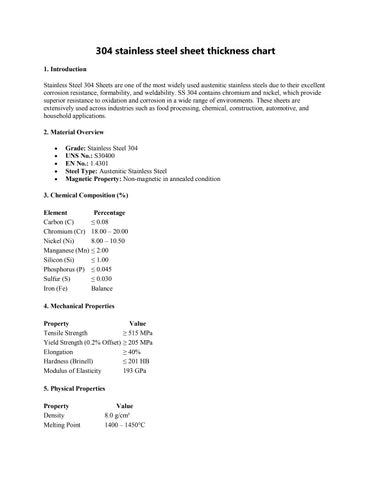
304 stainless steel sheet thickness chart
1. Introduction
Stainless Steel 304 Sheets are one of the most widely used austenitic stainless steels due to their excellent corrosion resistance, formability, and weldability. SS 304 contains chromium and nickel, which provide superior resistance to oxidation and corrosion in a wide range of environments. These sheets are extensively used across industries such as food processing, chemical, construction, automotive, and household applications.
2. Material Overview
Grade: Stainless Steel 304
UNS No.: S30400
EN No.: 1.4301
Steel Type: Austenitic Stainless Steel
Magnetic Property: Non-magnetic in annealed condition
3. Chemical Composition (%)
Element Percentage
Carbon (C) ≤ 0.08
Chromium (Cr) 18.00 – 20.00
Nickel (Ni) 8.00 – 10.50
Manganese (Mn) ≤ 2.00
Silicon (Si) ≤ 1.00
Phosphorus (P) ≤ 0.045
Sulfur (S) ≤ 0.030
Iron (Fe) Balance
4. Mechanical Properties
Property
Value
Tensile Strength ≥ 515 MPa
Yield Strength (0.2% Offset) ≥ 205 MPa
Elongation ≥ 40%
Hardness (Brinell) ≤ 201 HB
Modulus of Elasticity 193 GPa
5. Physical Properties
Property
Value
Density 8.0 g/cm³
Melting Point 1400 – 1450°C
Property Value
Thermal Conductivity 16.2 W/m·K
Electrical Resistivity 0.72 µΩ·m
Specific Heat 500 J/kg·K
6. Standards & Specifications
Stainless Steel 304 Sheets conform to the following international standards:
ASTM: ASTM A240 / A240M
ASME: SA 240
EN: EN 10088-2 (1.4301)
JIS: SUS 304
DIN: X5CrNi18-10
7. Surface Finish Options
Finish Description
2B Smooth, matte finish obtained by cold rolling
BA Bright annealed, mirror-like surface
No.1 Hot rolled, annealed, and pickled
No.4 Brushed finish
HL Hairline finish
Mirror Highly reflective polished surface
8.304 stainless steel sheet thickness chart
9. SS 304 Sheet Size Chart
10. Manufacturing Process
SS 304 sheets are manufactured using hot rolling or cold rolling processes, followed by annealing and pickling to enhance corrosion resistance and surface quality. Cold-rolled sheets offer better surface finish and dimensional accuracy.
11. Applications
Food & beverage processing equipment
Kitchen utensils & sinks
Chemical processing equipment
Heat exchangers
Architectural panels
Automotive trims
Storage tanks
Pharmaceutical equipment
12. Advantages of Stainless Steel 304 Sheets
Excellent corrosion resistance
High strength and durability
Easy fabrication and welding
Hygienic and easy to clean
Long service life
Cost-effective compared to higher alloy grades
13. Packaging & Supply Condition
PVC-coated or paper interleaving
Wooden pallets or seaworthy packing
Supplied in annealed condition
Mill test certificates available as per EN 10204 3.1
14. Conclusion
Stainless Steel 304 Sheets offer an ideal balance of strength, corrosion resistance, and versatility, making them suitable for a wide range of industrial and commercial applications. With multiple sizes, finishes, and global standards, SS 304 remains the most preferred stainless steel grade worldwide.