Stainless Steel 304 Plates: Sizes, Specs & Price Guide
What is Stainless Steel 304 Plate?
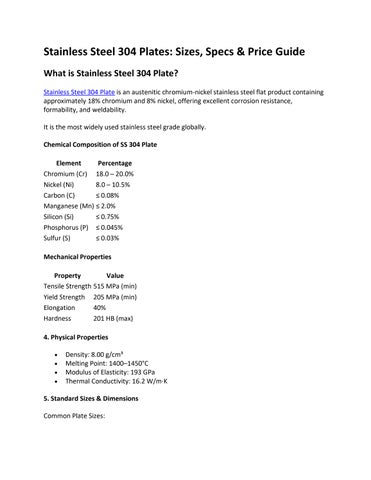
Stainless Steel 304 Plate is an austenitic chromium-nickel stainless steel flat product containing approximately 18% chromium and 8% nickel, offering excellent corrosion resistance, formability, and weldability.
It is the most widely used stainless steel grade globally.
Chemical Composition of SS 304 Plate
Element Percentage
Chromium (Cr) 18.0 – 20.0%
Nickel (Ni) 8.0 – 10.5%
Carbon (C) ≤ 0.08%
Manganese (Mn) ≤ 2.0%
Silicon (Si) ≤ 0.75%
Phosphorus (P) ≤ 0.045%
Sulfur (S) ≤ 0.03%
Mechanical Properties
Property Value
Tensile Strength 515 MPa (min)
Yield Strength 205 MPa (min)
Elongation 40%
Hardness 201 HB (max)
4. Physical Properties
Density: 8.00 g/cm³
Melting Point: 1400–1450°C
Modulus of Elasticity: 193 GPa
Thermal Conductivity: 16.2 W/m·K
5. Standard Sizes & Dimensions
Common Plate Sizes:
1000mm x 2000mm
1250mm x 2500mm
1500mm x 3000mm
2000mm x 6000mm
Thickness Range: 3mm to 100mm
Standards:
ASTM A240
EN 10088
ASME SA240
Stainless Steel 304 Plate Weight Chart
Weight Formula:
Weight (kg) = Length (m) × Width (m) × Thickness (mm) × 8.0
Example:
2m × 1m × 10mm = 2 × 1 × 10 × 8 = 160 kg
304 vs 316 Stainless Steel Plates Feature 304 316
Corrosion Resistance Excellent Superior (Marine)
Molybdenum No Yes (2–3%)
Cost Lower Higher
Best For General Use Marine/Chemical
Applications of Stainless Steel 304 Plates
Food Processing Equipment
Chemical Tanks
Heat Exchangers
Pressure Vessels
Structural Fabrication
Kitchen Equipment
Pharmaceutical Industry
Automotive Trim
Manufacturing Process
1. Melting in Electric Arc Furnace
2. Refining
3. Continuous Casting
4. Hot Rolling
5. Annealing
6. Pickling
7. Surface Finishing
Surface Finishes Available
No.1 (Hot Rolled)
2B (Cold Rolled)
No.4 (Brushed Finish)
BA (Bright Annealed)
Mirror Finish
Stainless Steel 304 Plate Price Factors
Prices depend on:
Nickel market rate
Thickness
Finish type
Quantity ordered
Location
Import/export duties
Typical price range (global average):
$2.5 – $4.5 per kg (subject to market fluctuation)
Buyer’s Checklist (Conversion Section)
Before purchasing:
✔Confirm ASTM A240 compliance
✔Check Mill Test Certificate (MTC)
✔Verify chemical composition
✔Confirm thickness tolerance
✔Ask for corrosion resistance certification
✔Compare 304 vs 304L if welding required
FAQs
Q1: What is Stainless Steel 304 Plate used for?
A: It is used in food processing, construction, chemical equipment, and general fabrication due to its corrosion resistance and strength.
Q2: Is 304 stainless steel rust-proof?
A: 304 is highly corrosion-resistant but not completely rust-proof in chloride-heavy environments.
Q3: What is the difference between 304 and 304L?
A: 304L has lower carbon content, making it better for welding applications.
Q4: What thickness is available in SS 304 plate?
A: Typically from 3mm up to 100mm.
Q5: What is the density of 304 stainless steel?
A: Approximately 8.0 g/cm³.
For More Details
Hindco Steel and Alloys
Phone: 9619035659
Email: info@hindco.co.in