
Tamarack
Other common names: Hackmatack, eastern larch,American larch,Alaska larch, juniper Scientific name: Larix laricina


The needles are flexible, tightly clumped and 2-5 cm long.They are green until autumn comes, which is when they turn bright yellow and then falls off.
Ecological Importance


Tamarack trees can reach up to 15-25 m tall and 9 m wide.


Young tamarack trees have grayish/reddish brown bark with irregular scales.Adult tamarack trees have grayer and more scaly bark with a red-purple inner layer.
- Provides material to build nests for birds
- White-throated sparrows and warblers live in the branches during the summer
- White porcupines eat inner bark
- Used for medical purposes (inner bark: infections and wounds outer bark: aches and pains)
- The saplings and seeds are consumed by birds, snowshoe hares and squirrels
- Used for building (house frames, railroads, fences, poles and pulpwood
- Needles creates teas
- Shelters bears, deer, and moose from the heat in summer
Indigenous perspective
- The tea created from the needles gives vitamin C, a prevention of scurvy for the Mi’kmaq people and settlers.
- Mi’kmaq people used theTamaracks’bark and wood to make canoes, paddles, drums, toboggans and snowshoes.
- Settles used the wood to build ships.
- Roots of tamarack are helpful to sew bark onto canoes.
- Comes fromAlgonquin name “wood used for snowshoes”


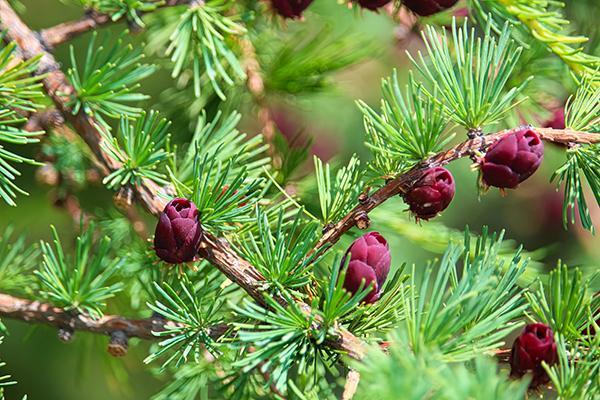
The young seed cones grow 5-10 mm long. They are either red, pink or yellow/green.Adult cones are 1-2 cm long and they are light brown.

References
(n.d.). Retrieved from https://www.for.gov.bc.ca/hfd/library/documents/treebook/tamarack.htm Farrar, J. L. (1995).Trees in Canada. Fitzhenry & Whiteside.
HSC Biodiversity Inventory Project. (n.d.). Retrieved from https://www.inaturalist.org/projects/hsc-biodiversity-inventory-project Home. (n.d.). Retrieved from https://spellbound.artshealthantigonish.org/tamarack/ Tamarack (Larix laricina). (n.d.). Retrieved from https://treecanada.ca/resources/trees-of-canada/tamarack-larix-laricina/ TamarackLarix laricina. (n.d.). Retrieved from https://www.ediblewildfood.com/tamarack.aspx