1/2
Sustainability “Our core value is sustainability. We must take care of our environment, so future generations can have the same opportunities as we have today. We farm salmon in harmony with nature, and we strive to ensure that all our activities are performed with minimum impact on the environment.” – Atli Gregersen, Owner & CEO
Preserving the Salmon’s Environment For decades, we have moved our salmon pens regularly to more exposed locations with stronger currents and higher waves. Today, we raise our salmon in the harshest weather conditions compared to other salmon farmers worldwide, with the strongest currents and the highest waves. This ensures optimal animal welfare, superior quality salmon and prevents seabed pollution. At Hiddenfjord, we regularly gather water quality and seabed measurements to ensure optimal farming conditions. To guarantee the quality of the seabed, the Faroese Environment Agency performs inspections of the seabed for every production cycle.
Our salmon are raised in the most exposed sites in the world Another vital part in protecting the salmon´s environment is the “all-in, all-out” strategy. Each production site is limited to only one generation of salmon. Between each generation, all equipment must be dismantled, thoroughly cleaned, and approved by the Food and Veterinary Agency. Thereafter, sites are required to lie fallow for a minimum of two months before a new generation can be raised in the area.
Salmon Should Swim, Not Fly
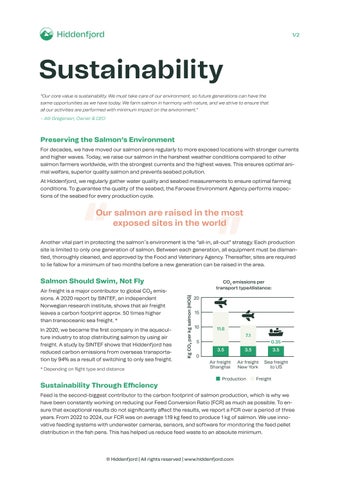
In 2020, we became the first company in the aquaculture industry to stop distributing salmon by using air freight. A study by SINTEF shows that Hiddenfjord has reduced carbon emissions from overseas transportation by 94% as a result of switching to only sea freight. * Depending on flight type and distance
Sustainability Through Efficiency
Kg CO₂ per kg salmon (HOG)
Air freight is a major contributor to global CO₂ emissions. A 2020 report by SINTEF, an independent Norwegian research institute, shows that air freight leaves a carbon footprint approx. 50 times higher than transoceanic sea freight. *
CO2 emissions per transport type/distance: 20 15 10
11.6 7.1
5 0
0.35 3.5
3.5
3.5
Air freight Shanghai
Air freight New York
Sea freight to US
Production
Freight
Feed is the second-biggest contributor to the carbon footprint of salmon production, which is why we have been constantly working on reducing our Feed Conversion Ratio (FCR) as much as possible. To ensure that exceptional results do not significantly affect the results, we report a FCR over a period of three years. From 2022 to 2024, our FCR was on average 1.19 kg feed to produce 1 kg of salmon. We use innovative feeding systems with underwater cameras, sensors, and software for monitoring the feed pellet distribution in the fish pens. This has helped us reduce feed waste to an absolute minimum.
© Hiddenfjord | All rights reserved | www.hiddenfjord.com