Subscribe to the digital version of Banking Business at heritagebanknw.com/ bankingbusiness. We'll email you a link to read the latest issue when it publishes and highlight a few of our favorite articles.
As we open the first issue of the year, I want to begin with a simple idea that continues to guide our work: strong businesses build strong communities—and strong partnerships make both possible.
Across Washington, Oregon and Idaho, we have the privilege of working alongside business owners who are navigating change, growth and complexity with resilience and creativity. Whether you’re a long-time customer, a prospective partner or a trusted advisor to the businesses we serve, this magazine is designed to offer insight, perspective and practical value as you plan for the year ahead.
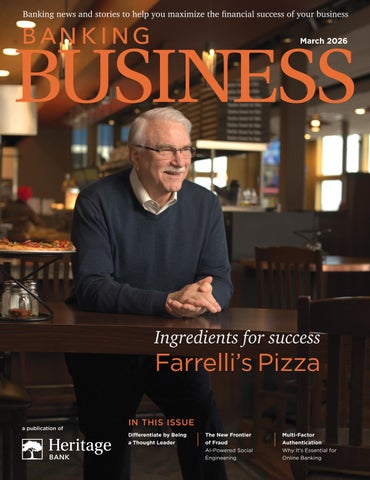
In this issue, you’ll meet Farrelli’s Pizza, a customer whose story reflects what we admire most in local businesses: commitment to quality, adaptability and deep community roots. Their growth is not just a business success story; it’s a reminder that when entrepreneurs are supported with the right financial tools and trusted advice, they can focus on serving customers and creating places people love.
Of course, today’s business environment brings challenges alongside opportunity. Cybersecurity remains one of the most pressing risks facing organizations of every size. In these pages, we explore why multi-factor authentication is no longer optional, but essential, and how AI-powered social engineering is raising the stakes even higher. These threats aren’t limited to large corporations or small businesses alone; they affect all of us. Our goal is to help you stay informed, prepared and confident in protecting your business and your customers.
We’re also taking a closer look at the wholesale industry, highlighting trends, pressures and opportunities shaping the sector today. Combined with insights on team building and leadership development, these stories reflect a broader truth: sustainable growth depends not only on capital and technology but on people.
As always, thank you for reading Banking Business and for choosing us as your banking partner.
Sincerely,
Bryan McDonald President and CEO
Bryan McDonald is president and chief executive officer at Heritage Bank. Bryan joined Heritage Bank in 2014 as executive vice president, chief lending officer. He has more than 20 years of managerial experience in sales, credit, operations, commercial banking and residential real estate. At Whidbey Island Bank, he served as president and chief executive officer from 2012-2014. He currently serves on the board of the Washington Bankers Association.
Building on legacy. Expanding possibility.
We’re excited to share that Heritage Bank and Kitsap Bank are coming together to build an even stronger future for our customers and communities. With shared values and a deep commitment to local service, this partnership allows us to expand opportunities while continuing to deliver the personalized care you know and trust. For more information, visit heritagebanknw.com/kitsapbank
Heritage Bank
ARTICLE BY JOHN STEARNS / PHOTOS COURTESY OF FARRELLI'S PIZZA
Good food and service are just part of the recipe
fueling success at Farrelli’s Pizza restaurants in the South Puget Sound region, according to the business’s co-founder.
Equally important is the connection with customers, what John Farrell calls the “invisible wires” that link staff to customers, and to one another, to create a warm, welcoming and nourishing environment.
The company, which opened its first restaurant in Lacey, Washington, in 1995, includes 12 Farrelli’s Pizza restaurants in the Washington communities of DuPont, Frederickson, Hawks Prairie, Lacey, Maple Valley, Parkland, Point Ruston, Silverdale, Sumner, Tacoma, Tumwater and Yelm, plus an additional location, McNamara’s Pub & Eatery, in DuPont that the company acquired in 2007. A 13th Farrelli’s is slated to open in Enumclaw, southeast of Tacoma, by about midyear. Farrell continues to look for South Sound growth opportunities, including through acquisitions.
“What we’ve tried to do is create this environment, this kind of family environment in our stores, so that our employees connect with each other, take care of each other,” said Farrell, who co-founded Farrelli’s with his late wife, Margaret, and daughter, Jacquelyn, who goes by Jacque. “When great things happen, they have someone to celebrate with. When sad things happen, they’ve got someone to share that with. And then hopefully that extends to our customers, where the connections that we have with them make them feel that they’re valued. We’re here to not only serve some great pizza, and some great pasta, and some great salads and great beverages, but also to just try and connect and make them feel that this is their home away from home.”
Also important is providing employees with growth opportunities.
Farrelli’s website notes: “The majority of our senior leadership team started as dishwashers in our original store. When we hire a new dishwasher or host, we view them as the next
“When I started focusing on not making money, but on becoming the best restaurant in the community that I was in...things became a lot more fun, we started being a lot more successful.”
manager of a store or a leader in our company. We are excited to open more stores in the future, to provide more job opportunities and nourish even more neighborhoods across the Pacific Northwest and beyond!”
Clayton Krueger, Farrelli’s chief marketing officer, is one of those company leaders who rose through the ranks, starting as a part-time dishwasher at the Lacey store in 1997. He was 16, in high school and referred to the job by a friend who also worked there. He held the job through high school, attended college out of state for a year, didn’t like the fit there, returned for community college locally and worked as a prep cook in Farrelli’s before heading to University of Washington Tacoma to finish his business administration degree with a concentration in marketing. He later saw Jacque at an event, they spoke, and she shared that the company needed marketing help to grow. He was invited to interview, offered a job and has served Farrelli’s for the last 19 years.
Krueger said he’s not the only person to climb the company ladder.
“There’s tons of examples of that in our company,” he said. “It’s one of the things that makes us truly special, and one of the things about it that kind of goes unsaid; it’s implied. That we have all known each other for a long time, and so it really does feel like a family. We’ve grown up together, we’ve grown this company together…so it’s a really special culture in that sense.”
Since his hiring, Krueger obtained his MBA at Washington State University to assist the company’s trajectory and has become a partner in the business.
Noting how the restaurant industry has split into different segments, he said Farrelli’s stands out as a people company, what he calls its “key point of leverage and key point of differentiation.”
Nearly 600 strong
The company has about 570 employees, 123 of whom are full-time, according to Farrell. The part-time count fluctuates with the season and includes students, mothers and others. Farrell, who’s been in the restaurant industry most of his 81 years and has no immediate retirement plans, founded
Farrelli’s after ownership stints in other eateries that included Hob Nob in Tacoma, Huckleberry Inn in Key Center, Engine House No. 9 in Tacoma with architect Robert “Dusty” Trail and John’s Restaurant in Lakewood and Gig Harbor.
“I’m still active and still having fun,” Farrell said.
He frequently praises Jacque for sharing his vision of growing the company while nourishing the neighborhoods it serves. Together, they share ownership of the business alongside several long-tenured, legacy employees, including Krueger and Mike Rutledge, the company’s chief procurement officer, both of whom are partners in Farrelli’s. Another longtime employee, Autumn Nesibu, is director of operations. She started as a cocktail waitress in the Sumner location and has risen in the company due to her passion for excellence and helping to grow general managers.
The family business also extends to the next generation, including Farrell’s granddaughter, Madison Soelling, who has worked in the family businesses since she was 10 years old. She serves as director of human resources, has earned Society for Human Resource Management certifications and is a partner. Her sisters also are actively involved: Emily Becker is events coordinator and JJ Gilbert is on the marketing team. Another granddaughter, Mary Catherine Bethune, is bartending in Sumner, while Farrell’s youngest granddaughter, Meg Lewis, works as a host at McNamara’s. Jacque is co-founder and CEO of the business. She was instrumental in creating the company’s culture, her father said, noting her love and care for her work team set the tone for what the business’s culture would become.
She began working with her father in the early 1980s, standing on a milk carton at the Huckleberry Inn in Key Peninsula to reach the counter and help, Farrell said. He calls her a natural in the business, noting she also graduated from the School of Hospitality Business Management at Washington State University, then earned a master’s degree.
“She has a heart as big as any heart I’ve ever known,” Farrell said, referring to himself as the numbers guy and Jacque as the person who translated their shared vision to our team members. Dozens of local and national awards over the decades validate Farrelli’s work.
Among Farrell’s four daughters, Jacque is the only one working full-time in the business. The others, Ann, Katie and Elizabeth, have all contributed over the years.
As the business continues on its growth trajectory, Farrell isn’t interested in expanding into Seattle or Eastern Washington, preferring to keep closer to existing operations. That includes growing through acquisition. He’s also exploring the idea of other restaurant concepts.
The Heritage relationship
Farrelli’s previously worked with a bank based out of state, where many business decisions were made, Farrell said.
“We found that Heritage, being a more local bank, was able to make decisions based not only on our business plans, but us as people—and that made a huge difference,” he said.
He, Jacque and Farrelli’s chief financial officer, Darin Johnson, approached Heritage in early 2021 to help with the purchase and remodel of a building in Yelm to house a new Farrelli’s after not receiving the service they expected from their previous bank, according to Brett Willis, senior vice president-commercial lender in Heritage’s downtown Tacoma office. Heritage responded quickly with a package they accepted and the relationship was born. It has grown to include more loans for new locations, moving Farrelli’s deposit relationship to Heritage’s Allenmore branch in Tacoma, and more loans are in the works for additional expansion, Willis said via email.
Farrell said Heritage did its due diligence on Farrelli’s, “but they also got to know us as people and got to know our
company and our goals, our visions, our standards, our values, and decided that we would be a good partner as well, so it’s kind of a win-win collaboration.”
Willis said several things make Farrelli’s successful, starting with father and daughter leading by example.
“John has been in the business for a long time but talks about the company with such enthusiasm to this day that it has obviously been a labor of love,” Willis said. “Jacque brings years of experience to the operations side of the business and her calm demeanor and sharp insight into dealing with people creates a warm and trusting environment for their employees.”
They care about their employees and treat them well, Willis said, noting not only advancement opportunities but retention rates exceeding industry standards.
Also key: “Their food is great!” Willis wrote.
Farrelli’s takes great pride in its pizza crust: flavorful and easily digestible, Farrell said. The dough is cold-aged for at least three days and hand-tossed to order. Farrelli’s also focuses on quality ingredients, including tomatoes for its sauces that go from field to can within about a half-day.
Added Willis, “Management is continually looking at and testing new menu items, new means of getting customers in the doors and offering great customer service.”
Farrelli’s also gives back to its communities and participates in local events, Willis said, calling it a testament to John’s and Jacque’s commitment to helping others.
Farrell said causes important to the business include the Boys & Girls Clubs. A personal cause he assists is St. Vincent de Paul.
“Working with John and Jacque and their team is an honor and fun,” Willis said, adding Heritage is fortunate to have them as customers.
Farrell considers Heritage a partner. When Willis asks for information, Farrelli’s is happy to provide it.
“As long as we stay financially responsible and financially healthy, they’re willing to help us grow,” he said. “I couldn’t ask for a better banking partner.”
Insights gained along the way
Farrell believes one thing that qualifies a business for a loan is its motivation for being in business.
As a young man, he thought he was in business to make money.
“Thank God, probably about halfway through my 40s, I figured out that this is not a reason for being in business,” Farrell said.
“When I started focusing on not making money, but on becoming the best restaurant in the community that I was in, the best employer, having the best-quality food, having spotlessly clean restrooms, having a dining room that was pleasant to sit in and then charging what I needed to charge to stay in business,
I realized other entrepreneurs needed to quit apologizing for trying to be the cheapest or undervalue what they’re doing,” he said. “If you focus on being the very best at what you do, taking care of your customers, taking care of your employees and then charge what you need to charge to stay in business; you’re not in business to make money, you’re in business to provide a service. Once I made that leap, things became a lot more fun and we started being a lot more successful.”
Added Farrell, “I think that’s probably the biggest lesson I could tell anyone. If you’re in business to make money, you’re probably going to ultimately fail. But if you’re in business to provide a service that exceeds—or at least equals any other service for the business that you’re in—you’re probably going to be successful.”
He’s proud the company has grown to where it is today.
“People ask me, ‘John, what’s your end game?’” Farrell said. “My end game is to (let’s say if we do come back, if that is a thing that actually happens) I don’t want to come back to a family that isn’t in the restaurant business. So, my overall goal is to leave this company ready to continue to grow in a very slow and controlled manner as we have done so that my children, grandchildren and great-grandchildren hopefully have a company that they can nurture and love the way I have.”
BANKER:
BRETT WILLIS
Brett has been with Heritage Bank since 2016 and in banking for over 30 years. He has broad experience in commercial lending and business banking, with a focus on commercial and industrial (C&I) industries, commercial real estate, contractors, manufacturers, healthcare, nonprofits and distributors.
Why Multi-Factor Authentication Is Essential for Business Online Banking
As businesses continue to rely on online banking to manage cash flow, pay vendors and monitor accounts in real time, the importance of strong cybersecurity measures has never been greater. Cybercriminals are increasingly targeting business banking platforms, recognizing that a single compromised login can provide access to significant funds and sensitive financial information. One of the most effective defenses against these threats is multifactor authentication (MFA).
MFA adds an extra layer of security beyond a traditional username and password. Instead of relying on something a user knows (a password), MFA requires at least one additional factor: something the user has (such as a mobile device or security token) or something the user is (such as a fingerprint or facial recognition). This layered approach dramatically reduces the likelihood of unauthorized access, even if login credentials are stolen or compromised.
For businesses, passwords alone are no longer sufficient. Especially because in many cases, employees reuse passwords across multiple platforms. Phishing emails, malware,
CONTRIBUTOR: DANA GARDNER
Dana has worked with commercial and nonprofit banking clients for over 20 years. As a true relationship banker, she gets to know the holistic you—from your personal life to professional background to what your goals are (financial or not).
data breaches and credential-stuffing attacks make it relatively easy for bad actors to obtain usernames and passwords. Fraudsters are even using phishing kits sold on the dark web that use scripted bots to target customers. They can impersonate bank personnel and trick customers to enter their credentials into a spoofed website.
The financial impact of a compromised business banking account can be severe. Unauthorized wire transfers, ACH fraud and account takeovers can result in significant monetary losses, operational disruptions and strained customer or vendor relationships. While banks have robust security systems in place, businesses also play a critical role in protecting their accounts. Implementing and consistently using MFA is one of the most important steps a business can take to reduce fraud risk.
Beyond fraud prevention, MFA also helps protect sensitive business data. Online banking platforms often contain payroll information, tax documents, transaction histories and other confidential records. A breach of this information can expose a business to regulatory issues, reputational damage and potential legal liability. By requiring multiple forms of
<< REAL-LIFE SCENARIO >>
Heritage Bank’s business online banking, Heritage Direct, uses one-time passcodes and tokens as an extra layer of protection. Each is required to complete certain tasks (logging in, sending wires/ ACH, etc.), and they are both required when there’s a suspected suspicious login (new browser, new IP address or new device).
verification, MFA helps ensure that only authorized users can access this data.
MFA does not have to be complicated or disruptive. Modern authentication methods—such as one-time passcodes sent via secure apps, push notifications or biometric verification—are designed to be quick and user-friendly. When implemented properly, MFA adds minimal time to the login process while providing substantial security benefits.
In today’s digital banking environment, cyber threats are not a matter of “if” but “when.” MFA is no longer a niceto-have feature. It’s a critical safeguard for businesses of all sizes.
This is a story about a real-life fraud attempt at Heritage Bank.
A customer received a phone call from a number spoofing Heritage Bank’s main telephone number (800-455-6126). The caller identified himself as someone from the Fraud Department and informed the customer there was suspicious activity on their business banking account. During the call, the fraudster requested the customer’s online banking credentials. Believing the request to be legitimate, the customer provided the information. As a result, a $98,000 unauthorized wire transfer was initiated. Thankfully, the customer became apprehensive and ended the call. They called Heritage Bank directly, and the wire transfer was rejected.
2025 Community Impact in Action
In 2025, we proudly invested $1.18 million back into the communities we serve, supporting organizations that strengthen the foundation of a thriving local economy. Our giving focused on affordable housing, economic development, environmental sustainability and financial literacy—areas that create lasting, meaningful impact for individuals, families and businesses. Through these partnerships, we’re helping expand access to safe housing, fuel job creation and small business growth, protect the places we call home and empower people with the financial knowledge they need to build a more secure future.
Learn more about our commitment at heritagebanknw.com/community.
Free Virtual Informational Events and Workshops
The SBA and its resource partners host in-person, hybrid and online training, information sessions and workshops across the country, covering a wide variety of business-related topics. Upcoming hybrid and virtual events hosted by the SBA and resource partners include:
• Disaster preparedness
• Virtual drop-in business coaching
• Tax and bookkeeping coaching
• Woman Owned Small Business (WOSB) certification program
• Understanding SBA loan programs
• Federal contracting basics
• Energy management and sustainability
• Health insurance for small businesses and startups
• Writing a business plan
• Digital marketing
Visit sba.gov/events to search by keyword, event type, date and location.
SBA Inspector General and USDA Inspector General Sign Data Sharing Agreement to Strengthen Fraud Detection and Enforcement Coordination
Published by the SBA Office of Inspector General, February 24, 2026
LOS ANGELES, CALIFORNIA – Inspector General William W. Kirk of the U.S. Small Business Administration Office of Inspector General (SBA OIG) and Inspector General John Walk of the U.S. Department of Agriculture (USDA OIG) announced the execution of a data sharing agreement to strengthen coordination and accelerate efforts to detect, refer, and support investigations into fraud impacting federal programs.
The agreement follows a meeting in Los Angeles with the First Assistant U.S. Attorney for the U.S. Attorney’s Office, Central District of California, focused on strengthening interagency collaboration and aligning oversight and law enforcement efforts to protect taxpayer dollars.
This partnership advances a shared commitment to improving information flow, identifying risk faster, and supporting investigative and prosecutorial work through more timely access to relevant data and analytics.
“Fraud schemes move quickly, and our oversight approach has to move faster,” said Inspector General Kirk. “This agreement strengthens our ability to share information, identify fraud indicators earlier, and support the law enforcement partners who are holding bad actors accountable. We are committed to protecting the integrity of SBA programs and safeguarding taxpayer funds.”
“Fraud in Government programs calls for enhanced approaches built on partnerships and modern law enforcement techniques,” said Inspector General Walk. “This agreement will enhance our ability to leverage data, analytics, and technology to support USDA OIG’s efforts to target resources and to identify potential leads for investigations and address programmatic and operational weaknesses. Through this partnership, we can better share information to better prevent fraud and hold wrongdoers accountable, in order to protect hard working taxpayers.”
SBA OIG and USDA OIG will continue to prioritize coordinated oversight efforts with inspectors general, prosecutors, and law enforcement partners, including through data driven analytics and information sharing initiatives designed to prevent, detect, and deter fraud.
Vecteezy
Optimizing Veteran and Military Spouse Success
Published by the U.S. Small Business Administration (SBA), February 19, 2026
For veterans and military spouses, entrepreneurship provides a powerful pathway to continue serving—by turning military-honed skills, such as leadership, adaptability and resilience, into small business ownership. Sometimes, navigating the transition from military life to business ownership comes with unique challenges. That’s where SBA resource partners make a big difference.
Through SBA grants, the following veteran entrepreneurial training programs help mentor and educate business owners at each stage of their businesses. Most programs are offered at no cost; however, some require veterans and military spouses to fund their own travel and fees.
Explore the following SBA-backed Entrepreneurship Training Programs that offer training and resources to veteran entrepreneurs (sba.gov/business-guide/grow-your-business/ veteran-owned-businesses#training-programs).
Entrepreneurship Bootcamp for Veterans (EBV), St. Joseph’s University
Provides immersive training followed by a year of continued mentoring to support business growth.
National Veterans Entrepreneurship Program (VEP), Oklahoma State University
Combines intensive instruction with ongoing mentorship to help veterans strengthen their business strategy and execution.
Veteran Institute for Procurement (VIP)
Delivers no-cost training and mentorship focused on helping veteran-owned businesses compete for and manage federal contracts.
Veteran Entrepreneurial Training and Resource Network (VETRN)
Offers structured business education and mentorship designed for veteran entrepreneurs to grow and scale their companies.
Why SBA training matters
Warrior Rising
Connects veterans to coaching, education and mentorship to turn business ideas into actionable plans.
The SBA also offers Women Veteran Entrepreneurship Training Programs that provide education, connections and opportunities for women veterans and military spouses to cultivate mentorships. These programs are:
D’Aniello Institute for Veterans and Military Families (IVMF), Veteran Women Igniting the Spirit of Entrepreneurship (V-WISE)
Includes a virtual business fundamentals course followed by a conference to empower women veterans and military spouses to grow their business ideas or new companies.
Our Native American Business Entrepreneurship Network (ONABEN)
Offers mentorship and hosts events and a conference to help entrepreneurs thrive.
Utah Veteran Business Resource Center, Startup Training Resources to Inspire Veteran Entrepreneurship (STRIVE)
The STRIVE program offers veteran and military-connected entrepreneurs the opportunity to take an early-stage business idea through a rigorous six-week training program.
Connect with one of these programs today and take the next step toward realizing your entrepreneurial vision.
Visit sba.gov/veterans and follow the SBA Office of Veterans Business Development on LinkedIn, X, and Facebook.
Lacy Hardman, a STRIVE Entrepreneurship Training Program participant, remarked, “I finished the class with a clear plan and a team of advisors I can trust to turn to for help as I implement my plan.” Just like Hardman did, you can receive tailored training, guidance and encouragement to develop your business. These training programs provide the tools for you to avoid costly missteps, sharpen your strategy and confidently pursue growth.
Change Your Business Model
If technology or consumer behavior has changed the way your customers buy or consume, you may need to change the way you sell.
Review trends
Start by understanding your current business model, key value proposition, customer segments, revenue streams, core competencies and cost structures. Then dedicate time to researching and discovering new trends.
• Keep current with advancements in your industry by attending events, webinars and conferences.
• Connect with other business owners to learn how they’re solving issues and staying ahead of the technology curve.
• Search app stores for apps that might be relevant to your company to see what technology is being used in your industry.
Then see if you can:
• Leverage technology, such as software for customer relationship management, supply chain and data analytics, to make better decisions.
• Invest in more efficient equipment. Conduct a cost/value analysis to calculate the long-term savings available from upgrading. Improving your capital equipment may unlock opportunities for larger contracts.
• Explore partnerships to share resources, expand networks and increase productivity through collaborative efforts.
• Take advantage of new trends, such as the use of AI for robotics.
Regularly evaluate the effectiveness of your business model and make data-driven adjustments to enhance profit.
Deepen the distribution channel
If you sell through a particular channel, for example, you wholesale to retailers or charge by the hour, there may be opportunities to expand how and what you sell.
For example:
• Sell software or services on a subscription model.
• Post products at online marketplaces (like Amazon), reaching new audiences efficiently and at a low cost.
• A retailer could start importing products and sell to other retailers.
• Manufacturers could sell through the wholesaling distribution channel or open a direct-to-consumer channel.
Identify all the ways a customer can buy what you sell, then decide if you can expand into those spaces.
Identify new ways of selling
Consumers and businesses are increasingly moving their lives and operations online. This, combined with the ease and low cost of technology, has led to innovative business models like:
• Drop shipping, where you sell someone else’s products without buying or holding the stock. With an absence of intermediaries, you can have thousands of products for sale and never have to touch them.
• On-demand business models (like Uber) who charge customers for a product or service only when they need it.
• Partner business models (like Airbnb) where the business relies on the sharing, reusing, or rotating resources between individuals or other companies.
• Digital content models where you give away information or services with the goal of converting free users into paying customers or picking up advertising revenue.
When to change
See if and how your competitors or similar businesses in other countries are shifting their processes. It may be a sign you must adapt your business model.
Before you make the shift, test first. Then, start implementing your business strategy slowly to amend your cost structure and revenue streams before relying on a brand new model to drive your business forward.
Tap into your ecosystem
Leverage your network to help you sell more. Your suppliers, resellers, contractors, government partners (local, state and federal) and employees all have a direct interest in you staying in business. Reach out to everyone in your own unique ‘ecosystem’ to find new ways to sell.
Smart Equipment. Smarter Financing.
Quality gear is an investment. Your financing should be, too.
You shouldn’t have to choose between protecting cash flow and getting the equipment your business needs to grow. Our limited-time equipment financing promotion pairs competitive rates and flexible terms with today’s updated tax rules—helping you put better financing and potentially better tax outcomes to work for your business. Before you sign with a vendor, talk with us. When you look at the full picture, you may find the numbers—and the long-term value—are hard to beat.
• Up to 100% financing on new equipment, including tax and licensing
• Flexible draw-down lines of credit so you access funds when you need them
• Fixed-rate terms up to 7 years for predictable payments
• Local decision-making with fast, responsive service
• Current federal tax provisions may allow you to maximize deductions and improve your overall tax position
For more information, please contact your relationship manager or visit heritagebanknw.com to find a commercial banker near you.
Subject to credit approval. Financing maximums and terms are determined by borrower qualifications and use of funds. Heritage Bank and its representatives do not provide tax advice. Consult an advisor regarding a particular financial situation. Credit products are offered by Heritage Bank. This advertisement is intended to provide a summary. Final executed loan documents should be relied on for complete and final terms. Heritage Bank makes no representation or warranty regarding your ability to qualify for any tax credits, refunds, rebates, benefits or programs. Talk with your accounting professional regarding your individual situation.
STARTING A NONPROFIT ORGANIZATION
This is the second in a two-part series of articles on starting a nonprofit organization. Look for steps 1 through 5 in the October 2025 issue of Banking Business.
Starting a nonprofit organization is a meaningful and exciting endeavor, but it can be challenging to navigate the legal, structural and operational requirements involved. A nonprofit organization plays a vital role in addressing community needs and fostering positive change, and setting one up involves a structured approach to ensure long-term success.
UNDERSTANDING NONPROFITS
A nonprofit organization is a corporate entity established to serve a public benefit, without any private ownership or shareholders. Unlike for-profit businesses, nonprofits operate solely to advance their mission rather than generate income for founders or organizers. Many nonprofits pursue tax-exempt status with the IRS, allowing them to receive tax-deductible donations and avoid federal corporate income tax. There are various types of tax-exempt organizations, with the 501(c)(3) classification being one of the most common. To explore the requirements and benefits of different tax-exempt categories, refer to the IRS resources on exemption requirements for 501(c)(3) and other tax-exempt organizations.
This checklist will guide you through the essential steps, from defining your mission to securing funding and establishing effective operations. By following these guidelines, you’ll lay a solid foundation for your nonprofit to make a lasting impact.
6. Legally incorporate your nonprofit Incorporation is a critical step in formalizing your nonprofit and gaining tax-exempt status.
• Submit incorporation documents to your secretary of state, including details like your organization’s name, purpose and a registered agent (a designated person or company who will receive legal documents on behalf of your nonprofit). You can find your state association and advice on incorporation on the National Council for Nonprofits website.
• Apply for an Employer Identification Number (EIN), which is your organization’s federal tax ID, issued by the IRS. This number is essential for tax purposes and required for setting up bank accounts and hiring employees. You can apply for an EIN via the IRS website.
• Your bylaws are essential governing documents that outline your board structure, voting procedures and key policies. They should address officer roles, meeting frequency, quorum and conflict-of-interest policies.
• Apply for tax exemptions with the IRS, depending on your organization’s projected budget and size. Tax exemptions relieve your organization from paying federal income taxes, and some states offer additional exemptions. Visit
the IRS website to file Form 1023 or Form 1023-EZ.
• Before soliciting donations, you may need to register with your state’s charity program, if it has one. They might also have resources like a nonprofit handbook which you should become familiar with.
Legally incorporating your nonprofit is essential to operate officially, qualify for tax exemptions and gain credibility.
7. Secure start-up funding
Raising initial funds is essential to launching your nonprofit and achieving your goals.
• Research grants specifically for nonprofit startups and consider reaching out to state-based foundations. Your state’s department of commerce and local community foundations may offer grants, particularly for organizations addressing state-specific needs.
• Build relationships with businesses, community leaders and other organizations. These partnerships can provide financial support, resources or in-kind donations and create opportunities for collaborative events or initiatives.
• Platforms like GoFundMe and Kickstarter can help you raise funds while building public awareness
When you lock in start-up funding, you kick-start your nonprofit’s impact. Pursue grants and build local partnerships to provide the financial stability and resources needed to bring your mission to life and foster long-term growth.
8. Begin early operations
Once you’ve completed the legal and structural steps, it’s time to initiate your organization’s day-to-day operations.
• Schedule consistent meetings to keep your board informed and involved in decisions. Regular meetings also ensure accountability and allow you to address challenges collaboratively.
• Hire an executive director to manage daily operations, oversee programs and act as a liaison between staff and the board. You can also start recruiting volunteers to support your mission, particularly for events and community engagement.
• Depending on your nonprofit’s needs, an office can serve as a central hub for operations, meetings and planning.
• An effective website helps communicate your mission, share updates and attract donations. Include essential information, such as your mission statement, program details and a donation button.
• Social media is a cost-effective way to share your story,
connect with supporters and promote events. Develop a content plan to maintain a consistent online presence and encourage engagement with your audience.
Getting your nonprofit started is how to build momentum. It's important to begin making an immediate impact while building a foundation for long-term success.
9. Build a strong volunteer program
Volunteers can be instrumental in supporting your mission, especially in the early stages. Outline specific volunteer roles that align with your nonprofit’s needs. This will make it easier to recruit, train and retain volunteers.
• Reach out to local community centers, colleges and social media networks to attract dedicated individuals. Networking with similar organizations can also provide access to potential volunteers.
• Volunteers are more effective when they understand their roles and your organization’s goals. Provide training to help them feel valued and well-prepared.
• When you build a strong volunteer program, you're making sure that you have the support needed to drive your mission forward.
10. Implement online donation options
• Setting up convenient donation channels allows your supporters to contribute easily.
• Make it easy for website visitors to donate by adding a clear and accessible button. Many platforms provide customizable donation buttons for nonprofits.
• Offer options for weekly, monthly or annual recurring donations. Recurring donors provide a steady revenue stream and may be open to increasing their support over time.
• Design individual donation pages for specific campaigns or events. Tailor the messaging and visuals to align with each campaign, making the page more relevant and compelling for potential donors.
Starting a nonprofit is a rewarding journey that requires strategic planning and dedication. By following these steps, you’ll be well-prepared to establish a legally compliant and mission-driven organization that can effectively serve your community. Each step, from defining your mission and building your board to securing funding and recruiting volunteers, brings you closer to making a tangible impact. Once your nonprofit is operational, remember that ongoing evaluation, engagement and adaptability will ensure that your organization continues to thrive and fulfill its purpose for years to come.
Turning Opportunity into Growth
Seven SSBCI Loans Closed Across Washington
Through the Washington State Small Business Credit Initiative (SSBCI), Heritage Bank recently closed seven new loans designed to help local businesses grow, expand and invest in their futures. These loans reflect our continued commitment to supporting small businesses across Washington by increasing access to capital and creating opportunities for long-term economic growth in the communities we serve.
1. $1.34 million building purchase for a construction company in Clark County Access to the SSBCI loan program helped retain three jobs and create three new jobs.
2. $375,000 building purchase for a new medical facility in Skagit County. Access to the SSBCI loan program helped retain five jobs and create one new job.
3. $2 million building purchase for a construction company in Whatcom County. Access to the SSBCI loan program helped retain eight jobs and create four new jobs.
4. $640,000 building purchase for a new industrial warehouse in Skagit County Access to the SSBCI loan program helped retain six jobs.
5. $593,000 building purchase for a new theater in Island County. Access to the SSBCI loan program helped retain seven jobs and create two new jobs.
6. $10 million building purchase for a new K-12 school in Clark County. Access to the SSBCI loan program helped retain 165 jobs and create eight new jobs.
7. $3 million new commercial building construction for a food bank in Kitsap County. Access to the SSBCI loan program helped retain 10 jobs.
If you or someone you know is ready to get started or has questions about eligibility, contact your relationship manager or visit our website at heritagebanknw.com/ssbci For more information about the program, visit bit.ly/wa-small-biz-loans. This program is exclusive to businesses and nonprofit organizations located in Washington state. Through the SSBCI program and the Heritage Bank Community Development Entity (HBCDE), we’re using a combination of our own capital and SSBCI funds to make owner-occupied commercial real estate loans to qualified businesses. We intend for these loans to fuel economic growth and create jobs. Priority for program funds will be given to businesses located in a CDFI-eligible census tract and which retain and grow jobs in those communities.
Vecteezy
Do Your Kids Know the Value of a Silver Spoon?
You taught them how to read and how to ride a bike, but have you taught your children how to manage money?
The average debt for student borrowers is $38,375, and 10.3% of new graduates will default within the first three years of repayment.1
For current college kids, it may be too late to avoid learning about debt the hard way. But if you still have children at home, save them (and yourself) some heartache by teaching them the basics of smart money management.
Have the conversation. Many everyday transactions can lead to discussions about money. At the grocery store, talk with your kids about comparing prices and staying within a budget. At the bank, teach them that the automated teller machine doesn’t just give you money for the asking. Show your kids a credit card statement to help them understand how “swiping the card” actually takes money out of your pocket.
Let them live it. An allowance program, where payments are tied to chores or household responsibilities, can help teach children the relationship between work and money. Your program might even include incentives or bonuses for exceptional work. Aside from allowances, you could create a budget for clothing or other items you provide. Let your kids decide how and when to spend the allotted money. This may help them learn to balance their wants and needs at a young age when the stakes are not too high.
Teach kids about saving, investing, and even retirement planning. To encourage teenagers to save, you might offer a match program, say 25 cents for every dollar they put in a savings account. Once they have saved $1,000, consider helping them open a custodial investment account, then teach them how to research performance and ratings online. You might even think about opening an individual retirement account (IRA). Some parents offer to fund an IRA for their children as long as their children are earning a paycheck.2
As you teach your children about money, don’t get discouraged if they don’t take your advice. Mistakes made at this stage in life can leave a lasting impression. Also, resist the temptation to bail them out. We all learn better when we reap the natural consequences of our actions. Your children probably won’t be stellar money managers at first, but what they learn now could pay them back later in life—when it really matters.
Heritage Wealth Strategies is a marketing name of Cetera Investment Services. Securities and insurance products are offered through Cetera Investment Services LLC (doing insurance business in CA as CFG STC Insurance Agency LLC), member FINRA/SIPC. Advisory services are offered through Cetera Investment Advisers LLC. Neither firm is affiliated with the financial institution where investment services are offered. Investments are: *Not FDIC/NCUSIF insured *May lose value *Not financial institution guaranteed *Not a deposit *Not insured by any federal government agency. 1000 SW Broadway, Suite 2170, Portland, OR 97205, (888) 360-0052.
The content is developed from sources believed to be providing accurate information. The information in this material is not intended as tax or legal advice. It may not be used for the purpose of avoiding any federal tax penalties. Please consult legal or tax professionals for specific information regarding your individual situation. This material was developed and produced by FMG Suite to provide information on a topic that may be of interest. FMG Suite is not affiliated with the named brokerdealer, state- or SEC-registered investment advisory firm. The opinions expressed and material provided are for general information, and should not be considered a solicitation for the purchase or sale of any security. Copyright 2026 FMG Suite.
WHOLESALE
Due to global supply chain disruptions linked to the pandemic and changes in consumer buying habits, the wholesale industry has undergone rapid transformation in recent years.
Although the pandemic restrained some growth due to supply chain disruptions and trade restrictions, the wholesale market is expected to rebound as businesses adjust their processes to address some of those issues. From 2020 to 2021, the U.S. wholesale industry increased more than 20%, according to the Annual Wholesale Trade Survey, conducted by the U.S. Census Bureau.
While the past few years have been tumultuous, the global economy is anticipated to rebound and wholesalers that adapt to market and technological changes can thrive. Creating differentiating points between their competition— including manufacturers who ship direct to consumers—can help wholesalers survive. Embracing technological change, enabling transparency and being flexible will also help wholesalers remain successful.
Success characteristics
Wholesaler success criteria vary depending on the particular wholesaler’s industry, size and specific business model. A major factor in success is the ability to continuously reassess and adjust their model to ever-changing market conditions.
Other success criteria include:
• Strong supplier relationships, which are critical to ensuring a consistent supply of goods.
• Efficient logistics and distribution, including having a good transportation network, warehousing facilities and distribution systems.
• Solid customer service, such as handling orders efficiently, being responsive to customer needs and resolving issues promptly.
• Flexibility in adapting to constantly evolving business environments, whether those revolve around market demand, new technology or supply chain disruptions.
• Market knowledge, which enables wholesalers to forecast and anticipate demand and adjust their products as needed.
• Product diversification helps wholesalers attract a wider range of customers and reduces their dependency on any one supplier or product, making them less susceptible to changes in the market.
• Quality assurance builds trust with customers and reduces the risk of products being returned or customers filing complaints.
• Sustainability initiatives can improve a wholesaler’s reputation and attract consumers who are socially conscious.
• Exclusive distribution rights provide a competitive advantage.
Challenges
A key challenge in recent years has been issues with the supply chain. Global trade has allowed businesses to be more interconnected, but this also means that disruptions in one country can affect supply chains on the other side of the world. Wholesalers must manage these risks to ensure they have a steady supply of products to offer their customers. Other challenges include:
• Meeting customer demand as expectations change quickly and retailers demand faster delivery, higher quality products and more ethical and sustainable practices. Wholesalers must meet these demands and prove they are doing so to keep their customers happy.
• Managing inventory at optimal levels. Too much inventory results in high storage costs and increases the risk of products expiring before they can be sold. Too little inventory can result in shipping delays and lost sales.
• Pricing pressure resulting from customers comparing prices and pressuring wholesalers to offer lower prices, which can undermine profitability and sustainability.
• Regulations, especially for wholesalers with international clients. Laws, safety standards, environmental regulations and import/export rules vary by country and even by state. Wholesalers must take steps to ensure they remain compliant.
• Competition from other wholesalers and from manufacturers who sell directly to retailers or consumers. This competition puts pressure on prices and profit margins.
• Digital transformation is also affecting wholesalers, who must keep up with changes in technology to sell online, manage their inventory, forecast sales and manage customer relationships.
Resources
The National Association of Wholesaler-Distributors www.naw.org
Federal Trade Commission Bureau of Consumer Protection www.ftc.gov/about-ftc/bureaus-offices/bureauconsumer-protection
U.S. Department of Commerce www.commerce.gov
U.S. Small Business Administration www.sba.gov
Wholesale trends
Customers are shifting their behavior to online shopping and no longer distinguish between online and offline shopping. Private labels are growing and more artificial intelligence is being integrated into the purchasing experience. This includes the development of a C2M (customer to manufacturing) business model, where companies use big data and artificial intelligence (AI) insight to personalize the products for the individual consumer.
Increased demands for personalized service
Retailers are the customers of wholesalers, and they increasingly expect wholesalers to provide a more personalized, tailored experience. This includes customized product selections, more flexible pricing and even highly specific delivery options. Wholesalers must adjust to these expectations to keep their retail customers happy.
Industry Profile: Wholesale, continued on page 21
Resources for America’s Small Businesswomen
In 2022, women-owned businesses had an estimated $2.1 trillion in receipts, 11.4 million employees, and $508.5 billion in annual payroll. 2023 Annual Business Survey (ABS), US Census
It is difficult to overstate the impact that women entrepreneurs have had on the U.S. economy during the last 50 years. In 1972, there were a little over 400,000 women-owned businesses across the country. As of today, that number exceeds 13 million. How we got to this milestone should come as no surprise. Women entrepreneurs are resilient, creative, and opportunistic—qualities they have used to leave their mark on every industry from health care and social assistance to retail trade.
Just look at the data: A monthly average of 440,000 new business applications were filed between 2021 and 2023. That’s a 45% increase over the prior four years combined, and women, along with Latinos and Black Americans, were major drivers of that growth.
Through its Office of Women’s Business Ownership (OWBO), the SBA endeavors to create more success stories by helping women entrepreneurs reach their full potential.
Online resources: The SBA’s free online courses at learning.sba.gov help small businesses level up with a course for every stage of business growth. The platform offers informative videos, discussion guides and self-assessments to support women entrepreneurs through their business journey. You can also find tools and training options on our resource partners’ websites, including SCORE (score.org/women-entrepreneurs).
Mentorship: Every small business owner needs someone in their corner. Through SBA resource partners, women entrepreneurs can find expert guidance to help
Reprinted with permission from the U.S. Small Business Administration (SBA)
navigate the ins and outs of small business ownership. There are nearly 150 Women’s Business Centers (WBCs) across the country, each of them offering no- or low-cost counseling, mentoring, training and business development resources. Other SBA resource partners are also at your disposal, including nearly 1,000 Small Business Development Centers, 200 local chapters of SCORE business mentors, and more than two dozen Veterans Business Outreach Centers. Whether you need general advising or technical assistance, visit sba.gov/localassistance/resource-partners to find resources near you.
Funding: The SBA makes accessing capital simple. Lending to womenowned small businesses has increased 70% since 2020, with total loan dollars exceeding $5 billion in 2023 alone. SBA loan programs, including 7(a) and 504, provide long-term financing and make it easier for small businesses to get the funding they need by reducing lender risk. The SBA also streamlines access to other financial tools, such as investment capital and disaster assistance. Learn more at sba.gov/ funding-programs
Contracting: 5% of all federal contracting work is reserved for women-owned businesses. Becoming a certified business allows you to compete for those set-aside contracts. Learn more about eligibility requirements, and become certified under the Women-Owned Small Business Federal Contract program at sba.gov/federal-contracting/ contracting-assistance-programs
The growth of women-owned businesses shows no signs of slowing, and the SBA is here for it. Visit sba.gov/events to find an event for women-owned businesses and visit sba.gov/women to learn more about how the SBA is helping women entrepreneurs break into the marketplace—and stay there.
Industry Profile: Wholesale, continued from page 19
Impact of direct-to-consumer sales
Some manufacturers are choosing to bypass wholesalers and sell directly to the consumer. This increases competition for wholesalers and puts pressure on their pricing. Direct-to-consumer sales are expected to increase, thanks to drop shipping platforms and eCommerce websites. Wholesalers may need to consider offering value-added services for their customers to create points of difference between them and manufacturers.
Rise of online behavior
One of the most obvious impacts is the ability for consumers to research product features and buy online. Such changes in consumer behavior affect retailers, which has an impact on wholesalers. Wholesalers may have to adapt to changes in the retail landscape by offering new distribution channels or expanding their product line.
Sensitivity to wider economic conditions
Wholesale is affected by retail, which is one of the more sensitive industry sectors. Sales are driven by consumer sentiment, interest rates, employment levels and disposable income. Often retail is the first sector to feel an immediate effect of concern, from a falling U.S. dollar (retail imported products are more expensive) to lower-than-expected agricultural prices to general unease over the decision to spend or save disposable income.
Technology is a key driver
Technological advancements impact the wholesale industry at all levels. These advancements include the use of artificial intelligence, software for managing customer relationships and supply chain technology that allows wholesalers visibility into all aspects of their supply chain.
Other technology trends:
• Wholesalers are increasingly using online platforms to sell their goods, which enables them to expand their customer reach
• Mobile technology improves the customer experience by making it easier for customers to find products and place orders
• Data analytics can be used to make informed decisions about adjusting to market trends, predicting demand and optimizing product selection
Wholesalers
can provide transparency into the process
Wholesalers can help their customers by using technology to provide easier ordering and full transparency in the process. For example, they can have their customers integrate software that automatically enables ordering when product levels drop to a certain number. They can also provide software that allows customers to track the entire shipment from their mobile device, so they know exactly when their order will be delivered. Software can also be used to enhance communication with customers, further optimizing the relationship.
CONTRIBUTOR: BRANDON SANDERS
With 18 years of banking experience, Brandon brings a wealth of knowledge and dedication to serving business clients. Since 2013, he’s focused on business banking, with the past seven years dedicated specifically to commercial lending. Passionate about supporting entrepreneurs, Brandon specializes in commercial real estate lending, business acquisitions and equipment finance.
Differentiate By Being a Thought Leader
For some businesses it’s getting tougher and tougher to differentiate from the competition. You need to prove you’re better than other businesses selling the same thing. Positioning yourself as a thought leader is an effective way to set yourself apart.
Becoming a thought leader means that you develop a deeper knowledge of a specific subject or topic than your competitors. By cultivating this expertise, you can gain a reputation in your market as a business that offers unique and innovative ideas about your industry.
As a thought leader, you'll also improve your business’s sales effectiveness, making it easier for potential customers to find you through social media and other channels. This increased visibility helps differentiate your brand, setting you apart from competitors and establishing trust with your audience.
The ultimate goal is to become an expert on a topic or business, so if a customer is choosing between two similar businesses, they’ll choose the one where the owner can demonstrate some industry thought leadership.
How to become a thought leader
The idea is to develop a unique point of view that challenges conventional approaches and provides innovative solutions to industry challenges. This perspective is what sets you apart from others in your field. However, it’s important to remember that thought leadership is not an overnight achievement. It takes time for your reputation to grow and for people to recognize your business as a source of fresh ideas and expertise.
Thought leadership goes beyond producing content. It also encompasses:
• The strong opinions and insights your business shares about trends, challenges and solutions within your industry.
• Leadership, where you guide others with your knowledge and set new standards for how things should be done.
• Innovation, where you consistently find new ways to solve problems or improve processes within your area of expertise.
Positioning your business as an authority in your field is essential for long-term success. Successful thought leaders are constantly refining and promoting their brand through various channels, such as events, storytelling and advertising. A prime example is Apple, which has firmly established itself as a thought leader in the tech industry with its innovative products and constant evolution. Competitors like Samsung have had to adapt and follow Apple's lead in order to stay relevant. By staying ahead of the curve and positioning yourself as an expert, you too can become a leader in your market.
Find an exclusive area of expertise
To stand out as a thought leader, you must identify an area where your business excels, has in-depth specialized knowledge and sets you apart from the competition. This expertise can be based on the unique skills, experiences or insights that your team possesses, or on a niche aspect of your industry that few others have mastered. Consider what your business does best and what you want to be known for within your market.
CONTRIBUTOR:
JAMES KREJCI
James joined Heritage Bank with over 14 years of experience and now leads our commercial banking team in the greater Spokane market. He’s focused on continued development of a talented group of bankers and building long-term partnerships with the innovative and growing businesses in the community. He’s also host of the Irons in the Fire podcast, which explores, highlights and raises awareness to the exceptional manufacturing and aerospace companies in Spokane, WA.
Vecteezy
For example:
• A plumber who has extensive knowledge of local council regulations and can navigate complex plumbing codes while efficiently repairing or replacing pipes.
• A construction engineer who specializes in advanced drainage systems and understands how to prevent water seepage in challenging foundation projects.
• A web designer with deep expertise in search engine optimization (SEO) and strategies for building highly effective social media campaigns that drive traffic and customer engagement.
Your business likely holds valuable knowledge across various areas, so the key is to focus on the most relevant and impactful expertise that will resonate with your target audience. By narrowing your focus, you can build your brand around this specific area so that you’re recognized as a leading authority in that field.
Dominate the topic
You’ll need to go further than your competitors and become the leading voice in your area of expertise. Try to create a story or some storylines around your unique knowledge. Break your story into a sequence, revealing one part at a time.
Channel your business’s knowledge through:
• Blogs or e-newsletters, either weekly or monthly, to show you have a wealth of wisdom on your specialist topic.
• Social media activity by interacting with your customer base and offering advice to help them solve issues and create ongoing sales.
• A book with pull-out quotes, data and unique information. As an example, if you began to consider yourself an authority on building eco-houses, you might consider writing an eBook about them.
• Workshops, webinars and podcasts to demonstrate your knowledge and skills.
• Aim to get elected to any industry or association boards, groups or committees.
• Attend and speak at conferences, both physically and virtually.
When you consistently share your expertise across multiple platforms and engage with your audience, you will establish yourself as the go-to authority in your field, further solidifying your position as a thought leader.
Next steps
• Identify and define your unique point of view or area of expertise that sets your business apart from competitors.
• Regularly create and share valuable content through blogs, social media, webinars and other platforms to demonstrate your thought leadership.
• Actively engage with your audience and industry peers to strengthen your reputation and build trust.
• Explore opportunities to speak at events, join industry boards or publish your expertise in formats like eBooks to expand your influence.
• Consistently research and stay up to date on your specialist topic. Whether speaking at conferences, engaging with customers on your website or networking with peers, you must establish yourself as a trusted authority on the future of your industry.
• Develop a clear plan for building your reputation and allocate a budget to support these efforts. Achieving thought leadership requires ongoing commitment and dedication. Your message should remain relevant and evolve over time, so that your business maintains its leadership position in the long run.
Creative Ways To Reconnect Your Team This Winter
February is an ideal time to connect with your team outside the office. The holidays are behind us, goals and budgets are set and winter’s gray days have people craving a mental reset until spring. Here are some team-building ideas to inspire collaboration, creativity and maybe even a little friendly competition. Each type of experience is matched to team dynamics to help you find the right fit.
Are your team members introverted or do you work remotely but in the same geographic area?
Guided classes and structured activities are a great choice for people who may feel uncomfortable in traditional social situations. Working on an activity—together or individually— allows people to sit side by side and chat casually. The activity itself serves as an icebreaker, with natural opportunities to offer feedback or help one another along the way.
Take advantage of a crisp, sunny day and schedule a guided nature walk or easy hike in a central location. The combination of gentle movement, fresh air and sunlight can lift spirits during a dark winter.
If rain is in the forecast, try a museum tour. With museums in our region ranging from regional history to pop culture or art, teams can explore together or use audio guides to immerse themselves individually.
For food lovers, look for cooking classes. Culinary schools often host group sessions featuring regional cuisines or pasta-making, and some businesses will even bring the class to your office or meeting space.
Is your team competitive or do you like to be active?
These activities get people moving, no special skills or equipment needed.
Get kitschy at a vintage bowling alley (complete with the ugly shoes) and hit the diner afterward for pizza, fries or nachos with cheese sauce.
Safely release a little work frustration by going axe or knife throwing. Or try a golf simulator venue such as Topgolf, where even those who’ve never swung a club can have fun aiming for giant targets while the technology keeps score.
For teams that enjoy serious competition, divide into groups, give yourselves playful team names, agree on a prize for the winners and head to the arena for a fast-paced game of laser tag.
Escape rooms are a fun way to stretch your brain and body. They’re affordable, widely available and a great way to uncover individual strengths as your group works together under pressure. Many locations now offer virtual reality options for a more immersive experience.
Does your team enjoy serving others?
The Pacific Northwest is home to thousands of charitable organizations. Whether your team is passionate about animals, families, financial literacy or the environment, you’ll find a nonprofit grateful for your time. Teams may contribute specialized skills or simply roll up their sleeves for hands-on work.
Schedule volunteer opportunities in advance, confirm group size and communicate how many hours you can give so the organization can prepare a meaningful project.
Heritage Bank teams, for example, have volunteered by sorting food bank donations, restoring trails and assembling furniture for families recovering from crisis.
Is your team creative or do you enjoy making things together?
The Pacific Northwest is rich in artistic experiences, with no shortage of hands-on options. Skip the paint-and-sip class and look for something with local flavor.
The region is renowned for glassblowing as the home of Seattle’s Pilchuck Glass School, founded by artist Dale Chihuly. In most major cities, you’ll find studios offering workshops where participants can create glass mosaics or ornaments.
For something more rugged, consider a blacksmithing class, where you can forge a knife, bottle opener or piece of jewelry. In just two to three hours, everyone leaves with a one-of-a-kind item.
Pottery studios are another popular option. Participants can choose their own piece and spend a relaxing afternoon painting. Some studios offer food and beverages, while others allow you to bring your own, so check ahead. Someone from your team will need to return later to pick up the finished pieces after firing. To add a charitable element, ask whether the studio participates in the Empty Bowls program, where painted bowls are donated to local fundraising events.
Looking for an alternative to the standard restaurant reservation?
Tasting events are interactive, social and sensory-rich. Wineries and distilleries are popular options, but if alcohol doesn’t align with your team culture, try a chocolate or cheese tasting instead.
Portland and Seattle both offer walking coffee and food tours, or you can visit a local food truck roundup, order items from multiple vendors and share a familystyle meal.
Many of these experiences offer weekday or early time slots, and some can even be brought to your office. When planning, consider workloads, travel distance, transportation and childcare needs. For food-based outings, keep allergies and dietary restrictions in mind. Confirm the duration if you’re booking a class or tour and send a calendar invite so everyone knows what to expect.
The benefits of team-building experiences
Regular opportunities to connect outside deadlines and deliverables strengthen relationships and improve communication. Getting to know colleagues beyond email or messaging builds empathy and reinforces a shared sense of purpose. Whether you’re refreshing an existing tradition or planning your first event, you may be surprised by how quickly rapport grows beyond the conference room.
Pro Tip
Pair your outing with a short reflection. Ask your team:
1. What did we learn about working together?
2. How did communication impact success?
3. Which skills can we apply back at the office?
You’ll leave with shared memories while reinforcing collaboration, creativity and trust.
Planning a Full- or Multi-Day Retreat?
Get away to a mountain cabin or lodge near one of the region’s national parks. Many offer full amenities including restaurants and meeting spaces. For smaller, close-knit teams, a large shortterm rental with multiple suites and a shared kitchen can provide a quiet escape for annual planning sessions.
If you’re celebrating a major milestone, the Northwest’s wine regions offer beautiful, lesscrowded experiences alongside award-winning wines. Tourism boards can recommend itineraries or private tour companies can help design a custom experience.
Vecteezy
CHRIS ANTRIM
No sleight of hand required to enjoy a good book
When I’m not working, you’ll often find me enjoying a book, mostly listening via Audible at home or on my commute to or from Heritage Bank’s Tanasbourne branch in Beaverton, Oregon. I’m especially fond of biographies, learning how high achievers made their way in the world and picking up some life and leadership lessons along the way.
Audible makes it easier to finish a book, especially the longer biographies I’ve completed that can run 50 hours. I admit, though, I sometimes miss flipping paper pages.
I got hooked on reading in fourth grade when my mother, concerned I wasn’t interested in reading, bought a book that included the story of Jim Hunter, an alpine ski racer who’s in the Canadian Ski Hall of Fame & Museum.
It was a fitting book choice as I was learning to ski and race myself at the time while growing up in Albany, Oregon, and I realized how much people could learn from a good life story.
I’ve listened to the stories of historical figures, including George Washington, Benjamin Franklin, Ulysses S. Grant, Genghis Khan and John Lewis, the civil rights leader and congressman who died in 2020. Lewis’ book was amazing.
Something I’ve noticed among super high achievers—people like Albert Einstein, Elon Musk, Jeff Bezos and Leonardo da Vinci—they were, or are, voracious readers.
I like the tips that books can provide for application in work and life, whether they’re considered self-help tomes or not.
After reading a book years ago, “First, Break all the Rules: What the World’s Greatest Managers do Differently,” by Marcus Buckingham and Curt Coffman, I found it validated some of how I felt as a manager at a previous bank. I wouldn’t speak up at meetings because I worried about judgment from other managers, even though I was enjoying success. The book confirmed some of what I was doing and opened my eyes to examining problems differently. While Gladwell didn’t write that book, I did read others authored by him that provided different ideas I could apply.
BANKER: CHRIS ANTRIM
With over 35 years of experience in the financial services and real estate industries, Chris brings a well-rounded perspective to his role as a branch relationship manager. Starting as a part-time teller fresh out of college, Chris quickly rose through the ranks in retail banking, ultimately overseeing 11 branches and playing a key role in developing sales culture and leadership at his previous bank.
While he doesn’t write biographies, I’ve learned the most from Malcolm Gladwell. My favorite Gladwell reads include “The Tipping Point,” “Outliers” and “Talking to Strangers.”
I also love books by Adam Grant; his work is fantastic. My favorites are “Think Again,” “Hidden Potential” and “Originals.”
Magic for fun
Next on my reading list should be something by a professional magician.
I’ve dabbled in magic tricks for about 16 years to entertain family and friends as an amateur magician, but I’ll be the first to admit that my skills could use some magic of their own.
I’ve mostly done card tricks, or sleight-of-hand magic, and some “mind-reading” tricks.
My brother, Mike Antrim, jokingly labeled me, “The Almost Amazing Antrim.”
The real fun is trying to entertain my family during the holidays. It’s less about the perfect illusion and more about providing a moment of ridiculous fun and distraction. It’s my way of embracing the lighthearted side of life and proving that, sometimes, effort and enthusiasm count more than flawless execution.
I mainly do card tricks, but my sleight of hand is so bad. (Not for a lack of trying, though.)
When I first got into magic, my brother’s partner owned a salon and they asked me to do magic tricks at the salon Christmas party. I had started doing magic a couple months earlier, but I was crushing it at the party. The stylists were laughing, enjoying the show, and then a real magician showed up that my brother had hired because he expected me to bomb. I was so angry at my brother that I didn’t speak to him for like a month. I’m convinced the stylists liked me better than the other guy, though.
I don’t do magic much anymore, other than the occasional family get-together. My son and daughter are grown now, both living in the Portland area, and I’m a proud dad.
I’m also active in the Beaverton Rotary, which I joined upon joining Heritage Bank last July. I previously was active in the Rotary Club of Portland, where for several years I chaired the Enterprise Academy program, a program for high school students to explore the business world at a weekend retreat, interact with successful business people, and participate in a team project. It’s a great program for youth and equally rewarding for mentors.
Think You’re Too Smart to Be Scammed? Think Again.
Fraud isn’t just a headline anymore. It’s something we all encounter every day. As your bank, we see firsthand how quickly schemes evolve and how sophisticated criminals have become. While tactics change, most incidents we help customers navigate fall into three common categories: phishing, account takeover and wire/ACH fraud. Understanding how these schemes work is one of the strongest defenses you have.
Phishing: The Doorway to Fraud
Phishing remains the most common starting point. These scams typically arrive as emails, texts or phone calls that appear to come from a trusted source: a vendor, shipping company, colleague or even your bank. The message often creates urgency, asking you to click a link, open an attachment or provide credentials. According to the Federal Trade Commission, phishing messages frequently impersonate familiar organizations and pressure recipients to act quickly before verifying legitimacy. Once credentials are entered or malware is installed, fraudsters can access systems, steal data or move money.
Account Takeover: When Criminals Get the Keys
Account takeover typically begins with stolen login information, often obtained through phishing or social engineering. Criminals use those credentials to access online banking, payroll platforms or payment systems, then change passwords to lock out the legitimate user. From there, they may initiate transfers or alter payment instructions. The Federal Bureau of Investigation reports that cybercriminals frequently impersonate financial institutions or support staff to trick victims into sharing login credentials or one-time passcodes, allowing them to seize control of accounts and move funds rapidly.
Wire and ACH Fraud: Speed Is the Criminal’s Advantage
Wire and ACH fraud often stems from compromised email accounts or payment systems. A common scenario involves a fraudster posing as a vendor requesting updated payment instructions or as an executive directing an urgent transfer. Because wires and ACH payments can be processed quickly, funds may be difficult to recover once sent. Account takeover schemes frequently culminate in unauthorized wires to criminal-controlled accounts where funds are quickly dispersed.
Protecting Yourself Starts with Awareness
While these threats are real, there are practical steps you can take:
• Verify payment changes verbally using a known phone number
• Use multi-factor authentication wherever possible (see page 7 on why this is essential)
• Train employees to recognize suspicious communications
• Monitor accounts daily for unusual activity
• Establish dual approval for wires and ACH transactions
If you suspect fraud, act immediately by contacting your bank. You can also report incidents and access prevention tools through the Federal Trade Commission at www.reportfraud.ftc.gov, which provides guidance for both businesses and consumers. We also have a ton of resources available on our website at www.heritagebanknw.com. Simply type “fraud” in the search bar for FAQs, links and reading materials on how to protect your information or what to do in case you need immediate assistance.
The New Frontier of Fraud: How AI-Powered Social Engineering Threatens Small Businesses
What Is AI-Powered Social Engineering?
Social engineering is the art of manipulating people into divulging confidential information or performing actions that benefit the attacker. Traditionally, this involved phone calls, phishing emails or in-person tactics.
AI-powered social engineering takes this to the next level by using artificial intelligence technologies, including:
• Generative AI (like ChatGPT or Microsoft Copilot). There are even Gen AI models on the dark web exclusively trained to carry out fraud schemes.
• Deepfake technology (audio and video that convincingly mimics real people’s voices and/or faces).
• Automated chatbots that can carry on realistic conversations.
The goal: to create highly convincing fake communications that trick people more easily and more frequently than before.
How Does AI-Powered Social Engineering Work Against Small Businesses?
Deepfake Voice/Video Impersonations
• Attackers use AI tools to clone the voice of a trusted vendor or company executive using just a few seconds of audio.
• Then, they call or video chat with a finance person, instructing urgent ACH/wire transfers, check writing or sensitive data release.
• Because the voice sounds exactly like the boss or a known contact, employees are more likely to trust and comply without the usual checks.
Hyper-Personalized Phishing Emails & Messages
• Using AI, scammers scan public or hacked data (e.g., LinkedIn profiles, company websites) to craft emails tailored to specific employees.
• The AI generates natural-sounding, relevant emails that avoid the typical spelling/grammar mistakes of old phishing scams.
• These messages may impersonate vendors, business partners or executives and ask for sensitive information or urgent payments.
Automated Chatbots for Fraudulent Conversations
• Fraudsters deploy AI chatbots on messaging or social media apps that mimic customer support or vendor reps.
• These bots can engage in multi-turn conversations, patiently extracting information or convincing business owners to share credentials or approve transactions.
Why Are Small Businesses Especially Vulnerable?
• Limited Security Resources: Small businesses often lack dedicated IT security or fraud prevention teams that can analyze and flag sophisticated threats.
• Less Training: Employees may not be trained to spot or respond to highly realistic AI-generated scams.
• Less Rigid Processes: Small businesses sometimes
AI-powered social engineering isn’t just a small business problem—it’s a growing threat to businesses of every size and everyday consumers alike. Small businesses are simply more vulnerable because attackers know fewer layers of defense can make them easier targets.
operate with informal or fast-tracked approval processes that scammers exploit.
• Trust-Based Culture: The close-knit nature of many small businesses makes employees more likely to trust internal or vendor communications.
How to Protect Against AI-Powered Social Engineering
Verification Protocols
• Always verify unusual or urgent requests through a separate communication channel (e.g., call a known number, send a text).
• For ACH and wire transfers, implement dual approval or a “cooling-off” period before funds move.
Employee Awareness & Training
• Train staff regularly on AI-powered scams; explain how realistic deepfakes can sound or look.
• Teach them to recognize subtle red flags: pressure tactics, unusual requests, unexpected contacts.
Leverage Technology
• Use email filtering and anti-phishing tools that detect AIgenerated content patterns.
• Implement caller ID verification tools that can help flag suspicious calls.
Establish Clear Policies
• Create clear internal controls for payments, vendor changes and data sharing.
• Restrict who can approve large transactions or update payment information.
Incident Response Plan
• Have a plan in place if you suspect social engineering (who to notify internally and at your bank).
• Encourage employees to report suspicious interactions immediately without fear of blame.
Real-World Examples
• A CFO receives a call that sounds exactly like the CEO instructing an urgent wire transfer for a confidential acquisition deal. The CFO, trusting the voice, transfers $100,000, only to learn later it was a deepfake scam.
• A small business owner gets a message on LinkedIn from a “vendor” quoting a familiar project, asking to update bank details. The email looks perfect and even references recent conversations. The business updates payment info and loses money.
• A receptionist interacts with a chatbot impersonating a known software vendor and unknowingly shares login credentials, allowing attackers to breach internal systems.
FINANCIAL DICTIONARY LEVERAGE RATIO
A leverage ratio is a metric used to evaluate the financial stability of a business and assess its ability to meet its financial obligations. It compares a business's total debt to its equity or assets, effectively quantifying the "margin of safety" available to creditors. Common ratios include Debt-to-Equity, Debt-to-Assets, or Debt-to-EBITDA.
While borrowing can amplify growth during prosperous periods, a high leverage ratio indicates a heavy reliance on debt, which can leave a business vulnerable to market volatility.
Consider this comparison of businesses with two different leverage ratios:
Firm 1 has $500,000 in equity and carries $250,000 in debt. This reflects a debt-to-equity ratio of 0.5 (250,000/500,000). Since the owner’s investment is double the bank’s contribution, the business possesses a significant buffer to withstand revenue fluctuations without defaulting on its obligations.
Firm 2 has the same $500,000 in equity but carries $2,000,000 in existing debt. This reflects a ratio of 4.0 (2,000,000/500,000). The business is "highly leveraged." From a credit standpoint, the risk is substantial because most of the monthly cash flow is likely directed toward interest payments. Even a minor increase in operating expenses could trigger a liquidity crisis for the company.
To qualify for more favorable lending terms, a business can:
• Retain net income within the business, rather than distributing it as owner draws.
• Liquidate underperforming assets to pay down principal or consolidate high-interest short-term debt.
• Secure an equity partner or contribute personal capital to increase equity without creating new monthly repayment obligations.
CONTRIBUTOR: CHRISTINA BAKER
Christina has over 15 years of experience in operational leadership, client relationship management and impact investing. She’s held several leadership positions for large domestic and international corporations where she’s specialized in driving revenue growth and increasing market share through business development and optimization.
Build Equity While You Build Your Business
OWNER-OCCUPIED COMMERCIAL REAL ESTATE FINANCING
Finance your owner-occupied commercial property now and stay ready for what’s next. If interest rates fall within 24 months, request a one-time rate reduction of up to 1.25%*.
Our innovative financing solutions offer competitive rates and flexible terms designed to help your business move forward today. This limited-time opportunity lets you stop waiting, start owning and gain a head start on building equity.
• Loan amounts of $1,000,000–$10,000,000
• 12-month interest-only period
• Competitive fixed interest rate
• Easy application process and local, timely approvals