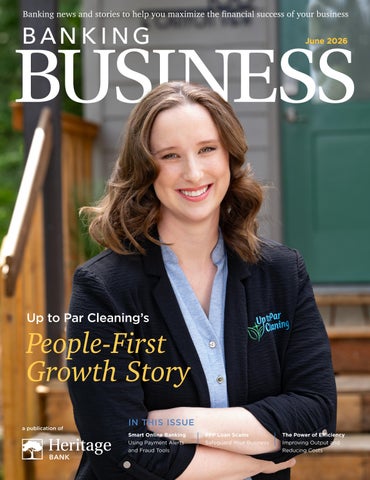
Banking news and stories to help you maximize the financial success of your business June 2026
Up to Par Cleaning’s
People-First Growth Story a publication of
IN THIS ISSUE Smart Online Banking Using Payment Alerts and Fraud Tools
PPP Loan Scams Safeguard Your Business
The Power of Efficiency Improving Output and Reducing Costs
Kim Nguyen
Contents
2
“I’m a relationship person, so having people in my corner that I actually feel a very human connection with is very important for me in order to feel safe, seen and heard.”
iStock
iStock
- Krista Ma’e, Up to Par Cleaning
20
8
Banking Business is a publication of Heritage Bank Director of Marketing Shaun Carson
2
Customer Profile: Up to Par Cleaning
Editor-In-Chief Whitney Gibson
7
Business Online Banking: Smart Payment Alerts and Fraud Tools
Creative Director Erica Bolvin
10 Metro Profile: Spokane Commercial Banking
Managing Editor Stephanie Neurer
13 Safeguard Your Business From PPP Loan Scams
Contributors Amber Clark Kristen Connor Jason Hollaway Diana Ortega Brandon Sanders John Stearns
14 A Guide to Transforming Your Business 16 Optimizing Industrial Growth 18 5 Banking Terms Every Business Owner Should Know 20 Industry Profile: Health, Wellness and Social Services 22 Branding for Small Business
IN EVERY ISSUE 6
8 17
Heritage Helps
Highlighting the good we're doing in our communities.
Business Banking Mentor
Improving output and reducing costs.
Wealth Strategies
Important birthdays after 50.
24 PNWonderland
Explore the unique sights and experiences of our Pacific Northwest.
26 My Heritage 28 Fraud and Cybersecurity
Why online habits matter to business cybersecurity.
28 Financial Dictionary
Empowering you to make smart business decisions by demystifying banking terminology.
Cover image: Kim Nguyen PhotosbyKim.com 3615 Pacific Avenue Tacoma, WA 98418 800.455.6126 heritagebanknw.com
©2026 Heritage Bank, Member FDIC, Equal Housing Lender. The information in this magazine is general education or marketing in nature and is not intended to be accounting, legal, tax, investment or financial advice. Although Heritage Bank believes this information to be accurate as of the date published, it cannot ensure that it will remain accurate. Statements of individuals are their own—and do not necessarily reflect the position or ideas of Heritage Bank. Contact us at 800.455.6126 or visit heritagebanknw.com to make an appointment with one of our local experienced relationship managers to discuss your individual business banking needs.
Equal Housing Lender | Member FDIC
A MESSAGE FROM OUR CEO
A Heritage Bank
s businesses across the Pacific Northwest continue to adapt to changing markets, evolving technology and shifting customer expectations, one thing remains constant: the value of resilience. At our core, we believe strong businesses build strong communities, and throughout this issue, you’ll find stories and insights designed to help organizations across our region continue to grow with confidence. In today’s environment, protecting your business is just as important as expanding it. Fraud schemes continue to become more sophisticated, targeting organizations of every size and industry. That’s why we’re highlighting practical fraud mitigation tools and strategies that can help businesses strengthen security, safeguard financial information and reduce risk without disrupting day-to-day operations. Growth also requires transformation. Whether you’re modernizing processes, investing in new technology or preparing for the next stage of succession planning, change can create new opportunities when approached strategically. In this issue, we explore ways businesses can transform operations, improve efficiency and position themselves for long-term success in an increasingly competitive landscape. Of course, success is not measured solely by financial performance. It’s also reflected in quality of life, strong relationships and the communities we build together. As more Americans celebrate important milestones and birthdays over 50, financial planning, business transitions and legacy-building conversations are becoming increasingly important for business owners and families alike. And because life in the Pacific Northwest is about more than business, we’ve included a feature celebrating waterfront dining destinations across our region. These local restaurants and gathering places showcase the unique character, beauty and hospitality that make the PNW such a remarkable place to live and work. As always, thank you for reading Banking Business and for choosing us as your banking partner. Sincerely,
Don't miss an issue! Subscribe to the digital version of Banking Business at heritagebanknw.com/ bankingbusiness. We'll email you a link to read the latest issue when it publishes and highlight a few of our favorite articles.
Equal Housing Lender | Member FDIC
Bryan McDonald President and CEO Bryan McDonald is president and chief executive officer at Heritage Bank. Bryan joined Heritage Bank in 2014 as executive vice president, chief lending officer. He has more than 20 years of managerial experience in sales, credit, operations, commercial banking and residential real estate. At Whidbey Island Bank, he served as president and chief executive officer from 2012-2014. He currently serves on the board of the Washington Bankers Association.
heritagebanknw.com
1
WHERE CLEAN MEETS COMPASSION
2
Issue 19 | June 2026
Banking Business a publication of Heritage Bank
UP TO PAR CLEANING’S PEOPLE-FIRST GROWTH STORY Article by John Stearns | Photography by Kim Oanh Nguyen | Hair & makeup by Maggie Green
K
rista Ma’e, owner and president of Up to Par Cleaning in Longview, Washington, seemed destined to operate her own cleaning business someday.
“I was pushing a broom ever since I could stand up,” Ma’e says. When she visited relatives’ homes, “They’d always be like, ‘Well, there’s Krista; she’s off cleaning.’ I was always a cleaner and I was always out mowing the yard. My sister was the bookworm, and I would be out weeding, working with my dad—all that stuff.” When she graduated high school in 2011 in Rainier, Oregon, and turned 18, she launched Up to Par Cleaning in the tiny town nestled against the Oregon side of the Columbia River. She had harbored thoughts of possibly attending naturopathic or massage school, but after a couple years in business, she focused on Up to Par and relocated its headquarters in September 2013 to Longview, just across the river from Rainier. She opened her Heritage Bank business account in September 2013 and hired her first employee in November. She never looked back. “I kind of had a crisis at four years in, and again seven years in, and then once I passed the seventh year, I was like, ‘I’m all in,’” she said. “I really had to redefine my purpose.” She realized in 2017-18 that her purpose was building a people-first company, creating opportunities and stability for others, and shaping lives through meaningful employment. That purpose applies today. “In the back of my mind, I’ve always wanted to have my own economy; I wanted to be able to decide (things) and be a good leader…make good decisions for people,” she said. That one-person business born in 2011 has turned into a thriving operation with almost 30 employees, a fleet of five company vehicles, and annual revenues on pace to approach $2 million this year. Up to Par Cleaning serves four counties in southwest Washington: Clark, Cowlitz, Lewis, and Wahkiakum. About 75% of its business is commercial. For commercial clients—such as banks, credit unions, law and medical offices, nonprofits, churches, and offices at large manufacturing facilities— Up to Par offers full-service janitorial services, window cleaning, waxing and stripping floors, carpet cleaning and post-construction cleanup at new or remodeled buildings, plus pre-sale real estate cleaning. With church clients, fees for Up to Par’s services come from tithing, so payments are like “sacred money” to Ma’e, who considers it an honor to serve the churches. For residential customers—including homes and short- and long-term vacation rentals—Up to Par offers all standard cleaning services, but no carpet cleaning. Customers like what they see.
Equal Housing Lender | Member FDIC
heritagebanknw.com
3
Photos for this article were taken at a short-term rental property for whom Up to Par Cleaning provides service. Scan the QR code to learn more and reserve the property.
Up to Par won gold medals in 2025 and 2026 in the cleaning services category in Bicoastal Media’s annual “Best of Southwest Washington” voting. It also won “Best of Lower Columbia” for 2025 and 2026 in voting by readers of “The Daily News.” Up to Par also has partnered since 2018 with Cleaning for a Reason, a nonprofit that provides free home-cleaning for cancer patients. Cleaning for a Reason matches cancer patients with cleaning companies around the nation to do two free cleanings in their home over a two-month period. Up to Par provides two four-hour sessions. “Some of these people—we went in, did our two cleanings, that’s great—and other ones, they’ve actually become our recurring customers after they overcame cancer,” Ma’e said. In 2023 and 2024, the business was also a sponsor for The Lower Columbia School Gardens, whose mission empowers the community by connecting kids and families with real food and hands-on learning through dynamic garden and cooking programs to cultivate health, equity, life-long learning and world stewardship. CLEANING IS A TEAM SPORT Running a cleaning business is demanding. It involves scheduling cleaning staff over a wide geographic region, and running shifts day and night, six days a week. Ma’e credits Jessica Chappell, accounting clerk, as instrumental in maintaining Up to Par’s accounts receivable, accounts payable, payroll, payroll taxes and more. Helping manage commercial projects is her husband, Loha Ma’e, a native of Hawaii. They met in 2021 and married in 2022. 4
Issue 19 | June 2026
Banking Business a publication of Heritage Bank
Krista Ma’e doesn’t take herself too seriously, but she’s serious about making an impact in her community, partnering with Cleaning for a Reason and sponsoring The Lower Columbia School Gardens. On their wedding day, in her wedding dress, Ma’e got a call from a major industrial customer whom she had unsuccessfully bid for their business three years earlier. The business asked for Up to Par’s help—wedding music to her ears. Shortly thereafter, Up to Par began cleaning a couple of that customer’s buildings. Results spoke for themselves. The client added another building a week later, then all the administration buildings a couple weeks after that, followed by additional facilities. “It’s a huge contract,” she said. Loha has been instrumental in helping the business achieve greater heights by partnering with Krista and learning the cleaning industry—from staffing requirements to client needs. Their partnership has built upon the foundation she established, and it has created meaningful growth for Up to Par by combining their strengths and work ethic. Another big client is a commercial and industrial builder for whom Up to Par does post-construction cleanup. When Ma’e spoke for this story, Loha had been cleaning windows for six weeks for that client. She and Loha are passionate about clean windowpanes. Up to Par recently purchased the top-of-the-line machine for window cleaning that she said would “revolutionize what window cleaning means to us.” The machine uses a water-fed pole, reverse osmosis and deionizer. They also recently bought a high-performance commercial steam cleaner that quickly kills bacteria and viruses, removes allergens and cleans window tracks. It cleans with water only, so there are no harsh chemicals, fragrances or residues. Equal Housing Lender | Member FDIC
“We’re really trying to get a little bit more of the specialized equipment so that we can be more robust instead of just your regular cleaning packs and vacuums,” she said. A customer review on Up to Par’s website mentions windows, saying, in part: “We recently started using Up to Par Cleaning for our professional office building, and all I can say is— wow! From the very first visit, they’ve completely exceeded our expectations. Their attention to detail is incredible; every corner, surface, and floor has been spotless since they took over. The office genuinely hasn’t looked this clean in years! What really impressed us was their recent full window cleaning—inside and out. The windows sparkle now, and it has completely brightened up the entire space. It’s one of those things you don’t realize how much you’ve been missing until it’s done right—and they did it right.” HERITAGE ‘HAS KNOCKED IT OUT OF THE PARK’ Ma’e enjoys her relationship with Lorie Blain, vice presidentarea manager for Heritage’s central region in Oregon and Washington. “Her customer service has been amazing,” Ma’e said. “I’m a relationship person, so having people in my corner that I actually feel a very human connection with is very important for me in order to feel safe, seen and heard,” Ma’e said. “They have definitely knocked it out of the park there with having the real personable relationships and making sure that I’m taken care of at all times whatever I need.”
Up to Par Cleaning, continued next page heritagebanknw.com
5
Up to Par Cleaning, continued from previous page The bank proved especially helpful during the COVID-19 pandemic, with Blain, who was the Longview branch relationship manager at the time, encouraging Ma’e to take advantage of government assistance through the Paycheck Protection Program (PPP) loans. “That turned out to be really a saving grace for me because I am very much a non-welfare seeker,” Ma’e said. “I was like, ‘I can do this; I can get through this’—and we did. It took a lot of grit,” but the two PPP loans were helpful, plus a separate employee retention tax credit. “A lot of that assistance really helped through the process of COVID and then during recovery,” Ma’e said, adding she’s glad she listened to Blain, acknowledging Up to Par likely would have had to lay off employees without the PPP loans, which were fully forgiven. Heritage made the PPP process painless, she said. The bank also has helped Up to Par with financing auto purchases. Ma’e is grateful for Marlene Johanson, commercial banking officer in Longview, who helped Ma’e get her first auto loan in 2018. Additionally, Ma’e credits James Hoyt, branch service officer in Longview, for telling her 10 years ago, when he was a teller, about check-processing technology that would allow Up to Par to process checks in its office. “It didn’t really matter back then, but with how much bigger the business is getting, it just makes sense, and so we just got that going,” she said. “We have the RDC, remote deposit capture, on Jessica’s desk and she can process payments pretty much same day and not have to go wait in the drivethrough line so that’s been huge.”
6
Issue 19 | June 2026
Volunteer Day Closure
We’re excited to announce that the bank will once again close for a dedicated afternoon of giving back. On Wednesday, August 12, employees will have the opportunity to volunteer their time and skills at local nonprofits and organizations throughout Washington, Oregon and Idaho. We will be actively engaging in various activities aimed at making a positive impact in our communities. While our doors may be closed for a few hours, our commitment to serving you remains unwavering. We have taken all necessary measures to ensure minimal disruption to your banking experience during this time. We will have limited customer service staff available during this time to address any immediate banking needs, online and mobile banking services will continue to be available and our ATMs will remain fully operational. All Heritage, Kitsap and Whidbey Island Bank locations will close at noon on Wednesday, August 12, 2026, and will remain closed for the remainder of the day. We will open at our regular time the following day.
Banking Business a publication of Heritage Bank
BUSINESS ONLINE BANKING
Protect Your Business with Smart Payment Alerts & Fraud Tools Fraud threats continue to evolve, but the right tools can help your business stay protected. Our payment alerts and fraud prevention services give you greater visibility and control over transactions moving through your accounts. By receiving timely notifications and using built-in safeguards, you can detect suspicious activity early, reduce risk and confidently manage your business finances.
Stay Informed with Payment Alerts ACH & Wire Alerts • Payments Awaiting Approval – Receive notifications if a payment has not been approved by a designated time. • Payment Status Change – Be alerted whenever the status of a payment changes.
Check Positive Pay Alerts • Suspect Item Notification – Alerts you when check exception items require your review. • Cutoff Time Reminder – Notifies you when the deadline is approaching to review exceptions. • No Suspect Items Notification – Confirms when no check exceptions are present for the day.
ACH Positive Pay Alerts • Electronic Suspect Item Notification – Alerts you when ACH exceptions need review. • Cutoff Time Reminder – Reminds you to review ACH exceptions before the deadline. • No Suspect Items Notification – Confirms when no ACH exceptions are detected.
Built-In Fraud Protection Tools Dual Control Adds an extra layer of security by requiring approval from two users for critical actions, such as user creation, permission changes, internal transfers, ACH origination and wire origination.
Payee Positive Pay Helps prevent check fraud by comparing issued checks against those presented for payment. Matching checks are processed automatically, while mismatches appear in an exception report for your review. In addition to the check serial number and dollar amount, the payee name is provided on the check issue file for verification.
ACH Positive Pay Monitors electronic transactions clearing your account. Authorized payments process smoothly, while unauthorized transactions are flagged as exceptions so you can choose to pay or return them.
Fraud prevention works best when strong tools and proactive monitoring work together. Payment alerts and fraud protection services help safeguard your accounts, provide greater oversight and give you confidence in every transaction. Talk with your banker today to learn how to activate alerts and fraud protection tools for your business.
Equal Housing Lender | Member FDIC
heritagebanknw.com
7
BUSINESS BANKING MENTOR
Improving Output, Reducing Costs: The Power of Efficiency Businesses that commit to operational efficiency are typically leaner, more agile and more resilient than those that do not. They often have lower costs, increased output, lessened space requirements and decreased time to market.
IDENTIFY PROBLEMS Monitor your key performance indicators (KPIs) that reflect how your business is performing in various functions. Gather feedback from stakeholders about operations, conduct audits of your processes, finances and operations and document all steps in your business processes.
BENCHMARK PERFORMANCE Before you implement any changes, you need to know where you’re starting from so you can monitor progress. Assess your company’s current progress on its KPIs and compare those with others in your industry.
DISCUSS OPERATIONAL CHALLENGES Your key staff members can identify specific problems that recur and how they affect your production, productivity, staff, customers and revenue. They can also highlight opportunities you’re missing out on because of a lack of efficiency.
MASTER PRODUCTION PLANNING
ANALYZE WORKFLOWS
Clearly outline what you hope to achieve by improving your efficiency. Your objectives may include saving costs, increasing production and improving customer satisfaction.
You may have already identified issues in your systems, but you want to analyze your current workflows to identify redundancies, gaps, bottlenecks, regular tasks that could be automated and activities that don’t add value for your business or customers.
OPTIMIZE OFFICE PROCESSES
Production planning directly affects your operational efficiency, customer satisfaction and profitability. Gather data to predict future demand, determine the production capacity of your facilities, prioritize tasks based on order of importance and develop a production schedule.
CONSULT EMPLOYEES Employees are important stakeholders whose interactions with products, services and customers provide a perspective that managers may not have. They can offer insight into which improvements would offer the greatest
iStock
Your client-facing and back-office activities can be optimized to reduce activities that don’t add value, are redundant, lead to errors or make tasks more complex. Find ways to
IMPROVE INVENTORY MANAGEMENT Many businesses tie up their cash flow in inventory, which creates a need for storage or warehousing and can result in excess waste. Implement a just-intime inventory system, where inventory is purchased only as needed. You’ll need a responsive supply chain but will likely save money in the long run.
DEFINE GOALS
Make sure they’re quantifiable, such as “reduce customer service response times by 10% in the next six months,” so you can better lay out your plan of action and monitor your progress. You can also set your goals based on industry standards, competitors’ benchmarks and even input from stakeholders.
automate or eliminate where possible. Ask how something can be done more effectively, without creating waste and with less room for error.
8
Issue 19 | June 2026
Banking Business a publication of Heritage Bank
impact and whether ideas are feasible or require greater refinement.
team up to take care of other pressing responsibilities that need human input.
Including employees in planning also fosters a sense of ownership and belonging. It can motivate them to take accountability for changes. Make sure they understand their role in making a positive change at your company.
PROPOSE SOLUTIONS
IMPLEMENT TEMPORARY COUNTERMEASURES It’s tempting to wait for a perfect solution but often taking some action will enable you to take further action and possibly free up the resources to find better solutions, prevent further complications, maintain operations and ensure customer satisfaction while you work on a long-term solution. For example, hiring contractors can bridge the gap while you interview and hire permanent employees. If equipment breaks down, rent until you’re able to purchase new equipment.
FIND THE ROOT CAUSE Often, an inefficiency is a symptom of a bigger issue. Until you address the bigger issue, you’ll find yourself facing the same problems repeatedly. When you identify an issue, follow it to its root cause. You can do this using “the five whys” (asking “Why?” repeatedly to every answer until you get to the root cause). For example, say a newsletter is repeatedly being sent out late. The initial reason is that the content is always provided at the last minute, but by repeatedly asking “why,” you uncover a lack of clear protocol for creating content for the newsletter and no person taking accountability for making sure it gets sent out on time. Now you can address that deeper issue to prevent future problems.
IMPLEMENT TECHNOLOGY Technology can play a significant role in eliminating redundancies and saving your team valuable time. Explore which of your activities can be automated or taken over by implementing technology. This frees you and your
Equal Housing Lender | Member FDIC
Often there will be multiple possible options you can take to address the inefficiency. Rather than going with the first option, gather information about numerous options. Talk to your teams to find out how they will be affected by each of the proposed solutions. Consider having a Plan A and a Plan B in case the first solution doesn’t work.
EVALUATE RESOURCES Any action plan requires resources such as labor, equipment and technology. Your plan may also require financing to cover the costs of equipment upgrades, redesigned production processes and hiring employees. Calculate the total investment required for your operational changes and identify and secure sources of funding.
PRIORITIZE CHANGES You may find numerous opportunities for efficiencies. You likely won’t be able to undertake them all at the same time. Begin with the areas with the highest potential impact. One method to prioritize changes is to start with those that are high impact and low effort, followed by high impact and high effort and, lastly, low impact and high effort. Cost, timeline and interdependencies may also play a role in how you prioritize changes.
ESTABLISH AN ACTION PLAN An action plan is your roadmap for implementing your solution. It sets out timelines for completion, milestones that should be achieved, resources necessary to carry out the plan and metrics for success. It also identifies which staff members are accountable for each aspect of the plan.
CREATE AN ACCOUNTABILITY FRAMEWORK To be successful, everyone involved needs to know and understand their roles and responsibilities. They must be aware of the expectations, timelines and deliverables they’re responsible
for achieving as well as how to monitor progress and when to alert the team if targets aren’t being met.
TRACK KPIS Your key performance indicators (KPIs) determine how successful you are at achieving certain targets. Industry KPIs vary, so set and track KPIs based on your industry and your specific goals. KPIs related to efficiency may focus on process performance, productivity and resource utilization, such as cycle time, overall equipment effectiveness and waste percentage.
TRAIN EMPLOYEES ON KPIS It’s important your team knows and understands what the KPIs are and what they mean. When they understand the KPIs, they can take ownership in achieving them, making your business better positioned for success in the long run.
MONITOR PROGRESS Set aside time to periodically review your goals, assess your progress and determine whether they’re still relevant. As your business evolves and grows, some goals may no longer be as important or other priorities may arise. If you’re not progressing towards your goals, analyze the decisions made so far and where issues have arisen. You may need to adjust your strategies or revise your timelines.
DOCUMENT CHANGES Documenting all changes, processes and rationales for decisions puts you in a better place to analyze those decisions and enables you to monitor and adjust in the future. Perhaps you chose one option because it was less expensive but, in the future, would go with a different option when you have more money available.
CELEBRATE WINS The road to efficiency might feel long and complicated. Celebrating as you achieve milestones will keep your team motivated and remind you of the benefits of taking these important actions. It will also increase morale.
heritagebanknw.com
9
Spokane commercial bankers score with team approach and creativity Heritage Bank opened a commercial banking office in Spokane, Washington, in January 2025, and its four bankers, led by James Krejci, are motivated by experience, heart, tenacity and creativity—not unlike a well-known and highly successful college basketball team in town, the Gonzaga Bulldogs.
detailed level because of their familiarity with the sector. The team also brings deep understanding of construction financing, commercial and industrial lending, including owner-occupied real estate, equipment financing, lines of credit for working capital, business-acquisition financing and the New Markets Tax Credits program.
Sometimes, the team has to find creative ways to score; not every basket (or loan) is a slam dunk.
“There are bankers in the market that are generalists and there are advantages to that, too; but just being able to dive a little deeper, peel back more layers with the company based on our specific expertise that we have, that’s something Heritage does,” Krejci said.
Take banker Sean O’Regan, for example, whom Krejci considers one of the most resilient bankers in town. “Some deals will have an obvious solution (and) those get a fair amount of competition,” from lenders, Krejci said. “Other deals take a lot of creativity and resilience to spend the time to find the right solution—and that’s what I would mention about Sean is that he cares about the deals that he’s working on and he works probably harder than a lot of folks on finding the right solution.” O’Regan, a vice president, is just one member of a winning squad Krejci enjoys leading. The commercial banking team also includes Chris Gunning and Tim Engh, both senior vice presidents with Krejci. Asked what the team’s secret sauce is while competing for deals, Krejci cited the group’s experience and heart. “I think, in a lot of ways, we take this process personally,” he said. “In this industry, there’s a tendency to get a bit calloused because there can be a lot of zeros sometimes, but when you boil it down, companies that are doing business with us are borrowing a significant amount of money; and, for a lot of them, it may be the first time that they’ve done, say, a construction project for their business,” he said. “So we keep it front of mind that these aren’t just transactions. We ask: ‘What’s the real-world impact that we’re having on the business?’” The team also understands very well each banker’s strengths, so those with industryspecific expertise can delve deeply into details with businesses, talk that industry’s talk and fully understand it, he said. In manufacturing, for example, Heritage’s Spokane bankers can communicate with manufacturing clients at a very
10
Issue 19 | June 2026
For Krejci, he’s developed expertise in manufacturing. The knowledge sparked from his dad, a welder and machinist in Bonners Ferry, Idaho, in the state’s far northern panhandle. Krejci graduated from the University of Idaho with a finance degree, then landed in Spokane, where he’s worked in banking for 15 years. “When I started in commercial banking, I had a mentor who said, ‘If you choose an industry that you’re passionate about and can relate to, and build expertise in it, it’ll go a lot further than just being a jack-of-all-trades,’” Krejci said. Because of his father, Krejci had always been around manufacturing, so he dove into that early in banking, inspired by the manufacturing activity around greater Spokane and northern Idaho. “The specific connections in and understanding of manufacturing have really paid off,” he said. His interest in the sector has expanded into an overall knowledge about large manufacturing, advanced manufacturing, aerospace, and other sectors. Numerous companies in the region support large, Tier 1 suppliers in aerospace, he said. There also are pharmaceutical manufacturers, including Jubilant HollisterStier, which bills itself as Spokane’s largest manufacturing company. Also, one of the world’s largest roller-coaster manufacturers, Rocky Mountain Construction, is in Hayden, Idaho. “To the general public, it’s one of those best-kept secrets, but there are a ton of companies around here doing a lot of amazing work,” Krejci said. Spokane Commercial Team, continued next page
Chris Wooley | Heads and Tails Photo
By John Stearns
From left: Sean O’Regan, James Krejci, Chris Gunning, Tim Engh
Equal Housing Lender | Member FDIC
heritagebanknw.com
11
Spokane County Data
Spokane Commercial Team, continued from previous page
BUSINESS BY THE NUMBERS
In April, the team was preparing to close a couple manufacturing loans in the aerospace and defense sector.
Major industries: government, healthcare and biotech, education, manufacturing, aerospace, logistics and distribution, agribusiness
Heritage also has a partnership with the Northwest I-90 Manufacturing Alliance, a nonprofit focused on development of the manufacturing industry in the region. The bank partners with it on myriad issues, including bank-created manufacturing industry events. The events attract business owners who get value out of being around their peers or hearing from an expert in the sector.
Major employers: Fairchild Air Force Base, Providence Inland Northwest Washington, Amazon, State of Washington, Spokane Public Schools
O’Regan also is well-versed in manufacturing, Krejci said. Commercial-industrial lending is his primary focus, including owner-occupied real estate, equipment financing, lines of credit for working capital and business-acquisition financing. Besides banking, his background includes working as controller for two area homebuilders and for the nonprofit Family Promise of Spokane.
Source: https://www.spokanejournal.com/ articles/15630-spokane-countys-largestemployers-list
Annual employment: 264,400 The City of Spokane is the second-largest city in Washington and serves as the business, transportation, medical, industrial and cultural hub of the Inland Northwest. Source: https://esd.wa.gov/
The population has grown by 8.7% in the last 5 Years Source: https://greaterspokane.org/
BANKER DETAILS Combined banker experience: 84 years Volunteer hours served in 2025-26: 32 Charitable giving in 2025-26: $32,050 Top nonprofits: Arc of Spokane, Family Promise of Spokane, Northwest I-90 Manufacturing Alliance, The Gathering House, Spokane Valley Chamber of Commerce
OFFICE DETAILS 201 W North River Drive, Suite 605 Spokane, WA 99201 509.931.8026 Open by appointment only
12
Issue 19 | June 2026
Gunning, with 21 years in banking, is an expert in construction financing. She led the construction-monitoring group at her previous bank, Krejci said, in addition to managing her own portfolio of clients, “so she has a real expertise in construction, which has been really valuable to our group.” Engh has substantial expertise in real estate for owner-occupied and non-owner occupied real estate, with broad expertise in everything from manufacturing facilities to hotels to community centers. “He actually has a deal that is pretty visible to the public right now that is using the New Markets Tax Credit structure for a community center-type facility, a deal that will be closing sometime in May,” Krejci said in mid-April. The New Markets Tax Credits, which Krejci also specializes in, are designed to inspire investors to invest in qualifying projects in low-income census tracts in Spokane County. They invest in the real estate, the company occupying that real estate gets a piece of the investment as equity in the real estate, and the investor receives an attractive tax credit. The bank used the program to assist with funding for the Salish School of Spokane to build a new school and cultural recreation community center, which will break ground this June. Other banking office teammates include Rob Stewart, SVP-director of SBA lending; Joy Drake, VP-senior SBA business development officer; Tucker Swem, assistant VP-senior credit analyst; and Jennifer Parman, relationship banking assistant. The team is located downtown at 201 W. North River Drive, next to the Spokane River, directly across the river from the Spokane Convention Center. Outside the office, bankers’ volunteerism includes: for Krejci, board treasurer for Family Promise of Spokane, board member with SNAP Financial Access, and member of the loan committee for Ignite Northwest, which funds and accelerates explosively growing companies in the Spokane, Coeur d’ Alene, and Sandpoint regions, according to Ignite’s website; O’Regan, who’s on the board of Adult & Teen Challenge; Engh is on the board of The Arc of Spokane; and Gunning, whose term recently expired on the Northeast Community Center board and is looking for new volunteer opportunities. “Our team is big on culture and we actually refer to ourselves as ‘Team Bulldog,’ which plays off of the Gonzaga Bulldog mascot, but we’re very intentional about our culture,” Krejci said. “We map out a vision and values for our specific team and how those interact with Heritage Bank, and we try to make all of our significant decisions based on that vision and values, even down to which customers are the right customers to bring into our portfolio, who to hire for our team, ‘Do those folks align with the culture that we’ve established?’ So we’re pretty intentional about it. If you see us around town, a lot of us wear a Bulldog lapel pin as a reminder of all that.” Banking Business a publication of Heritage Bank
Safeguard Your Business from PPP Loan Scams iStock
In July 2020, the U.S. Small Business Administration, in conjunction with the Department of Treasury, publicly disclosed the details of the 4.9 million PPP loans. Available data includes recipient names and states of operation, making it easy for fraudsters to identify businesses to target with PPPrelated scams. As such, scammers are posing as lenders, government agencies or financial institutions. Their goal is to steal sensitive information or money by exploiting confusion around loan forgiveness, eligibility or application/forgiveness processes. These scams can happen through emails, phone calls, text messages, fake websites or even mailed documents that appear legitimate. Using business names, lenders, loan amounts and other information obtained from public records, fraudsters craft convincing messages designed to gain a PPP loan recipient’s trust.
Warning Signs to Watch For Scammers often use familiar tactics to appear legitimate. Be cautious if you notice any of the following: • Unexpected contact claiming to be from your bank, the SBA or a lender • Requests for upfront fees to process, approve or forgive your PPP loan • Pressure to act quickly (e.g., “urgent,” “final notice,” or “risk losing eligibility”) • Offers to guarantee approval or speed up the process, especially for a fee • Emails or texts from unfamiliar, misspelled or suspicious addresses • Links to websites that look official but have unusual URLs or lack “https://” • Requests for sensitive information (SSN, EIN, account numbers, passwords) that legitimate institutions typically already have • Instructions to move money or provide payment via wire transfer, gift cards or cryptocurrency • Poor grammar, spelling errors or inconsistent branding in communications
How to Protect Yourself & Your Business • Never share sensitive banking information. We will never ask for passwords, PINs or onetime passcodes. • Never click links received in an email or text message. • Monitor your accounts daily. • Set account alerts. • Educate your team so employees can recognize and report suspicious activity. • File a complaint with the Federal Trade Commission (FTC) at reportfraud.ftc.gov. • Report suspicious SBA-related activity to the SBA Office of Inspector General.
Stay Vigilant Scammers rely on urgency and confusion. Taking a moment to verify can protect your business from financial loss and data theft.
Equal Housing Lender | Member FDIC
heritagebanknw.com
13
A Guide to Transforming Your Business For any business to maintain relevance and profitability, it must keep evolving. However, transformation goes beyond simply adopting the latest trends or launching new products. It involves a strategic approach to innovation that encompasses key factors like resource allocation, the right talent and careful risk management. A successful transformation is grounded in a commitment to improvement across every level of the organization, from operations to customer engagement.
of innovation where fresh thinking is encouraged and celebrated. Here are a few strategies to spark creativity: • Encourage collaboration through brainstorming sessions involving employees from various departments to share ideas freely. • Offer dedicated time for employees to explore creative projects outside their usual responsibilities, empowering them to contribute to the process. • Collaborate with businesses outside your sector to gain new perspectives and uncover unconventional solutions. • Invest in ongoing education and training for your team to stay updated on industry trends, technologies, and methodologies that can inspire innovative thinking.
Mitigating the risks of transformation To transform successfully, it’s essential to anticipate potential challenges and develop strategies to mitigate them. Key steps include: • Conducting thorough market research to confirm demand for new ideas and gauge their viability. • Analyzing costs to make sure that new products or services are financially sustainable and profitable.
The need to innovate Innovation is not merely about generating new ideas but about translating those ideas into valuable products or services that align with customer needs and expectations. Businesses that actively invest in innovation are more likely to achieve long-term growth and resilience. Success rests on these essential pillars: • Capabilities and resources, which means having the right technical expertise, operational processes and resources so your ideas can be brought to life effectively. • Customer feedback and validation, because innovation thrives when businesses listen to their customers. Successful innovation often starts with solving real problems for your target audience. • Commitment to drive change, requiring leadership commitment and a clear vision for how new ideas will fit into the broader business strategy. Without this, even the most promising ideas may fail to gain traction. When you align your innovative efforts with business goals and customer insights, you will create a sustainable foundation for growth and competitiveness.
Generating innovative ideas Creativity and fresh perspectives are necessary to generate innovative ideas, but identifying concepts that will deliver real value often takes time. The key is to create a culture 14
Issue 19 | June 2026
• Assessing the competitive landscape to determine if your offering is differentiated enough to stand out. • Making sure your business is compliant with relevant industry regulations to avoid costly delays or setbacks. By managing risks proactively, businesses can seize growth opportunities while minimizing potential setbacks that could impact profitability.
Recognizing non-starters early Not all ideas will be successful, and you need to spot them early to avoid wasting resources. One warning sign is a limited target audience that restricts scalability, making it difficult to achieve widespread adoption. Another red flag is unfeasible profit margins which prevent the idea from being financially viable and sustainable. Additionally, a lack of differentiation can make it easy for competitors to replicate your offering, undermining your competitive advantage.
Transforming existing products or services Innovation doesn’t always require a complete overhaul. Iterative improvements to existing offerings can significantly improve customer satisfaction and business performance. For instance, expanding your product range with complementary items or services can attract new customers and provide additional value to existing ones. Offering bundled products or services increases perceived Banking Business a publication of Heritage Bank
iStock
To transform successfully, it’s essential to anticipate potential challenges and develop strategies to mitigate them.
value and convenience, making it easier for customers to choose your brand over competitors. Additionally, customizing offerings to align with individual customer preferences creates a more personalized experience that fosters loyalty and sets your business apart. Incremental changes can help businesses stay responsive to evolving customer demands and market trends, for steady growth and long-term success.
Embracing digital transformation and new business models The rise of digital technologies has revolutionized how businesses operate and interact with customers. These technologies present opportunities to innovate, such as: • Leveraging e-commerce platforms and social media to diversify sales channels and reach broader audiences. • Introducing subscription models to create consistent revenue streams and enhance customer retention. • Adopting tools like customer service automation or inventory management software to streamline operations and improve efficiency. Your digital transformation journey is not about starting over but about enhancing what you already have to meet today’s challenges and opportunities.
Equal Housing Lender | Member FDIC
Next steps • Evaluate your resources, customer feedback and market trends to identify areas where transformation will have the greatest impact. • Align new ideas with your business goals, ensure leadership commitment and create a culture that encourages creativity and collaboration. • Conduct market research, assess costs and make sure you’re compliant with industry regulations to minimize potential challenges. • Adopt new technologies and refine existing offerings to stay competitive and responsive to customer needs. Transformation requires a willingness to innovate, adapt and experiment. It’s not about throwing everything out and starting over but about building on the solid foundation you already have. Successful business transformation involves carefully assessing your current processes, products and services and identifying areas that can be refined, enhanced or reimagined to meet evolving market demands. Adopt a mindset of continuous improvement by staying open to new ideas, testing different approaches and adjusting your strategies as you learn from both successes and setbacks. Ultimately, transformation is about creating a dynamic, resilient business that can not only survive but thrive.
heritagebanknw.com
15
OPTIMIZING INDUSTRIAL GROWTH
Leveraging The One Big Beautiful Bill Act & Strategic Financing for Your Next Equipment Investment For business leaders in the manufacturing sector, the decision to upgrade a production line or expand a fleet is rarely just about the machinery. It’s a strategic calculation involving capacity, competitive advantage, and, most importantly, the efficient use of capital. In today’s economic landscape, the combination of new federal policy and tailored financial solutions has created a unique opportunity for manufacturers to modernize while significantly reducing investment risk. By aligning the incentives found in The One Big Beautiful Bill Act (OBBBA) along with Heritage Bank’s specialized equipment financing, leaders can effectively lower their net cost of acquisition and preserve the liquidity necessary for operational agility.
The Power of Immediate Expensing: A $185,000 Advantage The centerpiece of recent legislative updates is the enhanced ability for businesses to accelerate depreciation. While traditional depreciation spreads the cost of an asset over its useful life, current provisions allow for a more aggressive front-loading of these tax benefits. Consider the impact on a typical industrial acquisition:* Imagine your company identifies a critical piece of specialized manufacturing equipment with a purchase price of $500,000. Under the 100% depreciation provisions facilitated by OBBBA, you may be eligible to deduct the entire purchase price in the first year. For a company in the 37% tax bracket, this creates immediate tax savings of $185,000. The result? While the invoice says $500,000, the immediate tax-adjusted “net cost” to the business is effectively reduced to $315,000.
Bridging the Gap Between Cash Flow and Capital Expenditure While the tax benefits are compelling, the challenge for many business leaders remains the upfront capital outlay. Utilizing cash reserves to fund a $500,000 purchase can strain working capital. This is where a strategic financing partner becomes an extension of your executive team.
Heritage Bank’s new equipment financing promotion is designed to complement these tax incentives, ensuring that your “tax win” isn’t offset by “cash flow friction.” Our current offering includes: • Up to 100% Financing: This includes tax and licensing, allowing you to keep your cash in the business where it can earn a higher return. • Draw-Down Lines of Credit: Access funds in stages as your equipment is built, delivered, and commissioned— paying only for what you use, when you use it. • 7-Year Fixed-Rate Terms: Lock in predictable payments to hedge against future interest rate volatility. • Local Decision-Making: In manufacturing, timing is everything. Our local experts provide the responsive service required to meet tight vendor deadlines.
The “Full Picture” Approach Before committing to a vendor’s in-house financing or depleting cash reserves, it’s essential to evaluate the full financial structure of the deal. By combining local, relationship-based banking with federal tax incentives, businesses can secure the equipment needed for growth while preserving the capital necessary for day-to-day operations. We encourage you to consult with your CPA to confirm how OBBBA applies to your specific tax situation. Once the strategy is set, our team is ready to provide the flexible, competitive structure to bring that equipment onto your floor. CONTRIBUTOR: DIANA ORTEGA Diana started her banking career over 20 years ago. With extensive experience working at a number of other banks located throughout the Pacific Northwest, Diana has local knowledge of the market and community. She works with business owners in establishing long term relationships with Heritage Bank and helps them achieve their financial goals today and in the future.
CONTRIBUTOR: JASON HOLLOWAY Prior to joining Heritage in 2015, Jason worked as an insurance consultant and financial analyst. Now, as a relationship manager, he focuses on helping his commercial customers with their general financial needs as well as real estate loans. He is committed to customer service and enjoys working with local businesses who make a powerful impact in our everyday lives.
*This is a fictional scenario used for educational purposes only. Subject to credit approval. Financing maximums and terms are determined by borrower qualifications and use of funds. Heritage Bank and its representatives do not provide tax advice. Consult an advisor regarding a particular financial situation. Credit products are offered by Heritage Bank. This article is intended to provide a summary. Final executed loan documents should be relied on for complete and final terms. Heritage Bank makes no representation or warranty regarding your ability to qualify for any tax credits, refunds, rebates, benefits or programs. Talk with your accounting professional regarding your individual situation.
16
Issue 19 | June 2026
Banking Business a publication of Heritage Bank
iStock
heritagewealthstrategies.com
traditional IRAs, 401(k) plans and other employer-sponsored retirement plans are taxed as ordinary income.
Age 62
Important Birthdays Over 50 Most children stop being “and-a-half” somewhere around age 12. Kids add “and-a-half” to make sure everyone knows they’re closer to the next age than the last. When you are older, “and-a-half” birthdays start making a comeback. In fact, starting at age 50, several birthdays and “half-birthdays” are critical to understand because they have implications regarding your retirement income.
Age 50 At age 50, workers in certain qualified retirement plans can begin making annual catch-up contributions in addition to their normal contributions. Those who participate in 401(k), 403(b) and 457 plans can contribute an additional $8,000 per year in 2026. Those aged 60, 61, 62 and 63 can contribute an additional $11,250 per year. Those who participate in most Simple Individual Retirement Account (IRA) or Simple 401(k) plans can make a catch-up contribution of up to $4,000 in 2026 (or $5,250 for those aged 60, 61, 62 and 63). And those who participate in traditional or Roth IRAs can set aside an additional $1,100 a year.1,2
Age 59½ At age 59½, workers can start making withdrawals from qualified retirement plans without incurring a 10% federal income tax penalty. This applies to workers who have contributed to IRAs and employer-sponsored plans, such as 401(k) and 403(b) plans (457 plans are never subject to the 10% penalty). Keep in mind that distributions from
At age 62, workers are first able to draw Social Security retirement benefits. However, if a person continues to work, those benefits will be reduced. The Social Security Administration will deduct $1 in benefits for each $2 an individual earns above an annual limit. In 2026, the income limit is $24,480.2
Age 65 At age 65, individuals can qualify for Medicare. The Social Security Administration recommends applying three months before reaching age 65. It’s important to note that if you’re already receiving Social Security benefits, you’ll automatically be enrolled in Medicare Part A (hospitalization) and Part B (medical insurance) without an additional application.2
Age 65 to 67 Between ages 65 and 67, individuals become eligible to receive 100% of their Social Security benefit. The age varies, depending on birth year. Individuals born in 1955, for example, become eligible to receive 100% of their benefits when they reach age 66 years and 2 months. Those born in 1960 or later need to reach age 67 before they’ll become eligible to receive full benefits.2
Age 73 In most circumstances, once you reach age 73, you must begin taking required minimum distributions from a traditional IRA and other defined contribution plans. You may continue to contribute to a traditional IRA past age 70½ as long as you meet the earned-income requirement. Understanding key birthdays may help you better prepare for certain retirement income and benefits. But perhaps more importantly, knowing key birthdays can help you avoid penalties that may be imposed if you miss the date.
1 If you reach the age of 50 before the end of the calendar year. 2 IRS.gov, 2025
Heritage Wealth Strategies is a marketing name of Cetera Investment Services. Securities and insurance products are offered through Cetera Investment Services LLC (doing insurance business in CA as CFG STC Insurance Agency LLC), member FINRA/SIPC. Advisory services are offered through Cetera Investment Advisers LLC. Neither firm is affiliated with the financial institution where investment services are offered. Investments are: *Not FDIC/NCUSIF insured *May lose value *Not financial institution guaranteed *Not a deposit *Not insured by any federal government agency. 1000 SW Broadway, Suite 2170, Portland, OR 97205, (888) 360-0052. The content is developed from sources believed to be providing accurate information. The information in this material is not intended as tax or legal advice. It may not be used for the purpose of avoiding any federal tax penalties. Please consult legal or tax professionals for specific information regarding your individual situation. This material was developed and produced by FMG Suite to provide information on a topic that may be of interest. FMG Suite is not affiliated with the named broker-dealer, state- or SEC-registered investment advisory firm. The opinions expressed and material provided are for general information, and should not be considered a solicitation for the purchase or sale of any security. Copyright 2026 FMG Suite.
17
5 Banking Terms r e n w O s s e in s u B y r Eve Should Know Running a business is about more than selling products or services, it’s about managing risk, cash flow and opportunity in an ever-changing economy. No matter which industry your business is in, understanding the language of banking helps you make smarter financial decisions. Here are five important banking terms that can give you a clearer picture of your business’s financial health and the confidence to plan for growth in 2026 and beyond.
Debt Service Coverage Ratio (DSCR) Your Borrowing Health Check The Debt Service Coverage Ratio (DSCR) measures your ability to pay your loans from your business’s operating income. DSCR is calculated by dividing your net operating income by total debt payments. For example, if your business earns $125,000 a year after expenses and your annual loan payments total $100,000, your DSCR is 1.25. Banks typically want to see a DSCR above 1.25, meaning you’re generating 25% more income than needed to cover your debt. A lower ratio suggests you might be too leveraged, making it harder to qualify for new credit or refinance at a good rate. Real-world example: A local brewery wanted to expand into canning their beer. Their DSCR was only 1.05; too tight for comfort. By cutting some discretionary spending and slightly increasing prices, they raised it to 1.3 within six months. That improvement helped them qualify for an equipment loan at a lower interest rate.
Loan Covenant The Rules of the Loan Road A loan covenant is a condition or rule that your lender sets when approving your loan. These can be affirmative (things you must do) or negative (things you must not do). For example, you might be required to: • Maintain a minimum DSCR or cash balance • Provide quarterly financial statements • Avoid taking on additional debt without the bank’s approval Breaking a covenant—even unintentionally—can trigger penalties or cause your loan to be called early. Before making major financial moves, give your banker a quick call. They’d rather help you stay compliant than have you experience the stress of correcting a problem. Real-world example: A small construction company added a new line of credit from another lender to cover a busy summer season. They didn’t realize their existing loan agreement restricted new borrowing without prior approval. Their bank flagged the issue and temporarily froze disbursements until it was resolved—a stressful but avoidable hiccup.
18
Issue 19 | June 2026
Banking Business a publication of Heritage Bank
Effective Interest Rate The True Cost of Borrowing The effective interest rate is the actual annual cost of borrowing once all fees, compounding and charges are factored in—not just the annual percentage rate (APR). The stated rate might look attractive, but the effective rate tells the real story. A $100,000 loan at 6% APR might seem great, but if it includes a 3% origination fee and monthly compounding, your effective rate could be closer to 7.2%. Ask your banker to show you the effective or annualized rate before signing. It’s the fairest way to compare loans applesto-apples. Real-world example: A design studio compared two equipment loans—one at 6% with a 3% fee and one at 6.5% with no fees. On paper, the first looked cheaper. But once they calculated the effective interest rate, they realized the second loan cost less over the life of the term.
Sweep Accounts & Treasury Management Making Cash Flow Smarter
UCC Filing (Uniform Commercial Code Filing): The Hidden Claim on Your Collateral When you take a secured business loan, your lender files a UCC financing statement—a public notice that they have a legal claim on your assets (like equipment, inventory or receivables) as collateral. Even after you pay off the loan, the UCC filing can remain on record unless it’s formally released. An old or active filing can block new loans, because it signals to potential lenders that another creditor has first rights to your business assets. After paying off any business loan, confirm that the lender files a UCC termination. It’s a quick fix that can prevent headaches later. Real-world example: A bakery owner tried to secure financing for a second location. Her application was delayed because an old UCC filing from a paid-off equipment lease was still active. Once the filing was terminated, her new loan was approved within days.
The Bottom Line Understanding these banking terms helps you speak the same language as your lender and spot opportunities to strengthen your business finances before you need them.
A sweep account automatically transfers (or “sweeps”) excess funds from your checking account into a higher-yield account or uses them to pay down your line of credit overnight. It’s a simple way to make every dollar work harder. If you end each week with unused cash sitting in your checking account, that money could instead be reducing your debt or earning interest. Treasury management tools can also help prevent fraud. Services like positive pay, ACH filters and dual authorization protect your business from check and online payment fraud. Real-world example: A landscaping company set up an automatic sweep that moved any balance over $25,000 from checking into a money market account every Friday. Over a year, that small automation earned enough interest to cover their new accounting software subscription and kept them more aware of their weekly cash position.
Equal Housing Lender | Member FDIC
At Heritage Bank, we believe financial knowledge should be empowering, not intimidating. Your relationship manager and local banking team are here to help you: • Review your DSCR and financial ratios • Understand loan terms and covenants • Automate cash flow through treasury tools • Ensure your credit profile is clean and ready for growth
heritagebanknw.com
19
iStock
iStock
INDUSTRY PROFILE
Health, Wellness & Social Services T
he health, wellness and social services sector includes a diverse range of community-based providers such as small medical clinics, dental practices, physical therapy and allied health providers, massage therapy practices, and childcare and early education centers. These businesses deliver essential, people-focused services and operate at the intersection of health care delivery, regulation and workforce management. Most providers are owner-operated or professionally managed small enterprises that rely heavily on credentialed staff, appointment-based revenue and consistent service quality. Demand is driven by demographic trends, population growth, aging communities and increased awareness of preventative care and early childhood development. In the United States, businesses in this sector operate within a highly regulated environment. Oversight may involve 20
Issue 19 | June 2026
state medical and dental boards, health care licensing authorities, childcare regulators and federal agencies such as the Centers for Medicare & Medicaid Services. Professional associations and accreditation bodies also play a significant role in setting standards and guiding best practice across the industry.
Success characteristics Health, wellness and social service providers that perform well typically combine clinical excellence with disciplined business management. Common characteristics include: • Maintaining strong patient, client and family relationships through consistent service quality and clear communication. • Operating efficient appointment scheduling, billing and recordkeeping systems to support steady revenue flow and capacity management. • Recruiting, supporting and
retaining qualified professionals in roles where credentials, experience and continuity of care matter. • Managing compliance, data privacy and documentation requirements as a core operational priority. • Balancing service accessibility with financial discipline, particularly in environments influenced by insurance reimbursement or public funding. Together, these characteristics support sustainable operations in industries where trust, continuity and regulatory accountability directly influence reputation and financial performance.
Challenges Providers across health, wellness and social services face a distinct set of pressures: • Workforce shortages and rising wage expectations for licensed and credentialed staff.
Banking Business a publication of Heritage Bank
Resources American Medical Association www.ama-assn.org American Dental Association www.ada.org American Physical Therapy Association www.apta.org National Association for the Education of Young Children www.naeyc.org U.S. Department of Health & Human Services www.hhs.gov
• Administrative complexity linked to insurance billing, reimbursement timing and documentation requirements. • Exposure to regulatory audits, licensing reviews and evolving compliance standards. • Capacity constraints driven by appointment availability, room utilization and staff-to-client ratios. • Cashflow variability related to delayed reimbursements, seasonal enrollment patterns or funding cycles.
CHILDCARE CAPACITY AND QUALITY PRESSURES
Childcare and early education centers face strong demand alongside strict staff-to-child ratios and regulatory oversight. Operators are adapting pricing, enrollment models and staffing structures to remain viable while meeting quality expectations.
Trends impacting health, wellness and social services As with other service-based industries, this sector is shaped by demographic shifts, adoption of technology and changing expectations.
HEIGHTENED FOCUS ON DATA PRIVACY AND RISK MANAGEMENT
Handling sensitive health and family information places ongoing emphasis on cybersecurity, data protection and professional risk management across all subsectors.
GROWTH IN PREVENTATIVE AND ALLIED HEALTH SERVICES
Demand continues to rise for physical therapy, massage and allied health services that support recovery, mobility and long-term wellness. This trend reflects an emphasis on early intervention and non-invasive treatment pathways.
The health, wellness and social services industry remains essential, resilient and complex. Providers that align professional standards with sound operational and financial practices are better positioned to navigate regulatory demands, workforce pressures and evolving community needs.
DIGITAL SCHEDULING AND RECORDS MANAGEMENT
Electronic health records, online booking systems and digital intake tools are becoming standard across medical, dental and wellness practices. These systems support coordination, data accuracy and patient experience.
CONTRIBUTOR: AMBER CLARK Amber has over 15 years of experience, with expertise in business development and portfolio management of commercial, healthcare and dental business customers. From transitions to startup ventures to commercial real estate purchases, she assists with each stage of the process. Actively involved in her community, Amber volunteers regularly for the Dental Foundation of Oregon, which provides free healthcare to underprivileged children and youth. She is also active in many local dental societies. In her spare time, she enjoys the outdoors and being a fitness guru.
CONSOLIDATION AND GROUP PRACTICE MODELS
Independent providers are increasingly joining group practices or networks to share administrative resources, manage staffing challenges and negotiate payer relationships more effectively.
iStock
iStock
• High professional liability exposure, particularly in clinical and childcare settings.
These challenges place ongoing pressure on owners to balance care delivery, compliance and financial sustainability.
Equal Housing Lender | Member FDIC
heritagebanknw.com
21
Your Brand Is Forgettable. Here’s why customers are choosing someone else. WHAT IS A BRAND, REALLY? If I asked, “What’s Nike’s brand?” most people would say “sports apparel,” the “swoosh” or “Just Do It.” If I asked, “What’s McDonald’s brand?” you might think “inexpensive fast food,” “the Golden Arches” or “I’m lovin’ it.” You’d be correct in all those answers, but a brand is a whole lot more than just a product, logo or tagline. The design of retail locations, the colors of packaging, the copy on a website, the fonts used in advertising, employee dress codes, celebrity ambassadors and a company’s environmental and social stances all contribute to its brand. Together, these tangible and intangible touchpoints create a brand personality—a distinct “feeling” that resonates with a specific audience. Branding is why certain beauty products go viral, why your kids are asking for $150 sweats with “Essentials” on the leg and why you choose Coke over Pepsi or Ford over Chevy.
THE PILLARS OF BRANDING: VOICE, VALUES, VISUALS The elements of a brand can be organized into three essential categories: visuals, voice and values. • Visuals are what most people think of first. Logos, taglines, graphics, color palettes, typography, web and ad design, etc. create immediate recognition and signal professionalism at a glance. • Voice is how a brand communicates. The tone and word choice may be casual and witty, warm and consultative or formal and authoritative. A highly technical audience may expect industry jargon, while mainstream consumers often respond better to simplified, benefit-driven messaging. Context matters: a lawn care company might lean into dad jokes and puns, while a cancer care provider must project empathy, reliability and reassurance. • Values define a brand’s character. If your business were a person, what would it care about? What would it like and dislike? Whether it’s speed and efficiency, luxury and relaxation or sustainability and community impact, your values shape how customers perceive and connect with you. Advocacy, whether for environmental stewardship, affordable housing or food access, also plays a role in modern brand identity.
iStock
WHY BRANDING MATTERS FOR SMALL BUSINESS
22
Issue 19 | June 2026
A strong brand builds trust, creates consistency and tells a clear story about who you are and who you serve. Without it, even great businesses can feel forgettable or unreliable. Consider a local home services company with mismatched logos, inconsistent messaging and no clear tone—customers may hesitate, unsure of the company’s professionalism or legitimacy. Now imagine that same business with a clean, cohesive visual identity, a friendly Banking Business a publication of Heritage Bank
Strong branding not only attracts the right customers, it justifies pricing, drives referrals and creates long-term loyalty. and knowledgeable voice and messaging that emphasizes reliability and customer care. The service itself hasn’t changed but the perceived value has increased dramatically. Strong branding not only attracts the right customers, it justifies pricing, drives referrals and creates long-term loyalty.
WHERE TO START CREATE COHESIVE VISUALS Gather all your physical and digital materials. Do they look like they belong to the same business? Consistency is key. Every touchpoint—your invoices, contracts, website, social media, ads, uniforms, signage and promotional items—should use the same logo, colors and fonts. If you don’t yet have a logo, consider hiring a designer. If that’s not feasible, start simple: choose an appropriate font, create a clean text-based logo and establish a color palette with one primary color and two complementary accents. In service-based industries, uniforms and branded materials reinforce professionalism and trust. When employees present a consistent, polished appearance, it signals credibility, training and long-term investment in the business.
DEFINE YOUR VOICE Identifying your brand voice can be challenging, especially for professional services providers where the business and the individual are closely linked. Still, your personal voice and professional voice are not always the same. Start by asking yourself: Which three words do I want people to use when describing my business? Then ask a few trusted customers the same question. If the answers align, you already have a foundation. Use these words as a filter for everything you publish. Does your website copy, social media and client communication reflect that tone? If not, refine it. For example, a trial attorney might define her brand as tenacious, trustworthy and serious—qualities that would steer her away from slang, overly casual language or excessive exclamation points.
LEAD WITH VALUES You don’t need to take a stance on everything, but you should stand for something. Choose a few values that genuinely matter to your business and talk about them. Regularly. Weave what matters to you into your messaging, partnerships and operations. If reducing waste is an important part of your story, create Facebook ads focused on how much trash you saved last year by changing your packaging style. If animal welfare matters to Equal Housing Lender | Member FDIC
you, add a banner to the top of your website that states 1% of profits go to your local humane society. Alignment between your industry and your values can be especially powerful. A pest control company might emphasize pollinator-safe solutions. A restaurant might highlight efforts to address food insecurity. An auto repair shop might support veterans through discounted services. Authenticity is critical. Not everyone will align with your values—and that’s okay. The goal isn’t to appeal to everyone, which would require you to dilute your message so much you’re not saying anything interesting anymore. The goal is to deeply resonate with the right customers. You won’t have time to convince the wrong customer to do business with you when you’re too busy selling to the right customers. When you combine all three of these categories, you end up with what can be thought of as the “personality” of your business. If you’re struggling to define what that is, consider going back to the “if your business were a person” question. Think of a friend or family member who has a strong personal brand. Maybe your friend is an eccentric firecracker who loves 90’s pop music and cares deeply about nature. She wears animal print and paisley together (visuals), speaks in pop lyrics and might say something inappropriate in a crowd (voice) and volunteers her time to maintain trails at state parks (values). Is she everyone’s cup of tea? Probably not. Is it clear who she is? Absolutely. Now picture your business as an actual person. What would they wear? How would they sound? What would their hobbies be? Describe the visuals, voice and values of your business like you’re describing a friend. Document the elements of your brand and share it with your team so that everyone is on the same page.
CONSISTENCY REINFORCES THE BRAND Brand recognition doesn’t happen overnight. It’s built through repetition, clarity and consistency across every interaction—whether a customer visits your website, sees your ad or interacts with your team.
THE BOTTOM LINE It’s important to view brand as a strategic asset, not a onetime exercise or a cosmetic upgrade. For small businesses, a well-defined brand levels the playing field, allowing you to compete not just on price or proximity, but on perception, trust and connection. When your voice, visuals and values align, you create more than recognition, you create preference. And in a crowded market, preference is what turns first-time customers into long-term advocates. heritagebanknw.com
23
IHG Hotels & Resorts
PNWONDERLAND
King Tide Fish and Shell
Where Water Meets the Menu Pacific Northwest Dining with a View
T
here’s something undeniably special about dining by the water in the Pacific Northwest. From Washington’s rugged coastlines to Oregon’s riverfront enclaves and Idaho’s tranquil lakes, waterfront restaurants here offer a front-row seat to some of the region’s most memorable vistas. Whether it’s the salty mist of the ocean or the glassy shimmer of a lake, these settings transform a simple meal into a sensory experience. A sunny afternoon on a riverfront patio can elevate even a burger and fries into something celebratory, while fresh seafood, local produce and seasonal dishes feel even more vibrant against the backdrop of the Northwest’s natural beauty. Whether you’re planning a casual brunch, a client-facing lunch or a memorable date night, these standout destinations pair compelling menus with unforgettable views. Here’s a curated selection, organized by state and occasion.
24
Issue 19 | June 2026
WASHINGTON Laid-Back Energy Agua Verde Café & Marina Cantina, Seattle (Portage Bay) Baja-style Mexican fare meets waterfront charm at this lively spot tucked between Lake Union and Lake Washington. Located along the marina and adjacent to the Burke-Gilman Trail, it’s a favorite refueling stop for paddleboarders, boaters and cyclists alike. Enjoy colorful décor, a covered patio ready for Seattle’s unpredictable summer showers and house margaritas—available to enjoy onsite or in cans to go. aguaverdecafe.com Client-Friendly Views Yacht Club Broiler, Silverdale (Dyes Inlet) A Kitsap County staple, this polished yet approachable restaurant is defined by sweeping views of Dyes Inlet and consistently warm service. The salmon linguine is a standout,
Banking Business a publication of Heritage Bank
Bayfront Elegance Woven, Tacoma (Commencement Bay) Reimagined after a pandemic-era closure, this striking waterfront space now reflects the vision of the Puyallup Tribe of Indians. Floor-to-ceiling windows frame Commencement Bay, while thoughtfully curated indigenous artwork grounds the experience. The menu, developed by celebrity chef Roy Yamaguchi, blends Pacific Island and native Northwest influences. Cedar plank salmon is a natural choice, though the ribeye paired with a craft cocktail makes a compelling case of its own. eatwoven.com IDAHO Riverside Relaxed Locking Horns Riverside Restaurant, Horseshoe Bend (Payette River) Easygoing and family-friendly, this riverside hangout delivers quintessential summer vibes. A broad menu—burgers, salads, pizzas (including gluten-free options)—ensures wide appeal. Crowd-pleasers include loaded “dirty fries” or tots with pulled pork and queso and a half-pound burger topped with peanut butter and fig jam. While adults linger over conversation, kids can spread out on the lawn for cornhole or giant Connect Four. lhriversiderestaurant.com Floating Fine Dining Cedars Floating Restaurant, Coeur d’Alene (Lake Coeur d’Alene) Floating atop 600,000 pounds of concrete encasing an inner core of Styrofoam, Cedars offers 360-degree water views where the Spokane River meets Lake Coeur d’Alene. The experience leans classic, from the 18-foot salad bar to a traditional surf-and-turf lineup. Don’t miss the huckleberry mud pie—a nod to Idaho’s official state fruit. For business gatherings, the early dining prix fixe menu offers a streamlined, value-conscious option. cedarsfloatingrestaurant.com Stylish Night Out Pig Latin, Eagle (Boise River Greenbelt) Exotic and stylish describes both the ambiance and the Instagram-ready cocktails at this newer Boise-area restaurant. Graphic striped upholstered booths, a green terrazzo bar and an abundance of live greenery amp up the energy. The Latincentered, globally inspired menu features tacos, chimichurri steak (sourced locally) and house-made tortillas. Go for lunch when it’s less busy or wait until the lights go down for a trendy night out. Begin or end your meal with a stroll along the Boise River Greenbelt. piglatin.us/eagle
Equal Housing Lender | Member FDIC
OREGON Tropical Kitsch Island Café, Portland (Willamette River) Perched on a floating dock along Hayden Island, Island Café fully embodies Portland’s offbeat charm. A thatched roof, bright umbrellas and a breezy, tropical aesthetic set the tone. Pair coconut prawns, rice bowls or a classic burger with a fruity cocktail—or a colorful non-alcoholic blended drink. Vegetarian options and a kid-friendly menu round out the appeal. islandcafepdx.com Quirky Riverfront McMenamins North Bank, Eugene (Willamette River) True to the McMenamins ethos, this riverside outpost blends history, whimsy and craft beverages. Overlooking the gently flowing Willamette River, the space features psychedelic murals, eclectic fixtures and the tucked-away Kapu Hut tiki bar. Settle in with a house-brewed beer or cider and a menu of elevated pub fare. In warmer months, the patio is prime territory—especially if you’re feeling adventurous enough to order the aptly named “Mystery Dessert.” mcmenamins.com/ north-bank Elevated Options King Tide Fish & Shell, Portland (South Waterfront) Located inside the Kimpton Hotel in Portland’s South Waterfront district, King Tide offers a refined yet approachable take on Northwest dining. The interior balances rustic textures with contemporary polish, while the seafood-forward menu highlights a well-executed raw bar and locally sourced ingredients. Equally suited for a client dinner or a leisurely weekend brunch, it pairs beautifully with a post-meal walk along the waterfront or a visit to the nearby Saturday Market. kingtidefishandshell.com
IHG Hotels & Resorts
while the crab Louie offers a lighter midday option. Ample parking—a rarity worth noting—makes it especially wellsuited for group lunches, and nearly every table captures a view. yachtclubbroiler.com
King Tide Fish and Shell
heritagebanknw.com
25
MY HERITAGE
Brandon Sanders
FROM WRENCHES TO RATIOS My journey from mechanic to banker, while still working with my hands. One might say, I transitioned from diagnosing engine trouble to helping businesses fire on all cylinders. My road to commercial banking officer began in the unlikeliest of places: the garage of an auto dealer, when after several years working as an ASE Certified Mechanic, I realized my love of mechanics and vehicles wasn’t fulfilled repairing minivans. I looked under the hood of banking and accelerated into a new career. After almost 20 years in the industry, banking has checked all the boxes for rewarding work. Instead of working with my hands for a living, I now do it for fun, including restoring a 1977 Chevrolet C-10 square-body pickup in a short-bed configuration. I’ve restored the interior, improved its operating performance, lowered its frame a couple inches and primed it for a new paint job. It’s not quite finished—because a larger restoration has consumed most of my free time.
We bought the house, which sits on five acres, in 2019, and the extensive interior and exterior renovations have taken significant time (and money), but we’re getting closer to our envisioned goal and hope to finish our remodel in about two years. We’ve done most of the work ourselves. Lori, by the way, is great with a paintbrush and isn’t afraid to get her hands dirty. I have a friend who’s an electrician who taught me various tips and tricks, and helped with wiring a hot tub and car charger, and I feel almost as comfortable now wiring a house as fixing vehicle electronics. He and another buddy have graciously assisted with projects that Lori and I can’t do alone. The house design was ahead of its time in 1954, when it was built with an Eichler-style roof, which is characterized by a very low slope that became more popular in the late-1950s and 1960s. A neighbor who remembers the house from when she was a child watched the home get built and thought it was ugly. She has a much better impression now.
I’m renovating a 1954 farmhouse that my wife, Lori, and I own in Brush Prairie, Washington, northeast of Vancouver, which is the Heritage office I joined last September. I’ve spent most of my life in the Vancouver area, including graduating from, believe it or not, Heritage High School.
26
Issue 19 | June 2026
Banking Business a publication of Heritage Bank
Photos courtesy of Brandon Sanders
Our property also includes a roughly 1-acre lake and a separate swimming pond, allowing us to keep a fun family of animals and waterfowl: 28 chickens, six ducks, three dogs and four cats. With that many chickens, all freeroaming yard birds, we enjoy a bounty of fresh eggs (as do neighbors and colleagues). Sky-high egg prices last year didn’t affect us. At the time of this writing in mid-April, we were trying to give away as many eggs as possible; we had a record 19 eggs the other day. Our hens are different breeds, resulting in a rainbow of egg colors: creams, soft pinks, dark browns with speckles, greens, blues and some unique combinations. The eggs we harvest smell better when cooking and taste better, and people love the colors. The pond also is a favorite annual spot for a goose family, with mom and dad producing goslings each spring. Wild ducks also breed in our pond, so we’re home to a number of ducklings, too, including from our own Cayuga ducks. Between the open space, the ponds and animals, we’re a favorite stop for our nieces and nephews in the area (Lori also grew up locally and has family here). We enjoy being the cool
Equal Housing Lender | Member FDIC
aunt and uncle and then sending the kids home after a day of exhaustion. When I’m not working on the house, my truck, or tending the land and animals, I enjoy occasionally smoking a pipe. I was inspired by my grandfather, who occasionally smoked a pipe when we fished together. I still remember the cherry-scented tobacco he enjoyed and the great smell. Tobacco comes in tins, with higher-end tobacco often sold in combinations with signature notes and flavors, not unlike wine or whiskey. Virginia is the main source of domestic tobacco I enjoy, but there are interesting tobaccos from Jamaica, the Caribbean, Bali and the Balkans in Eastern Europe, so it’s fun to experiment. There are many variants of pipe, too, my favorite being an apple pipe, which has the typical S-shape with a bigger bowl for tobacco. I’ve gotten some of my cigar-smoking friends to try pipes, but there’s a learning curve. A cigar, for example, will typically stay lit, no matter how you draw from it, as long as it was cut correctly; whereas there’s a science to how you pack a pipe and draw from it. You have to get comfortable with relighting it because
it will extinguish itself. It takes practice to keep it lit. If you’ve packed it just right and you get it going, you can set it down for 15 minutes, come back and it’s still going. It takes practice and patience, just like fixing cars or renovating homes.
ABOUT THE BANKER: BRANDON SANDERS Brandon Sanders is vice president-commercial banking officer in Heritage Bank’s Vancouver, Washington, office. He entered banking in 2007. Since 2013, he’s focused on business banking, with the past seven years dedicated to commercial lending. He specializes in commercial real estate lending, business acquisitions, and equipment finance. He gravitates toward working with specialty trade contractors and manufacturers, industries that play a vital role in regional growth.
heritagebanknw.com
27
FINANCIAL DICTIONARY Fiscal sponsorship is a strategic arrangement that allows charitable projects or emerging nonprofits to operate under the legal and tax-exempt status of an established 501(c)(3) organization. Through this relationship, the sponsoring organization provides administrative oversight, financial management and compliance support, enabling the sponsored project to receive tax-deductible donations and grants without immediately pursuing its own tax-exempt designation. For nonprofit founders, fiscal sponsorship can accelerate mission-driven work by reducing startup costs, administrative burdens, and regulatory complexities. It offers access to essential infrastructure such as accounting, human resources and governance support, allowing leaders to focus on program development and community impact. For corporate social responsibility efforts, fiscal sponsorship can offer businesses a practical way to fund and collaborate with mission-driven projects, particularly those that lack standalone nonprofit status but operate under established organizational oversight. While fiscal sponsorship provides flexibility and operational efficiency, it also requires clear agreements regarding financial controls, program ownership and reporting responsibilities. Selecting the right fiscal sponsor is essential to ensuring alignment in mission, governance and long-term sustainability. In today’s evolving social impact landscape, fiscal sponsorship serves as a practical solution for organizations seeking to launch, grow or support charitable initiatives while maintaining sound financial stewardship. CONTRIBUTOR: KRISTEN CONNOR Kristen specializes in serving some of the region’s leading organizations whose missions focus on a broad range of sustainability and social justice issues as well as nonprofits and legal professionals. Her experience in this space helped launch the Heritage Helps Committee that’s focused on employee volunteer efforts and corporate giving priorities.
28
Issue 19 | June 2026
iSto ck
FISCAL SPONSORSHIP
Your Personal Clicks, Your Company’s Risk Why Individual Online Habits Matter to Business Cybersecurity For many leaders, cybersecurity feels like an IT responsibility—a set of firewalls, filters and monitoring tools designed to protect company systems. Yet one of the most influential factors in business security sits outside the office network: personal online behavior. The same devices used to check business email are often used for shopping, banking, social media and everyday searches. Even when activities seem unrelated to work, they can shape how vulnerable a company becomes. This is not a matter of blame. Most professionals have never been taught how ordinary online habits connect to business risk. The encouraging reality is that small adjustments in personal behavior can significantly strengthen organizational protection.
How Personal Activity Reaches the Business Cybercriminals rarely begin by attacking a company’s servers. They begin by studying people. A single compromised account (especially one belonging to an owner, executive or employee with access to sensitive information) can provide an entry point into payroll systems, financial platforms, customer data and even vendor relationships. When personal and professional digital lives overlap on the same phone, laptop or browser, attackers don’t need to distinguish between them. Access to one often leads to access to the other.
How Personal Activity Can Compromise Your Business > Password Reuse Across Personal & Business Accounts Using the same or similar passwords for shopping, streaming Banking Business a publication of Heritage Bank
Small businesses often don’t have the budget for dedicated IT staff. The next best option is professional services, but that typically has a primary focus on operations and not security. The best money spent to improve security is on training. Ensuring that all employees, from top to bottom, have received security awareness training is the single most impactful thing a small business could do. services and company systems is one of the most common vulnerabilities. Retailers and entertainment platforms are frequent targets of data breaches. When those credentials are exposed, attackers automatically test them against business email and banking platforms. Because many people reuse passwords, these attempts often succeed.
> Social Media Oversharing Social platforms provide valuable intelligence to attackers. Photos of a home office setup, posts about travel dates, announcements about new hires or mentions of banking partners help criminals craft convincing impersonation emails. This is known as social engineering: using accurate personal details to gain trust and prompt an employee to transfer funds or share credentials.
> Personal Email on Work Devices Personal email accounts receive a higher volume of unsolicited messages and promotional content. Opening attachments, downloading coupons or clicking shipping notifications on a work computer can introduce malicious software. Once installed, that software can monitor keystrokes, capture passwords or access company files.
> Online Shopping & Saved Payment Information Shopping sites and browser extensions sometimes request broad permissions. A compromised extension can read browser data, including autofill information and stored login sessions. If a business banking portal or accounting platform is accessed from the same browser, those sessions can be captured without the user realizing it.
> Searches & Downloads from Unverified Sources Searching for software tools, tax forms, templates, or PDF converters often leads to sponsored results or imitation websites. Downloading files from these sites can install hidden programs that quietly provide outside access to a device connected to company systems.
Five Actions That Significantly Reduce Risk > Separate Personal and Business Credentials Use unique passwords for every account, especially business email and financial platforms. A password manager can generate and store complex passwords so you don’t have to remember them. This single change blocks one of the most common intrusion methods. Equal Housing Lender | Member FDIC
> Enable Multi-Factor Authentication (MFA) MFA requires a second verification step, such as a phone approval or authentication app, before logging in. Even if a password is exposed through a personal breach, attackers can’t access business systems without the second factor.
> Use a Dedicated Browser or Profile for Work Create a separate browser profile (or use separate browser entirely) used solely for company activity. Avoid shopping, social media or personal email within that environment. This limits the impact of malicious cookies, extensions and downloads.
> Be Selective About What You Share Publicly Review social media posts with the same care you would apply to a press release. Avoid sharing travel dates in advance; internal celebrations that reveal organizational structure; financial vendors; or images showing screens, badges or system dashboards. You can still communicate authentically while protecting operational details.
> Update Devices and Applications Promptly Software updates often fix security weaknesses. Delaying them leaves known openings available to attackers. Enable automatic updates on phones, computers and commonly used applications, including browsers.
A Practical Mindset Shift Cybersecurity is not about technical expertise; it’s about habits. Most security incidents don’t occur because someone intended to take a risk. They happen because normal behavior was never evaluated through a security lens. Shopping online, sharing family milestones or searching for helpful tools are entirely reasonable activities. The key is recognizing how they intersect with business access. Organizations invest in protective technologies, but the most effective control remains an informed individual. By adjusting a handful of everyday practices, professionals can meaningfully reduce exposure to fraud, data loss and operational disruption. The goal is not perfection. It’s awareness and consistency. Each small improvement compounds, strengthening not only your own digital safety but the resilience of the organization that depends on you.
heritagebanknw.com
29
PO Box 1578, Olympia, WA 98507
SMALL BUSINESS LOANS
Lower rates. Faster process. Getting what you need to move your business forward is faster and easier with a Heritage Business Express loan.
Heritage Business Express loans include business term loans to purchase equipment, commercial real estate loans to finance your operating facility and lines of credit for your working capital needs. Plus, lower the interest rate on your loan by 0.50% with automated payments from your Heritage Bank checking account! Fast and convenient process Minimal paperwork Competitive rates with a variety of terms available
Scan the QR code to learn more or visit bankwithheritagenw.com/business-express. Equal Housing Lender | Member FDIC