The Herefordshire Naturalist
A natural history journal
Issue No 89 2026
(formerly The Flycatcher)
Issue No 89 2026
(formerly The Flycatcher)
Mowley Valley - Habitat Restoration, Biodiversity
25 Ten years Supporting Species Rich Grasslands in Herefordshire Meadows
48 The Dead Wood Society - When Deadwood is Not Just Will Masefield
50 Herefordshire Ornithological Club - History of the HOC Terry Downes
53 Fine Sediments and the Water- Crowfoot Crisis in the Alan Evans River Wye 59
62
All views and opinions expressed in Wildlife of Herefordshire are the views of the author of each individual article and are not necessarily those of Herefordshire Wildlife Trust.
Editorial team: Ian Draycott, Trevor Hulme, Sarah Keefe, Frances Weeks
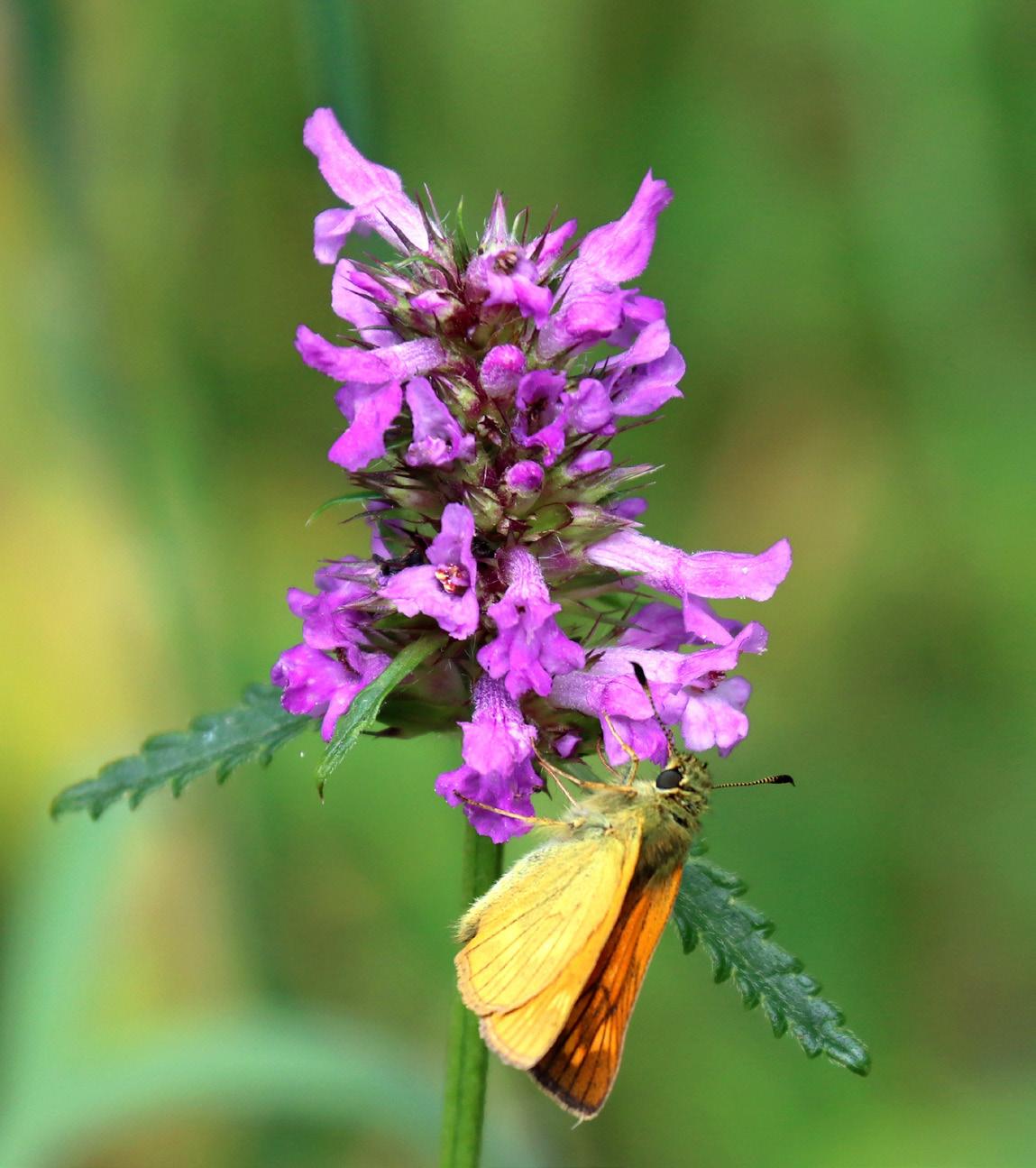
Cover image: Large skipper on betony (c) Trevor Hulme
Herefordshire Wildlife Trust, Queenswood Country Park & Arboretum, Dinmore Hill, Nr Leominster, Herefordshire, HR6 0PY enquiries@herefordshirewt.co.uk www.herefordshirewt.org
Herefordshire Wildlife Trust is a registered charity no. 220173 and a company limited by guarantee no. 743899
Welcome to issue 89 of Herefordshire’s annual natural history journal. In the last issue we paid tribute to the efforts of Peter Garner for establishing this publication many years ago. However, after some discussion the editorial team feel that it’s time for a name change, despite some sentimental attachment to its forebear. The old title of The Flycatcher, is presumed to originate from the then Nature Trust’s logo of a pied flycatcher, which is no longer used by the present-day Herefordshire Wildlife Trust.
The Herefordshire Naturalist was selected as a more self-explanatory title, as we try to reach a new generation of nature lovers and naturalists. The core content remains the same mix of wildlife reports and in-depth articles on species, habitat and related projects across the county.
In this edition, as well as some fascinating annual wildlife reports, there are features exploring the work of county conservation organisations such as Herefordshire Meadows, which champions our flower-rich meadows and the Herefordshire Ornithological Club.
The City Nature Challenge has become a global event, which the county entered for the first time last year. The Herefordshire Biological Records Centre co-ordinated your efforts and report on the results, as well as plans for this year.
This brings us on to a subject, close I’m sure to many of your hearts - the business of recording our precious wildlife. As we write this, winter is turning to spring and another recording year shifts up a gear. We live in a county blessed with a fascinating flora and fauna, but despite the efforts of many of you, Herefordshire remains I think it’s fair to say, an under recorded county.
Species and habitat monitoring is not only enjoyable but adds importantly to our knowledge and understanding of the riches on our doorstep, which in turn allows us to better manage for and protect this diversity. So, we encourage as many people as possible to get involved in the citizen science projects promoted by both national and local organisations… Happy recording.
If you would like to contribute an article to the next edition, we would love to hear from you, ideally by the end of September 2026.
The final copy deadline will be February 15th 2027. Contact: f.weeks@herefordshirewt.co.uk
As in the previous edition, this section is a combination of the summaries from the county recorders and reports and comments received from other taxa experts. We were unable to get contributions from experts covering several important taxa groups this year, but we hope to correct this in future editions.
Vascular Plants Stuart Hedley - County Recorder BSBI
As last year, I give here a very short selection of some of the more interesting 2025 botanical finds, with a fuller account to be included in the Transactions of the Woolhope Naturalists Field Club later in the autumn.
It was a notable year for Small-leaved Lime Tilia cordata, an important species with us, whose inability to set good seed in the UK climate has been a tenet of British botany for a long time. In 2025, however, groups of seedlings were recorded in both the Woolhope Dome and the Black Mountain Fringe. Seedlings have been known in well-studied Shrawley Wood in Worcestershires for some time, but this evidence in Herefordshire seems to be new.
The iconic Green-winged Orchid Anacamptis morio, a much less common plant than its look-alike Early Purple, also seems to be doing well. Several new stations were reported, in many of which only singletons were present, an interesting finding and one which merits further consideration. However, these new sites build on the monitored expansion at Joan’s Hill reserve in 2024 and, if mirrored elsewhere in Britain, may be behind the recent amelioration of the plant’s threat category:
A revision of the England Red Book late in the year saw A. morio go from ‘Threatened’ to ‘Near Threatened’. Early days but we like to grasp hold of positive news wherever possible.
Amongst the loveliest of our wild grasses is the genus Avenula, but these are very hard plants to spot. Not a problem for eagle-eyed Holly Thompson and Toby Fountain who found some in a field in Michaelchurch Escley during a Local Wildlife Site survey in 2023. Though not rare plants nationally, they are limelovers and hence scarce with us, where they are always associated with high quality habitat.
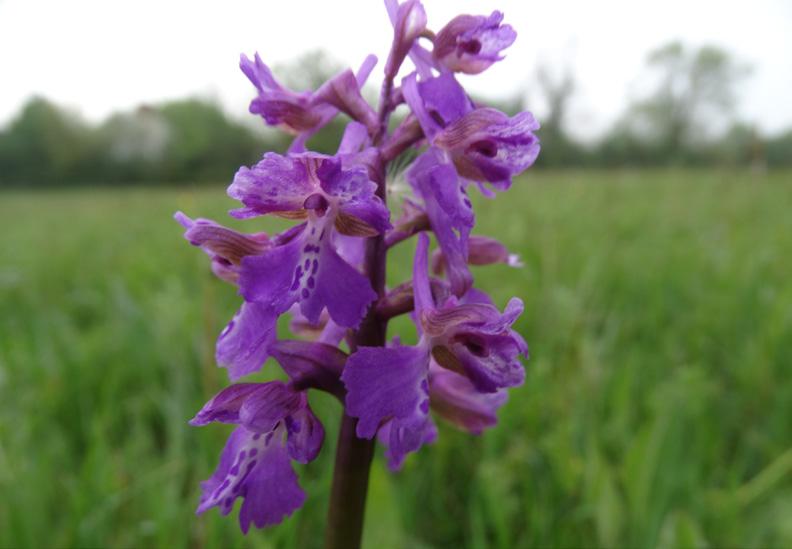
On returning to Holly and Toby’s site in 2025, I was thrilled to find one of the largest stands of Downy Oat-grass A. pubescens I have ever seen in Herefordshire, creating a silver sheen over a beautiful traditional meadow of very high quality. Green-winged Orchid Anacamptis morio
In the north-west there were new sites for the charming English Eyebright Euphrasia anglica and, one of the undoubted highlights of the year, the very rare and intriguing fern Moonwort Botrychium lunaria. Two more ferns of note: a county first in the relatively distinctive Dryopteris affinis ssp paleaceolobata, a scaly-male fern found for the first time in Shobdon Wood, and, at the other end of the county, Hay-scented Buckler-fern Dryopteris aemula. Here, an excursion by the British Pteridological Society to the Howle Hill area confirmed the continuing presence of the plant in vc36. This is one of the most oceanic species in the Herefordshire flora and it’s great to know it’s still on our list.
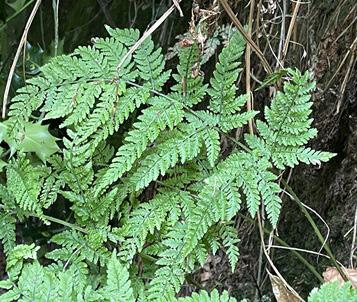
Hay-scented Buckler-fern Dryopteris aemula
A 2025 survey of the Wye banks was resumed, this year downstream of last on the incised meanders between Hereford and Ross. Many of the specialist riparian species present on the upper reaches of the river were also present in these lower stretches, especially Slender Tuftedsedge Carex acuta, Yellow Loosestrife Lysimachia vulgaris and Sneezewort Achillea ptarmica.
At Sink Green low water meant an abundant showing of the rare Needle Spike-rush Eleocharis acicularis, first found here by Peter Garner in 1989, and which may now have extended its population. Most notable however was the presence of River Water-Crowfoot Ranunculus fluitans, at several places in the main channel between Fownhope and Ballingham. There has been much concern about these plants, but the findings mean that both of the Wye water-crowfoots are persisting, in spite of the undeniable and widely-reported losses.
With over 16,400 records, 2025 was another excellent year for submissions, the second-best ever. This is down to the roll-out of various phone-based apps which allow plant records to be got from a field sighting onto a database in a short space of time. The enhanced capacity is proving useful in helping visualise what might be possible within a new Flora for the county in the years ahead. Please get in touch if you have spare capacity for recording wild flora, especially if you live in one of the less well-recorded areas: the farmed country between Pencombe and Leominster, or the lowlands south of the Arrow between Eardisland and Weobley, say, or the countryside around St Weonards. It’s an incredibly rewarding way of communing with the wild and I can give further support if needed.
Stuart Hedley s2arth@hotmail.com
Bryophytes:
No new county discoveries are known of from 2025, but several uncommon/scarce species have been re-found in 2025 including Floating Hook-moss Warnstorfia fluitans from a small pool on Cefn Common (HWRG - March), Grimmia orbicularis from an old quarry in Mortimer Forest (Border Bryologists meeting - November).
Another scarcity is Luisier’s Tufa-moss Gymnostomum viridulum, long known from the old quarry at King Arthurs Cave NR on the Doward but also found in November growing on the side of a track on Little Doward (WT).
Compiled by Ian Draycott and Tim Kaye
Please be aware that some of these reports will not yet have been reviewed and accepted as verified records by the appropriate recording schemes. Also note that some taxa families have no associated recording scheme even though in some cases, unverified records are still passed from iRecord to the National Biodiversity Network (NBN Atlas). This report therefore does not provide definitive information but a set of reports for general interest only.
We recognise that we do not usually credit the finders of these records but are grateful to everyone for sharing them and making them public in various ways.
Bob Hall, the County Recorder for Butterflies (B.C.) has provided a 2025 review on page 13. This may be familiar to readers of the newsletter of the Herefordshire members group of Butterfly Conservation where it was first published.
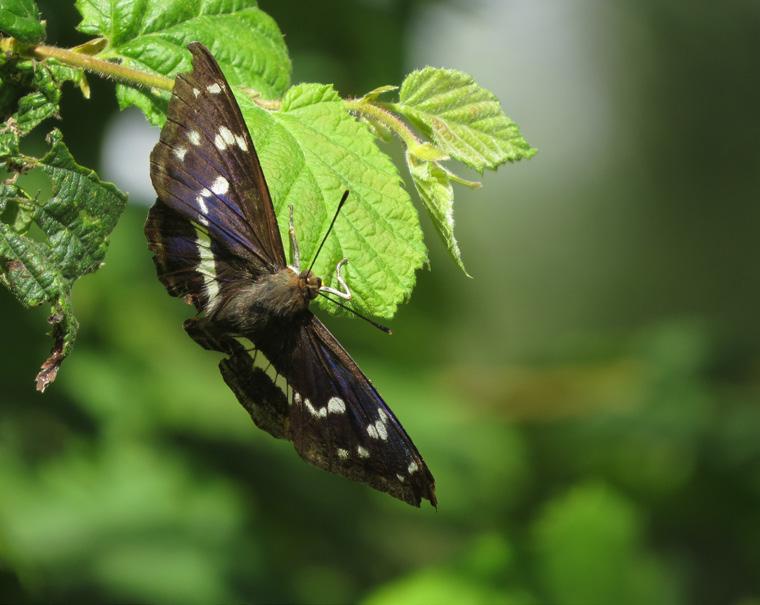
Bob reports on the exciting development of the re-appearance of Purple Emperor in the county at two sites. They were last here in the 1960s and it will be interesting to see if their westward spread continues.
His other news relays mixed fortunes as some regular species bounced back from a disastrous year in 2024, however, there was continuing declines or range reduction in some of our scarcer species.
Peter Hall, the County Recorder for Moths (B.C.), recommends regular checking of the website www.westmidlandsmoths.co.uk.
This is a relatively new site supported, in part, by Butterfly Conservation and is an impressive way of presenting the highlights from the combined data of all moth recorders moths in four West Midlands counties. Its distribution maps also generate some surprises about species that may be regular here in this county but are surprisingly scarce in neighbouring ones … and visa versa.
The site also has a notice board onto which Peter posts news including any new verified county records. In 2025 the following are listed so far although not all the results are in at time of writing!
New Macro-moths
Langmaid’s Yellow Underwing (July, Colwell)
Clancy’s Rustic (September, Lyonshall)
Cosmopolitan (September)
Also of note was a V Moth at Leintwardine which was the first in the county since 1980.
New Micro-moths
Phyllocnistis asiatica (Lyonshall, July)
Ptocheuusa paupella (Whitchurch, August)
Isophrictis striatella Tansy Stem Borer (Colwell, July)
Eudemis porphyrana (Bodenham, July)
Schoenobius gigantella - Giant Water Veneer (Bodenham, June)
In addition to these newcomers, the accessibility of the spatial and temporal data for all commoner species on this website helps raise alerts about any that are in decline. For example, with no records of Beech Green Carpet in six years, could this species now be lost to the county?
This website also offers useful tips on how to determine tricky species such as the difference between the recently-recognised Spiny Hook-tip and our more regular Oak Hook-tip.
The provisional list of the Bees of Herefordshire has risen to 122 species though not all these have had expert confirmation yet. One new addition is the Red-girdled Mining Bee Andrena labiata which was seen at two sites on the Doward in Spring 2025. However, an older record from a quarry in the centre of the county was from 2020 and has just appeared on NBN.
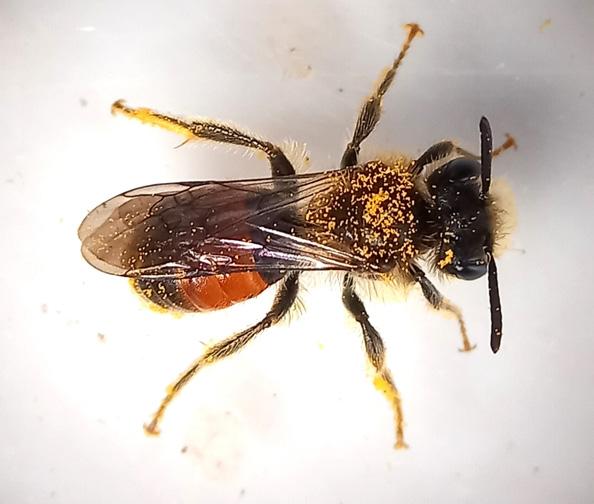
Red-girdled Mining Bee
Andrena labiata
Another new Mining Bee, Andrena angustior (Groove-faced Mining Bee) appeared to be a first county record but this is not an uncommon species and has probably been overlooked in the past.
Three species of Blood Bees, Sphecodes hyalinatus, S. geofrellus and S. crassus were also provisionally added to the list, as was one new Nomad Bee Nomada hirtipes.
There are three main families of Solitary Wasps in UK, and all are poorly recorded in the county. The following three species of Digger Wasp (Crabronidae) were found in 2025 seemingly for only the second time and at their second known county sites: the Dark-winged Digger Wasp Lestiphorus bicinctus, the Slender Wood-borer Wasp Trypoxylon attenuatum and Ectemnius literatus.
From the family of Spider hunting Wasps (Pompylidae) there are new records of the Common Black Anoplius, Anoplius nigerrimus, and the Potter Spider Wasp Auplopus carbonarius. The third group of Solitary Wasps are the Eumeninae (part of Vespidae) which includes the Mason Wasps such as the more familiar Ancistrocerus species. Sawflies (suborder Symphyta) many are tricky to identify but some are quite distinctive. A new accepted county record was for the was the small Cladius pectinocornis with its
strange forked antennae. Two other species, the Saddleback Grasscutter or Lawn sawfly Eutomostethus ephippium and the Torpedo Sawfly Nematus (Craesus) lucidus are now known from two county locations.
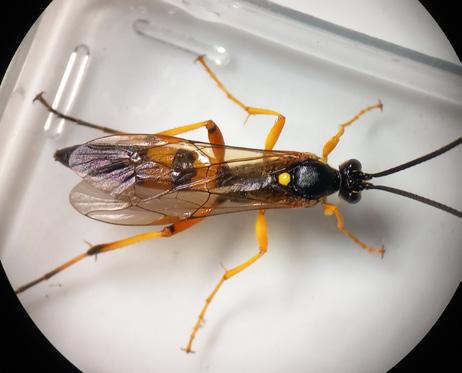
Four-spotted Cave
Ichneumon Diphyus quadripunctorius
Most species of the Ichneumonidae known as Ichneumons or Darwin Wasps, and many other members of the suborder Apocrita – Parasitica are even more challenging to identify. But again, some are quite distinctive and one discovery of the large Four-spotted Cave Ichneumon Diphyus quadripunctorius appears to be new for VC36.
Further efforts to document the county Diptera fauna has led a revision to the unofficial county checklist which is due to be published on Herefordshire Biological Records Centre website in early 2026. Adding species to this list is still an imperfect process due to difficulties getting expert verification by the national recording schemes, however much can still be done. A good number of new additions have been reported in 2025 and below are some examples from better known families.
Calliphoridae and allies - Blowflies etc There was a first county record of the distinctive-looking Locust Blowfly Stomorhina lunata feeding on garden mint flowers in the Doward during the heat of August. As this species is a larval parasite of locust species this individual was assumed to be a migrant from the Mediterranean or beyond. Actually, this species has now been placed in its own family the Rhiniidae.
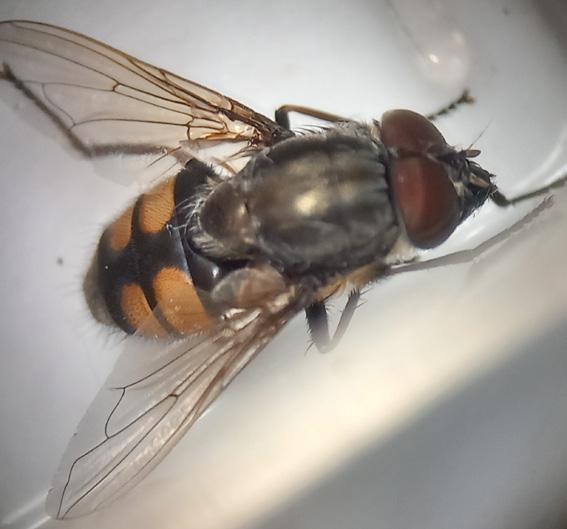
Syrphidae - Hoverflies The county hoverfly list now stands at 134 species (but with 29 still unconfirmed by the national recording scheme). The two new additions to the list are Chrysotoxum arcuatum and Cheilosia soror with three previously unconfirmed species records having now been verified (Melangyna umbellatarum, Meliscaeva cinctella, and Cheilosia bergenstammi).
Asilidae - Robberflies In June, a Golden-haired Robberfly Choerades marginatus was found on a wild rose on the Doward. The only previous county record was from Mocca Park in 1951, but they have presumably been happily doing their own thing unnoticed across the county since then.
Tachinidae - Parasite Flies The genus Phasia is best known for the large and showy Bluewinged Phasia, Phasia hemiptera. However, there are three smaller species that frequent garden flowers such as mint. One of these Yellow-knobbed Phasia Phasia barbifrons was recorded for the first time in the county in August. Another more difficult to identify Tachinid is Linnaemyia picta which awaiting expert review and may become a first record.
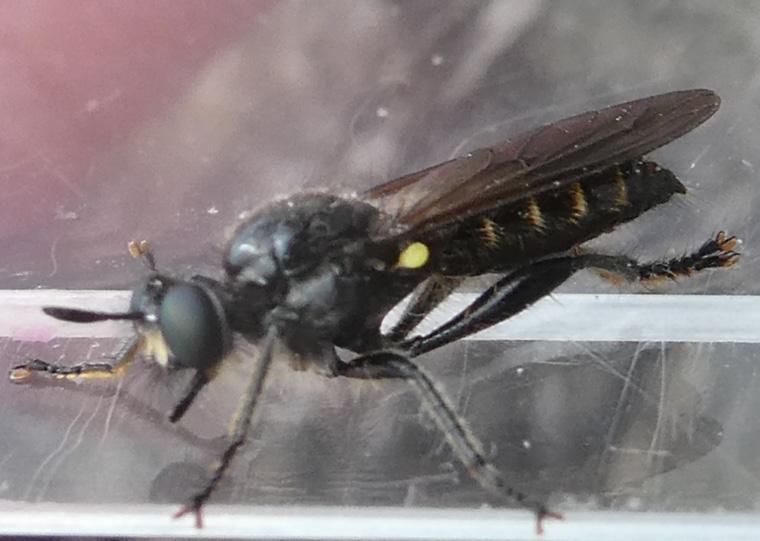
Golden-haired Robberfly Choerades marginatus
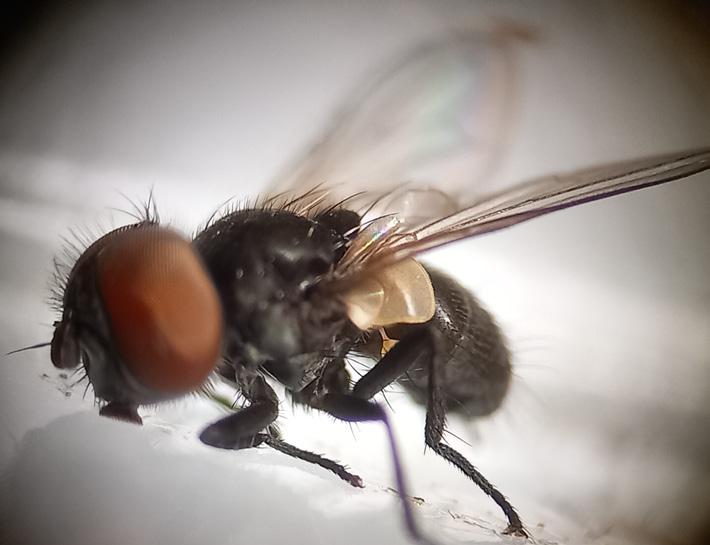
Yellow-knobbed Phasia Phasia barbifrons
Conopidae - Thick-headed Flies Records of these odd-looking flies have only come from a few sites, but they are doubtless more widely present. The Hornet Grabber Conops vesicularis is only reported from the Doward but no record has yet appeared on NBN. A Doward record of Myopa pellucida was thought to be new for the county until an earlier one from National Trust at Brockhampton in 2013 was uploaded to NBN in February 2026!
Other significant records were from families including Scathophagidae (Dung Flies), Tephritidae (Picture-winged Flies) and from the even less-well-known Megamerinidae.
A report in the February 2026 issue of the national magazine, British Wildlife, highlights a species of Fungus Gnat (Mycetophilidae) called Dynatosoma thoracicum was found in Haugh Wood and is new to Britain. A species of Scuttlefly (Phoridae) found on Little Doward in 2024 may also be new to science.
There was an upsurge in records of Coleoptera in the county in 2025 deriving largely from the fact that the Coleopterists Society held two field meetings here. The first in the Olchon Valley amassed 321 records of which 17 were new record for VC 36. These included 14 species of the Staphylinidae which are also known as Rove beetles. Many of them are hard to identify and as there are 1,200 species in the UK it was not surprising that it took national experts to find them.
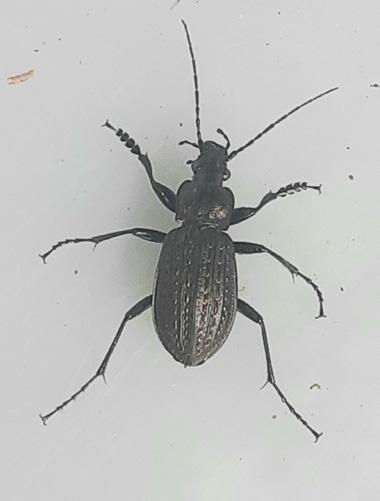
Further afield, recording at Snodhill castle turned up three more Rove Beetle records new for the county including Anotylus insectus. Also, a Flea Beetle, Longitarsus reichei was found new to the county at Trehumphrey Farm. Considering that this feeds on plantains it is probably more widespread that it appears. Nearby at Langstone Court, community surveyors found the uncommon carabid Carabus granulatus which is not super rare but still good to see. Bartonsham Meadows, now under tha management of Herefordshire Wildlife Trust, in the centre of Hereford, saw new county records for Stenopterapion meliloti, a pear-shaped weevil and Aleochara spadicea, again a Rove Beetle. Excitingly, Herefordshire had another record of the Bee Chafer, Trichius fasciata, a scarce species that was found on the edge of the county in Adleymoor.
Some further notes are provided about the important of the report by James McGill of the second survey for Saproxylic Insects (2024) at Little Doward on page 59. Further visits by James with local entomologists in May 2025 confirmed the continuing presence of the critically endangered Cosnard’s Net-winged Beetle Erotides cosnardi.
There is usually a great paucity of county records of Hemiptera, even on online platforms, but not so in 2025 as numerous records have come in through iRecord in 2025. These include common species such as Green Shieldbug, Palomina prasina and Hairy Shieldbug, Dolycoris baccata. There were however some new records for the county including Euceraphis betulae from Ewyas Harold.
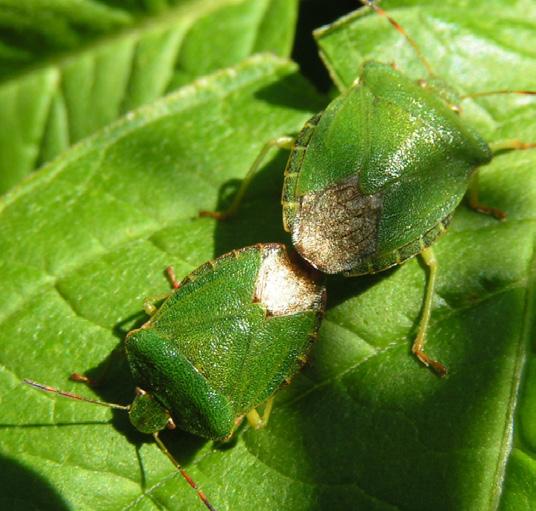
Green Shieldbug
Palomina prasina
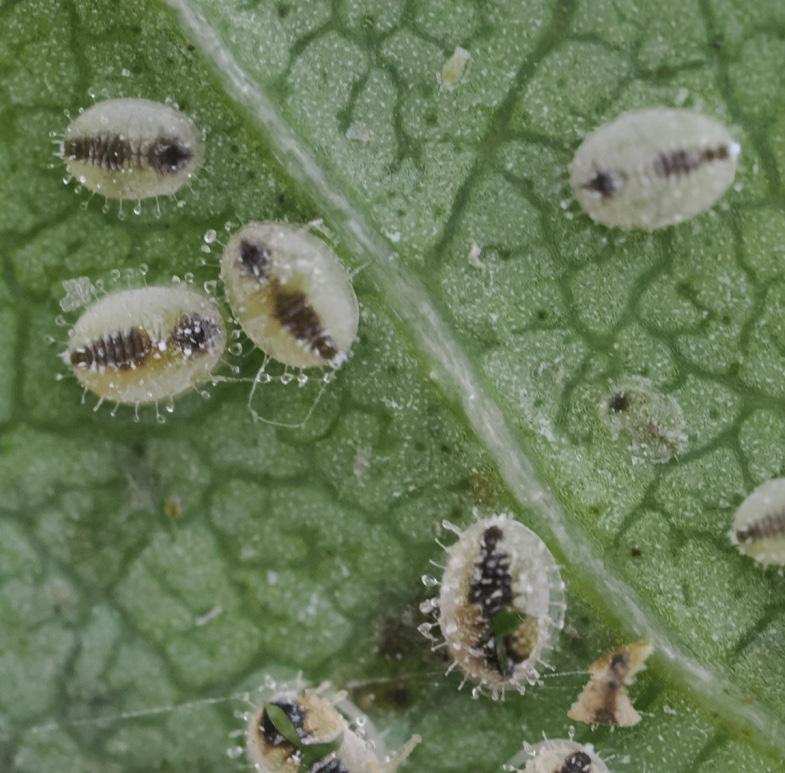
Aphids in particular are not often recorded so it was good to see Lime Aphid, Eucallipteris tillae being recorded by Richard Comont in Hereford. Richard was mainly active in his local stomping ground of Colwall Village Garden with numerous county firsts including the southern mirid species Amblytylus nasutus, Uroleucon sonchi, Aphis lamiorum (Dead-nettle aphid). Parthenolecarium corni, Macrosiphoniella helichrysi and Microlophium carnosum.
The southerly leafhopper Aphrodes makarovi was found at Wellington Heath by Reg Summers. He was also the finder of Neolygus viridis and Eurhadina loewii. There has been an influx of records for the Box Bug, Gonocerus acuteangulatus which was until recently only found on Box Hill in Surrey. It has since spread throughout the country as it found different plants to feed on. They are superficially similar to the common Dock Bug so keep an eye out for these.
Whiteflies (Aleyrodidae) do not often get recorded, so it was good to see a first county record for the Ash Whitefly Siphoninus phillyreae found by Aaron Woods at Wofferwood Common. Wye Valley Nurseries were the location for another first county record of the Painted Holm Oak Aphid Hoplocallis picta. Tim Kaye thought he had found the first record for the Andromeda Bug Stephanitis takeyai which comes in as a horticultural hitchhiker and feeds on Rhododendron, first seen in the UK in 1988. However, days before his record at Broadlands Primary School, one was found by Gail Hampshire in Cradley!
Crustacea: Isopoda - Woodlice
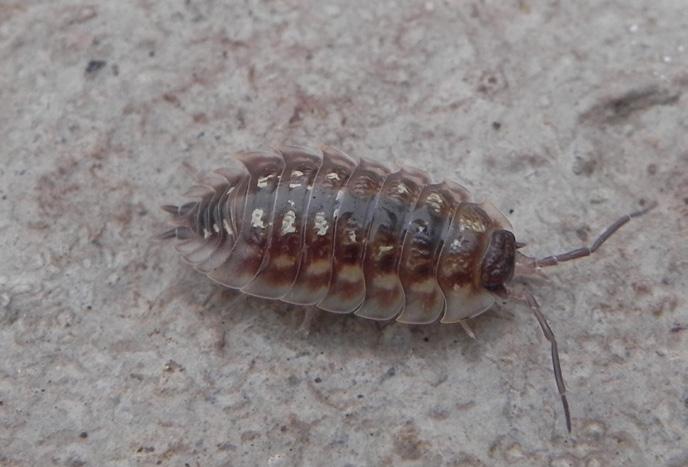
There were a few more records in 2025 than 2024 with the common Rough Woodlouse Porcelio scaber leading the way. However, Snodhill Castle turned up a record for Porcelio spinicornis which while not rare is certainly uncommon in this county. It was also nice to see a record for the Rosy Woodlouse, Androniscus dentiger at Three Ashes.
Diplopoda - Millipedes and ChilopodaCentipedes
Common records have been coming in on iRecord which is good to see. Pick of the bunch is Oxidus gracilis, the hot-house millipede found in a terrarium at Wofferwood Common.
Collembola - Springtails
Compared to Shropshire, searching for springtails does not seem to be a common preoccupation of Herefordshire naturalists. However, a few adventurous recorders seem to be looking out for them recently. Isotoma viridis was found at Bartonsham Meadows and Willowsia platini at Trehumphrey Farm were both county firsts. It should be pointed out that these are very common species and could be found by anyone grubbing around in bark and soil.
Arachnida: Order Ricinulei - Pseudoscorpions
The Common Chthonid, Chthonius ischnocheles was found in the Golden Valley in 2025. It would be great to know if any other species of Pseudoscorpions have been found recently by recorders. Some species are very common in leaf litter or compost; they’re just not noticed with any kind of regularity.
Mollusca: Gastropoda – Slugs and Snails:
Sadly, no new records appeared in 2025 of the lovely Lemon Slug Malacolimax tenellus or Ashy Black Slug Limax cinereoniger as they did in 2024. However, a Worm Slug Boettgerilla pallens was again found at Wofferwood Common. These are soil dwellers and are not often encountered and there are very few Herefordshire records.
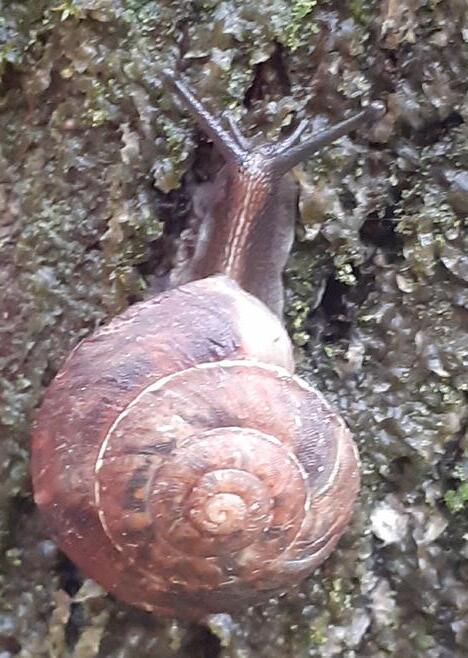
Another uncommon find was the Lapidary Snail, Helicigona lapicida which was found at the church at Garway by a citizen science group.
Dingy Skipper and Grizzled Skipper are still both very restricted in their distribution, with four records for Dingy from Ewyas Harold Common, Wye NNR and Zion Meadow; Grizzled have been found at The Doward as well as Ewyas Harold Common. 71 records for Large Skipper which are quite widespread in the county with a high count of 11 from Sarah Cadwallader at Mowley Valley. 71 records for Small Skipper with a maximum count of 75 from Tom Oliver at Urishay Court Farm. A few records of Essex Skipper, but this species is almost certainly under-recorded on account of difficulty in identification. There was a maximum count of three from Ian Draycott at The Doward.
There were over 70 records of Brimstone, but the summer brood was low in number. Plenty of Orange Tips in April and May with a large count of 20 from Tony Eveleigh at Red Daren.
There were over 200 records for Green Veined White with a max count of 45 from Jane Wise in Haugh Wood North. Large White were again common with a high count of 50 from Risbury Court Farm. There were over 140 records of Small White with a high count of 24 from Tony Eveleigh at Hartleton Lakes.
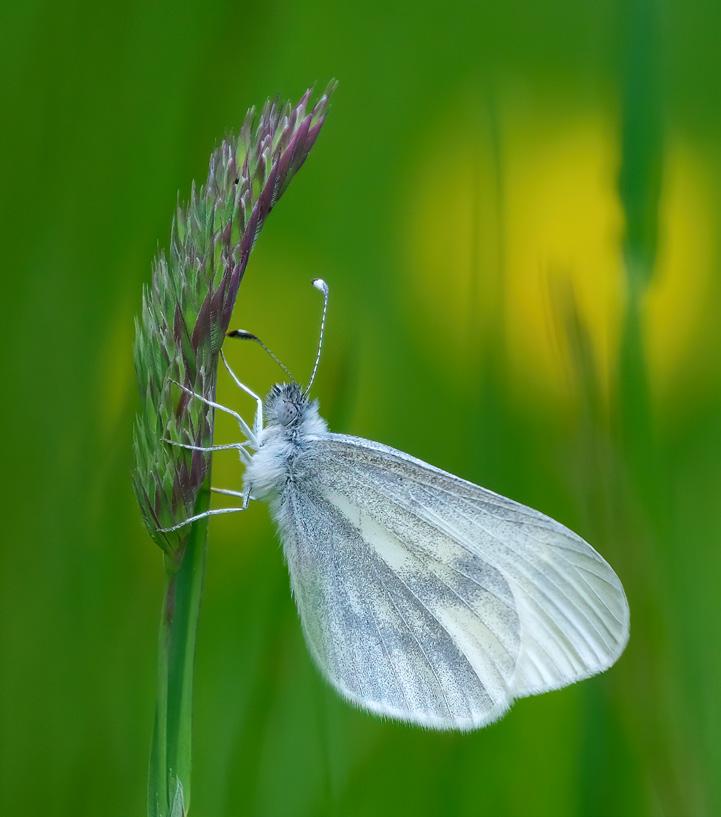
Wood White have had a better year than in 2024 with a high count of 51 recorded at Wigmore Rolls by Richard Wheeler. Wood White were also recorded in Mowley Wood, Shobdon Wood and Haugh Wood. There were five records of Clouded Yellow in August and September.
Gatekeeper had a good year with over 150 records. There was a high count of 72 from Haugh Wood. Meadow Brown also had a good year with nearly 200 records including an astonishing count of 200 plus from Tom Oliver at Urishay Court Farm. Sarah Cadwallader also had a high count of over 100 at Birches Farm.
Ringlets (max 89 from Haugh Wood South and 100 plus from Urishay Court Farm) also had a good breeding season. There were good counts of 100 Marbled White from Urishay and
50 from Joan’s Hill reserve. Speckled Woods were widespread with a high count of 19 from Sarah Cadwallader at Mowley Valley. There were 10 records of Wall from mainly the north and west of the county. Low numbers of Small Heath records from Herrock Hill (max 28) and other spots near Kington and in the Malverns.
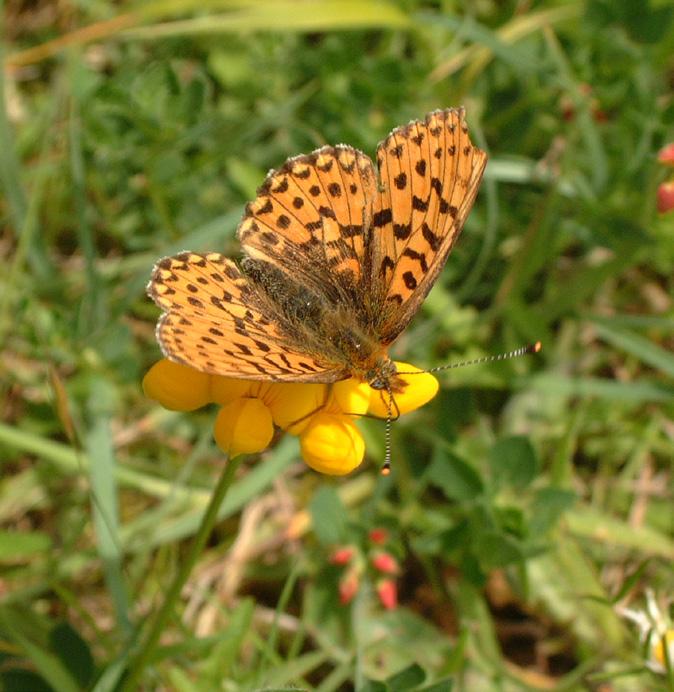
Pearl-bordered Fritillary Boloria euphrosyne
There was a maximum count of six Dark Green Fritillary from Hanter Hill, with smaller numbers seen at Ewyas Harold Common, Olchon Valley Pengelli and Cradley. Only five records in 2024.
Pearl-bordered Fritillary numbers were good at Ewyas Harold Common with a high count of 143. There was one recorded at Devereux Park.
Small Pearl-bordered Fritillary were recorded from Hanter Hill, Hergest Ridge and Pengelli with a high count of four from Toby Fountain at the latter site. Silver Washed Fritillary had 26 records: they had a fair season with a high count of 10 from Haugh Wood South. There was one record for Marsh Fritillary at a site near Madley. This is believed to be a site where the insect has been reintroduced.
There were plenty of records for Comma with a high count of eight from Gibes Wood. Red Admiral have had a most wonderful late season extending well into autumn with over 200 records. David Griffith had a high count of 18 from Lyonshall. There were also plenty of records for Painted Lady with a count of five from Mike Williams. Plenty of Peacocks with a high count of 15 from Martyn Davies at Bridge Sollers.
Small Tortoiseshell numbers too were generally low with only 140 records for the whole season. The highest count was 12 from Robbie Ledlie at Bartonsham Meadows. White Admiral: no records this year.
Surprise of the year was the re-emergence of the legendary Purple Emperor. Mel Mason spotted two at Perseverance Hill in the Malverns, and Anne and Dave Sudworth recorded them at Frith Wood, Ledbury.
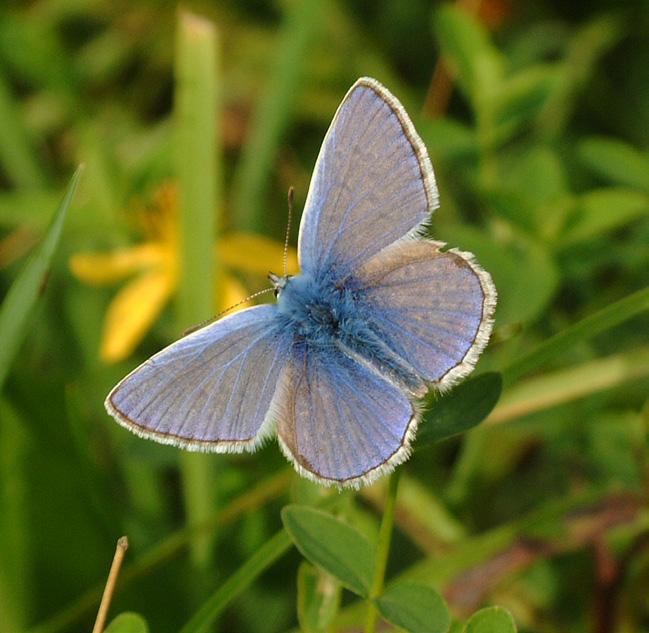
There were plenty of early records of Holly Blue and a good 2nd brood. Common Blue had a much better year in most places: Jeremy and Katherine Soulsby counted 25 at Joan’s Hill reserve and Sarah Cadwallader 24 at Birches Farm.
There were several records for Green Hairstreak from Hergest Ridge, Hanter Hill, Vaga Hill, Holywell Dingle and Malvern. Richard Wheeler counted at least 11 on Hanter Hill.
Purple Hairstreak were recorded from Haugh Wood South and Lulham with a maximum of three. White letter Hairstreak were seen in Haugh Wood and Holywell Dingle but only in small numbers, (max two from Heather Walker in Haugh Wood).
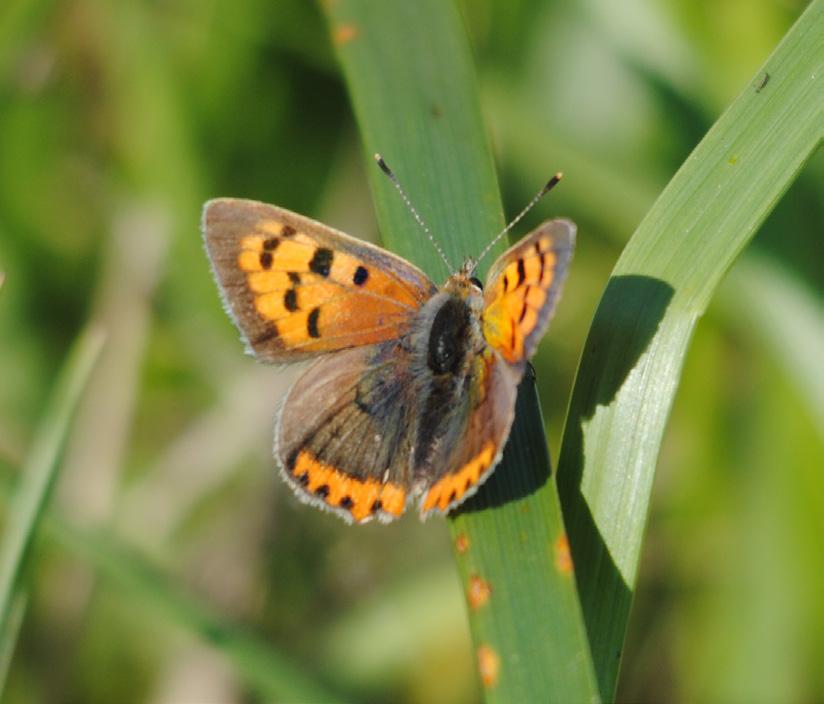
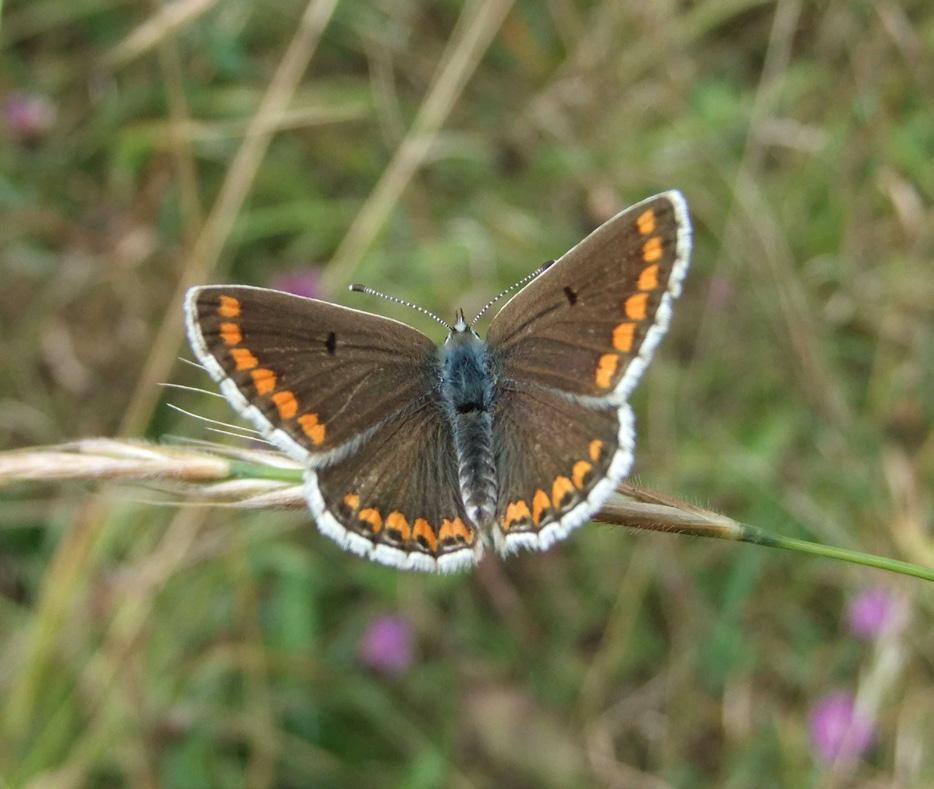
There were 11 records of Brown Argus with a high count of three from Jess Sly on Pinnacle Hill, Malvern. Small Copper were seen in good numbers in late summer with a remarkable count of 28 seen by Ella Curry at Eardisland.
2025 has been a much better season for many of our butterflies compared to the dismal 2024. Warm sunny weather in the spring led to good conditions for breeding as shown by the pleasing increase in the numbers of many of our native species.
However, the summer drought will have affected larval food plants: the consequence of this will not be seen until 2026.
Many thanks to all recorders for submitting their records. There are now too many of you to be mentioned individually. Thanks to Martyn Davies and Rachel Mailes for their great assistance in checking records.
Website: www.westmidlandsbutterflies.org.uk
The year started with good numbers of Golden Plover on Bradnor Hill in the North West of the County, counts of 35 and 58 were recorded, a great record of a Short-eared Owl was also recorded in the same location on the 14th January.
A Tree Sparrow was recorded at Downton, one of the last strongholds of this species and a Green-winged Teal was on the new-works Wellington Gravel Pits (GP) and another rare duck was reported at Bodenham Lake a pair of Ring-necked Duck, another North American species.
Rarer Gulls, Yellow-legged and Mediterranean were recorded on the Lugg Meadows on the receding floodwater a good place and time to look for these species at this time of year. A Jack Snipe was at The Sturts Nature Reserve and a Common Scoter appeared at Brockhall GP.
A Scaup showed well at Wellington GP, other notable birds in the first quarter were a White-fronted Goose at Shellack, a Marsh Harrier made a brief appearance at Brockhall GP along with a Redshank. Firecrest reported in the North of the County with a Jack Snipe at Wellington and a Short-eared Owl was seen along a road by Stretford area. Two Red Grouse were seen on the Black Mountains above the Darrens.
The second Quarter started with an Osprey at Trippleton Leintwardine area, an Arctic Tern at Breinton area. A White-fronted Goose was at Wellington GP and a Great-blacked Gull at Brockhall this is a rare Gull in the County. A Firecrest was reported again North County and a rare Black Kite in the Hope Mansell area was recorded on bird-guides.
Three Ring Ouzels were reported in the Darrens passing through and a record of a Hoopoe calling near Caradoc Court were good records. Grasshopper Warbler were recorded at the Bartonsham Meadows and a Whinchat on Bradnor Hill. Good passage of Dunlin, Wood Sandpiper and Greenshank with a Garganey all through Brockhall and Kenchester Pools. Red-breasted Merganser Mergus serrator
Sanderling came through with a count of five at Wellington GP on the 28th May, with records of an Osprey at Breinton and Wolflow in June and a Barnacle Goose at Kenchester Pools on the 7th June. Records of Yellow-legged and Great black-backed Gulls through the month but the top bird goes to a Puffin Fraticella arctica (fifth County record) picked up and taken to Pets for Vets who took it in and feed up for a week to release back into the wild on the Welsh coast, they named her Oona, a very rare County bird.
The third quarter had records of Ospreys at Winforton Wye area, two Egyptian Geese at Wellington GP with a good passage of returning waders through Brockhall and Wellington GPs Greenshank, three Redshank, Ruff, Blacktailed Godwit and Wood Sandpiper.
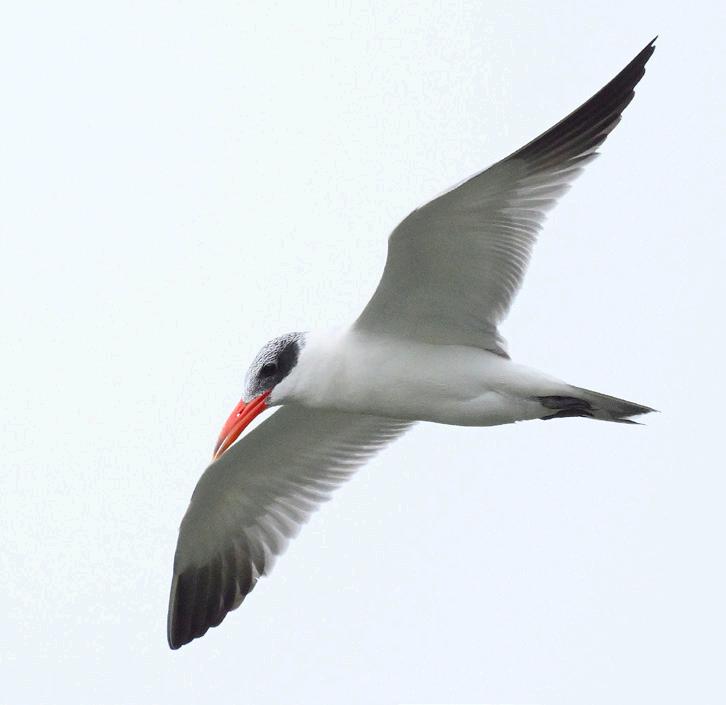
But without doubt the bird of the quarter was a Caspian Tern Sterna caspia (County first) at Hartleton Lakes on the 22nd July staying just long enough for some great photographs.
A Common Tern seen at Wellington GP on the same day and another on the 8th August, with a steady stream of Ruff, Greenshank, two Dunlin and a Little Gull came through the gravel pits. With the highlight of these was a Black-necked Grebe on the 19th of August at Brockhall.
Ring-necked Duck at Bodenham Lake and a Ring-necked Parakeet in Hereford with Osprey and a Spotted Redshank at Brockhall GP finished the quarter off.
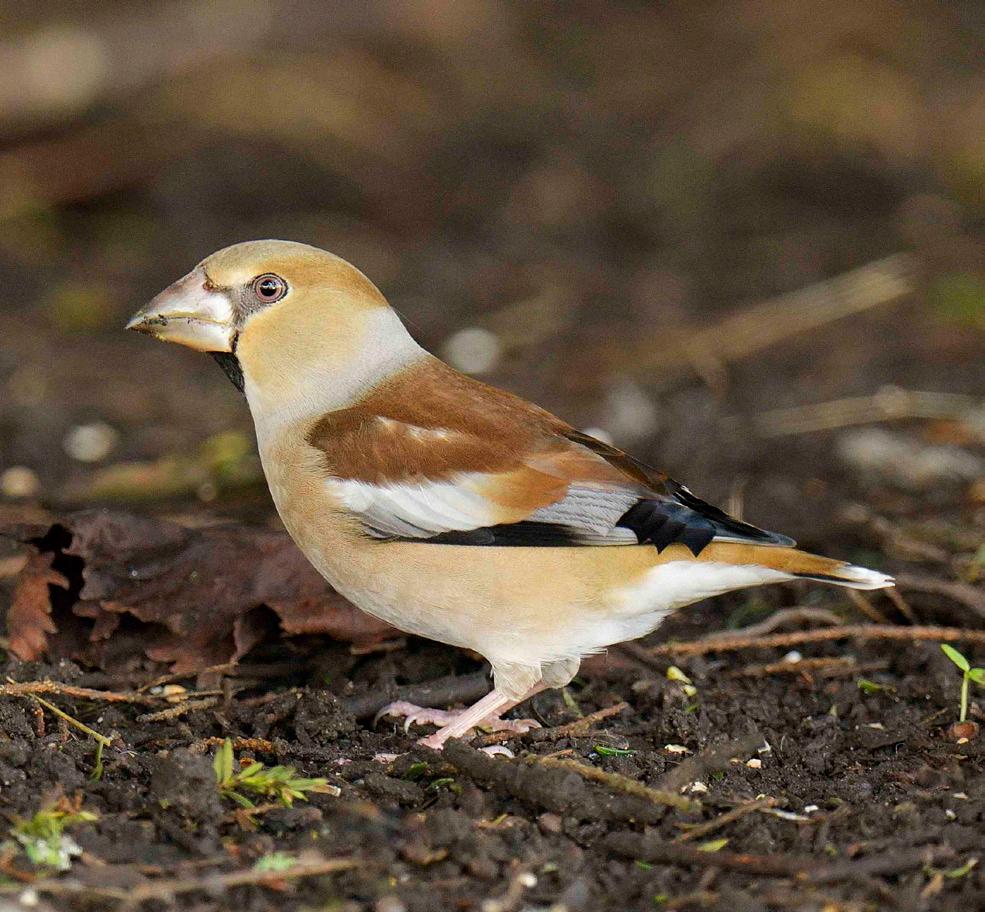
The final quarter of the year started well with a Black Redstart on Marcle Ridge and a Hen Harrier at Wellington GP with 6 Brambling at Titley Pool. two Hawfinch and a Cattle Egret were good records from Marcle Ridge. A female type Scaup was recorded at Bodenham Lake amongst the flock of Tufted Ducks.
The Red Daren produced five Ring Ouzels on the 1st November, birds coming through later than normal, with three reported through the next day along with a ring-tail Hen Harrier. Up to five Whooper Swans joined the Mute Swan herd at Whitney-on-Wye, with four remaining through to the New Year and beyond. A Yellow-browed Warbler was recorded along the N/E shoreline of Wellington GP on the 9th November with Mediterranean and up to nine Little Gulls recorded over the Lugg Meadows.
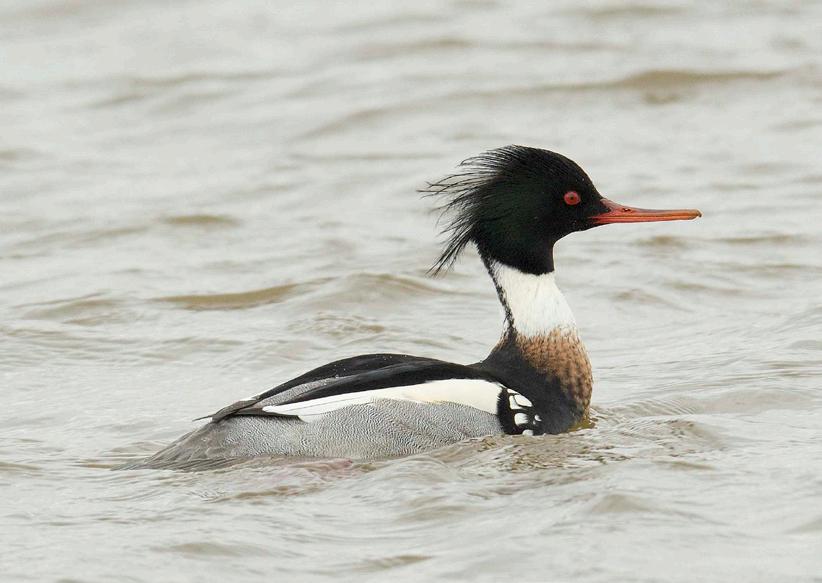
A Woodcock at Bacton Wood and up to 130 Golden Plover were recorded on Bradnor Hill with another Ring-necked Parakeet sighting at Kington, December brought a Caspian Gull onto the Lugg Meadows and Brockhall had another on 24th with a Red-breasted Merganser also at Brockhall only stayed a short time (a rare county bird) the year finished with White-fronted Geese appearing through 25th – 28th at various locations with a Hawfinch at Walford Church and up to 30 Brambling and a Tree Sparrow at Downton area.
Tony Norman, David Griffith and Sarah Cadwallader and myself started the Mowley Valley habitat restoration project six years ago after being approached by owner Edward Bulmer.
Situated between Titley and Staunton-on-Arrow in North West Herefordshire, Mowley Valley was carved out by the meltwaters of the last Ice Age. It has steep sides covered with ancient woodland and a wide floodplain bordering the River Arrow. There are a variety of habitats across its 65 hectares: river and meadows, ancient woodland and young native plantations, long rough edges along the river and woods, ponds and scrapes, wetland and wood pasture.
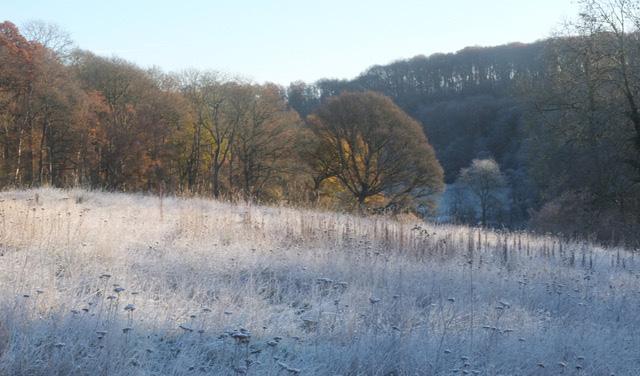
The narrow floodplain meadow beside the River Arrow was once used by drovers’ who stopped to let their animals feed and regain strength before continuing east. The land was never intensively farmed and is one of those rare examples where pesticides or herbicides were never applied. Although there is no public access, we share the project via guided walks and give talks to different groups.
The valley is now a Local Wildlife Site and designated Priority Habitat for the meadows and woodland. This article details the flora and fauna found in the Mowley Valley and the approach we have taken to restore its diverse habitats. If you would like to see these or any of our extensive species lists please contact: catherine.janson16@gmail.com.
The aims of the project are:
• To create and manage habitat in the valley to encourage a complex mosaic, increase biodiversity and encourage nature to restore itself.
• To restore species richness to the meadows which encourages the invertebrates and birds, as well as the water holding and filtering capacity of the soil beneath.
• Managing the long-term biodiversity of the woods with a varied age structure and ride habitat.
• Natural Flood Management with carefully placed scrapes, wetland, rough edges on the river, bank resilience, (shallow ponds)protecting the soil, large woody debris, and
meadows.
• Document and monitor the species in the valley. We are recording moths, butterflies, dragonflies, insects and other invertebrates, mammals, birds, plants, fungi, moss and lichen on detailed species lists.
• Protecting and further understanding the effects of historic management, including the use of flood meadows and other human interventions.
• The costs of meadow and habitat restoration, woodland management and work in the valley need to be paid for by income we generate in the valley from hay, grazing, grants, timber, and fishing.
Approximately 500,000 cubic metres of rain fall on the 65 hectares of the project each year. This will evaporate, transpire, run off or be absorbed into the ground. One percent of Organic Matter (OM) in the soil will hold around 200 cubic metres of water/hectare. OM at Mowley is about five percent, so the Mowley Valley will be holding in the soil approximately (65 x 5 x 200) 65,000 cubic metres (25 Olympic swimming pools) at field capacity.
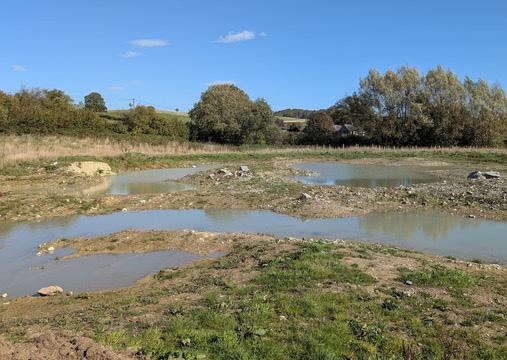
The still waters in winter cover approximately one hectare of ponds and scrapes (in about 20 different sized waterbodies). Some are winter filled and then dry up during summer receding to small pools, or wet marsh. These are all slowing many cubic metres of water getting into the river. Crucially, they also create wonderful habitat. There are many farms on brooks and rivers in the river catchment with very wet areas that are not good for farming and could be used in this way to help alleviate flooding, but it needs collective action.
The River Arrow at Mowley comprises approximately two hectares of running water which is moderately clean and supporting some iconic species such as European Eel, Atlantic Salmon, White Claw Crayfish and Otter. The floodwater from the River or Stansbatch Brook is short lived, covering approximately a further five hectares for up to 24 hours.
When the hay is cut we leave wide rough edges along the river banks. These are developing tussocky grasses with natural regeneration of scrub in slowing the flow of flood water. The floods also deposit woody debris and silt.
Large woody debris is left in situ in the river and creates habitat as well as spilling the floodwater onto the meadows. Fast flowing flood waters undermine the banks and roots behind the riverbank trees. These trees are vital for their root architecture that hold the banks so we are coppicing these where appropriate. Trees also create shade to cool the waters, vital in droughts, like in 2025. We continue to spend many voluntary hours on pulling Himalayan Balsam to allow native perennial vegetation a chance to re-colonise and stabilise the banks against erosion. Rubbish is collected after the floods.
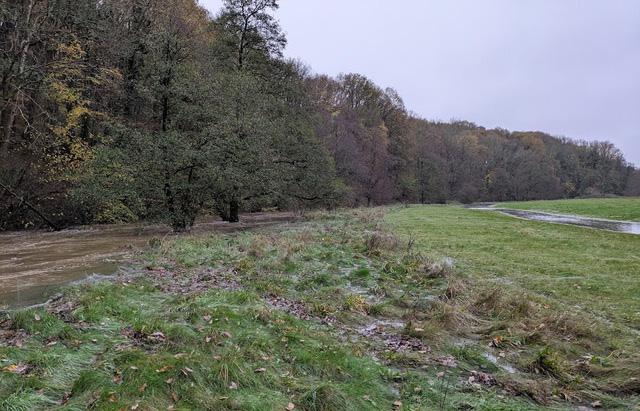
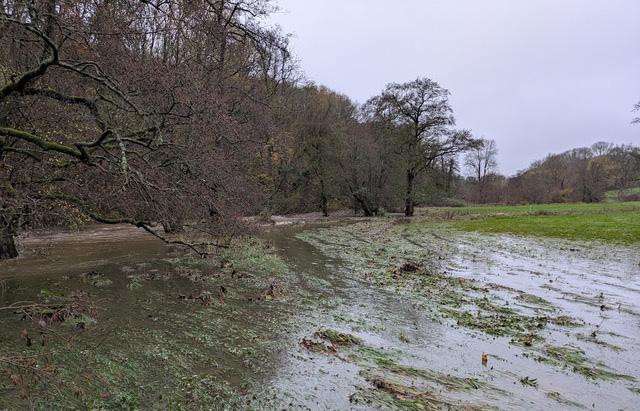
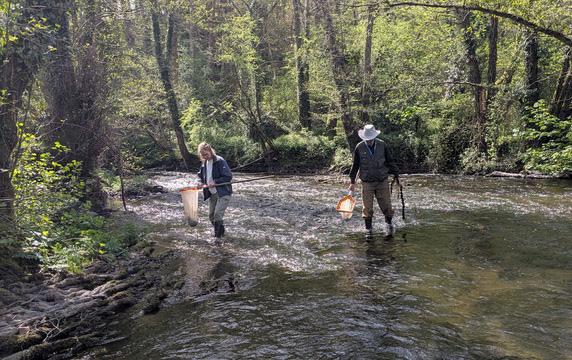
Various means are used to record or monitor: Water sampling (Environment Agency and Citizen Science) River fly sampling. Electro fishing (Wye and Usk Foundation), River levels (Environment Agency), fishing records (Midland Fly fishers), wildlife monitoring and recording (Mowley team), Moth trapping and trail cameras.
We have begun the process of converting the farmland to organic with the Soil Association, and we passed the first inspection. Ted Wardman cut and baled the hay, but due to the heat last year we made less hay than normal. These bales went to The Leen farm a few miles away for their dairy cows. The seed used in the original meadow restoration came from the SSSI meadows on the same farm. Martin Whitehead brought his excellent EasyCare sheep from Brilley Court farm to do the aftermath grazing (the grass that grows back after the hay cut). This grazing is important for the meadow management, and also provides income for the project and meat.
We repeated our meadow surveys using quadrats in the valley in June, with the expertise of Sue Holland. Our best quadrat (one square metre) had 26 species - 20 flowering plants and six grasses. Many other species are also benefitting from this richness. The dense and varied root structures also support biodiversity in the soil and resilience in drought. Common spotted orchids are proliferating, from a couple seen in the first year of meadow restoration to 100’s in 2025.
The 100 acres of ancient woodland at Mowley has a network of woodland rides and glades. Management includes ride edge management to keep these sunny and flowery by coppicing and bracken control with our small tractor and flail mower. We are also thinking about the next 10/25/50/100 years of woodland management and are beginning to use Continuous Cover Forestry (CCF)
The Herefordshire Naturalist
techniques. Phil Morgan and Jonny Hulson, experts in CCF, came to Mowley to do their first survey. We have started to thin the naturally regenerating birch in Hodson’s wood to give light and space to the planted hardwoods. We are controlling the deer and squirrels.
50 plants of the biennial Campanula patula, the spreading bell flower, were planted in 2024 in the dappled light of the woodland edge. Stuart Hedley, Botanical County Recorder, persuaded the Millenium Seedbank at Wakehurst Place to release seed. This used to be a common flower in Herefordshire, but is now very rare. Stuart has written about this is in Botanical Society of Britain and Ireland newsletter.
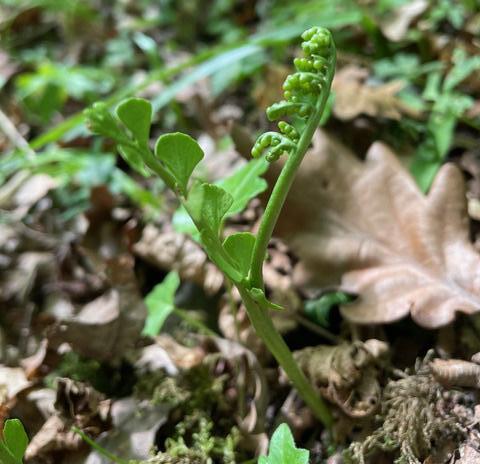
Moonwort was an exciting find in the woodland last year, an ancient fern that appears and then disappears for years leading to interesting folklore.
The Vincent Wildlife Trust installed a second pine marten box, as they believe that Mowley would be a great habitat for them, we await them impatiently as they prey on grey squirrels. Mowley also was the venue for den box training for the Devon Wildlife Trust.
Oak trees cut by Stan Blatchford were then milled by Andrew Hewitt who brought his mobile sawmill. This is being used to put a roof on the once ruined cottage in the valley.
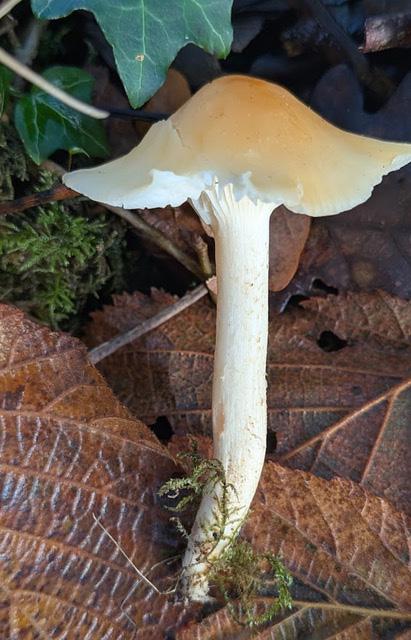
333 species, 31 new records in 2025. Highlights:
• Oak Woodwax (Hygrophorus nemoreus), eighth county record, first since 2010. We are regionally important for Waxcaps.
• Persistent Waxcap (Hygrocybe acutoconica) – 13th waxcap species
• Slender Club (Macrotyphula Juncea) – 11th Clavariacea species, we are nationally important for Clubs and both families need healthy diverse meadow habitat to thrive.
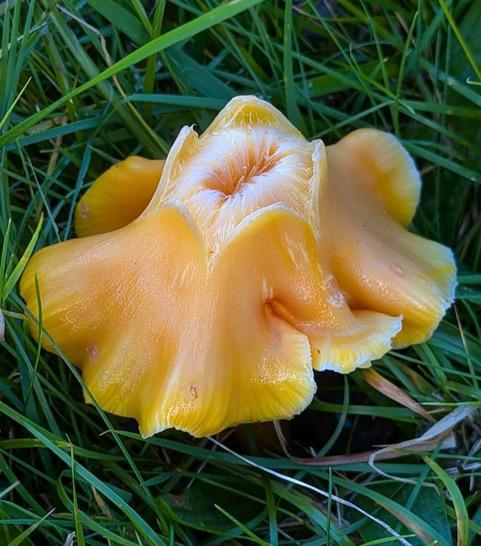
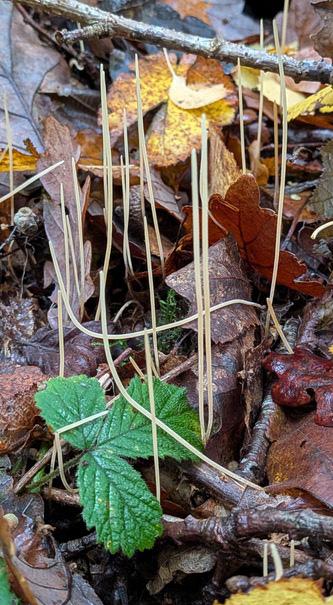
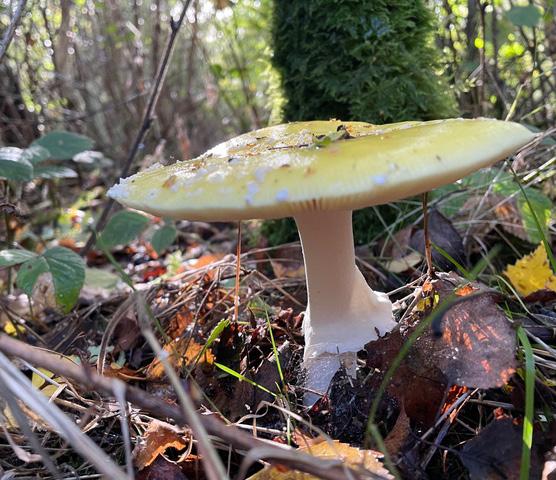
The Herefordshire
Over 600 species recorded, over 60 new records in 2025 (total pending , dissections underway by Peter Hall, County Moth Recorder)
Highlights:
• Five Spot Burnet Moth recorded, first county record for over 50 years.
• All three species of Burnet Moths found this year
• Clifden Nonpareil and Emperor Moths recorded
• Visit from Tony Simpson, (Worcester County Moth Recorder) for a leaf mine survey –30 new species recorded
• New battery actinic Skinner moth trap purchased from Woolhope Dome Environmental Trust grant (WDET)
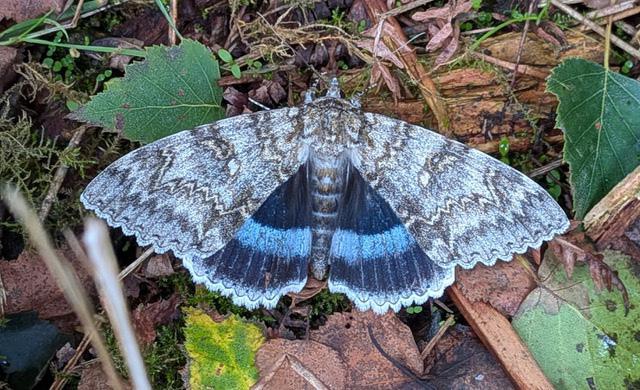
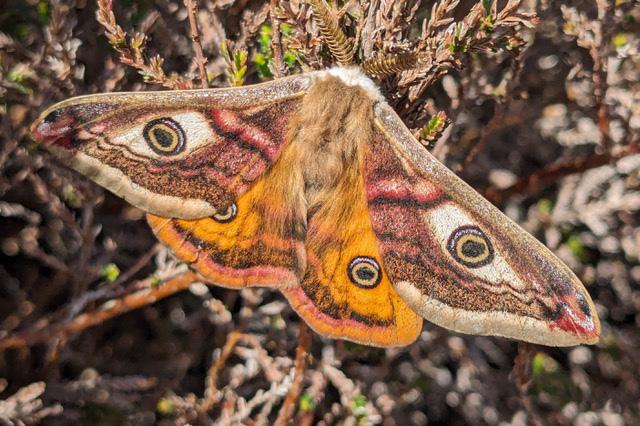
27 species. A good year for many species, large numbers of some after a very poor 2024.
Highlights:
• Brown Argus, new species recorded three times this year. Larval foodplant is the Meadow Cranesbill which is multiplying in the species rich meadows.
• Wood White recorded in meadow and woodland rides
• Wall recorded for second year running
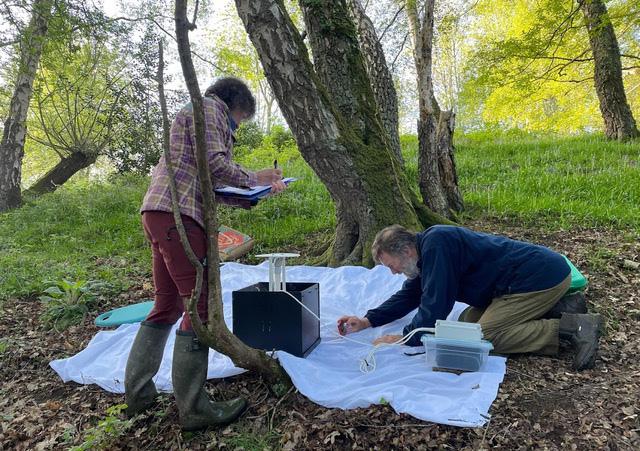
Visit from Winter Recording Group led by ecologist Tim Kaye added four new species to our records. 92 species of mosses, 16 species of liverworts.
The Herefordshire Naturalist
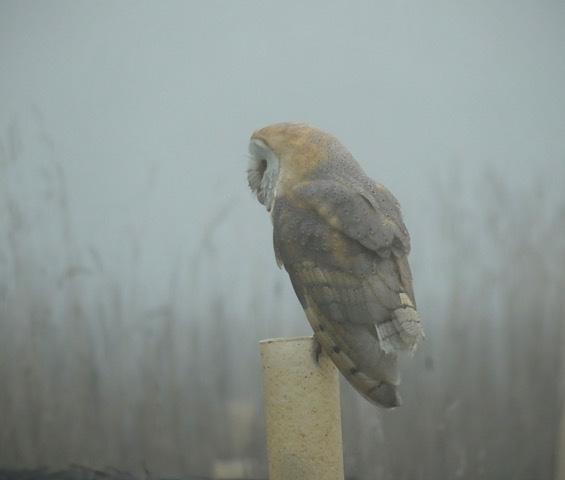
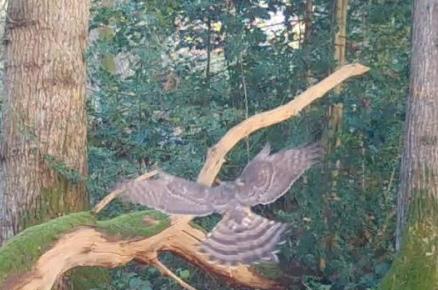
New species recorded – Greenshank, Little Egret and Lesser Black-backed Gull in the new wetland, Redpolls in Hodson’s wood and a Barn Owl in Rough acre where the extensive multi species tree planting has encourage rougher grasses and a huge vole population. A Tawny Owl chick was recorded on a trail cam – first evidence of successful breeding for this species. Also on a trail cam, a Goshawk.
Nest boxes – A better year for the Pied Flycatchers, with no predation, 25 chicks fledged. 5 new nest boxes were installed from WDET grant.
Continued monitoring including trail cams – two new cameras from WDET grant. Dormice were confirmed again.
Beetle – Berosus affinis found by Will Watson, a rare Herefordshire record
South American Waterweed - Elodea callitrichoides.
We had visits from: Environment Agency - river survey, Herefordshire Wildlife Trust Kington Branch Bug Hunt, Winter Recording Group with Will Watson and Tim Kaye, Eardisland Flood Group, Local councillor Roger Phillips and members from our Parish Groups, Toby Fountain, Herefordshire Wildlife Trust Local Wildlife Site follow up survey, and the Ledbury Naturalists.
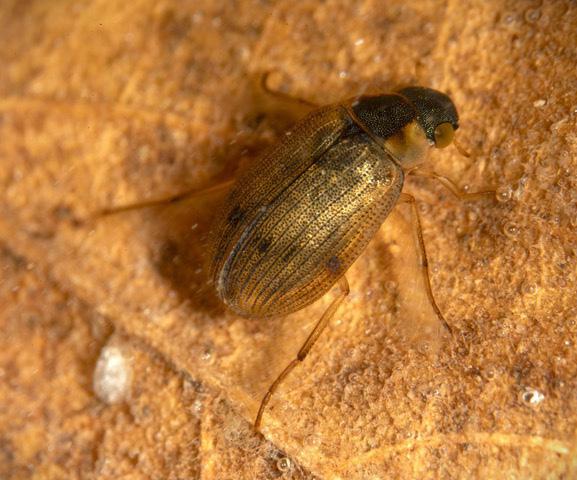
We have also done various talks on our work, including to the Herefordshire Rivers Conference.
The Herefordshire
To Matt Lawrence and Oda Djiksterhuis from The Environment Agency (EA) who visited us again this year, and it was great to welcome Alan Jones, formerly of the EA, who was the first to help the Mowley Project with funding in 2020 .
The Woolhope Dome Environment Trust also gave us a fantastic grant which has been used to purchase tools and monitoring equipment that we use in the valley. Thank you also to the many experts and volunteers who have helped us.
Thanks also to Kerry Goddard who has helped with the accounts and Lucinda Lewis (Wye and Usk Foundation) who helped with the Countryside Stewardship.
A special thank you to Edward and Emma Bulmer and the wider Bulmer family who own the valley.
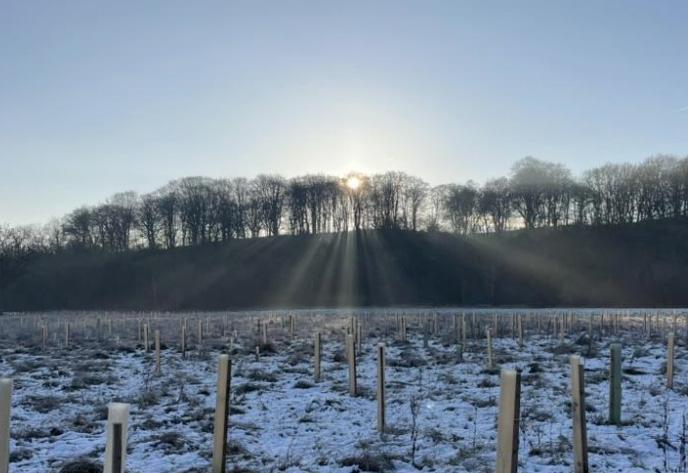
Like all good things, the idea that would become Herefordshire Meadows was formulated around a kitchen table followed by a pub meeting. In 2015, a group of farmers, land managers, conservationists, botanists and general enthusiasts were drawn together by a common desire to see Herefordshire’s grasslands better supported and managed in a sustainable and profitable way both for nature and for farm businesses. Sensing both the urgency and the interest for an initiative focused on species rich grasslands a resolution was made to apply to Natural England’s Countryside Stewardship Facilitation Fund (CSFF) and in 2016 the Herefordshire Meadows farmer discussion group was begun with 30 founding landowners and a strong steering committee.
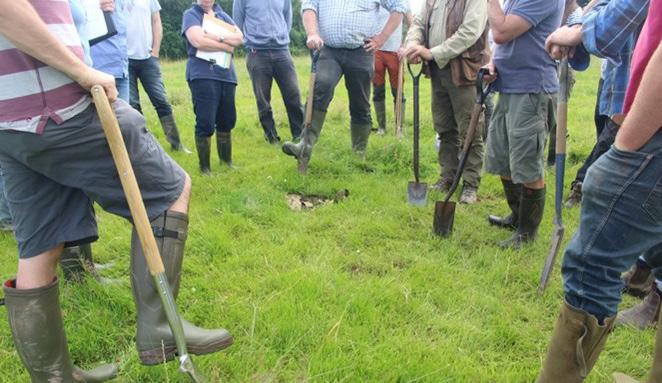
Over the course of the next six years hundreds of events and peer-topeer knowledge exchange workshops were held all across the county covering an array of topics from mob grazing methods to grassland waxcap identification.
The group also grew from 30 to 63 core members with more and more supporters and followers also getting involved. It was clear in 2021, when the CSFF scheme was coming to an end, that the interest in, species rich grassland was growing exponentially and Herefordshire Meadows needed to find a way to support this for the long term. This spurred the decision to apply for fully registered charity status and in 2022 Herefordshire Meadows became a Charitable Incorporated Organisation with seven founding Trustees.
We now have over 140 full charitable members, over 1,000 followers and supporters and in 2026, are celebrating the restoration and creation of over 1,000 acres of species rich grassland across the county. We
have grown to a core team of four Meadow Advisers with a further 19 ‘Meadow Monitor’ volunteers and eight Trustees.
We deliver locally but advocate nationally for species rich grasslands and those that protect, restore and create them. We sit within and support local partnerships including the Farm Herefordshire partnership which brings together a dozen organisations and agencies working to support the agricultural sector across Herefordshire.
Species rich grasslands were, until recently, widespread across Herefordshire. However, since the 1930s the UK has lost over 97% of its traditional flower-rich grasslands and Herefordshire did not escape this trend. The reason this matters is because these grasslands have wide ranging environmental, social, and economic benefits.
One of their most important functions is in supporting biodiversity. In fact, wildflower meadows are some of the most biodiverse habitats we have in this country, with over 700 different species of flower and grass having been recorded in British meadows. This botanical diversity supports over 1,400 species of invertebrate which in turn support a wide variety of birds, mammals, reptiles and amphibians. Some of our most diverse meadows have been recorded as having up to 40 different species of plant in a single m2 (Source: Plantlife; The Good Meadow Guide).
Wildflower meadows also contribute positively to soil health. The deep-rooting broadleaved herbs improve soil structure, reduce compaction, and increase soil organic matter. This enhances the soil’s ability to retain water and regulate flows, making the land more resilient to both drought and heavy rainfall. As a result, meadows can help reduce flooding by slowing water runoff and allowing rain to soak naturally into the ground. Additionally,
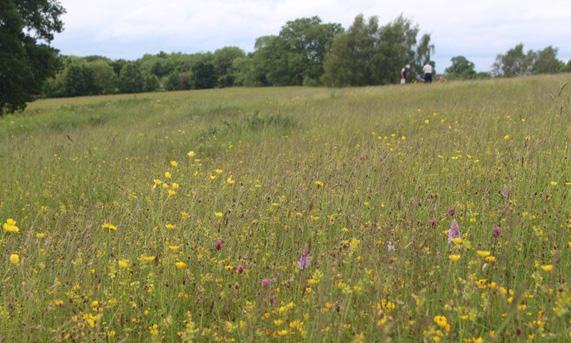
the greater ability of the soils beneath meadows to sequester and store soil organic carbon means they can also play a role in combating climate change. They act as carbon sinks, locking carbon down at depth.
Species rich grasslands can often be more profitable for farm businesses. They are low input systems with the healthy functioning soil biology making all the nutrients the plants need accessible. This allows for a decoupling of farm reliance on synthetic fertilisers, the prices of which are highly volatile and impacted by external global shocks. These systems are also more resilient to changing weather patterns caused by climate change with higher yields in times of drought and longer grazing availability in wet periods which reduces shed time and associated costs.
Wildflower meadows also enhance human wellbeing. Their natural beauty improves landscapes, providing spaces for recreation, relaxation, and education. Studies have shown that access to rich natural environments can reduce stress and improve mental health, all the more pertinent in our digital world.
Aware of both the multifaceted benefits and spurred on by the widespread demand amongst group members, in 2019, Herefordshire Meadows secured its first funding for active meadow creation across the county. We have been fortunate to have also secured funds every year since. These have come from a range of sources and typically cover the up-front capital and advisory costs associated with the creation works.
Care, attention and early planning are key when it comes to selecting suitable sites and delivering on successful interventions. Site scoping work starts in early spring when all potential candidates are visited and assessed to determine; historical and current land use and management, infrastructure, soil nutrient status, weed burden and landowner motivations.
Over the years
Herefordshire Meadows has supported a diverse range of restoration sites from arable reversion to sward enhancements beneath traditional orchards. All these present their own unique considerations in terms of establishment approach and initial management, but the overarching requirement is for sites to be managed either through grazing or cutting but preferably both.
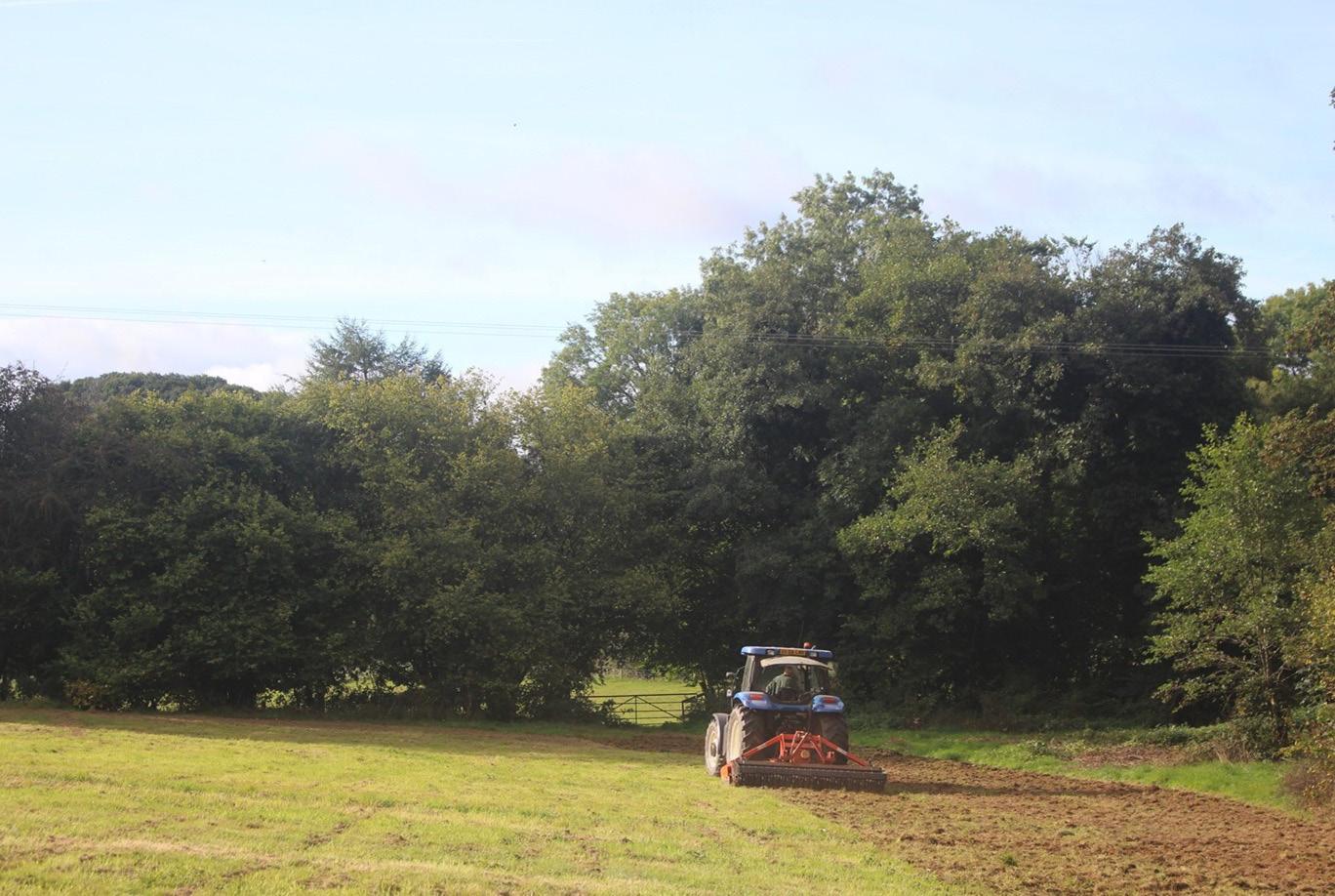
Using a power harrow to open up the sward and create 50% bare ground at a meadow creation site
Land managers are all required to sign up to 10-year agreements committing to follow the prescribed management recommendations, carry out weed control where required, and allow for follow up monitoring and surveying of the site. Before any works take place, we also collect baseline botanical data to be able to quantitatively determine changes over time. All land managers are invited to a free botanical training session and encouraged to carry out this baseline survey, and follow up surveying, themselves.
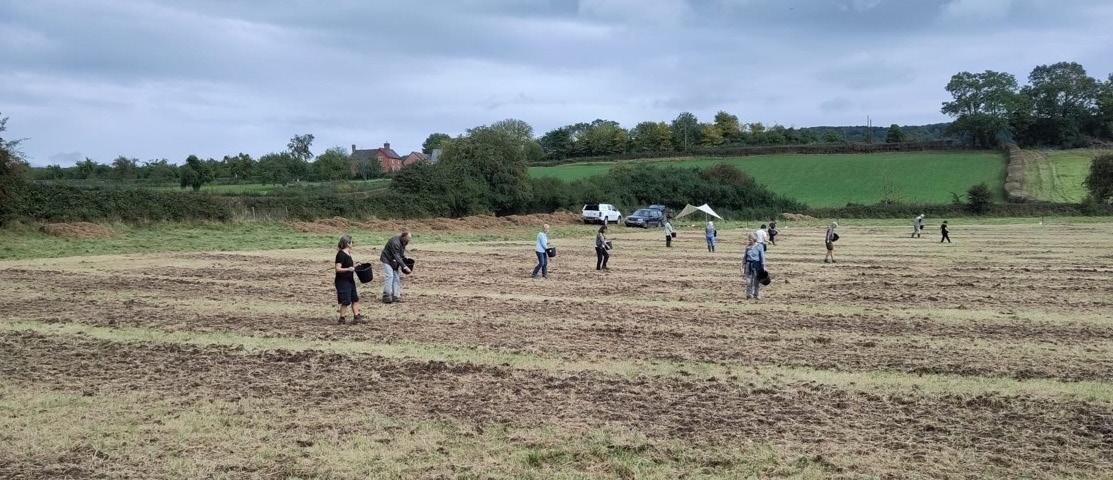
A
To ensure that the species introduced to our restoration meadows are suited to local conditions and are typical of the area, we use local provenance seed from carefully selected donor sites. These seed donor meadows are selected for their similar geology and grassland type, and for their good variety and density of key indicator species such as Yellow rattle (Rhinanthus minor) (the “meadow maker”), Rough hawkbit (Leontodon hispidus), Meadow vetchling (Lathyrus pratensis), Cowslip (Primula veris), Oxeye daisy (Leucanthemum vulgare), etc. The hay cut at these sites is kindly delayed for a week or two so that we can harvest seed at the optimum time around mid-July.
Our seed harvesting team use a Logic Brush Harvester, which we acquired in 2019 with funding from the Woolhope Dome Environment Trust. This lightweight machine is towed by a quad bike and collects seed using a high-speed rotating brush which is set to the flowering height of the target species. Much seed remains on the flowers during this gentle process, the hay crop is not damaged, and the area is not harvested again for at least 3 years, ensuring that the operation has minimal impact on our special donor sites.
The harvest is hand sifted on site to remove the bulk of grass, stalks and empty flower heads, and begins to air dry before collection by the recipient meadow’s owner. We might harvest between 50 and 150kg per hectare, depending on the composition of the sward, but much of this weight is lost in the drying process. For large restoration sites the seed gets a second hand sifting off-site, further reducing its bulk and weight, so that it is fine enough to be mechanically broadcast.
We aim to acquire enough seed to spread at a rate of approximately 15kg per hectare or, when transferring seed directly from site to site for hand broadcasting, we aim for a donor to recipient ratio of around 1:3 hectares.
Some years the demand for seed is more than we can harvest with our small team, or a receptor site may require specialist seed from a grassland type in short supply such as floodplain meadow. In these cases we use a local commercial supplier who provide high quality seed, sympathetically brush harvested from sites in Herefordshire and neighbouring counties.
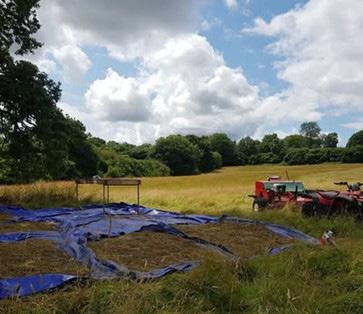
Our seed harvesting set up at a donor site
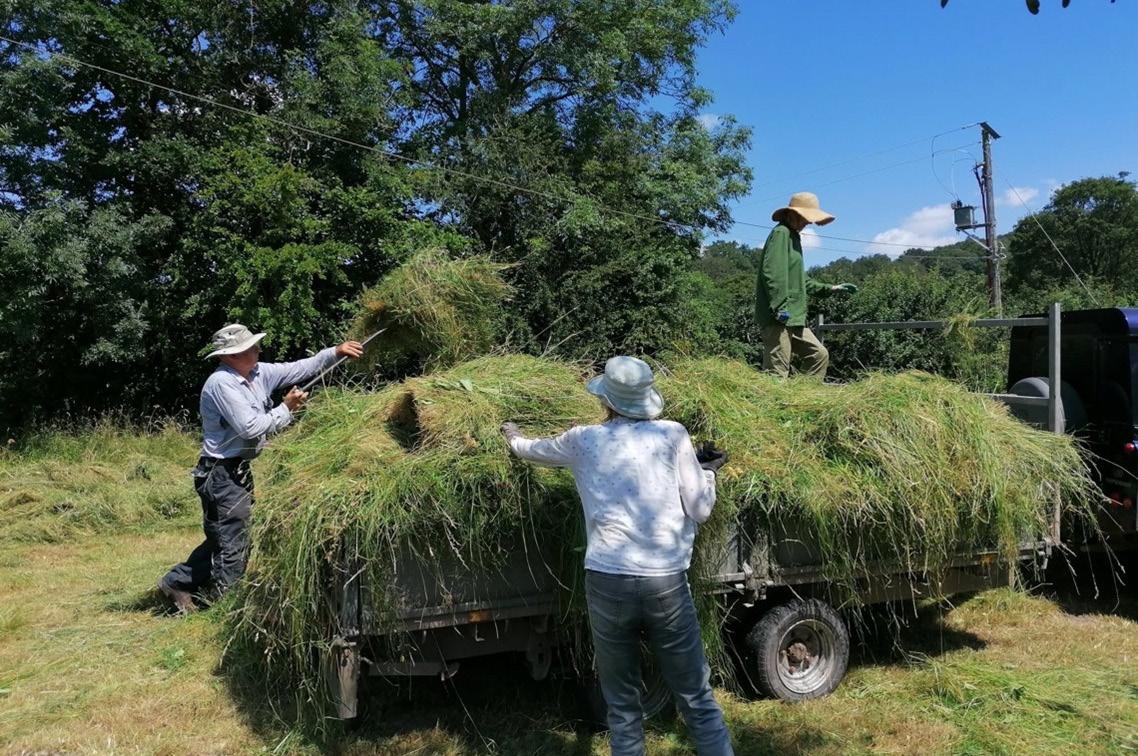
hay transfer being carried out in 2021
In a small number of cases we simply transfer green hay from one site to another, rather than acquiring seed. This process involves moving freshly cut hay immediately to a nearby receptor site and spreading it across recently cut and prepared ground. Due to the bulk of the product and the risk of it overheating in the process, green haying can only be undertaken between sites with access to appropriate machinery and in very close proximity, and with careful timing between the donor and recipient.
Conservation projects can face limitations when funding is short term and predominantly focused on up front capital costs, with resources rarely being made available for follow on engagement and monitoring. This can lead to a sense of abandonment amongst site owners and impact their motivation and ability to continue following best practice. It can also lead to false assumptions being made in terms of the impact and success of any particular project. Creating new areas of species rich grassland is a long-term endeavour. We define the ‘establishment’ phase as being the first 10 years post seeding and our oldest meadows have often been under the same, consistent management for hundreds of years.
Knowing these challenges, and aware of our own resource limitations as a small team covering a large county, in 2025 we secured an initial 3-year grant to launch a new citizen scientist volunteer programme. Our new team of 19 ‘Meadow Monitors’ have been a fantastic
new asset for the charity. Volunteers were not selected based on existing skills or experience but rather on availability and whether they could be successfully paired with a local restoration site. We have volunteers of all ages from 18 to almost 80 and spread right across the county. In 2025 we chose to revisit the 27 sites and 45 field parcels we supported in 2021, as we felt this represents enough time since seeding to gather a representative picture of progress.
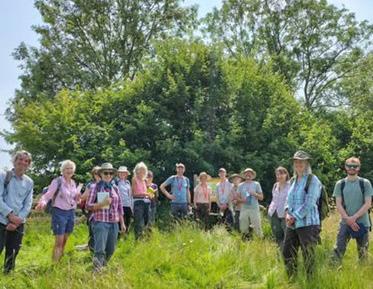
Our volunteer Meadow Monitor team at a Grass ID training session at Stockings Meadow Nature Reserve
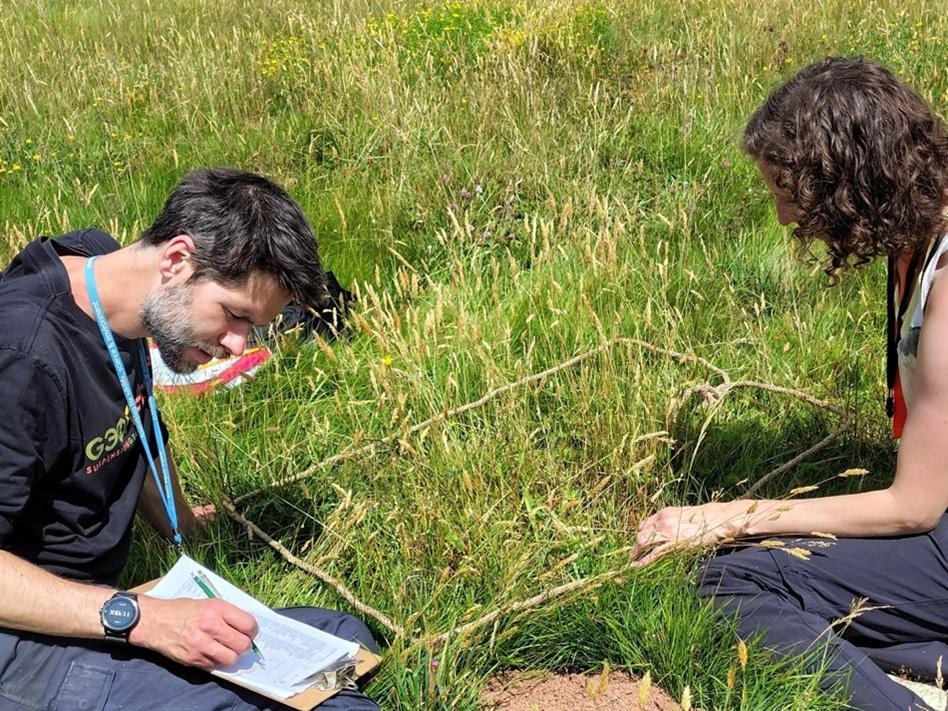
A couple of our Meadow Monitors carrying out a botanical assessment at one of the 2021 meadow creation sites
Monitoring is carried out in the form of a standardised botanical survey methodology developed by Stuart Hedley, Herefordshire’s County Botanical Recorder, which is both replicable and accessible for a relatively broad level of skillsets. It records the presence of broad-leaved flowering plants within ten 1m2 quadrats (occasionally 20 quadrats on larger sites). All ‘Meadow Monitors’ attended a full training day at a restoration site in mid-May and were then paired with a Herefordshire Meadows team member when visiting their allocated restoration sites(s). An unexpected benefit of an approach which pairs volunteers with local restoration sites is that they often already have strong links within the local community and can offer support to landowners with sourcing local contractors, graziers and more. The initial results from our 2025 surveying have been very promising with the average abundance of desirable broad-leaved herbs per m2 increasing by 200%. This just four years post-establishment. Surveys carried out by the Herefordshire Meadows team in 2023 of the 2019 and 2020 restoration sites produced similar results with the abundance of desirable broad-leaved herbs increasing by 178%. It is fantastic to have gathered a robust dataset which demonstrates that species rich meadow creation both works and that significant gains can be realised in a relatively short period of time.
Alongside the creation of new meadows, we have also been engaged in conserving our county’s existing species rich grasslands. This work typically takes the form of monitoring and carrying out condition assessments and then, with the landowners consent, ensuring these remnant habitats are recorded and mapped on local and national databases so that their value is recognised and known.
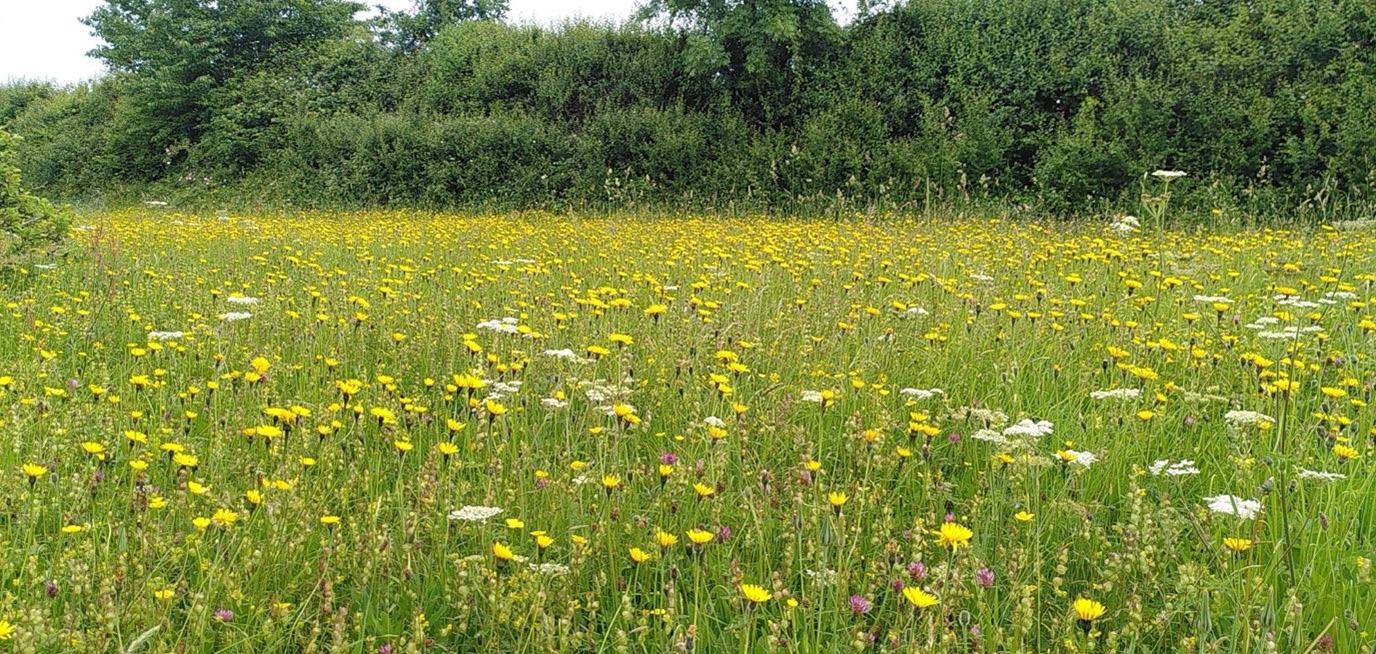
In 2022 we worked alongside Herefordshire Wildlife Trust on their National Lottery Heritage Funded Wilder Herefordshire project to identify and select 26 new grassland Local Wildlife Sites across the county from among our members. Local Wildlife Sites (LWS) are areas of land that are important for their wildlife and reflect the local character and distinctiveness of the county. Whilst being non-statutory, LWS status still entails a presumption against development and will be flagged up within the planning framework, providing a degree of future protection.
Furthermore, the LWS database has been used to directly inform Herefordshire’s Local Nature Recovery Strategy helping to better determine opportunities for habitat connectivity and targeted habitat interventions. We are very pleased to note that the LWS project is still being delivered by HWT in collaboration with Herefordshire Council and Herefordshire Biological Records Centre and we continue to offer support and input on potential new grassland candidates.
We have also been engaged with surveying and recording Priority Habitat Inventory (PHI) Grasslands. This condition criteria, developed by Natural England, has slightly lower thresholds than that of an LWS but is a nationally recognised measure of quality and has been a prerequisite for higher paying grant options under Countryside Stewardship and the Sustainable Farming Incentive. We have surveyed and mapped more than 50 new PHI grassland sites across the county since 2022.
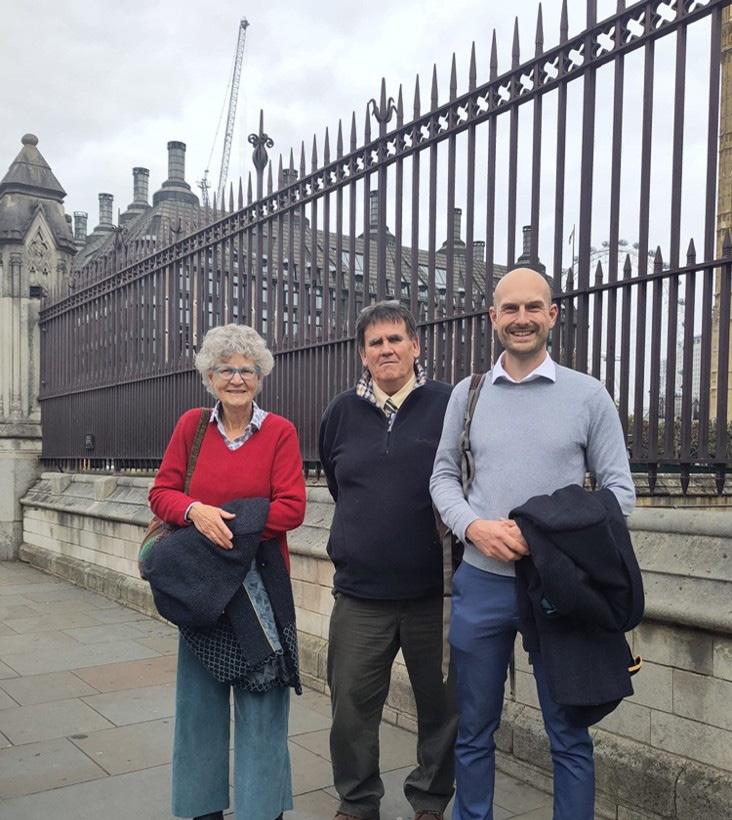
Directors Caroline Hanks and Rory Johnson and former Chair of Trustees, James Hawkins attending the Grassland Westminster Reception
A contributing factor as to why diverse grasslands continue to be threatened is because they remain undervalued in policy circles. We have been working closely with national partners including Plantlife to advocate for a Grassland Action Plan that places grasslands on a par with woodland and peat in terms of the recognition and support they receive. Work in this area has included trips to Westminster, delegations made to policy makers, calls for better research and understanding of complex natural systems and more.
Herefordshire Meadows has come a long way in 10 years, but we remain focused on our core aim; to support grassland farmers and land managers in the transition to sustainable, nature friendly and profitable farming practices. We will continue to act as an advisory organisation specialising in flower rich grassland systems. We will work across the county, helping to unpick and unravel the fast changing world in which farming has to operate within, and adapt to, and all the opportunities and challenges this brings. In 2024-2025 we were involved in the development phase of exciting new Landscape Recovery Project, Wyescapes, which brings together 49 land managers farming over 5,500ha of land along the Rivers Wye, Lugg and Arrow. The development phase revealed strong aspirations for positive change amongst land managers with ambitions to create 1000ha of floodplain meadow over the next 20 years. Consultations with DEFRA need to be concluded and funding needs to be secured to move on to implementation, but we are poised ready to support this exciting ambition.
Becoming a charity has also opened the door to new opportunities to broaden our outreach and engagement. Our new volunteer programme goes from strength to strength, and we are constantly exploring new ways to draw further upon the skills of these fantastic new team members. We also aspire to do more work with local schools, higher education institutions, community groups, artists, historians and others to raise awareness and understanding of wildflower habitats across a wider spectrum of Herefordshire society and through different means of engagement.
We will continue to support the creation of new meadows and campaign to protect existing ones. In 2026, we hope to launch a new multi-year initiative focusing on reintroductions of some of our threatened, Botanical Society of Britain and Ireland (BSBI) Red List, grassland plants starting with Devil’s Bit Scabious (Succisa pratensis), Betony (Stachys officinalis) and Milkwort (Polygala vulgaris). Our overarching vision is to see a more flower rich Herefordshire with a wildflower meadow in every Parish and on every farm.
Exciting times lie ahead. Bring on the next 10 years!
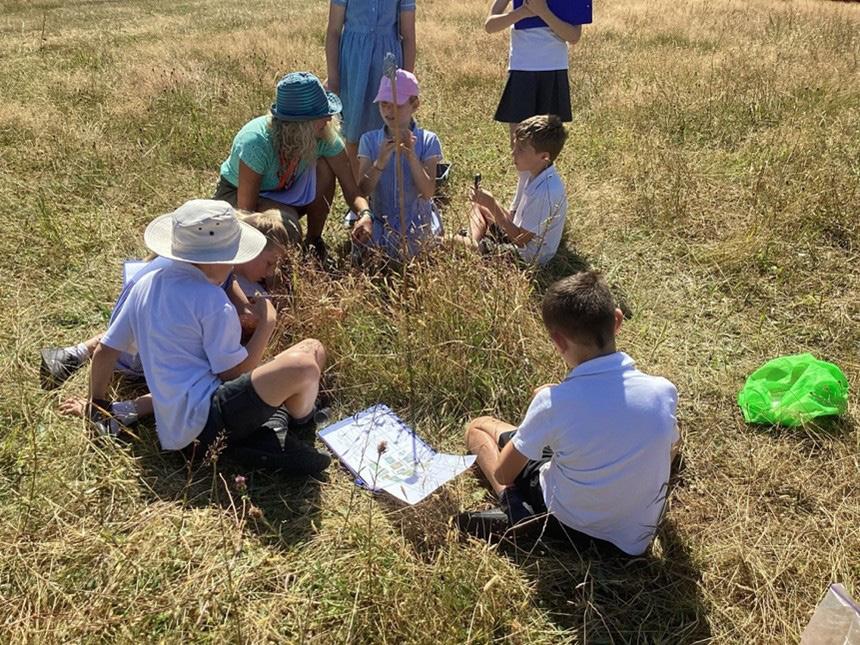
The future Meadow Champions – running a plant ID session with pupils of Ashperton
The City Nature Challenge (CNC) is a global bioblitz that takes place over the last weekend in April every year; it started in 2016 as a competition between Los Angeles and San Francisco, and is run by the Community Science teams at the California Academy of Sciences and the Natural History Museum of Los Angeles County. It’s grown into an international event, motivating people around the world to find and document wildlife in their own cities and regions (participating areas can be any size within reason, and don’t necessarily have to be cities). To give an idea of the scale, in 2025 3,310,131 observations were made by 102,945 participants of 73,765 species, and observations were made of 1 in 20 of all the species known on Earth.
Recording is carried out using the free iNaturalist recording platform, available as an app and website. This allows the results to be collated and compared on a global scale, and helps make the challenge accessible to a more general audience who may not have biological recording expertise, as the app provides assistance with identification.
Herefordshire Biological Records Centre (HBRC) entered the county of Herefordshire into the City Nature Challenge for 2025, which ran April 25th to 28th. As we are a very small organisation with limited resources, for Herefordshire’s first CNC we started on a small scale and primarily used our Instagram account (@hfds_brc) to promote the challenge. We also held 2 face-to-face iNaturalist training workshops which were very well received, and ran a competition to incentivise participation, again via Instagram, for the recorders who achieved the highest number of observations and highest number of species recorded.
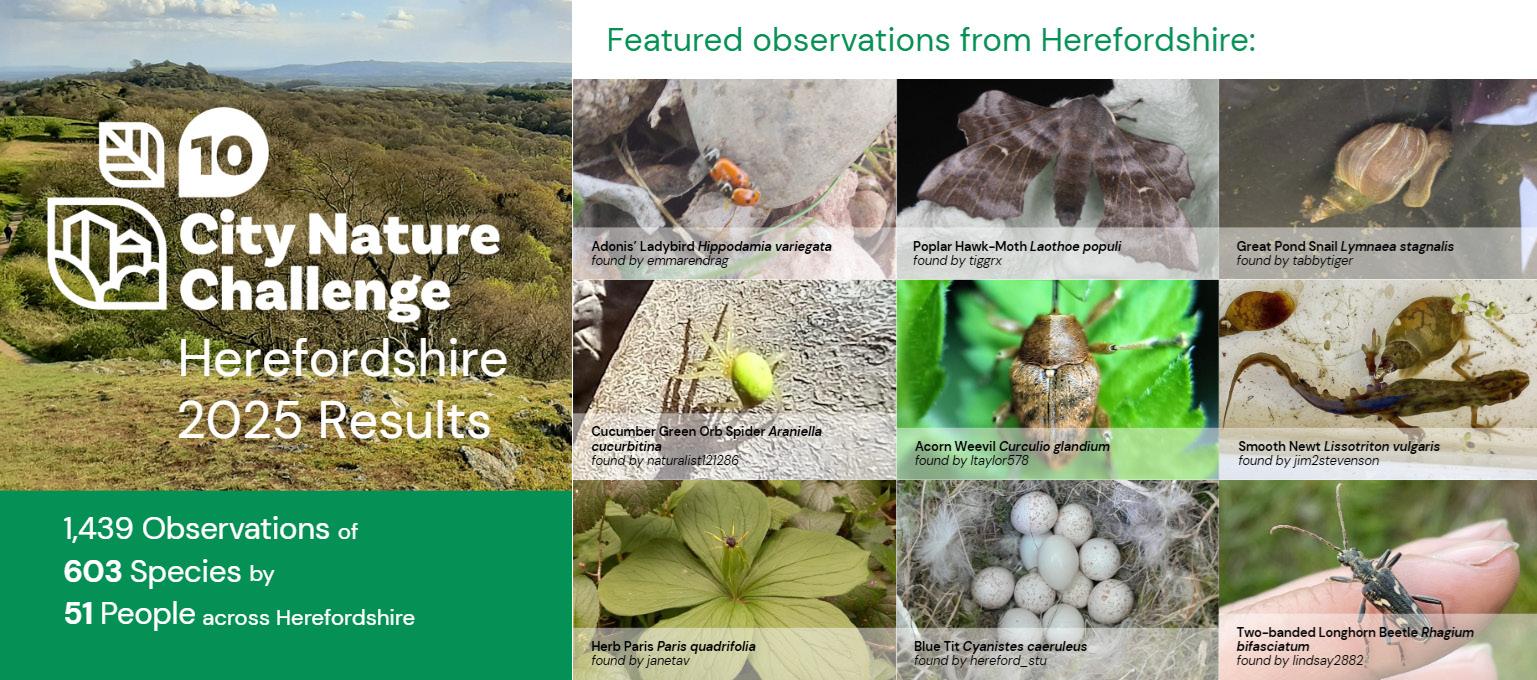
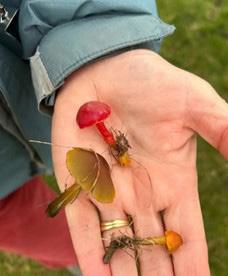
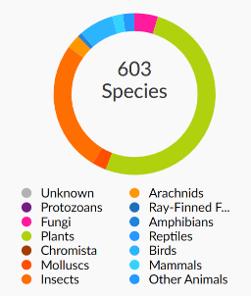
Herefordshire achieved a great result in its first CNC! We had 1,439 observations made of 603 species by 51 people; the image above shows a few highlights. Because of the way the iNaturalist app works (evidence is required, usually in the form of a photo), observations are skewed towards species that are relatively easy to photograph – plants made up 51.2% of the species recorded, followed by insects coming in second at 26.3%. This meant that we received some valuable records for quite under-recorded groups, including froghoppers, gall wasps, dung flies, craneflies, sawflies, longhorn beetles and weevils. Unsurprisingly given the time of year Bluebell was the top recorded species with 13 observations, with other common woodland, garden and hedgerow plants coming close behind.
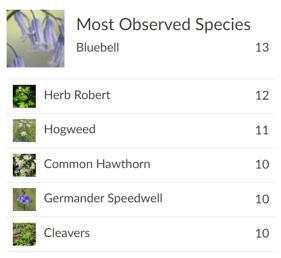
Considering Herefordshire’s small population, that it was our first year, and that we mainly only used social media to promote the challenge, these were great results. Colleagues at another West Midlands county record centre (Staffordshire Ecological Record) who have been doing the City Nature Challenge for a few years also achieved similar numbers in their first year, and Staffordshire has over 6 times the population of Herefordshire!
We’ve already entered the county into this year’s City Nature Challenge and it’s going to be bigger! For 2026, as well as publicising the CNC more widely and repeating our iNaturalist training workshops, we’re aiming to hold a couple of bioblitz events – these will be advertised through our website (hbrc.org.uk), mailing list and Instagram.
You don’t need to come to an event though to take part in the challenge – all you need to do is record wildlife anywhere at all in the county of Herefordshire using the iNaturalist app/ website between Friday 24 and Monday 27 April. Your observations will automatically be counted towards the total for the county.
Here are some great reasons to get involved:
• Contribute to global science and conservation – iNaturalist observations are used in hundreds of scientific publications
• Document and increase our understanding of Herefordshire’s biodiversity
• Get involved with the friendly and knowledgeable iNaturalist community – help each other to identify species observations
• Feeling competitive? We will once again be giving away prizes for the highest numbers of observations and species recorded!
• Get outdoors and enjoy our county at a wonderful time of year
• Have fun doing science in collaboration with people around the world
• No experience necessary!
• It’s free!
Herefordshire’s progress during the challenge can be tracked on our iNaturalist project page at https://www.inaturalist.org/projects/city-nature-challenge-2026-herefordshire (or just search for ‘City Nature Challenge Herefordshire’ in iNaturalist’s search box), and we’ll be posting regular updates on Instagram.
We’re really excited about building upon last year’s foundation to help connect more people with nature locally and grow the City Nature Challenge community, and are looking forward to seeing what species are recorded this year.
For those of you who enjoy rootling through mud, leaves and wood debris you will sometimes notice innumerable tiny creatures springing around crazily. These tiny creatures are likely to be Springtails or Collembola. They are not insects but classified in the Hexapoda alongside Proturans and Diplurans. Their mouthparts are internal rather than external as in insects if you were wondering!
Consisting of six legs and often with a furcula, a two pronged tail that acts as a spring mechanism. It is thought that this helps it right itself after springing around and to help with body moisture regulation. This is an incredibly fast process. One of the British species Dicyrtomina minuta propels itself 60 times its own height and a rotation of 368 per second. Nothing in the animal kingdom does a backflip faster.
However not all springtails have this appendage, and the crucial feature is the peg like ventral tube underneath the body. This is where they get their name from as in ancient Greek Collembola means glue peg.
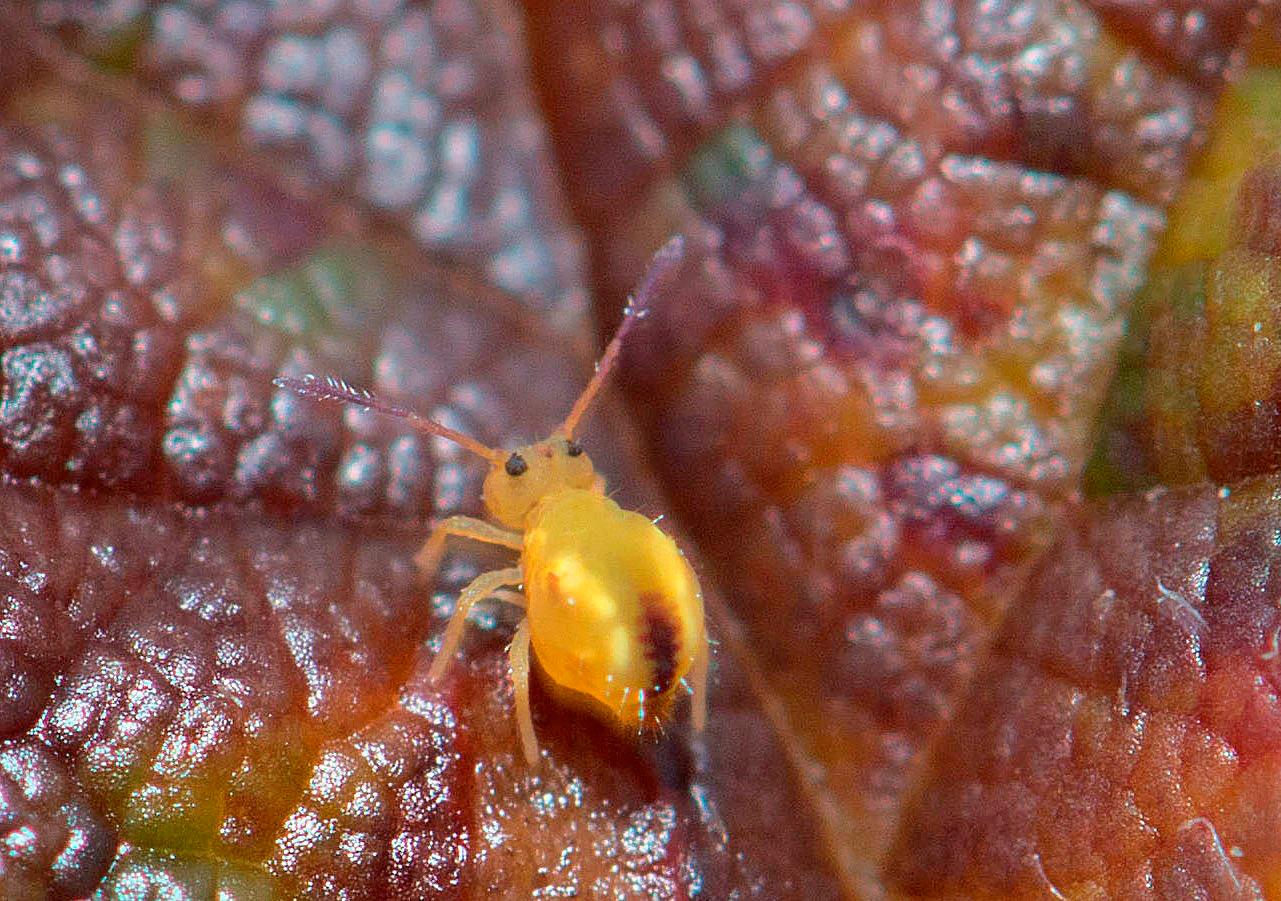
Without an efficient regulatory system and having a very small size (the smallest measure but 0.2mm long) they can quickly dry out and are therefore very prone to desiccation. In the right environment though in lowland humic soil they can number 100,000 per cubic metre. They will feed on plant material, bacteria and general debris and so are very important in conditioning soil. Some alpine soils are thought to compose solely of springtail faeces!
They can also reduce their size in hot weather. By moulting (the technical term is ecdysis) they can reduce body size by 30% which may mean the difference between survival and shrivelling up. Interestingly in 1952 the Chinese accused the U.S. of dropping a variety of invertebrates including springtails as part of a program of biological warfare in the Korean War.
The godfather of Collembology (that isn’t a word by the way) is Sir John Lubbock who was the 1st Baron of Avebury. His C.V. includes coining the words ‘Paleolithic’ and ‘Neoloithic’,
creating bank holidays, promoted the founding of British libraries and was a friend of Charles Darwin. He was the first person to create a monograph on Springtails in 1873.
In more recent times, having an enthusiastic entomologist (yes I know springtails are not insects,) Pete Boardman, working in Shropshire, has meant that Shropshire’s coverage of this taxa is extensive. Herefordshire has lagged behind with few species of any note being recorded. So, what can you look for in the county. Firstly Collembola are split into four main groups:
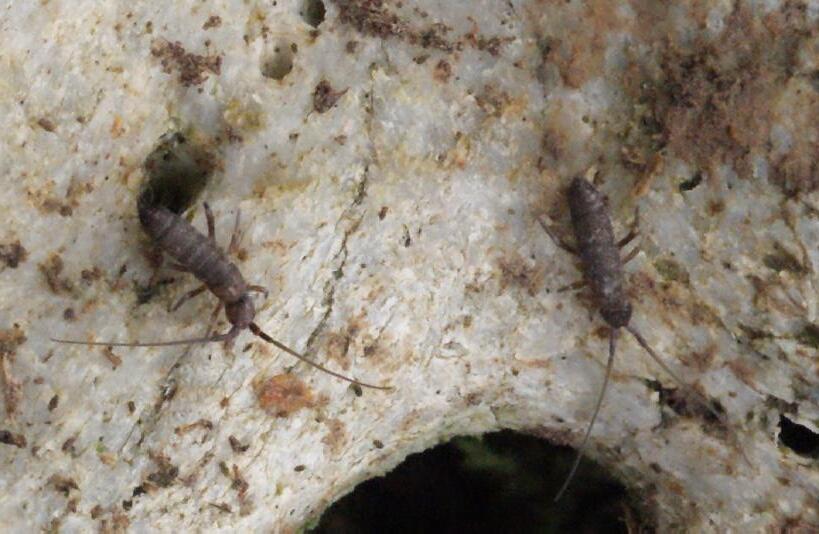
Firstly, there are the Pods or Poduriodea which are elongate but have a big bum. One very common species to spot is called Neanura muscorum which is slate blue in colour and can often be found lurking under logs.
Another Podura aquatica can be found on the surface of water bodies in large clumps. Then there are the Entos or Entomobryoidea which are similar but have a tapering bum. Orchosella villosa, a hairy species is very common in leaf litter in any habitat.
Another the largest springtail in the UK is Pogonognathellus longicornis. It measures up to a massive 6mm in length and the antennae tend to curl when touched.
Then there are the Neels or Neelidae which have a globular appearance but with a characteristic hunched appearance. There are only three species of these on the UK and the commonest is Megalothorax minimus which is pale, lives in caves and is only 0.4mm long!
Then there are the Globs (or Symphyleona) which have a broad head with round body. They are among the cutest invertebrates to be seen.
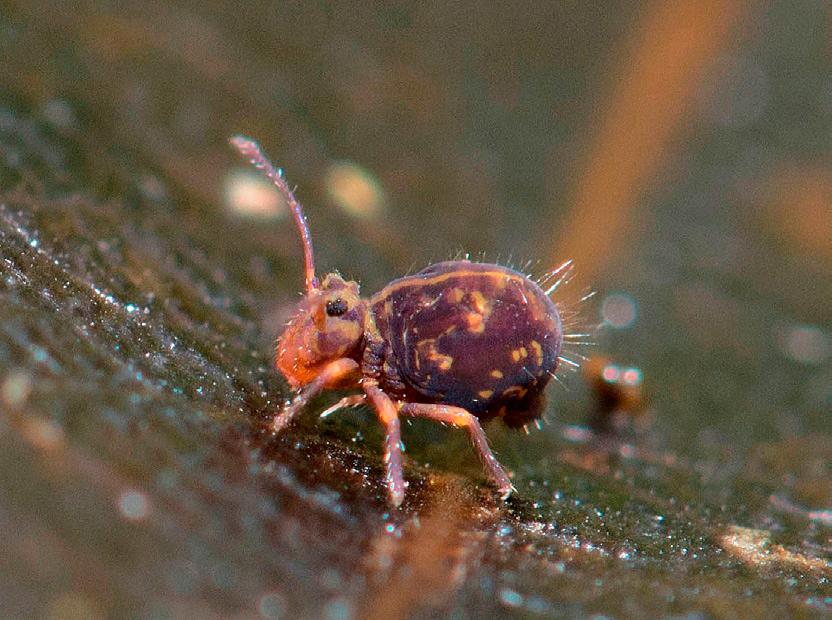
A characteristic species is Dicyrtomina saundersi which has beautiful markings as can be seen from the photo (see left). Another is Dicyrtomina ornata which differs in its abdominal markings.
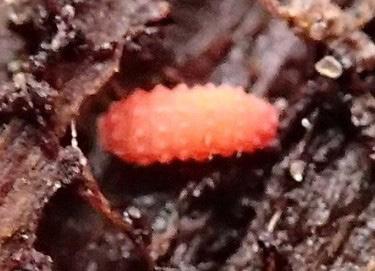
As an example of what you can find if you look is the time the Winter Recording Group visited Brilley Green Dingle reserve. Turning over a log revealed an Orange Springtail.
At first the only thing close was Monobella grassei but that is a pink species and not orange. It turned out that this was Bilobella braunerae which wasn’t discovered in the UK until 2015 when it turned up in North Wales. It has since appeared in quite a few places. It is often bred in captivity and has obviously found the wild an enticing place to live as well. It was the first record for the county.
Even common species can be new county records in Herefordshire given that it is so under recorded. A recent review of the taxa here showed that the county list for Springtails is a mere 35 species. The UK list is around 280 but the National Recorder James McCulloch thinks there are far more (see: British Springtails: How Many Species Really Are There?).
Being so small some specimens are hard to identify of course, and requires intense microscope work to make determinations beyond genus level. However, there are lots that can be identified with good macro photographs or the use of a hand lens.
For further information about springtails and other soil life you will be amazed by the fabulous website by Andy Murray (not that one) called A Chaos of Delight If you wanted to see some pictures of the UK fauna then Springtails & Bristletails | NatureSpot is a good place to start although the Key to the Springtail fauna of the UK by Steve Hopkin is the book you need for more serious study. I also have some literature I can distribute if anyone would be interested. I can be contacted at tim@clan-cic.org.
Links:
A Chaos of Delight https://www.chaosofdelight.org/
Springtails & Bristletails | NatureSpot https://www.naturespot.org/gallery/springtailsbristletails
British Springtails: How Many Species Really Are There?
Mike Williams
It started when I was looking at an 1888 OS map of Weobley parish. I noticed that quite a few of the ponds shown on the map no longer existed. This series of maps shows ponds in colour so it was very easy to spot them. I counted the number of ponds in the parish and came to 81. Then, with the help of Sue Hubbard from Weobley Museum, I was able to check some older estate maps from the early nineteenth century and came up with a figure of 97 ponds. The up to date OS map showed 32 ponds but when I went out to check them on the ground I found just 24 ponds. So we’ve gone from 97 ponds to 24 ponds in our parish – we’ve lost three out of every four.
The number of ponds is probably a reasonable guide to the health of our amphibian populations but, as they spend more of their lives out of ponds than in them I tried to get an idea of changes beyond simply the number of ponds.
I looked at field names on the parish Tithe map and found quite a few names suggestive of wet ground – Rushy Meadow, Marsh Meadow, Withy Bed, Sally Bed and Orl Piece. There is little or no sign of any wet features in these fields now.
Traditional orchards are rich wildlife habitat and are perhaps an indication of less intensively farmed land. I found 98 traditional orchards in the parish in 1888 and just 19 today.
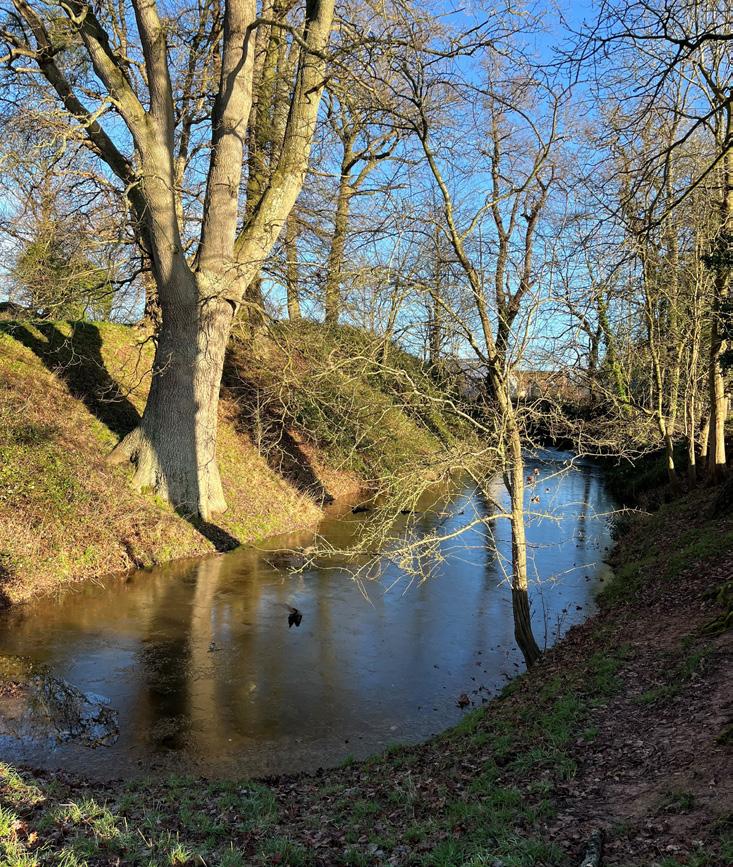
Loss of hedgerows has been one of the big changes in our countryside over the last 80 years or so. I chose one large field on the edge of the village and checked it out on the old maps. In 1913 this area was 15 fields and included four orchards, three ponds and around 1,900 metres of hedges. It is now one field with just a single old tree standing in the middle. Everything else is gone. Whilst this is probably an extreme example it does illustrate how habitat for amphibians and other wildlife in our wider countryside is much reduced in recent decades.
Add in less visible changes such as increased land drainage and the introduction and now widespread use of fertilisers and pesticides and our countryside is probably now very much less amphibian and wildlife friendly.
Many of the houses in Weobley have ponds in their gardens, features that were probably not common in 1888. Perhaps they go some way towards redressing the balance. With help from local pond expert Will Watson I put together a short questionnaire about ponds and distributed it as widely as I could. I asked people to tell me if they had a pond in their garden and to tell me a little about its size and wildlife.
To my amazement I have now had 69 replies from people with ponds, 40 from Weobley village itself and the rest from the wider Weobley parish and adjoining parishes. Here are some of the results from that questionnaire:
They range in size:
• 38% are quite small at two square metres or less.
• 32% are medium sized at between two and ten square metres
• 30% are quite large at ten square metres or more.
• 85% of ponds have frogs
• 55% of ponds have toads
• 58% of ponds have newts
• 12% of ponds have great crested newts.
• 88% of ponds have dragonflies or damselflies.
•
• 20% of gardens with ponds have grass snakes (we found grass snake eggs in the compost heap of a house on the main street).
• 65% of gardens with ponds have hedgehogs.
The built up area of Weobley village comprises around 100 acres. Whilst much of this area is houses and roads a large part is made up of gardens. A line of burgage plots leading away from the houses on both sides of the main street mean there are two large areas of linked up gardens very close to the centre of the village.
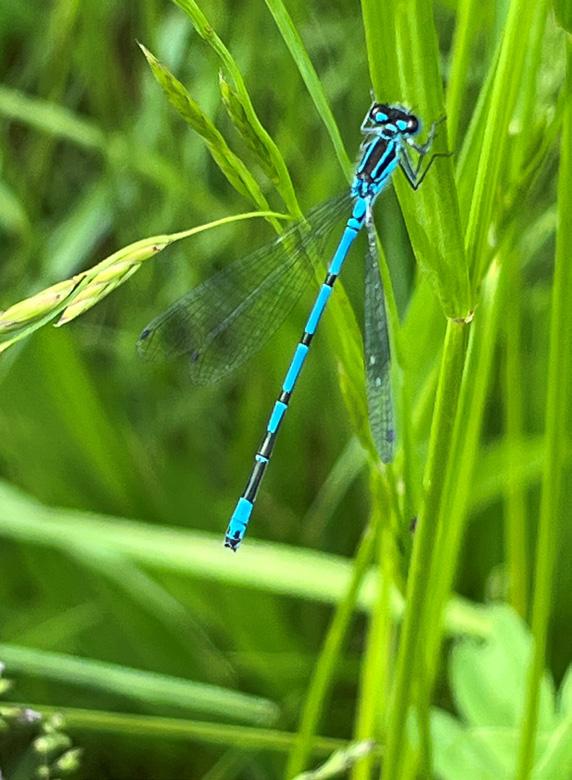
Most other houses have gardens, many of them large and wildlife friendly. Bats, swifts and house martins are features of the village as well as the hedgehogs and grass snakes mentioned above.
Through summer visits and using a survey form from the Freshwater Habitats Trust a few of us from the Weobley branch of the Herefordshire Wildlife Trust have visited 23 garden ponds and 12 farm ponds to look at the range of invertebrates and other wildlife, usually with the owner present.
We have been able to show a fascinating and rich variety of wildlife, including twelve different species of dragonfly. At the same time we have given advice on pond management and on management of the area around the pond. At Dilwyn Primary School we cleared
and cleaned out a very overgrown pond in the school grounds that will now be used by the very enthusiastic and grateful school staff for pond dipping with the children.
The first event that we organised was a “How to make a pond” afternoon in one of the large gardens in the middle of the village. Twelve people came along to watch as we dug out a hole, inserted a preformed pond liner, added stones, filled it with water and then put in plants. We then had an enjoyable pond dipping session in a larger pond in the garden and were able to see newts, dragonfly nymphs and more.
Our second event was a series of visits to three gardens on a hot Saturday afternoon last summer. The first garden had a well-established pond in a fabulous wildlife friendly garden with a small hay meadow beside the pond.
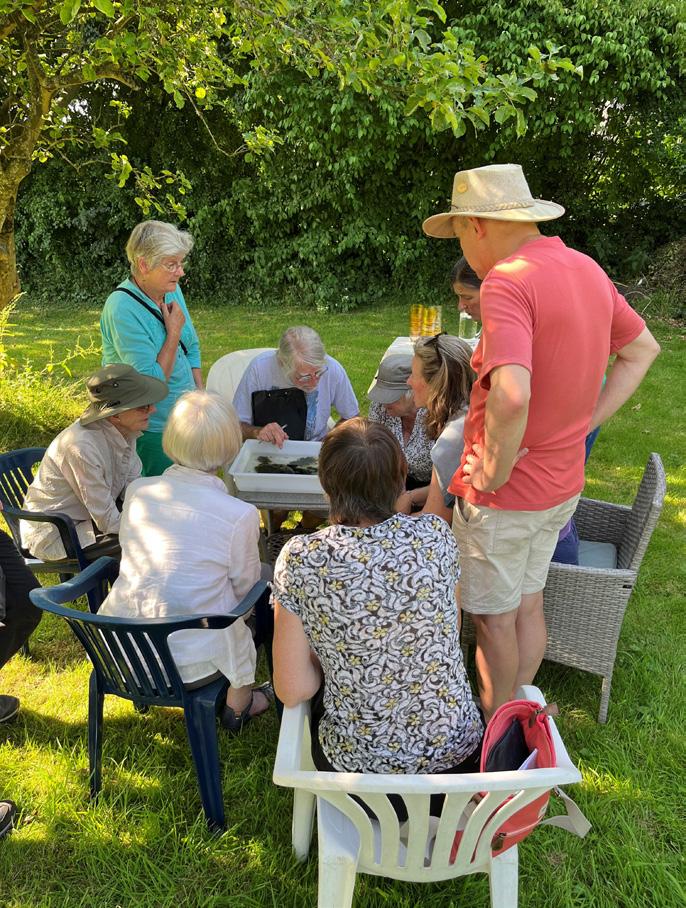
The second garden had two ponds, one of which held good numbers of great crested newts. The third garden, inspired by our first event, had two brand new ponds. The owners explained how they had made them and we dipped them to find that, although only a few months old, they were already rich in invertebrate life.
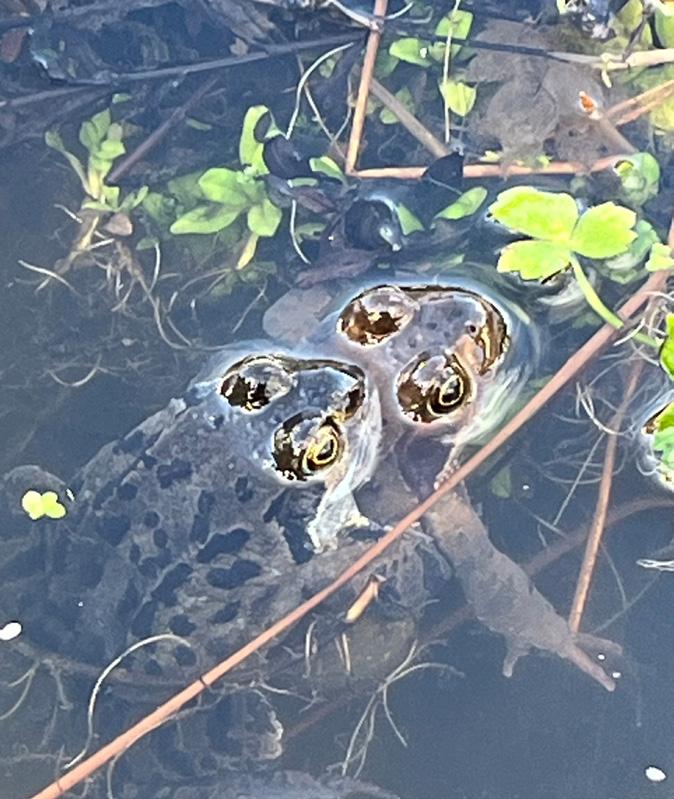
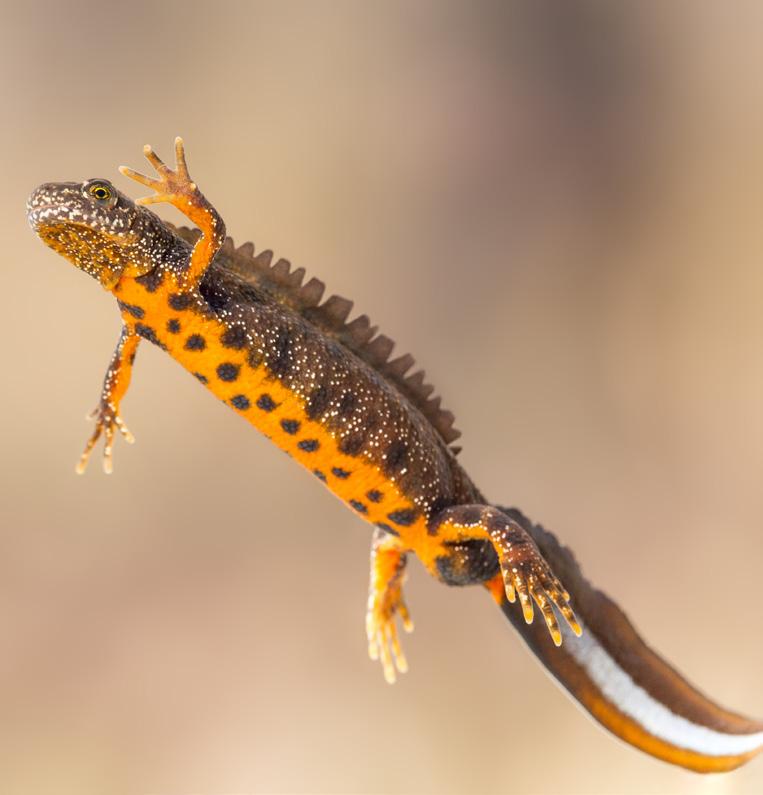
I have given two talks in Weobley village hall, to audiences of 50 and 60 people and have spoken about the project in two over village halls as well. We have taken a group of cubs and scouts to dip in one of the farm ponds in the village.
I am regularly sent photos and videos of ponds and pond life from pond owners in the village and beyond. Reports of frogspawn come to me daily at the spawning time of year.
Following a visit to one of our parish farms the farmer has created a new, large and very beautiful pond. Perhaps, for the first time in many years, the number of ponds in our parish is rising instead of falling.
I hope we have succeeded in raising interest in ponds, habitats, local wildlife and wider environmental issues (eg invasive species, No Mow May, flea and tick treatments for dogs).
A year ago the Herefordshire Wildlife Trust created a new pond in our village nature reserve, The Weobley Wildlife Meadows, and we hope we can use this to further promote ponds. We plan to have more events and to continue visiting and dipping ponds wherever there is an interest.
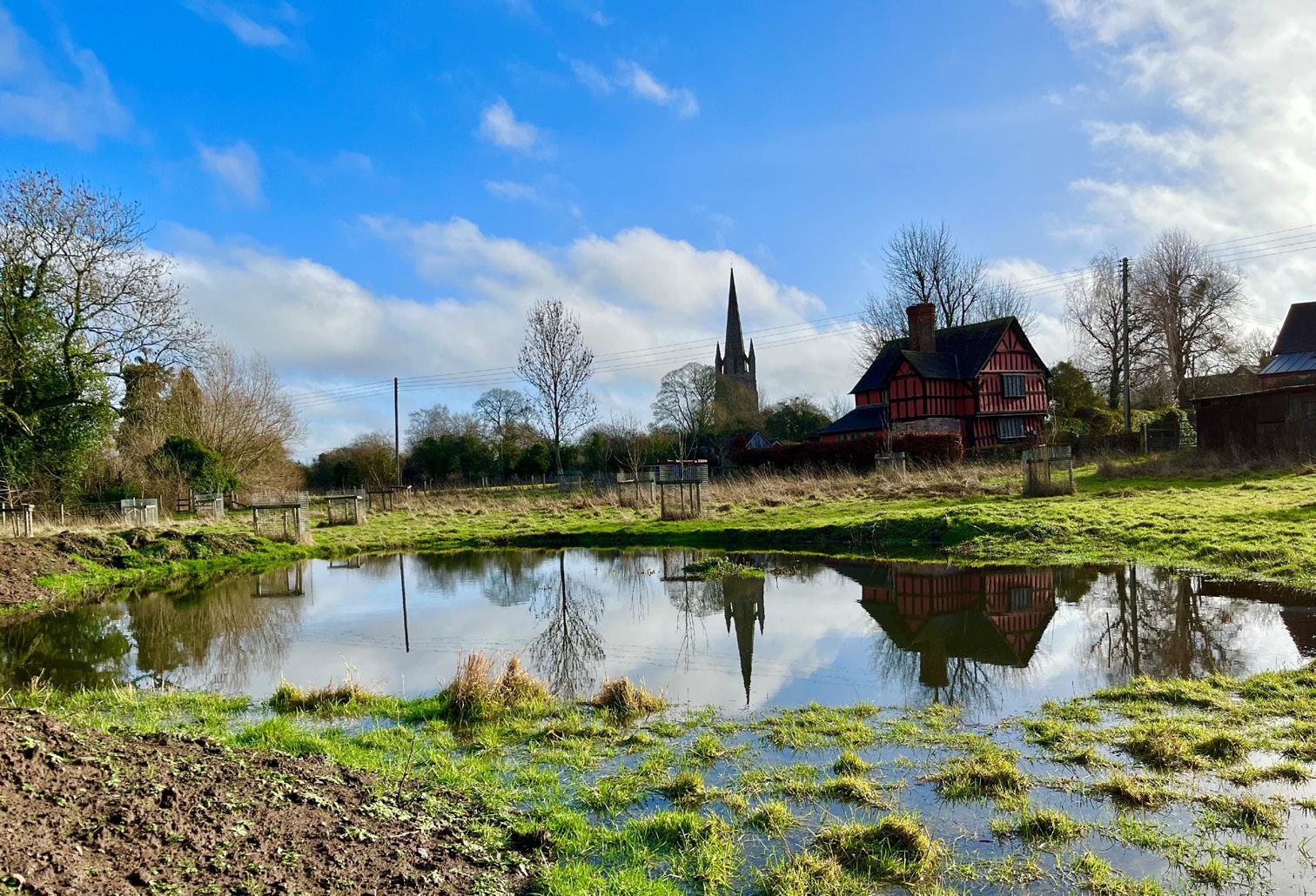
Dr David Marshall, Chair of Trustees,
Over the last six years, the Museum of Cider has been gifted land in Breinton, just west of Hereford, which, together with some further purchases, now comprises an estate of nearly 100 acres in total, 80 acres of which are seven cider orchards containing some 3,000 living fruit trees as well as plenty of standing deadwood.
The orchards are different types and ages. A small traditional orchard alongside the ancient green lane running westwards from Hereford is a scene essentially unchanged since it was painted by Brian Hatton 116 years ago, and near Breinton Church sits what must be one of the oldest bush cider apple orchards still in existence, initially planted in the 1930s, and whose over-grown trees create evocative long dark ‘naves’ and extraordinary habitats.
The fine standard trees in Phillips Orchard produce a good crop of certified organic apples which go into Westons cider. Elsewhere, younger standard trees have been planted over the last two decades, grafted to hold a nationally important collection of cider apples, currently comprising 164 varieties (three trees of each), mostly from the local region.
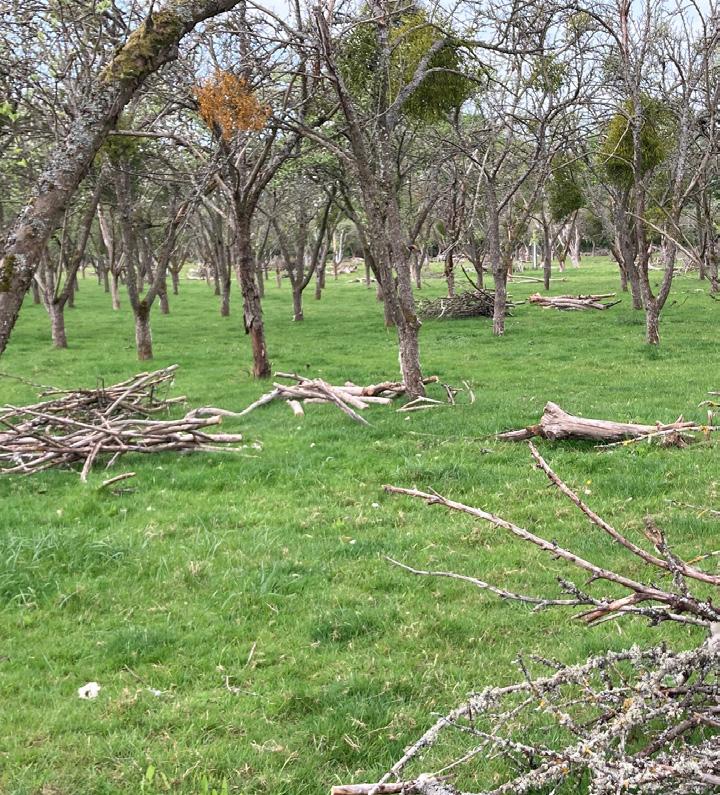
John Teiser, the Museum’s volunteer Conservator of Fruit, oversees work to collect and propagate varieties of cider apples for this collection, painstakingly researching their provenance and leaf samples from nearly every variety have been DNA-fingerprinted by NIAB’s East Malling research station to ensure the validity of the fruit collection.
The Museum’s estate at Breinton hides an outdoor museum with the orchards resembling a series of ‘rooms’ that complement the displays in the Museum, demonstrating different types of orchard, how they have developed and how they are managed. Over the last few years, we have set about understanding their economics, social history and biodiversityeach orchard is a haven for wildlife.
In his extraordinary 1653 manual A Treatise of Fruit-trees, the puritan Ralph Austen composed lists documenting the multiple benefits that he saw in orchards, both “profits” and “pleasures” (as well as observing an eye-watering one hundred “similitudes” between fruit trees and his faith in his companion book, ‘The Spiritual Use, of an Orchard; or Garden of Fruit-Trees’).
Rather like Austen four centuries ago, our approach has been to develop management plans underpinned by an understanding of the many layers of value held in each orchard, including nature – birds, bats, trees, lichens, fungi, mosses, invertebrates, plants and grasses, worms and soil structure. We set about the collection process with gusto, asking local groups to help us do this so that we fostered a community for the orchards too.
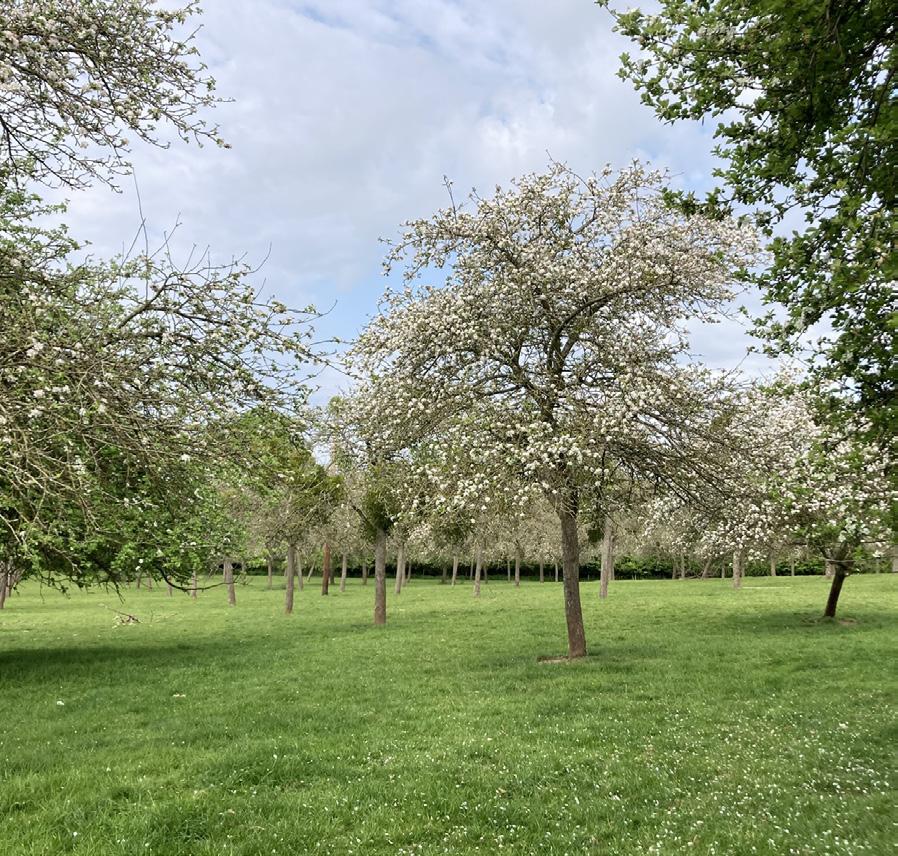
Hereford City branch of Herefordshire Wildlife Trust, Herefordshire Fungus Survey Group, Shropshire Lichen Group, experts from the National Trust and several other individual recorders have been to the orchards. Ornithologists Gerald Parker and Sue Griffin visit every month.
“There is always a feeling of expectation when we go into the orchards. How many species of bird will we see? In what numbers and will there be a possibility of a rarity? One’s senses go into overdrive in sight and more often sound because often the bird is hiding in the branches and causing much frustration.
Spring and autumn are usually the most exciting times as there is always the possibility of migrants arriving, redstarts, chiff-chaffs and flycatchers in the spring and winter thrushes such as fieldfares and redwings in the autumn, to take advantage of the fallen apples, berries and insects.
The orchards, especially the mature ones, offer cavities for nest sites and in addition we have many nest boxes offering further opportunities, it is enjoyable to check them for occupants. The orchards also offer the opportunity to enjoy and record butterflies, wildflowers and fungi depending on the season and, if we are really lucky, maybe a roe deer passing through. The dawn chorus in the spring makes getting up early very worthwhile!”
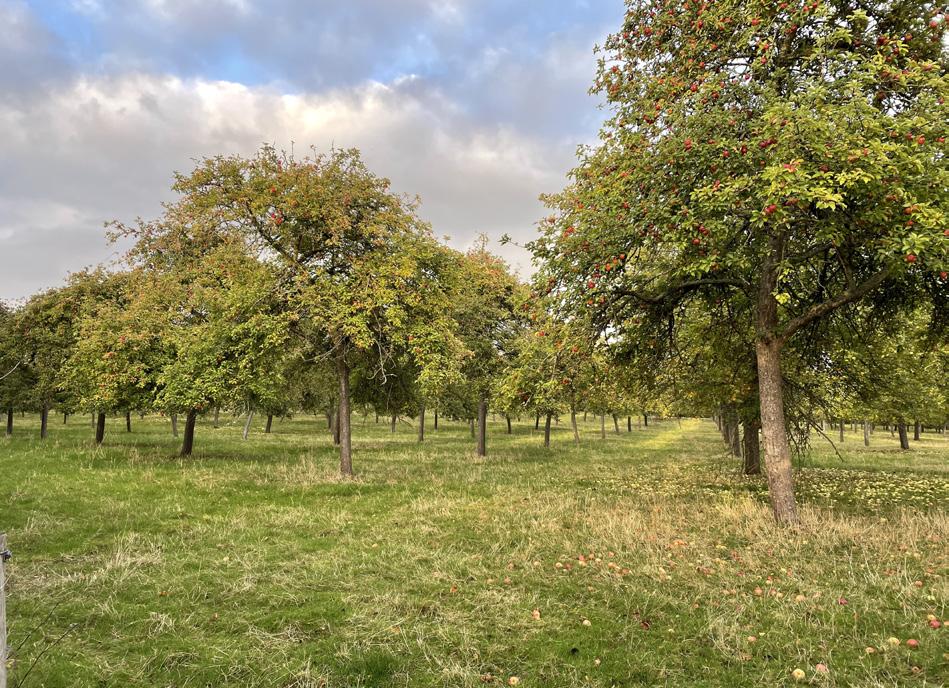
There have been some unusual finds and various new County records, especially in the old bush orchard. The bryophyte Golden Thread-moss Leptobryum pyriforme was spotted on a soil mound, and a very rarely recorded fungus Phaeobotryosphaeria visci, in its perfect state, that grows on dead mistletoe and potentially has significance given the preponderance of mistletoe in today’s orchards.
We’ve assessed the carbon stored in the trees and more importantly the untilled soils beneath the orchards, estimating that there is the equivalent of some 4,000 tonnes of CO2 secured.
All the orchards are grazed by sheep which in summer take refuge from the hot sun under the trees. At times there can be up to 200 sheep grazing the estate, earning income for the Museum. The grazier moves the sheep around the estate to comply with Soil Association organic rules and to ensure that orchards are sheep-free for two months before cider apples are harvested from the ground beneath the trees.
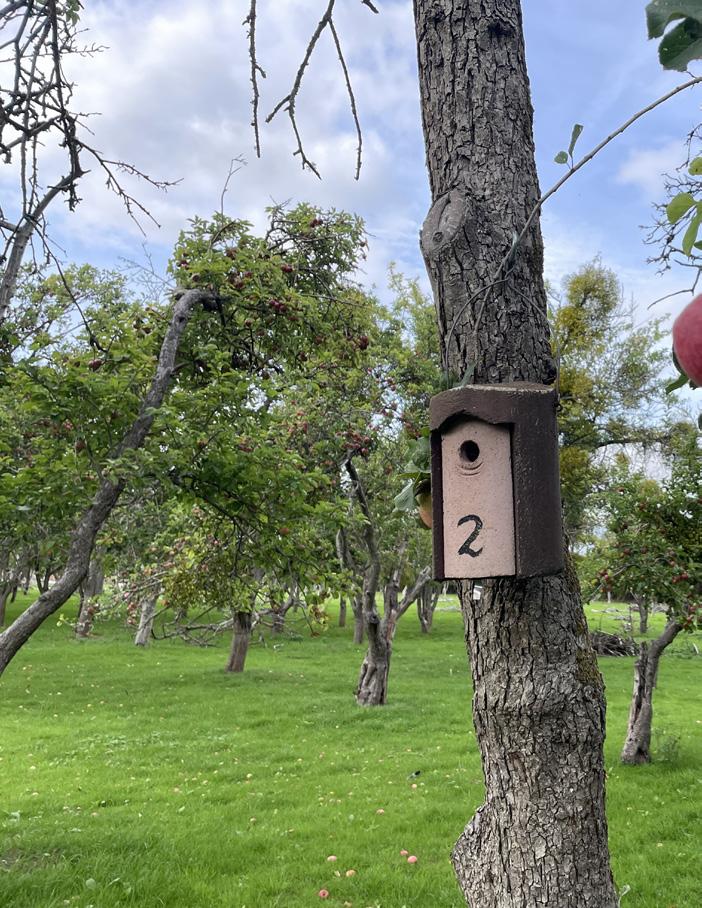
Records of the provenance of the land have been compiled. Old maps and LiDAR imagery, walking the land with archaeologists, and the memories of local people recorded by Breinton History Group have all helped understanding. Added to these, various old publications extol the virtues of Breinton, encouraging people to walk there from Hereford city along the banks of the River Wye to enjoy the lovely trees, blossoming orchards, and farreaching views – or in the 1930s to take a boat to tea gardens found at that time in Breinton and Sugwas.
There is currently no public access to the Museum’s orchards, and the Museum trustees are considering ways to share our estate in ways that are conducive to their nature. Orchards are indeed pleasant places just to ‘be’ – for humans and for nature – and have been appreciated as such for centuries. In the 1970s, Mr Snell escaped “the grey business world” (p.46), in the 1650s Ralph Austen described pleasures of being in an orchard, “beholding…the well composed alleys, walks, seats and arbours therein,… pleasant and delicate colours of the leaves, blossoms and fruits,…to hear the sweet notes and tunes of singing birds…”
And, like Austen, we are cataloguing the richness of orchards, bringing the ‘black and white’ of data recording to help monitor and support these remarkable multi-faceted habitats that the Museum has the honour and responsibility of owning. Or, as Ralph Austen puts it, to “see what a plentiful and joyful harvest of profits and pleasures may be yearly reaped from an orchard or garden of fruit trees.”
This letter was originally published in the Journal of the NFU, April 1973. It is still of interest and relevance today, especially read alongside the previous article. Ed.s
You have a section on grubbing old apple orchards in your issue of March 17 under the main heading “Inside the News” and the sub-heading “Apply now for grubbing grant”. You say “with land at its present values, it is difficult to understand why anyone would wish to retain them”.
Perhaps I can explain why I do. The orchard is old, some trees are cankered, gnarled, and in many cases hollow. There are many gaps. No two trees are alike and vary from towering upright French which bear a mass of tiny fruit, somewhere near the sun, to gaunt limbless relics, from sturdy well-rounded Brambles to one spreading individual which has a huge bramble growing in the fork some 10 feet above the ground sending its briars cascading to the ground all round the trunk.
Maybe these trees reduce the stocking capacity of this orchard by a quarter. To an efficient fruit grower they would undoubtedly be a nightmare – to me they are a dream.
On Sunday I walked my farm which straddles an intersection of two A roads. I was never out of hearing of the traffic. I picked up three bottles, a tin can, a large sheet of plastic and
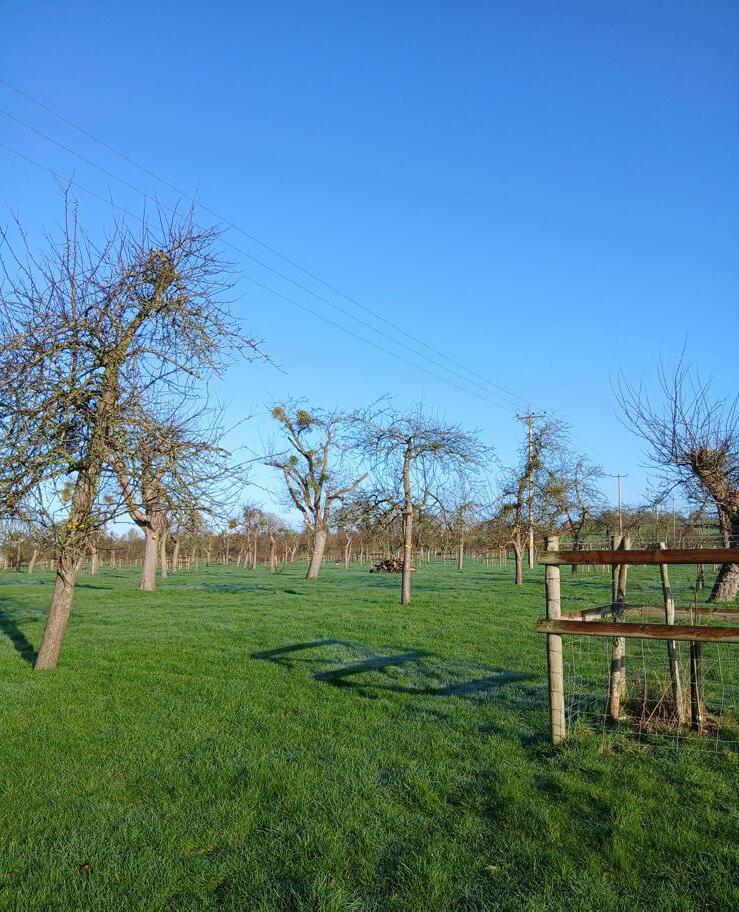
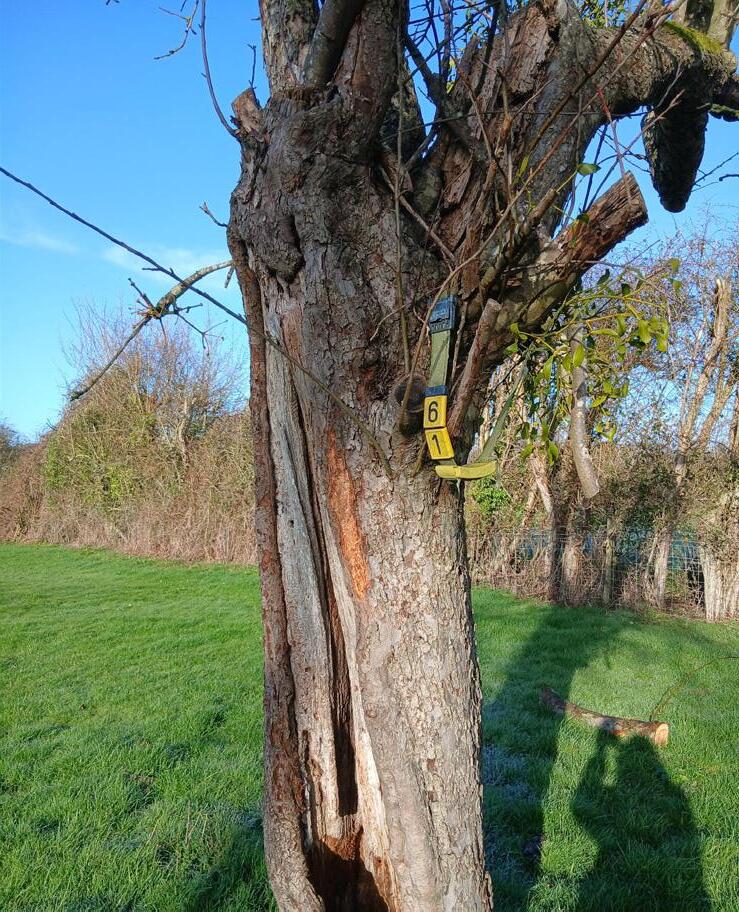
part of two plastic fertiliser bags. I walk across green but bare pastures back towards the farm, under grey skies with a thin East wind – over a gate into this orchard – grass 10 inches high – temperature degrees warmer – I startled a squirrel which shot up a tree causing a tawny owl to leave in great haste. Suddenly winter turned to spring.
Birds were everywhere. Later this orchard will be the breeding ground for numerous starlings, jackdaws, missel thrush, chaffinches, fly catchers and tree creepers, besides the occasional lesser spotted and green woodpecker, and redstart. Moorhens from the disused canal range here. Owls have a much needed sanctuary. On a cold day partridges are sure to be here. If I wish to create a place of equivalent beauty and interest, I could not do it, for it has developed and matured with age – and it beyond price.
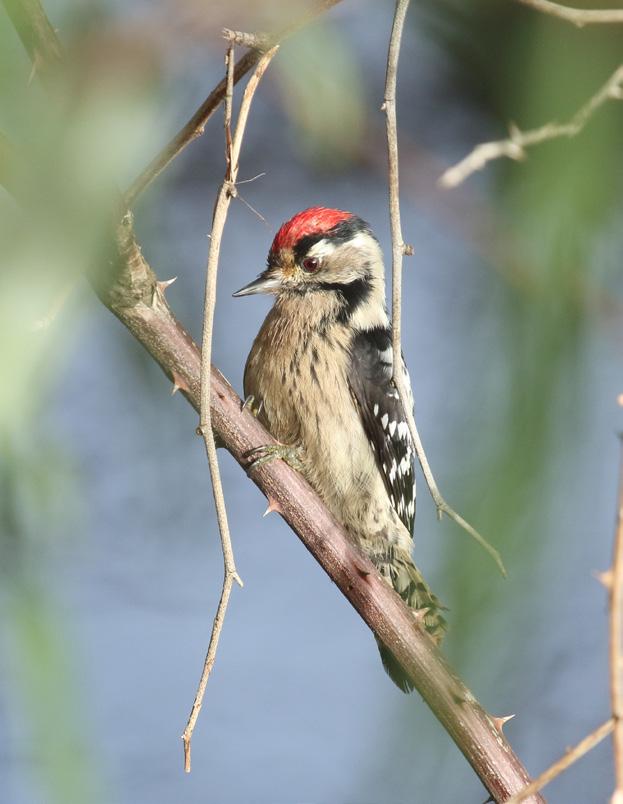
Soon I know, this orchard will attract finches – it may already be attracting them away from my blackcurrant plantations for all I know. Then, in the balmy May evenings it exquisite pink and white blossoms will provide me with a heady perfume, which will, for 10 glorious days, give a perfect setting for my cows and their new born calves.
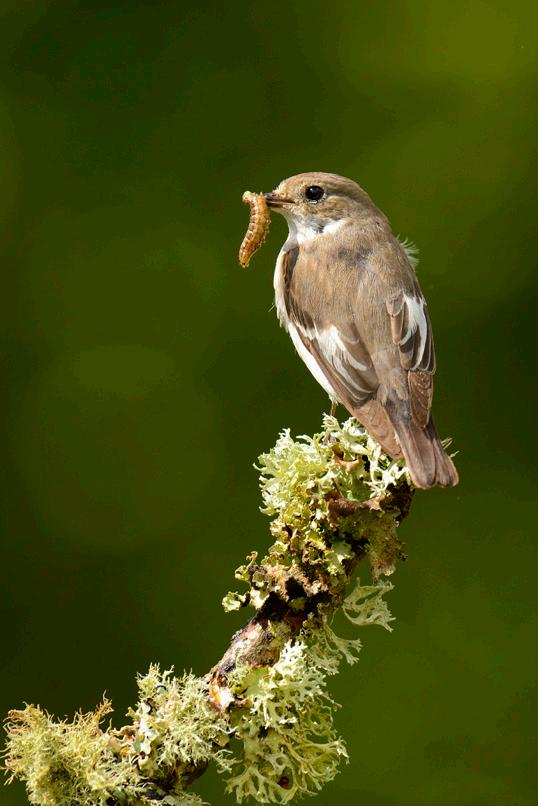
In the hot days of June the cattle privileged to graze here will rest while their less fortunate herd mates seek shade in vain.
Through July and August, while the residents of our exposed leys flee in terror from the warble and gad flies, possibly injuring themselves in the process, the cattle in this orchard will graze and lie in shady comfort, and when September comes will break boredom and thrive as they shake the lower apple branches to supplement the wet grass.
Throughout September and October, the days when fog fever strikes cattle in this valley, predictably, and often fatally, our orchard has been a refuge for some of our best animals, and when winter comes, the stock here will be the warmest on the farm. Here I can flee from the grey business world, and from the black and white of economics, to the peace of a multi-coloured haven of wildlife.
So the bulldozers will not move in – no, not even with a 100% grant.
Roger Snell, Monksbury Court, Monkhide, Ledbury, Herefords.
The Wildlife Trusts of Gloucestershire, Worcestershire and Herefordshire have formed a partnership, under the banner of the Severn Treescapes programme, that is seeking to champion the value of deadwood in the environment, for the benefit of the thousands of overlooked species (including around seven percent of our entire fauna) that depend upon it.
The Dead Wood Society is a project emphasizing the importance of dead and decaying wood especially for supporting countless invertebrates, fungi and bird species. The Wildlife Trusts promote deadwood habitats - in managed woodlands and traditional orchards - where veteran trees and decay sustain many rare saproxylic organisms such as beetles, moths, and red listed birds. They, in turn, play an important role in decomposition, recycling nutrients into the soil and storing carbon along the way.
Consider this a paean for decaying heartwood in trees, for rot-holes, sap-runs and slimefluxes, for crumpled cracks and crevices, white rot, red rot and the underappreciated architects of decomposition and decay.
Not all of the potential beneficiaries of the Dead Wood Society are cryptic and tiny – consider the jewel-like Noble Chafer Gnorimus nobilis (right,) a threatened denizen of traditional orchards and deadwood specialist.
The finch-sized Lesser Spotted Woodpecker can be found excavating nest holes in rotten trees in traditional orchards and ancient or veteran trees. And what about the Giant Sabre Comb-horn Tanyptera atrata, an orange and black cranefly - well named on account of its large size, its needle-like ovipositor (the sabre) and comblike antennae.
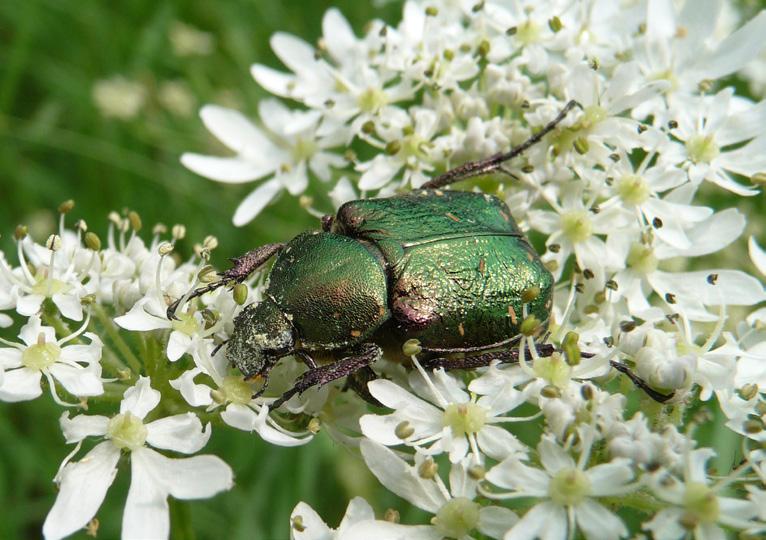
Consider the orchard toothcrust funguh as Limoniscus violaceus and Ampedus rufipennis and the marvellously-monikered Mistletoe Marble Moth Celypha woodiana which is, admittedly, cryptic, but like some other moths in the tortricid family, has evolved to resemble a bird dropping when at rest on tree trunks and branches, which presumably not many birds want to eat.
The mistletoe marble might not be officially saproxylic, but is dependant upon mistletoe, a haven for a number of other species and somewhat maligned for its habit of making orchard trees susceptible to wind-throw.
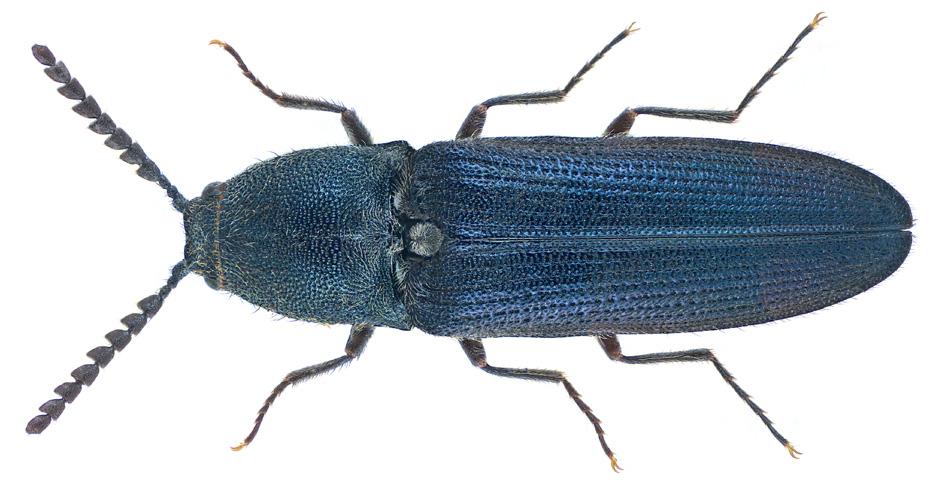
There is a role for the Dead Wood Society here to work with contractors, entomologists and orchard owners to ensure that mistletoe can be managed sensitively to prolong the life of veteran fruit trees (and thus the important deadwood habitats within them) whilst not denying mistletoe-dependent species of their habitat.
Many trees in old orchards are rich in complex deadwood habitats, due to the fact that they veteranise much earlier than, for example, an oak or a beech tree. It is an important reason (along with the fruit and the blossom and the associated habitats) why traditional orchards are such important places for wildlife.
It is such creatures, and the fungal colonisations that create their wood-rot habitats, that form the basis of Dead Wood Society. If you wishto get involved visit www.gloucestershirewildlifetrust.co.uk/dead-wood-society to register as a volunteer surveyor or sign up to one of workshops.
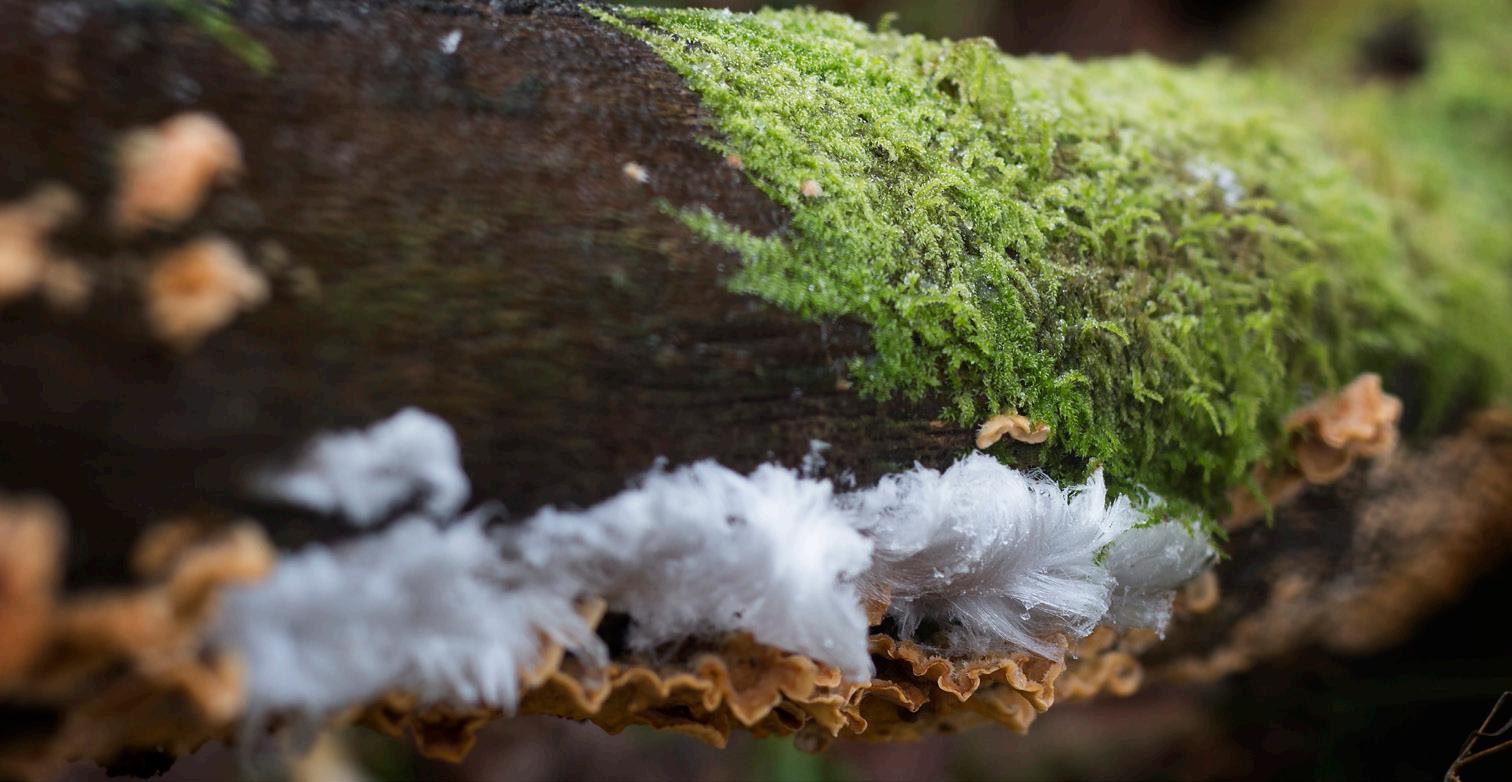
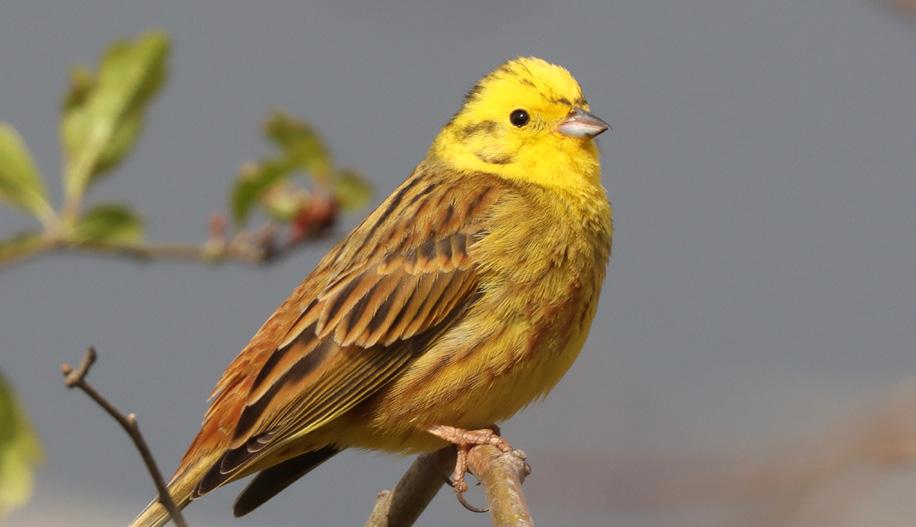
Our logo is the Yellowhammer Emberiza citrinella.
The club was formed in 1950 by like-minded people with the aim to record the birds of Herefordshire, which is still the main aim of the club today. Two founding members were Captain H.A. Gilbert and Dr C.W. Walker who reviewed the Birds of Herefordshire. From this they produced Herefordshire Birds
A precursor of the HOC was the Woolhope Naturalists Field Club who have been running from 1851 and are still active today. Registered Charity No 1068608
The HOC today
The HOC’s five pillars:
• Promote the engagement of birds and other wildlife in Herefordshire.
• Share information and knowledge of birdlife of the County.
• Record and submit sightings of birds and especially rarities and those of special interest through the County Recorder.
• Engage in conservation and survey work.
• Contribute to the mental and physical wellbeing of the people of Herefordshire.
Field Trips are arranged both locally and further afield, usually monthly. Led by an experienced guide, these trips are a great way of meeting other like-minded people and seeing some great wildlife.
Indoor Meetings are held once a month between September and February (currently held at Saxon Hall, Hereford,) where we invite a guest speaker to talk about a wide range of wildlifebased topics.
We have an interactive website packed with information and which guides the user to the events, newsletters, birding sites and allows members to leave photographs or messages. www.herefordshirebirds.org. Potential new members can also join via the website.
Our Quarterly Illustrated Newsletter keeps members up-to-date with field trips, indoor events, on-going projects and what rarities have been recorded in that period. The Newsletter is packed with photographs and items from our members.
The club produces an Annual Report each year, this is a fully illustrated account and lists all the birds recorded in Herefordshire for that year. It gives the financial report of the club and the results of any surveys and projects undertaken; it has sections on bird ringing and nest box schemes and articles from members. A hard copy of the report is given to all members and can also be viewed on the HOC website.
The HOC have recorded birds in Herefordshire for over 60 years and had produced an Annual Report, but had not undertaken a detailed full survey.
Therefore, HOC decided to produce a detailed Breeding Atlas of The Birds of Herefordshire 2007-2012. This was a huge piece of work and contains extensive information on all aspects of bird life in the county.
The HOC engages in conservation projects and surveys and works with other organisations e.g. the RSPB, Hereford Wildlife Trust, the BTO.
The Club has undertaken:
• Farmland surveys
• Wildlife promotional events
• Nest box schemes
• The Lowland Curlew Breeding Survey
• Acoustic recording of rare-breeding birds
The recording of the birds of Herefordshire is still the main aim of the Club and below is a list of records of rare and interesting sightings for the year 2025, these records are sent to the County Recorder and verified through the Rarities Committee who are affiliated to the Herefordshire Ornithological Club. (Please note some of the latter birds on the list have not yet been verified by the rarities committee)
Introduction
Water-crowfoots are aquatic buttercups in the genus Ranunculus. In the River Wye they are iconic: in summer their white flowers create a “sea of white” above the surface, while below long green ribbons of stems and forked, capillary leaves stream in the current, anchored to the riverbed. In many stretches of the river, they are the keystone species that support much the invertebrate and fish life for the whole ecosystem.
In recent years there has been a catastrophic decline in this plant in the Herefordshire sections of the river and beyond. This article sets out to explain the impact of fine sediment held in the river water as a major stressor to the shoot system, blocking oxygenated water flow through the riverbed, and weakening root anchorage of Water-crowfoot beds.
Rheophytic and Limnophytic Water-crowfoot
In the Wye catchment, most Water-crowfoot is adapted to withstand strong currents and remain anchored in coarse riverbeds and are known as rheophytes. Rheophytic forms of this plant include Stream Water-crowfoot (Ranunculus penicillatus subsp. pseudofluitans), the less common River Water-crowfoot (Ranunculus fluitans), and their fertile hybrids. As they hybridise, it can be difficult to identify them precisely, so here they are collectively referred to as ‘rheophytic Water-crowfoots’.
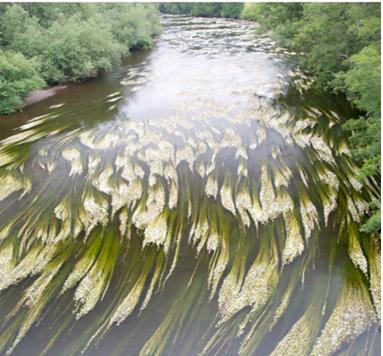
Rheophytic Water-crowfoot in the River Wye, near Bridge Sollars, a few miles upstream of Hereford, Summer 2013
By contrast, the limnophytic species, Pond Water-crowfoot, Ranunculus peltatus, is adapted to still or slow flowing water, with roots anchored in oxygen poor mud. It has broad, floating leaves, as well as capillary leaves.
The presence of rheophytic Water-crowfoots was one of the reasons the River Wye was designated a Special Area of Conservation (SAC) in 2004.
Ecological importance of rheophytic Water-crowfoots in the River Wye
Structural engineers of the river channel: their dense stands slow the flow locally, encouraging fine sediment to settle just downstream, creating stable patches where other aquatic plants can root.
Refuge for invertebrates and juvenile fish, sheltering them from predators and high flows.
Food web support, but not through direct grazing (as healthy leaves contain the toxin ranunculin, deterring most herbivores), but through the epiphytic algae that coat their stems and leaves. These algae feed grazing invertebrates, e.g. mayfly nymphs, caddisfly larvae, freshwater shrimps and snails, which in turn support carnivorous fish and apex predators such as otters, herons, and cormorants.
Oxygenation of slower reaches through rapid photosynthesis, improving dissolved oxygen levels for fish and invertebrates.
Seasonal turnover: Each autumn, much of the shoot system naturally breaks away and is transported downstream, entering decomposer food webs, while the perennial crowns, stolons, and roots remain anchored throughout winter.
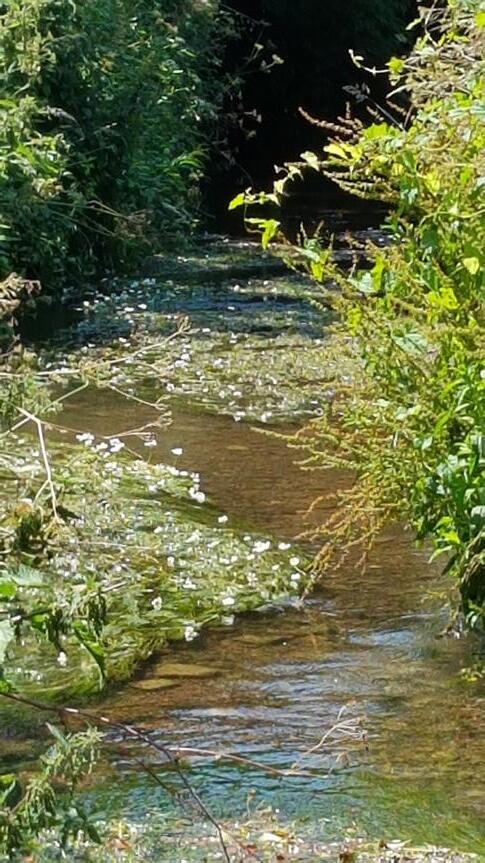
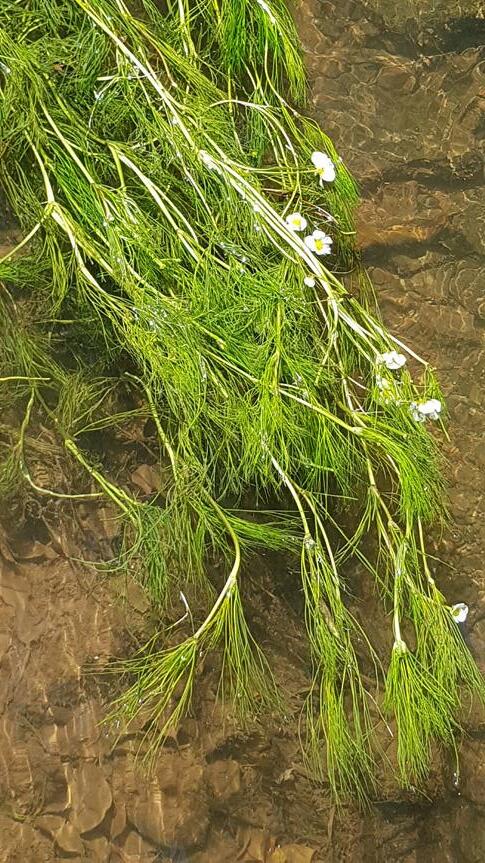
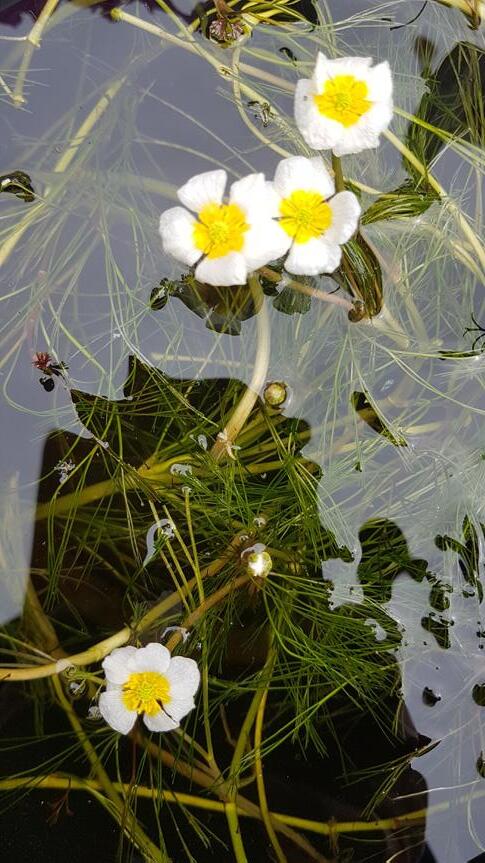
Since 2020, the River Wye has seen a dramatic decline in rheophytic Water-crowfoots. Long-term macrophyte monitoring by the Environment Agency and Natural Resources Wales shows some reaches experiencing losses of over 80% since the mid-2010s.
Public-facing conservation assessments have described the decline as even more severe, with the Wye Valley AONB reporting that “an estimated 95% of [water crowfoot] has disappeared from the River Wye in the last five years.”
The collapse has occurred alongside severe ecological degradation across large stretches of the Wye catchment. Multiple stressors are strongly implicated in this decline — excess nutrients (especially phosphate), pesticides, and climate driven changes in rainfall, flow
extremes, and temperature — but this article focuses on the major role of fine sediments.
Rheophytic Water-crowfoots occupy a remarkably narrow ecological niche, which is becoming increasingly rare in UK rivers. Because they are so tightly bound to these conditions, their presence, absence, or abundance makes rheophytic Water-crowfoots sensitive indicator species of a river’s ecological health.
They thrive only in clear, low-sediment water which is shallow, fast flowing, well oxygenated, and moderately nutrient rich, with a neutral pH – and a clean, permeable gravel bed.
Clear, shallow, low sediment water allows maximum light intensity to reach the shoots: this enables faster photosynthesis so producing more food and oxygen than would occur in turbid water with the same light conditions.
High levels of dissolved oxygen are essential for aerobic respiration in the shoots at night, when photosynthesis has stopped and every aerobic organism is drawing on the same supply. Dissolved oxygen is also needed in the pore spaces of the riverbed for aerobic respiration of roots.
Moderate nutrient levels support healthy growth. For example, nutrients such as nitrogen and phosphorus are essential for the structure of DNA, and nitrogen and magnesium for the structure of chlorophyll. However, excessive nutrients can lead to eutrophication - and algal blooms which reduce the light intensity reaching the shoots of rheophytic Water-crowfoot.
Fast flow helps to prevent fine sediment and epiphytic algae from settling on leaves and stems, which would otherwise block light and increase drag.
When these conditions coexist, the river can support dense stands of rheophytic Watercrowfoot alongside a rich community of submerged plants, fish, and invertebrates — a wellestablished ecosystem that has persisted for millennia yet is now struggling to survive.
The approximate position of the hyporheic zone from a cross-sectional view of a river catchment. Typically considered to extend between a few centimetres to a few metres in size (Stanford and Ward, 1988).
The hyporheic zone is the region beneath the riverbed and within the banks, where the river water mixes with shallow groundwater. Its depth can vary from a few centimetres to several metres. Water moves slowly through the pore spaces between gravel and pebbles, creating downwelling, upwelling, and lateral flows. These gentle exchanges:
• keep oxygen rich river water reaching the roots of rheophytic Water-crowfoot enabling aerobic root respiration
• support microbial nutrient-cycling in decomposer food webs, aided by the abundant hyporheic invertebrates, such as midge larvae and water mites
• moderate river temperature through mixing with groundwater, which is typically stable at 10–12°C at 52°N (Herefordshire’s latitude).
When fine sediment clogs these pore spaces, these three ecological functions collapse with fatal consequences for rheophytic Water-crowfoot, other aquatic plants, and the many microbes and invertebrates.
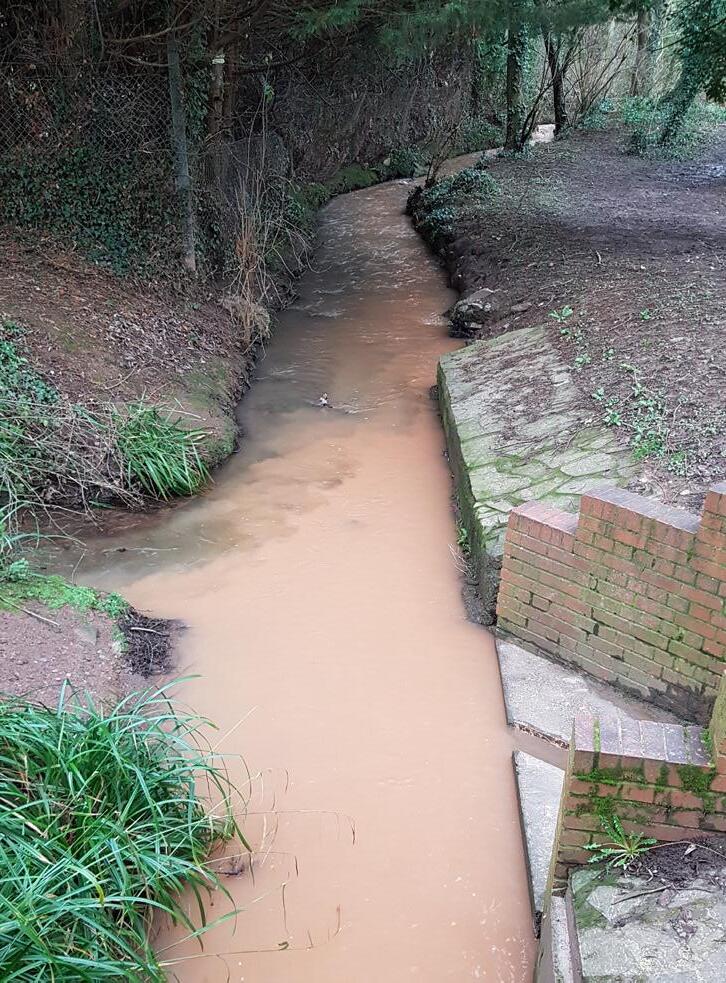
Newton Brook, Hereford, 29.1.2026: very turbid water flowing into the River Wye
Rheophytic water crowfoots have evolved in fast, oxygen rich water, with roots in open pore spaces in clean gravel. Previously, oxygenated water continually flushed through these pore spaces, giving roots a direct access to dissolved oxygen. There was no need for the specialised tissue (aerenchyma) of interconnected gas channels in their stems and roots to carry oxygen to the root tips.
Now, frequently, the high fine sediment loads in the River Wye infiltrate pore spaces, creating anoxia around the roots. Without oxygen, aerobic respiration and root growth stop, leading to root death and loss of anchorage. The high organic content of Wye sediment intensifies the problem by producing toxic compounds under anoxic conditions.
Fine sediment consists of both inorganic and organic materials, mostly less than 2 mm in diameter and down to 0.002 mm. The inorganic fraction includes clay, silt and fine sand particles. The organic fraction includes faecal debris (from livestock, wildlife and humans), microbial cells (bacteria, algae and fungi), and detritus of terrestrial and aquatic origin. It may also contain humic substances, micro and nanoplastics, and road runoff particles, such as tyre and brake wear debris.
Multiple lines of evidence from the Environment Agency, Natural England, and Natural Resources Wales indicate that agriculture is the dominant source of fine sediment in the Wye (typically 60–80%), with bank erosion contributing a smaller but significant proportion (around 10–30%), and point sources only a few per cent.
Most of the clay and silt in the Wye comes from ancient mudstones, glacial tills, and floodplain soils. These particles often carry iron rich coatings such as goethite, which bind ‘legacy’ phosphate, phytin from poultry manure, and agricultural chemicals such as herbicides and insecticides. Because crops still require phosphate fertilisers they too are easily washed into the river. The soils themselves erode readily: fine particles detach quickly, the terrain may be hilly, and intensive practices leave bare ground exposed to rainfall. Once these particles settle into the riverbed and hyporheic zone, oxygen depletion causes the iron coating to dissolve, releasing these legacy chemicals into pore water, threatening plants and invertebrates.
in which turbid river water harms rheophytic Water-crowfoot (and its community)
Turbid water affects rheophytic Water-crowfoots through a range of interacting mechanisms, both in the water column and in the riverbed and hyporheic zone.
In the water column
• Reduced light penetration causes starvation of the plant: Suspended clay, silt, and organic particles scatter and absorb light, sharply reducing the intensity reaching stems and capillary leaves. Photosynthesis falls, carbohydrate supply to roots declines, and anchorage weakens.
• Increased dissolved silica causes stimulation of diatoms: Silica rich silt can release dissolved silicate, promoting diatom blooms that further shade Water-crowfoot.
• Physical abrasion of stems and leaves: Fine sediment in fast flow acts like sandpaper, damaging capillary leaves and stem surfaces and increasing vulnerability to infection.
• Deposition of fine sediment on shoots: Settling particles smother stems and leaves, reducing light and gas exchange. They may also carry adsorbed glyphosate and encourage epiphytic algae, increasing shading.
On and in the riverbed and in the hyporheic zone
• Smothering of the gravel bed and clogging of the hyporheic zone: Clay and silt settle into the gravel, suffocating fish eggs and infiltrating pore spaces, blocking the flow of oxygenated water. Once clogged, microbial decomposition of organic matter consumes oxygen, creating anoxic conditions that kill roots and most invertebrates.
• Formation of toxic hydrogen sulphide (H₂S): Under anoxic conditions, sulphate reducing bacteria generate hydrogen sulphide, a gas that blocks aerobic respiration in plant roots and invertebrates, potentially killing them.
• Accumulation of ammonia: Decomposition of organic nitrogen (e.g. proteins) under anoxic conditions produces ammonia and ammonium ions. At higher pH values and temperatures, a higher percentage of ammonium ions converts to unionised ammonia, which is highly toxic to root tissues of Water-crowfoot, and fish and invertebrates. Delivery and release of legacy phosphorus (and OP insecticides): Clay and silt particles carry phosphate and OP insecticides bound to iron oxyhydroxide (goethite). When these particles are in anoxic pore spaces in gravel, the iron coating dissolves, releasing phosphate and OP insecticides into pore water and then the river, fuelling algal growth (including the diatom dominated periphyton on the riverbed) and exposing Watercrowfoot roots to OP insecticides.
• Cementation of the gravel matrix: In anoxic conditions of the hyporheic zone’s pore spaces, minerals such as iron, manganese and calcium carbonates precipitate around fine sediment, forming a hard, impermeable layer. Hydraulic exchange between the river and groundwater and temperature buffering are lost, the gravel behaves like a slab, rheophytic Water-crowfoot struggles to root, and hyporheic fauna declines.
Rheophytic Water-crowfoots once formed one of the defining features of the River Wye — dense, oxygen producing canopies that anchored food webs, sheltered fish and invertebrates, and stabilised gravel beds. Their survival depends on a simple but fragile set of conditions: clear water, open pore spaces, continuous access to dissolved oxygen, and a riverbed flushed by clean, fast flow.
Those conditions have now been lost. Fine sediment loads have risen sharply, reducing light to the shoots, clogging the hyporheic zone, and creating anoxic, toxic conditions around the roots. The collapse of Water-crowfoot is therefore not an isolated botanical decline but a signal of systemic failure in the Wye’s ecological functioning.
Restoring these plants, and the ecosystems they support, will require reducing sediment inputs at source, protecting riverbanks, improving land management, helping to improve conditions in the water column, the riverbed and the hyporheic zone. .
A full version of this article is available on request.
https://friendsoftheriverwye.org.uk/big-ranunculus-watch
Friends of the River Wye is asking everyone to share any photos they have of ranunculus from across the Wye catchment - both current and historical. We will use this data to map the presence of ranunculus through time so we can better understand if and where it is recovering or if it is still in decline.
It’s too easy to forget what we’ve lost. So, we’d like to remind people of how the Wye looked even a few years ago. These collective memories are so vital. This is about understanding what we’ve lost, but also helping us envision what we could have again
Please send in any current or historical photos stating where the photo was taken, when, if you’re happy for the images to be shared and if you’d like to be credited for the image.
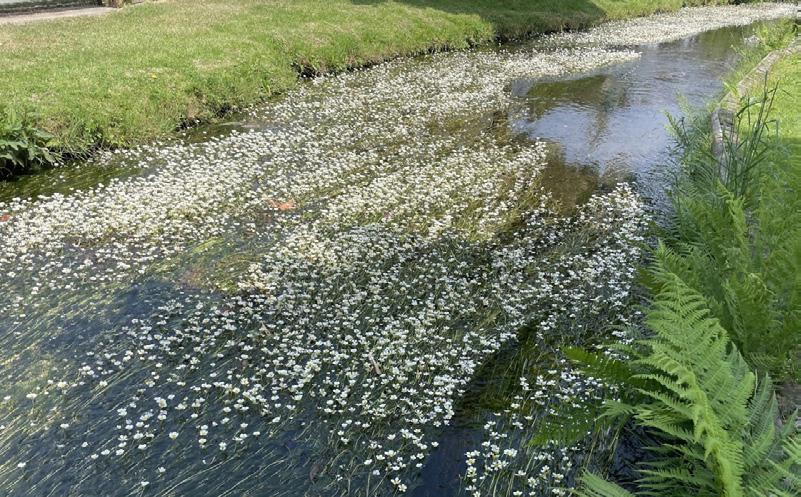
David Hutton, Project Manager,
The project team at Bartonsham Meadows
In May 2023, Herefordshire Wildlife Trust took on the management of Bartonsham Meadows, a 40ha (100 acre), former dairy farm which sits within a large meander of the River Wye in the centre of Hereford and which regularly floods during the winter months.
The site had effectively been abandoned for three years after several years of unsuccessful arable farming followed by severe floods of 2019/20. When HWT took on the management, almost the entire site was covered with what ecologists call ‘tall ruderals’ ie docks, thistles, nettles and similar species of disturbed ground.
After three seasons of ‘whole crop’ removal from 18ha (roughly half) of the 40ha site aimed at removing nutrients and suppressing the dominance of ‘weed’ species , we are beginning to see signs that some areas are already returning to something like the meadow habitat of years gone by, indeed there are already some areas where a variety of grasses are dominant in the sward, and the dock, nettle and thistle cover is much reduced or absent.
Creeping buttercup, lesser celandine and cuckoo flower are also quite common in patches, all quite widespread species but a step in the right direction, we still have a long way to go!
On the other half of the reserve in the ‘managed natural regeneration’ area where no management has been carried out to date, the plant communities are very different, with patches of reed canary grass, tansy, bramble and occasional willow and hawthorn scrub developing, providing plenty of nesting and feeding habitat for several species of birds.
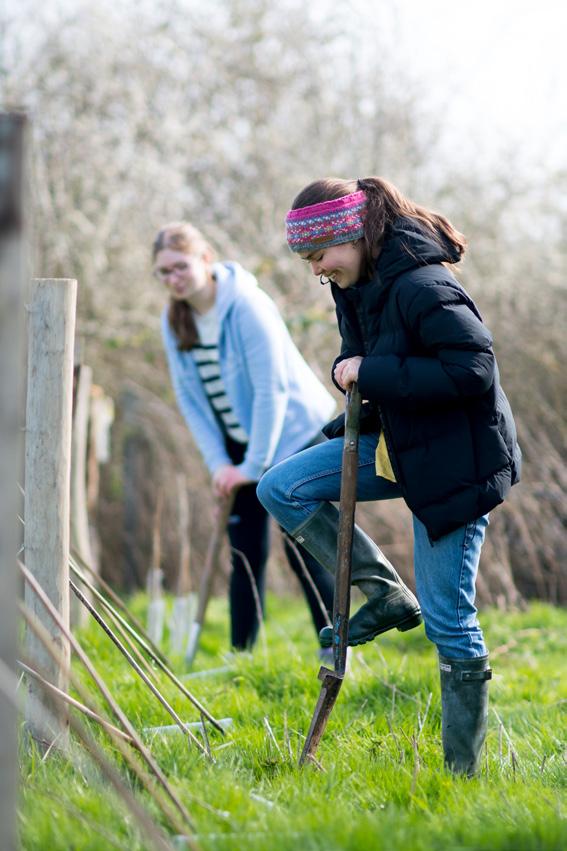
We have now fenced this area in preparation for grazing with a small number of cattle. Public access is unrestricted around the edges of this area and on the rest of the reserve, but we want to make this area a refuge for as many species of wildlife as possible so unfortunately to do this we need the area to be dog free.
We have enlisted the help of group of local volunteers who help manage the meadows by carrying out regular work parties to plant trees, hedgerows, and wildflowers. Some of these volunteers along with specialist ecologists also monitor birds, bees, plants and underground water levels. This provides a comprehensive data set for both management regimes, providing a baseline with which to measure the hoped for increase in biodiversity found on the site.
Data from this monitoring will be available on the Herefordshire Wildlife Trust website this summer: www.herefordshirewt.org.
• Cattle grazing on the Managed Natural Regeneration Area – May 2026 - We hope that cattle will arrive on site in late April to early May this year to graze the managed regen. area. They will have free range over the whole of the southern section of the Reserve. Each will have a tracking collar on it which will enable the grazier and a group of local volunteers to safely monitor their position and welfare. Volunteer livestock checkers will also be asked to carry out fence patrols as unfortunately we have been experiencing fence cutting in the last few months.
The introduction of low density grazing in this area will help to create a mosaic of habitats from dense scrub to open grassland which will provide homes for a huge variety of wildlife from nesting and wintering birds to dung loving insects!
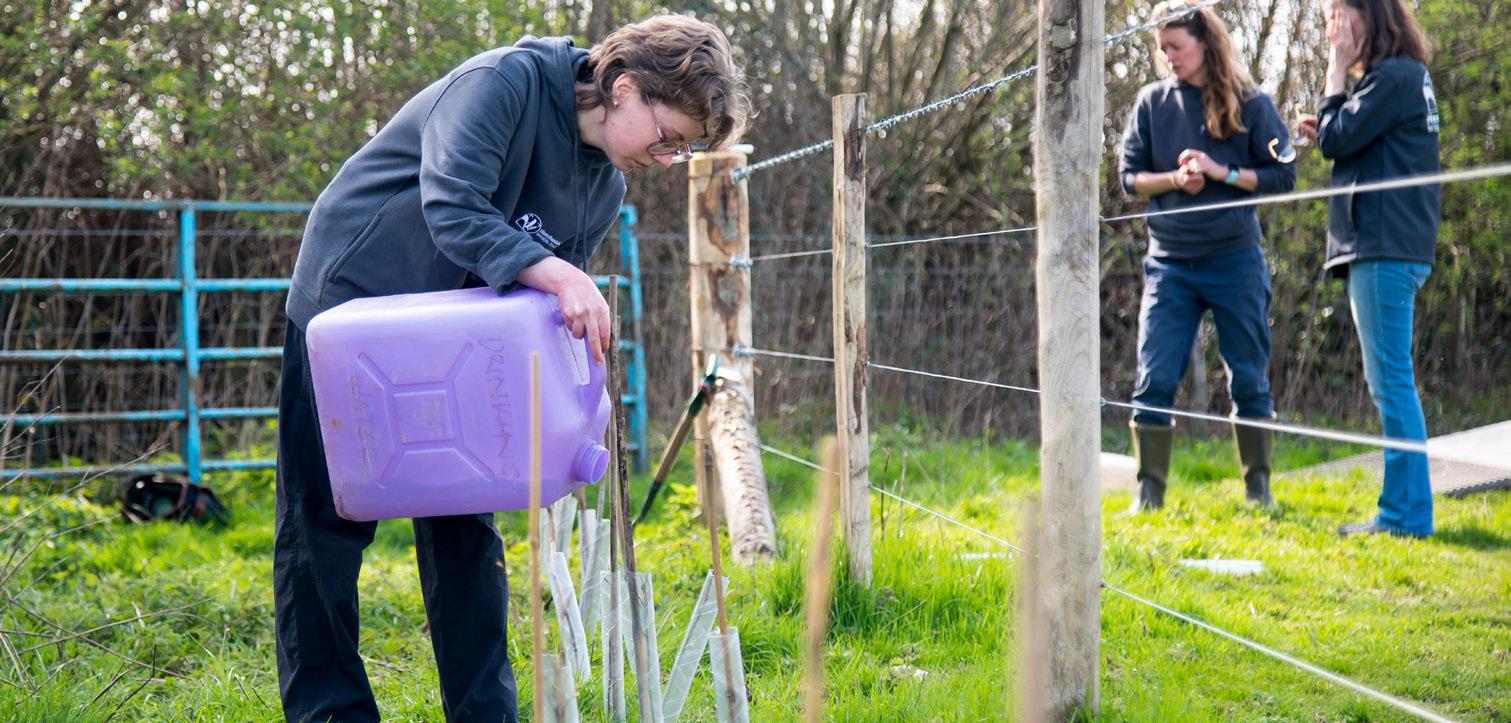
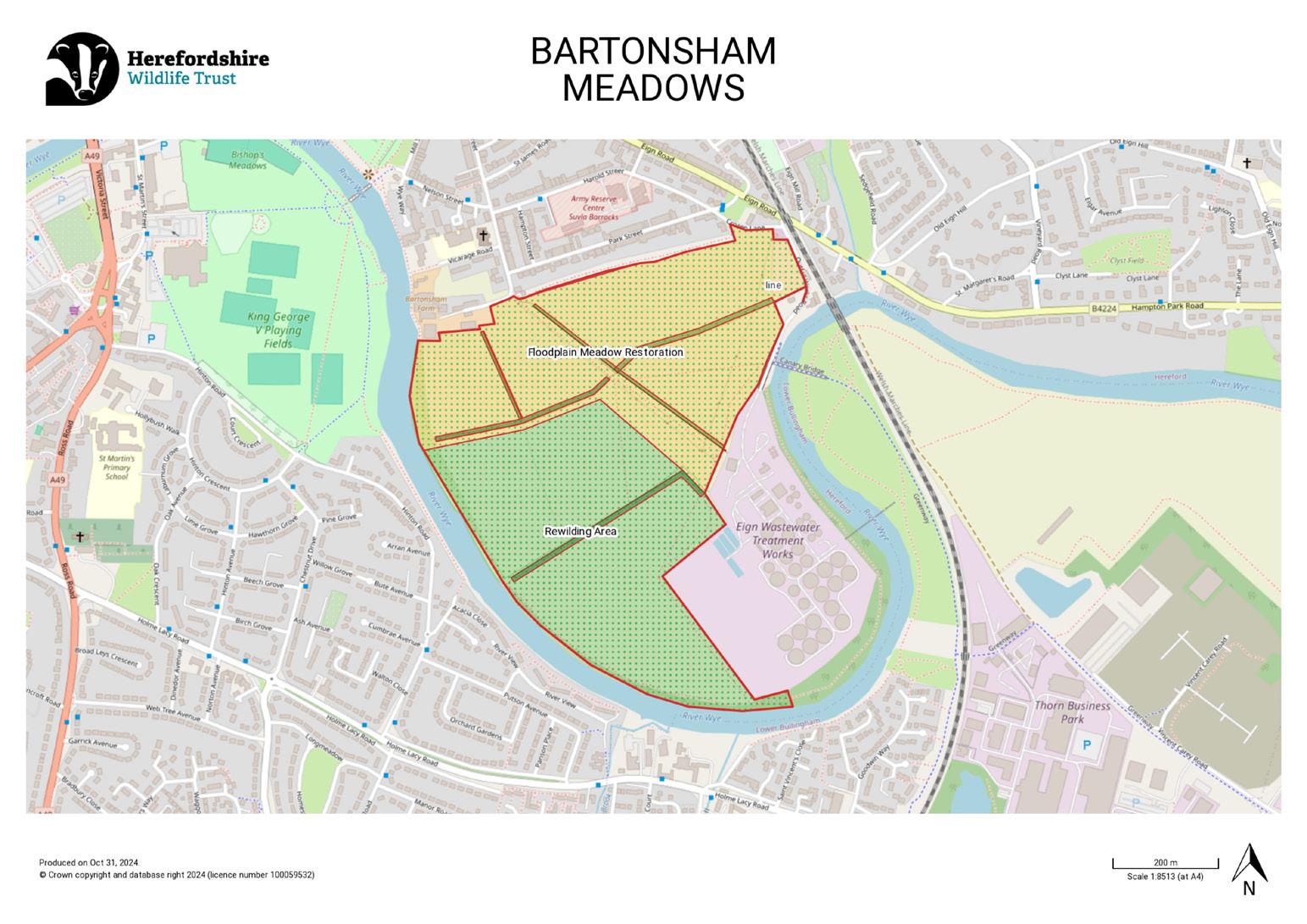
• Ongoing removal of the standing crop to remove nutrients and supress ‘weed’ species until the sward is ready to receive wildflower seed mix enhancement. This is usually done in June before seeding and when most nutrients in the soil have been taken up by plants.
• Introduction of wildflower and grass seed with yellow rattle - a semi-parasite of grasses to reduce competition on wildflower seedlings. We aim to seed up to 10ha (25acres) during July – September 2026
• Traditional floodplain meadow management including hay cutting and aftermath grazing. This will require the re-fencing of the perimeter of part of the reserve to enable grazing with cattle and/or sheep. Most years the grass will be allowed to grow until midlate June and then harvested. Once the grass has regrown, sheep or cattle will graze off the grass until October/November (depending on floods).
• Ponds and scrapes to increase biodiversity (subject to planning permissions etc)
• Hedge management. Some of the newly planted hedgerows will be suitable for laying in about 10 years while others are being allowed to grow out naturally.
• On site Interpretation – explaining the aims of management and current wildlife interest.
• On site storage facility for tools and equipment for local volunteers to enable local people to continue to help manage the reserve into the future.
There have been a number of professional entomological surveys for saproxylic (dead wood) invertebrates across Herefordshire in the 21st century which have shown a high number of rare or scarce species each with conservation designations. In particular there has been extensive research done at Moccas Park and at Little Doward with other investigations at parts of Great Doward and Haugh Wood and other areas. However, I am not aware of any efforts to combine these finding to give a countywide status. I suspect this would put Herefordshire high in the list of national rankings for this group of organisms.
As an example, the last survey of Little Doward in 2024 conducted by professional entomologist James McGill for the Woodland Trust using flight interception traps at tree rot holes of varying heights came up with a total of 468 saproxylic invertebrate species. This comprised of 231 beetles, 210 flies, 13 wasps, 4 ants, 4 spiders, 3 bugs, and 3 moths as part of a total of 1,088 invertebrate taxa.
Of these 159 species had a conservation status designation, including 92 beetles, 54 flies, 9 spiders, 2 wasps, 1 ant, and 1 moth. Seven species are listed as Threatened based on current IUCN criteria. This site is now known as the main UK location for the Cosnard’s Net-winged Beetle Erotides cosnardi which is described as ‘Endangered’ and, more recently, the Western Wood-vase Hoverfly Myolepta potens which is listed as ‘Critically Endangered’.
This Hoverfly is also known from Moccas Park NNR which also has a very long list of saproxylic invertebrates including the Moccas Beetle Hypebaeus flavipes which is only known in UK from this site. (see cdn. buglife.org.uk)
These expert reports contain a methodology to determine the European as well as National significance of a site and these two come out well in these criteria. But has anyone looked wider across the whole county?
More information can be provided on request. idraycott@yahoo.co.uk
The LNRS is a statutory document required by central government, setting out local priorities and identifying potential actions and locations to restore and protect natural assets and species.
Herefordshire’s new LNRS is one of just 48 nationally. It was developed collaboratively by residents, environmental groups, landowners, farmers, charities, Herefordshire Council and national agencies. It outlines a menu of nearly 100 voluntary ideas and suggestions, alongside existing nature reserves, wildlife sites and unique habitats, that residents, farmers and all types of landowners can choose to pursue with support from the Council and partners.
You can view the identified areas on the Local Habitats Map: https://www. herefordshire.gov.uk/lnrsmap
The final consultation on Herefordshire’s LNRS closed on 22nd March 2026 and we anticipate the publication of the final strategy later in 2026.
Herefordshire Council
There are a number of insect species for which the River Wye holds a special importance on a national scale. Given the well-publicised changes in water quality in recent years these need to be better monitored.
Some of these species can be found and identified without specialist skills and all records submitted to iRecord, with a decent digital photograph, will be verified and used by researchers to help determine the state of the biodiversity in the river.
The following 3 species are examples that are nationally uncommon but known to breed in the Herefordshire sections of the Wye and the adult stages can monitored by citizen science.
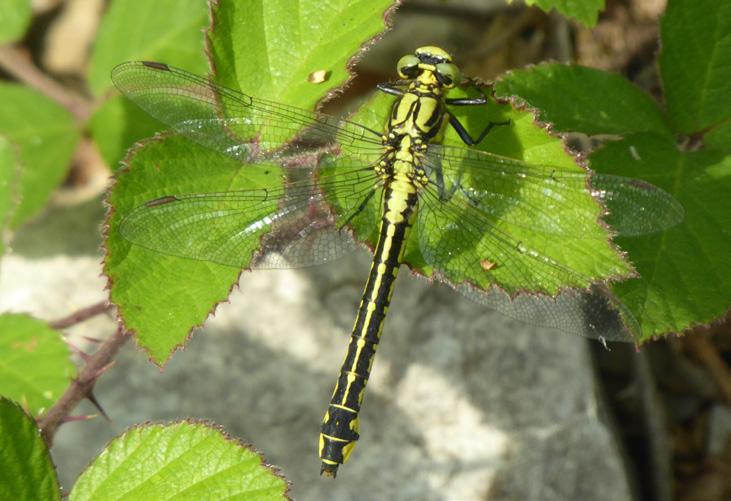
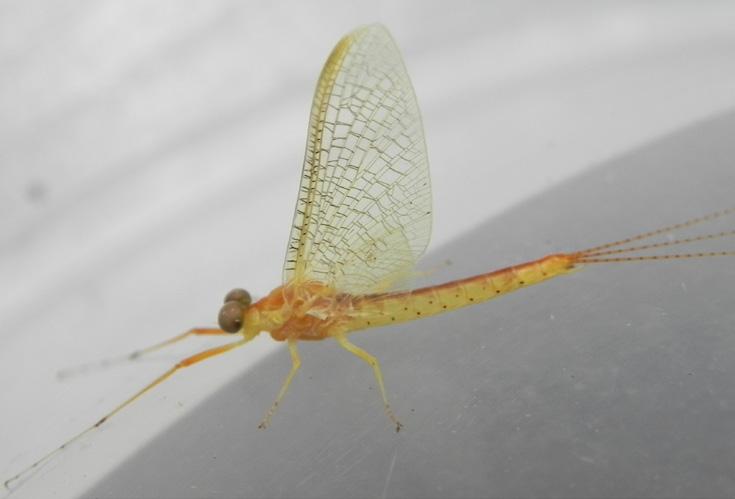
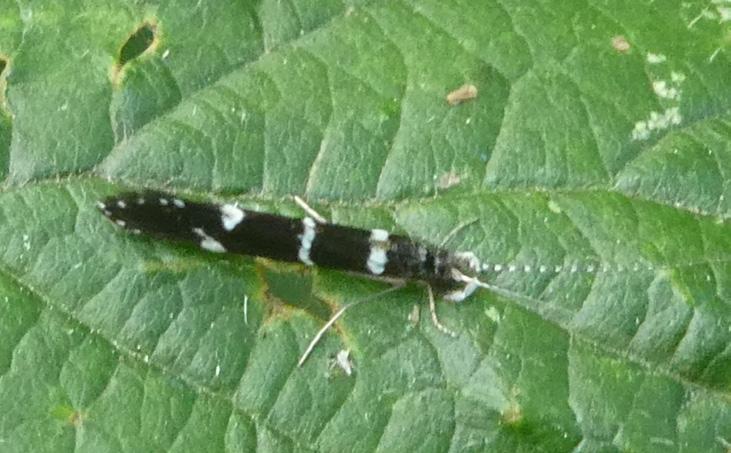
Note that they may be found some distance from their river during their flight periods: Please can everybody do what they can to submit more more records.
In March of this year the British Trust for Ornithology, along with four national partner organisations, announced that they are commencing preparatory work on the Bird Atlas 2027-31. The last atlas was completed in 2011 and involved an astonishing 40,000 volunteers.
The project will draw on the support and skill of thousands of volunteer surveyors,
who will help to measure changes in the number and distribution of all our bird species in both winter and the breeding season, collecting robust evidence that will underpin conservation action for decades to come.
Dust off your binoculars folks.
Trevor Hulme
The last issue of The Flycatcher contained an article explaining the benefits and aspirations of the Local Wildlife Site (LWS) network in Herefordshire. This is a low level non-statutory designation that grants these locations a level of recognition in the planning system. There are over 750 such sites in Herefordshire, ranging from ancient woodlands, grasslands, orchards and wetlands from small roadside verges to large woodlands over 100ha in size.
If you live in Herefordshire and own a site which is of high value to wildlife the LWS Project Manager based at Herefordshire Wildlife Trust would love to hear from you. Landowners entering the scheme would receive an ecological survey, funded by Herefordshire Council, and a management plan focused on improving habitat quality. This may also help agri-environment scheme applications.
Please contact: Toby Fountain, Nature Recovery Officer, Herefordshire Wildlife Trust
Severn Treescapes is a Gloucestershire, Herefordshire and Worcestershire Wildlife Trusts’ partnership project working across the three counties. Our ambition is to create a 60-mile corridor of enhanced tree cover to connect two of England’s largest seminatural woodlands crossing Gloucestershire, Herefordshire and Worcestershire.
The corridor will stretch from the Lower Wye Valley and Forest of Dean in the south, to the Wyre Forest in the north. This project will build on remaining pockets of ancient woodland to create a climate resilient landscape, all within 30 miles of the homes of around 8 million people.
During 2025 the original Severn Treescapes Trees Call to Action Fund project came to an end and we began the next phase – the Dead Wood Society.
We started the year off by planting up nearly 22,500 trees before the end of the planting season across the three counties, 8,600 of which were in Herefordshire.
Throughout the year, we’ve engaged with over 2,700 people across 44 different events. These range from orchard management workshops to school events, and larger events like the three counties show. During these events this last year alone, we’ve planted up 45 seeds (oak, beech or hazel) which we can then collect back in a replant later in the project.
Our first set of seeds from 2021 were collected in this year and we planted some in a woodland in Gloucestershire.
A massive thank you to our amazing 45 volunteers who’ve worked with us this year on the project. We’re always so grateful for your support and help with our planting! We look forward to working with more volunteers in 2026 as part of the Dead Wood
Society, surveying orchards across the three counties.
Megan Finn, Community Engagement Coordinator, Severn Treescapes
Herefordshire Wildlife Trust is using more than £460,000 of National Lottery funding to support communities at risk of flooding within the River Wye catchment. With the help of National Lottery players, the Wye Adapt to Climate Change project is bringing together farmers, landowners and local communities to implement approaches that help reduce flood risk, and to build longterm landscape resilience to the impacts of climate change.
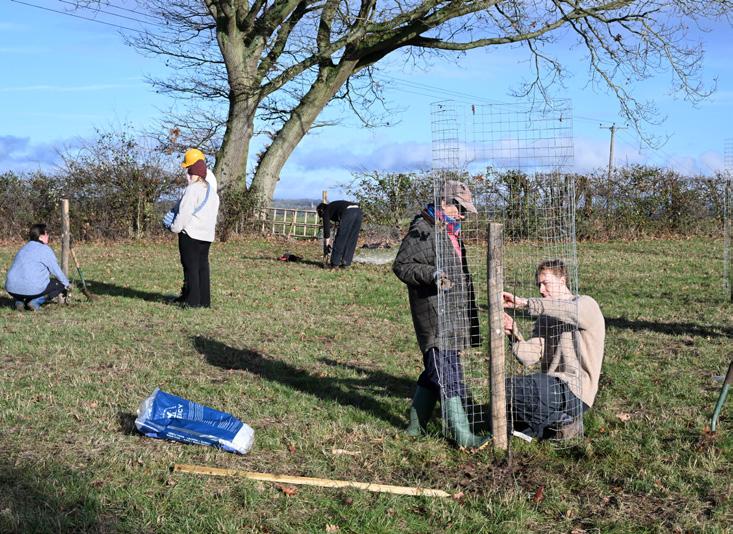
reduces flood risk by slowing, storing and filtering water using natural features such as wetlands, woodlands and healthy soils.
So far, 17 landholdings have been visited, with six implementing interventions which include pond creation, pond restoration, leaky woody barriers, scrapes and bunds, fencing off the watercourse from livestock and hedgerow creation. A further three landholdings are expected to begin NFM works before the project concludes in August 2026.
To understand baseline conditions and measure environmental change, initial surveys were undertaken looking at soil structure, soil water infiltration rates, botanical composition, river naturalness, and riverfly populations. Fixed-point photography post and drone imagery are also being used to track habitat change and evaluate how interventions are performing over time. In the final months of project delivery, effort will focus on completing final interventions and post-instillation monitoring. The project will produce case studies to showcase the actions taken, and the resulting benefits for flood management, biodiversity recovery, soil health and water quality.
Herefordshire Wildlife Trusts thanks the funders, farmers, landowners and community groups involved throughout the project.
Project staff in Herefordshire have most recently been focussing efforts in the Yazor Brook catchment with further funding through Dŵr Cymru Welsh Water’s Environment Fund. The project aims to deliver Nature-based Solutions (actions that use natural processes to address environmental challenges) across the catchment. A key component of the work is Natural Flood Management (NFM) which