Herefordshire Wildlife Trust
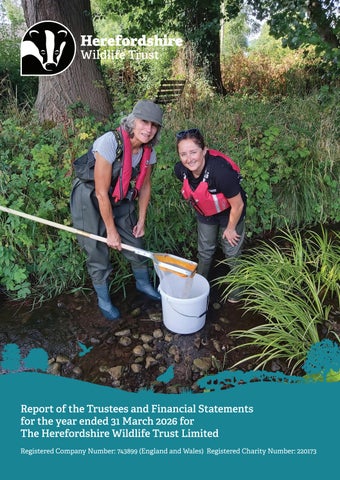
Report of the Trustees and Financial Statements for the year ended 31 March 2026 for The Herefordshire Wildlife Trust Limited Registered Company Number: 743899 (England and Wales) Registered Charity Number: 220173 1
CONTENTS Report of the Trustees
3
Statement of the Trustees’ Responsibilities
18
Report of the Independent Auditors
19
Consolidated Statement of Financial Activities
22
Consolidated Balance Sheet
23
Balance Sheet
24
Consolidated Cash Flow Statement
25
Notes to the Consolidated Cash Flow Statement
26
Notes to the Financial Statements
27
Volunteer Nic Howes leads a Discovery walk for members and volunteers at King Arthur’s Cave Nature Reserve 2
Report of the Trustees
Chair’s Statement As can be seen from this report, the year has been one of significant progress, building on the changes we have made during the last few years, and in line with our 2023-26 strategy.
Our increasing membership, and the activities of our members, demonstrate that people are determined to protect the environment we have in Herefordshire, and to protect more.
Herefordshire Wildlife Trust works to defend and conserve nature locally, regionally with neighbouring Wildlife Trusts, and nationally through the Royal Society of Wildlife Trusts, the Federation of which we are a member.
Two significant changes of people took place during the year. Jamie Audsley, who had been our Chief Executive since 2022, moved to a new job in the sector, and we appointed Saul Herbert on 1 January to replace him. Also, at the end of March 2026, Alison McLean retired after nine years as a Trustee and six as our Chair. They had both played an invaluable role over the last few years, and I would like to express my appreciation and thanks for their contribution.
The pressures on nature are increasing. Climate change, and the related challenge of energy security, together with an increasing population creating greater demand for resources, including food and housing, make it all the more important for us to act, not just to defend what we have, but to develop innovative ways of meeting the challenges.
The breadth of activity described here is possible only with the valued support of our members, volunteers,
supporters, funders and partners. We rely on them all to achieve our vison for a Wilder Herefordshire. On behalf of the Trustees and staff of Herefordshire Wildlife Trust, I would like to thank all of our supporters for their ongoing commitment to the Trust and our mission.
Jake Bharier, Chair of Trustees
Staff visit to Meadowlands, September 2025 3
The Trustees, who are also the directors of the charity for the purposes of the Companies Act 2006, present their report with the financial statements of the charity for the year ended 31st March 2026. The Trustees have adopted the provisions of Accounting and Reporting by Charities: Statement of Recommended Practice applicable to charities preparing their accounts in accordance with the Financial Reporting Standard applicable in the UK and the Republic of Ireland (FRS 102) (effective 1 January 2019).
Objectives & Activities A Wilder Herefordshire - More Nature Everywhere The year saw significant progress and important achievements in the delivery of the Trust’s 2023-2026 strategy: A Wilder Herefordshire – More Nature Everywhere. Focussed on our mission to ‘lead local action for nature’s recovery’ we have delivered an extraordinary range of activities under each of our three strategic goals:
Nature in Recovery • Manage our nature reserves to ensure they are rich in wildlife and strategically focus our landholdings • Work in partnership to create more, bigger, wilder connected habitats • Demonstrate how restoring nature can deliver multiple environmental benefits, and help tackle the climate and nature emergencies • Promote sustainable land use and challenge harmful practices and infrastructure that threaten nature’s recovery
We have continued our core work on driving nature recovery through habitat restoration and creation and species recovery work at a range of scales, from our own nature reserves to landscape scale solutions delivered in partnership with key collaborators. The Trust has progressed its strategy to restructure our nature reserves, building a series of larger, more impactful reserves. The restructure involves the often-challenging process of divestment of small, isolated reserves, including the sale this year of Rookhill Coppice. The Trust is now well positioned to move forward positively with the restructure and is actively exploring opportunities for strategic land acquisition in the coming year. The Restoring Bartonsham Meadows Project has reached its mid-point, and has already delivered substantial habitat improvements, including the enhancement of floodplain meadow plant communities through planting and seeding, the installation of grazing infrastructure and the establishment of a community orchard. Monitoring shows increasing biodiversity, with records of new birds including 4
stonechat, sedge warbler and grasshopper warbler. The Lugg Meadows Species Recovery Project concluded successfully, establishing several thousand plants of narrowleaved water-dropwort and propagating the nationally scarce mousetail in preparation for future planting projects. Replacement of the bridge across the Lugg Rhea now enables cattle movement across this central large ditch, enabling grazing at appropriate times. At Bodenham Lake Nature Reserve, most of the 246 orchard trees were pruned, 10 new trees were planted, 2 tonnes of fruit was harvested, and approximately two hectares of invasive Himalayan balsam was removed. While at Queenswood, around 1 kilometre of woodland rides was widened to improve habitat diversity, and coppicing work in South Wood continued. Four Japanese cherry trees were gifted to the Queenswood arboretum as part of the Sakura Cherry Tree Project – promoting cooperation and friendship between the UK and Japan. The trees have been planted in a prominent position at the entrance to the arboretum to provide a spectacular spring display. Landscape-scale conservation also advanced significantly. The Wyescapes Landscape Recovery Scheme, covering more than 5,000 hectares along the Wye and Lugg river corridors, has completed its development phase and been submitted to Defra for review. Led by Herefordshire Rural Hub, the project involved creating a Landscape Management Plan, working with 49 land managers, undertaking habitat and species surveys, securing partner and government agency input, developing monitoring and evaluation plans, and estimating costs and environmental finance opportunities. If approved, the 30-year scheme would deliver lasting benefits for nature, farming and local communities, with a final decision expected no earlier than autumn 2026. Through the £1.5 million Severn Treescapes Project, around five hectares of woodland were planted and plans developed for several further creation schemes. In addition, several orchard and veteran tree surveys were carried out as part of the Treescapes – Dead Wood Society project. Climate resilience work through the Wye Adapt to Climate Change (WACC) Project engaged 17 landholdings, supported six farms implementing interventions, installed 208 leaky woody barriers across 2.1km, trained 12 new Riverfly survey volunteers, and established five new monitoring sites, demonstrating tangible benefits for biodiversity, water quality and flood management
Report of the Trustees
Bartonsham Meadows Project Team (c) Gavin Dickson
Installing tree guards, Bartonsham Meadows (c) HWT
New bridge, Lugg Meadows (c) HWT
Orchard pruning course, Bodenham Lake (c) HWT
Volunteer group widenening rodes, Queenswood (c) HWT
Working with farmers, Wyescapes (c) Wyescapes
Treescapes orchard workshop (c) Brian Taylor
Riverfly Survey with WACC (c) HWT
5
Taking Action for Nature • Connect People to Nature • Support local groups and businesses to take action for nature • Develop a bolder campaigning voice and deliver proactive advocacy
Throughout the year the Trust has continued to grow its impact in connecting people with nature, supporting communities and inspiring action. Through the WildPlay programme, more than 1,200 children participated in naturebased activities across Hereford, Leominster, Kington and Queenswood. A new specialist programme, WildPlay Thinks Differently supported by £17,815 from the National Lottery Community Fund, engaged 44 children with Special Educational Needs, with most participants attending at least six sessions. The Restoring Bartonsham Meadows Project provided a major platform for engagement, hosting 28 school visits and welcoming more than 700 children and young people. The project also delivered a wide range of free public events, strengthening community connections with nature in the heart of Hereford. Our Artist-in-Residence, Richard Bavin, has continued his study of the native black poplar in Herefordshire which will conclude with an exhibition at Queenswood in 2026, and of the arboretum and woodland of Queenswood itself.
Bug hunting with WildPlay (c) HWT
The Trust launched Young Nature Rangers and hosted four trainees, expanding our offer for 16 – 25 year olds and helping to develop future conservation professionals. Young Nature Rangers sessions averaged eight participants per monthly session, while the Howard Bulmer Young Nature Champion Award supported innovative youth-led conservation projects. Community participation remained strong through the Nature Action Network, six active local branch groups and numerous supporter events. The network has provided a useful forum for discussion and inspiration and also supported the Rivers, Roots and Resilience day of climate action that saw groups and organisations across Herefordshire and the Wye Valley running activities celebrating wildlife, exploring our rivers and landscapes, raising awareness of climate change, and taking local action for a more sustainable future. Branch-led initiatives delivered practical conservation, environmental monitoring and fundraising, including Hereford City Branch’s sold-out ceilidh raising more than £1,000. The Trust’s advocacy work achieved a notable success when Herefordshire Council refused a major development proposal near Lugg Meadows Nature Reserve, following a campaign that generated more than 1,700 public objections. However, the developer has lodged an appeal, so the campaign continues. Combined with expanded volunteer training opportunities, these achievements demonstrate growing public engagement, stronger community action for nature and an increasingly influential voice for wildlife across Herefordshire.
6
Trainee Phoebe at Young Nature Rangers (c) HWT
Report of the Trustees Sustaining our Future •
Embed effective governance and business planning
• Continue to grow and diversify funding streams to grow unrestricted income, whilst also continuing to grow restricted funding • Develop an inclusive workplace for all staff and volunteers • Reduce our carbon footprint and embed sustainability practices The Trust strengthened its organisational resilience through improvements in governance, fundraising, team development and commercial performance. Following a comprehensive governance review, new Board reporting systems, committee terms of reference and trustee role descriptions were implemented, supporting more effective oversight and decision-making. Membership recruitment slowed in comparison to recent years, with the total number of members consolidating at over 8,000. Continued, albeit slower, growth is a powerful demonstration of the wide support for the Trust among communities across the County.
Fundraising performance remained strong. The Nature Recovery Fund raised a further £46,176 during the year, helping the appeal progress to more than 50% of its £1 million target. The Adopt a Species scheme generated £2,746 in its second year, while the fundraising event An Evening with Monty Don raised over £4,000. The Trust continued investing in its people, introducing an action plan following staff survey feedback and recognising exceptional contributions through four ‘Oaklie’ Employee Awards presented to individuals and teams. Equality, Diversity and Inclusion progress included achieving Disability Confident Level 1 status. Visitor numbers increased significantly. One measure is the use of our car parks, with 81,002 cars visiting Queenswood (+5.8% compared to the previous year) and 11,717 visiting Bodenham Lake (+17%). Commercial income also grew as we have sought to develop new income streams from these visits through retail, cafe, venue hire and other offers. New income streams include the dog wash, vending machine and a Herefordshire Wildlife Trust branded clothing offer. The Woodland Café, now in its full second year, saw sales increase by 15.8%. Careful rota planning and cost control have allowed the Café to increase profit, while Queenswood retail turnover increased by 12%. With Ledbury shop sales also increasing this demonstrates positive progress towards long-term financial sustainability.
Queenswood ParkRun (c) Nick Lattery
7
Public Benefit The Trustees have given due consideration to the Charity Commission published guidelines on Public Benefit as required under the Charities Act and are satisfied that our work clearly provides multiple public benefits in line with our charitable objectives. These benefits include: The Trust’s nature reserves are well used by the public and most have way-marked routes for people to use. At most sites we also provide information and interpretation for visitors. The Trust’s nature reserves and activities are available to all, and provisions for easy access are made wherever practicable. Information on our website is regularly reviewed and updated. We are increasingly able to influence other landowners to manage land for the benefit of wildlife and communities through our consultancy work, projects such as Severn Treescapes and partnerships such as with Marks & Spencer. Much of our work is delivered in conjunction with volunteers. These activities are well recognised to improve the health and wellbeing of volunteers in many ways. Our people and wildlife outreach programmes are aimed at communities, children’s centres, adult groups and the wider public. Some of our funding enables us to offer free activities in socially deprived communities. Contact with the natural world and the appreciation of wildlife and wild places brings great pleasure to many people and is well recognised as contributing towards health and well-being. We gather conservation data and provide expert advice to Local Authorities and others to ensure that planning decisions are made on a rational basis after taking full account of the public benefit of wildlife. Lastly, the Trust can exert influence at a local level through its members and our membership of groups such as the Local Nature Partnership, regionally in partnership with neighbouring Wildlife Trusts and nationally through membership of the Royal Society of Wildlife Trusts.
8
Discovery Day, Birches Farm (c) HWT
Report of the Trustees
Marden Moth Morning, part of our annual Day of Action (c) HWT
Riverfly survey demo, part of our annual Day of Action (c) HWT
9
A year for wildlife
Highlights of our Year We announced the winners of The Howard Bulmer Young Nature Champion Award and begin working with the recipients on their projects: an arts project to connect people in the city with the River Wye, with Charles Gundy: and a project with students of Fairfield School to transform an area of their school grounds into a mini nature reserve.
5 We launch WildPlay Thinks Differently, a programme for young people with special educational needs, thanks to initial funding from Herefordshire Council. We were awarded further funding later this year to continue the programme through the year and into 2026-27.
We teamed up with the Humble-Bee Gardeners to be charity partner for their show garden, Biosis: Mode of Life garden, at the RHS Malvern Spring Festival.
A new issue of The Flycatcher was published, after an absence of some years. The Flycatcher is a natural history journal for Herefordshire, published by Herefordshire Wildlife Trust but with contributions from conservationists across the county.
O C T O B E R
10
D E C E M B E R N O V E M B E R
Our orchards at Bodenham Lake, and our Nature Recovery officer Toby Fountain, featured on BBC Countryfile. Toby highlighted how brilliantly traditional orchards, with deadwood left within them, can provide excellent habitat for a wide variety of species.
We held a busy programme of summer events, including our summer Discovery Day for supporters, held at Birches Farm Nature Reserve, and our annual staff and volunteer picnic at Queenswood.
Queenswood Parkrun was launched. Our 5Km course is challenging but nonetheless has proved very popular bringing a new audience to enjoy Queenswood – a valuable addition to our weekly schedule. Parkrun is an international phenomenon, a free-to-enter, weekly 5km run staged by volunteers. It happens every Saturday morning at 9am at over 1300 locations around the country, attracting over 200,000 participants. An average of 180 runners & walkers have lined up at the start at the start of the Queenswood Parkrun, each Saturday. The benefits for Herefordshire Wildlife Trust include increased revenues from the Café and additional engagement due to the increased visitor numbers.
We were awarded £265,536 from the National Lottery Heritage Fund to progress with the Development Phase of an exciting new project, Hereford ~ River City. This will begin at the start of 2026-27.
We said goodbye to our CEO Jamie Audsley. Jamie led the creation and delivery of our 2023-26 strategy which resulted in many notable achievements including securing grant funding for several major nature recovery projects, increasingly our external collaborations for greater impact and advocacy and the advancement of our commercial strategy to secure ongoing, unrestricted funding for the Trust’s work.
Report of the Trustees
Highlights from Herefordshire Wildlife Trust
Our project Restoring Bartonsham Meadows took a leap forward when fencing was installed on sections of the meadows. This allows for grazing by livestock, essential for the site management and the creation of a wildlife refuge. Much of the site remains as open access for people.
We ran a programme of WildPlay activities in and around Kington with free sessions for families and nature trails in Kington and at nearby Birches Farm Nature Reserve, thanks to funding from Herefordshire Community Foundation.
J A N U A R Y
We welcomed our new CEO Saul Herbert. Saul’s previous role was with the Woodland Trust where he led the Conservation Outcomes team – shaping the organisation’s conservation activity through advice, guidance and training, supporting conservation projects across the UK. Prior to this, Saul worked more locally, managing Natural England’s National Nature Reserves from the Wye Valley to the Wyre Forest, including the iconic Moccas Park National Nature Reserve in Herefordshire.
September 2025 was a busy month in the Commercial team, with the end of a recordbreaking summer holiday period at Queenswood. Visitor numbers for the 6 weeks of the school holidays were up by 5.3% on the previous summer. This equated to 33,615 visitors. Car parking income for the same period increase by 22% on the previous year.
In collaboration with the Wye Valley National Landscape and many community groups and organisations across the county, we held Rivers, Roots and Resilience - A Day of Climate Action. There was a full programme of activities to celebrate wildlife, explore our rivers and landscapes, raise awareness of climate change, and take local action for a more sustainable future.
F E B R U A R Y We hosted the Herefordshire Young Farmers’ hedge laying competition at Bodenham Lake nature reserve. We had 26 entries across four classes – singles and pairs in under 21 and under 28 age groups. The weather was wet and windy but everyone was in great spirits and it was wonderful seeing young people keeping nature friendly, rural skills alive. The hedge created from the day is a work of art and can be seen on the trail to the northern hide. Thanks to the coppice crew at Queenswood for providing all the stakes and heatherings
M A R C H
Wyescapes was formally submitted to Defra as part of the government’s new Landscape Recovery Scheme. Wyescapes is an ambitious long-term plan to restore nature across more than 5,000 hectares along the river corridors of the Wye and Lugg between Leominster and Symonds Yat. The development phase was led by Herefordshire Rural Hub, working with partners Herefordshire Wildlife Trust, Herefordshire Meadows, and The Wye and Usk Foundation.
11
Financial Review Review of the financial position at year end Together The Herefordshire Wildlife Trust and its subsidiary, Herefordshire Wildlife Enterprises Ltd, make up “The Group”. Total Group income for the year decreased to £2,840,818 (2024-25: £2,962,235): this includes £433,000 in relation to the recognition of a large legacy. This represents a reduction of 4% against 2024-25. However, income was always expected to reduce following the full recognition and revaluation of the assets of Queenswood and Bodenham Lake in 2024-25 accounts. The Group has generated a surplus of £581,831 in 2025-26 (202425: £763,489 surplus). Excluding one-offs such as the large legacy and sale of Rookhill Coppice reserve, the Group made a surplus of £119,497 (2024-25: £75,877 deficit). Unrestricted income increased from £1,448,322 to £1,793,212, which is predominantly due to a combination of the Group’s growth of its commercial activities and the unrestricted element of the large legacy. Restricted income decreased from £1,513,913 to £1,047,606 reflecting a lower level of grant income awarded to the Trust. Several projects, including Lugg Meadows Species Recovery and the Wyescapes development phase projects, ended during 2025-26 and have been replaced by new projects such as Hereford ~ River City which have been awarded for delivery in 2026-27 and beyond. The strong pipeline of projects ensures that turnover is maintained in future years. Expenditure within the Group decreased over the year from £2,319,890 to £2,235,228, a drop of 4%. Within these totals, unrestricted expenditure recorded a small reduction from £1,579,658 to £1,531,640, highlighting the improved control the Group has made to its cost management. There was also a decrease in restricted expenditure from £740,232 to £703,588 reflecting changes in the restricted income. The outlook for 2026-27 and beyond is positive as the Group continues to grow unrestricted income, strengthening the balance sheet reserves. The receipt of a large legacy due in 2026-27 will ensure that the cashflow position remains strong for the coming year.
Financial Reserves policy The Finance Committee regularly reviews the level of reserves available (both restricted and unrestricted), balancing the need to advance the work and development of HWT with the duty to maintain a secure financial base. The Group’s unrestricted funds as at 31st March 2026 amounted to £542,241 (2025: £210,594) and the free reserves as at 31st March 2026 were £356,189 (2025: £186,559). There are no designated funds in either 2025-26 or 2024-25. Restricted funds as at 31st March 2026 total £5,051,655 (2024-25: £4,801,471).
12
The Trustees have agreed that the free reserves required by HWT are to be assessed on the basis that they: •
will meet any funding commitments already agreed for future periods. This does not include any commitments covered by the Restricted Funds;
•
are sufficient to ensure HWT can meet its financial obligations in the event of a sudden significant reduction in income;
•
are able to cover any unexpected costs arising from the properties owned or leased by HWT, that will not be covered by either the landlord or insurance;
•
are sufficient to cover any the costs of winding up HWT, should that prove to be necessary;
In addition, free reserves will also be accumulated to build up the cash holdings to enable sufficient cash liquidity to fund ongoing activities without recourse to borrowing funds. Free reserves are defined as the unrestricted funds less assets and investments and any funds designated for essential future spending. The target for the free reserves to be held are to be calculated by totalling the estimated nonproject related running costs for 3 months, the costs of redundancy if HWT were wound up, the existing liabilities on any leases or other contracts and any dilapidations due on leasehold properties occupied. The target for the free reserves on this basis is £540,000, which is more than the free reserves held of £356,189. However, the amount of the free reserves has substantially increased in the past year and HWT is in a reasonable financial position. It is an objective of the Trustees to increase the free reserves further over the next 3 years to the above target. The Trustees will review the Reserves Policy and free reserves target each year to ensure that they remain appropriate for the activities of the organisation
Investment performance The finance committee has adopted a policy of investing funds to produce a financial return of CPI plus 4%, net of expenses, over a five-year period but observing ethical considerations consistent with the Trust’s overall aims to enhance biodiversity, promote wildlife conservation and support environmental protections. On 31st March 2026, the investment held at COIF stood at £237,056. This is £23,759 (9%) lower than at the start of the year. This fall was in line with world markets which fell because of the ongoing US /Iran war which weighed on investor, consumer and business confidence. The COIF Charities Ethical Investment Fund performed well against most world markets which fell even more steeply.
Report of the Trustees Principal risks and uncertainties
to react and respond in a timely manner.
The Trustees regularly review the risks the charity faces and where appropriate establish processes and procedures to mitigate those risks identified, including, where appropriate, putting in place insurance and setting aside financial reserves and taking active steps to maintain positive relationships with our key stakeholders. Risks and uncertainties are summarised as follows:
The occurrence of an event that threatens the reputational damage or integrity of the Trust.
Maintaining an appropriate balance between restricted and unrestricted activity and thereby achieving a sustainable financial outcome carrying out the Trust’s charitable activities within its available funding envelope. Significant challenges in recruiting and retaining staff due to wage inflation and the volatility in the UK jobs market. Systems breach/ IT fraud/ cybercrime, increased risk of data breaches, virus and malware attacks and sophisticated attempts at online financial crime. Rising costs and inflationary pressures of energy, materials and supplier costs leading to greater unrestricted contributions to projects and greater likelihood of increased core costs. Risk of UK Government Policy to reinvigorate the UK economy, not accounting for wildlife and environmental factors, instead favouring commercially focused activity including housing development and large infrastructure plans, to the detriment of wildlife. Greater public awareness of complex environmental issues challenges the Trust to have sufficient resource and capacity
Sudden loss of key personnel or our head office communication and IT systems.
Going concern Within this report we have reviewed the Trust’s financial performance over the last year, the level of reserves held, and the principal risks and uncertainties that we face. From a financial perspective, the Trustees consider that the charity remains well placed to manage these risks. The budget is approved by the Board of Trustees on an annual basis and performance against budget is reviewed and reforecast on a quarterly basis. The 2026-27 budget and operational plan provide a framework for managing costs and growing our free reserves. As detailed in our reserves policy and explained here, we hold free reserves to provide cover for unexpected changes in income and expenditure and to allow us to adjust our cost base and continue activities. We will continue to monitor the situation and manage our finances accordingly. The Trustees therefore have a reasonable expectation that the charity has adequate resources to continue in operational existence for the foreseeable future, being at least 12 months from the date of approval of these financial statements. Accordingly, the financial statements continue to be prepared on the going concern basis.
Dipper (c) Alice Collins 13
Looking forward This year was the final year of our 2023-2026 strategy period. Through 2026-27 we will be refreshing this to create our 20272030 Strategy. The process will draw on the knowledge and experience of external stakeholders, volunteers, members and trustees as well as staff. Our operational plan for 2026-27 continues with delivery already underway, relating to our current strategy goals.
Nature Recovery The start of the year will see a major refresh to the staff team with recruitment of a new Nature Reserves Manager and two Reserves Officers, replacing staff who have left the Trust, as well as recruiting for three new project roles for Hereford ~ River City. This is a new project, funded by The National Lottery Heritage Fund, the development phase beginning in late spring 2026. The project will establish Hereford as a ‘river city’; where nature thrives within the network of waterways and surrounding wetland areas which are enjoyed by all. The initial grant awarded from the Heritage Fund will allow the Trust to conduct a development phase of 15 months, beginning spring 2026, before seeking funding of over £1 million to realise the full project over three years. While the Wye Adapt to Climate Change comes to an end in December 2026, we hope to progress our river restoration work with a new project focused on the River Lugg, in partnership with Radnorshire Wildlife Trust. We will be seeking funding for this project during this year. We are also hopeful of plans to increase our landholdings in the Woolhope Dome, creating larger and better-connected nature reserves within this special landscape.
Common frog (c) Paul Cooper 14
Nature Action In 2026-27 we are relaunching two Nature Tots groups thanks to funding from the Masonic Charitable Foundation and the Brailsford Trust. These will be delivered by the Nature Tots Officer – a new role at the Trust. Our WildPlay programme, reaching slightly older children, also has another busy year planned. The Generation Nature programme will focus on continuing our Young Nature Rangers Group with plans to expand to multiple groups during the course of the year. Through the Restoring Bartonsham Meadows and Hereford ~ River City projects, we will extend our engagement work in Hereford City to reach more, and more diverse, audiences of all ages. This year will also see us embed improvements to the volunteer experience including a smoother recruitment and induction process and the learning and development programme.
Sustaining our Future We will focus on people management systems and skills aim to achieve our Disability Confident Level 1 within 2026-27 with additional improvements to making our work experience and volunteering opportunities more accessible. Over the next year we will develop plans for the redevelopment of our flagship visitor site at Queenswood, including new visitor facilities and office provision. We also plan to expand our trading operations through the opening of a charity shop in Ross-on-Wye.
Report of the Trustees
Harebells (c) Steve Gray
Fundraising Looking forward
Herefordshire Wildlife Trust operates to high fundraising standards. We are registered with the Fundraising Regulator and follow its Code of Fundraising Practice and Fundraising Promise. We have a contract with South West Wildlife Fundraising Limited (SWWFL) to increase our membership recruitment. SWWFL comply with all
relevant standards, including protection of the public, particularly vulnerable people, from unreasonably intrusive or persistent fundraising approaches, and undue pressure to donate. SWWFL follow all applicable regulations, laws and the Fundraising Code of Practice and are responsible for dealing with any complaints regarding their activities. We set and monitor a range of key performance indicators for SWWFL.
Complaints We are committed to excellent customer service and welcome comments and feedback about the way we work. Every complaint is taken seriously and dealt with in line with our Complaints Policy which we reviewed this year and is available on our website an on request.
We try to resolve complaints as quickly and efficiently as possible, and in a personal, fair and confidential way. We have received no formal complaints this year.
GDPR We will always be clear, open and honest when communicating with supporters. We respect their privacy and contact preferences. Our Privacy Policy and Data Retention Schedule are available on our website and by request.
We have recorded no personal data breaches this year.
15
Structure, Governance & Management The Trust is a company limited by guarantee, as defined by the Companies Act 2006. The Trust was registered as a charity on 30th November 1962 and incorporated on 12th December 1962 in England and Wales. The charity is managed in accordance with the Articles of Association. The current Articles were adopted by special resolution passed on 18th October 2016, with further amendments in October 2020 and October 2022. The Trust is governed by a Board of Trustees, consisting of up to twelve Trustees, meeting normally four times a year. Trustees are elected at the relevant Annual General Meeting (AGM). The Board of Trustees has the power to co-opt Trustees for a period up to the next Annual General Meeting, to fill casual vacancies. Elected Trustees may serve a term of up to nine years, subject to reelection every three years. There are three committees of the Board covering Finance, Land (acquisition and disposal), and People. The Board also maintains a Nature Recovery Advisory Committee Trustees are the Directors of the Trust for the purpose of the Companies Act and are the Officers of the Company, with control of the Trust, its property and funds. The Chair, Vice Chair and Honorary Officers are elected at the first meeting of the Board of Trustees following the AGM. New Trustees are recruited mainly through advertisements placed with volunteer agencies and within the Trust’s own publications. A panel of up to three existing Trustees interviews prospective candidates and makes recommendations for appointment, based on an assessment
Magpie fungus (c) Paul Lloyd 16
of the individual’s skills and experience against a Trustee role description and skills gap audit of the Board. All new Trustees receive an induction pack, which includes a copy of the Trustee personal specification, the Code of Conduct, the terms and conditions of service, the latest audited accounts, the Charity’s governing documents and contact details for other Trustees. The Trust also offers full induction and a Trustee mentoring scheme, pairing new Trustees with existing Trustees, to help them to learn about the Trust. There is a Trustee training budget for governance related issues, which includes provision for two ‘all Trust’ meetings of staff and Trustees each year. The Trustees have appointed a Chief Executive Officer, Saul Herbert, to manage the day-to-day operations of the Trust, including the management of staff and the development and implementation of policies, strategies and business plans. The Trust is a member of The Wildlife Trusts (TWT) federation of 46 individual Wildlife Trusts coordinated and supported by the Royal Society of Wildlife Trusts (Charity number 207238). RSWT facilitates effective coordination and cooperation across the movement and undertakes lobbying and public relations on behalf of all Wildlife Trusts, giving the Trust a national voice and profile. Members have the use of RSWT’s branding and benefit from access to resources, best practices and experience of other members.
Report of the Trustees
References & Administrative Details Registered Company number:
Senior staff:
Investment Manager:
743899 (England and Wales)
Head of Action for Nature: Frances Weeks
CCLA Investment Management, One Angel Lane, London, EC4R 3AB
Registered Charity number: 220173 Registered Office: Queenswood Country Park, Dinmore Hill, Leominster HR6 0PY Trustees: Debbie Beaton Jake Bharier - Chair (elected 01/04/26) Richard Hugh Boyes - Treasurer (coopted 03/09/25) Rob Cannings (elected 18/10/25) Michael Dawson Jacob Dowling Becca Hadaway Vivien Holland (elected 18/10/25) Ben McCarthy Alison McLean - Chair (resigned 31/03/26) Jane Seabrook (resigned 30/01/2026)
Head of Commercial: Max Smith Head of Finance: Matthew Whereat (appointed 30/06/25) Head of Nature Recovery: Claire Spicer (resigned 27/07/25); Ian Grafton (appointed 08/09/25) Operations Manager: Eleanor Cherry Senior Statutory Auditor: Lisa Weaver FCCA Auditors: DJH Audit Limited, Statutory Auditors, 2, Wyevale Business Park, Wyevale Way, King’s Acre, Hereford, HR4 7BS Bankers: Santander UK plc Bank, 301 St Vincent Street, Glasgow, G2 5HN CAF Bank Limited, PO Box 289, West Malling, Kent, ME19 4TA
Chief Executive:
Cooperative Bank, 23A St. Aldate Street, Gloucester, GL1 1RU
Jamie Audsley (resigned 31st December 2025)
Solicitors:
Saul Herbert (appointed 1st January 2026)
Alex Cunliffe, Lambe Corner LLP, 36/37 Bridge Street, Hereford HR4 9DJ Land Agent: Katie Bufton, MRICS FAAV, Sunderlands 1862 LLP, Offa House, 2 St. Peter’s Square, Hereford, HR1 2PQ
Statutory information: So far as the Trustees are aware, there is no relevant information (as defined by Section 418 of the Companies Act 2006) of which the charitable company’s auditors are unaware. Each Trustee has taken all the steps that they ought to have taken as a Trustee to make themselves aware of any audit information and to establish that the charitable company’s auditors are aware of that information. Small Company Exemption: This report has been prepared in accordance with the special provisions of Part 15 of the Companies Act 2006 relating to small companies. Auditors: The auditors, DJH Audit Limited, will be proposed for re-appointment at the forthcoming Annual General Meeting.
Approved by order of the board of trustees on
......................................................................................... and signed on its behalf by:
......................................................................................... J Bharier – Chair
17
Statement of the Trustees’ Responsibilities The trustees (who are also the directors of The Herefordshire Wildlife Trust Limited for the purposes of company law) are responsible for preparing the Report of the Trustees and the financial statements in accordance with applicable law and United Kingdom Accounting Standards (United Kingdom Generally Accepted Accounting Practice). Company law requires the trustees to prepare financial statements for each financial year which give a true and fair view of the state of affairs of the charitable company and of the incoming resources and application of resources, including the income and expenditure, of the charitable company for that period. In preparing those financial statements, the trustees are required to
The trustees are responsible for keeping proper accounting records which disclose with reasonable accuracy at any time the financial position of the charitable company and to enable them to ensure that the financial statements comply with the Companies Act 2006. They are also responsible for safeguarding the assets of the charitable company and hence for taking reasonable steps for the prevention and detection of fraud and other irregularities. In so far as the trustees are aware: •
there is no relevant audit information of which the charitable company’s auditors are unaware; and
•
the trustees have taken all steps that they ought to have taken to make themselves aware of any relevant audit information and to establish that the auditors are aware of that information.
•
select suitable accounting policies and then apply them consistently;
•
observe the methods and principles in the Charity SORP;
•
make judgements and estimates that are reasonable and prudent;
•
state whether applicable accounting standards have been followed, subject to any material departures disclosed and explained in the financial statements;
The Trustees are responsible for the maintenance and integrity of the corporate and financial information included on the charitable company’s website. Legislation in the United Kingdom governing the preparation and dissemination of financial statements may differ from legislation in other jurisdictions.:
•
prepare the financial statements on the going concern basis unless it is inappropriate to presume that the charitable company will continue in business.
........................................................................
Bluebells (c) Diane Camden 18
J Bharier – Chair
Report of the Independent Auditors to the members of the Herefordshire Wildlife Trust limited Opinion We have audited the financial statements of The Herefordshire Wildlife Trust Ltd (the ‘parent company’) for the year ended 31 March 2026 which comprise the Consolidated Statement of Financial Activities, the Consolidated Balance Sheet, the Charity Balance Sheet, the Consolidated Cash Flow Statement and notes to the financial statements, including a summary of significant accounting policies. The financial reporting framework that has been applied in their preparation is applicable law and United Kingdom Accounting Standards (United Kingdom Generally Accepted Accounting Practice). In our opinion the financial statements: •
give a true and fair view of the state of the group and charitable company’s affairs as at 31 March 2026 and of its incoming resources and application of resources, including its income and expenditure, for the year then ended;
•
have been properly prepared in accordance with United Kingdom Generally Accepted Accounting Practice; and
•
have been prepared in accordance with the requirements of the Companies Act 2006.
Basis for opinion We conducted our audit in accordance with International Standards on Auditing (UK) (ISAs (UK)) and applicable law. Our responsibilities under those standards are further described in the Auditors’ responsibilities for the audit of the financial statements section of our report. We are independent of the group and charitable company in accordance with the ethical requirements that are relevant to our audit of the financial statements in the UK, including the FRC’s Ethical Standard, and we have fulfilled our other ethical responsibilities in accordance with these requirements. We believe that the audit evidence we have obtained is sufficient and appropriate to provide a basis for our opinion. Conclusions relating to going concern In auditing the financial statements, we have concluded that the trustees’ use of the going concern basis of accounting in the preparation of the financial statements is appropriate. Based on the work we have performed, we have not identified any material uncertainties relating to events or conditions that, individually or collectively, may cast significant doubt on the group and charitable company’s ability to continue as a going concern for a period of at least twelve months from when the financial statements are authorised for issue. Our responsibilities and the responsibilities of the trustees with respect to going concern are described in the relevant sections of this report.
Other information The trustees are responsible for the other information. The other information comprises the information included in the Annual Report, other than the financial statements and our Report of the Independent Auditors thereon. Our opinion on the financial statements does not cover the other information and, except to the extent otherwise explicitly stated in our report, we do not express any form of assurance conclusion thereon. In connection with our audit of the financial statements, our responsibility is to read the other information and, in doing so, consider whether the other information is materially inconsistent with the financial statements or our knowledge obtained in the audit or otherwise appears to be materially misstated. If we identify such material inconsistencies or apparent material misstatements, we are required to determine whether this gives rise to a material misstatement in the financial statements themselves. If, based on the work we have performed, we conclude that there is a material misstatement of this other information, we are required to report that fact. We have nothing to report in this regard. Opinions on other matters prescribed by the Companies Act 2006 In our opinion, based on the work undertaken in the course of the audit: •
the information given in the Report of the Trustees for the financial year for which the financial statements are prepared is consistent with the financial statements; and
•
the Report of the Trustees has been prepared in accordance with applicable legal requirements.
Matters on which we are required to report by exception In the light of the knowledge and understanding of the group and charitable company and its environment obtained in the course of the audit, we have not identified material misstatements in the Report of the Trustees. We have nothing to report in respect of the following matters where the Companies Act 2006 requires us to report to you if, in our opinion: • • • •
adequate accounting records have not been kept or returns adequate for our audit have not been received from branches not visited by us; or the financial statements are not in agreement with the accounting records and returns; or certain disclosures of trustees’ remuneration specified by law are not made; or we have not received all the information and explanations we require for our audit. 19
Responsibilities of trustees As explained more fully in the Statement of Trustees’ Responsibilities, the trustees (who are also the directors of the charitable company for the purposes of company law) are responsible for the preparation of the financial statements and for being satisfied that they give a true and fair view, and for such internal control as the trustees determine is necessary to enable the preparation of financial statements that are free from material misstatement, whether due to fraud or error. In preparing the financial statements, the trustees are responsible for assessing the group and charitable company’s ability to continue as a going concern, disclosing, as applicable, matters related to going concern and using the going concern basis of accounting unless the trustees either intend to liquidate the charitable company or to cease operations, or have no realistic alternative but to do so. Our responsibilities for the audit of the financial statements Our objectives are to obtain reasonable assurance about whether the financial statements as a whole are free from material misstatement, whether due to fraud or error, and to issue a Report of the Independent Auditors that includes our opinion. Reasonable assurance is a high level of assurance, but is not a guarantee that an audit conducted in accordance with ISAs (UK) will always detect a material misstatement when it exists. Misstatements can arise from fraud or error and are considered material if, individually or in the aggregate, they could reasonably be expected to influence the economic decisions of users taken on the basis of these financial statements. The extent to which our procedures are capable of detecting irregularities, including fraud is detailed below: Fraud and breaches of laws and regulations - ability to detect Identifying and responding to risks of material misstatement due to fraud To identify risks of material misstatement due to fraud (“fraud risks”) we assessed events or conditions that could indicate an incentive or pressure to commit fraud or provide an opportunity to commit fraud. Our risk assessment procedures included: •
• •
Enquiring of trustees, the finance committee and inspection of policy documentation as to the Charity’s high level policies and procedures to prevent and detect fraud as well as whether they have knowledge of any actual, suspected or alleged fraud. Reading Trustees’ meetings and finance committee minutes. Considering performance targets for management.
We communicated identified fraud risks throughout the
20
audit team and remained alert to any indications of fraud throughout the audit. As required by auditing standards, and taking into account our overall knowledge of the control environment, we perform procedures to address the risk of management override of controls, in particular the risk that management may be in a position to make inappropriate accounting entries. On this audit we do not believe there is a fraud risk related to revenue recognition because the revenue is nonjudgemental and straightforward, with limited opportunity for manipulation. We did not identify any additional fraud risks. We performed procedures including identifying journal entries to test based on risk criteria and comparing the identified entries to supporting documentation. These included those posted by finance management/ those posted and approved by the same user/ those posted to unusual accounts. Identifying and responding to risks of material misstatement due to non-compliance with laws and regulations We identified areas of laws and regulations that could reasonably be expected to have a material effect on the financial statements from our general commercial and sector experience, and through discussion with management (as required by auditing standards) and discussed with management the policies and procedures regarding compliance with laws and regulations. We communicated identified laws and regulations throughout our team and remained alert to any indications of noncompliance throughout the audit. The potential effect of these laws and regulations on the financial statements varies considerably. Firstly, the Charity is subject to laws and regulations that directly affect the financial statements including financial reporting legislation, taxation legislation and the Charities Act legislation and we assessed the extent of compliance with these laws and regulations as part of our procedures on the related financial statement items. Secondly, the Charity is subject to many other laws and regulations where the consequences of noncompliance could have a material effect on amounts or disclosures in the financial statements, for instance through the imposition of fines or litigation or the loss of the Charity’s license to operate. We identified the following areas as those most likely to have such an effect: health and safety, anti-bribery, employment law, data protection, anti-money laundering and specific areas of other legislation recognising the nature of the Charity’s activities. Auditing standards limit the required audit procedures to
identify non-compliance with these laws and regulations to enquiry of management, inspection of regulatory and legal correspondence, if any. Therefore, if a breach of operational regulations is not disclosed to us or evident from relevant correspondence, an audit will not detect that breach. Context of the ability of the audit to detect fraud or breaches of law or regulation Owing to the inherent limitations of an audit, there is an unavoidable risk that we may not have detected some material misstatements in the financial statements, even though we have properly planned and performed our audit in accordance with auditing standards. For example, the further removed non-compliance with laws and regulations is from the events and transactions reflected in the financial statements, the less likely the inherently limited procedures required by auditing standards would identify it. In addition, as with any audit, there remained a higher risk of non-detection of fraud, as these may involve collusion, forgery, intentional omissions, misrepresentations, or the override of internal controls. Our audit procedures are designed to detect material misstatement. We are not responsible for preventing non-compliance or fraud and cannot be expected to detect non-compliance with all laws and regulations. A further description of our responsibilities for the audit of the financial statements is located on the Financial Reporting Council’s website at www.frc.org.uk/auditorsresponsibilities. This description forms part of our Report of the Independent Auditors.
Use of our report This report is made solely to the group and charitable company’s members, as a body, in accordance with Chapter 3 of Part 16 of the Companies Act 2006. Our audit work has been undertaken so that we might state to the charitable company’s members those matters we are required to state to them in an auditors’ report and for no other purpose. To the fullest extent permitted by law, we do not accept or assume responsibility to anyone other than the charitable company and the charitable company’s members as a body, for our audit work, for this report, or for the opinions we have formed.
Mrs Lisa Weaver FCCA (Senior Statutory Auditor) for and on behalf of DJH Audit Limited Statutory Auditors 2 Wyevale Business Park Kings Acre Hereford Herefordshire HR4 7BS Date: .............................................
21
22
23
24
25
26
27
28
29
30
31
32
33
34
35
36
37
38
39
40
41
42
43
44
45
46
Much of our work over the year has been made possible thanks to generous support from funders including: Environment Agency Water Environment Improvement Fund The Brailsford Trust The Garfield Weston Foundation The National Lottery Community Fund - Climate ActionFund The National Lottery Heritage Fund Welsh Water Our WildPlay programme has been supported by: Belmont Parish Council, E F Bulmer Trust, Fromes Hill Parish Council, Hereford City Council, Herefordshire Community Foundation, Herefordshire Council, Ledbury Town Council, The National Lottery Community Fund: Awards for All, The Brailsford Trust, The Wild Flower Society
47
Herefordshire Wildlife Trust
Herefordshire Wildlife Trusts is part of a movement made up of 46 Wildlife Trusts and a central charity (the Royal Society of Wildlife Trusts). Each is an independent charity with a shared mission. Help us achieve our vision of a wilder Herefordshire: more nature, everywhere
• Join us as a member • Remember us in your will • Speak up for wildlife • Volunteer your time • Partner with us.
www.herefordshirewt.org Get in touch... enquiries@herefordshirewt.co.uk 01432 356872
Follow us...
48
Cover image: Dark green fritillary, Eywas Harold Common (c) Steve Grey