Herefordshire Wildlife Trust
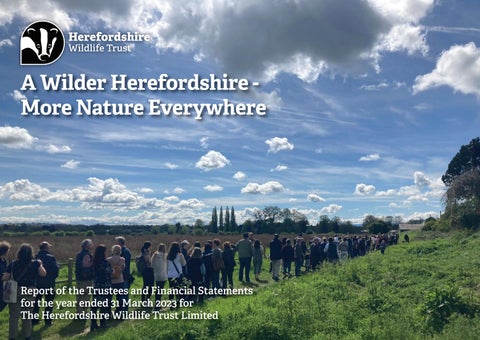
A Wilder Herefordshire More Nature Everywhere
report of the trustees and financial Statements for the year ended 31 March 2023 for the Herefordshire Wildlife trust Limited
The trustees who are also directors of the charity for the purposes of the Companies Act 2006, present their report with the financial statements of the charity for the year ended 31 March 2023. The trustees have adopted the provisions of Accounting and Reporting by Charities: Statement of Recommended Practice applicable to charities preparing their accounts in accordance with the Financial Reporting
HEDGE PLANTING? OAK TREE FRM (c) HWT
Standard applicable in the UK and Republic of Ireland (FRS 102) (effective 1 January 2019).
2 | Herefordshire Wildlife Trust
CONTENTS Report of the Trustees
4 - 21
Report of the Independent Auditors
22 - 23
Statement of Financial Activities
24
Balance Sheet 24 Cash Flow Statement 25 25
Notes to the Financial Statements
26 - 33
OYSTERCATCHER/ BODENHAM LAKE (c) PAUL LLOYD
Notes to the Cash Flow Statement
Herefordshire Wildlife Trust | 3
THE STURTS (c) PATRIcIA DOREE
A Wilder Herefordshire - More Nature Everywhere This is the vision statement we developed during this year as we refreshed our strategy with ambitions that are bigger and bolder than ever before. To make this a reality, our mission is to lead action for nature’s recovery across our county, enabling and harnessing the energy and determination of local communities to recover nature on farms, in rural areas, in and around our iconic rivers and in our towns too. To achieve our goal of 30 percent of land protected and managed for nature by 2030 we have therefore identified three strategic shifts:
Nature recovery…
•
Deliver nature recovery at scale through deeper collaborations, advice and services
Nature action…
•
Enable a greater depth and diversity of people to take action and campaign boldly
•
Grow and diversify our income through providing services, advice and experiences
With membership of the Trust at an all-time high (7,251 at the time of writing,) the number of people in the county standing together for the natural world is rising rapidly. Likewise, our profile has improved, with wider media coverage, decision makers collaborating with us and people across the county raising their voices to demonstrate their support for Herefordshire’s wildlife. This has resulted in some fantastic successes against the three pillars of our new strategy. Just a few examples:
4 | Herefordshire Wildlife Trust
In the Lugg Valley a network of pools and scrapes have been created beside the river at our Oak Tree Farm nature reserve to create an area of wetland habitat for wildlife. Herefordshire Wildlife Trust purchased the site in September 2020 following a successful fundraising appeal and this year has seen us transform the 30acre site thanks to funding from National Highways through their Network for Nature programme.
The campaign for the recovery of Bartonsham Meadows on the edge of Hereford city centre took a huge step forward. The campaign began in early 2020 in response to poor land management practices, flood and the climate crisis. Local action from the Friends of Bartonsham Meadows led to Herefordshire Wildlife Trust becoming responsible for the management of the site and we signed a long-term lease, for 25 years, in March 2023. The restoration of the meadows for wildlife and people has now begun. Sustaining our future… Our membership growth rate has been the highest of any Wildlife Trust at 11.4% for the year, and the average age of our membership continues to get younger as more families and younger adults join us.
Whilst economic, political and social uncertainty may create pressures in the short-term — in the long-term Herefordshire’s future, like its past, is firmly rooted in ensuring both nature and people succeed. Our members, supporters, funders and partners play a vital role in making this the reality we strive for. With huge thanks!
Chief Executive
Herefordshire Wildlife Trust
Chair
Herefordshire Wildlife Trust
Vision
More Nature Everywhere
Mission
To lead local action for nature’s recovery
Goals
Objectives
Nature in Recovery
Taking Action for Nature
1. Manage our nature reserves to ensure they are rich in wildlife and strategically focus our landholdings
1. Connect People to Nature
1. Embed effective governance and business planning
2. Work in partnership to create more, bigger, wilder connected habitats
2. Support local groups and businesses to take action for nature
2. Continue to grow and diversify funding streams to grow unrestricted income, whilst also continuing to grow restricted funding
3. Demonstrate how restoring nature can deliver multiple environmental benefits, and help tackle the climate and nature emergencies
3. Develop a bolder campaigning voice and deliver proactive advocacy
3. Develop an inclusive workplace for all staff and volunteers
4. Reduce our carbon footprint and embed sustainability practices
4. Promote sustainable land use and challenge harmful practices and infrastructure that threaten nature’s recovery
The Trustees have given due consideration to the Charity Commission published guidelines on
Public benefits Public Benefit as required under the Charities Act and are satisfied that our work clearly provides multiple public benefits in line with our charitable objectives.
•
•
These benefits include: • • • •
Sustaining our Future
The Trust’s nature reserves are well used by the public and most have way-marked routes for people to use. At most sites we also provide information and interpretation for visitors. The Trust’s nature reserves and activities are available to all, and easy access provisions are made wherever practicable. Information on our website is regularly reviewed and updated. We are increasingly able to influence other landowners to manage land for the benefit of wildlife and communities through our consultancy work, projects such as Severn Treescapes and partnerships such as with Marks and Spencer. Much of our work is delivered in conjunction with volunteers. These activities are well
• • •
recognised to improve the health and well-being of volunteers in many ways. Our Volunteer Assistant Reserve Officers and the participants in our Building Better Opportunities courses all gain valuable experience which improves their employability. Our people and wildlife outreach programmes are aimed at communities, children’s centres, adult groups and the wider public. Some of our funding enables us to offer free activities in socially deprived communities. Contact with the natural world and the appreciation of wildlife and wild places provides great pleasure to many people and is well recognised as contributing towards health and well-being. We gather conservation data and provide expert advice to Local Authorities and others to ensure that planning decisions are made on a rational basis after taking full account of the public benefit of wildlife. Lastly, the Trust can exert influence at a local level through its members and our membership of groups such as the Local Nature Partnership, regionally in partnership with neighbouring Wildlife Trusts and nationally through membership of the Royal Society of Wildlife Trusts.
Herefordshire Wildlife Trust | 5
il l i
am
s
A year for wildlife — Highlights from Herefordshire Wildlife
ra c ©T
©H
WT
Ice-age Ponds project concluded with ponds across the county integrated into long-term plans for landscape recovery and thousands of people better aware of this vitally important habitat
WT
Building Better Opportunities summer courses launch. One participant said: “I really enjoy my time outdoors and I am getting so much out of it. I learn something new every week. It has made me more interested in the natural world and I want to do more.” 6 | Herefordshire Wildlife Trust
o re v ©T
rH
u
Ail Meadow nature reserve opened to the public. The 14-acre meadow is situated within the wonderful, wildliferich landscape of the Woolhope Dome and is a vital site for rare wetland plants
Development of digital records and maps continues, supporting us to build the basis of vital information for nature’s recovery across the county
“Where are we now?” analysis identifies three strategic shifts for the Trust to respond to the nature and climate crisis: 1) Deliver nature recovery at scale through deeper collaborations, advice and services; 2) Enable a greater diversity of people to take action and campaign boldly 3) Grow and diversify our income through providing services, advice and experiences
i iff
n
e
Local Wildlife Site (LWS) surveys underway - to identify and support the protection of vital habitats across the county. 92 existing LWSs surveyed with 32 new LWSs approved. Management plans written and sent out to landowners to help them manage their special sites even more effectively for wildlife.
W
Jamie Audsley joins the Trust as CEO following the retirement of Helen Stace. lm
©H
ey
©S
ue
Gr
Landscaping work to create wetland habitat begins at Oak Tree Farm thanks to funding from National Highways Farm advice identified as a vital service for the Trust to continue to grow and develop. 80 farm visits and 30 reports provided across the year
New Hereford charity shop opened, giving the Trust a new hub in the city Defend Nature Campaign launched to respond to the attack on nature from the government Queenswood and Bodenham Lake Manager appointed and a focus on better engaging the public prioritised
©M
ike
Du
n
Recovering our Rivers campaign launched to enable the voice of the Trust’s members to address the decline of our iconic rivers Edward Harley OBE appointed as Herefordshire Wildlife Trust President
©G
WT
Gloucestershire, Worcestershire and Herefordshire Wildlife Trusts come together to ofcially launch the Severn Treescapes project funded by the Trees call to Action Fund
3 ©H
WT
Trust celebrates 60th Anniversary with more than 100 members and volunteers joining staff and The Wildlife Trusts’ cEO craig Bennett at reception at the Left Bank.
s
©H
WT
WT
en
sb
ee
/F
rie
n ds
of t he Lo w e r W ye
©H
©L
Positive partnerships developed – relaunch of the Local Nature Partnership and relationship with Farm Herefordshire strengthened Nature Tots sessions funded by children in Need result in 100% of participating families being more physically active and saying they now choose to play outside more
We create three attenuation ponds at a private farm at Derndale thanks to funding from the Environment Agency. These will contribute to the connected wetland habitats in the lower Lugg valley and reducing flooding risks for Wellington Village Nature Counts wildlife recording platform launches. The data collected will give the Trust a better understanding of which flora and fauna are thriving or where they are in decline
is a
St
ev
Bartonsham Meadows leased from church commissioners, creating a new urban edge nature reserve Nature Action Network to support learning, sharing and nature action takes shape as we approach the local elections
Herefordshire Wildlife Trust | 7
Nature recovery firm foundations built with our Wilder Herefordshire Project
TWAYBLADE ORcHID (c) PAUL LLOYD; LWS SURVEYING (c) HWT
This year saw the conclusion of our recent major nature recovery project, Wilder Herefordshire, which has been laying the foundations for nature’s recovery across the county. The Wilder Herefordshire project ran from 25 August 2021 to 31 March 2023, thanks to a grant of £249,500 from the Government’s Green Recovery Challenge Fund. The project’s main aim was to provide the essential foundation for, and act as a springboard to, the development of Herefordshire’s Nature Recovery Strategy – a legally required plan for nature that Herefordshire Council is responsible for delivering. After years of under-investment, Herefordshire lacks up to date information on the extent and condition of habitats, even for designated Local Wildlife Sites. Our project has operated county wide, connecting the blue corridor of the yazor Brook in the heart of Hereford City, through the farmed landscape of our county to nature reserves, Local Wildlife Sites and Protected Landscapes. Our multi-strand project has: • • • • •
•
8 | Herefordshire Wildlife Trust
restored, enhanced and created new habitats created new jobs and offered traineeships trained project staff to survey Local Wildlife Sites gathered data to refine Herefordshire’s Nature Recovery Network map encouraged more people, and a more diverse range of people, to support nature’s recovery by engaging and supporting landowners, individuals and communities to appreciate and act for nature generated the skills, community engagement and social investment necessary to support the future implementation of Herefordshire’s Nature Recovery Strategy
focusing our nature recovery work on three key landscapes Building from these firm foundations, this year’s work to refresh our strategy has resulted in focusing our nature recovery work on three key landscapes – The Lugg and Wye wetland corridors, the Woolhope Dome and The Doward. Why these locations? Firstly, they are key ecologically important and iconic landscapes for Herefordshire; secondly, the Trust has as an established footprint in these areas with the potential for collaborative partnerships to further increase impact and lastly, these landscapes are relatively accessible to people living in Hereford, Leominster and Ross on Wye, further supporting us to enable people to connect, act and be bold for nature. Working in partnership to create more, bigger, wilder connected habitats with partners such as Herefordshire Council; Farm Herefordshire; The Woodland Trust; The National Trust and The Duchy of Cornwall will now be key next steps.
this year’s work to refresh our strategy has resulted in focusing our nature recovery work on three key landscapes – The Lugg and Wye wetland corridors, the Woolhope Dome and The Doward. Why these locations? Firstly, they are key ecologically important and iconic landscapes for
Ensuring we align our landholdings and acquisitions to our key landscapes Aligned to our key landscape priorities we acquired and opened (June 2022) Ail Meadow in the Woolhope Dome and leased Bartonsham Meadows beside the River Wye.
A key part of our new strategy is developing a bolder campaigning voice and delivering proactive advocacy. Our first key focus for being “bolder” is to contribute collaboratively to the efforts to recover our rivers. This of course has a practical landscape focus too where we are prioritising The River Lugg. The River Lugg is an ecologically important SSSI and it also forms part of the River Wye Special Area of Conservation. The water quality in these rivers is currently very poor with high levels of phosphate being the biggest polluter. This phosphate comes from a combination of waste water treatment works and poor agricultural practices, and is largely responsible for significant algae blooms in the rivers and a decline in biodiversity. The River Lugg’s nationally important designations are largely due to the presence of uncommon flora and fauna (such as river water crowfoot and the white clawed crayfish), many of which are now at risk due to the poor water quality in the river. In addition to the poor water quality, our rivers are being affected by adverse weather caused by climatic shifts, hot summers are making pollution in the rivers more concentrated and flash floods are eroding river banks and scouring beds. In 2022-23 we undertook Recovering Our Rivers (ROR), a shortterm project funded by the Environment Agency which ran from the 1 January 2023 to the 31 March 2023, its aim to provide the training, methodology, data recording and mapping required to start a longer-term project during 2023-24. As part of this work, at Derndale Farm, adjacent to the Wellington Brook, we have created three large flood attenuation ponds on privately owned farmland. These ponds have been designed to take water from the Wellington Brook during high peak flows, storing it before slowly releasing it back to the brook. This has been a collaborative trial with the landowner who is keen to support residents in the village of Wellington and reduce the effects of flood events on homeowners. The creation of the ponds was completed in March 2023 and the additional money received through this project have been used towards landscaping and fencing.
Promoting sustainable land use Aligned to the efforts to recover our rivers and with 70% of Herefordshire being agricultural we developed our Land Advice offer through 2022-3 and launched our Farm Advice and Land Advice Consultancy Service in July 2023. This will see us aim to provide land management advice across the county, focusing where possible on strategic corridors and clusters to achieve even more for wildlife; for example - considering habitat connectivity within the farm and surrounding landscape enabling species to move and access resources such as food, water and shelter. https://www.herefordshirewt.org/ consultancy Aligned to our farm advice work, the Trust awarded £498,902 from the Trees Call to Action Fund to deliver the Severn Treescapes project in partnership with Gloucestershire and Worcestershire Wildlife Trusts. This project launched in November 2022 and is now well underway, working to demonstrate that increasing woodland connectivity at a regional scale, whether through woodlands, hedgerows, orchards, agroforestry and other tree systems, can work alongside productive agricultural systems. This work will not only maintain productivity but also benefit biodiversity as well as help to tackle the impacts of climate change and sow the seeds of improvements for future generations to enjoy.
Our Year for Wildlife & Herefordshire CLimate The Wildlife Wildlife Trusts Trust | 9
LANDOWNER ADVICE (c) HWT
Ail Meadow nature reserve is just over 14 acres and lies within the wonderful, wildlife-rich landscape of the Woolhope Dome. It is home to a number of rare county species including bog pimpernel, southern marsh orchid, flixweed and fen bedstraw. We ran a successful fundraising campaign to purchase the meadow with almost £65,000 donated by supporters and £75,000 donated by Severn Waste Services, long-term supporters and funders of the Trust, as well as several other smaller grants contributing to the purchase. Contributions were also made in memory of David Hailes who sadly passed away in 2021. Bartonsham Meadows nature reserve, an area of 100 acres, lies within the meander of the River Wye to the south east of the city and is a popular place for walkers as they are circled and crossed by footpaths. The meadows have been owned by the Church Commissioners for England since the 1850s and have previously been used for cattle grazing. From spring 2023, Herefordshire Wildlife Trust have been responsible for management of the site, having signed a long-term, 25-year lease, and plan to restore the meadows for wildlife and for people. We look forward to continuing to work closely with the Friends of Bartonsham Meadows and the local community at this site.
Developing a key landscape theme of Recovering our Rivers
YAZOR BROOKS TEAM 9c) ANNE cOTTRINGER; HEDGE PLANTING (c) HWT;; WATER MNITORING/ cHARLIE PATEL (c) HWT
CASE STUDy:
Meadow enhancement and creation of new wetland habitats at our new Oak Tree Farm Nature Reserve CASE STUDy:
Habitat creation and enhancement on Yazor Brook in the heart of Hereford city Volunteers have continued to work tirelessly to restore and enhance the Yazor Brook as it travels from open countryside and through Hereford city centre. The group have engaged with schools and youth groups and encouraged them to get involved. Over 2km of watercourse has been restored and enhanced, and more than 200 native trees have been planted along the riparian corridor. The volunteers have carried also out river fly surveys and water level monitoring.
10 | Herefordshire Wildlife Trust
At our Oak Tree Farm Reserve we have demonstrated how to connect habitats, generate significant biodiversity net gain and deliver nature-based solutions through creating species rich grassland, reedbed, pools and scrapes. Data has been collected at the start, during and end of project to monitor positive impacts over time. Thanks to National Highways for funding this habitat creation work through the Network for Nature programme
CASE STUDy: CASE STUDy:
Conserving Herefordshire’s Ice Age Ponds The Ice Age Ponds Project, which ended in Spring 2022, aimed to save the area’s unique glacial ponds through mapping, practical restoration and public engagement. These incredible heritage ponds were created around 20,000 years ago during the last Ice Age, when woolly mammoths were still roaming the landscape. Remarkably, many of these ponds still exist today and we created trails and interpretation during the project to allow people to continue to visit and learn about these fascinating landscape features.
One of the largest stretches of open water in Herefordshire, covering around 50 acres, Bodenham Lake today is an important overwintering and breeding area for wildfowl and other aquatic wildlife. The lake is designated as a Site of Local Importance and, where the reserve borders the River Lugg, it is designated as a Site of Special Scientific Interest and Special Area of conservation. This year we have further worked to improve the reedbeds.
This project was delivered by a partnership of local conservation organisations: Herefordshire Wildlife Trust, Herefordshire Amphibian and Reptile Team and the Herefordshire and Worcestershire Earth Heritage Trust and made possible by funding by the National Lottery Heritage Fund.
CASE STUDy: CASE STUDy:
Farm Herefordshire partnership
Bodenham Reedbed project
Herefordshire is a very rural county; intensive agriculture is having a negative impact on our rivers and streams due to pollution from sediment and phosphate. The Rivers Wye and Lugg are in unfavourable status due to this pollution. The Trust has collaborated with 11 other organisations in Farm Herefordshire to promote Nature Based Solutions, in this case, improved management of floodplain habitats and soils. Through this project, we have worked with farmers and landowners to create and restore habitats, to manage and conserve soils, and to implement wildlife friendly land management.
One of the largest stretches of open water in Herefordshire, covering around 50 acres, Bodenham Lake today is an important overwintering and breeding area for wildfowl and other aquatic wildlife. The lake is designated as a Site of Local Importance and, where the reserve borders the River Lugg, it is designated as a Site of Special Scientific Interest and Special Area of conservation. This year we have further worked to improve the reedbeds.
Herefordshire Wildlife Trust | 11
OTTER (c) LUKE MASSEY/ 2020 VISION; IcE AGE PONDS SURVEYING (c) HWT
Nature Counts
Nature Action As with our Nature Recovery work, we have also refreshed and refocused our strategy during this year to support people to take action - developing an overarching framework of “Connect, Act, Be Bold”. This aims to create a clear journey for our members, supporters and others as we work to achieve the big goal of one in four people taking action for nature. As we undertook this strategy work, this year also saw the conclusion of our successful major people project, Nature, Nurture, Nourish, which focused on connecting people to nature.
Connecting people to nature Nature, nurture, nourish
BBO / ALITHEA WATERFIELD (c) HWT
Our Nature, Nurture, Nourish, project began in Summer 2021 and ran until March 2023, with the aim of increasing nature connectedness and wellbeing across the Trust for our volunteers. The three key areas of activity were volunteering (supporting our volunteer numbers rise to over 600), supported volunteering and the provision for Trainee Reserve Officers. The project’s main achievements and legacies include an ongoing Volunteer Coordinator, new database to better manage volunteer and other data, staff trained in volunteer management, nature-based practice and mental health-first aid. The project also created a wellbeing garden that is being sustained through a self-led volunteer group. The skills of volunteers were also developed to support practical conservation work e.g. nature surveying. Building Better Opportunities We continued our Building Better Opportunities partnership with Landau, funded by the National Lottery Community Fund and European Social Fund. Herefordshire Wildlife Trust has offered courses as part of this scheme for four years with many success stories. This year we supported over 50
12 | Herefordshire Wildlife Trust
participants through our courses in summer 2022 including Outdoor Skills, Orchard Management, Playing Creatively and Woodwork. As well as participants learning new skills, they built confidence in working with others. Each participant was also supported with a dedicated mentor who assessed and supported progress through the course and with their next steps. Activities for children and young people Our WildPlay work connects children and young people to nature and this year our onsite and external outreach has involved over 2,000 young people through schools, youth groups and at community events. Some examples follow. Nature Tots The three-year Nature Tots project, funded by Children in Need to support children under 5 and their carers to connect with nature at our Queenswood Forest School site, has been completed. These sessions were for ‘families in need’ with over 25 families supported across the project and a wide range of activities undertaken including: apple juicing, campfire cooking, making play dough, animal yoga, nature crowns, tree decorations, tree guardians and woodland walks. The Nature Tots site contains an abundance of opportunities for imaginative play, exploration and creation which we encourage and support children to discover for themselves alongside the planned activities. Adventure Club and Wildlife Watch Groups We have continued a wide range of activities at Queenswood for young people with Adventure Club providing forest school activities for over 200 8 to 11-year olds during the year. Similarly, Wildlife Watch Groups run at Queenswood and Ledbury have provided a great range of opportunities to see and take action for wildlife and supported 26 young people and their parents and carers during the year.
Enabling people to Take Action for nature
Nature Action Network From our Next-Door Nature networking, we have begun to build a Nature Action Network – a network to bring organised groups together to share, learn and act with others for nature across the county. This will in time include businesses too. The network is currently in development with the aim to have at least 50 members within year one of operating.
Be bold Alongside growing this network, we have also led collective action through the national Defend Nature campaign and local Recovering our Rivers campaign. We brought supporters together for a screening of BBC Wales’ What’s Killing Our Rivers in November in Hereford which was followed by a packed community meeting to discuss both campaigns in February. Hundreds of our supporters have emailed their MPs directly or sent them a #DefendNature postcard and we have kept campaign issues firmly in the spotlight through use of the media, digital communications and in direct communications to our members and supporters. In March, our CEO met with both Jesse Norman MP and Sir Bill Wiggin MP to discuss our concerns and how we can work together.
Case study:
Community collaboration in Leominster Our Community Organiser Tracy Price is connecting a number of groups in Leominster to take action together including Leominster In Bloom, Leominster Town Council grounds team, Age UK and Transition Leominster. They came together for the first time to provide some new bird boxes for the grounds of the church. The boxes were made by the men attending the AGE UK Men’s Shed and the groups met to install them in March 2023.
Our Year for Wildlife & Herefordshire CLimate The Wildlife Wildlife Trusts Trust | 13
INSTALLING BIRD BOXES/ LEOMINSTER (c) HWT; LEDBURY WILDLIFE WATCH CLUB (c) HWT
We have further developed our culture of ‘nature action’, building relationships and undertaking listening exercises across the county to identify issues people want to see addressed and practical solutions for spaces people want to improve for nature. This has been undertaken as part of the Nextdoor Nature project which brought communities together to help nature flourish where people live and work, providing advice and support to help wildlife on their doorstep. In Herefordshire, the project is focusing on areas within Leominster, Bromyard, South Hereford and Ross-on-Wye. This work is being led by our Community Organiser, Tracy Price, who brings together community groups, churches, streets or estates that would like to know more about how they can engage with nature and the wildlife as well as explore their own ideas.
Sustaining our Future Embedding effective governance and business planning This year has seen the Trust refresh its governance implementing a “People Committee” to better support staff and volunteers; improving the clarity of responsibilities and decision making between Board of Trustees, Finance Committee and People Committee. The Board has grown welcoming four new Trustees and has also nominated “Trustee Leads” to provide oversight for key areas of work, for example in the area of Health and Safety or Fundraising, as well making a key contribution to the shaping and delivery of work where relevant and appropriate. The Trust, for the first time, has also implemented a 3-year budget development and supporting business planning process. This will now be reviewed on an annual basis, supporting sound financial decisions.
Grow and diversify funding streams
SARAH KING (C) HWT
Refreshing our strategy also emphasised the need to grow unrestricted income, whilst also continuing to grow restricted funding. To this end, we have refreshed our legacy and major donor giving strategies while building strategic corporate relationships and exploring novel funding opportunities such as habitat banking and Biodiversity Net Gain with our regional partners. We have begun to improve our membership journey and membership retention strategy to achieve further growth in our membership in order to secure our financial future, and to strengthen the Trust as a force for change.
Develop an inclusive workplace for all staff and volunteers
We have made good progress on developing our workplace for all, starting with the development of a broader and inclusive Management Team that is working hard to involve and listen across our teams. Pay was increased by 5% during the year in addition to the annual increase to support with rising inflation and the costs of living. We have also refreshed our Learning and Development Guide, have booked a high-quality EDI practitioner and have identified coaching and action learning as skills that can continue to support our professional development.
Sustaining our Future at Queenswood Autumn 2022 marked the end of the ‘Green Heart of Herefordshire’ project managed by our Queenswood partners New Leaf Sustainable Development who were funded for this work by the National Lottery Heritage Fund. This project investigated governance, financial resilience and engagement of a wider range of the community at our busiest nature reserve: Queenswood Country Park and Arboretum. Valuable insight was gained through the work of consultants ‘Resources for Change’ including understanding what people loved about Queenswood, barriers to visiting and improvements that could be made. This has guided decisions on team structure, Queenswood activities and events and our future strategy. Queenswood has accumulated a financial loss over the years which was exacerbated by ash die back works undertaken in 2022. The strategy is aiming to mitigate the losses by taking over the running of the Queenswood café on 1 March 2024 and to attract more income from events held at the site. The project also provided staff and volunteer training focused on Visitor and Customer Service, First Aid and Conservation and Climate.
14 | Herefordshire Wildlife Trust
Case study:
Hereford charity shop opens Case study: Hoople fund refurbishments at Queenswood Country Park & Arboretum To celebrate their 10th Birthday, Hoople Group sponsored the refurbishment of the popular viewpoint area at Queenswood Country Park and Arboretum which needed new surfacing and fencing. Audrey Clements, CEO of Hoople said “We recognise the importance of getting outdoors and how it benefits our wellbeing, especially when juggling busy lives. We are pleased to have been able to give back to the local community and contribute to this important project, whilst prioritising the wellbeing of our employees, too.” We have continued to develop relationships with businesses across Herefordshire and are grateful for the support of all our corporate members and supporters.
Case study:
Teddies support Herefordshire’s wildlife Susan Collard, who sadly passed away in 2022, chose the Trust to be the beneficiary of the proceeds of the sale of her incredible collection of over 4,000 vintage and antique teddy bears. In 2022/3 this raised a fantastic £37,646 for the Trust from a specialist auction sale with further sales to follow in 2023/4. We have continued to promote Gifts in Wills to our members throughout the year and hope others will be similarly inspired to remember the Trust in their Wills.
Herefordshire Wildlife Trust | 15
AUDREY CLEMENTS HOOPLE CEO (C) HWT; HEREFORD SHOP FRONT (C) HWT
In October, we opened a second shop, in Church Street in the heart of Hereford’s independent quarter, selling quality second-hand clothes and books alongside new items including wildlife-themed gifts, eco household products and the best in nature writing. Our first shop opened in Ledbury in 2017 and this year contributed more than £17,700 to the Trust’s fundraising under the management of Debbie Bean and Nicky David, supported by a fantastic team of volunteers. While the current financial climate is challenging across the retail sector, we have successfully begun to build a new donor, customer and volunteer base for our new shop this year which we hope will lead to strong sales over time.
Financial Review Review of the financial position at year end The Trust’s total income for the year increased to £1,865,600 (2021/22: £1,587,446), mainly due to an increase in membership, grant income and legacy income. Our ongoing success in recruiting new members, combined with an increase in annual subscriptions, led to a 11.4% % rise in membership to over to 7,250 members. Financial effect of significant events Expenditure within the Trust rose over the year to £1,825,867 (2021/22: £1,412,894) which reflects the increased grant related activities and the addition of a new shop in Hereford. Financial Reserves policy The Finance Committee regularly reviews the level of reserves available (both unrestricted and restricted) balancing the need to advance the work and development of the Trust with the duty to maintain a secure financial base. Unrestricted funds amounted to £367,273 at 31 March 2023 (31 March 2022: £482,125).
DEVILS BIT SCABIOS/ BIRCHES FARM (c) HWT
The Trustees aim to maintain sufficient reserves to ensure the Trust is able to meet its financial obligations in the event of a sudden significant reduction in income. Accordingly, the minimum threshold for unrestricted reserves is reviewed and agreed each year. All budgets and financial projections are assessed within the constraints of this threshold. Our free reserves as at 31 March 2023 were £367,273 (31 March 2022 £482,125) representing over 5 months of Herefordshire Wildlife Trust’s expenditure. This is below the bottom end of our current target range for free reserves of 6-9 months expenditure and we intend to build reserves up to this level over the next 24 months.
16 | Herefordshire Wildlife Trust
Investment performance The Finance Committee has adopted a policy of investing funds to produce the best financial return within an acceptable level of risk. This involves investment in a range of mediumrisk stocks and shares with a view to generating both income and capital growth, whilst maintaining a balance between investments and funds held on deposit. Ethical considerations are important to the Trust and our policy has been reviewed to give broader consideration to investments that enhance biodiversity, promote wildlife conservation and support environmental protection, whilst balancing Trustees’ overarching duty of sound financial management. The Trust’s investment policy is reviewed by the Finance Committee annually. Funds were invested by Brewin Dolphin to the end of March 2023 but have since been moved to the CCLA Charities Ethical Investment Fund, under their Risk Category 4 – moderate risk, on a discretionary basis. The value of funds under management was £248,234 at 31st March 2023. Principal risks and uncertainties The Trustees regularly review the risks the charity face and where appropriate establish processes and procedures to mitigate those risks identified, including, where appropriate, putting in place insurance and setting aside financial reserves and taking active steps to maintain positive relationships with our key stakeholders. The Trust’s principal risks and uncertainties are summarised as follows: 1. Significant challenges in recruiting and retaining staff due to wage inflation and the volatility in the UK jobs market 2. Systems breach/IT fraud/Cyber-crime; increased risk of data breaches, virus and malware attacks and sophisticated attempts at online financial crime 3. Rising costs and inflationary pressures of energy, materials and supplier costs may lead to greater unrestricted contributions to projects and greater likelihood of increased core costs 4. Risk of UK Government policy to reinvigorate the economy,
Plans for future periods
5. 6. 7. 8.
not accounting for wildlife and environmental factors, instead favouring commercially focussed activity including housing development and large infrastructure plans to the detriment of wildlife. Greater public awareness of complex environmental issues challenges the Trust to have sufficient resource and capacity to react and respond in a timely manner The occurrence of an event that threatens the reputational damage or integrity of the Trust Sudden loss of key personnel or our head office communication and IT systems Potential for overtrading with limited resource to deliver a large, diverse range of projects
Going Concern The Board of Trustees considered the status of the Trust as a going concern in September 2023, considering the 2022/23 year-end results for unrestricted funds and the forecast for 2023/24 and 2024/25. The Board concluded that the Trust should be regarded as a going concern.
From April 2023, for the coming three years, we will be fully implementing the new strategy and operational plan developed through 2022/3. Our departments and activities are now aligned under the three pillars of Nature Recovery, Nature Action and Sustaining our Future and we will continue deliver against our key objectives with a range of ongoing and new activities and projects including: Nature Recovery • Wye Adapt to Climate Change project which begins 2023/4 and runs for three years, in partnership with Radnorshire Wildlife Trust and Wye Valley AONB. The project aims to create a self-sustaining Wye catchment community that can recover nature, create a climate resilient landscape and enable long-term transformation. • Continued work to Recover our Rivers through practical work (funded in 2023/4 by Environment Agency), land advice and campaigning. • Identifying flagship nature reserves where will we prioritise investment to increase public engagement • Restoration of Bartonsham Meadows. Some grant funding is already secured for this with other applications planned for 2023/4. • Improving Lugg Meadows for key floodplain meadow species through the Species Recovery Programme grant. • Continuing to grow our land advice service through dedicated staff and projects including Severn Treescapes • Developing a model for nature recovery at landscape scale through continued development of the Wilder Marches partnership project.
Nature Action • Launching our Nature Action Network which will connect groups across the county, supporting them to take practical action, exercise influence for positive change and share skills and experience. • Codeveloping a new programme with Rural Media to engage young people (16-18) and support them to develop skills and knowledge around wildlife conservation and campaigning and digital media skills. • Developing clear offers for schools to collaborate with us. Sustaining our Future • Taking on the management of the café at Queenswood once the current tenancy ends (2024) • Increasing the number and scope of our paid-for events and workshops • Further integrating our CRM with our finance software, Xledger, and communications software, Mailchimp and Xledger with BreatheHR, Stripe and Co-Op banking. • Moving our current digital filing system to Sharepoint • Grow our corporate support and partnerships to generate at least £13,700 in 2023/4 and influence key sectors including housing, food and farming.
Herefordshire Wildlife Trust | 17
Fundraising Herefordshire Wildlife Trust operates to high fundraising standards. We are registered with the Fundraising Regulator and follow its Code of Fundraising Practice and Fundraising Promise. We will always be clear, open and honest when communicating with supporters. We respect their privacy and contact preferences. We maintained our fundraising income last year by adapting many of our activities to a virtual model, working hard to engage supporters, and by leveraging support from the wider public. To raise awareness of our work with our supporters and the public, we maintained our presence in the local press and on social media platforms. We engaged with supporters directly by with regular newsletters, emails and dedicated online events. This generated additional on-line memberships, some significant individual donations and encouraged membership retention, a good achievement in the context of the cost of living pressures.
WOOD WHITE/ COMMON HILL (C) paUL LLOYD
We have a contract with Southwest Wildlife Fundraising Limited (SWWFL) to improve our membership recruitment. SWWFL comply with all relevant standards, including protection of the public, particularly vulnerable people, from unreasonably intrusive or persistent fundraising approaches, and undue pressure to donate. SWWFL follow all applicable regulations, laws and the Fundraising Code of Practice and are responsible for dealing with any complaints regarding their activities. We set and monitor a range of key performance indicators for SWWFL.
18 | Herefordshire Wildlife Trust
Complaints We’re committed to excellent customer service and welcome comments and feedback about the way we work. Every complaint is taken seriously and dealt with in line with our Complaints Procedures, which we reviewed this year. We try to resolve complaints as quickly and efficiently as possible, and in a personal, fair and confidential way. We have received no formal complaints this year regarding any of our fundraising activities, or indeed any of our other activities. General Data Protection Regulations There have been no known infringements of GDPR.
Structure, governance & Management
The Trust is governed by a Board of Trustees, consisting of up to twelve Trustees, meeting normally five times a year. Trustees are elected at the relevant Annual General Meeting (AGM). The Board of Trustees has the power to co-opt Trustees for a period up to next Annual General Meeting, to fill casual vacancies. Elected Trustees may serve a term of up to nine years, subject to re-election every three years. There are three committees of the Board covering Finance, Acquisition and Disposal of reserves, and People. The Board also maintains a conservation Advisory committee Trustees are the Directors of the Trust for the purpose of the companies Act and are the Ofcers of the company, with control of the Trust, its property and funds. The chair, Vice chair and Honorary Ofcers are elected at the first Board of Trustees meeting following the AGM.
contact details for other Trustees. The Trust also offers full induction and a Trustee mentoring scheme, pairing new Trustees with existing Trustees, to help them to learn about the Trust. There is a Trustee training budget for governancerelated issues, which includes provision for two ‘all Trust’ meetings of staff and Trustees each year. The Trustees appoint a chief Executive Ofcer to manage the day-to-day operations of the Trust, including the management of staff and the development and implementation of policies, strategies and business plans. The Trustees undertook a recruitment process to appoint a new cEO, Jamie Audsley to succeed Helen Stace who retired in July 2022. The Trust is a member of The Wildlife Trusts (TWT) federation of 46 individual Wildlife Trusts co-ordinated and supported by the Royal Society of Wildlife Trusts (charity number 207238). RSWT facilitates effective coordination and cooperation across the movement and undertakes lobbying and public relations on behalf of all Wildlife Trusts, giving the Trust a national voice and profile. Members have the use of RSWT’s branding and benefit from access to resources, best practices and experience of other members. TAWNY OWL/ cOMMON HILL (c) PAUL LLOYD
The Trust is a company limited by guarantee, as defined by the companies Act 2006. The Trust was registered as a charity on 30 November 1962 and incorporated on 12 December 1962 in England and Wales. The charity is managed in accordance with the Articles of Association. The current Articles were adopted by special resolution passed on 18th October 2016, with a further amendments in October 2020 and October 2022.
New Trustees are recruited mainly through advertisements placed with volunteer agencies and within the Trust’s own publications. A panel of up to three existing Trustees interviews prospective candidates and makes recommendations for appointment, based on an assessment of the individual’s skills and experience against a Trustee role description and skills gap audit of the Board. All new Trustees receive an induction pack, which includes a copy of the Trustee personal specification, the code of conduct, the terms and conditions of service, the latest audited accounts, the charity’s governing documents and
Herefordshire Wildlife Trust | 19
references & adminstrative Details Registered company number: 743899 (England and Wales) Registered charity number: 220173 Registered Ofce: Queenswood country Park, Dinmore Hill, Leominster HR6 0PY Trustees Alison McLean Matt Williams Debbie Beaton Jake Bharier William Bullough Joseph cole Richard cryer Michael Dawson Jacob Dowling Peter Ford Peter Garner Becca Hadaway Jim Hardy Brian Hurrell Stuart McMaster Jane Seabrook
chair from 3 March 2022 Vice chair from 3 March 2022
Solicitors Lambe corner LLP, 36/37 Bridge Street, Hereford HR4 9DJ Lloyd cooper LLP, Solicitors, 28 South Street, Leominster, Herefordshire, HR6 8JB
(resigned 6 October 2022) (appointed 6 October 2022)
Land Agent Peter Kirby, ARIcS, Sunderlands & Thompsons LLP, Offa House, 2 St. Peter’s Square, Hereford, HR1 2PQ Investment Manager ccLA Investment Management, One Angel Lane, London, Ec4R 3AB
(appointed 6 October 2022) (appointed 6 October 2022) (resigned 6 October 2022) (resigned 6 October 2022)
Statutory information So far as the Trustees are aware, there is no relevant information (as defined by Section 418 of the companies Act 2006) of which the charitable company’s auditors are unaware. Each Trustee has taken all the steps that they ought to have taken as a Trustee to make themselves aware of any audit information and to establish that the charitable company’s auditors are aware of that information.
(resigned 6 October 2022) (resigned 25 May 2022) (appointed 6 October 2022)
Chief Executive Jamie Audsley Senior staff Head of Nature Recovery: Head of communications & Fundraising: Head of Finance and Operations: cOMMON FROG (c) PAUL cOOPER
Bankers cAF Bank Limited, PO Box 289, West Malling, Kent, ME19 4TA cooperative Bank, 23A St. Aldate Street, Gloucester, GL1 1RU
claire Spicer Frances Weeks Alex champ
Senior Statutory Auditor Lisa Weaver FccA Auditors Thorne Widgery, chartered Accountants, Statutory Auditors, 2, Wyevale Business Park, Wyevale Way, King’s Acre, Hereford HR4 7BS
Small Company Exemption This report has been prepared in accordance with the special provisions of Part 15 of the companies Act 2006 relating to small companies. Auditors The auditors, Thorne Widgery Accountancy Limited, will be proposed for re-appointment at the forthcoming Annual General Meeting. Approved by order of the board of trustees on ................................ and signed on its behalf by: A McLean – chair
20 | Herefordshire Wildlife Trust
Statement of the trustee’s responsbilities
company law requires the trustees to prepare financial statements for each financial year which give a true and fair view of the state of affairs of the charitable company and of the incoming resources and application of resources, including the income and expenditure, of the charitable company for that period. In preparing those financial statements, the trustees are required to • select suitable accounting policies and then apply them consistently; • observe the methods and principles in the charity SORP; • make judgements and estimates that are reasonable and prudent; • state whether applicable accounting standards have been followed, subject to any material departures disclosed and explained in the financial statements; • prepare the financial statements on the going concern basis unless it is inappropriate to presume that the charitable company will continue in business. The trustees are responsible for keeping proper accounting records which disclose with reasonable accuracy at any time the financial position of the charitable company and to enable them to ensure that the financial statements comply with the companies Act 2006. They are also responsible for safeguarding the assets of the charitable company and hence for taking reasonable steps for the prevention and detection of fraud and other irregularities.
In so far as the trustees are aware: • •
there is no relevant audit information of which the charitable company’s auditors are unaware; and the trustees have taken all steps that they ought to have taken to make themselves aware of any relevant audit information and to establish that the auditors are aware of that information.
The Trustees are responsible for the maintenance and integrity of the corporate and financial information included on the charitable company’s website. Legislation in the United Kingdom governing the preperation and dissemination of financial statements may differ from legislation in other jurisdictions. Auditors The auditors, Thorne Widgery Accountancy Limited, will be proposed for re-appointment at the forthcoming Annual General Meeting. Report of the trustees, incorporating a strategic report, approved by order of the board of trustees, as the company directors on ............................. and signed on the board’s behalf by:
WILDFLOWERS/ cROW WOOD AND MEADOW (c) TREVOR HULME
The trustees (who are also the directors of The Herefordshire Wildlife Trust Limited for the purposes of company law) are responsible for preparing the Report of the Trustees and the financial statements in accordance with applicable law and United Kingdom Accounting Standards (United Kingdom Generally Accepted Accounting Practice).
A McLean - chair
Herefordshire Wildlife Trust | 21
Report of the Independent Auditors to the Trustees of The Herefordshire Wildlife Trust Limited Opinion We have audited the financial statements of The Herefordshire Wildlife Trust Limited (the ‘charitable company’) for the year ended 31 March 2023 which comprise the Statement of Financial Activities, the Balance Sheet, the Cash Flow Statement and notes to the financial statements, including a summary of significant accounting policies. The financial reporting framework that has been applied in their preparation is applicable law and United Kingdom Accounting Standards (United Kingdom Generally Accepted Accounting Practice). In our opinion the financial statements: • give a true and fair view of the state of the charitable company’s affairs as at 31 March 2023 and of its incoming resources and application of resources, including its income and expenditure, for the year then ended; • have been properly prepared in accordance with United Kingdom Generally Accepted Accounting Practice; and • have been prepared in accordance with the requirements of the Companies Act 2006. Basis for opinion We conducted our audit in accordance with International Standards on Auditing (UK) (ISAs (UK)) and applicable law. Our responsibilities under those standards are further described in the Auditors’ responsibilities for the audit of the financial statements section of our report. We are independent of the charitable company in accordance with the ethical requirements that are relevant to our audit of the financial statements in the UK, including the FRC’s Ethical Standard, and we have fulfilled our other ethical responsibilities in accordance with these requirements. We believe that the audit evidence we have obtained is sufficient and appropriate to provide a basis for our opinion. Conclusions relating to going concern In auditing the financial statements, we have concluded that the trustees’ use of the going concern basis of accounting in the preparation of the financial statements is appropriate. Based on the work we have performed, we have not identified any material uncertainties relating to events or conditions that,
22 | Herefordshire Wildlife Trust
individually or collectively, may cast significant doubt on the charitable company’s ability to continue as a going concern for a period of at least twelve months from when the financial statements are authorised for issue. Our responsibilities and the responsibilities of the trustees with respect to going concern are described in the relevant sections of this report. Other information The trustees are responsible for the other information. The other information comprises the information included in the Annual Report, other than the financial statements and our Report of the Independent Auditors thereon. Our opinion on the financial statements does not cover the other information and, except to the extent otherwise explicitly stated in our report, we do not express any form of assurance conclusion thereon. In connection with our audit of the financial statements, our responsibility is to read the other information and, in doing so, consider whether the other information is materially inconsistent with the financial statements or our knowledge obtained in the audit or otherwise appears to be materially misstated. If we identify such material inconsistencies or apparent material misstatements, we are required to determine whether this gives rise to a material misstatement in the financial statements themselves. If, based on the work we have performed, we conclude that there is a material misstatement of this other information, we are required to report that fact. We have nothing to report in this regard. Matters on which we are required to report by exception • We have nothing to report in respect of the following matters where the Charities (Accounts and Reports) Regulations 2008 requires us to report to you if, in our opinion: • the information given in the Report of the Trustees is inconsistent in any material respect with the financial statements; or • the charitable company has not kept adequate
• •
accounting records; or the financial statements are not in agreement with the accounting records and returns; or we have not received all the information and explanations we require for our audit.
Responsibilities of trustees As explained more fully in the Statement of Trustees’ Responsibilities, the trustees (who are also the directors of the charitable company for the purposes of company law) are responsible for the preparation of the financial statements and for being satisfied that they give a true and fair view, and for such internal control as the trustees determine is necessary to enable the preparation of financial statements that are free from material misstatement, whether due to fraud or error. In preparing the financial statements, the trustees are responsible for assessing the charitable company’s ability to continue as a going concern, disclosing, as applicable, matters related to going concern and using the going concern basis of accounting unless the trustees either intend to liquidate the charitable company or to cease operations, or have no realistic alternative but to do so. Our responsibilities for the audit of the financial statements We have been appointed as auditors under Section 144 of the Charities Act 2011 and report in accordance with the Act and relevant regulations made or having effect thereunder. Our objectives are to obtain reasonable assurance about whether the financial statements as a whole are free from material misstatement, whether due to fraud or error, and to issue a Report of the Independent Auditors that includes our opinion. Reasonable assurance is a high level of assurance, but is not a guarantee that an audit conducted in accordance with ISAs (UK) will always detect a material misstatement when it exists. Misstatements can arise from fraud or error and are considered material if, individually or in the aggregate, they could reasonably be expected to influence the economic decisions of users taken on the basis of these financial statements.
The extent to which our procedures are capable of detecting irregularities, including fraud is detailed below: Fraud and breaches of laws and regulations - ability to detect Identifying and responding to risks of material misstatement due to fraud To identify risks of material misstatement due to fraud (“fraud risks”) we assessed events or conditions that could indicate an incentive or pressure to commit fraud or provide an opportunity to commit fraud. Our risk assessment procedures included: • Enquiring of trustees, the finance committee and inspection of policy documentation as to the charity’s high-level policies and procedures to prevent and detect fraud as well as whether they have knowledge of any actual, suspected or alleged fraud. • Reading Trustees’ meetings and finance committee minutes. • considering performance targets for management. We communicated identified fraud risks throughout the audit team and remained alert to any indications of fraud throughout the audit. As required by auditing standards, and taking into account our overall knowledge of the control environment, we perform procedures to address the risk of management override of controls, in particular the risk that management may be in a position to make inappropriate accounting entries. On this audit we do not believe there is a fraud risk related to revenue recognition because the revenue is non-judgemental and straightforward, with limited opportunity for manipulation. We did not identify any additional fraud risks. We performed procedures including identifying journal entries to test based on risk criteria and comparing the identified entries to supporting documentation. These included those posted by finance management/ those posted and approved by the same user/ those posted to unusual accounts. Identifying and responding to risks of material misstatement due to non-compliance with laws and regulations We identified areas of laws and regulations that could
reasonably be expected to have a material effect on the financial statements from our general commercial and sector experience, and through discussion with management (as required by auditing standards) and discussed with management the policies and procedures regarding compliance with laws and regulations. We communicated identified laws and regulations throughout our team and remained alert to any indications of noncompliance throughout the audit. The potential effect of these laws and regulations on the financial statements varies considerably. Firstly, the charity is subject to laws and regulations that directly affect the financial statements including financial reporting legislation, taxation legislation and the charities Act legislation and we assessed the extent of compliance with these laws and regulations as part of our procedures on the related financial statement items. Secondly, the charity is subject to many other laws and regulations where the consequences of noncompliance could have a material effect on amounts or disclosures in the financial statements, for instance through the imposition of fines or litigation or the loss of the charity’s license to operate. We identified the following areas as those most likely to have such an effect: health and safety, anti-bribery, employment law, data protection, anti-money laundering and specific areas of other legislation recognising the nature of the charity’s activities. Auditing standards limit the required audit procedures to identify non-compliance with these laws and regulations to enquiry of management, inspection of regulatory and legal correspondence, if any. Therefore, if a breach of operational regulations is not disclosed to us or evident from relevant correspondence, an audit will not detect that breach. Context of the ability of the audit to detect fraud or breaches of law or regulation Owing to the inherent limitations of an audit, there is an unavoidable risk that we may not have detected some material misstatements in the financial statements, even though we have properly planned and performed our audit in accordance
with auditing standards. For example, the further removed noncompliance with laws and regulations is from the events and transactions reflected in the financial statements, the less likely the inherently limited procedures required by auditing standards would identify it. In addition, as with any audit, there remained a higher risk of non-detection of fraud, as these may involve collusion, forgery, intentional omissions, misrepresentations, or the override of internal controls. Our audit procedures are designed to detect material misstatement. We are not responsible for preventing non-compliance or fraud and cannot be expected to detect non-compliance with all laws and regulations. A further description of our responsibilities for the audit of the financial statements is located on the Financial Reporting council’s website at www.frc.org.uk/auditorsresponsibilities. This description forms part of our Report of the Independent Auditors. Use of our report This report is made solely to the charitable company’s trustees, as a body, in accordance with Part 4 of the charities (Accounts and Reports) Regulations 2008. Our audit work has been undertaken so that we might state to the charitable company’s trustees those matters we are required to state to them in an auditors’ report and for no other purpose. To the fullest extent permitted by law, we do not accept or assume responsibility to anyone other than the charitable company and the charitable company’s trustees as a body, for our audit work, for this report, or for the opinions we have formed. for and on behalf of Thorne Widgery Accountancy Limited chartered Accountants Statutory Auditors Eligible to act as an auditor in terms of Section 1212 of the companies Act 2006 2 Wyevale Business Park, Kings Acre, Hereford, Herefordshire, HR4 7BS Date: ............................................. Note: The maintenenace and integrity of The Herefordshire Wildlife Trust Limited website is the responsibility of the trustees; the work carried out by the auditors does not involve consideration of these matters and, acordingly, the auditors accept no responsibility for any changes that may have occured to the financial statements since they were initially presented on the website.
Herefordshire Wildlife Trust | 23
24 | Herefordshire Wildlife Trust
Herefordshire Wildlife Trust | 25
26 | Herefordshire Wildlife Trust
Herefordshire Wildlife Trust | 27
28 | Herefordshire Wildlife Trust
Herefordshire Wildlife Trust | 29
30 | Herefordshire Wildlife Trust
Herefordshire Wildlife Trust | 31
32 | Herefordshire Wildlife Trust
Herefordshire Wildlife Trust | 33
Our corporate supporters We are proud to work in partnership with local businesses to support nature’s recovery. Working with others is crucial to tackling the nature and climate crises. Now, more than ever before, we are noticing that businesses are recognising the role they play in helping to bring nature closer to where people live, work and play. Through these partnerships, more space for nature is created in housing and infrastructure developments, farmland is improved for nature, employees get involved with habitat restoration and feel more fulfilled for doing so, and more opportunities are created for people to engage with nature.
GATTERTOP DRINKS: WESTONS cIDER
34 | Herefordshire Wildlife Trust
Our Funders
SUE GRIFFIN & VIV QUINN WITH STAFF FROM NATIONAL HIGHWAYS AT OAK TREE FRAM (c) HWT
many thanks to all the funders who have supported us to deliver projects this year
We also value and benefit from The Wildlife Trusts national partnerships which include:
Herefordshire Wildlife Trust | 35
Herefordshire Wildlife Trust
Herefordshire Wildlife trusts is part of a movement made up of 46 Wildlife trusts and a central charity (the royal Society of Wildlife trusts). each is an independent charity with a shared mission. Help us achieve our vision of a wilder Herefordshire: more nature, everywhere
• Join us as a member • Remember us in your will • Speak up for wildlife • Volunteer your time • Partner with us.
get in touch... enquiries@herefordshirewt.co.uk 01432 356872
BODENHAM LAKE (c) PAUL LLOYD
follow us...