C O M P L I M E N TA R Y
MARYL AND
P E N N S Y LVA N I A
WEST VIRGINIA | AUTUMN 2026
PART OF THE USA TODAY NETWORK
HOME BEAUTIFUL TIPS AND TRICKS FOR A BETTER INDOORS
PLUS: THE BEAUTY & HEALTH IN GARDENING
HARVEST TIME AT CONOCOCHEAGUE INSTITUTE
HISTORIC FURNITURE: AMERICAN-STYLE AND MORE
Propane a safe, clean, efficient & reliable energy choice for your home
a full line of indoor appliances and efficient fireplaces and gas log sets. (301) 797-4887
We Also Offer Automatic Delivery, Budget Program And Much More… Stand up to unpredictable weather and unforeseen outages with the most trusted name in residential and commercial standby power. 7 out of every 10 homes choose Generac when investing in home backup power
The #1 Selling Home Standby Generator Brand
18034 Shawley Drive Hagerstown, MD 21740 301.797.4887 • 1.877.797.4887 www.shawleysgas.com HM-43729058
inside
A HERALD-MAIL MEDIA PUBLICATION
Volume 13, Issue 4 ISSUE EDITOR
Glenn Garvie DESIGN EDITORS/LAYOUT
AT THE LIBRARY
6
Princella Heath, Brittany Huntley, and Emma Stackhouse of DesignIQ
Design Your Home With Your Library Card
CONTRIBUTING WRITERS
Jacob W. Barr, Tara Bockstanz, Lauren Buechmann, Bailey Rafter, Catherine Sorenson, Matthew Wedd
HOME IMPROVEMENT
8 9 10 12 14 16
ADVERTISING DIRECTOR
Dawn Gessel ADVERTISING SALES
Repurpose Your Rooms and Breathe New life Into a Home Renovations With the Biggest Bang for Your Buck Why an Insulated Attic Is a Good Attic The Rundown on Kitchen Cabinets
Gardening for Beauty and for Health
SENIOR LIVING
20
Gannett Creative Solutions
How to Brighten Interior Space
WELL + BEING
18
ADVERTISING DESIGN
How to Create More Interior Space for Winter
Hazards That Compromise Senior Safety at Home
Rebecca Cardenas, Michelle Horton, Chris Konsulis, Lori McNeil, Daniel Natt, Stacy Raidt © 2026 Herald-Mail Media
22 COMMUNITY
22
Leadership Washington County Celebrates 40 years of Impact
24
Harvest Time on the Pennsylvania Frontier
ARTS & ENTERTAINMENT
26
The History of Home: Decorative Arts and the Making of an American Identity
AT HOME PLACES is published five times a year, featuring Winter, Spring, Summer, Autumn and Holiday issues. Complimentary copies are available at area distribution sites. ALL RIGHTS RESERVED BY COPYRIGHT. Prices, specials and descriptions are accurate as of the time of publishing. This magazine or parts thereof may not be reproduced in whole or in part without the express written consent of the editor. Advertising information has been provided by the advertiser. Herald-Mail Media does not make any representations as to the opinions or facts contained herein. All terms and conditions subject to change. The cover, design, format and layout of this publication are trademarks of Herald-Mail Media. To advertise in the next issue of At Home Places, contact your Herald-Mail Media sales representative, hmadvertisingstaff@localiq.com
MIND YOUR MONEY
8
30
Follow @athomeplaces on
Fall Home Design on a Budget
facebook.com/athomeplaces twitter.com/athomeplaces instagram.com/athomeplaces
C O M P L I M E N TA R Y
MARYL AND
P E N N S Y LVA N I A
WEST VIRGINIA | AUTUMN 2026
PART OF THE USA TODAY NETWORK
HOME BEAUTIFUL
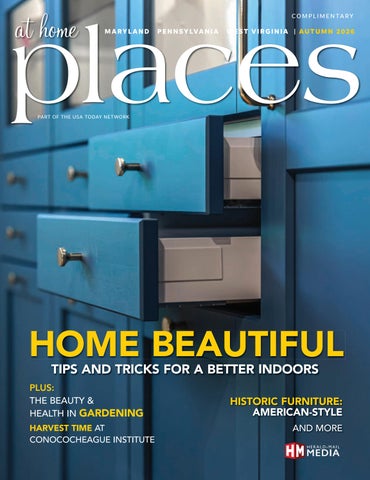
ON THE COVER: Spruce up your home before the winter hits. GETTY IMAGES
TIPS AND TRICKS FOR A BETTER INDOORS
PLUS: THE BEAUTY & HEALTH IN GARDENING
HARVEST TIME AT CONOCOCHEAGUE INSTITUTE
26 4 AT HOME PLACES MAGAZINE | AUTUMN 2026
HISTORIC FURNITURE: AMERICAN-STYLE AND MORE
Watch for our HOLIDAY ISSUE coming to your location in October.
Absolutely Exceptional Experiences
EXPANDING YOUR POSSIBILITIES Whether it’s a space for your growing family or the renovation you’ve been dreaming about, a SmartFlex HELOC* gives you the flexibility to make it happen. *SmartFlex Home Equity Line of Credit subject to credit approval
mvbbank.com |
AT THE LIBRARY
Design Your Home With Your Library Card Written by Lauren Buechmann
A
THE GRAVEL GARDEN: VISIONARY, DROUGHTDEFYING, NATURALISTIC DESIGNS
NATHAN TURNER’S I LOVE DECORATING: CREATING STYLISH, THOUGHTFUL, AND PERSONAL SPACES
JEFF EPPING, 2026
BENJAMIN REYNAERT, 2026
NATHAN TURNER 2026
“In The Gravel Garden, longtime horticulturist Jeff Epping explores the art of gravel gardening, a technique where deep-rooted, drought-tolerant perennials are planted in a deep layer of gravel that suppresses weeds and conserves water. Showcased here through profiles of twenty innovative gardens across the United States and Europe, this visionary, naturalistic method holds huge promise for the future of gardening.”
“From design influencer Benjamin Reynaert (behind aspoonfulofbenjamin) comes an aspirational guide to transforming your living spaces into vibrant, cozy, and personalized maximalist havens.”
“In Nathan Turner’s I Love Decorating, Turner offers readers an inside look at his design process, from the seedling of initial ideas to the nuts-and-bolts challenges of building a dream home. With personal anecdotes, stunning photography, and practical advice, Turner shares how he creates homes that feel both stylish and livable.”
FREE STYLE: UNLOCK CREATIVE HOME DESIGNS LIZ KAMARUL
CLUTTER REHAB: 101 TIPS AND TRICKS TO DECLUTTER YOUR HOME AND ORGANIZE YOUR SPACE LAURA WITTMANN, 2026
Lauren Buechmann is the head of public relations and marketing at the Washington County Free Library.
THE LAYERED HOME: INSPIRATION FOR CRAFTING COZY, COLLECTED ROOMS
“Organization guru Laura Wittmann is here to tell you that turning your chaotic disaster of a home into a well-organized safe haven doesn’t have to be a terrible undertaking-it can be fun, exciting, and ultimately, rewarding! Featuring tried-and-true quick solutions that have been tested by the loyal readers of the popular blog Organizing Junkie.”
6 AT HOME PLACES MAGAZINE | AUTUMN 2026
“Creating the perfect home design comes down to unlocking your own personal style and designing a home that reflects it. Designer and artist Liz Kamarul has always believed this, and in Free Style she shares her methods for creating uniquely beautiful homes. Rather than rules and checklists, Liz offers a different approach to home design. She asks readers to start with questions that can help them start the design process. With gorgeous photos of homes that put these methods into action, you’ll be inspired to create your own unabashedly beautiful and personal space. Make mistakes, use materials in weird ways, work with what’s around, and in the end, you’ll have a home that is amazingly and uniquely yours.”
GROUNDED LIVING: HARMONIZING DESIGN AND NATURE IN THE HOME ANITA YOKOTA, 2026
“From the author of Home Therapy comes a beautifully photographed guide to biophilic design: decorating your space to increase your connection with nature and create a more sustainable home. Bring the outside in with Grounded Living, a book that explores naturecentered interior design.”
PROVIDED BY WASHINGTON COUNTY FREE LIBRARY
home can be more than just a place to live; it can reflect your personality, support your lifestyle, and be a space where you feel comfortable and inspired. Whether you’re organizing a cluttered room, refreshing your décor, creating a peaceful outdoor retreat, or simply gathering ideas for a future project, inspiration is closer than you think. These newly released books offer expert guidance, creative ideas, and practical advice to help you design spaces you’ll love. No matter your style or budget, the perfect idea for your next home project may be just a page away. With your Washington County Free Library card, you can borrow these inspiring new titles and thousands more at no cost. Visit any Washington County Free Library branch or browse our online catalog to discover your next great read and start transforming your home, one idea at a time. Visit washcolibrary.org
HOME IMPROVEMENT
How to Create More Interior Space For Winter
A
fter a summer and fall spent outdoors, winter drives many people back inside. Homeowners may take inventory of their interior spaces in winter and find that there isn’t as much room as they would like. When entertaining inside, a home may feel particularly cramped. Creating an open, inviting indoor environment requires maximizing spatial design but not necessarily expanding square footage. By focusing on a few strategies, homeowners can maximize interior flow. Change up the layout of furniture
Being able to move around a space more easily may come down to rethinking the furniture layout. Interior design experts often emphasize traffic flow in a space, which can determine how comfortable homeowners and their guests feel. Universal design methodologies point to establishing clear, unobstructed routes to link different zones of a room. This will minimize physical congestion in the space. When entertaining, homeowners can push larger pieces of furniture against the perimeter of a room to open up a centeral gathering area. Heavy coffee tables can be swapped out for smaller tables to allow the rearrangement of the layout depending on how many people are spending time in a given space.
Subdivide rooms
Open-concept spaces might have lost some their appeal in recent years. Designers are now going back in the direction of room-based layouts over open concepts, according to Martha Stewart and New York-based designer Madeline Merin. Some homeowners now have a greater need for definition of the spaces they have to work with. Instead of one open room, dividing the space can create the illusion
8 AT HOME PLACES MAGAZINE | AUTUMN 2026
of having more square footage while providing distinctive spots for privacy and other room functions. An open-concept family room, for example, can be divided into a gaming room on one side and a home office space on the other. Change how spaces are perceived
Lighting and visual elements can make spaces feel more roomy and inviting even if they haven’t gotten larger. Painting
walls in soft tones will help them reflect more light, making boundaries feel like they are receding. Incorporating more natural light by removing heavy draperies is one strategy. According to the Journal of Biophilic Design, biophilic design is the intentional integration of nature into buildings and spaces to improve human health and productivity. Homeowners can incorporate natural lighting, living plants, organic materials, and organic patterns into their interior designs to make spaces feel more inviting Homeowners can look to various design strategies to open up interior spaces in their homes with a goal toward making them more comfortable places to ride out the winter. — METRO CREATIVE
METRO CREATIVE
Creating an open, inviting indoor environment requires maximizing spatial design but not necessarily expanding square footage.
HOME IMPROVEMENT
How to Brighten Interior Spaces
I
f spring and summer are seasons when homeowners focus their renovation energy on outdoor living spaces, that attention shifts back inside upon the arrival of fall. People tend to spend much more time indoors than outside come late fall and throughout the winter. The ambiance inside in fall and winter is notably different, as fewer hours of daylight can darken interior spaces. Finding ways to brighten home interiors can make spaces more inviting in late fall and throughout the winter.
Finding ways to brighten home interiors can make spaces more inviting in late fall and throughout the winter.
LAYER WITH SHEER AND BLACKOUT CURTAINS. The
simplest way to brighten interior spaces is to allow natural light to illuminate them, but that can be difficult in homes with blackout curtains. Blackout curtains are highly effective at keeping light out, but they won’t do much to brighten interior spaces in the winter. Layer blackout curtains with sheer curtains so you can still get some privacy but brighten interior spaces with natural light at the same time.
METRO CREATIVE
ADD LIGHTING WHEREVER POSSIBLE. The days when
interior lighting was limited to floor lamps and overhead fixtures are long gone. Various types of lighting can now be used to brighten interior spaces throughout winter. Recessed lighting is a relatively inexpensive upgrade that can brighten any room in a home at any point
brighter colors, then accents can lend rooms a lighter feel. Vibrantly colored throw pillows, blankets and fixtures can create a lighter feel when residents and guests enter a room. Artwork with light colors also can help to brighten interior spaces. WASH THE WINDOWS. They
Brightly colored accents like throw pillows can help to brighten interior spaces over the winter.
in a day. Unlike a traditional overhead fixture where the light emanates from a single source, recessed lighting can be installed in various points in the ceiling so each corner of a room can be lit up. In addition to recessed lighting, under cabinet lighting in kitchens and on bookshelves can brighten spots that traditional
fixtures typically fail to illuminate. Layering the lighting so light comes from various sources can create a brighter feel. USE COLOR TO YOUR ADVANTAGE. Color is another
tool that can be used to brighten interior spaces in the winter. If homeowners are reluctant to paint walls with new and
are easily overlooked, but dirty windows can block natural light and greatly reduce the amount of light entering a home through the windows. Clean the interior and exterior of your windows prior to winter so any grime that has built up in recent months and years is not preventing light from entering your home. It can be a challenge to keep interior spaces bright over the winter. But there are many ways homeowners can illuminate interior spaces. — METRO CREATIVE
AT HOME PLACES MAGAZINE | AUTUMN 2026 9
HOME IMPROVEMENT
Repurpose Your Rooms
And Breathe New Life Into a Home
H
omeowners do not need to get hung up on room labels as they explore ways to reinvent their spaces. Just because a floor plan labels a space as a formal dining room doesn’t mean the area has to remain that way. Repurposing rooms in a home comes down to aligning the space a person has with their lifestyle needs. Here are a few ways to rethink interior spaces and make a switch to improve utility.
Take note of spaces that are cleaned but rarely used. For many people, this is a dining room or a guest suite. Either of these rooms can be transformed into something new.
INVEST IN MULTIPURPOSE FURNITURE. Even people short on space can transform their homes. Replacing a traditional bed with a murphy bed or a daybed can make a room more suitable for a home office or yoga studio, but still provide a space for the occasional houseguest to sleep. A pull-down shelf desk in a bedroom or even a walk-in closet can turn an area into a compact home workstation.
CLAIM DEAD SPACE. The area under the stairs
or another small spot often is used to collect junk. Instead, it can be turned into a built-in wine rack, a reading nook for kids or even a pet sanctuary with just a few modifications. Analyze areas around the home that seem like they don’t serve a purpose, and then figure out a way to make them more functional.
ESTABLISH ROOM ZONES. Some people simply cannot transform an entire room into something else. Visual partitioning makes it possible to create rooms within rooms. An area rug can be used to define a border of a space. Open book-
10 AT HOME PLACES MAGAZINE | AUTUMN 2026
shelves can serve as a wall to separate a sleeping area from a lounging spot. Lighting can add dimension to areas in a space. A pendant light over a crafting or work table can be used define the space.
LOOK AT UTILITY AREAS. Unless you are a do-it-yourselfer or have a hobby that takes up much of the garage or basement, utility areas are major spots in a home to consider repurposing. A garage can be turned into a home gym, kids’ play area or even a hobby shop. Modular flooring and insulated walls can make the room comfortable. Attic lofts are the
ultimate quiet zones, and can be serene spots for reading, meditating or doing homework. An unfinished basement can be converted into a finished space to serve many different purposes. From media rooms to a teen lounge to a hobby cave, the opportunities are endless. A good rule of thumb before converting any room is to give it a test run. Move in a piece of furniture and test how it works with its intended function. Assess lighting, noise and foot traffic for a week, and then move ahead with changes if the result is positive. — METRO CREATIVE
METRO CREATIVE
IDENTIFY UNUSED OR UNDER-USED ROOMS.
Local service & great rates Call or stop by today Gaye McGovern Ins Agcy Inc Gaye McGovern, Agent 11373 Robinwood Dr Hagerstown, MD 21742-6706 Bus: 301-790-1462 Fax: 301-790-0513
State Farm Bloomington, IL
AT HOME PLACES MAGAZINE | AUTUMN 2026 11
HOME IMPROVEMENT
Renovations With the Biggest Bang for your Buck
3
5
GARAGE DOOR REPLACEMENT: A garage
1
MANUFACTURED STONE VENEER: Manufactured
MINOR KITCHEN REMODEL: Kitchens are the
door replacement is part of the curb appeal improvements homeowners can consider. At an average cost of $4,672, it offers a recouped cost of 267.7 percent according to the 2025 Zonda report.
stone veneer is a manmade masonry product that looks like natural stone but is lightweight and easier to install. It can offer a recouped cost of 207.9 percent on the $11,702 investment.
heart of a home, and a minor remodel offers a 113 percent return. Inside the home the golden rule is to keep things simple. Minor remodels tend to offer a better rate of return than major ones. Buyers will pay for move-in ready and updated, but sellers likely will not recoup the costs for luxury upgrades or over-thetop renovations.
2
4
STEEL DOOR REPLACEMENT: Also boast-
FIBER-CEMENT SIDING REPLACEMENT:
ing an ROI north of 200 percent, a steel door installation is a wise choice for homeowners who want to drive up the value of their homes.
Homeowners in the market for new siding can consider fiber-cement siding, which will see the investment recoup slightly more than 100 percent of its cost.
— METRO CREATIVE
12 AT HOME PLACES MAGAZINE | AUTUMN 2026
METRO CREATIVE
H
ome renovations are a significant part of homeownership. Naturally, people want to make their own personal marks on the homes they buy and ensure that their properties fit their needs and wants. While many renovations add value to a home, some offer more value than others. When allocating dollars to renovations, particularly when finances are tight, homeowners may want to direct their efforts to those projects that will offer the highest rate of return on investment. Each year Zonda Home, in conjunction with Remodeling magazine, puts together a list of high-return projects. Exterior projects drive the most value for owners who are selling their homes, and they consistently top the list of highROI improvements. Here are five projects offering a strong ROI that homeowners may want to consider. It’s important to note that 2025 was the first time a practical backup generator made the list of top improvements. Falling into the number seven spot, the generator averaged a return of 95.3 percent, which underscores how homeowners are gearing improvements toward the changing climate and unpredictable weather. Those remodeling primarily to increase equity for future sales may want to consider exterior projects and basic kitchen improvements.
LOCALLY OWNED & OPERATED ~ SERVING THE COMMUNITY SINCE 1901
Free decorating services
(717) 532-6725 7960 Molly Pitcher Highway, Shippensburg (2 miles south of Shippensburg on US Rt. 11)
HOURS: MONDAY THROUGH FRIDAY 9-5, SATURDAY 9-3
Don’t settle for “good enough.” Visit us for a complimentary 3D Foot Scan and discover what a personalized fit feels like. We can’t wait to be part of your foot story and help you take your next steps in comfort.
AT HOME PLACES MAGAZINE | AUTUMN 2026 13
HOME IMPROVEMENT
A
s homeowners address energy efficiency around their homes, they may want to put attics at the top of their list. Because heat naturally rises during the winter and also infiltrates the roof during the summer, a roof with insufficient insulation can be energy inefficient. Many experts attest that upgrading attic insulation is a practical and cost-effective home improvement. A desire to reduce energy bills is a primary motivator when installing attic insulation. Data from the U.S. Environmental Protection Agency’s ENERGY STAR® program says homeowners can save an average of 15 percent on heating and cooling costs, or roughly 11 percent on their total energy bills, by air sealing and insulating attics and crawl spaces. Standalone attic insulation 14 AT HOME PLACES MAGAZINE | AUTUMN 2026
Many experts attest that upgrading attic insulation is a practical and cost-effective home improvement. projects frequently achieve high rates of return. Beyond financial matters, attic insulation also creates a more comfortable and stable indoor climate. Attic insulation will buffer the interior from extreme temperature swings. This can help
preserve the integrity of the home. In cold climates, attic insulation will limit the occurrence of ice dams, which form at the eaves when heat inside living spaces escapes to the roof. Ice dams can cause water to back up under shingles and even tear away gutters. The U.S. Department of Energy indicates residential and commercial buildings combined account for 40 percent of the nation’s total energy consumption. By utilizing attic insulation and creating a proper thermal barrier, homes can draw less power from regional grids and burn less fuel locally. Attic insulation may not be as glamorous as a room remodel, but it is an important component of a safe, comfortable and energy-efficient home.
— METRO CREATIVE
METRO CREATIVE
Why an INSULATED Attic Is a GOOD Attic
Thank you for voting for us: • Best Law Firm • Best Attorney, D. Bruce Poole, Esq. • Top Employer, Locally Owned Business
Personal Injury, Truck Accidents, Car Accidents, Motorcycle Accidents, and Mass Torts
Katherine McGrath
Bruce Poole
301-790-3600 | www.poolelg.com 29 W. Franklin Street, Hagerstown, MD 21740 • 100-102 W. Church Street, Ste. 200, Frederick, MD
• Great Selection of African Violets • Jigsaw Puzzles • Bruder Toys • Children’s Tea Sets • Quality Educational Toys • Portable Drying Racks • Pure And Natural Soaps • Swing Cars • Perplexus Maze Balls • Folkmanis Puppets • Machine Washable Gotz Play Dolls • Family Games • Calico Critters • Melissa And Doug Educational Toys • Variety of Mugs • Riding Toys and Wagons & Lots More!
12177 Hollowell Church Rd. Greencastle, PA 17225 See coupons at horstdale.com
Mon., Tues., Wed. & Fri. 10-6, Sat. 10-12 Closed Sunday & Thursday
Mon–Fri 7:30am–5:30pm | Sat 7:30am–12pm
(717) 762-4130 HM-43914407
AT HOME PLACES MAGAZINE | AUTUMN 2026 15
HOME IMPROVEMENT
THE RUNDOWN ON
— METRO CREATIVE
Cabinets also can be repainted.
Refacing and replacing each merit consideration. Homeowners unfamiliar with cabinet projects may not realize they have two very different options to consider. Refacing allows homeowners to transform the look and feel of a kitchen while keeping the existing cabinet structure in place. When refacing cabinets, new doors, drawer fronts and typically hardware are installed to replace the existing ones. When replacing cabinets, the existing cabinet structure is torn out and completely new units are installed. Replacing might be done when the structural integrity of the existing cabinets is questionable or when homeowners are not fond of the existing cabinet layout and decide to change it completely.
16 AT HOME PLACES MAGAZINE | AUTUMN 2026
Cabinet refacing or replacing projects will not cost nearly as much as a complete kitchen overhaul. The cost of any home renovation project is unique to each home. No two homes are the same, and variables like layout and square footage will affect the price of most projects, including cabinet renovations. But homeowners should know that the average cost of cabinet refacing projects and replacement projects falls far short of the $60,000 price tag of kitchen renovations noted by Houzz. According to Angi. com, refacing cabinets costs between $900 and $6000 on average, while cabinet replacement projects can cost anywhere from $2,000 to $30,000. The wide ranges reflect the variables unique to each home. Contact a professional to get an accurate estimate of how much these projects will cost in their homes.
If refacing or replacing cabinets also threatens to bust the budget, homeowners can consider repainting or re-staining existing cabinets. This is a particularly cost-effective project because it gives the kitchen a new look but does not require homeowners to purchase new doors, drawers or hardware. This is a potentially good option for homeowners whose existing cabinets are structurally sound and painted but started to fade in regard to their color. It’s also a potentially sound temporary option for homeowners who are hoping to do a full kitchen renovation at some point in the near future but looking for a less costly and temporary means to give their kitchens a fresh look. Cabinet projects can create a different feel in the kitchen without requiring homeowners to make as sizable a financial investment as a full kitchen overhaul demands.
METRO CREATIVE
U
pdated kitchens are in demand, and homeowners are not hesitating to open their wallets when renovating these popular spaces in their homes. According to a 2025 study from Houzz, the median spend on kitchen renovations rose to $60,000 between 2024 and 2025. Homeowners concerned about the high price tag of kitchen renovations should know they have some less expensive means to giving their kitchens a new look. Cabinet projects can dramatically alter how a kitchen looks and feels. This rundown of cabinet projects can help homeowners answer any questions they have about this unique and budgetfriendly way to revitalize their kitchens. Cabinet projects can create a different feel in the kitchen without requiring homeowners to make as sizable a financial investment as a full kitchen overhaul demands.
Kitchen Cabinets
Promote your business Promote in all the right your business inPLACES. all the right
PLACES.
We care for the whole family. Thanks for voting us Best Home Health Care Services Franklin County.
Distributed to more than 250 high-traffic Distributed tooffices more than 250 high-traffic locations and in the tri-state area. locations and offices in the tri-state area. Plus, available as an online edition at www.issuu.com/herald-mail1 Plus, available as an online edition at www.issuu.com/herald-mail1
Contact Contact Us Us Today! Today!
Providing Exceptional Family-Centered Care in our community since 1980.
209 Grant St, Chambersburg, PA 17201 (717) 504-3465 https://franklinhospice.org
Email Email hmadvertisingstaff@localiq.com hmadvertisingstaff@localiq.com HM-43733557
HERALD-MAIL
Your One Stop Shop for Roofing, Siding, Windows, and More in the Tri State Area!
P PU UB B LL II SS H H II N NG G • • D D II G G II TA TA LL • • V V II D D EE O O
Thank you for Voting Us The Best Roofing Company!
Contact us today Contact us today HMAdvertisingStaff@LocaliQ.com HMAdvertisingStaff@LocaliQ.com
Roofing, Siding, Windows, Doors, Patio and Carport Covers
HM-43723452
SERVING: Maryland, Pennsylvania, & West Virginia (301) 582-0600 9813 White Hall Rd, Hagerstown, MD 21740
AT HOME PLACES MAGAZINE | AUTUMN 2026 17
HEALTH + WELLNESS
Gardening: For Beauty and For Health
Written by Catherine Sorenson
A
lthough many of us know that physical activity is important, we might still struggle to get ourselves moving. We hear the word exercise and picture intense gym sessions, running, weightlifting, or some other activity. That is awesome for those of us who are into that sort of thing! But if that doesn’t sound like your cup of tea, you might have a more difficult time figuring out how to fit in those 30 minutes per day or 150 minutes per week (which is the recommendation according to the Physical Activity Guidelines for Americans). The good news is that physical activity is a much broader term than many people realize. Pretty much anything that gets your body moving can be considered physical activity. So, if you enjoy making your home look just as good on
the outside as it does on the inside, then gardening might be just the ticket for you when trying to meet your physical activity goals and improve your overall health in the process. You don’t need to be a gardening expert to take advantage of the benefits either, just get outside and enjoy yourself. If you picture someone who is gardening, they might walk back and forth as they gather the produce they’ve grown or bend over to pull weeds. They might dig a hole for a new plant or carry around gardening tools and plants. The walking, bending, stretching, lifting, and other movements are all great for your body. Additionally, when you enjoy an activity, you are more likely to continue doing it in the future. If you struggle to motivate yourself to go to the gym for a walk on the treadmill, but enjoy strolling your garden and pulling weeds, then you’re more likely to continue gardening in the future!
18 AT HOME PLACES MAGAZINE | AUTUMN 2026
For long term health benefits, consistency matters. Having an activity you enjoy and want to do can be a big part of building a healthy habit that sticks with you for years to come. In addition to the physical health benefits, gardening can also provide mental health benefits, such as helping to reduce stress and anxiety for many people. It can also help keep your brain healthy over time. In fact, one study of adults in Australia found that daily gardening lowered dementia risk by 36%. Gardening is also a great way to experience the beauty of the natural world and practice the act of taking care of something and watching it grow. Gardens can even help you connect with others in your community. By volunteering in a local community garden, attending a gardening workshop, or joining a gardening group you can widen your social circle and meet new people and make new friends.
GETTY IMAGES
HEALTH + WELLNESS
If you’re an avid gardener, you might already have a beautifully landscaped exterior that adds to the beauty and curb appeal of your home. But if you’re just getting started, you might need some help to put a plan together. Depending on your yard, you might need plants that prefer more sun or more shade. You might also want to look for native plants that support our local environment or plants that attract pollinators like bees and butterflies. If you’re just getting started, you might want to start small with a window box, hanging baskets, or small raised bed or container garden. Regardless of where you are on your gardening journey, the University of Maryland Extension Office in Washington County can help. Our Master Gardener program offers a variety of workshops on different gardening topics.
To check out our list of upcoming events, visit extension.umd.edu/locations/ washington-county/home-gardening/ classes-and-events/. If you want to get even more involved, consider becoming a Master Gardener yourself. It is a great way to learn more about home horticulture and get involved with some volunteer-based gardening activities. Even if you live outside of Washington County, there are Master Gardener programs across the state through UME county Extension Offices and across the country through other Extension programs like Penn State Extension and Virginia Cooperative Extension. So if you’re interested in building more movement into your day-to-day, improving your mental health, and creating some beautiful green spaces for yourself, consider gardening.
In addition to the physical health benefits, gardening can also provide mental health benefits, such as helping to reduce stress and anxiety.
Catherine Sorenson is the Extension Educator at the University of Maryland Extension. AT HOME PLACES MAGAZINE | AUTUMN 2026 19
SENIOR LIVING
Hazards That Compromise Senior Safety at Home
How to Improve and Maintain Balance
F
Bathroom surfaces Bathrooms are notorious for posing an injury risk because of slippery surfaces. Wet tile and pooled water can be a recipe for hazardous conditions. These conditions are made even worse in spaces that are not equipped with non-skid mats or anchored grab bars.
Lighting Inadequate lighting can be a hazard to seniors, many of whom experience diminished vision. Dimly lit staircases, bedrooms and dark hallways can impair spatial awareness. Without enough light, navigating the changes in flooring or obstacles can become a challenge.
Tripping hazards Many things can cause seniors to trip and fall. Loose area rugs, exposed electrical cords, cluttered hallways, and too much furniture can make it difficult to safely navigate a space.
Cooking hazards The National Council on Aging says adults over 65 are 3.5 times more likely to die in residential fires than the general population. Cooking accidents and loose clothing or items catching fire near stovetops are a fire hazard. Seniors also may feel the cold more, and rely on space heaters or other less safe heating units to stay warm, which in turn increases the risk of a fire at home.
20 AT HOME PLACES MAGAZINE | AUTUMN 2026
— METRO CREATIVE
WATER EXERCISES AND SWIMMING:
Swimming and pool exercises are great ways to build core and leg strength without straining the joints. PILATES AND TAI CHI: These structured activities are good for building strength and improving flexibility, which can facilitate balance. Older adults can engage in balance-building activities each day to promote greater health and reduce the risk of injury. — METRO CREATIVE
IMAGES: METRO CREATIVE
H
omes are supposed to be sanctuaries where people can be comfortable and live independently. However, houses that are completely suitable for younger populations often harbor hidden threats that can compromise senior safety. Falls pose a significant threat to seniors. Data from the Centers for Disease Control and Prevention indicates falls are the leading cause of both fatal and non-fatal injuries among adults age 65 and older. More than 14 million seniors experience a fall each year. The Hospital for Special Surgery notes that around 60 percent of these incidents happen right in the home. Knowledge of the potential hazards lurking at home may help seniors identify the areas where they need to be especially cautious.
ostering good balance is crucial for maintaining independence, staying active and preventing falls. According to West Hartford Health & Rehabilitation, falls are a leading cause of injury among older adults. By building better balance, seniors can ensure that a minor trip or stumble will not turn into a serious fall. Balance training involves building strength in the lower back, core and legs. Should a fall occur, having stronger muscles and more nimble reflexes can help protect bones and joints. The following exercises courtesy of the Mayo Clinic are some activities that can improve balance and reduce falls. SINGLE-LEG STANCE: While standing near a counter, lift one foot two to three inches off the ground and hold for 10 to 30 seconds. Then switch legs and repeat. This can be done while brushing teeth to build it into a daily routine. SOBRIETY TEST: Much like a police officer will conduct a sobriety test on a suspected offender, place your right heel directly in front of your left toe so they touch. Walk forward for 10 to 20 steps, focusing on a fixed point ahead. SHIFT WEIGHT: Stand with feet shoulderwidth apart and slowly shift all weight to one foot, lifting the heel of the opposite foot. Hold this for 10 seconds and then switch sides. TREE POSE: Many yoga poses strengthen balance. Poses like the “tree pose” can train the center of gravity and improve flexibility.
REAL ESTATE TODAY ® Family owned and Operated Est. 2001
Cathy Wantz
Toby Wantz Associate Broker 17 years experience
29 years experience Licensed in MD
Licensed in MD and PA
Cathy has received TOP NEGOTIATOR AWARD from HomeLight
Toby has been nominated one of the top Real Estate Agents in the Tri States for six years in a row.
Cathy has been recognized as a one of America’s top 100 Real Estate agents.
GUIDING YOU HOME FOR 25 YEARS. Thank you to our incredible clients, friends, and neighbors who have trusted us along the way! View all of our beautiful listings at
www.realestatetoday.pro
Scan here to see our reviews!
We care for the whole family.
Providing Exceptional Family-Centered Care in our Community since 1980.
Embracing individual needs with love, kindness, and compassionate care while creating meaningful end-of-life experiences for our patients and families.
Call Anytime: (301) 791-6360 • www.hospiceofwc.org AT HOME PLACES MAGAZINE | AUTUMN 2026 21
COMMUNITY
Tara Bockstanz and Tara Sargent, directors of graduate engagement for Leadership Washington County, attend at recent fundraiser. PROVIDED BY LEADERSHIP WASHINGTON COUNTY
Leadership Washington County Celebrates 40 Years of Impact Written by Tara Bockstanz
F
or 40 years, Leadership Washington County has been bringing people together to learn, lead, serve, and invest in the future of our community. What began as a program to educate and connect local leaders has grown into a powerful network of more than 1,000 graduates who continue to shape Washington County in meaningful ways. As we prepare to celebrate LWC’s 40th anni-
versary, we are not simply looking back at four decades of leadership. We are looking ahead — to the next 40 years of service, connection, collaboration and impact. This milestone year gives us the opportunity to honor the people who helped build LWC, celebrate the graduates who continue to carry the mission forward, and invest in the future leaders who will guide Washington County for generations to come. LWC has always been about more than one class year or one program
22 AT HOME PLACES MAGAZINE | AUTUMN 2026
day. It is about creating a lasting ripple effect — leaders who leave the program with a deeper understanding of our community and a stronger commitment to making it better. That spirit was on full display this past May during our Graduate Membership campaign. Thanks to the support of our graduates, LWC raised more than $24,000 for Graduate Membership. Even more meaningful, we welcomed six Lifetime Members: Matt Andrews, Mitesh Kothari, Melissa Noel, Bob Spence, Gaye
COMMUNITY
Graduate members attend an AI learning event. PROVIDED BY LEADERSHIP WASHINGTON COUNTY McGovern, and Mary Ellen Waltemire. Their commitment represents more than membership. It is a lasting investment in the mission of LWC and in the continued strength of our graduate network. As we enter this anniversary year, we are focused on creating opportunities for graduates and community members to reconnect, celebrate, and contribute to something bigger than themselves. From alumni gatherings and Behind the Scenes experiences to LWC Presents events and special 40th anniversary features, the year ahead will highlight the people, places, and stories that make Washington County special. One of the major opportunities to support LWC this fall will be our annual Get Out of Town Raffle, running throughout October and November. This raffle has become a fun and meaningful way for the community to support LWC’s scholarship efforts while also having the chance to win incredible travel experiences. Proceeds help make the LWC program more accessible to nonprofit leaders, small business owners, and individuals who may not otherwise be able to participate. In that way, every ticket purchased is an investment in leadership, access, and the future of our community. Scholarships have long been an important part of LWC’s work. Over the years, LWC has awarded more than $226,000 in scholarships, helping more than 120 individuals participate in the program. These scholarships ensure that Leadership Washington County remains a place where diverse voices, experiences, and perspectives are represented. As we celebrate 40 years, we are more committed than ever to expanding that access and continuing to remove barriers for future leaders. As part of our 40th anniversary efforts, LWC is launching a campaign to raise $80,000 and unlock a $40,000 matching grant from the Fletcher Foundation. Through this 2-to-1 match, every $2 donated will help secure an additional $1 for LWC, creating a potential $120,000 investment in our dedicated scholarship fund. These
funds will help ensure that cost is not a barrier for the nonprofit leaders, small business owners, and other emerging leaders who can benefit from the LWC experience. Reaching this goal will take the support of our
a difference throughout Washington County. The 40th anniversary is more than a celebration. It is a call to action. It is a reminder that strong communities do not happen by accident. They are built by people who are willing to show up, stay engaged, ask hard questions, listen to different perspectives, and work together for the greater good. Leadership Washington County has spent four decades developing and inspiring leaders dedicated to serving the community and shaping its future. Now, as we look toward the next 40 years, we invite our graduates, partners, and community members to be part of what comes next. Whether by making a donation to this campaign, attending an event, purchasing a raffle ticket, becoming a Graduate Member, or simply reconnecting with the LWC network, every
Members enjoy a Happy Hour break at the end of the day. PROVIDED BY LEADERSHIP WASHINGTON COUNTY
entire community, and we are actively seeking donations from graduates, businesses, foundations, partners, and friends of LWC. Gifts of every size will move us closer to securing the match and help make this experience accessible for years to come. The goal is simple but powerful: invest in people today so they can continue investing in Washington County for decades to come. The anniversary year will culminate with a big End of Year Celebration in May 2027 at Hub City Vinyl Live. This event will bring together graduates, community partners, supporters, and friends of LWC to celebrate the legacy of the past 40 years and the exciting future ahead. It will be a chance to reconnect, reflect, and recognize the many ways LWC graduates continue to make
action matters. Every investment strengthens the legacy we are building together. Forty years is worth celebrating. The next 40 are worth investing in.
Tara Bockstanz is the director of graduate engagement at Leadership Washington County.
AT HOME PLACES MAGAZINE | AUTUMN 2026 23
COMMUNITY
The group poses for a photo during the harvest bonfire in 2025.
Harvest Time
on the Pennsylvania Frontier Written by Matthew Wedd
A
s the days grow shorter and the first hints of autumn appear across the Tri-State, it’s hard not to look forward to one of the busiest, and most rewarding, times of the year. After months of planting, tending, and hoping for favorable weather, harvest season was the moment when an entire year’s work finally paid off. For 18th century families, it was a season of hard labor, gratitude, and community. On Saturday, October 10, from 12 p.m. to 8 p.m., the Conococheague Institute invites visitors to experience that tradition firsthand during “1776: Harvest on the Homestead.” This free, family-friendly event brings the sights, sounds and flavors of colonial harvest celebrations to life through interactive demonstrations, living history, and hands-on activities. For early American settlers, the harvest wasn’t simply about gathering crops, it was
about preparing for survival through the coming winter. Every ear of corn, barrel of apples, and bundle of herbs represented months of careful work. Communities often joined together to help neighbors bring in their harvests before the weather turned, creating opportunities for fellowship as well as necessity. Visitors can take part in one of our most popular traditions by stepping into the grape-stomping vat. Known in French as pigéage, this centuries old method of crushing grapes offers a fun glimpse into early wine-making while giving participants the chance to literally get their feet wet in history. Nearby, fresh apples from local orchards will be transformed into cider using traditional pressing methods. In colonial America, cider was far more than a seasonal treat, it was one of the most common beverages of everyday life. Because clean drinking water wasn’t always reliable, fermented cider became a household staple, with many farms producing their own supply
24 AT HOME PLACES MAGAZINE | AUTUMN 2026
each autumn. Another returning favorite is historic brewing, where Oakgrove Farm will demonstrate how beer was crafted using period ingredients and equipment. Long before modern breweries, brewing was an important household skill, and every batch reflected the resources available to the family making it. The aromas of the harvest continue inside the Negley Log House, where interpreters will prepare seasonal dishes over an open hearth using authentic 18th century techniques. Without electricity or modern conveniences, cooking required careful planning, skill, and patience. Guests can watch traditional recipes come together while learning how colonial families preserved food to sustain themselves through the colder months. We’re also delighted to welcome back Drew Shuptar-Rayvis, Cultural Ambassador of the Pocomoke Nation, who will share Native perspectives on seasonal harvesting, traditional
PROVIDED BY CONOCOCHEAGUE INSTITUE
Drew Shuptar-Rayvis, Cultural Ambassador of the Pocomoke Nation, (right) shares Native perspectives on seasonal harvesting and traditional foods with Sam at the Institute.
Stomping grapes offers a fun glimpse into the process of early winemaking.
COMMUNITY foods, medicinal plants, and the deep relationship Indigenous communities maintained with the land long before European settlement. His presentations provide valuable historical context and broaden our understanding of the region’s rich cultural heritage. Harvest time wasn’t all work, however. Once the crops were safely stored, communities found reasons to celebrate. Throughout the afternoon, visitors can enjoy traditional games, music, dancing, and period activities that capture the festive atmosphere of an 18th century gathering. These celebrations helped strengthen community bonds and offered welcome moments of relaxation after months of demanding labor. As evening falls, everyone is invited to gather around our harvest bonfire. As twilight settles over the historic homestead, the fire becomes a place to share stories, enjoy music, and reflect on traditions that have brought communities together for generations. It’s the perfect way to conclude a full day immersed in living history. “1776: Harvest on the Homestead” is made possible through the generous support of Americana Corner’s Preserving America Partners program and its founder Tom Hand will be giving a special author’s talk at 1 p.m. Their continued commitment helps keep this event free and accessible while preserving the stories and traditions that shaped our region. Beyond our signature harvest celebration, the Conococheague Institute continues to offer engaging Saturday programs throughout the fall, exploring topics such as colonial gardening, herbal medicine, traditional crafts, animal husbandry, and archery. Across our 30 acre historic campus near Mercersburg, visitors can explore original 18th century structures including the Negley Log House, Piper Cabin and Davis-Chambers House while meeting knowledgeable interpreters who bring the past to life. History is at its best when it can be experienced, not simply observed. Whether you’re pressing apples, dancing to colonial music, tasting food from the hearth, or sharing stories beside the bonfire, you’ll leave with a deeper appreciation for the lives, resilience, and traditions of those who came before us. Join us on Saturday, October 10, from 12 p.m. to 8 p.m., for “1776: Harvest on the Homestead” and celebrate the season as our colonial predecessors once did. Admission is free. For more information, contact info@cimlg.org or call 717-328-2800. We look forward to welcoming you to the harvest.
Matthew Wedd is executive director of The Conococheague Institute in Mercersburg.
AT HOME PLACES MAGAZINE | AUTUMN 2026 25
ARTS & ENTERTAINMENT
Among the exhibits is a Pillar and Scroll Mantel Clock produced by Eli Terry & Sons during the 1820s.
The History of Home Decorative Arts and the Making of an American Identity Written by Bailey Rafter
T
he story of the United States is often told through revolutions, presidencies and political ideals. Yet another history unfolded quietly within the walls of American homes. There, in carved chairs, embroidered textiles, elegant clocks, and handcrafted furniture, generations of artisans recorded the nation’s changing aspirations long before photography and mass communication documented everyday life. These objects were never merely decorative. They reflected trade, technology, craftsman-
ship, education, fashion, and even the moral contradictions that accompanied the nation’s growth. Together, they reveal that the history of American design is inseparable from the history of America itself. During the colonial period, American craftsmen worked in a world that remained deeply connected to Europe. Cabinetmakers looked to London pattern books, French ornament, and Classical architecture for inspiration while adapting those ideas to local materials, regional tastes, and the practical realities of life in the colonies. The result was not simple imitation but the gradual emergence of an American
26 AT HOME PLACES MAGAZINE | AUTUMN 2026
visual identity. One of the finest expressions of this period is found in the elegant Rococo furniture produced during the third quarter of the 18th century. Characterized by flowing curves, elaborate carving, and refined proportions, The American interpretation of the Rococo reflected European tastes that had crossed the Atlantic through commerce and immigration. Yet American cabinetmakers increasingly interpreted these fashionable styles through their own regional traditions. A remarkable pair of American Colonial Rococo dining chairs illustrates this evolution.
ARTS & ENTERTAINMENT
PROVIDED BY WASHINGTON COUNTY MUSEUM OF FINE ARTS
Windsor chairs, a distinctly American furniture design, became fixtures in homes, taverns, meeting houses, and public buildings throughout the young republic. On the wall hangs a colorful sampler embroidered by Mary Martin from 1826.
An example of elegant Rococo-era furniture produced during the third quarter of the 18th century.
Scholars have long noted that the chairs combine characteristics associated with New York, Philadelphia, and Boston cabinetmaking traditions, suggesting the movement of craftsmen, ideas, and finished furniture throughout the colonies. Rather than belonging neatly to one regional school, the chairs demonstrate how American craftsmanship developed through collaboration, migration, and adaptation. Likewise, a gate-leg gaming table attributed to Boston-area cabinetmaker Benjamin Frothingham demonstrates the extraordinary sophistication achieved by American furniture makers during the 18th century. Furniture was expected to be useful, durable, and beautiful. Objects such as gaming tables occupied important places within the social life of the home while showcasing the technical mastery of the artisans who created them. Behind these remarkable furnishings, however, lies a far more complicated story. Mahogany: The material prized above all others by 18th-century cabinetmakers—arrived in North America through an expanding Atlantic trade network. Harvested primarily in Jamaica and Honduras, the dense hardwood possessed exceptional strength, rich color, and an unmatched ability to hold intricate carving. It became the defining luxury material of colonial furniture. Its beauty came at a tremendous human cost. The harvesting and transportation of mahogany relied overwhelmingly on the forced labor of enslaved Africans working in dangerous conditions throughout the Caribbean. The same global networks that carried artistic ideas and luxury goods to the American colonies also sustained slavery and environmental exploitation. Decorative arts therefore preserve not only exceptional craftsmanship but also evidence of the economic systems upon which colonial prosperity depended. As the new republic emerged following the American Revolution, American homes began reflecting another profound transformation: industrialization. Few objects illustrate this shift more clearly than the Pillar and Scroll Mantel Clock produced by Eli Terry & Sons during the 1820s. Terry is widely regarded as the father of the American mass-produced clock industry. Before his innovations, accurate clocks were expensive luxury items owned by relatively few households. By pioneering interchangeable parts and factory production, Terry transformed timekeeping into an everyday convenience available to ordinary Americans. The clock became a symbol of a society transitioning from seasonal rhythms and agricultural life toward an industrial AT HOME PLACES MAGAZINE | AUTUMN 2026 27
ARTS & ENTERTAINMENT
economy governed by standardized time and expanding manufacturing. Not every important contribution to American decorative arts emerged from a professional workshop. Within the home itself, women produced extraordinary works of artistry through embroidery and needlework. Decorative samplers required months of disciplined labor while demonstrating education, patience, and technical accomplishment. The colorful 1826 sampler embroidered by Mary Martin reflects both remarkable craftsmanship and a broader educational tradition in which young women learned practical and artistic skills that would become central to domestic life. These textiles recorded regional styles, family values, and personal achievement, preserving histories that often survive nowhere else. Furniture likewise continued evolving into forms that have become enduring symbols of early America. The Windsor armchair attributed to Philadelphia craftsman Thomas Gilpin represents one of the nation’s earliest distinctly American furniture traditions. Derived from English precedents but refined by colonial craftsmen, Windsor chairs became fixtures in homes, taverns, meeting houses, and public buildings throughout the young republic.
Collectively, these objects tell a story far larger than the history of furniture or interior decoration. They document how artistic movements crossed oceans, how craftsmen adapted foreign ideas into local traditions, how industrialization transformed daily life, and how homes themselves became places where national identity quietly took shape. Paintings and sculpture often dominate discussions of American art, yet decorative arts offer an equally revealing perspective. They remind us that history was experienced not only in government halls and public squares, but around dining tables, beside mantel clocks, and within the everyday spaces where Americans lived their lives. This broader understanding of American artistic development is at the heart of “Founding Artists, Founding Movements: 250 Years of Art in the United States,” now on view at the Washington County Museum of Fine Arts. Created as the museum’s signature contribution to the nation’s Semiquincentennial, the installation traces nearly three centuries of American creativity through paintings, sculpture, furniture, ceramics, textiles, silver, military artifacts, and other decorative arts. Rather than presenting these objects as isolated masterpieces, the exhibition places them into conversation with one another, revealing how
28 AT HOME PLACES MAGAZINE | AUTUMN 2026
artists and artisans alike documented—and helped shape—the American experience. Visitors will encounter many of the objects discussed here alongside portraits, landscapes, historical artifacts, and works spanning movements from the Colonial period through Impressionism, Regionalism, Precisionism, Abstract Expressionism, and beyond. Together, they tell the story of a nation continually defining itself through creativity, craftsmanship and innovation. As America marks its 250th anniversary, “Founding Artists, Founding Movements” offers an opportunity to view the nation’s history from an often-overlooked perspective—not through the events that shaped the country alone, but through the objects that shaped the homes, communities, and daily lives of the people who built it.
Bailey Rafter is the manager of marketing and publication for Washington County Museum of Fine Arts. To learn more about the museum, go to www.wcmfa.org.
Find, convert and Find, convert keep customers. and keep customers. Our proven record of innovation and performance will help youofdrive results. Our proven record innovation help you drive results. Learn howwill to accelerate your business with LocaliQ's digital marketing solutions.
Find, Find,convert convertand and keep keepcustomers. customers.
Learn how to accelerate your business with LocaliQ’s digital marketingHMAdvertisingStaff@LocaliQ.com solutions.
Our Our proven proven record record ofof innovation innovation and and performance performance will will help help you you drive drive results. results. To get started today,email us at hmadvertisingstaff@localiq.com Learn Learn how how toto accelerate accelerate your your business business with with LocaliQ's LocaliQ's digital digital marketing marketing solutions. solutions. WWW.HERALDMAILMEDIA.COM
MIND YOUR MONEY
Fall Home Design on a Budget Creating Seasonal Style Without Sacrificing Financial Goals
Written by Jacob W. Barr
A
s the air turns crisp and leaves begin their annual transformation, many homeowners feel the urge to refresh their living spaces for fall. Images of cozy throws, rich autumn colors, and beautifully styled rooms fill magazines and social media feeds, often creating the impression that seasonal decorating requires a substantial investment. The good news is that a warm, inviting fall home doesn’t have to come at the expense of your financial health. In fact, some of the most attractive seasonal interiors are built on principles of intentional spending, creativity, and long-term value. Financially responsible home design begins with a simple mindset shift: focus on enhancement rather than replacement. Instead of purchasing an entirely new collection of furniture or décor each season, look for opportunities to build upon what you already own. A neutral sofa can be transformed with a few strategically chosen accent pillows in rust, mustard, or deep forest green. Existing accessories can take on a fresh appearance simply by rearranging them or pairing them with seasonal elements. Nature itself offers some of the most beautiful and affordable fall decorating materials. Pinecones, branches, colorful leaves, and pumpkins can create elegant displays at little cost. A simple bowl filled with miniature gourds or a centerpiece made from collected autumn foliage can provide visual impact comparable to expensive designer arrangements. By embracing natural materials, homeowners can achieve a seasonal look while avoiding unnecessary spending. Textiles are another smart area for budget-conscious updates. Rather than replacing large furnishings, consider investing in a few versatile pieces that can be used year after year. A high-quality throw blanket draped across a chair or sofa instantly adds warmth and comfort. Unlike trendy décor items that may fall out of favor after one season, durable textiles often provide value for many years. When evaluating purchases, financially responsible homeowners ask an important question: “Will I still enjoy and use this item
three years from now?” If the answer is yes, the purchase may represent good value. Lighting also plays a critical role in fall design and offers one of the highest returns on investment. As daylight hours shorten, warm lighting can dramatically change the atmosphere of a home. Replacing harsh bulbs with warm-toned alternatives, adding table lamps, or incorporating flameless candles can create a cozy ambiance without requiring a major renovation budget. The goal is to enhance comfort through thoughtful design choices rather than expensive upgrades. For homeowners considering larger fall projects, prioritization is essential. Fall often inspires renovations related to kitchens, entryways, and living rooms, areas where families spend the most time during colder months. Before beginning any project, it’s wise to distinguish between wants and needs. Addressing maintenance issues such as insulation, weather stripping, or drafty windows may not be as visually exciting as new cabinetry or furniture, but these improvements can lower energy costs and improve comfort throughout the season. In many cases, financially responsible design means solving practical problems before pursuing cosmetic changes. Color remains one of the most powerful and cost-effective design tools available. Fall palettes typically feature warm earth tones, including terracotta, olive green, caramel, and deep burgundy. Introducing these colors through inexpensive accessories can refresh a space without committing to costly permanent changes. Paint is another high-impact option. An accent wall or a refreshed front door can dramatically update a home’s
appearance for a fraction of the cost of major remodeling projects. One common financial mistake is purchasing seasonal items impulsively. Retailers excel at creating urgency around limited-time collections and holiday décor. Responsible homeowners establish a seasonal decorating budget before shopping begins. This approach encourages thoughtful purchasing decisions and prevents decorative spending from interfering with important financial priorities such as emergency savings, debt reduction, or retirement contributions. A beautiful home should support overall well-being, not create financial stress. Sustainability and financial responsibility often go hand in hand. Shopping secondhand stores, estate sales, and local marketplaces can uncover unique decorative pieces at substantial discounts. Vintage baskets, ceramic vases, wooden trays, and framed artwork frequently complement fall design themes while adding character and individuality. These purchases often cost significantly less than new retail alternatives and help reduce waste. Ultimately, the most successful fall homes are not necessarily the most expensive ones. They are spaces that feel welcoming, comfortable, and authentic to the people who live in them. Financially responsible design recognizes that a home’s true value lies not in constant consumption but in thoughtful curation. By focusing on versatility, quality, and intentional spending, homeowners can enjoy the beauty of the season while remaining firmly on track toward their longterm financial goals. This fall, embrace the idea that good design is not about how much you spend, it’s about how wisely you invest in the place you call home.
Jacob W. Barr, AAMS, is a financial advisor at Raymond James Financial Services, 140 Paul Smith Blvd. in Hagerstown.
The foregoing information has been obtained from sources considered to be reliable, but we do not guarantee that it is accurate or complete, it is not a statement of all available data necessary for making an investment decision, and it does not constitute a recommendation. Any opinions are those of Jacob Barr and not necessarily those of Raymond James. Every investor’s situation is unique, and you should consider your investment goals, risk tolerance and time horizon before making any investment. Prior to making an investment decision, please consult with your financial advisor about your individual situation. Raymond James and its advisors do not offer tax or legal advice. You should discuss any tax or legal matters with the appropriate professional. Securities offered through Raymond James Financial Services, Inc., member FINRA/SIPC. Investment advisory services are offered through Raymond James Financial Services Advisors, Inc. Ark Financial Advisors is not a registered broker/dealer and is independent of Raymond James Financial Services
30 AT HOME PLACES MAGAZINE | AUTUMN 2026
HM-44420056
2026-2027 SEASON CALENDAR DR. JAY BARNETT JUST HEAL: THE COURAGE TO BE WHOLE SEPT 2 | 7:00 PM
THE ROCK ORCHESTRA BY CANDLELIGHT DEC 7 | 8:00 PM
PENNSYLVANIA GOSPEL MUSIC FESTIVAL SEPT 4-6
THE UNITED EUROPEAN BALLET COMPANY THE NUTCRACKER DEC 9 | 7:30 PM
BRIT FLOYD: THE MOON, THE WALL, AND BEYOND SEPT 20 | 7:30 PM
VIENNA BOYS CHOIR: CHRISTMAS IN VIENNA DEC 18 | 7:30 PM
GRAHAM NASH OCT 9 | 8:00 PM
UNITED STATES NAVY CONCERT BAND FEB 7 | 3:00 PM
VOYAGE: CELEBRATING THE MUSIC OF JOURNEY OCT 10 | 7:30 PM THE MY GENERATION TOUR OCT 17 | 7:30 PM SESAME STREET LIVE! ELMO’S GOT THE MOVES OCT 18 | 2:00 PM
MUTTS GONE NUTS: UNLEASHED! FEB 21 | 1:00 & 4:00 PM
LEGALLY BLONDE: THE MUSICAL MAY 20 | 7:30 PM
UNITED STATES ARMY FIELD BAND AND SOLDIER’S CHORUS OCT 25 | 3:00 PM JOHN ANDERSON OCT 30 | 7:30 PM
View the full season calendar online or scan the QR code!
SHIPPENSBURG UNIVERSITY COMMUNITY ORCHESTRA NOV 15 | 3:00 PM A MAGICAL CIRQUE CHRISTMAS NOV 24 | 7:30 PM MANNHEIM STEAMROLLER CHRISTMAS BY CHIP DAVIS NOV 29 | 3:00 PM
TICKETS ON SALE NOW! (717) 477-SHOW | luhrscenter.com
Media Sponsors
Corporate Sponsors
PLATINUM
BRONZE
GOLD
PURPLE