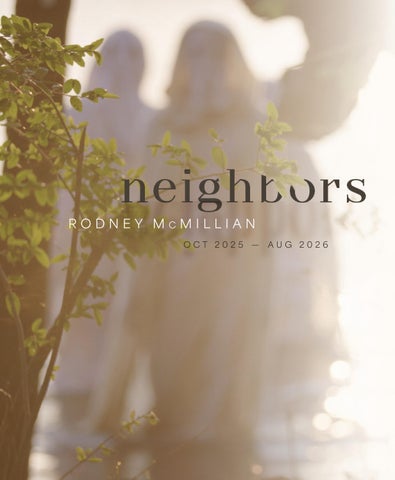
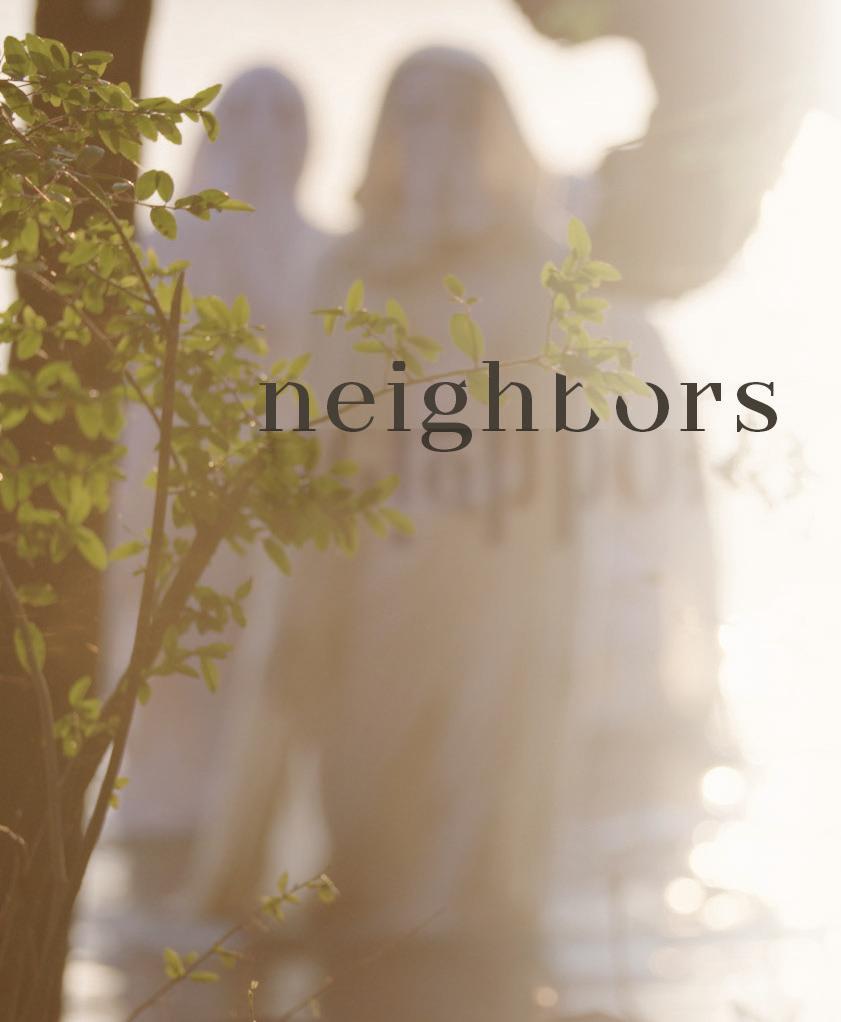
neighbors
RODNEY M c MILLIAN
OCT 2025 - AUG 2026
INTRODUCTION
Rodney McMillian (b. 1969, Columbia, South Carolina; based in Los Angeles, California) works with the social and political histories of the United States, focusing on the ways these forces shape our everyday. Using existent texts and often domestic materials, such as house paint on thrifted fabrics and bedsheets (or post-consumer objects as he describes them), he traces the visible and invisible forces that shape the body politic, particularly for the lives of African Americans.
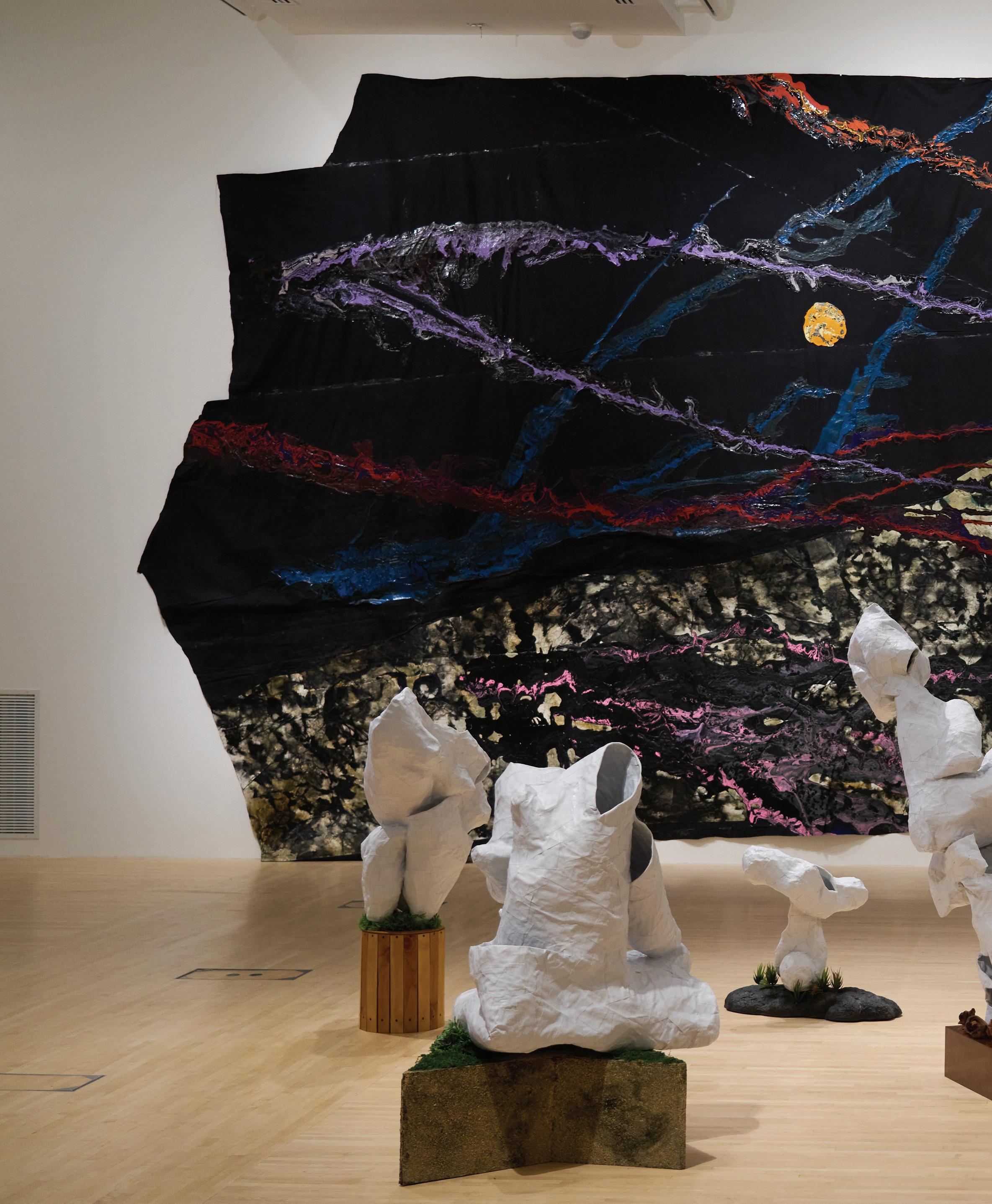
Inspired by the lush surroundings of the Henry, McMillian brings together a selection of sculptures, video, and painting that present an outdoor landscape overgrown with the lingering effects of physical, political, and social violence.
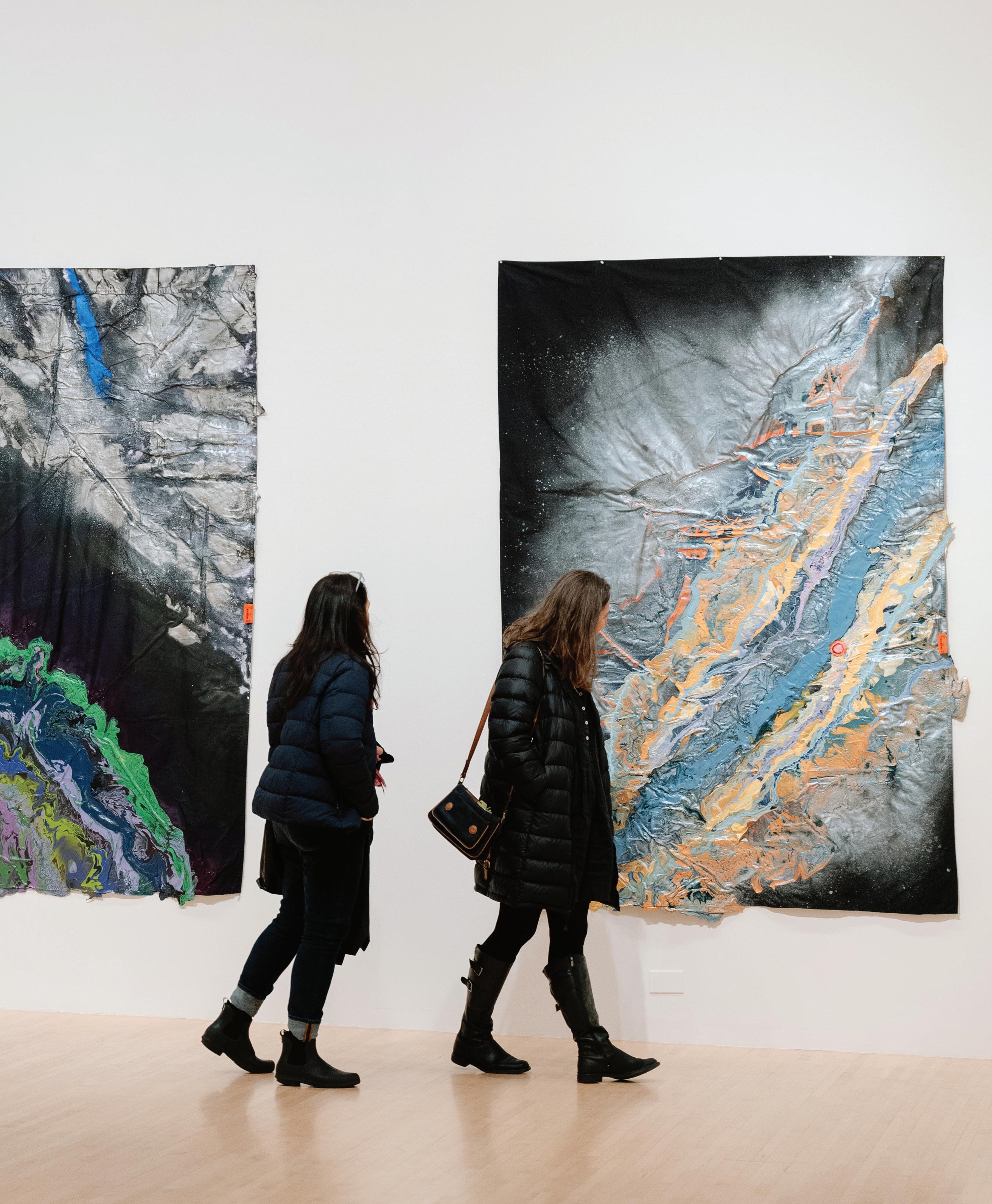
Across his varied media, McMillian navigates within the tension between abstraction and figuration, presence and absence. In a group of freestanding abstract sculptures, ghostly forms blur the line between taxidermy body and modernist object, distinguished trophy and deathly trace. Recent examples from his ongoing series of landscape paintings act as portals—offering views onto skies, stars, and foliage that float between this world and the next—both escape and confrontation. Together they offer a fantastical landscape moving elsewhere.
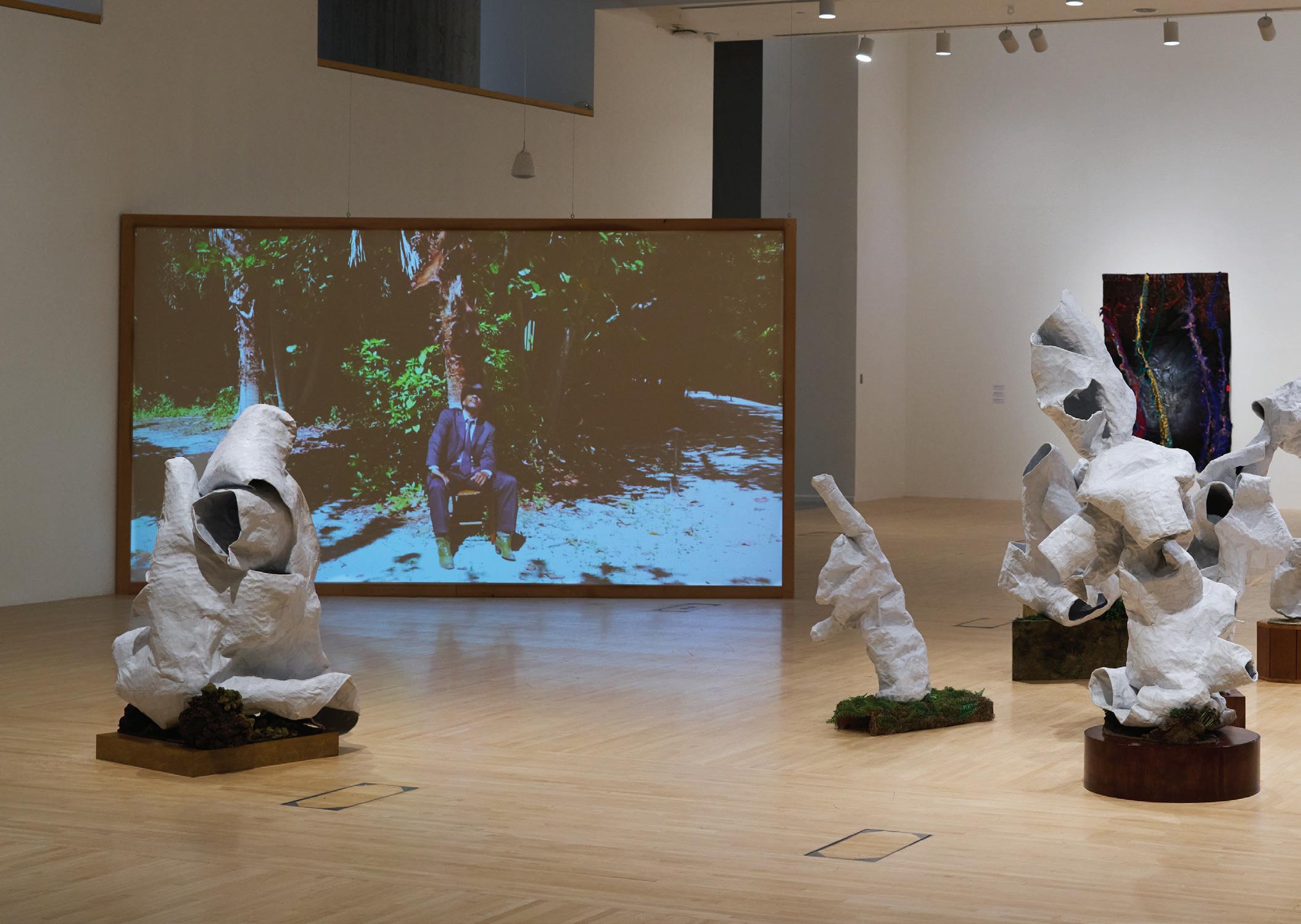
McMillian’s videos take a more direct approach to politics as it is embodied by figures and landscapes, rooted in our here and now. Preacher Man II (2017–2021) features a lay clergyman seated at a Southern crossroads, delivering his sermon adapted from a speech by civil rights activist Kwame Ture (formerly Stokely Carmichael) written during the height of the Black Power movement. While Untitled
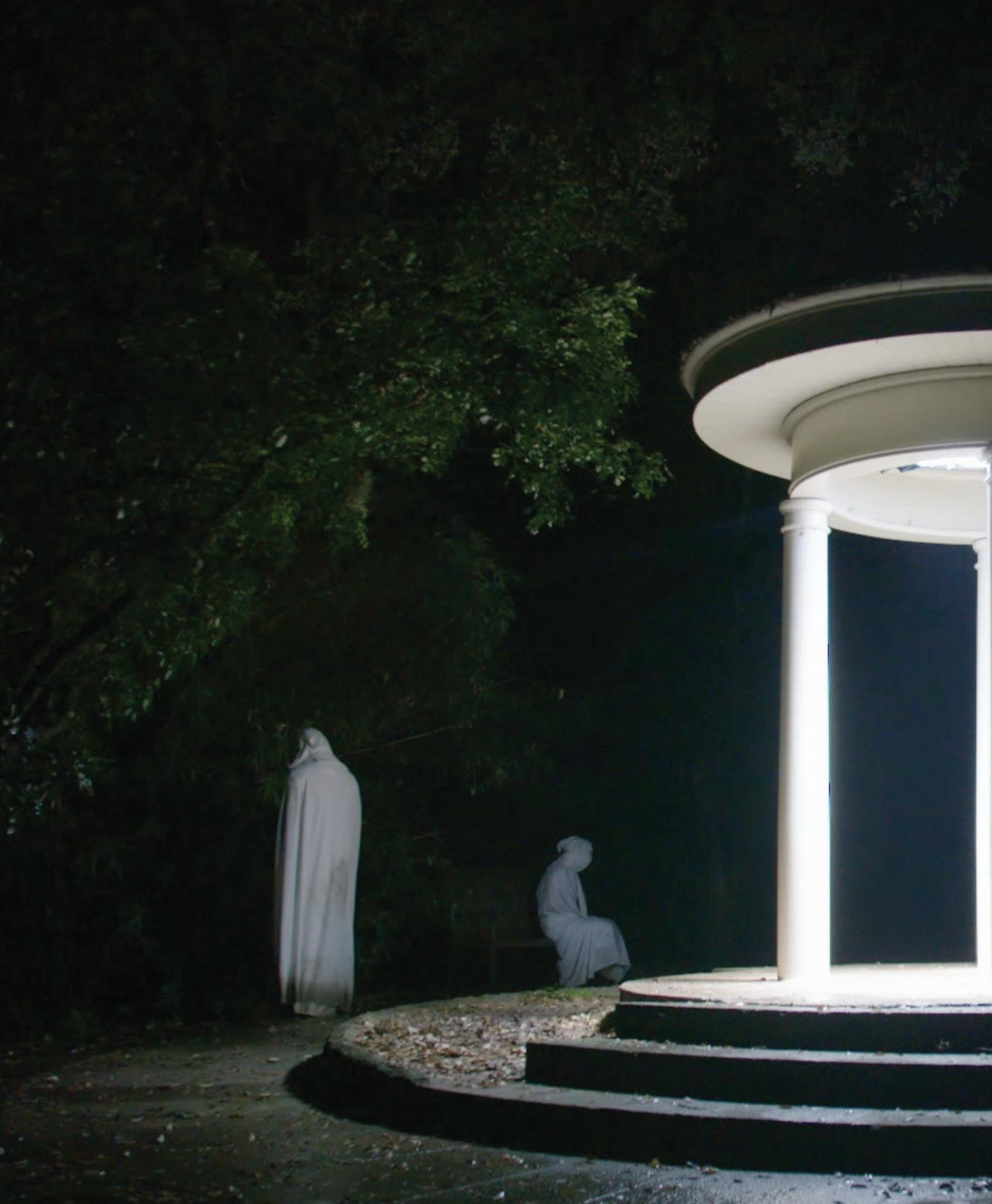
(neighbors) (2017), filmed in Austin, Texas, offers a group of dancers in flowing white garments stalking classical grounds and architecture with movements that are formal, incantatory, and ribald. Calling forth a haunting mixture of foreboding ritual and inappropriate response.
For McMillian, as for so many in the U.S., the past is never passed, the past is a fertilizer that feeds and cultivates this country we must tend to every day.
—Anthony Elms,
guest curator


CLOAKING DEVICE
There are always addendums, footnotes, asterisks, italics. That's what the landscape is.1
—RODNEY M c MILLIAN
Beneath the seen and heard—fertilizing and rooting—are active agents. They never sleep. They set the grammars and clauses of possibilities. Currently the most observable variant is without doubt the confluence of erratic patterns colliding as our self-made climate crisis. But more prevalent in sheer quantity are the laws, borders, treaties, understandings, and gerrymanders that regulate our relationship to where and how we stand. Twenty-first-century land is always underwritten and administered, even air rights traded as if tangible goods. These "addendums, footnotes, asterisks, italics" consolidate power over plentitudes. Antecedents, aftereffects, resonances and repercussions, as well as efforts to escape from these oft unacknowledged "addendums, footnotes, asterisks, italics" of our landscape are material for Rodney McMillian.
Prior to his commitment to art, McMillian studied foreign affairs at the University of Virginia and briefly worked at a New York law firm. His attentiveness to politics and policy has never abated. Objects, architectures, places, and identities—for McMillian, as for us all— contain microfilaments from broader social structures that shape, degrade, regulate, or nurture. For example, the epic vistas of the U.S. National Parks only appear raw and unspoiled because successive
1 Quoted in Adrienne Edwards, "Only when it is dark enough can you see the stars ...," in Rodney McMillian: History is Present Tense, ed. Heather Pesanti (Radius Books & The Contemporary Austin, 2018), 187.
federal administrations have deemed it necessary to protect their boundaries from the business-as-usual of spoiling economic encroachment. Similarly, any number of rural and inner-city neighborhood boundaries are designed to lack public services and utilities, suffering an absence of amenities due to commercial policy in tandem with state and federal laws designed to pool available resources elsewhere.
McMillian uses particular historical sources to destabilize the view. There is no one-point perspective in this land. Ours is a multidimensional land fissured and incongruous, annotated. To art historian Steven Nelson, his artworks "sit at the crossroads of contradictions in which the American racial unconscious provides possibilities for transformation."2 A crossroads McMillian populates with torqued forms that routinely refuse to choose between abstraction and figuration, adopting levels and degrees of both. "I'm gleaning, absorbing, piecing together myriad texts, histories, music, and sounds to make representations of this process of synthesis— making sense and making absurd the histories and political circumstances in which I live."3 Resultant sculptures, paintings, and videos are both haunted by and haunting our past and our potential.
Bringing together the works featured in Neighbors is McMillian's readings in U.S. history. First and primary was Elaine Frantz Parsons's Ku-Klux: The Birth of the Klan During Reconstruction, followed by the
2 Steven Nelson, "Rodney McMillian's Racial Unconscious," in Rodney McMillian, ed. Anthony Elms and Naima J. Keith (Institute of Contemporary Art, University of Pennsylvania and The Studio Museum in Harlem, 206), 130.
3 Rodney McMillian, "Wildseeding: there are veins in these lands," in Rodney McMillian: Landscape Paintings, ed. Heidi Zuckerman (Aspen Art Museum, 2015), 107.
1922 expose The Modern Ku Klux Klan by Henry Peck Fry in 2016.4
The latest resource, and most pertinent today, Carol Anderson's The Second: Race and Guns in a Fatally Unequal America. 5 Anderson details countless examples spanning over 200 years of the Second Amendment's use to give legality to the subjugation and murder of Black communities. From pre-Emancipation fugitive slave militias to twenty-first century Stand Your Ground laws, and the evergreen myth of that "good guy with a gun" protecting property and peace.
Neither pro- nor anti-gun, Anderson traces how the Second Amendment is a tool that underwrites the denial of African Americans' rights, equality, and lives as a law of the land. Detailing the right to legitimize violence. She begins with the fatal compromise that led to drafting the Second Amendment. A compromise drawn to keep pro-slavery states aligned with the nascent country, they didn't trust the quaker states. The result, an amendment guaranteeing a right for them to hunt people—or wayward property as slavers viewed Blacks. And as soon as a right to bear arms was on the books, those arms were simultaneously pointed at and kept from Black communities. In some decades, this was administered through Jim Crow laws, and over the history of the United States it is enacted through brute force. In summarizing the continued anti-Black use of the Second Amendment, Anderson turns to a position written by Supreme Court justice (1941–1954) Robert H. Jackson, "racism 'lies about like a loaded weapon ready for the hand of any authority that can bring forward a plausible claim of an urgent need.'"6
4 Elaine Frantz Parson, Ku-Klux: The Birth of the Klan During Reconstruction (The University of North Carolina Press, 2015); Henry Peck Fry, The Modern Ku Klux Klan (CreateSpace Independent Publishing Platform, 2016).
5 Carol Anderson, The Second: Race and Guns in a Fatally Unequal America (Bloomsbury Publishing, 2021).
6 Ibid, 163.
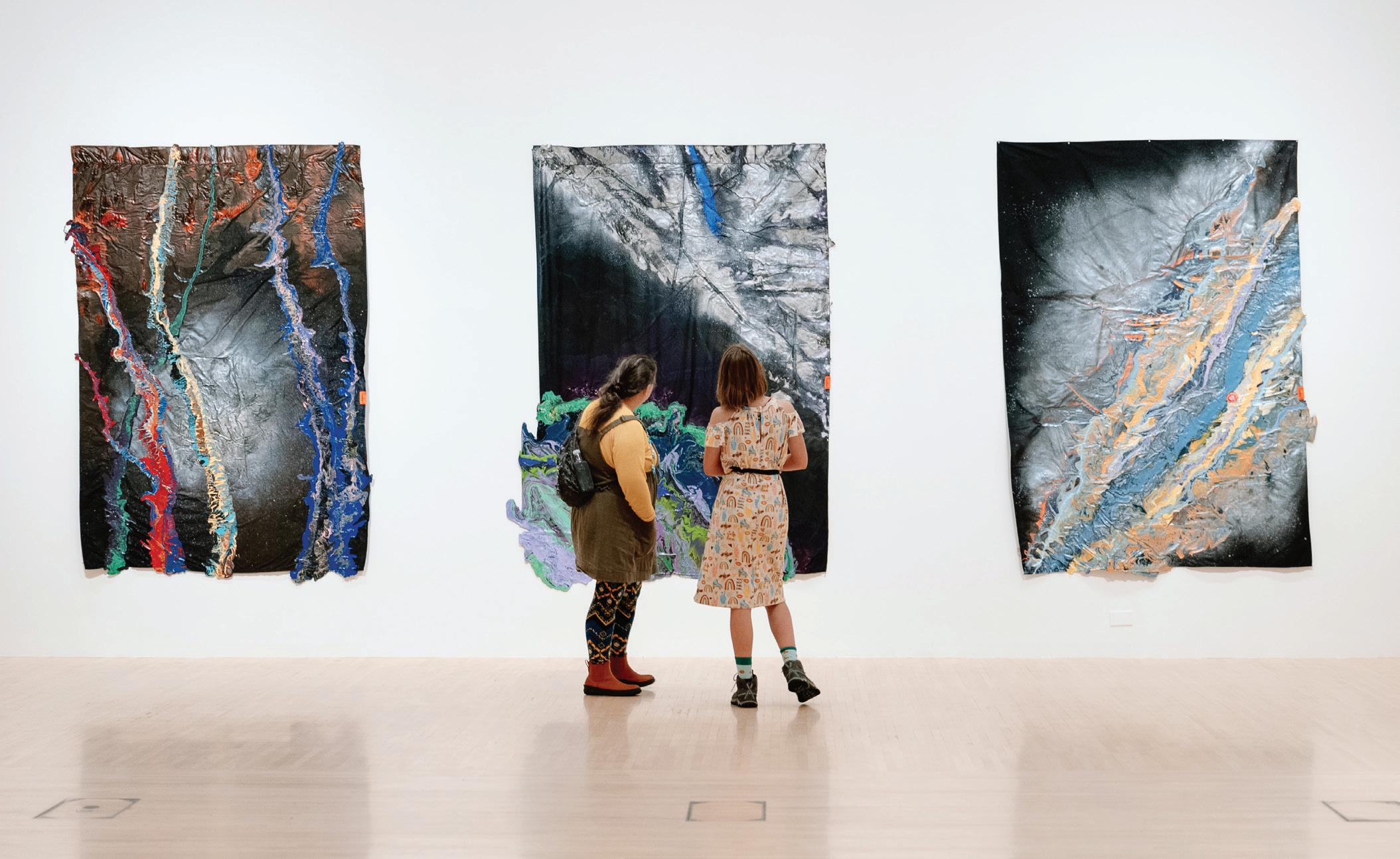
"Making sense and making absurd" in McMillian's landscape paintings is form and material. As landscape these are no lands I've lived.
Painted horizontally, his process of pouring, dripping and dragging, spraying and pooling paint recalls the techniques of Jackson Pollock, while the spindled plasticity and caked molten densities remind of painters such as Clyfford Still and Joan Mitchell, and the drape of his stretcherless fabric supports recall Sam Gilliam. McMillian's "gleaning,
absorbing, piecing together" of Abstract Expressionist materiality and painterly sweep in turn calls on aspects of mid-twentieth century American expansionism and attendant rugged, individualist psyche turned outward. Here and now, what if the grounds for this expansionism are not as neutral, uncontested, or uniform as once claimed? What if this expansionism is "the American racial unconscious," an aftereffect or otherwise-dimensional, deracinated and inward even.
McMillian's palette offers colors to the excess of any nature beyond the subaqueous realms. The garish spilling funk groove, soul vibe speculative science fictions of his paint on unstretched fabrics—often thrifted textiles, often bedsheets—keep depictions of overgrown forests, cephalopod vegetations, and twilight sunrises rooted in contemporaneous real-world people, economies, and polycrises. Thrifted pre-owned, past life sheets, throws, blankets and such, post-consumer objects as McMillian considers them, come with their traces. The painted landscapes now inhabiting these post-consumer objects want "addendums, footnotes, asterisks, italics" unexperienced by the previous owners of the textiles. The paintings enjoin electrics, are devotionally disabused, snared within syncopated sagging, hit a multi-tracked mellifluousness, define the post-apocalyptic postcoital. They are all akimbo.
In "Operating System for the Redesign of Sonic Reality," the introduction to More Brilliant Than the Sun: Adventures in Sonic Fiction, critic Kodwo Eshun famously wrote, nearly in passing: “The future is a much better guide to the present than the past.”7 Eshun's project isn't Afrofuturist. It is Afro-otherwise. Afro-change-of-state. Here calling there. A future you can't paint en plein air; paint what
7 Kodwo Eshun, More Brilliant Than the Sun: Adventures in Sonic Fiction (Quartet Books, 1998), -001.
ain't. Here abstraction, a picturing an otherwise, is the countervailing potential in uncontrollable processes. Abstraction is in excess of realism's rules. You pour and spray and drip and just need to wait. Making visible the flaunting of boundaries. Spilling and coagulating paint doesn't need to follow veins of inequity and injustice, though it certainly can. The plasticity of paint is always "gleaning, absorbing, piecing together" fields that disabuse themselves of “addendums, footnotes, asterisks, italics” as their grammar is customarily enforced. Simply "making sense and making absurd" with viscous materials on unstretched fabrics pools and fissures our interpretations and administrations. Not in excess; as access. It isn't a forgetting nor ignoring the past—remember, abstraction by necessity steps out from something identifiable. We use the recognizable to navigate what we don't. In abstraction familiar forms and everyday material response can land us elsewhere. Not paint-by-number histories. McMillian's declaring that his paintings are landscape paintings, regardless how near or far from terrestrial legibility he adheres, is material "making sense and making absurd" the potential of differently inhabitable spaces. The post-consumer textiles of support place these differently inhabitable spaces as portals opened within lived pasts and their household dreams, pleasures, inequities, tears, and solace. This is our opportunity. Paintings as viscously grafted estrangements engineered to run Eshun's operating system. For under the heat of an astringent setting sun, "the future is a much better guide to the present than the past" if tomorrow is to unfold otherwise.
As decidedly not-there yet from-here as the landscapes of McMillian's paintings are, the settings of his videos are concretely right-there of-here. Recognizable, familiar identities, specific texts. Abstraction as historical underwriting. The abstraction in McMillian's seemingly
straightforward video vignettes is behavioral, capturing moments of “addendums, footnotes, asterisks, italics." Like how a wondrous horizon is suddenly underwritten by invisible intractabilities. The way we feel nation-states in geological formations. Abstraction as the deep rapacious efficiencies by which law and policy camouflage and hem in potential breadths as sites for expansion.
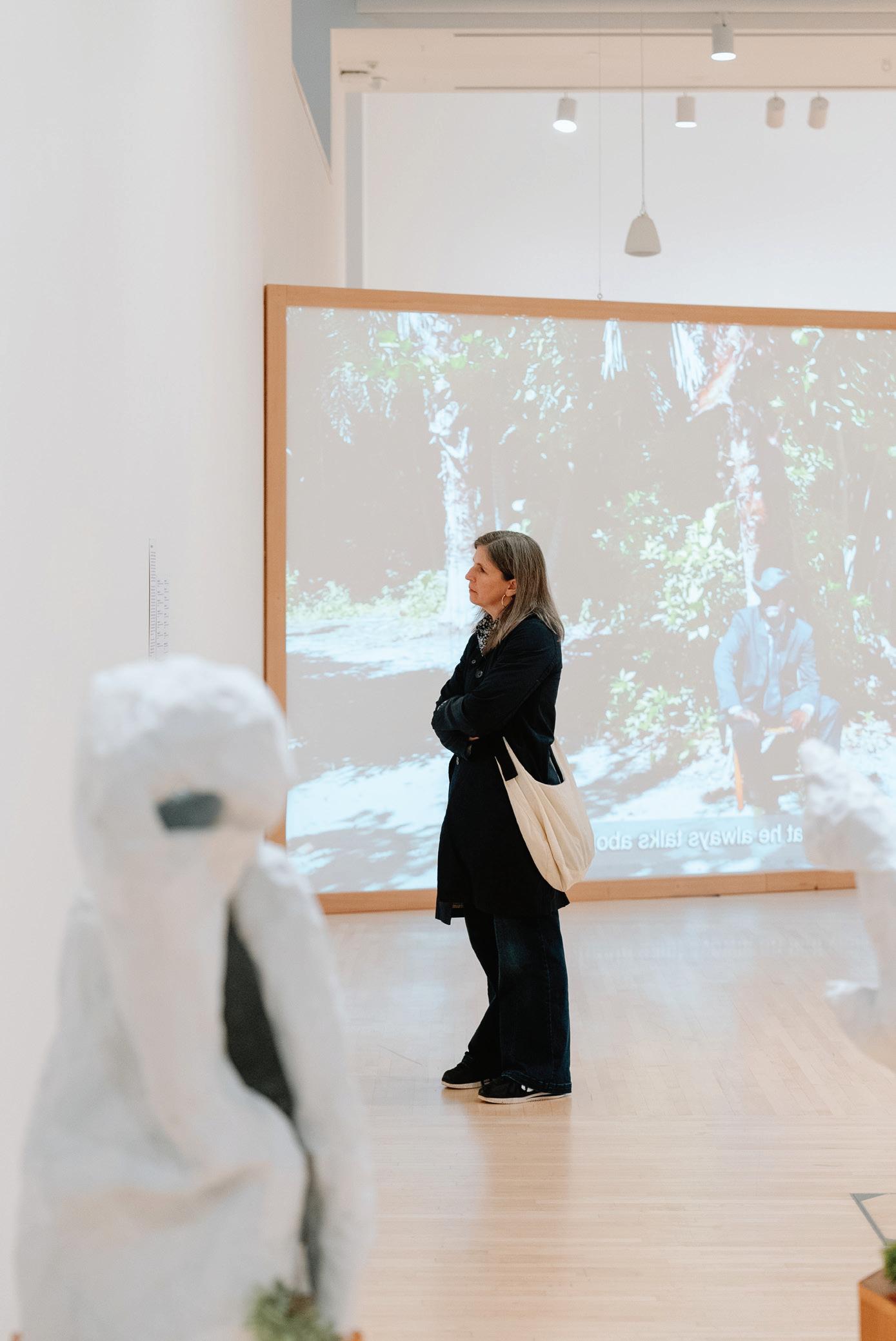
With Preacher Man II (The Pitfalls of Liberalism), the influence of Carol Anderson's The Second: Race and Guns in a Fatally Unequal America is most apparent. In fact, this work insists Anderson's historical account is not behind us but grounding us. One of McMillian's recurrent characters, that starkly-dressed plain-talking solitary Southern preacher, sits himself down at the proverbial crossroads to deliver a midday sermon. Today's lesson a 1969 text by political activist Kwame Ture (Stokely Carmichael) with direct redress. "Whenever one writes about a problem in the United States, especially concerning the racial atmosphere, the problem written about is usually black people, that they are either extremist, irresponsible, or ideologically naive."8 Ture, or our preacher, on the other hand, chooses to discuss the entwined problems of whiteness, power, violence—one group's meritocracy as another's subjugation.
The historical backdrop to The Pitfalls of Liberalism is given careful attention by Anderson's book. In 1967, California Governor Ronald Reagan passed the Mulford Act, sweeping gun control legislation that outlawed the open carry of loaded firearms. The legislation’s passage launched California's path toward some of the most restrictive gun laws in the United States. The Mulford Act was crafted in direct response to the bold public and perfectly lawful display of weapons
8 Kwame Ture, "The Pitfalls of Liberalism," in Stokely Speaks: From Black Power to Pan-Africanism, ed. Kwame Ture (Random House, 1971), https:// redsails.org/the-pitfalls-of-liberalism/.
by Black Panthers advocating for self-defense measures to be undertaken by every African American community. Stand their ground, if you will. The law passed in large part with strong support and advocacy for the restricting measure by the National Rifle Association, whose uninfringed right to bear arms has never been one of equanimity. Nor equality. The idea of Black communities brandishing the Second Amendment was anathema to Reagan, law enforcement, and the NRA. Let's quote Ture, "I want to state emphatically here that violence in any society is neither moral nor is it ethical. It is neither right nor is it wrong. It is just simply a question of who has the power to legalize violence."9 Those bureaucratic checks and balances that underwrite any system of law are drafted by someones with “the power to legalize violence.”
Today, Ture's text as preached through McMillian taunts along ethical lines: the serrated equivalences, the causal stridency. It is a jarring text not because his words feel alien—only his calling Richard Nixon a liberal comes from some past incongruent space. It is the many moments when issues and confusions feel so palpably trenchant that they shock. More than fifty years passed and still we navigate the same murky waters.
Is it not violent for a child to go to bed hungry in the richest country in the world? I think that is violent. But that type of violence is so institutionalized that it becomes a part of our way of life. Not only do we accept poverty, we even find it normal. And that again is because the oppressor makes his violence a part of the functioning society. But the violence of the oppressed becomes disruptive. It is disruptive to the ruling circles of a given society.10
9 Ibid. 10 Ibid.
This imbalance is preserved and reenforced through decades of public and private investment. Death may never take a holiday, but must it so often get to parade in exquisite finery? Demand devotees? And why do the powerful always call on its favors when we'd rather be sleeping in that midday sun.
Four figures emerging from a body of water and stepping into the focus of Untitled (neighbors). Four flowing white garments drape: equal parts baptismal gown, cartoon ghost, Klu Klux Klan robe. Four figures who aren't painter Philip Guston's infamous cartoon Klansmen going about the day to day. Four expressionist and irrational baptismal
ghost Klansmen cavorting. What they share is movement: playful, ominous, animated, violent, anonymous, irrational, even humorous. Four hooded shapes moving in irregular synchronicity. Guston's Klansmen are animated by the pressures and trials of daily routine. What drives McMillian's quartet? McMillian's are animated by our land. Four cloaked cardinal directions mapping an expedition from processional to graceful and lyrical, lurking, marching, ribald and disrespectful, athletic and frantic, fluttering. "Gleaning, absorbing, piecing together" America's racial unconscious "making sense and making absurd" on manicured grounds.
The four lurking shrouds share an absence: reconciliation for official policies of racial and territorial subjugation. Filmed on site for McMillian's 2018 exhibition at the Contemporary Austin, Untitled (neighbors), unfurls on land once owned by Stephen F. Austin, who many consider the founding father of Texas. Austin is also known for his ardent advocacy for slavery, despite slavery's abolition by the Mexican authorities then governing the territory Austin was colonizing. How is this neighborly? "The main problem in thinking about neighbors is that the word means 'bad' in some way. Very subtle, but there. Bad. Fences make...that kind of stuff."11 Next to not of.
Formed around 1865 in the Reconstruction south, the Ku Klux Klan is a Protestant-rooted organization. A combination secret fraternity and terrorist militia, keeping white supremacy the lay of the land, if not the written law. The sadly now widely recognizable uniform of a pointed white robe and hood with eye holes was adopted in the early twentieth century during the Klan's first resurgence. Anonymity equaled proximity, and has proven quite fertile over the decades.
11 Robert Ashley, Crash (Burning Books, 2014), 55.

You can't know if the KKK is a majority or a minority of your community. You can't know if the colloquial businessman next door is involved. And are you?
The KKK exploits ambiguity in neighborliness and proximity. For the Black citizen or civil rights activist, proximity between you and next door holds the concealed carry of possible terrorist. For the white supremacist, that same proximity holds potential solidarity and untrammeled opportunity. This uncertain imbalance of roles McMillian choreographs. “Making sense and making absurd” just who is next door. Untitled (neighbors) resists the solitary individual. Not us or them. Us and them. Particularly amidst a recent rise in nativist and anti-immigrant sentiments worldwide. We, alongside, in climates natural, political, cultural, social.
Every nation-state is born of violence. But no nation-state is governed by violence. At some point stability is required. For that you need power: the regulated flow of benefits and relations. It is the inevitability and dependability of behaviors that grants a nation-state power. The pacing and anticipation of "addendums, footnotes, asterisks, italics."12 In a fully-functioning nation-state you know its rhythms and coordinate. In return the nation-state provides for those
12 As example:
"John Lonsdale, another doyen of East African history, describes the nuance as follows: 'What transpired on the battlefield then, when the Hotchkiss or Maxim was assembled or the bayonet charge went in; when the thatch was fired or the cattle captured—all this was of fundamental importance in establishing a sense of mastery or subordination. But force was not power. Power comes not by a single act of confrontation but by repeated transactions within some ordered set of social relations; its costs and benefits must at least carry the possibility of calculation and prediction.' In other words, states are born of violence, but they cannot be made solely of violence."
Quoted in Christian Parenti, Tropic of Chaos: Climate Change and the New Geography of Violence (Nation Books, 2012), 69.
in tune with its rhythms, i.e. citizens. Groups such as the KKK operate as an arrhythmia, syncopating their actions against steadying rhythms of state force, to undermine that stately cadence of citizenship. Groups such as the KKK are the extra-judicial violence shadowing the state's official powers. The violence of the KKK is an unpredictable cadence meant not just to impede but to prevent many from ever seeking the benefits in the power of the state. And for those who do refuse to give up, KKK violence lands as an asymmetrically punishing gale force. Where neighborliness gets even murkier, is when depending on the municipality, the Klan functions either in spite of or in sight of the state. This is the condition in which four hooded figures roam a seemingly placid landscape from glistening refraction and humid glimmer, to twitching's last gleaming. East, West, North, South; in the rustle of fabric's furl, you can nearly hear an old American proverb carry the breeze: "Fear your neighbor as yourself."
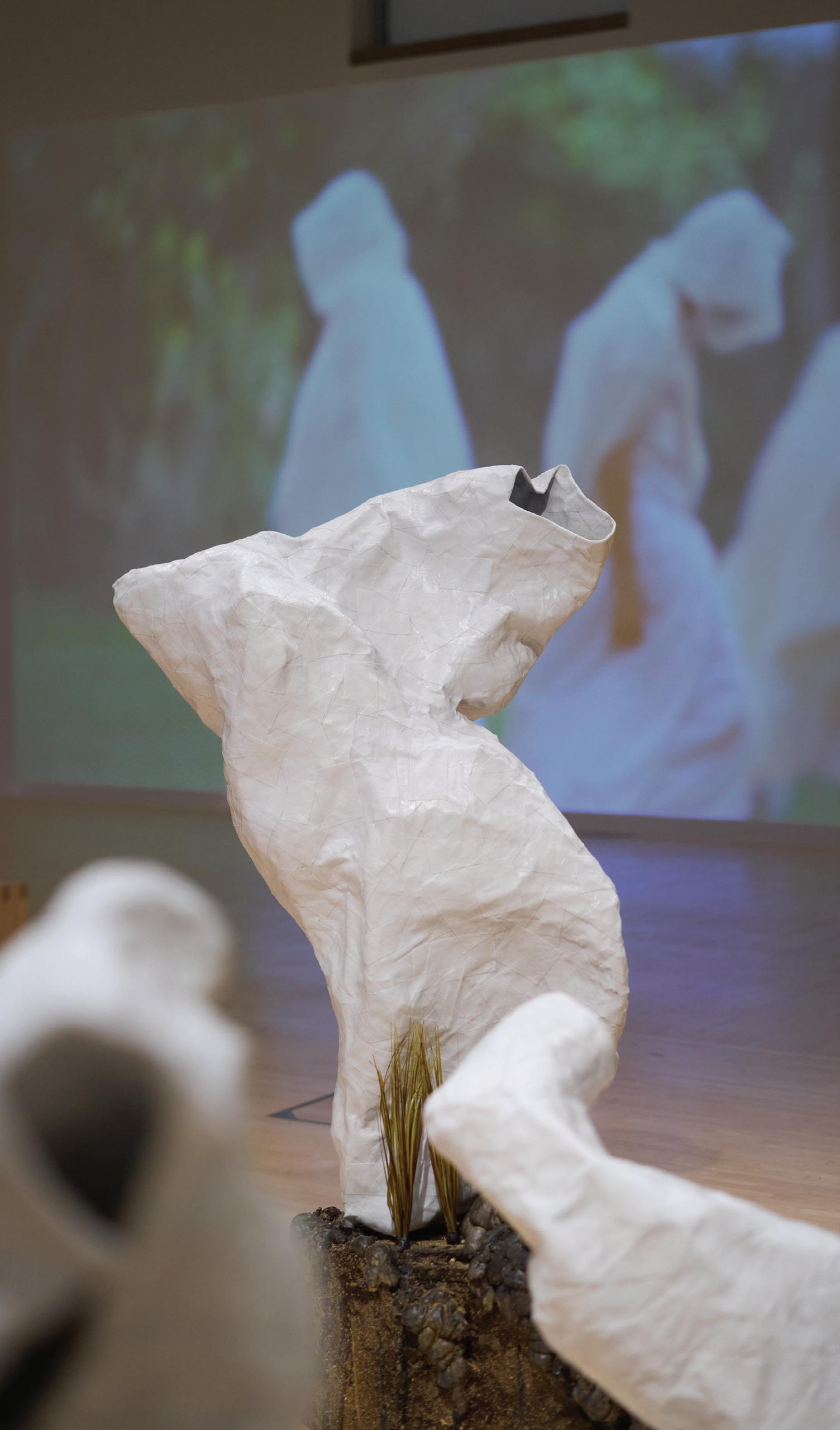
Mottled. Chalky and bulbous. Shelled. Churned and folded. Poised. Whatnot and wannabee. Specimen. The hand-formed sculptures resist recognizable figuration and repel pure abstraction. If indeed these Specimen are specimen, are indeed types in a species, they have characteristics of certain styles in Modernist sculpture. Round open limbs and snouts of monochromaticism recall the biomorphism of British sculptors Barbara Hepworth or Henry Moore disabused of polish. Maybe also the Surrealism of Hans Arp fallen on hard times. Revealing cavities, protruding and asymmetrical, invite hollow chiaroscuros, like the cast theatricality of George Segal figures made monstrous through the diabolic perversions of Hans Bellmer's doll. Rather than placed pleasingly on a pedestal or confrontationally plopped in our space, these evocative white mutations hold forth on personal-sized landscapes.
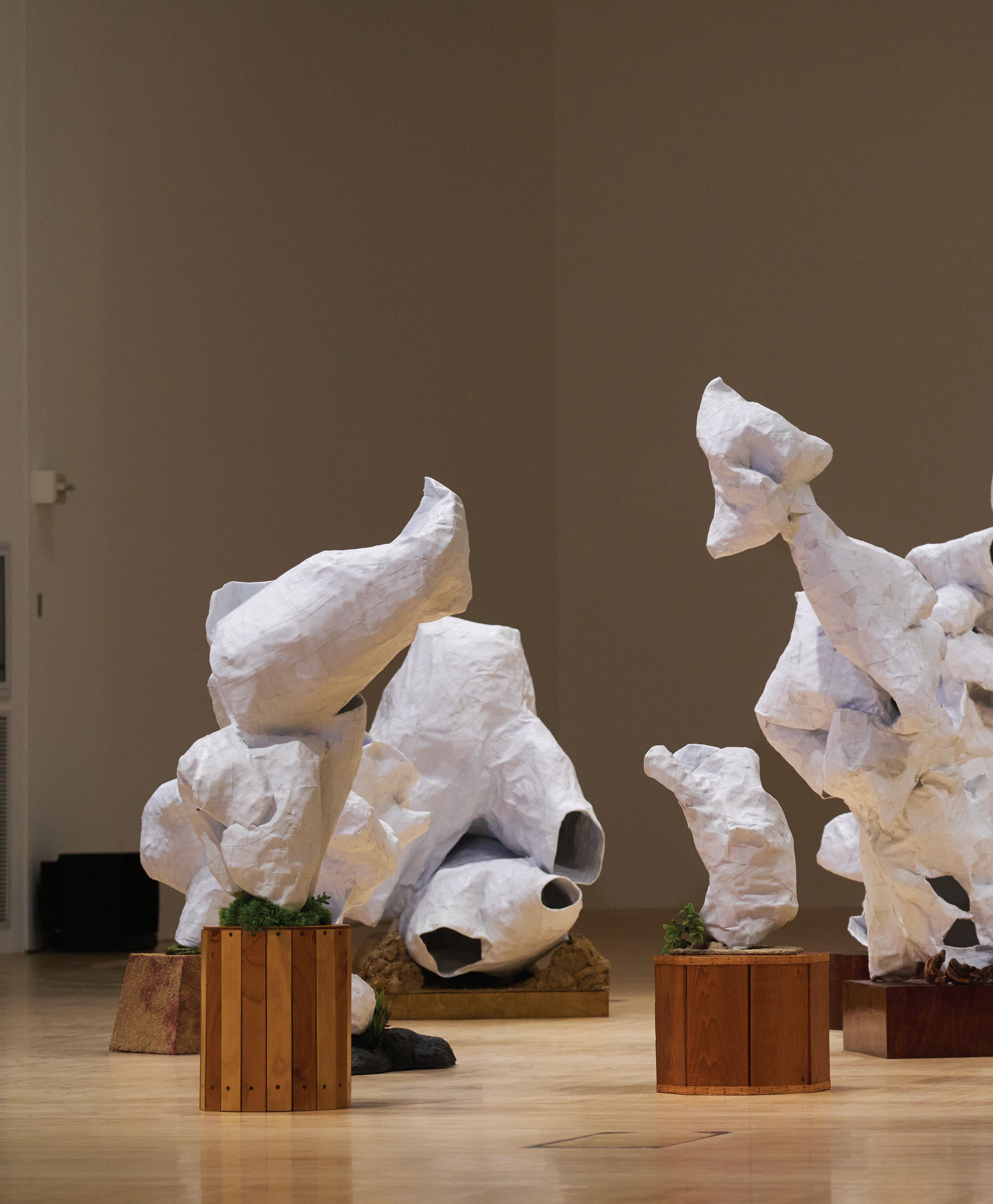
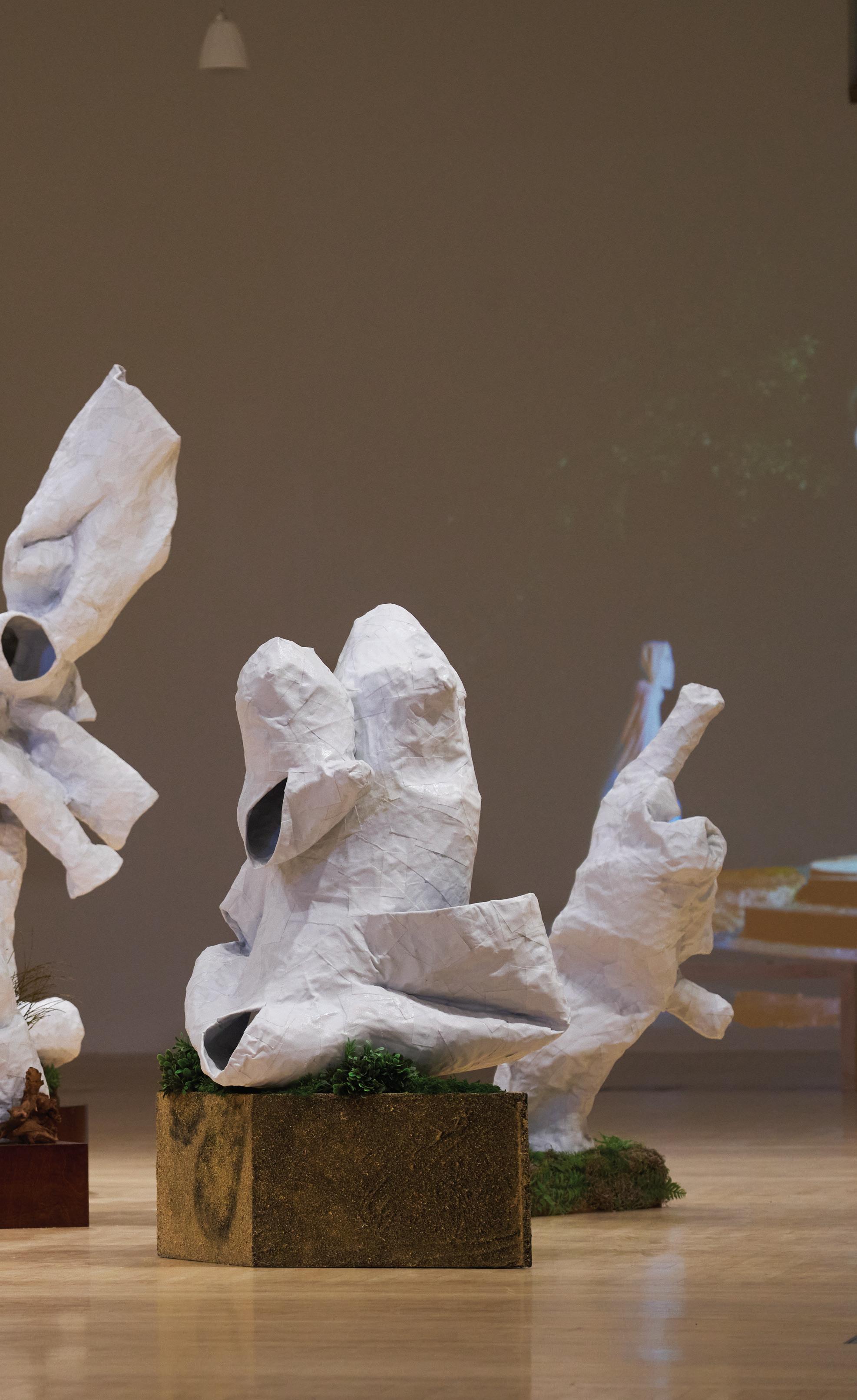
Staged atop faux fauna, artificial rock and roughened logs, the Specimen voices an entirely different sculptural dialect: taxidermy. Starting with the chicken wire and papier mâché down to the supporting plastic, wood and foam, these materials are those typically used in shaping animal hides back into lifelike forms. Their fauxnatural supports recall the iconicity of hunting triumphs and scientific classification. This semblance too drags the group of Specimen sculptures to quietly resonate like a herd of now dead animals. Their supple flowing whiteness trapped, skinned and staged, formalized and preserved. Are they at home amidst the otherwise landscapes, the hectoring preacher, the choreography of concealed actors?
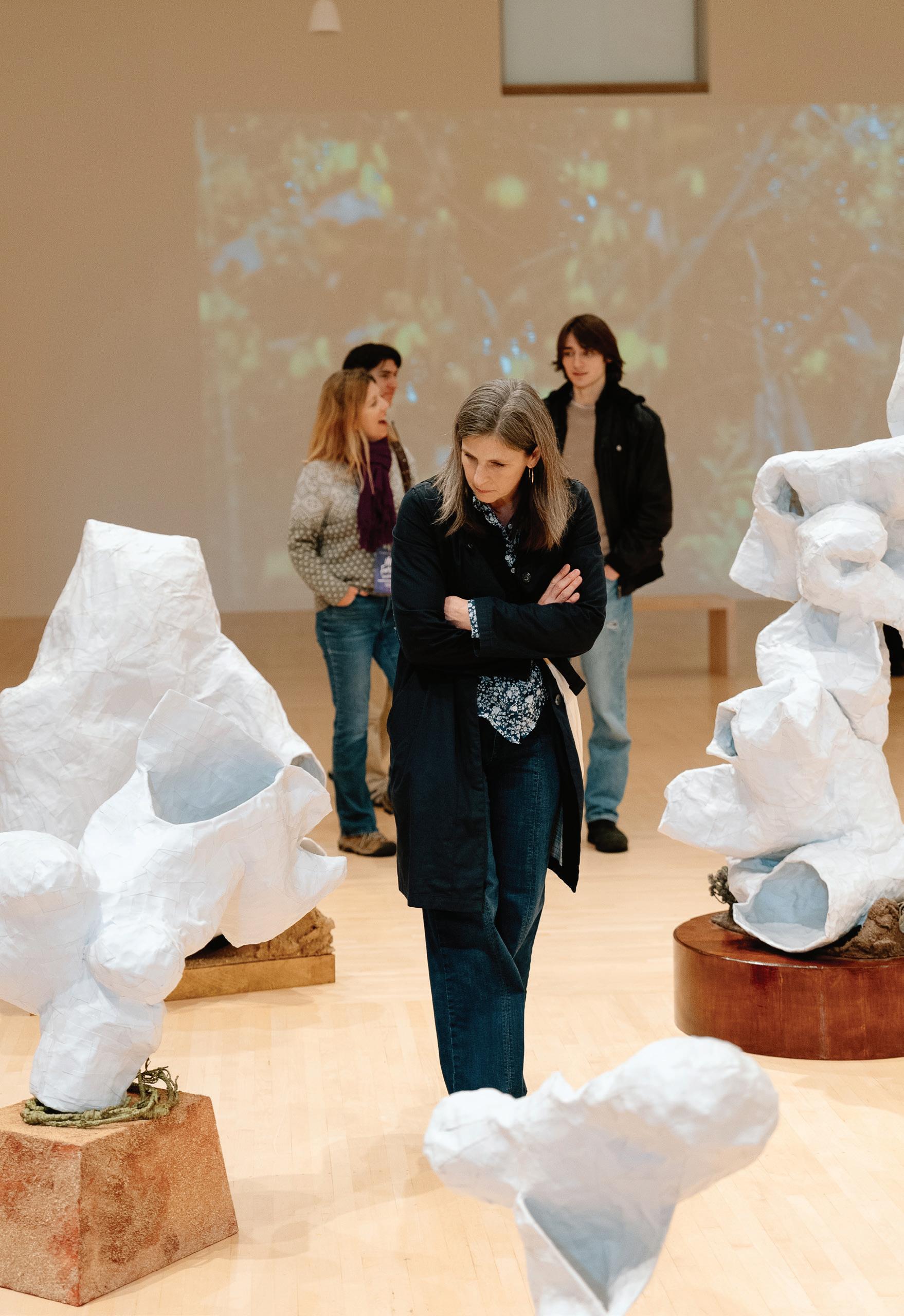
In situ, a gathering of Specimen together yearns for animated presence and inopportune repose. Their individualized native plots too constricting to create either civic space or wilderness. Clustered near and far throughout a gallery, these trophies plot points in proximity to power and violence, figure and abstraction, containment and confrontation—fantastical, flamboyant, possibly fanatical. Fraternal.
Being Specimen together, they are of a family with each who share like characteristics and traits: a shared disregard for the convenient comforts of clear definitions. In which case these fossilized exoskeletons are of a species and share a common genus name. Neighbors, some say.
WORKS IN EXHIBITION
Unless otherwise noted, all works are courtesy of the artist, Petzel, New York, and Vielmetter Los Angeles
Preacher Man II (The Pitfalls of Liberalism), 2017-2021
Color video with sound; 29:09 mins.
Edition 1/5, 2 AP
Untitled (neighbors), 2017
Single-channel video, color, sound; 19:04 mins
Edition of 3, 2 AP
Commissioned by the Contemporary Austin, with funds provided by the Suzanne Deal Booth Art Prize.
44.8617° N, 93.5606° W: coordinates to an ascension, 2018
Latex, acrylic, ink, and paper on duck cloth
498 x 437 in. (1264.92 x 1109.98 cm)
Anathema: earth from space, 2025
Latex, acrylic, and ink on bedsheet
84 x 72 in. (213.36 x 182.88 cm)
Anathema: setting sun in pink, 2025
Latex, acrylic, and ink on bedsheet
84 x 72 in. (213.36 x 182.88 cm)
Anathema: moon through trees, 2025
Latex, acrylic, and ink on bedsheet
84 x 72 in. (213.36 x 182.88 cm)
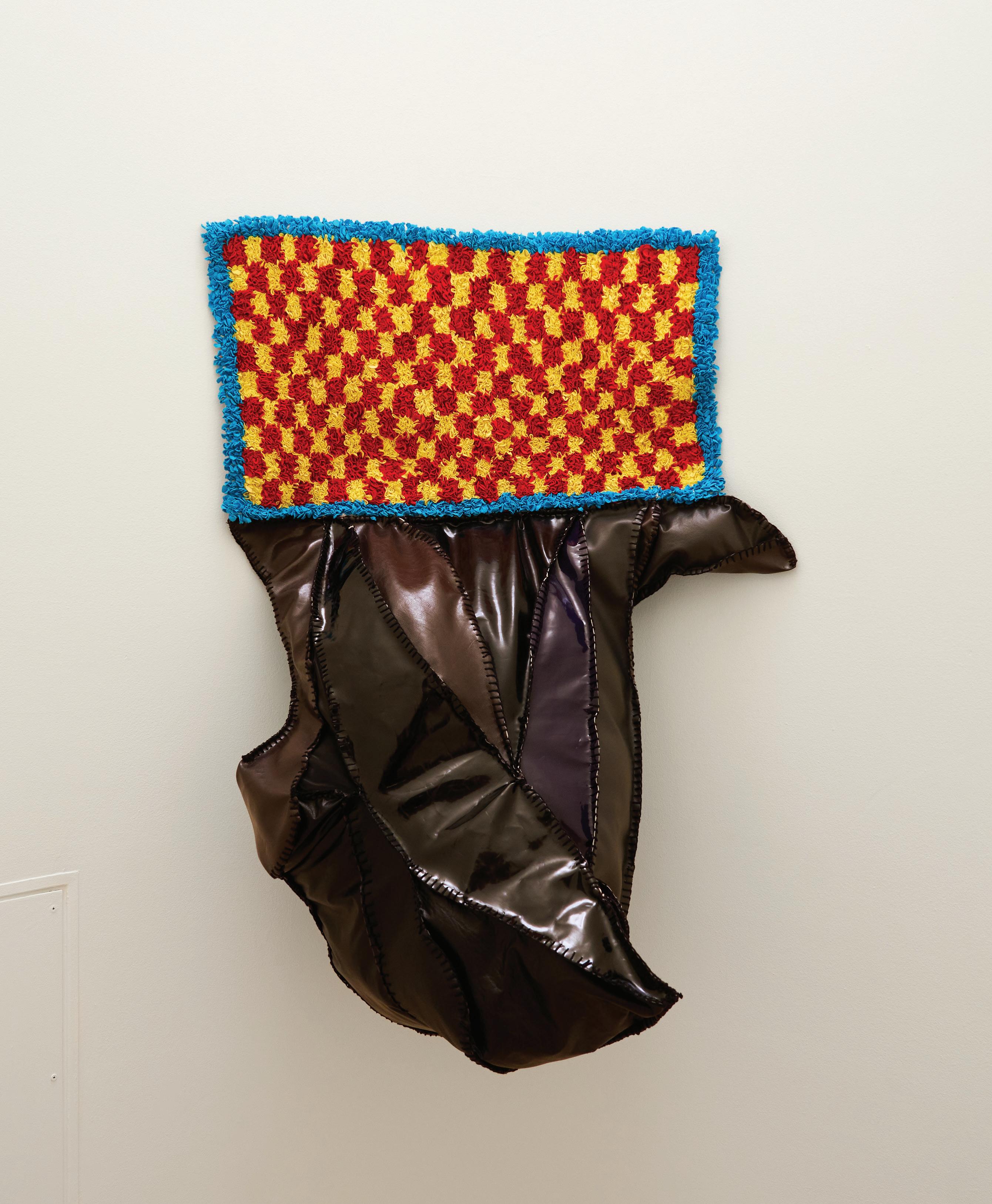
doormat (red, white, blue), 2025
Latex and acrylic on doormat
30 x 12 in. (76.2 x 30.48 cm)
Specimen, 2022
Fabric, chicken wire, gel medium, metal rods, faux plants, wood
47 x 31 x 27 in. (119.4 x 78.7 x 68.6 cm)
Specimen, 2022
Fabric, chicken wire, gel medium, metal rods, wood
48 x 38 x 29 1/4 in. (121.9 x 96.5 x 74.3 cm)
Specimen, 2022
Fabric, chicken wire, gel medium, metal rods, wood, faux plants
77 x 33 x 27 in. (195.6 x 83.8 x 68.6 cm)
Specimen, 2022
Fabric, chicken wire, gel medium, metal rods, styrofoam
34 1/2 x 39 1/2 x 25 1/2 in. (87.6 x 100.3 x 64.8 cm)
Specimen, 2022
Fabric, chicken wire, gel medium, metal rods, faux plants, wood
50 1/4 x 38 x 26 in. (127.6 x 96.5 x 66 cm)
Specimen, 2022
Fabric, chicken wire, gel medium, metal rods, wood, faux plants
80 x 33 x 29 1/4 in. (203.2 x 83.8 x 74.3 cm)
Specimen, 2022
Fabric, chicken wire, gel medium, metal rods, wood
60 1/2 x 42 x 29 3/4 in. (153.7 x 106.7 x 75.6 cm)
Specimen, 2022
Fabric, chicken wire, gel medium, metal rods, wood
55 x 26 1/2 x 20 1/2 in. (139.7 x 67.3 x 52.1 cm)
Specimen, 2022
Fabric, chicken wire, gel medium, metal rods, wood
51 x 32 1/2 x 23 in. (129.5 x 82.6 x 58.4 cm)
Specimen, 2022
Fabric, chicken wire, gel medium, metal rods, wood
40 x 31 1/2 x 19 1/2 in. (101.6 x 80 x 49.5 cm)
Specimen, 2022
Fabric, chicken wire, gel medium, metal rods, wood
28 x 31 x 23 1/2 in. (71.1 x 78.7 x 59.7 cm)
Specimen, 2022
Fabric, chicken wire, gel medium, metal rods, wood
29 1/2 x 21 x 16 in. (74.9 x 53.3 x 40.6 cm)
Specimen, 2022
Fabric, chicken wire, gel medium, metal rods, wood, faux plants
35 1/2 x 31 1/2 x 26 in. (90.2 x 80 x 66 cm)
Specimen, 2022
Fabric, chicken wire, gel medium, metal rods, wood, faux plants
61 x 36 x 35 in. (154.9 x 91.4 x 88.9 cm)
Specimen (group of 4), 2022
Fabric, chicken wire, gel medium, metal rods, wood, faux plants
Dimensions variable
4 sculptures, approx. 12-30 x 12-24 in. (30.5-76.2 x 30.5-61 cm) each
IMAGE CREDITS
* 00, 08
Rodney McMillian. Untitled (neighbors) [still], 2017. Singlechannel video, color, sound. Edition of 3, 2 AP. Running time: 19:04. Commissioned by the Contemporary Austin, with funds provided by the Suzanne Deal Booth Art Prize. Courtesy of the artist and Vielmetter Los Angeles.
* 01, 03, 04, 09
Rodney McMillian: Neighbors [Installation View, Henry Art Gallery, University of Washington, Seattle. 2025]. Courtesy of the artist, Petzel, New York, and Vielmetter, Los Angeles. Photo: Jonathan Vanderweit.
* 02
Rodney McMillian. 44.8617° N, 93.5606° W: coordinates to an ascension [detail]. 2018. Latex, acrylic, ink, and paper on duck cloth. Courtesy of the Artist, Petzel, New York, and Vielmetter, Los Angeles. [Installation View, Henry Art Gallery, University of Washington, Seattle. 2025]. Photo: Jo Cosme
* 05, 07, 10, 11
Rodney McMillian: Neighbors [Installation View, Henry Art Gallery, University of Washington, Seattle. 2025]. Courtesy of the artist, Petzel, New York, and Vielmetter, Los Angeles. Photo: Jueqian Fang.
* 06
Rodney McMillian. doormat (red, white, blue). 2025. Latex and acrylic on doormat. Courtesy of the Artist, Petzel, New York, and Vielmetter, Los Angeles. [Installation View, Henry Art Gallery, University of Washington, Seattle. 2025]. Photo: Jonathan Vanderweit.
ABOUT THE ARTIST
Rodney McMillian works with the intersections of power, race, class, and culture in paintings, sculptures, installations, video, and performance. He uses political texts and found, often domestic, materials such as house paint, cast-off furniture, fabric, and thrifted bedsheets, among others, to create works that trace these intersections in our everyday landscape. McMillian has exhibited widely, including the 2008 and 2022 Whitney Biennials; the 2021 Prospect.5 New Orleans: Yesterday You Said Tomorrow; and the 2015 Sharjah Biennial. He received Contemporary Austin’s initial Suzanne Deal Booth Art Prize in 2016, and the resulting solo exhibition Against a Civic Death was on view in 2018. Solo exhibitions have been staged at the Blaffer Museum, Houston, Texas; the Underground Museum, Los Angeles; the San Francisco Museum of Modern Art; the Institute of Contemporary Art, Philadelphia; the Studio Museum in Harlem; MoMA PS1, New York; and the Aspen Art Museum, Colorado. His work has also been included in group exhibitions at The National Portrait Gallery, London; MASS MoCA, North Adams, MA; the CCA Wattis Institute, San Francisco, CA; the Astrup Fearnley Museet, Oslo, Norway; the Institute of Contemporary Art, Boston; the Contemporary Art Museum Houston; the Museum of Contemporary Art, Los Angeles; the Museum of Contemporary Art, Chicago; the Hammer Museum, Los Angeles; the Renaissance Society at the University of Chicago; and the Los Angeles County Museum of Art, among many others. His work is included in the collections of the Hammer Museum, Los Angeles; the Museum of Contemporary Art, Los Angeles; the Museum of Modern Art, New York; the San Francisco Museum of Modern Art, San Francisco; Stadtisches Museum Abteiberg, Mönchengladbach, Germany; and the Studio Museum in Harlem, New York. McMillian received an MFA from the California Institute of the Arts in 2002; he is currently a professor of sculpture at the University of California, Los Angeles.
ABOUT THE CURATOR
Anthony Elms is a writer and curator. Formerly at the Institute of Contemporary Art, Philadelphia, he organized the exhibitions Karyn Olivier: Everything That’s Alive Moves (2020), Cauleen Smith: Give It or Leave It (2018), Endless Shout (2016–17), Rodney McMillian: The Black Show (2016), Christopher Knowles: In a Word with writer Hilton Als (2015), White Petals Surround Your Yellow Heart (2013), among others. Elms’s writings have appeared in many catalogues and edited collections, as well as various periodicals. He has independently curated many exhibitions, including Whitney Biennial 2014; Interstellar Low Ways (with Huey Copeland); A Unicorn Basking in the Light of Three Glowing Suns (with Philip von Zweck); and Sun Ra, El Saturn & Chicago’s AfroFuturist Underground, 1954–68 (with John Corbett and Terri Kapsalis).
HENRY TEAM
Kelly Anderson
Tanja Baumann
Erika Bentley Holland
Emily Blanche
Sarah Borders
Nina Bozicnik
Margarita Burnett-Thomas
Paula Castillo
Swagato Chakravorty
Em Chan
Helen Chandler
Harold Churchill III
Kate Clive-Powell
Troy Coalman
Tania Colette B
Lee Corbin
Jeff Deveaux
Maia Durfee
Randi Evans
Orlando Francisco
Trevor Goosen
Julie Gordon
Jordon Hayward
Alex Hines
Kay Huang
Jackson Irvine
Claire Kenny
Laura Kinney
Salah Kornas
Catalina Lane
Kris Lewis
Eliza Macdonald
Keif Manuel
Quinn McNichol
Markie Mickelson
Stephanie Mohr
Silas Morrow
Alicia Murillo
Adrian Nava
Cassidy Reynolds
Linda Rondinelli
Emma Rowley
Erin Scherch
Aaron Shapiro
Darbi Shaw
David Smith
Sage Sommer
Alexis Spoon
Phil Steyh
Tiffany Turpin
Vivian Wick
Eric Zimmerman