we leak, we exceed
WITH AN EXCHANGE
BETWEEN ZOË HOPKINS + KAMEELAH JANAN RASHEED
WITH AN EXCHANGE
BETWEEN ZOË HOPKINS + KAMEELAH JANAN RASHEED
AUG 23, 2025 – APR 26, 2026
WITH AN EXCHANGE BETWEEN ZOË HOPKINS + KAMEELAH JANAN RASHEED
Kameelah Janan Rasheed (b. 1985, East Palo Alto, CA; lives and works in Brooklyn, NY) is a self-described “learner” who creates multi-media works that explore the poetics-pleasurespolitics of Black knowledge production, information technologies, [un]learning, and belief formation. Rasheed’s art practice engages expanded forms of writing and reading, inviting audiences to reconsider relationships between language and the body. She often combines found images and text with her own writing and mark-making, resulting in a creative approach that centers revision as a process to resist fixed ways of knowing and finite ways of being.
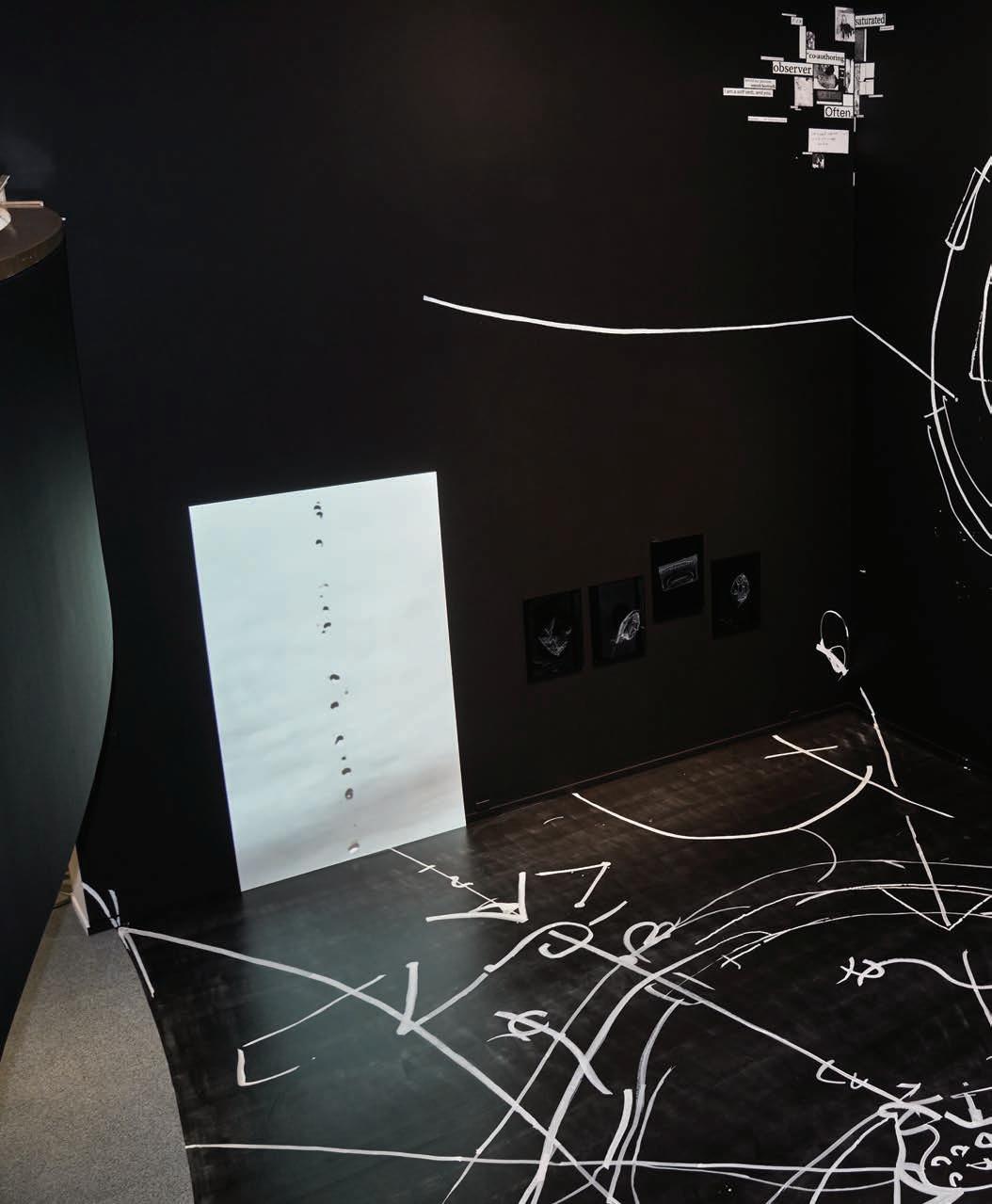
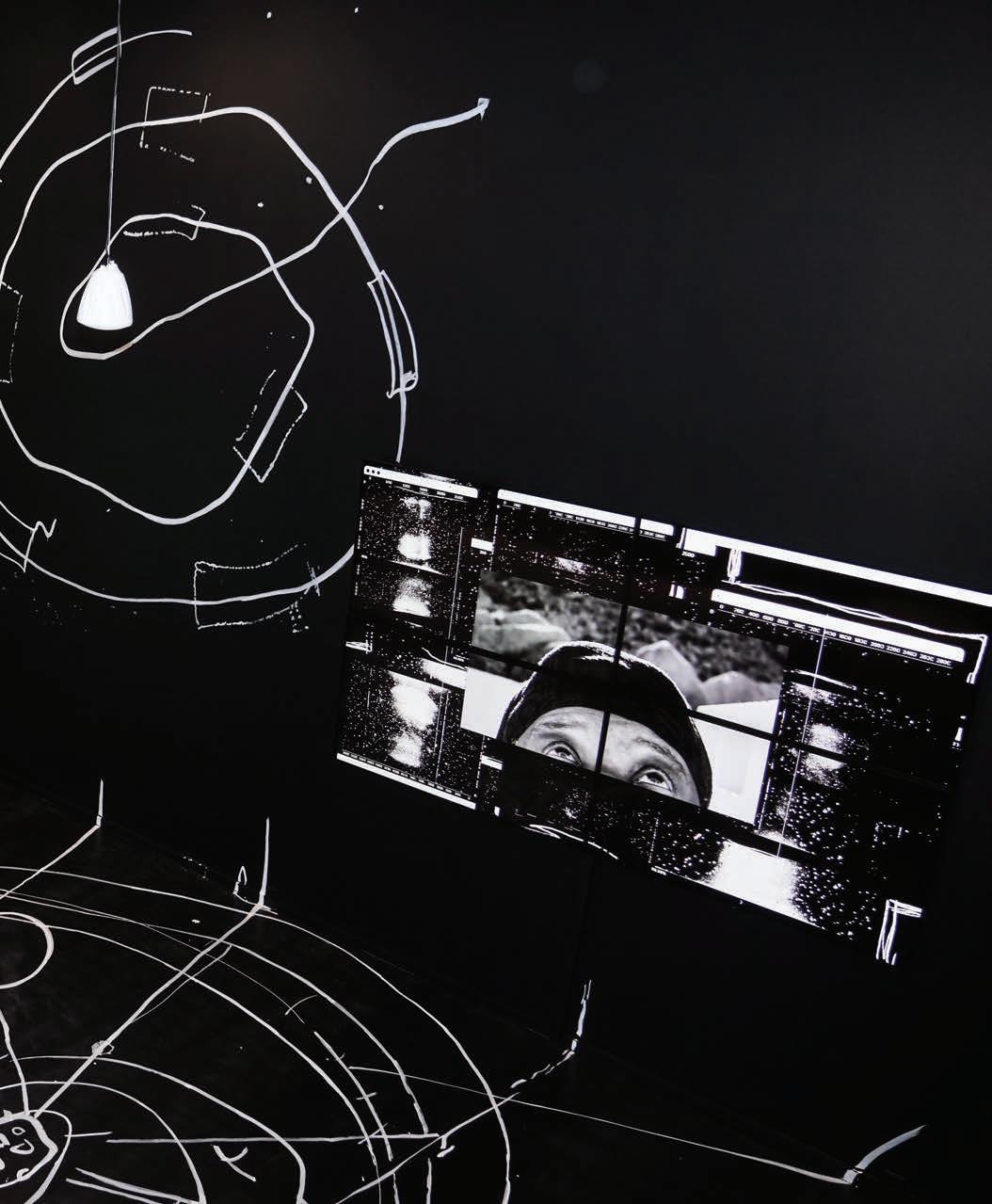
Rasheed’s site-responsive installation at the Henry draws from physics and information theory, engaging compression as a metaphor to question forces that attempt to reduce and constrain. Compression is a common process in data storage, spatial organization, and information systems that collapses complex ideas and entities into more simplified or condensed forms. Rasheed resists this reductive process. Drawing from a lineage of feminist and Black poetics and critical thought, she instead proposes what she calls “an embrace of Black excess and expansion.” This is a liberatory practice that challenges structures that attempt to restrictively define both ideas and people.
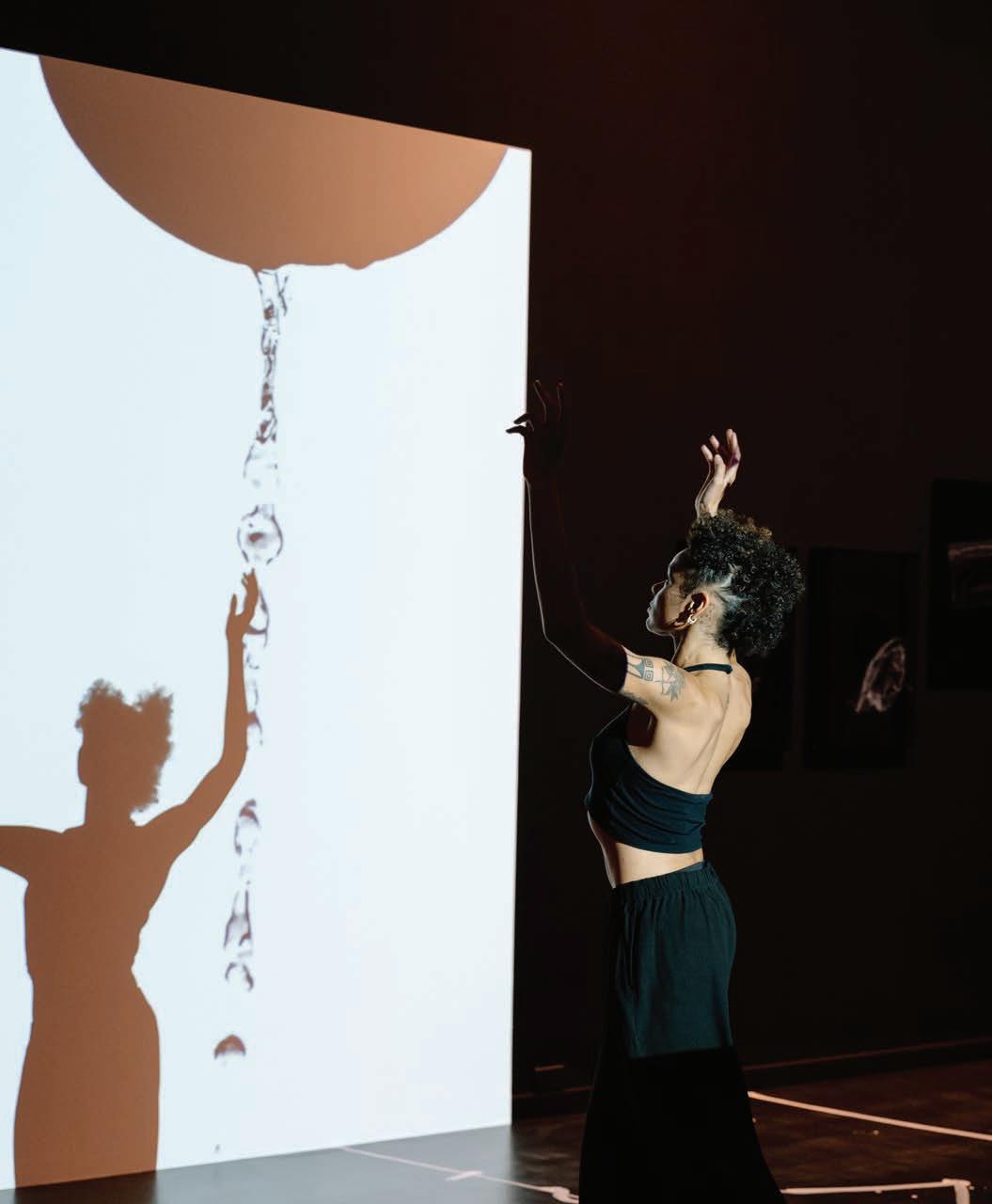
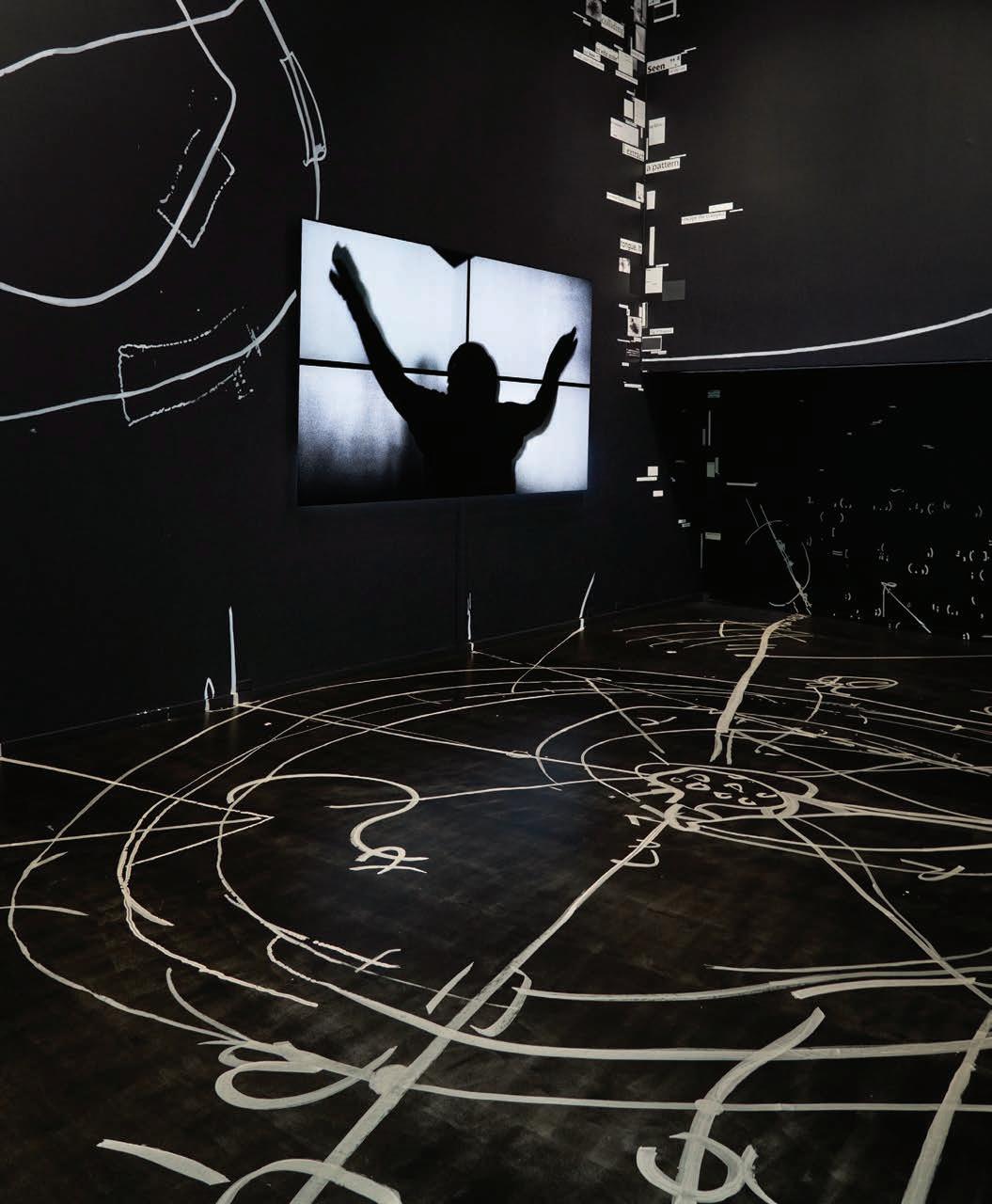
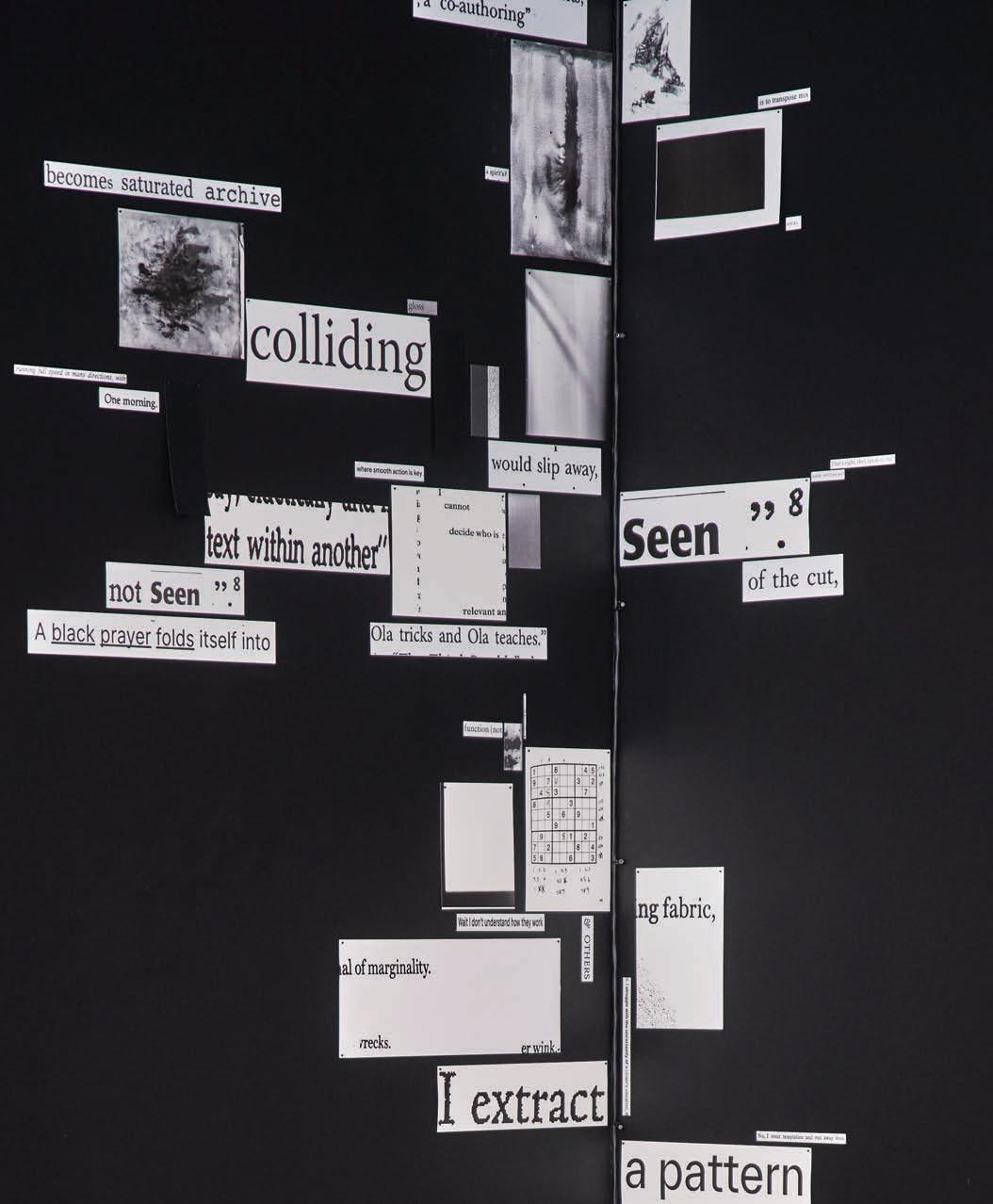
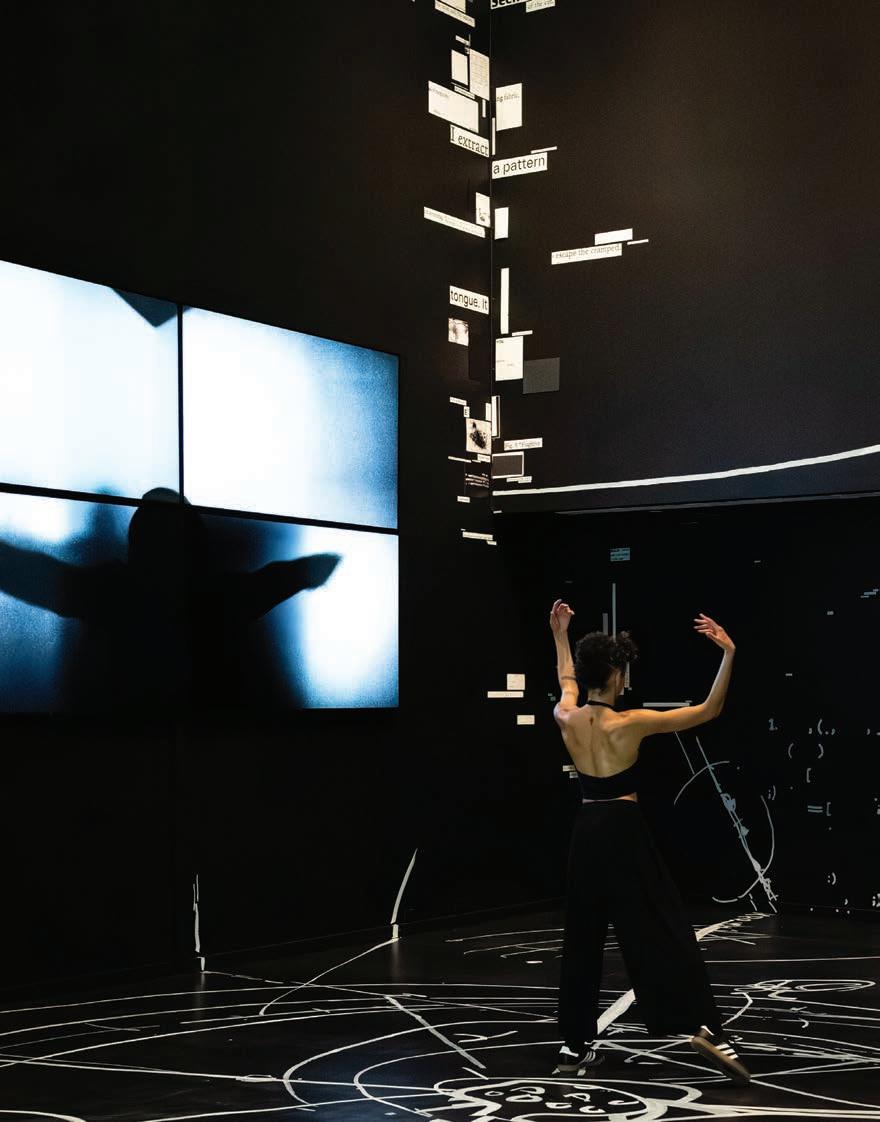
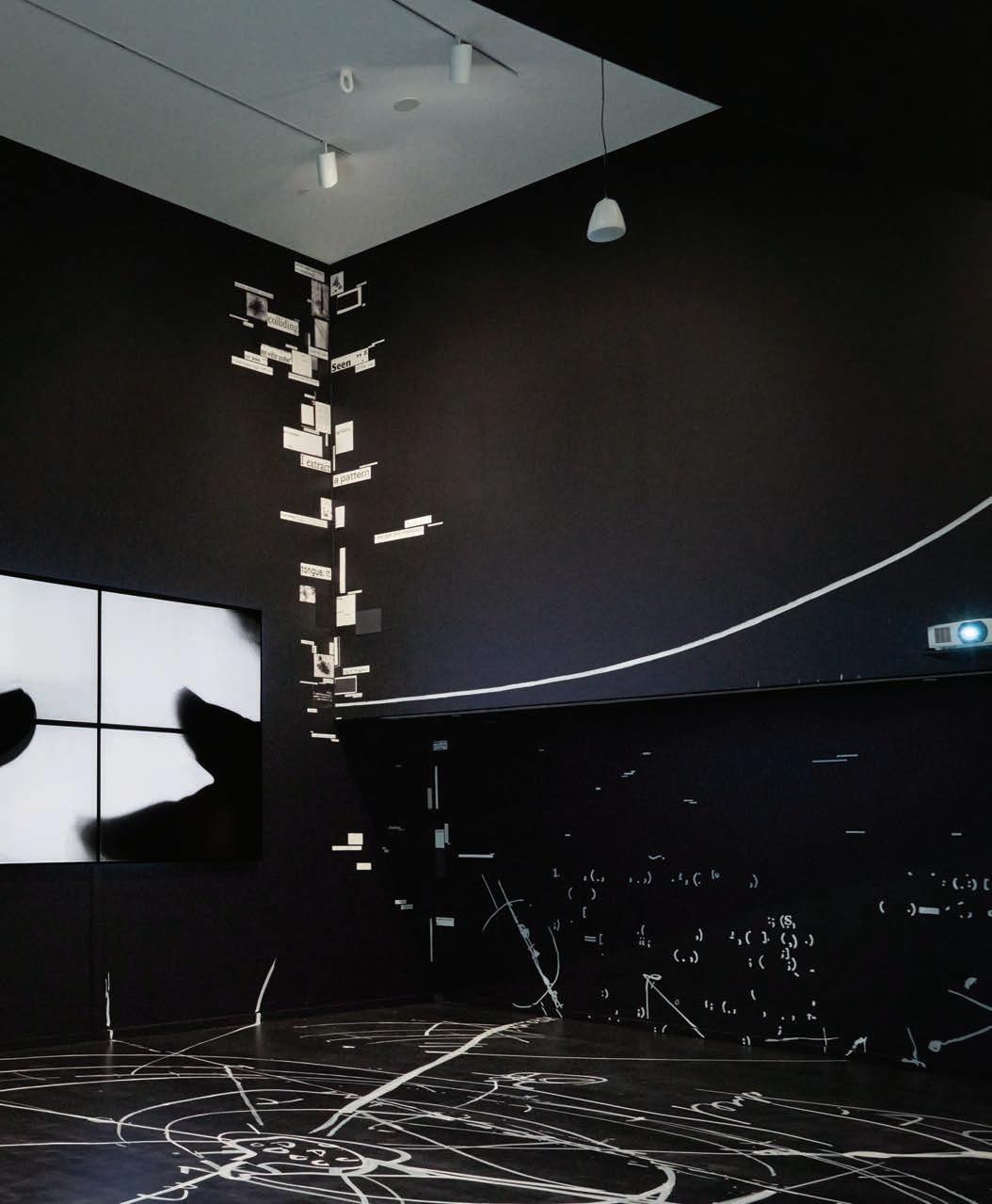
Rasheed’s immersive environment is a spatial manifestation of evading constraint through expansion, with words and marks pressing upon the boundaries of the gallery walls and exceeding the edges of the frame. In video, sound, photography, text collage, and architectural mark-making, Rasheed experiments further with fluidity and liquidity as a means of resisting containment. Liquid is present as both a material and a condition, characterized by shifting forms that evoke a continual process of becoming. These marks and interventions in the space function as speculative escape routes that reimagine imposed limitations as thresholds of possibility.
This exhibition builds from Rasheed’s visit to the University of Washington for a week-long residency organized by the Henry in 2023. we leak, we exceed mirrors processes of layering and accrual that Rasheed observed across scientific labs and geological fieldwork during her exchanges with faculty and graduate students. These visual and formal effects organize information anew to reveal different ways of seeing, signaling the potential of traversing disciplinary boundaries to generate new ways of thinking.
—Nina Bozicnik, senior curator
The writing in the pages to come is saturated by something other than writing, something in excess of the page: voice. Over the course of a few weeks, Kameelah and I developed a long voice memo exchange over iMessage, aiming to inflect our mutual love of language with a vibrational frequency, an embodied life, an acoustic thickness of air. Of course, we wanted the form of the project to feel commensurate with the theoretical schema of the exhibition: voices are containers of language, but they are leaky containers at that, exorbitant with presence and corporeality, with the live touch of a music, the tremor of the throat and the vocal chords, a heft and texture that exceeds what a page can hold. Voice is spillage.
It began when Kameelah sent me a textual “substrate” from which to launch our conversation, a sort of ground for a language to crawl inside. “Substrate” because geology has been quite alive in both of our minds recently (we’ve both visited and become obsessed with Cappadocia, a region in central Turkey known for its ancient “fairy chimneys,” pillarlike rock formations which are the residuum of volcanic eruptions in Central Anatolia millions of years ago). And we’ve both been thinking about sedimentary rock as a kind of metaphor for language: layered, weathered, seemingly sclerotic but always in quiet metamorphosis. We wanted to crouch down, to press our ear against the smoothness of stone, and crack open its voice.
For the most part, what you’ll read here is the transcription of our dialogue, edited down to accommodate spatial constraints. We collected these transcripts in a vast Google Doc, which became a sort of ecosystem of thought; growing, alive, entangled. We embellished the doc with screenshots of our text conversations over the past year or so, plus
screenshots from the various books and other textual objects that we refer to in our voice memos.
The margins of the Google Doc exploded into another life form altogether: as we transcribed and revisited the transcriptions, both of us began using the comment function in Google Docs to annotate each other’s remarks (these are represented as footnotes). And so our thinking kept unfurling into more and more pages, more margins, more magnitude. We have a taste for infinitude. And we like to speak, to write, to think, to give infinitude a kind of skin made of language. How and where to end?
As we met with the team at the Henry Art Gallery to think about layout, this question proliferated into a whole network of questions as we asked ourselves: How do we edit down our exchange without sacrificing the flicker of its immediacy, its realness? Where on the page do our annotations go? And what about the images? And perhaps most pressingly, how to give our voices a kind of presence on a page when they can’t actually be present on the page, when the written appearance of our exchange would necessarily involve some kind of loss of the phonic substance of the original form of our conversation?
Orality is a method, but first and foremost it is a material, a substance that writhes against its reduction for the sake of writing or writing’s methods. To write a note on our method, then, is always to reveal the confoundedness of this method, the ongoingness of its question. To write towards or within our method, I think, is to exceed method.
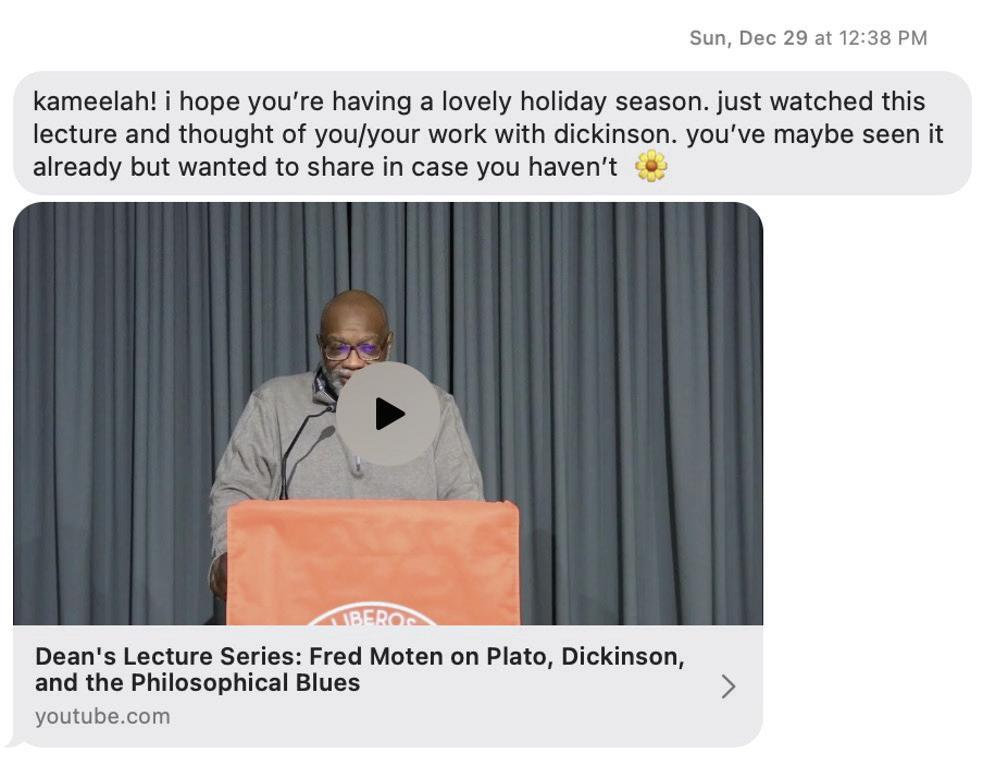
I have been deep in Karen Barad these past few months and ur text also made me think about how she reads particle diffraction… the particle that becomes a wave… feels like another gesture by which the universe insists on its magnitude and excess and expanse!
YESSSSSS!!!!!!
Thank you so much, Zoe. Sometimes, I am very much in my head and do not think anyone cares about anti-blackness + physics
WEDNESDAY, APRIL 2, 2025 AT 5:27 PM
Thank you, always! For returning me to clarity around why we do this work
THURSDAY, MAY 15, 2025 AT 1:01 PM
i was thinking a lot about erosion in my chapter in your work, was looking at "to chew a wad of lapped meaning" alongside "eat me/we are gorged with language" (though mostly using the words effacement and decreation—after anne carson)
This is a research side quest that I need to attend to more urgently—language and consumption and spiritual rituals that attend to language as material to be consumed for actual comprehension
THURSDAY, MAY 15, 2025 AT 3:08 PM
Islamic schools in west af is where students wash off the Quran script and drink the liquid or even communion. Or this German practice of eating stamps with the face of saints.
TUESDAY, JULY 8, 2025 AT 1:04 PM
It was a paradigm shifting trip for sure… so layered with palimpsests of history
How was turkey!?!?!
YESSSSSS IT IS A COUNTRY LARGE PALIMPSESTS AND CORE SAMPLE
WEDNESDAY, JULY 9, 2025 AT 8:09 AM
Good morning Kameelah! Thank you for your voice memo—so grateful to hear you craft this thorough exegesis and to hear the sound of the birds! Oof wish I could've cosplayed as a Yale student and taken that course… love Lispector as you know and love the questions you are opening up through that line in Agua Viva. Thanks for pointing me towards Freedom Time—haven't yet read it and you're the second person to remind me to do so in one day!
WEDNESDAY, JULY 9, 2025 AT 11:51 AM
We should talk about the core samples :) I've been talking about revision and drafting in terms of core samples.
MONDAY, AUGUST 25, 2025 AT 4:32 PM
i wanna talk about this with you!!!
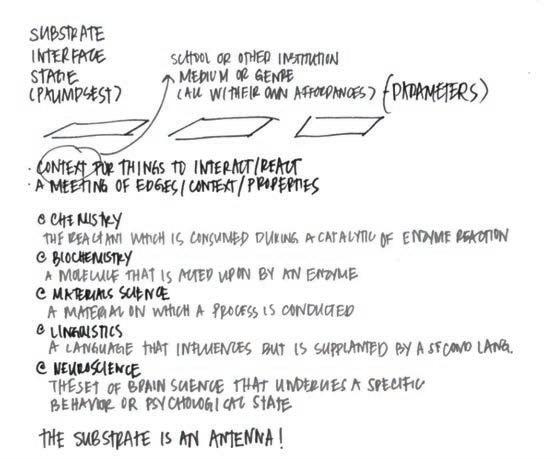
Kameelah Janan Rasheed: Dear dear Zoë, upon reviewing our text messages, I realized that we often leave a lot of loose ends and tangents. Our messages are short bursts of ideas, then we retreat before resurfacing for air. And I like it that way. There is anticipation—walking in and out of thoughts—returning somewhat on the mark or a tangent of an incomplete thought. As I stumble to figure out where we left off, I find myself thinking about the afterimage of our conversations. (While teaching with Chang Yuchen in Montpellier for the past summers, I (mis)remember her referring to the afterimage of our discussions, and that language feels fitting, so I borrow it here.) I return not to what we were speaking about, but the feeling. And the feeling is always one of spilling—that there is something to be said that we almost convey in messages, that maybe will get through with a voicenote, but doesn't.
We employ various modes of articulation in the hope that this diverse approach functions as a sort of insurance: what one method can’t hold, we hope another can. And here we are trying yet another method—a collage of text messages and non-linear responses. I am an optimist, but also deeply invested in non-capture—at least in written form. Some things will always be occulted. The pursuit of clarity is rooted in a belief that once we have clarity and perfect articulation, something will happen. I must admit, I am a bit afraid of that something because that something feels like the end of living. Living for me is a pursuit of disorientation, not a capture of certainty or final form. Maybe I have been reading too much of Catherine Malabou’s work! Whenever I feel too sure, I grow frightened, maybe suspicious. It is a sensation I cannot fully explain, and I guess that is why we are here. I wrote to you that this preliminary assemblage of messages was our substrate. I chose the word substrate intentionally. A substrate is a stage, a space of potential, a site of imminence. See my notes [to the right]. These were written on August 23 in the Delta Skylounge, while I was stranded in Seattle, Washington, following the show's installation.
Zoë Hopkins: Kameelah, hello. First, I want to apologize for taking so long to get back to you and thank you for your patience and for bearing with me. I'm voicememoing you after luxuriating in the substrate document that you shared with me, and in our old messages. It was a pleasure to review the memories we’ve written together, and to think about the efflorescence [1] of this friendship, the various catalysts that have brought it to bear on my heart.
KJR: I am unsure if you said efflorescence (the appearance of a white or grayish deposit of salts on the surface of porous materials like brick, concrete, and stone) or effervescence (the escape of gas from an aqueous solution and the foaming or fizzing that results from that release). I learned from Wikipedia that the word effervescence is derived from the Latin verb fervere ("to boil") and shares the same linguistic root as fermentation. I am intrigued by both directions! A budding friendship between two very porous people; our exchanges bring one another’s salty water to the surface—the wetness and liquidity of our exchanges evaporate, but a salty coating is left behind as a reminder that something occurred. (And)/Or a
budding relationship that buzzes and fizzes.
ZH: I think I said efflorescence… in part because it has to do with geological questions of substrates/ surfaces, or the precipitation of something onto a surface. But also because, as you mentioned, the phonetic hems of that word are always trimmed with a kind of multivalence, with/through other words (like effervescence, reflorescence, flourish, essence). Reflorescence refers to a renewed blossoming of flowers… it’s beautiful to think a kinship between salt and flowers; between the sharp, cutting taste of, lets say, salty tears deposited on the cheek—and the softness like a budding/blossoming of something (which also suggests

the effervescence of water boiling; both blossoming and boiling are state changes, matter passing from one expression of life to another).
Friendship is like this too: the inscription of the state change that follows from intimacy, from translating yourself in and through love/a loved one, the way that salty water translates itself into crystals, which are then transcribed/inscribed on a surface/substrate. Salt and water, in their efflorescent, effervescent, reflorescent tendencies, are lessons in depth migrating to a surface, or depth/ surface playing together to undermine any differentiation between the two, just as friendship blurs the distinctions between you/me, yours/mine.
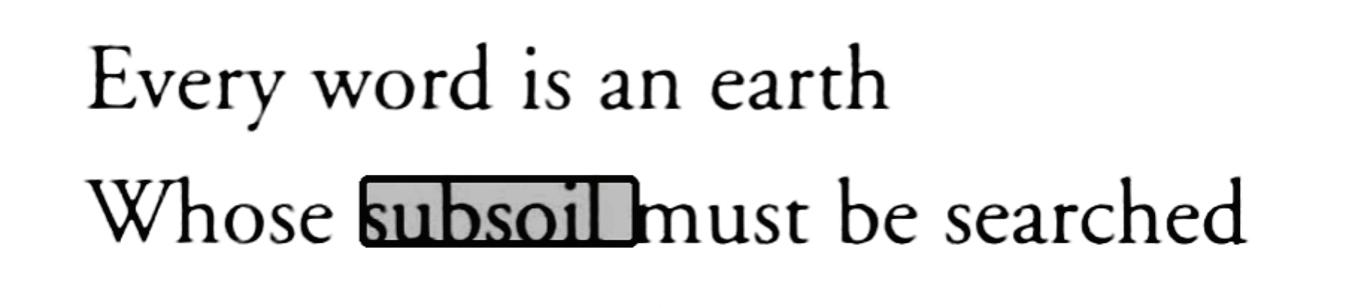
ZH: I'm going to break this up into a few voice memos, because I tend to get kind of carried away [2] . I wanted to begin with the matter of substrates and rocks, which we spoke a bit about over the summer, and you brought up one of my favorite Glissant quotes:
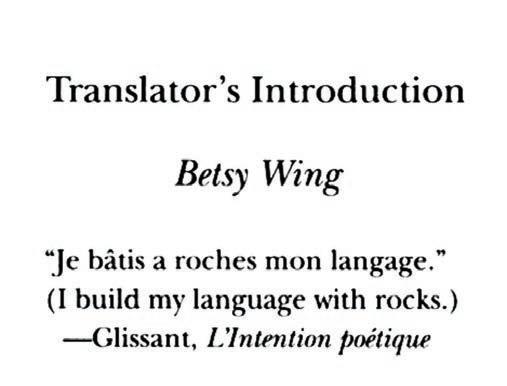
to which I replied with one of my other favorite Glissant quotes:
[2] carried away // 23 SEPTEMBER 2025
KJR: The language of being “carried away” is exciting to me because it is anticipatory—and I have the pleasure of holding this fuzzy energy of waiting for something unpredictable to come forth. It reminds me of Walter Benjamin’s articulation of translation as going off on a tangent. A tangent is about carrying away from the original point. Much like escape orbits, or the velocity necessary for an object to escape the gravitational pull of another. Saidiya Hartman’s waywardness also offers something to this expansion and celebration of being “carried away.” There is something here about a defiance of prescribed pathways. And there is Glissant’s errantry. I am reminded of a note from Betsy Wing’s translation of Poetics of Relation where she says something like he does not mean errantry as aimlessness, but as a wandering animated by a “sacred motivation.” So, please always get carried away. I often tell (and beg) my students to go off on a tangent/get carried away because something happens through, with, and because of this detour, this disobedience.
[3] refuses to remain at the surface // 23 SEPTEMBER 2025
KJR: I am curious about the surface as a non-trivial space. There is a book I have been meaning to read about the intimacy of paper (The Intimacy of Paper in Early and Nineteenth-Century American Literature by Jonathan Senchyne) and considering the surface as a generative site. While this text is focused on American literature, I can’t help but think about sacred writing and mark-making. The introduction of the text tells us that paper served as a “mute vehicle.” Amulets, as I understand them from a bit of what I read in Matthew Francis Rarey’s Insignificant Things, were written on specific substrates because the material is agentive and necessary, not convenient. I often use 'substrate' and 'surface' interchangeably.
Returning to my self of 30 minutes ago, I have to revise my previous comment. Actually, not a revision, but an articulation of how conflating these terms means something more than me not grasping the difference.
A surface is a boundary; the substrate is the whole, active, agentive thing. This slip-up is generative, at least for me. Perhaps I should consider not remaining at the boundary of an idea or methodology, but rather, I should embrace transgression as a form of responsibility amidst the “sacred motivations” that influence our wandering. The study (study in the Moten sense, “things you do with other people”) must be rooted in a certain non-compliance with the expectation to stay at the surface, as you say later of Chandler’s essay.
I think it is precisely what we've been engaging in, this searching, archaeological searching for each other's depths through language, engaging in a language that refuses to remain at the surface [3] or that kind of overturns its own soil in its incessant movement of searching and aeration, descent and ascent.
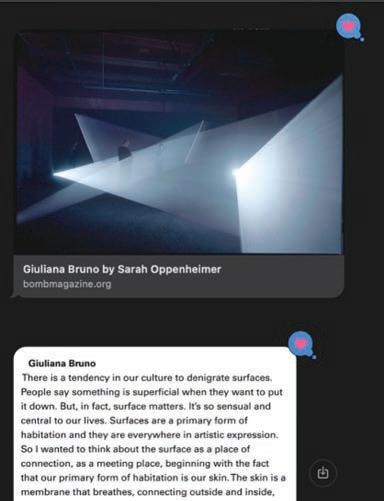
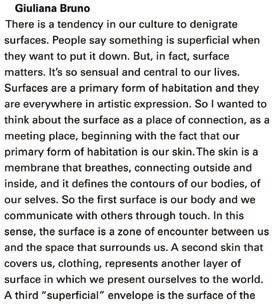
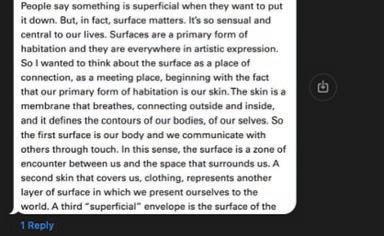
ZH (cont): I really appreciate the way that our conversations evoke such a movement between a kind of depth and then a surfacing for air, which is needed [4] .
I’ve also been reading a lot of Paul Celan these days, and one of his poems begins:
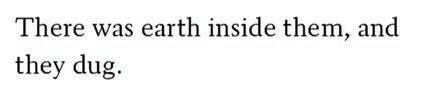
I'm
thinking about language as earths and subsoils [5] rich with metaphysics and aesthetics and all the things.
[4] a movement between a kind of depth and then a surfacing for air, which is needed.
// 23 SEPTEMBER 2025
KJR: It feels like a ritual with its own rhythm—one that was never prescribed, but just developed that way. There seems to be a recognition of our shared entanglement with the ideas we explore and the need for reprieve, even from ourselves!
[5] subsoils
// 23 SEPTEMBER 2025
KJR: Listening to the first seven minutes takes me more than an hour because I keep stopping to research ideas or phrases you have shared. And now, an episodic obsession with subsoil has developed. Wikipedia, again, tells me that the subsoil is the depth where these weathering products accumulate, and the subsoil is the depth of most deposition. Further, I learned that deposition is a geological process in which eroded materials— such as rock fragments or clay—drop and settle. The animating force, or the vehicle these eroded materials hitch a ride on, are natural agents like water, wind, or ice. Furthermore, as eroded materials accumulate in a new area, deposition can form new landforms. Language can travel. Language can form new landforms.
I’m also thinking of Deleuze and Guattari’s chapter in A Thousand Plateaus called “On The Geology of Morals,” where they speak about strata and sub-strata.
Hang on, hang on, hang on. I'm getting my notes, because I'm going to get all confused about the terminology, but they speak of, they speak of
Substrata give rise to this kind of catalytic movement, or shift, in the way the Earth moves; it's the thing that sits and stirs beneath the surface that brings to bear specific movements and tremors, making the Earth our co-conspirator and our rebel-in-chief.
I shared with you that Nahum Chandler's essay on exorbitance was a fucking mouthful [6]. But I hope it is helpful in some ways. He also writes an essay on the question of desedimentation.
[6] a fucking mouthful // 23 SEPTEMBER 2025
KJR: I was using another voice note tool as an add-on to Google Docs and then it broke. Or maybe, I broke it. I'm resharing this message, which feels odd to me but also exciting, because I have to, after rehearsing or saying the thing, then repeat it on a second run. Anyway, now I'm using a different add-on because I talked my head off and it didn't upload the file. Something got lost in the ether there.
Coming back to this question being a fucking mouthful because it echoes questions I have about excess and compression. This is an idea the show [at the Henry] approaches. And I am interested in how one’s personal and spiritual life is inflected by gestures of excess and compression…
When reading the Chandler essay, I laughed because each sentence felt like a compressed data file. In this way, my responsibilty or invitation as the reader was to decompress this sentence. My decompression methodology was annotation: unfurling sentences, phrases, and allusions. This was written language, but there was also an oral unfolding. In considering these poetics of the oral utterance, I re-encountered what I have often known which is that the voice, the vibration through material, does something different from marking on paper. Not better or worse, but different, and desireable under varying circumstances.
I am reminded of an adjacent idea I hitched to some of Fred Moten’s writing: I compared his sentences to springs, like, literal springs in physics. Springs as in they hold potential energy and maybe us as readers are invited to release the force to release this energy. In this consideration of Chandler’s sentences as compressed data files and Fred Moten’s writing as compressed springs, there is the ardent embrace of language as matter. Even more, there is a responsive reading practice, a specific one, in order to access these texts.
If or because language is matter, then what does that mean for the way that we talk about what language is doing? How might we talk about the personality of a sentence, its interiority? That we can create a physical description of a sentence: long and tall with trailing letters.
ZH (cont): Sorry, I'm getting some water.
Or on desedimenting the subject, the kind of discursive subject of Western modernity who stands as a kind of archetype of metaphysical substance and solidity, like what is required to kind of dig that subject out of place and thus expose the entire order [7] of the mastery that encases it?
On a realer and, like, less theory level, I've been working on a project with one of my best friends that began with the phrase "you are my rock," which, you know, we think of as, like, super cliché and whatever, but it's super real, and there’s something in geology that teaches us a lot about love’s first degree. And so when I think of the word substrate, I think of the love that guides me in the world and grounds me in the world and makes it possible for me to place my feet on the Earth every day with a kind of certainty that I will be held with steadfast trust [8].
[7] kind of dig that subject out of place and thus expose the entire order // 23 SEPTEMBER 2025
KJR: We know Glissant was intentional with his language. And, of course, he chose subsoil rather than topsoil for a reason. Taking up Glissant’s challenge in this poem—when we search the subsoil, we are searching the stratum that develops in response to erosion (rubbing, an intimacy—something like Roland Barthes and rubbing language; friction—I once wrote on a sheet of paper: “rub a word to see what leaks out" and migration (maybe he is being self-reflexive and speaking back to his ideas about errantry?).
Possibly the subsoil of the word are the non-local/native (this is problematic framing but this is all
the language I have to talk about language!) fragments (inflections, connotations, denotations, usage, etc.) carried by a variety of events (colonization, enslavement, etc.)
Topsoil on the other hand is the upper layer of soil and has the highest concentration of organic matter making it the site of a majority of the biological soil activity. Perhaps a word’s topsoil is the most active and variable layer, where linguistic matter is activated as it is used in everyday life in variable and sometimes unexpected ways. So perhaps Glissant is inviting us not just to explore its contemporary uses, but to undertake deeper lineage work to discover the capacity of a word, its history.
In this way, when we explore one another’s subsoils, we are invested in exploring one another’s epistemological migrations and the series of contact points. In this way, if someone were to take a core sample of our conversations, one might find a messy layer of emerging and confabulated ideas as well as some sort of narrative of how we got there. Maybe I took a circuitous route here, but I could not help myself.
Yeah. Anyways, I'm going to send you another voice memo, believe it or not, because I want to also reflect on this mode of communication of voice memos. Okay, give me one second.
ZH: KJ, Okay, we're back. I wanted to send a second voice memo, just thinking about, like, at a meta level, why I'm so happy that you were down to do voice memo exchanges as part of this adventure that we're embarking on together.
The first thing that I think is wonderful about voice memos, or at least the way that they're designed, like for Apple, is that you listen to the voice memo, and then you have, like, a minute or so to decide whether you want to keep it and to press the button, to press the save button. And I mean, I've definitely fucked up a lot of times and forgotten to save something. Still, I actually think there's something really delightful in that, in the sense that there's just this like, okay, I send my voice out into the ether, and there's no archival promise accompanying it. It’s different than texts or emails or whatever.
[8] substrate, I think of the love that guides me in the world and grounds me in the world and makes it possible for me to place my feet on the Earth every day with a kind of certainty that I will be held with steadfast trust // 23 SEPTEMBER 2025
KJR: The substrate as stage! The stage, or the zone of possibility that holds up your world, is love. I think we could expand this to think about substrates/zones of possibility that are foisted upon us. Your substrate is the love that guides you through the world. What might be my substrate? Maybe this is really a question of what the community is that makes you and what you put into the world possible?
KJR: I was having trouble with auditory processing, so I got a transcript from Otter.AI to read along with as I listen. I was also very curious about mistranscription in this process and what can and cannot be captured by AI-based services. This summer, while Chang Yuchen and I taught in Montpellier, FR, I used Otter for the first time. Chang Yuchen and I often joke about our English language abilities—she says she has a limited vocabulary, and I note how I mispronounce so many words. While using Otter, I was so excited to see how it gathered our speech— Chang Yuchen, a native Chinese language speaker who learned English through her engagement with academic texts and me, a “native” English speaker whose residual speech impediment in elementary school alongside my feverish, high-paced speaking could present interesting challenges as the “machine” attempted to keep up with us. Undoubtedly, there were errors. But I like errors. It is something like OuLiPo, where the nonsensical output from an algorithmic process yields something we did not even think we needed. Chang Yuchen once remarked that listening to me speak feels like a tornado. I think that was the weather event she was referring to. I am misremembering the exact words, but the spirit of what she said was clear: chaos amidst unstable atmosphere. I like thinking of myself as an unstable atmosphere—or at least my language presentation: sudden, unpredictable air movements and disorder.
I am writing to you from a plane heading back to New York. I decided to listen on the plane, because I find that I process and write “better” (or more expansively) when I am literally moving—a plane, on a train, walking. Something about being ambulatory or in motion evokes a certain feeling for me. I don't have words for this, but I hold this self-revelation very closely. Also, I am writing as if you were receiving each letter as soon as it appears on the screen. While I know that is not the case, I can’t help but feel like writing only feels good when I imagine each word finding its way to the reader with some sort of immediacy.
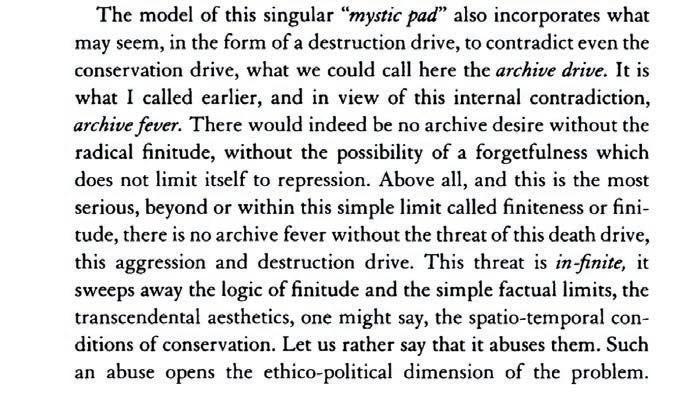
ZH: An Interjection – I want to make a quick interjection after reading this and listening to your voice memo. The technology of the voice memo reminds me in some way of Freud’s essay “A Note Upon the ‘Mystic Writing Pad,’" where he describes a device that is capable of instantly erasing anything written upon its surface. I think of this as language going back into itself… evacuating the world to return to some vast [9], unmarked space of pre-articulation. But (in a kind of Ashon Crawley way) I’m interested in thinking of this erasure/ unmarking/void—this return of the return of language to the kind of absence which frees it from the logocentric privileging of presence [10]—as a kind of excess rather than as solely negativity… or in that “lack worth having” to use Pope.L’s words.
[9] evacuating the world to return to some vast // 30 SEPTEMBER 2025
KJR: The immediate image that comes to mind is a sentence eating itself—maybe ouroboros?
[10] frees it from the logocentric privileging of presence
// 30 SEPTEMBER 2025
KJR: I am thinking about writing drafts before word processors. And how word processors even with the track changes/version history still hide the livity of language. We could look across many drafts—side by side. Now we just have the "final" version.
While trying to craft an artist statement, I wrote: I examine the materiality of wayward language—acrobatic (Clarice Lispector) sentences with trapdoors (Fred Moten), runaway syllables that scatter to the marooned edges of a page, words that escape the orbit of their mother sentence, footnotes that consume their reference, and
utterances that dissipate before being recorded.
This reminds me of vaporous language—language that is such diffused matter suspended in the air that our sightlines are occluded—the horizon becomes a blur rather than a fixed line.
I googled "how to capture vapor," and the methods offered feel like descriptions of the writing process:
1) condensation: cooling the vapor below its dew point until it becomes a liquid (something of definite volume but not definite shape).
2) Use of mesh: vapor passes through the mesh and begins condensation. Water droplets are caught on the mesh fibers.
3) Use of desiccant: hygroscopic (the phenomenon of attracting and holding water molecules) substances that attract and absorb moisture from the surrounding air to maintain a state of dryness.
4) and suspension—language suspended between written articulation and orality.
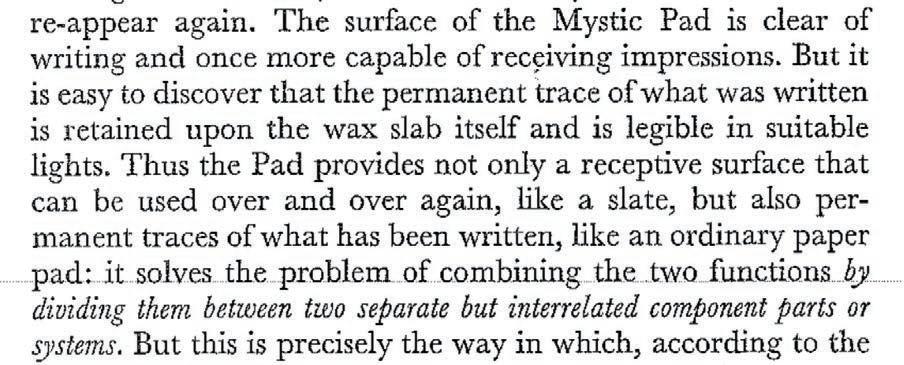
Freud, “A Note Upon the ‘Mystic Writing Pad’”
Derrida in response to Freud’s ‘Mystic Writing Pad’ in Archive Fever: A Freudian Investigation.
ZH: And it is precisely in that kind of spark of ephemerality that I locate the beauty of this form of communication. There’s something really tender in just sitting with the presence of somebody's voice, letting it wash over you and [11] then setting it adrift into a space that is beyond your control, although I do also like saving voice memos. And then there’s the obvious immediacy of voice-to-voice contact.
[11] really tender in just sitting with the presence of somebody's voice, letting it wash over you and // 25 SEPTEMBER 2025
KJR: Only recently, I started to think more about orality because there are these moments when, and this moment, in a very meta way, this is the moment I'm talking about, where I'm writing something and I want respond but I cannot type or write fast enough before I lose the words. I'm writing something, but at that moment, typing out or writing out letters won't be sufficient; I need to speak. I need to use my voice. I need to be able to hear myself aloud, as I buffer and do live sense-making. The process of writing can quickly consolidate or discipline your thoughts because they have to fit in a certain format. All
formats have constraints but when speaking, I do not feel the same behavioral constraints. I can speak in run on sentences. I can use inflection and intonation in ways that I cannot necessarily do in writing. And so I think that this note you have here about the voice notes operating in this very particular way feels important to me because I am also thinking about the literal vibration: to hear the ums and the ifs and all of those things, to hear you editorialize and say, “one second, I have to get a cup of water.” All of those things are like offstage commentary and build up this auditory landscape. There is this feeling of someone's
voice washing over you. Maybe I enjoy orality because it does provide a space of uncertainty or unexpected glitches, and that the desire for precision isn't there. You can backtrack. You can overspeak. You can underspeak. You can do all of these things that, if we were to do it in writing, would seem undisciplined. Or if we were to do it in writing, we would have to develop a new system to organize that process. But when I speak, the physics of where my words emerge feels broader. Like, I have a larger compositional field when I speak than when I type.
I love that Roland Barthes essay, The Grain of the Voice, where he describes “grain” as a certain musical sonority emerging from the embodied phenomenon of the voice. For him, the grain opens up a whole other register of signification and meaning that is distinct from the pure meaning of words. The grain allows for the voice to move underneath the surface of language, animating a whole other code of meaning[12]. This is part of what I appreciate about voice memos: they open onto polyphony and polyvalence of meaning, rather than being limited to the meaning that is expressed in the word alone or in the written sign.
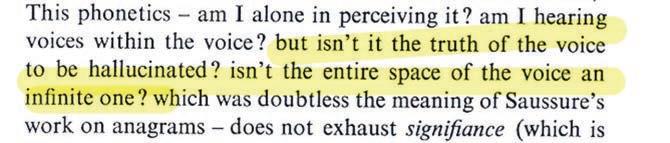
And there's one other thing Barthes says in that essay, he asked, as he says,
ZH: An Interjection –
Let a rough striation mark the putatively smooth surface of discourse. Let us exalt the texture of the meaning as much as we exalt the meaning of the text. Let no glottic vibration go unnoticed.
What is the relationship between the grain of the voice and the friction of language (à la Wittgenstein) and the texture of Glissant’s linguistic subsoil? If I were to take an image of the grain of my voice, how would it appear (or does attempting to arrest orality in the visual defeat Barthes’s insistence on excess/infinitude)? What are the frictions inherent to my language that give my voice its grain? Where in the soil of my voice do I dig for my words? What would this soil feel like if I could hold it in my hands?
ZH: “Isn't the space of the voice an infinite one?” Barthes asks. I think this makes much possible for the kind of conversations that we've been having about mysticism and occultism, which are oriented towards a kind of delight [13] and sacred commitment to something that expands [14] beyond the contingencies of the finite, particularly when it comes to language.
Um, yeah, I just wanted to say that I'm really glad that we're doing this. And I’m also glad that we have like, time to marinate in what the other person has said before responding. And yeah, I kind of am obsessed with that play between immediacy and time lag [15].
Um, okay, I hope that you're having a beautiful Friday somewhere where the sun is feeling close to your skin. Okay. Talk soon. Bye, Kameelah, bye.
Roland Barthes, Image, Music, Text
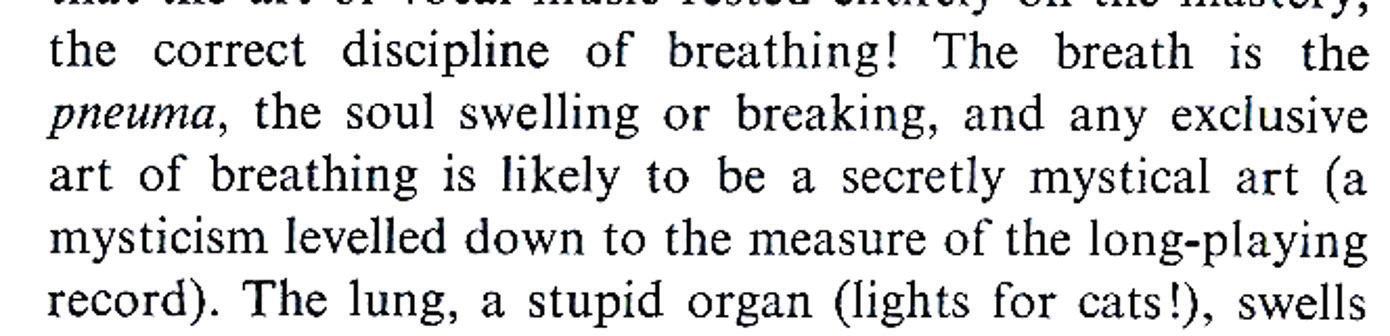
[12]the voice to move underneath the surface of language, animating a whole other code of meaning
// 25 SEPTEMBER 2025
KJR: I am imagining a thin sheet of vibrating paper slipping beneath each syllable. When you say that the voice is moving underneath the surface of language it establishes language as an object we can hold. I'm thinking about a sentence on a substrate somewhere and that someone is speaking and you see these sort of, like, gas bubbles sort of percolate underneath that sentence and seep into the spaces in between the sentences and just have a whole sort of, life. I hope that makes sense. I feel like I sometimes live in my own head. And then when I say it out loud, I'm like, you have to give so much more context. But maybe the context I am searching for is Moten’s question of whether there is an “underground railroad in this sentence.”
[13] a kind of delight
// 25 SEPTEMBER 2025
KJR: I am thinking about mysticism and the occult and all of these ways of of sitting on the perimeter of centralized spiritual thought or epistemological systems. Of being too much for a given system or container to hold you. The delight in that excess.
When you say delight, I think of the sacred commitment to something that defies itself, its own acknowledged limitations. This is also about pleasure. And the pleasures of confusion or disorientation. Not annoyance, but actual ecstatic sensation. There's a deep pleasure in being able to see the thing directly in front of you, but not being able to know it. I'm really curious about what other registers of pleasure and delight are possible: the pleasure of chasing something you know you can't catch. The joys of curiosity. I have been thinking about how predictive technologies have robbed us of these opportunities to be surprised, to have an epiphany, to be lost, to be confused. There's always a correct answer available for us, on demand.
[14] something that expands
// 25 SEPTEMBER 2025
KJR: Glossalalia and that phenomenon of multiple sounds being possible at once.
ZH: Multiple sounds and multiple meanings too… I'm convinced that glossolalia has a meaning even if its impossible to decode; a meaning that is not reducible to or locatable within the regime of sense-making, but meaningful nonetheless. Indeed, I think glossolalia might just be the thing that allows us to cleave a distinction between meaning and sense that frees the former from the latter.
[15] like, time to marinate in what the other person has said before responding. And yeah, I kind of am obsessed with that play between immediacy and time lag
//25 SEPTEMBER 2025
KJR: I am curious about the times before immediate communication where you wrote a letter, mailed it, and waited for a response. I wonder what it afforded us in terms of cadence and knowledge production cycles. Not the amount or type, but maybe something about the spirit of knowledge production—that it is worth it to take your time; a reward of being able to, as you say, “marinate.” When working on a project in Norway, I learned about the history of the telegraph, and of course, I went down the etymology rabbit hole. To telegraph means to talk at a distance. The ţelegraph is sort of magical in that way. Where you may have needed to be within a few feet of someone to talk to them, now a time-lagged set of your utterances can reach many countries away. The “distance” has increasingly shrunk over time to an almost instantaneous pace. So maybe this is a long way to complain about the impact of social media and other truncated, fast-paced, immediate back-and-forth rituals/protocols we engage with digitally.
ZH: Love this… makes me think also of how the graphic mark always already marks a distance between mark and referent. I'm curious to think about what lives in that space between the writing of the thing and the thing itself… to think about this distance as the presence of a breath rather than the death of the aura of the referent.
ZH (cont): There’s two things I wanna add. First, I’m interested in thinking about the connective tissue between the occult and the substrate, given that both are constituted through a certain hiddenness. The substrate is hidden beneath the strata of rock that lie above it. The occult is hidden from the faculties of rationality as we know them.
And then I wanted to say one more thing about voice memos. Your exhibition is dealing a lot with excess… aurality and orality carry a kind of Baroque excess and exorbitance that writing maybe does not and part of that is maybe related to what I was saying in my other voice memo about Barthes grain of the voice and the infinitude that is contained therein.
Zoë Hopkins is a writer, scholar, and independent art critic. She is a PhD student in English at the University of Pennsylvania, where her research focuses on experimental black poetics. Her writing on art has been published in The New Yorker, Frieze Magazine, ArtReview, Hyperallergic, and The Brooklyn Rail, in addition to several exhibition catalogs.

All works courtesy of the artist
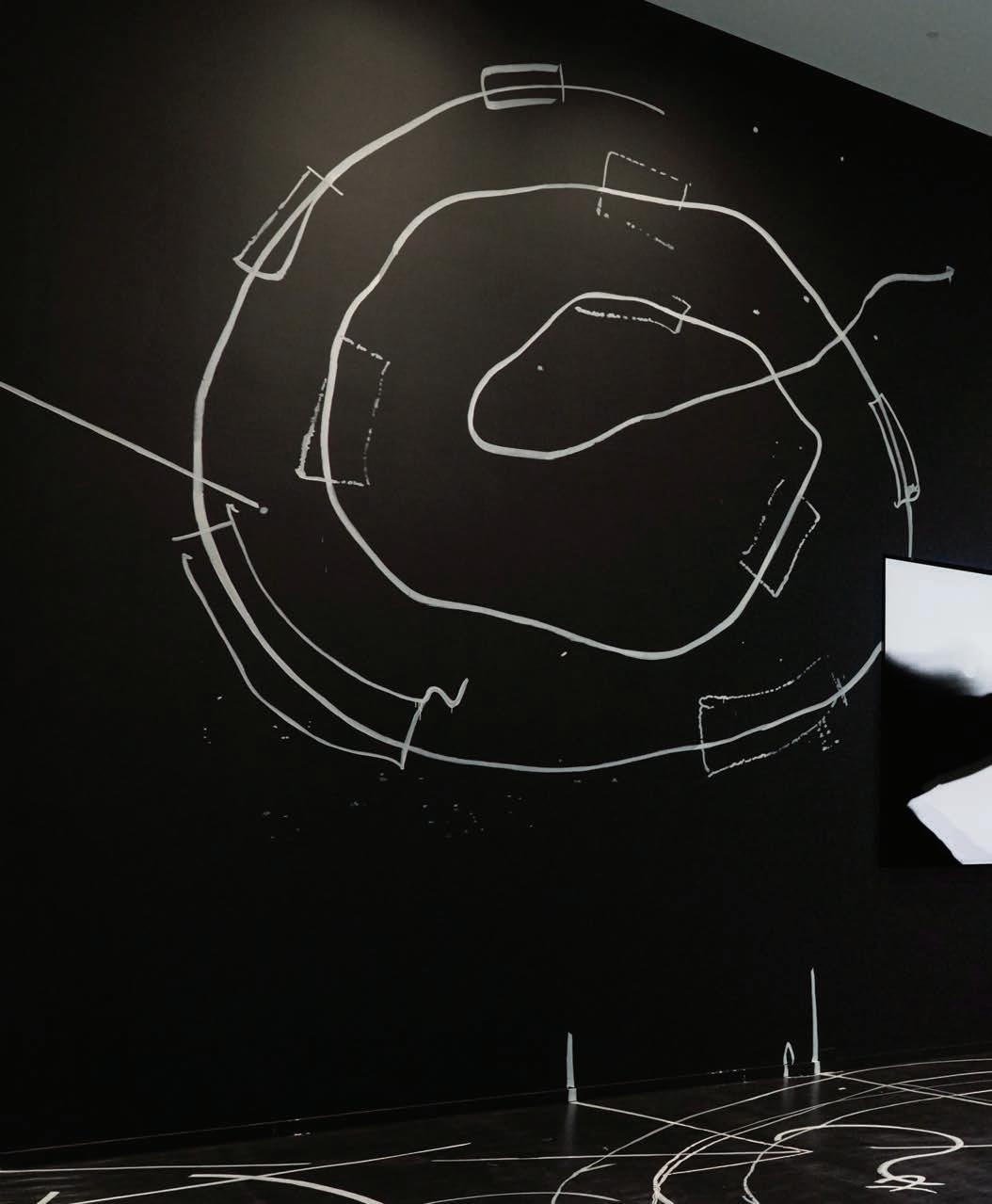
that is complete (?): score for entanglement, 2024–2025
Paint on vinyl and wall
Dimensions variable
disorganize the spirit i, 2025
Single channel video with audio; 06:15 mins; score by Th&o
wet/whet, 2025
Single channel video; 01:05 mins
* Image: 02
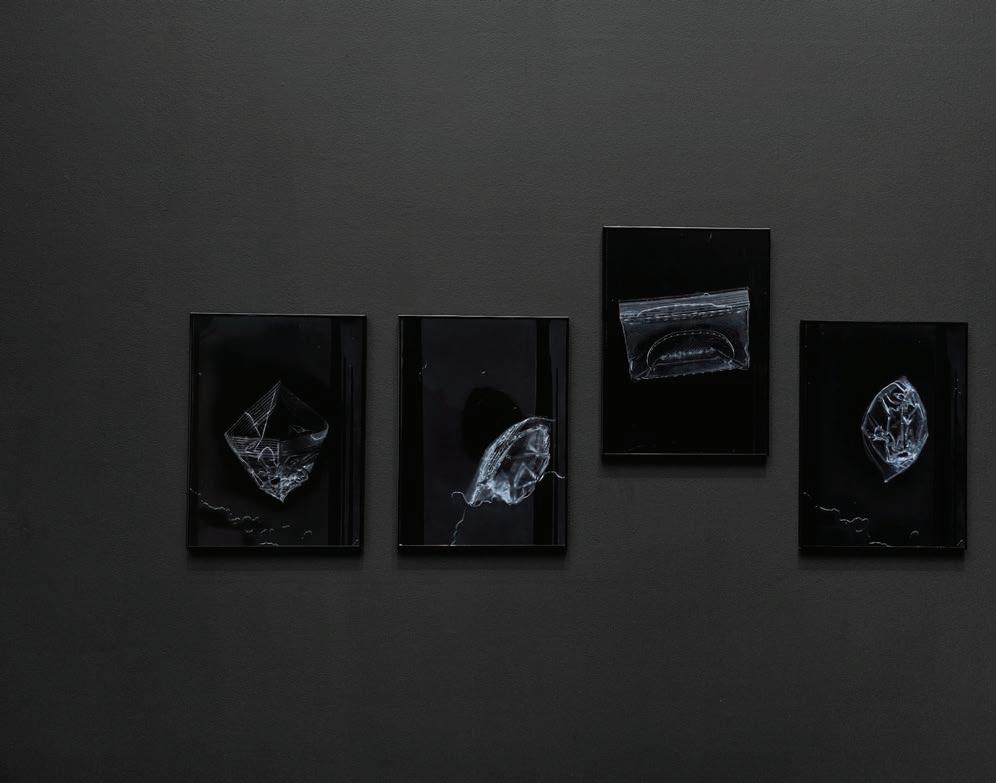
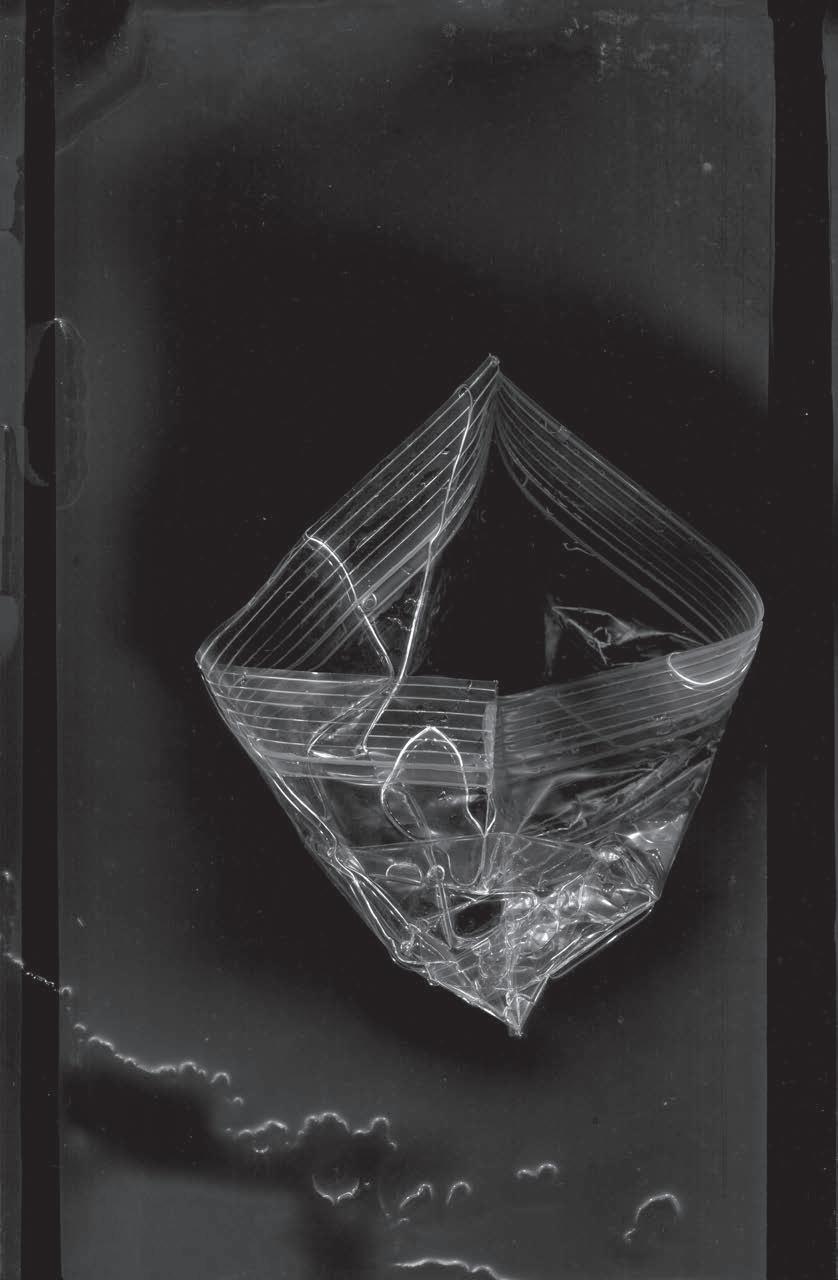
Event 1, 2025
Scanogram on Moab Slickrock
Metallic Silver paper
20 x 27 in. (50.8 x 68.58 cm)
* Images: 08, 09
Event 2, 2025
Scanogram on Moab Slickrock
Metallic Silver paper
20 x 27 in. (50.8 x 68.58 cm)
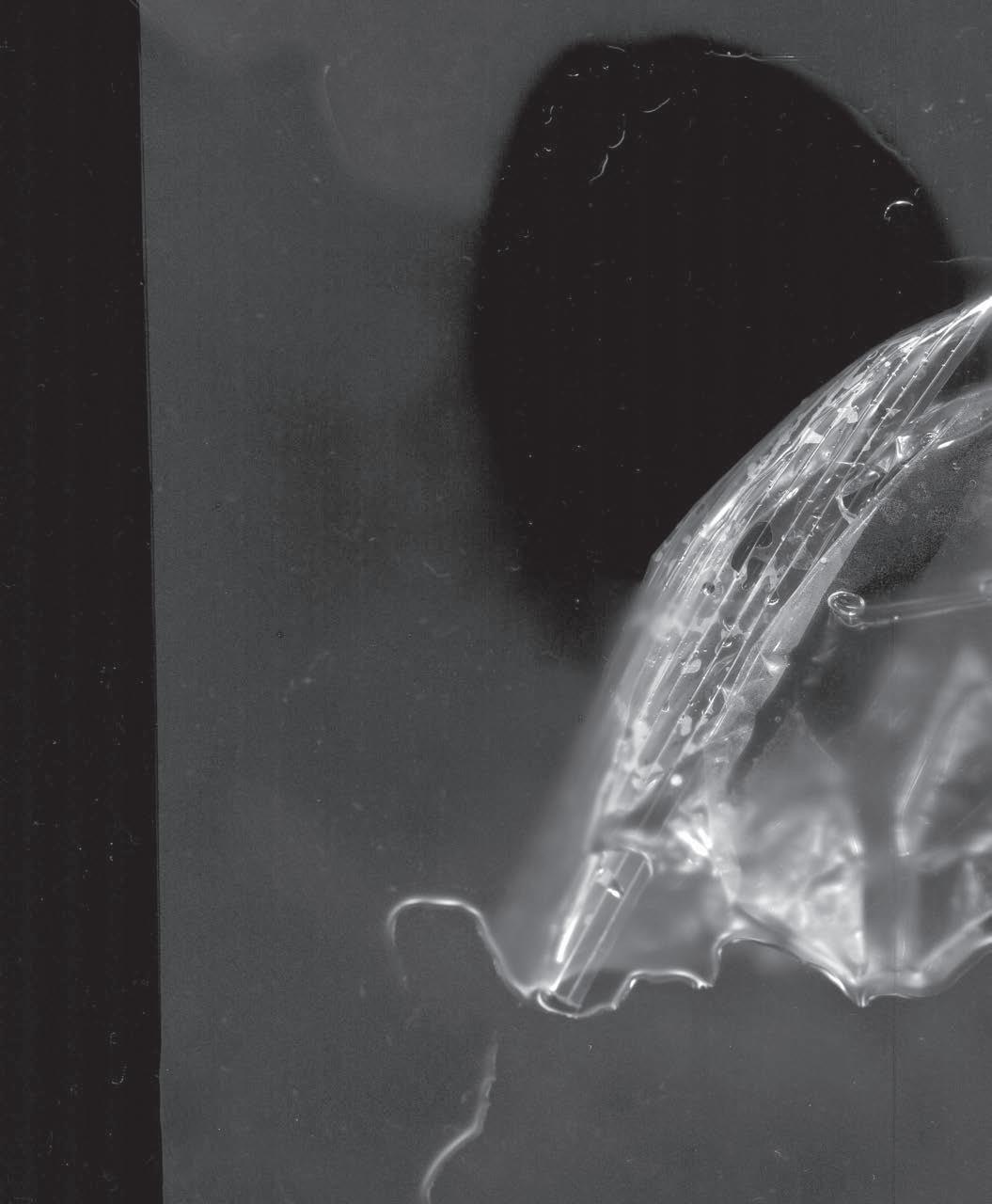
* Images: Cover, 08
Event 3, 2025
Scanogram on Moab Slickrock
Metallic Silver paper
20 x 27 in. (50.8 x 68.58 cm)
* Image: 08
Event 4, 2025
Scanogram on Moab Slickrock
Metallic Silver paper
20 x 27 in. (50.8 x 68.58 cm)
* Image: 08
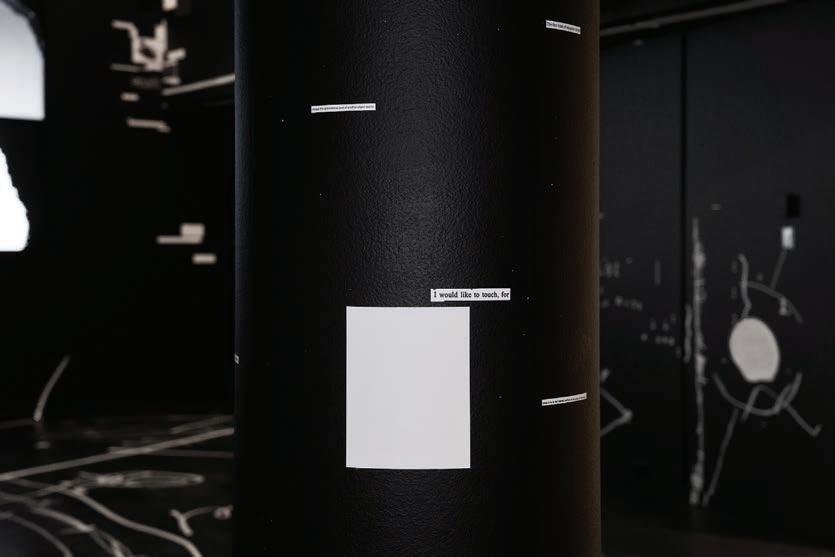
spillage collage, 2025
Photo Tex, paper, and map pins on wall
Dimensions variable
* Image: 04, 07
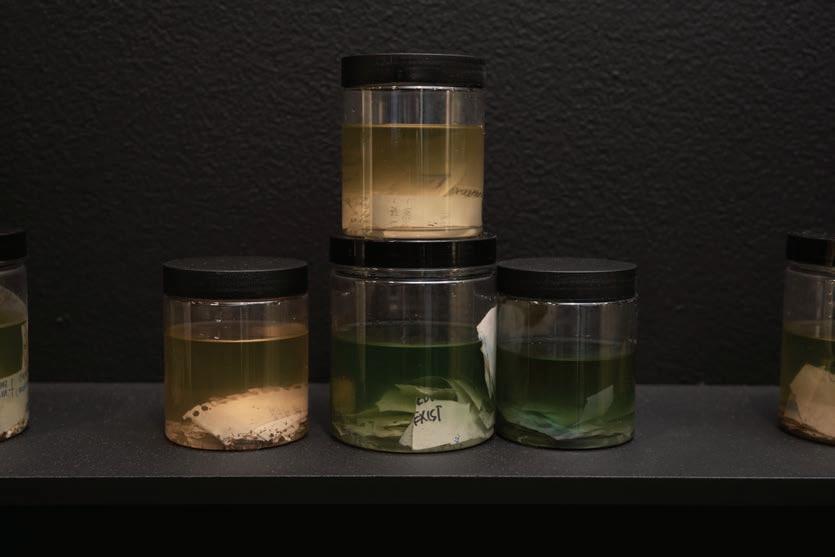
to chew a wad of lapsed meaning until it loses all flavor, ii/ the mystic dies and does not take her engorged sentences with her, 2020–2025
Jars, saliva, kosher salt, spring water, Seattle tap water, 24 hours brewed Fifth Chakra (vishuddha-throat)
tea, Agua Florida, isopropyl alcohol (90%), Cooley Landing marsh water, time, handwritten notes
Dimensions variable
* Image: 06
ABOUT KAMEELAH JANAN RASHEED
A learner, Kameelah Janan Rasheed (she/her) explores communication practices and poetics across all species, states of living, states of consciousness, and substrates. She creates sprawling, “architecturally-scaled” installations; public installations; publications; prints; performances; performance scores; poems; video; learning environments and other forms yet to be determined. Most recently, she was awarded a 2024 High Desert Test Sites Fellowship at Joshua Tree; a 2023 Working Artist Fellowship; a 2022 Schering Stiftung Award for Artistic Research; a 2022 Creative Capital Award; a 2022 Artists + Machine Intelligence Grants — Experiments with Google; and a 2021 Guggenheim Fellowship in Fine Arts. Her recent solo exhibitions include REDCAT (2024), KW Institute of Contemporary Art (2023), Art Institute of Chicago (2023), and Kunstverein Hannover (2022). Rasheed is the author of seven artists' books: rub, lick, drink, eat (REDCAT and Rasheed’s publishing project, Scratch Disks Full, 2024); all velvet sentences as manifesto, Like a lesson against smooth language or an invitation to be feral hypertext (Emerson College and Rasheed’s publishing project, Scratch Disks Full, 2024); in the coherence, we weep (KW Institute, 2023); i am not done yet (Mousse Publishing, 2022); An Alphabetical Accumulation of Approximate Observations (Endless Editions, 2019); No New Theories (Printed Matter, 2019); and the digital publication Scoring the Stacks (Brooklyn Public Library, 2021). She is on faculty at the Yale School of Art, MFA Sculpture Department, and an instructor at the School for Poetic Computation. Rasheed founded Orange Tangent Study, a consulting business that provides artist microgrants and supports individuals and institutions in designing expansive and liberatory learning experiences. Additionally, she founded The Little Octopus School, a roaming learning ecosystem for radical play and improvisation.
Kelly Anderson
Tanja Baumann
Erika Bentley Holland
Emily Blanche
Sarah Borders
Nina Bozicnik
Margarita BurnettThomas
Paula Castillo
Swagato Chakravorty
Em Chan
Helen Chandler
Harold Churchill III
Kate Clive-Powell
Tania Colette B
Lee Corbin
Maia Durfee
Randi Evans
Orlando Francisco
Trevor Goosen
Julie Gordon
Jordon Hayward
Alex Hines
Kay Huang
Jackson Irvine
Claire Kenny
Laura Kinney
Salah Kornas
Catalina Lane
Kris Lewis
Eliza Macdonald
Keif Manuel
Quinn McNichol
Markie Mickelson
Stephanie Mohr
Silas Morrow
Alicia Murillo
Adrian Nava
Cassidy Reynolds
Linda Rondinelli
Emma Rowley
Erin Scherch
Aaron Shapiro
Darbi Shaw
David Smith
Sage Sommer
Alexis Spoon
Phil Steyh
Tiffany Turpin
Vivian Wick
Eric Zimmerman
TEXT
Nina Bozicnik
Zoë Hopkins
Kameelah Janan Rasheed
DESIGN
Cassidy Reynolds
PHOTOGRAPHY
All images by Jonathan Vanderweit unless otherwise noted.
This publication is printed by Hemlock in Canada. Fonts used are Skolar designed by David Březina of Rosetta Type Foundry and Circular designed by Lineto.
Kameelah Janan Rasheed: we leak, we exceed is organized by Nina Bozicnik, Senior Curator, with Em Chan, Curatorial Assistant. This exhibition builds from Rasheed’s participation in the Henry’s Artist Fellowship Program, made possible by the Jones Endowed Fund for the Arts.
Exhibitions at the Henry are made possible through the generous support of our annual sponsors, 4Culture and ArtsFund.
henryart.org
All Henry exhibitions are the collective work of staff across museum departments. For a complete list, visit henryart.org/about/people
ISBN: 978-0-935558-03-6
© 2026 Henry Art Gallery