Back in 2018, Frostpunk showed us how easy it would be to slip into tyranny, asking us to make desperate choices in an alternate history where the world had been plunged into ice Yet for some, its bitterly difficult survival scenario raised more questions still You didn’t have to be a tyrant, but you were always an autocrat Would it have been possible to build something truly good or just in that world? What if the system itself were fundamentally fairer? In Frostpunk 2, the monkey’s paw curls
Here, 11 Bit puts us back in the biting cold, 30 years after the first game’s climate disaster. New London has grown vastly, no longer a huddle of tents around the leaky warmth of a generator but a city able to support thousands. The captain that led the settlement has passed, and your first move as his steward is to establish a council to give all the communities a representative vote. It’s a new world, with new challenges.
Among the alterations are the types of resources at your disposal and your building methods You’re no longer responsible for setting down every building , but instead establishing districts over a hex-based map. Extraction districts, for example, are zoned on top of resource tiles for coal, oil, prefabs and materials, while specific buildings specialise each district for output bonuses that turn the tide from desperation to surplus Not all tiles are available to start with, though, and you have to spend resources to break through the frost a handful at a time Combined with adjacency bonuses (and penalties) between districts, there’s a satisfying synergy game in how and when you place your tiles.
One of the most important resources, however, is trust, and it’s possible to get an early Game Over if you lose a vote of confidence from the communities you govern. The first problem you must solve is a shortage of fuel by finding a coal vein, then deciding what kind of factory to build to exploit it Here, instead of a tech tree, 11 Bit leads with an ‘idea tree’, which means communities can propose solutions to any problem, comprising new buildings and new laws Your choice of coal mine, then, isn’t only a compromise between which is more labourintensive or which raises the risk of disease, but which idea is more popular (and whose opinion you care about)
This framework of compromise underlies everything Outlawing child labour (or ‘childhood apprenticeships’, as it’s diplomatically phrased) is no longer an unambiguous nice thing that you weigh up against material costs of labour and shelter No, sending children to school is actively disliked by some, and will cause arguments about what children should be taught Broadly, there are three ideological spectrums here: whether to adapt to the cold or trust in technological progress; whether to respect tradition or be guided by reason; and whether to pursue equality or reward merit
Developer/publisher 11 Bit Studios
Format PC (tested), PS5, Xbox Series
Release Out now
Where Frostpunk was intimate, the sequel takes a bird’s-eye view, but this distance ser ves it just as well
However, decisions aren’t strictly either/or, and we find ourselves investing in ‘adapt’ and ‘evolve’, for example, by picking laws and buildings that align with both Each community holds one of these ideals, and factions (smaller, potentially more radical groups) will span all three, meaning they have strong opinions about everything that can become a stonewall This is where compromise comes in If there’s a law you want to pass, and opposition against it, do you negotiate with more moderate naysayers and promise them something else? Or do you strengthen the faction on your ‘side’ with bribes? Or take the dangling offer of renewed despotism and centralise authority around yourself ? Smartly, these ideologies lack easy real-world analogues, which makes it more interesting to engage with questions without reacting by reflex, even as divisions become extreme The religiously aligned Faithkeepers, for instance, value both Tradition and Equality, which means holding that everyone should be unionised and paid equal wages in the workplace – except mothers, who should be at home
Whether it’s compromising your vision or your own ideals, then, there’s no uncomplicated route through New London Nor is there even a linear one, as laws that have been passed can be revoked, and you can backtrack to alternate research choices at any time. It all makes Frostpunk 2 feel like a deeply reactive game Likewise with resources, it’s easy to tell from the UI whether you have ‘enough’, ‘not enough’, or ‘enough for now’, but the hard numbers are so large as to be unintuitive Tens of thousands of coal or oil units will last weeks, but that can mean minutes in realtime, and may change as soon as the temperature goes down or the population booms
BIG PICTURE
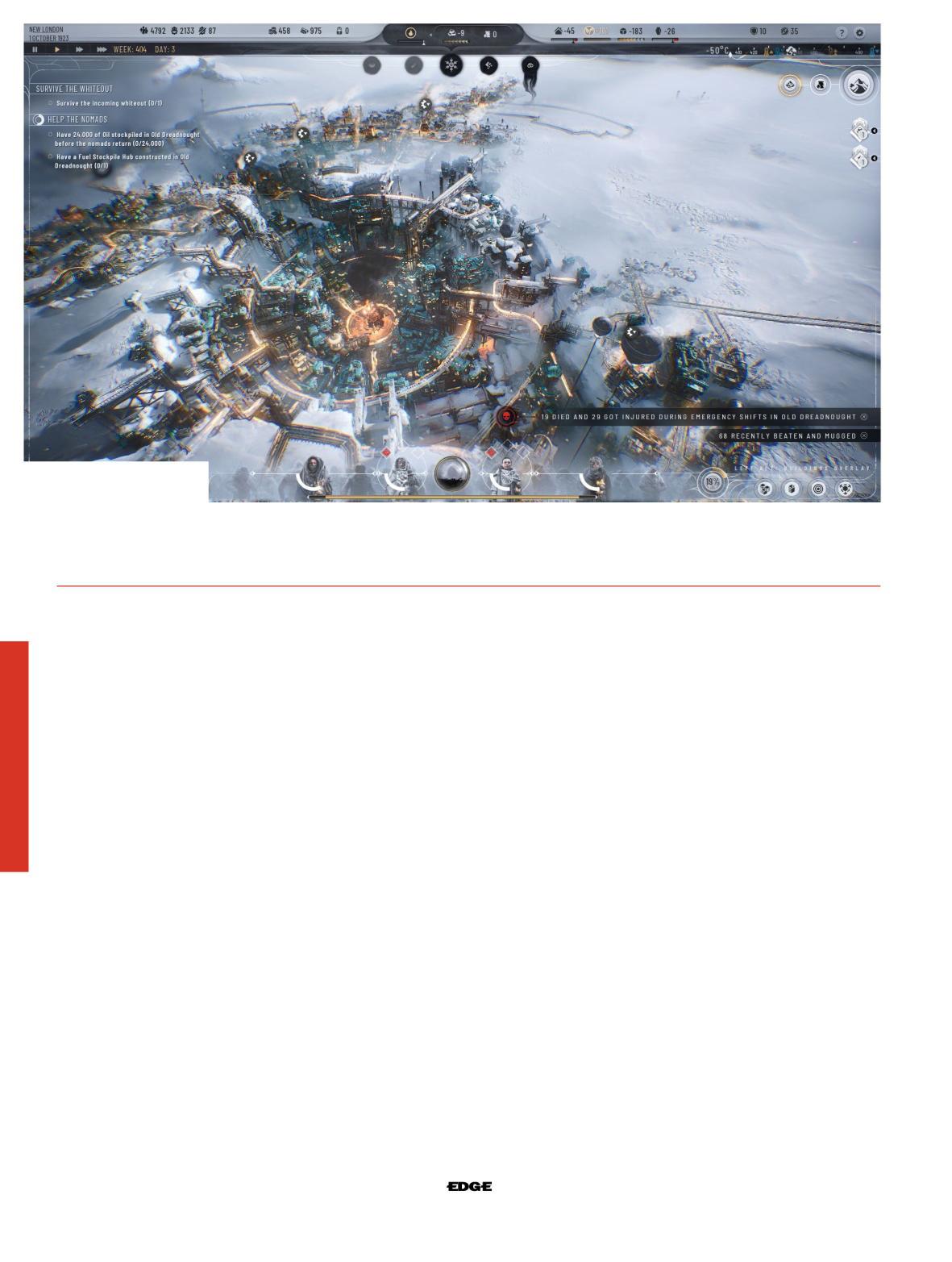
Frostpunk 2 is immediately a more zoomed-out game that demands a more macroeconomic approach Roads and infrastructure build themselves, with heat automatically piped into whatever districts you construct, and you no longer need to match each patient to a doctor, as disease now ebbs and flows with the wellness of the city The death bell may toll for a hundred deaths by hunger while you build housing districts to home an incoming population influx of a thousand As you look over the city and the surrounding frost lands, and the colonies and outposts connected by golden threads, you get to see all the branches and nodes of a complex ecosystem – while any sense of the individual person has long since washed out into the snow
And where the first game saw your situation become increasingly dire, Frostpunk 2 has your resources competing against your need for growth. You’re not simply putting out fires, but anticipating the next season, and continuous expansion Stability lasts moments, and that uncertainty creates the need to keep looking for the next thing The coal vein that provides power in your first year will be woefully inadequate by year two, so you have to push into the surrounding wilds to find more coal or oil, or to build outposts that supply food and materials when your resources run dry
Where Frostpunk was painfully intimate, the sequel takes a bird’s-eye view, but this distance serves it just as well When you’re the only person who can see the overlapping factors leading to disease, squalor and cold, and the complex steps to unravel them, you’ll know when someone is offering you half a solution, and when those patchworked halves are causing tensions to boil
Over the length of its five-part campaign, Frostpunk 2 demonstrates that it doesn’t only have new mechanical tricks for the survival city builder, but explores uncomfortable questions about whether you can ever build a fair world Fair, it asks, for whom?
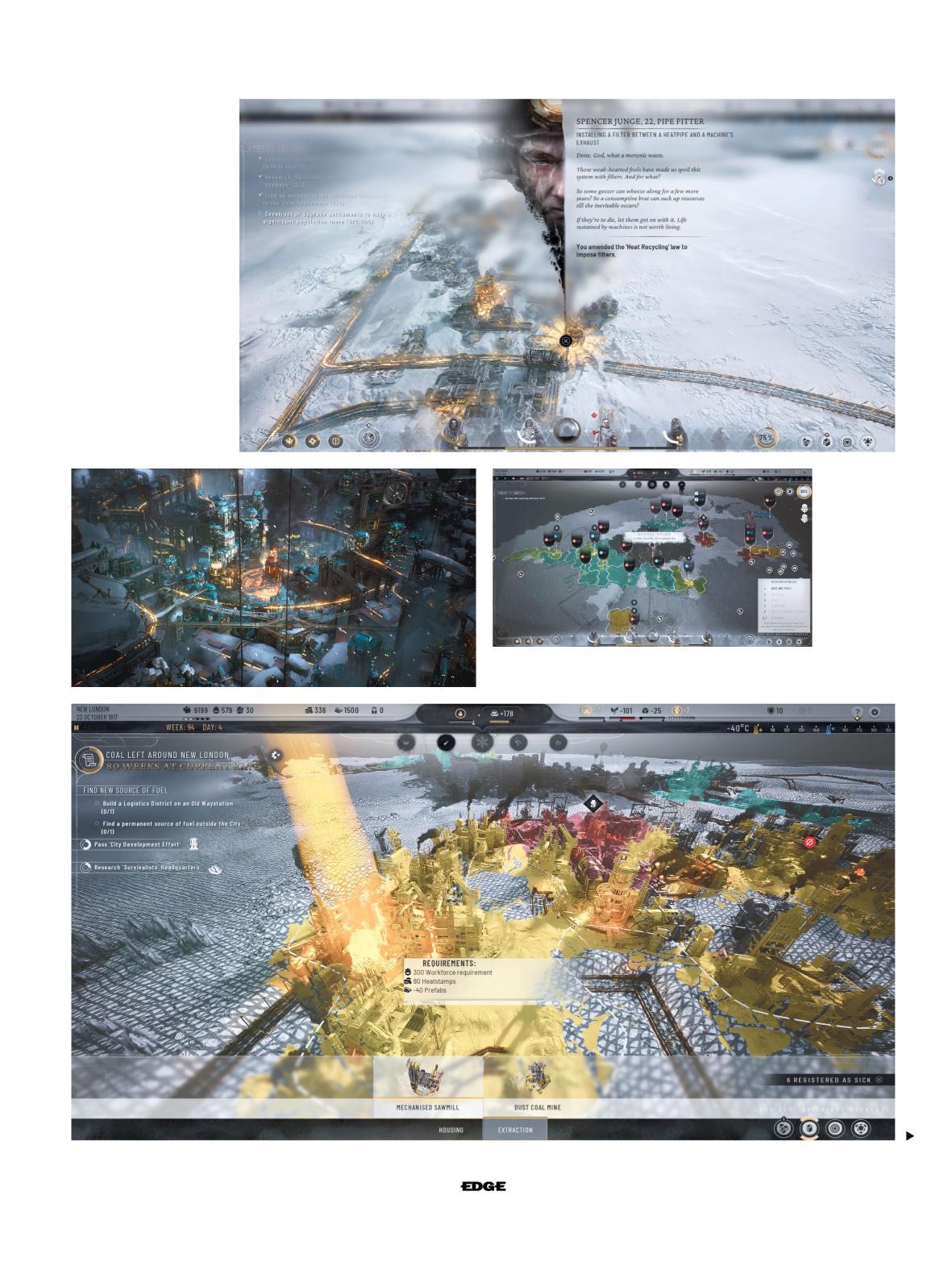
RIGHT Vignettes such as these keep you in touch with how citizens are affected by changing laws and ideology Sometimes heartwarming, and sometimes horrifying
BELOW The dense core of New London is well established When the city’s demand for heat is too high, that golden web of infrastructure starts turning red from the outer edges first MAIN Buildings are powerfully influential, but scarce – any district can only have one or two
ABOVE Managing your resources is absolutely key, and each district can be run at varying capacities in order to reduce labour and resource costs Overlays such as this make it easier to see what exactly you can afford
As much as games evolve, escapism remains one of their common functions. In the face of the eternal doomscroll, we look to digital entertainment as a distraction – another world to immerse ourselves in, a narrative with a certain beginning , middle and end, and a sense of competency where we otherwise lack control Frostpunk 2, though, is not that game. You can certainly earn your sense of accomplishment in it, and it does have a distinct narrative, but it also renders palpable the tensions of living through the past few years – and the climateanxiety angle is somehow the least of it
In one moment in our playthrough, it emerges that heating people’s homes with excess steam from the factories is damaging the residents’ health Installing filters protects the vulnerable and elderly affected by toxic fumes, at the cost of reducing the effectiveness of the heating Yet a little while later, a vignette pops up: people resent that the filters were installed A waste of resources, they say, to extend the lives of those who were inevitably going to die soon anyway.
It’s a deeply uncomfortable parallel to discourse throughout the COVID-19 pandemic, when many people argued against mitigation measures on the (callous and faulty) grounds that the disease was only harmful to
Post Script
Alt-histor y or something closer?
people who were already vulnerable – and, the argument implied, whose lives weren’t worth the resources. When, after a successful quarantine law is enacted, your communities band together to propose a total rejection of any anti-contagion measures, it’s an equally unsettling mirror of how reactionary backlash to the COVID vaccine has seen widespread anti-vaccination sentiment return, leading to a resurgence of measles and polio in regions where they were previously controlled
It isn’t only the COVID allusions that make Frostpunk 2 feel so contemporary, but the tensions between the public and government that form the focus of the game In contrast to the first Frostpunk, where it was possible to dissuade defectors with the power of community and the warmth of a good meal – assuming their needs were otherwise met –Frostpunk 2 is aware of the fundamental dissatisfaction that exists when people feel disenfranchised No matter how positive a relationship you have with a faction, whether they are warm and clothed and housed, they will still protest when they feel ideologically opposed to the city. Radicalisation refers to how violent they may get, but it’s not radical in Frostpunk 2 to oppose the status quo
Possibly more uncomfortable than the way factions oppose the government is the way
they oppose each other Early in the campaign, a new faction develops as a response to an existing one, in every way its ideological inverse. Any decision that pleases one will displease the other, and you’ll begin to see accusations flung between the two whatever direction the city goes in. It takes a majority of votes to pass any law, but a small minority will be blamed for poisoning the well
As we’ve seen increasing division and mass movements across the globe – waves of protest and populist rallies alike – Frostpunk 2 reflects without comment on the ways leaders can respond to them Since we’ve seen prime ministers and presidents embrace populist rhetoric that subsequently leads to violence, or violently suppress a peaceful sit-in, the game’s birds-eye view and nuanced systems create a new tension when it gives us those same choices – and alternate ones – as the player.
There was an element of escapism in the first Frostpunk You could defy its worst assumption and win the hard fight for the city you wanted to run The mirror held up this time, however, isn’t one for you to defy, but a reflection of the world we’ve been living in for the past few years It unveils our most divisive responses as members of the public, and the most harrowing directions our governments have taken
People are overworked, underhoused, freezing and afraid The more tensions rise, the more drastic the response may be
PLAY
Star Wars: Outlaws
Star Wars has always been at its best when fusing the insignificant with the vital: two droids, sold for scrap metal, carrying a message of galactic importance; a naïve farm boy scratching out an existence on a remote planet, with royal blood in his veins; a single torpedo fired from an X-wing that, when threaded just so, can take down a Death Star Heroism gains in impact the more modest its wielder So it is promising that Star Wars: Outlaws opens in the slums of an outland casino planet, in a tavern, in the boots of a petty thief
Kay Vess is as low-status as protagonists come: a broke loner with neither a ship nor a speeder, who is too scruffy for the bouncers to permit her into the local nightclub Her only real asset, aside from a blaster, is alien pet Nix, a mammal small enough to perch on her shoulder, pass through air vents, press buttons, pick the pockets of passersby, and distract stormtroopers with a wave of his tiny arms. A squeeze of a bumper button and he can be ordered away to do Kay’s bidding Still, while Nix is a handy accomplice throughout a career as a thief and trespasser, it’s not long before Kay needs to form some more profitable relationships – first on the moon Toshara, where she crash-lands for the first section of the game, and then, after she acquires a working ship of her own, across four more planets.
Star Wars: Outlaws is perhaps Massive’s most ambitious project to date, upscaling the inter-faction rivalries and trinket-collecting honed via its work in The Division series to galactic proportions Kay, a female Han Solo, proves to be a strong cipher: quippy, ruggedly attractive, quick-thinking and happy to make or break deals to suit her most immediate needs She also has something of the Nathan Drake about her (unsurprising given how much Drake owes to Harrison Ford’s various turns). She’s sufficiently athletic to swing across ravines using a hookshot, clamber up mesh surfaces and leap between handholds, all with an apparently inexhaustible tolerance for lactic acid.
Uncharted-style exploration is just one element of a game assembled from various interrelated systems and styles of play. Like all open-world games, there is a profusion of options: a poker-like card game called Sabacc; a cooking minigame; playable arcade machines nestled in the corners of cantinas; and a hundred different upgrades for Kay’s abilities It’s formulaic, to a point, but the designers have jettisoned the usual accoutrements of an Ubisoft open-world game (most noticeably, map-expanding towers) – a choice that allows fresh air to flow between its pillars
In the smoke-filled bars, cantinas and dingy alleys of Mirogana, you sell loot, buy parts to upgrade your tools, and make deals with the three main factions in the game
Once introduced to these organisations, you can accept and decline missions, and pick whom to support or double-cross – choices that change dynamically
Format PC, PS5 (tested), Xbox Series Release Out now
Even the most oversaturated Star Wars fan will feel a tremor of glee during the game ’ s most slickly presented moments
depending on whether certain districts (and, later, areas of space) are friendly or hostile, and to what degree. It’s here, too, that you acquire quests
The success of any open-world game depends heavily on the experience of traversing space Kay does not have an equivalent to Link’s exquisite glider, but she does eventually acquire something more akin to Arthur Morgan’s horse: a speeder for crossing the game’s vast plains, summonable with a click of her fingers, and upgradeable with various mods, some of which improve its handling , others its speed and capacity to soar. As with most technologies in the game, you need to buy or steal the requisite components, then shell out for the upgrades, some of which are necessary to advance the story The landscapes are grand and can involve lots of open space, although it’s easy enough to crash on small rocks and low fences. Frustratingly, even after lots of customisation, manoeuvring it is unwieldy, to the extent that you never really look forward to hopping aboard
TAP TO ENTER
Being an accomplished thief also requires you to be an accomplished hacker, and Kay spends a great deal of time standing at computer terminals and electronic locks, engaged in one of the two minigames which apparently handle all of the Empire’s digital security measures One is, unexpectedly, a rhythm-action game, whereby you must copy the tapping rhythm of a light in order to release the lock in front of you
The more valuable the prize the trickier the rhythm you must copy The other minigame is a Wordle-alike that uses symbols rather than letters, as you attempt to guess the combination Both minigames present enjoyable challenges, but eventually a feeling of weary repetition is inevitable
Arriving at an Imperial Stronghold, the core of the game emerges. Environments are arranged to encourage stealth, with the option to hack security cameras, attract the attention of guards, or ‘slice’ into computers to divert gun turrets. Without a traditional mini map and vision cones, you’re required to do everything by eye, and one mistake can be enough to trigger tediously never-ending waves of enemies. As stealth goes, it is enjoyable only in patches, and sometimes it’s tempting to simply burst in, blaster blazing from the off Out in space, dogfighting with TIE Fighters or creeping through asteroid clouds in search of loot is an easy-going joy, and eventually the game blossoms into a Mass Effect-style assemble-a-crack-team structure, as Kay travels to planets in search of specialists with whom to collaborate, further raising the stakes
The synth warble of a TIE fighter, the sight of the wreck of an Imperial cruiser poking through the jungle, the John Williams-style growl of a horn section, followed by a flutter of flutes: it all carries that magical charge Even the most oversaturated Star Wars fan will feel a tremor of childlike glee during the game’s most slickly presented moments And peel back the billion-dollar IP and there is much here to like. Some early forced stealth aside, the game is well-structured and welcoming The benefits and drawbacks of allying with factions’ feels dynamic and meaningful, and there’s a genuine thrill as your team begins to swell in size and ability. It’s in the intimate details that the game falters On the ground, there is a persistent coarseness that invites unflattering comparisons both with the open-world games Outlaws is up against and Massive’s own previous work The sights and sounds of the Star Wars universe, delivered with enthusiasm and authenticity throughout, at least make it easy enough to be swept along
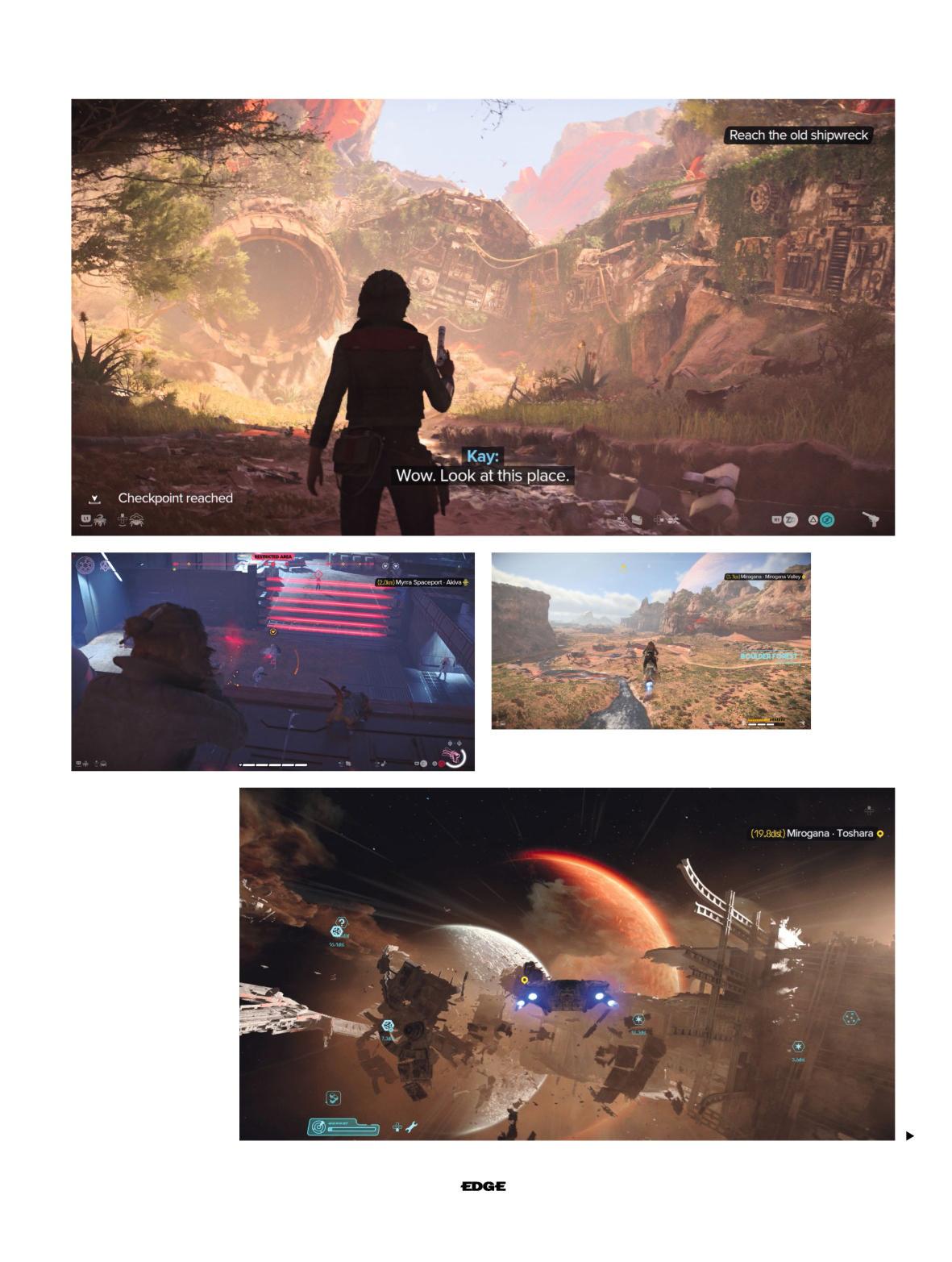
MAIN Your blaster switches between an offensive mode, used in combat, and an ion energy mode, used to power generators, open door mechanisms and even overwhelm the circuitry of drones
ABOVE If you ’ re caught infiltrating an Imperial base in certain instances, you’ll pay in credits to restart the mission, a tall penalty considering how things can go wrong from the smallest detail
RIGHT Dogfighting in space is one of Outlaws’ strongest assets, capturing the feel of the films, and finding the right balance between a sense of power and vulnerability
As well as having a blaster of her own, Kay can pick up enemy weapons, which are discarded once they’re out of ammo Combat aboard the
is only possible intermittently, using your adrenaline
ABOVE
speeder
meter
Nix is a merqaal, a cat-sized mammal with a scaly back and tail, and two ears that each split into three hairy lengths, that is new to the Star Wars universe He’s more than just a cute addition; as AI companions go – a notoriously troublesome addition to any game – he is skilled and dependable, and usually carries out Kay’s instructions ably and fast.
Holding L1 highlights any elements in your field of view, both animate and inanimate, that Nix can interact with It’s not long before you become adept at sending him off through a vent to lunge at an otherwise-inaccessible door-release button, and most small spaces have been explicitly designed to accommodate the creature For the lazy player who can’t be bothered to scrabble around behind the galaxy’s many rubbish bins, Nix is a helpful trinket-gathering assistant, who will fetch nearby collectable items before depositing them at your feet (including enemy grenades, weapons and vials of bacta, the life-giving drink that replenishes Kay’s health bar)
There are times when Kay cannot progress without Nix’s help (and often Nix will point out interactive elements in cluttered environments, reducing the designers’ need to rely on conspicuous splashes of paint), but the animal is perhaps most useful when
Post Script
Nixing the project
attempting to raid an enemy stronghold
Here he can be sent to detonate explosives, boobytrap electrical circuits mounted to the walls, or simply distract guards by waving his tiny, scaly arms in a dance that is equal parts cute and creepy. This trick essentially enables Kay to direct guards’ field of view, enabling her to sneak up behind them and administer a fatal knockout blow Without Nix, the game’s stealth sections would be more of a slog , even if here, too, the repetition can grate
One of the game’s most entertaining diversions is the option to share a meal – or ‘Nix Treat’, as Outlaws calls it – with Nix during downtime, either perched on barstools beside Japanese-style street vendors or in Kay’s kitchen In these lavishly directed segments, you follow button prompts to cook skewers of food, flicking morsels into the air for Nix to catch in his mouth, before taking bites of your own snack. These moments feel intimate and humane, strengthening the closeness of the relationship between Kay and Nix, and, in turn, how we feel about the animal too (as well as imbuing Nix with a useful buff thereafter, according to the meal he’s eaten)
Nix proves extremely useful, too, in the card game Sabacc, one of the standout pieces
of game design in the package Here, playing against other low-lives around a circular table, you take turns, through three rounds, to make a pair of the two lowest numbers possible You must pay a token to draw and swap one of your cards, and you lose more tokens for finishing anywhere but first Run out of tokens and you can no longer play, so the aim of the game is to be the last player standing. There are various complications to add interest and variety, but, like Blackjack, this is in essence a game of brinkmanship
The ever-vigilant Nix can be dispatched to peek at a rival’s cards and report back on their current hand, a trick that often gives Kay the edge – a useful ploy given that winning a game of Sabacc is key to advancing one of the main story missions
The designers work hard to strengthen the relationship between Nix and Kay, who at one point plainly states that she prefers to work with animals over people, and to make your relationship with the creature feel more than merely mechanical To unlock one upgrade you must find ten ways to ‘please’ Nix (it turns out that the creature enjoys riding on the speeder more than the player might), and another for finding a way to make him jealous. And, if you’re wondering , it is, of course, possible to pet the merqaal
Sabacc starts simply, but acquiring grey Shift Tokens throughout the main game allows you to apply all sorts of modifiers
The Plucky Squire
Little in fiction is as dull as the hero who always wins, in particular those who do so while barely breaking a sweat So as Jot, the star of The Plucky Squire children’s books, heads off to stop the evil wizard Humgrump once again, it’s hardly a shock that everyone – Jot included – seems to be going through the motions We’re thankful, in fact, that Humgrump has a trick up his ample sleeves when we arrive to confront him. Having figured out he’s a fictional character in a story, and that he’s destined to lose, the mage has mastered the art of ‘metamagic’ and banishes Jot to the reality beyond the book, along with the certainty of a happy ending
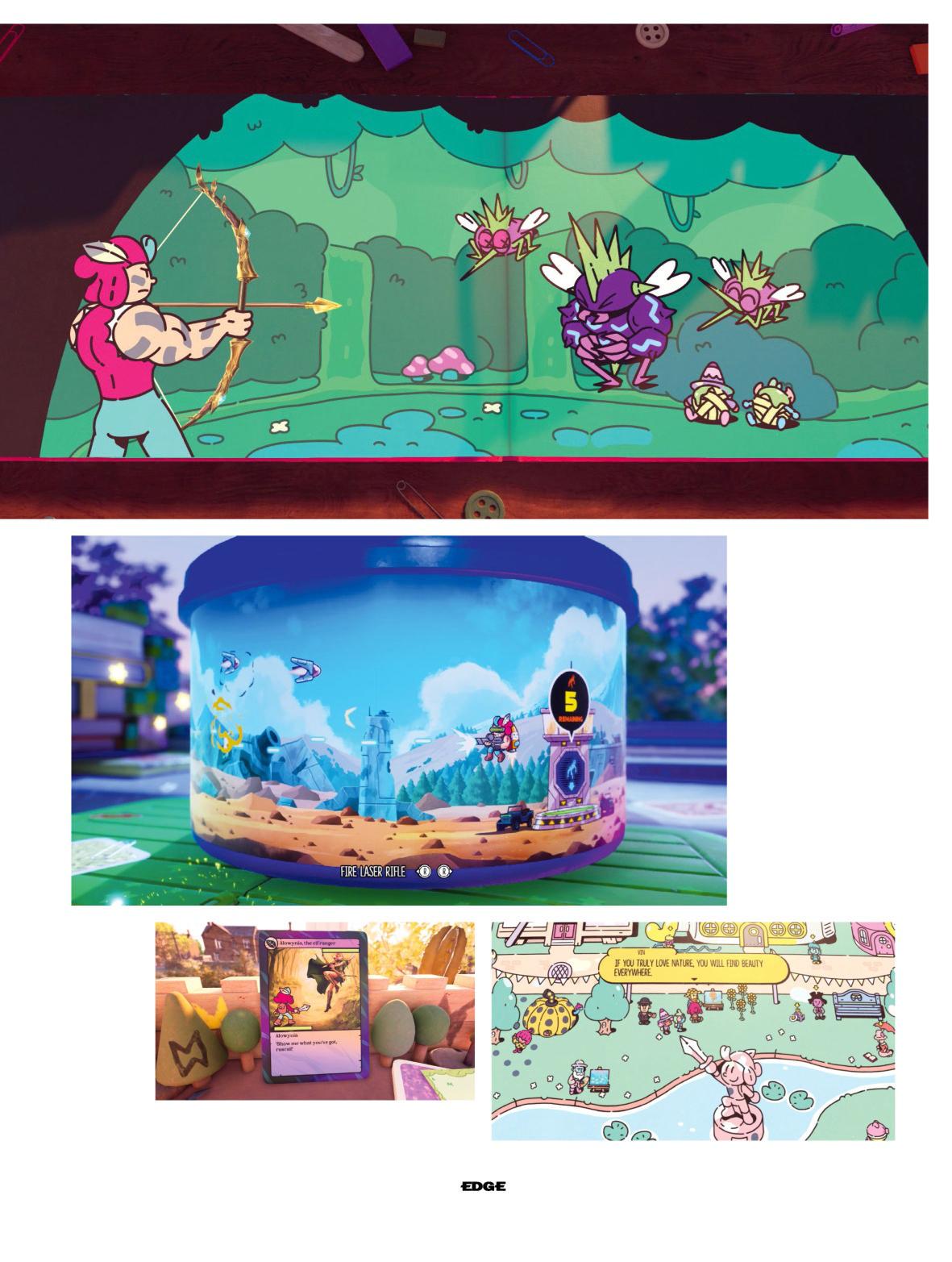
This switch, although fully expected if you’ve seen so much as a trailer for The Plucky Squire since it was announced, is as magical as the story would have us believe, and All Possible Futures commits fully to its concept, even before Jot is ejected onto the bedroom desk of the book’s owner, Sam When you’re moving inside the pages of the wide, squat hardback, each scene is depicted as a two-page spread, sharply illustrated and bathed in blocks of colour, the words of the story emerging as you tread around the paper The default view here is classic 2D Legend Of Zelda, but anything two-dimensional goes. Side-on platforming pages are a common turn, some rotating the book vertically so you make your way up or down, while set-piece battles zoom in on Jot’s surprisingly muscular frame for minigames – a Punch-Out!!-style duel with a honey badger the earliest example
And then, like that, you’re outside, amid paint pots and headphones, buttons and paperclips, all looming large in three dimensions It’s an uncanny yet gleeinducing transformation, and one that doesn’t lose its lustre even once you’re hopping in and out at will. First, though, you need to explore Sam’s desk The boy himself is never present, but his toys, drawings and arts and crafts paraphernalia litter the surface, creating walls, ramps and platforms, freshly rearranged each time you visit (This would be a much more straightforward adventure, albeit a less exciting one, if Sam tidied his room once in a while ) Initially, minus your sword, you have to sneak past aggressive beetles that Sam apparently keeps as pets in order to reach a magic item of your own Once you have it, you can use green portals to literally move between dimensions, even slipping into Sam’s sketches, and later the likes of a cardboard model of a volcano unhelpfully adorned with dinosaurs
This blurring of worlds then returns to the book itself, with portals popping up on the page so you can manipulate the story to solve puzzles. At the most basic level, this may mean circumnavigating an obstacle by exiting the book on one side and re-entering on the
Developer All Possible Futures
Publisher Devolver Digital Format PC (tested), PS5, Switch, Xbox Series Release Out now
The tilt ability sees you angle one side of the book so any loose items in a scene slide down the page
other, but as you uncover new powers in reality, the options become more ingenious. Once you can flip pages yourself, for example, you might go and grab a useful item from earlier in the chapter The tilt ability, meanwhile, sees you angle one side of the book so any loose items in a scene slide down the page Less showy but most satisfying , however, is the ability to remove words in the story that have been untethered by magic, then swap them with others to change conditions – that gate is only ‘closed’, for example, until you find the word ‘open’ and make the switch When you’re juggling several words in a scene, enlarging frogs and deflating bugs, The Plucky Squire is at its imaginative best
The reason such moments stand out, though, is that most of the time, while All Possible Futures is more than happy to toy with its creation, it doesn’t really want you to toy with it too Ultimately, many of The Plucky Squire’s joys are highly regimented, ushering you into very specific courses of action Despite its realistic rendering , the outside world funnels you along almost as much as the confines of the book, its scenery static, as if objects were glued in place. Signposts continuously direct you, while torturously slow camera pans display the location of your next objective As for the book, before you’re set loose on a puzzle, a friendly NPC will probably chip in with unsolicited advice, all but giving away the solution before you’ve had a moment to think And you may as well do as you’re told: in one section, we try to use tilt only to find it’s been temporarily disabled, since it’s not part of the designated solution
FRIENDS WITH BENEFITS
One point the story underlines is that you can’t succeed by yourself, and at crucial moments Jot has to rely on friends for help The wizard Moonbeard is an ageing mentor with plenty of knowledge to share, although he gives Zelda’s Navi and Fi a run for their money in terms of infuriating interruptions, while his equivalent on the desk is a bookworm called Page, who has a similar knack for overexplanation Childhood pals Violet and Thrash are your closest companions, the former an artistic magician, the latter a mountain-troll metalhead, and each eventually has to step up to complete entertaining mini-games of their own A mention must also go to talking mouse Pip, whose late-revealed gift for stealth gets us out of a proper pickle
Crucially, this sense of being herded around doesn’t gel with a plot about a story blown wide open or an overriding theme about the value of creativity All along , in fact, it seems like you’re destined to win after all. Standard combat, a simple, pleasant retread of that in A Link To The Past, spits out hearts to repair damage almost as quickly as you can lose them, while some minigame duels are stacked so heavily in your favour that it’s harder to fail You could argue that this is a game aimed at kids, but all but the youngest would hardly bemoan more pushback, and there’s also an easier difficulty level, a hint system and generous accessibility options, so there was surely scope to release the handbrake a little. As it is, Jot can’t truly escape that casting as the hero who eases to victory
It’s a testament to the strength of the core concept, then, that The Plucky Squire remains as entertaining as it does. Even when you feel like a passenger, it’s quite the ride, smart and surprising from start to finish Indeed, the game’s final stretch saves the day somewhat, with an amusing narrative shift and a few hands-off puzzles that finally ask you to combine your powers It leaves us more upbeat about what’s gone before, but also curious how this special idea might have been pushed to greater heights with just a little more pluck
ABOVE The game is a little too reliant on combat as a means of progress overall, but boss fights always offer something different LEFT You can slip onto various flat surfaces in the real world, some ideal for fun retro homages, such as this wraparound twin-stick shooter BELOW The book’s central kingdom is a painter’s paradise, where likenesses of Picasso, Kahlo, Warhol and more practise their art
ABOVE This turn-based face-off against an elven archer proves to be an anticlimax because the game refuses to let you lose the encounter You only want to borrow her bow, and she may as well give it to you at the start
DeathSprint 66
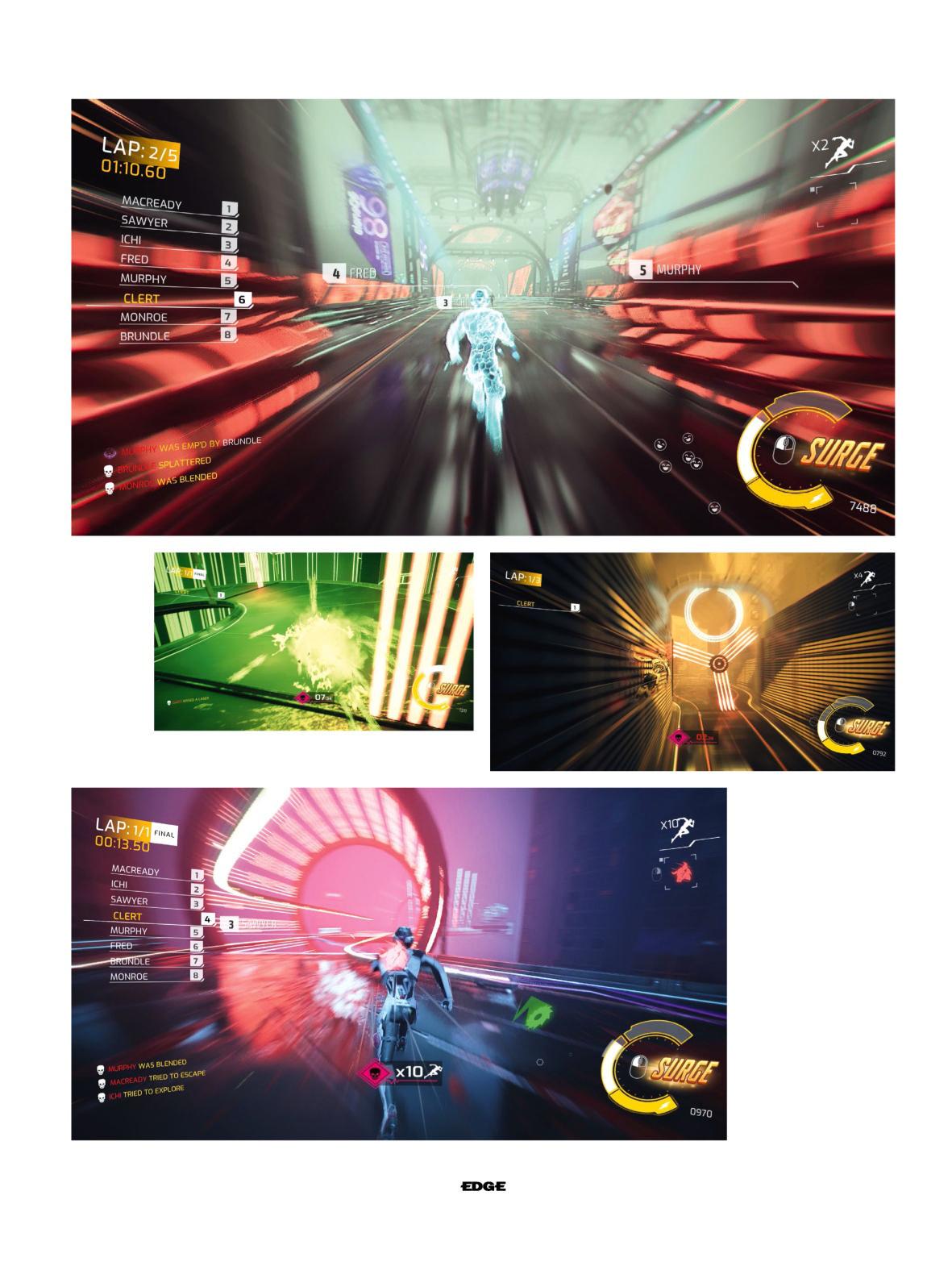
People familiar with the Baby Park course from Mario Kart: Double Dash may argue that the colourful racing series has always been the work of sadists It’s certainly true that on this tight, largely unadorned loop of track, paved with a disproportionately high number of weapon crates, Nintendo’s cheery mascots become unusually eager to produce a bloodbath out of every lap But Deathsprint 66 takes the idea much further. With a wealth of laser grids, sheer drops, spinning blades and general splatter, this is a spin on Mario Kart that’s truly made by sadists – and perhaps it’s made for sadists too.
None of this is close to being a criticism After all, even the gentlest of racing games can trigger the red mists of pure rage. DeathSprint 66, though, is a little more open about pushing its players towards a state of frenzy and casual violence Here is a future mega-sport to which the citizens of some desensitised urban dystopia tune in to watch cloned ‘jockeys’ race on foot at improbable speeds These poor fools sprint through twisting gauntlets, where death lurks around every corner. Leave the track for a second and you’re most likely dead Hit a laser grid or a meat-grinding pillar of spinning spikes and you definitely are Take too long finishing a course and you promptly explode. And if you die too many times, a fate worse than oblivion awaits: you must complete the race in the Suit Of Shame, which makes you look like a BDSM crash-test dummy. Such cruelty works because DeathSprint 66 is built on solid foundations by Sumo Digital, an outfit long known for making reliably great racing games, albeit none quite like this You’re on foot, for one thing , which feels slightly comical at first, but gives the game a physical sense of headlong pelt to go along with its exaggerated pace. Tracks, meanwhile, are satisfyingly twisty and devious, but also chuck in a handful of alternate routes along with lengthy wall-runs and rotating laser beams in spots where you could really do without them In fact, shake out all the bloody carnage and there’s a decent game here even before you add in the intricacies of a drift move, which allows you to trade speed for control on sharp corners but must otherwise be used sparingly, and a boost-like Surge mechanic that makes you very fast but very clumsy at the same time. Fortunately, Sumo seems to understand just how much to throw at you, and that turns out to be exactly one more thing than you can easily deal with in any situation. So tracks take you from rail-grinding to sudden jumps to a stretch of wall-dashing and a hairpin that comes at you from nowhere Master that and you still have to deal with rival players, who can bash you off the track or into hazards, their presence often deadly even before you consider a range of Mario Kart-style weapons and power-ups – drones, buzz saws, an EMP blast – that you can earn by collecting ‘tribute’ coins
Developer Sumo Digital
Publisher Secret Mode
Format PC (tested)
Release Out now
If you die too many times, a fate worse than oblivion awaits: you must complete the race in the Suit Of Shame
Building and maintaining momentum amid the chaos is, of course, the real test here, and the faster DeathSprint becomes, the closer it gets to the sublime Added speed means jumps take you farther and wallruns loft you greater distances. These in turn open up new routes and new lines to keep you ahead of the ravenous pack At a certain pace, even your worst mistakes can be redeemed: hit the wrong side of a wallrun at the right speed and you can just about stay alive by virtue of sheer momentum until you have a track back under your feet again
One area where the game doesn’t quite have the legs, though, is in the detailing It’s a lark to run through courses threaded around urban decay rather than futuristic beauty spots, but DeathSprint’s veneer of grim dystopian light entertainment is slightly too broad to make a lasting impact, and the power-ups and weapons are all rather forgettable. Elsewhere, cosmetic unlocks lack sufficient style to keep you grinding for levels, and character design is disappointingly Crysis-like – all skin-tight Kevlar and Oakley masks, with little in the way of striking features. The music, for its part, is fine but also largely surplus to requirements in a game that invokes such a fierce kind of zone-seeking focus
TRACK LISTING
Rail-grinding remains one of the most reliable pleasures in any game that encourages you to move through environments at speed DeathSprint 66 is deeply generous in this regard Not only can you ride rails to get across nasty gaps and to effectively erase difficult cor nering challenges, but you can also hang from rails that will sometimes carry you to new sections, where you’ll probably find a few seconds of peace, free of rival players It’s not all ease and convenience though Whether you’re grinding or hanging, rails often carry you perilously close to on-track hurdles such as lasers and spiked walls Leaning to avoid them or even swinging your body out as you move gives the game both extra challenge and a jolt of physical comedy
Beside PvP, which obligingly drops in bots if there aren’t enough human players around to get gibbed, there’s a suite of PvE ‘episodes’, which start with time trials that have you sprinting between rings to keep the clock ticking and gradually scale in complexity and menace until they’re extravagantly challenging. It’s a welcome safety net of solo play in the sense that it’s always available, regardless of how many other players are out there ready to race. On top of that, it’s an added reminder that, with a horrific potential mangling awaiting you at every turn, DeathSprint is one of those racing games where, even in multiplayer, you’re ultimately competing against your own mistakes. Glitches in our review code will need polishing out – we have to terminate a few races, for example, because the game keeps putting runners back on the track in spots where they’re instantly killed, and the framerate can splutter during player collisions More than anything , though, the issue of whether the game can attract a regular sustained audience hovers over it like the smog that obscures the sky in its irradiated courses. An inescapable concern is that it might be a touch too niche to earn the playerbase it needs if it wants to keep the fun flowing through its meatgrinding tracks over the long term. DeathSprint 66 has delightfully wicked ideas and the intelligence to push what feels like a limited budget further than you might expect But as brutal as its buzz-saw races can be, they pale compared to the marketplace for online multiplayer into which it’s throwing itself
MAIN You’re given a decent amount of invulnerability when you ’ re placed back on the track
ABOVE Wall-running provides the game with some of its finest moments You’re fast on these surfaces, but never far from danger LEFT Knowing precisely when to cash in Surge is often the key to success You can also throw away a massive lead in a race if you don’t learn to drift properly
ABOVE The game delights in flattening your poor racing clone, slicing you into pieces and flinging you straight into the abyss The brisk goriness is a perfect fit for the direct-to-video flavour of the whole enterprise
Warhammer 40,000: Space Marine 2
Since the release of the original Space Marine, some 13 years ago, an awful lot has happened in the world of Warhammer 40,000 On the tabletop, no fewer than five new editions of the game have superseded their predecessors, while this series’ titular supersoldiers got an in-universe upgrade to their new Primaris forms – an excuse for Games Workshop to refresh its miniatures range with larger, better proportioned, fascist toy soldiers.
Videogames have moved on a fair bit in the period too Back in 2011, Space Marine was something of a rebuttal to the trend of thirdperson cover shooters. Instead of steroidal men cowering behind conveniently placed walls, as in Gears Of War and its imitators, Space Marine had you striding across the battlefield, shooting and chainswording hordes of orks with abandon These steroidal men did it properly, Relic seemed to argue, topping up their health with special execution kills rather than worrying about being shot in the first place The result was generally entertaining , if not exactly revolutionary – but also far too repetitive Time to steel yourself for more repetition, because Space Marine 2 is largely more of the same
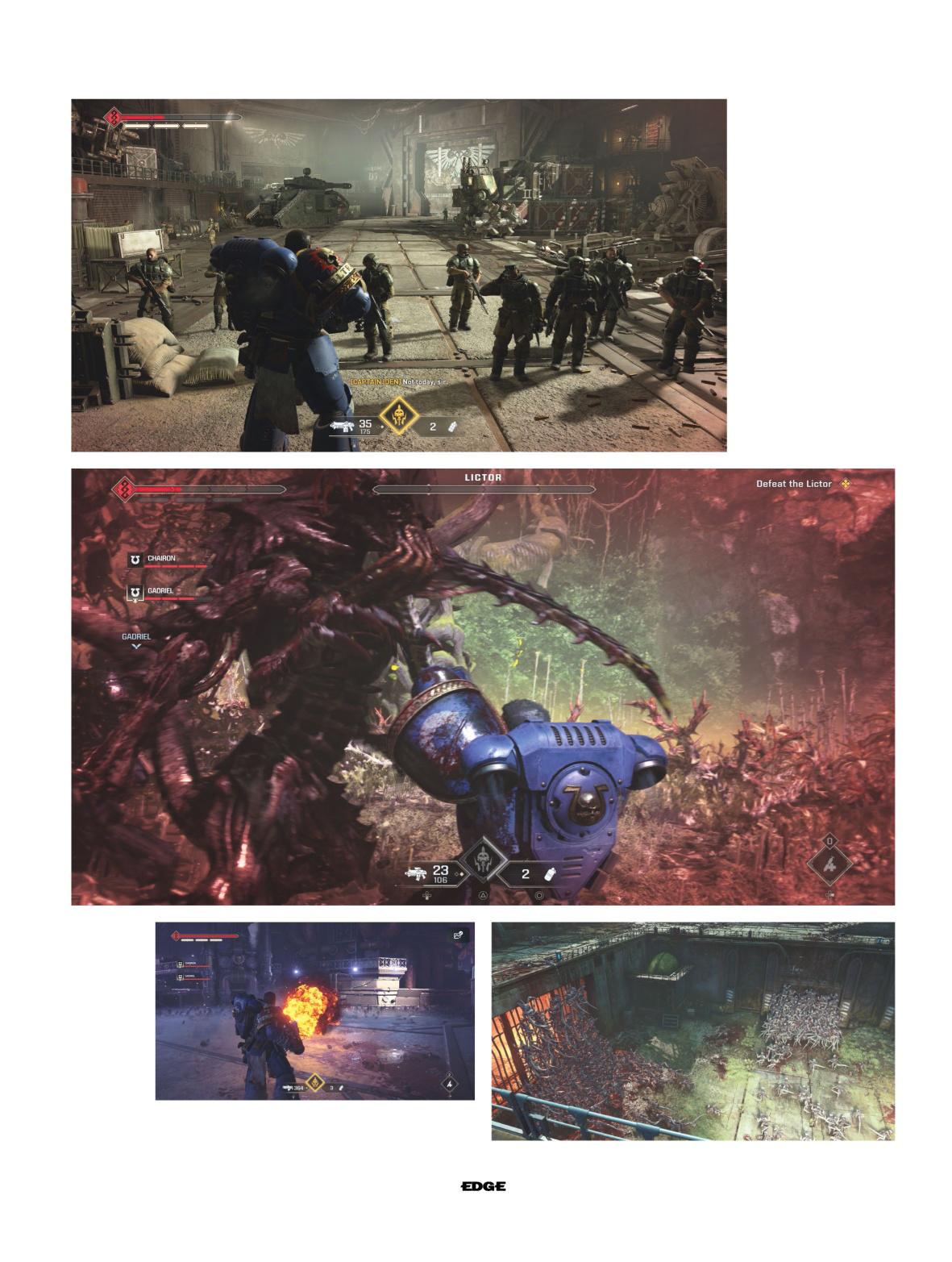
Visually, at least, the march of time is clear The game manages to evoke an incredible sense of scale, somehow both highlighting all eight-plus feet of the Marines’ stature and dwarfing them with the Imperium’s colossal architecture and machinery. It’s a 40K fan’s dream come true, not least in the array of weaponry on offer The iconic boltgun and chainsword look, sound and feel exactly as you’d imagine, especially with the added tactility of a DualSense controller
Most impressive of all is the engine powering the hundreds of tyranids Space Marine 2 serves up These colourful xenomorph-alikes take the place of orks as the sequel’s primary antagonists From a good vantage point, you can make out hundreds of them at once, swooping through the sky in great flocks and rushing towards you in an inexorable wave When they descend, in an effort to crack open your armour and get at the squishy bits inside, you’ll be hard pressed to make out smaller individuals in the teeming horde, instead concentrating on larger threats while your sword swings take out the little ones almost incidentally. Imagine A Plague Tale with a chitinous exoskeleton
There are mechanical nods to the past decade’s evolution, too, most notably in the focus on parrying and dodging. Colour-coded indicators for the more deadly enemy attacks give you a split-second opportunity to mash the appropriate button and avoid taking a large chunk of damage. Parrying a minor foe, meanwhile, results in a brutal instant kill – one animation that sees you pluck a leaping attacker out of the air and smash them into the ground is particularly satisfying. Doing the same to larger enemies, or pulling off a perfectly timed
Developer Saber Interactive
Publisher Focus Entertainment
Format PC, PS5 (tested), Xbox Series
Release Out now
Your two AI companions are about as useful in a fight as the outbuildings they resemble
dodge, will mark your assailant with a crosshair icon, their weak spot ready for blasting with your pistol. Damage them enough and they’ll be vulnerable to an execution, finishing them while recharging your armour
Unfortunately, these sequences don’t mesh together as tightly as you’d hope You can see the rhythm Saber Interactive was going for – a kind of controlled chaos as you hack and blast your way through endless enemies –but the timing of parries, while generous, doesn’t feel consistent There’s so much going that it can end up feeling overwhelming , like trying to play Dark Souls and Dynasty Warriors at the same time. Somewhat ironically, the forces of Chaos that crop up towards the end of the game prove far less chaotic, the thick swarms replaced by greater distinction, visually and mechanically, between the various enemy types
Again, though, it’s the repetition that really grinds, as the dozen hours of Space Marine 2’s campaign alternate between corridor fights and set-pieces in larger open arenas. You catch your breath, resupply and do it all over again The relentless surge is broken up in a few places by the addition of jump-packs that allow you to leap high into the air and hover for a few moments, raining death upon the heretics, before slamming down to continue the melee These sections are entertaining , but also serve to highlight the issues with the core combat loop, with your greater manoeuvrability making the work that much simpler
TITUS BLOCK
Space Marine 2 s story picks up a century after the original, with protagonist T itus (no longer voiced by Mark Strong) having completed his penance with the Death Watch, crossing the Rubicon Primaris and retur ning to serve with the Ultramarines This will either mean absolutely nothing to you, or be old news –which is precisely the issue with the narrative For those unfamiliar with the setting, it’s impenetrable nonsense, while fans will find it a surface-level approach that isn’t anything they haven’t seen 40,000 times before Rogue Trader recently demonstrated that videogames can do the Warhammer 40,000 setting justice, and while it would be unfair to expect Space Marine 2 to have the narrative depth of a sprawling RPG, it s still another disappointment
One thing is clear: Space Marine 2 was designed with co-op in mind, not least since solo campaigning sees you flanked by two AI companions, each about as useful in a fight as the outbuildings they resemble Set-piece battles are designed with two or three distinct roles in mind – having one person manage the swarms, for example, while another takes out the big threats and a third handles objectives Since the AI is incapable of taking responsibility for any of these, it’s a relief to know you can call on actual human friends to take its place
The real focus of co-op, however, is Operations Mode, a series of parallel missions that allow you to pick one of several classes, such as a stealthy sniper or a jumppack-equipped assault specialist, which you can level up and customise with various perks and unlockable cosmetics It’s the best part of the game by far
40K fans know that one of the cornerstones of the hobby is being able to make everything your own. Pick which space marine chapter colours to paint your little guys with, or make up one of your own Operations lets you do that, hinting at greater possibilities of infiltrations and armoured assaults, how every mission could have been distinguished without sacrificing the core power fantasy But since none of that is found in the campaign, solo players are likely to be left wondering what happened over all those years
LEFT Titus absolutely towers over the regular humans of the Astra Militarum, who respond to his presence with deferential awe MAIN Boss battles against especially powerful tyranid beasts provide spectacle, but they don’t deviate enough from encounters with regular enemies to become truly memorable BOTTOM Moments such as this are exactly what grenades and rapidfiring heavy bolters were made for
ABOVE Using a flamethrower to control swarms of tiny tyranids provides some respite from the standard gameplay loop of shooting and slashing Unfortunately, these changes of pace are in short supply throughout
Shadows Of Doubt
Gaining access to the private life of an NPC is more fulfilling when their behaviour emerges from a complex network of simulations, rather than a series of scripted events Which is a fancy way of saying that voyeurism is the best part of immersive sims Apartments in Deus Ex or Dishonored are attractive targets because they can feel like real places inhabited by people with complete and detailed lives
Apply this thought to an entire game, pair it with procedurally generated pixel-art cities and inhabitants, add a 1980s noir cyberpunk aesthetic, and you’re close to the concoction that is Shadows Of Doubt. You control a customisable private detective, investigating murders, kidnappings and affairs by infiltrating homes and workplaces, combing through personal effects and correspondence, and piecing together what happened on a virtual pinboard Each successfully completed job earns money and social credit. Get enough of the latter and you can retire to the Fields, a kind of analogue to A Scanner Darkly’s sinister New Path communes
Aside from the snippets of lore in the opening cinematic, loading screens and newspaper headlines, this is more or less the extent of Shadows Of Doubt’s scripted world-building Everything else is procedural, and there’s no denying the technical achievement that entails A small generated city here comprises three-bythree blocks of dense, architecturally intricate buildings, and about 300 NPCs with simulated routines, histories, relationships, preferences and motivations The largest cities are more than twice the size Every space can be infiltrated, every door opened or lockpicked, every light toggled, every email read, every storage pilfered for letters, medicines, foods and life’s detritus Shops, clinics, eateries, and legal and illegal businesses collectively produce a kind of fish-tank town – an approximation of society within a neatly contained grid
Against this rich canvas, Shadows Of Doubt’s crimes feel like magic. The algorithm weaves a web of motives, acts, alibis and evidence into each city As a result, cracking the case, or even finding a convincing lead, can match the investigation genre’s finest deductive moments While the process of canvassing a scene is reminiscent of rotating deliberately placed objects in LA Noire, deducing how they fit together and avoiding dead ends is more akin to locking in three fates in Return Of The Obra Dinn There’s no objective marker, no sixth sense to highlight key items, no hint system to join the dots on the pinboard. You are, admirably, on your own. It’s a moreish rush, and one that, initially at least, keeps us going despite the copious and significant rough edges. In our first ten minutes, for instance, we clip through a wall, fall through several floors of black space, and find ourselves reset in our apartment, recuperating But bugs are the least of the problems – the real issue is frequent and baffling breakdowns in logic
Developer ColePowered Games
Publisher Fireshine Games
Format PC (tested), PS5, Xbox Series
Release Out now
Ever y space can be infiltrated, ever y door opened or lockpicked, ever y light toggled, ever y email read
Take the case we’re given for the tutorial scenario A man has been shot dead. Someone called his apartment ten minutes before he died We check the number against his address book; it matches an apartment in the same building. We pay the neighbour a visit and hand over 200 crows – the in-game currency – and they give us free rein to snoop around, going about their business as we rifle through their belongings We log into their computer and find an assassination contract instructing them to kill our victim While we do this, their bedtime routine activates and they go to sleep We take their fingerprints, match them to the crime scene, handcuff them, and report to City Hall Case solved
Scenes like this are all too frequent, because NPC interaction is Shadows Of Doubt’s weakest point. Dialogue is bare and leads to instances of irrational behaviour, such as a hotel receptionist who tells us to mind our own business when we ask their name, or a restaurant owner who locks us in their establishment while we’re stood in front of them, causing the trespass status to activate Responses to combat and stealth are inconsistent. Some NPCs fail to notice us crouching at the end of a well-lit room; others spot us in the dark
In a game so reliant on evidence-based inference, the contamination of clues with random and inexplicable behaviour can turn cases into a slog For every successful deduction, there may be hours of schlepping between apartments and workplaces without any gain Some may counter that this is all part of the experience, or perhaps the pacing would feel breezier if our skills were up to task But while in real life – or scripted detective fiction – we understand that an apparent clue could be a double-bluff or false lead, here there’s no way to tell if it’s simply an aberration of the algorithm
SLIPPERY WHEN WET
Shadows Of Doubt attempts to create the illusion of life by applying a variety of statuses to the player and NPCs Rain will make you wet, for example, which will raise your probability of falling over Buy an umbrella and you can shield yourself Hunger, thirst, personal hygiene and irritable bowel syndrome all have their buffs or debuffs and counter-measures while permanent modifiers can be purchased, stolen or ear ned and installed at a clinic Unfortunately, as with the rest of the game s procedural generation, some of these statuses combine to bizarre effect Watching several NPCs sprint and repeatedly trip over in a downpour is amusing, but doesn’t sell the idea that these are real people living real lives
Such anomalies creep into everything Crawl spaces and surveillance have been a part of immersive sims since Thief and System Shock, and the bounty of vents here is exceeded only by the ubiquity of CCTV Yet the procedural generation often arranges them in Byzantine labyrinths that are confounding to navigate, or puts breaker boxes in front of cameras so it’s impossible to deactivate them without raising the alarm Windows can be smashed and jumped through, but there’s rarely anything outside to offer purchase, so most of the time we simply knock on the front door and ask for access or pull out a lockpick – the promise of player freedom reduced to a rinse-and-repeat of the same approach
Perhaps, then, we should add a caveat to our initial hypothesis: if voyeurism is the best part of immersive sims, it needs a narrative. Without a greater degree of authorship – a few lightly scripted cases in predesigned cities to complement the sandbox mode – Shadows Of Doubt is too prone to bewildering or illogical red herrings, shrouding the experience in uncertainty
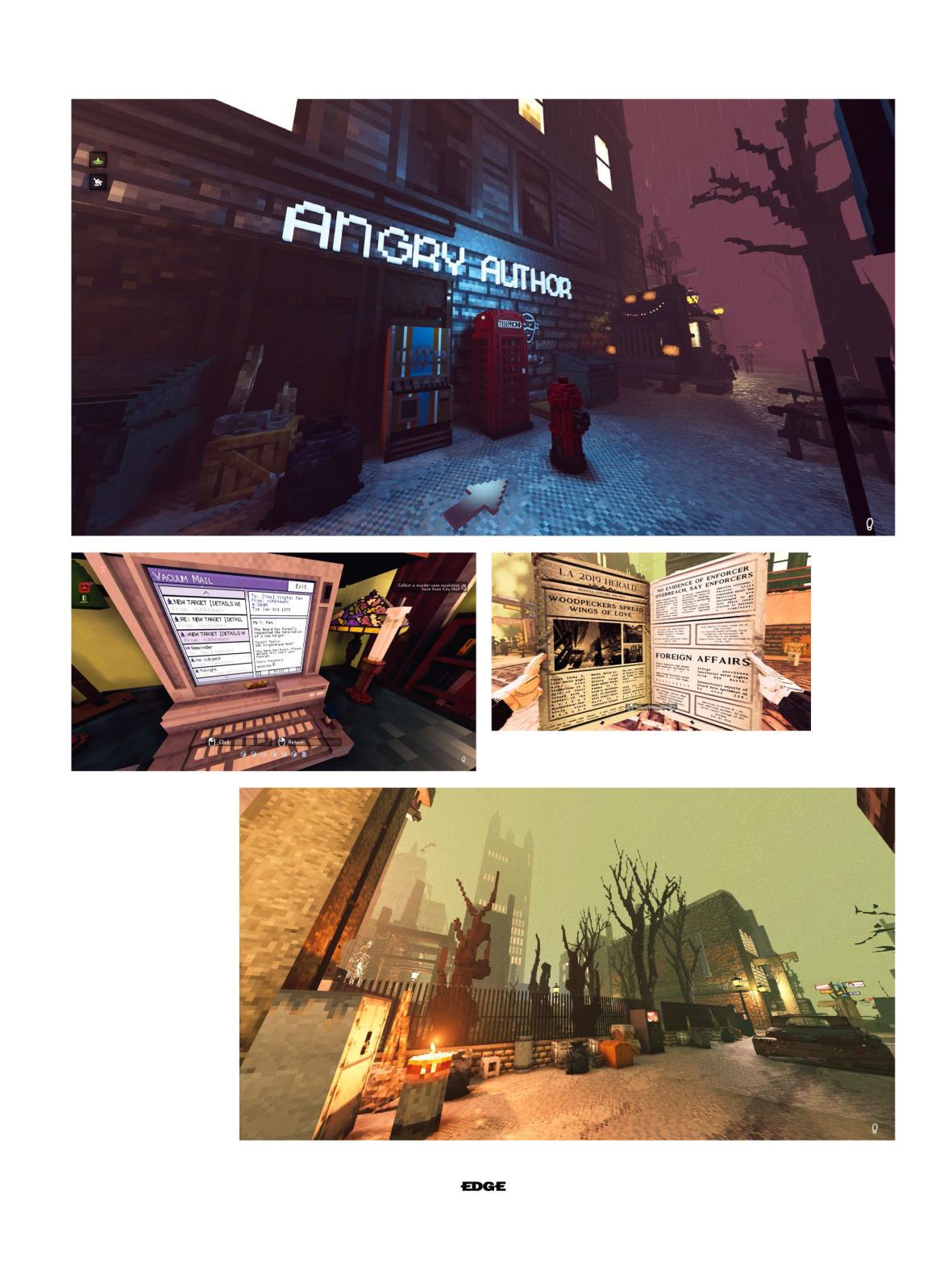
MAIN Shadows Of Doubt’s algorithm generates some genuinely amusing place names
Mankiller Street is an obvious highlight, while Angry Author may be best left without comment
ABOVE Computers, or ‘crunchers’, are a reliable source of leads
Log-in codes can usually be found on conveniently placed notes somewhere nearby
RIGHT Performance is uneven
Framerates wander anywhere from 30 to over 60, and there is frequent pop-in, especially in the game ’ s more open and busy areas
ABOVE There are inspired flourishes of detail: you can pull books off bookshelves with a spin of the mouse wheel, rubbish bags scatter bits when you throw them, and you can even hide behind newspapers
Wild Bastards
An alien named Roswell beams down to the planet’s surface. It’s the kind of incident that might confirm 75 years of UFO conspiracies, were it not for the fact that Ros is accompanied by a robot sniper named Judge, and the planet in question isn’t Earth In point of fact, it’s Aquarius Minor, a frontier world on the edge of the Baal sector, where the locals once mined a dangerously aggressive material named cramm. So dangerous was it that cramm consumed the place, leaving behind a desert landscape populated by roaming coyotes and rageful grizzlies
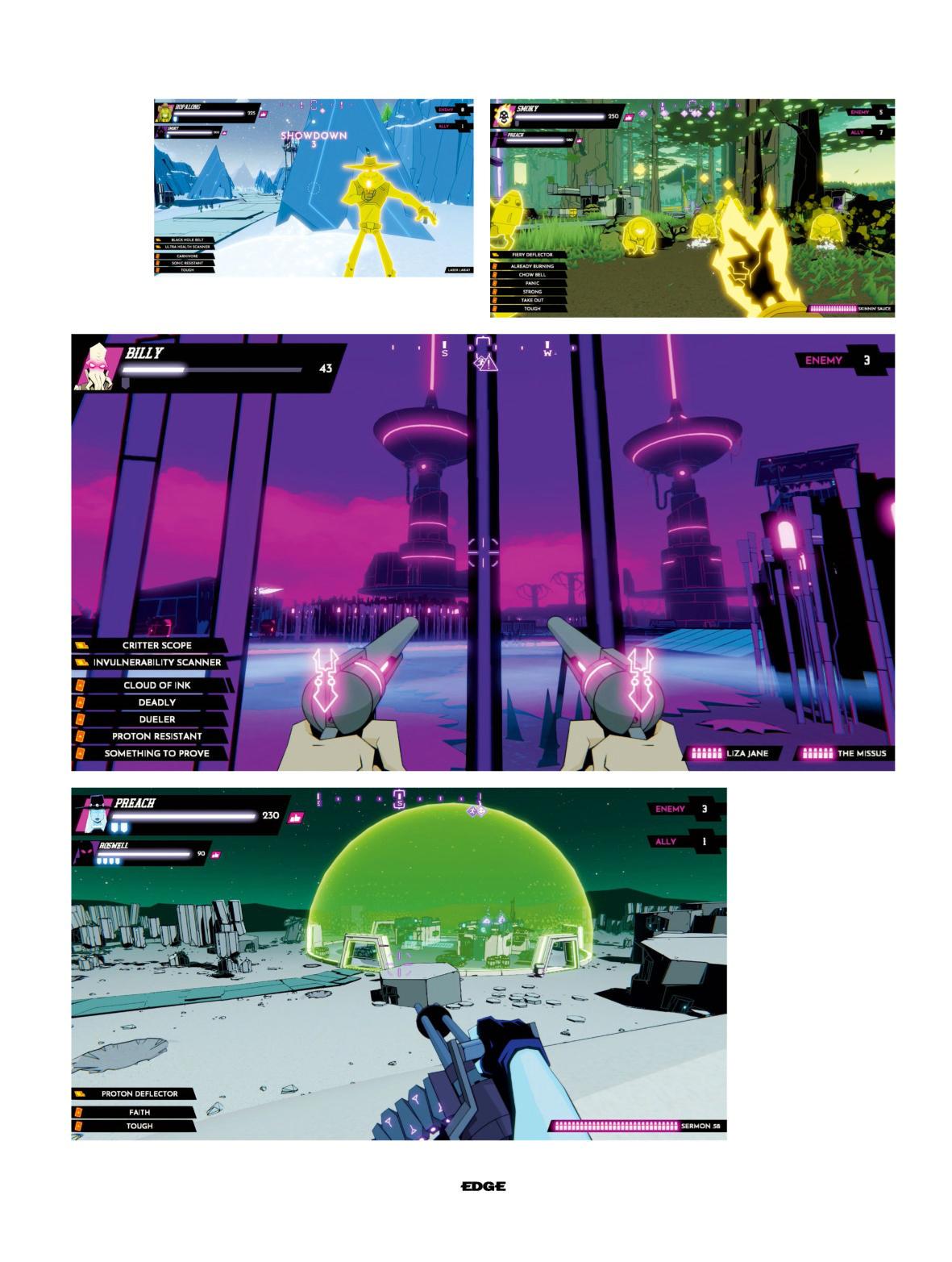
The paved roads remain, though – a rare blessing in this part of the galaxy, and one we’re happy to capitalise on If we take the path west at a gallop, we can pick up a pile of deactivated cramm – the closest thing to currency around here – and spend it on homingweapon mods To the south there’s a roadblock staffed by gun hands and assassins, but if we fight our way through, there’s an Ace card waiting on the other side, ready to level up one of our posse Most tempting , however, is the innocuous floppy disk waiting in the hills to the east. It contains enemy data, and if we’re very lucky, might spill the beans on those assassins –the damage type of their pistols, their weak spots, and how best to counter their teleportation attacks. The data wins out Forget the cramm: in Wild Bastards, nothing’s more dangerous than an enemy unknown
Mulling over this and tougher decisions still, we recall E397’s Blue Manchu Studio Profile, in which founder Jon Chey spoke with regret about his whitewhale project at Irrational – an XCOM shooter he felt unable to pull together Hopefully Chey now feels he can put that failure to bed, knowing he’s finally hit the mark Wild Bastards flits masterfully between its tactical layer and buoyant firstperson shootouts, neither side of the game dominating the other It’s a Roguelike of sorts, demanding that you guide your outlaws through a series of consecutive planetary runs before you can zip to the next sector and take on daunting new challenges Encountering rocket-belching bears for the first time knocks us for six, while burrowing poison snakes initially make a mockery of our six-shooters The pain of the squad wipe lives on
On the battlef ield you take care to dodge damage, knowing you’ll take the impact of any hits into the next fight. And on the strategic end you plan your approach carefully – picking which outlaws to beam down to a planet based on their combat abilities, resistances and relationships with one another. The robot trapper Rawhide converts enemy creatures to your side, and so suits a world like Aquarius Minor, while Roswell’s boosted jump is doubly useful on low-gravity moons Outlaws are deployed in pairs, but only one fights at a time – the other sitting in your back pocket as a
Developer Blue Manchu
Publisher Maximum Entertainment
Format PC, PS5 (tested), Switch,
Xbox Series
Release Out now
Wild Bastards
flits master fully between its tactical layer and buoyant firstperson shootouts
substitute, ready to be swapped in with the press of a button. It’s an extraordinary update of Halo’s twoweapon formula, pushing you to find complementary characters and commit to them, exploring their nuances in combination. Flaming skeleton Smoky shoots arcing fireballs from his fingers, filling a kind of barbecue artillery function That makes him a strong partner for the reptilian Hopalong , whose lasso is much better deployed at short range to squeeze the life out of isolated enemies, mopping up the battlefield once Smoky has set the horizon afire
But that’s only the surface level of their connection. Hopalong sprints at a crawl – unique for an FPS character, fitting for a snake – allowing you to quickly and quietly relocate Smoky when his firing position is given away Smoky’s ultimate ability, Cookout, sets three nearby enemies aflame That’s a gift for the reptile, who can locate the victims by the sound of their yelps and finish them off one by one
CHASTE-Y DECISIONS
The Wild Bastards spin on Spelunky’s ghost – the terrible force that comes after you if you tarry too long on a level – is a series of increasingly powerful, horse-bor ne warriors They’re all children of the puritanical magnate Jebediah Chaste, each infused with a comically awful personality “There is something about ya, how ya are, that does commingle sickness and pleasure in me,” drawls the closeted Francisco as she rides out to destroy you The best strategy is usually avoidance while navigating to the planet’s exit point, but one of the game s greatest joys is found in the gamble of tackling the Chastes head-on Perhaps you ll get lucky and catch the screechingly insecure Prince McNeil with your lasso But eventually daddy will arrive, and then playtime’s over
Consider that there are 13 outlaws in all, with many possible pairings, and you start to realise that Wild Bastards is a cramm-chest full of tactical creativity to be cracked open And there’s no chance you’ll fall into easy patterns and miss the magic, since you’re encouraged to mix up your choice of characters. When outlaws are fatigued, they lose access to their Charged Ace – usually a boost to health, armour or damage they can only regain with rest. What’s more, sometimes two Bastards will fall out, and refuse to beam down with each other Then, if one falls in combat, they’re knocked out until you can heal them with a Tonic or warp to a new sector, forcing you to fall back on some of the more neglected outlaws in your roster In the end, then, setbacks result in a deeper understanding and appreciation for the minmaxed set of FPS freaks Blue Manchu has assembled.
The gang builds up as you progress through a tale of backstabbing , desperation and derring-do in the face of cowpokes who object to your very existence; bigots who would rather the galaxy was a beiger shade of bland They’d be no match for the Bastards if the gang could get along and work together for more than ten minutes at a time, but of course they can’t When they’re not throwing each other in the brig , they’re demanding that certain character combos be deployed on a particular planet, because they’re an anthropomorphic fish who can see a few seconds into the future
The hot tempers and unchecked egos of these muties and tin cans are the two-headed fly in the ointment –the unstable element that forces you to change your plans and dig ever further into the tactical depths It’s this beautiful mess of strategic genius and personality defects that elevates Wild Bastards to the pantheon of truly great hybrid roguelikes, managing to do for the FPS what Spelunky did for platforming , and Slay
The Spire for deckbuilders
ABOVE Given the game ’ s futuristic-Western tone, and the personalities of your crew of Outlaws, blowing imaginary smoke from your finger gun is involuntary after particularly satisfying showdowns with your enemies
TOP Allied critters are useful for flushing out and distracting enemies while you focus on finding the ideal angle of attack MAIN In a distinctive visual motif, holographic neon is used to mark out all sorts of details, from shop signs to the hammer of a revolver LEFT Battle locations run the gamut from sci-fi swamps to lunar bases and saloon-centred frontier towns
Better late than never for Bakeru, which was released in Japan last year and arrives here at an odd time given its carnivalesque themes, as its native country’s summer festival season draws to a close. Not that the timing matters to chief villain Oracle Saitoru, whose magical troops have brainwashed the people of Bakeru’s alternate-reality Japan into neverending festivities So begins the adventure for the titular shape-shifting tanuki boy, as he journeys up and down the country, first seeking the powers of other fairytale heroes, then striving to save seven maidens who have the power to break the festival’s evil seal.
While Good-Feel is better known for working on Nintendo properties, this isn’t its first original venture, with twin-stick shooter Monkey Barrels hardly a distant memory But this time the studio breaks from largely two-dimensional planes, harking back to 3D action platformers of old, particularly significant given founder Etsunobu Ebisu’s work on N64’s Mystical Ninja Starring Goemon That does make it feel like something of a throwback, not least with its release so close to the dazzling light of Astro Bot, but the extra development time for localisation has had its benefits It’s welcome, for example, that Bakeru’s default walk speed has been revved up a touch from the original release, since many of the game’s stages are quite sprawling affairs
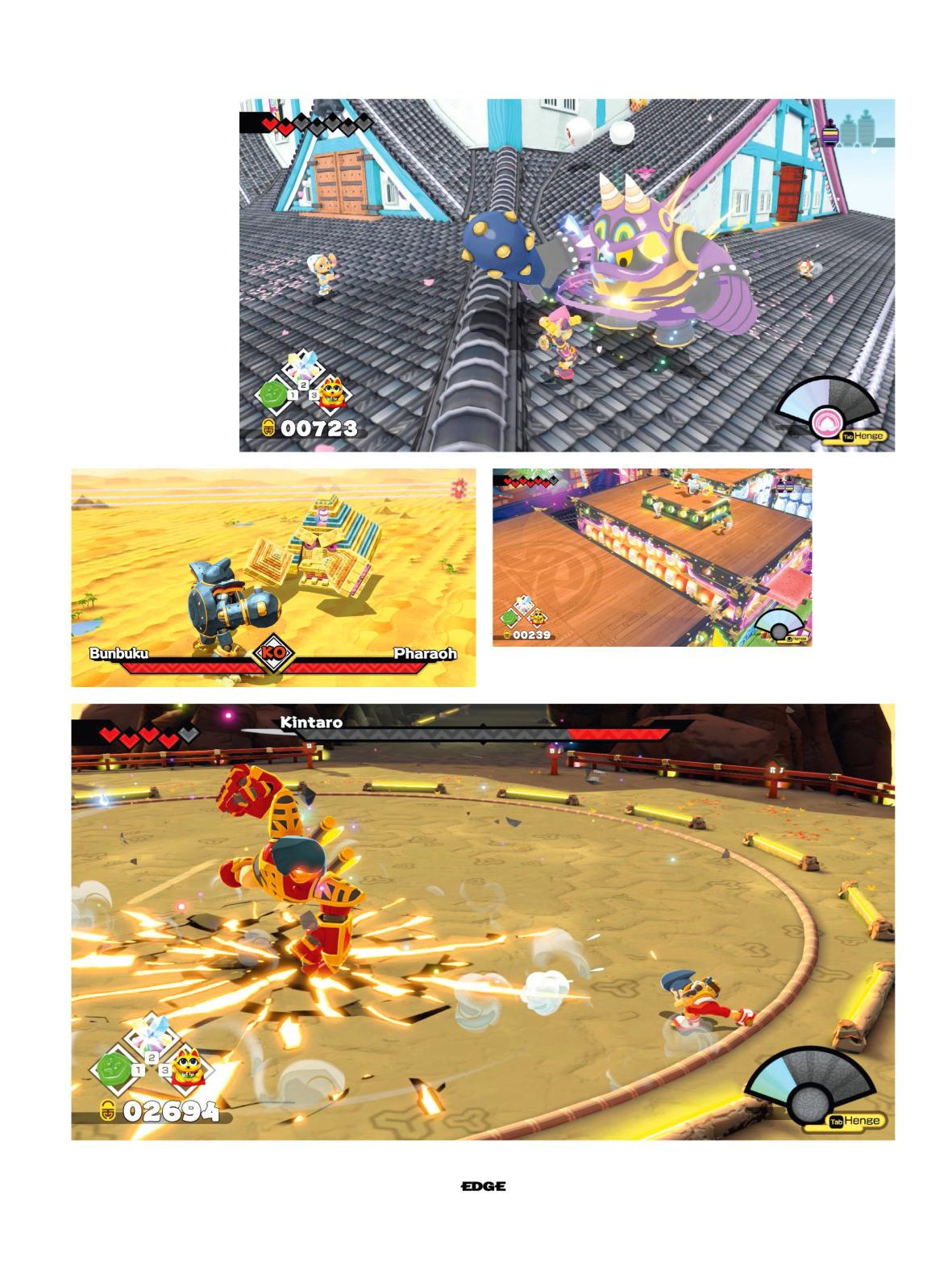
Set across all 47 prefectures, and then some, these levels depict Japan with adoring irreverence, freely shifting between classical and contemporary cultural touchstones. Environments may have simple textures but they’re painted in vibrant colours and highly varied, with Bakeru zipping between traditional castles and skyscraper roofs still undergoing construction. One minute you may be on a sandy beach, the next wading through snow at risk of being squashed by rolling triangular houses For the most part, levels culminate with a tall festival float sealed with a curse that must be lifted by destroying evil lanterns in the surrounding area Yet some take different forms, perhaps opening wide to allow you to scavenge for secrets before funnelling you through a set-piece On occasion, the path is more strictly linear, which makes sense in the context of a festival parade, or within the confines of a theme-park rollercoaster cart There are also levels where jumping into a transforming robot dog triggers a Mario Kart-style race over land or water, or a rail shooter in the skies Add in shapeshifting henge superhero powers and kaiju clashes with giant mecha based on the nation’s favourite foods, and you’re playing through a surreal buffet of Japan’s finest tourist attractions
Indeed, the notion that you’re here as a tourist as well as a hero is underlined by the game itself, notably with its collectables, which include souvenir items that illuminate some aspect of local culture as well as little
Bakeru
Developer Good-Feel
Publisher Spike Chunsoft
Format PC (tested), Switch Release Out now
These levels depict Japan with adoring irreverence, freely shifting between classical and contemporar y touchstones
creatures designed to resemble perfect curls of dog poo (aptly named Scoop), which offer trivia about the area, unusual customs or Japanese history Perhaps because of this tourist-friendly approach, Bakeru isn’t especially challenging either as an action game or as a platformer. Most of the festival troops seem quite harmless, themselves also cultural ambassadors, such as sentient watermelons ( Japan’s popular summer fruit) that burst into edible slices when defeated, or a row of masked cleaners who attack using the Japanese technique of wiping floors with a cloth while running
Armed with enchanted taiko drum sticks – not to fight but to ‘purify’ evil spirits – there’s nonetheless a pleasing rhythm as we alternate between shoulder buttons for our attacks (encountering a group of enemies, Bakeru moves automatically between targets after each hit) That dual-wielding style carries over to the henge powers he receives from other characters in the first third of the game, be it the giant palms of a shogun warrior or a pair of fishing rods that imbue a mid-range attack
It’s unfortunate, however, that this aspect of Bakeru feels underutilised in light of Good-Feel’s work on Princess Peach: Showtime If you thought the princess’s costume changes felt too prescribed, they at least changed how you interacted with a stage in a meaningful way In contrast, only the first unlocked henge ability here changes your traversal options, shrinking you to an inch high so you can fit through small gaps or use your lighter weight to travel farther in the air
RACCOON WATCH
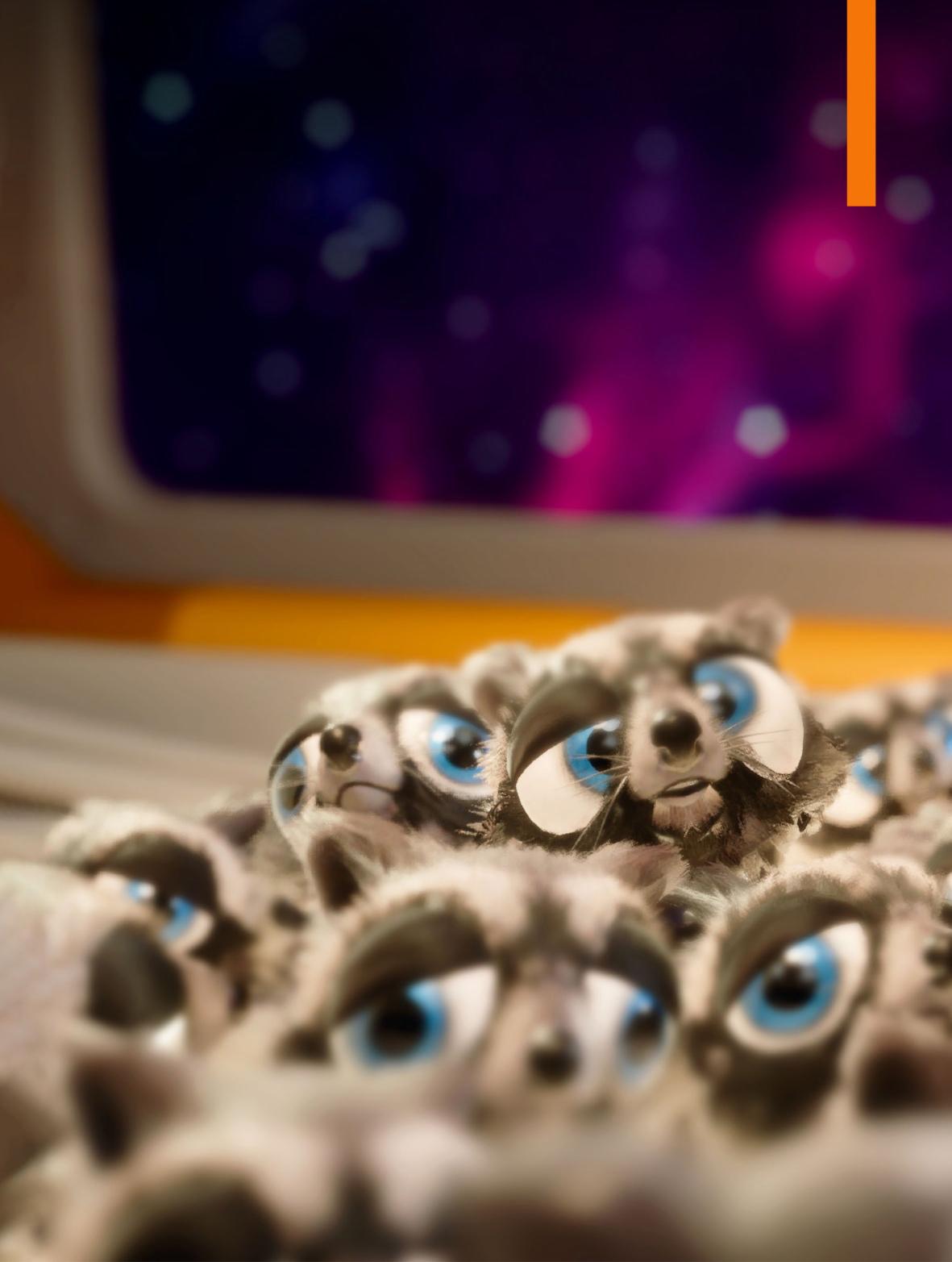
If Bakeru lacks challenge as a platformer, there’s nonetheless a completionist itch that comes with finishing a stage having found all three souvenirs and five Scoops While discovering these usually comes down to checking every nook and cranny (some Scoops hide behind destructible objects), hidden tanukis are a trickier task Introduced partway through the game, which also incentivises retur ning to earlier stages, each one is posing as an object right under your nose And although that sounds like an exercise in finding a needle in a haystack, smashing everything in your path in the hope of yielding results, attentive players will notice that these shape-shifters can’t hold their disguises without twitching occasionally In other words, it helps not to rush things
The rest merely provide new forms of attack (albeit a couple with increased range), essentially overpowering you against enemies that don’t put up much of a fight anyway And the drum sticks still have the most function outside of combat, as you interact with cogs to rotate platforms, or mash them to break the curse at the end of each stage.
If anything , this western release further incentivises you to keep to Bakeru’s default form since he’s been awarded two new moves, which unlock somewhat arbitrarily Charging up the left stick lets him perform an aerial overhead spinning attack, while charging the right has him attack enemies in a straight line. That has also led to changes in enemy placement to best make use of these abilities, even if it’s simply a case of giving you more crowds to use as punching bags.
Still, Bakeru’s belated localisation is a small victory for those who grew up reading about games that were unabashedly culturally Japanese and doomed to stay within their home country’s borders, even if it may also prove that what you imagine from screenshots can be greater than the final product While it doesn’t reach the upper echelon of 3D platformers, the fact that it bolsters a genre so starved these days, as many indies stay in their two-dimensional lane, while 3D games take a more serious tone, is worth celebrating , especially when its overt cultural charms are so endearing
RIGHT Lantern minibosses newly added to the western release provide more of a challenge in later stages of the game, though in you can still make relatively quick work of them in henge form
BELOW You soon acquire a giant kettle that serves as a vehicle for traversing the world map, and also as a huge fighting mech MAIN Staples of modern character action games, such as perfect dodge counters and projectile parries, can be executed, even if you won’t be scored for them
ABOVE While the Switch version’s performance is noticeably choppier than Good-Feel’s work with Nintendo licences, the PC port of the game benefits from smoother framerates and an increase in draw distance
Starstruck: Hands Of Time
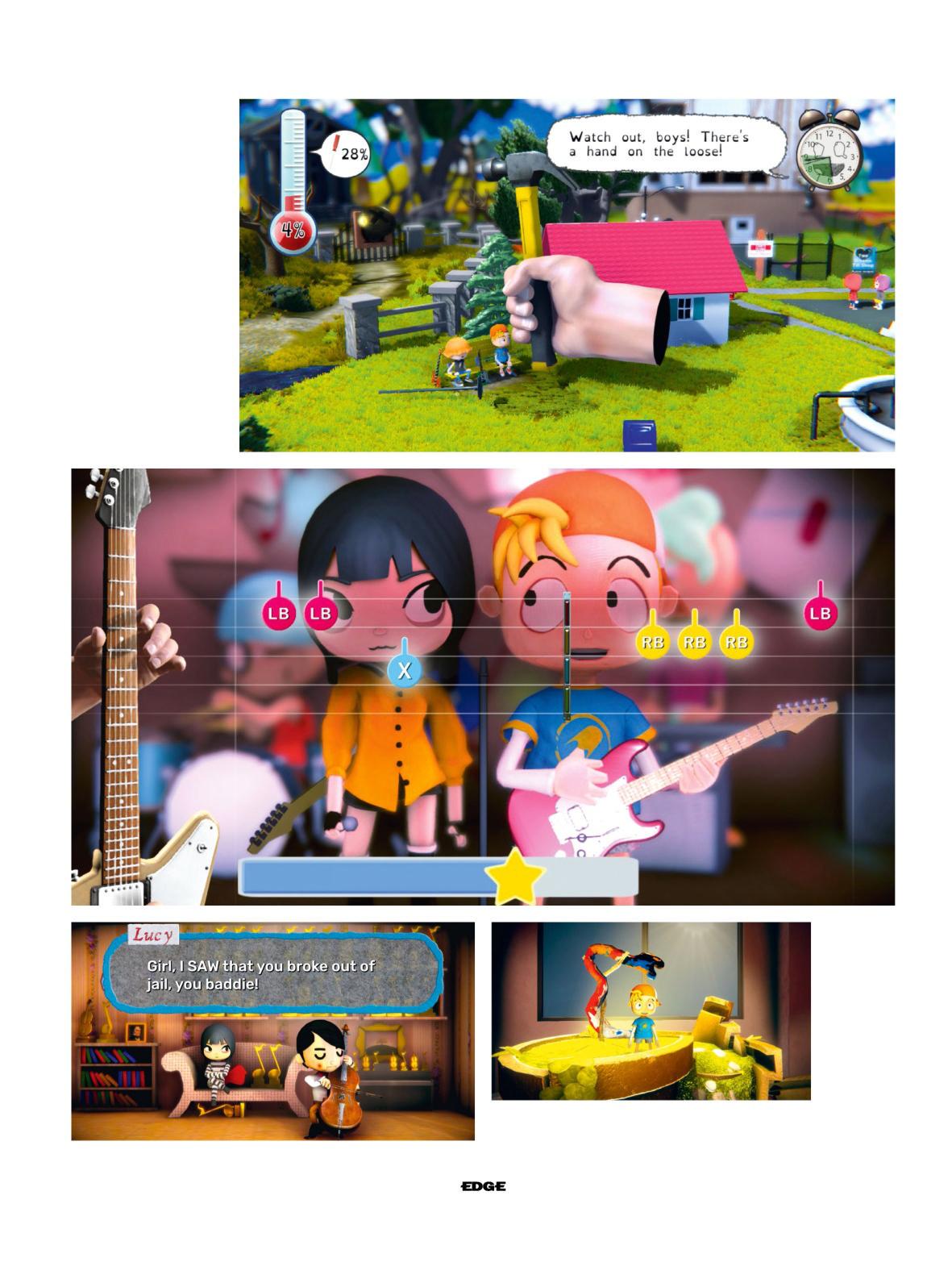
An astronaut – that’s you – travels a thousand years back in time to prevent an apocalypse. Specifically, an apocalypse that somehow involves Edwin, a young boy with aspirations of being a guitarist, who you control from your spaceship, alongside his more proficient musician friend, Dawn, and occasionally a giant human hand walking on two fingers As you strive to alter the timeline, you encounter sentient statues, undead composers, existential dread, and a melancholic frog crooner Confused? Don’t fret Starstruck: Hands Of Time is a playable prog-rock comedy musical that (mostly) just wants you to have a good time And beneath the surreal surface of this singing , dancing Earthbound riff you’ll find an accessible and fairly traditional rhythm game, one that should be familiar to veterans of Rock Band, particularly PSP’s excellent Unplugged, which, like this game, didn’t expect you to fork out for a peripheral.
While Starstruck is perfectly functional on a control pad, if you do choose to play along with a plastic guitar, you may be in for a shock At any difficulty setting above Story, the developer has little interest in easing you into the characters’ rockstar dreams There are only four coloured notes to hit, but almost immediately you’re faced with combos that demand you move your hand up and down the guitar’s neck to keep up
This initially steep learning curve is offset by a Free Play mode, in which there is no punishment for missed notes Not only is it a relief, it better reflects the idea that these are aspiring musicians. They’re meant to sound lousy, right? Still, if you want to hear these songs at their best (and you will – When You Break The Mold is the finest main theme a musical game has boasted since Sayonara Wild Hearts), you’re really going to have to work for it And, yes, it is worthwhile – achieving your first S-rank feels as sweet as it did the first time you nailed Through The Fire And Flames.
True, there’s little here that rhythm-game stalwarts won’t have seen before, but it’s all well implemented, and in some cases an evolutionary advancement. Solos, which allow you to improvise as long as you get the timing right, were a concept booed off the stage of Rock Band 4 – let’s face it, our incoherent noodling was never going to improve Paint It Black – but they’re a more harmonious fit with Starstruck’s original compositions, and perfectly in tune with the game’s expressive plasticine characters Edwin’s long , awestruck stares at Dawn’s superior string thrashing are a particular treat Between jam sessions, Starstruck has you exploring the pair’s tiny hometown in search of fresh musical opportunities It’s a place dense with delightful oddballs, mixing quips with soundbites of gibberish, plus the occasional blast of copyright-free classical music. The influence of Yoshiro Kimura’s work is apparent here
Developer/publisher Createdelic
The playful surrealness gives way to nightmarish logic and eventually outright horror
(developer Createdelic’s name is surely a nod to the Moon maker’s former studio Love-de-lic) and very welcome. Sometimes your progress is blocked by an obstacle such as a giant bowling ball Naturally, the answer is to return to your ship, scan your hand and materialise it as a massive facsimile to smash the place to pieces The result is a few minutes of cathartic nonsense as you indulge your inner naughty child and destroy the lovely dioramas with hammers and screwdrivers. There’s no real depth, with ‘puzzles’ amounting to nothing more than ‘hit object with correct tool’, but it’s pure silly fun that leads to some of the game’s best literal punchlines. And pure, silly fun would suffice to see Starstruck through to its end, yet Createdelic has greater, darker narrative aspirations. Don’t let its handmade heroes fool you into thinking this story is family-friendly kin to the likes of Paper Mario or Yoshi’s Crafted World Where those games revelled in their cuddly charms, Starstruck is more interested in the inherent creepiness of dead-eyed dolls The playful surrealness of its lighthearted musical adventure thus gives way to nightmarish logic and eventually outright horror. It’s a gear shift that might have been disappointing if it weren’t so effective, leaning on a wide range of tricks, from oversaturated lighting and disorienting camera angles to spikes of noise – or simply lingering on a figure’s face for far too long after dialogue concludes
MACHINE STILL LEARNING Hadley, your spaceship s on-board computer companion, exemplifies the humour and detail that makes Starstruck special Sweet, encouraging, and quick with a nonsensical quip, her constant yet fumbled cheerleading of your efforts can’t help but endear When you smash up the town with your giant hand, she assures you she’ll fix everything bar the obstacle you needed to remove Explore the area later, however, and you’ll note that her repair work is amusingly appalling, with buildings taped back together and full of holes And if you’d like an insight into what an AI really thinks of its own art, check your desktop s recycling bin There you’ll find MS Paint pictures depicting your adventures drawn by Hadley, which she’s then tried to hide
Then, before you tire of these attempts to make your skin crawl, Starstruck starts to get under it, bringing to the forefront themes of jealousy and the cruelty that creative people are capable of in order to get ahead. One act of violence, though tame by videogame standards, is shocking enough here to elicit a gasp Yet even in its darkest moments Starstruck has room for an inspired gag about premature baldness. It’s a remarkable balancing act One of the year’s best horror games shouldn’t feature so many successful jokes about toilets And yet
There are minor dropped notes, especially towards the end, as the stretches between songs increase Here the game begins to ramble into walking-sim territory, at times indulging its inner lecturer (the developers have clearly brushed up on their world history, and want you to know it) And when the plot attempts to wink away the predictability of its closing number by lampshading it, the joke doesn’t quite land Fortunately, it’s not enough of a misstep to undermine the terrific musical crescendo, and any lingering concerns are quickly shoved off stage by a haunting post-credits scene.
Occasional misses aside, then, Starstruck is an outstanding debut performance It’s all over within four hours (long for a concert, short for a cosmic adventure), and even with the inclusion of secrets to justify a replay, we’re left wanting more And, as Edwin and Dawn would attest, there are worse sins an artist can commit than leaving the audience screaming for an encore
ABOVE We mean it when we say Starstruck can get quite dark at times, but the climax of Edwin’s nightmare is a joke too good to spoil Developer Createdelic is great at using horror to wrong-foot you with humour
RIGHT More games should let you bash two of the lead characters with a hammer, consequence-free MAIN It’s worth paying attention to what the characters are doing while you ’ re playing, even if it leads to a few missed notes
BOTTOM Dawn’s brother is so much more successful that her mother has started putting his trophies in her room Brutal
PLAY
Caravan SandWitch
Studio Plane Toast’s approach to exploration is in many ways as laidback as it gets. For example, if the quickest route from A to B is to drive or jump off a cliff ? So be it Expect the merest of bumps on landing before arrowing off towards your destination again Nor should it take you long to arrive Spot something interesting in the distance and you can guide your indestructible van nearby in short order, then have driver Sauge hop out and scale any stubborn rocks with unfussy clambering leaps Caravan SandWitch’s open world is compact and very much at your fingertips
As such, this land of ruin can feel like an oddly utopian dystopia Returning to her home planet in search of her sister, Sauge is reunited with the few friends and family members who stayed put after a corporation stripped the world of resources then scarpered when a giant, tornado-like ‘anomaly’ (which still dominates the horizon) appeared. Those who remain survive by repurposing the tech left behind, yet while it’s a bare life, the absence of capitalist pressures and rhythms is also a relief Some individuals consider the security of a job off-planet, but for us this is something of a holiday.
Following your long-lost sister’s trail of messages largely means driving around the place at a leisurely
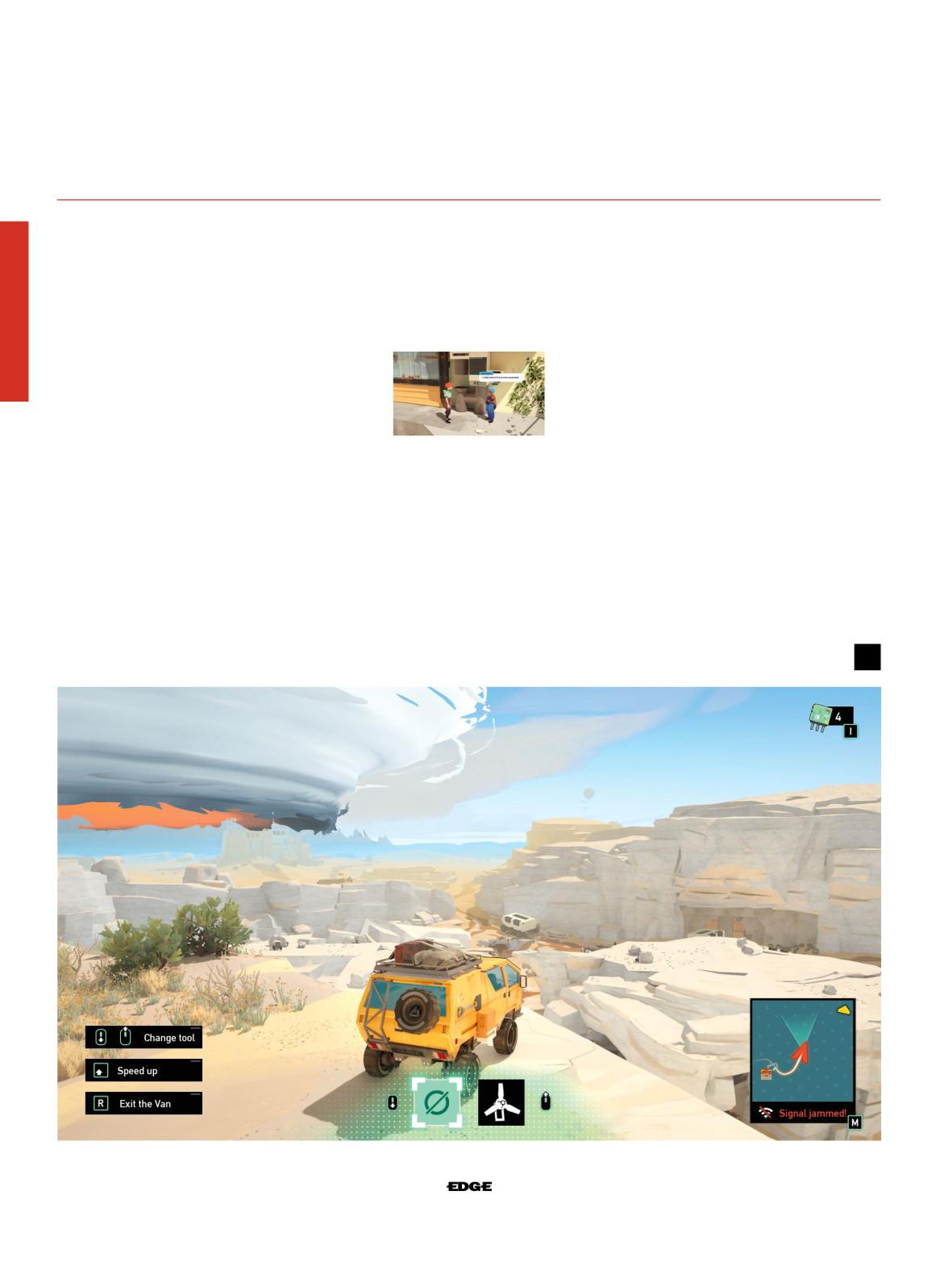
As well as being your mode of transport, the van doubles as a kind of checkpoint that you can warp to at any time You can also climb onto the roof, and the extra height comes in handy for reaching certain platforms
Developer Studio Plane Toast Publisher Dear Villagers Format PC (tested), PS5, Switch Release Out now
MOBILE SERVICE
While you re out on your travels you may as well fulfil requests from folk who aren’t blessed with a motorised vehicle and not only because doing so often ear ns you components The villagers, nomads and a community of frog people you meet are all pleasant enough, so it doesn’t feel like a chore to help, and you lear n lots about the world in the process It’s a shame, though, that the script feels a bit too ear nest and short on nuance
pace in your turmeric-yellow van, seeking out notable structures and trying to get inside. While you’ll have main objectives in mind at every stage, not least disabling the jamming devices that block communication between areas, to complete them you’ll also need to upgrade your van, which means gathering electronic components for Nèfle, your tech-head friend First they build you a scanner that, among other things, pinpoints power sources, helping you find mechanisms to open locked doors Soon you’ll have a grapple line that can yank free fragile panels blocking your way This progress system, however, feels far less laidback than what’s around it, as you make partial headway into buildings only to find another hard gate standing in your way. The pleasure of surveying a ruin to grasp how its walkways and ladders might get you to the roof is often curtailed when you spy, say, a zipwire that you simply can’t use yet. Reaching the top is thus a matter of scavenging more components – in high numbers for later upgrades – with each new tool sending you into another circuit of the map to locate the latest layer of obstacles that’s been removed. All along , the view from lofty, rusting peaks remains captivating , with frequent rest spots giving you a chance to simply take it all in. Despite the absence of punishing deadlines, though, maybe this escape is a little too much like work after all
PLAY
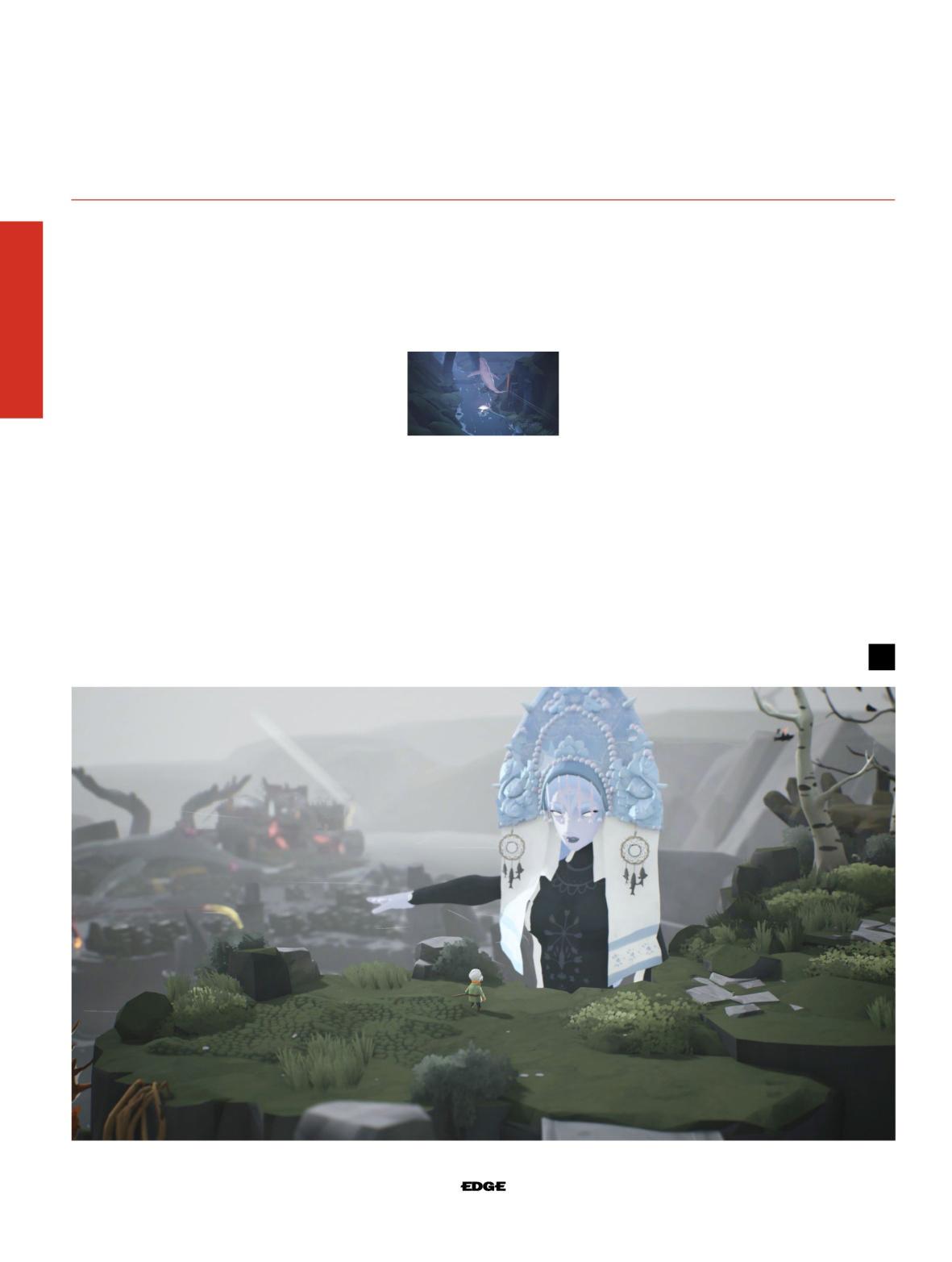
The title refers to a ritual, enabling individuals to move on after the loss of a loved one. Playing a recently deceased old man, stuck in a more literal limbo, it’s your job to perform it All you need is your light-giving magic staff, a personal item belonging to the deceased, and the soul of a fish Why a fish? Well, Selfloss is steeped in Slavic and Icelandic folklore, which manifests here in a reverence for the sea The plane you traverse is home to all sorts of aquatic creatures – flying whales, jellyfish gods and venerable turtles Whether you’re familiar with its mythical influences or not, it’s a fascinating backdrop.
Indeed, the dreamlike nature of your quest to seek out the grief-stricken, and ultimately an orca – the creature that can grant you release – is evident the moment you wash up on the game’s shores and are greeted by a slender being , entirely swathed in white except for a purple beaked face and orange feet. Bizarre yet solemn, this guide stands with a muted palette and haunting soundtrack to evoke a powerful melancholy It barely needs saying that this is a liminal world, and the sense is only heightened by foreboding seas, echoing whale song and schools of ghostly fish The water feels doubly dark when you push onto it in a
Selfloss
Developer Goodwin Games
Publisher Maximum Entertainment
Format PC (tested), PS5, Switch, Xbox Series
Release Out now
RAPID DESCENT
Between chapters, you re sent on a spiralling jour ney through dreams of your past life and then into gauntlets of hazardous waters In the first instance, a raging river littered with rocks provides a test of your paddling and sailing skills In the second, you’re lost at sea, seeking buoyant guideposts among heaving waves As in the rest of the game, the soundtrack plays a powerful role here, along with the violent rumble of thunder, to reflect your own sense of unrest
small, fragile boat, but it’s a crucial means of traversal, enabling you to link the islands containing key items and catch those all-important souls
The game’s chapters are discrete environments, presenting a series of puzzles accessible all at once from your vessel Solutions generally involve lighting up symbols with your staff, sometimes in a specific order discoverable nearby, yet the circumstances vary Use the light to guide different-coloured fish towards torches, for example, or plant the staff in the ground so you can stand on a pressure pad in one place, while illuminating a crystal in another. Your all-purpose tool is also essential in dealing with a fleshy miasma that blocks paths and spawns monsters Petrify them with a beam of light, and they can be smashed apart.
It’s a shame, then, that for all the ingenious versatility infused in your staff and neat transitions between combat, puzzles and exploration, Selfloss is itself infected, by stodgy controls that aren’t excused by the frailty of the protagonist The twin-stick setup to direct your staff ’s beam clashes with a camera that’s too often on the move, yet not quite quickly enough, while occasional platforming is imprecise, and boat-based puzzles can be a fiddly war of attrition Add in a couple of unwieldy boss fights, and as much as it’s captivating to soak in the atmosphere Selfloss creates, you should prepare for some choppy waters
Alongside the sea life, various humanoid beings populate the land, from giants who once warred with humans to an elven tribe and even the witch Baba Yaga, complete with her walking hut mounted on chicken legs
TIME EXTEND
How a twisting fair ytale beanstalk freed Ubisoft from its least playful impulses
BY CHRISTIAN DONLAN
hould you decide to be unfairly reductive about Ubisoft’s general approach to game design, you might argue that the publisher prefers to make large, busy games in which interaction is defined by convenience and work Games such as Assassin’s Creed can give you what amounts to a full-time job, but they at least make that job as easy to carry out as possible, with clear icons scattered on the map and tools that are neatly fit for purpose
Yet now and then Ubisoft will do something different It will allow a studio such as Newcastle’s Reflections to make something small and weird and yet still undeniably Ubisoft-adjacent This means Ubisoft occasionally produces games such as Grow Home – and in Grow Home something magical happens The convenience is there in everything you do, but the work fails to materialise You have objectives and missions and even collectables to hunt down, but everything is governed by a sense of open-ended play and, more than anything , by possibility. This is a word we will return to later Convenience might initially seem like a strange way to think about Grow Home, which, during its first few minutes, can seem wilfully, comically awkward The game casts you as a tiny red robot named BUD, whose ship has dropped him off on an alien planet And it’s done this quite literally: BUD has fallen out of the ship and plummeted through the sky to land on a sandy beach, surrounded by calm blue waters Your job in the game is to climb: to navigate rocks, mountains and eventually asteroids as you make your way back to the orbiting ship, hopefully having collected elements of the local fauna that will be of help back on your world
What makes this awkward at first is that BUD really feels like a robot He’s procedurally animated and driven by physics, meaning each part of his body feels distinct and rattly and only loosely connected to everything else To climb, you independently move BUD’s left and right hands, each controlled using its own trigger. You must grip a surface with one hand, reach with the other, grip that hand,
ungrip the first hand and thus continue your slow ascent
Cue YouTube failure-compilation videos full of limb entanglement and extremely lengthy falls But over time – and it doesn’ t take long – this simple, methodical approach to climbing starts to make sense It’s clasp-based, which means it’s entirely instinctive when there’s a lot of exposure below you It’s clean, too There’s no stamina meter to nurse as you go, and BUD’s sense of weight and momentum steadily starts to feel as fixed and reliable as Mario’s BUD’s first steps are clumsy and stumbling , raking the air and clutching at nothing , but within an hour he’s heaving himself up cliffs with an understanding of what’s possible within the elastic confines of each arm’s reach.
BUD has another ally, though, in the planet’s beanstalk, which starts at the surface level of the world and can be coaxed upwards by riding tendrils that sprout from it, and then connecting them, petrol-pump style, to various floating islands To grow the beanstalk up into space it needs many points of connection, and you ride these connecting tendrils by gripping on, attempting to steer, but mainly hoping you can just stay attached. It’s an unusual sensation, and it’s tempting to say that Ubisoft’s almost made a perfect game about riding bulls, or about the Nantucket Sleigh Ride – that phenomenon of 19th-century whaling when the boat had speared the whale and the whale then tried to unspear itself by racing off through the waters and dragging everyone along behind it
The beanstalk isn’ t merely hectic fun to engage with, though Pay attention and it can explain why this Ubisoft game doesn’ t feel like any other There are two reasons for this, and they both come down to a sense of freedom
The first reason is that, as you grow the beanstalk, as you climb it, and as you plug its tendrils in after riding them out into the sky, you’re engaged in a game in which you interact with the world in very different ways over time In early stages, you’ll be desperate to plug in as many tendrils as possible and get the beanstalk growing But then it grows, and you need to climb its main trunk to reach other tendrils
And, as it grows, you start to be distracted by the things the beanstalk is growing past Collectibles and save points and useful things like that, certainly, but also caves and waterfalls and scrabbly forests and landmarks that are impossible to pass by purely because of what they are Who can turn their back on a waterfall or fail to question what lies behind it? Who can see a cave mouth opening into a cliff and decide it’s best left to someone else to sound out?
So you climb, but you also ride and spelunk and explore and fall and move boulders out of the way, smell the flowers, and interact with the various elements of the wildlife This is a game where you know that one moment will always be very different from the moments that follow it, and it’s all done organically, through a sense of playfulness
fabled ‘possibility space’ that every game creates, and which every player operates within In Grow Home, that possibility space suddenly has volume. It’s now real space. It’s like a sink filled with water, and you can scatter delicate loops and lines of ink into it and see the otherwise-invisible contours of its potential
Grow Home always gives you just enough guidance It’s an elegant relationship, a
This brings us to the second reason Grow Home so successfully bucks the Ubisoft trend As you grow the beanstalk and place the tendrils, you are helping to design an open world that is initially left tantalisingly unfinished The floating islands are all in place, the collectables are duly scattered, and the wildlife has its own favoured patches. But the rest of the game is just sky, just air, cycling gently through day and night phases, until you decide to thread it with branches and leaves that become platforms and climbing frames and trampolines
It’s an open world with space for your own ludic graffiti, in other words, and as you climb higher, connect more tendrils and let them tangle and knot in empty areas as you see fit, it can be hard not to think of the
conversation between designers and players
The higher you get, the more you move past a set sequence of beautifully designed islands until you eventually hit outer space and its twisting asteroids and patiently waiting spacecraft But the way you connect these things, the routes you make between them and the areas you prioritise, are completely your own concern. It’s not quite a blank sheet of paper, and it shouldn’ t be, because a blank sheet of paper can be terrifying , imaginatively paralysing. Instead, it’s closer to a selection of ink blots that you’re invited to turn into your own doodled pictures: landscapes, staircases, trampoline parks The rewards for this kind of approach are extraordinary Grow Home feels both compact and panoramically vast It’s a playground that’s fit for whatever you can think of
There’s plenty of life to explore as you progress farther up the beanstalk, and a lot of it turns out to be quite useful
Riding a tendril out from the main stem is a thrilling change of pace in comparison to the slow progress of climbing
BUD AND FLOWER
BUD can use various tools as he explores the world of Grow Home, but none is such a perfect match for the dreamy landscape and the game ’ s nursery spirit as the daisy Plucked from the ground, and squeezed down into kit form with a press of both triggers, the daisy can be deployed whenever BUD is falling in order to slow him down and give him a little more control over his descent As visuals go, it’s already a beautiful idea, and the low-poly aesthetic manages to make the flower look more organic, due to well-placed planes and kinks that echo the pen strokes of a naturalist’s sketch The final genius is in the way the petals fall off as the daisy’s usefulness counts down to nothing
For a compact game, Grow Home is excellent at conjuring a sense of space, perhaps because you work in so many directions
And plenty of things you can’ t Late in the game, you’re tasked with collecting seeds that are growing around the place It feels like a real opportunity for a switch to flick, and for the traditional Ubisoft shutters to come down on your fingers But these seeds are as roly-poly with their own wayward physics as BUD is They’re designed to be grasped, but also to be dropped, to rattle down from one ledge to another, to spin into space and have you diving after them, unwilling to see them get away from you and fall into the ocean It’s a lot from a little, almost as if someone created a set-piece existing within one of those headache tablets that fizzes away once you’ve dropped it into water
Even here, Reflections guides you with a winning gentleness Any object lost to the waves will return, moments later, on a section of the starting area known to the
designers as the “magic beach” This small cove is a means of giving you back essential in-game items you’ve dropped, but it obeys the rhythms of this watery world as much as it does the needs of the game’s structure The designers are hiding behind the tide, lurking within the shifting currents of the ocean, and making sure anything BUD loses washes up on the shore. It’s a pretty brilliant place for designers to spend their time
Come back to an old Grow Home save file after years have passed, and it’s a different game yet again The dynamism of the tendrils, the addled urgency of the hunt for collectables, all these things are long gone, and you’re confronted with a space that you half remember, and that you half own, because you helped to make it all that time ago A game about climbing higher becomes a game about exploring outwards, reminding yourself of what was already here, how it fits together and how it came to be.
This is a kind of nostalgia that emerges from a rare sense of co-authorship And the nostalgia brings with it its own rules. An ancient save file for Grow Home should not be touched Or rather, it should not be tampered with Revisit the playground, but don’ t put up any more rides Don’ t create new tendrils or connect any more distant boulders This space is fixed, and yet somehow in being fixed it remains as playful as ever How best to reach that cave? How best to see what lurks behind that waterfall? What did we once do here, and what were we thinking as we did it?
The beanstalk is as much of a character in the game as BUD the robot is Its texture carries a strange hint of Gore-tex
Terms and conditions The free trial is only available to new subscribers, and only through the Apple App Store, Pocketmags and Amazon If you have previously subscribed to Edge, payment will be taken immediately You can cancel at any time during the free trial period and you will not be charged: simply turn of f auto-renew in your account subscriptions page at least 24 hours before the auto renew is due Payment will be charged to your iTunes, Pocketmags or Amazon account at confirmation of purchase No cancellation of the current subscription is allowed during active subscription period This does not af fect your statutor y rights Any unused por tion of a free trial period, if of fered, will be for feited when you purchase a subscription D O W N L O A D T H E E D G E A P P A N D G E T Y O U R F I R S T I S S U E F R E E
T H E L O N G G A M E
A progress repor t on the games we just can’t quit
Broken Sword – Shadow Of The Templars: Reforged
The Broken Sword games are no strangers to being reissued Even so, rereleasing the first of the beloved point-and-click adventures again, but in 4K and with a remastered soundtrack? It’s like being asked if you want to hear the Archers omnibus with THX audio Put another way, to play Shadow Of The Templars in this edition is to be reminded that a game so concerned with history is well on its way to being an artefact itself It’s still a fiercely charming artefact, however Dropped into Paris in the loafers of US tourist George Stobbart and asked to investigate a café bombing for the first, fifth, 20th time, the result is still the same It might’ve felt slightly elderly even way back when its technology was cutting-edge, but that’s no criticism – this is a deeply likeable adventure
As a chance for old fans to view the game with fresh eyes, Reforged holds up pretty well. The new animation is luxurious and colourful, although Stobbart’s facial expressions can appear rubbery during cutscenes The dialogue is stagey and can echo in the new audio, but the plot is brisk and the characterisations smartly crafted, if broad One of
our bigger hesitations, returning to this almost 30-year-old game, is how well a narrative that wrings its fun from conspiracy theories would work in 2024 In truth, Broken Sword fares better than you might expect. Its plot mostly stays clear of the “exotic travel” stereotypes that have aged so much adventure fiction, with stop-offs in places such as France, Ireland and Spain filling out the itinerary alongside Syria, while the tone is as self-deprecating as Stobbart himself
There may be clowns bombing cafés and biblical references knocking about, but Revolution is careful to always remember that this kind of thing is an interesting lark and nothing more
In many ways, the whole thing has arrived in the present moment far more intact than the works that followed in its path There’s none of the clanging dialogue and exposition dumps of a Dan Brown novel, and Stobbart is game enough as the butt of many of the jokes Nicole remains a high point in adventuregame characterisation, the ideal counterpoint to Stobbart’s naïvete, whatever the resolution. All told, it’s good to spend some time with these two again