
Post War & Contemporary Art

Page 1


post-war & contemporary art a uction

Thursday, May 21, 2026

155 Yorkville Avenue, 2nd Floor, Units 1 & 2, Toronto

Entrance at STK, 153 Yorkville Avenue

Together with Heffel’s Digital Saleroom

Registration required to attend or bid in person

Video Presentation

4:30 PM ET

Post-War & Contemporary Art, *followed by E.J. Hughes: Coastal Boats Near Sidney, BC

5 PM ET

Old Master, Impressionist & Modern Art

7 PM ET

p reviews

Heffel Gallery, Calgary

220 Manning Road NE , Unit 1080

Thursday, April 9 through Saturday, April 11, 11 am to 6 pm MT

Heffel Gallery, Vancouver 2247 Granville Street Thursday, April 16 through Tuesday, April 21, 11 am to 6 pm PT

Galerie Heffel, Montreal 1840 rue Sherbrooke Ouest

Thursday, April 30 through Monday, May 4, 11 am to 6 pm ET

Heffel Gallery, Toronto

13 Hazelton Avenue

Together with our Yorkville exhibition galleries Tuesday, May 12 through Tuesday, May 19, 11 am to 6 pm ET

Heffel Gallery Limited

Additionally herein referred to as “Heffel” or “Auction House”

contact

Toll Free 1-888-818-6505

mail@heffel.com, www.heffel.com

Please send all physical mail to our Vancouver address

t oronto

Main Yorkville Reception

13 Hazelton Avenue, Toronto, ON M 5 R 2 E 1 Telephone 416-961-6505, Fax 416-961-4245

15 Hazelton Avenue, Unit 200, Toronto, ON M 5 R 2 E 1

135 Yorkville Avenue, Unit 401, Toronto, ON M 5 R 3 W 5 via main reception

155 Yorkville Avenue, 2nd Floor, Toronto, ON M 5 R 1 C 4 via main reception

m ontreal

1840 rue Sherbrooke Ouest, Montreal, QC H 3 H 1 E 4 Telephone 514-939-6505

v ancouver

2247 Granville Street, Vancouver, BC V 6 H 3 G 1 Telephone 604-732-6505

north v ancouver

2455 Dollarton Highway, Unit 108 North Vancouver, BC V 7 H 0 A 2 Telephone 604-732-6505 ext. 150 by appointment

c algary

220 Manning Road NE , Unit 1080, Calgary, AB T 2 E 8 K 4 Telephone 403-238-6505 by appointment

c orporate b ank

Royal Bank of Canada, 2735 Granville Street Vancouver, BC V 6 H 3 J 1 Telephone 604-665-5700

Incoming wires are required to be sent in Canadian funds and must include: Heffel Gallery Limited, 2247 Granville Street, Vancouver, British Columbia V 6 H 3 G 1 as beneficiary.

b oard of d irectors

Chairman In Memoriam—Kenneth Grant Heffel

President—David Kenneth John Heffel

Auctioneer License T 83-3364318 and #26-155436

Vice-President—Robert Campbell Scott Heffel

Auctioneer License T 83-3365303 and #26-155435

Heffel com Departments consignments consignments@heffel.com

a ppraisals appraisals@heffel.com

a bsentee, t elephone & online b idding bids@heffel.com

s hipping

shipping@heffel.com

s ubscriptions subscriptions@heffel.com

c atalogue s ubscriptions

Heffel Gallery Limited regularly publishes a variety of materials beneficial to the art collector. An Annual Subscription entitles you to receive our Auction Catalogues. Our Annual Subscription Form can be found on page 111 of this catalogue.

c atalogue p roduction

Essay Contributors—Robert Amos, Marie-Hélène Busque, François-Marc Gagnon, Daniel Gallay, Robert Heffel, Ihor Holubizky, Alec Kerr, Lauren Kratzer, Adam Lauder, Marie-Jo Paquet, Naomi Pauls, Molly Tonken and Douglas Watt

Text Editing, Catalogue Production—David Heffel, Robert Heffel, Alec Kerr, Kristian Martin, Naomi Pauls and Kirbi Pitt

Director of Imaging—Martie Giefert

Digital Imaging—Ward Bastian, Jasmin Daigle, Brandon Prince, Justin Somjen and Jared Tiller

Catalogue Layout and Production—Kirbi Pitt and Clara Wong

c opyright

No part of this publication may be reproduced, stored in retrieval systems or transmitted in any form or by any means, digital, photocopy, electronic, mechanical, recorded or otherwise, without the prior written consent of Heffel Gallery Limited.

All photographic representations and other illustrations depicted are solely for guidance and are not to be relied upon in terms of tone or colour.

Follow us:

Printed in Canada by Friesens

ISBN : 978-1-927031-82-7

notice for c ollectors

Auction Location

heffel toronto

155 Yorkville Avenue, 2nd Floor, Units 1 & 2, Toronto Entrance at STK, 153 Yorkville Avenue Together with Heffel’s Digital Saleroom

Reserved Seating and Attendance

Entrance through 153 Yorkville Ave

Live Stream

Please note that we produce a live stream of our sale beginning with a video presentation at 4:30 PM ET and the auction commencing at 5 PM ET. We recommend that you test your video streaming 30 minutes prior to our sale at www.heffel.com.

All Lots and additional images depicting the frame and verso are available at www.heffel.com.

This auction is by pre-arranged reserved seating only. To register for in-person bidding or general attendance, please contact bids@heffel.com. Please note that all reserved seating requests must be received by Heffel at least two (2) business days prior to the commencement of the sale.

Admission is based on approved registration and verification by Heffel. Registered bidders will have priority for seating. General admission is limited and cannot be guaranteed. Please note that Heffel may, at its discretion, restrict entry for event security and safety.

Auction Notice

The Buyer and the Consignor are hereby advised to read fully the Terms and Conditions of Business and Catalogue Terms, which set out and establish the rights and obligations of the Auction House, the Buyer and the Consignor, and the terms by which the Auction House shall conduct the sale and handle other related matters. This information appears on pages 102 through 110 of this publication.

Please visit www.heffel.com for information on which Lots will be present at each preview location, virtual auction previews and to book your in person preview appointment. Preview appointments can also be booked by calling 1-888-818-6505.

Absentee, Telephone and Digital Saleroom Bidding

If you are unable to attend our auction in person, Heffel recommends submitting an Absentee Bid Form to participate. Heffel also accepts telephone bidding, prioritized by the first received Telephone Bid Form and limited to available Telephone Bid Operators per Lot. Alternatively, Heffel offers online bidding in real time through our Digital Saleroom, subject to advanced registration and approval. All forms of remote bidding participation and registration must be received by Heffel at least two (2) business days prior to the commencement of the sale. Information on absentee, telephone and online bidding appears on pages 5, 112, 113 and 114 of this publication.

Estimates and Currency

Our Estimates are in Canadian funds. Exchange values are subject to change and are provided for guidance only. Buying 1.00 Canadian dollar will cost approximately 0.71 US dollar, 0.62 euro, 0.53 British pound, 0.56 Swiss franc, 113 Japanese yen or 5.6 Hong Kong dollars as of our publication date.

auction details

Selling at Auction

Heffel offers individuals, collectors, corporations and public entities a full-service firm for the successful de-acquisition of their artworks. Interested parties should contact us to arrange for a private and confidential appointment to discuss their preferred method of disposition and to analyse preliminary auction estimates, pre-sale reserves and consignment procedures. This service is offered free of charge.

If you are from out of town or are unable to visit us at our premises, we would be pleased to assess the saleability of your artworks by mail, courier or e-mail. Please provide us with photographic or digital reproductions of the artworks front and verso and information pertaining to title, artist, medium, size, date, provenance, etc. Representatives of our firm travel regularly to major Canadian cities to meet with Prospective Sellers. It is recommended that property for inclusion in our sale arrive at Heffel at least 90 days prior to our auction. This allows time to photograph, research, catalogue and promote works and complete any required work such as re-framing, cleaning or conservation. All property is stored free of charge until the auction; however, insurance is the Consignor’s expense.

Consignors will receive, for completion, a Consignment Agreement and Consignment Receipt, which set forth the terms and fees for our services. The Seller’s Commission is the amount paid by the Consignor to the Auction House on the sale of a Lot, which is calculated on the Hammer Price, at the rates specified in writing by the Consignor and the Auction House on the Consignment Agreement, plus applicable Sales Tax. Consignors are entitled to set a mutually agreed Reserve or minimum selling price on their artworks.

Buying at Auction

All items that are offered and sold by Heffel are subject to our published Terms and Conditions of Business, our Catalogue Terms and any oral announcements made during the course of our sale. Heffel charges a Buyer’s Premium calculated on the Hammer Price as follows: a rate of twenty-five percent (25%) of the Hammer Price of the Lot up to and including $ 25,000; plus twenty percent (20%) on the part of the Hammer Price over $ 25,000, plus applicable Sales Tax.

If you are unable to attend our auction in person, you can bid by completing the Absentee Bid Form found on page 112 of this catalogue. Please note that all Absentee Bid Forms should be received by Heffel at least two (2) business days prior to the commencement of the sale. Bidding by telephone, although limited, is available. Please make arrangements for this service well in advance of the sale. Telephone lines are assigned in order of the sequence in which requests are received. We also recommend that you leave an Absentee Bid amount that we will execute on your behalf in the event we are unable to reach you by telephone. Digital Saleroom online bidding is available subject to pre-registration approval by the Auction House at least two (2) business days in advance of the auction.

Payment must be made by: a) Bank Wire direct to the Auction House’s account, b) Certified Cheque or Bank Draft, c) a Personal or Corporate Cheque, d) Debit Card and Credit Card only by Visa, Mastercard, Union Pay or American Express or e) Interac

e-Transfer. Bank Wire payments should be made to the Royal Bank of Canada as per the account transit details provided on your invoice. All Certified Cheques, Bank Drafts and Personal or Corporate Cheques must be verified and cleared by the Auction House’s bank prior to all purchases being released. Credit Card payments are subject to our acceptance and approval and to a maximum of $ 5,000 if the Buyer is providing their Credit Card details by fax or to a maximum of $ 25,000 per Lot purchased if paying online or if the Credit Card is presented in person with valid identification. A two percent (2.00%) Convenience Fee will apply to all Credit Card payments. In all circumstances, the Auction House prefers payment by Bank Wire.

General Bidding Increments

Bidding typically begins below the low estimate and generally advances in the following bid increments:

$ 50 – 300

$ 300 – 500

$ 500 – 2,000

$ 2,000–5,000

$ 5,000–10,000

$ 25 increments

$ 50

$ 100

$ 250

$ 500

$ 10,000–20,000 $ 1,000

$ 20,000–50,000

$ 2,500

$ 50,000–100,000 $ 5,000

$ 100,000–300,000 $ 10,000

$ 300,000–1,000,000 $ 25,000

$ 1,000,000–2,000,000 $ 50,000

$ 2,000,000–3,000,000

$ 100,000

$ 3,000,000–5,000,000 $ 250,000

$ 5,000,000–10,000,000 $ 500,000

$ 10,000,000+

$ 1,000,000

Framing, Conservation and Shipping

As a Consignor, it may be advantageous for you to have your artwork re-framed and/or cleaned and conserved to enhance its saleability. As a Buyer, your recently acquired artwork may demand a frame complementary to your collection. As a full-service organization, we offer guidance and in-house expertise to facilitate these needs. Buyers who acquire items that require local delivery or out-of-town shipping should refer to our Shipping Authorization Form for Property on page 115 and our Terms and Conditions for Shipping on page 116 of this publication. Please feel free to contact us to assist you in all of your requirements or to answer any of your related questions. Full completion of our shipping form is required prior to purchases being released by Heffel.

Written Valuations and Appraisals

Written valuations and appraisals for probate, insurance, family division and other purposes can be carried out in our offices or at your premises. Appraisal fees vary according to circumstances. If, within five years of the appraisal, valued or appraised artwork is consigned and sold through Heffel, the client will be refunded the appraisal fee, less incurred “out of pocket” expenses on a prorated basis.

f eaturing w orks from

The Barbeau Owen Foundation Collection, Vancouver

The Luc Plamondon Collection

The Estate of Dr. Luigi Rossi

An Important Ontario Collection

An Important Private Collection, usa

& other Important Private and Corporate Collections

AANFM LP QMG RCA SAPQ 1933 – 2004

Untitled oil on canvas, on verso signed and dated 1954 8 × 10 in, 20.3 × 25.4 cm

p rovenance

The Moore Gallery, Hamilton Private Collection, Ontario

V IBRANT AN d VIVACIOUS , Guido Molinari’s 1954 Untitled belongs to an important early moment in the artist’s development, when his engagement with gestural abstraction was already giving way to the structural investigations that would define his mature practice. Though still animated by an intuitive, organic vitality, the painting reveals Molinari’s growing concern with the relational power of colour. Thick, vigorous passages of pigment collide and respond to one another in a dynamic counterpoint, activating the surface as a unified visual field.

Rather than embracing the emotional excess associated with Abstract Expressionism or the measured harmonies of European mid-century abstraction, Molinari sought a more self-sustaining pictorial order. Here, vividly hued patches begin to assert themselves as broader, more deliberate chromatic zones. The composition resists hierarchy or narrative focus, instead proposing a continuous visual rhythm that unfolds across the surface.

This lively early work captures Molinari at a point of self-realization and exploration, as gesture yields to the disciplined pursuit of colour relationships that would soon become central to his art.

e stimate: $ 20,000 – 30,000

2 Mary Frances Pratt

CC OC RCA 1935 – 2018

Snow Light in My House oil on canvas, signed and dated 2010 and on verso titled and dated on the gallery label 20 × 30 in, 50.8 × 76.2 cm

p rovenance

Equinox Gallery, Vancouver

Acquired from the above by a Private Collection, Vancouver

By descent to the present Private Estate, Vancouver

T OWAR d S THE EN d of her marriage to Christopher Pratt, Mary Pratt increasingly turned to painting as a form of cathartic release, imbuing her domestic subjects with symbolic meaning. Pomegranates, long associated with fertility, sensuality and abundance, had emerged in her work in the mid-1980s. Earlier images

show the fruit tightly restrained in a glass bowl, while works from the 1990s on, coinciding with the dissolution of her relationship, depict pomegranates split open, their bleeding juices rendered in vivid detail.

In the last decade of her life, Pratt often revisited the themes that defined her career. Painted in 2010, Snow Light in My House is a masterful later work. Here, the familiar motif takes on an optimistic shift in tone, embodying a sense of peaceful contentment. Pomegranates rest in a glass bowl on a polished wooden table, brilliantly illuminated. The title evokes a clear day after fresh snowfall, sunlight filling the interior with a crisp, radiant glow. Pratt’s ability to capture the effects of light is at its height here, transforming a winter interior into a scene of striking luminosity. In its atmosphere of optimism and abundance, Snow Light in My House presents a vision of domesticity defined by warmth, fulfillment and quiet grace.

e stimate: $ 40,000 – 60,000

RCA 1935 –2022

Blue Mist

acrylic on canvas, signed and on verso signed, titled and dated 2002

40 × 32 in, 101.6 × 81.3 cm

p rovenance

Mira Godard Gallery, Toronto Private Collection, Toronto

l iterature

Ivan Eyre, Ivan on Eyre: The Paintings, Pavilion Gallery, 2004, page 444

PAINTE d IN 2002 , Blue Mist reflects Ivan Eyre’s disciplined and introspective approach to landscape. Rather than rendering a specific site, Eyre constructs an imagined, contemplative pictorial space that balances observed nature with formal clarity. The work demonstrates his sustained interest in landscape as both a visual and a psychological experience. The composition unfolds through a sequence of horizontal bands that recede with measured control. As Eyre observed, “Vertical canvases make an appropriate format for horizontally divided landscapes. It’s as if we are being encouraged to step up the rungs of a ladder, which are depicted by coloured divisions.” Here, the eye moves upward through successive passages of green and blue, each subtly modulated to create depth while maintaining compositional restraint.

A sinuous valley running through the centre provides the painting’s primary sense of movement, guiding the viewer’s gaze through the layered terrain, counterbalancing the ordered horizontals. Eyre’s nuanced handling of blue tonalities produces a soft veil of mist that both defines and dissolves the distant hills. The resulting effect introduces a subtle mysticism, as the composition hovers between landscape and dreamscape.

e stimate: $ 60,000 – 80,000

4 Gordon Appelbe Smith

BCSFA CGP CPE OC RCA 1919 – 2020

Snow #2

acrylic on canvas, signed and on verso titled and dated 2018 on the gallery label

46 × 47 3/4 in, 116.8 × 121.3 cm

p rovenance

Equinox Gallery, Vancouver Private Collection, Vancouver

I N THIS TRIUMPHANT late-career work, we see Gordon Smith treat one of his most cherished subjects, snow-powdered forest thickets, with supreme delicacy and a lifetime of experience with paint. Smith’s explorations through a dazzling array of hard-edge and expressive abstract styles allowed him to return with assurance late in life to the natural vistas of the Pacific Northwest. There, he discovered the abstract qualities hidden among the branches, recalling Jackson Pollock and Jean Paul Riopelle’s allover Abstract Expressionist treatments.

Here in Snow #2, the snow covering the forest floor creates a foggy shroud around the fine lines making up the tangle of sticks and grasses, as if they are disappearing and reappearing into a light-filled abyss. The canvas is almost entirely shade and light, with only tiny glimmers of spring greenery emerging from the underpainting of the undergrowth. Smith invites viewers to find a place for our eyes to rest. A sense of grounding comes from the masterful composition, where natural organizations of line and colour field allow us to be comfortably lost in the picture as Smith intended.

e stimate: $ 50,000 – 70,000

5 Takao Tanabe

OC 1926 –

Inside Passage 12/98: In Grenville Channel

acrylic on canvas, signed and dated 1998 and on verso signed, titled, dated and inscribed Errington 52 × 93 in, 132.1 × 236.2 cm

p rovenance

Mira Godard Gallery, Toronto

Acquired from the above by an Important Ontario Collection, 1999

l iterature

Roger H. Boulet, Takao Tanabe: Wet Coasts and Dry Lands, Kelowna Art Gallery, 2000, page 13

The views I favour are the grey mists, the rain-obscured islands and the clouds that hide the details. However much we desire order and clarity in all the details of our lives, there are always unexpected events that cloud and change our course. Life is ragged. The typical weather of the coast is like that, just enough detail to make it interesting but not so clear as to be banal or overwhelming. It can be a metaphor for life.

T AKAO T ANABE , BORN in 1926 in Seal Cove, now part of Prince Rupert, BC , is widely recognized as one of Canada’s foremost landscape painters. His long and remarkable career is rooted in the coastal environment of his early life, shaped by dramatic personal and historical circumstances. As a child of a fisherman, Tanabe developed an early intuitive connection to the sea and its shifting atmospheres. His life was interrupted in 1942 when the federal government forcibly placed his family in a Japanese Canadian internment camp, a profound disruption that nevertheless preceded his eventual immersion in art education across North America, Britain and Japan.

After the war, Tanabe studied at the Winnipeg School of Art before relocating in 1950 to New York, where he worked at the Brooklyn Museum Art School and studied with the influential Abstract Expressionist Hans Hofmann. His practice continued to

evolve during subsequent training in Japanese ink painting and Zen calligraphy at the Tokyo University of the Arts from 1959 to 1961—a period that left a lasting imprint on the atmospheric restraint and contemplative stillness of his later coastal paintings. Upon returning to Canada, he taught at the Vancouver School of Art and later the Banff School of Art before shifting to full-time painting in 1980.

Inside Passage 12/98: In Grenville Channel, from 1998, is an outstanding large-scale example by the artist and conveys his distinctive and mature visual language. The Inside Passage is an intricate network of fjords, channels and islands along the BC coast, terrain that Tanabe has revisited repeatedly as a subject. Grenville Channel is a strait between Pitt Island and the mainland, to the south of Tanabe’s hometown of Prince Rupert. Rather than rendering the monumental coastal scenery with literal precision, Tanabe distills it into quiet expanses where subtle tonal shifts become emotional cues.

Large in scale, this painting presents the sweeping, calm open water and a series of steep, overlapping coastal mountains receding into the distance, unified by Tanabe’s cool-toned colour palette. Seen as if from a boat, the water is glass-like, reflecting the clouds and light of the sky. The atmosphere is translucent and meditative, and the landscape is seen but also deeply felt—the painting is both an observation and an introspection. The panoramic scale of the work also creates an immersive experience, fully enveloping the viewer into the serene majesty and painterly world of the artist. Inside Passage 12/98: In Grenville Channel is a major achievement by Tanabe and an iconic example of Canadian landscape painting. The National Gallery of Canada has a painting from this series, Inside Passage 2/98: In Fraser Reach, in its permanent collection, gifted by the artist in 2012.

In 2026, Tanabe’s achievements will be celebrated in a major centennial touring retrospective. Takao Tanabe: Inside Passage will commence at the Audain Art Museum in Whistler, BC (June 13 to October 19), traveling to the National Gallery of Canada and the Art Gallery of Greater Victoria.

e stimate: $ 80,000 – 120,000

6 Gordon Appelbe Smith

BCSFA CGP CPE OC RCA 1919 – 2020

Old Growth Pacific Rim

acrylic on canvas, signed and on verso titled and dated 2006

60 × 67 in, 152.4 × 170.2 cm

p rovenance

Equinox Gallery, Vancouver

Private Collection, Vancouver

G OR d ON S MITH WAS one of the consummate modernist painters of the Pacific Northwest, with an oeuvre ranging in style and approach but never wavering from his commitment to the possibilities of painting. While his earliest work took the form of landscape and still life, beginning in the early 1950s, he drifted into realms of abstraction that would have been rare sights in Vancouver at the time. He moved through distinct periods of Abstract Expressionism and hard-edge, constantly teetering between austere organization and controlled chaos, with the ghostly impression of the landscape never fully disappearing from his canvases.

In Old Growth Pacific Rim, completed in 2006, we see Smith returning to the landscape after traversing a career-long thicket of stylistic divergences, emerging with a hybrid that lyrically captures nature’s fundamental entanglements. In close conversation with both Claude Monet and Jackson Pollock, the spindly twigs of the coastal old-growth forest become an all-over motif that consumes the canvas and envelops the viewer, articulating the dense, luxuriant growth of the temperate rain forest.

e stimate: $ 60,000 – 80,000

OC 1926 –

Gulf of Georgia 4/86: Bowen Island

acrylic on canvas, signed and on verso signed, titled and inscribed Errington, 1986

26 × 60 in, 66 × 152.4 cm

p rovenance

Acquired directly from the Artist, 1986

By descent to the present Private Collection, British Columbia

T AKAO T ANABE HAS shaped Canadian visual art for more than seven decades. Revered as an artist’s artist, he has worked across painting and printmaking while also serving as a dedicated educator and advocate for the arts. Born near Prince Rupert on British Columbia’s northern coast, Tanabe grew up surrounded

by the rugged atmosphere of the Pacific Northwest, a landscape that would later become central to his mature realist work. His depictions of the BC coast possess a quiet authority, distilling the region’s vastness into images of remarkable clarity and stillness.

Gulf of Georgia 4/86: Bowen Island situates the viewer from the iconic Georgia Strait, looking towards Bowen Island, Passage Island and West Vancouver, with the mountains of the Sea to Sky corridor appearing faintly in the background. The painting exemplifies Tanabe’s mastery, capturing the landscape’s familiar silhouette with a sense of both intimacy and grandeur.

Tanabe’s family moved from Seal Cove to Vancouver in 1937. By the mid-1940s he had relocated to Winnipeg, where the Winnipeg School of Art accepted him despite his lack of a high-school diploma. He graduated in 1949 and mounted a solo exhibition at the Hudson’s Bay store in Winnipeg, although there is no known record of what works were shown. He continued to

7 Takao Tanabe

seek artistic and educational opportunities, setting out on a path of travels that would take him across Canada as well as to the United States, England, Europe and Japan. Tanabe had a wide circle of friends in the creative world and during this time, he developed and experimented with various artistic styles across many mediums.

In 1980, he returned to BC and found an acreage property on Vancouver Island, building both a house and studio. This move marked a significant shift in his subject matter, and the coastal paintings that resulted are his most celebrated contributions to Canadian art. Tanabe’s paintings emerge from what he has described as an “abstracted reality,” shaped through photographs or plein air sketches and later refined in the studio. His ability to convey the shifting moods of the Pacific Ocean—the mist, the light, the stillness, the wildness—comes from a lifetime of observing and experiencing the ocean first-hand. In our painting,

Tanabe distills a familiar West Coast vista into a composition of serene simplicity. The land masses rise gently from the water, serving as a natural anchor for the distant coastal mountains and open expanse of sea and sky. The result is not merely a literal transcription of place, but an evocation of atmosphere that only an artist as accomplished as Tanabe can create.

In 2026, Tanabe’s achievements will be celebrated in a major centennial touring retrospective. Takao Tanabe: Inside Passage will commence at the Audain Art Museum in Whistler, BC (June 13 to October 19), traveling to the National Gallery of Canada and the Art Gallery of Greater Victoria.

e stimate: $ 60,000 – 80,000

l ike f amily: t he c ollection of d r. l uigi r ossi

dR . lUIGI R OSSI was born in 1956 in Smithers, a small town in northwestern British Columbia, where his parents Alba and Carmine had earlier immigrated to from Italy. With minimal education, money or knowledge of the English language, they left their family and what they had known as home, hoping to discover a place of opportunity and to create a rewarding life for themselves and the family they envisioned. To succeed, let alone survive, his parents knew they would have to work extremely hard.

Their work ethic was not lost on their son Luigi. From a very young age, whether academically or athletically, he had a simple outlook on life: if anything was worth doing, the only way to do it was to the best of one’s ability. He was always exceptional and excelled in whatever he did, while he remained incredibly humble in doing so. After completing high school, he enrolled at the University of British Columbia, where he completed his

bachelor of science in 1977 and subsequently obtained his doctor of medicine degree in 1981. He continued his education at the Foothills Hospital in Calgary and in 1986 graduated as a specialist in radiology with a licence to practise in Canada as well as the United States. He then moved to Grande Prairie, Alberta, located over 700 kilometres northwest of Calgary, and practised for 30 years at the regional hospital there as well as his clinic, until his passing in 2017.

Dr. Rossi’s collection of art had a modest beginning and can be traced back to 1982, though his interest had started much earlier. His passion continued to grow and even though Grande Prairie was far removed from major art centres, Dr. Rossi combined his love for traveling with that of art; he visited countless public and private galleries in North America and established relationships with many art dealers as well as the artists themselves.1

Collectors are not all cut from the same cloth and beauty is said to be in the eyes of the individual beholder. Collectors can have different perspectives or interests but share one meaningful characteristic—a deep passion for living with art, as one would envision being part of a family. This is not something that can be taught or copied from others: it is a lifelong journey of education and emotions.

A typical trajectory of collecting might be to start unassumingly, with emerging local artists, before taking the “plunge” and perhaps later, with a sense of history, acquiring work by precursors. In this way interests can shift and change over time. However, Dr. Rossi’s focus from the outset was Indigenous artists who were working in Western Canada, at a time when these artists had yet to be foregrounded in gallery exhibitions and critical writing in art magazines was sparse.2

Dr. Rossi acquired in depth works by artists who had been associated with the formative Professional Native Indian Artists Inc. (given the name the “Indian Group of Seven” by a Winnipeg art critic): Jackson Beardy, Eddy Cobiness, Norval Morrisseau, Daphne Odjig, Carl Ray, Joseph Sanchez and Alex Janvier, with whom he established a long friendship.3 Dr. Rossi’s interests continued to broaden and he acquired works by established artists Jack Bush, Rita Letendre, Gershon Iskowitz and Jack Shadbolt, and also landscape painters such as Robert Genn and Ted Harrison. Dr. Rossi’s collection was truly breathtaking, with many works rivaling what you would expect to discover in a museum. In turn he acquired intimate and thought-provoking works.

A hallmark of a committed collector is not needing to justify their choices but rather to satisfy their own love and passion for the art. Dr. Rossi did not follow fashion and market trends; he essentially established his own. There was no hint of architectural or design magazine staging in his Kelowna condo; an Iskowitz and a Shadbolt hung next to an Odjig, a Janvier next to a Letendre and a Bush, to underscore what the works shared. The walls and hallways disappeared in this intensive hanging: one frequent visitor “counted” over 100 works. Far from being claustrophobic, there was a sense of space and liveliness, a conversation of spirit on the walls that was enlivened by daylight pouring in from windows facing west over the city of Kelowna and Okanagan Lake.

s tewart t urcotte
Portrait of Dr. Luigi Rossi acrylic on canvas, 2018 18 × 14 in, 45.7 × 35.6 cm

I toured Dr. Rossi’s condo with Janvier in the summer of 2018 (my second time that year and a year after Dr. Rossi’s passing). We sat, talked, moved from room to room. Janvier offered comments on his own works that he had not seen for many years, but also those of other artists. It could well have been a conversation with Dr. Rossi. Living with art makes for a living collection and made so by the fine art of knowing, a discerning eye.

We thank Ihor Holubizky and the family of Dr. Rossi for contributing to the above text. Holubizky is one of the authors of The Rossi Collection: A Circle of Friends exhibition catalogue, published by the Kelowna Art Gallery.

1. The Art Gallery of Grande Prairie was established in 1975. Its current location opened in 2012.

2. An early and formative exhibition was Norval Morrisseau and the Emergence of the Image Makers, at the Art Gallery of Ontario in 1984.

3. While Inuit prints from the Kinngait (Cape Dorset), Qamani’tuaq (Baker Lake) and Ulukhaktok (Holman Island)

workshops were widely available and promoted from the 1960s on, the short-lived PNIAI (active from 1973 to 1975) offered a model for younger First Nations artists at a time when such cultural consciousness initiatives were rare.

Dr. Rossi’s life of collecting culminated with The Rossi Collection: A Circle of Friends, the 2018 exhibition mounted at the Kelowna Art Gallery. His collection was like a family to him, and on his behalf, members of his family were extremely proud to share these works with the public. Beyond its beauty and depth, the collection continues to resonate today as Canada advances on its path of truth and reconciliation. By foregrounding Indigenous voices and providing opportunity for artists who were once overlooked by mainstream institutions, Rossi’s legacy affirms the role of private collectors in shaping cultural awareness and dialogue. His vision continues to live on not only in the artwork he cherished but also in the conversations they bring forth—conversations about history, identity, and the responsibility we all share in building a more inclusive and reconciled future.

The Rossi Collection: A Circle of Friends, exhibition of the Kelowna Art Gallery, 2018 – 2019
Photo: Kyle L. Poirier Courtesy of the Kelowna Art Gallery

8 Ted Harrison

OC SCA 1926 – 2015

Home from the City

acrylic on canvas, signed and on verso signed, titled and dated 1983

36 × 48 in, 91.4 × 121.9 cm

p rovenance

Harrison Galleries, Vancouver

Dr. Luigi Rossi, Kelowna and Grande Prairie

Estate of Dr. Luigi Rossi

l iterature

The Rossi Collection: A Circle of Friends, Kelowna Art Gallery, 2018, reproduced front cover

T E d H ARRISON MOVE d with his family to the Yukon in 1967 in search of adventure and renewal, and the region would become his beloved home for the next 25 years. Immersed in the vast

northern landscape, Harrison found inspiration in its luminous colours, dramatic vistas and boundless skies, which profoundly transformed his artistic vision. His style evolved to embrace bold, vibrant hues and expressive, unconventional lines.

Home from the City exemplifies his signature approach, juxtaposing the lively charm of families, pets and small houses with the grandeur of rolling hills and radiant skies. Deep-blue and purple clouds swirl around a brilliant yellow sun, whose warmth is echoed in the fluorescent yellow houses below. The title likely alludes to a journey from Whitehorse back to nearby Carcross, the community that served as Harrison’s primary base during his years in the North. In Home from the City, Harrison not only celebrates the physical beauty of the region but also evokes a powerful sense of belonging and connection, highlighting the interplay between human life and the natural world.

e stimate: $ 20,000 – 30,000

9 Ted Harrison

OC SCA 1926 – 2015

Glorious, Glorious Dawn

acrylic on canvas, signed and on verso signed, titled and dated 1982 36 × 48 in, 91.4 × 121.9 cm

p rovenance

La Galerie Shayne, Montreal Canadian Fine Art, Joyner / Waddington’s, Toronto, May 27, 2011, lot 207

Dr. Luigi Rossi, Kelowna and Grande Prairie Estate of Dr. Luigi Rossi

I N 1981 , T E d H ARRISON retired from teaching to devote himself to painting full time. Glorious, Glorious Dawn was painted the following year, an ambitious and experimental work celebrating the splendour of the Yukon at sunrise. The canvas radiates a sense

of joyful artistic freedom. The sky showcases a gradient of soft pinks, punctuated by sharp, fragmented clouds outlined in fluorescent yellow backlight. On the water, the sun’s reflection glows in gentle orange, while indeterminate shapes, perhaps low-lying clouds or drifting ice, echo the drama above.

Against the radiant and expansive backdrop, life moves quietly across the land, with human and animal figures dwarfed by the immensity of the land and sky. Along a white embankment, a family moves steadily forward, leaning into the tailwind that whips their hair ahead of them. A calm, striding dog leads their way, and a small puppy leaps alongside, buoyed by the gusts. Nearby, a mother polar bear and her cub move in the opposite direction, undisturbed by the humans’ presence. Each group inhabits the landscape quietly, conveying a sense of shared awe and reverence for the luminous North.

e stimate: $ 20,000 – 30,000

10 Alex Simeon Janvier

CM PNIAI RCA WS 1935 – 2024

Tin Flute

acrylic on canvas, signed and on verso titled and dated 1985 on a label

96 × 48 in, 243.8 × 121.9 cm

p rovenance

Collection of the Artist

Acquired from the above by Dr. Luigi Rossi, Kelowna and Grande Prairie, 2010

Estate of Dr. Luigi Rossi

l iterature

Lee-Ann Martin, The Art of Alex Janvier: His First Thirty Years, 1960 – 1990, Thunder Bay Art Gallery, 1993, reproduced page 70 and listed page 86

Roger Boulet, A Legacy of Canadian Art from Kelowna Collections, Kelowna Art Gallery, 2017, reproduced page 86

The Rossi Collection: A Circle of Friends, Kelowna Art Gallery, 2018, reproduced page 19 and back cover and listed page 44

e xhibited

Thunder Bay Art Gallery, The Art of Alex Janvier: His First Thirty Years, 1960 – 1990, February 19, 1993, traveling until June 17, 1995, to the Woodland Cultural Centre, Brantford; Canadian Museum of Civilization, Hull; Edmonton Art Gallery; Mendel Art Gallery, Saskatoon; and Glenbow Museum, Calgary, catalogue #46

Kelowna Art Gallery, A Legacy of Canadian Art from Kelowna Collections, July 1 – October 15, 2017

Kelowna Art Gallery, The Rossi Collection: A Circle of Friends, November 10, 2018 – January 20, 2019

Tin FluTe IS a monumental, vertically oriented painting by the Denesųłiné artist Alex Janvier in the artist’s signature biomorphic style that bursts with colour and experimentation. Janvier grew up in Le Goff, the reserve of Cold Lake First Nations, Alberta, and attended Blue Quills residential school beginning at age eight. The school strictly imposed Catholic values onto the Indigenous students and introduced many hardships that Janvier would address in his later work. It was at Blue Quills that Janvier demonstrated an obvious artistic talent, creating murals and altarpieces with both Catholic and Indigenous iconography under the tutelage of his first mentor, Carl Altenberg, a German artist and Bauhaus devotee.

Janvier’s distinctive design structure crystallized in the early 1960s after he attended the Provincial Institute of Technology and Art in Calgary, where his teachers introduced him to the likes of Joan Miró (1893 – 1983) and Wassily Kandinsky (1866 – 1944). Janvier synthesized the imports of American and European expressionism, Surrealism and abstraction with his own Denesųłiné world view centred around a profound interconnection with the land, resulting in the swirling micro- and macrocosmic motifs found across his oeuvre. His calligraphic lines meander organically, evoking natural elements ranging from the tiniest nerve cells to the cosmic grandeur of solar flares.

In 1985, Janvier represented Canada in a Canadian-Chinese cultural exchange, and he was inspired by the landscape and gardens of the region. Tin Flute belongs to a small series of works created during these pivotal years of 1985 and 1986, each featuring the same grand dimensions, exuberant floral themes and with a heightened sense of colour inspired by his travels. These paintings are notable for their unique layered approach, where loose translucent washes are added as they gain sharpness and opacity towards the surface. The vivid coral, pale robin’s egg blue and lemon yellow behind the central image create an atmospheric perspective, adding depth beyond Janvier’s typical two-dimensional graphic surface. Even the harder edges here are looser than in Janvier’s works up until this point and foretell even more experimentation with watercolour later in his career.

The paint has a wet shine and is manipulated with a free hand. The central form evokes a bean, seed or embryo without landing on a single subject, and emanates even more associative growth like whipping and winding leaves, vines, petals, stamen and roots. One might also see the patterns and colours of feathers from a bird-of-paradise, one perhaps seen by Janvier on his travels or born from his imagination.

It is possible Janvier borrowed the work’s title from the popular French-Canadian novel of the same name by Gabrielle Roy, originally published as Bonheur d’occasion (“Second-hand Happiness”) in 1945. The story of love in the face of Depression and World War II –era poverty had a significant cultural impact and was made into a film in 1983, a few years before this painting was produced. Janvier often left us to wonder what, if any, connections his titles had to his paintings. We can be certain that the story of The Tin Flute is not so dissimilar to Janvier’s own: one of resilience, persistence and wild dreams in the face of social upheaval and adversity. The painting Tin Flute is a testament to the strength of Janvier’s unwavering spirit and his ability to transform his life experiences into optimistic visions for the future. Tin Flute was a significant painting to Janvier, and he held it in his private collection for decades until its sale to Dr. Luigi Rossi.

e stimate: $ 60,000 – 80,000

11 Alex Simeon Janvier

CM PNIAI RCA WS 1935 – 2024

Papal Visit to Fort Simpson

acrylic on linen, signed and on verso titled and inscribed 15 , 1987

48 × 36 in, 121.9 × 91.4 cm

p rovenance

Gail Carscallen, Calgary

Fine Art, Levis Fine Art Auctions, April 19, 2009, lot 308

Dr. Luigi Rossi, Kelowna and Grande Prairie Estate of Dr. Luigi Rossi

l iterature

The Rossi Collection: A Circle of Friends, Kelowna Art Gallery, 2018, listed page 44

e xhibited

Kelowna Art Gallery, The Rossi Collection: A Circle of Friends, November 10, 2018 –January 20, 2019

I N 1987, dENES ųł IN é artist Alex Janvier titled this brilliant abstract painting Papal Visit to Fort Simpson after Pope John Paul II ’s visit to the remote island village in the Northwest Territories. The event was originally planned for three years earlier, when the Dene Nation petitioned for a visit as part of a 1984 Canadian papal tour, but thick fog prevented the pope’s plane from landing. Returning in 1987, he addressed thousands traveling from near and far, affirming the right of Indigenous Peoples to “a just and equitable measure of self-government, along with a land base and adequate resources necessary for developing a viable economy for present and future generations.” 1

Janvier’s painted response to the visit is charged with abundance and optimism, despite deep wounds still felt from the Church-run residential school system he himself experienced. Typically spare, the work’s background is here filled with concentric moss-coloured outlines of his signature winding biomorphic forms, creating a pulsating, psychedelic effect. Janvier captures the brimming spirit of the people, land and water felt that day on the shores of the Mackenzie River with his kaleidoscopic vision of an interconnected world.

1. John Paul II , “Meeting with the Indigenous Peoples in Canada” [speech], September 20, 1987, https://www.vatican.va/content/john-paul-ii/en/ speeches/1987/september/documents/hf_jp-ii_ spe_19870920_indigeni-fort-simpson.html.

e stimate: $ 30,000 – 40,000

12 Daphne Odjig

FCA OC PNIAI RCA WS 1919 – 2016

A Time to Share

acrylic on canvas, signed and on verso titled, dated 1987 and inscribed #75

40 × 32 in, 101.6 × 81.3 cm

p rovenance

Wilfert’s Hambleton Galleries, Kelowna Acquired from the above by Dr. Luigi Rossi, Kelowna and Grande Prairie, June 1991 Estate of Dr. Luigi Rossi

l iterature

Roger Boulet, A Legacy of Canadian Art from Kelowna Collections, Kelowna Art Gallery, 2017, reproduced page 85

The Rossi Collection: A Circle of Friends, Kelowna Art Gallery, 2018, reproduced page 17 and back cover

e xhibited

Kelowna Art Gallery, A Legacy of Canadian Art from Kelowna Collections, July 1 – October 15, 2017

dAPHNE Od JIG WAS an innovative Canadian artist of Odawa-Potawatomi and English heritage, widely celebrated for her bold portrayals of family, myth and history. Odjig was born in 1919 on the Wikwemikong Reserve on Manitoulin Island, Lake Huron. When she was a child, her paternal grandfather, a stone carver and storyteller, shared stories of their heritage and provided early artistic guidance. In 1964, Odjig attended the recently revitalized Wikwemikong powwow, an experience that deepened her connection to Indigenous traditions and storytelling.

A Time to Share is a vibrant, confident work from Odjig’s later period. A dynamic kaleidoscope of layered figures pulses with energy, celebrating the life-giving act of storytelling and the sharing of Traditional Knowledge. While Odjig’s bold style has often been linked to Surrealism and Cubism, her work is more deeply rooted in Anishinaabe pictorial traditions and a world view that emphasizes the interconnectedness of all beings, the interplay of inner and outer worlds, and a cyclical understanding of time. In A Time to Share, Odjig masterfully describes these metaphysical conceptions. Layered beings and patterned forms flow into one another, conveying a sense of spiritual simultaneity, where different realms coexist in harmonious balance.

e stimate: $ 20,000 – 30,000

13 Alex Simeon Janvier

CM PNIAI RCA WS 1935 – 2024

Hotélnéné, Muskeg Land

acrylic on linen, signed and on verso titled and dated 1992

30 × 36 in, 76.2 × 91.4 cm

p rovenance

Gallery Moos, Toronto

Dr. Luigi Rossi, Kelowna and Grande Prairie

Estate of Dr. Luigi Rossi

l iterature

The Rossi Collection: A Circle of Friends, Kelowna Art Gallery, 2018, reproduced page 17 and back cover

e xhibited

Art Gallery of Calgary, The Alberta Biennial Celebrates the Work of Alex Janvier, September 7, 2007 – January 5, 2008

HoTélnéné, MuSKeg land is a highly refined and delicate biomorphic abstract painting by the Denesųłiné artist

Alex Janvier. His formal training began in the late 1950s at the Provincial Institute of Technology and Art, now named the Alberta University of the Arts, where his teacher Marion Nicoll, one of Canada’s earliest abstract painters, introduced him to automatic painting techniques. This approach, developed by the French Surrealists, encouraged artists to forgo control over an artwork’s final outcome, to unleash subconscious impulses and surprising new forms.

Janvier’s signature approach, rendered vividly in Hotélnéné, combined the revolutionary abstract language of automatic painting with an Indigenous world view rooted in connection to the land. The calligraphic lines emanating from the centre of this work resemble the natural forms of rivers and tributaries, plants and vines, and single-celled, interdependent organisms found tangled in landscapes like the expansive muskeg peatlands stretching across Northern Canada. Janvier’s crisp lines dance across the raw canvas with an internal logic informed by organic rhythms and stylistic exploration.

e stimate: $ 20,000 – 30,000

CSGA RCA 1919 – 1988

Summer Song

oil on canvas, signed and dated 1966 and on verso titled on the labels 65 × 50 in, 165.1 × 127 cm

p rovenance

Gallery Moos, Toronto

Important Canadian Art, Sotheby’s Canada in association with Ritchies, May 29, 2006, lot 136

Dr. Luigi Rossi, Kelowna and Grande Prairie Estate of Dr. Luigi Rossi

l iterature

The Rossi Collection: A Circle of Friends, Kelowna Art Gallery, 2018, reproduced page 30 and listed page 44

e xhibited

Art Gallery of Ontario, Toronto, A Canadian Survey: Selected Works from the Collection of Imperial Oil Limited, January 12 – February 17, 1980, traveling in 1978 – 1980 to multiple Canadian venues, including the Mendel Art Gallery, Saskatoon; Art Gallery of Windsor; and Art Gallery of Algoma, Sault Ste. Marie, catalogue #15

Kelowna Art Gallery, The Rossi Collection: A Circle of Friends, November 10, 2018 –January 20, 2019

PAINTE d IN 1966 , Summer Song belongs to a pivotal moment in Gershon Iskowitz’s career, when his mature abstract language was coming fully into focus. That year, Gallery Moos presented an important exhibition of his work, accompanied by a thoughtful catalogue text by Harry Malcolmson that affirmed Iskowitz’s growing stature within Canadian abstraction.

In Summer Song, radiant, orbed forms unfold across a luminous ground, their layered bands of colour radiating outward in a dynamic, musical rhythm. Suggestive of an aerial landscape, the composition reveals Iskowitz’s remarkable ability to transform memory and sensation into a structured yet lyrical abstraction.

This period marked a turning point in Iskowitz’s national recognition. He had recently exhibited in the Sixth Biennial Exhibition of Canadian Painting and was elected to the Canadian Society of Graphic Art. The present canvas was later included in the Art Gallery of Ontario’s survey of the Imperial Oil Collection, underscoring its early institutional recognition. Summer Song exemplifies Iskowitz’s transition towards his most celebrated style and stands as a defining statement within one of Canada’s most remarkable artistic journeys.

e stimate: $ 25,000 – 35,000

parolier et compositeur québécois Luc Plamondon, 1985

: Catherine Cabrol / Kipa / Sygma via Getty Images

u n héritage lyrique : la collection de l uc p lamondon

lUC Pl AMON d ON OCCUPE une place singulière dans l’histoire culturelle du Québec. Depuis plus de cinq décennies, ses paroles ont contribué à façonner la sonorité et l’imaginaire du monde francophone, alliant la poésie à la vaste portée de la musique populaire. Né le 2 mars 1942 à Saint-Raymond-de-Portneuf, il développe très tôt un intérêt pour la musique, la littérature et les arts visuels, une curiosité qui demeurera au cœur de sa vie créative.

Sa carrière débute presque par hasard. Après que le compositeur André Gagnon eut mis au défi le jeune Plamondon d’écrire des paroles sur une simple phrase musicale, celui-ci revint trois jours plus tard avec « Dans ma Camaro », une chanson qui

grimpa rapidement dans les palmarès et le convainquit d’abandonner une carrière d’enseignant alors naissante. Le succès de la chanson lui ouvre rapidement des occasions d’écrire pour d’importants interprètes québécois, dont Monique Leyrac, Renée Claude, Ginette Reno, Isabelle Boulay, Nanette Workman, Garou, Diane Dufresne et Robert Charlebois, qui contribuèrent à faire connaître sa voix singulière dans le monde de la chanson.

Plamondon écrira par la suite pour plusieurs des artistes les plus importants du répertoire francophone des années 1960 et 1970, parmi lesquels Françoise Hardy, Julien Clerc et Johnny Hallyday. Sa collaboration avec Céline Dion s’avérera particulièrement marquante. Plamondon se souvenait avoir rencontré pour la première fois la jeune chanteuse alors qu’elle faisait irruption dans la pièce après avoir chanté des chansons de Madonna et de Michael Jackson dans le corridor, se produisant déjà comme

Le
Photo

si elle était sur scène. Au cours de sa remarquable carrière, il a écrit plus de 500 chansons, dont plusieurs sont devenues des classiques durables de la chanson francophone, notamment « L’amour existe encore » (1991), l’un des enregistrements les plus célébrés de Dion.

La reconnaissance internationale arrive avec l’opéra rock emblématique Starmania, créé avec le compositeur Michel Berger et présenté pour la première fois en 1979. Leur collaboration commence par un appel téléphonique tard dans la nuit de Berger, depuis Paris, invitant Plamondon à écrire ensemble un opéra rock, une proposition qui allait changer le cours de sa carrière. Plamondon racontera plus tard que sa première proposition de paroles pour le projet fut rejetée par Berger, qui la trouvait trop « française ». Lorsqu’il revint avec la désormais célèbre phrase « Le monde est stone », Berger comprit qu’il avait trouvé exactement la voix qu’il cherchait. Starmania deviendra l’une des productions musicales les plus influentes du monde francophone et sera vue par des millions de spectateurs.

Près de deux décennies plus tard, Plamondon connaîtra un succès international comparable avec la comédie musicale Notre-Dame de Paris (1998), créée avec le compositeur Richard Cocciante. Sa chanson la plus célèbre, « Belle », deviendra un immense succès populaire.

Parallèlement à ses réalisations musicales se développe un engagement de longue date, profondément personnel, envers l’art moderne, et plus particulièrement l’art du Québec. Au fil des décennies, avec soin et conviction, Plamondon a constitué une remarquable collection qui témoigne à la fois d’un regard averti et d’une véritable passion pour le langage visuel du modernisme. Plusieurs de ses acquisitions les plus importantes ont d’ailleurs coïncidé avec des moments marquants de sa carrière, soulignant le dialogue naturel entre sa vie de collectionneur et son parcours d’auteur-compositeur.

À l’image des peintres modernes qu’il admirait, les paroles de Plamondon se distinguent par des images évocatrices, une immédiateté émotionnelle et une conscience aiguë de la vie contemporaine. Des œuvres comme Starmania révèlent une imagination visuelle sensible à l’atmosphère et aux personnages, des qualités qui font écho aux courants modernistes ayant façonné l’art québécois au XX e siècle.

Heffel a l’honneur de présenter une sélection d’œuvres provenant de la collection de Luc Plamondon, comprenant notamment des pièces exceptionnelles de Marcelle Ferron, Lise Gervais, Fernand Leduc, Serge Lemoyne, Rita Letendre, Guido Molinari et Claude Tousignant, entre autres. D’autres lots provenant de cette collection seront offerts dans notre vente aux enchères en ligne de mai au Heffel.com, qui se termine le jeudi 28 mai 2026. Les collectionneurs ont ici une occasion rare d’acquérir des œuvres réunies par l’une des figures culturelles les plus influentes du Québec, un prolongement naturel de son héritage créatif.

Céline Dion et Luc Plamondon à la première de sa comédie musicale Cindy à Paris, 2002
Photo : Sébastien Dufour / Gamma-Rapho via Getty Images
Québécois musician, lyricist and music executive Luc Plamondon poses during a photo session in Paris on November 3, 2022
Photo: Joel Saget / AFP via Getty Images

a l yrical l egacy:

t he c ollection of l uc p lamondon

lUC Pl AMON d ON OCCUPIES a singular place in the cultural history of Quebec. For more than five decades, his lyrics have helped shape the sound and imagination of the francophone world, pairing poetry with the broad reach of popular music. Born on March 2, 1942, in Saint-Raymond de Portneuf, he developed an early interest in music, literature and the visual arts, a curiosity that would remain central to his creative life.

His career began almost by chance. After composer André Gagnon challenged the young Plamondon to write lyrics to a simple musical phrase, he returned three days later with “Dans ma Camaro,” a song that quickly climbed the charts and convinced him to abandon a nascent teaching career. The success of the song soon led to opportunities to write for leading Quebec performers including Monique Leyrac, Renée Claude, Ginette Reno, Isabelle Boulay, Nanette Workman, Garou, Diane Dufresne and Robert Charlebois, who helped introduce his distinctive voice to the musical world.

Plamondon would go on to write for many of the most important artists in the francophone repertoire of the 1960s and 1970s, among them Françoise Hardy, Julien Clerc and Johnny Hallyday. His work with Céline Dion would prove especially significant. Plamondon later recalled first meeting the young singer as she burst into the room after singing Madonna and Michael Jackson in the hallway, already performing as if she were onstage. Over the course of his remarkable career, he has written more than 500 songs, many of which have become enduring francophone classics, including “L’amour existe encore” (1991), one of Dion’s most celebrated recordings.

International recognition arrived with the landmark rock opera Starmania, created with composer Michel Berger, which premiered in 1979. Their collaboration began with a late-night telephone call from Berger in Paris asking Plamondon to write a rock opera together, a proposal that would change the course

of his career. Plamondon later recalled that his first lyric for the project was rejected by Berger for sounding too “French.” When he returned with the now iconic line “Le monde est stone” (The world is stoned), Berger realized he had found exactly the voice he was looking for. Starmania would become one of the most influential musical productions in the francophone world and was seen by millions.

Nearly two decades later, Plamondon achieved similar global success with the musical comedy Notre-Dame de Paris (1998), created with composer Richard Cocciante. Its most famous song, “Belle,” became a huge popular hit.

Running alongside his musical achievements is a longstanding and deeply personal engagement with modern art, particularly the art of Quebec. Over decades, with care and conviction, Plamondon assembled an impressive collection reflecting both a discerning eye and a genuine passion for the visual language of modernism. Several of his most significant acquisitions closely paralleled moments of professional success, underscoring the natural dialogue between his collecting life and his career as a songwriter.

Much like the modern painters he admired, Plamondon’s lyrics are marked by vivid imagery, emotional immediacy and a sharp awareness of contemporary life. Works such as Starmania reveal a visual imagination attuned to atmosphere and character, qualities that resonate with the modernist currents that shaped Quebec art in the twentieth century.

Heffel is honoured to present selections from Luc Plamondon’s collection, including exceptional works by Marcelle Ferron, Lise Gervais, Fernand Leduc, Serge Lemoyne, Rita Letendre, Guido Molinari and Claude Tousignant, among others. Please view additional lots from this collection in our May Online Auction at Heffel.com, which closes Thursday, May 28, 2026. Collectors have a rare opportunity to acquire works assembled by one of Quebec’s most influential cultural figures, a natural extension of his creative legacy.

15 Marcelle Ferron

AANFM AUTO CAS QMG RCA SAAVQ SAPQ 1924 – 2001

Sans titre

oil on canvas, signed and dated 1959 and on verso signed and dated circa 1958 on a label

46 × 76 3/4 in, 116.8 × 194.9 cm

p rovenance

Galerie Simon Blais, Montreal Luc Plamondon Collection

e xhibited

Montreal Museum of Fine Arts, All for Art! Our Great Private Collectors Share Their Works, December 6, 2007 –March 2, 2008

PAINTE d IN 1959 , Sans titre belongs to a pivotal moment in the career of Marcelle Ferron, when her work achieved a new level of scale, chromatic intensity and structural assurance. Created during her Paris years, the painting stands among the most ambitious and authoritative expressions of her mature abstraction, situating her firmly within the international discourse of post-war painting while retaining a distinct Québécois sensibility.

By the late 1950s, Ferron had fully moved beyond the compact, earth-toned compositions of her Montreal years. In Paris, immersion in a cosmopolitan avant-garde environment and access to superior pigments encouraged a more expansive and luminous approach. She increasingly favoured large formats that allowed gesture to expand across the canvas with breadth and momentum, using palette knives and elongated blades to apply paint in sweeping, decisive movements. Sans titre is a commanding example of this technique.

The composition unfolds across the wide horizontal format in a rhythmic sequence of interlocking colour fields. Broad passages of rust red, burnt orange, deep blue and dense purple are dragged through a luminous white matrix, creating a surface that feels both immediate and rigorously constructed. The gestures retain the trace of their making—edges scraped, impasto ridges catching the light—yet the overall structure is carefully calibrated, with colour masses distributed to sustain visual tension across the canvas.

White plays a central role, functioning as both ground and structure. Rather than receding, it advances, infusing the painting with light and spatial depth. Colour is not simply placed atop the surface but drawn through it, partially absorbed and partially resisted, producing subtle tonal modulations and a sense of continuous movement. This ambiguity between figure and ground,

fundamental to Ferron’s Paris paintings, creates an oscillation between density and openness that animates the entire field.

The scale of Sans titre amplifies its physical and emotional impact. At nearly two metres wide, the painting demands a bodily response from the viewer, echoing the artist’s own physical engagement with the canvas. The gestures read not as isolated marks but as sequences of action materializing across space and time. This sense of momentum aligns Ferron’s work with contemporaneous developments in international abstraction, while her distinctive palette and compositional clarity remain unmistakably her own.

The painting’s exhibition at the Montreal Museum of Fine Arts underscores its institutional significance and situates it firmly within the narrative of Canadian modernism. Its presence in the collection of Luc Plamondon reflects his discerning commitment to the most accomplished and ambitious works of post-war Quebec abstraction. Within the Plamondon Collection, Sans titre stands out as a true centrepiece. Together with L’oustic (lot 17), it demonstrates the breadth of Ferron’s achievement at the end of the 1950s, when her works ranged from concentrated, lyrical statements to expansive, immersive compositions. In its scale, chromatic force and structural confidence, Sans titre represents Ferron at the height of her creative powers.

e stimate: $ 150,000 – 250,000

AANFM LP QMG RCA SAPQ 1933 – 2004

Structure rythmique vert-bleu

acrylic on canvas, on verso signed twice, titled, dated 11/1966 and inscribed G.M.-T-1966-06

68 × 50 in, 172.7 × 127 cm

p rovenance

Galerie Simon Blais, Montreal

Luc Plamondon Collection

B ETWEEN THE y EARS 1963 and 1969, Guido Molinari was focusing almost exclusively on his “striped” paintings, canvases featuring strict geometries of equal, vertical bands that emphasized the force and materiality of colour. The artist titled these works “mutations,” “rhythms” and “series” of colours, relationships that result in structure and movement emerging from the fluid—or disintegrated—borders between object and space. The works produced during this period defined the motifs that would define the rest of Molinari’s career and remain his most celebrated works.

This powerful canvas was produced in 1966, at a formative time for the young artist. The year previous, Molinari was included in the influential exhibition The Responsive Eye, at New York’s Museum of Modern Art. That M oMA show, which included fellow post-Plasticiens Claude Tousignant and Yves Gaucher, was a major exploration of the optical effects of hard-edge painting. In many ways it introduced a younger generation of Québécois painters to the world and jumpstarted the international acclaim that would follow Molinari in the latter half of the decade. His receipt of the John Simon Guggenheim fellowship in 1966 allowed him to double the size of his studio and subsequently enabled his canvases to expand to the massive scale on display here.

Structure rythmique vert-bleu encompasses a stripped-back palette of only four colours, rendered in primary and saturated, flattened hues: green, blue, yellow and red, with the first two lending the work its title. But if there is simplicity in the colour

scheme, it is only in service of complicating the structure of the canvas itself. The initial understanding of the vertical bands suggests that the lines are a predictable pattern of four colours. However, as our eye traverses the canvas, we find that the regularity quickly breaks down, and the work’s own rhythms emerge.

Rather than equal quantities, there is an imbalance in the bandings: six strips of blue, five each of green and red, and only four of yellow. There is no repetition of forms, only colours positioned in relation to their immediate neighbours and animated by a certain harmony that arises between tones. The overall composition remains legible, however, never devolving into noise but rather inviting a closer look. Further reading reveals that there is in fact a certain irregular order between the bands, with split pairings and mirrored intervals appearing across the canvas. The left-most grouping of red-green-blue is immediately repeated for a second time and is also reflected by a blue-green-red group on the right of the canvas. Three blue-yellow-red tricolours repeat, but the first two of these are preceded by a band of green.

The work is then structured by its own internal logic, one that implicates the viewer in its velocity: as the eye moves across the canvas, thrown alternately forward and backward, it discovers new combinations and rhythms. As we are confronted with a constantly shifting sense of relationships between the bands the picture becomes animated, spurring an illusory sense of space to contain this rapid energy. A new relationship between figure and ground then arises, an expansive chromatic space that is activated by the observer’s optic exchange.

This monumental work comes at Molinari’s most pivotal and confident period and is an important work in the Plamondon Collection. In the year 1967, the Art Gallery of Ontario acquired his major canvas Mutation serielle verte-rouge, produced the same year as this lot and featuring the same colour scheme (though with additional modulations of red and green). Molinari would go on to represent Canada in the 1968 Venice Biennale and that same year was included in the Seventh Biennial of Canadian Painting.

e stimate: $ 200,000 – 300,000

AANFM AUTO CAS QMG RCA SAAVQ SAPQ 1924 – 2001

L’oustic oil on canvas, on verso signed, titled, dated 1960 and inscribed no. 23 on the gallery label

19 1/2 × 25 1/2 in, 49.5 × 64.8 cm

p rovenance

Galerie Libre, Montreal

Luc Plamondon Collection

T HROUGHOUT HER CAREER , Marcelle Ferron pursued a painting practice defined by physical intensity, chromatic conviction, and a resolute commitment to gesture. Among the most important figures to emerge from post-war abstraction in Quebec, she created a visual language that was both uncompromisingly personal and fully engaged with international developments. L’oustic, executed in 1960 during her Paris years, exemplifies this synthesis with remarkable clarity and force.

Ferron’s artistic formation was shaped early by her association with Paul-Émile Borduas and the Automatists, whose emphasis on spontaneity and psychic immediacy provided a foundational ethos. Yet it was her move to Paris in 1953 that proved decisive. Immersed in a cosmopolitan milieu of ambitious painters and exposed to broader artistic currents, Ferron rapidly expanded her pictorial ambitions. She abandoned traditional brushes in favour of palette knives, spatulas and custom-made blades that allowed her to rake, scrape and drive paint across the canvas.

Although modest in scale, L’oustic possesses a striking compositional density that reflects this period of technical and conceptual consolidation. The surface is animated by vigorous passages of colour. Deep blues, smoky blacks, and flashes of red and ochre

compress into interlocking vertical and diagonal thrusts. These painterly blocks press against one another with muscular tension, their edges alternately sharp and frayed, revealing both the speed and decisiveness of Ferron’s hand. The paint is applied with palpable force, yet at the same time each gesture feels resolved and anchored within a confident internal structure.

Central to Ferron’s mature language is her use of white, which in L’oustic functions not as a passive ground but as an active element. White passages open the composition, allowing colour to breathe, while simultaneously establishing rhythmic intervals between denser zones of pigment. This sophisticated handling of negative space, so characteristic of Ferron’s Paris production, demonstrates her understanding of white as an equal partner to colour rather than a neutral backdrop.

The verso of the canvas, bearing the artist’s inscription and the Galerie Libre label, situates the work firmly within its historical context. Galerie Libre played a significant role in advancing avant-garde painting in Montreal, and the work’s provenance underscores Ferron’s early recognition among progressive dealers and collectors, including Luc Plamondon. Plamondon’s focused engagement with post-war Quebec abstraction reflects a deep appreciation for the period’s modernity, and L’oustic stands as a refined and concentrated expression of that cultural moment.

Painted at a time when Ferron was asserting herself internationally—exhibiting alongside figures such as Jean Paul Riopelle, Joan Mitchell and Sam Francis—L’oustic reveals an artist in full command of her means. It is an intimate yet powerful example from her Paris period: a work that distills the energy of her larger canvases into a tightly resolved composition charged with movement and painterly intelligence.

e stimate: $ 60,000 – 80,000

Sans titre (Série Bleu blanc rouge)

acrylic on canvas, on verso signed, titled, dated 1976 and inscribed GSB

66 1/8 × 48 1/8 in, 168 × 122.2 cm

p rovenance

Collection of the Artist

Galerie Simon Blais, Montreal

Luc Plamondon Collection

l iterature

Serge Lemoyne: Rouge-blanc-bleu, Espace Création, 2012, reproduced in a photo, unpaginated

T HE Bleu, Blanc, rouge series marks one of the most defining and celebrated periods in the career of Serge Lemoyne. Initiated in 1969 and pursued for a decade, this sustained body of work was governed by a strict chromatic discipline: Lemoyne resolved to paint exclusively in blue, white and red. Within this self-imposed limitation, he produced some of the most iconic paintings of his career, works that resonate deeply within the cultural and artistic history of Quebec.

The project was publicly announced during a performance at Gallery 20/20 in London, Ontario, where Lemoyne transformed the gallery into a hockey rink. There, he declared that all paintings produced over the next 10 years would adhere to the tricolour palette. The works exhibited that evening were to be crated and buried, only to be unearthed at the end of the decade, an act that underscored both the conceptual rigour of the series and Lemoyne’s penchant for provocation.

The palette unmistakably recalls the colours of the Montreal Canadiens, an emblem woven into Quebec’s collective identity. For Lemoyne, hockey was not merely a sport but a cultural touchstone capable of bridging audiences. By appropriating its chromatic language, he dissolved the divide between elite artistic discourse and popular experience, positioning painting within the emotional fabric of everyday life. This synthesis of intellectual inquiry and cultural immediacy accounts for the enduring appeal and collectability of the Bleu, blanc, rouge works.

Over the course of the decade, Lemoyne increasingly developed a strategy of fragmentation, isolating and reworking details from earlier compositions into new paintings. The series thus unfolds as a continuous internal dialogue, each canvas both autonomous and part of a larger evolving whole.

The present Sans titre is a striking example from this pivotal series. Broad diagonal divisions traverse the canvas, creating

a dynamic interplay between saturated expanses of red and assertive passages of blue and white. The composition suggests the fragment of a larger emblem or banner, yet remains firmly within the language of abstraction. The surface is animated by controlled drips and splashes, gestures that reveal the physicality of acrylic paint and recall the energy of action painting while remaining disciplined by the tricolour constraint.

Notably, this work was among the paintings displayed at Lemoyne’s residence in Acton Vale during the Saint-Jean-Baptiste Day celebrations of June 24, 1979, when the annual parade concluded at his home and canvases from the series were hung from the second-floor balcony. This gesture reflects the artist’s conviction that painting belonged not only to the gallery but also to the public sphere.

Balancing cultural symbolism with formal strength, Sans titre exemplifies the confidence and clarity of Lemoyne’s mature practice. Within a disciplined formal and conceptual vocabulary, he achieved a body of work that remains among the most recognizable and significant contributions to post-war Quebec art.

Please note: this work is unframed.

e stimate: $ 40,000 – 60,000

Sans titre shown hanging on the second-storey balcony of the artist’s house in Acton Vale, 1979
Photo: Rémy Beaugrand

19

Lise Gervais

QMG 1933 – 1998

Sans titre

acrylic on canvas, signed and dated 1960 and on verso signed, dated 1959 – 1960 and inscribed Paris

40 1/8 × 46 1/4 in, 101.9 × 117.5 cm

p rovenance

Luc Plamondon Collection

I N M ONTREA l’ S POST - WAR art scene, Lise Gervais distinguished herself as a bold and innovative painter. From 1953 to 1954, she studied at the École des beaux-arts, where she was exposed to Abstract Expressionism. Aligning with Paul-Émile Borduas’s circle, she became a key figure in the post-Automatiste movement. Her strong convictions set her apart from contemporaries such as the Plasticiens, whose geometric abstraction she deliberately resisted. These dynamic exchanges ultimately strengthened her artistic voice, deepening her commitment to a vibrant, expressive and gestural mode of painting.

Sans titre, executed from 1959 to 1960, is a dramatic and commanding early example of Gervais’s signature style, likely completed during or shortly after her foundational trip to Europe. She employs a contrasting textural strategy, indulgently applying paint in full, assertive strokes while balancing it with thinned, scraped areas that nearly reveal the canvas beneath. Sinewy shapes in red and orange contrast sharply with deep blacks and blues, evoking light piercing through darkness. The interplay of colour and texture creates a dynamic, emotionally charged surface, signaling the emergence of Gervais’s distinctive approach to gesture and materiality.

e stimate: $ 25,000 – 35,000

Lise Gervais in Montreal, 1970
Photo: Henry Koro

20 Claude Tousignant

AANFM LP QMG RCA 1932 –

Je suis le Je suis de la Jesuise . . .

acrylic on canvas, signed and dated 5-1964 and on verso titled on the gallery label and inscribed Je suis le je suis de la jesuise des armoiries en satin luisitude / Tableau 1964 de Claude Tousignant / Poèmes de détention le phylloxéra à battre de caoutchouc on a label and variously 64 × 76 in, 162.6 × 193 cm

p rovenance

Collection of Guido Molinari, Montreal Galerie du siècle, Montreal

Galerie Simon Blais, Montreal Luc Plamondon Collection

l iterature

James D. Campbell, After Geometry: The Abstract Art of Claude Tousignant, 1995, pages 81 and 82

e xhibited

Possibly Galerie du siècle, Montreal, May 25 – July 7, 1964

Galerie Simon Blais, Montreal, L’écho des Plasticiens, February 13 – March 20, 2013

T HE SECON d GENERATION of the Plasticiens, dissatisfied with what they viewed as an insufficient breakage with the spontaneity of the Automatistes, emerged at the end of the 1950s with a challenge to the established limits of abstract painting. Headed by Claude Tousignant and Guido Molinari, the so-called post-Plasticiens would push abstraction into larger, more severe and more orderly directions, defined by flat surfaces and hardedged geometries, with the aim of dissolving the tensions of figure / ground and vertical / horizontal relationships and achieving the autonomous painted object.

By the 1960s, Tousignant would focus his painting around the motif of the circle, finding in that inward turn of the picture plane something of the chromatic balance he was looking for: “I was fascinated by the circle as a form and the equal tensions to all peripheries. In my 1956 two-shape paintings I was trying to equalize the tension between the two given forms—the vertical and the horizontal—and became interested because the circle had equal tension all around.”

A pivotal moment for Tousignant was his exposure to the work of American Abstract Expressionist Barnett Newman in New York in 1962. In Newman’s colour fields, Tousignant saw the harmony,

economy and kineticism that he was looking for in his own painting: “I found a space of dramatic beauty. It is exactly what I was trying to do in 1956: to say as much as possible with as few elements as possible.” Tousignant quickly introduced what would become his signature vocabulary into his geometric paintings: the circle. With this, geometry could be reduced to a simple line or boundary, existing as a harmonious formal tension without the disruption of angular horizontal-vertical relationships. The following years would see his first successful forays into the use of this form and its capacity to express the nuances and rhythms of chromatic effects, expressed in radiating rings and chromatic sequences.

Je suis le Je suis de la Jesuise. . . emerges from this early exploration of the obliteration of the figure / ground dichotomy and the emphasis on painting as a holistic visual experience. Here, a bright yellow background is superseded by a thin, fluorescent green circle. Two vertical orange bands square off the picture plane, bounding the central circle while compromising the austerity and authority of the rectangular canvas. By the end of the decade, the balanced tensions found in Tousignant’s paintings would expand to include the structure of the canvas itself, with his polychromatic “targets” and “bullseyes” rhythmically rendered on perfectly circular, often expansive canvases. However, it is perhaps at this earlier point of his hard-edge painting that we see a more compelling expression of his goals, with the primacy of sensation made all the more apparent by the simplicity of its enunciation. The tonal shifts between line and colour here are subtle, appearing as seams or wrinkles in the surface rather than bold declarations or strumming vibrations. Here, through closely graded tones of vibrant colour, Tousignant presents an expansive, vibrant pictorial harmony.

Tousignant’s breakthroughs of the 1960s were quickly recognized and marked by inclusion in several important shows that decade. Two came in 1965, the year following this painting: first The Responsive Eye, an influential exhibition of Op Art at the Museum of Modern Art, followed by representing Canada at the 8th São Paolo Biennial. (Works shown in that latter exhibition, including La vierge au lit and Je suis Ernestin, le diamant des dames, both from 1964, also showcase the vibrant neon-yellow palette seen in the present work.) Wide recognition in Canada and internationally followed, culminating in 1973 with a major retrospective at the National Gallery of Canada.

e stimate: $ 50,000 – 70,000

21 Jean Paul Riopelle

AUTO CAS OC QMG RCA SCA 1923 – 2002

Sans titre

oil on canvas, signed and on verso signed, titled Composition on a label and dated 1950 28 5/8 × 36 in, 72.7 × 91.4 cm

p rovenance

Galerie Cruze, Paris Gallery Moos, Toronto

Acquired from the above by a Private Collection, Toronto, July 1983

l iterature

Yseult Riopelle, Jean Paul Riopelle Catalogue Raisonné, Volume 1, 1939 – 1953, 1999, reproduced page 263, catalogue #1950.025 H .1950

PAINTE d IN 1950 , Sans titre belongs to a moment of profound transformation in modern painting, when the language of the medium was being fundamentally changed. In the years immediately following the Second World War, artists across Europe and North America sought new ways to engage with paint, moving beyond traditional composition towards a more direct, physical and immersive approach. In New York, the Abstract Expressionists were redefining gesture and scale; in Montreal, the Automatistes were advancing a radical language of spontaneity and psychic automatism; while in Paris a new generation was revitalizing the School of Paris through a renewed emphasis on material, gesture and space. Within this international context, Jean Paul Riopelle emerged as one of the most dynamic and independent voices, his work distinguished by its density, structural coherence and expressive intensity.

Yet Riopelle’s position within this landscape remains singular. As Stéphane Aquin has observed, his work “resists classification,” existing outside the conventional categories of both the Paris and New York schools. Moving between these artistic centres while fully belonging to neither, Riopelle developed a language that is at once international and deeply individual. In Aquin’s words, “Riopelle would always find his artistic identity in an elsewhere.” 1

This painting unfolds through a dense accumulation of palette knife strokes, forming a tightly interwoven field of colour. Deep reds, blues and passages of black are punctuated by flashes of ochre and white, creating a pictorial surface that appears compact and expansive at the same time. Across this richly worked ground, white and dark linear accents, at times sharply incised, at others fluidly applied, cut through the composition, activating it with urgency and movement. The surface is charged with energy, as

if the marks themselves are continually forming, colliding and dispersing across the canvas.

At first encounter, the composition may appear spontaneous, even turbulent. Yet Riopelle’s painting is never arbitrary. As Michel Waldberg observed in his essay “Riopelle, the Absolute Gap,” the apparent disorder of his work conceals an underlying rigour, “far less erratic than [it] may at first appear,” grounded in “the extreme soundness of its structuring.” 2 The strokes interlock with precision, forming a complex system of relationships across the surface, each contributing to the whole. The painting is not a field of random gestures, but a constructed space, developed stroke by stroke with remarkable control and assurance.

In this respect, Riopelle’s work offers a compelling point of comparison with the contemporaneous innovations of Abstract Expressionism in New York. Both sought to liberate painting from the constraints of traditional composition, embracing gesture as a primary means of expression. Yet their methods and results differ in fundamental ways. Where American painters often emphasized dispersion and openness, Riopelle’s surfaces are layered, compact and intensely physical. His paintings do not dissolve form so much as rebuild it, creating a dynamic and cohesive pictorial field. As Aquin has noted, Riopelle functioned as a “relay” between European thought and the various art trends, from surrealism to abstraction, bridging traditions rather than aligning himself with any single movement.3

This distinction is central to understanding the achievement of Sans titre. Riopelle’s painting is grounded in the material presence of paint itself. The thick impasto captures and reflects light, producing subtle shifts in tone and colour as the viewer moves before the work. The surface becomes a terrain, a field of accumulated gestures that registers both immediacy and control. As Riopelle himself remarked, “When I hesitate, I don’t paint; when I paint, I don’t hesitate!” 4 The act of painting is one of total engagement, in which instinct and structure operate simultaneously.

While often described as an abstract painter, Riopelle rejected the term, preferring to emphasize his connection to the natural world. He stated: “My conception is not abstraction; it is to move freely toward it . . . to try to understand what Nature is, not to start with the destruction of Nature, but to move toward the world.” 5 Yet, as Aquin has cautioned, to interpret Riopelle simply as a “force of nature,” or to frame his work in terms of raw instinct, risks obscuring his “real artistic mastery.” 6 Rather than depicting the natural world, his paintings operate as constructed fields of energy, spaces in which perception, memory and gesture converge.

The white and black calligraphic accents that traverse the surface of this work introduce a further dimension, recalling the

watercolour and ink on paper, 1948

10 × 13 7/8 in, 25.4 × 35.2 cm

Not for sale with this lot

folding fan mounted as an album leaf ink and colour on gold-flecked paper, 1699

6 7/8 × 17 1/2 in, 17.5 × 44.5 cm

Collection of the Metropolitan Museum of Art Bequest of John M. Crawford Jr., 1988, 1989.363.153

Not for sale with this lot

dynamic linear networks of Riopelle’s ink and watercolour works from the late 1940s. In those works, lines intersect and overlap, creating structures that André Breton described as a system of “traps,” webs that capture and hold movement within the pictorial field.7 In Sans titre, this principle is transformed through the density of the oil paint. At moments, the lines gather into fleeting configurations, suggesting forms that almost cohere before dissolving back into the surrounding field. A looping contour may briefly evoke a recognizable shape, only to disperse as the eye continues across the canvas. The line does not define form; rather, it traces the movement of thought and gesture, articulating a space in constant flux.

Waldberg further drew a parallel between Riopelle’s work and the traditions of Chinese painting, particularly the writings of the seventeenth-century artist Shitao, for whom the “Single Stroke of the Paintbrush” embodied the unity of thought and action.8 The comparison is not one of direct influence, but of shared sensibility. In both cases, the mark becomes the trace of an encounter, a record of the artist’s engagement with the world. Painting emerges not as depiction, but as event.

Sans titre stands as a compelling example of this moment of renewal. Painted at a time when Riopelle was emerging as a leading force in post-war modern art, the work possesses a remarkable sense of vitality and assurance. The dense accumulation of strokes conveys an energy that recalls the rhythms of the natural world, not as representation, but as sensation, a field of movement and transformation. The painting seems to pulse with life, its gestures unfolding with a momentum that is both immediate and sustained.

1. Stéphane Aquin, “Jean-Paul Riopelle’s Critical Migration,” in Jean Paul Riopelle (Montreal Museum of Fine Arts, 2002), exhibition catalogue, 37.

2. Michel Waldberg, “Riopelle, The Absolute Gap,” in Jean Paul Riopelle Catalogue Raisonné, vol. 1, 1939–1953, ed. Yseult Riopelle (Hibou Éditeurs, 1999), 40.

3. Aquin, “Critical Migration,” 37.

4. Quoted in François-Marc Gagnon, Jean Paul Riopelle and the Automatiste Movement (McGill-Queen’s University Press, 2020), 127.

5. Quoted in Waldberg, “Riopelle,” 48.

6. Aquin, “Critical Migration,” 37.

7. Quoted in ibid.

8. Waldberg, “Riopelle,” 45.

This work has remained in the same private collection for 43 years since it was acquired from Gallery Moos in 1983. It is reproduced full page in volume 1 of the Jean Paul Riopelle Catalogue Raisonné

e stimate: $ 1,000,000 – 1,500,000

J ean paul riopelle
Sans titre
Sold by Heffel November 22, 2017, lot 25
shitao (Z hu ruo J i )

22 Jean Paul Lemieux

CC QMG RCA 1904 – 1990

L’énigme

oil on canvas, signed and dated 1964 and on verso titled and dated on the exhibition labels

40 7/8 × 62 1/4 in, 103.8 × 158.1 cm

p rovenance

Galerie Agnès Lefort, Montreal

Private Collection, Montreal

Post-War & Contemporary Art, Heffel Fine Art Auction House, May 25, 2016, lot 58

Private Collection, Vancouver

l iterature

Luc d’Iberville-Moreau, Jean Paul Lemieux, Musée des beaux-arts de Montréal, 1967, reproduced page 58 and listed page 79

Anne Hébert, Jean Paul Lemieux, Ministère des affaires culturelles du Québec, 1974, reproduced page 38

Guy Robert, Lemieux, 1975, reproduced page 212

e xhibited

Musée des beaux-arts de Montréal, Jean Paul Lemieux, September 15 – October 11, 1967, traveling in 1967 – 1968 to the Musée du Québec, Quebec City, and the National Gallery of Canada, Ottawa, catalogue #82

Musée du Québec, Quebec City, Jean Paul Lemieux, 1974, traveling in 1974 – 1975 to Moscow, Leningrad, Prague and Paris, catalogue #23

fEW PAINTERS HAVE confronted directly the subject of a night sky. Even in the famous painting The Night Watch (1642), by Rembrandt van Rijn, the eye is more attracted by the militia company of Captain Frans Banninck Cocq, the burgemeester (mayor) of Amsterdam, than by the small patch of starless sky above the company on the left. We are even told that the title of the painting could be a misnomer, since the sombre setting of the scene could have been produced by the dark varnish that was used to protect the painting.

In comparison, Jean Paul Lemieux made the night sky the main subject of a number of his paintings. Here, the primary focus of the painter is not really the young man depicted at the bottom of the painting, but the starry sky itself, where some constellations are even recognizable—like Orion and Cassiopeia on the man’s right, the Plough above his head, and what is possibly

the Summer Triangle on his left. This gives a touch of realism to what could be an almost metaphysical painting—Man and His World, or, to put it in the words of German philosopher Martin Heidegger, Dasein und sein Umwelt. We are indeed lost in this immense universe, and the uncertain expression on the face of the young man translates the concern (Sorge), which according to Heidegger is our most basic attitude in this life. What are we in this boundless universe? Of what are we sure, except our own death? Is this the “enigma” suggested in the title of the painting?

We are very far from the almost exuberant feeling expressed in Vincent van Gogh’s famous painting that is at the Museum of Modern Art in New York, The Starry Night (1889), in which the stars and the constellation are engulfed in fantastic whirlwinds coming directly from the imagination of the painter. Even the cypress tree and the small village of Saint-Rémy-de-Provence seem affected by the movements in the sky. Again, what is striking in this Lemieux painting is its matter-of-fact character. Fantasy seems to have no place here. This is a starry night sky as we would see it—at least in the country, because, unfortunately in our big cities, seeing the night sky is not possible any more. Its grandeur humbles us and, at the same time, questions our relevance in the world. But is it not “enigmatic” that we could be conscious of our own limits? That we could recognize the immensity of our universe without being crushed by it? Especially these days, when scientists have detected, 100 years after Albert Einstein, traces of gravitational waves coming from the merging of two black holes of 29 and 36 solar masses, respectively, and situated at 1.3 billion light-years away!

L’énigme was included in the famous Lemieux exhibition organized in 1974 by the Musée du Québec, which made him known in Russia, since the exhibition traveled to Moscow and Leningrad (and also to Prague and Paris). The Russian public recognized itself in Lemieux’s painting. The snowy landscapes he depicted seemed familiar to them, as they are for us. Lemieux was very happy about this reaction abroad. For him, it gave an international legitimacy to his painting, which was too often associated exclusively with the Québécois landscape. He perceived himself as a painter of the North, and as such, his work could appeal to the Russian public as much as to the Canadian one.

The above essay was written by François-Marc Gagnon of the Gail and Stephen A. Jarislowsky Institute for Studies in Canadian Art, Concordia University, in 2016.

e stimate: $ 250,000 – 350,000

23 Jean Paul Riopelle

AUTO CAS OC QMG RCA SCA 1923 – 2002

Sans titre

oil on canvas, signed and on verso dated 1958 and inscribed Riopelle and variously 18 × 21 3/4 in, 45.7 × 55.2 cm

p rovenance

The Moore Gallery, Hamilton Private Collection, Ontario

l iterature

Jeff Mahoney, “Defining Greatness: Jean-Paul Riopelle’s Paintings Allow Us to Look At, and Question, ‘Great Art,’ ” Hamilton Spectator, November 23, 1996, page W 6

Yseult Riopelle, Jean Paul Riopelle Catalogue Raisonné, Volume 2, 1954 – 1959, 2004, reproduced page 313, catalogue #1958.112 H V 1958

Yseult Riopelle, preface to Jean Paul Riopelle: The Artist’s Materials, edited by Marie-Claude Corbeil et al., Getty Conservation Institute, 2011, page xi

e xhibited

The Moore Gallery, Hamilton, 1996

PAINTE d IN 1958 , this vibrant untitled canvas finds Jean Paul Riopelle at a moment of artistic transition, when the celebrated mosaic structure of his early 1950s work begins to open into the more expansive and gestural language that would define his work later in the decade. Executed in Paris, where Riopelle was firmly embedded within the city’s dynamic post-war avant-garde, the painting reflects the fertile exchange between European Art Informel and the rising energy of American Abstract

Expressionism. The present work is particularly exciting in the way it retains the muscular density of the 1953 to 1955 period while introducing a greater sense of compositional freedom.

Across the surface, Riopelle’s assured palette knife builds a vigorous network of interlocking forms. Thick passages of impasto create a scaffold-like structure that feels both deliberate and instinctive. Unlike the tightly packed fields of his earlier mosaics, the composition here has room to breathe. Forms shift and loosen, creating moments of lift and movement that signal the artist’s growing confidence.

Colour is central to the painting’s impact. Striking passages of cobalt blue electrify the surface, activating the surrounding field with cool intensity. These are set against vivid flashes of crimson red that bring warmth and energy to the composition. Together, these saturated accents play beautifully against the dominant passages of creamy white and soft neutrals, creating a lively and carefully balanced chromatic rhythm.

Riopelle’s physical engagement with paint is fully evident. Pigment is pushed, dragged and layered into a richly sculptural surface that catches the light at every turn. As Yseult Riopelle noted, he valued above all “the direct and spontaneous contact with the elements, digging in with hands full, without sophisticated tools, except perhaps for the custom-made palette knives that he often used in working with paint.”

Both forceful and nuanced, this 1958 canvas brings together the structured mosaic language of Riopelle’s breakthrough years with the looser compositional freedom that would soon follow. Sans titre is a thrilling work from a pivotal and much admired moment in the artist’s career.

e stimate: $ 150,000 – 250,000

ARCA CGP CSGA CSPWC OSA P1 1 1909 – 1977

Attacca

acrylic on canvas, on verso signed, titled Attacca, dated June 1975 and inscribed Toronto and Acrylic Polymer W.B. and with an inscription crossed out

68 1/4 × 40 3/4 in, 173.4 × 103.5 cm

p rovenance

Collection of the Artist, June – October 1975

David Mirvish Gallery, Toronto, October – November 1975

Acquired from the above by Ron McQueen, November 1975

Canadian Art, Joyner’s, November 22, 2010, lot 175

The Art Emporium, Vancouver, 2010 Private Collection, Vancouver

l iterature

Sarah Stanners, Jack Bush Paintings: A Catalogue Raisonné, Volume 4, 1972 – 1977, 2024, reproduced page 361 and listed page 360, titled Attaca, catalogue #3.31.1975.30

e xhibited

David Mirvish Gallery, Toronto, Jack Bush: Recent Paintings, 1975

J ACK B USH IS a central figure in Canadian and international post-war abstraction. A founding member of Painters Eleven, Bush helped introduce and legitimize abstract art in Canada, aligning his practice with major modernist movements such as Colour Field painting and post-painterly abstraction. Influenced and championed by prominent critic Clement Greenberg, who described him as a “supreme colorist,” Bush developed a distinctive visual language defined by radiant colours, lyrical forms and rhythmic compositions.

This vibrant 1975 painting exemplifies Bush’s late-career command of colour, rhythm and lyrical abstraction. It also reflects the artist’s deep engagement with musical structure. Bush often spoke about the abstract figures in his paintings as colour “notes,” and in this painting, they connect and dance across the

composition. The title, too, suggests a musical subject. Attacca (also spelled attaca) is an Italian musical instruction directing performers to proceed to the next movement or section immediately, without any pause. Used frequently in classical repertoire and occasionally in contemporary works, the term ensures an uninterrupted flow between musical parts. By eliminating breaks, attacca heightens momentum, preserves dramatic continuity, and reinforces the structural cohesion of a composition.

Bush was known to be a fan of jazz music, often playing it in his studio. In about 1974, Terry Bush, son of the artist and a musician, gave his father a glossary of musical terms, which served to inspire the titles of his father’s later paintings. Most of these paintings convey a sense of movement and tempo; this painting, with its bright colour palette, exudes a sense of joy.

Set against a softly textured, warm ground, a constellation of boldly coloured, free-floating brush-strokes arcs across the surface in energetic sweeps. The gestures—rendered in saturated tones of bright pink, cyan, emerald green, yellow, orange, red and olive—appear as independent colour bands, each defined by clean edges yet softened by the tactile handling of the paint. The arrangement creates a dynamic sense of lift and musicality, characteristic of Bush’s mature vocabulary, in which colour behaves almost like sound: distinct, resonant, and interacting through rhythm rather than representation. The lightly worked background provides a gentle counterpoint to the vivid strokes, enhancing their luminosity and making the composition feel spontaneous yet carefully balanced.

As in music, achieving harmony and equilibrium in visual art is a challenging feat. Bush accomplishes this with remarkable finesse in Attacca. Even at this scale, the composition feels inviting, intimate and finely balanced, uniting delicacy and exuberance in a way that defines his unmistakable artistic voice.

The catalogue raisonné states: “Another title Pagoda is inscribed by the artist on the verso but crossed out and replaced with a full inscription bearing its current title, Attaca. The sweeping strokes of colour indeed resemble the general shape of a pagoda, which is a building type found in parts of Asia. This multistory structure is characterized by eaves sweeping outward upon each level.”

e stimate: $ 150,000 – 200,000

25 Jean Paul Riopelle

AUTO CAS OC QMG RCA SCA 1923 – 2002

Le chant de l’alouette

oil on canvas, signed and on verso signed and dated 1955

39 1/2 × 28 3/4 in, 100.3 × 73 cm

p rovenance

Galerie Jacques Dubourg, Paris

Dominion Gallery, Montreal, inventory #E 2450

Dr A.E. Grauer, Vancouver, 1962

Private Collection, Seattle

Canadian and European Art, Bonhams, June 19, 2008, lot 158

Canadian Fine Arts, Toronto Private Collection, Vancouver

l iterature

Yseult Riopelle, Jean Paul Riopelle Catalogue Raisonné, Volume 2, 1954 – 1959, 2004, reproduced page 241, catalogue #1956.098 HV 1956

J EAN PAU l R IOPE ll E ’ S paintings of the mid-1950s represent one of the most decisive and original contributions to post-war abstraction. In these works, Riopelle developed his celebrated mosaic-like surfaces, in which thick, interlocking strokes of paint form a dense, prismatic field of colour, at once highly structured and vibrantly animated. Le chant de l’alouette emerged from this heady period, produced at a moment when the artist’s distinctive techniques were fully realized.

Riopelle did not consider abstraction to be a departure from nature, but rather a means of approaching it more directly. As he observed, his aim was not to reproduce the visible world, but to “move toward” it, to grasp its underlying force, rhythm and sensation. In this view, the dense and dynamic surface of Le chant de l’alouette can be understood not as a depiction of landscape but as a translation of its energy. The surface evokes the ephemeral qualities and rhythms of the natural world.

Central to this achievement was Riopelle’s mastery of the palette knife, which allowed him to construct a work’s surface in thick, overlapping passages of paint. Here, the pigment is applied with exceptional density, creating a heavy impasto that projects

outward from the canvas. Broad, decisive strokes of white, grey, blue and deep red are layered and interwoven, forming a complex, mosaic-like structure. Each gesture retains its individuality yet contributes to a unified whole, producing a surface that appears to shift and evolve before the eye, as if the paint itself were in a state of continual transformation.

The prominence of white is particularly striking. These luminous passages cut through darker tones of black and crimson, animating the painting and introducing a powerful sense of light. At times, the thickness of the paint approaches relief, catching and reflecting light across the surface. This physicality is fundamental to the work’s impact, emphasizing painting not as illusion, but as a material and tactile experience. The darker elements provide a counterpoint, anchoring the composition and reinforcing its underlying structure. The result is a finely balanced interplay between weightlessness and density, movement and control.

Though the composition may appear spontaneous, it reveals an internalized if spontaneous order. Riopelle’s process is one of accumulation, in which successive layers of paint build a cohesive and integrated field. The painting is not composed in a traditional sense; rather, its structure emerges organically through the act of painting itself. This balance between freedom and control is a defining characteristic of Riopelle’s work at this time, and it is precisely this tension that gives the painting its vitality.

Around 1955, Riopelle encountered the American painter Joan Mitchell, initiating an important artistic dialogue that would resonate throughout both of their careers.1 While distinct in approach, Mitchell working with the brush and Riopelle with the palette knife, both artists shared a deep, experiential engagement with nature. Their work of this period reflects a parallel search for a visual language capable of conveying the immediacy and sensation of the natural world, a concern that recalls the legacy of Claude Monet, whose late Water Lilies dissolve form into immersive fields of colour and light.

1. See David Moos, “Pavane: Notes on the Relationship between Jean Paul Riopelle and Joan Mitchell,” in Jean Paul Riopelle Catalogue Raisonné, vol. 2, 1954 – 1959, ed. Yseult Riopelle (Hibou Éditeurs, 2004), 119–28.

e stimate: $ 300,000 – 400,000

ARCA OC OSA 1927 – 1977

Kanada Sibir!

mixed media on board, initialed and dated 1974 and on verso titled 12 1/4 × 8 7/8 in, 31.1 × 22.5 cm

p rovenance

Private Collection, Ontario

Post-War & Contemporary Art, Heffel Fine Art Auction House, May 27, 2015, lot 8

Acquired from the above by an Important Ontario Collection

W I ll IAM K URE l EK ’ S d EEP familiarity with Prairie winters— formed during his childhood on a Manitoba farm—infuses his winter scenes with authenticity and emotional weight. Throughout his career, Kurelek returned to winter imagery, rendering it with a sincerity grounded in lived experience. In Kanada Sibir!, he offers a stark and quietly humorous comparison between the Canadian Prairies and the vast, frozen reaches of Siberia. Three bundled figures labour to free their half-buried home from an overwhelming accumulation of snow. The composition is dominated by a broad, meticulously painted field of white, its subtle ridges and depressions carefully modeled to convey both the sheer weight of the snowfall and the daunting task ahead—a long, narrow path stretching towards the viewer, still waiting to be cleared. A single shovel handle juts from the foreground, perhaps abandoned at the end of the previous day’s work. This small detail adds a poignant narrative touch, emblematic of the repetitive rhythms, physical demands and quiet perseverance that define mid-winter Prairie life. Kurelek’s winter scenes, as seen here, are unmistakably Prairie, unmistakably Canadian, and deeply tied to the national imagination.

e stimate: $ 35,000 – 45,000

27 Alexander Colville

PC CC 1920 – 2013

Cattle Show

oil on board, signed and dated 1955 and on verso signed, titled, dated and inscribed Hewitt / 8381 and variously

26 × 40 7/8 in, 66 × 103.8 cm

p rovenance

Hewitt Gallery, New York

Mr. and Mrs. Joseph Verner Reed, New York, 1955

Important Canadian Art, Sotheby’s Canada, November 2, 2011, lot 39

Important Private Collection, USA

l iterature

Alex Colville, Paintings, Banfer Gallery, 1963, listed page 7

Evan H. Turner and William Withrow, Fifteen Canadian Artists, Museum of Modern Art, 1964, reproduced, unpaginated

Helen Dow, The Art of Alex Colville, 1972, reproduced page 144

David Burnett, Colville, Art Gallery of Ontario, 1983, reproduced page 175

e xhibited

Hewitt Gallery, New York, Alex Colville, 1955

Banfer Gallery, New York, Alex Colville, Paintings, 1963

Museum of Modern Art, New York, Fifteen Canadian Artists, July 25 – September 7, 1964, traveling in 1963 – 1965 to the Hunter Gallery of Art, Tennessee; Currier Gallery of Art, New Hampshire; Phillips Exeter Academy, New Hampshire; University of Texas, Austin; Washington Gallery of Modern Art, D.C.; Mercer University, Georgia; Columbus Gallery of Fine Arts; Colorado Springs Fine Arts Center; San Francisco Museum of Art; City Art Museum, Saint Louis, catalogue #63.1482; and Minneapolis Institute of Arts, catalogue #l 64.462.8

A MASTERPIECE O f magic realism,1 Alex Colville’s Cattle Show (1955) depicts the presentation of bulls in competition with all the solemnity of an ancient Egyptian frieze of the Apis cult. Colville was deeply impressed by Egyptian art while visiting the Louvre as an official Canadian war artist during the Second World War; painted a decade later, Cattle Show fulfills Colville’s intuition that the two days he spent absorbing Old Masters at the Parisian museum would take years to fully process.2 The numinous composition that Colville distills from a mix of ancient prototypes and acute observation of his contemporary surroundings recalls the similarly Egyptian-inspired works of pointillist Georges Seurat (1859 – 1891).3 But where the French Post-Impressionist painted the circus rings and sideshows of the Parisian metropole as modern equivalents of ancient ceremonials, Colville substitutes the austere showmanship of a rural livestock competition.

Such venerable spectacles of exceptional livestock as the Hants County Exhibition’s Classic Heritage Beef Show—held annually in Windsor, Nova Scotia, for over 260 years—offered Colville a fitting symbol of timeless tradition located in the specificity of his Maritime context. Colville’s secular subjects often evoke the conventions of sacred art, his paintings having frequently elicited comparisons to the religious paintings of the early Renaissance master Piero della Francesca (circa 1415 – 1492).4

But for all his reverence for the enduring lessons of art history—a subject that he taught at Mount Allison University for almost two decades—Colville was an artist equally attuned to the ephemeral trappings of modernity and to the quicksilver theatre of the particular “moment in time.” 5 The decisive moment of hieratic showmanship captured by Cattle Show epitomizes this recurring paradox in Colville’s art.

Inseparable from the Maritime milieux that he immortalized in paint, Colville’s relationship to regional identity is also more complicated than is sometimes assumed. He was born in Toronto in 1920, and Colville’s images of Atlantic Canada were informed by his wartime documentation of the low-lying terrain of the Netherlands. The magic realism of Cattle Show highlights additional transnational currents in Colville’s oeuvre. Its icon-like flattening of space and elimination of detail sets a mood of mystery that is typical of the “surrealist quality” of his works dating from the early 1950s.6 Reminiscent of the “dream-like” figures of Belgian surrealist Paul Delvaux (1897 – 1994),7 the dapper grey-suited gentleman in the foreground of Colville’s painting appears almost to float above the hallowed arena of the show ring. This loosening of gravity’s hold on the body is consistent with Colville’s symbolic elevation of mundane subjects—an approach that paralleled the work of American “Symbolic Realists” associated with the Hewitt Gallery in New York, such as Jared French and George Tooker.

Colville’s first visit to New York brought him into the orbit of these artists when his work was accepted by gallery owner Edwin Hewitt in 1952. Including Colville in a group show later that same

a lex c olville Study for Cattle Show pencil and ink on paper, November 5, 1955
6 ¾ × 10 7/8 in, 17.1 × 27.8 cm
Private Collection Courtesy of A.C. Fine Art Inc.
Not for sale with this lot
Cattle Show in frame

year, Hewitt would give him solo exhibitions in 1953 and 1955.8 An influential connection forged through Colville’s initial meetings with Hewitt was Lincoln Kirstein (1907 – 1996), co-founder of the future New York City Ballet with George Balanchine in 1946, and a member of the legendary “Monuments Men” during the Second World War. A lynchpin of mid-century New York cultural life, Kirstein had penned the introduction to the catalogue accompanying the Museum of Modern Art’s important exhibition Americans 1943: Realists and Magic Realists. The latter paired nineteenth-century realists including Thomas Cole and Thomas Eakins with contemporary artists who would subsequently join Hewitt’s roster, such as Jared French.9 Appropriately, Kirstein also wrote the essay for Hewitt’s exhibition of Symbolic Realists in 1950.10 After meeting Colville, Kirstein would go on to purchase several of his works and become a champion of the Canadian artist in the United States.

Colville’s growing visibility in the US included representation by the New York–based Banfer Gallery. Cattle Show was lent to the 1963 Banfer solo exhibition, whose success encouraged Colville to quit teaching that year.11 It was later included in the touring exhibition Fifteen Canadian Artists, which opened in 1963 and toured 10-plus venues, including the Minneapolis Institute of Arts and the San Francisco Museum of Art (today’s S f M oMA).

Circulated by the Museum of Modern Art, where it showed in 1964, Fifteen Canadian Artists also included masterworks by Paul-Émile Borduas and Jack Bush. Billed as “the first major exhibition [of Canadian art] organized for extensive circulation in the United States,” 12 Fifteen Canadian Artists was representative of post-war cultural projects whose cooperative ethos mirrored economic and political initiatives aimed at “fostering unity and community” in the aftermath of the Second World War, from the Marshall Plan to NATO and the UN 13 An acute observer of Colville’s art, curator Ray Cronin views its almost architectural sense of order as another manifestation of this collective search for alternatives to “nihilism and despair” amid Cold War tensions. It was perhaps these qualities that appealed to Joseph Verner Reed Sr. (1902 – 1973), who acquired Cattle Show from the Hewitt Gallery in 1955. Like Kirstein, Reed was a remarkably protean figure. He was a Broadway impresario in the late 1920s and early 1930s, and his passion for collecting art would lead him to found the Triton Press, renowned for its limited-edition folios of the American realist Andrew Wyeth. From 1957 to 1960, Reed served as a cultural attaché to the American ambassador to France, Amory Houghton.14 Reed’s son Joseph Verner Reed Jr. (1937 – 2016) would follow in his father’s political footsteps, serving as chief of protocol of the United States under President George H.W. Bush, and subsequently as under-secretary-general of the United Nations from 1992 to 1997. Reed Jr.’s passion for collecting animal-themed paintings was showcased by photographs of his New York apartment shot by Horst P. Horst in 1967 for Vogue. 15

Dominated by non-representational art, Fifteen Canadian Artists promoted a consciously modern image of Canada to American audiences. Cattle Show was a strategic inclusion of a contemporary realist artwork within this broader context of abstraction. Colville’s compression of space generates broad

Joseph Verner Reed Jr., serving as U.S. Chief of Protocol, stands with President George H. W. Bush and Soviet President Mikhail S. Gorbachev during the Washington Summit at the White House, June 1, 1990
Photo: Jose R. Lopez / The New York Times / Redux
The Reed family at home in their New York apartment, photographed by Horst P. Horst for Vogue, November 15, 1967

expanses of earth tones reminiscent of the colour-field abstractions of his compatriot Jack Bush. But though justly renowned for their rigorous construction, Colville’s paintings never engage in formal exploration as an end in itself.

Comprising nearly one-third of his total output, Colville’s paintings of animals extend his signature metaphysical themes to address the mystery of non-human consciousness.16 For art historian Mark Cheetham, Colville’s representations of animals convey the profound otherness of non-human ways of being in the world. Occasionally, Colville’s animal symbolism addresses less lofty ontological concerns, however. The rationale that he offered for his iconic centennial coin designs, for instance, was a back-handed critique of political mediocrity: “I could not find any person admirable enough to be commemorated . so I used animals,” he quipped.17 The bovine motif of such Colville works as Cow and Calf (1969) invites interpretation as a witty literalization of his tongue-in-cheek observation that “a cow eats grass and produces milk—so the production of art requires the consumption of something else.” 18 By contrast, the stately bulls and sacramental atmosphere of Cattle Show suggest that it is a more spiritual diet which sustains the artist. This work is a culminating statement of Colville’s spellbinding magic-realist period.

We thank Adam Lauder for contributing the above essay. Lauder is an art historian based in Toronto and an adjunct professor at the Ontario College of Art and Design.

1. See Helen J. Dow, “The Magic Realism of Alex Colville,” Art Journal 24, no. 4 (1965): 318–29.

2. Ray Cronin, Alex Colville: A Rebellious Mind (Gaspereau Press, 2018), 34.

3. See David Burnett, Colville (Art Gallery of Ontario in assoc. with McClelland & Stewart, 1983), exhibition catalogue, 60.

4. See, for instance, Cronin, Alex Colville, 43; Mark Cheetham, Alex Colville: The Observer Observed (ECW Press, 1994), 106.

5. Cronin, Alex Colville, 39.

6. Ibid., 43.

7. Cheetham, Alex Colville, 107. See also Burnett, Colville, 96.

8. See Burnett, Colville, 112.

9. Ibid., 111.

10. Ibid., 112.

11. Cheetham, Alex Colville, 50. See also Alex Colville, Paintings (Banfer Gallery, 1963), exhibition catalogue.

12. René d’Harnoncourt, introduction to Fifteen Canadian Artists (Museum of Modern Art, 1963), exhibition catalogue, n.p.

13. Cronin, Alex Colville, 11.

14. See Steven R. Weisman, “Joseph Verner Reed, Patron of the Stage, Is Dead,” New York Times, November 26, 1973, 34.

15. See “The Reed Speed,” Vogue 150, no. 9 (November 15, 1967), 150–53.

16. Burnett, Colville, 157.

17. Quoted in Cheetham, Alex Colville, 103.

18. Ibid., 110.

e stimate: $ 700,000 – 900,000

Minneapolis Institute of Arts exhibition label on verso
Museum of Modern Art exhibition label on verso

p roperty of the barbeau owen foundation, v ancouver

Buying art, like any other endeavour, requires know-how and focus. It’s a stimulating pastime because, unlike others, it combines the aesthetic with the mercantile, a perfect intellectual sandwich.

JACQUES BARBEAU 1

H E ff E l IS d E l IGHTE d and honoured to present this season five distinguished works from the renowned E.J. Hughes collection of the Barbeau Owen Foundation. These special works pay tribute to the remarkable relationship between a reclusive painter and his dedicated patron, Jacques Barbeau (1931 – 2020).

Barbeau was born in Montreal, Quebec, the youngest of three siblings. After his parents separated, he spent his early childhood living with his mother, his maternal grandfather and his older sister, Micheline. He wrote of visiting the nearby Montreal Museum of Fine Arts, which he described as “the cultural pivot of the city.” He and his mother moved in 1943 to Vancouver, where Barbeau

first attended Vancouver College and then North Vancouver High School. He later studied at McGill and ultimately graduated with a law degree from the University of British Columbia. During these years he met and fell in love with Margaret Owen of Vancouver, and the couple married in 1958.

“Jacques Barbeau . . . remains a totem to good taste and great humour,” wrote the journalist Peter C. Newman in 1983 in Titans, the third volume of The Canadian Establishment. Barbeau had first met Newman in 1960, when Newman invited him for dinner. Then a recent graduate of Harvard Law School, Barbeau had joined the Tax Policy Division of the Department of Finance in Ottawa. Some years later, Newman called on Barbeau for insight into the “major players” in Vancouver. When The Canadian Establishment was released in 1975, Barbeau was included.2 A later illustrated guide described him as follows:

Jacques Barbeau is a transplanted Montrealer who has successfully entered the tightly knit Vancouver Establishment. A graduate of the University of British Columbia and

J acques barbeau and margaret owen barbeau
E.J. Hughes and Jacques Barbeau Photographer unknown

Harvard, Barbeau spent five years in Ottawa with government taxation divisions and as a director of research for the Canadian Tax Foundation. He opened his own practice in Vancouver in the early 1960s; today Barbeau, McKercher, Collingwood & Hanna deals with clients around the world. Barbeau divides his time between his heritage house in Vancouver’s Shaughnessy district and a summer residence in Point Roberts, Washington. He collects Leica cameras and the works of Canadian artist E.J. Hughes and is a member of the Vancouver Club.3

As the story goes, Barbeau’s interest in the art of E.J. Hughes was first sparked when he saw one of Hughes’s paintings reproduced on the front cover of a 1958 Vancouver telephone directory. “The painting was bold and daring,” he later recalled, evoking strong feelings and capturing the “vibrant character of British Columbia.” 4 Almost a dozen years passed, in which Hughes was working steadily on Vancouver Island and Barbeau was establishing himself in Vancouver. Barbeau acquired his first Hughes after paying a visit to the Dominion Gallery in Montreal in 1969. Notably, the Dominion had represented Hughes since 1951, after art dealer Max Stern tracked him down at Shawnigan Lake. The Dominion Gallery was also well known to Barbeau, since when he was young he had lived almost next door.

Not content to simply admire his Hughes collection, Barbeau undertook to document and share the works. In the year 2000, he began to self-publish books devoted to Hughes’s art along with autobiographies. One title, A Journey with E.J. Hughes, charmingly combines information about the artist with stories about how Barbeau accumulated his collection over fifty-odd years. First released in 2000, this title was reissued by Douglas & McIntyre in 2005 in a deluxe coffee-table edition.

When Barbeau became aware of Michael Audain’s plans for a new museum of BC art in Whistler, he saw this as a perfect opportunity to bring Hughes’s work to a wider audience. In 2015, he loaned 15 masterpieces to the Audain Art Museum, where they have delighted viewers in the Barbeau–Owen Gallery since 2016. Lots 28 to 32 represent a rare opportunity to acquire works by a legendary West Coast artist from a prominent BC collection.

Jacques Barbeau was a long-time friend, mentor and supporter to all of us at Heffel Vancouver. His regular visits to our Vancouver gallery were always filled with passion, inspiration, guidance, friendship and, of course, the mutual Iove and admiration for the great artistic master E.J. Hughes.

1. Jacques Barbeau, Facts & Opinions: Truths & Half-Truths (Vancouver: Barbeau Foundation, 2009), 105.

2. Ibid., 186.

3. Peter C. Newman quoted in ibid., 190.

4. Jacques Barbeau, A Journey with E.J. Hughes, 2nd ed. (Vancouver: Douglas & McIntyre, 2005), 3.

Installation views of E.J. Hughes and Depictions of Place at the Audain Art Museum, Whistler, BC Photos: Lara Shecter Courtesy of Lara Shecter
E.J. Hughes signing copies of Ian Thom’s book E.J. Hughes with Jacques Barbeau, 2003 Photographer unknown

28 Edward John (E J.) Hughes

BCSFA

Vesuvius Wharf, Salt Spring Island watercolour on paper, signed and dated 1967 and on verso titled on a gallery label 18 × 24 in, 45.7 × 61 cm

p rovenance

Dominion Gallery, Montreal, October 30, 1967

Heffel Gallery Limited, Vancouver

Uno Langmann Gallery, Vancouver, 2015

Barbeau Owen Foundation Collection, Vancouver

R ARE AMONG PAINTINGS by E.J. Hughes, this complex and charming watercolour has never been published before. In the summer of 1967, Hughes made the short drive from his home at Shawnigan Lake to Crofton. From there he caught the little ferry across the Stuart Channel to Vesuvius, a village on Saltspring Island four kilometres away. The painting Vesuvius Wharf, Salt

Spring Island had its origin in a remarkably detailed sketch Hughes drew on the island at that time.

Every four years or so, Hughes took a summer-long break from his studio to go out into the field to make drawings. These formed the basis of his paintings in years to come. To help fund his sketching trips, he received grants from the Canada Council in 1959, 1963 and 1967. In a letter to his sister Zoe in March 1967, Hughes explained:

I applied for the full amount of $ 5500 but was awarded $ 3700. However this will still allow about seven months of sketching and help us finance a newer car for the thousands of miles of driving under pressure. This time I’m sketching in territory I haven’t covered in former trips. Namely to northern BC as far as Hazelton and Prince Rupert, to south east B.C. in the Kootenays, . . . and in the Gulf Islands as well as in areas of the east coast of Vancouver Island that I have missed. Fern is coming on the longest trips with me.1

On May 12, 1967, Hughes reported to Max Stern of the Dominion Gallery: “I am commencing my Canada Council sketching trips now, on the largest of the nearby Gulf Islands, namely Salt Spring Island, and commute almost daily from home to motif by car ferry from nearby Crofton on Vancouver Island.” His Saltspring Island subjects included Vesuvius, St. Mary’s Lake, the village of Ganges and Fulford Harbour.

Later that summer he spoke with staff writer Marie Cadorette of the Prince George Citizen:

“In the first few years after the war, I was known as B.C.’s primitive painter,” recollected Mr. Hughes.

“As I began to get more atmosphere in my work and a little less design I was classified by one critic as a magic realist.

“In one way I still represent a primitive—I still get every shape finished sharply.

“I am deliberately painting what is picturesque,” he said with conviction.

“Many painters try to avoid the beauty of nature.

“They are so afraid their paintings will be called pretty and picturesque.” 2

Hughes completed the summer’s travels in late August and on October 21, 1967, he dispatched his first new painting, Vesuvius Wharf, Salt Spring Island, to his exclusive dealer, the Dominion Gallery in Montreal. Just at that time the first Hughes retrospective exhibition, curated by Doris Shadbolt, was on show at the Vancouver Art Gallery. Under the auspicious headline “The Hughes Revelation,” well-respected critic Joan Lowndes’s review appeared in the Vancouver Province. “To stand among Hughes’ paintings is to experience mind-expansion as the doors of perception swing open,” she wrote. “Here is a painter whom we must revalue upwards.” 3

We thank Robert Amos, artist and writer from Victoria, BC , for contributing the above essay. Amos is the official biographer of Hughes and has so far published five books on his work. Building on the archives of Hughes’s friend Pat Salmon, Amos is at work on a catalogue raisonné of the artist’s work.

1. E.J. Hughes to Zoe Foster, March 1967, and other correspondence, Special Collections, University of Victoria.

2. Marie Cadorette, “Academy Artist Visits Here on Sketch Tour,” Prince George Citizen, July 24, 1967, 4.

3. Joan Lowndes, “The Hughes Revelation,” Vancouver Province, October 6, 1967.

e stimate: $ 40,000 – 60,000

for sale with this lot

e .J. hughes
The Ferry Wharf at Vesuvius, Salt Spring Island graphite on paper, 1967 Collection of the E.J. Hughes Estate
Not
The ferry sailing from Vesuvius to Crofton, on Vancouver Island, 1967
Photo: E.J. Hughes Courtesy of the E.J. Hughes Estate

29 Edward John (E J.) Hughes

BCSFA CGP OC RCA 1913 – 2007

Eagle Pass at Revelstoke graphite on paper, signed and dated 1961 and on verso titled on the Heffel Gallery Limited label 18 1/2 × 23 1/2 in, 47 × 59.7 cm

p rovenance

Dominion Gallery, Montreal

Heffel Gallery Limited, Vancouver

Private Collection, Vancouver

Barbeau Owen Foundation Collection, Vancouver

l iterature

Leslie Allan Dawn and Patricia Salmon, E.J. Hughes: The Vast and Beautiful Interior, Kamloops Art Gallery, 1994, the related 1961 canvas Eagle Pass at Revelstoke reproduced page 42

Ian M. Thom, E.J. Hughes, Vancouver Art Gallery, 2002, the related 1961 canvas reproduced page 156

Jacques Barbeau, A Journey with E.J. Hughes: One Collector’s Odyssey, 2005, reproduced page 63, listed page 166, and

a related 1958 pencil study reproduced page 62 and listed page 166

Jacques Barbeau, E.J. Hughes Through the Decades, Volume 2, The Paper Works, 1931 – 1986, 2014, reproduced page 55, and a related 1958 pencil study reproduced page 51

Robert Amos, E.J. Hughes Paints British Columbia, 2019, the related 1961 canvas reproduced page 135 and in a photo page 132, and a related 1958 pencil study reproduced page 133

R EVE l STOKE STAN d S AT the western end of Rogers Pass, where the Columbia River is joined by the glacier-fed Illecillewaet River. The building of the Canadian Pacific Railway through Revelstoke in 1885 marked the beginning of the town’s settlement history, but with the later arrival of the Trans-Canada Highway, the town became a recreational destination.

E.J. Hughes’s sketching trips through the Interior of British Columbia coincided with the opening of this major auto route, though at first he did not own a car. During his first summer in the Interior in 1958, Hughes, age 45, traveled by bus with his wife, Fern. That trip concluded with a visit to Revelstoke, from where he wrote to his dealer, Max Stern: “I find this hiking back and

forth to the motif 4 or 5 miles sometimes each way, and sometimes, like now, in 95-degree weather, cuts into my sketching time and energy a great deal.” 1

Hughes began Eagle Pass at Revelstoke with a pencil study done on site and densely annotated with colour notes. Another pencil study concentrated on the mountains and Rogers Pass in the distance. He took these back to his studio and in 1961, working up to the eventual painting, he drew Eagle Pass at Revelstoke, a complete tonal study or “cartoon” in graphite, which is offered here for sale. The resulting large oil painting, Eagle Pass at Revelstoke, was painted later that year.

Hughes began to create highly resolved tonal studies during the last years of his service as an official Canadian war artist, in preparation for his striking paintings, and carried on with this process until 1961. Eagle Pass at Revelstoke was the ultimate example. In all Hughes created approximately 53 such cartoons, and they are regarded as some of the finest of all Canadian drawings. Examples are in the collections of the National Gallery of Canada, the Canadian War Museum, the Department of Foreign Affairs, the Montreal Museum of Fine Arts, the Art Gallery of Sir George Williams University, the Art Gallery of Ontario, the Art Gallery of Hamilton, the Winnipeg Art Gallery and the Vancouver Art Gallery as well as numerous prestigious private collections.

When he shipped the oil painting Eagle Pass at Revelstoke to the Dominion Gallery on September 11, 1961, Hughes described it in a letter to Stern as follows: “This view of the outskirts of Revelstoke and the Columbia River is from the famous Mt. Revelstoke Ski Jump, which of course is deserted in the summer time. I believe soon, or even already, a third bridge is being built to the right of the 2 in the picture for the new Trans-Canada Highway. The domed building is the Court House and the main part of the city is out of the picture to the left.”

While Hughes was at work on this canvas, a television crew arrived to film him in his studio at Shawnigan Lake. As he reported to Stern in the same letter, “This painting with its cartoon and original small pencil sketch will be featured along with their producer [Hughes] in a CBC TV production.”

After filming the artist at Shawnigan Lake on Vancouver Island, the crew traveled across the province to film Revelstoke from the very viewpoint Hughes had chosen. Thus, onscreen they were able to merge their view of Revelstoke with Hughes’s cartoon of Eagle Pass at Revelstoke, which then dissolves into the oil painting that was on his easel at the time. The film, a CBC Television episode of The Lively Arts, first aired on December 26, 1961.2 Hughes recreated this memorable image as a watercolour in 2006.

We thank Robert Amos, artist and writer from Victoria, BC , for contributing the above essay. Amos is the official biographer of Hughes and has so far published five books on his work. Building on the archives of Hughes’s friend Pat Salmon, Amos is at work on a catalogue raisonné of the artist’s work.

1. E.J. Hughes to Max Stern, August 24, 1958, and other correspondence, Special Collections, University of Victoria.

2. Daryl Duke, dir., Henry Comor, host, “Five BC Painters,” The Lively Arts, CBC Television, Vancouver, scheduled November 28, aired December 26, 1961.

e stimate: $ 20,000 – 30,000

Not for sale with this lot

E.J. Hughes in his studio with the oil painting Eagle Pass at Revelstoke at the time of the CBC Television Lively Arts program, 1961
Photo: Bill Halkett
e .J. hughes Eagle Pass at Revelstoke graphite on paper, 1958
8 1/2 × 12 in, 21.6 × 30.5 cm Sold by Heffel, November 27, 2025, lot 601

30 Edward John (E.J.) Hughes

BCSFA CGP OC RCA 1913 – 2007

Hopkin’s Landing, Howe Sound watercolour on paper, signed and dated 2002 and on verso signed, titled, dated and inscribed Given by E.J. Hughes to Jacques Barbeau on October 5, 2002 after Ian Thom had given his book E.J. Hughes to E.J.H. 20 × 24 in, 50.8 × 61 cm

p rovenance

Acquired directly from the Artist, 2002 Barbeau Owen Foundation Collection, Vancouver

l iterature

Doris Shadbolt, E.J. Hughes: A Retrospective Exhibition, Vancouver Art Gallery, 1967, the related 1952 canvas Hopkin’s Landing, Howe Sound reproduced, unpaginated, catalogue #20

Ian M. Thom, E.J. Hughes, Vancouver Art Gallery, 2002, the related 1952 canvas reproduced page 106

Jacques Barbeau, A Journey with E.J. Hughes: One Collector’s Odyssey, 2005, titled as Hopkins Landing, Howe Sound, reproduced page 96, listed page 168, and the related 1935 drypoint etching titled Hopkins Landing, B c reproduced page 20 and listed page 164

Jacques Barbeau, E.J. Hughes Through the Decades: The Paintings, 1935 – 2006, 2012, reproduced page 75

Jacques Barbeau, E.J. Hughes Through the Decades, Volume 2, The Paper Works, 1931 – 1986, 2014, reproduced page 73, the related 1935 drypoint etching reproduced pages 13 and 72, listed page 84, and a related 1935 pencil sketch Hopkins Landing reproduced page 11, listed page 84

J ACQUES B ARBEAU, THE first owner of the watercolour Hopkin’s Landing, Howe Sound, called the view it depicts—that of Howe Sound as seen from a small community near Gibsons, BC —“a stunning combination of snow-capped mountains and sculpted islands.” Barbeau further described Howe Sound as “Vancouver’s magic corridor, which has justifiably seized the imagination of B.C. artists over the years. It is the near-perfect template of the West Coast.” 1

Hopkins Landing is on the Sunshine Coast just beyond Bowen Island and looks out to Howe Sound. E.J. Hughes first saw this view in 1935, just as his years at the Vancouver School of Art were

drawing to a close. The mother of his painting partner Orville Fisher owned a guest house at nearby Granthams Landing, and Hughes visited there with the third member of the Western Brotherhood, Paul Goranson. At that time he made a pencil sketch, which, once back home, he translated into a drypoint etching. Years later this became the source of his 1952 oil painting Hopkin’s Landing, Howe Sound

The painting of Hopkins Landing is certainly a coastal landscape study, in which the waters of Howe Sound and the headlands of Gambier Island lead to a view of the jagged peaks of the Garibaldi Ranges north of Vancouver. But for all of his realist tendencies, Hughes was also a modernist painter. The lower margin of the painting is inscribed with a striking red triangle carrying a pale grey square upon which is superimposed a black rectangle. These can be explained as a roof and a chimney, but their abstract effect is unmistakable. This red arrow shape directs the eye up to a pale grey form standing on alternating black and

The 2002 watercolour Hopkin’s Landing, Howe Sound in the living room of E.J. Hughes in Duncan
Photo: Pat Salmon

drypoint etching on paper, 1935

7 × 9 in, 17.8 × 22.9 cm

Sold by Heffel, September 26, 2024, lot 102

Not for sale with this lot

9 × 12 in, 22.9 × 30.5 cm

September 25, 2025, lot 3

Not for sale with this lot

grey vertical stripes. It is capped by another red arrow—a shed on a dock. A man in a rowboat seems suspended between the two in a neat compositional gesture. These geometric effects float on an ocean of cobalt blue inscribed with undulating wave motifs.

In 2002, sixty-seven years after he completed the initial sketch, Hughes revisited the scene in watercolour. While he was painting Hopkin’s Landing, a book on Hughes had just been published by the Vancouver Art Gallery. Robin Laurence interviewed the artist for the Globe and Mail, writing:

Hughes’s paintings have been described as nostalgic, picturesque, idealized. “Thinking so much about the construction of the picture prohibits it from being a picture of the moment,” Hughes says. “Sometimes the lighting is not quite exactly the same as in nature. It might be from two sources at the same time, and that’s what gives it an idealized look.”. Watercolour, he notes, is a very difficult medium, one that he feels he is still learning how to use.2

Some 15 months after that article appeared, Wendy Welch reviewed the Vancouver Art Gallery’s retrospective exhibition when it was seen in Victoria and she stated her appreciation succinctly: “The decorative surface treatment captures our attention and the usually complex compositions encourage us to stay with the work for much longer than a passing glance.” 3 Her words apply well to the exquisite watercolour Hopkin’s Landing, rendering a vivid coastal view that captivated Hughes for all of his adult life.

We thank Robert Amos, artist and writer from Victoria, BC , for contributing the above essay. Amos is the official biographer of Hughes and has so far published five books on his work. Building on the archives of Hughes’s friend Pat Salmon, Amos is at work on a catalogue raisonné of the artist’s work.

1. Jacques Barbeau, A Journey with E. J. Hughes, 2nd ed. (Douglas & McIntyre, 2005), 97.

2. Robin Laurence, “A Vision Nurtured Far from the Public Eye,” Globe and Mail, November 2, 2002.

3. Wendy Welch, “Getting Past the Superlatives,” Monday Magazine, March 25, 2004.

e stimate: $ 30,000 – 40,000

e .J. hughes Howe Sound from Hopkins Landing graphite on paper, 1935
Sold by Heffel,
e .J. hughes
Hopkins Landing

31 Edward John (E.J.) Hughes

BCSFA CGP OC RCA 1913 – 2007

Unloading Logs, Comox Harbour

graphite on card, signed and dated 1952 and on verso signed, titled and dated 14 3/4 × 17 3/4 in, 37.5 × 45.1 cm

p rovenance

Acquired directly from the Artist by Robert McCormack Filberg, Vancouver Island

By descent to a Private Collection, Vancouver Island Canadian Post-War & Contemporary Art, Heffel Fine Art Auction House, June 17, 2009, lot 6

Barbeau Owen Foundation Collection, Vancouver

l iterature

Ian M. Thom, E.J. Hughes, Vancouver Art Gallery, 2002, the related 1953 canvas Unloading Logs, Comox Harbour reproduced page 120

Jacques Barbeau, A Journey with E.J. Hughes: One Collector’s Odyssey, 2005, the 1953 canvas reproduced page 12, listed page 166, and a related 1948 drawing A Log Dump at Royston, Comox Harbour reproduced page 34, listed page 165

I N 1951 , E.J. H UGHES moved to Shawnigan Lake; from there he explored the coastline of eastern Vancouver Island, finding great interest in all the activities he saw, including working boats and harbours. On Vancouver Island, logging became an early mainstay of the economy. This scene captures the log dump at the port of Royston, BC , which was established by Robert J. Filberg (1889 –1977), owner of the Comox Logging and Railway Company. Filberg’s son, Robert McCormack Filberg, purchased this vigorous preparatory sketch along with two other graphite drawings from Hughes’s studio in Shawnigan Lake in the 1950s.

Hughes’s ability to capture not just the details of the scene but its unique feeling and clarity of atmosphere in highly finished graphite drawings such as this is truly remarkable. These tonal drawings, called cartoons, are rare, as he stopped producing them in the early 1960s. His practice of executing them at night from his annotated field drawings caused eye strain, and he was under pressure from Max Stern, his dealer at Dominion Gallery, to produce watercolours and oils during daylight. However, Hughes was known to have enjoyed the process of creating cartoons and often expressed a longing to return to them.

e stimate: $ 20,000 – 30,000

32 Edward John (E J.) Hughes

BCSFA

Above Osborne Bay

oil on canvas, signed and dated 1984 and on verso signed, titled, dated, inscribed Near Crofton and with the Dominion Gallery inventory #H 8060 and stamped Dominion Gallery

25 × 32 in, 63.5 × 81.3 cm

p rovenance

Dominion Gallery, Montreal

The Art Emporium, Vancouver Heffel Gallery Limited, Vancouver Barbeau Owen Foundation Collection, Vancouver

l iterature

Jacques Barbeau, The E.J. Hughes Album: The Paintings, Volume 1, 1932 – 1991, 2011, reproduced page 80 and listed page 99

E.J. Hughes: Paintings, Drawings & Watercolours, Heffel Gallery Limited, 1990, listed, unpaginated

e xhibited

Heffel Gallery Limited, Vancouver, E.J. Hughes: Paintings, Drawings & Watercolours, November 3 – 29, 1990

Maltwood Museum, University of Victoria, E.J. Hughes Retrospective, November 1995 – January 1996

T HE TIT l E aB ove oSB orne Bay may bring to mind

E.J. Hughes’s tranquil scenes of a beach strewn with driftwood. In fact, this painting is one of the artist’s many views of the wharf at the Crofton Mill. The frame label he wrote for the back of the painting reads:

Most of the time, one or two large ships are docked at this wharf but now that there aren’t any present, in this picture, the observer can find the bay itself the main point of interest. The background hills are on Salt Spring Island, the foreground and point on the right, middle distance, are Vancouver Island. The car ferry is coming from Salt Spring I., en route to the village of Crofton, B.C., just out of the picture to the right.1

The Domtar mill at Crofton was commissioned in 1957 and manufactured lumber and fine papers under a variety of corporate structures until its recent closure. Of course, a huge pulp and paper mill is not everyone’s idea of a beautiful landscape, but in the later part of his career, Hughes painted the wharves and ships at the Crofton Mill at least nine separate times. He drew the original pencil study for this painting while sitting in the front seat of his car, parked at the “Visitors’ Viewpoint” overlooking the mill. Pat Salmon noted that Hughes “painted a lot, right across from the Crofton Mill. In fact, he had permission to go in there for quite some time.” 2

Though known as a landscape painter, Hughes always considered the human element central to the scenes he chose. Ian Thom, in reference to another mill painting by Hughes, noted the artist’s “fascination with boats, machinery and, most importantly, complex visual patterns.” 3 In our painting, the artist emphasized the hard-edged patterns of the stacked lumber, the green squares of the warehouse walls and the vertical light poles, which punctuate the image.

It was usually a Sunday when Hughes chose to drive over to Crofton from his home in Duncan. Then he was able to make a drawing and capture the quiet feeling of the industrial site when ships were not being loaded. To accentuate the quiet, he emphasized the horizontals and what he called “diagonals in repose.” This painting focuses on the ochre lumber with bright red ends. The broad green side of the warehouse is complemented by the sprung arch of geometric white gangway. A ladder provides access to the roof of the warehouse. These man-made shapes are juxtaposed with the soft organic forms of the logged-over hillside of Saltspring Island beyond. In the foreground is that elemental coastal pair, a delicate young fir tree and an orange arbutus, with every needle and leaf given loving care and attention.

Through his paintings Hughes made the little ferry to Saltspring Island iconic, and in this canvas, seven pleasure craft cluster around it. To its left a sailboat makes for the open water. One of the most attractive features in any Hughes painting is the way the water is perfectly observed. Here the calm passages are intermingled with areas gently riffled by a breeze. The artist’s consummate skill lends a lovely assurance to this coastal scene.

We thank Robert Amos, artist and writer from Victoria, BC , for contributing the above essay. Amos is the official biographer of Hughes and has so far published five books on his work. Building on the archives of Hughes’s friend Pat Salmon, Amos is at work on a catalogue raisonné of the artist’s work.

1. Frame label by E.J. Hughes, July 9, 1984, Special Collections, University of Victoria.

2. Pat Salmon, interview with the author, December 30, 2014.

3. lan M. Thom, E.J. Hughes (Vancouver Art Gallery, 2002), 196.

e stimate: $ 75,000 – 95,000

Not for sale with this lot

e .J. hughes
Above Osborne Bay graphite on paper, 1978 11 × 13 3/4 in, 27.9 × 34.9 cm
Photo: Pat Salmon archive
Wharf at the Crofton Mill, circa 1984
Photo: E.J. Hughes
Courtesy of the Estate of E.J. Hughes

33 Jean Paul Riopelle

2002

Sans titre oil on canvas, signed and on verso inscribed Paysage and variously, 1977

21 1/4 × 28 5/8 in, 54 × 72.7 cm

p rovenance

Galerie Maeght, Paris

Canadian Art, Sotheby Parke-Bernet (Canada) Inc., May 26, 1981, lot 169

Private Collection, Ontario

l iterature

Riopelle, Peintures, estampes, Musée des beaux-arts et Hôtel d’Escoville, Caen, 1984, excerpts from an interview with Philippe Briet Yseult Riopelle, Jean Paul Riopelle Catalogue Raisonné, Volume 5, 1972 – 1979, 2017, reproduced page 201, catalogue #1977.027 H .1977

SanS TiTre ( 1977) was painted at a moment when the Canadian North occupied a growing place in Jean Paul Riopelle’s imagination. After nearly three decades in France, Riopelle spent the 1970s moving between Europe and North America, often returning to Quebec for hunting and fishing expeditions. These trips increasingly drew him towards the Far North, a region that deeply fascinated him.

In the summer of 1977, he undertook one of his most significant northern journeys, traveling to the Inuit community of Pangnirtung on Baffin Island, some 30 miles south of the Arctic Circle. The stark drama of the arctic landscape left a lasting impression on the artist that would soon find expression in his celebrated Iceberg paintings.

While the present work does not formally belong to the Iceberg series, it stands enticingly adjacent to it, inflected with a heightened awareness of the vastness of the North and its shifting qualities of light. The composition unfolds across an expansive field of white, traversed by sweeping arcs and angular strokes of black that structure the surface with striking clarity. Riopelle’s vigorous use of the palette knife creates a dynamic interplay of pressure and release as thick passages of paint are dragged, scraped and layered across the canvas. Accents of deep red and flashes of cool blue punctuate the picture plane, heightening the tension between the dense, dark forms and the expansive white ground. The result is a work that conveys breadth and atmosphere without resorting to literal description.

Riopelle firmly resisted the label of abstraction, emphasizing instead the experiential grounding of his work. As he later explained to Philippe Briet:

I never thought my paintings were abstract. When my paintings were called abstract, I opened the dictionary and read: “coming from.” So I concluded: I am not abstract, because I go towards. Some may consider my paintings to be abstract, but my approach is not abstract at all, quite to the contrary. My painting has also been described as a form of automatism. This is in reference to the automatic writing of the surrealists. My painting has nothing to do with automatism.

Painted in a pivotal year in the history of Quebec, Sans titre captures Riopelle also at a moment of transition, when the gestural language he had refined for decades begins to open towards the more explicitly northern imagery that would soon emerge.

e stimate: $ 125,000 – 175,000

James (Jim) Hart

Spirit of Bill Reid

bronze sculpture with deep brown patina, signed, editioned 9/9, dated 2010 and stamped with the foundry stamp

65 × 26 × 45 in, 165.1 × 66 × 114.3 cm

p rovenance

Douglas Reynolds Gallery, Vancouver, 2014

Acquired from the above by a Private Collection, Vancouver

l iterature

James Hart and Curtis Collins, 7idansuu James Hart: A Monumental Practice, Audain Art Museum, 2025, the Spirit of Bill Reid bronze with jade-green patina reproduced page 148, the Celebration of Bill Reid Pole reproduced pages 144 – 148

e xhibited

Bill Reid Gallery of Northwest Coast Art, Vancouver, the Celebration of Bill Reid Pole, permanent collection

Not for sale with this lot

J AMES H ART ( 7 I d AN SUU ) is one of the most significant contemporary Haida artists, known for his masterful carving, monumental sculptures and cultural leadership. Born in Masset, Haida Gwaii, in the early 1950s, Hart carries the hereditary chief name 7 I d AN suu, a lineage that connects him directly to renowned Haida artist Charles Edenshaw. His early artistic development included apprenticeships with two pivotal figures in Northwest Coast art, Robert Davidson and Bill Reid. Through this mentorship, he contributed to major cultural works, including finishing details on The Raven and the First Men (1980) and assisting on Reid’s iconic sculpture Spirit of Haida Gwaii: The Jade Canoe (1996). Hart is a hereditary chief whose work reinforces Haida identity, storytelling and cultural continuity. Hart is recognized as among the first Northwest Coast artists to work in bronze, expanding the medium of Haida sculpture while maintaining deep cultural symbolism. His major

artworks—such as Frog Constellation (1995, in the collection of Simon Fraser University), The Dance Screen (2013, on permanent display inside the Audain Art Museum) and The Three Watchmen (multiple versions, which are in the collection of the National Gallery of Canada, installed outside the Audain Art Museum and also installed in Vancouver and Quebec City)—blend tradition with innovation, demonstrating both technical mastery and profound narrative depth. His Reconciliation Pole at the University of British Columbia stands as one of his most powerful contributions, honouring survivors and victims of residential schools. Hart’s Celebration of Bill Reid Pole (figure 1) represents a pivotal moment in the artist’s evolution. Carved from a 500-year-old red cedar sourced in Haida Gwaii and completed in Vancouver at the Bill Reid Gallery of Northwest Coast Art, where it is on permanent display, the 20-foot pole merges traditional totem pole form with modern sculptural qualities. The work serves as a deeply

F IGURE 1: J ames hart
Celebration of Bill Reid Pole red cedar, pigment, copper, 2008 20 × 3.2 feet (diameter), 6.1 × 1 m
Bill Reid Gallery of Northwest Coast Art, Vancouver
Photo: David Strongman
F IGURE 2: J ames hart
Celebration of Bill Reid Pole (detail)
Photo: David Strongman

considered tribute to Hart’s mentor, Bill Reid. The pole includes a fully rounded raven figure at the top, painted in red and black (figure 2), whose carved human face subtly honours Reid while evoking the Raven’s trickster qualities.

Our work, Spirit of Bill Reid, focuses on the top Reid-raven figure, and stands over five feet in height. The title references the senior artist’s famous 1991 monumental work Spirit of Haida Gwaii (the bronze Spirit of Haida Gwaii: Black Canoe is at the Canadian Embassy in Washington, d C ; the jade canoe version sits at the Vancouver International Airport; and a full-scale plaster version stands in the Canadian Museum of History’s Grand Hall). Near the centre of the sculpture, the artist has integrated Reid’s facial features into the raven’s chest, lending the work a powerful duality and symbolic resonance. The claws grasp below, grounding the figure and emphasizing its vertical strength. Both raven and Reid look forward, authoritative and composed. This

bronze work, with its extraordinary detailing and monochromatic surfaces, recalls nineteenth-century argillite carvings and demonstrates Hart’s ability to translate traditional Haida forms into new materials and experiences. The bronze exemplifies Hart’s development of works from cedar to bronze, expanding the reach of his monumental forms through limited editions.

Hart produced the bronze casts (this work is edition 9/9) at the Polich Tallix foundry in New York’s Hudson Valley. The New York facility has produced work for Louise Bourgeois, Jeff Koons and Roy Lichtenstein, among many other artists. A version of this sculpture cast in bronze with jade-green patina is on loan to the Haida Gwaii Museum, from the collection of the Hart family.

e stimate: $ 125,000 – 175,000

35 Takao Tanabe

OC 1926 –

Gulf Islands 3/82: Afternoon Fog

acrylic on canvas, signed and on verso signed, titled and dated March 1982

43 1/4 × 55 in, 109.8 × 139.7 cm

p rovenance

Equinox Gallery, Vancouver Private Collection, Vancouver

Canadian Post-War & Contemporary Art, Heffel Fine Art Auction House, November 28, 2013, lot 53

Acquired from the above by the present Private Collection, Philadelphia

I N 1980 , T AKAO T ANABE left his teaching job in Banff and returned to British Columbia, acquiring property and building a studio on the east side of Vancouver Island. On ferry trips between the Island and the mainland, the vistas of islands, distant mountains and the ephemeral effects of weather made a deep impression on him. He began a series of coastal images of ocean expanses punctuated by islands and far-off mountain ranges, enshrouded by the moody weather of the coast with its mists, fogs and low-lying cloud. Tanabe’s fine, subtle paint treatment is entirely in harmony with the delicate atmospheres of the West Coast, as is his monochromatic palette dominated by blues and greys that range from silver to steel. Tanabe emphasizes specificity of site by using geographical references in his titles, bringing a scientific, observational element to the ethereal beauty of poetic works such as Gulf Islands 3/82: Afternoon Fog

In 2026, Tanabe’s achievements will be celebrated in a major centennial touring retrospective. Takao Tanabe: Inside Passage will commence at the Audain Art Museum in Whistler, BC (June 13 to October 19), traveling to the National Gallery of Canada and the Art Gallery of Greater Victoria.

e stimate: $ 25,000 – 35,000

36 Lawrence Paul Yuxweluptun

1957 –

Landscape, Spruce Pine Beetle Kill acrylic on canvas, signed and dated 2008 72 × 49 1/4 in, 182.9 × 125.1 cm

p rovenance

Buschlen-Mowatt Fine Arts, Vancouver Private Collection, Ottawa

An Important Private Canadian Collection

lAWRENCE PAU l yUXWE l UPTUN stands among the most significant and uncompromising voices in contemporary Canadian art. A member of the Tsartlip First Nation of the Coast Salish Peoples, with Okanagan (Syilx) ancestry on his mother’s side, Yuxweluptun has, since the early 1980s, developed a distinctive visual language that fuses Northwest Coast forms with Western landscape painting and Surrealist invention. His work confronts the cultural and political legacies of colonialism while affirming the enduring presence and sovereignty of Indigenous Peoples within the land.

Yuxweluptun’s upbringing was deeply shaped by political activism. His father, Benjamin Raphael Paul, was a prominent leader in the Union of BC Indian Chiefs, and his mother, Evelyn Paul, was active in the Indian Homemakers’ Association of British Columbia. This environment fostered a lifelong commitment to advocacy that permeates his artistic practice. Rather than separating aesthetics from politics, Yuxweluptun integrates them, creating works that are both visually arresting and intellectually urgent.

Painted in 2008, Landscape, Spruce Pine Beetle Kill is a commanding example of the artist’s mature style, in which vivid colour, stylized form and symbolic imagery converge to powerful effect. A sweeping landscape is animated by undulating fields of saturated colour—acidic yellows, electric blues and deep reds—that transform the terrain into a psychologically charged space. Across these rolling forms, Yuxweluptun overlays elements derived from Northwest Coast formline design, asserting an Indigenous presence embedded within the land itself. Beyond decorative, these motifs represent continuity and stewardship, a reminder that the land carries histories that long predate colonial occupation.

Dominating the left side of the composition is a striking red tree, its drooping, elongated forms articulated with intricate formline patterning. The tree’s colour is not incidental. In

forests affected by pine beetle infestation, needles turn a vivid red as the tree dies, creating vast expanses of scarlet across the landscape. Here, Yuxweluptun transforms this ecological phenomenon into a potent symbol. The tree reads simultaneously as a totemic presence and as a marker of environmental distress, linking Indigenous visual traditions with contemporary ecological realities.

The theme of environmental disruption is further underscored by the artist’s inclusion of industrial imagery. In the foreground, a mechanized excavator and a suited figure wielding an outsized chainsaw introduce a note of dark humour, yet their implications are serious. These motifs recur throughout Yuxweluptun’s oeuvre, representing the forces of resource extraction and corporate intervention that have reshaped the landscape. Their diminutive scale within this vast landscape underscores both their intrusion and their impact, suggesting the disproportionate consequences of industrial activity on the natural world.

Yuxweluptun’s engagement with the landscape inevitably invites comparison with earlier Canadian artists, most notably Emily Carr, who also sought to convey the spiritual presence of the West Coast environment. The lone tree in our painting brings to mind Carr’s perhaps most familiar and famous painting, Scorned as Timber, Beloved by the Sky, in the collection of the Vancouver Art Gallery. Yet where Carr approached the land with a sense of reverence, often shaped by her encounters with Indigenous culture, Yuxweluptun speaks from within that culture, offering a perspective grounded in lived experience and political urgency. His landscapes are not sites of romantic contemplation but arenas of contestation, where history, identity and environmental stewardship intersect.

Landscape, Spruce Pine Beetle Kill exemplifies Yuxweluptun’s ability to synthesize diverse influences into a singular and compelling vision. His paintings are immediately recognizable for their bold palette and distinctive iconography, yet they are equally notable for their intellectual depth. Through works such as this, Yuxweluptun has expanded the possibilities of the Canadian landscape tradition, challenging its conventions and asserting the central role of Indigenous perspectives within it.

Yuxweluptun was recipient of the 2025 Gershon Iskowitz Prize, which honours an artist for outstanding contributions to Canada’s visual arts. The prize includes a solo exhibition at the Art Gallery of Ontario in 2027.

e stimate: $ 60,000 – 80,000

37 Edward John (E.J.) Hughes

BCSFA CGP OC RCA 1913 – 2007

Old Baldy Mountain, Shawnigan Lake watercolour on paper, signed and dated 2004 and on verso signed, titled and dated 18 × 24 in, 45.7 × 61 cm

p rovenance

Acquired directly from the Artist Private Collection, Vancouver Island

l iterature

Ian M. Thom, E.J. Hughes, Vancouver Art Gallery, 2002, the related 1961 canvas reproduced page 157 and listed page 225

Jacques Barbeau, A Journey with E.J. Hughes: One Collector’s Odyssey, 2005, the related 1961 canvas reproduced page 78 and listed page 166

Jacques Barbeau, The E.J. Hughes Album: The Paintings, Volume 1, 1932 – 1991, 2011, the related 1961 canvas reproduced page 34 and listed page 93

Robert Amos, The E.J. Hughes Book of Boats, 2020, the related 1961 canvas reproduced (detail) pages 20 – 21 and listed page 81

Robert Amos, E.J. Hughes: Life at the Lake, 2023, reproduced page 108 and the related 1961 canvas reproduced page 9 and detail on the cover

e xhibited

Nanaimo Art Gallery, E.J. Hughes: The Man and His Art, July 3 – August 16, 2009

T HE PEACE AN d tranquility that E.J. Hughes found at Shawnigan Lake was essential to his success as an artist. This painting, a very personal image, conveys the contentment of the life he made in the small Vancouver Island community. Old Baldy Mountain, Shawnigan Lake also revisits in watercolour a favourite subject the artist had painted in oil decades earlier.

“You may be interested to know a few facts about the content of the picture,” Hughes wrote in a letter to Max Stern on June 27, 1961. He had just sent the original canvas of this subject to the Dominion Gallery in Montreal. “I have tried to paint the impression I have of the Lake near our home, on a summer week day, when it was very quiet. (On weekends there are, of course, many more boats and water skiers and swimmers on the lake.)” 1

Hughes and his wife, Fern, lived at Shawnigan Lake from 1951 to 1972. Old Baldy, the mountain shown here, rises 464 metres behind the Hughes home. Though the couple faced financial challenges at times, this was a perfect spot for a hard-working artist to retire from the world. The two had a simple life and a very happy life.

Hughes continued: “Although most of the houses and cottages are owned by summer visitors, there are some, like our own home, just out of the picture to the left in the small bay, and the

large building, which is a girls’ private school [Strathcona Lodge School for Girls], the building to the right of it, white with a green roof, which is a chicken farm, and below this Hamilton’s Boat Rentals where motorboats can get gas at the little Home Gas float; which are all used all year round.” At the marina there is a snack bar, and walking over to the Galley for a milkshake there was the Hugheses’ Sunday outing.

The letter concluded: “The boat in the foreground is one we owned for 4 years until a few weeks ago when unfortunately we were obliged to sell it, as our rented docking facilities were not suitable. . . . In case anyone wonders about the two ropes on the boat deck, the left hand, thinner rope is attached to an anchor, which I had overboard while sketching the original pencil sketch. The thicker white rope is just the ‘painter’ which is attached to the bow.”

The original pencil sketch was made from Hughes’s boat in 1958, and the detail of the bow of the boat was added later to Old Baldy Mountain, the oil painting, in 1961. Hughes wrote to his sister Zoe on October 24, 1960: “I am still plugging along in my old realistic manner, out of style with the times. I don’t like being out of style as I am more of a conservative than a rebel, but I like Nature in its many forms so much that I feel it is a shame to leave it all to the camera and commercial illustrators.”

Hughes revisited the scene in 1966 in a pencil drawing made for the cover of Green Boughs and Fallen Leaves, a book published by the Shawnigan Lake Historical Society in 1967.

The 2004 watercolour of Old Baldy, which may seem like a simple record of a summer vacation, abounds with unexpected details. Ian Thom, referring to the similar canvas, noted “the variety of treatments of the surface of the lake: areas of blue water are contrasted with blue-black, and, in the distance, a small area of ripples suggests a gust of wind on an otherwise quiet day. Through such relatively simple but carefully calculated means, Hughes makes the broad expanse of the water visually interesting. . .” 2

While Hughes is justly renowned for his dark post-war works full of brooding intensity, the paintings that followed slowly take on an Arcadian light and a serene clarity that looks like the work of a man increasingly at peace with himself. This late-career watercolour, created when Hughes was 91 years old, is steeped in fond memories.

We thank Robert Amos, artist and writer from Victoria, BC , for contributing the above essay. Amos is the official biographer of Hughes and has so far published five books on his work. Building on the archives of Hughes’s friend Pat Salmon, Amos is at work on a catalogue raisonné of the artist’s work.

1. Special Collections, University of Victoria, along with other correspondence quoted.

2. Ian M. Thom, E.J. Hughes (Vancouver Art Gallery, 2002), 155.

e stimate: $ 30,000 – 40,000

38 David Lloyd Blackwood

CPE CSGA CSPWC OSA RCA 1941 – 2022

Twilight Sounding

oil tempera on board, signed and dated 2010 – 2011 and on verso signed, titled and dated 48 × 72 in, 121.9 × 182.9 cm

p rovenance

Winchester Galleries, Victoria, 2011

Private Collection, Victoria

l iterature

William Gough, David Blackwood, Master Printmaker, 2001, the related 1995 etching Wesleyville Fleet in the Labrador Sea reproduced page x and the related 1996 etching In the Labrador Sea reproduced pages 116 – 117

Katharine Lochnan, editor, Black Ice: David Blackwood Prints of Newfoundland, Art Gallery of Ontario, 2011, page 5, and the related 1995 etching reproduced as plate 60 and listed page 205

A d E f INING ASPECT of David Blackwood’s work is his ability to transform lived experience and inherited memory into images of enduring power. Raised in the close-knit outport community of Wesleyville, Newfoundland, he was immersed from an early age in a culture of storytelling, featuring accounts of the sea, voyages, whales, and the rhythms of maritime life. These narratives, passed down through generations, became the foundation of an artistic vision that is steeped in North Atlantic lore yet universally resonant.

Twilight Sounding is a commanding and luminous example of this vision. On an impressive scale, the painting immediately envelops the viewer, drawing us into an extraordinary encounter between sailors at sea and the vast forces of the natural world. A great whale rises at the centre of the composition, its immense tail cutting across the sky in a gesture both powerful and graceful. The surrounding water glows with radiant tones of red, violet and blue, while distant vessels and an iceberg anchor the scene within Newfoundland’s coastal waters.

This powerful composition relates directly to Blackwood’s celebrated painting In the Labrador Sea (1995), which achieved a record price at Heffel in the fall 2025 auction. In both of these works, the artist explores an arresting perspective, bridging realms above and below the ocean’s surface and depicting a suspended moment where movement, light and scale converge. In each, the whale dominates the composition, linking the human and natural worlds in a single, unforgettable image. In addition, the panorama of Twilight Sounding is notably similar to the top portion of the imagery explored in the large-format etching Wesleyville Fleet in the Atlantic from 2003, sold by Heffel in May 2013.

Blackwood returns here to one of his most enduring motifs, the relationship of scale between human endeavor and the grandeur of nature. Rather than suggesting conflict, Twilight Sounding conveys a profound sense of harmony and awe. The whale is not a threat but a presence: ancient, commanding and slightly mysterious. Its emergence transforms the sea into a stage of light and motion, witness to a dramatic natural spectacle.

The artist’s mastery of oil tempera, a medium he adapted with remarkable skill, heightens this effect. Built through successive layers of pigment, the surface shimmers with depth and luminosity, capturing both the physical force of the ocean and the fleeting qualities of twilight. The result is a composition that feels at once immediate and timeless—rooted in observation yet elevated into the realm of myth and imagination.

Throughout his career, Blackwood revisited and refined such imagery across paintings, prints and watercolours, each iteration deepening his exploration of the sea’s visual and emotional power. In Twilight Sounding, this exploration reaches a particularly compelling expression, bringing together scale, light, colour and movement in a work of striking presence.

At its core, this painting is an expression of wonder. Standing before it, one is reminded of the rare experience of encountering something truly vast and beautiful. It is this sense of awe—quiet, expansive and enduring—that lies at the heart of Blackwood’s achievement.

The major exhibition David Blackwood: Myth and Legend runs until July 26, 2026, at the Art Gallery of Ontario, proudly sponsored by the Heffel Foundation.

e stimate: $ 100,000 – 150,000

David Blackwood with Twilight Sounding, 2011

39 Edward John (E.J.) Hughes

BCSFA CGP OC RCA 1913 – 2007

Beside the Public Wharf, Crofton, BC

acrylic on canvas, signed and dated 1981 and on verso signed, titled, dated and inscribed variously 24 × 36 1/2 in, 61 × 92.7 cm

p rovenance

Dominion Gallery, Montreal

Estate of Dr. Max Stern, Montreal

Important Canadian Art, Sotheby’s Canada in association with Ritchies, May 27, 2003, lot 127

Private Collection, Vancouver

By descent to the present Private Collection, Edmonton

l iterature

Max Stern and Jane Young, E.J. Hughes, R.C.A., Dominion Gallery, 1982, titled as Beside the Public Wharf, Crofton, listed page 11

Jacques Barbeau, The E.J. Hughes Album: The Paintings, Volume 1, 1932 – 1991, 2011, reproduced page 75 and listed page 98

e xhibited

Dominion Gallery, Montreal, E.J. Hughes, R.C.A., October 9 – 30, 1982, catalogue #10 (E 7836)

E.J. H UGHES ’ S HOME at 2449 Heather Street in Duncan was just a few miles from the seashore of the Cowichan Valley where he found the painting sites he often focused on: Mill Bay, Cowichan Bay, Maple Bay and Crofton. Exploring just about every part of the shoreline, he painted Crofton more often than any other place. At the centre of Crofton is the public wharf where the ferry to Saltspring Island docks. Hughes sometimes parked there and took in the view from the front seat of his car. He could sit for hours at a time without attracting attention, and no one disturbed his sketching.

In preparation for Beside the Public Wharf, Crofton, B c in 1978, Hughes spent two days making a superbly detailed drawing on site. He returned on a third day to create a page of rather cryptic colour notes. In 1981, when the resulting painting was ready to deliver to the Dominion Gallery, he sent an accompanying frame label:

The predominating tree in this canvas is a very old Arbutus, characteristic of this coastal area. The foreground is Vancouver Island, and the land mass in the background is Salt Spring Island. The ferry to Salt Spring Island can be glimpsed on the extreme right edge of the canvas with a row of cars about to go on board. The ferry wharf is also the public wharf, leading to a float (hidden by the central tree mass) for smaller boats.1

As Hughes’s frame label notes, Beside the Public Wharf, Crofton, B c centres on a huge arbutus tree (Pacific madrone), a broadleafed evergreen species native to the coastal areas of southern and eastern Vancouver Island as well as the Gulf Islands and Sunshine Coast. In his usual way, Hughes added a discreet narrative element: four people sit by the shore in a small clearing, watching a fishing boat make its way past Crofton. Perhaps they are two parents and their children who have arrived in the orange sedan to enjoy some quiet moments on a sunny afternoon. At the right behind a bright red railing, cars wait for the ferry that will take them to Vesuvius, on Saltspring Island.

In his original drawing, Hughes included a sign that advised “Please do not loiter on the ramp. Others are waiting” and he added two crows perched in the trees to the left. These are not included in the final painting. Yet he did give his undivided attention to many precious details that give this scene its timeless quality—the tire tracks and fallen leaves on the parking lot, the tiny boats speeding along far out in Stuart Channel. The scene conveys a peaceful quietness. One can almost hear the waves lapping against the wharf pilings and the old-fashioned fishing boat chugging north.

This painting perfectly captures a sunny afternoon by the shore. In its quiet way it shows Hughes to be the definitive painter of the BC landscape of the time and place in which he lived.

We thank Robert Amos, artist and writer from Victoria, BC , for contributing the above essay. Amos is the official biographer of Hughes and has so far published five books on his work. Building on the archives of Hughes’s friend Pat Salmon, Amos is at work on a catalogue raisonné of the artist’s work.

1. Frame label by E.J. Hughes, November 26, 1981, Special Collections, University of Victoria.

e stimate: $ 100,000 – 150,000

Not for sale with this lot

E.J. Hughes with Beside the Public Wharf, Crofton, BC , 1981
Photo: Pat Salmon
e .J. hughes
Beside the Public Wharf, Crofton, BC graphite on paper, 1978
Photo: Pat Salmon archive

f ine a rt s pecialists

With the largest and most experienced team of fine art specialists in Canada, it is our mission to provide transparent and superior client service to sellers and buyers of fine art globally.

Director of Appraisals, Eastern Division, Consignment Specialist

Jasmin D a igle Manager of Imaging, Montreal
m arie-Hélène B usque Director of Montreal Office, Co-Director of Online Auctions r ania C H
Senior Administrator, Consignment Specialist
r o B ert C. s . Heffel Vice-President
Davi D K.J. Heffel President
Ju D it H sC olni K Past Director
Handler
m artie g iefert Director of Imaging, Collector Motorcycle Specialist
Kristian m artin Senior Administrator, Consignment Specialist
m elina r ym B erg Manager of Toronto Office, Consignment Specialist
Art Handler
gor D on B utler Director of Art Handling and Storage Facilities
D amon H oge Art Handler
tH omas tang Art Handler
arie-Jo Paquet Director of Business Development, Consignment Specialist
Jo H n
Manager of Facilities, Montreal, Art Handler
Client Services and Administration
Patsy Kim Heffel Corporate Director
l auren Kratzer National Director of Consignments, Director of Vancouver Office
g oran u rosevi C Director of Information Services
Jare D t iller Co-Director of Calgary Office, Consignment Specialist
eir D re H ofer Consignment and Appraisal Specialist K ir B i Pitt Director of Marketing, Consignment Specialist
m olly t on K en Co-Director of Calgary Office, Consignment Specialist
D ouglas watt Art Handler
m ere D it H longri D ge Senior Finance Manager
Clara w ong Director of Operations, Consignment Specialist
H erry wang Client Services and Administration, Luxury Handbag Specialist
Jos H Heffel Art Handler
w ar D Bastian Manager of Imaging, Manager of Facilities, Vancouver
m artin Burian Chief Financial Officer
H i B ault B ennett Co-Director of Online Auctions, Consignment Specialist
ainsley H effel Director of Appraisals, Western Division, Consignment Specialist
s et H m en D oza Art Handler
Cynt H ia tai Administrative and Accounting Associate, Consignment Specialist
ryan H effel Art Handler
Bran D on Prin C e Digital Imaging, Art Handler
Justin s om J en Art Handler, Digital Imaging

T HESE TerMS and c ondi T ion S o F Bu S ine SS represent the terms upon which the Auction House contracts with the Consignor and, acting in its capacity as agent on behalf of the Consignor, contracts with the Buyer. These Terms and Conditions of Business shall apply to the sale of the Lot by the Auction House to the Buyer on behalf of the Consignor, and shall supersede and take precedence over any previously agreed Terms and Conditions of Business. These Terms and Conditions of Business and the Heffel Privacy Policy are hereby incorporated into and form part of the Consignment Agreement entered into by the Auction House and the Consignor.

a . d efined t erms

1. Auction House

The Auction House is Heffel Gallery Limited, or an affiliated entity;

2. Consignor

The Consignor is the person or entity named in the Consignment Agreement as the source from which the Property or Lot has been received for auction;

3. Seller’s Commission

The Seller’s Commission is the amount paid by the Consignor to the Auction House on the sale of a Lot, which is calculated on the Hammer Price, at the rates specified in writing by the Consignor and the Auction House on the Consignment Agreement Form, plus applicable Sales Tax and Expenses;

4. Property

The Property is any Property delivered by the Consignor to the Auction House to be placed in the auction sale held by the Auction House on its premises, online or elsewhere and, specifically, that Property described by Lot number in the Auction House catalogue for the auction sale. The Auction House will have the authority to partition the Property into Lots (the “Lots” or “Lot”);

5. Reserve

The Reserve is a confidential minimum price for the sale of the Lot, agreed to between the Consignor and the Auction House. The Reserve will not exceed the low estimate;

6. Knocked Down

Knocked Down means the conclusion of the sale of the Lot being auctioned by the Auctioneer;

7. Expenses

Expenses shall include all costs incurred, directly or indirectly, in relation to the consignment and sale of the Lot;

8. Hammer Price

The Hammer Price is the price at which the Auctioneer has Knocked Down the Lot to the Buyer;

9. Buyer

The Buyer is the person, corporation or other entity or such entity’s agent who bids successfully on the Lot at the auction sale;

10. Purchase Price

The Purchase Price is the Hammer Price and the Buyer’s Premium, applicable Sales Tax and additional charges and Expenses, including expenses due from a defaulting Buyer;

11. Buyer’s Premium

The Buyer’s Premium is the amount paid by the Buyer to the Auction House on the purchase of a Lot, which is calculated on the Hammer Price as follows: a rate of twenty-five percent (25%) of the Hammer Price of the Lot up to and including $ 25,000; plus twenty percent (20%) on the part of the Hammer Price over $ 25,000, plus applicable Sales Tax;

12. Sales Tax

Sales Tax means Federal and Provincial sales, excise and other taxes applicable to the sale of the Lot, applied using place of supply rules required by Canadian taxation authorities. QST will be levied on all purchases collected in Quebec or shipped to Quebec;

13. Registered Bidder

A Registered Bidder is a bidder who has fully completed the registration process, provided the required information to the Auction House and has been assigned a unique paddle number for the purpose of bidding on Lots in the auction;

14. Proceeds of Sale

The Proceeds of Sale are the net amount due to the Consignor from the Auction House, which shall be the Hammer Price less Seller’s Commission at the Published Rates, Expenses, Sales Tax and any other amounts due to the Auction House or associated companies;

15. Live and Online Auctions

These Terms and Conditions of Business apply to all live and online auction sales conducted by the Auction House. For the purposes of online auctions, all references to the Auctioneer shall mean the Auction House and Knocked Down is a literal reference defining the close of the auction sale.

b . t he b uyer

1. The Auction House

The Auction House acts solely as agent for the Consignor, except as otherwise provided herein.

2. The Buyer

a) The Buyer is the highest Registered Bidder acknowledged by the Auctioneer as the highest bidder at the time the Lot is Knocked Down;

b) The Auctioneer has the right, at their sole discretion, to reopen a Lot if they have inadvertently missed a Bid, or if a

Registered Bidder, immediately at the close of a Lot, notifies the Auctioneer of their intent to Bid;

c) The Auctioneer shall have the right to regulate and control the bidding and to advance the bids in whatever intervals they consider appropriate for the Lot in question;

d) The Auction House shall have absolute discretion in settling any dispute in determining the successful bidder;

e) The Buyer acknowledges that invoices generated during the sale or shortly after may not be error free, and therefore are subject to review;

f) Every Registered Bidder shall be deemed to act as principal unless the Auction House has acknowledged in writing at least two (2) business days prior to the date of the auction that the Registered Bidder is acting as an agent on behalf of a disclosed principal and such agency relationship is acceptable to the Auction House;

g) In order to become a Registered Bidder, the registration process shall be completed in full, and the required information shall be provided to the Auction House. Every Registered Bidder will be assigned a unique paddle number (the “Paddle”) for the purpose of bidding on Lots in the auction. Those interested in bidding in the live auction via telephone bid, absentee bid or through the Digital Saleroom shall register at least two (2) business days in advance of the auction. For online auctions, a password will be created for use only in current and future online auctions. This online registration procedure does not allow for participation in the live auction and may require up to two (2) business days to complete;

h) Every Registered Bidder acknowledges that once a bid is made with their Paddle, or Paddle and password, as the case may be, it may not be withdrawn without the consent of the Auctioneer, who, in their sole discretion, may refuse such consent; and

i) Every Registered Bidder agrees that if a Lot is Knocked Down on their bid, they are bound to purchase the Lot for the Purchase Price.

3. Buyer’s Price

The Buyer shall pay the Purchase Price (inclusive of the Buyer’s Premium) and applicable Sales Tax to the Auction House. The Buyer acknowledges and agrees that the Auction House may also receive a Seller’s Commission.

4. Sales Tax Exemption

All or part of the Sales Tax may be exempt in certain circumstances if the Lot is delivered outside of the jurisdiction of sale of the Lot. It is the Buyer’s obligation to demonstrate, to the satisfaction of the Auction House, that such delivery or removal results in an exemption from the relevant Sales Tax legislation. Shipments out of the jurisdiction of sale of the Lot(s) shall only be eligible for exemption from Sales Tax if shipped directly from the Auction House with shipping contracted by the Auction House. All claims for Sales Tax exemption must be made prior to or at the time of payment of the Purchase Price. Sales Tax will not be refunded once the Auction House has released the Lot. The Buyer agrees and shall fully indemnify the Auction House for any amount claimed by any taxing authority due as Sales Tax upon the sale of the Lot, including any related costs, legal fees, interest and penalties.

5. Payment of the Purchase Price

a) The Buyer shall:

(i) unless they have already done so, provide the Auction House with their name, address and banking or other suitable references as may be required by the Auction House; and

(ii) make payment by 4:30 p.m. on the seventh (7th) day following the auction by: a) Bank Wire direct to the Auction House’s account, b) Certified Cheque or Bank Draft, c) Personal or Corporate Cheque, d) Debit Card and Credit Card only by Visa, Mastercard, UnionPay or American Express, or e) Interac e-Transfer. Bank Wire payments should be made to the Royal Bank of Canada as per the account transit details provided on the invoice. All Certified Cheques, Bank Drafts and Personal or Corporate Cheques must be verified and cleared by the Auction House’s bank prior to all purchases being released. Credit Card payments are subject to our acceptance and approval and to a maximum of $ 5,000 if the Buyer is providing their Credit Card details by telephone or to a maximum of $ 25,000 per Lot purchased if paying online or if the Credit Card is presented in person with valid identification. A two percent (2.00%) Convenience Fee will apply to all Credit Card payments. In all circumstances, the Auction House prefers payment by Bank Wire.

b) Title shall pass, and release and/or delivery of the Lot shall occur, only upon payment of the Purchase Price by the Buyer and receipt of cleared funds by the Auction House.

6. Descriptions of Lot

a) All representations or statements made by the Auction House, or in the Consignment Agreement, or in the catalogue or other publication or report as to the authorship, origin, date, age, size, medium, attribution, genuineness, provenance, condition or estimated selling price of the Lot are statements of opinion only. The Buyer agrees that the Auction House shall not be liable for any errors or omissions in the catalogue or any supplementary material produced by the Auction House;

b) All photographic representations and other illustrations presented in the catalogue are solely for guidance and are not to be relied upon in terms of tone or colour or necessarily to reveal any imperfections in the Lot;

c) Many Lots are of an age or nature which precludes them from being in pristine condition. Some descriptions in the catalogue or given by way of condition report make reference to damage and/or restoration. Such information is given for guidance only and the absence of such a reference does not imply that a Lot is free from defects, nor does any reference to particular defects imply the absence of others;

d) The prospective Buyer must satisfy themselves as to all matters referred to in a), b) and c) of this paragraph by inspection, other investigation or otherwise prior to the sale of the Lot. The Buyer acknowledges that the Buyer has not relied on the Auction House, its statements or descriptions in regard to determining whether or not to purchase a Lot. The Buyer understands it is incumbent upon the Buyer to inspect the Lot and hire any necessary experts to make the determination as to the nature, authenticity, quality and condition of any Lot. If the prospective Buyer is unable to personally view any Lot, the Auction House may, upon request, e-mail or fax a condition report describing the Lot to the prospective Buyer. Although the Auction House takes great care in executing such condition

reports in both written and verbal format, condition reports are only matters of opinion, are non-exhaustive, and the Buyer agrees that the Auction House shall not be held responsible for any errors or omissions contained within. The Buyer shall be responsible for ascertaining the condition of the Lot; and

e) The Auction House makes no representations or warranties to the Buyer that the Buyer of a Lot will acquire any copyright or other reproduction right in any purchased Lot.

7. Purchased Lot

a) The Buyer shall collect the Lot from the Auction House by 4:30 p.m. on the seventh (7th) day following the date of the auction sale, after which date the Buyer shall be responsible for all Expenses until the date the Lot is removed from the offices of the Auction House;

b) All packing, handling and shipping of any Lot by the Auction House is undertaken solely as a courtesy service to the Buyer, and will only be undertaken at the discretion of the Auction House and at the Buyer’s risk. Prior to all packing and shipping, the Auction House must receive a fully completed and signed Shipping Authorization Form for Property and payment in full of all purchases; and

c) The Auction House shall not be liable for any damage to glass or frames of the Lot and shall not be liable for any errors or omissions or damage caused by packers and shippers, whether or not such agent was recommended by the Auction House.

8. Risk

a) The purchased Lot shall be at the Consignor’s risk in all respects for seven (7) days after the auction sale, after which the Lot will be at the Buyer’s risk. The Buyer may arrange insurance coverage through the Auction House at the then prevailing rates and subject to the then existing policy; and

b) Neither the Auction House nor its employees nor its agents shall be liable for any loss or damage of any kind to the Lot, whether caused by negligence or otherwise, while any Lot is in or under the custody or control of the Auction House. Proceeds received from the insurance shall be the extent of the Auction House’s liability for any loss, damage or diminution in value.

9. Non-payment and Failure to Collect Lot(s)

If the Buyer fails either to pay for or to take away any Lot by 4:30 p.m. on the seventh (7th) day following the date of the auction sale, the Auction House may in its absolute discretion be entitled to one or more of the following remedies without providing further notice to the Buyer and without prejudice to any other rights or remedies that the Auction House or the Consignor may have:

a) To issue judicial proceedings against the Buyer for damages for breach of contract together with the costs of such proceedings on a full indemnity basis;

b) To rescind the sale of that or any other Lot(s) sold to the Buyer;

c) To resell the Lot or cause it to be resold by public or private sale, or by way of live or online auction, with any deficiency to be claimed from the Buyer and any surplus, after Expenses, to be delivered to the Buyer;

d) To store the Lot on the premises of the Auction House or third-party storage facilities with Expenses accruing to the account of the Buyer, and to release the Lot to the Buyer only

after payment of the Purchase Price and Expenses to the Auction House;

e) To charge interest on the Purchase Price at the rate of five percent (5%) per month above the Royal Bank of Canada base rate at the time of the auction sale and adjusted month to month thereafter;

f) To retain that or any other Lot sold to or consigned by the Buyer at the same or any other auction and release the same only after payment of the aggregate outstanding Purchase Price;

g) To apply any Proceeds of Sale of any Lot then due or at any time thereafter becoming due to the Buyer towards settlement of the Purchase Price, and the Auction House shall be entitled to a lien on any other property of the Buyer that is in the Auction House’s possession for any purpose;

h) To apply any payments made by the Buyer to the Auction House towards any sums owing from the Buyer to the Auction House without regard to any directions received from the Buyer or their agent, whether express or implied;

i) In the absolute discretion of the Auction House, to refuse or revoke the Buyer’s registration in any future auctions held by the Auction House; and

j) All the above rights and remedies granted to the Auction House may be assigned to the Consignor at the Auction House’s discretion. Further, the Auction House may disclose to the Consignor the Buyer’s identity, contact information and other such information as the Consignor may need in order to maintain a claim against the Buyer for non-payment.

10. No Warranty

The Auction House, its employees and agents shall not be responsible for the correctness of any statement as to the authorship, origin, date, age, size, medium, attribution, genuineness or provenance of any Lot or for any other errors of description or for any faults or defects in any Lot, and no warranty whatsoever is given by the Auction House, its employees or agents in respect of any Lot, and any express or implied conditions or warranties are hereby excluded.

11. Attendance by Buyer

a) Prospective Buyers are advised to inspect the Lot(s) before the sale, and to satisfy themselves as to the description, attribution and condition of each Lot. The Auction House will arrange suitable viewing conditions during the preview preceding the sale, or by private appointment;

b) If prospective Buyers are unable to personally attend the live auction, telephone bid, or bid in the Digital Saleroom, the Auction House will execute bids on their behalf subject to completion of the proper Absentee Bid Form, duly signed and delivered to the Auction House two (2) business days before the start of the auction sale. The Auction House shall not be responsible or liable in the making of any such bid by its employees or agents;

c) In the event that the Auction House has received more than one Absentee Bid Form on a Lot for an identical amount and at auction those absentee bids are the highest bids for that Lot, the Lot shall be Knocked Down to the person whose Absentee Bid Form was received first; and

d) At the discretion of the Auction House, the Auction House

may execute bids in the live auction, if appropriately instructed by telephone or through Heffel’s Digital Saleroom, on behalf of the prospective Buyer, and the prospective Buyer hereby agrees that neither the Auction House nor its employees nor agents shall be liable to either the Buyer or the Consignor for any neglect or default in making such a bid.

12. Export Permits

Without limitation, the Buyer acknowledges that certain property of Canadian cultural importance sold by the Auction House may be subject to the provisions of the Cultural Property Export and Import Act (Canada), and that compliance with the provisions of the said act is the sole responsibility of the Buyer. Failure by the Buyer to obtain any necessary export license shall not affect the finality of the sale of the Lot or the obligations of the Buyer.

c the consignor

1. The Auction House

a) The Auction House shall have absolute discretion as to whether the Lot is suitable for sale, the particular auction sale for the Lot, the date of the auction sale, the manner in which the auction sale is conducted, the catalogue descriptions of the Lot, and any other matters related to the sale of the Lot at the auction sale;

b) The Auction House reserves the right to withdraw any Lot at any time prior to the auction sale if, in the sole discretion of the Auction House:

(i) there is doubt as to its authenticity;

(ii) there is doubt as to the accuracy of any of the Consignor’s representations or warranties;

(iii) the Consignor has breached or is about to breach any provisions of the Consignment Agreement; or

(iv) any other just cause exists.

c) In the event of a withdrawal pursuant to Conditions C.1.b (ii) or (iii), the Consignor shall pay a charge to the Auction House, as provided in Condition C.8.

2. Warranties and Indemnities

a) The Consignor warrants to the Auction House and to the Buyer that the Consignor has and shall be able to deliver unencumbered title to the Lot, free and clear of all claims. You, as the Consignor, are the owner of the Lot or a joint owner of the Lot acting with the express permission of all of the other co-owners, or, if you are not the owner of the Lot:

(i) You have the permission of the owners to sell the property under the terms of this Agreement and the Buyer’s Agreement;

(ii) You will disclose to the owner(s) all material facts in relation to the sale of the Lot;

(iii) You are irrevocably authorized to receive the proceeds of sale on behalf of the owner(s) of the Lot;

(iv) You have or will obtain the consent of the owner(s) before you deduct any commission, costs or other amounts from the proceeds of sale you receive from the Auction House;

(v) You have conducted appropriate customer due diligence on the owner(s) of the Lot in accordance with any and all applicable anti– money laundering and sanctions laws, consent to us relying on this due diligence and will retain for a period

of not less than five (5) years the documentation and records evidencing the due diligence;

(vi) You will make such documentation and records (including originals, if available) evidencing your due diligence promptly available for immediate inspection by an independent thirdparty auditor upon our written request to do so. The Auction House will not disclose such documentation and records to any third parties unless (1) it is already in the public domain, (2) it is required to be disclosed by law, or (3) it is in accordance with anti–money laundering laws; and

(vii) You and your principal (if any) are not aware of, nor are you knowingly engaged in any activity designed to facilitate tax evasion or tax fraud.

b) At the time of handing over the Property to us, you have met all import and export requirements of all applicable law. You are not aware that anyone else has failed to meet these requirements;

c) The Property and any proceeds of sale paid to you pursuant to this Agreement will not be used for any unlawful purpose and are not connected with any unlawful activity;

d) The Consignor shall indemnify the Auction House, its employees and agents and the Buyer for breach of its representations, warranties and obligations set forth herein and against all claims made or proceedings brought by persons entitled or purporting to be entitled to the Lot;

e) The Consignor shall indemnify the Auction House, its employees and agents and the Buyer against all claims made or proceedings brought due to any default of the Consignor in complying with any applicable legislation, regulations and these Terms and Conditions of Business; and

f) The Consignor shall reimburse the Auction House in full and on demand for all costs, Expenses, judgment, award, settlement, or any other loss or damage whatsoever made, including reasonable legal fees incurred or suffered as a result of any breach or alleged breach by the Consignor of Conditions or its obligations as set forth in this Agreement.

3. Reserves

The Auction House is authorized by the Consignor to Knock Down a Lot at less than the Reserve, provided that, for the purposes of calculating the Proceeds of Sale due to the Consignor, the Hammer Price shall be deemed to be the full amount of the agreed Reserve established by the Auction House and the Consignor.

4. Commission and Expenses

a) The Consignor authorizes the Auction House to deduct the Seller’s Commission and Expenses from the Hammer Price and, notwithstanding that the Auction House is the Consignor’s agent, acknowledges that the Auction House shall charge and retain the Buyer’s Premium;

b) The Consignor shall pay and authorizes the Auction House to deduct all Expenses incurred on behalf of the Consignor, together with any Sales Tax thereon including but not limited to:

(i) the costs of packing the Lot and transporting it to the Auction House, including any customs, export or import duties and charges;

(ii) if the Lot is unsold, the costs of packing it and returning it to the Consignor, including any customs, export or import duties and charges;

(iii) the costs of any restoration to the Lot that has been agreed by the Consignor in advance;

(iv) the costs of any framing and/or unframing, and any mounting, unmounting and/or remounting, if applicable for the Lot;

(v) the costs of any third-party expert opinions or certificates that the Auction House believes are appropriate for the Lot;

(vi) the costs of any physically non-invasive tests or analyses that the Auction House believes need to be carried out to decide the quality of the Lot, its artist or that it is authentic; and (vii) the costs of photographing the Lots for use in the catalogue and/or promoting the sale of the Lot or auction.

c) The Auction House retains all rights to photographic and printing material and the right of reproduction of such photographs.

5. Insurance

a) Lots are only covered by insurance under the Fine Arts Insurance Policy of the Auction House if the Consignor so authorizes;

b) The rate of insurance premium payable by the Consignor is $ 15 per $ 1,000 (1.5%) of the greater value of the high estimate value of the Lot or the realized Hammer Price or for the alternative amount as specified in the Consignment Receipt;

c) If the Consignor instructs the Auction House not to insure a Lot, THE AUCTION HOUSE SHAll HAVE NO lIABIlIT y Of ANy KINd fOR ANy lOSS, THEf T, dAMAGE, dIMINISHEd VAlUE TO THE lOT WHIlE IN ITS CARE, CUSTOdy OR CONTROl, and the Lot shall at all times remain at the risk of the Consignor, who hereby undertakes to:

(i) indemnify the Auction House against all claims made or proceedings brought against the Auction House in respect of loss or damage to the Lot of whatever nature, howsoever and wheresoever occurred, and in any circumstances even where negligence is alleged or proven;

(ii) reimburse the Auction House for all Expenses incurred by the Auction House. Any payment which the Auction House shall make in respect of such loss or damage or Expenses shall be binding upon the Consignor and shall be accepted by the Consignor as conclusive evidence that the Auction House was liable to make such payment; and

(iii) notify any insurer of the existence of the indemnity contained in these Terms and Conditions of Business

d) The Auction House does not accept responsibility for Lots damaged by changes in atmospheric conditions and the Auction House shall not be liable for such damage nor for any other damage to picture frames or to glass in picture frames; and

e) The value for which a Lot is insured under the Fine Arts Insurance Policy of the Auction House in accordance with Condition C.5.b above shall be the total amount due to the Consignor in the event of a successful claim being made against the Auction House. The actual proceeds received from the Auction House’s insurance shall be and shall represent the sole liability of the Auction House for any damages, loss, theft or diminished value of the Lot. Under no circumstances shall the Auction House be liable for any special,

consequential, incidental or indirect damages of any kind or lost profits or potential lost profits.

6. Payment of Proceeds of Sale

a) The Auction House shall pay the Proceeds of Sale to the Consignor thirty-five (35) days after the date of sale, if the Auction House has been paid the Purchase Price in full by the Buyer;

b) If the Auction House has not received the Purchase Price from the Buyer within the time period specified, then the Auction House will pay the Proceeds of Sale within seven (7) working days following receipt of the Purchase Price from the Buyer; and

c) If before the Purchase Price is paid in full by the Buyer, the Auction House pays the Consignor an amount equal to the Proceeds of Sale, title to the property in the Lot shall pass to the Auction House.

7. Collection of the Purchase Price

If the Buyer fails to pay to the Auction House the Purchase Price within thirty (30) days after the date of sale, the Auction House will endeavour to take the Consignor’s instructions as to the appropriate course of action to be taken and, so far as in the Auction House’s opinion such instructions are practicable, will assist the Consignor in recovering the Purchase Price from the Buyer, save that the Auction House shall not be obligated to issue judicial proceedings against the Buyer in its own name. Notwithstanding the foregoing, the Auction House reserves the right and is hereby authorized at the Consignor’s expense, and in each case at the absolute discretion of the Auction House, to agree to special terms for payment of the Purchase Price, to remove, store and insure the Lot sold, to settle claims made by or against the Buyer on such terms as the Auction House shall think fit, to take such steps as are necessary to collect monies from the Buyer to the Consignor and, if appropriate, to set aside the sale and refund money to the Buyer.

8.

Charges for Withdrawn Lots

The Consignor may not withdraw a Lot prior to the auction sale without the consent of the Auction House. In the event that such consent is given, or in the event of a withdrawal pursuant to Condition C.1.b (ii) or (iii), a charge of twenty-five percent (25%) of the high presale estimate, together with any applicable Sales Tax and Expenses, is immediately payable to the Auction House, prior to any release of the Property.

9.

Unsold Lots

a) Unsold Lots must be collected at the Consignor’s expense within the period of ninety (90) days after receipt by the Consignor of notice from the Auction House that the Lots are to be collected (the “Collection Notice”). Should the Consignor fail to collect the Lot from the Auction House within ninety (90) days from the receipt of the Collection Notice, the Auction House shall have the right to place such Lots in the Auction House’s storage facilities or third-party storage facilities, with Expenses accruing to the account of the Consignor. The Auction House shall also have the right to sell such Lots by public or private sale and on such terms

as the Auction House shall alone determine, and shall deduct from the Proceeds of Sale any sum owing to the Auction House or to any associated company of the Auction House including Expenses, before remitting the balance to the Consignor. If the incurred Expenses by the Auction House exceed the sums received from the sale of the Lot, the Buyer shall be liable for the difference between the sums received and the Expenses. If the Consignor cannot be traced, the Auction House shall place the funds in a bank account in the name of the Auction House for the Consignor. In this condition the expression “Proceeds of Sale” shall have the same meaning in relation to a private sale as it has in relation to a sale by auction;

b) Lots returned at the Consignor’s request shall be returned at the Consignor’s risk and expense and will not be insured in transit unless the Auction House is otherwise instructed by the Consignor at the Consignor’s expense; and

c) If any Lot is unsold by auction, the Auction House is authorized as the exclusive agent for the Consignor for a period of ninety (90) days following the auction to sell such Lot by private sale or auction sale for a price that will result in a payment to the Consignor of not less than the net amount (i.e., after deduction of the Seller’s Commission and Expenses) to which the Consignor would have been entitled had the Lot been sold at a price equal to the agreed Reserve, or for such lesser amount as the Auction House and the Consignor shall agree. In such event, the Consignor’s obligations to the Auction House hereunder with respect to such a Lot are the same as if it had been sold at auction. The Auction House shall continue to have the exclusive right to sell any unsold Lots after the said period of ninety (90) days, until such time as the Auction House is notified in writing by the Consignor that such right is terminated.

10. Consignor’s Sales Tax Status

The Consignor shall give to the Auction House all relevant information as to their Sales Tax status with regard to the Lot to be sold, which the Consignor warrants is and will be correct and upon which the Auction House shall be entitled to rely.

11. Photographs and Illustrations

In consideration of the Auction House’s services to the Consignor, the Consignor hereby warrants and represents to the Auction House that the Consignor has the right to grant to the Auction House, and the Consignor does hereby grant to the Auction House, a non-exclusive, perpetual, fully paid up, royalty-free and non-revocable right and permission to:

a) reproduce (by illustration, photograph, electronic reproduction, or any other form or medium whether presently known or hereinafter devised) any work within any Lot given to the Auction House for sale by the Consignor; and

b) use and publish such illustration, photograph or other reproduction in connection with the public exhibition, promotion and sale of the Lot in question and otherwise in connection with the operation of the Auction House’s business, including without limitation by including the illustration, photograph or other reproduction in promotional catalogues, compilations, the Auction House’s Art Index, and other publications

and materials distributed to the public, and by communicating the illustration, photograph or other reproduction to the public by telecommunication via an Internet website operated by or affiliated with the Auction House (“Permission”). Moreover, the Consignor makes the same warranty and representation and grants the same Permission to the Auction House in respect of any illustrations, photographs or other reproductions of any work provided to the Auction House by the Consignor. The Consignor agrees to fully indemnify the Auction House and hold it harmless from any damages caused to the Auction House by reason of any breach by the Consignor of this warranty and representation.

d . general conditions

1. The Auction House as agent for the Consignor is not responsible for any act, omission or default by the Consignor or the Buyer.

2. The Auction House shall have the right at its absolute discretion to refuse admission to its premises or attendance at its auctions by any person.

3. The Auction House has the right at its absolute discretion to refuse any bid, to advance the bidding as it may decide, to withdraw or divide any Lot, to combine any two or more Lots and, in the case of dispute, to put up any Lot for auction again. At no time shall a Registered Bidder retract or withdraw their bid.

4. The Auctioneer may open the bidding on any Lot below the Reserve by placing a bid on behalf of the Auction House. The Auctioneer, on behalf of the Auction House, may continue to bid up to the amount of the Reserve, either by placing consecutive bids or by placing bids in response to other bidders.

5. For advertising and promotional purposes, the Consignor acknowledges and agrees that the Auction House shall, in relation to any sale of the Lot, make reference to the aggregate Purchase Price of the Lot, inclusive of the Buyer’s Premium, notwithstanding that the Seller’s Commission is calculated on the Hammer Price.

6. Any indemnity hereunder shall extend to all actions, proceedings, costs, claims and demands whatsoever incurred or suffered by the person for whose benefit the indemnity is given, and the Auction House shall hold any indemnity on trust for its employees and agents where it is expressed to be for their benefit.

7. Any notice given hereunder shall be in writing and if given by post shall be deemed to have been duly received by the addressee within three (3) business days delivered by a recognized overnight delivery service with a signature required.

8. The copyright for all illustrations and written matter relating to the Lots shall be and will remain at all times the absolute property of the Auction House and shall not, without the prior written consent of the Auction House, be used by any other person.

9. The Auction House will not accept any liability for any failure or errors that may occur in the operation of any online, telephonic, video or digital representations produced and/or broadcasted during an auction sale.

10. This Agreement shall be governed by and construed in accordance with British Columbia Law and the laws of Canada

applicable therein. Any dispute, controversy or claim arising out of, relating to, or in connection with this Agreement, or the breach, termination, or validity thereof (“Dispute”), shall be submitted for mediation in Vancouver, British Columbia, Canada. If the Dispute is not settled by mediation within sixty (60) days from the date when mediation is initiated, then the Dispute shall be submitted for final and binding arbitration to the British Columbia International Commercial Arbitration Centre, with such Dispute to be resolved pursuant to its Rules and procedure. The arbitration shall be conducted by one arbitrator, who shall be appointed within thirty (30) days after the initiation of the arbitration. The language used in the arbitration proceedings will be English. The arbitration shall be confidential, except to the extent necessary to enforce a judgment or where disclosure is required by law. The arbitration award shall be final and binding on all parties involved. Judgment upon the award may be entered by any court having jurisdiction thereof or having jurisdiction over the relevant party or its assets.

11. Unless otherwise provided for herein, all monetary amounts referred to herein shall refer to the lawful money of Canada.

12. All words importing the singular number shall include the plural and vice versa, and words importing the use of any gender shall include the masculine, feminine and neuter genders and the word “person” shall include an individual, a trust, a partnership, a body corporate, an association or other incorporated or unincorporated organization or entity.

13. If any provision of this Agreement or the application thereof to any circumstances shall be held to be invalid or unenforceable, the remaining provisions of this Agreement, or the application thereof to other circumstances, shall not be affected thereby and shall be held valid to the full extent permitted by law.

14. In the event of any discrepancy or conflict between the English and French versions of these Terms and Conditions of Business, the English version will prevail.

The Buyer and the Consignor are hereby advised to read fully the Agreement which sets out and establishes the rights and obligations of the Auction House, the Buyer and the Consignor and the terms by which the Auction House shall conduct the sale and handle other related matters.

H E ff E l G A ll ER y lIMITE d maintains a strict Property Collection Notice policy that governs the Property collection terms between the Auction House and the Consignor, Buyer and Clients being provided professional services from the Auction House. The Collection Notice is pursuant to the Auction House’s published Terms and Conditions of Business with specific reference to Conditions B.7, B.9, B.12, C.5, C.9 and D.6.

a . property collection requirement

1. Buyer

a) Sold Property must be collected or have a completed and signed Shipping Authorization Form for Property submitted to the Auction House within seven (7) days post auction sale date and a shipping dispatch date not greater than thirty (30) days post auction sale date;

2. Consignor

a) Unsold Property must be collected by the Consignor within ninety (90) days post auction sale date;

3. Client being provided additional professional services

a) Property delivered and deposited with the Auction House by the Client for the purpose of appraisal, assessment, research, consultancy, photography, framing, conservation or for other purpose must be collected within thirty (30) days after delivery receipt of the Property to the Auction House.

b treatment of property collection notice default and of unclaimed property

1. All Property in default to the Property Collection Notice, as defined in Condition A, will be resolved as follows:

a) Property in default of the Property Collection Notice will require a completed and signed Auction House or third party Storage Agreement for Property submitted to the Auction House within seven (7) days of default;

b) Property listed in the signed and completed Storage Agreement for Property may be moved off-site from the Auction House offices or preview galleries to warehouse storage at the Property Owner’s expense;

c) Remaining unclaimed Property will be subject to the Unclaimed Property Act (British Columbia) [SBC 1999] 199948-19 to 32 and consequential amendments and repeal.

These Property Collection Notice terms shall supersede and take precedence over any previously agreed terms.

AAM Art Association of Montreal founded in 1860

AAN f M Association des artistes non-figuratifs de Montréal

AAP Association des arts plastiques

ACM Arts Club of Montreal

AGA Art Guild America

AGQ Association des graveurs du Québec

AHSA Art, Historical and Scientific Association of Vancouver

A l C Arts and Letters Club

AOCA Associate Ontario College of Art

ARCA Associate Member Royal Canadian Academy of Arts

ASA Alberta Society of Artists

ASPWC American Society of Painters in Water Colors

ASQ Association des sculpteurs du Québec

AUTO Les Automatistes

AWCS American Watercolor Society

BCSA British Columbia Society of Artists

BCS fA British Columbia Society of Fine Arts founded in 1909

BHG Beaver Hall Group, Montreal 1920 – 1922

CAC Canadian Art Club

CAS Contemporary Arts Society

CC Companion of the Order of Canada

CGP Canadian Group of Painters 1933 – 1969

CH Companion of Honour Commonwealth

CM Member of the Order of Canada

CPE Canadian Painters–Etchers’ Society

CSAA Canadian Society of Applied Art

CSGA Canadian Society of Graphic Artists founded in 1905

CSMA Canadian Society of Marine Artists

CSPWC Canadian Society of Painters in Water Colour founded in 1925

EGP Eastern Group of Painters

f BA Federation of British Artists

f CA Federation of Canadian Artists

f RSA Fellow of the Royal Society of Arts

G 7 Group of Seven 1920 – 1933

IA f Institut des arts figuratifs

IWCA Institute of Western Canadian Artists

l P Les Plasticiens

MSA Montreal Society of Arts

NA d National Academy of Design

NEAC New English Art Club

NSSA Nova Scotia Society of Artists

OC Officer of the Order of Canada

OIP Ontario Institute of Painters

OM Order of Merit British

OSA Ontario Society of Artists founded in 1872

P 11 Painters Eleven 1953 – 1960

P d CC Print and Drawing Council of Canada

PNIAI Professional Native Indian Artists Incorporation

POSA President Ontario Society of Artists

PPCM Pen and Pencil Club, Montreal

PRCA President Royal Canadian Academy of Arts

PSA Pastel Society of America

PSC Pastel Society of Canada

P y Prisme d’yeux

QMG

Quebec Modern Group

R 5 Regina Five 1961 – 1964

RA Royal Academy

RAAV Regroupement des artistes en arts visuels du Québec

RAIC Royal Architects Institute of Canada

RBA Royal Society of British Artists

RCA Royal Canadian Academy of Arts founded in 1880

RI Royal Institute of Painters in Watercolour

RMS Royal Miniature Society

ROI Royal Institute of Oil Painters

RPS Royal Photographic Society

RSA Royal Scottish Academy

RSC Royal Society of Canada

RSMA Royal Society of Marine Artists

RSPP Royal Society of Portrait Painters

RWS Royal Watercolour Society

SAA Society of American Artists

SAAVQ Société des artistes en arts visuels du Québec

SAP Société des arts plastiques

SAPQ Société des artistes professionnels du Québec

SC The Studio Club

SCA Society of Canadian Artists 1867 – 1872

SCPEE Society of Canadian Painters, Etchers and Engravers

SSC Sculptors’ Society of Canada

SWAA Saskatchewan Women Artists’ Association

TCC Toronto Camera Club

TPG Transcendental Painting Group 1938 – 1942

WAAC Women’s Art Association of Canada

WIAC Women’s International Art Club

WS Woodlands School

y R Young Romantics

w Denotes that additional information on this lot can be found on our website at www.heffel.com

ϕ Indicates that Heffel owns an equity interest in the Lot or may have funded all or part of our interest with the help of a third party. Additionally Heffel may have entered into arrangements to provide a Consignor a guaranteed Reserve bid. A guaranteed Reserve bid may have funded all or part with a third-party guarantor.

These catalogue terms are provided for your guidance:

c ornelius d avid k rieghoff

In our best judgment, a work by the artist.

a ttributed to c ornelius d avid k rieghoff

In our best judgment, a work possibly executed in whole or in part by the named artist.

s tudio of c ornelius d avid k rieghoff

In our best judgment, a work by an unknown hand in the studio of the artist, possibly executed under the supervision of the named artist.

c ircle of c ornelius d avid k rieghoff

In our best judgment, a work of the period of the artist, closely related to the style of the named artist.

m anner of c ornelius d avid k rieghoff

In our best judgment, a work in the style of the named artist and of a later date.

a fter c ornelius d avid k rieghoff

In our best judgment, a copy of a known work of the named artist.

n ationality

Unless otherwise noted, all artists are Canadian.

s igned / t itled / d ated

In our best judgment, the work has been signed/titled/dated by the artist. If we state “dated 1856” then the artist has inscribed the date when the work was produced. If the artist has not inscribed the date and we state “1856”, then it is known the work was produced in 1856, based on independent research. If the artist has not inscribed the date and there is no independent date reference, then the use of “circa” approximates the date based on style and period.

b ears s ignature / b ears d ate

In our best judgment, the signature/date is by a hand other than that of the artist.

d imensions

Measurements are given height before width in both inches and centimetres.

p rovenance

Is intended to indicate previous collections or owners.

c ertificates / l iterature / e xhibited

Any reference to certificates, literature or exhibition history represents the best judgment of the authority or authors named. Literature citations may be to references cited in our Lot essay. These references may also pertain to generic statements and may not be direct literary references to the Lot being sold.

e stimate

Our Estimates are intended as a statement of our best judgment only, and represent a conservative appraisal of the expected Hammer Price.

h effel’s c ode of b usiness

c onduct, e thics and p ractices

H E ff E l TAKES GREAT pride in being the leader in the Canadian fine art auction industry and has an unparalleled track record. We are proud to have been the dominant auction house in the Canadian art market from 2004 to the present. Our firm’s growth and success has been built on hard work and innovation, our commitment to our Clients and our deep respect for the fine art we offer. At Heffel we treat our consignments with great care and respect, and consider it an honour to have them pass through our hands. We are fully cognizant of the historical value of the works we handle and their place in art history.

Heffel, to further define its distinction in the Canadian art auction industry, has taken the following initiative. David and Robert Heffel, second-generation art dealers of the Company’s founding Heffel family, have personally crafted the foundation documents (as published on our website www.heffel.com): Heffel’s Corporate Constitutional Values and Heffel’s Code of Business Conduct, Ethics and Practices. We believe the values and ethics set out in these documents will lay in stone our moral compass. Heffel has flourished through more than four decades of change, since 1978, proof that our hard work, commitment, philosophy, honour and ethics in all that we do serve our Clients well.

Heffel’s Employees and Shareholders are committed to Heffel’s Code of Business Conduct, Ethics and Practices, together with Heffel’s Corporate Constitutional Values, our Terms and Conditions of Business and related corporate policies, all as amended from time to time, with respect to our Clients, and look forward to continued shared success in this auction season and ongoing.

h effel g allery l imited

(through Heffel Investments Ltd.)

Robert

Director and Shareholder (through R.C.S.H. Investments Ltd.)

Please complete this Annual Subscription Form to receive our twice-yearly Auction Catalogues. By submitting this form, I am indicating that I understand and acknowledge the Terms and Conditions of Business printed in the Heffel catalogue.

Catalogue Subscriptions—tax included

d elivered within c anada

■ One Year (four catalogues) Post-War & Contemporary Art / Canadian, Impressionist & Modern Art $ 80

■ Two Years (eight catalogues) Post-War & Contemporary Art / Canadian, Impressionist & Modern Art $ 130

d elivered to the u nited s tates and o verseas

■ One Year (four catalogues) Post-War & Contemporary Art / Canadian, Impressionist & Modern Art $ 90

■ Two Years (eight catalogues) Post-War & Contemporary Art / Canadian, Impressionist & Modern Art $ 150

Billing Information

NaME addrEss

ciTy

ProviNcE/sTaTE, couNTry

PosTal codE E-Mail addrEss

cEllular PhoNE hoME PhoNE

officE PhoNE fax

crEdiT card NuMbEr

ExPiry daTE cvv NuMbEr

sigNaTurE daTE

A two percent (2.00%) Convenience Fee will apply to all Credit Card payments.

d igital c ommunication c onsent I agree to receive e-mails and SMS notifications from Heffel.

· www.heffel.com annual subscription form c ollector p rofile f orm

VERSION 2026.03 © H E ff E l G A ll ER y lIMITE d

Please complete this Collector Profile Form to assist us in offering you our finest service.

of Particular Interest in Purchasing

a bsentee b id f orm

Heffel recommends submitting your Absentee Bid Form via e-mail to bids@heffel.com for expedited service. Should you wish to participate in French, please complete the French version of this form.

If you are bidding as a corporation (and not as an individual), please provide the Registered Business Name and Address of the corporation.

billiNg NaME or rEgisTErEd busiNEss NaME (as aPPlicablE)

daTE of birTh (if biddiNg as aN iNdividual)

addrEss or rEgisTErEd busiNEss addrEss (as aPPlicablE)

ciTy ProviNcE/sTaTE, couNTry

PosTal codE E-Mail addrEss

cEllular PhoNE hoME PhoNE

officE PhoNE fax

I request Heffel Gallery Limited (“Heffel”) to enter bids on my behalf for the following Lots, up to the maximum Hammer Price I have indicated for each Lot. I understand that if my bid is successful, the purchase price shall be the Hammer Price plus the Buyer’s Premium calculated at a rate of twenty-five percent (25%) of the Hammer Price of the Lot up to and including $ 25,000; plus twenty percent (20%) on the part of the Hammer Price over $ 25,000, plus applicable Sales Tax. I understand that Heffel executes Absentee Bids as a convenience for its clients and is not responsible for inadvertently failing to execute bids or for errors relating to their execution of my bids. On my behalf, Heffel will try to purchase these Lots for the lowest possible price, taking into account the Reserve and other bids. If identical Absentee Bids are received, Heffel will give precedence to the Absentee Bid Form received first. I understand and acknowledge all successful bids are subject to the Terms and Conditions of Business, including any amendments in the Priority Special Terms & Conditions of Business and Saleroom Announcements, as printed in the Heffel catalogues and published on Heffel.com.

sigNaTurE daTE

daTE rEcEivEd (for officE usE oNly)

coNfirMEd (for officE usE oNly)

d igital c ommunication c onsent

I agree to receive e-mails and SMS notifications from Heffel.

Please view our General Bidding Increments as published by Heffel.

To be sure that bids will be accepted and delivery of the Lot(s) is/are not delayed, bidders not yet known to Heffel must supply a bank reference letter at least two (2) business days before the time of the auction. All Absentee Bidders must supply a valid credit card number, expiry date and CVV number.

E-Mail addrEss of accouNT officEr

crEdiT card NuMbEr

ExPiry daTE cvv NuMbEr

I authorize the above financial institution to release information to Heffel and to discuss with them particulars of my financial condition and typical transactions conducted.

sigNaTurE daTE

To allow time for processing, Absentee Bids should be received at least two (2) business days before the sale begins. Heffel will confirm by telephone or e-mail all bids received. If you have not received our confirmation within two (2) business days, please re-submit your bids or contact us at:

h effel g allery l imited 13 Hazelton Avenue Toronto, ON , Canada M 5 R 2 E 1 Tel 416-961-6505 · Fax 416-961-4245 bids@heffel.com · www.heffel.com

NaME of baNk braNch locaTioN
NaME of accouNT officEr TElEPhoNE

t elephone b id f orm

Heffel recommends submitting your Telephone Bid Form via e-mail to bids@heffel.com for expedited service. Should you wish to participate in French, please complete the French version of this form.

If you are bidding as a corporation (and not as an individual), please provide the Registered Business Name and Address of the corporation.

billiNg NaME or rEgisTErEd busiNEss NaME (as aPPlicablE)

daTE of birTh (if biddiNg as aN iNdividual)

addrEss or rEgisTErEd busiNEss addrEss (as aPPlicablE)

ciTy

PosTal codE

TElEPhoNE No. To call

back-uP TElEPhoNE No.

ProviNcE/sTaTE, couNTry

E-Mail addrEss

I request Heffel Gallery Limited (“Heffel”) to enter bids on my behalf for the following Lots, up to the maximum Hammer Price I have indicated for each Lot. I understand that if my bid is successful, the purchase price shall be the Hammer Price plus the Buyer’s Premium calculated at a rate of twenty-five percent (25%) of the Hammer Price of the Lot up to and including $ 25,000; plus twenty percent (20%) on the part of the Hammer Price over $ 25,000, plus applicable Sales Tax. I understand that Heffel executes Telephone/Absentee Bids as a convenience for its clients and is not responsible for inadvertently failing to execute bids or for errors relating to their execution of my bids. On my behalf, Heffel will try to purchase these Lots for the lowest possible price, taking into account the Reserve and other bids. I am aware that all telephone bid lines may be recorded.I understand and acknowledge all successful bids are subject to the Terms and Conditions of Business, including any amendments in the Priority Special Terms & Conditions of Business and Saleroom Announcements, as printed in the Heffel catalogues and published on Heffel.com.

sigNaTurE daTE

daTE rEcEivEd (for officE usE oNly)

coNfirMEd (for officE usE oNly)

d igital c ommunication c onsent

I agree to receive e-mails and SMS notifications from Heffel.

Please view our General Bidding Increments as published by Heffel.

To be sure that bids will be accepted and delivery of the Lot(s) is/are not delayed, bidders not yet known to Heffel must supply a bank reference letter at least two (2) business days before the time of the auction. All Telephone Bidders must supply a valid credit card number, expiry date and CVV number.

NaME of baNk braNch locaTioN

NaME of accouNT officEr TElEPhoNE

E-Mail addrEss of accouNT officEr

crEdiT card NuMbEr

ExPiry daTE cvv NuMbEr

I authorize the above financial institution to release information to Heffel and to discuss with them particulars of my financial condition and typical transactions conducted.

sigNaTurE daTE

To allow time for processing, Telephone/Absentee Bids should be received at least two (2) business days before the sale begins. Heffel will confirm by telephone or e-mail all bids received. If you have not received our confirmation within two (2) business days, please re-submit your bids or contact us at:

h effel g allery l imited 13 Hazelton Avenue Toronto, ON , Canada M 5 R 2 E 1 Tel 416-961-6505 · Fax 416-961-4245 bids@heffel.com · www.heffel.com

d igital s aleroom r egistration f orm

Heffel recommends submitting your Digital Saleroom Registration Form via e-mail to bids@heffel.com for expedited service. This form should be received at least two (2) business days before the sale begins. Should you wish to participate in French, please complete the French version of this form.

If you are bidding as a corporation (and not as an individual), please provide the Registered Business Name and Address of the corporation.

Live Auction Paddle # (for office use only)

s al E daTE

cliENT billiNg NaME or rEgisTErEd busiNEss NaME

addrEss or rEgisTErEd busiNEss addrEss

ciTy

ProviNcE/sTaTE, couNTry

PlEasE PriNT

PosTal codE

cEllular PhoNE hoME PhoNE officE PhoNE

E-Mail addrEss daTE of birTh (aPPlicablE whEN biddiNg as aN iNdividual)

■ e xisting h effel.com u sers

ExisTiNg oNliNE PaddlE NuMbEr

Once approved, those who have previously bid in Heffel’s online auctions will log on to Heffel.com with their existing online paddle number and password in order to access the digital saleroom for the live auction.

■ n ew h effel.com r egistrants

dEsirEd Password (MiNiMuM of 8 characTErs aNd a coMbiNaTioN of NuMbErs, uPPErcasE, lowErcasE aNd sPEcial characTErs)

oNliNE PaddlE NuMbEr (To bE suPPliEd by hEffEl uPoN aPProval)

If my bid is successful, the purchase price shall be the Hammer Price plus a Buyer’s Premium of twenty-five percent (25%) of the Hammer Price of the Lot up to and including $ 25,000; plus twenty percent (20%) on the part of the Hammer Price over $ 25,000, plus applicable Sales Tax. I understand and acknowledge all successful bids are subject to the Terms and Conditions of Business, including any amendments in the Priority Special Terms & Conditions of Business and Saleroom Announcements, as printed in the Heffel catalogues and published on Heffel.com.

cliENT sigNaTurE daTE

crEdiT card NuMbEr

drivEr’s licENcE NuMbEr ExPiry daTE

ExPiry daTE aNd cvv NuMbEr

To be sure that bids will be accepted and delivery of Lot(s) not delayed, bidders not yet known to Heffel should supply a bank reference at least two (2) business days before the time of the auction.

NaME of baNk braNch

NaME of accouNT officEr TElEPhoNE

addrEss of baNk

E-Mail addrEss of accouNT officEr

■ I authorize the above financial institution to release information to Heffel and to discuss with them particulars of my financial condition and typical transactions conducted.

d igital c ommunication c onsent I agree to receive e-mails and SMS notifications from Heffel.

s hipping a uthori Z ation f orm for p roperty

Heffel recommends submitting shipping authorization and payment by logging in at heffel.com for expedited service. Alternatively, please sign and return this form via e-mail to shipping@heffel.com. Please contact the Shipping Department at 1-888-818-6505 for questions.

s hipping m ethod ( c hoose o ption a , b or c )

Option A

Consolidated ground shipment (when available) to destination Heffel Gallery:

■ Heffel Vancouver ■ Heffel Calgary ■ Heffel Montreal ■ Heffel Toronto

p acking m ethod

■ Soft packed (Cardboard) ■ Hard packed (Custom crate)

Option B

Direct shipment to address below via Heffel approved third-party carrier:

rEciPiENT’s NaME

addrEss

ciTy

PosTal codE

ProviNcE/sTaTE, couNTry

E-Mail addrEss

cEllular PhoNE hoME PhoNE

officE PhoNE Tax id (u s. shiPMENTs oNly)

p acking m ethod

■ Soft packed (Cardboard) ■ Hard packed (Custom crate)

Heffel’s insurance does not cover Fedex shipments with glass. Framed works will be shipped without glass.

All customs duties, import taxes and related charges are the sole responsibility of the buyer. Heffel is not liable for any such fees or delays related to international shipping or customs clearance.

p roperty i nformation

Lot Number Property Description in numerical order artist / title

Option C

I do not require packing/shipping services provided by Heffel. I have reviewed Section B.4 of Heffel’s Terms and Conditions of Business and accept all consumer tax liabilities. I authorize for my Property to be retrieved on my behalf by:

auThorizEd Third ParTy’s full NaME

Your Property will be insured under Heffel’s insurance policy at a rate of 1.5% of the value. Heffel does not insure ceramics, frames or glass. Please review Section 3 of Heffel’s Terms and Conditions for Shipping for further information regarding insurance coverage.

■ Please DO NOT insure my Property while in transit. I accept full responsibility for any loss or damage to my Property while in transit.

payment i nformation

crEdiT card NuMbEr

ExPiry daTE cvv NuMbEr

A two percent (2.00%) Convenience Fee will apply to all Credit Card payments. Shipping costs will be provided for approval prior to shipment unless authorized below to proceed.

■ No shipping quotation necessary, please forward my Property as indicated above

s ignature

Signed with agreement to the above, Heffel’s Terms and Conditions of Business and Heffel’s Terms and Conditions for Shipping

ProPErTy owNEr’s NaME

sigNaTurE daTE

h effel g allery l imited 13 Hazelton Avenue Toronto, ON , Canada M 5 R 2 E 1 Tel 416-961-6505 · Fax 416-961-4245 shipping@heffel.com · www.heffel.com

Heffel Gallery Limited (“Heffel” or “Auction House”) provides professional guidance and assistance to have Property packed, insured and forwarded at the Property Owner’s expense and risk pursuant to Heffel’s Terms and Conditions of Business and Property Collection Notice, as published in the auction sale catalogue and online. The Property Owner is aware and accepts that Heffel does not operate a full-service fine art packing business and shall provide such assistance for the convenience only of the Property Owner.

Heffel agrees to ship your Property (the “Property”), as described by sale and Lot number or such other designation on the front side of this Shipping Authorization Form for Property, subject to the following terms and conditions:

1. If the Property has been purchased at an auction or private sale conducted by Heffel, Heffel will not pack and ship, or release the Property, until payment in full of the purchase price for the Property, including the Buyer’s Premium and any applicable sales tax has been received in funds cleared by Heffel.

2. All packing and shipping services offered by Heffel must be preceded by a completed and signed Shipping Authorization Form for Property which releases Heffel from any liability that may result from damage sustained by the Property during packing and shipping.

3. The Property Owner agrees that Heffel’s liability for any loss or damage to the Property shall be limited according to the following terms:

a) Lots are only covered by insurance under the Terms and Conditions of the Fine Arts Insurance Policy provided to Heffel if the Property Owner so authorizes;

b) The rate of the insurance premium payable by the Property Owner is $ 15 per $ 1,000 (1.5% of the value). The value of insurance is determined by the High Estimate value, or Purchase Price, or Appraised Value or for the alternative amount as listed and defined under Insured Value while in transit as specified in the Shipping Authorization Form for Property. Heffel will charge a flat rate fee of $ 40 should the value be less than $ 2,500;

c) The value for which a Lot is insured under the Fine Arts Insurance Policy provided to Heffel in accordance with Condition 3.b above shall be the total amount due to the Property Owner in the event of a successful claim being made against the Auction House;

d) With regard to loss or damage, however caused, not covered by Heffel’s Insurance Underwriters, the Property Owner hereby releases Heffel, its employees, agents and contractors with respect to such damage;

e) Heffel does not accept responsibility for Lots damaged by changes in atmospheric conditions and Heffel shall not be liable for such damage nor for any other damage to picture frames or to glass in picture frames;

f) In no event will Heffel be liable for damage to glass, frames or ceramics;

g) If your Property is damaged in transit, please contact the Shipping Department promptly and provide photographs of the damage, retain the shipping box and materials and gather all relevant information;

h) If the Property Owner instructs Heffel not to insure a Lot, it shall at all times remain at the risk of the Property Owner, who hereby undertakes to:

(i) Indemnify Heffel against all claims made or proceedings brought against Heffel in respect of loss or damage to the Lot of whatever nature, howsoever and wheresoever occurred, and in any circumstances even where negligence is alleged or proven;

(ii) Reimburse Heffel for all Expenses incurred by Heffel. Any payment which Heffel shall make in respect of such loss or damage or Expenses shall be binding upon the Property Owner and shall be accepted by the Property Owner as conclusive evidence that Heffel was liable to make such payment; and

(iii) Notify any insurer of the existence of the indemnity contained in these Terms and Conditions for Shipping

4. All such works are packed at the Property Owner’s risk and then must be transported by a Heffel approved third-party carrier. Prior to export, works may be subject to the Cultural Property Export and Import Act (Canada), and compliance with the provisions of the said act is the sole responsibility of the Property Owner.

5. Heffel shall have the right to subcontract other parties in order to fulfill its obligation under these Terms and Conditions for Shipping.

6. As per section B.4 of Heffel’s Terms and Conditions of Business, all or part of the Sales Tax may be exempt in certain circumstances if the Lot is delivered outside of the jurisdiction of sale of the Lot. Shipments out of the jurisdiction of sale of the Lot(s) shall only be eligible for exemption from Sales Tax if shipped directly from the Auction House with shipping contracted by the Auction House. All claims for Sales Tax exemption must be made prior to or at the time of payment of the Purchase Price. Sales Tax will not be refunded once the Auction House has released the Lot. The Buyer agrees and shall fully indemnify the Auction House for any amount claimed by any taxing authority due as Sales Tax upon the sale of the Lot, including any related costs, legal fees, interest and penalties.

7. All customs duties, import taxes and related charges are the sole responsibility of the buyer. Heffel is not liable for any such fees or delays related to international shipping or customs clearance.

p acking o ptions

Soft packed

Works will be glass taped, plastic wrapped, cardboard wrapped and labeled. All fees are exclusive of applicable taxes.

• Works up to 40 united inches (height + width + depth = united inches) — $30 per work

• Works 41 to 75 united inches — $ 50 per work

• Works 76 to 150 united inches — $ 100 per work

• Works 151 to 250 united inches — minimum $ 150 per work

Hard packed (Custom Crate)

Custom crates are available when required or upon request. Works will be glass taped, plastic wrapped, cardboard wrapped, or divided foam packed in a custom wooden crate and labeled. All fees are exclusive of applicable taxes.

• Works up to 40 united inches (height + width + depth = united inches) — $150 per crate

• Works 41 to 75 united inches — $ 300 – $ 500 per crate

• Works 76 to 150 united inches — $ 500 – $ 750 per crate

• Works 151 to 250 united inches — minimum $ 750 per crate

International shipments as per international wooden packing restrictions may require ISPM 15 rules certified crating material to be used. Additional minimum $200 per crate.

s hipping t ransportation c arrier o ptions

Heffel may periodically offer consolidated ground shipments between Heffel’s offices in Vancouver, Calgary, Toronto and Montreal. Consolidated rates, in addition to the Packing Options outlined above, between our offices are as follows. All fees are exclusive of applicable taxes.

Regional (maximum range of two provinces)

• Works up to 40 united inches (height + width + depth = united inches) — $35 per work

• Works 41 to 75 united inches — $50 per work

• Works 76 to 150 united inches — $ 100 per work

• Works 151 to 250 united inches — minimum $ 150 per work

National

• Works up to 40 united inches (height + width + depth = united inches) — $35 per work

• Works 41 to 75 united inches — $ 75 per work

• Works 76 to 150 united inches — $ 150 per work

• Works 151 to 250 united inches — minimum $ 250 per work

A – G

Blackwood, David Lloyd 38

Bush, Jack Hamilton 24

Colville, Alexander 27

Eyre, Ivan Kenneth 3

Ferron, Marcelle 15, 17

Gervais, Lise 19

H – L

Harrison, Ted 8, 9

Hart, James (Jim) 34

Hughes, Edward John (E.J.) 28, 29, 30, 31, 32, 37, 39

Iskowitz, Gershon 14

Janvier, Alex Simeon 10, 11, 13

Kurelek, William 26

Lemieux, Jean Paul 22

Lemoyne, Serge 18

M – P

Molinari, Guido 1, 16

Odjig, Daphne 12

Pratt, Mary Frances 2

R – S

Riopelle, Jean Paul 21, 23, 25, 33

Smith, Gordon Appelbe 4, 6

T – Z

Tanabe, Takao 5, 7, 35

Tousignant, Claude 20

Yuxweluptun, Lawrence Paul 36

Turn static files into dynamic content formats.
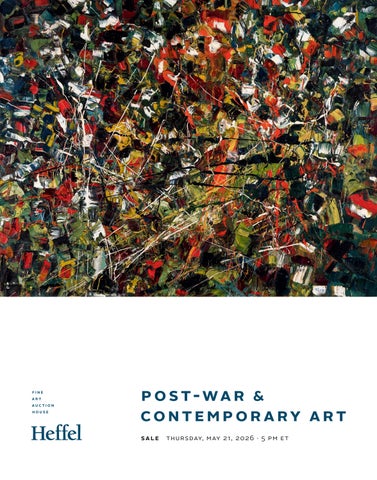
Create a flipbook