
Post-War & Contemporary Art Catalogue - May 25, 2023

Page 1

sA le   Thursday, m ay 25, 2023 · 2 pm p T | 5 p m ET post-w A r & contempor A ry A rt

P ost-w A r & contem P or A ry A rt

Auction

Thursday, May 25, 2023

155 Yorkville Avenue, Toronto

2nd Floor, Units 1 & 2

Entrance at STK, 153 Yorkville Avenue

Together with Heffel’s Digital Saleroom

Registration required to attend or bid in person

Video Presentation

1:30 PM PT | 4:30 PM ET

Post-War & Contemporary Art

2 PM PT | 5 PM ET

Canadian, Impressionist & Modern Art

4 PM PT | 7 PM ET

Previews

By appointment preferred

Heffel Gallery, Vancouver

2247 Granville Street

Saturday, April 15 through

Monday, April 24, 11 am to 6 pm PT

Galerie Heffel, Montreal

1840 rue Sherbrooke Ouest

Thursday, May 4 through

Wednesday, May 10, 11 am to 6 pm ET

Heffel Gallery, Toronto

13 Hazelton Avenue

Together with our Yorkville exhibition galleries

Wednesday, May 17 through

Wednesday, May 24, 11 am to 6 pm ET

Heffel Gallery Limited

Additionally herein referred to as “Heffel” or “Auction House”

cont A ct

Toll Free 1-888-818-6505 mail@heffel.com, www.heffel.com

Please send all physical mail to our Vancouver address

t oronto

Main Yorkville Reception

13 Hazelton Avenue, Toronto, ON M 5

Telephone 416-961-6505, Fax 416-961-4245

15 Hazelton Avenue, Unit 200, Toronto, ON

135 Yorkville Avenue, Unit 401, Toronto, ON

155 Yorkville Avenue, 2nd Floor, Toronto, ON

by appointment

o tt A w A

451 Daly Avenue, Ottawa, ON K 1 N 6 H 6 Telephone 613-230-6505, Fax 613-230-6505 by appointment

m ontre A l

1840 rue Sherbrooke Ouest, Montreal, QC

Telephone 514-939-6505, Fax 514-939-1100

vA ncouver

2247 Granville Street, Vancouver, BC V 6 H 3 G 1

Telephone 604-732-6505, Fax 604-732-4245

north vA ncouver

2455 Dollarton Highway, Unit 108

North Vancouver, BC V 7 H 0 A 2

Telephone 604-732-6505 ext. 150, Fax 604-732-4245 by appointment

cA lg A ry

Main Calgary Reception

888 4th Avenue SW, Unit 609, Calgary, AB T 2 P 0 V 2 Telephone 403-238-6505, Fax 403-265-4225

220 Manning Road NE , Unit 1080, Calgary, AB T 2 E 8 K 4 by appointment

c or P or A te bA nk

Royal Bank of Canada, 2735 Granville Street

Vancouver, BC V 6 H 3 J 1

Telephone 604-665-5700

Incoming wires are required to be sent in Canadian funds and must include: Heffel Gallery Limited, 2247 Granville Street, Vancouver, British Columbia V 6 H 3 G 1 as beneficiary.

b o A rd of d irectors

Chairman In Memoriam—Kenneth Grant Heffel

President—David Kenneth John Heffel

Auctioneer License T 83-3364318 and #23-106811

Vice-President—Robert Campbell Scott Heffel

Auctioneer License T 83-3365303 and #23-106810

Heffel com Departments

consignments

consignments@heffel.com

A PP r A is A ls appraisals@heffel.com

Absentee, t ele P hone & online b idding bids@heffel.com

s hi PP ing shipping@heffel.com

s ubscri P tions subscriptions@heffel.com

cA t A logue s ubscri P tions

Heffel Gallery Limited regularly publishes a variety of materials beneficial to the art collector. An Annual Subscription entitles you to receive our Auction Catalogues. Our Annual Subscription Form can be found on page 103 of this catalogue.

cA t A logue Production

Essay Contributors—Robert Amos, Alec Blair, Marie-Hélène Busque, Mark Cheetham, Gary Dufour, François-Marc Gagnon, Michèle Grandbois, Lindsay Jackson, Andrew Kear, Alec Kerr, Lauren Kratzer, Michel Martin, Sarah Stanners and Rosalin Te Omra

Text Editing, Catalogue Production—Julia Balazs, Rania Chaddad, David Heffel, Robert Heffel, Alec Kerr, Naomi Pauls, Tania Poggione and Rosalin Te Omra

Director of Imaging—Martie Giefert

Digital Imaging—Ward Bastian, Jasmin Daigle and Jared Tiller Catalogue Layout and Production—Kirbi Pitt and Clara Wong

c o P yright

No part of this publication may be reproduced, stored in retrieval systems or transmitted in any form or by any means, digital, photocopy, electronic, mechanical, recorded or otherwise, without the prior written consent of Heffel Gallery Limited.

All photographic representations and other illustrations depicted are solely for guidance and are not to be relied upon in terms of tone or colour.

Follow us: L I X Printed

in Canada by
Friesens ISBN : 978-1-927031-60-5
E 1
R 2
M 5 R 2 E 1
M 5 R 3 W 5
M 5 R 1 C 4
H 3 H 1 E 4
4 Notice for Collectors 5 Auction Details Selling at Auction Buying at Auction General Bidding Increments Framing, Conservation and Shipping Written Valuations and Appraisals 7 Post-War & Contemporary Art Catalogue 92 Heffel Specialists 94 Terms and Conditions of Business 100 Property Collection Notice 101 Catalogue Abbreviations and Symbols 102 Catalogue Terms 102 Heffel’s Code of Business Conduct, Ethics and Practices 103 Annual Subscription Form 103 Collector Profile Form 104 Absentee Bid Form 105 Telephone Bid Form 106 Digital Saleroom Registration Form 107 Shipping Authorization Form for Property 108 Terms and Conditions for Shipping 109 Index of Artists by Lot contents

notice for c ollectors

Auction Location

heffel toronto

155 Yorkville Avenue, Toronto

2nd Floor, Units 1 & 2

Entrance at STK, 153 Yorkville Avenue

Together with Heffel’s Digital Saleroom

Saleroom Telephone 1-888-212-6505

To attend the auction or bid in person, please contact bids@heffel.com to reserve your seat and register in advance. Complimentary food and beverages will be served.

Auction Notice

The Buyer and the Consignor are hereby advised to read fully the Terms and Conditions of Business and Catalogue Terms, which set out and establish the rights and obligations of the Auction House, the Buyer and the Consignor, and the terms by which the Auction House shall conduct the sale and handle other related matters. This information appears on pages 94 through 102 of this publication.

Please visit www.heffel.com for information on which Lots will be present at each preview location, virtual auction previews and to book your in person preview appointment. Preview appointments can also be booked by calling 1-888-818-6505.

Absentee, Telephone and Digital Saleroom Bidding

If you are unable to attend our auction in person, Heffel recommends submitting an Absentee Bid Form to participate. Heffel also accepts telephone bidding, prioritized by the first received Telephone Bid Form and limited to available Telephone Bid Operators per Lot. Alternatively, Heffel offers online bidding in real time through our Digital Saleroom, subject to advanced registration and approval. All forms of remote bidding participation and registration must be received by Heffel at least two (2) business days prior to the commencement of the sale. Information on absentee, telephone and online bidding appears on pages 5, 104, 105 and 106 of this publication.

Live Stream

Please note that we produce a live stream of our sale beginning with a video presentation at 4:30 PM ET and the auction commencing at 5 PM ET. We recommend that you test your video streaming 30 minutes prior to our sale at:

www.heffel.com

All Lots and additional images depicting the frame and verso are available at www.heffel.com.

Estimates and Currency

Our Estimates are in Canadian funds. Exchange values are subject to change and are provided for guidance only. Buying 1.00 Canadian dollar will cost approximately 0.71 US dollar, 0.65 euro, 0.58 British pound, 0.65 Swiss franc, 93 Japanese yen or 5.6 Hong Kong dollars as of our publication date.

4
H EFFEL SALEROOM

A uction det A ils

Selling at Auction

Heffel offers individuals, collectors, corporations and public entities a full-service firm for the successful de-acquisition of their artworks. Interested parties should contact us to arrange for a private and confidential appointment to discuss their preferred method of disposition and to analyse preliminary auction estimates, pre-sale reserves and consignment procedures. This service is offered free of charge.

If you are from out of town or are unable to visit us at our premises, we would be pleased to assess the saleability of your artworks by mail, courier or e-mail. Please provide us with photographic or digital reproductions of the artworks front and verso and information pertaining to title, artist, medium, size, date, provenance, etc. Representatives of our firm travel regularly to major Canadian cities to meet with Prospective Sellers.

It is recommended that property for inclusion in our sale arrive at Heffel at least 90 days prior to our auction. This allows time to photograph, research, catalogue and promote works and complete any required work such as re-framing, cleaning or conservation. All property is stored free of charge until the auction; however, insurance is the Consignor’s expense.

Consignors will receive, for completion, a Consignment Agreement and Consignment Receipt, which set forth the terms and fees for our services. The Seller’s Commission is the amount paid by the Consignor to the Auction House on the sale of a Lot, which is calculated on the Hammer Price, at the rates specified in writing by the Consignor and the Auction House on the Consignment Agreement, plus applicable Sales Tax. Consignors are entitled to set a mutually agreed Reserve or minimum selling price on their artworks.

Buying at Auction

All items that are offered and sold by Heffel are subject to our published Terms and Conditions of Business, our Catalogue Terms and any oral announcements made during the course of our sale. Heffel charges a Buyer’s Premium calculated on the Hammer Price as follows: a rate of twenty-five percent (25%) of the Hammer Price of the Lot up to and including $ 25,000; plus twenty percent (20%) on the part of the Hammer Price over $ 25,000 and up to and including $ 5,000,000; plus fifteen percent (15%) on the part of the Hammer Price over $ 5,000,000, plus applicable Sales Tax.

If you are unable to attend our auction in person, you can bid by completing the Absentee Bid Form found on page 104 of this catalogue. Please note that all Absentee Bid Forms should be received by Heffel at least two (2) business days prior to the commencement of the sale. Bidding by telephone, although limited, is available. Please make arrangements for this service well in advance of the sale. Telephone lines are assigned in order of the sequence in which requests are received. We also recommend that you leave an Absentee Bid amount that we will execute on your behalf in the event we are unable to reach you by telephone. Digital Saleroom online bidding is available subject to pre-registration approval by the Auction House at least two (2) business days in advance of the auction.

Payment must be made by: a) Bank Wire direct to the Auction House’s account, b) Certified Cheque or Bank Draft, c) a Personal or Corporate Cheque, d) Debit Card and Credit Card only by Visa, Mastercard or Union Pay or e) Interac e-Transfer. Bank

Wire payments should be made to the Royal Bank of Canada as per the account transit details provided on your invoice. All Certified Cheques, Bank Drafts and Personal or Corporate Cheques must be verified and cleared by the Auction House’s bank prior to all purchases being released. Credit Card payments are subject to our acceptance and approval and to a maximum of $ 5,000 if the Buyer is providing their Credit Card details by fax or to a maximum of $ 25,000 per Lot purchased if paying online or if the Credit Card is presented in person with valid identification. The Buyer is limited to two e-Transfers per Lot and up to a maximum of $ 10,000 per e-Transfer as per the instructions provided on your invoice. In all circumstances, the Auction House prefers payment by Bank Wire.

General Bidding Increments

Bidding typically begins below the low estimate and generally advances in the following bid increments:

$ 50 – 300

$ 300 – 500

$ 500 – 2,000

$ 2,000–5,000

$ 25 increments

$ 50

$ 100

$ 250

$ 5,000–10,000 $ 500

$ 10,000–20,000

$ 20,000–50,000

$ 50,000–100,000

$ 100,000–300,000

$ 300,000–1,000,000

$ 1,000,000–2,000,000

$ 1,000

$ 2,500

$ 5,000

$ 10,000

$ 25,000

$ 50,000

$ 2,000,000–3,000,000 $ 100,000

$ 3,000,000–5,000,000

$ 5,000,000–10,000,000

$ 10,000,000+

$ 250,000

$ 500,000

$ 1,000,000

Framing, Conservation and Shipping

As a Consignor, it may be advantageous for you to have your artwork re-framed and/or cleaned and conserved to enhance its saleability. As a Buyer, your recently acquired artwork may demand a frame complementary to your collection. As a full-service organization, we offer guidance and in-house expertise to facilitate these needs. Buyers who acquire items that require local delivery or out-of-town shipping should refer to our Shipping Authorization Form for Property on page 107 and our Terms and Conditions for Shipping on page 108 of this publication. Please feel free to contact us to assist you in all of your requirements or to answer any of your related questions. Full completion of our shipping form is required prior to purchases being released by Heffel.

Written Valuations and Appraisals

Written valuations and appraisals for probate, insurance, family division and other purposes can be carried out in our offices or at your premises. Appraisal fees vary according to circumstances. If, within five years of the appraisal, valued or appraised artwork is consigned and sold through Heffel, the client will be refunded the appraisal fee, less incurred “out of pocket” expenses on a prorated basis.

5
VERSION 2022.09 © H E ff E l G A ll ER y lIMITE d
sA le   Thursday, May 25, 2023 · 2 P M PT | 5 PM ET
ost-w A r & c ontem
A rt catalogue f e A turing w orks from The Alma Mater Society of the University of British Columbia The Estate of Vivienne Brosnan The Estate of Guido Molinari The Family of Douglas and Helen Small A Prominent Montreal Estate An Important Private Collection, France & other Important Private and Corporate Collections
P
P or A ry
8

BCSFA CGP OC RCA 1913 – 2007

Ladysmith Harbour

watercolour on paper, signed and on verso titled Lady Smith Harbour [sic] and inscribed with the Dominion Gallery Inventory #C 3442 on the gallery label and stamped Dominion Gallery, circa 1955

8 5/8 × 10 5/8 in, 21.9 × 27 cm

Proven A nce

Dominion Gallery, Montreal

Acquired from the above by a Private Collection, Montreal, 1969

By descent to the present Private Collection, Toronto

Jacques Barbeau, The E.J. Hughes Album: The Paintings, Volume 1, 1932 – 1991, 2011, reproduced page 24, noted as a 25 × 32 inch oil [sic], and the related 1970 canvas entitled View from the Old Coal Dump, Ladysmith, BC reproduced page 56

Robert Amos, E.J. Hughes Paints Vancouver Island, 2018, page 130, the related 1970 canvas entitled View from the Old Coal Dump, Ladysmith, BC, collection of the University of Victoria, reproduced page 131

I N 1948 , E.J. H UGHES was exploring locations on eastern Vancouver Island north of his home in Victoria, funded by an Emily Carr scholarship. During this time he executed pencil sketches of logging activities around the harbour at Ladysmith, a small town south of Nanaimo. This trip would yield oil and pencil sketches that would supply him with subject matter for several years of painting, during which he produced works such as the extraordinary 1948 painting Qualicum Beach (collection of Hart House, University of Toronto) and the 1949 oil Logs, Ladysmith Harbour (collection of the Art Gallery of Ontario). One of these pencil sketches was a drawing of this scene overlaid with a grid structure, which was the basis for this circa 1955 watercolour. In 1970, Hughes painted a large-scale oil of this image titled View from the Old Coal Dump, Ladysmith, BC. Hughes’s dealer,

Max Stern of the Dominion Gallery in Montreal, was so delighted with the 1970 painting that he sent a cheque for $ 1,000—which was a record price at the time for a payment to Hughes from the Dominion Gallery. Stern wrote in his letter to Hughes: “You will note—that this represents an increase on the customary price, and it reflects the increasing demand and resulting higher prices for your paintings.” This oil was soon acquired by the University of Victoria. The title refers to the history of Ladysmith, which was originally established in 1900 as a port for James Dunsmuir’s coal mine at Extension, 16 kilometres away. When the mine closed in 1932, Ladysmith became a depot for the logging industry—indicated by the log booms in the harbour.

Ladysmith Harbour is a striking watercolour from Hughes’s sought-after period of the 1950s. The colouration is rich—orange logs are contrasted with the intense blue of the sea, and in a lighter key, the delicate treatment of the sky with tones of blue and peach at the horizon is exquisite. The black ground on the shore shows the result of coal mining—coal dust, which in the past was as deep as 20 metres in places, and was present on Ladysmith’s waterfront when Hughes was painting these images. The artist’s careful attention to detail is evident in the inclusion of small buoys and buildings and the seagulls gathered on the wooden lane dividers for the logs. His compositional expertise is displayed in the oval in the foreground with grass, rocks and logs, which seems to echo the hills in the distance. Hughes includes charming nautical elements—a tug pulled up on the far shore, another boat in the foreground, and a small work boat manoeuvring in the log booms. The lumbermen moving about on the logs add to the atmosphere and vitality of the scene. In contrast to the activities in the foreground, the far shore with its forested hills is natural—typical of this area of Vancouver Island, in which nature and industry existed side by side.

Ladysmith Harbour is also a consummate example of Hughes’s refined skill with watercolour—his handling of paint, from washes to dense pigmentation, is masterful, especially considering the scale of the work. Hughes captured the specifics of the working life of this town while suggesting universal themes—the necessity and dignity of labour and the beauty of nature.

e stim A te: $ 15,000 – 25,000

9
l iter A ture

BCSFA

Low Tide at Roberts Bay

oil on board, signed and dated 1947 and on verso titled on the Dominion Gallery label and inscribed with the Dominion Gallery Inventory #B 8064 8 1/2 × 10 1/2 in, 21.6 × 26.7 cm

Dominion Gallery, Montreal

Acquired from the above by the present Private Collection, Vancouver, 1988

l iter A ture

Jacques Barbeau, The E.J. Hughes Album: The Paintings, Volume 1, 1932 – 1991, 2011, the related 1953 canvas entitled Roberts Bay, BC reproduced page 19

Robert Amos, E.J. Hughes Paints Vancouver Island, 2018, the related 1953 canvas entitled Roberts Bay, BC reproduced page 45 and the related 1948 ink drawing entitled Study of Boats at Roberts Bay, Sidney reproduced page 43

I N 1947 AN d 1948, an Emily Carr scholarship enabled E.J. Hughes to take sketching trips from his base in Victoria to

locations on Vancouver Island. In 1947, the artist painted this scene of boats marooned on the shore at Roberts Bay in Sidney, a picturesque seaside outpost at the tip of the Saanich Peninsula. Three related works followed: Study of Boats at Roberts Bay, Sidney, a 1948 annotated drawing; Roberts Bay, BC, a 1953 canvas (sold by Heffel, November 27, 2014, lot 38); and Low Tide at Roberts Bay, a 2006 watercolour. Our 1947 oil was the first in the sequence, and it is extraordinary. There is an immediacy and vigour to Hughes’s brush-strokes and a freshness of atmosphere, with a fine handling of sunlight raking across the scene. Executed on the spot, the work has a natural colour palette, with boats in tones of grey and green, rich dark-green trees and a cobalt sky.

The aforementioned drawing with colour annotations reveals Hughes’s plan for the colourful 1953 canvas. In 2006, inspired by the canvas, he also painted a pastel-toned watercolour. The artist must have found this image compelling to have produced these different versions. This 1947 oil has a dynamic energy, and it captures something raw and visceral about the scene not present in the more polished studio works. Low Tide at Roberts Bay is a rare, superb oil sketch from Hughes’s sought-after period of the 1940s.

e stim A te: $ 30,000 – 50,000

10
2 Edward John (E.J.) Hughes
– 2007
CGP OC RCA 1913
Proven A nce

3 Doris Jean McCarthy

CSPWC OC OSA RCA 1910 – 2010

The Esplanade Mountains oil on canvas, signed and on verso titled and inscribed 930721 , 1993 36 × 48 in, 91.4 × 121.9 cm

Proven A nce Private Collection, Alberta

l iter A ture

William Moore and Stuart Reid, Celebrating Life: The Art of Doris McCarthy, McMichael Canadian Art Collection, 1999, page 205

dORIS M C C ARTH y’ S f IRST trip to the Canadian Rockies was in 1937, to Edith and Maligne Lakes, and she was struck by the majesty of the region. Later, she returned yearly from 1974 to 1980, painting at such stunning locations as Banff, Golden and Jasper, and visited again in 1983, 1990, 1992 and 1993. This striking

scene of the Esplanade Mountains in Jasper National Park reveals their peaks exposed by the summer melt, their rocky “bones” sculpted by wind and glaciers, while lower down, their flanks, clothed by green growth, descend to the river.

McCarthy’s admiration for the Group of Seven, particularly Lawren Harris, can be observed in her work. She was inspired by his use of sculpted forms pared to their essential shapes, seen in her depiction of these peaks many decades after meeting Harris. The serenity of these towering peaks is McCarthy’s vision of how they feel to her—which is inspirational. Their reflection in the river gives a sense of depth, a dreamlike space in which the mountains extend below the surface of the land as well as above. The Esplanade Mountains expresses McCarthy’s communion with the beauty and power of the Rockies. As William Moore wrote, “What McCarthy brings to the history of landscape painting in Canada is her vision of place.”

e stim A te: $ 25,000 – 35,000

11

4 Gordon Appelbe Smith

BCSFA CGP CPE OC RCA 1919 – 2020

View from West Vancouver

oil on canvas, signed, circa 1955

22 × 23 in, 55.9 × 58.4 cm

Proven A nce

Peter Ohler Fine Arts Ltd., Vancouver

Private Collection, Vancouver

T HIS f INE PANORAMA shows a stunning view from West Vancouver over Burrard Inlet to Vancouver on the far shore, its streets laid out in a colourful grid. In 1953, Gordon Smith built a house in West Vancouver designed by well-known architect Arthur Erickson, where he lived peacefully until the end of his life, enjoying the proximity of city and forest. He was part of a vital community of modernist artists in Vancouver that included

Lawren Harris, B.C. Binning and Jack Shadbolt. It was an exciting and formative time in the city, and Smith was incorporating into his art the discoveries made during his 1951 enrolment at San Francisco’s California School of Fine Arts, where he was exposed to Abstract Expressionism through his teachers and viewing exhibitions.

Smith’s use of colour here is vivacious, and his depiction of reflected lights from the city shimmers with many hues in the ocean, giving the impression of movement. Smith deploys interesting spatial effects not only in the water but in the foreground—the pale forest floor on the hill makes the trees float, as if they are immersed in a reflection of sky. Smith establishes a fine equilibrium between the solidity of trees and streets and the ephemeral effects of water, sky and foreground that is both playful and assured.

e stim A te: $ 20,000 – 30,000

12

5 Gordon Appelbe Smith

BCSFA CGP CPE OC RCA 1919 – 2020

Pond AE I

acrylic on canvas, signed and on verso titled and dated 1996

67 × 36 in, 170.2 × 91.4 cm

Proven A nce

Equinox Gallery, Vancouver Private Collection, Vancouver

I N 1995 , VANCOUVER modernist

Gordon Smith was in Europe, where he visited the home and gardens of Claude Monet at Giverny. Smith was struck by the stunning setting and by Monet’s very modern approach to his paintings of the gardens. On his return to Vancouver, Smith embarked on an exquisitely beautiful series of Pond paintings, which began with a natural approach, as with Pond AE I , and later evolved into a more abstract treatment. Observation of these pools of water became a statement of feeling for their shimmering beauty.

As did Monet, Smith takes a low straight-on view from the water’s edge, causing the viewer’s eye to glide across, pausing vertiginously over the reflections of tree and sky, then back to the surface and the floating water lilies. Pond AE I is a sophisticated play with space—Smith crosses the reflections with fine white lines, causing a fluctuation between the illusion of the image and the surface of the painting. Smith’s handling of paint is sensual; buttery paint-strokes loosely define his image in tones of green ranging from delicate peridot to jade and dark forest. Small patches of blue, yellow and orange are scattered throughout, to remind us that for Smith, this work is about the properties of paint itself, just as much as it is a stunning landscape image.

e stim A te: $ 60,000 – 80,000

13
14

6 Paul-Émile Borduas

AUTO CAS QMG RCA 1905 – 1960

Des paysans miment des anges oil on canvas, signed and dated 1953 and on verso titled on the artist’s label and gallery labels, dated and inscribed Provincetown on the artist’s label and with the Dominion Gallery Inventory #A 1980 on the gallery label and stamped Winsor & Newton Linen Canvas / Artist Materials C.R. Crowley Limited, 1387 St. Catherine St. W., Montreal 25, Que.

22 1/8 × 18 1/4 in, 56.2 × 46.4 cm

Proven A nce

Dominion Gallery, Montreal

Passedoit Gallery, New York, 1954

Acquired from the above by a Private Collection, London, England, 1954

By descent to the present Private Collection, London, England

l iter A ture

François-Marc Gagnon, Paul-Émile Borduas (1905 – 1960): Biographie critique et analyse de l’oeuvre, 1978, listed pages 323 #19, 348 #10, 386 #14 and 490

François-Marc Gagnon, Paul-Émile Borduas, Montreal Museum of Fine Arts, 1988, page 299n3

François-Marc Gagnon, Paul-Émile Borduas: A Critical Biography, 2013, listed page 304

Borduas Online Catalogue Raisonné, Concordia University Fine Arts, catalogue #2007-1465, https://borduas.concordia.

ca/catalog

e xhibited

Passedoit Gallery, New York, Paul-Émile Borduas, January 5 – 23, 1954, catalogue #14

I N 1953 , PAU l-É MI l E B OR d UAS left the claustrophobia and hostility he was experiencing in Montreal as a result of his signing the Automatists’ Refus global manifesto to live in the USA , settling initially in Cape Cod’s Provincetown, near Boston. Several visits to New York in the spring and summer led to him moving there full time in October; he would remain in the city for the next two years before decamping to Paris. New York at the time was hosting extraordinarily vibrant discourse and advancements in abstract painting, and it was here that he encountered the work of the Abstract Expressionists he admired, including Jackson Pollock, Willem de Kooning, Robert Motherwell and Franz Kline. Removed from the context of Quebec, Borduas went through a period of rapid development, encouraged to begin to refine and expand his painterly techniques.

In January 1954, Borduas held his first exhibition in New York, a solo show at Passedoit Gallery on East 57th Street. That the show was arranged so quickly—just three months after Borduas

settled in the city, though the artist referred to “a one man show on my arrival” in New York as early as June 1953—speaks to the esteem in which the artist was already held. Comprising works from 1947 through to 1953, this exhibition tracked Borduas’s developments from Surrealism to Automatism. Des paysans miment des anges was one of the 24 paintings shown at this pivotal exhibition. True to Borduas’s feeling that the Refus global manifesto of the Automatists had an essentially regional character compared to the perceived universalism of the New York School, the sparse catalogue for this exhibition contained no mention of this manifesto, or of Automatism as a movement; rather, it billed Borduas simply as a much-valued Canadian artist, and otherwise allowed the works to speak for themselves.

At the time this painting was executed, Borduas had not yet been fully exposed to the developments of American painting, and the works he was producing still retained the essential Automatist character of freedom and independence. Placed in this new, international context, however, paintings such as Des paysans miment des anges can be read as being in the midst of transformation. Here we can see that his compositions were beginning to show the stronger “all-over” technique that would come to characterize his works through the remainder of his New York period. The sense of a defined figure / ground spatial relationship—complex masses developing against a darker background—is diminished in favour of a riotous use of colour that takes over the entire canvas. The background extends forward and occupies the same surface as the exploded, fragmentary objects.

The work is painted with a palette knife in a dense weave of rapid strokes: rich greens and burnished reds are agitated by flashes of white and black, the pigments smearing and sliding into each other in a glittering chorus. Colour and form become a single sensuous, dappled expression of the artist’s hand, as the composition expands to fill the whole picture plane. The background is not wholly eliminated, however, and we still maintain a sense that the mosaic of gestures forms a tactile pictorial surface. Borduas would only title his works after their completion, allowing himself to react instinctively to the resulting image. The title of this painting translates as “peasants mimic angels,” perhaps alluding to the collapse and equalization of the aesthetic structures that the artist had begun experimenting with, or to the outright exultation that such an energetic painterly expression could bring about. Des paysans miment des anges, produced at a crucial juncture of Borduas’s career, demonstrates the painter at the height of his confidence.

This work was purchased directly from Borduas’s seminal Passedoit Gallery show and has remained in the collection of the same London, England family ever since. Heffel is delighted to present this work for the first time to the Canadian and international art market.

e stim A te: $ 150,000 – 250,000

15
16

7 Jean Paul Riopelle

Sans titre oil on canvas, signed and dated 1957 and on verso titled Composition and dated on the exhibition labels and inscribed variously

38 × 51 in, 96.5 × 129.5 cm

Proven A nce

Acquired directly from the Artist in Paris by G. Blair Laing, Toronto, circa 1957

Laing Galleries, Toronto

Acquired from the above by a Private Collection, Toronto, April 15, 1958

By descent to the present Private Collection, Toronto

l iter A ture

One Hundred Years of Canadian Painting: A Loan Exhibition, Laing Galleries, 1959, page 31

Evan H. Turner and William J. Withrow, Fifteen Canadian Artists, Museum of Modern Art, 1962, listed, titled as Composition, unpaginated

Yseult Riopelle, Jean Paul Riopelle Catalogue Raisonné, Volume 2, 1954 – 1959, 2004, reproduced page 256, catalogue #1957.043 H .1957

e xhibited

Laing Galleries, Toronto, One Hundred Years of Canadian Painting: A Loan Exhibition, January 27 – February 8, 1959, catalogue #45

International Council of the Museum of Modern Art, New York, Fifteen Canadian Artists, 1963, traveling in 1963 – 1965 to the Hunter Gallery of Art, Chattanooga; Currier Gallery of Art, Manchester; Phillips Exeter Academy, Exeter; University of Texas, Austin; Washington Gallery of Modern Art, Washington, d C ; Mercer University, Macon; Columbus Gallery of Fine Arts; Colorado Springs Fine Arts Center; San Francisco Museum of Art; Saint Louis Art Museum; and the Minneapolis Institute of Arts

T HIS y EAR MARKS the 100th anniversary of Jean Paul Riopelle’s birth in Montreal on October 7, 1923. What a wonderful occasion to celebrate the work of a Canadian artist who earned such exceptional acclaim at home and abroad. There is also the fact that, in the past decades, and especially after the artist’s daughter Yseult Riopelle published the monumental catalogue raisonné of his works, a number of exhibitions, publications, and events about and surrounding Riopelle have led to new interpretations of his practice and a better understanding of his varied, experimental approach to art, in all its manifestations.

Riopelle was a member of Montreal’s Automatists, a constellation of avant-garde figures that gravitated around Paul-Émile Borduas, and signed their 1948 manifesto, Refus global. During his first stay in France, in 1947, Riopelle met André Breton and

joined the Surrealist movement. By the early 1950s, he had developed a form of “all-over” gesturalism that involved the use of spontaneous brush-strokes, while also relying on his perfect mastery of the medium. Associated with Informalism (an open concept posited by theoretician Michel Tapié to describe the various non-figurative approaches to painting), Riopelle quickly found himself a leading figure in the abstract movement of the Paris School, thanks in no small part to the majestic mosaics he painted in the first half of the 1950s, and with which he remains closely identified. As early as 1953, Riopelle was included in Younger European Painters: A Selection, an exhibition mounted by the Solomon R. Guggenheim Museum in New York that later toured to other US galleries. Critics were quick to praise the calibre of his work, along with that of Pierre Soulages and Georges Mathieu, and the museum even acquired one of his paintings, Blue Night, 1952.

In 1955, Riopelle met Joan Mitchell, an American painter of New York’s Abstract Expressionist school. The two quickly launched into an intense, tumultuous relationship that would play out over the next 25 years. Riopelle had just finished a series of white paintings, for which he again used his signature palette knife technique, applying dab after dab of paint in a sustained burst of expression. In these vast, pale compositions, he was forgoing colour and evoking unknowable spaces filled with light. Such an investigation naturally interested Mitchell, who was similarly fascinated by the power of white and its tendency to undo the illusion of depth as it interacts with other colours.

It was also at this time that Riopelle temporarily abandoned oil on canvas in favour of oil on paper and, increasingly, gouache, a more versatile medium that can range from transparent to opaque (for example, Eskimo Mask, 1955, Albright-Knox Art Gallery Collection, Buffalo), depending on the desired texture. The result is a kind of unbridled calligraphy of contrasting colour dabs, kept in a certain compositional order by the unifying action of white passages. Of course, Riopelle, in his correspondence with Mitchell, was quick to recognize the parallels between his new work and a resonance that the artist would assimilate and reinterpret with his characteristic energy and immediacy. Riopelle’s Sans titre, 1957, is an eloquent example of these developments.

This transformational and, to an extent, transitional piece, ostensibly a landscape, becomes a rich, dense garden of painted experience. From the general composition to the harmonious waves of colour sliding towards and into one another to the complex textural effects, Riopelle, here as everywhere, freely transgresses the notion of “good technique,” transforming the painting into a vehicle of sheer, bold expression. That, at least, is the underlying energy emanating from the white entity that visually occupies almost the entire surface of the composition. That white entity follows an ascending curve from left to right that is hedged in, on one side, by a dark, ambiguously defined—and thus complex—border, and on the other side, by another border made formally imposing by the staunch verticality of an opaque band of unabashed red that seems to find echoes in the top right and

17
QMG RCA SCA
AUTO CAS OC
1923 – 2002

centre sections of the painting, thus affecting the entire composition. Clearly Riopelle is pushing the edificial power of impasto to extremes, using an explosion of knife-strokes, interlacing, and incisions as structural vectors that dominate and organize the dynamic order of the composition.

Thus, Riopelle forges ahead along his chosen experimental path, investigating the possibilities of a physical object created through elated movement born of the process of perception. When one attentively scans the sloping line of the mass unfurled in the centre, the eye is drawn to an enigmatic, intensely black curvilinear stroke, like a hook emerging out of the red background that seems to slice the composition into two distinct parts that diverge in appearance and scope. The one on the right seems to have been assembled from the inside out around a charged core, readily capturing our attention with its imposing, uniform composition. The ensuing gravitational force seems to have drawn multiple elements together into a physical object whose definition in space relies on the mechanism of perception that is the very fount of the relationship between shape and substance. Riopelle would pursue this investigation and these questions regarding the relationship between an objective entity and its place in a given space in an even more systematic way in the early 1960s, even as he turned his attention to sculpture.

Held in a private collection since 1958, Sans titre (initially Composition), 1957, has appeared in two major exhibitions as a kind of snapshot of the state and progression of Canadian art at a given period. The first, One Hundred Years of Canadian Painting, organized by Toronto’s Laing Galleries in 1959, is notable for being a historic retrospective of a century of Canadian painting that roughly corresponds to the first 100 years of Canadian confederation; Riopelle eloquently concludes the exhibition with this work, which appears as #45 in the catalogue. The second, Fifteen Canadian Artists, 1963, was curated in Canada by a group of leading experts of Canadian contemporary art in collaboration with the Museum of Modern Art (MoMA) in New York. It was the first major exhibition of contemporary Canadian paintings in the United States and toured to multiple American cities over a twoyear period; the painting is #3 in the list of works by Riopelle.

We thank Michel Martin for contributing the above essay, translated from the French. Martin is a former curator of contemporary art at the Musée national des beaux-arts du Québec (1978 – 2008) and was curator of the exhibition Mitchell / Riopelle: Nothing in Moderation, organized by the MNBAQ in 2017.

The Jean Paul Riopelle Foundation, co-founded by Michael Audain, André Desmarais and Pierre Lassonde, is involved in many events related to Riopelle’s centenary. All through 2023, there will be numerous exhibitions, artistic events, performances, premieres and major projects related to Riopelle happening throughout Canada and internationally. Construction begins in 2023 for Espace Riopelle at the Musée national des beaux-arts du Québec, a pavilion dedicated to Riopelle that will be part of the existing museum. Five of the Foundation’s founders, Michael and Yoshi Audain, André and France Desmarais, Lassonde and Yseult Riopelle (the artist’s daughter) plan to donate $ 100 million in art to Espace Riopelle, as well as $ 20 million dedicated for construction.

e stim A te: $ 400,000 – 600,000

19
Museum of Modern Art, New York, Fifteen Canadian Artists, 1963, exhibition label on verso San Francisco Museum of Art, Fifteen Canadian Artists, 1965, exhibition label on verso Minneapolis Institute of Arts exhibition label on verso
20

8 Andy Warhol

1928 – 1987 American

Queen Elizabeth II of the United Kingdom, from Reigning Queens (F.S.II .334) screenprint on Lenox Museum Board, signed and editioned 25/40, with the printer’s blindstamp, Rupert Jasen Smith, New York and on verso stamped with the artist’s copyright stamp, published by George C.P. Mulder, Amsterdam, 1985

39 3/8 × 31 1/2 in, 100 × 80 cm

Proven A nce

Equinox Gallery, Vancouver Acquired from the above by the present Private Collection, Vancouver, 1985

l iter A ture

Frayda Feldman and Jörg Schellman, Andy Warhol Prints: A Catalogue Raisonné 1962 – 1987, fourth edition, 2003, catalogue #II .334, page 142, listed and reproduced page 142, listed page 219

Tony Shafrazi, editor, Andy Warhol Portraits, 2007, page 17

I N 1982 , A N dy WARHO l’ S European dealer and publisher George C.P. Mulder wrote to Queen Elizabeth’s private secretary, Sir William Heseltine, to state Warhol’s wish to produce a set of screenprint portraits of the monarch. While the Palace accorded the request, Heseltine’s response was muted: “While the Queen would certainly not wish to put any obstacles in Mr. Warhol’s way, she would not dream of offering any comment on this idea” (figure 1). In 1985, this first reserved response changed to a more positive tone when the Queen saw photographs of Warhol’s screenprints. Heseltine thanked Mulder and commented that “Her Majesty was most pleased and interested to see” these images (figure 2).

As the longest reigning monarch of the British crown, Elizabeth II was the subject of many portraits—official and

21
Andy Warhol holding a screenprint of Queen Elizabeth II in his studio at the Factory, New York, 1985 Photo: Derek Hudson Courtesy of Getty Images

otherwise—produced by some of the world’s most illustrious painters and photographers. Heseltine’s guarded response showed the care with which Elizabeth II ’s image was treated. Warhol, as the avant-garde prince of Pop Art, was perhaps regarded with caution. He was well-known for his portraits of public figures: film stars such as Liz Taylor and Marilyn Monroe, political figures such as John F. Kennedy and Mao, music stars such as Elvis. Warhol was fascinated with celebrity, and the Queen was renowned around the world. Frayda Feldman wrote that Warhol “did more than any other artist to revitalize the practice of portraiture, bringing renewed attention to it in the avant-garde world.”

Warhol produced his Reigning Queens series, a set of large screenprint portraits published in 1985, based on official or media photographs of the only four reigning queens in the world at the time: Queen Elizabeth II of the United Kingdom, Queen Beatrix

of the Netherlands, Queen Margrethe II of Denmark, and Queen Ntfombi Tfwala of Swaziland (now Eswatini). This iconic image of Queen Elizabeth II is based on a photograph taken by Peter Grugeon at Windsor Castle in 1975, which was released in 1977 on the occasion of her Silver Jubilee. She is beautiful, resplendent in her regalia of the diamond and pearl Grand Duchess Vladimir Tiara and a diamond and pearl necklace, wearing a blue sash pinned with a medallion with a miniature portrait of her father, George VI . Her expression is somewhat Mona Lisa–like—she has an enigmatic smile and appears to look beyond the photographer. She is warm but dignified, conscious of the fact that she is sitting for a formal photograph. Tony Shafrazi noted: “The image [of Queen Elizabeth] was interesting and had that iconic look about it in and of itself. No matter who the individual was, the colour, the graphic impact, and the pose of the subject were the most important factors in any given portrait.”

22
FIGURE 1: Letter from Sir William Heseltine to publisher George C.P. Mulder, September 16, 1982 FIGURE 2: Letter from Sir William Heseltine to publisher George C.P. Mulder, March 14, 1985

With his unerring eye for a great image that truly represented the sitter, Warhol understood that the Grugeon photograph caught the Queen in a classic pose: regal, confident, and radiating warmth and charisma. Warhol was keenly aware of how celebrities were mythologized and consumed by the public. In a sea of images of the Queen, this one truly stands out. Although the Queen was renowned for her discretion and dignity, rarely exposing her views in public, here we sense the woman behind the crown—inaccessible and yet someone we identify with and feel affection for.

Warhol produced two editions of these portraits—one of 30, noted as the Royal Edition, with crushed glass, called “diamond dust,” as part of the image, and an edition of 40 without diamond dust. This work is from the edition of 40. In each edition, Warhol produced four versions of this portrait in different background colours, with coloured lines drawn on the screenprint of the

photograph and overlaid with contrasting patches of geometric colour blocks. Colour in this series has a vivid, chromatic intensity, and this print was produced with a rich red background and vibrant pink, green, blue and orange colour blocks. This red background gives a more exuberant effect than the other coloured backgrounds in the series. In this extraordinary screenprint, the monumental importance the Queen had as a female monarch and a worldwide symbol is reflected through the vision of Warhol, himself a towering figure in contemporary art.

e stim A te: $ 200,000 – 300,000

23
Lot 8 showing in its frame
24

9 Andy Warhol

1928 – 1987 American

Bald Eagle, from Endangered Species (F.S.II .296) screenprint on Lenox Museum Board, signed and editioned 114/150, with the printer’s blindstamp, Rupert Jasen Smith, New York and on verso stamped with the artist’s and publisher’s copyright ink stamp, 1983 38 × 38 in, 96.5 × 96.5 cm

Proven A nce

PI Fine Art, Toronto Private Collection, Toronto

l iter A ture

Frayda Feldman and Jörg Schellman, Andy Warhol Prints: A Catalogue Raisonné 1962 – 1987, fourth edition, 2003, catalogue #II .296, listed and reproduced page 130, listed pages 189 and 218

I N THE EAR ly 1980s, American Pop artist Andy Warhol was approached by environmental activists to help raise awareness about the dire situation facing certain wild animals around the world. The idea for this 1983 project arose from a discussion Warhol had with New York art dealers Ronald and Frayda Feldman. Warhol created a series of 10 colour screenprints that portrayed animals from the Endangered Species Act of 1973: the Siberian tiger, San Francisco silverspot (butterfly), orangutan, Grévy’s zebra, black rhinoceros, African elephant, Pine Barrens tree frog, giant panda, bighorn sheep and bald eagle, whose populations had been decimated by habitat loss, illegal hunting and environmental factors such as the use of pesticides. Since 1983, when this series was produced, the situation has improved for some of these animals.

The bald eagle, which suffered from a decline in prey species as well as from the softening and subsequent destruction of their eggs from the pesticide dd T, has rebounded. In 1963, there were fewer than 1,000 of these raptors in North America; now there are over 300,000, and they have been removed from the endangered species list. Although it is a bird symbolic of the United

States, it freely roams throughout North America. Populations in Canada have also increased, and they are often seen in the skies over Vancouver and on the west coast. Eagles go where their prey is, and in late winter they can be seen festooning trees and soaring in the updrafts above the Squamish and Cheakamus Rivers near Squamish, British Columbia, when salmon return to spawn. The magnificent adult birds, with their white heads and tail feathers, are an awe-inspiring sight.

Warhol focuses on the head and shoulders of the eagle in profile, with its piercing golden eye gazing left. The close-up view makes the eagle appear to loom, as though larger than life, and its placement on the diagonal gives it a dynamic feel. Its powerful hooked beak is emphasized with a bright orange colouration. The upper part of its outspread wings against the backdrop of sky gives the impression of the eagle being either poised for flight or actually soaring. Warhol produced different versions of this print with varying colours. This is the blue colourway, stunning with its cobalt and turquoise background / sky. The artist drew mauve, yellow and red coloured lines on the screenprint of the photograph to emphasize outlines and give a sense of animation to the image. Warhol had an unerring eye for a strong image, and his eagle is alert, focused and ready for action.

The prints, numbered in Roman numerals within each edition, were given to wildlife organizations for fundraising projects. Following the success of the Endangered Species prints, Warhol worked with Kurt Benirschke of the San Diego Zoo to produce a book titled Vanishing Animals, for which Warhol provided the illustrations. The suite of screenprints was exhibited at the Museum of Natural History in New York and other natural history museums throughout the United States.

This image was printed on Lenox Museum Board. The edition is of 150, aside from 30 AP, 5 PP, 5 EP, 3 HC , 10 numbered in Roman numerals, 1 BAT, 30 TP, each signed and numbered in pencil. The edition was printed by Rupert Jasen Smith in New York and published by Ronald Feldman Fine Arts Inc., New York.

e stim A te: $ 100,000 – 150,000

25
26

10 Jack Hamilton Bush

ARCA CGP CSGA CSPWC OSA

Plume Totem

1977

acrylic on canvas, on verso signed, titled and titled on the gallery label, dated Oct. 1973 and inscribed Top (with arrow) and Acrylic Polymer W.B.

88 3/4 × 50 in, 225.4 × 127 cm

Proven A nce

David Mirvish Gallery, Toronto, April 1974 An Important Private Collection, France

l iter A ture

Marc Mayer and Sarah Stanners, Jack Bush, National Gallery of Canada, 2014, reproduced page 35

e xhibited

David Mirvish Gallery, Toronto, Jack Bush: Recent Paintings, 1974

I N A PRI l 1974 , you could walk along Markham Street in Toronto and enter the David Mirvish Gallery—and another world. There, 21 Jack Bush paintings filled the vast double-lot contemporary art gallery. These days, it takes a retrospective to bring together so many paintings by one artist in one place. The exhibition was Jack Bush: Recent Paintings and, being a celebration of his most current work, the show served as a debut of his powerful Totem series. Time magazine headlined its review of the show “Opulence in Toronto.” 1

The Globe and Mail art critic Kay Kritzwiser described the effect of seeing the exhibition as a feeling akin to witnessing nature’s grandeur, stating that each painting had “the majestic strength and simplicity of a forest.” 2 She was referring to the deeply textured effect of the backgrounds of these paintings. Regarding the paintings Grey Arc and Totem Spread, she described the backgrounds as “contradictorily textured as tree bark— velvety surfaced with countering black grooves. Then across these surfaces, horizontally or vertically, Bush sails his totems of color.” In describing the surface of Plume Totem, Kritzwiser used the words “rich” and “plushy.” 3

However forest-like Plume Totem’s background surface may be, the powerful zap of colours like pink, purple, coral red and electric blue snaps us out of any associations with the deep dark woods. These colours are intended to grab our attention and celebrate the wonders of pure creativity. Bush’s Totem paintings are highly original and among the best of his mature body of work as a painter.

In 1980, curator Duncan Macmillan argued that the Totems could be related to the human figure, based on a loose sketch Bush had made depicting a figure lying on a floor.4 The suggestion is plausible, especially since this series is so traditional in its distinct figure / ground relationship. Other sources for paintings like Plume Totem are more unexpected, but not unbelievable.

Blue Tee and On Line are two paintings Bush executed around the same time that he painted Plume Totem, in the fall of 1973. What they share are separate sections of colour that have a straight edge on at least one side, and often a frayed edge on the other side. These close cousins of Plume Totem have titles that hint at their real-life source material for inspiring colour and shape, and the arrangement of these factors. Seeing brightly

coloured clothing, such as a blue T-shirt (Blue Tee), hanging to dry on a clothesline (On Line) was a unique source of visual stimulation for the artist, and especially so if we consider how brightly coloured clothing was in the 1970s!

Clothing on a drying line is not the only referent in these paintings, but this example does demonstrate that he did not simply paint his abstracts on a whim. The artist carefully planned both the composition and the colours in advance of painting Plume Totem. A small sketch made in the planning of this painting is now in the collection of the University of Guelph. Although Plume Totem, and other paintings like it, are undoubtedly abstract, the artist still used methods that even the Group of Seven painters used when planning their work—that is, penciling in careful notes on the specific colours for each area of the painting in a preliminary sketch. A sharp red check mark in the bottom right-hand corner of this sketch tells us that Plume Totem was approved, and therefore realized by the artist.

We thank Dr. Sarah Stanners, director of the Jack Bush Catalogue Raisonné, contributor to the Bush retrospective originating at the National Gallery of Canada in 2014, and adjunct professor at the University of Toronto, Department of Art History, for contributing the above essay.

This work will be included in Stanners’s forthcoming Jack Bush Paintings: A Catalogue Raisonné.

1. “Opulence in Toronto,” Time, Canadian edition, May 6, 1974, 10–12.

2. Kay Kritzwiser, “Sculpture Shows of Museum Quality,” Globe and Mail, April 27, 1974, 28.

3. Ibid.

4. Introduction to Jack Bush: Paintings and Drawings, 1955–1976 (London: Arts Council of Great Britain, 1980), exhibition catalogue, 11.

This work, along with Jack Bush’s Pink Blossoms and Kenneth Noland’s Misty Mount (lots 11 and 12 in this sale), is making its auction debut and returning to Canada from a Canadian collector living abroad in the South of France.

e stim A te: $ 250,000 – 350,000

27
P1 1 1909
From left: Hook Totem (1973), Scoop Totem (1973) and Plume Totem (1973) installed at Jack Bush: Recent Paintings, David Mirvish Gallery, Toronto, April 1974 Unknown photographer
28

11 Jack Hamilton Bush

Pink Blossoms

gouache on paper, signed and dated May 1971 and on verso signed, titled, dated and inscribed Top (with arrow) and Toronto

29 3/4 × 22 3/8 in, 75.6 × 56.8 cm

Proven A nce

Collection of the Artist, May 1971 – June 29, 1972

David Mirvish Gallery, Toronto, June 29 – November 1972

An Important Private Collection, France, 1972

e xhibited

Edmonton Art Gallery, Jack Bush: Works on Paper, June 8 – July 11, 1973, catalogue #4

PInK BloSSomS BE l ONGS to a series of 12 gouache paintings made by Jack Bush between April and June 1971, all on the theme of spring. Pink Blossoms from this series stands out as one of only two displaying daubs of pink paint to suggest petals. Like nature’s confetti, the pop-and-flutter-down cycle of a cherry tree’s pink blossoms is a celebration of spring’s arrival. With light colours set against a dark ground, this painting expresses the joyous feeling of hope fulfilled: the grey of winter receding as the colours of spring move forward. In the bottom right-hand corner, a zesty yellow stroke appears like a flash, fast and bright as the fleeting blossoms of the forsythia shrub.

Bush did not have to look far to be inspired by nature’s palette. In 1980, art curator Duncan Macmillan spoke with the artist’s widow, Mabel Bush. His short summary of their conversation says it all: “Looking out at the garden of their home in Toronto, she said quite simply ‘that was what he painted.’ ” 1

Over his many years of living on Eastview Crescent in North Toronto, Bush often preferred to be interviewed in his backyard. The artist and his wife were equals in the garden, both labouring to bring about a beautiful space for rest, entertainment and even interactions with art world types. As Jenny Greenberg recalled in her memoir about being married to the infamous New York art critic Clement Greenberg, it was quite a surprise to find that Bush lived in a suburban family home. It was not the usual environment in which to meet a painter of abstract art, at least not from the point of view of these two New Yorkers. About the garden, Jenny noted, “There was a big backyard that showed years of loving care.” 2

Some interviewers who were welcomed to chat in the Bush garden include William Townsend, Art Cuthbert and Andrew Hudson. Art critic Hilton Kramer understood his subject when he wrote about the artist for artscanada and titled his article “A Garden for the Eye: The Paintings of Jack Bush.” 3 The garden provided context for Bush’s work, allowing art writers to see exactly what inspired so many of his colours. He also used the setting to explain his methods as a painter, which he likened to cultivating

a garden. In an interview with Cuthbert for CBC Radio, in September 1976, the topic of his process came up. Cuthbert inquired if he enjoyed the outcome of his paintings or the making of his paintings best, and Bush answered in terms of gardening:

I think it is the process of doing it . seeing it sort of grow. It’s like flowers in the garden that we were looking at there. You watch for them to grow up and then they come into bloom, and that’s beautiful, and you’re happy enough with that, but then you want to plant some more plants to see what will come out of them. It’s a very selfish sort of thing. Period. I don’t paint the pictures to please anybody.4

Without spring’s promise of better days ahead, bearing the winter months might be impossible. What compels a painter to keep on making art is also a sense of realizing something better. Karen Wilkin described this perfectly in her essay for the 2014 Jack Bush retrospective catalogue, where she explained that “Bush repeatedly used his garden as a way of finding impulses to move his work forward, distilling his pleasure in the return of spring, after a grey Ontario winter, into lively, abstract images . . .” 5 The artist was always moving forward, finding an eternal spring in the joy of painting.

We thank Dr. Sarah Stanners, director of the Jack Bush Catalogue Raisonné, contributor to the Bush retrospective originating at the National Gallery of Canada in 2014, and adjunct professor at the University of Toronto, Department of Art History, for contributing the above essay.

This work will be included in Stanners’s forthcoming Jack Bush Paintings: A Catalogue Raisonné

1. Introduction to Jack Bush: Paintings and Drawings, 1955–1976 (London: Arts Council of Great Britain, 1980), exhibition catalogue, 7.

2. Janice Van Horne, A Complicated Marriage: My Life with Clement Greenberg (Berkeley: Counterpoint, 2012), 11.

3. Hilton Kramer, “A Garden for the Eye: The Paintings of Jack Bush,” artscanada 37, no. 3, December 1980–January 1981, 12–17.

4. Interview published in “Some Thoughts on His Painting by Jack Bush,” Jack Bush: Paintings and Drawings, 19.

5. “Jack Bush: Not What It Seems,” in Marc Daniel Mayer, Karen Wilkin, Adam Welch, and Sarah A. Stanners, Jack Bush (Ottawa: National Gallery of Canada, 2014), exhibition catalogue, 86.

This work, along with Jack Bush’s Plume Totem and Kenneth Noland’s Misty Mount (lots 10 and 12 in this sale), is making its auction debut and returning to Canada from a Canadian collector living abroad in the South of France.

e stim A te: $ 20,000 – 30,000

29
CSPWC OSA P1 1
ARCA CGP CSGA
1909
1977

12 Kenneth Noland

1924 – 2010 American

Misty Mount acrylic on canvas, on verso signed, titled, dated 1974 and inscribed Top (with arrow)

28 5/8 × 7 in, 72.7 × 17.8 cm

Proven A nce

A gift from the Artist, 1974 An Important Private Collection, France

mISTy mounT IS a subtle and quietly compelling Colour Field painting by Kenneth Noland, one of the American artists who shaped this important movement as it evolved from Abstract Expressionism in the 1960s and 1970s. The boundless visual interest generated by Noland here appears through consciously restricted parameters. The surface is painted all over in a non-gestural way; colour is significant and often heightened; there is a concentration on shape, both on the surface and in the perimeter itself; the format is typically large. The interactions of these factors establish a pleasurably complex and refined visual encounter.

Abstract paintings are good at posing questions to us as viewers. We are not encouraged to look through them to something depicted and can instead stay focused. In Misty Mount, are we seeing a self-contained field or a detail of elements that have been selected for our appreciation? The answer could be “both.” Noland provided a glimpse, a detail of a larger pattern, in his so-called plaids series, begun in 1971. Horizontal formats are more common in his oeuvre, and it was again only in the early 1970s that he tried the other, very human orientation that we see here, one that encourages a “face to face” relationship.

While he is known for experimenting with the shape and placement of his canvases, his handwritten directions on the back about hanging this work (“Top,” with a vertical arrow underneath) make it clear that this is a vertical painting. What we might see in this encounter is simply endless. The hues, textures, weight and reflectivity of the colour bands are intriguingly various. They do not settle into patterns but instead keep us looking, for example, at the subtle difference in saturation and hue between the top two bands—which are closer to the colour of the ground—and the weightier forms

towards the bottom. This distribution of pigment does not overtly suggest bottom and top, yet we know, perhaps subconsciously, that the painting would look very different if inverted.

Appropriate as it is to dwell on the details of Misty Mount, it is interesting to know that Noland has several important connections to Canada. He showed with the David Mirvish Gallery, Toronto, at the time this work was painted, in an exhibition titled Recent Paintings by Kenneth Noland in June 1974. Notably, Noland offered a choice of several paintings from this series to our consignor—from which they chose Misty Mount—in appreciation for their assistance with the 1974 exhibition. Also, Noland had in 1963 led the Emma Lake Artists’ Workshops, the forum in Saskatchewan that brought together prominent American and Canadian abstract artists and significantly influenced art in Canada for decades after its start in the mid-1950s. Significantly too, Noland and American Colour Field painting remain part of ongoing discussions about one of Canada’s best-known artists internationally, Jack Bush, who knew and exhibited alongside Noland and other prominent American Colour Field painters from the 1960s until his death in 1977. Bush and Noland were shown together by American art critic and curator Clement Greenberg in his famous show Post-Painterly Abstraction, a 1964 touring exhibition organized by the Los Angeles County Museum of Art and seen in Minneapolis and Toronto. We thank Mark A. Cheetham for contributing the above essay. Cheetham’s two books on abstract art offer new understandings of this form over its 100-plus-year history: The Rhetoric of Purity: Essentialist Theory and the Advent of Abstract Painting (1991) and Abstract Art Against Autonomy: Infection, Resistance, and Cure since the 60s (2006). He is a professor of art history at the University of Toronto and a freelance curator and art writer.

This work, along with Jack Bush’s Plume Totem and Pink Blossoms (lots 10 and 11 in this sale), is making its auction debut and returning to Canada from a Canadian collector living abroad in the South of France.

e stim A te: $ 30,000 – 50,000

30

13 Ivan Kenneth Eyre

RCA 1935 –2022

Ravine Hills

acrylic on canvas, signed and on verso signed, titled and dated 2003

37 × 77 1/4 in, 94 × 196.2 cm

Proven A nce

Loch Gallery, Winnipeg, 2003 Private Collection, Vancouver

l iter A ture

Ivan Eyre, Ivan on Eyre: The Paintings, Pavilion Gallery, 2004, page 448, reproduced page 449

I VAN Ey RE WAS best known for his complex, figureless landscapes—which, although inspired by the landscapes of Manitoba and Saskatchewan, are works of his imagination. The artist once explained to his cardiologist that he took vicarious walks through his painted landscapes such as Ravine Hills, while painting and after their completion. His doctor advised him that

he should actually, not virtually, walk. But Eyre was more interested in his landscapes of the mind, stating:

The elements I add often challenge the sense of geographic correctness . these are, after all, paintings that speak about my ideas and emotions, not visual land documents. The liberties I take are always for pictorial reasons, and each part of the painting does work of some kind.

Ravine Hills is a glorious panorama, harmonious in its rich hues of blue, green and gold. The repetition of fine brush-strokes creates a rhythmic, patterned effect. Long horizontal strips of land build from the foreground up to the horizon, creating the illusion of deep space. In the centre, Eyre uses a white layer to create a path for the viewer’s eye to the back layers of the landscape. Ravine Hills is a complex and mysterious terrain that holds the viewer’s attention, enveloping the observer with a transcendental feeling of calm.

e stim A te: $ 75,000 – 100,000

31
32
33

Flip acrylic on canvas, on verso signed, titled, dated August 1969 and inscribed

Acrylic Polymer W.B. and Top 39 × 90 in, 99.1 × 228.6 cm

Proven A nce

Collection of the Artist, August – December 1969

André Emmerich Gallery, New York, December 1969 –November 17, 1971

Sigmund E. Edelstone, Chicago, November 17, 1971 –circa 1976

André Emmerich Gallery, New York, 1976 – November 1976

Downstairs Gallery, Edmonton, November 1976 Albert White Gallery, Toronto

Acquired from the above by a Corporate Collection, Toronto, June 23, 1980

Post-War & Contemporary Art, Heffel Fine Art Auction House, May 29, 2019, lot 44 Private Collection, Toronto

l iter A ture

William Raiser et al., “The Quintessential Design for Art,” Architectural Digest, vol. 28, no. 6, May – June 1972, pages 12 – 23

FlIP B y J ACK B USH puts a positive spin on his Spasm series, made just a few months before this painting. That series came about in spring 1969 in response to the artist’s diagnosis with a heart condition known as angina, which gave Bush tension in his chest, along with an irregular heartbeat. Like the Spasm paintings, the composition of Flip is set off by a section of brightly coloured stripes—but instead of a flurry of boomerang-shaped checks, Flip boasts one large, elongated boomerang in pale pink. The whisper-tone colour of this shape works well against the clean spring green, but these two soft colours are by no means meek alongside the pop of primary colours (plus orange). The green and pink together also serve well to create a sprightly feeling in keeping with the painting’s title. A curious dash of white at the far right tip of the arcing shape is a unique feature that puts a stop to any possible accusation of high design ruling over fine art in this painting.

In terms of the timing of its execution, Flip is also in close proximity to Bush’s very first mottled ground paintings, Irish Rock #1 and #2, which were painted in October 1969. With these two paintings, Bush used a roller and unmixed paints to achieve a textured look that is reminiscent of the rocks he saw when traveling through Ireland. Looking closely, we see that the light-green ground on Flip is applied with a roller, but the artist was more interested in creating an even tone across the canvas, with the paint so thinly and seamlessly applied that it appears as if the canvas is innately coloured rather than painted.

34
ARCA CGP CSGA CSPWC OSA P1 1 1909 – 1977
14 Jack Hamilton Bush

The André Emmerich Gallery first purchased Flip from the artist in 1969. In 1971, Emmerich sold the painting to Sigmund E. Edelstone, a Chicago-based contemporary art collector who made his fortune founding Dupli-Color, the automotive paint company that offers “true match” touch-up paint colours to the do-it-yourself market. The May/June 1972 issue of Architectural Digest dedicated a multi-page spread to exploring Edelstone’s passion for perfect matches as expressed in his apartment, designed under the direction of Arthur Elrod. Bush’s Flip painting was one of the chosen artworks for Edelstone’s extraordinary Chicago pad, along with works by Mark Rothko, Helen Frankenthaler, David Smith, Hans Hofmann, Pablo Picasso, Alberto Giacometti and other masters of twentieth-century art. Architectural Digest described Edelstone as “the perfectionist’s perfectionist” and, in true form for the swinging seventies, noted that “Bachelor Edelstone’s dedication to perfection precludes the possibility of adding a wife to the premises. ‘Where would I put her? Where would she hang her clothes? This is a bachelor’s apartment. I’ve made no provisions for a wife.’ However, every provision was made for important works of art.”

The article goes on to explain that Edelstone would bring photos of prospective artworks to the interior designers, and that no decision was final on design until the artwork was decided upon. A design sketch for Edelstone’s Chicago apartment, now in the collection of the Art Institute of Chicago, demonstrates the priority of the art over design; in this case, Hofmann paintings are placed proudly and dominantly over a modern, and relatively modest, living-room design. Elrod explained that for Edelstone, “It wasn’t a matter of going into a gallery and saying, ‘I’ll buy that.’ He studied art, artists and thought out his collection long before he even purchased the apartment.” Edelstone even managed to convince Robert Motherwell to make a diptych to custom specifications and rigged them to an automated system that made the two paintings act as a window covering that could smoothly separate or bring together the two canvases. The Edelstone apartment took three years to complete, reaching its unveiling in 1972. Bush’s Flip was painted in 1969, purchased in 1971 and at home at Edelstone’s in 1972.

We thank Dr. Sarah Stanners, director of the Jack Bush Catalogue Raisonné, contributor to the Bush retrospective originating at the National Gallery of Canada in 2014, and adjunct professor at the University of Toronto, Department of Art History, for contributing the above essay.

This work will be included in Sarah Stanners’s forthcoming Jack Bush Paintings: A Catalogue Raisonné

e stim A te: $ 250,000 – 350,000

mA ri A nne w illisch

Sigmund Edelstone Apartment, Presentation

Interior Design Drawings

graphite and coloured pencil on tracing paper; collage of tempera on tracing paper and colour prints added, circa 1965

18 × 24 in, 45.7 × 61 cm

Gift of the Estate of Marianne Willisch through Paul E. Mueller and Frances Rooz, reference #1984.1258.3-5

Courtesy of the Art Institute of Chicago

Not for sale with this lot

35

15 Jack Hamilton Bush

ARCA CGP CSGA CSPWC OSA P1 1 1909 – 1977

April Growth

acrylic on canvas, on verso signed, titled, dated April 1972 and inscribed

Toronto / Top / Acrylic Polymer W.B.

58 1/4 × 26 3/4 in, 148 × 67.9 cm

Proven A nce

Collection of the Artist

David Mirvish Gallery, Toronto, April – July 1972

Dr. and Mrs. Hilbert H. DeLawter, Virginia, July 1972

Salander-O’Reilly Galleries Inc., New York

Miriam Shiell Fine Art Ltd., Toronto, January 2003

Private Collection

Miriam Shiell Fine Art Ltd., Toronto

Private Collection, Toronto

l iter A ture

Karen Wilkin, Jack Bush, 1984, reproduced page 107

A CROSS f IVE d ECA d ES of painting, springtime was always Jack Bush’s most productive time of year, and the spring of 1972 was no different. April Growth is one of seven paintings he made in April 1972, most of which relate to nature, including April Rose and Late Sun—April. What separates April Growth from the others is its explicit visual reference to nature.

April Growth features a tall, bright green plant-like figure that stands like an emblem of the vigour of spring. As if in awe of the dominant green, two smaller strokes of colour—blue and pink— are placed vertically at the bottom right-hand side of the canvas. At this point in the artist’s career, his paintings were strictly abstract, and only colours served as referents to the real world, if at all. In the case of April Growth, the colours are fresh and springlike, but the central figure is specifically shaped like a plant. Bush managed to imbue this picture with a sense of duration and expectation in presenting the delicate and fleeting life of a bud, just before its blossoming. Its bowed and elongated head is reminiscent of an iris bud before it has revealed its petals.

The artist and his wife Mabel were avid gardeners. They worked hard to plant and care for their flower and vegetable beds, and they played hard in their garden too, taking time for rest and relaxation as well as hosting friends and colleagues for light fare in the backyard. The garden provided Bush with unending colour inspirations, and whole series of paintings were born from its visual delights. April Growth is unique in its appearance and does not belong to a certain series or type, but it does reside within a long tradition of the artist’s interest in painting flora.

Bush’s career was thriving when he painted April Growth He was coming off the high of his first major public exhibition in the United States, at the Museum of Fine Arts, Boston, which ended just days before he painted April Growth. Writing for the New York Times, Hilton Kramer pointed out the M fA’s good fortune in securing such an original artist, asserting, “He is indeed a painter of enormous eloquence who has found in the vocabulary of color abstraction the means of articulating a range of feeling all his own.” 1

Eight years after his review of Bush’s first American museum exhibition, Kramer wrote an article titled “A Garden for the Eye: The Paintings of Jack Bush” for artscanada. He was reviewing a survey exhibition of Bush’s paintings from 1955 to 1976, which was organized by the Arts Council of Great Britain in 1980 and toured throughout the UK . At the Serpentine Gallery in London, his paintings were installed in a space with lookouts to Kensington Gardens. Kramer was impressed by how the paintings looked at home next to nature, writing: “It isn’t every painter whose work can withstand the light from within or the vistas that beckon from without. Yet Bush’s paintings took complete possession of this setting, quite as if they were intended for it.” 2 His conclusion was that Bush’s eccentric imagery was most often related to the life he found in his garden, and he was right.

In an interview with Art Cuthbert for CBC Radio (September 1976), Bush spoke about his process as a painter by comparing it to the spirit of curiosity in gardening, stating, “You want to plant some more plants to see what will come out of them.” 3 The promise in painting is not unlike the pregnancy of spring, which we see so clearly in April Growth—most of our delight stems from wondering what might come out.

We thank Dr. Sarah Stanners, director of the Jack Bush Catalogue Raisonné, contributor to the Bush retrospective originating at the National Gallery of Canada in 2014, and adjunct professor at the University of Toronto, Department of Art History, for contributing the above essay.

This work will be included in Stanners’s forthcoming Jack Bush Paintings: A Catalogue Raisonné

1. Hilton Kramer, “Art Opener in Boston: Jack Bush,” New York Times, February 19, 1972, 26 C .

2. Hilton Kramer, “A Garden for the Eye: The Paintings of Jack Bush,” artscanada 37, no. 3, December 1980 – January 1981, 12–17.

3. Interview published in “Some Thoughts on His Painting by Jack Bush,” Jack Bush: Paintings and Drawings, 1955–1976 (London: Arts Council of Great Britain, 1980), exhibition catalogue, 19.

e stim A te: $ 150,000 – 200,000

36
37
38

16 Doris Jean McCarthy

CSPWC OC OSA RCA 1910 – 2010

Iceberg, Grise Fiord

oil on canvas, signed and on verso inscribed 760513 , 1976 36 × 48 in, 91.4 × 121.9 cm

Proven A nce

Acquired directly from the Artist by a Private Collector, British Columbia, 1976

l iter A ture

William Moore and Stuart Reid, Celebrating Life: The Art of Doris McCarthy, McMichael Canadian Art Collection, 1999, pages 55 and 199

dORIS M C C ARTH y STU d IE d at the Ontario College of Art from 1926 to 1930, under Group of Seven artists Arthur Lismer and J.E.H. MacDonald. She met Lawren Harris and visited his studio in 1928, at a time when his simplification and purification of form and commitment to a theosophical vision of the landscape were firmly established. The Group caused a storm of change in the art world at this time, and her work was influenced by their groundbreaking art.

From a young age McCarthy had a love for nature. Her father, George McCarthy, was an early conservationist who taught her that nature was an important part of her heritage. As a consequence, she was drawn to the landscape as her artistic focus. In 1939, she acquired land on the edge of the Scarborough Bluffs overlooking Lake Ontario. She called the house she built there Fool’s Paradise, and it became her lifetime home and studio. She also purchased, collectively with a group of women, Keyhole Cottage on Georgian Bay, as a summer painting base. McCarthy often took painting trips to locations such as Haliburton and the Gaspé Peninsula and many other places in Ontario and Quebec, as well as Newfoundland, the Yukon, the Arctic and the Rockies. She also painted in England, Ireland, the Netherlands and New Zealand. McCarthy had an irrepressible energy; as well as maintaining a teaching career and painting landscapes across Canada and internationally, she maintained a busy exhibition schedule.

In 1972, she made her first trip to the Arctic. She joined the Federation of Ontario Naturalists for a week, flying from Resolute to Eureka, Grise Fiord and remote islands, followed by Pond

Inlet. McCarthy commented, “In my first year in the Arctic I met my very first iceberg and I went crazy about icebergs and started doing ice form fantasies.” Many trips to the North would follow, her last taking place in 2004, at the age of 94. In 1976, the year she painted this stunning canvas, she returned to Grise Fiord via Frobisher Bay.

McCarthy was part of the valiant (mostly male) Canadian plein air tradition of braving the cold to paint on the spot. She dressed for temperatures as low as 15 to 20 degrees below zero, in layers of pants, a thick down parka over a hooded T-shirt, wool toque and a cotton sun hat. Seated before her canvas and easel with paints and turpentine, preparing to make an oil sketch, she kept her tube of titanium white pigment malleable by keeping it inside her clothes. She was intrepid—Paul Gooch related that on a painting trip to Baffin Island, they visited Inuit homes and workshops and “chewed our first hunk of blubber.”

In works like this she is clearly influenced by Harris’s dramatic vision of arctic mountains and icebergs from the 1930s, evidenced in the abstracted forms. As mentioned, McCarthy called her arctic works “ice form fantasies,” and here we see that manifested in this imaginative scene. A solid, sculpted white iceberg form shadowed by blues and greens towers above the water, while in the foreground an ice shelf and another pointed form float, their underwater existence suggested by shimmering shapes in the water. These forms and the mountain behind are hard-edged and jagged, creating strong impressions of volume. The berg forms are struck by an unseen light source, their white shining brilliantly against the darkness behind.

Especially intriguing is the transparent form in between the bergs. Painted in delicate shades of mauve and blue, it is like an insubstantial memory of a berg, or a dream of one. As William Moore writes, “We are involved in a continuum of an event . . . We experience her perceptions stretched over time. They are composites of mental sketches of the perception of icebergs synthesized into the idea of an iceberg.” Dream or memory, this transparent berg pulls us to another dimension of the landscape, one connected with the subconscious. Iceberg, Grise Fiord is an outstanding example of McCarthy’s arctic paintings, both powerful and poetic.

e stim A te: $ 60,000 – 80,000

39

I N 1940 , E NG l ISH professor Hunter Lewis approached the Alma Mater Society (the non-profit student society) of the University of British Columbia with the idea of initiating an art collection. Eight years later, the University of British Columbia’s Alma Mater Society Art Collection began its life as the Brock Hall Art Collection with the purchase of Abandoned Village, Rivers Inlet, BC by E.J. Hughes for $ 150, lot 18 in this sale. The Brock Hall Art Collection took its name from the newly opened Brock Hall on campus, which was the Alma Mater Society’s student union building until 1968. Between the years 1955 and 1968, energetic individuals such as artist and professor B.C. Binning and AMS vice-president Ronald Longstaffe would undertake to build a modern collection of astonishing variety and quality. Binning and Longstaffe looked to the University of Toronto’s Hart House for inspiration and guidance for the collection. Through correspondence back and forth with Binning and Hart House, the AMS was able to secure

the support of influential artists, including Lawren Harris, who would donate funds to acquire artwork, including his own, lot 17 in this sale. Binning remained a steadfast leader of the collection from 1958 to 1968 and under his management, the collection acquired 23 pieces of Canadian art. A landmark donation to the collection was received via Maclean’s magazine in 1958, including pieces by Harris, John Koerner, Bruno Bobak, Molly Bobak, Gordon Smith and Joe Plaskett, further strengthening the existing power of the Brock Hall Collection. Binning also looked beyond the acquisitions of the collection, scheduling inspiring artist studio visits for the committee to artists such as Takao Tanabe and Jack Shadbolt, and also organized an exhibition of the collection at the Vancouver Art Gallery. In 1968, Binning retired from UBC and the Fine Arts Department, and the Binning era ended. By the 1970s the committee was called the SUB Art Gallery Committee and the collection was moved into the new Student

40
Pro P erty of the Alm A mA ter s ociety of the u niversity of b ritish c olumbi A , vA ncouver Brock Hall Art Gallery, circa 1960 Unknown photographer Courtesy of University of British Columbia Archives, UBC 1.1/11094

Union Building. Contemporary works by Iain Baxter, Michael Morris, Gathie Falk and Jack Chambers were added to the collection. The following decades were a period of change for the collection—for the committee structures, exhibition spaces and guidance of the collection. In 2015, AMS Nest, the new student building, was completed and the collection moved into storage in this building. The majority of the collection remains in storage.

In 2012, a student referendum was passed authorizing the AMS to sell three artworks from the collection, with a one-year time frame. In 2017, the student union held another referendum on the sale of artworks from the AMS collection. The students voted and again authorized the sale of the paintings, but this time up to four works of art from the collection. The goal was to raise funds for the students and reduce the operating costs of holding the collection. In 2018, Heffel sold Jeune fille en uniforme by Jean Paul Lemieux, lot 17 in our November Post-War & Contemporary Art sale, raising much-needed funds for the students of UBC . This sale represents a continuation of the partnership between the UBC AMS and Heffel. The sale of Abandoned Village, Rivers

Inlet, BC and Northern Image will contribute to the AMS ’s overarching goal of improving the quality of the educational, social and personal lives of the students of UBC Vancouver. Run by elected student leaders, dedicated staff, and volunteers, the AMS exists solely to serve the 60,000-plus students at UBC Vancouver. From providing student services that support student health and education, to hosting meaningful and impactful community events, to reducing student debt and improving student housing, the AMS advocates for student interests to the university and all levels of government. The consignor proceeds will further benefit the students by reducing a financial deficit.

In 2012, the Patsy and David Heffel Award in Art History at UBC was established to provide financial assistance to third-year art history undergraduate students in need of support for the continuation of their studies.

Many Heffel staff members are proud UBC alumni, and the AMS art collection is both personally and professionally significant to us. We are honoured to facilitate the sale of these masterpiece paintings to support future AMS endeavours.

41
Hunter Lewis, UBC professor, circa 1950 – 1959 Unknown photographer Courtesy of University of British Columbia Archives, UBC 1.1/5411.1 B.C. Binning, co-founder of the Department of Fine Arts at UBC , circa 1960 Unknown photographer Courtesy of the City of Vancouver Archives, AM 1616-: CVA 136-028
42 Pro P erty of the a lma m ater Society of the u niver S ity of Briti S h c olum B ia, v ancouver

17 Lawren Stewart Harris

ALC BCSFA CGP FCA G7 OSA TPG 1885 – 1970

Northern Image oil on canvas, on verso signed, titled, dated 1952 and inscribed variously on the exhibition labels 50 1/4 × 47 1/4 in, 127.6 × 120 cm

Proven A nce

Alma Mater Society of the University of British Columbia, Vancouver, acquired with funds donated by Lawren Harris in 1955

l iter A ture

Lawren Harris Retrospective Exhibition, National Gallery of Canada, 1963, reproduced as frontispiece and listed page 86

Bess Harris and R.G.P. Colgrove, editors, Lawren Harris, 1969, reproduced page 9 and listed page 144

Dennis Reid, Atma Buddhi Manas: The Later Work of Lawren S. Harris, Art Gallery of Ontario, collection of the University of British Columbia, 1985, reproduced page 91

Peter Larisey, Light for a Cold Land: Lawren Harris’s Work and Life—An Interpretation, 1993, collection of the University of British Columbia, reproduced page 157

Andrew Hunter, Lawren Stewart Harris: A Painter’s Progress, The Americas Society, 2000, reproduced page 69

Catharine M. Mastin, editor, The Group of Seven in Western Canada, Glenbow Museum, 2002, reproduced page 178 and listed page 204

e xhibited

Canadian Group of Painters, Toronto, 1952

Vancouver Art Gallery, Lawren Harris: Recent Paintings, May 10 – June 5, 1955 and University of British Columbia, October 1955, catalogue #20

National Gallery of Canada, Ottawa, Lawren Harris Retrospective Exhibition, June 7 – September 8, 1963, traveling to the Vancouver Art Gallery, October 4 – 27, 1963, catalogue #65

Vancouver Art Gallery, Exhibition of Brock Hall Collection, March 1965

University of British Columbia, SUB Art Gallery, Exhibition of Brock Art Collection, November 1973

Art Gallery of Ontario, Toronto, Atma Buddhi Manas: The Later Work of Lawren S. Harris, September 28 –November 24, 1985, traveling in 1986 to the Vancouver Art Gallery; Winnipeg Art Gallery; and Art Gallery of Nova Scotia, Halifax, catalogue #57

Glenbow Museum, Calgary, The Group of Seven in Western Canada, July 13 – October 14, 2002, traveling in 2002 –

2004 to the Art Gallery of Nova Scotia, Halifax; Winnipeg Art Gallery; Art Gallery of Greater Victoria; and National Gallery of Canada, Ottawa, catalogue #205

Penticton Art Gallery, Students Collect: University of British Columbia Alma Mater Society Student Art Collection: 1948 – 1968, July 11 – September 7, 2008

fOR lAWREN H ARRIS , abstraction was an opportunity for an unparalleled expansion in the realms of painting. In one of his many public lectures on art, he described the creative artist as

one who does not look to the past achievements in art for guidance; rather . seeks to evoke . the creative attitude and power of those artists who created the great works of art of the past. [They do] so in the hope that [they] may create works that press past traditional painting, the generally accepted, and achieve in some degree a new vision expressive of his time and the new environment.1

43
lA wren s tew A rt hA rris Abstract Painting oil on masonite, 1950 29 × 31 1/8 in, 73.5 × 79.2 cm Collection of the National Gallery of Canada Gift in memory of Aurelie Forbes Stratford, 1991 Photo: NGC Not for sale with this lot

In the mid-1930s, Harris had reached an inflection point is his career—the end of where he felt objective representation of the landscape could take him. After the monumental works created from subjects in the Canadian Rockies and the Arctic, his reinvention saw him evolve to explore the “ideas insistently forming which could not be expressed in representational terms.” 2 While Harris’s contribution to the landscape art of Canada is possibly without peer in terms of its significance, for over half his career his focus was primarily on abstraction.

Northern Image represents a high point in the artist’s abstract catalogue, a fusion of landscape suggestions with the spiritual and intangible. The work was painted in the early 1950s, when Harris had been focusing on abstract painting for over a decade. In this time, his work had evolved significantly, moving from hard-edged geometric forms into a realm more responsive to natural, organic forms and the freedom of the unconscious line. As his practice developed and matured, one can sense a growing comfort in looking back on his landscape works as a source, and an increasing awareness of the connection between the visual

language of his abstractions and the subjects that inspired his previous representational works. What could be captured within his abstract paintings, however, was much more expansive, as Harris described: “The purpose of painting abstracts is different from that in landscape painting; it has to do with movements, processes and cycles in nature. One abstract painting of this kind is thus meant to convey more than is possible in a representational painting.” 3

This work, full of energy and excitement, was painted by Harris in his living-room studio in Vancouver, lit by large, north-facing windows. With the rare insight to his process provided by his daughter, Peggy Knox, we can understand the atmosphere during its creation:

Whenever possible he painted to music, and he liked it loud. He was as much inspired by the music as by the painting he was working on. He interpreted the feelings or mood of the music directly onto the canvas. He chose a particular piece of music to accompany the painting—to get just the right spirit

44
Pro P erty of the a lma m ater Society of the u niver S ity of Briti S h c olum B ia, v ancouver
National Gallery of Canada, Ottawa, Lawren Harris Retrospective Exhibition, 1963, with Northern Image indicated Unknown photographer

into the idea he was trying to portray. On a day when a powerful Sibelius symphony was fairly bouncing off the walls and the house seemed to shake with it, you could be sure that on the easel would be something like the magnificent Northern Image 4

In concert with this musical stimulation, the orientation of water and mountain forms in the work suggests that Harris was also drawing from the majestic views of the North Shore mountains and the shimmering waters of Burrard Inlet, which were clearly visible out the window from his easel. While there is an echo of his earlier dramatic and iconic mountain works, this painting moves beyond them, as he argued that abstraction made this possible. Here, we find Harris depicting the broader connections within the environment, reflecting ideas he later put into words: “The mountains are aloof, austere, detached, with their own life above the timber line. Yet they supply the wooded slopes and valleys, the farmlands and cities with the water of life.” 5

As is often the case with Harris’s abstracts, there are several permutations of this composition that exist: a smaller, preliminary study in the collection of the National Gallery of Canada (NGC 36165), another version in a private collection (lSH 114), and a cancelled version on the verso of a work in the collection of the Glenbow Museum (lSH 74). This particular canvas, however, stands as the definitive statement on the idea. It was so successful that when his career-spanning 1963 retrospective exhibition was mounted at the National Gallery of Canada, this painting was chosen as the frontispiece for the catalogue, and it was the sole work illustrated out of the 80 listed.

The fact that such an important and celebrated work would find its way into the collection of the students of the University of British Columbia is not surprising, as it aligns with Harris’s close connection to the institution, and with his firm enthusiasm for the promotion and appreciation of art. Very appropriately, when receiving an honorary degree from the university in May 1946, the citation read that the degree of Doctor of Laws (honoris causa) was presented to “Lawren Harris, creative artist himself and sustainer of the art in others, whose imagination has nobly interpreted the Canadian scene and ventures further into a region of ‘unpath’d waters, undream’d shores.’ ” 6 This encapsulation of Harris is especially resonant in the context of this painting, which in late 1955, he would assist the student association to acquire, early in their mission to establish a student-owned collection.

Harris had many connections to UBC after moving to Vancouver in 1940. In 1947, he was elected to the executive of UBC ’s fine arts coordinating committee as honorary president, and he held several exhibitions of his works on campus over the years, often alongside lectures he delivered. One show, Lawren Harris: Recent Paintings, is especially pertinent, as it included Northern Image. The show was at the Vancouver Art Gallery in May 1955, when fellow artist and UBC faculty member B.C. Binning wrote the following for the catalogue: “At a time when most men are simply summing up their past work, Lawren Harris continues to broaden and deepen the dimensions of his expression. The rhythms of his painting swirl deeper into the richness of life and broaden into larger circles, encompassing the greater joy. These

45
Art Gallery of Ontario, Toronto, Atma Buddhi Manas: The Later Work of Lawren S. Harris, 1985 – 1986, exhibition label on verso National Gallery of Canada, Ottawa, Lawren Harris Retrospective Exhibition, 1963, exhibition label on verso Canadian Group of Painters, Toronto, 1952, exhibition label on verso

Glenbow Museum, Calgary, The Group of Seven in Western Canada, 2002

are the qualities of great art.” 7 Binning was presumably enthusiastic in bringing that show to UBC in October 1955, and was then one of the members of the committee who selected and purchased the painting for the UBC student collection by December of that year. Its selection, from the very best works that Harris had at the time, is a testament to its impact and resonance.

Since its acquisition for the Brock Hall Art Collection, Northern Image has been lent numerous times for important exhibitions, and it has featured prominently in publications and exhibitions celebrating Harris’s work. For such a diverse artist, it is a work as emblematic and representative of his career as any, and its role in inspiring generations of students and the wider public places it in rare company among other important works of Canadian art. A dynamic and powerful painting, Northern Image is a triumph of Harris’s creativity and his drive to push art into new territories, and it is one of his most significant abstract works.

We thank Alec Blair, Director/Lead Researcher, Lawren S. Harris Inventory Project, for contributing the above essay.

1. Lawren Harris. “Art as an Expression of the Values of Its Day,” text from a public lecture, undated, collection of the Lawren Harris Estate, 6.

2. Lawren Harris, quoted in Bess Harris and R.G.P. Colgrove, eds., Lawren Harris (Toronto: Macmillan, 1969), 91.

3. Ibid., 114.

4. Peggy Knox, “Personal Reminiscences by Peggy Harris Knox,” addendum to Beginning of Vision: The Drawings of Lawren S. Harris, by Joan Murray (Toronto: Douglas & McIntyre, in assoc. with Mira Godard Editions, 1982).

5. Lawren Harris, quoted in “What B.C. Means to Nine of Its Best Artists,” Maclean’s, May 10, 1958, 30.

6. The printed citation is included in a letter from UBC president Norman MacKenzie to Harris, May 16, 1946, collection of the Lawren Harris Estate.

7. B.C. Binning, in Lawren Harris: Recent Paintings (Vancouver: Vancouver Art Gallery, 1955), exhibition catalogue.

e stim A te: $ 450,000 – 550,000

46
– 2004, exhibition label on verso
Pro P erty of the a lma m ater Society of the u niver S ity of Briti S h c olum B ia, v ancouver
47
View of the North Shore mountains from Point Grey, visible from Lawren Harris’s home in Vancouver Photo: Alec Blair
48 Pro P erty of the a lma m ater Society of the u niver S ity of Briti S h c olum B ia, v ancouver

18

Edward John (E.J.) Hughes

Abandoned Village, Rivers Inlet, BC oil on canvas, signed and dated 1947 and on verso signed, titled, dated and inscribed

AMS / Med. Coat 17 Oct. 46 / Lt. 3 Jan. 47 and variously

32 × 40 in, 81.3 × 101.6 cm

Proven A nce

Alma Mater Society of the University of British Columbia, Vancouver, 1948

l iter A ture

Ian M. Thom, E.J. Hughes, Vancouver Art Gallery, 1967, reproduced, unpaginated

Jane Young, E.J. Hughes, 1931 – 1982: A Retrospective Exhibition, Surrey Art Gallery, 1983, reproduced page 61 and listed page 92

Ian M. Thom, E.J. Hughes, Vancouver Art Gallery, 2002, reproduced page 79

Aliyah Shamsher et al., Alma Mater Society of the University of British Columbia: Permanent Collection 1948 – 2008, 2008, reproduced page 9 and listed page 90, catalogue #9

Jacques Barbeau, The E.J. Hughes Album: The Paintings, Volume I, 1932 – 1991, 2011, reproduced page 9

Robert Amos, E.J. Hughes Paints British Columbia, 2019, reproduced page 35

e xhibited

University of British Columbia, Vancouver, The Brock Hall Collection of Canadian Paintings at the University of British Columbia, September 1957

Vancouver Art Gallery, E.J. Hughes, October 5 – 29, 1967, traveling to York University, Toronto, November 13 –December 8, 1967, catalogue #7

Surrey Art Gallery, E.J. Hughes, 1931 – 1982: A Retrospective Exhibition, November 18 – December 11, 1983, traveling in 1984 and 1985 to the Art Gallery of Greater Victoria; Edmonton Art Gallery; Glenbow Museum, Calgary; National Gallery of Canada, Ottawa; and the Beaverbrook Art Gallery, Fredericton

Vancouver Art Gallery, E.J. Hughes, January 30 – June 8, 2003, traveling in 2003 – 2004 to the McMichael Canadian Art Collection, Kleinburg, and the Art Gallery of Greater Victoria Penticton Art Gallery, Students Collect: University of British Columbia Alma Mater Society Student Art Collection: 1948 – 1968, collection of the Alma Mater Society of the University of British Columbia, July 11 – September 7, 2008

T HE PAINTING Abandoned Village, Rivers Inlet, BC from 1947 is based on an early pencil drawing executed by E.J. Hughes one Sunday in the summer of 1938. Hughes was in his second summer as a gill net fisherman, working with fellow artist Paul Goranson. From the base camp at Rivers Inlet, Hughes accurately recorded the driftwood, waterwheel, cabins and distant trees eventually included in the final painting. “These houses were not quite abandoned,” Hughes told Pat Salmon, “as a Japanese family still lived in one of them. Looking at the painting now, I can see the influence of the Mexican muralists, in this case, Ruiz. That is the way he treated the inside of a wheel and the house behind it.” 1

Hughes was a Canadian war artist from 1939 to 1946. After the war he and his wife took refuge at his parents’ home at 410 Quebec Street in Victoria. There was plenty of vacant space on the top floor, and there he returned to his pre-war studies and painted Near Third Beach, Stanley Park (1946) and Fishboats, Rivers Inlet (1946, sold by Heffel, November 21, 2018, lot 47).

After moving to a big old house at 239 Menzies Street in February 1947, Hughes took up the image of Abandoned Village, Rivers Inlet, BC , creating a compositional study heavily worked in pencil. He shifted his point of view to show the buildings as seen from the water. Work on the oil painting was interrupted by a trip to Prince Rupert, sponsored by an Emily Carr scholarship. On his return, he completed it and then painted Indian Church, North Vancouver (1947).

These first four post-war paintings are a special series. Large and thickly painted, they have always been recognized as his most powerful works. Though Hughes never offered any interpretation of his paintings, it is hard to avoid reading these dark elegies as a reaction to the times he had just lived through. Emerging from the post-war era, the artist was moving towards optimism and had found his full painterly strength. In the mimeographed catalogue for the first exhibition of the Brock Hall Art Collection at the University of British Columbia in September 1957, Hughes wrote:

49
I painted this picture from a sketch which I did in 1938 when I was working at the nearby Brunswick Cannery. This old water mill and these cottages are part of a group of several more buildings. Why they were abandoned to the bleaching and rotting elements of the weather, I don’t know. On viewing the scene, I was impressed by the loneliness, the starkness and emptiness of the pale buildings against the dark cedar background, and the contrast of the twisted driftwood root forms with the straight-line forms of the buildings. 2 BCSFA CGP OC RCA 1913 – 2007

The painting is so dark that it seems to be a night scene lit by moonlight. Ruined buildings collapse in front of a storm-tossed forest. A huge wheel looms above the driftwood writhing at the shore. A rope tied to driftwood to secure boats hangs down to the dark waters at the lower centre.

These were hard times for Hughes, somewhat relieved in 1947 by the Emily Carr scholarship awarded to him by Lawren Harris. Hughes began to make sales, and was nominated to the Canadian Group of Painters by A.Y. Jackson and George Pepper in 1948. Perhaps it was Harris who suggested that the Brock

Hall Collection purchase a Hughes canvas. The Brock Hall Collection of the Alma Mater Society of UBC was created by a fund for art supported by a 15-cent contribution from each student. Abandoned Village, Rivers Inlet, BC was purchased by the university in 1948 for about $ 150, the first artwork to enter the collection.

In the summer of 1951, Harris was visited by Max Stern of the Dominion Gallery in Montreal, the dealer for Harris and other members of the Group of Seven. He was also the agent for the Estate of Emily Carr and had come west in search of new talent. While in Vancouver, Stern had lunch with Harris at the Faculty

50
Pro P erty of the a lma m ater Society of the u niver S ity of Briti S h c olum B ia, v ancouver
Lawren Harris unveiling Abandoned Village, Rivers Inlet, BC by E.J. Hughes, 1948 Unknown photographer Courtesy of University of British Columbia Archives, UBC 3.1/360

Club at UBC and asked for his recommendations. As it happened, the Hughes painting Fishboats, Rivers Inlet was on loan to the university and was hanging in the dining room. Stern, a northern European, recognized an echo of Albrecht Altdorfer. Hughes’s “renderings of trees, forest and landscapes seemed to bridge time and space for me,” he reflected.3 That afternoon they went on to discover Steamer Approaching the Dock, Nanaimo (1950), also on loan and hanging in a student dormitory. It is also likely that they saw Abandoned Village, Rivers Inlet, BC, which already belonged to the Brock Hall Collection.

In 1982 Stern wrote about this day: “I was so deeply impressed by the quality of this work that I decided then and there to include Hughes in my forthcoming exhibition, and thus give him a chance to become known to the art world and—I hoped—to collectors all over the world.” 4 He immediately went to Vancouver Island to seek out the elusive artist. When he eventually found him at Shawnigan Lake he bought all that Hughes had in his studio, and undertook to purchase everything Hughes would create in the future. At the opening of the Hughes exhibit at the Beaverbrook Gallery in 1984 Stern put it simply: “In 1943 I went west in search of new Canadian artists and found Emily Carr. In 1951, I went west and found Ed. Hughes, and since then I have found no other.” 5

It may seem surprising that a painter known for his sunny landscapes and holiday settings should be revered for these darkly brooding post-war canvases. Hughes commented on this in a rare television appearance on The Seven Lively Arts (CBC TV, 1961): “I believe that mysticism is a very important part of a painting. In fact I don’t believe that a painting can be a work of art without some mystery in it.” 6

We thank Robert Amos, artist and writer from Victoria, BC , for contributing the above essay. Amos is the official biographer of Hughes and has so far published four books on his work. Building on the archives of Hughes’s friend Pat Salmon, Amos is at work on a catalogue raisonné of the artist’s work.

1. E.J. Hughes in conversation with Pat Salmon, October 8, 1989, recorded in Salmon’s unpublished manuscript.

2. Exhibition catalogue, The Brock Hall Collection of Canadian Paintings at the University of British Columbia, September 1957.

3. Max Stern to Hughes, June 4, 1981.

4. Max Stern, introduction to a Hughes exhibition at Dominion Gallery, Montreal, 1982.

5. Transcript of introductory comments to a Hughes exhibition, Beaverbrook Art Gallery, Fredericton, NB , November 24, 1984.

6. “Five BC Painters,” The Seven Lively Arts, CBC Television, September 1961.

e stim A te: $ 1,250,000 – 1,750,000

Not for sale with this lot

Not for sale with this

51
e dw A rd John ( e .J.) h ughes Abandoned Village, Rivers Inlet pencil on paper, 1938 Private Collection e dw A rd John ( e .J.) h ughes Abandoned Village (Composition Study) pencil on paper, 1947 Private Collection lot

ALC BCSFA CGP FCA G7 OSA TPG 1885 – 1970

Mountain Spirit

oil on canvas, signed and on verso signed, titled on the Canadian Group of Painters label and Mountain Experience (crossed out), inscribed

F 126 and Crate 5, No. 7 on a label and stamped

Lawren Harris LSH Holdings Ltd. 122, circa 1955 51 × 34 in, 129.5 × 86.4 cm

Proven A nce

Collection of the Artist

l SH Holdings Ltd., Vancouver

Estate of the Artist

The Art Emporium, Vancouver, 1976

Estate of Vivienne Brosnan, Vancouver

l iter A ture

Canadian Group of Painters, Exhibition 59, Art Gallery of Toronto, 1959, listed

Bess Harris and R.G.P. Colgrove, editors, Lawren Harris, 1969, a related smaller oil entitled Mountain Spirit, dated as 1945, collection of the University of British Columbia, reproduced page 92 and listed page 144

Dennis Reid, Atma Buddhi Manas: The Later Work of Lawren S. Harris, Art Gallery of Ontario, 1985, page 51, the circa 1946 oil entitled Mountain Experience I reproduced page 3, and the circa 1936 oil entitled Mountain Experience reproduced page 67

Peter Larisey, Light for a Cold Land: Lawren Harris’s Work and Life—An Interpretation, 1993, page 173, a related smaller oil entitled Mountain Spirit, dated as 1950, collection of the University of British Columbia, reproduced page 174

e xhibited

Art Gallery of Toronto, Canadian Group of Painters, Exhibition 59, November – December 1959, catalogue #18

lAWREN H ARRIS HA d a powerful and long-lasting relationship with mountains in his life and in his art. This relationship began with his trips to the Rocky Mountains in the 1920s, and his paintings of them were majestic, depicted pared down to their essential forms and radiant with a spiritual light. By hiking and camping in the mountains, he absorbed their essence, and his belief in theosophy was the spiritual filter for the experiences he had in the Rockies and influenced how he depicted their forms.

In the 1930s, Harris’s life underwent considerable change—his marriage broke up, and the controversy about this and his subsequent relationship with Bess Housser provoked his departure from Toronto. The couple married and moved to the United States in 1934, first settling in New Hampshire in the White

Mountains. There, Harris’s work began to morph—at first he began painting the White Mountains with a realistic approach, but he soon transformed them through abstraction. An example is the strongly structured abstract entitled Abstract Experience, circa 1936, in which geometric shapes combine with fluid calligraphic lines, with a triangular abstracted mountain in the background. In 1938, Harris moved to Santa Fe, New Mexico, where he became one of the founders of the Transcendental Painting Group; there he continued with his abstract direction.

In 1940, the Harrises were forced to return to Canada due to the war, when they were unable to transfer their funds to the United States. They settled in Vancouver, where Harris resumed his relationship with the Rockies. He and Bess hiked there in the summers from about 1941 to 1950, and once again, Harris was able to experience the spiritual communion he had felt there in the 1920s. When Lawren and Bess stayed at Mount Temple Chalet near Lake Louise in 1945, Bess wrote: “There was beauty superlatively. The land below vanished—lost in a glorious up-soaring movement of white—of sun-lit cloud,—now and again a peak all snow was dimly seen, one lost the common sense of earth and sky.—It was a new space—all movement and light—I could only think I was looking at light.” Harris’s drawings resulted in studio canvases such as Mountain Experience I , circa 1946, with its abstracted forms of jagged lightning bolts and cloud forms as well as part of a peak.

In Peter Larisey’s book Light for a Cold Land: Lawren Harris’s Work and Life—An Interpretation, he discusses a related oil, a precursor to ours entitled Mountain Spirit, in which “the lines derived from Harris’s automatic drawings cling to, and seem to hover in the air over, a small cluster of mountain peaks It echoes the enormous importance the mountains had in Harris’s spiritual and artistic life.” He then refers to another painting, likely ours: “A second, much larger version of this painting has the same title, but Harris has removed the mountains at the bottom. The two pictures give us another clue to the use Harris was making of these lines to express emotional and spiritual feelings for the mountains or for spiritual truths experienced in some other setting.” Without the dark lines indicating mountains at the bottom of the smaller precursor work, the forms in our Mountain Spirit are freed to expand into a light-filled transcendental space.

Over a period of 16 years, Harris’s treatment of his mountain subjects had transformed. His paintings had moved from realism to structural abstraction with recognizable shapes to open, completely abstract representations of an internal experience of mountains. His paintings suggested emotions and ideas, and became essences of the emanations of mountains. Mountain Spirit is a transcendent, uplifting expression of Harris’s ideation of his subject, a synthesis of many mountain experiences that takes us beyond the realm of realism and the physical world.

e stim A te: $ 100,000 – 150,000

52
53
54

20 Jean Paul Riopelle

Sans titre

oil on canvas, signed and on verso signed, dated 1957 and inscribed 1607 and variously 18 × 21 1/2 in, 45.7 × 54.6 cm

Proven A nce

Galerie Jacques Dubourg, Paris

Arthur Tooth & Sons, London

Acquired from the above by Douglas and Helen Small of Ottawa, who were serving at the Canadian Embassy in Bonn, Germany, 1957

By descent to the present Private Collection, Vancouver l iter A ture

Yseult Riopelle, Jean Paul Riopelle Catalogue Raisonné, Volume 2, 1954 – 1959, 2004, reproduced page 285, catalogue #1957.152 H .1957

J EAN PAU l R IOPE ll E was already an acclaimed artist and avant-garde force when he moved from Montreal to Paris in the late 1940s. It was in the 1950s, however, that his remarkable abilities reached their peak and he was most widely esteemed. His international profile included showing at the Bienal de São Paulo in 1951 and 1955, in the Younger European Painters exhibition at the Solomon R. Guggenheim Museum in 1953, and at the Venice Biennale in 1954 and 1962. The notable provenance of this painting tracks the artist’s increasing transatlantic importance in the 1950s. Sans titre was purchased from the venerable London gallery Arthur Tooth & Sons, established in the mid-nineteenth century. While Canadian collectors knew otherwise, to most people at this time, Riopelle was considered a European artist.

It was in the early 1950s that Riopelle perfected the signature style that we see in Sans titre, a dynamic, corporeal method that involved a vigorous treatment of the painting surface, producing an evanescent order that is at once immediate in its tactility, yet feels unbounded, galactic. Once we visually cross the frame and enter the canvas, scale seems not to matter. Kaleidoscopic both in detail and overall, in this work “small” and “large” seem irrelevant. Riopelle was a great admirer of Claude Monet’s water lily paintings: Pavane (Tribute to the Water Lilies) (Pavane [Hommage aux Nymphéas]), 1954, in the collection of the National Gallery of Canada, is a direct example. In Sans titre, he creates a similar effect of immersion in a world.

Driven by the artist’s palette knife, all forms and colours in the painting are in motion. Our eye can nonetheless stop them momentarily to sense a concentration of reds near the centre, for example. But there can be no stasis. This temporary centre is counterbalanced by a large red form at the lower left, suggesting equipoise within movement. A bright blue, sky-like hue

dominates the top third of the surface, intimating Riopelle’s concern for nature in the form of landscape. Yet his work was never literal; this is not a place or landscape or a state of mind. “There’s only one thing you must not do,” he said, “and that’s to live for abstraction. You must live through things.” 1

Sans titre might appear to be spontaneous, but looking closely, we can see that it is adjusted to yield an overall sense of calibrated movement. With Riopelle, we can even speak of control, in the sense of being in control of one’s abilities. He reproduced nature’s energy but not its literal appearance. It is abstraction based on nature in a way that Monet himself could have appreciated.

We thank Mark A. Cheetham for contributing the above essay. Cheetham’s two books on abstract art offer new understandings of this form over its 100-plus-year history: The Rhetoric of Purity: Essentialist Theory and the Advent of Abstract Painting (1991) and Abstract Art Against Autonomy: Infection, Resistance, and Cure since the 60s (2006). He is a professor of art history at the University of Toronto and a freelance curator and art writer.

1. Quoted in an interview by Fernand Séguin, in Gilbert Érouart, Riopelle in Conversation, trans. Donald Winkler (Concord, Ontario: House of Anansi, 1995), 36.

Douglas and Helen Small spent many decades posted overseas with the Canadian foreign service. Douglas Small entered federal public service in 1949 and was recruited as a foreign service officer by the Department of External Affairs in 1955. He spent the next 34 years as a diplomat representing Canada, first in Bonn, Germany, then in Lagos, Dar es Salaam and London. From 1978 to 1981, he served as ambassador to Pakistan and Afghanistan. In his last posting, from 1985 to 1989, he served as High Commissioner to New Zealand and five South Pacific countries.

Helen Small moved to Ottawa in 1949 as part of the wave of university graduates who were joining the expanding federal public service. She was hired by the Department of Finance and then became the first female officer to join the newly formed Treasury Board Secretariat. She went on to work for the Parliamentary Centre and finally for the Applebaum-Hébert review of federal cultural policy. Both Douglas and Helen were keenly involved with the National Gallery of Canada during their retirement in Ottawa.

Included with this lot is the original 1957 invoice from Arthur Tooth & Sons, London, showing the Canadian Embassy in Bonn, Germany, as the Smalls’ address at that time, with a purchase price of 180 pounds sterling. This work has remained in their family until its consignment to Heffel this spring.

e stim A te: $ 150,000 – 250,000

55
AUTO CAS OC QMG RCA SCA 1923 – 2002
56

21 William Kurelek

ARCA

Cutting the Ice

mixed media on board, initialed and dated 1974

48 × 34 in, 121.9 × 86.4 cm Proven

Private Collection, Toronto

By THE MI d- 1970 S , William Kurelek was enjoying the height of popular success. Between 1973 and 1976 he published 11 books, including A Prairie Boy’s Winter, named one of the outstanding books of the year by the New York Times in 1973. Through series of paintings like The Ukrainian Pioneer Women in Canada (1967), The Happy Canadian (1974), The Irish in Canada and Jewish Life in Canada (both in 1976), Kurelek had become an emblematic representative of Canadian multiculturalism in the post-Centennial era.

Represented by the Isaacs Gallery in Toronto, one of the most respected commercial venues for contemporary art in the country, Kurelek also continued to enjoy cult status among critics and artistic peers. Contemporaries like Dennis Burton and Ivan Eyre, while not necessarily agreeing with Kurelek’s didacticism or Roman Catholic world view, found his strange and unapologetically personal approach refreshing. Cutting the Ice embodies both sides of Kurelek. This is a nostalgic image, illustrating the anachronistic practice of sourcing ice from a frozen body of water, and the cross-shaped slab overlays the everyday with something miraculous.

Born in 1927 at Whitford, Alberta, east of Edmonton, Kurelek grew up in a family that had been profoundly shaped by struggle and hardship. His mother’s kin, the Huculaks, had arrived in Western Canada in 1899 from the Ukrainian village of Borivtsi, seeking greater stability and opportunity. Their arrival coincided with the first significant wave of Ukrainian immigration to Canada. Kurelek’s father was born in the same town as the family of his future wife. He fled to Canada in 1923, following the devastation wrought by the First World War. In 1934, the Kureleks relocated to a dairy farm north of Winnipeg. The recollection of his formative years in Alberta and Manitoba represents one of the most persistent themes in Kurelek’s professional career, which stretched from the early 1950s to his premature death in 1977. Memory lies at the heart of some of his most iconic paintings, including, for example, Hailstorm in Alberta (collection of the Museum of Modern Art), Reminiscences of Youth (collection of the Art Gallery of Ontario), Manitoba Party (collection of the National Gallery of Canada), as well as his series A Prairie Boy’s Winter (various collections) and A Prairie Boy’s Summer (collection of Art Windsor-Essex).

Cutting the Ice was painted in 1974, between his undertaking of the books A Prairie Boy’s Winter and A Prairie Boy’s Summer. In these publications, intended for children, Kurelek stitches together words and pictures into a nostalgic autobiographical narrative recounting seasonal anecdotes from his youth growing up in rural Manitoba during the Depression. Although completed well after the release of A Prairie Boy’s Winter by Tundra Books, this painting’s subject and treatment is contiguous with the series. Here, a group has gathered on a frozen river with their dogs and tools, to cut and haul ice. The low banks and stubby trunks

of denuded deciduous trees help to place the scene within the Interlake Region, north of Winnipeg and south of Lake Winnipeg, where Kurelek grew up. Harvesting river ice was a common task in an era before indoor plumbing and mass refrigeration. In Kurelek’s painting, however, instead of the manageable blocks into which the river ice would normally be cut for transport, the labourers work to extract a single crucifix. This element distinguishes Cutting the Ice from anything found in the Prairie Boy’s Winter works, which, intended to appeal to a broad audience, lack the artist’s telltale religious iconography.

The presence of the crucifix within an otherwise quotidian scene performs a couple of functions for the artist. First, just as the sixteenth-century Flemish master Pieter Bruegel famously inserted biblical and miraculous moments into his scenes of contemporary life, Kurelek seeks to remind the modern viewer of the persistence of the divine within the present day. Second, the presence of the crucifix highlights the artist’s particular understanding of painted memories as offering not simply facsimiles of a private past, but also moments that achieve a reckoned significance and symbolic force through the power of hindsight.

We thank Andrew Kear, head of collections, exhibitions and programs at Museum London and co-curator of the traveling 2011 – 2012 exhibition William Kurelek: The Messenger, for contributing the above essay. In 2017, Kear authored the Art Canada Institute publication William Kurelek: Life & Work

e stim A te: $ 70,000 – 90,000

57
OC OSA 1927 – 1977
A nce
William Kurelek sitting next to Cutting the Ice Courtesy of the consignor

ARCA OC OSA 1927 – 1977

Fox and Geese

mixed media on board, initialed and dated 1973

13 × 13 1/4 in, 33 × 33.7 cm

Proven A nce

A Prominent Montreal Estate

l iter A ture

William Kurelek, A Prairie Boy’s Winter, 1973, a related work reproduced, unpaginated

fO x AN d GEESE was a game of farm children for generations, and here William Kurelek depicts his memories of the game. Kurelek wrote:

Usually these pies, or wheels with spokes, were tramped out in a clear unspoiled stretch of snow just outside the schoolyard which the children had to crawl through the school fence to reach.

The game was already in full swing . . . A fox had been chosen—or had volunteered—and he chased anyone he thought he could tag. The tagged one would then become the fox.

It was no fun being a fox if you were slow, because you got teased a lot Everyone, fox and goose had to stay on the lines of the wheel or pie, and it was hard to pass anyone without falling into the snow and being disqualified. Some tried to sneak up as close as possible to the fox and then escape him narrowly. Others made faces at him from the safety of home. Home was the hub of the wheel, and there the geese were safe.

Kurelek’s body of work based on his life growing up on the Prairies in Manitoba is extraordinary, and Fox and Geese is a wonderful example from it—finely detailed and full of atmosphere. This work is in the original frame made by the artist.

e stim A te: $ 30,000 – 50,000

58
22 William Kurelek

23 William Kurelek

ARCA OC OSA 1927 – 1977

School Yard Games

mixed media on board, initialed and dated 1976

6 × 12 in, 15.2 × 30.5 cm

Proven A nce

Acquired directly from the Artist

By descent to the present Private Collection, British Columbia

l iter A ture

Patricia A. Morley, Kurelek: A Biography, 1986, page 2

T HIS CHARMING AN d nostalgic painting of a school playground is a complex tableau of the games children play, drawn from William Kurelek’s childhood experiences on the Prairies. He spent his early life on farms at Whitford, Alberta, and Stonewall, Manitoba. Kurelek was a sensitive child, and his memories of his early life were highly detailed and insightful. He painted a series of works based on childhood games, some of which were included in the book A Prairie Boy’s Summer, paired with his

recollections. Patricia Morley wrote that Kurelek’s “scenes of people in groups, at work and at play, are in the tradition of the medieval Flemish masters . . . Nothing escaped his notice or his brush. His narrative skill turned paintings into stories.”

School Yard Games is a meticulous, finely finished work that captures the high spirits of the children, who have burst out from the confines of their one-room schoolhouse into the beautiful summer day. Different activities occur throughout the painting, such as skipping rope, doing the long jump, wrestling and playing leapfrog. Kurelek depicts both innocent fun and mischievous shenanigans, such as the boy on the left who has roped up two children like horses, driving them with a switch. In the playground, children from various immigrant backgrounds (the Kureleks were Ukrainian) mingled with those of Anglo-Saxon descent, their complex group dynamic captured by Kurelek’s sharp and empathetic eye.

This work is in the original frame made by Kurelek.

e stim A te: $ 25,000 – 35,000

59
60

24 Jean Paul Riopelle

AUTO CAS OC QMG RCA SCA 1923 – 2002

Foison

oil on canvas, signed and dated 1958 and on verso signed, titled, dated on the labels, inscribed G / 119 / RUT  / NGB 2873 / 186 , 28314 / 173 / 58309 on a label and stamped Douane

Centrale, Exportation Paris

31 1/2 × 39 in, 80 × 99.1 cm

Proven A nce

Galerie Jacques Dubourg, Paris

Galerie Motte, Paris and Geneva

Waddington and Tooth Galleries Ltd., London, England

Galerie Bernard Desroches, Montreal

A Prominent Montreal Estate

l iter A ture

Jean Paul Riopelle, Svensk-Franska Konstgalleriet, 1959, listed page 8

Yseult Riopelle, Jean Paul Riopelle Catalogue Raisonné, Volume 2, 1954 – 1959, 2004, reproduced page 287, catalogue #1958.023 H .1958

e xhibited

Svensk-Franska Konstgalleriet, Stockholm, Jean Paul Riopelle, 1959, catalogue #26

Galerie Bonnier, Lausanne, Maussion, Miotte, Mitchell, Mubin, Riopelle, Saura, 1961, catalogue #22

T HROUGHOUT THE IMPORTANT decade of the 1950s, within Parisian circles and internationally, Jean Paul Riopelle was regarded as an immense talent. He was deeply focused on mastering the medium of paint as an expressive material, sometimes directly applying paint from a tube onto canvas and using tools to manipulate the paint with a palette knife and spatula. His daughter Yseult Riopelle recounts him describing his paintings as “sculptures in oil,” 1 which is helpful when considering the three-dimensionality of canvases from this period.

Riopelle’s work would continue to gain recognition, and by 1958, the year Foison was painted, he had established a reputation few artists achieve by the young age of 35. Eminent Parisian dealers flocked to him, first Pierre Loeb and then Jacques Dubourg. This same year, Riopelle would receive an honourable mention at the Guggenheim International Award exhibition.

Concerning the title Foison, the French translation is literally an “abundance” or “very great quantity.” It is known that Riopelle was intentional when selecting titles for his paintings. The French meaning perhaps refers to his success and immense artistic output at this time. Even more curious is that the word “foison” in English, now rarely used, once referred to a “rich harvest” or “outpouring,” as evidenced in select late-sixteenth-century sermons brought from England to the New World by Mayflower pilgrims.

These themes of abundance, richness and outpouring deftly describe the compositional characteristics of our canvas. It is the richness and thickness of pigment, a mosaic of layered colour balanced by the white opacity, that creates the impression of a framing structure. We are led towards the pulsing heart of the canvas through a path of burning, fiery crimson. Riopelle had been employing this stylistic format for several years prior, when he allowed, as Michel Martin wrote, “his all-over impulse free rein, expanding the nature and tenor of his manipulations of the coloured paint-matter. In the process he guides the spectator’s gaze, which after roaming at random is forced back to the painting’s principal plane by the clear presence of a median right-to-left axis, indicated by a series of whitish dabs, strokes and streaks.” 2 The presence of white would become more of a preoccupation for Riopelle as the decade progressed. His love of Canadian winters and the snow-capped mountains of the Alps was a natural inspiration, as was the innate challenge and complexity of using white as a pigment. With a canvas like Foison, the three elements of colour, volume and range of gloss are paramount to its radiance and beauty. These elements harmoniously combine to reflect light in different points of the canvas, creating both active and still spaces within the composition.

Foison has a notable European provenance and exhibition history. It was included in an exhibition at the Svensk-Franska Konstgalleriet in Stockholm in 1959 and at Galerie Bonnier in Lausanne in 1961.

1. As quoted in Marie-Claude Corbeil, Kate Helwig, and Jennifer Poulin, Jean Paul Riopelle: The Artist’s Materials (New York: Getty Conservation Institute, 2011), 11.

2. Michel Martin in Mitchell / Riopelle: Nothing in Moderation, ed. Catherine Morency (Quebec City: MNBAQ ; Toronto: AGO , in assoc. with 5 Continents, 2017), exhibition catalogue, 28.

e stim A te: $ 250,000 – 350,000

61

25 William Kurelek

ARCA OC OSA 1927 – 1977

The Cat and the Crow mixed media on board, initialed and dated 1968 and on verso titled and dated 23 1/4 × 19 1/4 in, 59.1 × 48.9 cm

Proven A nce

The Isaacs Gallery Ltd., Toronto Private Collection

A gift to the present Private Collection, Toronto

l iter A ture

William Kurelek and Joan Murray, Kurelek’s Vision of Canada, Robert McLaughlin Gallery, 1983, page 10

W I ll IAM K URE l EK WAS born in Whitford, Alberta, the son of Ukrainian immigrant farmers. When Kurelek was seven, his family moved to Stonewall, Manitoba, where they operated a dairy farm, and the artist’s childhood experiences there form an important part of his oeuvre. Kurelek’s father was known as a spell-binding raconteur, and Joan Murray wrote that “Kurelek dreamed that he himself would someday be such a storyteller.”

Animals, both domestic and wild, were part of everyday life on the farm, and they often appeared in Kurelek’s narratives, such as swallows mithering a cat or a farm dog chasing a rabbit, all the product of the artist’s first-hand observations. Although such scenes were amusing, Kurelek was aware of the realities of the animals’ situation. “Working” farm cats, for instance, lived in the barn; only a favoured few saw the inside of the farmhouse. Animals had their own lives and dramas—and interspecies enmities.

Kurelek’s works are finely detailed, and here each element in the snowy field is carefully placed. The line of bare trees and the cross form of the telephone pole interrupt the far vista of the prairie, concentrating our attention on the protagonists in the foreground—the crow cawing on the roof, the boy flinging a snowball towards it, and the cat eating from a bowl of food, from which bones protrude. The Cat and the Crow implies a fascinating story that we can enjoy speculating about.

This work is in the original frame made by the artist.

e stim A te: $ 40,000 – 60,000

62

William Kurelek

ARCA OC OSA 1927 – 1977

Grizzly Sliding Down Glacier mixed media on board, initialed faintly and on verso titled on a label

12 × 8 3/8 in, 30.5 × 21.3 cm

Proven A nce

The Isaacs Gallery Ltd., Toronto Private Collection, Toronto

l iter A ture

William Kurelek, Kurelek’s Canada, 1975, page 120, reproduced page 121

W I ll IAM K URE l EK INC l U d E d this painting in the British Columbia section of his 1975 book Kurelek’s Canada, which featured scenes from the main regions of the country. He stated that the underlying theme of the book was joy, and in this image, Kurelek captured something unusual: the rapture experienced by a grizzly bear playing in the Rocky Mountains. He wrote:

This painting may look like fantasy, but I have it on good authority from a forest ranger in British Columbia that it did happen. Like most animals, these sometimes fierce and deadly beasts also have their playful side. To the forest ranger the playfulness or humour of the grizzly bear is an indication of its intelligence. He had happened upon a grizzly sliding down a glacier and stayed to watch from a safe distance. When the bear reached bottom, it stood up, looked back to where it had come from, scratched its head, and then purposefully climbed back up the glacier to slide down again.

The power of nature in the Rockies is fully expressed here, in the panoramic mountain view, rugged rock formations and rich colour. Kurelek was renowned for his fine sense of detail, and in the inscribed lines behind the grizzly’s head and upper body, he emphasizes, quite humorously, the speed at which the bear is sliding down the precipitous slope. This work is in the original frame made by the artist.

e stim A te: $ 20,000 – 30,000

63
26

27 Kazuo Nakamura

CGP CSGA CSPWC P1 1 1926 – 2002

Inner Structure

oil and string on canvas, on verso signed, titled, dated 1961 on a label and inscribed Toronto 9 Canada C -1405 and 5034 E 50 × 41 in, 127 × 104.1 cm

Proven A nce

Private Collection, Los Angeles Private Collection, Toronto

l iter A ture

Ihor Holubizky, Kazuo Nakamura: The Method of Nature, Robert McLaughlin Gallery, 2001, page 12

Roald Nasgaard, Abstract Painting in Canada, Art Gallery of Nova Scotia, 2007, page 115

e xhibited National Gallery of Canada, Canadian Exhibition for Poland, 1962, catalogue #28 Albright-Knox Art Gallery, Buffalo, Members’ Loan Gallery Acquisitions, 1963

K A z UO N AKAMURA WAS a founding member of the Painters Eleven in Toronto in 1953, and at that time he was producing abstracted landscape paintings. Nakamura was unique among his fellow abstract artists in that he did not follow the style of the Abstract Expressionists; he was also keenly interested in science and what he called “the fundamental universal pattern in all art and nature.” This interest led to more abstract compositions such as this one, its title being an indication of his penetration into what lies beneath the surface of matter. Typical of the series of works from which it derives, Inner Structure has a monochromatic, mottled surface divided by fragile lines with organic edges, precisely laid down using a razor blade and the edge of a piece of cardboard dipped into paint.

Ihor Holubizky wrote, “An open reading of Nakamura’s inner structure paintings allows us to imagine the unseeable, or unknowable,” such as what is revealed under a microscope or in scientific photography that unveils the hidden world of nature. These works could be a magnified view of the organic or inorganic, with a grid pattern that implies the human search for order. Inner Structure is a refined and elegant work, reflective of Nakamura’s discerning and sensitive thought process.

e stim A te: $ 30,000 – 50,000

64

28 Lynn Chadwick

1914 – 2003 English

Maquette VI High Wind

bronze sculpture, on verso editioned 2/9, dated 1984, inscribed C 23 and stamped C 12 1/8 × 6 3/4 × 7 3/8 in, 30.8 × 17.1 × 18.7 cm

Proven A nce

Galerie de Bellefeuille, Montreal

A Prominent Montreal Estate

l iter A ture

Dennis Farr and Éva Chadwick, Lynn Chadwick, Sculptor, 2014, reproduced page 357, catalogue #C 22, another cast

e xhibited

Marlborough Gallery, New York, Lynn Chadwick, December 1985, another cast

A RTIST ly NN C HA d WICK was an English architect and draughtsman, who found his way to sculpture through creating mobiles and constructions. Chadwick’s approach to sculpture was based in construction rather than modeling. He would first make a linear armature or skeleton onto which he applied a skin, building up the surface to a solid form. In 1956, his reputation as a sculptor was confirmed internationally when he won the International Prize for Sculpture at the 28th Venice Biennale Chadwick was absorbed by movement in his sculpture, from his early kinetic mobiles in the 1950s to the abstracted bronze figures that stand or stride in the High Wind series of the 1980s. In this series, the artist depicts his figures draped with skirts and dramatic cloaks; in Maquette VI High Wind, a woman is propelled from behind by intense gusts of wind, her skirt and hair streaming out in front of her. Her face is hidden; Chadwick felt that expressionless figures were more powerful and used body language to convey mood. Here, the interplay between the solidity of the static metal structure of the body and the movement of the woman’s drapery and hair blown by the ephemeral wind creates a fascinating, evocative tension between these two disparate elements.

e stim A te: $ 30,000 – 50,000

65
66

ϕ 29 Alexander Colville

PC CC 1920 – 2013

June Noon

acrylic polymer emulsion on board, signed and dated 1963 and on verso signed, titled, dated and inscribed Acrylic Polymer Emulsion and Panel of untempered masonite. Gesso of white pigments in acrylic polymer emulsion as are pigments for actual painting. Final protective coat of same emulsion. All materials from Permanent Pigments Inc., Cincinnati, Ohio. 30 × 30 in, 76.2 × 76.2 cm

Proven A nce

Banfer Gallery, New York

Donnelley Erdman, Colorado

Fischer Fine Art Ltd., London

The Langen Collection, Germany, 1970

By descent to the present Private Collection, Germany

l iter A ture

33a Biennale Internazionale d’Arte, Venezia, 18 Giugno –16 Ottobre 1966, Ente Autonomo La Biennale di Venezia, 1966, listed, titled as Meriggio di giugno, page 146

Robert Melville, Alex Colville, Marlborough Fine Art (London) Ltd., 1970, listed page 10 and reproduced page 21

Helen J. Dow, The Art of Alex Colville, 1972, reproduced page 178

David Burnett, Colville, Art Gallery of Ontario, 1983, reproduced page 217 and listed page 248, catalogue #69

David Burnett, Alex Colville: Prints / Estampes, 1985, reproduced page 11

Tom Smart, Alex Colville: Return, Art Gallery of Nova Scotia, 2003, reproduced page 119

e xhibited

33rd Esposizione Biennale Internazionale d’Arte Venezia, June 18 – October 16, 1966, catalogue #473

Marlborough Fine Art (London) Ltd., Alex Colville, January –February 1970, catalogue #10

Art Gallery of Ontario, Toronto, Alex Colville: A Retrospective, July 22 – September 28, 1983, traveling in 1983 – 1984 to Museum Ludwig, Cologne; Dalhousie Art Gallery, Halifax; Staatliche Kunsthalle, Berlin; Montreal Museum of Fine Arts; and Vancouver Art Gallery, with June Noon shown only in Toronto, Cologne and Berlin, catalogue #27

Al E x C O lVI ll E WAS a supremely thoughtful man and painter. We need the invitation to “slow looking” proclaimed by his images even more in our social media and AI world. June Noon is a superb and significant Colville painting, one that restores value to that overworked term “iconic.” One of the many reasons it stands out is its exhibition history. Shown in the world’s most prestigious contemporary art exhibit—the 33rd Venice Biennale in 1966, in which Colville represented Canada alongside painter Yves Gaucher and sculptor Sorel Etrog—the work could not have been more prominent.

Alex A nder c olville Study for June Noon (AC 1014) ink and graphite on paper, 1963

10 3/4 × 13 3/4 in, 27.3 × 34.9 cm

This work is from Alex Colville: Thinking, Making, Reflecting: A Selling Exhibition, Heffel Gallery Limited, 2023, catalogue #84

Not for sale with this lot

Alex A nder c olville Study for June Noon (AC 00167) ink, graphite and watercolour on paper, 1963

9 × 12 in, 22.9 x 30.5 cm

This work is from Alex Colville: Thinking, Making, Reflecting: A Selling Exhibition, Heffel Gallery Limited, 2023, catalogue #85

Not for sale with this lot

67

On the other hand, it has for decades been in a private collection, which, according to Colville, is the ideal place for its contemplation. In a 1967 interview, he mused that “Paintings are, in a sense, private works of art. I actually prefer a painting of mine to go into a private collection rather than a public one . Some person or small group of persons actually live with the painting [and] it becomes part of their life.” 1 June Noon has enjoyed both types of looking described by Colville: it has been reproduced in the literature on the artist and seen in exhibitions as important as the Venice Biennale, and it has received extended contemplation in its former home in Europe.

The contrast of private intimacy and public vision is a central theme of the work. The nude woman inside the tent—modeled as usual by Colville’s partner, Rhoda—sees herself as she dresses or undresses in relative privacy. Of course, we as viewers of the painting also see her. Why expose her in this way? Colville was an exponent of the long Western traditions of classical painting, including the female nude. He was an avid art history teacher in the Fine Arts Department at Mount Allison University in Sackville, New Brunswick, from 1946 until the year of this painting, 1963, when he left academe, not only to paint full time but also to have fewer administrative responsibilities and more autonomy. June Noon should be seen in company with the many other paintings of the female nude from the early part of his long career, including the much-acclaimed Nude and Dummy of 1950 and the variety of studies on this theme. Whatever one’s reaction to these and related images, it is worth recalling that Colville also turned his revealing gaze on himself (Studio, 2000).

Colville’s paintings often attract us because of their familiarity, whether they portray a domestic scene (Refrigerator, 1977, in which both Colvilles are in the nude), domesticated animals and pets, or well-known landscapes. But this is where the artist’s preference that people live with the painting and make it part of their lives comes in. In June Noon, we need time to contemplate the complexity of what he shows us.

We readily see that juxtapositions are characteristic of Colville’s method of constructing his complex and precise images and of his thinking in general. June Noon is a play of binaries: male/female (the former clothed, the latter nude); inside/outside; looking down and “inside” in the woman’s case versus the man (clearly Colville), who explores the world through binoculars; nature (grass, sand, water, sky) versus human technologies (the tent); light versus insight, because the bright outside contrasts with the subdued intimacy of the tent. Colville establishes these and additional formal and thematic relationships in the careful yet free-thinking studies for this painting. Crucially, though, his signature precision defeats overly simple readings of the work. For example, light from the outside, the male space, overlaps onto or intrudes into the entrance to the tent. The carefully slanted tent pole that divides the surface is at once reportage (tents require poles), a strong compositional device (a straight if angled line amidst the moored but loose fabric of the structure), and metaphorical. We see him work out its placement in Study for June Noon (AC1014), catalogue #84 in Heffel’s 2023 sale Alex Colville: Thinking, Making, Reflecting: A Selling Exhibition. For Colville, the world and our human relationships require our close observation and are never simple.

The year 1963 brought several turning points in Colville’s life and professional career. Yet we should ask, how much biography

68
Alex A nder c olville Study for June Noon, Figure (AC 00171) ink on tracing paper, 1963 11 3/4 x 5 1/4 in, 29.8 x 13.3 cm This work is from Alex Colville: Thinking, Making, Reflecting: A Selling Exhibition, Heffel Gallery Limited, 2023, catalogue #87 Not for sale with this lot

is germane to the understanding of a complex work such as June Noon? How much is too much and takes us away from a direct visual encounter? As noted, he left his long university career behind in this year. Like June Noon, the history is again more complex than conventions would suggest. Colville’s departure did not accord with the stereotype that artists become teachers to support their art and leave teaching to have more time. Of course, this does happen, but Colville was devoted to his role as a teacher of art history (less so to his studio teaching) and was a leader in the administration. He left mostly out of frustration in not being able to make the sorts of changes in higher education at Mount Allison that he envisioned. He did end up with more time for his art, but also with a precarious income. At this time, financial anxiety was multiplied by changing art dealers several times. And his mother died in August 1963.

If we know these details, we might be tempted to think that the man in June Noon, Colville himself, is not only looking at the seascape but also peering into his own future and that of his family (Rhoda and their four children). It is a highly confident painting created at an anxious time. Yet Colville’s faith in himself was fully warranted. National and international acclaim came simultaneously. On the heels of his triumph in Venice, he produced the enduringly loved Centennial coin set in 1967. He became an Officer of the Order of Canada in 1967 and received an honorary degree from Mount Allison University in 1968. Can we see this or the other biographical details in June Noon? No, not directly. But his achievements of the 1960s are nonetheless encapsulated in this painting.

We thank Mark A. Cheetham, author of Alex Colville: The Observer Observed, for contributing the above essay. He is a professor of art history at the University of Toronto and a freelance curator and art writer.

1. Quoted in “A Look Back at 50 Years of Canadian Artists at the Venice Biennale,” CBC Arts, April 21, 2022, para. 3 under “Alex Colville, 1966,” https://www.cbc.ca/arts/a-look-back-at-50-years-ofcanadian-artists-at-the-venice-biennale-1.6426341.

e stim A te: $ 1,500,000 – 2,500,000

69
Art Gallery of Ontario, Toronto, Alex Colville: A Retrospective, 1983, exhibition label on verso 33rd Venice Biennale, 1966, exhibition label on verso 33rd Venice Biennale catalogue cover, 1966
70

30 Jean Paul Lemieux

CC QMG RCA 1904 – 1990

Samuel

oil on canvas, signed and dated 1963 and on verso titled on the exhibition labels

34 × 22 3/4 in, 86.4 × 57.8 cm

Proven A nce

Acquired directly from the Artist, circa 1963

The Honourable Hugues Lapointe PC , OC , dd , QC , MP, Quebec

By descent to the present Private Collection, Quebec

l iter A ture

Luc d’Iberville-Moreau, Jean Paul Lemieux, Montreal Museum of Fine Arts, 1967, reproduced page 50

Anne Hébert, Jean Paul Lemieux: Moscou, Leningrad, Prague, Paris, Ministère des Affaires culturelles du Québec, 1974, reproduced page 30

Guy Robert, Lemieux, 1975, reproduced page 287

e xhibited

Montreal Museum of Fine Arts, Jean Paul Lemieux, September 15 – October 11, 1967, traveling in 1967 –1968 to the Musée du Québec, Quebec City, and the National Gallery of Canada, Ottawa, catalogue #62

Musée du Québec, Quebec City, Jean Paul Lemieux, 1974, traveling in 1974 – 1975 to Moscow, Leningrad, Prague and Paris, catalogue #14

H ERE IS SAmuEl, from Jean Paul Lemieux’s portrait gallery, his entire existence summed up in the image Lemieux has seen fit to provide for him: the body, truncated—cut to conform with the measurement of the canvas—and the oblong face, its broad forehead accentuated by the newsboy cap and tidy haircut. Samuel’s features are youthful and self-assured: his gaze is piercing; his smile is gracious. His neck is a cylinder fit tightly into his shirt collar, while his red necktie brings out the ruddiness of his youthful complexion. Thin lines of vermilion define the collar and lightly outline the shoulders before blurring away into the blue of the vest and olive green of the jacket.

Lemieux did not use a model for Samuel, painting this fictional portrait in the pared-down style typical of his work between 1955 and 1970—the years of his greatest success, which art historians refer to as his “classic period.” Late in the 1950s he embarked on his series of solitary figures, depicted full face or in profile. As in

everyday life, this microcosm of society is comprised of children, teenagers and adults, whether youthful or elderly. For some he provided a first name, for others only a brief descriptive title. This young man, advancing with assurance towards a life of action, has been christened Samuel. With his widely spaced pupils and discreet smile, he looks straight at us in a spontaneous challenge to penetrate the mystery he represents. In response, the viewer’s eye sets to work scouring the surface, exploring the harmony of geometrical forms and the density of the image, depicted with measured brush-strokes that make Lemieux’s singular space dance.

Not long after Samuel was completed, the painting was acquired by the Honourable Hugues Lapointe (1911 – 1982), agent general of the Quebec government in London from 1961 to 1966, and he kept it all his life. It first graced his City of Westminster office, then returned to Canada in 1966 with Lapointe’s installation as lieutenant-governor of the province. Lapointe occasionally agreed to lend out the work for appearances in major exhibitions officially celebrating Lemieux’s contributions to Canadian art. Thus Samuel was part of the Jean Paul Lemieux retrospective put together by the Montreal Museum of Fine Arts to celebrate the 1967 centennial of Confederation, which was also the year of the International and Universal Exposition (Expo 67), whose theme embraced the entirety of human endeavour. The profound humanity of Lemieux’s work was revealed in the 108 works on display, many of which were fictional portraits like Samuel, such as Brigitte, Françoise (1957), Nicolas, Miss Knight (1961), Ti-Gus (1962), Axel, Nathalie (1964) and Julie et l’univers (1965).

Seven years later, Lapointe sent the work out one last time for a months-long, high-profile solo exhibition sponsored by the Government of Quebec, with stops in Moscow, Leningrad, Prague and Paris. In her foreword to the exhibition catalogue, poet Anne Hébert quotes classical painter Nicolas Poussin in declaring, “Ours is a mute art.” She refers to “need without chit-chat” in considering Lemieux’s works, which exist on the level of feeling, closeness and silence. Come what may, painting skips through time with never a wrinkle, as exemplified by Samuel—a tender allegory of human life, its disarming freshness never fading.

We thank Michèle Grandbois, author of Jean Paul Lemieux au Musée du Québec, for contributing the above essay, translated from the French. This work will be included in Grandbois’s forthcoming catalogue raisonné of the artist’s work.

e stim A te: $ 250,000 – 350,000

71

AANFM RCA 1923 – 1999

Petite étoile rouge

oil on canvas, on verso signed, titled on the gallery labels and dated 1964 20 × 18 in, 50.8 × 45.7 cm

Proven A nce

Marlborough-Godard, Montreal Private Collection, Montreal

By descent to a Private Collection, Toronto

Post-War & Contemporary Art, Heffel Fine Art Auction House, November 23, 2013, lot 30

Acquired from the above by a Private Collection, Quebec

Galerie Michel-Ange, Montreal Private Collection, Calgary

I N 1955 , J EAN M C E WEN began to paint using his fingertips. This interaction with paint, more intimate than his usual use of the palette knife, transformed his works into strongly organic masses

of colour. He would then pick up his knife and brushes again to incise and scrape these rich surfaces. These works, with their planes of colour slipping fluidly over each other, established a new direction in Canadian modern art.

McEwen’s interest in translucent layered colour and his keen understanding of colour theory supported and shaped his mature compositions along continuous lines of exploration. He often worked in series; in 1964, he was engaged with Le drapeau inconnu (The Unknown Flag), Ovodalisque (Ovodalisk) and Hommage au soleil (Homage to the Sun) series. McEwen’s titles suggested associations in his paintings rather than being strict definitions of meaning. Petite étoile rouge (Small Red Star) causes us to think of the heavens and search for a star in the work— perhaps a pinprick of brilliant orange hidden in the luminous fields of colour. McEwen’s jewel-like tones are luscious: cobalt overlaid with lighter blue, lava-like red and brilliant orange set off against a horizontal bar of black. In Petite étoile rouge, McEwen dazzles us with his command of colour and space, and intrigues us with his evocative poetic associations.

e stim A te: $ 40,000 – 50,000

72

32 Jean Albert McEwen

AANFM RCA 1923 – 1999

Les contes arabes #3

oil on canvas, signed and dated 1964 and on verso signed, titled, dated and stamped Gallery Moos, 138 Yorkville Avenue, Toronto 20 1/8 × 18 1/8 in, 51.1 × 46 cm

Proven A nce

Gallery Moos Ltd., Toronto, 1964

Private Collection, Ontario

Post-War & Contemporary Art, Heffel Fine Art Auction House, May 24, 2017, lot 14

Acquired from the above by the present Private Collection, Calgary l

Roald Nasgaard, Abstract Painting in Canada, Art Gallery of Nova Scotia, 2007, page 177

lES ConTES ArABES #3 displays the complexity and sophistication of Jean McEwen’s brushwork and his distinctive approach

to colour. The artist sets layer upon layer of lustrous oil paint all over the canvas, building up a mottled surface of delicate tonal variation. Roald Nasgaard wrote: “His continuous coloured textures are built out of strata of superimposed paint layers, sometimes as many as a dozen. Their ever more variegated hues and tones lie in ambiguous depths, sometimes opaque and other times transparent and luminous.” Here, different cells of marbled colours are arranged in a cruciform. The central vertical poppy-red, saffron-yellow and brown column is bordered by L shapes of the same palette. The four corners of the canvas are accentuated by blue and mustard squares. Each cell is delineated by glossy black lines and two horizontal bands, which appear from the underlayers of the work. With its rich medley of colour and McEwen’s unique paint-handling technique, this canvas is intensely vibrant; each form is imbued with its own texture, resulting in an elaborate tapestry.

e stim A te: $ 40,000 – 50,000

73
iter A ture

33 Jean Paul Lemieux

CC QMG RCA 1904 – 1990

David oil on canvas, signed and dated 1960 and on verso signed, titled, inscribed Toronto and stamped Galerie Agnès Lefort (covered by the strip lining)

53 1/4 × 18 7/8 in, 135.3 × 47.9 cm

Proven A nce

Galerie Agnès Lefort, Montreal

Acquired from the above by the present Private Collection, Montreal, 1962

l iter A ture

Modern [Recent] Canadian Paintings, National Museum in Warsaw, 1962, listed page 16, available at the Library of the National Gallery of Canada, Ottawa Jean Paul Lemieux solo, Galerie Agnès Lefort, 1963, listed, unpaginated, Jean Paul Lemieux and Madeleine Des Rosiers fonds, Library and Archives Canada

e xhibited

National Museum in Warsaw, Poland, Modern [Recent] Canadian Paintings, with the support of the National Gallery of Canada, January 5 – April 1962, catalogue #20

Galerie Agnès Lefort, Montreal, Jean Paul Lemieux solo, April 1 – 20, 1963, catalogue #18

T HE EAR ly 1960 S saw an unprecedented surge in demand among Montreal collectors for works by Quebec artist Jean Paul Lemieux. There just were not enough works to go around. A case in point: Lemieux’s solo show at Galerie Agnès Lefort in April 1963. The gallery, founded in 1950 by painter and art dealer Lefort, was at the forefront of Canada’s avant-garde. It had been taken over in 1962 by Mira Godard, who kept the old name for a few years before relocating to Toronto. Godard’s relationship with Lemieux brought decades of success to both of them, with Lemieux rising to the pinnacle of the Canadian art market.

Of the 28 paintings in the April 1963 show, only 15 were actually for sale—the other 13 were on loan from collectors. As Robert Ayre observed in the Montreal Star, “This was a disappointment to other collectors, who had to be satisfied with looking at what they could not have for themselves. Nevertheless, the show is valuable as a sort of interim retrospective, covering the last two or three years in the life of a painter who has reached a place of importance in Canadian Art by simply ignoring trends and going his own quiet introspective way.” 1

The show was much lauded by critics. Paul Gladu recommended that readers of the Petit journal spend time with these “paintings bubbling over with allusions, connotations and implications, whose real subject is the very act of looking. Children with dazzled eyes, a woman hiding some wonderful secret, a man brought to stillness by the mystery of the horizon—the depths of each are traded for the depths of the world.” He continued, “Lemieux is the artist of restraint, a trait he shares with the world’s great painters, sculptors and writers.” 2 Laurent Lamy of Le Devoir admired Lemieux’s “omnipresent” characters who, in

both portraits and landscapes, are “of a scale unrelated to that of the scene and yet somehow never disrupt the composition. They belong to Lemieux’s own space, which they occupy delicately,” displaying faces that “are almost blank, and yet we sense the hidden life behind those smooth, hermetic features.” 3 Dorothy Pfeiffer concluded her article in the Gazette with the declaration: “Lemieux’s paintings never raise their voices, but their whispered secrets cast a magic spell. To my mind, Jean Paul Lemieux remains as one of the greatest.” 4

Among the works on loan for the Galerie Lefort show was David, painted in 1960. The throng of visitors viewed it alongside Lemieux’s other characters, including Miss Knight (1961, private collection) and Les perles (1963, private collection), a work of similar dimensions. Also on display were landscapes done in the horizontal format Lemieux preferred in his “classic” 1955 to 1970 period, including L’île aux coudres (1959, private collection), L’hiver en Gaspésie (1962, private collection), Le grand lac Matapédia (1962, private collection) and the celebrated 1910 Remembered (1962, private collection), which was on loan to the show and thus not for sale. A favourite of Lemieux and his wife Madeleine Des Rosiers, it was in fact never sold in their lifetimes.

David exudes an aura of fluidity. Background and form are structured by brush-strokes of paint applied without using an outline to contain the body. That body is thus composed simply of masses of dark colours and light grey that contrast with the luminous background. David emerges delicately against the light in a space barely able to contain the young man. His small head is tilted, perched on its long, cylindrical, quite well-defined neck as he looks appealingly towards the viewer. Lemieux transgresses with the scale of the figure against that of the frame, to problematize this pictorial concept as it extends beyond individual portraiture. As with other figures from Lemieux’s classic period, David seems to evoke the “ages of life” theme, incarnated in the human figure. It is an allegory of adolescence, in which the body grows, the arms and legs get longer, while the expressive young face has yet to mature.

David made two public appearances, at the National Museum in Warsaw in 1962 and then at Galerie Agnès Lefort a year later, before disappearing, to be scrupulously shielded from the spotlight for 60 years. We are privileged to have the opportunity today to encounter and admire this little-known work by Lemieux.

We thank Michèle Grandbois, author of Jean Paul Lemieux au Musée du Québec, for contributing the above essay, translated from the French. This work will be included in Grandbois’s forthcoming catalogue raisonné of the artist’s work.

1. Robert Ayre, “Jean Paul Lemieux and the Lonely Land,” Montreal Star, April 6, 1963.

2. Paul Gladu, “Jean-Paul Lemieux, peintre: de la fraîcheur de Québec,” Petit journal (Montreal), April 14, 1963.

3. Laurent Lamy, “Jean-Paul Lemieux, chez Agnès Lefort,” Le Devoir (Montreal), April 6, 1963.

4. Dorothy Pfeiffer, “Jean-Paul Lemieux,” Gazette (Montreal), April 6, 1963.

e stim A te: $ 125,000 – 175,000

74
75
76

34 Guido Molinari

AANFM LP QMG RCA SAPQ 1933

Système sériel vert-rouge

acrylic on canvas, on verso signed, titled on the labels, dated 11/12/1967 and inscribed #34 and G.M.-T-1967-10

90 × 72 in, 228.6 × 182.9 cm

Proven A nce

Estate of the Artist

l iter A ture

William Seitz, Seventh Biennial of Canadian Painting, National Gallery of Canada, 1968, page 5

e xhibited

National Gallery of Canada, Ottawa, Seventh Biennial of Canadian Painting, July 5 – September 1, 1968, catalogue #34

Galerie de Bellefeuille, Montreal, Guido Molinari, November 8 – 26, 2018

Galerie de Bellefeuille, Montreal, Guido Molinari, Toronto, 2019

Paul Kuhn Gallery, Calgary, Guido Molinari | Large Scale, February 8 – March 28, 2020

SySTèmE SérIEl VErT-rougE from 1967 is an outstanding example of the dynamic intensity of colour in motion, the hallmark of Guido Molinari’s oeuvre. Molinari produced these lusciously austere striped paintings, composed exclusively of coloured stripes of equal width, only between 1963 and 1969. These are the paintings that brought him into the international limelight and established his reputation.

His 1967 paintings are larger in scale, and they capture a new artistic energy and ambition. In 1966, Molinari received a John Simon Guggenheim fellowship, awarded to exceptional individuals in pursuit of scholarship in any field of knowledge, which gave him encouragement and the capacity to aim for more. He doubled the size of his studio space, worked tirelessly on larger canvases and exhibited often, including shows at the Museum of Modern Art and the Solomon R. Guggenheim Museum. It was a year of unparalleled activity, breathtaking experimentation and innovative striped canvases. The importance of this work was acknowledged by the Art Gallery of Ontario’s purchase of Mutation sérielle verte-rouge and by the artist being selected as Canada’s representative at the 1968 Venice Biennale

Close examination of the AGO’s Mutation sérielle verte-rouge and Système sériel vert-rouge reveals how Molinari created such unique colour / space, as he termed it. Mutation sérielle verte-rouge, painted in 1966, is a composition with four groups of six stripes each repeated in the same order while the individual hue, value and saturation of each colour remain constant. This open structure could extend infinitely; the perceptual challenge is in holding such a large group of stripes in one’s mind when observing a painting that is one unit, or identical halves and quarters.

As difficult as it may seem, in our painting, Système sériel vert-rouge, Molinari ups the perceptual ante significantly. The colour / space in this painting reveals a new system of contained intensity. None of the colours repeat; each of the colours green, red and blue appear four times, but with every occurrence there is a subtle variation. Each colour is different in hue and saturation, whereas their value remains constant. The stripes are in groups, although they repeat only as inversions of their partner group in the other half of the painting. A central division separates these two equivalences. An observer could unravel Molinari’s colour / space further; each half hosts three groups of three stripes. These potentially identical groups are subverted in a contrapuntal composition by the near-identical elements that subdivide Molinari’s unerring, unrelenting flat surface into equivocal either-or situations, engaging responsive eyes with their unending permutations.

Molinari’s achievements, particularly in his striped paintings, reflect his love of music and a youth spent immersed in music. Molinari grew up at a time when new musical composition strategies, specifically Arnold Schoenberg’s twelve-tone technique, were gaining in popularity, and the discussion of music was a constant in his home. Underlying the structure of the twelve-tone technique are set forms used to create generative transformations that paradoxically are simultaneously unpredictable and inevitable. These set forms can occur in original (prime), inversion, retrograde or retrograde inversion forms. Without us delving too deeply into this musical analogy, its characteristics have a remarkable similarity to Molinari’s repeating colour / space of stripes, with the titles Mutation rythmique, Système sériel or Bi-sériel hinting at equally systemic transformations.

As with many works of art, there is an intriguing inscription “#34” on the back of Système sériel vert-rouge. The number reveals a path to Molinari’s international debut in the exhibition The Responsive Eye and points to the importance of MoMA curator William Seitz. This 1965 exhibition in New York defined a new grammar for art based on perception as the vital link between the observer and a work of art. Seitz elevated the role and responsibility of observers with art that was experiential and durational, and attained meaning only through its engaged exchange with observers. Two years later Seitz found himself in Canada, a guest of the National Gallery, traveling coast to coast, to ultimately select “fifteen painters that are surely among the most interesting practicing in Canada today,” for the Seventh Biennial of Canadian Painting, shown in the summer of 1968 at the National Gallery of Canada, in which Système sériel vert-rouge was catalogue #34.

We thank Gary Dufour, an art historian based in Mount Claremont, Australia, for contributing the above essay. Dufour curated the exhibition Guido Molinari, 1951 – 1961: The Black and White Paintings, shown at the Vancouver Art Gallery, Art Gallery of Windsor and Art Gallery of Ontario in 1989 – 1990.

e stim A te: $ 200,000 – 300,000

77
– 2004

35 Jean Paul Lemieux

CC QMG RCA 1904 – 1990

Le conscrit

oil on canvas, signed, circa 1960 – 1961 52 5/8 × 23 5/8 in, 133.7 × 60 cm

Proven A nce

Galerie Agnès Lefort, Montreal

Acquired from the above by the present Private Collection, Montreal, 1962

dURING THE S ECON d World War, Jean Paul Lemieux was a young professor at Quebec City’s École des beaux-arts, as well as a painter and critic. He kept a diary at that time, in which we can read his many reflections on the conflict. In the last entry, dated January 30, 1945, he writes, “The Russians are 73 miles from Berlin. Could this be the end of the war?” 1

War is a theme that recurs throughout Lemieux’s work. From the primitivist narrative paintings of the 1940s to the expressionism of his final two decades (1970 – 1990), it is seen in emblematic works such as Notre-Dame protégeant Québec (1941, Collection Séminaire de Québec), in which Our Lady appears over Quebec’s Old City in a menacing sky studded with fighter planes and parachutes. Or consider the sweeping tableau of Dies Irae (circa 1982 – 1983, collection of the Montreal Museum of Fine Arts), with its foreground fringe of eight helmeted soldiers confronting a teeming mob of protestors. Lemieux’s late works reveal an artist deeply troubled over the future of humanity. His visions of the apocalypse often feature soldiers who preside over the world’s destruction.

As far as we know, Le conscrit (The Conscript) is one of a very few allusions to war from Lemieux’s “classic period” of 1955 to 1970. It has never been catalogued, publicly exhibited or reproduced. Le conscrit dropped off the radar after it was sold at Galerie Agnès Lefort in spring 1962. A full six decades went by before its reappearance for sale at Heffel this spring. It is undated, but based on the acquisition date, was likely painted in 1960 or 1961.

Straight as a pillar, marching forward, the conscript has no identity of his own. Lemieux has painted the prototype of a

national defence recruit. The khaki uniform, forage cap, and whitewall haircut are unmistakable. Was Lemieux inspired by contemporary events, seeing 1.5 million French conscripts age 20 to 25 called up for the Algerian War in the 1950s and early ’60s? Possibly. What France called a “police operation” in its North African colony was more than ever before conducted by youth, the government seeing no reason to send in the army’s primary and secondary reserves for what it refused to consider a “real war.” It did, however, increase the mandatory military service period for conscripts to 30 months.

The view, in profile, is a standard one for Lemieux’s classicperiod characters. First seen in Lemieux’s 1953 Les servantes (private collection), it is an angle he used regularly for many portraits and characters, starting in 1958. The figure is pared down to its most distinctive features, extricated from its physical reality and transformed into an intemporal type, as in profile portraits by Piero della Francesca or Georges Seurat. Notable in Le conscrit is how the artist accentuates the outline of the face, using the projecting nose, mouth and chin to echo the peaked brim of the cap. This wry profile has something in common with that of Monseigneur (1962, private collection), in which the ecclesiastical figure sports a mitre. Lemieux’s conscrit is, with his jutting jaw, more automaton than human being. His resolute forward motion is a wall that keeps us at bay. We behold a formal summation of a young conscript schooled to make war. Only the red highlights on his collar and lips afford a distraction from the heartbreak that lies ahead.

We thank Michèle Grandbois, author of Jean Paul Lemieux au Musée du Québec, for contributing the above essay, translated from the French. This work will be included in Grandbois’s forthcoming catalogue raisonné of the artist’s work.

1. Jean Paul Lemieux and Madeleine Des Rosiers fonds, Library and Archives Canada, Ottawa, R 6612.

e stim A te: $ 125,000 – 175,000

78
79
80

36 Jack Hamilton Bush

ARCA CGP CSGA CSPWC OSA P1 1 1909 – 1977

Tilt

acrylic on canvas, on verso signed, titled, dated July 1974, inscribed Toronto and Acrylic W.B. and stamped André Emmerich Gallery, New York

91 × 91 in, 231.1 × 231.1 cm

Proven A nce

Collection of the Artist, July – September 1974

André Emmerich Gallery, New York, September 1974 – February 1976

Harcus Krakow Rosen Sonnabend Gallery, Boston, February 1976

Nathalie Swan Rahv, Boston, February 17, 1976 – 1983

Private Collection, Boston, 1983

By descent to the present Private Collection, Boston

J ACK B USH MA d E more than 1,850 paintings during the span of his career, painting from about 1926 until he passed away suddenly in 1977. Within this painted oeuvre, he made only 17 diamond-shaped paintings, and only eight of these paintings were painted on linen. In January 1974, Bush started out the year by making five diamond-shaped paintings on linen, all in line with his Totems series. In July 1974, he made three more diamond paintings, including Tilt, but this time the colourful figures on bare linen grounds were much more in keeping with his next series of paintings, known as the Feathers

Unlike the Totem-style diamond paintings he made in January, the three diamond paintings made in the summertime involve two long feather-like shapes, each divided into multiple colours, which cross over each other. In Tilt, the feathers cross at their centres; in another painting, titled Gentle Criss, the feathers cross closer to the bottom, forming a scissor-like shape; and in the last of these paintings, called Right Angle, the two feathers cross in a manner suggested by its title—with one laid out horizontally and the other vertically.

Notably, two of the three July 1974 diamond-shaped paintings on linen remain untraced. Tilt is, to date, the only extant painting from this group. The last known whereabouts of Right Angle was in the collection of a Canadian politician known for charging

ahead with new nationalist cultural policies under the government of Pierre Elliott Trudeau. The other missing painting, Gentle Criss, was last known to be in the collection of the well-known Colour Field painter Friedel Dzubas, who was friends with Bush. The two artists traded paintings with each other in February 1975. The provenance for Tilt is also deeply interesting. At the time of the painting’s first point of sale, in September 1974, the André Emmerich Gallery in New York had exclusive rights to direct sales of Bush’s work in the United States, so if another American art dealer wanted to sell Bush’s work, they would have to purchase the painting from Emmerich first before being able to sell it to their own client. This explains why the Harcus Krakow Rosen Sonnabend Gallery in Boston purchased Tilt in February 1976. That gallery’s client was a woman named Nathalie Swan Rahv (1913 – 1983), who lived with the painting for eight years before she passed away and left it to her family. Rahv had been a student of the Bauhaus during its final year in 1933 and was a graduate of the architecture program at Columbia University. It is no wonder that someone trained in the principles of colour and structure, not to mention the power of simplicity, would fall in love with a painting like Tilt

The year 1974 was a busy one for Bush, and particularly so in terms of solo exhibitions, with two in New York, one in Toronto and one at André Emmerich’s new gallery in Zurich, Switzerland. More exposure to a European market came as a consequence of his work being shown at the Cologne Art Fair. Back in North America, eight group exhibitions added to the near-constant appearance of his work in exhibitions that year. Amidst the swirl of these activities, he still made time for his art and, within his practice, totally new directions, from Totems to Feathers, not to mention the clever tilt of a painting to make a shining diamond.

We thank Dr. Sarah Stanners, director of the Jack Bush Catalogue Raisonné, contributor to the Bush retrospective originating at the National Gallery of Canada in 2014, and adjunct professor at the University of Toronto, Department of Art History, for contributing the above essay.

This work will be included in Stanners’s forthcoming Jack Bush Paintings: A Catalogue Raisonné.

Please note the condition report for this work.

e stim A te: $ 100,000 – 150,000

81
82

37 Hans (Jean) Arp

1887 – 1966 French

Fruit préadamite

bronze sculpture with golden brown patina, on verso editioned 5/5, monogrammed and stamped Susse Fondeur Paris, 1938

11 1/8 × 10 7/8 × 8 in, 28.3 × 27.6 × 20.3 cm

Proven A nce

Marguerite Arp

Acquired from the above by Édouard Loeb, 53 Rue de Rennes, Paris, December 1973

Waddington Galleries, Montreal

A Prominent Montreal Estate

l iter A ture

Carola Giedion-Welcker, Jean Arp, 1957, catalogue raisonné #51

Jean Arp, Dadaland, 1948, quoted in Hans Richter, Dada, Art and Anti-Art, 1964, page 25

William S. Rubin, Dada, Surrealism, and Their Heritage, Museum of Modern Art, 1968, page 40

Eduard Trier, Jean Arp: Sculpture 1957 – 1966, Catalogue of His Late Sculpture, 1968

Harold Rosenberg, “Pro-Art Dada: Jean Arp,”

The De-definition of Art, 1972, page 78

Ruth Apter-Gabriel, editor, The Arthur and Madeleine Chalette Lejwa Collection in the Israel Museum, 2005, another cast from the edition referenced, accession #B 99.1990

e xhibited

The Israel Museum, Jerusalem, Dada, Surrealism and Beyond, February – June 2007, another cast from the edition, catalogue #B 99.1990

J EAN A RP IS associated with the very beginning of the Dada movement at Cabaret Voltaire, Zurich, in 1916. However, his work never seems to have had the abrasive quality of the early anti-art declarations of Tristan Tzara, or the flat rejection by Francis Picabia of painting as such, or the ironic detachment of Marcel Duchamp. His work always had a playful quality, a humour and a gentleness that seem foreign to these masters. Arp was to Dadaism what Joan Miró was to Surrealism: an eminent participant for sure, but too personal to really fit into a movement. And with time, neither Miró nor Arp changed their basic attitude. In the case of Arp, you could say that he remained what he had

always been, a free mind, a whimsical inventor of new forms and a creator of a nature parallel to the one we know.

But by insisting too much on the playfulness, not to mention the childish fantasy of Arp, there is a danger in losing the real meaning of his contribution to modern art. Arp was first attracted to Cubism, but he was also one of the first to feel the need for something else. In a time when the human form and more generally the living form was negated or destroyed during World War I in the name of reason, truth or order (precisely the values claimed by the Cubists), he felt the need to express exactly the opposite. Revolted by the butchery of the war, he wrote in 1948 that

we in Zurich devoted ourselves to the arts. While the guns rumbled in the distance, we sang, painted, made collages and wrote poems with all our might. We were seeking an art

83
Jean Arp in his studio with his work, 1953 Photo: © Denise Colomb—RMN Courtesy of © Ministère de la Culture / Médiathèque du Patrimoine, Dist. RMN -Grand Palais / Art Resource, NY, 1l01013

based on fundamentals, to cure the madness of the age, and a new order of things that would restore a balance between heaven and hell. We had a dim premonition that power-mad gangsters would one day use art itself as a way of deadening men’s minds.

Organic forms were to replace nicely constructed geometric space. Forms of life were to become the principal source of inspiration, instead of the clever scaffolding of elements seen from different angles. Freedom of inspiration—giving the same importance to a moustache, a cloud or a breast—was to be preferred to the traditions maintained by the Cubists, who were still painting still lifes, portraits and landscapes. It is this rejection of the destroying power of reason, tragically illustrated by the war, that made Arp a Dadaist to start with, and the introducer of biomorphism to modern art. As William S. Rubin, then director of the Museum of Modern Art, New York, has stated, Arp’s adoption of a “new curvilinear, organic morphology” influenced the whole Surrealist movement. He commented, “From that point on, biomorphism would be the nearest thing to a common form-language for the painter-poets of the Surrealist generations.”

This sculpture is of the post-Dada period of Arp’s work. It belongs to what he called his “concretions,” as if the forbidden fruit of Fruit préadamite, 1938, was the result of a long mental process similar to sedimentation or stalagmite formation. It has nothing, however, of the nature of a found natural object, like the Surrealists used to collect, and it is a sculpture on its own terms.

Fruit préadamite belongs to the type of sculpture in which “a torso [. . . could] be a leg, a vegetable [could turn] into animal, a star that might be a starfish, buds that are breasts.” It is not surprising that it could be of another race than Adam, and could even belong to what the seventeenth-century French writer Isaac La Peyrère called the Preadamite races. He argued that the existence of these races explained Cain’s life after Abel’s murder, which, in the Genesis account, involved the taking of a wife and the building of a city. When looking at Arp’s Fruit préadamite, there is no need, however, to refer to this type of erudition. One has a delightful multi-meaning object, the parts of which could be read differently, depending on the connections one makes mentally when handling it.

We thank the late François-Marc Gagnon of the Gail and Stephen A. Jarislowsky Institute of Studies in Canadian Art, Concordia University, for contributing the above essay in 2009.

This work is accompanied by a photo-certificate inscribed: “Je, soussigné Edouard Loeb, 53 Rue de Rennes, Paris, Certifie que le bronze photographié ci-contre, vendu à Waddington, de Montréal, intitulé ‘fruit préadamite’ par Arp, porte le no 5/5 d’une édition de 5 bronzes. Paris le 17 mai 1974. Reproduit sous le no 2/5 du livre Jean Arp, sculptures 1957/66, éditions Arthur Niggli S.A. Teufen (Suisse).”

This work is registered in the Fondation Arp catalogue raisonné on the artist’s work as #CGW 61.

e stim A te: $ 90,000 – 120,000

84
85
86

38 Jean Paul Riopelle

AUTO CAS OC QMG RCA SCA 1923 – 2002

Hibou-carnaval

bronze sculpture, signed, editioned 5/8 and stamped with the foundry mark FB , 1973 – 1986

11 3/4 × 11 5/8 × 6 1/2 in, 29.8 × 29.5 × 16.5 cm

Proven A nce

A Prominent Montreal Estate

l iter A ture

Yseult Riopelle, Jean Paul Riopelle: Catalogue Raisonné, Volume 5, 1972 – 1979, 2020, reproduced page 522, catalogue #1973.10 SC .1973

T HE OW l IS a recurring figure in Jean Paul Riopelle’s oeuvre. While its first most notable appearance was in the 1963 polyptych Point de rencontre—commissioned for Toronto Pearson Airport and now hanging in the Rideau Hall ballroom—Hibou premier, an oil on canvas board dated 1939 – 1941, was its first official iteration, when Riopelle was studying under Henri Bisson. Hibou premier is far removed from what Riopelle’s future works would look like, but it contains certain hints of his use of colour in the mottled background. The artist worked in abstraction for decades, cultivating and honing his unique approach to it. However, in the late 1960s and throughout the 1970s, Riopelle experimented with figuration again and reintroduced the figure of the owl. It appears in paintings (Hibou Jet-Black, 1970), prints (Les hiboux, 1970) and an entire suite of sculptures, to which this piece belongs.

Hibou-carnaval depicts an owl—perhaps a great horned owl with its two feathered horns—with its wings and tail open as if it is a peacock parading. The two feathers jut upwards, in a joyous and expressive fashion. As is typical with Riopelle’s sculpted work, Hibou-carnaval has an irregular and organic shape and is heavily textured with creases and edges from the artist’s fingerprints, reminding us of his presence. Deep calligraphic ridges cover the bird of prey’s body, as if to outline its plumage.

Although Riopelle’s interest in tri-dimensional works started from a young age and his earliest documented sculptures date from 1947, the medium was not an integral part of his practice until the 1960s. For him, it was a way to break from the habits of painting and reconnect to the visceral action of making something with his hands. Riopelle’s daughter, Yseult, recounts her father’s methods of sculpting:

With the tips of his ten fingers, lovingly, impetuously, he marks, pinches, fashions the malleable clay, whips and prods it with the point of a tool as if to tame its liveliness. Before long the fledgling owl breaks through its shell, and from the moment of its first flying lesson instinctively takes its place in the artist’s fantastic and playful bestiary.1

Riopelle would even incorporate found objects in his clay models, such as an old shovel, a crucible, a three-legged stool and a bottle-rack. “Anything in the studio could be sucked into Riopelle’s creative vortex, which feared neither god nor man.” 2

Following the owl, geese appeared in the artist’s bestiary. To quote the late art historian François-Marc Gagnon: “All these

works with bird subjects are evidence of a practice that is supported by nature and serves as the pretext for creation. For Riopelle, there was no gap between his abstract work and his figurative work. Both were a part of the same act, the same ‘doing.’ ” 3 Riopelle would say: “For example, if someone asked me why I drew two thousand owls, I would say ‘It was to make ten lithographs.’ But in reality, it was making the two thousand owls that interested me. Not because they are owls. I couldn’t care less about owls. They aren’t necessarily symbols. I wasn’t thinking of what they meant when I made them. I made them.” 4 That being said, it is still interesting to examine the meaning of this nocturnal hunting bird. The owl symbolizes wisdom and spirituality, but is also associated with the occult and nighttime.

Lively and deeply expressive rather than serious and dark, our Hibou-carnaval evokes celebration and conviviality. The owl’s wings are open wide, in a welcoming gesture, inviting us in. The clay sculpture was made in 1973 and cast in 1986. Another cast of Hibou-carnaval is in the collection of the Musée national des beaux-arts du Québec.

1. Yseult Riopelle, “Studio Memories,” in Riopelle: mémoires d’ateliers (Montreal: Hibou Éditeurs, 2010), exhibition catalogue, 19.

2. Ibid., 21.

3. François-Marc Gagnon, “The Owls,” in Jean Paul Riopelle: Life & Work (Toronto: Art Canada Institute, 2019).

4. Quoted in Gilles Daigneault, “Did Someone Say ‘Bestiary’?,” in Riopelle: les migrations du Bestiaire: une rétrospective (Montreal: Hibou Éditeurs, 2014), exhibition catalogue, 13–14.

e stim A te: $ 30,000 – 50,000

87
88

39 Victor Vasarely

1906 – 1997 French

FEM

tempera on board, signed and on verso signed, titled, dated 1965, inscribed 0596 / 66.91 / Box 2 / C 189 and stamped Douane Centrale, Exportation Paris

31 1/2 × 31 1/2 in, 80 × 80 cm

Proven A nce

Sidney Janis Gallery, New York

Galerie Denise René Inc., New York

Dunkelman Gallery, Toronto

Marlborough-Godard, Toronto

A Prominent Montreal Estate

l iter A ture

Museum of Modern Art Archives, folder II .2.138.9.2, listed page 22

e xhibited

Museum of Modern Art, New York, Victor Vasarely, May 1966 – July 1967, circulating exhibition #CE -65-10, traveling to De Cordova Museum, Lincoln, Massachusetts; J.B. Speed Art Museum, Louisville, Kentucky; University of Minnesota Art Gallery, Minneapolis; Reece Memorial Museum, East Tennessee State College, Johnson City; Munson-William-Proctor Institute, Utica, New York; Arts Club of Chicago; Fine Arts Gallery, University of Colorado, Boulder; Contemporary Arts Association of Houston, Texas; and Santa Barbara Museum of Art

V ICTOR VASARE ly IS internationally renowned as the father of Op Art, as well as for his pioneering work in multiples and his use of the computer in art. Vasarely was born in Hungary in 1906 and moved in 1930 to Paris, where he first worked in the commercial art field, while experimenting with his own art. After the war, encouraged by the Parisian art dealer Denise René, he turned to his art full time. Formative to the artist were his early studies at Mühely, the Budapest Bauhaus school, and the paintings of Piet Mondrian and Kazimir Malevich, which induced in him a vision of physics as a poetic source of inspiration. The physics of geometric shapes arranged in compositions of ordered movement were what Vasarely became known for. He made a science of art, ordered and built like a crystal or atom, endlessly passing through different permutations.

The movement of Op Art came into prominence in the 1950s, and it was concerned with the physical and psychological process of vision. It is non-representational, cerebral and systematic, eager to take advantage of new materials and processes supplied by science. It seeks to extend the realm of optical illusion. The mind is a computer into which the eyes feed a constant stream of data—but we tend to reject contradictory data or optical illusions in real life. Yet Vasarely’s planned, controlled optical illusions amuse and please the mind. He pushes and teases the eye

through strong contrasts between light and dark, and the receding and advancing of forms, which together give his flat canvases a three-dimensional existence. He often used opposing systems of perspective and colours that are strongly contrasting in hue, but which have the same tonal value. Although sometimes dissonant, colour is always orchestrated—the emotion of pure colour is in symbiotic relationship to rational geometric form. Vasarely’s paintings strike into the eyes of the viewer, disorienting them and drawing them into a pure world of line and colour, where mystery blooms in the midst of impeccable order.

In February of 1965, the Op Art exhibition The Responsive Eye at the Museum of Modern Art in New York consecrated Vasarely’s international recognition as the central figure of the Op Art movement. FEm, painted in the same year, is a prime example of Vasarely’s work from the 1960s. Two sets of squares repeat—one of brown circles on a gold background and one its reverse, a set of gold circles on a brown background—separated and enclosed by borders of darker circles on darker squares. FEm is balanced, harmonious, its elements painted with scientific precision. But the dominant impression is that of a glowing golden light, emanating alternately from behind the circles, popping them forward and creating a two-dimensional effect, and from the circles themselves, which bring us back to the surface. This dimensional shifting creates a bounce effect for the eye that is delightfully stimulating, while the golden light has a euphoric emotional effect.

Numerous museums and foundations house Vasarely’s work, including the Didactic Museum at Gordes Château in Vaucluse and the Vasarely Foundation at Aix-en-Provence, both in France, as well as the Vasarely Museum in his birthplace in Pécs, Hungary. In 1966, the Museum of Modern Art in New York included this fine painting in an exhibition that circulated to numerous museums across the United States.

e stim A te: $ 30,000 – 50,000

89
Museum of Modern Art, New York, Victor Vasarely, 1966 – 1967, exhibition label on verso
90

40 Ronald Albert Martin

1943

Guelph Trip—One & Two #17

acrylic on canvas, on verso signed, titled and dated March 1975

84 × 66 in, 213.3 × 167.6 cm

Proven A nce

Carmen Lamanna Gallery, Toronto Private Collection, Toronto

Canadian Post-War & Contemporary Art—Highlights, Heffel Fine Art Auction House, November 26, 2016, lot 315 Private Collection, Vancouver

l iter A ture

Philip Fry, “Ron Martin, in Regard to the Black Paintings (Pretext and Text),” Parachute, no. 2, January – March 1976, reproduced page 19

e xhibited

Carmen Lamanna Gallery, Toronto, Ron Martin, June 7 – 26, 1975

I N 1968 , R ON M ARTIN , who was only 25 years old at the time, gained national recognition when his art was featured in The Heart of London, a survey exhibition of contemporary art in London, Ontario. Martin’s work was already included in important collections, including the National Gallery of Canada, and he was beginning to explore his own artistic questions about painting.

As Martin’s fame grew, his art continued to develop and evolve. His earliest Black Paintings were done in 1973 after he concluded

his One Colour Paintings (1971 – 1973) and their well-known subset the Bright Red Paintings (1972). Martin’s Black Paintings, first exhibited in 1975, were particularly groundbreaking for Canadian abstract art, and Guelph Trip—One & Two #17 is an exceptional example of the artist’s unique approach to painting. These works were created through procedural choices rather than emphasizing composition or the flatness of the picture plane. He used a specific colour, exact amounts of paint and specific canvas sizes, orientations and presentation styles (unframed, and to be hung four to six inches off the floor) to produce works that were free from a particular style. The painting becomes a physical presence.

Guelph Trip—One & Two #17 was included in the Carmen Lamanna exhibition that showcased Martin’s Black Paintings in 1975. Along with Guelph Trip—One & Two #17, the Lamanna exhibition had closely related paintings that were acquired by the Art Gallery of Ontario, the Canada Council Art Bank and the National Gallery of Canada. This painting was created by moving seven gallons of Mars Black paint across a canvas that was laid on the floor, resulting in arcs of paint that create an illusionistic depth that draws the viewer in. These works are not meant to be analyzed in terms of pre-existing styles or understood in any particular way. Instead, Martin is interested in creating art that speaks to individuals and allows them to experience something unique during the process of looking deeply at his work. Martin’s innovative techniques and presentation, paired with his focus on individuality and freedom from traditional art styles, made him one of the most influential Canadian painters of his generation.

e stim A te: $ 40,000 – 60,000

91

f ine Art sP eci A lists

With the largest and most experienced team of fine art specialists in Canada, it is our mission to provide transparent and superior client service to sellers and buyers of fine art globally.

92 montre A l TA n IA Pogg I on E Director of Montreal Office and Senior Specialist J A s MI n DA I gl E Manager of Imaging, Montreal M A r IE -Hélèn E B usqu E Co-Director of Online Auctions, Consignment Specialist rA n IA C HADDAD Senior Administrator, Consignment Specialist Jo H n M AC l EA n Manager of Facilities, Montreal, Art Handler r o BE r T C. s . H EFFE l Vice-President D AVID K.J. H EFFE l President toronto Ju DITH sC oln IK Past Director, Consignment Specialist An DE rs oI non E n Art Handler lI n D s Ay J ACK son Director of Appraisals, Eastern Division, Consignment Specialist M A r TIE gIEFE r T Director of Imaging; Collector Motorcycle Specialist Kr I s TIA n M A r TI n Senior Administrator, Consignment Specialist M E l I n A r y MBE rg Manager of Toronto Office, Consignment Specialist r EBECCA r y KI ss National Director, Brand and Communications D A n IE l gA ll Ay Consignment Specialist wo JCIECH ol EJ n IK Art Handler
g r AHAM HA ll Art Handler A n TH ony wu Asian Art Specialist ro CHE ll E K onn Consignment Specialist M ATTHE w sCA r AFI l E Client Services and Administration A l EC KE rr Client Services and Administration, Consignment Specialist gor D on B u T l E r Director of Art Handling and Storage Facilities M ATHIE u lAC ro I x Art Handler A l I x DE s AI n T- H I l AI r E Client Services and Administration T H o MA s TA ng Art Handler AP r I l y I n Consignment Specialist, Administrator
93 o tt A w A A n D r E w g IBB s Director of Ottawa Office, Consignment Specialist cA lg A ry r os A l I n T E oM r A Director of Art Research PAT sy K IM H EFFE l Corporate Director lA ur E n Kr AT z E r National Director of Consignments Bo BB y M A Master Framer, Manager of Storage Facility, North Vancouver g or A n u ros EVIC Director of Information Services J A r ED T I ll E r Manager of Online Auctions, Calgary, Consignment Specialist DEI r D r E H o FE r Consignment and Appraisal Specialist nor BE r T M A Controller KI r BI P ITT Director of Marketing, Consignment Specialist Molly Ton KE n Manager of Calgary Office, Consignment Specialist D ougl A s w ATT Art Handler M E r EDITH longr ID g E Senior Finance Manager Cl A r A w ong Director of Information Management, Consignment Specialist n orth v A ncouver s HE rry w A ng Client Services and Administration K EVI n oEHE n Art Handler g r E gg C A ss E l MA n Art Handler Jos H H EFFE l Numismatics Client Services v A ncouver Jul IA B A l A zs Manager of Vancouver Office, Consignment Specialist wA r D B A s TIA n Manager of Imaging and Manager of Facilities, Vancouver M A r TI n Bur IA n Chief Financial Officer THIBA ulT BE nn ETT Co-Director of Online Auctions, Consignment Specialist AI nsl E y HEFFE l Manager of Appraisal Services, Consignment Specialist sETH M E n D oz A Art Handler Cyn THIA TAI Client Services and Administration K AT r I n A C HE ng Manager of Heffel Numismatics ryA n HEFFE l Art Handler

T HESE TErmS And Cond ITI on S o F Bu SI n ESS represent the terms upon which the Auction House contracts with the Consignor and, acting in its capacity as agent on behalf of the Consignor, contracts with the Buyer. These Terms and Conditions of Business shall apply to the sale of the Lot by the Auction House to the Buyer on behalf of the Consignor, and shall supersede and take precedence over any previously agreed Terms and Conditions of Business. These Terms and Conditions of Business are hereby incorporated into and form part of the Consignment Agreement entered into by the Auction House and the Consignor.

A d efined t erms

1. Auction House

The Auction House is Heffel Gallery Limited, or an affiliated entity;

2. Consignor

The Consignor is the person or entity named in the Consignment Agreement as the source from which the Property or Lot has been received for auction;

3. Seller’s Commission

The Seller’s Commission is the amount paid by the Consignor to the Auction House on the sale of a Lot, which is calculated on the Hammer Price, at the rates specified in writing by the Consignor and the Auction House on the Consignment Agreement Form, plus applicable Sales Tax and Expenses;

4. Property

The Property is any Property delivered by the Consignor to the Auction House to be placed in the auction sale held by the Auction House on its premises, online or elsewhere and, specifically, that Property described by Lot number in the Auction House catalogue for the auction sale. The Auction House will have the authority to partition the Property into Lots (the “Lots” or “Lot”);

5. Reserve

The Reserve is a confidential minimum price for the sale of the Lot, agreed to between the Consignor and the Auction House. The Reserve will not exceed the low estimate;

6. Knocked Down

Knocked Down means the conclusion of the sale of the Lot being auctioned by the Auctioneer;

7. Expenses

Expenses shall include all costs incurred, directly or indirectly, in relation to the consignment and sale of the Lot;

8. Hammer Price

The Hammer Price is the price at which the Auctioneer has Knocked Down the Lot to the Buyer;

9. Buyer

The Buyer is the person, corporation or other entity or such entity’s agent who bids successfully on the Lot at the auction sale;

10. Purchase Price

The Purchase Price is the Hammer Price and the Buyer’s Premium, applicable Sales Tax and additional charges and Expenses, including expenses due from a defaulting Buyer;

11. Buyer’s Premium

The Buyer’s Premium is the amount paid by the Buyer to the Auction House on the purchase of a Lot, which is calculated on the Hammer Price as follows: a rate of twenty-five percent (25%) of the Hammer Price of the Lot up to and including $ 25,000; plus twenty percent (20%) on the part of the Hammer Price over $ 25,000 and up to and including $ 5,000,000; plus fifteen percent (15%) on the part of the Hammer Price over $ 5,000,000, plus applicable Sales Tax;

12. Sales Tax

Sales Tax means Federal and Provincial sales, excise and other taxes applicable to the sale of the Lot, applied using place of supply rules required by Canadian taxation authorities. QST will be levied on all purchases collected in Quebec or shipped to Quebec;

13. Registered Bidder

A Registered Bidder is a bidder who has fully completed the registration process, provided the required information to the Auction House and has been assigned a unique paddle number for the purpose of bidding on Lots in the auction;

14. Proceeds of Sale

The Proceeds of Sale are the net amount due to the Consignor from the Auction House, which shall be the Hammer Price less Seller’s Commission at the Published Rates, Expenses, Sales Tax and any other amounts due to the Auction House or associated companies;

15. Live and Online Auctions

These Terms and Conditions of Business apply to all live and online auction sales conducted by the Auction House. For the purposes of online auctions, all references to the Auctioneer shall mean the Auction House and Knocked Down is a literal reference defining the close of the auction sale.

b

t he b uyer

1. The Auction House

The Auction House acts solely as agent for the Consignor, except as otherwise provided herein.

2. The Buyer

a) The Buyer is the highest Registered Bidder acknowledged by the Auctioneer as the highest bidder at the time the Lot is Knocked Down;

94
t erms A nd c onditions of b usiness

b) The Auctioneer has the right, at their sole discretion, to reopen a Lot if they have inadvertently missed a Bid, or if a Registered Bidder, immediately at the close of a Lot, notifies the Auctioneer of their intent to Bid;

c) The Auctioneer shall have the right to regulate and control the bidding and to advance the bids in whatever intervals they consider appropriate for the Lot in question;

d) The Auction House shall have absolute discretion in settling any dispute in determining the successful bidder;

e) The Buyer acknowledges that invoices generated during the sale or shortly after may not be error free, and therefore are subject to review;

f) Every Registered Bidder shall be deemed to act as principal unless the Auction House has acknowledged in writing at least two (2) business days prior to the date of the auction that the Registered Bidder is acting as an agent on behalf of a disclosed principal and such agency relationship is acceptable to the Auction House;

g) In order to become a Registered Bidder, the registration process shall be completed in full, and the required information shall be provided to the Auction House. Every Registered Bidder will be assigned a unique paddle number (the “Paddle”) for the purpose of bidding on Lots in the auction. Those interested in bidding in the live auction via telephone bid, absentee bid or through the Digital Saleroom shall register at least two (2) business days in advance of the auction. For online auctions, a password will be created for use only in current and future online auctions. This online registration procedure does not allow for participation in the live auction and may require up to two (2) business days to complete;

h) Every Registered Bidder acknowledges that once a bid is made with their Paddle, or Paddle and password, as the case may be, it may not be withdrawn without the consent of the Auctioneer, who, in their sole discretion, may refuse such consent; and

i) Every Registered Bidder agrees that if a Lot is Knocked Down on their bid, they are bound to purchase the Lot for the Purchase Price.

3. Buyer’s Price

The Buyer shall pay the Purchase Price (inclusive of the Buyer’s Premium) and applicable Sales Tax to the Auction House. The Buyer acknowledges and agrees that the Auction House may also receive a Seller’s Commission.

4. Sales Tax Exemption

All or part of the Sales Tax may be exempt in certain circumstances if the Lot is delivered outside of the jurisdiction of sale of the Lot. It is the Buyer’s obligation to demonstrate, to the satisfaction of the Auction House, that such delivery or removal results in an exemption from the relevant Sales Tax legislation. Shipments out of the jurisdiction of sale of the Lot(s) shall only be eligible for exemption from Sales Tax if shipped directly from the Auction House with shipping contracted by the Auction House. All claims for Sales Tax exemption must be made prior to or at the time of payment of the Purchase Price. Sales Tax will not be refunded once the Auction House has released the Lot. The Buyer agrees and shall fully indemnify the Auction House for any amount

claimed by any taxing authority due as Sales Tax upon the sale of the Lot, including any related costs, legal fees, interest and penalties.

5. Payment of the Purchase Price

a) The Buyer shall:

(i) unless they have already done so, provide the Auction House with their name, address and banking or other suitable references as may be required by the Auction House; and

(ii) make payment by 4:30 p.m. on the seventh (7th) day following the auction by: a) Bank Wire direct to the Auction House’s account, b) Certified Cheque or Bank Draft, c) Personal or Corporate Cheque, d) Debit Card and Credit Card only by Visa, Mastercard or Union Pay or e) Interac e-Transfer. Bank Wire payments should be made to the Royal Bank of Canada as per the account transit details provided on the invoice. All Certified Cheques, Bank Drafts and Personal or Corporate Cheques must be verified and cleared by the Auction House’s bank prior to all purchases being released. Credit Card payments are subject to our acceptance and approval and to a maximum of $ 5,000 if the Buyer is providing their Credit Card details by fax or to a maximum of $ 25,000 per Lot purchased if paying online or if the Credit Card is presented in person with valid identification. The Buyer is limited to two e-Transfers per Lot and up to a maximum of $ 10,000 per e-Transfer as per the instructions provided on the invoice. In all circumstances, the Auction House prefers payment by Bank Wire.

b) Title shall pass, and release and/or delivery of the Lot shall occur, only upon payment of the Purchase Price by the Buyer and receipt of cleared funds by the Auction House.

6. Descriptions of Lot

a) All representations or statements made by the Auction House, or in the Consignment Agreement, or in the catalogue or other publication or report as to the authorship, origin, date, age, size, medium, attribution, genuineness, provenance, condition or estimated selling price of the Lot are statements of opinion only. The Buyer agrees that the Auction House shall not be liable for any errors or omissions in the catalogue or any supplementary material produced by the Auction House;

b) All photographic representations and other illustrations presented in the catalogue are solely for guidance and are not to be relied upon in terms of tone or colour or necessarily to reveal any imperfections in the Lot;

c) Many Lots are of an age or nature which precludes them from being in pristine condition. Some descriptions in the catalogue or given by way of condition report make reference to damage and/or restoration. Such information is given for guidance only and the absence of such a reference does not imply that a Lot is free from defects, nor does any reference to particular defects imply the absence of others;

d) The prospective Buyer must satisfy themselves as to all matters referred to in a), b) and c) of this paragraph by inspection, other investigation or otherwise prior to the sale of the Lot. The Buyer acknowledges that the Buyer has not relied on the Auction House, its statements or descriptions in regard to determining whether or not to purchase a Lot. The Buyer understands it is incumbent upon the Buyer to inspect the Lot

95

and hire any necessary experts to make the determination as to the nature, authenticity, quality and condition of any Lot. If the prospective Buyer is unable to personally view any Lot, the Auction House may, upon request, e-mail or fax a condition report describing the Lot to the prospective Buyer. Although the Auction House takes great care in executing such condition reports in both written and verbal format, condition reports are only matters of opinion, are non-exhaustive, and the Buyer agrees that the Auction House shall not be held responsible for any errors or omissions contained within. The Buyer shall be responsible for ascertaining the condition of the Lot; and

e) The Auction House makes no representations or warranties to the Buyer that the Buyer of a Lot will acquire any copyright or other reproduction right in any purchased Lot.

7.

Purchased Lot

a) The Buyer shall collect the Lot from the Auction House by 4:30 p.m. on the seventh (7th) day following the date of the auction sale, after which date the Buyer shall be responsible for all Expenses until the date the Lot is removed from the offices of the Auction House;

b) All packing, handling and shipping of any Lot by the Auction House is undertaken solely as a courtesy service to the Buyer, and will only be undertaken at the discretion of the Auction House and at the Buyer’s risk. Prior to all packing and shipping, the Auction House must receive a fully completed and signed Shipping Authorization Form for Property and payment in full of all purchases; and

c) The Auction House shall not be liable for any damage to glass or frames of the Lot and shall not be liable for any errors or omissions or damage caused by packers and shippers, whether or not such agent was recommended by the Auction House.

8. Risk

a) The purchased Lot shall be at the Consignor’s risk in all respects for seven (7) days after the auction sale, after which the Lot will be at the Buyer’s risk. The Buyer may arrange insurance coverage through the Auction House at the then prevailing rates and subject to the then existing policy; and

b) Neither the Auction House nor its employees nor its agents shall be liable for any loss or damage of any kind to the Lot, whether caused by negligence or otherwise, while any Lot is in or under the custody or control of the Auction House. Proceeds received from the insurance shall be the extent of the Auction House’s liability for any loss, damage or diminution in value.

9. Non-payment and Failure to Collect Lot(s)

If the Buyer fails either to pay for or to take away any Lot by 4:30 p.m. on the seventh (7th) day following the date of the auction sale, the Auction House may in its absolute discretion be entitled to one or more of the following remedies without providing further notice to the Buyer and without prejudice to any other rights or remedies that the Auction House or the Consignor may have:

a) To issue judicial proceedings against the Buyer for damages for breach of contract together with the costs of such proceedings on a full indemnity basis;

b) To rescind the sale of that or any other Lot(s) sold to the Buyer;

c) To resell the Lot or cause it to be resold by public or private sale, or by way of live or online auction, with any deficiency to be claimed from the Buyer and any surplus, after Expenses, to be delivered to the Buyer;

d) To store the Lot on the premises of the Auction House or third-party storage facilities with Expenses accruing to the account of the Buyer, and to release the Lot to the Buyer only after payment of the Purchase Price and Expenses to the Auction House;

e) To charge interest on the Purchase Price at the rate of five percent (5%) per month above the Royal Bank of Canada base rate at the time of the auction sale and adjusted month to month thereafter;

f) To retain that or any other Lot sold to or consigned by the Buyer at the same or any other auction and release the same only after payment of the aggregate outstanding Purchase Price;

g) To apply any Proceeds of Sale of any Lot then due or at any time thereafter becoming due to the Buyer towards settlement of the Purchase Price, and the Auction House shall be entitled to a lien on any other property of the Buyer that is in the Auction House’s possession for any purpose;

h) To apply any payments made by the Buyer to the Auction House towards any sums owing from the Buyer to the Auction House without regard to any directions received from the Buyer or their agent, whether express or implied;

i) In the absolute discretion of the Auction House, to refuse or revoke the Buyer’s registration in any future auctions held by the Auction House; and

j) All the above rights and remedies granted to the Auction House may be assigned to the Consignor at the Auction House’s discretion. Further, the Auction House may disclose to the Consignor the Buyer’s identity, contact information and other such information as the Consignor may need in order to maintain a claim against the Buyer for non-payment.

10. No Warranty

The Auction House, its employees and agents shall not be responsible for the correctness of any statement as to the authorship, origin, date, age, size, medium, attribution, genuineness or provenance of any Lot or for any other errors of description or for any faults or defects in any Lot, and no warranty whatsoever is given by the Auction House, its employees or agents in respect of any Lot, and any express or implied conditions or warranties are hereby excluded.

11. Attendance by Buyer

a) Prospective Buyers are advised to inspect the Lot(s) before the sale, and to satisfy themselves as to the description, attribution and condition of each Lot. The Auction House will arrange suitable viewing conditions during the preview preceding the sale, or by private appointment;

b) If prospective Buyers are unable to personally attend the live auction, telephone bid, or bid in the Digital Saleroom, the Auction House will execute bids on their behalf subject to completion of the proper Absentee Bid Form, duly signed and delivered to the Auction House two (2) business days before the start of the auction sale. The Auction House shall not

96

be responsible or liable in the making of any such bid by its employees or agents;

c) In the event that the Auction House has received more than one Absentee Bid Form on a Lot for an identical amount and at auction those absentee bids are the highest bids for that Lot, the Lot shall be Knocked Down to the person whose Absentee Bid Form was received first; and

d) At the discretion of the Auction House, the Auction House may execute bids in the live auction, if appropriately instructed by telephone or through Heffel’s Digital Saleroom, on behalf of the prospective Buyer, and the prospective Buyer hereby agrees that neither the Auction House nor its employees nor agents shall be liable to either the Buyer or the Consignor for any neglect or default in making such a bid.

12. Export Permits

Without limitation, the Buyer acknowledges that certain property of Canadian cultural importance sold by the Auction House may be subject to the provisions of the Cultural Property Export and Import Act (Canada), and that compliance with the provisions of the said act is the sole responsibility of the Buyer. Failure by the Buyer to obtain any necessary export license shall not affect the finality of the sale of the Lot or the obligations of the Buyer.

c . the consignor

1. The Auction House

a) The Auction House shall have absolute discretion as to whether the Lot is suitable for sale, the particular auction sale for the Lot, the date of the auction sale, the manner in which the auction sale is conducted, the catalogue descriptions of the Lot, and any other matters related to the sale of the Lot at the auction sale;

b) The Auction House reserves the right to withdraw any Lot at any time prior to the auction sale if, in the sole discretion of the Auction House:

(i) there is doubt as to its authenticity;

(ii) there is doubt as to the accuracy of any of the Consignor’s representations or warranties;

(iii) the Consignor has breached or is about to breach any provisions of the Consignment Agreement; or

(iv) any other just cause exists.

c) In the event of a withdrawal pursuant to Conditions C.1.b (ii) or (iii), the Consignor shall pay a charge to the Auction House, as provided in Condition C.8.

2. Warranties and Indemnities

a) The Consignor warrants to the Auction House and to the Buyer that the Consignor has and shall be able to deliver unencumbered title to the Lot, free and clear of all claims. You, as the Consignor, are the owner of the Lot or a joint owner of the Lot acting with the express permission of all of the other co-owners, or, if you are not the owner of the Lot:

(i) You have the permission of the owners to sell the property under the terms of this Agreement and the Buyer’s Agreement;

(ii) You will disclose to the owner(s) all material facts in relation to the sale of the Lot;

(iii) You are irrevocably authorized to receive the proceeds of sale on behalf of the owner(s) of the Lot;

(iv) You have or will obtain the consent of the owner(s) before you deduct any commission, costs or other amounts from the proceeds of sale you receive from the Auction House;

(v) You have conducted appropriate customer due diligence on the owner(s) of the Lot in accordance with any and all applicable anti– money laundering and sanctions laws, consent to us relying on this due diligence and will retain for a period of not less than five (5) years the documentation and records evidencing the due diligence;

(vi) You will make such documentation and records (including originals, if available) evidencing your due diligence promptly available for immediate inspection by an independent thirdparty auditor upon our written request to do so. The Auction House will not disclose such documentation and records to any third parties unless (1) it is already in the public domain, (2) it is required to be disclosed by law, or (3) it is in accordance with anti–money laundering laws; and

(vii) You and your principal (if any) are not aware of, nor are you knowingly engaged in any activity designed to facilitate tax evasion or tax fraud.

b) At the time of handing over the Property to us, you have met all import and export requirements of all applicable law. You are not aware that anyone else has failed to meet these requirements;

c) The Property and any proceeds of sale paid to you pursuant to this Agreement will not be used for any unlawful purpose and are not connected with any unlawful activity;

d) The Consignor shall indemnify the Auction House, its employees and agents and the Buyer for breach of its representations, warranties and obligations set forth herein and against all claims made or proceedings brought by persons entitled or purporting to be entitled to the Lot;

e) The Consignor shall indemnify the Auction House, its employees and agents and the Buyer against all claims made or proceedings brought due to any default of the Consignor in complying with any applicable legislation, regulations and these Terms and Conditions of Business; and

f) The Consignor shall reimburse the Auction House in full and on demand for all costs, Expenses, judgment, award, settlement, or any other loss or damage whatsoever made, including reasonable legal fees incurred or suffered as a result of any breach or alleged breach by the Consignor of Conditions or its obligations as set forth in this Agreement.

3. Reserves

The Auction House is authorized by the Consignor to Knock Down a Lot at less than the Reserve, provided that, for the purposes of calculating the Proceeds of Sale due to the Consignor, the Hammer Price shall be deemed to be the full amount of the agreed Reserve established by the Auction House and the Consignor.

4. Commission and Expenses

a) The Consignor authorizes the Auction House to deduct the Seller’s Commission and Expenses from the Hammer Price

97

and, notwithstanding that the Auction House is the Consignor’s agent, acknowledges that the Auction House shall charge and retain the Buyer’s Premium;

b) The Consignor shall pay and authorizes the Auction House to deduct all Expenses incurred on behalf of the Consignor, together with any Sales Tax thereon including but not limited to:

(i) the costs of packing the Lot and transporting it to the Auction House, including any customs, export or import duties and charges;

(ii) if the Lot is unsold, the costs of packing it and returning it to the Consignor, including any customs, export or import duties and charges;

(iii) the costs of any restoration to the Lot that has been agreed by the Consignor in advance;

(iv) the costs of any framing and/or unframing, and any mounting, unmounting and/or remounting, if applicable for the Lot;

(v) the costs of any third-party expert opinions or certificates that the Auction House believes are appropriate for the Lot;

(vi) the costs of any physically non-invasive tests or analyses that the Auction House believes need to be carried out to decide the quality of the Lot, its artist or that it is authentic; and

(vii) the costs of photographing the Lots for use in the catalogue and/or promoting the sale of the Lot or auction.

c) The Auction House retains all rights to photographic and printing material and the right of reproduction of such photographs.

5. Insurance

a) Lots are only covered by insurance under the Fine Arts Insurance Policy of the Auction House if the Consignor so authorizes;

b) The rate of insurance premium payable by the Consignor is $ 15 per $ 1,000 (1.5%) of the greater value of the high estimate value of the Lot or the realized Hammer Price or for the alternative amount as specified in the Consignment Receipt;

c) If the Consignor instructs the Auction House not to insure a Lot, THE AUCTION HOUSE SHAll HAVE NO lIABIlIT y Of ANy KINd fOR ANy lOSS, THEf T, dAMAGE, dIMINISHEd VAlUE TO THE lOT WHIlE IN ITS CARE, CUSTOdy OR CONTROl, and the Lot shall at all times remain at the risk of the Consignor, who hereby undertakes to:

(i) indemnify the Auction House against all claims made or proceedings brought against the Auction House in respect of loss or damage to the Lot of whatever nature, howsoever and wheresoever occurred, and in any circumstances even where negligence is alleged or proven;

(ii) reimburse the Auction House for all Expenses incurred by the Auction House. Any payment which the Auction House shall make in respect of such loss or damage or Expenses shall be binding upon the Consignor and shall be accepted by the Consignor as conclusive evidence that the Auction House was liable to make such payment; and

(iii) notify any insurer of the existence of the indemnity contained in these Terms and Conditions of Business.

d) The Auction House does not accept responsibility for Lots damaged by changes in atmospheric conditions and the Auction House shall not be liable for such damage nor for any other damage to picture frames or to glass in picture frames; and

e) The value for which a Lot is insured under the Fine Arts Insurance Policy of the Auction House in accordance with Condition C.5.b above shall be the total amount due to the Consignor in the event of a successful claim being made against the Auction House. The actual proceeds received from the Auction House’s insurance shall be and shall represent the sole liability of the Auction House for any damages, loss, theft or diminished value of the Lot. Under no circumstances shall the Auction House be liable for any special, consequential, incidental or indirect damages of any kind or lost profits or potential lost profits.

6. Payment of Proceeds of Sale

a) The Auction House shall pay the Proceeds of Sale to the Consignor thirty-five (35) days after the date of sale, if the Auction House has been paid the Purchase Price in full by the Buyer;

b) If the Auction House has not received the Purchase Price from the Buyer within the time period specified, then the Auction House will pay the Proceeds of Sale within seven (7) working days following receipt of the Purchase Price from the Buyer; and

c) If before the Purchase Price is paid in full by the Buyer, the Auction House pays the Consignor an amount equal to the Proceeds of Sale, title to the property in the Lot shall pass to the Auction House.

7. Collection of the Purchase Price

If the Buyer fails to pay to the Auction House the Purchase Price within thirty (30) days after the date of sale, the Auction House will endeavour to take the Consignor’s instructions as to the appropriate course of action to be taken and, so far as in the Auction House’s opinion such instructions are practicable, will assist the Consignor in recovering the Purchase Price from the Buyer, save that the Auction House shall not be obligated to issue judicial proceedings against the Buyer in its own name. Notwithstanding the foregoing, the Auction House reserves the right and is hereby authorized at the Consignor’s expense, and in each case at the absolute discretion of the Auction House, to agree to special terms for payment of the Purchase Price, to remove, store and insure the Lot sold, to settle claims made by or against the Buyer on such terms as the Auction House shall think fit, to take such steps as are necessary to collect monies from the Buyer to the Consignor and, if appropriate, to set aside the sale and refund money to the Buyer.

8. Charges for Withdrawn Lots

The Consignor may not withdraw a Lot prior to the auction sale without the consent of the Auction House. In the event that such consent is given, or in the event of a withdrawal pursuant to Condition C.1.b (ii) or (iii), a charge of twenty-five percent (25%) of the high presale estimate, together with any applicable Sales Tax and Expenses, is immediately payable to the Auction House, prior to any release of the Property.

9. Unsold Lots

a) Unsold Lots must be collected at the Consignor’s expense within the period of ninety (90) days after receipt by the Consignor of notice from the Auction House that the Lots

98

are to be collected (the “Collection Notice”). Should the Consignor fail to collect the Lot from the Auction House within ninety (90) days from the receipt of the Collection Notice, the Auction House shall have the right to place such Lots in the Auction House’s storage facilities or third-party storage facilities, with Expenses accruing to the account of the Consignor. The Auction House shall also have the right to sell such Lots by public or private sale and on such terms as the Auction House shall alone determine, and shall deduct from the Proceeds of Sale any sum owing to the Auction House or to any associated company of the Auction House including Expenses, before remitting the balance to the Consignor. If the incurred Expenses by the Auction House exceed the sums received from the sale of the Lot, the Buyer shall be liable for the difference between the sums received and the Expenses. If the Consignor cannot be traced, the Auction House shall place the funds in a bank account in the name of the Auction House for the Consignor. In this condition the expression “Proceeds of Sale” shall have the same meaning in relation to a private sale as it has in relation to a sale by auction;

b) Lots returned at the Consignor’s request shall be returned at the Consignor’s risk and expense and will not be insured in transit unless the Auction House is otherwise instructed by the Consignor at the Consignor’s expense; and

c) If any Lot is unsold by auction, the Auction House is authorized as the exclusive agent for the Consignor for a period of ninety (90) days following the auction to sell such Lot by private sale or auction sale for a price that will result in a payment to the Consignor of not less than the net amount (i.e., after deduction of the Seller’s Commission and Expenses) to which the Consignor would have been entitled had the Lot been sold at a price equal to the agreed Reserve, or for such lesser amount as the Auction House and the Consignor shall agree. In such event, the Consignor’s obligations to the Auction House hereunder with respect to such a Lot are the same as if it had been sold at auction. The Auction House shall continue to have the exclusive right to sell any unsold Lots after the said period of ninety (90) days, until such time as the Auction House is notified in writing by the Consignor that such right is terminated.

10. Consignor’s Sales Tax Status

The Consignor shall give to the Auction House all relevant information as to their Sales Tax status with regard to the Lot to be sold, which the Consignor warrants is and will be correct and upon which the Auction House shall be entitled to rely.

11. Photographs and Illustrations

In consideration of the Auction House’s services to the Consignor, the Consignor hereby warrants and represents to the Auction House that the Consignor has the right to grant to the Auction House, and the Consignor does hereby grant to the Auction House, a non-exclusive, perpetual, fully paid up, royalty-free and non-revocable right and permission to:

a) reproduce (by illustration, photograph, electronic reproduction, or any other form or medium whether presently known or hereinafter devised) any work within any Lot given to the Auction House for sale by the Consignor; and

b) use and publish such illustration, photograph or other reproduction in connection with the public exhibition, promotion and sale of the Lot in question and otherwise in connection with the operation of the Auction House’s business, including without limitation by including the illustration, photograph or other reproduction in promotional catalogues, compilations, the Auction House’s Art Index, and other publications and materials distributed to the public, and by communicating the illustration, photograph or other reproduction to the public by telecommunication via an Internet website operated by or affiliated with the Auction House (“Permission”). Moreover, the Consignor makes the same warranty and representation and grants the same Permission to the Auction House in respect of any illustrations, photographs or other reproductions of any work provided to the Auction House by the Consignor. The Consignor agrees to fully indemnify the Auction House and hold it harmless from any damages caused to the Auction House by reason of any breach by the Consignor of this warranty and representation.

d . gener A l conditions

1. The Auction House as agent for the Consignor is not responsible for any act, omission or default by the Consignor or the Buyer.

2. The Auction House shall have the right at its absolute discretion to refuse admission to its premises or attendance at its auctions by any person.

3. The Auction House has the right at its absolute discretion to refuse any bid, to advance the bidding as it may decide, to withdraw or divide any Lot, to combine any two or more Lots and, in the case of dispute, to put up any Lot for auction again. At no time shall a Registered Bidder retract or withdraw their bid.

4. The Auctioneer may open the bidding on any Lot below the Reserve by placing a bid on behalf of the Auction House. The Auctioneer, on behalf of the Auction House, may continue to bid up to the amount of the Reserve, either by placing consecutive bids or by placing bids in response to other bidders.

5. For advertising and promotional purposes, the Consignor acknowledges and agrees that the Auction House shall, in relation to any sale of the Lot, make reference to the aggregate Purchase Price of the Lot, inclusive of the Buyer’s Premium, notwithstanding that the Seller’s Commission is calculated on the Hammer Price.

6. Any indemnity hereunder shall extend to all actions, proceedings, costs, claims and demands whatsoever incurred or suffered by the person for whose benefit the indemnity is given, and the Auction House shall hold any indemnity on trust for its employees and agents where it is expressed to be for their benefit.

7. Any notice given hereunder shall be in writing and if given by post shall be deemed to have been duly received by the addressee within three (3) business days delivered by a recognized overnight delivery service with a signature required.

8. The copyright for all illustrations and written matter relating to the Lots shall be and will remain at all times the absolute property of the Auction House and shall not, without the prior written consent of the Auction House, be used by any other person.

99

9. The Auction House will not accept any liability for any failure or errors that may occur in the operation of any online, telephonic, video or digital representations produced and/or broadcasted during an auction sale.

10. This Agreement shall be governed by and construed in accordance with British Columbia Law and the laws of Canada applicable therein. Any dispute, controversy or claim arising out of, relating to, or in connection with this Agreement, or the breach, termination, or validity thereof (“Dispute”), shall be submitted for mediation in Vancouver, British Columbia, Canada. If the Dispute is not settled by mediation within sixty (60) days from the date when mediation is initiated, then the Dispute shall be submitted for final and binding arbitration to the British Columbia International Commercial Arbitration Centre, with such Dispute to be resolved pursuant to its Rules and procedure. The arbitration shall be conducted by one arbitrator, who shall be appointed within thirty (30) days after the initiation of the arbitration. The language used in the arbitration proceedings will be English. The arbitration shall be confidential, except to the extent necessary to enforce a judgment or where disclosure is required by law. The arbitration award shall be final and binding on all parties involved. Judgment upon the award may be entered by any court having jurisdiction thereof or having jurisdiction over the relevant party or its assets.

11. Unless otherwise provided for herein, all monetary amounts referred to herein shall refer to the lawful money of Canada.

12. All words importing the singular number shall include the plural and vice versa, and words importing the use of any gender shall include the masculine, feminine and neuter genders and the word “person” shall include an individual, a trust, a partnership, a body corporate, an association or other incorporated or unincorporated organization or entity.

13. If any provision of this Agreement or the application thereof to any circumstances shall be held to be invalid or unenforceable, the remaining provisions of this Agreement, or the application thereof to other circumstances, shall not be affected thereby and shall be held valid to the full extent permitted by law.

14. In the event of any discrepancy or conflict between the English and French versions of these Terms and Conditions of Business, the English version will prevail.

The Buyer and the Consignor are hereby advised to read fully the Agreement which sets out and establishes the rights and obligations of the Auction House, the Buyer and the Consignor and the terms by which the Auction House shall conduct the sale and handle other related matters.

P ro P erty collection notice

H E ff E l G A ll ER y lIMITE d maintains a strict Property Collection Notice policy that governs the Property collection terms between the Auction House and the Consignor, Buyer and Clients being provided professional services from the Auction House. The Collection Notice is pursuant to the Auction House’s published Terms and Conditions of Business with specific reference to Conditions B.7, B.9, B.12, C.5, C.9 and D.6.

A . P ro P erty collection re Q uirement

1. Buyer

a) Sold Property must be collected or have a completed and signed Shipping Authorization Form for Property submitted to the Auction House within seven (7) days post auction sale date and a shipping dispatch date not greater than thirty (30) days post auction sale date;

2. Consignor

a) Unsold Property must be collected by the Consignor within ninety (90) days post auction sale date;

3. Client being provided additional professional services

a) Property delivered and deposited with the Auction House by the Client for the purpose of appraisal, assessment, research, consultancy, photography, framing, conservation or for other purpose must be collected within thirty (30) days after delivery receipt of the Property to the Auction House.

b tre Atment of P ro P erty collection notice defA ult A nd of uncl A imed P ro P erty

1. All Property in default to the Property Collection Notice, as defined in Condition A, will be resolved as follows:

a) Property in default of the Property Collection Notice will require a completed and signed Auction House or third party Storage Agreement for Property submitted to the Auction House within seven (7) days of default;

b) Property listed in the signed and completed Storage Agreement for Property may be moved off-site from the Auction House offices or preview galleries to warehouse storage at the Property Owner’s expense;

c) Remaining unclaimed Property will be subject to the Unclaimed Property Act (British Columbia) [SBC 1999] 199948-19 to 32 and consequential amendments and repeal.

These Property Collection Notice terms shall supersede and take precedence over any previously agreed terms.

100
VERSION 2021.11 © H E ff E l G A ll ER y lIMITE d
VERSION 2020.03 © H E ff E l G A ll ER y lIMITE d

AAM Art Association of Montreal founded in 1860

AAN f M Association des artistes non-figuratifs de Montréal

AAP Association des arts plastiques

ACM Arts Club of Montreal

AGA Art Guild America

AGQ Association des graveurs du Québec

AHSA Art, Historical and Scientific Association of Vancouver

A l C Arts and Letters Club

AOCA Associate Ontario College of Art

ARCA Associate Member Royal Canadian Academy of Arts

ASA Alberta Society of Artists

ASPWC American Society of Painters in Water Colors

ASQ Association des sculpteurs du Québec

AUTO Les Automatistes

AWCS American Watercolor Society

BCSA British Columbia Society of Artists

BCS fA British Columbia Society of Fine Arts founded in 1909

BHG Beaver Hall Group, Montreal 1920 – 1922

CAC Canadian Art Club

CAS Contemporary Arts Society

CC Companion of the Order of Canada

CGP Canadian Group of Painters 1933 – 1969

CH Companion of Honour Commonwealth

CM Member of the Order of Canada

CPE Canadian Painters–Etchers’ Society

CSAA Canadian Society of Applied Art

CSGA Canadian Society of Graphic Artists founded in 1905

CSMA Canadian Society of Marine Artists

CSPWC Canadian Society of Painters in Water Colour founded in 1925

EGP Eastern Group of Painters

f BA Federation of British Artists

f CA Federation of Canadian Artists

f RSA Fellow of the Royal Society of Arts

G 7 Group of Seven 1920 – 1933

IA f Institut des arts figuratifs

IWCA Institute of Western Canadian Artists

l P Les Plasticiens

MSA Montreal Society of Arts

NA d National Academy of Design

NEAC New English Art Club

NSSA Nova Scotia Society of Artists

OC Officer of the Order of Canada

OIP Ontario Institute of Painters

OM Order of Merit British

OSA Ontario Society of Artists founded in 1872

P 11 Painters Eleven 1953 – 1960

P d CC Print and Drawing Council of Canada

PNIAI Professional Native Indian Artists Incorporation

POSA President Ontario Society of Artists

PPCM Pen and Pencil Club, Montreal

PRCA President Royal Canadian Academy of Arts

PSA Pastel Society of America

PSC Pastel Society of Canada

P y Prisme d’yeux

QMG Quebec Modern Group

R 5 Regina Five 1961 – 1964

RA Royal Academy

RAAV Regroupement des artistes en arts visuels du Québec

RAIC Royal Architects Institute of Canada

RBA Royal Society of British Artists

RCA Royal Canadian Academy of Arts founded in 1880

RI Royal Institute of Painters in Watercolour

RMS Royal Miniature Society

ROI Royal Institute of Oil Painters

RPS Royal Photographic Society

RSA Royal Scottish Academy

RSC Royal Society of Canada

RSMA Royal Society of Marine Artists

RSPP Royal Society of Portrait Painters

RWS Royal Watercolour Society

SAA Society of American Artists

SAAVQ Société des artistes en arts visuels du Québec

SAP Société des arts plastiques

SAPQ Société des artistes professionnels du Québec

SC The Studio Club

SCA Society of Canadian Artists 1867 – 1872

SCPEE Society of Canadian Painters, Etchers and Engravers

SSC Sculptors’ Society of Canada

SWAA Saskatchewan Women Artists’ Association

TCC Toronto Camera Club

TPG Transcendental Painting Group 1938 – 1942

WAAC Women’s Art Association of Canada

WIAC Women’s International Art Club

WS Woodlands School

y R Young Romantics

w Denotes that additional information on this lot can be found on our website at www.heffel.com

ϕ Indicates that Heffel owns an equity interest in the Lot or may have funded all or part of our interest with the help of a third party. Additionally Heffel may have entered into arrangements to provide a Consignor a guaranteed Reserve bid. A guaranteed Reserve bid may have funded all or part with a third-party guarantor.

101
cA
VERSION 2023.03 © H E ff E l G A ll ER y lIMITE d
t A logue Abbrevi A tions A nd s ymbols

These catalogue terms are provided for your guidance:

c ornelius dA vid k rieghoff

In our best judgment, a work by the artist.

Attributed to c ornelius dA vid k rieghoff

In our best judgment, a work possibly executed in whole or in part by the named artist.

s tudio of c ornelius dA vid k rieghoff

In our best judgment, a work by an unknown hand in the studio of the artist, possibly executed under the supervision of the named artist.

c ircle of c ornelius dA vid k rieghoff

In our best judgment, a work of the period of the artist, closely related to the style of the named artist.

mA nner of c ornelius dA vid k rieghoff

In our best judgment, a work in the style of the named artist and of a later date.

After c ornelius dA vid k rieghoff

In our best judgment, a copy of a known work of the named artist.

nA tion A lity

Unless otherwise noted, all artists are Canadian.

s igned / t itled / dA ted

In our best judgment, the work has been signed/titled/dated by the artist. If we state “dated 1856” then the artist has inscribed the date when the work was produced. If the artist has not inscribed the date and we state “1856”, then it is known the work was produced in 1856, based on independent research. If the artist has not inscribed the date and there is no independent date reference, then the use of “circa” approximates the date based on style and period.

b e A rs s ign A ture / b e A rs dA te

In our best judgment, the signature/date is by a hand other than that of the artist.

d imensions

Measurements are given height before width in both inches and centimetres.

Proven A nce

Is intended to indicate previous collections or owners.

c ertific A tes / l iter A ture / e xhibited

Any reference to certificates, literature or exhibition history represents the best judgment of the authority or authors named. Literature citations may be to references cited in our Lot essay. These references may also pertain to generic statements and may not be direct literary references to the Lot being sold.

e stim A te

Our Estimates are intended as a statement of our best judgment only, and represent a conservative appraisal of the expected Hammer Price.

H E ff E l TAKES GREAT pride in being the leader in the Canadian fine art auction industry and has an unparalleled track record. We are proud to have been the dominant auction house in the Canadian art market from 2004 to the present. Our firm’s growth and success has been built on hard work and innovation, our commitment to our Clients and our deep respect for the fine art we offer. At Heffel we treat our consignments with great care and respect, and consider it an honour to have them pass through our hands. We are fully cognizant of the historical value of the works we handle and their place in art history.

Heffel, to further define its distinction in the Canadian art auction industry, has taken the following initiative. David and Robert Heffel, second-generation art dealers of the Company’s founding Heffel family, have personally crafted the foundation documents (as published on our website www.heffel.com): Heffel’s Corporate Constitutional Values and Heffel’s Code of Business Conduct, Ethics and Practices. We believe the values and ethics set out in these documents will lay in stone our moral compass. Heffel has flourished through more than four decades of change, since 1978, proof that our hard work, commitment, philosophy, honour and ethics in all that we do serve our Clients well.

Heffel’s Employees and Shareholders are committed to Heffel’s Code of Business Conduct, Ethics and Practices, together with Heffel’s Corporate Constitutional Values, our Terms and Conditions of Business and related corporate policies, all as amended from time to time, with respect to our Clients, and look forward to continued shared success in this auction season and ongoing.

102 cA t A logue terms
effel gA llery l imited
h
h effel’s c ode of b usiness c onduct, e thics A nd Pr A ctices
VERSION 2019.03 © H E ff E l G A ll ER y lIMITE d

A nnu A l subscri P tion form

Please complete this Annual Subscription Form to receive our twice-yearly Auction Catalogues and Auction Result Sheet

To order, return a copy of this form with a cheque payable to: Heffel Gallery Limited, 2247 Granville Street

Vancouver, BC , Canada V 6 H 3 G 1 Tel 604-732-6505 · Fax 604-732-4245 · Toll free 1-888-818-6505 mail@heffel.com · www.heffel.com

Catalogue Subscriptions tax included

d elivered within cA n A d A

■ One Year (four catalogues) Post-War & Contemporary

Art / Canadian, Impressionist & Modern Art $ 80

■ Two Years (eight catalogues) Post-War & Contemporary

Art / Canadian, Impressionist & Modern Art $ 130

d elivered to the u nited s t A tes A nd o verse A s

■ One Year (four catalogues) Post-War & Contemporary Art / Canadian, Impressionist & Modern Art $ 90

■ Two Years (eight catalogues) Post-War & Contemporary

Art / Canadian, Impressionist & Modern Art $ 150

Price Database—tax included

Please contact Heffel Gallery Limited (“Heffel”) to set up

■ One Block of 25 Searches $ 50

■ One-Year Subscription (35 searches per month) $ 250

■ Two-Year Subscription (35 searches per month) $ 350

Billing Information

NaME addrEss

ciTy PosTal codE

E-Mail addrEss

rEsidENcE TElEPhoNE BusiNEss TElEPhoNE

c ollector Profile f orm

Please complete this Collector Profile Form to assist us in offering you our finest service.

Artists

crEdiT card NuMBEr

ExPiry daTE cvv NuMBEr

sigNaTurE daTE

d igit A l c ommunic A tion c onsent

The Client agrees to receive e-mails and SMS notifications from Heffel.

Artists

103
of Particular
in
1 2 3 4 5 6 7 8 9
Interest
Purchasing
of Particular
in Selling 1 2 3 4 5 6 7 8 9
Interest
2021.04 © H E ff E l G A ll ER y lIMITE d
VERSION

Heffel recommends submitting your Absentee Bid Form via e-mail to bids@heffel.com for expedited service. Should you wish to participate in French, please complete the French version of this form.

If you are bidding as a corporation (and not as an individual), please provide the Registered Business Name and Address of the corporation.

salE daTE

BilliNg NaME or rEgisTErEd BusiNEss NaME (as aPPlicaBlE)

daTE oF BirTh (iF BiddiNg as aN iNdividual)

addrEss or rEgisTErEd BusiNEss addrEss (as aPPlicaBlE)

ciTy ProviNcE/sTaTE, couNTry

PosTal codE E-Mail addrEss

dayTiME TElEPhoNE EvENiNg TElEPhoNE

Fax cEllular

I request Heffel Gallery Limited (“Heffel”) to enter bids on my behalf for the following Lots, up to the maximum Hammer Price I have indicated for each Lot. I understand that if my bid is successful, the purchase price shall be the Hammer Price plus the Buyer’s Premium calculated at a rate of twenty-five percent (25%) of the Hammer Price of the Lot up to and including $ 25,000; plus twenty percent (20%) on the part of the Hammer Price over $ 25,000 and up to and including $ 5,000,000; plus fifteen percent (15%) on the part of the Hammer Price over $ 5,000,000, plus applicable Sales Tax. I understand that Heffel executes Absentee Bids as a convenience for its clients and is not responsible for inadvertently failing to execute bids or for errors relating to their execution of my bids. On my behalf, Heffel will try to purchase these Lots for the lowest possible price, taking into account the Reserve and other bids. If identical Absentee Bids are received, Heffel will give precedence to the Absentee Bid Form received first. I understand and acknowledge all successful bids are subject to the Terms and Conditions of Business printed in the Heffel catalogue.

Please view our General Bidding Increments as published by Heffel.

The Client agrees to receive e-mails and SMS notifications from Heffel.

To be sure that bids will be accepted and delivery of the Lot(s) is/are not delayed, bidders not yet known to Heffel must supply a bank reference letter at least two (2) business days before the time of the auction. All Absentee Bidders must supply a valid Visa, Mastercard or UnionPay number, expiry date and CVV number.

I authorize the above financial institution to release information to Heffel and to discuss with them particulars of my financial condition and typical transactions conducted.

To allow time for processing, Absentee Bids should be received at least two (2) business days before the sale begins. Heffel will confirm by telephone or e-mail all bids received. If you have not received our confirmation within two (2) business days, please re-submit your bids or contact us at:

h effel gA llery l imited

13 Hazelton Avenue, Toronto, ON , Canada M 5

bids@heffel.com · www.heffel.com

2

1 Tel 416-961-6505 · Fax 416-961-4245

104
Absentee b id f orm
sigNaTurE daTE daTE rEcEivEd (For oFFicE usE oNly)
oFFicE usE oNly) d igit A l c ommunic A tion c onsent
coNFirMEd (For
Lot Number Lot Description Maximum Bid numerical order artist Hammer Price $ CA d (excluding Buyer’s Premium) 1 2 3 4 5 6
NaME oF BaNk BraNch locaTioN NaME oF accouNT oFFicEr TElEPhoNE E-Mail addrEss oF accouNT oFFicEr crEdiT card NuMBEr ExPiry daTE cvv NuMBEr
daTE
sigNaTurE
R
E
VERSION 2022.03 © H E ff E l G A ll ER y lIMITE d

Heffel recommends submitting your Telephone Bid Form via e-mail to bids@heffel.com for expedited service. Should you wish to participate in French, please complete the French version of this form.

If you are bidding as a corporation (and not as an individual), please provide the Registered Business Name and Address of the corporation.

salE daTE

BilliNg NaME or rEgisTErEd BusiNEss NaME (as aPPlicaBlE)

daTE oF BirTh (iF BiddiNg as aN iNdividual)

addrEss or rEgisTErEd BusiNEss addrEss (as aPPlicaBlE)

ciTy ProviNcE/sTaTE, couNTry

PosTal codE E-Mail addrEss

TElEPhoNE No. To call

Back-uP TElEPhoNE No.

I request Heffel Gallery Limited (“Heffel”) to enter bids on my behalf for the following Lots, up to the maximum Hammer Price I have indicated for each Lot. I understand that if my bid is successful, the purchase price shall be the Hammer Price plus the Buyer’s Premium calculated at a rate of twenty-five percent (25%) of the Hammer Price of the Lot up to and including $ 25,000; plus twenty percent (20%) on the part of the Hammer Price over $ 25,000 and up to and including $ 5,000,000; plus fifteen percent (15%) on the part of the Hammer Price over $ 5,000,000, plus applicable Sales Tax. I understand that Heffel executes Telephone/Absentee Bids as a convenience for its clients and is not responsible for inadvertently failing to execute bids or for errors relating to their execution of my bids. On my behalf, Heffel will try to purchase these Lots for the lowest possible price, taking into account the Reserve and other bids. I am aware that all telephone bid lines may be recorded. I understand and acknowledge all successful bids are subject to the Terms and Conditions of Business printed in the Heffel catalogue.

Please view our General Bidding Increments as published by Heffel.

coNFirMEd (For

The Client agrees to receive e-mails and SMS notifications from Heffel.

To be sure that bids will be accepted and delivery of the Lot(s) is/are not delayed, bidders not yet known to Heffel must supply a bank reference letter at least two (2) business days before the time of the auction. All Telephone Bidders must supply a valid Visa, Mastercard or UnionPay number, expiry date and CVV number.

I authorize the above financial institution to release information to Heffel and to discuss with them particulars of my financial condition and typical transactions conducted.

To allow time for processing, Telephone/Absentee Bids should be received at least two (2) business days before the sale begins. Heffel will confirm by telephone or e-mail all bids received. If you have not received our confirmation within two (2) business days, please re-submit your bids or contact us at:

h effel gA llery l imited

13 Hazelton Avenue, Toronto, ON , Canada M 5 R 2 E 1 Tel 416-961-6505 · Fax 416-961-4245

bids@heffel.com · www.heffel.com

105
sigNaTurE daTE daTE rEcEivEd (For oFFicE usE oNly)
oFFicE usE oNly) d igit A l c ommunic A tion c onsent
t
ele P hone b id f orm
Lot Number Lot Description Maximum Bid numerical order artist Hammer Price $ CA d (excluding Buyer’s Premium) 1 2 3 4 5 6
NaME oF BaNk BraNch locaTioN NaME oF accouNT oFFicEr TElEPhoNE E-Mail addrEss oF accouNT oFFicEr crEdiT card NuMBEr ExPiry daTE cvv NuMBEr
sigNaTurE daTE
VERSION 2022.03 © H E ff E l G A ll ER y l IMITE d

d igit A l sA leroom r egistr A tion f orm

Heffel recommends submitting your Digital Saleroom Registration Form via e-mail to bids@heffel.com for expedited service. This form should be received at least two (2) business days before the sale begins. Should you wish to participate in French, please complete the French version of this form. If you are bidding as a corporation (and not as an individual), please provide the Registered Business Name and Address of the corporation.

Live Auction Paddle # (for office use only)

s al E daTE

cliENT BilliNg NaME or rEgisTErEd BusiNEss NaME PlEasE PriNT

addrEss or rEgisTErEd BusiNEss addrEss (rEgisTErEd BusiNEss BilliNg NaME & addrEss should MaTch ThE ProviNcial salEs Tax ExEMPTioN cErTiFicaTE)

ciTy ProviNcE/sTaTE, couNTry PosTal codE

dayTiME TElEPhoNE EvENiNg TElEPhoNE Fax

E-Mail addrEss oNTario Tax NuMBEr (iF aPPlicaBlE) daTE oF BirTh (aPPlicaBlE whEN BiddiNg as aN iNdividual)

■ e xisting h effel.com u sers

ExisTiNg oNliNE PaddlE NuMBEr

Once approved, those who have previously bid in Heffel’s online auctions will log on to Heffel.com with their existing online paddle number and password in order to access the digital saleroom for the live auction.

■ n ew h effel.com r egistr A nts

dEsirEd Password (MiNiMuM oF 8 characTErs aNd a coMBiNaTioN oF NuMBErs, uPPErcasE, lowErcasE aNd sPEcial characTErs)

oNliNE PaddlE NuMBEr (To BE suPPliEd By hEFFEl uPoN aPProval)

If my bid is successful, the purchase price shall be the Hammer Price plus a Buyer’s Premium of twenty-five percent (25%) of the Hammer Price of the Lot up to and including $ 25,000; plus twenty percent (20%) on the part of the Hammer Price over $ 25,000 and up to and including $ 5,000,000; plus fifteen percent (15%) on the part of the Hammer Price over $ 5,000,000, plus applicable Sales Tax. I understand and acknowledge that all successful bids are subject to the Terms and Conditions of Business as printed in the Heffel catalogues.

cliENT sigNaTurE daTE

visa, MasTErcard or uNioNPay #

drivEr’s licENcE NuMBEr ExPiry daTE

ExPiry daTE aNd cvv NuMBEr

To be sure that bids will be accepted and delivery of Lot(s) not delayed, bidders not yet known to Heffel should supply a bank reference at least two (2) business days before the time of the auction.

NaME oF BaNk BraNch

addrEss oF BaNk

NaME oF accouNT oFFicEr TElEPhoNE E-Mail addrEss oF accouNT oFFicEr

■ I authorize the above financial institution to release information to Heffel and to discuss with them particulars of my financial condition and typical transactions conducted.

d igitA l c ommunic Ation c onsent The Client agrees to receive e-mails and SMS notifications from Heffel.

106 VERSION 2022.03 © H E ff E l G A ll ER y lIMITE d

s hi PP ing Authoriz A tion f orm for Pro P erty

Heffel recommends submitting shipping authorization and payment by logging in at heffel.com for expedited service. Alternatively, please sign and return this form via e-mail to shipping@heffel.com or via fax to 1-888-685-6505. Please contact the Shipping Department at 1-888-818-6505 for questions.

s hi PP ing m ethod ( c hoose oP tion A , b or c )

Option A

Consolidated ground shipment (when available) to destination Heffel Gallery:

■ Heffel Vancouver ■ Heffel Calgary

■ Heffel Montreal ■ Heffel Toronto

P A cking m ethod

■ Soft packed (Cardboard) ■ Hard packed (Custom crate)

Option B

Direct shipment to address below via Heffel approved third-party carrier: rEciPiENT’s

Your Property will be insured under Heffel’s insurance policy at a rate of 1.5% of the value. Heffel does not insure ceramics, frames or glass. Please review Section 3 of Heffel’s Terms and Conditions for Shipping for further information regarding insurance coverage.

■ Please DO NOT insure my Property while in transit. I accept full responsibility for any loss or damage to my Property while in transit.

PAyment

crEdiT card NuMBEr (visa, MasTErcard or uNioN Pay)

Shipping costs will be provided for approval prior to shipment unless authorized below to proceed.

P A cking m ethod

■ Soft packed (Cardboard) ■ Hard packed (Custom crate)

Heffel’s insurance does not cover Fedex shipments with glass. Framed works will be shipped without glass.

Option C

I do not require packing/shipping services provided by Heffel. I have reviewed Section B.4 of Heffel’s Terms and Conditions of Business and accept all consumer tax liabilities. I authorize for my Property to be retrieved on my behalf by:

■ No shipping quotation necessary, please forward my Property as indicated above

s ign Ature

Signed with agreement to the above, Heffel’s Terms and Conditions of Business and Heffel’s Terms and Conditions for Shipping. ProPErTy owNEr’s NaME

107 VERSION 2020.03 © H E ff E l G A ll ER y lIMITE d
addrEss ciTy ProviNcE/sTaTE, couNTry PosTal codE E-Mail addrEss dayTiME TElEPhoNE EvENiNg TElEPhoNE
NaME
Tax id (For u s. shiPMENTs oNly)
auThorizEd Third ParTy’s Full NaME Pro P erty i nform Ation Lot Number Property Description in numerical order artist / title 1 2 3 oP tion A l l oss A nd dA m A ge l i A bility c over A ge
i nform Ation
cvv
ExPiry daTE
NuMBEr
sigNaTurE daTE h effel gA llery l imited 13 Hazelton Avenue, Toronto, ON , Canada M 5 R 2 E 1 Tel 416-961-6505 · Fax 416-961-4245 shipping@heffel.com · www.heffel.com

Heffel Gallery Limited (“Heffel” or “Auction House”) provides professional guidance and assistance to have Property packed, insured and forwarded at the Property Owner’s expense and risk pursuant to Heffel’s Terms and Conditions of Business and Property Collection Notice, as published in the auction sale catalogue and online. The Property Owner is aware and accepts that Heffel does not operate a full-service fine art packing business and shall provide such assistance for the convenience only of the Property Owner.

Heffel agrees to ship your Property (the “Property”), as described by sale and Lot number or such other designation on the front side of this Shipping Authorization Form for Property, subject to the following terms and conditions:

1. If the Property has been purchased at an auction or private sale conducted by Heffel, Heffel will not pack and ship, or release the Property, until payment in full of the purchase price for the Property, including the Buyer’s Premium and any applicable sales tax has been received in funds cleared by Heffel.

2. All packing and shipping services offered by Heffel must be preceded by a completed and signed Shipping Authorization Form for Property which releases Heffel from any liability that may result from damage sustained by the Property during packing and shipping.

3. The Property Owner agrees that Heffel’s liability for any loss or damage to the Property shall be limited according to the following terms:

a) Lots are only covered by insurance under the Terms and Conditions of the Fine Arts Insurance Policy provided to Heffel if the Property Owner so authorizes;

b) The rate of the insurance premium payable by the Property Owner is $ 15 per $ 1,000 (1.5% of the value). The value of insurance is determined by the High Estimate value, or Purchase Price, or Appraised Value or for the alternative amount as listed and defined under Insured Value while in transit as specified in the Shipping Authorization Form for Property. Heffel will charge a flat rate fee of $ 40 should the value be less than $ 2,500;

c) The value for which a Lot is insured under the Fine Arts Insurance Policy provided to Heffel in accordance with Condition 3.b above shall be the total amount due to the Property Owner in the event of a successful claim being made against the Auction House;

d) With regard to loss or damage, however caused, not covered by Heffel’s Insurance Underwriters, the Property Owner hereby releases Heffel, its employees, agents and contractors with respect to such damage;

e) Heffel does not accept responsibility for Lots damaged by changes in atmospheric conditions and Heffel shall not be liable for such damage nor for any other damage to picture frames or to glass in picture frames;

f) In no event will Heffel be liable for damage to glass, frames or ceramics;

g) If your Property is damaged in transit, please contact the Shipping Department promptly and provide photographs of the damage, retain the shipping box and materials and gather all relevant information;

h) If the Property Owner instructs Heffel not to insure a Lot, it shall at all times remain at the risk of the Property Owner, who hereby undertakes to:

(i) Indemnify Heffel against all claims made or proceedings brought against Heffel in respect of loss or damage to the Lot of whatever nature, howsoever and wheresoever occurred, and in any circumstances even where negligence is alleged or proven;

(ii) Reimburse Heffel for all Expenses incurred by Heffel. Any payment which Heffel shall make in respect of such loss or damage or Expenses shall be binding upon the Property Owner and shall be accepted by the Property Owner as conclusive evidence that Heffel was liable to make such payment; and

(iii) Notify any insurer of the existence of the indemnity contained in these Terms and Conditions for Shipping.

4. All such works are packed at the Property Owner’s risk and then must be transported by a Heffel approved third-party carrier. Prior to export, works may be subject to the Cultural Property Export and Import Act (Canada), and compliance with the provisions of the said act is the sole responsibility of the Property Owner.

5. Heffel shall have the right to subcontract other parties in order to fulfill its obligation under these Terms and Conditions for Shipping.

6. As per section B.4 of Heffel’s Terms and Conditions of Business, all or part of the Sales Tax may be exempt in certain circumstances if the Lot is delivered outside of the jurisdiction of sale of the Lot. Shipments out of the jurisdiction of sale of the Lot(s) shall only be eligible for exemption from Sales Tax if shipped directly from the Auction House with shipping contracted by the Auction House. All claims for Sales Tax exemption must be made prior to or at the time of payment of the Purchase Price. Sales Tax will not be refunded once the Auction House has released the Lot. The Buyer agrees and shall fully indemnify the Auction House for any amount claimed by any taxing authority due as Sales Tax upon the sale of the Lot, including any related costs, legal fees, interest and penalties.

P A cking oP tions

Soft packed

Works will be glass taped, plastic wrapped, cardboard wrapped and labeled. All fees are exclusive of applicable taxes.

• Works up to 40 united inches (height + width + depth = united inches) — $30 per work

• Works 41 to 75 united inches — $ 50 per work

• Works 76 to 150 united inches — $ 100 per work

• Works 151 to 250 united inches — minimum $ 150 per work

Hard packed (Custom Crate)

Custom crates are available when required or upon request. Works will be glass taped, plastic wrapped, cardboard wrapped, or divided foam packed in a custom wooden crate and labeled. All fees are exclusive of applicable taxes.

• Works up to 40 united inches (height + width + depth = united inches) — $150 per crate

• Works 41 to 75 united inches — $ 300 – $ 500 per crate

• Works 76 to 150 united inches — $ 500 – $ 750 per crate

• Works 151 to 250 united inches — minimum $ 750 per crate

International shipments as per international wooden packing restrictions may require ISPM 15 rules certified crating material to be used. Additional minimum $200 per crate.

s hi PP ing t r A ns P ort A tion cA rrier

oP tions

Heffel may periodically offer consolidated ground shipments between Heffel’s offices in Vancouver, Calgary, Toronto and Montreal.

Consolidated rates, in addition to the Packing Options outlined above, between our offices are as follows. All fees are exclusive of applicable taxes.

Regional (maximum range of two provinces)

• Works up to 40 united inches (height + width + depth = united inches) — $35 per work

• Works 41 to 75 united inches — $50 per work

• Works 76 to 150 united inches — $ 100 per work

• Works 151 to 250 united inches — minimum $ 150 per work

National

• Works up to 40 united inches (height + width + depth = united inches) — $35 per work

• Works 41 to 75 united inches — $ 75 per work

• Works 76 to 150 united inches — $ 150 per work

• Works 151 to 250 united inches — minimum $ 250 per work

108 VERSION 2019.03 © H E ff E l G A ll ER y lIMITE d
t erms A nd co nditions for s hi PP ing

i ndex of A rtists by lot

A – B

Arp, Hans (Jean) 37

Borduas, Paul-Émile 6

Bush, Jack Hamilton 10, 11, 14, 15, 36

C – G

Chadwick, Lynn 28

Colville, Alexander 29

Eyre, Ivan Kenneth 13

H – J

Harris, Lawren Stewart 17, 19

Hughes, Edward John (E.J.) 1, 2, 18

K– L

Kurelek, William 21, 22, 23, 25, 26

Lemieux, Jean Paul 30, 33, 35

M – O

Martin, Ronald Albert 40

McCarthy, Doris Jean 3, 16

McEwen, Jean Albert 31, 32

Molinari, Guido 34

Nakamura, Kazuo 27

Noland, Kenneth 12

P – R

Riopelle, Jean Paul 7, 20, 24, 38

S – Z

Smith, Gordon Appelbe 4, 5

Vasarely, Victor 39

Warhol, Andy 8, 9

109

Turn static files into dynamic content formats.
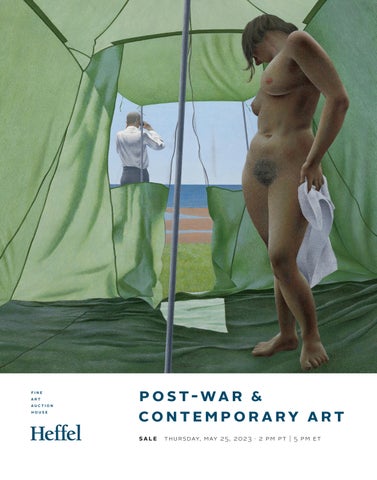
Create a flipbook