
Previous Screen
Product: ARTICULATED TRUCK
Model: D40D ARTICULATED TRUCK 2JJ
Configuration: D40D, D400D ARTICULATED TRUCK 2JJ00001-UP (MACHINE) POWERED BY 3406 ENGINE
Operation and Maintenance Manual
D40D AND D400D ARTICULATED DUMP TRUCKS
Media Number -SEBU8648-02
Machine Operation
Moving the Machine
Publication Date -07/02/1995
Date Updated -30/01/2002
Be sure no one is on or near the machine before starting and moving the machine. Keep the machine under control at all times.
Select the correct gear before starting downgrade. Do not change gear while going downgrade.
It is good practice to use the same gear going downgrade that would be used to go up the grade.
Do not allow the engine to overspeed when driving downgrade. Use the retarder to prevent engine overspeed on a downgrade.
1. Check that there is adequate clearance around the machine.
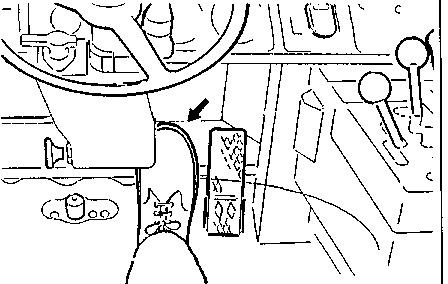
2. Push down on the service brake pedal to stop the machine from moving.
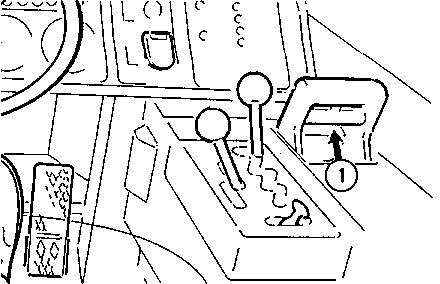
3. Pull the grip insert (1) UP and push the lever FORWARD to disengage the parking brake.
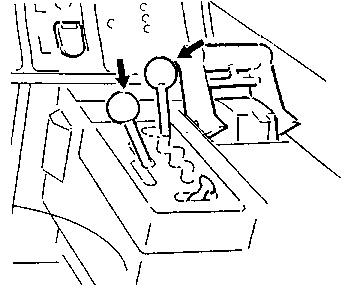
4. Move the transmission controls to the desired speed and direction.
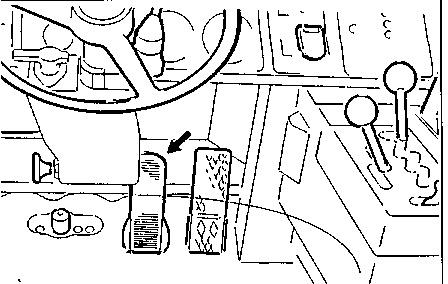
5. Release the service brake pedal.
NOTE: The suspension system may self level up or down when the brakes are released.
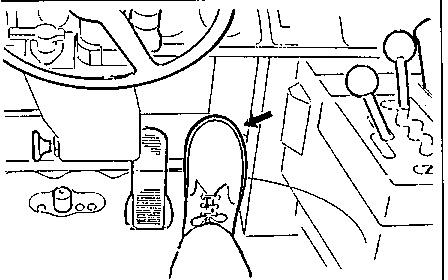
6. Push down on the accelerator pedal so the machine moves smoothly.
Gear Shifting
After moving off increase the engine speed to accelerate the machine. When the engine speed reaches 1400 - 1500 rpm the torque converter will lock up and the torque converter lock up indicator will go out.
Continue to accelerate until the engine speed reaches 2100 rpm then select the next gear up. Do not release the accelerator pedal while upshifting. Continue to upshift through the gears in this way as conditions permit.
All machines are equipped with a downshift inhibitor. To slow the machine during normal driving (to go round a bend for example) it is necessary to establish the correct engine speed before making a downshift.
The engine speed must be high enough to ensure steering system efficiency and low enough to ensure that the torque converter lock up clutch is disengaged. The downshift inhibitor prevents downshifting while the torque converter is locked up.
Allow the engine speed to fall, with the assistance of the service brakes or retarder if necessary. At about 1350 rpm the torque converter lock up clutch will disengage (the indicator will come on). As soon as this happens, downshift one gear.
When driving the machine up a grade it is important to choose the right time for downshifting. The machine should be operated in torque converter lock up as much as possible.
As the machine starts to climb the grade the engine speed will begin to fall. As soon as the torque converter lock up clutch disengages, downshift one gear. Continue to downshift in this way until the engine speed can be maintained at about 2100 rpm.
When driving down a grade select the gear which allows the machine to take advantage of the braking effect of the engine. As a general guide use the same gear to drive down the grade as was used to drive up. The correct gear should be engaged BEFORE STARTING down a grade.
Always drive at a safe speed in accordance with site and weather conditions and the loaded state of the machine. Maintain the proper stopping distance under all conditions.
Braking
D40D machines have drum brakes on the front wheels and oil immersed disc brakes on the rear wheels.
D400D machines have drum brakes on all wheels.
The wheel brakes can be activated by two different controls.
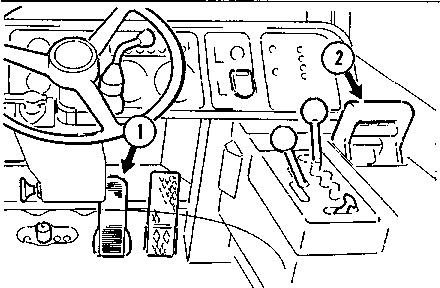
The brake pedal (1) applies all wheel brakes. Deceleration depends on how hard the pedal is pressed. Use the brake pedal for normal braking.
Repeated brake applications on a downgrade can reduce brake air pressure and causes wear and overheating of the brakes. Select the correct gear before starting down a grade and use the retarder to slow the machine.
Pull the parking/secondary brake control (2) BACK to apply the secondary brakes. Deceleration depends on how far back the control is pulled.
When the secondary brakes are engaged, all wheel brakes are applied. When the control reaches the stop the wheel brakes are fully applied.
During normal operation the brake pedal should be used to stop the machine.
Use of the Retarder
The retarder is positioned in the machine drive line, between the engine and the torque converter.
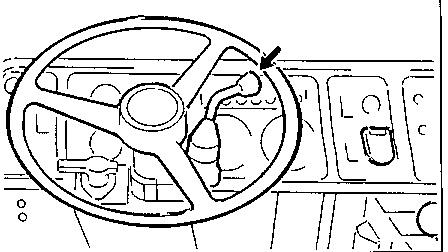
Pull the retarder control DOWN to engage the retarder. Retardation effect depends on how far DOWN the control is moved.
The retarder can only be engaged when the engine speed is above 900 rpm and a gear is selected.
Use the retarder to control ground speed, or to prevent engine overspeed on a downgrade.
The retarder can only be used to slow, or to help to stop the machine. It cannot completely stop the machine and it cannot hold the machine stationary.
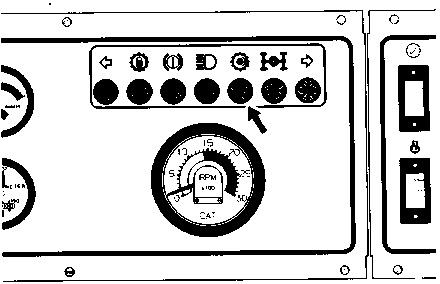
The retarder indicator will come on when the retarder is engaged.
Correct gear selection is very important for effective use of the retarder. The retarder is most effective when the engine speed is high, therefore a low gear should be used.
As a general rule, use the same gear for a loaded machine on a downgrade as for an empty machine on a similar upgrade.
Anticipate retarder use. When approaching a downgrade select the proper gear and move the retarder control to engage the retarder before reaching the downgrade. The retarder takes three to four seconds to fill and become fully effective.
If the proper gear is selected the retarder will maintain a safe speed without excessive use of the service brakes.
Travel down the grade at the best average speed. Do not speed up and slow down. Keep retardation steady and the machine speed under control.
Excessive or incorrect use of the retarder can cause the transmission oil to overheat. Observe the transmission/retarder oil temperature indicator on the EMS panel and the transmission/retarder oil temperature gauge during retarder operation.
Engine Brake - D400D (If equipped)
The engine brake system uses the engine as an aid in slowing the machine. When activated it alters the operation of the engines exhaust valves so that the engine operates as a enegy absorbing air compressor which provides a retarding action on the road wheels.
The engine brake is used for slowing and controlling the machine when driving down a grade. The service brakes can be used with the engine brakes but correct gear selection will eliminate the need for continuous application of the service brake.
The engine brake is only activated when the machine is operating in converter lock up with the accelerator pedal released. It is most effective when the engine is operating at higher speeds (up to 2300 rpm). Selecting the right gear is very important. Use the lowest gear that gives maximum retarding without exceeding high idle.
The engine brake will be automatically deactivated if the engine speed falls below 1350 rpm because the machine goes into converter drive. Downshifting will restore coverter lock up and engine brake operation.
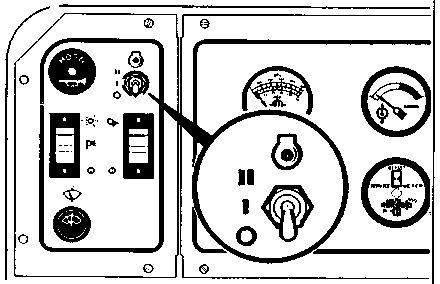
The system is controlled by a three position switch mounted on the dashpanel.
The switch provides an OFF position and two operating positions. The switch positions are marked '0', '1' and '2'.
Be careful when driving down a grade if the conditions are wet or slippery. Traction could be lost if the engine brake control switch is moved directly to the SECOND POSITION. Never miss a step when operating the engine brake control switch. Always go from OFF to FIRST POSITION, then to SECOND POSITION.
When the switch is in the '0' position the system is de-activated.
When the switch is in position '1' or position '2', the engine brake system operates automatically every time the accelerator pedal is released to the idle position.
Position '1' provides a level retardation suitable for a lightly loaded machine travelling on level ground, or shallow grades.
Position '2' provides a higher level of retardation which should be used when the machine is fully loaded or on steep grades.
The engine brake. depends on a free flow of engine lubricating oil for correct operation. For this reason the engine should be allowed to warm up to normal operating temperature before the engine brake is opened.
Use of Differential Lock
The inter axle differential can be locked to maintain drive in slippery conditions.
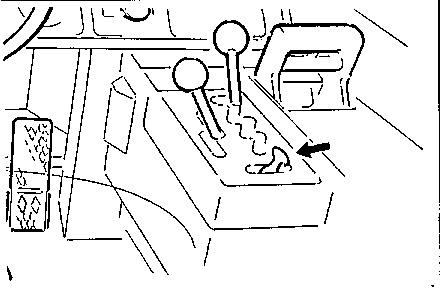
Move the differential lock control LEFT to engage differential lock.
Engaging the differential lock overrides the normal operation of the inter axle differential. When differential lock is selected, torque is transmitted to all axles, even though one axle may not have traction.
NOTICE
If wheel spin has already developed, remove pressure from the acclerator and allow the engine speed to fall sufficiently to stop wheel spin before engaging differential lock, or machine damage can result.
Differential lock should only be engaged when the machine is stopped or before wheel spin starts. If wheel spin has already started, stop the machine before engaging differential lock.
Disengage differential lock as soon as possible after the machine starts moving. Use differential lock to get a stuck machine moving. Do not use differential lock to keep a machine moving in slippery conditions.
The differential lock can remain engaged, even when the control is moved to the DISENGAGED position due to tractive conditions. Disengagement can be assisted by steering maneuvres or by stopping and momentarily engaging the opposite direction of drive.
Oscillating Hitch
The oscillating hitch eliminates stress between the front and rear frames by allowing UNLIMITED OSCILLATION between the tractor and trailer. As a result of this design, Articulated Dump Trucks have different operating characteristics than rigid frame trucks.
It is possible for the trailer to overturn while the tractor remains upright.
A sudden shift in momentum or load distribution caused by sudden steering and/or severe braking action on slopes or in turns and excessive speed in turns, on sloping or rough ground can cause the trailer to overturn.
Unlimited oscillation between the tractor and trailer is normal and means that the operator will receive little or no warning of an overturn.
To minimize the possibility of an overturn:
1. Avoid sudden steering and/or severe braking action in turns or on sloping ground.
2. Avoid travelling across slopes. If this type of operation is unavoidable, reduce speed, stay alert and avoid any sudden steering and/or severe braking. action.
3. Use caution when dumping. Material hung up in the body, coupled with one side of the trailer suddenly sinking into soft underfoot conditions can result in the trailer overturning.
4. The load should be evenly distributed in the body. Avoid excessively heavy loading of the front of the body, and the rated load must not be exceeded.
5. Always drive at a safe speed in accordance with site and weather conditions and the loaded state of the machine. Maintain a safe stopping distance under all conditions.
Copyright 1993 - 2025 Caterpillar Inc. All Rights Reserved. Private Network For SIS Licensees.
Tue Jun 17 16:27:43 UTC+0530 2025