DOWNLOAD LINK
For some reason if link does not work download this pdf and then click
Product: CHALLENGER
Model: 55 CHALLENGER 7DM
Configuration: Challenger 55 Agricultural Tractor 7DM00850-UP (MACHINE) POWERED BY 3126 Engine
Operation and Maintenance Manual
CHALLENGER 35, CHALLENGER 45, AND CHALLENGER 55 AGRICULTURAL
Media Number -SEBU6753-04
Publication Date -12/11/1996
Cooling System Specifications
General Coolant Information
Date Updated -30/01/2002
Many engine failures could be avoided with proper cooling system maintenance. Cooling system maintenance is as important as fuel and lubricating system maintenance. Coolant quality is as important as the quality of fuel and lubricating oil.
The three main functions that coolant serves are:
* Adequate heat transfer and anti-boil protection
* Cavitation erosion and corrosion protection
* Freeze protection
Coolant is normally composed of three elements:
* Water
* Additives
* Glycol Water
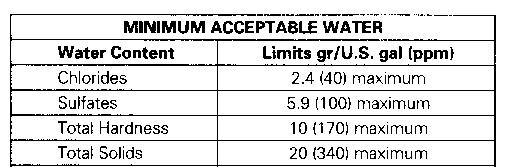
Distilled or deionized water is recommended for use in cooling systems. DO NOT use hard water, tap water, or salt softened tap water in engine cooling systems. If distilled or deionized water is NOT available, use water that meets the minimum acceptable requirements.
NOTICE
Water that does not meet the minimum acceptable limits will reduce engine service life when used in cooling systems.
If you are not sure of the content of the water, contact your Caterpillar dealer, your local water department, your agricultural agent, or an independent laboratory to analyze the water.
Additives
Additives must be included in all coolant mixtures. Additives help prevent the formation of rust, scale, and mineral deposits. Additives protect metals from corrosion, prevent liner cavitation, and contain anti-foaming agents. Additives are depleted during engine operation and need to be replenished. Additives can be replenished through the addition of supplemental coolant additives (used with conventional coolants) or Extender (used with Caterpillar Extended Life Coolant).
Nitrites or nitrite and molybdate additives protect the cylinder liner from cavitation corrosion. Nitrites are depleted, creating the need for additives or Extender. Additives and Extender also contain other inhibitors that can be depleted from cooling systems.
An insufficient additive concentration does not provide adequate protection for cooling systems. An excessive additive concentration can cause additives to drop out of the solution, deposit inside the cooling system, or form a gel in the radiator. Deposits can be in the form of sludge and scale which accumulate on hot engine surfaces. Deposits reduce cooling system effectiveness, or cause water pump leaks.
To maintain conventional cooling system protection, it is necessary to monitor supplemental coolant additive concentration. Maintain the proper additive levels in the cooling system.
Glycol
Engine coolant glycol is normally either ethylene or propylene. Glycol raises the boiling point of water to help prevent boil-over, provides freeze protection, helps prevent water pump cavitation, and reduces cylinder liner pitting.
NOTICE
For ambient temperatures requiring lower freeze protection (higher than 50 percent glycol), use ethylene glycol. DO NOT use propylene glycol.
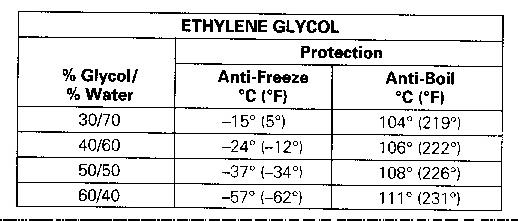
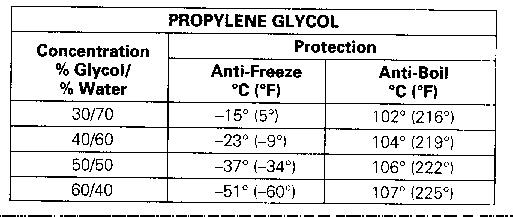
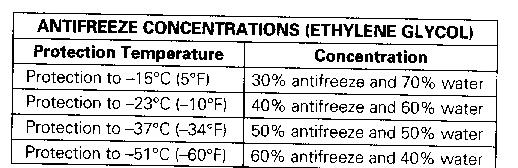
Proper freeze/boil protection requires the proper ratio of glycol and acceptable water. Use the following charts to determine glycol concentrations to mix with acceptable water.
Use the 1U-7298 Coolant Tester (°C) or the 1U-7297 Coolant Tester (°F) to check the coolant solution periodically to ensure adequate freeze/boil protection. The refractometers give immediate, accurate readings and can be used with ethylene or propylene glycol.
NOTE: For more detailed specifications, refer to: Know Your Cooling System, SEBD0518, and Coolant and Your Engine, SEBD0970, or contact your Caterpillar dealer.
Coolant Recommendations
* Preferred - Caterpillar's Extended Life Coolant (ELC).
* Recommended - Caterpillar's Diesel Engine Antifreeze/Coolant (DEAC).
* Acceptable - Any low silicate coolant that meets Truck Maintenance Council (TMC) Recommended Practice (RP) 329, TMC RP330, or ASTM D4985 requirements when used with supplemental coolant additives.
* Permitted - A mixture of acceptable water and a supplemental coolant additive, where freeze protection is not necessary.
* Unacceptable - Any high silicate coolant that is classified as meeting ASTM D3306.
NOTICE
Most commercial engine coolant/antifreezes are formulated for gasoline engine applications and have high silicate content. High silicates are conducive to cylinder liner cavitation and corrosion. Caterpillar DOES NOT recommend high silicate coolant/antifreezes.
NOTE: Due to individual engine applications, engine cooling system maintenance practices may need periodic evaluation.
NOTICE
Never operate without thermostats in the cooling system. Thermostats maintain the engine coolant at the proper operating temperature. Cooling system problems can arise without thermostats.
NOTICE
Never add coolant to an overheated engine. Allow the engine to cool first. Do not add coolant too quickly. Filling the cooling system at over 19 L (5 US gal) per minute can create air pockets in the cooling system. Engine damage can result.
When filling or adding coolant to the system, premix the coolant solution prior to pouring it into the cooling system. Pure, undiluted glycol will freeze at -23°C (-10°F). Use a coolant solution that is in a range which will provide protection to the lowest expected outside (ambient) temperature and provide the required boil-over protection.
Caterpillar's Extended Life Coolant
Caterpillar's Extended Life Coolant anti-corrosion package is different from the conventional antifreezes that have been used. Extended Life Coolant is an ethylene glycol-based coolant/antifreeze containing organic corrosion inhibitors and anti-foam agents with fewer nitrites than conventional coolants.
Extended Life Coolant was specifically designed for use in diesel engine cooling systems and natural gas engine cooling systems.
Extended Life Coolant extends coolant life to 6000 service hours or four years, whichever comes first. One addition of Caterpillar's Extender is required to maintain Extended Life Coolant.
Major Extended Life Coolant advantages:
* Twice the coolant life
* Considerably less maintenance
* Improved corrosion protection
* Better aluminum protection
* Better liner protection
* Fewer additives (chemicals) and no chemical drop out
* Longer radiator life
* Increased water pump seal life
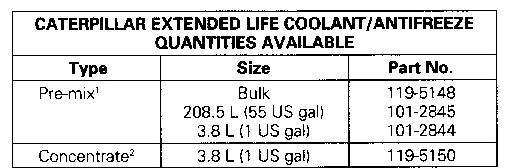
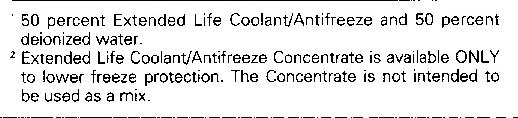
Extended Life Coolant is available as a 50 percent Extended Life Coolant and 50 percent deionized water solution or in concentrate. See the table for quantities that are available.
NOTE: A 50 percent Extended Life Coolant and 50 percent deionized water solution provides freeze protection to -37°C (-34°F) and anti-boil protection to 108°C (226°F). DO NOT use Extended Life Coolant at reduced concentrations (less than 50 percent), as the additives would be reduced along with the antifreeze. Extended Life Coolant concentrate is available to lower the coolant freeze point when used in arctic conditions. Extended Life Coolant concentration can be increased to 60 percent for -52°C (-62°F) freeze protection.
Extender
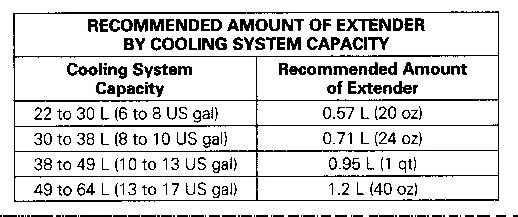
Extender should be added to the cooling system at the 3000 service hours or two years, whichever comes first. See the table to determine the recommended amount of Extender to add to Extended Life Coolant.
Extended Life Coolant Cooling System Maintenance
Use only Caterpillar products or commercial products that have passed Caterpillar's EC-1 specification for premixed or concentrated coolants.
Use only Caterpillar Extender with Extended Life Coolant.
Mixing Extended Life Coolant with other products reduces the Extended Life Coolant service life. Failure to follow the recommendations included in this section can reduce cooling system component life.
In order to maintain the correct balance of antifreeze and additives, care should be taken to maintain the proper Extended Life Coolant concentration. Reducing the amount of antifreeze lowers the proportion of additive, thus lowering the coolant's ability to protect the cooling system from pitting, cavitation, erosion, and deposits.
Proper Extended Life Coolant Additions
NOTE: DO NOT add Extended Life Coolant Concentrate as a makeup solution for routine cooling system top-off. Adding concentrated Extended Life Coolant increases the concentration of glycol in the cooling system.
During normal maintenance, use a premixed solution of approved water and Extended Life Coolant as a top-off to the cooling system to bring the coolant to the proper level. Use Extended Life Coolant or a coolant that meets Caterpillar's EC-1 specification. If a coolant that meets EC-1 is not available, use distilled or de-ionized water as a make-up. Check the glycol level of the cooling system with the 1U-7298 Coolant Tester (°C) or the 1U-7297 Coolant Tester (°F). Use Extended Life Coolant Concentrate to restore the proper glycol concentration before the engine is exposed to freezing temperatures.
NOTICE
Do not use conventional coolant to top off a cooling system using Extended Life Coolant.
Do not use supplemental coolant additives other than extender in cooling systems filled with Extended Life Coolant.
If a cooling system using Extended Life Coolant has been topped off with a small amount of conventional coolant or if a supplemental coolant additive was added to the system by mistake, the system will not be harmed.
Should the cooling system become contaminated with conventional coolant or supplemental coolant additive exceeding 10 percent of the cooling system's total capacity, perform one of the following actions:
* Drain the cooling system and refill the cooling system with Extended Life Coolant, or
* Maintain the cooling system as if the cooling system is filled with conventional coolant.
Extended Life Coolant Cooling System Cleaning
NOTE: No cleaning agents are to be used when a cooling system using Extended Life Coolant is drained, flushed, and refilled.
Clean water is the only system cleaning/flushing agent required when Extended Life Coolant is drained from the cooling system.
Extended Life Coolant can be recycled. The drained coolant mixture can be "distilled" to separate the ethylene glycol and water for reuse. Contact your Caterpillar dealer for more information.
After draining and refilling the cooling system, operate the engine with the radiator filler cap removed until the coolant reaches normal operating temperature and the coolant level stabilizes. Add coolant mixture as necessary to fill the system to the proper level.
Converting a Cooling System from Conventional Coolant to Extended Life Coolant
NOTE: When the coolant is changed from conventional coolant to Extended Life Coolant, a Caterpillar cleaner should be used. After the use of Caterpillar cooling system cleaners, the system MUST be thoroughly flushed with clean water.
To convert the cooling system from conventional coolant to Extended Life Coolant, perform the following procedure:
1. Drain the coolant.
2. Flush the system with clean water to remove any debris.
3. Use a Caterpillar cleaner to clean the system. Follow the instructions on the label. Caterpillar cleaner is available from your Caterpillar dealer.
4. Drain the cleaner. Flush the cooling system with clean water.
5. Fill the cooling system with clean water. Operate the engine until the cooling system temperature is 49 to 66°C (120 to 150°F).
6. Drain and flush the cooling system with clean water.
7. Repeat Step 5 and Step 6.
8. Fill the cooling system with Extended Life Coolant.
9. Attach a label to the cooling system to indicate the system has been converted to use Extended Life Coolant.
Conventional Antifreeze/Coolant
Recommended - Caterpillar's Diesel Engine Antifreeze/Coolant
NOTE: The following information and recommendations are for Caterpillar's Diesel Engine Antifreeze/Coolant only.
Caterpillar's Diesel Engine Antifreeze/Coolant was specifically designed for diesel engine cooling systems and natural gas engine cooling systems. Diesel Engine Antifreeze/Coolant is an alkaline
type, ethylene glycol-based formula containing inorganic corrosion inhibitors and anti-foam agents. Diesel Engine Antifreeze/Coolant was formulated with the correct additive levels to protect metal parts in diesel engines. Diesel Engine Antifreeze/Coolant will furnish adequate corrosion protection, anti-foam protection, and cylinder liner/block pitting protection. Use a 30 percent Diesel Engine Antifreeze/Coolant and 70 percent acceptable water/supplemental coolant additive solution.
Major advantages of Diesel Engine Antifreeze/Coolant:
* Minimal silicate content - High silicate coolants, used with supplemental coolant additives, can cause a build-up of solids over time. Build-up of solids can cause plugging, loss of heat transfer, and water pump seal damage. Diesel Engine Antifreeze/Coolant significantly reduces solid residue build-up that causes inhibitor dropout and water pump seal damage.
* No need to add supplemental coolant additive on initial fill - Supplemental coolant additive must be added with other commercially available coolants.
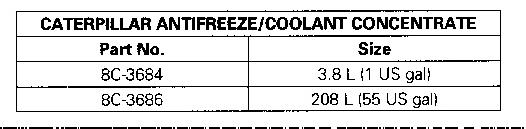
Diesel Engine Antifreeze/Coolant is available from your Caterpillar dealer in the following quantities:
Proper Antifreeze Concentrations
Use the table to determine concentrations of Diesel Engine Antifreeze/Coolant to mix with acceptable water and supplemental coolant additive.
Acceptable Antifreeze/Coolant
Any low silicate coolant that meets Truck Maintenance Council (TMC) Recommended Practice (RP) 329, TMC RP330, or ASTM D4985 requirements when used with supplemental coolant additives is acceptable.
Caterpillar recommends a minimum of 30 percent glycol to 70 percent water/supplemental coolant additive for proper corrosion protection. All Caterpillar engines with air-to-air aftercooling
(ATAAC) require a minimum concentration of 30 percent glycol to prevent water pump cavitation.
While 30 percent glycol is the minimum acceptable volume, Caterpillar prefers a 50 percent glycol and 50 percent water/supplemental coolant additive mixture for optimum performance.
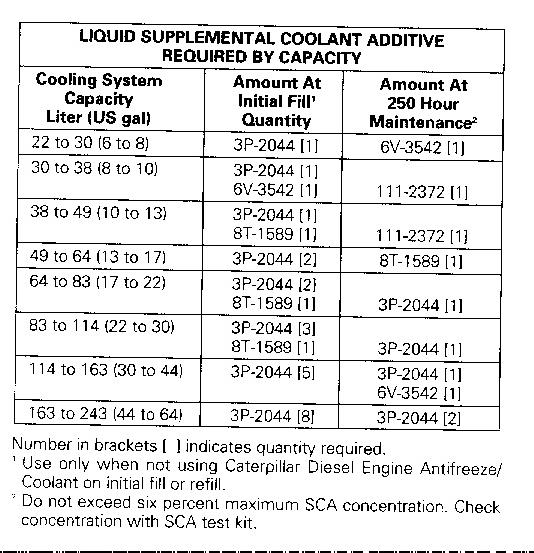
When using Diesel Engine Antifreeze/Coolant, no supplemental coolant additive is necessary on initial fill because supplemental coolant additive is in the Diesel Engine Antifreeze/Coolant. Supplemental coolant additive must be added with commercial coolants meeting ASTM D4985 at initial fill. Supplemental coolant additive must be replenished with both Caterpillar Diesel Engine Antifreeze/Coolant and other commercial coolants at regular service intervals. Refer to the chart for quantities of Caterpillar Liquid SCA to mix with ASTM D4985 commercial coolants at initial fill.
Supplemental Coolant Additive
Supplemental cooling system additive contains alkali. To prevent personal injury, do not drink, avoid contact with the skin and eyes.
NOTICE
The cooling system MUST contain supplemental coolant additive for proper engine protection, regardless of antifreeze concentration.
NOTICE
DO NOT mix Caterpillar's supplemental coolant additive or coolant additive elements with another manufacturer's products. Select a cooling system treatment and use it exclusively.
Supplemental coolant additive is necessary for proper conventional coolant maintenance. Most coolant solutions DO NOT contain sufficient supplemental coolant additive for diesel engine application.
NOTICE
Do not exceed the recommended six percent supplemental coolant additive concentration. Excessive supplemental coolant additive concentration can form deposits on the higher temperature surfaces of the cooling system, reducing the engine's heat transfer characteristics. Reduced heat transfer could cause cracking of the cylinder head and other high temperature components. Excessive supplemental coolant additive concentration could also result in radiator tube blockage, overheating, and/or accelerated water pump seal wear. Never use both liquid supplemental coolant additive and the spin-on element (if equipped) at the same time. The use of those additives together could result in supplemental coolant additive concentration exceeding the recommended six percent maximum.
Use liquid supplemental coolant additive or a supplemental coolant additive element (if equipped) to maintain a three to six percent supplemental coolant additive concentration in the coolant.
NOTE: Caterpillar test kits check for concentration of nitrites in the coolant solution. Some manufacturers' supplemental coolant additive are phosphate based. Caterpillar test kits provide inaccurate results with phosphate based supplemental coolant additive. Commercial supplemental coolant additive products must contain silicates and a minimum of 70 grams per 3.8 L (1 US gal)
(1200 ppm) nitrites. If another manufacturer's supplemental coolant additive is used, use that manufacturer's test kit. Follow the manufacturer's recommendations for cooling system treatment and test evaluation.
Test the coolant periodically to monitor supplemental coolant additive levels. Use the 4C-9301 Test Kit to check for Caterpillar supplemental coolant additive concentration. The kit also provides cooling system maintenance recommendations. This kit is specifically for use with Caterpillar supplemental coolant additive's. The 8T-5296 Test Kit can also to check for Caterpillar supplemental coolant additive concentration.
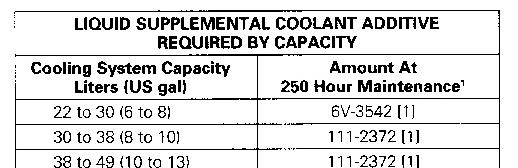
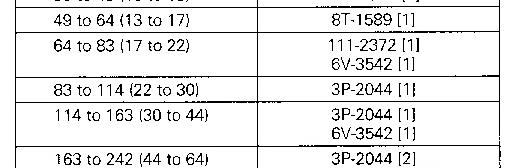
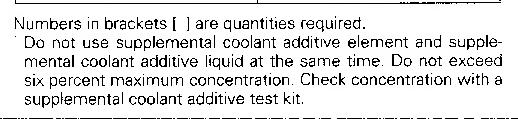
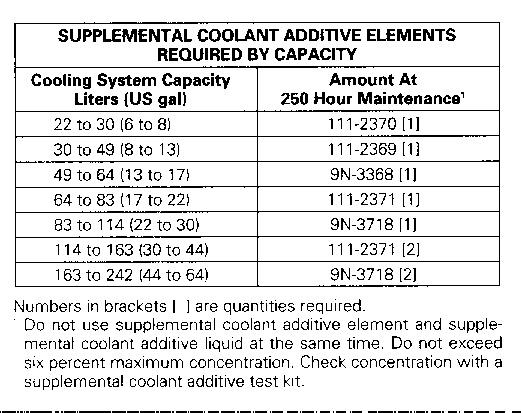
The tables lists the part numbers and quantities of supplemental coolant additive (liquid and solid) available from your Caterpillar dealer. Follow the instructions on the label.
Permitted-Water/Supplemental Coolant Additive
NOTICE
Never use water alone without supplemental coolant additive or inhibited coolant. Water alone is corrosive at engine operating temperatures.
NOTICE
A mixture of water and supplemental coolant additive does not protect against freezing or boiling.
NOTICE
A coolant mixture of water and supplemental coolant additive will cool and provide some protection to engine components, but it will NOT provide normal engine service life.
NOTICE
Caterpillar's recommendation for proper coolant is a minimum concentration of 30 percent glycol and 70 percent acceptable water and supplemental coolant additive (three percent of the total mixture). This recommendation will maintain cooling system corrosion protection.
In applications where freeze protection is not required, or where antifreeze is not available, a coolant mixture of acceptable water and supplemental coolant additive can be used. A water/supplemental coolant additive system should maintain a six to eight percent supplemental coolant additive concentration. DO NOT exceed eight percent maximum supplemental coolant additive concentration. Supplemental coolant additive concentration levels must be monitored.
The 8T-5296 Test Kit can be used to evaluate the supplemental coolant additive concentration in water/supplemental coolant additive coolant, with the following modifications to label instruction Step 3 and Step 5.
STEP 3. - Add tap water to the vial up to the 20 ml mark.
STEP 5. - With the defined procedure, the six to eight percent concentration will yield a 20 to 27 drop range. Fewer drops indicate a low concentration of supplemental coolant additive and more drops indicate a high concentration. Adjust the concentration appropriately.
If the supplemental coolant additive concentration is greater than the maximum of eight percent: drain some of the coolant, refill the system with acceptable water, and retest the concentration level.
Conventional Cooling System Maintenance
Check the antifreeze solution frequently in cold weather to ensure adequate freeze protection. Test the concentration or submit a coolant sample to your Caterpillar dealer in order to monitor the supplemental coolant additive concentration in your engine's coolant mixture every 250 service hours or monthly, whichever comes first. Supplemental coolant additive or a maintenance additive element (if equipped) may be needed every 250 service hours or monthly, whichever come first.
NOTICE
To prevent over-inhibiting the engine's cooling system, do not use both supplemental coolant additive liquid and a supplemental coolant additive element (if equipped) at the same time. Use one method exclusively.
When using Diesel Engine Antifreeze/Coolant and supplemental coolant additive, the cooling system should be drained, cleaned, flushed, and filled with new coolant every 3000 service hours or every two years, whichever come first. Refer to the topic Maintenance Intervals in this manual.
When NOT using Caterpillar Diesel Engine Antifreeze/Coolant and supplemental coolant additive, the drain/flush procedure must be performed at least every year.
After you drain and refill the cooling system, operate the engine with the radiator filler cap removed until the coolant reaches normal operating temperature and the coolant level stabilizes. Add coolant mixture as necessary to fill the system to the proper level.
Cooling System Cleaning
Draining, cleaning, and flushing the cooling system removes small particles, undesirable chemicals, scale, and other deposit formations. Not performing maintenance on the cooling system can eventually cause engine overheating problems that could result in severe damage to engine and components.
Clean the cooling system if the system becomes contaminated, if the engine overheats, or if foaming is observed.
Caterpillar's Fast Acting Cooling System Cleaner is designed to clean the system of harmful scale and corrosion. The cleaner dissolves mineral scale, corrosion products, light oil contamination, and sludge.
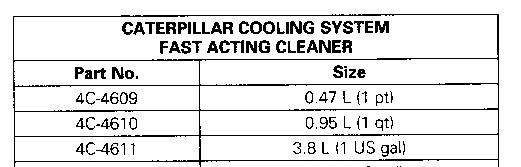
Fast Acting Cooling System Cleaner is available from your Caterpillar dealer in the quantities listed. Follow the product label directions for proper use.
Product: CHALLENGER
Model: 55 CHALLENGER 7DM
Configuration: Challenger 55 Agricultural Tractor 7DM00850-UP (MACHINE) POWERED BY 3126 Engine
Operation and Maintenance Manual
CHALLENGER 35, CHALLENGER 45, AND CHALLENGER 55 AGRICULTURAL
Media Number -SEBU6753-04
Fuel Specifications
Fuel System Information
Publication Date -12/11/1996
Date Updated -30/01/2002
Check the fuel level in the fuel tank by observing the gauge on the EMC.
NOTICE
Fill the fuel tank at the end of each day of operation to drive out moist air and to prevent condensation. Maintain a fairly constant level in the tank (near the top) to avoid drawing moisture into the tank as the level decreases. Do not fill the tank to the top. Fuel expands as it gets warm and can overflow.
Drain water and sediment from tank at the interval specified in the Maintenance Interval schedule.
Do not fill fuel filters with fuel before installing them. Contaminated fuel will cause accelerated wear to fuel system parts.
Fuel Recommendations
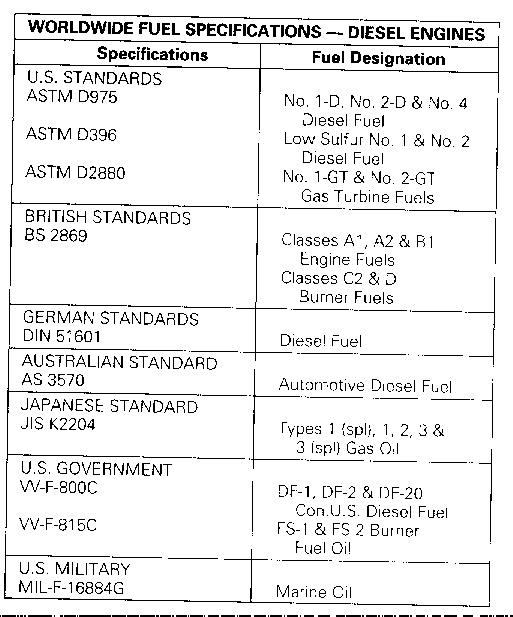
The table lists worldwide fuel standards which meet Caterpillar requirements.
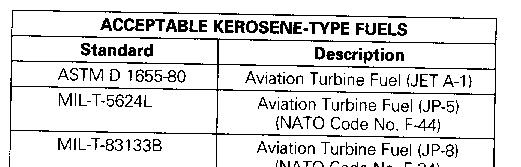
Aviation kerosene-type fuels meeting acceptable limits may also be used as an engine fuel. The table lists some of the acceptable kerosene-type fuels.
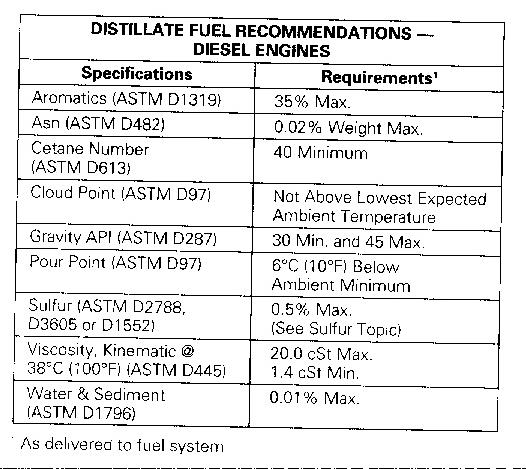
A minimum viscosity of 1.4 cSt at 38°C (100°F) is required to properly lubricate Caterpillar fuel system components. Kerosene-type fuels have a lower viscosity for low temperature operation.
The kerosene-type fuels have less energy per unit volume than diesel fuels, producing less peak power. More kerosene-type fuel is needed than diesel fuel to do the same amount of work.
Caterpillar diesel engines are capable of burning a wide range of distillate fuels. Burning clean, stable blends of distillate fuel meeting the listed requirements will provide quality engine service life.
NOTE: When economics or fuel availability dictate, other fuel types may be burned in the engine. Consult your Caterpillar dealer for more information and advice on any specific fuel.
Cetane Number
During average starting conditions, direct injection engines require a minimum cetane number of 40. A higher cetane value may be required for high altitude or cold weather operation.
Filterability
Clean fuels should have no more than 0.1 percent of sediment and water. Fuel stored for extended periods of time may oxidize and form solids, causing filtering problems.
Pour Point
Fuel pour point should be at least 6°C (10°F) below the lowest ambient temperature at which the engines must start and operate. Lower pour points of No. 1 or No. 1-D fuel may be necessary in extremely cold weather.
Cloud Point
The cloud point should be below the lowest ambient temperature at which the engines must start and operate, in order to prevent the fuel filter elements from plugging with wax crystals. Refer to the topic Fuel Problems in Cold Weather Recommendations, SEBU5898, for additional information.
Viscosity
Fuel viscosity affects the lubrication of fuel system components and fuel atomization. The provided viscosity limits address both of those affects.
Additives
Fuel additives are generally not recommended or needed for the specified fuels listed. Cetane improvers can be used as necessary for direct injection engine requirements. Biocides may be needed to eliminate microorganism growth in storage tanks. In cold weather conditions, treatment for entrained water may also be necessary.
Consult your fuel supplier about the use of additives to prevent incompatibility among additives already in the fuel and the additives to be used.
Fuel Sulfur
The percentage of sulfur in fuel affects engine oil recommendations. Fuel sulfur can change chemically during combustion. The chemical change forms both sulfurous acids and sulfuric acids. The acids contact metal surfaces and cause corrosive wear to the surfaces. Sulfur oxides formed during combustion also produce particulate exhaust emissions.
Some lubricating oil additives contain alkaline compounds which neutralize acids in combustion gases and minimize corrosive wear. Reserve alkalinity in lubricating oil is measured and defined with a Total Base Number (TBN).
Periodically request fuel sulfur content information from your fuel supplier. Fuel sulfur content can change with each bulk delivery.
More information concerning fuel sulfur and lubrication can be found in the topic Lubricant Specifications in this manual.
Refer to Diesel Fuels and Your Engine, SEBD0717, or contact your Caterpillar dealer for more information on fuel selection and fuel properties.
Copyright 1993 - 2024 Caterpillar Inc.
All Rights Reserved.
Private Network For SIS Licensees.
Thu Feb 29 22:22:37 UTC+0530 2024
Product: CHALLENGER
Model: 55 CHALLENGER 7DM
Configuration: Challenger 55 Agricultural Tractor 7DM00850-UP (MACHINE) POWERED BY 3126 Engine
Operation and Maintenance Manual
CHALLENGER 35, CHALLENGER 45, AND CHALLENGER 55 AGRICULTURAL
Media Number -SEBU6753-04
Publication Date -12/11/1996
Lubricant Specifications
Lubricant Information
Date Updated -30/01/2002
Certain abbreviations follow Society of Automotive Engineers (SAE) J754 nomenclature and some classifications follow SAE J183 abbreviations. SPC is a Caterpillar designation for special synthetic oils, that do not contain viscosity improvers. The MIL specifications are U.S.A. Military Specifications. The CCMC refers to an organization of major European manufacturers responsible for defining engine oil performance specifications.
The definitions other than Caterpillar's will be of assistance in purchasing lubricants. The recommended oil viscosities can be found in the Lubricant Viscosities chart in this publication.
Grease is classified by the National Lubricating Grease Institute (NLGI) based on ASTM D217-68 Worked Penetration characteristics which are given a defined consistency number.
General Information
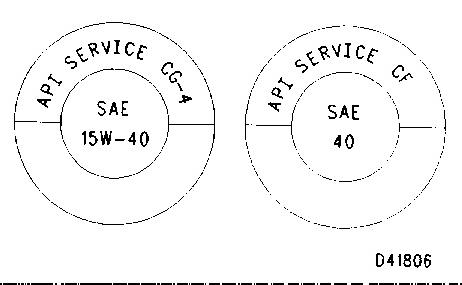
Caterpillar recognizes and supports the American Petroleum Institute (API) "Engine Oil Licensing and Certification System" for engine oils. The API publication No. 1509, 13th edition, contains the detailed information concerning this system. Engine oils bearing the API symbol are licensed by the API.
Examples of the API symbol.
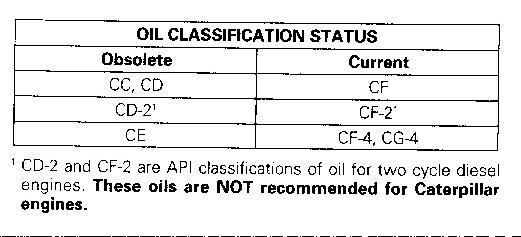
Diesel engine oil classifications CD, CD-2 and CE will not be API licensed categories after January 1, 1996. Caterpillar will only reference those categories that are licensed by the API. The table summarizes the status of the categories.
Engine Lubricant Specifications
Caterpillar Oil
Caterpillar oils have been developed, tested, and approved by Caterpillar to provide the performance and life that has been designed and built into Caterpillar diesel engines. Caterpillar oils are used for engine development and factory fill. Caterpillar oils are available from Caterpillar dealers. Due to significant variations in the quality and performance of commercially available oils, Caterpillar recommends the following oils:
Caterpillar
Diesel Engine Oil (DEO) (multi-grade)
Caterpillar DEO multi-grade oils are formulated with detergents, dispersants, and sufficient alkalinity to provide superior performance in Caterpillar diesel engines. DEO multi-grade oils are blended in two viscosity grades: SAE 10W-30 and SAE 15W-40. Refer to the lubricant viscosity
chart to choose the correct viscosity grade based on ambient temperatures. Multi-grade oils provide the correct viscosity for a broad range of operating temperatures and for cold engine starts. Multi-grade oils are also effective in maintaining low oil consumption and low levels of piston deposits.
Caterpillar DEO multi-grade oils are also qualified for use in other diesel engines and in gasoline engines. Consult the engine manufacturer's guide for the recommended specifications, and compare to the specifications of Caterpillar DEO multi-grade. The current Caterpillar DEO industry specifications are listed on the label and on the product data sheets.
Commercial Diesel Engine Oils
The performance of commercial diesel engine oils are based on API categories. These API categories are developed to provide commercial lubricants for a wide variety of diesel engines that operate at various conditions.
If Caterpillar DEO (multi-grade) is not used, only use the following commercial oils:
* Preferred - API CG-4
* Allowed - API CF-4
API CG-4 oils are preferred for use in Caterpillar engines because of the fuel sulfur level. API CG -4 is the only oil category that evaluates oils with engine tests utilizing 0.05 percent sulfur fuel.
The following explanations of these API categories can be used to make the proper choice of a commercial oil.
CG-4 - CG-4 is the newest oil category. CG-4 oils were primarily developed for diesel engines that are operating with 0.05 percent sulfur diesel fuel. All of the laboratory engine tests for this category were performed with 0.05 percent sulfur diesel fuel. CG-4 also defines oils that have superior soot dispersancy. CG-4 oils will provide improved viscosity control and improved crankcase cleanliness in applications where oil soot is a problem. CG-4 oils should also be used in engines that contain hydraulically actuated fuel injection pumps; these are the first oils to pass industry tests for foam control and viscosity shear loss. CG-4 oils must also pass recently developed tests for metals corrosion, and wear. CG-4 oils can be used in all Caterpillar engines where CF-4 oils are recommended.
CF-4 - CF-4 oils service a wide variety of modern diesel engines. This oil classification was developed with 0.40 percent sulfur diesel fuel. The fuel used in the CF-4 tests represents the type of diesel fuels commonly available world wide. CF-4 oils provide improved piston deposit control and improved oil control when compared to the CE category oils. CF-4 oils also provide improved soot dispersancy compared to CD or CF category oils.
Some commercial oils meeting these API specifications may require shortened oil change intervals as determined by close monitoring of oil condition and wear metals. The Caterpillar S·O·S Analysis Program is the preferred testing method.
Consult your Caterpillar dealer for the latest oil recommendations.
NOTICE
Failure to follow these oil recommendations can cause shortened engine life due to deposits and/or excessive wear.
Total Base Number (TBN) and Fuel Sulfur Levels for Caterpillar Diesel Engines
Caterpillar Prechamber Combustion Engines
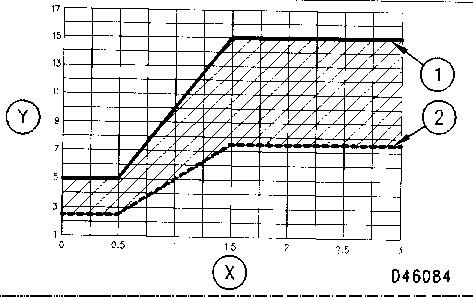
The TBN for a new oil is dependent on the sulfur level of the fuel used. For precombustion chamber (PC) engines running on distillate fuel, the minimum new oil TBN (by ASTM D2896) must be 20 times the fuel sulfur level. The minimum TBN of new oil is five, regardless of low fuel sulfur level. See the illustration.
Oil TBN shown by ASTM D2896 (Y). Percent of fuel sulfur by weight (X). New oil TBN (1). Change oil when the used oil TBN limit (2) is reached.
Caterpillar's 20 times rule for TBN (Reference: Oil and Your Engine, SEBD0640) versus fuel sulfur was a general requirement developed in the early 1980's for Caterpillar prechamber combustion (PC) system engines. Caterpillar still maintains 20 times TBN value for PC engines. Engines built prior to 1990 can continue to use single grade viscosity oil or commercial oils, provided the engine operates satisfactorily.
Fuel sulfur neutralization of new oil formulations in direct injection (DI) system engines is more effective. Field results indicate that direct injection (DI) combustion systems and the oils now recommended for those engines will operate at an oil TBN equal to 10 times the fuel sulfur.
Caterpillar Direct Injection Diesel Engines
For direct injection engines running on distillate diesel fuel, the minimum new oil TBN (by ASTM D 2896) must be 10 times the fuel sulfur level, and the minimum TBN is five regardless of low fuel sulfur level. See the illustration.
Oil TBN shown by ASTM D2896 (Y). Percent of fuel sulfur by weight (X). New oil TBN (1). Change oil when the used oil TBN limit (2) is reached.
In areas where the fuel sulfur exceeds 1.5 percent, choose an oil with the highest TBN that is within the API CF-4 or CG-4 categories, and shorten the oil change period based on oil analysis. The oil analysis should evaluate oil condition and wear metals. High TBN oils that are not within the API CF-4 or CG-4 categories can produce excessive piston deposits leading to a loss of oil control and bore polishing.
NOTICE
Operation at fuel sulfure levels over 1.5 percent may require shortened oil change periods to maintain adequate wear protection.
Hydraulic Steering System (MTO)
Caterpillar has released a new oil product that meets the requirements for the combined steering and implement system on this tractor. This oil type is widely used in agricultural tractors.
Cat MTO is a multigrade oil with much better ambient temperature range than the SAE 10W hydraulic oil. The temperature limits are -25°C to +40°C (-13°F to +104°F), and it has higher viscosity at the higher temperature than the SAE 10W oil.
This oil is not the same as Cat TO-4 oil nor any of the engine or hydraulic oils. It is a special performance oil to be used for only those applications for which it is specified.
Use 105-3335 [18.9 L (5.5 gal)] Cat MTO oil or equivalent.
Cat Lubricating Grease
Caterpillar has greases for all applications.
* Cat Multipurpose Molybdenum Grease (MPGM)
Use MPGM Grease for heavily loaded bearings and joints where an extreme pressure grease will maximize the life of Caterpillar equipment. This NLGI No. 2 grade is suitable for most temperatures.
If MPGM Grease is not available, use a multipurpose type grease which contains 3 to 5% molybdenum.
* Cat Multipurpose Lithium Grease (MPGL)
MPGL Grease, NLGI No. 2 grade, is recommended for light duty automtive type applications where a high temperature, up to 175°C (350°F) is required. This grease offers excellent mechanical stability, high resistance to oxidation, good rust protection and excellent breakaway torque.
If this grease is not available, use a similar multipurpose grease.
* Cat Special Purpose Grease (SPG)
SPG Grease is recommended for high temperature anti-friction bearings in such applications as electric motors, alternators, fan drive bearings, starters and generators. The grease is a NLGI No. 2 grade.
If this grease is not available, use a similar multipurpose grease suitable for anti-friction bearings.
Anti-Seize Compound (ASC)
Use 5P-3931 Anti-Seize Compound (ASC) or equivalent.
1993 - 2024 Caterpillar Inc.
SIS
Thu Feb 29 22:21:37 UTC+0530 2024
This is the sample of the manual click on the download link for complete manual