


Product: INDUSTRIAL ENGINE
Model: 3176C INDUSTRIAL ENGINE 2AW
Configuration: 3176C Industrial Engine 2AW00001-UP
Operation and Maintenance Manual 3176C and 3196 Industrial Engines

Product: INDUSTRIAL ENGINE
Model: 3176C INDUSTRIAL ENGINE 2AW
Configuration: 3176C Industrial Engine 2AW00001-UP
Operation and Maintenance Manual 3176C and 3196 Industrial Engines
For some reason if link does not work download this pdf and then click

Product: INDUSTRIAL ENGINE
Model: 3176C INDUSTRIAL ENGINE 2AW
Configuration: 3176C Industrial Engine 2AW00001-UP
Operation and Maintenance Manual
3176C and 3196 Industrial Engines Media Number -SEBU7082-02
SMCS - 1803-040
-01/09/1999
Do not disconnect the air line from the air compressor governor without purging the air brake and the auxiliary air systems. Failure to purge the air brake and the auxiliary air systems before removing the air compressor and/or the air lines could cause personal injury.
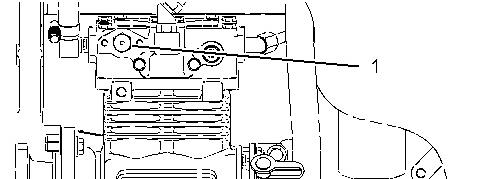
Illustration 1 g01076630 (1) Pressure relief valve
-15/08/2018
If the air compressor pressure relief valve that is mounted in the air compressor cylinder head is bypassing compressed air, there is a malfunction in the air system, possibly ice blockage. Under these conditions, your engine may have insufficient air for normal brake operation.
Do not operate the engine until the reason for the air bypass is identified and corrected. Failure to heed this warning could lead to property damage, personal injury, or death to the operator or bystanders.
The function of the pressure relief valve is to bypass air when there is a malfunction in the air compressor system.
The pressure relief valve releases air at 1723 kPa (250 psi). Do not stand near the pressure relief valve. Compressed air may be released without warning. All personnel should also stay clear of the air compressor when the engine is operating and the air compressor is exposed.
Refer to the Service Manual or refer to the OEM specifications in order to find information concerning the air compressor. Consult your Caterpillar dealer for assistance.
Product: INDUSTRIAL ENGINE
Model: 3176C INDUSTRIAL ENGINE 2AW
Configuration: 3176C Industrial Engine 2AW00001-UP
Operation and Maintenance Manual
3176C and 3196 Industrial Engines
SMCS - 1803-070-FQ; 1803-510-FQ
One of the single most important aspects of preventive maintenance for the air compressor is the induction of clean air. The type of maintenance that is required for the air compressor and the maintenance interval depends on the type of air induction system that is used. Operating conditions (dust, dirt and debris) may require more frequent service.
Refer to the Service Manual for the type of air compressor that is installed on the engine. Follow the maintenance recommendations that are provided by the OEM of the air compressor. Some engines use boost air pressure so the engine air cleaner will require servicing.
Copyright 1993 - 2025 Caterpillar Inc. All Rights Reserved. Private Network For SIS Licensees. Mon Mar 31 22:45:53 UTC+0700 2025
Product: INDUSTRIAL ENGINE
Model: 3176C INDUSTRIAL ENGINE 2AW
Configuration: 3176C Industrial Engine 2AW00001-UP
Operation and Maintenance Manual
3176C and 3196 Industrial Engines
Media Number -SEBU7082-02
-01/09/1999
Equipped
SMCS - 1451-535
NOTICE
Never allow the lubricator bowl to become empty. The air starting motor will be damaged by a lack of lubrication. Ensure that sufficient oil is in the lubricator bowl.
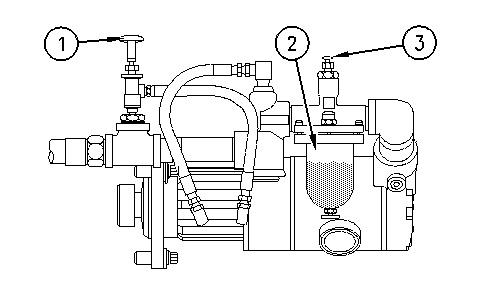
Illustration 1
-15/08/2018
(1) Air valve
(2) Lubricator bowl
(3) Adjustment knob
1. The vanes of the air starting motor are lubricated with a fine mist of oil from the air starting motor lubricator. Check the level of oil in lubricator bowl (2). If the oil level is less than 1/2, add oil to the lubricator bowl.
2. Ensure that the air supply to the lubricator is OFF.
3. Remove the plug. Pour oil into lubricator bowl (2). Use "10W" oil for temperatures that are greater than 0° C (32° F). Use air tool oil for temperatures that are below 0° C (32° F).
4. Install the plug.
If necessary, adjust the lubricator in order to release approximately two drops of fluid per 30 seconds into the starting motor air stream.
1. Ensure that the fuel supply to the engine is OFF.
2. Turn adjustment knob (3) clockwise until the adjustment knob locks.
3. Turn adjustment knob (3) counterclockwise for 1/4 turns.
Do not crank the engine continuously for more than 30 seconds. Allow the starting motor to cool for two minutes before cranking the engine again.
4. Crank the starting motor for ten seconds and observe the exhaust air from the mufflers of the starting motor. Look for oil mist. A slight oil mist should be barely visible.
If no mist is observed, or if the mist is excessive, rotate adjustment knob (3) in increments of 1/16 in order to increase or decrease the oil mist. Repeat the starting motor cranking and observe until the mist is satisfactory.
Note: Drip rates should only be made under an average steady flow condition. Once a steady flow condition is established, the lubricator will automatically adjust the drip rate in proportion to the variations in air flow.
Copyright 1993 - 2025 Caterpillar Inc. All Rights Reserved. Private Network For SIS Licensees.
Mon Mar 31 22:46:11 UTC+0700 2025
Product: INDUSTRIAL ENGINE
Model: 3176C INDUSTRIAL ENGINE 2AW
Configuration: 3176C Industrial Engine 2AW00001-UP
Operation and Maintenance Manual
3176C and 3196 Industrial Engines
SMCS - 1466-543-M&S
Moisture and sediment in the air starting system can cause the following conditions:
• Freezing
• Corrosion of internal parts
• Malfunction of the air starting system
When opening the drain valve, wear protective gloves, a protective face shield, protective clothing, and protective shoes. Pressurized air could cause debris to be blown and result in personal injury.
1. Open the drain valve that is on the bottom of the air tank. Allow the moisture and sediment to drain.
2. Close the drain valve.
3. Check the air supply pressure. The air starting motor requires a minimum of 620 kPa (90 psi) of air pressure to operate properly. The maximum air pressure must not exceed 1550 kPa (225 psi). The normal air pressure will be 758 to 965 kPa (110 to 140 psi).
Copyright 1993 - 2025 Caterpillar Inc. All Rights Reserved. Private Network For SIS Licensees.
Product: INDUSTRIAL ENGINE
Model: 3176C INDUSTRIAL ENGINE 2AW
Configuration: 3176C Industrial Engine 2AW00001-UP
Operation and Maintenance Manual
3176C and 3196 Industrial Engines
Media Number -SEBU7082-02
SMCS - 1405-040
-15/08/2018
i08259468
Caterpillar recommends a scheduled inspection of the alternator. Inspect the alternator for loose connections and proper battery charging. Inspect the ammeter (if equipped) during engine operation to ensure proper battery performance and/or proper performance of the electrical system. Make repairs, as required.
Check the alternator and the battery charger for proper operation. If the batteries are properly charged, the ammeter reading should be very near zero. All batteries should be kept charged. The batteries should be kept warm because temperature affects the cranking power. If the battery is too cold, the battery will not crank the engine. The battery will not crank the engine, even if the engine is warm. When the engine is not run for long periods of time or if the engine is run for short periods, the batteries may not fully charge. A battery with a low charge will freeze more easily than a battery with a full charge.
Copyright 1993 - 2025 Caterpillar Inc. All Rights Reserved. Private Network For SIS Licensees. Mon Mar 31 22:47:08 UTC+0700 2025
Product: INDUSTRIAL ENGINE
Model: 3176C INDUSTRIAL ENGINE 2AW
Configuration: 3176C Industrial Engine 2AW00001-UP
Operation and Maintenance Manual
3176C and 3196 Industrial Engines
SMCS - 1357-039
To maximize the engine performance, inspect the belts for wear and for cracking. Check the belt tension. Adjust the belt tension in order to minimize belt slippage. Belt slippage will decrease the life of the belts.
To check the belt tension, apply 110 N (25 lb) of force midway between the pulleys. A correctly adjusted belt will deflect 13 to 19 mm (0.50 to 0.75 inch).
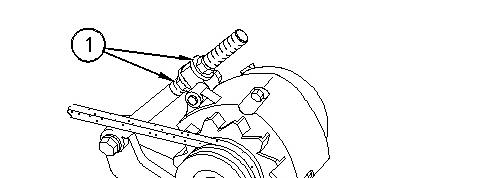
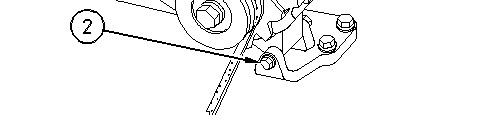
Illustration 1 g00122875
Typical illustration: (1) Adjusting nuts. (2) Mounting bolts.
1. Remove the belt guard.
2. Loosen mounting bolt (2) and adjusting nuts (1).
3. Turn adjusting nuts (1) in order to increase or decrease the belt tension.
4. Tighten adjusting nuts (1). Tighten mounting bolt (2). Refer to the Operation and Maintenance Manual for the proper torques.
If new belts are installed, check the tension again after 30 minutes of engine operation at the rated rpm.
For applications that require multiple drive belts, replace the belts in matched sets. Replacing only one belt of a matched set will cause the new belt to carry more load because the older belt is stretched. The additional load on the new belt could cause the new belt to break.
Refer to the Service Manual for more information on the procedures for the following topics: belt removal and belt installation procedure.
Copyright 1993 - 2025 Caterpillar Inc. All Rights Reserved. Private Network For SIS Licensees. Mon Mar 31 22:47:28 UTC+0700 2025
Product: INDUSTRIAL ENGINE
Model: 3176C INDUSTRIAL ENGINE 2AW
Configuration: 3176C Industrial Engine 2AW00001-UP
Operation and Maintenance Manual
3176C and 3196 Industrial Engines
Media Number -SEBU7082-02
SMCS - 1401-561
Always recycle a battery. Never discard a battery.
-01/09/1999
Always return used batteries to one of the following locations:
• A battery supplier
• An authorized battery collection facility
• Recycling facility
-15/08/2018
Copyright 1993 - 2025 Caterpillar Inc. All Rights Reserved. Private Network For SIS Licensees. Mon Mar 31 22:47:45 UTC+0700 2025
Product: INDUSTRIAL ENGINE
Model: 3176C INDUSTRIAL ENGINE 2AW
Configuration: 3176C Industrial Engine 2AW00001-UP
Operation and Maintenance Manual
3176C and 3196 Industrial Engines
SMCS - 1401-081
When the engine has not run for long or short periods of time, the batteries may not fully recharge. Ensure a full charge to help prevent the battery from freezing.
In warmer climates, check the electrolyte level more frequently.
Ensure that the electrolyte level is 13 mm (0.5 inch) above the top of the separators.
All lead-acid batteries contain sulfuric acid which can burn the skin and clothing. Always wear a face shield and protective clothing when working on or near batteries.
1. Remove the filler caps. Maintain the electrolyte level to the "FULL" mark on the battery.
If the addition of water is necessary, use distilled water. If distilled water is not available, use clean water that is low in minerals. Do not use artificially softened water.
2. Check the condition of the electrolyte with the 245-5829 Coolant Battery Tester Refractometer.
3. Keep the batteries clean.
Clean the battery case with one of the following cleaning solutions:
A mixture of 0.1 kg (0.2 lb) of baking soda and 1 L (1 qt) of clean water
A mixture of 0.1 L (0.11 qt) of ammonia and 1 L (1 qt) of clean water
Thoroughly rinse the battery case with clean water.
Use the 1U-9921 Battery Service Tool to clean the battery terminals. Use a wire brush to clean the cable clamps. Clean the items until the surfaces are bright or shiny. DO NOT remove material excessively. Excessive removal of material can cause the clamps to fit improperly. Coat the clamps and the terminals with the Loctite® product listed below, petroleum jelly or MPGM.
For Americas North - Loctite LB8632
For Europe and Africa, Middle East, CIS (AMEC) - Loctite LB8104
For Asia Pacific - Loctite LB8801
For Americas South - Loctite LB Superlube
For ordering the products listed above, go to the following address. http://www.loctite.com/en/meta/meta-nav/location-selector.html
Copyright 1993 - 2025 Caterpillar Inc.
All Rights Reserved.
Private Network For SIS Licensees. Mon Mar 31 22:47:58 UTC+0700 2025
Product: INDUSTRIAL ENGINE
Model: 3176C INDUSTRIAL ENGINE 2AW
Configuration: 3176C Industrial Engine 2AW00001-UP
Operation and Maintenance Manual
3176C and 3196 Industrial Engines
SMCS - 1402-029
The battery cables or the batteries should not be removed with the battery cover in place. The battery cover should be removed before any servicing is attempted.
Removing the battery cables or the batteries with the cover in place may cause a battery explosion resulting in personal injury.
1. Turn the start switch to the OFF position. Turn the ignition switch (if equipped) to the OFF position and remove the key and all electrical loads.
2. Disconnect the negative battery terminal at the battery that goes to the start switch. Ensure that the cable cannot contact the terminal. When four 12 volt batteries are involved, the negative side of two batteries must be disconnected.
3. Tape the leads in order to help prevent accidental starting.
4. Proceed with necessary system repairs. Reverse the steps in order to reconnect all of the cables.
Copyright 1993 - 2025 Caterpillar Inc. All Rights Reserved. Private Network For SIS Licensees. Mon Mar 31 22:48:15 UTC+0700 2025
Product: INDUSTRIAL ENGINE
Model: 3176C INDUSTRIAL ENGINE 2AW
Configuration: 3176C Industrial Engine 2AW00001-UP
Operation and Maintenance Manual
3176C and 3196 Industrial Engines
SMCS - 1300; 1348; 7581
NOTICE
Recommended engine warm-up procedure must be followed. Refer to the engine Operation and Maintenance Manual. Also refer to the relevant “Lubricant Viscosities for Ambient Temperatures” table footnote in this Special Publication.
NOTICE
Excessive engine idling time can contribute to excessive water in the crankcase oil, causing corrosion, sludge, and other problems. Excessive engine idling time can also lead to injector fouling, piston and combustion chamber deposits, corrosive damage, and increased oil consumption.
For proper selection of oil viscosity grade and oil type and/or specification, refer to this Special Publication, "Lubricant Specifications" section.
Also, refer to this Special Publication, "Lubricant Viscosities" article.
NOTICE
Not following the recommendations found in the “Lubricant Viscosities for Ambient Temperatures” table and associated footnotes can lead to reduced performance and engine failure.
Do NOT use only the oil viscosities when determining the recommended oil for an engine compartment. The oil type (performance requirements) MUST also be used.
For easier cold weather starting, make sure that all of the components of the engine electrical system are properly maintained. All electrical wiring and connections should be free of the following: fraying, damaged insulation and corrosion. Batteries should be kept fully charged and warm. The batteries and the battery cables must be sized properly for the application.
Various starting aids are available in order to assist with cold engine starts in low temperature conditions. Follow the recommendations that are provided by the manufacturer of the starting aid. Refer to the foreword section of this Special Publication, "Aftermarket Products and Warranty".
For additional information concerning cold-weather operation, refer to this Special Publication, "Fuel Specifications" section. Also refer to this Special Publication, "Cooling System Specifications" section.
Before attempting to start the engine, make sure that the oil in the engine is fluid enough to flow. Check the oil by removing the dipstick. If the oil will drip from the dipstick, then the oil should be fluid enough to allow the engine to start. Do not use oil that has been diluted with kerosene. Kerosene will evaporate in the engine. and cause the oil to thicken. Kerosene will cause swelling and softening of the silicone seals. Kerosene will dilute the oil additives. Dilution of the oil additives will reduce the performance, and reduce the engine protection that the additives provide.
If the viscosity of the oil is changed for colder weather, also change the filter element. If the filter is not changed, the filter element and the filter housing can become a solid mass. After you change the oil, operate the engine in order to circulate the thinner oil.
When you start a cold-soaked engine or when you operate an engine in ambient temperatures that have lubricant viscosity grade of SAE 0W or of SAE 5W. An example of viscosity grade is SAE 5W-40.
When you start a cold-soaked engine or when you operate an engine in ambient temperatures that

Note: Use the highest oil viscosity grade that is allowed for the ambient temperature when you start the engine. If a different oil viscosity grade is specified in the table, use the viscosity grade that is specified in the table. In arctic applications, the preferred method of lubrication is to
use a properly sized engine compartment heater and a higher viscosity grade oil. Refer to the “Lubricant Viscosities” article in this Special Publication for further details.
Note: Cold-soaked starts occur when the engine has not been operated for a time. The oil will become more viscous due to cooler ambient temperatures. Supplemental heat is recommended for cold-soaked starts that are below the minimum ambient temperatures listed in the “Lubricant Viscosities for Ambient Temperatures” tables. Supplemental heat may be required for cold-soaked starts that are above the minimum temperature that is stated, depending on the parasitic load and other factors.
Engines that use fluid or pan heaters, or heated enclosures, or are kept running under load, etc. can, and generally should use higher viscosity oil. The “Lubricant Viscosities for Ambient Temperatures” tables (Maintenance Section) Minimum viscosity for ambient temperature recommendations are for cold-soaked conditions. Use the highest viscosity oil that is allowed for the ambient temperature at startup. BUT, under continuous usage (multiple shifts per day), and/or when using fluid or pan heaters, use a higher viscosity oil than the minumum recommended viscosity for cold-soaked starting conditions. The higher viscosity oil will maintain the highest possible oil film thickness. Refer to the “Lubricant Viscosities for Ambient Temperatures” tables and the table footnotes for exceptions.
Example: The oil viscosity recommended for use in Cat diesel engines
0W viscosity grade (SAE 0W-30). If the diesel engine is run continuously, SAE 15W-40 viscosity grade diesel engine oil can be used and is generally the preferred oil viscosity in this situation.
If ambient conditions warrant, a higher viscosity oil of the recommended specification for a given compartment may need to be installed in order to provide adequate film thickness.
Copyright 1993 - 2025 Caterpillar Inc. All Rights Reserved. Private Network For SIS Licensees. Mon Mar 31 22:40:40 UTC+0700 2025
Product: INDUSTRIAL ENGINE
Model: 3176C INDUSTRIAL ENGINE 2AW
Configuration: 3176C Industrial Engine 2AW00001-UP
Operation and Maintenance Manual
3176C and 3196 Industrial Engines
SMCS - 1350; 1395
If Caterpillar DEAC is not used, select a coolant/antifreeze with low silicate content for heavyduty applications that meets "ASTM D5345" or "ASTM D4985" specifications.
Note: When you are not using Caterpillar DEAC the cooling system must be drained one time during every year. The cooling system must be flushed at this time as well.
When a heavy-duty coolant/antifreeze is used, treat the cooling system with three to six percent Caterpillar SCA by volume. For more information, see this publication, "Conventional Coolant/Antifreeze Cooling System Maintenance" topic (Maintenance Section).
If Caterpillar SCA is not used, select a commercial SCA. The commercial SCA must provide a minimum of 1200 mg/L or 1200 ppm (70 grains/US gal) of nitrites in the final coolant mixture.
Coolant/antifreeze that meets "ASTM D5345" or "ASTM D4985" specifications MAY require treatment with SCA at the initial fill. These coolants WILL require treatment with SCA on a maintenance basis.
When concentrated coolant/antifreeze is mixed, Caterpillar recommends mixing the concentrate with distilled water or with deionized water. If distilled water or deionized water is not available, water which has the required properties may be used. For the water properties, see this publication, "General Coolant Information" topic (Maintenance Section).
Copyright 1993 - 2025 Caterpillar Inc. All Rights Reserved. Private Network For SIS Licensees. Mon Mar 31 22:44:01 UTC+0700 2025
Product: INDUSTRIAL ENGINE
Model: 3176C INDUSTRIAL ENGINE 2AW
Configuration: 3176C Industrial Engine 2AW00001-UP
Operation and Maintenance Manual
3176C and 3196 Industrial Engines
Maintenance
SMCS - 1350; 1352; 1395
NOTICE
Never operate an engine without water temperature regulators in the cooling system. Water temperature regulators help to maintain the engine coolant at the proper operating temperature. Cooling system problems can develop without water temperature regulators.
Check the coolant/antifreeze (glycol concentration) in order to ensure adequate protection against boiling or freezing. Caterpillar recommends the use of a refractometer for checking the glycol concentration. Use the 1U-7298 Coolant/Battery Tester (Degree Celsius) or use the 1U-7297 Coolant/Battery Tester (Degree Fahrenheit). The testers give readings that are immediate and accurate. The testers can be used with ethylene or with propylene glycol.
Caterpillar engine cooling systems should be tested at 250 hour intervals for the concentration of Supplemental Coolant Additive (SCA). SCA test kits are available from your Caterpillar dealer. Test the concentration of SCA or submit a coolant sample to your Caterpillar dealer at 250 hour intervals. Refer to S·O·S Coolant Analysis for more information on this topic.
Additions of SCA are based on the results of the test or based on the results of the coolant analysis. An SCA that is liquid or a maintenance element for an SCA (if equipped) may be needed at 250 hour intervals.
Table 1 lists the amount of Caterpillar SCA that is needed at the initial fill in order to treat coolant/antifreeze. These amounts of SCA are for systems that use heavy-duty coolant/antifreeze.
Table 1 also lists additions of SCA for liquid and for maintenance elements at 250 hours. The additions are required for Caterpillar DEAC and for commercial coolant/antifreezes.
22 to 30 L (6 to 8 US gal)
31 to 38 L (9 to 10 US
39 to 49 L (11 to 13 US
50 to 64 L (14 to 17 US gal)
65 to 83 L (18 to 22 US gal)
84 to 114 L (23 to 30 US gal)
(1)
(1)
(1)
(1)
(1)
(1) 115 to 163 L (31 to 43 US gal)
164 to 242 L (44 to 64 US gal)
L (160 fl oz)
L (256 fl oz)
L (40 fl oz)
L (64 fl oz)
(1) When the coolant system is first filled, the SCA is not required to be used with Caterpillar DEAC.
(2)
(2)
(2) Do not exceed the six percent maximum concentration. Check the concentration of SCA with a SCA test kit.
(3) Do not use the maintenance element for the SCA and the liquid for the SCA at the same time.
Note: Specific engine applications may require maintenance practices to be periodically evaluated in order to properly maintain the engine's cooling system.
Refer to Table 2 for part numbers and for quantities of SCA.
Table 2
Caterpillar Liquid SCA
Part Number Quantity
6V-3542 0.24 L (8 oz)
111-2372 0.36 L (12 oz)
8T-1589 0.47 L (16 oz)
3P-2044 0.94 L (32 oz)
8C-3680 19 L (5 US gal)
5P-2907 208 L (55 US gal)
Adding the SCA to Conventional Coolant/Antifreeze at the Initial Fill
Note: Caterpillar DEAC DOES NOT require an addition of SCA when the cooling system is initially filled.
Commercial heavy-duty coolant/antifreeze that meets "ASTM D4985" or "ASTM D5345" specifications MAY require an addition of SCA at the initial fill. Read the label or the instructions that are provided by the OEM of the product.
Use the equation that is in Table 3 to determine the amount of Caterpillar SCA that is required when the cooling system is initially filled with the following fluids:
• "ASTM D4985"
• "ASTM D5345"
Table 3
Equation For Adding The SCA To Conventional Coolant/Antifreeze At The Initial Fill
V × 0.045 = X
V is the total volume of the cooling system.
X is the amount of SCA that is required.
Table 4 is an example for using the equation that is in Table 3.
Table 4
Example Of The Equation For Adding The SCA To Conventional Coolant/Antifreeze At The Initial Fill
Total Volume of the Cooling System (V)
Multiplication Factor Amount of SCA that is Required (X)
946 L (250 US gal) × 0.045
43 L (11 US gal)
Heavy duty coolant/antifreeze of all types REQUIRE periodic additions of an SCA.
Test the coolant/antifreeze periodically for the concentration of SCA. For the interval, see the Operation and Maintenance Manual, "Maintenance Interval Schedule" (Maintenance Section). SCA test kits are available from your Caterpillar dealer. Test the concentration of SCA or submit a coolant sample to your Caterpillar dealer. See this publication, "S·O·S Coolant Analysis" topic (Maintenance Section).
Additions of SCA are based on the results of the test or based on the results of the coolant analysis. The size of the cooling system determines the amount of SCA that is needed.
Use the equation that is in Table 5 to determine the amount of Caterpillar SCA that is required, if necessary:
Table 5
Equation For Adding The SCA To Conventional Coolant/Antifreeze For Maintenance
V × 0.014 = X
V is the total volume of the cooling system.
X is the amount of SCA that is required.
Table 6 is an example for using the equation that is in Table 5.
Table 6
Example Of The Equation For Adding The SCA To Conventional Coolant/Antifreeze For Maintenance Total Volume of the Cooling System (V)
946 L (250 US gal) × 0.014 9 L (4 US gal)
Note: Specific engine applications may require maintenance practices to be periodically evaluated in order to properly maintain the engine's cooling system.
Table 2 lists part numbers and quantities of SCA that is available from your Caterpillar dealer.
Caterpillar cooling system cleaners are designed to clean the cooling system of harmful scale and corrosion. Caterpillar cooling system cleaners dissolve mineral scale, corrosion products, light oil contamination and sludge.
• Clean the cooling system after used coolant is drained or before the cooling system is filled with new coolant.
• Clean the cooling system whenever the coolant is contaminated or whenever the coolant is foaming.
• For the recommended service interval, refer to the Operation and Maintenance Manual, "Maintenance Interval Schedule" for your engine.
Copyright 1993 - 2025 Caterpillar Inc. All Rights Reserved. Private Network For SIS Licensees. Mon Mar 31 22:44:32 UTC+0700 2025
For some reason if link does not work download this pdf and then click