DOWNLOAD LINK
For some reason if link does not work download this pdf and then click
Product: EXCAVATOR
Model: 235D EXCAVATOR 8KJ
Configuration: 235D EXCAVATOR 8KJ00001-UP (MACHINE) POWERED BY 3306 ENGINE
Operation and Maintenance Manual
235D EXCAVATOR
Media Number -SEBU6453-00 Publication Date -01/01/1992 Date Updated -11/10/2001
Specifications and Model Views
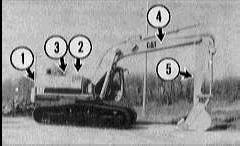
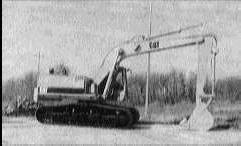
Engine (1), fuel tank (2), hydraulic tank (3), boom (4) and stick (5).
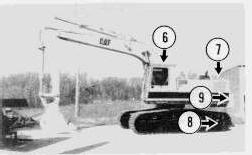
Operator's compartment (6), radiator (7), final drives (8), and counterweight (9).
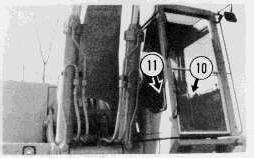
Key start switch (10) and monitoring system (11).
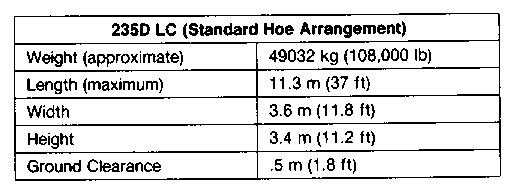
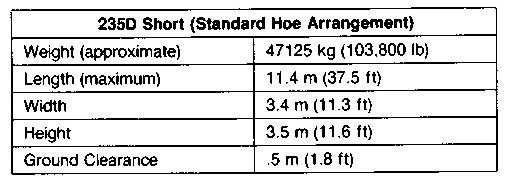
Basic machine shipping specifications are listed below.
Copyright 1993 - 2024 Caterpillar Inc.
Rights Reserved.
Network For SIS Licensees. Thu Apr 25 10:56:00 UTC+0530 2024
Product: EXCAVATOR
Model: 235D EXCAVATOR 8KJ
Configuration: 235D EXCAVATOR 8KJ00001-UP (MACHINE) POWERED BY 3306 ENGINE
Operation and Maintenance Manual
235D EXCAVATOR
Media Number -SEBU6453-00 Publication Date -01/01/1992
Foreword
Literature Information
Updated -11/10/2001
This manual should be stored in the operator's compartment in the literature holder or seat back literature storage area.
This manual contains safety, operation, transportation, lubrication and maintenance information.
Some photographs or illustrations in this publication show details or attachments that can be different from your machine. Guards and covers might have been removed for illustrative purposes.
Continuing improvement and advancement of product design might have caused changes to your machine which are not included in this publication. Read, study and keep this manual with the machine.
Whenever a question arises regarding your machine, or this publication, please consult your Caterpillar dealer for the latest available information.
Safety
The Safety Section lists basic safety precautions. In addition, this section identifies the text and locations of warning signs and labels used on the machine.
Read and understand the basic precautions listed in the Safety Section before operating or performing lubrication, maintenance and repair on this machine.
Operation
The Operation Section is a reference for the new operator and a refresher for the experienced one. This section includes a discussion of gauges, switches, machine controls, attachment controls, transportation and towing information.
Photographs and illustrations guide the operator through correct procedures of checking, starting, operating and stopping the machine.
Operating techniques outlined in this publication are basic. Skill and techniques develop as the operator gains knowledge of the machine and its capabilities.
Maintenance
The Maintenance Section is a guide to equipment care. The illustrated, step-by-step instructions are grouped by servicing intervals. Items without specific intervals are listed under "When Required" topics. Items in the "Maintenance Intervals" chart are referenced to detailed instructions that follow.
Maintenance Intervals
Use the service hour meter to determine servicing intervals. Calendar intervals shown (daily, weekly, monthly, etc.) can be used instead of service hour meter intervals if they provide more convenient servicing schedules and approximate the indicated service hour meter reading. Recommended service should always be performed at the interval that occurs first.
Under extremely severe, dusty or wet operating conditions, more frequent lubrication than is specified in the "Maintenance Intervals" chart might be necessary.
Perform service on items at multiples of the original requirement. For example, at "Every 500 Service Hours or 3 Months," also service those items listed under "Every 250 Service Hours or Monthly" and "Every 10 Service Hours or Daily."
Machine Description
This machine is equipped with a direct-injection 3306 turbocharged and aftercooled engine. It has hydrostatic drive, variable flow hydraulics and spring applied/hydraulically released brakes.
This machine is designed primarily for moving and digging material.
1993 - 2024 Caterpillar Inc.
Thu Apr 25 10:53:54 UTC+0530 2024
Product: EXCAVATOR
Model: 235D EXCAVATOR 8KJ
Configuration: 235D EXCAVATOR 8KJ00001-UP (MACHINE) POWERED BY 3306 ENGINE
Operation and Maintenance Manual
235D EXCAVATOR
Media Number -SEBU6453-00
Literature Reference Materials
Caterpillar Reference Material
The following literature can be obtained through any Caterpillar dealer.
SEBD0518, Know Your Cooling System
SEBD0970, Coolant and Your Engine
SEBD0717, Diesel Fuels and Your Engine
SEHS7067, Fuels Recommendations for Caterpillar Diesel Engines
LEDT5092, Driving Techniques For Maximum Fuel Economy
LEGT5087, Truck Engine Application and Installation Guide
LEKQ3363, Caterpillar Engine Data Sheet 60.1, Fuels Recommended For Use In Caterpillar Truck Engines
SEBU5898, Cold Weather Recommendations Operation and Maintenance Manual
SEBU6310, EMA Lubricating Oils Data Book for engines
SEBD0640, Oil and Your Engine
SEBU6453, Operation & Maintenance Manual
SENR5430, Service Manual
SEBP2020, Parts Manual
SEHS7392, Storage of Diesel Engines
SEHS9031, Storage Procedure for Caterpillar Products
SEBF8029, Guideline For Reusable Parts and Salvage Operations (An index of publications on reusability or salvage of used parts.)
SEBU5294, Safety Manual
SFBU6453, French Operation & Maintenance Manual
SSBU6453, Spanish Operation & Maintenance Manual
SGBU6453, German Operation & Maintenance Manual
SLBU6453, Italian Operation & Maintenance Manual
Additional Reference Material
ASTM D2896 TBN Measurements (Can normally be obtained from your local technological society, library or college.)
SAE J313 Diesel Fuels (Found in the SAE handbook or can be obtained from any local library, college or technological society.)
SAE J754 Nomenclature (Normally found in the SAE handbook.)
SAE J183 Classification (Normally found in the SAE handbook.)
Maintenance Chart and Decal
The following form numbers can be ordered from any Caterpillar dealer.
SELU6453 chart contains lubrication and maintenance information with an overhead view of product, on oil and tear resistant material. Chart contains refill capacities, lubricant recommendations and daily walk-around inspection information.
SEEU6453 decal contains lubrication and maintenance information with an overhead view of product, including lubricant and refill capacity recommendations. Decal can be placed anywhere, but should not be placed over other signs or on windows.
Product: EXCAVATOR
Model: 235D EXCAVATOR 8KJ
Configuration: 235D EXCAVATOR 8KJ00001-UP (MACHINE) POWERED BY 3306 ENGINE
Operation and Maintenance Manual
235D EXCAVATOR
Media Number -SEBU6453-00 Publication Date -01/01/1992 Date Updated -11/10/2001
Torque Specifications
For additional torque specifications, not included in this section, refer to "Torque Specifications," form SENR3130, available from your Caterpillar dealer.
Torques for Ground Engaging Tool Bolts
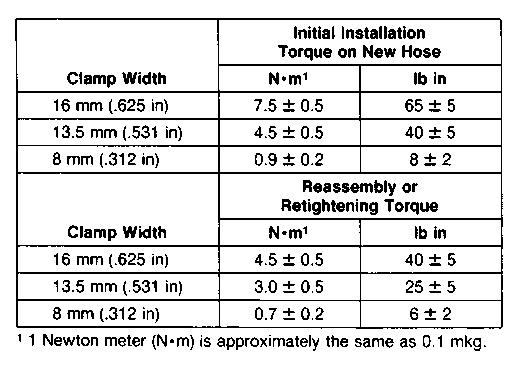
Torques for Standard Hose Clamps - Worm Drive Band Type
NOTICE
The following chart gives the torques for initial installation of hose clamps on new hose and for reassembly or retightening of hose clamps on existing hose.
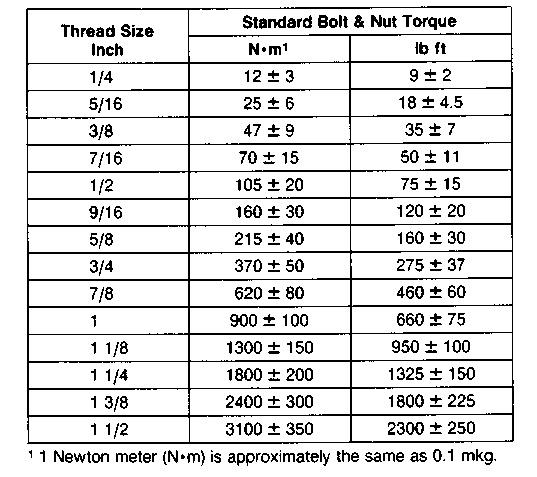
Torques for Standard Fasteners
NOTICE
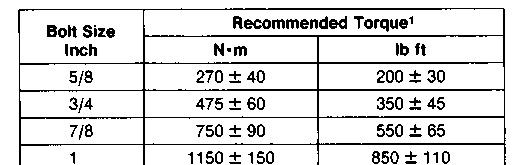
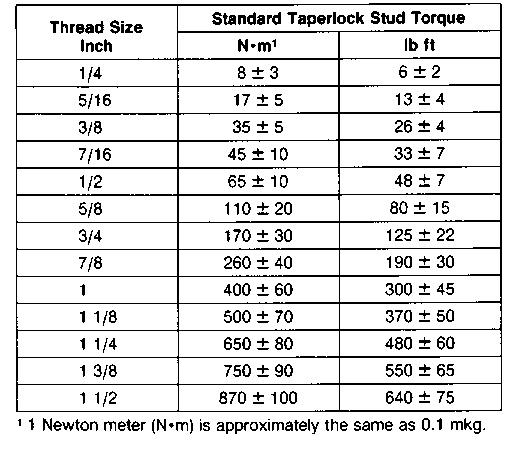
The following charts give general torques for bolts, nuts and taperlock studs of SAE Grade 5 or better quality.
Torques for Bolts and Nuts
Torques for Taperlock Studs
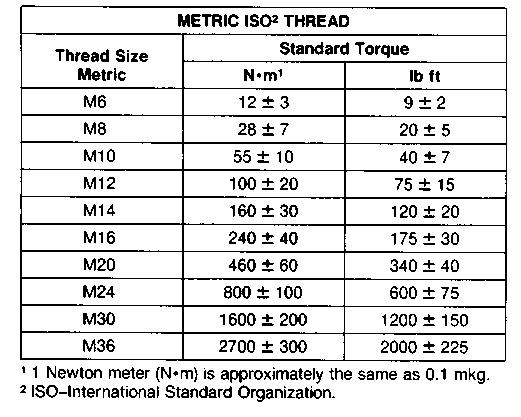
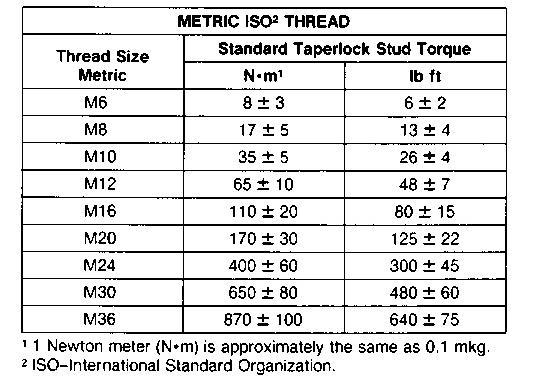
Torques for Metric Fasteners
NOTICE
Be very careful never to mix metric with U.S. customary (standard) fasteners. Mismatched or incorrect fasteners will cause machine damage or malfunction and can result in personal injury.
Original fasteners removed from the machine should be saved for reassembly whenever possible. If new fasteners are needed, they must be of the same size and grade as the ones that are being replaced.
The material strength identification is usually shown on the bolt head by numbers (8.8, 10.9, etc.). The following chart gives standard torques for bolts and nuts with Grade 8.8.
NOTE: Metric hardware must be replaced with metric hardware. Check parts manual for proper replacement.
Torques for Bolts and Nuts
Torques for Taperlock Studs
Copyright 1993 - 2024 Caterpillar Inc.
Network For SIS Licensees. Thu Apr 25 10:54:48 UTC+0530 2024
Product: EXCAVATOR
Model: 235D EXCAVATOR 8KJ
Configuration: 235D EXCAVATOR 8KJ00001-UP (MACHINE) POWERED BY 3306 ENGINE
Operation and Maintenance Manual
235D EXCAVATOR
Media Number -SEBU6453-00
Cooling System Specifications
Coolant Information
-11/10/2001
Diesel engine operating temperatures have increased to improve engine efficiency. This means proper cooling system maintenance is especially important. Overheating, overcooling, pitting, cavitation erosion, cracked heads, piston seizures, and plugged radiators are classic cooling system failures. In fact, coolant is as important as the quality of fuel and lubricating oil.
NOTICE
Caterpillar recommends that the coolant mixture contain a minimum of 30% Caterpillar Antifreeze, or equivalent. Liquid supplemental coolant additive must be added, when not using Caterpillar Antifreeze, which contains the proper additive.
Never add coolant to an overheated engine, engine damage can result. Allow the engine to cool first.
All water is corrosive at engine operating temperature. The cooling system should be protected with a 3 to 6% concentration of liquid supplemental coolant additive at all times, regardless of the concentration of antifreeze.
Excessive supplemental coolant additive greater than the recommended 6%, together with concentrations of antifreeze greater than 65% can cause deposits to form and can result in radiator tube blockage, overheating, and/or water pump seal damage.
Do not use liquid supplemental coolant additive or elements or antifreeze with Dowtherm 209 Full-Fill coolant. Dowtherm 209 FullFill coolant is not compatible with other antifreeze and coolant mixtures.
Dowtherm 209 full-fill coolant will lower the water pump cavitation temperature and coolant boiling point. These lowered temperatures will cause overheating at a lower ambient temperature than an ethylene glycol and water mix. If Dowtherm is used, follow the
instructions provided and use only the inhibitor package recommended by the supplier.
If the machine is to be stored in, or shipped to, an area with freezing temperatures, the cooling system must be protected to the lowest expected outside (ambient) temperature.
The engine cooling system is normally protected to -28°C (-20°F) with Caterpillar Antifreeze, when shipped from the factory unless special requirements are defined.
Check the specific gravity of the coolant solution frequently in cold weather to ensure adequate protection.
Clean the cooling system if it is contaminated, if the engine overheats or if foaming is observed in the radiator.
Coolant should be drained, the system cleaned and new coolant added every 3000 service hours or two years. When not using Caterpillar Antifreeze and supplemental coolant additive as recommended, the drain period must be shortened to 1500 service hours or one year.
Filling at over 20 liters (5 U.S. gallons) per minute can cause air pockets in the cooling system.
After draining and refilling the cooling system, operate the engine with the radiator cap removed until the coolant reaches normal operating temperature and the coolant level stabilizes. Add coolant as necessary to fill the system to the proper level.
Never operate without a thermostat in the cooling system. Cooling system problems can arise without a thermostat.
Refer to Know Your Cooling System, SEBD0518, and Coolant and Your Engine, SEBD0970, for more detailed specifications.
Coolant Water
Hard water, or water with high levels of calcium and magnesium ions, encourages the formation of insoluble chemical compounds by combining with cooling system additives such as silicates and phosphates.
The tendency of silicates and phosphates to precipitate out-of-solution increases with increasing water hardness. Hard water, or water with high levels of calcium and magnesium ions encourages the formation of insoluble chemicals, especially after a number of heating and cooling cycles.
Caterpillar prefers the use of distilled water or deionized water to reduce the potential and severity of chemical insolubility.
Using water that meets the minimum acceptable water requirement may not prevent drop-out of these chemical compounds totally, but should minimize the rate to acceptable levels.
Antifreeze
NOTICE
Caterpillar recommends that the coolant mix contain a minimum of 30% Caterpillar Antifreeze, or equivalent and acceptable water to maintain an adequate water pump cavitation temperature for efficient water pump performance.
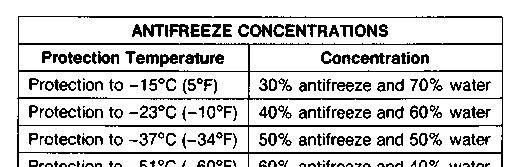
Premix coolant solution to provide protection to the lowest expected outside (ambient) temperature. Pure undiluted antifreeze will freeze at -23°C (-10°F).
Only use a greater concentration (above 30%) of Caterpillar Antifreeze as needed for anticipated outside (ambient) temperatures. Do not exceed a coolant mixture of 60% antifreeze to water since a concentration above 60% antifreeze will reduce the engine's freeze protection and increase the possibility of deposit formation in the cooling system.
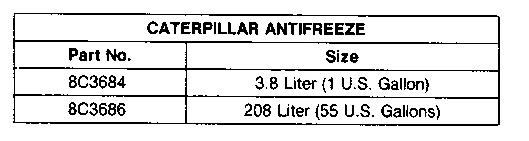
Use Caterpillar Antifreeze or GM Specification 6038-M Antifreeze. Caterpillar Antifreeze is available through your Caterpillar dealer in quantities that follow.
Most commercial antifreezes are formulated for gasoline engine applications and will, therefore, have high silicate content. Caterpillar Antifreeze is formulated with a low silicate content and the proper coolant additives for heavy duty diesel engines.
GM Specification 6038-M is a low silicate antifreeze, but supplemental coolant additive must be added.
The major advantages of Caterpillar Antifreeze are:
* Significantly reduces water pump seal leakage problems caused by excessive concentration of chemical additives.
* There is no need to add supplemental coolant additive on initial fill which must be done with current commercially available antifreezes.
* High silicate antifreezes used with a supplemental coolant additive can cause a build up of solids over a period of time which can cause plugging, loss of heat transfer, and water pump seal damage.
Make proper antifreeze additions.
Adding pure antifreeze as a makeup solution for cooling system top-up is an unacceptable practice. It increases the concentration of antifreeze in the cooling system which increases the concentration of dissolved solids and undissolved chemical inhibitors in the cooling system. Add antifreeze mixed with water to the same freeze protection as your cooling system.
Use the chart below to assist in determining the concentration of Caterpillar Antifreeze to use.
Supplemental Coolant Additive
Supplemental coolant additive is necessary to prevent rust, scale, pitting and/or corrosion of engine parts that coolant comes in contact with. Most antifreeze solutions DO NOT contain sufficient supplemental coolant additive.
NOTICE
Always add supplemental coolant additive or equivalent to the coolant, or install a Caterpillar supplemental coolant additive element (if equipped). Never use coolant only, except if Caterpillar Antifreeze is being used which contains the additive. In this case, no supplemental
coolant additive is needed on initial fill, but is necessary on a maintenance basis.
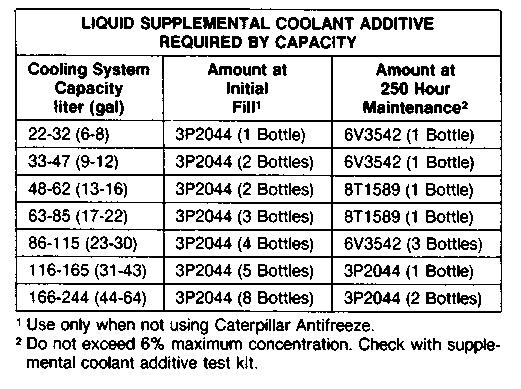
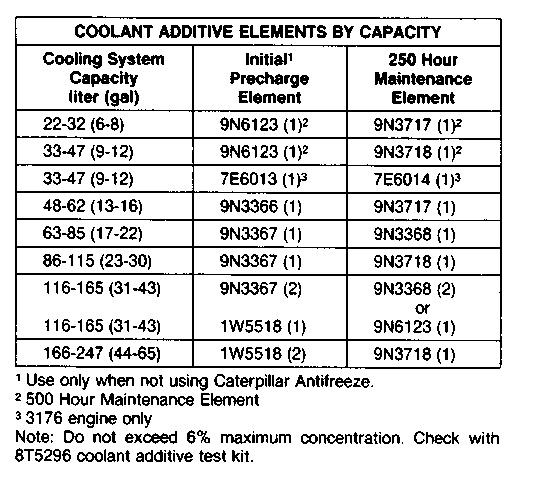
Use supplemental coolant additive or a supplemental coolant additive element (if equipped). This will provide a 3 to 6% concentration in the cooling system to help prevent corrosion.
To prevent overinhibiting the engine's cooling system, never use both the liquid supplemental coolant additive and the supplemental coolant additive element (if equipped) at the same time. The use of these additives together could result in excessive concentration that would exceed the Caterpillar recommended maximum of 6%.
NOTICE
Excessive concentration of an additive can form deposits on the higher temperature surfaces of the cooling system and create a barrier that reduces the engine's heat transfer characteristics. Reduced heat transfer could cause cracking of the cylinder head and other high temperature components. Excessive concentrations of additive could also accelerate water pump seal wear.
Supplemental coolant additive is needed when not using Caterpillar Antifreeze for premixed coolant solution.
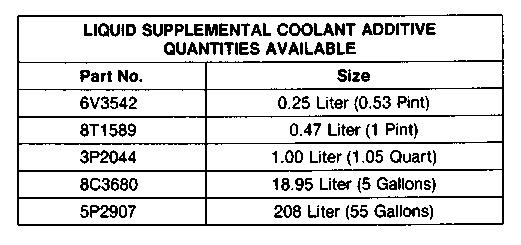
Liquid supplemental coolant additive can be purchased from your Caterpillar dealer. Follow the instructions on the container.
NOTICE
DO NOT add supplemental coolant additive at initial fill when using Caterpillar Antifreeze. Caterpillar Antifreeze contains the necessary supplemental coolant additive precharge. Addition of supplemental coolant additive could result in an overconcentration.
On initial fill of a new or reconditioned engine if Caterpillar Antifreeze is not used, add 1 liter (1 quart) of supplemental coolant additive, or equivalent, for each 30 liters (8 U.S. gallons) so that the cooling system will have a 3 to 6% concentration of supplemental coolant additive.
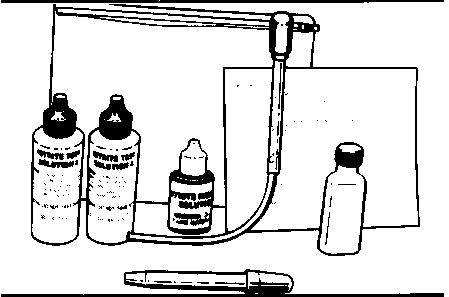
To maintain a 3 to 6% concentration of additive, add liquid supplemental coolant additive or install a maintenance supplemental coolant additive element (if equipped), every 250 service hours or oil change, whichever occurs first. Use the 8T5296 Test Kit to check for concentration.
If the engine is not equipped with spin-on element, add .25 liter (1/2 pint) of supplemental coolant additive for each 38 liters (10 U.S. gallons) of coolant capacity to maintain the 3 to 6% concentration of additive.
Cooling System Cleaning
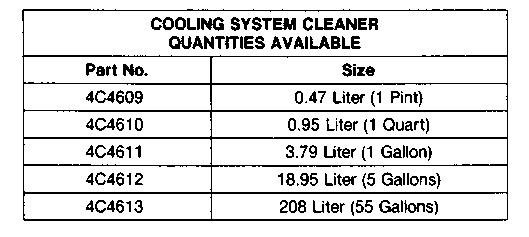
Caterpillar Cooling System Cleaners are designed to clean the system of harmful scale and corrosion. It dissolves mineral scale, corrosion products, light oil contamination and sludge.
Clean the system according to the maintenance interval chart, or whenever the coolant is dirty or foaming.
Cooling system cleaners are available from your Caterpillar dealer in the quantities listed below. Follow the label directions for proper usage.
Copyright 1993 - 2024 Caterpillar Inc. All Rights Reserved. Private Network For SIS Licensees. Thu Apr 25 10:55:14 UTC+0530 2024
Product: EXCAVATOR
Model: 235D EXCAVATOR 8KJ
Configuration: 235D EXCAVATOR 8KJ00001-UP (MACHINE) POWERED BY 3306 ENGINE
Operation and Maintenance Manual
235D EXCAVATOR
Media Number -SEBU6453-00
Fuel Specifications
Fuel Information
Use only fuel as recommended in this section.
-01/01/1992
NOTICE
Fill the fuel tank at the end of each day of operation to drive out moist air and to prevent condensation. Maintain a constant level near the top of the day tank to avoid drawing moisture into the tank as the level decreases.
Do not fill the tank to the top. Fuel expands as it gets warm and can overflow.
Do not fill the fuel filters with fuel before installing them. Contaminated fuel will cause accelerated wear to the fuel system parts.
Drain the water and sediment from any fuel storage tank before it is refilled. This will help prevent water and/or sediment from being pumped from the fuel storage tank into the engine fuel tank.
Fuel Types
Caterpillar Diesel Engines have the ability to burn a wide variety of fuels. These fuels are divided into two general groups, preferred and permissible.
The Preferred Fuels provide maximum engine service life and performance. They are distillate fuels. They are commonly called diesel fuel, MDO diesel, furnace oil, gas oil or kerosene (for cold weather operation).
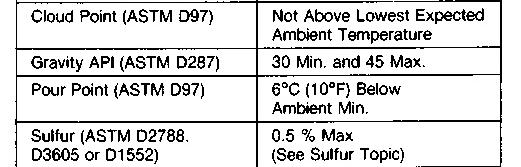
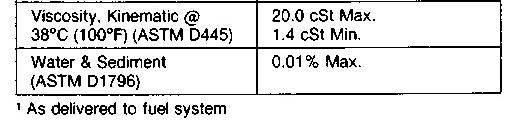
Experience has proven that distillate fuels meeting the following basic specifications will result in optimum engine performance and durability.
Caterpillar strongly encourages the use of fuels that meet the Preferred Fuels specification.
The permissible fuels are crude oils or blended fuels. Use of these fuels can result in higher maintenance costs and reduced engine service life.
Crude oil is used to describe oils/fuels that are not refined and are in the original state as when pumped from the ground. Certain types of crude oils can be burned in Caterpillar Engines.
Refer to Diesel Fuels and Your Engine SEBD0717 or SAE J313 Diesel Fuel Specifications for information about fuel properties, such as ignition quality, gravity/density, viscosity, cloud point, sulfur content, etc.
Fuel Sulfur Content
The percentage of sulfur in the fuel will affect the engine oil recommendations. Fuel sulfur is chemically changed during combustion to form both sulfurous and sulfuric acid. These acids chemically attack metal surfaces and cause corrosive wear.
Certain additives used in lubricating oils contain alkaline compounds that are formulated to neutralize these acids. The measure of this reserve alkalinity in a lubricating oil is known as its Total Base Number (TBN). TBN is essential to neutralize the acids from combustion gases and to minimize corrosive wear.
Any API classification performance oil should have sufficient TBN for fuels with less than 0.5% sulfur. For fuels with 0.5% to 1.5% sulfur by weight, engine oil must have a TBN of 20 times the percentage of fuel sulfur as measured by the ASTM (American Society of Testing Materials) D2896 method. (ASTM D-2896 can normally be found at your local technological society, library or college.)
Caterpillar recommends infrared analysis (in conjunction with wear metal analysis) of used oil in determining the effectiveness of oil TBN and acid neutralization.
For fuel with sulfur exceeding 1.5% by weight, use an oil with a TBN of 30 and reduce the oil change interval by one half. Also, infrared analysis and wear metal analysis should be used to establish oil change intervals.
Periodically request fuel sulfur content information from your fuel supplier. Fuel sulfur content can change with each bulk delivery.
For more information on oil, fuel sulfur content, etc., refer to Oil and Your Engine, SEBD0640, or contact your Caterpillar dealer.
Copyright 1993 - 2024 Caterpillar Inc. All Rights Reserved. Private Network For SIS Licensees.
Thu Apr 25 10:55:30 UTC+0530 2024
Product: EXCAVATOR
Model: 235D EXCAVATOR 8KJ
Configuration: 235D EXCAVATOR 8KJ00001-UP (MACHINE) POWERED BY 3306 ENGINE
Operation and Maintenance Manual
235D EXCAVATOR
Media Number -SEBU6453-00
Scheduled Oil Sampling (S·O·S)
Updated -11/10/2001
Caterpillar recommends using Scheduled Oil Sampling (S·O·S), at regularly scheduled intervals, to complement a good preventive maintenance program.
The Caterpillar Scheduled Oil Sampling Program, (S·O·S), was developed to help Caterpillar users realize the highest possible value from their equipment by minimizing repair costs and maximizing availability. The S·O·S program is a series of diagnostic tests which analyze used lubricating oils from the oil wetted compartments of the equipment. By analyzing the used oils, problems may be identified early, before extensive component failure occurs. This reduces repair cost and down-time.
The S·O·S program is coupled with a wide range of repair options so that when a problem is identified, an appropriate matched repair plan is available. This offers the user a more complete service to minimize repair costs and schedule down-time. S·O·S can also measure the effectiveness of the user's maintenance program.
Obtain S·O·S Sample
There are several methods used to obtain S·O·S samples.
NOTE: Sampling methods recommended are in preference order. If one of the first two methods is not feasible, then use the drain-stream method.
* Use an in-line sampling valve.
* Use a sampling gun inserted into the sump.
* Use the drain stream method when changing oil.
When using the drain-stream method to obtain an oil sample, take the sample after some oil has drained out and before the final drain oil. The oil at the beginning or end of the drain stream is not mixed well enough to be representative of circulating oil in the compartment and may carry debris that can give false S·O·S analysis results.
S·O·S Analysis
S·O·S is composed of three basic tests:
* Wear Analysis
This is the sample of the manual click on the download link for complete manual