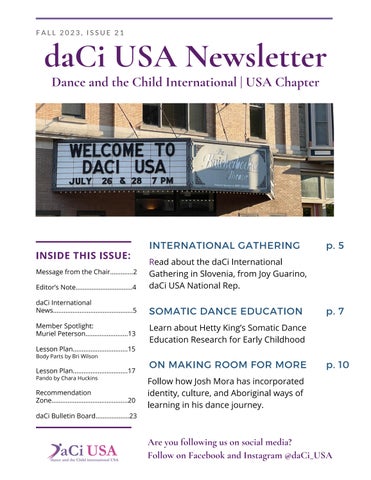
FALL 2023, ISSUE 21
daCi USA Newsletter Dance and the Child International | USA Chapter
INSIDE THIS ISSUE:
INTERNATIONAL GATHERING
Editor’s Note................................4
Read about the daCi International Gathering in Slovenia, from Joy Guarino, daCi USA National Rep.
daCi International News.............................................5
SOMATIC DANCE EDUCATION
Message from the Chair.............2
Member Spotlight: Muriel Peterson........................13 Lesson Plan...............................15 Body Parts by Bri Wilson
Lesson Plan...............................17 Pando by Chara Huckins
Recommendation Zone...........................................20
p. 5
p. 7
Learn about Hetty King’s Somatic Dance Education Research for Early Childhood
ON MAKING ROOM FOR MORE
p. 10
Follow how Josh Mora has incorporated identity, culture, and Aboriginal ways of learning in his dance journey.
daCi Bulletin Board...................23
Are you following us on social media? Follow on Facebook and Instagram @daCi_USA
MESSAGE FROM THE CHAIR Greetings daCi USA Members! I am still energized by the experiences I shared with many of you at the National Gathering in July. I know not everyone could join us in Michigan, so I would like to take this opportunity to introduce myself as the new chair of daCi USA and extend a warm welcome to those who have joined our membership this year. Associating with daCi, its mission, and its members, has benefited me personally and professionally. Being a member of daCi is a non-negotiable in my life, even when my level of involvement needs to adjust with the ebb and flow of life’s adventures. daCi checks all the boxes for me! Child-centered Culturally responsible Aesthetically and artistically driven Grounded in relationships Inspiring and innovative Connected and communal Transformative and experiential Accessible to my whole family
2
My daCi journey began in 2009 when I attended the international gathering in Kingston, Jamaica, as a freshman with the Kinnect Dance Company at Brigham Young University. Our director, Marilyn Berrett, shared her deep commitment to daCi with us as she was our dancing docent, helping us connect to the daCi way through the whole week. Jamaica is where I developed the desire to make daCi a part of my life. I’ve been a member ever since. Marilyn’s mentorship continued as I struggled with limiting physical conditions in college. She invited me to co-produce a Utah daCi Day of Dance in 2010. It became my training ground as a leader and educator. She taught me to write grants, plan meeting agendas, prepare event details, coordinate a team, delegate tasks, lead the creative process, organize performances, negotiate contracts, develop and distribute promotional materials, and lead with gratitude. I continued to co-produce the regional day of dance with the daCi Utah Board after I graduated and became a dance and math educator at an urban middle school in Salt Lake City. When I went through career shifts, it was my connection with my daCi Utah colleagues that expanded my path to include roles such as arts administrator
professional development provider, and instructional designer. I have been the Research and Design Coordinator for the BYU ARTS Partnership for six years. I could never have anticipated in Jamaica how many wonderful things would come because of my commitment to daCi. It is my intention now to use my skills, passion, and experience to strengthen the quality and quantity of opportunities daCi offers to students, educators, and leaders in our communities; and to give back to daCi what daCi has given to me. I’m a strategic planner, futuristic thinker, ideator, and innovator. I am invested in developing sustainable leadership and execution practices within our organization, elevating opportunities for young dancers, and caring for the aesthetic and rich relationships we share as a community. I hope leading with these gifts and goals will strengthen our organization and, at the same time, the field of dance education, and I hope we can do it together! Warm autumn wishes from Salt Lake City, Heather Francis daCi USA Chair
Dancing with my family in a parent- tot class
3
Editor’s Note Hello daCi USA members, I am pleased to share with you the fall 2023 daCi USA newsletter, full of news and views. It has user-friendly lesson plans from members in Salt Lake City and Seattle, a spotlight on a new member from New York, our ever-fun and interesting Recommendation Zone and the Bulletin Board with announcements and opportunities. daCi USA members are involved in exciting and important projects and directions in dance education. Two of them are featured in this issue. From New York, Hetty King describes her research in somatics with young children, and, from Oklahoma, Josh Mora shares his development of a fresh culturally-centered approach to dance. Enjoy their insights and ideas. An excellent new addition to the newsletter team is Camille Schirado who handled the visual design. Thanks for your eye and skill and welcome aboard, Camille!
It’s been three months but I am still cruising on the wonderful time I had at daCi USA’s 7th National Gathering in Holland, Michigan. I was glad to cross paths there with many long-time and firsttime daCi members. I am proud that daCi created an oasis – temporary but real -- of creativity and collaboration and dance magic. Before going to Michigan, I had no plans to go to the daCi International Conference in Slovenia next year but now, after the National Gathering…I’m considering it! A train ride along the stunning Adriatic coast from Venice to a week of dance with global dance compatriots in a beautiful small central European city -- well, that’s the stuff of dreams! See the National Rep’s message for more details. Dancing on, Mady Cantor Newsletter Editor
4 Photos from the July 2023 National Gathering in Holland, MI
DACI INTERNATIONAL NEWS By Joy Guarino, daCi USA National Rep
daCi International is excited to announce the 2024 Conference I-BODY, I-DANCE to be held July 7-12 in beautiful Ljubljana, Slovenia in Central Europe. Everything about this daCi International conference will be spectacular! As the USA National Rep, I traveled to Ljubljana to participate in the conference planning meetings and fell in love with the conference theme and offerings, and the location!
The theme of the conference emphasizes that we are our body, and that body and dance are inseparable. The “I” is for Imagination, Improvisation, Inclusion, Identity, Intelligence, and Interdisciplinarity. These ideas will be represented through papers, presentations, workshops, panel discussions, lecture demonstrations, and posters/installations. Applications are open for young dancer performances, twinnings, outreach, and research projects -- something for everyone! 5
The small country of Slovenia is located where the Alps and Adriatic meet. I encourage you to explore travel options and consider flying into Trieste or Venice, Italy or Zagreb, Croatia and take the train along the Adriatic coast. The people of Ljubljana are so friendly, and the beautiful city is completely walkable. You will want to visit the markets, explore the castle, and learn the story of the legendary dragon. There will be options for reasonable hotels and inexpensive dorm/hostels that are central and safe. I-BODY, I-DANCE will be an amazing opportunity to share with our international friends in a unique and enchanting European city so begin planning now. For more information: daCi - Dance and the Child International Conference 2024 (daci2024.org) or contact me at guarinja@buffalostate.edu
Register today on the daCi 2024 website by clicking here.
SOMATIC DANCE EDUCATION FOR EARLY CHILDHOOD What are the possibilities? By Hetty King I am an early childhood dance educator. In addition to teaching in a public school in Brooklyn, I am a doctoral candidate in the EdD dance education program at Teachers College, Columbia University. My doctoral research looks at the possibilities of a somatic movement education pedagogy for the early childhood dance education classroom. I come to this research through my extensive practice as a professional dancer and twenty years as a 3K-12 dance educator working in NYC public and private schools. As a dancer, my study and practice of somatics, mostly with Nancy Topf and Topf Technique®/Dynamic Anatomy, was revelatory. Initially, I went to Nancy because of an injured knee. I was able to heal my knee through Topf Technique, but, more profoundly, I found a way into a creative and dynamic process that allowed me to train as a dancer with kindness and a deeply informed understanding of myself – body, mind, and psyche. In my research, I have found that, historically, somatic practices have been applied therapeutically and artistically across a wide range of modalities, such as injury prevention, teaching dance techniques, movement training, and education. The fact that there are many
applications makes the distinction between them complicated. I define my application of somatic dance pedagogy for early childhood as explicitly educational. By this, I mean that I identify as a teacher, the children as my students and that my practice is intended for whole-class instruction in a school setting. This is not to take away from somatic practices' therapeutic or healing benefits but to be intentional about the scope of my research and its potential applications. My project counters the current dominant focus in 3K-12 dance education on ‘dance literacy’ which is an approach that centers on technical skills, dance history, and critical response. My focus is on ‘personal literacy,’ a term I coined to name my experience of the intersection of dance
7 Photo credit: Hetty King
and somatic movement education. Somatic dance education pedagogy is centered on the body-mind, asking the student to consider how their body feels, what it senses and perceives through movement, guided by a discrete knowledge of the body. It teaches and acknowledges objective information and subjective experience equally. With this as the grounding, I formulated my research question this way: Given a somatic-constructivist approach to early childhood dance pedagogy, what are children's (age 4.5-5) experiences within a somatic-based learning context? How can the principles of somatic movement education be used to develop pedagogical practices for early childhood dance in a New York City public school? How might this approach counter bodymind dualism and the privileging of objective learning over subjective experience? How might this approach contribute to selfknowledge and the development of ‘personal literacy’ as an explicit outcome of dance education?
To begin my research with the children in my dance class, I wrote four somatic dance education explorations – two based on tonic function (the role of gravity in each individual's experience of being and living) and two focused on the bones. Each exploration was written as a story where the concepts come alive and speak to the children, engaging them in movement that explores the concepts through movement, drawing, and discussion. For example, the first story focused on the feet to begin exploring experiencing weight (gravity) through grounding the lower body. The feet were introduced as The Two Big Feet. They asked the children questions about their feet that initiated movement, discussion, and drawing. The discussion was in the form of the children “popcorning” their thoughts and feelings with a few moments where we all listened to one child at a time. I created a protocol for gathering data that included an external witness who wrote field notes, a rubric that rated the children on their engagement and general well-being, and drawings created by the children. I gathered data from two pre-K classes, one in a private school and the other in a public school. I analyzed the data and examined what this pedagogy elicits in the children. The results of my coding showed that the movement explorations shed light on the interaction between the student, the teacher, and the participants' experience. Written as a theory statement, this expression was personified by the joy in personal expression and awareness of self. Taken together, they begin to define the practice of a somatic dance education pedagogy for early childhood.
Photo credit: Hetty King
From this, I developed some preliminary principles of a somatic pedagogy for early childhood. They include: A balance of objective information with subjective experience that explicitly addresses a body-mind connection. Providing time for reflection and integration, allowing the body-mind time for assimilation and recuperation. Actively engaging thinking, feeling, and sensing through a multisensory approach. Teach from embodied knowledge. This pedagogy is an embodied practice where the educators' presence and experience are as significant as the content of the lesson. With these two pilot projects complete, I am ready for my dissertation research, which will expand my project to include a pre-exploration period of observations followed by ten somatic movement explorations, expanding the data collection from the previous four. The words of Andrea Olsen, Professor Emerita of Dance at Middlebury College, from her book Body Stories: A Guide to Experiential Anatomy, inspire me. “Our many years of schooling bring a separation of mind and body – sit still and learn. There is often the sense that one is either the master or the victim of one’s body. However, the body has its own way of telling us what is going on inside, its own, logic. Much of our task is to learn to listen.” What better place to learn to do this than in the dance education classroom, beginning with the most formative stage of development – early childhood.
Photo credit: Hetty King
Hetty King has an alphabet soup of degrees and credentials: BFA, MFA, MA, TT®, RYT200, RSDE ISMETA®, NYS Licensed Dance Educator, Doctoral Candidate in Dance Education at Teachers College, Columbia Photo credit: Andrew Perret University. Hetty is a native New Yorker and a High School for the Performing Arts graduate. From 1985-2003 she danced professionally in many small modern dance companies, most notably Ralph Lemon and David Dorfman, and created and produced her own performances. As a dance educator, she has worked as a teaching artist and in public and private schools. In 2022, she completed the posthumous manuscript of her teacher, Nancy Topf, A Guide to a Somatic Movement Practice: The Anatomy Of Center. Hetty lives in Brooklyn with her husband, two daughters, and their cat and frog. See hettyking.com for more information.
On Making Room for More by Joshua Yago Mora Dance is my sanctuary, a place where I can express myself, even find myself. Like all of us, 1 I contain multitudes. I am a brown, queer dancer, a Filipino-American, Alaskan-born and military-raised, a child of immigrants, endurer of chronic gout, eager researcher/student, and movement educator. My path to dance started on the coattails of my mother’s dance journey. She danced in companies in the Philippines and brought Filipino traditions and knowledge with her wherever we were stationed. I witnessed communities strengthened through gatherings that included stories shared amid food, games and evenings of dance. My love of dance and community brought me from these folk dances to make-believe parade choreography with siblings, to gatherings in parking lots with friends sharing the latest things we learned in between bursts of dancing next to cars playing music without drivers and early morning warehouse dance parties. In the vein of formal training, I found my way to a BA in Modern Dance at Brigham Young University; performance and teaching; the co-founding of Triptych Figures which is a dance company focused on community-based performance; collaboration in the launch of Speakers’ Corner (a platform for art and discussion based on activism); and recently to an MFA in Modern Dance at the University of Utah. Along the way I have often found myself straddling multiple worlds, seeking a way to blend my cultural identities with dance. I began the graduate program at the University
Photo credit: Todd Collins
of Utah in 2020, a year charged by raciallymotivated hate crimes and a pandemic that nearly took my brother’s life. I realized I could no longer straddle multiple worlds—never really committing to anything and politely participating in everything. I felt a dissonance in the multitudes that swell and flow within me, including in the unspoken expectations of working within academia. This dissonance is not new. I had found echoes of it in school and afterschool dance programs and studios, and when performing as a dancer and guest choreographer. In an episode of the podcast Finding Our Way, author and activist Sonya Ranae Taylor said “we're in a time of infection, right? And so for me, the question is, what do we want to spread? If we know we’re in the time of infection, if we know we're in a time where things are contagious …” It made me question what contagions I was cultivating within myself and my personal practices of art making, performance, teaching, and research. During discussions with my colleague and friend Heather Francis about change and hopes for the future, she shared with me a pedagogical strategy developed in Western New South Wales in Australia called 8 Ways of Aboriginal Learning. It is an approach that 10
calls for a focus on the values, systems, protocols and processes found in aboriginal or indigenous culture. I was attracted immediately to the vibrancy of this perspective and the implications for my work. The 8 Ways of Aboriginal Learning are: 2 Story Sharing: Approaching learning through narrative. Learning Maps: Explicitly mapping/visualizing processes. Non-verbal: Applying intra-personal and kinesthetic skills to thinking and learning. Symbols and Images: Using images and metaphors to understand concepts and content. Land Links: Place-based learning, linking content to local land and place. Non-linear: Producing innovations and understanding by thinking laterally or combining systems. Deconstruct/Reconstruct: Modelling and scaffolding, working from wholes to parts (watch then do). Community Links: Centering local viewpoints, applying learning for community benefit. I was overcome by the ways my personal upbringing in dance connected with the 8 Ways of Aboriginal Learning. It was like finding a treasure chest of ideas that resonated with my own experiences. I had often felt at a loss, as if the dominant systems in dance were not made for me. The 8 Ways seemed to allow my many intersections to blossom. I wondered how my choreographic processes and classroom practices might change if I were to focus on the interplay of these perspectives. Below are a few ways my approach to dance making and teaching changed as a result of experimenting with the 8 Ways.
In dance making Land Links/Symbols and Images My original inroad to dance was through the folk dance companies my mother would start whenever we moved into a new city. The rehearsals always seemed to include food. I wondered why my “professional” experience in dance rarely included food as part of the process. I thought about how foods are tied to what grows in the area and how chemical changes when one eats (and what one eats) might have an effect on the movement. In my creative thesis work, which was part of my graduate degree, I committed to feeding, at every rehearsal, the food I grew up with to those who showed up. This attempt at Land Connections through food provided communal time to share the origins of some of the Filipino folk dances we explored as part of the creative process. For example, the use of poles in my piece was inspired by the dance Singkil, and morphed into trees moving in an enchanted forest. We spoke of what earth and, specifically, wood might offer in terms of movement qualities. Toggling back and forth to the original cultural imagery allowed for opportunities to find movement with this particular group of dancers I could not have thought of on my own.
In the studio classroom Story Sharing / Community Links Often, when teaching majors and non-majors in a college dance program, we would start our time together with roll call and a two-word check-in. However, I soon found the need to warm-up more quickly, so these two-word check-ins became movement moments and we responded physically as we heard how our classroom community was doing.
11
This story sharing became central in one of my classrooms when I asked what emotions were surfacing for them and about the ways those emotions related to each student’s life during an energy shift in the choreography. This opened an opportunity to share my own narratives of shifts in life. These individual narratives were woven into a sequence, with rhythmic or energetic accents in the phrase, and with the stories from the class community supporting the dancers through the sequence. This was not always a trauma dump, but often
Photo credit: Todd Collins
have grown into a career in dance. In these times of searching for a better future, I hope we make space for mindful creating of culture. We have always been more – more than we allow ourselves to be, more than what we are told we can be -- and how lovely it is to have found a way, or 8, that allows for us to be and develop and acknowledge more of everything, together. 1
Thank you, Walt Whitman, for this phrase!
2 Adapted from https://www.8ways.online/about
became ‘highlights of the week’ or insights they felt might stick with them. The collective acknowledging of their emotions within the sequence helped not only with memorization of the movement sequence, but seem to strengthen them as a community while also building the most beautiful nuance in expression. The end-of-semester reflections abounded with both gratitude for their peers and an appreciation for the depth of movement imagery and description in the class. These practices I developed from 8 Ways yielded many opportunities to acknowledge identities. I felt a strong awareness of community in creative work and in classrooms from elementary programs to undergraduate classes. I think a sense of community has always been the draw to dance for me as I
The 8 Ways philosophy has a clear protocol about using its ideas: “If you take something, give back.” I feel that my experimentation and directing is part of that giving back, as is the sharing of my process in this essay. –JYM
Joshua Yago Mora is currently living in Oklahoma City. In the last few months, he has found joy in slowness after the bustle of attaining an MFA in Modern Dance from the University of Utah. Joshua recently premiered an evening-length work based Photo credit: Sam Stone on themes found in The Crucible, a work in which he collaborated with his long-time friend and mentor Kate Monson and new friend Shelley Graham. Being absolutely horrible at new hobbies has filled free time which has been a most luxurious commodity of late. Joshua is grateful for this period in which openness for what happens next provides playful and delightful dreaming.
12
Member Spotlight MURIEL PETERSON by Chara Huckins daCi Membership Liaison
For Muriel "Murri-Lynette" Peterson, her life in dance began at home. Her mother was a professional modern dancer. Her father was the oldest of six siblings and the family had a lot of parties where she and her sisters and cousins would create dances to perform. She says that her love of dance “started organically with performances and socializing. Dance is just a part of African American culture, so it was just something that we did. Everybody was encouraging so it made sense to keep doing it.” Muriel began studying dance at age four in Syracuse, New York at the Paul Robeson Performing Arts Company (PRPAC). She tried ballet but discovered that it wasn’t for her. Hip-hop, however, drew her in and felt like home. Her interest was sparked by her older cousins, friends in PRPAC, music videos, and socializing in her community. It was the dance of the time and easy to access.
She considered cosmetology school as she had started doing her own hair at ten years old and then started doing it for family members and friends. But by the time she was 16 she started to seriously consider dance as a profession. She looked around at various colleges and universities but was not able to find the right fit until she discovered Queens College-City University of New York. She earned a BA in Dance & Urban Studies with a minor in Spanish language. While in college she was able to start taking classes at hip-hop studios consistently. She was trained by teachers who worked with recording artists from the music industry, mostly with hip-hop and R&B artists. She continued to take classes to learn the history and absorb as much hip-hop movement vocabulary as possible. She continually sought information about the culture and “wanted to be involved in it not just at a social level but on a professional level as well.” After graduating she did a variety of jobs but couldn’t find anything that really appealed to her. She then started looking at graduate schools and chose Temple University where she planned to get a degree in African American Studies. She felt like they were educating her just to be a professor and after
As she got older she wanted to dance in music videos. She wondered, “how could I get there?” Her family moved to the suburbs of New York City when she was ten, and at 15 she went to her first professional hip-hop class in New York City. However the travel from the suburbs to the city made it difficult to attend regularly. Photo credit: Rachel Keane
13
a semester she decided that she needed a change. She transferred into the dance department and received a MFA in dance from Temple University in 2021. Her performing experience includes a stint with Dancing in the Streets: Hip-Hop Generation Next ’10 at Lincoln Center. She has had the honor of performing with tap legends Marshall Davis Jr. and Ted Louis Levy. Recently Muriel was cast in Bill T. Jones’ Deep Blue Sea. Currently she is a member of Ladies of HipHop Dance Collective training company, NuTribe Dance Company, and Enya-Kalia Creations. Muriel found out about daCi USA through former grad school classmate Enya-Kalia Jordan, current daCi board member. She attended the daCi National Gathering in Michigan this past summer. She said what she “loved most about the conference was the intergenerational exchange. I was able to connect directly with younger students while teaching them…..and connecting with dancers
In performance at the recent daCi USA National Gathering.
older than myself gave me the opportunity to see the various ways a dance career can exist.” Muriel is currently teaching hip-hop at Hunter College and does teaching artist residencies in New York City and Long Island. She also teaches at a private dance studio. She enjoys connecting with students and strives to be a positive influence on their lives. She hopes that her students will feel comfortable enough to relax, let their hair down and have a good time with dance. In addition to teaching, her passion is performing. She loves all the aspects of performing – the creativity, costuming, make-up, lighting, and generally being on the stage. If Muriel isn’t either performing or teaching, she enjoys spending time with her family and her boyfriend. She hopes to follow her mother’s example of having a great dance career and a lovely family. She also hopes to one day try stand-up comedy which appeals to her theater and performance interests!
14
LESSON PLAN
BODY PARTS Developed by: Bri Wilson, Creative Dance Center, Seattle, WA Age group: Ages 13-14 Length of Lesson: 1.5 hours Warm-Up (Teacher-directed) Brain Dance Sitting back to back with a partner: Breath, Tactile, Core-Distal, Head-Tail Standing sharing weight through hands: Upper-Lower, Body-Side, Cross-Lateral, Vestibular Suggested Music: “Escape Artist” by Zoë Keating
Photo credit: Devin Muñoz
Introduce the Concept: “See, say, hear, and do” Musicians use instruments, painters use canvas, and photographers use cameras to create their forms of art; dancers use their bodies. Let’s name different body parts and move them in isolation. Now move your whole body as one unit. We’ll explore dancing with our heads, spines, hands, ribs, pelvis, thighs, toes, hearts, lungs and much more today! Reference: Creative Dance for All Ages, 2nd Edition Exploring the Concept (Student-centered) Initiation Points Round One: Find a partner and decide who is Leader 1, and Leader 2. Leader 1 names a body part, and Leader 2 moves across the floor through general space with that body part in the driver’s seat, so to speak. Every movement is initiated by that part, while the rest of the body trails behind. Leader 1 acts a witness, slowly walking with Leader 2 as they set off on their exploration, observing Leader 2’s movement with compassion and curiosity. Once the pair reaches the other side of the room, they switch roles. Repeat Round One 2-3 times. Round Two: Find a new partner. Leader 1 continuously names body parts as Leader 2 travels across the floor, inviting Leader 2 to quickly change initiation points. Once the pair reaches the other side of the room, they switch roles. Repeat Round Two 2-3 times. Round Three: Find a new partner. Now there is no Leader 1 or Leader 2. Instead, the pair works together to choose one body part that is connected – right shoulder to right shoulder, for example. They must move across the floor while maintaining contact between those body parts. Invite the dancers to change levels, spatial orientation, body shapes. Remind them to move slowly, that there is no leader, and that listening to their partner is absolutely key for the success of this exercise. Repeat Round Three 2-3 times. Suggested Music: “Looming” by Rival Consoles
15
Reflection: tell your partner what was most challenging for you, and why. After both of you have shared, remember to thank your partner for the dance. OR: which initiation point was easiest? Which one was hardest? Why? Developing Skills (Teacher-directed) Technique Warm Up Pliés in parallel first, parallel second, turned out first, and turned out second Prances and tendus in parallel and turned out, en croix Swings in sagittal, vertical, and horizontal planes Suggested Music: “The Sneeze” by Argonaut & Wasp; “Fences” by Magic Bronson; “Janglin” by Edward Sharpe & The Magnetic Zeros Combination: see Link I choreographed to “Stunner” by Milky Chance. The combination featured big spiraling turns, sautés in arabesque, and rolls across the back. I encouraged the dancers to identify which body parts were initiating each movement: crown of the head to spiral, fingertips to spoke, pelvis to push through space. Creating: Isolation, Together (Student-centered) In trios or quartets, each dancer chooses only one body part that can move: Student #1 picks head, Student #2 picks right foot, Student #3 picks left elbow, etc. Together they create a dance with an ABC, or three part structure, wherein each section differs from the last: A: Students moving at the same time in self space, with their individual body parts. B: Students move through general space with their whole bodies, letting go of their focus on a single body part and instead using the whole body as contrast. C: Students come back together, connect their individual parts, and move in self space. Trios or quartets perform one at a time. Audience members reflect back to each performing group by making a shape that shows a body part they saw in the performing group’s choreography. Cool Down In a circle, dancers review Body Parts with the Say, See, Hear, Do model: the teacher names individual body parts, and the class responds by making a shape emphasizing that body part, while also saying the name of that body part out loud. Class concludes with group deep breathing, and one collective clap of gratitude.
Bri Wilson is a dance teaching artist based in Seattle, Washington. Originally from Michigan, she holds a BFA in Dance from the LINES Ballet BFA program. She joined Creative Dance Center faculty in 2020 to teach ages 3.5 and up in Creative Dance, Ballet, and Modern, and has served as rehearsal assistant for Kaleidoscope Dance Company since 2022.
16
LESSON PLAN
PANDO: A LIVING WONDER OF TREES Developed by: Chara Huckins, Salt Lake City, UT Age Group: K - 4th grade Length of lesson: Two 60 minute classes Overview: Students will learn about Pando, a forest colony of interconnected aspen trees in Utah, and then create a dance about the related scientific concepts and the elements of dance. Curriculum Integration: Plant life Lesson Materials and Resources: A Living Wonder of Trees by Kate Allen Fox; photographs of Pando; a long piece of elastic
Activities: Exploring Using the text and illustrations from the book, start by guiding the students through the content. Consider showing photographs of Pando which can be found on the internet. The text in italics is from the book; following the text are guiding suggestions with movement-rich words in bold type, and some scientific information to use, depending on the level of the group.
17
“Near a humming highway, a giant forest stands firm.” Let's build a forest. This forest started growing 80,000 years ago with a single seed. Let’s float to a new place and plant a seed. How small a shape can you make? Is your shape round or angular? “This tiny seed grew into a tree.” Next, the seed sprouts and begins to push, rise, and grow. As the aspen trees grow and develop, they form different shapes. “Pop! Another tree sprouted. It grew, and grew, and grew…” Some of these tree shapes are curved, angular, twisted, and connected. “The sprouts kept sprouting for years and years and years. The sprouts grew…” As the trees continue to grow, their branches reach, stretch, extend, and lengthen. Now there are 47,000 trees in Pando, making it the largest organism in the world. And these trees dance and sing together. “Thousands of Trees - almost exactly alike - whisper in the wind. All these trees tremble in the same breeze. Their yellow leaves shimmer in the same sunshine, dancing to the same symphony of chirping birds.” Quaking aspen’s scientific name is Populus tremuloides means to tremble. This name refers to the way in which the leaves flutter in the wind. This movement is created by the shape of the tree’s stems. Aspen leaves quake, tremble, whisper, and shimmer. “All these trees are one being called by one name: Pando. In the old language of Latin, its name means I spread. And spread Pando has.” Pando is a tree clonal colony of male quaking aspen. Aspen trees are dioecious species, so male and female flowers are on separate plants. Create shapes with a partner or small group that match, same, duplicate, alike, and similar. “All these trees seem to stand apart. But… under the inky soil, their roots link -- tree, hooked to tree, hooked to tree.” Aspens share a common root system. This means they are one living organism and one living community - at the same time. Using elastic, have the whole class hold onto it. Choose a leader. Have them lead the class with movement that pushes, twists, winds, and carves. After the class has experienced dancing with the elastic, remove it. Now in small groups, allow all students to lead their group like a root growing underground. Vocabulary Words: twisting, winding, pushing, carving, interrelated, unified, 18 interlinked, connected.
Creating Now that the class has had a chance to dance with these vocabulary words, in small groups, create a dance. Practice and perform the dance for the class. Part 1: Sprout: The young shoot of a plant. Sprout action words: pushing, rising, growing, sprouting, developing Part 2: Aspen tree Aspen tree trunk shape words: curved, angular, twisted, connected. Part 3: Aspen tree branches Action words: reaching, stretching, extending, lengthening Part 4: Aspen leaves: the scientific name is Populus tremuloides which means “to tremble.” This name refers to the way in which the leaves flutter in the wind. This movement is created by the shape of the tree’s stems. Aspen leaves action words: quaking, trembling, whispering, shimmering Part 5: Cloning: A copy of a living thing. Cloning vocabulary words: duplicate, alike, same, match, similar Part 6: Interconnected root system Root system vocabulary words: twisting, winding, pushing, carving, interrelated, unified, interlinked, connected Contextualizing Ask questions to check for the student’s level of understanding. Did the dance have a clear, beginning, middle, and end? How did the dancers show the element of energy? What types of pathways did you see? Were there any interesting spatial relationships? How could we organize the dances to make the spatial relationships more interesting? Chara Huckins is a dance educator with the Beverly Taylor Sorenson Arts Learning Program, Salt Lake City, UT. She recently returned from Rwanda where she co-presented an arts integration intensive training for educators on dance integration strategies.
RECOMMENDATION ZONE Read, watch, or experience something inspiring? Send your favorites to newsletter@daciusa.org
Recently I took a workshop on diversity, equity and inclusion called Start with a Story by Mika Inouye and Sarah Inouye Mano. These sisters shared stories from their Japanese-American grandparents who were interned in a camp in Wyoming during WWII. As they shared their stories, they taught empathy skills by dancing and singing their poetry such as “I understand a little more, I understand. I also understand that I’ll never understand” and “I can imagine but I can’t really know. Still I feel something and that is valuable.” Singing their poetry helped the group ask: How can we respond to other people’s challenges without making it about ourselves or pretending that we understand when we can only imagine? The museum at Topaz Mountain, a Utah internment camp, promotes this book: Obāchan Told Me Gaman: A Child's View of Topaz. And here's a link to a fully-accessible video version that teachers can use in the classroom. Sarah and Mika also included hard stories from other cultures to expand our view as global citizens today. One of the picture books they danced about was about a Kuwaiti immigrant, Where Butterflies Fill the Sky. Participants made butterflies with watercolor on coffee filters and danced ideas from the story and illustrations. Cally Flox, Salt Lake City, UT
Here is a short introduction to the unusual work of French choreographer Sadeck Waff. More of his limb-centric choreography can be found online, including this performance celebrating the upcoming 2024 Paris Olympics and Paralympics. Deborah Lipa-Ciotta, Buffalo, NY
20
In the book Move: How the New Science of Body Movement Can Set Your Mind Free by Caroline Williams (which I HIGHLY recommend) she writes about moving to a beat in a chapter titled "Slave to the Rhythm." She writes about many benefits of dancing with others or by oneself and in one section she writes about what kind of music really gets people moving. "In his 2012 study Janata a musician who does research on the effects of music – ed.] played 148 pieces of music, ranging in style from R & B to folk, to a group of volunteers, then asked them whether it made them want to dance and whether they considered it to be ‘groovy'. Despite the range of musical interests in the group, everyone could agree on what that meant. Out of all of them, "Superstition" by Stevie Wonder consistently came out on top. Like many of the songs that scored highly for this quality, “Superstition” has a syncopated rhythm, which means that a lot of the rhythmic action takes place off the main beat. It's harder to find the beat than a regular stomp, but when we do, we feel like the coolest kid on the dance floor because we've worked out the secret code..." I make sure I dance every day to either Superstition or another favorite, "Freedom" by Jon Batiste. It gives me a wonderful dopamine hit and I have a smile on my face for quite a while afterwards! Chris Roberts, Springville, UT
Recommendations for books: A new book on tap dance, Black Tap Dance and Its Women Pioneers by Cheryl Willis, and Karen Campbell Kuebler’s books for kids: Alice and Pops: Tap! Tap! Tap! and Cakewalking with Queen Aida.
I have been reading Fosse, a biography of Bob Fosse by Sam Wasson. It contains an amazing descriptive analysis of an early Fosse choreography “From this Moment On.” I am going to use that excerpt along with this video of the dance it describes in my Dance History class to create an assignment on the art of describing movement vividly, an important reflective practice for students of dance as they learn to appreciate, analyze, and advocate for dance in their communities. Kathryn Austin, Winter Garden, FL
Midnight Snack - A dance film by Rachel Repinz. Enya-Kalia Jordan, Brooklyn, NY
Here is an interesting TED Talk and demonstration on Flamenco. Carol Day, Park City, UT
Anne Green Gilbert, Seattle, WA
18 21
Check out Summer of Soul, the 2021 documentary directed by Questlove, on the 1969 Harlem Cultural Festival, a celebration of Black history and culture. It’s notable and exciting for many reasons, but a highlight for me is the chance to see almost the complete choreography of “I Heard It Through the Grapevine” sung by Gladys Knight & the Pips. The dancing by the Pips is electric. It is available on Hulu. Mady Cantor, Philadelphia, PA
I've been doing a lot of research on Alzheimer's since my mom was officially diagnosed with it. This page is about the benefits of dance for people with Alzheimer's. It includes links to research studies on the connection.
This is a short trailer from the Iconoclasts program from Sundance TV about famous restaurateur Alice Waters and dancer Mikhail Baryshnikov. Alice Waters describes Baryshnikov's work and makes connections to cooking. Very daCi!
Amy Lang-Crow, Phoenix, AZ
Sara Malan-McDonald, Phoenix, AZ
Be a Tree! This is an excellent children's book by Maria Gianferrari about what we can learn from trees about ourselves and being in a community with one another. The illustrations are exquisite, and the words and visuals have so much movement potential. Heather Francis, Salt Lake City, UT
Have something to share? Send it to newsletter@daCiUSA.org.
22
BULLETIN BOARD daCi member Amy Lang-Crow has taken a leap... from high school dance educator to Assistant Principal in a K-4 school in El Mirage, Arizona. She feels that many aspects of being a dancer and dance educator lend themselves to leadership and looks forward to continuing down this path into administration.
Looking for a PAID path for Dance Certification with benefits? Yes, you read that right. The MEd in Elementary Education with Dance is a one-year program offered by Loyola University/Chicago in partnership with Chicago Public Schools (CPS) Residency Programs. The program is designed for maximum impact. You complete coursework with evening and online options, allowing you to be employed as a CPS teacher resident while pursuing your degree. Graduates receive a Professional Educator License (PEL) with elementary and ESL endorsements along with a K-12 Dance endorsement based on 18 credit hours of existing dance coursework required to enter the program. This program is designed for individuals seeking to secure an initial teaching license and to teach dance in elementary schools. An integral component of our teacher preparation program is classroom experience where candidates engage directly with students and educators while developing their pedagogical expertise. To gain this experience, candidates will be employed as full-time CPS teacher residents and provided a resident stipend of $40,000 by CPS. Upon completion candidates must commit to an additional 3 years teaching in the Chicago Public Schools with benefits and a substantial salary increase. ` Applications are now open for the 2024-2025 cohort. There are limited spots available each year. A theatre education certification through Loyola is also available. For more information contact Loyola faculty member: Diane Rawlinson at rawlinsondianemarie@gmail.com. Please put “Loyola cohort” in your message heading. Additional information, interest form, and application: here.
23
Two new dance positions open at Hope College in Holland, Michigan. Further info here.
InterPlay for Educators Tools for the Self and the Classroom Training Online Session December 2-3, 2023 InterPlay has transformed lives, communities, and classrooms for over 30 years. InterPlay is an active, creative way to unlock the wisdom of the body. It is based in a series of incremental “forms” that lead participants to movement and stories, silence and song, ease and amusement. In the process, we discover the wisdom in ourselves and our communities. Get a taste of embodiment tools and practices that can be used to center yourself as an educator and can be applied in communities. We will use movement, storytelling, and voice to awaken the imaginative learner. By the end of the course, you will receive: A greater understanding of your own body wisdom Community network of embodied facilitators Tools and practices to bring back to your teaching environment Language to advocate for more body-centered learning An opportunity to join a longer training to learn the whole system of InterPlay for educators Additional sessions will be offered in the spring with an in-person “Untensive” to be held summer of 2024. To receive more information, fill out the following this form or email facilitator Diane Rawlinson. Video description of InterPlay here.
24
Moments from the 7 th National daCi USA Gathering, July 2023, Holland, MI
DACI USA BOARD Heather Francis (Utah) – Chair Kathryn Austin (Florida) – Chair-Elect Jennifer Florey (Arizona) – Treasurer Amy Munro Lang-Crow (Arizona) – Secretary Joy Guarino (New York) – National Representative Nicki Flinn (Michigan) – Past National Representative
Madeline Cantor (Pennsylvania) – Newsletter Editor Chara Huckins (Utah) – Membership Liaison Members at Large: Cally Flox (Utah), Enya-Kalia Jordan (New York), Deborah Lipa-Ciotta (New York), Sara MalanMcDonald (Arizona), Angela Rosales Challis (Bolivia), Vincent E. Thomas (Maryland)
VISIT US AT DACIUSA.ORG
25