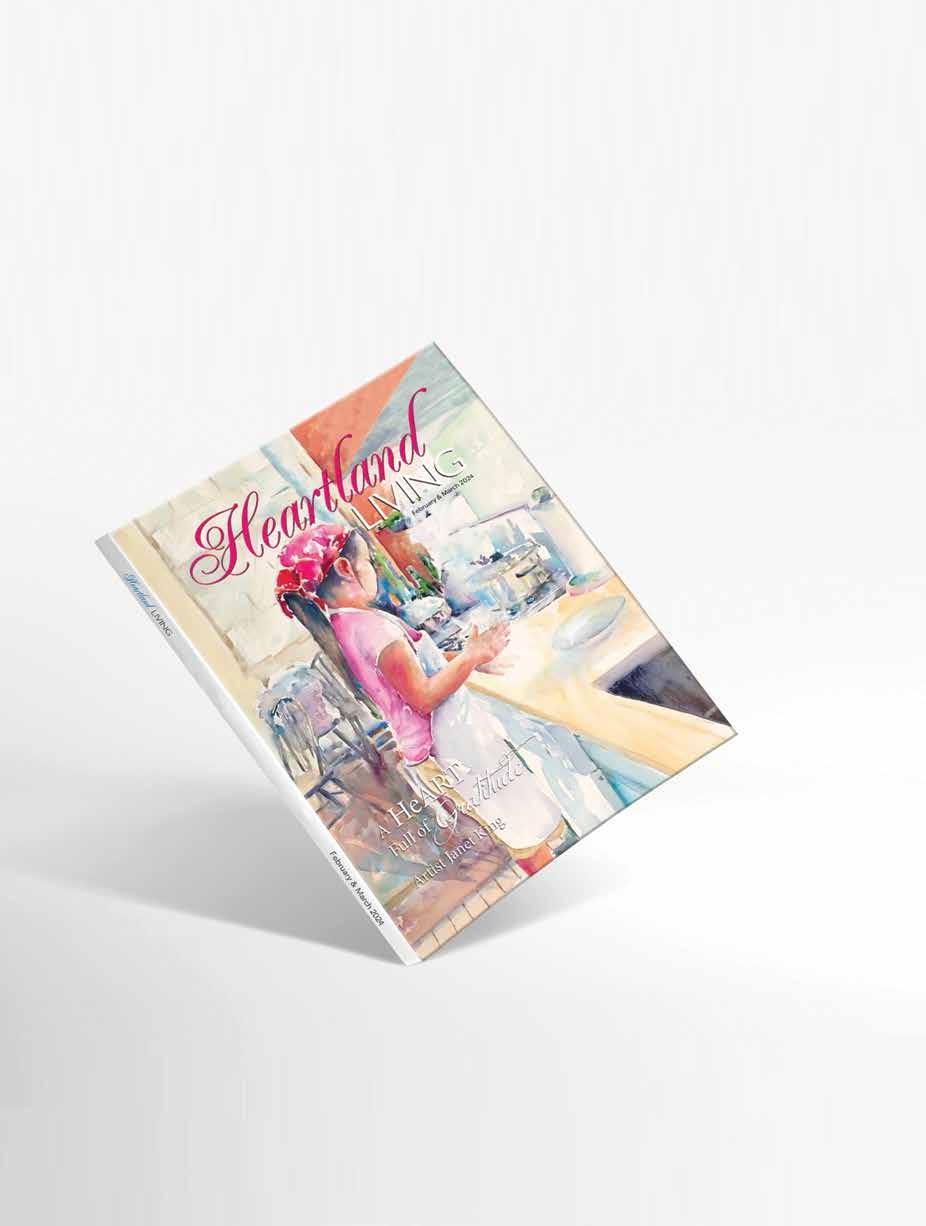
Heartland LIVING
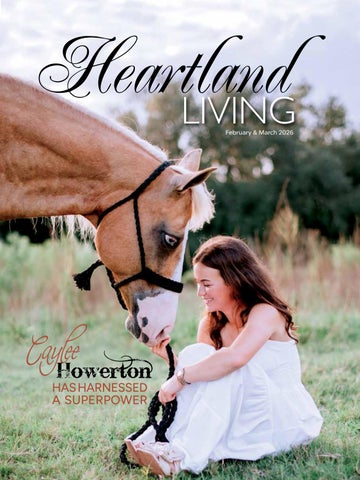
CayleeHowerton
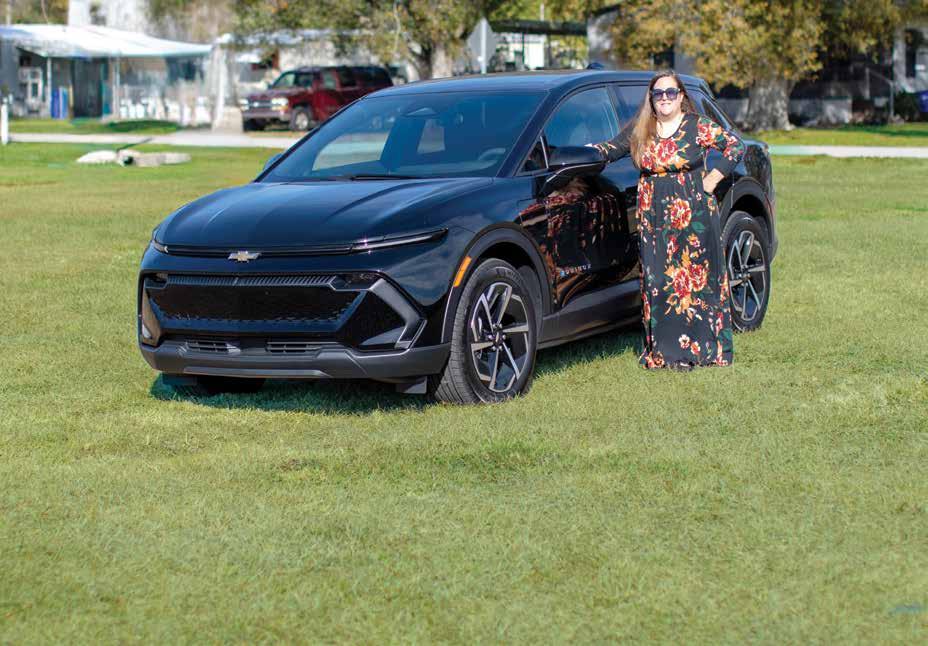


“Buying my first EV was a big step, but the team at Gilbert Chevrolet made it easy and exciting. They took the time to walk me through everything—from OnStar and SiriusXM to all the EV features—so I felt confident driving off in my new Chevy Equinox EV. Everyone was friendly, patient, and truly helpful.”

3550 US Highway 441 South ° Okeechobee, FL 34974 (863)763-3154 ° www.GilbertChevrolet.com
- Jessica McGill








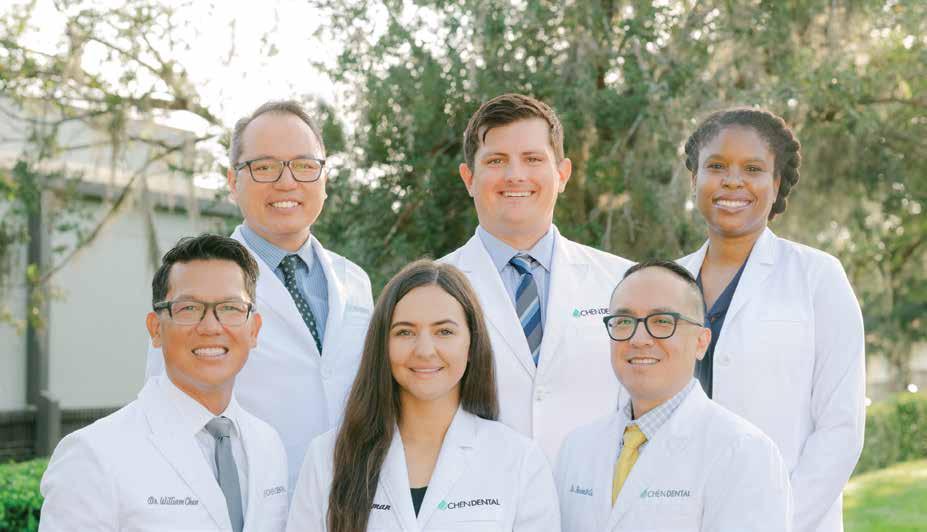
Whether your dental needs are an exam and cleaning, full-mouth restoration, or anything in between, we promise to provide you with exceptional care as we enhance the natural beauty of your smile. Please call or visit us today for your reservation! We look forward to meeting you.
Located next to Lowe’s in Sebring!
We are excited to offer the latest in digital denture technology. Using 3D technology, our doctors use impressions and digital scans to design dentures that will mimic your own gums and teeth. This will ensure a better bite and increased comfort, tailored to fit your specific needs! Our state-of-the-art, in-house lab will fabricate the dentures right here, minimizing wait time for your new smile. Call today!

FEATURES
By Rebecca Maglischo
58 Gentle Giants
Florida Manatees

Kevin Welborn
By R. Michael Brown

By Kimberly Blaker
By Cindy Sebring Adams





Heartland LIVING
LETTER FROM THE PUBLISHER
Hello. My, how time flies! Fourteen years ago, I wrote my first “Letter from the Publisher.” Didn’t have a clue what I was doing and not sure I do going into our fifteenth year. On a positive note, my good friend Diana Albritton shared with me, “Don’t change a thing about the way you write your publisher's letter. It reads just like you are talking to someone.” That made me feel comfortable, so I keep doing what I love—talking, ha ha.
Also reminiscing, I remember that day when I called my creative designer Bridgette Waldau when I was publishing a small magazine. Now we are into our fifteenth year with Heartland LIVING and have printed 82 magazines. I feel we not only work together as a team, but I also feel we have become friends, or at least we talk about everything. Thank you for your amazing designs and helping me publish all that we have these years. Wouldn’t want to do it with anyone else! Here’s to many more; we aren’t done yet…
We are into 2026, and hopefully you feel you are off to a beautiful year; I pray that for you. We are happy you have picked up our February & March Issue to start bringing you our 6 issues of Heartland LIVING for the year. I hope you enjoy all the features our writers have found and wrote to share with you, and all the beauty our photographers have captured for you.
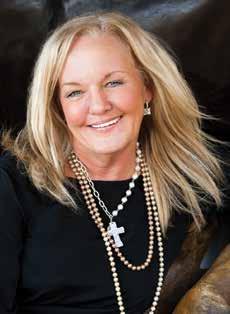
My intention moving into the year is to deepen my relationship with you, our readers and social media followers, to further develop content that is inspiring and of value to everyone. In fact, I would be thrilled to hear from you on what you’re loving and what you’d like to see more of in the Heartland as well as adventures. Who doesn’t love to read about other people’s travels? You just might read about somewhere you want to visit and experience.
Talking about adventure, thank you, Rebecca, for sharing your childhood memory about the resident manatee that visited your family every day on vacation. I won’t spoil the story but was so happy to read that it is now your annual trip to share with your boys and family. I learned so much about our manatees reading this story.
Writers Christy, Kevin and Mike have brought you features that are interesting in their own way, and each is very different. We touch on history, some tough girls in the Heartland and our cover, Caylee Howerton, and her accomplishments with her horses and her love of animals. Thank you, Lisa Taylor Hall, for our gorgeous cover.
Time to start turning the pages, and we hope you enjoy! Please visit and support our advertisers and let them know you saw their ad in Heartland LIVING
God Bless,
Cindy Sebring Adams







Look & Feel Your Best
Blue Ocean Dermatology stands as a beacon of excellence in skincare. This state-ofthe-art dermatology clinic is dedicated to providing top-notch care to residents and visitors alike, ensuring their skin remains healthy, radiant and protected from the sun’s harsh rays.
The name “Blue Ocean” reflects the practice’s commitment to innovation and differentiation in the field of dermatology. It signifies their desire to venture beyond the boundaries of traditional dermatological practices and create a new, unexplored space where patients can receive the highest quality care and experience.
With Seven Locations in Florida
New Smyrna Beach | Port Orange | Daytona Beach | Palm Coast Sebring | Winter Park | Okeechobee
Blue Ocean Dermatology is renowned for its expertise in both medical and cosmetic dermatology. With a passion for helping patients achieve their skincare goals, the staff at Blue Ocean Dermatology are a highly trained team that offer a comprehensive range of services tailored to address various skin concerns. Blue Ocean Dermatology was founded with a vision to provide exceptional dermatological care and create a unique patient experience.
Medical Services | Medical Dermatology Cosmetic Dermatology
Blue Ocean Dermatology prides itself on staying at the forefront of dermatological advancements. From acne and eczema to psoriasis and Mohs surgery for skin cancer, their dermatologists have the expertise to deliver the highest standard of care. In addition to medical dermatology, they offer an array of cosmetic services to help patients look and feel their best. Whether it’s rejuvenating treatments like Botox and dermal fillers, laser hair removal or chemical peels, the clinic’s skilled professionals tailor each procedure to meet the unique needs of every individual.
As a patient, you’ll have a close, personal relationship with your community dermatology providers, who have the training, experience, and expertise necessary to meet all your skincare needs
Non invasive skin
Paul Giles, M.D.
To bring their vision to life, the founders of Blue Ocean Dermatology, assembled a team of highly-skilled and compassionate dermatologists, nurses and support staff.
Sara Corwin, APRN
Jason Welch - APRN CEO
Christina Morales, APRN
Publications & Marketing, Inc.
EDITORIAL
Christy Swift | Editor, Writer
Cindy Sebring Adams | Writer
Kimberly Baker | Writer
R. Michael Brown | Writer
Rebecca Maglischo | Writer
Kevin Welborn | Writer
Bridgette Waldau | Creative Director
PHOTOGRAPHERS
Katelyn Baker
R. Michael Brown
Samuel Foster
Lisa Taylor Hall







OFFICE TEAM
Cindy Houtz | Website
Kristan Baker | Distribution
Lisa Griffin | Distribution
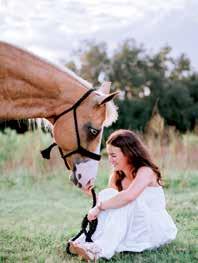










WRITING & DESIGN BEHIND THE SCENES
Cindy Sebring Adams is Founder/ Publisher of Heartland LIVING Magazine. Born and raised in Sebring, FL, she is fourth generation of the founding family of Sebring. She brings personal and inspirational stories to the community through Heartland LIVING Magazine. Besides overseeing the development of the magazine, she also contributes through writing and photography.
Christy Swift is an award-winning author, editor and technical writer. She recently scored a 2-book deal with a major publisher, Hachette Forever. Her debut romcom, Celebrity Crush, launched in 2025 and her second book, Hollywood Hookup, comes out February 10th, 2026. She also writes science fiction and fantasy. Find her at www.christyswift. com
Kimberly Blaker is a freelance lifestyle and licensed real estate agent. She's also founder and director of KB Creative Digital Services, an Internet marketing agency, at kbcreativedigital.com.
Writer
Editor | Writer
Rebecca Maglischo is a wife and mother of two boys. She holds a Bachelor's degree in Early Childhood & Elementary Education and a Master's Degree in Human Movement with an emphasis on Corrective Modalities. She has completed a study in Full Body Systems through the Holistic Nutrition Lab and a certification in Functional Range Condition through the Functional Anatomy Systems
Kevin Welborn grew up in Highlands County, where his love for sports and community took root early on. A former college baseball player, he spent 10 years teaching before his current role as a local financial advisor. Kevin is passionate about pouring into the children of the Heartland and giving back to the community. He is married to his wife, Ingrid, they have three children: Mila, Alessia, and Luca.
February & March 2026


Bridgette Waldau has been a graphic and fine artist for over 40 years. She received her A.A. from the Ft. Lauderdale Institute of Art and a BFA degree from Stetson University. Bridgette has been creative director for Heartland Publications & Marketing since 2011, winning 11 Florida Magazine Charlie Awards (2015- 2021). Bridgette is married to James, a retired firefighter from the City of Hialeah
Katelyn Baker is a Florida-based photographer and entrepreneur with a passion for capturing timeless imagery. She is the owner of Katelyn Baker Photography and Eden Salon. Whether behind the camera or leading her salon team, Katelyn’s work is rooted in authenticity and service. She strives to use her gifts to glorify Christ and reflect His light through every space she enters.
Samuel Foster was born and raised in Sebring. He grew up immersed in photography through his father’s business. A lifelong motorsports fan, he spent his youth racing go-karts. He carries on the family photography legacy while also serving as a special needs teacher in Highlands County, bringing patience, focus and connection to every subject he photographs.


Writer Writer Writer

Lisa Taylor picked up her camera 10 years ago when motherhood inspired her to see the beauty in each day. She loves how photography captures a moment in time that otherwise might be forgotten. She grew up in Sebring and currently lives in Lake Wales with her husband and their three sons. Lisa specializes in lifestyle photography for families, small events, maternity and graduates.
R. Michael Brown is an award-winning writer, producer and marketing consultant with bylines in major market newspapers and magazines as well as credits with network broadcasting and Discovery Channel. He earned a New York Film Festival Award, authored You Are the Media Now, and teaches college-level communication. He helps brands, organizations and communities tell stories that connect and drive impact
Every GREAT design begins with an even BETTER story.
-
Lorinda Mamo, designer
Creative Director
Photography
Writer | Photography

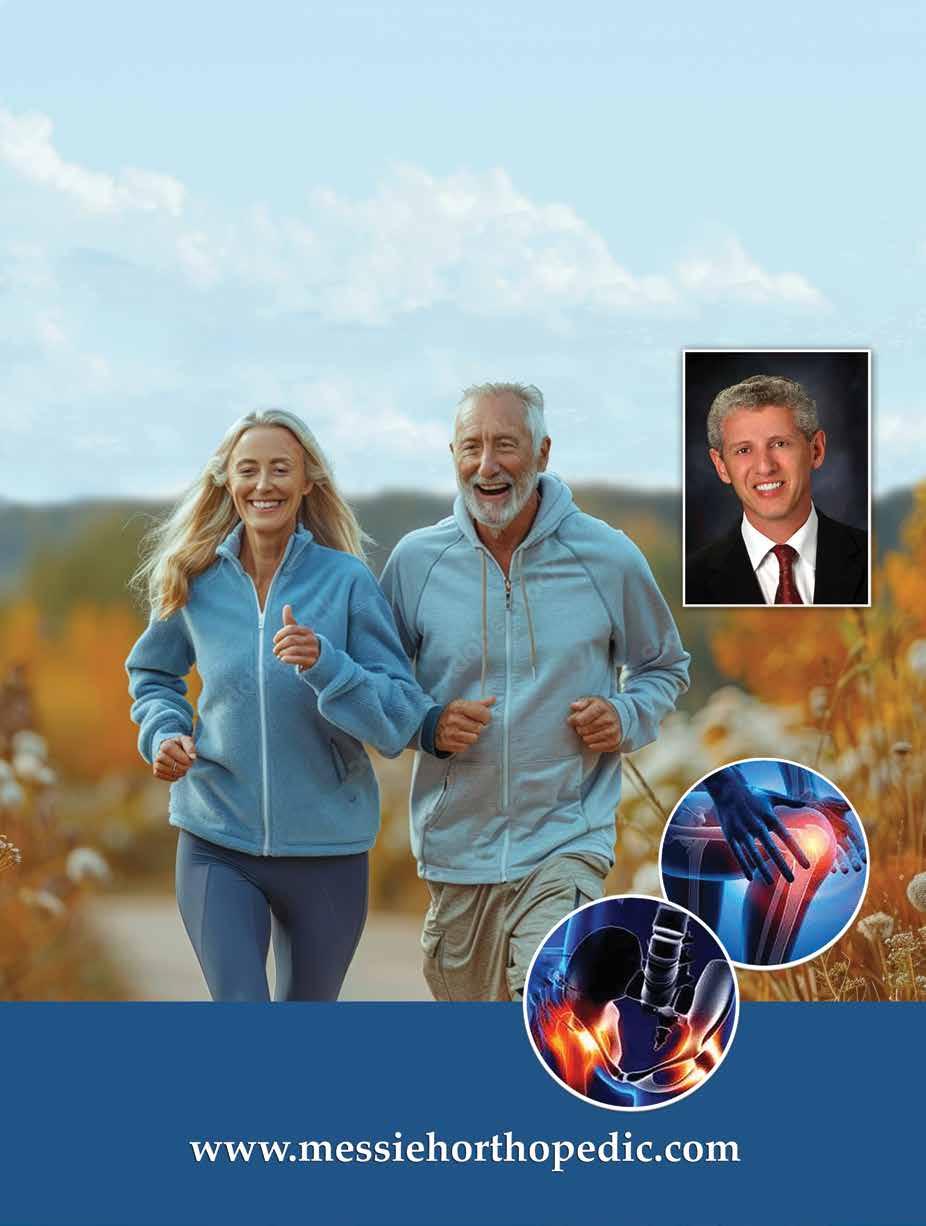
Offering a variety of Hip & Knee Replacement procedures including Direct Anterior Approach to the Hip. The Anterior Hip Replacement Approach causes less trauma than traditional techniques, making recovery easier for the patient.


Be Your Own Kind Beautiful of
Dr. Rogers and his highly qualified team of Nurse Practitioners and medical staff look forward to keeping your skin healthy for years to come!
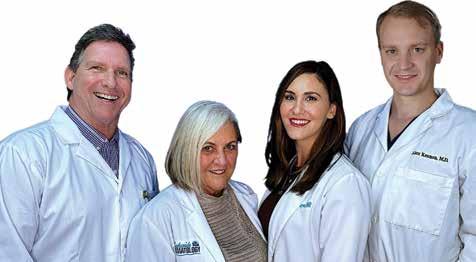
Dr. Michael J. Rogers, MD, Board Certified Dermatologist
Dr. Alexander W. Kennon, M.D
Board Certified Dermatologist and Mohs Surgeon
Dr. Brooke Rogers, DNP, FNP-C | Barbara Ross, ARNP-C
Cosmetic Dermatology:
Botox
Dysport
Fillers:
Restylane Lyft, Restylane Kysse and Lip Enhancement
Micro-Needling with PRP
PRP Treatment for Hair Loss
Sculptra
Kybella
Hydrafacial
NEW! ViPeel
General Dermatology:
MOHS Micrographic Surgery
Skin Cancer Screening & Treatment
Mole Removal & All of your Skin care needs
Gift Certificates Available
SEBRING (863) 385-7183 727 US Hwy 27 S
WINTER HAVEN (863) 293-SKIN 400 Avenue K SE, Ste. 3




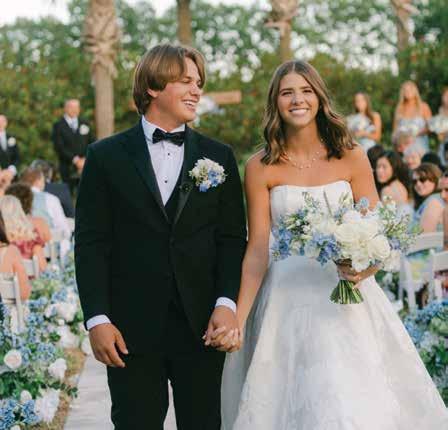
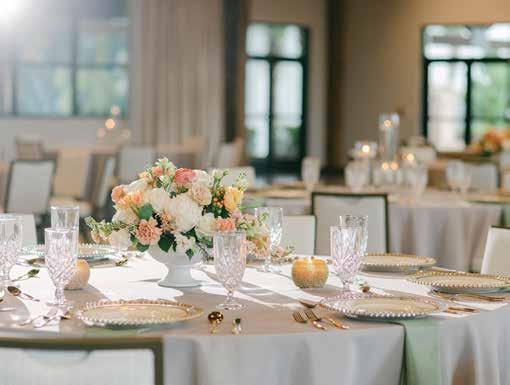



A Century of Southern Charm
By
Christy Swift
Photography by Katelyn Baker
Photos Courtesy of SFSC Foundation and Historical Archives
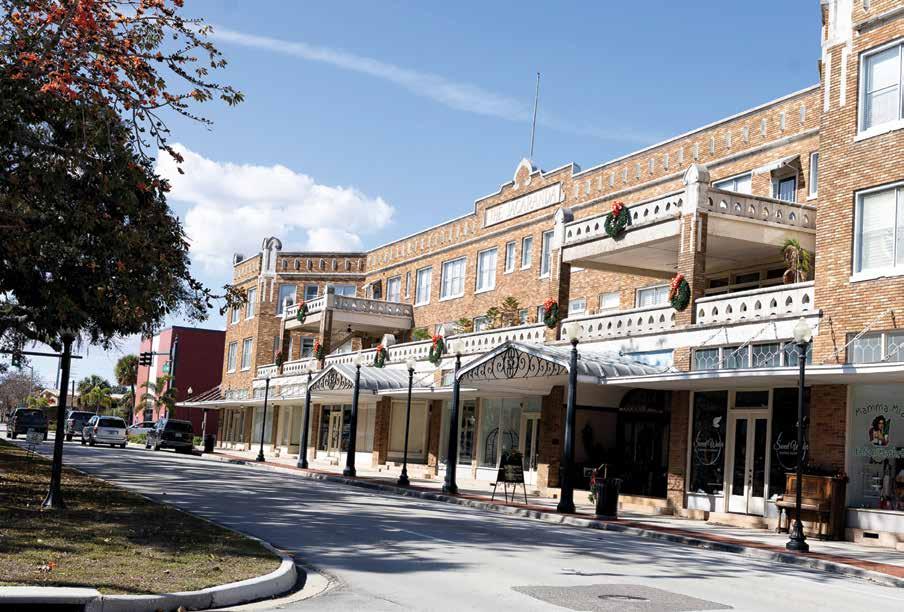
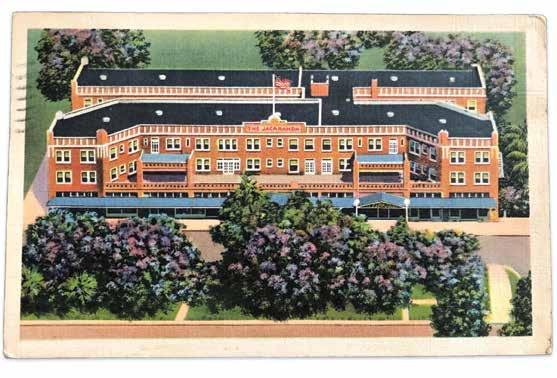
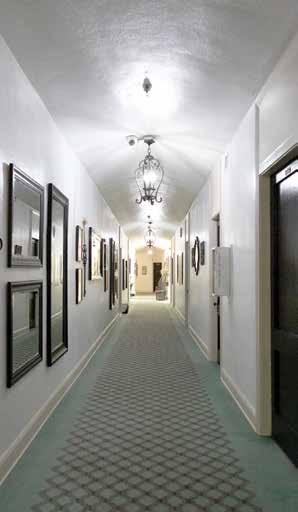
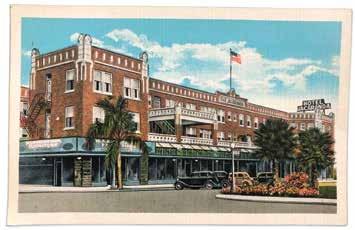
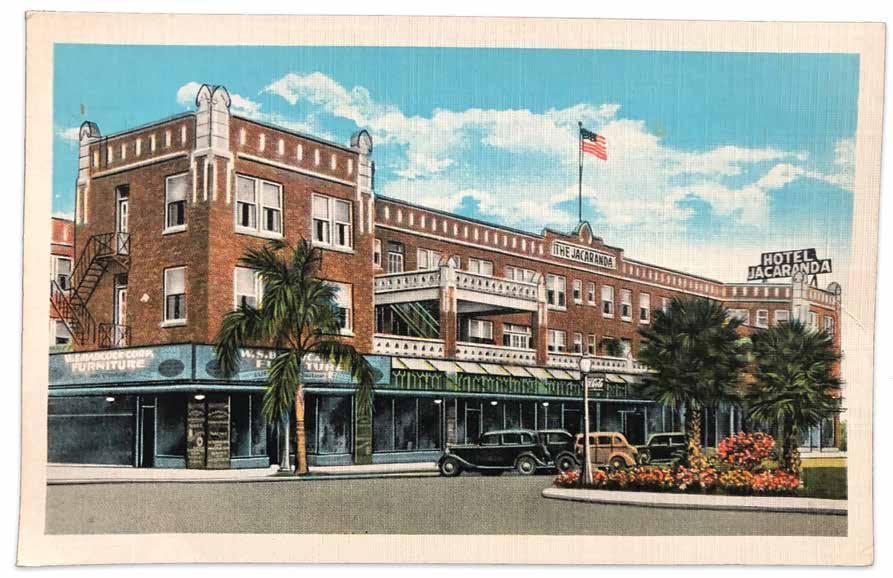
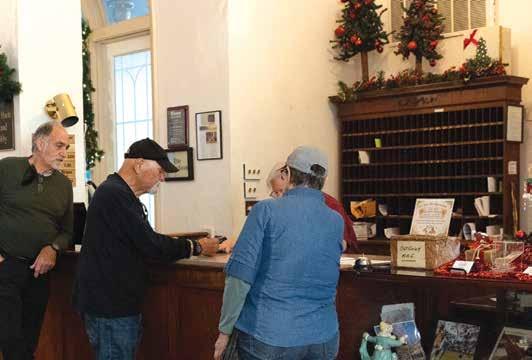
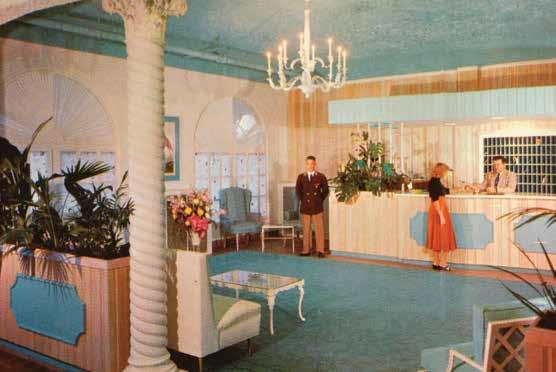
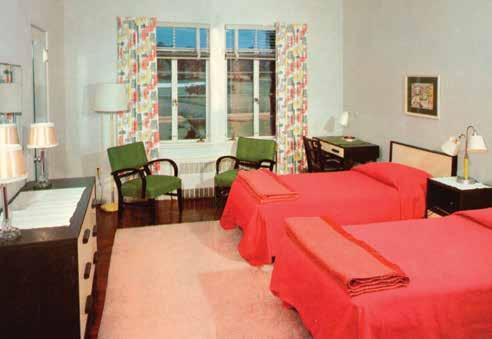
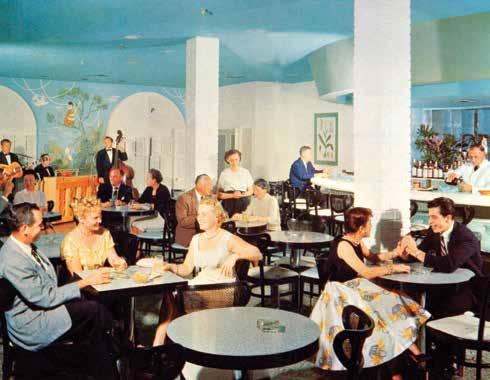
Nestled on a quiet corner of Avon Park’s Main Street, the Hotel Jacaranda has watched nearly a century of Florida history unfold. Built in 1926, this “gracious lady” is the oldest hotel in Highlands County and remains a living testament to the elegance and charm of the 1920s. Listed on the National Register of Historic Places, the Jacaranda’s stately brick exterior, high ceilings, and quiet hallways evoke a bygone era where travel was leisurely and hotels were as much a destination as the cities they graced.
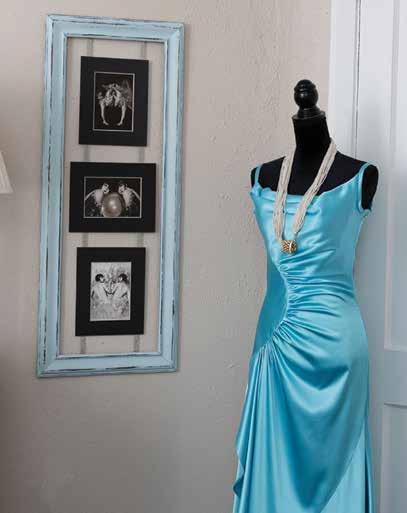
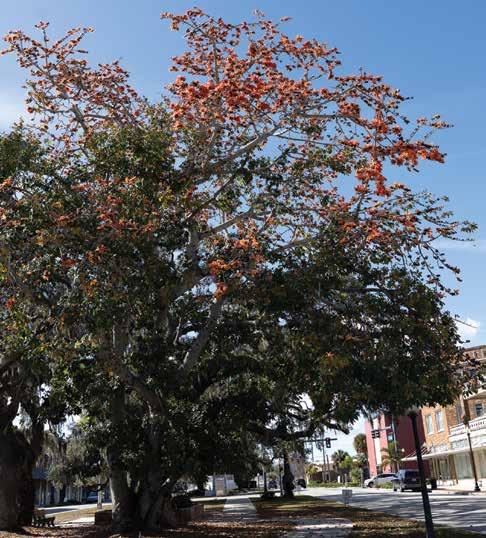
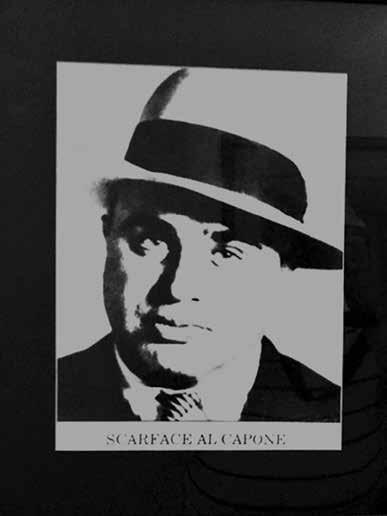
The Jacaranda’s story begins with a 150-year-old jacaranda tree that once stood on the property, removed to make way for the grand hotel. Soon after opening, it became the epicenter of Avon Park’s blossoming tourism scene, aided by easy railroad access that brought in visitors from across the country. Some of its first guests were members of the St. Louis Cardinals, who arrived for spring training from 1927 to 1929. In the years that followed, the hotel’s halls echoed with footsteps of legends—Babe Ruth, Clark Gable, George Burns and Gracie Allen. There are even whispers that Al Capone sought a quiet getaway there. Photographs of these notable visitors now adorn the hallways, a visual tapestry of Hollywood glamour and baseball lore. ▶


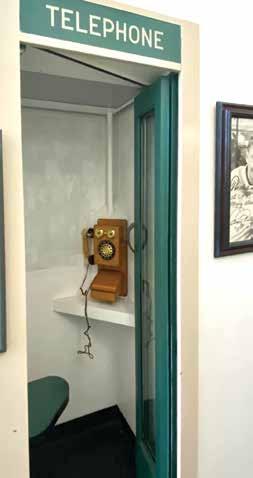

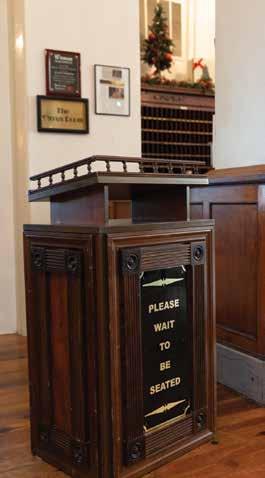


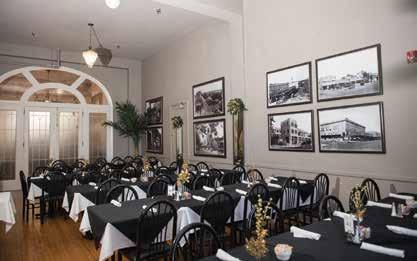
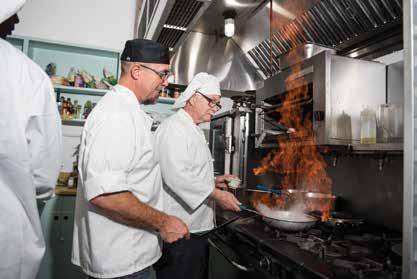
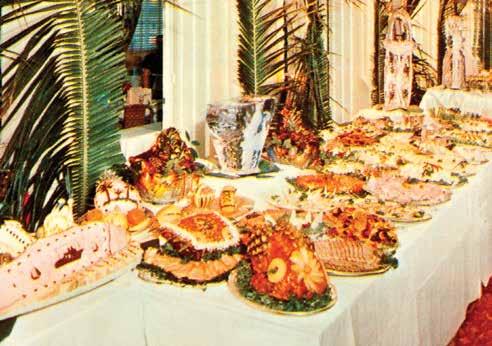
During World War II, the hotel supported the war effort, housing hundreds of servicemen training as military pilots. Later, in 1988, the South Florida State College Foundation purchased the hotel, preserving its historic charm while giving it new life. Today, students train in the Jacaranda’s modern kitchen, and a vibrant restaurant offers elegant, casual dining and a Grand Buffet every Sunday. One of the hotel’s most charming features is a 1920s crank elevator—a rare relic of old-world elegance (ask the staff for a ride in it and they might oblige).
“The arcade is my favorite feature of the Hotel Jacaranda,” says Emily Dabolt, the SFSC Foundation’s Executive Director of Institutional Advancement. “Walking past the indoor storefronts feels like stepping into a time warp. It's easy to imagine guests from the 1920s browsing these same hallways.”
A stroll through “the Jac,” as it is lovingly called, is like entering a time capsule. “Take time to wander all the spaces in the Hotel Jacaranda,” Emily encourages. “Each room and corridor reveal carefully preserved antiques, original furniture and historical wall decorations that have witnessed nearly a century of stories. Let yourself be transported to another era as you discover these treasures tucked throughout the building.” ▶




Pinecrest Golf Course:
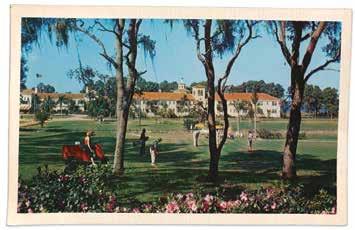
What did the elite Jacaranda guests of the 1920s do for entertainment while staying in Avon Park? Why, they golfed, of course!
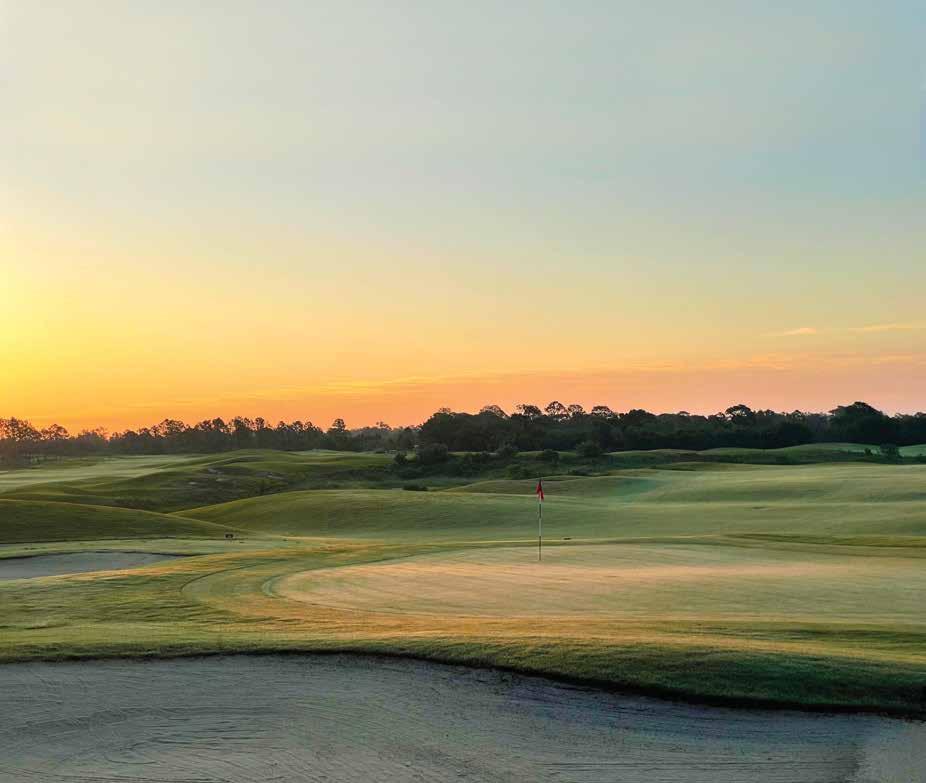
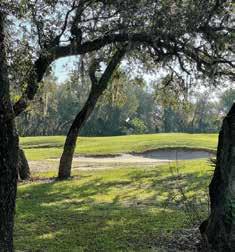
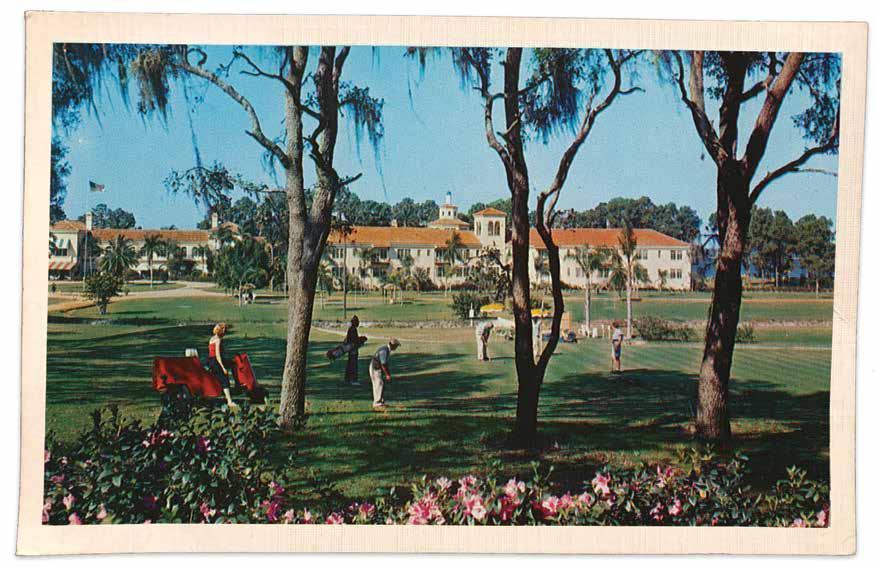
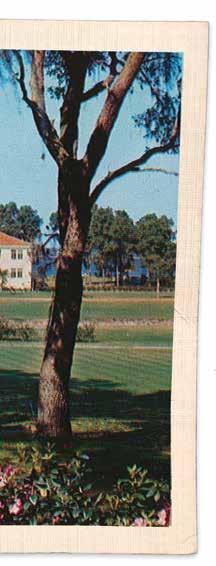
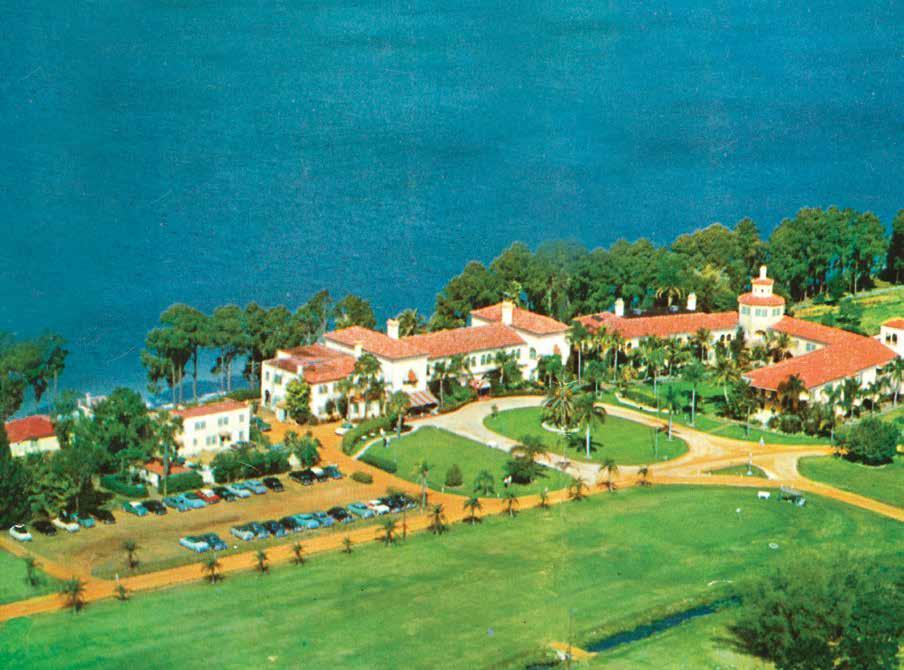
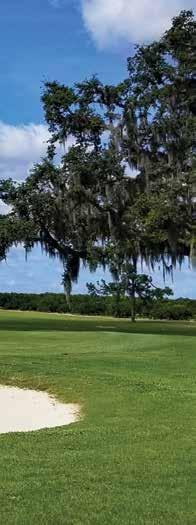
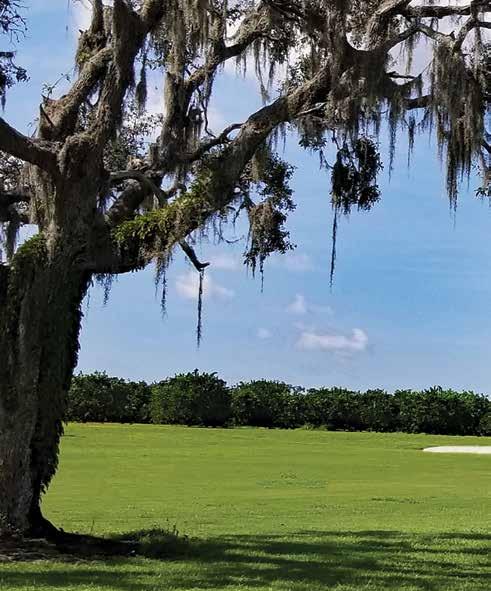
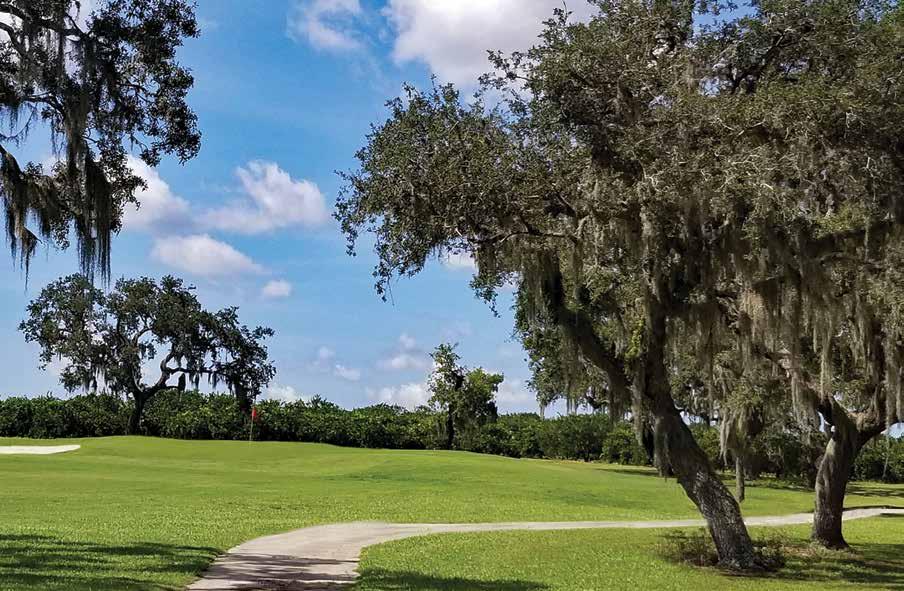
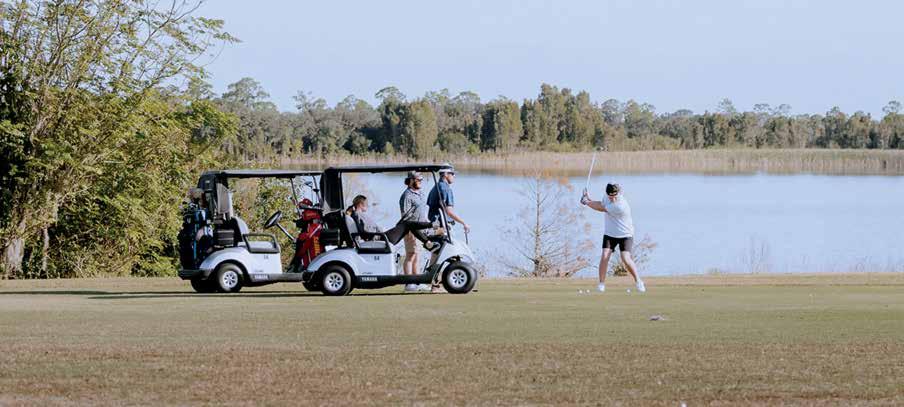
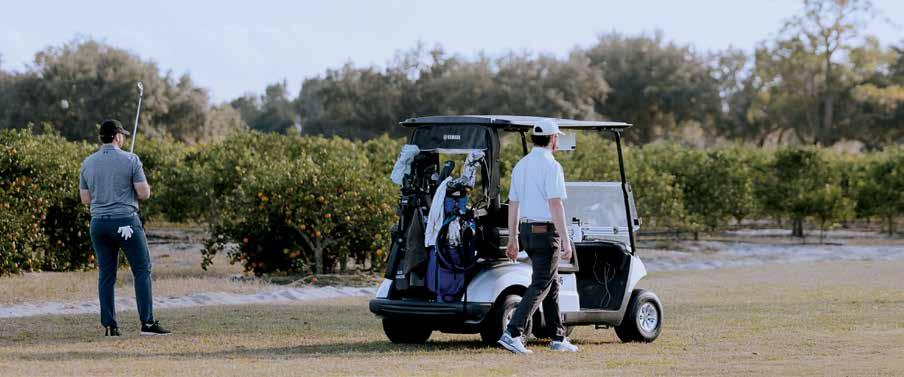
Horse-drawn carriages carried guests from the elegant hotel to the rolling fairways and sunlit lakes of the Pinecrest Golf Course, which is celebrating its own centennial. Designed and built in 1926 by Donald Ross, one of America’s most revered golf course architects, the course takes full advantage of the natural topography, weaving fairways through wooded areas, citrus groves, lakes and subtle elevation changes, creating a seamless harmony between sport and landscape.
The Jacaranda wasn’t the only hotel in town at the time. Pinecrest had its own, built by owner Colonel Royal Page Davidson II and architect William Heim, with several wings added over time to accommodate more guests as the property expanded. The back nine holes were added in 1936 under the ownership of Chicagoan E. B. Hitchcock. The northeast wing of the hotel was completed in 1950. In 1954, a clubhouse was built under the ownership of Ben Morell, a textile importer from Sag Harbor, New York. (The dilapidated remains of that structure are located in the woods near the one and two holes.)
If golf courses had careers, it could be said that this one got its big break in 1959, when it hosted the very first televised golf tournament—the PGA World Championship of Golf—broadcast by NBC. Teeing off at that event were Sam Snead, Gardner Dickinson, Don January and match winner Dr. Cary Middlecoff. In the years that followed, the course became a popular destination for golfing legends like Arnold Palmer, Tommy Bolt, Julius Boros, Kathy Whitworth, Joanne Carner and Mickey Wright. Pinecrest had gained true notoriety. ▶
But change was coming. In 1966, the property was purchased by a couple from North Carolina who turned it into a boarding school for girls. The next three decades brought about even more upheaval—multiple owners, a stint as a boys’ school, in 1978, a surprising new life as a retreat site for transcendental meditation.
The hotel succumbed to time and the elements, but the Pinecrest golf course survived and eventually found its way under the umbrella of the City of Avon Park and then into the hands of its members before it was ultimately purchased by the owners of the groves that surround it—Christy and Cruiser Crews—and their business partner, former grounds chairman of the board, Tim Devlin, in 2018.
Prior to Crews and Devlin purchasing Pinecrest, financial contributions from dedicated former member-owners, helped keep the course alive along with surfacing the greens. “Since our purchase of Pinecrest we have invested heavily in course care. “We grew grass in places where people have never seen grass,” says Cruiser. “Owning a golf course is a labor of love,” adds Tim.
Crews and Devlin also replaced the course’s old snack bar with a full-service restaurant called the Sandhill Grill. Menu items are named with playful nostalgia— for example, the “Moonies” (mozzarella sticks) were dubbed as such because that was the nickname young Cruiser and all the locals called the transcendental meditators. The “Your Hartt’s Desire” appetizer (aka fried green tomatoes with their signature pimento cheese) was named for the popular teenage makeout spot down by the Hartt family’s land at the Little Bonnet Lake boat ramp. “If you know, you know,” jokes Cruiser. ▶



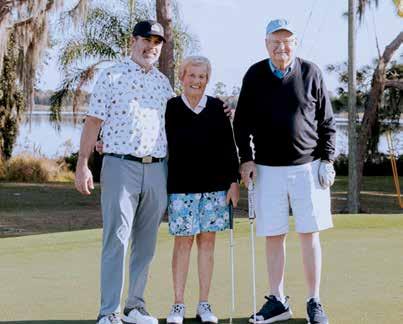

(L-R): Andy Kesling, Head Golf Professional and long time members Nancy and David Chaffee
The course’s wildlife-rich landscape, free from the usual encroachment of nearby homes, offers players a rare sense of solitude and immersion in nature—a defining feature that has kept it popular for generations.
“I like that you can play the first eight holes and never see a home,” says Tim. “You might see a deer, you might see a hog, you're gonna see turkeys, we’ve seen bear. It’s a gem.”
“It’s a unique golf course,” Pinecrest’s onsite golf pro, Andy Kesling, confirms. “It carves its way through some orange groves and some lakes, and it’s a Donald Ross design with greens that challenge the golfer. It’s definitely a fair golf course and a well-designed golf course.”
“I love the family feel we are trying to build at the course,” says Christy. “For example, we have been doing an annual Christmas golf cart parade and contest that brings out a lot of families and friends for a fun night.”
In the spirit of fun events, Pinecrest golf course is kicking off its centennial celebrations with a night golf, 4-person scramble with glowballs on February 27th, sponsored by Bagwell Lumber. They are also planning a “Blast from the Past” tournament in March, where players will use original hickory stick equipment and dress in period attire.
Both the Hotel Jacaranda and Pinecrest Golf Course stand as testaments to Avon Park’s storied history and celebrations of endurance, commitment, and community. Together, they remind us that some places aren’t just visited—they are experienced, cherished, and remembered for a lifetime.





For more information go to both historical places' websites: www.hoteljac.com www.golfpinecrest.com
100 YEARS

Hotel Jacaranda
Avon Park, Florida

Avon Park, Florida
Pinecrest Golf Course
Heritage Festival 2026
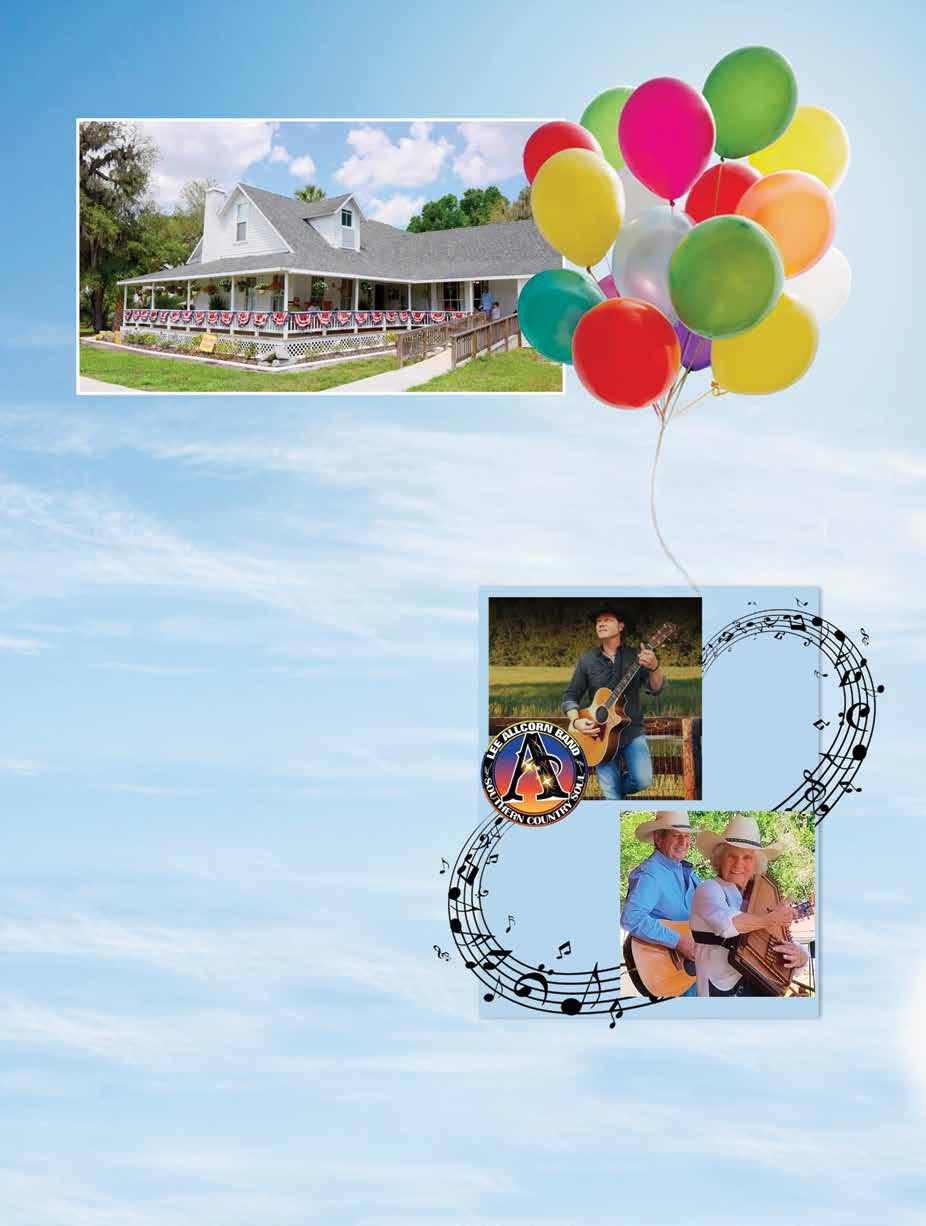
April 11 & 12, 2026
•Food Truck Vendors
•Local Entertainment
•Native Rescue Exhibit
•Kids' Zone
•Spinning & Quilt Display
•Florida Cracker Trail Riders
•House Tours
•All American Car Show
•Ecological Boat Tours
Locally Sourced Southern Inspired
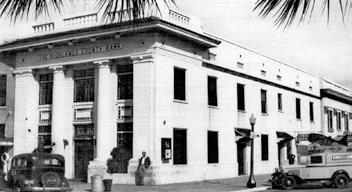
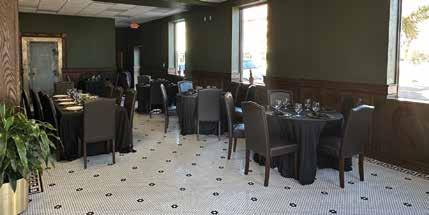
Restaurant and Event Venue on the Circle in the Historic Highland’s Bank Building



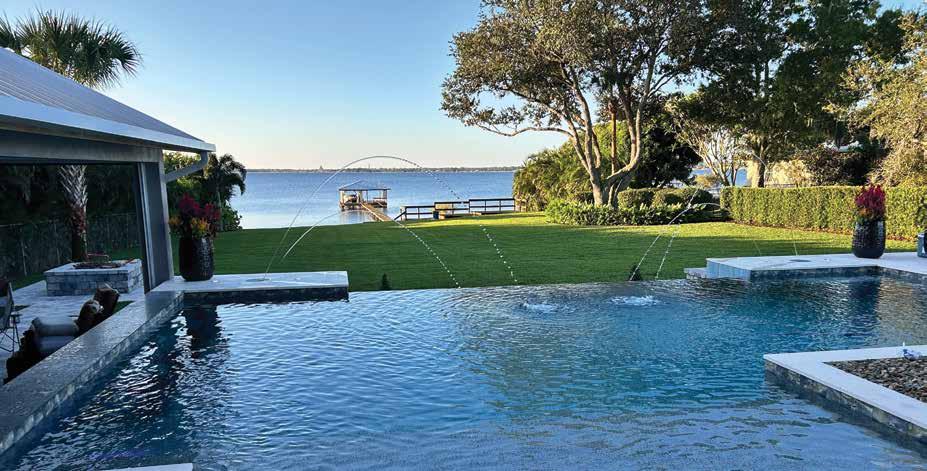

Fall is for dreaming, winter is for building, and summer is for enjoying.
Let’s design you forever backyard, one intentional detail at a time.

Jordan Shannon
Tom DiGiacomo
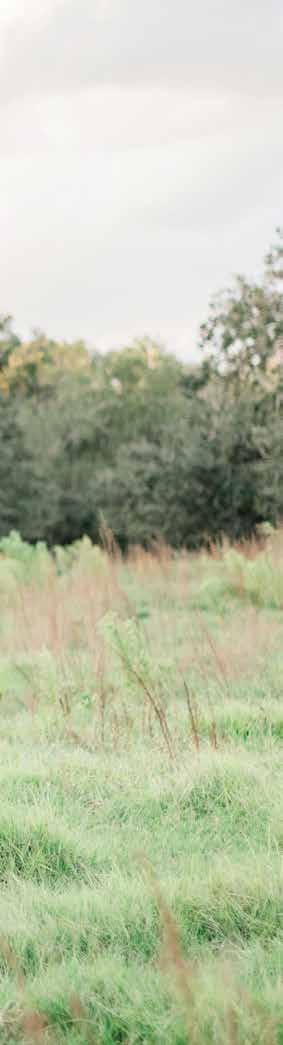
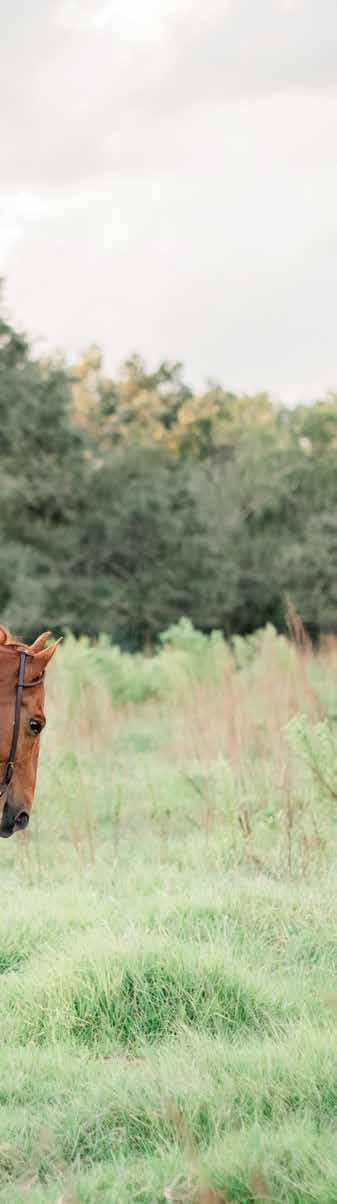
HAS HARNESSED A SUPERPOWER
By R. Michael Brown
Photography by Lisa Taylor Hall and R. Michael Brown
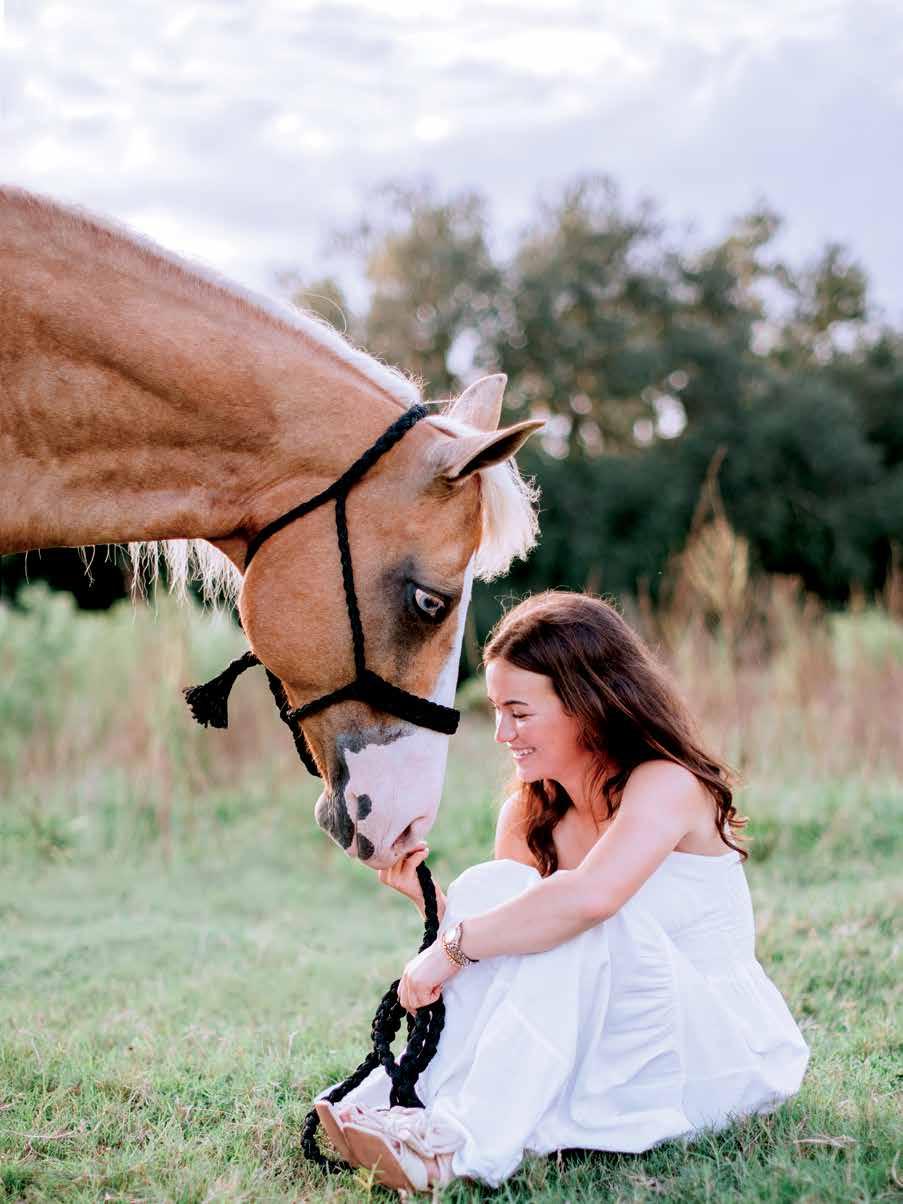
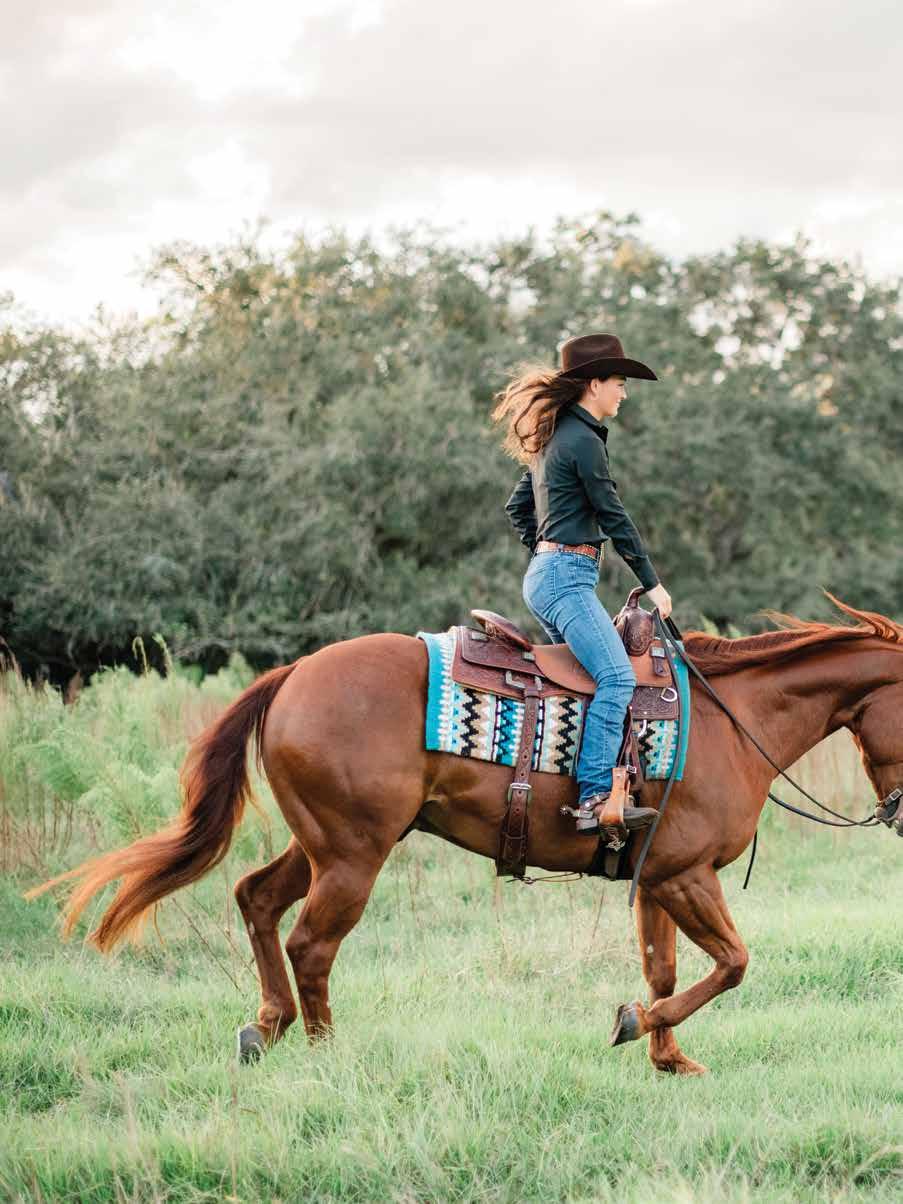
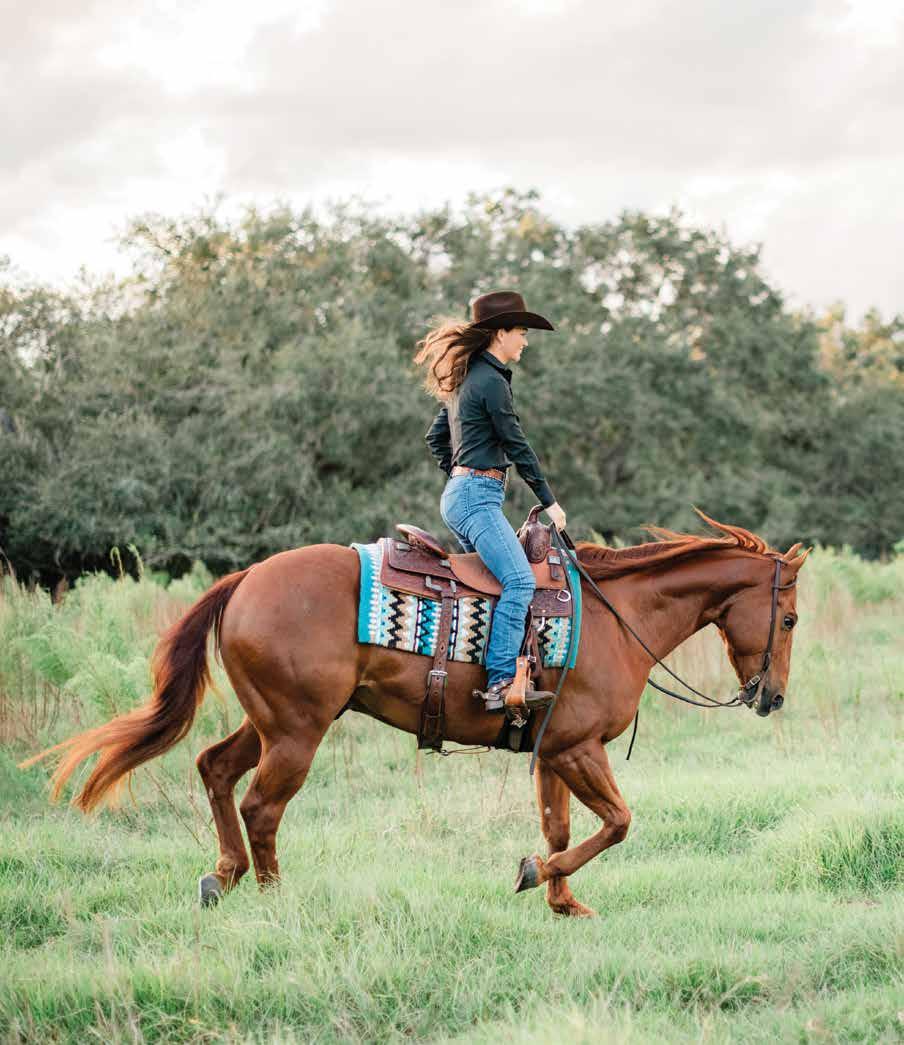
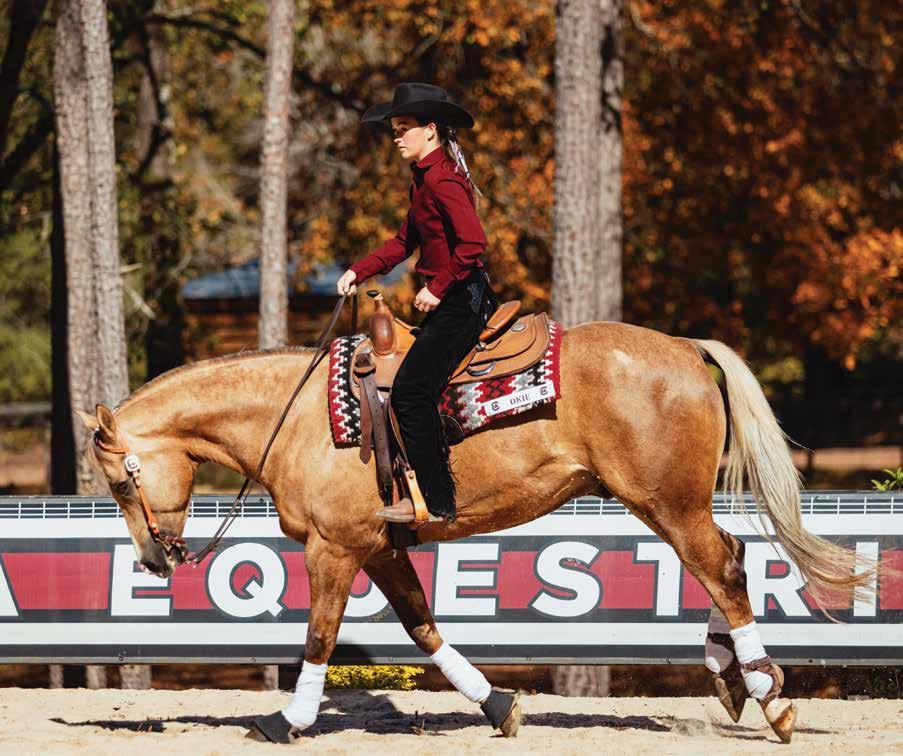
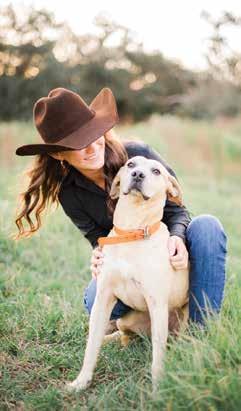
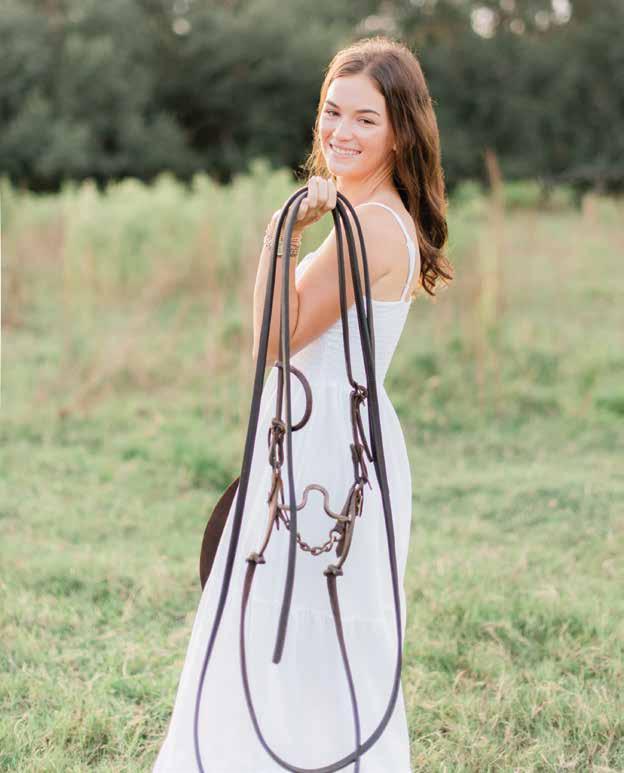
Caylee Howerton’s quiet superpower isn’t her championship spins or sliding stops. It’s the rare mix of grit and grace she carries into every barn stall, every show arena, and every quiet moment when she leans into her horse and whispers thanks.
In recent years, reining has surged in popularity thanks in part to TV series Yellowstone, where real reining horses—many of them champions—slide and spin across television screens. Series creator Taylor Sheridan competes in the sport himself with horses he owns, bringing reining into living rooms far from the show pen.
But Caylee didn’t need television to make reining feel big. For her, it has always been everything. ▶
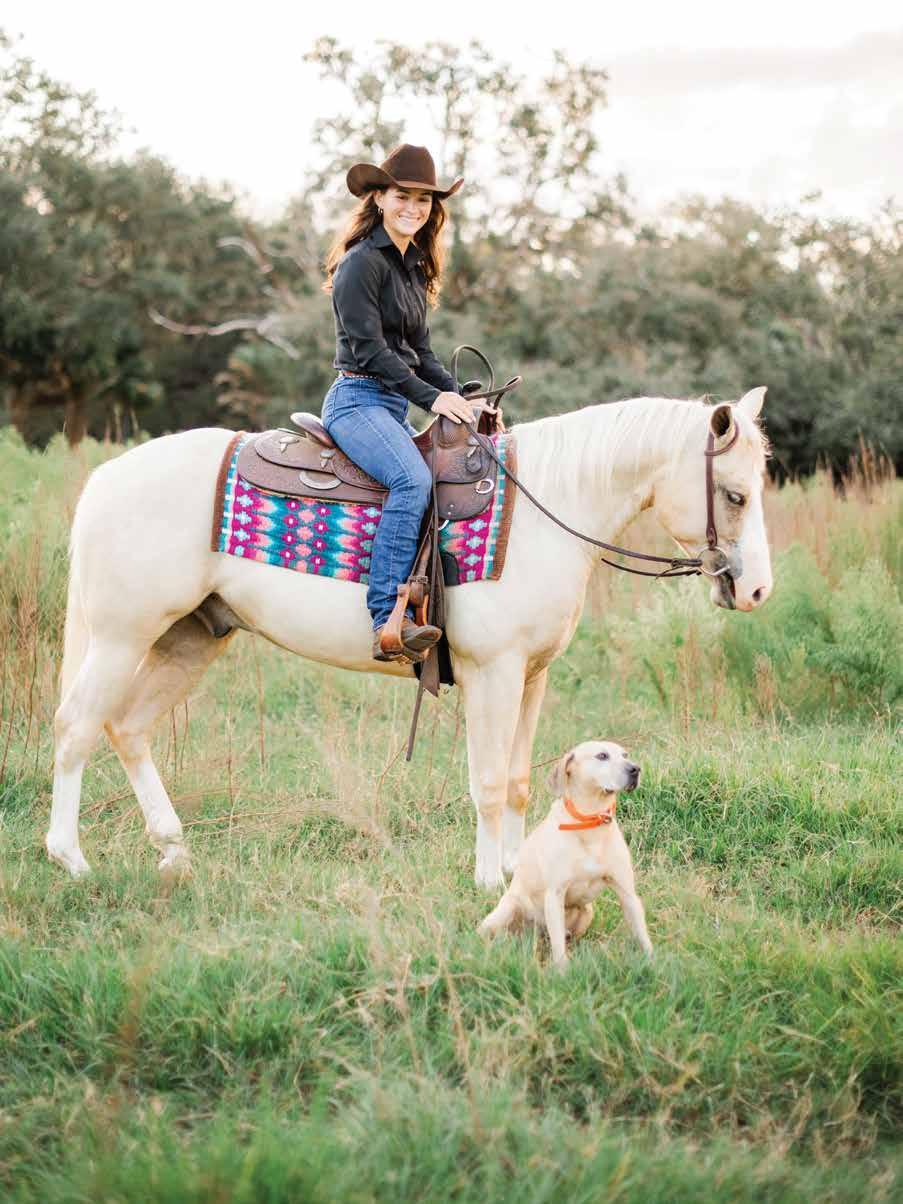
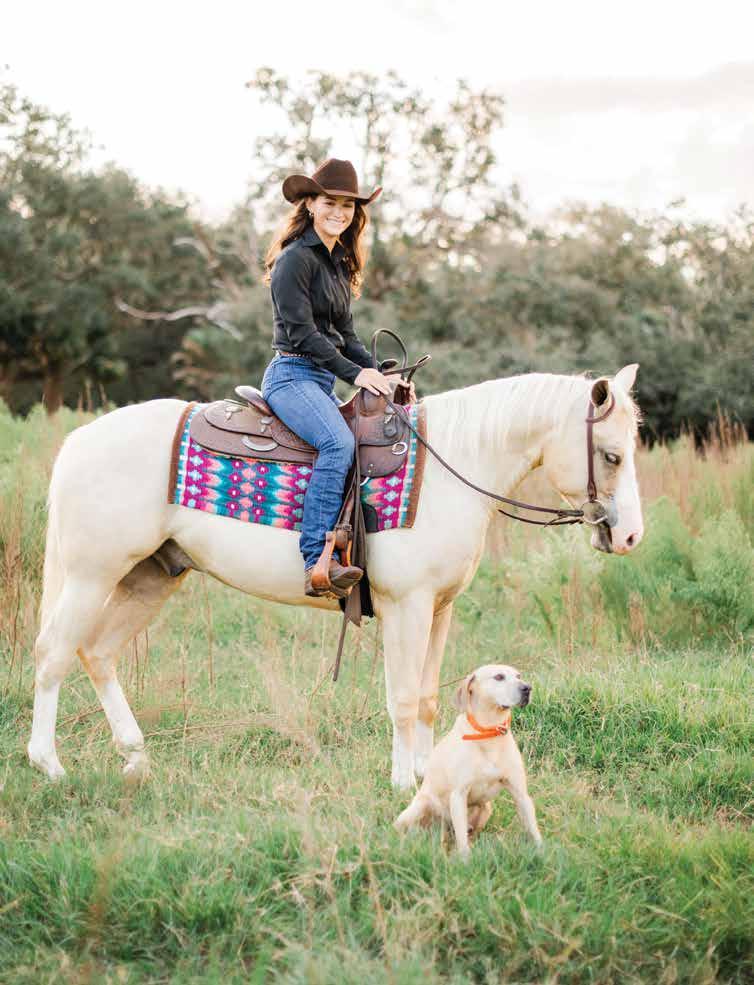
was her mother Laurie’s love of the sport, the dust and discipline of the barn, the nerves before a run, and the quiet, unspoken bond between horse and rider that can’t be manufactured. It was family tradition, hard work, and mentors who helped shape not just a competitor—but a young woman grounded in humility.
On most mornings, Caylee doesn’t look like a nationally ranked rider with championship buckles. She looks like someone on a mission—boots on, ponytail up, moving from stall to feed room like the sun is chasing her.
“I feel like I get straight to it,” she says with a laugh. “I get to the barn, and I have to feed, then clean the stall, and I do everything like bam, bam, bam. Get ’er done.”
That phrase—get ’er done—is more than a saying. It’s a mindset of extreme focus. One that carried Caylee through nine-hour training days on horseback, long drives, and pressure-filled runs under arena lights during a five minute show. It’s also what helped make her one of the most decorated youth reining competitors in the Southeast—and a rising force at the national level.
But if you ask her grandmother, Donna Howerton, what truly sets Caylee apart, trophies aren’t the first thing she mentions. “She’s always had a love of animals,” Donna says. “She’s strong and good, but gentle. Like a horse whisperer.”
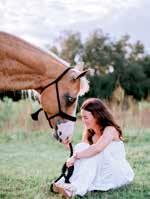
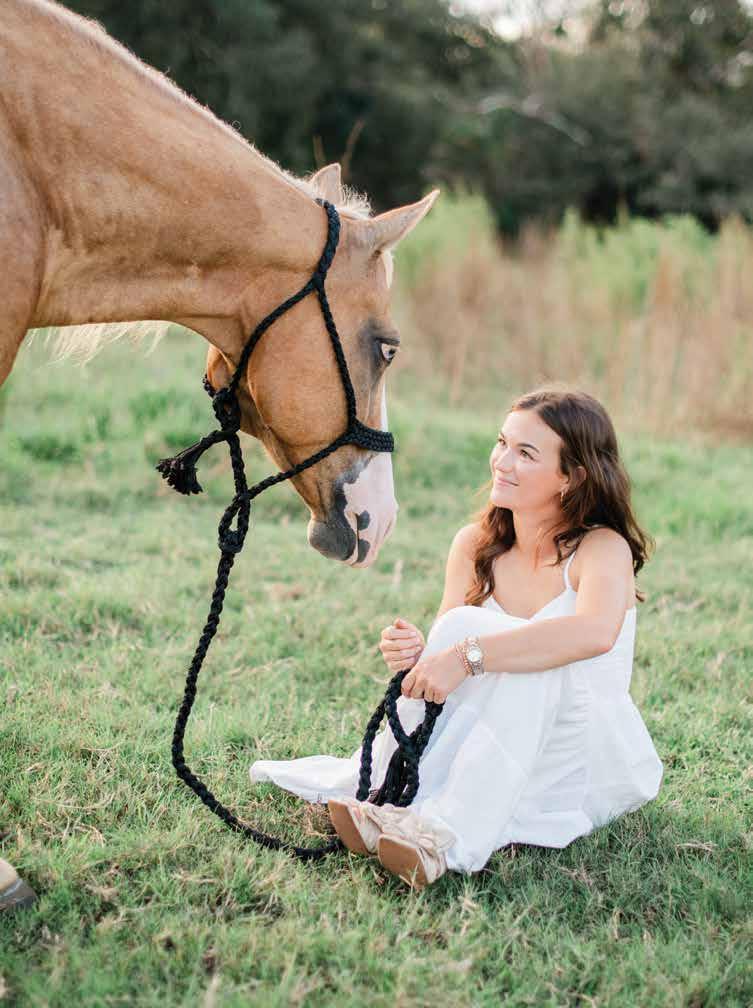
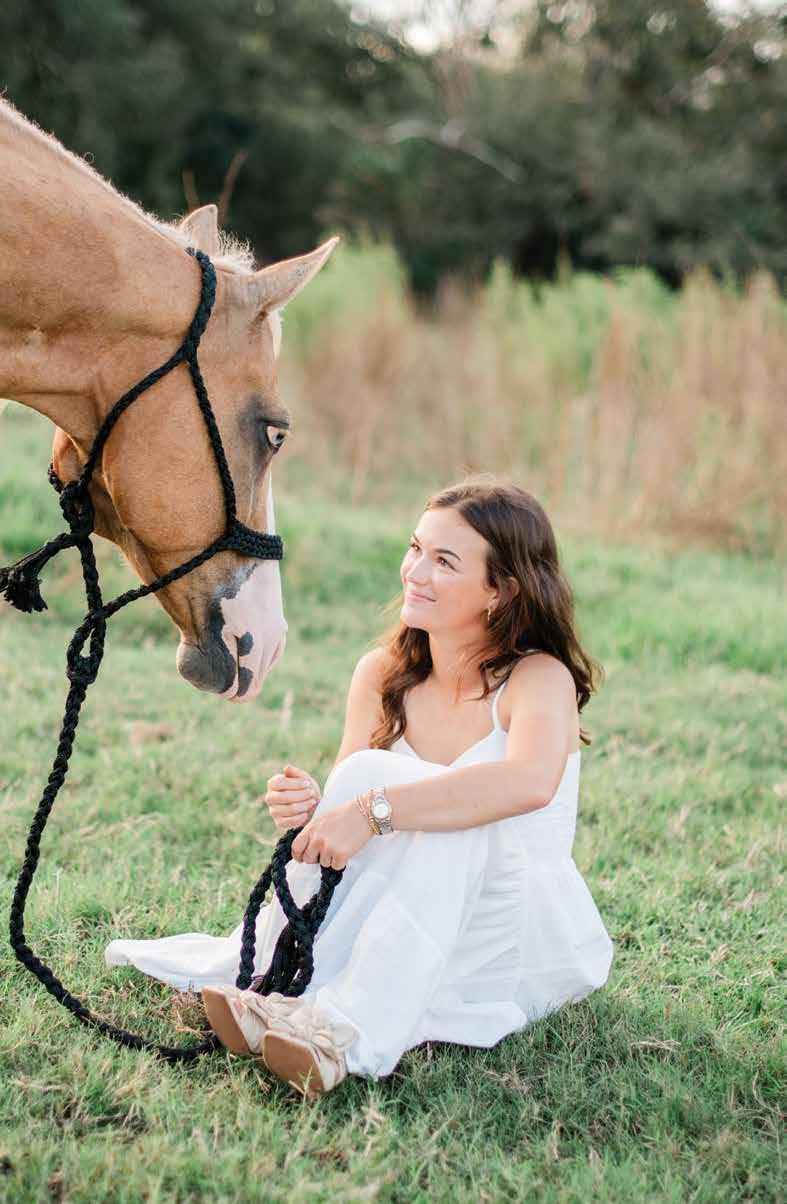
You understand it the moment you see Caylee with her horses—quiet, respectful, fully present. That partnership is where reining truly begins. ▶
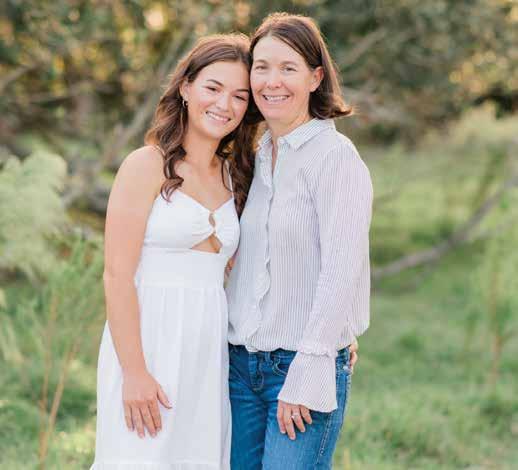
Caylee and her mom Laurie
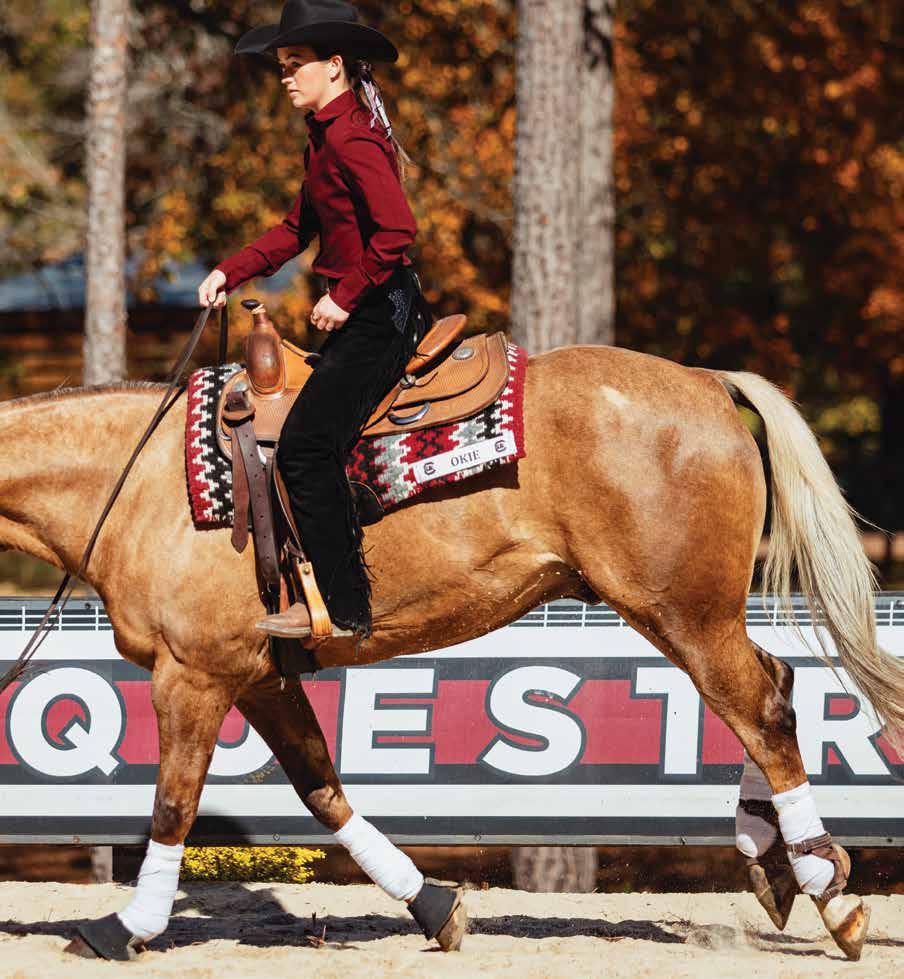
Often called “Western dressage,” reining demands precision and partnership. Horse and rider perform a set pattern that includes fast and slow circles, spins, rollbacks, lead changes, and the sport’s signature maneuver—the sliding stop—where a horse runs hard and then drops into a long, controlled glide, dirt flying.
The best runs look effortless. The horse appears willing, calm, and responsive. Creating that illusion is one of the hardest skills in the sport.
“It’s tougher than people think,” Caylee says. “And I always want to grow—no matter how good a run feels.”
Like elite athletes in any sport, she studies video immediately after each run, dissecting details with her trainers. She’s learned to stay steady through highs and lows.
“They taught me humility when you do good and humility when you do bad,” she says. “You keep it in the middle.”
Her father, Carey Howerton, has watched that discipline translate into results.
“Caylee moved from Green to Rookie to Non-Pro in just three years—a path that typically takes five,” Carey said. “Her lifetime non-pro earnings already top $26,000, and she now competes in events like the one in Oklahoma this year that is drawing more than 600 non-pro riders, and 1,200 all together.”
Top pro reiner Andrea Fappani just topped $10 million in lifetime earnings after twodecades. Caylee is just getting started. ▶
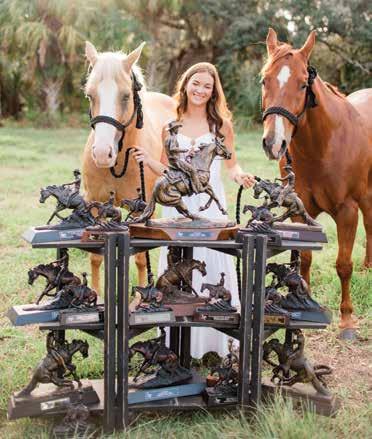

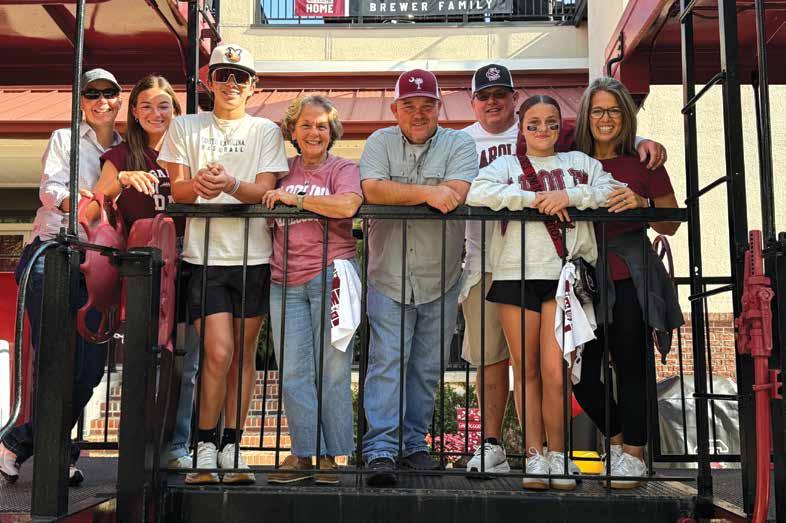
(L-R): Laurie Howerton, Caylee Howerton, Carter Gose, Donna Howerton, Carey Howerton, Matt Gose, Cooper Gose and Christi Gose
Caylee’s story is deeply rooted in family. Her mother, Laurie, grew up riding reining horses and introduced her daughter to the world naturally—but never with pressure.
“I told her, ‘You can pick and do whatever you want to do,’” Laurie recalls. “I didn’t want her doing it just because I did. It’s a tough sport. If you don’t love it, you’re not going to succeed.”
Caylee didn’t just love it. She committed to it.
That commitment showed up in sacrifices that most teenagers would not choose.
“I missed a lot of high school stuff,” Caylee admits. “After school I’d drive two and a half hours to ride before sunset, then drive back home.”
All for a ride that might last less than an hour. The focus and dedication of an elite athlete. Donna understands it instinctively.
“There was a moment when I realized she had something special,” Donna says. “It wasn’t just a kid riding horses anymore.”
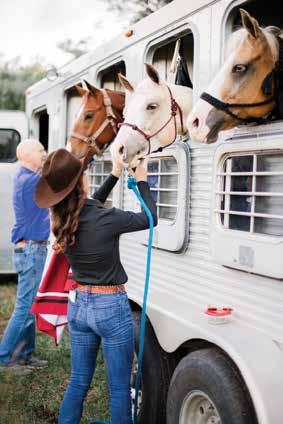
Though reining looks like a solo performance, Caylee is quick to say no one succeeds alone.
Her longtime trainers, George and Lisa Aldridge of Aldridge Performance Horses in Webster, Florida, trained her mother years earlier—long before Caylee was born. Their relationship feels less like business and more like family tradition.
“She’s a force in the show pen,” George, a veteran horseman says. “I wouldn’t want to have to show against her.”
But what stuck with Caylee wasn’t just technique. “George would always say, ‘You can be a hero one day or zero the next,’” Caylee says. “You can’t get too high or too low.”
That mental discipline is often what separates good riders from champions. “They were like extra grandparents,” Caylee says. “I was blessed.”
“It takes a team,” Donna adds simply. ▶
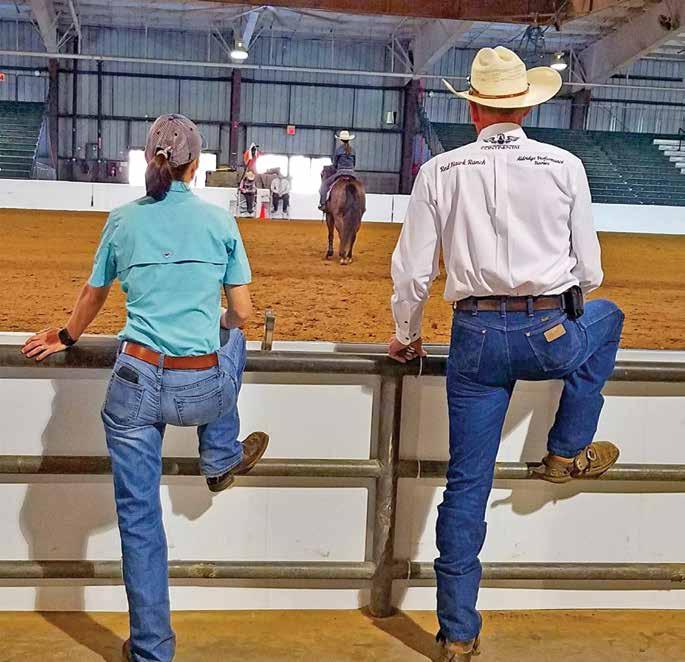
Laurie Howerton and George Aldridge
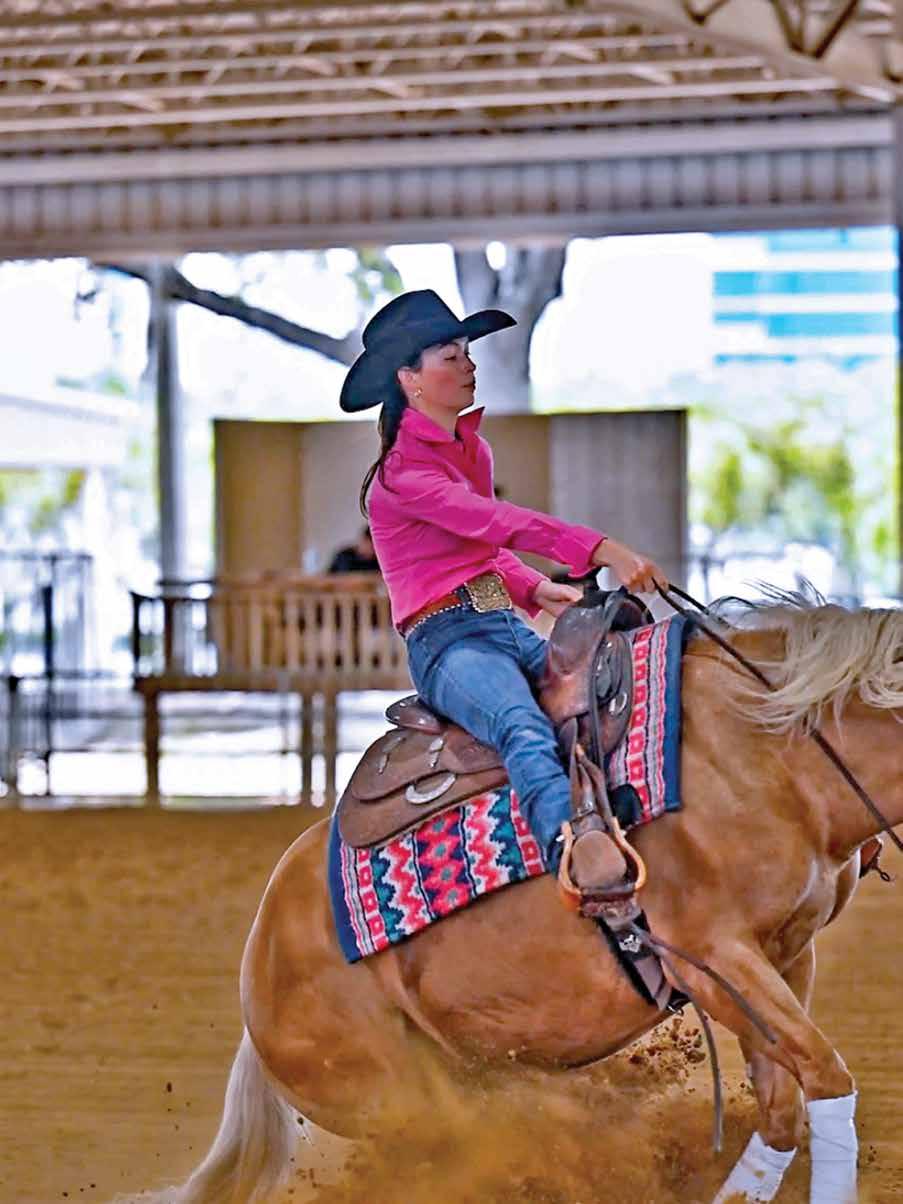
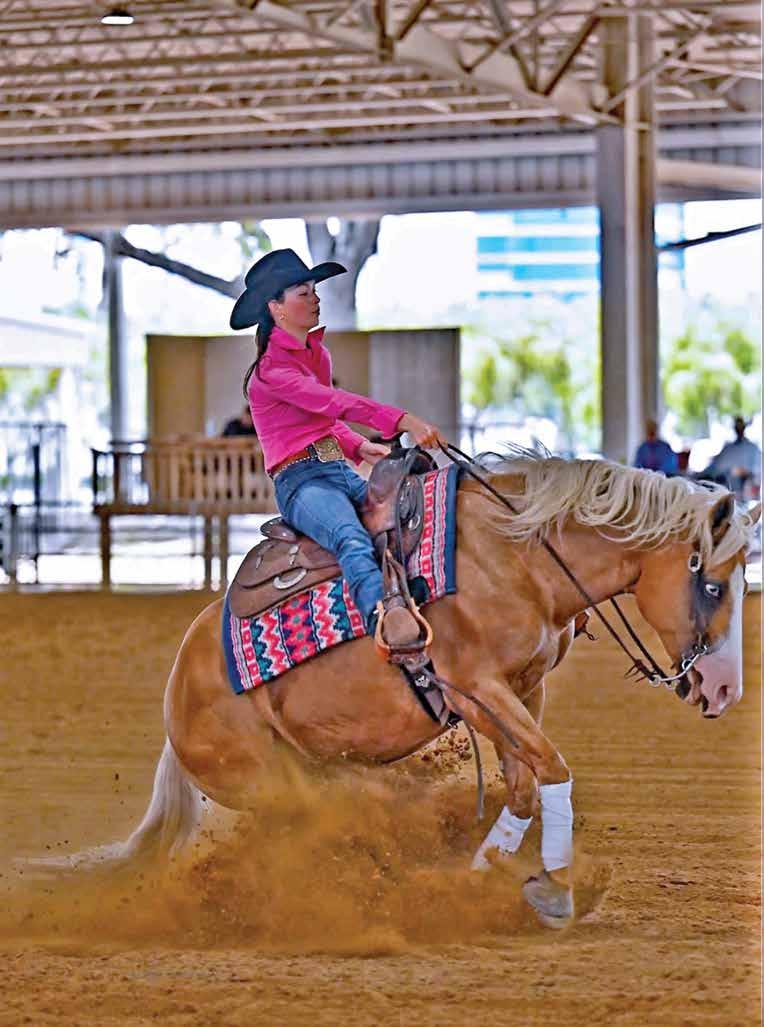
Caylee with Dolly
In reining, pros talk about horsepower—big stops, quick feet, athletic strength to carry speed and balance. But Caylee’s success runs deeper than that.
Donna’s favorite moment isn’t a championship announcement or score. It’s what happens at the end of a run. “She never forgets to thank her horse,” Donna says. “A gentle pat and a hug.”
That small gesture says everything with gratitude, tenderness, and respect.
Caylee doesn’t describe her success as something she took with her horse—she says it’s what they built together.
Her first horse was Louie, an 18-year-old who taught her all the reining moves. Then came Dolly, the horse who pushed her to the next level. “She was difficult in some ways,” Caylee says. “I had to work hard to bring out her talent. She taught me a lot.”
Three years ago, Dolly gave birth to a colt—Bubba.
“We raised him until he was two,” Caylee says. “I got to break him, then we sent him to my trainers.”
She’s riding Bubba in competitions now. Even as her skills grew, Caylee never lost the sense that the horse is doing this with her—not for her.


Though only one rider enters the arena, Caylee sees the full picture: early mornings, long hauls, family sacrifices, quiet encouragement.
“It makes me feel grateful,” she says. “Sometimes it almost feels too good to be true.”
Lisa Aldridge sees Caylee’s composure as a defining strength.
“You can make a mistake and still win,” Lisa explains. “Some riders fall apart. Caylee rides through it.”
That steadiness matters in a sport where nerves can unravel even the best runs. ▶



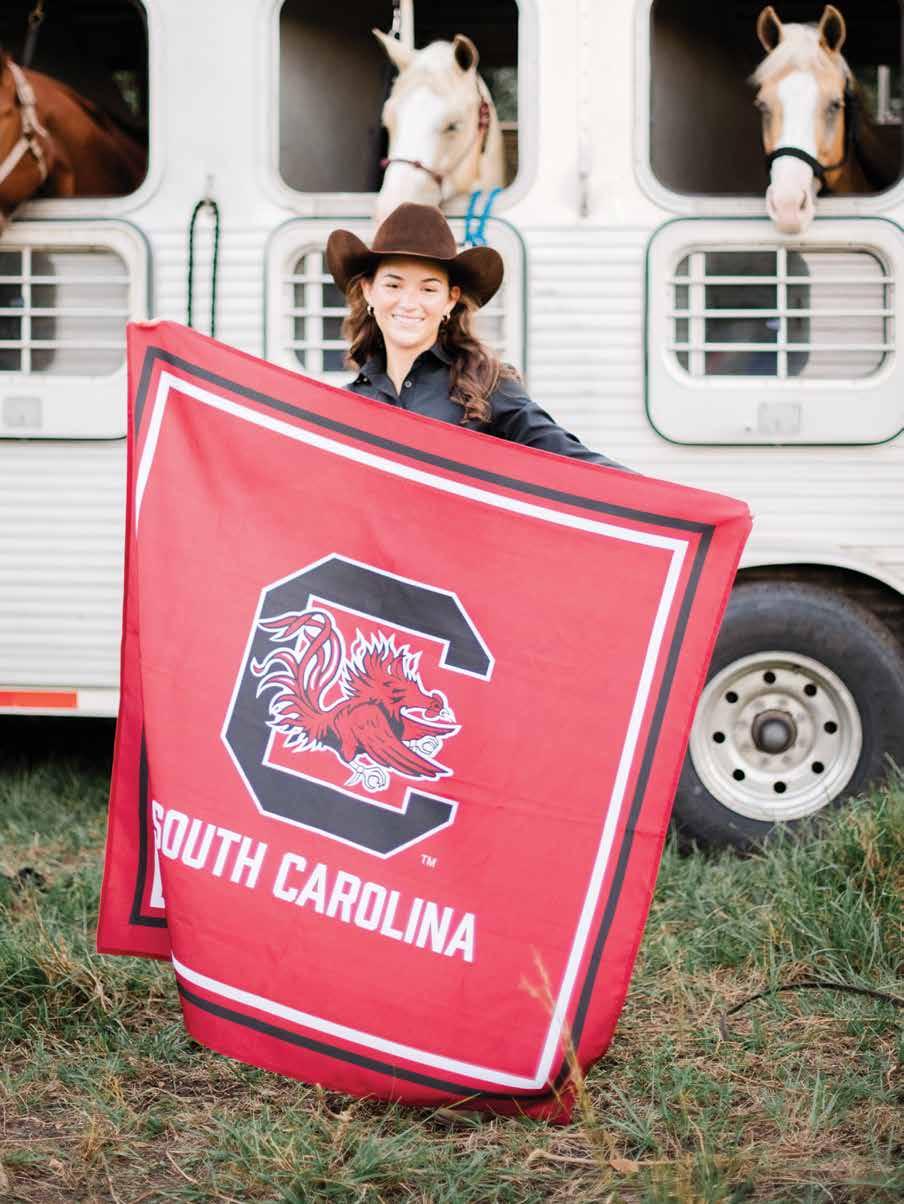
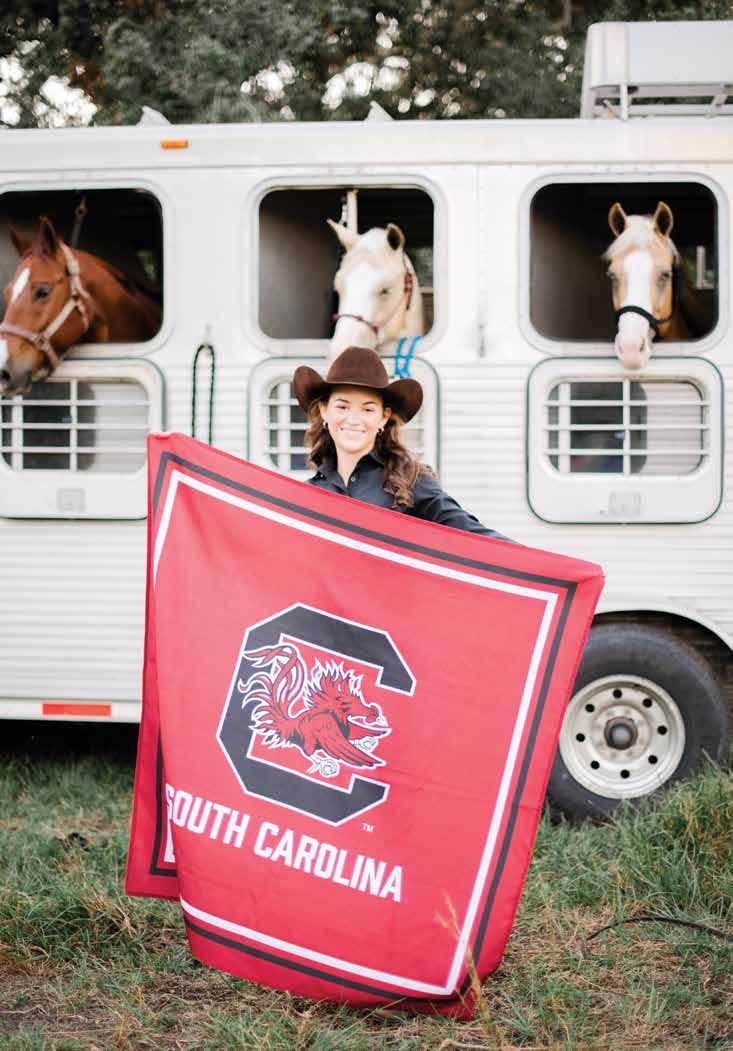
Caylee has earned a scholarship to the University of South Carolina, competing on its Division I equestrian team while studying risk management and insurance. One day, she hopes to own an agency specializing in equine insurance—a practical dream tied to the world she knows best.
Her family is proud—but not just because of what she’s won.
“She’s been blessed,” Donna says. “And she’s earned it.”
Caylee remains grounded, still thinking like a barn kid with work to do. Championships don’t last forever. You keep showing up. You keep earning your place.
And tomorrow, she will.
Because Caylee Howerton may be a champion in the arena—but her real superpower is the grit to work before winning, the grace to stay humble, and the heart to never forget who carried her there.
LIVING
WINDOWS
EXTERIORS REPAIRS



I get to the barn, and I have to feed, then clean the stall, and I do everything like bam, bam, bam. Get ’er done.














QUALITY SERVICES:
Joint Replacement
Quadriceps Sparing Computer Navigated Minimally Invasive
Knee Replacement
Bikini Anterior Total Hip Replacement
Partial Knee Replacement
Hand, Wrist, Elbows & Shoulder
Foot & Ankle




Sports Medicine
Interventional Spine
Regenerative Medicine (PRP)
Spine Cord Stimulator
Radiofrequency Ablation (RFA)
Epidural Cortisone Injection (ESI)
Laser Therapy
Digital X-rays

Rapid Pain Relief
Reduced Inflammation
Enhanced Tissue Healing
Non-Invasive and Drug-Free Solutions


FLORIDA MANATEES
By Rebecca Maglischo

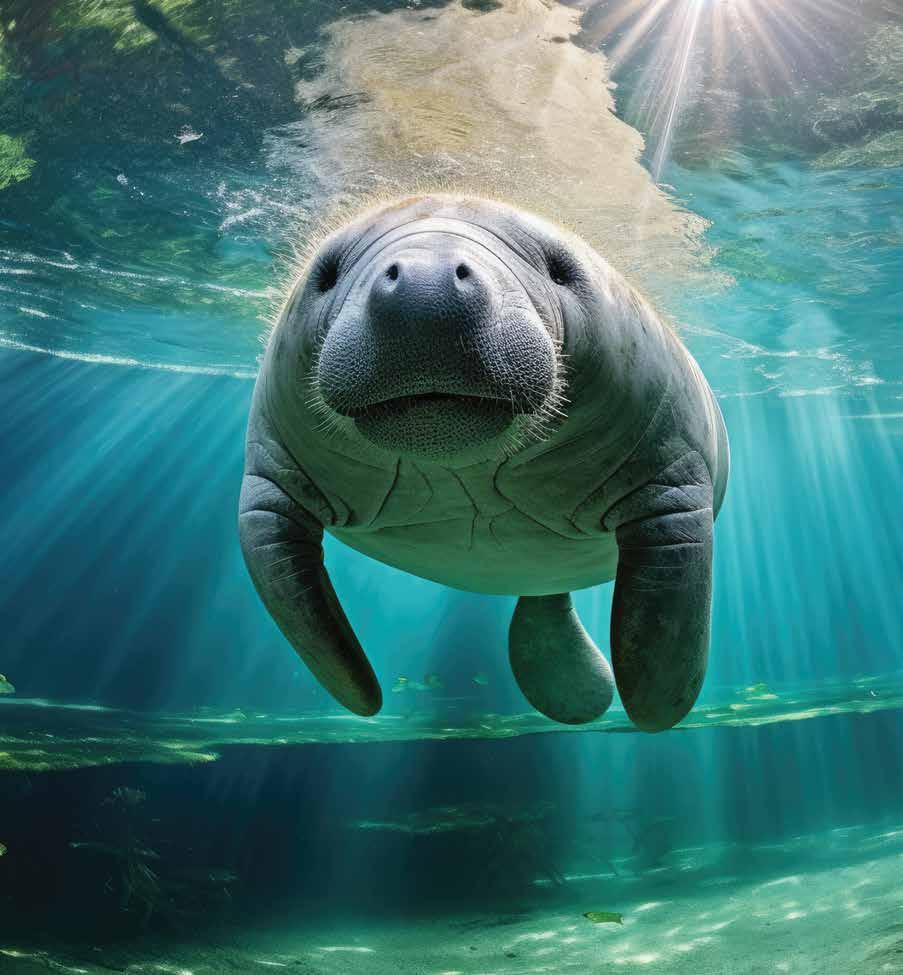
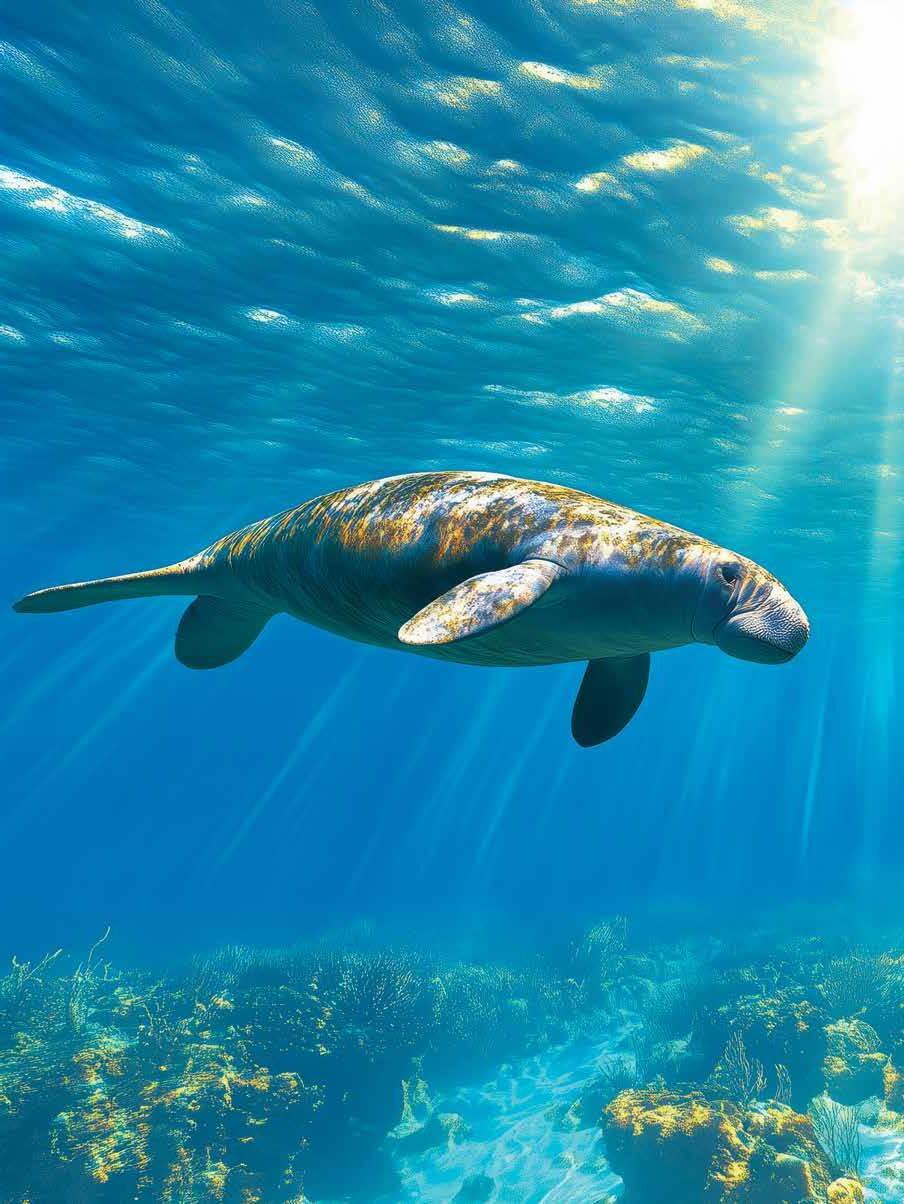
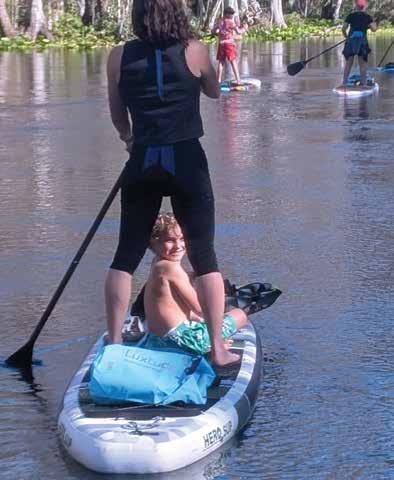
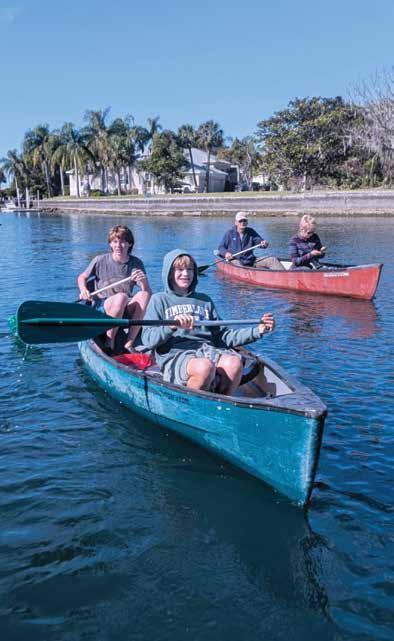
Every winter, my family makes the trek to the Gulf Coast for our annual paddle with the manatees. I have been fascinated with the giant, whiskerfaced sea mammals since I was a little girl running the Kids Saving Earth Club at my elementary school in the late ‘80s and early ‘90s. My family had rented a condo on Pine Island, and a resident manatee visited us every day for a cool drink of water straight from the water hose, which my brother and I delightfully provided. I marveled that such a huge creature could be so gentle, and we giggled as he played in hose water doing acrobatic tumbles. This is a core memory of my childhood, and our annual trip is a personal mission to connect my own children to the beauty and wonder of a natural Florida I fear will soon disappear. ▶
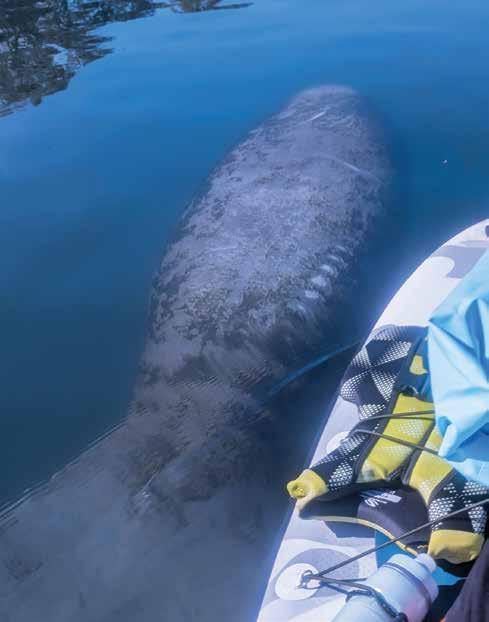
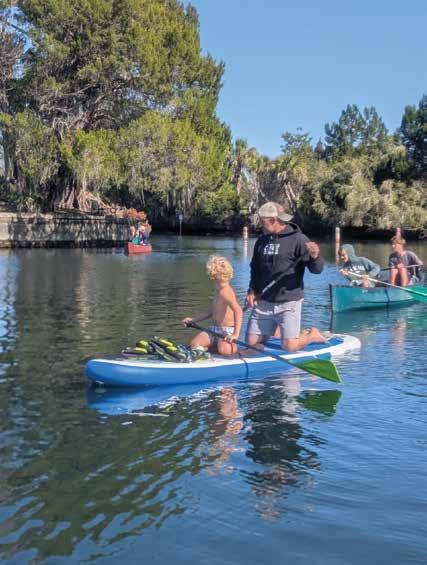

undreds of years ago, sailors often spotted manatees floating on the ocean surface. While none of these sea-faring men would have heard of a “manatee” or “dugong,” tales of mermaids, sirens, sea witches and other mythical creatures decorated the oral tradition of story-telling. In 1493, Christopher Columbus noted in a journal.
“Yesterday, when I was going to the Rio del Oro, I saw three sirens that came up very high out of the sea. They were not as beautiful as they are painted since, in some ways, they have a face like a man.” Anyone who has been close to a manatee would likely find it laughable that they might be mistaken for a beautiful fish woman, but I suppose a bottle of rum and a fortnight on a boat would certainly have an impact…
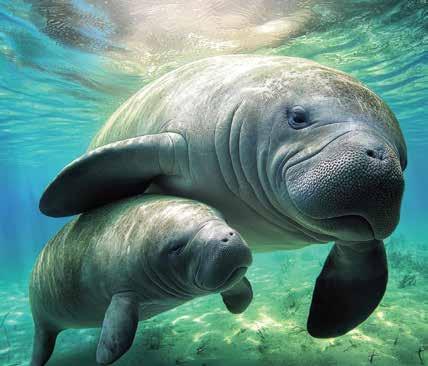
There are four species in the order Sirenea, a word that is derived from the Greek word for sirens. Three species of manatee can be found around the Atlantic Ocean, and the fourth species, the dugong, is an Indo-Pacific variety. The West Indian manatee's range is from the southern United States throughout the Caribbean Islands, Central America, to northern South America. In the United States, the Florida manatee, a sub-species of the West Indian manatee, inhabits the state’s coastal waters, rivers and springs. Some Florida manatee are known to travel up the eastern coastline into Georgia, the Carolinas, and a few travel as far north as Massachusetts during warm months. In the Gulf, Florida manatees can be found west through coastal Louisiana and are occasionally sighted as far west as Texas. ▶
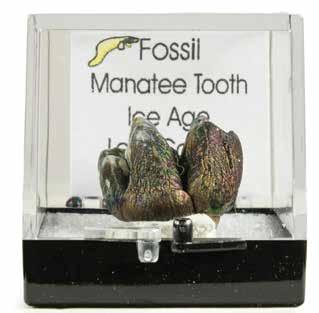
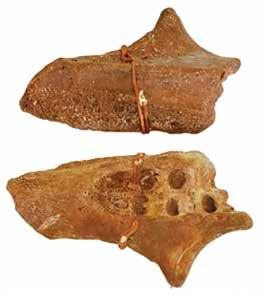
Manatee fossils from the Ice Age
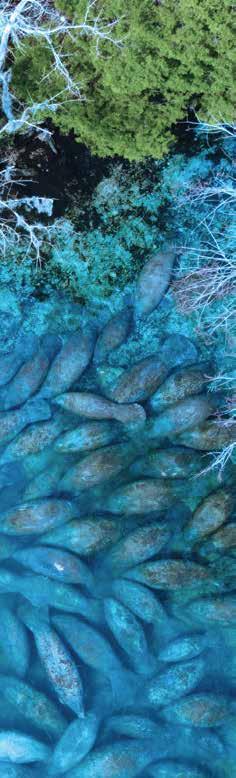
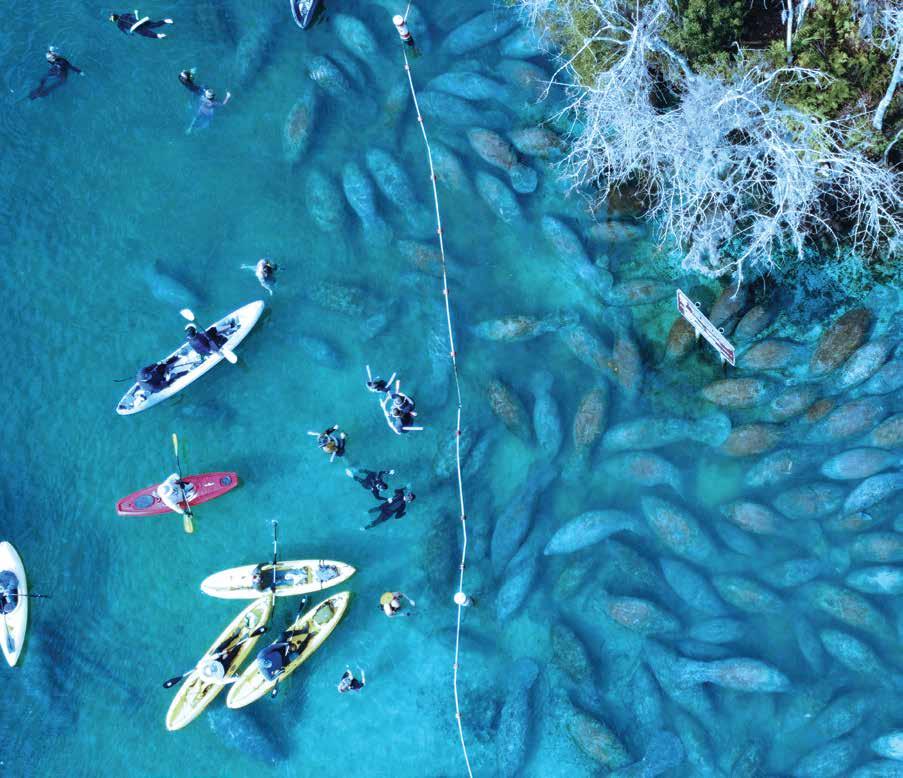
hile today hundreds of manatees gather in the warm waters of Florida’s springs every winter, scientists believe that, like many human residents, Florida’s State Marine Mammal started as a tourist! Researchers believe that prior to the 1800s, manatees likely lived year-round in Cuba and other Caribbean locales. Occasionally, the large sea mammals might venture north but would always return back to the warmer southern waters. The first reliable written narratives of manatees in Florida date to the period of British rule in the late 1700s, but, even then, sightings were rare. At the end of The Little Ice Age (in the mid-1800s), Florida began heating up, and manatees began to stick around.
Early 20th century entrepreneur, Alligator Joe, opened the Florida Alligator Farm in 1900 and put manatees on display as exotic specimens for spectators to observe. In the 1920s and 1930s, the newspapers began writing of routine sightings in Miami and St. Augustine, and by the mid-1950s there were reports that manatees were “becoming more plentiful” in Tampa Bay, and a few were said to have become permanent residents of Crystal River. While actual numbers were never documented, this was likely the peak of manatee populations in Florida but the slow, gentle creatures faced many dangers with few defenses. In poverty-stricken areas of coastal and southern Florida, manatees were used for food, some were captured and featured in exhibitions and many had fatal interactions with the ever-increasing traffic within the waterways. A group of 1960s scientists attempted to employ a herd of “sea cows” to solve Florida’s aquatic weed problems, and even as late as 1966, a St Petersburg Times article called them “huge, awkward, ugly vegetarian sea mammals.” ▶
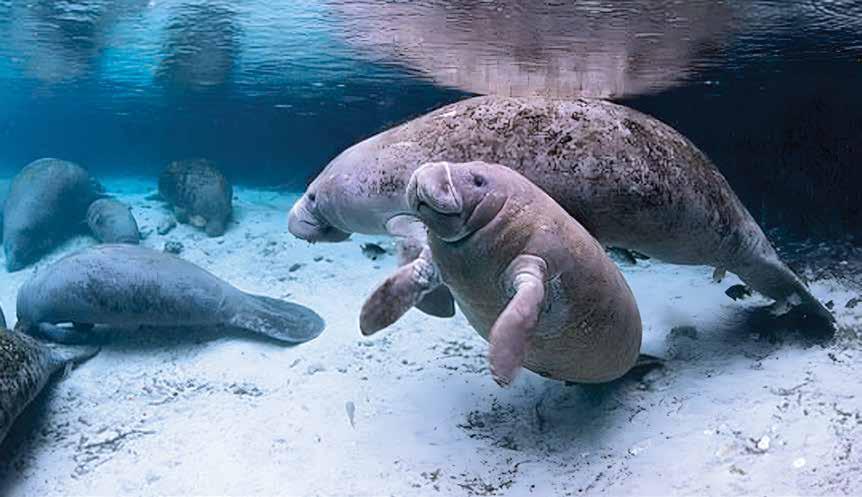
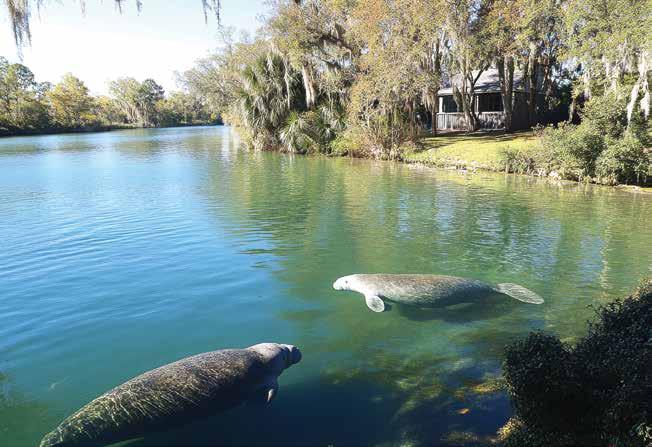
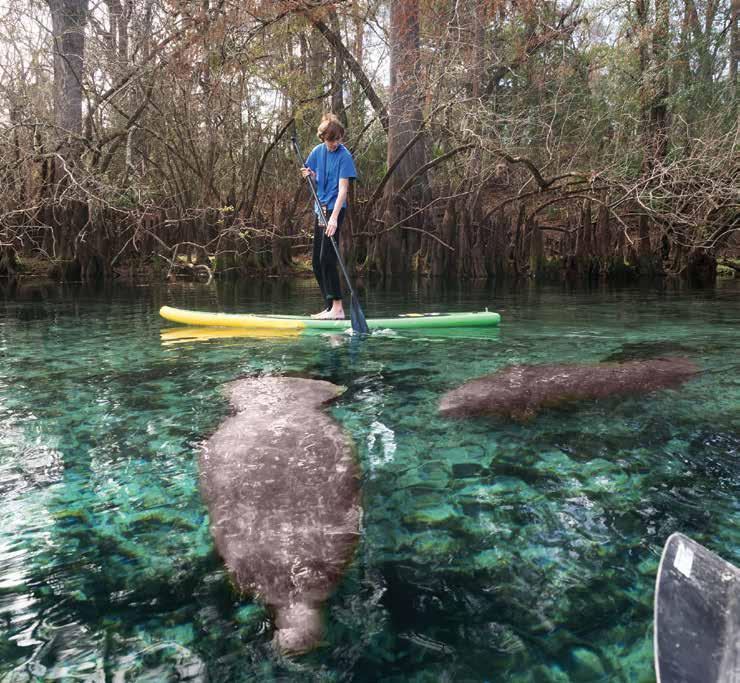
nvironmental activism began to take hold as the 60s ended and just in the nick of time to save the manatees, whose documented population dipped below 1,000 individuals in 1973. In order to combat this, the federal Marine Mammal Protection Act of 1972 and the Endangered Species Act of 1973 were put into place to help protect these gentle giants. Florida residents began to fall in love with their chubby sea neighbors, and with education and awareness campaigns, manatee numbers stabilized. Overall improvements in numbers and habitat helped the manatee move from an endangered status to a downgraded threatened status in 2017. But the manatee may once again be on the endangered list very soon. In the past three years, over 2,500 manatees have died in Florida, mainly due to lack of food. The manatee’s main source of diet, seagrass, has experienced extreme loss due to pollution, algae blooms and other issues.
A day on the water with manatees is a zen-like experience and an opportunity to be filled with amazement. Florida is a place like nowhere else in the world. Our pristine waterways and their unique residents have a tumultuous story to tell, a story of adventure, a story of trauma, a story of recovery, a story of relationship and redemption. It’s a story much like my own, and probably yours too. The manatee has been a part of that story and hopefully will continue to be for a long long time.
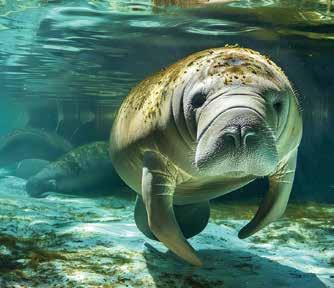




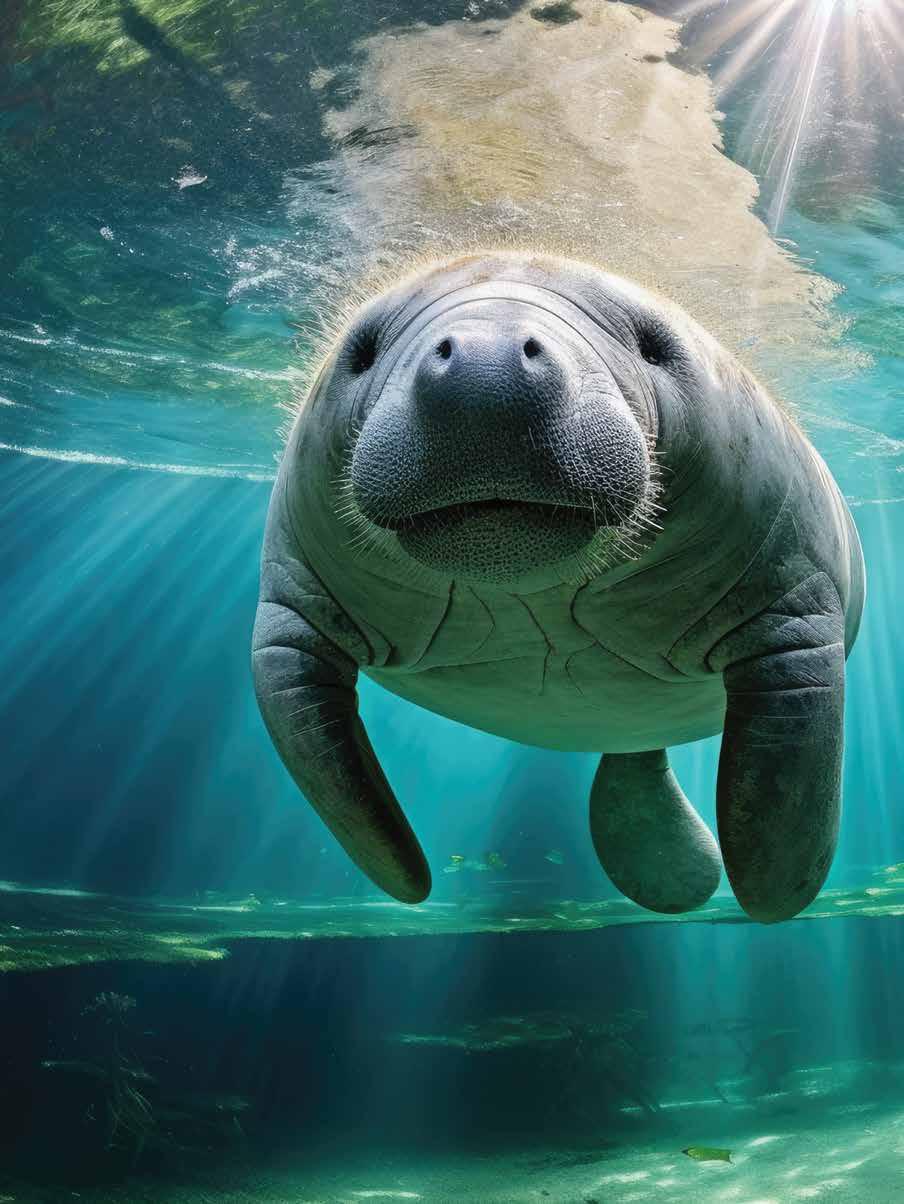
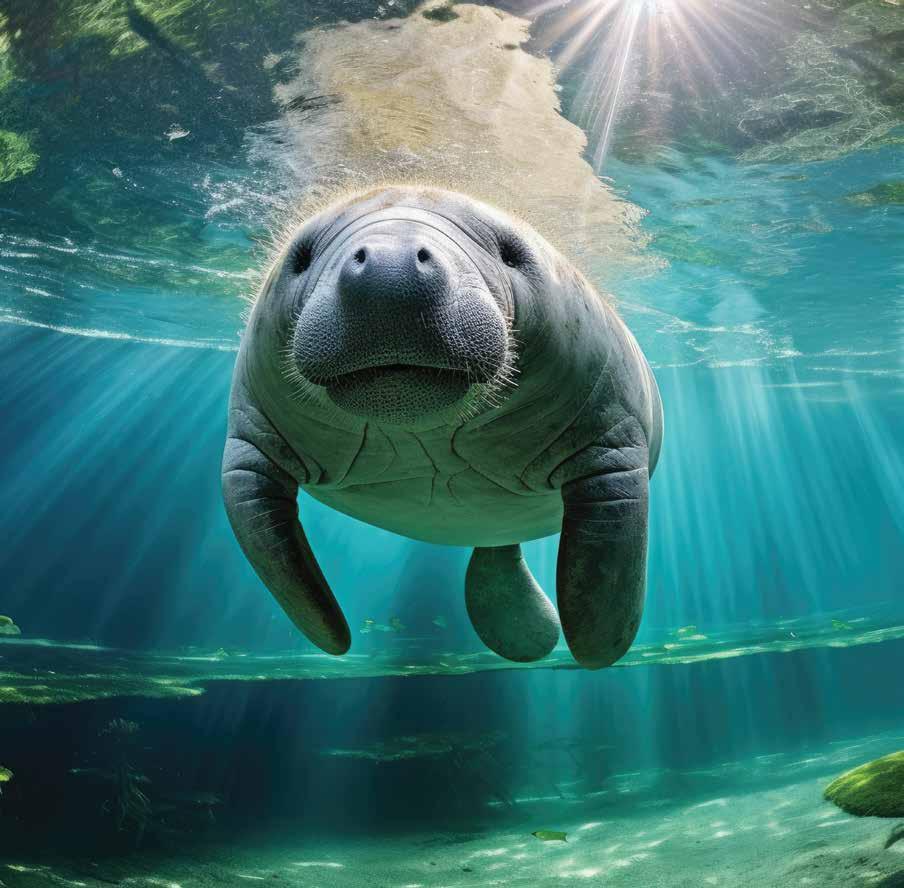



A day on the water with manatees is a zen-like experience and an opportunity to be filled with amazement.
-Rebecca Maglischo




Heartland Who Compete Without Limits
By Kevin Welborn
Photography by Sam Foster
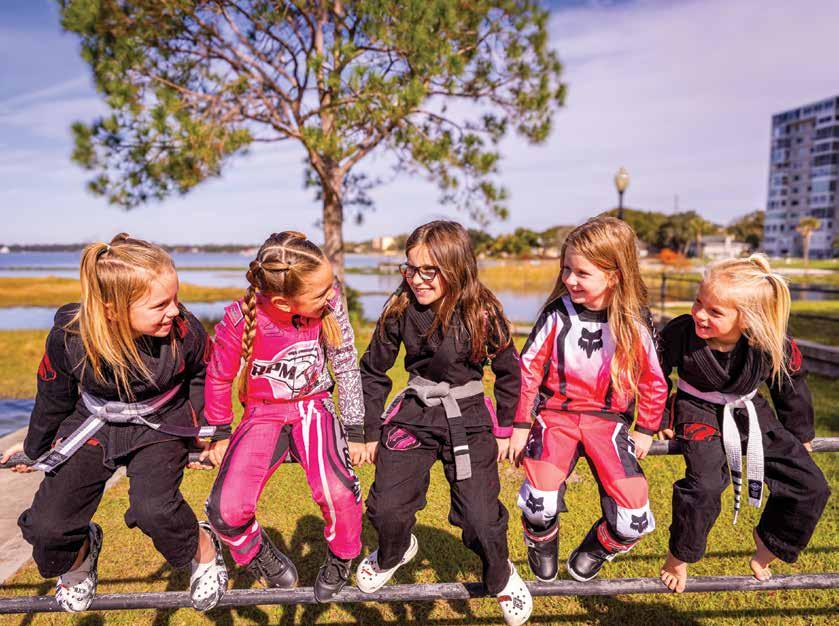
ey came together from across the Heartland of Florida. From Sebring, Lake Placid, Arcadia and the small towns in between. To the naked eye, they look like any other group of young girls: smiling, well-mannered, full of life. You might assume their conversations revolve around dolls, nail polish or favorite colors.▶
BUT LISTEN A LITTLE CLOSER.
These talk about bruises earned on martial arts mats. About road rash and highspeed crashes. About rope burns from leaping off horses to tie goats. About wipeouts so violent the water itself can leave you with whiplash. Their laughter is paired with stories of grit, fear, adrenaline and the hunger to compete again tomorrow.
What binds them together is a shared love for adrenaline-fueled sports—and the understanding that in these arenas, girls are often underestimated. Many have been discounted because of their size, their age or their gender. Instead of letting that isolate them, they found strength in one another. Every hard-earned victory became communal. Every step forward felt bigger when shared.
MAKING WAVES: FEARLESSNESS BEHIND THE BOAT
On the water in Lake Placid, assumptions dissolve quickly.
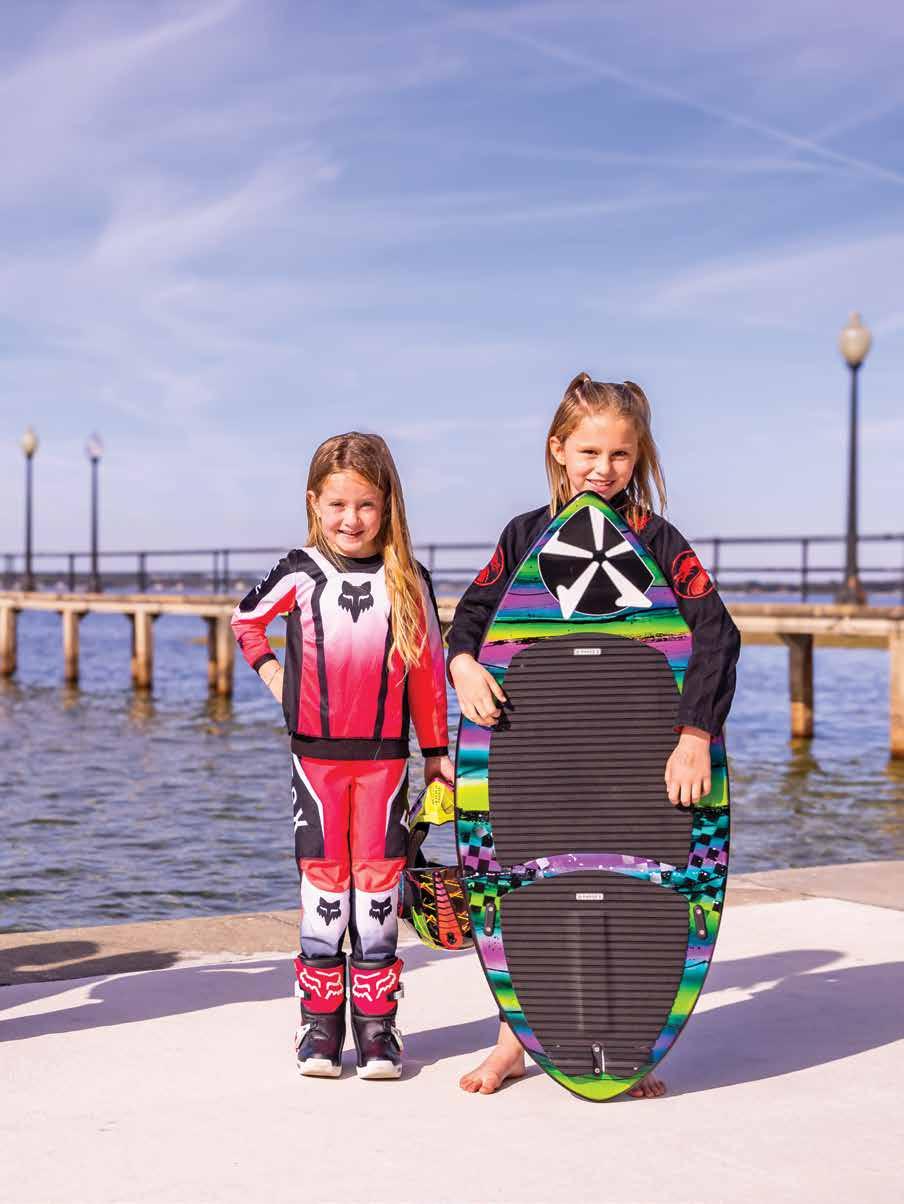
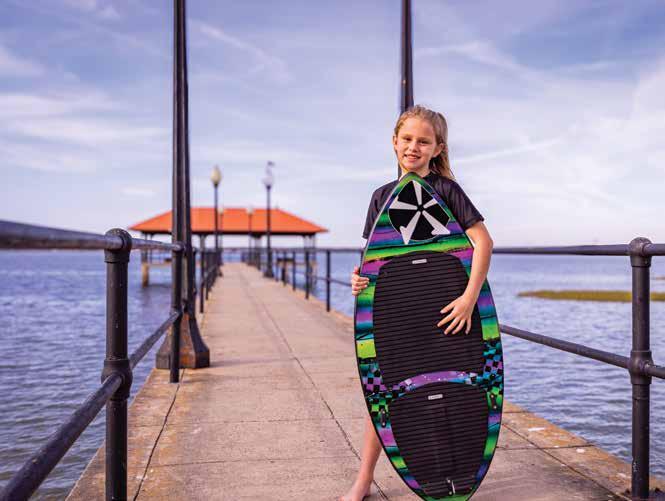
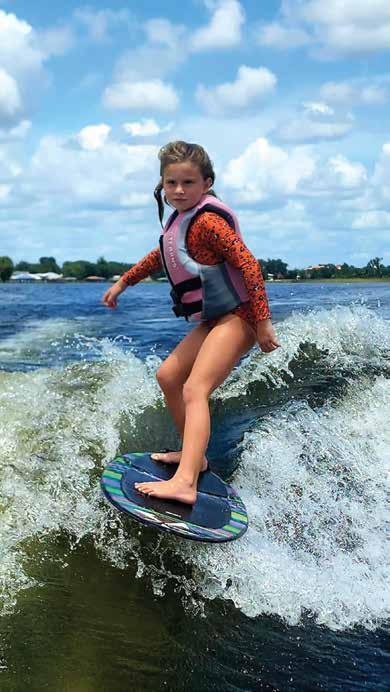
Reese Smiling, 9, has been surrounded by water sports since she was two and a half years old. What began with kneeboarding and tubing evolved into wakeboarding by age four, and wakesurfing by five. Balance, speed, and commitment came early—but fear never took hold.
Reese was inspired by watching local wakesurfing professional Jodi Grassman, whose presence on the water showed her that strength and grace could coexist at high speed. Grassman, who offers private lessons for adults and children, became proof that girls can carve their own path in adrenaline sports. (She can be found on Instagram at @jodigrassman.)
Behind the boat, Reese isn’t thinking about expectations— she’s thinking about the next wave, the next adjustment, the next chance to improve. Every wipeout is a lesson. Every clean run is shared with pride. In a sport where fear can slow progress, Reese has learned that confidence grows fastest when you trust yourself—and when other girls are cheering you on. ▶
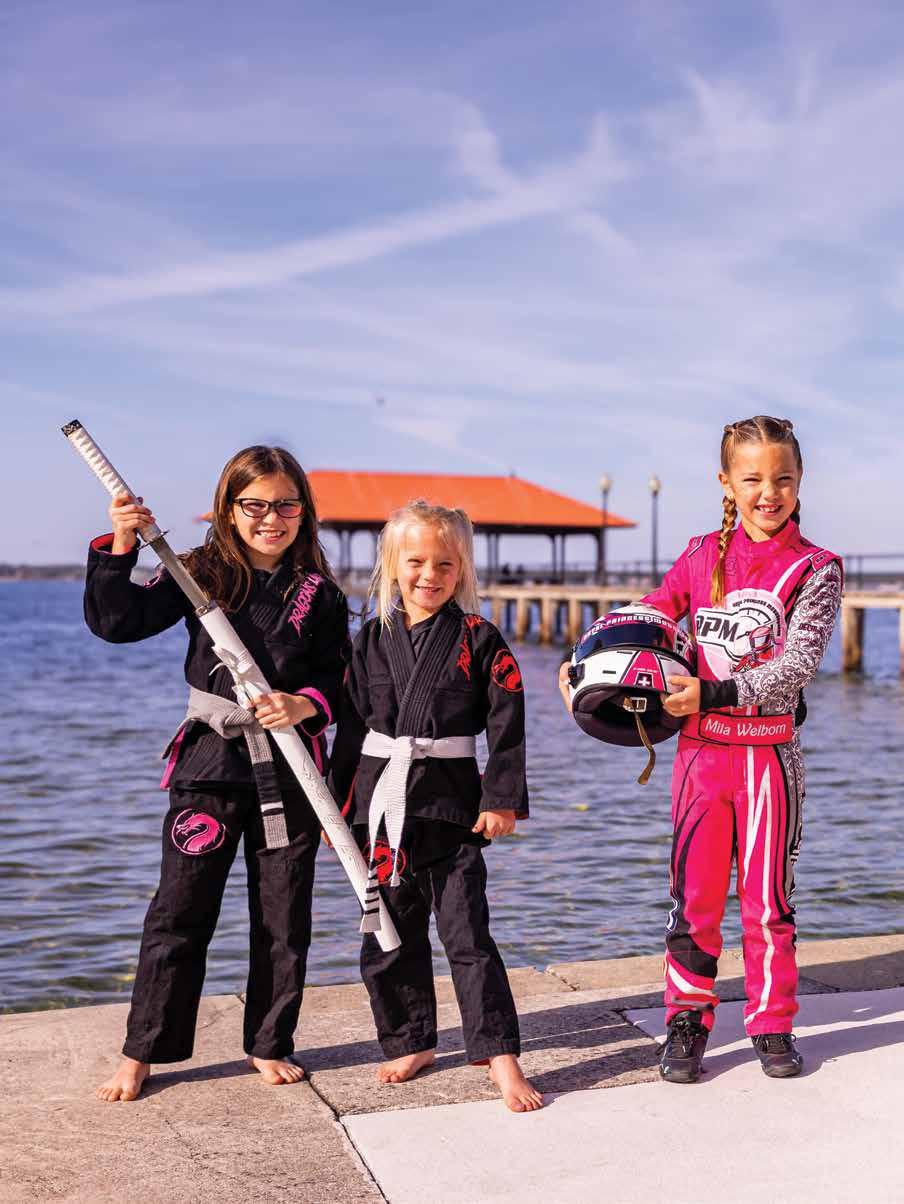
GROUND GAME QUEENS: GRIT FORGED ON THE MAT
On the mats of Sebring’s Dragon’s Lair, appearances are checked at the door. What matters is discipline, composure and heart.
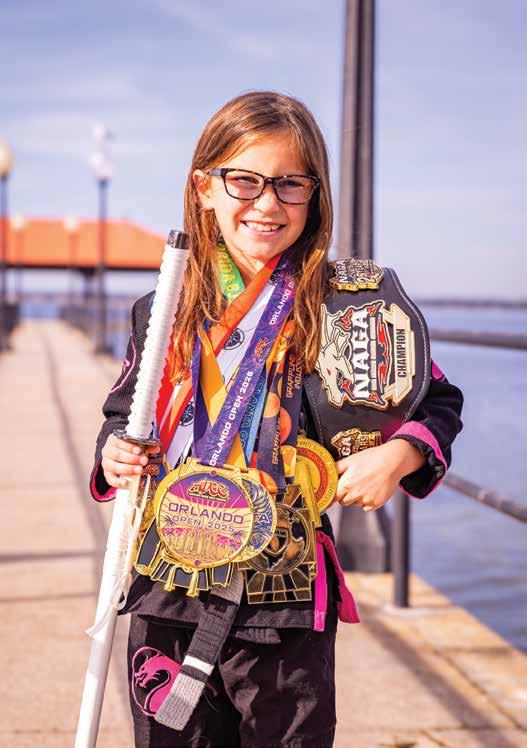
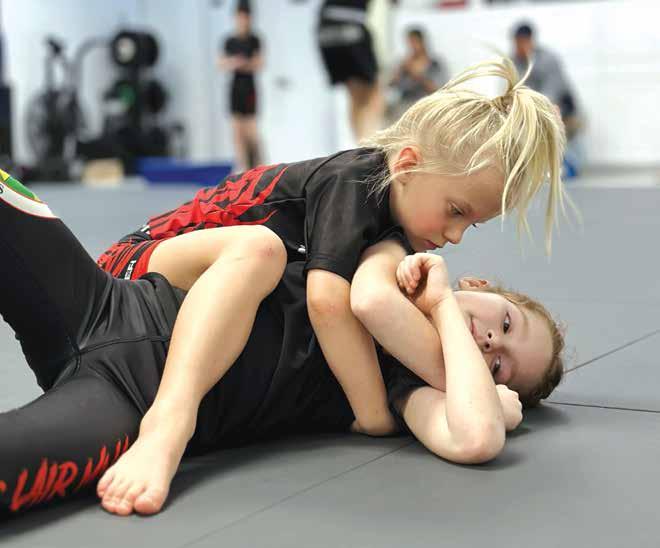
At just 8 years old, Audrey Albritton has already proven she belongs among the nation’s best in Brazilian Jiu-Jitsu. Ranked third nationally in her division, Audrey has tallied over 50 competition wins and earned multiple ADCC Open gold medals. In 2025, she was named Competitor of the Year at Dragon’s Lair, and she enters 2026 as a legitimate contender for the top spot.
Audrey knows what it’s like to be underestimated. When nerves creep in or doubt tries to surface, she slows everything down. She takes a breath, returns to the fundamentals, and listens closely for Master Hank Henry’s voice. Audrey trusts her training—and in a sport where calm often beats chaos, that trust makes her dangerous.
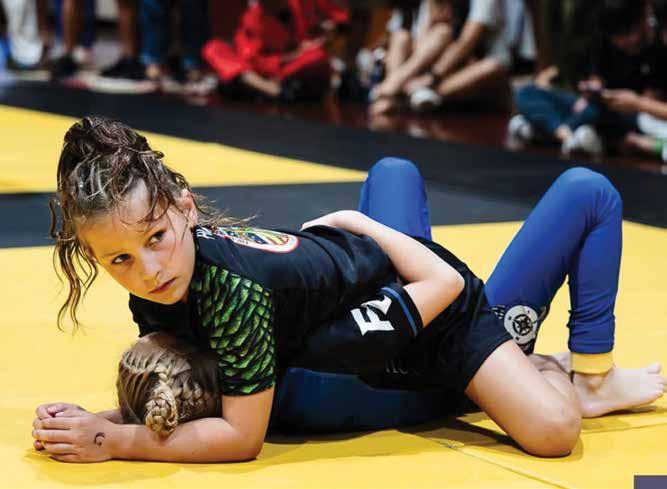
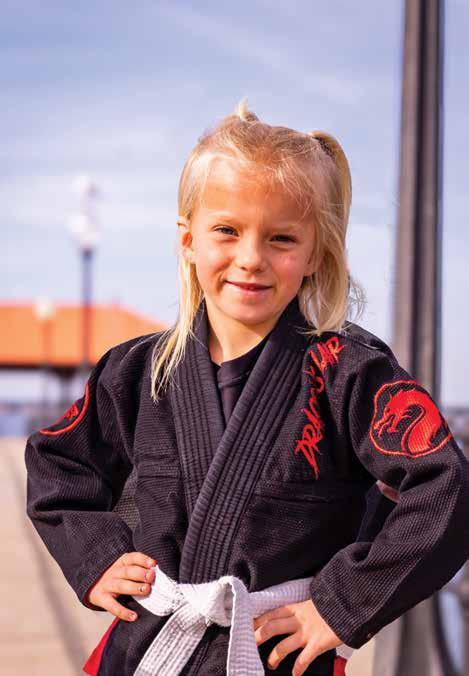
Training alongside her is Dylann Smiling, 6, whose path to Jiu-Jitsu began with a single online competition video. Though she had tried soccer, gymnastics and baseball, it was Brazilian Jiu-Jitsu that truly spoke to her.
When Dylann first stepped onto the mats, confidence didn’t come naturally. Over time, through structure, repetition and accountability, she transformed. Jiu-Jitsu didn’t just teach her how to defend herself—it taught her how to believe in herself. At Dragon’s Lair, these girls didn’t just learn how to compete; they learned that toughness can be quiet, focused and relentless.
Every win on the mat isn’t just theirs—it’s proof that girls belong there. ▶
FULL THROTTLE FUTURES: RACING BEYOND EXPECTATIONS
On the racetrack, speed erases assumptions.
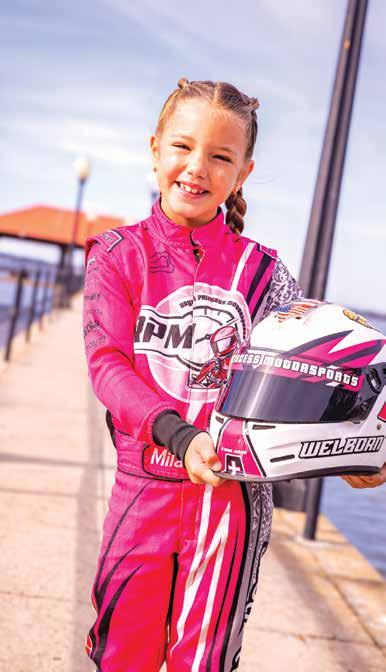
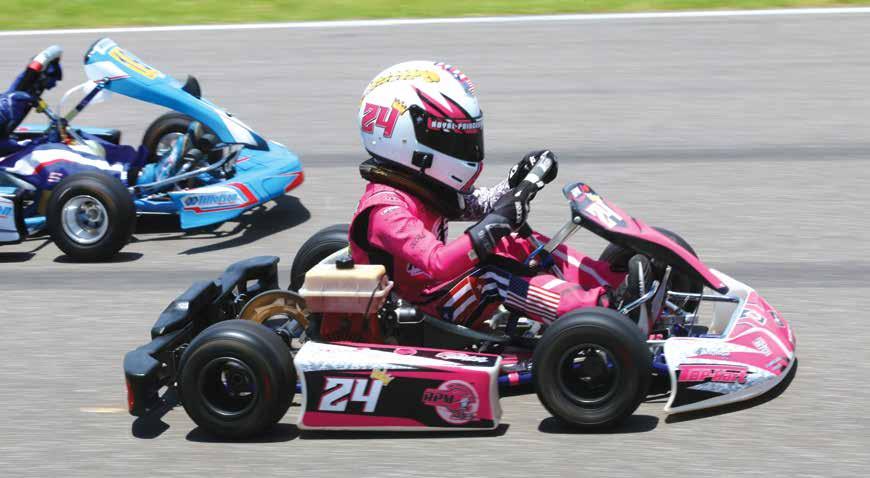
Mila Welborn is already making waves in competitive karting. During the week, she wears leotards and ballet shoes. On weekends, she straps into a kart and reaches speeds nearing 60 miles per hour.
Mila (at just 6 years old) races in a division built for 8–12-year-olds, often lining up against competitors nearly twice her age. Despite that, she finished fourth in championship points in the 2025 season. Rather than being discouraged by faster drivers, Mila seeks them out.
“I try to learn something from every person that passes me,” she says. “I follow their racing line and see what they do differently from me. I learn from their entries and exits in every corner.”
That mindset—humble, observant, fearless—has fueled rapid growth and made her progression one of the most exciting stories heading into 2026.
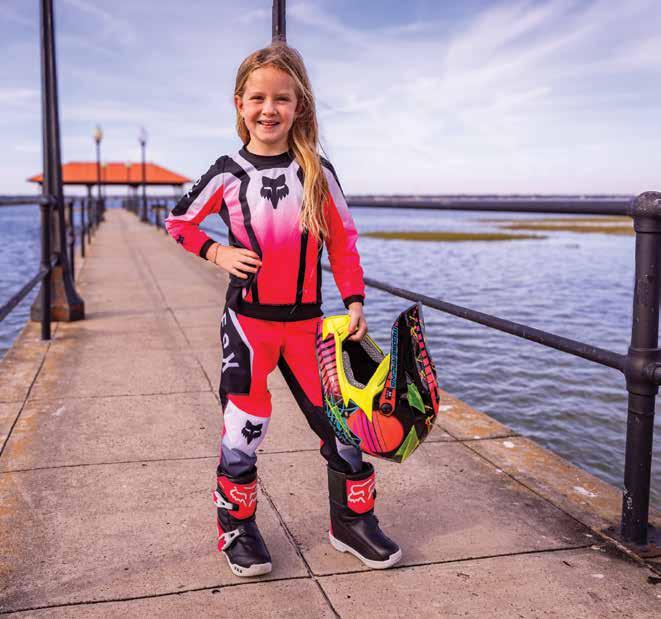

Sharing that same fire is Kate Bishop, an ATV racer from Sebring, who competes with the Florida Trail Riders. Kate doesn’t just ride trails—she races them. On a quad built for speed and endurance, she launches off the gate and attacks the course with precision, navigating sand, roots, tight turns and rapidly changing terrain at full race pace.
Quad racing demands total focus: throttle control, body positioning, stamina, and adaptability. Kate has learned to read the course lap by lap, adjusting her lines as conditions evolve and fatigue sets in. In a sport where girls are often outnumbered on the starting line, she has earned respect the hard way—by racing hard and refusing to back down.
That grit was on full display during one Florida Trail Riders race when Kate’s quad caught awkwardly in a rut and flipped—landing on top of her. In a moment that would have rattled even seasoned racers, Kate did the opposite of what most expected. She pushed the quad off, climbed right back on, and rejoined the race without hesitation, determined to finish what she started.
It’s moments like that that define her as a racer. Not fearless— but resilient. For Kate, every race is about perseverance, and every finish line crossed is another reminder that she belongs on the track, competing at full throttle. ▶

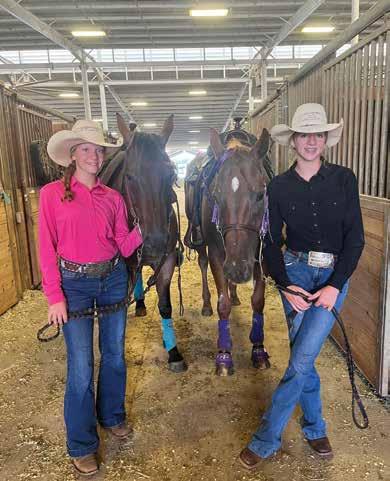
DUST, GRIT, AND GUTS: SISTERS OF THE RODEO ARENA
In the rodeo arenas of Central Florida, there’s no room for doubt.
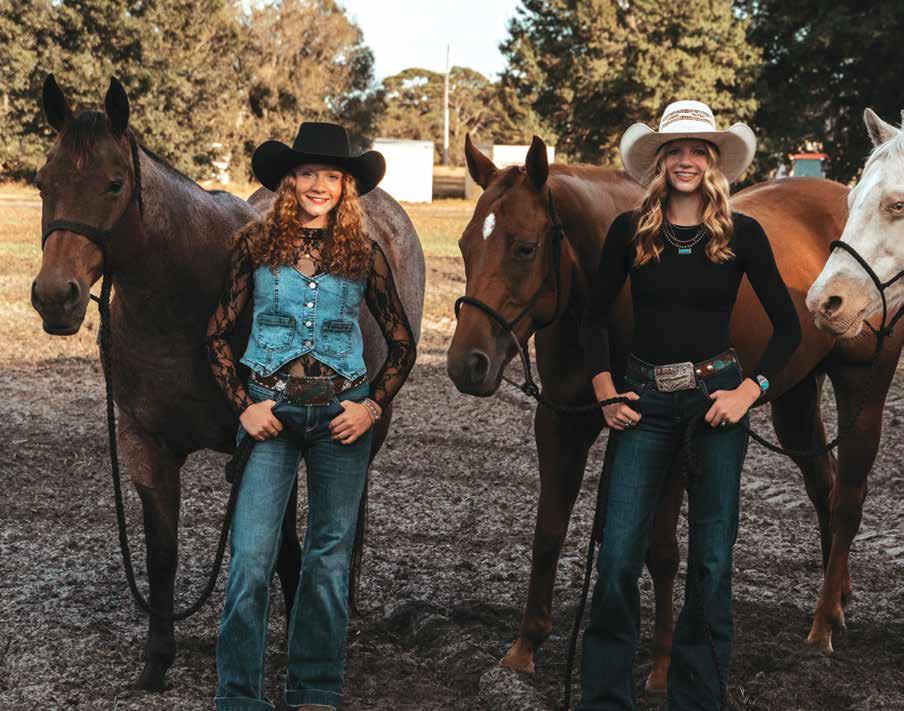
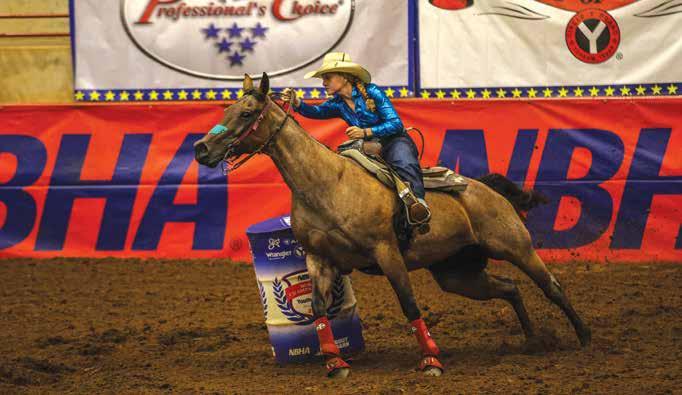
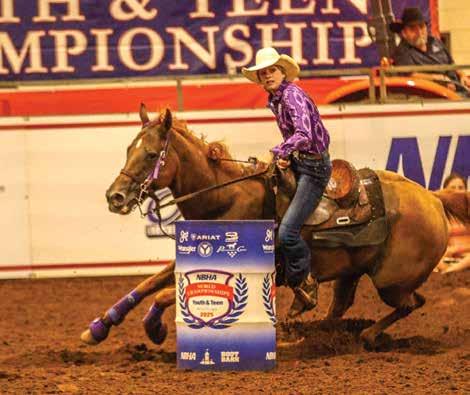
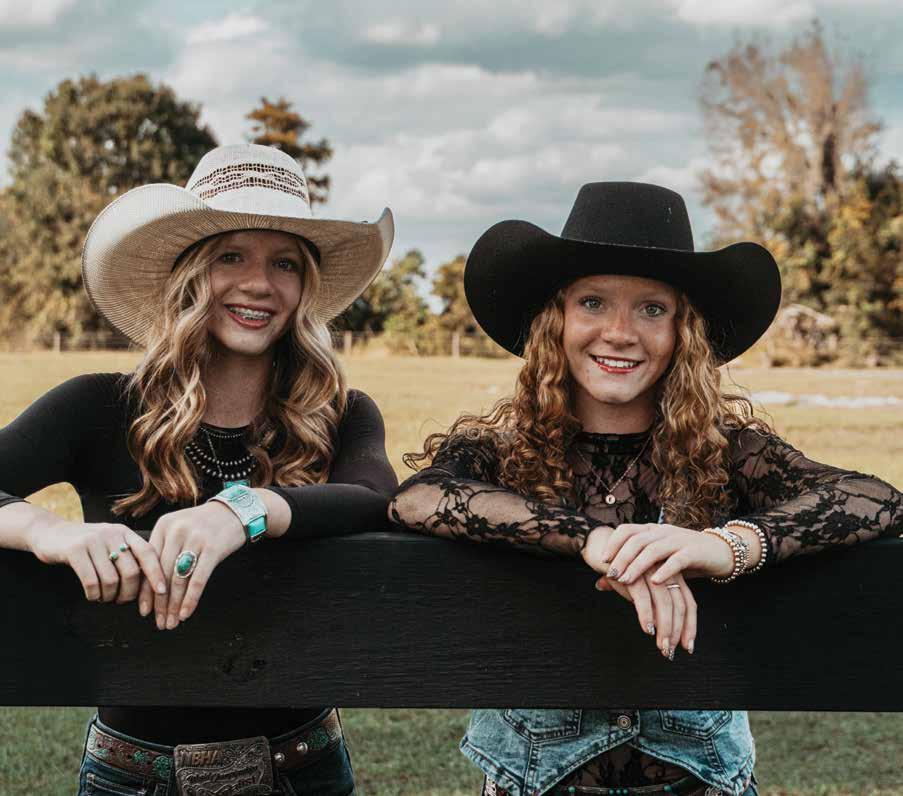
Ella Updike, 16, and Riley Updike, 13, spend nearly all of their free time on horseback—barrel racing, pole bending, goat tying and wrestling steers that outweigh them by hundreds of pounds. They compete through the Arcadia Youth Rodeo Association, the Top Hand Challenge in Myakka City and barrel racing jackpots across the region. They compete through the Arcadia Youth Rodeo Association, the Top Hand Challenge in Myakka City and barrel racing jackpots across the region.
Rodeo is unforgiving. Barrel racing and pole bending demand perfect timing at full speed. Goat tying requires riders to leap from moving horses without hesitation. Steer wrestling—arguably the most dangerous—requires strength, technique and absolute commitment as athletes bring down animals weighing more than 1,000 pounds. Some days are wins. Others are lessons learned in the dirt.
When Ella was recently trampled by a steer, there was no talk of quitting—only reflection and resolve. Her response captured the shared mindset of these girls perfectly: “Pain is temporary.”
In rodeo, success depends on two athletes—the rider and the animal—and unpredictability is part of the challenge. But Ella and Riley thrive in that chaos, feeding off the adrenaline and supporting one another every step of the way. ▶


Beyond their own achievements, these girls share a bigger hope—one that reaches far beyond medals, rankings or finishing positions. They want more girls across Florida’s Heartland to see themselves in these sports. They want young girls watching from the sidelines to know that fear is normal, nerves are expected, and strength comes in many forms. Whether it’s stepping onto a jiu-jitsu mat, lining up at a starting line, dropping into the water, or entering a rodeo arena, these athletes hope their stories spark courage. Their message is simple: you don’t have to fit a mold to belong.
EACH OF THESE ATHLETES WAS ASKED THE SAME QUESTION:
“What would you tell a young girl who wants to compete in the dangerous sport you’re doing, but might be scared?”
Their answers echoed the same truth: Yes, girls may be outnumbered in these sports—but they are never alone. Show up. Stick with it. Learn from every fall, every bruise, every loss. And most importantly, support one another.
Because in the Heartland of Florida, these girls have learned something powerful: when one girl succeeds, they all do. Every podium, every clean run, every finish line crossed is bigger than the individual.





OF LIVING A
How to Find Meaning and Overcome Road Blocks
By Kimberly Blaker

"It is not the years in your life but the life in your years that counts."-
Adlai Stevenson


point Stevenson illustrates is a reminder of how it's easy to lose sight of living a meaningful life.
It's an interesting phenomenon the amount of time, energy and money we invest in living healthier, longer and happier lives. Yet, we often still feel unsatisfied and that our lives are devoid of meaning.
When it comes to living a meaningful life there's no one-size-fits-all solution. What makes life meaningful is unique to each and every person. So, to find meaning, you may need to do some exploration to discover what speaks to you.
Meaning can come from many different avenues. Unlike happiness, which stems from receiving or doing things for yourself, meaning comes from giving or doing for others.
Perhaps for you, it comes from fostering a close family relationship. For some, it's about choosing a fulfilling career path that involves helping others through teaching, nursing, counseling or coaching. Others find meaning by giving back to their community by joining the Kiwanis or volunteering as a Big Brother or Big Sister. Purpose can also come from forming an organization for a national cause you're passionate about. Or perhaps taking up a hobby you enjoy, such as gardening, then donating your excess produce to a soup kitchen.
But before you begin your journey to explore new avenues for meaning, evaluate what you're doing with your life right now. Maybe you're already giving in a way you don't even realize and aren't giving yourself enough credit. If so, you may just need to reframe in your mind what you're already doing and understand that what you do really does matter. If it still isn't enough to satisfy your quest for a meaningful life, explore other options that are important to you. ▶

you've determined what would bring meaning to your life is often where the challenge lies. You must now make a conscious decision and concerted effort to follow through. If you've chosen a challenging path, only you can decide if the sacrifice and risk are worth the reward of a meaningful life.
Often, we blow our sacrifices and risks way out of proportion. The most significant risk may merely be an unrealistic fear of failure. The greatest sacrifice may be little more than stepping outside your comfort zone or setting aside a little happiness in exchange for something more fulfilling, uplifting and meaningful.
If these are the things holding you back, work toward changing your frame of mind. Schedule 20 minutes a day to sit in solitude with your eyes closed envisioning your meaningful life. Allow yourself to build excitement and desire for that which would bring meaning to you and others.
Also, spend some time each day reading or listening to audiobooks and watching online videos relevant to the activity that would bring meaning.
If you find you're still holding yourself back, talk to supportive family and friends, and ask them to hold you to it. A counselor or coach can also lend support to help you move toward your goals.
Whatever path you choose, and regardless of its outcome, give yourself credit for your efforts. Remember, having a meaningful life is often as much about how you perceive what you do as it is about what you do.


At Central Florida Health Care, we believe everyone deserves quality, compassionate care, no matter what. From routine checkups to pharmacy and specialty services, we’re here for your health journey, every step of the way.
And if your insurance changes? Don’t worry, we’ll still be here for you. Our team helps navigate coverage transitions so you can keep the same trusted providers and the care you depend on.
With 17 convenient locations across Polk, Highlands, and Hardee Counties, and a full range of services under one roof, CFHC makes care simple, supportive, and centered on you.














By Cindy Sebring Adams
Celebrating Saint
Patrick's Day TRADITIONS, FOOD & SPIRITS!
ST. PATRICK is the Patron Saint of Ireland. He was born in Britain and at 16 sent to Ireland to work. There, he became interested in Christianity, and taught others about the religion, and converted many to Christians.
SHAMROCKS According to legend, St. Patrick used the three-leafed shamrock to explain the Holy Trinity, symbolizing the Father, the Son, and the Holy Spirit. The tradition of wearing shamrocks on St. Patrick’s Day can be traced back to the early 1700’s.
GOING GREEN Green is the color that mythical fairies claimed leprechauns dressed in. According to folklore, wearing green renders you invisible to leprechauns, mischievous creatures known for pinching anyone they can see. Also, green's significance as an Irish color has political origins. Local Catholic leaders opposed the English crown and adopted a green flag featuring a harp as their emblem. Some people think sporting the color will bring good luck, and others wear it to honor their Irish ancestry.
TODAY’S TRADITIONS St. Patrick’s Day evolved into a global celebration through Irish immigration and cultural pride. Here in America, Irish immigrants sought to assert their identity, giving rise to the first parades in cities such as New York and Boston. The festivities evolved into celebrating Irish ancestry through music, dance, parties and food!
FOOD & DRINKS
The traditional dishes enjoyed on this day bring a taste of Ireland to the table representing the country’s culinary heritage. Irish food and drinks are deeply rooted in Irish tradition and passed down through generations. We have gathered some of the most beloved traditional dishes for St. Patrick’s Day to ensure your celebration is full of flavor and cultural richness. ▶

A pint of Guinness stout is the ultimate St. Patrick's Day drink, Ireland's signature beverage. A few drops of green food coloring in the glass can make it more festive.
There are many festive St .Patrick Day drinks. You can find a couple of our favorites on pages 98 and 99.

INSTRUCTIONS
Place corned beef in a large bowl and cover with cold water; let stand 1-2 hours. Rinse with cold water and thoroughly pat dry.
Preheat oven to 325 degrees F. Line a 9 x 13 baking dish with foil.
In a small bowl, combine mustard, allspice, cloves and 1 teaspoon pepper.
Place corned beef onto the prepared baking dish. Spread mustard mixture evenly over one side of the corned beef, top with onions. Fold up all 4 sides of the foil over the corned beef, covering completely and sealing the packet closed.
Place into oven and bake until tender, about 3 1/2-4 hours; let stand covered.
INGREDIENTS
4 ½ pound center-cut corned beef brisket, excess fat trimmed
3 tbsp. whole grain mustard
¼ tsp. ground allspice
¼ tsp. ground cloves
Kosher salt and freshly ground black pepper, to taste
1 medium sweet onion, sliced
1 head cabbage, cut into 2-inch wedges
3 tbsp. olive oil, divided
2 pounds medium red potatoes, quartered
3 large carrots, cut into 3-inch pieces
2 tbsp. chopped fresh parsley leaves
Increase oven temperature to 425 degrees F. Line two baking sheets with parchment paper.
Brush cabbage with 1 tablespoon olive oil. Place in a single layer onto the prepared baking sheet; season with salt and pepper, to taste.
Place potatoes and carrots in a single layer onto the second prepared baking sheet. Add remaining 2 tablespoons olive oil; season with salt and pepper, to taste. Gently toss to combine.
Place sheet pans into oven, on separate racks, and bake until cabbage is lightly charred and potatoes and carrots are tender, about 30-35 minutes, rotating pans and stirring halfway through baking.
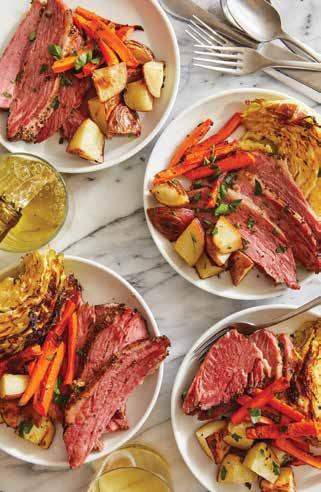
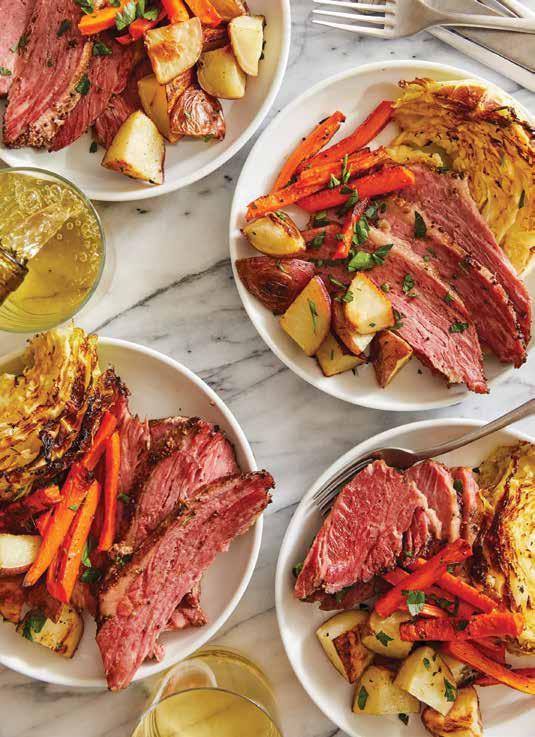
Thinly slice corned beef against the grain and serve with onions, cabbage, potatoes and carrots, garnished with parsley, if desired. Corned beef and cabbage is a classic, one-pot meal often associated with St. Patrick's Day, featuring tender brisket slow-cooked with carrots, potatoes and cabbage. Although associated with Irish culture, this dish is largely considered an Irish-American creation, as Irish immigrants in the 19th century substituted corned beef for their traditional bacon.
Irish stew is a hearty stew from Ireland, traditionally made with lamb or mutton. Modern versions often use beef. Guinness beer gives the stew a richer flavor, but the core is a slow-cooked, comforting dish with tender meat and vegetables
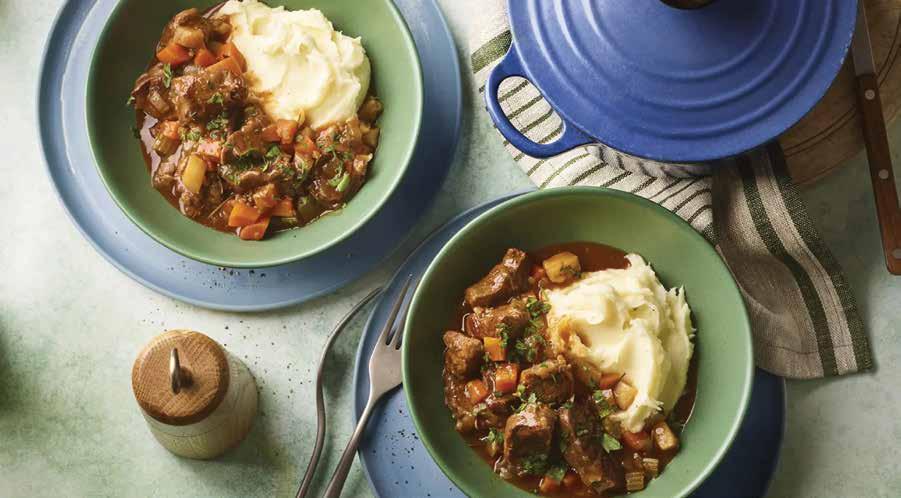
INGREDIENTS
2 pounds beef chuck, cut into 2-inch chunks
Kosher salt and freshly ground black pepper, to taste
2 tbsp. olive oil
1 medium sweet onion, diced
3 large carrots, peeled and diced
3 ribs celery, diced
3 cloves garlic, minced
2 tbsp. all-purpose flour
3 tbsp. tomato paste
1 (14.9-ounce) can Guinness Draught beer
2 cups beef stock
1 tbsp. Worcestershire sauce
INSTRUCTIONS
Season beef with 1 teaspoon salt and 1/2 teaspoon pepper.
Heat olive oil in a large stockpot or Dutch oven over medium high heat. Working in batches, add beef to the stockpot and cook, stirring occasionally, until evenly browned, about 6-8 minutes; set aside.
Reduce heat to medium. Add onion, carrots and celery. Cook, stirring occasionally, until tender, about 3-4 minutes.
Stir in garlic until fragrant, about 1 minute.
Whisk in flour and tomato paste until lightly browned, about 1 minute.
Stir in Guinness, scraping any browned bits from the bottom of the stockpot
Stir in beef stock, Worcestershire, thyme, bay leaves and beef. Bring to a boil; reduce heat and simmer, partially covered, until beef is very tender, about 2 hours, stirring occasionally.
Remove and discard thyme sprigs and bay leaves. Stir in parsley; season with salt and pepper, to taste.
Serve immediately with mashed potatoes, if desired. ▶
INSTRUCTIONS
Preheat the oven to 375 degrees F.
Place olive oil and butter in a Dutch oven over medium heat. Stir in ground lamb and onion; cook and stir until meat is brown and crumbly, about 10 minutes.
Stir in flour until incorporated. Mix in garlic, ketchup, rosemary, paprika, cinnamon, salt and pepper; cook and stir until garlic is fragrant, 2 to 3 minutes.
Stir in water, scraping up any brown bits from the bottom of the Dutch oven. Reduce heat to medium-low and bring mixture to a simmer; cook and stir until thick, 5 to 6 minutes.
Remove lamb mixture from heat, then stir in peas and carrots until combined.
Spread lamb mixture into the bottom of a 9x13-inch baking dish; set aside.
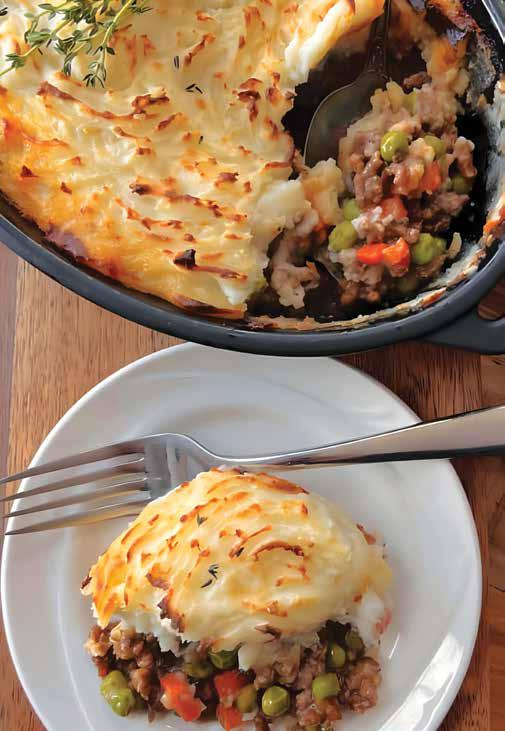
Shepherd's Pie is a traditional Irish dish that is fantastic for a St. Patrick's Day feast. In Ireland, it is traditionally made with lamb. If you live in an area where lamb is hard to come by, you can use ground beef.
INGREDIENTS
1 tbsp. olive oil
1 tbsp. butter
2 pounds lean ground lamb
1 onion, diced
1/3 cup all-purpose flour
3 cloves garlic, minced
1 tablespoon ketchup
2 tsp. minced fresh rosemary
1 tsp. paprika
⅛ tsp. ground cinnamon
salt and ground black pepper to taste
1 (12 ounce) package frozen peas and carrots, thawed
2 ½ cups water, or as needed
2 ½ pounds Yukon Gold potatoes, peeled & halved
¼ pound Irish cheese shredded (such as Dubliner),
¼ cup cream cheese
1 tbsp. butter
1 pinch ground cayenne pepper
1 large egg yolk
2 tbsp. milk
Place potatoes into a large pot of salted water. Bring to a boil, reduce heat to medium, and cook until tender, about 15 minutes. Drain well and return potatoes to the pot.
Mash Irish cheese, cream cheese, butter, and cayenne pepper into potatoes until smooth. Season with salt and black pepper.
Whisk together egg yolk and milk in a small bowl; stir into mashed potato mixture.
Top lamb mixture in the baking dish with mashed potatoes; spread evenly to cover.
Bake in the preheated oven until the top is golden brown and sauce is bubbling up around the edges, 25 to 30 minutes.
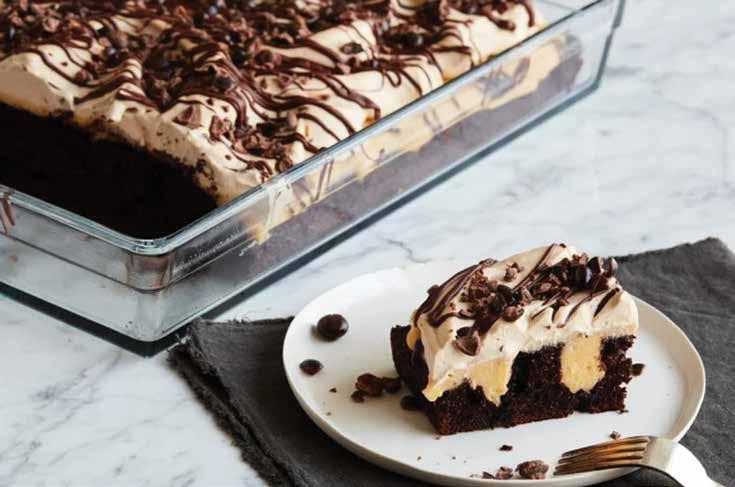
This rich and delicious Irish Cake is a modern, American-style "fun" dessert often created for St. Patrick’s Day celebrations.
INGREDIENTS
1/2 cup vegetable oil, plus more for the baking dish
3 tbsp. instant espresso powder
15.25 oz. box German chocolate cake mix
3 large eggs, at room temperature
14 oz. can sweetened condensed milk
1 cup Irish cream liqueur, such as Baileys Irish Cream
3.4 oz. box vanilla instant pudding
1/4 cup powdered sugar
2 cups heavy whipping cream
Dark chocolate shavings, for garnish
INSTRUCTIONS
Preheat the oven to 350°F. Grease a 9-by-13-inch baking dish with oil.
In a large bowl, whisk together 1 tablespoon of the espresso powder with 1 cup water. Add the chocolate cake mix, eggs, and ½ cup vegetable oil, whisking vigorously until very well combined, about 2 minutes. Pour into the prepared baking dish and bake according to the package directions.
Meanwhile, in a large measuring cup or medium bowl, whisk together the sweetened condensed milk with ½ cup of the Irish cream.
Remove the cake from the oven and let it cool on a wire rack for 5 minutes. Then, use the rounded handle of a wooden spoon to poke holes all over the cake. Slowly pour the condensed milk mixture over the entire cake. Let the cake cool completely, about 45 minutes.
In a large measuring cup or medium bowl, whisk together the remaining ½ cup Irish cream and 2 tbsp. espresso powder until the powder is dissolved.
In a stand mixer fitted with the whisk attachment, stir together the pudding mix, powdered sugar, and espresso-Irish cream mixture. With the mixer running on low speed, slowly add the heavy cream. Scrape the bottom and sides of the bowl. Increase the speed to medium-high and beat until stiff peaks form, 2 to 3 minutes.
Spread the topping over the cake and chill for at least 30 minutes and up to overnight. Just before serving, sprinkle the cake with chocolate shavings. ▶
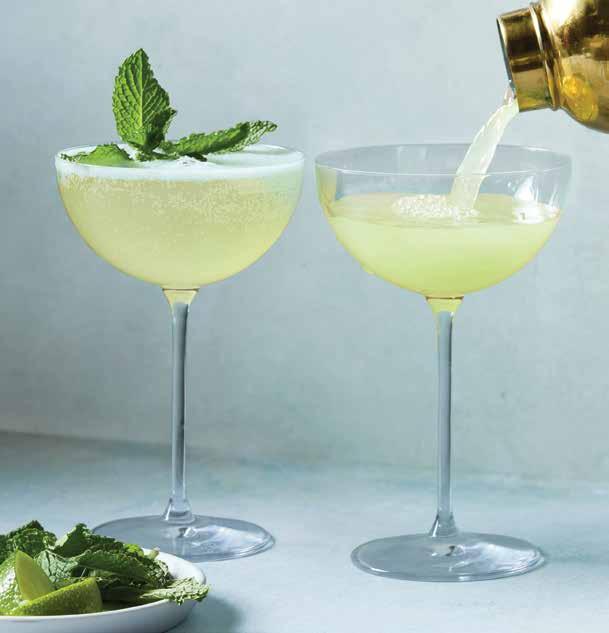
Shamrock Smash is a vibrant green cocktail designed for St. Patrick's Day.
INGREDIENTS
1 large plus 1 small fresh mint sprigs
2 lime wedges
1/2 oz. simple syrup
Ice
1 large egg white
2 oz. seltzer
2 oz. sour apple liqueur
1 oz. vodka
INSTRUCTIONS
In a cocktail shaker, muddle large mint sprig, lime wedges, and simple syrup until mint leaves start to bruise and lime wedges release their juices.
Fill cocktail shaker with ice. Add egg white, seltzer, apple liqueur, and vodka. Cover and vigorously shake until outside of shaker is very frosty, about 20 seconds.
Strain into a coupe or small wine glass. Garnish with small mint sprig.
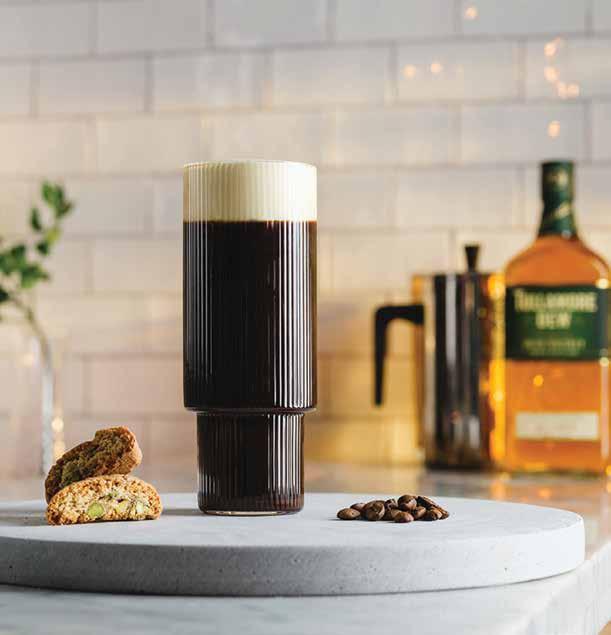
A classic Irish Coffee is a simple yet refined cocktail designed to warm you up.
INGREDIENTS
6 oz. freshly brewed coffee
1 ½ oz. Irish whiskey
1 to 2 tsp. maple syrup, to taste
Whipped cream, for topping
INSTRUCTIONS
Pour the whiskey and 1 teaspoon maple syrup into a heatsafe mug. Pour in a splash of the coffee and stir with a spoon until the maple syrup dissolves into the coffee.
Pour in the rest of the coffee. Taste and stir in additional maple syrup if you would like a sweeter drink.
Top with whipped cream. If your whipped cream is lightly whipped, you may need to pour it slowly over a spoon so it floats on top. Serve while the drink is still warm!









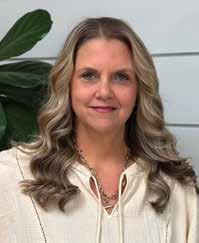
Monica Collier MSN, FNP-C, Family Nurse Practitioner with more than 30 year’s experience in healthcare will be providing: Concierge Primary Medical Services, IV Hydration and Vitamin Therapy, Injections including Vitamin D, and Vitamin B12, and Personalized Weight Loss and Wellness Services.
Botox and Microneedling Also...Men’s & Women’s Sexual Health



offering 2 locations in Highlands County to


















Okeechobee County Polk County