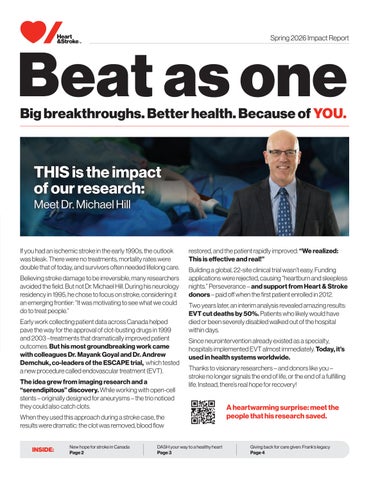
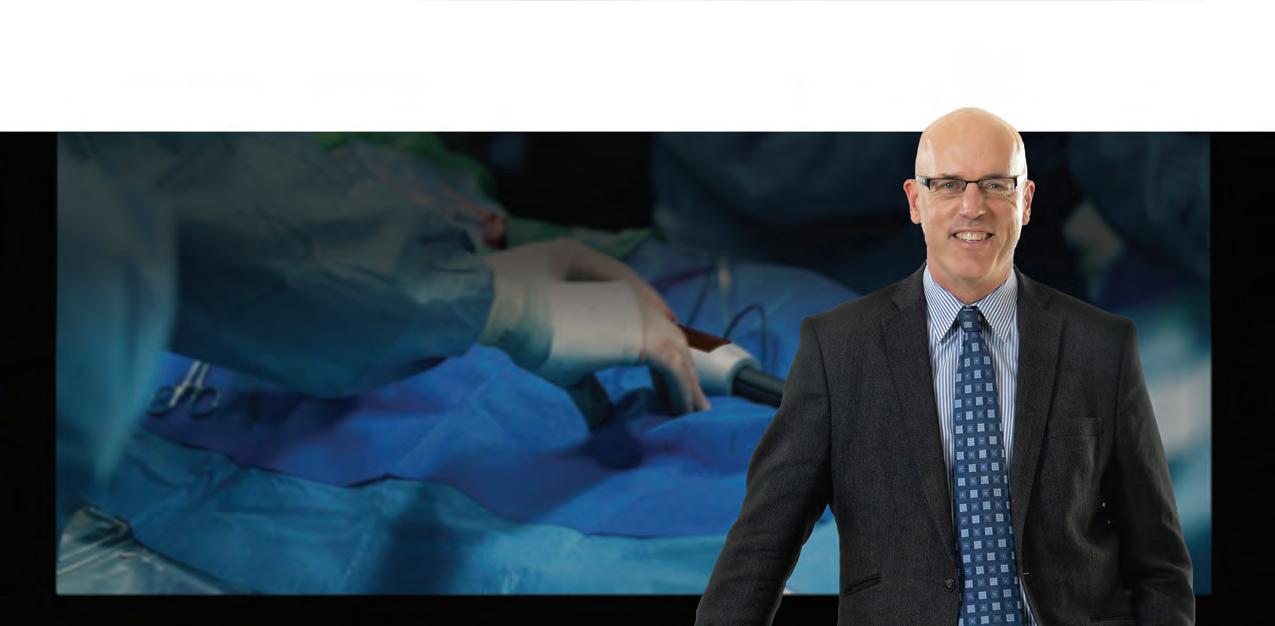
If you had an ischemic stroke in the early 1990s, the outlook was bleak. There were no treatments, mortality rates were double that of today, and survivors often needed lifelong care. Believing stroke damage to be irreversible, many researchers avoided the field. But not Dr. Michael Hill. During his neurology residency in 1995, he chose to focus on stroke, considering it an emerging frontier: “It was motivating to see what we could do to treat people.”
Early work collecting patient data across Canada helped pave the way for the approval of clot-busting drugs in 1999 and 2003 –treatments that dramatically improved patient outcomes. But his most groundbreaking work came with colleagues Dr. Mayank Goyal and Dr. Andrew Demchuk, co-leaders of the ESCAPE trial, which tested a new procedure called endovascular treatment (EVT). The idea grew from imaging research and a “serendipitous” discovery. While working with open-cell stents – originally designed for aneurysms – the trio noticed they could also catch clots.
When they used this approach during a stroke case, the results were dramatic: the clot was removed, blood flow
restored, and the patient rapidly improved: “We realized: This is effective and real!”
Building a global, 22-site clinical trial wasn’t easy. Funding applications were rejected, causing “heartburn and sleepless nights.” Perseverance – and support from Heart & Stroke donors – paid off when the first patient enrolled in 2012.
Two years later, an interim analysis revealed amazing results: EVT cut deaths by 50%. Patients who likely would have died or been severely disabled walked out of the hospital within days.
Since neurointervention already existed as a specialty, hospitals implemented EVT almost immediately. Today, it’s used in health systems worldwide.
Thanks to visionary researchers – and donors like you –stroke no longer signals the end of life, or the end of a fulfilling life. Instead, there’s real hope for recovery!
A heartwarming surprise: meet the people that his research saved.
Beat stroke.
Thank you for your part in ensuring that more Canadians can prevent, survive, and recover from stroke!
Stroke is one of the leading causes of death and disability in Canada. It happens when blood flow to the brain is suddenly blocked or a vessel ruptures, damaging brain cells. This can lead to brain injury, disability or death.
And it can happen to anyone. Nearly one-quarter of Canadians affected are under the age of 65, with more younger people being diagnosed every year.
Thanks to decades of progress – and committed donors like you – the death rate from heart disease and stroke has dropped by 75% since 1950. But the need remains urgent: more than 108,000 strokes occur each year – about one every five minutes – and almost one million Canadians are living with the devastating effects. Your support is critical to turn research, innovation and advocacy into life-saving action.
Here’s how your generosity is making a difference: FAST awareness: Since 2014, donors have helped power Heart & Stroke’s FAST campaign, doubling public awareness of stroke symptoms and the need to call 9-1-1 immediately. This knowledge saves lives and reduces disability.
Strengthening emergency and acute care: Your support helps advocate for timely access to effective treatments – including clot-busting drugs—and strengthens
stroke systems of care so patients get the right treatment as quickly as possible.
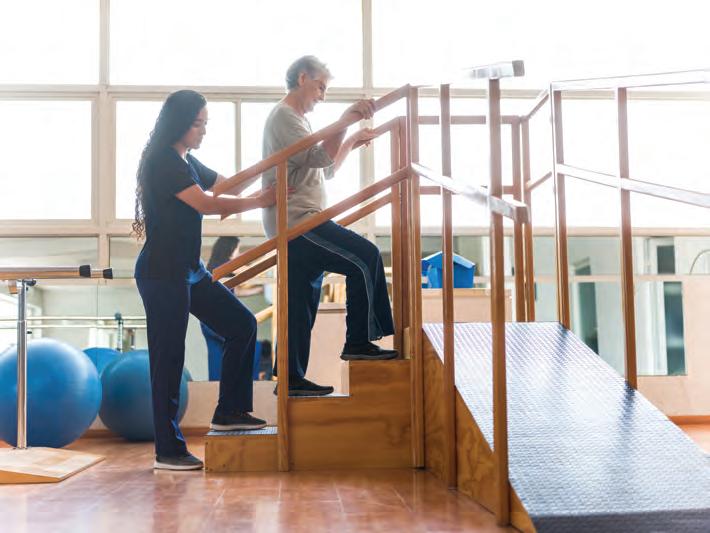
Supporting survivors and recovery: By funding rehab, research and national initiatives like updating the Canadian Best Stroke Practice Guidelines – and championing increased provincial support, including a 2024 $15M annual boost to Community Stroke Rehabilitation in Ontario –you’re helping people living with stroke and their caregivers access the resources they need.
Because of you, Canadians can better recognize the signs of stroke, get treatment faster, recover more fully and reduce their risk of future strokes.
Your blood pressure: the new numbers to know
High blood pressure is the number one risk factor for stroke and a major contributor to heart disease, affecting 1 in 4 Canadians. Since it often has no symptoms, it can go unnoticed.
Blood pressure measures how hard your blood pushes against the artery walls as the heart pumps. It’s measured using two numbers: systolic (pressure during a heartbeat) and diastolic (pressure between beats).
While it’s normal for these numbers to rise and fall throughout the day, according to the new 2025 Hypertension Canada guidelines, a consistent reading of 130/80 mmHg or higher signals hypertension, a condition that strains your heart and blood vessels over time. Even if just one of those numbers is elevated, it’s considered high.
A single high reading doesn’t mean you have high blood pressure. Healthcare providers look for consistently high numbers over several days. Understanding, monitoring and talking to your care provider about your blood pressure will help prevent it from developing into a major health risk.
Simple steps to lower your risk and stay healthy: heartandstroke.ca/ BPinformation
Decoding genes to save more hearts
Dr. Guillaume Paré is unlocking DNA clues to reveal heart attack risk — decades earlier.
What if your DNA could predict your risk of a heart attack years before it happens — and what if you could change that risk?
Dr. Guillaume Paré, a Heart & Stroke–funded researcher and cardiologist at McMaster University, is tackling those questions head-on. In his Hamilton clinic, he sees people in their 30s and 40s blindsided by severe heart attacks — often with no warning signs.
His frustration led to a breakthrough: polygenic risk scoring. Instead of one faulty gene, polygenic risk looks at thousands of tiny genetic variants that, together, can triple a person’s risk of heart disease. This innovation was named one of the American Heart Association’s top ten advances in cardiovascular research.
Now, Dr. Paré is pushing further. His latest research explores accelerated biological aging — when your body ages faster than your years. Using DNA markers, his team can
The delicious DASH diet
Lower your blood pressure. Protect your heart. Enjoy delicious, satisfying meals. The DASH diet makes it possible. In just a few weeks, DASH can help reduce blood pressure, and over time, it supports heart health, lowers cholesterol, reduces inflammation and can even lower the risk of type 2 diabetes and certain cancers.
DASH is all about variety and flavor, think colorful fruits and vegetables, whole grains, nuts, legumes, fish, poultry, and low-fat dairy. DASH gives your body the fibre, protein, potassium, magnesium, and antioxidants it needs to fight inflammation and protect your heart. Pair it with 30 minutes of daily activity, and you’re giving your heart a powerful boost – without giving up the foods you love.
Visit: heartandstroke.ca/dashdiet
estimate biological age and uncover hidden risks for heart
If someone is 40 but their biological age is 45,
That’s critical information for prevention.
Why does this matter? Early-onset heart disease is devastating — striking people in their prime, with young families and active careers. Genetic testing could identify high-risk individuals decades before disease strikes, enabling earlier, targeted interventions.
Heart & Stroke donors make this life-saving research possible. Your support helps unlock answers that could prevent heart attacks before they happen — and save countless lives.
To learn more about Dr. Paré’s research you help fund, visit: heartandstroke.ca/drpare
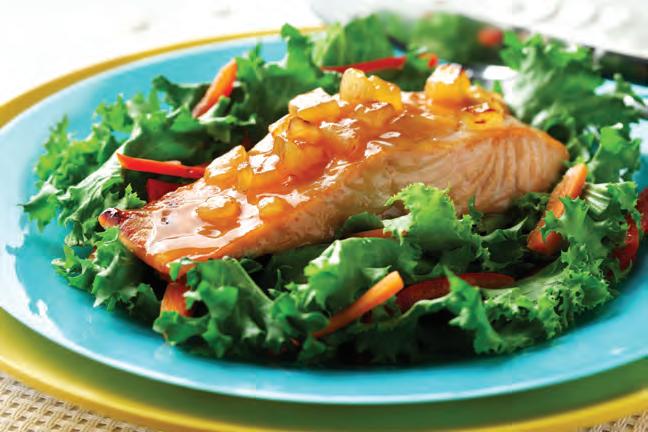
Simple salmon with mango chutney is a good source of omega-3 fat. Visit: heartandstroke.ca/ Salmonwithmangochutney
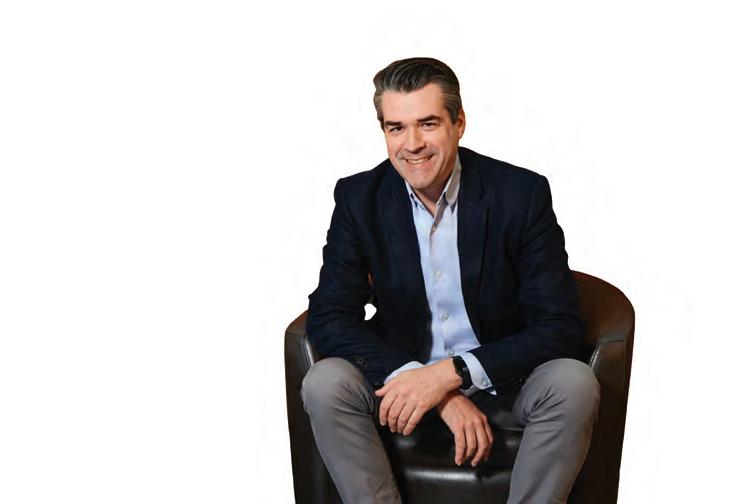
Dr. Guillaume Paré Heart & Stroke researcher
Resilience and generosity from a longtime donor
Inspired by the care that helped him recover, Frank Polanski is leaving a gift in his Will so that others will receive the same chance at life.
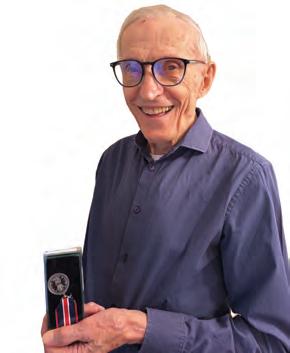
Upon meeting Frank Polanski, your first thought might be that he looks like a vibrant man in his 70s. But the Edmontonian is actually 94 years old… a living, breathing testimony to the power of exercise and determination in recovering from a stroke.
His stroke happened at age 77, on a Friday the 13th. Frank remembers getting out of bed, planning to go to the gym, and falling to the floor. He quickly realized his entire left side was paralyzed. His wife Elsie, who has since passed, called 9-1-1 and Frank was taken to a hospital 15 minutes away.
His recovery was nothing short of miraculous – thanks to his already active lifestyle. “Later that morning, I felt my toes and fingers starting to recover from numbness.” That same day Frank’s doctors let him begin walking slowly. A day later, he was released from hospital with a cardiac monitor.
“Without a doubt, my speedy recovery was aided through regular exercise and healthy eating, and my faith,” Frank says. He continues to exercise daily and watch his food intake with an aim to “reach 100.”
Frank’s stroke and the care he received prompted him to give back. He supports Heart & Stroke through regular donations and has also made the decision to leave a gift in his will. A true inspiration, he’s happy to share his story in the hope that others will see that lifestyle choices really do matter. Thank you, Frank!
Your legacy gift will make an impact for generations to come. Together, we can build a future where everyone enjoys a longer, healthier life uninterrupted by heart disease or stroke.
Contact numbers are: Mary Goodfellow - ON 1-800-205-4438
at: heartandstroke.ca/securities A life-saving gift, a legacy of hope
Learn
Susan Deike - BC, YK, AB, NWT, SK, MB 1-403-451-3675