Making a difference is a way of life: Mark’s story “If you think you are too small to make a difference, try sleeping in a closed room with a mosquito.” — African Proverb After a career as a physician assistant and medic, Mark continues to devote his time and expertise to helping others. As co-president of the Canadian International Medical Relief Organization (CIMRO), he spends six months a year travelling to some of the world’s most dangerous conflict zones, bringing advanced medical care to people in need.
Wanting to ensure that lifesaving discoveries continue for future generations, Mark has included Heart & Stroke in his estate plans. For him, it’s a natural extension of a lifetime spent helping others.
For Mark, one thing has remained constant: his belief that every person has the power to create meaningful change. That same belief inspires his support of Heart & Stroke. Having witnessed many cardiac emergencies, Mark understands the importance of research in improving survival.
Your legacy gift will make an impact for generations to come. Together, we can build a future where everyone enjoys longer and healthier lives, uninterrupted by heart disease or stroke.
Big breakthroughs. Healthier lives. Because of YOU.
Mark Cameron
Mark’s story is proof that one person can truly make a lasting difference. You can, too.
Contact numbers are:
To learn more about Legacy giving, visit: heartandstroke.ca/legacy
Mary Goodfellow – ON 1-800-205-4438 Susan Deike – BC, YK, AB, NWT, SK, MB 1-403-451-3675
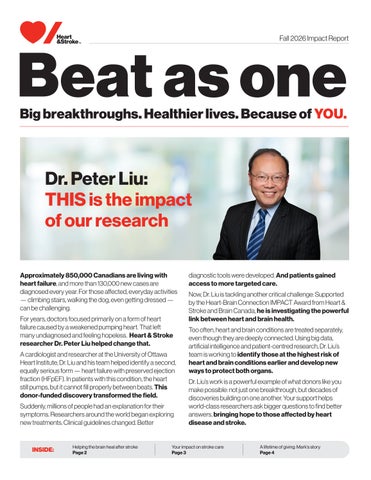
Dr. Peter Liu: THIS is the impact of our research
Angela Gresseau-Okalow – QC, NS, PEI, NL 1-416-386-4517
64.5 cents funds lifesaving research, advocacy and health promotion 33.3 cents is invested in fundraising 2.2 cents covers administrative costs
Where every donor dollar goes*
*Based on F25 financial reporting year.
Phone 1-877-882-2582
Online heartandstroke.ca/impact or scan the QR code
When we beat as one, we achieve so much together.
Approximately 850,000 Canadians are living with heart failure, and more than 130,000 new cases are diagnosed every year. For those affected, everyday activities — climbing stairs, walking the dog, even getting dressed — can be challenging. For years, doctors focused primarily on a form of heart failure caused by a weakened pumping heart. That left many undiagnosed and feeling hopeless. Heart & Stroke researcher Dr. Peter Liu helped change that. A cardiologist and researcher at the University of Ottawa Heart Institute, Dr. Liu and his team helped identify a second, equally serious form — heart failure with preserved ejection fraction (HFpEF). In patients with this condition, the heart still pumps, but it cannot fill properly between beats. This donor-funded discovery transformed the field.
3 easy and secure ways to make your special year-end gift today: Mail Return the reply card in the postage paid envelope provided
Beat as one
“A legacy gift is a way to keep making a difference long into the future,” he says.
From advances in CPR and defibrillation to new treatments and better systems of care, he credits Heart & Stroke-funded
A lifesaving gift, a legacy of hope
research and education with helping to advance the knowledge, treatments and tools that save lives every day.
Fall 2026 Impact Report
Scan to donate!
STW1ZDM-EN
Suddenly, millions of people had an explanation for their symptoms. Researchers around the world began exploring new treatments. Clinical guidelines changed. Better
INSIDE:
Helping the brain heal after stroke Page 2
diagnostic tools were developed. And patients gained access to more targeted care. Now, Dr. Liu is tackling another critical challenge: Supported by the Heart-Brain Connection IMPACT Award from Heart & Stroke and Brain Canada, he is investigating the powerful link between heart and brain health. Too often, heart and brain conditions are treated separately, even though they are deeply connected. Using big data, artificial intelligence and patient-centred research, Dr. Liu’s team is working to identify those at the highest risk of heart and brain conditions earlier and develop new ways to protect both organs. Dr. Liu’s work is a powerful example of what donors like you make possible: not just one breakthrough, but decades of discoveries building on one another. Your support helps world-class researchers ask bigger questions to find better answers, bringing hope to those affected by heart disease and stroke.
Your impact on stroke care Page 3
A lifetime of giving: Mark’s story Page 4
© Heart and Stroke Foundation of Canada, 2026 | ™ The heart and / Icon on its own and the heart and / Icon followed by another i con or words are trademarks of the Heart and Stroke Foundation of Canada.
46190-Heart And Stroke_Impact Report_EN.indd 1
2026-08-18 9:54 AM
Supercharging the brain’s self-healing cells
20 years of better stroke care, thanks to you We’re celebrating a coordinated system of care that brings the latest advances to patients faster.
A burst of potent cells that appear briefly after a stroke may hold the key to reversing brain damage.
Dr. Jing Wang, Heart & Stroke researcher
Imagine asking your daughter to pass the salad, but the word that comes out is “shoe.” Or suddenly needing a walker to move around your living room. For many stroke survivors, damage to the brain can severely affect quality of life. Speech, mobility, memory, thinking and mood can all take a hit.
Stroke can happen to anyone at any age. One moment, a person is spending time with loved ones, heading to work or enjoying an active day. The next, they may be struggling to speak, walk or think clearly.
“Before the best practices, stroke care was fragmented,” says Dr. Eric Smith, a Heart & Stroke-funded researcher and stroke neurologist. “Today, they help bring the best stroke expertise to every doctor in Canada.”
Dr. Wang’s team is studying how to harness this brief window of recovery.
Every year, more than 108,000 Canadians experience a stroke — that’s one every five minutes. Nearly one million people in Canada are living with its effects.
More good news: up to 80% of premature strokes can be prevented. Eating healthy, staying active and managing your stress can make a huge difference to your health.
Their research has shown that specialized cells called pericytes, which normally support blood vessels in the brain, can transform into neural stem cells after injury.
The good news is that, thanks to donors, more Canadians today have a better chance of surviving stroke and make a meaningful recovery.
But what if a new treatment could supercharge the stem cells your brain produces at the injured site and repair the damage?
The challenge is encouraging these stem cells to produce enough new neurons to restore lost function — and donor support is moving this work forward.
With support from donors like you, Dr. Jing Wang and her team at The Ottawa Hospital are investigating what happens in the brain immediately after an ischemic stroke, when a clot blocks blood flow to the brain.
One promising avenue involves metformin, a commonly used diabetes medication. The team is now exploring ways to deliver the drug to the injury site and further boost recovery.
For the past 20 years, Heart & Stroke’s Canadian Stroke Best Practice Recommendations have helped transform stroke care nationwide. Created in 2006 by Heart & Stroke and the Canadian Stroke Network, these evidence-based guidelines have helped build a more coordinated system of stroke care across Canada.
Their research is uncovering a remarkable natural repair process that could help stroke survivors regain lost abilities and improve their quality of life. In the days following a stroke, the brain produces a temporary surge of neural stem cells capable of generating new brain cells. These stem cells appear at the injury site for just three to seven days before disappearing.
“Ultimately, we hope to allow patients to regain the function they lost because of brain damage,” says Dr. Wang. “That could mean return to work, walking without assistance or maintaining independence.”
Download your guide to stroke prevention here: heartandstroke.ca/ strokeprevention
What once took years to move from research lab into hospitals can now be adopted quickly, giving patients access to breakthrough treatments when every minute matters — and helping families get more time together.
You are helping to advance this research, bringing us closer to helping more stroke survivors reclaim their lives.
The Canadian (Mediterranean) diet The healing power of autumn Feeling overwhelmed? Fall is the perfect time to slow down and recharge in nature. Discover how getting outdoors can reduce stress, improve sleep and support lifelong heart and brain health.
For raising awareness and funds, thanks to our partner: 2
46190-Heart And Stroke_Impact Report_EN.indd 2
Activities to try: heartandstroke.ca/reducestress
Bring a taste of the Mediterranean to your kitchen — no plane ticket needed! One of the world’s most hearthealthy eating patterns, the Mediterranean diet is packed with vegetables, fruit, whole grains, beans, nuts, fish and healthy fats. Use our guide to bring this heart-healthy goodness to your table right here in Canada. Visit: heartandstroke.ca/canadianhealthydiet 3
2026-08-18 9:54 AM
Supercharging the brain’s self-healing cells
20 years of better stroke care, thanks to you We’re celebrating a coordinated system of care that brings the latest advances to patients faster.
A burst of potent cells that appear briefly after a stroke may hold the key to reversing brain damage.
Dr. Jing Wang, Heart & Stroke researcher
Imagine asking your daughter to pass the salad, but the word that comes out is “shoe.” Or suddenly needing a walker to move around your living room. For many stroke survivors, damage to the brain can severely affect quality of life. Speech, mobility, memory, thinking and mood can all take a hit.
Stroke can happen to anyone at any age. One moment, a person is spending time with loved ones, heading to work or enjoying an active day. The next, they may be struggling to speak, walk or think clearly.
“Before the best practices, stroke care was fragmented,” says Dr. Eric Smith, a Heart & Stroke-funded researcher and stroke neurologist. “Today, they help bring the best stroke expertise to every doctor in Canada.”
Dr. Wang’s team is studying how to harness this brief window of recovery.
Every year, more than 108,000 Canadians experience a stroke — that’s one every five minutes. Nearly one million people in Canada are living with its effects.
More good news: up to 80% of premature strokes can be prevented. Eating healthy, staying active and managing your stress can make a huge difference to your health.
Their research has shown that specialized cells called pericytes, which normally support blood vessels in the brain, can transform into neural stem cells after injury.
The good news is that, thanks to donors, more Canadians today have a better chance of surviving stroke and make a meaningful recovery.
But what if a new treatment could supercharge the stem cells your brain produces at the injured site and repair the damage?
The challenge is encouraging these stem cells to produce enough new neurons to restore lost function — and donor support is moving this work forward.
With support from donors like you, Dr. Jing Wang and her team at The Ottawa Hospital are investigating what happens in the brain immediately after an ischemic stroke, when a clot blocks blood flow to the brain.
One promising avenue involves metformin, a commonly used diabetes medication. The team is now exploring ways to deliver the drug to the injury site and further boost recovery.
For the past 20 years, Heart & Stroke’s Canadian Stroke Best Practice Recommendations have helped transform stroke care nationwide. Created in 2006 by Heart & Stroke and the Canadian Stroke Network, these evidence-based guidelines have helped build a more coordinated system of stroke care across Canada.
Their research is uncovering a remarkable natural repair process that could help stroke survivors regain lost abilities and improve their quality of life. In the days following a stroke, the brain produces a temporary surge of neural stem cells capable of generating new brain cells. These stem cells appear at the injury site for just three to seven days before disappearing.
“Ultimately, we hope to allow patients to regain the function they lost because of brain damage,” says Dr. Wang. “That could mean return to work, walking without assistance or maintaining independence.”
Download your guide to stroke prevention here: heartandstroke.ca/ strokeprevention
What once took years to move from research lab into hospitals can now be adopted quickly, giving patients access to breakthrough treatments when every minute matters — and helping families get more time together.
You are helping to advance this research, bringing us closer to helping more stroke survivors reclaim their lives.
The Canadian (Mediterranean) diet The healing power of autumn Feeling overwhelmed? Fall is the perfect time to slow down and recharge in nature. Discover how getting outdoors can reduce stress, improve sleep and support lifelong heart and brain health.
For raising awareness and funds, thanks to our partner: 2
46190-Heart And Stroke_Impact Report_EN.indd 2
Activities to try: heartandstroke.ca/reducestress
Bring a taste of the Mediterranean to your kitchen — no plane ticket needed! One of the world’s most hearthealthy eating patterns, the Mediterranean diet is packed with vegetables, fruit, whole grains, beans, nuts, fish and healthy fats. Use our guide to bring this heart-healthy goodness to your table right here in Canada. Visit: heartandstroke.ca/canadianhealthydiet 3
2026-08-18 9:54 AM
Making a difference is a way of life: Mark’s story “If you think you are too small to make a difference, try sleeping in a closed room with a mosquito.” — African Proverb After a career as a physician assistant and medic, Mark continues to devote his time and expertise to helping others. As co-president of the Canadian International Medical Relief Organization (CIMRO), he spends six months a year travelling to some of the world’s most dangerous conflict zones, bringing advanced medical care to people in need.
Wanting to ensure that lifesaving discoveries continue for future generations, Mark has included Heart & Stroke in his estate plans. For him, it’s a natural extension of a lifetime spent helping others.
For Mark, one thing has remained constant: his belief that every person has the power to create meaningful change. That same belief inspires his support of Heart & Stroke. Having witnessed many cardiac emergencies, Mark understands the importance of research in improving survival.
Your legacy gift will make an impact for generations to come. Together, we can build a future where everyone enjoys longer and healthier lives, uninterrupted by heart disease or stroke.
Big breakthroughs. Healthier lives. Because of YOU.
Mark Cameron
Mark’s story is proof that one person can truly make a lasting difference. You can, too.
Contact numbers are:
To learn more about Legacy giving, visit: heartandstroke.ca/legacy
Mary Goodfellow – ON 1-800-205-4438 Susan Deike – BC, YK, AB, NWT, SK, MB 1-403-451-3675
Dr. Peter Liu: THIS is the impact of our research
Angela Gresseau-Okalow – QC, NS, PEI, NL 1-416-386-4517
64.5 cents funds lifesaving research, advocacy and health promotion 33.3 cents is invested in fundraising 2.2 cents covers administrative costs
Where every donor dollar goes*
*Based on F25 financial reporting year.
Phone 1-877-882-2582
Online heartandstroke.ca/impact or scan the QR code
When we beat as one, we achieve so much together.
Approximately 850,000 Canadians are living with heart failure, and more than 130,000 new cases are diagnosed every year. For those affected, everyday activities — climbing stairs, walking the dog, even getting dressed — can be challenging. For years, doctors focused primarily on a form of heart failure caused by a weakened pumping heart. That left many undiagnosed and feeling hopeless. Heart & Stroke researcher Dr. Peter Liu helped change that. A cardiologist and researcher at the University of Ottawa Heart Institute, Dr. Liu and his team helped identify a second, equally serious form — heart failure with preserved ejection fraction (HFpEF). In patients with this condition, the heart still pumps, but it cannot fill properly between beats. This donor-funded discovery transformed the field.
3 easy and secure ways to make your special year-end gift today: Mail Return the reply card in the postage paid envelope provided
Beat as one
“A legacy gift is a way to keep making a difference long into the future,” he says.
From advances in CPR and defibrillation to new treatments and better systems of care, he credits Heart & Stroke-funded
A lifesaving gift, a legacy of hope
research and education with helping to advance the knowledge, treatments and tools that save lives every day.
Fall 2026 Impact Report
Scan to donate!
STW1ZDM-EN
Suddenly, millions of people had an explanation for their symptoms. Researchers around the world began exploring new treatments. Clinical guidelines changed. Better
INSIDE:
Helping the brain heal after stroke Page 2
diagnostic tools were developed. And patients gained access to more targeted care. Now, Dr. Liu is tackling another critical challenge: Supported by the Heart-Brain Connection IMPACT Award from Heart & Stroke and Brain Canada, he is investigating the powerful link between heart and brain health. Too often, heart and brain conditions are treated separately, even though they are deeply connected. Using big data, artificial intelligence and patient-centred research, Dr. Liu’s team is working to identify those at the highest risk of heart and brain conditions earlier and develop new ways to protect both organs. Dr. Liu’s work is a powerful example of what donors like you make possible: not just one breakthrough, but decades of discoveries building on one another. Your support helps world-class researchers ask bigger questions to find better answers, bringing hope to those affected by heart disease and stroke.
Your impact on stroke care Page 3
A lifetime of giving: Mark’s story Page 4
© Heart and Stroke Foundation of Canada, 2026 | ™ The heart and / Icon on its own and the heart and / Icon followed by another i con or words are trademarks of the Heart and Stroke Foundation of Canada.
46190-Heart And Stroke_Impact Report_EN.indd 1
2026-08-18 9:54 AM