MO ODERN FARMER
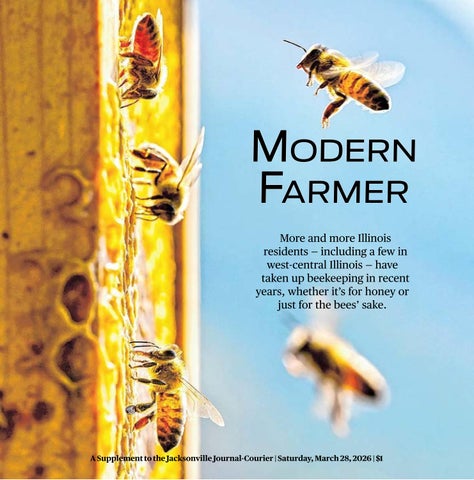
More and more Illinois residents — including a few in west-central Illinois — have taken up beekeeping in recent years, whether it’s for honey or just for the bees’ sake.
Modern Farmer
Saturday, March 28, 2026
Cover Story:
Region abuzz with bee(keeper)s................2
How does your garden grow?...............5
Quail farm expands operations.....................8
Proposed 45Z rule seen as step forward10
USDA pauses funds for manure digesters10
Gradengineerswater disaster solutions........11
Mink farming toes line as lawmakers consider regs...............12
Suit challenges use of new pesticide on farms..............................13
Ethanol industry wants ‘let off the leash’......................14 Legislation would protect Illinois waterways....................15
Spas for soil: farm charm shapes bookings.......................16
Old tree lines may hold value for farmers...................12 Historically dry ’25 boosts drought issues.............................13

Region abuzz with bee(keeper)s
Numbers of hives rise
By Ben Singson STAFF WRITER
Have you swatted something away from your head on instinct after hearing a buzzing by your ear? Have you had the misfortune of getting stung by something?
You might have an Illinois beekeeper to thank for that.
More and more people around Illinois have been keeping bees, according toU.S.DepartmentofAgriculture. Data from the agency’s newest Census of Agriculture indicates that between 2017 and 2022, the number of farms in the state that keep bees jumped up from 1,770 to 2,446 — an increase of 676, or 38.2%.
Colonynumbershaverisen sharply as well, from 15,103 in 2017 to 24,531 in 2022, representing a 62.4% increase.
As of 2022, Morgan County was home to 18 farms with bees and 149 colonies. More than a few residents of the county, such as Pat Ward of Murrayville, have gotten into beekeeping relatively recently.
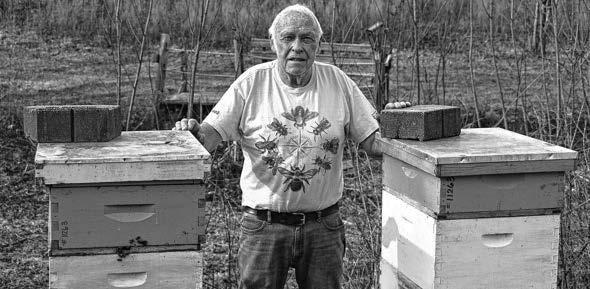
Ward and his wife, Barb, have been keeping bees for the past10 years. Their 12 hives produce about 500 pounds of honey a year, he said.
Ward said he was inspired to start keeping bees after he and his wife attended a University of Illinois Extension class.
Giovanni Bortolani/@giovannibortolani
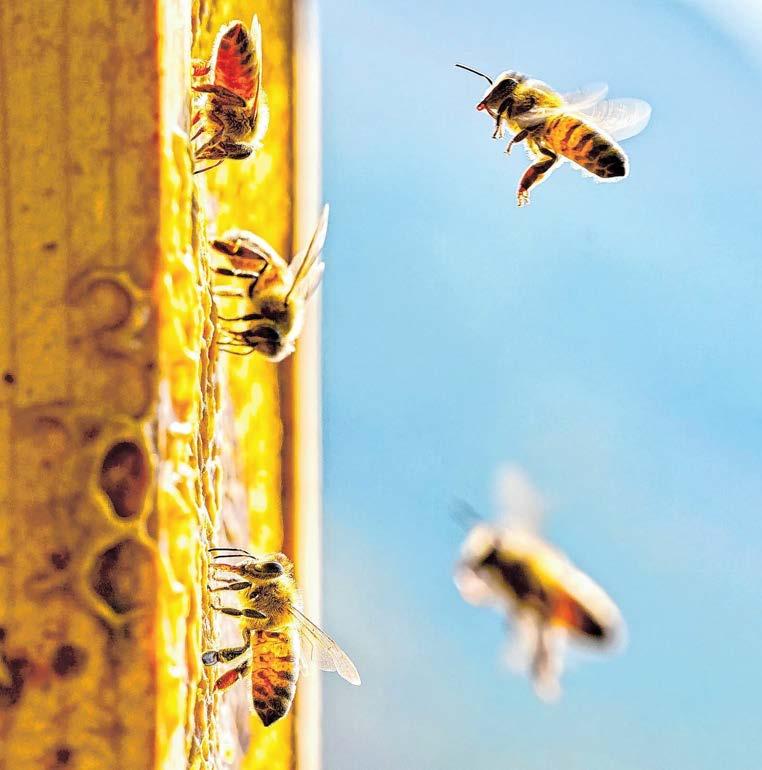
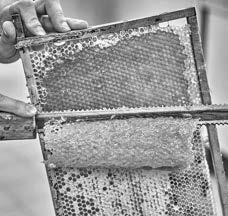
Bees walk on a honeycomb. More people around Illinois have been keeping bees, according to U.S. Department of Agriculture. As of the most recent reporting, Morgan County was home to 18 farms with bees and 149 colonies.
During the class, he said, instructors talked about howbeepopulationshave been on the decline; according to a 2022 report fromUtahStateUniversity Extension, populations of the western bumble bee have declined by 93% over the past 20 years.
Per the university, bee populations are under
threat from a variety of different issues, including habitat loss, climate change and pesticide usage. Ward also cited pests like Varroa mites and small hive beetles as being detrimental to hive safety. Beekeepers of all skill and experience levels can lose huge chunks of their hives during un-
Bees continues on H3
BEES
From page H2
lucky years, Ward said.
“It’snotunusualtolose 50% of your bees between fall and the next spring,” he said.
Ward sells off the honey his bees produce at places like farmer’s markets. He doesn’t just utilizehisbeesforthat,however; he also keeps their waxsoitcanbemadeinto candles. Bees also serve as important pollinators for plants, a fact that Wardhasbeenabletoutilize.
“I take some hives to the pumpkin patch ... over by Meredosia every year to increase their yield of pumpkins,” Ward said.
Others, like Jacksonville’sAdamPorter,arein it strictly for the love of
Ben Singson/Journal-Courier
Pat Ward stands between two of the 12 beehives on his Murrayville property. Ward and his wife, Barb, have been keeping bees for 10 years. Bees continues on H4
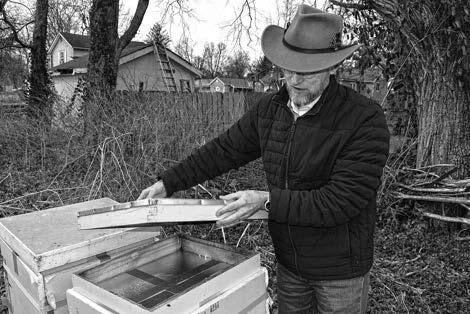
Ben Singson/Journal-Courier Illinois College professor Adam Porter takes the lid off one of his four beehives. The hives have been wrapped in insulation to protect against chilly weather.
BEES
From page H3
the game. Porter, a professor of religion at Illinois College, keeps four hives in the city — two in his backyard and another two near the AGROhood public garden off South Church Street. He’s been keepingbeesforaboutsix to eight years.
Like Ward, Porter was inspired to start keeping bees after attending a University of Illinois Extension class; his father andgrandfatheralsokept bees before him, he said. For him, the thing he enjoys about beekeeping is seeing the insects themselves at work making honey.
“They’re just fascinating little creatures,” he
said.
Porter said that while he collects the honey fromhishivesandgivesit to friends and family, he otherwise is a hobbyist farmer, making no profit but letting the bees roam around and pollinate plants in and around their hives.
“I’mnottryingtomake a living at it,” he said.
Both Ward and Porter

said that interest in beekeeping had risen as of late, with Ward saying that the interest was part of why the Apple Creek Beekeepers Club, an apiaryclubbasedinJacksonville, had formed.
“When we took the class in Morgan County, people decided that they wanted to get together and talk about bees,” he said.
Porter, meanwhile, said that he was uncertain about whether or not more people in his own circles had taken up beekeeping. Attendance at Apple Creek Beekeepers Club had fluctuated, he said, with some people continuing to keep bees without going to club meetings and others getting out of beekeeping altogether.
“If the state said numbershavegoneup,I’dcer-
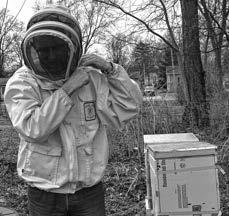
Ben Singson/Journal-Courier Illinois College professor Adam Porter dons a beekeeping jacket and veil designed to protect against stings. Porter is one of numerous Illinoisans who have taken up beekeeping.
tainly believe it, but I couldn’t really say anything about my own personal experience,” Porter said.
It also was difficult for Porter to say whether or notinterestinbeekeeping would continue into the future. He speculated that if Varroa mites disappeared, people would bemoreinterestedinbee-
keeping, since they have become the headache of many an apiarist as of late. However, with headlines about declining bee populations out of many people’s minds, that attention might slow, he said.
“I wouldn’t be surprised if the number decreased somewhat,” Porter said.
Tomekbudujedomek/Getty Images Hurling honey from bee wagons.
How does your garden grow?
With a little bit of planning, a little bit of care, a little bit of fun
By Angela Bauer STAFF WRITER
West-central Illinois started experiencing the joy of early spring well before spring actually arrived just days ago.
Spring planting in backyard gardens? That’s only now starting to be a good idea — and only with some caveats, according to garden experts.
“Ideally, people will be doing soil prep” about now, said Ken Johnson, University of Illinois Extension’s horticulture educator for Calhoun, Cass, Greene, Morgan and Scott counties. “They’re findingoutwhattheirsoil pH is like, so if there’s a deficiency, they can address that.”
On the plus side, Illinois “generally has pretty fertile soil” requiring minimal fuss, he said.
Testing can help determine what nutrients are missing from the soil and allow backyard gardeners to channel their efforts in the right direction.
Basic soil testing will measurepHandsuchnutrients as phosphorus, potassium, sulfur, calcium and magnesium. Nutrientsdotheirbestgrowing work when the soil pH is between 6.5 and 7 with some flexibility to a rangeof6.0to6.8,according to Extension.
“If someone is going to do a soil test on soil from their home garden, you want to make sure you say ‘this is a home garden,’”Johnsonsaid.“Otherwise, the lab’s most likely going to tell you the fertilizer for (growing agricultural crops of) corn andbeans.Justmakesure you indicate it’s for a vegetable garden, a flower
garden, tree fruits.”
Those eager to get something in the ground and growing should be awarethatlatecoldsnaps remainpossibleandplant accordingly, Johnson said.
InlateMarch,itshould besafetoplantvegetables such as broccoli, cabbage and kale, Johnson said. By early April, lettuce, carrots and peas can be planted.
“Those are things that, if you get a frost, they can tolerate it,” he said. “Tomatoes, peppers, things like that need to wait.”
Carrots can be planted directly from seed, while lettuce and broccoli can beplantedastransplants.
“They should have started them indoors (from seed) already or buy transplants,” Johnson said.
Illinois’ fertile soil means backyard gardeners really have their choiceofwhattogrow,he said.

Photos by Angela Bauer/Journal-Courier
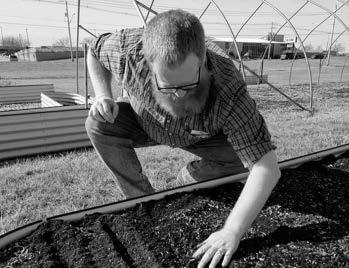
Ken Johnson, University of Illinois Extension's horticulture educator for Morgan, Calhoun, Cass, Greene and Scott counties, sweeps a hand over the soil in a raised bed at Extension’s Lukeman Garden and Education Center along West Morton Avenue in Jacksonville to cover newly planted seeds.
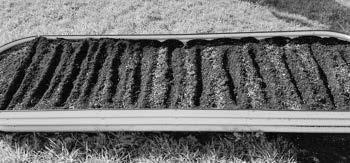
A raised bed awaits planting at University of Illinois Extension’s Lukeman Garden and Education Center along West Morton Avenue. Seeds can be placed in the shallow trenches and lightly covered with soil to encourage growth.
Garden continues on H6
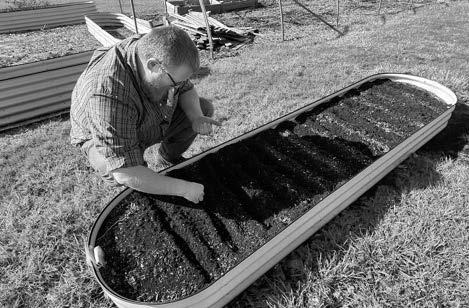
Ken Johnson, University of Illinois Extension's horticulture educator for Morgan, Calhoun, Cass, Greene and Scott counties, plants spinach seeds in a raised bed at Extension’s Lukeman Garden and Education Center along West Morton Avenue in Jacksonville. This is the time of year when planting for spring gardens can begin, as long as what's being planted can withstand some late weather swings, Johnson said.
GARDEN
From page H5
“We have a growing season that’s too short for some things,” Johnson said.
Some of the “more tropical” produce also may need extra attention including being
brought inside if the temperature drops — and some items, such as ginger, aren’t going to grow as prolifically in Illinois as they do elsewhere, he said.
But those are relatively minor barriers to growing pretty much what one wants.
“If there’s something
you really want to grow, try it,” Johnson said. “Get a (grow) tunnel to extend that season. If you’re determined enough, you can do it.”
Grow tunnels are similar to greenhouses, using steel frames and plastic sheetingtocoverandprovide increased warmth to a patch of soil. The addi-

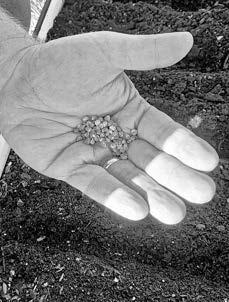
Ken Johnson, University of Illinois Extension's horticulture educator for Morgan, Calhoun, Cass, Greene and Scott counties, holds spinach seeds ahead of planting.
tional heat makes it safer to plant earlier and grow later in the year.
Johnson grows artichokes in his home gardenandhasgrowncotton and peanuts, he said.
Artichokes aren’t something“you’dtypically see” in a west-central Illinois backyard garden, Johnson said. “But I wanted to try it, to see if I can. Peanuts? You’re not going to get tremendous yield, but it’s fun to try.”
Thoseseekingthegratification of growing their own produce rather than the challenge of growing something more exotic still have plenty of options in west-central Illinois.
“There’s a reason people grow tomatoes and peppers, potatoes, onions, things like that,” Garden continues on H7
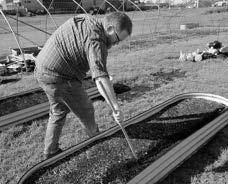
Ken Johnson, University of Illinois Extension's horticulture educator for Morgan, Calhoun, Cass, Greene and Scott counties, uses a stick to dig a shallow trench in a raised bed at Extension’s Lukeman Garden and Education Center along West Morton Avenue in Jacksonville. While he dug trenches the width of the container in one raised bed, he dug this one length-wise because he was preparing to plant peas that will need a trellis to grow, he said, noting longer rows make it easier to build such a trellis.
Photos by Angela Bauer/Journal-Courier
GARDEN
From page H6
Johnson said. “It’s because they grow well.”
While there are some considerations for planting a backyard garden — fromwheretoplaceitsoit receives the appropriate amount of sunlight for what’s being grown to whether to plant in the ground, in raised beds or in containers — getting started need not be complicated.
“I don’t till my garden at all,” Johnson said.
Instead, on a recent sunnyday,heusedastick to scratch rows into the dirt in raised beds at Ex-
tension’s Lukeman Garden and Education Center along West Morton Avenue in Jacksonville. Headdedspinach,carrot, radish and pea seeds to the resulting shallow trenches and then brushedoverthesoilsurface with his hand to covertheseedsinalooselayer of dirt.
Planting can be that easy.
And keeping it simple is, perhaps, the best advice Johnson has to offer beginning gardeners.
“If somebody is new to gardening, don’t bite off morethanyoucanchew,” he said. “Start off small and expand. I don’t think (newcomers) realize all
that goes into gardening. You can start expanding as you become more familiar with it, when you kind of know what to expect.”
Weeding is “probably the most time-consuming part” of maintaining a backyard garden, Johnson said, noting that layering mulch in between the seed-filled trenches can help suppress weeds.
Watering — and knowing when to water to supplement rainfall — also can be a stumbling block.
“If you’re working the soil, you don’t want it too wet,” Johnson said. “Thenyou’redealingwith compaction of the soil” that can prevent growth
and water absorption. For more information on when to plant for home vegetable gardening,Extensionhasafairly thoroughlistoffruitsand vegetables and when to plant and harvest them at extension.illinois.edu/ gardening. It also has individual sections on such considerations as planning, planting, weed control and extending the growing season, among others.
While Extension does not offer soil testing, the Agricultural Laboratory Testing Association maintains a list of labs that do at alta.ag/certified-labs.
The bottom line of successful gardening is making it your own and having fun with it, Johnson said.
“Grow what you’re goingtoeat,”hesaid,noting that getting children in-
volved in the process can encourage them to try more fruits and vegeta-
bles.“Ifyoudon’tlikeeating tomatoes, don’t grow tomatoes.”
Photos by Angela Bauer/Journal-Courier
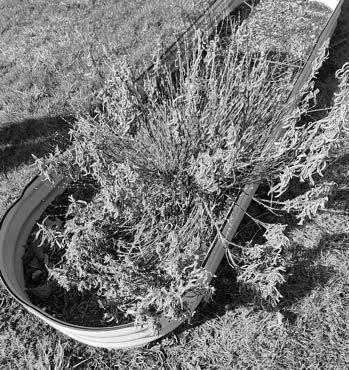
A sage plant that died back during the winter shows signs of returning this growing season at University of Illinois Extension’s Lukeman Garden and Education Center along West Morton Avenue in Jacksonville.
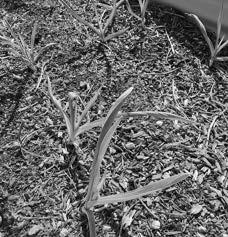
Garlic shoots show signs of returning this spring after being planted last summer at University of Illinois Extension’s Lukeman Garden and Education Center along West Morton Avenue in Jacksonville.
Quail farm expands operations

While helping to protect the natural population
By Samantha McDaniel-Ogletree STAFF WRITER
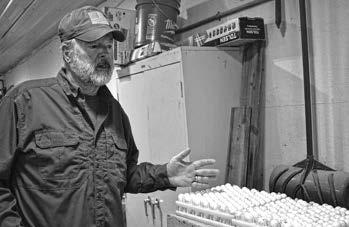
On a farm east of Jacksonville, a covey of quail is growingasthelandowners expand the number of birds they raise and the products they offer.
From eggs and meat to birds used in dog training andhunting,theCleggsare building their quail operation after establishing it just two years ago.
“I grew up with chickens and I’ve raised pheasants,” said John Clegg. “We thought why not give quail a shot.”
John and Kristy Clegg havedecidedtospendtheir retirement from livestock on a new venture. With very few quail farmers in the area, John Clegg said theyhavegottenafairbitof support locally.
While they established their first covey of about
7,000 birds last year, they arestilllearningandtrying newthingsastheyexpand.
The number of birds is expected to double this year.
“We just started two yearsagoandthefirstyear was us doing our due diligence,” Clegg said. “We were told quail are hard to raise.Wearelookingtoexperiment with a couple speciestoseeifwearewillingtotakethemtomarket.
Though they can’t say for sure where the closest farm is, they don’t believe there are any close and have had customers from several hours away.
Attheirfarm,theCleggs are raising birds through every stage, from eggs to adult birds.
While similar to chickens in many ways, John Clegg said there are some important differences..., such as ensuring the habitat for the birds is clean as quail like to peck at any-
thing and could pick up their feces if not provided the right environment.
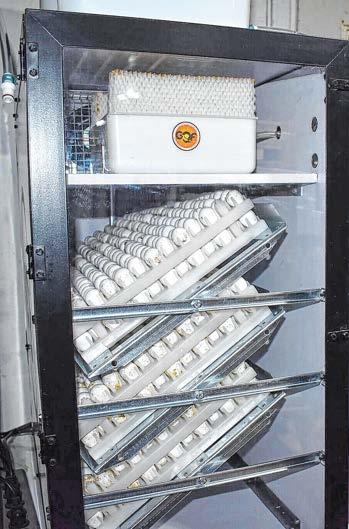
“The management, collectingtheeggs,incubating and hatching are all very similar,” he said. “Quail eggs are also harder to incubate and require a very reliable temperature and humidity environment. Chickeneggsareabitmore forgiving.”
John Clegg said quail mustbemonitoredclosely.
In addition to elevated enclosures, John Clegg said they have to be aware of other hazards, as he has found quail easily escape their enclosures and are prone to being self-destructive.
“I don’t know what a quail’s IQ is, but I would guess it’s single digits,” he said.
Each year, the Cleggs addsomethingelsetotheir services.
Quail continues on H9
Photos by Samantha McDaniel-Ogletree/Journal-Courier
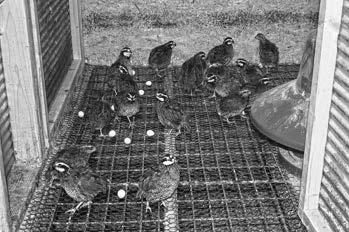
John and Kristy Clegg raise quail at their farm east of Jacksonville. They raise the birds through every stage, from eggs to adults.
John and Kristy Clegg rotate birds in their aviaries based on age.
QUAIL
From page H8
“Our first goal was to sell flight-ready birds for hunter or landowners,” John Clegg said. “We’ve hadsomebuybirdstohelp propagate their land.
We’ve had clients who were dog trainers that would buy them to train new dogs or to help keep dogs in shape. We are tryingtogetoutofthehunting side and trying to create a marketformeatandeggs.”
The Cleggs are looking at other products they can
offer, including pet treats made from the eggs, however, they have to get other specialty licenses before they can begin to offer those products.
The Cleggs have been working with the Morgan County Health Department and the Illinois De-
partment of Natural Resources and Illinois Department of Agriculture to getlicensesfordifferentaspects of their operation and find different avenues they can explore.
While both are birds, John Clegg said quail have different requirements for theirenclosuresanddifferent nutritional needs.
While they are working on expanding what they offer, John Clegg said they are trying to work with
other people who have shown an interest in quail.
Being one of the few local quail farmers, he said they’vegottenmanyphone calls about how to help protect the natural quail populationsonotherproperties.
While working on the productionside,theCleggs are also working on the conservationsideandpromoting conservation efforts that support the growth of the natural pop-
ulation as well.
“There has been a declineinthenaturalpopulation,”JohnCleggsaid.“Before,theyusedtobeonevery farm and roadside.”
Kristy Clegg said their natural habitat has been declining for years.
“It’s all timber and less habitat,” she said.
Quail do well in areas with prairie grass, light woodlandsandshrubbery.
John Clegg said he is converting a portion of his land into habitat for the natural quail population, but said it is a longer processasmuchofitwasused for farming.
He said they are also working with others who have expressed interest in establishing conservation areasandwanttoseequail on their property.
“We are willing to talk with anyone and try and helpwherewecan,”Kristy Clegg said.

Photos by Samantha McDaniel-Ogletree/Journal-Courier
An incubator rotates fertilized eggs to ensure they remain at optimal temperatures while hatching.
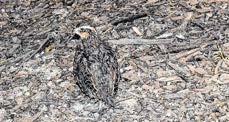
Quail roam the barn on the Clegg Farm property.
Proposed 45Z rule seen as step forward
By Tammie Sloup FARMWEEK
Newly released proposed 45Z guidelines include key details on how biofuelsandothercompanies can qualify and potentially sets up farmers to benefit from the tax credits by factoring in feedstocks’ carbon intensity.
The Treasury Department and Internal Revenue Service last month issued proposed regulationsfordomesticproducersofcleantransportation fueltodeterminetheireligibility for the clean fuel production credit, or 45Z.
The proposed regulations provide guidance on thedeterminationofclean fuel production credits, emissions rates and certification and registration requirements, and address key issues raised by stakeholders, according theTreasuryDepartment.
“The proposed 45Z guidance is a positive step forward for farmers and the biofuel industry,” Illinois Farm Bureau President Philip Nelson said.
The proposal includes rulestoimplementcertain changes included in the One Big Beautiful Bill (OBBB) legislation passed last summer to the clean fuel production credit. OBBB changed the 45Z credit to:
The45Zcreditprovides businesses with an income tax credit for clean transportation fuel produced domestically after Dec. 31, 2024, and sold by Dec. 31, 2029.
Newly released proposed 45Z guidelines include key details on how biofuels and other companies can qualify and potentially sets farmers to benefit from the tax credits by factoring in feedstocks’ carbon intensity.
• Extend the credit to Dec. 31, 2029
• Limit feedstocks to those grown or produced intheU.S.,MexicoorCan-
related intermediaries
• Eliminate the special rate for sustainable aviation fuel (SAF)
• Add an anti-abuse provision to prevent double crediting
• Prohibit negative emissions rates except for fuels derived from animal manure
• Require feedstockspecific emissions rates forfuelsderivedfromanimal manure
• Excludeindirectland use changes from emissions rates
ada
• Add prohibited foreign entity restrictions
• Broaden sale attribution for fuel sold through
Biofuels, agriculture, petroleum, airlines and otherindustrieshavebeen waitingformoreguidance on the tax credit designed to fuel the development of a domestic SAF industry.
The interim rule includesthreeprimaryfeedstockcrops:fieldcorn,soy and sorghum. It also covers climate-smart agriculture practices that could reduce greenhouse gas emissions or sequester carbon. The covered CSA practices include reduced till, no-till, cover crops and specified nutrient management practices.
Rule continues on
H19
Early last year, USDA published an interim rule establishing guidelines for climate-smart crops used as biofuel feedstocks aswellasaFeedstockCarbon Intensity Calculator. Around the same time, the Treasury Department announced its intent to propose rules for 45Z, with plans to utilize USDA’s proposed interim rules for climate-smart agriculture.
USDA pauses funds for manure digesters
By Mark Richardson PUBLIC NEWS SERVICE
Groups focusing on the environment and small farms are praising a decision by the U.S. Department of Agriculture to pause and review funding for systems that produce natural gas from manure at industrial livestock operations.
The move comes just a week after a coalition filed apetitionaskingthatfactory farms be ineligible for funding for anaerobic digesters under the Rural Energy for America Program. The EPA database listsoneanaerobicdigester in Arkansas, near Springdale.
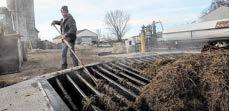
is put in a
with the goal of converting much of the food waste and cow manure into heat and energy.
Tyler Lobdell, senior staff attorney for the nonprofit Food and Water Watch, said factory farm biogas digesters do produceenergybutcarryhigh environmental costs.
“They increase water
andairpollution,andthey encouragefactoryfarmsto getbigger,whichincreases the overall pollution load that a rural community has to deal with,” Lobdell explained. “We are adding
Catrina Rawson/Illinois Farm Bureau
The Boston Globe
Manure
digester
Manure continues on H17
Grad engineers water disaster solutions
By Tim Obermiller CONTRIBUTING WRITER
Growing up in Nepal’s flood-prone Terai region, Southern Illinois University Carbondale graduate Dewasis Dahal learned early that water can be both a lifeline and a threat.
Monsoons make crops possible and refill wells. But on trips with his father — an executive at a nonprofit that supports community projects — Dahal also saw the other side of that seasonal rhythm: floods and landslides that uprooted families, damaged roads and bridges, and left rural communitieswithoutsafe drinking water.
Those moments planted a question that has stayed with him ever since: How can engineering help communities not just recover from waterrelated disasters, but adapt and prepare for what comes next?
When Dahal arrived at SIU in August 2023 to pursue a master’s degree in civil engineering, he quickly caught the attentionofassociateprofessor Ajay Kalra.
“Hestoodoutasahardworking, curious student who was eager to learn and contribute,” Kalra recalled.
After taking Kalra’s courses in open-channel hydraulics and water resources engineering, Dahal joined the professor’s Water Resources Lab — and soon built a research record that is rare for a master’sstudent,publishing more than 10 peer-reviewed journal articles, including four as lead author.
Much of Dahal’s research centers on using
artificial intelligence and machine learning to improve flood prediction.
Water problems often involve massive datasets — decades of rainfall records,soilmoisture,landuse change and river discharge measured at fine time scales.
“Traditional methods alone struggle to capture the complexity,” he said; machine learning can help identify patterns “that would otherwise be difficult to detect.”
Because his graduate research was done with tight budgets, Dahal became deliberate about choosing approaches others could use. He leaned on openly available data and efficient tools and focused on methods that canbeimplementedwithout expensive software or equipment.
“Ifamethodistoocostly or complex, it often stays on paper,” he said.
Designing low-cost, practical solutions became a core goal — so research can move beyond academia and make a difference on the ground.
“Behind every dataset ormodelarereallivesand real challenges,” he said, and that mindset pushes
sponsibility.
At Kathmandu University, where he earned a bachelor’s in environmental engineering, Dahal learned that water management isn’t only technical—itconnectsdirectlytoequity,safetyand quality of life. His bachelor’s thesis examined Nepal’s first centralized wastewater treatment plant through a life-cycle assessment — work that could inform future plant design and policy decisions.
him to ask better questions — and stay focused on why the work matters.
For one of his projects, Dahal analyzed climate dynamics and developed machine-learning models to improve flood forecasting in Sacramento, California — among the nation’s most flood-prone regions. Published in HydroecologyandEngineering, the research also earned the Top Poster Award at SIU’s spring Creative Activities and Research Presentations, sponsoredbytheOfficeof the Vice Chancellor for Research.
“Dewasis’workreflects exactlywhatweaimtodevelopatSIU:abalancebetween theory, modeling and application,” Kalra said. He added that SIU trains students to tackle applied problems, collaborate closely with faculty and peers, “and learn by doing — not only by theory.”
That kind of environment, Kalra noted, preparesengineerstotakeon complex, fast-changing challenges like climate variability, flood risk and urban water management with both rigor and re-
him to devote himself to graduate study. The transitiontoanAmericanuniversity was eased by support that began even beforehearrived:Futurelab mates helped with housing and logistics, and faculty checked in regularly.
Realizing the research might shape real infrastructurechoices,hesaid, was “deeply meaningful.”
Dahal chose to advance his education at SIU Carbondale, attracted by its environment and a full scholarship that allowed
Inside Kalra’s Water Resources Lab, Dahal found a culture built on collaboration and applied problem-solving. The lab is “highly diverse,” he said, and emphasizes “working on real problemsratherthanonlytheoretical exercises.”
“Projects like this showed me how technical analysis, when guided by purpose,candirectlyconnecttopeople’slives,”Dahal said.
Dahal also interned with the Illinois Department of Transportation’s District 9 utilities team, gaining field experience, and collaborated with Carbondale-basedEmriver Inc. to help calibrate hydraulic flumes used for education and research. That practical focus is
SIU’s emphasis on connecting learning to practice extended beyond the lab. Dahal researched flood mitigation and lowimpact development strategies in the American Bottoms and East St. Louis—communitiesfacing long-standing environmental and social challenges. The work explored how green infrastructure such as permeable pavement, bioswales and green roofs can reduceurbanfloodingwhile improving water quality.

Courtesy of Little River Research & Design
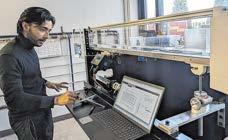
Dewasis Dahal works in a Southern Illinois University lab to calibrate hydraulic experiments using a flume from Little River Research & Design.
Mink farming toes line as lawmakers consider regs
By Jade Aubrey CAPITOL NEWS ILLINOIS
For over 65 years, Bernice and Frank Monteleone have been raising minksontheirfarminElgin. The couple bought theirfirstminkin1959—a red female who was pregnant at the time. She quickly produced seven babies, or kits.
“Beforethen,Ihadnever seen a mink before in my life,” Bernice Monteleone said.
Thecoupletradedthose kits for minks from a neighboring farmer and begantobreedthem.That one female mink led the family to raise around 30,000minksattheheight of their production. In turn, the farm financially supported all the couple’s
children and their families throughout the 1970s and1980s.
“It has been a really wonderfulwayoflife,”she said. “We’ve raised six kids here and a bunch of grandkids, and they learned good work habits and things like that from it, too. We really enjoyed that kind of life.”
Although the industry has self-imposed guidelines farmers adhere to in order to sell their pelts legally, mink farming is not regulated at the federal level or in Illinois.
But a bill in play in Springfield could change that. House Bill 2627, sponsored by Rep. Joyce Mason, D-Gurnee, would regulate the mink industryatthestatelevel,creating mink farm licensing
and requirements. But proponents and opponents have two vastly different opinions on what the bill really aims to do.
Mason testified during the hearing alongside Chris Green, executive directoroftheAnimalLegal Defense Fund, and Marc Ayers, Illinois director of

mink industry, and that therequirementsoutlined in the bill are impossible for farmers to adhere to.
“I don’t know if it’s ignorance, or if, in my opinion, it is them trying to push us out of business,” Hobbs said in an interview.“Becausethesesame proponents tried to pass a bill last year to ban us, so that’s what it looks like.”
What bill would do
theHumaneSocietyofthe United States, who all warned of the potential public health risks mink farms pose.
But Bernice MonteleoneandChallisHobbs,executive director of Fur Commission USA, disagree. They say the bill’s main goal is to ban the
Hobbs and Monteleone’s opinion, the bill is yet another attempt to shut the industry down.
But Mason maintains the bill’s intention is to protect public health.
“This isn’t even about mink welfare, it’s about health,” Mason said in an interview. “My goal is not to shut them down at all. It’s just to make sure that they’re not breeding viruses.”
HB2627issupportedby the Animal Legal Defense Fund, the Humane Society of the United States, and the Animal Welfare Institute. It is opposed by such groups as the Fur CommissionUSA,theIllinoisFarmBureau,andthe Illinois Trappers Association.
Mink continues on H18
“There’s not much doubt in my mind that they’re just trying to get rid of it,” Hobbs said, referring to the mink farming industry. “When I readthesethingsandhow they’ve written this bill, obviously, it’s not someone who’s been in agriculture or they just want to put us out of business.”
Old tree lines may hold value for farmers
By Judith Ruiz-Branch PUBLIC NEWS SERVICE
Supporters of a new project hope studying the benefits of tree and shrub systems used to protect farms from extreme weather, otherwise known as windbreaks, will revive the practice among Illinois farmers today.
The Corn Belt Windbreak Project will look at trees planted through the Conservation Reserve Program, with the oldest dating back to the1980s.
Dallas Glazik, an Illinois farmer and precision agriculture and conservation specialist for the groups Pheasants Forever andQuailForever,iscom-
Gary Yeowell
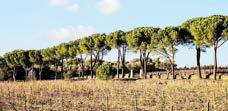
Experts say a landscape with more windbreaks could be better prepared for extreme weather, with cleaner water and thriving wildlife.
piling profitability data, particularly for crops along end rows, where farmers typically lose money. He noted farmers are now removing windbreaks to maximize space on their farms.
“It’s one that we’re see-
ing a forgotten place about,” Glazik explained. “With the use of intensive agriculture on these landscapes they think, ‘Oh, I can squeeze out another seven rows if I get rid of this tree line.’ And they’re
Tree continues on H15
Vital Hil/Getty Images
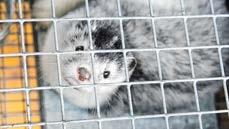
A gray mink in a cage looks through the bars.
Historically dry ’25 boosts drought issues
By Rhiannon Branch FARMWEEK
Drought, flooding, tornadoes, severe thunderstorms and extreme temperature swings; 2025 had it all and it varied drastically by location, making last year a memorable one fromaweatherstandpoint for many Illinois farmers.
State Climatologist Trent Ford, with the Illinois State Water Survey, reviewed weather statistics from 2025 and events that stood out during a recentFarmWeekinterview.
Precipitation, or lack thereof
Preliminary statewide average total precipitation in 2025 was 31.78 inches, about 9 inches below normal. While official rank-
ings by the National OceanicandAtmosphericAdministration had not yet been released as of press time, it is likely 2025 will make the top 20 driest years on record statewide.
However, there was a lot of seasonality for precipitationlastyearandthe amount of rainfall varied immensely by region within the state.
January and February were drier than normal across the state, March was close to normal and then April and May were hugeprecipitationmonths for southern Illinois.
Sunlight pokes through cloudy skies
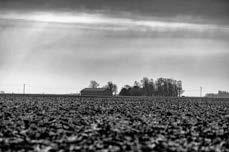
over an Illinois farm. Despite recent rains, drought and dryness remain a top concern following a wild weather year that wound up historically dry in Illinois.
“There were places that coming into June 1 were having nearly their wettest year on record, especially the closer you got to the Ohio River and the Kentucky border,” Ford told FarmWeek. “There were places like Metropolis that were on par with some of the wettest years on record, including 1993, coming into the summer.”
Suit challenges use of new pesticide on farms
By Zamone Perez PUBLIC NEWS SERVICE
Conservation groups havefiledalawsuitagainst the EPA over its approval of a “forever chemical” insecticide.
The insecticide, called isocycloseram, is a type of chemical known as PFAS, known for accumulating in the environment. It was approved for use on golf courses, lawns and a wide range of food crops.
Thelawsuitpointstoresearch by the EPA on animals, which shows the insecticide affects their reproductive ability and harms the liver.
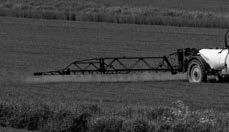
The pesticide isocycloseram has been recently approved for use on many different types of crops, including tomatoes, peaches, almonds and apples.
But the consistent location of those storms in the jetstream through central and south-central Illinois meantalotofthenorthern half of the state was get-
ting missed.
June and July brought a little bit more equitable precipitation, including heavy rainfall.
“For example, Brownstownhad12inchesofrain in a single day. A couple weeks later, the Chicago area had an event where 5 inches of rain fell in 90 minutes,” Ford said.
Onlytwomonths,April and July, averaged wetter than normal statewide and in central Illinois, every month was drier than normal except July.
“In many places in the centralpartofthestate,we were drier than some of the most extreme drought years like 1988 and 2012,” Ford said. “But the reason we didn’t see catastrophic agricultural losses is because we got rain when it really mattered.”
Total precipitation in September and October was about only 3 inches statewide,lessthan50%of normal, making it the thirddriestAugusttoSeptember period on record in the state.
Total annual precipitation by town varied greatly.Metropolishad67inches of precipitation in 2025, about23inchesmorethan normal, while parts of central and northern Illinois got about only 30 inches.
“There were a couple places in Champaign and PiattCountythatonlyhad 22 inches of precipitation in2025,”Fordsaid.“Itwas thetop10driestyearonrecordinPeoriaandSpringfield, the 12th driest in
Dry continues on H14
Nathan Donley, environmental health science director at the Center for Biological Diversity, said its approval points to the power of chemical manufacturers.
Safety and Pollution Prevention Office are former lobbyists for the pesticide industry.
Henotedthatfourofthe top political appointees nowintheEPA’sChemical
“The scientific consensus on the harms from

Catrina Rawson/FarmWeek
Eva Kongshavn
Ethanol industry wants ‘let off the leash’
By Tammie Sloup FARMWEEK
The ethanol industry wants“letofftheleash”to help provide new market opportunities for the renewable fuels and agriculturesectors,saidGeoff Cooper, Renewable Fuels Associationpresidentand CEO.
During his state of the industry report at the National Ethanol Conference in Orlando, Florida, Cooper said 2025 was a good year for the ethanol industry but could’ve been so much better.
“We saw glimpses of our industry’s potential,” he said.
Exports were a bright spot in 2025. A record 2.2 billion gallons of ethanol were exported last year. The industry also generated35millionmetrictons of high protein animal feed and a record 4.7 billion pounds of distillers corn oil.
“Toputthatinperspective, that’s enough animal feed to produce 13 billion pounds of red meat and enough corn oil to generate 575 million gallons of biobased fuel,” Cooper said.
DRY
From page H13
Quincy, and the second driest in Champaign-Urbana where we were only slightly wetter than1894.”
And for the first time since 2021, Illinois was snowier than normal, especially later in the year. SomeplacesaroundDecaturgot16to18inchesabove average snowfall in 2025.
Slightly warmer than normal
Domestic ethanol consumption hit 14.3 billion gallons in 2025 — the highest in six years.
But the statistics don’t tell the whole story, Cooper said. Ethanol was neck and neck with livestock feed as the top user of U.S. corn last year.
Roughly 5.6 billion bushels of corn and grain sorghum went into ethanol last year, “providing a critical demand use for farmers who, despite harvesting record crops, faced the worst economic conditions in nearly 50 years,” he said.
Some analysts have estimatedcornpriceswould have been close to $1.50 per bushel lower without ethanol, Cooper said.
“Indeed, ethanol continuedtoprovidealifeline to farming communities that are experiencing incredibly difficult conditions and a dire financial outlook,” he said.
For the past four decades, ethanol has been the shining star of valueaddedagriculture,Cooper said.
While proud of the industry’s statistics, Cooper said “we could have done so much work as an in-
Last year will be rememberedbysomeforextremetemperatureswings especially in December whensomeareasdropped more than 60 degrees in less than 24 hours following 60-plus degree conditions on Christmas. But, statewide the year averaged only 1 degree above normal temperature, making it the 20th warmest year on record. February and December averaged below normal temperatures, with May and August also
The
dustry if simply given the opportunity.
“But unfortunately, the renewable fuels industry remains on a fairly tight leash,” he said. “We are being held back from reaching our full potential.”
Specifically, yearround nationwide E15, for which RFA and Illinois Farm Bureau strongly advocated,hascomecloseto being approved by Congress but legislation was pulled twice in the past year at the last minute.
Cooper said E15 re-
slightly below. March and October were warmer than usual.
“We had a very early start to pretty intense warmth in March. Octoberwasverydryandpretty warm across the state, which did help planting and harvest progress,” Ford said.
Most of the state ended upbetween0.5and2.5degrees warmer than normal with a bit higher temperatures in northern Illinois than southern Illinois.
sized oil refineries who say they will go into the redandmustlayoffworkers if they lose access to small refinery exemptions.
Instead of E15 legislation being included in the latest round of appropriations, the House created anE15RuralDomesticEnergy Council to study biofuel issues and prepare year-round nationwide E15 legislation.
assistant administrator for air and radiation, told NEC attendees the EPA’s proposed renewable volume obligations final rule was sent to the Office of Management and Budget on Feb. 25.
mains a seasonal fuel that cannot be sold during the busy summer months, “allbecauseofanonsensical glitch and regulations that were adopted 35 years ago.”
“Many retailers have made it abundantly clear to us that they are not interested in selling E15 if it can’tbeofferedtocustomers 365 days a year, even if thefuelprovidesacleaner motorcostoptionfortheir customers,” Cooper said.
Congress also has seen significant pushback from a handful of mid-
It was the15th warmest year on record in Chicago and 20th warmest in Peoria.
Severe weather active
Last year began on track to beat 2024’s record for most tornadoes in Illinois. But active weather slowed down in the second half of the year.
“In2024,wehad142tornadoes, which was the highestonrecord.In2025, the National Weather Service confirmed 126,” Ford said. “So still about two
During a panel discussiononethanolpolicyand newmarkets,JordanDux, seniordirectorofnational affairs at Nebraska Farm Bureau, said farmers often tell him with the large supply of corn in the market from the 2025 crop year, passage of E15 legislation is urgent.
“We have a lot of product out there and this is one of the easiest ways to get it off the market,” Dux said.
Looking at this year, Cooper acknowledged getting E15 legislation passed could be a lift.
“We just need the chance to compete. We need the opportunity. We need to be unleashed,” he said.
Aaron Szabo, U.S. EPA
times our long-term average and certainly a top three most active tornado year.”
By July 1, Illinois residents experienced more tornadoes than in the first half of 2024 with 35 tornadoes in March, more than 45 in April, more than 20 inMayand25-plusinJune all above average for those months.
But severe weather became quieter by late summer,ingeneral,withfewer than five tornados statewide each month from Ju-
A supplemental notice of proposed rulemaking also considers how SREs for compliance years 2023-25 will be accounted for when establishing the RVOs in the final rule. EPA is co-proposing two approaches: additional volumes accounting for 100%or50%ofthe2023-25 exempted RVOs. Biofuel and ag groups, including IFB, are seeking full reallocation to ensure the small refinery waivers do not hurt demand for products like corn-based ethanol.
An NEC panel with representatives of farmers, fuel retailers and petroleum added RVO certainty soon would be welcome.
“We’ve been afforded so little certainty in the way of production agriculture. ... If we know whatwe’retryingtogetto, Ithinkthat’sdefinitelygoing to benefit farmers,” Dux said.
ly through November cappedby10inDecember. “Wehadsomeextremely dry conditions statewide from August to Novemberandwhenwehave drought we usually don’t have very much severe weather,” Ford said. “The drought in the fall that persisted across much of thestatemadeitsothatwe didn’t break that tornado recordtwoyearsinarow.” Illinois finished second in the nation for most tornadoes in 2025, behind Texas.
Sanya Kushak/Getty Images
ethanol industry wants “let off the leash” to help provide new market opportunities for therenewable fuels and agriculture sectors.
Legislation would protect Illinois waterways
By Gabriel Castilho CAPITOL NEWS ILLINOIS
As the Trump administration moves to slash federal protections for waterways and wetlands, Illinois Democratic lawmakers and environmental advocates are racing to finally pass a measure that would enact state safeguards.
The Wetlands Protection Act was discussed in both chambers of the Illinois General Assembly last year but failed to get traction or make it to the House and Senate floors, partly due to budget constraintsinthe2025budget year.
“I hope things will turn around,” said Rep. Anna Moeller, D-Elgin. “It’s just really important for our ecosystem, for flood control, for water control, for water quality.”
A proposal from the Trump administration adds urgency to a longstanding issue in Illinois. LastNovember,thefederal EPA proposed a new rule totheCleanWaterActthat would bestow protection only to wetlands that hold water during the wet season and with visible connections to major water-
TREE
From page H12
losingmoneybydoingso.”
Glazik stressed windbreaks serve as important shields, especially during spring and winter months whensoilisbare.Henoted they can reduce soil erosion by 95%, increase key wildlife habitat populations and protect neighboring farmland.
The nonprofit Savanna Institute received a five-
ways. Excluded are seasonal streams, marshes, bogs, swamps and mangrove forests.
Seasonal streams are thosewetlandsthatdryup duringcertaintimesofthe year.
Inastatementoutlining the rule changes last year, the EPA said it wanted to cut the red tape and provide predictability, consistency and clarity for American industry, energy producers, the technologysector,farmers,ranchers, developers, businesses and landowners.
Developers must obtain a permit from the Army Corps of Engineers before building over a wetland to ensure environmentally responsible practices.
If the EPA rule change is finalized this year, over two-thirds (707,566 acres) ofIllinois’wetlandswould bewithoutprotections,according to a University of Illinois Urbana-Champaign study released in September. Neighboring stateslikeWisconsin,Missouri and Indiana already havesafeguardsinplaceto protecttheirwetlands,but Illinois does not.
“We need to do something:90%ofourwetlands have already been de-
year, $1.7 million grant from the U.S. Department of Agriculture to conduct the study in Illinois and Iowa.
Nate Lawrence, ecosystem scientist with the SavannaInstitute,saidalong with soil and wildlife benefits, researchers will study how windbreaks affect crop yields and water quality.
“The core that makes memostexcitedaboutthis projectisthatopportunity to work with dozens, at

The Shedd Aquarium, despite its tourist side, works with international, national and local organizations with efforts to promote the protection of waterways, wetlands and wildlife.
stroyed in Illinois,’’ Moeller said, “and we need to protect the remaining 10%.”
Senate Bill 2401 would give the Illinois DepartmentofNaturalResources authority over wetland permittingonprivateland before construction begins. The bill exempts certain agricultural activities like normal farming, silviculture and maintenance of farms and stock ponds
The bill was re-referred for assignment at the end of the last session, and no actionhasbeentakenonit this session.
Sen. Laura Ellman, D-
minimum, (of) farmers across these different target regions,” Lawrence emphasized. “We wanna know from farmers what wedon’tknow.They’rethe core directors of the research.”
Farmers will be working with the University of Illinois to integrate the findings. Lawrence added the end goal is to develop better strategies and show farmers how windbreaks can benefit them now and in the future.
years, which in short meansothertopicsreceive great priority,” Ellman saidinanemailstatement.
“Ibelievethataswecontinuetolayoutthecasefor Senate Bill 2401 and other environment-related legislation, the push to take action now is stronger than ever. As you know, actions speak louder than words.”
Does bill have governor’s support?
Naperville, who sponsored the bill, said she is hopeful this will be the year the state Wetlands Protection Act becomes law.“Wehadtoughbudget
Still, Democrats supporting the bill face opposition from some Republicans,theIllinoisFarmBureau as well as a question mark surrounding supportfromGov.JBPritzker.
Without support from the governor and the Illinois Department of Natural Resources, passage of the bill through the two Democratic-led chambers might be difficult, supporters of the bill said.
“I think our thought is, frankly, if the governor andIDNRwouldcomeout as supporting this, it would be a much easier selltothelegislature,”said Brian Gill, senior director of government affairs and policy for the Shedd Aquarium in Chicago, one of the organizations sup-
Protect continues on H16
A spokesperson for Pritzker wrote: “The Governor’sOfficewillmonitor andreviewlegislationasit moves through the General Assembly. Any legislation that requires additional state resources will becarefullyreviewedwith budgeteers to understand the fiscal impact.”

Gabriel Castilho/Medill Illinois News Bureau
Spas for soil: farm charm shapes bookings
By Jennifer Allen CONTRIBUTING WRITER
As winter departs muchoftheUnitedStates, a different kind of spring planningisalreadytaking shape.
Agricultural calendars, from bud break to calving and planting, operate on fixedschedulesregardless of when travelers book. That timing pressure helps drive growing demand for hands-on farm and field experiences in 2026, a trend some industry forecasts have labeled farm charm.
Unlike traditional agritourism centered on tastings and scenic views, theseprogramsinviteparticipation. Travelers plant seedlings, rehabilitate rice paddies, peel cinnamon bark,andharvestproduce tobecookedthesameday. The appeal lies in direct access to seasonal work
PROTECT
From page H15
porting the bill.
With the dynamics of consistently tight budgets inSpringfieldinmind,the Sheddchangeditsstrategy inthestatecapitalrecently.
“We last year flipped from pointing at the General Assembly to asking Gov. Pritzker to take a leadership role in this,’’ Gill said. “I think those of us that support this certainly would probably support more budget for IDNR to also handle this, but that is the bigger concern: budget and resources.”
Moeller conceded the law might require additional resources from the state.
“I don’t think the De-
tied to the land rather than curated observation.
Booking window shrinks
Compressed planning timelines can complicate accesstoseasonalagricultural programs tied to specific planting and production cycles. In Italy’s Emilia-Romagna region, spring brings planting in the foothills of the Apennines and calving season that supports the area’s Parmigiano-Reggiano supply chain. At Palazzo di Varignana, a 650-hectare estate outside Bologna with vineyards, olive groves and orchards, guests can join planting workshops and vineyard walks during bud break, experiencesavailableonly within defined seasonal windows.
In northern Patagonia, springatHotelAWAoverlooking Lake Llanquihue ushersinthefirstharvests from its organic garden, supportedbyvolcanicsoil and a cool, high-rainfall climate. The property in-
partment of Natural Resources is against this legislation,butIthinkweare working with them to make sure that they can implement the regulation with everything else that they’re charged with doing.”
Elsewhere, opposition to the bill centers around the added restrictions to landowners and the potential impact on economic growth and development in rural Illinois. In addition to the farming groups, last year the Illinois Fertilizer and Chemical Association weighed in as opposing it. When asked whether their positionremainsthesamethis year, an IFCA spokespersonsaid,“Wearemonitoring the wetlands bill and otherbillsofgeneralinterest to the ag industry as a
whole.”
Sen. Jason Plummer, REdwardsville, has opposed the bill since 2024. On his official website, he said the bill would have a massive negative impact on farmers, the construction industry, anyone looking to build a home and all private property owners.
“This legislation is absurd,andifitbecomeslaw, itwilljustbeonemorereasonthatpeoplechoosenot to build a home or start a business in Illinois,” he is quoted as saying on the website.
What about Swampbuster Act?
Sanjay Sofat, director of environmental policy at the Illinois Farm Bureau, said there are already effective government pro-
corporates permaculture and biointensive growing techniques suited to southern Chile’s shorter growing season. Guests
grams in place to protect wetlands.
He cited the federal Swampbuster Act, which discourages farmers from turning wetlands into croplandsince1985.Under thefederallaw,anyfarmer who drains a wetland on their property is ineligible forfederalbenefitssuchas subsidies,loansandinsurance. According to the environmental advocacy organization Food and Water Watch, the program currentlyprotectsapproximately 78 million acres of wetlands — almost twothirds of the wetlands left in the continental United States.
“The burden is, you are doubly regulating the same entity that is already regulated on the Swampbuster,” he said.
However, Tucker Barry,
pan has expanded efforts torehabilitatericepaddies damaged by severe flooding in 2024. Rice cultivationinJapanfollowsstrict planting and transplanting periods in late spring, with harvest in early autumn. Through its Community Project, travelers assist in restoring damaged fields so they can return to production for the 2026 growing cycle.
harvestingredientsbefore participating in cooking sessions based on what is available that day.
InruralJapan,WalkJa-
communications director for the Illinois Environmental Council, said the Swampbuster Act does not address the legal protections gap that would arise if the new EPA rules weretobefinalized.While theSwampbusterrewards farmers’ compliance if they do not convert wetlands, it does not define what a wetland is — insteaditusestheCWAdefinitionofwetlandsas“navigable waters.”
Barry argued that not all farmers are against wetlands protection. “Many farmers understand that this bill is reasonable and offers vital protectionsthathelpthem protect their land from flooding, poor water quality and soil health problems,” Barry said.
Some counties in Illi-
Integrated hospitality Farm-based programming is also being incorporated into higher-end stays, where cultivation and sourcing form part of the guest experience. At Spier Hotel and Wine Farm in South Africa’s Stellenbosch region, the property operates within a working wine farmandmaintainsafood gardenguidedbyregenerative practices under its
Charm continues on H17
nois, meanwhile, have stepped up to fill the lack ofafirmstatepolicy,Barry said.
DuPage County requires additional documentation for activities that disturb the ground, removesvegetation,builds un-permitted structures, or any activity that affects the flow or absorption of water.
Ellman,whorepresents the county, sees her bill as an extension of those kinds of efforts.
“As there are wetlands protections already in placeforDuPageCounty,I am thinking beyond the scopeof(Senate)District21 in terms of how important this matter is,” Ellman said. “By enforcing these protections now, we are protecting our state’s ecosystem and more.”
Ozgur Cankaya/Getty Images
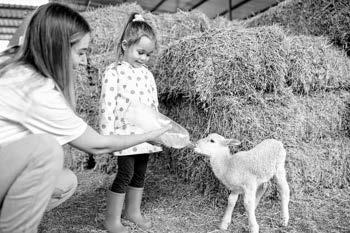
A girl uses a bottle to feed a baby lamb inside a barn.
CHARM
From page H16
Growing for Good initiative. Seasonal produce harvested on site is used in the property’s restaurants,andagriculturaloperations become part of guest programming through scheduled harvest sessions and garden visits.
In Umbria, Vocabolo Moscatellisitswithinarestored monastery estate surrounded by olive groves and woodland. Guests join the kitchen team in harvesting produce from the property’s garden before dinner service. The region is also known for black truffles, typicallyforagedfromlate autumn through winter, and local guides lead small-group hunts tied to those seasonal windows.
In Tanzania, Elewana
MANURE
From page H10
industrial gas production on top of these already very large and pretty industrialized facilities.”
In a statement, the Renewable Natural Gas Coalition said the digesters “reduce methane emissions from manure man-
PEST
From page H13
these chemicals is so clear andingrained,thattohave one of these pesticides just be approved a few months agoissofrustratingtosee,” said Donley. “It really gets at how much influence the pesticideindustryhasover theapprovaloftheseproducts in this country.”
The EPA has proposed mitigations to reduce the risks and says it’s provid-
programming is being incorporated into higher-end stays, where cultivation and sourcing form part of the guest experience.
Arusha Coffee Lodge is set on a working arabica coffee plantation near Mount Kilimanjaro and Mount Meru, where volcanic soil and elevation support coffee cultivation within East Africa’s Coffee Belt. Harvest typically
agement, improve water andairquality,enableproductionofrenewablenatural gas, and support grid reliability.”
Lobdell argued the limited program funds would be better spent on projects like solar arrays on small farms, which do not produce enough manure to meritamultimillion-dollar digester.
inggrowerswithflexibility to control pests. That includes requiring spraydrift buffers, and prohibiting use in the days leading uptobloomsforcropsand at times of the day when pollinatorsaremostactive.
TheEPA’sownresearch has found bees and other pollinators could be exposed to1,500 times the lethal level of isocycloseram whencollectingpollenand nectar near treated orchards.
Donley predicted that
runs from June through October. Guests learn about varietals, processing methods and roasting, and during harvest season, may pick ripe cherriesalongsideestateworkersbeforeobservingpulping and drying stages.
“This type of gas production adds yet another marketleveragainstsmallscale local farming and in favorofmultinational,‘Big Ag’ corporations,” Lobdell contended.
Thereisalsoaprototype digester at the Arkansas Agricultural Experiment Station, which transforms waste into fertilizer and captures methane.
the use of these types of pesticides will affect the health of future generations.
“The fact that these chemicals will be around foranincrediblylongtime, means a lot of the harms thatcomefromthemaren’t going to be felt by ourselves,” said Donley. “They’regoingtobeshouldered by our children and ourchildren’schildren.So, it’s really the next generationthatisgoingtobepaying the price.”
dy, guests participate in harvesting and peeling Ceylon cinnamon, derived from Cinnamomum verum trees native to the island. Sri Lanka remains one of the world’s leading producersoftruecinnamon,and harvestinginvolvesstripping the inner bark during specific growth phaseswhenmoisturecontent allows it to separate cleanly. The bark is then rolledintoquillsbyhand.
Skills
over spectacle
A third shift centers on skill-building and cultural exchange rather than passive observation.
At Aarunya Nature ResortinSriLanka’scentral highlands near Kan-
Across similar programs, instruction and technique take priority over demonstration. According to Booking.com, 69% of travelers said they’dlovetostayinahotel where they can forage for their meals. Whether learning to identify soil readiness before planting, understanding how climate shapes truffle growth or observing the stages of coffee process-
ing, travelers are engaging directly with agricultural systems rather than viewing them from the sidelines.
Looking ahead
Interest in rural stays and farm-based travel has growninrecentyears.According to Vrbo, 84% of travelers say they are interested in staying on or near a farm, signifying broader curiosity about agricultural settings beyondtraditionalresortexperiences. At the same time,compressedbooking timelines are redefining how trips are planned. For 2026, that convergence may narrow access to seasonal programs that operate within limited windows and small groups. For travelers seekinghands-onagricultural experiences, availability may hinge more on timing than price.
Javier Dall/Getty Images
Farm-based
ThebillpassedaHouse committee in March but wasnevercalledforavote inthefullHousebeforean April 11 deadline. However, if passed into law, HB2627 would create a mink farming license, requiring farmers to disclose their location, the number of staff they employ, and the number of minks they house.
“To our knowledge, only four fur farms exist in this state, just four,” bill proponentMarcAyers,Illinois director of the Humane Society of the United States, said in committee.
However, Monteleone said she’s not sure there are even that many fur farms in the state.
“I’m not even aware of four, to be honest with
you,” Monteleone said. “Weusedtocommunicate quite a bit before, but the industry has gotten much smaller.”
Hobbs said the transparency of farm locations poses a safety risk to farmers. They say the locations of mink farms are kept relatively secret on purpose—toprotectboth mink farmers and their animals from anti-fur activists, who often break into farms and set caged minks free. Hobbs said minks usually die within 24-48 hours of their release and that activists have released over 50,000 commercially raised minks in the past few years.
The bill also requires farmers to pay an annual licensefeeof$1,000,which would be used for two annual inspections of mink farms, among other things. It also sets several
requirements that farmers must meet if their minksshowsignsofinfection.
One of those requirementswouldbethatfarmers test enough of their minks weekly for COVID, bird flu or any other “potentially harmful virus.” Farmers would also have to test all their staff for viruses as well.
Those testing requirements, Hobbs said, would put a large financial burden on small mink farmers. According to him, the industry voluntarily participated in a national USDA program where they tested minks and farm employees for viruses.Betweenthecostsoflabor and sample collection from that program, they estimated the testing would cost farmers over $160,000 per year.
If any of the minks or workers on a farm test
positive, the bill would require farmers to quarantine all their workers and separatetheirminksfrom one another by six feet. Hobbs said this separation would be “impossible” to achieve on any commercial farm — as commercially raised minksliveinrowsofsmall wire cages, placed side by side.
“They want you to separate the mink six feet apart. You can’t. There’s no livestock where you can do that,” Hobbs said. “I promise you, if this bill wasproposedforanyotherindustry,you’dhaveevery powerful lobbyist group there in two seconds, because the regulations on this are crazy.”
has been in talks with the federalDepartmentofAgriculture about potentiallydevelopinganindemnity program for mink farmers,but“itdidn’tlook like there was too much appetite for it.”
Another concern Monteleone and Hobbs share is that licensing would be overseen by the Illinois Department of Public Health. They say the Illinois Department of Agriculture would be better suitedtooverseetheissue.
Minks and diseases
back to humans — and minks were one of those animals.
Although the CDC maintainsthatthecurrent public health risk for humansislow,theconcernis that interaction between the seasonal flu virus and the bird flu virus might create a new strain that could start human-to-human transmissions. This would likely increase the risk of another pandemic, officials said.
Another provision wouldmandatethatfarmers euthanize their minks “if euthanasia of the mink is necessary for disease containment.” Currently, poultry farmers who have to euthanize their birds due to bird flu are eligible for reimbursements through the USDA’s indemnity program. In an interview, Mason said she expects the Illinois Department of Agriculture would also reimburse minkfarmerswhohaveto euthanize their minks.
Green, of the Animal Legal Defense Fund, pointedoutthatthefederal law regulating animal farming exempts minks from the classification of “farmanimals,”whichare under authority of the USDA.
Green served as the executive director of HarvardLawSchool’sAnimal Law & Policy Program until 2023. He was the main author of a 170-page report that assessed the rates and risks of animals spreading diseases to humansintheUnitedStates, including among minks raised on farms.
Minks are part of the mustelid family of animals, which includes other carnivorous mammals like badgers, wolverines, otters, weasels and ferrets. The New York Times Magazine reported these animals have respiratory systems that are like humans — so similar that scientists often use them assubjectsinexperiments designed to study respiratory diseases like coronaviruses.
In the committee hearing,Masonsaidthatfactis extremely relevant now, especiallywithbirdfluinfection rates on the rise.
“Inthecaseofmink,we know that they also had COVID before it was transmitted to humans,” she said. “They are now experiencing avian flu, and they are very likely to become vectors of future diseases,whichcouldlead to pandemics.”
Sofar,theCDChasonly confirmed one case of an American mink with bird flu, but the history of minks contracting and spreading COVID is what worries Mason.
Since minks are naturally independent and free-roaming animals, Green said being kept in a cage is very stressful for them.Andbecausehigher rates of stress have been proven to lower immune responses, he said that leaves the animals more susceptible to disease.

Hobbssaidtheindustry
During the pandemic, humans infected many different types of animals with the virus, including captive minks living on mink farms. But the CDC says that only four types of animals gave the virus
But John Easley, a Wisconsin-basedveterinarian who specializes in minks, disagrees. He said minks havebeenbredtothrivein and adapt to commercial farm settings since the 1940s.
“In most cases, I don’t feel that the animals are under stress, undue stress, compared to any other animal that’s raised in a commercial setting,” he said in an interview.
Hobbs, the Fur Commission executive director,saidGreenandMason are making a bigger deal about the risk of the bird flu spreading in minks than necessary.
“You can go to the CDC andUSDAwebsitesandit willliterallysaythatmink farms did not play a significant role in spreading COVID-19,” Hobbs said. “The bottom line is that the health authorities are saying that we are low risk. Maybe the proponentsaresayingthatwe’re not, but that’s kind of where we differ.”
He said Fur Commission USA is currently
From page H12 Mink continues on H19
RULE
From page H10
Farmers can calculate farm-specific carbon intensity scores in line with the standards of the interim rule using the USDA Feedstock Carbon Intensity Calculator, which is a sub portion of the Greenhouse Gases, Regulated Emissions, and Energy Use in Technologies model. The calculator was published in its beta version with USDA collecting feedback before it’s finalized.
Farmersadoptingthese practices could lower their feedstock CI score, increasing the biofuel producer’s credit. However,howmuchofthatvalue will be shared with the
GRAD
From page H11
matched by an ethical one. Dahal’s early experiences in Nepal shaped a belief that vulnerable communities are often hit hardest by water-related disasterswhilehavingthe least influence in planning and decision-making.
“If engineering solutions don’t reach the peo-
farmer is unknown.
The proposed rule does not include full details of farmer participation, which will be announced later this year, according to the recent guidance.
“We are encouraged thatthereleasedguidance recognizes the important role farmers play in providing low carbon feedstocks for biofuel production, and the new market opportunity it could potentially provide to our members. However, details on how farmers can participate need to be finalized quickly,” Nelson said.
Following the guidance release last year, IFB wrote in a letter to USDA the use of low-carbon commodities provides newmarketopportunities
ple who face the highest risks,thentheyaren’ttruly solving the problem,” he said.
Colleagues describe Dahal as “a poet at heart and an engineer by training,”acharacterizationhe embraces. He has performed slam poetry as a hobby, and he believes creativity helps him step back and view technical work through the perspective of the people affected.
for U.S. farmers. However, without the proper framework, farmers may face unnecessary barriers limiting access to these markets, and it is imperative that the final rule structure for low-carbon feedstocks is done correctlysotherewillbeoptimal participation from farmers across the country.
Uponreleaseofthenew guidance proposal Feb. 3, GrowthEnergyCEOEmily Skor said, “The proposed rule provides much-needed clarity aroundkeyissues,includinghowcreditswillbecalculated and who is eligible. However, some key questions still remain unresolved.Beforetheruleis finalized, we urge regulators to swiftly release an
Dahal credits Kalra with helping him build the confidence to become apublishedscholarandto think like an independent researcher. He recalls Kalra’s guiding philosophy: “I will be successful when my students are successful.” That support and willingness to give students independence, Dahal said, made it easier to take on ambitious projectsandstrengthenscientific arguments.
updated 45Z-CF GREET model that appropriately reflects the removal of indirect land use change and includes the use of farmpracticestocounttoward carbon reduction goals.”
Illinois Corn Growers Association President Mark Bunselmeyer said the association is pleased to see acknowledgement offutureopportunitiesfor farmer participation. Whetherfarmerscanparticipate hinges on the timelinessofthefinalrule as2026managementdecisions are already made and planning for the 2027 crop will begin soon.
“In today’s challenging farm economy, farmers need durable market signals and opportunities to build a positive balance
Kalra sees Dahal’s growth as a case study in what the field now demands.Withclimatevariability increasing both flood and drought risk, and with urban sustainability requiring better waterplanning,engineers must be comfortable crossing traditional boundaries and working with uncertainty. Dahal, he said, learned to blend fundamental hydrology with modern data-driven
sheet. When crafted appropriately,thistaxpolicy can help,” he said. “I would urge the USDA to finalize its guidance and Treasury to promptly adopt the language, because our members need opportunities to consider changes to their on-farm management that will result in financial gain.”
The Renewable Fuels Associationwelcomedthe proposed regulations, but said more clarity is needed.
“Muchworkremainsto be done and many questions still need to be answered. First and foremost, ethanol producers are anxiously awaiting a new,revisedversionofthe 45ZCF-GREET model, which will help shed light and provide clearer direc-
approaches while staying grounded in real systems and real communities.
After completing his SIU coursework last spring,Dahalnowapplies those skills as a water resources engineer at Illinois-based Maurer-Stutz, working on projects such as two-dimensional hydraulicmodelingtoevaluate infrastructure and reduce flood impacts, and dam-breach analyses that support emergency plan-
tion on several critical issues,” RFA President and CEO Geoff Cooper said. “Inaddition,questionsremain to be resolved around the quantification of emissions related to low-carbonfeedstockproduction at the farm level, implementationofforeign feedstock prohibitions and provisions related to theuseofenergyattribute credits.”
Treasury’s guidance also must be paired with swift finalization of the administration’s Renewable Fuel Standard proposal, which will further promote pro-farmer and pro-American biofuel production, according to the American Soybean Association and National Oilseed Processors Association.
ning. A December graduate, he sees that work as a continuation of the mission that drew him to the field:usingengineeringto protect communities as water risks grow more unpredictable.
“Many of the world’s biggest challenges, like water,climateandenergy, are still unsolved,” he said. “Even small efforts, when guided by care and purpose, can lead to meaningful change.”
From page H18
working with United States Department of Agriculture to develop a bird flu vaccine for minks, just as it worked with the departmenttodevelopaCOVID vaccine for minks during the pandemic — whichEasleysaidapproximately 92% of the U.S. commercial herd received.
Minks and Denmark
Since U.S. mink farms aren’t regulated, there is no state or national database that discloses where farms are or how many minks they house. When an outbreak of coronavirus occurred in mink farms in Wisconsin, the state government was unaware how many farms were in the state and had no direct way to reach them. The Wisconsin State Veterinarian had to contact Fur Commission USA to get in touch with the state’s mink farmers.
According to the Harvard study, 18 fur farms across four U.S. states experienced an outbreak duringthepandemic.One mink farm in Michigan experienced an outbreak that resulted in a small numberofworkerstesting positive for a strain of the virus the CDC said, “contained unique mink-related mutations.”
The New York Times Magazine reported that in Denmark, more minks were infected with COVID than humans during
the pandemic. The virus mutated in the minks, resulting in a new strain that infected workers on the farms, which prompted the Danish prime minister to order a mass slaughter of the country’s roughly 17,000 commercially farmed minks.
A CDC webpage about minks and COVID states there is no evidence that minks played a “significant role” in the spread of the virus to humans, but that“thereisapossibility” the minks spread the vi-
rus to workers. It also notes mink-to-human COVID-19 transmission was reported in Europe and data suggests it might have also happened in the U.S.
But the virus wasn’t confined to minks on mink farms. Minks regularly escape farms or are released by anti-fur activists. Those escaped minks then infect wild minks and other animals they encounter, allowing the diseases to spread and mutate among other wild
animals.
In August 2020, the CDC identified coronavirus outbreaks on mink farmsinWisconsin,Utah, Michigan, and Oregon. That month, the CDC launched a wildlife investigation near two Utah minkfarmsthathadexperienced outbreaks. The report says officials capturedandtested102mammals — including 78 rodents, 11 presumed escaped minks, two presumed wild minks, five raccoons, and six skunks.