A supplement to the Jacksonville Journal-Courier | Saturday, Oct. 24, 2026
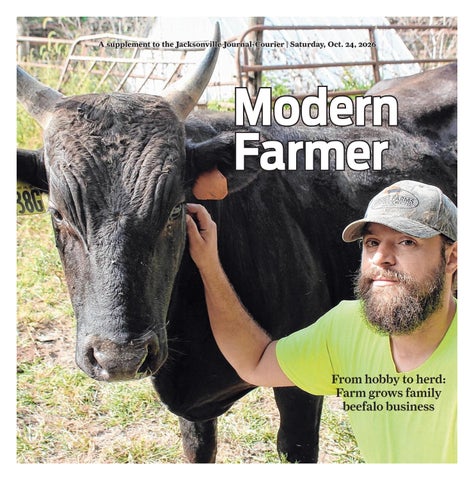
Modern Farmer
From hobby to herd: Farm grows family beefalo business
H2 SATURDAY, OCTOBER 24, 2026
JACKSONVILLE | MYJOURNALCOURIER.COM
MODERN FARMER 2. Farm grows family beefalo business 5. Autonomous equipment tests farm budgets 8. Solar generates $1.7M in tax revenue for county 9. Calf health research guides cattle farmers 11. AI detects soybean diseases before symptoms appear 12. Farm cultivates the crunch in potato chips 13. 104-year-old farmer retires after lifetime in field 14. ‘Swamp cooler’ remains important today 15. Will healthier soil can grow more nutritious food? 16. Scientists hope deeper-rooted soybeans can withstand climate extremes
Dave Dawson/Journal-Courier
Elsie, a beefalo cow; Katara, a Wagyu cow; and Daisy, the first Wagyu-beefalo hybrid cow, dubbed Wagyulo; gaze toward a fence gate at Gross Farms. The beefalo raised by Hunter Gross are primarily a cross of black Angus cattle and American bison that produces meat with less fat and more protein. Gross is in the process of creating a new breed of beefalo using Wagyu cattle from Japan as the beef component.
From hobby to herd: Farm grows family beefalo business By Dave Dawson CONTRIBUTING WRITER
William Gross started raising beefalo as a hobby and now his grandson is turning it into a way of life. The elder Gross pulled up stakes in Kansas in the early 1950s and moved to Jacksonville where he began the work of crossing black Angus cattle and American bison to create an animal called beefalo. The hobby continued with Dr. Gross’ son, Will, but now Hunter Gross is making it his vocation. “The beefalo experience started in the late 1950s,” Will Gross said. “We didn’t make big news of it early on. It was just something my father took on as a personal project. He never had aspirations of making it a marketable item. It was a hobby to him.”
Hunter Gross is the main farmer with assistance from Will, who has stepped away from active farming; his brother, Forrest; and a couple of occasional helpers. William Gross, a veterinarian, died in 2011. Beefalo is not new. Accidental crosses were noted in the American colonies as far back as 1749. Cattle and bison were first intentionally crossbred during the mid-19th century. Today, beefalo is defined as 3/8 bison and 5/8 cattle, according to the American Beefalo Association. “Black Angus from Scotland first landed 13 miles from our ranch in Kansas in 1873. So we bought in and started raising black Angus,” Will Gross said. Dr. Gross was one of the first in the country to breed and raise black An-
gus beefalo. He brought part of his black Angus herd from Russell, Kansas, to Jacksonville, then bought the bison in Oklahoma. “As time went on and the flavor and the taste of the meat got shared with family members and friends, everyone started saying, ‘why don’t you sell this?’” Will Gross said. About 10 years ago, the Grosses started managing the herd in order to keep animals around and bring them up to butcher weight rather than just selling them at market. “Now everything we keep goes through our process and nothing goes to the live markets anymore. We sell it at farmers markets because people appreciate the flavor and the health attributes,” Will Gross said. “I take it from farm to Bison continues on H3
SATURDAY, OCTOBER 24, 2026 H3
JACKSONVILLE | MYJOURNALCOURIER.COM
grand a year, are we going to do something with it to make money, or is it better to just sell it?” said Hunter in regard to his father stepping away from fulltime involvement with the animals. “I decided to keep going because I think it is more fulfilling to extend my grandfather’s legacy than it would be to find a corporate job,” Hunter said. “It’s certainly more fulfilling to spend time with animals and be my own boss.”
BISON From page H2 table including taking it for processing and then to market to sell,” Hunter Gross said. “I do the downtown Springfield market Wednesday morning, the Jacksonville market on Wednesday afternoon, then on Thursday I do the market at the state fairgrounds.” On Saturday, Will covers the Springfield market and Hunter goes to Bloomington. Beyond that, Hunter also does scheduled pickups whenever he’s available, which is usually every day except Wednesday and Saturday. “I have a limited supply of meat, so it makes it hard to make it too widely available,” Hunter Gross said. “It costs about $20,000 a year to pay for the hay for the winter so I had a
Eastward Ho
Dave Dawson/Journal-Courier
Bubbi, a beefalo bull, and Daisy, a Wagyulo cow, are part of the herd at Gross Farms, which is operated by Hunter Gross. The beefalo herd has its roots in the 1950s and was started by Gross’ grandfather, Dr. William Gross. The beefalo raised by Gross are primarily a cross of black Angus cattle and American bison that produces meat with less fat and more protein.
decision to make. Are we
going to keep it for senti-
mental value and lose 20
How the Gross family of veterinarians came to Jacksonville from Kansas, where the family homesteaded their land shortly after the end of the Civil War, is a story in itself. Glen Gross was the first to come to Jacksonville. There was one veterinarian in the area at that time, according to Will Gross,
and he was killed in a train-vehicle accident. Members of the community contacted Kansas State University in its search for a replacement and eventually recruited Glen Gross. “Glen came here and realized there was plenty of work for the whole family. After that, things just flourished,” Will Gross said. William Gross practiced veterinary medicine in west central Illinois for more than 50 years, maintaining a central office in Winchester, while working with his three brothers, Glen, Dean and Robert, and sister, Joanne Gross Pfeffer. A nephew, Dr. Joseph “Mac” Gross, who died recently, was the sixth veterinarian in the Gross family to practice in the area. “My grandfather brought a portion of his Bison continues on H4
H4 SATURDAY, OCTOBER 24, 2026
JACKSONVILLE | MYJOURNALCOURIER.COM
BISON From page H3 herd from Kansas to Illinois. He was strictly black Angus until he got the American bison and got into the cross-breeding,” Hunter Gross said. “We manage the genetics now by the bulls we use. For example, the most recent bull we bought was 40 percent bison genetically. We don’t do genetic testing, we just manage it based on the bulls we have,” Hunter Gross said. “We had 10 pure bison when I was growing up. We had them separated from the main beefalo herd. We don’t need pure bison anymore, though we would like to get more,” Hunter Gross said. “My father sold them about 10 years ago because they were in a pen across the highway and the fencing was getting pretty bad. It’s hard to put up a new fence when you have a full-grown bison standing behind you.”
Farm with a view Motorists who travel U.S. 67 south of its interchange with Interstate 72 have likely spotted the creatures on the west side of the highway. The farm wasn’t always divided by a highway. The goal of converting U.S. 67 in Illinois from a two-lane
Courtesy of Hunter Gross
A beefalo calf nestled in a feeder for warmth last winter at Gross Farms. The beefalo raised by Hunter Gross are primarily a cross of black Angus cattle and American bison that produces meat with less fat and more protein.
highway to a four-lane expressway from Godfrey to Rock Island, unsuccessful in parts of the state, was successful around Jacksonville.
“The construction of Corridor 67 was an experience and a challenge. I learned a lot from that and it got the family ahead in a lot of ways,” said Will
Gross of the project that began in 2003. “The state made a ridiculous offer to cut us in half and take 20 acres out of the heart of our operation to put that highway through. Negotiations began with an offer that was not fair for what the land was worth, even if it hadn’t been improved to handle animals like this with double high fences and waterways,” Will Gross said. “We were the last ones to settle, but while the highway was being built, we had a chance to re-facilitate and put in new fences, new pastures, new travel paths and all that,”
Will Gross said. “It was a huge inconvenience, but it also came with some benefits. They had a lot of extra dirt that they had to put somewhere, so we built some lakes. One of them is a 32acre lake,” Will Gross said. “So while it provided a travel path for everyone to see our operations and while maybe not so quiet for the animals, it created new opportunities in the way of watersheds and soil conservation.”
Care and feeding Hunter Gross has a degree in natural resources and environmental science. He acknowledges it
is “not super applicable to farming,” but it has helped him develop a holistic way of thinking that translates well into farming. “There are things my family has been doing for decades that I thought we could do better. The first year I took over, the winter was brutal. In the past, we had not taken the bulls out of pasture for certain portions of the year to prevent calves being born in the dead of winter,” Hunter Gross said. “During the first winter after I took over, probably 10 calves died. It was probably because we didn’t go down there enough to actually assess the full situation and know that we were losing that many calves,” Hunter Gross said. “In March, we bring the bulls in for three or four months to avoid that. It’s been better since that first year. I’m an animal lover and it was heartbreaking to go out there every day and find another dead calf. It was preventable,” Hunter Gross said. Raising beefalo versus cattle is much the same with some important differences. “Beefalo can be more aggressive because of the bison part of them. You can see bison processing something sometimes and think, ‘You’re about to do something, aren’t you?’ So you really have to watch that,” Hunter Gross said. “I haven’t spent a lot of time around other cows, so it’s kind of hard to compare but ours do get a little bigger. We have some monster cows in the main herd and that’s part of being one-third bison. They are a larger-framed animal,” Hunter Gross said. While the animals eat mostly grass, in the winter, Gross has to put out Bison continues on H18
JACKSONVILLE | MYJOURNALCOURIER.COM
SATURDAY, OCTOBER 24, 2026 H5
Autonomous equipment tests farm budgets By Todd Marver STA F F W R I T E R
As high upfront costs and steep subscription fees reshape the agricultural landscape, adopting modern field automation has become a financial equation for growers. Depending on the year and configuration of the machine, it typically costs between $40,000-$45,000 to add autonomy to a John Deere tractor that already has the capability of AutoTrac, said Doug Awe, Sloan Implement’s Winchester store manager. It then costs around $10,000 a year for the subscription to run the machinery, he said. “You also need to have a compatible John Deere tillage tool associated with it; they’re tied to-
gether. Depending on the year of the tool, you might need to add a performance upgrade kit to the tool also, in order to have a GPS globe on the tool. That may vary between the model and width of the tillage equipment,” Awe said. Other subscription fees include a G5 Advanced, a StarFire RTK or some type of RTK correction signal, Awe said. “The GPS signal needs to be at that accuracy in order to have autonomy,” Awe said. Autonomous tractors have been in the area for over three years, and some are limited build, Awe said. “They are available for sale today and we currently have an 8R 370 and a 25-foot 2660 VT tool
Courtesy of Sloan Implement/
An unmanned John Deere 8R tractor and 2660VT tillage tool operate autonomously in a field near Illiopolis. The driverless setup relies on high-definition camera systems, boundary mapping and RTK correction signals to navigate row-crop fields while avoiding hazards.
running in our area with very good success,” he said. Tractors are not the only machinery seeing a tech overhaul; local farmers are also increasingly looking to the skies to automate their operations. Not many ag implement dealers are drone dealers, and Sloan’s customers who adopt drones have been taking on those lines, Awe said. That was interrupted by some tariffs and technology entering the country in the last couple of years, but many of Sloan’s customers are drone dealers, he said. The cost can vary anywhere from $50,000 on the base level to up to $100,000 for the larger 26gallon high-capacity drones, Awe said. By the Auto continues on H6
H6 SATURDAY, OCTOBER 24, 2026
AUTO From page H5 time you add another support trailer, you can get up to $200,000 invested in that, which is still substantially less than some of the ground rig sprayers, he said. “Ground rigs versus drones has been a debate as to whether or not their coverage is the same. Many customers use both. A dozen of our customers actively use drones. They are providing that service to other customers of ours, especially when it comes to fungicide application,” Awe said. Whether managing autonomous rigs on the ground or drones in the air, the recurring overhead costs require careful calculation. As far as a per-acre budget for the software and technology
subscriptions, whenever a product is introduced, Sloan always looks at costs and thinks that can’t possibly pencil out, Awe said. But as time goes on, customers do factoring of expensive chemical savings on some of the See & Spray technology, the labor costs and the ability to find labor to drive the tractor, he said. The cost per acre is always something the customer has to keep in mind and as ag technology is adopted, customers are finding it beneficial to them, Awe said. “That’s not a whole lot different than other technologies in the world. You don’t know that savings until you get in there and truly see the benefit,” he said. Autonomy is a sheer factor of the lack of labor in rural America, Awe said. As technology is adopted, Sloan has at least
JACKSONVILLE | MYJOURNALCOURIER.COM
Todd Marver/Journal-Courier
A side view of the John Deere 8R series tractor reveals the cab layout required for autonomous field operation. Fully utilizing driverless technology demands communication between the tractor's steering systems, boundary maps and RTK correction signals.
one product support staff member per location and sometimes multiple, Awe
said. This is in addition to parts, service and sales staff. The support personnel provide assistance and are included in the cost per acre, and there aren’t extra fees for that service, Awe said. The personnel take the data and make sure the data is arranged such that the autonomy is compatible with the farmer’s operation, he said. “They work with boundary lines and aid in the setup of the machine and tweaking of the performance. We provide that service as Sloan Implement for customers who adopt this new technology,” Awe said. There are fields that have to be mapped, and light poles and hazards that have to be avoided, Awe said. There have to be boundary lines, he said. “As something crosses like a ditch, that’s not part of the field and that has to be a boundary and then a gap and then another boundary. There have to be zones created,” Awe
said. Outside factors are dust, rain and anything that will affect the camera systems, Awe said. Autonomy is just now being made available because technology of the camera systems is now affordable, he said. “The level of accuracy and definition on camera systems is out of this world compared to what we used to have. That was the major change that allowed autonomy and it’s also the major change we’ll see in all technology going forward,” Awe said. Camera systems are used on automobiles, robots and any type of automation, Awe said. That could have been done in the past, but the price of the cameras was too expensive, he said. “I’ve got a security system that has cameras that are $1,500 apiece and my home security is less than $300 for the same type of camera with better resolution,” Awe said. While local dealerships are absorbing support
costs to help farmers adapt, agricultural economists note that the return on investment depends on the size of the operation. Fixed costs will be recovered faster on a larger farm when you have more acres to cover, said Dennis Bowman, University of Illinois Extension digital agriculture specialist. One thing that might change the equation is the value of the crops being grown, he said. “If a farmer has some kind of a high-value crop or a specialty production where the value per unit is higher, then that makes the case for smaller acreage to be more competitive on that return on investment. In general it is going to be more of a challenge for smaller farmers that may be looking for ways to contract out with somebody else that has the technology and can spread it over larger acres, so they don’t necessarily have to own it themselves,” Bowman said. It is going to be more of a challenge for a low-acreage grower, unless the value of the crop is higher or the value of the inputs is higher, Bowman said. In either of those cases, it can change the equation on how fast the investment can be recovered, he said. “In general, it’s going to be a harder road for the smaller farmers to recover,” Bowman said. The acceleration of agricultural automation does not act as a primary catalyst for farm consolidation, and it’s part of a much bigger picture, Bowman said. “It’s a very small piece of a big picture that had been going on for a long time for farmers to try to get that economy of scale and going larger or with another alternative of shifting production to livestock or specialty proAuto continues on H7
JACKSONVILLE | MYJOURNALCOURIER.COM
AUTO From page H6 duction or some type of alternative income on the farm that will help offset some of those costs,” he said. One of the areas that the University of Illinois has been looking at is smaller autonomous equipment that is scalable to small farmers, and looking at some options for more low-cost and able automated equipment that works at different scales equally, Bowman said. “We talk about the giant John Deere See & Spray that costs $1 million, but we can retrofit smaller sprayers with a similar type of equipment for a much lower cost. We can look at autonomous equipment that can be smaller, but run 24 hours a day and not have that huge of an investment. We’re seeing a lot of the initial work is going on, on the giant side of things, but we see a lot of development, including stuff that is coming out of Europe that is geared to be more scale-neutral,” he said. A general finding in technology adoption where high fixed cost investments are involved is that the greater the upfront cost, the larger the area or utilization generally required to reach break-even, said Shadi Atallah, associate professor and director of graduate admissions in the department of agricultural and consumer economics at the University of Illinois. USDA data shows a clear tendency for larger farms to adopt technologies at higher rates, especially field crops, Atallah said. But the evidence is not causal, and there might be other character-
istics of larger farms that make them adopt first, he said. About 70% of large-size family farms adopted guidance and autosteering technology, and 45% of large-size family farms used Variable Rate Technology. Only 9% of small farms adopted guidance and autosteering technology, and 5% of small farms used Variable Rate Technology. A total of 52% medium sized farms adopted guidance and autosteering technology and 32% of medium sized farms adopted Variable Rate Technology. For corn, the top quantile of farm size used about five times more (43%) than the smallest quantile of farms (8%). Recurring subscription fees may create an additional barrier, particularly when they are charged as fixed annual fees rather than on a per-acre basis, Atallah said. But we have no data or studies on how these fees have affected adoption by farm size, he said. USDA data provides information on what farmers state as the main reason they adopted technologies, rather than provide causal evidence based on observed input choices, Atallah said. Among farms using guidance and auto-steering systems, the most reported reasons for adoption were reducing operator fatigue (64%) and saving labor time (50%), while 31% cited higher yields and 28% cited lower purchased-input costs. For VRT, the dominant motivations were reducing purchased-input costs (62%) and increasing yields (58%), while 22% cited labor-time savings. Labor substitution has been a major objective of mechanization and automation, Atallah said. Harvesting specialty fruits
SATURDAY, OCTOBER 24, 2026 H7
Todd Marver/Journal-Courier
A close-up view of the John Deere 2660VT tillage tool frame highlights the equipment model currently operating with autonomous systems in local fields. Depending on the manufacturing year and width of the implement, growers must add a performance upgrade kit to mount the necessary GPS hardware to the tool.
and vegetables is labor-intensive work, and the farm profits are vulnerable to changes of wage, he said. “As wages increase, the economic value of laborsaving automation also increases because the cost savings from substituting robotic systems for manual labor become larger. This is based on ex-ante analyses,” Atallah said. With regard to lower input costs, newly developed robots can reduce herbicide, pesticide and fertilizer use, Atallah said. An ex-ante analysis of mechanical weeding robots shows that robotic mechanical weeding can reduce reliance on herbicides and help manage herbicide resistance by substituting, or in some cases complementing, chemical weed control, he said. “Note ex-ante analyses are based on data from experiments, not based on real farmer input choices. By definition, ex-ante analyses are about technologies that have not hit the market yet,” Atallah said. With regard to higher yields or higher value (marketability), AI using
image processing can increase yield and marketability through better maturity decisions, Atallah said. Low-cost RGB images can be used to estimate grape soluble solid content, an important indica-
tor of ripeness and quality, he said. “More precise apple flower robotic thinning can improve the distribution of fruit size and quality. These, too, are based on ex-ante analyses,” Atallah said. There is no evidence that rapid acceleration of high-ticket agricultural automation acts as a primary catalyst for farm consolidation, said Atallah. USDA survey data shows that larger farms tend to adopt more automation technology, and USDA reports also show that the observed adoption patterns cannot be explained by size only and could be due to more complex production systems, he said. AI-powered technology can reinforce existing disparities in technology adoption, and some technologies, particularly those requiring special-
ized hardware, are likely to remain expensive and capital intensive, Atallah said. For example, emerging autonomous harvesting systems for labor-intensive crops such as strawberries may therefore be adopted first by larger operations, he said. “However, this suggests a potential reinforcement of scale-related adoption advantages rather than evidence that automation itself accelerates farm consolidation,” Atallah said. The emergence of rental, custom-hiring and service-based models may reduce the scale advantage associated with ownership of expensive automated equipment, Atallah said. In theory, servicebased business models could weaken the scale advantage of larger farms by making costly technologies accessible without direct ownership, he said.
H8 SATURDAY, OCTOBER 24, 2026
JACKSONVILLE | MYJOURNALCOURIER.COM
Solar generates $1.7M in tax revenue for county By Bridgette Fox STA F F W R I T E R
In the last tax year, Morgan County taxing districts have received a total of $1.7 million from solar projects. While people have still shown up to Jacksonville City Council and Morgan County Commission meetings to gripe about solar panels, it’s clear that county, schools and road districts are seeing a financial benefit. The groups that receive the least amount of funding are miscellaneous; specifically, the River Valley Library District and Jacksonville Airport Authority. They received a total of $2,354.42 in the last tax year. Morgan County is home to several solar projects, and there are dozens of
land parcels eligible for taxation within those projects. The largest tax contributor is the Wolf Run Solar Park at $753,544.26 in total tax contribution. Wolf Run is a 140 megawatt project, and it started being fully functional in 2025. Over the next 40 years, it’s expected to generate $31 million. It’s currently on track to meet that number. While the project initially generated around 400 construction jobs, that number fell to two permanent positions after finishing. “We pride our team on how we give back to the local community,” said Kaylen Olwin, a development senior manager for EDP Renewables. “We paid more than $10 million in lease payments to landowners, most of which
Ben Singson/Journal-Courier
Ryan Dillon, senior commissioning and maintenance engineer for Sol Systems, leads a tour of the company's Prairie Creek Solar farm in June.
will use that locally and in their operations, which benefit the local economy. We are excited to support the community and contribute to other organizations.” The second-largest tax contributing solar farm is
Double Black Diamond. It’s located in the eastern part of the state, split with Sangamon County. In the last tax year, it brought a total of $701,649. While the solar benefits are split across the state, including to the City of
Chicago, the economic benefit was touted by local officials after the project was completed in 2025. Sangamon County Board Chair Andy Van Meter said the solar panel farm would “pay significant dividends for the community.” However, most of these solar farms have a lifespan of about 40 years. Some companies like Nexamp, a company that recently got its 16-acre project approved for the east side of Blacks Lane in Jacksonville, have a recycling plan for the solar panels when their lifespan is up. A consistent criticism that solar farms are faced with come from people concerned that agricultural land is being forced away from farmers. There are also concerns that the promised benefits aren’t
solidified yet. “I’m not set on solar fields,” said Jacksonville Alderman Mark Sorrill in August. “In my mind, they have yet to prove themselves.” Some farmers have shared anecdotally that it’s been beneficial to lease their lands at a time when the cost of exporting goods is high. And researchers from Purdue University released a study examining how solar projects affect land prices too. “Solar installations generate positive spillover effects on nearby farmland values, with price increases relative to average land prices, suggesting that completed solar development on one parcel raises the perceived energy development potential of neighboring land,” researchers said.
SATURDAY, OCTOBER 24, 2026 H9
JACKSONVILLE | MYJOURNALCOURIER.COM
Calf health research guides cattle farmers By Samantha McDaniel-Ogletree STA F F W R I T E R
BAYLIS — A healthy adult herd of cows is only possible when healthy calves are born. In Baylis, the Orr Beef Research Center, affiliated with the University of Illinois Extension, is doing research to help establish best practices to raise healthy cattle, starting with breeding, through birth and weaning, until they move to other farms for additional research projects. “The Orr Beef Research Center is a pretty important piece of the research program,” said Travis Meteer, a beef and cattle specialist with the University of Illinois Extension. “It is one of three major farms.” At the Orr facility, the extension can focus on projects affecting younger calves, breeding tech-
Samantha McDaniel-Ogletree/Journal-Courier
The Orr Beef Research Center in Baylis breeds and raises cows that are used in various research projects by the University of Illinois. Research projects begin in the early stages, from best ways to breed to protecting calves and best ways to wean a calf.
niques and ways to help improve calf health. “At each research center, we look at things that are applicable to local and state cattle farmers,” Meteer said. “We’ve done a
variety of research over the years.” One of the unique aspects of the center is its controlled breeding schedule, which allows researchers to concen-
Samantha McDaniel-Ogletree/Journal-Courier
The Orr Beef Research Center monitors everything about the growing calves, from parentage, weight, feeding and other aspects as they perform their research. They have equipment used to help control the cow or calf as they perform various tests.
trate resources and better predict when calves will
be born. First, Meteer said the
center follows a set breeding schedule. Each cow is artificially inseminated and then spends roughly 50 days in the pens with a bull. “Every female has the chance to become pregnant naturally,” Meteer said. “Some will already be pregnant when they are put in with a bull.” Those that become pregnant are watched carefully as they near birth, usually between February and March. Throughout the pregnancy, researchers carefully monitor the cows’ diet, vitamins and vaccinations. By controlling when conception takes place, Meteer said they can more closely monitor when the cows give birth. Calf continues on H10
H10 SATURDAY, OCTOBER 24, 2026
JACKSONVILLE | MYJOURNALCOURIER.COM
CALF From page H9 “We are a lot more hands on than the average cattle producer,” Meteer said. “A lot of data has to be collected for our research, so the animals are handled a lot more.” Once they are sure a cow will give birth soon, it is moved into a pen with clean bedding. After birth, each calf is weighed, measured and tagged. Its parentage is recorded and it is monitored closely to ensure it is nursing properly. The calves also receive serum to help fight bacterial infections, along with vitamin and mineral injections. Once calves begin nursing, they receive colostrum from their mother’s milk, which helps provide natural immune support.
Samantha McDaniel-Ogletree/Journal-Courier
The Orr Beef Research Center raises cattle across several pastures and uses the research they perform to help area farmers and cattle producers.
Samantha McDaniel-Ogletree/Journal-Courier
The Orr Beef Research Center raises cattle across several pastures and uses the research they perform to help area farmers and cattle producers.
Prior to birth, immune support does not transfer from the mother to the
calf as it does during human pregnancies, which is why Meteer said re-
searchers take steps to immediately boost a calf ’s immunity. Being closely monitored also allows staff to assist when there is a difficult birth or if a calf is having other difficulties, he said. “We do everything we can to help a calf have a successful start,” Meteer said. “But, again, some producers can’t be as hands on.” One of the more recent studies focused on limiting stress during the weaning process. When the calves are ready for weaning, Meteer said they are introduced to feed. Once they are eating, they begin the weaning process. “One example is separating the calf and mom by a fence,” Meteer said. “They can still see each other, but the calf can’t feed off the mom.” At the center, calves are monitored to ensure they are getting all the proper nutrients as they make the transition. After a period of fence-
Samantha McDaniel-Ogletree/Journal-Courier
line separation, the calf is fully separated from its mother and taken to one of the other farms for future research projects. “We want as little stress as possible,” he said. “A good transition from weaning to that growing period.” Meteer said some producers do not fully regulate the breeding season, so they can have calves at multiple stages of development. Meteer said because the extension has significant resources, as well as help from full-time employees and research students, many of its practices may not be practical for commercial producers. “One of the unique things we have here is our set up,” Meteer said. “We have more scales, more facilities. We have a lot of
experience in our crew. Because we are taking research results, we are more hands on.” Meteer said the role of the center is to answer producers’ questions. Part of Meteer’s job is to help producers troubleshoot issues. He said he can evaluate a herd and help pinpoint whether there is an issue with nutrition or other factors that can affect herd health. While some research projects are generated by the extension, many have come from questions asked by producers. “We are trying to do the research,” Meteer said. “Producers can come to us and get information they can take back to their herds. Chances are, if one producer has a questions, others have had the same one.”
SATURDAY, OCTOBER 24, 2026 H11
JACKSONVILLE | MYJOURNALCOURIER.COM
AI detects soybean diseases before symptoms appear By Brooke Keltner CONTRIBUTING WRITER
Harvest season is well under way for soybean farmers across Illinois. Each plant among their crops is valuable, contributing to their yield and overall profit. A big issue that can eat into that small profit margin is plant diseases — so researchers at Southern Illinois University Carbondale are working toward a solution. Billy Ram, an assistant professor of precision agriculture, and his doctoral student Samuel Singh, are working to design a robot and program its artificial intelligence models to detect soybean diseases before symptoms appear. The goal is for agricultural machinery companies to use that predictive technology to produce tractor or spray attachments for farmers that are efficient, affordable and easy to use.
Soybeans reign supreme Illinois is the number one soybean-producing state in the country. Across the state, 43,000 soybean farmers rely on making a profit from their crops to feed and support their families as well as invest in the equipment and products needed to sustain their farms. Soybean prices are set based on a combination of global markets, local supply and demand, and futures trading. Over the past 20 years, soybean prices have increased — but so have the expenses that farmers pay to maintain their business. “From the 2000-2004 average of $6.15 per bushel to the 2020-2024 average at $12.71 per bushel, farmers see the financial benefit of growing soybeans,” ac-
cording to the Illinois Soybean Association. “However, non-land costs have also increased, with one farmer mentioning a 400% spike in productivity and pricing in this timeframe. With increased soybean prices come increased expenses.” Increased expenses are just one factor that can cut into profit margins. Several other factors impact the growth of soybeans and their yield including the weather, pests, weeds and diseases.
Diseases cut into profit Many diseases that attack soybean crops are caused by fungi in the soil and spread when it rains, Ram said. By the time symptoms appear on the stems or leaves, the plant is too damaged to produce a good yield. “If a disease overpowers your field, late-stage fungicide application is not very efficient,” Ram said. “Once the disease attacks the farmer’s crops, the yield can be reduced to 60 to 70%. It has a real economic impact.” On top of this, diseases can be difficult to eradicate. Often, these soil borne fungi will stay in the soil for long periods of time, attacking crops over consecutive growing seasons — which is why prevention is key.
Robots and AI the cure? Ram and Singh are conducting research on a soybean field at University Farms that has frogeye leaf spot, an invasive disease that causes lesions on the leaf and can spread to the plant’s stem and pods. Initially, the duo used a drone to create hyperspectral and multispectral maps of
the field, and the robot can follow the rows on its own. “The robot should be able to drive down the field, keep track of each plant, identify if the plant has a disease and which type, and then share what percentage of the crop is diseased,” Ram said.
Mapping the future
Todd Duermyer/Southern Illinois University
Samuel Singh, a doctoral student in the agricultural sciences program, showcases a robot equipped with multiple cameras that can capture plant diseases on soybean crops.
the field. These maps utilize wavelengths not seen by the human eye helping researchers analyze the crop’s health from above. However, despite flying the drone close to the crops, they could not collect sufficient data to detect the frogeye leaf spot. That’s because the drone’s camera had a difficult time capturing the lesions on the underside of the leaves and lower down toward the stem. “At the end of the day, we’re only working with cameras,” Ram said about the research which received funding through the Illinois Soybean Center. “We’re solving an engineering problem more than an agronomic problem. The challenge is how efficiently can you collect a large source of data while the equipment is traveling the field.” This is when the team decided to build and design a robot that could reach those hard-to-see spots. The robot is batterypowered, has four wheels, GPS and multiple cameras mounted to its frame to
view the underside and tops of the soybean plants. The robot also has an autonomous setting where a user can upload a map of
Now that the robot’s designed, Ram and Singh will work on developing the AI models that it needs to detect frogeye leaf spot. Once finished, the robot will detect the disease with precision. “I want to design maps that help farmers detect hot spots, so farmers can see the hot spots and know what site-specific areas to apply fungicides instead of spraying all over the field,” said Singh, who is work-
ing toward a doctoral degree in agricultural sciences. “Soybean diseases are a problem all over Illinois. This project is challenging, but it’s exciting because I think we can develop these maps.” Singh has spoken to local farmers during SIU agriculture events and has listened to the challenges they face. He wants to work toward developing tools and systems that support their practices. “As an engineer, we love working on solutions that actually help people, not just something that sounds good on paper,” said Singh, who also has a bachelor’s in agricultural engineering and master’s in remote sensing. “The future means humans using robots to make life easier and more efficient.”
H12 SATURDAY, OCTOBER 24, 2026
JACKSONVILLE | MYJOURNALCOURIER.COM
Farm cultivates the crunch in potato chips By Kim Hill FA R M W E E K
Like many farms in Illinois, Neumiller Farms grows the state’s top crops, corn and soybeans, along with green beans and other produce. But the potato reigns supreme for this family farm, which plants about 3,000 acres of potatoes each year. A significant portion of their harvest becomes potato chips for major companies such as Frito-Lay. “Potatoes are not a commodity where you just take them down to your local co-op after harvest,” says Katie Neumiller-Floming, who serves as the farm’s operations manager. “There are too many inputs, so everything we grow is contracted.” The Neumiller family traces its potato-growing origins to before they made their way to America, let alone Illinois. “Our farming history goes back to my greatgrandfather, who lived in a German community in Russia,” says NeumillerFloming. “He fled during the Russian Revolution. Eventually, he made it to Canada before settling in Colorado, but all the while, he was growing potatoes. They have always been in our family one way or the other.” The family’s long-standing relationship with FritoLay precedes the brand itself. “My grandfather, Fred Neumiller, started selling to Red Dot on a handshake in the 1950s,” NeumillerFloming says. “Red Dot and other companies merged to become FritoLay, and we’ve had a relationship with them for more than 70 years.” The expansion of Neumiller Farms to Illinois can
Jeff Adkins/Journal Communications
Tom Neumiller’s family has been growing potatoes for what’s now Frito-Lay for more than 70 years. His daughter, Katie Neumiller-Floming, is carrying on the family farm as its operations manager.
be traced to her father, Tom. After college, Tom returned to his family’s Wisconsin farm. One day, Fred asked him to travel to northern Illinois to collect payment from a farmer who’d purchased seed potatoes from the family. “My dad never did get the money, but he did get to see some really nice pockets of sandy soil around Savanna,” Neumiller-Floming says. “When he went home to Wisconsin, Dad told my grandfather if we ever got the chance, there was good, sandy ground for potatoes down in Illinois.” In 1974, opportunity arrived. Neumiller-Floming’s parents purchased land in Hanover in Jo Daviess County, which they still own today. “Neumiller Farms in Illinois got its start because
my dad couldn’t get the
money for the seed pota-
toes,” Neumiller-Floming
says with a laugh, noting the family joke all these years is that it’s good Tom kept his day job as a potato farmer, because he wasn’t a good money collector. “And things just grew from there.” Over the years, the farm continued to expand, and the family later purchased land down the road in Savanna. Fred also sowed the seeds of another farm partnership. Decades ago, he ordered holiday gifts from a store in North Dakota. Paul Sproule, a clerk home from college on Christmas break, took Fred’s phone order year after year. They’d talk about farming, Sproule’s classes and other matters. After college, Sproule went to work for Frito-Lay, with Neumiller Farms among his suppliers. Eventually, Sproule left the company and began farming. In 1998, Sproule and Tom bought land in Bath, now known as the Neumiller-Sproule Farm.
Chipping in together
Jeff Adkins/Journal Communications
The Neumiller family traces its potato-growing origins to before they made their way to America, let alone Illinois.
These days, the extended Neumiller family works with their 40-plus employees, some of whom have been with the operation for more than 40 years. Many of the vintage potato chip cans and boxes in the lobby of their Savanna office date back much longer than that. “A lot of these cans are from Midwestern companies, and we like to think at some point, maybe my grandfather grew the potatoes that became the chips in these cans,” NeumillerFloming says. In fact, Tom and Neumiller-Floming’s story inspired the 2026 Lay’s Super Bowl commercial of the father passing down Chips continues on H17
SATURDAY, OCTOBER 24, 2026 H13
JACKSONVILLE | MYJOURNALCOURIER.COM
104-year-old farmer retires after lifetime in field By Hannah Spangler FA R M W E E K
After decades spent working in agriculture, stepping away from farming was not a decision Donnie Peterson could make overnight. “It wasn’t easy, but I realized it was time to let go,” said Peterson, who is retiring at 104. Born in 1921, Peterson grew up on his family’s farm near Aledo. He began growing corn and soybeans with his father during the Great Depression in the 1930s. After his father retired in the 1950s, Peterson took over. “I was pretty small when I started working on the farm,” Peterson said. “I didn’t know any other profession, so I just
stayed with it.” The Mercer County farmer still remembers buying his first piece of equipment, “an old John Deere tractor,” which he said was enough for him to get started. Peterson acquired more equipment over the years and joined Illinois Farm Bureau in 1972. His last purchase came six years ago when he bought a 2018 John Deere 6155 tractor. That tractor was among the equipment up for bid during an auction run by Merit Auctions on Peterson’s farm. He told Jim Taylor of the RFD Radio Network he had been considering the decision for two years before moving forward with the sale. “Two years back, I de-
Jim Taylor/RFD Radio Network
Donnie Peterson with his 2018 John Deere 6155 tractor before it sold at a farm equipment auction.
cided it was about time to start thinking of changing, so that sort of took time just to make that decision,” Peterson said. Dale Jones, an auctioneer with Merit Auctions, said he had previously reached out to Peterson about a sale, but Peterson told him he wasn’t ready yet. This summer, however, Peterson called Jones and said, “It’s time to do this.” “So that’s what we did,” Jones said. Selling his equipment and deciding to rent out his land is one of many changes Peterson has experienced during his farming career. “I’ve seen a lot of things change in my lifetime,” he said, noting improvements in technology, seed
and ag inputs. “Our quality of everything is so much better.” But “modernization of farm equipment” stands out as the biggest change Peterson said he has seen throughout his more than 70 years as a producer. He started farming with horses and ended with a John Deere tractor. Peterson said he was slower to adapt to new technology than other farmers. Even so, he embraced changes that helped move his operation forward and refined his management practices, including the use of GPS technology and reduced tillage. “That’s the way things go; you have to go with the times of life and new ways of doing things,” he said.
H14 SATURDAY, OCTOBER 24, 2026
JACKSONVILLE | MYJOURNALCOURIER.COM
‘Swamp cooler’ remains important today By Alexa St. John A S S O C I AT E D P R E S S
Before air conditioning spread across the United States, before temperatures increased and the world heated up, people in the Southwest sweltered. Dry heat and minimal relief were day-to-day life, and many had to get a little creative. Some slept outdoors under damp sheets. Others adjusted schedules to avoid working outside during high daylight hours. Then a great way to beat the heat emerged. It was dubbed the “swamp cooler.” Basic cooling principles were used centuries ago in ancient civilizations; air was fanned by hand over water in clay pots or jars. In the early 20th century, those same principles were refined in the United States. The evaporative cooler, or swamp cooler, was the result. America’s first system using the concept of evaporative cooling was perfected by Oscar Palmer in 1908 in Arizona. It’s relatively simple: A fan pulls a stream of fresh hot air through vertical, porous pads saturated with water. It evaporates, cooling and humidifying the air and directing it in-
Jeff Chiu/Associated Press
Bill Werner, lead greenhouse manager, walks between plants and evaporative cooling pads in a greenhouse.
doors. By the 1930s, the gadgets changed entire swaths of the country, cooling southwestern states like New Mexico and Nevada. Even today, in the age of air conditioning, they play a role in making desert-like states more livable. “If it’s really dry out, in
Arizona, you’re going to get a greater cooling effect,” says Eric Verpolegen, the founder of CoolVeg, a nonprofit dedicated to evaporative cooling for fruits and vegetables. Traditional air-conditioning units didn’t become standard in the U.S. until the 1950s, and central air conditioning remains a
luxury. But the swamp cooler endures. “Where you don’t have air conditioning and where the climate allows,
evaporative coolers could be a good solution and are low cost, low energy consumption,” says Ankit Kalanki, principal of cool-
ing at RMI, a nonprofit dedicated to clean energy. Swamp coolers and fans fall short in humid regions because the air is already saturated and can’t handle more water. Experts say humidity has been worsening in some areas. “There is a lot of innovation happening where people are trying to come up with hybrid solutions, where they are marrying evaporative cooling with something that can manage humidity separately,” Kalanki says, “and so now you have the best of both worlds.” Evaporative coolers remain in use for Americans and many around the world who lack other cooling options. “We’ve got this vicious circle where the hotter it gets, the more cooling we need,” Verpolegen says. “So you’re going to spend more energy, which could lead to more greenhouse gas emissions.” That’s where Palmer’s cooler tech and even more modern iterations come into play.
Jeff Chiu/Associated Press
Water drips down evaporative cooling pads in a greenhouse.
SATURDAY, OCTOBER 24, 2026 H15
JACKSONVILLE | MYJOURNALCOURIER.COM
Will healthier soil can grow more nutritious food? By Judith Ruiz-Branch P U B L I C N EWS S E RV I C E ILLINOIS
The food on our plates may not be as nutritious as it once was, and Illinois farmers and soil experts said regenerative agriculture could offer part of the solution. Carl Rosier, a soil scientist and farmer for the nonprofit Basil’s Harvest, said traditional agricultural practices, breeding crops for size and production, can dilute nutrients like protein and minerals. He pointed out degraded soil, reduced organic matter and other factors may also affect how nutrients become available to plants. And because the majority of produce is made to withstand long-distance shipping, he noted it loses
additional nutrients traveling from the farm to grocery stores before reaching people’s plates. “We have this dependence on chemical fertilizers, so we apply these chemical fertilizers to get that crop as big as we can, and because of that, those don’t scale,” Rosier explained. Rosier argued regenerative agriculture shows promise for bringing nutrients back to crops through improving soil health and creating stronger microbial communities, which are groups of small organisms in and around plants. More scientific evidence is needed to consistently measure its benefits. As farmers continue to face pressure to remain profitable, some industry voices said there
Susumu Yoshioka/Getty Images
Traditional agricultural practices, breeding crops for size and production, can dilute nutrients like protein and minerals.
is little room for implementing new practices that might not pay off. Erin Meyer, founder and executive director of the nonprofit, said the or-
ganization is helping them transition to practices like no-till farming and cover cropping by meeting them where they are, but stressed the food system
requires more than asking farmers to change how they grow. She noted community response measures to recent food recalls — pushing consumers to
depend more on local ingredients — offer a blueprint of how food systems should be functioning. “It has to be healthcare, has to be agriculture and it has to be food systems that have to come together to help create and build on what’s being done already,” Meyer urged. Meyer underscored people can focus on shopping at farmers markets and local food co-ops to help support farmers and regional food systems and acknowledged it does not have to be all or nothing. Families can mix locally sourced foods into their weekly grocery store budgets. Ultimately, she added, building a healthier food system will take collaboration where everyone has a role to play.
H16 SATURDAY, OCTOBER 24, 2026
JACKSONVILLE | MYJOURNALCOURIER.COM
Scientists hope deeper-rooted soybeans can withstand climate extremes By Joshua A. Bickel and Annika Hammerschlag A S S O C I AT E D P R E S S
Research scientist Ashish Rajurkar kneels in the dirt, lifting a large clod of soil tangled around a soybean plant. He knocks away pieces of earth from the plant’s roots, which slope straight down instead of out to the side like typical soybean plants. Researchers hope roots like these could help crops withstand some effects of climate change while also drawing more carbon from the atmosphere and storing it underground. Carbon dioxide released by burning fossil fuels traps heat in the atmosphere, driving human-caused climate change. For years, scientists have explored ways to remove some of that carbon from the atmosphere, including through direct air capture, changes to ocean chemistry so seawater can absorb more carbon, and reforestation. Now, researchers at the Salk Institute for Biological Studies are testing whether deeper root systems could become another tool. But scientists still need to show how much additional carbon those roots can store under real farming conditions, how long the carbon would remain underground and whether the crops can maintain yields. An $18 million grant from the Bezos Earth Fund will help Salk researchers test those questions in the field by mea-
Joshua A. Bickel/Associated Press
Preyanka Mehta, a research associate at Cquesta, removes soil from a genetically engineered soybean root.
suring how resilient these plants are to drought and other climate stressors, how much carbon they can store and for how long, and how to get the plants onto farms at scale. Wolfgang Busch, director of the institute’s Harnessing Plants Initiative, said the issue is pressing. “We are actually steering in a direction that is very concerning,” he said. “It will become harder to grow enough food for enough people.”
Scientists use genes to create deeper roots Over the last six years, Salk scientists uncovered the genetic information of hundreds of versions of
Joshua A. Bickel/Associated Press
Root samples of genetically engineered soybeans dry after collection.
common row crop plants such as soybeans and sorghum from around the world, creating an “encyclopedia” of plant genomes, said Todd Michael, a research professor at the institute. After identifying 347 genes related to carbon storage and root growth, scientists were able to edit the plants’ DNA and create ones with roots that penetrate the soil further down. “We wanted to leverage the natural variation of a given plant,” Michael said. “We just have to be able to make the right crosses to bring in those genetics.” During droughts, they hope the roots will allow plants to access water below the top layer of soil while also storing carbon farther underground, where it may be less vulnerable to being released when farmers till their fields. Researchers are also trying to boost carbon storage by growing larger root systems so more carbon-rich plant material is left in the soil, and by increasing suberin, a corklike substance in roots that contains carbon and decomposes more slowly than many other plant tissues. Researchers hypothesize that more steeply shaped root systems may also allow farmers to plant more crops in a smaller area, potentially increasing yield. Salk scientists think longer, bigger roots could also absorb more nitrogen and other fertilizer runRoots continues on H19
SATURDAY, OCTOBER 24, 2026 H17
JACKSONVILLE | MYJOURNALCOURIER.COM
CHIPS From page H12 the family potato farm to his daughter. However, Neumiller-Floming notes that Tom is still very involved in the business, ensuring operations run smoothly. “He’s the first one here in the mornings and the last one to leave at night,” says Neumiller-Floming, who also manages Neumiller Farms’ trucking operation. “Dad is very involved with our crews, making sure everything gets done the way it should be done.” That means typically planting in March, harvesting in July and often continuing until October. After harvest, potatoes are sorted, washed and graded, loaded onto Neumiller Farms’ semitrucks, and shipped to customer processing facilities.
Jeff Adkins/Journal Communications
Paul Sproule (above) and Tom Neumiller purchased land in Bath. Both farm locations have sandy soil well-suited for growing potatoes.
“For those customers less than two hours from us, if we dig a potato at 8 a.m., it could be to our customer by noon, and processed and in a bag by 1
p.m.,” Neumiller-Floming says.
Spud sustainability Down in Bath, Kelsey Bess and Sergio Barragan
co-manage the 1,000-acre Neumiller-Sproule Farm. Bess says soil management and potato crop development are her favorite parts of the job.
“Each fall we take soil samples, and in 2025 we did DNA extraction soil samples for the first time, which will tell us what diseases might be present in the soil, if any,” Bess says. “This will help us with pesticide management.” She explains that from DNA extraction, they can obtain RNA from leaf tissue samples, which are collected at the same time as petiole (leaf stem) tissue samples. This tells them, for example, if the plant is low in potash – letting them know weeks ahead of traditional methods. “I’m excited about these new technologies, which should really help improve sustainability,” Bess says. As another eco-friendly effort, each fall the farm plants cereal rye as a cover crop, which helps keep the topsoil in place and reduces erosion. “We’re holding those
nutrients down in the soil and not letting them blow away in the wind,” Bess says. Because potatoes thrive in sandy, well-irrigated soil, they use water from the Mahomet Aquifer to irrigate their fields. And they closely monitor for the Colorado potato beetle, a threat not seen on the farm but one they remain vigilant against. “I’m proud to be a woman in agriculture,” says Bess, a University of Illinois graduate. “Ensuring quality potatoes are shipped to the processing plant, along with having a part in food safety, brings me joy.” Focusing on sustainability extends to the Savanna farm as well. “Our goal is to protect the land so it’s productive for the next generation,” Neumiller-Floming says. “We want to do a good job of protecting it.”
H18 SATURDAY, OCTOBER 24, 2026
JACKSONVILLE | MYJOURNALCOURIER.COM
lands on a plate. Hunter Gross said they have no cash crops, but cash rent the land they own. He envisions making the farm self-sustaining by transferring some of the cropland into hay fields and eliminating a $20,000 expense. “They eat grass most of the year, but it is hard to make it through winter without hay. You don’t want them to go hungry in the winter,” Hunter said.
BISON From page H4 hay for them to eat. The animals receive some antibiotics, but are hormone-free. “It’s a slow growth process versus normal cattle feeding farms where they give them a bunch of grain and they get a fat, big cow in a year-and-a-half. Most of the ones we take into the butcher are about three years old. It gives us better quality, I believe,” Hunter Gross said. At any point, they have 120 to 140 animals on hand, depending on the number of calves. They end up processing 20 to 24 animals per year. “For the past four or five years, we’ve kept all the females and sent the males to the butcher which is equal to about how many calves we get a year. So it works out pretty well,” Hunter Gross said.
Wagyulo and hay Hunter Gross is looking ahead with another set of goals. One is to become self-sustaining by growing the farm’s own hay, while the other is refining a new kind of beef the Grosses are calling Wagyulo. Wagyulo is beefalo, except the name is more specific to the breed name. The family became acquainted with Wagyu beef through Will Gross’ travels when he was employed at Capitol Records where he managed the compact disc factory. He was responsible for production maintenance and his travels seeking new equipment often took him to Japan. It was there Will became acquainted with Kobe beef, which is black Japanese Wagyu. He lost track of the breed after
Nutritional values
Dave Dawson/Journal-Courier
Ralphie, a Japanese Wagyu bull, poses in a pasture at Gross Farms. Hunter Gross is in the process of creating a new breed of beefalo using Wagyu cattle from Japan as the beef component.
Capitol closed the Jacksonville plant in 2004. Later, he saw it for sale online, while noting it was expensive, he discovered the fat content of Wagyu cattle is similar to bison. “They’re healthier for you. Because beefalo is lower in fat than beef, you can eat twice as much of it in a day because of the bison’s genetics. So I thought, ‘I’m going to buy some of these Wagyu and start making beefalo with them,’” Will said. Two years ago he bought 20 head of 99.6plus percent pure DNAtested Japanese black Wagyu cattle to eventually produce Wagyulo. The Grosses believe no one else is crossing bison and Wagyu, so they have christened the adventure as Wagyulo, a name that is also on Will’s newly minted license plates. The Grosses have had
Courtesy of Livestock Research and Innovation in Burns, Wyoming
The beefalo raised by Hunter Gross are primarily a cross of black Angus cattle and American bison that produces meat with less fat, fewer calories and more protein. The chart above compares the nutritional elements of beefalo, beef, pork and chicken.
several heifers with Wagyulo blood so far. The first male was born late in September, which is cru-
cial in the process of creating the new breed. The next step is to further develop the Wagyulo and
produce a steak that contains healthy fat. But it will be two to three years before a Wagyulo steak
Beefalo tastes similar to beef and generally acts like steak in recipes, according to Hunter Gross. “I tell people when they buy my product to treat it like beef, just be attentive because it is leaner so it cooks a little quicker. Beyond that, my customers make everything you make with beef with beefalo, It has a sweeter flavor and less fat which they appreciate,” Hunter said. Beefalo has been shown by USDA testing to possess superior vitamin levels, higher protein, nearly 1/3 less cholesterol, 79% less fat, and 66% fewer calories than conventional beef, according to the American Beefalo Association. Just because beefalo is healthy doesn’t mean it’s not tasty. Beefalo cuts have received the “Best Steak” award multiple years running at the American Royal Steak Competition, the association said. Besides farmers markets, Gross Farms beefalo can sometimes be found at Downtown Liquors, 340 W. College Ave. Orders for pickup can always be placed by emailing grossfarms.il@gmail.com or calling Hunter Gross at 217-883-1903. Delivery point is at 345 W. College Ave.
SATURDAY, OCTOBER 24, 2026 H19
JACKSONVILLE | MYJOURNALCOURIER.COM
ROOTS From page H16 off, which can cause algae blooms and lead to lowoxygen environments that kill marine life. Based on earlier lab results, Salk researchers estimate one hectare (2.5 acres) of deeper- and bigger-rooted soybean plants could store an additional metric ton of carbon dioxide per year. How long that carbon stays stored depends on how deep the roots can grow and the surrounding environment in the soil. Initial results from the field are expected this fall, Busch said. At one of these field sites at the University of Illinois Urbana-Champaign, Salk is growing deep-rooted soybean plants under a canopy that can open and close to control the amount of rainfall plants receive, testing how the plants perform in drought conditions. Using underground cameras and sensing equipment, research partners at the university can track the amount of carbon in the soil and view the root structure’s growth in real-time. But there is still uncertainty about how these plants will perform outside a lab. Salk researchers hope data collection at the site in Illinois, along with ones in Missouri, Kansas and Iowa, will provide accurate estimates of carbon storage and crop yield. Because most plant breeders haven’t focused on root systems in the past, “we don’t really know what the real tradeoff is,” Busch said. “You have to test it in the field.”
Rapid adoption relies on industry and farmers Busch
acknowledges
Annika Hammerschlag/Associated Press
Plants with contrasting root systems, genetically engineered (left) and not, are displayed at the Salk Institute for Biological Studies.
Joshua A. Bickel/Associated Press
A device measures carbon levels in soil.
that getting new seed technology into farmers’ fields can be difficult. Having a crop that has clear benefits to farmers and large seed companies is key to getting it adopted rapidly. He noted that companies and farmers adopted herbicide-resistant crops in less than a decade once the technology was introduced. “Historically it’s clear, if you have a technology that is interesting to a big seed company, it will go out there very, very fast,” he said. And large-scale adoption on farm fields will be required to have the kind of carbon-reduction impact Salk scientists want. A 2025 study that Busch co-authored modeled that about a gigaton of carbon dioxide per year could be removed from the atmosphere by 2040 if deeperrooted soybean, corn, cotton and canola crops were adopted in countries where genetically-modified crops are already grown. Adoption could be rapid because deeper-rooted
crops could be planted on current farm fields using existing agricultural infrastructure and land, according to the study. Andrew Bovarnik, head of global food systems for the United Nations Development Programme, cautioned new crop technologies can take longer to implement than researchers expect. Farmers’ decisions are shaped not only by what happens on their fields, he said, but also by seed companies, commodity buyers, government subsidies, trade rules and access to financing. “There’s a sense that if you innovate and come up with a good idea, then boom, it can happen,” Bovarnik said. “But it tends not to. We are stuck in a system that is pretty entrenched.” Farmers are also reluctant to take risks on unfamiliar crops, he said, particularly without evidence they won’t bring unintended problems such as greater susceptibility to disease or heat. Subsidies and other in-
centives could help speed adoption, Bovarnik said, but even if deeper-rooted crops prove useful, their
impact will depend on how land is used, how soils are managed and whether crops such as soy are being grown for the most efficient or beneficial purposes. “Always keep looking at that bigger strategic, systemic lens to food,” Bovarnik said, “not just the end-of-pipe innovation.”
Busch also acknowledged that crop and seed development can take years. Ambitious solutions, he said, require fast funding. “It’s a race against time,” he said of climate change. “We are racing against limiting the damage and crossing tipping points, where it’s much harder to return from.”
H20 SATURDAY, OCTOBER 24, 2026
JACKSONVILLE | MYJOURNALCOURIER.COM