StoryofAmerica alive in Edwardsville, Glen Carbon Localresidents tellthe storyofour nation
Mississippi rivers.
If America’s story is one ofexploration, industry, perseveranceand the pursuit offreedom, thenthepeopleof Edwardsvilleand Glen Carbon helptellthat story. Edwardsvilleisthe third-oldest city in Illinois. It was founded by the grandsonofanimmigrant and shaped by peopletryingtomake this country theirhome. The area’s history reflects generationsseekingan unalienableright defined by theDeclarationof Independence:thepursuit of happiness.
The first settlers
In 1805, ThomasKirkpatrick builtthefirst log cabinin what isnow Edwardsville. The cabin was small,just oneroom, but this humble structure went ontoserve as Madison County’s first courthouse.
Kirkpatrick was born in South Carolina,buthis family linebeganin Ireland. In 1736, Kirkpatrick’s grandfatherimmigrated fromBelfast.Although the Declarationof Independenceand its unalienablerights were still 40 years away, immigrantshad longbeen comingto what would becomethe United States withthat samehope.
Kirkpatrick obtained the original 100 acresof what wouldbecome Ed-
Riley Hansen/TheIntelligencer
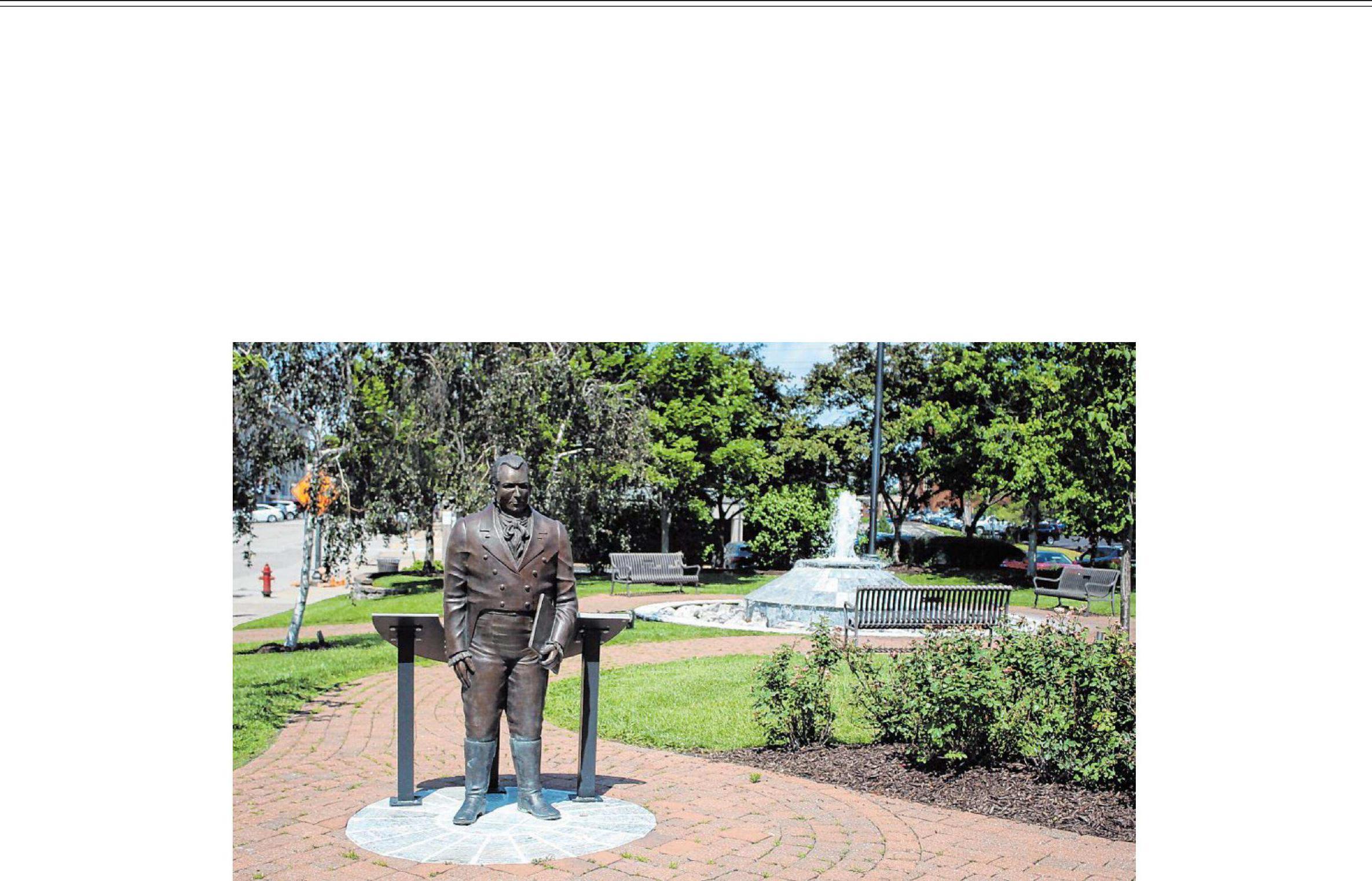
The statueof Ninian Edwards was thecenterofcontroversy several years ago. Now, the statue stands in front ofasign that acknowledges Edwards’ racist history.
wardsvillefrom a Frenchman namedPierre Lejoy. The oldest house in Edwardsville still stands at 1712 Main St.,anotherlog cabinhiddenbehindmodern siding. In additionto residences,Kirkpatrick alsobuilt a millonCahokia Creek, oneofthe first examplesofindustry in the new town.
As Kirkpatrick continued tolay outthenew town,henamed it after Ninian Edwards, the territorial governorof Illinois. The city was charteredin 1819. Illinoishad just become
astatein 1818, and it enteredthe Unionas a free state.However, the actions of Edwardsville’s namesake were fundamentally at odds with abolition.
“Ninian Edwards is widely known tohave owned enslaved people, as wellastohave led raids on Indigenouscommunitiesandtohavevetoed legislationthat would have endedIllinois’ system ofindentured servitude (slavery),”said Ezra Temko, anassociateprofessorofsociology at SIUE.
That history shows
how those actions shaped locallives,underscoring that thepursuit ofhappinessisimpossible without freedom.
The first inhabitants Kirkpatrick andhis family werenotthefirst peopletocallthenew city home The region was longinhabited byIndigenoustribes,many of whomsignedtreaties cedinglandtothenew settlers.
The nameIllinois comesfrom theIllinois Confederationof Indigenouspeoples. Thisgroup,
which included the Peoria and Cahokia tribes,had been interacting with settlersformore than 100 years by the timeKirkpatrick and Edwardscame to the area, beginning when Jacques Marquette and Louis Jollietcame through.
In 1818, U.S. leaders, including Ninian Edwards,signed a treaty with leadersfrom the Peoria, Kaskaskia, Mitchigamia, Cahokia and Tamarois tribes in which the tribal leadersceded their land, starting at theconfluenceofthe Ohio and
Under the treaty, the tribes were required to move to Missouri, andfor 12 years, they were to be paid “an annuityofthree hundred dollars, in money, merchandize, or domestic animals.”
This treaty was signed Sept.25, 1818, in Edwardsville.
Asimilar treaty was signed with the Kickapoo on Aug. 30, 1819. The Kickapooceded their land in returnfor a total of $23,000 to be paid out over 10 years.
Industrious immigrants
The areacontinued to attractnew residents from around the world. Edwardsville was started by the grandsonofan Irish immigrant, andthat patternofimmigrationcontinued to grow.
In 1886, thefirst membersofthe Kovarik family moved fromBohemia, now partofthe Czech Republic.
“Thename Kovarik and the translation into Bohemianmeans blacksmith,” said Justin Kovarik. William Kovarik was his great-great-grandfather. “They were all skilled tradespersons. In their research of regions, they were going, ‘where is metal booming at?’ In their research, they were told St. Louis.”
Williamultimately made hishome in Glen
Carbon,andhe wasa fundamentalpartofthe beginnings of Buck Road Cemetery.
Justin’s family roots alsoinclude theSaseks, anotherBohemianname foundoften at Buck Road. His grandmother’s brother, RichardSasek, served in the U.S. military and diedin Vietnam at 30. Justin Kovarik’s lineage is Bohemian,andhis family’s story isalso deeply American.
Perseverance
old, she developedmeningitisandlost both her hearingandhersight.
In 1901, she began attendingtheIllinois Institutionforthe Education of the Blindin Jacksonville, Illinois. It tookseveralmonths for Kubicekto adjust to her new environment. However, afterlessthana year, she had made considerableprogressinboth Brailleandsignlanguage.
In 1904, Kubicekand her teacher, Helen Jordon, attendedthe World’s Fair in St Louisto demonstrateher accomplishments.
withunderstanding,” it stated. “Theroute toher brainis a tediousoneand it has required a great amount ofhard work and patienceonthepartof instructorandpupilto put it in shape, butthe girl has more than justifiedall that has been done.”
Kubicek regularly wroteletterstoher family. Someare available through the Madison County HistoricalSociety.
route knownasthe Mother Road passed right through Edwardsville, allowingthecitytobenefit fromoneofthemost famous roadsinthecountry.
due to the advent of interstates, Edwardsville continues to honor the famous road and is celebrating its centennial this year during theannual Route 66 Festival.
Freedom for all?
In an area wheremany peoplehave pursued life, liberty and happiness, equalityhas been an ongoing struggle.
One ofthemost famous residentsof Buck Road Cemetery isEmma Kubicek, knownasthe Helen KellerofIllinois. Kubicek was bornin 1896, the seventh childbornto Bohemianimmigrants. When she was3 years
An articleinthe Bureau County Tribuneon Sept. 1, 1905,spoke of Kubicek’s success.
“Despiteherinfirmities the girl israpidly acquiring a goodeducationand is perfectingherselfina numberof studies. She reads with avidity and
AMarch 8, 1907, letter to Kubicek’s mother spoke of the 11-year-old’s excitement about a new Easter dress. The young girl died just five days laterofa rapidcaseofpneumonia. Her death made headlines nationwide, and she was rememberedforher academic excellence.
The Mother Road
Route66 was oneofthe main routesfor farmers traveling duringtheDust Bowl, andthen it was usedtotransportmilitary equipment. In the 1950s, many peopletookthe highway to Los Angeles on vacation.
Businessessprouted alongside the route, ready to fuel vehiclesorfeed drivers passing through. Theycalled attentionto themselves with attractionslike thebeloved Herbiethe Hereford statue above theoldGoshen Butcher Shopon Main Street,thefuturehomeof the Edwardsville Arts Center.
That history isnot entirely in thepast. Last June, The Intelligencer spoke to Houston Lowry, who has lived in Edwardsville his whole life —long enough to remember segregatedschools.
front door and hear the school bell ringing at the high school, but I couldn’t go there. We weren’t integrated.... I said, 'I’m here, I’ve got to walka mile andthere’s two schools two blocks down the street.’ That was bad,” Lowry said last year.
In 1926, Route66 opened,connectingChicago to Los Angeles. The
While Route66 was decommissionedin 1985
Lowry first beganhis education at Lincoln School, a segregated schoolfor Black students, even though he lived just down the streetfrom Edwardsville High School.
“I could standon my
EHS desegregated during the 1950-51 academic year, and Lowry enrolled. He was a track, football andbaseball star and was inducted into the Edwardsville Athletics High School Hall of Fame in 1984. He was reinducted with the Class of2026 in January.
The present and the
FrompageH3 HistorycontinuesonH5
Lowry’s legacy is that of a man determined to call the city home, regardlessofthe challengeshe facedorthemanfor whom the city was named.
future
Whilethehistory of Edwardsvilleand Glen Carboncannotfit ina single newspaper story, localinstitutions, like the MadisonCounty HistoricalSocietyandthe Wildey Theatre, preserve the story whilelookingforwardtothefuture.
The areacontinuesto grow SIUEopenedin 1957, andenrollment continuestogrow, with 11,932 students attendingforthe spring2026semester.
Edwardsvillealso places a strongfocuson smallbusinesses,especially restaurants,and takes pride inbeinga “foodiekindoftown.”
Although Route66has longbeenoutofservice, the citylandscaperesidents know today was
Theoldesthousein
shaped by the Mother Road andthebusinesses that sproutedalongside it.
Main Streetremainsa work inprogress,with ongoing water mainreplacement intended to better support its businesses.
One ofthosebusinesses,the Wildey Theatre, originally openedin 1909, andtoday, it contin-
ues to supportlocal art withconcerts, budgetfriendly movie screenings and fundraisers.
The story is not over. As residents continue their everyday lives— at school, at work, while volunteering and while pursuing creativity— theyfurther the themes this country was founded on.
Edwardsville, built by Thomas Kirkpatrick, still stands at 1712 Main St.Thisphoto showsit standing in 1928.
By AbiZajac STAFFWRITER
The EdwardsvillePublic Library haslongbeen aplace wherepeople beginnew chaptersin life On May 29, it became the settingfor29people from 16 countries who began a new chapteras Americancitizens.
“Thelibrary represents free accesstoknowledge,” U.S.Magistrate Judge Mark Beatty said. “Librariesarealsoplaces that many people go to beginnew chaptersin theirlives. The place
TAKING THE OATH
Newcitizens share what freedommeans
wherepeopleteach their childrentoread. It’sa place where students cometoprepareforexams. It’s a place where peoplecometolearn language andtoseeknew opportunities. Perhaps someof you may have used a library in your journeyin yourpathhere today becomingcitizens.”
Before administering the OathofAllegiance, Beattyemphasized its significance, explaining that new citizenspledge loyaltytothe United States, supporttheConstitutionand obeythe
nation’s laws A U.S. Department of Justice representative confirmed that eachapplicant had met federalresidency requirements and demonstratedthe character and commitment requiredfor citizenship.
Master Sgt. Joanne Griffinperformedpatriotic music, andthe EdwardsvillePublicLibrary played host totheceremony in partnership with federalcourt officials.
Afterthe oath, several new citizens shared what freedommeans tothem. Amongthe new citi-
zens was Alyssa Freya Fernandez, who moved from Spainas a teenager after her parents decided to seek a betterfuturein the United States.
“At first, I was terrified,” Fernandez toldthe audience. “Ithought that Iknew what I wantedto do with my life.”
Ten years later, she said she understands why herparentsmade the move.
“Thiscountry gave me many opportunities,” she said.“Iam surrounded by the peoplethat made me fall in love withthe land.”
Sarah Brokensha, who moved from SouthAfrica with her family in2020, saidbecoming a citizen carries specialmeaning because several generations ofher family now live in the United States.
“We’re very grateful to all be in the samecountry,” she said.“It’s really meaningful.”
For Sheila Miller, who cametothe United States fromthe Philippines ona fiancévisa,theceremony markedtheculmination of years of sacrifice and adjustment.
“There weremoments of fear, homesickness and uncertainty, but I kept movingforwardwith faith and determination,” Miller said. “Today, standing here as an immigrant inthe United States and becominga U.S. citizen,I feelproud.”
SarahBrokensha, whomoved to the United States from South Africain2020,celebratesafter becominga U.S.citizen..
American Revolution welcomedthe new citizens followingthe oath, whilethe League of Women Voters offered voter registration informationtohelpthem participate in the democraticprocess.
The ceremony brought together several localand civicgroups. Members of the Daughters of the
“When you think abouttoday, I want to encourage you tothink
about it, notnecessarily as the completion ofa legalprocess,but as the beginning of a new chapter,” Beatty said. “The new chapter in your lives as citizens. You arethe authors of that new chapter, and you get towrite that story. You’re alsothe author of the next chapter in theAmerican story.”
Photos by Abigail Zajac/TheIntelligencer New U.S.citizen Sheila Miller readsaspeechfrom her phone following thenaturalizationceremony at the Edwardsville Public Library.
NOTABLE LOCAL RESIDENTS
32 people whohelped shape Edwardsville and GlenCarbon
By Don Munsch STAFFWRITER
Many people shaped Edwardsville, GlenCarbon andthearea into the communitiestheybecame The peoplementioned iarejust someof the moreprominent people who helped shape local communities.
Namestied to the area’s identity
N.O. Nelson
Perhaps nopersonhad
moreimpacton Edwardsvillethan N.O. Nelson. The Leclaireneighborhood’s rootsare linked to Nelson. The Friends of Leclaire website notes the Leclaire National Historic Districtis a 19th-century neighborhood in the heart of Edwardsville and was founded by Nelson in 1890. Leclaire wasa model “cooperative village offeringaffordable homes, a healthful environment, freeeducation, opportunities for recreationand self-improvement, andpleasant working conditions at the N.O.
Nelson Manufacturing Company.” Cindy Reinhardt, historian and author specializing in Madison County, said Nelson’s creation of thevillage eventually added more than 1,000 peopletothe city whenthat village was incorporated into Edwardsville in 1934.
Ninian Edwards
Edwardsville was named after Ninian Edwards, who served as governor of theIllinois Territory and later as governor of Illinois. His influence on early Illinois
politics was immense, and his namebecame permanently attachedto the MadisonCounty seat. Edwards was among the most powerful political figures in Illinois during its formative years His leadership helped shape territorial government and thetransitionto statehood.
ThomasKirkpatrick
Thomas Kirkpatrick is generally credited as the founder of Edwardsville and was thecommunity’s first permanent settler.
Peoplecontinues onH8
Nelson
Madison CountyHistorical Society N.O.
Kirkpatrick laidoutthe townin 1815 andnamed it after Ninian Edwards. He alsoplayeda majorrolein establishinglocal government andpromoting settlement inthearea.
Benjamin Stephenson
Benjamin Stephenson wasa military officer, public official and oneof the most influential figuresinearly Illinois. His home, now theBenjamin Stephenson House, remainsoneof Edwardsville’s most significant historiclandmarks. Stephensonserved asregister ofthe Edwardsville LandOffice,a position that gave himtremendous influence over development andsettlement in southernIllinois.
Charles Boeschenstein
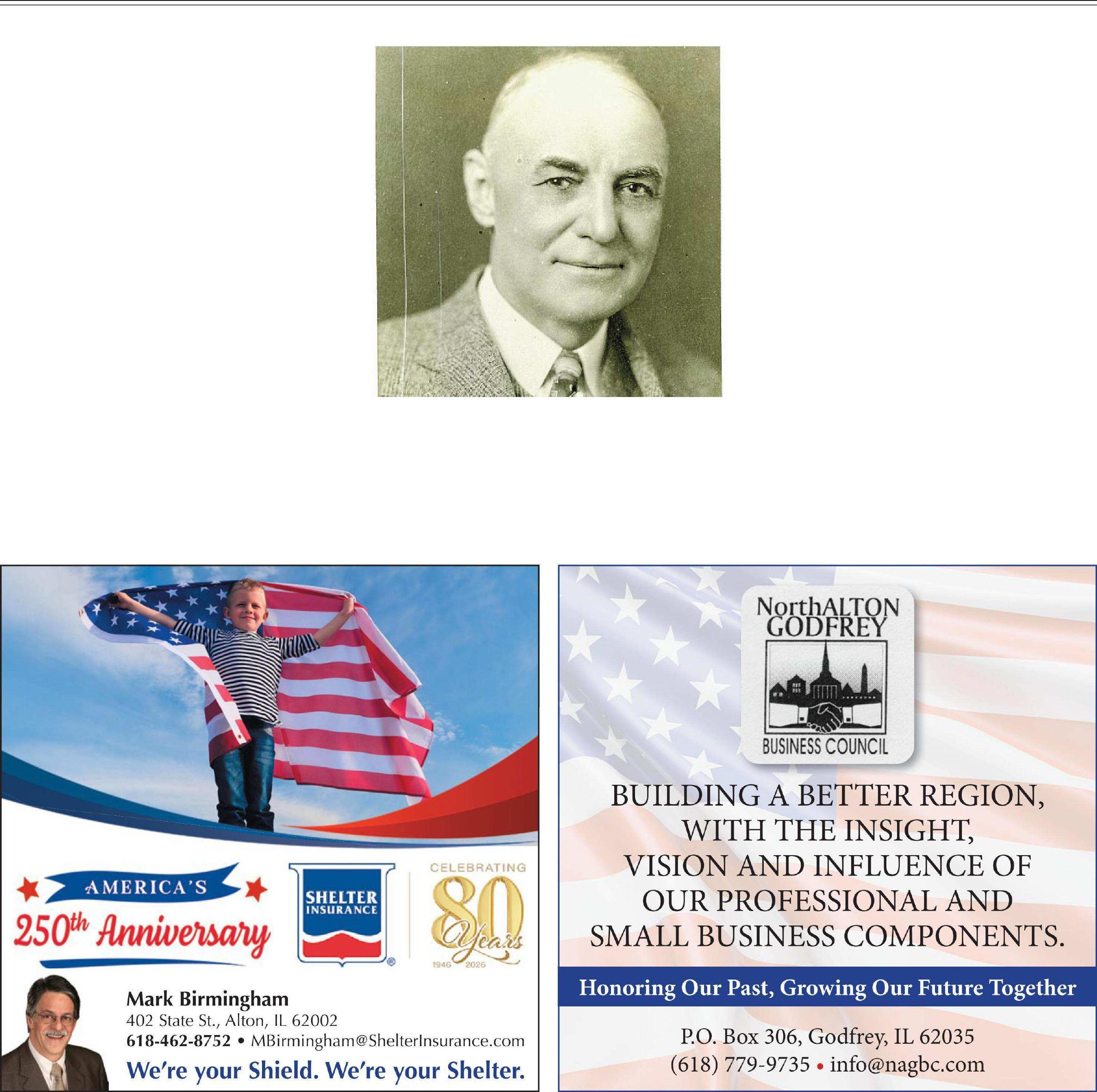
CharlesBoeschenstein once ownedthe Edwardsville Intelligencer, and he wrotetoAndrew Carnegie toask for money to buildthe Edwardsville PublicLibrary, Reinhardt said.“When the library had a major fire in 1956, his estate provided funds to helprebuild the library,” Reinhardt said. “So hedidn’t just build it one time – it was twice.” Boeschenstein serveda coupleofterms as mayor and discoveredhecould get more accomplished outside ofoffice He became what the St. Louis Post-Dispatch called the most influential Democrat inthe state ofIllinois, Reinhardt said. He wasa figureinnational politics, but not whilehe was in office. Reinhardt credited him with turning around the Intelligencer, as the
papergrew tobeingpublished as a daily paper and he supportedincluding news from other communities.
today, people complain aboutthe signordinances and this andthat, (and) he’s the one that started out with, ‘We don’t have to pay thesepeopleto come in – theywill come,’” Reinhardt said. “And we don’t needto allow themtomake our town ugly. We can have these signordinances so that they needtobetasteful – that kind of thing.” He diedin2020.
Dolores Rohrkaste
Gary Niebur
Gary Niebur, a longtime Edwardsvillemayor, had an indelibleeffect on Edwardsville. “When you look at Edwardsville
Dolores Rohrkaste was abusinesswoman and community leader who broke a lot of glass ceilings in the areaand was president ofChamber of Commerce early in the 1950s, during a time when it was unheard of fora womantoholdthat position.“Iusedto go talk with her allthetime— she was justa font of information when you
wantedthe history ofthe place,” Reinhardt said. Dolores and her husband startedthe Rohrkaste Dairy, whosebuilding now housesthe Main StreetCommunityCenter. Dolores also worked asa property appraiser, and she also worked asa draftsperson at the Kane architectural firm. Working there is another example of something she did that was unusual for women.“She broke a lot of glass ceilings withthe jobsthat she had,with her leadership,” Reinhardt said, noting that Rohrkaste was instrumental in getting SIUE here and helped lead the charge for the Mississippi River Festival. She diedin 2020.
Herman Shaw
Herman Shaw wasa multi-sport athlete and
FrompageH7 PeoplecontinuesonH9
Madison County Historical Society
Charles Boeschensteinonce owned the Intelligencer.
communityleader who was inductedintothe Edwardsville Athletic Hallof Famein2023. He was alsoinvolvedinarts and education,servingas afounding boardmember of the Edwardsville Symphony andfounding the Lincoln School Alumni Foundationin 1986. Shaw died Jan. 12, 2026.
Rudy Wilson
Rudy Wilson was the first Black memberofthe EdwardsvilleDistrict7 school board, eventually servingas president. He servedasSIUE’s assistant provost forcultural and socialdiversity He was alsoan associateprofessor inthe School of Education.
Political,civic and educational leaders
Edward Mitchell West
Edward Mitchell West wasa politician, attorney and bankerand is credited with making a deal withAlton that kept Edwardsvilleasthe county seat.“When they had the state convention in 1858,there was an argument(that) Alton wanted to bethecounty seat,” Reinhardt said. “He struck a deal where Alton would get thefirst state prisonand Edwardsville would keep the county seat. Which I’m glad that he did. Just think if you lived in Highland, especially back inthe day, goingtothecounty seat in Alton would have been along way. Havinga countyseat that’s centrally locatedjust makes more sense.”
Cyrus Edwards
Cyrus Edwards,brother of Ninian Edwards, was a lawyer, politician
and land developer who played a majorroleinthe growth of MadisonCounty. He promoted settlement and economic development throughout
the region and helped establish Edwardsville as an important center of commerce and government.
Ninian Wirt Edwards
Ninian Wirt Edwards, son of Ninian Edwards, becameIllinois’ first superintendent ofpublic instruction. His work helped shape the state’s public education system. He later served in other government positions and extendedthe Edwards family’s influencebeyond politics into education.
James Semple
James Semple wasa lawyer, legislator and U.S. senator who lived in Edwardsville. Semple served as Illinois attorney general andlater represented Illinois in the United States Senate. He was amongthe leadingpolitical figurestoemerge from
MadisonCounty during the state’s early years.
Lester Munzert
Samantha Doolin, museum manager forthe GlenCarbon Heritage Museum, said Lester Munzertplayeda critical role in the village and was mayor from 1969to 1981 and was a trustee fora yearbeforethat. Munzert, 99, was bornand raised in GlenCarbon and still lives intown.“He was mayor duringthe village’s giant boom,” Doolin said. “There were 21 annexationsbetween ‘69 and ’71, and thepopulation increased from 1970 to 1980 by 174%.” In 1971, there were about 1,800people, and by 1980, the village had 5,197 people During his time as a mayor, Munzert and other leaders conducted a number of significant water and
PeoplecontinuesonH10
Madison County Historical Society
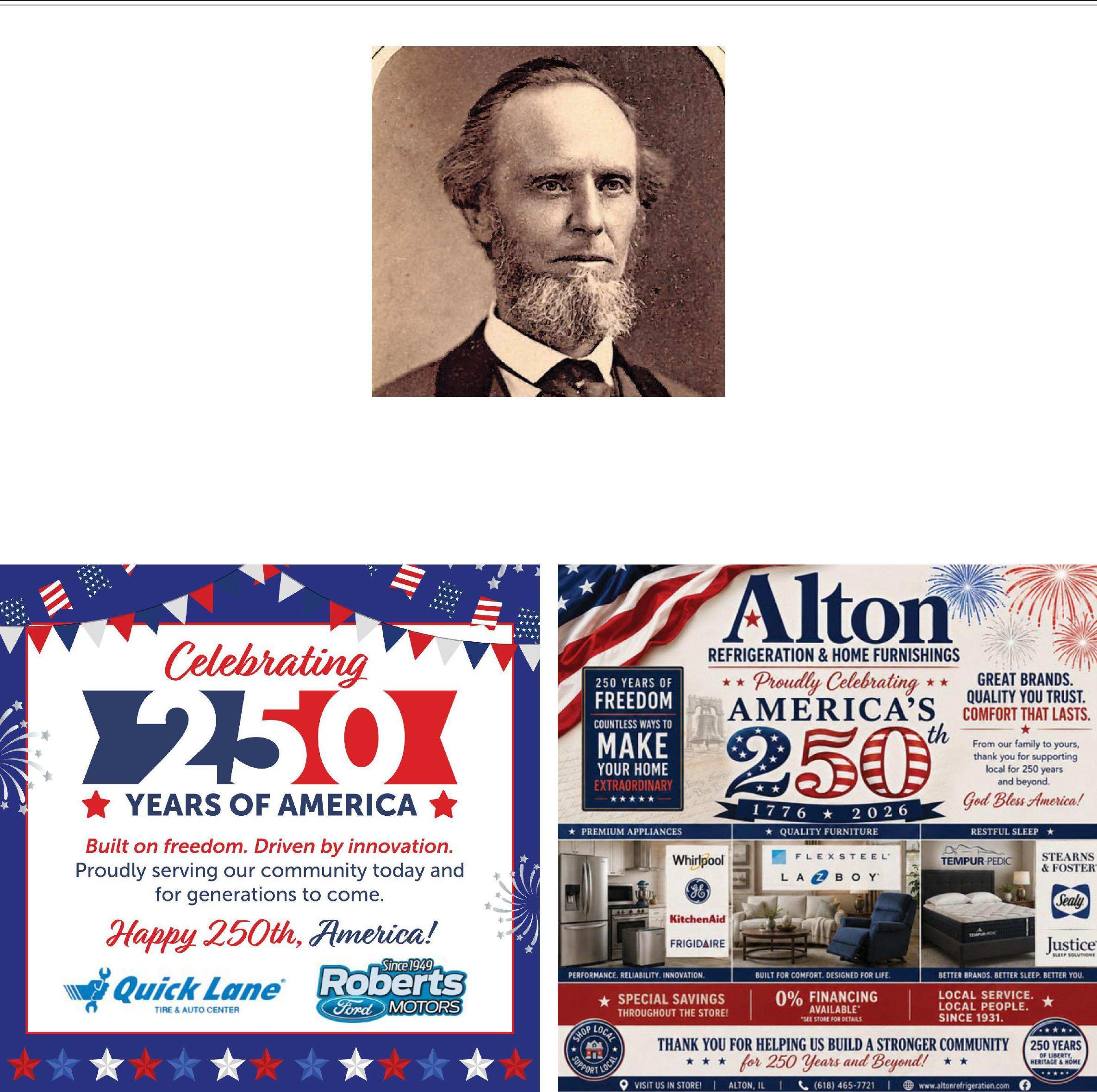
Edward Mitchell West
sewer improvements,and commercial development and thesalestaxbase increased.“He was very adamant inhis advocationfor Glen Carbonand GlenCarbonfirst,”Doolin said. “There werea numberofdisagreements with Edwardsville about the annexationsand propertylines.” He remains a big advocatefor the village, Doolinsaid. Doolinsaidpeople in GlenCarbon generations ago werenotasfocused on gaining admirationfor themselves asthey were moreconcerned about supportingtheircommunity, includinglocalorganizations such asOddfellows, American Legion and Kiwanis.
Harold Helfer
Harold Helfer served as a mayor and was superintendent of Glen Carbon’s schooldistrict before the village’s schoolsincorporated into District 7.
William Guy
William Guy was president of MadisonCoal Corporationandpresident ofthe St. Louis, Peoria & Northern Railway who workedtomake GlenCarbon a company town.
David L. Browman
David L. Browman servedasthe first chancellorof SouthernIllinois University Edwardsville. During his tenure, SIUE grew from a new campus into a majorregional university. The institution’s continued growth would have a profound effect on Edwardsville’s economy, population and identity.
Ted and Ruth Mudd
Ted and Ruth Mudd wereamong SIUE’s most
significant benefactors. Theirphilanthropy supported universityprogramsand facilities and helped strengthen SIUE’s
role as a majoreducational and economic driver in Edwardsville and the surroundingregion.
Preservationists and cultural voices:
Betty Maloney
In the 1960s and 1970s, Betty Maloney was an advocatefor thepoor, and she and her husband also conducted a building survey ofhistoric Edwardsville properties that has become a resource for historians. There’sa file at the Madison County Historical Society buildingcalled the Betty Maloney File. “It’s one of the first places that you look when you’re researching your historic home,” Reinhardt said. She died in 2022.
Karen Mayteka
Karen Mayteka, a historian and preservationist, helped obtain fundingfor the Stephenson House and wasa volunteer. She wrote the Main Street Historic District application. “She helped get the fundsfor the Stephenson House to be restored and she served on that boardfora number of years,” Reinhardt said. One of Mayteka’s accomplishments was establishing the downtown historic district in Edwardsville. “That was a huge job,” Reinhardt said, noting that task involved hundreds of properties. She died in 2015.
Joan Foster
Joan Foster, wife of former Mayor Ron Foster, kicked off the collection for the museum, as she assembled photos and
PeoplecontinuesonH11
Glen CarbonHeritage Museum
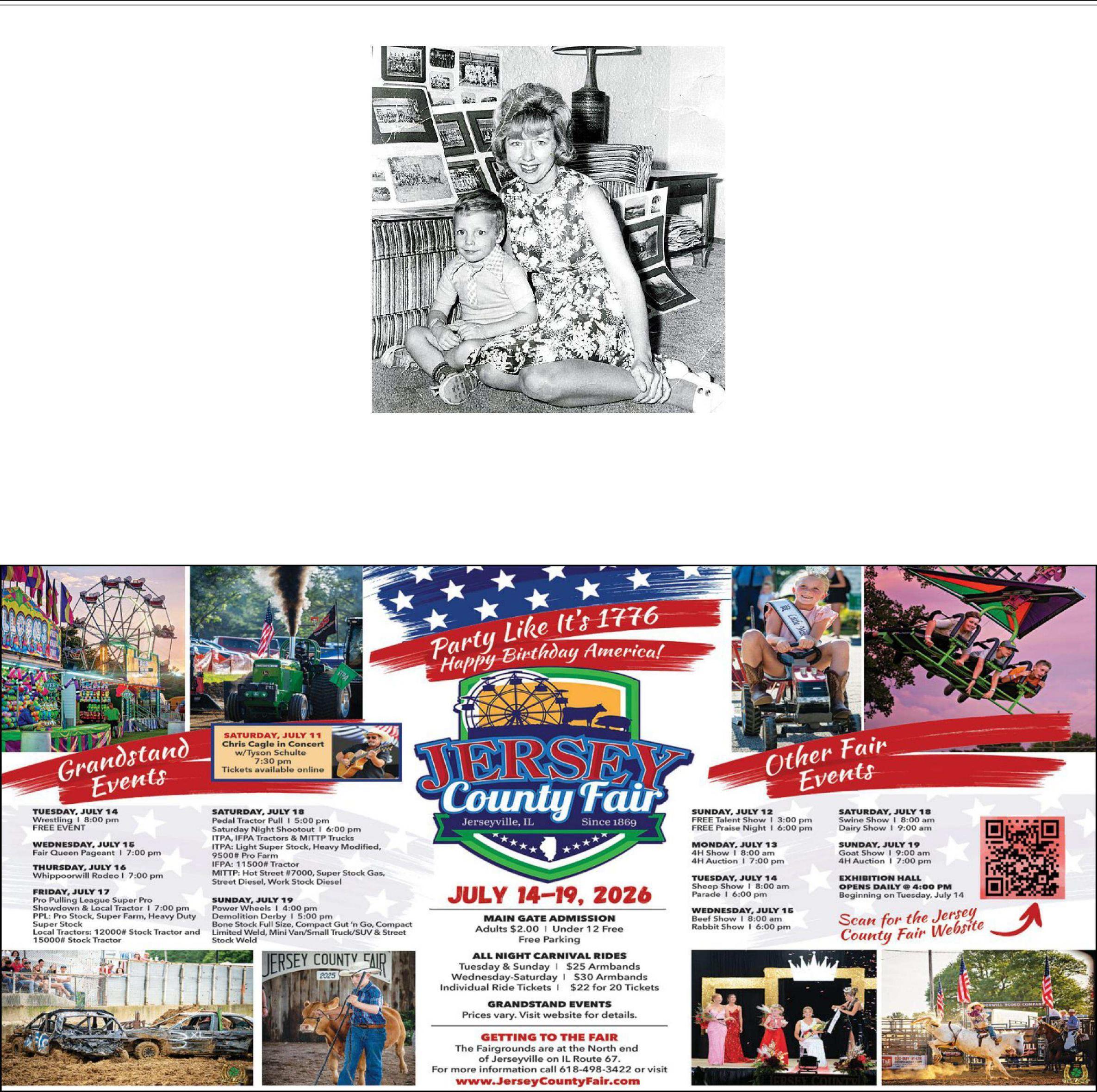
Joan Fosterwithherson, Ron Jr.
Frompage H10
interviewedresidents. She wasonthelibrary boardthat was ableto buildthenewlibrary, servedontheboardto startthefirstlibraryin GlenCarbonand wason theboardthatspearheadedthecreationofthe CentennialLibraryDistrict.
Joyce Williams
Author Joyce Williams hasbeeninstrumentalin preserving GlenCarbon’s history, as sheandher husband Robertrestored the Yanda LogCabin. She wasthefirstdirectorfor the GlenCarbon Heritage Museum. Sherecently endedhertermonthe Historicaland Museum Commission.
William Yanda
William Yanda was amongtheearly settlers whose family became closelyassociated with GlenCarbon’s development. The Yanda family farmandhomestead becamepartofthecommunity’shistoricidentity, andthe Yanda LogCabin remainsoneof GlenCarbon’s best-knownhistoric structures.
James Yanda
James Yanda wasa memberoftheprominent Yanda family, whose contributionshelped preserve GlenCarbon’s early heritage. The family’s legacy remainsvisible throughthe Yanda Log Cabin, whichhasbecome oneofthevillage’smost recognizablehistoric landmarks anda symbol of itspioneerpast.
GlenCarbon’s
MerchantSamBirgerarrivedin 1893.
early builders
Sam Judy In 1801, Sam Judy was thefirstAmericanto settletheareathat would
become GlenCarbon, accordingto Madison Historical: The Online EncyclopediaandDigital Archive for Madison County,Illinois. At the time,theregion was knownasthe Goshen
Settlement. GlenCarbon wasincorporatedasa village in 1892 asa coal miningtownanda hub forrailroads,thearchive said.“Whenhecame, there wasjusta wave of settlers whocametothe area,”Doolinsaid.
William Peters
William Peters was fromalarge German familythatcametothe area,andtheGoshen Settlement wasrenamed Peters Station.
MartinSmola
MartinSmola wasa Bohemianimmigrant who wasamajorproperty ownerandset upa schoolfor childreninthe area.
RudolphPrimas
RudolphPrimas was knownforoperating PrimasBakeryandPremor’s Tavernand wasan early trustee.
ChristianSchroeder ChristianSchroeder wasaGermanimmigrant and startedSchroeder Brothers Meat Market withbrotherAntonin 1895.
SamBirger
SamBirger, a merchant,arrivedin 1893and wasthefirstindividualto buildatwo-storybrick storefronton Main Street.“It wasn’t builtin 1893,butthe store was startedin 1893,”Doolin said.
BernardBirger
BernardBirger, son of SamBirger, wasinfluentialinestablishing the GlenCarbon FireProtectionDistrictandserved ontheboardoftrustees. He also donatedlandto build GlenCarbonElementarySchool.
Glen CarbonHeritage Museum
REST INPEACE Revolutionary War veterans partofcounty’s history
Veteransoffight for freedomremembered at Edwardsvillearea
By Matt Kamp STAFFWRITER
Though Edwardsville was notsettleduntil 1805 and Illinoisdidnotbecome a state until 1818, MadisonCountybecame the finalrestingplacefor nearly a dozen Revolutionary War veterans.
From Lusk Memorial Park and Woodlawn Cemetery in Edwardsvilleto Nix-Judy Pioneer Cemetery in GlenCarbon and LutheranCemetery in Worden,reminders of the nation’s earliest history remain scattered throughoutthe Edwardsvillearea. Revolutionary War veteranscanbe found at Lusk Memorial Park and Woodlawn Cemetery in Edwardsville; Nix-Judy Pioneer Cemetery in GlenCarbon; LutheranCemetery in Worden;and PaddockFlagg Cemetery in Moro.
Lusk Memorial Park
• Thomas Tindall was borninthe 1760sin Halifax, Virginia.Duringthe Revolutionary War, he helpedfeedthearmy asa youngboy. Afterthe war, Tindall,hiswife Martha and their nine children traveled west intending to settlein Missouri. Instead,the family arrived in Edwardsvillein November 1816 and remainedin Madison County. Tindalldiedin 1832.
• Reuben Hopkins was born June 1,1748,in
lowing the War of 1812, Hopkins and hiswife
cemeteries
VETS
Frompage H12
Hannahmoved to Edwardsville.
WoodlawnCemetery
• George Prickett was born in Marylandin 1757 and diedin Madison Countyon July 20, 1846. Originally buriedin Lusk Memorial Park, his remains were later moved to Woodlawn Cemetery. Prickettcame to Madison County in 1808after previously living in the Carolinas, Georgiaand Kentucky.
Nix-Judy Pioneer Cemetery
• The Rev. Isham Randle was born March 23, 1758, in Brunswick County, Virginia,and died April 18, 1838.Randle served in the North CarolinaContinental
Army and also enlisted in Brunswick County, Virginia, duringthe Revolutionary War. He, his wife Francesandtheir childrenmoved to Madison Countyin 1817. Randle was originally buried at Goshen,or Old Bethel Cemetery, near thepresent-day Lakewood subdivision in GlenCarbon. Acommemorative marker now stands at NixJudy PioneerCemetery.
• RichardRandle, the brother of IshamRandle, was born Aug. 21, 1752, in Brunswick County, Virginia,anddied April 14, 1842, in Madison County. Duringthe Revolutionary War, heservedin enlistmentsfromboth Virginiaand North Carolina.RichardRandle moved to MadisonCounty withIshamRandle and their families in 1817.
• Josias Wright was born Jan. 18, 1746, in
Brunswick County, Virginia.Afterlatermoving to NorthCarolina, Wright becameanofficer in theAnsonand Montgomery Countytroops duringthe Revolutionary War. He, his wife Apphia and their children relocatedto MadisonCounty in 1811 alongside the Randle family. Wright died Jan. 2, 1825,in Madison County. A commemorative marker islocated at Nix-Judy PioneerCemetery.
• Henry Thornhill was bornin Virginiain 1757anddiedin Madison Countyin 1835 Thornhill servedinthe Virginia militia duringthe Revolutionary War. Duringa secondtermofservice, he marchedthrough Williamsburg to Yorktownand was discharged five days beforeCornwallis surrenderedonOct. 19, 1781. Thornhillmoved
to Illinoisin 1821.
• John Nix was born in SouthCarolinain 1756 and died July 12, 1822, in MadisonCounty Nix enlistedintheSouth CarolinaContinental Army andfought inthe battlesofOrangeburg and Eutaw Springs. Nix and his wife Winifred, along with their children, moved nearpresent-day Kaskaskiain 1812. In 1817, President James Monroe granted Nixa landpatent at thefootofthe Sunset Hillsbluffnear Edwardsville.
• WilliamBiggs was born June 3, 1755, in Frederick County, Maryland, and died March 27, 1827, in MadisonCounty. Patrick Henry sworeBiggs intothe Virginiamilitia in 1777. He later served under George Rogers Clark duringthe 1782 captureof Kaskaskiaand Vincennes.Biggs andhis
family, including hiswife Nancy, moved toIllinois in 1784. In 1789, Kickapoo Indians captured Biggs and held him for ransom nearly 250 miles away in northern Indianabefore he returned home 10 weeks later. Biggs’ burial locationisunknown,but the Sons of theAmerican Revolutionplaced a commemorative memorial at Nix-Judy PioneerCemetery in 1997.
LutheranCemetery
• Francis Roach was bornin April 1739 in FairfaxCounty, Virginia, and died July 9, 1845, in Worden. Roach enlisted in 1779 and againin 1780 before serving a final termin 1782. After migrating from NorthCarolinato Kentucky in 1779, he owned 299 acres in ChristianCounty, Kentucky, before movingto Illinoisinthe early 1800s.
Roach died at age 106. Paddock-Flagg Cemetery
• Gaius Paddock was born Nov. 22, 1757, near Plymouth, Massachusetts,anddied Aug. 11, 1831. He isburied at Paddock-Flagg Cemetery in Moro. Paddock enlisted in 1776 and fought inthe battles of Trentonand Princeton. He also reportedly served with George Washington at Valley Forge. Paddock arrived inIllinois from Vermont in 1817 after claiming 160 acres for his Revolutionary War service. The cemetery where he isburied was part of that land grant. When General Lafayette visited St Louis, Paddock and his family joined festivities honoring Lafayette, including a ball heldin his honor.
BACKINTHE DAY
Alook at Illinois of yesteryear
The statehometo Edwardsville, Glen Carbon was mightydifferent 250 years ago
By MadelynSinclair CONTRIBUTINGWRITER
Whenthe 1783 Treaty of Paris saw the United Statesformally released fromtheBritish Empire, colonistsfromtheeast coast swarmed inlandto newly acquiredterritory west ofthe Appalachian Mountains.American homesteadersandmarket speculatorshad been outraged two decades prior by Crowneffortsto designatetheareaas Indian Reserve and restrict expansioninto it; now, evenasthenew government struggledto assembleandfund itself, they wereeager tobegin staking claims.
outpostsandestablishing frontier colonies. To this day, some roads remain that originally were paved-over paths carved by hoof.
The expansive prairies hinted at what would come to be a defining characteristic of the region: flat, fertileland with deep soilandideal climate conditions for growing a variety of essential crops. While many Southern colonists made their fortunesestablishing slave plantations to produce highvalue cottonand tobacco, thoseinthe northand west found that grain and livestock could flourish here. Bit by bit, native grasslandsand meadows were shaved down to make way forendless fields of grain, bison were slaughteredin droves to be replaced by imported Europeanlivestock, andpatchwork homesteads came to comprise thebulk of the regionallandscape.
At the time, what we today callIllinoislooked remarkably different. Priortocolonization,the vast plainsofthe North Americaninterior werea sea ofprairiegrasses. Thosegrasses, awash withwildlifeandsometimes up to 8 feettall, made navigation tricky for humans butprovideda smorgasbordfor native bison, which both grazedonandhidwithin thosegrasses whilemigrating acrossthecontinent The wandering herdsfollowed paths routineenough that Native localslearned touse the trample-trailsleftin their wake ascorridors for travel and hunting; later, Europeans would follow theirexample whenbuildingtrade
actedas a sturdy backbone forrapidpopulation growth; from 1770 to 1870, thepopulation of the United States nearly doubled every 20 years, and it continues to grow to thisday.
Of course, all that grain needs some way to move from farm to table. At thedawn of U.S. independence, steamlocomotives hadn’t yet been invented; it would be several decades before the nation’s railroad boom. With the dense prairieand broad Appalachian range making it difficult to returneastward on foot, moving large quantities of food overlong distances would be noeasy feat. To this end, the MississippiRiver becamea lifeline.
Today, Illinoisproduces upwards of $17 billion annually in agricultural goods(mostly cornand soybean). Farmland makes up around 70% to 75% of the state by land area, making it not onlya major producer of grain for the United States but also a major exporter to countriesaround the world. The massive surpluses produced by Illinoisand neighboring states historically have
Lifeinthe North Americaninterior, in fact, has depended on the MississippiRiver and its many tributaries for as longas humans have lived here For humans throughout the majority of history from the “Mound Builder” cultures whose pre-colonial urban centers rivaled European contemporaries in population to the more nomadic tribes that moved throughout the regionasresource availability fluctuated,and from the early Spanish and French colonists who sought to extract the land’s resources to the
ILLINOIS
Frompage H14
subsequent wave of United Statescolonists who sought toreshape the landscape itselfforcommercialbenefit— lifein thisregionmeant clinging tovital waterways for travel,trade, war and communicationalike.
Thismade Illinois’ position withthe MississippiRiver tothe west; its largest tributary, the OhioRiver, tothesouth, and Lake Michigantothe northeast—a very useful one tobein.
Early on,these waterways still were far from accessible, unless you happenedtolive right alongthe shore Most colonists who came to live throughout theGreat Lakes region initially survivedthrough subsistence farmingandlocal trade, much like the area’s Indigenousinhabitants.Scatteredgatherings ofindividualhomesteads wouldbejoined together by centralmarketplaces, wherelocals would exchange their goodswithoneanother or withtravelingmerchantsseeking to move them fartherafield. With no locomotives or automobiles available, travel was limitedtomoving by foot, so any essential resourcesorservicesa personmight needhad to be within walkingdistance.
the region, with striking workers often facing imprisonment or physical violenceinretaliation for interrupting production. Locallabor organizing efforts eventually culminatedinthe formation of Industrial Workers of the World,a merger of existing coal and rail unions founded with the goal of building and uniting unions in every variety of trade nationwide.
BettmannArchive
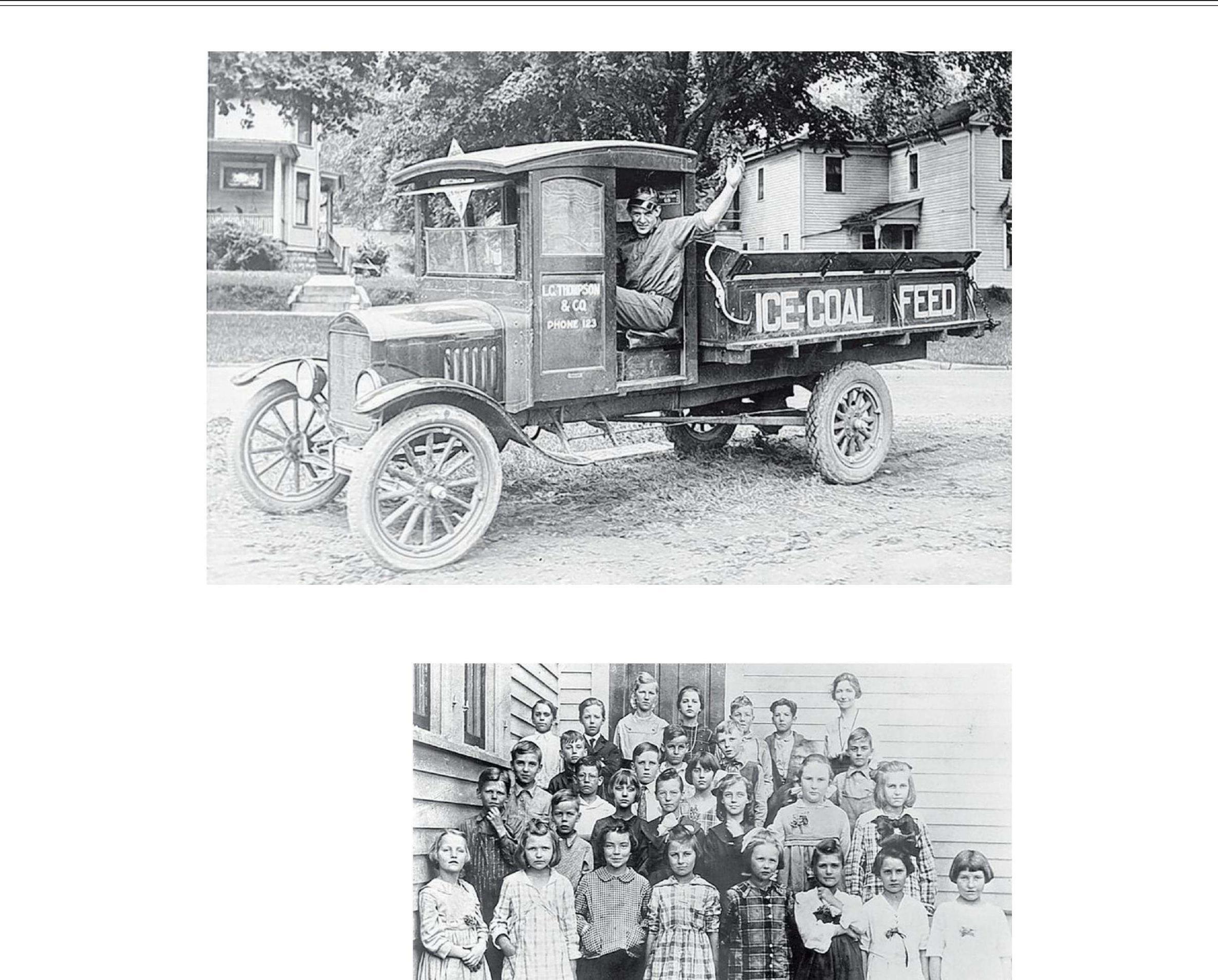
Uponhis return to Illinoisfromamovie shootin Hollywood, RedGrange,nationallyfamousIllinois University football star, cheerfully returned to hisoldjob for a small-townicecompany.
The industrial boom proved lessexplosive and lesslong-lasting outside the Windy City, though. Shiftsinthe freight market over time caused the prosperity downstream of Chicago’s shippingand production market to fade, sending some riverside townsinto steady decline Meanwhile, agriculture —a moreconsistent economicfoundation —remains dominant through much of the state to thisday.
WhenIllinois was admittedas a state in 1818, its colonialpopulation was somewhere around 35,000 technically toofew people to become a state, butthe initialcensushad errors that inflatedthe number. Most of its residentslived in the southendofthe state, closetothe junctionofthe Ohioand Mississippi rivers,making it
relatively easy totravel to nearbySt. Louis by ferry. It still wouldbesome time beforethenortheast rose to theprominence it now holds;Chicago was littlemorethan an old fur-tradingoutpost with perhaps a hundred people livingaround it. This would change quickly: The ErieCanal’s openingin 1825connected the upperGreat Lakes to the AtlanticOcean, bringingwith it a sharp uptick inimportsofboth people and goodstothe coastal Midwest. Areas along the lakes’ shores almost immediately began to see steady populationgrowth. What truly broke thedam, however, was theopening 23 yearslaterofthe Illinois and Michigan Canal. Thiscanal linked Lake Michigandirectly to the MississippiRiver by way of Chicago, instantly
WhileIllinois may not have quite as flashya reputationas stateslike New York andCalifornia, it isundoubtedly just as essential —a beating heart at the core of the nation, steadily carrying on day by day.
Historical/CorbisviaGettyImages
Illinoisnative Ronald Reagan at 8 yearsoldwith his third-grade classin Tampico. Reaganis the first childon theleft in thesecond row.
placing itat thecenterof trade between the Atlantic Ocean to theeast,the Gulfof Mexico to the south, the MissouriRiver to the west, andCanada to the north.
Practically overnight, Chicago becameaneco-
nomic powerhouse. Industry andcommerce boomedand,asrailroads criss-crossedIllinois, that newfound prosperity in the northeast helped fuel theindustrialization of the rest of the state, as well. The coal, steeland
railindustries took off; so too didlabor organization withinthoseindustries. Overthe years, numerous strikesand subsequent backlashes shaped relations between workers,employersand government officialsin
It’s difficult to imagine the United Stateslooking the same without sucha crucial center of transportationenablingeasy travel, or without the excess of food provided by thisand other breadbasket states. As the nation rings in its 250th anniversary, one has to wonder what thisland between rivers might looklike given another few decades of development and social change.
Withany luck, those marking the nation’s 300th year willbe able to look back on today and feel satisfied with how things have shaken out.
REVOLUTIONARY WAR
Battle marked war’sonly clash west of the Mississippi
St. Louis wassiteof westernmost battle, defeat forBritish and Indians
By SteveWhitworth STAFFWRITER
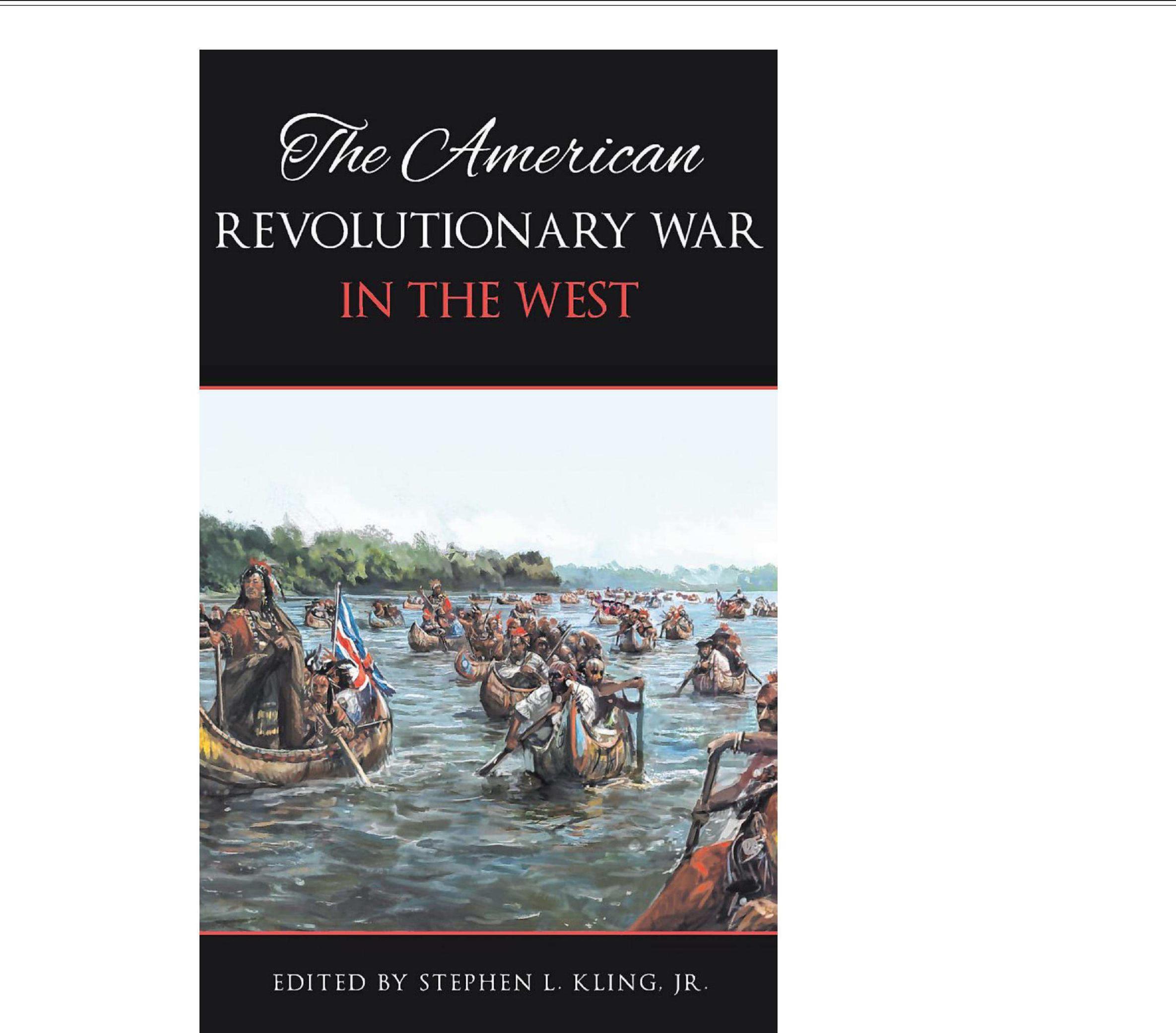
The main sourcefor this informationis an article written by Stephen L. Kling Jr thatappears on the website of the Missouri SocietySonsof theAmerican Revolution.
Although most Revolutionary War battles werefought inthe original 13 American colonies, one notable skirmish duringtheconflictoccurredjusta few miles downriver fromAlton.
The Battleof St Louis, alsoknownastheBattle of FortSanCarlos,took place on May 26, 1780, pitting Native Americans alliedwiththeBritish againsta hodge-podge of French andSpanish colonists defendingthe youngcity It was the only Revolutionary War battleto occur west of the MississippiRiver.
St. Louis was founded in 1764 by French colonists who came up the Mississippi from New Orleans. The French settledin a numberof spotsonbothsidesof the river, includingCape Girardeau and Ste. Genevieve in Missouri,as well as Kaskaskiaand Cahokia inIllinois.
authority in St. Louis in the late 1760s.
Shortly afterthe Revolutionary War broke out in 1775 in andaround Boston,the French and Spanish began aidingthe American colonists in their struggle against the British, longtime adversaries ofboth France and Spain. France’s contributionstotheAmerican cause are wellknown, especially the efforts of the Marquis de Lafayette, but Spain’s role in the war gets little publicity.
Mississippi River marked war’s western frontier
In 1778, American Gen. George Rogers Clark of Virginia opened the war in the West by attacking and capturing the British fort at Kaskaskia. In early 1779, Clark led an expedition from Kaskaskia across Southern Illinoisto capture another British fort nearpresent-day Vincennes, Indiana.
But in 1762, theSpanish tookcontrolofthe vast areathat the French had named Louisiana under thetermsofa treatythat endedthe Seven Years’ War. The Spanish establishedtheir
Those defeats alerted British leadersto the importance ofcontrolling what then was the western frontier of America. So in 1780, Patrick Sinclair, the military governor at Fort Michilimackinac inpresent-day Michigan, urged Loyalist fur traders to organize Native Americantribes for an expedition against St. Louis. Abouttwo dozen
CourtesyofTHGC Publishing
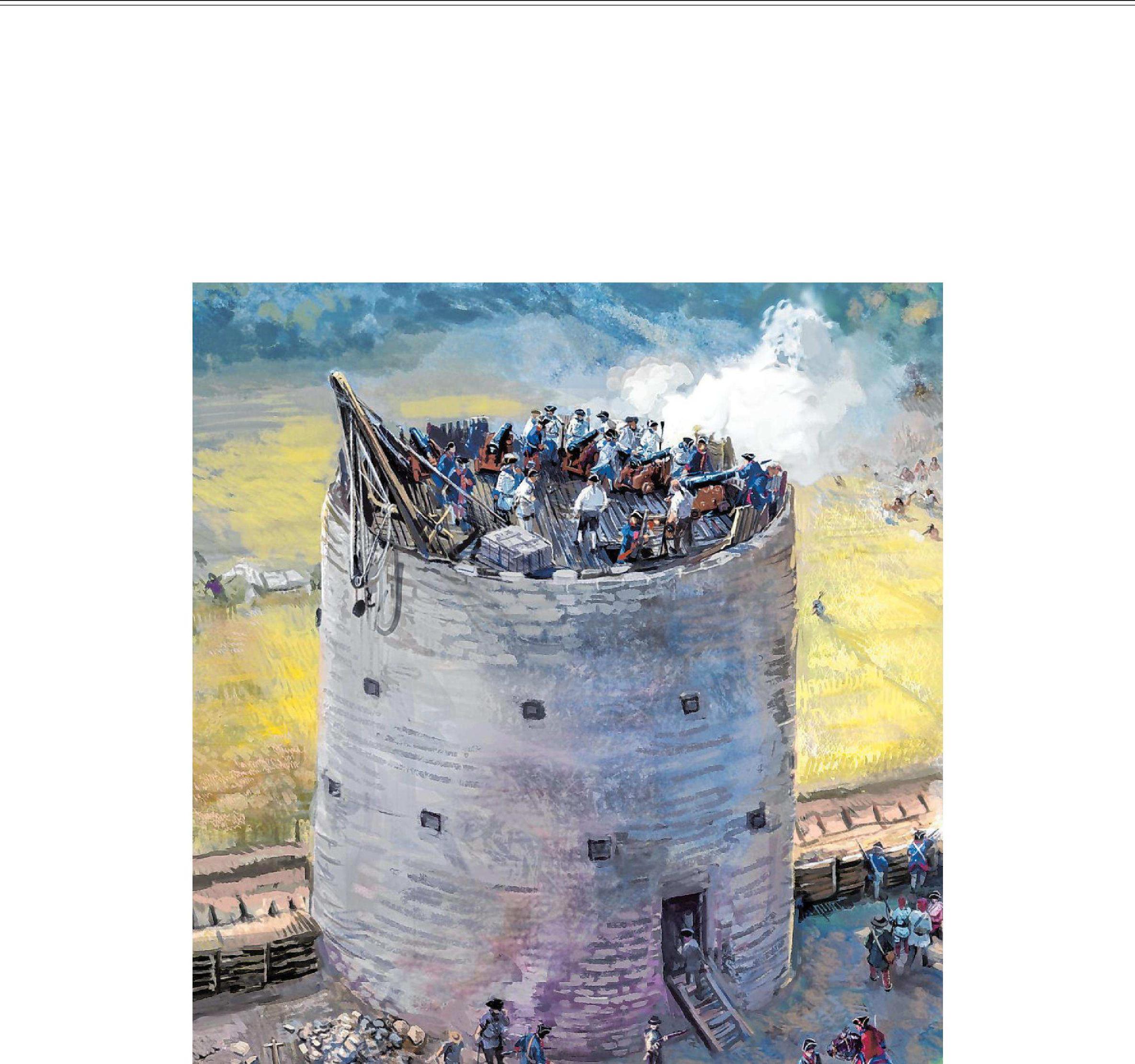
Thispainting by Mitchell Nolte, which appearsin thebook "TheAmerican Revolutionary War in the West," edited byStephen L. Kling Jr., depicts Fort SanCarlos during the Battle of St. Louison May26, 1780. The
BATTLE
Frompage H18
fur tradersandanestimated 750 to 1,000 Indian warriorsleftPrairie du Chienin Wisconsin on May 2, 1780, underthe commandofEmanuel Hesse,a formermilitia captainturned furtrader.
About200Sioux warriorsmade up thelargest contingent from one tribe, butfighters from the Ojibwe, Menonimee and Ho-Chunknations alsocamealongunder the leadership ofthe Ojibwe chief Matchekewis astheforcemade its way incanoes downthe Mississippi. At Rock Island,they werejoined by about250menfrom the Saukand Meskwaki nations.
The village of St. Louis was governed by Lt.Gov. Fernando de Leyba,a captainintheSpanish army, who was warned by a furtrader aboutthe British planto attack. Withlittletimetoprepare, he oversaw the constructionof a round tower, about30to40feet high, that gave a commandingview ofthearea outside thevillage.It was named FortSanCarlos.
Trenches were dug to form a defensive perimeter. Five heavy cannons wereset up inthetower, withsmaller cannons and swivelgunsdistributedinthetrenches. Leyba had 310 menunder his command,most of themmilitia.
ans landedtheir canoes on May 25 near what now wouldbethe Bremen neighborhood of North St Louis. Hesse decidedto attack the followingday. About 750 of the Indians would attack FortSanCarlos, while some 200 warriors, mostly Chippewa, would attack Cahokia.
The battlebegan about 1p.m. on May 26, with the British and Indians chargingthe entrenchments around St Louis. They were met by cannon fire from thetower and musket firefrom the earthworks. Free Black inhabitants of thetown assistedinthe defense.A number of townspeople were caught intheir farm fields outside ofthe defenses whenthe attack began,andthey made up the majority of the casualties.
After abouttwo hours of fighting, the Indians retreated, effectively endingthebattle. The cannon firefrom the tower, inparticular, apparently surprisedand intimidatedthe Indian attackers. Theylater referredto FortSanCarlos asthe“Houseof Thunder.”
ers andtaken five prisoners.
Battle secures westernfrontier for Americans
The British forces retreated up the Mississippithe nextday, taking about 70 prisoners withthem,and destroying cropsand killing livestock alongthe way. Militia cavalrymen from St. LouisandCahokia pursuedthe Indians up the Mississippiandalso up theIllinois River to the vicinity of presentday Chicago. The combined French,Spanish and American forces,in turn, attackedand burned some Indian villages, especially those belongingtotheSac and Fox tribes.
At thesametime, GeorgeRogersClark and asmallcompany from his Illinois Regiment of Virginiafortifiedthe French village ofCahokia, a few miles east of St. Louis, repairinga large stonebuilding at the missionthat was called FortBowman. Clark himself arrived
there a few days before the attack; he was ableto meetwith Leyba todis-
cusstheir strategy. Fortproves decisive
in defeat of British, Indian allies
The British and Indi-
Leyba tallied 21 dead and six wounded, with 25 peopletakenprisoner. Another 46 people were capturedalongthe Mississippi River beforeand afterthe attack The British and Indians reportedly suffered fewer than 10 casualties overall. Leyba himself, who had been severely ill during the battle, diedthe next month.
At Cahokia,the attackers also failedtobreach the defenses.Clark’s men and the militia, numbering about 200 to250, wereassisted by some 45 Kaskaskia warriors. The British reportedthey had killed four of the defend-
Chastened by their defeat, a number of Sac and Fox chiefslater returnedto St. Louisto surrendertheir British peace medalsand flags; they acceptedSpanish medalsand flags intheir place to signify their new allegiancetoBritain’s enemies.Almost all of the captives were returnedto St Louis by the end ofthe war in 1783. Although the Battle of St. Louis was relatively small comparedtothe majorbattlesalongthe AtlanticCoast, it effectively deniedthe British control over the Mississippi River Valley, pavingthe way for the Americanstomove westwardafterthe war’s end. FortSanCarlos was located at thepresentday corner of Fourthand Walnut streetsin downtown St. Louis, wherea plaque was placed by the Sons of theAmerican Revolutiontocommemorate thebattle. The remains of thetower underliethepresent-day Ballpark Village adjacent to Busch Stadium.
AMERICA AT 250 HowIllinois helped shapeAmerican music,freedomand women’s rights
Localwriters share perspectives as nation commemoratesanniversary
The folk musiccenter of America
By Bucky Halker
Most Americans associate “folk music”with rural America,someplace vaguely Southern, where white musicians pick, bow, andsingwitha twang.A few may recall AfricanAmerican musicians,rooted intheSouth, who fashioned bent-note melodiesinto gospeland blues. Media and scholars offered a similarperspective, withanoccasional
nod tosongs ofthe American West.
That Illinois andChicago played a key role was never considered.
Not that Illinois folk music was overlooked. IllinoisansCarl Sandburg, Charles Neely, and David McIntosh publishedcollectionsfeaturingIllinois songs. Irish immigrant and one-timeChicago police chief Francis O’Neill collectedthousands of Irish folksongs inthe early twentiethcentury. De-
cades later, old-timefiddler Garry Harrison documentedregionalfiddle traditions in Illinois,and his valuablecollectionis housed at EasternIllinois University Othersites aroundthe state hold field recordings and related documentsas well. Blues and gospel have alsobeen recorded and documented. AfricanAmericansresided inIllinoissince its beginning, and asthe Great Migration advanced,their music
caught the attention ofrecordcompanies, journalists, andscholars The Rev. Thomas Dorsey, the Staples Singer, Muddy Waters, Koko Taylor, Junior Wells,Big BillBroonzy, Howlin’ Wolf, and Buddy Guy became starsand established Chicago asthe vitalcenter of gospeland blues, a position it maintainstoday.
Turningtocountry music, we can see more clearly how Chicago andIlli-
StoriescontinuesonH22
1858.
BettmannArchive
STORIES
FrompageH21
noisplayed a pivotalrole in folk musicand how the conventional paradigm limitsourunderstanding. With therise ofradioand recordingin the 1920s, musicreachedwider audiences.Chicago’s WLSbegan broadcastingin 1924 and launchedthe National BarnDance,a live broadcast featuringprominent “country and western” artists.
The program’s audience skyrocketedasWLS’s power increasedto50,000 wattsandNBC broadcast the show nationwide. Chicago emerged asthe capital ofcountry music,a position it retainedfornearly thirty years. PatsyMontana,Gene Autry, Bill Monroe, Smiley Burnett (of Summon),the Girls of the Golden West (of
Mount Carmel), Lulu BelleandScotty, bluegrass legend Jethro Burns, and guitar icon Les Paul did stintsonBarnDance.
Evenas theprogram declined,country music maintained a substantial audience in Illinois.Chicago’s WJJDbroadcast as an “allcountry” station in the ’60s,the only one outside Nashville, andBarn Dance-styleprograms flourishedon stations such asWDZ inTuscola and WHO in Clinton.
“Hillbilly Heaven,”Chicago’s Uptownneighborhood, declinedas a rural migrant locale, but “country,” “altcountry,” and “Americana” still prosper in Chicago and allofIllinois.
The music of thegreat “folkrevival” also advanced.Beginningin the 1930s,peoplefrom Makandato Waukegancampaigned to“preserve” all
Rockmusician Dave Peverett,fromleft,of the group Foghat andAmerican blues musicians Johnny Winterand Muddy Waters play electric guitars as they performonstage during the Foghat Blues Tributeconcertin 1977.
kinds of folk music. Asa nationalrevival took hold in the1950s,themovement garneredmomentum. Folk clubsandfestivals
sprang up acrossIllinois. The most ambitious effort came in 1957with the establishment ofthe Old TownSchoolof Folk Mu-
sic by Frank Hamilton, DawnGreening, and Win Stracke, with help from Big Bill Broonzy and Studs Terkel.
Still in operation, the nationally renowned school offers a range of classes and concerts, and it utilizes an inclusive definition of folk music. As the revival continued into the ’60s and ’70sthespotlight of stardom shoneon singer-songwriters too, notably JohnPrine and Steve Goodman.
At the very least, the “folk music” outlined above should persuade some to acknowledge Lincoln Land’s key role in the genre. What happens, however, if we considera lessrestrictive definition of folk music, one less Anglo-centric, one that encompasses the music of all Illinoisans and Americans? Shouldn’t “folk music” be inclusive instead of
applying immigration quotas and segregation to the model? Americahas always been a dynamic, multi-ethnic, multi-racial mass and nowherehas that masscreated a more vital musical home than in Illinois and Chicago.
Indeed, an inclusive model demonstrates Illinois’ premierrole as torchbearerfor the nation’s folk music with Chicago atits core.
We should hardly be surprised. Oncehome toa large, Indigenous population, Illinois became an outpost for French imperial aspirations and emerged as a key agricultural producer during the early republic and a crossroad for people and trade goods. White migrants settled the state, as did African Americans, though some were brought as
StoriescontinuesonH23
Getty Images
STORIES
slaves. Abundant waterways, canals,coalmines, and expandingrailroads quickly established The Prairie State asthenation’s trade center. Peoria, Moline, Decatur, and East St Louisemerged asurban centersandChicago soaredas a majorindustrialandmanufacturing center, theheart ofthenation’s steel,railroad, livestock, andmeatpacking sectors.
and otherparts of Europe. After World War I,Illinois witnessed the Great Migration ofAfrican Americans to the North,followed by Mexicansand MexicanAmericans, alongwith people from China, Japan, India,the PacificIslands,South America,and Africa.
As the demand for workers surged,internal migrants, Black and white, pouredintothe state, asdid Irish andGerman immigrants. Gilded Age immigrants,including Jewsfleeing pogroms, arrived from Poland, Norway, Italy, Greece, Sicily, the Balkans, Sweden, Russia,Czechoslovakia,
Thisdiverseassemblage transformed Illinois societyandfolk music, bringingandco-mingling ingredientsthat gave rise to bluegrass,country, ballads,minstrelsy, labor protest songs, gospel, light opera, sentimentalairs, and country andurban blues. Polka,tamburitza, workeranthems, Irish reelsandcéilí, comedic dialectsongs,corrido, klezmer, Indiandrumcircles,Greekkalamatiano, and Japanesetaiko, emanated from socialgatherings, taverns,theaters,radio and television. Record
TrisSpeakerpractices forsomesnappy broadcasting whenhe getsinto actioncovering all theWhiteSoxandCubsbaseball games overWLS radio.
inclusive, fluid notion of Americanfolk music, one that exchangesethnic hierarchy foregalitarianism, one that stresses process overpedigree” and “whereconsistently rootsy, constantly evolving, and wildly combinatory musicalexperiencesconstitute theAmericanfolk musical norm.”
Clearly, “folk music” includes a range of music and nowhere was that music morevibrant andrevered than in Illinois and Chicago.
of the Illinois State Historical Society. Copyright 2026 by the Board of Trustees of the Universityof Illinois. Used with permissionof the University of Illinois Press.
By Theodore J. Karamanski
companiestook notice by the 1920s,recording acts such as Silvano Ramos and DanielRamirez, Franciszek Dukli, Julius Siik, the KotsakaConcertinaQuartette, the Moser Brothers, Eleanor Kane Neary, and the Polish Mountaineers.
250YEARS Celebrating of COMMUNITY,
INDEPENDENCE &OPPORTUNITY.
Folklorist Jim Leary assertsthe needfor“amore
Bucky Halker is a historian, song writer, and folksinger with more than 15 recordings to his credit, including “Coal,” a solo acoustic recording fearing songs by coal miners. He also produced “Folksongs of Illinois,” a five-CD anthology of historic recordings of Illinois folksongs. This article is from the Journal
Illinoisand the saving of the American republic
It was in the years 1860 to 1865 that Illinois played its greatest role in American history. When the sectional dispute over theextension of slavery to the western territoriesresulted in treason and secession, Illinoisans playeda determinative role in saving the country and giving it a new birth of freedom. Memorials to the Civil War arefound across the Prairie State, in the courthouse squares of county seats, in ruralcemeteries,
FrompageH22 StoriescontinuesonH24
George Rinhart/Getty Images
STORIES
under Springfield’s marble rotunda,andinChicago’s lakefront parks. Fittingly, Abraham Lincoln is featuredprominently, and Ulysses S. Grant isnot neglected. What ismost touching, however, arethe modest granitegravestonesand monuments that mark thesacrifice of the ordinary people who put aside thepursuits of peace tofrustrate the slaveholder’s rebellion.
For Illinois,the conflict over slavery wasa people’s war. Virtually theentire population was engaged in the struggle, although not always onthe same side Powerful ideological currents surgedthrough the farms,towns,andcities ofthe state, sweeping aside past politicalorthodoxiesand legal strictures. The Civil War was America’s second revolution,andIllinoisans were as centraltothat struggle as the Virginians Thomas Jeffersonand George Washington were tothe breakwithBritain.
The 1860presidential election triggeredthe creationoftheSouthernConfederacy. The key figures in that race weretheIllinoisans StephenA.Douglas fortheDemocrats and AbrahamLincoln of the upstart Republican Party.
In contrast tocontemporary politicalleaders, thesemen, who were rivals for decades beforethe war, nonetheless maintained a cordial andrespectful relationship. In the race, Douglasbroke withconvention and openly campaignedfor the presidency. His nationwide travelsbroke his healthas he vainly triedto beat back thesecessionists who had sunderedhis beloved Democratic Party. Whenthedivisive election concluded,Lincoln’s victory was made possible onlyby northern votes. In
defeat, Douglas showed his character whenhe supportedLincoln’s effortstoholdthe nationintact. In the wake of the firing on Fort Sumter, Douglas hurried to Illinois, and in a series ofrousing speeches, hehelped to unite the state’s Democrats and Republicans when hethundered, “Therecanbeno neutrals in this war: only patriots and traitors.”
Douglas was noLincoln, butfew politicians everdidmorethanthe “Little Giant”tobuildIllinois. It seems posterity
has been hard onhislegacy, especially the recent removal of hisname from public facilities andthe banishment of his statue fromthe state capitol.
cessfully appeal to the people’s “better angles.” It is a testament to Lincoln’s role in leading Illinois and the nation to social justice that he brought the majority of Unionmen to accept the end of slavery. In 1865, Illinois was the first state to ratify the 13th Amendment, and it revoked the infamous Black Codes that for a generation had denied African Americans.
Over the years, both professional historians and the publichave not wavered in their admiration ofLincoln’s leadership UlyssesGrant, the George Washington ofthe Civil War, has hada rougher passage through the nation’s historical imagination. His contemporaries lauded his greatness and twiceelected him chief-of-state, but thetextbooks of later generations tended to diminish his military reputation. This was the pernicious influence ofthe Southern “Lost Cause” school ofhistory that lauded Robert E. Lee as a military genius and necessarily had to dismiss Grant as a bloody butcher who only won by overwhelmingresources.
Lincoln was the central figure in the four-year struggle that followed. His greatness was demonstrated not by any clearsightedvisionofhow the country couldbesaved, but rather by his flexible, pragmatic, butalways principled abilityto evolve to meetthe escalating challenges of civil war. The 13th Amendment to the Constitution, passed in 1865, that ended slavery is often seenas his greatest accomplishment. That accomplishment ismore noteworthy when it isrememberedthat in 1861, before Fort Sumter, Congresscrafted,and Lincoln sent tothe statesforconsideration, a vastly different Thirteenth Amendment, which proposedto enshrine inthe ConstitutionAmerican slavery in perpetuity. A great leader grows in office, is flexible, and finds a way to suc-
Grant beganhis Civil War career as the obscure colonel of the unruly Twenty-First Illinois Infantry As he rose to prominence, a special bond was built with volunteer troopsfrom Illinois. At Shiloh,Grant commanded more than 30Illinois units. His brilliant operations in the Vicksburg campaign included thirtysix thousand Illinoisans. It is useful to remember as we approach the 250th anniversary of theAmerican Revolution that Grant and hisfellow Illinois soldiers went to war very much in defense ofthe ideals of 1776. One volunteer mirrored the sentiment of thousands of comrades when he wrote, “Freedom is just as dear to usnow as it was to ourforefathers in revolutionary times.” Soldiersendured great hardshipsfor yearson end to keep the democratic and unitedrepublic bequeathed by thefounders. To that endmore than 250,000 Illinoismen put their lives on the line and 34,834 gave the “last full measure of devotion” to that cause. The men and women of Civil War Illinoisrecognized and acted against the Southerner’s threat to the constitutional order. They appreciated Benjamin Franklin’s answer to the questionof what type of government had come outofthe 1787 constitutionalconvention: “A republic if you can keep it.”
FrompageH23 StoriescontinuesonH25
The reality, ofcourse, was quite different. Lee’s rash attacks led to many morecasualties than Grant’s operations.Grant supervisedmilitary campaigns that spanned half the continent, and which includedcomplexcombined arms operations, while Lee never won a battle outside his home state of Virginia. Three times in the conflict Grant forced the complete surrender of the rebel armies he faced. In addition to thesemajor accomplishments,Grant’s calm self-confidence, unostentatious demeanor, and resilience in the face of setbacks endeared him to his fellow Midwesterners.
The Civil War generation’s appreciation that republican government requiredcivicvigilance is reflected in themonument the state erected onthe Shiloh battlefield. On the site, where in 1862 the state’s soldiersendured 3,957casualties, isa bronze female figure representing Illinois facing “enemy territory to the
Fotosearch/Getty Images
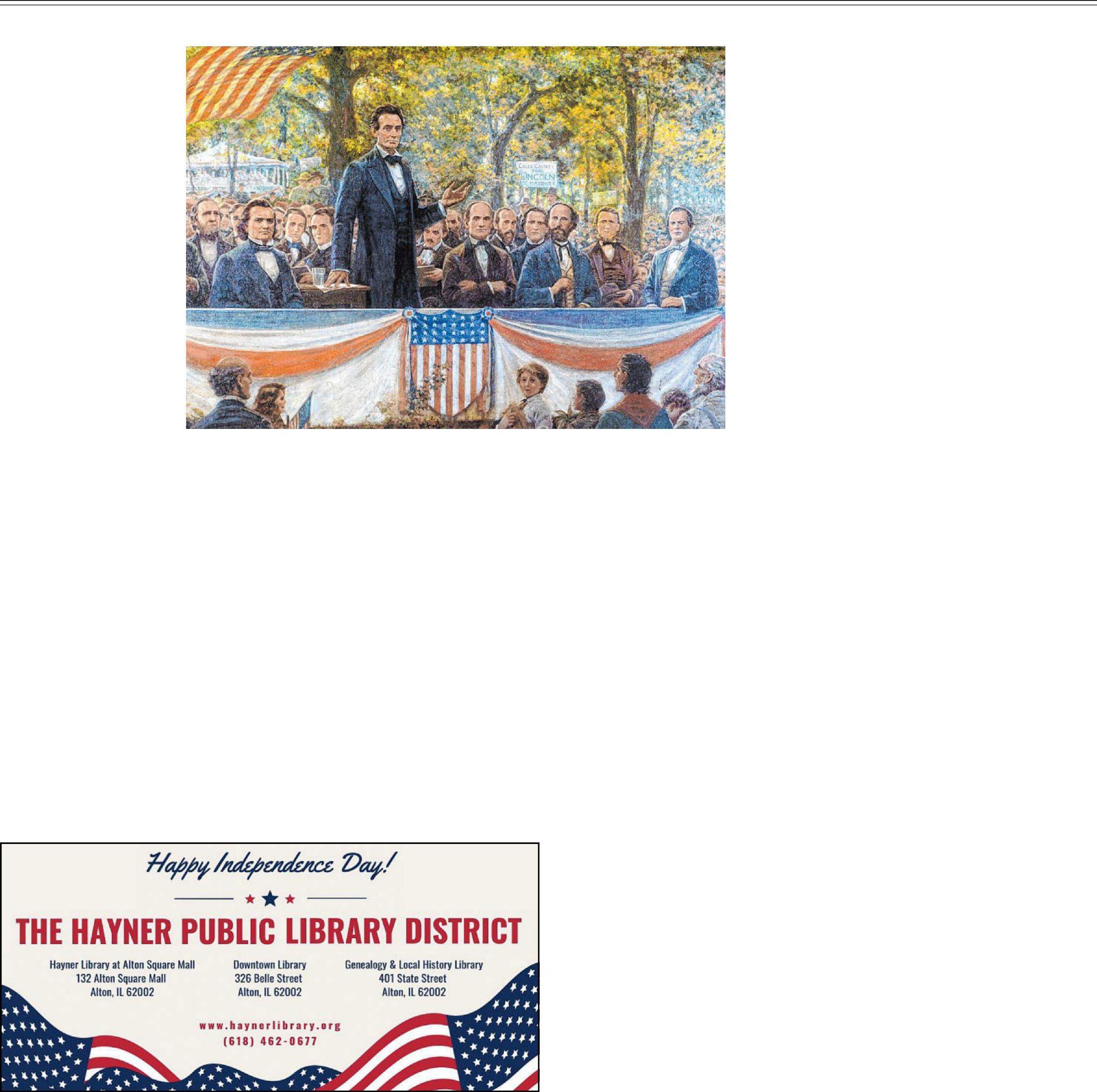
A paintingofPresident AbrahamLincoln's debatewith StephenDouglas in 1856.
south.”
In herhandis a partially sheathed swordheld in readiness should the republic againbethreatened.
Theodore J. Karamanskiis
aprofessor emeritus at Loyola UniversityChicago. He is the author of twelve books, including “Civil War Chicago: Eyewitnessto History” (with EileenM. McMahon) and most recently “Great Lake: An Unnatural History ofLake Michigan.” This articleis from the Journal of the IllinoisState Historical Society. Copyright 2026 by the Board of Trustees of the University of Illinois. Used with permission of the University of IllinoisPress.
The journeys of
freedomseekers in Illinois
By CarolineM.Kisiel Journeys
ofthe Underground Railroad— where escapingenslavedindividualstraveledprecarious routesoutof bondage towardfreedom—are not ones we typically associate with the state of Illinois. Harriet Tubman,the UndergroundRailroad’s celebrated champion,isa story tocommemorateas the nationcelebrates 250 years.
But thisisalsoan appropriatetimetorecognize underrepresented journeys ofthe variety of freedomseekers who traveledto andthrough and lived lives withinthe state of Illinois.
Whileestablishedasa free state in 1818, Illinois was largely hostiletoward the enslaved who sought to change theircircumstances,as wellas toin-
dentured servantsand free African Americans. This is due tothe legacy of slavery intheIllinois Country underthe French inherited by those living in theIllinois Territory (1809–1818) and carriedon by Americans intothe early yearsof statehood Although Illinois passed its constitution as a free state, many early Illinois leaders were pro-slavery and sought toexpand slavery in the state, believing this would support land development andeconomic growth. The harsh Illinois Black Codes ineffectfrom 1819 to 1865 restrictedthe rights and movement of enslaved, indentured, and free African Americans who lived in orsought residence or passage through Illinois.
This context complicatesthe 21st century narrative ofIllinois as a beacon offreedom thefirst
state toratifythe 13th Amendment that fully abolished slavery after the Civil War, andthehomeof AbrahamLincoln and other championsof freedom. Yet this complexhistory means that the stories of individual African Americans and communities who persevered despite thehostileenvironment in Illinois are even more crucial to elevate.
Thanks inlarge partto the historicalresearch of Glennette Tilley Turner and Larry McClellan, we know that there were many ways individualsin bondage sought freedom via Illinois.Somesaw Illinois as a destination for settlement,others were in bondage in Illinois prior to statehood,some were free and struggled to maintaintheir freedomin Illinois, and others traveledthrough ontheir way to Canada. Although
scholarship aboutfreedom seekers in Illinois has blossomed, because of the illegality of escaping slavery and Underground Railroad activity both for those seekingfreedom and anyone assisting them —records of activities of freedom seekers are challenging to find.
Yet the stories we know concerning Illinois are worthy of note.
Fleeingfrom bondage occurred since the dawn of slavery across the nation, but activity increased in nineteenth-century Illinois as abolition sentiment grew, particularly in the wake of the murder of Alton abolitionist and newspapereditor Elijah Lovejoy in 1837. The examples chosen here center on the early statehood period, illuminating a variety of journeys taken by freedom seekers. These stories are not exhaustive but
illustrative, andreaders will be directed to sources for further discovery.
Many towns across the state became known as safe harbors Alton, Africa in Williamson County, Brooklyn,Cairo, Chester, Jacksonville, Miller Grove, and Rocky Fork, to name a few. Some were townsfounded by free Black people, others were predominantly white, withresidents who developed antipathy toward slavery and provided shelter, and yet others were biracial communities. Black churches wereestablished across the state and served as safe spacesfor those fleeing bondage. Chicago became a hub for abolitionists. Free Black John Jones and his wife, Mary Richardson Jones, were known to harborfreedom seekers in theirChicago home, and Jones was in-
StoriescontinuesonH26
STORIES
strumental in gettingthe Illinois Black Codesrepealedin 1865.
Nearthe city, Jan and Aagje Ton’s farminthe Calumetregion in south Chicago, Avisand Israel Blodgett’s home inDownersGrove, Sheldon Peck’s homein Lombard, and WheatonCollege wereallknown havens. The presence ofthese townsandlocales across the state andthe activity we know ofilluminates not only themagnitude of freedomseekers who journeyedtoandthrough all parts of the state butalso those who lived their lives intheseplacesand took considerable risks to assist them. The geography ofIllinoisalsoplayed arole, withriver borders near slave statesand Indi-
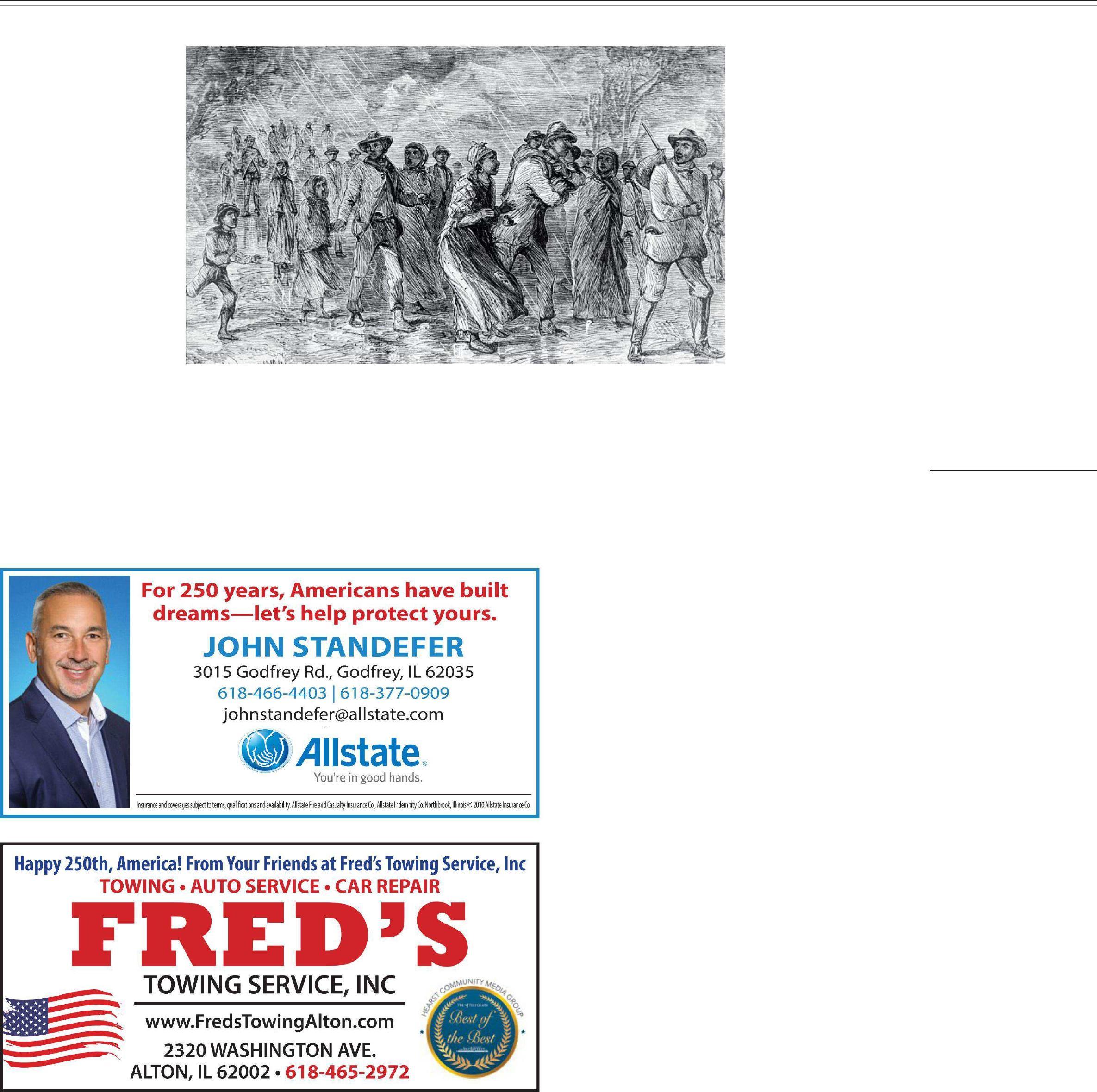
Escaped slaves,including women and children,on a routeusing the Underground Railroad.
an trailsand internal rivers serving as routestraveled by freedom seekers. The community at New PhiladelphiainPike Countyillustrates many facetsofthe quest forfree-
dom.“Free” Frank McWorter, as he was known,anenslaved man from Kentucky, industriously used his earnings in the saltpeter business to purchasefreedomfor his
wife, Lucy, in 1817, ensuring his children wouldbe bornfree. Purchasing his own freedomin 1819 and his son’s in 1829, they moved toIllinoisin 1830 and beganpurchasing land in 1835. “In total, Free Frankfreed 16 ofhis relatives (including himself), at a combinedcost of $14,000 (about $500,000 in 2023 dollars). After his death in 1854, Free Frank’s sonscontinuedthis effort.” Anearly biracial town on theIllinois frontier where white and Black residents worked together, New Philadelphia was a haven forfreedom seekers,and anexample of Black entrepreneurialismand generational wealth-building in Illinois.
three children she then had, now all living in Pekin, also becamefree.
Nance’s long legal journey set a precedent for others,ending indentured servitude in Illinois.
Gilbert BurresofAlbion illustrates how free Black people sought to assert and maintain their freedom, and help others. Free African Americans wererequired to carry Certificates of Freedom at all times and register themselves at their local courthouse. Burrescomplied with theserestrictions,registering himself and his family members regularly overthe course of 36 years. Albion was in southeastern Illinois, where pro-slavery sentiment and kidnappings were a constant threat. In arare, published example from 1824 demonstrating Burres’s character and actions, we have documentation that he defended another African American in the community from kidnappers, reportedly declaring he would not give up Sally, “never while Ihave a drop of blood to defend her.”
Caroline Quarlls, a 16year-oldenslaved girl from St Louis,embarked on a remarkable solo journey via the Mississippi River northward to Milwaukee, through Will and McHenry counties and Chicago, aided by local families, abolitionists, and free African Americans. Eventually reaching Canada via Detroit, she settled in freedom. Documentation of her journeyexemplifies hercourage and persistence, and the support of white and Black abolitionists and sympathizers.
securefreedom, and enslaved individualsfinding help and guidance in their questsforfreedom— these stories are representative of many others in Illinois and show agency and tenacity among African Americans. Despite hostility in Illinois, Black and biracial communities wereestablished and grew, and actively supported the causeofcountlessfreedom seekers. While Illinois does have acomplicated past connected to slavery and hostility toward African Americans, as the United Statescelebrates 250 years, the stories of Illinoisfreedom seekers add to the rich tapestry ofresilience worthy ofcelebration in our state.
Nance Legins-Costley was an indenturedservant originally from Kaskaskia who, at age thirteen,tookthe bold stepof suing her indenturer, indicating she had not agreed to the contract. Following multiple appeals over 13 years, she eventually won her suit whenthe Illinois supremecourt declared her cause just in 1841. Defended by Abraham Lincoln, this rulingmeant the
Free African Americans building and defending communities and aiding those journeying towardfreedom, indentured servants using the law to
Caroline Kisiel is an associate professor inthe School of Continuing and Professional Studies at DePaul University andan Illinois Humanities Road Scholar. She writes and teaches about slavery andabolition in early Illinois, is completing a bookon the antislavery efforts of early Albion and recently published “On the Brink of Slavery and Freedom: Two Hundred Years After the 1823-1824 Illinois Constitutional Convention Controversy” in the Journal of the Illinois State Historical Society. This article is from the Journal of the Illinois State Historical Society. Copyright 2026 by the Board of Trustees of the University of Illinois. Used with permissionof the University of Illinois Press.
1934 fair brings the world to Illinois
By Cate LiaBraaten
The American Associationfor State and Local History has publisheda useful “field guide” for the American semiquincentennial, with suggested
One ofthesethemesis “Doing History,” andthe associationhas suggested that, much like the 1975 bicentennial,thisanniversary might provide anopportunityforprofessional historianstotalk about our work with a public that hasa renewed interest inthe Americanpast. Of course, thereis a history tohow Americanshave “donehistory,” especially in relationtothe Revolutionary era. Thishas playedoutin a varietyof venues, includingthe 1934 seasonoftheCentury of ProgressExpositionin Chicago.
updatesbased onthe successes of the first season.
The Century ofProgress World’s Fair itself was managed by a group of prominent white men, businessmenandpoliticians,mostly fromChicago’s northern suburbs. The exhibitsand concessions were contracted bya variety ofbusinessesand groups.
wherevisitorscouldimagine themselves stepping back in timeto theperiod of the United States’ founding It was a bit ofa hodgepodge: it includeda Betsy Ross house,a replica of the Old North Church Tower, a “pilgrim settlement,” andmore. The most preeminent building wasa replica of George Washington’s home, Mount Vernon.
The year 1934 was the second seasonof the World’s Fair, andfeatured
Although the fair’s theme officially focused on technological progress, there were multiple visionsofthepast ondisplay, includingsomeIllinois-specific stories,likea replicaof Fort Dearborn,a replicaof Jean Baptiste Point du Sable’s cabin,and of course, plentyof Lincolnania. There was alsoa space dedicatedto America’s colonialand Revolutionary past knownas the Colonial Village. The Colonial Village wasa portionofthe fairgrounds
This Mount Vernon was a space of conflict when it came to “doing history.” Two different groups wantedto claim the spaceandmanageit—that is,two different groups wantedtoberesponsiblefortellingthe story ofthe American Revolutionary era. Two patriotic women’s groups came into conflict over the management ofthe replica Mount Vernon:the Illinois Daughters ofthe American Revolution,
and the Mount Vernon Ladies’ Association.Bothof these organizations hada vested interest inthe Revolutionary era,and both were interested inthe publicitythat the world’s fair wouldbring them. Additionally, both groups feltthat they had a right to tellthe story ofGeorge Washington’s home: the DAR by virtueoftheir general interest and bloodline connectionsto the American Revolution, as wellasthe factthat fair organizers invited them, and the Mount Vernon Ladies’ Associationbecause they werethe longtime ownersandmanagers of the actual Mount Vernon site in Virginia.
The heart of theconflict was historical authorityas wellascommercialism. The two groupseach believedtheyhad the authoritytotellthishistorical story to a massive pub-
lic millions ofvisitors from Illinois and beyond. They also disagreedonthe appropriate level of commercialism and historical accuracyfor a space that recreated a historic building but was not the actual building itself. The Mount Vernon Ladies’ Association believed in a strictly accurate historical interpretation based onthe work they did at Mount Vernon, Virginia, as well as minimal souvenirselling. They were also concerned that DAR operation of thereplica would lead to confusion in the public, and people would assume the DAR ran the historic site in Virginia as well. The Illinois DAR hoped the space could bea fundraising opportunity for theirorganization.
Both groups agreed that American Revolutionary history was important to show visitorsfrom Illinois
and around the world and thatit would promote American values. In the end, the Daughtersofthe American Revolution were the caretakersofthe site, responsiblefor some of the most prominent historical storytelling at the world’s fair.
The story of these two Depression-era women’s groupscoming into conflict over ownership of the past is a goodreminder that the Revolutionary era has long beencontested. This is notnecessarilya bad thing: Many people are interested and deeply invested in the storiesof the founding ofthe United States. Perhaps this means that many people are interested in doing the work of history or at least learning how the work is done The interpretations of thepast at the Century of ProgressExposition
FrompageH26 StoriescontinuesonH28
STORIES
weredifferent thanhow professionalhistorians would sharethosesame storiestoday—Washington himself was venerated uncritically, for example—andsometimespeople feellike their world view has been destabilized when theylearnthat history is a dynamicfieldand nota staticone. America’s semiquincentennialwill hopefully provide many opportunitiesforhistorians tocommunicatewith public audiencesthe ways we “do history”—how we interpret evidence, use sources,andseekto share evermoreperspectives and stories aboutthepast.
Cate LiaBraaten is an assistantprofessor of history at Austin Peay State University, where she teach-
es U.S. history, American women’s history and public history courses She earned her Ph.D.atLoyola UniversityChicago.Thisarticle is from the Journal of the IllinoisState Historical Society. Copyright 2026 by the Board of Trustees of the University of Illinois. Used with permission of the University of IllinoisPress.
Women artists shaping culture
By KristanH. McKinsey
The creativity of late 19thandearly 20thcentury Illinois women can be seenthroughout the state and across the nationin museums and private collectionsand inpublic works of art— sculptures, murals,and paintings— in post offices,schools, government buildings, and parks and onbridges. Publicsculpturesand muralsareespecially power-
ful formsofvisualcommunication and cultural expression;free and accessibleto everyone, they encourage communityengagement andtransform urbanspaces.
To ensure visibilityand
impact, public works of art tendto belarge. Until the 20th century, many considered women incapable ofcreating large artworks and certainly too weakto work hardmaterials such as marble. De-
spite limited opportunitiesfor women to train as sculptors, severalfemale Illinois artists didproduce important public sculptures. An early example is Adelaide Johnson (1859–1955). Between 1887 and 1921, she made seven marble portrait busts and two portrait medallions of her friend and fellow suffragetteSusan B. Anthony.
Her second bust, along with ones she carved of ElizabethCady Stanton and Lucretia Mott, were displayed regularly at suffragist meetings and ceremonies and at the 1893 and 1904 world’s fairs. Alice Paul of the National Women’s Party commissioned Johnson to commemorate passage of the 19th Amendment. In “Memorial to the Pioneersofthe Woman’s Suffrage Movement,” busts of Anthony, Stanton and Mott emerge
from an 8-ton block of Carrara marble. Its dedication in the Capitol Rotunda in February 1921 as a national gift was thefirst reception to honor a woman in that space; the massive work was soon moved downstairs to theCrypt In 1997, it was returned to the Rotunda, the sole sculpture there depicting women.
Several women sculptors received recognition and significant booststo their careers in 1892 when Lorado Taft, their instructor at the Schoolof the Art Institute of Chicago, hired them as assistantstoturn small models sent to Chicago by artists around the country intofull-scale sculptures to decorate1893 World’s Columbian Exposition buildings.Several contributed sculptures of their own design to the fair. The allegorical sculp-
StoriescontinuesonH29
Libraryof Congress
Anengravingof Myra Bradwell.
STORIES
ture “Illinois Welcoming the Nations” by Julia Bracken (1871–1942)graced the Illinois State Building, then cast inbronzeto be installedintheIllinois state Capitolalongwith her statue ofPresident James Monroe;in 1914 Brackencreated the 11-foot tall “The ThreeGraces: Art,Scienceand History,” which haspresided over the rotunda ofthe Natural History Museum in Los Angelessince the museum opened.EllenRankin Copp (1853–1901) won the first medalforsculpture awarded by theArt InstituteofChicago in 1890. Of hersix sculpturesfor the fair, the24-foot-tall “Pele, theGoddessof Fire” for the Hawaii Building was hailedasthe“largest statue evermadebya
woman.” She made a careercarvingportrait busts of prominent Chicago men.
Helen Farnsworth Mears (1872–1916) went on to study with Augustus Saint-Gaudensandcompleted various publiccommissions, including a statue ofthe suffragist and temperance reformer Frances E. Willardforthe U.S. Capitol. Enid Yandell (1869–1934) created a massive 40-foot“Pallas Athena” for the Tennessee centennialcelebrationsanda memorial fountain in Providence, Rhode Island, titled“Struggle ofLife.”
Bessie Potter Vonnoh (1872–1955), known for her intimate statuettes of womenand children,and Carol Louise Brooks MacNeil (1871–1944)bothhad sculptures shown at the 1900 World’s Fairin Paris and in St. Louis in 1904. EvelynBeatrice Long-
man (1874–1954) won the silvermedalfor sculpture at the 1904 fair AT&T commissioned “Geniusof Electricity”from her, a gilt bronze, winged figure holdingtwo boltsofelectricityaloft, which has servedastheircorporate symbol since 1916 Three years later, she was the first woman sculptor elected as a fullmember of the prestigious National Academy of Design. Finally, theprolific Janet Scudder (1869–1940) won awards at severalAmerican and Europeanexpositions. In addition to decorative fountains and garden statuary she was known formemorial sculptures, bas-reliefportraiture, and portrait medallions,many of which are now inthe collections of major museumsinthis country and in France, where she kept a studio. The production ofpub-
lic art surged again40 years later with New Deal art projects sponsored by the Works Progress Administrationbetween 1934 and 1943. The bulkofthe artworks were sculptures, murals,and easelpaintings forplacement in parks,federalbuildings, and tax-supported institutions such aspublic schools. Typicalthemes celebratedpatriotism and traditional family values, reflecting aninterest inregionalism and a nostalgia for bettereconomictimes. Participation in Illinois was particularlystrong, as nearly 800Illinois artists —19%of whom were women participated, creatingmorethan 200 murals, over 500 sculptures,and almost 5,000 easelpaintings.
Most artists received one ortwo commissions, but Andrene Kauffman (1905–1933) completedsev-
en sculptures,more than 50 easel paintings, and 25 muralsfor the Brookfield Zoo, two public schools, Cook County Children’s Hospital, a publiclibrary (all Chicago locations), and other locations; she painted a local historical scene, Preparationfor the First County Fair-1872, for the Ida Grove, Iowa, post office.
Natalie Smith Henry (1907–1992)focused on local industriesfor her Springdale, Arkansas, commission. Martyl Schweig (1917–2013) portrayed wheat workers in Russell, Kansas. Themes oftenreferenced the building in which the artwork would be displayed. For example, two women chat over a fence, one holdinga letter, in a mural by Francis Foy (1890–1963) for the East Alton post office, and Dorothea Mierisch (1885–1977) depicted the
first airmail flight for the McLeansboro post office.
Amural by Henriette Amiard Oberteuffer (1878–1962)celebrates the cotton industry and its role in thecommunity in the federalcourtroom of Vicksburg, Mississippi. Mildred Waltrip’s (1911–2004) muralfor Ravinia School in Highland Park depicts the exploits of a popular legendary childhood hero, Robin Hood, while her muralfor Scott Air Force Base isa visual history of aviation. The Works Progress Administration programs provided women artists many opportunities they might nothave had otherwise, and launched many of them onlong and highly successfulcareers. Their talentscontinue to enrich our communities through their works ofpublic art.
StoriescontinuesonH30
STORIES
FrompageH29
KristanH. McKinseyis directorof theIllinois Women ArtistsProject,a researchand documentationproject based on the campusofBradley University in Peoria. She isa member of the IllinoisState Historical Societyboard and chair of the publicationscommittee. This article isfrom the Journal of the IllinoisState Historical Society. Copyright 2026by the Board of Trustees of the Universityof Illinois. Used with permission of the Universityof IllinoisPress.
Fighting for women’s rightsinIllinois
By EileenM. McMahon
Anumber of womenof the Revolutionary generationunderstoodthe bold Enlightenment assertion of theDeclaration of Independencethat “allmen are createdequal” to be gender-neutral. However, it wouldtake concerted actionon thepart of many Illinois womentomake this areality in the state. The fight stillcontinues.
public sphere.
Jane Addams, the founder of Chicago’s HullHouse, was one ofthe most notable women in Progressive Erareform. Addams argued that the fate of democracy hinged on a more humane and inclusive urban society.
MPI/Getty Images
Abolitionist HarrietTubman(left)with family and friends:heradopted daughterGertie Davis (fromleft)and husband Nelson Davis, LeeCheney, John “Pop”Alexander, WalterGreen,“Blind Aunty” Sarah Walker,Dora Stewart.
through the US Sanitary Commission, women such as Mary Livermoreconfronted legal restrictions on their agencytocarry out their work, particularly negotiating and signing contracts.
fight for women’s rights. In 1892, she received her law license.
In 1818, whenIllinois achieved statehood, women’s legal status was still classified by thepre-Revolutionary concept offeme covertorcoverture an English commonlaw term that stated a married womanhad no legal stature independent ofher husband. Thisincluded no title toproperty or wages; noright tosign contracts;andnoright to vote at any level.
In the 1850s,SusanB. Anthony’s cousin Susan HoxieRichardson— organizedthefirst women’s suffrage group inIllinois. The Civil War, however, actedasthecatalyst fora generationof women to fight for suffrage. Through theireffortsmobilizingthehomefront
Myra Bradwell (1831–1894) was key to challengingand overturning Illinoiscoverture law. She did sothrough the development of a new legalphilosophy called sociological jurisprudence. Bradwell studiedlaw in her husband JamesB.Bradwell’s law office inChicago Coverture, however, preventedherfrom entering intocontracts in her own nameand even acting as a notary since she could not own property. Bradwell then initiatedand helpwritethe Married Women’s Property Act of 1861. It allowed womento own landand otherproperty in their own name.
wages because they were not her separateproperty. Bradwellthenutilizedthe Chicago Legal News to urge lawmakerstopass the 1869 Married Women’s Property Act tosecure women’s control over their own wages.
In 1868, Bradwell foundedChicago Legal News, which served asa law review forIllinois and proved indispensable for attorneys and state legislators. Its successallowed Bradwellto regularly feature women’s rights issues. In 1865, theIllinois SupremeCourthad ruled that the 1861 Married Women’s Property Act did not pertainto women’s
In 1869, Bradwell applied for a law license to challenge gender discrimination. When her application was denied, she suedthe state in Bradwell v. State of Illinois. It went to the Illinois supreme court.Although thecourt ruledthat laws of coverture denied her theright to an independent legal identity, Bradwell’s brief drew fromthe innovative legal thought of sociological jurisprudence that consideredcontemporary changes in women’s statusin society, such asbetter educationand employment opportunities,that securedthem greaterindependence. She also claimedthat the 14th Amendment’s equalprotection clause granted womencitizenship and equality, andthat theCivil Rights Act of 1866also applied to womenguaranteeingthemfulland equal benefits.
Bradwell’s interpretation of the 14thAmendment and Civil Rights Act influencedthe subsequent
After 1870, the United States and Illinois developedan urbanindustrial economy and society. Demandfor laborbroughta diversity ofimmigrantsas wellaspromoted the Great Migration ofAfrican Americansfromthe South In responseto these changes, a growing middle classof educated womenformed women’s clubs throughoutthe state. Thisalso comprised aproliferation ofAfrican American women’s clubs that included raceand women activists such as Ida B. Wells-Barnett. These clubs galvanized womenthroughout the state tofight notonly for suffrage butalso what cameto becalled “civic housekeeping.” The pre–Civil War era’s emphasis on the Cultof Domesticity intendedto keep women in the home. In the post–Civil War era, thepublic sphere previously associatedwithmen was marked by politicalcorruptionand economic exploitationthat affectedthe domesticand privatelives of urbanresidents. Women argued that their unique nurturing abilities and moralcompass were necessary to clean up the
Other notablereformers were Florence Kelley, who championed the rightsof women, children, and allraces workingfor eight-hour days, minimum wage, and against sweatshopconditions. In 1893, Illinois passed its first factory act. Kelley became Illinois’s first woman to hold a statewide office as factory inspector. Her work influenced the New Deal’s Frances Perkins and the Fair Labor Standards Act.
Margaret Haley, a Chicago school teacher, became an activist for the Chicago Teachers’ Federation in 1898. She fought for higher teacher wages and amore just property tax system to fund schools. Her work demonstrated the impact womencould have onreshaping the city.
Frances Willard was also a notablereformer who promotedfemaleeducation, suffrage, labor rights, and prisonreform. Willard was a foundingmember of the Women’s Christian Temperance League (1874) and its president from 1879 to her death in 1898. The league argued the root ofurban social problems was alcohol abuse promoted by large distillers. Her temperance reformeffortsculminated in the Eighteenth Amendment (1917), which prohibited the manufacture and sale of alcohol. It was repealed in 1933 by the 21st Amendment.
In 1891, the Illinois Supreme Court determined womencould vote for school boards chartered by the state. In1913, the Illi-
noisGeneral Assembly passed the Presidential and Municipal Women’s Suffrage Act, which granted Illinois women the right to votefor presidentialelectors and vote in local elections not included in the state’s constitution. In 1919, Illinois became the seventh state toratify the 19th Amendment granting all women the right to vote.
Two other Illinois women had an impacton women’s rights. Betty Goldstein Friedan was born in Peoria. She helped launch the second wave women’s movement with the publication of The Feminine Mystique (1963). Friedan was also a supporter of the Equal Rights Amendment. Phyllis Stewert Schlafly founded the Eagle Forum (1975) in Alton and spearheaded the defeat of the Equal Rights Amendment. Illinois was oneof 15 states that did not ratify the amendment by the deadline of 1982 Nonetheless, Illinois has stoodfirm in guaranteeing a woman’s right to reproductive freedom. Many Illinois women have served in public office at the local, state, and national level as well as have enjoyed educational and economic opportunity.
Myra Bradwell, Jane Addams, Ida B. Wells, and Betty Friedan arein the National Women’s Hall of Fame.
Eileen McMahon is professor emerita of history at Lewis University. She specializes in Irish American, immigration, and women’s history. This article is from the Journal of the Illinois State Historical Society. Copyright 2026 by the Board of Trustees of the University of Illinois. Used with permission of the University of Illinois Press.