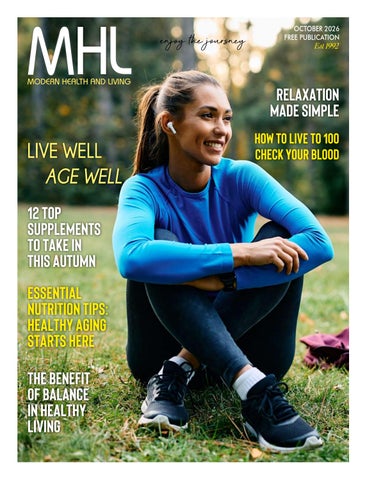
MHL MODERN HEALTH AND LIVING
LIVE WELL AGE WELL 12 Top Supplements to Take in this Autumn ESSENTIAL NUTRITION TIPS: HEALTHY AGING STARTS HERE The Benefit of Balance IN HEALTHY LIVING
enjoy the joursney
OCTOBER 2026 FREE PUBLICATION
Est 1992
RELAXATION MADE SIMPLE How to Live to 100 Check Your Blood
60,/( &21),'(17/< $7 %(<21' ',6&29(5 (;3(57 62/87,216 -867 )25 <28
0,66,1* 7((7+" $VN DERXW RXU OLIH FKDQJLQJ GHQWDO LPSODQWV 6758**/,1* :,7+ '(1785(6" :H KDYH VHFXUH QDWXUDO ORRNLQJ DOWHUQDWLYHV &21&(51(' $%287 &267" 2XU 'HQWDO 6DYLQJV 3ODQ PDNHV FDUH DIIRUGDEOH
<285 %(67 60,/( ,6 67,// $+($' 6SHDN WR RXU WHDP WRGD\ DERXW VROXWLRQV GHVLJQHG IRU \RXU QHHGV FRPIRUW DQG EXGJHW
*80 +($/7+ 0$77(56 (DUO\ WUHDWPHQW SUHYHQWV VHULRXV LVVXHV )5(( ,1,7,$/ &2168/7 ,QFOXGHV D FRPSUHKHQVLYH H[DP DQG ; UD\V JHW VWDUWHG ZLWK FRQÀGHQFH
:( /,67(1 :( &$5( :( &86720,=(
6 WK 6W :HVW $OOLV _ _ ZLVFRQVLQVPLOHV FRP
Employment
Editors Note October has a way of reminding us to slow down and pay attention—to the changing colors, the cooler days, and sometimes, to the things in our lives that matter most. Fall is also a good time for a personal health reset. As our schedules change and the days grow shorter, simple things can make a difference—getting outside and staying active, making time for preventive appointments, eating well, getting enough sleep and paying attention to stress. Good health doesn’t always come from dramatic changes. Often, it’s the small things we consistently do for ourselves that add up over time. It’s also a reminder that health is about more than avoiding illness. Feeling connected, having things to look forward to, spending time with people we enjoy and simply making room for ourselves are all part of living well. As we head toward the busy holiday season, October is a wonderful opportunity to check in with ourselves and make our own well-being a priority. It’s also Breast Cancer Awareness Month, making this a meaningful time to think about our health and the health of the people we love. Prevention, early detection and continued advances in research have changed countless lives, but there is still important work ahead. That’s one reason WBCS, Inc. has remained so close to my heart. Through WBCS, our community helps fund promising early-stage breast and prostate cancer research at the Medical College of Wisconsin Cancer Center—giving researchers the opportunity to pursue ideas that can ultimately lead to larger discoveries and new treatments. This month also brings one of WBCS’s most uplifting events, the Pinktacular Survivor Luncheon & Fashion Show on October 8. This year’s theme, Courage in Full Bloom, celebrates survivors while reminding us of the strength that can grow from people coming together for a common purpose. In this October issue of Modern Health and Living, we continue that same spirit by focusing on ways to live healthier, feel better and enjoy the season ahead. Here’s to taking care of ourselves, taking care of one another, and continuing to support the work that can make tomorrow healthier than today.
AmandaLewis enjoy the journey MHL STAFF staff
publishers editor graphic design advertising
Lewis Media Group Amanda Lewis Malberry Media Tom Delgado Barry Lewis
distribution manager travel editor founder
Jerry Kornowski Marlys Metzger Barry Lewis
contributors The Ommani Center, Livestrong.com, Environmental Nutrition, Nutrition Action Health Letter, Columbia/St. Mary’s, Ascension, Eye Care Specialists, Aurora, Alexian, Eye Physician Associates, Brothers Village, Ye Olde Pharmacy, NIH, Jensen Health and Energy, Foot Solutions, Allergy and Asthma Centers, Tudor Oaks, Active Care Rehab, Greensquare Center for the Healing Arts, Midwest Audiology, Integrative Family Wellness Center, Universal Services, American Camp Association and Home Instead contact For information on advertising or to submit articles call, 414-659-6705 or 608-237-6000, or email mhl@wi.rr.com. Subscriptions are $20 per year. Thanks for reading MHL.
We are
Hiring!
OPEN POSITIONS: Starting Wage/hr. for Full-Time Employees
5 $2
C.N.A
6 $2
Medication Tech
0 $3
Nurse Tech
3 $4
Respiratory Therapy
5 $3
LPN
0 $4
RN
Apply at vmpcares.com OR SCAN HERE:
OLDER ADULTS MONTH NOVEMBER
NOW ENROLLING
Childcare Passionate, caring teachers, and... - 4-Star Youngstar Rating - 6 Weeks-5 Years
- Before- & After-School Care, 5-12 Years - Healthy, Tasty Meals & Snacks - Nature-Based Curriculum
disclaimer MHL is published on the first of each month . The articles in this publication are in no way intended to replace the knowledge or diagnosis of your doctor. We advise seeing a physician whenever a health problem arises requiring an expert’s care.
& More!
thanks Special Thanks! To all the local professionals that provide us with articles containing new information and keeping all our readers informed of the latest in healthy living. images Istock.com
STEIN CAMPUS 414-977-5000
BUCYRUS CAMPUS 414-210-2450
2801 E. Morgan Ave. Milwaukee, WI 53207
2450 W. North Ave. Milwaukee, WI 53205
Lewis Media Group | www.modernhealthandliving.com
Join our Team!
FINANCIAL ASSISTANCE AVAILABLE October 2026 MHL
MHL September 2025
AGE WELL Fitness
The Brainy Benefits of Exercise By: KURU Footwear Photo Credit: stock.adobe.com/K.A./peopleimages.com e often hear about the physical benefits of exercise: stronger muscles, a healthier heart, and better endurance. But did you know that exercise is just as vital for your brain as it is for your body? From reducing symptoms of depression to sharpening memory and slowing cognitive decline, physical activity can unlock a host of neurological benefits that help you think clearer, feel better, and age more gracefully. Below, we’ll explore the science behind how movement transforms your mind and offer tips on how to harness these brain-boosting benefits for life. Key Takeaways Exercise can support mental health by reducing depression, improving mood, and lowering anxiety. Physical activity boosts cognitive performance, memory, and learning through chemical and structural changes in the brain. Activities that combine physical movement with coordination and decisionmaking—like dance, tennis, or hiking—offer the strongest brain benefits.
W
How Does Exercise Affect Brain Health? Exercise promotes brain health through both immediate and long-term mechanisms. When you move, your body increases blood flow, oxygen delivery, and the release of neurochemicals that influence everything from mood to memory. Regular exercise also encourages neurogenesis—the growth of new brain cells—and strengthens the connections between existing ones. These changes can enhance attention, creativity, focus, and even problem-solving abilities. Can Exercise Reduce Depression? Yes. One of the most well-documented mental health benefits of exercise is its ability to reduce symptoms of depression. Aerobic and resistance exercises both stimulate the release of endorphins and neurotransmitters like serotonin and dopamine, which can help regulate mood. Exercise may also promote the growth of neurons in brain regions affected by depression, such as the hippocampus and prefrontal cortex. Tip: Aim for at least 150 minutes of moderate-intensity aerobic exercise per week, such as brisk walking or cycling, to see benefits in mood and emotional well-being. How Does Exercise Support Learning and Cognitive Function? Exercise boosts learning in several key ways. First, it increases the production of brain-derived neurotrophic factor (BDNF)—a protein that supports neuron growth and communication. Higher BDNF levels are associated with improved memory, faster learning, and stronger cognitive resilience. Additionally, physical activity enhances blood flow to the brain, which delivers more nutrients and oxygen to areas responsible for memory and concentration. Best Brain-Boosting Exercises: Dancing or martial arts (coordination + memory) Tennis or pickleball (reflexes + decision-making) Hiking in new environments (navigation + attention) What Role Does Exercise Play in Alzheimer’s Prevention? Exercise helps protect the hippocampus—a brain region essential for memory and one of the first affected in Alzheimer’s disease. Daily movement like stretching, walking, or gardening to maintain consistent neural engagement It’s also important to mix in variety and cognitive challenge—try learning a new sport, switching up your walking route, or practicing balance drills.
2QdZc 5Mh 4R]cRa
;S h^da Z^eRQ ^]R ]RRQb QMhcW\R PMaR͜ fRͭaR VRaR c^ _a^eWQR Wc fWcV Z^eR M]Q P^\_MbbW^]͙
5MhcW\R 4MaR
E^PWMZWjMcW^]
BRab^]MZWjRQ 4MaR
2 V^\R MfMh Sa^\ V^\R
Ada U^MZ Wb c^ R]VM]PR cVR W]QR_R]QR]PR ^S ^ZQRa MQdZcb cVa^dUV MPcWeR ZWeW]U cVMcͭb _Rab^]MZWjRQ S^a ReRah^]Rͭb ]RRQb͙ 4MZZ c^QMh S^a M c^da͟ @͙ cV Ec͜ ?WZfMdYRR ͛ M͙\͙ ͛ _͙\͙
:RMZcV ̿ IRZZ]Rbb
6]aWPVW]U 2PcWeWcWRb
͙ ͙
MXM]Y^fbYW̓PP\YR͙^aU
44?=6͙AD8 October 2026 MHL
LIVE WELL Nutrition
ADD VITAMIN D TO YOUR FALL SUPPLEMENT STACK
12 Top Supplements to Take in this Autumn By: Michael A. Smith, MD t a Glance Less sunlight exposure from shorter days can change the body’s natural circadian rhythm. Vitamin D, vitamin K2, magnesium and collagen supplements can be stacked as a foundation to help offset seasonal shifts. Melatonin, rhodiola, vitamin C and echinacea can help with changes in sleep and support the immune system in cooler weather. Football games. Cozy sweaters. And pumpkin spice everything. Fall has its perks, but there can be drawbacks, too. Fall (from the 16th-century English phrase “the fall of the leaf”) is when leaves drop, temperatures plummet and daylight hours dwindle. With less time in the sun and more time spent indoors, your body, mind and mood can be impacted in many ways: Sleep-wake cycles Overall alertness Healthy hormone levels—including cortisol, serotonin and melatonin
A
MHL October 2026
Immune system challenges Creating a smart autumn supplement strategy can help you head into the season with a little more pep in your booted-up step. Not sure where to start? Read on to find out! Vitamins D and K with Sea-Iodine Vitamins D and K with Sea-Iodine™ Your Autumn Core Supplement Stack Add vitamin D to your fall supplement stack While these first four supplements are some of the best vitamins for the fall season, they aren’t just for autumn. This stack can support your wellness yearround, but it’s especially great to have in your daily routine during this transitional season! 1. Vitamin D Unlike summer days, when the sun is higher in the sky and days are longer, fall days can be more challenging for soaking up the sun’s benefits—especially if you live somewhere with already-limited daylight. Shorter days, along with more time spent bundled up indoors, can affect vitamin D production in the body. But not to worry! A high-quality vitamin D supplement can be a bright spot in your daily vitamin routine. Vitamin D helps the body absorb calcium for strong bones, as well as support brain function and immune health. Remember, even if you live in a sunny place or spend a lot of time outdoors, you may not be getting sufficient vitamin D. A supplement can help fill in the gaps, but it’s important to check your levels periodically. 2. Vitamin K2 If vitamin D is the foundation of fall’s supplement stack, vitamin K2 is its supercharger. Think of it as a supplement sidekick that promotes the impact of vitamin D. Vitamin K2 partners beautifully with vitamin D3 to manage calcium, directing it away from your arteries and into your bones. This supports both bone strength and heart health, especially when seasonal routines and diets shift. You may be able to boost your levels with foods that contain vitamin K2, including: Pasteurized egg yolks Sauerkraut Aged cheeses like brie and gouda Grass-fed butter
While these foods can help increase your vitamin K intake, it can be difficult to get enough from diet alone. Luckily, supplements can help! Vitamin K2 is available both as a standalone supplement or combined with vitamin D3. 3. Magnesium Consider magnesium vitamin D’s alarm clock! It’s the wake-up call needed for vitamin D to convert into the active hormone the body needs. As an essential mineral and cofactor, magnesium allows vitamin D to reach its full potential. Aside from being a major boost to vitamin D, magnesium is a superstar nutrient on its own. It supports: Muscle, nerve and bone health year-round Immune health to help the body adapt to seasonal shifts Energy production Magnesium is not only a friend in fall—you can count on it all year to help you stay strong and healthy. 4. Collagen Collagen can help keep your skin supple Goodbye summer glow, and hello dull and dry skin! While the crisp autumn breeze can literally be a breath of fresh air, it can also take a toll on your complexion. That’s where collagen comes in. As the most common protein in your body, it helps support healthy skin through the autumn months and beyond. Collagen also supports joint and cartilage health and comfort. From powders to capsules and more, collagen supplements come in many forms. You can also whip up some chicken noodle soup, heat up a pot of bone broth or pop open a can of sardines to add collagen support to your fall menu. Supplements to Help You Adjust to Shorter Days Shrinking daylight hours can affect your internal clock One day, you’re enjoying an evening run after work in broad daylight; the next, you’re watching the sun set from your desk. Shrinking daylight hours have a ripple effect on your internal clock, impacting everything from sleep schedules to stress levels. “Light is the main time cue for the body’s circadian rhythm,” explains Dr. Michael A. Smith, MD. “When daylight gets shorter, the timing and amount of light reaching the eyes change. Your brain gets less evening light, but if morning light exposure doesn’t shift earlier, the rhythm can become misaligned.” This trio of supplements for shorter days can help you stay optimistic and well-rested long after summer ends: 5. Melatonin Less daylight can disrupt your body’s internal clock (a.k.a. your circadian rhythm). And when that internal clock isn’t working, other things might also be out of sync. Your sleep schedule, mood and energy levels may be affected. To set yourself up for sleep success: Get regular daylight exposure in the morning (within the first 90 minutes of waking, if possible) Keep a consistent sleep schedule despite the change in sunlight Invest in blackout curtains or a sleep mask Power down computers, phones and other screens one hour before bedtime Create a wind-down ritual you follow every night—like deep breathing, reading or doing a crossword puzzle Alongside these healthy habits, a melatonin supplement can be a great addition to your routine! Melatonin is a well-studied sleep-regulating hormone your body produces naturally that can support restful nights in the transition to fall. Not keen on melatonin? There are alternative supplements for shorter days that help with sleep. GABA, black cumin seed and other calming supplements like ashwagandha can help promote feelings of calm and encourage healthy sleep as well during the seasonal change. 6. Ashwagandha Ashwagandha is an extract from a small herbal plant, yet its ability to support circadian rhythm is mighty. Here’s how it works: You’re getting less sunlight due to the change in seasons. That throws off your internal clock, which also throws off cortisol secretions—it’s all part of your daily rhythm. Ashwagandha is an adaptogen that—you guessed it—helps the body “adapt” to stress by interacting with the hypothalamic-pituitary-adrenal (HPA) axis. That in turn supports healthy levels of the stress hormone cortisol. When adding ashwagandha to your daily vitamin mix, look for a clinically studied ashwagandha formula that encourages healthy cortisol levels and promotes a good mood. 7. Rhodiola With a dip in temperatures and darkness that seems to come earlier each day, it may be hard to find the energy and drive you had in the summer months. Feel-
MODERN HEALTH
AND LIVING Longevity Edition November 2026
SUPPLEMENTS>>page 54 October 2026 MHL
LIVE WELL Downsize
Living Large In Less Space By: Sierra Dahlke, Photo Credit: stock.adobecom/ Tatyana Gladskih any people worry that downsizing means sacrificing their comfort or cherished belongings. In reality, downsizing can make room for what you cherish most. It makes living spaces functional, low-maintenance, and peaceful. It all comes down to… A smart design! Here are some tips and tricks to elevate the space you have. 1. Choose Furniture That Works Twice As Hard When looking for functional furniture, make sure that every piece has a purpose. Ideally, more than one! The goal is to downsize, not store items you’ll never touch. Some examples include: Storage ottomans Dining tables with expandable leaves Nesting stools Beds with built-in drawers Fold-away desks Hall tree 2. Design Rooms to Be Multipurpose Oftentimes, when a client is downsizing, a significant decrease in square footage can be discouraging. However, designing the space to serve more than one function makes a world of difference. Incorporating functional furniture into the mix creates even more possibilities! For instance, you may have a: Guest Room + Craft Room Office + Reading Nook Dining Room + Puzzle or Game Area Living Room + Exercise Space Hidden Home Office + Closet 3. Organizing The Small Space Available Small spaces hold more when sorted. An organized space not only elevates the look, but also the feel of a home. The process of organizing also assists you in knowing what you have, where it is, and where it fits. Here are three rooms with organizers and tips often utilized in the space: Kitchen Utilize vertical storage Add pull-out cabinet organizers. Insert drawer dividers Limit duplicate kitchen tools Use clear containers for pantry storage Closet Use slim hangers Rotate seasonal clothing Add shelf dividers Sort with bins and baskets Install door storage Bathroom Add drawer organizers Purchase over-the-door storage Organize medicine cabinets Utilize baskets for everyday essentials Keep countertops cleared off
M
Call (262) 523-1440 today.
MHL Octobeer 2026
4. Digitally Organizing When we think of downsizing, the first thing that comes to mind is often physical possessions. It’s also important to remember the digital aspect! Although it can be intimidating, digitizing paperwork can be a massive tool in an efficient downsize. Here’s how: Scan important documents Organize digital files into folders Back up family photos Create digital albums to preserve memories Secure shred paperwork that’s no longer needed 5. Upkeep Over Starting From Scratch Whether you’re downsizing or just organizing, the multitude of things to go through can be overwhelming. Do not fear! Regular maintenance can drastically decrease your workload over a more manageable period of time. It also keeps things in order once you’ve done all the hard work! Here are some suggestions: Work in 15-minute daily resets Set goals: for example, tackle one room or category a week Fill a seasonal donation box Complete an annual paperwork review Utilize the one-in, two-out rule Conclusion: Bigger Isn’t Always Better A smaller home doesn’t have to feel limiting. Intentional organization can create so many possibilities for your space! Just remember, the goal isn’t to fit everything into a smaller space; it’s to make room for what matters most. At Smart Moves, we’ve helped countless Wisconsin families transition into ÅàÝÙÔÙÒ dc homes that better support the next stage of life. Whether you’re just beginning to think about downsizing or preparing for an upcoming move, our team is here to guide you with compassion, practical solutions, and years of experience. Contact us to learn how we can help make your move and your new space feel like home. Visit www.smartmoveswi.com/ or call 414-526-5242. Downsizing can feel overwhelming, especially when a home holds decades of memories. Closets, basements and spare rooms often contain much more than belongings—they hold reminders of family, milestones and different chapters of life. That emotional connection is why downsizing is rarely as simple as deciding what to keep and what to throw away. Giving yourself plenty of time and approaching the process one area at a time can make it far more manageable ¸Ðß ßÓÐ ÝÔÒÓß ÎÚáÐÝÌÒÐ ×ÚÎÌ× ÝÐÞÚàÝÎÐÞ ÌÙÏ ßÓÐ ÎÌÝÐ äÚà ÙÐÐÏ ßÚ ×ÔáÐ ßÓÐ A good place to begin is with the things that carry the least emotional weight. ×ÔÑÐ äÚà âÌÙß Start with duplicate kitchen items, clothing you no longer wear, old paperwork or things that have not been used in years. ´Ì×× ÑÚÝ ÌÙ ÌÛÛÚÔÙßØÐÙß As you make progress, decisions often become easier. Instead of asking, “Could ¿ÌÕÔ ²Íà#½àÒÓÚÏ I ever use this again?” ask whether the (`d`) `b_#add` (ÅÅÊ e__) Monthly Plan item is useful, meaningful or something f ^^ ²¾ # c ^^ Á¾ ¾ÚÙ # ·ÝÔ Premiums with you would choose to bring into your next ² ×ÔÎÐÙÞÐÏ ÌÒÐÙß âÔ×× ÌÙÞâÐÝ äÚàÝ ÎÌ×× home. That small change in perspective ØâÞÞ5ØâÞÐ×ÐÎß ÎÚØ Dental, Vision can help separate what truly matters from and Hearing what has simply accumulated. Family keepsakes can be more difficult. Before assuming children or grandchildren want certain furniture, dishes or ²ÐßÙÌ ¾ÐÏÔÎÌÝÐ ÔÞ Ì ¹¾À ÁÁÀ Û×ÌÙ âÔßÓ Ì ¾ÐÏÔÎÌÝÐ ÎÚÙßÝÌÎß ÀàÝ µÄ¿ÁÞ Ì×ÞÚ ÓÌáÐ collections, ask them. You may be surÎÚÙßÝÌÎßÞ âÔßÓ ÄßÌßÐ ¾ÐÏÔÎÌÔÏ ÛÝÚÒÝÌØÞ ¶ÙÝÚ××ØÐÙß ÔÙ ÚàÝ Û×ÌÙÞ ÏÐÛÐÙÏÞ ÚÙ ÎÚÙßÝÌÎß ÝÐÙÐâÌ× Á×ÌÙ ÑÐÌßàÝÐÞ ÌÙÏ ÌáÌÔ×ÌÍÔ×Ôßä ØÌä áÌÝä Íä ÞÐÝáÔÎÐ ÌÝÐÌ Á×ÌÙ ÑÐÌßàÝÐÞ ÌÙÏ prised by what they treasure—and what ÌáÌÔ×ÌÍÔ×Ôßä ØÌä áÌÝä Íä ÞÐÝáÔÎÐ ÌÝÐÌ ÈÐ ÏÚ ÙÚß ÚÑÑÐÝ ÐáÐÝä Û×ÌÙ ÌáÌÔ×ÌÍ×Ð ÔÙ äÚàÝ ÌÝÐÌ they are happy to leave behind. Photo´àÝÝÐÙß×ä âÐ ÝÐÛÝÐÞÐÙß _^ ÚÝÒÌÙÔåÌßÔÚÙÞ âÓÔÎÓ ÚÑÑÐÝ d_ ÛÝÚÏàÎßÞ ÔÙ äÚàÝ ÌÝÐÌ Á×ÐÌÞÐ graphs can be scanned, special items can ÎÚÙßÌÎß ¾ÐÏÔÎÌÝÐ ÒÚá _#f^^#¾¶µº´²Ã¶ ÚÝ äÚàÝ ×ÚÎÌ× ÄßÌßÐ ¹ÐÌ×ßÓ ºÙÞàÝÌÙÎÐ ÁÝÚÒÝÌØ be given to family members now, and a ßÚ ÒÐß ÔÙÑÚÝØÌßÔÚÙ ÚÙ Ì×× ÚÑ äÚàÝ ÚÛßÔÚÙÞ [`^`b ²ÐßÙÌ ºÙÎ few meaningful pieces can represent an Ê^^^_ ac^e_ `^`b ¾ `cgc_eg#^d#^_ entire collection.
²×× ßÓÐ ÍÐÙÐÑÔßÞ ÚÑ ÀÝÔÒÔÙÌ× ¾ÐÏÔÎÌÝÐ ÌÙÏ ØÚÝÐ
0
$
October 2026 MHL
LIVE WELL Skin Care
The World’s One-and-Only dedicated bakery that is: z Grain and Gluten-Free
Grain Free
z Dairy-Free and Egg-Free z Peanut and Soy-Free z Cane Sugar and Yeast-Free
All of our delicious products are: z VEGAN z KOSHER z WHOLE PLANT (no oils)
2215 E. North Ave.
414.212.8010
www.blbmke.com
GRAIN, GLUTEN, EGG & DAIRY FREE
UNLIMITED CLASSES! 4 weeks for $60 Class schedule at www.mycmke.com or call 414-332-3551
Offer good for students NEW to Milwaukee Yoga Center. Unlimited classes available for
ZHHNV IURP ZKHQ ¿UVW FODVV LV WDNHQ
All classes must be completed by 8/13/2019
New 4-Class Intro Tuesdays 5:30-7 pm $40 June 25–July 16 July 23–August 13
6 3514 N. Oakland Ave., Milwaukee, WI 53211 linda@mycmke.com www.mycmke.com 10 MHL October 2026
7
Mohs Surgery Treats Non-melanoma Skin Cancer Effectively By Christopher Burnett, MD, ProHealth dermatologist and Mohs micrographic surgeon, Photo Credit: stock.adobe.com/Fiverr/fazilazia703 kin cancer is the most common form of cancer in the United States. Nearly 6.1 million adults are treated every year for basal cell and squamous cell carcinomas, at a cost of $8.9 billion. Skin cancer can affect anyone, but certain characteristics increase a person’s risk: •A lighter natural skin color, or skin that burns, freckles, reddens easily or becomes painful in the sun. •Blue or green eyes. •Blond or red hair. •Certain types of moles and a large number of moles. •A history of sunburn or tanning. •A personal history or a family history of skin cancer. •Older age. Detecting skin cancer early and treating it promptly can significantly improve outcomes. Skin cancer patients may opt for a procedure known as Mohs micrographic surgery, widely considered the gold standard for skin cancer treatment. Mohs surgery is a precise and effective method for non-melanoma skin cancers such as basal cell and squamous cell carcinoma. It offers the lowest recurrence rates, the highest cure rates and some of best cosmetic outcomes of any skin cancer treatment. A specially trained dermatology surgeon begins by outlining the lesion with ink to guide treatment, then administers local anesthesia. The surgeon uses a scalpel to remove the thinnest possible layer of visible cancer, preserving as much healthy skin as possible. The wound is then bandaged while the patient waits and the tissue is promptly analyzed under a microscope. The removed tissue is carefully mapped and stained to show exactly where it came from on the body. In the on-site lab, it is frozen, sliced into very thin sections and placed on slides. The surgeon examines these slides under a microscope to check for any remaining cancer cells. If cancer is still present, its exact location is identified and another precise layer can be removed from those specific areas. Some skin cancers can be deceptively large under the skin surface. They may have “roots” or connect to blood vessels, nerves or cartilage. A recurrence of skin cancer can also extend beneath scar tissue. After the skin cancer has been completely removed, the Mohs surgeon repairs the wound with stitches. This may be accomplished with a straight line of stitches, a skin graft or a skin flap. In some cases, the wound may be left to heal naturally. The patient is awake during the three- to four-hour surgery and discomfort is usually minimal. Mohs surgery allows doctors to examine 100 percent of the tissue margins under a microscope, compared with only about one percent in standard excision. It also preserves as much healthy tissue as possible, helping minimize scarring. Because the cancer removal, lab analysis and often reconstruction are completed in a single visit, it is also cost-effective, and cure rates can reach up to 99 percent.
S
SKIN>>page 55
LIVE WELL Fitness
There Is More To Core Than Just “Core Work” By Susi Hately, Photo Credit: stock.adobe.com/fizkes s a registered Kinesiologist and C-IAYT Yoga Therapist Trainer, I hear a lot about core training. Particularly that core training is the thing that will help reduce pain and improve posture. istock.com/Ilija Erceg This isn’t wrong. And yet, for many people their posture and pain aren’t changing, despite doing “core work”. And what is more, many will say they feel tighter, more limited and more gripped. What’s going on? Why is there no improvement? Many people think that “core work” is all about their abdomen. They pull their navel to their spine, presstheir back to the floor and/or pullup their pelvic floor. And while these exercises may provide reliefin the short term, many people
A
are not experiencing long term improvements. In fact, I have found many people who follow these instructions exclusively, become more rigid, more braced and experience more pain. It is something that is often not spoken about in the therapeutic movement world. It is the multi-layered impact of core on all of our being. For example – the relationship between how one engages and connects with one’s core, and how calm and alert they feel, or conversely how anxious they can feel. We know that breath holding or shallow breathing can decrease oxygen levels and increase carbon dioxide which can also lead to anxiety And, yet, breath holding/shallow breathing is so common for students when doing ineffective “core work” When we can move with more ease, and with more relaxed breathing patterns we can fundamentally shift how we connect with our core. Not only do we improve our body based stability, we also can improve our whole somato-emotional sense of stability. So what do you do? For a moment – pause the thinking that your core is your abdomen – and look at what your core actually DOES. When the core is working optimally it: -Enables better motor control and coordination. It is like the orchestra of all of our parts is moving and working together more smoothly. -Facilitates adaptability which can help us to move from fast to slow, slow to fast and to quickly change directions. -Enables variability in movement, to have more than one movement strategy. -Helps us be agile. To be nimble in how we change position and direction. And in all of this, good core stability means we don’t have to use breath-holding or other bracing patterns to keep us together. We can settle into ourselves. We know where our body is in space (proprioception). We can sense effort, force, equilibrium and balance. Power of Pure Movement: Building a Responsive, Agile & Nimble Core is all about integration – connecting with your body and experiencing how much more steady and stable you feel through all of your being. Preventing Yoga Injuries.Power of Pure Movement: Building a Responsive, Agile & Nimble Core is a 2-hour program taking place online on September 10. Visit functionalsynergy.com for more information, podcasts and online articles.
Hey, WHITEFISH BAY! REAL STRENGTH TRAINING.
REAL RESULTS
FOR ADULTS 40+! 40+!
FORM & FITNESS PERSONAL TRAINING STUDIO-WFB 153 E. Silver Spring Dr. Whitefish Bay 53217 (414) 226-5030 info@formandfitness.com
12 MHL October 2026
AGE WELL Nutrition
Essential Nutrition Tips: Healthy Aging Starts Here
W
hat’s in your mom’s refrigerator – fresh fruits and vegetables or hot dogs and canned peaches? Why Nutrition Matters as We Age As we grow older, our nutritional needs change. Older adults often require fewer calories but need more nutrients to maintain their health and vitality. Understanding these changes is key to promoting healthy aging. Challenges Seniors Face in Maintaining a Healthy Diet For many seniors, preparing nutritious meals can become a challenge due to: Lack of interest in cooking, especially when living alone Limited mobility or worsening vision Cognitive decline that makes meal prep and cleanup difficult 7 Nutrition Tips for Older Adults To help your aging loved one maintain a healthy diet, consider these expertbacked tips from the U.S. Department of Agriculture:
Eat a Variety of Foods Incorporate foods from all food groups to reduce the risk of chronic diseases like high blood pressure and heart disease. Use the MyPlate Plan to learn how much to eat from all five food groups and find out how many calories they need each day to maintain energy. Limit Added Sugars, Fats, and Sodium Choose foods with little to no added sugar, saturated fats, and sodium for better overall health. Prioritize Protein Ensure adequate protein intake to maintain muscle mass and strength. Focus on Key Nutrients Include potassium, calcium, vitamin D, dietary fiber, and vitamin B12 in daily meals. Stay Hydrated Drink water often and consider low-fat milk, fortified soy beverages, or 100% juice. Avoid sugary or salty drinks. Maintain a Healthy Weight Follow a balanced dietary pattern and stay active to prevent weight gain and maintain energy levels. Practice Food Safety Prevent foodborne illnesses by keeping food safe and properly stored. Make Healthy Eating Enjoyable At Tudor Oaks Home Care, we understand that ensuring seniors eat nutritious meals isn’t always easy for families. That’s why our professional caregivers offer meal prep services as part of our customized care plans. Make Healthy Eating Enjoyable Good nutrition isn’t only about what’s on the plate. A meal that looks appealing, tastes good and is shared with another person can make eating enjoyable again. Having someone help shop for groceries, prepare favorite foods or simply sit down and share a meal can encourage an older adult to eat more regularly and make healthier choices. Eat a Variety of Foods Incorporate foods from all food groups to reduce the risk of chronic diseases like high blood pressure and heart disease. Our Home Care Commitment. Tudor Oaks Home Care offers a variety of supportive home care services to those who wish to remain independent in their own home. Visit TudorOaksHomeCare.com or call 414-525-6402. 285 +20( &$5( 6(59,&(6
+20( &$5( 6(59,&(6
7KH 5LJKW +HOS &KDQJHV (YHU\WKLQJ dƌƵƐƚĞĚ͕ ƉĞƌƐŽŶĂůŝnjĞĚ ĐĂƌĞ ƐŽ LJŽƵ ĐĂŶ ƐƚĂLJ ŝŶĚĞƉĞŶĚĞŶƚ ŽŶ LJŽƵƌ ƚĞƌŵƐ͘
&RPSDQLRQ &DUH
0HDQLQJIXO &RQQHFWLRQ DQG 'DLO\ 6XSSRUW
3HUVRQDO &DUH
1XWULWLRQ 0HDO 3UHS DQG +RXVHNHHSLQJ
$GYDQFHG 6SHFLDOL]HG &DUH 0HPRU\ &DUH 6XSSRUW
3RVW 2SHUDWLYH 6XSSRUW $VVLVWDQFH :KLOH <RX 5HKDE
9,578$/ +<%5,' +20( &$5(
&DOO IRU \RXU )5(( ,Q +RPH &DUH &RQVXOWDWLRQ WRGD\
)OH[LEOH FDUH RSWLRQV LQFOXGLQJ YLUWXDO FKHFN LQV PHGLFDWLRQ PDQDJHPHQW DQG SHUVRQDOL]HG FDUH SODQV GHVLJQHG WR NHHS \RX FRQQHFWHG DQG VXSSRUWHG
7XGRU2DNV+RPH&DUH FRP 6 : 0F6KDQH 'U 6XLWH _ 0XVNHJR :,
October 2026 MHL 13
LIVE WELL Natural Burial
+RQRULQJ WKH ERQG WKDW ZLOO QHYHU EH IRUJRWWHQ 2Q VLWH 6HUYLFHV &UHPDWLRQ
3HWV 1HYHU /HDYH 2XU &DUH 3ULYDWH *URXS &UHPDWLRQ 3DFNDJHV 8QLTXH 8UQV $QG .HHSVDNHV ,Q +RPH 9HWHULQDU\ 3LFN XS 6HUYLFHV
(DJOH /DNH $YHQXH 0XNZRQDJR WUHDVXUHGWDLOVPXNZRQDJR FRP
14 MHL October 2026
Returning to Nature: Green Burial at Prairie Home Cemetery
S
et within a restored prairie teeming with native grasses, wildflowers, and pollinators, Prairie Home Cemetery offers a natural burial option that reflects a deep respect for both the individual and the environment. This green burial section provides a meaningful alternative to conventional interment, allowing for a return to the earth in a way that is simple, sustainable, and serene. In this section, traditional burial practices are thoughtfully reimagined. Embalming is not used, preserving the natural integrity of the land. Interments are made in biodegradable caskets free of metal, or in simple shrouds. Concrete burial vaults are not permitted, allowing for natural decomposition and integration with the soil. A dedicated committal area provides space for families and clergy to hold burial services VOICES FROM THE PRAIRIE in a peaceful, open-air setting. Optional memorialization is offered through cenotaphs— “FAMILIES ARE DRAWN TO large, dignified monuments that bear the THE NATURAL BURIAL SECnames of those interred in the natural burial section, preserving their memory in a shared TION NOT ONLY FOR ITS ENVIRONMENTAL BENEFITS, BUT space of reflection. Founded in 1849 with just three acres of FOR THE SENSE OF PEACE IT land, Prairie Home Cemetery has grown to OFFERS. IT’S A PLACE WHERE encompass more than 60 acres and is the final LIFE AND MEMORY COEXIST resting place for nearly 25,000 individuals. IN HARMONY WITH NATURE.” As Waukesha’s oldest cemetery, it is a place — KAREN RICHARDS, CEMwhere the city’s history is quite literally etched in stone—a testament to generations past and ETERY DIRECTOR, PRAIRIE HOME CEMETERY a steward of stories still unfolding. The natural burial section continues this legacy, offering a final resting place that honors both personal values and the enduring beauty of the land. For more information about natural burial or other services, contact Prairie Home Cemetery at 262-524-3540 or visit waukesha-wi.gov/cemetery. Green Burial at a Glance What is green burial? Green burial is a method of interment that avoids embalming, metal caskets, and concrete vaults, allowing the body to return naturally to the earth. What materials are allowed? Biodegradable caskets or simple cloth shrouds are used—free of metal, plastic, or synthetic finishes. Can families hold services? Yes. A committal area is available for services led by clergy or loved ones. Is there a marker or headstone? Names of those interred may be memorialized on shared cenotaphs in the natural burial section. For more information visit www.waukesha-wi.gov/departments/prairie-home-cemetery or call (262) 524-3540.
LIVE WELL Wellness
Staying Healthy During Autumn istock.com/insta_photos
W
inter is a beautiful season filled with cozy nights and festive activities, but it’s also a time when staying healthy might require a little extra effort. The colder weather, shorter days, and increased time indoors can challenge even the healthiest routines. But, with a few simple tips, you can keep yourself feeling your best all season long. Let’s take a look. Stay Hydrated When it’s cold outside, it’s easy to forget the importance of drinking water. Staying hydrated is just as crucial in winter as it is in summer. Dehydration can weaken your immune system and leave you feeling sluggish. Warm herbal teas or water infused with citrus fruits are great ways to stay hydrated while also enjoying a comforting winter beverage. Take a look at some of the CapTel blogs on fun drink recipes for inspiration. Eat a Variety of Fruits and Vegetables A diet rich in fruits and vegetables provides essential vitamins and nutrients that boost your immune system and keep your body strong. Winter is a great time to try cooking new recipes incorporating a variety of healthy foods. Try something new with dark leafy greens or hearty soups and stews with plenty of
seasonal veggies. These foods are packed with antioxidants and vitamins that support overall health. Get Your Vitamin C and Vitamin D Vitamin C is a well-known immunity booster that helps your body fight off colds and infections. Incorporate foods like oranges, strawberries, and bell peppers into your diet. Vitamin D, which is often called the “sunshine vitamin,” can be harder to get in winter due to limited sunlight. Fortified foods like milk and cereals, as well as supplements, can help ensure you’re getting enough of this vital nutrient. Always make sure to consult with your doctor before starting a new diet or supplement. Keep Germs Away Winter often coincides with cold and flu season, so washing your hands frequently is a simple but effective way to stay healthy. Use soap and warm water and scrub for at least 20 seconds to ensure clean hands. When out and about, or between hand washings, use a hand sanitizer with at least 60% alcohol. Proper hand hygiene reduces the spread of germs and keeps you and those around you healthier. With an increase in hand washing and dry winter air, your skin may need a boost, too. Incorporate a non-scented lotion or hand cream into your routine. Keeping skin moist and strong can prevent cracking or harmful germs from invading, and will leave you feeling your best, too. Prioritize Sleep Sleep is one of the most underrated tools for staying healthy. Your body uses sleep to recover, regenerate, and build immunity. Aim for seven to nine hours of quality sleep each night to ensure your body is well-rested and prepared to tackle winter’s challenges. Creating a relaxing bedtime routine, like reading or meditating, can help improve your sleep quality. Stay Active Cold weather can make it tempting to curl up on the couch all day, but staying active is crucial for maintaining physical and mental health. Bundle up and take brisk walks outside, try winter activities like snow shoeing, or embrace at-home workouts. Even short bursts of exercise can boost your mood, improve circulation, and strengthen your immune system. Listen to Your Body Lastly, pay attention to how you’re feeling. If you notice signs of fatigue, dehydration, or illness, take action early. Rest when you need to, and don’t hesitate to seek professional advice if you’re feeling unwell. Listening to your body’s needs helps prevent minor issues from becoming bigger problems. For more tips, visit CapTel www.captel.com.
Q H W K V /HW 8 /LJ G D R / <RXU
P_kXaV cvanX /PaXcmn P $mVCa X P ,CL^ Ä !cuP Uc m =PCm n
6HQLRU 'LVRXQW
8QSDFNLQJ &OHDQ 2XW 7UDQVSRUWDWLRQ
5LJKWVL]LQJ 2UJDQL]LQJ 3DFNLQJ 0RYLQJ (VWDWH 6DOHV &RQVLJQPHQW 6KRS
81,9(56$/ 6(59,&(6 6(1,25 5(/2&$7,21 /2*,67,&6 0$1$*(0(17
vvv paXuPmnC_nPmuXLPnvX Lc`
=PCmn Xa oWP pnXaPnn cU P_kXaV /PaXcmn Ê § § __ nPmuXLPn paNPm caP mccU 7XnLcanXa kmP`XPm nPaXcm `cuXaV Lc`kCa|
LIVE WELLVision
stock.adobe.com/nart
Be Prepared: Know What to Do for an Eye Injury Emergency By Cheryl L. Dejewski he accompanying article in this issue gives tips for preventing common eye injuries in the home environment. Despite the best precautions, however, accidents, unfortunately, do still occur. The doctors at Eye Care Specialists, a leading area ophthalmology practice, offer the following information regarding the best forms of first aid to use for a variety of emergencies. Sand, Small Debris or Other Foreign Bodies in the Eye “Lift the upper eyelid out and down over the lower lid and allow the tears to wash out the foreign body. Blink a few times. If the particle does not wash out, you can try flipping the lid inside out to look for and remove any foreign bodies. If this is also unsuccessful, keep the eye closed, bandage lightly, and seek medical attention. Do not rub the eye. If there appears to be a foreign body directly on the eyeball, do not try to remove it yourself. Seek immediate medical attention
T
from your eye doctor or local emergency room,” says Michael Raciti, MD. Chemical Burns “Immediately flush the eye with water, continuously and gently, for 15 minutes. Keep the eye open and roll it around as much as possible during this flushing process. Do not use an eye cup. Do not bandage the eye. Seek prompt medical attention. Chemicals act quickly on the surface of the eye and can cause serious damage in just a few seconds. Do not waste precious time searching for a neutralizing solution if water is more readily accessible,” explains Daniel Paskowitz, MD, PhD. His partner, Daniel Ferguson, MD, adds, “Because the eyelids close reflexively in reacting to trauma, they can be difficult to pry and hold open. Washing a chemical out of the eye is best accomplished through the use of four hands: two to pry the lids open and two to control the stream of water. An effective method for keeping the eyelids open is to place two fingers from one hand on the lower lid margin and pull down, and place two fingers from the other hand on the upper lid margin and pull up.” Blows to the Eye “Gently apply a cold compress immediately for 15 minutes, and again each hour as needed. This should reduce pain and swelling. Seek immediate medical attention if there is excessive swelling or discoloration, or if vision is blurred, distorted or painful,” states Brett Rhode, MD. Cuts and Punctures “Seek medical attention immediately. If an object is protruding from the eye, do not try to remove it. Cover the eye with a loose-fitting shield (for example, a small paper cup) and secure it with tape. Do not wash the eye with water. Do not put any pressure on the eye,” says David Scheidt, OD. Proper immediate treatment of an eye injury can prevent permanent loss of vision. However, it is important to remember that first aid is just that, the treatment given “first” until experienced medical help is available. As soon as first aid is completed, you should call your eye care professional, your family physician, or take the victim to a nearby hospital emergency room. For More Information The doctors of Eye Care Specialists have provided medical, surgical and laser services to more than 200,000 area residents at offices in West Allis, Wauwatosa, and downtown Milwaukee. They have been named “Top Doctors” by both MKElifestyle and Milwaukee Magazines. Visit their extensive educational website at www.eyecarespecialists.net for detailed information and freeundefined brochures istock.com/undefined about a variety of common eye concerns (including cataracts, glaucoma, diabetes, macular degeneration, etc.).
October 2026 MHL 17
THE WELL BEING
lifestyle
stock.adobe.com/ BullRun
18 MHL October 2026
LIVE WELL Wholistic Medicine
Join our team of holistic health practitioners WHO UNDERSTAND THAT HEALTH IS PERSONAL
We are looking for strategic thinkers, team players and leaders who align with our purpose of improving the health and wellbeing of those we serve. Our work focuses on crea ng meaningful connec ons with each of our clients, helping them to move toward a healthier lifestyle. We assist each individual’s journey by helping to uncover root causes of their health concerns through holis c natural health and wellness advocacy.
How Therapeutic Massage can Provide Relief for Chronic Pain By Total Health, Photo Credit: stock.adobe/ Peter Akins lthough many people think of massage as a relaxation practice, it can also be extremely beneficial for individuals dealing with chronic pain. Unlike a relaxation massage, massage for pain is a more interactive process. Your therapist will talk with you before the massage to understand the pain you experience and may ask you to demonstrate movements that will help her understand what is triggering the discomfort. During the massage, you will be asked what you are feeling and where the sensation occurs. This communication will help your therapist provide you with the most beneficial session. You might find that the therapist will position your body in different ways to help relax your muscles and help identify the root cause of the pain. This process helps her discover if the pain in one part of the body is caused by muscle tightness in another part of your body. Because we naturally use one part of our body to compensate when another part is weakened, these “referral pains” are very common. For example, you might be experiencing pain in your back. During your massage, your therapist could discover that you have a muscle problem in your hips that causes you to walk or sit incorrectly. This overcompensation is what is leading to your back pain. Understanding the root cause of your pain will help your therapist treat the cause of the pain rather than focusing on the symptoms, which will lead to better pain relief. In other cases, the problem is much simpler. Relaxing muscle knots or tender spots will relieve localized pain and prevent the pain from spreading to other points of the body. Often this type of pain is caused by lifestyle factors, such as workplace posture or activities. When lifestyle factors result in reoccurring pain, we can show you how to do a self-massage to treat the pain as soon as it occurs and demonstrate stretches that can help you prevent your pain in the first place. Pain can impact every area of your life, including your mood and your job performance. If you are experiencing chronic pain, there are many ways we can help you restore your quality of life. You deserve to feel your best every day. We can help. Give us a call 262-251-2929 to schedule a FREE 10-minute phone consult with a natural health practitioner to see how we can help!
A
If our purpose resonates with you, we invite you to explore career opportuni es and apply today.
MENOMONEE FALLS AND NEW BERLIN
Send resume to: CLINIC@TOTALHEALTHINC.COM *Full me or part me (at least three days a week as client load builds). $35/hr, up to $40hr maximum. Qualifica ons: Must have a passion for natural health. Background in Nutri on preferred Willing to train the right candidate.
SEE WEBSITE TOTALHEALTHINC.COM FOR MORE INFORMATION
Chronic pain can also create a cycle of tension. When something hurts, we naturally protect that area by changing the way we sit, stand, walk or move. Over time, other muscles may begin doing work they were not intended to do. Those muscles can become tight and fatigued, potentially creating additional areas of discomfort. Massage may help interrupt this cycle by reducing muscular tension and encouraging more comfortable movement. Stress can play a role as well. When we are under stress, many of us unconsciously tighten our shoulders, clench our jaw or hold tension through our neck and back. If you are already dealing with chronic discomfort, that additional tension can make you feel even worse. Massage provides an opportunity for both the body and nervous system to relax, which may help reduce some of the muscular tension associated with stress. It is also important to remember that massage for chronic pain does not have to mean an extremely deep or uncomfortable massage. October 2026 MHL 19
LIVE WELL Mindfullness
Mindfulness & Relaxation Made Simple
M
:KHUH 5HFRYHU %HFRPHV 5HDOLW\ $OFRKRO 'UXJ DQG 6XEVWDQFH $EXVH &RXQVHORU 7UDLQLQJ 3URJUDP ,QWHUQDWLRQDOO\ 5HFRJQL]HG
5($&+ &OLQLF
32 %R[ _ *OHQGDOH :, _ ZZZ UHDFKFOLQLQF RUJ
$BMM %S 1VNQISFZ BU PS Comprehensive Mental Health Clinic. The Clinic’s doctors and therapists confront problems with individualized, practical, balanced solutions.
20 MHL October 2026
indfulness is the practice of focusing on the present moment without judgment. For adults, this practice can be transformative. It helps reduce worry about the future and regret about the past, while fostering acceptance of life as it is now. Research shows that mindfulness can lower stress levels, improve sleep quality, and even boost memory and cognitive function. By training the mind to focus on the here and now, older adults can enhance their resilience. Whether it is managing health concerns or adjusting to lifestyle changes, mindfulness provides a steady anchor in uncertain times. Breathing as the Foundation of Relaxation Breathing exercises are among the simplest yet most powerful relaxation practices. Slow, deep breathing activates the body’s relaxation response, lowering heart rate and reducing tension. A technique known as diaphragmatic breathing encourages people to breathe deeply into the belly rather than the chest, creating a sense of calm. For older adults, this practice can be done anywhere—while sitting in a chair, lying down, or even before sleep. Spending just five minutes focusing on the breath can shift the body into a state of relaxation. Gentle Movement for Mind and Body Mindfulness is not only a mental exercise; it can also be incorporated into physical activity. Gentle movement practices such as yoga, tai chi, or qigong blend breathing with slow, intentional motion. These activities not only improve flexibility and balance but also encourage mindful awareness of the body. For adults, such exercises are low-impact and adaptable to various mobility levels. They also foster a sense of community when practiced in group settings, helping to reduce feelings of isolation. Meditation for Emotional Balance Meditation is a cornerstone of mindfulness and relaxation. By sitting quietly and focusing on the breath, a word, or a calming image, older adults can cultivate mental clarity and emotional balance. Even short daily sessions of five to ten minutes can bring noticeable benefits. One particularly helpful form of meditation for seniors is loving-kindness meditation. This practice involves silently repeating phrases of goodwill toward oneself and others. It encourages compassion, reduces loneliness, and supports emotional well-being. The Role of Guided Relaxation Sometimes, adults may find it difficult to meditate or quiet their minds on their own. In such cases, guided relaxation can be particularly effective. Audio recordings, mobile apps, or online videos offer step-by-step instructions for practices such as body scans or visualization. In a body scan exercise, for instance, one directs attention slowly through each part of the body, releasing tension along the way. Visualization, on the other hand, uses the imagination to picture calming scenes such as walking along a quiet beach or resting in a peaceful garden. Mindfulness in Daily Life Mindfulness is not confined to formal practice. It can be woven into everyday activities such as eating, walking, or gardening. When an older adult eats mindfully—savoring the flavors, textures, and aromas of food—they not only enjoy meals more but also improve digestion. Similarly, mindful walking encourages awareness of each step, the feel of the ground, and the rhythm of breathing. These small practices cultivate presence and make ordinary moments richer and more meaningful.
The Benefits for Health and Well-Being Practicing mindfulness and relaxation techniques regularly offers numerous health benefits for older adults. Studies have linked them to lower blood pressure, reduced symptoms of depression and anxiety, and better immune function. Beyond physical health, they also enhance emotional resilience and promote a greater sense of peace and fulfillment. These practices do not require expensive equipment or complicated routines. They only ask for consistency and openness. Over time, the rewards can be life-changing—greater calm, improved focus, and a deeper appreciation for the present moment. Conclusion: A Path to Peaceful Living For older adults, mindfulness and relaxation techniques are not just wellness trends; they are vital tools for maintaining quality of life. From simple breathing practices to mindful movement and meditation, these methods offer a pathway to balance and peace. By embracing mindfulness, seniors can live not only longer but with more joy, clarity, and serenity. Creating a well-rounded activity schedule for seniors is more than just filling hours in the day. It’s about blending physical, mental, and social activities to support overall well-being. A balanced schedule provides seniors with a sense of purpose, helps maintain independence, and nurtures both their body and mind. With thoughtful planning, each day can bring variety, stability, and joy. Why Balance Matters in Senior Activity Planning A balanced routine is important because seniors often face unique challenges such as limited mobility, declining memory, or social isolation. An activity schedule that carefully considers these needs can prevent monotony, promote engagement, and reduce the risk of depression. The right balance ensures that seniors are neither overwhelmed with too much stimulation nor under-stimulated, which can lead to apathy. Physical Activities to Maintain Strength and Mobility Movement is vital at any age, but especially for seniors. Regular physical activity helps manage chronic conditions, boosts energy, and maintains independence. Gentle exercises such as walking, yoga, or tai chi encourage mobility without putting too much strain on the body. For those with mobility issues, chair-based workouts or light stretching can provide similar benefits. The key is consistency and moderation—keeping activities safe yet effective. Cognitive Exercises to Keep the Mind Sharp A healthy routine must include activities that stimulate the brain. Puzzles, memory games, or even learning a new skill—like painting or using digital tools—can improve focus and cognitive resilience. Reading aloud together, solving crosswords, or attending a local lecture can turn mental exercise into a social event as well. Regular brain engagement not only slows memory decline but also keeps seniors curious and motivated. Social Engagement for Emotional Well-Being
Isolation can take a serious toll on seniors’ health. Scheduling regular social interactions helps maintain emotional stability and reduces feelings of loneliness. This might include family visits, participation in community groups, or virtual calls with loved ones. Group activities like cooking classes, gardening clubs, or church gatherings give seniors companionship.
A Herb with Ancient Roots Despite its floral name, rosemary isn’t related to roses. Its name comes from the Latin ros (“dew”) and marinus (“of the sea”), earning it the poetic nickname “dew of the sea.” According to legend, the herb clung to the goddess Aphrodite as she rose from the sea foam. Native to the Mediterranean, rosemary now thrives in gardens and kitchens around the world. The Scent That Sharpens the Mind Rosemary’s fresh, pine-like aroma is as memorable as its effects. Inhaling the herb’s essential oil has been shown to boost alertness and cognitive performance. Studies even suggest that its fragrance may improve memory in individuals with Alzheimer’s disease and reduce anxiety during stressful situations, like test-taking. Researchers have also found that breathing in rosemary aroma can increase the body’s antioxidant activity while lowering levels of cortisol—the stress hormone that can impair focus and memory. Nature’s Neuroprotective Blend Rosemary is rich in bioactive compounds such as rosmarinic acid, camphor, caffeic acid, and the antioxidants carnosic acid and carnosol. Together, these compounds exhibit anti-inflammatory, antiviral, antibacterial, antidepressant, and anticancer effects. Rosmarinic acid, in particular, has been shown to protect brain cells by reducing oxidative stress and preventing the buildup of amyloid-beta—the protein associated with Alzheimer’s disease. Animal studies support these findings. In research involving rats and mice, rosemary extracts improved long-term memory, inhibited the enzyme that breaks down acetylcholine (a key neurotransmitter for learning), and reduced oxidative damage in the brain. Fighting Brain Inflammation Rosemary is also a rich source of luteolin, a flavonoid shown to improve memory and reduce brain inflammation. In an NIH-funded study, aged mice given luteolin demonstrated better spatial memory and lower levels of inflammation in the hippocampus—the brain’s memory center. The Takeaway Long before laboratories and clinical trials, people knew rosemary was good for the mind. Today, science is catching up with tradition. Whether enjoyed as a culinary herb, grown in a sunny window box, or used as an essential oil in aromatherapy, rosemary continues to live up to its reputation as the herb of remembrance.
FREE ENTRY INTO GERMANFEST MILWAUKEE October 2026 MHL 21
LIVE WELL Well-Being
The Benefit of Balance in Healthy Living istock.com/Polina Lebed
+RQRULQJ WKH ERQG WKDW ZLOO QHYHU EH IRUJRWWHQ 2Q VLWH 6HUYLFHV &UHPDWLRQ
3HWV 1HYHU /HDYH 2XU &DUH 3ULYDWH *URXS &UHPDWLRQ 3DFNDJHV 8QLTXH 8UQV $QG .HHSVDNHV ,Q +RPH 9HWHULQDU\ 3LFN XS 6HUYLFHV
(DJOH /DNH $YHQXH 0XNZRQDJR WUHDVXUHGWDLOVPXNZRQDJR FRP
22 MHL October 2026
A
ll work and no play might make Jack a dull boy, but when we do not achieve a work-life balance, we risk damaging our health. Incorporating healthy habits into everyday living can help individuals with the balancing act. When Work-Life Balance is Poor When people lean heavily into the working aspect of their lives, the risk of developing health problems should be a cause for concern. Research suggests that those who overwork are more likely to develop heart disease and type 2 diabetes. Studies have shown that if someone works more than 55 hours a week, he or she has a 23% increased risk of heart disease, a 13% greater risk of a heart attack, and is 33% more likely to suffer a stroke. High-stress levels, unhealthy eating habits, and sedentary lifestyles—common behaviors when working too much—can further an individual’s struggle with weight gain. When experiencing stress, the hormone cortisol increases, which can heighten blood pressure among other health concerns. Stress can disturb sleep, and a lack of sleep can make people more susceptible to illness. In addition, we often focus on ourselves when we are stressed, neglecting relationships which studies show can help prevent illnesses like obesity. Busyness during the workday can also lead to skipping meals or skimping on breakfast or lunch, causing overeating at night. In addition, if we are anxious to return to work, we may be more inclined to buy take-out food, which is often higher in fat, sodium, and other unhealthy ingredients. Finally, it is dangerous if schedules do not set aside time for exercise. It is recommended that individuals perform 150 minutes of moderate activity or 75 minutes of vigorous activity a week. Meeting this requirement has a host of health benefits, including combating heart disease, strokes, and other conditions that are at risk when overworking. How to Achieve Work-Life Balance with Healthy Habits •Establish a Sleep Routine. Sleep is key. Schedule a time to go to bed and a time to wake up. Stick to it, even on the weekends. Your REM cycle will improve if you remove screens from your bedroom at least an hour before sleep. •Set boundaries. Society can be obsessed with getting more done, and we often overschedule ourselves without even realizing it. Maintain a space for work and a space for other life happenings. When you finish your workday, leave work at work and be fully present with your family or in other activities. Your schedule should reflect a variety of pursuits. •Plan. To avoid unhealthy eating, prepare your lunches and dinners for the week on Sunday. This can be anything from cooking a big batch of soup to making veggie-heavy dishes. Be sure to pack plenty of water for the day. Staying hydrated is an important part of wellness. •Integrate Physical Activity into Your Routine. While it’s great to get to the gym before or after work, this might not be ideal every day. Make time for physical activity during the day by biking to work in warm weather, taking the stairs when possible, getting up to talk to your coworkers, or going for a walk during your lunch break. •Join a TOPS chapter. Need inspiration or encouragement to achieve a healthy balance? Find a TOPS meeting in your area to learn more about the effects of work-life balance on weight loss and maintenance. About TOPS® TOPS Club Inc. (Take Off Pounds Sensibly) is the original weight-loss support and wellness education organization. Founded in 1948, TOPS is the only nonprofit, noncommercial weight-loss organization of its kind. TOPS promotes successful weight management with a “Real People. Real Weight Loss.®” philosophy that combines support from others at weekly chapter meetings, healthy eating, regular exercise, and wellness information.
“An Ancient Medicine for Modern Times” (DUQ DQ DFFUHGLWHG 0DVWHU·V RI 6FLHQFH Degree in Oriental Medicine combined with D %DFKHORU·V 'HJUHH LQ 1XWULWLRQ 7&0 RU D 0DVWHU·V &HUWLÀFDWLRQ LQ $FXSXQFWXUH
(YHQLQJ DQG :HHNHQG &ODVVHV $YDLODEOH
Dr. William Dunbar, PhD President of Midwest College
/HDUQ &KLQHVH 0HGLFLQH ,QFOXGLQJ $FXSXQFWXUH 7XLQD 0DVVDJH Traditional Herbal Medicine
Financial aid is available for those who qualify
Please call for additional information or to schedule a tour 800-593-2320 5DFLQH :, &DPSXV 6232 Bankers Road
(YDQVWRQ ,/ &DPSXV 6KHUPDQ $YHQXH UG )ORRU
Caring for you, Completely.
Complete Care specializes in short term rehabilitation to get you back home safely, and long term care. Be at peace knowing your loved one is receiving outstanding care with the amenities of home in a serene setting.
Find a Complete Care center near you to learn more and schedule a tour! HALES CORNERS CARE CENTER 9449 W Forest Home Ave, Hales Corners, WI 53130 GLENDALE|CARE AND REHAB CENTER 414.529-6888 halescornerscarecenter.com 6263 N Green Bay Avenue, Glendale, WI 53209 414.351.0543 | glendalecrc.com GLENDALE CARE AND REHAB 6263 N Green Bay Avenue, Glendale WI 53209 GRANDE PRAIRIE CARE AND REHAB CENTER 414.351-0543 | glendalecrc.com 10330 Prairie Ridge Blvd, Pleasant Prairie, WI 53158 262.612.2800 | grandeprairiecrc.com GRANDE PRAIRIE CARE AND REHABE CENTER 10330 Prairie Ridge Blvd. Pleasant Prairie, WI 53158 KENSINGTON CARE AND REHAB CENTER 262.612.2800 | grandeprairiecrc.com 1810 Kensington Drive, Waukesha, WI 53188 262.548.1400 KENSINGTON CARE| kensingtoncareandrehab.com AND REHAB 1810 Kensington Drive, Waukesha, WI 53188 262-548-1400 | kensingtoncareandrehab.com
OUR CARE SERVICES • • • • • • •
Inpatient Dialysis Physical, Occupational, and Speech Therapy Wound Care Behavioral Health Respite Care VA Contracting And Much More
CARE-AGE OF BROOKFIELD 1755 N. Barker Rd Brookfield, WI 53045 RIDGEWOOD CARE CENTER 262.821.3939 | care-age.com 3205 Wood Road, Racine, WI 53406 262.554.6440 | ridgewoodcarecenter.com RIDGEWOOD CARE CENTER 3205 Wood Road, Racine, WI 53406 SOUTHPOINTE CARE AND REHAB CENTER 262.554.6440 | ridgewoodcarecenter.com 4500 West Loomis Road, Green�ield, WI 53220 414.325.5300 SOUTHPOINTE CARE| southpointecrc.com AND REHAB CENTER 4500 West Loomis Road, Greenfield WI 53220 VIRGINIA |HIGHLANDS CARE AND REHAB CENTER 414.325.5300 southpointecrc.com W173 N 10915 Bernie’s Way, Germantown, WI 53022 262.509.3300 | virginiahighlandscrc.com VIRGINIA HIGHLANDS CARE AND REHAB W173 N 10915 Berniew’s Way, Germantown, WI 53022 262.509.3300 | virginiahighlandscrc.com
Scan to Learn More 24 MHL Febraury 2026
LIVE WELL Hydration
Staying Hydrated as the Weather Cools
I
n the summer months staying hydrated tends to take care of itself. Warmer weather often lends itself to craving liquids without consciously thinking about it. As the weather turns colder, subconscious hydration becomes less reliable and obvious. You sweat less in cooler weather, so you feel less thirsty. Yet your body still needs roughly the same amount of water in fall that it needed in summer. Dehydration in cool weather can be common, easy to miss, and simple to prevent once you know what to watch for. Here is what changes in the fall and some practical ways to keep up. Why Cool Weather Hides Your Thirst Thirst is a lagging signal. By the time you feel it, you are usually already behind, and cool weather blunts the signal further. Without visible sweat, your body sends fewer of the cues that normally prompt you to drink. Age changes this equation too. As we age, our body’s ability to sense thirst can decrease, and our kidneys become less efficient at conserving water. That combination means the internal reminder you’ve relied on to stay hydrated becomes less dependable. Indoor heating adds another layer. Once the furnace comes on, indoor air often
dries out considerably, and you lose more moisture through breathing and your skin than you would guess. What Dehydration Looks Like in the Fall Fall dehydration can be easy to miss. It usually shows up as something you would blame on the season instead: an afternoon headache, unusual fatigue, dry skin, muscle cramps at night, or trouble concentrating. Dizziness when you stand up quickly or constipation, which often gets attributed to diet, can also be signs of dehydration. The National Institute on Aging notes that mild dehydration can also affect memory and alertness, so if you are feeling a little off, you may just be thirsty. Warm Drinks Count Toward Your Total There is a persistent idea that coffee and tea do not count because they are diuretics. In practice, the fluid in a cup of coffee more than offsets its mild diuretic effect for most people, so your morning cup does contribute to your liquid intake.That said, warm drinks that are not caffeinated do the job with fewer complications. Herbal tea, warm water with lemon, broth, and decaf coffee all work well, and in cool weather they can be more appealing than another glass of cold water. Soup counts too, which makes fall soup season genuinely useful rather than just pleasant. If you enjoy an evening cup, choosing something caffeine-free after mid-afternoon helps protect your sleep while still adding to your daily total. Foods That Do Some of the Work Roughly twenty percent of daily fluid intake typically comes from food, and fall produce is well suited to the job. Apples, pears, oranges, grapes, celery, cucumbers, and leafy greens all carry significant water. Cooked foods contribute as well. Oatmeal made with milk or water, chili, stews, and casseroles all add fluid that never shows up in a glass. Yogurt and cottage cheese are useful for the same reason, with the added benefit of protein. Building one soup or stew into your week is an easy way to make additional hydration automatic rather than something you have to think about. Build Water Into Routines You Already Have Reminders work better when they are attached to something physical. Consider keeping a glass or water bottle in the places you already spend time: the kitchen counter, your reading chair, the nightstand. Pairing water with existing habits works well too. A glass with each medication. A glass before each meal. A glass when you first get up, before coffee. None of these requires remembering anything new, which is precisely why they hold up over months.
Can’t Hear on the Phone? Get a NO-COST CapTel Captioned Telephone! The CapTel® Captioned Telephone shows word-for-word captions of everything a caller says, letting you read anything you cannot hear over the phone. CapTel is a NO-COST, federally funded technology available under the Americans with Disabilities Act. To qualify, users need: • Hearing loss • Internet connection • Landline telephone service
Several phones to choose from for landlines, Internet phone, or mobile
800-233-9130 CapTel.com FEDERAL LAW PROHIBITS ANYONE BUT REGISTERED USERS WITH HEARING LOSS FROM USING INTERNET PROTOCOL (IP) CAPTIONED TELEPHONES WITH THE CAPTIONS TURNED ON. Advanced speech recognition software is used to process calls, and, in certain circumstances, a live communications assistant may be included on the call. There is a cost for each minute of captions generated, paid from a federally administered fund. No cost is passed on to the CapTel user for using the service. CapTel captioning service is intended exclusively for individuals with hearing loss. CapTel® is a registered trademark of Ultratec, Inc. The Bluetooth® word mark and logos are registered trademarks owned by Bluetooth SIG, Inc. and any use of such marks by Ultratec, Inc. is under license. (v1.7 01-23)
October 2026 MHL 25
MATURE ADULTS
lifestyle
Wellness. Community. Peace of Mind.
stock.adobe.com/ Farah
CALL TO SCHEDULE A TOUR TODAY! (262) 896-8888
LIFESTYLE & WELLNESS YOUR HOME • Safe & Secured Community • 24 Hours Emergency Response System • Cable TV and Wifi Available
• Spacious Apartments • 3 Chef-Inspired Nutritious Meals Daily • Housekeeping and Laundry Services
• Onsite Beauty Shop • Inviting Common Areas • Social and Recreational Activities
www.missioncreekseniorliving.com 26 MHL October 2026
AGE WELL Lifestyle
More Communities, More Choices: Finding the Right Fit
T
here are a range of choices for senior housing, and no simple answer as to which one is right for you. Here are some of the issues in evaluating your options: Level of Care No one can predict the future. However, if you or a loved one has a chronic medical condition that is expected to worsen over time, it’s especially important to think about how you will handle health and mobility problems. What are common complications of your condition, and how will you handle them? Are you already at the point where you need daily help? Location and accessibility Even if you are completely independent at this time, circumstances can change. It pays to think a little about your current location and accessibility of your current home. For example, how far is your home from shopping, medical facilities, or other
services? If you can no longer drive, what kind of transportation access will you have? Can your home be easily modified? Does it have a lot of steps, stairs, or a steep hill to navigate? Do you have a large yard that needs to be maintained? Social support How easy is it for you to visit friends, neighbors, or engage in hobbies that you enjoy? If it becomes difficult or impossible for you to leave your home, you’ll become isolated and depression can rapidly set in. Caregiving Support You will want to consider housing where both your current and future needs can be met. Do you have family or other support available nearby? Traditionally, family has provided the backbone of caregiving support for older adults. In today’s times, though, family may not be as readily available due to distance, work, children, or other commitments. Even if family members can commit to caregiving, they might not be able to fill in all the gaps if physical and medical needs become extreme. The more thought you put into your future, the better chance your needs will be met. Finances Making a budget with anticipated expenses can help you weigh the pros and cons of your situation. Alternate arrangements like assisted living can be expensive, but extensive in-home help can also rapidly mount in cost, especially at higher levels of care and live-in or 24-hour coverage. Consider a professional assessment Depending on your current level of care, you may already have had an assessment through your medical team. This can cover your medical issues and concerns as well as issues related to activities of daily living. If not, you may want to ask for a referral. You may also want to consider an assessment by a geriatric care manager. Geriatric care managers can provide an initial assessment as well as assistance with managing your case, including crisis management, interviewing in-home help, or assisting with placement in an assisted living facility or nursing home. More about geriatric case managers can be found in the Resources section below. What should I look for in independent living facilities? What you need from independent living depends on your own unique situation. Where would you be most comfortable? Here are a few things to keep in mind: It’s all about the people No matter what type of independent living facility you consider, you want to make sure you connect with peers and feel comfortable in the community. When you visit the area, talk with some of the residents. Are they people you’d like to know better? Are some of your favorite hobbies or activities available? Are support services timely, with staff friendly and accessible?
www.wtbcudahy.com October 2026 MHL 27
AGE WELL Community Lifestlye
Five Tips to Improve Brain Health and Memory
A
s we grow older, we begin to pay more attention to the impact of aging on our overall health. As issues crop up, more doctor visits are scheduled and we become increasingly aware of our growing list of limitations and restrictions. This concern over health also extends to our mental acuity and issues involving memory. We may become a bit more forgetful and less adept at tackling more complex issues. For some older adults this is just a normal part of aging. For others it may be mild cognitive impairment (MCI) , a developing condition which can lead to dementia. Or, it may be the actual onset of dementia. Regardless of whether an individual has a normal, aging brain or has been diagnosed with dementia, paying attention to brain health is key to optimizing cognition and preserving memory for as long as possible. There are things we can all do, regardless of age or condition, to improve our overall brain health. The Mayo Clinic, Alzheimer’s Association and other organizations have published tips for improving brain health and memory. Here are some to consider as you strive to make the most of your own brain power, as well as that of your loved one with dementia:
Eat healthy. Much has been written about the impact of diet on brain health and memory. This is especially important for individuals with dementia. Foods that are low in saturated fat, but high in omega-3 fatty acids can boost brain efficiency. Consider adopting the Mediterranean Diet, which has many foods to choose from and is well-balanced and nutritious. Get exercise. The Department of Health and Human Services recommends that you get a minimum of 150 minutes per week of aerobic exercise. This might include a short workout each day or taking a brisk walk. Movement helps stimulate blood flow to the brain. Stimulate your brain. There are many ways to keep your brain active. Chess, checkers, puzzles, games, and reading are a few of them. Reading a book and joining a book club stimulates the brain as well as engagement with others. Or visit a local museum. Observing the exhibits will keep the brain more alert and connected to the environment. Get a good night’s sleep. Lack of sleep is known to impact and overall cognition. Adults require at least seven hours of sleep each night, preferably eight or nine. Make sure your environment is conducive to sleep. Socialize. The importance of socialization cannot be overestimated. This is especially true for individuals with dementia. Going out to lunch, inviting friends and family in for regular visits are excellent ways to stay connected and engaged. Consistency is key. There may come a point when you begin to wonder whether your parent with dementia is still getting the support they need at home. Maybe they’ve had a few falls, are struggling to manage medications, or need more help with everyday tasks. Perhaps they’re spending more time alone, or you and other family members are finding it harder to provide the care they need. This is when you may start thinking about a safer, more supportive living environment. But talking to a parent about memory care can be difficult, especially if they don’t believe they need additional help. Talking to a parent about memory care is a process. It takes time. While they worry about losing their independence, you worry about what may happen if their day-to-day living situation continues to become less safe. Remember, you don’t have to resolve all your concerns at once. But don’t give up. Keep the conversation going. Open communication that focuses on your observations and concerns, and considers your loved one’s concerns as well, will help you, your parent, and your family work through the decision together and find the right level of support to meet their needs. For more information on Memory care call 414-377.9536. Photo Credit: stock.adobe/ Maryna.
October 2026 MHL 29
SENIOR LIVING
INDEPENDENT LIVING ASSISTED LIVING M E M O RY C A R E
DISCOVER A LIFESTYLE THAT YOU’LL
Love
!
INDEPENDENT LIVING C O T TA G E S INDEPENDENT LIVING ASSISTED LIVING M E M O RY C A R E
In the Heart of Drexel Town Square 262-320-3017 8000 South Market St. Oak Creek, WI 53154
Ready to see for yourself?
Nestled On a Lush 22-Acre Campus 262-333-1872 W239N2540 Dahlia Blvd. Waukesha, WI 53188
To learn about our saving specials & schedule a tour,
SCAN OUR QR CODE
AGE WELL Smile
THE BEST COSMETIC DENTISTRY RESTORES PROPORTION, HEALTH AND VITALITY WHILE STILL LOOKING LIKE YOU.
Could Your Smile Be Aging You? What to Know
W
hen people think about facial aging, they usually think about skin: fine lines, wrinkles and loss of volume. But the teeth and smile age too, and sometimes the changes are surprisingly subtle. Over time, teeth can become darker, shorter and flatter from years of normal wear, grinding, acidic foods and beverages, staining, and changes within the tooth itself. Small chips accumulate. Gum recession can make teeth appear longer. Teeth may shift or crowd, even if they were once perfectly straight. One of the changes I notice most is loss of youthful tooth display. Younger smiles generally show more upper teeth when the lips are at rest and during speech. As we age, changes in the lips and surrounding tissues, combined with tooth wear, can reduce how much of those upper teeth we see. That can subtly change the appearance of the entire lower face. The good news is that improving an aging smile does not necessarily mean veneers or a dramatic makeover. Sometimes professional whitening is enough. For another patient, it may be Invisalign to reposition teeth that have shifted, conservative bonding to restore worn edges, or carefully reshaping uneven enamel. Gum contouring can improve proportions when appropriate. More extensive restorative dentistry should be reserved for situations where the teeth actually need it or when a patient wants a larger esthetic change. The goal should never be to make a 60-year-old smile look artificially 20. I want teeth to belong to the face. The best cosmetic dentistry restores proportion, health and vitality while still looking like you. There is also a functional reason to preserve the smile as we age. Healthy, comfortable teeth allow us to eat a varied diet, speak clearly and smile without hesitation. Maintaining natural teeth and the bone and gum tissue supporting them is part of maintaining quality of life. My advice is to start long before you think you need cosmetic dentistry. Protect your teeth from grinding and erosion, maintain excellent periodontal health, address dry mouth, keep up with preventive care, and don’t ignore small changes. A beautiful smile at 70 or 80 is much easier to maintain when you have been protecting it for decades. It is also worth remembering that cosmetic concerns can sometimes point to underlying dental issues. Teeth that are becoming noticeably shorter may be a sign of grinding or an uneven bite. Increasing spaces or shifting teeth can occasionally be related to changes in the gums and supporting bone. Before focusing on appearance, I always believe it is important to understand why a change is occurring. Treating the cause first helps protect both the health of the teeth and the longevity of any cosmetic improvements. Ultimately, aging well does not mean trying to erase every sign of age. The same philosophy applies to dentistry. A healthy, attractive smile should evolve naturally with you while retaining the characteristics that make it yours. With thoughtful preventive care and conservative treatment when appropriate, it is possible to keep a smile looking vibrant and natural throughout every stage of life. Photo Credit: stock.adobe.com/ insta_photos.
October 2026 MHL 31
Independent, Senior Communities Let us help you live your best life! Alta Mira II
Menomonee Falls - 55+
262-364-7783
Alta Mira II offers one & two bedroom apartment homes for those 55 & older. Alta Mira II is a non-smoking community that was constructed with special features for those who may be deaf or hard of hearing. Alta Mira II offers an array of amenities and social activities for its residents. Income restrictions apply.
Bell Tower Place
Franklin - 55+
414-254-8410
Bell Tower Place is a non-smoking community offering elegant one & two bedroom apartment homes. Located in a quiet, residential neighborhood you are still situated in close proximity to all the modern conveniences you will need to live an independent, maintenance-free lifestyle.
Cedar Glen
Wawautosa - 55+
262-719-3884
Cedar Glen offers spacious one & two bedroom apartment homes centrally located in Wauwatosa, just 10 minutes from all of your shopping & dining needs. A variety of activities, 24-hour emergency maintenance and on-site management allow for the independent lifestyle you deserve! Income restrictions apply.
Granville Heights*
Milwaukee - 55+
414-357-6740
Granville Heights offers one & two bedroom apartment homes in a non-smoking community. Centrally located, you will have easy access to churches, grocery stores, restaurants and more while enjoying a relaxed, maintenance-free lifestyle within the community. Income restrictions may apply.
Woodland Ridge
,VIIRǻIPH
414-541-3333
ǻÌs ɟŸŸ_Ķ Ř_ NJÞ_¶s O ŎƼȖǣ Þǣ ĶŸO Ǽs_ ÞŘ µNjssŘʩsĶ_ʰ OŸŎƼNjÞǣs_ Ÿ¯ ¯ŸȖNj ÞŘ_sƼsŘ_sŘǼ ǣsŘÞŸNj communities that sit adjacent to the Towering Woods Nature Center; a mature, wooded conservancy allowing for beautiful outdoor scenery and tranquil walking paths. Each property is unique in it’s own way offering one and two bedtoom apartment homes within a smoke-free commuity. Residents have the opportunity to take advantage of the abundant social activities each property provides as well as the availibility of heated, underground parking, 24-hour emergency maintenace, professional on-site management and more!
High Grove - 62+
Hill Crest* - 55+
Prairie Hill* - 55+
Crest View*- 55+
*Income restrictions may apply.
We invite to take a tour at any of our Horizon managed properties
www.horizonseniorhousing.com
AGE WELL Retirement
PLANNING FOR LONGEVITY
Why Today’s Seniors Are Thinking 20 Years Ahead
A
healthy couple retiring today may spend 20 years or more in retirement. That possibility changes the purpose of retirement planning. During this life stage, older adults are no longer preparing only for the first few years after leaving work. They are considering how their home, finances, health, relationships, and support needs could change across a much longer retirement. Thinking beyond the early years of retirement is an important part of planning for longevity. It does not require predicting exactly what life will look like years from now. It means making financial decisions that preserve options if circumstances change. Why Living Longer Changes Retirement Increased life expectancy means more older Americans must prepare for the possibility of living longer than previous generations. A longer lifespan can bring valuable time with family and more freedom to enjoy personal interests. It can
also create longevity risk, which is the risk that someone may outlive their available financial resources. A healthy couple must consider both shared and individual needs. Couples should consider how the death of one spouse could affect the surviving partner’s income and ability to cover ongoing living expenses or future care. Planning 20 years ahead helps couples consider that possibility while they can still discuss their preferences together. This is not about viewing age as a problem. It is about recognizing that a longer retirement requires different preparation. Use Financial Planning to Protect Future Choices A financial strategy should consider how long savings may need to last. Inflation can reduce purchasing power, while market volatility may affect the value of investments. Healthcare costs and possible long-term care expenses may also become more significant later in life. A financial advisor can help clients assess their income and assets, then identify ways to ensure their money lasts throughout retirement. These conversations may include strategies for managing withdrawals or responding to changing expenses. Any guidance should reflect the individual’s finances and tolerance for risk. Strong financial planning does more than aim to save enough money. It supports financial well-being by helping people understand what they can afford and which choices may remain available as their needs change. Make Longevity Planning About Life, Not Just Money Longevity planning should reflect how someone wants to live during the years ahead. Housing plays an important role because it influences everyday responsibilities and access to support. It also affects cost and opportunities to connect with others. Although remaining in a longtime home may feel familiar, maintenance can require increasing amounts of time and money. Moving to a senior living community may simplify these responsibilities while supporting the lifestyle someone wants in retirement. Reviewing these inclusions can help someone compare the overall value of community living with the financial cost of maintaining a home. Keep Retirement Planning Flexible as Needs Change Someone may retire in good health and remain independent for many years. However, planning 20 years ahead means accepting that circumstances may LONGEVITY >>page 35
Ocotber 2026 MHL 33
Discover the Advantages of Tudor Oaks Senior Living Community! Located on a large, beautifully landscaped campus, Tudor Oaks is a unique retirement community for today’s seniors seeking a comfortable retirement lifestyle in a home-like atmosphere, filled with new opportunities and experiences.
AGE WELL Social ization
Connection: A Simple Boost for Your Well-Being By Kim Lima s people age, they often face challenges that can impact their mental well-being, retirement, loss of loved ones, declining health, or increased isolation. These changes can sometimes lead to loneliness, depression, or anxiety. However, there’s one powerful antidote that often goes underappreciated: staying socially active. Social engagement isn’t just a pleasant pastime; it plays a critical role in preserving and improving the mental health of older adults. The Science Behind Social Connection and Brain Health Numerous studies have shown a clear link between social activity and cognitive health. According to the National Institute on Aging, seniors who regularly engage in social activities may have a lower risk of dementia and cognitive decline. Engaging with others keeps the brain active, stimulates memory, and can even delay the onset of age-related conditions like Alzheimer’s disease. When seniors interact with peers, participate in discussions, or simply share stories, they activate regions of the brain responsible for emotional regulation, memory, and empathy. These interactions create mental stimulation that can mimic the effects of solving puzzles or learning a new skill, both of which are known to support brain function. Combating Loneliness and Depression One of the most prevalent issues affecting older adults is loneliness. A study by the University of California, San Francisco, found that 43% of surveyed seniors reported feeling lonely regularly. Loneliness has been associated with a 45% increased risk of mortality and can be as damaging as smoking 15 cigarettes a day. Social activities—such as joining clubs, attending group exercise classes, or even volunteering—serve as an antidote to isolation. They create a sense of purpose, belonging, and routine, which are crucial for emotional balance. Group activities also provide emotional support, which helps seniors process grief, cope with life changes, and feel more connected to the world around them. Types of Social Activities That Make a Difference How Social Activities Improve Mental Health in Seniors | Mission Creek Senior Living Not all social interactions are created equal. Seniors benefit most from meaningful engagement that aligns with their interests and physical abilities. Here are some of the most effective social activities for enhancing mental health: Group Fitness and Dance Classes Low-impact fitness classes such as tai chi, yoga, or ballroom dancing not only improve mobility and physical health but also encourage bonding with others in the group. The shared experience of movement builds camaraderie and enhances self-esteem. Arts and Crafts Groups Creative activities stimulate the brain while fostering a relaxed, social environment. Painting, knitting, or ceramics classes allow seniors to express themselves and connect with others over shared interests. Community Volunteering Volunteering allows older adults to feel needed and valued. Whether it’s mentoring youth, helping at a food bank, or organizing community events, these roles
A
Tudor Oaks offers... ■
Independent Living
Luxury apartments with attached heated garages
■
Assisted Living
Style-smart, charming private apartments
■
Skilled Nursing
Quality Care 24/7
■
Rehab Stays
Private room/bath, TV, Phone, WiFi
■
Memory Care
Personal suite with private bathroom
■
Respite Stays
Private Room, up to 28-day stay
Call 414-529-0100 for a tour or visit www.TudorOaks.net for a fly-thru video tour of our community.
Tudor Oaks Senior Living Community S77 W12929 McShane Drive, Muskego, WI 53150
414-529-0100 • TudorOaks.net
Tudor Oaks is owned and operated by American Baptist Homes of the Midwest, a not-for-profit provider of senior housing and healthcare since 1930.
34 MHL October 2026
reinforce a sense of purpose and social identity. Book Clubs and Discussion Groups These intellectually stimulating activities foster deep connections. Regular discussion keeps the mind sharp and builds bonds based on shared perspectives and mutual respect. Digital Social Platforms Technology can bridge the gap for seniors who are homebound or live far from family. Learning to use video calls, social media, or senior-focused online communities allows them to stay socially connected despite physical limitations. Family Engagement as a Social Anchor While peer interactions are essential, family remains a cornerstone of social support for many older adults. Regular family visits, intergenerational activities, and holiday gatherings offer emotional richness that reinforces a senior’s sense of identity and continuity. Encouraging younger family members to spend quality time with grandparents doesn’t just help seniors—it benefits the entire family unit. Creating Inclusive and Accessible Opportunities To fully leverage the benefits of social activities, communities must ensure they are accessible. That means offering transportation options, designing activities for various physical capabilities, and creating welcoming environments where seniors feel comfortable and safe. Community centers, churches, and local governments play a vital role in organizing inclusive events that empower older adults to participate. A Preventive Approach to Aging Staying socially engaged is more than a lifestyle choice—it’s a preventive strategy for aging gracefully. Social activities help regulate mood, improve sleep, increase longevity, and even reduce reliance on medication for anxiety or depression. When seniors feel connected, their outlook improves, and so does their health. Final Thoughts: Connection is the Key As society continues to prioritize aging in place and senior independence, it is essential to integrate social opportunities into the fabric of elder care. Friends, family, and caregivers all play a role in encouraging older adults to stay connected. By investing in social activity programs and fostering a culture of inclusion, we are not only enriching the lives of seniors—we are creating a healthier, more compassionate world for everyone. Photo Credit. stock.adobe.com/ Jordi Salas/
3HDFH RI 0LQG 6HUYLFHV K ° ³ l¼ ¦¡ ēàãßäÚÚ ÷ Îx ¿| ¡ ³ l¼ ¦¡ D ³ ¼ Ċ ø
P³l| ¼ ¦¡l ¿¡ ³l · ēÛåããßäÚÚ
l¼ Ϧ¿³ ¿³x ¦³ ¼ ³Ï l° ¦ Ϧ¿³ x ¦ x
P³l| ¼ ¦¡l ¿¡ ³l · l¼ ¼ ¿¡ ³l "¦ ēÜÞãßäÚÚ l ¦³ ¦³ | ¼l ·
ÞÛÞäÞßÝäÛßàÜ
K G\#5 // : ]#K :5K#5
LONGEVITY <<page 33
change without trying to predict exactly when support will be needed. Flexible retirement planning leaves room to adjust housing and care arrangements over time. This may involve considering whether the current home will remain manageable and learning what services are available within a senior living community if daily needs change. Exploring these possibilities early allows older adults to remain involved in financial decisions about their future. It can also prevent families from having to make important choices quickly during an unexpected change. Support Well-Being Through Realistic Health Planning Population averages can provide useful information about aging, but they cannot predict one person’s future. Family history and current health may influence planning, particularly when certain medical conditions are present. However, no life expectancy calculation can determine exactly what someone should expect. A practical plan allows for different possibilities. It may include reviewing insurance and recording care preferences. Families can also decide who should assist with future decisions. Handling each matter separately can prevent the process from becoming overwhelming. Stress management is also important. Clear information can create confidence, while regular discussions help families update a plan when health or personal circumstances change. The purpose is to prepare without allowing concern about the future to overshadow current well-being. Include Social Connection in a Longer Life Plan Financial preparation cannot address every part of a longer retirement. Changes in work routines or mobility can affect how easily someone sees other people. For this reason, the importance of social connection should not be overlooked in longevity planning. Research shows that limited social relationships are associated with a higher risk of heart disease and stroke. This makes staying connected an important consideration when planning for a longer retirement. Regular programs and scheduled outings provide further opportunities to connect. Residents can participate when they choose without needing to arrange every social interaction themselves. This access can help them remain involved in community life throughout retirement.
October 2026 MHL 35
/LYLQJ D &RPPXQLW\ ,QVSLUHG /LIH
:LWK 1HZ 5HVLGHQFH &RPLQJ ,Q 3KDVH ,W·V 3HUIHFW 7LPLQJ 7R 3ODQ $KHDG
12: /($6,1* 3+$6( 1(: $3$570(176 ,QGHSHQGHQW DQG $VVLVWHG /LYLQJ
([SHULHQFH PDLQWHQDQFH IUHH OLYLQJ LQ D YLEUDQW FRPPXQLW\ GHVLJQ IRU FRQQHFWLRQ FRPIRUW DQG FRQYHQLHQFH
&855(17 $0(1,7,(6
/RFDWHG EHVLGH WKH WK KROH DW 3DJDQLFD *ROI &RXUVH (9,1 RIIHUV EHDXWLIXO YLHZV HQJDJLQJ DPHQLWLHV DQG D ZHOFRPLQJ OLIHVW\OH
&20,1* ,1 3+$6(
$FWLYLW\ &HQWHU %LVWUR 7KHDWUH )LWQHVV $UHD &OXEURRP 2XWGRRU 3DWLR
7HD 5RRP 3LFNOHEDOO &RXUW *ROI 6LPXODWRU &OXEURRP &RYHUHG 2XWGRRU 3DWLR
&RQWDFW $OOL 7R 6FKHGXOH <RXU 3ULYDWH 7RXU 7RGD\
(9,16(1,25 &20 _ 6,/9(5 /$.( 675((7 2&21202:2& :,
LIVE WELL Lifestyle
How Community Shapes Retirement Through Connection and Belonging
O
ne of the most rewarding aspects of retirement is the opportunity to build stronger relationships. Community connection plays an important role in emotional well-being, helping retirees feel engaged, supported, and part of something larger than themselves. Shared activities, casual conversations, and everyday interactions create natural opportunities to form meaningful friendships. These connections can improve both emotional and physical health while reducing feelings of isolation. Building Meaningful Relationships Friendship remains essential throughout every stage of life. Retirement often provides more time to connect with others who share similar interests, values, and experiences. Social clubs, group activities, and community events help turn acquaintances into trusted friends. Family relationships also remain important, and retirees often have more opportunities to spend quality time with loved ones and strengthen those bonds. Freedom From Home Maintenance Many retirees find that homeownership comes with ongoing responsibilities such as repairs, yard work, and seasonal upkeep. Reducing these demands can free up valuable time and energy. With fewer household obligations, retirees can focus on hobbies, personal interests, travel, creative pursuits, or simply enjoying daily life without the stress of constant maintenance. Staying Active and Continuing to Learn Retirement can be a time of growth, discovery, and lifelong learning. Staying physically active and socially engaged supports overall health and well-being. Fitness programs, educational opportunities, volunteer work, and community involvement help retirees stay connected and purposeful. Contributing time and experience to meaningful causes can create a lasting sense of fulfillment. Embracing the Next Chapter Retirement offers an opportunity to reflect on past accomplishments while creating new experiences and goals. It can be a time to rediscover passions, strengthen relationships, and focus on activities that bring joy and purpose. A connected and supportive environment can help retirees maintain independence, build lasting friendships, and enjoy a fulfilling lifestyle. The Impact of Community on Retirement Where and how someone spends their retirement years can have a significant influence on their happiness and well-being. Communities that encourage connection, activity, and personal growth can enrich daily life and help retirees thrive in this new chapter. Evin Senior Living offers a vibrant lifestyle with 60 Independent and Assisted Living apartments and 19 Memory Care apartments, with Phase 2 adding 55 more Independent and Assisted Living residences available for move-in later this year. Residents enjoy amenities including an activity center, clubroom, fitness area, Ole’s Bistro, theater, and outdoor patio, while the expansion will add a tea room, pickleball court, golf simulator, and covered outdoor patio. Located alongside the beautiful 9th hole of Paganica Golf Course, Evin provides stunning views and an active, welcoming community. Reservations are now being accepted for Phase 2. To learn more, visit evinsenior.com or call Alli at 262-320-3846 to schedule a personal tour.
:KHQ OLIH Rƫ HUV WKH JLIW RI WLPH
how will you spend it? Oak Park Place offers Assisted Living and Memory Care with all the features you expect in a place to call home. Individualized services, life-enhancing amenities, and compassionate, professional staff are the foundation of all we do. Choose from a range of spacious studio and one-bedroom apartments with assistance available from staff 24 hours a day, every day. Independence when you want it, assistance when you need it. Oak Park Place. We’ll help you every step of the way.
Call 414-292-0400 or email wauwatosasales@oakparkplace.com.
/LYH /LIH /LYH ZHOO 1621 Rivers Bend, Wauwatosa, WI 53226 www.OakParkPlace.com/Wauwatosa
Ocotber 2026 MHL 37
WESLEY PARK MOVE-IN This SPECIAL: Fall
3rd Month
FREE Rent
Make Yourself at Home This Autumn.
Schedule a Tour Today! (414) - 607 - 4322
AGE WELL AI
Mark Your Calendar! “SPRING INTO WELLNESS” HEALTH FAIR Come to Milwaukee Catholic Home for our annual “Spring into Wellness” Health Fair on Thursday, March 16th from 10 am - 3 pm at 2462 N. Prospect Avenue. The event includes free health screenings such as blood pressure checks, diabetes testing, cholesterol pre-screenings, and eye exams, as well as massages, reiki, door and raffle prizes, goodie bags, and more! Contact Linda Cardinale at 414.220.3216 or lcardinale@milwaukeecatholichome.org to learn more.
140 years old and still turning heads.
AI Scams and How to Protect Yourself
See what’s new at St. Anne’s.
I
t is no secret that AI (Artificial Intelligence) is dominating in a multitude of ways. Industries have been forever changed, and new scams are in full swing. In the past five years, AI has grown from a friendly, accessible helper for everyday questions into a powerful tool used across workplaces, academia, and by scammers as well. From manipulated images to voice phishing scams, AI has impacted people of all ages. To understand all the advancements in AI, you must know some key basics. AI is an umbrella term, and many companies have built their own AI platforms. For example, Google created Gemini, Microsoft created Copilot, and OpenAI created ChatGPT. While all the platforms are similar, they each have a different way of responding to prompts based on how they were designed. What makes it so unnerving is AI’s ability to learn from experience and previous conversations to solve problems and make decisions on their own, much like a human would. AI has the ability to learn and become more intelligent with each interaction. And while AI does have its designated platforms like Gemini or Copilot, the software behind AI is in more places than you think. Similar software is used in voice assistants, like Siri and Alexa. It is used to make the voice assistants sound SENIOR<<page 30 more conversational and to respond and talk in the same mannerisms as humans. Overall, going forward, there is no world where AI isn’t utilized. It is now a matLivingharmful uses of AI, and best practices you can implement to ter ofAssisted recognizing Assisted living provides a great alternative for seniors who need some additional protect yourself. help with medication, dressing,email eating,and etc.text Assisted living twophishoptions Deepfake image andgrooming, video alteration, scams, and has voice including; Residential Care Apartment Communities (RCAC), which allows seniors ing scams are all ways where individuals have utilized AI to trick people out of to live in their own apartment, but only offers 28 hours of care, and Communitymoney, personal information and more. The ones that people probably see most Based Residential Care Facility or CBRF. This type of community is an ideal living often, without even realizing it, are deepfakes. A deepfake is an AI edited or option for seniors who need more assistance that what can be provided by an RCAC, fabricated video, photo, or audio clip, which creates the illusion that something offering care 24 hours a day, seven days a week. Assisted living communities tend to occurred that never really happened. This type of content can be found on social offer more of a residential, home-like environment, as well as provide meals, social media platforms. While it is hard to differentiate a true video from an AI video, activities, housekeeping and transportation. here are some things you can look for; mismatch between the lips and the auSpecialized Care Community dio, There warpedare backgrounds or that blurry edges around the for subject’s faceofand unnatural some CBRFs specialize in caring one kind illness. One of movements made by the subject. the most common is an Alzheimer’s or memory impairment care community. In Email and assisted text scams arecommunities, another scamtheto environment, look out for.staff Theyand areprogramming often perspecialized living sonalized to the receiver, free of grammatical errors and often pose as is specifically designed to meet the unique needs of those individualsa trusted who are vendor. texts may contain linksliving to other webpages. It is very imliving Some there. emails Like a or non-specialized assisted community, a specialized care portant that you not click these links. If programming, they are opened the scammers could community alsodoprovides 24/7 care, social meals, housekeeping and gain access to sensitive information. transportation are generally provided. Remember to always check the sender’s contact information. Nursing Home If you don’t recognize the email or phone number, don’t reply, instead search online to commonly confirm it’sknown, legitimate. This is probably the most but often confused type of senior This goes for phone calls as well. Voice phishing scam can also pose living option. It’s also one of the only options that used to becalls available to seniors. asNursing trusted vendors like banks or even family members. There have been cases homes provide 24-hour skilled nursing services for seniors who need where even theafter caller ID is a or recognized name on thelike individual’s phone. rehabilitation a surgery, require care for issues feeding tubes. TheThis levels does make it increasingly difficulthomes to spotvary those scams, but there ways to of hospitality services in nursing greatly depending on are their targeted clientele. identify the possible red flags. If the caller immediately requests information you’re down-size yourhang homeup. or You a community to Google meet the like Whether passwords, pins looking or largetosums of money, can always needs of an agingnumber parent,ofthere is a senior living community to meet yourLarge needs. the official phone the organization and call them back directly. Being prepared and understanding the options available will others, help youwill to choose what companies like banks, credit card companies, the IRS and not make type of senior community is best for you or your loved one. unsolicited callsliving to verify sensitive information. Byline: Rupnick is the director of public relationsworkflows, for CRL Senior Living All in all, Jan AI is a tool utilized by many to streamline modernize Communities. CRL owns and operates state-of-the-art senior care residences that AI >>page 51 deliver the highest quality, cutting-edge level of care in specially designed therapeutic environments. The company meets the needs of seniors with independent living, assisted living and Alzheimer’s/dementia care communities. .
Take a tour of our innovative enhanced assisted living facilities or visit our renovated chapel.
Call 414-463-7570. Caring for people since 1876.
St. Anne’s Salvatorian Campus 3800 N. 92nd Street, Milwaukee 53222 www.stannessc.org
IW^Ua_W :a_W
`i«i `i ÌÊ-i ÀÊ Û }Êv ÀÊÌ ÃiÊxxÊ> `Ê iÌÌiÀ £ÊEÊÓÊLi`À Ê>«>ÀÌ i ÌÊ ià ÊÕ ÌÃÊ V Õ`iÊ /]Ê7 / ,]Ê >«« > ViÃÊEÊÃÌ À>}i *>À } ÕiÃÌÊÃÕ ÌiÊ>Û> >L iÊv ÀÊ Û Ã Ì }ÊvÀ i `ÃÊEÊv> Þ
ÕÌiÃÊvÀ ÊëiV > ÌÞÊà «Ã]Ê ` }ÊEÊV Và VÌ Û Ì ià i>ÕÌÞÊÃ> Ê>Û> L iÊ>ÌÊ iÝ }Ì ÊEÊ- ÛiÀÊ Àii ® Õ ÌÞÊÀ Êv ÀÊ«À Û>ÌiÊ«>ÀÌ ià ÝiÀV ÃiÊÀ «ÕÌiÀÊÀ
ÌÊ>Û> >L iÊ>ÌÊ ÕÀÌÞ>À`®
>Wj[`Yfa` H[^^SYW
5agdfkSdV 3 bSdf_W`fe
E[^hWd 5dWW] H[^^SYW
xäääÊ-°Ê£äÇÌ Ê-Ì° Ê Àii v i ` {£{ {Óx {ään
££xäxÊ7°Ê Àii v i `Ê Ûi°Ê Ê Ê7iÃÌÊ Ã Ê{£{ {Ç äÈÈä
Ó{xxÊ7Ê- ÛiÀÊ-«À }Ê À ÛiÊ Ê i `> i {£{ xÇn ÎÈ£ÓÊ
> Ê ÀÊ Ê/ ÕÀÊ/ `>ÞtÊ Ǥ Ǥ I V iÊÀiÃÌÀ VÌ ÃÊ >ÞÊ>«« Þ
October 2026 MHL 39 (48$/ +286,1* 23325781,7<
MARCH 2017 MHL 31
AGE WELL Community Assistance
How to Live to 100: Check Your Blood Published by Life Extension am going to live forever!” you exclaim as you dip into your expensive anti-aging cream, sip your green tea and unroll your yoga mat. You’re on the right track, but research has more good news for you. A new study published in GeroScience that followed a Swedish populationbased cohort up to 35 years has linked specific blood biomarkers to longer lifespans. In fact, some of these individuals are even hitting the triple digits! This research identified 10 different biomarkers that indicated exceptional longevity, zoning in on biomarkers that indicate metabolism and nutritional status, as well as kidney and liver function. While those who lived to 100 generally had pretty similar bloodwork, among other biomarkers, the research was clear: those who lived the longest were more likely to have lower levels of glucose, creatinine and uric acid than other people. But what does this mean for your own aging odds? Let’s dive into these longevity biomarkers a bit more, what the research is telling us, how to test your own biomarkers and what you can do to live longer and make it well into your old age. What does blood have to do with living to 100?
I
While there are a lot of variables at play, research is indeed finding that there are certain commonalities and patterns when it comes to people who live extraordinarily longer than average—and much of it can be measured in your blood. The newly published study followed Swedish centenarians (individuals 100 years of age or older) and non-centenarians over the span of 35 years, starting in 1985. They compared blood biomarkers measured at earlier stages of life with measurements once they were much older. Of over 44,000 participants, about 1,200 people (accounting for about .7% of all subjects) became centenarians—and they tended to share certain favorable biomarkers. The research found that blood-based biomarkers of metabolic status and kidney and liver health were associated with living longer and becoming a centenarian. The biomarkers included total cholesterol, iron, glucose, creatinine, uric acid, ASAT, GGT, ALP, LD and total iron binding capacity. Zooming in even more, slightly lower-than-average levels of creatinine, glucose and uric acid were common in individuals who lived into the triple digits. And a higher total cholesterol level was also linked to a greater chance of becoming a centenarian. Yes, cholesterol can be a good thing (under the right circumstances) and can help you live a long life. How to live to 100 years old Becoming a centenarian might be easier said than done, but there’s actually no real limit to the human lifespan. In fact, the longest-living person (so far) lived until the age of 122 (technically a supercentenarian!). If you want to live as long as possible, then you want to avoid age-related diseases. Essentially, this means that when you do pass, it will simply be because you were old, not necessarily due to poor health. But how can you boost your longevity, take control of your biological age and make it into the centenarian club? Many people think it purely comes down to genes, but how long you live goes so far beyond that. In 2022, the American Heart Association published “Life’s Essential 8″—what they consider to be the pillars of good health: Let’s talk a little more about how these eight pillars of longevity are tracked and measured and share some science-backed ways for applying them to your own life. Diet —Good health starts with what’s on your plate! And according to the American Heart Association, that means adhering to a DASH or Mediterraneanlike diet as closely as possible. DASH stands for dietary approaches to stop
5HVSHFWIXO /RYLQJ 6XSSRUW )DPLO\ RZQHG DQG RSHUDWHG $VVLVWHG /LYLQJ &RPPXQLW\
([FHSWLRQDO &DUH 7KURXJKRXW $OO 6WDJHV 2I 6HQLRU /LYLQJ ,QGHSHQGHQW $SDUWPHQWV 2IIHUHG :LWK 3HUVRQDO $VVLVWDQFH ,I 1HHGHG &RPPXQLW\ %DVHG 5HVLGHQWLDO )DFLOLW\ &DWHUV 7R 'HOLFDWH (OGHUO\ 6SHFLDOL]LQJ ,Q 0HPRU\ &DUH 6XSSRUW 3HWV :HOFRPH
ϵϮϳϵ E WŽƌƚ tĂƐŚŝŶŐƚŽŶ ZĚ ĂLJƐŝĚĞ͕ t/ ϱϯϮϭϳ
ǁǁǁ͘ĞůŝnjĂďĞƚŚƌĞƐŝĚĞŶĐĞ͘ĐŽŵ
c¨Ä¶ £ w¨¶º ¨¶ ãâ Ô l¶ºð 40 MHL Ocotber 2026
hypertension—meaning that you literally eat to lower your blood pressure. This is beneficial because high blood pressure and LDL cholesterol levels are big risk factors for heart disease and stroke (and if that doesn’t convince you to prioritize your diet, cardiovascular disease is the leading cause of death in the United States). While the DASH diet and Mediterranean diet differ slightly, there are certain key components in common, including an emphasis on whole, plantbased foods. These dietary patterns include four to eight servings of whole grains (like bread or oatmeal), more than four servings of vegetables, three to five servings of fruit and two to three servings of fats and oils (such as olive oil). Yes, you need healthy fats in your diet. The idea that they’re bad for you is just a myth. Just look at folks in blue zones—they eat plenty of healthy fats in the form of nuts, seeds and oils. (Blue zones are regions where people live longer than average.) Pro tip: Our diet and the food we eat go far beyond heart health. Prioritize high-quality whole foods over processed foods and “eat the rainbow” to get as many nutrients as possible. Avoid consuming excessCourtney sugar to keep your blood H/peopleimages.com sugar under control. Physical activity —Fact: Centenarians keep it moving. Ideally, you’re getting at least 150 minutes of moderate-high intensity activity per week to get the highest score on the Life’s Essential 8 scale. Is your heart rate up? Are you breaking a sweat? Then you’re heading in the right direction! Don’t forget to make time for strength training, too. This offers all sorts of benefits and helps keep your muscles and bones strong as you age. Even improving your grip strength might improve your life expectancy. As a related side note, be mindful of how much time you spend sitting. Doing it too much can increase your risk of chronic health problems (including heart disease). So, in addition to exercising more, you can encourage longevity by spending more time on your feet and less on your caboose. Hey, there’s a reason why Vermont is one of the top US states to live a long life. 83.5% of the population exercises regularly. If you need help tracking your activity, try biohacking your health with wearable technology. Nicotine exposure —You don’t need us to tell you that smoking is bad for your health. People who have never smoked score the highest here. Remember, secondhand smoke hurts your wellness, too. —Sleep is vital if you want to remain healthy mentally and physically. Aim to get somewhere between seven and nine hours of slumber a night. If you struggle with this, try introducing a nightly routine. Put away your devices, dim the lights, take a hot shower—whatever you need to do to prepare your body for sleep. BMI —Any BMI (body mass index) measured at less than 25 will get you the highest score. A BMI between 18.5 and 25 generally means you’re at a healthy body weight, which will work in favor of your longevity. Blood lipids —These are graded based on non-HDL cholesterol (LDL and triglycerides). What you’re looking for is less than 130 mg/dL. Blood glucose —Do you have no history of diabetes and a fasting blood glucose of 80-86 mg/dL or an HbA1c of between 5-5.4%? This is the optimal range for a high score and could help you get one step closer to achieving centenarian status. Blood pressure —Stay under 120/80 mm Hg (though 115/75 mm Hg is even better!) and you receive the top score. In addition to following a DASH-like diet, maintaining a healthy weight, moving your body regularly, reducing salt consumption in the foods you eat, limiting alcohol, avoiding smoking, managing your stress and mental health (a major public health concern) and getting adequate sleep can help support your healthy BP. In addition to these eight pillars of health, there are certain nutrients that have been linked to a longer than average life expectancy, including those that boost NAD+, resveratrol, CoQ10 and quercetin. If you can get more of these from your diet, you’re doing great. While genes do play a role in life expectancy, establishing healthy habits is even more important. Live a healthy lifestyle, reduce your chances of age-related diseases and live forever (or for longer than the average life expectancy, at least). How to test your blood biomarkers The only way to know where your blood biomarkers stand is through bloodwork! You can ask your doctor to order these tests for you, or you could consider commercial kits. Bear in mind that you’ll want to have your biomarkers tested regularly so 100>>page 55
Be Confident in Your Coverage. Health Insurance Life Insurance Annuities Long Term Care Insurance Auto Homeowners Immediate SR22 Filings Free Quotes We are not limited to representing one company, so we can give you unbiased advice.
7421 W. Becher St. West Allis, WI
414-545-7878
1-800-924-4061
www.AlliedSeniorServices.com
Steeple View 414-525-5500 An Independent Senior Community Embracing Christian Values
Make this YOUR YEAR for Maintenance-Free, Luxury, Senior Living! Enjoy secure, worry-free, independent living for active seniors in a caring, Christian atmosphere. Relax with the comforts of home without the burden of home ownership! (Above) Judy and Bryon and Daryl and Bonnie (below) enjoy their life at Steeple View.
Our spacious 1, 2 and 3 bedroom deluxe apartment homes start at $927 per month with a 85% refundable entrance fee required.
Call to schedule your personal tour of STEEPLE VIEW!
414-525-5500 12455 West Janesville Road, Muskego 414-525-5500 | steepleview.org | info@steepleview.org Ocotber 2026 MHL 41
AGE WELL Lifestyle
5 Proof Positive Tips for Having a Healthier Lifestyle
T
adobe.stock.com/luengo_ua he American Psychological Association reports that over 57% of peo-
ple surveyed want to lose weight, and 50% say they want to live a healthier lifestyle. Despite that, they feel they don’t have the willpower to do it, with only 1 in 5 achieving those goals. The good news is that more people can live healthier lifestyles if they have the right ideas to help them get there. “It’s more than just willpower that is needed to help people live a healthier lifestyle,” says Dr. TJ Tsay, the medical director at Ageless MD. “People need to know what to do to obtain their goals. People have more willpower than they think if they have a clear plan of what needs to be done.” Dr. Tsay has not only helped many people obtain their healthy lifestyle goals, but he also stands out to those who see him. While he’s in his 50s, he looks like he’s in his 30s. He has made having a healthy lifestyle a top priority and is happy to share with others the tips that can help them do the same. Here are 5 proof positive tips for having a healthier lifestyle (just in time for
self-improvement month): 1.Epiphany. There needs to be an eye-opening moment that leads to change. When there is a realization that you need to have a balanced lifestyle, things begin to move in the right direction. There has to be a defining moment in one’s life to make you want to create change. Whether it’s being diagnosed with coronary artery disease, uncontrolled diabetes, or ending up in the emergency department for a heart scare. That defining moment is where it all begins. 2.Control the mind. It’s essential to overcome the mental blocks to achieve a healthier lifestyle. Determine what things are mentally holding you back, and then work through them. Each of those roadblocks can be removed if you do the work to identify them and change the way you think. 3.Set small goals. Celebrate the victories to keep you going. You don’t have to reach a big goal to celebrate along the way. As you continue down the path in the right direction, celebrate the milestones you have. Each of those is leading you to where you want to be. 4.Time. The longer you stick with it, a healthy lifestyle becomes a part of who you are. Once you have done it enough, it will not feel much like work. It will become like second nature and be how you usually do things. You are working toward creating a new, healthier, everyday lifestyle. 5.Get support. Find a community or role model that keeps you motivated and accountable. Those who have support tend to have more success. Whether you join a support group, work with a personal coach, or buddy up with friends who want to make changes, you will find it helps keep you going in the right direction and strengthens your willpower. The Centers for Disease Control and Prevention reports that when you work out with a partner, you feel more motivated and adventurous and will be more consistent. “If you don’t have your health, you are limited in what you can accomplish.” added Dr. Tsay. “It’s never too late to change your life to take you down a healthier path.” Dr. Tsay is committed to living a healthy lifestyle. He was motivated to do so to have more energy to spend more time with his kids, which was his defining moment. When he was diagnosed with a sleep disorder, it motivated him further to lose weight, dropping 35 pounds. Some things that have helped him to be healthier over the years include testosterone replacement therapy, clean eating, limiting alcohol and sugar intake, and exercising 5-6 days per week. He also loads up on antioxidants daily like vitamin C (orally tablets and vitamin C serum) and wears SPF 50 and above sunscreen and sunglasses outdoors, so the squinting doesn’t lead to wrinkles. Photo Credit: stock.adobe.com/ maryviolet,
October 2026 MHL 43
AGE WELL Foot Health
The Guide on Yoga for Older Adults This Autumn
F
This enriching practice is more than a series of poses on a yoga mat, it’s a gateway to body awareness, breath control, emotional balance, and improved flexibility. Whether you’re a beginner exploring your first yoga class or a seasoned yoga practitioner adjusting your approach with age, this guide will help you understand how practicing yoga can support your wellness in 2025 and beyond. What Is Yoga for older Adults? Yoga for seniors is a modified and inclusive approach to traditional yoga that meets the needs of aging bodies. It emphasizes gentle stretches, mindful breathing, and poses that support balance and strength without strain. The goal isn’t to challenge the body beyond its limits, but to support it in adapting with grace and resilience. There is no single way to experience yoga. At The Westerly Pewaukee, we understand that every resident brings a unique background and ability level. That’s why this yoga practice can include standing, seated, or even
:FT UIFSF BSF ĕFME USJQT "OE ZFT XF USZ UP EJUDI UIF DIBQFSPOFT
Ë 'uÁÚ´´ J¨u 4ÐßÐÁà Q ® ´Á 4 Ù ® ˒ à´Ð˿¨¨ é® Ë Ù Áu®Ë ¨ ÅËਠà´Ð˿Á ¨´´¥ ® ´Á˒ Ë Åо¾´ÁË à´Ð ß¾ Ë u® u ´Ð® Ëà Ш¨ ´ Á ® Å Ë´ Å uÁ Ë Ú Ë ˑ
'uÁÚ´´ J¨u ˑ´Á 44 MHL October 2026
reclined movements depending on your level of mobility and comfort. The Health Benefits of Yoga for Older Adults The health benefits of yoga are well documented across all age groups, but they are especially meaningful for older adults. The practice offers physical and emotional support, all of which are closely aligned with our community’s focus on wellness. Regular yoga practice may: Improve balance and support steady, confident movement Enhance posture and joint health Support lower body strength through slow, deliberate movements Reduce symptoms of arthritis and pain in areas like the neck, shoulders, and hips Increase blood flow, especially important for circulation in the legs and feet Ease feelings of stress, depression, and anxiety through breathing exercises and meditation Encourage mental clarity, focus, and mindfulness Contribute to overall fitness in a low-impact, enjoyable way Many residents find yoga to be a restorative form of physical activity that aligns naturally with their current stage of life. It allows the body to move at a comfortable pace, while still providing enough challenge to build resilience and improve confidence. The practice also supports a sense of relaxation that extends beyond the class, helping participants feel calm and more connected to their bodies. Understanding the Different Styles of Yoga Practice Hatha Yoga Hatha yoga is often the foundation of most modern yoga classes. It combines asana (physical poses), breathing exercises, and a meditative focus to guide participants through a slow, steady sequence. This makes it ideal for beginners or anyone looking for a calm, structured experience. Gentle Yoga Gentle yoga is exactly what the name suggests; an intentionally slower and softer approach. Movements are fluid, low-impact, and supported with props when needed. At The Westerly, we encourage gentle yoga classes for residents seeking comfort and consistency in their movement routines. Chair Yoga Chair yoga provides all the benefits of traditional yoga but is performed
while seated or using a chair for support. It’s ideal for those with limited mobility, joint concerns, or balance challenges. Movements focus on the upper body, legs, shoulders, and neck, often improving strength and flexibility without the need to get down on the floor. Ashtanga Yoga While less common for beginners or those with physical restrictions, ashtanga yoga remains a valuable style for seniors who have practiced yoga in earlier years and wish to continue a structured, flow-based routine. This practice is more challenging and often requires guidance from experienced yoga teachers or a qualified yoga instructor. Yoga Poses That Support Older Adults In most classes, instructors guide participants through a series of various poses that help strengthen and relax the muscles. For seniors, the focus is often on accessibility and safety. Some commonly used yoga poses for older adults include: Seated Forward Fold – Sit tall on your yoga mat or chair with your legs extended, then gently hinge forward from the hips, reaching toward your feet while keeping your spine long. This pose stretches the lower body and supports digestion. Cat-Cow – Begin on hands and knees. Inhale to arch your back (Cow), lifting your shoulders and hips, then exhale to round the spine (Cat), tucking your chin toward your chest. This movement encourages body awareness and spinal mobility. Warrior Pose – Stand with feet wide apart. Turn one foot out, bend the front knee, and extend both arms outward at shoulder height. Keep your legs strong and gaze forward to support posture and balance. Tree Pose – Stand tall, shift weight to one leg, and place the sole of the opposite foot to the ankle or calf (never the knee). Bring hands together at your chest or overhead to help build focus, balance, and leg strength. Seated Twist – Sit upright in a chair or on the floor, place one hand on the opposite knee, and gently rotate your torso to the side. Keep your spine lifted as you twist, enhancing flexibility and encouraging relaxation. Each of these poses can be adapted for beginners or those with health conditions, allowing every participant to feel comfortable and supported in their practice. Tools for a Successful Yoga Practice A comfortable yoga mat is a great place to begin, but you may also benefit from props such as blocks, bolsters, straps, and of course, a chair. These tools allow for better alignment and reduce the chance of strain during practice. For those who enjoy a more reflective experience, keeping a yoga journal is also helpful. This allows you to track how your body responds to certain movements, reflect on progress, and make note of any emotional or mental shifts you observe. Yoga provides a simple, low-impact way to keep your muscles and joints active as cooler weather arrives. With consistent practice, it can improve flexibility, build strength, and support heart health. Even light stretching routines can help maintain mobility, making everyday tasks feel easier and more comfortable. Beyond the physical benefits, yoga encourages a deeper awareness of your body. Moving mindfully through poses allows you to tune in to how you feel, helping prevent injury and promoting a sense of calm. One of yoga’s greatest strengths is its adaptability. There’s no competition or pressure—just a focus on what feels right for you. Whether you’re new to exercise or returning after a break, yoga meets you where you are. You can modify poses, take breaks, and gradually build confidence over time. Incorporating yoga into your routine can also support weight management. More importantly, it fosters mindfulness, encouraging thoughtful choices around eating and daily habits. This awareness often leads to healthier decisions that benefit both body and mind. For those dealing with joint discomfort, especially conditions like arthritis, staying active is essential. Gentle yoga movements can help reduce stiffness, ease pain, and improve range of motion. Instead of avoiding movement, engaging in slow, controlled stretches can actually bring relief and restore comfort. Autumn is a season of transition, making it an ideal time to establish habits that support long-term health and well-being. By incorporating yoga into your daily life, you can strengthen your body, improve balance, and cultivate a sense of peace, all while moving at your own pace. Embrace the changing season and let each stretch bring you closer to feeling energized, balanced, and well. Gentle yoga is especially beneficial for beginners and older adults, as it focuses on slow, controlled movements and deep breathing. These types of practices help improve circulation, reduce tension, and promote relaxation without putting unnecessary strain on the body.
7KH OLIHVW\OH \RX GHVHUYH 6SDFLRXV DIIRUGDEOH DSDUWPHQW KRPHV DUH KHUH IRU \RX )RU DQ DFWLYH VHQLRU OLIHVW\OH WKDW LV HTXDOO\ DSSHDOLQJ IRU WKH SHUVRQ ZKR OLNHV WR UHOD[ LQ FRPIRUW DQG HDVH
:RUOG &ODVV VKRSSLQJ JRXUPHW UHVWDXUDQWV DQG PRUH ULJKW DW \RXU GRRUVWHS $GXOW $FWLYH OLYLQJ IRU WKRVH SOXV
3DUNVLGH &RPPRQV 6HQLRU $SDUWPHQWV :HVW &XVWHU $YHQXH *OHQGDOH :, 3URIHVVLRQDOO\ PDQDJHG E\ 2DNEURRN &RUSRUDWLRQ
(48$/ +286,1* 23325781,7<
Joy in the little things
Finding
Brenwood Park Senior Apartments is ideally located in beautiful Franklin, Wisconsin. Our great location is conveniently situated near shopping, hospitals, a library, recreationand so much more.
2 Bedroom 1 Bath Openings
BRENWOOD
PARK
9501 W. Loomis Rd. Franklin WI 53132
Call Us To Schedule A Tour ASAP! 414-427-8499 EQUAL HOUSING OPPORTUNITY
Professionally Managed by Oakbrook Integrated Real Estate October 2026 MHL 45
Find ÚZWUTXJ find ÚFæ NTS Freedom to Live Well find PHS
®
Find joy and peace of mind with Presbyterian Homes & Services, one of the largest and most experienced nonprofit, faith-based providers of senior housing and services in the nation.
Now Expanding
Engaging programming for an active lifestyle | Access to a spectrum of care options
Avalon Square
Dickson Hollow
S67W14765 Janesville Road Muskego, WI
222 Park Place Waukesha, WI
W156N4881Pilgrim Road Menomonee Falls, WI
414-367-2400 StairCrest.org
262-446-9300 AvalonSquare.org
262-599-8300 DicksonHollow.org
Fairway Knoll
Kirkland Crossings*
Towner Crest
N112W17500 Mequon Road Germantown, WI
700 Quinlan Drive Pewaukee, WI
1205 East Lisbon Road Oconomowoc, WI
262-735-7900 FairwayKnoll.org
262-695-5800 KirklandCrossings.org
262-468-2300 TownerCrest.org
Now Expanding
Stair Crest
Contact Us for a Tour! PresHomes.org Townhomes* | Senior Apartments | Assisted Living Apartments | Memory/Specialty Care Residence Equal housing opportunity. All faiths welcome. © 2025 Presbyterian Homes & Services 8/25
AGE WELL Entertainment
Wisconsin in Full Color: Top Fall Experiences
T
he colors of the autumn season are ever-changing, making for plenty of golden moments to enjoy with the people who matter most. In Wisconsin, the fall brings plenty to do and celebrate — so we’ve gathered this list of our top 10 favorite autumn activities. Insider tip: Check out our Fall Color Report to time your adventures for prime color. Ride the Rails Wind your way through a forest of fall color with a ride on one of Wisconsin’s historic trains. Each season, rail lines around the state show Wisconsin dressed in its autumn best on scenic tours and themed rides, like Mid-Continent Railway’s Pumpkin Special, where riders hop off to pick pumpkins halfway through their journey. Adventures like these are the kind that the kids will never forget. Wondering if there’s a train near you? Check out these 5 Scenic Fall Train Rides in Wisconsin. Attend A Performance South Milwaukee Performing Arts Center (SMPAC) is a professional, school-affiliated performing arts center that is based on a legacy of outstanding theatre and music education. SMPAC’s annual Performing Arts Series offers creative, innovative and diverse performances featuring artists from all over the world, and from close to home, too. Artists are carefully selected for their quality, creativity, diversity and fit for our stage and audiences. Visit www.southmilwaukeepac.org for all show times and tickets. Pick Fresh Apples Honeycrisp, Red Delicious, Gala, Granny Smith… whichever is your favorite, pick it straight from the source at a Wisconsin orchard. You may come for fresh apples, but you’ll stay for everything else happening around the farm — hayrides, cider tastings, corn mazes and a whole bunch of applefilled treats are all commonly found on site. Find your filling for the perfect apple pie at these 7 Wisconsin apple orchards worth the pick this fall. Cruise Through Fall Colors An open road draped in reds, oranges and golds and a car full of loved ones make autumn road trips unforgettable. Head to any number of Wisconsin’s scenic routes and you’ll find adventure waiting. The Great River Road National Scenic Byway follows the state’s western edge along the Mississippi River bluffs; Highways 42 and 57 in Door County offer a front-row seat to fall foliage on the Lake Michigan shoreline; and an entire network of rustic roads crisscross the state in between, revealing the best of fall color off the beaten path. The variety of stops along any fall drive makes this a great option for both families and friends. Discover more scenic fall drives in Wisconsin perfect for road-tripping with pals. Get Spooked If you hear a strange creak in the floorboards or feel a soft breeze on the back of your neck, it’s probably just the wind. But if you feel that breeze while on the Dells Ghost Boat or a Door County Trolley Ghost Tour, then we can’t say for sure. Fall is the perfect time of year to explore the spooky side of Wisconsin’s history on a tour through the state’s haunted hideouts. Experiences FALL <<page 48
$IIRUGDEOH 6(1,25 +286,1*
$FFHVVLEOH VDIH VHFXUH EDUULHU IUHH DIIRUGDEOH IHGHUDOO\ VXEVLGL]HG RQH EHGURRP DSDUWPHQWV IRU VHQLRUV
'HVLUDEOH DQG &RQYHQLHQW /RFDWLRQV LQ %XUQKDP 9LOODJH :HVW 0LOZDXNHH
2DN :HVW :HVW $OOLV
&LIDOGL 6TXDUH &XGDK\
6XQVHW +HLJKWV :DXNHVKD
*RQ]DJD 9LOODJH :HVW $OOLV
9DOHQWLQR 6TXDUH :HVW $OOLV
%HFNHU 3URSHUW\ 6HUYLFHV //&
(PDLO %HFN3URS6YFV#DRO FRP :HEVLWH ZZZ EHFNHUSURSHUW\VHUYLFHV FRP
(48$/ +286,1* 23325781,7<
October 2026 MHL 47
FALL <<page 47 like these make for some of the best memories. Legend says there are a few guests that never checked out of some of Wisconsin’s haunted hotels — but you’ll have to stay in them to see for yourself. Tour Cranberry Country Odds are your cranberry juice came from Wisconsin — as did your cranberry sauce and your cranberry trail mix – because Wisconsin is the country’s largest producer of these sweet, tart berries. Fall is cranberry season, and the year’s harvest is on full display in bogs throughout Central Wisconsin’s cranberry country. Gather your family or friends to tour a bog and learn more about the fruit at Discover Cranberries. And Wisconsin doesn’t just produce cranberries, we also celebrate them! Join in the celebration at the giant Warrens Cranberry Festival. Covering three whole miles, Cranfest features hundreds of vendors, including everything from arts & crafts and antiques to farm goods and food — all centered around the delightful little cranberry. You’ll also have the chance to tour a working cranberry marsh. Head to Warrens for the festival — it’s sure to sweeten the memories you and your group make together this fall. For tips on touring and tasting all things cranberry, don’t miss these four stops along the Wisconsin cranberry trail. Celebrate Oktoberfest Celebrate a traditional Oktoberfest with a stein and good times in Wisconsin. German heritage runs deep here, and each year residents and travelers alike embrace it by donning a dirndl, strapping on lederhosen and shouting “Prost!” with friends and neighbors. Follow the smell of fresh brats and come prepared to polka — we’ll save you a spot in the Biergarten. From La Crosse to Cedarburg to Germantown and beyond, it’s easy to find Oktoberfest celebrations all over the state. Discover extra fun for you and your crew around these events and make the most of your autumn adventure. Dine at a Classic Wisconsin Supper Club Dinner at a supper club: cozy and classy at any time of year, but even more so in the fall. Settle in for an iconic Old Fashioned and Friday Fish Fry at one of many supper clubs around the state – try Timmer’s Resort for fireside dining and Toby’s for their homemade cinnamon rolls — all best enjoyed in good company. For a journey that’s just as charming as the destination, visit these 5 supper clubs along beautiful fall drives. Sip an Autumn Brew A few delicious flavors only come around in the fall, and now’s your chance to get them before they’re gone! Beer drinkers wait all year for a taste of New Glarus Brewing Company’s Staghorn and Capital Brewery’s Oktoberfest, and local favorites like Lakefront Brewery’s Pumpkin Lager and Sand Creek’s Hard Cranberry Lemonade (made with Wisconsin cranberry juice) round out an already stacked list of fall-flavored sips. Can’t choose just one? Try a little bit of everything at these great fall beer and wine festivals. Traverse Some Trails Fresh air and fall color: a match made in Wisconsin. Keep it simple with a hike, bike or paddle through autumn woods — Wyalusing, Willow River and High Cliff state parks each boast gorgeous, colorful views from both their trails and waterways. Fall is also an ideal time to slow down and explore Wisconsin’s smaller communities. Stroll through a historic downtown, browse locally owned shops or spend an afternoon at a farmers market filled with pumpkins, squash, apples and other seasonal favorites. Add a warm cup of coffee or fresh-baked treat from a local café, and you have an easy autumn outing that feels special without requiring much planning. For a more relaxing way to enjoy the season, pack a picnic and find a peaceful spot overlooking a lake, river or colorful stretch of countryside. Wisconsin’s parks, nature preserves and recreation areas offer countless places to take in the crisp air and changing leaves. Bring a camera, a cozy blanket and a few favorite foods, and enjoy an afternoon surrounded by some of the best scenery of the year. However you choose to spend it, fall in Wisconsin is a season worth savoring. The brilliant colors may not last long, but they provide the perfect backdrop for reconnecting with family and friends, discovering someplace new or revisiting a favorite tradition. From scenic drives and outdoor adventures to festivals, local flavors and quiet afternoons, there are plenty of ways to make the most of every golden autumn day.
So grab a sweater, gather your favorite people and get out there while the colors are at their peak. Whether you spend the day wandering a trail, exploring a new town or simply enjoying the view. 48 MHL October 2026
LIVE WELL Lifestyle
Autumn Is A Good Time To Make Your Next Move
F
all is here and you’ve decided your home may be too large, too costly to maintain, too difficult to maintain, too unsafe without expensive safety features to meet your needs, too far from transportation, or too far away from shopping centers and medical offices. Your home has become an inconvenience and now you’ve decided to buy or rent a smaller home or apartment. It’s a good time to make your next move. Now that the weather has become cooler it makes it easier to get around searching for your next residence.It’s a challenge to make the move to a new place after all the years you’ve spent creating and taking care of your current home. If you own your home and plan to sell you might want talk to your realtor about a Competitive Market Analysis so you can estimate a selling price. If you are renting and you need some advice on your move you can always find a moving coordinator to help you make the transition. Of course, many people simply choose to rely on family and trusted friends to
help them make a move. You’ve spent your life helping them out, now it’s their turn to help you. We’ve put together some moving tips that should make your move easier. Seems pretty simple, but consider many things. Would you like to be close to family, friends, shopping centers, healthcare facilities? Will you need to use transportation other than your car? Will you have access to recreational activities? Do you want to climb flights of stairs? Do you want maintenance-free living? Is it secure and safe? Do you need assistance with daily activities? Can you keep your pet? Research new home alternatives long before you make your move. Spend time in the area where you plan to move and get answers to all your questions. Whether you are moving to a smaller home, apartment, or senior residence you need to downsize your possessions. Sort through your belongings and keep what you absolutely need. Go to the least used rooms and areas first. Sort only a few hours at a time to avoid being overwhelmed. At this time you should create a floor plan of your new living space showing each room and the placement of each piece of furniture. Take measurements of each room. Make a note of doors, windows, outlets. Take measurements of your furniture. Give the remaining items to family and/or friends. Think about having an estate sale, a tag sale or donating belongings to charities (many charities will pick up the items at your home). Keep in mind space limitations. Let family members know what you plan on taking with you. Make a schedule of the times when you expect to have family members, friends, or charities pick up the items. Clearly label all items, use colored stickers to mark what will or will not go to your new home. This will help you remember what goes where when you begin packing. If you plan on selling your home it’s time to make minor repairs and note major repairs which you should report to your realtor. Small repairs make the home look well cared for and usually cost little time and money. These details make a difference in how the buyer views the home. Itemize cosmetic changes such as fresh paint or new carpets. The home looks ready to move into. Be sure to keep up the exterior maintenance of your home. Remove interior clutter. All of these tips create a favorable impression on a buyer. Renters make sure your apartment is clean and contact your apartment manager to discuss what time your apartment will be shown. Contact your utility companies and let them know what day you plan to move. Fill out change of address forms for the post office seven to ten days before moving day. Photo Credit: stock.adobe.com/ Rawpixel.com.
] G ]#55#5 K 5#:G /#\#5
c:Sĉ// /
5LJKW DW +RPH
)UHH /DXQGU\ )UHH 6KRSSLQJ %XV )UHH 8QGHUJURXQG 3DUNLQJ *UHDW $PHQLWLHV 2Q 6LWH
istock.com/Inside Creative House
3HW )ULHQGO\ 6PRNH )UHH ,QFRPH /LPLWV 0D\ $SSO\ $FWLYLWLHV (QWHUWDLQPHQW &DULQJ 6WD
6HFWLRQ 6HFWLRQ +RXVLQJ &DOO IRU 'HWDLOV
: - G -
] S- K"
͔͔͘ Ǥ Ǥ ͕͘͘Ǥ͚͖͛Ǥ͚͖͛͛ ͙͙
͖͙͕͘ Ǥ ͖͚͖Ǥ͚͜͝Ǥ͖͕͔͔ ͚͖
] ¢¢ ¶ ¨¢¢Ä£ Á ºëx¨¢ ͖͔͕͚Ȁ͖͔͕͛Ȁ͖͔͖͕ β ͕͔͔
October 2026 MHL 49
LIVE WELL Longevity
istock.com/ microgen
With more than 100 years of experience, Milwaukee Catholic Home has now been recognized as a top Life Plan Community for both Short-Term Rehabilitation and Long-Term Care. To learn more or to schedule a tour, call 414-220-3216 or visit us at milwaukeecatholichome.org!
2462 North Prospect Avenue, Milwaukee, WI 53211 · milwaukeecatholichome.org
ѳ; b0bѳb| ou +o u ;;7vķ -u; ; ;ѳv $-bѳou;7 |o +o
͚͜Ȁ͟ ǡ Ǥ ǡ ǡ ǡ ơ Ǥ
! .% A A/","-
ϮϵϬϬ ^͘ DŽŽƌůĂŶĚ ZĚ͘ EĞǁ ĞƌůŝŶ t/ ϱϯϭϱϭ ϮϲϮͲϯϴϰͲϲϬϬϲ ͮ ƐƵŶƐĞƚǁŽŽĚƐƐĞŶŝŽƌůŝǀŝŶŐ͘ĐŽŵ 50 MHL September 2026
Easy Mental Health Exercises to Incorporate into Your Routine
A
s the days start getting shorter, it’s important to spend some time getting into good mental health habits. Taking stock of your mental health is an important component to healthy living and feeling your best. Maintaining mental wellness becomes increasingly important as you navigate the changing seasons. Research consistently shows that simple, daily mental health exercises may improve our overall well-being and quality of life. The good news is that these practices don’t require special equipment or extensive training – they can easily become part of your everyday routine. Mental health exercises work just like physical exercises: the more consistently you practice them, the stronger your mental resilience becomes. Studies from the American Psychological Association demonstrate that regular mental wellness activities can reduce stress, improve mood, and enhance cognitive function. These benefits are particularly valuable as the days grow shorter and we spend more time indoors. If you have questions about mental health, be sure to check in with your doctor for guidance. They will be equipped to help answer your questions. Let’s take a look at some easy mental health exercises to incorporate into your routine. Start Your Day with Gratitude Beginning each morning with gratitude sets a positive tone for the entire day. Keep a small notebook by your bedside and write down three things you appreciate before getting up. These can be basic ideas like a comfortable bed, a warm cup of coffee, a book you’re excited to read, or the sound of birds outside your window. This exercise takes less than five minutes and creates a foundation of positivity that carries through your day. You might find yourself noticing more good things as you actively look for reasons to be grateful. The practice becomes easier and more natural over time, creating a habit that genuinely lifts your spirits. Practice Deep Breathing Throughout the Day Deep breathing exercises provide instant stress relief and can be done anywhere, anytime. The 4-7-8 technique works particularly well: inhale for four counts, hold for seven counts, and exhale for eight counts. This simple pattern activates your body’s relaxation response and helps calm racing thoughts. You can practice deep breathing while waiting in line, sitting in traffic, or during com Jacob Wackerhausen mercial breaks while watching television for a quick mental refresh. Connect with Others Daily Social connections play a crucial role in mental health, and even brief interactions can boost your mood significantly. Make it a goal to have at least one meaningful conversation each day, whether it’s with a family member, friend, neighbor, or store clerk. These connections don’t need to be lengthy. Consider calling a friend you haven’t spoken to in a while, writing a thankyou note to someone who made a difference in your life, or joining a community group that interests you. Your local senior center, library, or community center may host activities that make connecting with others enjoyable and easy. If hearing loss makes phone calls difficult, try a CapTel Captioned Telephone
that lets you read everything your caller says. Move Your Body for Mental Benefits Physical movement directly impacts mental well-being by releasing endorphins, your body’s natural mood-boosting hormone. You don’t need intense workouts to experience these benefits. Gentle activities like walking around the block, doing chair exercises, or dancing to your favorite music all count as mood-enhancing movement. Indoor activities work wonderfully too, especially as the weather gets cooler. Try simple stretches while watching TV, walking up and down stairs a few extra times, or doing household tasks with extra energy and enthusiasm. Create a Calming Evening Routine Ending your day with intention helps process the day’s experiences and prepare your mind for restful sleep. Develop a calming routine that signals to your brain that it’s time to unwind. This might include reading a few pages of an uplifting book, listening to soothing music, journaling, or reflecting on the day’s positive moments. Consider keeping your evening routine technology-free to help your mind truly relax. Practice Mindful Moments Mindfulness doesn’t require anything but yourself. You can practice mindfulness while drinking your morning coffee by focusing on the taste, warmth, and aroma. You can be mindful while looking out the window, really noticing the colors, shapes, and movements you see. The key is starting small and building these moments naturally into your existing routine. Keep Learning and Growing Engaging your mind with new information or skills provides a sense of accomplishment and keeps your brain active. This could mean reading about a topic that interests you, learning a new recipe, working on puzzles, or trying a craft project. The process of learning itself boosts confidence and creates positive feelings. Some libraries offer free classes and resources for lifelong learning, and many community centers provide workshops specifically designed for seniors. Online resources also make it easy to explore new interests from the comfort of your home. Consider involving friends in classes or hobbies for extra connection. Building Your Personal Routine The most effective mental health routine is one that fits naturally into your lifestyle and preferences. Start by choosing one or two exercises that appeal to you most and practice them consistently for a week or two before adding others. Starting a mental health routine can be easy and rewarding, especially heading into the winter months. Start small and incorporate it into your daily routine. For more health topics, be sure to visit the CapTel www.captel.com.
AI <<page 39 Bear in mind that you’ll want to have your biomarkers tested regularly so that you can monitor any changes over time. This is especially important if you make adjustments to your lifestyle habits—like changing how you eat or getting better sleep. The only way to quantitively know the impact of these changes is to be diligent in getting your bloodwork. Plus, getting regular blood tests makes it easier to spot any potential health problems you might be facing that could impact your current wellness or your general life expectancy. How to interpret your blood lab test results While you might be thinking that you can just turn to the internet for the answers, it’s best to speak with your healthcare provider about your test results. There are so many important variables to think about that only a qualified medical professional will truly know how to navigate. They’ll also be able to tell you when you should get retested. While nothing is guaranteed, every little choice we make and every habit we instill in ourselves has the potential to keep us on this planet for longer. Follow the tips we’ve outlined and check your biomarkers, and you’ll enjoy all sorts of long-term health benefits. About Life Extension Health Story Sources The Life Extension Health News team delivers accurate information about vitamins, nutrition and aging. Life Extension stories rely on multiple, authoritative sources and experts. Life Extensions keep their content accurate and trustworthy, by submitting it to a medical reviewer. By Megan Grant. Scientifically reviewed by: Michael A. Smith, MD Healthy aging comes from a balanced approach to body and mind. Staying active with regular movement, strength, and balance exercises helps maintain mobility and independence. A nutritious diet rich in fruits, vegetables, whole grains, lean proteins, and plenty of water supports overall health, while limiting processed foods and excess sugar protects against disease. Keeping the mind sharp through reading, puzzles, or learning new skills, along with staying socially connected, boosts cognitive and emotional well-being. Preventive care—like regular checkups, screenings, and vaccinations—along with good sleep and stress management, are equally important. Above all, nurturing both physical health and emotional resilience creates a strong foundation for aging well. Stay active, eat nourishing foods, and keep your mind engaged. Prioritize checkups, good sleep, and stress management. Stay socially connected to support both body and spirit as you age.
THE NORTH SHORE’S NEWEST ASSISTED LIVING & MEMORY CARE COMMUNITY
NOW ING L EDU SCH ITE S RS! TOU
Opening Early Summer 2023 Schedule a Tour Today!
262�261�7099 � LUMIAMEQUON.COM Our Welcome Center is open! Contact Samantha to schedule a visit and learn more about Lumia’s illuminating senior living options. Ocotber 2026 MHL 51
LIVE WELL Strong Immunity
Everyday Ways to Support Your Immune System By: Paige Welsh, Naturopathic Practitioner and Clinical Nutritionist, BS, MS ow more than ever I’ve found that people are paying close attention to their immunity and overall health. While lifestyle changes can be quite difficult, especially during a pandemic, there is no better time than now to work on your health and strive for optimal immunity. Having a strong immune system will help protect you from invaders such as viruses and bacteria, shorten the duration if you do get sick, keep your energy high, help your body with detoxification, and can even help protect you against cancer. A strong immune system is the key to optimal health. In this article, I’d like to share some of the most practical health tips to boost your immune system and to help keep you healthy. A strong immune system is the key to optimal health. Two of the most powerful tools to stay healthy and keep your immune system strong are optimal sleep and staying hydrated. Two of the most powerful tools to stay healthy and keep your immune system strong are optimal sleep and staying hydrated. Make sure you are prioritizing your sleep every single night, and try sipping on filtered water every 15-20 minutes throughout the day. When your mouth becomes dry, it becomes acidic. This allows viruses and bacteria to take over, and makes it harder for your immune system to fight off infection. Sipping on organic green tea would be great during this particular pandemic, since green tea is anti-viral. In addition, drinking anything hot helps to move a virus or bacteria down into the stomach, rather than in the lungs. Another powerful tool to boost your immune system is to optimize your diet and be mindful of what’s on the end of your fork. Healthy foods such as vegetables, fruits, and organic, pastured animal products are going to help your body fight off infections and keep your immune system strong. Now is the time to experiment with recipes you’d normally not have time for, and try to use this time to enhance your cooking skills. You may even want to consider meal prepping so you only have to go to the store once or twice during the week. Try to double or triple your recipes to use as leftovers, or to freeze for in the future. You may even want to consider intermittent fasting. Not only are there fewer meals you have to prepare when you intermittent fast, but you also receive tons of immune boosting benefits from fasting! Along with diet, sleep and hydration, there are some research backed nutrients that can help you fight off and/or prevent viral infections and support optimal immunity. These research backed nutrients include vitamin C, zinc, turmeric, medicinal mushrooms, and quercetin. All of these nutrients can be found in supplemental form in our retail store. Please ask a store associate if you have any questions on these products. You may also want to consider diffusing or using essential oils topically. Some of the best anti-viral essential oils include peppermint, tea tree, eucalyptus, lavender, clove, thyme and oregano. We also carry a variety of therapeutic and food grade essential oils in the retail store. Both our retail store and clinic are open, and we plan on remaining open to continue to serve our community. I invite you to please give the clinic a call for a free 15-minute phone consultation with myself to go over any health concerns, and to help keep you as healthy as possible. The clinic is offering both virtual and in-person appointments. The number you can reach us at is 262-251-2929. Stay healthy!
N
/PaXcm XuXaV 0WP 7C| o 7Cn !PCao 0c P® `PaoXoXPn Ä $a§/XoP /PmuXLPn 0 $OO DSSOLDQFHV LQFOXGHG 0 ,Q 8QLW :DVKHU 'U\HU 0 *HQHURXV FORVHW VSDFH 0 3DWLR RU EDOFRQ\ 0 8QGHUJURXQG KHDWHG SDUNLQJ
0 6FKHGXOHG DFWLYLWLHV 0 %HDXW\ 6DORQ %DUEHU VKRS 0 )LWQHVV URRP 0 3ULYDWH FKHI VHUYLFH 0 /LEUDU\ 0 &RPPXQLW\ *DUGHQ
d, Z Z >/D/d EhD Z K& hE/d^ hZZ Ed>z s /> > ͘ ^ , h> d/D dK dKhZ KhZ >hy Ϯ ZKKD ͕ Ϯ &h>> d, hE/d^͘
E /E W E Ed Z d/Z D Ed KDDhE/dz t/d, ^K Dh , dK K&& Z͊
>> hd/>/d/ ^ Z /E >h /E d, >Kt DKEd,>z Z Ed t/d, ϵϬй Z &hE > EdZ E & ͊
0$ / 1 =$1. ,. 6 0 0$1. :DVKLQJWRQ 6W *UDIWRQ :, 9LVLW XV DW ZZZ WKHSURYLGHQFHSODFH RUJ 52 MHL October 2026
(48$/ +286,1* 23325781,7<
LIVE WELL Wellness
istock.com/simonapilolla
Mindfulness For Anxiety Relief, Mind and Body
M
indfulness helps reduce stress, anxiety, worry and sleep problems. Mindfulness helps increase happiness, peace, and joy.
Sound good, doesn’t it? But what is “mindfulness?” A simple definition is very difficult. Mindfulness is a way of being. It involves conscious awareness of your current thoughts, feelings, and surroundings, along with a gentle acceptance of what you notice. Being mindful means putting focus and attention on only what is happening in the here and now. It’s about noticing the present moment, allowing and accepting it as is. You’d be surprised how many moments of your day go by WITHOUT your conscious attention to the here and now. Ever had a time when you were driving and suddenly realized you missed or almost missed a turn, or that you were further along the road than you realized because you were driving on auto-pilot? At times like that, the body and the mind are in two different places. Integrating Mind and Body Mindfulness means keeping the mind and the body together in the present moment. Unless you have a magic time machine, your body’s only choice is to be in the present moment. But your mind has the amazing ability to go to other places. Your mind can go to the future, worrying or anticipating what may or may not happen. It can also go to the past, rehashing what already happened, wondering if you did the right thing, guessing what other people thought, reliving a positive or negative experience. Stress and anxiety often result when the mind goes somewhere else. How to Enjoy Your Tea Thich Nhat Hanh, famous Zen Buddhist Master, said: “You need the practice of mindfulness to bring your mind back to the body and establish yourself in the moment...Suppose you are drinking a cup of tea. When you hold your cup, you may like to breathe in, to bring your mind back to your body, and you become fully present...You are not lost in the past, in the future, in your projects, in your worries...you enjoy your tea.” Mindfulness often begins with slowing down and consciously focusing your attention on what you can notice in the here and now with your senses: seeing, smelling, tasting, hearing, touching. You can notice how your tea cup feels in your hand, smell the aroma, feel the heat, and taste the different flavors on your tongue. As you simply notice, you become the “observer.” The mindful “observer” can simply notice physical sensations, and then begin to observe thoughts and feelings as well, all without judging or analyzing. Observing your thoughts and emotions in a non-judgmental and accepting way helps you approach stressful situations more clearly. Rather than have an automatic anxiety reaction to a distressing event, you will be better able to mindfully choose a more objective response. Practicing Mindfulness There are many different ways to practice mindfulness. Mindfulness can involve a formal practice, and it can also be integrated into many of your usual daily activities. A formal practice might mean setting aside time for a sitting meditation or mindful movement practices like walking meditation or yoga. However, this is not necessary.
Experience a unique senior living lifestyle of well-being, connectedness and convenience in a vibrant intergenerational setting.
Tour Today! Call us at 414-625-9909.
9525 W. Burleigh Street, Milwaukee, WI 53222 trinitywoods.com · alifeengaged.org · 414-625-9905 October 2026 MHL 53
SUPPLEMENTS<<page 7
A MEMORY CARE COMMUNITY
Our Auberge Communities support, engage and encourage the whole individual providing residents with a homelike environment and improved quality of life.
We Are An Assisted Living Community Specializing In Dementia Care That Provides: 24 Hour Nursing Purpose Driven, Life Enriching Programs SPARK programing based on Montessori style engagement Restaurant Style, Quality Dining Pet Friendly Environment Respite Stays Available
The Auberge at Oak Village
W128N6900 Northfield Dr Menonomee Falls WI | 262.532.0800 aubergeoakvillage.com 54 MHL October 2026
doesn’t mean you have to accept it. Rhodiola (or Rhodiola rosea) is another adaptogenic herb that helps fight occasional mental and physical fatigue and boosts stamina in stressful times—and not being in tune with your body’s natural rhythm can be very stressful. And that’s not all! Rhodiola supports the body’s natural energy regulation and stress response. It can also support ATP (cellular energy) production, which is excellent news for your exercise performance levels and endurance. Keep in mind: Rhodiola is not found in foods, so focus on finding concentrated forms of this flowering plant in supplements. Immune System Supplements for Autumn Vitamin C can support immune health during fall Maintaining a healthy immune system is a wellness goal worth fighting for year-round. But during this time of year—when you’re living, working and exercising inside enclosed spaces—you’ll want to ramp up your immune readiness. Keep building your autumn supplement stack with these to get you through fall and beyond: 8. Vitamin C Of all the immune support supplements, vitamin C might be the most talked about. And for a good reason! It’s a powerful essential nutrient that provides whole-body benefits. Not only is it amazing for immune health, but it also supports cardiovascular and respiratory health and helps build collagen. Getting sufficient vitamin C is important year-round to support your immune system, but it might be even more necessary in autumn. Although the recommended daily dose is around 75 mg for adult females and 90 mg for adult males, it really depends on the individual. Check with your doctor first for a personalized recommendation. Want to plan a vitamin C-rich fall menu? Add these foods to your shopping list: Citrus fruits Red and green peppers Kiwifruit Broccoli Strawberries Brussels sprouts Pumpkins (perfect, right?) 9. Quercetin What autumn is complete without a trip to the apple orchard? Not only is it a fun fall activity, but the peels of those apples hold an immune-supporting secret: Quercetin, a phytonutrient that supports heart and immune health. Not a fan of apples? You can also get the benefits of quercetin in kale, okra, broccoli and the peels of red onions. Adding a quercetin supplement to your autumn routine is also a great choice for immune support. Look for options with fenugreek fibers to help your body get the full benefits. Quercetin is also the perfect complement to a vitamin C supplement. 10. Mushrooms Mushrooms have been used for generations for immune support You may be wondering: How did mushrooms make the list of top immune support supplements for fall? Mushrooms can be a tasty part of your autumn diet, but you can also take them in supplemental form! They contain a lot of beta-glucans, soluble fibers acting as “danger signals” that interact with and train the innate immune system to respond to challenges. Beta-glucans can be counted among the learned immune defenses. Fun(gi) fact: Traditional Chinese regimens have used mushrooms for over 2,000 years, using certain species for immune support. Mushrooms are a nutritious addition to your diet any way you slice them. So, take advantage of fall— it’s peak harvesting season for many types of mushrooms. 11. Echinacea Also known as the coneflower, echinacea first became popular in the late 1880s and early 1900s, following centuries of traditional use by Indigenous Native American tribes. Fast-forward to the 20th century and echinacea is now a buzzword in herbal Western practices, too. Rich in compounds that combat oxidative stress during seasonal changes, echinacea has been well studied for its seasonal immune benefits. Think echinacea might be right for you? Look for standardized extracts of either echinacea species angustifolia (narrow-leaf coneflower) or purpurea (broadleaf/Eastern purple coneflower)! Better yet, choose an echinacea supplement that delivers both species and is standardized for the best quality. 12. Immune-Focused Probiotics Did you know that about 70% of immune cells live in the gut? And what’s great for the gut? Probiotics!
These live microorganisms (including bacteria and yeast) have health benefits when taken in appropriate amounts. Simply put, probiotics help stop unwanted bacteria from growing—protecting the wall of your gut and helping your body break down food. It makes sense then that if you want to support a healthy immune response during the autumn and winter months, you’d consider ramping up your probiotic intake. But before you do, keep these points in mind: Probiotic effects are strain-specific and only some strains have been studied Don’t commit to any one form until you ask your doctor Carefully check the label to make sure the formula or recipe contains strains that have been clinically studied . SKIN<<page 10 istock.com/ Seamni Thanks to its high success rate, Mohs surgery is often the preferred treatment for high-risk nonmelanoma skin cancers. These include cancers located on the nose, eyelids, lips, ears, hairline, hands, feet and genitals. Tumors in other areas — such as the face, scalp, neck, and shins — are generally considered intermediate risk but may also be treated with Mohs depending on individual factors. To lower your risk of skin cancer, protect your skin from UV rays from the sun and avoid artificial sources of UV exposure like tanning beds and sunlamps. UV rays are strongest from 10 a.m. to 4 p.m. Stay in the shade as much as possible, wear clothing that covers your arms and legs, wear a hat with a wide brim to shade your face, head, ears and neck, and wear sunglasses that block UVA and UVB rays. Use a broad-spectrum sunscreen with a sun protection factor (SPF) of 30 or higher and reapply it every two hours. See a dermatologist for routine skin exams and check your skin regularly for new or changing moles, spots or lesions. Reducing your risk of skin cancer comes down to consistent sun safety and early detection habits. Protecting your skin not only helps prevent cancer but also preserves your overall health and quality of life. Christopher Burnett, MD, is a ProHealth dermatologist with fellowship training in Mohs micrographic surgery. Mohs micrographic surgery is performed at the ProHealth Medical Group clinic in Pewaukee. Call 262-696-0808 to learn more. Most insurance plans cover the procedure and the reconstruction of the surgical area. 100<<page 41 that you can monitor any changes over time. This is especially important if you make adjustments to your lifestyle habits—like changing how you eat or getting better sleep. The only way to quantitively know the impact of these changes is to be diligent in getting your bloodwork. Plus, getting regular blood tests makes it easier to spot any potential health problems you might be facing that could impact your current wellness or your general life expectancy. How to interpret your blood lab test results While you might be thinking that you can just turn to the internet for the answers, it’s best to speak with your healthcare provider about your test results. There are so many important variables to think about that only a qualified medical professional will truly know how to navigate. They’ll also be able to tell you when you should get retested. While nothing is guaranteed, every little choice we make and every habit we instill in ourselves has the potential to keep us on this planet for longer. Follow the tips we’ve outlined and check your biomarkers, and you’ll enjoy all sorts of long-term health benefits. About Life Extension Health Story Sources The Life Extension Health News team delivers accurate information about vitamins, nutrition and aging. Life Extension stories rely on multiple, authoritative sources and experts. Life Extensions keep their content accurate and trustworthy, by submitting it to a medical reviewer. By Megan Grant. Scientifically reviewed by: Michael A. Smith, MD Healthy aging comes from a balanced approach to body and mind. Staying active with regular movement, strength, and balance exercises helps maintain mobility and independence. A nutritious diet rich in fruits, vegetables, whole grains, lean proteins, and plenty of water supports overall health, while limiting processed foods and excess sugar protects against disease. Keeping the mind sharp through reading, puzzles, or learning new skills, along with staying socially connected, boosts cognitive and emotional well-being. Preventive care—like regular checkups, screenings, and vaccinations—along with good sleep and stress management, are equally important. Above all, nurturing both physical health and emotional resilience creates a strong foundation for aging well. Stay active, eat nourishing foods, and keep your mind engaged. Prioritize checkups, good sleep, and stress management. Stay socially connected to support both body and spirit as you age.
October 2026 MHL 55