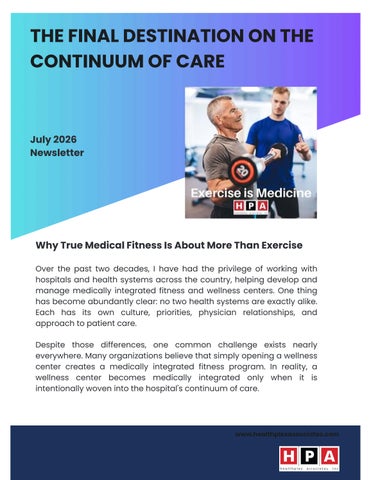
THE FINAL DESTINATION ON THE CONTINUUM OF CARE
July 2026 Newsletter
Why True Medical Fitness Is About More Than Exercise Over the past two decades, I have had the privilege of working with hospitals and health systems across the country, helping develop and manage medically integrated fitness and wellness centers. One thing has become abundantly clear: no two health systems are exactly alike. Each has its own culture, priorities, physician relationships, and approach to patient care. Despite those differences, one common challenge exists nearly everywhere. Many organizations believe that simply opening a wellness center creates a medically integrated fitness program. In reality, a wellness center becomes medically integrated only when it is intentionally woven into the hospital's continuum of care.
www.healthplexassociates.com
A medically based fitness center is not just another gym. It is an extension of healthcare. For patients, the continuum of care often begins with a physician's office or emergency department and continues through surgery, hospitalization, physical therapy, cardiac rehabilitation, oncology, diabetes education, or another specialty service. Too often, however, that journey ends when formal treatment concludes. Patients are discharged with instructions to "stay active," but without a structured plan or trusted destination to continue improving their health. This is where medical fitness changes everything.
At Healthplex Associates (HPA), we believe the wellness center should be the final destination on the continuum of care, the place where recovery becomes lifelong wellness. Whether a patient has completed cardiac rehabilitation, physical therapy, cancer treatment, orthopedic care, pulmonary rehabilitation, or simply needs help managing chronic disease, every patient should be presented with an opportunity to continue their journey toward better health through a medically supervised wellness program.
www.healthplexassociates.com
This philosophy has guided HPA since our founding. It is also the foundation of our Clinical Integration Program, which was specifically developed to build meaningful relationships between hospital departments, physicians, rehabilitation professionals, and wellness staff. The Clinical Integration Coordinator serves as the liaison between the hospital and the fitness center, ensuring patients transition safely from clinical care into long-term wellness while strengthening collaboration among physicians, therapists, and exercise professionals. One lesson I have learned over the years is that physician engagement does not happen by accident.
Successful clinical integration requires education, communication, and trust. Physicians, therapists, nurses, and hospital leaders must understand not only the services available within the wellness center, but also how those services improve patient outcomes. They need confidence that when they refer a patient, that patient will continue receiving professional guidance from qualified exercise specialists who understand their medical history, limitations, and goals.
When this trust is established, referrals become a natural extension of patient care instead of an afterthought. Research consistently supports this approach. Regular physical activity reduces the risk of chronic diseases, improves functional independence, lowers hospital utilization, and enhances quality of life. Yet many healthcare providers report that referral programs are underutilized because physicians are simply unfamiliar with the available resources or lack an established referral process. Our experience has shown the same thing: integration is not created by proximity, it is created through relationships.
www.healthplexassociates.com
The benefits of a truly integrated wellness center extend well beyond the individual patient.
For hospitals, investing in medical fitness strengthens population health initiatives while supporting their broader mission of improving community wellness. Active, healthier patients are less likely to require avoidable hospitalizations, experience complications from chronic disease, or rely heavily on emergency services. Exercise-based interventions have been shown to improve outcomes for conditions including cardiovascular disease, diabetes, obesity, arthritis, cancer survivorship, and depression.
www.healthplexassociates.com
A strong wellness center also enhances the hospital's reputation within its community. Rather than being viewed solely as a place people visit when they become sick, the hospital becomes recognized as a lifelong partner in health. This strengthens patient loyalty, supports physician satisfaction by providing trusted referral resources, and reinforces the organization's commitment to prevention rather than simply treatment. For nonprofit hospitals in particular, medically integrated wellness programs also contribute to community benefit initiatives by demonstrating meaningful investments in improving the health of the populations they serve. These programs align closely with today's healthcare priorities of prevention, valuebased care, and population health management. Building this level of integration requires leadership, consistency, and long-term commitment. It means educating physicians about available programs, maintaining regular communication with clinical departments, tracking patient transitions, following up on physician referrals, and continually demonstrating measurable value back to the healthcare system. These principles are central to HPA's Clinical Integration Program and remain essential to every partnership we develop. At Healthplex Associates, we don't simply manage fitness centers, we help hospitals extend their mission beyond the walls of the hospital and into the everyday lives of the communities they serve. Our goal is to create wellness centers that become indispensable partners in healthcare, supporting patients long after formal treatment has ended. We envision a healthcare system where every patient leaves the hospital with a clear path toward lifelong wellness. Our goal is simple but ambitious: every physician understands the value of medical fitness, every clinical department embraces wellness as part of the recovery process, and every patient is offered the opportunity to continue their journey in a medically integrated fitness center.
www.healthplexassociates.com
That is the future we strive to build with every hospital partner. Because healthier people create healthier communities, and healthier communities create stronger health systems.
Nothing motivates like results. Every successful referral, every patient who continues exercising after rehabilitation, and every physician who confidently recommends a wellness program represents another step toward a healthier community.
That is what true medical fitness looks like. And that is what Healthplex Associates continues to strive for every day.
Ryan Barr Assistant Vice President Healthplex Associates Email: rbarr@healthplexassociates.com
www.healthplexassociates.com