Winter 2018
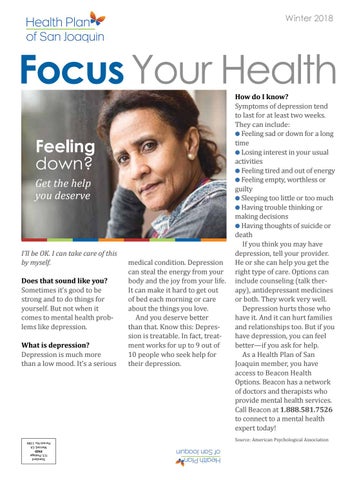
Focus Your Health Feeling down? Get the help you deserve
I’ll be OK. I can take care of this by myself. Does that sound like you? Sometimes it’s good to be strong and to do things for yourself. But not when it comes to mental health problems like depression.
What is depression? Depression is much more than a low mood. It’s a serious
medical condition. Depression can steal the energy from your body and the joy from your life. It can make it hard to get out of bed each morning or care about the things you love. And you deserve better than that. Know this: Depression is treatable. In fact, treatment works for up to 9 out of 10 people who seek help for their depression.
How do I know? Symptoms of depression tend to last for at least two weeks. They can include: ●● Feeling sad or down for a long time ●● Losing interest in your usual activities ●● Feeling tired and out of energy ●● Feeling empty, worthless or guilty ●● Sleeping too little or too much ●● Having trouble thinking or making decisions ●● Having thoughts of suicide or death If you think you may have depression, tell your provider. He or she can help you get the right type of care. Options can include counseling (talk therapy), antidepressant medicines or both. They work very well. Depression hurts those who have it. And it can hurt families and relationships too. But if you have depression, you can feel better—if you ask for help. As a Health Plan of San Joaquin member, you have access to Beacon Health Options. Beacon has a network of doctors and therapists who provide mental health services. Call Beacon at 1.888.581.7526 to connect to a mental health expert today! Source: American Psychological Association
Standard U.S. Postage PAID Merced, CA Permit No. 1186
Are your meds covered? A drug list is a list of medications (meds) your doctor can use that will be covered by HPSJ. It lists safe and helpful meds that offer the best value without sacrificing quality of care. To see what meds are on the drug list, you can: ●● Use the online Med List Search tool at hpsj.com/ formulary. ●● Download a copy of the drug list at hpsj.com/ formulary. ●● Call HPSJ Customer Service at 1.888.936.PLAN (7526); TTY/TDD: 711. As a Medi-Cal member, you pay nothing for outpatient meds and some over-thecounter meds (OTC), if the three reasons below are met: 1 The med is listed in HPSJ’s drug list. 2 The med is prescribed by a doctor that works with HPSJ. 3 The med is picked up at a pharmacy that works with HPSJ.
Did you know?
HPSJ has an online search tool where you can find which drugs are covered and which providers are in our network. This can be found on the home page of hpsj.com/members. No computer? Call HPSJ Customer Service at 1.888.936.PLAN (7526) or TTY/TDD: 711. 2 Focus Your Health
What’s this?
Want to learn more about the topics in Focus Your Health? With our HealthReach Audio Health Library, getting the health information you need is as simple as 1-2-3. You can find a list of topics and codes at hpsj.com/advice-nurse. 1 Call 1.800.655.8294 anytime, 24 hours a day, 7 days a week. 2 Once you are connected to the call center’s automated menu, press 2 to access the library. 3 Follow the prompts to listen to the topics that interest you.
Nondiscrimination Notice Health Plan of San Joaquin complies with applicable federal civil rights laws and does not discriminate on the basis of race, color, national origin, age, disability or sex. Health Plan of San Joaquin cumple con las leyes federales de derechos civiles aplicables y no discrimina por motivos de raza, color, nacionalidad, edad, discapacidad o sexo. 遵守適用的聯邦民權法律規定,不因種族、膚色、民族血 統、年齡、殘障或性別而歧視任何人。
Language Assistance Services English ATTENTION: If you speak another language, language assistance services, free of charge, are available to you. Call 1.888.936.PLAN (7526) (TTY/TDD: 711). 简体中文 (Simplified Chinese) 注意:如果您使用简体中文,您可以免费获得语言协助服务。 请致电.888.936.PLAN (7526),(TTY/TDD 专线 711)。
Español (Spanish) ATENCIÓN: Si usted habla español, se encuentran disponibles servicios sin costo de asistencia de idiomas. Llame al 1.888.936.PLAN (7526) (TTY/TDD: 711). Information in FOCUS YOUR HEALTH comes from a wide range of medical experts. If you have any concerns or questions about specific content that may affect your health, please contact your health care provider. For more information about services available through your medical plan, consult your benefit booklet or call HPSJ. Models may be used in photos and illustrations. 2018 © Coffey Communications, Inc. All rights reserved.
Boost your mood this season Whether you need a lift from the winter blues or a break from holiday stress, check out these ways to brighten your day:
Look for the good. There’s often an upside to a stressful situation. You might ask yourself: Could this make me stronger? What am I learning? Writing about something or someone you’re thankful for can also lift your spirits. Give yourself a break. Don’t expect more from yourself than you would anyone
else. It’s OK if you couldn’t buy a gift for everyone on your list, or if a meal doesn’t turn out exactly as planned.
Get some sunshine. Take a walk or sit by a window to make the most of the daylight. Be kind to others. Consider volunteering. Or practice little acts of kindness, like holding the door for someone.
Visit a friend. Being around others may help you perk up. Talking on the phone, or via text or email, can help too. Sources: American Council on Exercise; Mental Health America
Holiday fires 8,690 Home fires involving candles are reported each year. TO AVOID FIRE Place candles where they can’t be knocked down or blown over. Consider using batteryoperated candles instead of real ones. Keep candles away from flammable decorations (including trees).
Extinguish candles when you leave the room.
Use nonflammable candle holders.
Sources: U.S. Consumer Product Safety Commission; National Fire Protection Association
Focus Your Health 3
Find your medical home
Our pledge to you
The goal of Health Plan of San Joaquin (HPSJ) is to improve the When it comes to getting health care, it’s smart to have a health of our members. We want place to call your medical home. That means seeing one to give health care value and doctor first, no matter what type of care you need. advance health care outcomes. With a medical home, you and your doctor get to know When we think about Utilizaeach other. Your doctor leads a team of nurses and other tion Management (UM) rewards, providers who manage your overall health—the whole we keep in mind: you. This team can meet most of your needs. That might 1 The right care and support. be wellness checkups or managing an ongoing health 2 Health plan coverage at the problem. time. If you also need a specialist, your doctor helps you find We do not reward one. Your doctor will also stay updated on your care. It doctors for giving makes for more streamlined care. That can mean less out denial letters. ? S hassle for you—and more peace of mind. There are no N TIO To get connected to a doctor, go to hpsj.com and rewards or QUES If you have any select “Find a Provider.” extra money to questions, please call us at 1.888.936.PLAN support using Sources: Agency for Healthcare Research and Quality; American Academy of Family Physicians; American College of Physicians (7526); TTY/TDD: less resources.
711.
Need to ask a question about your health?
Call HealthReach - Free phone service to give you the care you need when your doctor is not available.
HealthReach can help:
D Speak with an advice nurse D Talk to a doctor D Find urgent care locations near you D Decide if your problem can be treated at home D Listen to audio health library topics
Call HealthReach
1.800.655.8294 HLTHRCH031318
4 Focus Your Health
5 ways to make those New Year’s resolutions stick First you make ’em. Then you break ’em. Does that pretty much sum up your past history with New Year’s resolutions? You’re jazzed in January to get in shape, stop smoking, eat better—to achieve your goal, whatever it is. But by February, your resolution is kaput. As you’ve likely discovered, good intentions aren’t enough to make resolutions stick. You’ve got to stack the odds in your favor. Here’s how: 1 Be specific. Rather than a fuzzy resolution—for instance, “I’m finally going to get fit”—commit to a clearly defined one. Do you want to be able to finish a 5K? Do a dozen pushups? Walk the hilly streets in your neighborhood without getting winded? Nail the details. 2 Don’t overreach. Resolving to go to the gym every morning before work is potentially setting yourself up for failure. Getting there two or three times a week is more realistic—and far likelier to become a habit. 3 Line up support. Pair up with a resolution buddy—somebody with the same or a similar goal. Change is easier if you don’t attempt it solo. And spread the news about your resolution. The more friends and family you tell, the more accountable you’ll feel. 4 Reward yourself. Did you make it through your first week without smoking? Then spend the money you would have spent on cigarettes on something special for yourself. Are you down 5 pounds? Why not celebrate with a manicure or tickets to a concert? 5 Bounce back. OK, so you skipped the gym a couple of times or binged on a bunch of snacks one weekend. You slipped up, but so what? Missteps are normal. And one key to successful behavior change is resiliency. Tomorrow really is another day—it’s your chance to get back on track. Sources: American College of Sports Medicine; American Council on Exercise; American Psychological Association
HEALTHY
ideas kids will love
Visit the farmers market Encourage kids to pick out a new fruit or veggie to take home and try.
Make a splash that’s not soda Flavor water with fresh berries or orange slices.
Stock a snack drawer Older kids can help themselves to wholegrain crackers, unsalted nuts, and dried or fresh fruit.
Plant something together Kids may be more likely to try kale or collards if they planted the seeds and watched them grow.
Create a sports zone Keep balls, jump ropes and other fun gear in one go-to location.
Make a game of food labels Have kids measure out what they think is a serving and compare it to what the label says.
Focus Your Health 5
Get ready for your
Most things go better with a little preparation. And mammograms are no exception. Whether it’s your first mammogram, or you’ve been getting the tests faithfully for years, these tips from the American Cancer Society (ACS) can help the whole process go more smoothly: Be consistent. Try to go to the same facility every time you get a mammogram. That way your images can be easily compared from year to year. But if you’ve had mammograms elsewhere, get the old images and bring them with you. Schedule smart. If you’re
menstruating, try to avoid getting your mammogram the week before your period. Instead schedule a time for when your breasts aren’t likely to be tender or swollen. That will help ease any discomfort and help get better pictures.
Don’t wear deodorant the day of the exam. Some contain substances that can show up on x-rays as white spots. Speak up. Describe any breast symptoms or problems to the technologist doing the mammogram. Also bring up any medical history that could affect your breast cancer risk, such as hormone use or breast cancer in your family. Ask when to expect the results. If you don’t hear, don’t assume the results are normal. Get back in touch. Additional source: Radiological Society of North America
HealthReach 1120
Stay on top of screening Be sure to talk with your doctor about the best mammogram schedule for you. Here’s what the ACS advises for women at average risk of breast cancer in the following age ranges:
40 44 45 54 to
You have the option to start screening with yearly mammograms.
6 Focus Your Health
to
Get yearly mammograms.
55
and older.
You can switch to a mammogram every other year or continue with yearly screening for as long as you’re in good health.
The anatomy of smoking How tobacco affects your body If you’re a smoker, you probably know you should stop. That’s a good start toward quitting, but you need a powerful motivator to follow through. Knowing the truth about how smoking harms your health may be what it takes. An alarming fact is that smoking affects nearly every part of your body, including your: ●● Airways. Delicate tissues in your lungs become inflamed because of smoking. This can lead to serious disorders, such as chronic obstructive pulmonary disease. Smoking can also cause cancer to develop in your lungs, throat and mouth. ●● Heart. Smoking harms the cells lining the blood vessels and heart and can increase the risk of clots that cause heart attacks. Smoking can also contribute to an abdominal aortic aneurysm—the weakening of the major artery near the stomach. ●● Other blood vessels. Damage to vessel linings can cause them to narrow, restricting blood flow to the kidneys, stomach, arms, legs and feet. This can lead to a range of problems, including pain and gangrene.
●● Brain. Blood clots that
form in damaged arteries can travel to your brain and cause potentially fatal strokes. ●● Bones and tendons. Smoking increases the risk for osteoporosis—weak bones—and fractures in both men and women. Overuse injuries, such as tendinitis, and traumatic injuries, such as sprains, are also more likely among smokers, according to the American Academy of Orthopaedic Surgeons. ●● Immune system. Smokers have smaller amounts than nonsmokers of some types of cells that destroy germs. That leaves you more vulnerable to infections. In addition, smoking can cause cancer of the pancreas, kidneys, cervix and stomach. It also can cause leukemia, which is cancer of the blood. And smoking increases your risk for eye diseases and dental problems. Women who smoke tend to have more complications with pregnancy, including premature births, low-birthweight babies and stillbirths. And their babies are more likely to die of SIDS (sudden infant death syndrome) than babies whose mothers don’t smoke.
A LOOK AT SMOKING RATES IN AMERICAN ADULTS
A DEADLY HABIT
THERE ARE MORE THAN
480,000 DEATHS A YEAR FROM SMOKING
278,544
DEATHS AMONG MEN
201,773
DEATHS AMONG WOMEN Source: Centers for Disease Control and Prevention
Turn your risks around By quitting, your health risks decrease immediately and continue to diminish over time, no matter how long you’ve smoked. Health Plan of San Joaquin provides individual, group and telephonic counseling for members of any age who use tobacco products. Go to hpsj.com/health-education to learn more! A tobacco quitline can also help you quit for good. You can call the California Smokers’ Helpline at 1.800.NO.BUTTS (662.8887).
HealthReach 1841 Focus Your Health 7
Flu season is here: Did you get your flu shot yet? The holidays are here. That can only mean one thing: it's flu season. Flu can be harmful for kids and families. Between 6,000 and 26,000 children younger than 5 are sent to the hospital every year because of the flu. The flu shot is safe and helps protect kids and adults from flu. The flu is not the same as a cold, and comes on quickly. Even healthy kids and adults can get really sick from the flu. They can then spread it to family and friends.
Signs of flu can include: ●● Fever ●● Cough ●● Sore throat ●● Runny or stuffy nose ●● Body aches ●● Headache ●● Chills ●● Feeling tired ●● Vomiting and diarrhea A flu shot is important for people of all ages. It is really important for kids 6 months and older, pregnant women, and anyone with chronic health problems like asthma, or diabetes. They have a higher chance of getting more serious issues 8 Focus Your Health
from flu, like pneumonia, which can lead to hospital stays.
Tips for flu season: ●● Try to avoid close contact with sick people. ●● If you are sick, try to stay home for at least 24 hours after your fever is gone. ●● Cover your nose and mouth when you sneeze. ●● Wash your hands often. It’s best to get your flu shot by the end of October every year to be ready for flu season.
Call your doctor’s office to set up an appointment to get your flu shot today. Not sure who your doctor is? Call HPSJ at 1.888.936.7526 (PLAN); TTY/TDD: 711. Visit hpsj.com for more information on flu resources and HPSJ’s HealthReach nurse and doctor advice line.
Source: cdc.gov/flu
HealthReach 1401