Compliance 4 U - Monthly Compliance Newsletter_20260301

Page 1


March 2026

The Compliance4U newsletter offers insight into the day-to-day functions of the Health Plan’s Compliance Program and serves as a resource to help staff stay informed about key regulatory updates, reporting obligations, audit activities, and policy changes. Its goal is to promote awareness, accountability, and a culture of compliance across all departments within HPSJ/MVHP (“Health Plan”)

Spotlight: Why Department-Level Monitoring Matters

In Medi-Cal Managed Care, staying compliant isn’t just about passing audits it’s about being ready every day. Department-level monitoring plays a critical role in keeping the Plan ahead of potential regulatory findings and aligned with our mission to deliver high-quality care.

What makes monitoring so important?

• It catches issues early. Regular review of timeliness, accuracy, workflows, and data quality gives teams the chance to correct problems before they become formal findings or trigger Corrective Action Plans.

• Regulators expect real-time oversight. DHCS and other agencies increasingly look for evidence that plans are actively monitoring their operations not waiting for an audit to discover gaps.

• It protects our members. Timely authorizations, accurate provider data, clean encounters, and strong grievance processing directly impact access, safety, and member experience.

• It strengthens operational accountability. When departments own their monitoring, Compliance can focus on advising and supporting not firefighting.

• It builds continuous audit readiness. When documentation is current, processes are aligned with APLs and contract requirements, and data is reliable, audits become smoother, faster, and far more successful.

Bottom line: Department-level monitoring is not just a compliance requirement, it is a proactive strategy that protects members, reduces risk, and reinforces a culture of excellence. In the Managed Care world, it’s one of the most important things we do to stay ready, responsive, and resilient.

Our success in staying audit-ready doesn’t come from any one team, it comes from all of us working together. When each department leans in, monitors its processes, and shares insights openly, we create a stronger, more proactive Plan. This is true collaboration in action: Compliance, Operations, and every supporting function moving in the same direction, with the same commitment to excellence. Together, we’re not just meeting expectations, we’re setting the standard for what high-quality, member-focused Managed Care should look like.

Regulatory Affairs D-SNP Updates

CMS issues Health Plan Management System Memos (HPMS Memos). These are similar to APLs where it serves as a regulatory notification with new or updates to requirements or regulations, as well as information on what’s coming through in the near future. HPMS memos are less defined compared to an APL, therefore, Compliance must interpret, assess for business ownership, impact and action items. It is important to read each one sent to business areas to determine business impact.

Below is a list of HPMS memos that are actionable:

Frequently Asked Questions Related to the Medicare GLP-1 Bridge

Issue Date: March 3, 2026

Summary: This memo provides FAQs to Plans who intend to participate in the BALANCE Model and bridge Medicare GLP-1s. This is currently being reviewed through the CY 2027 Bid process.

Encounter Data Software Release Updates: March 20, 2026

Issue Date: March 16, 2026

Summary: This memo provides information concerning updates to the Encounter Data Processing System (EDPS) effective March 20, 2026. Changes described include deactivation of edits, updates to the validation criteria within existing edits, and new edits. Edits within the EDPS have two

possible dispositions: Informational and Reject. Edifecs will deploy updates to the HPSJ Encounter processing platform.

Release of the Updated Important Message from Medicare (IM) and Detailed Notice of Discharge (DND)

Issue Date: March 19, 2026

Summary: The Office of Management and Budget approved the updated Important Message from Medicare (IM) and Detailed Notice of Discharge (DND) for 3 years. CMS improved the notices’ readability and design. The new forms are posted in English and Spanish on CMS’ BNI webpage.

Part D-Medicare Part D Manufacturer Discount Program: April 2026 Participating Labeler Code List and Phase-In National Drug Code List

Issue Date: March 25, 2026

Summary: CMS has updated the Labeler and NDC-9 Lists, which lists the manufacturers that are participating in the Manufacturer Discount Program. PBM, MedImpact updates their system to capture this list monthly.

Computer-Based Training Series on Risk Adjustment: 2026 Calendar Year Updates

Issue Date: March 26, 2026

Summary: CMS is pleased to announce the next module of its computerbased training series on risk adjustment. The new module (Module 7) provides an overview of the updates for calendar year 2026 from the 2026 Rate Announcement.

Health Plan Management System (HPMS) Program Integrity (PI) Portal for Fraud, Waste and Abuse (FWA) Reporting Module - New Fee-For-Service (FFS) Payment Suspensions Report Announcement

Issue Date: March 26, 2026

Summary: CMS received requests from Plans to share the FFS payment suspension report on a more frequent basis. Therefore, the monthly FFS Payment Suspension report will be available in the FWA Report module. The information in the report is intended to support plan sponsors by enhancing transparency and assisting with plan sponsors’ own FWA efforts.

Note, limited information will be provided in the monthly report, while additional information regarding the FFS suspension will continue to be provided in the FWA Quarterly Plan Report. The report will be available April 8, 2026.

Part C Independent Review Entity (IRE) Contract Award and Transition Notification

Issue Date: March 31, 2026

Summary: CMS has awarded C2C Innovative Solutions, Inc. (C2C) on February 26, 2026. Effective May 1, 2026, C2C will be responsible for conducting appeals for adverse reconsiderations issued by Part C plans, as well as reviews of plan dismissals of appellant reconsideration requests.

Existing IRE vendor, MAXIMUS, will continue to process appeals received on or before April 30, 2026. To date, Health plan has not submitted any appeals to IRE.

Regulatory Affairs Medi-Cal Updates

All Plan Letters (APLs)

DHCS and DMHC issue All Plan Letters (APLs) to formally communicate updates to federal or state policy, regulatory requirements, or operational procedures. These directives are intended to guide Managed Care Plans (MCPs) on how to implement changes and ensure compliance with applicable laws and regulations.

RA reviews and analyzes each APL to interpret its impact, coordinate internal implementation, and ensure timely compliance and required filings.

Draft APLs often identified with placeholder codes such as “XXX” are released by the regulators to solicit feedback from MCPs before finalization. During this comment period, MCPs can raise concerns or seek clarification, which may influence the final version of the policy.

Below is a list of recently released APLs for your awareness:

A. DHCS Regulatory Notices

APL 26-003 Quality Measures for Encounter Data Update: Quality Measures for Encounter Data 2.0 (QMED 2.0) (Supersedes APL 14-020)

Attachment: Quality Measures for Encounter Data- Version 2.0

Issue Date: March 13, 2026

Summary: This APL notifies Health Plan about an update to the DHCS QMED requirements

APL 26-004 Medi-Cal Managed Care Plan (MCP) Responsibilities for Behavioral Health Data-Sharing

Issue Date: March 16, 2026

Summary: This APL provides Health Plan with clarified guidance regarding existing responsibilities for data sharing, including ensuring data privacy and security of Members’ behavioral health data with Medi-Cal Third-Party Entities in real time pursuant to Assembly Bill 133, Health and Safety Code section 130290, the California Health and Human Services Data Exchange Framework (DxF) Policies and Procedures (P&Ps), MCP’s DHCS contract requirements, relevant APLs, and other state and federal statutes and guidance including HIPAA, recent updates to the 42 Code of Federal Regulations Part 2 regulations, Information Blocking, and CMS Interoperability and Patient Access Final Rule (May 2020), and CMS Interoperability and Prior Authorization Final Rule (January 2024).

APL 26-005 Maternity Services for Pregnant and Postpartum Medi-Cal Members (Not Yet Posted Online) (Supersedes APLs 00-012, 18-022, and PLs 98-006, 98-010, and 12-003)

Issue Date: March 25, 2026

Summary: Referred to as the Omnibus Maternity Services APL, this APL consolidates and updates guidance for MCPs on the maternity benefits that MCPs are required to provide to pregnant and postpartum Members. This APL also retires APL 01-003 and Policy Letters (PLs) 98-001 and 02-004.

APL 26-006 Skilled Nursing (SNF) Facility Workforce Quality Incentive Program (WQIP) (Not Yet Posted Online) (Supersedes APL 25-002)

Issue Date: March 30, 2026

Summary: This APL provides MCPs with instructions on the payment and data sharing process required for the SNF WQIP for Rating Periods between

01/01/2023 and 12/31/2025. The Calendar Year 2023 Rating Period is referred to as Program Year 1, Calendar Year 2024 as Program Year 2, and so forth.

B. DMHC Regulatory Notices

APL 26-005 Compliance with Assembly Bill 904, Maternal and Infant Health Equity Program

Issue Date: March 20, 2026

Summary: This APL informs plans covering maternity services of the filing requirements necessary to demonstrate compliance with and implementation of Assembly Bill 904. Medi-Cal plans such as Health Plan are considered to already meet the requirements of Assembly Bill 904 as long as DHCS continues to require MCPs to have doulas in their provider networks.

Regulatory Reports

Under the terms of our contract with DHCS and in alignment with our KnoxKeene license requirements regulated by DMHC the Plan is required to routinely submit reports that demonstrate operational performance and regulatory compliance. RA tracks and coordinates these submissions to ensure timeliness and accuracy across all departments.

Below is a list of upcoming regulatory reports due to our regulators in April 2026. The table includes the accountable Director and Executive sponsor for awareness and coordination. Please review the list to determine which reports fall within your area. Reports due for the upcoming month should be saved in this Dropbox Folder.

Report Name

Monthly Certification and Enrollment Reporting: Report Summarizing the previous month's D-SNP enrollment numbers

Accountable DT

Accountable ET

Somatra Sourng Michelle Tetreault

Monthly CBAS Waiver

Monthly 274 File

Monthly ECM/CS JSON

Pamela Lee Lakshmi Dhanvanthari

Clarence Rao

Clarence Rao

Monthly MCPD/PCPA JSON Clarence Rao

Monthly Data Certification

Monthly Post Payment Recovery (PPR)

Monthly Member Data Discrepancy Notification

Monthly Member Death Notification

Monthly Restricted Provider Site Verification

Monthly Consolidated Billing

Monthly Provider Information Network (PIN)

Monthly Encounter Data

Victoria Worthy

Victoria Worthy

Victoria Worthy

Tamara Hayes Betty Clark

Christopher Navarro

Michelle Tetreault

Tamara Hayes Betty Clark

Tamara Hayes

Betty Clark

Toni White Betty Clark

Clarence Rao

Victoria Worthy

Ana Aranda Liz Le

Clarence Rao

Monthly New Member Mailing Vena Ford

Monthly NMT-NEMT

Monthly Provider Directory

Dale Standfill

Ana Aranda

Victoria Worthy

Evert Hendrix

Liz Le

Liz Le

Monthly Financial Somatra Sourng Michelle Tetreault

Quarterly PHM Key Performance Indicator (KPI)

Quarterly CBAS Report

Quarterly Consumer Governance Boards: Committee Meeting Minutes and Agendas

Quarterly MOU Good Faith Efforts Status Report

Quarterly Pending & Unresolved Grievances Report

Quarterly Provider Network Impact Report

Quarterly Interoperability API Utilization

Semi-Annual Provider Directory

Johnathan Yeh Lakshmi Dhanvanthari

Pamela Lee Lakshmi Dhanvanthari

None

Tracy Hitzeman

Jeanette Lucht Lakshmi Dhanvanthari

RJ Ruiz

Lakshmi Dhanvanthari

Ana Aranda

Clarence Rao

Ana Aranda

Liz Le

Victoria Worthy

Liz Le

Annual CAC Demographic None Tracy Hitzeman

Annual Key Personnel Disclosure Form Tamara Hayes Betty Clark

Annual Marketing Plan Vena Ford Liz Le

Provider

Complaints

Provider complaints come to Health Plan in different forms (e.g., direct call to us or dispute submission to DMHC). While our Provider Services and Claims teams address those coming into us, Compliance is the point of contact for those coming through DMHC. In 2026, Health Plan received 21 requests (18 new Provider Complaints and 3 additional information requests), disputing 26 claims. In 2025, Health Plan received 70 requests (41 new Provider Complaints and 29 additional information requests), disputing 48 claims.

Compliance coordinates a cross-functional group to review each complaint we receive. This group investigates the cases (from the original request to claim processing and dispute resolution) and prepares a comprehensive response to the DMHC about the provider’s concerns and the actions taken by us. These tables outline the status:

Table 1: Provider Complaints Received from DMHC as of April 3, 2026:
Table 2: Provider Complaint Closures by Decision as of April 3, 2026:

DMHC Consumer Complaints and Independent Medical Review (IMR):

Effective May 2025, RA manages the intake, tracking, and submission of all DMHC consumer complaints and Independent Medical Reviews (IMR) to ensure timely, compliance, and coordinated responses in collaboration with Grievance & Appeals.

DMHC Consumer Complaints

The following reflects the Consumer Complaints received, including analyses by case reason, urgency and outcome.

• Table A displays the Consumer Complaint reasons for Standard Cases, Expedited Cases and Additional Information Requests.

• Table B shows the Consumer Complaint outcomes for Standard Cases, Expedited Cases and Additional Information Requests.

Table A: DMHC Consumer Complaints by Case Reason (May 30, 2025-April 3, 2026)
Table B: DMHC Consumer Complaints by Case Outcome

DMHC Independent Medical Review

Table C below reflects the number of IMR cases received from the Department since May 30, 2025, and their outcomes

Table C: DMHC Independent Medical Review (IMR) (May 30, 2025- April 3, 2026

What’s going on at the State and Federal levels? To support you in your role and ensure timely awareness of changes to regulatory and contractual requirements, Regulatory Affairs staff attend regulatory calls (e.g., DHCS Managed Care Plan Call - MCPC) and other regulatory meetings/calls where key regulatory information is shared.

 Calls Held by Health Plan’s Regulators

Regulatory Affairs staff maintain materials from regulator calls. Check out previous meetings HERE.

Do you have a question for Compliance? To submit an inquiry, go to Team Sites > Compliance > Requests > Submit an Inquiry on SharePoint or simply use this link: check it out here.

Program Integrity Unit (PIU)

Privacy & Security

Privacy & Security Incidents

In the month of February, forty-six (46) HIPAA incidents were reported to PIU. None of these incidents were reportable to DHCS or OCR.

What’s the Difference Between PHI, PII, PI, and Confidential Information — and Why It Matters

No matter your role, you interact with sensitive information every day. Understanding the different categories of data we handle is essential for protecting our members, our organization, and ourselves. These terms often appear in policies, training, and day-to-day work, and each has a specific meaning under privacy and security standards.

PII — Personally Identifiable Information

PII refers to information that can identify a specific individual on its own or when combined with other data. NIST SP 800-122 is the federal standard for PII. Examples include:

• Name

• Address

• Email

• Phone number

• Social Security number

• Driver’s license number

PI — Personal Information

PI is a broader category defined by various privacy laws (such as the California Consumer Privacy Act/CPRA). It includes PII but also covers additional data that relates to, describes, or could reasonably be linked to a person. Under CCPA/CPRA, PI includes any information that “identifies, relates to, describes, or could reasonably be linked” to a consumer or household. Examples include:

• Online identifiers (IP address, device ID)

• Biometric data

• Geolocation data

• Employment information

• Financial account information

PHI — Protected Health Information

PHI is health-related information that can be tied to an identifiable individual and is created or maintained by a covered entity or business associate. Per HIPAA’s Privacy Rule (45 CFR §160.103), PHI only applies within the healthcare context; the same data outside a HIPAA-regulated entity may not be considered PHI. Examples include:

• Any health information paired with identifiers

• Name

• Address

• Email

• Phone number

• Social Security number

• Date of Birth

• Medical records

• Diagnoses and treatment information

• Insurance enrollment or claims data

• Member ID numbers

Confidential Information

Confidential Information refers to internal, proprietary, or sensitive business information that is not intended for public disclosure. It may or may not include personal data. Examples include:

• Business strategies and financial projections

• Internal reports and communications

• Contract terms

• Operational processes

• Non-public performance data

The reason why each of these distinctions matter is because each category of information is governed by different laws, protections, and reporting requirements. Misunderstanding them can lead to:

• Regulatory violations (HIPAA, CCPA/CPRA, GLBA, etc.)

• Breach notification obligations

• Financial penalties

• Reputational harm

• Loss of member trust

Knowing what type of data you’re handling helps ensure it is stored, shared, and protected appropriately and that we uphold our legal and ethical responsibilities.

Fraud, Waste, and Abuse (FWA)

Key Legal Implications for Health Plan FWA Investigations

Fraud, Waste, and Abuse (FWA) investigations are a core compliance responsibility for health plans, and the legal landscape governing them is both complex and high-stakes. Health plans must navigate federal and state laws that dictate how investigations are conducted, how data is handled, and how suspected misconduct must be reported. Failure to comply can result in significant penalties, exclusion from federal programs, and reputational damage.

1. Federal Laws and Regulations Governing FWA Investigations

Federal oversight is driven primarily by the Centers for Medicare & Medicaid Services (CMS), the U.S. Department of Health and Human Services (HHS), and the Department of Justice (DOJ). Key federal requirements include:

False Claims Act (FCA)

• Prohibits knowingly submitting false or fraudulent claims for payment to the federal government.

• Allows whistleblower (qui tam) actions.

• Penalties include treble damages and civil monetary penalties.

Anti-Kickback Statute (AKS)

• Criminal law prohibiting offering, paying, soliciting, or receiving remuneration to induce referrals for services covered by federal healthcare programs.

• Violations can lead to fines, imprisonment, and program exclusion. Stark Law (Physician Self-Referral Law)

• Prohibits physicians from referring Medicare/Medicaid patients to entities with which they have a financial relationship unless an exception applies.

• Violations can trigger repayment obligations and civil penalties.

Civil Monetary Penalties Law (CMPL)

• Authorizes HHS-OIG to impose penalties for a wide range of misconduct, including false claims, kickbacks, and beneficiary inducements.

CMS Medicare Advantage & Part D Compliance Program Requirements

• Require health plans to maintain effective FWA programs.

• Mandate timely investigation and reporting of potential misconduct.

• Require oversight of first-tier, downstream, and related entities (FDRs).

HIPAA Privacy

and Security Rules

• Govern the use and disclosure of protected health information (PHI) during investigations.

• Require safeguards to prevent unauthorized access or disclosure.

42 CFR § 455 (Medicaid Program Integrity)

• Requires Medicaid Managed Care Plans to investigate and report suspected provider fraud.

• Mandates cooperation with state Medicaid Fraud Control Units (MFCUs).

2. California State Laws and Regulations

California imposes additional requirements on health plans, particularly those regulated by the Department of Managed Health Care (DMHC) and the Department of Health Care Services (DHCS).

California Penal Code § 550

• Criminalizes healthcare fraud, including submitting false claims, billing for services not rendered, and upcoding.

• Applies to both public and private health plans.

California Insurance Fraud Prevention Act (IFPA)

• Allows civil actions against individuals or entities committing insurance fraud.

• Includes whistleblower provisions similar to the federal FCA.

Knox-Keene Health Care Service Plan Act (Health & Safety Code § 1340 et seq.)

• Requires health plans regulated by DMHC to maintain systems to detect and prevent fraud.

• Mandates reporting of suspected fraud to DMHC and law enforcement when appropriate.

Welfare & Institutions Code (WIC) § 14107 & § 14107.11

• Establish criminal penalties for Medi-Cal fraud.

• Require Medi-Cal managed care plans to report suspected fraud to DHCS and cooperate with investigations.

California

Confidentiality of Medical Information Act

(CMIA)

• State-level privacy law governing medical information.

• Imposes stricter requirements than HIPAA in some areas, including breach notification.

3. Key Legal Implications for Health Plans

Mandatory Reporting Obligations- Health plans must report suspected fraud to the following entities. Failure to report can be treated as non-compliance

• CMS (for Medicare Advantage/Part D)

• DHCS (for Medi-Cal)

• DMHC (for Knox-Keene plans)

• Law enforcement or OIG when required

Data Privacy and Security

• Investigations must balance fraud detection with strict adherence to HIPAA and CMIA. Improper access or disclosure of PHI can create additional liability.

Timeliness Requirements

• CMS and DHCS expect prompt investigation, documentation, and resolution. Delays can be interpreted as ineffective compliance oversight.

Oversight of Delegated Entities

• Health plans remain legally responsible for FWA compliance even when functions are delegated to medical groups, IPAs, PBMs, or other vendors.

Potential Civil and Criminal Liability

• If a health plan fails to act on credible allegations, it may face:

• Civil penalties under FCA or CMPL

• Criminal exposure under AKS or state fraud statutes

• Contract sanctions from CMS or DHCS

Health plans must maintain robust compliance programs, ensure timely and well-documented investigations, and adhere to both federal and California-specific laws. By doing so, they protect program integrity, safeguard member trust, and reduce exposure to significant legal and financial risk.

Fraud, Waste, and Abuse Cases

In February, the PIU started the month with 28 open cases, opened six (6)new cases, and closed two (2) cases. At month end, our team had 32 open cases.

Provider Exclusion Monitoring

PIU regularly monitors vendors and providers we contract with for exclusions, per 42 Code of Federal Regulations (C.F.R.) §438.610, which prohibits Managed Care Plans (MCPs) from contracting or maintaining a contract with physicians or other health care providers who are excluded, suspended, or terminated from participating in the Medicare or Medi-Cal programs.

Identified Excluded Parties

In February 2026, five (5) excluded, restricted, and suspended providers were identified in February through ad hoc and standard monthly screening

Need to Report a Concern?

You can report FWA concerns anonymously, confidentially and without fear of retaliation to the Program Integrity Unit (PIU):

• Online Reporting Tool: Report Non-Compliance, Privacy or Fraud, Waste & Abuse Issues

• Email: PIU@hpsj.com

Audit & Oversight (A&O)

Transitional Rent Community Support Service Assessments

Introduction

Let’s start with a quiz!

Which of the following is true of the Transitional Rent Community Support Service, per the Department of Health Care Services (DHCS)?

a. It is one of seven Community Support Services that specifically address the needs of Members experiencing or at risk of homelessness.

b. It is the newest addition to the suite of Community Support Services

c. Provides up to six months of rental assistance in interim and permanent settings to Members who are experiencing or at risk of homelessness, have certain clinical risk factors, and have either recently undergone a critical life transition (such as exiting an institutional or carceral setting or foster care).

d. It is covered under Medi-Cal.

e. Is required for the Behavioral Health population of focus as of 1/1/2026.

If you answered a., b., c., d., and e. – or “all of the above” - congratulations –you are correct!

Overview of Community Supports to Support Members Experiencing or at Risk of Homelessness

There are seven Community Support Services to support Members experiencing or at risk of homelessness:

(1) Housing Transition Navigation Services (HTNS)

(2) Housing Deposits

(3) Housing Tenancy and Sustaining Services (HTSS)

(4) Day Habilitation

(5) Recuperative Care (Medical Respite)

(6) Short-Term Post-Hospitalization Housing

(7) Transitional Rent

Coverage of the first six of these Community Support Services is optional - but strongly encouraged – by DHCS, and all Managed Care Plans are required to cover Transitional Rent for Members in the Behavioral Health population of focus as of January 1, 2026. Health Plan provides comprehensive coverage for members by offering all the community supports, including Transitional Rent for members in the Behavioral Health population.

Overview of Transitional Rent

Transitional Rent has three key objectives:

1. Ensure a connection to long-term housing supports, such as rental subsidies, for Members receiving Transitional Rent to provide a pathway to housing stability and prevent a return to homelessness.

2. Use the temporary housing stability afforded by Transitional Rent as an opportunity to help Members connect to needed health care services.

3. Minimize administrative barriers (without compromising program integrity), so that Members experiencing or at risk of homelessness can readily access Transitional Rent.

Compliance

To prepare for the mandatory coverage of Transitional Rent starting 1/1/2026, Audit & Oversight (A&O) has assessed five (5) providers to evaluate their ability to conduct prospective Transitional Rent services in accordance with regulatory standards developed by DHCS. A&O will continue to provide readiness assessments for any additional Transitional Rent providers, as well as annual audits, and ad hoc audits as needed, to ensure adherence to regulatory requirements and ongoing compliance. A&O plays a critical role in ensuring the services provided are effective, adhere to regulatory guidelines, and meet the needs of impacted members.

If you’d like to learn more about the specifics of Transitional Rent, you are encouraged to read the DHCS Community Supports Policy Guide: Volume 2, pages 57-80, which fully outlines the Transitional Rent program.

Compliance Operations

Member Records Request ESP Ticket Workflow Changes

Updates to the ESP workflow for Member Records requests are currently underway. This collaborative effort between Compliance, IT, and Customer Service focuses on enhancing the existing ESP Ticket Member Records Request and its associated workflow. The streamlined process is designed to reduce bottlenecks and improve efficiency across Compliance, Customer Service, and the various business areas, helping ensure member records are compiled and delivered in a timely manner. Additional updates will be shared soon.

Policies and Procedures

February 2026 Published Policies

Eighteen (18) policies were published in February.

CLMS21 Hospice Service Reimbursement

CM02 Sensitive Healthcare Services

CM70 Community-Based Adult Services & Community-Based Adult Services Emergency Remote Services 02/05/2026

CM74 Hospice Services

02/05/2026

CMP02 Records Management and Retention 02/05/2026

CONT01 Review and Execution of Provider Contracts 02/03/2026

FIN32 Targeted Provider Rate Increases 02/05/2026

HE06 Text Message Communication with Members 02/05/2026

IT16 Medi-Cal Enrollment File Processing 02/05/2026 Medi-Cal

IT17 Encounter Data Submission 02/05/2026 Medi-Cal

IT32 Interoperability and Patient Access 02/05/2026 Medi-Cal

QM05 Facility Site Review 02/05/2026

QM73 California Business and Professions Code (BPC) 805 Reporting Process 02/05/2026

UM01Authorization and Referral Review 02/03/2026 Medi-Cal

UM02 Inpatient Admissions and Concurrent Review

02/05/2026 Medi-Cal

UM50 Quality Community Supports 02/03/2026 Medi-Cal

UM88 Transitional Care Services 02/05/2026 Medi-Cal

Did you know?

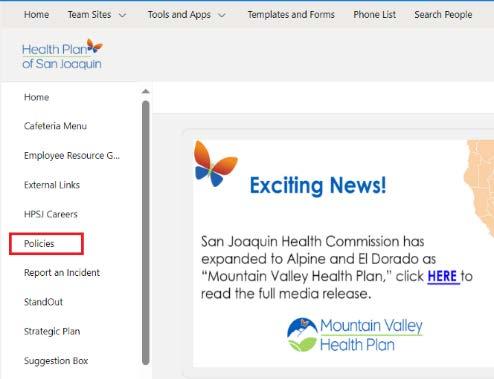
You can access all published policies directly via the Policies link on our Intranet. If you have any policy-related questions, please get in touch with the Policy Review Team at Policies@hpsj.com.

Stay Connected with Compliance!

Stay informed and updated with Compliance4U, a monthly newsletter focused on connecting and informing

Turn static files into dynamic content formats.

Create a flipbook
Compliance 4 U - Monthly Compliance Newsletter_20260301 by Health Plan of San Joaquin/Mountain Valley Health Plan - Issuu