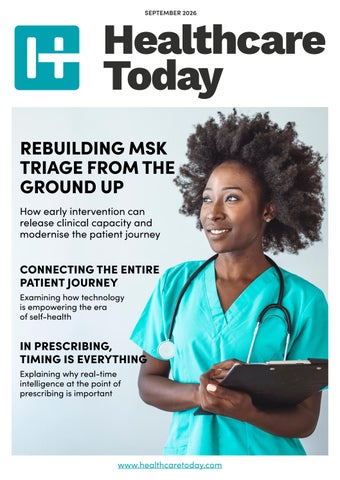
SEPTEMBER 2026
REBUILDING MSK TRIAGE FROM THE GROUND UP How early intervention can release clinical capacity and modernise the patient journey
CONNECTING THE ENTIRE PATIENT JOURNEY Examining how technology is empowering the era of self-health
IN PRESCRIBING, TIMING IS EVERYTHING Explaining why real-time intelligence at the point of prescribing is important
www.healthcaretoday.com
WELCOME
SEPTEMBER 2026
For EQL co-founder and chief medical officer Peter Grinsbergs, closing the inequality gap requires a fundamental rethink of how patients enter the healthcare system. This month, he talks to Healthcare Today about taking clinical cues from professional sport, dismantling digital exclusion in deprived communities and why modern healthcare cannot afford to leave patients waiting while letters sit in the post. Also in this issue, Christoph Lippuner, co-founder and chief executive of Semble, examines how technology is empowering the era of self-health; Kamya Elawadhi, co-founder and president of Doceree, explains why real-time intelligence at the point of prescribing is important; and much more...
28-31
38-39
We hope you enjoy! Tell us your news: Adrian Murdoch, Editor-in-Chief adrian.murdoch@healthcaretoday.com +44 (0)7983 407607 Katie Heslop, Senior Writer katie.heslop@healthcaretoday.com Glen Ferris, Managing Director glen.ferris@healthcaretoday.com +44 (0)7780 298825 To download a copy of our media pack, click here.
48-49
MHRA CALLS FOR REGULATION OF AI IN HEALTHCARE THE Medicines and Healthcare products Regulatory Agency (MHRA) has identified ten conclusions from its report on regulation of AI in healthcare. Following a call for evidence late last year, the MHRA has published Information on how AI is used in Health and the Current Regulatory Frameworks, collecting its findings to provide an evidence base on how AI is used in practice and its regulatory challenges. From the report, the MHRA has identified ten findings, including that there is a clear call for a proportionate, lifecycle-based approach to regulation and, crucially, that there is strong consensus for significant regulatory reform. It also found that there was broad consensus that AI systems will increasingly require continuous post-market surveillance and monitoring, and that that responsibility should be shared across the system, with each individual and institution understanding their essential role and responsibilities. Healthcare providers want a robust and clear governance structure/organisational responsibility, while the patient/ public wants the current gaps addressed. There is greater clarity and consistency in liability needed. Above all, human oversight and responsibility for clinical judgment should be retained, and transparency and explainability will be key for the ongoing deployment of AI systems. Data access and use are central to the role of AI in healthcare moving forward.
RADIOGRAPHE RACIST ABUSE F
R
acist abuse from patients towards radiographers has increased over the past 18 months, according to a new survey.
Some patients refuse to be treated by non-white staff or don’t acknowledge the worker carrying out the vital task, according to the Society of Radiographers (SoR).
To make sure that it all works and that patient and public trust is maintained, there is a need for robust training and improved AI literacy and, at the same time, that there is a need to improve incident reporting and learning mechanisms.
One radiographer was called “a monkey” by a patient, while others were referred to as “dirty foreigners”, the survey revealed.
“The increasing AI in healthcare will affect all of us,” said Alastair Denniston, chair of the National Commission into the Regulation of AI in Healthcare.
Paul Awah, a diagnostic radiographer from Bedfordshire who originally moved to the UK from Nigeria, said patients had questioned his ability to treat them because of the colour of his skin.
“These views consistently highlight the potential to bring many benefits, enhancing quality, speed, convenience and increasing safety, but also highlight that this is a change that the regulators and wider health system need to actively engage with, including ensuring that our regulations and governance systems match the risks and benefits of these new technologies.” 4
NEWS
Awah is experienced in cannulating patients and said colleagues often ask him to help with difficult procedures. But on three occasions, patients questioned whether he had done the procedure before, after a colleague had been unable to carry it out.
“I was stunned, somebody who how dare you b
Awah said he h claiming they c despite English speaks. The So racist incidents alongside a rise the country.
Matthew Hopki director at the N findings as “dee unacceptable”. committed to ta a tolerant and i acknowledging
The SoR has co develop new N published this m
PRIVATE HEALTHCARE USE RISES MORE people are turning to private healthcare, but many lack confidence in navigating their options or finding reliable information, a new survey has found. Nearly one in seven people (16%) used private healthcare in the past year, according to research by Healthwatch England. This is almost double the 9% recorded in 2023.
ERS REPORT RISE IN FROM PATIENTS by Katie Heslop, Senior Writer
accountable for tackling racism, violence and sexual harassment in the workplace.
,” he said. “They’re saying, ‘If o’s Caucasian has tried and failed, bring a black man now?’”
Now, SoR is calling on NHS trusts to record incidents of racism, monitor how they are dealt with and work with trade unions where necessary. There are currently no guidelines setting out what should happen after an incident of racism is recorded, according to SoR.
had also experienced people could not understand him, h being the only language he oR said its members believed s had become more prevalent e in anti-immigration rhetoric in
ins, acute and ambulance NHS Alliance, described the eply disturbing and absolutely He said NHS leaders were ackling racism and creating inclusive culture, while g that more needs to be done.
ollaborated with other unions to NHS staff standards, which were month. The standards hold trusts
It also wants the NHS to improve the way new radiographers and other staff are inducted, orientated and integrated, whether they have moved nationally or internationally. Around one in four radiographers registered with the Health and Care Professions Council trained overseas. Dean Rogers, executive director of industrial strategy and member relations at the SoR, said racist behaviour undermined patient care and called for “clear accountability” to ensure radiographers can work in a safe and inclusive environment.
Long NHS waits were the most common reason for going private, with 39% of people citing them as their main motivation. Meanwhile, separate research suggests many people would struggle to know where to start when looking into private healthcare. A survey of 2,000 UK adults by the Private Healthcare Information Network (PHIN) found that 28% of those who would research private healthcare before using it would not know where to start. Only 26% said they felt “very confident” organising and using private healthcare. PHIN said the growing use of private healthcare made it increasingly important for patients to have access to clear and reliable information about their choices. Ian Gargan, chief executive of PHIN, added that patients may have to make decisions about private healthcare “when they already feel unwell or are uncertain, and under pressure.” The organisation’s report found that patients need straightforward access to independent information to help them understand their options. PHIN is the government-mandated organisation responsible for collecting and publishing data on privately funded healthcare in the UK. NEWS
5
Trusted by Clinicians, Chosen by Patients Located in the Harley Street Health District, Pharmacierge supports over 4,500 GPs and Consultants with seamless, secure e-Prescribing apps tailored for private practitioners. With our state-of-the-art robotically enabled dispensary and nationwide delivery, we ensure your patients receive their medications promptly, while you prescribe with confidence - anytime, anywhere.
mPrescribe® Revolutionises private prescribing by allowing you to prescribe flexibly without a laptop, for delivery to your patients nationwide. Medication range Due to the range of specialists we support, we stock and source medication not typically found outside of a hospital setting, including refrigerated, controlled, injectable and biologic medication. Courier delivery We include same weekday delivery to London postcodes, or next weekday nationally as standard. International deliveries are also available.
"Your mobile app changed my life!"
— Dr Dominic Paviour, Consultant Neurologist
"Intuitive and secure."
— Dr Tim Wigmore, Consultant Intensivist & Anaesthetist
Join thousands of clinicians today. Download the app and register online www.pharmacierge.com/register
URGENT ACTION NEEDED TO IMPROVE UNDER-STRAIN GP SURGERIES IN WALES MORE than half of GPs in Wales say they are routinely unable to meet patient demand because years of severe underinvestment have left them struggling to cope. A new survey by the British Medical Association (BMA) Cymru Wales paints a bleak picture of conditions in GP surgeries, with excessive workloads impacting patient care and reduced services. Campaigners have long highlighted the need for further investment in GP surgeries in Wales. Between 2012 and September 2025, the number of practices decreased from 474 to 368, while at the same time the number of patients registered in Wales has increased by 148,233, nearly 5%. The annual BMA survey, of which 221 GPs took part, shows doctors under consistent pressure and having to make difficult decisions about the future of the surgeries. Some 54% described patient access as routinely inadequate in the face of demand. Meanwhile, 43% reported recruitment freezes, and 31% say they are deferring investment into the premises and IT facilities. In March, the Senedd Health and Social Care Committee’s report on the future of general practice said “bold action” was needed to ensure additional services could be delivered in surgeries, to ease pressure on hospitals. It also called for reliance on time-limited booking windows, known as the “8 am scramble”, to be reduced and continuity of care to be restored. The Plaid Cymru government, which came to power in May after defeating Welsh Labour, has since pledged to recruit up to 100 new salaried GPs as part of a £145 million package focused on bringing down NHS waiting lists and getting people diagnosed more quickly. Gareth Oelmann, chair of the BMA’s GP committee in Wales, says that in order for every patient to secure timely appointments, surgeries must be able to invest in staff and services. While the BMA shares the government’s ambition to deliver care closer to home, currently “demand is far outstripping capacity,” Oelmann added. Sustained investment would mean family doctors could plan for the long term, he said.
0207 631 1269 | 43A Wimpole St, London, W1G 8AQ pharmacist@pharmacierge.com
ONE IN FIVE WORLDWIDE SET TO DEVELOP CANCER
T
HE World Health Organization (WHO) has released its annual global status report on cancer. It explores how “highly inequitable” the “near universal” burden of cancer is and warns that individuals’ experience of the disease and chances of surviving now depend less on stage or biology and more on their location and economic circumstances. The 280-page document relied on new data to state that cancer will afflict one in five of us in our lifetime, with 20.6 million people worldwide receiving a diagnosis in 2024. The majority(19.5 million) were new cancer diagnoses, excluding nonmelanoma skin cancer, and affected 9.9 million men and 9.6 million women. Significantly, the number of new cancer diagnoses is expected to hit 35 million per year by 2050. But the WHO feels this “underplays the impacts of the global cancer burden”. Its new estimates of breast and childhood cancer survival paint a worrying image of global inequalities. In high-income countries, where
by Eleanor Philpotts, Senior Writer cancers are likelier to be diagnosed early, five-year net survival now exceeds 85%, but this dwindles below 45% in low-income countries. The report adds how cancer is increasingly driving premature death, being its leading cause in 2021, across 41 countries. Worryingly, just 12 countries are on track to meet the target of reducing premature cancer mortality by a third by 2030. Yet 48 countries are experiencing rising rates of premature deaths from cancer, linked to rising cancer burdens. The WHO pointed to gaps in the system, including “underinvestment in prevention and early detection programmes, persistent inequity in access to diagnostic tests and radiotherapy, insufficient skilled workforces and an imbalanced research agenda”. The WHO also conducted a global survey on the lived experience of people affected by cancer, looking into human, financial and societal impacts. It concluded that across all settings, cancer diagnoses often lead
to substantial hardship, including psychosocial burdens, disrupted emotional well-being, mental illness and financial hardship. Carers, too, felt the strain, such as through unpaid services, prolonged grief and social isolation. Schemes such as tobacco control have been successful, with the WHO Framework Convention for Tobacco Control contributing to a 27% reduction in the prevalence of tobacco use since 2010, but more still needs to be done. In a similar vein, coverage with the first dose of the human papillomavirus vaccine among girls in the 85% of countries that have the programme is now around 31%. This is an improvement from the 17% reported in 2019, but it is still some distance from the target of 90% by 2030. The WHO also noted a “spending paradox” where technologies and treatments receive attention and financing, but survivorship and palliative care don’t. It will continue to flag the inequities faced by too many of those diagnosed with any form of cancer. NEWS
7
NEIGHBOURHOOD HEALTH MODELS CAN IMPROVE CHILDREN’S WELLBEING MORE than one in five children are obese by the time they leave primary school, Barnardo’s has warned, as it calls on the government to create a child health action plan. Labour’s much-vaunted ambitions for more people to be treated in their neighbourhood with joined-up care must be designed around the needs of young people, the charity says, with the focus on prevention. A new report from Barnardo’s argues that children’s health is shaped long before they see a GP or go to hospital, with poverty, housing insecurity and chronic stress all major influences. Tooth decay is the leading cause of hospital admissions among young children despite being entirely preventable, and one in five people between eight and 25 have a probable mental health condition. The report urges the government to make prevention and tackling inequalities the measure of success
for its neighbourhood health framework. Barnardo’s wants to see “truly” integrated local services and has pointed to its Family Focus programme to illustrate how this could work. Working with Modality Partnership, the charity has placed wellbeing workers in five GP practices in Birmingham and Smethwick. Once referred by a doctor, the wellbeing workers can provide support with issues such as domestic violence, housing or special educational needs.
and being placed in temporary accommodation which was an hour from the child’s school. By providing practical support, these workers address the root causes of ill health beyond the scope of GP consultations, Barnardo’s said. Barnardo’s chief executive Lynn Perry said that children’s health is “inseparable from their families, schools and communities,” and if services do not take all this into consideration, attempts to prevent poor health cannot be successful.
Aimee McGuinness, a wellbeing worker, was able to help a family with their housing issues after a parent went to the GP complaining of breathing problems. It then turned out that the family lived in a house with mould that the landlord was refusing to fix.
A child health action plan should set out the role of neighbourhood centres, outline the functions of different government departments and align national and regional delivery, as well as creating a consistent framework for measuring progress.
In another example, a family was helped to access financial support and a more secure and suitable home after fleeing domestic violence
This, Perry said, will help create a system that “allows every child to feel safer, happier and healthier” after being let down for too long.
NO YOUNG WOMAN HAS DIED OF CERVICAL CANCER IN ENGLAND IN THE 2020s
T
THANKS to the human papillomavirus vaccine, no woman in her 20s has died in England this decade of cervical cancer. The promising reduction in deaths from cervical cancer across England in the most recently recorded five-year period is because of the human papillomavirus (HPV) vaccine having been rolled out in schools. Around 90% of women in England in their 20s received the HPV vaccine, usually aged around 12 or 13, when it offers strongest protection. Now, a study has shone a light on its encouraging impact years down the line. Cancer Research UK took the lead in uncovering the link between HPV and cervical cancer 25 years ago, as well as developing the vaccine. HPV can infect the skin and cells lining the inside of the body. Most people will have it at some point and clear the infection from their body. But some high-risk HPV types can cause cancer if they stay present for a long
by Eleanor Philpotts, Senior Writer time. It’s now known that almost all cervical cancer cases are caused by HPV. The vaccine helps to prevent cervical cancer by protecting against HPV, tricking the body into thinking it has been exposed to the virus. Then, the immune system produces antibodies to fight against it. If the body is exposed to HPV again in future, the immune system can quickly recognise it and produce the correct antibodies, making it quicker and easier for the body to clear HPV.
Around 200 cervical cancer deaths have been prevented so far in England, but it’s still early days and many more are set to follow. For example, Wales and Scotland join England in ambitions to eliminate cervical cancer as a public health problem by 2040. This is in line with the World Health Organisation’s wider global goal, which includes 90% of girls in the UK being vaccinated before turning 15. But to achieve this, more people will need to receive the vaccine. Nationwide, the current figure is 7686% of girls who aren’t yet 15.
The UK introduced the HPV vaccination programme in 2008, and it’s now offered to boys and girls aged between 11 and 13, and in schools, delivered by NHS teams.
“It’s incredible to think that a single jab can almost eliminate a particular type of cancer, and this new research shows just how vital it is to keep HPV vaccination levels high so more people are protected,” commented lead researcher Peter Sasieni.
Women and girls, plus boys born after 2006, can also get the vaccine free at their GP if they didn’t get it at school, until they’re 25.
Cancer Research UK is working to make vaccines more accessible, including by dispelling myths that encourage vaccine hesitancy. NEWS
9
Providing first class medical consulting and therapy rooms at prime locations in Central London and Liverpool London tenharleystreet.co.uk 020 7467 8300 Liverpool eightyeightrodneystreet.co.uk 0151 709 7066
er-ad-60x100.indd 1
ENCOURA ALZHEIME
A
BLOOD test for Alzheimer’s disease biomarkers looks set to strengthen diagnostic accuracy among specialists and primary care doctors, according to a first-of-its-kind study.
The research centred on more than 1,300 patients with mild cognitive 13/10/2016 11:08 impairment or dementia, based in Sweden, and 165 doctors. It saw a head-to-head comparison after reviewing blood test results. In this, the primary care doctors and specialists both had a diagnostic accuracy of around 90%. For those in primary care, the test was most useful to rule out Alzheimer’s. The real-world study’s data was revealed at the Alzheimer’s Association International Conference 2026 in London in July. It had measured amyloid beta and phosphorylated tau, abnormal brain proteins linked to Alzheimer’s. After seeing the blood test results, doctors changed their diagnosis in about a third of their patients, also altering their plans for future care and exams for more than half of the patients.
by Eleanor Philpott Senior Writer
The patients seen in primary were also independently ass dementia specialists.
The test is more useful for ru Alzheimer’s than diagnosing primary care doctors tend to patients for specialist confirm
Current Alzheimer’s diagnos includes specialist PET scan spinal fluid analysis, but thes often expensive and only ava memory clinics.
“It’s important to remember t blood tests are designed spe to detect Alzheimer’s, so pati negative results may still hav neurological conditions and be suitable for referral to a sp for further evaluation,” added Sebastian Palmqvist, study lead and associate professor neurology at Lund University Sweden.
Palmqvist also announced th outcome of a study on the eff Alzheimer’s blood-based bio
AGING NEW ER’S FINDINGS
ts,
y care sessed by
uling out g it as o send mation.
sis ns and se are ailable in
that these ecifically ients with ve other may still pecialist d
r of y,
he ffects of omarkers
on diagnosis and clinical management in secondary and primary care. Blood-based biomarkers for Alzheimer’s accurately detect pathology but still have an unclear impact on real-world clinical decisionmaking. So, his team assessed changes in diagnosis and clinical management for patients with cognitive impairment before and after their blood-based biomarker results were revealed to doctors in both primary and secondary care. They analysed plasma prospectively using an algorithm called PrecivityAD2 and applied a two-cutoff model, classifying results as negative, intermediate or positive. Doctors then completed questionnaires before and after the blood-based biomarkers test disclosure. This found that in secondary care, dementia experts changed their diagnosis in 21.6% of patients after the test disclosure. Diagnostic accuracy for Alzheimer’s increased from 74% to 89%, and doctors’ readiness to make an immediate clinical diagnosis increased from 0.8% before to 11.5% after test disclosure in blood-based biomarkers-negative cases and
from 1.9% to 55.4% in blood-based biomarkers-positive cases. Test disclosure also led to changes in clinical management in 49.2% of cases. In primary care, diagnosis changed in 30.0% of patients. Accuracy for Alzheimer’s diagnosis increased from 65% to 93%, while readiness to make an immediate clinical diagnosis didn’t increase in blood-based biomarkerpositive cases, whereas blood-based biomarker-negative results brought an increase from 12.9% to 25.0%. Changes in clinical management occurred in 55.9% of cases. This showed how accessing a high-performing blood test substantially improves diagnostic accuracy for Alzheimer’s and leads to meaningful changes in clinical management in both primary and secondary care. Primary care doctors appear more confident using blood-based biomarker tests to rule out Alzheimer’s, whereas dementia experts also use them to support Alzheimer’s diagnosis. Finally, the UK has taken a stride towards new dementia treatments with the launch of the BARBARA Alliance, an initiative to improve dementia research. The nationwide
platform will connect patients with clinical trials and aim to accelerate discoveries in the field. BARBARA stands for the Brain Ageing Registry for Biomarkers, Access to trials, Research and Adoption, while the government also commissioned the Dame Barbara Windsor Dementia Goals Programme in 2022 to develop and deliver new treatments. The launch of the BARBARA Alliance is backed by the publication of a report, which sets out a roadmap for how the UK can become a global leader in dementia research and treatment. The alliance will connect commercial Life Sciences companies, health foundations, charities, academics and national health systems. It will be chaired by former Department of Health and Social Care minister Lord James Bethell and encourage innovations in biomarkers, clinical trials and data on innovative technologies, such as by advancing blood-based biomarkers. It is the latest in a series of encouraging developments within Alzheimer’s detection. NEWS
11
APPRENTICESHIPS LAUNCHED TO SUPPORT NHS NON-CLINICAL WORKFORCE
SCIENTISTS INVESTIGATE HOW NHS CAN CUT CARBON FOOTPRINT
A UNIVERSITY has launched new apprenticeship programmes aimed at supporting non-clinical roles across the NHS and wider health and care sector.
SCIENTISTS are to investigate how the NHS can cut the environmental impact of gas and air used by women during labour. The research will look at ways to reduce leaks and clinical waste linked to gas and air, while ensuring women continue to have access to effective pain relief during childbirth.
Arden, a private university with campuses throughout the UK, has introduced Level 3 and Level 4 courses in business administration, human resources, project management and sustainability, with the first intake planned for November 2026. The schemes have been launched as healthcare organisations adapt to changes in government apprenticeship funding. The reforms have removed levy funding for some management apprenticeship standards, with the government aiming to focus investment on younger learners and entry-level training.
Led by Lancaster University, the study is one of five projects to have received funding from the National Institute for Health and Care Research (NIHR) under a new £25 million programme to make health and social care more sustainable.
Arden says the courses have been designed to help health and care organisations build the skills needed to improve services and respond to changing demands on staff, including the use of AI and new digital tools.
The NIHR has committed £5 million to the first round of projects, with further funding rounds planned over the next five years.
The NHS 10 Year Health Plan, published last year, makes clear that the role of AI within the health service is set to expand, and will be used to reduce administrative workloads, automate routine tasks and support staff with clinical documentation. Steven Hurst, director of corporate learning at Arden University, says that changes to apprenticeship funding have prompted organisations to reconsider how they invest in staff development. “Learners will be able to apply their learning directly in the workplace to deliver meaningful organisational impact and help to deliver world-class healthcare across the UK,” he added. 12
NEWS
Researchers will work with NHS staff and patients to develop national guidance for hospitals. They will also create a practical guide to help maternity services reduce waste. Gas and air, known medically as nitrous oxide, is widely used across the NHS and is a significant contributor to healthcare emissions. Researchers say reducing unnecessary leaks could help lower the NHS’s carbon footprint without affecting patient care. In December last year alone, the emissions from gas and air in the NHS in England were equivalent to 12,622 tonnes of carbon dioxide.
Other studies focus on reducing waste and improving efficiency across the health and care system. One project, led by the University of Sheffield, will explore whether the environmental impact of medicines could be considered when assessing new treatments. The aim is to encourage pharmaceutical companies to reduce waste and improve value for money. Meanwhile, researchers at The Clatterbridge Cancer Centre NHS Foundation Trust are developing sustainable packaging that could allow unopened, high-cost medicines, including cancer treatments, to be safely reused. Another Lancaster University project will examine whether virtual wards can help reduce emissions by allowing more patients to receive treatment at home rather than in hospital. A fifth study, led by the London School of Hygiene & Tropical Medicine, will look at how adult social care services can become more energy efficient by shifting support from hospitals into homes and communities. Sophia Lentzos, NIHR’s head of climate, health and sustainability, said watching the studies get underway is a “hugely important milestone”. She added reducing environmental impact through cutting waste and “using resources wisely” is a top priority for the institute.
ONE IN FIVE MOTHERS ATTEND A&E IN THE YEAR AFTER GIVING BIRTH
A
ROUND one in five mothers attend A&E in the year after they give birth, a report from the Nuffield Trust shows. Black women, those from the most deprived areas and mothers with mental health conditions are among those more likely to receive emergency care than average. Researchers examined which groups are most likely to face health complications during the post-partum period. Using NHS data, they looked at about 1.6 million births that occurred between April 2021 and March 2024, which equates to about 1.5 million people having babies. Many of the emergency hospital trips happened in the very early stages of motherhood. One in ten occurred in the first two weeks after birth and almost a quarter within the first six weeks. The three most recorded reasons were abdominal pain, chest pain and bleeding from the vagina. However, no reasons were recorded for 21% of visits, which report lead, Sarah Scobie, described as “appalling” and a clear area of improvement for the NHS to understand the health of new mothers better.
by Katie Heslop, Senior Writer Women of black ethnicities were more likely than average to go to hospital in an emergency when their babies were less than a year old. For example, 27% of black Caribbean, 26% of black African and 28% of mothers of ‘any other’ black ethnicity had an emergency care visit. That’s compared with 23% of white British, 22% of white Irish and 19% of mothers with ‘other’ white ethnicities. Meanwhile, emergency care visits followed 27% of deliveries in the most deprived areas and became less frequent as deprivation fell. And in nearly 70% of deliveries, mothers had at least one pre-existing health condition, many of which, such as obesity and diabetes, are potentially preventable. Researchers also noted that 30% of mothers with a mental health condition visited A&E, compared with 19% of those without one. Most visits did not result in admission, suggesting some could have been avoided with better support in the community. The recent Amos Review into maternity and neonatal services highlighted the inequalities faced
by women during pregnancy, particularly black women, with racism and discrimination embedded in the system. The report shows that “health inequalities follow women into the next phase of motherhood,” Scobie, deputy director of research at Nuffield Trust, said. Scobie urged policymakers and NHS leaders to examine whether post-birth A&E visits could be avoided with better community care and improved preventative support well before birth. Strategies to improve the health of girls and women must be prioritised alongside addressing the failures in maternity care, report co-author Veena Raleigh, who is a senior fellow at the King’s Fund, said. Raleigh argued that “adverse maternal outcomes” are strongly associated with conditions that are preventable, such as obesity and hypertension, and are more common among deprived and some ethnic minority communities. “Girls and women from these communities are at risk even before they embark on pregnancy,” Raleigh said. NEWS
13
NHS ILL HEALTH RETIREMENT APPLICATIONS HAVE JUMPED OVER PAST FIVE YEARS THERE has been a steep rise in ill health retirement applications across the NHS, in the face of mounting workforce pressures. Their increase of 43% since 2021/22 means a rise of around 1,000 more NHS staff applying for these reasons each year. Most applications are successful, new Freedom of Information data from the NHS Business Services Authority has revealed. The data, obtained by financial advisors Wesleyan, shows there were 2,132 applications in 2021/22, but 3,062 by 2025/26. Ill health retirement allows NHS Pension Scheme members who become permanently incapable of carrying out their role because of illness or disability to access their pension before normal retirement age, without the usual early retirement reductions. In recent years, more applications have been approved than previously, across both Tier 1, where people are permanently unable to continue in their NHS role but may still be capable of other work, and Tier 2, where someone is considered permanently unable to undertake any regular employment before pension age. Tier 2 awards made up most of 2025/26’s successful outcomes. The data doesn’t go into why employees are applying for ill health retirement, but comes amid ongoing issues around workforce pressures, doctors’ burnout and reduced hours due to poor health. “A 43% increase in applications over four years is a significant rise. While the data itself can’t tell us exactly what’s behind it, it reflects what we’re seeing day to day, with increasing levels of burnout across the NHS,” said Wilf Moralee, chartered financial planner at Wesleyan. There are also likely to be many more healthcare professionals suffering similarly but not formally applying, perhaps already on long-term sick leave and unaware of the scheme, or wrongly assuming they won’t be eligible. Burnout spiked in the Covid-19 pandemic across the NHS, but has remained high in the years since. 14
NEWS
RCP EXPRES AUTOMATED
T
by Adrian Murdoch, Editor-in-Chief
HE Royal College of Physicians (RCP) has expresse the UK government’s announcement that the Med products Regulatory Agency (MHRA) will not class technologies (AVTs) used in healthcare as medical
“We are concerned that not including all automated voice te settings from the medical device framework risks creating ga when these tools have the potential to influence decisions ab RCP clinical digital health lead Anne Kinderlerer. “If an AI-ge omits clinically relevant information or introduces errors, the extend far beyond simple notetaking.”
New guidance from the MHRA has clarified that AVTs intende for transcription, summarising clinical conversations, drafting suggesting clinical codes for clinician review” are not regulat devices under the current framework, and that this will not c
This is a departure from previous NHS guidance, under whic needed to hold MHRA Class I medical device registration to b on the NHS-approved AVT self-certified supplier registry.
AVTs are increasingly being used across the NHS to record, tr and summarise clinical consultations. However, these tools d provide voice transcription. They use generative AI to identify and prioritise information, determining what is important en include in a summary. In this sense, they function as inferenc applying automated judgements about relevance, significan meaning that can influence clinical decision-making.
The RCP has consistently called for smarter regulation that s innovation and rapid adoption while increasing clinician and confidence in these technologies. By not including all AVTs us in the medical device regulatory framework, this could weak technologies that provide clinical decision support, making it and respond to risks.
In addition, where an AVT produces inaccurate documentatio information or contributes to patient harm, responsibility will individual clinicians and trusts, rather than being shared with framework.
The new guidance places significant weight on the stated int manufacturers when determining whether a product is regu device. This could create a scenario where similar technolog differently depending on how they are marketed, rather than clinical practice.
SSES CONCERN OVER D VOICE TECHNOLOGIES
ed concern following dicines and Healthcare sify all automated voice l devices.
echnologies in healthcare aps in oversight at a time bout patient care,” said enerated summary e consequences can
ed “solely g letters or ted as medical change.
ch suppliers be included
ranscribe do not simply y, interpret nough to ce machines, nce and
supports d patient sed in healthcare ken oversight of t harder to identify
on, omits relevant l fall more heavily on hin a regulated device
tended purpose of ulated as a medical gies may be regulated n how they function in
NEWS
15
ELDERLY MORE LIKELY TO ENDURE 12-HOUR WAITS IN A&E
T
HE elderly are bearing the brunt of the ongoing crisis in A&E, enduring long waits more often than young people, new research shows. Last year, 43% of those aged over 80 faced waits of more than 12 hours between arrival in the emergency department and admission to a ward, compared with 19% of those aged 2130, according to analysis carried out by health think tank Nuffield Trust. The analysis also found that some health conditions are much more likely to lead to longer delays than others, such as breathing, gastrointestinal and neurological issues. During the study, carried out as part of the QualityWatch programme, with funding from the Health Foundation, researchers examined how such long waits and so-called corridor care became the norm, and who is most affected. In March, NHS England formally defined corridor care as when patients spend more than 45 minutes
by Katie Heslop, Senior Writer being treated in inappropriate settings, either in A&E or on a ward. Although corridors are the most typical example, patients have reported being seen in car parks and side rooms. And starting this summer, data is now routinely published showing how often this is happening. In June, there were 72,955 cases of patients enduring corridor care, which is equivalent to 5% of A&E attendances.
preventative social care could avoid some hospital admissions entirely, they said. The evidence is clear that we need improvements in how patients “flow through hospitals after A&E,” said Nuffield Trust deputy director of research, Sarah Scobie, describing it as “absolutely shocking” that two-fifths of the most elderly patients wait more than 12 hours to be admitted. Better access to health and social care services outside of hospital is needed to bring about a “sustained reduction” in long A&E waiting times, added Scobie.
However, researchers warned that over-emphasising corridor care and its elimination could have unintended consequences, such as staff delaying the handover of patients from ambulances to reduce the numbers in A&E.
The findings come as new prime minister Andy Burnham announced he would address the social care crisis, adding there would be “difficult decisions” on funding but he was determined to “get it right”.
And for too long, policies aimed at fixing long waits have been focused on what goes on in A&E, the report’s authors argued. Poor access to social care services and a low number of hospital beds are major factors. Further, more consistent investment in
His plans include more pay and better training for care workers and closer integration with the NHS. He also announced that a review of social care by Louise Casey, Baroness Casey of Blackstock, would be published next summer, instead of 2028. NEWS
17
CALLS FOR CARING FOCUS ON LEARNING DISABLED PATIENTS THE government is being urged to create a dedicated NHS programme for people with learning disabilities as campaigners warn they risk being left behind. More than 1,200 people have signed an open letter to new prime minister Andy Burnham, highlighting persistent health inequalities faced by people with learning disabilities. This comes as sweeping changes are being introduced in the NHS. The 10 Year Health Plan promises more care in the community and away from hospitals, a greater emphasis on technology to reduce administrative work and priority given to preventative medicine. However, campaigners say that with no national strategy focused on learning disabilities, people fear falling through the gaps. The letter, coordinated by Learning Disability England, highlights a series of long-standing concerns, including lower life expectancy, preventable 18
NEWS
deaths and barriers to accessing healthcare. More than half of adults with learning disabilities die before the age of 65, according to the Learning Disabilities Mortality Review. The report, commissioned by NHS England, looked at deaths recorded between 2021 and 2024 and found those with learning disabilities died, on average, 19 years younger than the general population. The proportion of avoidable deaths resulting from treatable conditions such as epilepsy and pneumonia had declined from 46% in 2021 to 39% in 2024 but was almost double that of the general adult population. In response, then-health minister Preet Kaur Gill said the findings were “unacceptable”, and the government is “committed to improving outcomes” through early intervention and more training. Meanwhile, a recent Royal College of Nursing review found the number of learning disability nurses
employed by the NHS had fallen by a third, from 7,083 in 2009 to 4,768 in 2025. People with learning disabilities are overlooked when it comes to health planning, said Mary Woodall, a member of Learning Disability England’s representative body, and part of the delegation that delivered the letter to Downing Street last month. Signatories, including family members and support organisations, said the national strategy should be co-led by a person with learning disabilities and produced with those who have “lived experience”. Campaigners said recent progress, including new guidance introduced under the Mental Health Act and the Down Syndrome Act, must be supported by a national programme to deliver lasting improvements. The letter serves as a reminder that people with learning disabilities “deserve the same chance to live healthy, fulfilling lives as everyone else,” Woodall added.
RURAL GP CLOSURES PUTTING VULNERABLE PATIENTS AT RISK
R
URAL GP closures are putting vulnerable patients at risk and leaving communities without easy access to primary care, doctors have warned. The British Medical Association (BMA) says patients in remote areas are being left behind as GP practices continue to close, forcing some people to travel miles for appointments and placing additional strain on neighbouring surgeries. Since 2015, 1,474 GP practices in England have closed or merged, leaving 6,149 remaining. Over the same period, the number of full-time equivalent GPs has fallen by 356 despite growing patient demand. The warning follows the closure of Reeth Medical Centre in North Yorkshire in May, which left 1,600 patients in the lurch. The surgery’s GP partner retired after 18 years, but the Integrated Care Board (ICB) could not find a replacement.
by Katie Heslop, Senior Writer Unable to keep the surgery open, the ICB proposed transferring patients to neighbouring practices, including Central Dales Practice, based 14 miles away. Due to the distance and poor public transport, however, many patients were left “stuck”, said Jonathan Pain, lead partner at Central Dales, which has now set up a temporary branch at the Reeth site. Already one GP down, taking on so many additional patients was a “stretch”, he added, with help needed from the ICB.
closure of facilities and services, such as schools, banks and post offices, making the areas less attractive places to live, the BMA says. Losing a GP is a “crisis” for patients in rural areas, who tend to be older, have more complex needs and may struggle to travel, said Brian McGregor, North Yorkshire member of the BMA’s GP committee. Meanwhile, the closure of nearby health services has shifted the burden onto GPs, stretching “their capacity to meet an unmanageable demand”, McGregor added.
Proper planning must be in place to prevent this from happening again, Pain said, “not just for doctors who are overstretched, but for patients who rely on their GP being close by.”
He said that GP funding needs to be redesigned with rural practices in mind, as they don’t receive the same amount of money as centres in urban areas, despite their “unique pressures”.
While a fifth of GPs work in rural areas, many practices struggle to recruit and retain doctors, with the
Proper funding, he added, would help practices employ enough GPs to avoid potential closures. NEWS
19
The care that Julia’s House children’s hospice provides is life-changing for us. Zoe, Mum of Ted
Support Julia’s House children’s hospice
juliashouse.org/HealthcareToday Registered Charity No. 1067125
PRIVATE SECTOR GROWTH ACCELERATES INSURED healthcare reached new heights in the second quarter of 2026, data from private technology firm Healthcode has revealed. Private invoice volumes grew by nearly 8% year-on-year, beating their growth of almost 7% in the first quarter. Meanwhile, Healthcode, as the UK’s official clearing organisation, processed 3.2 million invoices for private healthcare providers over this three-month period, totalling £1.5 billion. It was also the second consecutive quarter where invoice volumes exceeded 1 million in each month, meaning the total for the year so far sits at 6.3 million. The majority came from outpatient care – up 8.5% compared with last year. However, admitted care also grew by 2.7%, with an increase in day cases of 3.8% year-on-year. Despite this, inpatient invoice volumes were down slightly. More than 70% of doctors, practices and clinics use Healthcode’s Clearing Service to charge for insured patients. Data is also broken down into settings, specialities and regions. Most private invoices processed by Healthcode in this period came from non-hospital sources such as clinics, private practices and practitioners. Orthopaedics remained the largest hospital speciality, with 191,000 invoices, while pathology/ haematology saw the largest yearon-year fall of 7.9% and radiology, which is suffering particular workforce issues, continued to bounce back from a quiet 2025 with 151,000 invoices, meaning year-onyear growth of 30.2%.
STAFF SHORTAGES AND BURNOUT CONTINUE TO IMPACT DOCTOR TRAINING
S
by Katie Heslop, Senior Writer
TAFF shortages continue to impact doctor training, a survey from the General Medical Council (GMC) has found.
The GMC spoke to more than 51,000 trainees and nearly 23,000 trainers, discovering that burnout and rota gaps remain a problem. More than a quarter of resident doctors are unable to use their training time as intended, while one in three hospital doctors who are trainers said gaps in rotas go unaddressed, putting pressure on staff. Fatigue continues to be a persistent issue, with six in ten resident doctors at moderate or high risk of burnout, and one in five saying their working pattern leaves them short of sleep on a daily or weekly basis. The report noted a “small but real increase” in the number of trainee doctors reporting unwelcome sexual conduct on a daily or weekly basis. Trainers are under pressure too, with nearly half also at risk of burnout. Those teaching GPs were at the highest risk of moderate burnout. Despite this, nine out of ten said they enjoyed their role and the survey found that access to teaching time had improved in some areas. However, goodwill stretches only so far in an understaffed NHS, British Medical Association (BMA) deputy chair Emma Runswick warned, adding that recent attempts to cut consultant pay for that type of work will only make things worse. Staff shortages and workplace cultures “are holding back trainers and trainees alike,” Runswick said, adding that doctors deserve to work in environments that are safe, not just survivable. The GMC did note some positives. For example, for the second year running, more than three-quarters of trainees rated the quality of their teaching as good or very good. There were also early signs of improvement in risk of burnout and reporting of discrimination, the GMC said, while acknowledging that experiences vary at different sites. The council urged employers, educators and healthcare organisations to act on the findings, arguing that every doctor, regardless of where they work, should have access to high-quality training that supports their development and wellbeing. NEWS
21
UK LIFE SCIENCE SECTOR ATTRACTS £3BN INVESTMENT
T
HE UK life sciences sector has attracted more than £3 billion in new public and private investment in just 12 months, in the latest attempt to secure the country as a global leader in the science, innovation and health ecosystem. The financial win, announced before Andy Burnham took over as the new prime minister, will mean patients nationwide can benefit from new drugs, including the world’s first-ever immunotherapy for Type 1 diabetes, and faster access to lifesaving medicines. The finances also contribute to ambitions to support 66,000 additional roles in the sector across the country by 2035. Within an NHS shouldering significant waiting times, it was promising that the overall
by Eleanor Philpotts, Senior Writer
average waiting time to set up clinical trials dropped from 169 to 122 days in the first half of 2025 to 2026. Patients are also expected to access new medicines up to six months sooner under the new joint approval process between the Medicines and Healthcare products Regulatory Agency and the National Institute for Health and Care Excellence. Private companies have contributed greatly, from a £300 million backing from AstraZeneca to support operations in Cambridge and Macclesfield using artificial intelligence to discover new drugs, to Moderna opening an innovation centre in Oxfordshire with a £1 billion UK research and development investment
commitment spanning the next decade. Keir Starmer’s government also updated its Life Sciences Sector Plan earlier this month to outline plans for the UK to gain the title of the third largest life sciences economy in the world by 2035. “In its first year, our Life Sciences Sector Plan is delivering cuttingedge treatments to tackle cancer, new opportunities for British businesses to start up and grow and well-paid jobs that improve lives for families,” said then-science, innovation and technology secretary Liz Kendall. The life sciences sector is also generating around £147 billion in annual turnover and employing 360,000 people, almost half of whom are based outside of London, the East and South East of England.
WORLD-FIRST CARBON-FRIENDLY INHALER APPROVED THE Medicines and Healthcare products Regulatory Agency (MHRA) has approved the first pressurised metered-dose inhaler (pMDI) that contains a next-generation low Global Warming Potential propellant. The revised type, Clenil Modulite, is manufactured by Cheisi and has been approved for both 100mcg and 200mcg formats. It contains beclometasone dipropionate for maintenance treatment of asthma in adults and children. The aim is for it to significantly lower carbon footprints while maintaining the clinical benefits, familiarity and usability that
healthcare professionals and patients see in the current versions of Clenil Modulite. These remain available at present.
The UK is the first country to approve the product, showcasing some commitment to consider the environment within respiratory care.
This is the first approval featuring the propellant HFA-152a, which isn’t an active medicine itself, but is used to deliver the inhaled dose. These new versions will become available to UK patients later this year.
“This approval… demonstrates how innovation can support both patient care and environmental sustainability while maintaining the high standards of quality, safety and effectiveness patients expect,” said Julian Beach, executive director of healthcare quality and access at the MHRA.
pMDIs are the most widely used type of inhaler device in the UK, accounting for around 70% of the 60 million prescribed yearly. However, they also contribute to 3% of the NHS’ total carbon footprint.
Chiesi also intends to be named the first pharmaceutical company to achieve Net Zero greenhouse gas emissions across its entire value chain by 2035, a decade ahead of the NHS’ own target. NEWS
23
ONE IN SEVEN ARE USING AI INSTEAD OF A GP
ONE in seven people in the UK have used AI for health advice instead of contacting a GP, according to a new study. The research, by King’s College London, also found that one in five people who sought health advice from a chatbot said it did not encourage them to seek a professional opinion.
Her comments come as OpenAI reports that health-related queries account for around five per cent of all chatbot conversations globally, with one in four of ChatGPT’s 800 million regular users submitting a health prompt every week.
The findings, one healthcare technology leader said, show that debates about whether patients should use AI at all are now “futile”.
Doctify, which allows patients to search for and review healthcare providers, has seen a 680% year-onyear increase in traffic arriving on its platform directly from AI-generated searches.
Instead, the focus should be on ensuring the information powering AI is accurate and trustworthy, said Stephanie Eltz, a former NHS surgeon and chief executive of healthcare platform Doctify.
This reflects a shift away from traditional search engines, as patients increasingly use conversational AI to explore symptoms, treatments and healthcare providers.
The “infrastructure and information” needed to generate responses without compromising safety must be prioritised, Eltz added.
Eltz said the technology industry must ensure AI systems rely on verified, evidence-based information rather than unverified online content,
24
NEWS
while also guiding and encouraging patients to see a doctor. The King’s College researchers said the growing use of AI for health advice underlines the need to ensure people continue to access professional medical care when it is needed.
The study was conducted by King’s Health Partners, Responsible AI UK and the Policy Institute at King’s College London. The findings are based on answers from a survey of nearly 2,100 adults, which took place in March. The most common reasons people gave for using AI chatbots for health advice were convenience, curiosity and uncertainty about whether their concern was serious enough to contact a GP. A quarter said they did so because they were waiting too long for NHS services.
FIGHT TO END RATIONING OF CONTINENCE PADS RECEIVES BOOST FROM GOVERNMENT
T
HE fight to end the rationing of continence pads in hospitals has received a boost from the government.
Some NHS Trusts distribute hygiene products based on “arbitrary limits”, leaving family members or patients with no choice but to pay for extra pads, campaigners say. Now, the department of health and social care has reminded hospitals to meet the clinical needs of those suffering with incontinence and prioritise safe and “effective” care. It comes after a written parliamentary question from Mohammed Yasin, the Labour MP for Bedford, who asked what steps ministers were taking to ensure NHS trusts comply with national guidance when determining which products are most appropriate for patients. Replying, Preet Kaur Gill, then parliamentary under-secretary of state, said the department expects “services” to follow guidelines and standards set out by the National Institute for Health and Care Excellence (NICE) and the Royal College of Nursing (RCN).
by Katie Heslop, Senior Writer NICE advises that products should be distributed based on specific needs, rather than policies or budgets. Yasin, a member of the adult social care cross-party group, described the response as a “welcome step”, and called for the principle to be applied consistently across every NHS trust. Access to the correct products should never be determined by “arbitrary limits or local cost-cutting measures,” he added. The intervention follows the launch of the End the Pad Gap campaign, which has warned that people living with incontinence are being left without enough products to remain dry, healthy, and independent. The campaign is backed by organisations including the RCN, Prostate Cancer UK, Bladder & Bowel UK, Dementia Carers Count, and Essity, which supplies pads to the NHS. Earlier this year, freedom of information data provided by 110 NHS
trusts showed that more than half (53%) have a cap on the availability of products. Of these trusts, 34% have a limit of three products a day, while the remainder have a cap of four products, the requests, submitted by Essity, reveal. Around 14 million people in the UK experience incontinence. In March, as reported by Healthcare Today, charities and MPs urged Louise Casey, Baroness Casey of Blackstock, to tackle the issue in her independent review of social care. They warned that those suffering with incontinence are being failed by a system driven by budgets. Writing for this publication, Tracey Whitehouse, service manager and adult specialist nurse at Bladder & Bowel UK, warned that when poorly managed, incontinence can lead to urinary tract infections, skin damage, avoidable hospital admissions and deep emotional distress. There is also a social element, she said, with people declining invitations and planning their days around rationed products. NEWS
25
LANDMARK NHS APPROVAL BRINGS NEW HOPE TO BLOOD CANCER PATIENTS
A
ROUND 200 patients a year nationwide, including young children, are set to benefit from newly approved drugs for rare blood cancers. NHS England has given the go-ahead to two cutting-edge treatments, to be offered when others have failed. The first, Dabrafenib, is a tablet treating histiocytic neoplasms, a group of rare, potentially fatal blood cancers. Without effective treatment, around a tenth of children with highrisk types of the disease die within a year of diagnosis, while 70% of adults will die within five years. The new treatment blocks proteins that help cancer cells grow, slowing or stopping the growth. Its approval will also mean patients can take the drug at home instead of in hospital. Meanwhile, children from the age of
by Eleanor Philpotts, Senior Writer eight who have Hodgkin Lymphoma that has relapsed or not responded to initial treatment are also set to benefit from a new drug combination. It will fuse Brentuximab, Vedotin and Bendamustine to target cancer cells more precisely, binding to a protein on cells’ surface and delivering a cancerkilling drug directly into it. Patients will receive this through intravenous drip. The combination can achieve high remission rates, is generally well tolerated and can help patients become well enough to receive a potentially life-saving stem cell transplant. For between 10% and 30% of patients – around 180 to 540 people – Hodgkin Lymphoma typically returns or doesn’t respond to standard treatment.
“This is a landmark moment for people with histiocytic neoplasms and Hodgkin Lymphoma, giving them access to new treatment options they might not otherwise have had. “For people living with the uncertainty of these rare cancers, these innovative therapies could offer something that can be hard to find – renewed hope – while allowing many patients to take their treatment at home instead of in hospital, so they can spend more time living their lives,” commented Peter Johnson, national clinical director for cancer at NHS England. The government is prioritising rare cancers’ treatments through its 10 Year Cancer Plan, while these rollouts were made possible by NHS England’s recently expanded Clinical Priorities Advisory Group. The team assess specialist medicines, medical devices and treatments by their benefits, clinical effectiveness and value for money. NEWS
27
PETER GRINB REBUILDING MSK TRIAGE FROM
M
USCULOSKELETAL (MSK) conditions account for one of the heaviest ongoing burdens on the National Health Service, consuming massive primary care capacity and driving up orthopaedic wait times across the country. Yet despite decades of clinical advances, access to early assessment and effective care pathways remains severely fragmented. It is dictated all too often by postcodes, socio-economic status and administrative delays. For EQL co-founder and chief medical officer Peter Grinsbergs, bridging this gap requires a fundamental rethink of how patients enter the healthcare system.
Here, he talks to Healthcare Today about taking clinical cues from professional sport, dismantling digital exclusion in deprived communities and why modern healthcare cannot afford to leave patients waiting while letters sit in the post. What does the AI triage tool assess, and how does it determine risk? I spent a number of years working in elite sport as a physiotherapist – specifically football – before I transitioned into healthtech. Throughout that journey, I was constantly struck by the stark contrast between elite sport and the real world. In professional football, the moment you watch a player get injured, you begin making a diagnosis. Within minutes, you are implementing a management strategy. That immediate intervention meant you could reliably predict a rapid recovery. 28
INTERVIEW
The co-founder and chief medical officer of EQL explains how data-driven triage, inclusive technology design, and early intervention can release clinical capacity and modernise the patient journey. Written by Adrian Murdoch. It was only after leaving that environment that I began to question why – even in private practice – it takes so long for ordinary people to achieve a favourable outcome. The key determinants of health weren’t that public injuries were inherently worse or harder to treat. Rather, recovery depended on access: how much money you had, where you lived, or who your insurance provider was. At its core, standard triage and assessment rely on a patient providing information about their condition to a clinician, who then interprets those responses using a fairly standardised format. Because the diagnostic questioning is largely systematic, technology presented an ideal solution to lower those barriers. How has the AI tool been validated? What evidence underpins it? The first stage of our process focused on standardising the intake experience. Initially, we gathered these established prediction rule sets and overlaid them with our own clinical subject-matter expertise. While academic literature provides a foundational framework, real-world patient cases rarely follow a textbook blueprint. We engage clinical experts to review the matrix, asking
whether the mapped outcomes align w their practical experience and sensechecking the overall structure to ensure its clinical validity.
A key differentiator and a fundamental principle for us is that every output is ultimately made available for clinical review. While this step does not slow down the initial routing of the patient to the right care option, it provides a vital safety net. This is particularly true for urgent or “red flag” outcomes. If the system flags that a patient should attend A&E based on a specific set of high-risk symptoms, the case is immediately escalated to a clinician within our team. They can then conduct a follow-up call to ensure the patient ha received the necessary advice and take appropriate action.
To date, we have completed approximately one million assessments. That volume of data continuously feeds back into our system, allowing us to refine and optimise how it operates. By pairing data-driven insights with a robu human-in-the-loop model, we ensure physical clinicians oversee outcomes an maintain exceptionally high standards of patient safety. This three-pronged approach – combining evidence-based guidelines, expert clinical oversight and continuous human validation –
BERGS: M THE GROUND UP
with
e
o
t as en
. s
ust
nd
d
guarantees we consistently deliver the right care pathways. How are you avoiding false positives or unnecessary anxiety for patients? What happens if there is a mistake, especially at these volumes? The reality is that you cannot entirely eliminate false positives in triage, but what you can minimise are false negatives. We always err on the side of caution. Over-referring a patient to a higher-urgency pathway is not necessarily a bad outcome, and it is a principle widely accepted across healthcare. If you call 111 or 999 with a concerning set of symptoms, the standard advice might be to attend A&E. A large percentage of the time, after a full evaluation, the emergency staff will reassure you that it isn’t serious. You could look at that outcome critically and argue that it was a wasted A&E visit driven by a false positive. In practice, however, safety-critical thresholds must be maintained. High-urgency pathways are intentionally designed with high sensitivity, which naturally leads to a degree of over-referral. No clinician would argue that sending a patient for emergency care was inappropriate when the presenting symptoms justified that precaution. As technology providers, our responsibility is to build in sufficient safety buffers. We deliberately set a lower threshold for triggering a false positive to ensure that potential risks are caught early. You cannot remove false positives altogether, but prioritising caution in this way remains the safest approach to clinical triage. INTERVIEW
29
How are you addressing digital exclusion? When developing technology or health services, one of the first questions you are invariably asked is, “Who is your target audience?” It can be tempting to reply that you are aiming at digitally literate individuals aged between 20 and 50. We took a fundamentally different approach. The prevalence of musculoskeletal (MSK) conditions skews towards older generations anyway, so we chose not to fall into that trap. Instead, we set out to build a platform that could serve everyone, across all demographics, from the outset. By design, accessibility was our priority, and we held ourselves accountable using real-world data. Through partnerships with the NHS, we put our model to the test. The local health service was struggling to engage ethnic minority populations effectively, so we collected demographic data during the triage process and benchmarked our reach directly against Office for National Statistics (ONS) data for the local area. The results showed that we were actually over-representing minority groups. When we analysed why this was happening, a clear pattern emerged: interacting with a digital platform appeared to carry far less stigma. When looking at age demographics, we uncovered a similar breakthrough. Older patients frequently expressed a reluctance to “bother the GP” with issues they perceived as minor. They also valued the autonomy our system provided; it eliminated the need to coordinate transport or rely on a companion to attend a physical appointment. They could complete the triage independently online. 30
INTERVIEW
Rather than making assumptions about digital exclusion, we designed the platform for universal accessibility and let the data speak for itself. What outcomes does EQL measure?
Nobody wants t poor health, oft lack the tools
There is no single, one-size-fits-all metric. Our approach is to collect as rich a dataset as reasonably possible to support clinical interpretation. We capture demographic background, work activity, socio-economic status, functional improvements, sleep quality and how well a patient is coping with the psychological stress of an injury. We pair this with objective metrics gathered through our self-management platform, monitoring app engagement, exercise completion and user feedback on specific interventions.
360-degree data from our partners on long-term health economics, we build a comprehensive picture of cohort health.
By combining these independent data points with validated clinical outcomes and – where possible –
Admittedly, long-term tracking in healthcare is complex. It is difficult to draw a direct line stating that
Our core philosophy is to make the process as seamless as possible. We aim to encourage positive health choices while providing direct access to clinical support whenever it’s needed. If you get those foundational elements right, it creates a ripple effect. For instance, if a patient uses our platform to manage their back pain and has a positive experience, they become more digitally enabled. The next time an injury arises, they are far more likely to take a proactive, selfmanaged approach. How does your pathway plug into existing primary care and community services? It is particularly frustrating in the UK because we have a huge, diverse population and a fundamentally brilliant healthcare system, yet the dots often fail to join up.
to live in pain or ten, they simply s or guidance.
because a patient completed a digital triage on a Sunday and was pain-free four weeks later, they avoided a knee replacement three years down the line. However, we can measure broader patient flow. We can evaluate whether the technology reduces GP
appointments, releases capacity for clinical teams by empowering suitable patients to self-manage or lowers orthopaedic referral rates. The NHS has talked about shifting from reactive to preventative care for years. Can it ever work? It is a significant challenge because, ultimately, we are talking about driving cultural change. In my view, long-term health needs to start early. Healthcare, physical fitness and general wellness are principles that ideally should be instilled from a young age. While that isn’t always achievable for everyone, what is achievable is providing people with the right tools. When you remove barriers and make health management straightforward, people are genuinely willing to engage. Nobody wants to live in pain or poor health, often, they simply lack the tools or guidance.
My view is that smart, transparent use of data can unlock those disconnects. By leveraging data, we can predict when people are likely to suffer injuries, identify which interventions yield the best outcomes, and use those insights to support similar patients in the future. We built our business around this exact principle. We don’t just provide a triage tool; we offer total transparency regarding who we are seeing, how patients are progressing, what works and what doesn’t. While data privacy is a sensitive topic – and rightly so – a collaborative, transparent approach to health data is the ultimate solution. Patients shouldn’t face delayed care simply because a GP hasn’t received a scan result or a hospital consultation letter is sitting in the post. There is immense potential for the UK to streamline these workflows, remove unnecessary administrative barriers and truly lead the world in modern, datadriven healthcare delivery. INTERVIEW
31
CHRONIC CONDITIONS AS A 10-YEAR PLAN TEST CASE
W
E STAND at a critical juncture for the future of the NHS. The publication of the government’s 10 Year Health Plan last July set a welcome direction and ambition for change across the NHS based on three core shifts – hospital to community, analogue to digital, and sickness to prevention. However, details around implementation and how progress is to be tracked still lack clarity. The test of the plan now lies not in its ambition, but in where delivery starts. From my perspective, we must first identify areas that can function as early exemplars of scalable reform. Chronic conditions such as atopic dermatitis are well-positioned to be the NHS’s first proving ground for delivering government ambitions and demonstrate a replicable blueprint for other chronic disease areas. Atopic dermatitis is a relapsingremitting condition that affects approximately 1.5 million UK adults, and requires ongoing management,
32
FEATURE
Pete Williams, general manager, UK and Ireland, at Incyte, argues that the British health system hasn’t kept pace with the expansion of innovation, and for conditions like atopic dermatitis. which generates repeated demand across all areas of the care pathway – from GP appointments and referrals to outpatient reviews and treatment escalation. The crisis facing NHS dermatological services has created particularly acute challenges for those living with chronic skin conditions like atopic dermatitis. Bottlenecks persist as dermatology departments respond to growing numbers of urgent referrals for skin cancer, while the specialist workforce, including both consultant dermatologists and specialist dermatology nurses, is underresourced. With one consultant for every 72,200 patients – around 15% below the recommended service requirement - services are left strained, and approximately 35%
of NHS dermatology patients are waiting longer than the target of 18 weeks to receive treatment. For patients, the issue here is not a single delayed appointment but the cumulative burden of a pathway ill-equipped for long-term proactive management of the condition. Without effective control, the chronic cycle of patient need creates repeated demand across the system and the individual – living with poorly controlled, visible, uncomfortable and psychologically burdensome disease for too long. Addressing the challenges in chronic condition care requires a fundamental rethink of the patient pathway for conditions like atopic dermatitis. In dermatology, the workforce challenges make pathway
reform essential rather than optional. Thankfully, the required solutions can be designed and delivered in line with the three foundational shifts set out in the plan. Dermatology pathways are particularly suited to the planned rebalancing from hospital to community care. The impact of innovation here has already been demonstrated through the success of teledermatology models that enable remote triage, review, and monitoring, supported by digital imagery. These capabilities have helped to protect NHS capacity and enhance efficiency while empowering patients to manage their care closer to home. Similar benefits could be achieved with greater access to innovative treatments that allow patients to manage their condition at home. A more proactive and personalised approach can reduce psychosocial burden while shifting care from reactive symptom management towards prevention. The best treatment plans do more than reactively treat symptoms – they
take a holistic approach that reflects patients’ preferences and quality of life. The UK health system hasn’t kept pace with the expansion of innovation, and for conditions like atopic dermatitis, a key challenge is ensuring new treatments can be deployed in the right care settings. In dermatology, treatments that could support earlier intervention and care closer to home may remain anchored in secondary care because the access, pricing and reimbursement infrastructure has not kept pace with the NHS’s stated ambition to shift care into the community. For example, confidential discounts and Patient Access Scheme arrangements are typically only possible for medicines prescribed in secondary care, meaning that patients do not get access to new and innovative medicines in primary care settings closer to their home. It’s critical that pathway design, workforce planning, pricing mechanisms and commercial access models work in alignment to truly move appropriate care out of hospitals.
So, how does the health sector as a whole support the change we want to see? There is huge potential for purposeful pathway reform in dermatology to help deliver on the government’s long-term ambitions for healthcare. Turning ambition into delivery means backing earlier control, practical digital tools, and community-based models in high-volume long-term conditions. These are areas where progress can be demonstrated quickly, but only if joined-up thinking is prioritised. The 10 Year Plan was developed with great optimism for the future of the NHS, but expectations for impact to be evidenced are rapidly escalating. If we can successfully redesign care for chronic conditions such as atopic dermatitis, we will demonstrate how practical reform is possible across a much wider range of disease areas. This provides patients greater agency in care decisions, eases pressures on overstretched services and helps build a health system truly fit to tackle the challenges of the future. FEATURE
33
C
ARE home operators are facing a growth paradox. Demand is rising as the UK’s population ages, and many lenders are keen to support the sector. But higher demand does not automatically mean easier growth. Staffing costs, energy bills, regulation and funding pressures mean operators need finance that’s structured around the realities of running a care business. This is especially the case for those that fall into the established business category with 5-250 employees. According to a report by economic advisory firm Oxford Economics, these businesses make up 28% of private sector employment in the sector. Too complex for off-the-shelf small business banking, but without the scale or in-house finance teams of larger healthcare groups, they often struggle to find finance that is genuinely fit for purpose. The good news for care home operators looking to invest is that we have seen the base rate decline over recent years, making it cheaper to borrow and invest in much-needed staff and facilities.
BANKING W
And, while the latest Bank of England decision kept rates at the same level, this stability – paired with an easing of inflation – does mean many care providers I’ve spoken to are confident to invest and grow their business.
a relationship with, and that can support their long-term growth plans. In my experience, a healthcare operator choosing the right finance partner can be just as important as securing the funding itself.
A positive quirk of the care home sector currently is that there are a lot of lenders keen to be part of the sector’s growth. Unlike the rest of the economy – where established businesses are really struggling to get support – care home operators are telling me that they actually have a good deal of choice when looking for finance.
Many lenders may try to support the sector’s expansion, but not all have the specialist knowledge needed to understand its day-to-day realities.
That makes the care home market something of an exception, but while positive in the short term, operators need to take care to find a lender that they can build 34
FEATURE
Operators need a bank that knows their CQC from their ICB – and understand how occupancy, staffing ratios, fee rates, compliance costs and property investment all affect the resilience of a care business. The right finance partner should be able to look beyond the headline loan request and understand what sustainable growth actually requires.
Anthony Newman, sp relationship manager a how to meet growing he sustainabl
That expertise matters because the pressures facing care providers are rarely simple. Alongside the challenge of fluctuating rates and high demand, staffing remains a real concern, with wage inflation, minimum wage increases, and National Insurance hikes all putting a strain on businesses when it comes to hiring and retaining staff. This is driving businesses to rely on agency workers, and as a result of
proven to be growth drivers, but when margins are tight, freeing up the cash to make these investments can feel like a headache. These are the details that should be brought into funding conversations early. Clearly articulating barriers to growth, such as staffing challenges, regulatory requirements and operational costs, helps lenders better understand what success looks like in practice. Lenders with healthcare expertise can also help businesses make more informed investment decisions and deploy capital more effectively by benchmarking performance against competitors, assisting with day-to-day cash flow planning, giving informed options on investing surplus cash to optimise interest returns, and supporting long-term growth.
WITH CARE
To propel long-term growth, however, long-term banking relationships should also be a key consideration. Having a lender dip in and out of the market when it suits does not create the stability needed to thrive in such a long-term investment sector.
These are not side issues. They directly affect cash flow, investment decisions and the level of headroom a business needs.
Instead, look for a lender that has invested in the sector, brought on specialists with real knowledge of the market and its headwinds and opportunities, and is able to support you from your first deal to your last. I have worked alongside many care providers for many years, and it’s been a privilege to support them in their growth.
pecialist healthcare at Allica Bank, considers ealthcare demand with le finance.
the increased demand, the cost of acquiring these workers has spiked. Many providers also historically relied on recruiting internationally, however recent government restrictions around hiring overseas workers have made this more complex. In addition, despite investors and care home operators having the desire and cash available to buy new properties and expand their groups, there is a lack of available homes coming on the market.
An increasingly tight regulatory landscape may also make long-term business planning difficult as rising compliance costs, data protection and workforce requirements all impact businesses’ ability to grow.
With rates held, loan repayments and financing costs are unlikely to rise immediately, providing greater certainty in terms of financial planning. The question now is, how to capitalise on this relative stability and make the right investment? At a time of increased financial pressures, businesses should look to prioritise investing in areas already
Funding alone will not solve the pressure care providers are facing. But structured well and supported by lenders who understand the sector and truly care about the businesses they support, it can help operators invest with confidence: strengthening facilities, protecting cash flow and building businesses that are better placed to meet growing demand sustainably. FEATURE
35
PREVENTION ISN’T A POLICY AMBITION
T
HE FIRST time I walked into a Seoul health checkup centre, I expected something like an annual physical. What I experienced instead completely changed how I think about healthcare. In a single morning, I got bloodwork, cardiac testing, advanced imaging, a colonoscopy, and dozens of investigations, all sequenced room to room like a well-run production line. By the afternoon, a physician was walking me through my results, line by line. The colonoscopy had found a single polyp, up to 5mm. They performed a polypectomy on the spot, and my written checkup report later confirmed the biopsy finding: a benign hyperplastic polyp. Found, removed and documented, all in one visit. I have gone back for a fullbody checkup every year for the past five years, because the real product isn’t the day itself. It’s the trend line: the same numbers, tracked annually, telling me where my health is heading while there is still time to steer.
36
FEATURE
That single morning ultimately changed the direction of my career and led me to become the co-founder of Himedi. It should also interest anyone watching the NHS try to deliver the 10 Year Health Plan’s third and hardest shift, from sickness to prevention. Because South Korea is what that shift looks like when a country actually builds it: not rhetoric, but infrastructure, capacity and execution.
Healthcare spending Start with the scoreboard. Korea spends about 8.5% of GDP on health against the UK’s roughly 11%, yet Korean life expectancy stands at 83.5 years against the UK’s 78.8 for men and 82.8 for women. The starkest single number: five-year survival for stomach cancer is around 20% in England and Wales and 78.4% in Korea. That is not a treatment gap. British oncology is excellent, and Korea’s gastric advantage partly reflects higher incidence, justifying endoscopic
William Ban, co-f operating officer of H the NHS could learn fr in Se screening. The mechanism is what matters: Korea has largely decided that finding disease early is the system’s responsibility, not simply the patient’s. And note well, it did so within a universal, single-payer system. The National Health Insurance Service invites every insured adult to a general screening every two years from age 40, and 75.9% of the eligible population attends. A national programme layers on six cancers. My checkup that first morning wasn’t a luxury outlier; it was the consumer-grade version of something the whole country does by default. The UK invented much of modern screening, and its best programmes still deliver; England is within sight of
Y
founder and chief HiMedi, explains what rom a checkup centre eoul. eliminating cervical cancer in young women. But participation is drifting, with cervical coverage down to 68.8% and fewer than half of invitees attending
an NHS Health Check. And capacity, prevention’s unglamorous precondition, is starved: the UK operates 19 CT, MRI and PET scanners per million people
against an OECD average of 51 and Korea’s 87, and the six-week diagnostic standard has not been met since 2013, with roughly one patient in four now waiting longer. I see the consequence from an unusual vantage point. The company I co-founded exists to connect international patients with vetted Korean hospitals and screening centres, and what began as an overwhelmingly US clientele now includes a growing
number of British patients. They are not fleeing the NHS; most speak of it with real affection. They are buying the thing it does not sell: a comprehensive look under the bonnet, this month rather than next year, at a published price. The domestic market tells the same story. Private hospital admissions hit a record 953,000 last year, and UK providers now sell health assessments at £800 to £1,100. Patients paying out of pocket for diagnostics are not defecting from the NHS model. They are voting for a product it does not yet stock.
Prevention is a designable system I will not pretend Korea is a template to photocopy. Its thyroid screening surge became the textbook case of overdiagnosis, its fee structures do not transplant, and its clinical workforce is under genuine strain. The lesson is narrower and more useful: prevention is a designable system with four working
parts the UK could borrow without abandoning a single NHS principle. Make screening a broad default rather than a patchwork of programmes. Collapse the diagnostic journey into one visit under one roof, a direction community diagnostic centres already gesture towards. Treat scanner density as prevention policy, not capital indulgence. And manage participation as a vital sign of the system itself, chased the way we chase waiting lists. Korea’s preventable mortality runs at 99 per 100,000 against an OECD average of 158, at two-thirds of Britain’s
spending share. That is not genius or luck. It is what happens when a universal system decides that meeting citizens while they are still well is its core business, and builds the rooms, the schedules and the scanners to do it. I walked through the result one morning in Seoul, and it changed my life. The 10 Year Health Plan has named the destination. The NHS has set the destination. Korea offers one possible roadmap for getting there. FEATURE
37
CONNECTING THE PATIENT JOURNEY
H
EALTHCARE is entering a new era, led by a generation of patients wanting to take greater control of their health. A recent survey found that more than half (52%) of UK patients plan to self-fund care this year, rising to 67% among 18-to-30-yearolds. This shift is changing how healthcare is accessed, with providers adapting to a more proactive, digitally engaged patient population. Meeting these expectations requires more than simply digitising existing processes. Patients increasingly expect healthcare to feel as connected and responsive as the digital services they use every day. Technology has transformed how patients can access care and support their own health, but many providers are still relying on disconnected systems that create gaps between the stages of care, making the patient journey arduous and complex. More technology is rarely the answer. Instead, we must connect existing technologies so the entire patient journey functions as one continuous experience. Doing so reduces administrative burden, gives clinicians more time with patients and creates a smoother experience from diagnosis through to ongoing care. The two driving forces behind the self-health trend are speed and prevention. The survey revealed that more than half (54%) of patients expect greater access to preventative screenings, while nearly a quarter (24%) would self-fund for faster access to care. Reflecting growing demand for more responsive healthcare experiences, over two-thirds (68%) also expect test results and follow-up appointments to be fully digital. For providers, this means digital services cannot operate in isolation. Faster access and earlier intervention only deliver their
38
FEATURE
Christoph Lippuner, co-founder and ch executive of Semble, examines how techn is empowering the era of self-health full value when every stage of the patient’s journey is connected. The challenge for providers is no longer adopting more digital tools, but orchestrating them so that booking, diagnostics, consultations, treatment and follow-up flow seamlessly from one step to the next. Preventative care depends on giving clinicians the information, time and tools they need to identify risks earlier and guide patients towards the right next step. When clinicians spend less time on administration, they have more capacity for meaningful conversations that help patients understand their health, engage with treatment and act before problems escalate. AI is becoming an important enabler of this shift. Before appointments, it can help triage patient-reported symptoms, prioritise urgency and route patients appropriately. During consultations, AI scribes can reduce the burden of documentation, allowing clinicians to focus on the patient and ensure they properly understand the next steps in their care. But its real value depends on what happens beyond the consultation. Patients experience healthcare as a journey, not as a series of isolated interactions. AI may improve individual moments of care, but those moments only translate into better outcomes when they’re connected. A blood test should automatically trigger the appropriate follow-up. An abnormal result should route a patient to the right clinician without unnecessary delays. Appointments,
communications, referrals and c records should move together s patients don’t have to repeat inf clinicians don’t have to manuall the next step.
This is where care orchestration essential. Rather than adding an solution, care orchestration con technologies providers already coordinated workflow. It ensure communications and clinical de seamlessly across the entire pat preventing delays in care and m easy for providers to deliver pro preventative support at scale.
Interoperability is the foundatio this possible. Patients may inter single portal to book appointme results or communicate with the but the real value lies behind th how systems exchange informa actions and ensure care continu interruption.
Ultimately, better connected car each moment of care connected next. Whether it’s a test result or conversation, every action helps patient journey forward.
“Prevention and self-funded car when they’re connected to a bro journey,” Matt Balerdi, of Humb Partnership NHS, Spire and Bup in response to a recent survey o care. “It’s not just about access o about understanding how patie
E ENTIRE Y
chief nology h.
clinical so that nformation and ly coordinate
n becomes another point nnects the use into a es information, ecisions move tient journey, making it oactive,
on that makes ract with a ents, access eir clinician, he scenes, in ation, trigger ues without
re keeps d to the r a follow-up s move the
are only work oader clinical ber Health pa, explained on self-funded or speed; it’s ents live, what
motivates them and then guiding them step by step with clinical reassurance, so patients feel confident navigating more digital pathways.” That broader clinical journey is fundamental to a more patient-led healthcare system. If prevention is to become the norm rather than the exception, patients need easier access to their health information and more connected care pathways, which will give them confidence to take action earlier. Faster appointments are important, but patients also need the information and guidance to make informed decisions about their health, so they can act earlier and stay well for longer. Technology has a critical role to play in enabling that future, but technology alone isn’t enough. AI will continue to enhance individual moments of care, while interoperability ensures information can move between systems. Care orchestration brings these capabilities together, connecting every stage of the patient journey into a coordinated whole. Connecting people and clinical workflows is key to enabling earlier identification of health risks, faster intervention and greater patient involvement in managing their own health. Ultimately, that’s what will enable more preventative care, better patient experiences and improved outcomes. FEATURE
39
INJECTABLE WEIGHT VS DAILY WEIG
W
ITH the Wegovy pill now available in the UK, patients are increasingly asking how weight management medication works, where it fits into their lives, and whether they can use it properly over the long term. As these discussions increase, many are also interested to know whether this means a step away from injectable treatments to a solution that is needle-free. That is an understandable query, particularly for patients who are anxious about injections or who travel frequently, but it is not the only question clinicians should be asking. A tablet is not automatically a step down from an injection, and it is not automatically easier. In the case of the Wegovy pill, the active ingredient is semaglutide, the same molecule used in the Wegovy injection. It is the same medicine delivered differently, with different rules and a different absorption profile. The pill vs injection debate cannot be reduced to “which is better?” rather, which route is right for this patient, and which one are they most likely to use correctly?
Weekly injections can become part of a routine For patients using injectable GLP-1 treatments, the rhythm is usually weekly. There is dose escalation, a titration schedule, side effect monitoring and a repeatable pattern of administration. Once patients get used to it, treatment often becomes part of their normal week, like collecting a repeat prescription or filling a weekly pill organiser. A daily semaglutide pill asks something different of the patient as it requires them to commit to a specific morning routine. The Wegovy pill must be taken every morning on an empty stomach, with up to 120ml of 40
FEATURE
Andre da Silva, superintendent pharmac CheqUp, explains why convenience shou replace clinical judgement. water. Patients then need to wait 30 minutes before eating, drinking anything other than water, or taking other medicines, which can be difficult to juggle. If someone works shifts, has unpredictable mornings, takes other medication on waking, or relies on an early coffee, this may be harder than expected. For clinicians, that conversation needs to happen before switching GLP-1 treatment. One concern I hear from patients is whether moving from an injectable treatment to a tablet means going back to the beginning. In most cases, it does not. A clinician should review the patient’s current dose, treatment history, tolerability and weight loss results before deciding the most appropriate starting point. There may still be an adjustment period because the medicine is absorbed differently, but this is not starting treatment from scratch. Some patients may notice a temporary increase in appetite or the return of food noise. This does not automatically mean the medicine is failing or that a weight loss plateau is inevitable. In many cases, appetite control settles again as the oral dose reaches its effective level. Side effects need clear counselling. The overall profile will be familiar to clinicians who work with GLP-1 medicines, but indigestion GLP-1 symptoms appear to be more noticeable with the tablet form. Dyspepsia, reflux-type symptoms and upper gastrointestinal discomfort should be discussed before a switch is made. Practical nausea management and side effect mitigation can make a real difference. Smaller meals, avoiding very high-fat foods, peppermint or ginger tea, and antacids may
help. Some patients may need a pump inhibitor.
Patients also need to understan and injectable GLP-1 treatments used together. The Wegovy pill s taken alongside Wegovy injectio or another GLP-1 medicine. For looking for a weight loss jab alte is a switch, not an add-on. Timin clinician-led, typically with a ga seven days between the last inje first tablet.
There are genuine advantages treatment, unlike many injectab treatments, the Wegovy pill doe refrigeration. Room temperatur means no cold chain, no packin fewer worries about hotel fridge patients who travel often, travel treatment planning can become CheqUp’s survey earlier this yea respondents about their travel p including 1,000 using weight los and 500 considering, found tha patients worry about keeping m at the correct temperature while 32% say fridge access now influe they stay, and 37% worry about through airport security with inj and needles. These are practica they are also adherence barrier are anxious about storage, secu logistics, clinicians need to facto treatment choice.
Medication timing matters too. T 30-minute post-dose window a other medicines, which is releva taking morning medication or d
T LOSS MEDICATION GHT LOSS PILLS
cist at uld not
a proton-
nd that oral s must not be should not be on, Mounjaro someone ernative, this ng should be ap of around ection and the
to oral ble GLP-1 es not require re storage ng ice and es. For l weight loss e simpler. In ar of 1,500 preferences, ss medication at 41% of medication le travelling, ences where travelling jection pens al barriers, but rs. If patients urity or travel or that into
The applies before ant for patients drugs with a
narrow therapeutic window. Patients using an oral contraceptive pill should also speak with their clinician before switching.
The future is choice, but not casual choice The market is moving towards more oral options. Trial programmes such as OASIS 4, show where the field is heading. So much so that in our customer research, 83% of those surveyed responded positively to the idea of using an oral treatment as part of a clinically supported step-down plan. This means the appeal is not simply “a pill instead of an injection”; it is the possibility of a more flexible treatment pathway, provided the patient remains supported and clinically monitored. Oral weight loss medication may suit patients who want needle-free weight loss, travel frequently, and can follow a strict empty stomach dosing routine. Injectable treatment may still be better for patients who prefer weekly administration, have complex morning medication needs, or are unlikely to manage fasting requirements consistently. That is why we believe wraparound care is so important; the clinical conversation does not end once a prescription is issued. Patients need help choosing the right route, managing side effects, understanding dosing rules, recognising when expectations need resetting and knowing when to ask for advice. FEATURE
41
C
HINA’S place in the global biotechnology ecosystem has changed fundamentally. Not long ago, it was viewed primarily as a destination for manufacturing and generic development. Today, it is increasingly where innovative science is being discovered, developed and commercialised. For life sciences companies, investors and dealmakers, that changes the conversation. Whether China should feature in a global innovation strategy is no longer the key question. The market has already answered that. The challenge now is understanding how to engage with China’s biotech ecosystem in a way that captures opportunity while managing legal, commercial and geopolitical risk.
China has become a source of innovation China’s emergence as a biotech powerhouse reflects years of investment in research infrastructure, government support, the return of internationally trained scientists and the rapid 42
FEATURE
adoption of technologies such as artificial intelligence. Just as importantly, the nature of China’s competitive advantage has changed. It is no longer simply about cost. What we hear consistently from companies active in the market is that China’s greatest strength is its ability to execute. Turning promising science into clinical data is often the biggest challenge in biotech, and China’s ecosystem has become exceptionally good at moving programmes forward quickly through efficient decisionmaking, sophisticated research infrastructure and access to deep scientific and engineering talent. That speed creates value. Earlier proofof-concept data enables companies to make investment decisions sooner, attract partners earlier and reduce development risk. In a more selective financing environment, shortening development timelines can make a material difference. The quality of innovation has also evolved. Chinese biotech companies are increasingly producing differentiated assets that attract interest from
McDermott Will & Sch Emmanuelle Trom Paronneau, explain companies need a st with C multinational pharmaceutical companies and investors. For businesses looking to strengthen their pipelines, China is becoming a source of innovation rather than simply a place to develop existing programmes more efficiently.
Why Europe is a natural partner China’s strengths do not diminish Europe’s role; they make collaboration more compelling. Chinese biotech companies increasingly want partners that can help them navigate international regulation, commercialise products globally and access Western capital markets. European companies, meanwhile, are looking for innovative assets, efficient development pathways
CHINA’S BIOTECH RISE
hulte’s Paris partners, mbe and Anthony n why life sciences trategy for engaging China. and opportunities to replenish pipelines. Those ambitions are highly complementary. Clinical development illustrates this well. China’s ability to recruit patients quickly, particularly in oncology and other high-incidence diseases, can significantly accelerate development programmes. At the same time, global regulatory expectations continue to require diverse patient populations, meaning multinational trial strategies remain essential. China is becoming an increasingly important component of global development programmes. This shift is also changing how transactions are structured. Licensing remains an important model, but it is increasingly complemented by joint ventures, NewCo structures and other strategic collaborations that better
align incentives and share risk. In our experience, successful cross-border partnerships depend less on legal structure than on both parties having a clear understanding of their commercial objectives from the outset.
Designing deals for a more complex world As collaboration becomes more sophisticated, so do the issues companies must address. Intellectual property, governance, regulatory compliance and data management all require careful planning, particularly where multiple jurisdictions are involved. Strong intellectual property protection remains fundamental, but success increasingly depends on building transaction structures that support collaboration over the long term. Geopolitics has undoubtedly added another layer of complexity. Foreign investment screening, export controls, data localisation requirements and evolving biotechnology legislation have all increased scrutiny of China-related transactions. Yet these developments have changed how deals are designed rather than whether they happen.
Clients are increasingly focused on allocating rights appropriately, protecting intellectual property and building sufficient flexibility to respond to future regulatory developments. There is also a broader consideration. While China has become an increasingly important engine of innovation, the commercial economics that underpin biotech research remain global. Returns generated in markets such as the United States continue to fund much of the venture investment and high-risk research that drives scientific progress. As governments consider reforms to pricing and reimbursement, maintaining incentives for innovation will remain critical. China’s growing importance reflects a biotechnology industry that is becoming more interconnected, with different regions contributing distinct strengths. For European life sciences companies, success will depend less on deciding whether to engage with China than on developing a clear strategy for doing so. Those conversations are already taking place in boardrooms across the sector, and they are likely to shape the next generation of biotech partnerships. FEATURE
43
T
HE government’s NHS modernisation agenda, taken forward through the Health Bill, sets the right ambition for a more connected health service, but legislation alone will not determine whether patients feel the benefit. Patient choice, neighbourhood health, shared information and a single patient record all respond to the same challenge. Too often, patients and clinicians are still forced to work around a system that does not join up well enough. Digital reform can solve that. Done well, it can make care faster, fairer and easier to use. It can give patients more control over their own health, while giving staff better access to the information they need. But the success of reform will be decided in ordinary moments. A patient trying to order a repeat prescription. A clinician accessing notes during a home visit. A pensioner in a rural area trying to use an online service because the nearest physical appointment is miles away. If the digital route does not work for them, the NHS risks creating new barriers instead of removing old ones. For millions of people, the NHS is increasingly something they access through a phone, tablet or computer, as well as through a GP practice, hospital or clinic. The NHS App shows how far this shift has already gone. In April, there were 74.8 million logins, up from 51.2 million in April last year. Over the same period, repeat prescription orders through the app rose from 5.5 million to 7.0 million. The risk is that a more digital NHS creates a new dividing line between those who can use online routes easily and those who cannot. The people most exposed to that divide are often those who already face barriers to care. Older patients,
44
FEATURE
NHS REFORM MU A DIGITAL POST disabled people, rural communities, people on lower incomes and those less confident using digital services are all more likely to feel the effects if digital access is designed around ideal conditions rather than real lives.
Paul Taylor, head of pub Business, argues that if w then digital reform can b faster and more
A weak connection, poor coverage, limited access to devices or a service that does not work well in practice can all become barriers between patients and support. Frontline staff can feel this too. Neighbourhood care, remote access, shared records and patient self-management all depend on the right information reaching the right person at the right time, wherever care is being delivered.
When systems are slow, unavailable or difficult to access, staff lose time, and patients may grow frustrated from having to repeat themselves. Decisions can be delayed, and confidence in digital services can weaken. The answer is to treat connectivity as part of service design, not something to check after a digital service has already been built.
record and the continued growth of the NHS App will depend not only on functionality, but on public confidence that services are secure, resilient and available when people need them. Digital services also need fallback routes when systems are disrupted, while patients who need extra support should still have a clear way to access care. None of this sits with one part of the system alone. Government, NHS bodies, technology partners and network providers all have a role in making sure digital health services are built around real-world access. The goal should be simple. When a patient needs care, the digital route should make that care easier to reach, not harder.
UST NOT CREATE TCODE LOTTERY
blic sector at Vodafone we get NHS reform right, become a route to fairer, e confident care. This starts with testing services in the places people will actually use them. A patient may be at home, on a mobile phone, with patchy broadband. A clinician may be moving between homes, GP practices and care settings. A service that works well under ideal conditions may feel very different in the middle of a busy clinic or a home visit.
The real test of digital NHS reform is whether patients feel the benefit. Can they get care faster? Can they access support from where they live? Do clinicians have the information they need when they need it? Are people who already face health inequalities brought closer to care, rather than pushed further away from it?
It also means planning properly for care outside traditional settings. If more care is going to happen in the community, staff need access to the right information wherever they are working. That requires reliable connectivity, but also systems that are secure, resilient and simple enough to use under pressure.
These are the questions that should guide delivery.
This is especially important when digital health services are handling some of the most sensitive information people have. Patients need to trust that their records are protected, that information is only available to the right people, and that the networks carrying it are safe and reliable. The success of initiatives such as the single patient
If we get that right, digital reform can become a route to fairer, faster and more confident care. If we do not, we risk replacing old barriers with new ones and creating a digital postcode lottery where access to care depends not just on clinical need, but on connectivity, confidence, affordability and the device someone has in their hand.
A more connected NHS should mean better access, better information and more joined-up care. But that will only happen if secure connectivity, resilience and digital inclusion are built in from the start.
FEATURE
45
SOMEONE RIN H ERE’S a number that should stop every NHS trust board mid-meeting: 264,000. That’s how many individual intrusion attempts threat researchers logged against UK healthcare networks between January and May this year. For context, the whole of 2025 saw 27,000. That’s a startling tenfold surge compressed into less than half the time. And it’s still climbing.
If you’ve followed cybercrime trends over the past couple of years, you’ll know ransomware volumes fell sharply in 2025 – down 87% across UK businesses. Standard threat actors (industry term for hackers) are losing interest, while the sinister “Big Game Hunters” are getting smarter. They stopped spraying attacks everywhere and started picking fewer, richer targets, going in for bigger single payouts instead of volume.
Down at the device level, it is even worse. Every sensor monitoring a UK healthcare network is now absorbing roughly 11,000 attack events.
These verticals are facing their own issues, but healthcare has become the most targeted industry in the country.
Healthcare doesn’t quite fit into the mould. What we’re seeing instead is something more patient and, frankly, more unsettling: zero confirmed ransomware activations against this wave of activity. No lock screens or ransom notes. Just quiet, methodical reconnaissance – attackers mapping hospital networks, probing their supply chains, working out exactly where the weak points sit. Not exactly a smash and grab. Surveillance at this scale usually precedes something bigger.
So why aren’t the alarm bells louder? Because the attackers aren’t tripping any alarms at all, that’s the part that should genuinely worry us.
A huge chunk of this activity – 41% of it, 107,708 hits – is exploiting Log4j. The honest assessment is that attackers are still walking through a front door
No other sector in Britain is anywhere close. Retail, finance and manufacturing – none of them is being hit with this kind of relentless, focused pressure.
46
INTERVIEW
Spencer Starkey, exec EMEA, at SonicW hospitals are bein breakin
that’s been unlocked for years, using a vulnerability the industry has known about since 2021. What makes it worse is that it isn’t exactly a sophisticated zero-day – a security flaw in software that the people who made the software don’t know about yet – it’s a flaw sitting quietly inside legacy Java middleware that administrators haven’t been able to patch, or haven’t bothered to or haven’t had the resources available. In a lot of cases, nobody can patch it. In the more extreme cases, you can’t take a critical care system offline for maintenance when it’s running lifesupport monitoring or diagnostic imaging. Clinical continuity has to win over IT hygiene, every single time, and everyone, attackers included, knows it. They’re exploiting an impossible trade-off. The term is: zombie tech –
NG THE ALARM!
cutive vice president, Wall, says that our ng stress-tested to ng point. ancient, unpatched, technically deadbut-walking infrastructure that keeps shuffling along because pulling the plug isn’t an option. It haunts the NHS because it has to. Layer onto that the 33% of sensors seeing active attacks against F5 BIG-IP, which is hardware/ software that sits in front of a company’s servers and manages traffic – bouncer and air traffic controller rolled into one. You’ve got adversaries hitting both the old foundations and the modern edge of hospital infrastructure at once. The push to digitise – patient portals, online booking, remote monitoring, all built on modern frameworks like React and Next.js – has been broadly good for patients and desperately needed. Everyone has waited for a GP appointment far longer than they should have. But speed and security don’t always travel together, and we’re now seeing fresh vulnerabilities in these
newly deployed frontline services being actively targeted. Attackers are working two flanks simultaneously: decades-old middleware nobody can safely patch, and brand-new web infrastructure that hasn’t had time to harden. That gap between old and new is the entire attack surface, and threat actors have sussed it. They’re scanning for it relentlessly, methodically and, crucially, without geopolitics driving the timeline. This exploitation wave started before recent geopolitical flashpoints, including the escalation around Iran. What could be opportunistic noise riding on the back of a news cycle, it is actually tracked far more closely with a global uptick in targeting of critical infrastructure and operational technology. In other words, healthcare is being treated as critical national infrastructure (CNI) by the people attacking it. As much as many in cyber would love there to be, there is no silver bullet for infrastructure this complex, this constrained and this exposed. However, acting and planning according to the
following three steps needs to happen faster than current speeds. First, visibility has to improve. You cannot defend a network you can’t see, and reconnaissance-stage attacks are only detectable if someone’s actively watching for the probing, and not only the resultant payload. Second, segmentation matters more than ever. If a legacy system genuinely can’t be patched, it needs to be isolated so a compromise in one spot doesn’t become a compromise everywhere. Third, and most difficult: procurement and security teams need to be on the same page when new patient-facing services go live. The rush to digitise is right and absolutely needed, but to digitise without security baked in from day one is how you end up on the wrong side of a headline. As it stands, UK healthcare is being stress-tested at a scale and intensity no other sector is experiencing. There is nothing reassuring about the silence. It’s covert reconnaissance with a delayed sting in the tail. INTERVIEW
47
IN PRESCRIB TIMING IS EVER
T
HE healthcare industry has become remarkably good at collecting data. Every patient interaction, prescription, diagnosis, lab result and reimbursement generates another signal that promises greater insight into clinical decision-making. Yet despite this abundance of information, one challenge remains surprisingly unresolved: delivering the right intelligence while a prescribing decision is actually being made. Too often, what is labelled as “real-time” intelligence is anything but. It arrives after the prescription has been written, after the patient has left the consultation, or after the opportunity to influence care has passed. At that point, the data may explain what happened, but it cannot change the outcome. As prescribing becomes more complex – with evolving formularies, affordability concerns, and increasing administrative burden – the timing of intelligence has become just as important as the intelligence itself.
The cost of arriving late Prescribing has become harder, not easier. Formularies shift quarterly. Prior authorisation requirements multiply – physicians now complete an average of 40 requests per week, according to the American Medical Association’s most recent physician survey, consuming roughly 13 hours of physician and staff time that used to go toward patients. Biosimilars and follow-on therapies have added real clinical nuance to decisions that used to be simpler. Physicians are asked to hold more variables in their heads, in less time, than 48
FEATURE
Kamya Elawadhi, co-founder and presiden Doceree, explains why real-time intelligen at the point of prescribing is important.
at almost any point I can remember in this field. Meanwhile, patients are more costsensitive and more likely to abandon a fill if the first experience – affordability, access, understanding – goes wrong: one peerreviewed study, tracking abandonment of an HIV prevention medication, found rates of 5.5% at no out-of-pocket cost climbing past 40% once that cost exceeded $500 (£372), with even a small increase from $0 to $10 doubling the abandonment rate, a pattern that shows up across cost-sensitive prescriptions more broadly. In that environment, a prediction that’s directionally right but temporally late doesn’t help the patient standing at the pharmacy counter deciding whether they can afford what’s in front of them. It helps with a report. The cost of that gap isn’t abstract; it shows up as delayed interventions, missed affordability support, avoidable non-adherence, and, ultimately, worse outcomes that we then spend enormous energy trying to explain retrospectively.
A shift already underway To be fair, the industry is not standing still on this. There is real momentum toward event-driven, interoperable infrastructure – electronic health record (EHR) systems that expose clinical events as they happen rather than in batch, pharmacy platforms that can signal a fill or an abandonment in near real time, data exchange standards that are finally making real-time a technical possibility rather than a marketing phrase. This is the
quiet, unglamorous infrastructure wo that rarely gets a headline, but it’s th precondition for everything else.
The distinction I’d draw is between predicted windows and triggered moments. A predicted window says: based on patterns, this physician will likely prescribe something in categor sometime this month. A triggered mo says: this diagnosis was just coded, this script was just written, this fill just happened – respond now, while it’s s relevant. The difference sounds subtl In practice, it’s the difference betwee intelligence that’s useful and intellige that’s interesting. Predictions still mat they’re how you plan. But a plan is no presence.
Getting to triggered moments require few things that are easy to state and to build: integration close to the actu source of the clinical signal, not sever steps removed from it; first-party con rather than inferred or look-alike dat and compliance and privacy safegua designed into the architecture from t start, not layered on afterwards. Non this is exotic. It’s just genuinely difficu infrastructure, and difficult infrastruc usually where the real value in health technology tends to live.
A moment no one owns
What I find most interesting, though, isn’t the technology. It’s the question ownership. Who is actually responsib for the point of prescribing as a real-
BING, RYTHING
nt of time moment? The EHR vendor has the but not always the downstream nce workflow, signal. The pharmacy system has the fill data, but rarely the clinical context that .
ork he
l ry X oment
t still le. en ence tter – ot a
es a d hard ual ral ntext ta; ards the ne of ult cture is hcare
of ble -
preceded it. The payer has the cost picture but sees it weeks later. Marketers and life sciences companies want to be useful in that moment, but are often the furthest from it. I don’t think any single stakeholder owns this moment today – and none of the incumbent systems was built to. The prescribing journey is fragmented by design – diagnosis, prescribing, dispensing and refill all sit in different systems, run by different companies, on different timelines. Solving for real-time intelligence at the point of prescribing isn’t really a product problem. It’s a connective one, an argument for infrastructure that spans those handoffs rather than infrastructure that optimises any single link in the chain. That, to me, is the real frontier. Not another dashboard, not another model trained on last month’s data, but genuine presence at the moment decisions get made. Healthcare has spent years getting better at explaining what happened. The next competitive advantage for patients as much as for the industry will belong to whoever gets serious about being present for what’s happening now. FEATURE
49
ANTLER: A REA A
NTLER is one of the only investors in the room that backs founders before they have a product, co-founder, or even a fully formed idea. That gives the early-stage venture capital firm a early read on where the next generation of European health innovation is coming from, and who is building it.
The firm’s current British portfolio reads like a who’s who from the future and includes Prima Mente, an AI biology company building multimodal foundation models for neurological disease; healthtech firm Synthax; Bleep64, a gamified platform simulating patient and ward interactions; home care agency Gladys; Klaris, an AI-native platform to automate regulatory compliance and technical documentation for medical device manufacturers; and biotechnological research company CipherX Technologies. Here, Sarah Finegan, associate partner at Antler, and Bazil Azmil, principal at Antler, talk to Healthcare Today about how they evaluate founders, what entrepreneurs 50
INTERVIEW
who come from a bureaucratic environment need to unlearn, and how they evaluate novelty versus real-world use.
Antler backs founders before they even have a co-founder or a fully formed idea. What does day zero look like in practice? What are you evaluating?
Sarah Finegan: At the very beginning of our journey with healthtech innovators, we over-index heavily on founder talent. When we meet entrepreneurs looking to build the next big thing, we are looking specifically for founder DNA. When we manually screen applications, we look closely at what an individual has achieved in their lifetime. What is their founder’s spike, their internal superpower? Is it deep domain expertise, a commercial skill set, or an exceptional technological talent? Those who spark our excitement are invited to a first interview. In that initial conversation, we drill down into what defines them as a founder. We also look for first-principles thinking: can they break down
Antler backs healtht beginning of their journ Bazil Azmil explain how separate real-world uti
Written by Adr problems to an extent that makes them uniquely placed to solve them? If we build conviction that an individual scores highly across these core DNA characteristics, we invite them to a partner interview. During this stage, we evaluate their broader thinking around execution. What kind of co-founder do they need to balance their skillset? Who is that perfect partner to join them on the journey and help execute the vision? We look at how they approach the zero-to-one phase, but we also look far beyond that. How do they plan to go to market? We have to consider commercial velocity: can this business scale to £100 million in five years? Once both the investment team and the partners have built conviction,
ASON TO WIN
tech founders at the neys. Sarah Finegan and w they spot talent and ility from mere novelty.
rian Murdoch. we invite the founder to work closely with us in our residency. This is a curated group of individual founders brought together in our offices, where we work side-by-side with them in the trenches, acting as sparring partners to help them get further, faster. We then bring the partners together and, in all cases, invite a relevant external VC to join the discussion. The founders pitch for 12 minutes, followed by a Q&A session. What are the non-negotiables that make you say yes to a founder at that stage? Bazil Azmil: In terms of nonnegotiables, the first question is always: Is it big enough to be venture-scale? We have to look
at it and ask, can this really scale to a £100 million annualised business? Alongside that, we need to understand if this is truly the team to win in that space. First of all, the massive scale needs to be possible. Secondly, this team needs to be the potential winner, and the framework we look at is quite specific. Imagine if we were to see a hundred competitive teams all chasing this one exciting, large problem area. Can we look at this particular founding team and genuinely see them as the potential winner? What that actually ends up looking like in practice will differ depending on the business, the problem area, and the potential solution. You have to figure out what is going to be the most difficult part of building this business, and then look at whether this founding team has the existing knowledge, the existing network, or the specific skill set to overcome it. When evaluating a day zero founder who is a brilliant clinician or researcher but lacks a commercial background, how do you evaluate their capacity to scale into a venture-backed CEO?
Bazil Azmil: We get the chance to observe start-ups, work with them and spar with them in those four to eight weeks before we head to an investment committee. This means we can actually see how they are adapting and how they are learning to sell. What we look for, again, is their rate of learning and their ability to build a track record in real time. They may not have had an opportunity in the past to handle sales or commercial work, but in this incredibly short period of time, they are going to do some commercial work. For example, can they get in front of tens or hundreds of potential customers in an unbelievably short space of time? Can they figure out how to find them and how to book time with them? From there, can they start to have meaningful conversations and build a pipeline that turns into early design partners or early customers? Having the ability to work so closely with them helps us assess their likelihood of becoming a highly commercially oriented founder. INTERVIEW
51
In companies like Synthax or Klaris, the founders come from bureaucratic environments. What is the biggest cultural mindset shift these founders have to unlearn? Bazil Azmil: Many founders are coming from regulated environments, and that often comes at the cost of velocity. In a way, that mindset is still important and good to have if you are building in the healthcare technology space broadly speaking. There is simply a higher bar for these businesses when it comes to data privacy, data security and regulatory compliance, so keeping that perspective is essential. Where the shift really needs to happen is in working out where the parts of the business are where you have more creative licence. 52
INTERVIEW
Another major shift applies to people coming from these heavily regulated backgrounds who are used to a waterfall approach to building. Because they are accustomed to understanding end-to-end product development, there is a tendency to build under wraps and only launch with a fully-fledged product. However founders need to pivot and build in a highly iterative way – prototyping and securing customer feedback as much as possible along the way. This is especially true for people building AI products today. When it comes to the ultimate integration and end goal, not everyone has a fully clear picture yet of what the final iteration looks like. Because of that, it is important to stay close to your customer and gather feedback throughout the process,
ensuring you are building towards a joint, shared vision of what the solution should be. Deep tech and frontier biology usually require capital and years of r&d before hitting clinical trials. How do you balance that with milestones required for seed or Series A? There’s a tension there, isn’t there? Bazil Azmil: As a fund, we are probably not going to do something that fits the profile of a traditional therapeutic. While we do invest in some hardware and work with deep tech, what is ultimately important to us is that there is a strong degree of scalability and a robust software component, broadly speaking. Within that scope, we are highly sector-agnostic and incredibly open-minded. That being said, when we work with these deeper tech companies and think about
A product needs to be more than just different; it needs to give you a reason to win.
where that first check goes, what we ultimately need to figure out is how to measure progress. In cases where the technologies are highly differentiated and complex, we don’t necessarily expect immediate revenues after the initial check is invested. Instead, we ask ourselves: can this team reach milestones that we know are meaningful enough to help the business make progress towards its next funding round? For a deeper tech business, those milestones might mean securing key partnerships, assembling longitudinal datasets to train a model, or bringing in critical hires to de-risk whatever major challenges lie downstream. Moving the ball forward in these ways still represents tangible progress, even if it isn’t immediate commercialisation of the product.
When backing an AI-first health company, how much are you concerned about ethical and clinical guardrails? Or does that come later? Bazil Azmil: It is really important. Generally speaking, when we work with clinical founders, they already have a high bar for ethics. They possess an exceptionally good understanding of what should and shouldn’t be done, especially when deploying technology within the healthcare space. In terms of clinical guardrails, things like clinical robustness are viewed as a feature rather than a constraint. It is the very reason your product is good and trusted, rather than an obstacle to overcome. It is something that really gets front-loaded as much as possible. When the entrepreneurs personally understand the problem they are trying to solve, you see that clinical robustness and clinical
guidelines truly become a core feature. The risk of getting it wrong is so high, and because they feel that weight themselves, they are deeply incentivised to ensure they build the best possible product. How do you evaluate novelty versus real-world use? Sarah Finegan: A product needs to be more than just different; it needs to give you a reason to win. When we look at uniqueness, differentiation or novelty in the market, we have to ask ourselves: Is that difference actually going to change customers’ minds? Is it going to help close more deals? Is it going to build a more robust, larger business in the long term, or is it just different? That is a vital distinction to make. Ultimately, we need to ensure the market is sizeable and that it is a venturescale business. INTERVIEW
53
THE SIN RECOR NHS’ DA
I
T IS a familiar situa struggled with an o explain your medica refers you to a spec your medical history another specialist, who
Patients are frustrated, are the doctors and spe waste precious minutes information that they co the appointment. Imag were written down som
Mercifully, the NHS’s 10 acknowledged this prob up with a solution. The (SPR) is scheduled to be key sectors (maternity a available for all patient
Problem solved? Well, n is a welcome reform, it the problem, rather t they stand, patients’ log continuous biolog during a lifetime, the various inte with the health
That means are useful fo acute condi useful for ch preventativ In order to c data, the NH than tweaks new digital r
Consider the fact that a children found that one 54
FEATURE
NGLE PATIENT RD WON’T FIX THE ATA PROBLEM
ation for anyone who has ongoing health issue: You al history to a GP, who cialist, who asks you for y before referring you to o asks you for your…
, and rightly so, but so ecialists who have to s listening carefully to ould have read before gine if all this information mewhere?
0 Year Health Plan has blem – and even come single patient record e rolled out in 2027 in and elderly care) and be ts by 2028.
not exactly. While the SPR t is the data itself that is than where it is held. As health records do not gical changes that occur , they simply document eractions of an individual hcare system.
that while these records or the treatment of itions, they are less hronic conditions – and ve healthcare in general. collect and store that HS would need more s, it would need a whole records system.
a 2024 study of British
e-in-four had developed
Nora Cavani, chief executive and co-founder of Alba Health, argues that the NHS doesn’t need more data – it needs better data.
a chronic health condition by age 16, or that one-in-three people in the UK are living with some sort of allergy. Innovation agency Nesta estimates that £200 billion could be saved by 2040 if that growth rate was halved – £500 billion if it was halted altogether. In some areas, the NHS has already proved that it can detect early biological signals: newborn bloodspot screening, for example, has diagnosed conditions like phenylketonuria early enough to enable dietary interventions that prevent brain damage. There are hundreds of peer-reviewed studies from major birth cohorts, including HELMi, CHILD, COPSAC, DIABIMMUNE, and WHEALS, that have pointed to the importance of the early childhood gut microbiome as a key factor in allergies, asthma, eczema and weight, as well as susceptibility to respiratory infections. Willem de Vos, a prominent microbiome scientist, has shown that early microbiome composition can predict outcomes before symptoms appear.
not logged by GPs or maternity departments, and yet if they were, then we could arguably prevent allergies, asthma and eczema at scale. The private sector is already moving fast. Google’s $2.1 billion acquisition of Fitbit in 2021 – a deal which was scrutinised in part for its implications for health data at scale – is telling. Big tech clearly understands the value of longitudinal biological data; real capital is moving in that direction. The question is whether the NHS will define its own ambitions broadly enough to compete on public health grounds before that opportunity passes. The NHS has already committed to integrating genomic data and predictive analytics into the SPR and taking advantage of wearable tech to preventative care. But it still doesn’t incorporate microbiome tracking or longitudinal biological monitoring in early childhood, which is where the prevention opportunity is arguably the largest.
Meanwhile, a landmark study found that one of the most critical pioneer microbes in early life, Bifidobacterium infantis, is absent in British infants, despite remaining common in babies from sub-Saharan Africa and South Asia.
What we need is a data infrastructure that follows children all the way from birth, monitoring microbiome development, diet, and early symptoms alongside standard clinical records. Nesta suggests that primary prevention delivers four times the health benefit per pound spent compared to treatment. Our current system is back to front.
These are not theoretical risk signals. They are measurable, present from birth, and entirely absent from the health record. Currently, they’re
The clock on preventable chronic disease in childhood is already running, and the data that could change that is not in the system at all. FEATURE
55
CLINICAL READ DISCHARGE H OSPITALS are often described as being full because they do not have enough beds. But in many health systems, the more important question is not how many beds exist. It is how many are occupied by patients who no longer need acute hospital care. This distinction matters. A patient can be clinically ready for discharge without being operationally ready to leave. Clinical readiness occurs when a patient no longer requires acute medical treatment. Discharge readiness requires considerably more: post-acute placement, administrative coordination, medication reconciliation, family or caregiver arrangements, receivingfacility acceptance and transportation. When these processes do not move together, medically ready patients remain in acute care beds. The result is 56
INTERVIEW
hidden occupancy: capacity that exists on paper but is unavailable in practice.
The consequences extend far beyond the individual patient. Delayed discharges can contribute to emergency department boarding, delayed inpatient admissions, postponed procedures and increasing pressure on already stretched hospital systems. At high occupancy levels, even small disruptions can have a disproportionate effect on patient flow. This is not solely a US problem. The challenge has been documented across healthcare systems with very different structures and funding models. In the UK, delayed transfers of care have long been recognised as a significant contributor to pressure on hospital capacity. In Canada, patients designated as requiring an alternate level of care can remain in acute hospital beds while waiting for appropriate community, rehabilitation
Madeline Sukoneck, at Envoy America, l capacity constrai
or long-term care arrangements. Similar challenges exist in Australia and the United States, where patients may remain hospitalised while awaiting post-acute placement or other downstream services.
The common thread is that the patient is ready to leave clinically, but the system is not ready to complete the transition. Transportation is often treated as the final logistical task in this process. That framing is a mistake. When transportation is arranged only after every other discharge activity has been completed, a small delay can quickly become a missed transfer window. A receiving facility may have
DINESS IS NOT E READINESS
marketing specialist looks at the hidden int in healthcare. a limited admission window. A vehicle may not be available when needed. A delay in one part of the process can create a chain reaction that leaves a hospital bed occupied and a postacute bed unused. Transportation should therefore be viewed as part of discharge coordination rather than as a separate service called after the discharge decision has already been made. A Minnesota case study illustrates the potential impact of this approach. A coordinated discharge model aligned transportation planning with anticipated discharge timing and strengthened communication between acute hospitals and post-acute facilities. Between September last year and April
this year, the model supported more than 1,250 patient transitions across a network of ten metropolitan hospitals. On-time transportation performance exceeded 98% across urban and rural communities, including transfers to destinations more than 100 miles from the Twin Cities. The model also reduced transportation costs by more than 50%, with wheelchair, stretcher and bariatric transports averaging approximately $65 (£48.80) per completed trip. The broader lesson is not that transportation alone solves hospital congestion. It does not. Patient flow is a complex system involving clinical decisions, staffing, placement, communication and capacity across multiple organisations. The lesson is that discharge execution deserves to be managed as an operational function in its own right. Health systems routinely measure bed occupancy, emergency department
boarding and length of stay. They should also ask a more basic question: once a patient is clinically ready to leave, how long does it actually take to complete the transition? That interval represents an opportunity. Improving patient flow does not always require constructing new facilities or adding more acute-care beds. In some cases, the opportunity lies in better coordinating the processes that determine how quickly existing capacity becomes available. Clinical readiness is a medical determination. Discharge readiness is a system outcome. As healthcare demand continues to grow, the systems that perform best may not simply be those with the most physical capacity. They may be those that are best able to convert clinical readiness into completed transitions of care. INTERVIEW
57
WHY UK-BASED DEDICATED ACC MEDICAL BILLING FOR PRIVA
C
ONSULTANTS, practice managers and medical secretaries are rightly focused on the patient journey, clinical quality and day-to-day service delivery. Behind the scenes, however, the speed, accuracy and consistency of billing has a direct impact on cashflow, patient experience and the long-term financial health of the practice. This is where a UK-based Dedicated Account Management approach from a specialist medical billing company can make a significant difference. Rather than treating medical billing as a series of disconnected administrative tasks, the dedicated account management model provides each practice with a named, specialist point of contact who understands the practice, its patient base and the nuances of its billing requirements. For private practices looking to improve revenue collection while maintaining a professional and compassionate patient experience, that continuity matters.
A more holistic view of the practice Medical billing is varied and rarely straight forward. A single practice may include private medical insurance, self-pay, medico-legal, embassy, and hospital pathway patients. Each with different requirements, fee structures, authorisation processes, coding rules and expectations around payment. When work is compartmentalised, with one team handling invoicing, another chasing shortfalls and still another reconciling payments, important context can easily be lost. 58
SPONSORED CONTENT
Medical billing is one of the most important parts of running a successful private practice, yet it is also one of the easiest areas to underestimate, says Simon Brignall, Head of Sales and Accounts at Civica Medical Billing and Collection.
At Civica Medical Billing and Collection, our Dedicated Account Manager based service provides a more holistic approach. Our account managers become familiar with the way a practice operates, the preferences of its clinicians and administration team, and any challenges that may affect payment. This is particularly valuable in private healthcare, where billing can be influenced by individual consultant arrangements, insurer requirements, patient histories or established local processes. Over time, the account manager becomes a seamless extension of the practice working in partnership to deliver common goals.
remain outstanding. A UK-based Dedicated Account Management model helps to support both sides of that relationship. For the practice team, havin a named contact creates accountability and continuity. Instead of repeating information to different people, the practice can build a working relationship with someone who understands how it operates. This supports faster decisionmaking, easier escalation and more consistent service. For patients, it means payment communications can be handled with clarity and sensitivity, while the clinical relationship between patient and consultant remains focused on care rather than money.
Optimising cashflow and reducing aged debt Cashflow is central to the sustainability of any private practice. Delayed invoicing, missed coding opportunities, un-chased shortfalls, reconciliation problems and limited payment options can all contribute to avoidable debt. In a busy practice, these issues can build gradually until they become difficult to untangle.
Better communication for the practice and the patient
A specialist billing partner with experience across the private healthcare sector can help identify problems earlier and keep the revenue cycle moving.
Good billing depends on good communication. Practices need confidence that queries will be identified quickly, resolved accurately and followed through without the need for repeated explanation. Patients also need clear, timely and professional communication when invoices are issued, shortfalls arise or balances
Civica Medical Billing and Collection service is built on strong foundation of UK based Dedicated Account Management, combined with robust chasing processes and modern payment pathways has led to revenue increases of up to 25% through optimised billing, while bad debts are reduced to an average of less than 0.5% and as low as 0.18%.
COUNT MANAGEMENT IMPROVES ATE HEALTHCARE PRACTICES Why UK-based support matters Data location, governance and communication standards are increasingly important considerations for private healthcare practices. Billing involves sensitive personal, financial and clinical information, including patient details, insurer information, treatment data and payment records. Practices therefore need to know not only who is handling their billing, but where key operational activity is taking place and how information is protected. Civica Medical Billing and Collection has both ISO 27001 and Cyber Essential certification. A UK-based Dedicated Account Management approach supports confidence in service delivery. It helps practices work with teams who understand the UK private healthcare market, the expectations of consultants and practice managers, and the systems used by insurers, hospitals and payment providers.
Modern payment options with a personal service Today’s private patients expect payment to be simple, secure and convenient. They may want to pay online, over the phone, by payment link or using digital wallet options such as Apple Pay and Google Pay. However, technology alone is not enough. If payment journeys are not supported by good communication, accurate information and timely follow-up, practices can still experience delays and patient frustration. The strength of the Dedicated Account Management model is that it combines technology with relationship-led service. Digital tools can support fast invoicing,
payment collection and reporting, while the account manager ensures the service reflects the individual needs of the practice. This balance is important because private healthcare is highly personal. Professional, consistent billing communication helps improve the patient experience as well as the practice’s income.
A partnership that grows with the practice Private practices change over time. Consultants may add locations, increase self-pay activity, join group practices or adopt new practice management systems. Internal staffing can also change, creating risk if billing knowledge sits with only one or two individuals. A dedicated billing partner can provide resilience through continuity, capacity and sector expertise. At Civica Medical Billing and Collection, we understand how important ensuring a smooth transition to our service is to both the practice and its patients. This is why we have developed a structured onboarding process, we have called “intensive care”, during which the account manager understand how a better understanding of how the practice works and tailors our service accordingly. This matters because successful outsourcing is not simply about transferring tasks. It is about building a partnership in which the billing team understands the practice’s processes, reporting needs, patient preferences and commercial goals.
Visibility and informed decision-making Accurate billing and dedicated account management of the
private healthcare revenue cycle delivers valuable practice financial information. Practices need visibility of what has been billed, what has been paid, what remains outstanding and where delays are occurring. Without reliable reporting, it is difficult to make informed decisions about growth, pricing, insurer activity, self-pay trends or aged debt. Civica Medical Billing and Collection’s reporting Dashboard not only provides an array of reporting to the practice but when combined with the insight of a Dedicated Account Manager it becomes a practical tool for improving performance, identifying issues and improving cashflow.
Conclusion For private healthcare practices, effective medical billing is not simply an administrative function. It is a critical part of the patient journey and the commercial health of the practice. A UK-based Dedicated Account Management approach brings together specialist knowledge, continuity, accountability and technology in a way that supports both financial performance and service quality. By working with a partner such as Civica Medical Billing and Collection that understands the nuances of private healthcare billing, practices can reduce administrative pressure, improve cashflow, offer patients simpler payment options and gain the visibility needed to make better decisions. Most importantly, they can free their clinical and administrative teams to focus on what matters most: delivering excellent patient care. SPONSORED CONTENT
59
COMMON INDEMNITY M
I
Shouldn’t your knowledge of your protections in place begin before the occurrence of an incident?
The nature of your policy Indemnity vs Insurance Many clinicians are under the impression that any indemnity that they hold for their practice can be considered insurance, which is incorrect. Not all indemnity can be considered insurance. To be considered insurance, a financial contract is required. Some indemnity providers do not actually provide clinicians with an insurance contract, these clinicians could be left liable for their own claim. 60
As a clinician with a heavy caseload would typically be indemnity - that is receiving a clinical negligence claim specialist at THEMIS Clinical Defence
T IS always a surprise to realise how many clinicians are not fully aware of the indemnity that they have in place, which is something I tackle day after day.
SPONSORED CONTENT
Contractual indemnity is backed by: •
•
•
Set indemnity limits – you know the exact amount of financial protection you have in place, should a claim arise. Legally binding insurance contracts – cover will not be withheld from you at your providers discretion, something we have seen before when clinicians have been supported by discretionary indemnity providers. Regulated cover – all contractual providers will be regulated by the Financial Conduct Authority, creating an additional level of reassurance to all policyholders.
Understanding your requirements - Clinical negligence scheme for trusts Those working in the National Health Service would typically be covered by the Clinical Negligence Scheme for Trusts (CNST) which is implemented by NHS Resolution. A common misunderstanding when regarding CNST is that this would also cover clinicians for personal regulatory representation, medicolegal support and advice - the CNST would typically not cover clinicians for this. To tackle this gap in cover, many
MISUNDERSTANDINGS
d; one of the last things on your mind s until you are in the position of m, says Lola Mitchell, junior policy e.
providers offer additional indemnity to NHS clinicians. As an NHS clinician, I would encourage you to ask yourself the question – does the CNST cover me for everything that I could be exposed to?
Provisions in your indemnity policy Part of my role as a junior policy specialist at THEMIS Clinical Defence is to ensure clinicians are receiving the correct indemnity that is appropriate to their scope of practice. Something that I do is to provide my
clinicians with a policy comparison; sifting through the legal jargon to identify any provisions in place, or lack thereof. Upon comparing the policy wording of many indemnity providers, something that has become apparent to me is the Prospect of Success/Burden of Proof clause. This clause outlines that an insurer may only defend the insured at the point of a claim; should there be realistic prospect of success. This risk highlights the importance of thoroughly reviewing your policy wording.
How can we mitigate these struggles? The General Medical Council suggests you should review your indemnity arrangements regularly; this might look like:
•
•
•
Revisiting your Statement of Fact upon renewal – Something you cannot do with Auto-Renewal! Thoroughly reading through your policy wording – I am always on hand to support you in understanding key terms. Checking indemnity requirements with employer – Most clinicians are always shocked by the lack of an agreed indemnity limit which doesn’t meet the £10 million limit most private hospitals set.
At THEMIS, we see our clinicians’ careers as though they are our own, not risks. This is reflected through our consultative approach as brokers. By taking the time to understand each and every one of our clinician’s specific indemnity requirements; this allows us to provide bespoke, tailor-made indemnity that is built for clinicians, by clinicians. SPONSORED CONTENT
61
NHS England reported in their July 2026 Patient safety strategy update that PSIRF - the “revolutionary new national approach to incident response and investigation” – is being piloted in over 200 GP practices, with more to come in 2027. The GP pilot demonstrates that PSIRF is not a ‘one-size-fits-all’ approach, writes Rebecca Beaumont, Technical Director ‑ Clinical Investigations, at Maulin Group.
PSIRF IS NOT A ‘ONE-SIZE-FIT APPROACH
What is PSIRF? Patient Safety Incident Response Framework (PSIRF) was launched by NHS England in 2022 as a new framework for responding to patient safety incidents. It replaced the Serious Incident Framework (2015). The aim of PSIRF is to move away from individual blame and towards understanding why patient safety incidents have occurred and systems-based learning. The four key aims of the framework are: 1.
2.
3.
4.
Compassionate engagement and involvement of those affected by patient safety incidents. Application of a range of system-based approached to learning from patient safety incidents. Considered and proportionate responses to patient safety incidents. Supportive oversight focused on strengthening response system functioning and improvement.
PSIRF does not prescribe methods of investigation and instead promotes a range of learning responses 62
SPONSORED CONTENT
following a patient safety incident, including After Action Reviews, Multidisciplinary Team Reviews, Swarm Huddles, and Patient Safety Incident Investigations. The range of options available to healthcare providers is to encourage a proportionate response to individual incidents depending on the factors involved and the risks and learnings associated with the same.
expanded to more than 200 GP practices heading into 2027.
What have been the learnings from the GP pilot?
•
PSIRF has been implemented in every NHS secondary care provider since 2024 and part of their standard contract for these providers. The pilot in general practice commenced in 2024 and was led by Health Innovation Network (HIN) South London. 56 organisations were involved in year 1, and this has been
The HIN pilot has demonstrated that general practice is operating in a different context to secondary care and a tailored approach to implementation of PSIRF is required. Key differences in general practice highlighted in the year 1 report include:
•
•
Reporting structures: incident reporting in general practice is managed locally and less embedded in the organisation culture. Resources and capacity: general practice settings have fewer infrastructure resources than secondary care. Learning systems: general practice focuses on learning through discussion rather than formal investigations.
A TS-ALL’
What can providers take away from the PSIRF GP pilot? The GP pilot for PSIRF highlights that the framework is not ‘one-sizefits-all’ and needs to be tailored to the individual organisational context when being used. Secondary care providers should be equally cognisant of this in their own approach to PSIRF, even where the framework is established within their organisation. PSIRF users should ensure their approach is regularly audited by: •
•
•
Given these differences, the pilot recognised a need to: •
•
•
Translate PSIRF into the general practice context and language and ensure tools are reflective of this and easily usable by GPs. Identify resource implications for implementation of PSIRF as general practice has less resource allocated to incident investigation than secondary care, likely because far fewer reports of adverse events causing significant harm are initiated in general practice. Recognise and explore the challenges of moving to systems-based thinking in what are smaller organisations, where it can feel less beneficial to take a wider view than to focus on problem solving.
In year 2 of the pilot, these learnings were taken forward. In their report on year 2, participants mostly described the process of implementation of PSIRF as “difficult” or “neutral.” Strong progress was found in the recording of patient safety incidents, but monitoring and patient involvement are still in the early stages of implementation. Infrastructure and resource remain significant barriers with a lack of protected time for staff and a high demand for primary care specific training which is suitable for busy clinical schedules. The pilot continues and PSIRF is not mandatory for general practice yet. More work is needed to tailor the framework to the general practice context and carve out dedicated resources to facilitate the implementation if PSIRF is to spread.
Assessing the tools being used to implement PSIRF and ensuring their continued suitability. Engaging with staff to ensure that training is fit for purpose and they have capacity to comfortably engage with PSIRF as part of their practice. Adapting and updating procedure and process associated with PSIRF according to organisational context.
The roll-out of PSIRF across different providers is a welcome development in moving away from a blame culture in incident investigation and towards compassionate systemsbased learning. The challenge is ensuring frameworks work for providers who have disparate resources, organisational structure, and clinical practice. PSIRF is supposed to be flexible, and providers who embrace this will see more of its benefit. Maulin Group’s investigations team are regularly engaged to assist providers with this kind of gap analysis – for example, where policies have fallen short and providers need to understand the why, how, and what in order that they can prevent recurrence of issues. For more information on our services, contact info@maulingroup.com. SPONSORED CONTENT
63
Published by Healthcare Today Media Ltd. Healthcare Today is editorially independent. Material is governed by copyright. No part of this publication may be reproduced, stored in a retrieval system or transmitted in any form without permission, unless for the purposes of reference and comment. © Healthcare Today Media Ltd 2025 Registered office: Connect 38, 1 Dover Place, Ashford, Kent, TN23 1FB
Tell us your news: Contact: Adrian Murdoch adrian.murdoch@healthcaretoday.com +44 (0)7983 407607 Advertise with us: Advertise with us: Contact: Jake Sackman jake.sackman@healthcaretoday.com +44 (0)7785 803226 To download a copy of our media pack, click here.