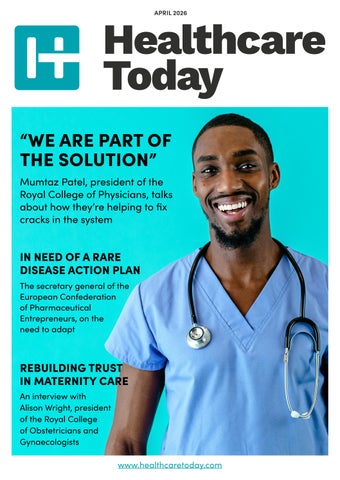
Mumtaz Patel, president of the Royal College of Physicians, talks about how they’re helping to fix cracks in the system
IN NEED OF A RARE DISEASE ACTION PLAN
The secretary general of the European Confederation of Pharmaceutical Entrepreneurs, on the need to adapt
REBUILDING TRUST IN MATERNITY CARE
An interview with Alison Wright, president of the Royal College of Obstetricians and Gynaecologists
APRIL 2026
From the “Groundhog Day” of year-round corridor care to a medical training system she describes as no longer fit for purpose, the perspective of Mumtaz Patel, president of the Royal College of Physicians, is rooted in her daily reality as a consultant in Manchester.
In this issue, she talks to Healthcare Today about the urgent need for transparent data, the integration of social care to unlock patient flow, and why the NHS must move away from blaming individuals for burnout and instead address the systemic failures in workforce wellbeing.
Also in this issue, Alexander Natz, secretary general of the European Confederation of Pharmaceutical Entrepreneurs, warns that the UK’s pricing and reimbursement frameworks need to adapt; Alison Wright, president of the Royal College of Obstetricians and Gynaecologists, talks about fixing the gynaecology backlog and rebuilding trust in maternity care; and much more...
We hope you enjoy!
Contact:
To
30-33
46-49
PRESSURE MOUNTS ON ADDENBROOKE’S HOSPITAL
THE challenges for Addenbrooke’s Hospital continue to mount as the Cambridge University Hospitals NHS Foundation Trust hospital launches an urgent review into its neuroscience service after concerns were raised about the department.
The neuroscience unit at Addenbrooke’s is responsible for treating conditions including complex brain injuries, head trauma and neurological disorders. Two specialist external health bodies will oversee the investigation, which CUH says will look across multiple clinical teams rather than focusing on any single clinician. The investigation will run until the end of February, with a final report expected to be delivered to the trust by the summer.
“We take concerns about clinical services or individuals extremely seriously, and we have established processes to investigate thoroughly when issues are brought to our attention,” said a spokesperson for the Trust.
It has confirmed that the findings of the neuroscience investigation will be made fully public and that it will act on all recommendations.
The neuroscience investigation comes as the hospital continues to deal with the consequences of the separate high-profile investigation within its paediatric orthopaedic department and suspended paediatric orthopaedic surgeon Kuldeep Stohr.
As Healthcare Today reported in December, the legal team at Hudgell Solicitors had called for a public inquiry into Addenbrooke’s Hospital patient safety failings and had written to health secretary Wes Streeting.
Stohr was suspended in January last year after having her practice restricted by the Trust the previous October. The first concerns date back as far as ten years, and at the beginning of April last year, the external inquiry into issues with hip operations performed on children at Addenbrooke’s Hospital in Cambridge concluded. It found that the trust had missed multiple opportunities to act on earlier warnings and concerns raised about Stohr’s practice. In November, she had restrictions placed on her by an interim orders tribunal for 18 months.
“It is vital that the trust demonstrates transparency, investigates failures rigorously and implements changes that prevent similar issues in the future,” said Maria Repanos, head of clinical negligence in Manchester for Hudgell Solicitors.
REPORT INTO SERVICES HIGHLIGHTS
THE INTERIM report of Valerie Amos, Baroness Amos, of her independent investigation into maternity and neonatal services in England is as bleak as expected. Her initial impressions in December into 14 hospital trusts as part of a rapid, independent, national investigation into maternity and neonatal services set the tone.
The national investigation was launched in July last year by health and social care secretary Wes Streeting to drive urgent improvements to care and safety after a number of high-profile cases and rising medical negligence claims.
Amos’ initial findings come in the aftermath of a report from the Public Accounts Committee (PAC) which found that not only has the government’s liability for clinical negligence quadrupled over the past two decades to £60 billion last year, the Department of Health and Social Care (DHSC) is unable to show any meaningful action taken to address this, and the NHS has not done enough to tackle the underlying causes of patient harm.
The interim report comes in the slipstream of the MBRRACE-UK Collaboration investigation into maternal deaths in the UK and shows that the mortality rate for women who died during or soon after pregnancy between 2022 and 2024 was 20% higher than the maternal death rate between 2009 and 2011.
“A 20% increase in maternal deaths over a 15-year period is very concerning, especially
as pressures on eased,” said Marian National Perinatal MBRRACE-UK heard about families and not listened labour, a lack of and reluctance professionals to when things have her interim report.
She and her team 400 families, and submitted evidence
Although she emphasises finished evidence she paints a consistent pain.
“Women and families high levels of distress, that are caused occurs, leading a loss of trust, which the system fails appropriately,”
Most shocking persistent inequalities and neonatal system, higher risks” of from Black and women living in
Black women are to die during pregnancy
INTO ENGLAND’S MATERNITY HIGHLIGHTS FAILINGS
on maternity services have not Marian Knight, director of the Perinatal Epidemiology Unit and programme lead. “We have families being disregarded listened to during pregnancy and of kindness and compassion, reluctance on the part of trusts and to admit mistakes and say sorry have gone wrong,” said Amos in report.
team have met with more than and 8,000 people have so far evidence to her investigation.
emphasises that she has not evidence gathering and analysis, consistent picture of distress and families have told us about the distress, pain and suffering caused when death or serious harm leading to psychological trauma and which is compounded when fails to respond quickly and she writes.
of all are her reports of inequalities within the maternity system, specifically the “notably of adverse outcomes for women and Asian backgrounds and in more deprived areas.
are almost three times as likely pregnancy or up to six weeks
after birth compared with White women, and Asian women were 1.3 times more likely to die during the same period, she writes.
At the same time, women living in the most deprived areas have twice the rate of maternal mortality compared with those in the least deprived areas, she says.
This backs up a Liverpool University study that Healthcare Today highlighted in November that found that babies born to mothers of black ethnicity face an 81% higher risk of death compared with babies of white mothers.
The interim report makes no firm conclusions or recommendations. Streeting has promised to act on her final recommendations, which will be published in June.
The Royal College of Midwives (RCM) has described the report as “harrowing”.
“For years, the RCM has argued that staffing and funding are not keeping pace with the growing complexity of maternity care and these findings reinforce that. Even Trusts meeting recognised staffing targets may not have safe staffing in practice. Without ringfenced investment in the workforce and infrastructure, midwives will not be able to deliver the safe care women and babies deserve,” said RCM chief executive Gill Walton.
“We are also deeply troubled by the findings on racism and discrimination, experienced
both by women using services and by the staff working in them. This is not a secondary issue – tackling racism and discrimination is fundamental to improving outcomes for all women,” she continued.
Rory Deighton, acute director speaking on behalf of the NHS Confederation and NHS Providers, said he hoped the report would mark a “turning point”.
“[Health leaders] recognise that there have been unacceptable failings in maternity and neonatal care and they are committed to doing everything within their power to ensure these are not repeated,” he said.
While Amos’ report focuses on England, many of the same issues are being seen in Scotland, which has been undergoing its own maternity review. Health Improvement Scotland, a public body, has said that all of Scotland’s maternity units are on track to be inspected by the end of March next year.
It was agreed with the Scottish Government that Healthcare Improvement Scotland would undertake an initial eight on-site inspections by the end of March. “We are on schedule to achieve this,” said chief executive Robbie Pearson.
“The inspections are unannounced –meaning that the unit will get no warning that inspectors are on their way – and the reports will be made publicly available around twelve weeks after each unit has been inspected,” he added.
NEW MEDICAL AND DENTAL AGENCY FOR NORTHERN IRELAND
FOLLOWING the introduction of the nursing, midwifery and support workers framework in May 2023, Northern Ireland has launched a new agency framework for medical and dental locum staff.
Workforce stabilisation is the core purpose of the work being taken forward across health and social care to reduce the use of and expenditure on medical and dental locums, the Department of Health said. This will bring with it significant benefits in terms of improved governance and quality of care, financial sustainability, increased morale in teams and improvements in operational performance, it added. It went on to say that the first actions of the Regional Agency Reduction Implementation Group (ARIG) naturally focused on the use of nursing and midwifery agency staffing, as this was by far the largest area of expenditure.
In addition to a new agency nursing and midwifery framework, the cessation of the use of off-contract agency for that professional group, further investment in and recruitment of the core health and social care nursing/midwifery workforce and ongoing work to reform and modernise the health and social care nursing bank, has seen total spend for registered nurses and midwives reduce by 22.3% between 2022/23 and 2024/25 and the near total elimination of off-contract agency use.
“A price cap has been introduced for the first time into the Medical and Dental framework. This should enable Trusts to secure better value and reduce locum spend. It is anticipated that it will also support stabilisation of the medical workforce through some doctors taking up substantive posts with Trusts,” explained health minister Mike Nesbitt.
BLACK WOMEN FACE BARRIERS TO MENOPAUSE SUPPORT
HEALTHCARE TODAY has long highlighted the significant barriers that women of colour face accessing the NHS, but new research from UCL argues that Black women in the UK are entering menopause severely under-informed, under-supported and often dismissed by healthcare professionals.
The study – the first UK-wide survey to focus specifically on the menopause experiences of Black women – gathered responses from 377 women aged 40 to 70. It found that 88% of Black women received no menopause education at school, while more than half (58%) felt completely uninformed before the age of 40. Many participants revealed that they felt frightened and unprepared when symptoms began.
The survey showed most women sought help only once symptoms were severe, often turning first to friends or social media rather than health services.
“Our findings show a stark picture: many Black women are navigating menopause with far too little information and far too little support,” said lead author Joyce Harper, professor in reproductive science at UCL. “This lack of preparation and culturally competent care is leaving many women frightened, dismissed, and struggling alone,” she added.
Women reported being misdiagnosed with anxiety or depression rather than menopause; offered antidepressants instead of menopausespecific treatment; told they were “too young” to be menopausal, despite experiencing significant symptoms; and met with reluctance to prescribe hormone replacement therapy (HRT), even when symptoms were severe.
Many participants – reflected repeatedly in the qualitative analysis – said that their symptoms were not taken seriously, and some felt they had to self-diagnose to receive appropriate support.
The study also found that stigma surrounding menopause remains particularly strong within families and communities. Many women recounted that their mothers or older relatives refused to talk about menopause, leaving them feeling isolated – a recurring theme in the qualitative responses, though not quantified numerically.
“This is the first study to focus specifically on Black women’s experiences of menopause in the UK, and the message is clear – they are being let down. Women told us they were unprepared, unsupported and often dismissed by healthcare professionals, and this reveals deeply entrenched disparities affecting diagnosis, treatment, and trust in medical experts. This must change. Culturally competent care is not optional; it is essential to delivering equitable healthcare,” said Harper.
Researchers say these findings echo national evidence of racial inequality in women’s health outcomes and underline the need for mandatory cultural competence training across the NHS.
BOOM IN ‘BOOMER’ CARE
THE UK is witnessing a boom in Boomer care as the private elderly social care sector expands rapidly to meet the needs of the country’s ageing population.
Drawing on the latest Companies House data, specialist bank Cynergy Bank has developed a Business Births and Deaths Index. It shows that the private elderly social care sector added a net 5,405 businesses last year. This is 25% more than in 2024, and the largest annual net increase since at least 2019, as demand continues to rise and closures slow significantly.
The data reflects the demographic shift. According to Office of National Statistics population estimates, the number of people aged 70 or over in the UK has increased steadily for years and now stands at 8.5 million, up from fewer than 7 million just a decade ago.
This year, the oldest members of the Baby Boomer generation turn 80, driving greater demand for care, support and specialist services.
At the same time, sustained capacity pressures across publicly funded health and social care are reshaping behaviour. Families are increasingly turning to private providers for faster access, continuity of care and specialist support, rather than relying solely on overstretched local authority and NHS services.
“Britain’s ageing population is creating sustained demand for elderly care, and we’re seeing that reflected in strong and consistent growth across the private care sector,” said the bank’s chief executive Nick Fahy.
“What we’re seeing is not a temporary spike but a permanent rebalancing of the care system. As demand outstrips public capacity, private providers are
increasingly becoming the default option rather than the exception.”
No surprise then that the UK’s private health and social care sector was one of the strongest-performing industries last year, supported not only by rising demand but by the growing role of independent providers within the wider care system, including closer collaboration with the NHS to reduce waiting times.
Private health and social care has now expanded every year since 2019, delivering a net gain of 18,380 businesses over the past six years, according to the latest ONS data.
Growth has accelerated since the start of the Labour government. Since July 2024, 16,805 new private health and social care firms have launched, while closures have slowed, resulting in a net increase of 4,410 businesses across the sector.
NEW GUIDANCE FOR DIABETES CARE
IN A MOVE that could help people with Type 2 diabetes, the National Institute for Health and Care Excellence (NICE) has recommended that they be offered a type of medicine called an SGLT-2 inhibitor, known as flozins, much earlier in their treatment.
One of the most commonly prescribed SGLT-2 medicines, dapagliflozin, is now available as a clinically equivalent generic version.
The estimated cumulative savings in total over the next two years from generic dapagliflozin would be £560 million.
NICE has said that this money could be reinvested in other areas of diabetes care, such as education programmes and community support services or other parts of the NHS.
Analysis by NICE suggests using SGLT-2 medicines earlier in the treatment pathway, and the introduction of GLP-1 receptor agonists and tirzepatide for some people, could prevent around 17,000 deaths over a three-year period across the UK by reducing the risk of heart attacks, strokes and kidney problems.
“This is a landmark moment for diabetes care. Our independent committee conducted a rigorous review of the evidence and concluded that by offering certain medicines earlier, we can prevent thousands of heart attacks, strokes and cases of kidney failure,” said Eric Power, NICE’s interim director of the centre for guidelines.
Until now, most people newly diagnosed with Type 2 diabetes have been started on a medicine called metformin. The new NICE guidance recommends that most people should now be offered metformin along with an SGLT-2 inhibitor from the start.
The guidance also recommends that people should be given a slow-release form of metformin. Many people experience stomach upsets with the standard-release form, which can put them off taking their medicine. The slow-release version is easier on the stomach and helps people stay on their treatment, particularly if they experience side effects.
SGLT-2 inhibitors work by helping the kidneys remove excess sugar from the body. But research shows they do much more than control blood
sugar by also protecting the heart and kidneys. This is particularly important because heart disease is the leading cause of death in people with Type 2 diabetes.
The new guidance moves away from what NICE calls a “one-size-fits-all approach”. Instead, it sets out different recommendations depending on each person’s circumstances.
People diagnosed with Type 2 diabetes before age 40 face a higher lifetime risk of heart and kidney problems, so may benefit from adding another type of medicine called a GLP-1 receptor agonist (such as semaglutide, dulaglutide and liraglutide) or tirzepatide.
Those living with obesity have specific recommendations that take account of their needs. Patients who already have kidney disease or heart failure have tailored recommendations, with SGLT2 inhibitors offering particular benefits for protecting their kidneys and heart.
“This welcome guidance will transform treatment for people living with type 2 diabetes across the UK,” said Douglas Twenefour, head of clinical at Diabetes UK.
Trusted by Clinicians, Chosen by Patients
Located in the Harley Street Health District, Pharmacierge supports over 4,500 GPs and Consultants with seamless, secure e-Prescribing apps tailored for private practitioners.
With our state-of-the-art robotically enabled dispensary and nationwide delivery, we ensure your patients receive their medications promptly, while you prescribe with confidence - anytime, anywhere.
mPrescribe®
Revolutionises private prescribing by allowing you to prescribe flexibly without a laptop, for delivery to your patients nationwide.
Medication range
Due to the range of specialists we support, we stock and source medication not typically found outside of a hospital setting, including refrigerated, controlled, injectable and biologic medication.
Courier delivery
We include same weekday delivery to London postcodes, or next weekday nationally as standard. International deliveries are also available.
"Your mobile app changed my life!"
— Dr Dominic Paviour, Consultant Neurologist "Intuitive and secure."
— Dr Tim Wigmore, Consultant Intensivist & Anaesthetist
Join thousands of clinicians today. Download the app and register online www.pharmacierge.com/register
$1 MILLION RESEARCH FUND FOR OVARIAN CANCER AWARDED
THE Global Ovarian Cancer Research Consortium has awarded its inaugural $1 million (£740,000) AI accelerator grant to an international team of researchers from the UK, Canada, Australia and the US. The team’s goal is to understand whether artificial intelligence can improve how survival and treatment responses are predicted in ovarian cancer.
Using the global research award, plus an additional $1 million in computer support from Microsoft’s AI for Good Lab, the team will analyse one of the largest international collections of ovarian cancer data. They’ll integrate tumour samples, clinical records, immune response, genetic information, and lifestyle factors from thousands of patients across international research institutions. The researchers will then analyse the data to identify patterns in survival and treatment response that current tools cannot detect. By improving how patients are matched to treatments and clinical trials, the project aims to reduce unnecessary side effects, support more personalised care, and ultimately help improve survival outcomes for women with ovarian cancer.
“Ovarian cancer survival rates can improve if the best minds work together at a global scale,” says Cary Wakefield, chief executive of Ovarian Cancer Action. “Clinicians have limited ability to predict how an individual patient’s cancer will behave, or which therapies will be effective. By connecting global data from thousands of women, powered by AI, we will pinpoint how each tumour responds to treatment, with the potential to dramatically change treatment for the 7,500 women diagnosed in the UK every year,” she continued.
The researchers are led by James Brenton, professor of ovarian cancer medicine at Cambridge University; Leigh Pearce, associate professor at the University of Michigan; Susan Ramus, professor in the school of clinical medicine at the University of New South Wales; and Ali Bashashati, director of artificial intelligence research at the University of British Columbia.
Formed in 2024, the Consortium unites four leading ovarian cancer research organisations from around the world – Ovarian Cancer Research Alliance (S), Ovarian Cancer Research Foundation (Australia), Ovarian Cancer Canada, and Ovarian Cancer Action (United Kingdom). Together, the partners are combining resources, data, and determination to accelerate progress in a disease where survival rates have seen limited improvement for decades.
77 SEXUAL ASSAULTS REPORTED IN NHS TRUST
AGLOUCESTERSHIRE
Health and Care NHS Foundation Trust patient was raped while under the trust’s care, as a further two dozen were sexually assaulted in just three years.
The figures, uncovered through a freedom of information request sent by Sexual Abuse Compensation Advice, reveal the rate of sexual assaults taking place at the NHS.
In the past three financial years –since 2022 – Gloucestershire Health and Care NHS Foundation Trust alone has recorded 77 incidents where a sexual assault has taken place, one of which was rape. In the same time frame, one member of the public and 11 employees were sexually assaulted.
A third of all sexual assaults that were recorded by the trust saw a patient as the victim (26), with as many as 49 staffers also lodging a complaint to the service and two members of the public.
On top of the offences, there were a further 56 complaints of sexual harassment taking place on the trust’s grounds – 11 of which were reported by patients, while eight of those happened last year.
Despite the number of incidents, no staff member has been dismissed on the grounds of a sexual offence since 2022. In the same timeframe, just
one employee was disciplined, which took place in the most recent financial year.
“We take sexual safety within our services very seriously. As such, we encourage the reporting of incidents so that full investigations can take place,” said a spokesperson for Gloucestershire Health and Care NHS Foundation Trust.
“We can confirm that the incident recorded as rape has been the subject of a police investigation, which we have supported. More generally, we have a full range of security and safety measures in place to minimise the possibility that offences occur, but also a full range of support for anyone affected by such incidents,” they continued.
The findings back up a BMA survey in November, which found that two-infive female respondents experience being targets of sexual harassment or sexual assault at university, and a concerningly high number mention criminal offences.
National evidence shows that sexual misconduct in medicine is widespread, under-reported, and inconsistently sanctioned, particularly where strong power imbalances exist between staff and patients.
A recent analysis of Medical Practitioners Tribunal Service (MPTS) decisions found that nearly a quarter of all tribunal cases heard in a single
year involved sexual misconduct, with more than half of those cases involving sexual assault allegations.
Among cases where misconduct was proven, 65% resulted in doctors being erased from the medical register, while 35% led only to suspension, even in serious cases.
In almost a quarter of cases (24%), tribunals imposed less severe sanctions than those recommended by the General Medical Council, raising concerns about leniency and inconsistency.
Disturbingly, one in four (26%) of cases involved offences against children. The study also found that all doctors sanctioned for sexual misconduct were male, with 83% holding senior positions of authority, such as consultants or GPs.
“What these disclosures show is a pattern that can no longer be dismissed as isolated wrongdoing,” said Ellie Lamey, head of our sexual abuse claims department at Sexual Abuse Compensation Advice.
“We regularly hear from people who stayed silent for months or years because they believed speaking up would achieve nothing or would place them at personal or professional risk. That silence should not be mistaken for absence of harm – it reflects fear, imbalance of power and a system that too often prioritises reputation over protection.”
ACLOSING
HEAD of elections this year, the safety watchdog, the Professional Standards Authority for Health and Social Care (PSA), has said that closing the safety gaps must be a priority for the next Scottish and Welsh governments.
With a 55% increase in serious patient safety incidents in Scotland’s health service in the past four years, the PSA’s Scotland manifesto urges those seeking office at the 2026 Scottish Parliament election on 7 May to focus on three areas for improving health and social care services in the country.
They need to tackle the health and care workforce crisis by developing
a robust regulatory strategy help manage any safety risks workforce changes and support successful delivery of Scotland’s workforce plan.
They should close the safety by setting up a mechanism so learning from every major inquiry across Scotland and the UK real, measurable change. And need to modernise regulation working with the UK Government fast-track the professional regulation reform programme.
This will allow regulators to a preventative approach which avoid harm, not just address has occurred.
Over the past few years,
CLOSING SAFETY GAPS MUST BE A PRIORITY
regulatory safety changes and delivery of gaps so that inquiry leads to And they regulation by Government to regulation support which helps it after it there has
been positive progress across the Scottish health and care landscape, but with the national review of maternity services, concerns remain over the safety and quality of care.
“The healthcare sector in Scotland, as across the UK, faces challenges on numerous fronts – addressing staffing shortages and improving patient safety being two of the most important,” said PSA chief executive Alan Clamp.
“We also urge all political parties to prioritise action to improve public protection when workforce changes are made by adopting a clear method for deciding how to manage risks, including from new roles.”
With 87% of GPs reporting that they
fear their rising workloads could impact patient safety, the PSA’s Welsh manifesto also urges those seeking office at the 2026 Senedd election on 7 May to focus on three areas for improving health and social care services in the country.
They need to tackle the health and care workforce crisis by developing a robust regulatory strategy to help manage any safety risks from workforce changes and support the successful delivery of the workforce plan for Wales. Safety gaps should be closed by extending the local authority licensing scheme for special procedures to include non-surgical cosmetics. This will help avoid cosmetic tourism by aligning more closely with protections in England and Scotland. Regulation should
also be modernised by working with the UK Government to fast-track the professional regulation reform programme.
The PSA pointed out that NHS Wales still has comparatively poor outcomes, access measures and population health in comparison to many other European countries.
“While Wales, as in the rest of the UK, faces health and care sector challenges on numerous fronts, it is vital to focus on addressing safety gaps,” said Clamp.
“We urge all political parties to prioritise action to improve public protection when workforce changes are made by adopting a clear method for deciding how to manage risks, including from new roles,” he added.
GOVERNMENT FUNDING TO IMPROVE NURSING CAREER PROGRESSION
THE secretary of state for health and social care, Wes Streeting, has set out a package of new commitments to nursing staff in England. These promise fairer recognition, stronger support and a clearer future.
The government has asked the NHS Staff Council to prioritise graduate pay in the forthcoming structural reform negotiations. This includes nursing roles and all Agenda for Change graduates.
Every nurse paid at band 5 will have their role reviewed by their employer to make sure their band and job description reflect the job they do. Too many are working at a higher level but not paid fairly for it.
The government has informed us that additional funding has been made available to employers to support this programme of work and the salary uplifts that will come from it. This is separate from the funding for the 2026/27 cost-of-living pay award and structural reform negotiations.
As part of the chief nursing officer for England’s professional strategy for nursing, they will lead work with
unions, employers and stakeholders to improve the quality and consistency of preceptorships across the country.
“This announcement is significant progress on career progression for nursing staff. Too many are not being paid fairly and valued for their skills and responsibilities in caring for patients, too often starting and finishing their careers on the same low pay band,” said Royal College of Nursing general secretary and chief executive Nicola Ranger.
The full strategy will be published soon.
Separate from the NHS cost-of-living award, the government has confirmed that funding is available to employers to support this review and the salary uplifts that will come from it.
“Nursing is the safety-critical profession and this investment is paramount for the effective running of the health service.
“We’ve been clear with the government that all nursing staff need progress in both their careers and their pay packets too. Today, we have seen major investment in one big aspect of career progression,
but we now urgently need a fair pay deal that values nursing too,” Ranger added.
The news was greeted as “a welcome step” by independent health and social care think tank The Nuffield Trust, which pointed out that an estimated one in five NHS nurses leave within the first two years of their career.
“This agreement is absolutely right to recognise that poor nurse retention has always been about a combination of factors, not just pay. A lack of career progression has been a key reason nurses leave the NHS, and we have long called for measures to address this, so the government is right to focus on this now,” said Nuffield Trust fellow Lucina Rolewicz.
Though she went on to say that tight NHS finances might be a stumbling block in the future.
“Without additional funding to cover faster promotion, and given that the government is having to deal with similar issues in other parts of the NHS workforce too, it will not be easy to suddenly boost the number of Band 5 nurses progressing into more senior roles,” she added.
INCONTINENCE SHOULD NOT BE IGNORED
CHARITIES and parliamentarians have written to crossbench peer Louise Casey, Baroness Casey of Blackstock, as she begins her independent review of adult social care, warning that people living with incontinence are quietly being failed by a system driven by budgets rather than clinical need.
In a joint letter to the House of Lords, the signatories argue that continence care remains one of the most neglected areas of adult social care. Despite affecting some of the most vulnerable people in society, it is largely absent from national reform debates, even though it has a profound impact on health, independence, and quality of life.
The letter, seen by Healthcare Today, describes continence care as a “hidden frontline of indignity” and calls on the review to place dignity at its heart, with explicit recognition of the challenges faced by people who rely on continence support.
Led by the Spinal Injuries Association, the letter is supported by a coalition of health and disability charities including Shine, Pain UK, Disabled Living, Bladder and Bowel UK, The Neurological Alliance, and Dementia Carers Count, alongside parliamentarians Caroline Dinenage, Mohammad Yasin, Margaret Ritchie and Tanni Grey-Thompson.
The letter warns that incontinence is often treated as an uncomfortable afterthought in adult social care, despite the serious consequences of inadequate support. Poor continence care can lead to urinary tract infections, skin damage and severe emotional distress, while many
people report being unable to leave their homes or take part in everyday activities because they lack reliable access to appropriate products and specialist support. In June, a survey of 500 healthcare professionals found that substandard incontinence products are delaying hospital discharges and driving avoidable admissions.
Incontinence affects an estimated 14 million people in the UK, cutting across age, disability and longterm illness. As continence issues become more common later in life, campaigners warn that demand will rise sharply as the ageing population grows – placing further strain on a system that charities say is already failing to meet basic needs.
The intervention follows an investigation which found that patients with incontinence are being “robbed of their dignity”. Freedom of information data revealed that more than half of the Trusts questioned cap continence products at just three or four pads per day – regardless of individual need.
“People, including those with spinal cord injuries, should not have their
independence determined by a postcode lottery. Too many are denied appropriate continence support because of arbitrary caps and under-resourced services,” said Nik Hartley, chief executive of the Spinal Injuries Association.
Charities also stressed that the impact of restricted continence care is felt not only by patients but also by families – many of whom are forced to take on additional caring responsibilities when formal support falls short.
“Continence care requires the recognition it deserves, which is long overdue. We need to drive evidencebased practice, putting the patient at the centre of their care,” said Tracy Whitehouse, service manager and adult specialist nurse at Bladder and Bowel.
In their letter, the signatories urge the commission to recognise continence care as a core component of dignity in adult social care and to recommend reforms that ensure access to proper assessment, specialist support and sufficient products based on individual need rather than postcode.
NEW DRUG IDENTIFIED FOR CHILDREN WITH RARE EPILEPSY
AN
EXPERIMENTAL
treatment for children with a hard-to-treat form of epilepsy is safe and can reduce seizures dramatically, helping them lead much healthier and happier lives, the findings of a UCL and Great Ormond Street Hospital-led international clinical trial show.
Researchers found that children with Dravet syndrome had up to 91% fewer seizures while being regularly administered a new medication called zorevunersen.
The results also show, for the first time, the potential to reduce the impact of the condition on a child’s mental processes and behaviour. The children’s quality of life improved over a three-year period, and most of the treatment’s side effects were mild.
Dravet syndrome is a devastating genetic condition which causes frequent, hard-to-control seizures and long-term neurodevelopmental impairment. The condition also causes feeding difficulties, movement problems and has a high risk of premature death. Current treatments fail to control seizures in most patients, and there are no approved medicines that address the condition’s devastating cognitive and behavioural impacts.
“I regularly see patients with hard-totreat genetic epilepsies with impacts that go beyond seizures and it’s heartbreaking when treatment options are limited. This new treatment could help children with Dravet syndrome lead much healthier and happier lives,” said lead author Helen Cross, director and professor of childhood epilepsy at the UCL Institute of Child Health.
“Overall, our findings showed that zorevunersen is safe to use and
well tolerated by most patients and supports further evaluation in the ongoing Phase Three study,” she added.
Zorevunersen, produced by Stoke Therapeutics in collaboration with Biogen, works by tackling the underlying cause of the disease – a faulty gene.
Humans typically have two copies of the SCN1A gene and in most people with Dravet syndrome, one copy of this gene doesn’t produce enough of a protein for their nerve cells to function properly.
The new drug works by increasing the levels of the protein produced by the healthy SCN1A gene, aiming to restore proper nerve-cell function. The researchers have now published the latest results of their initial trial and extension studies, which have involved 81 children with Dravet syndrome in the UK and the US.
The published data are from initial studies designed primarily to evaluate the safety and tolerability
of zorevunersen. The researchers also evaluated its effects on seizures, cognition, behaviour, and quality of life. A Phase Three study is currently underway to further evaluate the treatment.
Eighty-one children aged two to 18 took part in the initial trial. Patients in these studies had an average of 17 seizures per month before the trials started.
The 81 children were given up to 70mg of zorevunersen by lumbar puncture, either as a single dose or with additional doses two or three months later over a six-month period.
Of those patients, 75 went on to take part in extension studies. Those patients continued to receive the drug every four months.
Patients given a 70mg dose in the initial phase of the trial saw their seizures reduce by between 59% and 91% over the first 20 months of the extension studies compared with the number of seizures they were having before the trial started.
BRAINOMIX EXTENDS SERIES C FUNDING
OXFORD-based AI medical imaging platform Brainomix has extended its Series C funding by £4.8 million. This is on top of the £14 million it raised in March last year, bringing the total in the round to £18.8 million.
The extension round was led by existing investors, Parkwalk Advisors and Hostplus via the IP Group Hostplus Innovation Fund, and includes participation from a new US-based investor, early-stage venture capital firm Modi Ventures.
A spinout from the University of Oxford, Brainomix has developed AI platforms that automate validated imaging biomarkers to improve both diagnosis and treatment decisions.
The additional capital will enable Brainomix to expand further in the US market as the company advances deployment of its AI imaging platforms, Brainomix 360 Stroke and e-Lung, across multiple hospitals.
“This investment reflects strong confidence in our technology, our team, and the impact Brainomix 360 Stroke and e-Lung can have on patient care,” said chief executive and co-founder Michalis Papadakis.
“Stroke care depends on speed, while lung fibrosis care requires early identification and consistent clinical decision-making over time, underscoring the need for hospital technologies that support clinicians at the point of care,” he added.
According to Crunchbase, to date, the firm has raised £44.5 million in nine rounds of funding.
PRIVATE HOSPITAL ADMISSIONS CONTINUE TO RISE
THE LATEST figures from non-profit organisation the Private Healthcare Information Network (PHIN) show there was a 1% year-on-year rise in the number of reported admissions at the UK’s private hospitals in the third quarter last year.
Although small, it was the highest total ever for that time of year and was driven by patients in the 50-to-59 age group.
Private medical insurance remained the preferred payment method, and the number of admissions funded this way increased by 1% and was at a record level for the period.
Self-pay remained steady and makes up just under a third of all admissions.
For the first time ever, there were more admissions (19,910) for chemotherapy than for any other procedure.
Cataract admissions (19,075) came a close second. The next two highest admissions were for diagnostic tests (Upper GI endoscopy 10,390 and colonoscopy 9,160).
“Our latest data shows that although growth has slowed slightly from previous periods, there continues to be an appetite for using the private healthcare sector for diagnostic tests and treatment,” said Richard Wells, PHIN’s director of technology and insights.
Wells emphasised the popularity of the private sector for patients with cancer.
“Therefore, it is no surprise to see the growth in the use of private care for chemotherapy in the latest data,” he said.
Despite the overall rise in admissions, there was a decline in weight-loss surgeries during the period.
Admissions for gastric balloons and gastrectomies were both down 72%.
“We are also seeing a decline in the popularity of weight-loss surgeries as people turn to the popular jabs like Wegovy (semaglutide) and Mounjaro (tirzepatide) instead,” said Wells.
“There are seasonal variations throughout the year, with Q3 normally being the lowest period. Although that appears to be the case again in 2025, there were the highest number of admissions we’ve ever seen for this period,” he continued.
“We have been seeing a greater variety in the type of procedures people go private for some time. Chemotherapy and diagnostic tests have become much more prevalent, whereas the traditional top three of cataracts, hip replacements and knee replacements are no longer dominant,” he added.
PHIN’s data also shows that the proportion of total admissions in England which were in a private setting remained at 6%.
NHS-funded procedures taking place in private hospitals also remained steady at 5% of the total admissions. The majority of admissions remained ‘NHS Hospital, NHS Funded’, which was at 88%.
MORE CAREER OPPORTUNITIES FOR NHS SUPPORT STAFF
OVER the past decade, the NHS has expanded the routes available for its clinical support staff, such as healthcare assistants and nursing auxiliaries, to train for and progress into registered roles, such as nursing or physiotherapy.
New research from the Institute for Fiscal Studies looking at the NHS in England finds that 16% of the new nursing cohort in 2024 were recruited from a clinical support role in the NHS, compared with just 4% in 2014.
The expansion in new routes for support staff to progress reflects efforts to fill workforce gaps, improve retention and position the NHS as a force for social mobility. The recent 10 Year Health Plan committed to using training pathways to improve local prosperity, with a focus on individuals from the most deprived communities.
“New pathways into registered roles are a valuable way for NHS trusts to attract and retain staff, and often result in training opportunities that would not have otherwise been
available,” said Olly Harvey-Rich, a research economist at IFS and an author of the report.
Yet so far, occupational transitions have been much more common in regions with higher wages elsewhere in the local labour market, as well as in mental health trusts. For example, in 2023, clinical support staff working in the South East were twice as likely to move into registered roles in the NHS as those working in the North East. One likely explanation is that some of these trusts find it
more difficult to recruit, and so have a stronger incentive to train staff in-house. The research argues that if this government wishes to use apprenticeships and other training for support staff as a tool for social mobility, it will need to ensure all trusts have both the resources and the incentives to provide these opportunities.
This is needed sooner rather than later. Increasing rates of transition are set to continue for at least the next few years, as many staff are still in training.
More than 1,000 existing NHS staff members started a nursing degree apprenticeship in 2024, up from just over 300 in 2019.
“As the NHS drafts its new ten-year workforce plan, it should therefore be clear about what it wants these pathways to achieve. There will likely be a trade-off between designing incentives that target areas with workforce shortages and achieving broader social objectives such as reducing regional inequalities,” said Harvey-Rich.
NEW YORK-based IT service firm Kyndryl and the University of Liverpool’s Civic Health Innovation Labs (CHIL) will collaborate to explore how emerging AI technologies could be used to strengthen future healthcare services.
Through the initiative, Kyndryl and the university plan to develop blueprints for next-generation healthcare technologies, using Kyndryl’s agentic AI framework. In phase one, the collaboration aims to generate and evaluate conceptual AI projects that could improve patient interaction.
Potential areas of collaboration include the development of conversational AI services, such as voice agents, to help patients record how they feel, how well they use medicines, and how to make the best use of the NHS and social care services.
“The work of CHIL and the University’s AI for Life Frontier is grounded in mobilising data, data science, and AI engineering to improve people’s lives in the Liverpool City Region and beyond, by tackling big health problems such as the pressures health systems world-wide face
as more people spend more of their lives in ill health, especially in disadvantaged communities,” said CHIL director Iain Buchan.
“This collaboration with Kyndryl allows us to explore potential AI futures that could enable health systems to offer more preventive and personalised care, whilst targeting scarce resources to better help the most vulnerable in society. Together, we are building a pipeline of ideas and AI prototypes that can shape the future of healthcare in ways the public trust and influence,” he continued.
BIRMINGHAM HOSPITAL’S FAILURE TO PROVIDE INTERPRETERS
HOSPITAL staff at University Hospitals Birmingham NHS Foundation Trust used a teenage boy to tell his deaf mother that her father might die that day, an investigation by England’s Health Ombudsman has found.
Alan Graham was a former furniture maker who had moved to Birmingham to be closer to his grandchildren. In June 2021, he had a fall at home and was admitted to Queen Elizabeth Hospital in Birmingham. He suffered swelling in his legs and chest pain and was diagnosed with right-sided heart failure before being discharged in August.
In September 2021, he was admitted again after experiencing similar symptoms and was diagnosed with heart failure. Graham died two weeks later.
During the 11 weeks that he was in hospital, the Trust provided professional interpreters on only three occasions. The Parliamentary and
Health Service Ombudsman (PHSO) found that the Trust was regularly using two of his grandchildren to communicate with Graham’s daughter, asking them to translate medical information and details about his prognosis.
Graham’s daughter, who was born Deaf and uses British Sign Language (BSL), complained to the PHSO about her father’s care and the use of her children as interpreters.
PHSO found that the University Hospitals Birmingham NHS Foundation Trust failed to comply with national guidance by repeatedly using her children, one of whom was 12 years old at the time, to relay information to Graham about his care and treatment. This caused distress to the family and affected their ability to grieve.
“Public services must be accessible to everyone for the system to be fair and equitable. Deaf patients and their families should have access to the same healthcare as everyone else
without facing additional barriers,” said Rebecca Hilsenrath, chief executive at the PHSO.
The Ombudsman found that while a lack of interpreters did not impact the care and treatment that the patient received, it caused worry and stress to his family, whose ability to communicate with medical staff about treatment was also affected.
The PHSO recommended that the Trust create an action plan detailing how it will prevent this from happening again. It also recommended that the Trust apologise and pay Graham’s grandchildren £900 each and pay his daughter £750 for the impact of the failings on them. The Trust has complied.
“In this case, by not consistently providing BSL interpreters to Alan, the Trust caused unnecessary distress in the weeks before his death. Healthcare leaders and professionals must learn from this to make sure that another family does not go through the same experience,” Hilsenrath added.
RESTRICTIONS ON MIGRANT WORKERS’ RIGHTS HITS HEALTHCARE
AFTER a series of restrictions to migrant workers’ rights and successive increases to employer costs, the number of skilled worker visas issued to foreign nationals coming to the UK to work is now at its lowest level since 2021.
Research by Dora-Olivia Vicol and Andrei Savitski at the Work Rights Centre, a charity that helps migrants and disadvantaged Britons, has found that significantly fewer migrant care workers, nurses, therapists, scientists, education professionals and skilled tradespeople are coming to work in the UK, compared to a couple of years ago.
The number of visas granted for Caring Personal Service roles, which fall under the Health and Care Worker visa route, saw the steepest decline in absolute terms, from 107,847 in 2023 to as little as 3,178 last year and just 23 in the fourth quarter.
This is despite Skills for Care data showing that as of January, as many as 78,330 roles remain vacant across the adult social care sector in England, with a vacancy rate of 6.3%, at nearly three times the national average. For care worker roles, this is as high as 7.6%.
Last year saw a massive 74% decrease in the number of visas granted to health professionals, which dropped from a peak of 38,997 in 2022 to 10,060 in 2025. This includes a 93% decline in visas granted to nursing professionals, a 30% decline in visas granted to medical practitioners, and a 73% decline in visas granted to therapy professionals.
The government’s rationale has been that further restricting overseas recruitment will force employers to recruit and invest in the domestic workforce. In practice, however, things are significantly more complex.
As the report makes clear, businesses already have incentives to invest
in domestic skills training, but can only do so once they have a stable workforce. The absence of skill is why they’re going to the international market in the first place.
Investment in the local workforce is not just a question of will, it’s also a question of funds. Vicol and Savitski cite the Homecare Association, which noted that “27% of homecare contracts in England are at rates below direct employment costs at the legal minimum wage”.
Perhaps most evidently, even if all employers increase investment in training, some roles take years to train for, they point out.
“If the latest data shows the government’s measures to reduce migration are working, the bigger picture is that this can come with severe consequences for the delivery of public services, research institutes, business objectives, and workers’ rights. It is time to change focus,” the research concludes.
NEW STRATEGY FOR HSSIB
THE Health Services Safety Investigations
Body (HSSIB) has published a new strategy to strengthen investigation capability in England and to help meet what it calls the demands of a changing patient safety landscape.
It says that the strategy will be instrumental in supporting investigators across the NHS to carry out high-quality investigations that drive real improvements in patient safety. Since 2023, it says that more than 40,000 people have undertaken its courses.
The strategy focuses on strengthening capability in investigation skills, increasing accessibility to investigation resources, improving the professional connections between investigators and working in collaboration with the national health system to align priorities and reduce duplication. As the document outlines, “the healthcare system has significant activity in patient safety investigations – what’s needed is a greater depth of expertise, stronger investigation methodology grounded in human factors, and more sophisticated system thinking”.
Andrew Murphy-Pittock, education director at HSSIB, called the strategy “a milestone in HSSIB’s development”.
“This strategy sets the foundation for a coordinated and sustainable approach to building investigator capability, one that continues to be recognised as a sector-leading standard in the UK and internationally,” he added.
The body said that the final strategy captures four key methods for focus. First, targeted capability building – proactively direct support where the gaps in investigation capability are greatest or where it aligns with investigation priorities. For example, rather than waiting for applications for courses, HSSIB could identify sectors, organisations or cohorts of providers that would benefit from intensive support.
Second, with accessible resources. The aim with this is to ensure that alongside targeted support, HSSIB provide accessible resources, and this could look like: developing online modules, toolkits and guides, as well as signposting to other resources to increase collaboration. It next looks at professional leadership to enhance the developing field of healthcare investigation and to link up and connect investigators in the absence of a professional association.
Finally, there is a focus on national system convening. This is aimed at coordinating national efforts to build the capability of healthcare investigators to reduce duplication and aligned priorities, particularly in the light of healthcare restructuring.
CONSULTATION ON CE-MARKED MEDICAL DEVICES
A CONSULTATION on proposals for indefinite recognition of CE-marked medical devices in Great Britain has been welcomed. The UK’s Medicines and Healthcare products Regulatory Agency (MHRA) is consulting on whether it should recognise CE-marked medical devices in Britain indefinitely.
As the law currently stands, general medical devices compliant with the EU medical devices directive (EU MDD) or EU active implantable medical devices directive (EU AIMDD) with a valid declaration and CE marking can be placed on the GB market up until the sooner of expiry of certificate or 30 June, 2028.
In vitro diagnostic medical devices (IVDs) compliant with the EU in vitro diagnostic medical devices directive (EU IVDD) can be placed on the GB market up until the expiry of the certificate or 30 June, 2030, and general medical devices, including custommade devices, compliant with the EU medical devices regulation (EU MDR) and IVDs compliant with the EU in vitro diagnostic medical devices regulation (EU IVDR) can be placed on the GB market up until the same date.
The MHRA is inviting views that extend the current transitional arrangements for devices that comply with the Medical Device Directive (MDD) to align with the EU timelines for devices to transition from MDD to EU Medical Devices Regulation. It is also considering indefinitely recognising devices that comply with the EU Medical Device Regulation (EU MDR) and EU in vitro Diagnostic Medical Devices Regulation (EU IVDR), and introducing an international reliance route for devices classified higher in Great Britain than in the EU.
The regulator said 90% of medical devices used in the UK are CE-marked, which indicates compliance with EU health and safety standards. The thinking behind the legislation is to minimise the risk of supply disruption and to reduce the risk of interruption to the supply of medical devices for patients in Britain.
“If the UK healthcare system is to benefit from the innovation that medical device manufacturers can deliver, it makes sense for Britain to form a closer regulatory relationship with the EU,” said Gerard Hanratty, head of health and life sciences at law firm Browne Jacobson.
WITHDRAWAL OF SPECIALIST SURGICAL TRAINING IS DANGEROUS
THE Confederation of British Surgery (CBS) has warned that an NHS England decision to withdraw funding for specialist surgical training without national oversight and standard setting will have “inevitable consequences” and make a recurrence of the recent Great Ormond Street Hospital scandal, which affected just under 100 children, more likely than ever.
Training interface group (TIG) fellowships, the only nationally quality-assured, GMC-regulated supraspecialist fellowships, have effectively been axed by NHS England. They have been removed as quality-assured training opportunities for surgeons.
“The decision to make the cuts by the Postgraduate Medicine and Dental Education Oversight group in NHS England (NHSE) effectively dismantles a regulated pipeline into complex sub-specialist surgery at the same time as high-profile failures in paediatric orthopaedics are exposing the dangers of poorly governed, siloed complex practice,” said CBS board member and president of the
Association of Surgeons in Training, Raiyyan Aftab.
“The withdrawal of funding will have inevitable consequences for future patient safety,” he added.
TIG fellowships were curriculumbased in complex sub-specialist surgical practice, which requires additional training such as cleft lip and palate, hand surgery, head and neck oncology, spinal, oncoplastic breast surgery and major trauma. Their aim, as described by the Joint Committee on Surgical Training (JCST), is to ensure “excellence in a selected group of talented trainees” over a minimum of 12 months, reaching defined competencies for formal certificates of completion.
“In practice, the cuts mean the loss of the single, regulated, UK-wide pathway for specialist competence in these fields, to be replaced by a patchwork of ad-hoc, locally employed posts of variable oversight and quality,” said Aftab.
“Removing TIG’s creates a patient safety issue in that without quality assurance, patients and
commissioners cannot reliably know what training a surgeon has actually received in supra-specialist procedures or whether their unit has met any nationally agreed threshold for case-mix, supervision, and governance,” he added.
The confederation points to evidence on siloed and poorly coordinated care, for example, a UK perioperative care review which describes how multidisciplinary working can improve outcomes but also warns that “less well-organised” multidisciplinary models are associated with worse survival than conventional care, highlighting how fragmented, poorly structured practice can be.
Other examples of the value of coordinated training with close national oversight include cleft palate surgery, which historically was a fragmented service with the worst speech, growth and appearance outcomes in Europe. This scandal led to a central government push to centralise services, as well as setting clear, measurable and quality assured standards for training and practice, which has transformed cleft lip and palate surgery in the UK.
NHS SBS LAUNCHES NEW FRAMEWORK AGREEMENT
CORPORATE services provider, NHS Shared Business Services (NHS SBS), has launched a new procurement framework agreement to help public sector organisations, including NHS trusts, improve the way they communicate with their patients and service users.
The Patient/Citizen Communication, Engagement and Hybrid Mail Solutions framework agreement includes fully vetted suppliers, who can provide everything from chatbots to SMS messaging to mail processing.
With missed appointments (Did Not Attends or DNAs) costing the NHS an estimated £1.2 billion each year, providing patients and service users with swift, efficient, two-way communication is vital.
“Effective communication is vital in any organisation – but even more so in the NHS, when lives can depend on it. Unfortunately, NHS organisations aren’t always quick to adopt new
communication technologies – some trusts are still using fax machines and analogue pagers,” said senior category manager Kelly Harris.
By using a framework agreement, organisations can swiftly and compliantly procure the technology and support they need to ensure that essential communication – like appointment notifications and reminders – are in place, saving time and money.
Other services which can be procured via the new framework agreement include workforce communication, including one and two-way mobile audio messaging and digital pagers; call handling via call centres and the provision of patient portals and smartphone apps.
The framework agreement consists of seven lots: digital communication, including the provision of automated one- and two-way internet-based communication services such as portals, smartphone apps and email; messaging, including the provision of
automated one- and two-way digital messaging, SMS, digital paging and alerting; and voice communication, including the provision of an agent calls service based in a call centre and interactive voice response (IVR), including intelligent call routing and patient self-service.
It also consists of hybrid mail, including the provision of on- or offsite bulk mail, both traditional and electronic; patient/citizen experience, including the provision of surveys and feedback analysis and data collection; workforce communication, including the provision of one- and two-way audio messaging, digital paging and alerting services; and combined solutions – encompassing elements from various lots with a single supplier and a sole contract.
“Using a framework agreement like ours enables all public sector organisations to swiftly and compliantly procure reliable and costeffective ways of communicating with their patients, staff and service users,” said Harris.
FEMALE SURGEONS ARE VASTLY UNDERREPRESENTED IN PRIVATE HEALTHCARE
WOMEN make up just 6.2% of surgeons working across the UK’s five largest private hospital groups, compared with 16.9% in the NHS.
The research, authored by Kate Hulse and Caitlin Brennan, shows that across all specialities, female representation in private practice is substantially lower than in the NHS, and in most specialities remains below NHS levels recorded as far back as 2012.
Neurosurgery had 2.3% women consultants, with some providers listing no women neurosurgeons at all, while in trauma and orthopaedic surgery, women made up just 2.2% of consultants. In two of the five largest hospital groups, there are more orthopaedic surgeons named David than there are women in the same speciality.
The Royal College of Surgeons in England has written to the five largest
independent hospital groups in the UK, calling on them to take clear and credible action to ensure the surgical workforce in their hospitals reflects the diversity and talent of the profession.
“The independent sector now delivers a growing share of surgical care, yet women remain strikingly underrepresented within its surgical workforce,” said Felicity Meyer, consultant vascular surgeon and chair of women in surgery at the RCS
While women remain underrepresented in surgery across both NHS and independent settings, the disparity is significantly greater within the independent sector across almost every surgical speciality.
The research raises concerns about access to surgical careers in the independent sector for women and suggests that longstanding structural barriers may still determine who is able to enter and succeed in independent practice.
RCS England suggests that the independent hospital groups should publish transparent gender data, set targets to increase women’s representation, invest in programmes that support women entering surgery, guarantee fair access to leadership and progression, and enforce robust policies that ensure safe, inclusive workplaces free from discrimination and harassment.
“RCS England’s own work has repeatedly shown that this is not just an issue of fairness, but one that affects the resilience, safety and sustainability of the profession as a whole and ultimately impacts patient safety,” said Meyer.
“Surgery is an immensely rewarding career, but too many barriers still shape who is able to enter, progress and lead,” she added.
“Removing these obstacles is essential if we are to attract and support the full breadth of surgical talent that the future workforce depends on.”
MUMTAZ PATEL
“WE
FROM the “Groundhog Day” of year-round corridor care to a medical training system she describes as no longer fit for purpose, the perspective of Mumtaz Patel, president of the Royal College of Physicians, is rooted in her daily reality as a consultant in Manchester.
Here, she talks to Healthcare Today about the urgent need for transparent data, the integration of social care to unlock patient flow, and why the NHS must move away from blaming individuals for burnout and instead address the systemic failures in workforce wellbeing.
Corridor care has become a visible symbol of system strain. You have called for figures to be made public. What is taking so long?
It feels like Groundhog Day; we have been calling for this for such a long time now. Corridor care and emergency pressures were once primarily a winter phenomenon. Unfortunately, this issue has now become a year-round crisis.
We are seeing the result of chronic, structural problems and systemic issues – specifically a lack of investment and a mismatch between capacity and demand. We need to consider the entire patient pathway. The fundamental issue is the flow of patients. It is both a front-end and a back-end problem. While seasonal illnesses in the winter certainly exacerbate the situation, the lack of capacity means these issues sadly continue all year round. We have been pushing for better data since this time last year. When you see the loss of privacy and dignity you cannot help but think that it could be your own mother or father, or even yourself one day. It simply is not right.
What would materially reduce the need for corridor care? What can the government really do?
We have campaigned heavily on the data aspect because it remains vital to quantify the scale and location of the crisis. Occasionally, we hear that
ARE PART OF THE SOLUTION”
As the NHS grapples with systemic strain, the Royal College of Physicians explains providing the blueprint to fix cracks in
Written by Adrian Murdoch.
certain hospitals have successfully eliminated corridor care but we need to understand how they achieved that. Learning from and sharing best practice is essential.
In terms of the day-to-day reality, we produced guidance in October for both staff and patient care, focusing on measures to keep patients safe.
While we must never normalise corridor care, we are currently immersed in it, so we have to make it as safe as possible while pursuing long-term solutions. A part of me feels a profound sadness that this is what we are now accommodating.
In the medium to long term, we must address ward capacity and reconsider the entire patient flow. We are huge advocates for the government’s proposed shifts towards community care and prevention, but we need to see these happen in practice. Crucially, social care must be integrated.
The RCP’s latest guidance provides standards for treating patients in corridors. How do we prevent best practice standards for temporary spaces from becoming the new norm?
It is a really difficult balance to strike. Our members are telling us clearly that these are critical issues; they are worried and they are asking for our support.
That is why we issued the guidance – to provide immediate, short-term support for those working in these spaces. Having official guidance gives them leverage with managers and other key stakeholders.
However, our campaign
We still want the While I appreciate solve everything commitment to crisis. The data tool in that process.
Some of our members pointed out that “no-win” situation we talk about safety, people ask about data; if we talk ask if we have response is that We cannot ignore sadly, the problem must make current possible while on those vital medium–solutions.
Do you think the sufficiently vocal When the College listen?
I realise that, from perspective, it though the colleges without offering counter that, I –colleagues – make every issue with
PATEL
SOLUTION”
strain, the president of explains that the College is in the system.
campaign remains very active. the data and we want this fixed. appreciate that the government cannot everything overnight, we need a firm to the solution phase of this data will remain a powerful process.
members have that it feels like a situation – if safety, about the about solutions, they forgotten the data. My that we are pushing on all fronts.
ignore the short term because, problem isn’t going away. We current practice as safe as simultaneously working medium– and long-term
the RCP has been vocal about system risk? College speaks, do politicians
from the government’s can sometimes feel as colleges are simply “moaning” offering a way forward. To – and many of my make a point of pairing with a proposed solution.
For a long time, I have argued that medical training is no longer fit for purpose and requires a radical shift. Following campaigns by our next generation group and the wider membership, a medical training review was announced. Similarly, with corridor care, our persistent campaigning has finally gained real traction.
Finally, there is the workforce plan. We were consistently asking where the engagement was, and in September, 80 organisations wrote to the government. Remarkably, about five days later, I received a phone call inviting us to a meeting.
That led to focus groups and the use of our evidence base to inform the Ten Year Workforce Plan. I would never be one to shout about these things, but it shows the value of an evidence-based approach: providing support, offering challenge, and maintaining a constant, vital dialogue.
We hear a lot about doctor shortages, yet many trainees report bottlenecks in speciality training posts. Where is the problem? Is it supply, funding or workforce planning?
The challenges we face exist at every level. There is a massive demand for staff, yet we struggle with supply, recruitment, retention, and, crucially, staff wellbeing.
People are leaving the NHS in significant numbers, and prospective doctors are also being deterred. Young people are put off by the challenges within training and the difficulties of career progression.
Regarding recruitment and supply, we successfully campaigned to double medical school places back in 2020.
However, we failed to see a commensurate increase in postgraduate, foundation and
core speciality training posts. You cannot simply expand one end of the pipeline without addressing the other.
This has created a massive bottleneck. Since 2019, we have seen a significant rise in the recruitment of International Medical Graduates (IMGs). Our healthcare system simply could not function without them, but the ratios have become completely lopsided. To give you a sense of the numbers, pre-2020, we had roughly 12,000 applicants for
9,000 posts. Now, for those same 9,000 jobs, we have nearly 40,000 applicants.
Furthermore, we’ve seen an exponential increase – three to fivefold – in locally employed doctor posts. These are non-traditional pathways that lack the same quality assurance and progression as formal training. When people talk about doctor shortages, it is often a matter of where those doctors are in the system. There is also a major geographical imbalance. I work in
Retention fundamentally comes down to ensuring that staff feel valued.
Manchester, but if you go up the road to Blackpool or other coastal and deprived regions, they are struggling to find doctors.
We must get the quality of training and supervision right and ensure posts are distributed where they are needed most. We need to ensure that there is a healthy balance between service delivery and actual training; at the moment, that balance is off. Morale is incredibly low across the profession, which is why we are seeing so much unrest.
Finally, we need to address the total lack of flexibility. I had my two children while working as a consultant, but as a resident doctor, I moved 14 times in six years. That is simply not conducive to a healthy working life and is an upheaval that doesn’t happen in other professions.
Is retention now a bigger concern than recruitment?
Retention fundamentally comes down to ensuring that staff feel valued. In any role, people work
incredibly hard, and while the European Working Time Directive exists, the level of hours and commitment in medicine is on a different level.
A sense of belonging is essential, yet training has become so fragmented that staff are rarely in one place long enough to feel part of a team. I grew up in the firm structure, where a medical student, resident doctors and the consultant all worked together on the same patients daily. We were in it together. Now, the system is so disjointed that you might not see the same resident doctor from one day to the next.
While there is still no shortage of people wanting to enter medical school, we are seeing a worrying drop-off later on. Many are choosing to leave not just the NHS, but medicine entirely.
What is the uncomfortable truth about the NHS that politicians avoid saying?
My message to politicians is that the honest truth remains: the NHS is a magnificent asset to this country, and I am a firm believer in its value.
However, they must listen to those of us on the ground to enable the necessary solutions. As a College, that is exactly what we strive to do – we are part of the solution. Whether as individual clinicians or as a national organisation, we want to provide clinical leadership.
I would urge the government to continue engaging with us.
We represent countless voices on the front line and so many people who are deeply committed to this wonderful healthcare system. We want to make it work.
We may not always say what people want to hear, but we offer that challenge in the spirit of making things better.
UNLEASHING HEALTHTECH
THE UK is not short of ambition when it comes to developing health technology. Over the past few years, we have seen a steady stream of national strategies and frameworks, from commitments to value-based procurement (VBP) to new medtech adoption routes and Modern Service Frameworks for digital tools. NICE’s new National HealthTech Access Programme, announced at our Parliament & HealthTech Conference last month, is a welcome example.
Yet the real test of all this activity will come by 2030. By then, the main question will be whether proven devices, diagnostics and digital tools are routinely embedded in NHS pathways, or if they will still be stuck in pilots and proof of concepts.
The current reality is that the UK doesn’t have an ideas problem but a bureaucracy and system-design problem. For many innovators, the NHS still looks like a patchwork of mini-markets rather than a cohesive system. Each Integrated Care
System (ICS) and commissioning body can have its own rules and evidence expectations. Instead of one predictable route to adoption, companies face overlapping processes, variable demands for data and repeated local pilots to demonstrate benefits that may already be well established elsewhere. This complexity slows the spread of technologies that could improve outcomes and relieve pressure on staff. The NHS should be a front door for innovation, but due to red tape and the bureaucratic nature of the current procurement processes, it instead acts more like a drawbridge.
Purchasing decisions have typically been made on price alone, rather than on what delivers the best value for patients. A genuine value-based approach would look beyond the immediate cost per device to consider outcomes and workforce productivity. However, experience from health technology assessments and procurement reviews shows how fragmented, duplicative processes and in-year budget pressures
Nick Lansman, founder innovation coalition the discusses unlocking the
make it difficult for organisations to choose higher-value devices and diagnostics, even when the long-term case is robust.
The Health Tech Alliance procurement report highlights how this challenge disproportionately hurts small and medium-sized enterprises. When the financial benefits of a technology build up in a different part of the system, or in a future financial year, the system is structurally inclined to pick the lowest upfront cost. This undermines innovation and makes it harder to invest in tools that support prevention and earlier intervention.
There is, however, a clear opportunity to redesign how healthtech moves from concept to standard care, creating a single joined-up route from evidence to adoption.
HEALTHTECH ADOPTION PATHWAYS
founder and chief executive of the Health Tech Alliance, potential of healthtech.
Firstly, once the 13 VBP pilots in NHS trusts conclude and are evaluated, a national commitment to VBP must move from the published framework, pilot scheme and rhetoric in the 10 Year Health Plan into reality and implementation.
That should include a national implementation plan for healthtech, with a clear methodology for devices and diagnostics, defined priority categories where VBP is expected as the default, and alignment with NICE, the new adoption route and the Innovator Passport scheme
This would embed a consistent expectation that procurement decisions weigh patient outcomes, not just price, giving both the NHS and industry a shared framework for assessing value and helping to align local purchasing decisions
with wider system priorities on productivity and prevention. Alongside this, ring-fenced local innovation budgets are needed at the trust and ICS level. Even if relatively small, protected funds would allow systems to back devices that shorten length of stay, avoid admissions or free up clinical time, even where there is an upfront cost.
Procurement teams also need the tools and skills to make value-based decisions in practice. A national programme should support NHS commercial teams to compare whole-pathway value, such as bed days saved, complications avoided, and staff time released, rather than relying on list price alone.
Finally, VBP should be linked directly to Modern Service Frameworks (MSF). When MSFs specify an intervention, for example, a particular category of device or diagnostic, VBP should be the default route to commissioning it, ensuring that service redesign, procurement and innovation are all pulling in the same direction.
If these elements are in place by 2030, successful healthtech integration will mean patients receive proven devices as standard care, leading to earlier detection, safer procedures and more tailored treatment.
The measure of progress will not be how many healthtech strategies or roadmaps have been published, but whether the devices and tools they champion have been put into everyday practice. Turning that ambition into reality will require government and NHS leaders to simplify and align adoption pathways. Clinicians and patients, meanwhile, must be at the heart of defining what value looks like in practice. The next chapter must be about implementation, alignment and scale, ensuring that by 2030, the UK is judged not on what it promised for medtech, but on the tangible difference those technologies make in NHS care every day. We look forward to working with DHSC, the independent sector and the NHS to close the gap between plan and practice.
WHY PHOENIX BETTING BIG ON
THE surge of private equity interest in women’s health over the past decade is a shift that Healthcare Today has tracked closely. While many firms have focused narrowly on the IVF and fertility markets, private equity firm Phoenix has taken a broader, data-driven approach by addressing the gaps in general gynaecological care across the UK.
Here, origination and research director Ally Vey and partner Barry Robinson discuss why the clinicalfirst model is the only sustainable way to drive commercial growth. They also explore the integration of AI in patient care, the challenges of scaling a founder-led culture, and how the growing representation of women on investment committees is finally bringing women’s health to the forefront of the private equity (PE) agenda.
Phoenix first met with London Gynaecology founders Narendra and Pradnya Pisal long before the deal closed in December 2024. What made this the right time?
Ally Vey: When looking at healthcare providers – specifically where independent providers outside of the NHS have been successful – we noticed that the NHS was largely struggling to keep up.
About seven years ago, we took a methodical approach and realised there was a massive waiting list of women wanting to see a gynaecologist in the NHS. That was when I came across Narendra Pisal. When we met, we got on so well;
we had a clear, shared vision of what good women’s health should look like. We spoke over a number of years after that; at the time, the business was just too small for us to partner with.
Eventually, London Gynaecology reached a position where it was a business in which we could finally invest and support. They really
Following their landmark London Gynaecology, Ally Vey and Barry Robinson clinical excellence is of commercial
Written by Adrian
PHOENIX EQUITY IS
GYNAECOLOGY
landmark partnership with Gynaecology, Phoenix Equity’s Robinson explain why is the ultimate driver commercial success.
Adrian Murdoch.
wanted to scale what they felt was a fantastic proposition, while also providing an exceptional place for gynaecologists to work.
How do you balance the clinical autonomy of the 35 specialist consultants at London Gynaecology with the commercial growth required by a private equity partner?
Ally Vey: Our view is that clinical governance and clinical excellence are paramount. The clinical side has to come first. We track clinical governance incredibly closely. While the doctors must be able to act independently and do what they feel is best, there is strict governance around how they work. Because it is a growing group of doctors, the clinical governance has to be scaled to be suitable for that. Evidently, that filters through the rest of the company. It has to be a well-run organisation, of course, but the business simply doesn’t exist without excellent clinical standards.
Barry Robinson: Ultimately, we believe that high clinical quality and standards drive good commercials; it results in happy patients, repeat customers, a happy clinical team, and a happy workforce, which ultimately drives growth. You find yourself in a very different spot if you start cutting corners, it really does destroy value quite quickly. While we want to back terrific, ambitious founders, our number one assumption is that the clinical quality and standards are sectorleading – then we have something to work with.
Can you make sure that the mindset of the founders grows as quickly as the company?
Barry Robinson: This is one of the key reasons why founders come to us; the conversation resonates when they talk to us. Often, they are either scientifically led or clinically led, and growing a business – the back office and the support functions – isn’t typically in their wheelhouse. We
simply have a lot of experience in doing that, so it works well. What we get tested on in those conversations is our understanding of the importance of clinical standards. When we can speak that language and demonstrate that we have built other clinically led businesses with that same culture and quality ethos, the conversation becomes a positive one very quickly. It is a privilege of what we do, and it reflects a shared passion.
While many PE firms have jumped at IVF and fertility, Phoenix has gone for a broader gynaecological platform. What is the strategy? Is the strategy to build a cradle-tomenopause model?
Ally Vey: At the moment, our focus is on gynaecology alone; there is so much to go for in that area that it remains our primary priority. Longer term, the vision is to become the goto women’s health brand. While we would love to eventually extend our service offering, the focus for now is purely gynaecology. There is so much work to be done there.
How did you think about valuation and structuring this deal in a sector where revenues are tied to medical services rather than traditional products or tech metrics?
Barry Robinson: We have invested in some healthcare product businesses, but most of our healthcare investments are ultimately about backing people and clinicians. Depending on the sub-sector, there tend to be precedent transactions that we look at, but at this level –where things are a bit smaller – we explore what the founders want and go on that journey with them. Sometimes it is easier to arrive at a valuation because there are precedent transactions elsewhere; there have been plenty of private clinic transactions in orthopaedics, cardiovascular, and private cancer care that you can point to. However, the valuation on day one is only part of the story. We invest alongside the
founders, and what they are really investing in is the opportunity to move faster and benefit from that growth in the end. Consequently, a lot of our discussion around valuation centres on the economics of how we are going to invest together. That is a slightly nuanced way of looking at it, because the actual entry valuation –especially when they are putting so much back into the company – isn’t as important as how we help them reach the endpoint.
Phoenix recently published thoughts on how AI is changing healthcare delivery. Where do you see alpha for a gynaecology group?
Ally Vey: We are already using an AI transcription tool called Heidi within London Gynaecology. As you book, you are informed that this will be used. It is very important to have a human in the loop because Heidi doesn’t always understand the specific nuances; however, London
Women are now making investment
Gynaecology is already using it in that capacity. The benefit isn’t just efficiency. For me, having spoken to the clinicians, the biggest advantage is that the consultant can really listen and engage. We’ve all been in a doctor’s surgery where they are tapping away, trying to capture everything the patient is saying. That is one key example of driving efficiencies, but we will be
now in the room
investment decisions.
assessing everything very closely before introducing further AI into a healthcare business.
Barry Robinson: We are using it elsewhere too. We’re using it in our dental business to improve the scheduling experience for our patients, and we’re using it in our clinical trial business to drive automation around patient
recruitment. Unsurprisingly, we think about this in every investment we make. Sometimes it manifests as small point solutions, but in time, it will start to join up more of the workflow and the value flow. However, it obviously needs to be done with real thought and sensitivity, especially where clinical information is concerned.
Given the exploding nature of this market, what does the exit landscape look like? Is the end goal a trade sale to a global healthcare provider, or do you see the potential for a larger women’s health consolidator?
Ally Vey: In some businesses where we invest, there might only be one or two clear options for the future, but with women’s health, and with London Gynaecology specifically, there are likely many. There are lots of different healthcare providers out there that want to improve women’s
health; they are approaching it from various angles, but they don’t have the physical clinics. That is the missing piece of the puzzle. London Gynaecology is the largest private gynaecology clinic in the country, and I am sure there will be other investors like us who see the same huge opportunity and the potential for growth.
Barry Robinson: Ultimately, our proposition is based on partnering with founders, and therefore the exit route is heavily dependent on what those founders want to do. For example, I was on the board of a drug discovery business working with a founder who wanted to keep going. In that case, we ended up exiting to another investor; the business has since gone on to do things more globally with a bigger chequebook. That is one avenue. Other founders may want to transition out, and in those cases, we help them find a chief executive to replace them. The team might then buy from them, which is a slightly different path. We sell to trade buyers less often than the norm because, ultimately, many of the founders we back are on a mission to do something really meaningful. We are often just the first big stepping stone to help them in that direction.
Have we crossed the Rubicon? Are people now taking women’s health seriously?
Ally Vey: I believe they are; I really hope so. I also think it is worth considering the makeup of investment committees across various funds – what percentage of those committees are women? That number is growing, and it will continue to grow. Women like me are now in the room making investment decisions. Don’t get me wrong: we are making sensible, commercial investment decisions – but those decisions now can, will, and do include women’s health. That is fantastic, but there is still so much to do in so many different areas. Let’s hope the momentum continues.
NAVIGATING THE GAP BETWEEN PRESCRIPTION AND PERSISTENCE
AN INJECTION before the school run, a dose taken after a long shift, medication squeezed into an already crowded fridge, treatment routines fitted around travel, exhaustion and the competing demands of family life - this is what healthcare looks like today.
There is no denying that modern medicine has made extraordinary advances. We are lucky enough to have earlier diagnoses, more precise treatments and better overall management for health conditions.
That being said, there is a major flaw in our system. Currently, clinical trials show what therapies can achieve under controlled conditions, but everyday life decides what is achievable in practice.
This is where adherence becomes the deciding factor. Too often it is treated as something to measure after the fact, instead of something care pathways should be built around from the start.
Just look at The World Health Organization, which has long estimated that adherence to long-term therapies for chronic conditions averages only 50% in developed countries.
The Centers for Disease Control and Prevention has previously reported that around one in five new prescriptions are never filled, and as mentioned, of the ones that are filled, only half are taken correctly.
A point the WHO has made evidently clear is that improving adherence can deliver a bigger population health impact than improving specific treatments alone. So why are we ignoring this?
In the UK specifically, the pushback is
Kieran Daly, general manager and co-founder of HealthBeacon, argues that although healthcare has moved into the home, our support systems haven’t.
often, “we don’t have an adherence issue, we deliver 100% of the medicines”. Home delivery and repeat dispensing have improved access, but access is not adherence.
Having medication in the home is not the same as taking it as prescribed, and that gap is where outcomes quietly unravel.
If we look closely at the numbers, these lapses are anything but marginal. Non-adherence has been associated with an estimated 200,000 premature deaths each year and a financial cost of roughly €80 to €125 billion annually in the EU.
In the US, direct healthcare costs have been estimated at approximately $100 to $300 billion a year. If we look behind the numbers, we would see avoidable admissions, unnecessary complications and treatment potential left on the table.
When adherence fails, it is rarely because patients do not care. More often, the system makes it too hard to succeed. Care has moved into the home, but many pathways still behave as if patients are being managed inside clinics.
We still design care as if patients have spare time and perfect routines. Appointments, workflows and standard instructions assume life will make room. It will not. Work, family, travel, stress and exhaustion turn a straightforward plan into something that is surprisingly difficult to sustain.
Adherence rarely collapses in the same dramatic moment, rather it fades. We see regimens that are fiddly, instructions that are unclear, or life simply gets chaotic for a week and routines are off knocked track. When follow-up is patchy and communication inconsistent, support usually arrives after the damage is done, not at the first sign of trouble.
Health systems that do better treat adherence as infrastructure, not aftercare, and design for the home from the start.
The goal here is not to police people, it is to make the right behaviour the easiest behaviour, and to step in early when a plan stops fitting.
Technology of course has its role here, but only when it reduces guesswork and leads to action.
What does this mean? Smart packaging, connected devices and digital tools can highlight patterns that clinicians rarely see, where routines slip, which days are hardest, whether someone is stretching doses, or whether side effects are driving avoidance.
What technology will never do, is replace care. A reminder does not answer “is this normal?”, a notification does not resolve conflicting advice and data that never reaches someone who can help, changes nothing.
The value appears when insight triggers practical support, a timely check-in, a clearer explanation, an adjustment
BETWEEN PERSISTENCE
What does an adherence-ready pathway look like in practice? It starts with ruthless simplicity, regimens, onboarding and instructions designed for tired people on busy days, not ideal circumstances. It builds continuity into the first months, when uncertainty and side effects are most likely to derail routines, and patients need answers quickly. It uses technology for early signals, not late reporting, so teams can respond to friction before it becomes a failure. It measures what matters, distinguishing between cannot and will not and recognising the practical barriers underneath adherence, affordability, access, health literacy and mental load.
As funding models shift towards outcomes rather than activity, the long middle of care and the months after initiation becomes the part that defines value. That is where systems either prevent deterioration early, or pay more later to manage avoidable setbacks. I have always believed that a breakthrough therapy only earns its promise when it can be sustained in ordinary life, both consistently and safely.
The next major leap in healthcare will come from closing the gap between prescription and persistence, meaning a system designed around people’s lives, built to be supportive, practical, intuitive and dependable.
WOMEN’S health has long been underfunded, under-researched and designed around the male body, with structural consequences that leave women spending around 25% more of their lives in ill health. Growing calls to redesign healthcare with women in mind have made one thing increasingly clear: closing this gap will depend not just on policy and funding, but on how data and technology are collected, built and used.
As technology and AI become part of everyday healthcare, there’s a real opportunity to address long-standing gaps, using better data to improve research, diagnosis and care. But without the right action now, there’s also a risk those same tools could reinforce existing bias and exclusion for years to come.
The foundations are weak. Women make up half of the global population, yet health systems have rarely been designed around their lived experience. Only 7% of global
healthcare research funding goes to conditions that exclusively affect women, and just 5% of medicine is properly tested and labelled for use during pregnancy or breastfeeding. As a result, women’s health remains systematically underrepresented across research, clinical trials and real-world data. When AI is trained on this skewed base, bias scales quickly. Triage tools can underweight symptoms such as pain or fatigue, while diagnostic algorithms may perform less accurately for women, particularly in cardiovascular disease, stroke and cancer risk assessment.
Generative AI raises the stakes. With around 24% of UK adults already seeking health advice from AI tools or social platforms, emerging evidence shows these systems are more likely to downplay symptoms in women and ethnic minorities. At scale, this risks quietly shaping care prioritisation and access in ways that are hard to detect and even harder to undo. This is not a failure of technology, but the predictable outcome of building powerful systems on incomplete foundations.
WHY REAL FOR
Paula Bellostas Muguerza healthcare and life sciences and Elena Bonfiglioli, global for healthcare, pharma Microsoft, warn against improve women’s
Technology alone cannot undo decades of exclusion, but it can help prevent those failures from being repeated. AI systems trained on robust, sex-disaggregated data can surface patterns that were previously invisible. This includes how symptoms present differently, how treatment responses vary, and how risk accumulates across the life course. Standardised data frameworks and interoperable platforms allow information to move with patients rather than remain trapped in organisational silos.
The principle sits at the heart of the [w]Health Tech Manifesto, which calls for women’s health data to be treated as core infrastructure, not a specialist add-on. Tools like this translate this ambition into practice, enabling organisations to assess
WHY AI IS THE REAL TEST CASE FOR WOMEN’S HEALTH
Muguerza, global lead of sciences at Kearney, global business leader pharma and life sciences at against using skewed data to women’s health.
where gaps persist across the health value chain and prioritise action.
Data only matters if it leads to better care. Yet, women’s health pathways remain deeply fragmented. From menstruation to maternity and through to menopause, women’s care pathways are inconsistent, poorly connected and chronically under-resourced. The consequences are already visible: gynaecology is now the largest specialty on NHS waiting lists, accounting for 12% of patients aged 18-64
Digital platforms offer a way to redesign end-to-end care. Virtual consultations, remote monitoring and AI-supported triage can help prioritise patients more effectively, identify risk earlier and reduce unnecessary referrals.
When embedded into redesigned pathways, rather than layered onto existing ones, these tools can ease pressure on overstretched services while improving access and outcomes.
The same opportunity exists in maternity care, where digitally enabled pathways can replace episodic touchpoints with continuous, coordinated support across pregnancy, birth and postnatal care. Women’s health hubs show what is possible when services are designed around women rather than specialties; scaled with shared data and digital tools, they could finally deliver joined-up care from menstruation through menopause.
AI can be a powerful enabler in women’s health. Used well, it can support clinicians by analysing complex datasets, identifying risk earlier and tailoring interventions more precisely. It can strengthen research through more inclusive trial design and support women directly with personalised information and navigation that reduces delay and uncertainty.
AI cannot operate in isolation, and clinicians must remain firmly in the loop. Human oversight is essential to validate outputs, protect patient safety and ensure accountability. Without it, automation bias risks displacing clinical judgment, eroding trust and widening disparities rather than closing them.
Addressing these risks goes beyond technology alone. It demands clear guardrails on how data is collected to truly serve 51% of the population and creates better outcomes for women Sex-disaggregated data must become standard, legacy datasets must be scrutinised, and there needs to be collaboration across private and public sectors.
Technology will not fix women’s health by default. It will only do so if it is designed, governed and deployed with intent and with women involved from the outset. The tools already exist. The risk is not slow progress, but fast adoption on the wrong foundations. The choices made now will determine whether AI finally closes the women’s health gap or locks it in for another generation.
ENGLAND CANNOT DELAY ON COSMETIC
WE HAVE been closely following the debate around cosmetic reforms. Last year, the government announced longawaited plans to regulate the nonsurgical cosmetics sector. After more than a decade of reviews, warnings and high-profile cases, it seemed that meaningful reform was finally in sight. But no progress has been made since.
The recent Women and Equalities Committee’s (WEC) report has now made clear that further delay is untenable. Its call for an immediate ban on high-harm procedures such as liquid BBLs and liquid breast augmentations reflects mounting evidence that the current framework is failing.
In the absence of robust regulation, the sector has become a wild west in which procedures have reportedly taken place in Airbnbs, hotel rooms, garden sheds and even public toilets. Individuals with as little as a 24hour training course can carry out potentially dangerous interventions/ Meanwhile, existing safeguards, such as controls on prescription-only medicines, are being circumvented or poorly enforced.
The consequences of this regulatory vacuum are not theoretical – they are reflected in the legal claims we handle and the rise in insurernotified cases involving people who have suffered serious, and sometimes life-changing, injuries as a result. Moreover, although the NHS does not provide most cosmetic procedures, it absorbs the consequences.
A sector-wide issue
This isn’t marginal. The UK’s nonsurgical aesthetics industry is worth more than £3 billion and is growing rapidly.
Treatments such as Botox, dermal fillers, laser therapy and chemical peels are now commonplace, often promoted heavily through social media. Demand is increasingly driven by younger demographics, shaped in part by online beauty standards and algorithm-driven exposure.
Yet there remains no consistent legislative framework setting out mandatory qualifications or enforceable training standards for many non-surgical procedures. As the WEC put it, regulation hasn’t kept pace with the sector’s expansion.
In 2013, the then-national medical director of NHS England, Bruce Keogh, warned of the risks of under-regulation, remarking that someone undergoing a non-surgical cosmetic intervention had little more protection than someone buying a toothbrush. More than ten years on, the committee’s conclusion is stark – the only thing that has changed is the number of people experiencing complications.
The committee argues that high-risk procedures such as liquid Brazilian butt lifts should be restricted immediately to appropriately qualified medical professionals. In reality, that would amount to a neartotal ban.
Few mainstream clinicians are prepared to carry out such high-risk
Chris Dexter, partner Weightmans, discusses Equalities Committee’s cosmetic procedures and reform is needed
The government previously proposed a tiered licensing framework under the Health and Care Act 2022, classifying procedures by risk and restricting the most dangerous treatments to regulated professionals. In principle, that structure is sensible.
The committee’s central criticism is not about the architecture of reform, but its pace. In the absence of firm timelines and
AFFORD FURTHER COSMETIC REFORM
partner at law firm discusses the Women and Committee’s call to ban high-risk and why urgent regulatory needed in England.
visible implementation, the industry continues to operate in a space where self-regulation fills the gaps. For high-risk procedures in particular, the committee is signalling that consultation has run its course. Immediate restriction is the only credible response to a sector where harm has already been well documented.
In contrast to England, Scotland is actively advancing reform.
Very recently, MSPs at Holyrood unanimously backed the general
principles of the Non-surgical Procedures and Functions of Medical Reviewers (Scotland) Bill. The legislation would ban non-surgical cosmetic procedures for under-18s and ensure that treatments such as Botox and dermal fillers are provided only in regulated healthcare settings – including GP surgeries, dental practices, registered pharmacies or licensed private clinics.
Crucially, the bill requires appropriately qualified healthcare professionals to oversee or carry out these procedures.
It would also grant ministers powers to set enforceable standards on hygiene, safety and practitioner qualifications, alongside creating criminal offences and penalties for non-compliance.
This isn’t incremental change. It’s a clear signal that self-regulation is no longer sufficient, and that patient safety must be underpinned by enforceable standards.
The contrast with England is becoming harder to ignore.
Beyond injectables
The committee’s report goes further than procedural risk. It identifies a safeguarding gap in relation to mental health, recommending mandatory training in informed consent and psychological screening for those seeking licences to practice.
It raises serious concerns about cosmetic tourism and the strain placed on the NHS when patients return with complications from procedures performed abroad.
It calls for systematic recording and annual publication of data on such cases, to quantify the cost and improve public awareness.
It also urges stronger data collection in relation to breast implants, including mandatory recording of implant and explant procedures and improved postmarket surveillance.
Taken together, these recommendations point to a common theme – patient safety must be embedded systemically, not reactively. The fact that insurance firms are actively commenting on regulatory reform is strong evidence of systemic risk concerns.
This isn’t about demonising aesthetics. Most practitioners want clear, enforceable standards that reduce harm and create a level playing field.
The government signalled intent last year, and the WEC’s report has now amplified the urgency.
With Scotland progressing with its reforms, England must decide whether it intends to follow suit.
In a billion-pound sector carrying real medical risk, delayed regulation could be seen to cause unnecessary risk to patients and damage trust.
Licencing would raise standards, cut complaints and claims, and lower premiums. Early movers won’t just be compliant, they’ll be safer and commercially stronger than those scrambling to catch up.
ALEXANDER WE NEED A EUROPEAN DISEASE ACTION
THERE has been a great deal of discussion over the past few months in the UK about pharmaceutical pricing. The US government under president Donald Trump has pushed – successfully – for Britain and Europe to raise pharmaceutical prices in an attempt to avert threatened tariffs on the sector.
But there is more to be done.
There is a fear that unless Britain and Europe adapt to the new global pricing reality and establish Most-FavouredNation (MFN)-compliant pathways for orphan drugs, patients could face slower access to innovative therapies, more selective or delayed launches, and reduced long-term investment in highrisk rare disease research.
Alexander Natz, secretary general of European Confederation of Pharmaceutical Entrepreneurs, talks to Healthcare Today about why this is an issue, appropriate pricing and the need for a European rare disease action plan.
You’ve warned that UK patients could face slower access to innovative therapies because of its pricing and reimbursement frameworks. How big an issue is this?
For a year now, we have been dealing with Most-Favoured Nation policies, a trend initiated by the Trump
The secretary general of the European Confederation of Pharmaceutical Entrepreneurs warns that the UK’s pricing and reimbursement frameworks need to adapt.
Written by Adrian Murdoch.
administration early last year. This is not exclusive to the EU – it also includes the UK. Essentially, it means that the US is benchmarking and comparing its prices with other European countries.
In most of these programmes, the benchmark is the G7 plus Switzerland and Denmark, which obviously includes the UK. This would mean that the willingness to pay in the US is capped at the price levels of those G7 nations.
You can already see that the way you price your medicine in a given country has become very competitive. While pharmaceutical companies can set their own price in the beginning, the NHS eventually comes in and price negotiations begin.
This is what is happening across Europe and in many other countries, the systems are lowering prices. If those prices are then exported to the US through benchmarking, it creates a problem for potential patient access in European countries. That is something we are working on very closely with local
decision-makers in Europe to ensure there is a common understanding of this US policy, because it could potentially affect patient access to innovative therapies in your country.
Is this just about getting UK taxpayers to pay more for their medicines?
I don’t think it is. I think the first thing is that you should readjust your willingness to pay for innovative medicine. That is one thing, and I think we have seen that happening in the UK
My interpretation of what happened with the Voluntary Scheme for Branded Medicines Pricing and Access (VPAG) in the UK is that the willingness to pay has been reassessed.
I believe it is necessary that we reassess our willingness to pay for innovative medicines.
However, we cannot expect that –just because of a US measure – the willingness to pay will suddenly double in all our countries. Our goal at the trade organisation I run is to engage in
NATZ: EUROPEAN RARE ACTION PLAN
discussions with decision-makers to see if we have a common understanding of what is happening in the US.
We need to ensure we are on the same page and, based on that, develop potential solutions to hedge the risk and ensure companies are still coming to Europe, because that is our ultimate objective.
If there is a change of government at the next US elections, do you get a sense that this policy will be continued?
I would assume that the Democratic Party would continue with this policy simply because, under the administration of [former president] Joe Biden, they initiated the Inflation Reduction Act. While it is known for many other things, it contains a significant section on how to reduce the costs of innovative medicines.
Because of this, I think it is very unlikely that we will see the wheel turned back on this issue.
Once you have decreased medicine prices, it is politically
very difficult to reverse that, as it would likely be unpopular with US voters, patients, and the general population.
What I believe we must do in Europe is ensure we are engaging in serious discussions with our governments, the Department of Health, and the NHS.
It is important that we are operating at the top level of our assessment mechanisms, such as NICE, while maintaining a clear understanding of the implications that pricing decisions have on access.
Our primary objective is to ensure a common understanding and to discuss what is in the toolbox to guarantee continued access for European patients.
The UK represents a relatively small share of global pharma revenues. Why does UK pricing matter so much to your members?
UK pricing matters, first and foremost, from the perspective of the UK patient. It is a large territory and a significant country – one that is particularly important for the pharmaceutical industry.
There is a great deal of production and research ongoing in the UK, supported by world-class universities.
It is also the case that the UK is included in many country baskets for international reference pricing. If the UK price is set too low, you not only face that ripple effect in the US but also, potentially, across other European countries.
The UK is important simply because of its market size and the fact that its system is accustomed to providing patients with access to innovative treatments, but it is also a very important hub and country for the pharmaceutical industry to remain active in.
What does “good” look like? What is a win for the broader European pharmaceutical industry?
It is vital that we place access at the very centre of our discussions. Here in the EU, as well as at the Medicines and Healthcare products Regulatory Agency (MHRA) in London, we have an excellent regulatory system, but we must now focus specifically on access, and on what constitutes appropriate pricing and reimbursement for that innovation.
We need to create MFN-compliant pathways in Europe so that companies have a predictable understanding of what they are entering into when they move into
different countries. To that end, we are currently engaged in bilateral discussions with many decisionmakers across Europe. This is not so much a Brussels-based issue or a matter of EU legislation; it concerns national pricing and reimbursement systems.
Ultimately, what “good” looks like is a Europe that, in its totality, is open to innovation, open to paying for that innovation and committed to ensuring patient access.
We saw during the pandemic how important it is – not just that we are quick, but that we have actual access to medicines.
This is not just an important industrial factor; the pharmaceutical industry is very often the solution to health threats. Whether it is biosecurity, smallpox, or mpox, there are so many significant threats where the industry plays a critical role. Consequently, we must maintain an innovative and positive industrial policy for these types of companies.
Are we heading toward a two-tier Europe in rare disease access?
First of all, I want to start with something positive. In the EU – and this also applied to the outcomes in the UK for a very long time – we have had a good rare disease policy.
Historically, there was a willingness to invest in this area, with regulatory exclusivities of ten years. Even if a compound is well known, if it is developed for a rare disease, it still receives that ten-year period. This has led to improved access and the development of rare disease therapies.
There are, however, 30 million people in Europe living with a rare disease and there is still so much that needs to be done. On top of that, 95% of rare diseases still have no treatment option. We have three therapies for spinal muscular atrophy, and we have treatments for Duchenne muscular dystrophy and
certain types of cancer that wouldn’t have been developed without both strong policy and these exclusivities.
But there is much more to do. The positive news is that I don’t believe we are losing our way, but we must be careful not to reduce these exclusivities.
Current pharmaceutical legislation is seeing these periods curtailed slightly, but the most important message I want to send is that we need a European rare disease action plan. We need to integrate rare diseases into all areas of policy, and that can only be achieved through a dedicated action plan.
ALISON WRIGHT: WE MUST FIX THE BACKLOG
PRESSURE on women’s health services in England has rarely been greater. Gynaecology waiting lists have surged in recent years, leaving many patients waiting months – sometimes years – for treatment for conditions that, while rarely life-threatening, can be profoundly life-limiting. At the same time, maternity services continue to face intense scrutiny following a series of high-profile failures and the independent investigation led by Valerie Amos, Baroness Amos, into maternity and neonatal services in England.
In an in-depth interview, Alison Wright, president of the Royal College of Obstetricians and Gynaecologists, talks to Healthcare Today about the Amos Review, why gynaecological conditions have not been taken seriously in the past and why that is beginning to change.
I have to start with Baroness Amos’s investigation into maternity and neonatal services in England. Previous inquiries – Ockenden, East Kent, Shrewsbury and Telford – always identify the same problems. Are we on a hamster wheel?
There are several recurring themes that we must address. We have to accept that, historically, we have not always been the best at listening to women –and we must improve. However, it is also true that certain systems currently hinder our ability to facilitate that listening. Regarding the Amos Review, we are incredibly keen to be engaged; obstetricians and gynaecologists truly want to be part of the solution. That might sound obvious, but we haven’t always had a seat at the management
The president of the Royal College of Obstetricians and Gynaecologists talks
about fixing the gynaecology backlog and rebuilding trust in maternity care.
Written by Adrian Murdoch.
or policy-making tables – often simply because we are occupied in clinics and operating theatres. As the relatively new president, I am committed to ensuring that our profession is present when policy decisions are made. This means collaborating genuinely with governments, women and families to find a path forward.
A 360-degree approach is essential. Most importantly, we must listen to women and families, which is exactly what Baroness Amos and her team are doing. Furthermore, I believe it is vital to listen to staff regarding systemic change. We need more personnel and, crucially, protected time for training. This includes communication and listening skills, but also cultural competency.
We must acknowledge that systemic racism exists everywhere, including within the NHS and maternity services. We are aware of the unacceptable disparities in maternity care, but these extend to gynaecological care as well. For instance, when looking at gynaecology waiting lists, women from Black and South Asian communities are disproportionately affected –research indicates that Black women often wait significantly longer for specialist referrals and treatment compared to their white counterparts.
This is an issue we must tackle headon, and addressing systemic racism is something I am personally determined to lead.
Are the maternity safety crisis and the gynaecology backlog essentially symptoms of the same cultural and structural problems? Is it just that there isn’t enough money and people aren’t listening?
We know there are fewer doctors and midwives on the shop floor than in the past, yet, quite rightly, demand has increased. As we successfully raise awareness of conditions like endometriosis and fibroids, more women are coming forward – but we are currently unable to match that demand with the necessary capacity.
Similarly, within maternity services, our caesareans rates have doubled – and in some regions tripled – compared to 15 or 20 years ago. This is driven by several factors, and it is crucial that maternity services are appropriately prepared with the right staffing levels, training and facilities to manage increasingly complex births and increasing interventions.
In other instances, we are simply becoming better at identifying problems with a baby earlier, which is also a good
WRIGHT: BACKLOG
list end up needing to access A&E. They may require an emergency blood transfusion or urgent intervention – treatment that would be entirely unnecessary if they could have accessed the care they needed in the first place.
Many gynaecological conditions – endometriosis, heavy menstrual bleeding, prolapse – are not lifethreatening but can be life-limiting. Why has the system historically undervalued these illnesses?
This crisis stems, in part, from women’s position in society; women and their health are simply not valued or prioritised as much as they ought to be. However, we are hopeful that the refreshed Women’s Health Strategy – due to be released shortly – presents a genuine opportunity to re-establish a renewed ambition for women’s health across the board.
You are absolutely right regarding the severity of endometriosis. Twenty years ago, the renowned gynaecologist Ray Garry conducted research into pain scores associated with the condition; he found that they were often higher than those described by patients with advanced cancer. When you consider that the pain scores for women with endometriosis are so extreme, you have to ask why people haven’t taken more notice. I am afraid the answer is that women’s health, generally speaking, has not been a priority.
With Endometriosis Action Month in March, there are some truly exciting innovations in diagnosis on the horizon. First and foremost, however, we must listen to women properly; we must take the time to truly hear their symptoms. We also need clear referral pathways. We now have dedicated endometriosis centres with specific expertise, and we work closely with Endometriosis UK – an amazing support group with a wealth of knowledge to share. We must all work together,
alongside governments, to raise awareness and empower women. This includes the development of Women’s Health Hubs, which involve closer collaboration with GPs in primary care and colleagues in sexual health. By providing these wraparound services, we can ensure women access help much sooner. Historically, it has taken years to reach a diagnosis for endometriosis; it is simply not acceptable for women to suffer for so long on a list, waiting just to see someone before they can even be referred for specialist care.
We must listen properly; we must to truly hear their
Are we heading into a world where women’s health, in its broadest sense, is being taken seriously?
wasn’t all that long ago. Thanks to Davina and others sharing their own experiences, we have seen a total shift in awareness. Now, women are talking about the menopause in the workplace; they feel empowered to visit their GP and speak openly about their symptoms. It has been a genuine game-changer – not just for the menopause, but for raising the profile of endometriosis and fibroids too.
In my own practice, I see a similar shift regarding stress incontinence. Historically, women were often told that such issues were simply “part of being a woman” and that they should just get on with it. Today, we are determined to take these aspects of women’s health seriously. The care and the treatments are available –our task now is to facilitate women in accessing that appropriate care.
Are we training enough obstetricians and gynaecologists to meet demand?
We must make the speciality more attractive, but we also fundamentally need to create more training places. That necessity is clear across the board. The solutions to tackling the gynaecology waiting list lie partly in the development of Women’s Health Hubs – ensuring that we only see those women in a hospital setting who truly require that level of specialist intervention.
listen to women must take the time their symptoms.
I genuinely hope that we are at a turning point – that is certainly my dream. You are absolutely right, particularly when it comes to the menopause. I was discussing this with Davina McCall at a menopause event only the other night; 15 years ago, while I was with the British Menopause Society, we struggled to find a single celebrity willing to speak publicly about the subject. That really
However, within the hospitals themselves, we must also dedicate more operating theatre time and space specifically to women. Historically, I have always had to fight to have my own patients prioritised on the operating list. I hear frequent reports that gynaecological waiting lists are being negatively affected because we are losing dedicated gynaecology lists in hospitals across the country.
We really need to push for gynaecology and women’s health to be prioritised, whether that
involves increasing theatre capacity, expanding Women’s Health Hubs, or supporting the gynaecologists themselves.
Morale in maternity services is fragile. How do you balance honest scrutiny with retaining and motivating staff?
Demonstrating accountability is essential. Through the Baroness Amos review and my own conversations with families – particularly those who have suffered the tragedy of losing a baby – it is clear that people need to know we are held to account. Being both accountable and responsible is fundamental to restoring trust.
This accountability extends to our training. While we have the necessary programmes in place –such as obstetric skills and drills and, increasingly, cultural competence training – staff often cannot be released to attend them.
Every major report delivers the same message: we must listen better, tackle systemic racism and improve our cultural competency in communication. However, we cannot ethically leave a labour ward shortstaffed to attend a seminar. We must have adequate staffing levels to ring-fence the time required for this vital development.
Collaboration is one of the three core pillars of my presidency. It sounds obvious, but we must consistently remind ourselves to listen genuinely to women and families and, crucially, to act on what they tell us. I have been deeply moved by the bravery of bereaved families involved in the Amos Review. They have not only shared their lived experiences but have been incredibly constructive in helping us find solutions.
From their insights, we have identified clear needs: better conversations after birth, the offer of a formal debrief, robust community support and transparency regarding investigations. I often tell our junior
staff that while we must be prepared to work under scrutiny, the path forward lies in co-producing these solutions. We all want the same outcome; we just need to build it together.
How helpful is the move towards community hubs? Can the move out of acute hospital settings help with issues like healthcare equity?
Tackling systemic racism within our hospitals as well as on a policy level. In my own Trust, I am a proud ally of an initiative called Anti-Racism Initiative in Action (ARIA). This programme addresses the difficult practicalities of hospital life; for instance, how do we respond if a patient refuses care from a Black midwife? It also examines differential attainment, as we know that progression often differs significantly between Black, South Asian and white staff. Implementing these anti-racism strategies at a local level across the board is absolutely essential.
Community-focused hubs are a vital part of the solution. I have visited excellent examples in Leeds, Birmingham and Tower Hamlets that work because they are truly embedded in their communities. The most successful models involve a gynaecologist, a sexual health doctor and a GP collaborating on triage.
In some of these hubs, they have found that only a third of the women who attend actually require hospital care. This collaborative working reduces gynaecology waiting lists dramatically.
However, success depends on funding from Integrated Care Boards (ICBs). The best models rely on robust funding, strong administration and integrated electronic records. In Tower Hamlets, for example, a dedicated administrative team frees up doctors to perform
proper triage. These hubs also provide access to physiotherapists; many women on waiting lists for a gynaecologist could be seen by a pelvic floor physio, or have a ring pessary or Mirena coil fitted within the community. This is ideal for patients as it is close to home, provided the pathways between the hub and secondary care are seamless. We have seen this work best when hospital gynaecologists are directly involved in the hub to ensure a smooth transition of care.
Is fear of litigation distorting clinical decision-making?
The RCOG supports exploring alternatives to the current clinical negligence system, which can discourage openness and learning. This is not a way to avoid accountability – we still require a robust structure to ensure that where mistakes are made, those responsible are held to account.
However, the current system is binary: if negligence and causation are proven, families may receive millions; if not, they receive nothing. Tragically, we currently lack the care structures necessary to support babies with hypoxic-ischaemic injuries who require lifelong assistance. A no-fault system would ensure these families receive the entitled support regardless of the legal outcome.
One of the most damaging aspects of the current adversarial system is that it often discourages doctors and midwives from maintaining contact with families after a poor outcome. This is profoundly unhelpful. We want a system that allows communication to continue on a human level, even while an investigation is underway. We must move away from the historical defensiveness that has plagued the profession. While we have a duty of candour, we must ensure that this duty is
exercised with absolute honesty and frankness from the very outset. Ultimately, families want answers. They want to know exactly what happened. As a profession, we are getting better at this, but there is still a long way to go.
It is a sobering reality that we are currently spending more on litigation fees than on our entire maternity staffing budget. That cannot be right. By shifting toward a more open, honest and less litigious culture, we can better serve both our staff and, most importantly, the families in our care.
If you had a 15-minute meeting with Wes Streeting, what would you ask him to do?
Our primary focus is on supporting our doctors to make a meaningful difference. We must constantly ask what we can do to facilitate that care through modernisation and innovation. I am pleased to say that our priorities are closely aligned with those of the health secretary, Wes Streeting, who has shown a clear commitment to listening to women, families, and frontline staff.
We are fully supportive of the move from analogue to digital and the broader push toward collaboration between different organisations, which remains one of my core presidential priorities. There is also a significant shift toward prevention. In women’s health, this means raising awareness much earlier – ideally in schools – about conditions like fibroids, endometriosis, and the menopause. We also need to have more honest, transparent conversations about childbirth. By promoting the democratisation of information and investing in education, we can empower women from an earlier age. As a UK-wide College, we are working intimately with governments across the four nations to ensure our goals are aligned and that we are providing mutual support to improve outcomes for all.
OVER the next decade, medicine is set to be transformed more profoundly than at any point in the past half-century. Transformational scientific discoveries, maturing technologies and a surge in innovation globally is redefining patient outcomes. From oncology to gene therapy and from personalised medicine to the early revolutions fuelled by artificial intelligence, the biotech sector is entering a period of acceleration that has not yet been fully realised.
Biotechnology has always advanced in waves driven by new breakthroughs. What is different today is the sheer number of waves hitting at the same time. Emerging biotech companies now account for roughly two-thirds of the global drug development pipeline, and the pace of clinical progress has never been broader or deeper. This innovation is taking place across central nervous system disorders, inflammatory diseases, immunology, oncology and rare genetic conditions.
When you combine that breadth with new platforms such as RNA medicines, gene and cell therapy, bispecific antibodies and antibodydrug conjugates, it’s clear that the sector is unlocking multiple routes to treating and curing a multitude of diseases.
Inevitably AI is being described as the next catalyst for medicine. It is an exciting contributor, however, it is important to be clear-eyed about where the real impact will fall. AI is already being used widely across the industry to accelerate drug discovery, predict molecular structures and improve the selection of drug candidates.
However, even perfect prediction models must ultimately meet the reality of human clinical trials. It takes time for drugs conceived through algorithms to demonstrate
BIOTECH’S BIG
they are effective and safe in patients.
We are still in the early stages of seeing AI-enhanced therapies reach the clinic, and the timeline from computer to bedside remains measured. But the direction of travel is unmistakable. AI is enhancing productivity, reducing costs and enabling scientists to explore biological questions previously considered intractable. Over the next decade, that incremental lift will compound, and drug pipelines will expand in both number and quality.
If anything has surprised investors in recent years, it is the disconnect between the scale of innovation and the valuations applied to emerging biotech companies. Rising interest
Geoff Hsu, portfolio manager Growth Trust, explains expect from the next innovation.
rates from 2021 onwards created a headwind that disproportionately hit the most innovative but least profitable segment of the market.
At one point, more than a quarter of listed biotech companies traded below the value of the cash on their balance sheets. Innovation did not slow during this period; capital simply became more expensive.
As rates normalise, we are now seeing the early signs of a recovery in sentiment, performance and
BIG REBOUND
manager for the Biotech what investors should next wave of medical innovation.
capital formation, and there is still significant room for this rerating to continue.
The gap in performance between biotech and the broader equity market over the past four to five years remains striking, and the fundamental drivers for the sector - scientific progress, clinical success and unmet medical need - have only strengthened.
Another under-appreciated force reshaping the next decade is the
globalisation of biotech innovation. China now represents around 30% of global clinical trial activity and can develop drugs at a fraction of the cost and time required in the US or Europe.
In response, the US and European pharmaceutical companies are increasingly licensing Chinesedeveloped drugs to bring them to Western markets. That flow of innovation benefits patients in the West and provides exposure to a different innovation ecosystem, one that is moving quickly, costeffectively and at scale. In our view, Chinese biotech sits largely outside the crossfire of global trade tensions because the benefit to Western healthcare systems is too direct to ignore.
What excites me most about the coming decade is the maturation of technologies that previously felt like science fiction. Gene therapy is transitioning from concept to commercial reality, with the potential to repair or replace defective genes and deliver one-time curative treatments. Cell therapies continue to show impressive results in oncology, and researchers are rapidly refining these tools to make them safer, more precise and more accessible. Antibodydrug conjugates are ushering in a new era of targeted cancer therapy, delivering chemotherapy directly to tumours while sparing healthy tissue. RNA medicines are expanding into new disease areas beyond the high-profile success of mRNA vaccines. Each of these technologies has the potential to reshape disease treatment on its own; taken together, they represent a generational leap forward.
Perhaps the most transformative shift will be the rise of personalised medicine. The genetic fingerprint of a disease can differ dramatically from patient to patient, even when the diagnosis is identical. As gene sequencing becomes cheaper and more widely adopted, treatments will increasingly be designed around the individual rather than the average. For complex diseases, and cancer in particular, this will mean therapeutics tailored to the mutations driving a specific tumour. The one-size-fits-all era of medicine is gradually fading. What replaces it will be more precise, more effective and, in many cases, more durable.
Biotech is a sector defined by volatility in the short term and value creation in the long term. The next decade is poised to reward those who can navigate that volatility with deep scientific analysis and disciplined risk management. For investors, the opportunity ahead is substantial. For patients, it is nothing short of life changing.
WHISTLEBLOWING: TIME FOR GREATER
WHISTLEBLOWING
is defined and protected in law as disclosing criminal or harmful wrongdoing in the public interest, however there’s no legal definition or protection of a ‘whistleblower’. Conducting protected acts or disclosures is tested as whistleblowing only in the employment tribunal, should an individual bring a claim for detriments. This enables a situation where, despite promises by regulators, support to healthcare whistleblowers is lacking, and their concerns are not being addressed with the required rigour. This works as a deterrent and has resulted in belated exposés of healthcare and probity failures over the years.
There have been examples in which, following the escalation of serious concerns, management nevertheless maintained access to patients and decisionmaking authority, thereby retaining control over local processes, information, and engagement with key stakeholders.
We saw this in the Ockenden Review into maternity services at The Shrewsbury and Telford Hospital NHS Trust, which found that “the maternity governance team inappropriately downgraded serious incidents to a local investigation methodology in order to avoid external scrutiny, so that the true scale of serious incidents at the Trust went unknown until this review was undertaken.”
Investigations inadequate, Health did not which not find 36% of Opinions clinically governance inform or advisory mandatory declaration transparency the General outlines they may there to close independent it’s not liaison management not a expertise judge clinical Opinions disciplinary the whistleblower The A Whistleblowing are living counter-allegations professional Paterson to raise been
WHISTLEBLOWING: GREATER ACCOUNTABILITY
An NHS whistleblower writes that many healthcare scandals have come to light because individuals have refused to be silenced about poor patient safety.
Investigations into concerns are inadequate, the Parliamentary and Health Service Ombudsman found “Trusts not find failings in 73% of cases in which we found them” and “Trusts did find out why things went wrong in of cases where they found failings”. Opinions of managers (not necessarily clinically trained) – who are in control of governance when incidents occur – can inform the decision-making of regulators’ advisory bodies’ investigations, without mandatory verification of accuracy, declaration of conflicts of interest, or transparency in communications. While General Medical Council (GMC) outlines what information/evidence may need for an investigation, is no specific threshold required close a concern. The GMC can obtain independent professional advice, but not obligatory. The GMC’s employer liaison advisers/officers work closely with management on investigations, but it’s role requirement to have clinical expertise, meaning it may be difficult to judge if managers are providing plausible clinical reassurances.
Opinions can also be used to justify disciplinary and regulatory action against whistleblower for raising concerns. All-Party Parliamentary Group on Whistleblowing reported that NHS workers living in a culture of fear about facing counter-allegations regarding their professional conduct. The inquiry into Ian Paterson found colleagues were reluctant raise concerns, as those who had, had put under investigation.
In the case of Jasna Macanovic – who won damages after being sacked for raising concerns over a colleague performing a contraindicated procedure – the judgment found that senior consultants assumed she was incorrect, “and their view was adopted by more senior management without any real exploration”.
These issues demonstrate a structural risk of reliance on selective or misleading information. Even without intent, such arrangements undermine confidence that concerns are being examined in full.
None of these procedures to investigate whistleblowing allegations appears to be safe or rational for a modern medical practice. Arguably, there’s too much emphasis on a concern being managed rather than addressed swiftly, proportionately, and appropriately.
Many will be unaware of these potential conflicts of interest and limited expertise to verify allegations and make accurate conclusions. Many whistleblowers are unable to mount legal challenges to analyse this complex interplay due to limited legal knowledge, resources and representation. Additionally, a persistent refusal by the whistleblower to accept unsafe or premature closure of concerns could be reframed as vexatious behaviour by the healthcare body, with legal repercussions.
Significant improvement could be achieved through clearer standards set by regulators and government, alongside
greater candour related to patient safety. This would include mandatory mechanisms to ensure verification of documentation, information protection, and evidence in all concern-handling processes. Clinical concerns should be assessed with appropriate clinical input as a matter of course. Independence must be real, not merely procedural – particularly where invited reviews are used or where dual roles, such as responsible officer and medical director functions, are led by the same person.
Organisations should also disclose mandatory audits of how concerns and escalations are handled. Standardised processes would enable learning and identify patterns of concern management.
They are neither costly nor difficult to implement. They would help identify unsafe practices early on and resolve concerns locally, reducing the need for escalation and associated costs.
Wider system reform for genuinely independent mechanisms like an office of the whistleblower is required, as well as the legal definition and protection of whistleblowers. But change shouldn’t always be top down. Open reflection and audits of how whistleblowers are treated, information is gathered, and what expertise is used are necessary to identify red flags and create gold standards in concern management.
Parliamentary discussions following high-profile inquiries should have driven lasting reform. It’s not too late to act: this would improve trust and uphold the integrity of the medical profession, and would ensure responsible use of public funds. This is the minimum that patients should expect from the systems designed to care for them.
SYSTEMS THINKING,
TALK of digital transformation in the NHS often becomes a numbers game. Waiting lists are falling. Targets are being met. Ministers talk about the need to move faster with technology to improve productivity and patient flow. Health secretary Wes Streeting has cautioned that the real risk is not moving too fast, but moving too slowly with NHS technology, emphasising that running 21stCentury services on analogue systems wastes both time and human potential.
Yet when we look at what actually works for patients and staff, speed is only part of the picture. The deeper issue is the disconnect between how we think systems should work and how people actually experience them. Across the health service, there are many teams doing thoughtful work to improve this, often under intense pressure. What makes progress difficult is the complexity of trying to redesign systems while they are still carrying heavy demand.
In too many parts of the service, digital initiatives are launched with fanfare and strategic intent. They promise seamless pathways and
Danny Weston, client partner at NEC Digital Studio, argues that NHS technology fails when it forgets how care is actually experienced.
joined-up care. But when patients engage with these systems, they often encounter frustration, confusion or barriers that make care feel disjointed rather than connected. Staff face similar frustration. Basic clinical systems fail to talk to each other. Colleagues describe scenarios where they must open multiple records screens just to piece together a patient’s journey. These are not isolated anecdotes. They reflect systemic friction that technology alone has not resolved.
Visual maps
Work in urgent and emergency care offers a useful illustration. NHS England has begun to build visual maps that show how IT tools, databases and pathways interact across urgent care settings. These maps, created through inclusive system-wide workshops, reveal bottlenecks not just in clinical flow but in information flow. Visualising these interactions helps leaders
understand where digital tools support patient journeys and where they inadvertently create blind spots. Importantly, exercises like this do not always require major investment. Sometimes they begin with something as simple as paper mapping sessions that bring together frontline staff and representative users. Those relatively low-cost exercises can generate valuable insight before expensive technology decisions are made.
These approaches focus less on technology alone and more on seeing the whole picture. This is the essence of systems thinking, and it matters because the human experience, that of the patient and clinician alike, is where the success or failure of digital change becomes real.
When we neglect lived experience, we risk designing services that satisfy performance metrics but fall short in practice. For example, a centralised
THINKING, HUMAN FEELING
triage system may streamline access on paper, yet if it routes a parent with a sick child through eightlayered menus before they reach clinical help, it generates anxiety rather than reassurance.
Human experience extends beyond digital confidence. It includes people managing mobility challenges, language barriers, anxiety, unstable housing, caring responsibilities or simply the practical difficulty of navigating services while looking after young children. And there will always be some people who will never fully move to digital channels. Understanding their needs is part of making transformation work and strengthens the design of services for everyone.
This does not diminish the importance of platforms and technology. They remain essential, but they do not operate independently of organisational reality. Services only feel coherent when they align with how care is actually delivered and received.
Systems thinking invites leaders to zoom out and see the broader landscape while also zooming in on individual experience. This duality
helps avoid the trap of building elegant architecture on flawed foundations. It surfaces critical questions about equity, access and usability that purely structural thinking overlooks. Mapping systems conceptually before implementation also helps teams test assumptions, explore trade-offs and refine design choices early, when change is still relatively inexpensive. By the time technology is commissioned and deployed, those same changes become significantly harder and more costly.
For instance, if we discover in codesign sessions that patients living with multiple long-term conditions repeatedly re-register with different services because their information is not shared, that insight challenges assumptions about interoperability. It points to specific changes required not just in data standards but in how front-end systems present options to users.
Reframing priorities
Leaders can shift from operational compliance to meaningful transformation by reframing priorities. They can redefine success so it reflects measurable
improvements in how people navigate and feel supported by the system. They can involve service users and clinicians early, treating them as partners in shaping design and evaluation.
Embracing systems thinking grounded in human experience does not require waiting for perfect conditions. It begins with listening attentively. It begins with acknowledging complexity rather than simplifying it away. It begins with framing technology as an enabler of experience, not an organiser of it.
Integrating lived experience into digital design is essential to building services that scale safely and sustainably. When technology is rooted in how people actually live and work, it becomes a platform for connection and care rather than an obstacle to be navigated.
We cannot afford to think of digital transformation as simply a matter of pace. The pace question invites a race. What we need is a journey: one that recognises people as the heart of the system and builds technology in service of that reality.
THE landscape of private cancer treatment is evolving. Patients are increasingly seeking care models that prioritise quality of life and convenience without compromising clinical outcomes. For private consultants, integrating cancer treatment at home is not about relinquishing control - it is about extending the reach of clinical practice. It offers a way to deliver Systemic Anti-Cancer Therapies (SACT) and supportive care in a patient’s home, under strict governance frameworks keeping the consultant as the primary decision maker.
Here is how at-home treatment integrates into private pathways, ensuring safety, accountability and seamless coordination.
Understanding the integration model
It is a common misconception that at-home treatment is a separate, siloed service. In reality, cancer treatment at home, functions as an extension of the hospital or clinic. Treatment at home does not replace
The landscape of private cancer treatment is evolving, say Lloyds Clinical. Patients are increasingly seeking care models that prioritise quality of life and convenience without compromising clinical outcomes.
the consultant’s role or the need for hospital-based interventions when clinically appropriate. Instead, it operates alongside outpatient clinics, day units, and inpatient care as a flexible ‘ward without walls’.
Clinical leadership
One of the most frequently asked questions is, ‘Will I remain the lead clinician?’ The answer is an unequivocal yes. The consultant remains the responsible clinician.
INTEGRATING CANCER AT HOME INTO PRIVATE
Clinical treatment at home operates under consultant direction, in accordance with their authorised protocols.
With treatment plans, consultants determine the regimen, dosage and schedule. Any changes to therapy such as dose reductions, delays or changes in therapy remains their clinical decision. With regards to escalation, consultants set the parameters. Interventions are escalated via the agreed bespoke escalation pathways.
Where clinical treatment at home fits in the pathway
Clinical Treatment at home is not suitable for every patient, but it offers significant value at specific integration points:
Systemic Anti-Cancer Therapy (SACT): Many subcutaneous and intravenous therapies can be safely administered at home. For example, Lloyds Clinical review all SACT treatments following strict protocols and processes via our clinical governance committee.
CANCER TREATMENT PRIVATE PATHWAYS
Symptom management and supportive care: Integration extends beyond active treatment. Specialist nurses can visit patients to manage central venous access devices and administer supportive medications, as well as providing holistic care and support.
Mitigating treatment fatigue: For patients, the cumulative burden of travel and hospital waiting times can lead to treatment fatigue. Integrating home visits can significantly improve the patient experience and treatment adherence.
Governance, safety and escalation
In England, providers of at-home cancer treatment are regulated by the Care Quality Commission (CQC), meeting rigorous standards for safety and effectiveness. Highly trained clinical teams have the expertise and equipment to respond as they would in hospital.
When integrating clinical treatment at home, the consultant should expect rigorous clinical governance
with protocols that align with UK Oncology Nursing Society (UKONS) guidelines and national best practices. Defined escalation pathways give clear, pre-agreed routes for managing acute reactions or clinical deterioration. Audit and reporting are transparent with clear reporting of incidents, outcomes, and patient satisfaction data.
Communication and information flow
A robust private pathway relies on seamless information exchange. Consultants know what is happening with their patients in real time. Effective processes combined with digital technology innovations facilitate open and transparent updates and reporting.
Timely updates ensure confirmation when treatment has been administered and immediate notification if it has not. Reporting means clinical notes from home visits are promptly accessible and patient records are complete. Continual feedback ensures regular touchpoints to review patient progress and adjust care plans as necessary.
The benefits of integrating clinical treatment at home
Integrating at-home care offers distinct advantages for both the consultant and the patient.
For the consultant, it offers flexibility, releasing capacity in the day unit or clinic, allowing the consultant to prioritise new or complex patients. Consultants remain in control with complete clinical oversight, with safety and clinical governance at its heart.
For patients, treatment at home removes the strain of unnecessary travel, car parking and hospital visits, freeing up time for patients to prioritise family life and work. Patients receive consistent care from specialist nurses in a familiar environment.
Lloyds Clinical provide specialist clinical treatment outside of hospital in patients homes, for a range of conditions including Cancer and Home Parenteral Nutrition. For further information, visit LloydsClinical.com.
FINANCIAL YEAR END BE TAXING FOR PRIVATE
FOR MANY private consultants, April does not just mark the start of a new financial year, it brings a familiar sense of pressure.
Balancing patient care with the demands of running a practice is already challenging. Add the need to produce accurate financial reports and respond to accountant queries and it is easy to see why this time of year can feel overwhelming. This year, there is an added complication. The introduction of Making Tax Digital (MTD) for income tax is set to change not just how practices report financially, but how they manage their data day to day.
Those of you with medico-legal or purely cosmetic practices that are VAT registered will be aware that MTD for VAT has been in place since April 2022.
A moment that exposes deeper challenges
Financial year end often brings underlying issues into sharp focus.
It is the point where many consultants uncover:
• Income that was never billed
• Coding errors that have impacted revenue
• Problems with payment reconciliation
• Outstanding debt that has not been effectively chased
Individually, these may seem minor, but across a private practice these issues can accumulate quickly, often representing thousands in lost or delayed revenue over the course of a year.
The introduction of Making Tax Digital is set to make life easier for private consultants but, says Civica’s Simon Brignall, there are a few things you should know first.
For many, this is the tipping point, highlighting the need for a more structured and consistent approach to financial management and will be the reason they reach out to experts such as Civica Medical Billing and Collection (MBC)
The shift to Making Tax Digital
Making Tax Digital (MTD) represents a fundamental shift in how financial reporting is managed in the UK.
Rather than submitting information annually, practices will need to adopt a continuous, digital approach, maintaining accurate records throughout the year and submitting updates to HMRC on a quarterly basis as well as an additional final declaration.
From April 2026, this will apply to sole traders and landlords earning more than £50,000, with this threshold reducing in subsequent years. It’s important to note that it will be the information provided for FY25/26 that will determine if you are required to do this.
While designed to reduce errors and improve efficiency, MTD will require greater discipline in how financial data is captured,
maintained, and reported. Crucially, compliance will rely on the quality of data captured throughout the year, not just as the result of an end of year exercise.
From reactive to proactive financial management
Traditionally, accurate financial reporting in private practice has been focused on this yearly deadline rather than the need to maintain real time visibility.
MTD challenges this model.
Practices are increasingly moving towards a more proactive approach, where:
• Financial data is accurate, complete, and up to date
• Billing and reconciliation happen consistently throughout the year
• Decisions are informed by real time financial insight
END DOESN’T HAVE TO PRIVATE CONSULTANTS
For busy consultants, achieving this shift internally can be difficult without increasing administrative burden.
How practices are responding
Some practices are addressing these challenges by reviewing systems and processes, but for many the best option will be to work with a specialist medical billing partner such as Civica MBC. Working with a medical billing partner providing year-round financial management, ensures that invoicing, reconciliation, and debt chasing are handled in a structured and timely way.
Practices that chose the option see:
• Increased revenue through more accurate, timely billing
• Reduced aged debt resulting in improved cashflow
• Greater visibility of financial performance
For many practices, these improvements in billing and debt recovery will translate into meaningful financial gains over the year.
Civica’s Dedicated Account Managers even liaise with your accountant providing them with the up-to-date detailed reporting when they need it.
Enhanced visibility drives better decisions
Access to accurate, real time financial data is essential to run an effective private practice.
With reporting tools such as Civica MBC’s Dashboard, practices can access up to date financial information at both summary and detailed levels, helping to identify issues earlier and respond more effectively.
It also improves collaboration with accountants, reducing the delays and challenges often associated with financial year end reporting.
The ability to analyse the activity generated from payment companies, hospitals and different treatments leads to better informed decision making - ensuring your practice can thrive.
Looking ahead with confidence
As regulatory requirements continue to evolve, practices will need to adapt, not just to remain compliant, but to operate more effectively.
Making Tax Digital reflects a broader shift towards greater transparency,
accuracy, and accountability in financial management. For consultants, the priority is finding a sustainable way to meet these demands while maintaining focus on delivering high quality patient care.
Creating space to focus on
patients
Financial processes should support your practice, not compete with it for time and attention.
By putting the right systems and support in place, it is possible to reduce administrative burden, strengthen financial performance, and gain the visibility needed to plan with confidence.
Financial year end does not have to be taxing. With a more proactive, consistent approach, it can become an opportunity to improve performance, not just report on it.
Leaving you free to deliver amazing care to your patients.
Considering your approach
If you are reviewing how your practice manages billing, cashflow, or preparing for Making Tax Digital, it may be worth exploring how partnering with a professional medical billing company could help.
Civica MBC has more than 30 years experience of partnering with consultants, clinics and hospitals removing the burden of financial reporting, optimising cashflow and delivering a simple secure medical billing solution to their patients.
Discover more about Civica Medical Billing and Collection here.
BUILDING DIGITAL RESILIENCE IN URGENT CARE: INTRODUCING THE CLEO NHS 111 CONTINGENCY MODULE
DIGITAL transformation continues to redefine how urgent care services operate across the NHS.From triage and referral through to clinical documentation and patient flow management, frontline teams increasingly depend on digital systems to deliver safe, efficient and high-quality care. But as reliance on technology grows, so does the need for robust contingency measures that ensure services can continue operating safely when primary systems go offline.
Urgent care providers are seeking alternative digital contingency solutions that can maintain continuity during system downtime. In response to this need, CLEO Systems has launched the CLEO NHS 111 Contingency Module - a purposebuilt platform designed to ensure urgent care services can continue working digitally when their host clinical systems are unavailable.
CLEO Systems explains the thinking and innovation behind the CLEO NHS 111 Contingency Module, a flexible solution for users of any urgent care clinical patient management system.
Other, now retired solutions, have been widely used across the NHS as a resilience measure during clinical system outages. The new CLEO NHS 111 Contingency Module builds on this, providing a flexible solution for users of any urgent care clinical patient management system. It enables services to maintain triage, referral and clinical governance processes during periods of disruption, whether outages are brief or prolonged.
Across urgent care settings, digital platforms now underpin almost every aspect of the patient journey. High-volume services rely on electronic clinical triage tools, referral systems and patient records to ensure consistent, safe decision-making. Even short periods of downtime can create significant clinical and operational challenges.
When systems fail, teams often revert to paper processes, slowing clinical workflow, increasing administrative burden and introducing risks related to documentation, auditability and patient tracking.
These temporary arrangements can be especially difficult to manage during peak-demand periods and often result in fragmented records that must be reconciled once systems are restored. With NHS services continuing to accelerate digital adoption, building resilience into operational models has become essential.
The CLEO NHS 111 Contingency Module has been developed specifically to address these challenges. The standalone platform enables clinicians and call handlers to continue recording patient interactions, conducting triage and managing referrals digitally, even when their primary system is unavailable. By preserving structured digital workflows, the module reduces service disruption and helps teams maintain safe and consistent care delivery during outages.
Crucially, the solution removes the need to fall back on paper, helping protect patient safety while supporting operational continuity. Its flexibility also means it can be deployed alongside a wide variety of NHS urgent care technologies, providing a sustainable option for organisations.
The module gives operational teams clear oversight of activity
during downtime, enabling them to allocate resources dynamically and respond to fluctuations in demand. All patient interactions recorded during an outage are captured within the system, ensuring accurate documentation and simplifying the recovery process once primary systems return. This reduces the administrative backlog and strengthens governance and reporting.
CLEO Systems brings deep experience in developing digital solutions that support frontline healthcare delivery. The organisation works with urgent care providers, emergency departments, outpatient pathways and community pharmacy services to improve efficiency and enhance patient outcomes.
As Emma Dew, Director of Customer Success at CLEO Systems, explains: “CLEO Systems has extensive experience in creating robust, riskmanaged solutions that enable
safer, innovative and reliable patient services. The CLEO NHS 111 Contingency Module allows service leads to maintain and record vital activity, allocate resources dynamically and respond proactively to surges in demand, all within one intuitive interface.”
As NHS services continue to scale digital innovation, resilience is becoming just as critical as transformation.
Ensuring urgent care providers can continue operating safely and confidently during system outages is vital to protecting both patients and clinicians. Solutions such as the CLEO NHS 111 Contingency Module will play an important role in strengthening the resilience and reliability of urgent care infrastructure across the NHS.
For more information on the CLEO NHS 111 Contingency Module, click here.
THE CHANGING LANDSCAPE AND WHAT IT MEANS FOR
OVER the past five years, the UK private healthcare market has experienced consistent growth, and all signs suggest this trend is set to accelerate.
In 2024 alone, private hospital and clinic admissions rose by around 3% compared to the previous year (Phin), with projections indicating the market could expand by more than 35% over the next five years.
A particularly notable development is the rise in admissions funded by private medical insurance (PMI), which have reached record levels (Broadstone).
What’s changed, however, is who is driving this demand.
Historically associated with older patients, private healthcare is now seeing the largest increases in PMIfunded admissions coming from individuals in their 20s and 30s.
Historically associated with older patients, private healthcare is now seeing the largest increases in PMIfunded admissions coming from individuals in their 20s and 30s, THEMIS’ Sebastein Dean explains why.
So, why are more patients choosing to go private?
Several key factors are reshaping patient behaviour. First and foremost, long waiting times within the NHS continue to play a significant role. Backlogs in specialties such as ophthalmology and orthopaedics have pushed many patients to seek faster alternatives. As a result, procedures
like cataract surgery, hip and knee replacements, and diagnostic services have seen an increase in private settings (DataM Intelligence).
Speed and convenience are also major drivers for younger patients, who are often more willing to travel for timely treatment and value the ability to access care quickly. The growing uptake of PMI among younger individuals reflects this shift in priorities.
Employer-backed PMI has further expanded access to private healthcare. Many organisations now include PMI as part of their employee benefits packages, making private treatment a more viable option for working-age adults who may not have previously considered it.
In addition, private providers continue to position themselves at the forefront of medical innovation. With access to advanced technologies, shorter
LANDSCAPE OF PRIVATE HEALTHCARE FOR MEDICAL INDEMNITY
waiting times, and greater flexibility in scheduling elective procedures, it’s easy to see why patients are increasingly opting for private care (WHO).
There may also be a less obvious influence at play. The rise of digital marketing and online engagement has made private healthcare more visible and accessible than ever before. Digitally active patients are increasingly researching symptoms and treatment options via platforms like Reddit and provider websites, often leading them to explore and book private services directly online.
Taken together, these trends are redefining the profile of the private healthcare patient. It is no longer just retirees or high-net-worth individuals using insurancebacked services. Today, a growing proportion of users are working adults who are informed, proactive, and open to exploring alternative care pathways.
Implications for indemnity and clinician risk
As the private healthcare sector expands, so does the complexity of the clinical environment. A higher volume of elective procedures, an increase in insured and self-pay cases, and a broader, more diverse patient base all contribute to a shifting risk landscape.
For clinicians and practitioners operating in this space, this presents both opportunity and challenge.
With more patients seeking treatment privately, there is clear potential for growth in practice. However, the evolving nature of patient expectations, treatment types, and funding models also introduces new layers of risk.
This is where medical indemnity becomes critically important. Traditional models may not fully account for the nuances of modern private practice, particularly as
hybrid funding arrangements and digitally driven patient journeys become more common. Clinicians need indemnity solutions that are not only comprehensive, but also adaptable to these changes.
A contractual, regulated, and specialised provider like THEMIS plays a key role in this evolving landscape.
By offering clear and robust personal indemnity for individuals, alongside corporate indemnity for clinics and hospitals, THEMIS ensures that practitioners are properly protected.
In a market defined by growth and transformation, having the right indemnity framework in place gives clinicians the confidence to focus on what matters most, delivering high-quality care while making the most of the opportunities the private sector now present.
For more information about THEMIS’ services, click here.
LOST YEARS CLAIMS A TURNING POINT IN CLINICAL
ON 18 FEBRUARY 2026, the UK Supreme Court delivered a landmark judgment rewriting a decades-old rule on lost years damages in clinical negligence cases involving children. In CCC (by her mother and litigation friend MMM) v Sheffield Teaching Hospitals NHS Foundation Trust [2026] UKSC 5, the Court held by a majority of four to one that children injured by medical negligence whose life expectancy is reduced can recover lost years compensationthe financial loss caused by not living to their normal life expectancy - on the same legal basis as adults.
This development will have profound consequences for personal injury and clinical negligence practitioners, indemnifiers and insurers alike. It corrects what many commentators have described as a longstanding inconsistency in the law and opens the door to materially higher awards in catastrophic birth injury cases.
The legal issue: What are Lost Years claims?
In personal injury and clinical negligence litigation, Lost Years damages are claimed when a tortious injury shortens a claimant’s life expectancy. Traditionally, courts have compensated claimants not only for past and future losses up to their anticipated earlier death, but also for the economic losses they would have suffered had they lived their full life. These losses include income they would have earned, and pension benefits they would have received during the “lost years” of their life. For adults and adolescent claimants, Lost Years damages have been recoverable since the
Neil Rowe, head of practice at Maulin Law, considers yesterday’s landmark Supreme Court judgment on “Lost Years”.
House of Lords’ decisions in Pickett v British Rail Engineering Ltd [1980] AC 136 and Gammell v Wilson [1982] AC 27, which held that damages for such pecuniary loss were part of English law. However, for more than 40 years, a conflicting rule from the Court of Appeal in Croke v Wiseman [1982] 1 WLR 71 prevented the recovery of Lost Years damages in cases where the claimant was a young child. The rationale was that awards for income in years that the child would never live were too speculative and that the absence of future dependants made such compensation inappropriate.
Facts of CCC v Sheffield Teaching Hospitals
The claimant “CCC” suffered catastrophic brain injury caused by hypoxia at birth in 2015, due to admitted clinical negligence by the Trust. She has severe and permanent disabilities, is entirely dependent on others, and her agreed life expectancy is to age 29.
At the quantum trial, the parties agreed that, but for the injury, CCC would have gone on to gain qualifications, entered the workforce and worked until age 68, subsequently receiving pension benefits. Her loss of earnings to age 29 was agreed at £160,000.
The unresolved question was whether the lost years - the decades after age 29 that she would have worked and lived - could be compensated. The trial judge declined to assess this element because he felt bound by Croke, which barred such awards for young child claimants. With the parties’ consent, he granted a leapfrog certificate to appeal directly to the Supreme Court on the legal issue.
The Supreme Court majority judgment
In a judgment delivered by Lord Reed (with whom Lord Briggs, Lord Burrows and Lord Stephens agreed), the Supreme Court allowed CCC’s appeal by a majority of 4–1. The Court held that:
1. The principle in Pickett and Gammell applies equally to children and adults - there is no legal basis to deny lost years damages to a claimant injured in early childhood simply because of age.
2. The central reasoning in Croke - that children could not have dependants and that future earnings were speculative - was inconsistent with the earlier House of Lords authorities. The majority concluded that Lost Years damages are recoverable in principle where a claimant’s life has been shortened by negligence and the economic loss can be demonstrated on ordinary evidential principles.
3. The right to damages is the claimant’s own, not dependent on how any award would be spent. Denying compensation on the basis of absence of dependants or speculative
CLAIMS FOR CHILDREN: CLINICAL NEGLIGENCE LAW
future was inconsistent with the common law compensatory principle.
4. The Court confirmed that it had not been asked to revisit the fundamental basis for lost years awards or to specify how such damages should be assessed.
The dissenting opinion
Lady Rose was the sole dissenter. Consistent with commentary from practitioners ahead of the hearing, she emphasised the practical difficulties in assessing future earnings for someone injured at birth, noting that evidence about specific careers, earning potential, and pension prospects will often be lacking. Those concerns, in her view, counselled caution in extending lost years awards to young children.
Her judgment stresses that while the principle may be sound, its application demands careful evidential underpinning - and these evidential challenges might influence the quantum ultimately awarded.
Wider review of the basis for Lost Years claims ?
Although not formally revisiting the groundwork of Pickett, the Supreme Court’s majority judgment endorsed comments suggesting that the legal basis for lost years damages - whether they represent compensation for non-receipt of future economic benefits or diminution in earning capacity as a capital asset - is ripe for clarification. The Court noted that this conceptual issue, and the methodology for assessing such damages, was not fully argued and should be addressed in due course.
This invitation opens the door for future litigation or perhaps legislative reform.
Practical steps for lawyers, brokers and insurers
The CCC decision will reverberate across clinical negligence practice and insurance both in the NHS and independent sector. Key steps for stakeholders include:
1. Reviewing existing and ongoing cases: Firms handling catastrophic birth injury claims should reassess whether Lost Years damages can now be pursued or revisited in ongoing negotiations and settlements. Cases that may have been put on hold pending the judgment will now need to be revisited. Insurers should be alerted to potential exposures in cases where life expectancy has been shortened.
2. Adjusting valuation models: Experts, lawyers and counsel must revisit past valuation models for claims involving children with reduced life expectancy — updating multiplicand estimates (future income and pensions) and multipliers (Ogden tables) to reflect the availability of lost years compensation.
3. Evidential preparation: Claimant lawyers will need to build robust evidential bases for lost years claims, drawing on educational trajectories, family background, labour market projections and pension data. Defendants must develop strategies to challenge speculative assertions while
recognising the compensatory framework set by the Supreme Court.
4. Reserving for increased exposure: Insurers should reassess reserves in line with potential increases in awards. Broader supervisory policies on catastrophic birth injury portfolios may need revisiting given the prospect of materially larger damages.
5. Education and risk management: Potentially significantly higher awards for brain injured children is another piece in the claims inflation puzzle that means healthcare organisations should incorporate the evolving legal landscape into their risk management strategies. Enhanced clinical governance and monitoring remain critical.
Conclusion: A new era for child claimants
The Supreme Court’s decision in CCC represents a watershed moment in clinical negligence law: children whose lives are shortened by negligent care are no longer barred from claiming full compensation for the economic loss that flows from those lost years.
The judgment rectifies an inconsistency that has disadvantaged child claimants for more than four decades and aligns the law with basic principles of compensation and fairness.
However, the concept of “salary in heaven” is controversial and it remains to be seen whether, and how soon, the Supreme Court’s invitation to clarify is accepted.
LOST YEARS RULING HIGHLIGHTS
CONTINUED LEARNING FROM R
OBUST investigation and learning from avoidable errors within maternity services is key to improving patient safety and reducing the volume of claims.
Rebecca Beaumont, Director of Investigation Services at TMLEP, considers the judgment, the current landscape of maternity claims and investigations, and how independent bodies can assist.
The Supreme Court judgment and its potential impact
The Supreme Court handed down its judgment in CCC (by her mother and litigation friend MMM) v Sheffield Teaching Hospitals NHS Foundation Trust [2026] UKSC 5 on 18 February 2026. The claimant in the case had suffered a severe brain injury during birth in 2015 as a result of admitted clinical negligence on the part of the defendant.
The question for the Supreme Court to answer was whether the claimant could claim for pecuniary (financial) losses during lost years –the additional years of life she would have worked and lived but for the clinical negligence and her injury. It had been agreed at the trial on the issue of damages by the parties that the claimant would have had a normal life expectancy and worked until the age of 68.
The Supreme Court found by a majority of 4-1 that child claimants should be able to claim for lost earnings during lost years, overruling the Court of Appeal decision in Croke v Wiseman [1982] 1 WLR 71
Rebecca Beaumont, Director of Investigation Services
at TMLEP, considers the recent Lost Years judgment, the current landscape of maternity claims and investigations, and how independent bodies can assist.
and remitting CCC’s case back to the High Court for damages during the lost years to be assessed.
The claimant’s case has “[put] right a historic injustice” as noted by the solicitors who represented her and her family by bringing the position for children into line with adults. It will also likely lead to significant
increases to damages awarded in similar claims. This has significant implications for the NHS, whose maternity services continue to be under scrutiny.
NHS maternity claims and investigations – the current landscape
£3.1 billion was paid out in 2024/25 for compensation by NHS Resolution. Of that, £1.3 billion related to maternity – 41.94% of the overall payments made.
Given the ruling in CCC could further increase damages awards to claimants in maternity claims, it is imperative that the NHS ensure continued and robust learning from errors in maternity services.
There are already investigative frameworks and improvement
HIGHLIGHTS THE NEED FOR FROM MATERNITY CLAIMS
programmes in place with a view to improving maternity and neonatal safety, many having been introduced in the past decade. They include:
• The Maternity and Neonatal Safety Improvement Programme, renamed following the launch of the NHS Patient Safety Strategy in 2019 – this programme covers all maternity and neonatal services in England and aims to improve by providing a high quality healthcare experience for all and contribute to the national ambitions to reduce maternal and neonatal deaths and preterm births.
• The Maternity and Newborn Safety Investigations Programme – formerly part of the Healthcare Safety Investigation Branch and now hosted by the Care
Quality Commission, NHS Trusts are required to tell the MNSI about certain patient safety incidents in maternity care so an independent investigation can be carried out.
• NHS Resolution’s Early Notification Scheme – launched in 2017, the ENS investigates injuries which occur at birth to find out if they were caused by clinical negligence with a view to make prompt assessments of eligibility for compensation and reduce the overall effect of the cost to the NHS.
With the presence of multiple different schemes, programmes, and inquiries aimed at improvement, the value of independent clinical expertise and investigation cannot be underestimated.
How independent bodies can help
At TMLEP, we are frequently engaged to provide independent expert evidence and investigations into maternity services. We bring together expert clinical opinion and specialist investigators to provide unbiased insight.
Our experts have an active clinical practice and bring their frontline knowledge to our reviews. Our specialist investigators draw together evidence across multiple patient care pathways and disparate providers to build a chronology, assess the clinical care, and identify harm caused. This then feeds into thematic analysis where we ensure defensible recommendations for improvement are made.
Independent bodies have a wealth of experience across claims, investigations, and the different programmes and frameworks for improvement. They are therefore poised to offer unique insight into not only the challenges faced in maternity services but also potential solutions.
TMLEP play a key role in investigation and reporting on maternity services and ensuring that learning is shared and takes into consideration the wider context.
Given the judgment in CCC has the potential to raise damages substantially, focus on collaborative and contextualised learning in maternity claims and investigations continues to be vital.
For more information on TMLEP, click here.
Published by Healthcare Today Media Ltd. Healthcare Today is editorially independent. Material is governed by copyright.
No part of this publication may be reproduced, stored in a retrieval system or transmitted in any form without permission, unless for the purposes of reference and comment.