Advice from a marketing expert on how to grow your private practice P10
Please keep it a secret
What happens when a patient objects to having their information shared? A medico-legal expert shows what to do P36
Make it easier to go private!
By Robin Stride
The whole private health sector is being urged to commit to breaking down barriers that prevent patients from easily accessing consultants and treatment information.
Fiona Booth, chief executive of the Association of Independent Healthcare Organisations (AIHO), revealed patients’ frustration at a ‘double-whammy’ facing them when they try to access private care.
New research from the organisation found the two least satisfactory aspects of a patient’s experience when receiving private healthcare was the information given to enable their choice and the referral process.
She said: ‘We asked patients what sources of information they used to decide about receiving treatment at an independent hospital and how they rated this information out of ten.
‘Most people said their GP’s recommendation guided their choice of provider. And, sadly, they only rated the quality of this information two out of ten. Some patients found their GP could not offer them comprehensive information.
‘This should concern all of us, as GPs are the first point of call and tend to be the main channel for patients seeking treatment.’
Ms Booth said AIHO’s research also uncovered mixed reviews on the information received from insurers, with patients complaining the information did not provide treatment costs or clear explanations on what their package covered.
Patients criticised the referral process both from the NHS and insurers.
She warned the audience at the Private Healthcare Summit 2017 it would be ‘foolish’ if independent hospitals ignored these findings: ‘As a sector, we need to step back and ask ourselves ‘how good are we at helping patients choose?’ and ‘how are we helping patients make educated and well-informed decisions?’
‘It’s not enough that we provide choice just by simply offering our services. Instead we must become active partners in assisting the patient decision-making process. Enabling patient choice is critical for every one of us, and as a sector we need to work together to improve these standards.’
So
Don’t miss our audio interview with Sue Smith, Independent Doctors Federation CEO, on our website
www.independent-practitioner-today.co.uk
Don’t fall into the VAT trap
Our accountant columnist gives practical guidance to avoid the common pitfalls of this complicated tax P44
AIHO wants the sector to support its new patient choice/GP Education campaign by exploring what improvements each organisation could make to give better information and help customers’ choose.
Ms Booth urged everyone to look for new ways to improve patient experience and also work collaboratively with insurers to improve patient choice and information.
AIHO’s research, covering NHSfunded, PMI and self-pay patients, found 92% would recommend the service to a family member or friend. NHS-funded patients were the most satisfied with their experience, followed by self-pay and PMI patients.
The most common reason for people wanting private consultant treatment was to be treated more quickly, followed by the quality of treatment.
Ms Booth said these were the
We must become active partners in assisting the patient decision-making process
FIONA BOOTH Chairman of the Association of Independent Healthcare Organisations
same two reasons why those who had not yet used independent hospitals said they were open to the prospect in the future.
‘This means, as a sector, we are rightly characterised by these two outstanding qualities. But the challenge and responsibility for all of us is to ensure these standards are maintained and also promoted.’
She quoted a King’s Fund study showing that 75% of respondents said choice was either ‘very important’ or ‘important’ to them. Patients expected more choice, more responsive services and a positive customer experience.
Ms Booth said the sector should note NHS figures last month showing the number of people in England being forced to wait more than six months for an operation had almost trebled in the past four years and those waiting over a year had almost doubled.
n See page 4 and 5
they can make your business soar How to get the best out of the working partnership with your secretary P14
Joining up gPs and specialists a ‘doctorpreneur’ explains his novel website to promote private referrals P16
locking out cyber crime advice on dealing with the threats from online criminals, which are on the rise P22
totally committed consultants in a new north london group say they’re creating something special P26 take care of your money-spinners advice on how to take care of your intellectual property and inventions P38
investment risks are not all visible an examination of risk when it comes to investment, and what it really means P40
Patients wearing thin
Frustrated patients are showing an increased likelihood to complain about aspects of their private treatment.
They are often unhappy at the lack of information available to help them make a choice and, as our lead story on page one reports this month, the whole referral process.
It is incumbent on everyone in the sector to do the best they can and make the experience of private healthcare far easier. As AIHO’s boss Fiona Booth says, results of its recent survey should concern us all.
Are you due a pay rebate?
By leslie Berry
Some private specialists are seeking salary rebates after discovering they are on the wrong pay threshold of their NHS consultant contract.
Independent Practitioner Today has been told that those affected have received tens of thousands of pounds in backdated pay after financial experts unearthed the problem during routine retirement planning.
Specialist financial planners Cavendish Medical revealed it uncovered several cases when checking the NHS salary details of new clients.
One consultant had been on the wrong pay level for over eight years, leading to an arrears payment claim of £75,000.
‘Doctors’ pay scales are complex and mistakes can be easily missed by busy medical professionals getting on with the day job or financial advisers not well versed in NHS pay regulations.
‘The issue is that not only are the consultants missing out on their deserved income, they could also face grave consequences with their pension contributions. As we know, there are now harsh penalties for excess annual and lifetime pension savings.
‘If you are on the wrong pay scale, your pension will be greater than projected and could result in substantial tax payments. In this case, the consultant saved £34,500 in tax liabilities by rectifying the mistake sooner rather than later.’
Consumers in any sector these days are more likely to
voice their concerns at whatever treatment worries them.
But with UK private healthcare facing many pressures from all quarters, we need greater effort to ease the patient journey.
We are supposed to be demonstrating our quality and usually do. But it’s depressing to see figures from the Indepen dent
Healthcare Sector Complaints
Adjudication Service showing complaints up in all areas –complaints handling, consultant/medical care, discharge/ aftercare, administration/information and clinical outcomes.
See our next issue for more analysis editorial comment
Now other Independent Practitioner Today readers are being advised to check they have not missed out in the same way.
Dr Benjamin Holdsworth, a practising medic and business development director of Cavendish, said: ‘As well as the substantial salary rebate, the consultant’s pension income in retirement will rise by more than £4K a year, plus the capital value of his NHS pension will be increased by £100K.
In June, MPs voted to uphold the public sector pay rise cap of 1% which has been in place since 2012.
Dr Holdsworth added: ‘There is mounting pressure on the Treasury to remove the belowinflation pay rise ceiling, but no firm announcements have been made.
Success for IDF event
Doctors are backing a repeat of the Independent Doctors Federation’s (IDF’s) ambitious London Healthcare Conference specialty showcase event.
to advertiSe Contact advertising manager Margaret Floate at margifloate@btinternet.com Phone: 01483 824094 to SUBScriBe lisa@marketingcentre.co.uk Phone 01752 312140
Publisher: Gillian Nineham at gill@ip-today.co.uk Phone: 07767 353897
Head of design: Jonathan Anstee chief sub-editor: Vincent Dawe Circulation figures verified by the Audit Bureau of Circulations
speakers for showing the quality and innovation in patient care available in London’s independent sector.
‘It is imperative that doctors check their pay details carefully now and at subsequent intervals throughout the year.’ tell US yoUr
‘A great line up’, ‘fascinating’, and ‘very useful’ were among positive comments from delegates at the Royal Society of Medicine event at the beginning of July, featuring over 40 speakers in fastmoving parallel sessions across a wide specialty range.
idF president dr Brian o’connor
Organiser Ted Townsend praised
IDF chief executive Sue Smith added: ‘We want doctors to know we will help them in supporting and building their practices.’
President Dr Brian O’Connor said: ‘We were really pleased this first conference on this scale went so well, as we hope to make it an annual event.’
Holidaying doctors who help out in an emergency are being advised to make a detailed record of the incident, explain their actions to the patient and, if possible, have a chaperone for any physical examination.
The Medical Defence Union said a survey about ‘Good Samaritan’ acts answered by 117 members found 88% had experienced at least one incident where they had been called upon to help a person in distress.
But in 60 cases over the last five years, doctors had needed defence body help following the incident. Some had to give a police statement or, if the person died, to the coroner, while in three cases there was a complaint.
Keep good records if tending to strangers Insurance tax hike campaign is put on ice
The petition campaign to fight any further rises in insurance premium tax on private medical insurance has been put on hold in the wake of political uncertainty following the general election.
Stuart Scullion, chairman of the Association of Medical Insurers and Intermediaries, said the decision to defer would continue until it was confident in the longevity of Government.
He told Independent Practitioner Today: ‘In the meantime, we will continue to lobby to ensure the voice of the health and wellbeing industry is heard on the issue of insurance premium tax.’
It is hoped to eventually get 100,000 signatures so the whole issue of the tax, which some fear could rise from 12% to 20%, can be debated in Parliament.
Inspections to be same as for NHS
By martha walker
Independent doctors are facing yet more changes in their Care Quality Commission (CQC) registration.
A more robust accountability process is on the way and private doctors will be inspected against the same set of key lines of enquiry (KLOEs) as NHS colleagues – being rated from ‘inadequate’ to ‘outstanding’ across the five pillars of safe, effective, caring, responsive and wellled.
The CQC believes this new regulatory approach will reflect the changing world where healthcare company ownership is more complex and the once clear lines of who offers what services to whom are becoming more blurred.
With more doctors forming limited companies to run their medical practices, and many taking codirectors, the second part of a consultation paper gives clear guidance about the CQC definition of fit and proper persons to be directors.
And it reminds providers that all directors are responsible for the quality and safety of the care delivered.
From November, one set of KLOEs will operate for the CQC to assess all healthcare service providers. The consultation paper explains how these will be used to measure and rate delivery of services.
Being rated will be a useful guide for the growing number of independent doctors tendering for NHS Clinical Commissioning Group contracts.
But doctors running solely private practices will be concerned about how the watchdog’s inspectors arrive at their decision and what benchmarks they use.
A main area of concern in this document for independent doctors involves the six patient groups that already form part of NHS doctors’ inspection regime. They are:
1 Older people;
2
People with longterm conditions;
3 Families, children, young people;
4
Workingage people, including those recently retired and students;
5
People whose circumstances make them vulnerable;
6
People with poor mental health, including those with dementia.
Independent doctors – not only GPs but also those providing secondary care such as consultant psychiatrists, cardiologists and paediatricians – will be rated as to how effective and responsive they are to the six patient groups.
This could prove challenging, as not every independent doctor has all the patient groups on their list.
Independent Doctors Federation (IDF) regulation committee chairman Dr James Mackay said: ‘The IDF welcomed the opportunity to discuss the proposed ratings system with Prof Ursula Gallagher, CQC’s deputy chief inspector of General Medical Services, in the near future and are pleased the IDF continues to enjoy a positive working relationship with the regulator’.
The secondphase consultation paper and the KLOEs are available on the CQC website. Consultation closes on 8 August.
Don’t miss our next issue in September for an update on the CQC’s latest plans for private doctors
Advance makes billing easier
Independent practices can now receive secure confirmation that their invoices have been paid though an innovation from private healthcare online services specialists, Healthcode.
A new ePractice remittance feature displays advice from medical insurers that a payment has been made.
The practice can then view details of the amount and allocate the payment to the correct invoice or invoices.
As well as reassurance, it helps
practices monitor their cash flow and means users can quickly look into discrepancies between a payment and the invoice amount and, if necessary, contact the insurer or generate a shortfall letter.
Unlike traditional remittance advice, which is often posted or emailed, the Healthcode system is encrypted to ensure all financial details remain secure and confidential.
Managing director Peter Connor said: ‘Healthcode’s goal is to use
technology to make routine but necessary tasks easier for independent practitioners.
‘Users of our e billing service already receive automatic confirmation that their electronic invoice has been safely received, but we wanted to give them the additional comfort of seeing when insurers have made a payment.
‘The next phase of the project will be to introduce automated payment so insurer payments are automatically assigned to the correct invoice.’
Aid for doctor investors
By Robin Stride
A consultant has given the Competition and Markets Authority (CMA) a pat on the back for alerting would be doctor entrepreneurs to the fact they are allowed to invest in private healthcare facilities.
He said that, until the competition watchdog’s 2015 final order arising from its private healthcare investigation, many doctors never realised they could put money into equity participation schemes.
Dr Tony Lopez, chief executive and medical director of Incorporated Health, said although the CMA put a prohibition on unfair business relationships between consultants and private facilities,
it also made clear they must not hold more than 5% in these projects.
This meant they could indeed invest and there were now plenty of wellfunded new companies who wanted to work with consultants, he told the Private Healthcare UK conference in London.
dr tony lopez
Partnerships with consultants brought in certified high net worth investors, stakeholders with a vested interest in quality, and highly motivated partners.
And another bonus was consultants were also in a position to
control expenditure by ensuring money was not spent on expensive innovations that were not absolutely necessary – a benefit for insurers too.
He added: ‘Consultants are prepared to take lower personal remuneration because they more than offset their losses by a return on revenue.’
Dr Lopez, a consultant radiologist, told the audience disruptive innovation was ‘here to stay’ and should not be ignored.
Over the last decade, his company has been developing new business models with consultant investors ‘to address the funda
News in brief from the conference
Private hospital brand recognition is poor, according to a qualified ophthalmic surgeon and management consultant.
Mansfield Advisors’ partner Dr Victor Chua said hospitals needed to get better known in the community because few people could name their local independent hospital but everyone knew the best local schools.
He suggested hospitals could do more in their community to get known. They should not expect a quick return on investment on advertising – they needed to try to build a brand.
By knowing the true clinical and personal value of their services, they could promote them more effectively.
But he believed only a few providers had ‘an intimate, datadriven knowledge’ of their customers.
Dr Chua predicted that, by 2025, many more consultants in London would work fulltime for independent hospitals, who might need to provide indemnity cover for them.
Brand consultant dr Victor Chua said private hospital brand recognition was poor
Quote of the conference: ‘If you don’t like change, you need to get out of the market’: Keith Pollard, head of Intuition Communication, operators of the conference organisers Private Healthcare UK.
The typical private patient is 54 years old – and female, like 56% of private patients, the conference heard.
Cobham, Surrey, is the area with the most private patients, according to records from the Private Healthcare Information Network (PHIN).
The top 20 procedure groups compose 65% of procedures, with cataract surgery on 9.3%.
Boss Matt James said PHIN’s 150
procedure groupings on its website covered 70% of admissions.
14% of admissions appeared to have no procedure carried out. These included medical admissions, but at this stage would also reflect coding incompleteness.
The 16% of admissions with procedures but falling outside the top 150 were typically either very rare or minor and unlikely to form the basis of a search – for example, intravenous chemotherapy, catheter removal and blood withdrawals.
Mr James said PHIN would work to include rare procedures and medical admissions categories.
Consultant performance measures are due next Spring with consultants’ fees the following year.
mental issue that healthcare is simply too expensive’.
He said: ‘High costs and uneven levels of access are hallmarks for an industry that is ripe for disruption.’
Speaking later to Independent Practitioner Today, he said schemes could be ‘very profitable’ and a typical investment might be £25,000£70,000.
‘If they had the opportunity, I think there would be about 2,000 doctors willing to get involved. They just don’t know how to do it. But there are companies, as well as mine, who can help them.’
He said his company was currently talking about seven schemes with three network providers.
Salaried consultants in private hospitals in the UK are on the way, according to Sue Smith, chief executive of the Independent Doctors Federation.
But those specialists who are interested should consider their options and decide how much they want to be tied down.
Ms Smith said her organisation would work with doctors closely to help to advise and support them when they were deciding their preferred route.
She told the conference that private doctors now had to be leaders in decisionmaking: ‘It’s not about walking in and walking out after the operation anymore.’
The way patient surveys ask questions is very important, Chris Graham, chief executive of Picker Institute, Europe, warned.
He gave an example where a study found 64.7% of participants favoured ‘more assistance for the poor’. But when asked if they favoured ‘greater assistance for people on welfare’, only 19.3% voted in favour.
Chris Blackwell-Frost of nuffield health said self-pay was the ‘rising star’
Rapid change lies ahead for sector
Private doctors can expect to see rapid change in the independent sector in the years ahead, according to the chief customer officer at Nuffield Health.
Chris BlackwellFrost said selfpay was ‘the rising star’ in the sector and showed the greatest potential for private healthcare growth.
Talking of the future shape of private healthcare, he outlined five areas of mixed opportunities for development:
1. The selfpay market would continue to experience strong growth, driven by increased willingness to pay. Markets still had strong potential, but investment was needed to address awareness issues.
2. Underlying demand for health services would increase and, overall, demand growth for health services remained positive.
3. The regulatory environment would remain stable but there would be more scrutiny on service quality and governance. There would be pressure on improving hospital quality and demonstrating outcomes/value.
4. The NHS would continue to face financial and performance challenges, but uncertainty remained around waiting list
opportunities. This could drive more – but localised – outsourcing opportunities.
5. Private medical insurance would see continued low growth as well as margin pressures and this market was likely to be increasingly challenging for hospital groups.
A quarter of those aged over 50 believed universal care would end within the next decade and the population had already experienced self pay by stealth; for example, with prescription fees, dentistry and optometry.
Mr Blackwell Frost suggested there was a need to move away from the emphasis on surgical interventions in the sector and take a more holistic view of the patient.
Quality was the sector’s opportunity to differentiate. But the market could not afford to stand still. There needed to be a ‘customers first’ approach and, he said, a lot of work needed to be done to improve customers’ experiences and their treatment journey.
Investment was needed to achieve growth and the sector’s brand and reputation needed attention.
Getting patients’ feedback ‘is vital’
The private healthcare sector was challenged to constantly review how it can better understand patients’ experiences – and then strive to improve its response to what they say.
Bupa UK medical director Dr Steve Iley said giving customers the opportunity to provide feedback at each stage of their journey should not be an optional extra.
He told the Private Healthcare Summit that understanding the patient experience was central for providers and insurers to be able to provide exceptional care – and there should be a focus on ensuring private medical insurance offered the highest possible quality and service.
Dr Iley admitted more could be done in the insurance industry to improve processes to help bring
down costs and make private medical insurance more affordable.
But he said if customers received a bad service and poor quality care, it did not matter how well insurers did in controlling the cost of their premium, they would still leave the market.
Affordability had to be the focus, but for the market to grow and adapt to changing trends, then the industry had to offer exceptional quality and service.
If this happened, the future of private medical insurance looked ‘very bright indeed’.
Dr Iley said Bupa often heard of consultants ‘going the extra mile’ and he illustrated his talk with two examples of patient feedback demonstrating good and bad experiences (see box below).
CaSe hiStoRy: amazing CaRe when we get thingS Right
Female, 73, tReated at a national gRoup hoSpital
on admission: ‘the admission process was well organised, i was escorted to my room without having to wait. all of the reception staff and the porter were pleasant, cheerful and charming.’
the nurses: ‘the staff showed caring concern without being intrusive.’
the consultant: ‘i have been treated by dr S previously some years ago. he remembered me and put me at ease before my procedure and wrote to my gp with a copy to me very promptly, so there was no stress or worry regarding the results.’
on discharge: ‘the discharge process was very smooth and the hospital telephoned me the following day to check all was well.’
CaSe hiStoRy: what happenS when we get thingS wRong
male, 62, tReated at a national gRoup hoSpital
on admission: ‘the process is very long-winded; lots of forms to complete, asking the same questions. the admissions nurse had very poor communication skills.’
the nurses: ‘the level of care was inconsistent. on one occasion, a nurse gave me two painkillers, telling me she had given me four.’
the consultant: ‘the consultations felt rushed and one-sided on the consultant’s terms. he lacked bedside manner.’
on discharge: ‘the whole process felt rushed. the physiotherapy was conducted to suit the physiotherapist rather than when i was able to manage the exercises. there was no discussion about how i would manage at home.’
Help to cope with adverse events
By Olive Carterton
Surgeons are being asked to take part in a survey aiming to find out the true impact of adverse events on them and to give them better support.
A research team led by Mr Kevin Turner, a consultant urological surgeon in Bournemouth, is conducting the first large-scale national study in the UK that will give a detailed national picture of the challenges, responses, and resilience surgeons have when dealing with adverse events.
It is hoped this will enable more appropriate and better targeted support, ‘enhancing the quality of surgeons’ professional and personal lives and help them to use their experiences to improve their practice’.
Mr Turner, co-editor of the Oxford Handbook of Urological Surgery, said: ‘There are aspects of the impact of adverse events that will be common to all doctors. However, there are some issues which are unique to surgeons.
‘Surgical adverse events are linked to individual decisions and actions/inactions by a named surgeon in a way that just doesn’t occur so prevalently in other areas of medicine. Anecdotally, surgeons are also less likely to engage with existing support services.
‘My research group and I are motivated by a desire to better help surgeons when adverse events happen. We want to build up an accurate picture of how UK surgeons are affected when things go wrong, and then we want to recommend ways in which sur -
Spire Bushey’s new centre
Development work has begun on a new diagnostic centre at Centennial Park, Elstree, part of the Spire Bushey Hospital’s two-phase £22.7m investment strategy. The two-floor facility, opening in November, will provide 14 consulting rooms, associated treatment rooms, outpatient diagnostic rooms and MRI scanner.
(Left) Hospital director Lisa Trybus and Hertsmere Mayor Cllr Pete Rutledge at the ground-breaking ceremony for the new development.
geons could be helped to prepare for and deal with adverse events.’
The survey and other information can be seen at www.surgeonwellbeing.co.uk.
Welcoming the research, the MDU’s Dr Mike Devlin said it can be devastating not only for the patient, but also for the doctor when things go wrong as a result of surgical treatment.
Dr Devlin said: ‘Recognising the harmful effects that adverse events have on those in providing clinical care, the term “second victim” has been used. This is a useful concept and helps us to understand why such events can be incredibly stressful to deal with, sometimes leading to prolonged stress and affecting an individual’s health, ultimately impacting on professional and family life.’
Chelsea unit receives top rating from watchdog
HCA’s The Lister Hospital, Chelsea, has been rated outstanding by the Care Quality Commission (CQC).
It was praised for high-quality patient-centred care, particularly in critical care and surgery, including its weekly multidisciplinary meetings, and innovative procedures such as non-invasive hip replacements and shoulder operations under local anaesthetics,
The CQC found a commitment to delivering individual patientcentred care, with staff going the extra mile to ensure patients felt involved in decision-making.
Teams build relationships with patient relatives to understand more about their needs and invite them to a weekly lunch to talk through their loved-one’s progress.
Staff at the HCA UK Elstree Outpatients and Diagnostics Centre, part of the Wellington Hospital, prepare to cut the ribbon
HCA brings best of the capital to Herts
Specialists from HCA’s The Wellington Hospital in London are extending services at a new purpose-built health centre in nearby Elstree.
The Elstree Outpatients and Diagnostics Centre is seen as a more convenient location for north London and Hertfordshire patients.
Specialties involved include cardiology, dermatology, gastroenterology, general surgery, gynaecology, orthopaedics, paediatrics, pain management, plastic surgery, rheumatology, spinal sur-
gery, urology and on-site pathology services.
Hospital chief executive Sarah Fisher said: ‘Local neighbourhoods will be able to count on us as a local care provider that offers convenient access to a modern facility led by some of the country’s leading consultants.’
Consultant orthopaedic surgeon Mr Andrew Goldberg said: ‘The modern facilities and equipment on offer at the new centre represent a step-change in service provision in the area.’
What doctors are earning in London
By a staff reporter
Specialists working in the central London private acute medical care market have been earning a gross average of around £166,000.
According to figures in LaingBuisson’s Private Acute Medical Care in Central London report, around 3,056 specialists work in the central London private acute medical care market and bring in about £507m.
The market analysts worked with Stanbridge Accountants to come up with the figures, based on historical earnings.
Although a number of assumptions were made in compiling the data, and authors say they should be treated with some caution, they represent the most accurate currently available.
The report says the London private acute medical care market
London’s private specialists bring in an estimated £507m a year
was worth an estimated £1.43bn in terms of hospital revenues.
Both full-time and part-time private consultants, with a private practice within five miles of Harley Street, were included in the survey.
Consultants’ average gross income by specialty was:
Ophthalmology: 195 consultants, £237,000;
Trauma and orthopaedics: 259, £230,000;
General surgery: 146, £220,000;
Cardiology: 222, £220,000;
ENT surgery: 115, £210,000;
Dermatology: 130, £200,000;
Obstetrics and gynaecology: 242, £180,000;
Urology: 109, £180,000;
Clinical radiology: 227, £180,000;
Oncology: 114, £150,000;
Other: 1,297, £115,000.
The report observes that practice fee income for oncologists looks low compared to the amount of revenue a hospital makes from an oncology patient. Cardiologists and radiologists seem to have the opposite issue, however.
It adds: ‘More work needs to be done in this area, but it is a useful start in terms of providing a useful “order of magnitude” estimate as to total size as well as split by specialty.’
Highly specialised units on the rise
The Central London private hospital market is opening up to a new breed of small, highly specialised provider, reports LaingBuisson.
Says its report: ‘For some years, private hospitals in central London have been moving up the
Private hospital school opens
HCA’s The Portland Hospital and The Harley Street Clinic have joined forces to open what is billed as the UK’s first private hospital school for paediatric patients.
Run in partnership with the Chelsea Community Hospital School, it will help children continue studies during their hospital stay. It follows the nat ional curriculum and the normal school year from September to July.
complex care trajectory and the emergence of super-specialties is taking that to another level as groups of consultants get together to offer highly specialised services.
‘By focusing on the whole care pathway, these companies are challenging the established
market power of private hospitals.’
Consultant groups could provide the consultations, the diagnostics – including imaging – and surgery. This meant they could make money from the whole patient journey rather than just their consultant fees.
Neuro clinic expands with children’s service
Brain clinic Re:Cognition Health has launched a new children and young people’s service and is expanding its central London clinic at 77 Wimpole Street in August to include 45 Queen Anne Street.
This will complement its service in the neurological assessment and imaging of cognitive impair-
THE STaTE Of PMI
Market analysts LaingBuisson have expressed concern that the UK’s positive business cycle since 2013 has not delivered more growth for the health cover sector.
all health cover markets were adversely affected by the 2009 recession and its aftermath and have not yet recovered, with a drop of 9% in the last seven years, it says in its UK Healthcare Market Review 29th edition
It draws attention to a gradual shift in the balance of the market, with demand for company-paid private medical cover stronger than individual paid schemes over two decades.
LaingBuisson says: ‘There were an estimated 3,070,000 companypaid subscribers to private medical cover at the end of 2014, compared with 972,000 individual-paid subscribers.
‘The value of subscriptions paid is much closer, at £2.9bn and £1.8bn respectively in 2015, reflecting the much higher health risks of (generally older) individual subscribers.’
The report says the price of private medical insurance is a central concern, since it is continually driven upwards by medical advances which create new opportunities for effective intervention.
‘While this enhances the attractiveness of the product as compared with rationed public healthcare, it threatens to make PMI unaffordable for some existing subscribers, especially individual subscribers.’
Bupa replaces clinic in London
ment, neurovascular diseases and traumatic brain injury.
Led by psychiatrist Dr Dimitrios Paschos, it will treat pervasive neurodevelopmental disorders and other mental health conditions.
Re:Cognition Health said it would be the first provider for the Early Start Denver Model (ESDM) in the UK.
Bupa has opened a new health and dental clinic with ten consultation rooms in Chancery Lane, central London, to offer insured and self-pay customers a range of services.
Services include private GP, health assessments, physiotherapy and orthopaedic physician services.
The facility replaces Bupa’s centre in Gough Square.
MDU blasted for ditching back surgery
By Robin Stride
The president of the Independent Doctors Federation (IDF) has expressed alarm at a Medical Defence Union (MDU) decision to stop covering spinal surgeons in private practice.
Dr Brian O’Connor said: ‘We are very concerned by this latest development which does not bode well for the practice of medicine in “high-risk” areas.’
And he warned: ‘It seems that the MDU are departing from the concept of indemnifying the full spectrum of highly qualified specialists performing to international standards and are now beginning to cherry-pick according to risk of individual specialities. Organisations such as the MDU ought to embrace the concept of pooled risk.’
The MDU move came three months after the then Lord Chancellor Liz Truss changed the controversial ‘discount rate’ formula used by courts to adjust large compensation payments to take account of future investment returns.
Independent Practitioner Today warned then that the future of potentially thousands of consultants and GPs in private practice was threatened by big rises in indemnity costs.
Many in the sector predicted the MDU’s action and there are fears other specialties, such as obstetricians, could follow.
Other indemnity and insurance providers said they were still providing cover for spinal surgeons. But, according to one report, some surgeons have already decided to stop operating privately.
The MDU admitted some members were upset by its decision, but said it gave ‘plenty of notice’ and felt it had no choice.
A spokesman for Medical Protection said: ‘Surgeons, including those who undertake spinal surgery, are welcome to apply for membership with Medical Protection. All applications are considered on a case by case basis.’
The Medical and Dental Defence Union of Scotland said: ‘MDDUS offers membership, including access to indemnity for private practice, for consultant spinal surgeons who hold a substantive NHS contract.
‘As a mutual, not-for-profit membership organisation, we consider the risks that we are prepared to accept on behalf of our members.
‘The recent changes to the discount rate will have an impact on the cost of claims, and we expect these to be particularly significant for specialties such as spinal sur-
What the MDU SayS
how have the benefits of MDU membership changed in respect of private spinal surgery?
In light of the discount rate change, the MDU has reviewed the indemnity risk in relation to certain types of work undertaken by members and, regretfully, we have concluded that the impact on the cost of settling spinal surgery claims makes it impossible for us to continue to provide indemnity to members undertaking private practice in this specialty.
Why have you taken this decision?
Despite strong lobbying by the MDU and other organisations, the Lord Chancellor recently announced a change to the discount rate (the mechanism courts use to calculate the size of lump sum compensation payable to claimants) which dropped dramatically from 2.5% to -0.75%.
the change has had retrospective effect and its impact is profound, as it will increase the size of compensation awards substantially and more than double the cost of many high-value clinical negligence claims, such as those which can arise from spinal surgery.
are members being indemnified to the end of their subscription year? yes, where current members are already indemnified to undertake this work, we will continue to provide indemnity for the work, at the price quoted, until the end of their current membership year; at which point, if they plan to continue to undertake this work in the private sector, they will need to source alternative indemnity.
We will be contacting each member who has told us that their private practice includes an element of spinal surgery individually, well in advance of their membership renewal.
Will you indemnify them for historic problems? What about current cases?
Members will continue to be able to ask for our support with claims from their independent practice that arise from incidents until their next membership renewal year. We will also continue to assist with ongoing cases.
gery, where there is a greater chance of a patient suffering significant neurological injury.
‘We keep all of our membership grades and subscription rates under close review, but we have no plans to stop offering membership for spinal surgeons.’
Medical Indemnity said it could ‘potentially provide cover for any UK spinal surgeon’.
Christian Beadell, of medical negligence law firm Fletchers Solicitors, claimed the MDU’s decision could have ‘catastrophic con-
sequences’ for the health sector. If specialists could find no other provider to insure them, they would be forced to self-insure or even completely stop doing certain procedures.
He said: ‘In the case of private spinal injury surgery, this could have a disastrous effect on the NHS, as the burden of providing these procedures will be passed back onto the public healthcare services and hospitals, placing more pressure on a service that is at its limits.’
HCA and NHS join to build Birmingham hospital
HCA Healthcare UK and University Hospitals Birmingham NHS Foundation Trust plan to build a £65m specialist hospital on the Queen Elizabeth Hospital Birmingham campus in 2020. It will treat patients over age 18, give 72 NHS new beds, a radiotherapy unit and operating theatres, and 66 private beds owned and run by HCA.
Services will include cancer, cardiology, neurology, hepatobiliary, urology, orthopaedics and stem cell transplantation.
The partners are working with specialist health property company Prime to develop plans.
The trust said it welcomed HCA’s support in providing patients’ choice and freeing up NHS capacity.
HCA UK Joint Ventures chief executive Claire Smith said the ‘exciting partnership’ would increase hospital capacity and resources, bring acute complex private healthcare to the region, and generate new job opportunities.
Setting out your
Marketing guru Dhiraj Mighlani (below), of the full service private healthcare marketing agency Digital Catalyst, specialises in helping private healthcare businesses grow and see return on investment in their marketing spend. Here, he shares his wisdom
If you are a consultant or GP in private practice, it can be daunting to think about marketing. After all, your expertise is in healthcare – not selling and certainly not digital marketing.
Nonetheless, a good strategy and the right expertise are essential, because whether you realise it or not, you are telling your potential patients about your practice all the time. far better to choose and direct your message than be flying blind.
Here are ten rules to live by:
1Create and maintain a consistent brand identity It is impossible to overstate the importance of a professional, informative and up-to-date web presence nowadays.
Having said that, in medicine there is also no substitute for ‘real world’ impressions and personal recommendations. So what you need is a smart strategy that joins
up your physical practice with your online presence to create a cohesive identity – a brand.
What do you want potential patients to feel when they come across your practice, virtually and actually? What is your message? you need to decide on this message and keep it consistent across digital and non-digital mediums: when you’re developing logos, choosing photos, creating brochures and web copy, and even posting on social media.
Marketing of medical practices can vary considerably depending on the issues the doctor treats. for example, the branding for a sports injury clinic is likely to differ markedly to that of an IVf clinic.
2
Harness the power of local sEO
Local search engine optimisation (SE o ) is key to ensuring your clinic is easily found on Google.
q CPD Accreditation for all educational content
q Live Demonstrations of fillers, toxins, thread lifting, peels and more!
q Live Debates on the most topical and controversial issues
q Practice Management Conference covering practical business guidance
q Getting Started in Aesthetics sessions on how to set up a successful practice
q Nurses Advice Clinic for expert guidance on how to improve your services
q +200 Suppliers showcasing the latest innovations
q Networking Drinks Reception for all attendees
And much more!
Increasingly, smartphone searches are linked to Google Maps. Plus, when it comes to medical practices, people do tend to key in things like ‘top London gynaecologist’ or ‘IV f clinic in Leeds’. Spend some time researching what your target audience are searching for in your ‘catchment area’.
Both ‘on page’ and ‘off page’ factors are important in local SEo: links, local reviews – through Google, yelp and so on – keywordoptimised content and so on.
The local reviews you get will affect your Google rankings, so it really is important to spend some time drawing them in.
What’s more, things that may seem quite rudimentary, like consistent local NAP citations (Name, Address and Phone Number) and setting up a Google My Business page are very important for local SEo – so never forget them.
And don’t underestimate the on-page factor when it comes to local SEo. Engaging content that Google can pick up and match to the relevant searches is absolutely crucial.
3 invest in some paid advertisements yes, it feels like an outlay you don’t want to make at first, but, the truth is, some initial advertising is actually very cost-effective. Even the finest SEo strategy takes months to fully take effect. So in the shorter-term, consider investing in some Google Adwords advertising.
When it’s done effectively, you will definitely see results. What’s more, with tools like Adwords, you can analyse your results, seeing how many people are responding to the ads and in what ways. you can then use this data to refine your digital marketing strategy.
4 get social media savvy
A smart social media presence is essential for any independent medical practice. u sually, people don’t ‘convert’ through social media, but it is crucial for brand recognition with potential patients. If you combine a good social media strategy with Adwords advertisements and other paid ads, people are more likely to head to your website.
5 Be mobile compatible
These days, people do most of their browsing on smartphones, so it is essential that your website is fully mobile-compatible and responsive to all devices. If your potential patients are already viewing your website on the phone, it’s important to give them a ‘call to action’ to book an appointment at your practice.
6 Create a constant stream of fresh, engaging content
Sloppily-written content can really affect the perception of your brand, even if everything else is right, so this is not an area to scrimp on.
Plus, your search engine rankings are enhanced by people linking to your website. The more engaging, topic-relevant content you produce, the more likely peo-
If you want to draw people in, you need to be accessible and engaging – in short, you need to think like a patient but write like an expert
ple are to link to you, and the more likely Google is to recognise that you have what people are looking for.
Generally speaking, doctors are used to writing for other doctors. If you want to draw people in, you need to be accessible and engaging – in short, you need to think like a patient but write like an expert.
That’s why at Digital Catalyst we always recommend getting dedicated journalists to write the content for you. It really is worth its weight in gold.
7 Don’t forget the public relations
Public relations isn’t advertising per se – it’s a bit subtler than that. Essentially, it’s about creatively harnessing mediums outside your business to let people know who you are and what your practice does. To use a cliché, it’s about thinking outside of your box a little bit.
Think about what might be newsworthy or different about your practice. Delivering targeted press releases, offering expertise to local or national media on the area you work in, giving lectures, offering comment on trending topics or writing an advice column – these are all some of the ways you might use public relations to raise your profile.
8 Don’t forget the phone lines
This may seem obvious, but it is frequently overlooked. When it comes to medical issues, clients frequently use the web to discover and the phone to decide whether to book.
When they are going to pay for a consultation, most patients want to speak to an actual person beforehand. It’s crucial to have a ‘busy’ message for your practice phone when all lines are occupied or for out-of-hours.
Such a message should provide some clinic information and reassure the caller that they will hear back from the practice – confidentially of course – within one working day.
9
Hire an effective practice manager
Never underestimate the importance of having a warm, engaging practice manager who knows what they are talking about. He or she is the door through which your patients walk, the first point of human contact and the one whom your patients first speak to when they have followup questions. The right practice manager should be efficient and able to quickly pass on questions to consultants when necessary. They should be efficient in booking appointments, converting calls into clients and should be able to lead a team of admin staff in achieving the same goals.
10
Analyse data, revaluate, analyse again
A marketing strategy should be a continuing, dynamic practice, and never more so than today. you will need to continually revisit your goals, and track the click and conversion numbers to see what is working and what isn’t.
This will allow you to evolve your business. your goals will include both conversion and general brand recognition – remember, both are very important. New modes of communication, apps, social media forms and browser habits are emerging all the time and that’s why if you really want an edge, you need experts on board.
Are you ready to take your private practice to the next level?
Dhiraj Mighlani (‘Migs’) is managing director of Digital Catalyst and has more than 20 years’ experience in helping major organisations develop brand positioning strategies, drive customer acquisition, conversion and retention programmes
woRkiNg wiTh yoUR sECRETARy
They can make your
One of the most important hires you will ever make is your medical secretary. Jane Braithwaite (left) gives some excellent advice and tips on working in partnership
Your secreTArY should ideally be viewed as your business partner. But in a world where your patient is your highest priority and things generally move at lightning speed, it’s truly difficult to find the time to cultivate your relationship with them.
Many independent practitioners today work from numerous locations and are bombarded with information and technology. However, many overlook their most valuable asset, namely their medical secretary.
Your medical secretary may well be in contact with your patients more regularly than you are. They are an ambassador for your practice and represent you always. Your patients’ opinion of your practice will depend greatly on
your care, but also on the service that your team provides.
The role of a modern medical secretary is a specialist one, but primarily it is about customer service. Your patients will need support to book appointments, arrange prescriptions and follow on treatment. They also need assistance dealing with insurance companies and other billing matters.
Crucial role
For any doctor looking to grow their practice, the capabilities of their medical secretary play a crucial role. The initial patient call or email will be handled by your medical secretary. They will provide information on your behalf and may well play
your business soar
a role in overcoming objections such as your diary availability and the cost of treatment.
The modern medical secretary has a key role to play in developing your practice and will support you in doing so. It is important to recognise that there is an element of business development involved, and that is a complex area where you will need to work very closely together.
If you accept all this to be true, your next question will naturally be: how do I maximise the relationship and build this important partnership?
Mutually beneficial relationships, be they personal or professional, have communication and open dialogue at their very heart. Taking the time to have meaningful and purposeful interactions is key.
This doesn’t necessarily mean you must discuss personal issues, but rather that you need to make your dialogue beneficial.
‘What do you need from me to (insert your task)?’ is a great way to start the flow of information. Listen to your medical secretary’s requests and respond accordingly.
Never presume
Never presume that your medical secretary automatically knows how you like things to be done, so be sure to take the guesswork out of it. If you don’t like being bombarded with emails, ask for one which rounds up outstanding points/tasks.
If you don’t like emails at all, be sure to schedule regular time with your medical secretary for a meeting or call to run through your tasks and avoid changing or moving this time.
Provide clear feedback, so that your secretary knows how to improve in all respects, including how they communicate with you.
Asking your medical secretary how they like to do things will
also help you get a broader understanding of how your working practices affect them. Likes and dislikes are what fundamentally help us to connect with each other.
Most medical secretaries are in this field because they care about patients, are highly skilled organisers and can tackle any task or requests in the most efficient way. It’s quite a leap of faith to trust someone to have such responsibility for your practice, but empowering your secretary to make key decisions within agreed boundaries will enable your secretary to be most effective.
Clear
priorities
Being clear in your priorities will enable your medical secretary to deliver the results you need. share your objectives with them so that you can both work towards achieving them.
If you want to increase the number of private clinics you hold each week, ensure your secretary knows this.
If you promise your patients to provide their results within a certain time, ensure you both agree this is realistic and that your secretary shares a commitment to achieve this.
There will be mistakes. It is crucial to handle these with care and respect. Your medical secretary may make a mistake from time to time; for example, forgetting to follow up on something. But so will you.
How you handle this will set the scene for how you both evolve and learn to ensure continuous improvement. None of us are perfect and we all make mistakes, so be accountable for your errors, which will show your medical secretary that he/she can be open and honest too.
c reating an environment of mutual respect will be unendingly beneficial overall. A good medical
secretary will offer a solution to any problem and will work with you to ensure a positive resolution.
There will be problems that are outside the control of your medical secretary – for example, a colleague cancels a theatre list, for good reason, of course, but this leaves you stranded at short notice.
It is your medical secretary who breaks the news to you. Be careful not to shoot the messenger and alienate the one person who can help you find a way out of the chaos.
If you make this mistake in the heat of the moment, be sure to apologise. Without such contrition, this can lead to your secretary withholding information to avoid getting shot next time.
Personal tasks
The biggest cause of disagreement is often asking your medical sectary to perform tasks that they perceive to be outside their job description.
This may vary depending on the background of your secretary and the culture they are used to working in, but one obvious example is personal tasks.
If you expect your secretary to do personal tasks for you, then please make sure this is clear from day one. It would help to explain that their support with these mundane tasks enables you to be a more effective doctor and is therefore invaluable.
Your medical secretary may feel that there is not time to take on these responsibilities and, in that case, consider engaging the support of a flexible private PA to assist you.
And finally, show appreciation. Your medical secretary is both highly qualified and committed to their role and does not expect you to show sincere thanks for every task performed.
But when your secretary goes above and beyond the call of duty for you, your appreciation will go a long way. I am not suggesting you make a grand gesture of flowers and champagne – although this may be appropriate in some circumstances – but taking the time to say ‘thank you’ for a specific piece of work done well is very powerful.
Working as a partnership will ensure your patients receive the best experience possible from your practice, will generate loyalty from your medical secretary and will ensure you have an enjoyable day-to-day experience in your private practice.
Top ten tips
➊ Communication is key and it’s a two-way process.
➋ Listen carefully to feedback regarding your patients to help you develop your practice. Your secretary talks to your patients more often than you do.
➌ Be responsive. Remember that your secretary is making requests of you to enable him/her to respond to your patients.
➍ Share your objectives and agree how you can achieve them together.
➎ Discuss and agree how to work together. Don’t assume it’s obvious.
➏ Trust your secretary to make decisions on your behalf – within agreed boundaries, of course.
➐ Be accountable for your mistakes and create a culture of trust enabling your secretary to be open and honest.
➑ Don’t shoot the messenger. If you do make this mistake, be sure to apologise.
➒ Discuss and agree boundaries and jointly develop solutions.
➓ Show appreciation: say ‘thank you’ when it is appropriate.
Jane Braithwaite is managing director of Designated Medical
Joining up GPs and specialists
Dr Kartik Modha (right) is a north London GP and the co-founder and chief executive at myHealthSpecialist.com. He has been listed in the Pulse Power 50 most influential GPs in the UK for the last four years and is passionate about using technology to improve clinical connectivity and patient care
What is myhealthspecialist. com?
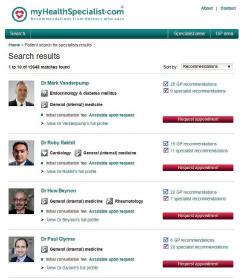
myHealthSpecialist.com features specialists who have also been recommended by doctors, and connects them with patients looking for a specialist referral.
We only feature peer-recommended doctors, as we believe in directing patients to the most trusted healthcare professionals.
In addition, our GP-led team helps new and established specialists digitise their professional reputation and build links with GPs in order to establish long-term clinical relationships.
how did you get involved with this project?
I am passionate about technology and care deeply about building clinical communities and improving patient care.
When a patient needs a specialist referral – usually privately, but sometimes on the NHS – they almost always ask their GP the same question: ‘Who do you recommend?’
It’s helpful if their GP knows an expert in that field, but if they don’t, it leads to messages and emails to colleagues asking for their recommendations or –indeed – asking the patient to find
out for themselves. This can be time-consuming for both patients and GPs.
We started myHealthSpecialist. com to aggregate the recommendations currently existing in the minds of doctors and to make them freely accessible for everyone to use.
We know if doctors find this information difficult to come by, then patients will find it even more difficult, especially as these may relate to life-changing decisions.
Who is using you service?
With the help of our fantastic GP and specialist members, we have collated over 8,000 recommendations for UK specialists on the website, which currently receives 400,000 specialist profile views each month by GPs and patients, and helps connect thousands of patients to recommended specialists each week.
Our clients range from individual specialists, groups, clinics, hospitals and national providers, who are keen to build new referral pathways and improve their online visibility and reputation. We are strong on evidence and show a clear return on investment to our clients.
how is myhealthspecialist different from other online specialist directories?
The key difference is that our website has been created by GPs and only features specialists that have been recommended by doctors.
We believe peer review is the most trusted source of information and is in line with scientific journals and the new appraisal/ revalidation process.
Also, we believe in working with specialists, clinics and providers to augment a positive online reputation and help establish long-term referral pathways based on strong clinical relationships between primary and secondary care.
Regular networking events for our GP and specialist members help cement existing relationships and spark new ones.
Together, this has achieved strong results for our existing clients and helps improve patient satisfaction and outcomes.
The myHealthSpecialist website is laid out in a clear manner and includes profiles on specialists
can patients leave feedback?
Patients are not currently able to leave feedback on the website. This is because an erroneous negative comment has medico-legal implications and there is no right of reply from a clinician because of patient confidentiality.
We therefore focus on positive recommendations from healthcare professionals who are happy to publicly endorse a particular specialist.
This information is vital for GPs and patients selecting a specialist for onward care.
If you have no negative patient feedback, then it’s a testimonial and it’s hard to establish if this is real or fake.
All our recommendations are from GMC-verified GPs and specialists and represent a digitisation of ‘real world’ recommendation knowledge used in clinical practice.
What do the regulatory bodies say about myhealthspecialist?
The website has been developed with advice from the GMC and addresses a key theory of harm raised by the Competition and Markets Authority (CMA) regarding the lack of independent and transparent information available to GPs and patients accessing private healthcare services.
We are in close communication with the chairman at the Private Healthcare Information Network (PHIN), who has been very supportive of our endeavours.
What is the myhealthspecialist revenue model?
The website is free to use for patients and GPs. For specialists wishing to publish private practice details and engage our consultancy services, there is a subscription fee of £52.80 a month, including VAT, and this keeps it free for those searching the platform.
For clinics and large providers, we have discounts and bespoke packages related to performance and these currently range from £5k-50k a year.
For each recommendation that is shared by a GP or specialist, we make a donation to the Royal Medical Benevolent Fund (RMBF), a fantastic charity which helps medical students and doctors in financial or emotional difficulty. We believe our model is a win-win for all stakeholders and supports a very worthwhile charity.
What has been your funding journey to date?
The beta-version of the website was launched in 2013 with seed funding from a founder team of GP colleagues and friends who had a passion for health and IT
and also poured in a lot of hard work.
After seeing strong organic growth in 2014, a further earlystage investment round was completed in 2015, which allowed for technology updates and a dedicated team to be set up.
Are you still practising as a gp?
Yes, I work two days a week in practice and work on myHealthSpecialist the rest of the time. Besides the fact I love clinical practice and patient consultations, it’s essential to understanding our healthcare system from a front-line perspective and in particular where technology can help and where it may be a hindrance.
GPs work at a frenetic pace and are required to have a vast breadth of knowledge; it’s impossible for anyone to truly understand this if you’re not on the front line.
What is Tiko’s gp group?
Tiko’s GP Group (TGG) is a GP-only Facebook group that I started in 2011. It was inspired by a YouTube video by Steven Johnson on ‘Where good ideas come from’, which essentially linked innovation to historic increases in connectivity.
GPs may work in the same practice but can often feel disconnected from each other by the nature of our work. TGG aimed to connect us in the online space, which overcame the barriers with geography and time.
It grew organically from 20
friends who were part of my Royal Free GP Training scheme and now has 5,000+ members and facilitates thousands of interesting discussions each week. It’s a partnership with myHealthSpecialist and means we can continue to run TGG for free while helping specialists connect with GPs online through interviews, articles and events.
What have been the biggest challenges of being a ‘doctorpreneur’?
There’s certainly been a few so far! Learning a completely new set of skills which aren’t taught in medical training has been the first major hurdle.
The parts of the brain used for diagnosis, management, treatment and patient-focused multitasking feel completely different from technology development, finance and marketing.
Balancing both in the same working week in a sustainable way has been a key challenge and the importance of being passionate about what I do helps me keep building both myHealthSpecialist and TGG.
In addition, it has been key to communicate that what we are building is for the long term to help all stakeholders in healthcare.
Dr Kartik Modha
GPs at myHealthSpecialist’s Summer ‘EduSocial’ at the Royal Society of Medicine: (L-R) Dr Zoe Williams, Dr Ramona Gadelrab and Dr Rupy Aujla
There can be cynicism that clinical innovators are trying to ‘get rich quick’ and opt out of the arduousness of front-line clinical work, but only by having clinicians lead innovation will we see genuine step-wise improvements in our current healthcare systems.
Another big challenge has been to improve communication and the sense of community which has been eroded by successive healthcare re-organisations and the subsequent increasing pressure on clinical time.
That said, I have been incredibly lucky to have been supported by some very experienced individuals and am part of a very hard-working team, which means we have overcome each challenge placed in front of us and the projects have allowed me to learn new skills along the way.
In medicine, we traditionally believed in the ‘see one, do one, teach one’ model and I think it’s this swashbuckling, ‘can-do’ spirit that helps clinicians push forward in the innovation space.
What’s next from myhealthspecialist?
We will soon be opening up our search platform to doctor-recommended GPs, dentists and allied health professionals and have some exciting new technology and partnerships in the pipeline.
We were recent finalists at the UK Blog Awards in the education category with ‘myHealth bytes’ and have been rolling out new vlog content across our social media and syndicated channels.
Video content is a key way to communicate and increase awareness of a service online and we are able to facilitate the production of high-quality content as well as make the most of existing video content for our clients.
Our aim is to help make private healthcare more transparent and improve access to trusted providers and, so far, things are heading in a positive direction.
For more information about myHealthSpecialist, contact: info@myhealthspecialist.com or call 020 3475 8580
Left to right: Dr Kartik Modha, Sir Richard Thompson (former physician to the Queen), Dr Rasha Gadelrab and Dr nik Modha, chief operating officer
Dear Reader,
Subscribing to Independent Practitioner Today is the only way you can be sure you will see every issue and have the option of reading us online using our special page-turnable edition. Don’t risk missing out. Our personal subscription for doctors and managers is only £90 a year and £210 for organisations. But you can cut this to just £75 and £180 respectively if you pay by direct debit. So take advantage of this offer now for our unique business journal dedicated to supporting you in your private practice. We’re confident your subscription will repay itself many times over!
Editorial director
i enclose a cheque for £ ........... made payable to the independent
please
my Mastercard/Visa/Amex/diners
Instructions to your Bank or Building Society to pay Direct Debits
Instructions to your Bank or Building Society to pay Direct Debits Name and full address of your bank/Building Society
To: The Manager Bank/Building Society Address Postcode Ref. No. (Do not complete) Signature(s)
Banks and Building societies may not accept direct debit instructions for some types of account
Name and full address of your bank/Building Society Banks and Building Societies may not accept Direct Debit instructions for some types of account
post your application (no postage required – UK only) to: independent practitioner today subscriptions department, Freepost, po Box 36, plymouth, pL1 1Br
Banks and Building Societies may not accept Direct Debit instructions for some types of account
phone: 01752 312140 Fax: 01752 313162 email: lisa@marketingcentre.co.uk or subscribe online at www.independent-practitioner-today.co.uk if you want to pay by card
from your branch of the amount paid. You can cancel a Direct Debit at any time, by
ApplicATion FoR sUbscRipTion
mARkETing yoUR pRAcTicE
Bin the budget
In a previous article in Independent Practitioner Today (April 2017), surgeon
Mr Dev Lall (right) turned
the spotlight on opportunities to market your practice for free. But you shouldn’t look to do everything for nothing, he warns
We all like stuff for free. No matter what it is: products – or less commonly, services – we love it. and the dawning of the internet age has meant that the marketing of products and services from vendors to purchasers is now very, very easy.
People have more choice than ever before. and that means free samples of products abound as businesses feel the competition. But one major downside of this is being seduced by the concept of free. always looking for a free way of getting what you want – free software, for example.
The peril of free and too much free is neither good nor healthy because it can easily cloud your thinking.
Take marketing your private practice. In my last piece, I talked about free or virtually free ways of growing your private practice. Nothing wrong with that whatsoever – and I hope you have started putting some of those strategies into action.
But looking to do something so important as promote your private practice purely for free is bonkers. Because promotional efforts that come with an overt cost – advertising in print, media or online – often have huge advantages over free. Control and scalability, for example.
The folly of the marketing budget
Many people and businesses when planning ahead decide upon a marketing budget for the next six months or a year. and, on the face of it, this sounds entirely sensible. But I believe that really reveals a
fundamental lack of understanding about how marketing does, or should, work.
By creating a marketing budget you are, in effect, saying you are going to spend ‘X’ amount of money on promoting your private practice regardless of the outcome.
You’re saying that even if your marketing budget of, say, £5,000 generates £10,000, £15,000 or £20,000 of business, you’re going to stop spending money on marketing for the rest of the year, as you’ve used up your ‘budget’. That, clearly, is nuts.
But, sadly, that is the way most people operate larger private practices. Smaller private practices often won’t spend money at all to promote themselves. I’m not sure which is worse.
So the first thing I want to do is banish the concept of the marketing budget and replace it with the concept of the marketing pilot.
The marketing pilot
Here’s how it works: you take a good look at your practice and consider your current income as well as your income goals for six months or a year down the line.
With that in mind, you decide how much money you are happy to spend and are willing to lose, if necessary, to grow your practice.
The ‘willing to lose’ bit is critically important, because what you’re going to do is to spend that money testing out one or more tactics to grow your practice. Testing, because you can’t be certain any one approach is going to work.
We know that marketing as a strategy for growing a private
practice or any other business always works – yes, always – but we can’t know for certain what particular approaches or tactics will work in any given specialty or location.
We can only make educated guesses based upon what we know works in the same specialty in other areas of the country and what works in other specialties. and not only do we not know if a particular strategy will work, we also do not know how successful a given approach to marketing your practice will be. It might only generate a few patients or it might generate a veritable tidal wave of them.
The uncomfortable truth is that, of all your marketing efforts to grow your practice, a few will fail disastrously, the majority will generate a reasonable number of patients and a few will generate spectacular results with a stream of patients vying to be seen as if by magic.
But until you actually test it and see what happens, you have no idea what your results will be.
That is why, when trying out a new approach to marketing your practice, you should always start small and allocate a sensible amount of money that you are comfortable to lose if it doesn’t work out as you had hoped.
In other words, start small with a pilot study.
next month: When the results are in – marketing as an investment
Mr Dev Lall is a surgeon who runs a specialist private practice consultancy www.privatepracticeexpert. co.uk
dATA pRoTEcTion
Your practice premises may be secured with double-locks and a burglar alarm, but that is not the only way that criminals can get to you. In the third and last of his articles on technology for independent practice, Healthcode’s
Peter Connor (left) looks at cyber threats and explains why the stakes have never been higher
Locking out
In January 2017, the largest nHS trust in England was forced to shut down some of its IT systems for several days, including its pathology and file-sharing systems.
Barts Health Trust had become the latest high-profile victim of a cyber-attack which left it scrambling to tackle the cause of the infection and ensure patient data was not compromised.1
The attack on Barts highlights a sinister and growing threat to all healthcare providers. Only three months before, northern Lincolnshire and Goole Foundation nHS Trust was hit by a ransomware attack – where files are locked until a ransom is paid – which effectively shut down its IT systems for four days and led to the cancellation of 2,800 appointments.
a nd it has been reported that more than a third of n HS trusts have been infected by ransomware in the previous 18 months.2
Despite the gallant image cultivated by some computer ‘hacktivists’, cyber-criminals are prepared to target healthcare organisations, ignoring the potential repercussions for ordinary patients and the precious resources that have to be diverted to deal with the crisis and its aftermath.
as an independent practice, you may think that you do not present a target for this kind of crime, but, as we shall see, cyber-crime represents a significant threat to us all. a nd new data laws which come into effect next year will raise the stakes even higher.
A phantom menace
In March 2017, a report by the new n ational Cyber Security Centre and the n ational Crime a gency 3 described the growing threat posed by cyber-crime to British business in stark terms. It warned of a number of factors that contributed to its growth:
The number of potential criminals is increasing as the technical skill required to commit cyberattacks decreases. r eady-made malware programmes can now be downloaded from the ‘dark web’;
The number of devices and opportunities to launch an attack is growing. For example, some internet-connected devices – the ‘Internet of Things’ – have been found to be vulnerable to hackers, which means they can be used as a
platform for attacks on otherwise secure networks;
Criminal groups and individuals are increasingly working with and learning from each other;
Social media allows criminals to select individual targets from within organisations and use their online profile to dupe them into opening emails and links (phishing);
Organisations are leaving themselves unnecessarily vulnerable by failing to update their anti-malware protection and other poor security practices.
The report also suggests that criminals are constantly adapting their tactics in response to new opportunities. For example, it predicts that attackers could increasingly try to manipulate files as well as steal or deny access to data. In healthcare, this could have lifethreatening consequences.
But perhaps the most insidious aspect of cyber-crime is the way that the victim unwittingly colludes in their own downfall.
Invoice scams are a classic example. In February 2017, a ction Fraud warned 4 that, in recent months, several medical practices had experienced ‘substantial financial losses’ as a result of CEO (chief executive) fraud.
In this case, the fraudsters pose as a senior partner to email a member of staff with responsibility for authorising financial transfers, instructing them to make an urgent payment.
To discourage staff members from checking, the bogus email often asks them not to contact the senior partner again, as they are busy.
In other cases, the fake email is sent while the senior partner is on holiday to make it harder to check.
Other tactics include posing as an existing supplier to email a change of bank account details so money can be siphoned into the fraudster’s account and sending a phishing email requesting payment of an attached invoice.
Once opened, the attachment infects the recipient’s computer with malware which enables criminals to steal confidential data or transfer money from your online bank account.
iT security in the spotlight ultimately, cyber-crime can take many forms, which makes IT secu-
rity an ongoing technology challenge for every practice owner. a nd this is likely to take on increasing significance ahead of stricter Europe-wide data protection rules which come into effect from 25 May 2018 regardless of Brexit.
replacing the Data Protection a ct 1998, the General Data Protection r egulation (GDP r ) 5 imposes greater accountability on organisations when it comes to information security.
For example, a rticle 5 of the GDPr requires personal data to be ‘processed in a manner that ensures appropriate security of the personal data, including protection against unauthorised or unlawful processing and against accidental loss, destruction or damage, using appropriate technical or organisational measures’. Data controllers ‘shall be responsible for, and be able to demonstrate, compliance’.
Perhaps the most insidious aspect of cyber-crime is the way that the victim unwittingly colludes in their own downfall
The Information Commissioner’s Office (ICO) has produced guidance on how you can demonstrate compliance with the GDPr’s data security obligations which can be found on its website.6 The key points include:
➲ Implement internal data protection policies such as staff training, internal audits of processing activities, and reviews of internal Hr policies.
➲ Keep records of your processing activities for the ICO, including:
Upright Positional MRI
• Completely open scanner that is well tolerated by claustrophobic patients
• Weight-bearing scans for spine and joints enable a more precise diagnosis
• Patients who are large or cannot lie down can be accommodated
For more information go online at: www.trulyopenmri.com or call
❍ Details of your organisation;
❍ The purpose of processing;
❍ The categories of individuals and personal data;
❍ Categories of recipients of personal data;
❍ Details of data transfers to other countries and the safeguards in place;
❍ retention schedules;
❍ Data security measures in place.
➲ a ppoint a data protection officer to monitor compliance with data protection laws, advise and train staff, conduct internal audits and be the first point of contact on data protection.
➲ Show that you have considered and integrated data protection into your processing activities – for instance, pseudonymising data where possible, monitoring and enhancing security features on an ongoing basis. This is known as ‘data protection by design’.
➲ Carry out a data protection impact assessments (DPI a ) to identify the most effective way to comply with data protection obligations and address problems at an early stage. a DPIa is essential when your practice adopts new technology.
➲ Consider signing up to a code of conduct or certification scheme such as ISO/IEC 27001:2013.
obligation to report
The GDPr imposes an obligation on organisations to report a breach of security leading to the destruction, loss, alteration, unauthorised disclosure of, or access to, personal data which is likely to result in a risk to the rights and freedoms of individuals; for example, the loss of health or financial data.
Failure to do so can result in a heavy fine of up to €10m or 2% of global turnover.
The ICO will have the power to fine companies up to €20m or 4% of a company’s total annual worldwide turnover for the preceding year for serious failures.
In a speech earlier this year, the u K Information Commissioner, Elizabeth Denham, warned: ‘If a business can’t show that good data protection is a cornerstone of their practices, they’re leaving themselves open to a fine or other enforcement action that could
If you rely on a third-party supplier to process or store data, you also need to ensure they have appropriate information security safeguards
damage bank balance or business reputation.’7
If you rely on a third-party supplier to process or store data, you also need to ensure they have appropriate information security safeguards to comply with the GDPr as a guide, here are some of the measures that Healthcode has in place:
☛ Private dedicated infrastructure – we hold data within a private dedicated infrastructure rather than store it in a cloud and shared with unknown organisations.
☛ Data sovereignty – we use a secure data centre which is physically located in the uK.
☛ Encryption – electronic bills and clinical records submitted through our online system are securely encrypted in accordance with internet banking conventions.
☛ Information security management – our internal policies, procedures and controls comply with ISO/IEC 27001:2013, the international standard.
☛ Resilience testing – we regularly review our security, including penetration tests to identify potential weaknesses and ensure systems remain fit for purpose and that data is protected as technology advances.
☛ Back-up – we back up our data daily and have a separate secure disaster recovery facility.
☛ Independent audit – we allow clients to review our information security arrangements.
Independent practitioners owe it to patients and themselves to take commonsense It security measures within their practice
☛ Services – security is a primary consideration when developing services. For example, we have developed a secure encrypted messaging service so that healthcare professionals can instantly share information with named colleagues or relevant healthcare departments without compromising patient privacy.
Your security check list a t the same time, independent practitioners owe it to patients and themselves to take commonsense IT security measures within their practice (see box on the right).
used properly, technology can be your first line of defence against data breaches, but if you are complacent, it can also become your achilles heel. you wouldn’t think of leaving your practice without locking the door and setting the alarm. It’s time to look at your IT systems in the same way.
References
1. Update: Trojan malware blamed for Barts cyber-attack; Digital Health, 16 January 2017. www.digitalhealth. net/2017/01/update-trojan-malwareblamed-for-barts-cyber-attack-2.
2. Cyber criminals target NHS to steal medical data for ransom; Financial Times, 2 February 2017.
3. The cyber threat to UK business; National Cyber Security Centre and National Crime Agency, Crown copyright 2017. www.nationalcrimeagency.gov.uk/ publications/785-the-cyber-threat-to-ukbusiness/file.
4. Medical practices targeted by CEO Fraud, ActionFraud, 1 February 2017. www. actionfraud.police.uk/news/medical-practices-targeted-by-ceo-fraud-feb17.
5. General Data Protection Regulation (GDPR), Regulation (EU) 2016/679; Official Journal of the European Union, 27 April 2016. http://eur-lex.europa.eu/legalcontent/EN/TXT/PDF/?uri=CELEX:32016R 0679&from=EN.
6. Overview of the General Data Protection Regulation (GDPR); ICO website. https://ico.org.uk/for-organisations/dataprotection-reform.
7. GDPR and accountability. Speech by Elizabeth Denham, 17 January 2017, ICO website. https://ico.org.uk/about-the-ico/ news-and-events/news-and-blogs/ 2017/01/gdpr-and-accountability/
If you want to know whether your practice is vulnerable to cyber-criminals and data protection breaches, ask yourself the following ten questions:
❶ Have you installed security software – antivirus and firewall – to protect your computer and ensure it is kept up to date? the software should be set to automatically scan files and webpages and whole system scans should be carried out frequently
❷ Do you and your staff follow good password practice? use different passwords for different services so that one breach doesn’t compromise all your accounts. Change passwords regularly; use passwords with combinations of letters, numbers and characters. Never share passwords
❸ Do you install software updates when available? older operating systems, software, internet browsers and apps may not be supported by the provider, so they will be inherently less secure
❹ Do you only use secure and encrypted channels of communication to send invoices and other information? standard unencrypted email is inherently insecure and should never be used to send invoices or identifiable patient information
❺ Do you back up your data every day and store back-ups separately? regular back-ups mean you can restore data and are less vulnerable to ransomware demands
❻ Do you control access to confidential data? staff should have their own user identity which gives them access appropriate to their role
❼ Do you have a practice It security policy? this should cover aspects of security such as internet and email use, passwords, using screen-lock and restrict the storing of data on unsecured mobile devices. Non-compliance should be a disciplinary matter
❽ Do you and your team receive regular training in cyber security? Alongside training, it’s worth visiting the Government’s Cyber essentials8 and the ICo websites for the latest best practice information
❾ Do you check the security credentials of other companies? Ask service providers, insurers, hospitals and suppliers about the measures they have in place to protect your data
❿ How quickly would you recognise a security breach? the sooner you are aware of a security breach, the sooner
can act.
Totally committed
Consultants who have formed a new north London group, Total Orthopaedics, believe they are creating something special. Kathryn Bryant (below) tells their story
A new consultA nt partnership has developed from the foundation of friendship and years of collaboration running an orthopaedic department for Barnet and chase Farm nHs Hospitals.
‘It just made sense that we formed an orthopaedic group’, explains Mr Joyti s aksena. ‘ we support each other in the n H s and in our personal lives. we genuinely are great mates and are passionate about the service we provide to our patients.
‘ we wanted to develop an orthopaedic service that is more affordable for patients and incorporates self-pay package pricing for outpatient and/or inpatient pathways, in addition to delivering quality, innovation and results.’
t he ethos of the resulting group, total o rthopaedics, is excellence through innovation, quality and commitment to patients, delivered by teamwork.
Mr saksena says: ‘Any organisation can provide new treatments or techniques delivered by individuals, but all partners need to be invested in the ethos and dynamic of the group.
‘Being passionate, honest and supporting one another within our service to ensure co-operation and joined-up thinking is essential for each partner.’
But forming a cohesive group with each member signed up not only to be accountable to their patients and to the service but also to be accountable as leaders in the organisation, and to each other as partners, can be difficult to achieve in practice. Yet it has a profound and positive effect on patient care.
Founding partners
total orthopaedics is made up of seven founding partners: Mr Rajiv Bajekal – spine; Mr Bob chatterjee – spine; Mr s imon Mellor – hip and knee; Mr Harold nwaboku –hip and knee; Mr Pinak Ray – foot and ankle; Mr Dan Rossouw –shoulder/some upper limb; and Mr Joyti saksena – hip and knee. the consultants are masters of their own subspecialty in the group and each partner is also responsible for overseeing certain functions of the organisation by being involved in the planning and implementation with their staff.
Finance, physiotherapist/GP liaison, governance/surgical outcomes, promotion, website/social media are some examples of the partners’ extra organisational responsibilities and demonstrates their accountability to one another, as each responsible partner reports back their activity and evaluation into the group.
All partners equally drive and develop the group while balancing their nHs consultant roles.
t he group holds outpatient clinics and performs surgery at Highgate Private Hospital, which is part of Aspen Healthcare. the hospital was always t otal orthopaedics’ first choice to provide their service from.
t he location needed to be in north l ondon and the capabilities of the setting had to ensure a seamless pathway for orthopaedic patients supported by allied staff who were aligned to the partnership’s ethos and culture.
Serene surroundings
n estled in serene surroundings, there is a boutique atmosphere that immediately puts patients at ease. t he orthopaedic service is multispecialty, available six days a week and offers same-day appointments/diagnostics and affordable self-pay packages.
Mr s aksena continues: ‘ we wanted our patients to have minimal visits to provide a definitive diagnosis and treatment plan, be transparent about how much a total outpatient/inpatient journey with all its variations would cost and wrap it up in more affordable self-pay package prices.
‘we obviously have no control over insured pricing, but we knew
The group is based at Aspen’s Highgate Private Hospital, north London, while also keeping up their NHS practices
we could improve the situation for self-paying patients.’
the consultants have interests in all musculo-skeletal conditions with additional skill sets to address trauma and sports injuries and offering minimally invasive or non-surgical treatments.
As part of their launch activities, they were all keen to achieve something else together as a team.
Mr simon Mellor recalls: ‘I turned 50 and I wanted to get in shape by cycling more and started with setting a goal of riding from london to Brighton.
‘All the guys were committed from the start to join me and we agreed to train at weekends to achieve our goal as part of the launch of total orthopaedics and to raise money for cancer Research in honour of my father.’
goal achieved they rode as a team and achieved their goal of cycling from london to Brighton together earlier this summer. they had been in training for a couple of months and dedicated s unday mornings to the cause.
c ycling is the fastest-growing sport in the uK and the injuries caused by the sport impact the lower limb, upper limb and spine. the group gained first-hand experience about correct positioning on the bike and who better now to advise cyclists on injuries than orthopaedic consultants that happen to cycle: ortho-pedalists! t he partners have continued their weekend cycling sessions and the next goal, according to Mr Dan Rossouw, is the london to cambridge ride this month and then ‘london to Paris in 2018’. total o rthopaedics aims to achieve its goals and objectives together. Its members approach the ever-changing marketplace
with an ethos that underpins its organisation: commitment delivered by teamwork.
this was demonstrated in their dedication to support Mr Mellor in achieving his goal to cycle to Brighton and it is also evident when they describe their input and ownership of the service that they believe will enable more people to be able to afford the fivestar orthopaedic care.
they have a genuine respect for one another and a passion about the service delivered to their patients. An orthopaedic team that has developed in the n H s and now the independent sector will surely benefit through delivering a service that is enjoyed by the actual deliverers, due to their friendship and teamwork.
this idea is reflected in organisational culture and leadership literature, with the notion that ‘culture eats strategy for lunch every day of the week’.1
In the coming months, the group will be visiting referring GPs and allied health professionals to network and promote the consultants’ service and ethos.
they will also be providing inhouse cPD lectures and events at Highgate Private Hospital and say they are available if any GP, physiotherapy practice or individual needs advice on a patient or would like a bespoke c PD inhouse programme: email to @ highgatehospital.co.uk or phone 020 8347 3869.
Reference: 1. Lee, F. (2004): If Disney Ran Your Hospital: 9½ Things Your Would Do Differently; Montana, Second River Healthcare Press.
Kathryn Bryant, a healthcare management consultant, is director of Primary Healthcare Consultancy and consults on business management for Total Orthopaedics
PROBLEMS WITH THE TAX MAN?
HMRC tax investigations and disputes create difficult and stressful times.
As an award winning firm of tax experts, our highly experienced partners specialise in resolving problems relating to tax investigations and disputes with HMRC.
To find out, in confidence, how we can help call 0800 734 3333.
‘Here to help. Not to judge.’
Left to right: Mr Harold Nwaboku, Mr Rajiv Bajekal, Mr Bob Chatterjee, Mr Simon Mellor, Mr Dan Rossouw, Mr Joyti Saksena and Mr Pinak Ray
GETTING THE BEST OUT OF YOUR PPU
The last word on
Self-pay growth and yearly profits are among the areas covered in the third and last of Philip Housden’s series providing an A-Z guide of private patient
units (PPUs)
Ring-fenced
(PPU beds)
A PPU is not really a PPU unless it has a ‘home’.
And in almost every example that means beds. Maybe not many, as low as six can still be commercially viable – 12-16 is better – but, crucially, they must be ring-fenced for private admissions.
Ring-fenced beds will increase rather than decrease funded NHS capacity in the trust. This is because higher private patient earnings will drive the surpluses to invest to create additional capacity, to pay for the private bed capacity to be staffed and open, while also delivering headroom during ‘troughs’ of demand to fund the NHS care that should be slotted-in to unused private beds.
PPUs are likely to push hard at capacity, at maximising the flexibility of rooms and all the square meterage of space they have access to, in order to be able to say ‘yes’ to all referrals.
This means looking at use of space not just within the PPU, but unused space elsewhere in the trust; for example, during evenings and weekends.
PPUs can export the trust’s private patient branding to one or more corners of the building well away from the private ward base.
It may only take the use of a key colour, improving signage or the adding of some personality to a space to turn it into a private patient facility after-hours, even when that same space has been used for the NHS during nine to five.
Self-pay
Self-pay is growing for PPUs at nearly 10% a year.
Generally speaking, most patients are not really informed purchasers or consumers of healthcare, at least not in the sense of knowing the difference between the doctors they might choose or be referred to.
Most patients, even in the age of the internet search engine and social media, will rely on their GP and hospital consultant to recommend the best course of action.
For insured and self-pay patients that want to ‘go private’, this means the choice of location for treatment will mostly be managed through a conversation with their surgeon or physician.
That choice will be dictated by where the consultant practises, which, in turn, will be a function of location, capacity for that surgeon and the wherewithal of that organisation to support the consultant. But this may not be ‘cheap’.
The independent hospital providers can set prices that absorb risk across their whole network, enabling a fixed-price promise and also ongoing aftercare.
They can do this in the knowledge that the occasional very high-cost patient can either be admitted to the NHS with complications or minor losses can be offset across the general profitability of the patient cohort.
In a PPU it is different. Private hospitals have quite likely
screened out the prospective patients with raised risk of complications and co-morbidities.
But the PPU cannot risk a loss against NHS tariffs, and certainly cannot offer a ‘stop-loss’ fixed price, given that, every once in a while, the catastrophic ‘£100k+’ patient will come along.
For these reasons, PPUs should carefully consider offering selfpay at a robust price point that emphasises the patient safety back-up which usually only the NHS can deliver. This, to the right patient and their family, is priceless.
Tariffs
At least once each year, PPUs should benchmark tariff prices, analyse activity by insurer and self-pay and review issues raised by consultants or others about areas of concern on costs inputs that may be hitting margins.
For both insured and self-pay tariffs, it makes sense for PPUs to do what they can to understand the local and national market. External benchmarking reviews may enable insight into movements in the market, as achieving tariff increases can be tough, but is helped by diligent research.
PPUs
PPUs often engage the help of a sector expert with access to up-todate benchmarking information or perhaps support for the negotiations with insurers.
In any event, there should certainly be some internal analysis and consideration of which clinical specialties and procedures the NHS PPU has a relative position of strength in the market. It is these that it makes sense to work on to further strengthen them and seek rewards through tariff increases that ensure the PPU continues to deliver a reasonable return.
Unplanned admissions
The average take-up of private medical insurance remains at nearly 11% of the population. This is a typical figure across most of England at least – with some ‘hot spot’ areas considerably higher and others, of course, a lot lower.
So that means that one in nine or ten of the catchment of most trusts hold insurance and, in addition of course, many more people are prepared to consider the selffunding of private care.
the trust have insurance or would consider paying for treatment.
But often these patients don’t know they can use their insurance, don’t know how to use it or are not even sure they can use it if they attend the NHS.
The net result of the patient not accessing that insurance means insurers achieve higher profit margins while the same represents lost potential income to the trust.
If a trust has a PPU and those beds are protected so they can ‘take’ admissions, then asking patients at registration about their insurance status will increase private patient activity.
Every patient taken out of the four-hour queue is one less potential ‘breacher’, and every patient admitted to the PPU from the ‘front door’ would have been admitted to the trust anyway.
So when a trust holds protected PPU beds, it really does not reduce NHS capacity.
Volume and value
It is vital that PPUs become aware of the relative value of the range of private procedures undertaken. That means, checking that no service is offered at lower than NHS tariff, and also taking a view on the relative resource efforts required by the organisation to deliver the financial margin.
NHS PPUs should not chase activity that the local private hospital can do more cheaply, but instead concentrate on understanding the work that the private hospital cannot.
This is likely to be procedures related to specialist skills and equipment: those based on critical care support and treatment of patients with co-morbidities and other areas of relative higher risk.
All of these are reasons to engage with insurers to ensure that PPU tariffs reflect the ‘lower volume but higher costs’ nature of the cohort of patients that consultants choose to use the PPU for.
Walk-in/walk-out ambulatory
The increasing range of outpatient and ambulatory procedures and diagnostic tests have revolutionised much of inpatient care, outpatient settings and the patient experience.
What started with diagnostic imaging investment in MRI and CT scanners has developed into therapeutic techniques that are blending imaging and pathology and significantly reducing admission rates, lengths of stay, and extending the range of treatable conditions.
Although PPUs should not admit patients for longer than necessary, offering day-case patients the privacy of a bedroom may well be what the patient wants – while in many independent-sector hospitals with day-care ‘pods’ and ‘ambulatory chairs’ this may be exactly what they no longer get.
Xmas and the other seasons
September is a burst of activity –not just for the management annual business cycle, but importantly for private healthcare demand too.
As the schools go back, so surgeons are available and hungry for private work.
And patients, too, seem keen to take action with their health, perhaps planning for all to be well before Christmas.
Autumn has traditionally therefore – at least anecdotally – been the busiest season for private providers, certainly for self-pay.
PPUs should not close for Christmas. Leave that to the independent sector competitor and the PPU can then pick up work.
It is helpful to the PPU if private hospitals want/need to save on costs or carry out refurbishments, as cases will come back to the trust.
These may be complex, they might be from ‘big-hitters’ or newly appointed consultants that haven’t used the PPU before.
In any event, Christmas is an opportunity – but PPUs need those ring-fenced beds to really maximise it.
The New Year may be impacted by the ski season, but spring and
This means that a significant proportion of patients attending ➱ p30
Therefore, it is often better to work out a limited list of procedures on which to negotiate specific uplifts, citing specific internal expertise and costs pressures, than it might be to seek a ‘one-size-fits-all’ blanket acrossthe-board percentage increase.
summer seasons also drive elective demand as patients look to sort out their health in the lead up to the warmer weather and family holidays.
Again, PPUs should not close in August, as the competitor just might.
Yearly profits
A PPU must earn its way. This means delivering profits after consideration of trust overheads.
What is possible? Well, that depends on all sorts of factors, but a six-bed PPU can do it – although bigger is more beautiful.
So, size is important, yes; but the recipe of success also requires:
Visible leadership;
Trusted administration;
Robust governance;
A well-maintained built environment with a dash of ‘love’ and care;
A hard-headed commercial approach.
That’s what delivers yearly profits to plough back into NHS core activities.
Zero (missed opportunity)
So, what happens if the local trust does not have a PPU? In this situation, the patients, insured or not, most probably default to the NHS.
Of course, holding private medical insurance does not impact on the eligibility of the patient to access the NHS, but when there is a private bed available on the NHS trust site, then this is an option that the patient and their surgeon can choose.
Making that choice both saves the NHS costs, while also increasing revenue for re-investment in core NHS services.
Philip Housden is a director of Housden Group, a management consultancy specialising in commercial support in the healthcare sector
A year ago, my Independent Practitioner Today series on PPUs started with optimism about growth and the potential for achieving increased surpluses from private patient activities for NHS trusts.
That optimism was borne of pressures that are enabling positive change for private patient services and my experience of working across many trusts up and down the NHS.
Despite the worst winter pressures ever, the burning platform of NHS finances is highlighting to management the benefits of mixed or blended provision.
And looking back now, I was right to be optimistic. The trusts I have worked with in 2016-17 enjoyed significant growth in private patient revenues and surpluses. They delivered an improved NHS service contribution too – in capacity enhancement, relieved demand pressures and focused support for elective surgical and complex surgery.
So I remain even more optimistic about 2017-18 and supporting even more trusts in this journey to deliver the ‘best of both’.
I hope you have enjoyed our series on private patient units. Please let us know what you think, and also share your experiences with us.
Making allowances
Many
independent practitioners would benefit by making a summer stock review to ensure they are not missing
out on accumulating more funds for themselves and
their business.
Susan Hutter (right) points where to look
THE RULES on dividends, which apply for anyone who trades as a limited company, changed on 26 April.
A taxpayer in 2017-18 could earn up to £22,500 tax-free. This is made up of: £11,500 personal allowance, £1,000 personal savings allowance, £5,000 savings starting rate and £5,000 dividend allowance.
If your spouse is a shareholder or you have children over the age of 18, you can allocate dividends to them. The good news is that the reduction in the dividend allowance from £5,000 to £2,000 in the last Budget has been shelved for the time being.
Keep it in the family
While this arrangement won’t be appropriate for all, getting your
family to work in the business –providing they earn less than £11,000 a year – is a good way to give funds without paying tax.
Perhaps your spouse helps out with running of diaries or managing administration?
If you have computer-savvy children over the age of 16, they can also legally work for your practice and be put on the payroll, whether that is for IT requirements or even cleaning up your database to ensure everything is up to date.
Keep records up to date
It might seem obvious, but a lot of practices fall down and lose money by not keeping accurate records and by failing to carry out their bookkeeping regularly and on a timely basis.
Have all your invoices been sent out on time?
Who is ensuring invoices are paid quickly?
Whoever is given this responsibility needs to be properly trained up so they can handle and put all relevant details in accounting or business software.
Ensure freelancers are freelancers
Be aware that you do not cut corners by trying to employ staff as a freelancer if they actually qualify as an employee.
HM Revenue and Customs (HMRC) takes a very dim view of business owners paying staff as freelancers when they do not meet the criteria and you should, in fact, be paying out employers’ National Insurance.
Be aware that inspectors will not usually investigate the ‘freelancer’. Your company is much more likely to be the target. You may be landed with a backdated bill if you are found ‘guilty’.
This could be thousands, if not tens of thousands of pounds. Depending on the level of payments and how long it has been going on, HMRC can go back six years.
Check out the key attributes of self-employed individuals, in the box (above, right).
One way to ensure the business hiring the self-employed individual is not at risk of being considered an employer is to require all
CHeCk THem oUT
Be aware that key attributes of self-employed people include:
They are in business for themselves, are responsible for the success or failure of their business and can make a loss or a profit
They can decide what work they do and when, where or how to do it
They can hire someone else to do the work – the right of substitution is a key requirement
They are responsible for fixing any unsatisfactory work in their own time
Their employer agrees a fixed price for their work – it doesn’t depend on how long the job takes to finish
They use their own money to buy business assets, cover running costs and provide tools and equipment for their work
They can work for more than one client
such consultants to operate through a limited company. The consultant is then an employee of their own company which will normally be required to operate its own PAYE scheme under specific legislation designed for this purpose.
Make the most of your R&D tax credit
Far more in the medical profession could be making the most of Research and Development tax credits such as developing a website and creating and launching a new product. And at a staggering 220% tax relief, it is worth seeking advice on what you are allowed to claim.
Susan Hutter is a specialist medical accountant and a partner at Shelley Stock Hutter
Evolving landscape of private insurance
In light of the changing nature of how private medical insurance companies operate, Garry Chapman discusses how the billing and collection process works and what you need to do to ensure healthy cash flow in future
The percenTage of the UK population with private medical insurance (pMI) policies has fallen from its peak in 2008 when over 12% of the population had a policy. It then fell sharply between 2008 and 2011 due to the recession that followed.
The market then stayed flat for a number of years before slowly recovering and it is now rising at the fastest rate since its peak.
This growth is mainly coming from the corporate sector. as the economy has recovered, more people have moved back into work and firms continue to offer insurance as an employee benefit.
This has more perceived value than before, due to the recent decline in nh S services and the increased waiting lists. It is interesting to note that the number of individuals taking out pMI continues to fall due to the increased costs of the premiums.
The insurance companies are faced with the twin dilemmas of an ageing population and expensive new treatments. as the technological advancements continue to increase, then the cost of providing these also increase.
On top of this, the insurance premium tax has been introduced and has continued to increase, reaching 12% in June.
all of the above means the cost of insurance polices are rising at a higher rate than inflation and they are forecast to rise at more than 6.5% this year.
as a result, insurance firms must look at ways of keeping costs down and, to achieve this, there has been a significant change in many polices, either limiting which consultants or hospitals the patient can see or reducing costs.
This can include an increase in the policy’s excess, a reduction in benefit or an increase in co-share policies where the patient is responsible for a certain percentage of every invoice.
The main point to understand about this is that whatever the reason for the shortfall between the fee charged by the practice and the contribution paid by the insurance company, the burden for the administration of these shortfalls is the responsibility of the practice.
added to the above, you have a situation where many people who
have pMI do not pay much attention to the small print of their policy until they need to use it.
This is more common with those who have corporate policies over those who have taken it out personally, as the type of policy will probably have been ‘selected’ for the former by their employer.
It is common for many pMI customers to think that their health insurance will cover all of the costs and, to their surprise, this is quite often not the case.
insurance company rules
To ensure you bill accurately to each individual insurance company so that you price correctly and adhere to each insurance companies’ rules, you need to understand the following. each individual insurer has its own fee schedule for procedures and they use the clinical coding and Schedule Development group (ccSD) codes to create their own fee schedules.
There are over 2,000 ccSD procedure codes – not including the 3,000 diagnostic codes.
e ach insurer can then have their own rules regarding the billing of these codes: when they can be used together, formulas for pricing when multiple procedures have taken place and what codes cannot be used together.
These rules need to be observed when raising an invoice, as consultants can risk derecognition for consistently billing incorrectly.
The ccSD schedule is updated on a weekly basis and this can include the addition of new codes, amendment of existing codes and how they are used in conjunction with other codes.
Process
Due to the increased costs that the insurers are experiencing, another major development in recent years has been a steady move towards raising invoices electronically.
This is typically done via electronic data interchange (eDI) as the preferred method or practices have to enter the invoice details onto each insurance company system rather than sending the invoice by the traditional postal method.
Bupa requires you to submit invoices online through its providers Online website and other
e-billing options such as healthcode – see the options at www. bupa.co.uk/healthcare-professionals/billing-and-payment –and Vitality has recently moved that way, meaning it no longer accepts invoices by post or email.
This is a sure sign of what is to come and we expect to see all insurers move in this direction, as it dramatically reduces their costs.
The p MI market still accounts for the largest segment of private practice and looks set to grow even more, so you do need to look at the following steps to ensure your practice is fit for dealing with the insurers in future.
iT infrastructure
There are still a lot of consultants working in private practice who operate their billing process either manually or on a word processing and spreadsheet platform.
To make matters worse, these software programmes are typi -
cally being run on laptops, notebooks or pc s which are never backed up. This means that if the device is either lost or the software becomes corrupt, then the finances of the consultant are put at risk from both a monetary and tax perspective.
One of the first issues a consultant should address is to ensure they set up the running of their private practice on a sound basis with the correct infrastructure.
This involves having a robust auditable system to facilitate the financial elements of the practice, including the ability to raise invoices electronically, reconcile payments and the capability to chase the outstanding invoices in a robust manner by phone and letter.
Terms and conditions
another area which is very rarely addressed correctly within a private practice is to have the terms
UK
• AISMA member (Maidstone and Leicester offices)
• 15 offices including London City
• Tax structures for Hospital Consultants - dispelling myths
• Surgeon groups and consortia
• GP Practices including mergers and federations
• Solvent liquidations (for companies at the end of their lives)
For more information please contact:
South East
James Gransby FCA
E: james.gransby@mhllp.co.uk
T: +44 (0)1622 754033
M: +44 (0)7712321899
East Midlands
Robert Nelson DChA FCA
E: robert.nelson@mhllp.co.uk
T: +44 (0)1162 894289
M: +44 (0)7814009160
General email: healthcare@mhllp.co.uk www.macintyrehudson.co.uk
Top 20 accountants specialising in the healthcare sector
and conditions written down and presented to the patient prior to any treatment taking place.
This would typically take place within a ‘patient registration form’ and cover areas such as pricing and shortfalls, especially where the patient should be notified that they are responsible for any costs that are not covered by their own pMI policy.
Pricing structure
The practice has to decide if it is going to adhere to each fee schedule of the insurance company, as they all have their own specific prices for each ccSD code, which can differ by up to 100%.
On top off this, it has to decide what rate it is going to charge for consultation fees. In some cases, the contract the consultant has signed with the insurer will dictate what they can charge for both the ccSD codes and the consultation fees. Where the contract does
not, then they need to decide what to charge.
invoicing schedule
The practice should always aim to raise the invoice to the insurer within 24 hours of the treatment being carried out. There are many reasons for doing this and not least of these is making sure that the cash flow of the business runs smoothly.
We are constantly surprised to see this is not always the case and it is not uncommon to see a practice run many weeks behind in raising the invoices.
Before sending the invoice out to the relevant insurer, there should be a checking process to make sure the invoice contains all the relevant information and is correctly priced for each insurer.
Once the invoice is sent, it is too late to change anything and this can either lead to losing money by undercharging or delays in pay -
The practice should always aim to raise the invoice to the insurer within 24 hours of the treatment being carried out
ment if the invoice does not contain all the correct information required by the insurer – and that can cause cash flow issues.
Reconciling money received another area which can cause a practice problems is not reconciling the remittances correctly against the invoices raised.
e ach insurer should send a remittance to the practice when it sends the money, which is typically done electronically direct to the practice bank account.
But the remittance does not always arrive at the doctors’ end, so unless the practice is chasing the insurers or reconciling the bank account on a regular basis, the invoices remain outstanding on the system.
This, in turn, can lead to further problems, as the missed and unreconciled remittance can have shortfalls identified on it. These should have been sent to the
patient – so the practice has more bad debts.
The way to rectify this is to make sure remittances are reconciled the same day they are received and chase the missing remittances from the insurers on a regular basis.
This will ensure you keep on top of outstanding invoices and also know at the earliest opportunity if you have to invoice a shortfall to the patient.
billing for shortfalls
raising the invoice for the shortfall directly to the patient should be the first priority of the practice once it has identified there is an outstanding shortfall owed by the patient during the remittance process.
This is one of the biggest risk areas for bad debts and, for many clients who join us, we see the shortfall bills have never actually been sent.
Raising the invoice for the shortfall directly to the patient should be the first priority of the practice
chasing up
In our experience, chasing payments gives most practices the biggest headache. It is a very difficult area for many, as they struggle to find the time to chase outstanding invoices sent to insurers.
We find they need chasing on a regular basis, as quite often the invoice either does not reach them or does not end up on their system.
Summary
a s the p MI market continues to change, you need to make sure your practice keeps abreast of these changes.
It is crucial you are aware of these and put systems in place to deal with them efficiently and effectively.
This starts from having the correct infrastructure in place, notifying patients of their responsibility for fees even though they are insured, becoming familiar with
the various online invoicing web portals and dealing with the shortfalls in a timely manner.
Many of the practices we take on do not realise this has become an issue for them – only when they have looked closely at their own collection rate or bad debts levels does the penny drop.
a review of the practice and its procedures relating to the issues outlined above is always worthwhile. Once any issues have been identified, they can then be resolved.
If you do not want to invest the time and effort to do this internally or you do not have the manpower, then you should consider outsourcing this crucial area to a medical billing and collection company and let the professionals do this for you.
See Code Buster! page 48
Garry Chapman (left) is chairman of Medical Billing and Collection
EXPERT ADVICE YOU CAN TRUST
EXPERT ADVICE YOU CAN TRUST
EXPERT ADVICE YOU CAN TRUST
SPECIALIST MEDICAL ACCOUNTANTS
Since starting in the mid 1970’s Sandison Easson has continued to grow and is one of the largest independent medical specialist accountants in the UK.
Since starting in the mid 1970’s Sandison Easson has continued to grow and is one of the largest independent medical specialist accountants in the UK.
Since starting in the mid 1970’s Sandison Easson has continued to grow and is one of the largest independent medical specialist accountants in the UK.
Sandison Easson acts for medical professionals throughout all stages of their career and has clients in almost every town in England, Scotland and Wales.
Sandison Easson acts for medical professionals throughout all stages of their career and has clients in almost every town in England, Scotland and Wales.
Sandison Easson acts for medical professionals throughout all stages of their career and has clients in almost every town in England, Scotland and Wales.
We provide the usual services you would expect from an accountant such as preparation of your accounts and tax declarations but offer so much more including advice on:
We provide the usual services you would expect from an accountant such as preparation of your accounts and tax declarations but offer so much more including advice on:
We provide the usual services you would expect from an accountant such as preparation of your accounts and tax declarations but offer so much more including advice on:
• Setting up in Private Practice
• Setting up in Private Practice
• Setting up in Private Practice
• Developing your Private Practice
• Developing your Private Practice
• Developing your Private Practice
• Tapering of the Annual Allowance
• Tapering of the Annual Allowance
• Tapering of the Annual Allowance
• Lifetime Allowance planning
• Lifetime Allowance planning
• Lifetime Allowance planning
• Personal Allowance planning
• Personal Allowance planning
• Personal Allowance planning
SPECIALIST MEDICAL ACCOUNTANTS T 01625 527 351
• Expenses that you can claim and those you cannot
• Expenses that you can claim and those you cannot
• Expenses that you can claim and those you cannot
• Minimising your tax bills
• Minimising your tax bills
• Minimising your tax bills
• Reviewing your PAYE Coding Notices
• Reviewing your PAYE Coding Notices
• Reviewing your PAYE Coding Notices
T 01625 527 351
T 01625 527 351
E info@sandisoneasson.co.uk
E info@sandisoneasson.co.uk
www.sandisoneasson.co.uk
W www.sandisoneasson.co.uk
Rex Buildings, Wilmslow, Cheshire, SK9 1HY
at 1 Harley Street, London, W1G 9QD
Please keep it
The fourth in our series examining new GMC confidentiality guidance focuses on sharing information for healthcare purposes. Most patients who visit an independent practitioner do so for specialist investigation and treatment. However, they continue to rely on their GP for the rest of their healthcare needs and will return to the care of their GP following a procedure. Therefore effective information-sharing between independent practitioners and practices is essential – but what happens if patients object to their information being disclosed?
Dr Sissy Frank (below) looks at how the GMC’s revamped confidentiality guidance applies
a secret
As hEAlThCArE needs and treatments become more complex, there is a growing need for practitioners to collaborate with other professionals to ensure that patients receive the right ongoing care.
Paragraph two of the new GMC guidance on confidentiality notes that ‘appropriate informationsharing is an essential part of the provision of safe and effective care. Patients may be put at risk if those who are providing their care do not have access to relevant, accurate and up-to-date information about them’.
The GMC distinguishes between sharing information for a direct care and disclosures which are ‘indirectly related to patient care’ such as clinical audit, service planning and medical research.
disclosUREs FoR diREcT cARE implicit and explicit consent Provided certain conditions are met, the GMC says you can rely on the patient’s ‘implied consent’ to share information with those ‘who provide (or support the provision of) direct care’ [paragraph 28].
In this context, implied consent means ‘it would be reasonable to infer that the patient agrees to the use of the information, even though this has not been directly expressed’ [paragraph 13b].
You need to ensure that:
You are satisfied the person with whom you are sharing the information is using it to provide or support the patient’s direct care;
You have made information available to patients explaining how their details will be used and their right to object;
You have no reason to believe the patient has objected;
You are satisfied the person to whom you disclose the information understands they must respect the patient’s confidentiality.
h owever, if you are in any doubt or ‘suspect a patient would be surprised to learn about how you are accessing or disclosing their personal information, you should ask for explicit consent’ unless this is not practicable [paragraph 29].
The GMC defines explicit consent as ‘when a patient actively agrees, either orally or in writing, to the use or disclosure of information’ [paragraph 13a].
patient objections
Occasionally, a patient may object to information being shared for their direct care. The GMC says you should not usually disclose the information in these circumstances, unless this would be justified in the public interest or the
patient lacks capacity and you believe disclosure is of overall benefit to them [paragraph 30]. Independent practitioners sometimes contact the MDU because a patient does not want them to write to their GP, usually because they don’t want a particular diagnosis or treatment to be documented in their Nhs medical record.
In this situation, you as the independent practitioner can explain why you feel it is necessary to share the information and the possible consequences for their future care if their GP is unaware of their full medical history.
The GMC says ‘you should also consider with the patient whether any compromise can be reached’ [paragraph 31]. h owever, if you
cannot persuade the patient, it would be difficult to justify sharing the information and you may be unable to share responsibility for their ongoing care with their GP.
The MDU advises doctors to record this discussion in your notes and provide the patient with written information in case they change their mind. however, if a patient objects to you sharing information which you believe is essential to provide safe care – for example, the patient has an infectious disease that could put others providing their care at risk – the GMC says ‘you should explain that you cannot refer [the patient] or otherwise arrange for their treatment without also disclosing that information’ [paragraph 31].
patients without capacity If you have assessed the patient as lacking the capacity to con-
sent to a particular disclosure, you can usually share relevant information with others providing their care, as long as it is of overall benefit to the patient.
The GMC says that when deciding whether to disclose personal information, you must make the patient’s care your first concern, respect their dignity and privacy, and support their involvement in decision-making as far as possible.
You must also consider:
Whether the decision could reasonably wait – if their loss of capacity is temporary;
Evidence of the patient’s previously expressed wishes;
The views of anyone the patient has asked you to consult or who has legal authority;
The views of anyone close to the patient;
What you know of the patient’s wishes, feelings, beliefs and values [paragraphs 44-45].
In a medical emergency, you can pass on relevant information to those who are treating the patient.
But if the patient regains the capacity to understand, ‘you should inform them how their personal information was disclosed if it was in a way they would not reasonably expect’ [paragraphs 32-33].
disclosUREs FoR sEcondARy pURposEs local clinical audit
Where information is to be shared for reasons not directly related to the patient’s care, you will generally need to seek their consent.
One notable exception is where the information is needed for a clinical audit by the team providing care or clinical audit staff. In such cases, you can rely on implied consent ‘as long as you are satisfied that it is not practicable to use anonymised information’ and the patient has not objected.
As before, you are expected to ensure patients have access to information explaining that their personal information might be used for local clinical audit and they have the right to object [paragraph 96].
If the patient objects and you cannot persuade them that disclosure may benefit their current and future care, you should remove
them from the audit if this is practicable.
If this is not practicable, you should explain this to the patient and set out any options they have [paragraph 97], which may take the form of making a complaint or raising an objection with the organisation conducting the audit.
oThER hEAlThcARE disclosUREs
Adverse incident investigations: The law generally enables you to disclose personal information so that an organisation can meet its duty of candour obligations.
Where this is not a statutory requirement, you should ask for patient consent unless this is not appropriate or impracticable.
The GMC says that such ‘disclosure[s] may be justified without consent in the public interest’ [paragraph 102] in exceptional circumstances for important health and social care purposes.
Public interest disclosures: These occur where the benefits to society arising from the disclosure outweigh the patient’s and public interest in keeping the information confidential.
In relation to health and social care provision, such disclosures should only be made in exceptional circumstances ‘if there is no practicable alternative to using personal information and it is not practicable to seek consent’ [paragraph 106].
You should seek appropriate medico-legal advice when making a decision as to whether this falls within the scope of the overriding public interest. The GMC says that ‘you must keep a record of what information you disclosed, your reasons and any advice you sought’ [paragraph 112].
Medical research: Disclosure of patient personal information should only be made if there is a legal basis and the research has been approved by a research ethics committee. The committee should have been informed that personal data will be disclosed without consent and that there is a legal basis for the disclosure [paragraphs 113-114].
Dr Sissy Frank is a MDU medico-legal adviser
Take care of your money-spinners
Doctors in private practice and private healthcare operators are often innovators, developing software, equipment and treatments, and building a ‘brand.’
Using these more widely, both in British healthcare and further afield, could bring benefits to patients – and private practitioners are often keen to help this happen.
However, they need to consider what happens to their intellectual property in their innovations. Intellectual property is a valuable asset – as is being increasingly realised by the NHS – and needs protecting.
Gill Hall and Nabil Asaad report
The Term ‘intellectual property’ is used to describe a specific set of intangible assets that are generated through intellectual effort and creative activity. It typically covers patents, trademarks, copyright, designs and databases.
It is often used as a broader term to include ‘know-how’ and confidential information as well, although these are not, strictly speaking, intellectual property.
Some types of intellectual property, such as patents and registered trademarks, require registration in order to gain protection, but others, such as copyright and some types of design right, do not, with the right arising automatically when the work in question is created.
each requires a different strategy to ensure effective protection is obtained and maintained.
The type of intellectual property that may be created by an individual doctor or by a private health-
This is the seventh article in our series designed to help you understand legal issues for setting up a new healthcare business
care operator varies dramatically. Potentially, there is a huge range, from training materials and software, which attract copyright protection, to patentable inventions and distinctive brands that are registered as trademarks.
In all cases, identifying, capturing and appropriately protecting the intellectual property are just the first steps on the road to realising the value in that intellectual property.
Exploiting ideas
Independent practitioners and companies may miss out if they do not look at what can be done to maximise the return on their innovation investment through exploitation of their intellectual property.
In some cases, they will want to use the intellectual property within the existing company, potentially giving them exclusivity – and what those working in
marketing describe as a ‘unique selling point’ – such as ‘the only company to offer X’. On this basis, they may be reluctant to see the same technology used by rivals.
h owever, the potential revenues that can be gained by commercial exploitation should not be ignored.
Intellectual property can be licensed out to third parties – for further research and development, to facilitate the manufacture and sale of products in other markets, to permit services to be offered under a proprietary brand or, increasingly, to allow exploitation overseas.
Licensing terms require careful consideration to ensure that the intellectual property is properly protected, maintained and enforced, to ensure the scope of rights granted to any third party is clear and to provide appropriate mechanisms for payment of
doctors may miss out if they do not look at what can be done to maximise the return on their innovation investment through exploitation of their intellectual property
royalties and other fees to be implemented.
There are many possible approaches and the licence agreement must be tailored to the relevant circumstances.
Companies and individuals may want specialist advice on this. A 2002 Department of h ealth document entitled The NHS as an Innovative Organisation has some information which may be of use to those working in private healthcare – for example, what to include in a licence agreement.
Managing risks
The guidance also contains information on how to manage the risks on a variety of commercial exploitation projects. It acknowledges that licensing is just one route to market.
e xploitation can also take the form of an outright sale or assignment of intellectual property or
wHAT To do
So what should private practitioners and healthcare operators do to ensure they make the most of any intellectual property (IP)?
A good starting point is to:
Carry out a review of potential IP-generating activities to ensure that IP is being captured and protected adequately;
develop an IP policy so that, in future, additional opportunities to exploit IP are identified and assessed;
Examine how staff are empowered and incentivised to innovate within the organisation;
Review the existing IP portfolio to determine whether all rights are being appropriately maintained and whether all potential exploitation options have been explored;
Review and update any existing licence arrangements.
the setting up of a spin-out company which takes the intellectual property, either by way of licence or assignment, and exploits it in return for fees, a revenue share, royalties and/or shares in the company itself.
All of these project structures can be a highly effective means of exploiting intellectual property.
Intellectual property can be a complex area and legal support is often essential, but it will also present some interesting opportunities for organisations and individuals to generate new revenue streams from assets that may potentially have been underutilised to date.
If you require any further information, contact Gill Hall (partner) or Nabil Asaad (solicitor) at Hempsons Solicitors. Gill Hall: Phone: 0191 230 6056. Email: g.hall@hempsons.co.uk. Nabil Asaad: Phone: 01423 724102. Email: n.asaad@hempsons.co.uk
Investment risks are not all visible
Investors need to take risks to achieve returns, but do you really understand what risk means?
Dr Benjamin Holdsworth shows how risk is connected to your long-term objectives
Investors know that equity markets can be risky. the trouble is that ‘risky’ means different things to different people.
william Bernstein – a neurosurgeon-turned-adviser and prolific investment writer – wrote a great, short booklet on risk, where he explained the different risks that equity investors face, as follows:
‘ r isk, then, comes in two flavours: “shallow risk”, a loss of real capital that recovers relatively quickly, say, within several years; and “deep risk”, a permanent loss of real capital.’
In the investment world, risk is often used synonymously with volatility; but that is a poor gauge of what risk means to an individual. Just because equity market returns are volatile does not, in itself, make them risky.
In investment industry terms, bonds are less risky than equities. But such a statement of risk fails to consider an investor’s circumstances, not least their investment horizon and objectives.
shallow risk: precipitous equity market crashes that recover relatively quickly t his first level of risk is the one that most investors focus on, yet is perhaps the least relevant, particularly for those with long investment horizons.
t hese are the scary and emotionally fraught times when equity markets fall dramatically, the latest example of which was the Credit Crisis of 2007 to 2009. we can look at the five largest equity market falls in the Uk market since 1927 as an example.
Despite the magnitude of these falls – and not underestimating the emotional impact of living through such times – it is evident that the courageous investor who owns equities at an appropriate level had to wait between two to seven years to get back to their original pre-crash value, before inflation. Most investors have investment horizons far longer than this. t his is what william Bernstein means by ‘shallow’ risk. the key mitigants are allocating a suitable amount of the portfolio to defensive bond assets, remaining well diversified across securities and markets and being emotionally strong and staying the course. selling out in panic is a disastrous strategy.
mid-depth risk: relentlessly disappointing returns we believe another level exists –that of mid-depth risk. we see this as a prolonged period of disappointing market returns – perhaps over ten years or more – after accounting for inflation. these periods do exist and are easy to spot on general graphs of equities’ performance.
For those in the accumulation phase of investing, this is less of a problem, as subdued markets allow them to make regular contributions at lower market levels. warren Buffett captured this nicely when he wrote a letter to his Berkshire Hathaway shareholders in 1997:
‘If you expect to be a net saver during the next five years, should you hope for a higher or lower stock market during that period? Many investors get this one wrong. e ven though they are going to be net buyers of stocks for many years to come, they are elated when stock prices rise and depressed when they fall.
‘In effect, they rejoice because prices have risen for the “hamburgers” they will soon be buying. t his reaction makes no sense. only those who will be sellers of equities in the near future should be happy at seeing stocks rise. Prospective purchasers should much prefer sinking prices.’ the trouble comes when investors are in the early stages of decumulating assets – usually taking money from their portfolio to meet retirement expenditure –where assets get depleted faster than is optimal when many years of retirement remain. t he sequence of returns can make a big difference to wealth outcomes. Mitigants include owning a well-diversified portfolio, sensible upfront cash-flow modelling to assess the scale of the problem, setting in place some dynamic adjustments to the spending plan and regular discussions with an adviser to talk through the challenges – and options – as they arise.
deep risk: a permanent loss of wealth
Bernstein defines deep risk as the permanent loss of purchasing power on account of four events:
1. Hyperinflation, such as that of the weimar r epublic, where, from 1921 to 1924, bonds and cash lost nearly all their value;
2. Prolonged deflation causing a depression and high unemployment;
3. Devastation: for instance, wars and geopolitical events, such as the Bolshevik revolution – almost 100 years ago to the day – resulting in the closure of the russian stock market and default on tsarist government debt;
4. Confiscation, which still happens today. For example, the Argentinian government’s expropriation of the spanish oil company r epsol’s assets in the country in 2012.
t here are two investment behaviours that translate shallow risk into deep risk. Being shaken out of the market by a precipitous rapid fall (shallow risk) and then failing to get back in again – as there never seems to be a good time to do so – crystallises a real loss (deep risk).
o wning concentrated stock portfolios can do the same. A recent study in the Us shows that 26,000 listed companies have been in and out of the Us equity exchanges since 1926, with a mean life of only seven years. only 36 companies have made it through from 1936. owning high exposures to stocks that fail is deep risk.
diversified
portfolios
the best mitigants of deep risk are to own a globally diversified portfolio of several thousand stocks distributed predominantly across developed equity markets of democratic countries with sound legal frameworks.
equities provide the prospect of strong, long-term inflation-plus returns.
Investors know that placing money in the bond and equity markets carries risk. Yet the way in which many look at and measure risk is disconnected from investors’ actual longer-term investment horizons, focusing on shallow risk, rather than deep risk.
Owning more ‘low-risk’ bonds or cash is not necessarily always the right answer when trying to avoid the deep risks that investors face
advice. Cavendish Medical always recommends that you seek independent financial advice before making any financial decisions.
Levels, bases of and reliefs from taxation may be subject to change and their value depends on the individual circumstances of the investor. The value of investments and the income from them can fluctuate and investors may get back less than the amount invested.
Dr Benjamin Holdsworth (right) is a practising doctor and business development director of Cavendish Medical, specialist financial planners helping consultants in private practice and the NHS
Unless one understands the probability of an adverse event (hazard) happening and the effect of this exposure, due to a specific hazard on the individual investor, then it is likely that the real risks faced by an investor are masked by the shallow risks that have more emotional impact. owning more ‘low-risk’ bonds or cash is not necessarily always the right answer when trying to avoid the deep risks that investors face.
The content of this article is for information only and must not be considered as
financial
When your patient is abusive
The increasingly common problem of dealing with a difficult patient is tackled here by Dr Carol Chu (right), a medico-legal adviser for the MDU
Dilemma 1 How do I handle violent patient?
QA few months ago, I operated on a patient who, during their admission, frequently swore and threatened other patients and members of staff.
Consequently, I spoke to the patient about their behaviour. During follow-up consultations, the patient has continued to be aggressive and their behaviour is upsetting both myself and my colleagues.
What should I do and how can I handle a difficult patient in the future?
AIt is understandable that the behaviour of this patient has left you feeling vulnerable and upset.
Unfortunately, it seems that this issue is becoming an increasingly common concern for health professionals.
In 2015, NICE published guidance recommending that staff working in primary care are trained in methods of avoiding violent or aggressive patients such as anticipation, prevention, de-escalation and breakaway techniques.
This comes as 70,555 NHS staff were attacked in 2015-16, up 4% on 2014-15. This equates to over 200 assaults on doctors, nurses and other NHS staff in England daily.
But a doctor’s first duty, as stated by the GMC, is to ‘make the care of your patient your first concern’.
In this case, it may be appropriate to liaise with the clinical director or senior management to check that the patient under -
stands the circumstances under which you and your colleagues could continue to provide treatment. This may include drawing up a behavioural contract with the patient, declining to provide the patient with further care or even reporting the incident to the appropriate authorities.
For the future, there are a number of actions you and your colleagues can take to prevent this from happening again. After all, it is always much better to prevent a situation from deteriorating rather than dealing with it once something has gone wrong.
Asking open-ended questions, offering reassurance and not encroaching on the person’s personal space can reduce tension and prevent a potentially tense situation from worsening. It is also advisable to have a clear policy in place setting out how abusive and threatening behaviour from patients will be treated. The policy, often referred to as a zero tolerance policy on aggressive and abusive behaviour, should be readily available – for example, a notice at reception or on the clinic website.
There are also a number of actions you can take to make your workplace as safe as possible for both your colleagues and patients. For example, have all staff been trained on workplace protocols and do these include the roles and responsibilities of staff members if a patient’s behaviour escalates?
Moreover, does the layout of the room enable you and/or your colleagues to get out of the room quickly and easily if a patient does become angry or would the patient find it easy to block your exit?
Would you be able to alter the layout of a room to improve your exit in an emergency? It may also be appropriate to install a panic button or alarm. If so, ensure all staff know what to do if it is deployed. Also, make sure it is in good working order.
Ultimately, if you feel you can no longer treat a patient, it is important that your decision is communicated sensitively to the patient and that arrangements are made for their ongoing care. This can avoid the patient making further complaints or even taking their grievance to the GMC or the media.
Advice on references
Doctors are regularly asking for advice on writing references for others. Dr Catherine Wills (right) advises on how to write a reference for a colleague
Dilemma 2
What should I put in a reference?
QA colleague – who has become a good friend –has asked me whether I could write a reference on their behalf.
I am happy to do this but, I haven’t written a reference before and am unsure what I should include and whether I am best placed to act as a referee. What are my ethical obligations?
AAt the MDU, we regularly receive calls on how best to write a reference. Essentially references should be honest, objective, fair and accurate.
The GMC in its supplementary guidance entitled Writing References emphasises the following principles on how health professionals should approach writing a reference:
It is vital that references are based on honest and objective professional opinion.
References should be fair to both the candidate and the future employer.
Referees should ensure that employers can rely on the information in the reference and the candidate is confident that the reference is both accurate and reliable.
A reference that gives a false or inaccurate picture could lead to an unsuitable candidate being appointed, which could put patients at risk of harm and undermine trust in the profession.
References should normally be provided by the person best placed to provide them; for example, an educational supervisor for a trainee or a medical line manager for non-training-grade doctors. If you do decide that you are an appropriate person to write a refer-
ence, you should make it clear what your relationship with the doctor is: how long you have known them and in what capacity.
As well as being accurate, information about doctors should be relevant and this means giving careful thought to what should be included.
Referees should also take reasonable care in determining what information to leave out of a reference so as not to provide a misleading picture of the doctor’s abilities.
Any information provided should be capable of being substantiated and you should be objective, fair and unambiguous. This means that you should take reasonable steps to verify the accuracy of the information you provide and if it is incomplete, you should make that clear.
The safety of patients is paramount and the ethical obligation to protect them from harm applies to references too.
So information about a doctor’s
competence, performance or conduct that could put patients at risk and is relevant to their suitability for the job they have applied for should be provided.
There may be information not directly related to patient safety but which could affect a patient’s trust in the individual doctor or the public’s trust in the profession, which also should be disclosed in a reference.
Health concerns can be a difficult area to address in a reference. Generally, information about a doctor’s health should not be included in a reference unless it has a direct bearing on their suitability for the job they have applied for.
Where you judge that a health problem may impact on their suitability for a prospective job, you should get the doctor’s consent to share the information with the prospective employer, and where consent is given, ensure that it is done in such a way that protects confidentiality
The organisation that receives the reference you write is not bound by data protection law, so can disclose it
as far as is reasonably practicable. In the rare circumstances where a doctor does not give permission to share relevant information about their health with a prospective employer, you should seek advice from your medical defence organisation on whether it may be necessary, in the public interest, to share information without the doctor’s consent.
A person providing a reference in confidence about another person for prospective employment is not obliged to disclose it under data protection law.
But this exemption does not apply to the organisation that receives the reference, and so a doctor could make a subject access request of them and may be entitled to see all or part of the reference.
So you should assume that a doctor will be able to see what is written in a confidential reference about them and you should usually be prepared to give them a copy should it be requested.
A pRiVATE pRACTiCE: VAlUE AddEd TAx
Ensure you don’t
Value Added Tax (VAT) is a complicated levy and outside of the private medical profession is a normal tax for businesses to deal with. Healthcare has special provisions within the VAT legislation, but it is important to note that for medical services to be exempt from the tax, you must keep certain records. Otherwise tax officials may argue that the work is subject to VAT – or ‘standard rated’ as they call it.
Ian Tongue looks at the background and provides practical guidance to help support your status
fall into VAT trap
Why is VAT an issue for medics?
Up to May 2007, VAT was not on the radar for most medics in the context of the work they perform.
However, a case involving a doctor changed that and brought in a requirement to look at the work performed to see whether its principal purpose was the provision of medical care. Where the principal purpose is not medical care, then the work is potentially subject to VAT.
What was clear from the legislation was that medico-legal work did not satisfy the exemption for medical care and this is on the basis that the principal purpose of the work being carried out is not medical care and is for a third party to make a decision.
This can also affect other reports and therefore if you are providing such services, speak with your accountant for guidance.
An area that was potentially identified as not satisfying the medical exemption criteria were ‘cosmetic’ procedures. This is on the basis that the principal purpose of the services provided was not the protection, maintenance or restoration of the health of the person concerned.
Ever since, this has been somewhat of a hot potato between HM Revenue and Customs (HMRC) and the medical profession, as the words ‘health’, ‘medical care’ and ‘cosmetic’ can take many forms and interpretations.
The medical exemption
There is a two-part test to ensure that the medical exemption applies and both conditions need to be met.
These tests are:
1. The services are within the profession in which you are registered to practise;
2. The primary purpose of the services is the protection, mainte -
nance or restoration of the health of the person concerned.
Part 1 of the test should not be difficult to satisfy, but HMRC has often tried to argue that where a psychological or mental health issue is being addressed, then it would expect to see a psychologist or psychiatrist involved.
This view demonstrates ignorance of the training a doctor will undergo and, as any medic will know, there is extensive training to understand a patient’s mental health.
Part 2 of the test is where things start to become more subjective. HMRC is used to dealing with matters being black and white.
So this aspect of the test is where it struggles to understand the nature of work being performed and the myriad of reasons that a patient would be undergoing the treatment.
Case law
It is worth understanding the system to see why matters are unclear. HMRC issues policy documents to highlight its stance on a particular tax area, but until those policies are tested in court, it does not actually carry full legal weighting.
The main policy document for medics is VAT Notice 701/57 and there have been only a small number of cases that have got to the appropriate level of tax tribunal to form a legal precedent.
The main case that HMRC likes to quote is Ultralase Medical Aesthetics Limited v HMRC.
This case muddied the waters for many doctors, as Ultralase wanted to be VAT-registered to recover a lot of VAT on expenditure on equipment.
Inexperienced VAT officers may still look to this case for guidance, but an overriding case was heard at the European Court of Justice (ECJ) which carries weight over
the UK case – well, at least until we exit the EU!
While not exhaustive, the following key points were established within this case heard by the ECJ:
It is the responsibility of the health professional and not the tax authorities to make the judgement on whether a medical condition is being treated;
Psychological reasons for a treatment are regarded as a health condition;
Only ‘purely cosmetic’ procedures will not satisfy the medical exemption.
Despite the responsibility falling on the medical professional to apply the VAT exemption, you cannot simply argue that you have decided it is exempt and leave it there.
To comply with applying the exemption, you must keep evidence in support of your conclusion.
Additionally, due to procedures being performed for a variety of reasons, the supporting evidence must be presented case by case –i.e. patient by patient.
Maintaining ‘evidence’
Over the years, most doctors would not have thought that their medical notes could be under scrutiny by tax officials. While they cannot request to see the notes as they stand, they are allowed to request an anonymised version. In this scenario, they are looking for evidence of you identifying factors supporting the medical treatment.
In reality, the scrutiny of records is only likely within a cosmetic or aesthetic discipline, as other specialties are clearly going to satisfy the medical exemption.
For those operating within the plastic surgery/cosmetic sector, it is really important that you docu-
ment the reasons why the patient is presenting to you.
The key focus is on the health condition that you are treating and making sure that you make notes of the factors that have lead them to being in front of you, particularly if there are psychological factors to note.
The ECJ case uses the word ‘purely’ cosmetic and therefore if a patient is presenting purely for cosmetic reasons, they would need to be classified as such within your accounting records.
Currently, the VAT legislation allows you to make taxable supplies up to £85,000 on a rolling 12-month basis before compulsory VAT registration is required.
For those not carrying out other work that is standard-rated – for example, medico-legal work – this does allow considerable scope if some patients do not satisfy the test.
For those carrying out medicolegal work, additional care must be exercised, as the income sources are added together if carried out through the same business.
VAT is a complex tax outside of the healthcare sector and therefore combining these income streams only adds to the number of obligations and risks to manage.
If you are operating in a plastic or cosmetic specialty, the use of a specialist medical accountant or VAT expert to review your current systems is highly recommended, as, to date, no tax cases are available to refer to. So you are fighting your corner from your own business’s perspective should HMRC decide to look at your practice.
Next issue: Top ten tax planning tips
Ian Tongue (right) is a partner with Sandison Easson
chartered accountants
This new beamer
Our motoring correspondent Dr Tony Rimmer finds a car that ticks all the boxes for the average independent practitioner needing a smart, high-quality, useful family vehicle that is still fun to drive and has a great image
We pride ourselves in the medical profession in making changes to the way we practise when deficiencies are highlighted.
i t is only by a process of applying small but continuous refinements to the way we work that we can advance medicine and indeed private practice for the future.
Sometimes, however, rather bigger changes are needed all at once and advancing techniques, technologies or negative feedback from previous systems and procedures can influence these.
We can apply these princi -
ples to the motor industry and its habit of updating current models constantly, with bigger changes happening every few years with the launch of a completely new version. BMW has done this with the X1, its smallest SUV.
The original X1 was launched in 2009 and was rear-wheel drive with a chassis platform from the 3-series Touring. i t was not particularly roomy and the styling looked slightly awkward from most angles.
Although it drove well, the ride was harsh and it did not have any class-leading features to recommend it over competi-
tors. BMW took note of criticisms and, in 2015, it launched a completely revamped X1.
Kinder to the eye it now became front-wheel or four-wheel drive and was based on the chassis platform of the latest Mini. The engine is now mounted transversely to shorten the bonnet, provide more interior space and allow the styling to be kinder to the eye. it now looks like a smart and compact SUV; a shrunken version of the excellent X3 and X5 models. d irect rivals include the Audi Q3 and the Mercedes GLA models.
The X1 range is extensive. There are four trim levels and two petrol and three diesel engine options. The lowest s d rive 148bhp 18d diesel and 138bhp 18i petrol models are front-wheel drive only and the remaining 188bhp 20d, 188bhp 20i and 228bhp 25d models get BMW’s xdrive four-wheel drive as standard.
Fuel consumption ranges from the 44.8mpg 20i up to the 68.8mpg 18d. However, as diesel is currently out of favour, the 18i uses the excellent 1.5litre three-cylinder petrol unit as used in the Mini Cooper and can achieve 51.3mpg.
is smiles better
All models get standard sat-nav, alloy wheels and a powered tailgate. Being a BMW, options are extensive, so be careful. It is easy to tick lots of boxes when ordering.
Family-friendly features
Useful family-friendly extra features include a sliding rear seat, which also reclines and can increase boot space. Interior space is excellent and the rear bench seats, which were cramped in the old model, can now take adults in comfort.
This being a BMW, the driver is well looked-after and the major controls are arranged logically and comfortably. The door and dashboard materials are of a high quality even in the lowest versions.
My test car was the lowest specification diesel model available, the front-wheel-drive sDrive 18d SE. This was a great base on which to judge the X1’s merits, as more powerful and higher specification versions can cover up deficiencies in the overall design. At £29,350 it also represents the cheapest model in the range.
Any worries that I had about the car feeling too basic and under -
powered were immediately dispelled as soon as I hit the road.
Because the underpinnings are based on the latest Mini models, the X1 has inherited some sprightliness that is intrinsic to all Minis. The steering is direct and the handling is neat and tidy despite this being a tall car.
It is actually fun to drive, something that could never be said of the old pre-2015 X1 model.
Clunky gearbox
The lack of four-wheel drive is of no consequence in this lowerpowered version and if you really need better traction in snowy or icy conditions, then investing in a set of winter tyres would be a relatively cheap and very effective option. The ride, although still firm, is much better than in the previous model.
The only fly in the ointment was that the manual gearbox is a bit clunky and I found it difficult to engage the right gear on a few occasions.
Spending an extra £1,550 on the excellent automatic gearbox would cure this problem and better suits the easy-going nature of this small SUV.
Useful family-friendly extra features include a sliding rear seat, which reclines and can increase boot space
Overall, I have no hesitation in recommending the latest X1, even in its lower specification form.’
It is not too big for town use and is a great motorway cruiser. For the average independent practitioner, it ticks all the boxes needed to provide a smart, high quality, useful family vehicle that is still fun to drive and has a great image.
Dr Tony Rimmer (right) is a former NHS GP practising in Guildford, Surrey
It is actually fun to drive, something that could never be said of the old pre-2015 X1 model
Body: Five-seat hatchback SUV engine: 2.0 litre four-cylinder turbo-diesel
Power: 148 bhp
Top speed: 127 mph
Acceleration: 0-60mph in 9.2 secs
Claimed economy:
Combined 68.8mpg
CO2 emissions: 109g/km
On-the-road price: £29,350
The X1 now looks like a smart and compact SUV; a shrunken version of the excellent X3 and X5 models. The controls are arranged logically and comfortably
BMW X1 sDRIVe 18d
PrivAte medicAL inSurAnce wOrk in PrivAte PrActice iS big buSineSS, SO Let CODe BUSTeR!
keeP YOu in the knOw every month, the clinical coding and Schedule development group (ccSd) reviews its 2,000-plus procedure codes, and more than 3,000-plus diagnostic codes, that form the basis of private medical insurance. it is crucial for independent practitioners and their practices to know these codes, so they bill correctly. if they don’t, then it could cost them money
The route to getting paid quicker
coDE BUsTER!
ThERE ARE FivE nEw PRocEDURE coDEs
W7720 – Minimally invasive sacroiliac joint stabilisation surgery for chronic sacroiliac pain under image guidance;
M7180 – Irreversible electroporation of prostate cancer;
A5752 – Medical Branch Block (under X-ray control) – 1 to 2 levels;
A5762 – Medical Branch Block (under X-ray control) – 3 to 4 levels;
A5772 – Medical Branch Block (under x-ray control) – 5 to 6 levels.
Two nARRATivE chAngEs
E2500 and V3345
ThREE inAcTivATions
A5750, A5760 and A5770
ThERE ARE Two UnAccEPTABLE comBinATions (ALso known As UnBUnDLing)
J0781 added with L7040; V3345 added with L5100.
ThERE ARE FoUR DEcLinED oR wiThDRAwn REqUEsTs
XR962 – inactivation of code declined, as this code is still required;
T6800 and T6822 – narrative change adding ‘secondary repair of tendon and Achilles tendon’ was declined because ‘Delayed’ was added to the narrative before, because some patients don’t have the repair done for several weeks or even months;
W3715c – proposed new code with narrative ‘Ceramic on ceramic hip resurfacing arthroplasty’ was declined. Use code W3715 instead.
ThERE ARE ALso ninE nEw DiAgnosTic TEsTs coDEs
M1046 – Point shear wave elastography (PsWe);
5005B – PD-L1 marker;
5006B – Mycoplasma genus PCr; 5007T – DNA re T protein gene test;
5008B – residual leukaemic testing;
5009B – Mitotane level; 5010T – CMv-CIsH; 5011T – CIsH or chromogenic in situ hybridisation; 5012b – globin panel; With one re-instatement:
AU027 – Cortical evoked response audiometry.
o f special note this month, codes A5752 , A5762 and A5772 have been replaced by codes A5750, A5760 and A5770
AXA has also stopped allowing local anaesthetic code AC100 to be billed alongside procedures. It
has indicated that code X3510 is the replacement in certain circumstances and as long as no separate anaesthetic is billed. Please remember, however, that codes are not mandatory by insurers. In other words, the inclusion of procedure codes within the CCsD schedule does not indicate the automatic agreement of individual insurers to provide benefit for this procedure. You need to contact each insurer directly to find out if benefit is provided.
Code Buster data is provided B y Medi C al Billing and ColleCtion. For Full details, go to the Clini C al Coding sChedule developMent we B site at www. CC sd. org.uk
Hard work to stand still
Our latest benchmarking survey finds that general surgeons who think they are having to work harder just to stand still are not alone. Ray Stanbridge reports
AverAge gross income for general surgeons in private practice rose by about 2.3% between 2014 and 2015, going up from £130,000 to £133,000.
But practice costs rose by around 3.6% from £56,000 to £58,000. As a result, taxable profits went up by 1.4% from £74,000 to £75,000. All in all, this suggests another no-change year, but the working environment is altering for many.
For instance, more general surgeons are undertaking NH s Choose and Book work and, as time goes on, we see the full effect
of pressures on fees as a result of the Bupa ‘open referral’ system and moves by other insurance companies too.
For many consultants, fees are roughly the same but they are having to work harder. What then of costs?
Little
movement in costs
All in all, we have found little movement. In some cases, room hire/hospital service charges fees have been increasing, reflecting anticipation of the Competition and Marketing Authority (CMA)
aveRage INCOMe aND eXPeNDITURe OF a CONSULTaNT geNeRaL SURgeON WITH aN eSTaBLISHeD PRIvaTe PRaCTICe
There is also an increasing number of female consultants, who have perhaps different work-home life balances than some of their traditional colleagues who were pre-occupied with their work
though we anticipate further downward pressure on fees.
Perhaps more fundamental changes will affect the future of income and expenditure patterns for general surgeons.
consultants as employees
There is, for example, increasing interest and talk about the consultant employment model for doctors, as has been well reported in Independent Practitioner Today, and this may take some consultants out of private practice.
Expenditure
changes – which did not actually occur during our survey period.
s ubscription/professional indemnity costs seem to have remained constant – for now. As reported in 2016, we are seeing a switch from the traditional indemnity insurers to new providers. This is perhaps affecting our ‘average figures’.
The only other costs which seem to have shown any increase is phone costs, for no obvious reason other than they are making more phone calls.
It seems that Choose and Book work is likely to continue, regardless of which policitcal party is in power.
As a result, many practices will continue to be steady – even
Insurers are also increasingly looking at consultant groups, and those who are members of a group might prosper more than those who remain as sole traders.
There is also an increasing number of female consultants, who have perhaps different workhome life balances than some of their traditional colleagues who were pre-occupied with their work.
All these factors will influence income. At worst, however, we will see a ‘no change’ situation for general surgeons in private practice. our best guess is for continued modest growth.
In our survey last year (JulyAugust 2016 – available for subscribers at www.independent-
Year ending 5 April. Figures rounded to nearest £1,000 (percentage is also rounded up)
Source: Stanbridge Associates Ltd.
practitioner-today.co.§uk), we commented as follows:
‘As we have reported when looking at other specialties, we are concerned at the increasing difficulties in producing a reliable consistent series of income and expenditure analysis for [general surgeons’] profits.
‘This is because of the increasing number of subspecialties among general surgeons, the reporting comparison problems arising from the new means of trading such as limited liability companies and groups, and the growth of NHs Choose and Book work.’ o ne year on, and these com -
ments are even more valid. Trying to prepare meaningful analysis of what happens in a typical general surgeon’s private practice is becoming increasingly difficult.
But the basis of our survey remains much the same. It does try to reflect what has happened in a typical practice, but in no way can be deemed as statistically significant.
It is important to realise that all our surveys do not include fulltime private consultants. our survey here includes general surgeons who:
Hold either an old- or new-style NHs contract;
May or may not have incorporated their business yet;
May or may not work with a group;
Have a keen interest in private practice;
Have been involved in private practice for at least five years;
e arn private practice gross income in excess of £5,000 a year.
next time (september): cardiologists
Ray Stanbridge is a partner with accountancy, finance and tax advisory medical specialists Stanbridge Associates
years ending 5 april
what’s coMing in our septeMBer issue
Make sure you don’t miss our next issue, published on 21 September. you may not receive every issue if you have not yet subscribed to the journal. Don’t risk missing out on vital topics we tackle next time, including:
The rise and rise of the self-pay patient – we report on the latest findings of a major survey from Private Healthcare UK
Private patient complaints are on the up. What can you do?
Business Dilemmas advises a practice which needs help responding to a disgruntled patient who is threatening to report it to the Information Commissioner’s Office for failing to keep accurate information
Out of tune: when a row breaks out in theatre over the choice of music…
Residency rules spell tax trouble for doctors working abroad. How to avoid being stuck in ‘tax limbo’. In a nutshell, doctors leaving to work overseas must keep detailed records of their working hours.
How best to deal with the media if they contact you
Our legal series for doctor entrepreneurs ends with Simon Lee’s ten tips for doctors in the process of – or who are considering – setting up an online and/or app-based healthcare business
Social media – where are my patients? The predominant rule with social media is ‘be where your audience is’. But how do we find them and engage with them? Jane Braithwaite shows how
New series: Make your phone work for you! Converting phone inquiries into patients is a skill
eDITORIaL INQUIRIeS
accountant’s Clinic has some vital advice for doctors launching a new product or service line
Dr Michelle Tempest (pictured right) on how she made the transition between hospital medicine and management consultancy
Future-proof your website! We demonstrate how
In a new addition to his book serialised in Independent Practitioner Today – The effective and efficient Clinical Negligence expert Witness –Michael R. young warns why you must now always illustrate in your reports that you understand the game-changing Montgomery v Lanarkshire Health Board ruling on informed consent
How to become the top dog in your field. Surgeon Mr Dev Lall stirs up some controversy
Doctor On The Road columnist Dr Tony Rimmer reviews the audi Q5
Top tax-planning tips for doctors starting up in private practice
Profits Focus examines the latest earnings of cardiologists
Plus tip top advice from Medical Billing and Collection, and Cavendish Medical financial advisers, and all the latest news and views
aDveRTISeRS: The deadline for booking advertising for our September issue falls on 25 august
robin Stride, editorial director email: robin@ip-today.co.uk tel: 07909 997340
£90 gPs and practice managers (private & nhS). £210 organisations. but if you pay by direct debit, individuals pay only £75, and organisations £180 call Proact Ltd on 01752 312140 email: lisa@marketingcentre.co.uk
guarantee you get the next copy of Independent Practitioner Today. Take out a subscription (at the rates shown on the left) by phoning 01752 312140 or by sending off a subscription form on page 20 or by emailing us at admin@independent-practitioner-today.co.uk. Or go to the ‘Subscribe’ page of our website www.independent-practitioner-today.co.uk
If you subscribe by direct debit, individuals pay only £75. Just fill in the form on page 20 and send it to the Freepost address shown at the bottom of the form.
Robin Stride, editorial director @robinstride
BaCK ISSUeS: £12.50 including post & packaging CHaNgINg
Phone 01752 312140 or email lisa@marketingcentre.co.uk
business journal for doctors in private practice
When we established our medical billing service, an e-billing capability was essential. Healthcode’s system has all the benefits: ease-of-use, efficiency and minimising our postage costs.
”
Rebecca Deering, Nuada Group
Securely manage your patient billing
As the UK’s official medical bill clearing company, Healthcode’s ePractice solution incorporates electronic billing to all major insurers and paper billing for self-pay patients, allowing you to have both paper and electronic bills under one system.
Using ePractice to bill, you can:
• Raise electronic or paper invoices
• Receive payment quicker for ebills
• Improve cash flow
• Ensure fewer errors
• Confirm your ebill is with the insurer
Healthcode’s ePractice solution offers:
Patient Billing
Patient Management
Payment Tracking & Financial Reporting
Appointments
Membership Enquiry
Complimentary ePractice App
Experts in Online Solutions for Smarter Healthcare... ‘code for success.