THE BUSINESS MAGAZINE FOR DOCTORS WITH A PRIVATE PRACTICE
In this issue
Learning lessons of my fall A Harley Street doctor relates his ‘Robert the Bruce’ story of rising again P16
The pitfalls of partnerships Avoid these ten common errors that ensure failure when setting up in partnership P32
New subscribers: Get your first 3 issues free – and £15 off –when you take out a subscription by direct debit this month
n See page 24
Mark of a good leader
The qualities of a good leader are more elusive than being a competent manager P36
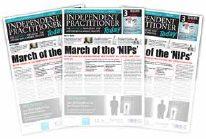
March of the ‘NIPs’
RECORD GROWTH IN ‘NEW INDEPENDENT PRACTITIONERS’ WIll STIFFEN COMPETITION
By Robin Stride
Competition among consultants is set to intensify as thousands of new entrants into private practice build up their businesses.
Private healthcare analysts have revealed the number of ‘NIPs’ –new independent practitioners –has never been higher.
Over 3,700 doctors have launched a private practice in the UK since 2011 – and numbers are still growing as younger specialists seek to boost stagnant NHS incomes and take on new challenges.
‘NIPs’ numbers have shot up by 60% in just 36 months, rising from 1,008 in 2010 to 1,612 last year.
Figures collated for Independent Practitioner Today by independent sector online solutions experts Healthcode show a typical practitioner entering private practice is a
According to Healthcode’s analysis, over 60% of the 3,741 consultants entering private practice in the last three years were from the following specialties:
1. Anaesthesia (13%) 6. Obstetrics and gynaecology (5%)
2. Trauma & orthopaedic surgery (10%) 7. Ophthalmology (5%)
3. General surgery (9%) 8. Urology (3%)
4. Clinical radiology (6%) 9. Paediatrics (3%)
5. Cardiology (6%) 10. Dermatology (3%)
male anaesthetist who joined the specialty register eight years ago.
But while most popular specialties among the new cohort broadly reflect the GMC’s register, women remain significantly underrepresented.
Healthcode’s managing director Peter Connor warned that the sheer numbers now taking on private work signalled that competition in the sector would become more intense in the coming years.
He said: ‘We have certainly seen
the highest rate of increase over the last recent years. A reason, which may help explain the recent trend, could be the NHS Any Qual ified Provider (AQP) commissioning programme, which as a consequence has encouraged more providers to enter private practice.’
As the clearing house for online billing, his company processes around 15,000 transactions daily and its analysis is based on an extensive database of private hospitals and consultants.
The figures broadly reflect the GMC’s latest registration statistics, where anaesthetists represent 11.67% of doctors on the specialist register. The number of anaesthetists entering independent practice rose from 90 in 2011 to 254 in 2013. Clinical radiology also saw a significant increase, from 44 new independent consultants in 2011 – the seventh most common specialty –to 136 in 2013 when they were second in that year’s top ten.
Other areas of clinical practice that are traditionally strong within the private health sector are trauma and orthopaedic surgery, ophthalmology and dermatology. But in the three years since 2011, the percentage of new orthopaedic and trauma specialists in each year fell slightly from 11% in 2011 to 8% in 2013.
n Women doctors: see page 2
In association with
March 2014
www.independent-practitioner-today.co.uk
make money out of your invention answering your questions on how to turn your patented idea into profits P12
lessons on how to push your practice marketing experts who run sessions at private units answer your pr posers P20
grasp marketing’s 80:20 principle if you understand the principle of life’s imbalances, you can really cash in P27
Take advantage of self-pay What consultants need to do to exploit the growing self-pay market P30
How to pick a winning investment
Successful investment strategies stick to a plan and ignore ‘market noise’ P40
Preparing to take on rooms our accountant columnist looks at the key aspects when taking on premises P42
Plus our regular columns
Doctor on the road: porsche panamera hybrid P44
Business Dilemmas: ethical conundrums answered P46 Profits Focus: radiologists P48
ediTorial commenT
Competition nips at your heels
Figures showing record numbers of new independent practitioners, known as ‘NIPs’, are now entering private practice (see story on front page) will be a surprise to many.
But as the fastest growing medical magazine over the last few years, we and our advertisers have seen and recorded a surge of interest in the sector.
NHS doctors visiting our stand at conferences and exhibitions have been showing a massive appetite to work differently and increase income by going private.
How many of the ‘NIPs’ will run into trouble because they
enter partnerships blindly remains to be seen, but we would commend to them – and more established doctors –Maitland Cook’s excellent feature warning of partnership pitfalls to avoid, starting on page 32 of this issue.
We hear too often about financial disasters for doctors who had no proper deeds to protect them from acrimonious bust-ups.
Some may indeed be nipped by the new wave of private practice entrants. But they can be totally devoured by former friends if they drift into informal arrangements.
Tell us your news Editorial director Robin Stride at robin@ip-today.co.uk
Phone: 07909 997340 @robinstride
To adverTise Contact advertising manager Margaret Floate at margifloate@btinternet.com Phone: 01483 824094
To subscribe lisa@marketingcentre.co.uk Phone 01752 312140
Publisher: Gillian Nineham at gill@ip-today.co.uk Phone: 07767 353897
Head of design: Jonathan Anstee chief sub-editor: Vincent Dawe
Circulation figures verified by the Audit Bureau of Circulations
Use the fiscal breaks open to companies
by edie bourne
Independent practitioners who have set up partnerships or limited companies to be more taxefficient are not making the most of other opportunities presented by their trading structure.
Financial planners Cavendish Medical said many should consider the forthcoming changes to tax relief on pensions and may need to act before the April deadline.
Managing director Simon Bruce explained: ‘We meet many doctors who have correctly planned the trading structure of their private practice to minimise tax liabilities but are then unsure how to get the most out of their partnership or limited company.
‘Consequently, they could be missing out on opportunities to fund pensions or investments.’
A limited company can contribute ‘pre-taxed’ company income to a pension. If you are a higher-
rate taxpayer, instead of declaring the income as company profit and taking the income as a dividend, you can put the sum straight into a personal pension.
In April, the annual allowance on tax-relievable pension contributions will drop from £50,000 to just £40,000 per tax year. It may be attractive for a spouse or civil partner working with the consultant or private GP to put more money into a pension before the lower limits are introduced.
A further issue is doctors holding excess cash on the balance sheet of their limited companies when these sums could be better used to fund future growth or expenditure; for example, in a corporate investment account.
Mr Bruce added: ‘It is important to make sure your corporate money works as hard as possible, otherwise inflation will erode its value by the time it is withdrawn from the company.’
Male doctors predominate
More women are joining the ranks of independent specialists but men remain the overwhelming majority, according to online solutions company Healthcode (see page one).
The GMC recently reported that the number of women specialists increased by 18% between 2007 and 2012 – they now represent 31% of the total.
But women represented only 19% of new independent consultants in 2011-13 although the overall numbers increased from 159 to 637 over the three years.
Analysts believe this may be because women are under-represented in common independent specialties such as general surgery and trauma and orthopaedics.
Another factor is likely to be the difficulty of part-time working within independent practice: according to a 2011 census by the Royal College of Physicians, 38% of women specialists choose to work part-time.
Figures revealed by Independent Practitioner Today in this issue show that new independent consultants were on the specialist register for an average of six years before entering private practice. 38% of new independent consultants had been on the specialist register between three to four years. Trauma and orthopaedic specialists were quickest to see the opportunities, averaging only two years on the specialist register before beginning private work.
NHS deals spell bonanza
by robin stride
New work opportunities for independent practitioners look set to escalate as increasing numbers of private and NHS deals take shape. Lawyers involved in the discussions have revealed that joint projects between the sectors have never looked so promising.
One specialist legal firm has revealed it alone is currently working on ten transactions, while a second wave ‘in the pipeline’ could double this number.
The rosy picture was given to a private health entrepreneurs’ breakfast seminar in London by the meeting’s host Jonathan Lisle, partner and head of corporate
healthcare at global law firm DLA Piper.
Later he told Independent Practitioner Today : ‘We are currently acting on a large number of public/private partnerships in the healthcare sector and we see this as a real growth area – and indeed I personally regard this as key to the successful future of the NHS.
‘We are advising both private operators and the NHS on joint ventures, private practice units, mergers and acquisitions and have previously advised bidders on ground-breaking transactions such as Hinchinbrooke.
‘In our view, the role of the private operator in the NHS has never been more critical.’
But he said the business case for each transaction needed to be properly made out.
‘Sometimes the numbers simply do not work for private players and a similar point may be made in relation to process. The NHS cannot delay and wrap deals in cumbersome red tape if it is to successfully leverage the role of the private provider.’
Mr Lisle said his firm’s seminar, ‘Healthcare in the modern world – challenges, risk and opportunities’, was being held at a time of unprecedented change and challenge for both NHS and private healthcare.
He told delegates, who included doctors, hospital bosses, advisers
Competition inquiry to dominate BMA meeting
Independent practitioners will consider their future in the wake of the Competition Commission investigation at this year’s BMA Private Practice Committee (PPC) annual conference.
The meeting on Thursday 1 May at BMA House, London, is scheduled later than normal to accommodate analysis of the inquiry’s final report due by 3 April.
Nearly an hour will be devoted to the Competition Commission as three speakers give a providers’, insurers’ and doctors’ perspective on the future of private healthcare.
ation Network (right), will talk on data in the independent sector, another issue examined by the commission.
The meeting will also hear about cosmetic interventions in the independent sector.
For the afternoon, the conference splits into three streams – for specialists setting up in private practice, established private consultants, and private GPs.
Talks include:
anie Bown, Medical Protection Society;
Basics about setting up in private practice: PPC chairman Mr Derek Machin (right).
The private GPs’ stream, chaired by PPC deputy chairman Dr Susan Horsewood-Lee, includes:
The new CQC regime and the practicalities: Matthew Trainer, Deputy Chief Inspector of Primary Care;
and bankers: ‘Decreased funding in real terms combined with increasing patient demand is creating a widening funding gap. Getting maximum value out of every pound spent is an imperative, resulting in those involved in managing healthcare services needing innovative solutions to help them deliver services more cost-effectively.’
Mr Lisle has advised on 37 healthcare merger and acquisition transactions in the last nine years including acting for General Healthcare Group, Nuffield Health, Spire Healthcare, Ramsay Healthcare UK, Classic Hospitals Group, GE Healthcare and LGV Capital.
HMRC chases car mileage
Hundreds of specialists are being chased by the taxman for up to £25k following the result of the Dr Samad Samadian car mileage test case revealed in Independent Practitioner Today last month.
The money is for cash they are now deemed to historically owe for journeys between home and private hospitals. Accountants advise consultants: ‘Wait to be chased’.
‘Neglect law’ is ‘waste of time’
The speakers will be BMI Healthcare chief executive Stephen Collier, Bupa Health Funding managing director Dr Damien Marmion, and Federation of Independent Practitioner Organisations chairman Mr Geoffrey Glazer (right).
Matt James, chief executive of the Private Healthcare Inform -
Groups and chambers: advantages and disadvantages, Dr Sean Tighe, chairman of the Association of Anaesthetists’ Independent Practice Committee
The insurer and consultant relationship: Dr Annabel Bentley, medical director, Bupa Health Funding (right);
Workplace pensions, the Bribery Act and tax: Dr John Canning;
Medical indemnity: Dr Steph -
Technological innovations to help your practice: Dr Justine Setchell (right).
The PPC said the conference was targeted at all doctors engaged wholly or partly in private practice, as well as those looking to set up, and was relevant to consultants, GPs, associate specialists and junior doctors.
Cost: £100 BMA members (£150 non-members). For details, email confunit@bma.org.uk or phone 020 7383 6137.
Doctors would face needless police investigation under Government plans for a new offence of ill treatment or wilful neglect, a defence body has warned.
The MDU’s Dr Christine Tomkins said: ‘No one would disagree with the premise that doctors who wilfully or recklessly mistreat a patient should face consequences.
‘However, there is no evidence to suggest that doctors are illtreating patients in such a way and, even if they were, there are already criminal and other sanctions which apply. For example, doctors could be erased from the medical register by the GMC.’
Doctors’ safety reputation
dented
By Charles King
Doctors’ working pressures are cited as a key factor in driving them to the top of Britain’s car insurance claims league.
Research from a comparison website has revealed they are the most bump prone drivers, with GPs leading the way and consultants right on their tails.
Gocompare.com found almost a third of GPs had made at least one car insurance claim in the past five years. The proportion of GPs with a claim was not only the highest of any occupation in the UK, but more than double the national average for all professions (13.12%).
Hospital consultants were immediately behind them with just over 26% having made a claim.
The overwhelming majority of drivers with claims worked in the medical profession, holding eight of the top ten spots and making up 75% of the top 20.
safest occupations
The safest occupation on the road was car dealers, with only 3% of drivers in the profession having made a claim in the past five years.
Other occupations that had a lower proportion of drivers with a claim than the national average included bar staff, van drivers, painters, plasterers, tattoo artists and professional footballers.
Prof Andrew Smith, from Cardiff University’s School of Psychology, said: ‘It’s not surprising to see that medical professionals had the highest proportion of claims in this study. Healthcare is typically considered a highly stressful occupation, which could explain why GPs and other health professionals seem to make more insurance claims than others.
‘Stress can dramatically affect a person’s health and cognitive functions. For instance, if you are
having a particularly stressful day, you may find that you become absentminded when it comes to day to day activities and find it difficult to concentrate on tasks.
‘You might even find that you become especially clumsy at times. This is due to the effect stress can have on the brain, and while this can be serious in any context, it is an especially bad combination while behind the wheel.
‘Typically, the types of accidents that are attributed to stress tend to be relatively minor bumps, caused by lapses in concentration while driving.’
stressful job
Lee Griffin, chief operating officer at Gocompare.com, said: ‘From Prof Smith’s comments, it would appear that a stressful job is a common link between drivers with a high proportion of claims, and that these accidents are due to distraction or breaks in concentration while on the road rather than reckless driving.
‘It’s ironic that GPs having their mind on the patients while driving could result in them needing medical attention themselves.
‘This study highlights the importance of being in the right state of mind while behind the wheel. Driving when stressed or angry can lead to accidents, so if you find yourself particularly frustrated, it might be a good idea to take some time to calm down before driving or find a safe place to pull over for a while until you are in the right frame of mind to continue your journey.’
The comparison site analysed 6,041,042 insurance quotes made on the site between January and November of 2013. It looked at the number of drivers with car insurance claims in the past five years and ranked them to find which occupations had the highest proportion of drivers with claims.
This study highlights the importance of being in the right state of mind while behind the wheel
ExpERT AdviCE: pROTECT yOuR NO-CLAiMS BONuS
independent practitioners who are safe drivers and have built up a no-claims bonus (NCB) should consider getting it protected. Gocompare.com’s Lee Griffin said: ‘protecting your NCB will ensure you don’t lose your no-claims discount entitlement should you have an accident in your car, and adding this can cost as little as 50p a week.
‘in comparison, having a claim for £1,000 and losing nine years’ NCB could result in a car insurance premium being £322.36 more expensive than having the same claim and keeping your no-claims bonus due to it being protected.’
The comparison website ran an example quote of a 31-year-old doctor from Bristol, driving a 2010 volkswagen Golf 1.6 Tdi 105 BlueMotion Tech SE with nine years’ NCB. The only change made was to protect the NCB.
The average of the top ten cheapest premiums without NCB protection was £301.45, and the average with protection was £327.93. (£327.93£301.45 = £26.46 / 52 = 50p a week).
it also ran two example quotes for the same doctor driving the same car. Both quotes had a £1,000 ‘at fault’ claim, but no injury claim added to them, with one quote having nine years’ protected NCB and the other having none to show the effect of losing the bonus.
The average of the top ten cheapest quotes without an NCB was £701.31, and the average with nine years’ NCB was £378.95. (£701.31£378.95 = £322.36).
See doctor On The Road – page 44
Small firms look to grow this year
Small business owners remain positive about the year ahead, according to the Forum of Private Business, with as many as 85% of members surveyed intending to develop their businesses in the next 12 months.
Thirty per cent expect to employ more staff numbers and 15% aim to increase their hours.
Development of their customer base was cited as the most popular growth strategy, with 60% looking to target new customers, while 42% will focus on improving customer service and 41% on new product development.
Medico-legal
advice while on the move
A new free advice app available to Medical Protection Society (MPS) members gives them medicolegal help on issues arising from their professional practice.
According to the MPS’s head of medical services Dr Nick Clements, the regularly updated guidance could help curb rising numbers of complaints and claims.
The society gets hundreds of calls weekly from doctors seeking quick advice on issues ranging from getting a minor’s consent to report writing. Its app includes advice on a wide range of medicolegal topics tailored for doctors in England, Scotland, Wales and Northern Ireland, plus more than 300 case reports.
It can be downloaded for Apple’s iOS or Android devices, and automatically updates with new material as it becomes available wherever the mobile or tablet connects to WiFi.
The MPS Advice app was tested by more than 100 users.
Claims against the defence body’s UK members shot up by 40% from 2011 to 2012.
Eye group invests
By a staff reporter
Eighteen consultant ophthalmic surgeons are in the first wave of specialists being trained to use new laser equipment on offer through eye hospital group Optegra.
The company’s six hospitals in London, Guildford, Aston, Apperley Bridge/Leeds, Solent and Didsbury are due to have the LENSAR Femtosecond Cataract Laser by the end of March.
Optegra said it would be the first national eye care provider to offer this technology to patients across all of its UK hospitals, for either cataract surgery or Clarivu permanent lens replacement.
Consultant ophthalmic surgeon
Mr Sundeep Kheterpal, director of laser cataract surgery for Optegra, carried out the first LENSAR procedure in the UK.
He said evaluations over the past year at Optegra’s London and Solent hospitals had confirmed that surgery could be made as accurate and predictable as possible by using LENSAR’s 3D custom imaging.
Mr Kheterpal said: ‘The proce
dure has been extremely well received by patients and uptake has been very strong. A further benefit is that the system makes removing the natural lens of the eye easier and more efficient. We firmly believe this is the future of cataract and refractive surgery.’
Optegra’s managing director Gareth Steer said: ‘We have been so impressed with this technology that we are furthering our strategic partnership with Topcon GB and installing LENSAR across all six of our UK hospitals.
‘We strongly believe that, in the future, this will be the standard way of carrying out lens replace
London Breast Clinic installs 3D imaging
The London Breast Clinic at 108 Medical Chambers, Harley Street, has launched an upgraded mammography service.
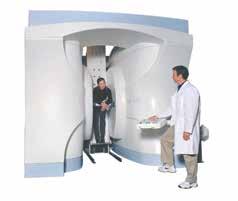
It has moved from fullfield digital mammography to tomosynthesis (3D). This is able to layer image slices in addition to the conventional 2D mammo graphic image, which greatly enhances the quality of image available for review by the radiologist.
Consultant breast surgeon Mr Simon Marsh said: ‘The improvement in clarity and resolution of the new images is remarkable. The ability to diagnose and biopsy small breast cancers will be significant enhanced.’
Consultant radiologist Dr William Teh said the equipment would help improve the accuracy in screening and symptomatic review of women, particularly those with dense breasts. ‘It is also the first in the UK to use tomosynthesis to guide vacuum biopsies which greatly assists the speed and accuracy of breast biopsies.’
Chambers managing director Hamish Millar said there would be no price increase for patients.
Senior radiographer Sally Bucklitsch added that patient feedback on their user experience was very positive. ‘Ergonomically, it is a superb machine to use. The clarity of image is fantastic.’
ment surgery and we are delighted to be at the forefront in offering this leadingedge technology.’
A key feature of The LENSAR Laser System is its imaging system which collects an unprecedented amount of biometric data. It then uses optical raytracing technology to reconstruct a precise 3D model of the anterior segment of the eye using proprietary augmented reality technology.
This model of each individual patient’s eye ensures the laser’s precision, accuracy and reproducibility.
The company declined to disclose the cost of the project.
If you have got the best secretary . . .
Nominations for the British Society of Medical Secretaries and Administrators’ Private Medical Secretary of the Year Award 2014 are now open.
The winner will receive £500 and the runner up £250. Both finalists will receive personalised trophies and significant discounts with sponsors DGL Solutions and the BSMSA.
To make a nomination, complete the online form available at www.dgl solutions.com/companyprofile/PMSYAward
The closing date for nominations is the 30 June, with results announced in October.
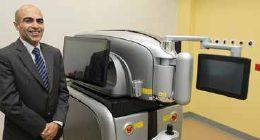
Mr Sundeep Kheterpal with Optegra’s LENSAR Femtosecond Cataract Laser
Bid to curb op rush
By a staff reporter
Consultants at BMI Healthcare are encouraging patients not to rush into cosmetic surgery decisions after the hospital group experienced a 162% increase in inquiries from patients looking to undergo cosmetic procedures since the start of 2014.
The biggest spike in inquiries were 321% for breast augmentation procedures, 320% for neck lift, 313% for facelift, 283% for nose reshaping and 227% for breast lift.
Appointments have risen 115% this year, fuelled by people adopting the ‘New Year, New You’ ethos.
Consultant plastic and aesthetic surgeon Mr Raj Ragoowansi said it
Backley backs BMI’s big idea
steve Backley: javelin former world recordholder
Former Olympian and javelin world recordholder Steve Backley is throwing his weight behind BMI Healthcare’s Active for Life campaign, which aims to raise awareness around bone and joint health.
Executive director David Henderson said he hoped the campaign would help educate people about the steps they can make to alleviate their risk and keep them active and mobile well into retirement.
Steve, who had a hip replacement in 2005, said: ‘My need for a hip replacement left me in pain and reduced my mobility. But, my new hip has completely transformed my life, giving me back both my freedom and mobility.’
A guide on how people can maintain their bone and joint health is at www.bmihealthcare. co.uk/orthopaedics plus an advice line: 0808 101 0373.
was important to remind people that having cosmetic surgery is a very serious, life changing decision and one which should not be rushed or taken lightly.
He and the team at BMI Healthcare have issued detailed advice to anyone looking to undergo cosmetic surgery, including:
Check the surgeon’s credentials and look for a BAAPS member;
Do research: ‘If a price sounds too good to be true, it generally is’;
Talk to a past patient;
Prepare for the consultation;
Meet the team, look round the hospital;
See your GP: ‘Good surgeons will want to work closely with your GP’;
Get a price: ‘The hospital should
offer a fixed price package, which should include hospital fees, surgeon’s fees, anaesthetist’s fees, implant costs and all aftercare including dressings’;
Take your time and don’t be pressurised by special offers;
Find out about on going support.
Patients are told: ‘Ask how many postoperative visits are included within the aftercare package and when they are likely to be. Make sure you’ll have the follow up appointments with the surgeon who performed your surgery.
‘Ask what happens if things don’t go to plan. In the event of acute complications arising postsurgery, the hospital should be able to resolve them at no extra cost.’
Taxman gets lavish with staff loans
Employers are being advised that, from 6 April, the taxfree limit for beneficial loans doubles from £5,000 to £10,000.
This is the maximum an employer may lend to an employee without the loan being regarded as a taxable benefit.
Doctors’ accountants Humphrey & Co of Eastbourne, East Sussex, said that, under the scheme, an emp loyer could, for example, lend a staff member money to buy an annual season ticket to commute to work.
A beneficial loan is where either the employee pays no interest or pays interest at a rate below an ‘official rate’ – 4% since 2010. Loan repayments from salary or wages can only be made if the staff member gives written authority before the money is lent.
Sussex unit gets a refit
Day Hospital’s new owner, Horder Healthcare, has announced plans to open in the summer after a full refurbishment.
Migraine work prize
Consultant neurologist and headache specialist Dr Farooq Maniyar, who practises at BMI The London Independent Hospital, has received recognition for his migraine research work from the American Headache Society.
It awarded him its prestigious Harold G. Wolff Lecture honour for his studies which examined brain activity in patients during the early stages and through the course of a patient’s migraine episode.
Dr Maniyar, who flew to Boston, Massachusetts, to pick up the award, said: ‘One of the main difficulties in finding effective treat
ments for migraines is we are not entirely sure what causes them. Previous studies have concentrated on the theory they begin in the surrounding nerves and blood vessels.
‘However, our new research shows changes take place in areas of the brain, particularly the hypothalamus, before the headaches begin. The hypothalamus maintains the normal environment of the brain. It seems to be involved in the early stages of a migraine, which may explain why these headaches occur when people change their routine in a way that causes them stress.’
The charity said it would invest in new patient facilities for the East Sussex unit, offering consultantled orthopaedic and musculoskeletal (MSK) services, including physiotherapy, with ambitions to also provide diagnostic services such as Xray.
It works with consultant orthopaedic surgeons and MSK specialists from locations in Horley, Crowborough, Tunbridge Wells, Eastbourne, Heathfield and Pulborough.
firm
Consultant haematologist Dr Virginia Clough has been appointed associate medical director at revalidation specialists Equiniti 360° Clinical.
Seaford
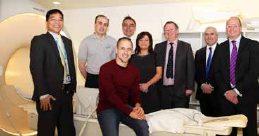
insiDe righT: west ham united fC’s Joe Cole (foreground) opened a new £1.5m 3-Tesla mri scanner at holly house hospital, Buckhurst hill, essex. The club’s players regularly use the unit’s diagnostic services.
Inaction on cosmetic injectables attacked
By Leslie Berry
Surgeons have registered frustration and disappointment at the continuing lack of Government controls over ‘cosmetic cowboys’ following Sir Bruce Keogh’s review into the sector last year.
The biggest critics have been the British Association of Aesthetic Plastic Surgeons (BAAPS) which condemned what it sees as a lack of action in the Department of Health’s response last month to the 40 recommendations.
Although the Government agreed with most of Sir Bruce’s recommendations, the association’s president, consultant plastic surgeon Mr Rajiv Grover, claimed: ‘It’s business as usual in the Wild West and the message from the Government is clear: roll up and feel free to have a stab.’
BAAPS complained that the Government’s response in a 22page report boiled down to very little regulation, in real terms, being implemented.
Mr Grover said: ‘Frankly, we are no less than appalled at the lack of action taken. This review – not the first one conducted into the sector – represents yet another thoroughly wasted opportunity to ensure patient safety.
‘With all the evidence provided by the clinical community, choosing not to reclassify fillers as medicines with immediate effect or setting up any kind of compulsory register beggars belief.
‘Legislators have clearly been paying only lip service to the sector’s dire warnings that dermal fillers are a crisis waiting to happen.
‘Most shockingly of all, the fact that there is no requirement for the actual surgeon involved to provide consent for the procedure makes a mockery of the entire process.’
A recent BAAPS survey revealed that as many as two out of three surgeons were seeing patients pre
senting with facial injectable (‘dermal filler’) complications. Nearly nine out of ten of those with permanent fillers required corrective surgery or were inoperable.
However, Treatments You Can Trust – which runs a register of safe providers of Botox and dermal fillers – welcomed the report and, in particular, what it believed was a move to make dermal fillers prescriptiononly devices. It said this would ultimately ensure facetoface consultations and traceability.
But it was concerned that the absence of a register of safe providers would put patients at risk and inhibit tighter control in what is a rapidly expanding industry.
Sally Taber, the group’s director of standards, said: ‘Whilst we welcome tighter regulation of the industry, the Government is not providing a solution to protecting patients who are looking for safe Botox and dermal filler treatments.
‘It is vital that there is further education and consumers are aware of what they are buying. Injectables are not just aesthetic but carry real risks when carried out by inappropriate providers or in inappropriate premises.’
TreaTmenTs You Can TrusT’s response To The Doh review’s keY finDings:
welcomes move to clamp down on advertising for cosmetic injectables
agrees that procedures should always be performed under the responsibility of a clinical professional and that any person who wishes to do them should have appropriate accredited qualifications. But it says this needs to be formally mandated and the names of these practitioners and clinics should be available to the public via a proper register
points out that The Treatments You Can Trust register is the only quality assurance scheme available to consumers in the industry. it says: ‘in the absence of regulation, we believe that it will be essential to maintain this register to enable consumers to make informed choices and, through the standards and qualifications required, to demonstrate improved quality assurance’
Backs a decision to place responsibility for training standards with health education england. But it fears consumers may now have no means of distinguishing a competent practitioner from a dangerous one
Caelen King, chief executive of private healthcare search engine WhatClinic.com, said: ‘It is great to finally see a clear direction on inappropriate advertising. Cosmetic cowboys should not have an easy ride in the UK.
‘Though some have lobbied for a ban on all advertising, it is reassuring to see that the Government has recognised that this would have been detrimental for patients as well as smaller practices, unable to compete with industry giants.’
He believed the regulations should be welcomed: ‘Anything that protects consumers and improves the quality of their treatments is a step in the right direction.
‘Despite the fact that fillers were not made prescriptiononly, there are a number of smart and useful changes that will make a real difference to standards in the business.
‘These changes will certainly improve standards and, with it, the reputation of the market as a whole. I believe it will encourage more people to enter it both as consumers and providers.’
He believed prices might go up in the short term and access to
treatments could be restricted as unqualified practitioners drop out of the race.
But overall, said Mr King, increased trust should have a positive effect on growth, success and patient safety.
At the GMC, chief executive Niall Dickson said: ‘We are delighted that the Government is taking this forward. This is a significant area of medical practice which has grown enormously in recent years.
‘We need to make sure patients are protected and that doctors and others undertaking cosmetic procedures have the training and skills needed to undertake this work.
‘We have already tightened up our guidance for doctors prescribing Botox and other injectables, and we welcome the fact that the Government has accepted the recommendation we made to the Keogh Review that only doctors on the GMC’s specialist register should be able to perform cosmetic surgery.’
He said the GMC would now work with the Royal College of Surgeons and others to explore the further specific guidance that was needed.
When it pays to remain up to date
In today’s world, we are surrounded by technology and, without realising it, we use information technology daily in almost every part of our lives.
t his could be driving to work using the satnav, reading the newspapers on our tablets and watching t V/films via satellite/ PC/smartphone.
We also use our smartphones to communicate via email or text, booking our holidays online, reviewing customer comments to decide which restaurant to choose and even having the ability to control our finances online.
In the medical world, I t has been a major driver in improving treatment in a host of ways across a variety of specialties and, in the last ten years, this has increased dramatically.
t his has been through improved scans/MRIs, robotic surgery, enhanced echocardiographs, better drugs and a plethora of equipment which has enabled better diagnosis.
all of these tools have improved the ability to offer a level of care which once would have been beyond the medical world’s wildest dreams.
With all of the above It being used on a daily basis, I wonder why, from an administrative perspective, most of the medical world lags behind the rest of the commercial world.
the biggest example is the lack of a core central system for patient notes for the entire UK. It seems ridiculous in this day and age that the patient’s notes, for the most part, are still on paper.
In the 1970s, motor manufacturers used to communicate with their suppliers regarding receiving orders and supplying remittances electronically via an electronic data interchange (EdI) system to facilitate better service levels and reduce costs.
Compare this to the medical world today, where millions of invoices are sent from practices up and down the country to the private medical insurers each year by post. t hey are then still assessed manually before being
By GArry ChApmAn managing director, medical Billing and Collection
inputted into their respective systems so that it can be processed for payment.
the cost of having these manual systems in place is becoming increasingly prohibitive for both the practice and the insurer. something has to change.
Mandatory change
I believe that, in the near future, there will be a big push from the major private medical insurers (PMIs) to reduce the cost per invoice transaction by enforcing the use of electronic billing, enforcing payment by B a C s directly into the consultant’s bank account and emailing remittances.
While these facilities are currently available – dependent upon the PMI – to every practice, it is not yet mandatory. this is what I think will change: in order to do business with the PMI, each consultant will have to commit to operating electronically.
one insurer already has specific wording that relates to this in its contracts with consultants, but, as yet, it is not enforcing it.
For the majority of consultants, using I t is not necessarily the problem, but implementing these sophisticated systems within the practice can become a challenge on many levels.
there are a plethora of administrative solutions on the market
This is what I think will change: in order to do business with the pmI, each consultant will have to commit to operating electronically
invoicing the patients with the shortfall and excess amounts. a number of consultants have joined us where they were using the above solutions and had recognised the pitfalls of them. o ne option available to the practice is to consider outsourcing this critical area to an organisation that can do this on behalf of the practice, not just now but on an ongoing basis so that they have the responsibility to cope with the inevitable changes that will take place. this will be potentially easier for the organisation to deal with due to economies of scale.
and deciding what particular systems best suit their needs to cover all the administrative functions is not an easy task and can become very time-consuming.
Each consultant will need to consider how best to deal with this and when they should start the It review process to make sure they are in the best possible position should they become forced to adopt electronic working.
I see many practices that have their entire billing process on Excel spreadsheets, with the invoices created via a Word document. t hey do not even have a basic accounts package that they use.
Dangerous practice
t his is a perfect example where the use of I t is not ideal and is actually quite dangerous. If the hardware crashes and the files get corrupted, then the entire billing system could be lost, with all the implications that would have on lost revenue.
another example that I see on a regular basis is where the practice actually uses an electronic system connected to the PMI’s so that they are actually doing electronic billing – but it is only part of the solution.
they do not have a robust system to deal with the remittances and then, where appropriate,
Core infrastructure at Medical Billing and Collection, we have used It as the core infrastructure of our business and have continually invested in our own state-of-the-art software to facilitate doing as much as possible electronically.
this includes sending invoices electronically to the major PMIs via their EdI system, having the ability to receive the remittances electronically, having the ability to email invoices directly to the patient as well as receive payment from them by debit/credit card online 24/7, which reconciles the payment against the outstanding invoice automatically.
When we are chasing payments, the chase letters are also sent automatically by email direct to the patient. our clients also have access to our system online and we can also communicate with them via email and text directly from the software.
Whatever decision the consultant makes, I believe reviewing the I t strategy within the practice should be taken at the earliest opportunity so that they can decide if they need to change any aspect of their It administration functions. If they do decide to make changes, then deciding the time-scale could be critical.
Getting this wrong could be costly from both an investment perspective as well as a potential loss of revenue, should they not be able to transact with a particular PMI. n
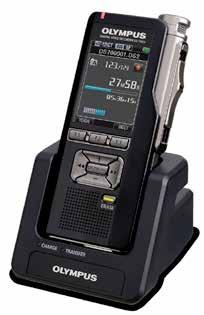
Olympus DS-7000
As easy as tape recording, but with many more advantages...
EFFICIENT - Dictate on the go, download, network or email your files back for typing
SECURE - A password protects your DS-7000 so confidential information is secure if the machine is lost. Encrypt individual files with up to 256 bit encryption
CONVENIENT - Never replace your batteries again as the DS-7000 is fully rechargeable
EASY - Full editing capabilities of files if you forget to include something in your dictation
COMPATIBLE - Speech recognition with the highest Dragon rating for maximum accuracy and compatible with Dragon Medical Practice Edition
Why move from analogue to digital? The only question really, is why not?
For a demonstration, quote or product brochure, please email dictation@olympus.co.uk or visit www.olympus.co.uk/voice
Stop money being eaten
Most independent practitioners realise that in order to maintain – and hopefully improve – the profitability of their practice, they have to strive for new ideas and ensure that effective business processes are in place.
This is particularly so when there have been long-term insurance company ‘freezes’, reductions in private fees for certain procedures and an increasing amount of red tape to deal with. But what aspects of your practice and business planning should you be looking at to maximise profitability?
Accountant Susan Hutter provides her top tips to help your private practice flourish in the financial year ahead.
Cash flow planning
It is recommended that you keep three months’ working capital in the practice bank account.
This includes:
Salaries – including your own drawings;
Premises expenses;
Office and stationery expenses.
You also need to put money aside for HM Revenue and Customs; for example, for corporation tax or income tax, depending on your trading vehicle.
It is imperative that invoicing of patients and insurance companies is kept completely up to date and one of your employees can manage and chase the debtors effectively.
The latter is no mean feat, so make sure you do have the right person in the role.
Business expenses
It is important that you keep full records of all business expenses, especially those that you may pay for out of cash or from a ‘nonpractice’ bank account.
I would advise that you record these expenses regularly – preferably monthly – and also that you retain the back up vouchers. Remember that if you are a higherrate taxpayer, every £100 of expenses will save you £40 or £45 in tax.
Information technology
Make sure you or someone in the practice is information technology (IT) savvy. All too often, I hear about practice management software not being used properly.
Sometimes the users have had insufficient training and are unsure as to what information the software is supposed to be generating.
If you do not have timely and accurate data, you will find it difficult to run your practice, so ensure that your staff are well trained and up to date.
Similar comments apply for bookkeeping software. Usually with medical practices, a simple
accounts package can be used or even an Excel spreadsheet.
Whatever you do decide to use, it is important the data is entered accurately and, at the very least, the bank account and fees ledger are reconciled on a monthly basis.
Manage your drawings
Many doctors in private practice also have NHS appointments. If you operate your private practice via a limited company, then your accountant should have advised you that, from a tax point of view, it is better to leave as much money in the company as possible. This is because any money drawn out, either as a dividend or salary, will be taxed at income tax rates and most doctors will be higherrate taxpayers, paying at least 40%. A company only pays tax at 20% on profits up to £300,000. Work in conjunction with your accountant to plan a sensible dividend policy. Do not leave yourself short of funds, but be aware there is no point in drawing money out that you do not need.
Investment of company cash
A lot of doctors will then ask: ‘What do I do with the money I’ve left in the company bank account?’
Interest rates on bank deposits are still low and are likely to be for the next two or three years. You could look at investing in property and/or in a stock market portfolio. But do ensure you take specialist advice about this. At least if you take one of these options, you are not leaving money in the company current bank account doing very little so it will eventually be eroded by inflation.
Susan Hutter is a specialist medical accountant at Shelley Stock Hutter LLP. She provides specialist accounting, taxation and business advice to the medical and healthcare industry
Celebrating our 22nd year in Business
www.medbc.co.uk
Come and join the hundreds of other consultants who use MBC and experience the following benefits:
• Bad debts of less than 0.5%
• Increase in net income by up to 25%
• Freedom for the consultant and secretary to focus on the medical side of the practice
• 24/7 online access to both your financial and practice management data
• Having a service tailored to your needs with your own Account Manager
• Our fees are only charged on the money that we collect for the practice and NOT on what we invoice which means we share the same objectives
Special offer:
To celebrate our 22nd year in business we are for a limited period of time offering all new clients an introductory discount of 20%*
Further information:
MBC – More than just a billing company
Please visit www.medbc.co.uk for more detailed information or phone 01494 763999 and speak to Garry Chapman to establish how we may assist your practice.
*Terms and conditions apply
Make money out of your invention
In the last of our series on patents, Robert Cobley (right) tackles some of the most common questions doctors have about turning their patent into profits
Knowing how to maximise and properly exploit your intellectual property with the right partners can significantly add value to your bottom line
Ident I fy I ng whether your invention is patentable and making your patent application is just the beginning. n ow the hard work starts.
Intellectual property (known as IP) – and especially patented IP –can create an important revenue stream through sale or licensing. we have all heard of pharmaceutical companies that exist solely to collect royalties on the patents and IP they own.
there is no doubt that knowing how to maximise and properly exploit your IP with the right partners can significantly add value to your bottom line.
we regularly get asked how healthcare professionals can best realise and exploit the value in their innovations and meet commercial partners who can help successfully bring their product to market.
In this question-and-answer article, we look at some of the key questions inventors commonly ask about commercialising their inventions.
And we also explore some of the simple principles and strategies you can apply today to help avoid the pitfalls, and protect and realise the value in your innovative healthcare products.
QI have been approached by a potential investor, manufacturer or partner who has said they can help bring my product to market. How can I make sure they’re not going to steal my idea?
Questions around whether a valuable invention was created in the course of employment or partnership duties is often cause for dispute
AIf you do have to share your invention or idea with investors, manufacturers or partners who can help get your idea to market, make sure they sign a non-disclosure agreement (ndA) before you share any information with them.
If you do not, you could find your intellectual property rights seriously compromised or even lose them entirely.
In fact, regularly using nd As should be the very first step you take in helping to avoid any of your valuable IP or ideas being inadvertently disclosed to potential competitors.
An ndA is a legal contract and safeguard between you and your potential business partners where you agree to disclose information to them about your invention for a specific purpose, while they agree not to share it with anyone else.
f or example, you may have come up with a design/patent for an assistive living device and need to get an estimate from a manufacturer of how much it will cost to make.
you will often face objections to using nd As from investors and manufacturers. But never be tempted to exempt someone from signing your ndA – stick to your guns or speak to your advisers and take a measured view on the potential risks before proceeding. your general rule should always be not to give anything away until they have signed on the dotted line.
QI’ve been working on an idea with one of the other consultants in our partnership outside of office hours – who owns the intellectual property?
Ag enerally, if you develop an invention completely outside of your normal employment or partnership duties, in your own time, you own it. If the invention is something that is a natural extension of your work, things can get complicated. Questions around whether a valuable invention was created in the course of employment or partnership duties is often cause for dispute between employers and employees.
If in doubt, check your employment contract and get advice. One thing is for sure, if you are in a partnership, you should ensure your partners are happy for you to run the project in any event. If not, you could be in breach of your partnership agreement.
If you have developed an invention with a colleague, you should agree as soon as possible how you own the intellectual property between you – and what happens if you want to later part company or fall out.
for example, will you be able to compete with each other? Jointly owning patents means different things in different countries. In the UK, if you jointly own a patent, you can’t do anything with it without the other owner’s specific permission.
In the US, you can; so it’s important to know your rights and get a clear agreement in place early.
QShould I set up a separate limited company to sell my invention?
Afor many reasons, it may be helpful to run your project through a separate limited company, but there are many ways you could exploit your IP rights. In simple terms, there are three main routes to market your innovation. w hich path you choose will depend on what funding you have, what stage you are with product development and on your own time, skill and experience. you could manufacture, develop, market and sell your innovation yourself. t his gives you maximum profit and control, but also requires the most resources and exposes you to the most risk. you could collaborate on the
further development of your IP with a third party and license your invention to them in exchange for royalties or revenue share.
t his route minimises capital investment, reduces risk and, with the right partner with the right contacts and resources, can accelerate market entry.
Or you could sell your IP outright. whatever route you choose, whether you are part of a partnership or going it alone, it’s important you take accounting and tax advice early to ensure the project is run as efficiently as possible. If there is any royalty or revenue share arrangement, be careful: getting this wrong could be especially costly.
QWhen should I start looking for potential investors, manufacturers or partners who can help get my idea to market?
The more you can reduce your potential partner’s risk, the more likely they are to invest in you and your product
AAs long as you use an ndA, you do not have to wait until your IP rights have been granted. Once you have a patent or registered design application filed, you should take advantage. w hen a potential partner is looking at whether to invest or license your product or innovation from you, they will be looking at the protection you have in place. having professional help from the very start that allows you to both present a sound developed idea with a good prototype and also show it is properly protected can really assist you in getting a deal.
the more you can reduce your potential partner’s risk, the more likely they are to invest in you and your product. It may also mean that they pick up any future IP registration costs. So getting advice and protecting yourself early can really help get the deal done.
MEDICO-LEGAL TRAINING
QI’ve been approached by a manufacturer who wants to work with me to develop my prototypes to working models. They’ve sent me an agreement which says they want exclusivity and to own all the new IP. Should I be worried?
ALicenses are generally exclusive or non-exclusive. Usually, a company looking to help bring your product to market will ask for some sort of exclusive rights from you.
you may be happy to give exclusivity if it is short-term or country-specific, but if you do agree to this, make sure you can get out of the agreement if they fail to deliver what they promise.
who owns the developed IP in any agreement will largely depend on the nature of your project and the bargaining power of the parties involved.
Individual inventors will often
It may be less important for you to own the IP, provided your interests are protected with clear contractual terms and you have a managed exit plan
defer to a larger commercial party on the ownership of IP, as the larger partners are more likely to have systems and resources in place to pay renewal fees, protect the IP and take expensive action against potential infringers.
Crucially, in relation to ownership of IP, it is important to bear in mind that it may be less important for you to own the IP, provided your interests are protected with clear contractual terms and you have a managed exit plan. this is the best way to ensure there are no nasty surprises if things don’t go according to plan.
Robert Cobley is head of the intellectual property and technology team at solicitors Harrison Clark Rickerbys. The firm has specialist health and social care and patent attorney legal teams, as well as providing a complete spectrum of regionally-based, City-quality legal services to business and private clients across the UK
Learning lessons of
‘This
Story
Story
Dr Charlie Easmon
I HAvE wANTED to be a doctor since the age of five. I happen to come from a line of doctors and my great, great grandfather trained at University College in 1879.
My dad was a famous surgeon in Ghana, but I never knew him. I was born in Sekondi, Ghana. I was there until aged two, then bought to England. From the age of seven to 17, I was at Catholic boarding schools in England, raised by nuns, monks and priests in Dorset, Stoke-on-Trent and Leicester.
I went to medical school at St George’s, Tooting, and adopted south London for many years. I now live in the cheapest place on the Monopoly board – the Old Kent Road. And love it.
I had a great time at medical school and had time to form my own rock band – The Droogs. After qualification, I did house jobs in Maidstone and Balham, then casualty at whipp’s Cross. I was then privileged to spend a year in Australia, which included some amateur dramatics.
On return to the UK, I became an over-busy general medical registrar with membership of the Royal College of Physicians.
I spent six years in the travel insurance industry. This started when a ventilated patient was
my fall
flown in from Italy to my A&E department for transfer to intensive care. I talked to the doctor who had done the medevac and he gave me a few tips.
After that, I then flew around
I wasted money on some
personal loan for the same amount, which I got!
The first person through the newly painted doors happened to be a delightful, internationally acclaimed actress from north America. The business was built around vaccinations, visa medicals and corporate clients.
I worked hard to build relationships with chief medical officers of large companies who off-loaded some of their travel health concerns to me.
I networked furiously through breakfast meetings with Business Network International and even-
good word of mouth and customer service.
As the business grew, I took on more space, staff and doctors. At one point, I had 14 admin staff, 2,000 square feet of space and about seven rotating doctors.
Our highest annual turnover was £1.4m, which would have been me sorted if I had known more about keeping your overheads low.
The old adage ‘turnover is vanity, profit is sanity’ was well applied to my ignorance. I didn’t manage my 14 staff as effectively as I could have and I should have
story 2: The big fall
As debts mounted, I finally had to face the inevitable and call in the liquidators.
These are people no one wants to meet and the going was extremely tough. I was at a crossroads – start again or try to fit back into the NHS?
I believed in what I was doing and the need for a quality service such as we had provided and so I bit the bullet and started again.
There were some definite lows and I remember one Christmas being aware that I had no money for presents and cheer (my son was 11 at the time).
You soon know who your few real friends are as opposed to flyby-night acquaintances. A lot of suppliers had to be paid up front, as we had no credit rating. Even setting up the new bank account and having a credit card machine that paid in time was tricky.
The honest truth is I do not regret the fall at all because I learned so many invaluable lessons from it.
story 3: The comeback
I cut the team back to the barest minimum and, having learned my lesson, was unsentimental when analysis showed that person X or Y needed to go. I made sure that this time around I had a mature accountant whom I could work in partnership with.
we lost one main client along the way, but, fortunately, have found that we can win interesting new business and look forward to exciting and interesting prospects in 2014 and beyond.
Our service focus is on health screens, vaccinations, occupational health, mental health seminars and health advice consultancy.
Our client focus includes oil, gas, mining, construction, shipping, defence and private schools. we are blessed to work with FT100 companies and to have all levels of staff from chief executives downwards making use of our services. we treat all in the same friendly and respectful manner.
In the last year, I have travelled to Miami twice to work with cruise lines, to vienna as a speaker on pandemic diseases, to Sierra Leone for a mining company and to Kurdistan for an oil company.
Many business opportunities are not instant and, by appreciating that fact, it encourages excellence in service without expecting immediate reward
other more loyal and caring clients. I have a mental list of clients and potential partners that I will never work with.
I have been interviewed by CNN’s Inside Africa current affairs programme (http://edition.cnn. com/video/data/2.0/video/international/2013/07/15/insideafrica-ghanaians-london-b.cnn. html), by the BBC talking about rabies and featured on Arise T v about malaria.
so what i learned?
I love business as much as, if not more than, medicine. It is the clichéd constant roller-coaster, but that’s what makes it interesting. I have learned more from ‘doing’ than the vast library of business books with their success biases can tell me.
A key lesson for me has been to review clients and decide which ones to sack! The reason for this is that there is always somebody out there who bullies you and demands too much of your time for too little reward.
You end up over-servicing these clients at the expense of your
In my twitter account (@charlie easmon), I noted that an unnamed retail client of mine had an HR manager that would have scared the Third Reich. This person had no compassion for an employee who had seen his best friend murdered and who had family and financial problems on top of that. You cannot work with people like that.
People are your best asset, but also your biggest headache. Managing individuals, their expectations, their interactions versus your business needs is a minefield for which you need to have the right tools and approaches.
Planning is essential and at each end of the year I write my plan for the next year.
Loyalty and the long game are also important. Many business opportunities are not instant and, by appreciating that fact, it encourages excellence in service without expecting immediate reward.
One delightful couple off to Senegal returned after many years for vaccines and was kind enough to send me CDs of a famous artist that they managed. It was a small but delightful and well-appreciated gift from a client whom we have obviously delighted and not just satisfied.
I am glad to say I am not all work and no play. I love reading. I am quite a movie buff and love original series like The Killing, The Bridge, Braquo, Spiral, Borgen, Mad Men and recently the Netflix original series Orange is the New Black. I also love travel and meeting new, interesting people and learning about history and cultures.
Now TEll uS your STory
Do you, like Dr Charlie Easmon, have a story to share about your experience of setting up and working in private practice? or are you an overseas doctor who has come to establish themselves as an independent practitioner in the uK?
Get the publicity your hard work deserves by telling us your interesting story and the lessons that others can learn from it. Contact editorial director robin Stride by phone on 07909 997340 or email him at robin@ip-today.co.uk to discuss your idea with him.
An easy to use software system, which fully supports the
and office staff and makes the whole process of running a busy Practice a lot easier. Call now for a chat and ask about a free, no obligation demonstration of our comprehensive system that has been designed to save your Practice time and money.
Lessons on how to push your practice
Consultants raise some common questions at practice promotion evenings run for them by their private hospitals. Marketing experts Sarah Bakker (right) and Holly Broadway (far right) give their responses
Our marketing agency works with a number of private hospitals to help promote their independent practitioners’ practices and we often conduct consultant evenings.
these explain the basic principles of P r and marketing to a room full of our clients’ doctors. the evenings help them to understand how we will work with them and why.
We find the same questions generally arise:
WEbsiTEs
would not have missed out on being listed in the Yellow Pages, so do not miss out on having a presence online.
how do i make my website easy to find on Google?
the key to making your website visible on g oogle is through search engine optimisation (SeO). g oogle ranks pages and sites highly that it thinks are authoritative. S e O is all about making g oogle see your site as having high authority. in simple terms, S e O involves using keywords –words people use in searches – on your site and having other websites link to your site to show how important your site is. But it is also much more involved than this.
how do i make my website easy to view on a mobile?
When you are having your website built, you will need to ask for it to be designed responsively. t his means it changes size depending on whether it is viewed on a PC, a tablet or a smartphone. this avoids frustration when people are trying to view your site from a mobile device.
What should i call my website?
You would not have missed out on being listed in the Yellow Pages, so do not miss out on having a presence online
should i have a website? Yes – definitely!
a website creates a medium to host content that is purely owned by your brand, which means that you have full control over what you say.
the first place most people look when they are searching for a service these days is the internet. You
i f conducted effectively, it means the website for a consultant plastic surgeon based in Harley Street would come up on the first page of google, if searching for ‘plastic surgeon + London’. i t is actually a very difficult thing to do effectively and is not something we recommend you do on your own, so you should have an SeO specialist or agency help you.
However, having well-written, relevant content on you website is a good place to start.
m any consultants ask us this question, as they are unsure what the domain name (the address which takes you to the site) of their website should be. there is no hard and fast answer to this question, unfortunately. However, at the end of the day, your practice is all about you as a person. Your name is what is unique and sets you apart, and you have worked hard to build your own reputation, so you might want to consider utilising your own name as part of your website’s domain name.
how often should i update my website?
Your website is all about promoting your story. When you have something to say, say it. i f you have performed a ground-break-
PR can help position you as a thoughtleader and someone who is ahead in their field. It also provides a third-party endorsement
ing procedure or you have been mentioned in an article, then put this on your site. Website content is not meant to be static; it is meant to evolve and should be updated regularly.
Websites are a means of creating conversation between you and your target audience; and conversation is a two-way thing, so you have to be prepared to listen. You can do this by allowing for feedback through comment forms on your site, conducting surveys or linking in social media. Just make sure you keep the conversation going.
m ost sites these days are run through content management systems (C m S), which make it simple and easy for anyone to update them. if you understand microsoft Word, then you should be able to pick up how to use a modern C m S. t hey are hosted online; so providing you can get internet access, you can update the content of your site.
pUblic RElATions
will ask the right question to make sure the article will position you in the best light.
P r can help position you as a thought-leader and someone who is ahead in their field. it also provides a third-party endorsement. So rather than an advertisement – which is basically you telling people you are great – it is a third party (the media) that is saying it for you.
and practice to be known outside of the medical world. We are approached every day by consumer journalists asking for quotes from consultants to provide clinical credibility and insight for their stories.
What is the difference between pR and advertising?
Because you pay for advertising space, it means you have control over the content and – sometimes – where it is placed.
However, with P r , although you may be paying an agency to help you, you are not paying for the space an article takes up in a publication or for the airing time on tV.
the publication, tV programme or radio show runs the article as editorial, as it has a news value. For this reason, the final content of the article and where it is placed in the publication is purely at the discretion of the editor.
this can be a little bit daunting, but if you work with a trusted agency, they will know what the appropriate publications to target are, will have relationships with journalists whom they trust and
Pr also gets you noticed. When flicking through publications, ads are so easy to ignore, as it is the articles you bought the magazine for. the same goes for watching tV – when the ads are on, people get up and make a cup of tea. However, when you are part of the main editorial content, you do not get ignored.
r emember this quote: ‘ i f a young man tells his date how handsome, smart and successful he is – that’s advertising. i f the young man tells his date she’s intelligent, looks lovely and is a great conversationalist, he’s saying the right things to the right person and that’s marketing. i f someone else tells the young woman how handsome, smart and successful her date is – that’s Pr.’ (S. H. Simmons)
What does the consumer media want?
Consumer media outlets such as national newspapers, television, radio and glossy magazines can be a great medium for targeting potential patients.
the reach of this kind of media is often incredibly large, providing an opportunity for your name
Consumer media works very differently from trade media, as these journalists are not writing for medical professionals – they have a much wider audience. the biggest thing you need to remember when talking to these journalists is that they are not clinical, therefore you need to avoid using clinical jargon and explain things in a way the lay person can understand.
Journalists will want to speak with you for various needs. this could include anything from providing a quick comment for an article relevant to your field of expertise, to helping them find interesting patient case studies.
Consumer journalists often work to extremely tight deadlines, so if you are asked to meet a deadline, you need to stick to it. You have to work around their schedule and be flexible so that they will see you as a reliable source and come back to you again when they need help in future.
What makes a good patient case study?
an interesting patient case study placed in a key national publication is one of the most successful ways of ensuring a credit for your practice and positioning you as an expert in your field.
Doctors attending talks on promoting their practice often ask the same questions of PR speakers
the consumer media are most interested in the human interest angle – how the treatment or surgery you have provided has changed the life of an individual, which is not necessarily the same things that would interest a medical professional.
When looking for a potential media case study, there are some questions you need to ask before putting them forward:
Are they a happy customer?
When your patient speaks to the journalist, you want them to have only positive things to say about all aspects of their treatment. a patient with a grudge does not make a good case study.
Is your patient willing to be identified in the media?
Journalists are only interested in speaking to a patient who is happy to be named and photographed.
Has your patient given consent? We would encourage you to have any patients in case studies sign a consent form which outlines they have given you permission to share their story.
Are they happy to do this free of charge? Despite what many case studies might think, the media are very unlikely to pay for a story, unless it is about a highprofile celebrity, so patients need to be happy to share their story free of charge.
Is the treatment new? a case study will achieve more interest from media if the treatment undertaken was a first, either in a major city, the uk or the world.
Is the treatment relevant? Linking a patient case study to a time of year or a national or global health awareness day can make it more desirable to consumer media. For example, a patient who has successfully undergone treatment of breast cancer will be appropriate to take to journalists during Breast Cancer awareness month.
how do i respond to media inquiries?
many consultants we encounter are nervous about bad press due to stories they may have heard from colleagues. i t is often assumed that journalists are only contacting you to find a negative story. that is not true.
Of course, this can happen, but
It is often assumed that journalists are only contacting you to find a negative story. That is not true
as mentioned previously, if you work with an appropriate P r agency, it will screen the inquiries and have a good idea of what the journalist’s angle will be. in the absence of a Pr agency, this is something that you or your secretary will need to do. While being careful not to annoy the journalist by wasting their time, it is a good idea to ask what the angle of their story is and where your contribution will fit in, and ensure you ask when their deadline is.
many consultants assume they will get final say over what is printed, but unfortunately it is extremely unlikely you will get sent the full article before it goes to print.
However, if your comment includes complex clinical information, it is worthwhile politely asking for a read-back of your quote, to ensure you have been quoted correctly.
the key to feeling comfortable with dealing with media inquiries directly is to understand what the story is about. Do not be afraid to ask questions. if a journalist has asked you to comment on new research findings you are not familiar with, ask them to send you the papers to read through.
how much time do i need to invest in pR?
Different media opportunities will vary in the time required. Providing comment on a story for a national newspaper could be as short as a ten-minute phone-call with a journalist.
However, working with a patient case study will take much longer than this, as the process involves another person and often a lot of detail.
many consultants are perplexed when, after meeting a tight media deadline, they do not see coverage within the next day or two. unfortunately, this is the way the media work.
We need to meet the journalist’s deadline so they can get the article to their editor on time, and it is then out of our hands and theirs when the article gets published at the editor’s discretion. However, it generally does happen eventually. it is also important to note that once the coverage has been
Even though Twitter suits a more colloquial tone, always think your tweets and responses through before posting them
achieved, the results may not be instantaneous.
Do not expect to see a line of patients queuing outside your door the day after you have been interviewed. i t is a slow burn, which gently builds awareness. Be patient, and you will see the results.
sociAl MEDiA
how do i make social media work?
the world of healthcare is changing, and using social media to communicate with current and potential patients is becoming more common among healthcare professionals.
We find the most effective social media platform for private practitioners is twitter. twitter is an open forum, which enables direct communication between you and potential and current patients.
it is important not to see twitter as purely an advertising tool, as this will bore your followers. twitter creates an opportunity for you to position yourself as a thought-leader.
Share interesting information and blogs that are relevant to your practice, tweet articles that you have been quoted in and get involved in appropriate debates. On a cautionary note, be careful not to blur the line between professional and personal.
e ven though twitter suits a more colloquial tone, always think your tweets and responses through before posting them and ensure you are representing your practice’s image at all times.
Do not talk about what you did in the weekend or use it to communicate to your golfing friends, as this would not be appropriate representation of your practice.
Sarah Bakker and Holly Broadway work for Merchant Healthcare Marketing, an integrated agency with a specialist healthcare division
To learn more or to subscribe risk-free, visit learn.uptodate.com/UKanswer Or call 1-888-525-1299 (US and Canada) or +1-781-392-2000 (all other countries).
Patients don’t just expect you to have all the right answers. They expect you to have them right now. Fortunately, there’s UpToDate, the only reliable clinical resource that anticipates your questions, then helps you find accurate answers quickly – often in the time it takes to go from one patient to another. Over 700,000 clinicians worldwide rely on UpToDate for FAST clinical answers they trust. Shouldn’t you? Join your colleagues and subscribe to UpToDate risk-free today!
INDEPENDENT PRACTITIONERToday
SPECIAL LIMITED OFFER FOR NEW SUBSCRIBING DOCTORS
by direct debit and we will give you £15 off and send you your first
KEEP YOURSELF UP TO DATE AND ARM YOURSELF WITH THE KNOWLEDGE TO MAKE YOUR PRIVATE PRACTICE GROW
We are the established business magazine for doctors with a private practice, both consultants and Gps. reading our news and feature articles will keep you up to date with the latest developments in private practice. and it will help you to cope successfully with the financial, legal, tax, regulatory and human resource pressures of running a medical business and employing staff.
An annual subscription of £75 guarantees you receive:
• Ten issues of the printed magazine a year – delivered to your door
• Complete access to our website containing a huge resource of hundreds of informative articles
• Regular free guides (right) bringing in-depth coverage on a range of important issues affecting independent practitioners
But you will save £15 if you pay by direct debit. after tax, that’s the equivalent of a good bottle of wine.
our team of expert authors offer no-nonsense, practical advice that is helping growing numbers of independent practitioners match their medical excellence with the business skills they need.
as well as reporting on the latest developments in private health care, independent practitioner today:
• Helps you to strengthen your private practice, to market it successfully and to exploit new opportunities
• Enables you to share ideas and benchmark statistics to boost your profits
• Briefs you on important tax, legal and regulatory changes
• Brings you the views and opinions of key figures in the industry
• Suggests ways of improving your practice management
• Provides you with the means to be able to flourish in the fast-changing world of private practice and to meet its challenges
• Keeps you abreast of the latest ethical and medico-legal advice, including the minefield of social media
• Allows you to learn from entrepreneurial colleagues and business and marketing experts
• Gives regular advice to help you with revalidation
How to subscribe
take out a subscription using the form on the next page ➱
remember, as well as getting your first three issues free, you save 20% by subscribing by direct debit!
Dear Reader,
SubScribe Today and never miSS anoTher copy
Subscribing to Independent Practitioner Today is the only way you can be sure you will see every issue. Don’t risk missing out. Our personal subscription for doctors and managers is only £75 a year and £200 for organisations. But you can reduce these figures to just £60 (only £36 after tax for higher-rate payers) and £175 respectively if you pay by direct debit. So take advantage of this offer now for this unique business magazine dedicated to supporting you in your private practice. We’re confident your subscription will repay itself many times over! Editorial director
Doctors, please give GMC No. (See rates listed above)
Please debit my Mastercard/Visa/ Amex/Diners Card No
r * indicates this item must be filled
Instructions to your Bank or Building Society to pay Direct Debits
Name and full address of your bank/Building Society
Society
Banks and Building Societies may not accept direct debit instructions for some types of account Signature(s)
Banks and Building Societies may not accept Direct Debit instructions for some types of account To: The Manager
post your application (no postage required – UK only) to: independent practitioner today Subscriptions department, promotion 13410, FreepoSt, po Box 36, plymouth, pL1 1Br
phone: 01752 312140 Fax: 01752 313162 email: lisa@marketingcentre.co.uk or subscribe online at www.independent-practitioner-today.co.uk if you want to pay by
can
Direct
the amount paid.
at
The principle of
Cash in on the 80:20 principle – you really can turn it to your personal and practice’s advantage. Dev Lall shows how
Many independent practitioners over the years have asked the question ‘Why are some people more successful than others?’
and, of course, it’s a very good question; after all, if we can find some answers, it potentially has an impact on every facet of all our lives, both as individuals and as a society.
a stonishingly, we do have some answers.
as you might expect, successful people behave in ways that are very different from the majority. always.
a nd one of the ways they behave differently is that they understand that everything about the world is asymmetric. Highly skewed. i n fact, positively wonky.
this is called the 80:20 principle, and all successful people exploit that fact ruthlessly.
magic of Pareto’s Principle i n 1897, Vilfredo pareto (18481923) was looking at the patterns of wealth and income in england and found that 80% of the country’s wealth was in the hands of 20% of the citizens.
t his perhaps was not so very surprising, but what was surprising was that this was a pat-
tern that was repeated over and over and over again in all other countries.
Further research demonstrated that this asymmetry was apparent in all facets of life. Sir isaac pitman, for example, the inventor of shorthand, discovered that of the half a million or so words listed in the new Oxford Shorter english dictionary, 700 of those words make up 80% of the words commonly used day-to-day. and did you know that:
1.3% of all movies earn 80% of all the box office revenue?
20% of motorists cause 80% of the accidents?
80% of all the crimes are caused by 20% of the criminals? the list of asymmetric relationships is seemingly endless. yet, though the numbers are not always the same – the ratios might be 99:1 or 65:35, for example – there is always an inequality between causes and effects.
Why the 80:20 principle matters to your practice pareto’s principle, or the ‘Law of the Vital Few’, matters because it highlights something we are all at least unconsciously aware of:
that some things are very much more important than others in terms of results.
And the wonderful thing is if we can find out what those highly valuable and important elements are and focus our efforts on them, we can disproportionately improve the end results we get.
80:20 and the surgical procedures
Not all the clinical conditions we treat are equally – or sadly, even appropriately – remunerated. So the fee a surgeon would receive for an open inguinal hernia repair is perhaps half the fee he or she might receive for an anterior resection.
Yet an open inguinal hernia might take 2030 minutes of operative time, whereas even a straightforward laparoscopic ‘high’ anterior resection would take three to five hours – and much more when you factor in the preoperative theatre preparations with the laparoscopic equipment, anaesthesia and everything else.
So the same halfday operating list might allow for five or six open inguinal hernias or one anterior resection.
Of course, the resulting income generated by a list of six hernias would be three times that from the anterior resection.
80:20 and surgical complications
But it gets worse, unfortunately. Because although everyone has complications, once again, those complications are also skewed. A small percentage of the procedures you perform will lead to a disproportionately large percentage of all the complications you ever get.
So you rarely get complications from hernia surgery, but – far more frequently than any of us would like to – you get complications from colorectal surgery. This applies to both medical and surgical complications.
80:20 and post-op care
And then we come to aftercare. The patient with the hernia can usually be treated as a day case, occasionally overnight stay and that’s it. Not so the ‘big case’ who often requires HDU care postop,
80:20 and case mix
The logical conclusion is that the sensible thing is to do as many of these smaller procedures as possible rather than the big operations, as they do not pay proportionately as well and disproportionately take your time.
These are compelling business reasons to shy away from looking after certain clinical conditions privately. Yet very, very few consultants will do this – turn away work.
They fear that if they do so, then GPs will be disinclined to refer more patients to them. Yet this is not borne out in practice at all.
if we can find out what those highly valuable and important elements are and focus our efforts on them, we can disproportionately improve the end results we get
followed by maybe a week on the ward – and that’s if they do well.
Even a small hiccup in their recovery, such as excessive pain or urinary retention, will delay things easily by a couple of days minimum.
And every day they are in hospital, you will need to go and see them, speak to them and their family and take time out from everything else you have to get done.
And if they have a complication, then their hospital stay could become very prolonged indeed – and likely result in a transfer to your NHS practice.
Of course, you don’t feel good about this, it doesn’t look good to your colleagues, it looks bad to the patient and his family and damages your reputation among GPs – far more so than a complication developed by an NHS patient.
80:20 at work in your outpatient clinic
And then there is the question of follow up. The hernia patient needs to be seen once preop and once postop and that’s usually it. A short consultation time means you can see more such patients in each clinic.
In contrast, the patient requiring anterior resection will require multiple consultations, multiple investigations and each clinic appointment will last considerably longer than for the patient with a hernia. This will adversely affect the numbers of patients that can be seen in each outpatient’s session.
Some things we can do are incredibly valuable and have a huge return on investment
But it is possible to take this one step further: because for certain clinical conditions, such as followup for head and neck cancers in oncology or follow up for childhood squints in ophthalmology, the work involved is very quick, simple and longterm.
Caring for such patients does not generate much per appointment, but over the long term can generate a substantial income for very little stress and effort.
80:20 and your use of time
One of the most important applications of the 80:20 principle is in our use of time. Some things we can do are incredibly valuable and have a huge return on investment.
For example, writing a handwritten letter or phoning to thank someone who has just referred a patient to you is incredibly valuable, as it multiplies several fold the likelihood they will send you further referrals in the future.
Contacting the DNAs from your clinic – especially first appointments – is also incredibly valuable, as a high proportion of patients will rebook and attend if chased in this way.
Other things you can do, such as sending the patient you have discharged a letter a few months or a year down the line inquiring if they OK and inviting them to book a check up appointment, can also be incredibly useful in generating business. These little things make a very big difference to the success of a practice.
By also deleting the ‘lowprofit, highstress’ cases from your practice, you might reduce your
if you know your numbers, you are in a very powerful position –because so many consultants do not
income by five, ten or even 15%.
But, because of the disproportionate amount of time these cases consume, you will liberate a very large amount of free time which can be spent elsewhere.
Time you could spend with family and friends. Or time you could devote to marketing your practice, targeting the patients whom you know are worth far more to you over the long term.
You can make a very substantial difference to your income even with just one or two extra patients a month with certain clinical conditions requiring longterm input – and they can also can give you more free time than before.
Powerful position
And if you know your numbers, you are in a very powerful position – because so many consultants do not.
How about passing all your ‘big cases’ to a consultant colleague – a competitor? You might suggest that you will ‘swap’ him an anterior resection for a hernia.
That’s minimal time commitment to look after the patient but only a small reduction in income after swapping out the colorectal case. He will get his cancer numbers up. You will generate lots of goodwill.
There are a few things we do which have a disproportionately large positive impact on our private practices. Every practice has them. We should seek them out and spend as much of our time as possible on those tasks.
Don’t forget that by far and away the most powerful and highly productive thing you can do is spend time in activities that generate new patients. In other words, spend time on your marketing.
Sadly, the vast majority of things we do have minimal impact on the profitability of our practices. They suck up time, add stress and drain our energy. They, too, are present in every practice. These tasks should be ruthlessly sought out and either relegated, delegated or deleted.
Mr Dev Lall (left) is an upper-GI surgeon and runs a specialist private practice consultancy. He is the owner and director of www.PrivatePractice Expert.co.uk
PROBLEMS WITH THE TAX MAN?
HMRC tax investigations and disputes create difficult and stressful times.
As an award winning firm of tax experts, our highly experienced partners specialise in resolving problems relating to tax investigations and disputes with HMRC.
To find out, in confidence, how we can help call 0800 734 3333.
‘Here to help. Not to judge.’
Take advantage of
Choice, simplicity and clarity are vital when trying to take advantage of the growing self-pay market, says Sam Phillips
ChoiCe is fundamental to patients and to the UK healthcare market, but at times it can seem that patients are confused over what pathways are available to them.
A recent GP survey, commissioned by BM i h ealthcare in London, revealed that over half (55%) of the GPs surveyed said most of their patients did not have a good understanding of their options outside of the Nhs.
With results from market analysts LaingBuisson highlighting that private medical insurance (PMi) coverage is at its lowest rate for more than 20 years – at 10.8% of the UK population – a surprising development in the private healthcare market in the past two years has been the rise in market optimism around the selfpay sector.
i n a survey, BM i h ealthcare found 57% of UK adults would consider paying for hospital treatment out of their own funds because N hs waiting time for treatment is too long.
The survey also highlighted that 48% of patients would consider paying for treatment if the procedure was not available to them on the Nhs
Patients willing to pay for treatment in the private sector – or indeed within the Nhs itself – are, of course, nothing new.
But the rapid and continued growth of this sector is making the industry stand up and take note with the spotlight now firmly back on selfpay.
The perfect storm for growth
Restrictions in N hs procedures, rising PMi premiums and increased consumer confidence following the recession have all combined to create the perfect storm for the growth of selfpay.
And in the next three years, commentators and industry analysts are predicting doubledigit growth in this market.
To put the selfpay market into context, in 2011, LaingBuisson estimated that the selfpay market, excluding cosmetic surgery, was worth just under £400m. in the UK, this meant that selfpay revenue and patients accounted for approximately 15% of all acute private work.
This is well down on the market high of 20% in 2002 and, evidently, there are geographic variations and a natural bias to London and the south of england.
But across the private healthcare sector and throughout the UK there is a general feeling that patients and GPs are slowly becoming more aware and willing to consider the selfpay option.
MarketIng to a Self-Pay audIence
So how, as an independent practitioner, can you take advantage of this market growth and how should you go about maximising revenue in your private practice?
choIce
We approach this in two ways. ensuring patients are aware that they have a choice and making sure gPs are speaking with their patients about their options to self-pay if they do not have medical insurance and the procedure they need is not available to them on the nhS.
SIMPlIcIty
from both a gP and patient perspective, simplicity is key.
Patients want to know how they can access self-pay treatment in a private hospital, and gPs need to feel confident in explaining the selfpay process to their patients.
for patients, we have created the web page: www.bmihealthcare.co.uk/ paying-for-yourself to guide them through the five-step process: finding out the cost of treatment, getting a referral, seeing the specialist, arranging their treatment and then finally paying for their treatment.
We also have a dedicated self-pay helpline – 0800 142 2316 – which patients can call for advice. for gPs, a self-pay presenter from our primary care managers clearly explains the process and contains pricing information for the most common procedures.
clarIty
the price quoted to a patient prior to their surgery needs to be the price they pay after their treatment.
Patients need to be aware of what the package includes and what they can expect, and you need to be clear and transparent on any additional costs that may incur.
coMPetItIon
look at your local market and see what your competitor or colleagues are charging. It is important not to price yourself out of the market, but if you are charging more, make sure you are show-casing your strengths or unique selling points.
again, it is important to remember that up-front transparency is more important to a patient than the final overall cost.
fInance
Self-pay does not mean patients have to pay up all in one go after their surgery. If you can offer flexible finance options and an interest-free payment plan, this could make the proposition of self-pay more attractive to many patients.
our patients can use a new BMI card which allows them to spread the cost of their healthcare.
It offers them 12 months’ 0% interest free credit and a subsequent low aPr to give peace of mind that they can get the treatment they need when they need it most, without having to wait. they can spread the cost over a time period that suits them.
target
It is important to deliver the right message to the right people. for medical self-pay, there are three broad markets: those aged 40-65, 65+, and those making purchasing decisions for a parent or family member aged 65+.
the messages, options, treatments and campaigns delivered to each of these audiences can be very different and need to reflect their situation and personal circumstances. consider the local geographic landscape and what treatments are being restricted by the local clinical commissioning group. the self-pay market is expanding and, for many private practitioners, the opportunity could be huge.
It is important to remember that up-front transparency is more important to a patient than the final overall cost
Take advantage of growth This month, BM i h ealthcare launched its 2014 national marketing initiative to promote selfpay to our patients and GPs within our hospital’s catchment areas. it involved us working with our consultants, hospitals and colleagues across the UK to establish clarity around pricing, as having a clear pricing structure is paramount when marketing to selfpay patients.
i have heard many patients say that often procedures were not as expensive as they first thought; they wish they hadn’t waited so long for surgery and that their quality of life is now so much better.
The key messages we are trying to convey is that patients do have a choice and that choice is often not as expensive or inaccessible as they may have first envisaged.
Sam Phillips (left) is the head of B2C Marketing at BMI Healthcare
Upright Positional MRI
A new concept providing real benefits to patients
• Weight-bearing scans and variable patient positioning enables a more precise diagnosis
• Truly open system is a solution for claustrophobic patients without compromise in image quality
The pitfalls of
Partnerships have been – and remain – a popular way of working with colleagues in the medical fraternity in order to develop practices. So, warns Maitland Cook, be sure to avoid these ten pitfalls that will ensure failure
There are now myriad versions of partnerships in private practice. They range from the simple to the complex, from small to very large, from GPs sharing on call duties to complex multidisciplinary investor partnerships.
But they are sadly often a vehicle for disaster.
In the field of ‘business’ and ‘business acumen’, the majority of doctors are neither trained nor interested.
and, apart from anything else, the priority of the working day has always been the clinical work, while everything else has come a distant second.
Failure in any partnership is easy to ensure, and the percentage of failures in the medical environment is markedly higher than in the legal or financial professions.
So let us examine the sure-fire ways that can ensure failure, for they are many.
Firstly, there is the partnership itself, ranging from a husbandand-wife team with only the marriage vows to bind them together, to the informal ‘we have always worked closely together’ types.
Many will admit to being partners in a practice without any formal arrangement being agreed, let alone being signed off. and many will confess to having no idea how the agreement for management and control should be drawn up.
1
The first guarantee of failure is the lack of a partnership agreement with clear definitions and objectives.
a partnership cannot work to clearly defined targets and goals unless they are considered and planned from the outset.
Drifting into an informal arrangement where ‘we will share the costs and distribute the profit’ never works in either the short or long term.
It is usual that plans have to be modified as time goes by and the practice develops, but failure is certain without there being a basic plan to work from to achieve targets.
2
The second guarantee of failure is lack of communication in the practice.
In these partnerships, there is no discussion nor consideration. They are in ‘the clinical work is the most important thing, the rest will sort itself out’ scenario.
here, the clinical practice takes up the whole day, there is the social life and there are the children. rush in for the first appointment, chase your tail throughout the day, do the dictation and rush home.
Twelve hours gone, every day, every week, every month. No time to talk, no time to consider, no time to plan. Many Independent Practitioner Today readers will
The first guarantee of failure is the lack of a partnership agreement
surely recognise this pattern: discussions only start after the crisis. But, by then, it is usually too late. These two points are by far the most basic, yet important factors: everything else flows from them.
But, within the above, there are another eight reasons why I believe failure can be guaranteed. Getting the basics wrong due to lack of attention and planning haunts the partnership when it is at its most vulnerable.
3
In the current era of regulation, no partnership or practice can commence without registration, however simple.
The cavalier approach to the regulators no longer works. The forms are detailed, sometimes complex and they are a pain to complete.
Not giving them the respect they deserve will delay the project, delay the registration and will ensure a poor working relationship with the relevant authority on subsequent inspections.
4
When statutory regulation –including all policies and procedures, all standard operating practice and all clinical controls –is deemed to be at the behest of the clinical practitioner by many, that is another disaster waiting to happen.
Without the properly prepared books of policies and systems in situ to monitor adherence to and development of them, the clinical management and reporting will become chaos.
In the event of a serious medical problem, the partnership will be facing failure from the regulatory standpoint.
The marriage of the clinical and commercial aspects of a successful partnership is irrevocably linked. Unless this is done correctly, there will almost certainly be failure on both sides.
5
a business plan and a performance monitoring programme take considerable time to prepare and, in the early years, will not necessarily be achieved.
But to commence trading on the haphazard basis of ‘we are busy, so it will all be alright’ is irresponsible in the extreme. It is risking financial ruin and the welfare of patients, colleagues and staff alike.
Once on the financial back foot, it becomes difficult to recover, and failure looms once more.
6
a ssuming the partnership has survived the first five failure points above, then it needs to be developed.
Independent practitioners should ask what strategy has been considered in expanding the business and what business development plans are in place.
A partnership cannot work to clearly defined targets and goals unless they are considered and planned from the outset
Some questions to ask might include:
Will the partnership need to recruit medical colleagues?
Will it be developed by offering additional services through nurseled operations?
What products can be sold to bolster income?
a ll need clear planning and thinking to enhance the business. If they are not clear at the outset, they may become blurred, without focus and they fail.
7
You need to know how associates will be recruited. When they consider how best to plan the recruitment of an associate, some founding partners promise to ‘have a word with colleagues’ who are ‘bound to be interested in working here’.
That does not work. Many fruitless hours will be spent, while consulting and treatment rooms remain unoccupied and not contributing. a lack of structured strategy will leave the partnership vulnerable.
In general, doctors do not like change; they will only move when it benefits themselves. Many a medical project has collapsed over the last 30 years due to it being based on unrealistic expectations given by colleagues promising to support the new.
The last three ‘failure warnings’ relate to completely non-medical matters, but they are the biggest contributors to failure in all businesses. a partnership is a business pure and simple; a limited liability partnership (LLP) equates to a limited company to all intents and purposes.
8
In this modern era, human resources and employment law cannot be ignored.
Working without contracts of employment and clear guidelines about holiday, notice, terms and conditions will lead to severe difficulties, as the law is strongly supportive of the employee.
any unfair dismissal claim can easily cost £20,000 in lawyers’ fees to defend, not to mention the wasted time in the partnership preparing for the case.
In a small practice, the effect on team morale should never be underestimated. Failure to comply with current regulations can
A partnership is no different from any other business. If we do not manage the finances, it will fail and potentially go bust
destroy all the hard work that has gone in to creating the working partnership.
9
Not knowing how income and expenditure will be monitored and controlled is another route to failure.
Who wants to lose money on any investment? Nobody ever does. Yet approximately 25% of medical businesses do, in fact, trade at a loss. Not a good statistic. at the end of the day, whatever our commitment to our profession, we all work for financial reward.
The partnership is no different from any other business. If we do not manage the finances, it will fail and potentially go bust.
It has to have accurate and regular reporting, there has to be a line of communication to the bank and any investors. a book-keeper must count the income and monitor all the costs.
Letting the financial matters drift because ‘everything must be OK because we are busy’ is the recipe for disaster.
10
Finally, who manages the partnership?
The partners must do, including managing themselves. They must not fall into the trap of assuring each other all is well. It never is all well.
Something always needs senior input. Someone is always not pulling their weight. and somewhere a patient is always not entirely happy.
Not only is this aspect of the partnership vulnerable, but also there are the partners themselves and their relationships to think about. Muddling through may be a survival mechanism, but more likely will be a failure mechanism.
a partnership needs much more than failure or muddling along.
If all the above seems negative and depressing, it is meant to be, because, with some simple guidelines and attention to detail, the position can be reversed.
next month: Ten ways to ensure partnership success
Maitland Cook (left) is director of The Cadogan Clinic and also founder/director of Maitland Cook Medical Management Services Ltd
Avoiding
CLAims
When others have the power to give consent
In his Independent Practitioner Today article last month, Dr Gerard Panting (pictured below) wrote that failure to obtain valid consent is a regular feature in clinical negligence claims. Here, he discusses competence to consent, powers of attorney and ensuring there can be no allegations of duress
O ne O f the downsides of ‘informed consent theory’ is that it suggests consent begins and ends with doctors giving patients all the information they could ever need about their proposed treatment.
Providing patients with all information material to their decision is undeniably important, but with the focus on disclosure of risks, it is easy to gloss over the other important aspects of consent – namely competence and voluntariness or giving consent freely.
It is assumed that adult patients are competent to give or withhold consent unless there is reason to believe otherwise.
A patient who disagrees with their doctor’s recommendation, or suffers from a mental illness, even if detained under the Mental Health Act as a result, or who makes a decision which appears irrational, cannot be assumed to be incompetent.
furthermore, a patient should not be regarded as incompetent unless all practicable steps have been taken to help the patient come to a decision without success.
What is a competent patient?
The issue of competence was examined by the courts in the case of Re C.
C was a 68-year-old chronic schizophrenic detained under the Mental Health Act, who developed gangrene of his foot.
The patient was referred to surgeons who advised amputation, but the patient refused consent and instructed lawyers to apply for an injunction to prevent the doctors from amputating his foot, without his express written consent.
The judge held that the decision-making process comprises
three stages. f irstly, does he understand the treatment information including the implications of accepting or rejecting the various treatment options?
Secondly, does he believe it?
Thirdly, can he weigh it in the balance to arrive at a choice and express that decision comprehensibly? If the answer to all three questions is yes, then the patient is competent and entitled to decide what treatment to accept or reject. e ven if that decision is objectively a bad choice, resulting in permanent injury or death. In this case, the patient was deemed competent, declined surgery and survived to tell the tale.
Fluctuating competence
Competence is therefore not an all or nothing phenomenon. Patients may possess the capacity to consent to some treatments but not others.
Other patients may exhibit fluctuating competence and, where this is the case, the GMC advises that doctors should provide any assistance the patient might need to reach an informed decision, and review their decision at appropriate intervals when the patient is competent to establish that it is reliable.
In children, the situation is more complex. In e ngland and Wales, a 16- or 17-year-old can consent to treatment and it is not necessary to obtain consent from a parent or guardian. But a child under 16 who is capable of understanding all the issues outlined in the Re C case can also consent to treatment.
If a minor cannot consent, there are a number of people who can do so on his or her behalf, including parents or anyone else with
Persons granted lasting powers of attorney by the patient have authority to make decisions about an individual’s welfare, property and affairs
tal responsibility and the courts. Of these, the courts will always have the final say in relation to any question put before them.
But what if an adult patient is not competent? Here, the law varies between the different UK jurisdictions.
In england and Wales, we now have The Mental Capacity Act 2005 which came into force in 2007, allowing competent adults to appoint other people to make proxy treatment decisions on their behalf, should they become incompetent at a later date.
Lasting powers of attorney
Persons granted lasting powers of attorney by the patient have authority to make decisions about an individual’s welfare, property and affairs.
But there are some restrictions, so where a lasting power of attorney includes the power to make decisions about personal welfare, this does not extend to refusing, carrying out or continuing lifesustaining treatment unless the patient expressly gave authority to that effect.
However, if there is no power of attorney, incompetent patients cannot simply be left to languish.
Under these circumstances, they should be treated according to their best interests unless there is a valid advance directive in place, prohibiting one or more treatment options.
What amounts to an individual’s best interests will depend on their specific circumstances and is not decided on purely medical considerations.
Religious beliefs or values expressed by the patient when competent should all be taken into account in consultation with people properly interested in their welfare.
Decisions cannot be made merely on the basis of age, appearance or behaviour and, even if incompetent, patients must be encouraged to participate in the process.
The flip-side of consent is refusal. As the case of Re C illustrates, the refusal of a competent patient must be respected. Providing treatment to a patient who has refused it leaves the doctor open to a civil claim or even criminal prosecution for assault.
The Mental Capacity Act 2005 also makes provision for advance treatment decisions, otherwise known as living wills or advance directives
In addition to introducing lasting powers of attorney, the Mental Capacity Act 2005 also makes provision for advance treatment decisions, otherwise known as living wills or advance directives.
Competent individuals can make advance decisions about specified treatments, which should not be carried out or continued in certain circumstances. However, these decisions do not apply to life-sustaining treatment unless verified by a written statement signed by the patient and witnessed by another.
A further safeguard allows health professionals faced with managing a patient with an advance decision of dubious validity or applicability not to be liable for providing treatment which would otherwise be in the patient’s best interests.
no liability is incurred for withholding or withdrawing treatment if those responsible for care believe that a valid and applicable advance decision exists.
In cases of doubt, the court can determine whether an advance decision exists, is valid and applicable to relevant treatments.
Pending the declaration of the court, nothing should prevent provision of life-sustaining treatment or anything believed to be necessary to prevent a serious deterioration in the patient’s condition.
Consent must be given freely f ollowing competence and consent, the third limb of valid consent is voluntariness: that the consent is given freely. forcing a treatment on an unwilling and
protesting competent patient is clearly wrong, but more subtle pressures may be applied that threaten to invalidate an otherwise valid consent.
Taking consent on the day of operation is one example: if the consent process for an elective procedure is left until the patient is prepared for theatre, there is considerable psychological pressure to undergo surgery even if new issues are raised which paint the options in a different light.
In the case of Moses v Vafadis, the patient underwent a discectomy, and subsequently suffered cauda equina syndrome. The patient claimed he had not been warned of the risk; the surgeon said ‘he had been warned on the day of surgery’.
The judge found that even if cauda equina syndrome had been discussed on the day of surgery, this did not represent valid consent, as the patient would not have had sufficient time to digest and reflect on the new and material risk, before deciding whether or not to proceed with the surgery.
So while the importance of providing patients with all information material to enable them to make their decision is undeniably essential, there are other issues that need to be considered when seeking patients’ consent to treatment.
Dr Gerard Panting is medico-legal adviser to a number of specialty specific indemnity schemes including PRASIS for plastic surgeons, OTSIS for orthopaedic surgeons, AOOSIS for ophthalmic surgeons and SIS for general surgeons
Mark of a good
The ability to manage resources and staff underpins effective management in private practice but, as Dr Mike Roddis discusses here, good leadership qualities are more elusive
leader
Not o N ly are the best leaders able to inspire those around them but they also, consciously or unconsciously, appreciate the moral and ethical dimension to leadership.
this moral aspect of leadership is seldom discussed, although that is changing. But the subject is important for practice owners who are responsible for the welfare of staff and patients, particularly in the fast-changing world of independent practice.
In the context of the recent inquiries into care failings by health providers, the expansion of commissioning and the ongoing investigation of the Comp -
etition Commission, it has never been more important for independent practitioners to show moral leadership to their employees, colleagues and patients, especially to resolve apparent conflicts of interest.
moral tensions
those who have held a leadership role within a healthcare organisation will be familiar with the tensions which can arise when trying to satisfy their overlapping responsibilities to patients, staff and the organisation itself.
It is a subject addressed by ethicist Dr Suzanne Shale, an associate of mine, in her thought-
It has never been more important for independent practitioners to show moral leadership to their employees, colleagues and patients
provoking book, Moral Leadership in Medicine1 in which she spoke to medical directors about the moral dilemmas that arose from the difficult leadership decisions they faced, including the conflicting loyalties which can become an obstacle to providing moral leadership following adverse incidents.
Dr Shale defines moral leadership as ‘being astute to the moral connotations of all that is involved in providing care … identifying situations where action is needed to improve or maintain the moral quality of care, and orchestrating the activity of other people to provide a
morally appropriate response when one is required’.
practising moral leadership
on a practical level, moral leadership demands insight into the ethical aspects of providing care, employing staff and running a business in much the same way that the GMC already expects doctors to reflect on their clinical practice.
It means ensuring your practice has a culture which nurtures and sustains moral leadership in others and where it is easy to ‘do the right thing’.
Although concerned with the serious failures at Mid-Staffordshire NHS trust, the high-profile Francis Inquiry Report was unequivocal about the importance of leadership in creating an ethical culture in healthcare organisations, reflecting that ‘it is a truism that organisational culture is informed by the nature of its leadership’.
Among the report’s many recommendations was that: ‘A common code of ethics, standards and conduct for senior board-level healthcare leaders and managers should be produced and steps taken to oblige all such staff to comply with the code and their employers to enforce it.’2
Situations where you need to show moral leadership include:
Responding to adverse incidents
In carrying out case investigations for independent hospitals and in the NHS, I have seen how leaders’ instinct to protect the reputation of the organisation when something has gone wrong can sometimes take precedence at the expense of the rights and wishes of the patient and their loved ones.
In situations where harm has occurred, it is a leader’s primary responsibility to ensure patients are the ‘moral interlocutor’. In other words, victims of harm should be allowed to:
Define the situation in their terms;
Explain how it affected them;
Ask questions about what went wrong;
Receive an honest response which is not constrained by the desire to shift blame or avoid legal action.
Leaders’ instinct to protect the reputation of the organisation can sometimes take precedence at the expense of the rights and wishes of the patient and their loved ones
➱ p38
“MidexPro thinks like a doctor, not a computer expert”
All you need to run your private practice including document management, diary, clinical data, even test ordering and lab reports from TDL.
From paper billing (incl. VAT) to electronic billing (EDI) to management of bulk purchase contracts.
Grow seamlessly from a small solo practice through to a large group practice, remote access network system.
MidexPro is the cost effective practice management system with support second to none.
Free download of the full working package (30 day limited) from www.midexpro.com or call for a CD.
Try it for yourself with no sales pressure.
“MidexPro has revolutionised our lives; it is just so easy”
0845 505 0369
www.midexpro.com
sales@midexpro.com
At the same time, leaders also have a moral obligation to staff to ensure investigations are not simply exercises in apportioning blame, but focus on root cause analysis so that lessons can be learned and systems made fit for purpose.
implementing good governance
As the banking sector discovered to its cost, an absence of effective oversight within an organisation allows people to cut corners undetected and can easily bring that organisation into disrepute. the purpose of good governance is to ensure transparency and establish benchmarks against which the organisation and its employees can be held accountable.
your practice should have clear, written procedures and systems which are readily available, consistently followed and regularly reviewed, covering areas such as staff grievances, disciplinary processes, appraisals and complaints policies.
For example, I recommend a written code of personal conduct which establishes individual standards of behaviour and sets out the possible consequences of not following the rules.
Staff obligations under the code could include:
Showing respect to colleagues;
Maintaining patient confidentiality;
Avoiding any behaviour which might bring the practice into disrepute;
Avoiding conflicts of interest;
Raising concerns about risks to patient safety.
Written procedures should be clear and easy to follow to ensure your response is consistent.
For instance, your complaints procedure might set out the person responsible for managing complaints, time-scales for your
response, the different stages of the investigation process, the possible outcomes and what patients can do if they are still unhappy.
It’s also a good idea to include the ethical principles which inform the policy, such as your commitment to a constructive response or to seek continuous improvement.
managing staff
Administrative skills and financial acumen are important when recruiting or promoting staff, but so too is moral and ethical awareness, particularly if the role is a patient-facing one.
Consider assessing candidates’ awareness of the ethical principles underlying health provision. Complex situational judgement tests aren’t necessary, but you could pose a few questions about whether they understand the importance of respecting patient confidentiality or how they would respond to a patient who was distressed.
Practice owners also have some moral responsibility for the wellbeing of employees. Staff in difficulties should be offered support, even if they are the subject of concerns, as the impact of failures on healthcare staff can be devastating.
Conduct or performance investigations must be fair and transparent. While incompetence and poor conduct need to be addressed, hanging staff out to dry after they have made an error is unlikely to elicit openness and honesty from others if things go wrong.
Instead, it’s more constructive, where possible, to help the individuals concerned reflect honestly on what has happened and provide appropriate support if remediation is possible.
In the last few years, there has been increasing focus on promot-
TakIng a LeaD
Clearly, a hard-headed business approach is necessary to ensure your practice makes a profit, but practice owners should not lose sight of the moral and ethical considerations when making commercial decisions.
Healthcare provision is in the throes of enormous change and it’s almost tempting to see independent practice as a pioneer town where everyone is battling to secure their position.
There are excellent opportunities, such as the moves by clinical commissioning groups to put local nHS services out to tender under the ‘any Qualified Provider’ scheme.
But there are also threats such as the imminent publication of the Competition Commission’s final report into the private healthcare market, which will inevitably affect the way practitioners can promote their services and their relationship with hospital providers.
In the midst of these uncertainties, the onus is still on independent practitioners to show moral leadership and respect the principles in good Medical Practice, as well as the gMC’s ethical framework for doctors in business, which was published in 2013.
It means being open and honest about your commercial interests and declaring financial conflicts of interest when they arise. It means taking reasonable steps to ensure your marketing and promotion is not misleading in any way, especially when it comes to treatment fees.
It also means ensuring that decisions about patients’ best interests are not influenced by the profit motive – for instance, being prepared to refer a patient to another consultant if they are more experienced in a particular procedure.
an absence of effective oversight within an organisation allows people to cut corners undetected and can easily bring that organisation into disrepute
ing leadership skills in healthcare, from the publication of the Medical leadership Competency Framework to the establishment of the Faculty of Medical leadership and Management and the publication of Leadership and Management for all Doctors by the GMC in 2012.
Inevitably, much of this concerns doctors practising in the NHS, but it would be folly to overlook the important role of private practitioners in providing moral – as well as business – leadership within their practices, clinics and hospitals.
References
1. Moral Leadership in Medicine, Dr Suzanne Shale; Cambridge University Press, 2012.
2. Report of the Mid-Staffordshire NHS Foundation Trust Public Inquiry –Executive summary, 6 February 2013.
Dr Mike Roddis (left), a former consultant pathologist and NHS medical director, is now a specialist in professional development and organisational trouble-shooting, working in the independent sector and with NHS trusts
FuLLeR FIguReS
Two digits stuck up to recession
Plastic surgeons have been enjoying widespread publicity after reporting a double-digit rise in all cosmetic procedures. We look closer at the figures
MEMBERS oF the British Association of Aesthetic Plastic Surgeons (BAAPS) earned some welcome treatment themselves in the run-up to Valentine’s Day last month after revealing what they have been doing to make people more beautiful.
Individuals and their leaders were interviewed widely across the media after the body reported the economy was appearing buoyant once more ‘as austerity gives way to augmentation’.
BAAPS statistics showed an impressive double-digit rise in all cosmetic procedures – ‘a trend not seen since the heady pre-recession days of 2008’.
Cosmetic operations last year rose 17% on average over 2012; and not even one individual procedure decreased in popularity.
A spokesman said: ‘Despite being rocked by a worldwide implant scandal, the sector proved impossible to deflate for long, with breast surgery up just two years after the crisis by a whopping 13%.
‘Britain is well on the way to reaching ideal figures, with a stratospheric rise in liposuction of 41%. the number of total surgical procedures in 2013 rose above 50,000 and their order of popularity for men and women combined has remained entirely unchanged for the past five years.’
highlights:
l ast year saw 50,122 procedures performed, a rise of 16.5% on average overall; but every one of the cosmetic ops monitored individually also showed a double-digit rise across the board.
2013 also recorded a 41% rise in liposuction procedures. BAAPS said this was possibly a backlash against the many non-surgical treatments for body contouring which may have proven less effective than advertised
Breast augmentation saw an increase of 13%: ‘Despite the PIP scandal, demand for the procedure doesn’t appear to have significantly diminished in the longer term. Breast augmentation remains the top surgical procedure in the UK.’
Women are increasingly turning to liposuction, as the procedure increased by an impressive 43% and is rising in popularity among females to 6th place from 8th place in 2012.
Anti-ageing procedures also continued to prove popular among men and women, with eyelid surgery up by 14%, face and neck lifts up by 13%, fat transfer by 15% and brows rose by an expressive 17%
Male surgery numbers rose by 16% overall, but the proportion held steady from last year, with
Men anD woMen CoMBIneD
The top ten surgical procedures for 2013 (total 50,122 – an increase of 16.5%) in order of popularity:
Breast augmentation 11,135 – up 13% from last year
Blepharoplasty 7,808 – up 14%
Face/neck Lift 6,380 – up 13%
Breast Reduction 5,476 – up 12.5%
Rhinoplasty 4,878 – up 17%
Liposuction 4,326 – up 41%
abdominoplasty 3,466 – up 16%
Fat Transfer 3,302 – up 14.5%
Browlift 2,138 – up 17%
otoplasty 1,213 – up 14%
woMen onLy
The top ten surgical procedures for women in 2013 (45,365 total – an increase of 16.5% on 2012). women had 90.5% of all cosmetic procedures in 2013.
Breast augmentation 11,123 – up 13% from last year
Blepharoplasty 6,921 – up 14%
Face/neck Lift 6,016 – up 13%
Breast Reduction 4,680 – up 11%
Rhinoplasty 3,841 – up 19%
Liposuction 3,772 – up 43% (up from 8th place in 2012)
abdominoplasty 3,343 – up 16% (Dropped one place from 2012)
Fat Transfer 3,037 – up 15% (Dropped one place from 2012)
Brow lifts 1,962 – up 18%
otoplasty 670 – up 19%
Men onLy
The top ten surgical procedures for men in 2013 (4,757 total. an increase of 16% on 2012). Men had 9.5% of all cosmetic procedures in 2013. 2013 figures for men in order of popularity:
Rhinoplasty 1,037 – up 9% from last year
Blepharoplasty 887 – up 17%
Breast Reduction 796 – up 24%
Liposuction 554 – up 28% (up one place from 2012)
otoplasty 543 – up 8% (Dropped to 5th place from 4th)
Face/neck Lift 364 – up 19%
Fat Transfer 265 – up 10%
Brow lifts 176 – up 18%
abdominoplasty 123 – up 15%
Breast augmentation 12 – Static
men still accounting for one in ten (9.5%) aesthetic plastic surgery procedures.
Body contouring procedures showed the biggest increase among males, with liposuction up by 28% and gynaecomastia up by a quarter (24%).
BAAPS president and consultant plastic surgeon Mr Rajiv Grover observed: ‘Both the UK economy and the British public seem to be well on the way to regaining their shape with the most impressive rise in demand for cosmetic surgery we have seen since the onset of the recession in 2008.
‘Patient confidence and also consumer confidence has return ed, with Britons choosing to spend on procedures with proven trackrecords such as liposuction, which remains the gold standard for body contouring.
‘ t he continued double-digit rise of cosmetic surgery underlines the fact that whether it is breast augmentation or anti-ageing procedures like facelifting, the public are choosing tried and tested surgical methods rather than the magical-sounding quick fixes that fail to deliver promised results.’
SoUnd invESTmEnT STRATEgiES
Picking a winner
The investment strategy most likely to allow you to achieve your goals is to have a well-developed and written investment plan, and adhere to it –ignoring all the forecasts and market noise. Simon Bruce (right) explains
A few months before the first iPhone was launched in 2007, steve Ballmer, chief executive of m icrosoft, declared: ‘ t here’s no chance that the iPhone is going to get any significant market share. no chance.’
f or many years before we reached the new millennium, analysts were convinced our computers were set for destruction.
Billions of pounds were spent on making software ‘Y2K compliant’, but the fears proved unfounded. Independent forecasting ‘experts’ the Centre for economics and Business Research predicted the London 2012 olympics would be a ‘failure’.
Predictions can make entertaining reading, but can be even more amusing in hindsight. Judging by the headlines in the financial press at the start of 2013, investors spent much of the past year anxiously awaiting blow after economic blow that largely failed to occur.
Back then, the publication Financial News told its readers that ‘political storm clouds loom over the global economy. f rom washington to Beijing, the financial markets are in thrall to seismic political events’.
umn Buttonwood’s n otebook declared: ‘Although investors are not as complacent as they were heading into 2000 or 2007, say, it is still hard to believe this will be a bumper year for returns.’
Politicians were quick to focus on the UK’s dire economic prospects for the year ahead. shadow Cabinet m inister Jon Cruddas said: ‘Cameron may have to dump o sborne as the economy continues to tank – sent home to spend more time with his Brideshead Revisited DVDs. things are going to get bumpy.’
In The Economist magazine, the tone was equally sceptical. Its col-
dr doom
A cover story from weekly financial tome Barron’s in n ovember 2012 warned investors to ‘get ready for the recession of 2013’. the title of a Time article on the outlook for financial markets that same month shouted ‘why stocks Are Dead’ in oversized type.
Prominent economic forecaster n ouriel Roubini, dubbed Dr
Doom for his often pessimistic views, gained recognition for correctly predicting the global financial crisis, but has struggled to give an accurate forecast since.
he suggested that four elements – stagnating Us economic growth, the european debt crisis, a slump in emerging markets and military conflict in the middle east – could combine and lead to a ‘superstorm’ in 2013.
In fact, the unusually strong performance of stocks in 2013 came as a welcome surprise for investors who follow a simple buy-and-hold strategy and a source of exasperation for many
professionals caught flat-footed by the steady rise in share prices. As of early December 2013, many global equity markets were notching up record-breaking years. the ftse 100 total return index reached a 13-year peak in may last year. It has come off a little since then, but was still nearly 15% higher for the year by December.
Listening to noise
Despite a senior columnist from forbes predicting that the American s&P 500 Index ‘drops to 800, a 42% decline’, it finished up by around 30%, on track for its big-
gest annual gain in more than a decade.
Investors who listened to ‘noise’ about the latest sure thing in stocks will also have come unstuck. m any headlines suggested the road to riches was lined with shares in Apple, but the reality was a little different.
w hile the s &P soared, Apple returned just 7.6%, underperforming by 24.8%. And despite collective insight telling us that the price of gold would escalate, it suffered the largest annual decline since 1981.
forecasters also advised avoiding european stocks, as europe’s recession and the slow growth in the U s would mean the highest returns would come from the fastest-growing economies such as China.
China’s economic growth slowed from double digits but still grew at about 7.6% in 2013, more than four times as fast as the estimated 1.7% rate for the Us economy. Despite these differences in growth rates, the American Vanguard 500 Index fund gained 32.2%, while China’s equivalent etf lost 2.2%. In e urope, Vanguard’s european Index fund returned a healthy 24.7%.
Accuracy of predictions
the UK started 2013 on the brink of a ‘triple-dip recession’ but ended it as one of the fastestgrowing economies in the developed world. the ftse 250 index is about 20% higher than a year ago. house-builder Redrow, which was nearly bought last year for about £600m, now has a market capitalisation of more than £1bn. even the Bank of england struggled with the accuracy of its predictions. At the end of last summer, when unemployment stood at 7.8%, the Bank of england stated that interest rates would not rise until the jobless rate hit 7%.
According to the bank, this was likely to be in early 2016. s uch has been the pace of growth in the job market, however, that official data due to be published this month will show the unemployment rate most likely fell to 7% in the fourth quarter of 2013. the historical evidence demonstrates the real challenge in giving good market forecasts. Results
Results tell us we should be sceptical of our ability – or anyone else’s – to predict the future well enough to outperform a simply buy-and-hold strategy
from this past year – indeed probably every year – tell us we should be sceptical of our ability – or anyone else’s – to predict the future well enough to outperform a simple buy-and-hold strategy.
So-called gurus
Yet millions of investors will base their decisions on the predictions of so-called gurus. this is not to say the media stories are necessarily incorrect. most of them accurately reflect the sentiment prevailing at the time they were written and the uncertainty about the future as expressed in prices.
But as an individual investor, there is not much you can do about that. t hese expectations and uncertainties are already built into the market.
Investing is about what happens next and, as we do not know what happens next, we diversify. t he well-known ‘confirmation bias’ will also be at work – investors are more likely to believe and act on a forecast that agrees with their own beliefs.
earning the rewards offered by the world’s capital markets requires a combination of discipline and detachment that can elude many investors.
the strategy most likely to allow you to achieve your goals is to have a well-developed and written investment plan, and adhere to it – ignoring not only shortterm forecasts, but the ‘noise’ of the market as well.
Simon Bruce is managing director of Cavendish Medical, specialist financial planners helping senior consultants in private practice and the NHS
Taking on
Many consultants are offered the opportunity to lease or buy rooms that they may already work from – or they may get together with colleagues to develop new premises.
It can be a daunting step to take, but one that can reduce your ongoing costs and, in the case of purchasing, provide capital growth for the future.
Ian Tongue (right) looks at some of the key considerations if you are thinking of taking on premises
Renting on a longer-term basis is usually cheaper than ad hoc rental if you are a regular user of a premises.
Longer-term rental is usually by way of a formal lease arrangement and the terms are usually negotiable in relation to length and exposure to costs. this route is more flexible than buying, but any capital growth from an increase in value of the premises resides with the landlord.
Key considerations if leasing are:
Potential stamp duty payable on the lease;
Service charges that are usually payable on top of the rental;
Business rates may be payable on top of the lease;
t iming of rent reviews and break points to exit the arrangement;
exposure to exit or dilapidation costs when the premises are vacated;
Flexibility to sub-let any excess space if you take on too much. the lease rentals charged are a tax-deductible expense in your private practice.
given the current economic climate, in many areas there is an excess supply of property to rent, with landlords offering incentives such as rent-free periods or an upfront payment to assist with costs. Always discuss matters with your accountant who can explain the tax implications of the deal on offer.
thiS mAy be a sole purchase or with other colleagues to diversify risk and often bring synergies of working together.
For most consultants with an established private practice, they should have few issues in obtaining finance to buy in. however, due to the recession, many lenders are requiring larger deposits and are not offering interest-only products.
t he type of loan arrangement entered into is usually by way of a commercial mortgage and only the interest element of the payments per annum is allowable as a tax-deductible expenses against your private practice income.
the capital element effectively increases your ownership of the building and represents an increase in your investment. this distinction is important when considering affordability and cash flow.
Purchasing does expose you to all of the maintenance expenditure and therefore it is important to acquire the premises in good order or at least have the budget to bring it into use.
i t is important to note that if you have to spend money to bring the building into use, certain expenditure may not be deducted against your private practice income and will be added to the purchase price and given tax relief later on against capital appreciation.
this is usually expenditure on the structure and certain costs in
Given the current economic climate, in many areas there is an excess supply of property to rent, with landlords offering incentives
r ms
bringing it up to standard, depending on its condition.
it is also important to note that stamp duty is payable for the purchase of non-residential premises over £150,000 on a tiered rate basis depending on acquisition cost.
WhetheR you lease or buy, it is likely that you will incur significant cost on fixtures and fittings. m ost of these costs are likely to attract capital allowances, which means that you get tax relief on them but in a different manner to other costs – for example, secretarial costs.
Capital expenditure attracting capital allowances is usually identified by your accountant when preparing your private practice accounts.
t he most common areas are ‘plant and machinery’ and shortlife asset categories such as computer expenditure. t he current rate of capital allowances for these is 18% a year on a reducing balance basis.
Certain capital expenditure which forms part of the fabric of the building attracts capital allowances at a lower rates, known as integral fixtures. the current rate of capital allowances for these is 8% a year on a reducing balance basis.
however, incentives are in place to encourage capital expenditure which provides a special allowance known as the ‘Annual investment Allowance’.
this allowance has varied considerably over the last few years, but, from 1 January 2013, has been £250,000 a year. the allowance permits you to write off 100% of the cost of the first £250,000 of qualifying expenditure.
the net effect of this results in the cost – up to £250,000 – being deducted in full against your private practice profits, provided you meet the relevant criteria.
g iven the changes in the Annual i nvestment Allowance that are again proposed to reduce to £25,000 from 1 January 2015, you should discuss the timing of your asset purchases, as bringing forward expenditure can frequently provide tax relief at the earliest opportunity.
Likewise, if you are incurring capital expenditure in excess of the Annual i nvestment Allowance, spreading the cost over two tax years can often be beneficial. But care is required, particularly if the proposed reduction of this allowance to £25,000 takes place as planned.
together to buy a premises, they often find cost-sharing opportunities in a number of areas, particularly around the secretarial and administrative function. this can potentially save thousands of pounds a year from your private practice.
iF you lease premises, you would normally exit the lease when it expires and, as mentioned previously, you usually need to budget for dilapidation costs to bring the property back to the condition and layout of when you moved in.
For those who own a building, the most common option is to sell upon retirement, but the option to retain and draw an income from the premises is a key consideration.
hAving you R own premises often provides you with the opportunity to rent out rooms on an ad hoc basis in the same way as you most likely hired them before taking on premises. this is an excellent way of making the premises work for you and usually generates significant overall savings.
Where consultants have come
i f you own property with colleagues, often there is some form of agreement between investors akin to a rulebook. t his may require a sale upon retirement to protect those still practising from the premises.
if you are selling your premises upon retirement and make a profit after deducting the acquisition costs – including enhancement expenditure – and meet the relevant criteria, you should be entitled to reduce the capital gains tax rate to 10% from a special relief known as ‘entrepreneurs Relief’.
Without the relief, most consultants would pay capital gains tax at 28%. this is an important
Where consultants have come together to buy a premises, they often find cost-sharing opportunities in a number of areas
consideration and your accountant will be able to advise your further in this area. there are various criteria to meet for this relief and also an overall lifetime limit, currently £10m.
Depending on the size and stability of your private practice, taking on premises can often be an excellent way of reducing costs, particularly if it is as a joint venture with other colleagues.
if you can make savings along the way and create an additional asset for the future, it can be a win-win situation.
As with all decisions such as these, keep your accountant informed and ask them to prepare indicative figures to ensure that, for your circumstances, it makes financial sense.
Next month: Commonly asked questions when starting out
Ian Tongue is a partner with Sandison Easson & Co, specialist medical accountants
docToR on ThE RoAd: PoRSchE PAnAmERA S E-hybRid
An eco car with little loss in performance
High-earning doctors who work in a city and commute out should definitely check out this beauty, says Dr Tony Rimmer
The aim of any private medical practice is to operate as efficiently as possible while maintaining high-quality standards of care. Of course, the rising costs of advanced technology challenge this objective, but they can be offset by the increased efficiency of modern techniques and equipment.
This philosophy is applicable to all business models and, naturally, extends to the car industry.
One of the most successful and profitable makes in the world is Porsche. This builder of high-class sporty and iconic products has only become increasingly successful due to the adoption of cuttingedge technologies.
The investment has paid off. The classic 911 model maintains its place as a modern high-quality
thoroughbred sports car because the technology used is light-years ahead of all its predecessors.
But, in 2009, Porsche broadened its product appeal by launching the Panamera, a fourdoor, four-seat sports saloon. Keen drivers who demanded more practicality in their daily drive now had an option from a maker backed by impeccable credentials.
Updated range
Now, the Panamera range has just been updated with the recent unveiling of the second-generation model. Petrol engines ranging from a new 3.0 litre V6 up to the range-topping 4.8 litre V8 twin-turbo are available. Diesel-lovers are also catered for by a 3.0 litre turbo-diesel model. h owever, there is also a really
interesting petrol/electric hybrid version and this is the basis of my test.
The new hybrid model brings plug-in hybrid technology to the executive segment for the first time. The brand-new twin-turbo V6 engine provides 320bhp that is topped up by the 95bhp electric motor which can easily drive the car around town on electric power alone.
electric propulsion is the whole raison d’être of this e - h ybrid model. Liable for £0 Road Tax –remember, this is a Porsche i am talking about – and exempt from London’s congestion charge, this car is perfect for the city-based private practitioner.
i ts eco credentials are impressive, with an overall 91mpg petrol consumption and an exceedingly
low CO2 output. This is a car that you can tell your colleagues is greener than any purely petrol or diesel car they care to mention.
Styling changes
So to discover its qualities, i used some mixed city/urban/motorway driving to get to the heart of this technical tour de force. a s always, first impressions count for a lot and i am pleased that Porsche has made some subtle changes to the styling of the Panamera. The front is sharperlooking with new standard bi-xenon headlights and the dumpy rear now looks better proportioned and elegant. Slide into the driving seat and your spirits are immediately raised. Your surroundings are definitively a Porsche design.
Crystal-clear instruments surrounded by superior materials and the low-set, full leather sports seats suggest that this car is not just efficient, it means business too.
Room is plentiful for four adults and rear leg-room is impressive. Boot space accessed through the hatch-like tailgate is surprisingly large despite some loss due to the batteries.
Porsches are all about driving and not only does the Panamera deliver but the e-hybrid experience is unique and very impressive.
i have driven hybrid and allelectric cars before and their electric-powered take-off is always swift and smooth. Limitations become apparent, though, when this performance does not extend at speeds higher than 30-40 mph. But no such problem for the Panamera.
The powerful V6 twin-turbo
starts and cuts in almost unobtrusively to continue a seemingly endless power band that can go all the way up to 168mph.
an eight-speed automatic gearbox smooths out gearchanges and progress is seamless, smooth and quiet; just what the busy professional needs away from the rush and stress of a busy practice.
Fun part
The fun part of driving any hybrid car is to see how swiftly you can travel and how far you can go on electric power alone. This was always disappointing in early hybrid cars: the engine cutting in early on any journey.
The e - h ybrid is different, though. if you start the day on a full charge by plugging into the mains overnight, you can get a realistic ten to 15 miles in a city or urban environment without a flicker from the engine; impressive.
When the engine does start, it charges the batteries again, so when you slow down, you are back to electric only.
The big difference driving the Panamera e-hybrid compared to any other hybrid car is that you do not feel you are compromising your driving experience at all. i n fact, it feels enhanced and certainly makes the extra purchase cost seem worthwhile. Being a Porsche, it handles the corners brilliantly.
Super-accurate and direct steering make placing this large executive saloon really easily and it shrinks around you.
i see this new Porsche as being a really attractive proposition for the higher-earning independent practitioner with a healthy Citybased practice who may commute from an urban area.
it fulfills practical requirements, is superb to drive and has excellent green credentials. it is full of
cutting-edge technology to boost efficiency and performance. i t also has a great badge and can wear it proudly.
Dr Tony Rimmer is a GP practising in Guildford, Surrey
PoRsche PanameRa s e-hybRiD
body: Five-door saloon/hatchback, four seats engine: 3.0 litre twin-turbo petrol and 79Kw electric motor Power: 220bhp (petrol), 95bhp (electric) – 415bhp combined Torque: 440nm (petrol) 310nm (electric) acceleration: 0-62mph in 5.5 secs claimed economy: (combined) 91mpg electric-only range: a realistic 10-22 miles depending on conditions on the road price: £88,967
H ARLEY S TREET
OccasiOnal and sessiOnal cOnsulting ROOms
Monday to Friday 9am to 9pm Saturday and Sunday 9am to 5.30pm FLEXIBLE, COST-EFFECTIVE, FULLY AIR-CONDITIONED CONSULTING ROOM SOLUTIONS SERVICED SUITES AVAILABLE HIGH-SPEED WIRELESS INTERNET PERSONALISED TELEPHONE ANSWERING AND VOICEMAIL FULL SECRETARIAL SUPPORT
QI am a consultant plastic surgeon working mainly in private practice. Like a lot of those in my specialty, I use social media websites for personal use and recently logged on to one site and received a message from a patient I treated last year.
He wished me a happy Valentine’s Day and asked if I had any plans for 14 February. He stated that if not, then I may want to join him for dinner! I feel very uncomfortable about the message and I’m not too sure what to do next.
AIt is always difficult for a doctor when a patient approaches them to express their amorous feelings.
Calendar events such as Valentine’s Day can spur on a patient with feelings for their doctor to act. Nowadays, it is not only cards and phone calls that patients use to contact their doctor. They make use of social media websites to befriend their doctor too.
It is important to make sure that you maintain clear professional boundaries at all times with your patients and do not share personal information in a consultation or online. This can help to make sure that you do not become the object of a patient’s affections.
The GMC’s guidance on maintaining a professional boundary between you and your patient advises that it is never ethical to pursue an ‘improper emotional relationship’ with a patient or someone close to them, such as a family member.
If a patient pursues such a relationship with you, the GMC
advises you to treat them politely and considerately and try to reestablish a professional boundary if possible.
If a patient does behave inappropriately, by adding you on social media or through more traditional means such as presenting you with an unexplained gift, do not ignore it, as they may assume you don’t object. Instead, politely but firmly ask them to stop, making clear that the relationship is strictly professional. Keep a record of this conversation.
The GMC offers advice specifically in relation to social media, stating that: ‘If a patient contacts you about their care or other professional matters through your private profile, you should indicate that you cannot mix social and professional relationships and, where appropriate, direct them to your professional profile.’
In the majority of cases, a patient who has made amorous advances will understand and stop. But if their unwelcome behaviour continues, you may decide to end your professional relationship with them.
The GMC says you should tell them your decision and your reasons for it, preferably in writing. It also expects you to take steps to ensure arrangements are made for the patient’s continued care.
If you feel that your safety or that of others is threatened by the patient’s behaviour, you might decide to involve the police. But you should not divulge any confidential clinical details about the patient without the patient’s consent, unless this would be justifiable in the public interest.
Dr Sally Old is a medico-legal adviser with the MDU
In association with
ProfiTS focuS: radiologiSTS
Profits may have peaked
As profits looked to have peaked for consultant radiologists it looks like more will consider alternative ways of earning their income, reports Ray Stanbridge. Additional data from Martin Murray
Radiologists aRe increasingly specialising. some are taking on ever more complex interventional work. others are focusing on servicing ‘Choose and Book’ activity taken on by their colleagues.
a s a result, we are seeing that the variations around the ‘average’ income are becoming increasingly wide (see box below). in fact, we forecast this in our review 12 months ago, published in Independent Practitioner Today in March 2013.
Finding the ‘average’ radiologist in private practice these days is harder than finding somewhere to park the car in the average hospital car park.
i n addition to these trends, there are, of course, the effects of groups (or non-groups) on income levels, incorporation (or nonincorporation) and other factors too. these include location and age, which are both increasingly impacting on average incomes.
But with this caveat on the prob-
aveRage INCOMe aND eXPeNDITURe OF a CONSULTaNT RaDIOLOgIST WITH aN eSTaBLISHeD PRIvaTe PRaCTICe
lems of data estimates, our headline figures are that, between 2011 and 2012, average gross incomes of radiologists from private practice rose by around 10%, going up from £97,000 to £107,000. Costs rose by about 8% from £25,000 to £27,000. a s a result, taxable profits increased from about £72,000, on average, to £80,000.
Sample consultants
For the sake of clarity, our figures should not be regarded as statistically valid. details are extracted from the accounts of a sample of consultant radiologists who are not full-time in private practice. But they do have to satisfy the following criteria. they must:
Have had at least five years’ experience in the private sector;
Have earned at least £5,000 a year gross in the year to 5 a pril 2012;
Be seriously interested in private practice as a business;
Hold (or have held) an old style
NH s maximum part-time contract or new contract;
Work either as a sole trader, through a limited partnership or group or through the medium of a limited liability company.
a s readers will appreciate, it takes a long time for all the final accounts and profits figures to filter through and our published data is two years old. since 2012, however, we have, of course, seen further pressure by both insurers and hospitals to reduce radiologists’ fees. o ur expectation is that most radiologists’ gross incomes will have peaked, in real terms, and that some fall in income may be expected in future years as a result of these pressures. the exceptions will, of course, disprove the rule. We have seen continuing growth of incomes among those who specialise and/ or have developed international skills.
investing in equipment
income growth has also continued for those who have invested in their own equipment. However, we do note that increasingly insurers are looking at all consultants who have invested into facilities, not necessarily benignly! as to costs, there seems to have been a small decrease in payments for medical supplies and, particularly, assistants.
RaNge OF gROSS INCOMeS FOR RaDIOLOgISTS By
Year ending 5 April. Figures rounded to nearest £1,000 (percentage is also rounded up)
Source: Stanbridge Associates Ltd. Additional information: Sandison Easson and Co
An independent firm offering one to one meetings anywhere in the UK giving advice and help with:
• how to start in private practice
• how to maximise private practice income
• ways to reduce tax payments
• setting up in Chambers/Groups
• limited companies and LLP’s
• financial planning
• record keeping
• computer software
• tax and financial advice re: car purchases
• pensions: NHS, personal and employee schemes
• purchase of consulting rooms and surgeries
• inheritance tax and capital gains tax planning
• VAT
For more information please contact us by:
Wilmslow
Phone: 01625 527351
Fax: 01625 539315
Harley Street
Phone: 020 7307 8759
Fax: 01625 539315
Email: info@sandisoneasson.co.uk
Website: www.sandisoneasson.co.uk
Specialist Medical Accountants
staff costs have shown a modest increase. again, as with other disciplines, there has been a correlation between increase in staff costs and the rise in the national personal tax allowance given under the fiscal policies of the Coalition government.
‘Use of home’ costs seem to have shown a slight increase. We observe that an increasing number of radiologists are now seeking to report from home. some have invested in their home office to enable them to do this efficiently.
We have also observed some increases in ‘other costs’. t hese seem to be on marketing expenses
PROFITS FOCUS IS THe INDUSTRy BeNCHMaRK
Doctors and their specialist medical accountants use the statistics published in our ‘Profits Focus’ series to look at how their earnings compare with others and see where they can cut costs and boost their income.
Now all this information is available on our website and is free when you take out a subscription. either fill in the subscription form on page 26 or phone 01752 312140 or email lisa@marketingcentre.co.uk. get a discount by paying by direct debit.
www.independentpractitioner-today.co.uk
– although the ability of most radiologists to formally market their businesses is limited to those who have ‘clinics’ or facilities.
increased income share
With the controversial Competition Commission final report expected any day as we went to press, we expect that it will give a stimulus to the growth of radiology groups.
We expect these groups to increase their share of available income. o ther radiologists who specialise can continue to expect to do well.
But, interestingly, we expect an
increasing number of radiologists to look at an alternative means of obtaining additional income –probably through negotiating sessional rates with private hospitals. as in the Us, we believe this to be a growing trend.
a ll in all, we anticipate a very mixed picture for radiologists in private practice in years to come.
Next month: urologists
Ray Stanbridge runs an accountancy, finance and tax advisory service specialising in the medical profession. Martin Murray is a partner at Sandison Easson & Co, specialist medical accountants
How arE You doiNg?
Use these benchmarking statistics to help you compare your financial performance with other specialists in private practice. Subscribers can check out their specialty in full at www.independentpractitioner-today.co.uk
years ending 5 april
See apriL’S independent practitioner todaY
Don’t miss our next issue, published on 24 april. Only subscribers are guaranteed to get a copy. To be sure you receive it, and all future issues of Independent Practitioner Today, why not take out a subscription – from as little as £60 a year? you can even offset much of the cost against your tax bill! See rates and signing-up details at the bottom of this page.
all the reaction to the Competition Commission’s long-awaited, hugely controversial final report affecting independent practitioners and private healthcare as a whole
The future of Harley Street. We report from the big debate on whether the enclave can maintain its pre-eminence as a national and international centre of medical excellence (see Independent Practitioner Today, February 2014)
a new tax year always provides new opportunities and some new ‘issues’. Specialist medical accountant Susan Hutter looks at what you should be considering for you and your practice
Tips to help consultants and private gPs improve their relationships with their Pa – and vice versa
What the Budget means for private doctors
If you employ any staff as an independent practitioner, then don’t miss our legal advice on redundancy, performance management and avoiding costly tribunal claims
Published by The Independent Practitioner Ltd. Independent Practitioner
Today is editorially independent and thanks Bupa for its assistance with distribution.
Printed by Williams Press
Material is governed by copyright. No part of this publication may be reproduced, stored in a retrieval system or transmitted in any form without permission, unless for the purposes of reference and comment. Editorial layout is the copyright of the publishers. If you wish to use it for promotional purposes on websites or for reprints, we would be happy to discuss licensing the copyright to you.
Registered office: 7 Lindum Terrace, Lincoln LN2 5RP
Doctors in partnerships: Maitland Cook gives some sure-fire ways to ensure success
Doctor on the Road columnist Dr Tony Rimmer gets behind the wheel of the medium-sized quality SUv, the audi Q5
Find out how the proposed ‘mansion tax’ may affect you, especially if you own what many might see as an ordinary home in the South-east
Doctors’ accountants in our unique benchmarking series Profits
Focus examine the income and expenses trends of urologists
Dr Benjamin Daniels, whose book Confessions of a gP has sold over 400,000 copies, gives his strong opinion on why he turned down a private health clinic when it asked him to consider leaving the NHS and becoming a private gP
More of your Business Dilemma questions answered by the MDU
Tips for making the most of your allowances against tax on your investments in the new financial year
Ian Tongue’s ‘Starting a Private Practice’ answers some of the big questions doctors have when they first become an independent practitioner
aDveRTISeRS: The deadline for booking advertising for our april issue is 28 March
£75 GPs and practice managers (private & NHS). £200 organisations.
But if you pay by direct debit, individuals pay only £60, and organisations £175 Call Proact Ltd on 01752 312140
Email: lisa@marketingcentre.co.uk
Robin Stride, editorial director twitter.com/ robinstride
gUaRaNTee yOUR COPy
To guarantee your copy of Independent Practitioner Today by taking out a subscription (at the rates shown on the left), phone 01752 312140 or send off a subscription form on page 26 or email lisa@marketingcentre.co.uk or go to the ‘about’ page of our website www.independent-practitioner-today.co.uk
If you pay by direct debit, individuals pay only £60 for a subscription – just £36 after tax. Just fill in the form on page 26 and send it to the Freepost address shown at the bottom of the form.
BaCK ISSUeS: £10 including post & packaging CHaNgINg aDDReSS OR SUBSCRIPTION DeTaILS?
Phone 01752 312140 or email lisa@marketingcentre.co.uk
Circulation figures verified by the Audit Bureau of Circulations
Experts in Online Solutions for Smarter Healthcare
Online Medical Billing
Secure online billing to leading health insurers will streamline your business, improve cash-flow and save admin costs.
Online Practice Management
Powerful practice management system to help run your practice more efficiently and save admin costs, with secure access from anywhere.
Membership Verification
Allows healthcare professionals to confirm patients insurance details securely, online, saving time on lengthy phone calls and ensuring accurate billing.
Secure Messaging
Secure messaging, encrypted to internet banking standards, allows confidential transmission of information between practices, hospitals, consultants and insurers.
Clinical Coding
Provides translation between different clinical code sets, used by private sector and NHS, allowing accurate coding for NHS patient treatment.
Clinical Benchmarking
Working with PHIN as part of an industry-wide initiative to capture patient level information from private hospitals and process it for benchmarking the independent sector.