MENOPAUSE
&
SEPTEMBER 2026 MAGAZINE
Understanding Anxiety
Your Mind
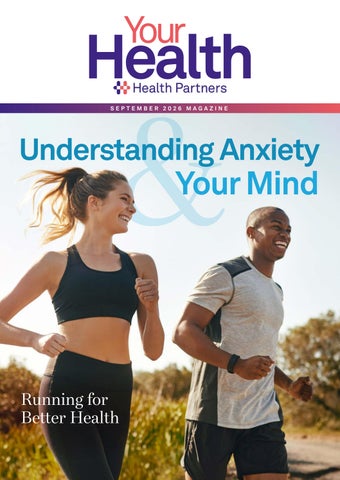
Running for Better Health
Your
Health
2|
| Your Health Newsletter
www.healthpartnersgroup.com
RUNNING FOR HEALTH
Running for Health: A Guide for New and Regular Runners
In this article, we explore how to get started with running, the benefits it can bring, and how heart rate training can help you build a smarter, more sustainable routine. Running has never been more popular, and for good reason. From boosting mental wellbeing to improving physical health, more people are discovering the benefits of getting outside and moving. The rise in popularity was evident around the 2026 London Marathon, where a world record-breaking 1.13million people from the UK and across the globe applied for the public ballot, marking a 36% increase from 2025. On race day, around 59,000 runners took to the 26.2-mile course, cheered on by hundreds of thousands of spectators. Whether for fitness, mental wellbeing, a charitable cause, or simply the enjoyment of being outdoors, running continues to appeal to people of all ages and abilities.
www.healthpartnersgroup.com
For many people, taking that first step into running can feel like a big one, but it is often much more achievable than it first seems.
Questions like Where do I start? How far should I go? or Am I doing it right? are completely normal. Luckily, running doesn’t require expensive equipment or a gym membership. All you really need is a comfortable pair of trainers, a bit of time and a plan that works for you.
Your Health Newsletter |
|3
Your
Health
How to Get Started with Running If you’re new to running, starting small is key. Programmes like Couch to 5K are designed specifically for beginners, gradually building fitness through short run-and-walk intervals over several weeks. This approach helps build confidence, consistency and a more resilient approach to running. Another great entry point is parkrun. These free, weekly 5K events take place in local parks across the UK and are open to all abilities. Whether you walk, jog or run, parkrun provides a supportive and non-judgemental environment that can help you stay motivated and track your progress. For those who prefer a social approach, local running groups or clubs can be incredibly beneficial. Running with others can boost motivation, provide accountability and help you set realistic goals. It also makes the experience more enjoyable, especially on days when your motivation might be low. Starting your running journey is about tuning into your body, discovering what you enjoy and building a consistent routine. Over time, it’s this consistency that drives real progress. If you have any underlying health conditions that may affect your ability to exercise, always consult your doctor for advice before embarking on a new fitness regime.
4|
| Your Health Newsletter
www.healthpartnersgroup.com
RUNNING FOR HEALTH
www.healthpartnersgroup.com
Your Health Newsletter |
|5
Your
Health
The Benefits of Running
Running is one of the most accessible forms of exercise and its benefits go far beyond just getting fitter.
6|
| Your Health Newsletter
www.healthpartnersgroup.com
RUNNING FOR HEALTH
Stronger Muscles
More Than Physical
Running engages major muscle groups including the core, hips, gluteals and hamstrings. Over time, this builds strength, stability and mobility, while also supporting better posture and reducing injury risk.
Running, especially outdoors in nature, also supports mental wellbeing and promotes quality sleep, giving you space to clear your mind, reflect and step away from everyday pressures.
Weight Maintenance Running burns a higher number of calories than inactivity or walking over the same time duration, helping you maintain a healthy weight. This can lower your risk of conditions such as type 2 diabetes, stroke and certain cancers, especially when combined with a balanced diet.
Cardiovascular Health Running for as little as 10 minutes a day can improve heart health. A 2024 study of more than 55,000 adults aged 18 to 100 found that running is linked to a significantly lower risk of death. Participants were followed for 15 years, with nearly a quarter identifying as runners. Compared with non-runners, they had a 30% lower risk of dying from any cause and a 45% lower risk of death from heart disease. Running strengthens the heart, improves circulation and lowers resting heart rate, reducing the risk of cardiovascular disease over time.
“For me, running is a great way to keep fit and healthy, both physically and mentally. It’s a way for me to let off some steam and feel the freedom of the road or trail. It helps clear my mind and is a great release for all those stresses of life. It also tires my choccy lab Baze out as he loves running too. It’s a great way of making friends and enjoying the great outdoors, while strengthening your bones, heart and lungs, and losing weight.” Sonja, Occupational Health Technician at Health Partners www.healthpartnersgroup.com
Your Health Newsletter |
|7
Your
Health
So Where Do Heart Zones Come In? Whether you’ve just started running or you’re heading out several times a week, it’s easy to settle into running at a similar pace each time, often without realising how much effort you’re putting in. As your running becomes more consistent, progress is shaped by how well you understand your effort and apply it with purpose. This is where heart zone training comes in. By tracking your heart rate and working within specific zones, you can better match your effort to your goals.
8|
| Your Health Newsletter
For more experienced runners, it offers a structured way to improve performance, avoid plateaus and reduce the risk of fatigue or injury. Rather than guessing how hard to push, heart rate training provides clear guidance which can help you get more from each session. If you’re new to running, it’s best to start with a simple approach by focusing first on getting comfortable with the movement and learning how your body feels at different efforts before introducing heart rate zones. Building this awareness creates a strong foundation to train more effectively later on. Joining a local running club can also be helpful, offering guidance, shared experiences and a supportive environment to stay motivated as you progress. www.healthpartnersgroup.com
RUNNING FOR HEALTH
Understanding Heart Rate Zones Heart rate zones allow you to structure your training around effort rather than pace, making your runs more effective and consistent. To get started, you’ll need an estimate of your maximum heart rate (MHR).
www.healthpartnersgroup.com
A simple guide is: 220 minus your age. For example, a 30-year-old would have an estimated MHR of 190 beats per minute. While this can vary between individuals, it provides a useful starting point, and there are a range of online calculators and wearable tools that can offer more personalised estimates.
Your Health Newsletter |
|9
Your
Health Zone 1 - Recovery (50–60% of MHR) This is a very light level of effort, ideal for warm-ups, cool-downs and recovery runs. It helps increase blood flow to muscles without putting the body under stress. For a 30-year-old, this would mean staying between 95 – 114 bpm.
Zone 1
Zone 2 – Endurance (60–70% of MHR) A comfortable, steady pace where you should still be able to hold a conversation. This is the key zone for building endurance and improving your body’s ability to burn fat efficiently. For a 30-year-old, this is between 114 – 133 bpm.
Zone 2
Zone 3 – Aerobic (70–80% of MHR) A moderate level of effort that feels more challenging but is still sustainable. Your breathing becomes heavier, and talking in full sentences is more difficult. This zone is excellent for improving overall cardiovascular fitness. For a 30-year-old, this equates to 133 – 152 bpm.
Zone 3
Zone 4 – Threshold (80–90% of MHR) A high-intensity effort where you can only speak in short phrases. This zone is typically used for interval training and speed work, helping to improve performance and increase stamina. For a 30-year-old, this sits at 152 – 171 bpm.
Zone 4
Zone 5 – Maximum Effort (90–100% of MHR) This is your absolute limit. Short bursts of maximum effort used to develop speed and power. Work in this zone is intense and can only be sustained briefly. For a 30-year-old, this would be between 171 – 190 bpm.
10 |
| Your Health Newsletter
Zone 5
www.healthpartnersgroup.com
RUNNING FOR HEALTH
One of the biggest challenges for new runners is knowing how hard to push themselves. Research suggests many runners spend more time training at higher intensities than necessary, which can limit progress over time. Spending more time in the lower zones, particularly Zone 2, allows your body to develop a strong physiological foundation. This helps to:
f Build a solid aerobic base f Burn fat more efficiently f Improve overall endurance f Recover more quickly between sessions While it may feel slow at first, this approach leads to stronger, more sustainable results over time and, ultimately, can make you a better runner. Additionally, there are recognised risks associated with starting a high-intensity exercise regime from a low level of fitness, including cardiovascular strain and musculoskeletal injuries. This article from RunReps provides a more detailed look and further information at creating a training plan that works for you.
www.healthpartnersgroup.com
Your Health Newsletter |
| 11
Your
Health
Run Smarter, Not Harder
12 |
| Your Health Newsletter
www.healthpartnersgroup.com
RUNNING FOR HEALTH
Even with the best intentions, many runners fall into similar habits, such as running too fast on easy days, skipping recovery sessions, focusing only on pace, or doing too much without enough rest. Over time, these patterns can lead to fatigue, stalled progress or injury.
Understanding your effort and listening to your body can help you avoid these common habits that can hold progress back. Heart zone training offers a simple and effective way to guide that process, helping you balance intensity, recovery and progression more thoughtfully. Running offers far more than physical benefits. It supports better sleep, improves mental wellbeing and creates space to reset and recharge. Whether you are building a new routine or developing your performance, a consistent and balanced approach is what leads to lasting progress.
By training with greater awareness, you can build a stronger and more sustainable running routine that supports both your health and enjoyment. Next time you head out, whether it is your first run or part of an established routine, remember that heart rate zones are there to guide you, not to control your routine. Start at your own pace, find your rhythm and enjoy the movement. With time and consistency, each step forward helps build strength, confidence and a lasting sense of wellbeing.
www.healthpartnersgroup.com
Your Health Newsletter |
| 13
Your
Health
14 |
| Your Health Newsletter
www.healthpartnersgroup.com
UNDERSTANDING ANXIETY & YOUR MIND
Understanding Anxiety & Your Mind With expert insight from Senior Clinical Psychologist, Dr Anna Wachowska.
www.healthpartnersgroup.com
Your Health Newsletter |
| 15
Your
Health Ever noticed how anxiety can seem to arrive before you’ve even had time to think?
A message goes unanswered. A meeting is scheduled. A small physical sensation appears. And suddenly, your mind is racing ahead, predicting, preparing and protecting. For many people, this experience has become increasingly familiar. Across the UK, levels of anxiety have been rising – shaped by a mix of modern pressures. Financial strain, changes in employment, and wider global uncertainty all play a role. More personal factors, such as loneliness and physical health concerns, can also influence how anxiety is felt and maintained over time. For many, concerns extend beyond dayto-day life. Nearly nine in 10 people report feeling anxious about climate change, for example. This reflects how wider issues can weigh on everyday wellbeing. 16 |
| Your Health Newsletter
Younger adults are reporting higher levels of anxiety, with recent UK data showing that around one in four 16 to 24-year-olds are living with a common mental health condition and that over a third of 18 to 24-year-olds feel anxious most or all of the time. At the same time, the way we talk about anxiety has shifted. What might once have been dismissed as “just nerves” is now more widely recognised and understood. Conversations have opened up, and more people are beginning to notice and name their experiences earlier.
If anxiety is talked about more openly than ever, why can it still feel difficult to fully understand what is actually happening?
www.healthpartnersgroup.com
UNDERSTANDING ANXIETY & YOUR MIND
How Anxiety Becomes Familiar Your brain is constantly taking in information from your experiences. Over time, it links together situations, thoughts, feelings and bodily reactions into patterns. If anxiety shows up often enough in certain situations, these patterns can become quicker and more efficient. Your brain begins to recognise the situation and respond in a way that feels familiar. We’re naturally drawn to what feels familiar, even when it isn’t helping us anymore. That means anxious responses that may once have been useful – like keeping you alert or prepared – can stick around long after they’re needed.
The more often this pattern repeats, the stronger it becomes. Each time the same thoughts, feelings and reactions show up together, your brain is more likely to follow that pathway again in the future. Over time, this can keep anxiety going, even in situations that aren’t actually threatening. This helps explain why anxiety can feel so convincing and so fast. It reflects a response your brain has come to know well through experience.
Dr Anna Wachowska, Senior Counselling Psychologist explains, “Anxiety often isn’t
just about what’s happening now, it’s about what your brain has learned to expect.” www.healthpartnersgroup.com
Your Health Newsletter |
| 17
Your
Health
Why Doing Things Differently Can Feel Uncomfortable If anxiety is rooted in familiar patterns, it makes sense that change doesn’t feel natural straight away. In fact, trying something new, whether that’s stepping back from a worrying thought or staying in a situation you’d usually avoid, can feel surprisingly uncomfortable. Part of this is because your brain tends to favour what’s familiar, even if that familiarity is anxiety. It can also be influenced by the beliefs we hold about anxiety itself. For example, you might feel that worrying helps you stay prepared, avoid mistakes or keep things under control. When that’s the case, doing things differently can feel risky, as though you’re letting your guard down.
Dr Anna Wachowska notes,
“When you begin to respond differently, there’s often a temporary sense of uncertainty as your brain adjusts to something new.”
With repetition, however, that unfamiliar ground can start to feel steadier.
18 |
| Your Health Newsletter
www.healthpartnersgroup.com
UNDERSTANDING ANXIETY & YOUR MIND
It’s not about “thinking positive” One of the most persistent myths about anxiety is that the solution lies in simply thinking more positively. In reality, forcing upbeat thoughts rarely changes deeply ingrained patterns. What does create change is something more subtle: learning to relate differently to your thoughts, feelings and physical sensations.
Dr Anna Wachowska describes, “It is less about replacing thoughts and more about changing your response to them.”
www.healthpartnersgroup.com
Instead of trying to replace anxious thoughts, the focus shifts to how you respond to them.
Do you immediately believe them? Do you act on them? Or do you pause, notice them, and allow them to pass without jumping in? This shift may seem small, but psychologically, it’s powerful.
Your Health Newsletter |
| 19
Your
Health
The quiet process of rewiring Change often unfolds gradually, sometimes in ways that are easy to overlook at first, but beneath the surface your brain is already adapting. Research shows that repeated experiences and behaviours can gradually shape the brain’s pathways. In other words, the more often you respond in a certain way, the easier it becomes for your brain to follow that route again. Each time you respond to anxiety in a slightly different way, you are creating a new pathway. At first, that pathway is faint. The old one still feels stronger, easier, more convincing. But over time, the balance begins to shift. What once felt automatic can become less so. What once felt overwhelming can feel more manageable.
20 |
| Your Health Newsletter
www.healthpartnersgroup.com
UNDERSTANDING ANXIETY & YOUR MIND
www.healthpartnersgroup.com
Your Health Newsletter |
| 21
Your
Health
Ways Psychology Can Help Change Your Response to Anxiety
22 |
| Your Health Newsletter
www.healthpartnersgroup.com
UNDERSTANDING ANXIETY & YOUR MIND
CBT
CFT
Cognitive Behavioural Therapy (CBT) focuses on the connection between thoughts, feelings and behaviours. It is based on the idea that anxiety is often maintained by repeated thinking patterns and habits such as avoidance.
Compassion Focused Therapy (CFT) explores how the brain has evolved to detect threat, which can make anxiety feel intense and persistent. It places a strong emphasis on self-compassion as part of change.
Changing patterns of thought and behaviour
How it works
Bringing compassion into anxious patterns
How it works
f Identifies unhelpful thinking styles f Tests out new responses in real situations f Gradually reduces avoidance
f Explains the brain’s threat, drive and soothing systems f Reduces self-criticism and shame f Builds a kinder and balanced internal voice
Why it helps
Why it helps
By gently interrupting these cycles, CBT supports the brain in forming new, more balanced patterns over time.
Developing compassion can help the brain feel safer, making it easier to move away from threat-driven responses.
ACT
Relational Therapy
Acceptance and Commitment Therapy (ACT) takes a different approach. Rather than trying to reduce anxious thoughts, it focuses on changing how you relate to them.
Relational Therapy focuses on how our wellbeing is shaped through relationships. It suggests that feeling disconnected or unseen can play a role in anxiety, while supportive, understanding connections can foster growth.
How it works
How it works
Learning to respond differently to anxiety
f Helps you notice thoughts without getting caught up in them f Encourages openness to uncomfortable feelings f Shifts focus towards actions guided by personal values
Why it helps ACT creates more flexibility, allowing anxiety to be present without letting it take over. www.healthpartnersgroup.com
The importance of connection
f Explores experiences of connection and disconnection f Builds mutual empathy and understanding f Considers social and cultural influences on relationships
Why it helps Strengthening meaningful connections can reduce feelings of isolation and help create a greater sense of safety, making anxiety easier to manage. Your Health Newsletter |
| 23
Your
Health
What actually helps in everyday life Dr Anna Wachowska suggests, “Change is built through small, repeatable shifts in how you respond to anxious moments.”
24 |
| Your Health Newsletter
www.healthpartnersgroup.com
UNDERSTANDING ANXIETY & YOUR MIND
f Slow the moment down
Even one breath or a brief pause between feeling and reaction can begin to interrupt the usual pattern.
It can be helpful to remember that anxiety is something your brain has become familiar with over time, and that familiarity can shift.
f Notice what is happening in your body
Often, it is the small, repeated moments of doing things a little differently that begin to create change.
f Stay a little longer than usual
Feeling awkward or uncomfortable during change does not mean it is not working. It can be a sign your brain is learning something new.
A racing heart or tight chest can feel intense, but these sensations are not dangerous and often settle when you allow them.
Sitting with a situation just slightly longer can help your brain learn that it is manageable.
f Make space for feelings, and step back from thoughts
It can help to approach thoughts and feelings slightly differently. Anxious thoughts can sometimes be questioned or gently stepped back from. For example, instead of “This will go badly,” you might try, “I do not know how this will go, but I can handle it.” Feelings, however, are not something you need to argue with. Emotions like anxiety often ease more naturally when they are noticed, acknowledged and allowed to pass, rather than pushed away.
f Focus on consistency
Small changes repeated often matter more than doing it perfectly.
www.healthpartnersgroup.com
At the same time, anxiety does not have to be something you manage entirely on your own. Many people find that small shifts in everyday responses, alongside developing self-awareness, self-compassion and mindfulness, can make a meaningful difference over time. If you would like to understand your anxiety more deeply, therapy can offer a space to explore where it comes from, what tends to trigger it, and what might be keeping it going. This can help you make sense of your experiences and build new ways of responding. If anxiety is starting to feel overwhelming or is affecting your sleep, work or ability to enjoy day-to-day life, it may be worth speaking to your GP. They can talk through what you are experiencing and help you explore options for support, which might include talking therapies or other approaches. Reaching out can be a supportive step, helping you understand your experiences and build new ways of responding over time.
Your Health Newsletter |
| 25
Your
Health Resources – Running for Health f New ballot world record for 2026 TCS London Marathon (London Marathon Events) f Record breakers and finish line proposals: London Marathon in pictures (BBC) f Get running with Couch to 5K (NHS) f Parkrun f What Are the Mental and Physical Benefits of Running? (WebMD) f The Impact of Running on Cardiovascular Health: A Comprehensive Review of Benefits and Risks (Research Gate) f Heart Rate Zone Calculator (UK Calculator) f Running to a Target Heart Rate (RunReps) f Cardiologist Explains: The Only 2 Heart Rate Zones That Really Matter (Active Man)
Resources – Understanding Anxiety & Your Mind f The Big Mental Health Report 2025 (Mind) f Young people 18-24 most likely to feel anxious (Mental Health Foundation) f National mental health survey: A quarter of young adults living with mental health condition and a fifth of adults struggling (Noclor) f Adult Psychiatric Morbidity Survey: Survey of Mental Health and Wellbeing, England, 2023/4 (NHS) f Neuroplasticity: How Life Experiences Reshape the Brain (Psychology.Town)
Our Services At Health Partners we offer a wide range of workplace health services. In this issue we discuss topics around mental health, wellbeing and lifestyle, all of which are related to services we offer clients’ employees. To find out more about our services, visit our website healthpartnersgroup.com
NEXT ISSUE
October 2026 Cholesterol
Menopause