
Steps to Better Health

Health Your Global Running Day Every Step Counts!


Global Running Day, occurring annually on the first Wednesday of June, is an international celebration of running and movement. It’s a day dedicated to encouraging individuals of all fitness levels to lace up their trainers, step outside and embrace the simple act of running or walking. The beauty of this event lies in its inclusivity – whether you’re an experienced marathoner or someone taking their first steps, every little effort truly helps.
Health Your

The Science of Small Steps
It’s easy to feel overwhelmed by the idea of running long distances or hitting a specific number of steps daily, but research shows that even small increases in physical activity can yield incredible health benefits. The NHS advises that adults should aim for at least 150 minutes of moderate activity or 75 minutes of vigorous activity per week. That might sound like a lot but breaking it down into bite-sized chunks – even a 10-minute walk or jog – can help you reach this goal over time.
Steps Add Up: The Benefits of Moving More
Let’s look at how small steps translate to measurable health benefits.
1. Improved Cardiovascular Health
A study published in the Journal of the American Medical Association in 2019 found that walking just 4,400 steps per day significantly reduced the risk of death from cardiovascular diseases in older women compared to sedentary individuals. As step counts increased, the benefits continued to grow.
2. Weight Management
Walking 10,000 steps per day –equivalent to about 5 miles – burns roughly 400–500 calories depending on your weight and pace. However, even smaller increments, like a brisk 30-minute walk (approximately 3,000 steps), can burn 150–200 calories. Weight loss or maintenance is often about small, consistent changes. Every step contributes to calorie expenditure, making it easier to achieve your goals.
3. Reduced Risk of Chronic Diseases
Walking 3,000–4,000 steps per day (30 minutes of moderate activity) can reduce the risk of Type 2 diabetes, stroke and some cancers. Walking, jogging or even taking the stairs can help reduce the risk of age-related ill health and improve sleep.
4. Better Mental Health
Just 7,000 steps per day can significantly reduce symptoms of anxiety and depression, and is a more achievable target than 10,000 steps, the previously widely accepted benchmark. Physical activity releases endorphins – the body’s natural mood boosters. Even a short run or walk can help clear your mind and elevate your mood.

Making Movement Part of Your Day
You don’t need to overhaul your lifestyle to get more steps in. Here are some simple ways to incorporate more steps into your routine:
1. Take Active Breaks: Set a timer to remind you to get up and move. Try to move hourly from prolonged sitting if you can.
2. Commute Creatively: Walk or jog part of your commute to work. Park further away from your destination or get off the bus at an earlier stop.
3. Lunchtime Strolls: Use your lunch break to walk around the block or a nearby park.
4. Family Runs or Walks: Involve your loved ones in a short jog or walk. It’s a great way to bond while staying active.
5. Use Technology: Fitness trackers or smartphone apps can help you monitor your daily step count, set achievable goals and guide you to gradually increase your running or walking distance.
6. Get Medical Advice: Remember to consult your GP for advice before embarking on a new regime if you have a health condition that affects your ability to exercise.
Whether it’s a quick dash to the shops, an evening stroll or a 5K run, every step you take contributes to a healthier and happier you. So, why not commit to moving a little more – because every step truly does count.


Prostate Cancer The Key to Staying Ahead
Written by Dr Dan O’Sullivan, Occupational Health Physician at Health Partners
This article is about the early detection of prostate cancer, the second leading cause of cancer related deaths in men.
From Stephen Fry in 2018 to Lord Cameron’s announcement in 2025, it seems like many notable men in their middle age have been diagnosed with prostate cancer in recent times. These high-profile cases shine a spotlight on the issue –one that is bright but can sometimes dazzle and glare.
It’s useful to know the facts in case you’re in a situation where you are worried about prostate cancer. As a GP, a Urology Doctor and an Occupational Physician at Health Partners, I come into contact with prostate issues both benign and cancerous regularly.
What follows is my attempt to communicate what I aim to convey during a consultation from my perspective. However, what’s always missing is your side of the story. If you have any symptoms, concerns or worries, I encourage you to make an appointment with your GP to discuss this article or anything on your mind. More often than not, having that conversation can be reassuring.
Key statistics from Prostate Cancer UK:
f There are around 55,300 new cases of prostate cancer every year (2017-2019)
f 78.9% of those affected, survive prostate cancer for 10 years or more
f There are around 12,200 prostate cancer deaths in the UK every year
f 1 in 6 males will be diagnosed with prostate cancer in their lifetimes.
Health Your
Origins and Risk Factors
Risk factors for the development of prostate cancer include age, ethnicity and genetics. There are some potential links to some lifestyle factors, but none have clearly met the threshold for definitively being labelled ‘avoidable risks’.
Age
The most obvious and important risk factor for developing prostate cancer. I’m sure you’ve heard someone say something along the lines of ‘you either die with it or of it’. The incidence of prostate cancer increases significantly with age.
Ethnicity
Men of African ancestry in Western countries tend to have worse outcomes from prostate cancer treatment. This may be partly because their cancer is often diagnosed at a later stage compared to men of other backgrounds.
A study published in the European Urology Journal suggests that these differences are influenced by social and structural factors, such as unequal access to healthcare, economic inequalities and systemic racism. These factors can limit access to better living conditions and medical care.
Interestingly, recent European guidelines for prostate cancer, aimed at Consultant Urologists, indicate that for men with advanced prostate cancer (when the disease has spread), survival rates are similar across White, Black and Hispanic men.
Genetic Factors
A small sub-set of men regardless of race or racial origin have a true family link to prostate cancer. True hereditary prostate cancer is defined in one of the following ways:
f Three or more cases in the same family
f Cases in three successive generations
f Two or more cases in the same family that were diagnosed under the age of 55 years. Certain genes can increase the risk of prostate cancer, and one of the most well-known is the BRCA gene, often linked to breast cancer. Men with a family history of breast cancer may have a higher chance of developing prostate cancer if they carry a mutation in this gene.

There is little evidence of modifiable risk factors impacting your prostate cancer risk but there is some evidence that smoking and obesity are linked with more aggressive forms of the cancer.
Prostate Specific Antigen (PSA)
What Is PSA?
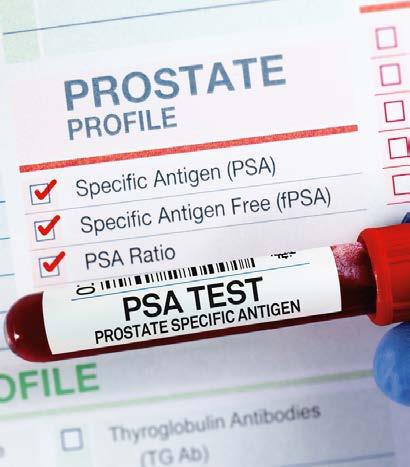
Prostate Specific Antigen is protein produced by prostate cells that can be found in the blood. All men have some PSA in their blood, so it doesn’t always indicate prostate cancer.
It is important to highlight that there is no current prostate cancer screening tool in the UK unless you are in a very small group of men. You can view the details of the national screening committee decision and consultation plans on that decision online.
It remains true that the best way we have to detect prostate cancer early and treat it earlier is by checking a PSA blood test. It is normal for PSA to rise as a man gets older, so the ‘normal ranges’ also increase with age.

Who Should Get a PSA Test?
Currently, most men won’t get invited for a PSA test unless they ask for it. But who should be asking their GP for it?
f If you are an African man or a man of African or AfroCaribbean heritage, over 45 and you’re concerned about your prostate then go to your GP and request a discussion about a PSA test. This doesn’t mean you need to have symptoms, just that you’re concerned – maybe you have a family member with prostate cancer, maybe you saw it on the news! All of these are relevant concerns.
f If you have a family history of prostate cancer, it makes sense to have this discussion earlier as well so 45 would be the correct age for this.
f If you are a man that is from any other ethnic group and you have no family history of prostate cancer, go and have a discussion about a test if you’re over the age of 50.
Health Your
If My PSA Blood Test Is Raised, What Will Happen?
The PSA test is a flag, a signal that there might be a cancer there. The next step depends on the level of the blood test or if the result was a false positive.
If the level of PSA showed as raised:
f Sometimes the test will need to be repeated (usually if it’s a bit raised, but not too raised)
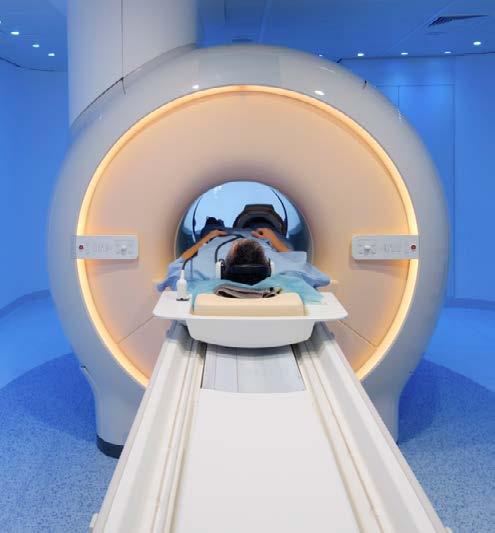
f Sometimes you’ll go on to get an MRI scan to have a detailed look at the prostate
f If anything is found on the MRI scan, you’ll usually go on to have a prostate biopsy, and this is the only way to 100% confirm or refute that prostate cancer is diagnosed.

You can have a raised PSA and not have prostate cancer – we would call these ‘false positives’. This can be caused by:
f You have been on a long cycle ride 1-2 days before the test
f You have ejaculated 1-2 days before the test
f You have had invasive urological investigations in the preceding six weeks before your PSA blood test such as a prostate biopsy or a cystoscopy
f You have had an active Urinary tract infection (UTI) in the last six weeks
f You have had a digital rectal examination performed in the last 1-2 days
f You have an enlarged but non-cancerous prostate.
If any of these are true and you have had a PSA test, the right thing may be for your GP to repeat it after 4-6 weeks rather than jumping into onwards referral straight away. After this, false negative results can also occur. This means the PSA result is negative, when there is a prostate problem. You should consult your GP again if you develop new or worsening symptoms for advice.

What Symptoms Should I Be Concerned About?
Symptoms that may be concerning for prostate cancer and merit an urgent review with your GP include:
f Blood in the urine
f Worsening lower urinary tract symptoms
– Urinating more at night
– Passing urine more frequently than normal
– Urgency to pass urine
– Dribble after finished
– Flow reduction
f Sudden onset new erectile dysfunction
f New onset lower back or hip pain without a clear cause.
Do I Need to Have a Digital Rectal Examination?
No – if you have a raised PSA, then that should be enough to consider the next step.
Sometimes it can be helpful to do a rectal exam in situations where the PSA blood test is normal and we don’t know whether or not the prostate is enlarged, and sometimes various lumps or bumps can be found that might prompt further investigation.
Visit Prostate Cancer UK to check your risk in 30 seconds or the British Association of Urological Surgeons for more information on this topic.
I recognise that this whole topic can be really worrying. It is really important to remember that 75% of PSA blood tests that are raised are due to benign causes. If you are diagnosed with prostate cancer, there are loads of good treatments out there and new ones are being developed all the time. If there is a problem, the earlier it is found, more options are available.
Resources – Making Movement Part of Your Day

f Is 4400 Steps per Day the New 10 000 Steps per Day? | JAMA Internal Medicine | JAMA Network
f Exercise – NHS
f Walking 10k steps burns 400-500 calories – here are 4 techniques to burn even more
f How Many Calories Do You Burn Walking 10,000 Steps?
f Daily steps and health outcomes in adults: a systematic review and dose-response metaanalysis – The Lancet Public Health
f The multifaceted benefits of walking for healthy aging: from Blue Zones to molecular mechanisms – PMC
f Just 7,000 steps a day could cut health risks, study says – BBC News
Resources – Prostate Cancer
f Prostate Cancer UK | Prostate Cancer UK
f Deconstructing, Addressing, and Eliminating Racial and Ethnic Inequities in Prostate Cancer Care–PubMed
f EAU Guidelines on Prostate Cancer
f UK NSC opens consultation on draft prostate cancer screening recommendation – UK National Screening Committee
f BAUS PCUK DRE FAQs.pdf
Our Services
At Health Partners we offer a wide range of workplace health services. In this issue we discuss topics relating closely to our wellbeing services, from running and movement to cancer testing.
To find out more about our services, visit our website healthpartnersgroup.com