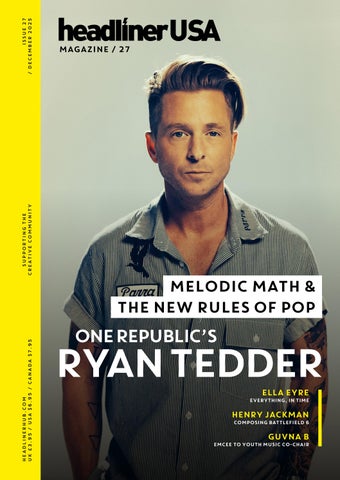
ISSUE 27 / DECEMBER 2025 SUPPORTING THE CREATIVE COMMUNITY
MAGAZINE / 27
HEADLINERHUB.COM UK £3.95 / USA $6.95 / CANADA $7.95
MELODIC MATH & THE NEW RULES OF POP
ONEREPUBLIC’S
RYANTEDDER ELLA EYRE
EVERYTHING, IN TIME
HENRY JACKMAN
COMPOSING BATTLEFIELD 6
GUVNA B
EMCEE TO YOUTH MUSIC CO-CHAIR
SoundOn is TikTok’s all-in one platform for music creators
DEJA
Check out my new song Tu Tu
Young Athena
Distribute your music for free at soundon.global Images: Young Athena, DEJA and Josh Barry performing at SoundOn presents.
Josh Barry
Bridging in-room and personal headphone monitoring Our UNIOTM Ecosystem gives the ability to optimise, align and seamlessly navigate your monitoring options, for the flexibility to work anywhere, anytime – from stereo to immersive. Now, with the introduction of Personal Reference Monitoring – our pioneering new active monitoring headphone solution – UNIO offers the very highest level of headphone accuracy. genelec.com/unio
Explore UNIO
4
ISSUE 27
Welcome to Headliner USA
NO.27/ USA
Paul Watson CEO
Alice Gustafson Editor-in-Chief
Marc Henshall Head of Digital
Keith Watson Chairman
Adam Protz Deputy Editor
Grace Mcguigan Artist Relations Manager
Rian Zoll-Kahn COO
Ste Knight Partnerships Director
Rae Gray Head of Design
Rick Dickerson Reviews Editor
HEADLINER USA
WELCOME
In the words of Mariah Carey, it’s tiiiime. That’s right, it’s officially Christmas in a few days, where those working in the music and audio industries can take a wellearned break after another busy year, and will surely soon be feeling as bloated as Ms. Carey’s December bank balance. The last few weeks of the year are a good time to pause and reset, and to look back at what has been achieved in 2025, while anticipating what’s to come in the new year – because let’s face it, it’s sure to involve AI. For now, that’s a 2026 problem. In a year that’s brought us the resurgence of cassettes and CDs, the UK government banned reselling live event tickets for profit, AI copyright issues dominated headlines, Beyoncé finally won album of the year at the Grammys, Kendrick Lamar spawned a thousand Drakebeef memes at the Super Bowl, Diddy got sent down, and Taylor Swift bought back the master recordings to her first six albums. Oasis reunited, the KPop Demon Hunters soundtrack dominated the pop charts, the Federal Trade Commission filed a lawsuit against Ticketmaster and Live Nation over
misleading ticket prices, and who could forget the Coldplay jumbotron scandal? We also lost some musical legends in 2025; RIP Brian Wilson, Ozzy Osbourne, D’Angelo, Angie Stone, and Roberta Flack.
5
tick, followed by a pit stop in Milan to discuss major label strategy with Warner Music Italy.
Bringing us up to this issue, which sees OneRepublic’s frontman and hitmaker-to-the-stars, Ryan Tedder, From industry leaders and cuttinggrace the cover to talk “melodic edge music tech to film scores, math”, why TikTok attention spans global pop, and festival culture, have resulted in shorter songs, and Headliner’s cover stars this year the death of the bridge. Over on the showcased the full spectrum of live sound front, Headliner shines modern music and audio – kicking a spotlight on the tech powering off with NAMM president and CEO OneRepublic’s biggest tour yet. John Mlynczak. Next, we saddled up In new music releases, Ella Eyre and brought you the tech behind explains why her new album proves Netflix’s record-breaking livethat she’s so much more than a streamed extravaganza, Beyoncé dance feature vocalist, while her coBowl. Next came an in-depth look at producer reveals the tech he couldn’t hit body horror film, The Substance’s have made the record without. Into electronic score, and hot on the heels gaming? Say less. We’re bringing was Ezra Collective’s Ife Ogunjobi you an interview with Henry Jackman on keeping a level head amidst the on collaborating with Limp Bizkit band’s unstoppable success. for Battlefield 6, and repping rap is Guvna B, who reveals how he went Then we went all Brat Summer from emcee to Youth Music co-chair. with Charli XCX’s Brat co-producer Plus, much more. and co-writer; headed over to Austria to catch up with this year’s And if all you want for Christmas is Eurovision winner, before sinking not to check your emails, then happy our teeth into 28 Years Later’s sound holidays, and see you in 2026! design. During festival season, Alice Gustafson we headed over to Lakefest with Editor-in-Chief Groove Armada; found out what makes superstar DJ James Hype
HEADLINERHUB.COM
6
ISSUE 27
Welcome to Headliner USA
CONTENTS 08
ASPIRING HEADLINER Shao Hao: Bridging Brit-pop and Mandopop
COVER STORY
ARTIST
14
38
Ella Eyre steps out of the dance-feature shadow on everything, in time
OneRepublic’s Ryan Tedder on melodic math and the new rules of pop
By Alice Gustafson By Alice Gustafson 44 22
ON TOUR WITH ONEREPUBLIC: LIVE TECH TAKES CENTER STAGE
26
INSIDE BEAST The 100-speaker dome system redefining immersive sound
32
EMERGING HEADLINER Inside Dakota Dry’s The Edge Of Our Never Ending Universe
HEADLINER USA
MEET THE PRODUCER Aston Rudi on producing Ella Eyre’s everything, in time
50
LOSS><GAIN & D&B SOUNDSCAPE: A NEW ERA OF IMMERSIVE MUSIC EXPERIENCES
56
COMPOSER Henry Jackman: Collaborating with Limp Bizkit for Battlefield 6
CONTENTS
7
THE BIG INTERVIEW
Warner Music’s Kevin Segler on breaking German dance acts By Alice Gustafson
62 68
ARTIST Guvna B: From emcee to Youth Music co-chair
92
BRUTAL GÜET: THE CUTTING-EDGE AUDIO INSIDE NEW OB TRUCK
74
QRION: THE MAKING OF WE ARE ALWAYS UNDER THE SAME SKY
94
BOOMTOWN FESTIVAL 2025: LIGHTING THE DISTRICTS
80
TRUE ROMANCE SOUND: CAPTURING BRITTANY HOWARD’S KUMITE PROJECT
96
BREGENZ FESTIVAL: LAKE-STAGE PRODUCTIONS
98
82
DAVID HALLYDAY ARENA TOUR: ACHIEVING THE ZENITH OF SOUND
BRUCE BEACOM: OVERCOMING HEARING IMPAIRMENT AS A SOUND MIXER
102
86
ELECTROCRAFT: ZERO-COMPROMISE SOUND FOR INDIAN SUMMER SEASON
INDUSTRY INSIGHT Ken “Pooch” Van Druten on what worldclass mixers know that executives miss
88
HSD SOUND SYSTEMS: UPGRADING FLAGSHIP SUBS WITH CELESTION
GET IN TOUCH
COPYRIGHT
grace@headlinerhub.com headlinerhub.com
The content of this publication belongs to HEADLINER GROUP and to the authors & collaborators. Do not reproduce.
HEADLINERHUB.COM
SHAO HAO
Bridging Brit-pop and Mandopop
Image credit: Kentaro Murata
8
HEADLINER USA
ASPIRING HEADLINER
9
ds by or A W
M PROTZ DA
BRIDGING BRIT-POP AND MANDOPOP
SHAO HAO Shao Hao is a singer-songwriter who has gone from being an unconfident music student who left China for studies in the UK, to having no.1 hit songs across South East Asia and on Netflix and anime shows. He chats to Headliner about how being a resident artist at London’s Roundhouse helped him sign his life-changing publishing deals, and the latest single from his Brit-pop meets mandopop solo project, Where Is My Home.
Upon moving to the UK, Hao submitted a demo to a songwriting competition being run by the Roundhouse, leading to his two-year residency at the iconic venue and artist space. Winning the competition, he was then able to pen a publishing deal in Taiwan, leading to a slew of hits as a co-writer for Taiwanese artists, as well as success
in China, Malaysia, Singapore, and Taiwan. And, with more success under his belt, writing songs for Netflix and anime programmes, he launched his solo artist project with the single White Horse. He even finds time to perform at schools and talk to students about his journey.
HEADLINERHUB.COM
SHAO HAO
Bridging Brit-pop and Mandopop
Image credit: Kentaro Murata
10
from Abbey Road. I got to perform with artists like Imogen Heap and Jamie Cullum. I even supported Edwyn Collins at his concert. That was also my first time performing at the main stage at the Roundhouse. It was so surreal. You eventually landed a major publishing deal in Taiwan. How did that come about while you were based in London? I entered this international Mandarin pop songwriting competition in 2016 with my demos. Eventually, I won the competition, and that’s how I got signed to a record label from Taiwan called HIM International. They are one of the biggest major record labels in Southeast Asia. That really opened the doors for me as a songwriter to write for huge superstars.
What are your earliest memories of music, and when did you start thinking this might be a career for you? The earliest one will be when I was maybe only seven. My mom took me for piano lessons, and it was really fun. I was trying to copy melodies that I heard from TV or pop songs and played them on the piano. I entered a karaoke competition at primary school, where I came third. I thought, “Okay, not bad. Maybe one day I can do this as a career.” Deciding to move to the UK must have felt like a huge step. Did you feel you couldn’t pursue music the way you wanted to in China? In high school, it became really stressful learning all the subjects that they think are important, which are less important to me, because my passion was in music. In China, especially when entering university, you have to pass a lot of exams, where music is not that important. I didn’t really have a choice but to focus on studying music at the time. I was inspired by classmates who were looking to study abroad. I said to my parents, “I really love British music. Is it possible for me to go to the UK and HEADLINER USA
study music?” They found this amazing school in St Andrews. That’s how I took music seriously and learned music theory and songwriting skills. When you first arrived, your English was quite limited. Did music become your primary way of connecting with people? My English was really, really bad, so I almost felt like music was my first language. That’s how I had my first connections with people: through concerts. After the concert, people came up to me, and I could see that they were starting to get to know me a little bit more just through music. After St Andrews, you became a resident artist at the Roundhouse in Camden. How was that experience for you? That was an incredible opportunity that I never would have dreamed of. One of my classmates told me that this Roundhouse choir existed. I joined the choir and then found out there’s this resident artist programme. I was very lucky to pass the audition. Through the resident artist project, I was able to record my first few original songs properly in their recording studios, with recording equipment that was donated
You’ve had songs reach number one across Asia. Did that success develop quickly for you? I would say it was slow progress. For the first two or three years, I barely had any cuts. They had a really high bar for the quality because they wanted my first cut to be the one that could be in the chart. I didn’t have my first cut until I had written over 100 demos. But instantly, my first cut was the song for a pop diva from Taiwan, Angela Zhang. Earlier this year, one of my songs was sung by Stephanie Sun, and that went number one across so many countries. What was more surreal was that she was my idol when I was a kid. When I first came to my boarding school in St Andrews, I took three of her CDs with me to listen to in my bedroom all the time. It’s so surreal that I have written a song for her now, and it has become her comeback song. You will see these huge billboards in China with the title of my song playing.
11
Image credit: Kentaro Murata
ASPIRING HEADLINER
Your song White Horse was featured in the number one Netflix series, The Victims’ Game. How did that connection happen? It was number one in Taiwan, Hong Kong, Vietnam, and Indonesia. The TV series is about an autistic father and his estranged daughter. When I wrote the song, I instantly felt super connected to the story because I was diagnosed as autistic when I was in school. I always find it difficult to read between the lines and to express myself without music. Initially, I just sang the demo and we pitched for other singers to sing. But the TV producer heard my voice and felt that my voice was so connected to the main character. He decided to just use my voice for the song. That became my first original song released by a major label, and that launched my idea of becoming a singer-songwriter myself.
You mentioned combining K-pop and Brit-pop. Which artists influenced that sound for you? It comes so naturally because that’s my identity. I am literally a fusion of East and West. People like Blur, even The Beatles, Coldplay, Adele, and Lewis Capaldi were all my Brit-pop influences. K-pop was already a huge thing for Chinese teenagers when I was a kid. Now, younger generations in the West are so into K-pop. I thought now it’s a great opportunity for me to introduce both of them and combine them to create something that’s unique to other people, but original to me.
HEADLINERHUB.COM
12
SHAO HAO
Bridging Brit-pop and Mandopop
“HOME IS NOT A LOCATION, IT’S THE FEELING OF BELONGING AND THE PEOPLE WHO YOU LOVE AND MAKE YOU FEEL SAFE.”
Your new single, Where Is My Home, is all about identity. How have you found the reaction so far? It’s honestly overwhelming. While I perform these songs at the schools all around the UK, the kids are having so much fun. The song is about identity; I wrote it for my younger self, who was 17, who had just come to the UK and was not quite sure where my home is. I want to tell people through the song that home is not just a location, it’s actually the feeling of belonging. It doesn’t matter how different you are from everyone else; as long as you know that you are loved, you have a home somewhere. The kids say that I make them feel cool to be different. It’s really great that they can feel much more confident about their own identity listening to my song. You’ve mentioned feeling “too Chinese” for some in the UK and “too British” for friends in China. How do you navigate that middle ground? Discrimination always exists in all societies. I often feel like I’m too Chinese for British people, but then to my Chinese friends, I seem too British. I’m always somewhere in between and sometimes feel quite lost with my identity. As I was writing the song and chatting to other songwriters, this idea really inspired me that actually home is not a location, it’s the feeling of belonging and the people who you love and make you feel safe. HEADLINER USA
Who worked with you to create the sound for this single? I had Jack Leonard and Johnny; they are a writing duo called Cheap Cut. Johnny has produced for Kylie Minogue, and Jack has written a lot of Brit-pop stuff. I had another co-writer who is Japanese, Kanata Okajima. She is one of the top writers from East Asia and has written for BTS twice and for Lisa. We had a perfect team: two Asians and two Westerners. We just created this fusion, and the sound came out so organically because of who we are. How’s 2025 shaping up for you? I’ve just released a 2025 version of the Christmas song, Walking in the Air. Also, I’ll be flying to Seoul, Korea, because I have written quite a few songs with K-pop producers and writers, and I’m going to record them in Korea to finish the songs. Hopefully, I can release them as part of my English EP early next year. The EP at the moment is called SH17, which is a kind of time travel code of me traveling back to when I was 17 and trying to heal all these traumas I had as a teenager. I want to do more live shows and find a booking agent to get my music heard. SHAOHAO.CO.UK
88R LBC PRECISION. POWER. PURE NEVE DNA. 88RS CONSOLE DYNAMICS IN 500-SERIES FORMAT
www.neve.com
14
ONE REPUBLIC’S RYAN TEDDER
Melodic math & the new rules of pop
ONEREPUBLIC’S
RYAN
HEADLINER USA
ds
15
by alic e
MELODICMATH &THENEW RULESOFPOP
stafso n gu
Wo r
COVER STORY
Ryan Tedder has the music tastes of a teenage girl, and it’s what’s been keeping him booked and busy as one of the most successful and prolific songwriter-producers in the world for the last 20 years. Most will know him as the frontman of OneRepublic, but he’s also a 3x GRAMMY award-winning songwriter and producer in his own right, having worked with the biggest names in music on some of their most commercially successful records, including Beyoncé, Adele, and Taylor Swift. Heard a catchy song on the radio in the last 20 years with an infectious, melodic run? Chances are, Tedder wrote or produced it.
And while many artists struggle to reap the financial rewards from Spotify streams, Tedder (or private equity firm KKR, which bought a majority stake in his music catalog in 2021) has no such problem. This year, Tedder racked up 27.8 billion streams from 316 million listeners across 184 countries. At this point, he seems
to be carrying the music industry on his back. His recent songwriting credits alone read like a roll call of chart royalty – Rosalía, Tate McRae, Katseye, and Beyoncé and Miley Cyrus’ 2025 Grammy-winning duet II Most Wanted. It’s a level of dominance that cements his status as a writer-producer extraordinaire,
a reputation he’s been building ever since OneRepublic’s breakout hit Apologize shattered the US Top 40 radio airplay record with 10,331 spins in a single week.
HEADLINERHUB.COM
16
ONE REPUBLIC’S RYAN TEDDER
And before anyone could say, ‘Thank you, another one,’ he needn’t have worried about being pushed off the top spot by another artist: his only competition turned out to be himself. The Timbaland remix of Apologize held the no. 1 most played song for five months until Leona Lewis’ Bleeding Love – also co-written and co-produced by Tedder – broke that record with 10,665 plays in one week. And as of 2025, Apologize, Bleeding Love, and Beyoncé’s Halo remain among the best-selling singles of all time. It’s no surprise, then, when grabbing a strict 20 minutes with Tedder to discuss modern songwriting trends and OneRepublic’s first-ever career-spanning album, to discover he eats, sleeps, and breathes music. One gets the impression you could pose him any question on any musical topic, and he’d immediately be able to lurch confidently into an insightful discussion spanning decades, genres, and eras. And even though he’s in full-on interview promo mode for OneRepublic’s new album and will have answered every question put to him today countless times already – if not 20 minutes before this interview, then throughout his career – he answers with real depth and expands thoughtfully on each topic. Far from going through the motions, he takes one breath and expels a dizzying stream of well-considered musical knowledge and opinions, complete HEADLINER USA
Melodic math & the new rules of pop
with tangents, compelling subplots, and whatever the opposite of long story short is. “I still have a job because I basically have the ears of a 15 or 16-year-old girl. Truly! I have the musical taste of a teenage girl,” he insists when reflecting on his ability to write mega hits across decades. “Ultimately, my ear gravitates towards something that young people are going to resonate with. You get really lucky when it’s an artist like Adele, or even OneRepublic; I have dads come up to me and they’re like, ‘My eightyear-old is blasting I Ain’t Worried or Sunshine on our way to school every morning’, while the parents grew up with Apologize, Stop and Stare, or Counting Stars. That’s the secret sauce for me anyway.” Part of that secret sauce, aside from his talent for writing smashes, seems to lie in Tedder’s signature melodic hooks and unpredictable vocal choices that stand out across his work. Take the bridge in Adele’s Turning Tables, for example, or the last run at the end of the chorus on OneRepublic’s Love Runs Out; the anthemic, six-note ‘I’ that leads the pre-chorus on Counting Stars, or the earwormy way Beyoncé dances over four notes in the last belt of Halo. Does Tedder consciously build these interesting melodic choices into his songs as he’s seen what’s been successful for him?
“I think that ultimately the answer is somewhat yes, somewhat no,” he considers. “In terms of the melody choices that I make, if I’m writing a song from the beginning, whether it’s Adele’s Turning Tables, or something for Rosalia or Tate McRae, even though they’re all three wildly different genres, the best way to put it is, you know when you have an itch somewhere on your body and it’s hard to reach and you can’t quite figure out where it is, and you’re trying to explain to someone else? Like, ‘Hey, can you scratch this part in between my shoulder blades?’ It’s one of those things where you’re like, ‘No, that’s not it…no, up, to the right, to the left, down, down, down, down, down’. It’s like there’s an itch that I hear once I hear the chords, and even if I’m writing the chords myself or someone else did the track, there’s an itch, and I’m trying to scratch it. “I don’t quite know where it is until I land on it, and then I’m like, ‘Yeah, that’s it!’ That’s what I’m doing, but the itch is the melody. So at the end of the day, I’m really scratching my own itch. And again, that’s pretty much the reason I still have a job – because of my ability to execute or scratch that itch, whether it’s for something more highbrow, like a super Pitchfork-y indie band or artist, or if it’s the most pop, Sugababes thing in the world, and everything in between.”
COVER STORY
17
HEADLINERHUB.COM
18
ONE REPUBLIC’S RYAN TEDDER
Melodic math & the new rules of pop
Long before Tedder’s first foray into music (he interned at DreamWorks SKG in Nashville, producing demos for songwriters and labels), he worked as a waiter and at Pottery Barn. Anyone who’s done their time in retail and hospitality will be all too familiar with the playlists that these establishments cycle through, which, depending on whether one’s memories of that employer were favorable or not, can create something akin to song-PTSD when hearing them again, no matter how much time has passed. Tedder laughs, immediately recalling his days as a waiter: “My first job waiting tables was at a Joe’s Crab Shack in Nashville, and one of my really close friends is Diplo,” he mentions – segue incoming. “We were hanging out a couple of months ago and were talking about, of all the places in all the world – I’m not from Nashville – but I was living in this suburb called Hendersonville, working at Joe’s Crab Shack in the car park of this really shit mall called RiverGate Mall, and inside that mall, my restaurant faced a shoe shop called Just For Feet. And Wes, or Diplo as everybody knows him, was working in the shoe shop at the same time I was working at Joe’s Crab Shack, which is hilarious. Literally, you’re talking 30 metres away, and I used to go into that shop and look at shoes. It’s just a weird little coincidence, because he’s not from Tennessee either. We just both happened to be living there at the same time when we were about 18 years old. “But anyway,” he says, pulling himself back to answering the question at hand, “in terms of the music at the time, I can tell you specifically the two biggest songs that I remember being on the playlist perpetually: one was Eric Clapton, Change the World. That song played every 15 minutes. It was outrageous. And the number one song that summer, and I remember because I bought the CD, was Goo Goo Dolls’ Iris. I’m pretty HEADLINER USA
sure Chumbawamba’s Tubthumping was also on that playlist. I think they all paid their mortgage off with that song,” he laughs. Tedder grew up listening to the top 40 at a time when the only way to catch a new song was to listen to the radio or watch MTV. Songwriting and the way tracks break out today look very different. He weighs in on whether or not he’s adjusted his songwriting style to follow industry trends. “More or less, you’re a by-product of your environment,” he says. “I was raised without access to any cool radio stations or record shops. All I had was the top 40 countdown, seven days a week. So naturally, call it two decades of growing up with
nothing but the biggest 40 songs in the world, seven days a week – that was my radio station. Because of that, I think my ear is naturally inclined to write things that resonate with the masses, as opposed to more niche music listeners. “I think in terms of conscious decisionmaking, I for sure have my own signature style. Songwriters tell me that all the time. To this day, I couldn’t articulate what that is other than emotion. I gravitate towards things that are more emotional. I’m chasing goosebumps, chasing that dopamine rush. As I wrote more and more and I got into my late 20s and early 30s, I started to become a student of the – I hate saying formula – but there is a math to melody.”
COVER STORY
He credits this formula to Swedish DJ, music producer, and songwriter. Denniz Pop (who in turn recruited fellow pop hit-maker, Max Martin), co-produced and co-wrote a string of hit songs for Backstreet Boys, Britney Spears, *NSYNC, Robyn, and 5ive. “He was the guy that created Ace of Base and started the whole Backstreet Boys, *NSYNC thing,” Tedder elaborates. “He more or less developed what you could call melodic math, or what some people in the industry refer to as Swedish pop math. Once I started working with some of those guys, I quickly became a student of that and did a deep dive into understanding why hits are hits. Because up to that point, everything I’d had was just me shooting from the hip, randomly. Once I unlocked melodic math and that there is a science to hit records, that unlocked a whole new world. It made it easier for me to get out of trouble, as when you’re writing songs, sometimes you get stuck. “I don’t like to write with any type of
math,” he clarifies, “but when you write as much as I do and you’re trying to write hit songs, sometimes you’re like, ‘Why does this chorus not feel right? Why is this verse not setting the chorus up?’ When you understand melodic math and shape, it allows you to get out of jail, so to speak. So it’s definitely become easier as I’ve gotten older. “The irony is that it’s easier for me to write potential hits the older I get. It’s way harder to actually have them because of social media and streaming. There are just too many songs coming out per day. It’s made it way harder to connect songs on a global scale.” Indeed. Since the rise of streaming, the length of pop songs has been steadily shrinking. As platforms reward immediacy and repeat plays, tracks are increasingly squeezed, compressed, and front-loaded with hooks. In 2019 – just two years after TikTok launched – the average song length dropped to 3 minutes
19
and 12 seconds, signalling a major shift in how music was written and consumed. And today, many TikTok-driven hits skip intros entirely, racing straight to the chorus to grab attention before listeners scroll on (although there are rare exceptions – hello The Weeknd’s Blinding Lights). And when was the last time you sat through an entire film, or even an episode of a TV show, without glancing down habitually at your phone? Our attention spans are just not what they used to be. By 2024, the average Spotify charting song sat at around three minutes – nearly 30 seconds shorter than in 2019. Even the Grammys reflect the trend: almost 20% of 2024 nominees ran under three minutes, including 2025 Record of the Year contenders like Sabrina Carpenter’s Espresso and Charli xcx’s 360.
HEADLINERHUB.COM
20
ONE REPUBLIC’S RYAN TEDDER
“TikTok and social media have created a situation with the majority of human beings, at least anyone who is on social media, which is probably two-thirds of the world,” Tedder nods. “The constant scrolling and page turning create this endless desire for dopamine, because every time you get a new thing, the first two seconds are the most exciting and they grab you, and then you switch to the next thing. And kids are used to it. Try to find a 13-year-old right now who can sit through a 90-minute movie, unless it’s K-Pop Demon Hunters. It’s created a situation where everyone is craving these constant, quick, short dopamine kicks. So naturally that was going to pour over into music, and it has.” It’s easy to blame shrinking song lengths on shortened attention spans in the streaming era, but the truth is that music has always been shaped by the technology of its time. HEADLINER USA
Melodic math & the new rules of pop
When the band was at its height, the dominant ABBA-style song structure kept tracks brief, with the average song running around two minutes and 30 seconds. This wasn’t just an artistic choice – it was a technical necessity. Widely used until the ‘40s, 78 rpm records could only maintain good sound quality for roughly three to five minutes per side. The ‘50s and ‘60s brought the rise of the verse-chorus form, although the 12-inch LP could only hold about 22 minutes per side. When CDs became commercially available in ‘82, they expanded the listening canvas dramatically, offering up to 74 minutes of total playtime. By the ‘90s, that increased capacity was reflected in the music itself. Tedder explains that he isn’t writing shorter songs now to keep pace with this trend. “Songs have got shorter,” he confirms. “I wouldn’t say that guys like me or
any songwriters are intentionally sitting down and going, ‘Okay, whatever we do today, it has to be two minutes 30 or less.’ That is not at all a decision. I mean, let’s be real,” he says, changing tack, “if you take it back to the ‘50s and ‘60s, your average Beatles song was about two minutes long. Some of them were less than two minutes, some of them barely over, and the reason was that you could only fit so many songs on a vinyl, and so songs were truncated and shorter. “Typically, with a lot of the Beatles stuff, you’d go verse, chorus, verse, chorus, verse, chorus. And if you think of the style of Johnny Cash or June Carter Cash and those songs from the ‘60s and ‘70s, also you’d have a verse, chorus, verse, chorus, verse, chorus, and that was it.”
COVER STORY
He uses Scottish alternative rock band Del Amitri as an example from the ‘90s, and off the top of his head, recalls the song’s exact runtime down to the second. “If you think about Roll To Me, look at the song length of that song and then look at the structure. They were doing a super catchy record. I remember the song being something like 2.12, and it was verse, chorus, verse, chorus, verse, chorus, and that’s it. “And as more experimental bands like Led Zeppelin and Grateful Dead came around, they started increasing the lengths of songs and jamming, and songs got longer and longer. And then Radiohead or Coldplay’s song lengths exploded in the ‘90s. I remember back when Corinne Bailey Rae blew up. Her songs were around five minutes long. Or Bleeding Love, my first hit. It’s around four minutes and 20 seconds. That’s the length of two songs now.” One casualty of TikTok attention spans and shorter songs is the gradual phasing out of the middle eight, though artists like RAYE and sombr are pushing back (the latter’s 12 to 12 even has a certain Tedderesque vibe to it), crafting inventive bridges that are standout moments of their tracks. Tedder recalls working on what he calls the biggest surprise of his career: Adele’s Grammywinning 21, the best-selling album of the 21st century, and his favorite project he’s ever worked on. “The first thing that got killed was bridges,” he acknowledges. “Or in the UK, you say middle eight. If you think about Rumour Has It, that whole middle eight is a song within a song. It used to be my favorite part of songs, and it’s a long middle eight in Rumour Has It. That would never work today. Those got killed off pretty instantly.” Tedder is friends with American rapper 24kGoldn, whose catchy
single Mood (clocking in at a tight 2.20) took off on TikTok in 2020 before dominating the charts and going quadruple platinum. “That was the number one song in the world at the beginning of Covid,” Tedder recalls. “The guys that made that – Omer Fedi and Blake Slatkin – who also did Lizzo’s About Damn Time and a few other records – are the next generation of hit-makers. Those guys were young, new hitmakers coming up with TikTok who grew up on social media. I call it the freshman class of hit songwriters. What you started hearing during Covid was songs dropping to two minutes, or 2.20 – it’s those guys. They’re all my friends, but I blame them all the time: ‘You’re the reason songs are two minutes!’ They can’t handle anything longer than that. Once the song gets to three minutes, they’re bored. They just clock out,” he shrugs. “So that’s what you’re seeing. It’s a combination of things, but it’s not so much an intentional decision…” he trails off. “I have legitimate ADD, but I think everyone’s attention has been completely affected, sadly, by social media, so things just get shorter. Pay attention to commercials, pay attention to everything else you see visually, and you’ll notice everything has been cut down to size as a result of TikTok.” The conversation turns to OneRepublic’s latest album, OneRepublic: The Collection, which assembles nearly two decades of smashes, including generational hit Counting Stars, which earned a rare Diamond certification from the RIAA, I Ain’t Worried, which was originally penned for the blockbuster Top Gun: Maverick soundtrack, Love Runs Out, All The Right Moves, as well as the band’s signature breakout song, Apologize. Headliner notices that the biggest chart hits on the album – Chasing Stars, I Ain’t Worried, Apologize, Love Runs Out – all end
21
in a hard stop rather than a fade out. Is this a personal preference of Tedder’s, a songwriting trend, or simply a decisive choice to just end a song? “Not necessarily,” he considers. “We’ve had maybe a few songs that have faded out. Those are more like album cuts that we’re using as transitional elements. I grew up in a single generation,” he reflects. “I grew up listening to music, but I’m not one of those guys who can sit around and brag about how cool my record collection was. My cousins were listening to Black Sabbath and Jim Croce and the cool shit, and meanwhile I was listening to Boyz II Men, The Police – which is also really cool,” he clarifies quickly, “but also, random one-hit wonders like Rick Astley. “Most of those songs had a definitive start and stop. “I just grew up listening to so much Top 40 and so much radio. I wasn’t blasting Pink Floyd, where you’d have some seven-minute slow fade out. With OneRepublic, it’s not like I sit down and make a conscious decision of, ‘Okay, today I’m writing a hit, ’ because that’s not how it works. You just sit down and go, ‘Today I’m writing something I love, period’. I just naturally like songs that have hard endings; I think it’s as simple as that. It’s never been too much of a decision. Frankly, I think it’s just more instinctive,” he decides. OneRepublic are supporting their new album with a tour that spans Asia and Europe, commencing in January 2026. ONEREPUBLIC.COM
HEADLINERHUB.COM
22
ONEREPUBLIC TOUR
HEADLINER USA
Big Arena Energy
LIVE SOUND
23
ords by W
ON FS
GUST ICE A AL
BIG ARENA ENERGY
TOUR From Myspace beginnings to 60,000-capacity fields, OneRepublic’s growth has transformed not just their audience, but the technical demands of their live show. Headliner discovers how DiGiCo consoles are powering the band’s biggest tour yet.
Long before arenas and festival main stages, OneRepublic first found traction as an unsigned act on Myspace, building a grassroots following that turned online momentum into real-world buzz. By the time they were playing shows across Los Angeles in the early 2000s, labels were already circling.
and amphitheaters by the mid2010s, before tipping fully into arenas and festival headline slots. By the time Human arrived in 2021, followed by Artificial Paradise in 2024, the band had sold over 16 million records worldwide – and their live show had scaled accordingly.
The breakthrough came in 2007 when Dreaming Out Loud debuted at No.14 in the US, powered by Apologize, whose Timbaland remix transformed the song into a global phenomenon. The single topped charts in 16 countries, earned a Grammy nomination, and pushed the band out of clubs and into theaters, then amphitheaters, as demand began to outgrow intimate rooms. From there, the trajectory never really dipped. As hits like Counting Stars took hold, OneRepublic’s touring footprint expanded in tandem with their catalogue. What began as small club runs around Dreaming Out Loud evolved into mid-sized venues
With each tour, production grew more ambitious: bigger staging, sharper visuals, and arena-ready sound designed for vast indoor spaces and sprawling outdoor crowds. International legs now routinely span North America, Europe, Oceania, and East Asia, and that growth reaches a new peak in 2026. As part of their 2026 tour, OneRepublic are set to play some of their biggest venues yet, including Prague’s Letiště Letňany – a colossal open-air site capable of holding over 60,000 fans – alongside AsiaWorld-Arena in Hong Kong and Sydney’s Qudos Bank Arena, both among the largest indoor arenas in their regions. HEADLINERHUB.COM
24
ONEREPUBLIC TOUR
Big Arena Energy
Accompanying the band are Justin Ripley at the front of house position and Chris Marinaccio at the monitor position. Both engineers are using DiGiCo Quantum 338s, supplied by Spectrum Sound in Nashville. Ripley has been with the band for many years and, as he explains, the scale and variety of the band’s touring schedule will keep him coming back to DiGiCo, whatever the venue. “For OneRepublic, the choice to use DiGiCo is predicated on reliably sourcing them everywhere,” he expands. “The neutral sound of the console, and the fact that the components hold up quite well on the road, mean I have used them the whole time. This band will definitely push the limits of the gear we take with us, due to how much we travel.” Traveling extensively, with multiple rigs on the road, means that Ripley is constantly developing and evolving his show file. As he continues, the technicality of swapping files between consoles is not something he worries about, but being up to date is. “I like to use the most recent file available because I’ve always brought my most recent music ideas to every show I’ve ever done. It’s nice to have some benchmark ideas available to me at all times,” he expands. “As I get older, I find myself using less toys, getting less and less tweaky with the sound, so my DiGiCo footprint is mostly routing and basic sound sculpting. The sound of DiGiCo consoles will always keep them in demand.” Monitor engineer Marinaccio has been with the band for almost exactly a year. In that time, he has toured across Asia, the Middle East, the USA, and now Europe. As he explains, there really is not a band that tours quite like OneRepublic, with a total of six Quantum 338 always on the road, also supplied HEADLINER USA
by Spectrum Sound. No day is ever a typical day, but having the power of DiGiCo in his rig helps the day go smoothly, whatever it holds. “We have three full audio rigs and a fly rig constantly in rotation around the globe. With the band jumping between continents, it can get intense, but it’s been incredible,” he says. “The crew is ultra-professional, and I’m lucky to be working alongside two of the best audio minds in the business: Justin Ripley and production manager, Dave McMullin. “The DiGiCo Quantum 338s are one of the most robust audio packages I’ve ever worked with. We’re also using a shared SD Rack, two SDMiNis and an Orange box. “Typically, we will start with unloading the truck in the morning. I set up my control package, set wedges, check the Opto-Loop, confirm MADI with the video department, and line check before the show. It’s hard to say exactly, because almost nothing is typical with this band. One day we’re sending gear up a mountain in Austria, the next we’re prepping for a major festival in Abu Dhabi!” When the work is so varied, having a familiar workflow and a reliably customizable surface is key. As Marinaccio continues, the features quickly and easily available on the Quantum 338’s surface make it the ideal companion, wherever they end up. “The flexibility of the Quantum 338 allows it to adapt easily to either monitors or front of house positions,” he explains. “On the monitor side, the customizable layout is crucial; quick access to Auxes and inputs makes for a fast and intuitive workflow. The input and output count is also a big factor. We’re dealing with around 105 input channels and 34 Auxes
on this tour, and the Q338 handles it all comfortably. The Aux function on the Control Groups is really useful for quick changes on an instrument group for one person. Relative Groups are another extremely useful feature for overall changes across multiple Snapshots, and Aux Nodes are amazing for that one musician who needs an instrument processed completely differently. Even simple stuff like fades in between Snapshots can turn a jarring transition into something that just works.” On a busy, globe-crossing tour, knowing that the equipment you use every day will just work, no matter how far it has travelled overnight, is a massive bonus. For the band’s expansive Escape to Europe tour, this is even more important. Engineers may use the consoles in very different ways, but as both Ripley and Marinaccio conclude, the ability to be exactly what they both need is what keeps them on the rider. “There’s a lot of muscle memory built up now on this platform because the layout is really simple and straightforward,” Ripley notes. “I only recently started using Mustard EQ and, now I have, there will be no going back.” “I exclusively use DiGiCo on tour. No other company offers a desk that matches its combination of power, flexibility, and global availability,” Marinaccio concludes. “I keep on choosing DiGiCo for its strong field support, plus the workflow just makes sense to me. In my opinion, DiGiCo makes the best live sound consoles out there, and for a tour with the scale of OneRepublic’s, DiGiCo is simply the right tool for the job.” DIGICO.BIZ
DRUM RE-SYNTHESIZER
A revolutionary way to design your own drums – Backbone is your new, innovative drum designer for single kicks, snares, hi-hats, percussion, rises, hits and more. Layer up to eight samples and shape them with classic subtractive synthesis, decompose samples into tonal and noise elements and re-synthesize samples to manipulate them in unheard ways.
steinberg.net/backbone All specifications are subject to change without notice. Copyright © 2020 Steinberg Media Technologies GmbH. All rights reserved.
26
INSIDE BEAST
HEADLINER USA
The 100-speaker dome system redefining immersive sound
27
ICE GUSTA AL
ON Fs
ords by W
IMMERSIVE AUDIO
THE 100-SPEAKER DOME SYSTEM REDEFINING IMMERSIVE SOUND
INSIDE BEAST Annie Mahtani is co-director of BEAST – the Birmingham ElectroAcoustic Sound Theatre at the University of Birmingham – which just so happens to be home to one of the most extraordinary concert sound systems in the world. Since its founding in ‘82, BEAST has become a hub for innovation in electronic music, known for its immersive acousmatic compositions and live diffusion performances. What sets it apart is its scale: the system can deploy over 100 individually addressable loudspeakers around a concert space, including a stunning dome setup that envelopes audiences in a three-dimensional sound world. Headliner gets to the heart of the BEAST…
HEADLINERHUB.COM
28
INSIDE BEAST
The 100-speaker dome system redefining immersive sound
BEAST isn’t just offering an exploration of surround sound; it’s a fully immersive sonic playground where composers and performers can sculpt space, movement, and perspective in ways impossible in a conventional venue. At the heart of it all are Genelec monitors, chosen for their clarity, precision, and reliability, bringing every subtlety of sound into sharp focus. From the bespoke Elgar Concert Hall to performances across the UK and Europe, the BEAST system continues to inspire composers, performers, and audiences, offering experiences that are as thrilling as they are unique. In this interview, Mahtani provides an insight into the creative and technical magic behind BEAST, and what it’s like to work within a 100-speaker dome that transforms the way we hear music. For those unfamiliar, how would you describe what BEAST is and what makes it unique? BEAST stands for Birmingham Electro-Acoustic Sound Theatre. At the moment, we could say it’s just a collection of loudspeakers sitting in flight cases in the basements [laughs], but really it’s a site-specific
performance system for fixedmedia music. It started in 1982 as a way of listening to music that had been created in a studio in a more communal setting. Here in Birmingham, we specialize in electro-acoustic music, and we’ve got a strong tradition of acousmatic music as well. This music is made to be heard on loudspeakers. It’s created in a studio, normally in the sweet spot, and naturally, when you bring more people in, you don’t have a sweet spot for everyone. So the initial idea was to create a system that meant more people could share in that experience. It’s grown over the years. The first BEAST system was probably 10 channels, and now we’re working with systems that are up to 100 channels. How has BEAST contributed to the development of acousmatic music and the practice of live diffusion? Diffusion is the term used for the performance element of working with a system like this. If we go back to stereo, the performer – the diffuser – would be in the middle of the room, not on stage, with a lot of faders in front of them. Those faders control the volume of sound going to any
“THE FIRST BEAST SYSTEM WAS PROBABLY 10 CHANNELS, AND NOW WE’RE WORKING WITH SYSTEMS THAT ARE UP TO 100 CHANNELS.”
HEADLINER USA
of the loudspeakers in the room. Diffusion lets us really shape sound in space. So if we’re composing in the studio and implying a specific space or a specific trajectory within the music, we can realize that in real time. For example, if you’ve got a sound that’s far away in the distance and you’ve tried to imply that in the spatial information you’ve put into the piece, and it’s meant to come towards you as a listener, you can make that happen by pushing the sound out to the very distant loudspeakers and then bringing it closer. That’s a simple example, but the spatial information within the music is massively exaggerated on a system like this, and it takes a lot of practice and experience to diffuse well. You might have 64 faders in front of you sometimes – controlling the space is incredible. When we’re working in multichannel, we can still move sound through space. Even if we’ve already written a lot of spatial information in, say, an eight-channel piece, that proximity and the perspective implied in the work are something we can really shape. It’s like mixing live through space. It’s an incredible experience both to perform your music like that and to listen to the sound that way. A lot of the feedback we get from firsttime listeners is that they’re mindblown or lost for words, because it’s a sonic experience they’ve never really had before.
What do you think has allowed BEAST to remain so relevant and pioneering for over four decades? The fact that it sits within a wider research institution means it’s driven by the artists, and I think that’s a really important part of it. As technology has developed and the way composers work has developed, BEAST has evolved with it. In the early days, composers were working on reel-to-reel tape, very much in stereo, and it wasn’t until the end of the last century that they started expanding into multichannel work.
IMMERSIVE AUDIO
When I first came to BEAST – I was a student here as well – we were limited to 32 channels, and that was because we mixed the sound in the concert hall using an inverted mixing desk, with two channels coming in and 32 going out. Those were your
stereo pairs around the room. But as we’ve developed and composers have started using more channels in the composition, the BEAST system has grown as well. We’ve gone from moving stereo pairs around the hall to having rings of eight loudspeakers.
29
That’s part of the uniqueness of BEAST: we adapt, and we’re always adapting as needs change.
HEADLINERHUB.COM
30
INSIDE BEAST
The 100-speaker dome system redefining immersive sound
“WHEN WE HEARD THE GENELECS, IT WAS A NO-BRAINER: THEY WERE AMAZING.”
BEAST is often described as more than just a sound system; it’s a creative platform. How do you see the relationship between technology and artistry in BEAST’s work? The ability to work with the BEAST system really does inform practice. Certainly, in my case, having the chance to perform and diffuse sound in space has really influenced how I compose in space, and I see that across the BEAST community as well. That community isn’t just those of us in Birmingham, but also people who’ve worked with the system across the country and around the world. Space is the core element, and performance and creation go hand in hand. There are other ways it informs practice, too. We have artists and composers who work with the system, sometimes doing live performances with it, and we’ve had people create pieces specifically for our system as well. So moving away from standardized spatial audio formats and creating something the system can actually handle, whether that’s 24-channel pieces, 32-channel pieces, or hybrid works using both ambisonic and fixed channel locations. We’ve seen it all. Composers and performers who’ve come to work with the system have been inspired through listening, through experiencing other works, HEADLINER USA
and also through using it as a playground for experimentation and exploration. It’s really driven the directions their future work can go in.
but it was a lot! That marked a big shift because we were moving over to powered speakers – until then, everything had been passive.
BEAST is renowned for its sound system, one of the largest of its kind, capable of setups with over 100 loudspeakers. Genelec loudspeakers are a central part of the system. What drew you to work with Genelec, and what qualities do they bring to BEAST’s sound world?
With the big performance system now, we still keep some of the other loudspeakers, but the majority are Genelec. We’ve got a combination of 8040s, 8050s, 8030s, and our latest addition are 8340s, so we’ve created a calibrated ambisonic dome within the wider system. With the dome, we use Genelec’s GLM calibration software to tune the system. We adapt and grow so we can meet the needs of all the composers and the types of music and formats we present.
Just to give you the historical way it’s evolved, back in the ’80s, BEAST was basically made up of the hi-fi stereo speakers that our community had. People would bring them in, and we’d lump them together to create a system to get the 10 channels we started with. Then, as we grew, we managed to procure and purchase more loudspeakers. When I joined, we were mostly working with a mix of speakers. I was just starting my Master’s when, around 2003, we got a big lump of funding to upgrade and expand the BEAST system. I remember spending a day listening to loads of different loudspeakers in our old hall. We tried all sorts of models. When we heard the Genelecs, it was a no-brainer: they were amazing. We kept going back to listen to different models, and unanimously, the Genelecs were what we needed. So we had a big influx of Genelec speakers then; I can’t remember how many exactly,
You also use Genelecs across all of the BEAST studios; how do they enable both composition and research? We’ve got five studios here, and three of them are multichannel, and they all have Genelecs. The smaller multichannel rooms have a 12-speaker array, and the one I’m in now [Studio One] has a lot more. They’re wonderful monitors, that’s the first thing – being able to listen to your audio on high-quality monitors is something we take for granted sometimes. You don’t realize how good they are until you don’t have them. They also let people work with real precision and allow for precision in their compositions. It means they can move seamlessly between all of these spaces. One of the real
IMMERSIVE AUDIO
31
benefits of our current setup is that we can work in Studio One, and then quite easily transfer that work up into the dome room and use that as a research space or a workspace you might perform in. And then you can transfer it again onto the main BEAST system, which is a whole different kettle of fish in many ways, but still familiar. We know the music and the sound we’ve composed and designed to work in a certain way, and to move in a certain way, will translate. We can replicate that in any of these spaces. That ease of adapting from one space to another is a real benefit.
the space and do that calibration is who don’t have access to, or much really important. It’s incredible how the experience in, spatial audio, and space transforms when we do that. mentoring them and helping them develop those skills. We can give them We also have a second system, a space here at the university to work semi-permanent one called Mini and to perform as part of our concert BEAST, and it’s a pure Genelec system. series. It’s been wonderful seeing We’ve got a dome at the top of the how we can support that growth building with a 20-channel system in practice. It’s definitely something setup. The speakers are installed in we’ll keep doing, so we’re serving not the dome itself, and we can bring in just the traditional electroacoustic the lower ring as well, so it’s great community but the wider community for Ambisonics. We’ve upgraded that of artists and practitioners working in recently, too, and we’ve got GLM this area. calibration in there as well.
How essential is Genelec’s precision and consistency for the kind of immersive, spatially complex sound experiences BEAST creates?
One thing we’ll continue to do is try to be as honorable as possible with the technical developments happening in the wider creative community and industry. There are certain things we’ll adapt to as well. One of our strengths is that we’re kind of format-agnostic – we’re open to anything. But there are lots of people working in very specific formats that we might need to think about incorporating into the system. So, for example, people working in Dolby Atmos – we can absolutely handle that, and that’s something we’d incorporate.
It’s so important, and it’s interesting because we use different loudspeakers for different roles. Within the system, we have arrays of loudspeakers, some that we want to be broader and more diffuse, and some that need precision and that very specific quality. Those are going to be closer to the audience, and that’s how we choose which models go where. Now that we’re moving into Ambisonics, where you want a very holistic, complete sound image, being able to tune the speakers in
How do you see BEAST evolving in the next decade – artistically, technically, and in its role within the wider electroacoustic community?
GENELEC.COM BEAST.CAL.BHAM.AC.UK
Something I’ve really enjoyed in the last few years is working with artists HEADLINERHUB.COM
32
DAKOTA DRY
HEADLINER USA
The Edge Of Our Never Ending Universe
ds
THE EDGE OF OUR NEVER ENDING UNIVERSE
33
bY ALICE STAFSON GU
Wo r
EMERGING HEADLINER
DAKOTA DRY Dakota Dry’s debut album, The Edge Of Our Never Ending Universe, arrives as a sweeping, emotionally charged portrait of early adulthood – one shaped by cycles of love, loss, revelation, and renewal. Produced by Grammy-winner Eva Reistad, the Richmond, California-born songwriter draws on the poetic folk of Joni Mitchell and the soulful power of Aretha Franklin, blending intimate storytelling with cinematic arrangements that mirror the intensity of the moments that inspired them. She speaks candidly to Headliner about her biggest revelation while making the record, the song she found hardest to write, and the healing she found in writing this collection of songs.
HEADLINERHUB.COM
34
DAKOTA DRY
The Edge Of Our Never Ending Universe
The Edge of Our Never Ending Universe, as a title, sounds both intimate and cinematic. What does the title mean to you personally? I wanted this album to be a universe within itself that listeners can enter. The title track is about being completely enveloped in a relationship with someone to the point that you can’t see outside of it, and it is like living in a completely separate “universe” that just the two of you create. I wanted to capture the beauty and pain of that, and play with the paradox of something feeling completely infinite and yet, in reality, having an end. How would you describe the emotional journey this album takes listeners on? I would describe it as a cycle. The Edge of Our Never Ending Universe is a tender exploration of every part of the emotional pendulum. It is full of inward reflection and outward release. Beginning with the intimate title track, it sets the scene of a beautiful but painful love. It is an honest telling of a love story that exposes untethered hope and joy (at the beginning of the album) and deep discouragement, anger, and fear (through the songs at the center of the album). These songs in the middle of the album are aching and cathartic. However, the last three tracks take listeners slowly back into the light present at the beginning of the album with a feeling of yearning, reassurance, and new beginnings.
HEADLINER USA
You’ve said the record reflects the relationships and revelations of your early adult life; what was the biggest revelation you had while making it?
You’ve cited Joni Mitchell, Phoebe Bridgers, Mitski, and Adrianne Lenker as inspirations. What qualities in their music speak to you most?
My biggest recurring revelation was the way in which life, love, and creativity move in cycles. I learned to trust those cycles during the time making this project. To trust that moments of confusion would eventually lead to clarity, which would eventually lead back to confusion, and on and on. I learned that this would apply to joy and pain, connection and distance, and excitement and disappointment. These cycles not only existed in my personal life, but also in my professional and creative life, and I was taught this lesson over and over in different ways. A big part of moving from adolescent to adult is realizing that the feelings you have won’t last forever; everything ebbs and flows.
The main aspect of all of their music that draws me to their work is the way that they prioritize the expression of a feeling over everything and have deep artistic integrity. All of their music provides such intense catharsis for so many, and their musical choices clearly come from a desire to express rather than impress. Listening to Adrianne Lenker’s voice, lyricism, chord choices, and melodies makes me, and so many of her fans, so deeply emotional. She could sing one word over and over or tell a detailed story, and either way, it moves people because of the honesty it comes from. These artists are my reminders of the importance of honest music.
How did you approach creating a sound that balances sweeping arrangements with deeply personal storytelling?
Were there specific albums or songs by those artists that guided your creative direction during the writing process?
Although when I first wrote all of these songs, they started as intimate explorations through poems in my notes app or times alone spent at the piano in my room, the feelings that they held were big and all-consuming.
My influences during the writing process were mostly subconscious since the music I write usually comes out in one moment of overwhelming desire to understand and release a feeling. However, in recording, arranging, and producing, I took a lot of outside inspiration. I knew from the beginning, for instance, that I wanted Why Can’t You Free Me to emulate Phoebe Bridgers’ I Know The End. Cunningham Birds’ Crystal was great guidance for the type of tenderness and beauty I wanted for The Edge of Our Never Ending Universe, and I generally took a lot of inspiration from Weyes Blood’s And In The Darkness, Hearts Aglow for the lushness I wanted in the strings.
I wanted to capture that in the arrangements and wanted a lushness and drama that matched my internal world at that time. In creating this entire project, I always came back to the moment I created the song and rooted every choice in a dedication to honoring and capturing that initial feeling.
EMERGING HEADLINER
35
HEADLINERHUB.COM
36
DAKOTA DRY
The Edge Of Our Never Ending Universe
Your music draws from both folk and soul traditions of the ’60s and ’70s; how do those influences show up in The Edge of Our Never Ending Universe? The political landscape of the US during this time created a shift to more honest music that was less concerned with being palatable and more concerned with making a statement and releasing emotional burdens. The lyric-focused music of the Laurel Canyon scene of the ‘60s and ‘70s has a big influence on the way I approach writing. The songs on this album emphasized storytelling and emotional expression, inspired by this period. I also approached singing these songs from a place of feeling rather than perfection, and was inspired vocally by the raw and soulful quality that singers of this time employed. New Moon is described as a celebratory love song; what inspired that track, and what does it represent within the album’s story arc? I wrote this song at the very beginning of a relationship. It was June 1st, which was just 11 days after a long building crush had finally asked me out on the night of the New Moon in May. I was coming out of a period of a lot of selfpity and wallowing, and I was surrendering to the idea of something new and exciting. I was realizing that a lot of my worries were smaller than I had been feeling and that things pass. I had also just had a really exciting show that was a big step into the next phase of my music career. I wanted to capture the joy and hope that was bubbling inside me in this song. It’s one of my only “happy songs”. This song is the spark of hope that new love brings. With so many celestial metaphors present in the album, I wanted to compare cycles of love to cycles of the moon. New Moon is the beginning of that cycle. The release of this album on November 20 2025, was also on the New Moon! The album closes with How To Begin Again, a song about the end of a relationship. Why did you choose to end your debut with that reflection? Although the song is about the end of a relationship, it is also about the beginning of a new era. I wrote this song after my very first breakup, and I had no idea how I would move forward. Little did I know, I would end up healing, creating a new life and community, then falling in love again, and then out of love again, and so on. This song taught me about that transitional period of time between eras. The song sounds different from the rest of the album in many ways, and I love that there is a feeling of newness and excitement musically in a song that lyrically mourns the ending of something. This album is a time capsule to an era of my life, and closing with a song that feels like the end of something old but opens the door to what comes next was very intentional for both personal and musical reasons. Which song on the record was the hardest to write, and which one felt the most healing? Hopelessly took a long time to write, so in many ways that song was the hardest. I had the chords for a while, HEADLINER USA MAGAZINE
and I couldn’t figure out what the lyrics would be. Everything I tried didn’t feel quite right. At the time, I was in love with my best friend and hadn’t admitted it to myself yet. Coming to terms with that feeling was necessary for me to write the lyrics, and writing those lyrics was necessary for me to come to terms with that feeling. As soon as I confronted that truth, the lyrics flowed. It was a very important moment in my life. Craving Collapse was definitely the most healing to write. It was based on a dream I had where I discovered a child version of myself crying on the floor of my room. I tried to go up to her to comfort her, but felt distant and unsure of how. I was coming to terms with being responsible for my own pain now as an adult and grappling with my desire to be saved by someone else. Ultimately, I knew I would be the one to have to heal those young and hurting parts of myself, but I didn’t know how. That admittance of feeling like a stranger to my young self was, ironically, an important step in becoming closer to her. I was able to lay to rest my sense of victimhood through that song. Your mission is to make music that helps people feel understood in times of isolation. Was there a moment in your own life when someone else’s song did that for you? The album Halfway Home by Angel Olsen was a refuge for me when I was rebuilding myself after a break-up and a period of disconnection from my own center. The first song, Acrobat, has a line where she sings, “I am alive/ I am alive/ I thought/ I thought that I’d died” in the most beautiful vibrato. I listened to that song over and over just to hear that line sung with the weary and tender hopefulness that resonated with me so deeply in the moment. INSTA: @DAKOTADRY_MUSIC
LCT 240 PRO The perfect microphone for home recording. • • • •
Easy-to-use XLR microphone For recording vocals and instruments at home Professional sound quality Cardioid polar pattern
ELLA EYRE
Image credit: Kaj Jefferies
38
HEADLINER USA
everything, in time
39
BY ALIC E DS
EVERYTHING, IN TIME
STAFSON GU
WO R
ARTIST
ELLA EYRE You’ll know UK singer-songwriter Ella Eyre from her radio-friendly, highenergy collabs Waiting All Night, Gravity, Came Here for Love, Answerphone and Just Got Paid, but as she proves on her long-awaited, second album, everything, in time, she’s so much more than a dance feature vocalist.
Eyre’s career has been a series of stop-starts. Signed at 17, her early years were a whirlwind of chart success and major collaborations, but much of that momentum came at the expense of her own creative vision. While her voice was everywhere, as it turns out, her agency often wasn’t. A BRIT School alumna who studied musical theater Eyre was discovered through a vocal coach in 2011, signing a publishing deal with Warner Chappell in 2012 and a record deal with Virgin EMI soon after. Her breakout came in 2013 with Rudimental’s Waiting All Night, a UK number one that won a Brit Award for British Single of the Year. More hits followed – top 20 solo singles, even a MOBO for Best Newcomer, and highprofile collaborations with Sigma,
to make a second album ever since I Sigala, Meghan Trainor, and French released my first one, which was over Montana – cementing her as a chart 10 years ago now, almost to the year. mainstay. But behind the scenes, her journey was marked by halted progress I’ve been signed three times over my career, so it’s been a real journey. Now and compromises. I’m independent, which comes with its own challenges. It’s exciting and After jumping to another label, Island Records in 2019, the pandemic brought creatively freeing to make a record as an independent artist, but it also feels like an even sharper pause: vocal surgery learning on the job all over again. The left Eyre unable to speak, forcing her landscape is completely different from to relearn her instrument entirely. when I released my first album. Eyre decided to leave Island; she took ownership of her masters and scrapped “Back then, it was more like: turn up, do all unreleased music. a radio interview, hope for a chart spot. Now it’s all social media, algorithms, Now at 31, she’s finally reshaping her streaming, TikTok, trends, building career on her own terms. “It definitely community – there’s so much more to hasn’t been easy to get here,” she think about.” acknowledges, speaking to Headliner from her home. “It still feels pretty surreal, honestly,” she says of her new album finally being out there in the world. “It’s been a dream of mine HEADLINERHUB.COM
ELLA EYRE
everything, in time
were, understandably, thinking about success, money, and commercial outcomes, while I was thinking about fulfillment. I wanted to make music that genuinely resonated with me, music I’d actually listen to, especially thinking back to growing up, first heartbreaks, and turning to my favorite artists to help heal those moments. I didn’t feel like I was able to do that as an artist myself.”
Image credit: Kaj Jefferies
40
The industry moves fast, and 10 years between albums is a long time out of the public eye. Although Eyre is quick to point out that she’s been steadily working throughout this period on features, writing for others, and releasing an EP, rather than on a significant body of work. “It’s not been plain sailing,” she admits. “It hasn’t been easy to build momentum, because I’ve often been battling against my team and the wider infrastructure, with different visions from the one I had for myself. I got into the industry when I was 16, and I definitely hadn’t fully developed my creative likes, dislikes, or my sense of artistry back then. I’ve basically been figuring that out ever since I released my first album.” Ironically, Eyre eventually realized that 2015’s Feline reflected the truest version of herself. She set about trying to recapture that essence in her new record, but in a more modern and fully fleshed-out way. “With this second album, for anyone who’s been an ‘Eyrehead’ – as they like to call themselves – since the beginning, they’re saying they can hear a lot of similarities between the first album and what they’re hearing now. That makes sense, because that really is who I am at my core. It’s just a more mature, more experienced version now, and I’ve had a lot of fun with it.” Similarly to RAYE, Eyre’s now out of the major label system, where HEADLINER USA
she was constrained to what other people wanted her to be. Once independent, she took a hard look at an earlier iteration of the album and decided that it wasn’t right, scrapping it entirely and starting again. Eyre is refreshingly candid about why. “I was with the wrong label,” she shares. “At that point, I’d done a lot of dance collaborations, and when I signed to Island Records, they signed me off the back of those records and my reputation in that part of the industry. I signed, knowing their heritage and history, and wanting to lean into something more soulful and more personal. I just had a different vision for myself. “When I started making that record, I was trying to make it in a way that the label would like, so they’d keep letting me do it and actually put the money in by the time it was finished. I was trying to people-please. I knew what it was like to be signed to a label and feel stagnant, and that’s a really frustrating place to be. You’re trying to make music for yourself, but also music the label will push and fully commit to,” she elaborates, adding that she’s not shading her former label – they just both envisioned different things for the project. “Because of that, I knew the record was never really going to work. I wasn’t truly committed to it, and they weren’t either, because it wasn’t what they wanted. They
The decision to scrap it all came after her vocal surgery. “I couldn’t speak for a month and then had six months of rehab afterwards,” she explains. “I couldn’t operate as an artist for a long time, and that period made me realize that if I was ever going to share my voice with people again, it had to be on my own terms. Regardless of what kind of commercial success that brought, I just knew I needed to feel fulfilled in what I was doing. “That period taught me so much,” she reflects. “There were a lot of lessons packed into that time. It’s definitely not for the weak – you literally can’t speak, you can’t laugh, and crying is actually damaging for your vocal cords when you’re that vulnerable after surgery. Suddenly, the natural ways you express yourself are completely off-limits. Being all in your head like that can be dangerous, especially when you’re questioning your future and whether you’ll even be able to do the one thing you’re good at. “I had to really learn patience and how to trust the process, something that, as an Aries, does not come easily. I guess that’s exactly what my album, everything, in time is about,” she considers. “It’s about accepting that things – good things, and things in general – happen in their own time, and there’s nothing you can do to rush them. It’s about finding peace in the process and being okay with that.”
Image credit: Kaj Jefferies
ARTIST 41
HEADLINERHUB.COM
ELLA EYRE
everything, in time
Image credit: Kaj Jefferies
42
Since Eyre released her debut album, streaming changed the way music is released and consumed forever, and with it and the rise of TikTok and its preference for short clips, pop songs have also, in turn, been getting steadily shorter. Eyre has been watching all of these changes unfold. “That was exactly why I didn’t rush into making a second album,” she nods. “When I was coming up, I’d released maybe two songs in my entire career before streaming really came into play. Then the landscape changed dramatically, and it changed so fast. Labels were suddenly trying to keep up and trying to work out how to crack a system that was completely new. Attention spans are much shorter now. There are so many more people releasing music every week, and so many different platforms where you can find and discover new artists. It’s really hard to put an album together and get the same level of impact you might have had 10 years ago, because attention is spread so thinly now.”
definitely didn’t feel like I had a voice or that I could express my frustrations about my label situation. If you spoke badly about your label, they could lock you into a deal indefinitely. That’s happened to other artists: they have a big commercial success at a young age, something goes wrong, and instead of being allowed to leave and flourish elsewhere, they’re kept there so they can’t have that success with someone else.
Despite her early featured vocalist success – which she’s nothing but grateful for, by the way – Eyre is now at a place where she can put out the music she wants to make, where she can distance herself from being typecast as a certain type of artist, without the fear of backlash from a label. We should have known her dance bangers were not a true representation of herself; what self-respecting millennial likes leaving answerphone messages anyway?
Although she admits that sudden freedom came with its own challenges. Now that she was free to make honest music that reflected what she liked, what did she want to say? “It was freeing at first, but also a bit scary, because suddenly the possibilities were endless,” she admits. “I could go anywhere I wanted, but I also struggle with making firm decisions and trusting my gut. It took a little while to navigate what I actually wanted. At the same time, learning to be free with that uncertainty – and realizing things won’t always go the way I want – was part of the process. Sometimes those moments take you somewhere unexpected.”
“Well, exactly,” she laughs. “When I was 16, we were in a completely different music industry. Social media didn’t really exist in the way it does now. I really admire artists like RAYE, who use platforms like Twitter to speak openly and let people know what is actually going on. When I signed, I HEADLINER USA
“There was always this underlying fear and a kind of oppression. Especially as a female artist, it often felt like, ‘You’ve never done this before, you’re coming into our world, we know what we’re doing, and you’ll do what you’re told. ’ I wanted success, but I didn’t really know how to get there. At that age, you’re just following along as best you can. I do think I had a voice, and I tried to stay true to myself, but at 16, how are you even supposed to know what that really is?”
With everything, in time, Eyre has unveiled a body of work that is as unfiltered, fearless, and fully-formed as she is. A
ARTIST
43
“WHEN SOCIAL MEDIA FIRST CAME AROUND – TWITTER, IN PARTICULAR – I WAS ALL OVER IT. BUT THAT BEAST HAS REALLY GROWN INTO SOMETHING ELSE.”
self-curated collection of 15 songs, everything, in time sees her step into a sound that is rooted in rich soul, bold R&B, retro funk, and emotional truth, and is one that embraces her influences of Lauryn Hill and Amy Winehouse. The title track, for instance, is decidedly Back To Black-esque. “That was actually the last song I wrote for the album,” she reveals, adding that she also toyed with calling the album Exactly As I Am – a track that in the end didn’t make the album.
particular – I was all over it. But that beast has really grown into something else. Once algorithms came into play, and Instagram stopped being chronological, the game changed entirely. Posting was no longer just for fun or when it felt right – you had to strategize. If you didn’t post enough, the algorithm punished you. It’s a love-hate relationship with social media: I used to genuinely love it, but the obligation has made it far less fun,” she shrugs.”
“everything, in time felt like the culmination of a journey, both sonically and musically – the place I’d been searching for the whole time. The song just flowed out of me. It’s my favorite on the album, and it’s the one I really want people to hear,” she stresses. “Going through the major label system, I’d lost a lot of confidence. I present as quite confident and outgoing, but I’m actually an introvert and can be very self-critical. Getting into the music industry at 16 meant learning about myself on the job, and that wasn’t always easy. Making this album became about rediscovering myself, understanding who I truly am, and finding acceptance in that. By the time I finished, I felt I’d found that, but I still had more to say, more to learn, which is everything, in time ultimately became the title track.”
kintsugi is the traditional Japanese art of repairing broken pottery using lacquer mixed with powdered gold, silver, or platinum. Eyre reveals why the word resonated with her at this time in her life: “What struck me was the beauty of the idea that something broken can be made more beautiful through repair. That’s so true in everyday life – relationships, whether romantic, family, or friendships. Things can break, yes, but that doesn’t mean they can’t be fixed. Sometimes, once they’ve been broken, they can even become stronger.
The album followed some of its recent releases, including high on the internet (ft. Jay Prince), a searing indictment of digital burnout and online illusion, silky soul-pop banger, domino szn, and the intriguingly titled, self-assured track, kintsugi. Eyre considers her current relationship with social media: friend, foe, or necessary evil? “It’s kind of like that uncle you like, even if you don’t always agree with him,” she laughs. “When social media first came around – Twitter, in
It’s a hard-won perspective, shaped by years of stop-start progress and lessons learned in the public eye. With her dance feature vocalist days in her rearview mirror, she’s ready to take the lead as the main character in her own story. “There’s been a lot to learn along the way, and it definitely doesn’t feel like the end of the journey,” she adds. “If anything, it feels like the beginning again,” she smiles. ELLAEYREIAM.COM
HEADLINERHUB.COM
MEET THE PRODUCER
Aston Rudi on Ella Eyre’s everything, in time
Image credit: Bethel Haimanot
44
HEADLINER USA
s
45
bY ALICE
ASTON RUDI ON ELLA EYRE’S EVERYTHING, IN TIME
STAFSON GU
Wo rd
PRODUCER
ASTONRUDI A producer, composer, and songwriter with a sharp ear for soul and storytelling, Aston Rudi is one of the songwriters and producers behind Ella Eyre’s new record, co-writing and producing key tracks including head in the ground, what about me, red flags and love hearts, and everything, in time. His touch runs deep through the record – grounding its raw honesty in rich, expressive production.
Beyond his work with Eyre, Rudi has become one of the most in-demand names behind some of the UK’s most loved contemporary R&B and soul records. From WEARESOUL favorites like Mahalia’s Do Not Disturb to FLO’s The Lead, his catalog is stacked with songs that balance polish with feeling. Recent collaborations with
Cat Burns, Olivia Dean, and Lola Moxom only underline his range and relevance. But Rudi’s influence goes further than the studio. A multifaceted creative, he is also deeply committed to mentoring young talent, dedicating time to supporting and guiding the next generation of artists and producers. It’s this combination of craft, care, and
cultural impact that makes him not just a producer to watch, but a producer who genuinely shapes the scene. Here, he provides a deep dive into the studio production kit behind everything, in time, and reveals why Eyre was done playing it safe.
HEADLINERHUB.COM
46
MEET THE PRODUCER
Aston Rudi on Ella Eyre’s everything, in time
The album has a real sense of artistic rebirth; it’s soulful, raw, and self-assured. How did you translate that emotional honesty into production choices? In our first session, we made head in the ground. It’s raw, soulful, and bass-driven, and that set the tone for everything we did after. The honesty comes from the room itself. My studio’s pretty cozy and has an inviting feeling of inclusivity; I have an upright piano, a few guitars and percussion lying around, which means anyone could start playing something without having to wait for me to start clicking or recording [laughs]. Sonically, I noticed Ella resonated to organic-sounding percussion a lot. That mixed with the live bass and piano in my room created the feeling. Ella described scrapping an earlier version of the album and starting fresh. Were you part of that transition? Nah, I was part of the rebirth. By the time I got involved, she was done playing it safe. Ella wanted freedom from the boxes and expectations that came from her past success, and to reflect more of who she is now in a more raw, unapologetic way. We made a shared reference playlist: Betty Davis, Christina Aguilera, Gregory Porter, Adele, Kirby. Plus, hanging out listening to music together really helped build a palette for me as a producer to draw from. I guess that also created cohesion because we were both referencing from similar places. How do you typically structure your sessions with an artist like Ella? Do you start with live jams, vocal takes, or building beats from scratch? Always from scratch. Usually, we’d start from a conversation, or if we’re in before Ella, Jonny [Lattimer], and I may start jamming for fun, and Ella comes peeking into the room like, “Ooh, what’s this?” and we start going instantly. With head in the ground, I started flicking through drum breaks as a starting point, then playing HEADLINER USA
bass on top, and once Jonny started playing piano on top, everyone just locked in. Having some drum loops ready that day was an essential jumping-off point, and that really helped me understand the type of sounds Ella likes. It made the canvas less vague for later sessions. This is Ella’s most fearless and unfiltered work. What did that look like in the studio? Ella is seasoned and has loads of experience writing and in sessions. She’s assembled a group of cowriters and producers that she really trusts. I think that creates such a safe space for her to be super vulnerable about what’s going on in her life, and at the same time for everyone to do the same. It was a truly inclusive process. I remember Ella being frustrated about a dynamic where she felt her efforts weren’t being reciprocated. That led to us writing what about me. I remember telling Ella that I’m a “recovering pleaser”, which she loved [laughs]. I’m glad we managed to sneak that line in. Which monitors, interface, and DAW are you using? Neumann KH 310 studio monitors. They’re a great all-rounder and sound solid in my room while writing and making decisions. I know them well now, including where they exaggerate parts of the spectrum. I use an Apollo x8 interface. It’s reliable, clean, and it integrates perfectly with my outboard chain. The Apollo sound is everywhere in modern music. Its conversion preserves the character of my Heritage Audio HA-73 Elite and WesAudio NG76 compressor chain, keeping everything tight and consistent. I use Pro Tools; it’s the DAW I know the deepest, and still love for recording and mixing. Plus, I saw Dr. Dre using it when I was 16 and never looked back! How did you balance Ella’s powerful, soulful voice with the textured production? The key to capturing the beast (Ella!) was being really hands-on during
recording her vocals; first making sure my compressor was set correctly, and then literally riding the input level of my NG76 while recording her to control dynamics without flattening character. I’d always have my right hand on the input dial while tracking, while Ella would be standing right next to me. I’d pull the input down when she went big, push it up when the emotion needed intimacy, and try to keep it within about 5dB of gain reduction. Sometimes she’d belt, and it would go way past that, but it sounded incredible. It added this pressure to her vocals that just felt right for the record. I almost approached it like real-time clip gaining, subtly riding the input for dynamics. The NG76 lets you switch between Blackface and Blueface modes, and the Blueface compression just fits her tone – adding midrange presence and a bit of bite that worked beautifully. The speed of it also meant I could control those explosive moments without losing the character in her voice. Were there any unconventional recording or mixing techniques you used to highlight Ella’s vocal nuances, especially after her recovery? I wanted to hear Ella like you would hear the greats of the ‘60s and ‘70s: great miking, saturation, and musical distortion, but in a contemporary way. For her vocal chain, I used a Brauner Phantom – HA-73 – a NG76 compressor for clarity, while driving the pres a little for vintage tone. Leaning into the NG76 at times also really complemented her vocals on our records. For BVS, gang vocals and piano, I have a pair of Coles ribbon mics picking up the sound of my room, which naturally became part of the tone of our songs. How did you use the HA-73 gain structure to add warmth and analog color, and were there moments where you intentionally drove it harder for character? All my live bass goes through the HA-73. I’ll push it harder or softer depending on the song, then shape it in the box with a Neural DSP
PRODUCER
47
HEADLINERHUB.COM Image credit: Kaj Jefferies
48
MEET THE PRODUCER
Aston Rudi on Ella Eyre’s everything, in time
Archetype Cory Wong X. Same with Ella’s vocal: I always have the trim dialled up to max and set the gain between 30-45, depending on how much color I want. Driving it slightly gives that thickness. What’s some of the essential gear or software that shaped this album – are there any particular synths, plugins, mics, monitors, or hardware you couldn’t live without? My vocal chain for Ella was: a Brauner Phantom mic – HA-73 preamp – NG76 compressor, which was perfect for her gritty, dynamic voice and range. In the box, I used more NG76 emulations, Soothe2, Decapitator, and, of course, Valhalla VintageVerb. Other key items were my upright piano, a Fender P bass, a pair of Coles ribbon mics (my favorite!), and various percussion pieces I have lying around in my room. The Coles adds a rich character – less pristine, more personality. They were perfect for BVs, gang vocals, and piano, contrasting Ella’s bright, upfront vocal. They soften the edges in a really special way. In the box, I relied heavily on XLN Audio’s Addictive Drums for distorting and chopping up drum breaks, then layering them with other sounds and adding live percussion on top. That hybrid became the backbone of Ella’s new sound. It represented rebellion. A breakaway from the ultra-clean pop production she was expected to make. Sometimes, recording down the whole song and embellishing special moments in the arrangement. Your vocal chain was clearly crucial. Why did that combination deliver the clarity with vintage tone you were aiming for with Ella? Brauner into an HA-73 into an NG76 is a classic for me: clean mic, colored preamp, fast compressor. That chain gave me the clarity I wanted while still letting me push the pres for warmth and attitude. It suited Ella’s voice perfectly. The Phantom has this bright, pristine quality that works beautifully with a dynamic voice like Ella’s. Once I heard how well it matched her tone, there was no need to look for anything else. Soothe2 is often used to tame harshness. How did you use it without losing Ella’s natural grit? I try not to let any single plugin do the heavy lifting. Soothe2 sat before the McDSP MC404 multiband compressor, catching small resonances – never more than about 3dB. Then the MC404 smoothed the overall tone. It’s about managing the harshness while keeping the grit. Decapitator and Spectre both add saturation in different ways. How did you choose between them? Decapitator is my go-to for Coles recordings of percussion – like the stomps and claps on what about me. Driving it brings up the noise floor and room tone, which adds life and attitude. I rarely boost with EQ – if I boost, I boost with saturation. Spectre lets me add richness and shape tone to Ella’s vocal or other elements. And of course, Pultec for the top end. HEADLINER USA
Image credit: Bethel Haimanot
You say tone is everything. How did you balance capturing tone at the source versus shaping it later with plugins? I try to pick sounds that are already emotionally right; the kick, snare, loop, or groove that sets the tone of the song. Same with bass: for Ella’s music, it was always the P-Bass through the HA-73. It gets closer to the sound at the source, and you work less later. After that, you jam and record, then obsess over plugins to your heart’s content – just not during writing. That’s all, post [laughs]. How did you use Valhalla VintageVerb to create depth while keeping Ella upfront in the mix? My Valhalla trick is to de-ess before the reverb so the S’s don’t affect the tail. Then I’ll compress after the verb, sidechained to the lead vocal, so the space breathes around Ella. I’ll calculate the pre-delay and decay to the tempo, then tone-shape with the hi/lo-pass filters or EQ. How did you use FabFilter Pro-Q 3 to balance Ella’s gritty vocal with the saturated production? Pro-Q 3 with spectrum grab is step one – catching peaks on individual parts and on the vocal bus. Then I’ll compress, soothe, multiband, and add another Pro-Q to clean up whatever’s left before saturation and boosting. Is there a specific instrument or sound texture that became a sonic signature for this album? Live bass and live drums (or live-sounding!) set the landscape, and the gang vocals alongside Ella’s glued everything together. I think there’s an ethos that shaped the sound, too: if it sounds good, don’t overthink it and move on. Hardware I couldn’t live without would be my Heritage HA73, Wes NG76, and the Coles. The software secret weapons are Addictive Drums and Archetype: Cory Wong, and I couldn’t do it without Valhalla, Pro-Q, and Decapitator either. INSTA: @ASTONRUDI
A NEW HIGH IN THE LOW END Designed and built in the UK, Ten Squared (Ten2) is a range of premium, low frequency loudspeakers. Engineered without compromise, they deliver consistently superior levels of performance in the most demanding professional sound reinforcement applications. All the time. Every time. 18, 21 and 24-inch models available.
Discover Ten Key Features that add up to a new standard in LF driver performance
celestion.com
50
LOSS><GAIN & D&B SOUNDSCAPE
HEADLINER USA
A new era of immersive music experiences
y
51
L WA PHI R
D
Words b
IMMERSIVE AUDIO
A NEW ERA OF IMMERSIVE MUSIC EXPERIENCES
LOSS><GAIN & D&B SOUNDSCAPE After a strong start in gaming and VR, object-based audio is making inroads into live sound. The terms ‘spatial’ and ‘immersive’ are used a lot to describe this new technique, and are perhaps in danger of diluting its importance. But they are useful. This is not merely surround sound; it has many applications that, quite seriously, could reinvent the wheel of professional audio in the way that stereo, 5.1 and even line array have done in the past. But what if there was a third way between studio and stage? What if there was a way of presenting music that was so realistic, so engaging, that the blurred lines between live and playback disappeared? To do this would bring economies of scale that would tick the sustainability box, give venues and promoters much easier access to the material of busy or remote artists and create a new event ethos. It would also require a sound reinforcement system that melted into the music.
If all this sounds a little far-fetched, it’s time to meet Loss><Gain. Not a band; not an end-of-year financial adjustment buzzword; not the switch that fell off Nigel Tufnel’s Marshall stack. Loss><Gain is described by its founders as an“immersive experience partnership”, and they are sound designer David Sheppard and erstwhile Sigur Rós manager John Best. They steer a collaborative network of visual designers, lighting engineers,
producers and creative consultants who enable them to ‘stage’ – not really the right word – events in which specific music is played to audiences welcomed into a venue transformed by their work. There may have been a time, long ago, when this sort of thing was called psychedelic. Today, we’re going to have to come up with something better than that.
HEADLINERHUB.COM
52
LOSS><GAIN & D&B SOUNDSCAPE
Best has spent several years touring the world with Sigur Rós’ unique ‘Liminal’ concept, where music listening meets wellbeing in venues ranging from art galleries to Hyde Park. They’ve also been called ‘sound baths’, but ‘gig yoga’ might be more accurate because they are less passive than the idea of merely soaking up and nodding off suggests. Although sleep is indeed a healing state that the band is keen to explore aesthetically, the hidden active ingredients of focused musical meditation are well to the fore, leading one review in Vogue magazine to comment that “If there’s one band qualified to blur the line between meditation and the music world, it’s Sigur Rós”. The Sunday Times simply states: “the gig is reinvented”. A three-hour taster is available on most streaming platforms. But the main reason why comparisons with the ‘60s are inadequate is that the chief modus operandi of Loss><Gain is d&b audiotechnik’s Soundscape system, the object-based audio solution that fills the space with a different kind of hallucination. The audio envelopes the audience from a 360° array of loudspeakers, and is so subtle as to make the speakers, in John Best’s description, “disappear”. The sources are less specific and less condensed than a conventional loudspeaker system and, arguably, reproduce the instruments and voices with such understated clarity that it’s better than the real thing – if the real thing is a bunch of unruly microphones and backline struggling to disperse in halls not especially calibrated for them. HEADLINER USA
A new era of immersive music experiences
That’s certainly the view of David Sheppard, who has been mixing various music programmes for Loss><Gain events at a studio quietly nestled in Slad Valley near Stroud in Gloucestershire, where, just as Elon Musk fondly imagines, the Hobbits smoke their pipe-weed. There’s nothing misty about the set-up: a desktop PC running Reaper inputs to d&b’sDS100 Signal Engine, and monitoring is via 15 speakers from the xS-Series of very compact, coaxial point source boxes: five 5S; and ten 4S, powered by four 30D installation-model 4-channel amplifiers. There is also one T-SUB, for now, which is an active bass-reflex loudspeaker with a high excursion 15-inch driver. Sheppard has made a speciality of mixing sound art, where gallery spaces and other inspiring locations are transformed into the kind of immersive experiences that use the virtues of real space rather than the space stations of virtual reality. Loss><Gain, then, combines a kind of Icelandic sonic massage with consummately cultured audio, and over the last few years has popped up across a network of esoteric venues like slow-moving lava through tundra. The titles tell their own story – Immersive Fields, Moonbathing, Still, Sky Burial, Sacred Sound 360, Cathedral Oceans – while collaborating artists range beyond Sigur Rós to John Foxx, Richard Norris, Super Furry Animals, Public Service Broadcasting and Gaunt, among many others. At the moment, the pair are busy with a European tour celebrating the 20th Anniversary of the seminal Sigur Rós album Takk, which
presents the music in a new spatial mix by Sheppard alongside sympathetic visual installations. This mix was a typical Soundscape labor of love. “When we discussed the idea with the band,” Sheppard recounts, “they said it wouldn’t be possible because there were no stems. But it turned out that they’d mixed live in the desk, adding processing at that stage, so what existed as multitrack components was raw input from the studio – including sources that were not used in the final mix. Actually, that helped in letting me rebuild sections almost from scratch, together with a reference from the finished stereo master. What you then accept is that this is not a standard spatialized mix from processed stems, but a reworking of the album. “For example, in one song, I only had a distorted guitar track but needed a clean one to recreate the master. Using stem separation provided a version of the clean, but it had to remain in a fixed location, so I used the distorted version spatially to create a feeling of space and breath. As with mixing a live show, there are many ways you can draw the ears of the audience to accept that this is the sound for that part, but with Soundscape, you can establish that this is a performance version of the album beyond the stereo fixed version. It’s the same music, it has the same beauty and impact, but it’s much more than simple playback.”
IMMERSIVE AUDIO
53
HEADLINERHUB.COM
54
LOSS><GAIN & D&B SOUNDSCAPE
A new era of immersive music experiences
“WITH D&B’S KIT, IT SOUNDS LIKE REAL INSTRUMENTS IN THE ROOM, NOT SPEAKERS.”
Preserving the authenticity of the stereo album is a complex issue, just as it is with Dolby Atmos mixes. Fortunately, Sheppard has a good understanding with the band. “Because they didn’t hear it till it was done,” he says, “I stayed as loyal as possible to the master. They did say they’d compressed the guitars a lot more than I did, but I said I chose less compression because, in a space like this, you feel like they’re in the room with you. “In a gig, you want them blasting out of a cabinet, part of the wall of sound, but in this situation, you want to feel the presence of the instrument.” The room is fairly lively, although drapes and rugs are available to calm things down, and this adds to the concert mood injected into the stems as you mix, even though everything is in the box. The band is clearly happy with HEADLINER USA
the results, however, as Best explains. “They’ve asked us for a Soundscape system like this in their studio in Iceland,” he reveals, “so they can have a dialogue with us about creating work going forward. For example, they thought we’d added chorus to some strings, but we hadn’t – it was just the natural effect of the strings in the space created by the mix. And the reason we’re doing that is to create an organic sense that you’re inside this breathing piece of music – not listening to a wall of speakers. They got it!” This is pivotal. For the most part, at least with Sigur Rós, Loss><Gain has been working with existing music. Now, there is the real possibility of creating new music alongside them. “It’s not the first time we’ve used music made for Soundscape,” adds Best, “but
it would be the first time we’ve done it with a band who can play four nights at The Royal Albert Hall.” As part of a long-standing relationship with d&b, the studio also acts as another demo space for Soundscape, where relatively local artists and engineers can get their hands on a compact and very accessible version of the system and set out like Bilbo Baggins upon their quest to find the One Ring of spatial audio. And speaking of invisibility… “With d&b’s kit, it sounds like real instruments in the room, not speakers,” reflects Best. “It’s a completely new ticket.” TOURDEMOON.COM/LOSS DBSOUNDSCAPE.COM
MYTH OR TRUTH? The best sounding live console was originally designed for broadcast.
The mc Series 2
Hearing is believing – sign up and find out for yourself.
LAWO.COM
56
HENRY JACKMAN
HEADLINER USA
Collaborating with Limp Bizkit for ‘Battlefield 6’
57
AM PROT AD
Z
ORDS by W
COMPOSER
COLLABORATING WITH LIMP BIZKIT FOR BATTLEFIELD 6
HENRY JACKMAN Henry Jackman has entered the gaming arena. Having worked on massive Hollywood movies such as Captain America: The Winter Soldier and its sequel Civil War, and Captain Phillips, he turns his hand to a huge gaming franchise with Battlefield 6. He talks about some of the similarities and differences between the two mediums, still having plenty of budget to work with, including orchestral sessions, and how nu-metal legend Fred Durst became involved in proceedings.
Now based in California long-term, Jackman was born in Hillingdon, London. Jackman’s musical upbringing was very classical, learning choral singing at the iconic London landmark, St Paul’s Cathedral, before going on to have music lessons at Eton College and studying at Oxford University. Despite all this, though, his ears were
increasingly captured by jungle and drum and bass music from the likes of Fabio & Grooverider while attending raves. His ability to both produce and arrange saw him working in music production, and he would find himself in studio sessions alongside Elton John and Seal.
HEADLINERHUB.COM
58
HENRY JACKMAN
Collaborating with Limp Bizkit for ‘Battlefield 6’
Image credit: Electronic Arts
indulge all my electronica fetishes! That was a lot of fun because the producers and the people I was collaborating with were quite au fait with electronic music, and wanted to really explore fabric and texture and whatnot, and I got a bit of time to do it.”
This all changed when some of his own music was heard by two film composers: fellow Brit John Powell (known for the Shrek and the Jason Bourne films) and a certain Hans Zimmer. He would soon be whisked away to Zimmer’s Remote Control Studios in Los Angeles, with the German composer himself convincing Jackman that his unique blend of classical music knowledge and modern production ability made him ideally suited to a career in film music.
Jackman’s latest endeavour is Battlefield 6, the enormously successful first-person shooter from Electronic Arts. It is the 18th installment in the Battlefield franchise, and is available for users of PlayStation, PC, and Xbox. And, for a story befitting a composer of Jackman’s gravitas, it sees a splintered NATO fighting it out with Pax Armata, a fictional private military company, set three years in the future. Created with a budget in excess of $400 million, it’s one of the most expensive video games ever made. Having already worked on two games and being used to such huge budget circumstances, Jackman explains how it wasn’t a fishout-of-water situation for him.
Lo and behold, Jackman is now one of Hollywood’s most in-demand and go-to figures in composition, and some of his huge credits include Kick-Ass, the second and third Captain America films, and animations such as Puss In Boots. Off the back of some big movie jobs in Extraction 2 and Red One, Jackman has just worked on another game, Tom Clancy’s Rainbow Six Siege. He says, “That couldn’t have been any more different from Red One. I got to
“I’d already done Uncharted, so it wasn’t a culture shock,” he says. “When you do a movie, every scene and every cue that you write for the scene is fixed in time once they’ve stabilised the cut of the movie. You can go into endless detail for a particular scene when you’re writing a piece of music, and the BPM can change, and, especially in animated movies, you’re going to need key changes. There’s endless flexibility, weirdly, that comes from the fixity of
HEADLINER USA
the scene, because it’s never going to permutate or be different every time you watch it. “In Battlefield 6, there are cut scenes which are more cinematic, so those really are scored just like a movie. But with the in-game music, you have to think vertically: you need to write a piece of music that will have two, three, or four layers of intensity. You need the game to be able to drift elements in and out of the mix for it to work. For that to be the case, you can’t suddenly have all your elements at different keys and different tempos.” Fans of Jackman’s work on The Gray Man, starring Ryan Reynolds and Chris Evans, and his other work with a stronger electronica slant, are in for a treat with Battlefield 6. The opening track on its OST, Battlefield 6 Main Theme, showcases some very heavy and glitchy electronic music that almost sounds like UK jungle, with the beat sounding like it’s having a difficult time digesting itself. Plus, his penchant for adding in cellos that have deliberately been battered and bruised, and then being put through a load of outboard gear to sound like synthesizers. Jackman somehow, as he is known to do, melds this into a huge Hollywood score with the big brass and soaring strings.
COMPOSER
59
HEADLINERHUB.COM
60
HENRY JACKMAN
Collaborating with Limp Bizkit for ‘Battlefield 6’
Fascinatingly, Jackman explains how he had been earmarked as the composer to approach for the game for this precise reason. “The team behind it really knew their franchise, and they knew what I’d done and different pieces I’d written. It’s funny, if you only listen to certain music of mine, you’d form one opinion of what I do. For example, in Captain America: The Winter Soldier, you’d think I’m contemporary, always making crazy noises. And if you’d only listened to Winnie the Pooh and Puss in Boots, you’d think I just use a traditional orchestra a lot. “They actually sent me playlists of quite obscure tracks that I’d written – and I got into some really interesting creative conversations with them. Battlefield 6 is a really big deal. When you see the number six, you can be tempted to think, ‘Here comes another one.’ But as far as EA was concerned, it was a real top-to-bottom reboot of the whole franchise in every respect. It’s a really ambitious project.” Jackman also reveals how he loves to have a word or sentence from a director or member of the production on a film or game to simmer in his creative consciousness and guide his decisions. Battlefield 6 was no different. He recalls that, “I was in one of the very first meetings with pretty much everyone who was a bigwig in the room. I said, ‘Just throw out a sentence or an idea,’ which I often say to a director, because it will affect your subconscious. One of the guys said, ‘It doesn’t sound like a big idea, but destruction and damage is a really big deal we’re working on.’ “At first, I thought that was more for the programming guys, because there’s sophisticated destruction technology and graphics in the game. I remember being vaguely disappointed that I didn’t have a bigger keyword or a phrase. But when I went back to the studio and started working, I got into some real hand-baking of sounds, synths, and processing, using a lot HEADLINER USA
of outboard gear. I started to get into more distortion and overdrive. It actually ended up really helping as a creative guideline. I had this permission on my shoulder, ‘You can push the saturation. Don’t worry about if you’re getting pretty serrated and gnarly. That’s what they’re up for!’” Speaking of destruction and damage, the game and its accompanying album also bring two new songs into the world from the band behind Rollin’ and Break Stuff, Limp Bizkit. First is the curiously titled Making Love To Morgan Wallen, which contains some classic Fred Durst lines like, ‘I’ll be the greatest motherfucker you ever hated.’ And the album’s final track is Battlefield: The After Party, which sees the nu-metal band collaborate with Jackman. This may raise eyebrows, but Jackman’s damage-themed main theme syncs perfectly with Bizkit’s distorted guitars and turntable scratching that brings back fond memories of the early days of Limp Bizkit and Linkin Park on this instrumental track. “I have Steve Schnur [President of EA Music Group] to thank for this,” Jackman enthuses. “He’s a bit of a visionary. Steve was listening to my Battlefield 6 main theme remix and said, ‘Even though it’s kind of a bit industrial and electronica, there is definitely a semi-rock thing going on there. I was hanging out with Limp Bizkit last week, and I just know that if you and them got in a studio together, I swear something will happen.’ And so on the day, we took some drums out to leave space, and then we just went player by player. Ironically, Fred [Durst] was so useful on the day; he was collaborating with me and talking to the band. The only thing the track doesn’t have is his vocals, but he was there all day, and we got loads of cool drums, bass, DJ scratching, and guitars. I only met the bass player once, Sam [Rivers], who sadly isn’t with us anymore. I think that was the last thing he recorded.”
With all this talk of outboard gear, distortion, and saturation, it would be a crime not to ask Jackman about his production work on creating the Battlefield 6 sound. He reveals that, “One piece of outboard gear I’ve enjoyed using a lot is called Heat, which has sophisticated options for overdrive. I like pushing signal outboard to some pretty old synths, like the Roland SH-5 and SH-7. The only slightly tedious thing about that is, because it’s mono, you’ve got to do it twice and then lock it back together again — it gets a little bit like an Italian watchmaker spending forever making a watch. But the filters on my SH-5 and SH-7 sound so good. When you push them too hard, you get these unexpected anomalies. “I also love using an acoustic or organic sound. Because what you start with matters, even if you process it loads. An original acoustic sound is often more complex. It transforms these curious complexities that were in the original recording. Some of the really aggressive sustains were originally just cello sounds. By the time you’re done with it, you wouldn’t even know it’s a cello.” As is often the case with anyone in the film industry, Jackman can’t give much news on what he’s working on next due to non-disclosure agreements, except that he does have several films on the way. And no news on a Gray Man sequel just yet. But, in the meantime, if damage and destruction are what your life needs right now, Battlefield 6 and its soundtrack album are both out and await you stepping onto the battlefield. EA.COM/EN/GAMES/BATTLEFIELD
Transmitters...
...for every purpose ®
USA 1-800-821-1121 In Canada, call 877-753-2876 In Europe, call +33 (0) 78558 3735 In South America, call +57 310799 4564
62
WARNER MUSIC’S KEVIN SEGLER
HEADLINER USA
Breaking German dance acts
THE BIG INTERVIEW
63
BREAKING GERMAN DANCE ACTS
BY ALIC E DS STAFSON GU
WO R
WARNER MUSIC’S KEVIN SEGLER From intern to industry leader, Kevin Segler’s journey through the heart of Germany’s music scene is a testament to passion, persistence, and creative vision. Now serving as director of marketing, dance at Warner Music Central Europe, he oversees campaigns for some of the region’s biggest dance acts, including BENNETT, Hugel, Marten Lou, and Robin Schulz. Since joining the company in 2007 as a marketing intern, he has played a pivotal role in shaping the careers of internationally recognised artists, helping to elevate German dance music onto the global stage.
Segler’s belief in human creativity, collaborative innovation, and the evolving digital landscape has made him a driving force behind Warner Music’s recent chart success. The label led throughout 2024, and closed Q1 2025 as the major force in Germany’s electronic and dance charts. With a new office in Berlin – Europe’s club capital – serving as a hub for creativity and connection, Segler and his team are building on the momentum of a thriving domestic scene that’s capturing global attention. From Marten Lou’s Coachella debut to
Robin Schulz’s ongoing international acclaim, Segler is focused on what’s next: staying ahead of digital trends, empowering artists, and ensuring that German dance music continues to resonate far beyond its borders. In this interview with Headliner, Segler shares his vision for building a powerhouse dance team that operates with the agility and spirit of an independent label within a major, and discusses his commitment to developing local talent, such as highly acclaimed artists like BENNETT and
Marten Lou, and helping them grow into global stars. He reflects on how platforms like TikTok have transformed the industry, shifting power from traditional gatekeepers to audiences, and how Warner Music has adapted its strategies accordingly. He also touches on the rising interest from international artists choosing to sign in Germany, and makes clear Warner Music’s dedication to authentic, human creativity.
HEADLINERHUB.COM
WARNER MUSIC’S KEVIN SEGLER
Breaking German dance acts Image credit: Jakob Bauer
64
In your current role and responsibilities as director of marketing, dance, how has your leadership impacted the growth of Warner Music Central Europe’s presence in the dance music scene? My ambition is to build a team that feels like a strong, powerful force, almost like an independent label operating within a major one. The goal is to develop artists from the German market and help them grow beyond just a presence in Central Europe. We think global from the start. We want to take artists like BENNETT, who comes from a small town in Germany, and who had a viral debut track, and support their journey to becoming major international brands . According to Spotify’s 2024 Global Impact List, which highlights artists generating the most streams outside their home markets, German dance music has made a significant international impact. Notably, Robin Schulz continues to shine, while the local Hypertechno scene, including artists like BENNETT, is gaining global attention. You’ve been instrumental in the careers of artists like Alle Farben, BENNETT, Robin Schulz, and Hugel. How has Warner Music supported their development and international success? Robin Schulz is a great example of how we successfully brought other affiliates and countries within the HEADLINER USA
Warner Music Group network on board the most important shift artists need to be part of his journey. Today, he’s to understand. Social media is an the most successful German artist on a opportunity to connect with people global scale. It’s incredible to see how and bring them along on your journey. far he’s come: from a DJ in Osnabrück And if you approach it the right way, uploading tracks on SoundCloud to combined with genuine talent and becoming the most successful German strong music, people will follow, artist abroad of all time. We worked support you, and help you grow. closely with him and his management, Have you noticed any common led by Stefan Dabruck, and that threads or trends in how dance partnership has remained strong to music performs on TikTok compared this day. It’s been amazing to witness what can be achieved when you have to other genres? Are there specific campaigns or artist moments where a clear plan, a strong vision, and the TikTok made all the difference? determination to overcome obstacles along the way. From the beginning, BENNETT is one of the most striking there’s been a consistent flow of examples we’ve had in recent years. releases, always featuring top-quality He created a track for his sister while tracks and some of the best songwriters sitting at the desk in his childhood in the industry. bedroom. She’d requested it because TikTok has reshaped how dance tracks breakthrough, often creating viral moments before a song even charts. How has the platform influenced your marketing strategies for dance releases? It’s both a challenge and an opportunity. These days, you’re not as reliant on gatekeepers or people in key positions deciding whether or not you have potential, as was often the case 10 or 20 years ago, when getting on platforms like MTV was essential for success. Now, the landscape is much more democratic. It’s the audience who decides whether you have the potential to become a meaningful part of their lives, and I think that’s
she loved the film the original song featured in. He initially made it as an intro for a DJ set he was going to play. As the track started gaining traction, particularly on TikTok, even before its official release, we had to adapt our strategy, despite our content strategies working very well. The pressure and momentum on the platform were already so high that we made the decision to hold off on our usual Spotify pitching process. Instead, we chose to release the track quickly, focus on building momentum, and keep the content stream alive by engaging people organically throughout the journey.
THE BIG INTERVIEW
65
HEADLINERHUB.COM
66
WARNER MUSIC’S KEVIN SEGLER
Breaking German dance acts
What are your primary strategic focuses moving forward? How do you envision further strengthening Warner Music’s position in the dance music genre? We aim to grow our German dance roster not only domestically, but also across Europe and globally, especially because Germany remains one of the largest and most influential dance music markets in the world. We’re seeing increasing interest from international artists wanting to sign with us. Several international acts already on our roster have given us great feedback, saying they prefer signing in Germany at the moment because they feel it benefits their careers. A lot of artists, which aren’t signed in Germany directly, gained traction last year partly through their success in the German market. That local support helped elevate their profiles more broadly. Our focus now is on increasing our market share. While Warner Music may not be the largest label globally, it’s one of the top three, and when it comes to dance music in Germany, we’re leading. Last year, we held a 41% share of all dance tracks charting in Germany’s Top 100, which is a fantastic result. Of course, we’re always working to anticipate which genres might trend next. It’s a challenge, as trends are evolving faster than ever. Right now, we’re seeing the rise, and already in some cases the slow decline, of Hyper Techno, Afro House, and Trance, which has already become huge in Germany. At the moment you see subgenres like Arab House, Drum’n’Bass or even Dubstep growing again. We’re keeping a close eye on all of these movements as we shape our strategy, both locally and internationally. Warner Music artist Charli xcx’s Brat album was huge for bringing the dance/rave scene to the mainstream and was incredibly successful in terms of sales, streaming and awards. Do you think the success of Brat signals a broader shift in how the industry and mainstream audiences engage with club music? Yes, definitely. We’re seeing that more and more people are engaging with dance music at the moment, even those who typically lean towards mainstream music and may not be deeply involved in club, live, or festival scenes. There’s a growing interest in pop and dance as they continue to merge, which isn’t entirely new, but it’s becoming more prominent. Moments like ‘Brat Summer’ have definitely helped bring more people into the space. Many listeners are discovering dance music without even realising it, they perceive it simply as modern pop. The boundaries between genres are blurred, and dance music is becoming a more and more natural part of the mainstream soundscape again. What industry shifts or emerging trends discussed at IMS in Ibiza this year caught your attention, especially in terms of where the global dance scene is headed? I believe we’re still very much in growth mode, and we’ll continue to see more emerging young artists who are HEADLINER USA
“WHEN IT COMES TO DANCE MUSIC IN GERMANY, WE’RE LEADING. LAST YEAR, WE HELD A 41% SHARE OF ALL DANCE TRACKS CHARTING IN GERMANY’S TOP 100.”
evolving quickly and organically, without it feeling forced. Audiences genuinely connect with them. And while certain artists have been making waves in recent years, some of them have been around for nearly two decades, and they’ve still achieved massive success. I think we’ll continue to see more artists rising from niche scenes, gradually breaking through to wider audiences and building genuine fanbases as the landscape evolves. Are you having conversations around issues surrounding AI-generated music within Warner Music, or with your artists? Yes, of course, it’s definitely a topic of discussion at Warner Music, and our position is that while AI can be a tool for our artists, we deeply believe in talent and the human essence of creativity. Our priority is always to support and protect our artists, and that includes ensuring transparency and safeguarding their work as AI technologies evolve. Robin Schulz on working with Kevin Segler: Working with Warner Music has been a great journey from the beginning. Especially in electronic music, where things change quickly, their support of my creative vision has always been important to me. Working with Kevin Segler, who has been part of my journey for almost a decade now, brings a lot of trust into the process and gives me the freedom to evolve as an artist. WARNERMUSIC.DE
L- ISA STUDIO YOUR PORTAL TO SPATIAL AUDIO CREATION
CREATE. IMMERSE. ANYWHERE.
l-acoustics.com
GUVNA B
From emcee to Youth Music co-chair
s by AD A rd o
GUVNA B
HEADLINER USA
PROTZ
FROM EMCEE TO YOUTH MUSIC CO-CHAIR
M
W
68
ARTIST
Growing up in Newham, East London, placing him in the grime music lineage of the likes of Kano, Ghetts, and Dizzee Rascal, Guvna B is a MOBO-winning rapper, author, broadcaster, and now co-chair of Youth Music. Despite limited music opportunities growing up, he’s become a leading voice in the UK’s rap and hip-hop scene, and also works as a football pundit for Sky Sports. He chats to Headliner about his work as co-chair of Youth Music and helping the underrepresented voices in the UK who could become the next Stormzy or Little Simz. Born to Ghanaian parents, Guvna B experienced a religious upbringing in East London, still influencing the Christian slant on his music to this day. He got a degree in business and journalism from the University of Hertfordshire, then returned to London to begin creating his unique take on UK rap – unlike his grime contemporaries, he released UK hip hop that combined urban and gospel sounds. It was a forward-thinking approach that paid off, including two MOBO Awards for Best Gospel Act, three Urban Music Awards for Best Gospel Act or Artist, and a Gospel Music Award for Best Gospel Artist. In 2013, he achieved a milestone by becoming the first rapper to top the Official Christian and Gospel Charts with his album, Odd1Out. All the while, he also caught attention by appearing on tracks with the likes of Ghetts, D Double E, and Wretch 32. And, as a dedicated West Ham fan, has appeared as a football pundit on Sky Sports News. Creativity runs in the family; he is a cousin of Michaela Coel, best known as the lead actor and creator of I May Destroy You. Another impressive entry on his CV, he recently became co-chair of Youth Music. He joins the organization at a fork in the road moment for
young people and music in the UK, especially regarding diversity and representation. In a recent report, Youth Music found that only 29 percent of young people from Global Majority backgrounds feel represented in the music industry, compared to 53 percent of white musicians. The report also found problems with a Eurocentric curriculum and cultural bias, leaving many music students feeling unseen, and a lack of visible role models in the industry from GM backgrounds. Add to this systemic barriers to career progression, a lack of funding for grassroots music spaces, and the chances of the next Stormzy, Little Simz, or Ezra Collective are being stifled. “I grew up on what my parents played, which was a lot of Motown stuff, a lot of gospel, some jazz, some blues,” Guvna B says. “We were the annoying house on the street that would always play quite loud music. But I think people loved it. As I got into my early teens, I started to develop my own taste, and that came from what was happening around me. “I grew up in Custom House, East London, and that was the home of grime music. It started off with Dizzee Rascal, Wiley, and a crew called Ruff Sqwad. And then Kano, who lived in East Ham, a stone’s throw away from me, started to do really well. He had a song called P’s and Q’s, which was on TV, MTV Bass. That inspired me to write down lyrics, the fact that someone from my area was able to do that.” Next to some of those wildly successful names mentioned to put Grime and UK rap music on the map after decades of American dominance, some might be surprised to learn that Guvna B has been in the game almost as long as the likes of Kano; he first started dropping music in 2008, in Grime’s initial
69
heyday. His fame has been a much slower burn, perhaps because he didn’t completely align himself with those garage and jungle-influenced sounds of the early noughties, instead carving out his own sound with gospel and hip-hop influences. Of his particularly unique entry point into emceeing, he says, “I started rapping when I was 15 in the playground at school, battle rapping, saying some not very nice things about people’s mothers. And then my youth leader at the local church would run youth projects for music and football, and that kind of stuff. He challenged me to write an EP or an album with more positive lyrics, and he paid for the studio time. And that’s how I got into music.” One could easily make the argument that Guvna B has built his music career and other ventures from his vibrant positivity. So, working with Youth Music, which has done so many positive things for young people and the UK music industry at large, is a very comfortable fit for both. The organisation is not just about helping young people participate in music, but knocking down the many barriers preventing them from earning a living from their passion. Their funding projects have helped young creatives launch music careers. They have helped over 120,000 children and young people get access to learn about and make music, and have invested nearly 10 million pounds into grassroots music, making sure plenty of that is divested outside of London, where it is often needed the most.
HEADLINERHUB.COM
70
GUVNA B
From emcee to Youth Music co-chair
On becoming Youth Music’s co-chair, Guvna B says, “I think I interacted with Youth Music through projects in my teenage years, without actually knowing that it was Youth Music. Because we do so much and support so many projects up and down the country, but we don’t always put a big fat Youth Music banner across the front. They’ve invested in my career without me really knowing it in my teenage years. A couple of years ago, I got the opportunity — I had a message from someone on LinkedIn who thought I would be good in this co-chair role because of my work in secondary schools up and down the country. I’ve been to over 500 secondary schools doing music workshops, and we’re just really passionate about giving young people an opportunity to succeed in music.” Guvna B and Youth Music use the term for people from non-white backgrounds as ‘global majority’, a more positive spin on the more commonly used ‘ethnic minority’, HEADLINER USA
considering people hailing from parts of the world such as Asia, the Middle East, and Africa quite literally make up the global populous majority. And, when you consider the UK music industry generated eight billion pounds for the economy in 2024 alone, it seems common sense to rip those barriers down so that the next Stormzy or Little Simz can reach full potential in their careers. When you look at some of the biggest UK artists and bands who have made it, the evidence of how many went through the most expensive private schools in the country, leading to incredible connections in the industry, is fairly damning. In terms of the systemic barriers that make it harder for GM musicians and music professionals to make it in the industry, the emcee has a great analogy for what the experience is like for artists such as himself.
ARTIST
71
HEADLINERHUB.COM
72
GUVNA B
From emcee to Youth Music co-chair
“THIS ISN’T JUST ABOUT RAPPERS OR SINGERS. THAT’S NOT THE ONLY WAY THAT PEOPLE CAN GET INTO MUSIC AND EARN FROM MUSIC.”
“I think the big thing to pull out of the Youth Music report is this isn’t just about rappers or singers. That’s not the only way that people can get into music and earn from music. You could become a label executive, an A&R, or a tour manager. But, because of the structures that are in place, it seems that a lot of people from my kind of background are locked out of those networks. But the report is not just about highlighting the problem; we’re in a position to offer a solution. “I like to describe it like this: newer cars these days all come with a sat nav, and if you type in an address, you’ll get to where you’re going. Everyone has to face some traffic or a congestion charge, whatever it is that makes the journey a little bit longer. It’s not a report saying that no one else has barriers. But I’d say that people from global majority backgrounds often don’t even get a sat nav. They have the traffic and the congestion charge, but you gotta get out of the car, go ask for directions, and the whole situation just takes way longer, and it’s way harder. The report highlights that GM people don’t see themselves in the industry. They don’t have enough role models to look to.” With all this in mind, Guvna B feels lucky that a certain few opportunities were presented to him that proved vital in turning his passion into a HEADLINER USA
career. He’s all too aware that too many young British musicians and aspiring professionals aren’t so lucky. “The main thing that I would say is that I didn’t have access to people in the industry that could mentor me, or give me an opportunity, teach me about the ins and outs of the music industry,” he explains. “Also, I got really lucky. My youth leader gave me some free studio time, and I did some live performances in Newham at a place called Community Links on the Barking Road, and Tinie Tempah’s manager happened to be there. I got invited on tour with Tinie. It goes back to the point about Little Simz: it’s one story that’s amazing, and my story is one story that’s amazing. But what we’re passionate about at Youth Music is making the barrier to entry less exclusive. It’s not saying that everyone’s gonna go on tour with a big artist or headline Wembley. It’s about giving everyone a good opportunity to learn and earn from music at whatever level is suitable.” And for Guvna B, the proof is in the pudding when it comes to the huge impact Youth Music is having with their mission to help young musicians and young adults interested in the industry. “Every year, we hold the Youth Music Awards, and attending my first one earlier this year was incredible,” he says. “I’ve been to other shows, like the Brits, but this was
special: an award show full of young people who, without our funding and support, wouldn’t be able to pursue what makes them feel alive. The room was full of so much joy and love. One thing I realized was the number of established artists, like Loyle Carner, Ezra Collective, and Jordan Stevens from Rizzle Kicks, who have all passed through Youth Music-funded projects, often without even knowing it at the time. They look back and realise that without that early support, having access to things like a drum kit or bass guitar in a funded project, it would have been much harder to get to where they are today.” Finally, for anyone interested in pursuing Youth Music’s opportunities, or supporting the organization, he says it’s as simple as: “Jump on the Youth Music website. There are various ways that you can get involved monthly, looking at what’s happening in your own area, or seeing if there’s a local youth group that you can support.” GUVNAB.COM YOUTHMUSIC.ORG.UK
THE WORLD’S BEST SOUNDING CONVERTERS
DREAM ADA-128
8 TO 128 CHANNELS OF ANALOGUE I/O FOUR CLOCK DOMAINS UNRIVALLED
NOTHING ELSE COMES CLOSE, NO MATTER WHAT YOUR APPLICATION
Contact us now for a demo Hear why the world’s best choose the world’s best
SALES@PRISMSOUND.COM WWW.PRISMSOUND.COM
PERFORMANCE FLEXIBLE MODULAR CONSTRUCTION
BACKGROUND PIC: WISSELOORD STUDIOS, NETHERLANDS | WISSELOORD ACOUSTIC DESIGN BY: JV-ACOUSTICS, AUDIO & ACOUSTIC CONSULTING, JOCHEN VEITH
| Dolby Atmos | Post Production | | Recording | Film | Live | Theatre |
QRION
We Are Always Under The Same Sky
Image credit: Abeiku Arthur
74
HEADLINER USA
s
75
bY ALICE
WE ARE ALWAYS UNDER THE SAME SKY
STAFSON GU
Wo rd
PRODUCTION
QRION From the snowy streets of Sapporo to the vibrant music scene of Austin, Texas, Qrion has charted a remarkable journey as a producer and DJ. Her latest album, We Are Always Under The Same Sky, is a deeply personal exploration of grief, addiction, and renewal – a record born from the highs and lows of the past decade and the warmth of newfound clarity. Once making music mainly out of sadness, Qrion has transformed her process into a celebration of positivity and connection, crafting tracks that are as emotionally resonant as they are dancefloor-ready.
From her early days experimenting with sounds on a phone in high school to mastering the intricate possibilities of Cubase, Qrion’s production journey
reflects both her dedication and her distinctive creative vision. In this feature, she delves into the making of her new album, reveals how overcoming
personal struggles has shaped her music, and shares a glimpse of her plans for 2026.
HEADLINERHUB.COM
76
QRION
We Are Always Under The Same Sky
“I USED TO MAKE MUSIC MAINLY OUT OF SADNESS.”
What are your early memories of music as a child in Japan? My mom always played classical music at home, so I can’t name any specific pieces, as I was too young. However, I remember that there was always classical music playing. My dad was a pianist, so we had a grand piano in our traditional Japanese house, which looked a bit old. He played the piano every day, and my sister and I just listened. That was our routine. Music played a significant role in my childhood. Your new album’s title, We Are Always Under The Same Sky, has a beautiful sense of connection and comfort. Where did the phrase come from? It’s how I always feel when I’m on tour or living in the US, because I get homesick. But I also remember that my family has their own lives back home, and I have my own life living in the US. My friends on tour, friends in England, friends in India, or in other states in the US – they all have their own lives too, and that’s why we’re separated. Music can connect our feelings in one place, mentally, so that title came from that idea. We Are Always Under The Same Sky explores deeply personal themes, including grief, addiction, renewal, and being guided by the “stars” of your dad and former self. What emotional space were you in when you began writing it? HEADLINER USA
I used to make music mainly out of sadness. I’d get sad or frustrated, then make music and put those feelings into it. That was how I worked and how I dealt with producing. But after rehab and everything, it changed my life. I was able to see the world in a more genuine and kind way, and that made me realize there’s so much small happiness everywhere. Before, I used to ignore it, or even avoid it, and sink into sadness. That change completely shifted how I think about music. I started to feel more warmth and appreciation, even though I’d struggled with addiction to alcohol and Xanax, hurt people around me, and lost trust from close friends.
feelings out, and I’m really glad I learned how to turn those feelings into sound. It’s more positive now, more therapeutic, and more positive.
Music was always at the center, motivating me. This is why I decided to move to the US – I really wanted to keep trying and to be a better producer. That motivation helped me stay sober, get closer to my friends, and appreciate them more. All of those feelings turned into this really happy, warm feeling that I’d never experienced before. So those were the inspirations for my album.
How does this second album differ creatively or emotionally from your debut, I Hope It Lasts Forever?
You’ve described the past decade as full of highs and lows. Do you find it difficult to reveal such a vulnerable side of yourself in your music, or is it cathartic? I do feel like making music is therapeutic, because I can let my
Hush My Heart with Josie Man was the first single from the album. Why did you choose this track to introduce the project? I truly enjoyed working with her. She’s an amazing singer. We met at a show, but we worked separately. I remember how happy I was to receive the stems and put them together with my demo, and it worked perfectly. So it’s a big part of the album, and that’s why we decided to use it as a single.
I love both albums, but they have very different vibes. The first one was more focused on my sadness, and it was a good outlet for me because I could put those emotional fluctuations into the sound. It made me feel really relieved. But the first album definitely has a colder vibe. The second one comes from all those personal experiences, so it’s more positive, warmer, and more about how I appreciate music. I love both.
77
Image credit: Abeiku Arthur
PRODUCTION
HEADLINERHUB.COM
78
QRION
We Are Always Under The Same Sky
more unique vocal chops, using lots of parts together to make melodies out of vocals. Skillrex always did that in his projects, so I definitely got inspiration from him. I love how I can edit audio in Cubase, and I’ve been loyal to it for more than 10 years. With Cubase 15, I really like how the mixer can be at the bottom – it’s just super, super convenient. You’ve said Cubase’s vocal editing tools are unmatched. How do VariAudio and its pitch-flattening features shape your sound? I also make vocal chops from the main vocals. When I’m working with a singer, I listen to all the vocal stems, and You started making music in high school on your phone. when I find a part I really like, I cut it with the scissors tool, What sparked the moment when it shifted from hobby to gather the pieces, and then edit each part of the vocal serious career? chop. I might change the key or flatten it out so it sounds When I was 16, my friend said there was a super cool artist in more natural as a vocal chop. That’s how I usually do it, the US called Skrillex. They were always listening to this album, and I prefer cutting, copying, and pasting like that, rather so I bought the CD and listened to it, and it just blew my mind. than just loading it into a sampler and changing it there. I That’s why I started making music on my phone. I couldn’t think it makes the sound more unique, and that’s one of the afford any software yet, so I was basically copying his sound amazing things VariAudio can do. on a tiny iPhone. How does being able to view the mixer panel on the same screen influence your workflow while building a When I graduated from high school, maybe around 80% of full track? my school went to university. I thought I should follow them,
because I didn’t really know what to do with my life. I was like, I’m still learning mixing – mastering is just generally super maybe I should just go to university and find something else, difficult – and that’s the part I’m still figuring out: how to maybe that’s easier. I talked to my dad about it, and he was make each sound more balanced and how to place sounds really against it. He knew how much I hated studying and in a cohesive space. Using the mixer panel and working with how bad I was at it, so he said, “You say you want to go to two screens in Cubase is super convenient for me. When university, but you suck at studying, so what’s the point? You something feels off, I can check the control panel and see need to find your life purpose. Until then, I think you should just the faders, while also seeing the tracks I’m working on. I work”. can do both at the same time, which I really like. Usually, having one monitor for the mixer and another for working is So I took that route. I was doing random part-time jobs every convenient, but in Cubase, you can put everything together day, but one day, the label owner in my hometown, Apollo, without it feeling too cramped. It’s really balanced – I can reached out and asked if I wanted to release an EP from my clearly see the faders and the MIDI notes at the same time. old demos on SoundCloud. I was just randomly uploading It’s amazing. songs there, and he said he really liked my project and wanted to release it online as an EP. I was like, “Okay, I don’t know how You’re working on some collaborations for release in early 2026. What can you tell us about the sound or this will go, but let’s do it”. energy of these new projects? The first time I played a MIDI keyboard and performed my songs in front of people, I really felt like, “This is what I want to do. I want to keep doing this. I want to share my feelings with people I don’t even know, all in one place, for one moment.” It felt really special. So I kept working, saved some money, and bought Cubase 6 for the first time. That was the turning point. You’re using the most recent version, Cubase 15, now. What keeps you loyal to it after all these years? Once I bought Cubase, I really had to lock in and focus. I really love how much I can do with vocals in Cubase. Cubase has a system called VariAudio, where you can see the audio files, change the notes, and edit everything by hand. I think that’s a really special system in Cubase. I like using a sampler – cutting vocals, putting them in a sampler, and changing the notes – but I wanted to create HEADLINER USA
I already have a couple of plans for 2026, in January and February, and both are collaborations. The songs are really beautiful and more club-oriented than my usual tracks. I’m really excited to share them and see people play them at the club. INSTA: @_QRION_ STEINBERG.NET
TRUE ROMANCE SOUND
Capturing Brittany Howard’s Kumite Project
S BY ADA RD
TZ PRO
CAPTURING BRITTANY HOWARD’S KUMITE PROJECT
M
WO
80
TRUE ROMANCE SOUND Nashville’s True Romance Sound have been building an impressive portfolio, following work with a diverse range of clients and projects. The company crafted a live in-studio video session with Canyon Lights, the upcoming record from Tayls, and collaborating with singer-songwriter Crystal Rose.
HEADLINER USA
Headliner learns about Kumite, the unexpected new hardcore venture fronted by Alabama Shakes powerhouse Brittany Howard, and how True Romance Sound co-founder Jared Colby crafted the sound. True Romance Sound captures these projects utilising a diverse array of AUDIX microphones, including the
OMX-T dynamic vocal microphone, the i5 dynamic instrument microphone, SCX25A large diaphragm condensers, and the D6X dynamic kick drum mic. The Kumite project was born from a shared passion for hardcore music between Brittany Howard and Colby.
STUDIO
Colby describes the music as “insane beat-down music, unlike anything her fans have ever heard.” Colby details the project’s genesis: “Early on, we bonded over our love for hardcore, particularly the band American Nightmare. Soon after, she said she wanted to get in the mix and play the show and asked if we could co-write some songs.” Kumite debuted live in January 2025 with Colby’s hardcore band, Second Spirit, serving as the backing band. Co-founder Alanna Royale emphasized the studio’s live recording ethos: “We encourage live performances. We embrace natural imperfections if the overall performance is good, a philosophy we’ve adopted from our experience with tape.” The recording session for the new songs was spontaneous. Colby notes, “Brittany walked into True Romance
around 10.30 pm after a full day of studio work on another project. She used the AUDIX OMX mic, handheld in the live room with the drums and amps and absolutely crushed it! The AUDIX OMX-T is perfect for artists who like to record using a handheld because it doesn’t pick up cable noise if shaken or change tone if cupped.” All three Kumite songs were tracked live within an hour. Beyond vocals, the AUDIX i5 is used heavily on guitar tones for the Kumite sessions and is also employed on snare drums, often placed on the side to capture a “heftier, less papery, snare bottom sound.” The AUDIX D6X is used for kicks, floor toms, and bass guitar cabinets, with Colby adding, “I use the D6X on every session. I like it because I can still get that classic D6 sound with the advantage of mid-range control.” SCX25A microphones are used for drum overheads to provide
90
a “non-harsh condenser sound, which provides a nice, bright, hi-fi tone without being excessive.” Royale highlights Colby’s broad expertise, noting his ability to apply concepts from “heavy, fast, punk music” to tender acoustic projects: “Even though it’s the other end of the spectrum, Jared has dug himself into where he can find sonic parallels and has been able to take the things he’s learned... and find ways to apply it to music that is so tender and touching.” Colby concludes by affirming his reliance on the gear: “I can put AUDIX microphones up and they simply sound like the source, which significantly reduces the need for extensive post-production work. Plus, AUDIX microphones last forever and don’t require kid gloves. I’ve used AUDIX mics since 2004, and in the past year, I’ve used them more than ever.” AUDIXUSA.COM
HEADLINERHUB.COM
DAVID HALLYDAY ARENA TOUR
Achieving the zenith of sound
s by ADA rd
PROTZ
ACHIEVING THE ZENITH OF SOUND
M
W o
82
DAVIDHALLYDAY ARENA TOUR HEADLINER USA MAGAZINE
LIVE SOUND
David Hallyday has returned to the French stages with a new production spanning Zéniths and arenas across France, performing to audiences of between 3,000 and 6,000 people each night. The show blends energetic pop-rock, modern electro textures, and intimate ballads, placing high demands on clarity, control, and dynamic range. Headliner gets the scoop on the process of achieving the required precision for this repertoire. Front of house engineer and mixer Stéphane Plisson, supported by MAWIP, selected a full L-Acoustics K Series concert sound system, supplied by Potar. Hallyday was born to popstar parents, rock legend Johnny Hallyday and pop chanteuse Sylvie Vartan, a ‘60s
83
celebrity couple in France. He was born in Boulogne-Billancourt in 1966, and grew up between France and the US. His creative foundations saw him in a rock band, playing drums for his father in 1979, and also acting. His debut album was the English language True Cool, released in ‘88 and achieving close to one million sales internationally. His sophomore record, Rock ‘n’ Heart, saw the single Ooh La La charting in the States. Success in his native France was a slow burn after these LPs sung in English, but his first all-French album, Un Paradis/Un Enfer finally brought big recognition in his home country, winning multiple awards and significant sales. He is also a race car driver and still occasionally acts; he briefly appears in The Hunger Games: Mockingjay - Part 2.
HEADLINERHUB.COM
84
DAVID HALLYDAY ARENA TOUR
Achieving the zenith of sound
“STAY FLEXIBLE, TRUST YOUR EARS, WORK CLOSELY WITH YOUR SYSTEM ENGINEER, AND NEVER UNDERESTIMATE THE IMPORTANCE OF LOW-FREQUENCY CONTROL.”
Plisson’s association with the Hallyday family spans many years, including his role mixing Johnny Hallyday’s Flashback Tour in 2006. Personally approached by the star for this new tour, Plisson brought MAWIP — the company he co-manages — to provide the complete audio package. “I have worked almost exclusively with L-Acoustics since their very first models HEADLINER USA
in 1987,” he explains. “From DOSC and V-DOSC to K1, K2, K3, and now L Series, I’ve followed every step of the brand’s development. For this reason, I choose L-Acoustics on all the tours I mix.” The tour’s itinerary presents a variety of acoustic challenges. Zéniths and midsized arenas are known for complex reverberation profiles, variable audience geometry, and unpredictable
low-frequency behaviour. Hallyday’s show calls for stable SPL, a coherent stereo image, and a controlled lowend response throughout the venue. “Zéniths are difficult for the low end, which I actually enjoy,” Plisson notes. “I mix with the vibrations, and the audience feels them too. The challenge is to avoid low-end build-up, cancellations, and pressure
LIVE SOUND
hotspots.” The system also requires quick deployment and calibration to provide consistent results regardless of venue variation. Plisson and MAWIP designed a system architecture based on the L-Acoustics K2. The main arrays typically comprise 14 K2 per side, providing the bandwidth and headroom necessary for the vocal and instrumental arrangements. In venues with restricted rigging capacity, the array is adapted to 12 or 10 cabinets.
The system is powered by LA12X amplified controllers. Processing flows through a redundant Milan-AVB network anchored by a P1 processor, which receives an AES feed from Plisson’s Midas Pro HD96 before distributing audio via LA-RACK II AVB and LS10 switches. The team relies on L-Acoustics Soundvision for modelling rigging, coverage, and tonal balance in advance, while Autofilter helps achieve repeatable results.
Low-frequency control is managed through a combination of six flown KS21 in omni mode and six ground-stacked KS28 in an end-fire configuration at 60 Hz. These are spaced to project a directional low end while reducing energy on stage. Coverage is extended by eight K3 out-fills, six Kara II infills, and a combination of three A15 Wide and three X8 cabinets for tonal continuity across the lip of the stage.
The system design allows for a threehour timeline from the opening of the truck to a fully calibrated system. Throughout the tour, the technical teams have reported positive results regarding mix clarity, stereo image precision, and low-end control. Musicians have noted comfort in their in-ear mixes, while audiences have experienced consistent coverage across different venues.
85
Reflecting on the production, Plisson’s advice to other sound companies is characteristically direct: “Stay flexible, trust your ears, work closely with your system engineer, and never underestimate the importance of low-frequency control. And above all, choose a system you truly know and feel comfortable with – it makes all the difference on tour. L-ACOUSTICS.COM
HEADLINERHUB.COM
ELECTROCRAFT
Zero-compromise sound for Indian summer season
s by ADA rd
PROTZ
ELECTROCRAFT
M
ZERO-COMPROMISE SOUND FOR INDIAN SUMMER SEASON
W o
86
After quickly establishing itself in high-profile fixed installations, CODA Audio has made an equally significant impact on India’s live events sector. Headliner discovers how leading rental supplier Electrocraft deployed CODA systems throughout a busy summer at prestigious events, leveraging the power and clarity obtainable from CODA’s compact, lightweight enclosures.
One of the largest celebrations was the 11-day Navratri Festival at the Jio World Convention Centre in Mumbai, which drew approximately 10,000 attendees per day for performances, including renowned singer Falguni Pathak. For the second successive year, a CODA Audio system was selected for this extravaganza. HEADLINER USA
Electrocraft deploys a main rig comprising 10 AiRAY per side, supplemented by three APS as outfills, and low-end reinforcement from 24 SCP-F sensor-controlled subs. Delay systems utilise a combination of AiRAY, CiRAY, ViRAY, and SCV-F subs. The consistent sonic signature across the combined VCA
family ensures high-quality audio throughout the large venue. “Working with CODA’s system for this scale of celebration was a rewarding challenge,” says Roger Drego, managing director and founder of Electrocraft, who first used the AiRAY system in late 2024. “The precision of
LIVE
the AiRAY and CiRAY, combined with the depth of the SCP and SCV subs, gave us the confidence to deliver a consistent impact across the venue. It’s rare to find technology that combines power, control, and clarity at this level, but CODA Audio makes it possible,” he enthuses. Across Mumbai at the NSCI Dome, Electrocraft supplies a CODA Audio system for the YouTube Fanfest India 2025, which attracts a live audience of around 6,000. The compact nature of the CODA units is crucial, meeting a production requirement for the PA to be as discreet as possible to limit its impact on sight lines and broadcast cameras. The NSCI Dome also hosts Spotify’s Rap 91 Live 2025 concert, where a combination of AiRAY and SCP-F subs handles the heavy bass, fast
transients, and clear vocal projection required by the Indian hip-hop community. CODA systems are also deployed for various devotional and spiritual events, where the warmth and intelligibility of the sound are fundamental requirements. Devasis Barkataki, founder and managing director of CODA Audio’s Indian distribution partners, Alphatec, highlights the brand’s advancement: “We are very proud to bring CODA Audio into the spotlight of India’s live music scene. With its advanced waveguide technology, CODA delivers exceptional clarity and tonal precision; perfect for live performances. The brand is setting a new benchmark for sound experiences in India.”
87
Audio has redefined what efficiency and performance mean for largescale events in India. The systems deliver extremely high SPL with zero compromise on clarity, yet remain remarkably compact and lightweight, making transport, setup, and rigging far more efficient. With fewer cabinets required and minimal manpower needed, CODA empowers us to achieve a powerful, distortion-free sound experience with unmatched ease. For an industry where time, logistics, and impact are everything, CODA is a game-changer.” CODAAUDIO.COM
Drego further agrees, reflecting on the summer’s deployments: “CODA HEADLINERHUB.COM
HSD SOUND SYSTEMS
Upgrading flagship subs with Celestion
BY ALIC E DS
UPGRADING FLAGSHIP SUBS WITH CELESTION
HSD SOUND SYSTEMS HSD Sound Systems, a name synonymous with high-impact, custombuilt professional audio, is embarking on a new chapter, integrating cutting-edge Celestion TSQ Series drivers into some of its most acclaimed loudspeakers. With this strategic move, HSD has upgraded its flagship Sherman subwoofer with the Celestion TSQ2460 24-inch low-frequency loudspeaker, its versatile Tomahawk subwoofer with the 21-inch TSQ2145, and the DJ18 DJ Monitor with the 18-inch TSQ1845. Seeking more than just sonic improvements, HSD’s founder, Bob Trinanes, reveals that the TSQ Series’ rugged durability was a crucial deciding factor in his decision.
HEADLINER USA
STAFSON GU
WO R
88
PRO AUDIO
Originally founded by Trinanes in 2014 as Hennessey Sound Designs, HSD Sound Systems emerged from a lifelong passion for sound and speaker building. Inspired by an unforgettable sound system experience in Las Vegas, he built a custom rig for his own nightclub, which quickly garnered attention. “People began calling, asking who built it, and that’s how Hennessey Sound Design started – almost by accident,” Trinanes reflects. Today, HSD Sound Systems is a household name on the EDM festival circuit, providing loudspeakers for the One Vibe Festival, Resonance, Electric Forest, Miami Music Week and many others. Based in Fall River, Massachusetts, HSD prides itself on its unique, fully in-house manufacturing process. “We do everything in-house: assembly, paint, and shipping.
89
We are one of the few companies that handle all these processes internally,” Trinanes states, which is further supported by the company’s description of handling research and development, woodworking, finishing, driver integration, and polyurea coating in-house. This endto-end control ensures meticulous quality standards and enables rapid iteration. HSD systems are renowned for their sonic clarity, physical resilience, and ease of deployment in demanding environments. HSD’s long-standing appreciation for Celestion has deepened with the introduction of the TSQ line. “We’ve used Celestion in the past in our more economical subs, but we always wanted something from them with more powerful capabilities,” Trinanes notes. “When Celestion released their new heavy-hitter TSQ line, we were among the first in the country to test them. We found these new Celestion drivers handle power well, sound phenomenal, and are very musical.” HEADLINERHUB.COM
90
HSD SOUND SYSTEMS
Upgrading flagship subs with Celestion
This rigorous testing has led to a pivotal partnership with Celestion drivers now incorporated into four different HSD models. Most notably, the Celestion TSQ2460 LF driver has revived the colossal Sherman subwoofer, which had stopped production due to unreliable drivers from another manufacturer. HEADLINER USA
The TSQ2460 was chosen for its unwavering performance and durability, redefining the benchmark for loudspeaker longevity. The Sherman, HSD’s largest hornloaded subwoofer, is engineered for extreme low-frequency reproduction and unmatched output, delivering
the equivalent of two HSD BattleAxes, their second largest subwoofer. This 440-pound behemoth, measuring 30” x 48” x 72”, boasts a formidable low corner of 29 hertz.
PRO AUDIO
91
“WE HAVE A SAYING: ‘CAN IT SURVIVE A WEEK AT BURNING MAN?’ AND CELESTION’S NEW TSQ LINE MEETS THIS STANDARD.”
“While the Sherman was initially designed around a different 24-inch driver, the previous driver was fragile, and we experienced failures during torture tests,” Trinanes recounts. “After testing five different 24-inch drivers in this box, the Celestion TSQ2460 was the unanimous winner. It immediately stood out for its sound quality and exceptional durability, handling abuse and power much better. Now that the TSQ2460 is widely available, the Sherman is back in production. In fact, we have already locked in our first sale for new TSQ-loaded Sherman subs during a customer demo last week.” The 21-inch Celestion TSQ2145 is now integral to HSD’s Tomahawk model, a compact and scalable subwoofer, designed to provide a highly sensitive, truck-pack-friendly solution for touring
and installations. Its integration of a 21inch Celestion TSQ2145 driver from the TSQ line enhances its efficient power handling and robust performance. Similarly, HSD’s DJ18 Subwoofer Monitor, designed for stage and DJ booth monitoring, now benefits from Celestion’s18-inch TSQ1845 driver, ensuring precise and reliable lowfrequency output. While not in Celestion’s TSQ series, Trinanes adds that he also “chose the Celestion FTX1225 for our REF12 highperformance powered point source to provide the exceptional clarity we were striving for with that loudspeaker. Celestion definitely has an edge, offering great value for the money,” he furthers, adding that beyond competitive pricing, HSD values Celestion’s proven reliability.
“We always knew Celestion had the capability to build rugged products for our market. We have a saying: ‘Can it survive a week at Burning Man?’ and Celestion’s new TSQ line meets this standard. Celestion is one of the easiest companies to work with, and I value their flexibility in accommodating our specific specifications for different needs,” he concludes. CELESTION.COM
HEADLINERHUB.COM
BRUTAL GÜET
Streamlined Audio
S BY AD A RD O
PROTZ
BRUTAL GÜET
M
STREAMLINED AUDIO
W
92
Swiss broadcast service provider brutal güet has launched a new stateof-the-art outside broadcast vehicle built entirely around IP-based workflows, powered by Lawo’s Audio-over-IP (AoIP) infrastructure. Headliner discovers how the OB truck was designed, integrated, and project-managed by German system integrator Broadcast Solutions.
The mc²56 MkIII console provides a comprehensive feature set for demanding live productions, including immersive audio workflows, snapshot automation, loudness metering, and direct integration of Waves plugins. This functionality ensures efficient, high-quality production of challenging events such as multilingual sports broadcasts and classical concert mixes. The entire Audio-over-IP infrastructure is managed via Lawo HOME, the cloud-native control HEADLINER USA
and management platform. HOME automatically detects compatible devices, integrates them securely into the network, and enables centralized configuration through an intuitive user interface.
Broadcast Solutions designs the OB van itself based on its Streamline concept, tailoring it to brutal güet’s specific operational needs. The interior layout follows a clear workflow structure:
Supporting NMOS IS-04/05 and strong security protocols, the platform combines flexibility with strong security. With the new HOME 4.0 release and its HOME Pass licensing model, infrastructures can be scaled precisely – only active devices and apps require a license— ideal for dynamic productions.
Jonas Zurbriggen, COO of brutal güet, explains the system’s impact: “The combination of the mc²56 and HOME has fundamentally streamlined our production workflows. We can configure complex setups in no time, automatically integrate devices into the network, and react flexibly to new requirements – without manual
BROADCAST
IP configuration or lengthy prep work.” He notes that in Switzerland, where productions often take place simultaneously in multiple national languages, this flexibility is key. “With Lawo, we can reliably manage parallel commentary feeds in German, French, and Italian – all
from one compact yet powerful vehicle,” Zurbriggen adds. The OB van’s modular architecture and integrated equipment storage allow for fully independent operation without external infrastructure, which saves time and enhances operational reliability. Zurbriggen
93
continues to stress their commitment to quality: “We’re new to the OB truck business, but from the outset we wanted to make a clear statement about quality. With Lawo, we’ve found a solution that not only meets our current needs but is also fully scalable for the future.” LAWO.COM HEADLINERHUB.COM
BOOMTOWN FESTIVAL 2025
Lighting the Districts
S BY ADA RD
M PROTZ
W O
94
LIGHTING THE DISTRICTS
BOOMTOWN FESTIVAL2025 Amidst a sea of samey music festivals, the UK’s Boomtown Festival shines brightly as one of the most imaginative festivals and music gatherings on the calendar. Like spending a long weekend in a specially-assembled town which is both utopian and dystopian, it’s an absolute feast of imagination for fans of electronic music and immersive theater. The Winchester event, which features eight distinct ‘districts’ and over 50 hidden venues, is known for its incredible visual displays and lighting. Headliner finds out how Cameo Lighting stepped up to the task for the 2025 edition.
British event technology service provider GLS Lighting was once again responsible for the realization of several main stages this year, with a clear focus on fixtures from Cameo. For the high-profile Grand Central Stage, account and project manager Wil Gregory created a setup designed to integrate harmoniously with the spectacular stage architecture and handmade backdrops by the London design studio Brutal. “We wanted to optimize the iconic set design of Brutal – not compete with it,” Gregory explains. The design utilized Cameo ORON H2 IP65 hybrid phosphor laser moving HEADLINER USA
heads and OTOS W6 IP65 wash moving heads. Gregory distributed these across the center stage and above the LED screens. “The ORON H2s produce incredibly focused beams and cut through the night sky like a laser,” he explains. “In addition, the OTOS W6 not only delivers rich colors and powerful washes, but also brings additional movement and depth to the overall design with its eye-candy effects.” The Engine House Stage featured a denser, club-like design. Here, Gregory focused on a combination of versatility and performance using the Cameo OTOS H5 IP65 beam-spot-wash
hybrid moving heads, ZENIT W600 SMD Outdoor SMD-LED wash lights, and OTOS W3 IP65 wash moving heads, which served as backlights, frontlights, and effect lights. Gregory confirms the versatility of the fixture: “For me, the OTOS H5 is like a Swiss army knife: beam, spot, and wash in one, fast, precise, and reliable.” He adds, “With the OTOS W3, we were able to realize very compact yet powerful wash effects – ideal for the club atmosphere of the Engine House Stage.” Crew Chief Josh Utteridge from GLS Lighting also comments on the reliability of the ZENIT fixtures: “The ZENIT W600s are extremely robust, bright, and versatile
LIGHTING
– simply great. They can be positioned perfectly and work exactly as we need them to.” A further highlight for the team was the logistical efficiency of the Cameo lights. Their compact and wellthought-out construction allowed the devices to be easily mounted on truss elements, even at challenging angles.
“We had to get creative with many positions – and that’s where Cameo gave us the flexibility we needed,” Gregory concludes.
95
required while maintaining the desired visual impact. CAMEOLIGHT.COM
This efficiency was evident on the PA towers. By using the high-output Cameo FLAT PRO 7 G2 and FLAT PRO 12 G2 LED PARs, the team was able to reduce the total number of lights HEADLINERHUB.COM
96
BREGENZ FESTIVAL
Lake-stage productions
ds by or A W
N SO
GUSTA CE F LI
LAKE-STAGE PRODUCTIONS
BREGENZ FESTIVAL In the heart of Austria’s stunning Lake Constance, where the Bregenz Festival’s legendary floating stage rises each summer, a new wave of technology is transforming the magic behind the scenes. Riedel Communications has announced a major expansion of its cuttingedge intercom and media distribution systems at the world-renowned festival, empowering its ambitious lake-stage productions with unprecedented precision and coordination. By integrating Riedel’s Bolero wireless intercoms, Artist digital matrix, and MediorNet realtime media network, the Bregenz team has streamlined its technical workflow to match the scale and spectacle of its open-air operas, as Headliner discovers…
Held each summer in the picturesque province of Vorarlberg, the Bregenz Festival is celebrated globally for its breathtaking opera performances set on a vast stage floating above the lake. Beyond the iconic “play on the lake,” audiences also enjoy a rich cultural program in the Festspielhaus, the workshop stage, and the Theater HEADLINER USA
am Kornmarkt, making the festival one of Europe’s most extraordinary artistic destinations. “Riedel’s technology has become absolutely essential to our operations,” says Clemens Wannemacher, head of sound for the Bregenz Festival. “Every department,
LIVE EVENT TECH
from lighting and stage management to props, relies on Bolero for clear, reliable communication. “The Artist system gives us the flexibility we need to manage complex routing across multiple teams, and MediorNet has transformed how we handle video distribution. It’s not just about transmitting signals, it’s about creating a seamless connection between the conductor and performers, managing simultaneous rehearsals, and adapting to the dynamic nature of live production. These tools have allowed us to push the boundaries of what’s possible on the lake stage.” Famous for its spectacular openair opera performances on the lake stage with seating for 6,700 guests, the Bregenz Festival strives to replicate the acoustics of an opera house in an outdoor environment. For its production of Freischütz by Carl Maria von Weber, the sound team deployed 400 loudspeakers and 24 subwoofers, supported by advanced mixing consoles and directional audio systems to achieve precise sound localization and immersive effects.
Managed by the festival’s in-house sound department, the deployment includes over 60 Bolero beltpacks, more than 20 antennas, five Artist frames (including 1024, 128, 64, and two 32-port frames), and a comprehensive MediorNet video distribution system. The Artist intercom system provides flexible IP-based communication, while MediorNet facilitates real-time video distribution, including conductorto-singer visual links and dynamic multiview configurations. These technologies enable the Bregenz Festival to maintain precise communication across departments and ensure high-quality audio-visual transmission between performers and conductors, with support for simultaneous rehearsals and events. The festival plans to continue scaling its Riedel systems to support increasingly complex productions and enhance operational efficiency across its venues.
97
system, which was also supplied and installed by PKE. Thanks to the integrator’s extensive expertise, the cross-departmental deployment and interoperability of the Riedel systems were seamlessly achieved, fully meeting the festival’s complex technical and artistic requirements. “Bregenz Festival represents the pinnacle of technical artistry in live performance,” enthuses Christoph Thalinger, sales manager Austria, Riedel Communications. “We’re proud to see our technologies play such a central role in enabling the festival’s creative vision. The integration of Bolero, Artist, and MediorNet not only enhances operational efficiency but also empowers the team to deliver breathtaking experiences to audiences. It’s a testament to how scalable, interoperable systems can support even the most demanding production environments.” RIEDEL.COM
Serving as the system integrator, PKE played a central role in implementing Riedel’s advanced media and communications infrastructure within the festival’s stage management HEADLINERHUB.COM
98
BRUCE BEACOM
HEADLINER USA
Overcoming hearing impairment as a sound mixer
Y
99
AM PR AD O
TZ
WORDS B
PRODUCTION SOUND
OVERCOMING HEARING IMPAIRMENT AS A SOUND MIXER
BRUCE BEACOM Who’d let something as minor as hearing issues prevent them from pursuing a career in…professional audio? Certainly not Bruce Beacom. To be precise, he is 95% hearing impaired, and yet, he has led a 20-year career in location sound. He’s even picked up Emmy nominations for his work as a production sound mixer. Headliner learns about his fascinating career so far and how Lectrosonics hardware fits into his remarkable story.
Beacom is responsible for audio on programmes such as The Amazing Race and Top Chef, and credits his professional success to radical adaptation and the use of digital wireless tools, specifically Lectrosonics UCR411a and IFBR1a receivers alongside SMQV and UM400a transmitters.
sound in 2001. His credits include 16 seasons of Top Chef and 15 consecutive seasons of The Amazing Race, earning him three honorary Emmy certificates. He also received an Emmy nomination for his work on HBO’s Project Greenlight.
Beacom transitioned from postproduction in New York to location HEADLINERHUB.COM
100 BRUCE BEACOM
Since 2003, Beacom has relied on Lectrosonics hardware, maintaining a kit that includes legacy gear such as the SRb, M2R, and UM200. He continues to use older blocks for overseas assignments where they remain compliant with local regulations. “Lectrosonics products are so well-made and reliable. I take care of my equipment, but Lectrosonics also takes care of me. I buy it, read the manual, put it to use and I’ve never had a problem. It’s impressive that I am still using gear I bought over a decade ago,” he shares. “Their rugged build quality is so important, but so is their exceptional range. Both were the reasons why I used the UM400a and UCR411a for years on Amazing Race.”
bones are the crucial XLR cable connecting the signal to the cochlea, the amplifier,” He explains. “Otosclerosis is like taking wire cutters to that XLR cable, disrupting the conductive path.” To continue working during the period of near-total deafness, Beacom adopted unconventional monitoring techniques: “When I was almost completely deaf, I set the headphones to mono and turned them up so they would vibrate against my skull, and I could feel it.”
In his late 20s, Beacom began experiencing severe tinnitus, eventually leading to a diagnosis of otosclerosis. This rare genetic disorder causes bone overgrowth in the middle ear, which prevents sound transmission. By age 33, Beacom’s hearing was nearly gone.
He also transitioned to a visual workflow. “I developed a visual sense for sound, specifically by focusing on VU meters – always paying attention to make sure that the meters are bouncing, not erratically, over modulating, or too low, but balanced and healthy. I mixed a few years purely that way, and surprisingly, this made me a better engineer, even after regaining my hearing, because I take into account more dimensions of the sounds I’m capturing, it’s almost like having a sixth sense.”
To explain the condition, Beacom compares the ear to a professional PA system: “The eardrum is the microphone and the middle ear
Between 2004 and 2022, Beacom underwent six surgeries to install titanium prosthetic bones. Coupled with custom Oticon hearing aids, his
HEADLINER USA
hearing is now restored to 80%. He notes that having reliable equipment was essential during his recovery and the most difficult stages of his impairment. “Lectrosonics has been with me throughout it all, and I wouldn’t be able to do my job as a sound engineer without it. Even when I was struggling through the worst stages of my hearing loss, I never doubted I would capture what I needed with Lectrosonics,” he confides. “And that carries through to today. I know when I’m miking somebody up with Lectro, I’m going to capture great content. When you walk onto a set with confidence like that, it affects the way you collaborate with other people, and their confidence in you as well. I’m still working, I’m lucky to be doing it, and I’m thankful every day,” he smiles. LECTROSONICS.COM
AVAILABLE ON APPLE MUSIC AND SPOTIFY LISTEN NOW
102 KEN “POOCH” VAN DRUTEN
HEADLINER USA
How most executives miss the lessons world-class mixers have already mastered
103
s bY mike d r
as di
Wo
INDUSTRY INSIGHT
HOW MOST EXECUTIVES MISS THE LESSONS WORLD-CLASS MIXERS HAVE ALREADY MASTERED
KEN“POOCH” VAN DRUTEN In live sound, the real product isn’t the PA or the console, it’s the moment the show you imagined becomes the show you actually feel. That transformation depends on a simple architecture: trust is the condition, translation is the act, experience is the outcome. In his latest Headliner column, pro audio executive Mike Dias profiles front of house engineer Ken “Pooch” Van Druten about how he operates inside that equation every night, taking an artist’s intent and converting it into an experience tens of thousands instantly recognize as “right.” Most leaders never operate under expectations this unforgiving, but the principles that make his world function apply everywhere.
HEADLINERHUB.COM
104 KEN “POOCH” VAN DRUTEN
When you walk into an arena, you think you’re buying a ticket to a show. You’re not. You’re buying a promise – that for two hours your nervous system will fire the way you imagined it would when you first fell in love with that artist. The people at front of house don’t just mix. They’re responsible for making that promise real, under conditions where failure is public and unforgiving. Ken “Pooch” Van Druten has built a career in that environment. He doesn’t think of himself as “the sound guy.” He thinks of himself as the last link in a chain of trust between the artist and 20,000 people who showed up with expectations. “Ticket prices are ridiculous these days,” he shares. “If the audience doesn’t feel what they came to feel, I failed 20,000 people at once.” That’s not drama. That’s his job description. Executives may never touch a console. But they already live under a version of this pressure. The difference is that in Pooch’s world, the feedback loop is instant. Pooch’s résumé is a tour of expectation management at the highest level: Iron Maiden, Linkin Park, Justin Bieber, Jay-Z, KISS. Manufacturers often assume that if they build great gear, the rest takes care of itself. Pooch’s reality is harsher. “Yes, the gear matters,” he acknowledges. “But what matters way more is knowing I can call you at two in the morning and you’ll answer.” He uses DiGiCo as an example: “I know I can call James Gordon at 2 a.m. and he’ll pick up. That matters more to me than the fact that his gear is fantastic.” When he chooses a console or microphone, he’s not making a neutral technical choice. He’s putting his name – and his relationships – on the line: in front of the artist, in front of the crew, in front of management, and in front of a paying audience who will blame the show, not the signal chain. If that gear fails publicly, the failure attaches to him. That’s the part most manufacturers and HEADLINER USA
How most executives miss the lessons world-class mixers have already mastered
executives miss: what looks like “an endorsement” is actually a sharedrisk contract. You can translate this directly to any business: Your product is the baseline; your response is the differentiator; the real loyalty is to the person who answers the phone at 2 a.m. when everything breaks. If your customers don’t know who that person is in your organization, that’s your first problem. Ask Pooch what a concert actually is, and he doesn’t start with SPL charts or coverage maps. He starts with expectations. “People show up with a fully formed idea of who that artist is and how it should feel,” he said. “My job is to translate that into reality. If they don’t get what they expected, we failed.” That word – translate – is where the leadership lesson lives. Everything about a modern tour is complex: the artist’s intent, the crew’s execution, venue constraints, gear limitations, budget and time pressure, and the emotional weather of the day. You can have world-class components and still deliver a night that feels off. What separates a competent show from a great one is the translation layer – someone who can collect all of those inputs and turn them into a coherent experience that matches what the audience thought they were buying.That’s not far from what a great product leader or general
manager is supposed to do: translate vision into reality; match experience to expectation; keep every team aligned on the same outcome. The difference is that in an arena, you find out if you got it right in about three seconds. Pooch has mixed for artists who treat the show as a shared project and for artists who never say more than two words to him. The contrast is sharp. Working with Linkin Park, he described a deeply collaborative environment: “A lot of discussion about what the final product should be, how they want it represented, how the show should feel. It felt like a true team effort.” Everyone knew what they were building. They shared a language about the show. They could adjust together when things changed. On another tour with a global pop superstar, the experience was almost the opposite. “I mixed that tour for three years,” he said. “I think we said two words to each other the entire time.” No real direction. No explicit vision. The crew still delivered – their standards wouldn’t allow anything less—but they were building towards a picture the artist never articulated. Both structures can work in the short term if the crew is strong. The difference is in how resilient the show is under stress, how calm or chaotic the backstage environment feels and how aligned or improvised the decisions become night to night.
INDUSTRY INSIGHT
105
HEADLINERHUB.COM
106 KEN “POOCH” VAN DRUTEN
You can map that directly to corporate life: With clear, collaborative leadership, people become stewards of the vision, and with absent or opaque leadership, teams quietly invent their own version of “what good looks like” and hope it matches. If you don’t explicitly define the experience you’re trying to create, your team will improvise one. Sometimes they’ll get close. Most of the time, they’ll diverge in slow, invisible ways. You can’t stay handsoff and then judge people against a standard you never bothered to state. Ask Pooch who his boss is, and he doesn’t give you a name. He gives you a map. He gets hired through vendors who recommend him, production managers building a trusted team, artist management and word of mouth. Once he’s on the tour, “the boss” might be: The artist, the production manager, the tour manager, the vendor who put their reputation on the line, management, the label, or someone in the artist’s inner circle who carries real influence. Add the VIPs and friends standing at the front of house with direct access to the artist’s ear. A single offhand comment from any of them can affect his future. “In reality, there’s not one boss,” he said. “There are like 10 or 20 people in the soup of who’s in charge. Part of why I’ve had a long career is that I’m good at navigating that.” Executives talk about “managing up and down.” Pooch is managing in all directions: protecting the artist’s intent, respecting the production manager’s constraints, honoring the vendor who recommended him, reading the emotional undercurrents backstage, and still delivering a consistent experience to the audience. His job is technical. His career is political and psychological. That’s not a bug in the system. That is the system. At some point, I asked him the most direct question I could: “What makes you so damn good?” He HEADLINER USA
How most executives miss the lessons world-class mixers have already mastered
“THE DIFFERENCE BETWEEN A REALLY GREAT MIXER AND A WORLD-CLASS ONE IS PSYCHOLOGY. KNOWING WHAT TO SAY, WHEN TO SAY IT, AND HOW TO ACTUALLY DELIVER WHAT PEOPLE ASK OF YOU.”
didn’t answer with gear, plugins, or workflow tricks. He split it into two halves. First, there is talent – the part he describes as unearned, innate, or god-given – the way some legendary players are simply born with a different level of musical instinct. Then there is the part he’s worked for: “The difference between a really great mixer and a world-class one is psychology. Knowing what to say, when to say it, and how to actually deliver what people ask of you.” He talks about walking into a room, quickly reading a band, management, and crew, and understanding what each person needs from him, not to placate them, but to actually deliver on what they’re asking. Talent got him into the room. Emotional intelligence kept him there. Consistency under pressure earned trust over time. Strip away the PA, the buses, and the artist names, and what’s left is a leadership model that every MBA graduate recognizes: You’re operating under pressure, whether you name it or not. Your product is the experience, not the slide deck or feature list. Trust outruns technology – people remember who showed up when it mattered. Collaborative clarity beats charismatic
improvisation over the long run. You don’t have one boss; you’re navigating a shifting constellation of stakeholders. Your real advantage isn’t technical skill—it’s how well you read rooms and align agendas in real time. Pooch may never sit in your boardroom, but your boardroom is already playing by the same rules that govern his mix position. The only real question is whether you hold yourself to the level of clarity, responsibility, and ownership that he brings to every show. Mike Dias writes and speaks about pressure, performance, and the Relationship Economy — translating the hidden operating systems of world-class entertainers into leadership frameworks that actually work. His lens makes one thing clear: trust is the condition, translation is the act, and experience is the outcome. MIKE-DIAS.COM
BOOTH N1821
SEE IT. LOVE IT. REPLAY IT. RIMOTION REPLAY
REPLAY FOR EVERYBODY, EVERYWHERE. RiMotion is an easy-to-install replay solution that can be implemented almost instantly in broadcast environments of any scale. It streamlines traditional and modern workflows and provides real-time performance, even when working remotely.
• Intuitive touchscreen UI • Dedicated Remote Controller • Compact 1RU or 2RU server
Available in seven cost-effective bundles
RiMotion R6, R8, R10, R12 & R16 with 6 to 16 HD channels RiMotion R84 & R168 with up to 8 UHD SDR / 16 HD HDR channels
SUPER-SLOMO CAPABLE
riedel.net
The FIRST Compact , dual 12”, dual DDP, high output line array system
‘Innovation not imitation’ Still the lightest* Still the smallest Still the most powerful Still the best return on your investment
*40kg
356 mm
674 mm
555 mm
https://www.codaaudio.com/speakers/airay/
What makes the difference? Our patented DDP Technology