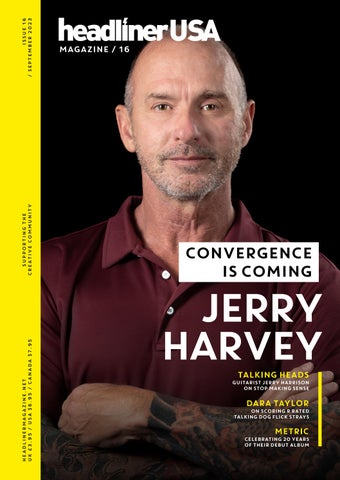
ISSUE 16 / SEPTEMBER 2023 SUPPORTING THE CREATIVE COMMUNITY HEADLINERMAGAZINE.NET UK £3.95 / USA $6.95 / CANADA $7.95
MAGAZINE / 16
CONVERGENCE IS COMING
JERRY HARVEY TALKING HEADS
GUITARIST JERRY HARRISON ON STOP MAKING SENSE
DARA TAYLOR
ON SCORING R RATED TALKING DOG FLICK STRAYS
METRIC
CELEBRATING 20 YEARS OF THEIR DEBUT ALBUM
©2022 QSC, LLC. All rights reserved. QSC and the QSC logo are registered trademarks of QSC, LLC in the U.S. Patent and Trademark Office and other countries. Play Out Loud is a trademark of QSC, LLC.
SUP P
IVE C EAT O CR
ING THE T R O
NITY MU M HEADLINER USA
16 It has been a big month in more ways than one for the music and pro audio industries. And where better to start than with this issue’s cover story.
For decades, Jerry Harvey, founder of US in-ear monitor manufacturer JH Audio, has been producing some of the most revered products on the market. And this month, his company has unveiled a technological breakthrough that, he tells us, has been almost 30 years in the making. In a Headliner exclusive, Harvey himself takes us inside his groundbreaking new Pearl processor and Ruby IEM. As he reveals in our indepth interview, it is an innovation that renders JH Audio not only a pro audio company, but a technology one as well. Meanwhile, another musical icon sharing the initials JH also took the time to sit down with us for an extensive chat. With the legendary Talking Heads coming as close to a reunion as they are ever likely to get, the art rock four-piece came together to promote the 40th anniversary of their peerless concert film Stop Making Sense. Headliner managed to pin down the one and only Jerry Harrison, guitarist and keyboardist with the band, to discuss everything from his personal favourite Talking Heads live show, as well as how he joined the band and their rapid artistic evolution.
Elsewhere, a little closer to home, it’s been a huge month for the team here at Headliner, as our new Headliner Spaces project kicked off in style. As part of a joint venture with UK chart-toppers Enter Shikari, we have rejuvenated and reimagined St. Albans grassroots venue The Pioneer Club. In addition to providing a phenomenal space for all manner of performance, rehearsal, and recording opportunities, it will also be offering a vast array of educational and community-driven initiatives. In addition to hosting multi-awardwinning drum and bass outfit Rudimental earlier this month, we have also partnered with TikTok’s music distribution platform SoundOn to host monthly talent showcases at the venues. The challenges facing new artists today are manifold, but with key players and partners from across the music and pro audio industries coming together in such a fashion, there is still plenty of cause for optimism for the talent of tomorrow.
Daniel Gumble Head of Content HEADLINERMAGAZINE.NET
22/ FARHAD DADYBURJOR
08 / OLIVIA LUNNY
14/ JH AUDIO
28 / LD SYSTEMS LIVE SESSIONS
32 / STUDIO
42 / JERRY HARRISON 50 / JEFF CARDONI
36 / DARA TAYLOR
54 / HEADLINER PARTNERS WITH SOUNDON
58 / AUGSPURGER ® MONITORS & ATMOS
62 / LIVE SOUND
72 / ARYEE THE GEM 68 / INTRODUCING THE SUET YARD
84 / MIXING
78 / METRIC
96 / EVERYTHING AUDIO
88 / IMMERSIVE AUDIO
102 / BUSINESS
92 / PRO AUDIO
118 / RECORDING 106 / TREVOR GURECKIS
124 / PETE LYMAN 112 / TESSA VIOLET
128/ OPERA
138 / LIGHTING 134/ GIRL RAY
8
OLIVIA LUNNY
HEADLINER USA
Heartbreak On Repeat
ASPIRING HEADLINER
9
Y
ds by or C W
BY RAMS E OL
HEARTBREAK ON REPEAT
OLIVIA LUNNY Canadian-born electronic pop artist Olivia Lunny recently spoke to Headliner about her new single Heartbreak On Repeat, and her musical journey since releasing her self-titled debut album in 2021…
Having just completed two 10-hour studio sessions on consecutive days – “working on my studio tan,” in her own words – Lunny is poised and excited to share everything she’s been working on lately as she joins Headliner over Zoom from her new base in L.A. If her previous release – Timezone – is anything to go by, fans of Lunny’s music can expect more love pop anthem-esque vibes, although she insists that this track was a bit of a one off when questioned on the matter. “It’s definitely a bit more dancier and poppier than some of my other stuff,” she admits. “I’m at a time in my life right now where time zones are affecting me; I’m traveling a lot, and I just moved to L.A. while my
family’s on the east coast. I was in a long distance relationship at the time, and there’s just so many things going on, so I wrote down in my notes: timezone. I brought that into a session and then the song kind of transpired. We wrote it in probably three hours because we just had so much to say about the topic.” Heartbreak On Repeat, Lunny’s latest single, is entirely relatable in more ways than one, and takes listeners on an exciting journey of selfdiscovery and empowerment. She wrote the song with her friend and collaborator Julia Ross, along with songwriter Ferras - known for his extensive work with Katy Perry.
HEADLINERMAGAZINE.NET
10
OLIVIA LUNNY
Heartbreak On Repeat
“IN MY TRUEST FORM, ME WITH AN ACOUSTIC GUITAR IS WHEN I COME UP WITH THE MOST ORGANIC SONGS.”
“At first I didn’t know what to expect, but when I saw him I was super pumped,” she recalls. “The breakup that inspired Timezone, I brought that to the table again in this session. I would like to think I’m a lovable person, but the career itself with all the traveling and craziness is sometimes a hard thing to digest. It’s hard to love a person who’s doing that career, and so we were just talking about that and how it feels like heartbreak on repeat; you’re trying all these different relationships while trying to stay grounded throughout the process.” The song will also share a name with Lunny’s upcoming EP, set for release in October: “It’s going to be five songs about falling in love and heartbreak and everything in between,” she reveals. “In my truest form, me with an acoustic guitar is when I come up with the most organic songs; last night I sat around jamming and didn’t even notice two hours had gone by. But in terms of the more poppy topline songs, I’ve been really loving the idea of just writing down a concept or a song title, bringing that into a session, and then you have this overarching theme that gives you direction.” Lunny grew up in a musical household listening to an eclectic range of influences, from Fleetwood Mac, Eric Clapton and The Beatles HEADLINER USA
to Coldplay, Ed Sheeran and “A lot of stuff happened in between, a plethora of indie bands: “It’s but then opening for Lionel Richie anything and everything for me was just crazy,” she says. “Apparently really,” she says. “I’ve actually been this woman heard one of my songs listening to lots of house music lately on the radio, and there wasn’t while I’ve been cooking, because originally supposed to be an opening I’m living alone for the first time in slot, but she was the head up at Live my own place.” Nation and just said, ‘Hey, do you want to support Lionel Richie in four Lunny’s live music journey started days?’ I was like ‘of course!’, so I put humbly when she made her stage a band together for the first time debut at the Winnipeg Folk Festival and we kind of winged it, but I think it in her hometown, at the tender age worked out!” of 14. Last summer Lunny found herself “It’s been a journey,” she says. “I collaborating with rapper and did piano lessons when I was super internet personality Bhad Bhabie on young but I actually really disliked a song called VIBE CHECK, which has them. I begged my parents to take performed well across streaming me out because they’re just so platforms since its release. structured, and I didn’t like the idea of having to play what’s in front of “I think that was around last April or me. I would rather just sit down and so,” she recalls. “I’d written the song make something up. I’m grateful for with my friend AJ, and the same those lessons because it drew me to thing happened - it all started with a the piano, but then my dad would theme. This is hilarious, but we were just always leisurely pick up a guitar just googling Gen-Z slang terms and play it around the house at the because we were just talking about weekend, so I asked him to teach how we feel old, even though I’m still me four or five chords. I wouldn’t quite young… there’s so many trends say I’m a renowned guitar player, and things are going so quickly. So but I know enough to get by, and we’re just searching words, landed so I just started gigging locally and on vibe check, and thought that’s playing at a bunch of cafes and kind of cool, so that ended up being bars and restaurants.” the chorus. Things really started getting real when Lunny was invited to support Lionel Richie on his Hello World Tour in Toronto in 2019.
ASPIRING HEADLINER
11
HEADLINERMAGAZINE.NET
12
OLIVIA LUNNY
Heartbreak On Repeat
“It’s quite an interesting song for me; I wouldn’t say it sounds like anything I’ve ever really done before, it’s slower and quite provocative. Then I was just scrolling on TikTok and we had the idea of having a female feature, because it’s quite an empowering song. I thought Bhad Bhabie would be a good fit, so my team reached out and she apparently really liked the song. She laid down a verse and then the song came out! I’m super pumped that she’s on there; she’s got a lot of character!” As we round up the conversation, Lunny reveals that she has in fact been in the studio recently collaborating with another artist, but she can’t reveal who just yet: HEADLINER USA
“Someone who I’m really excited about is going to be on one of the songs coming out on the EP,” she says. “It’s just so fun to hear people give your song new life.” SPONSORED BY
QSC.COM INSTA: @OLIVIALUNNY
“Genelec have set the bar for immersive monitoring.” Emma Townsend, RAK Studios
When London’s legendary RAK Studios responded to demand and went immersive, they wanted the most truthful monitors available. So they chose The Ones Smart Active Monitors, finding them unbeatable for neutrality, imaging, fatigue-free listening and consistent mix translation. RAK now enjoys a flawlessly cohesive and scalable immersive system that’s also pinpoint accurate in level, distance and frequency response alignment, thanks to our GLM calibration software. So, if you’re serious about going immersive – whatever your room size – explore our industry-leading solutions online. Visit www.genelec.com/immersive-hub
14
JERRY HARVEY
“Convergence Is Coming”
JERRY HEADLINER USA
15
s by PAU rd TSON WA
CONVERGENCE ISCOMING
L
W o
COVER STORY
JH Audio launches groundbreaking Pearl processor and Ruby IEM as the manufacturer makes a huge play to become a technology company as well as in-ear innovator…
It’s no secret that JH Audio sits firmly at the top of the table when it comes to manufacturing in-ear monitors, but now the company has launched a mind-bending new matched product pairing, which could change the way people approach in-ear monitoring for good. Headliner sits down with JH Audio founder and IEM pioneer, Jerry Harvey, as he explains why Pearl, a tri-amp micro speaker management system, and Ruby, a super-compact new in-ear, will take the manufacturer into new
waters, as well as give longer life to engineers’ careers. “This is something I’ve been wanting to make since 1995, when I first started doing this,” opens Harvey, with a smile. It was in ’95, of course, that he created the first multi-driver earpiece while at Ultimate Ears - the UE5 - and it’s been innovation after innovation ever since. When Harvey left Ultimate Ears to launch JH Audio in 2007, he strived to make improvements on every element of the IEM experience, from
sonics to comfort, creating universal and custom earpieces made by professionals, for professionals, that could do the job on another level. Some of the standout shifts in gear included upping the ante from 2-way to 3-way pieces, 6-driver to 12-driver, and state-of-the-art 3D modelling — and as time has gone on, more benchmarks have been set, making JH Audio the leader in its field today.
HEADLINERMAGAZINE.NET
16
JERRY HARVEY
“Convergence Is Coming”
NEW TERRITORY This new shift with Pearl, however, takes the manufacturer into new territory — JH Audio is becoming a technology company, not just an IEM company. “Going forward, it’s not about how many drivers you can put in a plastic shell, it’s about using fewer drivers, making smaller earpieces and having more control over the frequency response of the earphone itself,” Harvey explains. “I always knew that passive crossover earpieces were a compromise on how well you could do things — it just took 30 years of technology improvements, processors getting smaller, and batteries getting more powerful, to allow us to actually miniaturise what they’ve been doing in large-format PA systems for years.” And that’s what Pearl does. Alongside this three-amp micro speaker processor is JH Audio’s latest inear monitor, Ruby, which has been meticulously designed to work only with Pearl. This matched pair opens up a whole world of new possibilities and, according to Harvey, will suit three levels of customers: music professionals, sound engineers, and even the home recording fraternity. “We had it out on over 70 shows with Mötley Crüe, from the prototype all the way to the finished product; it worked perfectly for those guys HEADLINER USA
and allowed them to perform on a higher level,” Harvey says. “Not only can you customise the equalisation for each individual [using Pearl], but because there are three amplifiers driving the [Ruby] earpiece and the DSP processing range, the earpiece has much more dynamic range and headroom than a single-amp out of a belt pack. Instead of 60-65 percent tuned, it’s now 100 percent tuned and 100 percent in phase. In fact, [Aerosmith guitarist] Brad Whitford says not only does it sound better, it’s larger than life — he says the stereo imaging is like nothing he has ever heard.” Ruby has a passive crossover, but the active crossover in Pearl is essentially sweetening up the process in the earpiece. “We do this is because we need to keep the low passes in the actual earpiece,” Harvey continues. “If we were to do a 100Hz low pass, the latency in the processing becomes too long to perform. It would be fine if you’re a studio guy as you don’t have a zero reference, but if you’re a drummer or singer, you have to have below 5ms of total latency in the chain; and the latency of the Pearl processor is sixtenths of a millisecond. We achieved that by not inducing any low passes or really low frequency low passes. From the console to the transmitter to the Pearl pack, it’s 1.7ms of latency total — so, way below 5ms.”
Ruby is now the smallest-footprint earpiece by some distance in the JH Audio inventory, yet still boasts quad low, quad mid, and quad extended high frequency drivers. Harvey achieved this by putting all the components in time digitally, then delaying the components in the software between the low, mid and high drivers to make it phase coherent and in time — all thanks to the processing power within Pearl.
ON THE ROAD MIXING “With Pearl, you can create any frequency response from 10Hz to 20kHz. Let’s say you’re a touring engineer and you’re using virtual soundcheck to get a mix together for a PA system, or maybe a recording engineer trying to mix your tracks down — this is where Pearl really shines,” Harvey says. “With a click of a mouse, you can go from a perfectly flat earpiece to, for example, an Auratone tuning, a Yamaha NS10 curve, then on the live side you might want an L-Acoustics curve, a Clair Global Cohesion Curve — the possibilities are endless. You can sit in your hotel room or in the back lounge of a tour bus and mix things down that, when put into a PA system, actually translate.” That is a seriously big ‘first’ — and it’s not the only one. Headliner asks Harvey to tell us more about the
17
Photograph Credit: Josh Given
COVER STORY
HEADLINERMAGAZINE.NET
18
JERRY HARVEY
“Convergence Is Coming”
customisation of these individual earpieces, and Pearl’s ingenious ability to bring band members and crew members onto a completely level playing field of hearing reference. This is not only extraordinary from a technology perspective, but it must also open up new levels of creativity and performance?
So, you’re essentially putting the hearing loss back in the curve?
And on a personal level, what were the results of your audiogram?
“Yes, exactly — we start with a perfectly tuned earpiece, then we put roughly 20 percent of the hearing loss back in,” Harvey says. “I have found that to be the sweet spot when you run the belt pack up at performance level (92-98dB) as a hearing curve flattens out. Basically, if someone has loss of 50dB at 4 kHz, at the most I am only going to put 10dB back in; then I’ll write a +10dB file, a +8dB file, and a +6dB file with different degrees of compensation to see which sounds the sweetest to them.”
“When I got my audiogram and I plugged this in, it was really amazing how detailed I could make my earpieces sound. Anyone who has been doing this for more than 10 or 15 years, is going to have some noise-induced hearing loss; it may be subtle, but there is stuff going on there.
Game-changer is a very overused term, but… “[laughs] Yeah, I already have two engineers — Travis White and Troy Milner — who say they’ll never mix monitors without a Pearl pack again,” Harvey smiles. HEADLINER USA
“So, the next layer is the perfectly tuned earpiece along with the tools to shape it however they like. You can never ‘make’ bass response or high frequency extension or the tonality. This is the only tool that will take one earpiece and make it sound any way you want.” Pearl can also be retrofitted to work with any JH Audio piece, but that’s a much more involved process.
Photograph Credit: Josh Given
“Absolutely,” Harvey says. “Although the Aerosmith tour got cancelled, I walked in [to mix monitors during rehearsals] and made the band 100 percent happier than they’ve ever been with my mixes — and everyone on stage had a Pearl pack. I took audiograms for all of the people on stage, and we did corrective hearing curves for everyone — that included people with no hearing loss. We created a curve for those who had noise-induced hearing loss from years of being on-stage. I also created one for myself, and for Travis White, who mixes Steven Tyler; it was an incredible feeling for all involved, and it worked amazingly.”
The user would physically need to go to one of the JH Audio offices or send the piece to the lab to get fully checked and tuned to the Pearl pack. “It’s an unknown quantity,” Harvey says, “but it can be done.”
COVER STORY
19
“WE CREATED A CURVE FOR THOSE WHO HAD NOISE-INDUCED HEARING LOSS FROM YEARS OF BEING ON-STAGE.”
THE FUTURE OF IEMS So, this has been 14 years in the making, and sees JH Audio jumping firmly into the world of audio technology as a manufacturer. No small feat… “[pauses] You know, I’d worked with four different companies on this between 2009 and 2020, but had never quite got it over the line. It was a conversation at the NAMM show three years ago with my good friend James Gordon (CEO of the Audiotonix Group); I told him we had this great product 90 percent there but just couldn’t get it finished. After listening to what we needed, in typical James fashion, he said, ‘We can do that for you;’
and he was right. Skip to the present day, and Audiotonix has helped us create a product that’s actually a viable solution that we can show to the world.” Business, like life itself, is often about moments, and it’s no secret that the pro audio industry as a whole is still in recovery mode, post-pandemic. Does this ‘moment’ for JH Audio mean even more, all things considered? “It’s a career achievement, for sure; but honestly, I think it’s just the start,” Harvey admits. “Over the next three to five years, people will come to understand that passively tuned earpieces are a severe compromise, and once you hear this, you won’t
be able to go back. As you know, I developed the first multi-driver inear, all the way up to 12-driver, and everyone ran off and did that from that point on. But I had hit the end of speaker development and passive crossover development in IEMs, so this was the next logical step. Now I think we have opened Pandora’s box; it’s a professional level for professional people, right?” Harvey will be hosting masterclasses at Clair Global and at JH HQ from Oct 11, where engineers and system technicians will be taught how to tune the earpieces on the JH Audio ear simulator and smart rig.
HEADLINERMAGAZINE.NET
JERRY HARVEY
“Convergence Is Coming”
Photograph Credit: Josh Given
20
“I genuinely believe that this will allow FOH, monitor and studio engineers to prolong their careers by doing hearing compensation curves,” he declares. “If you mix FOH for a band, imagine you pop in your earpieces and all of a sudden everything you’re doing through the PA system becomes very apparent. You gain a trust in the earpiece, and you realise that you basically mix on the earpiece because you open it up, and you don’t start adding high frequencies. It will definitely allow engineers who have been working in this industry for decades to extend their careers.” HEADLINER USA
The Pearl System will be available only in combination with the JH Audio Ruby IEMs; the full system is priced at $4,499. If the rental houses jump on Pearl — which is, of course, part of the plan — then the IEM world could very well be about to change for good. And wouldn’t that be something. “It really would, but we have been the innovators of IEMs since 1995, and every breakthrough in the IEM world has come from Jerry Harvey Audio. So, people already have a great trust in us, and in our products,” Harvey reflects. “It’s just
that now, we’re not just an earpiece company, we’re moving into being a technology company - and that is very exciting. I believe we’re going to see convergence in the future where this all becomes one system: think early cell phones, the ones without cameras, and where mobile devices are today. The same thing is going to happen with this technology. It’ll take manufacturers five years, but it’ll all be in one belt pack; that is the trend I can see happening.” JHAUDIO.COM
AVAILABLE ON APPLE MUSIC AND SPOTIFY LISTEN NOW
22
FARHAD DADYBURJOR
HEADLINER USA
Sonic Laundry
s
23
bY alice
SONIC LAUNDRY
tafson us g
Wo rd
ENGINEER
FARHAD DADYBURJOR Farhad DadyBurjor, who has been working as a recording and mixing engineer since 1989, explains why India does not put enough focus on quality engineering, why he thinks Dolby Atmos music is unnecessary and why independent singer-songwriters will be the next big thing in India.
HEADLINERMAGAZINE.NET
24
FARHAD DADYBURJOR
Sonic Laundry
DadyBurjor has been working as a recording and mixing engineer since 1989 for almost every kind of media release imaginable, from film music, to soundtracks, orchestral scores, Grammy-nominated jazz albums and sound design for numerous stage shows. He’s witnessed every technological innovation in the recording industry since then, and has been building world class studios in India since 1995, including converting Mubai’s Galactica A within Famous Studios into the first Dolby-certified Atmos HT mixing room in the country. You’ve said before that, “Unfortunately, in India, we celebrate mediocrity, so the quality and standards of engineering have gone in a steadily downward spiral; everything is only about the lowest possible cost. At no point does anyone even mention quality.” Is that still the case? Yes, that’s India for you. Studio dynamics in India have changed quite a bit from what I’m hearing. It seems like a lot of the main engineers – freelance and otherwise – have their own rooms now, and very few of them actually go to the studio to work on a lot of the tracking. We’re in the middle of a strange echo of the covid way of working still. The bulk of my work, at least, is not movies, but advertising. Any way you can stretch your work there, is exploited. I’m sure covid has unfortunately taught a lot of producers that it is feasible to get quality work out of people by collaborating and not going to the studio and gobbling up expensive studio time and paying for everyone’s meals, transport etc. Can quality still be produced on a low budget, and is there the potential for things to turn around? I think TV and on-air broadcasting is – at least in India – still a reasonably forgiving medium; you don’t have to have stellar engineering and stellar mixing to get there. I think it’d be a big effort. It really HEADLINER USA
depends. I’m not saying this is the way for everyone – there are still plenty of people who insist on quality and are willing to pay for it. I think there will always be a stress on trying to get the highest quality for the lowest amount; I don’t think that would be purely an Indian phenomena. It would be worldwide. Fortunately, I think a lot of engineering and gear purchases by people in India is more out of passion to own and to use the gear rather than being driven by commercial viability in most cases. Statistics usually suggest that the Indian music industry is largely dominated by Indian film soundtracks, accounting for approximately 80% of the country’s music revenue, followed by Indi-pop. Could you give an insight into the state of the current Indian recording market and music industry? I think those stats would largely still stand. I think now with OTT [overthe-top media service], the age of YouTube and the adoption of cellular technology, that would be the most important factor. Even your average rural person has access to a cellphone with a camera and ability to record video and put a video onto YouTube. So it’s fairly democratized. We’re seeing a rise of rural and urban music like Punjabi, hip-hop and creations
from the heartland of India, more than just Bollywood as such. There’s a lot of interest in upcoming indie singer songwriters. That’s a very big industry – not yet, but it will be, and I welcome that. That’s my favorite genre of people to work with and hopefully help enable. Bollywood will, of course, remain Bollywood. I try to take a backseat from it in the sense that I don’t go seeking it out. If it crosses paths with me, I do the job, and, of course, I enjoy it! A lot has changed with technology and recording studios since the ‘80s. What are some of the most significant changes you’ve seen during your career so far? Sometimes I’m in a restaurant and a Hindi song comes on and I look at my friends and say, “I know the tune, I mixed that! But for the life of me, I can’t remember what movie it was!” Going back to the digital domain days, one of the nicest things about working in the digital domain was we were like a little factory. Everyone used to play live. We used to get three commercials done in a day. There was no undo button, which helped tremendously, so you got what you had to do on tape and if you thought you could get better then you had to risk losing it. The thought of risking things pretty much made sure that there was no decision paralysis. Very often I would see the same thing broadcast on TV
ENGINEER
25
HEADLINERMAGAZINE.NET
26
FARHAD DADYBURJOR
Sonic Laundry
“I THINK ATMOS IS FANTASTIC TO HAVE FOR SOUND-TO-PICTURE, AND IT’S ABSOLUTELY NOT REQUIRED FOR MUSIC.”
the next day or the day after that. Those were the easiest times. In the old days, working to tape itself forced you to make decisions. Not having automation forced you to do your best because there was no undoing anything. I think we did probably 10 times as much work in a useful day, and we had fun doing it. You have overseen and built 12 highly successful studios within the Famous facilities, culminating in your conversion of Galactica A into the first Dolby-certified Atmos HT mixing room in the country. What are your views on the adoption of Dolby Atmos music? I have very firm but mixed views on Atmos. I think Atmos is absolutely fantastic to have for sound-to-picture, and it’s absolutely not required for music. I don’t see what it brings to the table that your stereo mix doesn’t already. It’s extremely troublesome right now to monitor in real-time what you’re doing with an Atmos mix, coupled with the fact that your end product ultimately doesn’t translate because it goes through Apple Spatial Audio conversion from the Atmos master. You’re just spitting in the wind until it becomes possible to at least monitor in real-time what you are doing on the mix. At least in my generation, I don’t know anybody who wants to listen to the song being in the middle of the band, as such. HEADLINER USA
You watch a band on stage, you don’t jump up next to the lead singer!
of Genelec 8030s and I’ve never looked back.
How has Dolby Atmos taken off in India?
I’ve found out over time that I had to work a lot harder to get a mix sounding nice on the Genelecs, but once it did sound good on the Genelecs, it translated much better than what sounded good on my previous monitors. Of course, one learns the speaker and then things get sped along, and it changed the way I worked. After that, we were doing an upgrade in one of the other studio rooms and I bought the first pair of 8260s to land in India, and I loved them so much that I bought another pair for the Sonic Laundry. At the time, I also had a pair of 8020 nearfields just in case. Then when it came time to upgrade, the 8341 was – in my opinion, for the money in the performance it put out – the best speaker in the world. Once I decided to stop addressing Atmos at these as-good-as-free prices, I got rid of the speaker system, so no monitoring system. From selling off the immersive system, I reinvested in a pair of Genelec 8351s and W371s.
I was chatting with a friend just a couple of days back and he said that everyone is asking for Atmos mixes with the stereo master. I said, “I hope that you just took an agnostic session and only did the panning, as in, baked in all the sounds and effects and EQ, etc and just did the panning”. And he said, “Yeah, we do that, but apparently there are guys who do it for 5,000 rupees,” – that’s £50 for an Atmos mix of your music. It’s the reason why I decided to take a step back from Atmos and just stick to working in stereo. I felt very strongly about it. You have continued to engineer as a freelancer and at your own studio, The Sonic Laundry. Why did you opt for a Genelec monitoring system? I’ve always had only Genelecs at the Sonic Laundry. I used to use another brand of monitors, and in the middle of a very critical project that I was working on, somebody came in and fiddled with the crossovers and something I mixed sounded like a wet cardboard box when played somewhere else. I immediately panicked and said, “I need a portable nearfield reference system”. I picked up a pair
GENELEC.COM
The FIRST Compact , dual 12”, dual DDP, high output line array system
‘Innovation not imitation’ Still the lightest* Still the smallest Still the most powerful Still the best return on your investment
*40kg
356 mm
674 mm
555 mm
https://www.codaaudio.com/speakers/airay/
What makes the difference? Our patented DDP Technology
28
AYDA ROSE
HEADLINER USA
LD Systems Live Sessions
29
LBY RAM S CO
EY
ords by W
LIVE
LD SYSTEMS LIVE SESSIONS
AYDAROSE London-based Ayda Rose was born into a very musical family, and as an independent musician, she lives and breathes this creative industry. In this second LD Systems Live Session, she performed her original song Psychic through an LD Systems MAUI G3 rig in The Suet Yard, St. Albans – a brand new acoustic venue created to support aspiring and emerging talent, as well as the local community – and speaks to Headliner about the results.
What have you been up to recently? For the last few months I’ve just been finalizing what I’ve been working on for the last 18 months - almost two years now. I’ve been out in L.A. writing and finishing things off for my first project under the name Ayda Rose. My first single – which is called Psychic – came out in June, so I’ve been promoting that and have done a few shows, and just been trying to stay creative! And you recently had a song on Love Island? Yes! So I have an alias, which is Effie, and we had a song with my friend Indigo Kid. We wrote it a couple of
years ago, and we were like, ‘Yeah, we should get this on Love Island!’ And then we got the call to say that it had been synced to the show. So yeah, that came out a few weeks ago, and that’s been really cool. The song is called Over Us, and that’s out now as well. How did you first get into music? Music has always been a part of my life. My dad’s a drummer and a singer. He’s in a ‘60s band called Dave Dee, Dozy, Beaky, Mick & Tich. He was my first introduction into music. Then my great grandma was a gospel singer and my auntie was a soul singer, so I guess music is in my blood! HEADLINERMAGAZINE.NET
30
AYDA ROSE
LD Systems Live Sessions
“I TRY TO FOCUS ON THE FACT THAT I WANT TO MAKE AUTHENTIC MUSIC AND BE AUTHENTIC AS AN ARTIST.”
What does it mean for you to be an independent artist in today’s industry? I think it’s a really good time for independent artists, to be able to take control of your art and not listen to outside influences. Major labels have gotten away with a lot for a long time, and now I feel like the power is being handed back to the artist a bit more. It’s kind of frustrating at times, but also super exciting, and I love being an independent artist. What would you say are the challenges and advantages of being independent? The obvious challenge for most is not having the financial backing straight off the bat, and not having those instant connections that sometimes a label can HEADLINER USA
give you. But I try not to focus on that – I try to focus on the fact that I want to make authentic music and be authentic as an artist, and push it myself. Advantages-wise, it’s about having complete autonomy over what it is that you’re doing – just having more of a choice and more of a say, and not being a puppet with quotas to fill. I can do things at my pace; I make the decisions and I oversee everything. And while that can be stressful, I like the freedom of it, and I think that’s super important. How did you find performing through the LD Systems MAUI rig? It was wicked – I really enjoyed it. The sound was really nice and clean, and it’s really easy to use. It’s such a
cool system, and I would definitely recommend it. What have you got coming up? The rest of the project! We’re going to be releasing single by single, and I’ve got a couple of really exciting shows in the pipeline with some other artists. So lots of cool stuff on the way, and I’m excited! LD-SYSTEMS.COM ADAMHALL.COM INSTA: @IAM.AYDAROSE
See us at IBC booth 10.A31
LIVE VIDEO PRODUCTION ALL-IN-ONE | REPLAY | CLOUD
VIDEO NETWORKS SDI | IP | HYBRID
INTERCOM
ALL STANDARDS | WIRELESS | IP
EVENTS
CONVENTION CENTERS
STADIA
THEATERS
CRUISE SHIPS
www.riedel.net
32
BACK TO BLACK
HEADLINER USA
Second Neve Console for dBs Music
33
LBY RAM S CO EY
ords by W
STUDIO
SECOND NEVE CONSOLE FOR DBS MUSIC
BACK TO BLACK dBs Music – a leading provider of audio engineering education – is taking its capabilities to new heights with the installation of a Neve Genesys Black G32 console at their Manchester facility.
The decision was strongly influenced by the success of the Genesys console at their Plymouth campus, where it has become a beloved tool for students and staff since 2015 and has stood out for its remarkable features, functionality, and exceptional sound quality. The familiarity and admiration for the 1073 preamps found in the 500 series racks at the Plymouth and Bristol centers also played a significant role in choosing the Genesys Black console. “Neve is the flagship console for us. The name, sound and quality are synonymous with the pinnacle of audio engineering,” says Matt Bernard, executive head of technical operations and resources. “The console
is sophisticated and will allow students to develop more and more complex workflows and develop the technical proficiency needed for the modern audio industry.” With 16 dedicated control surface faders, the console is designed to offer maximum flexibility, allowing staff and students to explore various hybrid workflows. With the quick recall functionality, students can swiftly resume their work and revisit previous sessions, which is particularly important in a busy educational environment. Additionally, the seamless integration of the console with the Avid MADI interface on their HDX rig, complete with a full complement of digital converters, further solidified its appeal.
HEADLINERMAGAZINE.NET
34
BACK TO BLACK
Second Neve Console for dBs Music
Recognizing the importance of introducing younger students to analog consoles, dBs Music emphasizes the ease of teaching and understanding the fundamentals of audio engineering on analog consoles, as Bernard explains: “These skills are easily transferable to digital systems and digital audio workstations (DAWs), ensuring a well-rounded education for the students.” The console’s central touchscreen facilitates seamless DAW monitoring and control, providing an ergonomic workflow for students. The control software can be displayed on a large monitor for all students during demonstrations, enhancing the learning experience. In addition to the Genesys Black console, dBs Music has installed a 1073OPX in the main live room, providing a consistent front-end recording system to complement the Genesys Black’s 1073 preamps. The 1073OPX is ideal for expanding the Genesys preamp count on a larger session and is the perfect standalone preamp for students who need to record directly into their own laptops via USB. The 1073OPX Dante option allows dBs Music to route audio to any teaching room using their existing HEADLINER USA
IT infrastructure. By presenting all eight preamps and a stereo return channel remotely, students can work collaboratively in different locations throughout the facility.
the digital control element allows the students to quickly initialize the desk for a live recording session. It really opens the desk to students, adding even more usability into the sessions.
They have also been actively involved in the development of the New Century Hall venue. The integration of the Genesys Black console will enhance its capabilities, as eight optical fiber links connect the venue’s front of house and stage to dBs Music’s studio floor patch room.
“Being able to quickly rename channel strips, swapping between long and short faders, controlling inserts and auxiliaries, and of course, being able to recall all settings when revisiting the session is a huge bonus.”
Starting in September 2023, dBs Music’s Live Sound course will be based in the New Century venue during practical sessions, creating a dynamic learning environment for students. It is important to dBs Music that students have experience using the console in live recording sessions as it gives them the opportunity to use the desk in a different way to the conventional studio recording process. The Genesys Control Plugin is also utilized in live recording sessions as it brings the power and speed of in-thebox workflow while reaping all the benefits of Neve analog console sound. Jack Taylor, technician at dBs Manchester, says: “Besides the legendary preamps and EQ, which help shape the sound of the recording,
The addition of the Genesys Black to the dBs Manchester facility helps students to understand the differences between studio and live recording and how to deal with those differences – thereby significantly increasing confidence and knowledge, and creating a future generation of talented audio engineers. AMS-NEVE.COM DBSINSTITUTE.AC.UK
36
DARA TAYLOR
HEADLINER USA
A Dog-Eat-Dog World
37
s bY ALIC rd
STAFSO GU
N
A DOG-EATDOG WORLD
E
W o
COMPOSER
DARA TAYLOR From the humans that brought audiences Cocaine Bear and 21 Jump Street, R-rated talking dog caper, Strays poses the question: what if dogs were all bite and (some) bark? Outraged on behalf of their newest member (that has been abandoned by his owner), a ragtag pack of four-legged friends set about exacting a toothy revenge. Dara Taylor explains her unusual approach to composing a score about a posse of drinking, drug-taking, foul mouthed canines.
HEADLINERMAGAZINE.NET
38
DARA TAYLOR
A Dog-Eat-Dog World
Earlier this year, Dara Taylor could be found in a branch of Petco, hammering everything she could find in the store. “The sales people were very confused,” she laughs. “She was like, ‘What kind of dog do you have?’ We’re like, ‘We don’t have a dog…’” The reason? Important dog-related research for new NSFW talking dog comedy, Strays, which features the voice talents of Will Ferrell, Jamie Foxx, Isla Fisher, Randall Park and Sofía Vergara. Having composed scores for the likes of The Tender Bar (endearing, coming of age), The Invitation (horror, thriller) and Netflix’s no.1 film The Noel Diary (Christmas, romance), Taylor was ready to sink her teeth into a genre she hadn’t tackled before: foul-mouthed dogs with a plan for revenge. Back to that Petco trip: “By the time I got to recording, I was finding that things that aren’t meant to be instruments were the things that I really enjoyed,” she says. “So my percussionist friend, Hal Rosenfeld and I were in Petco, and we just banged on everything in the store! We wanted to see what this cone sounds like, play with crinkly toys, dog bowls, antlers and kibble and all these other weird things so HEADLINER USA
we could incorporate them into the fabric of the score, just to give one level extra of uniqueness.” In Strays, naive but lovable dog Reggie (Ferrell) is abandoned by his lowlife owner. Forced to live on the streets and fend for himself, he soon meets fast-talking, foul-mouthed Boston Terrier, Bug (Foxx) and his gang of strays. Determined to seek revenge, Reggie and his new canine pals embark on an epic adventure to get him home and make Doug pay for his dirty deed. The F-bombs featured in the trailer alone – along with the pack’s drunken plan to bite off a certain appendage of Reggie’s owner as punishment – are enough to flag up that this ain’t no Homeward Bound – this is an R rated canine caper. “I think everyone’s first thoughts are, ‘What?’” recalls Taylor on her first impressions after hearing the synopsis. “But it was so funny, even from the script stage. I work from home, and my boyfriend also works from home, so sometimes he’ll hear me reading a script and I’m laughing. From far off he’s like, ‘What’s so funny?’ I’m like, ‘I’m reading a script!’ This was definitely one of those instances where I’m just laughing to myself in a room. It’s insanity, but in the best way,” she chuckles warmly.
Taylor wrote a score that speaks to the heart of the film and its characters, which is finding your support and chosen family. Director Josh Greenbaum has some initial ideas about the approach to the score: “He wanted to lean into the happygo-lucky part of Reggie and create a sort of folksy backdrop to speak to the Homeward Bound of it all, but then develop it from there. One thing about this film is, as hilarious as it is, there’s also a lot of really sentimental moments. So I wanted to be as real and true to the dogs and their current emotions as possible, regardless of how it might seem to their human audience. We definitely wanted to find and hone in a sound that had this homegrown feel to it, but didn’t lean too far into a specific genre, so it kept itself hybrid in a way. There’s some folk and acoustic guitar, but there’s also an orchestra and piano to ground it cinematically, instead of it just being a folk song. Then there are some hip hop elements for Bug’s character.”
Photograph Credit: Universal Studios
COMPOSER 39
HEADLINERMAGAZINE.NET
40
DARA TAYLOR
A Dog-Eat-Dog World
For Strays, Taylor utilizes sweeping orchestral scores when leaning into the emotional scenes of a dog realizing when he’s been wronged, and hip-hop inspired tracks when Reggie meets Bug and the gang and they get into various questionable street dog antics. She explains the juxtaposition between the two very different musical styles: “The biggest part was to have a large juxtaposition at the beginning, and then have those gaps close as the relationships grow,” she considers. “Bug’s introduction definitely had more of a hip hop flair and I used this West Coast sine wave sound as the main melody that comes in in a few different places, sometimes supplemented with other instruments, or it’s done on a piano later on. That is to sharply juxtapose Reggie’s tone with Bug’s theme, which might be treated one way in the beginning, but by the end, there’s a softer side to it. I’m finding two genres that can be seen as far apart and then bringing them closer together as the story goes on.” Taylor scored music that would match each dog and their unique personalities, her favourite being Reggie’s. “His theme became the theme of the journey and of the film, so it was the one that got the most use, and it was fun to use that in a variety of different circumstances, dramatically.” Reggie’s street life is very different from his perceived perfect home life, where he is continually dumped in random locations by his owner in an effort to rid himself of his pet, only for him to return every time, thinking it a game. On the streets, Bug helps Reggie find his way back to his owner to exact his revenge. During the journey, the group begins to bond as they get into several sticky situations, culminating in getting caught by Animal Control after a mushroom-induced high causes them to maul a family of rabbits. Taylor reflects on creating a score that matches the absurd nature of talking dogs that swear, drink and get high, and generally get themselves into situations that would never normally pair with fast-paced music for more traditional action set pieces. “The biggest thing for us was to have the score be from the dogs’ point of view,” she says. “So even if we see something as human observers that we know may not be as big of a deal to us, it might be to a dog – like fireworks. We wanted to lean into what the dog’s perspective was: they thought their life was ending, so musically, we acted like their life was ending.”
HEADLINER USA
The film is littered with memorable scenes, however Taylor has a firm favorite: “Apologies for any spoilers,” she smiles, holding up her hands. “In the pound, they have to get this key from across the hallway as they’re trying to escape,” she explains. “It’s got this heist element to it, and there’s some saxes and some pop brass in there. It’s a fun detour to go down musically.” Paw-sing for thought on what movie to watch next? Strays is available to stream at home in the US on Apple TV, Amazon Prime Video, YouTube, VUDU, Xfinity and Microsoft. DARATAYLOR.COM
ANUBIS PRO + HAPI MKII + SOUND ID
EVERYTHING YOU NEED
AT YOUR FINGERTIPS No-compromise 9.1.6 immersive audio package from Merging Technologies Provides 12 analog outputs, 3 headphone outputs, 8 AES/EBU I/O, 8 ADAT I/Oplus 2 Mic/Line inputs with control at your fingertips. www.merging.com
JERRY HARRISON
Photograph Credit: Jordan Cronenweth
42 JERRY HARRISON
HEADLINER USA
Talking Sense
43
s by DA N rd
TALKING SENSE
MBLE GU
W o
ARTIST
Boasting one of the most enduring musical legacies of any band from the past 50 years, Talking Heads were, and will forever remain, quite unlike anybody else. Their catalog contains some of the most revered records of the ‘70s and ‘80s, while their Jonathan Demme-directed film Stop Making Sense has become arguably the best loved concert movies of all time. Headliner caught up with guitarist and keyboardist Jerry Harrison for an in-depth chat discussion about all things Talking Heads, and what he believes is truly the band’s definitive live show…
When Headliner connects over the phone with Jerry Harrison, he’s currently in the midst of a Talking Heads revival of sorts. In tandem with guitarist Adrian Belew, who was part of the band’s touring setup in 1980, he has been performing a run of gigs that has sought to bring one of their most ambitious and beloved concerts back to life for contemporary audiences. And it’s not Stop Making Sense.
Over a decade ago, footage of a 1980 show in Rome in support of their masterful Remain In Light album surfaced on YouTube. It features a similarly sized ensemble of musicians shoehorned onto a stage together, jamming their way through a set of material that seamlessly weaves the most disparate aspects of their sound together. The twitchy post-punk of early anthems Psycho Killer and Stay Hungry sit
comfortably alongside the looser, more experimental music they were making at the time, with the likes of Born Under Punches (The Heat Goes On) and Houses In Motion ebbing and flowing seemingly without beginning or end. It may not possess the tightly choreographed precision and visual spectacle that defined Jonathan Demme’s 1984 film, but it is no less thrilling.
HEADLINERMAGAZINE.NET
JERRY HARRISON
Talking Sense
Photograph Credit: Jordan Cronenweth
44
Prior the Stop Making Sense remastered re-release, which saw Harrison, David Byrne, Tina Weymouth and Chris Frantz reunite for a Q&A with Spike Lee at its premiere at the Toronto International Film Festival – the first time the four had been in the same room in 21 years – Harrison had been working with Belew and several other musicians to recreate that Rome show across a number of North American tour dates. Joining us from his San Francisco home studio earlier this year, Harrison speaks at length about what inspired him to revisit those shows, as well as what life was like inside the world of Talking Heads during the making of Remain In Light. “Every now and again when Adrian and I got together we would talk about how fantastic that concert in Rome was, and how cool would it be to recreate it,” he explains. He speaks slowly and thoughtfully with a weathered, gravelly low register. “It was all supposed to happen for the 40th anniversary of Remain In Light in 2020 but obviously that didn’t happen because of the pandemic. So it got pushed to 2021 and we’ve HEADLINER USA
been doing that for the past two years. And hopefully we’ll bring it to Europe at some point.” Inevitably, comparisons between the Rome show and Stop Making Sense were made when the 1980 footage first appeared on YouTube over a decade ago. It’s impossible not to draw certain parallels on account of the profoundly distinctive entity that Talking Heads were as a live act during that era, but they are very different shows. Belew’s presence, Harrison believes, is one of the primary distinctions. “Adrian is a unique guitar player and his presence distinguishes it from Stop Making Sense,” he says. “And it was much looser than Stop Making Sense, where the show became more choreographed from the lighting to the background scenery. It was a far more constructed visual experience, whereas 1980 was just a whole line of musicians onstage. And one of the things that happens when you have a whole line of musicians onstage is that you sometimes find one side of the stage goes off on a jam that’s different to what’s going on at the other side of the stage [laughs]. That was sometimes abstract and wonderful and other
times it was a bit chaotic! This was the first attempt for us at what a big band could be, and it was all about the joy in the music and not precise visual presentation.” He is also quick to address the absence of his former primary bandmates. “I thought, if I’m not doing a show with Chris, Tina, or David, I still want to do something that felt authentic,” he says. “Adrian was part of that touring band, and then I wanted to find a group of musicians who weren’t session players but people who regularly play together so it had an organic feel to it, which is what the original band had. Also, it’s not just about nostalgia - there are a lot of young fans who never got to see Talking Heads who now get to see not just representatives of that band but an exciting, joyful group of musicians performing those songs.” As the fourth of the main four members to join, Harrison’s role within Talking Heads was a unique one. Founded by Frantz and Weymouth, who quickly recruited Byrne as their frontman, the band had already written their first two albums’ worth of material by the
Photograph Credit: Jordan Cronenweth
ARTIST 45
HEADLINERMAGAZINE.NET
46
JERRY HARRISON
Talking Sense
time Harrison entered the fold. As guitarist and keyboardist with new wave icons Modern Lovers, he arrived with a considerable reputation within the NYC music scene, but his first task, he tells us, was not to change the band’s sound, but expand upon it. “I didn’t want to change their sound, I wanted to reinforce their sound,” he asserts. “I think this is one of the reasons that they felt I was the right person. So, I wrote parts that very directly sometimes doubled or referenced Tina’s bass parts and David’s guitar parts and made them a little fuller or make some transitions a little smoother. And make it so that if David broke a string we didn’t have to stop [laughs]. “Then later I got more involved in the arrangements and the writing of the music,” he continues, elaborating on the band’s rapidly evolving creative process. “After we recorded I Zimbra on Fear Of Music, that was something we wanted to explore a lot more and that was the impetus for where we wanted to go on Remain In light. On each of our albums we tried to create a different process and location for recording because we thought those things deeply influence the way a record sounded and came out. The first record we did with Tony Bongiovi and he was a disco producer, and they wanted something in contrast to, say, The Ramones. And it was a beautiful sounding record, but we didn’t feel Tony understood the zeitgeist of the band. But when we met Brian Eno, we really felt he did. The conversations were easier, we had read the same books. Working with Eno, his approach was to think of the studio as an extension of your instrument. So, we learned a lot from him and by the time we got to Remain In Light we could make suggestions and he was more involved in the songwriting process. Then we produced ourselves for the next few records because we felt confident enough to do that.” HEADLINER USA
I DIDN’T WANT TO CHANGE THEIR SOUND; I WANTED TO REINFORCE THEIR SOUND. Location was also a major factor in shaping the sound of each of the band’s records, especially the first four. “With those four records, the first (Talking Heads ’77) was made with Tony in New York, and the second (More Songs About Buildings and Food) was made in the Bahamas,” he says. “The third (Fear Of Music),
we hired a mobile trucks to record us at Chris and Tina’s loft, and with Remain In light we decided there was something special and innocent about the first time we ever played a song, so we decided to do an album that was all about discovery and being in the moment, so we didn’t write anything before going in the studio.
ARTIST
“After that we realized that because Remain In Light was basically modal - it was all in the same key - it made it much more difficult to write a melody and lyrics because it was never migrating to a different set of chord changes. So, when we did Speaking In Tongues we had a similar process but we built in chord changes so we could delineate the verse, the chorus, and the bridge. A lot of music is so based on the lyrics and the vocals and there is very little to the music, but these albums were about making interwoven pieces of music where vocals were just one part of that.” It was following the completion of Remain In Light that Harrison first started to conceive the next iteration of Talking Heads as a live outfit. “We had said yes to two shows [during the Remain In Light sessions] and I
had a conversation with David where I said, ‘If we want to play to play this live we can’t do it as a four-piece’. So we came up with a list of guitar players, backing vocalists, percussionists… we even had another bass player! And I went out in an afternoon, and I hired everyone apart from Steve Scales, the percussionist. That was because I’d been hanging around New York and knew all these different musicians, and of course one of them was Adrian. “I remember walking back to the studio one day and saying to Eno, ‘We are going to have the most amazing band’. So, we started rehearsing while David was in California and for at least two of the days I was showing everybody the parts, and then David showed up and everybody goes, ‘Who’s this?’ I go, ‘Oh, he’s the lead singer!’ So, then we had these two fantastic concerts
47
and the audience really reacted well. Then it was like, okay, we need to do this for the entire tour.” While the whole band and the very concept of live performance evolved rapidly for Talking Heads during the ensuing tour, Byrne’s transformation from reluctant singer into one of the most electrifying frontmen of his generation was something few could have predicted. Where early shows were noted for Byrne’s obvious discomfort at leading the band, often visibly awkward and timid behind the mic, their late-‘70s/ early-‘80s shows were defined by his new, uninhibited persona. What was previously a tightly wound bundle of nervous energy had exploded into a whirlwind of wild dance moves and unbridled expression.
HEADLINERMAGAZINE.NET
JERRY HARRISON
Talking Sense
Photograph Credit: Jordan Cronenweth
48
“It was a beautiful transition,” says Harrison. “David was talking about it one time, and someone had said, ‘You’re smiling and you weren’t in the beginning,’ and he said, ‘Well it was just so funky onstage that I had to smile and I had dance’. think that’s how we all felt”. It’s not just the live side of Talking Heads that Harrison has been revisiting of late. Recently, he took a leading role in remixing the entire Talking Heads catalog for immersive playback. Last year, he led an immersive playback of one song from each of the band’s remixed albums at a special event with pro audio giant L-Acoustics in Los Angeles. “I had done 5.1 mixes in 2005 through 2007 so I understood the concepts and what you could accomplish and what you should stay away from in surround sound,” he says of how he approached the immersive mixes. “It was really high pressure because we HEADLINER USA
mixed eight albums in two months and that was an insanely intense process, because there are so many options and ways you can go. “We made a choice in our mixes to put things mainly in front of you as though you were at a concert but with reflections and representation of what it feels like in a theater, with things bouncing off the walls and the ceiling. A good example of this is the song The Great Curve where you have three contrapuntal vocal parts, so we placed those in different places in the room. And L-Acoustics provided a really lovely place for the playback. We also took the time when we were at L-Acoustics to adjust volumes of speakers and do various things to make the mixes read as we thought they should read in that particular room.” With every anniversary or rerelease, the question of a bona fide comeback never fails to rear its
head. And while history has shown time and again that even the most unlikely of reunions can be achieved, in the case of Talking Heads it seems certain that the coming together of Harrison, Byrne, Weymouth, and Frantz is likely to be confined to the realm of commemorative releases or one-off events like the Rock n Roll Hall Of Fame induction of 2002. Whether or not we get to see the four of them together in the same room again is impossible to know, but whatever the future holds, their incomparable contribution to music is to last a lifetime. TALKINGHEADSOFFICIAL.COM
A POWERFUL INVESTMENT IN PREMIUM POINT SOURCE PERFORMANCE
Coaxial point source innovation meets highly flexible deployment to deliver a new benchmark in performance and versatility. Joining Our Strongest Ever Live Sound Line Up
STAGE MONITORS
Unite Your Audience The Martin Audio Experience
martin-audio.com
JEFF CARDONI
Scoring HBO’s White House Plumbers
by ADA M ds
SCORING HBO’S WHITE HOUSE PLUMBERS
JEFF CARDONI
HEADLINER USA
OTZ PR
Wo r
50
51
Image Credit: White House Plumbers via: Sky
COMPOSER
Does getting the opportunity to work with a cast as insanely talented as Justin Theroux, Lena Headey, Woody Harrelson and Domhnall Gleeson make a composer’s life easier, or more daunting? This is one of the questions put to a highly experienced composer in the world of film and TV, Jeff Cardoni, who has written the music for HBO’s Watergate Scandal drama The White House Plumbers. Without overly generalising, there are mostly two distinct breeds of film composers. There is the film composer who has crossed over from the world of rock and pop, perhaps because a director or producer was a fan of their previous music releases and felt they’d be a great fit for the project. And then there is the composer who has done the full classical education and has pursued film scoring from the beginning of their music career,
often working as an assistant to an established composer as their way into the industry. Cardoni is a better fit for the latter type of composer, and unique in how traditional his approach is versus the many Hans Zimmer clones out there.
huge studio complex where many composers start out). But working for my friend John Murphy was a brilliant mentorship, he was just hitting his stride in his career while I worked for him.”
He grew up studying classical piano while playing percussion in orchestras. Having said all that, he did dabble in the world of rock, briefly the guitarist for Warner Bros band Alien Crime Syndicate, which brought him to Los Angeles. He left the band to pursue scoring full-time, assisting John Murphy (28 Days Later, Guardians of the Galaxy Vol. 3) while studying orchestration and conducting at UCLA.
In fact, Cardoni was trying to get his first work in a pre-internet time. It was a case of “combing through the Hollywood Reporter, which would list every film and show in production, and sending out CDs out to people. I had a pretty tough time with that, but then I had a friend who was a music supervisor on CSI Miami. Music supervisors are very influential when it comes to who scores a project, and he helped me get the opportunity to score a short film.”
“I kind of made it harder for myself by not choosing either of those paths specifically,” Cardoni says, regarding the fact he played in a band before then finding work as a composing assistant. “I could not get a gig at Remote Control (Hans Zimmer’s
Cardoni has been diligently honing his craft with film and shows for well over two decades now, his hard work paying off with credits on the likes of Young Sheldon and Step Up: All In. But being brought in for an HBO series feels like the stronglyHEADLINERMAGAZINE.NET
52
JEFF CARDONI
Scoring HBO’s White House Plumbers
“IT WAS A LITTLE DAUNTING, IT FELT A LITTLE LIKE A MURDERERS’ ROW OF EMMY-WINNING ACTORS.”
deserved coup his career has been building up to. And not just any HBO project; its outrageous array of talent sees the cast headed up by Woody Harrelson, Lena Headey, Justin Theroux and Domhnall Gleeson. It tells one part of the Watergate Scandal story that follows Nixon’s political saboteurs, E. Howard Hunt and G. Gordon Liddy, as they attempt to save the Nixon presidency but unwittingly topple it.
slightly bumbling aspect to them, the musical score leans far too heavily on that and the music inadvertently removes some nuance from the film. HBO was wise to lean instead on the experience and expertise of Cardoni — his music for the limited series drives the story forward while tastefully saluting the ‘70s period it took place in, with wonderful funk elements. And no hint of slapstick in the music, either.
It took a lot of persistence on Cardoni’s part, however. “I was trying to get that show for close to a year,” he says. “I have a friend who was an editor on the show, and I kept sending demo music written for it to him, but I just couldn’t get a meeting. I think every person in town ended up sending a demo for it. But I got lucky in the end; they used some of my demo music as the temp score for the first episode, and I then got to write a demo for the full episode. It got to a point where they couldn’t delay bringing a composer in any longer, and they gave me a shot.”
“On the score I played upright bass, drums, piano and Rhodes piano,” he says. “I had this insanely talented musician come in called Jeff Babko, who’s in Jimmy Kimmel’s band. He added Hammond and Clavinet keys. And then an insanely good jazz flute player called Curtis Buckingham. I wrote for him knowing some of his parts would be in the main titles and end credits.”
It’s happened all too often that if a film’s central characters have a HEADLINER USA
Regarding working with such an incredible lineup of actors, he says, “It was a little daunting, it felt a little like a Murderers’ Row of Emmy-winning actors!” he laughs. “So I didn’t want to screw it up in that way but also hoped to ride on their coattails a
little. Even the bit-part actors are phenomenal too; for example F. Murray Abraham appears as a judge for just one scene, so even the small parts were going to ridiculously wellknown actors!” Make sure to go and see the finelymade, finely-acted and very finelyscored White House Plumbers if you haven’t already. And then, as you can imagine, there is lots more to look forward to from this very talented composer. “I’m working on a sci-fi drama called Fallen at the moment, and an Amazon film called Sitting In Bars With Cake, which is a real tearjerker! I have a Netflix film called Players that’s in the can, and I’m just starting work on a TV series remake of Cruel Intentions.” JEFFCARDONI.COM
SMALL NEVER SOUNDED SO BIG. MAUI® G3 SERIES COMPACT CARDIOID COLUMN PA SYSTEMS
Introducing MAUI® G3 – Designed & engineered in Germany, this game-changing column PA system boasts a seamless design, powerful subwoofer & larger mid speakers for an unprecedented full-range experience. Ideal for mobile DJs, event technicians and musicians, it delivers bone-shaking bass down to 37 Hz, powerful mids and crystal-clear highs. Get the ultimate headache-free column PA system with impressive sound pressure, cardioid column as well as a wide and far-reaching sound dispersion. Compact, portable, and perfect for any venue. Take your performance to the next level with MAUI® G3!
ld-systems.com/MAUIG3
DESIGNED & ENGINEERED IN GERMANY LD Systems® is a registered brand of the Adam Hall Group.
SOUNDON PARTNERS WITH HEADLINER
Supporting New Talent
s by D rd A o
SOUNDON PARTNERS WITH HEADLINER HEADLINER USA
B GUM LE
SUPPORTING NEW TALENT
N
W
54
LIVE
55
SoundOn, TikTok’s all-in-one distribution and promotion services platform for artists and creators, has entered a new partnership with Headliner, which is designed to boost the careers of exciting new talent.
The new partnership between SoundOn and Headliner will see The Pioneer Club host monthly live SoundOn Sessions for up-andcoming artists. The partnership kicks off in style on October 12, as SoundOn presents the first of two special MOBO UnSung events at the Pioneer Club, with five acts performing live on the night plus, a headline set from artist and producer Ayo Beatz. Details
of the second MOBO UnSung night will be announced shortly. To find out more about the work SoundOn is doing to support artist, as well as its new partnerships with Headliner and MOBO UnSung, we caught up with TikTok head of artist services UK, Nichal Sethi…
HEADLINERMAGAZINE.NET
56
SOUNDON PARTNERS WITH HEADLINER
Supporting New Talent
“ENABLING ARTISTS TO TAKE THEIR CRAFT OUTSIDE OF TIKTOK AND INTO A LIVE SPACE WAS AN INCREDIBLE OPPORTUNITY.”
What is SoundOn, and how does it support artists? SoundOn is TikTok’s all-in-one distribution and promotion services platform. It was designed to empower new undiscovered artists starting their career and provide them the tools for further career development and gain assistance from some of the best people we have at TikTok. Do you have any examples of how the platform has impacted artists’ careers? When I joined TikTok in January 2022 I helped launch SoundOn in the UK and the US and initially we had a massive influx of musicians and creators, but particularly a lot of artists who were very early on in their independent careers. And an early example that comes to mind is Venbee. We released her track low down with Dan Fable, which was a great track, and it was an absolute success on platform (TikTok) and streaming services. She then went on to sign a major label deal with Columbia Records. HEADLINER USA
Since then, we have worked with a whole host of artists, and they’ve had success in many different ways. Seb Lowe, for example, is an emerging artist who is building his following on platform and is now selling out his first tour, he signed a publishing deal, he’s seeing great success on streaming platforms. And we also worked with Stepz very early on in his career. He joined SoundOn in 2022 and then released a song called Pacman and he ended up being TikTok’s most viewed artist in the UK in 2022, which is an incredible feat. We released a track by Kenya Grace back in the day called Oranges and now she is having an absolutely huge moment with Strangers with Major Records / Warner, and that’s also bringing some success back to Oranges again. We’ve got to a place now where we have developed further conversations with artists who are maybe a bit further along in their career, the likes of Rain Radio, who have had massive hits in the past. They joined us and we were able to secure
them a great sync with a brand and they have had great streaming success on and off platform. There are a whole load more as well. We initially built the platform to meet the needs of those emerging artists. For us it came down to non-exclusivity. We wanted to be really friendly in terms of giving back to the artist. So we pay 100% royalties for TikTok for all time, and we pay 100% royalties for streaming platforms for year one, and then take a small cut in year two. So, we have tailored our service to artists who need that help in terms of platform but also making sure they got the most friendly terms from a distribution platform. Tell us about your new partnerships with MOBO and Headliner. MOBO has a programme called MOBO UnSung, which is essentially for young independent artists. Kanya King (MOBO founder) came to us about doing something this year, and it felt like everything lined up and made sense. What MOBO UnSung does is very much in line with SoundOn
LIVE
57
and TikTok’s core values in terms of supporting up and coming artists. From a TikTok perspective, since day one we have served as a springboard for emerging artists and that made for a natural fit. But after having a few conversations, we thought that SoundOn would be the best platform for them, because there was more we could do in terms of a distribution perspective, but we also add new value as TikTok as well. MOBO UnSung has historically done all of its entries via a website, but this time artists could enter via TikTok by posting a video of them singing a song and using a hashtag. So, the competition ends up with 20 people performing live with judges on a panel who select a final 10. We as TikTok had six finalists come through TikTok and 14 via the normal route. We then whittle that down to 10 finalists, who are Ace Clvrk, Bea Anderson, DEJA, Josh Barry, Kaniva, NEONE The Wonderer, Young Athena, Gabriel Sanches, Melica and Shack Santima. We also had a TikTok day where the artists came in and we ran through a programme of different areas of the industry, providing them with a full background of the music business which was a very valuable resource. It’s a great programme and it supports exactly the type of artists who need that chance. They are all very special and we are so pleased we could support them and their releases. This partnership is also linked to a new partnership with Headliner and The Pioneer Club, which will be hosting two special SoundOn presents MOBO UnSung nights. Tell us how that came about. So, Rian Zoll Khan, who is Wes Nelson’s manager, has been a big advocate for SoundOn since the first campaign we did with Wes, which was absolutely amazing. He and Headliner owner and CEO Paul Watson came to meet me at TikTok and essentially presented this opportunity with Headliner and what it would mean for SoundOn and for
artists. From my perspective it was a no brainer. It’s similar to the MOBO UnSung partnership where emerging talent is at the forefront. That was so key, but there is also the community element and the charity element with Headliner. And enabling artists to take their craft outside of TikTok and into a live space was an incredible opportunity without even seeing the venue. Then I saw the venue and what we were supporting and what was being created. And it’s this amazing venue with a bar and a skatepark and an incredible studio that’s being built. Plus, there are plans for young people to come in and learn how to make
music. It’s just such a great way for us to give back to Headliner in terms of what they are doing. It’s a great space to support these artists and for us to be part of the Headliner and Pioneer Club community. And this opportunity with Headliner allows us to do SoundOn Sessions at the Pioneer Club with new talent on a monthly basis. And that opportunity intertwined nicely with MOBO UnSung. SOUNDON.GLOBAL
HEADLINERMAGAZINE.NET
58
TONIK CAPITAL
HEADLINER USA
World’s first Augspurger Monitors Atmos system
59
N GUMB L DA E
rds b Wo y
IMMERSIVE AUDIO
WORLD’S FIRST AUGSPURGER MONITORS ATMOS SYSTEM
TONIK CAPITAL Augspurger® Monitors has successfully completed the first installation of the world’s inaugural Augspurger® Atmos system at Tonik Capital, a multi-studio complex based in Burbank, CA, spearheaded by producer/ engineer Todd Tarverdian.
Tarverdian started his journey in the music industry back in 2011 from a rented room in a small studio in Burbank. “I was a new engineer in this industry and having a hard time finding a job,” he says of his beginning in the business. “I rented a room and built up some clients, but the early days were challenging, especially
when the studio I was in got robbed. Thankfully, they didn’t touch my room - but I knew it was a sign to move on. It took a while, but in 2015, I discovered this great 12,000 sq. ft. facility and the foundation for Tonik Capital was laid.” Tonik Capital was not just a business venture for Tarverdian but the realization of his vision. HEADLINERMAGAZINE.NET
60
TONIK CAPITAL
World’s first Augspurger Monitors Atmos system
“The concept was to create a unified space for recording, rehearsals, and performances. Having one comprehensive space also allows us to host showcases, enhancing the experience for both artists and audience,” he explains. However, the path to completing this state-of-the-art studio came with some significant challenges. Soon after leasing part of the building and moving in, the pandemic hit and put an indefinite halt on all plans. Describing this period, he elaborates: “A few weeks into the pandemic, the landlord had told me that many of the other tenants were struggling financially, and he needed to sell the building. With all the uncertainty, I knew I had to secure our spot. And so, I bought the whole thing.” The decision was quickly followed by the establishment of Tonik Capital’s primary, large recording space – the Gotham Room. During his search for top quality speakers, Tarverdian stumbled across an online seller from Chicago, who was offering pre-owned Augspurger Duo12s at a price that his now stretched budget could afford. This acquisition led to a positive call with Dave Malekpour, president of Augspurger® Monitors, to confirm the speakers’ authenticity. HEADLINER USA
It wasn’t until several months later – still during the pandemic - when Tarverdian was looking to upgrade the studio to Atmos, that Malekpour and Tarverdian connected again, this time to discuss how he might incorporate Augspurger® Monitors into his Atmos set-up. “We hadn’t installed a wholly Augspurger® system before, but Todd was pretty adamant that’s what he wanted, after being impressed with the sound of the pair he’d bought previously,” says Malekpour. “People have been asking me for years to create a small speaker that could live on the meter bridge but that has Augspurger’s power and clarity – and MX-65 was born of that concept. “At the time it was still, in fact, being refined and tested ahead of its launch at NAMM later that year. We had considered that it would be great in Atmos, but when Todd contacted me for this project – we knew this could be the perfect opportunity, and were sure that the MX-65s would complement Todd’s Duo12s. “Todd trusted in the vision and the brand, and this led to our collaboration, and ultimately the installation of the system – before the world had even seen or heard MX-65. All pretty incredible, given the challenges we faced during such trying times.”
Tonik Capital is capable of delivering 9.2.4 Dolby Atmos immersive sound, complemented by Augspurger® Duo 12s in the front, Solo 12s in the rear, five 18-inch subwoofers, and the flagship MX-65 and an Avid S6 M40 32 fader console powers the control room. The studio, in aiming to offer maximum versatility, also has both a live performance and video recording space. In addition to its new, state-of-theart infrastructure, Tonik Capital insists that it remains dedicated to its core values. Over the past year and a half, it has completed over 70 Atmos mixes. Tarverdian states: “We’re highly focused on independent artists. Working with them often feels more organic, and genuine - and bypassing the complexities that sometimes come with labels has its own benefits. I’m so glad to have collaborated with Augspurger® Monitors on this project - the system sounds incredible. Our clients are consistently impressed, and the feedback has been overwhelmingly positive.” AUGSPURGER.COM TONIKCAPITAL.COM
MI-�� Series
ISM Digital Stereo Wireless IEM System
5 OLED
GHz
Level Indicator
Dante
Digital
ACT-BUS
EQ
Engineer Mode
Hear the True Sound The MI-58 Series digital IEM system has been praised for its wide 20 Hz~23 kHz frequency response, extremely low audio latency, and delicate sound. No matter vocals or musical instruments, the MI-58 system offers crystal clear sound and great hearing experience. Now MIPRO expands the system with the new MI-580R stereo bodypack receiver. While the MI-58R receiver is powered by one Li-ion battery, the MI-580R is powered by either two AA batteries or one Li-ion battery, conveniently charging via USB Type-C. Both are compatible with the MI-58T and MI-58TD transmitters. The system also offers an ENG MODE, giving sound engineers full control over every live performance.
MI-58R / MI-580R ● Stereo / Mixed mode ● L / R AF balance ● 4 equalizer modes ● 18500 Li-ion rechargeable battery (MI-58R) ● AA batteries / 18500 Li-ion battery (MI-580R) ● USB Type-C charging port for 18500 Li-ion battery (MI-580R)
www.mipro.com.tw
MI-58T / MI-58TD ● 12 channels (Group A) and 64 ID codes ● Dual earphone monitoring connectors ● Easy-to-read volume indicator ● Two 6.3 mm loop outputs ● ACT-BUS networking interface ● Dante® interface (MI-58TD)
100% Made in Taiwan
62
DREAM THEATER
HEADLINER USA
‘A real show-stopper’
63
s by dan rd
‘A REAL SHOW-STOPPER’
mble gu
W o
LIVE
DREAM THEATER Prog metal legends Dream Theater recently took North America’s first L-Acoustics L Series system on the road. And according to production company PRG account executive Erik Paquette, it won’t be long before the system is a regular fixture on the touring market.
For almost four decades, Dream Theater have been at the forefront of prog metal, both with regard to their studio output and, indeed, their live productions. Always seeking to expand their horizons, the band recently embarked on its first ever
Dreamsonic tour, which has been billed by Dream Theater guitarist John Petrucci as the band’s ‘very own prog metal music festival’, also noting that it is the first edition of an annual prog-centric traveling festival curated by the band. HEADLINERMAGAZINE.NET
64
DREAM THEATER
‘A real show-stopper’
The tour was the first in North America to feature the new L-Acoustics L Series, which was announced back in April and dubbed by the French pro audio specialist as a breakthrough concept in concert sound made possible through the culmination of 30 years of intensive R&D in software modeling, loudspeaker technology, and electronics. Prior to being released publicly, L-Acoustics placed L2 and L2D enclosures in the hands of PRG for deployment on the Dreamsonic event – one of a small selection of pilot-phase production providers. According to Paquette, who has served with PRG for some 10 years, the L Series marks something of a game changer in the market. “PRG has been involved with the Dream Theater camp for about five years now,” he tells Headliner. “We have supported them on their past few tours with board and monitor packages, and occasionally with PA. The current tour was a mix of theaters and small arenas. “The truck-friendly size of the box paired with the power and fidelity of the box made this the perfect fit for this tour. This is such an exciting
HEADLINER USA
addition not only to the L-Acoustics brand but to sound reinforcement in general. The box itself is such an interesting compact design. Truck space was a big challenge on this tour and the compact size of the L2 really helped with getting the most bang for your buck in the truck and in the air. “But the real showstopper,” he continues, “is the LA-Rak III and LA7 control. This is the most exciting sound reinforcement technology I have seen in a very long time, and I look forward to deploying it many more times in the future.” Meanwhile, Steve Thom, PRG’s system engineer on Dreamsonic, commented that being one of the first companies to road test the L2 was a proud moment. “It’s an absolute privilege to be one of the first to be hands-on with technology like this on tour,” he said, noting that L-Acoustics provided training on the L Series before the tour and support as needed once it began. He also added that venue staff at each stop on the tour have been highly intrigued as to the audio spec for the shows. “They want to know what we’re carrying, and I get to say, ‘Have I
got a surprise for you!’” he laughs. “Everybody is very intrigued about the new technology.” Among the features he’s been particularly impressed with is how few boxes it takes to assemble a system adapted to accommodate all venues on the tour, which he achieves using L-Acoustics Soundvision software. “Depending on the size of the venue, we’ll do either two or three L2 over an L2D,” he explains. “The largest we’ve done is three L2 on top of an L2D, but even that is far more compact and streamlined than any system we’ve used before, even K2. We don’t have to set 16 inter-cabinet angles and eight jumpers as with a conventional line array. We only have four elements to connect, instead of 16, without sacrificing any output.” In addition, two other new components also ease the assembly process. The new LA7.16 high- resolution touring amplified controller, which supports L2 and L2D with 16 channels of high-power amplification and processing, comes in a new LA-RAK III touring rack offering 48 channels of amplification in a Milan AVB-ready package, with more than
LIVE
65
“L-ACOUSTICS LITERALLY THOUGHT OF EVERYTHING FOR THE L SERIES.”
60,000 watts of power in just 9U. Furthermore, the forthcoming new Clamp1000, which can carry up to four L2/L2D, is designed to make rigging simple and predictable, allowing users to rotate a flown line array from the ground, reducing setup time and the number of motors needed. “LA7.16 is incredible,” says Thom. “Everything you need is integrated into a single amplifier, so you don’t
need multiple amps, and the multi pin connector on the back takes any guesswork out of the process. L-Acoustics literally thought of everything for the L Series.” On the sonic benefits he’s noticed with this setup, he continues: “Compared to a conventional line source that will most likely have one group of FIR filters dedicated to four compression drivers, each group of FIR filters on the L Series is dedicated
to each individual compression driver in the line, providing increased resolution,” he says. “Also, the transition from component to component is incredibly precise, so there’s no gap in coverage, and the system’s tight directivity really helps clean up the sound on stage.” Elsewhere, Dream Theater FOH engineer Michael ‘Ace’ Baker explains that he had his own epiphany with L Series. HEADLINERMAGAZINE.NET
66
DREAM THEATER
‘A real show-stopper’
“It’s been exciting to be part of this,” he says. “When we go into new venues, I see staff there, who didn’t have to come in that day, show up just to see and hear L Series. That’s happened multiple times on this tour.
same thing: L Series truly makes us excited about mixing again.”
“This is an awesome box. In each venue, it felt like it was exactly the right system for that room, and you didn’t have to wait until halfway through a show to realize that. Talking with the front-of-house engineers for our openers, Devin Townsend and Animals As Leaders, we all say the
“Delivering a system that meets the sonic, budget, and space requirements can be challenging when every venue on tour is so different,” he concludes. “We went through multiple options in the planning stages of this tour since it was going to theaters, arenas, and
HEADLINER USA
PRG project manager Randall Knight concurs that the L2 and L2D were the ‘perfect fit’ for Dreamsonic.
amphitheaters. Once L Series was on the table through the pilot program with PRG, it was the obvious choice. The coverage and sonic quality this system can achieve is truly amazing. It’s a game changer.” L-ACOUSTICS.COM
THE WORLD’S BEST SOUNDING CONVERTERS
DREAM ADA-128
8 TO 128 CHANNELS OF ANALOGUE I/O FOUR CLOCK DOMAINS UNRIVALLED
NOTHING ELSE COMES CLOSE, NO MATTER WHAT YOUR APPLICATION
Contact us now for a demo Hear why the world’s best choose the world’s best
SALES@PRISMSOUND.COM WWW.PRISMSOUND.COM
PERFORMANCE FLEXIBLE MODULAR CONSTRUCTION
BACKGROUND PIC: WISSELOORD STUDIOS, NETHERLANDS | WISSELOORD ACOUSTIC DESIGN BY: JV-ACOUSTICS, AUDIO & ACOUSTIC CONSULTING, JOCHEN VEITH
| Dolby Atmos | Post Production | | Recording | Film | Live | Theatre |
THE SUET YARD
Jaw-Dropping Sound
s by DAN rd
JAW-DROPPING SOUND
MBLE GU
W o
68
THE SUET YARD HEADLINER USA
LIVE
For several decades, The Pioneer Club has been one of the UK grassroots music scene’s besthidden gems. Nestled in a leafy nook of the city of St. Albans, it has been something of a spiritual home to chart-topping locals Enter Shikari, and a regular fixture on the touring circuit for countless artists and performers, among them the likes of Gallows and Bring Me The Horizon. However, for the most part, it has been very much a local concern. That is all about to change. Last month it was announced that Headliner would be teaming up with Enter Shikari to launch Headliner Spaces, a joint-venture designed to not only revitalise The Pioneer Club, but redevelop it into one of the UK’s premier touring spots. What’s more, a brand new,
69
world class Dolby Atmos studio and rehearsal facility is also being constructed on the same site, while its location – a mere 20 minute train ride from central London – takes its reach far beyond the immediate locale. In essence, it is set to become a musical and cultural hub with genuine nationwide appeal. It should be noted that its focus on the local community is still paramount, with all manner of initiatives to be rolled out over the coming weeks and months that will see The Pioneer Club become a hotbed of opportunity for those on its doorstep. These will range from educational opportunities for the some of the city’s most disenfranchised people, as well as charitable causes and the chance for locals to not only take advantage of The Pioneer Club’s HEADLINERMAGAZINE.NET
70
THE SUET YARD
Jaw-Dropping Sound
“THE JBL PRX IS BRILLIANT BECAUSE IT’S SUCH A COMPACT SYSTEM, BUT IT REALLY PACKS A PUNCH.”
performance and recording spaces, but also gain invaluable experience behind the scenes as technicians and engineers. The first part of the redevelopment arrived in July with the opening of The Suet Yard. Fully reimagined from its initial iteration as a communal canteen area, it is now a social, DJ and performance space that sits alongside the main venue area, complete with a bar powered by Signature Brew and a JBL-powered PA system that can accommodate everything from DJ sets and stripped back and acoustic sessions for up to 200 people. The full PA system is comprised of an assortment of speakers from JBL’s PRX Series, including PRX915XLF subwoofers, PRX908 and IRX108BT loudspeakers, as well as a Soundcraft Ui24R mixer. HEADLINER USA
The system was given a thorough run through its paces on the opening night of the Suet Yard, where leading execs from across the music industry, as well as friends of The Pioneer, local artists, and music fans were treated to a DJ set from Enter Shikari drummer Rob Rolfe, band High Regard, and The Pioneer’s very own Alex Eales, who handles events and management of the venue. As well as serving in various technical capacities, from FOH engineering to lighting, he is also a long-standing frequenter of the venue, having been performing and attending shows there for more than 12 years. “I hopped on the decks that night, and we had a fantastic band called High regard DJ as well, they were absolutely fantastic,” Eales told Headliner, recalling The Suet Yard’s opening night. “It was a lot
of fun. The Suet Yard, before it was renovated, wasn’t a particularly appealing room,” he continues, describing the space’s total transformation. “It had a youth club feel to it, but with the renovation, I remember walking in and seeing and hearing it finished for the first time and my jaw just dropped. And it’s been the same for everyone who has seen it since. On the opening night we had not just friends of the Pioneer in attendance but a lot of key music industry people who wanted to see what we’re doing.” As for the JBL PRX system that has been specified for The Suet Yard, he is effusive in his praise, not only with regard to the system itself but its suitability for the space.
LIVE
“I just love the sound system,” he beams. “The JBL PRX is brilliant because it’s such a compact system, but it really packs a punch. I love the clarity of sound and the bass from the subs is really, really nice. A few days ago, we had a client who is going to be DJing in The Suet Yard come in to take a look around and check out the system, and they thought it was just fantastic. When they were given a demo of the system they were so impressed with how full and punchy it sounded, especially for something so compact. It is just perfect for a place like the Suet Yard where
space is at a premium and you need something really compact and powerful, and it does just that. It really does tick every box. “The Soundcraft Ui24R mixer is also brilliant,” he continues. “It’s very intuitive. I hadn’t used one before and the opening night was the first time I was able to get hands-on with it, and it was just super easy to work with. The setup is absolutely ideal. I’ve been to events before where you’re constantly trying to work out what is going on with the kit, so to have something that is nicely designed and so intuitive is great.
71
“All in all, it’s a system where people can just come in and get to grips with it in virtually no time at all, which is perfect when people want to get in and get to grips with a system quickly and efficiently and just know it’ll sound great.” With a raft of major new announcements coming up, The Pioneer Club promises to be a hive of activity for the remainder of 2023 and beyond. PIONEERCLUB.CO.UK
HEADLINERMAGAZINE.NET
72
ARYEÈ THE GEM
HEADLINER USA
Getting To It
EMERGING HEADLINER
73
ords by W
ON FS
GUST A ICE L A
GETTING TO IT
ARYEÈ THE GEM In this Emerging Headliner interview powered by JBL, Atlanta-based artist, Aryeè The Gem explains why being a self-confessed overthinker led to the biggest release of her career so far on her slinky R&B track, To It, which has seen her streaming and follower numbers soar.
Aryana Damesha Jackson is well aware she shares a first name with two of the most exciting pop and R&B stars on the scene, but with her slick R&B jam To It, Aryeè The Gem is letting the world know it’s her time to shine. “People always ask me, ‘So what’s your name?’ I’m like, ‘My name is Ary or Aryana,’ and they go, ‘Oh, like Ariana Grande, or Ari Lennox!’” begins Jackson, who’s a captivating combination of assertive and pensive during the conversation from her home in Atlanta. “That was always frustrating to me to explain to people: Yes, my name is Aryee, but you don’t have to make that reference.”
If you’re wondering how ‘The Gem’ came to be incorporated into this rising star’s alias, she says it came to her after struggling to process the death of her grandfather at a time where she also found herself grappling to find a sense of identity. “I was not in a good mental space,” she reflects, “and I felt a sense of disconnect from myself, but also, I was finding a new aspect of myself. This name came to mind, which was Gem Star, and I was like, ‘Okay, my name is Gem Star,’ and then one of my friends said, ‘The Gem!’. From there, Aryeè The Gem just made sense and I resonated with that.
HEADLINERMAGAZINE.NET
74
ARYEÈ THE GEM
Getting To It
“My energy has always been a rare type of vibe and people always tell me that I’m like no other, so it felt fitting,” she states by way of explanation. “Plus, I didn’t want to run from my name. Aryeè The Gem is such a standalone name and it does separate me from the other Aris, so I took that and ran with it. It allows people to see that, yes, she is rare. She is a gem. She is something that you don’t normally see often and very valuable. I like that,” she smiles. Less than a year on from bursting onto the scene with her progressive soul debut Spring, the deep-thinking singer, songwriter and vocal producer
recently returned with smooth R&B earworm To It – a song so infectious it racked up over 100,000 Spotify streams in a month and saw her listeners rocket from 4,000 to over 40,000. Jackson shares that she had a feeling this song would make an impact, but that the wave of online support has caught her off guard: “I knew this song was gonna be special just based on how it made me feel when I was creating it,” she nods. “It is a very vulnerable song and I was speaking from a place of wanting to push through my obstacles. I knew it was going to be a special song because it was a special song for
me, and when I shared it with my family, they would tell me, ‘Yo, this is my favorite song!’. I feel it’s relatable to where we are in the social climate with inflation and with all of the things that you go through as an adult, like relationship issues. People can really resonate with it. It’s down to earth,” she considers. “People were able to connect with my story and see themselves within that – it has a universal understanding, you know? But I couldn’t fathom this. I knew it was gonna be big, but I didn’t know it was gonna impact my community in this way and create this much noise, but I’m so grateful.” The song’s lyrics touch on everyday worries of paying bills and not getting back to people, as well as struggling with feelings of loneliness and reacting to mounting social pressures. Speaking about the inspiration behind To It, Jackson reveals that it is inspired by one of her self-proclaimed character flaws: overthinking. “At the time I was in a space where I knew that I needed to be creating,” she says of writing the song. “I always knew that music was my passion and my purpose and aligned with the reason that I’m alive. I was working this nine to five, and it was a struggle; I never really had enough money to take care of myself and just do what I wanted to do. I started feeling the weight and the pressures of adulthood and relationships and not knowing if people want to be with me, because I’ve been single for about five years now. So it was about me wanting to build these intimate connections, but not even knowing that we’re building from a solid foundation. I was feeling all of the weight of that, and I was like, ‘Let me just alchemise this energy and shift it into something that I know is going to help me in my future’. Even in the midst of all that I knew I had to stay focused and keep working really hard to get to this next level.”
HEADLINER USA
EMERGING HEADLINER
75
“I ALWAYS KNEW THAT MUSIC WAS MY PASSION AND MY PURPOSE AND ALIGNED WITH THE REASON THAT I’M ALIVE.”
Listen to To It and you’ll catch a hint of Solange, Brandy, and yes, even Ari Lennox intertwined in there. Her love of R&B songstresses stems from her early influences; she grew up listening to artists like Lauryn Hill and Jill Scott on road trips with her mother, while a talent for writing became apparent in her childhood poems. “I always knew that I wanted to do something that I loved, and music was the most consistent thing that kept me grounded in my life,” she recalls. “I took a lot of road trips with my mom growing up, traveling from Alabama to Wisconsin – that’s around 16 hours,” she points out. “She’d have all of these different CDs from artists like Teena Marie, Vivian Green, Jill Scott – all of the OGs that were really talking about love and that were expressing themselves in a soulful way. Those are the types of frequencies that motivated me to notice music that is created from a real place.” Produced by Trakmatik, who has also worked with the likes of Snoh Aalegra, Keyshia Cole, and August Alsina, To It is the first single from Aryeè The Gem’s upcoming debut solo EP, which is set to be released via independent label Saint & Citizen Music. In terms of what she can reveal about the EP, Jackson says that it comes from a genuine place which sees her exploring the different facets of love. “It’s all about reimagining what love and connection is with other people and with yourself,” she reveals. “This project gets pretty vulnerable. It’s fun, it’s unorthodox. Ultimately, it’s gonna feel like a hug, and I love that. We’re still working on the name, but I kind of wanna keep that on the hush hush until we’ve locked that in…”
HEADLINERMAGAZINE.NET
76
ARYEÈ THE GEM
Getting To It
Jackson regularly performs all over Atlanta, but has become more choosy about the types of shows she’ll say yes to as she carefully considers the type of artist that she wants to be. Anyone seeing Jackson on stage will spot her JBL EON ONE compact portable PA that she’s recently started using: “A lot of time I would have to borrow a friend’s PA speaker, so getting this has really changed the game for me, honestly,” she says. “For performances now and in the future, and also just for practice, being able to have something that I can easily carry around and take where I need, and so I can be preparing for these performances, has been a game-changer. The sound quality is top-tier,” she enthuses. “I’m blasting it in my room; I know my roommates are probably like, ‘Turn that down!’ but I really have been enjoying it. My music sounds super clear and fire on it, and the setup was so easy,” she points out. “You take it out the box, you plug it in the wall and boom! That’s about it! I love that it has multiple ways to connect to it as well, like via aux or Bluetooth. I HEADLINER USA
really enjoy the fact that it’s portable and that it has a rechargeable battery, so it doesn’t necessarily have to be plugged in. That is the biggest thing for me because it’s like, ‘Alright, maybe I want to do a little pop up performance somewhere just randomly,’ right? Now I can just take this and not even need to be plugged in, so it creates a sense of freedom and accessibility for many things. It really benefits artists because not only can you play your instrumentation through it, but you’ll be able to connect a microphone to it as well and play at the same time. This is a lifeline for an independent artist that is out there gigging and making money through music – this is one of the tools that you need; it’s a foundation. It’s everything. It’s the start.” For Jackson, music has always been a calling – a natural path for her to instinctually drive towards, and one where she’s carving out her own path and distinctive, independent sound. You won’t be confusing her with any other Ari anytime soon, and when it comes to her soon-to-be-released debut solo EP, rest assured, she’s getting to it…
“I feel like I have to tell the truth,” she shares as a closing thought. “I don’t like to sugarcoat, you know? I’m naturally an open person and I love to share and express. This is a form of me giving myself in different ways. It always starts with me first. I’m not making songs necessarily for other people. I know that I’m in alignment with my purpose and I’m doing what I’m supposed to do,” she states. “It brings me peace to be able to open up and allow people to see me. It is a little scary because I didn’t expect for my giving to inspire or to make people feel this way, but ultimately, I know this is what I’m supposed to be doing so I push the fear and the overthinking to the side. I’m here to help inspire people to open up, because we need each other.” POWERED BY
JBLPRO.COM ARYEETHEGEM.COM
METRIC
Inside Formentera II
Image Credit: Justin Broadbent
78
HEADLINER USA
79
s bY DAN rd MBLE GU
W o
ARTIST
INSIDE FORMENTERA II
METRIC On October 13, Canadian indie rock stalwarts Metric release their surprise new album Formentera II just one year after unleashing its predecessor Formentera in 2022. And this year they are also celebrating the 20th anniversary of their debut album Old World Underground, Where Are You Now? Lead vocalist and songwriter Emily Haines caught up with Headliner to talk new music, the future, and escaping the ‘music industry abyss’…
A beaming Emily Haines appears before Headliner as she joins the Zoom call from a particularly picturesque spot somewhere a couple of hours outside of Toronto. The sun is beating down on lush greenery and a vast wood paneled structure that has become the band’s new home - Main Street Studios. Formerly a church, the band bought the property during the
pandemic and transformed it into, in Haines’s words, “a world class studio facility and fine dining emporium”. “Over the years, Jimmy has acquired a pretty staggering amount of skill as a chef and his knowledge of wine and food has grown in tandem with his knowledge of modular synthesis and production,” she explains with a laugh, sipping on a cold drink. “The
layout of the studio is such that here is an amazing chef’s kitchen and a range, so whenever we start the working day you never really know where Jimmy is going in terms of what he’s about to say – whether it’s about the meal that evening or a bridge for the next single. It’s a cool tandem existence.”
HEADLINERMAGAZINE.NET
80
METRIC
Inside Formentera II
and fellow Metric co-founder and songwriter Jimmy Shaw grappled with how best to release it.
It’s certainly a distant cry from the existence that shaped Metric at the turn of the Millennium. The journey, as we discover over the course of our conversation, from impoverished, malnourished artists eking out a living by any means necessary, to the luxurious HQ they’ve built for themselves today is a profound one. “It’s funny because we’ve been reflecting a lot as it’s the 20th anniversary of our debut album, and we were thinking about when we moved to New York around that time,” she recalls. “The loft we had in Williamsburg where all these bands lived was not for human habitation! It was over a trucking company, there was carbon monoxide… a loft was a very generous term for how we were living. But we were so committed to our work that the basics of human functioning were secondary to the ability to create, and now it feels like we got our big payoff after all those years of sharing bathrooms and living on a bun a day!” It’s a topic we will return to in greater detail later on, as we shift focus back to Formentera II. A by-product of the pandemic, Metric took the time spent off the road not only building Main Street Studios but also assembling an 18-song opus into which they could immerse themselves. And while the Formentera project was always intended as a double album, Haines HEADLINER USA
“We knew it was a double album, but we had intense strategic discussions [about its release],” she explains. “Because no one tells us what to do - Jimmy and I succeeded in our indie dreams that we run everything, but the terrifying thing is we are the adults and make all the decisions. But we had this body of work and decided it was better to put out the first one and make the second a surprise release.” Both parts were primarily recorded at Main Street Studios, while finishing touches were applied at Motorbass in Paris, where Metric favorites Air, Daft Punk and Sébastien Tellier have all recorded defining works. “The majority of the recording happened at Main Street and the concept was like Terry Gilliam’s Brazil,” Haines elaborates. “During the pandemic we experienced this intense loss, we lost dancing and our ability to travel and exist in the world. So like in Brazil where this person is trapped and has this fantasy world he goes off in, that was Formentera for us. It was a sonic escape for those who couldn’t be anywhere.” For a band that have become famed for their shape-shifting approach to record making, their extended stay in the studio resulted in them diving into a deeper creative headspace than ever before. “Our ‘genre’ has always been ‘genre-defying’, and it’s a move I’m so pleased we started out of the gate with,” she says. “So, normally after any album we tend to make a big pivot. But we’ve established this new material that has a different feeling, and now I feel like we have
so much more leeway for where we go with our next album. Maybe we don’t have to do anything too extreme because we have synthesized everything into this 18song statement.” The epic body of work that is Formentera and Formentera II is a fitting way to mark the 20th anniversary of the band’s debut album, which possesses a similarly epic backstory. The culmination of much personal and professional turmoil, it is a record that represents a triumph over adversity that would have crushed many others. “It was such a circuitous road,” says Haines with a deep breath. “Jimmy and I moved to a loft in New York and it was hellish. Everyone was struggling but it was an exciting time. But we were plucked out of that to go to England. We had a call from a manager who had heard us and told us the buzz was so crazy and to just get there and we’ll sign this huge deal. This was 2000, which was the peak of that era when A&R people were like big rock stars. “We get to London, sign a publishing deal and have all these conversations with labels, got a beautiful place in Shoreditch, and the first person we really liked was Andy Ross at Food Records. He took us to the Good Mixer in Camden, we went to the dog races with Graham Coxon, and he was like, ‘I’m going to sign you’, so it was all happening. Then he goes to EMI to be like, ‘Hey, I’ve found this band’, but EMI said not only are you not signing them, we’re cutting all your funding and Food Records is being folded! That set off a series of events that really defined who we are. We fell into an abyss of the music industry’s worst side. Your whole life is like an audition.”
81
Image Credit: Justin Broadbent
ARTIST
HEADLINERMAGAZINE.NET
METRIC
Inside Formentera II
Image Credit: Justin Broadbent
82
As money and opportunities in the UK ran dry, Haines and Shaw were forced to make the move back to New York. The city they returned to, however, was a very different place to the one they left. “We had to go back with our tail between our legs,” she continues, “but the amazing thing was that we came back to this huge indie rock moment and that was exactly what we needed. We soon meet Josh and Jules and it was a total fairy tale… and then 9/11 happens. So we then decided to take a breather and went back to Toronto for a bit and reconnect with our pals, but Jimmy and I were too antsy and decided that the best thing was to go to L.A. and it changed our lives. We met Mike Andrews who made music for Donnie Darko and his friend who ran a label called Everloving Records said, ‘You guys are cool, we’ll make your record’. It was a really hard-won journey, everyone was broke and it was scrappy. And the day we finished recording our first album my father died. It’s pretty intense for me, this anniversary. It was hard.” There’s a pause before we pick up the conversation – the only one that punctuates our time together, highlighting the lasting impact of those tumultuous years. Her smile quickly returns though, as she points to the scene behind her as a marker of all that has been overcome and achieved over the ensuing two decades. That they survived those first few years is an accomplishment by itself, let alone the fact they have been consistently making music and have just signed off on the most ambitious record of their lives. HEADLINER USA
“I would have loved to have a different story where EMI put out our record and I lived in London,” she reflects with a smile. “But the reason we are so scrappy and resilient is because we had a very early glimpse at how it looks to have no power over your life. Even now with people talking about the democratization of the industry and the lack of gatekeepers, the feeling we got from being jerked around in those early days was that it was bullshit and the whole premise of those major label deals is that they are spending your money. It works for some people, but for us to have the good fortune to come back to New York and see all our contemporaries doing what they were doing was a blessing. All of those things that happened made us stronger and is why we are still here. The fact we own our own music is bananas; we are in such a good spot that was really hard-won at the time. And hopefully when people see us it makes them feel a little bit more empowered not to conform to bullshit and do what they want to do, to stand for something and not back down.” It’s a poignant note to end on. Wherever Metric go from here is anybody’s guess. But it would be a fool who bets against them still standing defiant in another 20 years’ time, treading their own path and imbuing others with the belief they too can do the same. ILOVEMETRIC.COM
L- ISA STUDIO YOUR PORTAL TO SPATIAL AUDIO CREATION
CREATE. IMMERSE. ANYWHERE.
l-acoustics.com
LIVING THE DREAM
Mixing Made Painless
y co sb lb rd
LIVING THE DREAM
HEADLINER USA
ramsey
MIXING MADE PAINLESS
y
Wo
84
STUDIO
85
After a six-year love affair with his three Prism Sound Titan audio converters, Georgian producer, composer and sound designer George Gvarjaladze has swapped them for a new Prism Sound Dream ADA-128 modular conversion system, making him one of the first audio professionals to install the conversion system in a commercial studio. “The unit’s flexibility and smaller footprint were key reasons why I chose to replace my three Titans with an ADA-128,” says Gvarjaladze, who is mostly known as Gvaji, his teenage nickname. “Just one box can do the job of all three Titans – in fact it could do the job of eight! – and as soon as I heard it was being released, I wanted to be among the first studios to own one.” Designed to suit the needs of a wide range of audio professionals, Prism Sound’s Dream ADA-128 is a modular audio conversion system offering up to 128 channels of 32-bit A/D and D/A conversion at sample rates of up to 768kHz. It is both a conversion system and a highperformance, networkable audio distribution and processing system, with a flexible 2RU mainframe that can be fitted with up to 16 analog and digital IO modules (each of which nominally provides eight input or output ports, or both). Up to four host modules provide bidirectional multi-channel connections to host computers, workstations, networks etc, with the ADA-128 providing free routing between all of these inputs and outputs under detailed user control, as well as a wide range of processing functions. “A lot of the work we do has a high track count, so having plenty of DSP power is essential for painless mixing,” Gvaji says. “I’m not quite at the point where I need 128 channels,
but it is great to know they are there if I need them. And, of course, I’m getting Prism Sound audio quality, which is so important. All the best people use Prism Sound and I like being among that company.” Originally a musician who played guitar and bass with various artists such as Irakli Charkviani, Giga Mickaberidze, and Lado Burduli, Gvaji is now a key figure in Georgia’s music and pro audio industry. As head of Lenø Records, a commercial recording studio and label based in Tbilisi, he works closely with a range of artists handling both their studio and live sound needs. He also teaches at Tbilisi State Conservatoire and CES and designs recording studios, film production houses, TV and radio stations, venues and clubs. Lenø Records was established in 2019 as a new incarnation of Gvaji Records, which Gvaji had been running for a number of years. The name change was an homage
to Gvaji’s teenage daughter who tragically died earlier that year. Many artists who knew Gvaji wanted to support him through that difficult time and were keen to join Lenø Records. As a result, it now defines the Georgian music scene in almost every genre, offering recording, mixing, mastering, and post production services to a wide range of clients. Among the local and international artists who have worked with Gvaji at Lenø’s studio are Nikoloz Rachveli, Katie Melua, Lisa Batiashvili, Anita Rachvelishvili, Gori Women’s Choir, Sergi Gvarjaladze, Nino Katamadze, LOUDspeakers and Stephane. Amongst Lenø’s clients are Deutsche Grammophon, Sony Classical and BBC. All audio services for Tsinandali Festival are also handled by Lenø Records. The studio itself has a large live room and a control room equipped with an SSL AWS 924 Delta console, a Pro Tools HDX system and PMC IB1S monitors powered by Bryston amps. HEADLINERMAGAZINE.NET
86
LIVING THE DREAM
Mixing Made Painless
Gvaji’s affection for Prism Sound technology dates back to 2002 when Pro Tools HD was released, and, on behalf of the company he was then employed by, he decided to test interfaces that could work alongside it. Prism Sound’s Dream ADA-8XR converters came out on top and HEADLINER USA
were duly installed, but when Gvaji left to set up his own studio he wasn’t in a position to afford one. At that point all other Prism Sound units on the market wouldn’t allow him to link directly to his HDX DSP system, so he opted for Prism Sound’s Orpheus audio interface and daisy chained
three together, giving him 24 inputs to use with his SSL console. The situation changed in 2015 when Prism Sound introduced the MDIO expansion module for its Titan and Atlas interfaces. This immediately solved Gvaji’s problem; he bought
STUDIO
87
“When I got the Dream ADA-128 and set it up in my studio, I was blown away by the audio quality.”
three Titans and was very happy with the audio quality they delivered. “I adored my Titans and thought nothing could better them, but when I got the Dream ADA-128 and set it up in my studio, I was blown away by the audio quality,” he says. “It sounds fantastic, and I can hear every detail of my music, including every instrument. It gives me the ability to make the right decisions when I am mixing, and I am completely in love again.”
“It is small enough and quiet enough to have it next to me in the control room,” he continues, “and I can control it remotely via a browser from an iPad or even from my phone. The fact that it is so portable and has mic inputs means I can also use it in live situations, although I admit I haven’t tried that out yet!” PRISMSOUND.COM LENORECORDS.COM
Gavji added that the Dream ADA-128 makes it much easier to connect equipment that has different clocking and sampling rates. He has also future proofed his studio because he can add to the system by investing in MADI and Dante cards, as and when he needs them. HEADLINERMAGAZINE.NET
88
INTO THE FOREST
HEADLINER USA
CODA Space Hub Debuts in China
IMMERSIVE AUDIO
89
ds by or C W
Y
Y RAMS LB E O
CODA SPACE HUB DEBUTS IN CHINA
INTOTHE FOREST Production specialist Tongbo successfully deployed CODA Audio’s Space Hub to provide immersive ‘concert hall’ sound for an outdoor orchestral event in Beijing, as Headliner recently discovered…
The 2023 Beijing Xishan Forest Park Concert was recently staged in the Chinese capital’s Xishan National Forest Park. The Symphony Orchestra of the Chinese Central Ballet Troupe (China’s national ballet company) was conducted by the well-known and highly regarded Tan Lihua, who is also the conductor of the Chinese Philharmonic Orchestra. As well as being a hotly anticipated ticket for the audience, the concert also provided leading production specialist
Tongbo with an ideal opportunity to deploy a CODA Audio immersive sound system for the first time. The system was based around CODA’s latest product, the immersive sound processor Space Hub, which Tongbo had spent almost a year trialing at the CODA Audio Beijing Operations Centre (a wholly owned subsidiary of Zhejiang Tongo Vision Technology Company).
HEADLINERMAGAZINE.NET
90
INTO THE FOREST
CODA Space Hub Debuts in China
“WE BELIEVE THIS MARKS A NEW CHAPTER IN THE FIELD OF IMMERSIVE SOUND REINFORCEMENT FOR LIVE PERFORMANCES.”
Having carefully examined the practical applications of Space Hub, Tongbo’s technical team felt that the Forest Park Concert offered the perfect environment in which to take their achievements with immersive sound out of the rehearsal facility into the real world. The team had addressed two principal areas in the studio, firstly in the context of stage monitor mixes for musicians and then to enhance the experience of the audience at concerts. Following thorough communication with the organizers of the Forest Park Concert, the go-ahead to use the immersive system was granted with their full support. Everyone involved with the project was excited to witness what could be achieved. Essentially, the team wished to provide the audience with an experience similar to sitting in an indoor concert hall while attending an outdoor concert. This was to be achieved by combining traditional stereo sound with immersive sound techniques to simulate the acoustic environment of a concert hall. The main system deployed traditional stereo reinforcement by means of eight CODA Audio AiRAY per side for the mid to far field, supplemented by six ViRAY suspended below for near HEADLINER USA
field coverage. Three SC2 subs per side were arranged in a heart shaped configuration to ensure that low frequency signals were kept away as much as possible from the stage area. In conjunction with the main system, the Space Hub immersive system utilizing its built-in acoustic processor, adopted a U-shaped layout, surrounding the audience area on the remaining three sides of the space in a 270° wraparound configuration. A distance of 6.5m separated six loudspeaker positions on each of the sides. Each position used two HOPS8 8” full range point source loudspeakers, at heights of 1.5m and 2.5m, respectively. A further four speaker positions were located at the back of the audience area, each comprising a single HOPS8 deployed at a height of 3m. According to everyone involved, the system worked extremely well. The combination of uniform, realistic and clear musical layers delivered by the main array, enhanced by the supplementary Space Hub-based system successfully recreated the sound environment of an indoor concert hall in the beautiful setting of the Forest Park. An audience of more than a thousand enjoyed proceedings on a perfect summer night, leaving
conductor Tan Lihua to express his excitement after the performance: “The sound left a deep and lasting impression on me. It allowed every musician and listener to enjoy the fresh air of nature whilst listening to the beautiful and brilliant sounds of the concert hall!” The concert received great critical acclaim from multiple media outlets, with the Tongbo team especially happy that their preparation and hard work had paid off. CODA Audio global director of sales and marketing, David Webster, comments: “This was a highly successful and meaningful endeavor which we believe marks a new chapter in the field of immersive sound reinforcement for live performances. The Tongbo team were painstaking in their preparations for this hybrid system which had such a positive impact. The possibilities offered by Space Hub are exciting indeed and it’s great to see our friends at Tongbo pushing the boundaries with CODA Audio technologies to achieve successes like this!” CODAAUDIO.COM
presents:
IMPRESSION
OUT NOW!
26 – 29 April 2022 Booth 12.1 C30
Watch the video:
The first washlight of a new generation! High Efficiency Output without Compromise
Round face with a super narrow 3.5° beam to a vast 60° wash
High TLCI and TM-30 values for standard-setting light quality
GLP German Light Products | Germany | France | Hong Kong | United Kingdom | USA info@glp.de /GLP.German.Light.Products /GLPimpression www.glp.de
CELESTION
Next-Generation Compression Drivers
by ALIC E ds
NEXT-GENERATION COMPRESSION DRIVERS
CELESTION HEADLINER USA
STAFSO N GU
Wo r
92
TOURING
93
Celestion’s new drivers represent the next generation of 1.4-inch exit, neodymium magnet, high frequency devices, and are the latest examples of the manufacturer’s philosophy of continuing advancement, as Headliner discovers…
Brand new from Celestion are two new 1.4” exit, neodymium magnet, high frequency compression drivers. Named the CDX14-3055 and CDX14-3045, these next-generation drivers both offer improved power handling and sensitivity, with a lower crossover point and overall reduction in size, making them a compact and effective HF solutions for use in high-quality fixed installation, touring
sound systems and large scale PA applications such as stadiums, churches, theaters and cinemas. “Celestion’s flagship ‘large format’ compression drivers, the CDX14-3050 and CDX14-3040, have been around a few years now, and we’ve been working on ways of making them perform better while keeping the same successful core technology,” John Paice, HEADLINERMAGAZINE.NET
94
CELESTION
Next-Generation Compression Drivers
“THESE TWO COMPRESSION DRIVERS ARE THE LATEST EXAMPLES OF CELESTION’S PHILOSOPHY OF CONTINUING ADVANCEMENT.”
manager, Celestion, tells Headliner – pointing out that the manufacturer defines a large format driver as having a 2” diameter voice coil or greater, and an exit size larger than 1” – (these two drivers both have 3” diameter voice coils and 1.4” exits). “Specific improvements are that the power handling capability has been increased dramatically and output sensitivity (how loud they can go for a given input) has been increased,” he elaborates. “Additionally, the very high frequency output of the CDX14-3055 has been increased, which means more treble presence for this driver.” Indeed, the CDX14-3055 offers significant improvements over its forerunner, the CDX14-3050. This includes an upgraded power handling capability of 120W (measured to AES standard) and a sensitivity of 108dB. The compression driver offers a lower minimum crossover point of 800Hz (12dB/oct) to increase application flexibility as well as a notable boost in sound pressure level above 5kHz. The CDX14-3055 is also far more compact with an external diameter of only 120mm, which reduces the distance between HEADLINER USA
acoustic centers when multiple units are used, offering improved closecoupling in applications such as line array cabinets. In common with its predecessor, CDX143055 incorporates Celestion’s patented two-piece, deep drawn titanium diaphragm and maximum modal suppression phase plug, delivering an ultra-low noise performance. “Like the CDX14-3050 before it, the CDX14-3055 featured a Deep Drawn titanium diaphragm and Maximum Modal Suppression phase plug – patented innovations that work together to enable the device to massively reduce output distortion (compared to similar competitor units) for a much greater signal clarity,” Paice explains. “We have used new advancements in our in-house Finite Element Analysis software to design these two drivers specifically, which is how the improvements have come about,” Paice adds. “This has enabled us to reduce the moving mass of the system, resulting in the improved sensitivity. It has also
enabled us to provide overall smaller units, which is important as it reduces the distance between centers of the drivers (where multiple drivers are deployed, for example in a large line array box), so they couple (i.e. work together) at higher frequencies, which increases the output of the finished speaker system. The closer together the centers of the drivers are, the higher in frequency the coupling will happen, which is beneficial to the system designer,” he explains. Notably, the companion CDX14-3045 driver is an upgraded version of Celestion’s earlier CDX14-3040, HF compression driver, this time featuring a single piece titanium diaphragm. Again, this high-quality HF solution features a power handling capability increased to 120W (measured to AES standard) and an enhanced sensitivity of 108dB with a lower crossover point of 800Hz (12dB/oct). In addition, the diameter of the CDX14-3045 has also been reduced, measuring in at a compact 117mm, which improves closecoupling when employed in multiple driver applications.
TOURING
“These two compression drivers are the latest examples of Celestion’s philosophy of continuing advancement,” states Celestion marketing manager, Ken Weller. “The CDX14-3055 and CDX14-3045 are both excellent options for high-quality sound reinforcement applications.” Paice is happy to report that the feedback has been entirely positive so far, with one industry professional enthusing that, “The sensitivity at VHF is very high which is good, especially for passive systems. The listening experience was positive, with a sound signature that is world class.” “Pro audio engineers who are designing high end sound reinforcement systems will benefit
from these new products,” says Paice. “For them it’s a modern, high quality compression driver with Celestion quality and reliability. Just recently, a pro audio industry expert listened to the CDX14-3055 and told us that the listening experience was positive; he could appreciate the sound quality at high output with a sound signature that is directly comparable to world class competitive products,” Paice elaborates. “He also said that the sensitivity at VHF is very high – especially good for passive systems – and that the dynamic compression seems well controlled,” he notes. “He also said, ‘It is a good product that I would qualify among the high level, world class, 3” compression drivers and would
95
certainly approve for use in highperformance systems.’” Designed and developed at Celestion’s headquarters in Ipswich, England, the next-generation CDX143045 and CDX14-3055 high-frequency compression drivers demonstrate Celestion’s continuing commitment to delivering a range of highquality engineering-led solutions for professional audio applications. CELESTION.COM
HEADLINERMAGAZINE.NET
96
PHIL FEINMAN
HEADLINER USA
Mic Trends and Weird Al
97
s bY ALIC E rd
MIC TRENDS AND WEIRD AL
STAFSO GU N
Wo
EVERYTHING AUDIO
PHIL FEINMAN Before his current role as Harman’s product manager for microphones, Phil Feinman owned L.A’s Bedrock studios, and has worked with artists ranging from Guns N’ Roses to Weird Al. In this Everything Audio interview, Feinman reflects on working with Weird Al on his Grammy winning album, his role at AKG and the current trends in the microphone industry.
HEADLINERMAGAZINE.NET
98
PHIL FEINMAN
Mic Trends and Weird Al
Weird Al Yankovic’s Mandatory Fun won the award for Best Comedy Album at the 57th Grammy Awards. What was your involvement with the recording of this album? Mandatory Fun ended up winning a Grammy for Best Comedy record and it hit number one on the Billboard charts. So that was a wild ride and super fun to work on. It was great to work with Al. He’s the nicest guy in the world. First of all, Al was great. His band is great. He’s had the same band for most of his career and they nail it every time. They’re really fun projects to work on because you’re recreating the songs that already exist. It’s a fun exercise where you have to listen to the songs and say, “Okay, let’s take the synth line; what synthesizer are they using? How do we get that sound?” It’s the same with everything: the drums, the bass, so you’re trying to recreate it as closely as possible. Then you let Al do his thing on top of it. Al’s an AKG user, he uses a C12 on pretty much all of his records, so that’s also great. It was super fun to work on and there was a great vibe in the studio. He’s a sweetheart. Given that the album is made up of parodies of well-known songs by artists like Iggy Azalea, Pharrell Williams, Robin Thicke and Lorde, how do you get around copyright HEADLINER USA
issues if you are replicating the track bit-by-bit aside from the lyrics? In the United States, there’s a parody law, so you’re allowed to poke fun at things in this way and it’s totally legal. There are no consequences for it. Al doesn’t want to hurt anyone’s feelings. It’s always in fun, right? So he always gets permission from the artist before he copies any of the songs, even though technically, it’s not needed. He wants everyone to be on board. Pretty much every time, the artists are really excited. When Al approaches you and says, “Hey, I want to copy one of your songs,” it’s almost like a sign you made it! You’ve worked with artists ranging from Guns N’ Roses to Weird Al. What’s a standout pinch me moment or treasured memory you have of your studio career? Weird Al was a highlight. One of the other things that really stands out to me is we had Peter Frampton in to rehearse with his kid and his kid’s friend. It was so awesome to see these kids getting to jam with Peter Frampton. You could tell it was really inspiring to the kid, and he’ll never forget it. It’s one of those moments I won’t forget either, because it’s almost surreal in a way. We worked with all kinds of people
who’ve been really fun. We did a couple of Method Man’s albums that were really fun. I bring my dog to the studio every day and he and my dog got along great; he was taking pictures with my dog and stuff like that, so there have been a handful of surreal moments! When Bedrock closed for good, this ultimately led you to joining Harman’s microphone product development team. What was it about your skills and experience in mastering that makes you a natural fit for the role? The mastering helps on the critical listening end of things, plus I have the electronics background. And although I’m not specifically designing these microphones, I can have very frank conversations with the engineers – down to the component level – about how we think things should be made. I am knowledgeable enough to say, “Hey, maybe we should try this capacitor”. Obviously, I’m not trying to overstep – we have really great engineers here that are electrical engineers – but it’s nice that I can have the conversation and I think they appreciate it as well.
EVERYTHING AUDIO
99
HEADLINERMAGAZINE.NET
100 PHIL FEINMAN
Mic Trends and Weird Al
What does your current role at Harman entail? Everything about the business runs through me. Harman has a whole sales team; we have marketing teams and we have engineering, and I’m the main point of contact through all of these channels. So if we’re going to put a microphone on promo and change pricing, I’m going to talk to the marketing team about that, I’m going to talk to the sales team about that. If we’re developing stuff, I’m talking to the engineering team about that, or if a part becomes obsolete and we need to find a new part, we have a sustaining engineering team that will help source new parts and then qualify them to make sure that the product remains sonically the same. So I walk through all these processes with all these departments and I’m basically the main person for all AKG microphone-related stuff. What would you say are some challenges facing the overall industry? In the microphone industry there’s a handful of big names, and we’re fortunate enough to be one of them. I think it’s hard for newer companies to break in and cut through but we’ve been really fortunate. AKG has been around since 1947, so the first microphone we made was that year, and then we started making headphones in 1949. We’re really lucky to have this long legacy of creating these products. Some companies maybe started making microphones and then later on as an afterthought started making headphones, or vice versa. We’ve really been entrenched from the early days of doing this stuff, so we have a lot of cumulative knowledge and engineering research. Another thing Harman is really great about is research in general: Harman’s done an incredible amount of research, so to be able to have those researchers and those engineers on our team when we’re developing stuff is such an amazing leg up.
HEADLINER USA
“THE MOST IMPORTANT JOB THAT WE HAVE IS MAKING SOMETHING THAT PEOPLE TRUST.”
As someone with a rich background in microphone development, how important would you say history is when it comes to mic development and preserving the legacy of the AKG brand? I think it’s extremely important. There’s a handful of these companies that were started in the ‘40s and ‘50s that are still around today. AKG is one of the biggest. Our microphones have been used by almost everybody; the professionals that haven’t used AKG products are probably shorter than the lists of people that have. Artists like Freddie Mercury used a C414 for pretty much everything he’s done. Stevie Wonder is also a big AKG microphone user. Tom Petty was using the C12 VR quite a lot. We’re trying to make products that enable people to be more creative. I think the most important job that we have is making something that people trust. When you trust something, you can almost remove it from the equation in some way; you’re free to be creative because you know that the product is going to deliver. You can just focus on yourself and focus on the art. What kind of use cases are you currently looking at solutions for? We’re always looking at several different use cases. Right now, I think about how HD streaming has become more prevalent – Apple Music, Spotify and Amazon are doing HD streaming where you can listen to audio on your phone or in your house at much better quality than we’ve ever been able to do before. I liken it to when 4K TVs came out. When 4K TVs came out, we needed to make cameras that could
film in 4K, so we needed to make sure that we could create the content to deliver to the end user. With HD streaming and microphones, they’re the beginning of the chain and I think it’s more important now than ever that microphones are extremely high quality because the end user is going to be hearing little nuances that they maybe never would have heard before. Do you have any advice for the industry? My advice is, it’s not that big of an industry. I feel like once you’re in it, if you don’t know people directly, you’re a handshake away, so integrity is important and making sure that people know what you’re about and they like you. It’s important that you go and find your community of like-minded people too. I don’t think that any art, whether it’s music, movies or even products – I consider creating a product an art – none of these things get made in a vacuum. Very rarely do people achieve absolute great things all by themselves, so it’s very important to find like-minded people to work with so you can support each other. Harman has fit the bill for me – everyone here is great. They knew from day one what my mentality was about in terms of what I wanted to bring to the table, and they’ve been extremely supportive. I try to support them as much as I can as well. HARMAN.COM AKG.COM
DRUM RE-SYNTHESIZER
A revolutionary way to design your own drums – Backbone is your new, innovative drum designer for single kicks, snares, hi-hats, percussion, rises, hits and more. Layer up to eight samples and shape them with classic subtractive synthesis, decompose samples into tonal and noise elements and re-synthesize samples to manipulate them in unheard ways.
steinberg.net/backbone All specifications are subject to change without notice. Copyright © 2020 Steinberg Media Technologies GmbH. All rights reserved.
‘This has never been done before’
s by DA N rd
INSIDE22LIVE HEADLINER USA
MBLE GU
‘THIS HAS NEVER BEEN DONE BEFORE’
W o
102 INSIDE 22LIVE
LIVE
22live founder Paul Timmins and commercial director Alex Penn have spoken to Headliner about the inner workings of the new pro audio rental firm, as well as their plans for the market and the trends shaping the business.
The goal, it seems, was to enter the top tier of rental companies with the lightness of foot of a start-up and the expertise of a long-established market leader. And while it is still very early days, 22live is certainly showing signs of delivering on its promise.
Founded by and constructed around some of the most influential figures in the world of pro audio, 22live is a start-up unlike any other. Officially launched in January 2023 by Paul Timmins, the former Capital Sound exec quickly assembled a team of fellow rental and event production veterans. Former SSE (now Solotech) stalwarts Alex Penn and Spencer Beard were installed as commercial director and managing director respectively, while several other highprofile appointments were made in swift succession.
A partnership with fellow British brand Martin Audio was inked early on, which saw the loudspeaker specialist drafted in almost immediately for a Sigur Rós tour and a run of dates with the Australian Pink Floyd. Of course, like any start-up, despite the wealth of expertise and talent within its ranks, there are always challenges to contend with in an already highly competitive marketplace. Headliner caught up with Timmins and Penn for an inside look at how 22live came together and what the future holds…
103
Talk us through the origins of 22live. Alex: We all have a long history working in the industry. Paul founded 22live on the premise of getting back to the origins of what we do. We had all been in businesses that we were in control of, which went on to become much bigger organizations where we didn’t have the control to make the decisions we wanted to make. So we wanted to go back to having a smaller business with more control. After me and Spencer left SSE we decided that sounded like an attractive proposition for us. We left the industry to reset and it gave us an opportunity to reflect on what we wanted to do. And there were lots of other things I’d like to do but nothing I knew how to do quite as well as this. And it became clear that this would be exciting and we’d be doing it for the right reasons. We wanted to reset the focus to being passionate about the
HEADLINERMAGAZINE.NET
104 INSIDE 22LIVE
‘This has never been done before’
“THIS HAS NEVER BEEN DONE BEFORE IN THE WAY WE’VE GONE ABOUT IT.”
industry and not being on endless Zoom calls and talking about spreadsheets and budgets. And by keeping a leaner overhead it gives us the opportunity to work with people who want to work with us, rather than trying to hunt down everything. Paul: I took some time off and wasn’t sure what I wanted to do next. As time went on, I started to miss it and I thought an ideal situation would be to blend my experience with some younger guys. And we’re all quite lucky in that we’ve been in the business long enough and made a little bit of money along the way, so we can get into something for the right reasons. The first thing was sniffing around a few businesses that might be for sale, but I decided to start something from scratch. Alex: It’s never been done before in the way we’ve gone about it. This is like a second phase for us. That’s unique as there aren’t many people HEADLINER USA
who start a business as a second phase in their career. Because of the team we have from the outset we are a bigger team of directors than most other start-up businesses. There haven’t been any start-up businesses playing in the top tier in the last 20 years, so we’ve started with a massive step up in terms of the experience and the profile that brings. Where we are up to as a management team is where a normal start-up would be after at least 10 years. That also means we can grow faster and add more people faster. We want to build a younger management team beneath us over the next 10-15 years who can take it forward. Does assembling such a team come with any additional scrutiny from the rest of the market? Alex: Generally, the industry has been very supportive of us because they feel that they want independent companies in the mix. And the production
managers and sound engineers want to work with companies where they feel they are getting full attention and are not just one of 100 other gigs on a long list of jobs. Everyone recognises the need for what we are doing. The only ones putting pressure on us to make sure that everything is 100% spot on and better than anything we’ve done before is ourselves. You selected Martin Audio as your core loudspeaker partner. How did that partnership come about? Paul: When I worked for Capital Sound in around ‘92 it was Martin Audio, a one brand company. So, I got to know the people, the history and the products very well. Over the next 10 years I went from being a crew person to hooking up with Capital and working with just the one brand and then it became inevitable that I was getting some clients who wanted a line array when there weren’t a lot of options. Martin Audio had a line array coming but it wasn’t anywhere near ready,
LIVE
so at Capital we took on the Meyer Sound product and that worked really well for a while. But, I got to know the business really well, and then there was the generation with MLA and the Hyde Park project, and at the time Rob Lingfield was still around and running things there. And I was very close with Rob, so it’s always been in my heart.
invest in R&D to compete with the biggest brands in the world, and we want to help them on that path.
With 22live it was the fact there was a new generation of Martin Audio. All of the products we buy into we try to buy at the front end of their life rather than the back end, so we get some legs out of our investment. The Precision range was all coming online during the pandemic, so it was evident that if we went with Martin we’d be at the front end of a range of products.
What are the biggest challenges facing 22live?
With the investment from Focusrite you can see that is starting to pay off big time with the engineering and the products that are coming through. And we want to support companies close to home, so that played a part as well. But ultimately the product has got to be top notch. Alex: And Martin Audio is very much perceived as being on the up. Ever since Dom [Harter, MD] took the company over it’s been on an upward trajectory. Obviously, there are two brands who are dominant, but from the rental companies there is a sense that people would like the opportunity to buy something else, and if you’re going to buy something else Martin Audio is one of the best options. That’s why we are seeing a lot of uptake on it. It’s a brand with legacy and with some of the shows it gets specified on, like Glastonbury and Hyde Park, that does a lot to demonstrate that it’s a capable product. We believed in that and hence invested in it, and now it’s part of Focusrite. They have the opportunity to really
105
Paul: Our aim is to drive that brand forward and close the gap with the other two. That’s been happening over the last 10 years. Alex: The biggest challenge right now is cash flow, because it’s very expensive setting up a new business. But we’ve been pretty successful in getting all the funding we have. We’ve made a really strong start and we’ve got to keep growing. We aren’t looking to be the biggest, but we want to be able to take on the biggest projects we can. It’s probably the same for any company. But the biggest opportunities are that we’ll have the chance to work at the highest level and provide audio to the biggest jobs because we are proving to the market we are capable of it. Paul: If we hadn’t come from where we came from then we’d be trawling the clubs trying to build a roster of artists, but of course, the phone is now ringing from past clients and contacts and people who do want to work with us. And you don’t want to say no to anything. It’s trying to facilitate everything that comes across you. MARTIN-AUDIO.COM 22LIVE.COM
HEADLINERMAGAZINE.NET
106 TREVOR GURECKIS
HEADLINER USA
Dead Space
107
Image Credit: Ben Norman
COMPOSER
N SO
ds by or A W
GUST AF CE LI
DEAD SPACE
TREVOR GURECKIS EA’s remake of the sci-fi survival horror classic Dead Space was released earlier this year – completely rebuilt from the ground up, offering a deeper and more immersive experience, all new experiences and expanded narrative elements. Composer Trevor Gureckis explains how he wrote a space horror score for his first AAA game project…
NYC-based Gureckis is no stranger to film and TV scores, and as a frequent collaborator of M. Night Shyamalan, he has scored four seasons of the director’s hit Apple TV+ show Servant as well as his recent feature film Old – however this was his very first game project. Being a remake, it was important to Gureckis to maintain the authenticity of the original, unforgettable score by Jason Graves (which is still intact in the remake) while also blending his new ideas and adding his own signature music to bring out the new
narrative elements, expanding upon Dead Space’s lore and offering a wholly new playthrough experience. Primarily set in a 26th century science fiction universe, like the original game, it is set on a mining spaceship overrun by deadly monsters called Necromorphs following the discovery of an artifact called the Marker, and players control engineer Isaac Clarke as he navigates the spaceship and fights the Necromorphs while struggling with growing psychosis.
HEADLINERMAGAZINE.NET
108 TREVOR GURECKIS
Dead Space
“WE WANTED TO EXPLORE THINGS LIKE CORRUPTION, INSANITY AND AN ILLNESS THAT HAPPENS AS YOU GO FURTHER AND FURTHER IN THE GAME.”
How does it feel now that Dead Space is finally out in the world? It’s great! It took a long time to put together, compose, go through orchestration and record and mix and the whole process, to then finally see it – and now I’m actually playing the game myself! This is my first game, so this is my first chance to hear my music in a game. As a gamer I’m super thrilled to hear my own music in a game that I loved way back in 2008. I was so thrilled to be part of this remake. It’s been a lot of fun. Had you always wanted to score a game prior to this? Yeah, definitely. There are incredible musical opportunities and great composers working in the field. I ended up sort of following whatever was in front of me before, which for a long while has been film and TV projects. But this came along and at the right time. I’ve always wanted to do one and it was like a dream to actually do Dead Space. This is your first ever AAA game project, and on a high profile remake – no pressure! Thinking back, it was pretty intense! I tried to narrow my focus on what my initial goals were, which were to have some narrative aspects that they HEADLINER USA
wanted to expand upon in the remake and to explore some new sounds and aesthetics that they thought they had the opportunity to do now they were doing a remake. Not only were they going to use some of Jason Graves’ original score in the game in some very key moments, but they also had very specific plans about expanding on the relationship between the main character Isaac and his girlfriend, who he’s searching for in the game. But we wanted to explore things like corruption, insanity and an illness that happens as you go further and further in the game, (you lose your mind and start seeing visions), so they wanted to see if music could be a part of that. EA’s remake of the sci-fi survival horror classic was completely rebuilt from the ground up. Where did you start in terms of coming up with a sonic landscape and how it should sound, and being a remake, how important was it to maintain the authenticity of the original score by Graves while also blending your ideas and sonic signature? I’m not trying to rewrite the score. That’s not what I was trying to do. But I was expanding on certain narrative things and looking for opportunities in the remake. I was definitely a fan of Jason’s
score since playing the original myself and know a lot of the influences that he’s talked about publicly about where he got some of his ideas. I kind of went to a similar well [of inspiration], like Krzysztof Eugeniusz Penderecki, a 20th century Polish composer, in the way I was looking for performance techniques to get the orchestra players to perform in a certain way to create shocking, eerie and otherworldly sounds. I would do that myself because I play violin and cello. I mean, I [does air quotes] “play” but just enough for a horror score! I used a lot of choir in my score, and that was because I was searching for similar influences, which I think was because Jason created the DNA across three games. So when I would write something, we would listen back with the audio team and ask ourselves, ‘Does this feel like it’s gonna fit that space?’ That was an important question to ask: does it have the right shock value and is it delivered correctly? That was a way to make it so that the player doesn’t feel like it is a really big shock of a composer jump – it’s going from the original score and then suddenly hitting the new score.
109
Image Credit: EA
COMPOSER
HEADLINERMAGAZINE.NET
TREVOR GURECKIS
Dead Space
Image Credit: EA
110
My use of electronics was very intense in the score but it’s still in the ambient universe, it’s not too pounding or anything, it’s got arpeggios and craziness but that’s to make sure that we’re not having that bump between the two scores. Even in the opening scene, it starts out with his score, and then it jumps into my score within five minutes. When I was playing it, I was kind of surprised at how early that came in! But I also didn’t really notice the transition, because it was like we’re speaking the same language – the language of a space horror film score, like Jerry Goldsmith’s Alien score. Tell us about one of the action battle sequences in Dead Space, which you called the craziest thing you’ve ever written… There’s a kind of language in the audio programme that runs Dead Space and it’s based on intensity – so level four is high intensity and there’s four layers of a track. When you get to layer four, it’s the biggest boss battle – it’s really nonstop, high intensity, but it needs to grow the entire time because it’s basically an entire run to the end. It has these driving percussion parts, and percussion is not my favorite thing to write because it’s not my strength. So whenever I have to do percussion stuff, I’m always like, ‘I’m gonna do big battle music,’ and I really went for it. It has all sorts of stingers and metallic sounds and they’re all affected by all sorts of crazy reverbs. Then we get into the actual fighting and get into the groove of the fight, and each step up is like a little bit of a bumper where the boss is transitioning to a different state. Then you go into the phase two section and everything’s changing around you – and it needs to be more than the last time. So then you go to the next bumper, and you’re picked up and you’re thrown around. It’s pretty insane. I’m playing my cello like it’s the monster itself screaming, putting it through distortion effects and stuff. I was throwing everything I could at this to make it a high intensity track. This is as big as I could make it. In all these cues, tracks are recorded with a full orchestra: 50 strings, 15 brass players, choir, wind instruments – the whole thing! The hive mind is like a massive heart attack of cello sounds. HEADLINER USA
You mentioned that manipulating the instruments was key to creating these frenzied pieces of music. What is some of the studio kit you used to achieve this? I’ve been using Waves plugins for 10 to 12 years – all of our machines at the studio have Waves Gold plugin bundles, so we have a complete set. We utilize a lot of things in a bit-bybit situation. I use a lot of the tuning software like Waves Tune Real-Time and SoundShifter – the latter is really important for my workflow. I’ll often shift my violin pitch down an octave to make it sound more like a viola or cello; it’s a really clean sound. I also use a lot of the Limiters and the Aphex Vintage Aural Exciter in the mastering channelstrip, and then some of the synths as well. It’s definitely in the workflow of the main things that go on here. What do you usually use Tune Real-Time for? The tuning would be for pitch correction because I’m not a great violinist! [laughs]. So it’s mostly for correcting my playing on violin and cello, plus it’s really easy to use and it’s quick, so I can just get through it. It’s really helpful and I’ve been using it for years. I also love using Doubler, which is really great for creating an ensemble effect so that it sounds like more people are involved. It has a great out of the box setting called dark fader which I also used on my other creepy thing that I work on, Servant by M. Night Shyamalan. I play clarinet on this but I make it sound more like a bass clarinet using Doubler, and it just sounds really clean. Sometimes with these auto tuning inserts, you get a lot of flubbing sounds, but this particular one is pretty cool. It’s just a really great effect! GURECKIS.COM WAVES.COM
RELENTLESS HIGH QUALITY PERFORMANCE Featuring an advanced cooling system and components with superior thermal stability, PowerProX18 operates with its voice coil consistently at 20°C lower than
PowerProX18 18-inch / 2400W For demanding bass applications
competing products. The result is ultimate control over power compression, extreme reliability and a relentless high quality performance, even after 100s of hours of use.
LET'S TALK For more information, contact: engineering@celestion.com
celestion.com
TESSA VIOLET
Playing With Fire
Photograph Credit: Sarah Pardini
112
HEADLINER USA
113
s bY COLB d r
Y
S RAM EY
Wo
ARTIST
PLAYING WITH FIRE
TESSA VIOLET Singer-songwriter and social media personality Tessa Violet, formerly best known for her vlogging under the username Meekakitty, speaks to Headliner about her brand new single Play With Fire, her reaction to blowing up on TikTok, and her creative process as someone who undoubtedly has their finger on the pulse of content consumption in the digital age.
HEADLINERMAGAZINE.NET
114
TESSA VIOLET
Playing With Fire
Famed for her trademark colorful hair and array of large-frame glasses worn in her videos, Tessa Violet is your typical fun-loving geek-girl, but don’t let that fool you into thinking she’s not a serious musician. In fact, the reality is quite the contrary. At the time of interview, Violet had just hit the halfway mark on her own headline tour in support of her new album; that’s 26 shows in six weeks. “We’re currently in Columbus, Ohio, which is one of my favorite cities to play in America,” she tells Headliner with an infectious energy. “We had a day off yesterday, but the fire alarm went off in the hotel at like 2am last night, so we all evacuated and then Frances was like, ‘we should make some content.’ And I was like, ‘we should make some content!’ There was no fire though, it was a false alarm. So just for the record, we wouldn’t have been influencing if there had been an actual emergency!” The Frances in question is the brilliant Frances Forever, who features on Violet’s latest track Play With Fire; a somewhat fitting title considering the escapades we’ve just been discussing. “One half of the director duo that did the music video for my song Games also directed Space Girl for Frances, so that’s how they were on my radar,” says Violet. “One day my manager texted me saying he’s in a meeting with Frances’ manager, and asked if I want them to come on tour with me. I thought it was a great idea! Frances then sent over the bridge for the song and just killed it, because I always wanted the song to have a bridge but I felt really stuck. So it was fun to get a collaborator on it.” Violet’s creative process with regard to songwriting usually starts with a concept or topline, which she’ll then explore further by HEADLINER USA
playing around with some chords: “The melody comes together with the lyrics,” she reveals. “There is a melody to the way that we talk; it’s the same with songs. “My little belief about songwriting is that I think that songs already exist. They’re in the air, and a songwriter’s purpose is just to be open enough to listen, to hear them and let them come through them into this realm.” Listening to her mother’s Starbucks jazz compilation CDs as a child, and getting into musical theater as a teen, Violet was destined for greatness when she left her small hometown to seek out like-minded songwriters who could help her on her quest. Play With Fire features on Violet’s recently released album MY GOD!, a record that really is a tale of two sides. Violet admits that the majority of her songs are all either a diary entry or a letter to someone that she didn’t send, giving familiar echoes of Taylor Swift. “The album is a lot of bad bitch confidence at first, and then it’s got all these sad girl breakup indie songs,” she explains. “The truth is
that I wrote all the sad songs first, because after Bad Ideas [Violet’s second studio album], I went through a serious heartbreak. Then I started practicing confidence and getting in touch with who I am and what I want, and I wrote a bunch of songs about that. “I like the title for it too, because it’s something you can say when you get good news, ‘Oh my God’, or when you get terrible news. As for Play With Fire, I’m currently a sober alcoholic, and when I was writing it I was like, ‘do I want to drink again? Am I about to reenter my chaotic era?’ And so in the chorus and first verse I wrote about that; spoilers - I did not drink again, I’m still sober. But by the second verse, I’m like, maybe it’s about a boy [giggles].” Headliner was curious to find out how Violet’s early experience as a full time vlogger has influenced her artistry, since releasing her debut album Maybe Trapped Mostly Troubled in 2014.
Photograph Credit: Sarah Pardini
ARTIST 115
HEADLINERMAGAZINE.NET
116
TESSA VIOLET
Playing With Fire
“I HAVE A LOT OF SONGS ABOUT FEELING DEPRESSED, SO IT MADE ME FEEL GOOD TO SING ABOUT FEELING GOOD.”
“I don’t think that being a vlogger influences the way that I make art, but it definitely influences the way I market that art,” she responds. “And it’s definitely a boon, because I think a lot of artists will make a beautiful piece of art, and then their management’s like, ‘Okay, now be an influencer’, which is hard, even now having done it for years. “When you’re an artist in the modern era, you’re required not just to make art, but to sell yourself and be really good at selling yourself, and that’s a whole job within itself. I feel very lucky that I already have a lot of practice at that job, and I understand and speak the language.” Violet’s infectious pop number YES MOM went viral earlier this year on TikTok, and needless to say, she was stoked: “I love the song,” she says. “It was actually the first song I’d written about feeling good. I have a lot of songs about feeling depressed, so HEADLINER USA
it made me feel good to sing about feeling good. And it got me thinking about the power of our words and that our words are spells. I’m like okay, well if I’m casting spells, I want to cast spells that make me feel good and make other people feel good. “There’s something to be said for sad songs that also make people feel good, because they make people feel understood. So that’s also a powerful thing, but I really tapped into something new and special with YES MOM, so when I got it going in such a major way on TikTok, I was like, ‘yeah baby, I knew it.’ Validated.” When people ask Violet what has been her favorite collaboration, she has – up until this moment – always said Smoke Signals, because she has always been such a huge fan of British singer-songwriter Cavetown, who she featured on the song with. “But I really love my new collaboration with Frances too; I
love our song together,” she says. “It’s also fun to be in the trenches on social media promoting it together, because that part of the job can be lonely, and it’s fun to feel like you have a team member in that.” As well as being halfway through her own tour at the time of interview, in May Violet also completed a 24-date tour in support of California-based trio Half Alive, and has been taking the live side of her craft to the next level. “I’m really excited about doing Europe with Robbie (Cavetown), because I haven’t been to Europe in four years,” she concludes with a smile. “And I’m also getting married in October, so I’m extremely excited about that.” TESSA-VIOLET.COM
Transmitters...
...for every purpose ®
USA 1-800-821-1121 In Canada, call 877-753-2876 In Europe, call +33 (0) 78558 3735 In South America, call +57 310799 4564
PAUL NOVOTNY
Tiny Studio, Big Ideas
Photograph Credit: Jon Gorrigan
118
HEADLINER USA
119
s bY DAN rd MBLE GU
W o
IMMERSIVE AUDIO
TINY STUDIO, BIG IDEAS
PAUL NOVOTNY Paul Novotny, owner of audio production services company The Audio Producers, speaks to Headliner about bringing immersive capabilities to small studio spaces, as well as the transformative impact Merging Technologies has had on his career.
HEADLINERMAGAZINE.NET
120 PAUL NOVOTNY
Tiny Studio, Big Ideas
With a career spanning over 40 years, Novotny’s career has spanned virtually the full audio spectrum, from his early years as a gigging bassist and studio musician, through to composing music for all manner of visual media, as well as working in a variety of studio engineering and post-production capacities. He has also built no fewer than six studios, the most recent of which being the leaping off point for his Tiny Studio concept. Having found that his most recent build didn’t meet guidelines for an Atmos studio listing with Dolby on account of its compact footprint, he immediately set about creating an optimal environment in which he could work in immersive formats. Joining Headliner from his Tiny Studio in Toronto, here he explains the challenges he had to overcome to create the best sounding room he’s ever had, and how Swiss pro audio specialist Merging Technologies helped him in that endeavor. “I started as a bass player and I quickly realized after being on the road that I didn’t like touring that much,” he explains. “And I really wanted to write music for TV and screen media, so about 40 years ago I came off the road and resumed my professional bass playing career as a studio musician HEADLINER USA
and jazz artist here in Toronto. I also started the company The Audio Producers and over that time I built about six different studios in the Greater Toronto Area (GTA). Essentially, I have always viewed the Audio Producers as being a fullservice audio production company, being able to write music, do sound design, work in immersive audio and do audio post for TV. Along the way I have been a post engineer, mixing and delivering music for over 1,000 episodes of TV shows in the studios I’ve built. And Tiny Studio is the last studio I’m building!” So, what prompted the Tiny Studio concept? “I knew I wanted to work in Atmos, and when I looked at the Dolby guideline to move to Atmos I realized there was no designation for a room smaller than 50 cubic meters, and my room is not 50 cubic meters. Their designation deals with Far-Field, Mid-Field, and Near-Field which is what most music Atmos rooms are. So, I thought there has to be a way to make an effective room for an independent music creator that is efficient, accurate, and affordable in a small space, especially with the constraints of high priced real estate around the world. “I realized there was no convention for this size and the Dolby guideline
even discourages it, so I knew I’d have to look beyond the Dolby guideline for bespoke solutions. I came up with the term Tiny Studio because, like the global Tiny Home movement, I realized there was incredible demand for large scope, small scale, efficient operations in a small space that is economically sensitive to the realities of today’s music business. I call this my Hyper Near-Field Atmos Tiny Studio, which is approximately 50% smaller than Dolby’s smallest Near-Field designation, and Tiny Studio is there to say the independent creator can now start to look at their own unique ways to build efficiencies and large scope in a very small scale.” In creating his very own Tiny Studio, Novotny had to overcome a number of logistical challenges when it came to equipment and studio technologies. “In a small room we don’t have room for a mixing board,” he asserts. “I’m quite limited that way, so I had to make choices about my equipment that would give me the kind of workflow and power for a lot of inputs, so I had to figure out how to do that in such a small footprint. Also, from an acoustical point of view, any small room has a huge challenge to overcome with regards to standing waves.
IMMERSIVE AUDIO
“The other thing that is essential is the sound pressure level. In order to create an Atmos room you have to meet Dolby’s guidelines for being able to operate at 79 dB SPL, 82 dB SPL, or 85 dB SPL. I realized that when you put speakers very close to you all of a sudden you have the ability to overcome this SPL challenge more economically. That is a real cornerstone of why Tiny Studio is a great solution for Atmos. “Another thing that’s really important is the noise criteria, which is the noise floor of the room. Dolby specifies they want an NC25, and this room meets that. It’s quiet, it’s in the basement, so I’m taking advantage of that. Also essential is your room reverb time. Dolby says it should be at about 0.5-0.8 of a second in terms of reverb time. There is no way this room has that level
121
of bounce. I’m at about one tenth of a second, which is short and tight. “I realized halfway through this that the concept of the Tiny Studio has an important role to play in the world of Dolby Atmos because Atmos is headed for the automobile, and that is a very small, non-reverberant space. So, I argue that the Tiny Studio is a tremendous place to test a mix for a car in terms of the amount of reverberance you have. “Then there are the economics. Where do you spend your money when you are going to transition from stereo to 3D sound? That’s where Merging Technologies created solutions to all of my problems.”
HEADLINERMAGAZINE.NET
122
PAUL NOVOTNY
Tiny Studio, Big Ideas
“TO SEE A MANUFACTURER THINKING ENVIRONMENTALLY WAS A REALLY BIG WIN.”
For Novotny, the Merging systems he has kitted out his studio with have benefited him not purely in terms of audio quality, but also in the versatility they have brought to the space. “Anybody who is going to build an Atmos room has to think about what interface and speaker controller they are going to use,” he explains. “I looked at everything in the marketplace and when I saw Anubis I thought, ‘this is a gamechanger’. The fact I could have a multichannel console, which is pretty much as wide as any AoiP will afford me, with the physical inputs when you combine it with the Hapi MK II, I realized it was a system I had to consider. I quickly found out it was going to do everything I needed and a lot more as the studio and my needs grow. “I have bought hardware from most manufacturers over the last 40 years, and the single biggest determinant of whether you have a satisfying experience is obviously if something works, and Merging works insanely well. But customer service is key. I had the confidence when I jumped into Anubis with Hapi Mk II that I was going to get the answers I needed from my team here in Toronto and also the team in Switzerland and elsewhere. So, the reasons I went with Merging are because they sound great, workflows are amazing, and you can customize your I/O like you wouldn’t believe. It’s a great big digital audio patch bay. The speaker controller in Anubis is out of this world. I’m now using the multichannel Sonarworks Sound ID Reference - Sound Calibration Software within Anubis to tune the room and that blew me away. “Because it’s a tiny room, using my tape measure I was able to correlate the speaker distances for timing very, very accurately, so there is a strong foundation for the Sound ID Reference software to build on because it is physically well correlated. Now when I listen through my Merging Technologies systems with SoundID it’s the best sounding room I’ve ever had. I’ve worked in a lot of big rooms and Tiny Studio sounds as good or better than most of the professionally tuned big rooms I’ve worked in the past 40 years. I couldn’t HEADLINER USA
do it without Anubis, Hapi MKII, and Sonarworks Sound ID Reference.” Novotny also notes that for the uninitiated, there is something of a learning curve that requires navigating when first getting to grips with the world of the Anubis. “You become a traffic cop for routing, and when you realize that in the Merging system you can multicast any input to numerous outputs, all of a sudden, the world changes. Merging has given me the capability to expand the system for the future in ways I have not yet perhaps found. As for how he came to be introduced to Merging Technologies, Novotny recalls a meeting with a colleague in which he outlined his vision for the Tiny Studio concept. “When I started to conceive the design of the Tiny Studio, the Anubis had literally just come out and I remember someone sharing it with me, and I was immediately impressed just by how it felt in my hand,” he smiles. “I started going through the menus and I realized I can design any input I want just by creating it; I can create any monitoring system I want. Then I started looking at the specs and the preamps. And the power consumption rating of all the Merging stuff was a complete fit for the Tiny Studio concept . To see a manufacturer thinking environmentally was a really big win. From the sound to the workflow to the functionality, the expandability, and the economics, I realized it was the best out there. And it would be the last hardware I would buy in my lifetime. It will go the distance with me. It’s the heartbeat of efficiency and workflow for the whole studio.” It may be the last piece of hardware he acquires, but for Novotny’s Tiny Studio concept, it’s only the beginning . AUDIOPRODUCERS.COM MERGING.COM
The hybrid SSL studio Add the perfect balance of Fusion’s six analogue processors on 2-bus or stems, command your creative session with UF8 Advanced DAW Controller, or apply SSL Native processing like you’re piloting an SSL console with UC1 Plug-in Controller. Solid State Logic has taken its renowned legacy in studio workflow and ergonomics and combined it with the latest forward-thinking production tools to create the hybrid SSL studio.
Fusion | Bus Compressor | UF8 | UC1 | SSL Native Plug-ins | 500 Series
#WhatWillYouCreate www.solidstatelogic.com
124
PETE LYMAN
HEADLINER USA
Country Roads
125
s by ALIC rd
STAFSO GU
N
COUNTRY ROADS
E
Wo
MASTERING
PETE LYMAN Grammy-nominated mastering engineer and owner of Infrasonic Mastering, Pete Lyman clears up misconceptions about mastering, explains why a lot of the early Atmos mixes were released with no quality checking, and reveals the only way to make a Chris Stapleton record is to approach it like a ‘70s recording session. The main goal, he says, is to do no harm…
Pete Lyman knew right away that he wanted to be a mastering engineer. “It was around ‘99 or 2000,” he recalls from his home studio in Nashville. “I was with a friend of mine that owned a record label. We went to get a record mastered and I met my mentor Richard Simpson. We were
actually cutting lacquers, so we had to get two vinyl masters done. I saw the process and it just blew my mind. From then on, I knew I wanted to be a mastering engineer.”
HEADLINERMAGAZINE.NET
126
PETE LYMAN
Country Roads
Over two decades on, Lyman is a Grammy-nominated mastering engineer and the owner of Infrasonic Mastering, an audio and vinyl mastering studio with locations in Los Angeles and Nashville. Meanwhile, his digital and vinyl mastering career spans thousands of titles over the last two decades, which has seen him master Grammy winning and Grammy-nominated albums for Chris Stapleton, Jason Isbell, Brandi Carlile, Sturgill Simpson, John Prine, Weezer and Panic! At the Disco. In 2005 Lyman opened Infrasonic West, a custom-built mastering facility in California. He moved to Nashville in 2018 and opened Infrasonic East. Since then, he has curated the Infrasonic roster to include engineers spanning everything from mixing to mastering, to vinyl cutting, to immersive. An artist he’s been working with since the beginning is Chris Stapleton, whose debut album, Traveller, he mastered. “I started doing a lot of country records,” he nods. “I did a record for Chris Stapleton called Traveller that just exploded. None of us were really expecting that at the time. I’ve been working with Chris nonstop since that record. In fact, we’re literally working on his new album right now!” he discloses.
Traveller received a nomination at the 58th Grammy Awards for Album of the Year and a win for Best Country Album. The album included the singles Traveller, Nobody to Blame and Parachute, although despite not being released as a single, album track Tennessee Whiskey became the record’s big hit following a heavily-praised duet with Justin Timberlake at the Country Music Association (CMA) Awards. “I have so many memories of working on this album,” Lyman smiles. “These Stapleton records are just a joy to work on. The music is absolutely amazing and they’re real records. What a lot of people don’t realize is this is a real band playing real music. In fact, a lot of the tracks on Traveller are live vocals – those are first-take live vocals with the band while Chris is playing guitar, all in one room, and a lot of those are rough board mixes that just came right when they were tracking. That’s one of the things that makes him so amazing: the music is just so good, it doesn’t need any extra flair, it’s just so strong. The mixes are not that complicated – it’s all in the production. “I’m a fan of that type of recording because I like real, raw records,” he elaborates. “I come from that
punk rock world where in my old bands, we went in the studio and we recorded and yeah, maybe we punch in a few times, but we recorded a song and when we were done playing it, that was it. There was no spending 10 weeks doing vocals and replacing everything with samples, so I really appreciate a great-sounding record with an amazing band. You can really feel that vibe that comes through and frankly, it’s almost impossible to replicate when you do it any other way. You just have to get in there with a band and make a real record like you would have done in the ‘60s or ‘70s.” Mastering is an art that requires both technical prowess and a keen ear. One thing that people often find difficult to grasp is that as a mastering engineer, the goal isn’t necessarily to make anything sound different. Lyman explains how sometimes, less can be more: “There’s a lot of misinformation out there about mastering, and I’ve had the fortune of knowing a lot of the previous generation mastering engineers and picking their brain about this stuff,” he says. “I think people get tied up in processing. For good mastering engineers that work at a top level, our first main goal is to do no harm. Sometimes a mix is so good that you do absolutely nothing to it. I’ve always said, you have to know when to restrain yourself. The most important part is listening; you don’t just start slapping plugins and start running it through gear because someone told you you need to use this compressor, this limiter or this EQ on a track.’
HEADLINER USA
MASTERING
An ever-present piece of the gatekeeping puzzle that keeps Infrasonic studios’ mastering projects sounding as smooth as, well, Tennessee Whiskey, is Steinberg’s WaveLab mastering tool, which Lyman has been using since 2002. “I love WaveLab,” he stresses. “Everyone in my team uses WaveLab – I don’t know how we could get any work done without it, frankly. I really like its flexibility; it works really well with my external analog gear. It’s sort of my right hand, honestly. I’ve been using it for so long that I really don’t think about it, it just works. I can’t imagine having to change and use a different tool for my mastering.” Due to Infrasonic’s L.A and Tennessee locations and multiple studio rooms,
WaveLab streamlines the mastering process for all engineers, wherever they’re working from. “We work off networked SSD drives – I even have one in my house,” Lyman points out. “For instance, my assistant, Dan, will be setting up a session for me in another room, and as soon as that’s done I can instantly pull that up and start working on it. I can master a record, print my mixes, close it, and then send it to my assistant. Then he can start rendering it down and printing references for the client while I’m EQing and working on another project. We do a lot of vinyl cutting and WaveLab has been amazing for that process. Having everyone on the same system is a time saver. God forbid, if someone had an accident or was out sick, we
127
can always open up their projects and know exactly what’s going on. We have a very streamlined process at Infrasonic and WaveLab is the main glue that holds all of that together on the mastering side.” At that, we wrap the interview up – Lyman is due to leave to meet Stapleton to work on the new album. “I think the new record is his best,” he grins. “I work on a lot of different music, so it’s really rewarding when you get to work on something that you actually want to listen to over and over again after you work on it.” INFRASONICSOUND.COM STEINBERG.NET
HEADLINERMAGAZINE.NET
ORFEO
Reimagining a 400 year old opera
Image Credit: Curtis Brown
128
HEADLINER USA
129
by alic e ds
REIMAGINING A 400 YEAR OLD OPERA
stafso n gu
Wo r
OPERA
ORFEO The Santa Fe Opera’s new production of Orfeo, by composer Claudio Monteverdi, takes a modern approach with a new orchestration by Nico Muhly as well as otherworldly vocal and reverberant effects by Sound Designer Mark Grey. This, despite the work itself dating back to 1607, makes it one of the world’s very oldest known operas.
HEADLINERMAGAZINE.NET
130 ORFEO
Reimagining a 400 year old opera
WE’RE PUSHING THE BOUNDARIES UNTIL WE REACH THE POINT WHERE WE’RE IN THE UNDERWORLD.
To achieve this reimagining of an ancient masterpiece, Grey teamed up with the opera’s audio/visual director, Cooper Adams, as well as audio engineer Abbey Nettleton and implemented their vision using 14 channels of Lectrosonics SSM belt pack transmitters and Venue2 receivers. All three gave their thoughts on realizing this new twist on a more than 400-year-old opera using state-of-the-art wireless mic technology from Lectrosonics: What is different about this production of Orfeo? MG: In Nico’s new orchestration, like Wagner using leitmotifs, he uses orchestral colors paired to each of the characters. For example, when Orfeo sings, there would be a certain instrumentation associated with him. I think Nico has achieved a 21st Century adaptation of that approach. He used strings and woodwinds, though woodwinds weren’t really a part of the original Orfeo ensemble. It looks like he’s using woodwinds as the continuo, and there are eight or nine contemporary brass instruments — French horns, trumpets, trombones — and they’re much louder than the original brass, like sackbuts. CA: We have 14 loudspeakers in the house to accommodate the surround system. Normally, we have four. Mark Grey did a great job making it sound very engaging. HEADLINER USA
Traditionally, opera is done 100% acoustically. What about this work requires using wireless mics? MG: The tradition of opera didn’t have sound reinforcement back in the day. They built venues and set pieces with flat surfaces to create intimacy. By the mid-1800s, larger operas, though still in our sense “traditional,” developed in larger houses, with orchestrations that were denser. The voice type started to change, and we saw the heroic tenor, Wagnerian voices, and such come about to get over the density of the orchestra. While Nico was writing, Yuval thought it would be desirable to have some light reinforcement on the singers. It was also decided to explore using processing on the voices. Not so much dynamic processing, but effects. Like time delays, tap delays, reverberation, etc. In Act II when the characters go down in Hades, Yuval wants the sound world to radically change. I got into the space and started experimenting with the processing, like reverberation coming from the surround sound, and key roles sung or spoken from offstage. And even some prerecorded voices. Yuval decided on integration of three worlds: the live voice, the processed voices with otherworldly effects, and voices that are either pre-recorded or coming from offstage. So, we need continuity among the three worlds.
CA: The Santa Fe Opera prides itself on its acoustical availability while still being an opera venue, though with fewer reflective surfaces. With Orfeo they were looking to have more effects, making characters sound more ethereal. And there’s a moment where they have to sound like they’re coming through a record player. Those moments require wireless microphones. We purchased this wonderful Lectrosonics wireless system, and we often do some form of wireless miking, but this is a big usage with 14 channels. They’re primarily for effects, but we’re also rigging some performers in acrobatic harnesses, and we wanted to give them support. AN: Traditionally opera is ambient, but we’re just pushing the boundaries until we reach the point where we’re in the underworld, and we push harder using vocal effects and reverb. What other artistic choices are made available by using Lectrosonics wireless? MG: Drama is quite often linked with language, and a clear and natural representation of the voice can go a long way in that audience’s journey. We’re using the SSM belt packs. They have excellent dynamic range, keeping the noise floor down, making it much easier to match the live and recorded voices. At the Santa Fe Opera, which has a whole row of front fills, I like to use
131
Image Credit: Curtis Brown
OPERA
HEADLINERMAGAZINE.NET
132
ORFEO
Reimagining a 400 year old opera
“LECTROSONICS IS AN EXTREMELY ELEGANT PRODUCT, WHICH IS NOT A TERM I WOULD USE FOR MANY PIECES OF AV EQUIPMENT!”
small line array elements because they’re very narrow on the vertical dispersion, like 10 degrees, so they fire over the pit and don’t spray the conductor with sound. It helps create, at least for the first ten rows, the feeling that the sound is locked to the performer, that it’s coming from the stage instead of the flown line arrays. There’s actually enough reflection within the Crosby Theatre that we could turn off the main PA and the opera would still be heard fairly well from just the front fills. CA: The Lectrosonics products are like little tanks. I’ve always been extremely impressed with the quality of the products. Lectrosonics also offers silicone jackets for the transmitters, which are important because in this production at one point the characters are in a mist, essentially enveloped in rain onstage. How many Lectrosonics wireless channels are you using for this production? AN: The 14 principal singers have wireless mics while the chorus members are covered with area mics or not at all. MG: Thirteen channels are on characters who are onstage and sometimes offstage. The fourteenth is on a character who is only offstage. We also have wired microphones offstage. We’re using DPA 4061 mics on the SSM belt packs. HEADLINER USA
What challenges do you face in the venue that the Lectrosonics systems help you solve? AN: There’s a lot of wind. The theater is pretty well protected because it has wind baffles on one side, but when the [back of stage] doors are open, we’re battling the sounds of outside when we’re trying to maintain a balance. It’s really helped with trying to maintain a natural sound in the space. With Lectrosonics there’s just a really clean signal and sound anywhere that we need them to be. We have such a huge space, and we have some people singing offstage with their wireless packs who are as far away from the receiving antennas as possible, but the range of the packs has allowed us to expand where we’re going, so every area of the stage is covered. We use two directional helical antennas with the 14 channels of diversity receivers. One antenna is up behind the stage on the half roof pointed down, and the other is on stage right aimed across the stage. CA: We don’t normally intend to be a miked house, but with the Lectrosonics products, we were able to use the tiny SSM transmitters that could be tucked anywhere, and they work great with a variety of microphones. Fortunately, we don’t have a lot of RF issues out here, but the Wireless Designer software is great for scanning for potential
problems, and the Venue 2 receivers are just fantastic. The modularity of the system is really useful, too. I’ve always been extremely impressed with the quality of Lectrosonics products. When did you first hear about Lectrosonics? CA: In 2016, my apprentice year at the Santa Fe Opera. We had two Lectrosonics racks in an area we call ‘Wireless World.’ My predecessor would take us every year to tour the Lectrosonics factory for about an hour and meet Karl Winkler. Ever since then I’ve been a big fan. They’re very luxurious products but they work so well! I’ve worked in musicals and in opera, and it seems that in opera we want ever smaller packs. Lectrosonics is perfect for that because they’re so tiny. I would say that Lectrosonics is an extremely elegant product, which is not a term I would use for many pieces of AV equipment! They accomplish their goal in a very nice-looking package. Visiting their factory, I get to see how they’re made; they’re definitely an American product! We will absolutely continue using Lectrosonics. LECTROSONICS.COM
THE Fibre Network for the Pro Audio Industry
The NEW M-Series
Advanced MADI switches with bridging and routing options · Single channel and stream routing · Standalone or network performance · Built-in LAN switch and RS485 router
· Dual PSU, no fan · The most cost-efficient and powerful audio switches on the market
M8
M12
4 BNC or fiber MADI ports 2 SANE ports (MADI over Cat5) 2 Optocore hi-speed fiber uplinks
8 BNC or fiber MADI ports 2 SANE ports (MADI over Cat5) 2 Optocore hi-speed fiber uplinks
.com
inquiry@optocore.com
GIRL RAY
Prestigious
s by DA rd o
MBLE GU
PRESTIGIOUS
N
W
134
Image Credit: Chiara Gambuto
GIRLRAY
HEADLINER USA
ARTIST
Last month, London-based threepiece Girl Ray released their third, disco-infused album Prestige. Headliner caught up with singer and chief songwriter Poppy Hankin and drummer Iris McConnell for a glimpse inside the band’s world …
135
Image Credit: Eerie Rose
Girl Ray are one of those bands that don’t just create music, they create universes. With hindsight, fans of the band’s debut album, 2017’s Earl Grey, may feel somewhat wrong footed given the subsequent sonic excursions upon which they have embarked since. While it may have established them as one of the most exciting new ‘indie’ acts on the circuit, that record’s homespun, highly melodic brand of minimalist jangly pop was rapidly obliterated by its follow-up, 2019’s Girl. Taking its cues from late ‘90s/ early ‘00s pop and R&B, Girl may only have arrived two years after its predecessor, but was light years away in style, genre, and execution. From the songwriting and production to the sonic foundations upon which it was constructed, Girl was the sound of a band not just tugging at its creative threads but unravelling them altogether to create something entirely new. Its bright, synthy, summery sound was reflected in every facet of what we might describe as Girl Ray 2.0, from the album cover art of the three identically posed in a red, open-top car, reclining with hands behind their heads wearing sunglasses and the same white outfits, to the music video for the title track, which saw them driving with the top down along a stretch of beachy coastline. Now, almost four years later, we come to album number three. Released on August 4, Prestige sees
Girl Ray reinventing themselves once again, this time drawing from ‘80s disco as its primary influence. Produced in Atalanta by Ben H. Allen (M.I.A, Gnarls Barkley, Christina Aguilera, Deerhunter) along with Hankin, it is certainly the most polished the band has ever sounded, gleaming with sparkling guitars and shimmering synths. On singles Up and Everybody’s Saying That, which are among the most infectious additions to the Girl Ray catalogue
yet, you can almost feel the beams of light bouncing off the mirror balls. It’s meticulously crafted, but like their previous two albums, is infused with the sense of gleeful abandon that flows through everything they put their hand to. Indeed, chatting to Headliner via Zoom from the sofa of Hankin’s East London living room, she and bandmate McConnell are as engaging and entertaining company as one might expect.
HEADLINERMAGAZINE.NET
GIRL RAY
Prestigious
Image Credit: Chiara Gambuto
136
“It’s a total cliché but it’s a mixture of excitement an anxiety,” laughs Hankin, as she does a lot during our conversation, when asked how they’re feeling about releasing their first record in four years. “When you’re a couple of weeks away from the release there is this low-level anxiety. Also, I’m pretty sure I got scammed on Facebook Marketplace over buying a pizza oven and all my anxiety about the album release is being channelled through this scam! I’ve been saying to my girlfriend, ‘Why would they scam me, why would they do it?!’ I’ve lost about £80 so it’s fine but she was just like, I think you’re getting really anxious about the album release!” Like most artists releasing their first post-pandemic record, their relationship with Prestige is a strange one. As Hankin, explains, the material feels simultaneously old and new, although they are perhaps more excited than ever to be sharing new music with the world. HEADLINER USA
“In terms of writing, you put out an album and you’re already thinking about writing for the next pretty sharpish,” Hankin elaborates. “So, I first started thinking about some of the tracks when we were touring Girl in early 2020. It was written in lockdown, so it’s been thought about for a while. Then we recorded it last February, so it definitely feels like it’s had a long life to us, so were really excited for people to finally hear it. The whole album campaign bit is such a fun part of being in a band and you’re creating a whole aesthetic and world. It’s just fun for us.”
that develops more naturally.
“But even though it was a long time ago,” notes McConnell, “we haven’t really started writing the next album yet, so our mindset is very much with Prestige.”
“We’re definitely a band that doesn’t want to rest on our laurels,” says Hankin. “We are constantly trying to change and evolve. We really crudely set ourselves a genre that we’re interested in for each album. The last album, we were all just so into mainstream pop and R&B, so we aimed for that and if we got 10% of the way there that’s cool. It’s never going to sound like Ariana Grande, it’s going to sound like Girl Ray with a tinge of R&B. So, with this one the same happened for disco. It’s a genre we’ve always been fans of, but it’s never a conscious choice until we go into the studio. Its only when we start to write and rehearse that we think about it. It just depends on what we’re listening to.”
As we address the genre-hopping nature of Girl Ray, the pair slightly play down the idea that each record must adhere to a specific stylistic blueprint. For them, it’s a process
“The last album was the first time we’d stepped into the electronic world,” adds McConnell. “And with this one, because we’d dipped our toes in that a little bit, it felt a bit less
ARTIST
137
“THE INDIENESS WILL LIVE WITHIN US! BUT WE’RE LESS RAMSHACKLE THAN WE USED TO BE, I HOPE!”
scary to leave our indieness behind [both laugh].” “We still have our indieness,” Hankin asserts. “The indieness will live within us! But we’re less ramshackle than we used to be. I hope!” In order to bring their signature sense of vibrancy and fun to the fore, the band decided to scale up the production values of the record, decamping to Atlanta for two weeks to work with superstar producer Ben H. Allen at Maze Studios. “When we were working on the demos, the label head at Moshi Moshi set me up to write with Ben who was over from Atlanta in London,” says Hankin of how they came to work together. “We got on really well and wrote Tell Me and I just liked the way he worked and how precise he was in his vision. And he had a really good understanding of what we were going for. I just asked his manager on a whim – not really aware of how successful he was [laughs] – would he be up for working with us? He’s worked with Biggie Smalls and Christina Aguilera! But he liked the music, so we made it work.” As we talk through the band’s creative process, Hankin reveals that one of the driving forces behind her writing is a desire recapture the power with which music lands during adolescence.
“You just feel albums so powerfully when you’re a teenager,” she says, “which is something I really miss and try to achieve when writing.”
about it because it’s like, these are my songs now! It’s that feeling of ownership over a song, where it feels like it’s just for you.”
So what were the records that left a lasting impact on the pair during their teenage years?
“I guess also, quite predictable, Haim, because we like to think of ourselves as the English Haim,” McConnell laughs. “That album really struck many chords.”
“The big one for me was The Beatles, and that’s why me and Poppy really became friends,” says McConnell. “I just couldn’t listen to anything else for about three years of my life, and that was why I wanted to be in a band. Then I went through a big ‘80s phase – I really liked The Police when I was a teenager [Hankin laughs]. I had a really middle-aged man’s taste [both laugh]. When we were talking about being in a band, we went to see White Denim who I still really like. I think that night I was thinking, playing the drums looks quite easy, let’s do it.”
With a UK and European tour set for November, it’ll be a busy remainder of 2023 for Girl Ray. For the first time, they are releasing a record without any new music or ideas lined up for the album to follow. What shape it may take is anybody’s guess. And if they remain true to form, there’s little point in guessing. GIRLRAY.CO.UK
Are there any artists or records more recently that have come close striking the teenage chord within them? “The latest Let’s Eat Gandma album (Two Ribbons),” says Hankin after a pause. “There are a good handful of songs on there that hit that teenage spot for me, where I can’t stop listening to it and I don’t want to talk to anyone else about it as it’s only made for me! And we know Let’s Eat Granma and I don’t even want to talk to them HEADLINERMAGAZINE.NET
Image Credit: Keith Griner
138
SHANIA TWAIN
Queen Of Me
LIGHTING
139
ds by or C W
Y
RAM SE LBY O
QUEEN OF ME
SHANIA TWAIN Geodis Park – home of Nashville Soccer Club – staged its first ever concert recently, hosting Shania Twain’s one-off Queen of Me stadium show where the audience was immersed in a world of JDC hybrid lights from GLP.
The concert was lit by André Petrus, well known as an experienced programmer, to add dimension to a concept conceived by creative producer and production designer Cory FitzGerald, of Silent House Productions. To create a fully immersive experience for Shania, he selected large quantities of fixtures from GLP’s JDC family, as well as the powerful impression FR10 Bars.
The origins of the production date back to Shania Twain’s Las Vegas residency at Zappos Theater in Planet Hollywood several years ago. Having programmed her shows since 2015, when it came to Las Vegas Petrus was charged with lighting the show, with FitzGerald brought in as production designer for the first time.
HEADLINERMAGAZINE.NET
140 SHANIA TWAIN
Queen Of Me
They ramped up the quantity of FR10 Bars from the arena iteration in order to line the central LED stage performance floor and the entire outside of the stage. This boxed everything in and brought attention to the performance area. Having programmed the show on a grandMA3, Petrus passed over the reins to Pete Smith to direct the show (while his wife, Jenny Lobland, just happens to be Shania Twain’s hair and make-up stylist). As for Upstaging, under crew chief Adam Cooper it provided a six strong support team.
Image Credit: Keith Griner
“Cory had experience doing Vegas residencies so it was a perfect fit,” says Petrus. “It was supposed to last a year but then Covid hit in 2020 and it postponed everything for two years. So we reinstalled the show in the fall of 2021.” They then started touring arenas, but the 30,000-cap Nashville stadium show was a different proposition entirely. “There were a lot of unknowns with it being a new venue; we just had to work within the constraints of the building so the keylight and spotlight towers were not ideal,” he adds. The stadium features a 360-degree canopy, but according to Petrus is not that tall: “It only has a 100 and 200 level, whereas many have a 300 level and are a lot deeper and taller.” Instead of the 270° wrap-around arena approach, the stadium show was mounted on a K2 roof structure with side wings. “We had more LED in the arena show because it’s actually in the round,” explains Petrus, “whereas this time it was more of a traditional stage setup. We expanded the lighting on the wings to make the show wider, added more audience lighting and obviously added some keylight towers behind FOH.” GLP’s impression X4 Bar 20, which he had used in Vegas, was now HEADLINER USA
replaced by 60 of the more powerful impression FR10 Bars, provided by Upstaging, which also supplied 60 of the JDC Line 500 and 40 of the JDC Line 1000, as well as 54 pieces of JDC1. “The JDC Lines are some of my favorite fixtures, high quality and bright,” remarks the designer. “It’s such a versatile fixture. We have the JDC Line 500 outlining the ladders on either side of the upstage video wall and the JDC Line 1000s underneath the LED wall. Since the show is so video driven, the lighting is designed to accent, outline and box in a lot of the video.” Adaptations needed to be made on the fly. “It wasn’t the touring version of the Vegas show that we had been led to believe,” he exclaims, “and this led to some extremely long days.” Petrus programmed his own show, opting as always for a high Multipix mode to give him full individual pixel control: “I create a lot of custom dimming curve presets, to give each light individuality,” he continues. The JDC1s were scattered in the overhead – distributed on fingers from upstage to downstage, five on each stick of truss – and this helped create the roof. “The cool thing about this is that the show looks completely different depending on where you’re sitting,” says Petrus.
Reviewing the impact of the GLP pieces, Petrus was unstinting in his praise. “It’s the sheer quality of the JDC Lines that stands out,” he points out. “A lot of manufacturers come out with similar products but are getting away from quality; not necessarily the brightness, but the dimming curves and the whole finesse. As a programmer, what you get out of the entire JDC series is the smooth dimming curves, while the color shifting is minimal and it reacts exactly to what you tell it to do.” The impression FR10 Bar gives him a big step up in power: “I would say it’s four times as bright [as the X4 Bar 20] but is easily twice the size. But the FR10 Bar gives you the individual zoom which is great and a whole other dynamic to the light. For instance you can get cool effects, carving through the atmosphere haze, to get a completely different feel.” “The Queen of Me stadium show was a totally different show than the arena show,” he emphasizes in conclusion. “Shania loves it and each time she features a completely different wardrobe, different wigs… you just never know what you are going to get with her!” GLP.DE
1073OPX ADAT | ANALOGUE | DANTE | USB
WHETHER YOU CHOOSE ANALOGUE, USB OR ADAT, OR UPGRADE TO THE PIONEERING DANTE TECHNOLOGY AS YOUR STUDIO GROWS, IT'S ALL POSSIBLE WITH THE 1073OPX AND THE OPTIONAL DIGITAL CARDS. DESIGNED AND CRAFTED IN THE UK BY NEVE® ENGINEERS
INTRODUCING