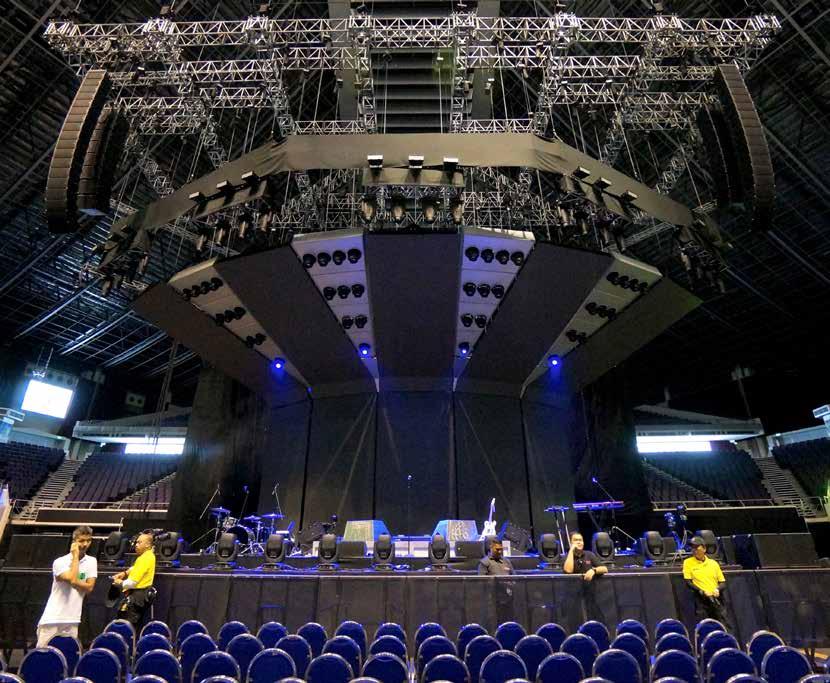

SoundOn is TikTok’s all-in one platform for music creators




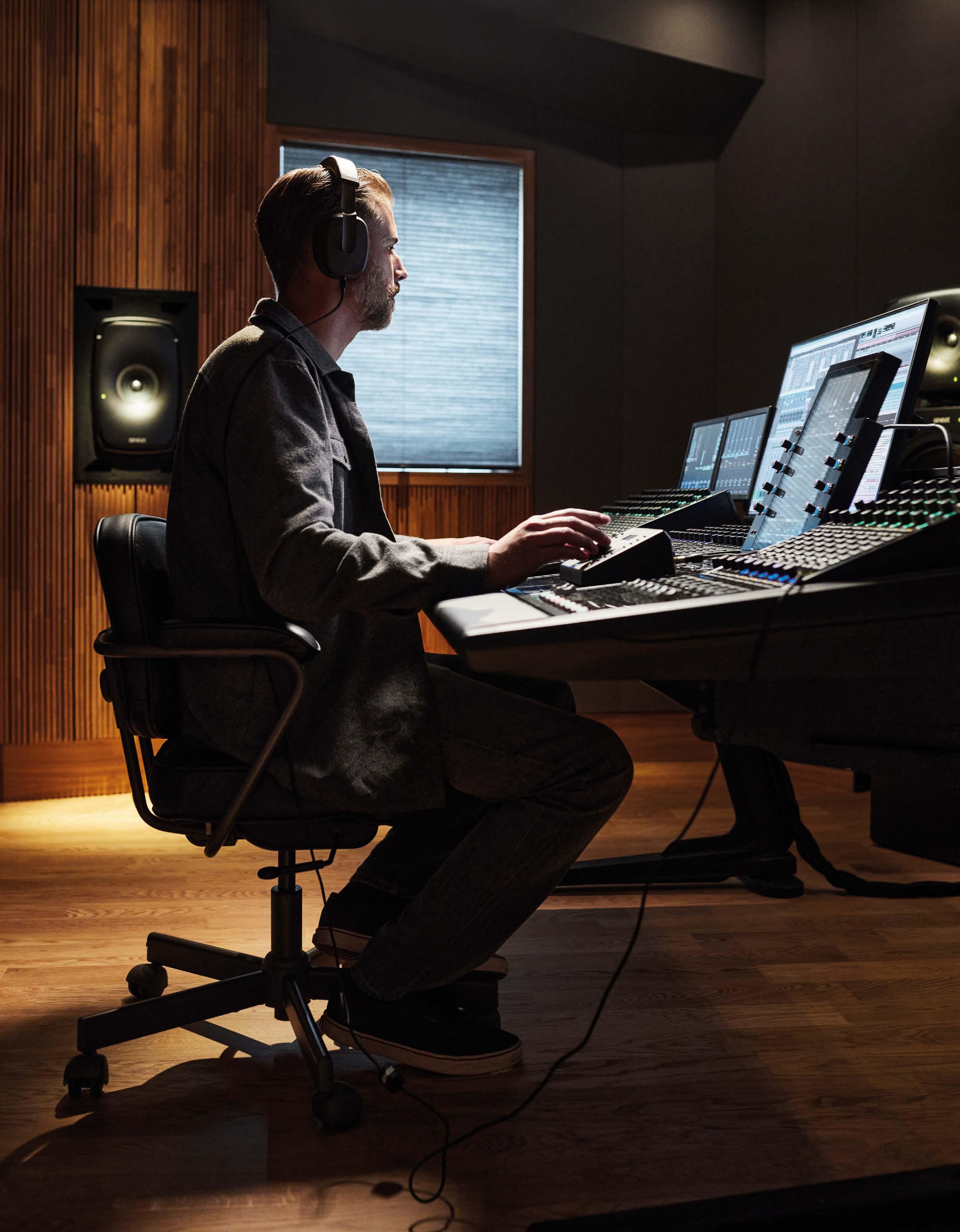
Bridging in-room and personal headphone monitoring
Our UNIO TM Ecosystem gives the ability to optimise, align and seamlessly navigate your monitoring options, for the exibility to work anywhere, anytime – from stereo to immersive.
Now, with the introduction of Personal Reference Monitoring – our pioneering new active monitoring headphone solution –UNIO offers the very highest level of headphone accuracy.
genelec.com/unio
Paul Watson CEO
Keith Watson Chairman
Rian Zoll-Kahn COO
Alice Gustafson Editor-in-Chief
Adam Protz Deputy Editor
Ste Knight
Partnerships Director
Rick Dickerson
Reviews Editor
Marc Henshall Head of Digital
Grace Mcguigan
Artist Relations Manager
Rae Gray Head of Design
UK independent music venues are in trouble. A dramatic statement, certainly, but one that is, unfortunately, true. A perk of the job at Headliner is being able to attend the odd glitzy event, with a recent standout being the BRIT Awards, which was held up north for the first time in its London-centric history. While there were no Jarvis Cocker-level shenanigans to speak of (although honourable mention to Sombr’s slightly baffling stageinvader publicity stunt), what stood out was the abundance of musical talent the UK has to offer – not to mention how much money the country’s music industry is clearly raking in.
The UK recorded music market exceeded £1.5 billion in annual revenue for the first time last year, driven by a new generation of artists such as Olivia Dean, Lola Young, and Skye Newman. It might be hard to connect the dots at first, but if independent music venues continue to close at the rate they have been, how will the next RAYE or Olivia Dean get discovered, and what will the inevitable butterfly effect be?
The grassroots music sector contributes over £500m annually to the UK economy, and yet, remains structurally fragile, with more than half of the UK’s grassroots music venues showing no profit at all in 2025. UK Government changes to national insurance and business rates resulted in a loss of 6,000 jobs as venues struggled to meet unsustainable tax burdens. While accepting their BRIT award for group of the year, Wolf Alice’s lead singer
Ellie Rowsell flagged her concerns about the shrinking UK grassroots scene: “We’d like to thank all of the pubs and clubs and grassroots venues where we quite literally learned to play our instruments and write our songs. Thank you for opening your doors to us, and thank you to those who continue the fight to keep them open.”
One such organisation is Music Venue Trust, which is investing £2 million into targeted programmes to support grassroots music. d&b audiotechnik is providing ongoing funding, a nationwide festival is being launched with The National Lottery, PRS for Music will add £1 to large-venue ticket sales to support the sector, and Marshall has introduced a membership programme for long-term support.
Save the grassroots venue, and you don’t just preserve a stage, you protect the very first spark of an idea, the shaky first gig, the moment an artist realises they might actually have something worth hearing. There is no arena without the back room. No headline tour without the half-empty Tuesday night gig at the local pub. And let’s not forget that if we want the next generation of British talent to thrive, we also need to show up as punters.
Although the X Factor audition stage is about as far from a grassroots stage as one can get, the Doncaster artist at the heart of this issue’s cover is a big supporter of championing small venues and opportunities for rising artists, even creating his own festival to support up-and-coming
talent. Ex-One Direction star Louis Tomlinson’s new album, How Did I Get Here?, recently shot to the no. 1 spot in the UK. So why the imposter syndrome? This month’s cover story sees German producer Nicolas Rebscher reveal how heading off to the jungle helped the 1D star confront those doubts and create his most honest record yet.
After the success of her breakthrough debut, Honey for Wounds, BritishNigerian singer-songwriter Ego Ella May is tackling the difficult second album with her new release, Good Intentions, and gets frank about why she’s preparing to take a loss on her UK tour. Meanwhile, Headliner celebrated the launch of its very own DJ and producer-centric event in Wakefield this month: CRE8. Softcult delves into going from radio poppunk to shoegaze rage on their new debut album, When a Flower Doesn’t Grow; Warner Chappell Music’s Gustavo Menéndez examines if the Latin music explosion is sustainable; and Headliner meets Worley Sound to discover how a boutique audio firm is competing with the biggest US players in live sound. Plus much more!
If you can, support your local independent venue, and enjoy the issue.
Alice Gustafson Editor-in-Chief

By Alice Gustafson
By Alice Gustafson
By Alice Gustafson
56 WORLEY SOUND
The boutique audio firm competing with the biggest US players
64 HELONG STADIUM
Striking a balance in stadium acoustics
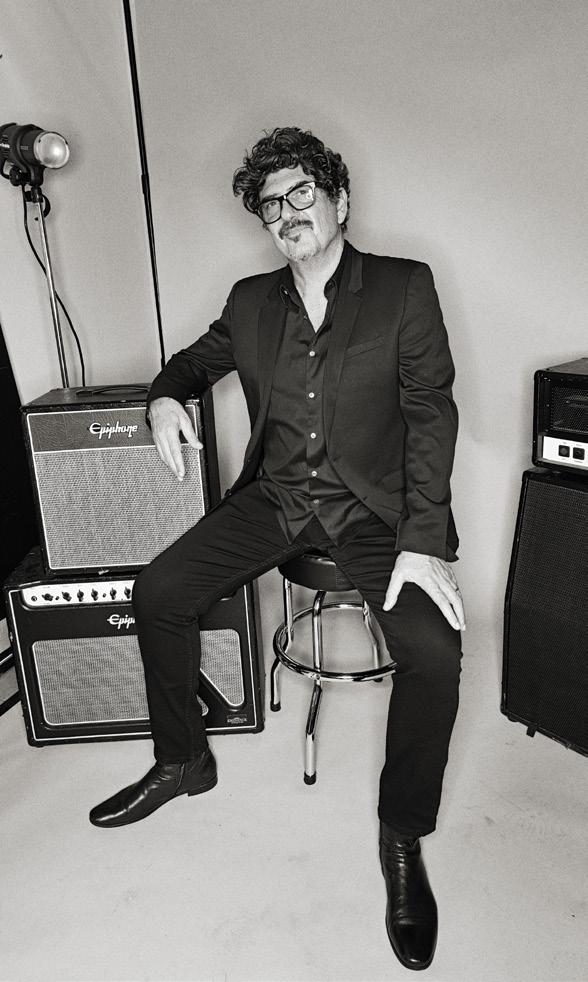
66 TOMO FUJITA SHARES HIS GUITAR WISDOM
68 UNIVERSITY OF NEBRASKA Campus broadcast rewired
72 BEHIND THE CURTAIN AT TEATRO ALLA SCALA IN MILAN
74 HOW THOM SHAFER RECORDS HIGH-STAKES STORIES
78 GUADELOUPE CULTURAL WEEKEND Drums, dance, & digital mixing
80 LILAS IR INNOMINE Lighting the comeback
82 INDUSTRY INSIGHT WITH MSI JAPAN HOLDINGS: The most powerful force is the one nobody notices
Credit: Tom Wilkinson

TAKE IT OR LEAVE IT
SALARYMEN
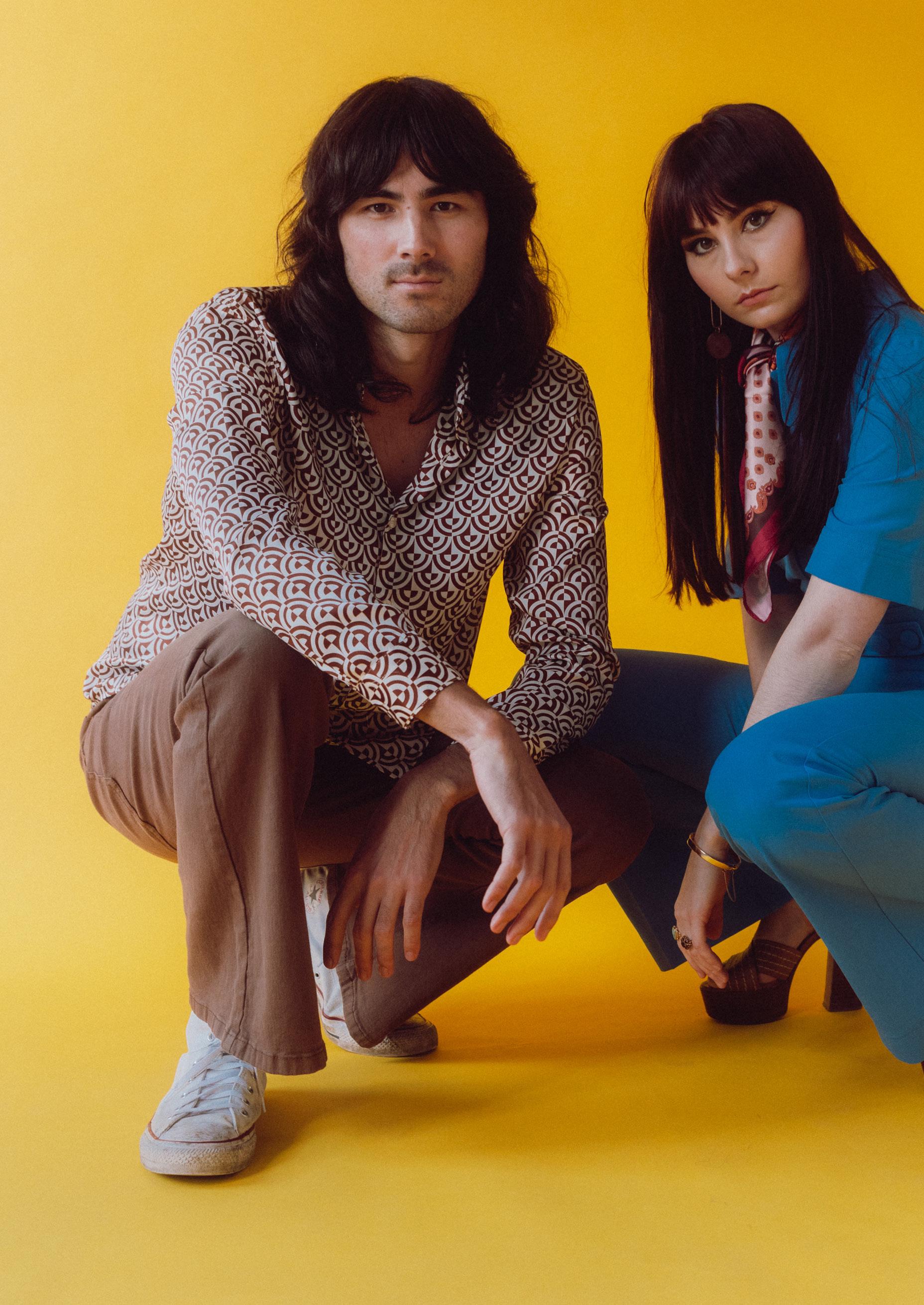
Renee de la Motte and Thomas Eagleton are the Aussie duo behind Salarymen, a band named after burned-out white-collar Japanese workers, with songs combining an array of rock, psych, and dream pop influences. Since releasing their debut single in 2019, they have supported the likes of Royal Otis and have toured the United States, Japan, and their native Australia. The London-based duo speak to Headliner about honouring the album format, not rushing their music, and the process behind their debut album, Take It Or Leave It.
One of the trademark qualities of Salarymen is Eagleton and De la Motte’s call-and-response vocals, with songs that are nostalgiainducing by design. Besides supporting Royal Otis and their globetrotting performances, they have also notched up SXSW Austin and Sydney appearances, as well as an array of festivals that includes
Lost Paradise, Mountain Goat Valley Crawl and The Gum Ball. They are no strangers to radio, with their songs in rotation on BBC 6 Music, Radio X, KEXP, and more. With the new deluxe version of Take It Or Leave It having just been released, the pair are a little tired after performing in Brighton the night before and having a hard time getting home.
“BEING A MUSICIAN IS HARD; IT’S HARDER IN AUSTRALIA. THERE ARE MORE BARRIERS TO GETTING ANYWHERE, PHYSICALLY AND FIGURATIVELY.”
Hello, Salarymen! How was the show in Brighton?
De la Motte: We got home at 2am last night after our train from Brighton was cancelled. The show was a success, though, so we’re looking forward to doing some more shows there.
What’s the origin story of Salarymen?
Eagleton: We were dating — and still are! — I was in another band which fell apart, and I was going to start my own thing. I realised how much work that was going to be, so I recruited Renee and taught her how to play bass.
It’s pretty clear from your sound that you’re influenced by ‘60s and ‘70s music, did you grow up hearing bands from that era?
De la Motte: When we first started, we were much more ‘60s and ‘70s-sounding. At the time, we were listening to a lot of David Bowie and The Beatles. We have diversified it a bit now, but that is a common thread in every song we write. It always has to have loads of harmonies and classic ‘60s chord progressions and melodies.
How did you make the decision to leave Australia for the UK?
Eagleton: In Australia, you’re limited by the fact that it’s a small population and a huge country. We were explaining to some British bands last night that you can fly for five hours and still be in the same country. On that Royal Otis tour, we went to Perth for the first time.
That’s around a five or six-hour flight, and very expensive.
De la Motte: Being a musician is hard; it’s harder in Australia. There are more barriers to getting anywhere, physically and figuratively.
How did you settle on the band name, which refers to overworked white-collar Japanese workers who work exhausting hours and then get wasted in karaoke bars?
Eagleton: We are slightly obsessed with Japan, we’ve been there six times. It’s a surprisingly easy flight from Australia. We threw the name out as a bit of a joke, but then we thought about it and it has serious parallels with the way we operate. Until last year, we didn’t have a manager, and we were working our butts off just like actual salaryman, slaves to the music. We come home from work, send emails, and do band admin. Then we go out and get drunk in the karaoke bar. In Japan, you literally see grown men passed out on the sidewalk in suits, fiercely loyal to their company.
Musicians these days have to be their own marketing, PR, and social media team, often while working full-time jobs. How’s your experience been?
De la Motte: This year has been wild. This is our debut album, and we’ve tried to squeeze in a million different videos. The social media element is arguably more important than the music these days, which is very bad. Management is always saying,

“content, content, content”. It sucks the life out of you, but you have to promote. We have fans in Japan, Ecuador, Chile, Mexico, and Brazil who would never have heard our music years ago. It can feel like a drag, but it’s a good way to reach fans you otherwise wouldn’t. You have to adapt.
Huge congrats on releasing Take It Or Leave It, your debut album. What was the writing process like for the record, as a duo?
Eagleton: We split up and write; Renee will write her own songs and I write mine, then we come together.
De la Motte: Having two singers is an unusual format these days, we both consider ourselves the lead. We want to make the most of both of us, and it opens up new opportunities and challenges to feature both our voices. We love the dual vocals, it’s our unique selling point.
A great case study on the album is If You Want Me ; the song goes from the drum machine intro into a huge rock band sound.
Eagleton: I wrote that a few years ago, inspired by standard ‘50s and ‘60s ballads like Roy Orbison. Then we slapped a bunch of heavy synths and distorted guitars on it.
De la Motte: Originally Tom wrote and sang it, but we reimagined it for the album as a back-and-forth duet. It added a different meaning to the lyrics; now it’s two people lamenting how they wronged each other. It’s kind of surprising when Tom starts the song and the next line is my voice, which is a lot higher.

Credit: Tom Wilkinson

Tell us about the Rhodes piano and trippy flourishes and production on Let Me Go
Eagleton: I have a Roland Space Echo which I love and sneak into songs as much as I can. I love little things at the start of songs, sometimes I spend five hours on a tiny five-second thing.
It kind of feels like a movie intro. That was your song, Renee!
De la Motte: I was really into bongos at that point. I said I was going to write a song around a bongo riff. I got my toy keyboard and came up with that piano riff, and I sat on my bed crosslegged and came up with the melody, and recorded it on my phone. It just felt like a cool way to start a song instead of some boring drum beat.
Being in a duo, is that helpful for dealing with the critical internal dialogue around your songs?
Eagleton: We can definitely bounce off each other, but we criticise each other quite heavily too!
De la Motte: If I give something to Tom and he says it’s shit, then it’s just shit. I’m okay with that, we trust each other completely. I don’t know how solo artists do it. They either have to be rich or miserable.
Eagleton: We can share in our frustrations and revel in the good times when we have them. It seems like the game is rigged these days; people with the most money and the most paid social media marketing get all the opportunities. We just try to keep each other’s chins up.
De la Motte: Something we were really excited about for this album is that we got a Tokyo-based designer to hand-draw us in an anime scene. It’s Tom and I eating late-night ramen. What could be more Salarymen than the two of us in a ramen shop at 2am in manga form? It’s important that musicians support other creative artists because AI is coming for us all.
Going back to your gig in Brighton, that was the start of your tour for this album. How did it go in terms of setting the tone?
Eagleton: It was freezing. I have never been so cold inside a venue. It was a place called the Green Door Store beneath the Brighton station archways. Very cool spot, great sound, and a good crowd.
De la Motte: It was our first headline show in Brighton. You would not dare host a gig on a Tuesday night in Australia because we’re not cool enough to come out and support live music mid-week. It was really, really nice to see all these new faces support an Aussie band on a Tuesday night. Quite inspiring.
Take It Or Leave It (Extended) is out now.
Credit: Tom Wilkinson

MAKING LOUIS TOMLINSON’S HOW DID I GET HERE?
Louis Tomlinson was a member of one of the best-selling boy bands of all time, boasts the most writing credits in One Direction out of all the band members (selling over 70 million records with the group), and with the release of his third album, How Did I Get Here?, he has just secured his second UK No.1 album. So why the imposter syndrome? German producer Nicolas Rebscher, aka Tomlinson’s very own “mad professor behind the desk,” reveals how heading off to the jungle helped the 1D star confront those doubts and create his most honest record yet.
“It’s so surreal for me,” says Rebscher on securing a UK no.1 with the new album, which he wrote half of and produced in its entirety. “The UK is always seen as an incredible music market that produces amazing artists and has really shaped pop history – I always dreamed of
contributing to that in some small way, but I never, ever imagined having a number one in the UK. I’ve been so heavily involved in this project, and I love it, so seeing it at number one was unbelievable.”
Having already established his post1D sound as more Britpop-esque and finding success as an indie rock artist, Tomlinson’s third album sees the singer continue to lean into that. The new record is one shaped by an artist confident enough to sit with the album’s emotional layers, blending his indie guitar influences with a brighter, more buoyant pop sound laced with synthy textures. Tomlinson has pushed himself as a lyricist, songwriter, and performer in his latest body of work, while making a decidedly less gloomy record than his previous efforts, calling it a more accurate reflection of his decidedly un-gloomy personality.
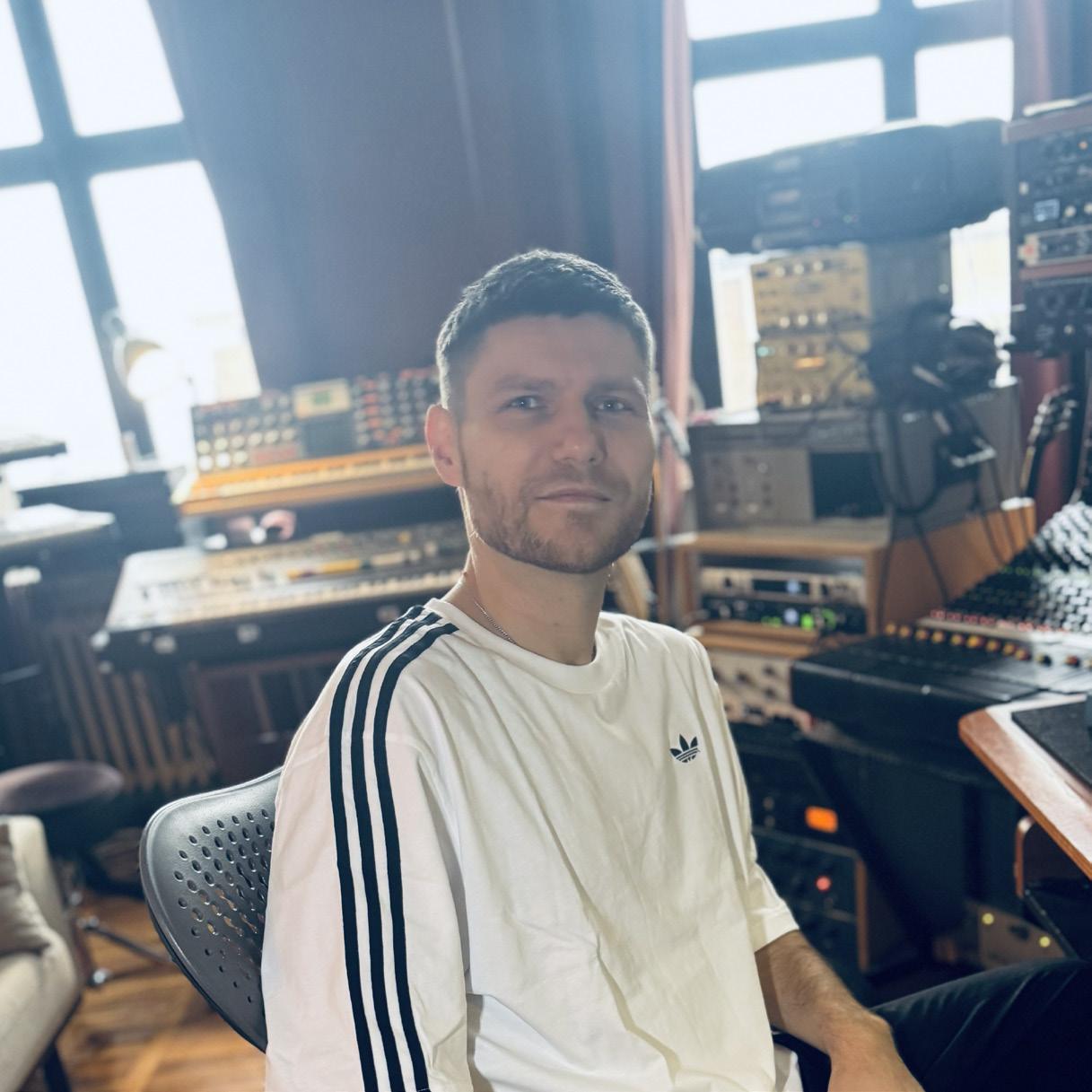
It wasn’t Rebscher’s first rodeo with Tomlinson, who was a producer on 2022’s Faith in the Future, and who also brought his experience of working with artists like AURORA, Macklemore, Ella Henderson, and Alice Merton to the table. And by ‘table’, he means Costa Rica. Tomlinson assembled a handful of initial ideas in the English countryside before decamping to Santa Teresa for three weeks in early 2025. Rebscher jokes that the singersongwriter kidnapped him on a plane to get the creative gears turning for the album.
“It was a wild journey for me,” he recalls, admitting he is not a fan of small planes. “Louis always had this vision of going away somewhere warm and far away. I took a big plane to Costa Rica, but then they told me we’d need to take a smaller one if we didn’t want to spend the whole day travelling by bus or boat. It was just a 10-person plane, and I was really scared because we flew straight into massive thunderclouds and rain, and I was like, ‘Okay, I’m sending my wife my last goodbye,’” he laughs. “He took us there, right in the middle of the jungle. We stayed in a villa that you could only reach by quad, climbing really steep hills. One night, I walked back alone from the studio through the jungle, and it was incredible; it was so mind-opening.”
The time in paradise paid off. Tomlinson is unabashedly himself on How Did I Get Here?, finding the confidence to become the artist he has always wanted to be. “It was about finding a new direction for Louis,” agrees Rebscher. “When I was first asked to do a session with him, they said they wanted to explore a new path for his sound,” he says of working on the singer’s second record – their very first session together produced his 2022 single,
Out Of My System. “At that time, I didn’t really know what kind of music Louis was making,” Rebscher admits. “He was working in that alternative rock-pop space, and I assumed we’d continue in that direction in the next sessions. But then he said he wanted to try something completely different – something that felt more contemporary pop.”
The duo used the sound they created on Faith in the Future as a starting point, but only in order to deliberately move away from it to find something new. “Louis really drove the direction of everything,” Rebscher elaborates. “How he is as a person should be in the music too. We discovered so many interesting sides of Louis’ character, and the album reflects him really well in that sense. We took the dreaminess, the self-awareness, the emotional side – all of those elements – and tried to piece them together to create something new.”
Credit: Susann Bosslau
“HE HAS ALWAYS BEEN EVOLVING. I DON’T THINK HE WOULD EVER SAY, ‘THIS IS MY IDENTITY FOREVER.’ IT’S ALWAYS IN MOTION.”
Thematically, the new album is lighter and more optimistic than Tomlinson’s earlier work. Rebscher explains how this shift affected his songwriting and production decisions: “It changed it completely. I mean, he took us to Costa Rica and put us in one of the most beautiful places in the world, with the best smoothies, the warm sea, and a beautiful studio overlooking the jungle and the ocean,” he points out wistfully. “That changes everything about how you write and make music. It’s really interesting how much an environment like that affects the process.
“And right now, it can be hard to find things that feel light and positive in the world,” he adds. “So I was really happy to go in that direction and to bring some lightness into the music. I wouldn’t say it’s simply light, though,” he corrects himself, “because the lyrics are still quite deep, and it’s been a great success. It’s on the A-list on BBC Radio 1 at the moment, which has never happened to me before!”
Like George Michael, Justin Timberlake, Beyoncé, Robbie Williams, JADE and yes, Harry Styles before him, Tomlison, free from the confines and pop expectations of an established and successful group, was able to investigate what his musical identity was as a solo artist. “He has always been evolving,” shares Rebscher. “I don’t think he would ever say, ‘This is my identity forever.’ It’s always in motion. Through the first and second albums, he had already started that process, and he’s really proud of this album. I think it’s more about moments in time, because identities shift and change,” he considers.
“He always says that indie and alternative music are his bread and butter; that’s where his heart is. But he also opened himself up to a new direction, and you can hear that on the album. There are indie and alternative tracks, but there are also songs with more of a pop tempo influence. We tried to combine the old and new styles a little bit too,
and steering away from the old style but still having his DNA in there was a big risk, because it could have gone wrong. We experimented a lot, which is why at times it leans more one way and then another. Listening to the album is a bit of a journey, which I find really interesting and fun. If everything sounded the same, why would you listen to the whole album?”
The record was recorded with a full band to capture a live feel. “We knew the album would showcase so many sides of him and different kinds of music,” says Rebscher. “He loves live gigs – the energy, the instruments, the honesty they bring to the music. Also, it made the album more coherent – having the same instrumentalists throughout helps everything melt together, making it more heartfelt and powerful. That was our goal: to capture his energy, because seeing him live is just a wall of power, a massive celebration, and I wanted that on the album too.”
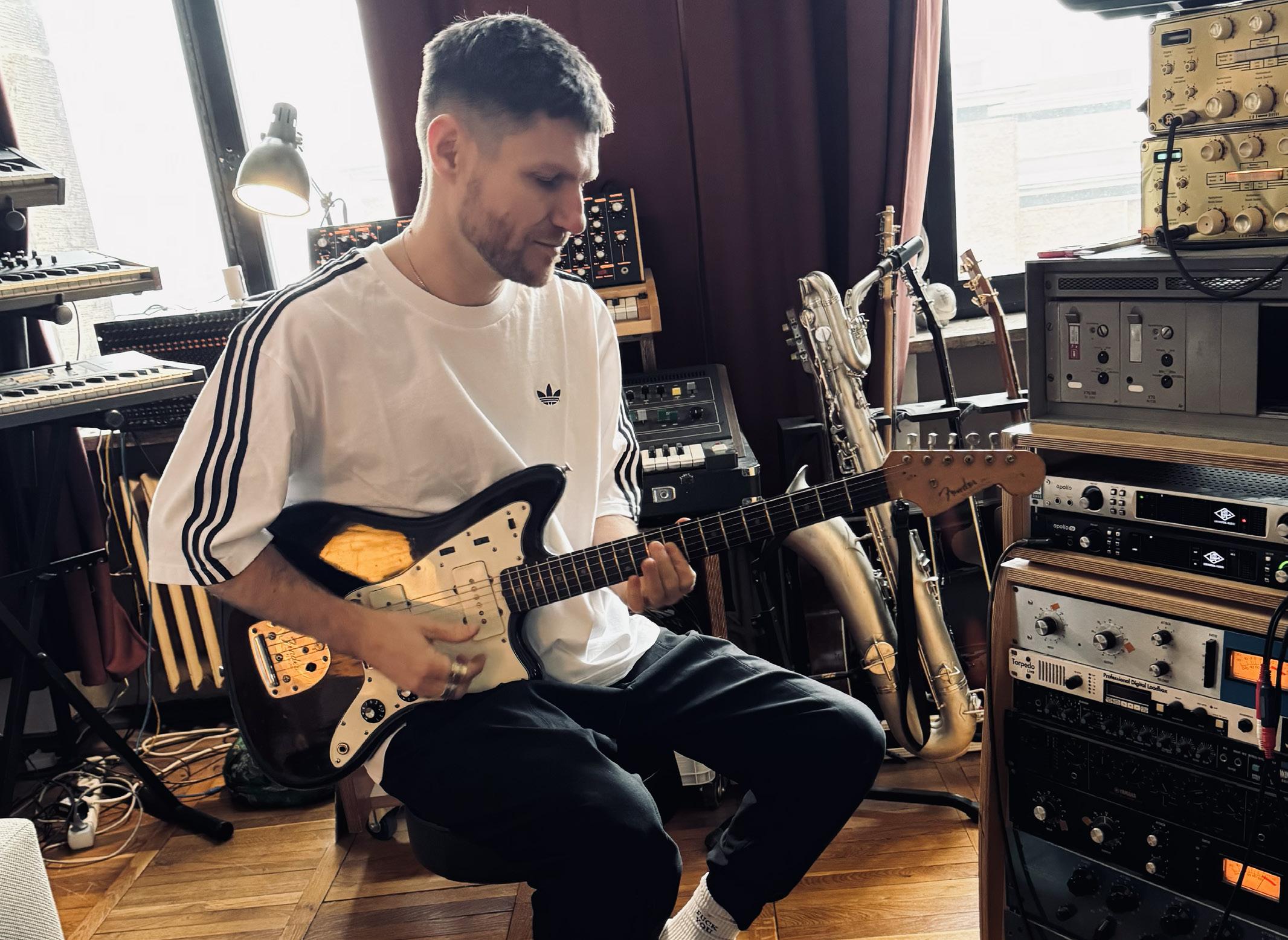
Radio-friendly Lemonade, although recorded toward the end of their studio time, was chosen as the first single from the album, capturing the spontaneity and fun of the Costa Rica sessions. A mix of tight funkified guitars, shimmering keys, and organic percussion lead to a merry, sing-along chorus, which saw the song chosen as BBC Radio 1’s Hottest Record. Rebscher co-wrote the track and served as producer, sound engineer, bassist, keyboard player, guitarist, and singer on background vocals.
“We tried out loads of ideas and had plenty of songs lying around with different sounds,” Rebscher reflects. “This track really pulls all those elements together; the synth melody at the end, combined with the riff, blends Louis’ classic sound with his newer style. It felt like the perfect song to introduce his new direction while keeping the riff-driven energy he loves. It brought all the threads of the album together.”
He reveals that on the vinyl version, there’s a longer intro they couldn’t add to Spotify – “for charting reasons,” he shrugs. “You hear a ‘gong, gong, gong’ – that’s me hitting some iron scaffolding. In the background, you can hear crickets and even someone coughing. We did the same in the outro, recording the ocean in Costa Rica as it fades out. And Theo Hutchcraft, who co-wrote the song with us, found a funny little flute in the studio. You’ll never actually hear it – it only plays two notes,” he smiles knowingly. “I
used that flute on Lemonade; it’s completely out of tune and so strange, but I loved it. I put it into the intro, and nobody knows – but I do, and I find that hilarious. We added all these little sounds to make it feel real, even if it’s just for us; it’s such a lovely memory.”
The chorus hinges on the word Lemonade – a classic entry in the long tradition of soda-inspired song titles. Were any other fizzy contenders considered? Rebscher chuckles at the notion of Orangeade as an alternative title. “Louis writes down countless concepts and ideas, and he’s brilliant at it. For this one, he was the first to sing when the chords rang out – someone played them on the piano, and he just went for it, coming up with the whole chorus on the spot. He was in the living room area where you’d have a drink and hang out, while I was inside the studio producing the tracks. It’s an easy, sing-along chorus that everyone can join in with. It’s very stadium-ready, and the verses have a hooky guitar and bass riff that makes it really compelling.”
The progression sidesteps the familiar four-chord pop formula, giving the track a more distinctive sound. “It felt effortless in a way, even after going through such a long process to get to where we wanted to be,” Rebscher notes. “This was just the conclusion of that journey. As a producer, you try to think from the listener’s perspective and how they experience it, but that’s not always possible.”
Credit: Susann
Bosslau
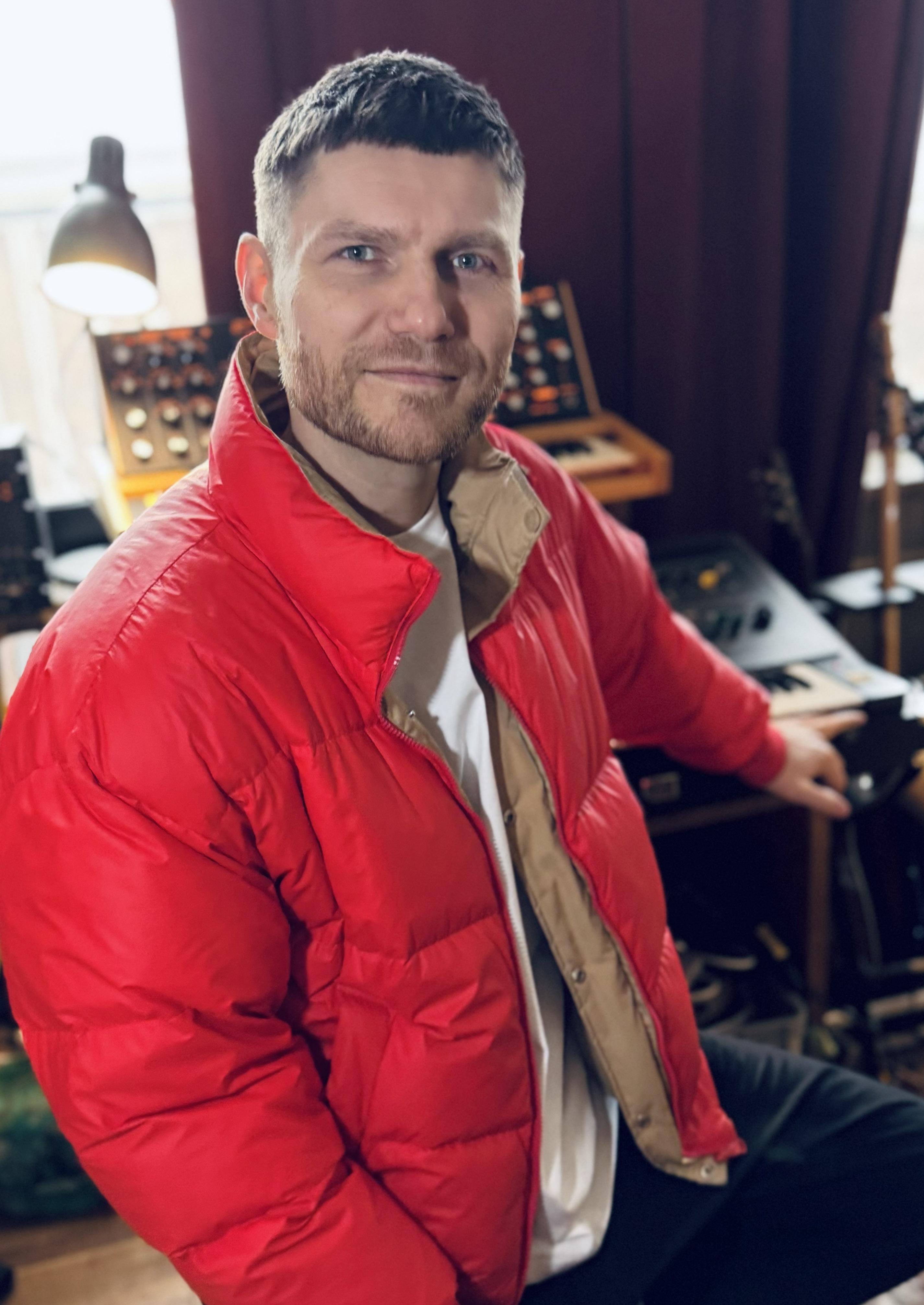
The album’s third single, Imposter was released in January 2026 and is still going strong on Radio 1’s A list into late March. The raw and lo-fi indie pop song features a pulsing bassline and dirty guitars, with production, instrumentation, and songwriting from Rebscher. The lyrics explore the singer’s struggles with imposter syndrome and not feeling worthy.
“Louis has always been fascinated by the imposter syndrome phenomenon and how it all connects,” says Rebscher. “He’s really interested in psychology, so he had it on his songwriting ideas list. The song came together effortlessly in two or three hours. We just sat down and went for it. It sounds effortless, but songs like this are the result of years of work, of writing songs that may not even make it,” he points out. “It’s amazing when you finally get it right; you leave your head behind and just follow your heart. We had a simple bass idea for Imposter, then I detuned the guitar really low, giving the sound a growly, compelling edge.”
While the writing may have happened in a few hours, it was a different story when it came to the production. “The others took a break to get some food and called me over, but I said, ‘No, I’m in this flow now,’” Rebscher recalls. “I stayed there and kept working on it for another 10 hours, building the production. For Imposter, I didn’t want to lose the magic of the first demo, that first moment. You want to make it better and eventually release a finished product. Often, the last 30% of the work can take 90% of the time. Writing itself might be quick, but reaching the point where writing comes easily takes a lot of time and effort.”
Given that Tomlinson is the 1D member with the most writing credits across the band’s discography, it’s not surprising to hear that the singersongwriter played an active part in shaping all arrangements, lyrics and sounds on the new record.
“He’s very inspiring to sit with,” nods Rebscher. “Every song has a concept that Louis brings into the room. Sometimes he just leaves it to me, and I think it’s great that he does, because I can do my shit, and then at some point he comes back and listens and gives me feedback, and we talk about things. We’ll work on guitar riffs or vocal lines together – that’s the kind of stuff he loves doing. He gives great feedback and arrangement ideas. He also takes a little bit of time off while I’m completely in the zone; it’s great to have somebody not listening the whole time, because you somehow lose the overview in a way.”
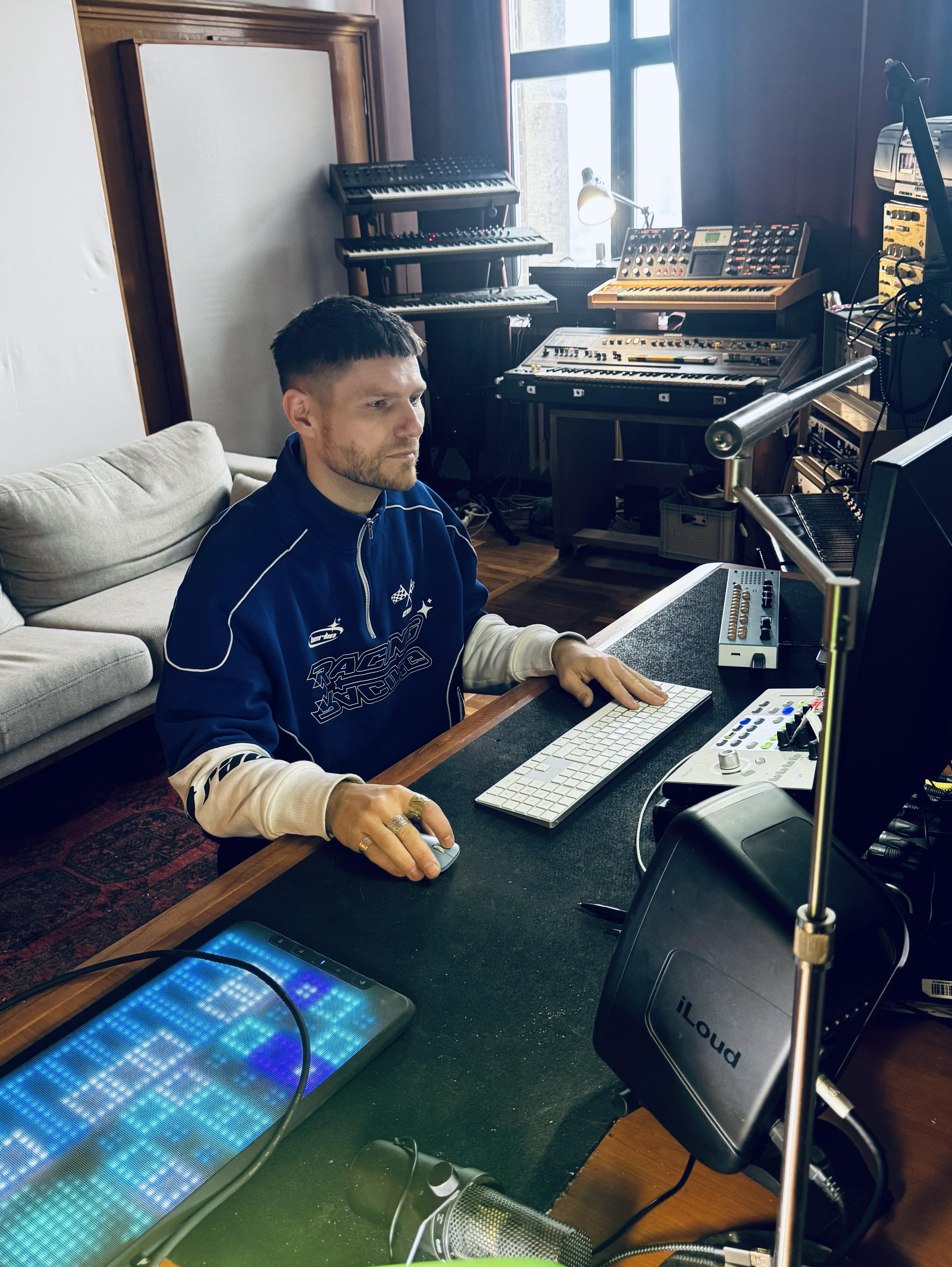
Helping Rebscher stay focused for the long studio sessions was his DAW of 20 years: Cubase. He’s stayed loyal to Steinberg’s music production software since then and is currently enjoying the updates in the most recent iteration, Cubase 15.
“I’m always the first to want the new version because I get so excited about new stuff coming in,” he enthuses. “It’s my playground, that’s what I call it. Some of the greats use it too, like Cirkut, so I’m like, ‘Yeah, I get why you use it! I love it too.’ I know all the features really well, and I don’t have to learn anything to get my sounds where I want them to be. It’s all very intuitive, and I love how technically great it is, and at the same time, it gives you creative tools and freedom to play with and experiment. It’s such a great combination.”
He points out that he’s a big fan of Cubase’s modulators, allowing him to add variation and tension curves to static sound images. “You can put them on basically every knob you can find in Cubase,” he elaborates.
“You can put a modulator on something, and it moves the knob by itself – that was a game changer for me. I can just modulate from Cubase, make it move, do weird stuff, and it’s so much fun. That was a big thing for me, and I use it all the time. I’ve got a
template of tools I use for Louis that I use in every song, again and again.”
Tomlinson refers to Rebscher as his ‘mad professor’ behind the desk due to his ability to turn the vaguest concept into a polished hit. “It feels like a real compliment, even though I can’t see myself from the outside,” he laughs. “But I think I get what he means. When I get excited about something, I go all in, I’m putting plugins, distortion, and changing sounds. I just love doing that, so I think that’s why he came up with this funny compliment.”
Thrilled with the album’s No.1 status and positive reception from critics, and proud of it as a cohesive body of work that reflects Tomlinson’s personality, stage of life and indie leanings, Rebscher struggles to pick a firm favourite from the new record. “I do love Imposter, Dark To Light, Lucid…and I do love Sunflowers as well,” he adds, laughing at his multiple answers. “Sunflowers brought this new sound and added a whole new vibe to the production. I hear that from a lot of people that they can’t settle on just one track. That’s a good sign for an album, because it means different songs speak to different people. It shows it’s not just one great song and the rest is like, ‘Let’s forget about that’.
For Rebscher, the real triumph lies in the album as a complete statement: Tomlinson confronting his doubts, embracing his identity, and finally recording the music that feels truly his. “Louis’ project was so heartfelt, and I loved working on it so much. Hopefully, he does another one and asks me again,” he grins. “Until then, I want to find projects that excite me just as much as this one did.”

Credit: Mitch Störing

THE MAKING OF PALE BLOOM
LUCY KRUGER & THE LOST BOYS
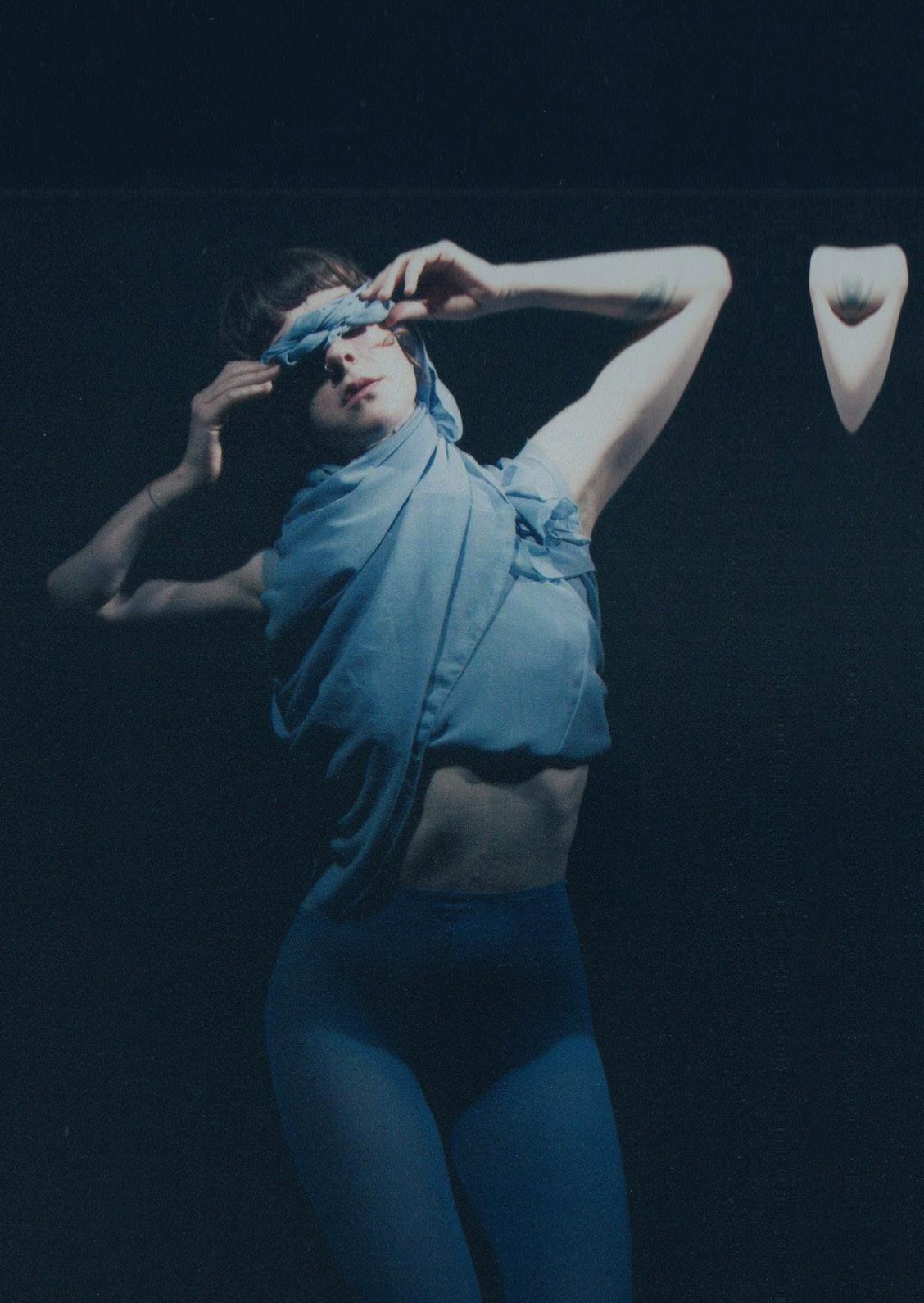
Lucy Kruger is the South African singer, songwriter, sonic-explorer, and frontwoman of her namesake band, Lucy Kruger & the Lost Boys. Upon realising her art-pop noise songs were unlikely to lead to a financially feasible future in her home country, she moved to Berlin and became a full time musician. She chats to Headliner about her new album Pale Bloom, which is lavished with guitar feedback, violas, sparse arrangements, and haunting melodies, and about her 2026 touring plans.
Kruger and her Lost Boys have been hitting the road hard for the last six years, appearing at festivals such as The Great Escape and Focus Wales in the UK, SXSW in the States, and dozens of European ones also. In 2023, the band secured the Europavox Spotlight Prize, leading to five showcase festivals across the EU, and Kruger was then shortlisted
as a participant of Keychange, an international network with the goal of gender equality in the music industry. The new album is another excellent showcase for Kruger’s talents, with instrumental arrangements that are somehow equally sparse and lush, progressive guitar playing, and her unique and ambient vocals.
“Artists are having to find different ways to find income because music streaming pays so little. Patreon has been good for me.”
How’s life in Berlin? It’s such a great place to be an artist and a musician, but its draw as an affordable city is under threat from rising rents and living costs…
I moved in 2018, so it has been a while. It’s a bit shocking to me how quickly time goes. Coming from South Africa, there’s very little funding structure there, definitely not for the kind of music that I’m making. Comparatively, Berlin is amazing. I’ve been a full-time musician since I moved here, which would not have happened very easily in South Africa. But in Berlin, Funding is getting cut, rent is going up, and the pressure mounts. I think art is very necessary, but it’s a difficult time to be an artist.
In terms of big cities, it is still much cheaper than London or New York. I didn’t get part-time work because of my visa, but what I noticed here is that it’s possible to get a side job for a reasonable income, allowing you enough time to practice your art. That isn’t the case in South Africa.
Before relocating to Germany, what did your early days of music in South Africa look like?
I used to love performing a lot, and when I was about 16, my now sisterin-law started to play guitar. I saw her writing her own songs, and I somehow got introduced to Joni Mitchell’s album Blue. I guess it was a coming-of-age moment as well, where you are starting to experience slightly stickier feelings that are harder to articulate. There was this
woman singing songs in my bedroom through my little boombox; it was a revelation moment with regards to how I could use this thing that I love to do, which was singing, to explore my own experience and to express something quite personal. I started to play little shows on acoustic guitar. When I moved to Cape Town after university I asked a family friend if he wanted to play in my band, because he was literally the only musician I knew — he said yes and became one of the Lost Boys. We organised a couple of tours on our own and realised, because the visa situation is quite complicated, that we couldn’t do it in a sustainable way. We needed to relocate. Logistically, Berlin just made the most sense. The UK is not an option at all because they’re very unwilling to allow a South African passport holder with no money into their country. Once I moved, I had to find my new Lost Boys.
In the early days, did the project feel more like a solo project than a band?
so in that sense, it’s never really been a solo thing.
You’re a great example of an artist who has built an income stream using Patreon; could you share your experience with that?
Artists are having to find different ways to find income because music streaming pays so little, and Patreon has been good for me. I started it during Covid as a way to find income, but also as a way to have a more grounded and constant conversation with an audience. More than anything, it’s a sort of tender deadline for continuing to create. The reason I’ve been able to release with the consistency that I have is because of Patreon. It keeps you in the practice of sharing with an audience so you’re not just sending stuff into the void.
Congratulations on releasing your seventh album, Pale Bloom. One of the early singles was Anchor, a great example of the minimalism on this album. How did that one come to be?
I was experimenting with sketches on a computer, trying to think more along the lines of making very simple beats and what would come from writing from that place. I used to only write with my guitar as the source, and I play guitar in a particular kind of way. With these songs, I just made very basic beats that I liked and then I wrote from that. When you’re composing on the computer, even if it’s very minimal or simple production, that becomes the seed of the feeling of the piece for me; I get attached to it and so that often ends up staying, and stuff gets built around that. I don’t like too much stuff on a song in general — saying the most with the least amount of things is my preference.
Which DAW did you use and how did you go about making those song sketches?
I actually released an album in 2012 where I worked with producers. I didn’t know anything about making an album and I went to the professionals. In the end, I don’t know if it was the most meaningful way to move through the process, because I realised when I listened to it that the songs were mine, but it didn’t sound anything like me. That is when I found some friends to start this project with, because I needed to find my own voice. They were very influential, and I’m working with Logic, and there is so much that you can just drag in that’s pre-made, especially now in

the AI world. But the problem is, if I do that, there’s too much information there to work with and I feel a bit lost. So I do it in an extremely juvenile way where I will take a kick drum and then the hi-hat, add a very basic delay, and then that creates some kind of little moment. It’s like typing with one finger. Once there’s something there that I can work with, I try to move from there, especially because with this record, I wanted to take it to the band, so I didn’t want to fill it too much since all the songs also have live kits.
Our latest single, Damp, was quite different. I wrote it on the acoustic guitar and then Liu, our guitarist, took the stems and completely changed
it. It’s quite amazing to me to feel what the song became, because we’ve been playing that song live for a little while now and it’s become the most driving song that started from the least driving place. I couldn’t get that out with the original guitar demo at all. It was almost too vulnerable; sometimes people don’t want to get too close to that kind of state because it feels too exposed. This offers a kind of backbone so you’re safe enough to absorb the fragile part of it.
You’re on the road a fair bit this year; what’s the Lucy Kruger & the Lost Boys live experience like?
If I was of a financially sound mind, I wouldn’t take the full band to the UK and around Europe, but the music doesn’t really make sense when I’ve
tried to do it stripped back. So we’ll be with the whole band. The live experience makes so much sense to me; it feels very intense and alive, and I hope it’s the same for the audience. I believe in it somehow. I’m very proud of my band; I think they’re amazing and the players are very special. It makes me very proud to know that I give these people room to express themselves, because I would be happy to watch each and every one of them for each moment of the show. Their playing is so meaningful to me.
Credit: Francis Broek




DRUM RE-SYNTHESIZER
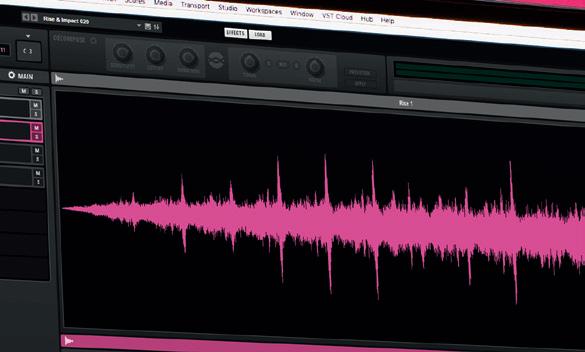
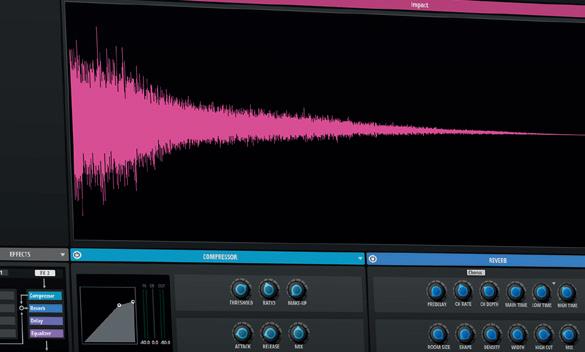
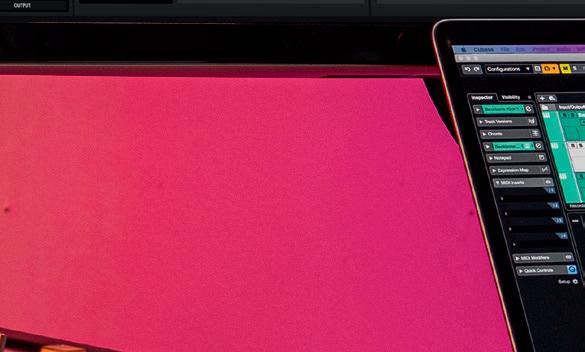



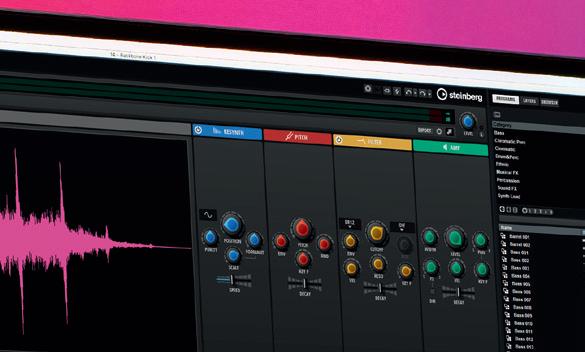
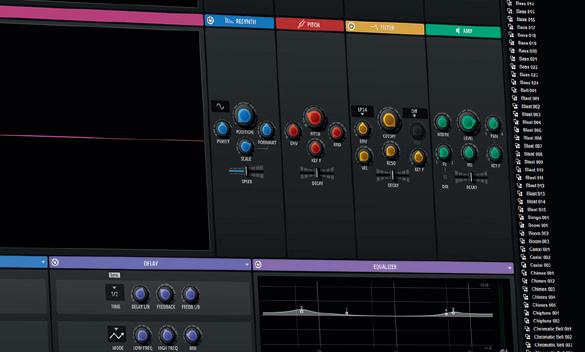
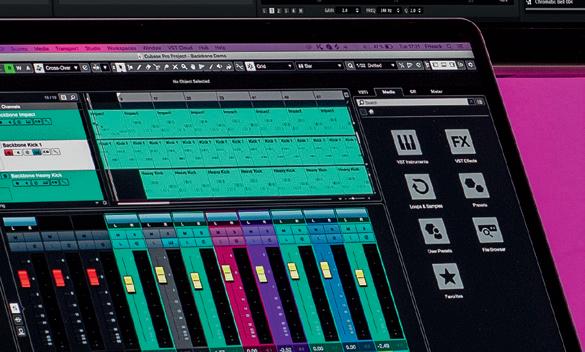
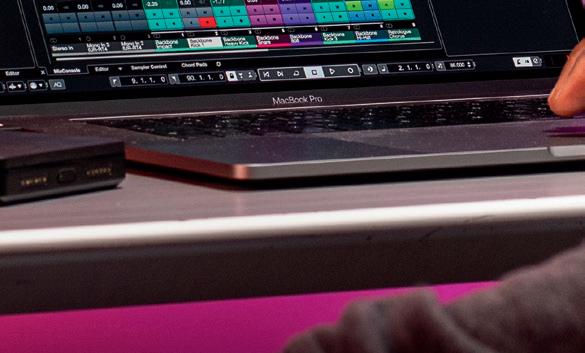










A revolutionary way to design your own drums – Backbone is your new, innovative drum designer for single kicks, snares, hi-hats, percussion, rises, hits and more. Layer up to eight samples and shape them with classic subtractive synthesis, decompose samples into tonal and noise elements and re-synthesize samples to manipulate them in unheard ways.
steinberg.net/backbone



Credit: Jelani Pomell
NOTHING BUT GOOD INTENTIONS
EGO ELLA MAY
After the success of her breakthrough debut, Honey for Wounds, British-Nigerian singer-songwriter Ego Ella May is tackling the difficult second album with her new release, Good Intentions. Maybe it’s the self-deprecating Brit in her, but May is embracing for her flop era.
“The second-album jitters are real, and overcoming them is no easy feat,” confesses May from her home in South East London, a few weeks prior to the album’s release. “Writing a second album is tough; I felt a lot of pressure after the first album. I think that’s probably why it took me so long to start the next one – I just felt overwhelmed. I didn’t know where to begin. I was wondering, do I have to make Honey for Wounds Part Two? Does it have to be exactly the same? Because that’s clearly what people
connected with. But that didn’t feel right to me. I wanted to switch it up. That’s where the title Good Intentions comes from. I made this album from a place of pure intention in music. I love music, I want to push myself, and the intentions are mine; the outcome I can’t control.”
Her first record earned her critical acclaim, including Best Jazz Act at the 2020 MOBO Awards and Best Vocalist at the 2021 Jazz FM Awards, as well as placements in major film and TV series like Insecure, Sex Education, Dear White People, Queen Sugar, The Jackal, and And Just Like That
With Good Intentions, May pushes her artistry further, blending vulnerability, growth, and fearless experimentation into a record that is her most ambitious work to date, exploring community, liberation and vulnerability. “This album may flop; who knows?” she shrugs.
“But the point is, I made it from a very pure place, and I’m proud that I’ve managed to finish another body of work. I’m keeping my focus on that. It is what it is,” she says, thinking practically. “When I say it may flop, it might, but whatever happens after I
finish it and release it into the world is beyond my control. So whether it flops or not is neither here nor there.”
May’s creative lens is shaped by the writers she loves: Chimamanda Ngozi Adichie, Patti Smith, Chinua Achebe, Ayobami Adebayo, Joan Didion and Stevie Wonder – whose storytelling sharpens her sense of narrative and introspective detail. “Stevie Wonder is my ultimate icon and my unofficial singing teacher, because I feel he taught me everything I know,” she enthuses, recalling seeing him perform around 13 years ago.
“Because I was in the front row, nothing’s been able to top that. I thought I was being really clever by arriving at the festival around 6 am, but there were already people there, which is crazy. I couldn’t do that today,” she laughs.
Drawing from both her musical and literary influences, May is known for creating songs that explore self-reflection, healing, identity, social consciousness, love, and the complexities of modern life. On Good Intentions, her voice, soft yet commanding, carries an intimacy that resonates with longtime listeners and newcomers alike.
Guided by literature, introspection and deep chats with her loved ones, May turns vulnerability into connection through her songwriting, taking cues from artists who lay themselves bare, and channelling that same honesty and emotional depth into her own sonic world. At the same time, jazz greats such as Sarah Vaughan and Lambert, Hendricks & Ross, grounded her enduring love for the genre.


The result is a swoony, neo-soul record that feels both intimate and expansive. May’s dreamy, blissed-out vocals drift effortlessly over tight musicianship and lo-fi beats, creating a sound that is as soothing as it is self-assured. There’s a quiet confidence running throughout, carried by rich harmonies and carefully layered vocals that echo the emotional depth of artists like Erykah Badu, Solange and Ari Lennox, while still feeling distinctly British and her own. At the same time, Good Intentions is grounded in live-sounding musicianship. Tracks like What You Waiting For lean into jazzy instrumentation, giving the album a dynamic, organic quality that feels almost defiant in an increasingly digital age.
“I was ready to grow my musicianship,” nods May. “I’m used
to working with producers, and I played with a live band, so I wanted to reflect the live experience of my shows and push myself, because I’m quite introverted and usually only comfortable with one person in the room. I wanted to start making music with a band and challenge myself on that level. I think I definitely achieved that with this album. I’ve pushed myself vocally and stylistically; it’s an album of growth. I’ve purposely avoided staying in my comfort zone this time.”
Flop era concerns aside, there is one thing worrying May about the new album: “It’s quite different from Honey for Wounds,” she warns. “That album was so well received, and that’s what made me freeze at first and hesitate to make a second album. But ultimately, that’s the point of life,
isn’t it? To push yourself and try. I also wanted to let go of expectations, create freely, and see what happens when I make music in a different way.”
On navigating life as an introvert whose work centres on sharing her most personal thoughts and feelings with strangers, May reflects on how she finds that balance. “It’s definitely hard being more introverted in such an extroverted industry, but I’m kind of used to it now,” she reasons. “I know how to deal with it; I’ve reached a point where if something doesn’t align with me or make me feel good, I don’t need to do it. I just want to focus on things that make me feel good. I have to trust that the music is enough; I don’t need to be gimmicky, feed the algorithm, or be a yes girl.”
Credit: Jelani Pomell

Good Intentions marks a new beginning for May and sees the singer-songwriter creating and releasing from integrity rather than urgency. “It feels like everyone’s releasing stuff every day, and the music industry is so oversaturated,” she says of wanting to wait until she had a body of work that reflected what she wanted to say, when she was ready. “It can be hard to maintain momentum if you’re not constantly putting out music. I was really patient with this album. It took a long time to finish, and then once it was done, I had to get the marketing plan together, shoot all the visuals, and press the vinyl; there were a lot of steps before I could even announce it. It’s about accepting that. It’s not as instant as people make out online. You only see the finished product, but it’s usually years in the making.”
On Good Intentions, May leans fully into a world shaped by community, liberation and vulnerability, drawing inspiration from candid conversations with her inner circle and the writers who continue to inform her perspective. “I’m really big on one-to-one conversations,” she nods. “I get a lot from them, and they influence my songwriting. There are a couple of songs on the album inspired by conversations I’ve had – one in particular, which I won’t go into because it’s very personal,” she says, the introvert in her careful to hold some personal information back when speaking about the new record.
A recent single is Don’t Take My Lover Away. Produced with Alfa Mist and written by May, the song is about an irrational fear that something bad could happen to her husband. “Because I’m introverted, I put a lot of my feelings into my music,” she says. “Most of my vulnerability comes out in my songs. I don’t usually write many love songs, so that feels a little strange. But I’m happy to release it because it was an important song for me to share.”
The album features production from May herself, along with Alfa Mist, Melo Zed, Tom Excell, LVTHER, Beat Butcha, TAVE and more. May shares that she’s not new to producing: “I’m just not very good at it,” she laughs. “I’m good enough to get my ideas across, but I’ve never been confident enough to start as a producer. That’s another area where I really pushed myself; I was more involved with the instruments this time. I always produce all my own vocals, but I’ve pushed myself to sing harder melodies. I worked with musicians and producers to create a sound I wanted, rather than before, when the sound was already set, and I would write to what they’d done. I took more control in that area this time.”
May is an independent artist and is frank about the realities of trying to survive on music alone, especially when it comes to her upcoming UK mini-tour, which she’s already bracing to take a loss on. She’s currently training to be a therapist.
“I’m doing that because I have other interests and I want to create a somewhat sustainable life, financially speaking,” she explains.
“The reason I haven’t done a full tour for four years is that I’d literally lose money. It’s not profitable to do shows unless you’re an A-list artist, especially without full support. With these shows, I’m doing it because I feel these songs deserve to be heard live, but it’s definitely not going to be profitable. I’m just choosing to take
the L because I can’t let the industry dictate what I can and can’t do. I’m doing it and hoping for the best: that people will show up, buy tickets, and support in other ways, because all of that is vital to an artist’s livelihood. It’s tough these days, but you just have to keep pushing. The reason you go from being in the red to at least breaking even is if people buy merch,” she discloses, adding that she will have T-shirts and hoodies available to buy, as well as some bookmarks –a nod to her love of reading.
May shares that the song she’s most proud of on the new record is Sister “Production-wise, it’s great, and the melodies are quite interesting,” she smiles, then adds a few more contenders: “The last song, Back to Sea, has a really beautiful ending. Also, Hold On, features additional vocals by my friend Rosie Lowe, and she created the most beautiful outro for it. And the title track, Good Intentions, which sums up the reasoning behind the album.”
May’s gift lies not only in her musicianship, but in her ability to create songs that feel timeless, speaking to the tender, thoughtful and questioning parts of listeners across generations. With jazz at the root of it all, Good Intentions sees her subtly shift the lens, stretching beyond the world of her debut with a newfound sense of freedom and intent. In doing so, she continues to carve out her place as one of the most emotionally resonant and quietly innovative artists of her generation. And flop era be damned: Good Intentions debuted at no.2 on the Official UK Hip Hop and R&B Albums Chart.
EGOELLAMAY.COM
Photo credit: Jelani Pomell
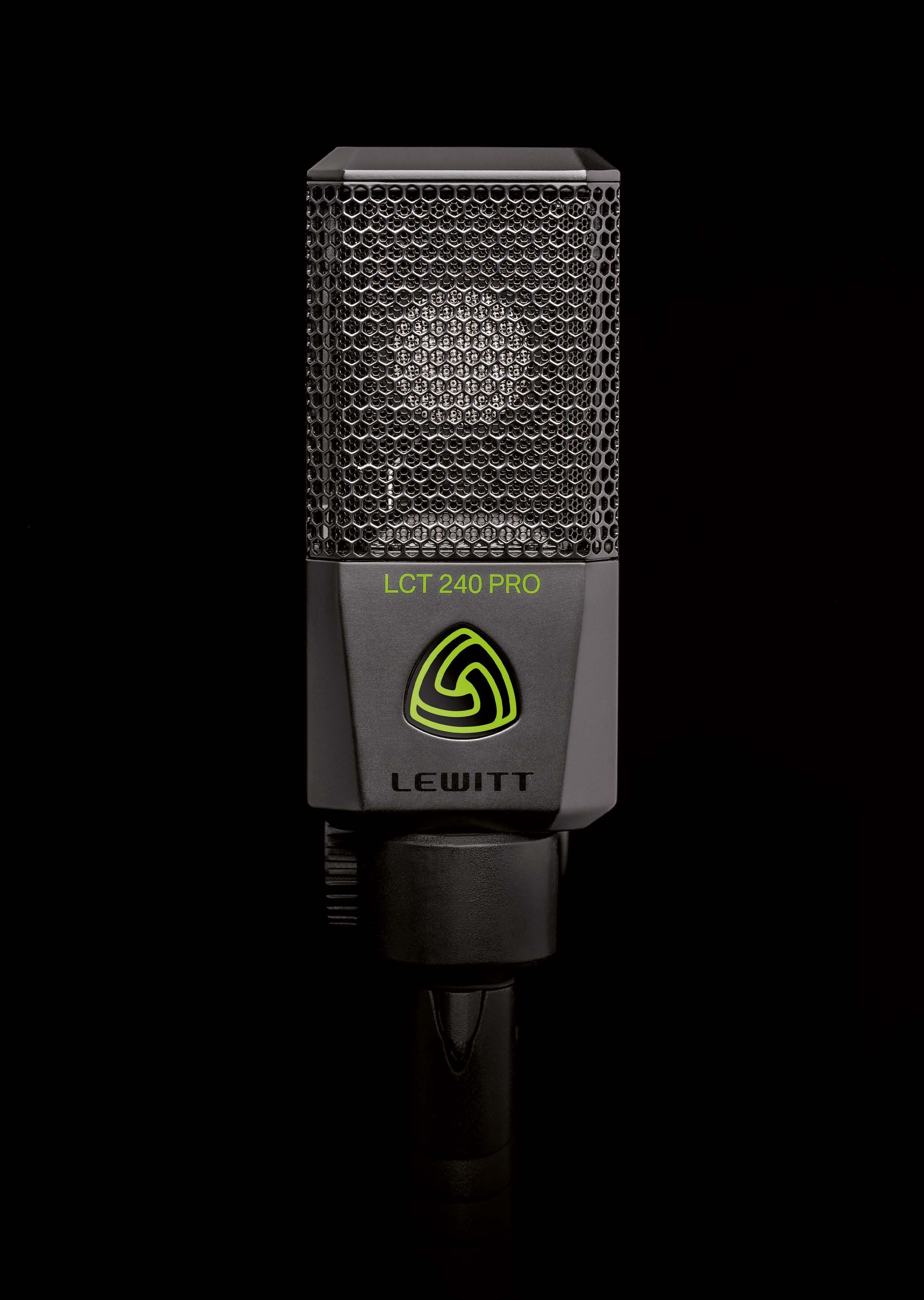
LCT 240 PRO
The perfect microphone for home recording.
• Easy-to-use XLR microphone
• For recording vocals and instruments at home
• Professional sound quality
• Cardioid polar pattern
THE ULTIMATE EVENT FOR DJS AND PRODUCERS ARRIVES UP NORTH
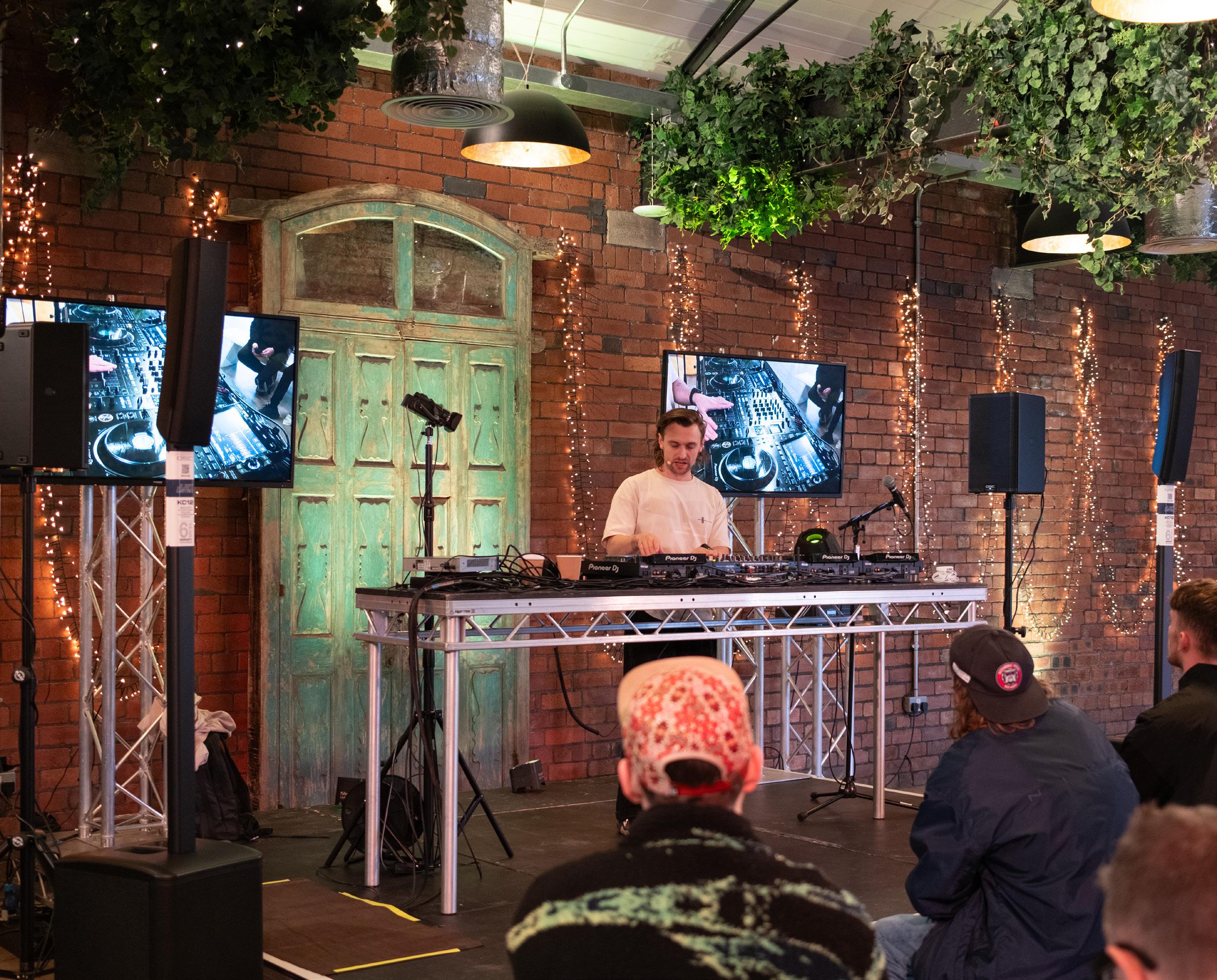
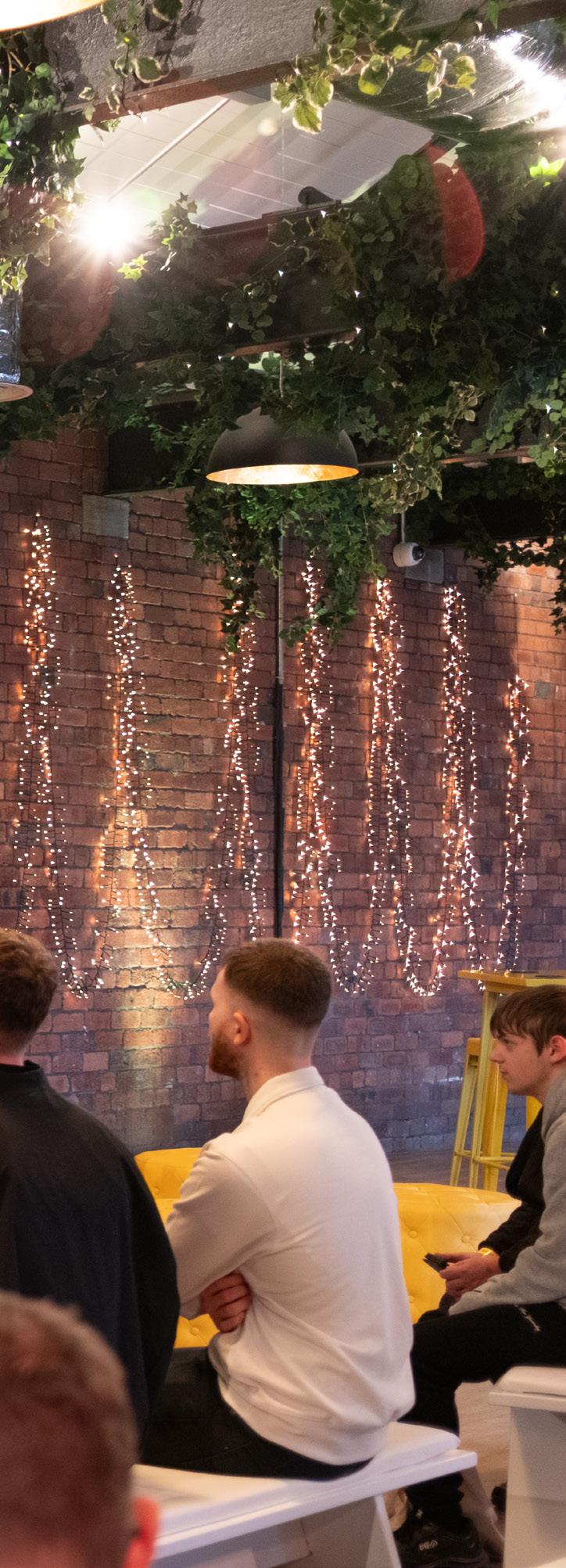
Wakefield, West Yorkshire – once dubbed the ‘Merrie City’ in the Middle Ages for its festivals and street plays, the birthplace of Barbara Hepworth and The Cribs, and now the host city for the inaugural 2026 CRE8. A day in which DJs and producers come together in a place for people in music to sharpen skills, expand into the industry via networking, and learn how to grow a personal brand. This creator’s dream is a powerful coming together from the Headliner Group, PLASA, TikTok LIVE (with the full event streamed live on the platform), and the stunning Tileyard North, the UK’s largest creative community venue outside of London. Exciting artists such as TeeDee, Lily C-D, Bobby Harvey, and Ace Clvrk were on site, creating new tracks live, running insightful workshops, and performing blistering DJ sets.
There have been complaints for years that the UK music industry has been far too London-centric. This seems to be shifting, though: the 2026 Mercury Prize, which ultimately went to Geordie Sam Fender, was held in Newcastle; and this year’s BRIT Awards took place at the CoOp Arena in Manchester.
Headliner was proud to buck this trend by making Wakefield the home of CRE8 for the first time. The Yorkshire city is rich in cultural history, and long before TeeDee was waking up ‘Wakey’ with subbass, there were once official
virtuoso town musicians known as the ‘Waits’ patrolling the streets. Local historians believe that the popular singing rhyme, Here We Go Round the Mulberry Bush originated with female prisoners at the local Wakefield prison. There is even a rhubarb festival which celebrates Wakefield’s 150-year history of growing the pink vegetable. Get that crumble ready!
CRE8 kicks off on a foggy Saturday morning in March, in Tileyard North, a stunningly converted building that reflects Wakefield’s industrial mill past. First up on the talk front is The ArtistAgent Conversation for the 10.30 am early birds. Successful artist and DJ, Sally Rodgers, quickly shows how valuable having a booking agent can be, remarking that, “I never had a good poker face for negotiating fees, I’m too gobby!” And, when her agent Matthew Johnson set her first high fee for her sets, her initial response was, “If you’re sure, but I’ll probably never gig again!” As well as making sure the DJs and artists he works with get paid properly, Johnson talks about other key parts of his agent role, for example, “Making sure the press pack and artist photos feel zingy and up to date”.
This is shortly followed by The Promo Panel, featuring insight from Ben Brindle, head of promo at Helix, and Jay Ahmed, head of promo at Your Army. Brindle makes the vital point that “Success is different; for some it might be a Friday night radio play, for another it might be their first ever
New Music Friday on Spotify.” When asked about traditional versus the more contemporary versions of music promo, he says, “I will always fly the traditional promo flag; it still has a place. Press, radio, and TV can be such a concrete part of everything. But you have to be reactive.” Ahmed gives an excellent example of turning a viral moment into a release: “Femi from Ezra Collective spoke over the top of a Fred Again track at Ally Pally — they then released it the next day, and it did huge numbers.”
While these moustache-stroking talks take place, upstairs in The Mill is a different prospect for those seeking a break from the chin-wagging and instead seeking big beats. There are bone-shuddering back-to-back sets from Manchester star Lily C-D and fellow Mancunian Jentzen, as well as soon-to-be superstar DJ Emma 2000, the Skepta and Central Cee supporting-Nøah, and a return from Sally Rodgers, this time letting the decks do the talking.
All that before a headline set on the main stage from drum and bass legends, Brookes Brothers, one of D&B’s most successful duos.
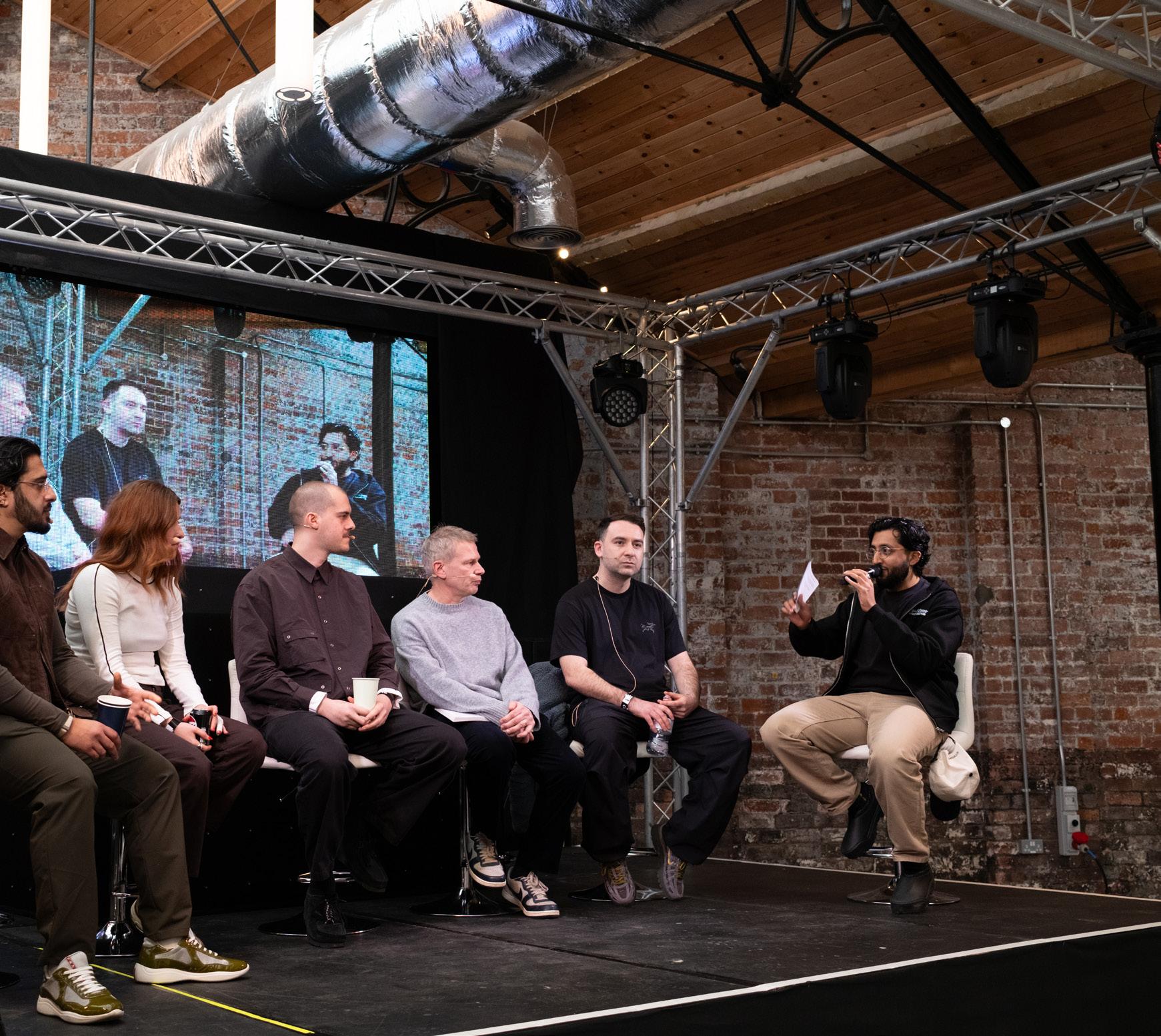
Next is the Management Panel, featuring industry veterans Annie Josephine, Jasmine Igoe, Lee Haslam, and Kurt Hurst. This talk is rammed with essential advice, including: “You want a manager to come to you, not vice versa, otherwise you’re on the back foot.” Trust between manager and artist is emphasised with, “If there’s no trust between us, that’s a red flag.” And for those interested in becoming artist managers, they are left with, “You’re going to be spinning a lot of plates, so attention to detail is very important. You’re an extension of the artist.”
There’s plenty of excitement upstairs, as Crossfader DJs run workshops exploring the art of DJing, with cameras and a backdrop screen ensuring the audience of budding selectors get to see every single move these seasoned artists make.
Best of all, they aren’t gatekeeping the decks; DJs get to make their way up to the front and have a go themselves.
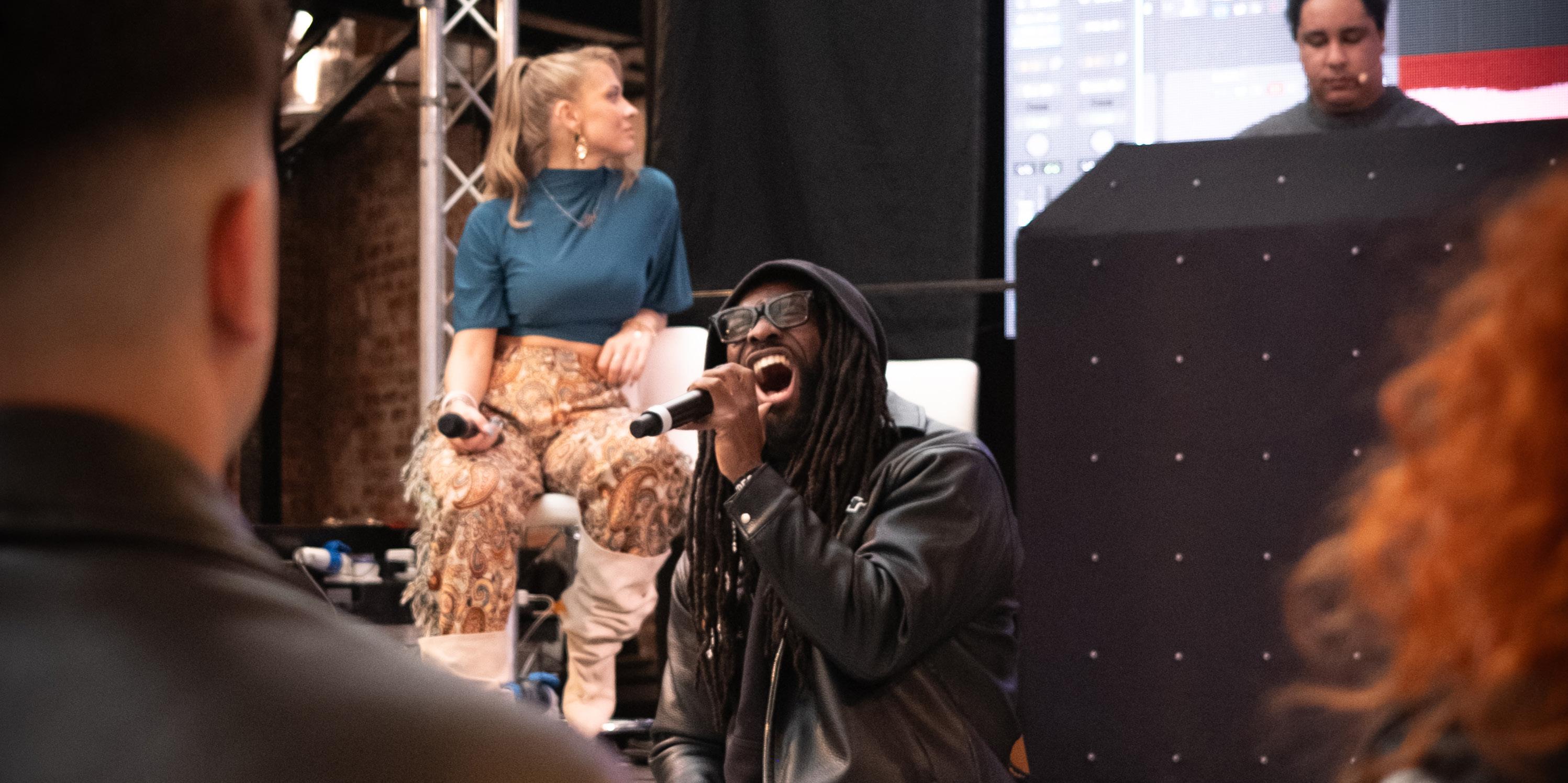
Back downstairs, as we pass the lunchtime mark, it’s the turn of the record labels to take the stage. It’s another panel packed with quotes to live by - for example, Omar Khan of Hyperactive World says, “We’re an artist-first brand. We’re less focused on release frequency and instead getting the record right and then putting it out.” Phil Sagar from Armada adds, “The music industry has changed, but the core principles remain the same: is the song relevant? Who’s playing it? We always stick to that, however much the industry changes.”
Two standout moments of the day are a live workshop with Sheffield’s TeeDee, a DJ/producer who has worked with the likes of Bugzy Malone. A bewitched audience watches on as he creates a track completely from scratch in Ableton Live. He’s followed by Bobby Harvey, who gives a rare glimpse into his Logic sessions as he talks the crowd through creating his recent hit, Waterfalls (with James Hype and Sam Harper) using a bare bones setup in Ibiza.
One of the most exciting tech moments of the day is the Immersive Audio panel, hosted by Headliner’s own CEO, Paul Watson. He asks big questions such as, “The streaming services have
been floating the idea of embracing spatial audio for years. Is it just talk?” Veteran engineer, Simon Todkill, replies, “It’s been on the cards for years, with Dolby Atmos, etc. It’s evolving, and the earlier in the recording process we can start using it, the more widespread it will become.”
Headliner’s head of bookings, Henry Day, had this to say about the day’s success: “CRE8 was about real access, connecting industry leaders with the next generation. Seeing emerging artists ask questions, make connections and take something away is why we built it. It only worked thanks to everyone involved: panellists, artists, crew, and venue staff, all aligned to support new talent.”
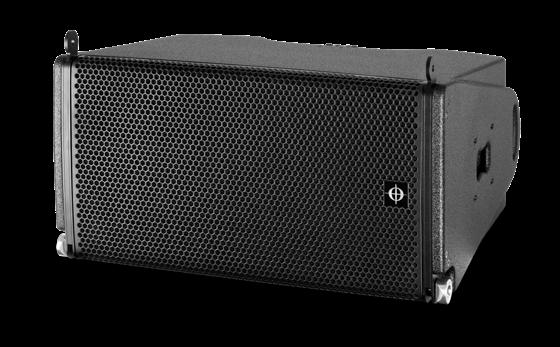
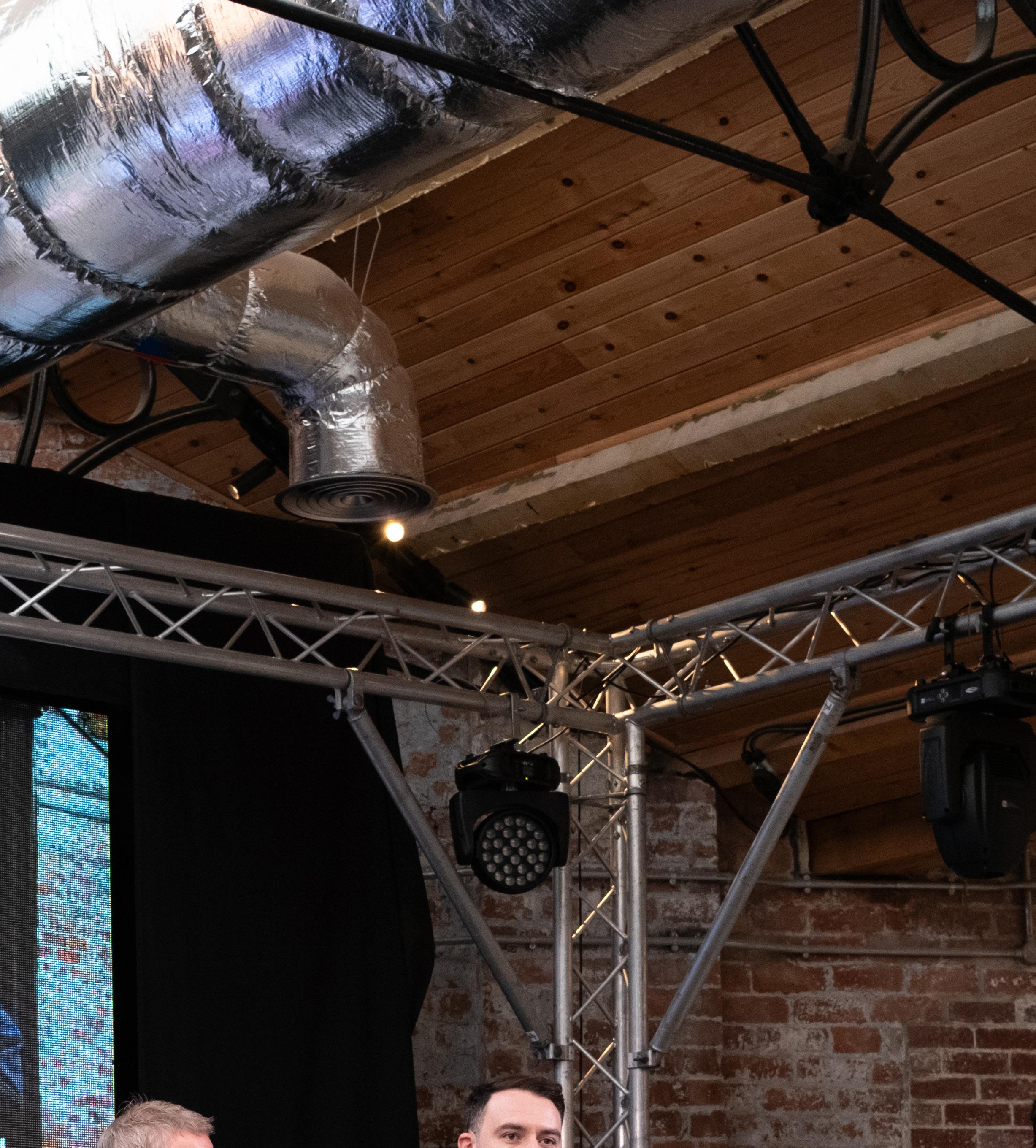
“We opted for the self-powered version for speed; I only had to plug in a couple of 16A CEEform connectors and run a single XLR aside,” Dickerson explains. “The system comprised two 2x15 sub cabs and column units, each sporting four 6.5-inch drivers and four high-end MAILA SAT passive satellites. These boxes lock together to hide power contacts, producing a classic 100° horizontal and 8° vertical dispersion pattern.” Despite the small footprint, the MAILA performed exceptionally; even 70m from the back wall, the speech from our panellists was crystal clear.
Headliner’s in-house engineer, Rick Dickerson ran us through the allimportant tech setup for the inaugural event. “Our first CRE8 featured top-tier equipment partners,” he begins.
The stage, supplied by Steve Williams of Viking Productions, was anchored by the flagship LD Systems MAILA Rig, brought by Lee Harper and Oliver Webb.
“We utilised a booth from Paladin Innovations housing three CDJ3000s and a V10 mixer, with monitoring provided by LD Systems Stinger G3-10 coaxial monitors and a G3-8 centre fill,” Dickerson elaborates. “FOH control was handled by an Allen & Heath SQ5 and eight channels of Shure Axient digital wireless receivers. The setup worked superbly for everything from spoken word to high-SPL dance sets from DJ EMMA 2000 and Brookes Brothers, sounding warm, detailed, and distortion-free throughout.”
QSC powered the Crossfader workshops, a compact and powerful
THE TECH DRIVING THE CRE8 MAINSTAGE
rig the team knew would excel in this room. “We used the QSC K12.2 system, which provided such a full sound that we removed our additional KS118 sub,” says Dickerson. “Booth monitoring was handled by a pair of K8.2s on stands. Jamie Hartley from Crossfader ran two DJ workshops here, using three CDJ3000s and an A9 mixer on an 8’ x 2’ riser, with camera feeds to large TV screens for the students. QSC also supplied a TouchMix digital desk to handle the DJ mixer and four channels of Shure Axient wireless.
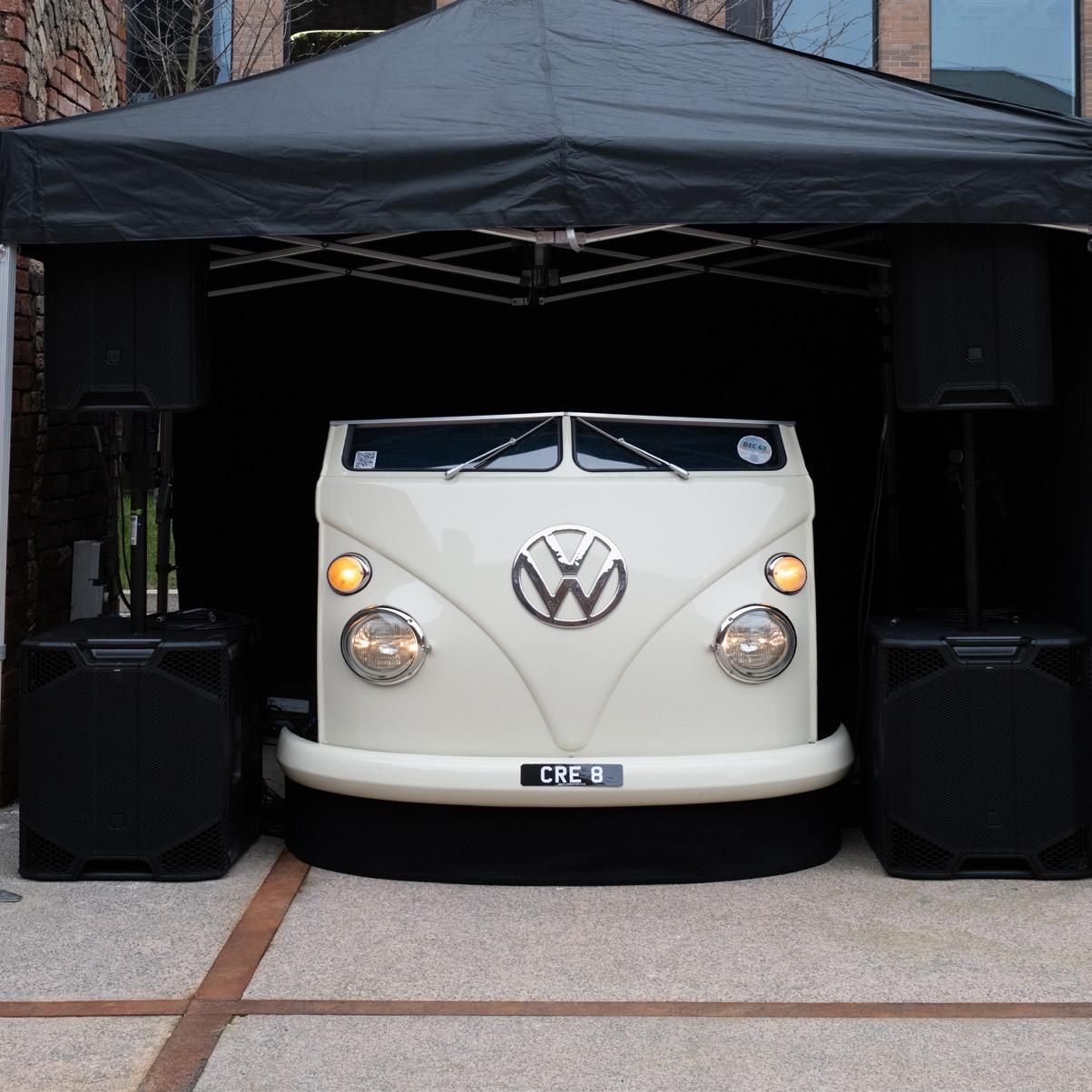
“LD Systems did us proud once more in the courtyard,” Dickerson enthuses. “The DJ booth was a custom VW camper van front from Paladin Innovations, complete with illuminated headlights, housing three CDJ2000s and an A9
mixer. We flanked the van with stacks of LD Systems ICOA point-source speakers – an ICOA Sub 18As paired with 12A BT tops. This attention-grabbing system pointed the way to our main entrance, with an ‘open DJ policy’ that invited guests to plug in their own USBs and give it a whirl. The ICOA 12A’s coaxial design and rotating CD horn made it a versatile performer, proving a great advert for our partners and the CRE8 event as a whole.”
Dan BB shares his glowing review of the sound system on the day: “The LD System handled high-energy drum’n’bass without breaking a sweat. Clean, loud and controlled.”
Photographer: Atiba Jefferson
VISUAL DESIGN FOR CRE8
Headliner also caught up with digital and surface designer Emma Briggs about creating motion graphics and visuals worthy of the event, venue, and the TikTok LIVE broadcast.
“My role involved working alongside PLASA and Headliner to ensure all relevant TV and animated graphics were created, maintaining a consistent visual identity across the event,” says Briggs.
“I was responsible for designing and operating the lighting in both the main event space and the upstairs area, ensuring clear and balanced illumination for the speakers during panel discussions before transitioning to a more dynamic, DJ-style atmosphere for the evening sets. During the live event, I managed the visuals on the main stage LED screen, operated two PTZ cameras, and vision mixed the feeds together with presentation content for the TikTok LIVE broadcast.” To support the broadcast, the team used a feed from ProPresenter alongside the two PTZ cameras, vision mixed using a Sprolink switcher with a dedicated PTZ controller for precise shots.
The Sprolink also received a clean audio feed from the SQ5 mixer, which proved straightforward to configure and manage. Graphics and holding screens were run through ProPresenter; its layered system allowed text elements to be easily edited after backgrounds were uploaded, which was particularly useful for implementing quick changes to panel titles or speaker information without needing to redesign entire slides.
The final visual output from the Sprolink was sent both to the LED screen at the back of the stage and simultaneously
to TikTok LIVE. “This duplicated output workflow allowed the same program feed to serve both the in-room audience and the online viewers without requiring additional routing or systems,” Briggs explains. “The integration of ProPresenter, the PTZ system, and the Sprolink allowed for a streamlined workflow, though additional camera angles and improved pre-event testing time could further enhance the visual interest and refinement of transitions for future events.”
THOUGHTS FROM THE VOICES OF
After his incredible session creating a track live, Teedee says, “An event like CRE8 pulls back the curtain on how the people in this industry work. Not just producers but promoters, managers, and label owners. It just goes to show it’s not as complicated or as smoky as people may think.”
Following lending her voice on the management panel, Annie Josephine says, “I believe it’s good to create this kind of interactive space, because it can be difficult to get a foot in the industry, and it’s good we can share a bit of that and open up the door to give some advice. I didn’t get a lot of help when I started out, so it’s nice to be able to give a bit back.”
Following the label panel, Coryn Brunavs was also full of enthusiasm: “It was nice to meet different people doing the same things with different labels and hear how things work slightly differently. So it was really fascinating for me. Learning about the multiple jobs there are in the music industry and what people actually do is really important and vital.”
After the peak behind the curtain of creating his hit, Waterfalls, Bobby Harvey is also delighted with how CRE8 turned out. “I’ve spent over 10 years coming to events like this, and without
“CRE8 PULLS BACK THE CURTAIN ON HOW THE PEOPLE IN THIS INDUSTRY WORK. NOT JUST PRODUCERS, BUT PROMOTERS, MANAGERS, AND LABEL OWNERS.”
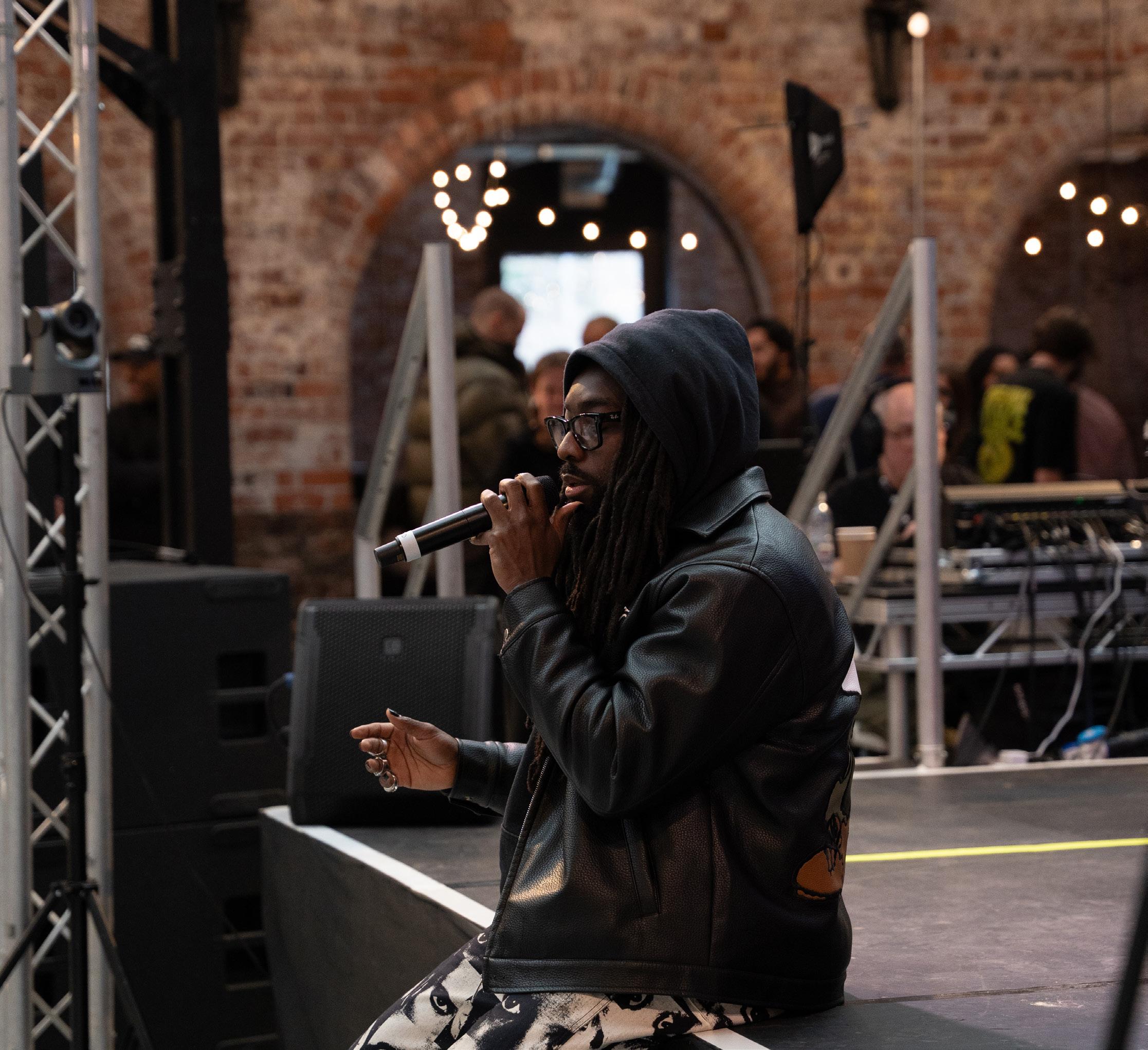
it, I wouldn’t be here now talking about how I got to where I am. If I hadn’t been asked to come and speak here, I would have come anyway. It’s such a great place to meet artists and industry professionals face to face. As soon as I walked in here, I could imagine this continuing and being great.”
Gary Spittle is also on a high following the immersive panel. He feels that, “We were expecting to see quite a broad range of people and we exceeded our expectations. We had everything from students who are still at college wanting to learn about music and technology to some of the country’s best DJs and music producers. It’s been fantastic.
“To be involved with a groundbreaking event, we wanted to learn from people who will actually be using our technology and also be part of this great environment here at Tileyard. It’s a great place for everyone to come together at different levels. You have some of the really big brands rubbing shoulders with really small brands and startups like us. We need more events like this, because it’s very accessible for smaller companies.”
After dropping gems of knowledge at the social media panel, Grahame Farmer shares the final word: “There’s so much going on down south already, and a lot of people can’t make it
anyway because it’s too far to travel or too expensive. So having an event like CRE8 up north is so important.”
As CRE8 draws to a close, there’s a very palpable sense that the gathered artists, DJs, and producers are going away having learned invaluable things for their crafts and careers, and with their cups full.
Let’s all dust off the decks and do it again next year – roll on CRE8 2027.
CRE8DJ.COM
A NEW HIGH IN THE LOW END
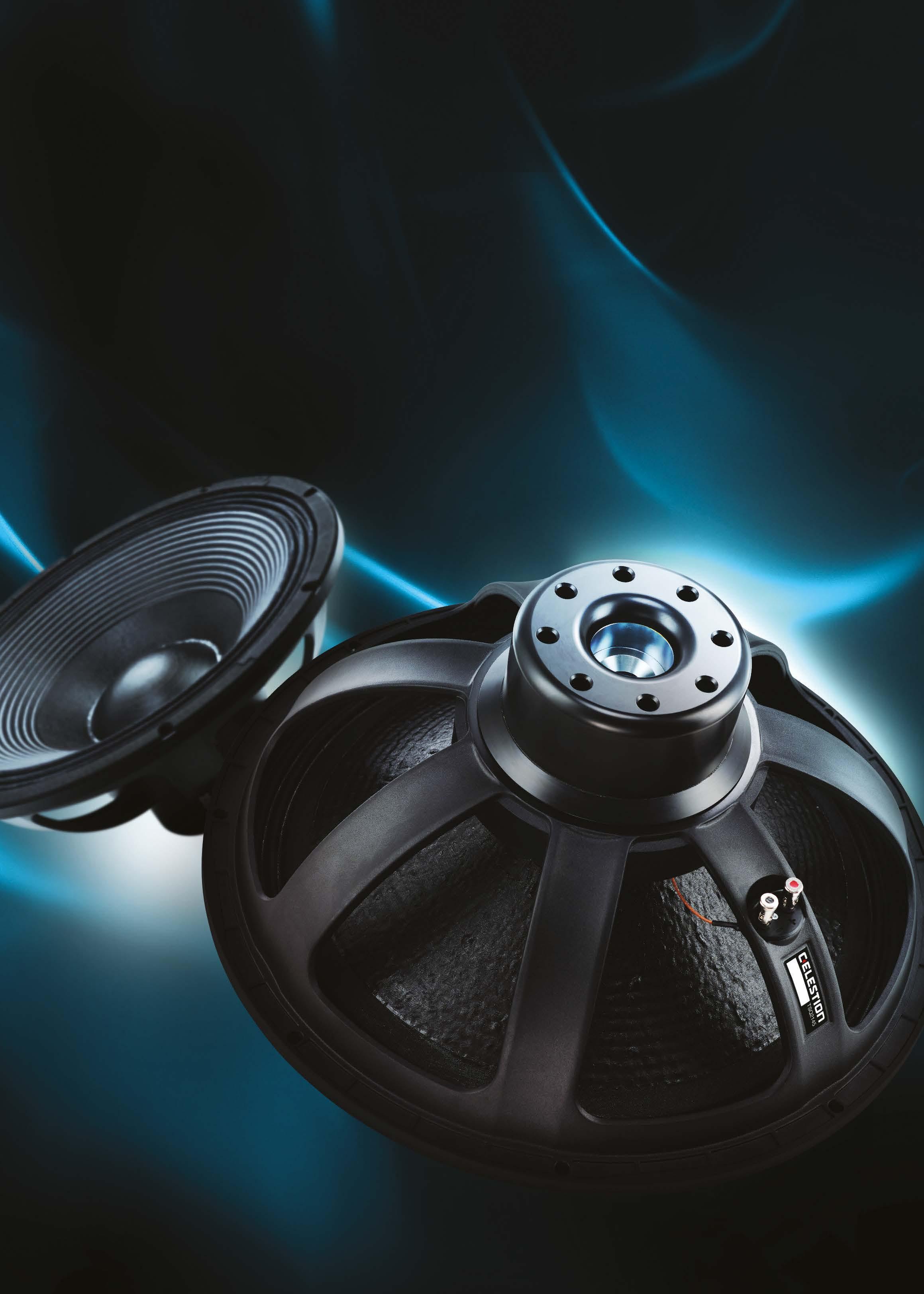
Designed and built in the UK, Ten Squared (Ten2) is a range of premium, low frequency loudspeakers. Engineered without compromise, they deliver consistently superior levels of performance in the most demanding professional sound reinforcement applications. All the time. Every time. 18, 21 and 24-inch models available. Discover Ten
celestion.com
WORDS BY ADAM PR O ZT
SOFTCULT FROM RADIO POP-PUNK TO SHOEGAZE RAGE
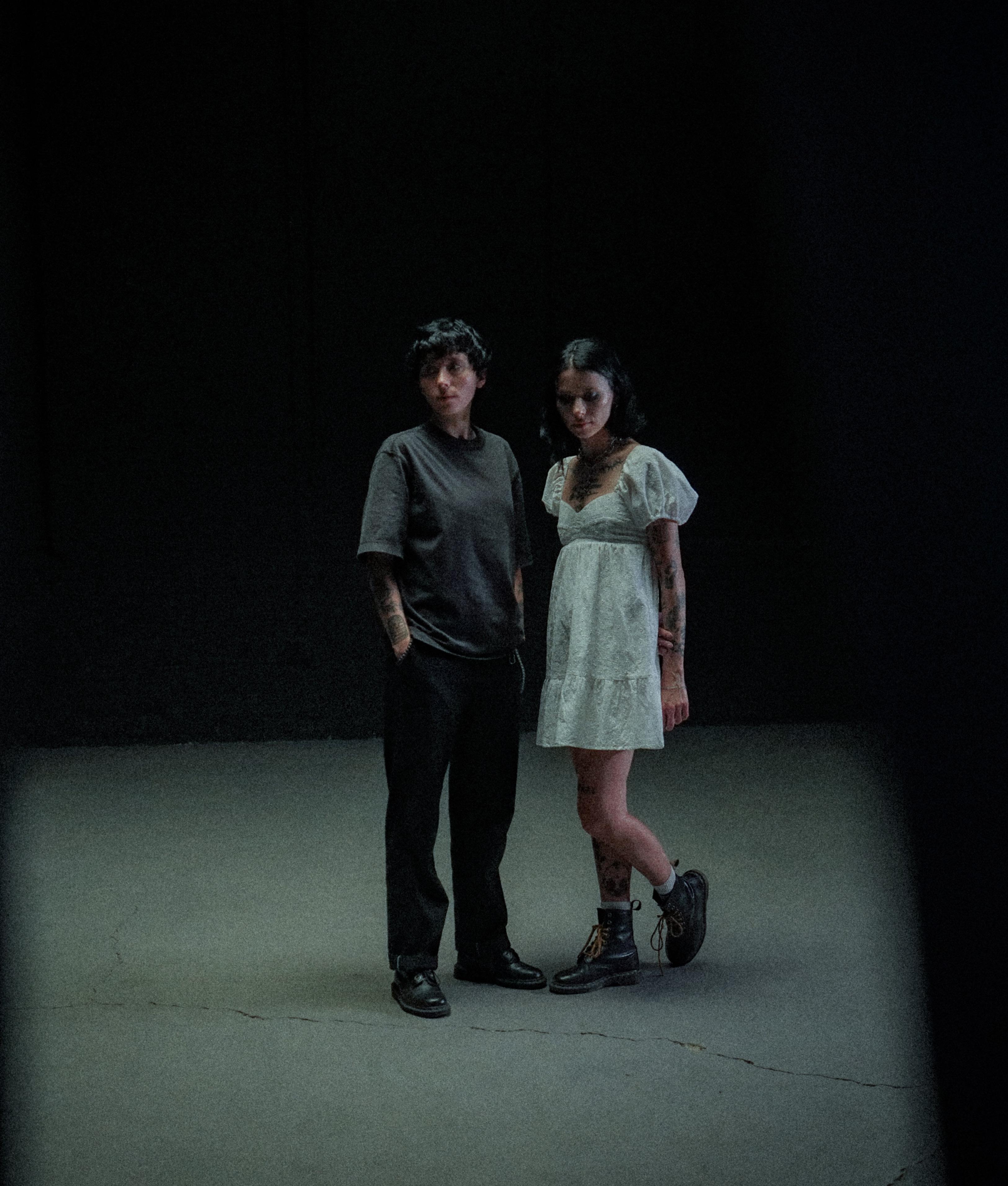
Not many bands have quite the trajectory of going from cheerful poppunk songs about comic books to cathartic grunge and shoegaze that rails against the patriarchy, gender disparity, and personal upheaval, but that is the story of Canadian twin siblings Softcult. The Ontariobased Mercedes and Phoenix Arn-Horn penned a record deal at a young age as the poppier Courage My Love, but a decade later, yearned for a fresh, DIY start and a more mature sound in Softcult. Early singles such as Uzumaki built strong hype and garnered radio coverage from the likes of 6 Music, with North America and Europe touring following. Mercedes Arn-Horn speaks with Headliner about the road to their new debut album, When a Flower Doesn’t Grow, reinventing their sound, and the decision to go from the radio-friendly lyrics of the first band to raging against the machine.
Perhaps the twins’ parents felt careers in entertainment were inevitable when naming their children Mercedes and Phoenix, who found early success and a record deal in the trio Courage My Love. Active as early as 2010, the group released a number of EPs and two studio albums throughout the 2010s. However, they encountered creative roadblocks on the record deal they signed at a young age, and were desperate to be freed from that contract and start fresh.
During the Summer of 2020, Softcult was born. Their break from the lyrics of their previous manifestation, and strong social commentary was established early in songs such as B.W.B.B., which was written as a response to the murder of Sarah Everard at the hands of a
policeman in the UK. The 2022 EP Year of the Snake also spawned huge singles, Spit it Out and Uzumaki , two firm favourites which are exemplary of Softcult’s gritty sound, while retaining the big, heavy riffs of their past.
“We’ve been doing it, honestly, ever since I can remember,” Mercedes Arn-Horn says, who is in Seattle for the North American leg of their current tour. “Even when we were just little kids, Phoenix and I were always writing songs together. We started our first band when we were 14 years old, and started touring when we were 16. It’s what our lives have revolved around for more than half of our lives at this point.”

Credit: Kaylene Widdoes
Regarding the decade or so in Courage My Love, she says, “We were into pop-punk and more of an adolescent sound, which is natural considering that we were adolescents at the time,” she laughs. “We got signed pretty young; we were only 16, so Phoenix and I couldn’t even sign the contract. They had to get our parents to sign it. Honestly, those years were really interesting – they were fun because we were learning the ropes and touring a lot.
“We were grinding with Courage My Love for 10 years. We ended up in a situation where we were starting to butt heads with our label and not getting along on a creative level. They wanted something very different, and we ended up writing so many songs that never came out. Somewhere along the way, we felt like we lost our creative voice and identity. We ended up asking the label to drop us and let us go so that we could start something new and find greener pastures.
“When the pandemic hit, I think we had so much pent-up creativity that had no place to go, and that’s where Softcult started.”
Headliner enquires if it was a conscious decision for Softcult to go from the more radio-friendly lyrics of CML to their contemporary writings, some of which are like a gut punch. The second verse of Spit It Out, for example, reads: “Such a pretty girl / But pretty things should be seen and not heard / Ornament on a shelf / You make me wanna erase myself.” Unsurprisingly, Arn-Horn affirms that this was the case.
“We got a lot of pushback on that! Anytime we wanted to write anything that wasn’t accessible to the majority of people, it was always a hard no. In a lot of ways, we felt silenced. We wanted to use our platform more responsibly — when we
started Softcult, it was Trump’s first administration. Then George Floyd was murdered, Sarah Everard was murdered, and the Me Too and Black Lives Matter movements were at the forefront of everyone’s mind. We were writing the songs at a very turbulent time, where it felt almost impossible to write about anything else.”
Six years into this new chapter for the Arn-Horn twins, and after four EPs, we have the much-anticipated Softcult debut album, When A Flower Doesn’t Grow. It’s a record that powerfully delivers on all the hype and promise the group have been steadily building over the years. While the title alludes to the fact that if a flower won’t bloom, it’s the fault of the environment, not the flower itself, it also serves as a fantastic metaphor for their gothadjacent transformation.
The album’s first single was 16/25, a track with a driving shoegaze riff, the bed for the trademark Arn-Horn
hypnotic vocal harmonies. This verse then opens up into one of the band’s biggest choruses yet, as the siblings sing, “She’s sixteen, you’re twenty-five.”
On that powerful album title, which also serves as the album’s closing title track, Arn-Horn says, “I was looking for some guidance and self-help that might comfort me. I was going through a huge change in my life where I was embracing my sexuality and identity as a queer person. That was an exciting and joyous thing, but also a scary thing — it meant that I had to end my relationship that I was in for nine years with my partner, and basically go into this unknown. That quote helped me through it. Then I wrote a song called When a Flower Doesn’t Grow at four in the morning, and I sent the voice note over to Phoenix. Phoenix wrote me back the next day and was like, ‘Oh, we have to make that the album title, and this should be the final track on the album.’

Credit: Kaylene Widdoes
“ANYTIME WE WANTED TO WRITE ANYTHING THAT WASN’T ACCESSIBLE TO THE MAJORITY OF PEOPLE, IT WAS ALWAYS A HARD NO.”
“Phoenix had this whole idea that we were going to make this a concept album. All the songs would be about how individuals get to this point where they feel empowered, not oppressed. We realised that the quote was bigger than our own personal experience, and we have to be the ones who change the environments around us so that everyone has the opportunity to thrive, grow and live authentically. It became a call to action.”
The latest single from the album is its penultimate track, Not Sorry, accompanied by its Handmaid’s Tale-esque music video, directed by Arn-Horn herself. Besides directing the music videos, another way the duo have ensured their creative freedom and DIY ethos that wasn’t previously
possible is with Phoenix engineering and producing the music, as well as all of Sotcult’s cover art. Not Sorry is another great example of the siblings setting their soft, angelic vocals and harmonies against biting, distorted guitars and drums. While it sometimes feels like the world is completely ablaze every time the news flashes up, Arn-Horn is feeling optimistic about how the music industry is becoming a safer and more inclusive space.
“I feel the conversation around gender equality, especially in the music industry, has just opened way up compared to when we were teenagers and just starting,” she shares. “We did experience our fair share of misogyny in those early years, and I think it was normalised for us
at that point. When you’re young and don’t have a ton of experience in the world, it feels like that’s just how it is. Then, as we got older and started to put the pieces together, we got really angry and asked, why is it this way? Why are we accepting it as the status quo? But I’m happy to say that now, even in the last 15 years, music and alternative music has diversified a lot. You see a lot more women on stage, a lot more queer artists, and different races and cultures. It’s still a work in progress, but I am so happy to see it going in this direction. A lot of the guys in bands, too; we have two guys in our band, and they’re great. I think there is this broader awareness now and solidarity that was not always there.”
Following their March tour of the US and Canada, Softcult will head to Japan in June, as East Asian fans are able to experience the new album live. When A Flower Doesn’t Grow is out now, and Arn-Horn is very glad to be out performing it in person instead
of obsessing over the social media side. “We went straight out on tour when it was released, so I’m losing the plot a bit,” Arn-Horn laughs. “It’s really fun to have the chance to tell a story with a full-length album, and find out which songs are connecting with people — it’s almost never the ones that you anticipate.”
SOFTCULT.BAND
Credit: Kaylene Widdoes
MYTH OR TRUTH?
The best sounding live console was originally designed for broadcast.
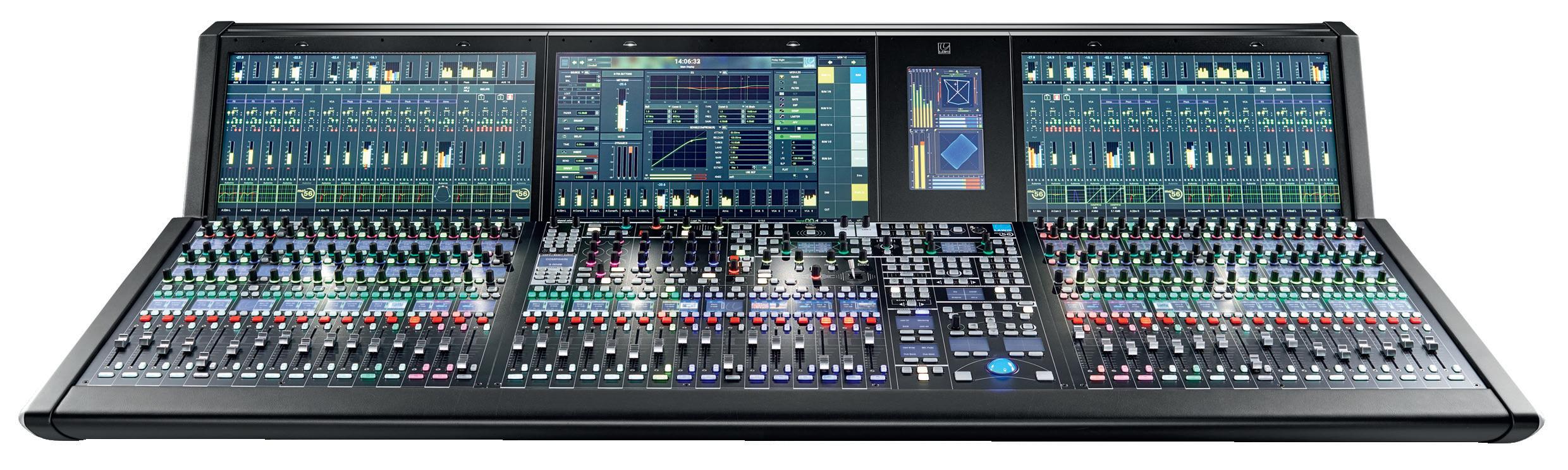

Hearing is believing – sign up and find out for yourself.
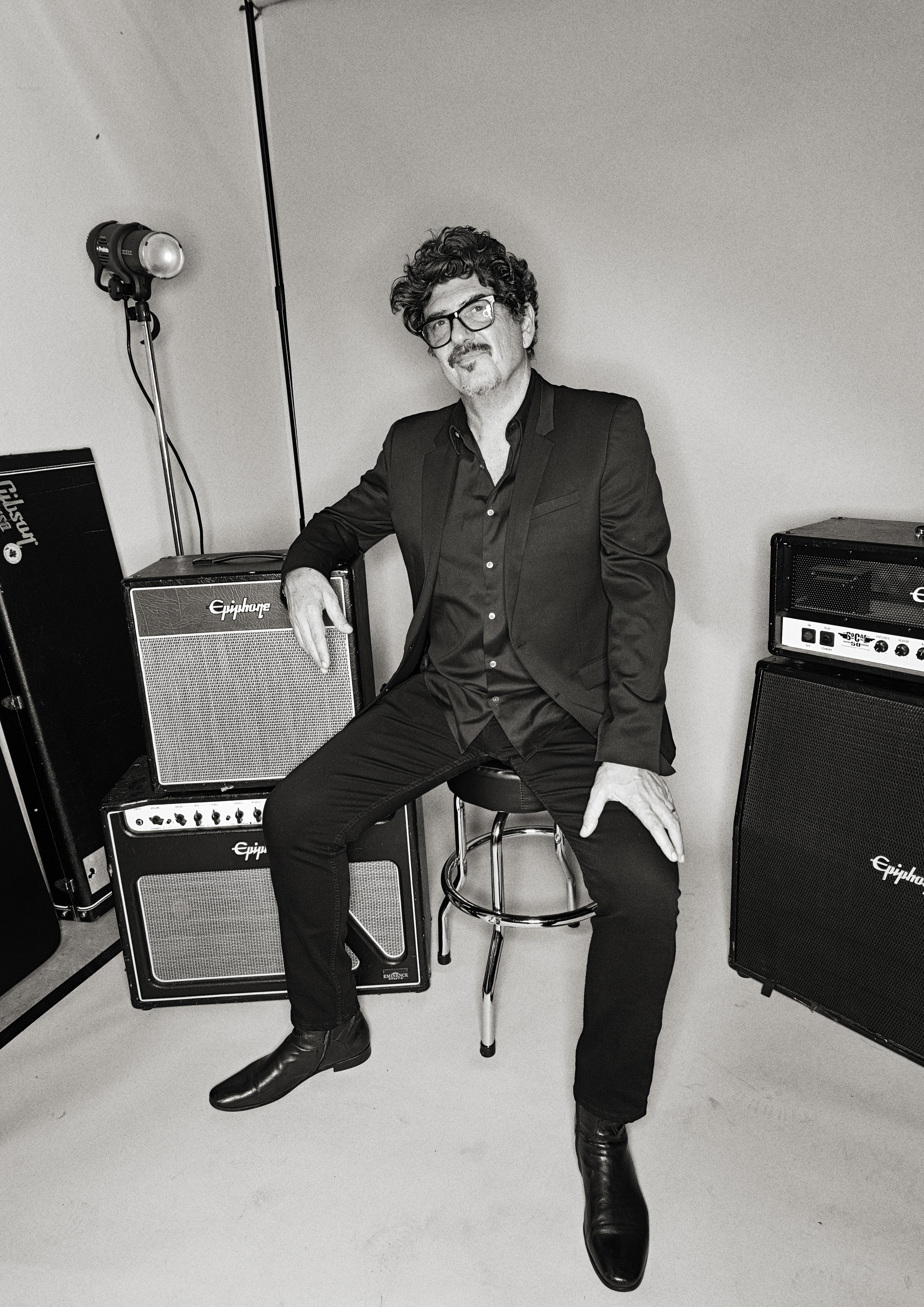
Warner Chappell Music’s Gustavo Menéndez
Credit: Basilio Silva
WARNER CHAPPELL
MUSIC’S GUSTAVO MENÉNDEZ
THE LATIN MUSIC EXPLOSION
Latin music’s global momentum shows no sign of slowing in 2026. What was once described as a “crossover” movement has now become a dominant force shaping the mainstream music industry – from recordbreaking revenues and streaming growth to historic wins on the world’s biggest stages.
According to the Recording Industry Association of America’s 2024 YearEnd U.S. Latin Music Revenue Report, Latin music revenues in the United States reached a record $1.4 billion, rising 18% above the genre’s previous inflation-adjusted peak in 2005. It marked the third consecutive year that revenues exceeded $1 billion, with Latin music continuing to grow faster than the overall market.
Unsurprisingly, fans’ engagement on streaming services remains the engine behind the genre’s expansion, accounting for 98% of total Latin music revenues, while Latin music’s share of the total U.S. market climbed to 8.1% in 2024. Paid subscriptions generated $967 million, and ad-supported streaming – including platforms such as YouTube and the free tier of Spotify – accounted for $354 million, nearly a quarter of the market.
Beyond the numbers, Latin artists are increasingly defining the cultural conversation. At the 2026 GRAMMY Awards, Bad Bunny made history by becoming the first artist to win Album of the Year with a record performed entirely in Spanish, taking home the prize for Debí Tirar Más Fotos, along with two additional awards. And his year of dominance extended far beyond the GRAMMYs. Bad Bunny also brought a Spanish-language performance to what is now officially the most-watched Super Bowl halftime show performance of all time, performing for a global audience of more than 125 million viewers and sharing the stage with fellow Latin icon Ricky Martin, one of the best-selling Latin music artists of all time.
Other Latin stars are similarly breaking new ground. Karol G is set
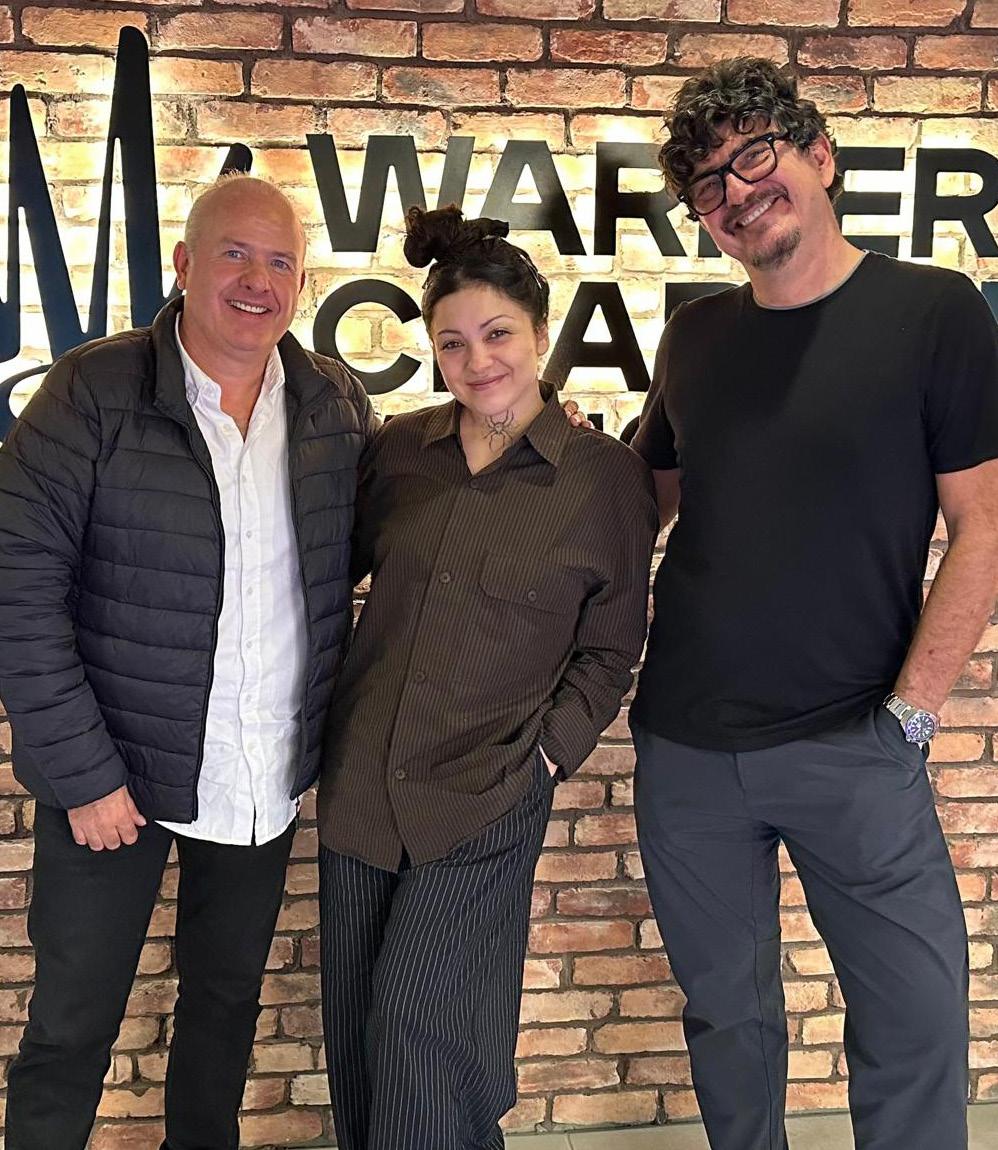
to become the first Latina artist to headline Coachella in April 2026, while Shakira recently made touring history with her Las Mujeres Ya No Lloran world tour, now the highestgrossing tour by a Hispanic artist, earning more than $421 million in revenue. Meanwhile, other Latin creators continue to earn recognition at the industry’s highest levels. At the GRAMMYs, Gloria Estefan won Best Tropical Latin Album for Raíces, while CA7RIEL and Paco Amoroso took home Best Latin Rock or Alternative Album for PAPOTA, further underscoring how Spanish and Latinrooted music now sit at the centre of global pop culture.
Behind many of these successes are the songwriters, producers and publishing teams helping shape the genre’s future. One of the most influential figures in that ecosystem is Gustavo Menéndez, President of U.S. Latin and Latin America at music publisher Warner Chappell Music.
With more than two decades at the company, Menéndez has built a career discovering and nurturing talent across the Latin music landscape. Today, he oversees a roster that includes stars such as Juanes, Maná, Rauw Alejandro, Yandel, Tokischa, Danna Paola, Marco Antonio Solís and Maria Becerra. As Latin music continues its unprecedented expansion, Menéndez remains focused on the foundation of it all: great songs and the songwriters behind them. In this interview with Headliner, he reflects on his unconventional route into the industry, his perspective on the forces driving Latin music’s rise, the responsibility of nurturing new talent, where the genre is headed next, and if its current trajectory is sustainable.
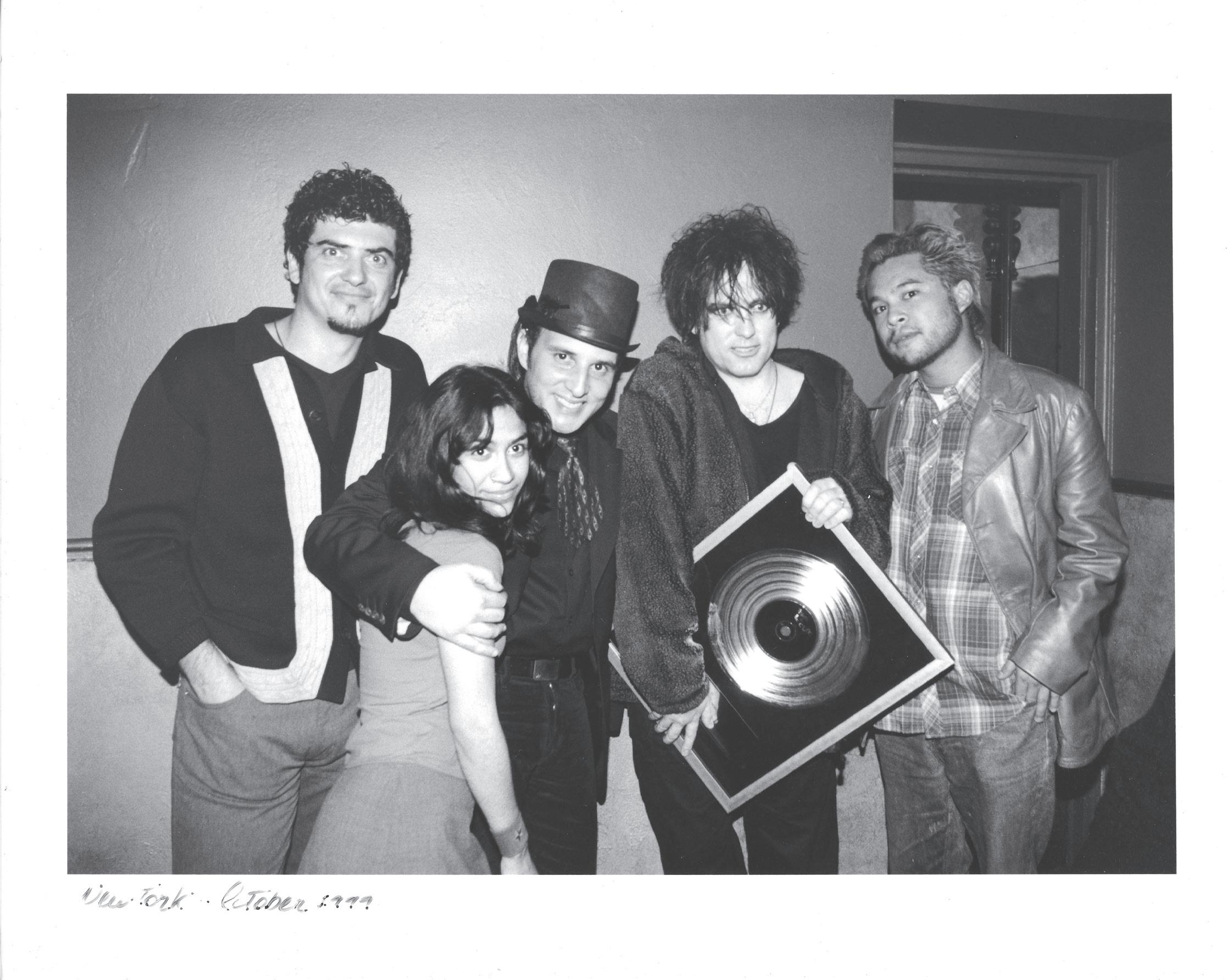
How did producing and starting your own label influence your understanding of the business side of music?
I’m proud and ashamed at the same time to realise that I had no clue what the business entailed. I just dived in and learned the business the hard way. It was just a matter of wanting it, and I’m super lucky because it panned out all right. It was always about wanting to help people to be heard, and then it turned into a business. Being independent, I had
no clue that you basically had to wear a thousand hats.
What led you to transition from running your own label to music publishing, and what drew you to that side of the industry?
I think it was fate. I was able to take the record company to a certain level, and then I decided to sign all my artists with major labels, which I was able to do. While looking for new opportunities, publishing kind of landed on my lap. A good friend of
mine ran Warner Chappell, and she made me an offer I couldn’t refuse [laughs]. At the beginning, I was a little reluctant, because I didn’t know much about publishing.
But basically she said, “It’s all about music,” and that opened the door for me. I thought it was going to be an interesting experience, and 20-something years later, here I am!
What were some of the biggest challenges or turning points in those early career moves that helped define your professional identity?
When you’re independent, you can’t slow down. That applied to my whole career afterwards, although the huge change is that you have the backup of a corporation. Nonetheless, the engine needs to be running at the same intensity and speed. I don’t think it was a hard transition from indie to major. I saw it as a great opportunity to tackle the business the same way, but now with this huge backup. I’ve always kept that indie mentality, to think outside the box. It’s always been my motto: don’t conform to standards.
What lessons from your earliest years in the industry still guide you as a leader today?
I remember one time at the very beginning, I was with Rick Shoemaker, who was the president of Warner Chappell, back then. We were in Miami at the first Latin America MTV Awards. There was somebody there who, at the time, was the biggest producer and writer, but a bit of a strange character. He saw me looking that way and shaking my head, and he said, “What’s happening?” I said, “We’re dealing with this guy. We’re trying to sign him, but I don’t know. I don’t trust him that much.” And he basically said, “Don’t do it.” The lesson was that you don’t have to work with people you don’t respect or don’t think are going to bring something positive to the company, aside from revenue. So that stuck with me. Entering a multinational company at the beginning, you think you have to sign all the most important writers at the time.
You’ve been with Warner Chappell Music for over two decades, witnessing significant growth in Latin music. How have you seen the genre evolve, especially with its recent milestone of surpassing 19.4 billion streams?
I’ve been waiting for this for so long. There are so many genres. In Brazil itself, there are over 100 genres. So it was just a matter of that music being discovered, because it has its own roots, its own rhythm, its own sound. I remember back in the day trying to promote it internally in the company, and promote our producers and writers, and even artists, for collaborations. I always tried to call it world music. By calling it Latin music, you corner it into a territory, but I always thought it had that flavour or special sound that could be enjoyed around the world.
Despite the current success in the genre, are there still barriers that Latin artists face globally?
A natural barrier for any genre or artist is the immense amount of competition. There’s so much music being released daily, so to be relevant, you really have to be on your toes. There’s also, in a way, language – although it’s not a barrier per se – it can still be an issue for some Latin artists. But other than that, the music has already established itself. It’s not a flash in the pan, not a phenomenon anymore. It has already established itself as a force in worldwide music. The challenge now is, more than anything, keeping the quality high: producing better and better music. Back in the ‘90s, for example, Ricky Martin came out with Livin’ la Vida Loca. He hit number one on the Billboard charts – not just Latin charts, but the main market too. But after him, there was basically no one for a while. It was just a one-time occurrence. Then you had Marc Anthony, who also made an impact, and Shakira, but there were really just three people. There wasn’t a movement. Now, it’s a huge genre, with a lot of young talent really breaking through.
How has the role of language evolved in Latin music’s crossover success? Do you see more artists sticking to Spanish or blending languages to reach wider audiences?
It’s a mix of everything. What I like is the fact that artists don’t have to mix Spanish with English or include an English part to be successful. Initially, the huge success that reggaeton had all over the world was just in Spanish. Reggaeton was all about the vibe, the dance, the melodies, and that unmistakable Latin Caribbean feel; it was super infectious. In that sense, language was not as important as the music or the song itself; it was just part of it. If you compare that to rock bands or singer-songwriters, language plays a much bigger role.
Has the rise of data and streaming analytics changed how you identify and develop talent within the Latin genre?
It’s been huge, especially because we have several tools that our A&R teams use, given that success can be so immediate. For example, we signed a very talented regional Mexican writer-artist, Gabito Ballesteros. We saw him starting to spike, then we started talking to his manager, and it took about six months to close the deal. When we first saw him, he had around 50,000 monthly listeners on Spotify. By the time we did the deal, he already had about 5 million – and that happened in five or six months, with just four songs. The industry moves at such a fast pace that these tools help us identify writers a little earlier and help us keep up. That said, one of the most important things the A&R team knows is that, aside from what you see or can identify with these tools, you still have to do the real A&R work: listen to the music, assess whether it’s genuine, or if it’s just an influencer who decided to sing, grew immensely, went viral, and next week will be selling Adidas instead of doing music.
With Latin music reaching unprecedented levels of commercial success, how do you maintain authenticity and cultural integrity in an increasingly global market?
What I’ve seen recently is that many artists who exploded in the last few years are now going back to their
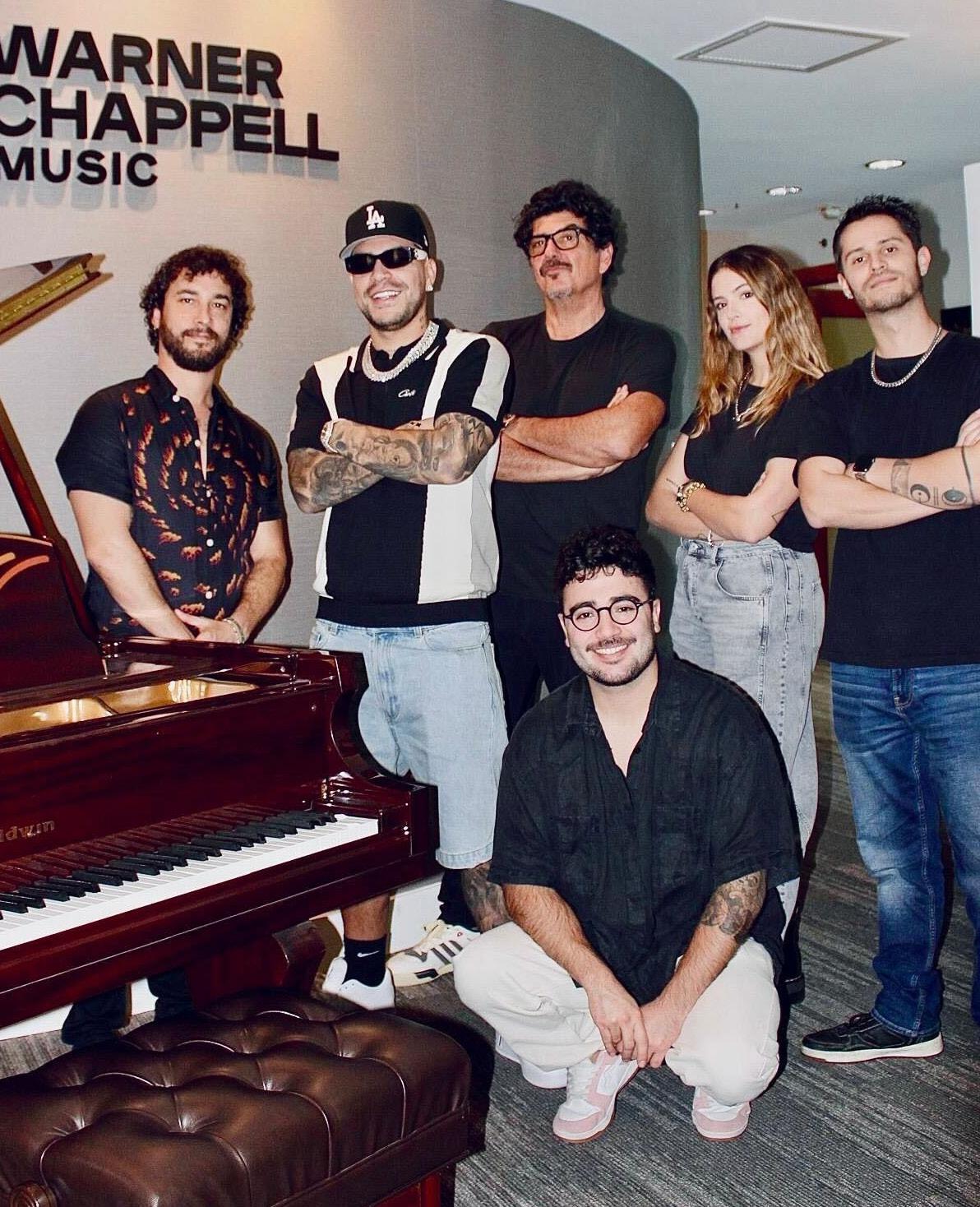
roots. It’s almost like a maturity in itself. Many artists are mixing modern sounds, production, and beats with salsa, or bomba in Puerto Rico, or cumbia in Argentina. I’ve seen trap
and hip-hop artists incorporating more folklore from northern Argentina. They’re discovering the sounds of their countries and their culture and weaving them into their
music. I think it’s fantastic. Instead of moving towards a uniform sound, they’re looking to their own culture for relevance, to be different, and to keep pushing the boundaries.
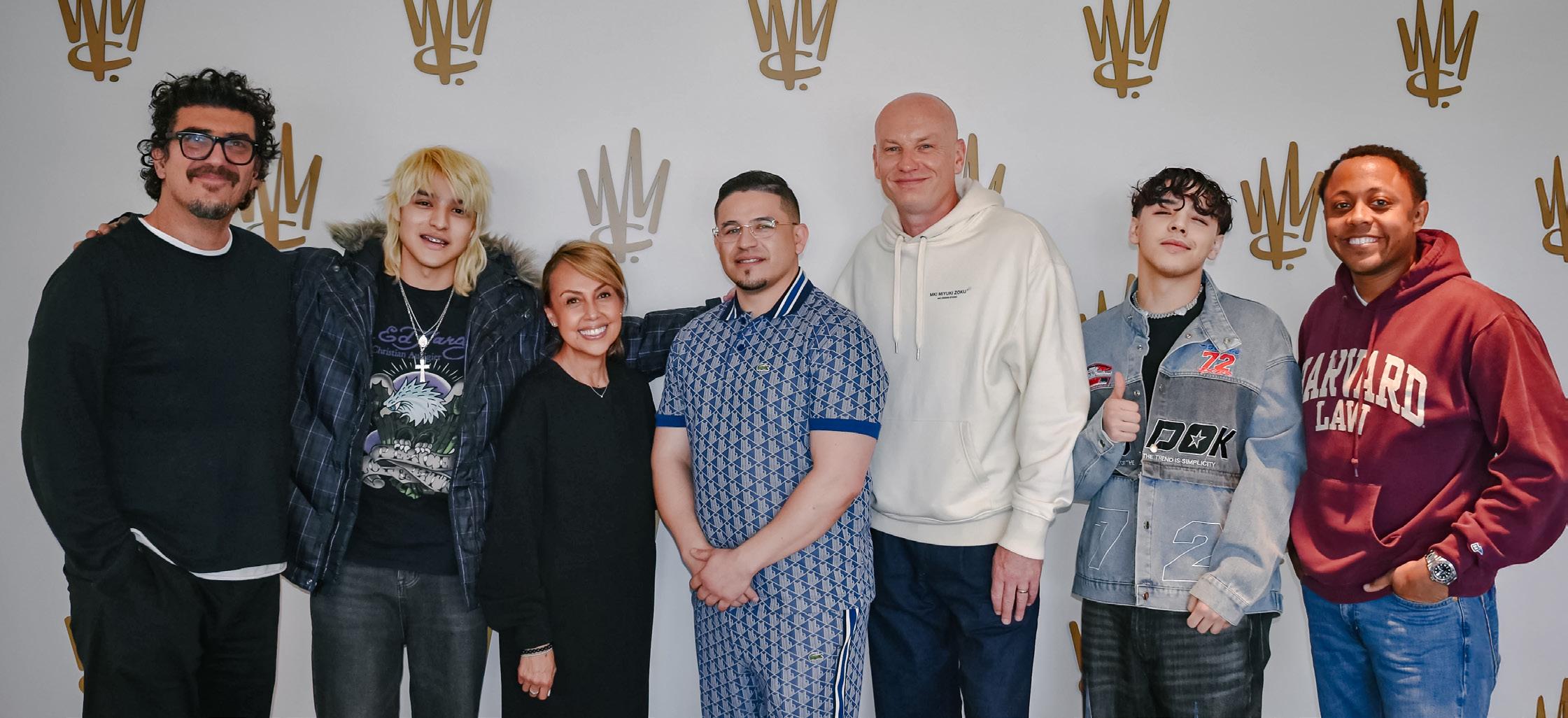
Do you think the current growth of Latin music is sustainable? What needs to happen within the industry to support long-term momentum?
The growth isn’t unlimited. Everything reaches a point where it plateaus or grows according to factors like population or the influence of the DSPs, if they continue expanding their market, which we’ve seen slow down. I think it’s natural, given how much penetration DSPs can achieve or how many new accounts they can open. I absolutely believe it is here to stay. In the ‘90s, that wasn’t the case. The key is that every artist and writer needs to do their best and put out really good music; that will be the safeguard.
What impact do you think Latin music’s rise is having on the broader music publishing ecosystem, including collaborations with artists outside the genre?
It’s part of the whole new trend: artists collaborate with anyone around the world. It’s not just within Latin music. I’ve seen it happen in our song camps – we bring writers, producers, and artists from 18 or 19 different countries. You don’t have to think, “Should we put the Germans with the Colombians?” Of course you can. The world is our oyster. Everyone
wants to see who has the best sound, what’s new, new melodies, and new trends. We truly are a worldwide company. All the offices work very well together. We’re always striving to create global partnerships, and it’s paying off.
With AI and tech transforming the industry, how do you foresee these tools shaping the future of songwriting, artist discovery, and music production in the Latin space?
After the initial panic, there was a realisation that we have to embrace the technology. I think it’s going to be super useful as a tool, but the key is always to defend and ensure the correct protections are in place for writers and artists. AI has the potential to raise the bar in a lot of different areas, but it won’t replace human artistry and creativity.
It will definitely push the bar higher, but true creativity can’t be copied. At the end of the day, music has a huge element of emotion – it evokes memories – and I don’t think AI will ever replace that.
How is Warner Chappell preparing to support the next generation of Latin music creators and innovators?
It’s the same approach we’ve always had. Personally, for our A&R team and me, the most important thing is helping the younger generation – the new writers and artists. You can be a multinational, of course, representing huge superstars, but we have a responsibility to make sure new talent has opportunities.
It’s about being present, presenting them with opportunities, connecting them with the huge network we have, and then hoping for the best. It’s about creating those opportunities for them, and hopefully, they’ll make it and become the next superstars.
Does your micro transmitter have these features?
• IP57-rated watertight, all-metal enclosure
• Removeable LiOn rechargeable pack
• Drop-in charging with optional dock
• High-Density RF mode for 24+ ch. in 6 MHz
• Fixed audio latency of 1.4 ms
• Lav mic presets for optimum audio quality
• Full menu & control on the unit
• Selectable RF Power up to 50mW
The DSSM micro digital body pack has ALL these features and more, in one tiny package.
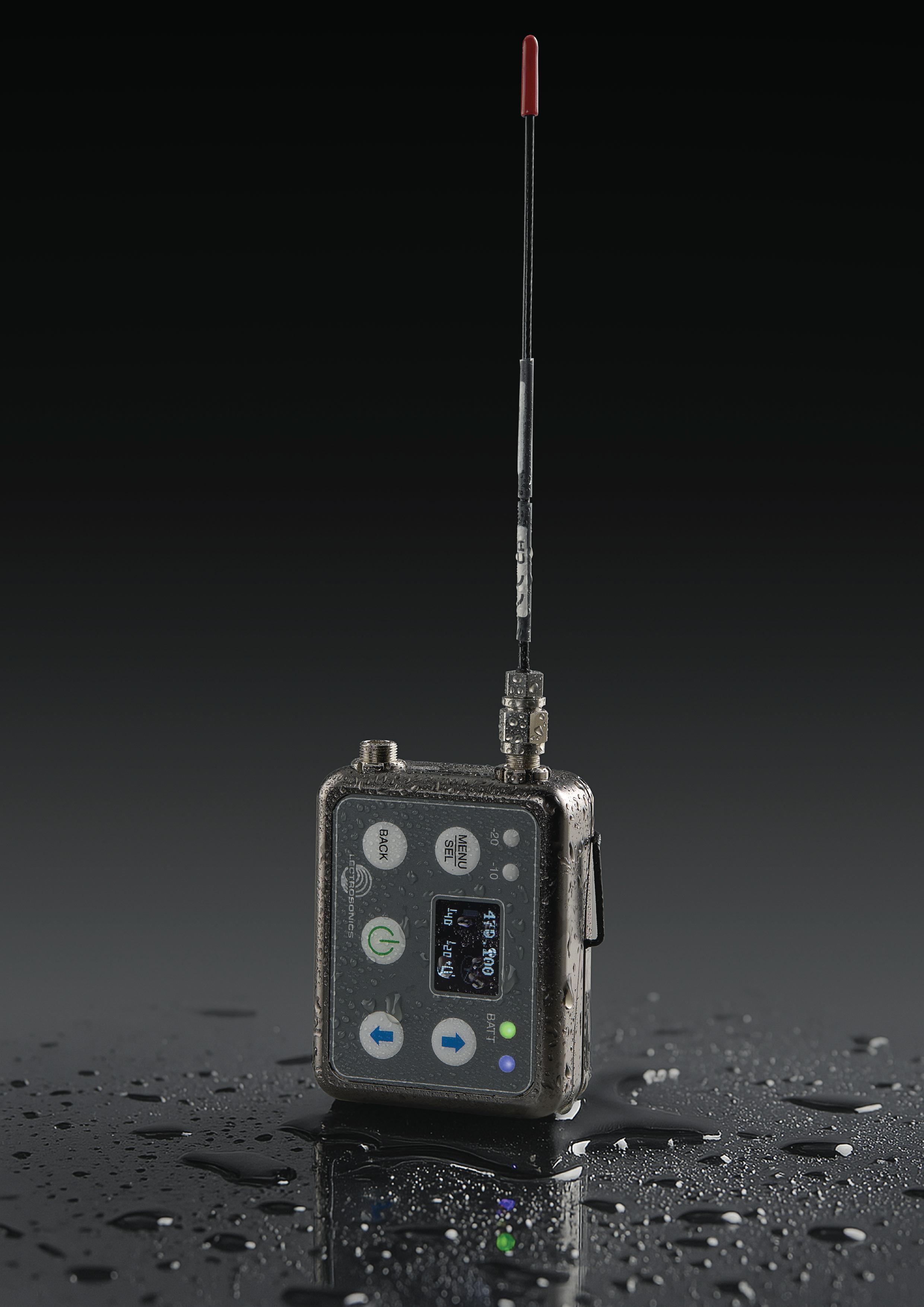











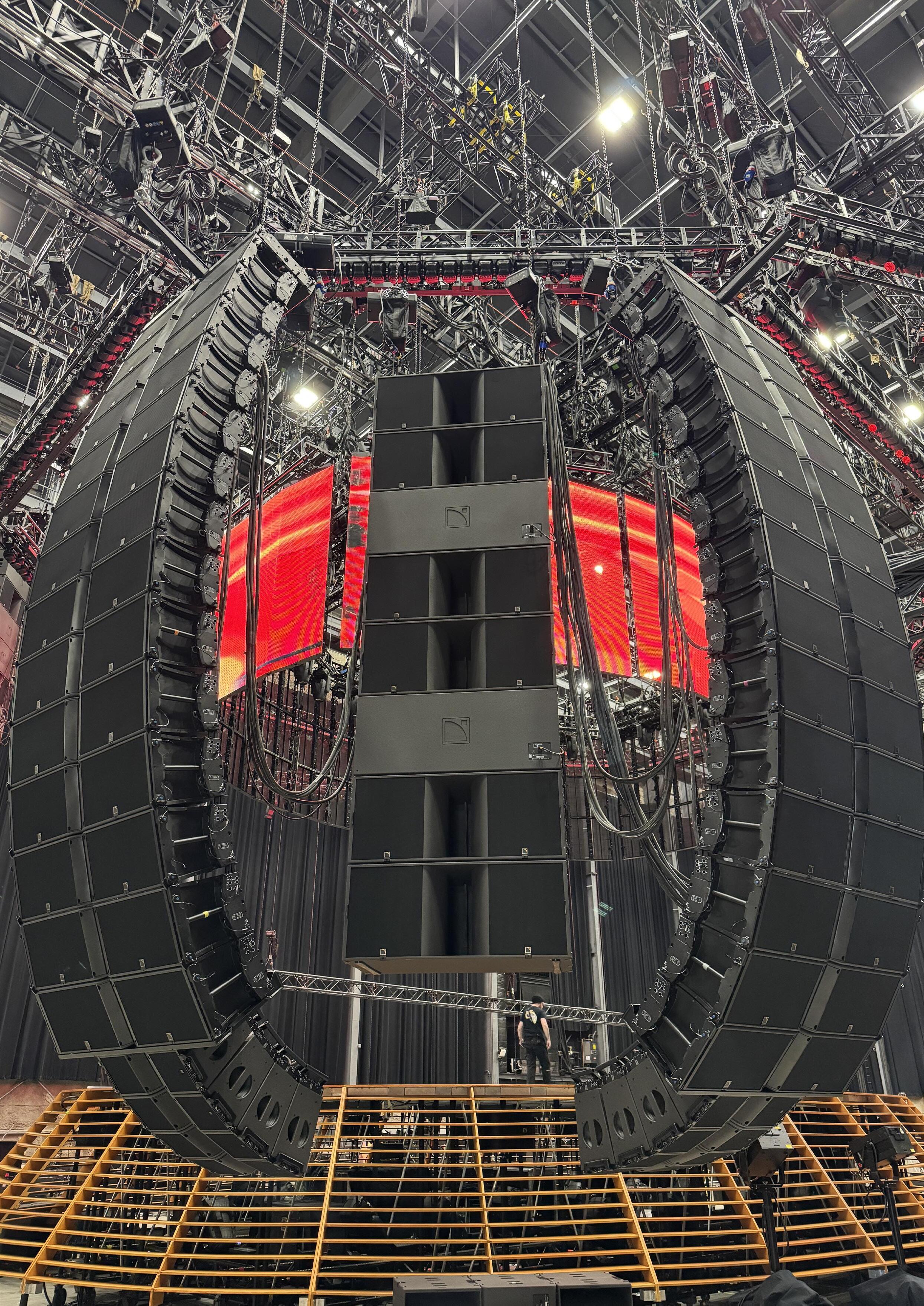
Credit: Lasse Lagoni
SMALL TEAM, BIG LEAGUES
WORLEY SOUND
When Tom Worley first launched Worley Sound, a sound reinforcement company that specialises in the touring and live event sectors, he was told it would never work. The former systems engineer reveals how he’s gone from being an underdog to competing with the biggest sound reinforcement and touring supply companies in the US and globally.
“A lot of people thought I was mad, including some bigger companies I spoke to,” Worley admits, speaking to Headliner from his home in Nashville. “They said, ‘This is never going to work. You can’t run something like this from New Zealand.’ And, to be fair, they were right. I needed to move back to the US. So I did.”
It all started with a dream: to provide high-end, tour-ready audio packages that make life on the road easier. For Worley, that vision has grown into
Worley Sound, a Nashville-based company punching far above its weight. “I grew up in New Zealand, in quite a rural area,” he explains. “My parents were farmers, and we lived on the east coast of New Zealand, very isolated – about an hour away from any town. I went to a fairly traditional school that was very focused on sport and that sort of thing. But I started getting into music, playing guitar, and we had a little band at school.”
“WE’VE CARVED OUT A NICHE WE’RE VERY PROUD OF: A HIGH LEVEL OF ATTENTION TO DETAIL AND PERSONAL CUSTOMER SERVICE. WE CALL IT A WHITE-GLOVE SERVICE.”
From those humble beginnings, Worley carved a path through the live entertainment industry, starting at 18 as a freelancer at Oceania Audio in Auckland, working on tours for major international acts passing through. “Quickly, I picked up mixing and the systems engineering side of live sound. I was quite practical, good with people, and I just worked it out as I went along.”
A stint in the UK with Londonbased audio rental and production company, Britannia Row, exposed him to even larger-scale productions, including tours with Depeche Mode and Pearl Jam, and events like the Queen’s Diamond Jubilee. From there, the US beckoned: Rat Sound in California brought him over for Coachella, and by 2014, he had moved permanently to L.A. with his family, taking on the role of head systems tech for major tours and festivals and later as an account manager. After a brief return to New Zealand during Covid, Worley saw an opportunity to create his own boutique sound company – one that
would prioritise meticulous attention to detail, plug-and-play efficiency, and a personal touch that global giants often lack. In 2021, Worley Sound was born, providing audio for acts including alt-J, King Gizzard and the Lizard Wizard, Fontaine’s DC, Jungle, Turnstile, and Tame Impala – all from a lean, agile team headquartered in Nashville.
“When Covid began to ease, and everyone started going back to work, I started to get calls from all these bands,” he recalls. “At that point, I thought, ‘We need to move this company back to the States’. I went back to a company I’d been working for, and said, ‘Remember that control package we built right before Covid? I want to buy that off you.’ They agreed to sell it to me, and that’s how I got started.”
The company has gone from strength to strength since. “We have 45 consoles, around 250 L-Acoustics boxes, and we’re a full-service audio provider,” he nods.
“We’ve got Bolero comms and all that sort of thing; we’ve gone full service.”
What sets Worley Sound apart isn’t the size of the company; it’s the level of care, planning, and precision packed into every tour package. By offering a bespoke approach that rivals the largest players in the US, Worley has proven that small can indeed compete with mighty – and thrive. “We’ve carved out a niche we’re very proud of: a high level of attention to detail and personal customer service,” he nods.
“We call it a white-glove service. We prep everything right down to the little things. The clients turn up, often without having seen the gear before, plug it in, and everything works –everything’s in the right place. That’s what we’ve become known for. We’re small enough to stay nimble, which means we can spend the extra time making sure that happens.”
Worley has lost count of the number of times he’s been asked if global industry leader acquisitions of other audio companies worry him. “Honestly, I think it’s great,” he insists. “It’s actually really good for my business. What it does is open up more space for companies like us to move in underneath and provide a different kind of hands-on service –one that can be really beneficial for our customers in other ways. They want customer service, attention to detail, and they don’t want to feel as though they’re just another number going in and out.”
After receiving audio bids from most of the major players for tours, production managers who have experienced Worley Sound’s technical precision and ability to be more agile are opting to use Worley’s company instead, safe in the fact that they will get tailor-made systems and won’t be lost in the shuffle.
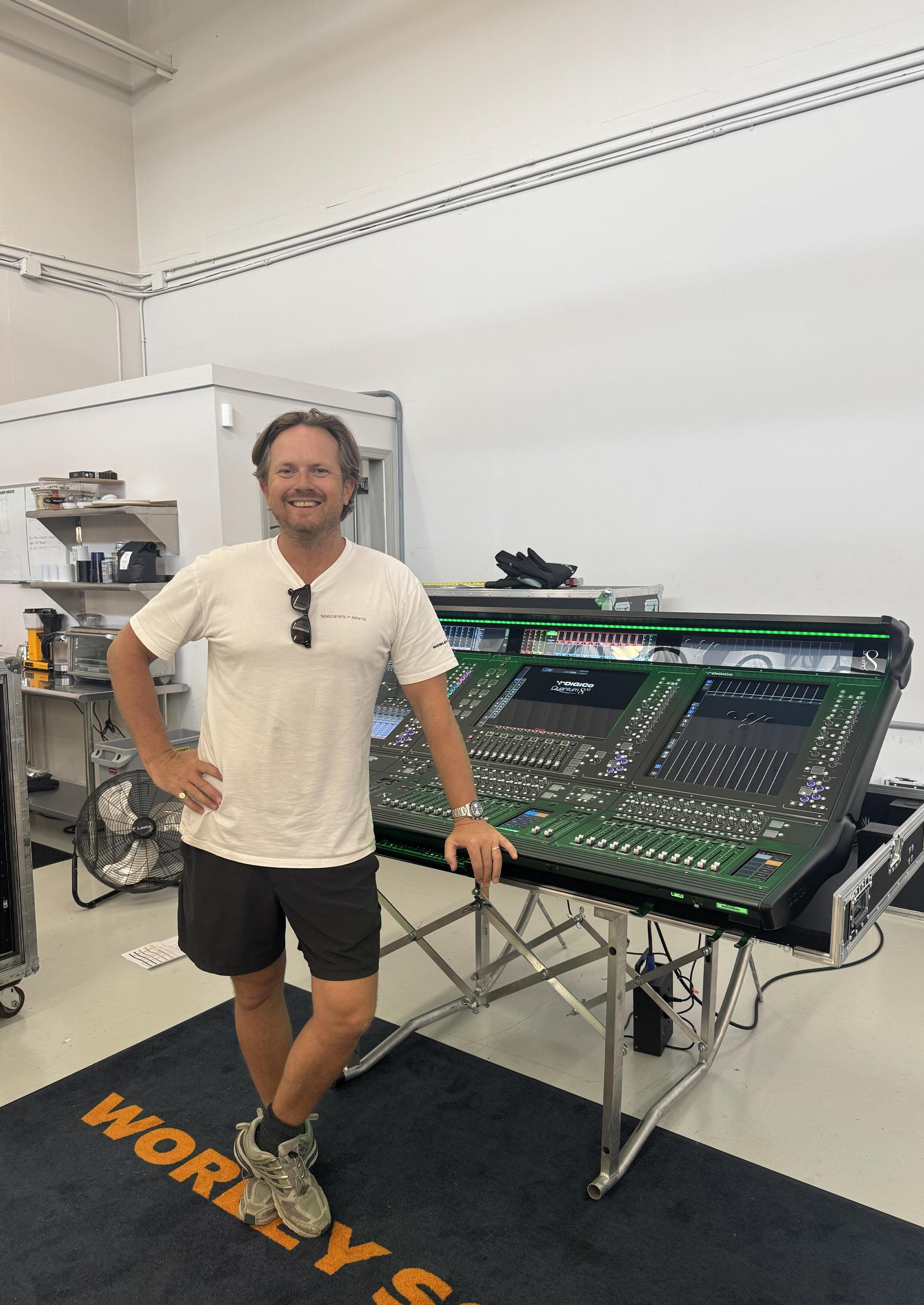
“We’ve got a rehearsal studio as well – Worley Studio – right next to our audio warehouse. We have a lot of A-list customers come through there, and often they have a package from someone else. We get to see firsthand how these systems are being presented to their customers, it’s covered in dust, nothing’s labelled – it’s honestly shocking that that’s the standard. So that’s where we’ve positioned ourselves, and we see it as an opportunity. If we talk about the industry more broadly, I don’t think the monopolisation of the industry is a good thing overall. But for our business, it does create an opportunity to take advantage of what I’d call a lack of quality control.”
This custom service has certainly struck a chord with production managers, who praise the company for its meticulous approach and impeccable packaging. Worley Sound makes sure everything is ‘plug-and-play’ and ready to handle the pressure of life on the road, and it’s an ethos that has resulted in customers who return every time their act hits the road.
“Our clients know that when they come back, we’ll build the system exactly how they want it, often the same as last time,” Worley points out. “That consistency is something they really value. That’s where we stand out. We meticulously archive all our preps – the way we build everything, rack drawings, spreadsheets for pre-production – so when a client returns, it’s like they’re picking up exactly where they left off. Everything works, everything feels familiar, and it’s seamless.”
Worley Sound was born from a vision to deliver high-end audio packages that make life on the road easier. Worley considers the finer details that he noticed that could have been improved at that time. “A lot of it comes down to the way the equipment is packaged: how
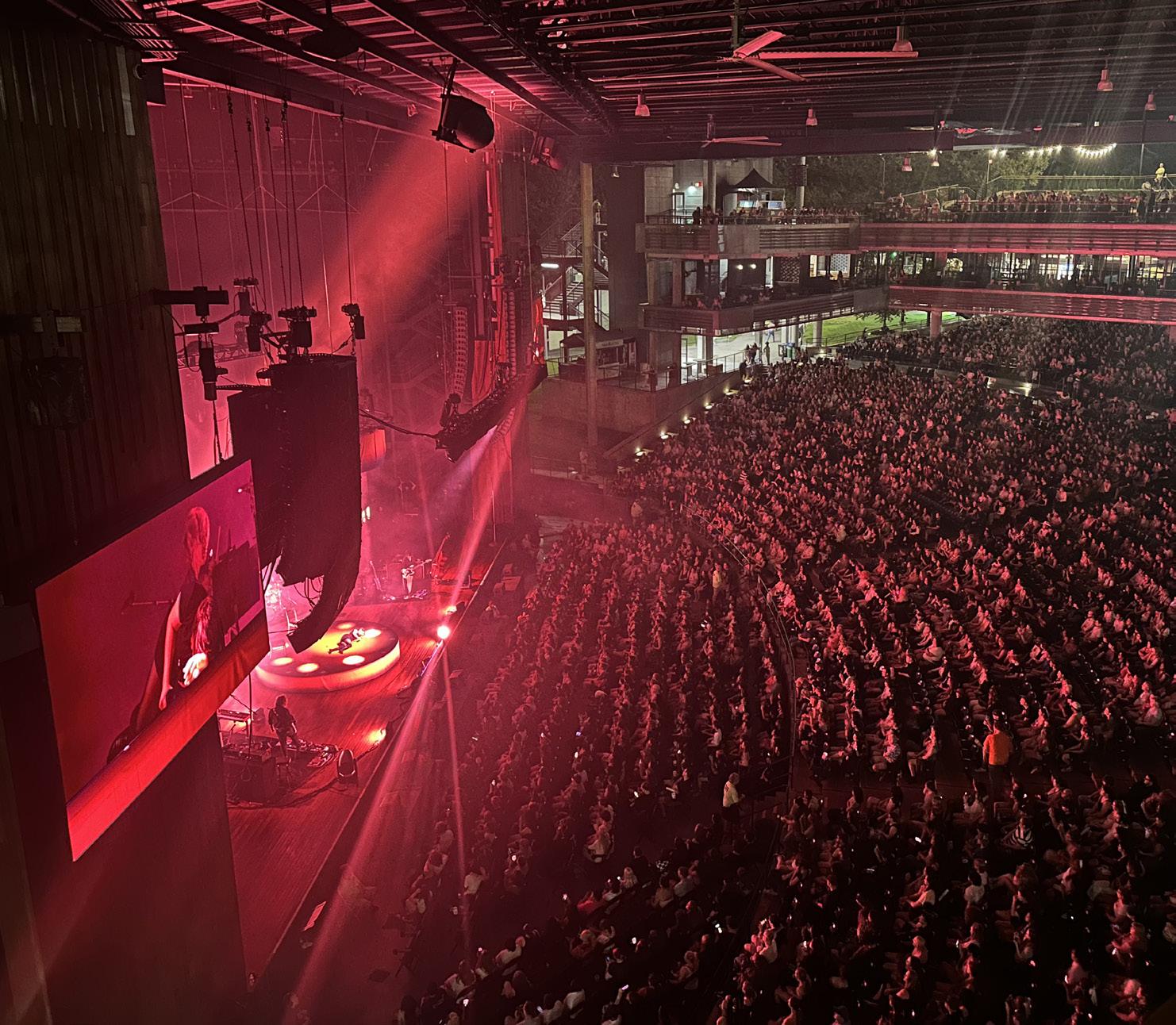
everything is built into the racks and the types of connectors you choose,” he explains. “At our scale, we’re able to spend time on those finer details: the connectors, the cabling on stage, the size and layout of the cases.
“None of it is particularly complicated, but it makes a real difference for the engineers and crews using the system every day. We try to think through every part of the experience and make things easier wherever we can. Sometimes it’s as simple as asking an engineer if they’d like their console set a little lower so it’s more comfortable to mix on. Nothing is left unconsidered.”
Worley Sound today spans equipment rental, system design, consulting, and specialised labour, but building a full-service ecosystem didn’t happen overnight. “We felt that if we were just a dry hire company, we’d miss out on a big opportunity,” Worley explains.
To rewind a little, the company began by focusing solely on control packages – often sending out equipment without technicians.
Over time, the scope expanded. “Now we have PA, we’re sending out more staff, and we’re running bigger tours that require techs. It’s really just about wanting to be a full-service audio company and provide the complete package.”
Worley Sound is a proud L-Acoustics Certified Provider – a credential that immediately came into play on Mitski’s expanded North American tour. As her shows grew from smaller venues to arenas of up to 20,000 capacity, the tour required a dedicated system rather than relying on house PAs.
“I’ve been working with L-Acoustics products for around 20 years and have built a really strong relationship with the company,” says Worley.
When Worley Sound started working in larger venues, Worley knew he needed to invest in large-scale speakers. He says partnering with L-Acoustics was a no-brainer.
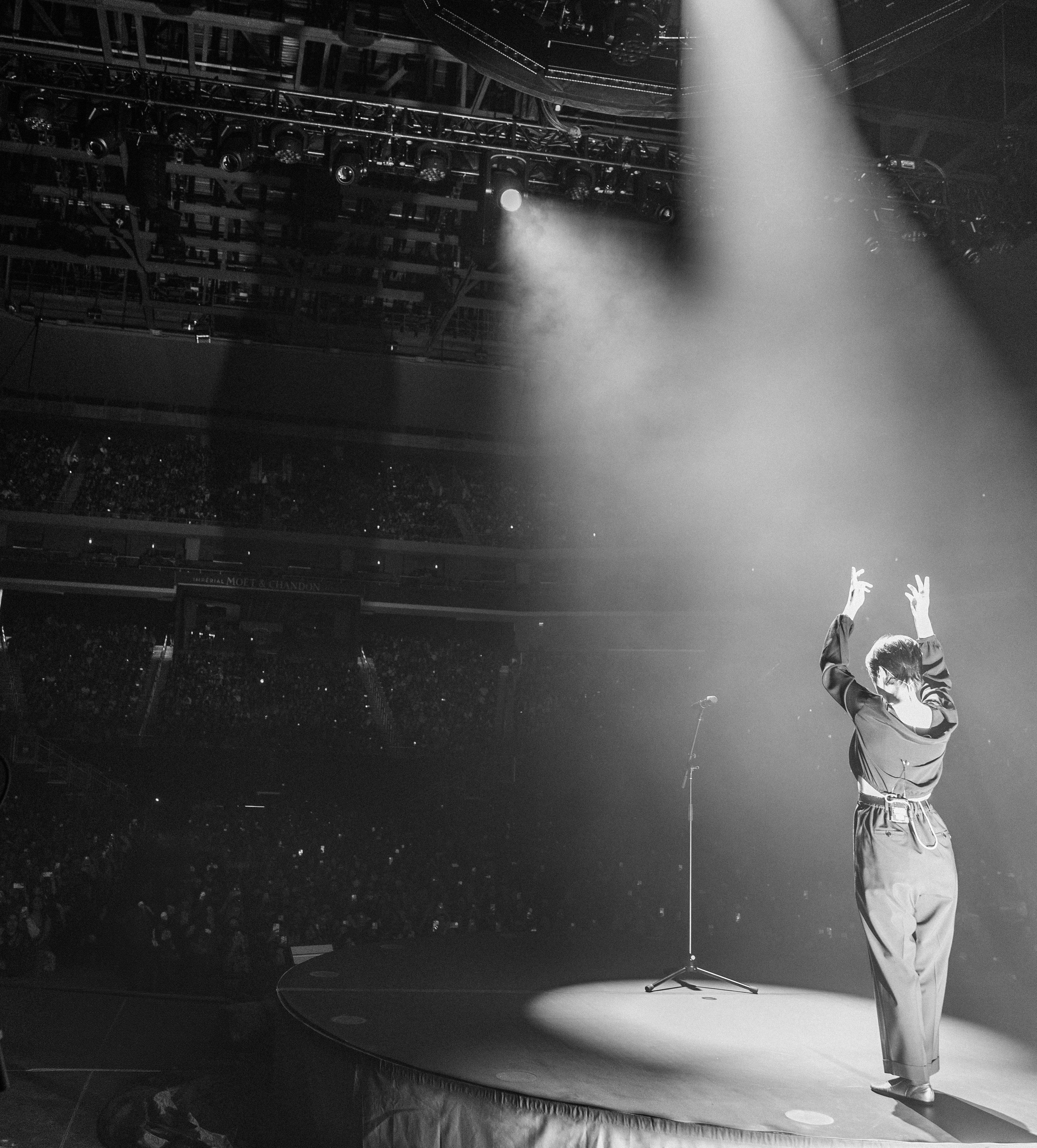
“They’ve consistently pioneered live sound for decades. I’ve always admired their drive to push boundaries, improve technology, and make things better – not just for touring crews, but for audiences too.
That’s why I’m such a big supporter of L-Acoustics, and it’s exactly what I love about their approach to live
sound. It certainly puts us in the mix when it comes to quoting for larger tours and arena shows, too,” he furthers. “Obviously, smaller tours don’t require a full PA system, so it’s not relevant for them. But now that we’ve got the PA capability, we’ve found that very few people want to rent the control package from one company and the PA from another.
They want it all to come from a single source. That’s exactly what I’ve been aiming for with this full-service approach.”
“WE SEE IT ALL THE TIME: COMPANIES GROW TOO BIG, AND SUDDENLY THEY CAN’T DELIVER WHAT THEY USED TO, BECAUSE THERE ARE TOO MANY MOVING PARTS.”
The US live sound industry has faced a turbulent few years, with touring coming to a complete halt during the pandemic and then surging back as restrictions lifted. Worley has been navigating it all with a keen eye on both opportunity and stability.
“There was definitely a bit of a boom after COVID. A lot of that was due to pent-up demand, but there were also supply chain issues that caused people to panic a little and make decisions faster than they were used to,” Worley reflects. “Now, we’re definitely getting back into a more routine rhythm here. There have been some challenges from the artist side,
with rising expenses, higher prices for everything, tariffs, and other factors increasing the cost of touring. But most of our clients fall into the middle to top range: they have the budgets, the experience, and put a lot of thought into their tours.
Looking to the future, Worley is focused on sustainable, controlled growth. “We’ve grown 40% year on year, and we expect to continue growing. That said, we’re very aware that we don’t want to get too big. To maintain our quality control and level of precision in this white-glove service, we need to keep our focus and not expand to the point where
we lose that. We see it all the time: companies grow too big, and suddenly they can’t deliver what they used to, because there are just too many people and too many moving parts.
“We do have some strategic plans to move into different areas,” he reveals, “but for now we’re focusing on Nashville, our clients, and continuing to do what we do best: providing a true white-glove service.”
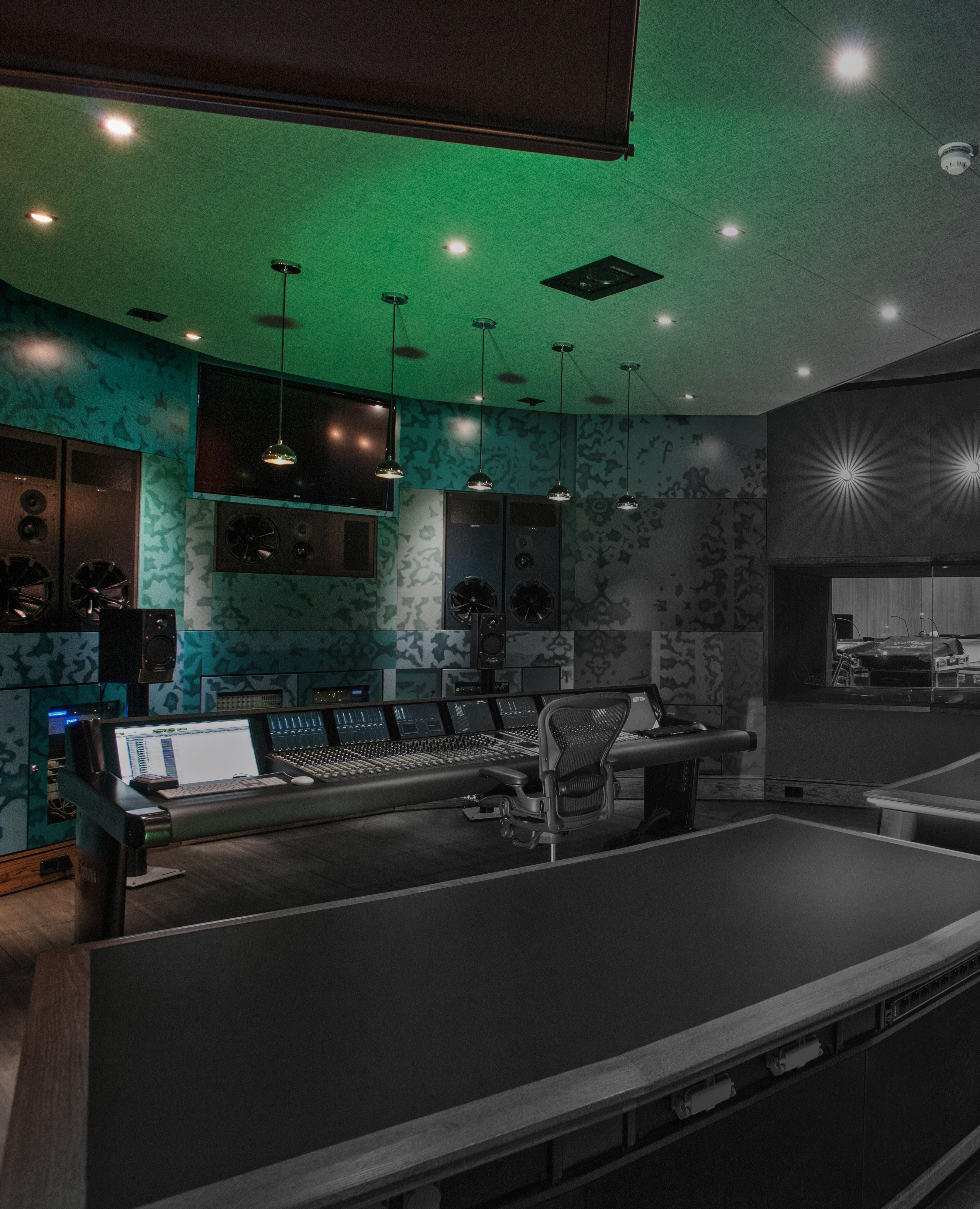

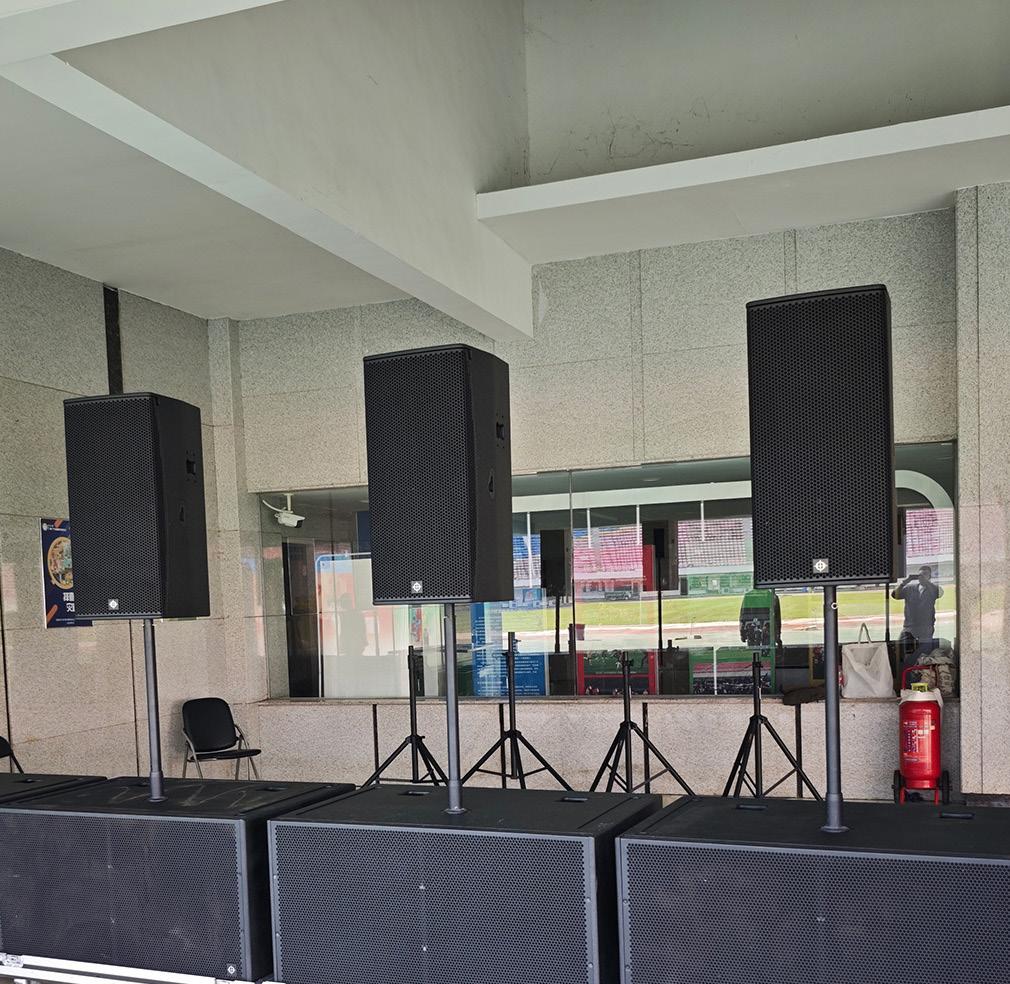
WORDS BY ALICE GU S NOSFAT
STADIUM ACOUSTICS
HELONGSTADIUM STRIKING A BALANCE IN

The Helong Stadium in Changsha, China, is a 55,000-capacity multipurpose venue best known for hosting football matches. While it isn’t the home ground of any specific club, the stadium regularly hosts China’s national team fixtures and major music events featuring both Chinese and international artists. To maintain its reputation as a premier sports and cultural destination, the stadium’s management recently undertook a comprehensive overhaul of its audio system, aiming to deliver world-class sound for every event, as Headliner discovers…
With an overall brief to address the dual issues of high-quality speech intelligibility and music reinforcement, the Helong team aimed to strike a balance between ‘clearly audible’ stadium announcements and ‘pleasantly enjoyable’ music listening.
The project was undertaken by Zhejiang Tongbo Vision Technology Co., Ltd., which installed a CODA Audio system to deliver professional-grade, significantly enhanced audio for the major sporting and cultural programs at the Stadium.
The audio challenges faced in stadiums are many, including vast open spaces and often complex tiered seating. On this occasion, owing to a busy schedule of forthcoming major events, Tongbo also faced a very intense schedule with a limited timescale in which to complete the installation. Drawing on their extensive experience of major installations and detailed understanding of CODA Audio’s advanced technologies, the Tongbo team worked around the clock to complete the installation, from design and preparation to commissioning, in just 12 days.
The system at Helong Stadium primarily deployed CODA Audio loudspeakers from the HOPS range (high output point source). In the grandstand areas, 32 HOPS12i (fullrange, three-way) are driven by eight LINUS14 DSP amplifiers. A system comprising eight HOPS12T and eight PW418 subs, driven by eight LINUS14s, is used for mobile performances within the venue, whilst six HOPS5 driven by two LINUS6.4 amplifiers cover the VIP area.
“Optimised for speech intelligibility and music performance, the new CODA system at the stadium constitutes a major leap forward in audio performance, maintaining exceptional clarity for announcements, with uniform coverage and a natural listening experience in every seat, from the front rows to the furthest reaches of the stands,” enthuses a spokesperson for Tongbo. “It will significantly enhance the audio experience for both sporting events and cultural activities, setting a new benchmark for venue acoustics.”
“Tongbo has once again excelled itself with this installation, particularly as it has been completed in such a short time,” adds David Webster, global head of sales and marketing for CODA Audio.
“We’re very proud to see a CODA system trusted to deliver audio at this high-end international-class stadium.” CODAAUDIO.COM
GUITAR WISDOM
WORDS BY ALICEGUS
TOMO FUJITA
For more than three decades, Tomo Fujita has been a respected voice in the global guitar community, balancing life as a professor at Berklee College of Music with an acclaimed performance career. Along the way, he has shared the stage with renowned musicians including Phil Collins, Steve Gadd, and Bernard Purdie, while shaping the next generation of players. Central to that sound is his long-standing reliance on guitar speakers from Celestion, including the Vintage 30, G12-65 Creamback, and Celestion 100, as Headliner discovers.
Known worldwide for his online platform Guitar Wisdom and for mentoring artists such as John Mayer, Fujita’s philosophy centres on groove, nuance, and the pursuit of a pristine, clean tone.
Fujita treats his guitar as a vocalist, making the loudspeaker a critical component of his signal chain. “If you consider the amplifier’s power to be the lungs, then the tone is truly the throat,” Fujita explains. “Everything ultimately comes out of the speaker, and Celestion, brings out the best characteristics of a guitar.”
His relationship with the Celestion brand began shortly after he moved to the US in 1986 with just one suitcase, one guitar, and a desire to communicate deeply through music.
After placing third in the Boston Best Guitarist Competition, he won a Marshall JCM900 amplifier, two cabinets, and a 100-watt Celestion speaker. He immediately swapped the Celestion speaker into his Fender Champ 12 practice amp.
“Right away, with Celestion, I noticed a better balance from the low to high frequencies, and I could hear
every detail,” he recalls. “That was the moment I first became interested in the profound impact of speakers.”
Fujita advocates for a pure tone, eschewing massive pedalboards in favour of finger dynamics. He famously teaches students to practice with their amplifier’s treble turned all the way up and the bass rolled off to master their picking touch through discomfort.
Because he plays clean, the speaker itself becomes a vital, organic compressor that reveals the truth of the player’s hands.
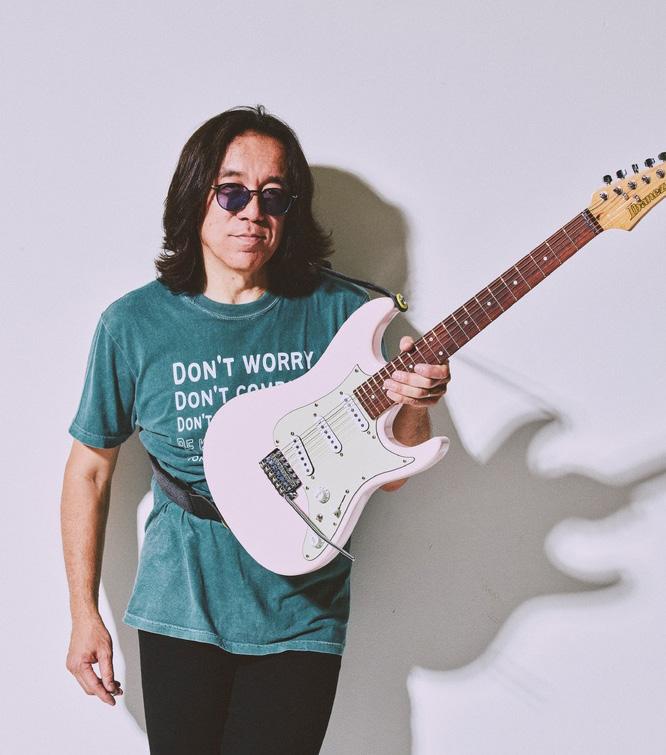
“A good amplifier with Celestion speakers definitely possesses builtin, natural compression,” he notes. “When you push them, they vibrate organically. A truly great speaker reveals the nuances of a player’s tone exceptionally well.”
Today, Fujita’s primary rig features his signature Two-Rock amplifier loaded with a Celestion Vintage 30, a driver that has thoroughly impressed him. Alongside the Vintage 30, his curated collection includes a vintage G12-65, which he relies on for his signature funk sound, the Alnico Celestion 100, and the G12M-65
Creamback. “I initially thought the Vintage 30 was strictly a rock speaker, but the balance is incredibly good,” he enthuses. “It simply has everything you need right there.”
CELESTION.COM
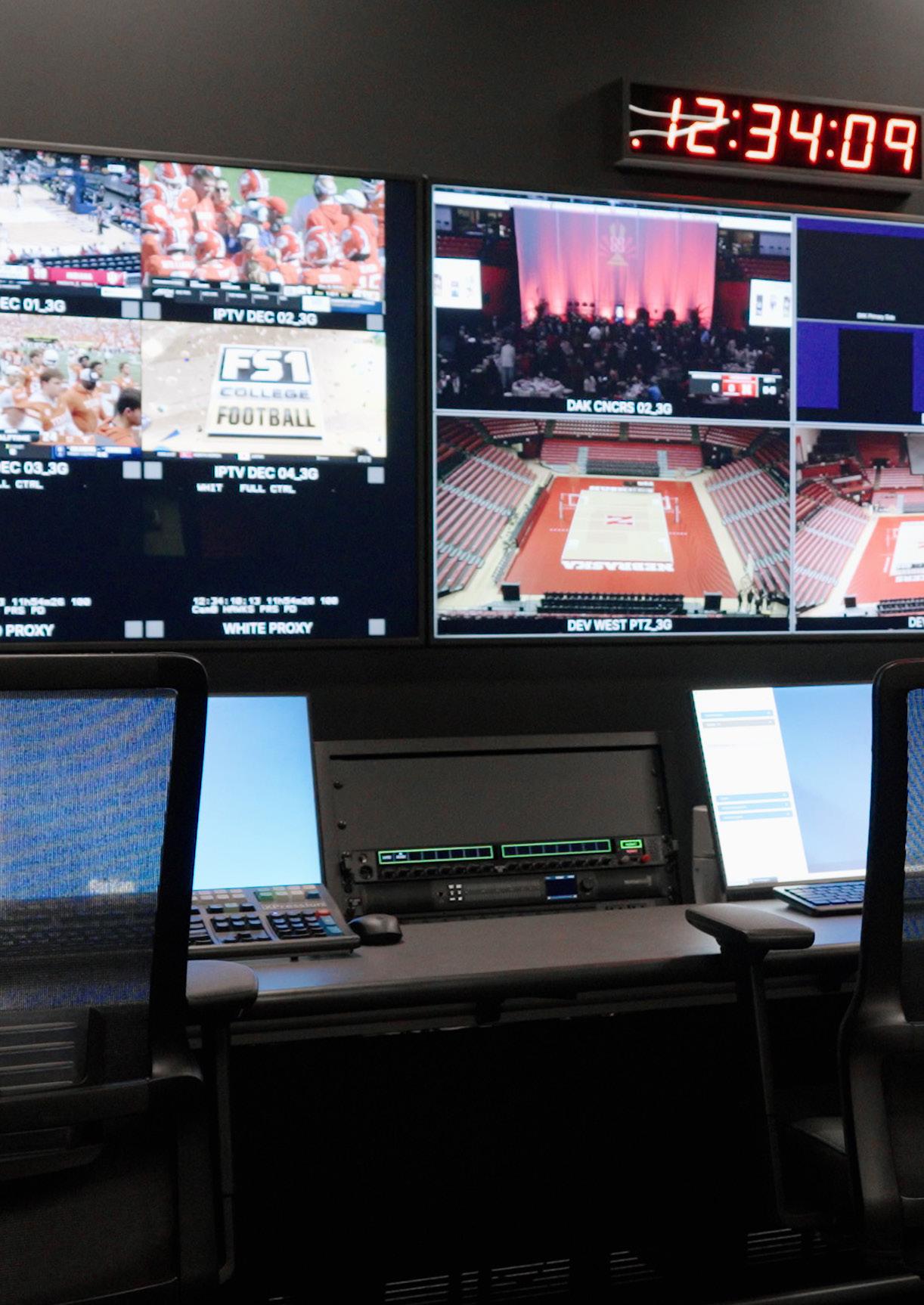
REWIRED
UNIVERSITY OF NEBRASKA CAMPUS BROADCAST
At the University of Nebraska, the drive to modernise live production across campus has reached a new milestone. Headliner discovers how the university’s HuskerVision team completed the second phase of a multi-year transformation, deploying a comprehensive ST 2110-based video infrastructure powered by Lawo.
Building on an audio-first upgrade introduced in 2023 – HuskerVision’s first step into IP workflows – the latest phase brings video production for all major athletic venues into a unified, software-based environment.
The result is a campus-wide media fabric capable of supporting simultaneous shows from multiple control rooms, while giving student operators hands-on experience with the same tools used in leading broadcast facilities.
The earlier audio upgrade had introduced HuskerVision to Lawo’s IP
ecosystem through mc²56 production consoles, A_UHD Core processing, A_stage 64 and A_mic 8 interfaces, and HOME Management for routing and orchestration. “Doing audio first was key,” recalls recently retired chief engineer Scott Guthrie.
“We learned timing, stream management, PTP, device discovery – all the fundamentals. When it came time to roll out the video, everyone was ready.”
That readiness was crucial as the university moved towards its SMPTE ST 2110 implementation, designed
and integrated by BeckTV. With Nebraska’s athletic venues spread across a wide geographic area – including Memorial Stadium, Hawks Championship Center, the Devaney Center, Pinnacle Bank Arena, Haymarket Park, and the Dillon tennis and Hibner soccer complexes – the goal was to bring all locations together through a single IP backbone feeding three co-located control rooms inside Memorial Stadium. This allowed operational consolidation while dramatically boosting routing flexibility.
“STUDENTS ARE DOING REAL ENGINEERING TASKS NOW. THEY’RE LEARNING ON THE SAME TOOLS USED IN THE BROADCAST TRUCKS.”
At the core of the new video infrastructure is Lawo’s .edge platform, used both as a high-density gateway and as a full IP processing node. Multiple .edge frames provide 3G-SDI and 12G-SDI ingest, while native ST 2110 connectivity and quad-25GbE interfaces feed the production fabric. The system’s ability to present SDI inputs as network “proxies” gives HuskerVision high scalability with minimal bandwidth overhead.
“We can bring in signals from any venue, whether five cameras from volleyball or a full football package, and everything just shows up in the fabric,” says director of technology Garrett Hill. “Routing video or audio essences independently is as easy as moving blocks around.”
One of the most operationally transformative areas is the truck dock at Memorial Stadium. Using .edge for video and A_stage64 for audio, HuskerVision can now exchange 24×24 bidirectional signals with national broadcast trucks, accommodating 12G-SDI, HDR, SDR and ST 2110 feeds without additional hardware.
“Trucks get whatever flavour they want,” says Guthrie. “Up, down, HDR, SDR, it’s all handled right there in the IP edge.” Hill notes that the increase in available I/O and native processing “has completely changed how we interact with visiting crews.”
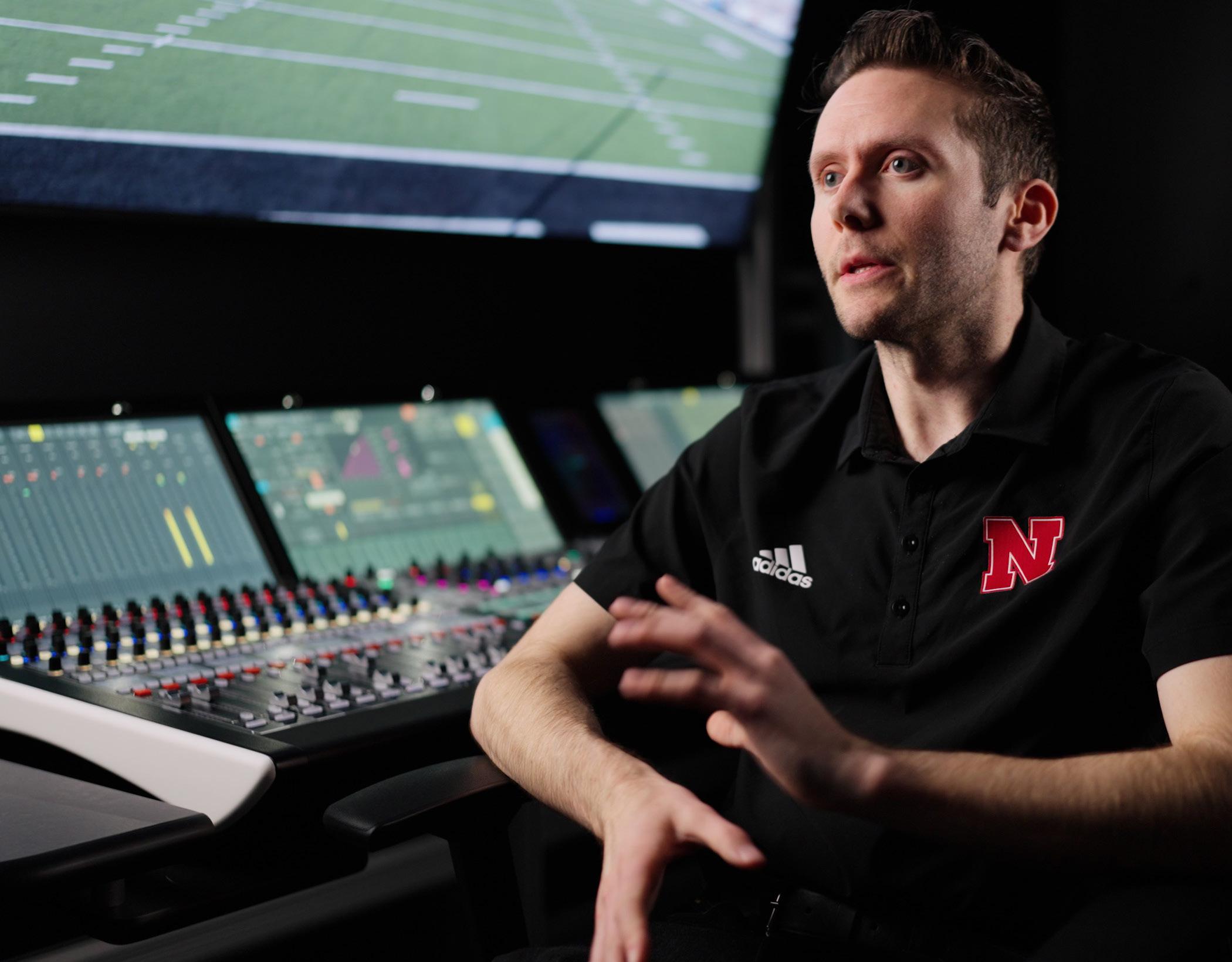
Workflows inside the control rooms benefit heavily from Lawo’s HOME Apps, running on COTS servers. The HOME Multiviewer, combined with the Wall layout builder, enables dynamic, venue-specific monitoring setups that can be reconfigured in seconds. Meanwhile, the HOME UDX app provides on-demand up/down/cross conversion directly in the network, reducing the need for traditional baseband converters.
BeckTV senior engineer and Nebraska alumnus Brock Raum describes this flexibility as the project’s defining characteristic: “From season to season, your shows change, and sometimes
just from sport to sport. You might have soccer in one control room one day and football in another. With HOME Apps, you shut down the tools you don’t need and spin up the ones you do.
“We’ve played with the WebRTC app, downstream keying, UDX – you name it. The flexibility of using COTS hardware with the HOME App system is the highlight of the whole solution. If I need an app for a set of shows, I use FLEX credits. When I don’t, I shut it down and reuse those credits for something else.”
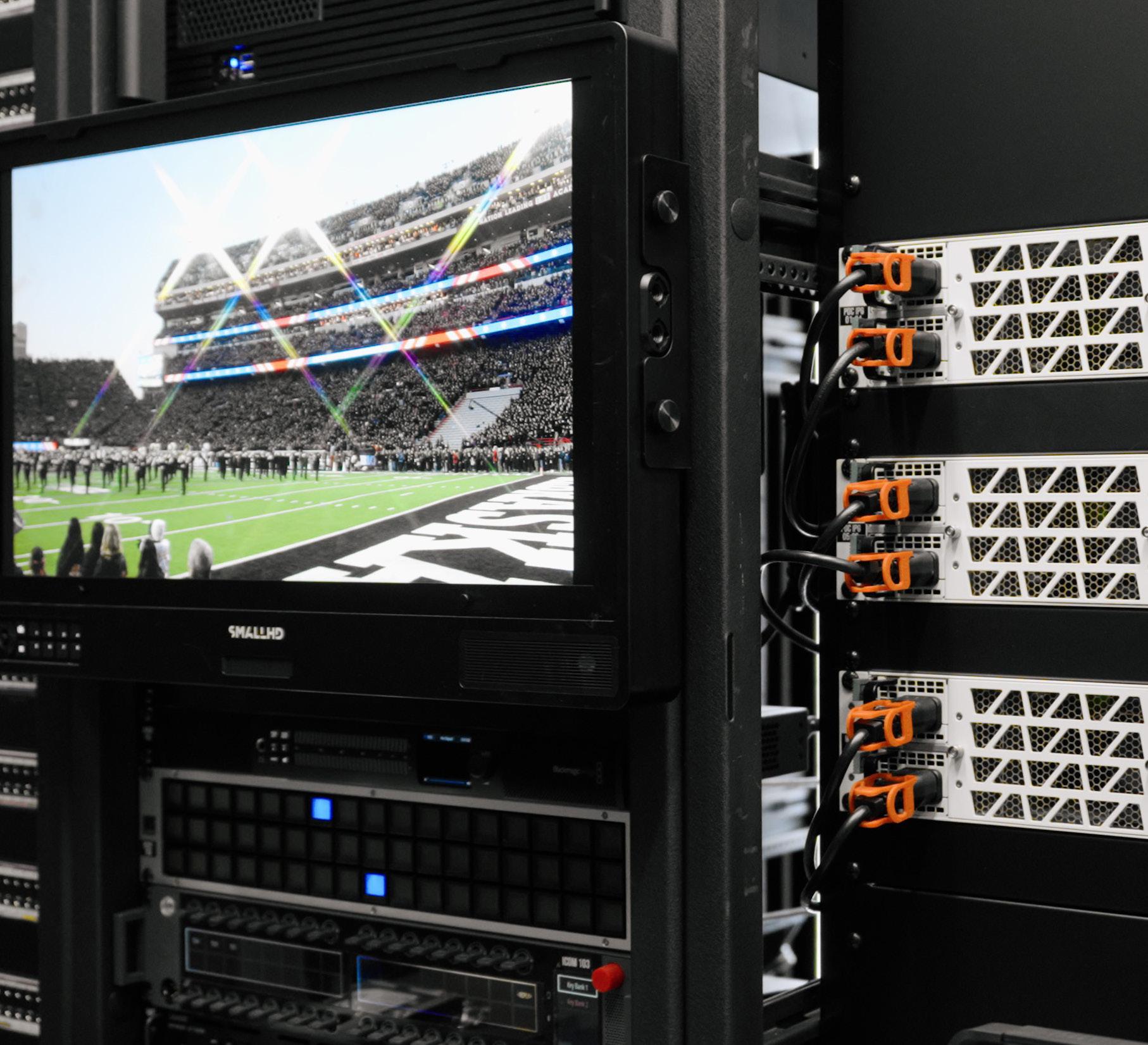
All workflows – video routing, tally, device control and multiviewer changes – are orchestrated through Lawo VSM, which gives operators a single, intuitive control layer across the multi-venue environment.
According to Guthrie, “VSM lets us go from a big-screen volleyball show to a press-conference recording setup with one or two clicks. In a schedule where events overlap constantly, that’s huge.”
Because HuskerVision relies heavily on student operators, the accessibility of the system was essential. Seven full-time staff
oversee a large student team who are involved in every aspect of the productions. Raum says, “Students are doing real engineering tasks now. They’re learning on the same tools used in the broadcast trucks.”
Guthrie adds, “They learn the backend: how to modify layouts, manage essences, fix routes. And they get it.”
Hill nods, emphasising the career value: “Training on the best gear helps them get jobs. Our students leave here ready for the industry.”
With the new IP backbone, HuskerVision can now scale productions, transport media content more efficiently between venues, and support multiple overlapping events with unprecedented ease.
As Guthrie puts it, “Our business is making the fans happy. And with this system, we can do better than ever before,” he smiles.
Words by ALICE GU S T
WIRED FOR OPERA
TEATRO AL LA SCALA
Behind the curtain at Teatro alla Scala in Milan, precision has always been as vital as performance. Since its inauguration in 1778, the legendary opera house has stood at the centre of Italian cultural life. Over centuries, most of Italy’s greatest operatic artists – alongside many of the world’s finest singers – have taken its stage, cementing La Scala’s reputation as one of the leading opera and ballet theatres on the planet. Now, the historic venue is bringing the same commitment to excellence to the technology that powers its productions. Headliner discovers how the Fondazione Teatro alla Scala has deployed a comprehensive wireless intercom solution built around Riedel’s Bolero, NSA, RiFace, and PunQtum systems.
NOSFA

With Bolero at the core, the new setup unifies and modernises backstage communication, enabling seamless, real-time coordination across La Scala’s complex production environment, ensuring that, behind one of the world’s most celebrated stages, every cue can be delivered with perfect timing.
“Bolero has completely transformed how we work at Teatro alla Scala,” explains Marco Schretter, head of audio-video-streaming at Teatro alla Scala. “Its reliability, coverage, and intuitive interface have streamlined our workflows, reduced downtime, and eliminated the need for emergency fixes. During a rehearsal, we handed out Bolero beltpacks – most teams had never used them before – the rehearsal went flawlessly, and the feedback was consistently positive.
“That’s when we knew Bolero had arrived. It’s not just a technical upgrade; it’s a new backstage performer that supports the precision and elegance our productions demand. Now, we can deploy smaller teams across different locations and remain fully interconnected.”
Before implementing Bolero, Teatro alla Scala relied on a fragmented mix of communication tools that created significant integration challenges.
The venue’s architectural complexity – with staircases, elevators, and acoustically sensitive zones like the orchestra pit and director’s booth – made consistent communication difficult. Riedel’s solution covers the high demands of Teatro alla Scala with a scalable system that integrates seamlessly across departments. Bolero now connects stage managers, lighting technicians, audio engineers, video operators, fly tower staff, streaming crews, and the director, enabling uninterrupted wireless communication even in the most RF-challenging areas of the theatre. RiFace integration supports 45 UHF channels for rigging crews, while NSA ensures interoperability with third-party systems used by the streaming team. PunQtum devices complement Bolero in roles requiring additional flexibility.
The system is actively used across key zones of interest, including the stage, stage tower, backstage, multiple foyers, museum, light and audio booths, and the orchestra pit. This allows for distributed task management and faster response times, saving staff from running back and forth and significantly improving operational efficiency.
The deployment has also delivered measurable cost savings. Bolero’s reliability reduces maintenance
and downtime, while its unified architecture lowers equipment overhead. The intuitive interface minimises training costs, and the system’s durability, supported by the Riedel Care maintenance plan, ensures long-term performance without the need for frequent replacements or emergency fixes. Teatro alla Scala also reports faster setup and turnaround times, reduced labour costs, and enhanced coordination across departments.
“To see Bolero seamlessly integrated into such a prestigious venue is a testament to its reliability and versatility,” enthuses Giuseppe Angilello, regional sales manager Italy, Riedel Communications. “Teatro alla Scala represents the pinnacle of live performance, and Bolero is proud to support its legacy of excellence. This deployment sets a benchmark for other theatres and production companies seeking robust, scalable communication systems that meet the demands of world-class live events. We’re also proud of the strong partnership and support we’ve built with the team; they know we’re always there when they need us.” RIEDEL.NET
WORDS BY ALICEGUS T A NOSF
CAPTURING HISTORY
THOM SHAFER
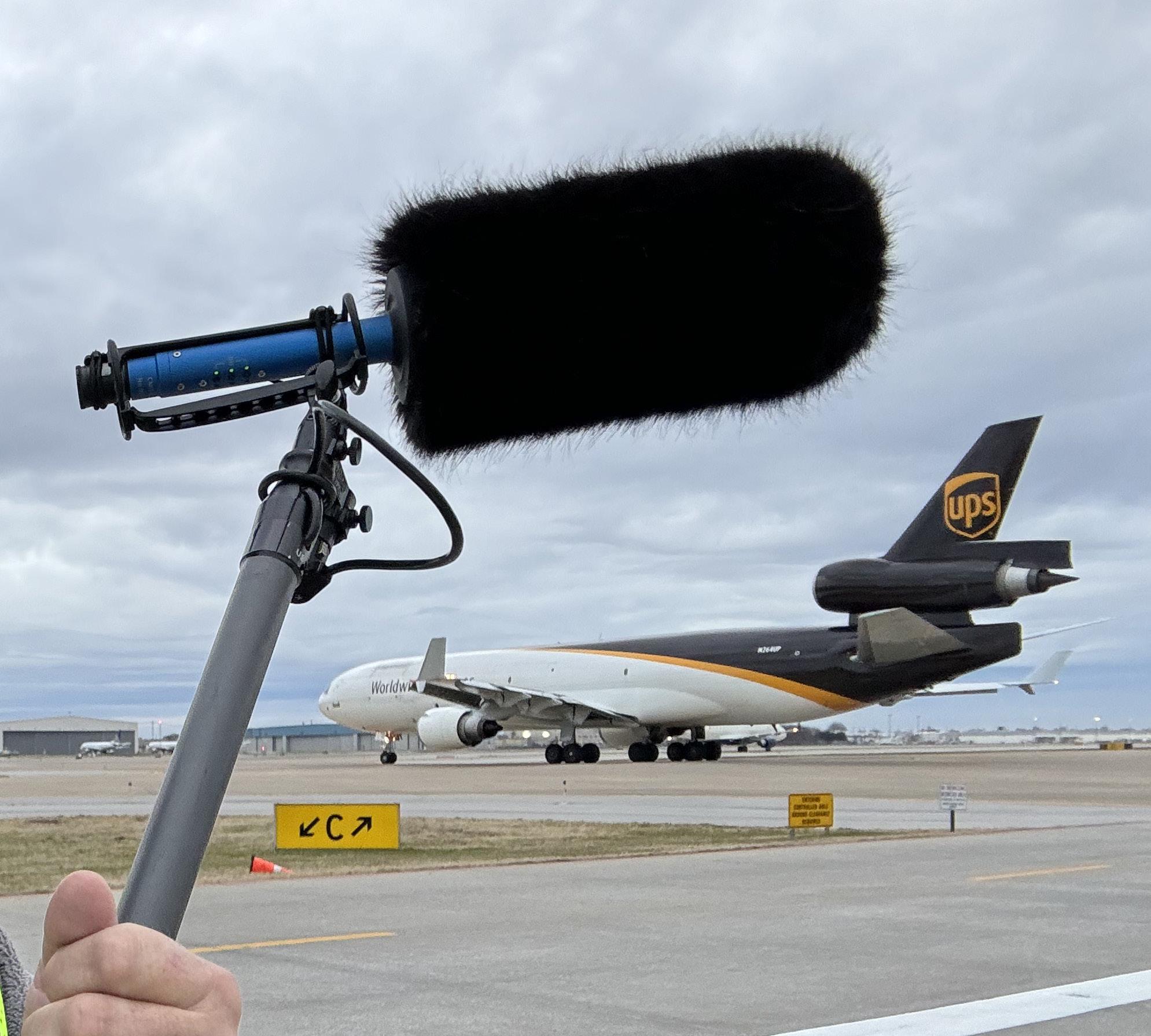
For veteran production sound mixer
Thom Shafer, a career spanning nearly four decades has often meant being in the right place at the right time – frequently when history itself is unfolding. From interviewing the last seven U.S. Presidents to reporting from the front lines of Northern Ireland and documenting the aftermath of 9/11, Shafer has worked in some of the world’s most unpredictable and high-stakes environments. Headliner discovers how he captures those high-stakes moments with clarity.
For more than 34 years, Shafer has relied on Lectrosonics’ wireless
systems, building a toolkit designed to deliver dependable performance in even the most demanding situations. Today, his kit includes DSR4 Four Channel Digital Slot Receivers, SRC Dual Channel Slot Mount Receivers, and SRB Camera Slot UHF Receivers, alongside SMWB and SMDWB Single and Dual Battery Miniature Wideband Transmitters and SMa Super Miniature Belt-Pack Transmitters – equipment he trusts to ensure every critical word is heard. Shafer’s journey into audio began with a literal epiphany while serving in the Navy.
“I was on a submarine sitting in the torpedo room thinking about my options,” he recalls. “I enjoyed being a musician, but I didn’t enjoy the lifestyle. Inspired by Alan Parsons, I realised I wanted to be on the other side of the glass as an engineer.”
After seeing a short seminar on media production in 1987, he borrowed three thousand dollars to buy his first gear and never looked back. His introduction to Lectrosonics came shortly after with the 185 series.
“It was the most liberating thing ever to not have to worry about frequencies and to know that I could go anywhere in the country and they would work,” he shares. Today, his comprehensive kit is a blend of legacy and cutting-edge digital technology, including the aforementioned units, plus IFBT4 Frequency Agile Compact IFB transmitters, LMa and HMa Digital Hybrid Wireless Belt Pack and PlugOn UHF Transmitters, and SNA600 and ALP 620 Antennas.
Shafer’s work is famously varied, ranging from network news like Dateline and 20/20 to major sporting events like Monday Night Football.
During a recent wildcard game between the Steelers and Texans, he deployed a complex routed IFB system using IFBT4s and SMWBs in IFB mode to allow multiple producers to communicate with anchors individually without interruption.
“I just love doing stuff like that,” he grins. “Mixing a live show up; it’s a lot of fun.”
But more than fun, Shafer’s career has been known to place him in situations where technical limitations collide with high drama. While filming an unreleased Wings series for the Discovery Channel in the ‘90s, Shafer found himself on the flight deck of the USS America, 20 feet away from F-14s at full thrust.
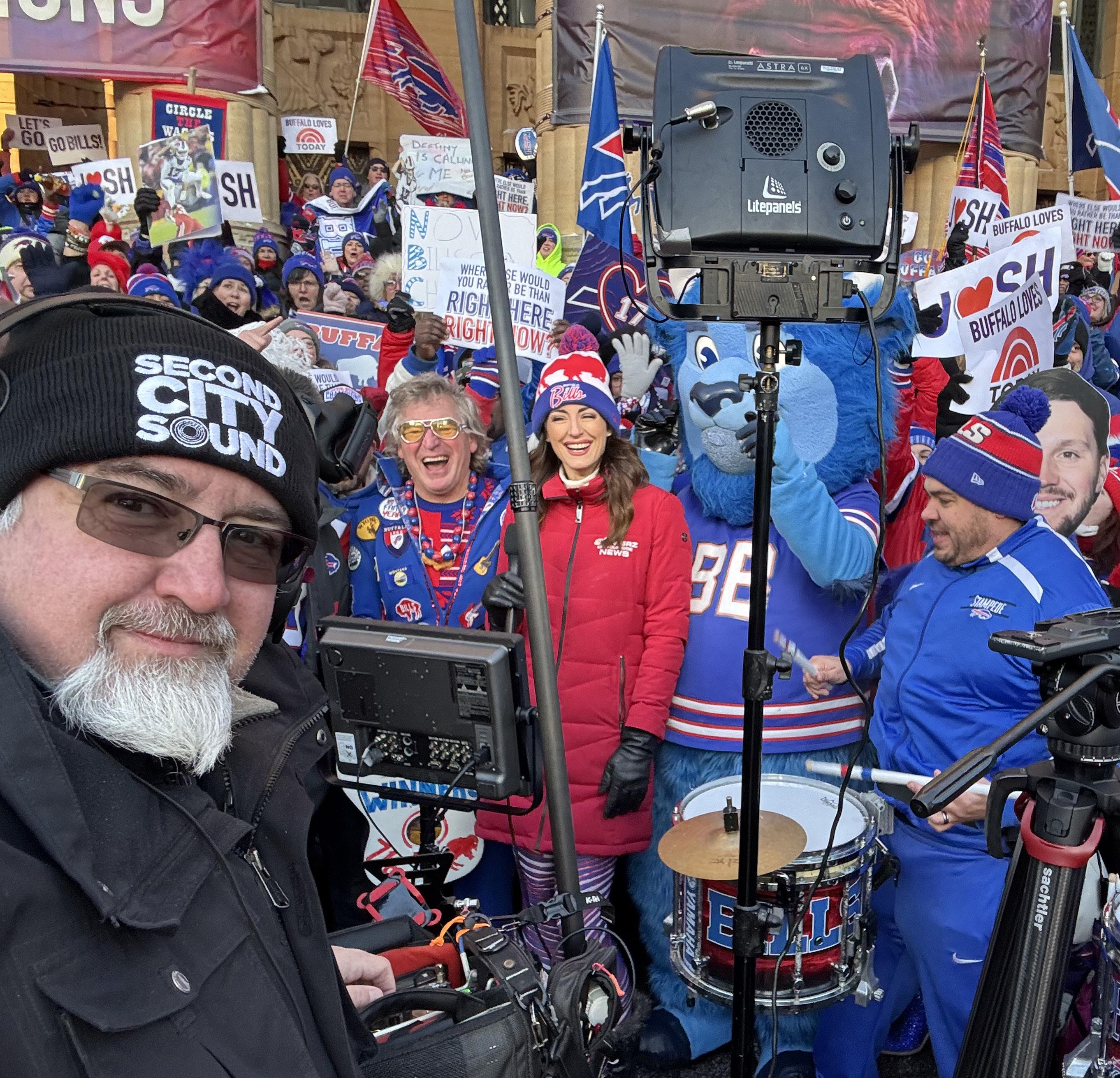
“LECTROSONICS IS SO MUCH PART OF MY EVERYDAY LIFE THAT I DON’T EVEN HAVE TO THINK ABOUT IT.”
“We were actually the first to document the B1 bomber, but technology was not like it is today,” Shafer explains. “I actually had to take a Lectrosonics 190 and put the mic in the ear of the jet pilot’s helmet because there were no extra plugs to get the dialogue.”
In another instance, while capturing a segment for Real Sports with Bryant Gumbel – investigating the slaughtering of horses who didn’t perform on the racetrack – Shafer’s team faced immediate danger.
“We were shooting in the stables when some, shall we say, unhappy ‘gangster’ types surrounded us demanding our tape,” he recalls.
Thinking fast, the crew swapped the footage for a blank tape.
“We proceeded to record the confrontation via the correspondent’s Lectrosonics wire, and it made the cut,” he says.
Beyond the adrenaline, Shafer relies on his gear to capture the gravity of historical moments. He was on the ground in New York covering the aftermath of 9/11 for ABC’s Nightline, joining stockbrokers on the ferry into lower Manhattan when Wall Street reopened. “There were guys in suits with attaché cases and gas masks on going to work,” he describes. “The smell is really difficult to describe; a combination of electrical and whatever was in those buildings, all merged together.”
Through it all, his Lectrosonics gear performed without issue, allowing him to focus on the human story rather than technical troubleshooting.
The durability of the gear has been proven in the most extreme conditions Shafer has encountered, including hurricanes and even working 1,765 feet underground in salt mines beneath Lake Erie.
“I’m hard on equipment; I don’t baby it,” Shafer admits. “I’ve had a plug-on transmitter in a hurricane with just a baggie around it, and it never failed. In 34 years of using Lectrosonics, I’ve only sent something in for repair twice, and that first time was 15 years in. It all just works.”
For Shafer, the brand represents a home base that allows him to focus on the story rather than the tech. “The greatest tools are the ones that just get out of the way,” he concludes. “No matter what environment I am filming in, with Lectrosonics I know it will work, and I’ll capture the best quality audio possible. Lectrosonics is so much a part of my everyday life that I don’t even have to think about it.”
DRUMS, DANCE, & DIGITAL MIXING
GUADELOUPE CULTURAL WEEKEND
Mouvement Mas K Klé are a musical collective that celebrates the modern and historic culture of Guadeloupe. As part of Guadeloupe’s Cultural Weekend, the group performed with others from across the Archipelago in a huge celebration of Caribbean culture with music, dancing and live performances. Headliner discovers how Sono Scène supplied the event with a DiGiCo Quantum 225 at the front of house position and SD12 at monitors.
Sono Scène is owned by Maurice Cely, who mixed front of house for the event and has supported every festival since the first edition in 2013.
Engineer Mikael Benjamin (Benj), a French sound engineer based in Guadeloupe, was the monitor engineer. “The DiGiCo system was deployed with two D2-Racks acting
as stage boxes, one dedicated to FOH and one to monitors,” Benj says.
The main traditional drums used by Mas K Klé are called Tanbou Mas, and this family of instruments hold a powerful significance in Guadeloupe culture. For Benj and Cely, the dynamic EQ of the Quantum 225 was
particularly useful for targeting the specific frequencies in the resonance of these drums, maintaining the sonic clarity of the mix.
“The Quantum 225 handled the drums extremely well thanks to its flexibility, processing capability, and sound quality,” Benj continues.
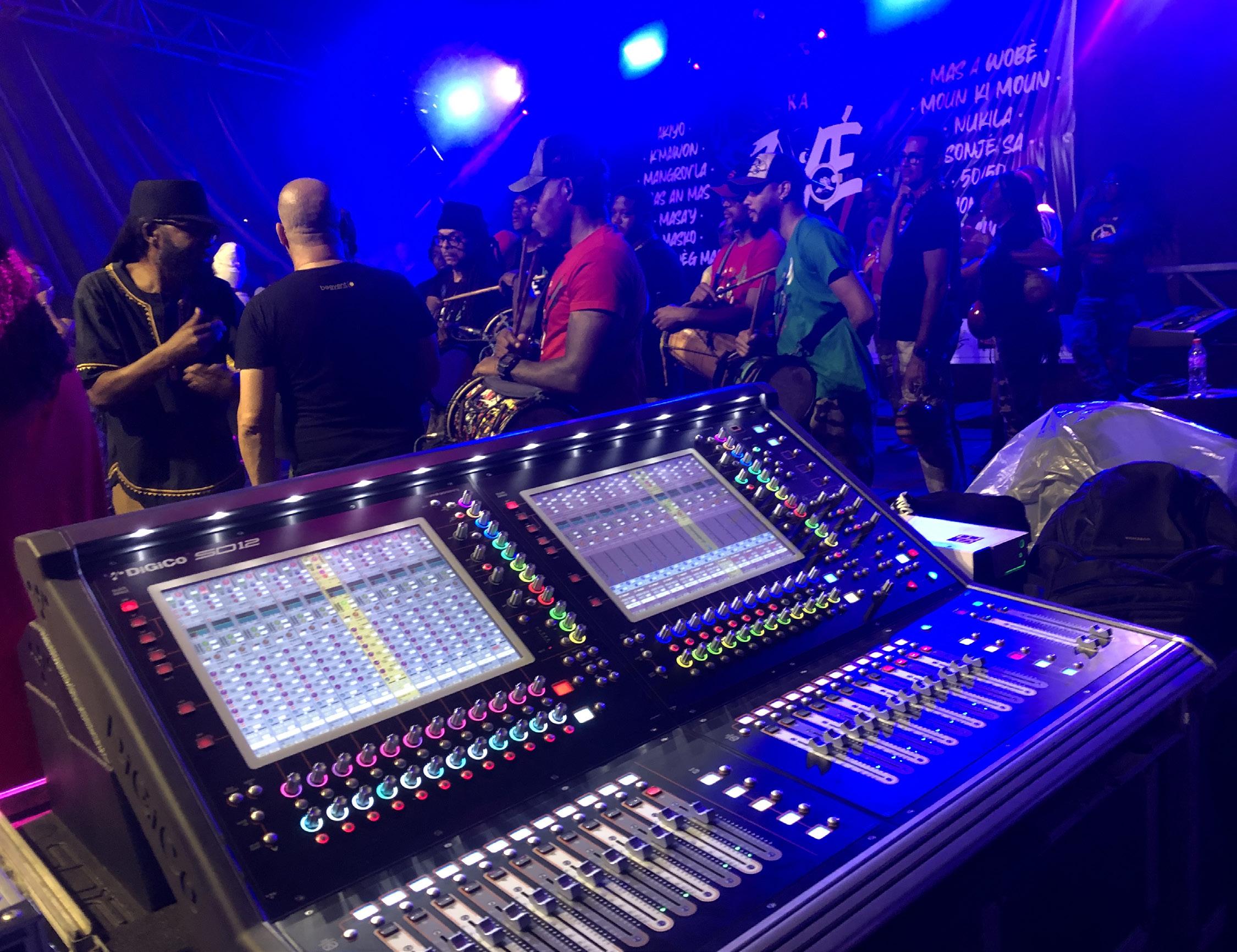
“The Tambour basse generates strong low-frequency energy, while the Tambour contrebasse creates low-mid frequency buildup, and the Tambour chant occupies the higher frequency range. The Quantum dynamic EQ allowed us to target these frequency ranges very precisely, engaging only when defined thresholds were exceeded. This approach preserved the natural energy and character of the instruments while keeping the mix clean, controlled and musical, delivering precise sound shaping with excellent clarity and minimal background noise.”
For busy, outdoor shows like these, the DiGiCo workflow is also a bonus. Key features that are available across the ranges, like Copy To functions, were integral to the smooth running of the weekend. “On the SD12 for monitors,
features like Mute Groups via Macros and Copy To were essential for handling multiple performers and constant stage changes,” Benj says. “I also created a custom EQ preset bank, allowing fast recall of drum EQ settings and ensuring consistency across performances. A wellorganised desk layout and consistent channel structure made it possible to manage very different musical dynamics smoothly.”
These features also came into their own for including last-minute guests. The Cultural weekend is an inclusive event that always involves the whole community, so making sure everyone can be seen and heard was key to the success of the 2026 weekend. Having a smooth and reliable workflow really aids engineers, with Benj being able to react quickly to any last-minute changes.
“We deliberately chose not to use Snapshots,” he expands. “Instead, we relied on a clear desk layout, a consistent channel structure, and real-time control, which made transitions faster and more predictable. In a cultural show context where additional musicians, especially percussion, can appear without being present during soundcheck, this workflow proved essential. The Copy To function was invaluable again, allowing us to quickly duplicate processing and routing to spare inputs when unexpected instruments were added, ensuring continuity without interrupting the flow of the show.”
DIGICO.BIZ
LILAS IR INNOMINE LIGHTING THE COMEBACK
WORDS BY ALICEGUST A F NOS
Five years after stepping away from the spotlight, Lithuanian hip-hop duo Lilas ir Innomine returned in spectacular fashion in 2025, drawing a crowd of around 20,000 fans to a sold-out open-air show at Vingis Park in Vilnius. The event marked the biggest concert in Lithuanian rap history to date, turning the city’s iconic park into a sea of lights, music, and celebration. Headliner takes a look at the powerful, fully weather-ready lighting setup from Cameo that helped transform the long-awaited comeback into an unforgettable live experience.
The stage at Vingis Park was more than a conventional concert venue – it became a projection surface for a musical statement. At its centre stood a semicircular structure made up of LED screens, staircases and a catwalk. Choir, dancers, special effects, lighting and video elements were brought together into a cohesive visual concept. Behind the scenes, the
visual spectacle was brought to life by Marfa Lights, which handled the lighting and video design on behalf of Baltic Production Service. The aim was to visually convey the musical dramaturgy of the show surrounding the two protagonists, Konstantinas Kiveris (Lilas) and Rolandas Venckis (Innomine), across all levels.
“Everything we design visually should contribute to telling the artist’s story,” explains Andrius Stasiulis, founder and lighting designer of Marfa Lights.
The team used Cameo ZENIT W300 and ZENIT W600 outdoor LED wash lights, OTOS B5 IP65 beam moving heads and PIXBAR SMD IP G2 LED bars, which were distributed in large numbers across the entire stage set.
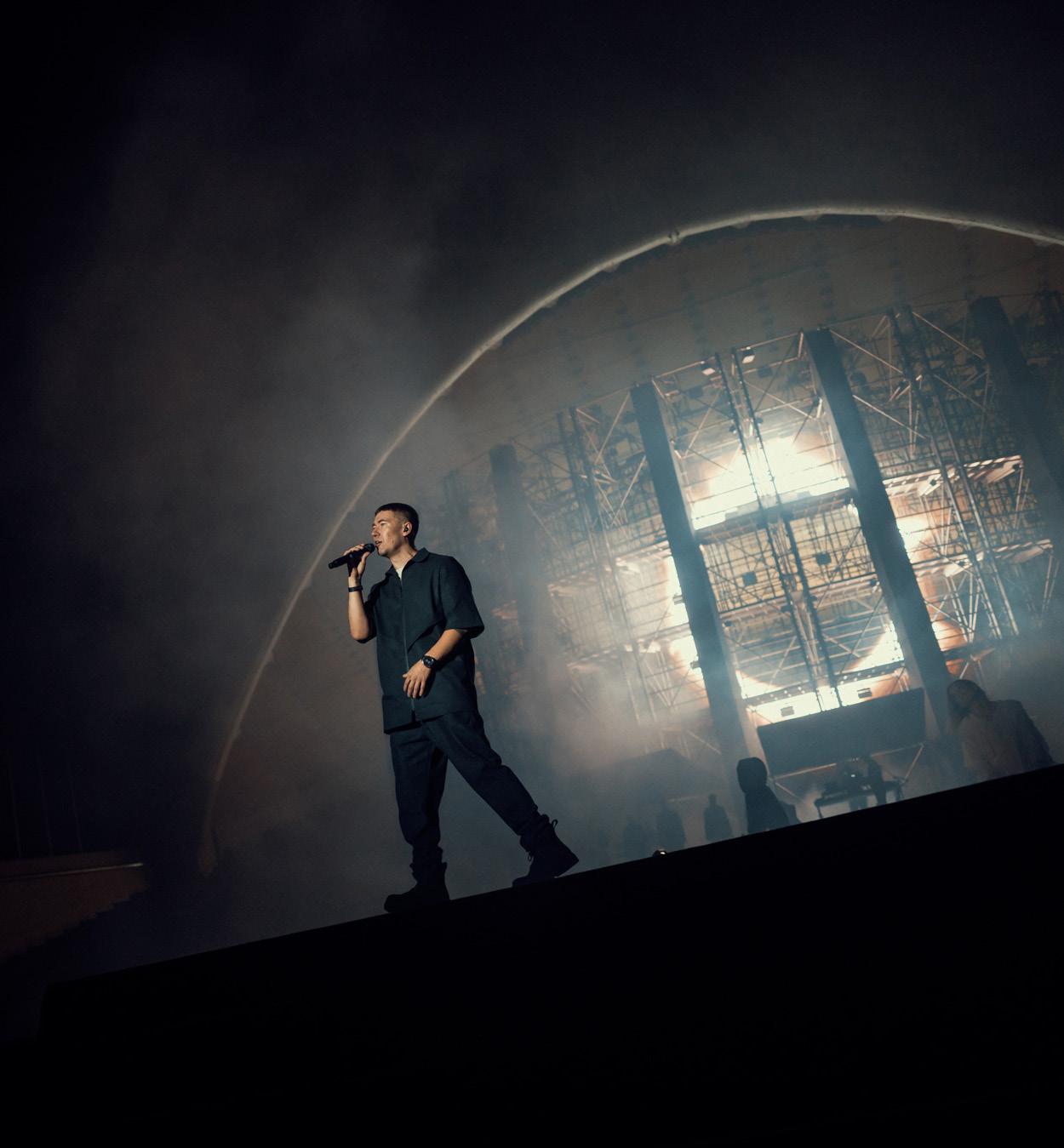
The lighting concept was based on the ZENIT W600. The IP65certified LED wash lights provided even illumination across the entire width of the stage and had “enough power to light up the entire stadium,” confirms Stasiulis.
Marfa Lights also used ZENIT W300 footlights, which ensured natural
skin tones, especially for close-ups on the LED screens. PIXBAR SMD IP G2 LED bars were used for accents, pixel designs and colour gradients, and were cleverly integrated into the stage architecture.
The video design was also seamlessly integrated into the overall concept. Based on the grandMA lighting consoles and the Notch and
Hippotizer software solutions, Pijus Norušis, video designer at Marfa Lights, created visual sequences that functioned like an extended lighting design: “Because we programmed the video according to the same principles as the light, we were able to create a consistent visual language throughout,” he concludes.
CAMEOLIGHT.COM
Credit: Marfa Lights
MSI JAPAN HOLDINGS THE MOST POWERFUL FORCE IS THE ONE NOBODY NOTICES
In his latest Headliner column, Mike Dias explores the hidden operating system beneath every great performance, and profiles Motoshige Nishio, COO of MSI Japan Holdings – an institution that has been running “invisible work” across Asia for nearly 50 years.
Think about the last time a performance stopped you cold. Not the lights. Not the production. Not even the song. The moment when something moved through you without asking permission. When the distance between the stage and your chest collapsed completely, and something true arrived, and you felt it before you understood it. You were not watching a show. You were inside a transfer. And almost nothing about what just happened to you was accidental.
THE SHOW YOU’RE WATCHING IS NOT THE REAL SHOW
Every seat in every arena on earth participates in the same illusion. The audience believes the show is what’s
happening on stage — the lights, the production value, the performers themselves. The visible mastery was spectacular for one night. And they are right. But only about the smallest part of what is actually happening. Because attending a show is not about watching. It is about receiving.
Everything the performers have ever practised, every hour of rehearsal nobody watched, every failure absorbed in private, every standard held when no one was keeping score — all of it compressed into muscle memory so deep it no longer requires thought. The body knows. The voice knows. The hands know. Decades of dedication made invisible so that tonight, in this room, the only thing that remains is pure signal.
In the seats, the audience arrives carrying everything they have ever felt. Every memory this music holds. Every version of themselves that existed when this song first found them. They did not come to watch a performance. They came to have something true about themselves reflected back with enough force to be undeniable.
Performer and audience. Signal and receiver. Two forces in the same room. But two forces alone produce nothing repeatable. Nothing can happen the same way tomorrow night in a different city for different people who arrived carrying different things. For that, you need the third force: the invisible infrastructure that holds the space, focuses the energy, and creates the precise conditions for the transfer to occur. Without it, there is no show.
And the most extraordinary thing about the infrastructure that makes the greatest shows on earth possible? Nobody in the audience knows it exists. Nobody knows because this is all invisible by design — the hidden scaffolding that supports the illusion.
What follows are lessons from a conversation with Motoshige Nishio, COO of MSI Japan Holdings, the organisation that has been providing that invisible third force behind Asia’s greatest stages since 1977. Not a profile of a company. Not a retrospective of shows produced or artists served. But instead, a masterclass on what happens when the principles that make a perfect transfer possible — on stage, every night, across language and culture and every variable a continent can produce — are applied to the building of an institution itself. This is infrastructure, turned inward. For 50 years. Quietly. Invisibly.
道半ば — THE ROAD IS LONG AND WE ARE STILL ON IT
In 1977, Motoshige Nishio joined a small operation in Osaka called LIVE SOUND MOB. What they lacked in resources, they made up for in the clarity of a single shared vision — not just to work with local bands, but to support musicians and artists capable of touring nationwide. To play on the biggest stages in Japan. To think beyond the city they were standing in. From the beginning, the dream was larger than the means.
Nishio-San joined as a sales representative. Four months later, through an acquaintance’s introduction, he made his first sales visit in Tokyo and secured a domestic tour contract for an artist. That is how MSI Japan began.
Nearly 50 years later, MSI Japan Holdings operates across Tokyo, Osaka, Hong Kong, Taiwan, Beijing, and the United States. Their engineers have held Whitney Houston at Fukuoka Dome. David Bowie’s Japan tours ran through their infrastructure. TVXQ
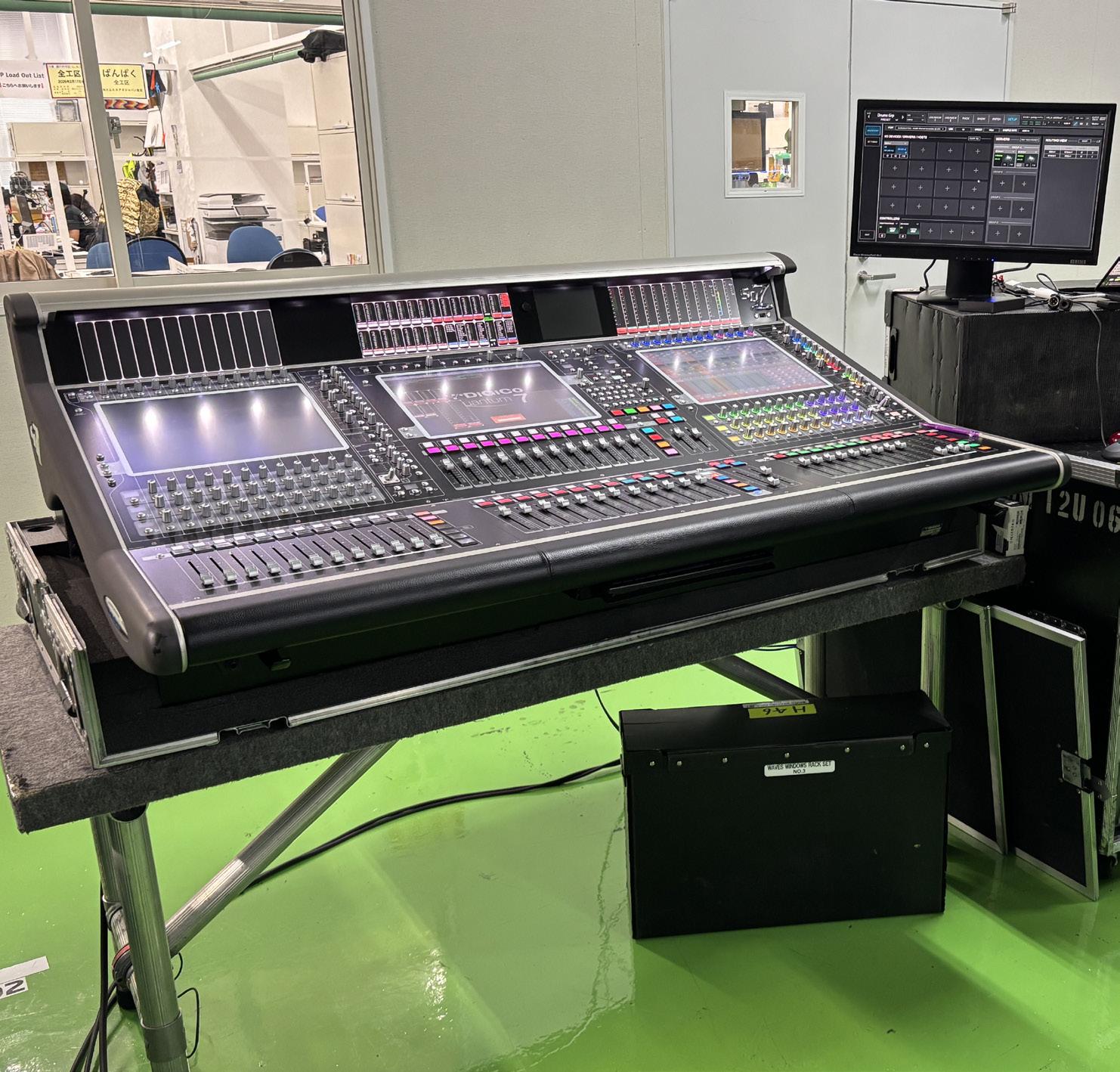
performed at Tokyo Dome in 2012 in what became the first concert in that venue’s history without delay speakers — a technical achievement that required both the vision to attempt it and the precision to deliver it live, in front of tens of thousands, without a second chance.
Andy Lau. G.E.M. Jolin Tsai. Masaharu Fukuyama. And upon request from Eighth Day Sound, equipment support for Madonna, Lady Gaga, Taylor Swift, and Eminem. Decades of the most important rooms on the continent, running on MSI Japan’s equipment, MSI Japan’s engineers, and MSI Japan’s relationships.
Yet their name appears on almost none of it. And when I asked Nishio-San to describe where MSI Japan stands today — after all of this — he used two words.
Michi Nakaba, which means the road is long, and we are still on it. Halfway there. The journey is not yet complete.
This is not false modesty. This is the honest assessment of a man who has chosen the work over the arrival. Who has never confused the harvest with the end of the work? Who measures progress not in destinations reached but in standards maintained — and who understands, with the certainty that only comes from fifty years of proof, that the moment you believe you have arrived is the moment the standard begins to drift.
There is a question every leader eventually faces. Not in a boardroom. Not in a strategic planning session. In the moment when everything is uncertain, when the variables are beyond counting, when the pressure is real, and the outcome is public, and the people around you are watching to see what you do next. What do you do?
Nishio-San’s answer comes from a tradition older than any management framework ever written.
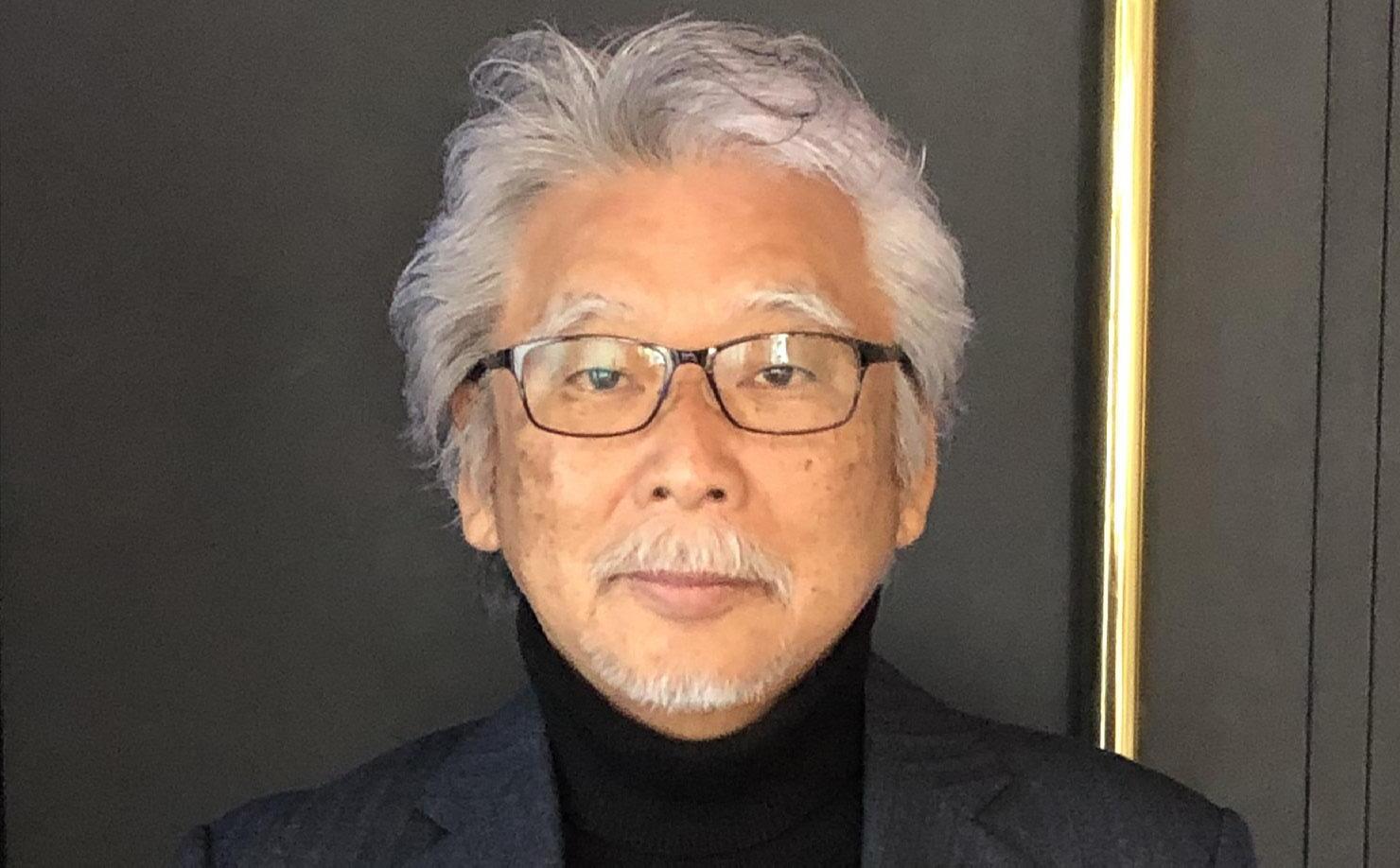
治にいて乱を忘れず。
“In times of peace, never forget the era of turmoil”. Prepare in peace for the chaos that will come. Build the systems, develop the people, hold the standard — not because the pressure is here yet, but because it is always coming. And when it arrives, do not be swept into it. Do not be shaken by it. Do not let it change what must be done.
When I asked Nishio-San what this means in practice, he was precise: “No matter what situation arises, if a leader maintains the composure to calmly execute what must be done without being shaken, everyone will follow suit.”
This is the law that every great stage manager, every world-class FOH engineer, every tour manager who has ever held a production together under impossible conditions already knows in their bones. The leader’s composure is not a personality trait. It is a signal. It tells every person in the room whether the infrastructure is holding or collapsing. Whether the system was built for this moment or is being improvised in real time. When the leader holds, the system holds. When the system holds, the transfer happens.
なすべきことをなす。
Execute what must be done. Not what is visible. Not what earns recognition. Not what feels significant in the moment. But what must be done.
Nishio-San calls this the essence of leadership. Not a strategy. Not vision. Not charisma. Not disruption. The irreducible minimum. Applied without drama. Every time. Under any conditions.
PEOPLE ARE NOT DEVELOPED. THEY GROW.
Ask most companies how they build great teams, and they will show you a training programme. A competency framework. An onboarding curriculum. A leadership pipeline with milestones, metrics, and quarterly check-ins. Ask Nishio-San, and he will give you a law. “People aren’t developed. They grow.”
The distinction is not semantic. It is architectural. Development implies something done to a person from the outside. A process applied. A standard was installed. A curriculum delivered until the box is checked and the person is deemed ready. It positions the organisation as the active force and the person as the recipient — shaped, moulded, produced.
Growth implies something that happens inside a person when the conditions are correct. It cannot be scheduled. It cannot be mandated. It cannot be measured in a quarterly review. It can only be enabled by building an environment so clear in its standard, so consistent in its
expectation, so honest in its feedback that the person inside it has no choice but to become capable of holding what the work requires.
The leader’s job is not to develop people. The leader’s job is to build the conditions where growth is the only logical outcome of showing up. Before formal employment, MSI Japan takes time with every candidate and lets them experience actual work. Trial and error. No title. No permanence. Just the real conditions, the real standard, the real system — and the honest answer that arrives about whether this person can hold what the work requires.
The environment is not adjusted for the person. The person grows into the environment. Nishio-San does not pretend this is simple. “Balancing individual excellence and collective responsibility — that’s difficult. Balancing individual interests and organisational interests — this is similarly challenging.”
He says it plainly. Without resolution. Because the tension is not a problem to be solved. It is the condition that keeps the standard alive. Nishio-San extends this further: “Even if we build an organisation capable of handling 1,000 artist performances, without the skills to execute it or the supporting systems, neither the employees, the company, nor the organisation can achieve stability.”
And then he makes it concrete in the way only someone who has lived it can: “Work only functions when people are in place at every stage — those preparing equipment, staff coordinators, and so on.” Not the stars. Not the headliners. Everyone. Every role. Every person whose name never appears on the poster, but without whom the poster means nothing.
コツコツ— THE WORK THAT NOBODY WATCHES
There is a sound in Japanese — コ ツコツ — that has no clean English translation. It is the sound of steady, persistent, unglamorous effort. The drip of water on stone. The daily practice that produces no visible result today and no visible result tomorrow, and then one day — after years of invisible accumulation — produces everything. Western business culture is allergic to コツコツ. It wants the breakthrough. The pivot. The disruption. The moment the graph bends upward. It celebrates velocity over depth, the announcement over the work that made the announcement possible, the visible heroic act over the invisible daily standard. The stage has never had this problem. Because the stage is binary. The transfer either happens or it doesn’t. The audience either feels it or they don’t. You either killed. Or were murdered. And no amount of announcement, branding, or strategic narrative changes what occurs in the three seconds after the lights go down. コツコツ is the only preparation that matters. So of course, when I asked Nishio-San what creates MSI Japan’s environment of trust — what practices, what philosophies, what systems — he answered without hesitation. “Sincerely and earnestly. Steadily putting in the work. If we keep コツコツ, various opportunities should come our way.” No framework. No methodology. No competitive differentiation strategy. The work. Done fully. Done sincerely. Without performance. Without scorekeeping. Without waiting for recognition, that was never the point. And here is where Nishio-San’s コツコ ツ becomes something most leaders will never attempt. Every morning since January 16, 2016 — without a single exception — he has sent his entire staff a passage from a book that moved him in his private reading. Not a corporate directive. Not a performance update. Not a motivational quote harvested from the internet. A few sentences that reached him personally were forwarded without an agenda
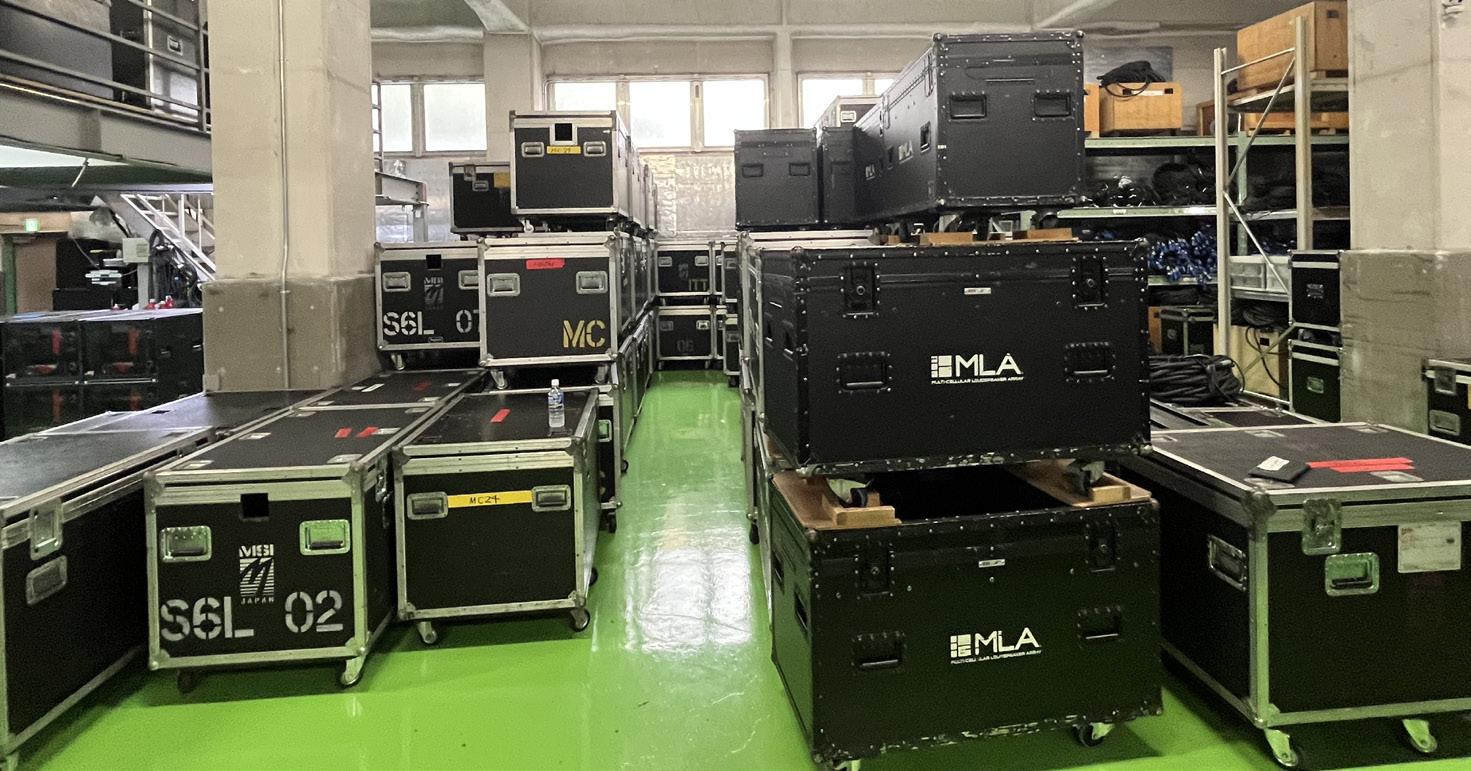
to every person in the organisation. That is more than 3,200 consecutive mornings. One morning at a time.
実るほど頭を下げる稲穂かな
— THE RICE PLANT BENDS LOW AS IT RIPENS
There is a proverb that Nishio-San’s father gave him when he was a child. 実るほど頭を下げる稲穂かな。The heavier the grain, the lower the stalk bows. In Japanese agricultural tradition, this is literal. The rice plant that carries the most — the one that has grown the fullest, produced the heaviest harvest, fulfilled its entire purpose — is the one that bends lowest to the earth. Not from weakness. From the weight of what it has become.
Nishio-San has carried this proverb for a lifetime. It now lives — unnamed, unposted, unannounced — inside the culture of an institution that has been doing the invisible work for nearly 50 years. And when I asked about humility — about its role in MSI Japan’s culture — he didn’t reach for a framework. He didn’t offer a leadership principle. He offered the image his father gave him. And then he added this:
“Without humility, arrogance takes root. You start asserting yourself, saying ‘I, I, I.’ I believe the moment you get carried away is the most dangerous.” Not the moment of failure. Not the moment of crisis. Not the moment when the system is under pressure, and the transfer is at risk, and everyone is watching to see if
the infrastructure holds. The moment of success. The moment the work has produced something undeniable and the temptation arrives — quiet, reasonable, entirely human — to believe that you have arrived.
That is the most dangerous moment. Because the rice plant that stops bending has stopped growing. The leader who stops bowing has started believing the harvest is the destination rather than the proof that the journey continues. 道半ば. The performer is still transmitting. The audience is still receiving. The infrastructure is still invisible. The show is still happening. Nobody notices. Everybody feels.
Motoshige Nishio is the COO of MSI Japan Holdings — the organisation behind nearly fifty years of live production across Japan, Hong Kong, Taiwan, Beijing, and the United States. He has been doing the invisible work since 1977.
Mike Dias writes and speaks about pressure, performance, and the Relationship Economy – translating the hidden operating systems of world-class entertainers into leadership frameworks that actually work. His lens makes one thing clear: trust is the condition, translation is the act, and experience is the outcome.











REPLAY FOR EVERYBODY, EVERYWHERE.
RiMotion is an easy-to-install replay solution that can be implemented almost instantly in broadcast environments of any scale. It streamlines traditional and modern workflows and provides real-time performance, even when working remotely.
• Intuitive touchscreen