DALE MORTON
Dale Morton has a very diverse range of interests and a very unusual career. His academic studies included creative writing and sculpture at West Virginia State College and Marshall University, as well as mechanical drafting at Carver Technical Institute. He is 56 years old and makes his living as a self-employed mascot costume designer and sculptor. His interests include aviation, history, warships and submarines. His favorite authors are Tom Clancy, Patrick O’Brian, J.R.R. Tolkien, and J.K. Rowling. Dale spent six years researching and writing The Return of the Flying Boat, and has several other novels in the planning stages, two of which are sequels to his first. Dale lives in Hurricane, West Virginia, with his family.
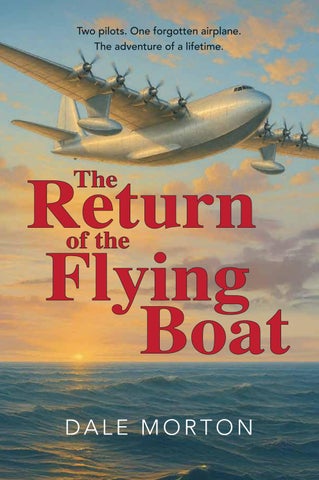
Two pilots. One forgotten airplane. The adventure of a lifetime.
The Return of the Flying Boat
In 1999 the world teeters on the edge of war with Russia as a fleet of experimental Russian attack subs wage an all-out assault on the Atlantic shipping lanes, increasing the need for the U.S. to transport military cargo by air. America urgently needs to replace its aging fleet of giant C-5 Galaxy cargo planes, one of which crashed due to wing failure. Responding to this need, an aging, visionary industrialist assembles a crack team of engineers to refurbish and fly the giant 52-year-old Hughes H-4 Hercules Flying Boat, the Spruce Goose, as a prelude to building a fleet to replace the Galaxies as quickly as possible. These events set the stage for a tale of international intrigue, undersea warfare, cut-throat competition between aircraft manufacturers, and an unexpected military rescue mission into Northern Russia the Hughes Flying Boat must undertake. It is a fast-paced story about the resurrection of a legendary aircraft and the redemption of the man destined to fly her.
DALE MORTON
Two pilots. One forgotten airplane. The adventure of a lifetime.
THE RETURN OF THE F LY I N G B O AT A NOVEL
DALE MORTON
Publisher Page
an imprint of Headline Books
Terra Alta, WV
The Return of the Flying Boat by Dale Morton copyright ©2025 Dale Morton All rights reserved. This book is a work of fiction. Names, characters, places, and incidents, except where noted otherwise, are products of the author’s imagination, or are used fictitiously. Any other resemblance to actual people, places or events is entirely coincidental. No part of this publication may be reproduced or transmitted in any other form or for any means, electronic or mechanical, including photocopy, recording or any information storage system, without written permission from Publisher Page. To order additional copies of this book or for book publishing information, or to contact the author: Headline Books, Inc. P.O. Box 52 Terra Alta, WV 26764 www.HeadlineBooks.com mybook@headlinebooks.com Publisher Page is an imprint of Headline Books ISBN 13: 9781958914670 Library of Congress Control Number: 2025934282
P R I N T E D I N T H E U N I T E D S TAT E S O F A M E R I C A
This book is dedicated to my wife, Cindy, whom I would marry a hundred times over.
Acknowledgments My deep and sincere thanks to the following individuals, without whom this novel would not have been possible: • Lt. Colonel James W. Piercy, USAF C-130 pilot for the West Virginia Air National Guard, 130th Tactical Airlift Group for serving as inspiration for my main character and for generously sharing his experiences as a flyer and his knowledge as an engineer. Godspeed to you, Sir. • Sergeant Steve Cook, WV ANG, 130th TAG, for answering countless questions and allowing me to crawl all over the C-130s up at Yeager Airport. I’ll never forget you, my friend. • Dave Grant, hydraulic systems designer for the Hughes Flying Boat and the man who was sitting in the co-pilot’s seat the day she flew. Thank you for taking the time to sit through our lengthy phone interview. • Stan Soderberg, Hughes Aircraft mechanic who served as the HFB’s unofficial caretaker for nearly fifteen years. Thank you for passing on your knowledge and experiences. • Robert Withrow, my lifelong friend and aviation enthusiast who helped me early on with making sure my flight terminology was correct and for first explaining to me what “angle of attack” meant.
Introduction Transcript of live broadcast by radio pool announcer Jim McNamara, November 2, 1947: “It’s fifty...it’s fifty over a choppy sea. It’s fifty-five...it’s fifty-five. More throttle. It’s sixty...it bounces to sixty-five. It’s seventy...it’s seventy-five... And (sound cuts out) and... and I believe we are airborne! We are airborne, ladies and gentlemen! And I don’t believe Howard meant this to be, I don’t know. We were airborne for just a moment. And we were really up in the air! We were really up in the air! I don’t know whether...Howard, did you expect that?” “Certainly, I like to make surprises.” It had been fifty-two years since the giant airplane’s one-andonly flight, yet she was in just as good a condition now as she had been then. The silent, interior darkness of the cavernous hangar that encapsulated her was pierced by a single overhead spotlight that was on merely to accommodate the silver-haired man who shuffled across the floor off her port side. The elderly man could see his immediate vicinity but didn’t need to see the plane; he already knew every inch of the enormous aircraft intimately, i
The Return of the Flying Boat
having spent most of his adult life caring for and protecting her as if she were a child of his own. But at long last, the darkness was about to close in upon her finally. No matter what they did to prevent it, the proverbial axe was about to fall. The man stepped over to a television monitor embedded in a display stand that held various enlarged photos of the famous aircraft. For the past eighteen years, the video system had run the same documentary every day, telling the tourists the story of the plane and of the legendary man who had designed and built her. Across the hangar, a door opened, momentarily letting in a trace of light from the evening sun, its latch echoing through the silence as it closed. The middle-aged man who had entered strode wearily to where the older man stood, passing under the great aircraft’s wings. This was the Axe Man himself. “You still here, Stan?” he said. “It’s getting late.” “Yeah,” replied Stan without turning. “It’s been late for a long time.” Together, they watched the familiar images of the documentary play on the screen. “Hughes Tests Plane on Eve of Inquiry” declared the old newsreel footage, followed by a shot of the giant seaplane in drydock. The grainy, black and white film showed the plane being floated into the harbor and the pilot, his head adorned with a snap-brim fedora, taking his seat in the cockpit. “Listen, Stan,” the younger man began, “I have some bad news: I’m afraid we’re going to have to close down at the end of the month. We don’t have much choice at this point.” Stan said nothing, he only looked gravely at his friend for a moment before turning his attention back to the screen. “We wouldn’t have to shut down if they would just put a little effort into promoting her again,” he replied at last, his words heavy with resentment. “I know, but they’ve made it clear they simply aren’t interested in doing that. And you know the Smithsonian has wanted sections of her for years.” ii
Dale Morton
“Sections,” said Stan, tersely. “That means she’ll be sawed up into pieces. One museum will get the forward section, another will get the tail, another the wings—” “At least it would be a fairly dignified way of letting her go. Of course, the best thing that could happen is that somebody puts in a bid for the whole plane. When we announce the closure, we’ll get some nice publicity out of it and may end up getting the right offer.” Stan let out a long, exasperated sigh. He had given over fifty years of his life to the care of this plane. It had provided him with a livelihood he could be proud of and countless wonderful memories. Now, she was going to be cut up and carted away piecemeal. “We’ve come so close to losing her so many times for the same reasons,” said Stan. “I guess I was just hoping to be dead and gone by this point so I wouldn’t have to watch it happen.” The younger man hung his head slightly. He couldn’t think of anything to say that sounded remotely comforting. He knew that neither Stan nor the few remaining Hughes “Oldtimers” had any time or energy left to give to their beloved Flying Boat. “I know how you feel...but we’ve done all we can do.” The younger man placed a steadying hand on his friend’s shoulder. “What do you say we grab some dinner?” Stan looked over and smiled thinly. “Sure, why not?” He walked over to the monitor and shut the system down for the evening. The light was shut off, the door locked, and the two men headed into the night, leaving the oppressive silence behind to engulf the giant aircraft that was truly the only one of her kind in the world.
iii
Prologue If we were to turn back the hands of time to the opening of the 1990s, we would witness the beginnings of the divergence in historical events that shaped the world described in the following account into one vastly different from the one we are familiar with. Following the collapse of the Soviet Union in 1991, a wave of paranoia and fear swept through the weary population of Russia as living conditions declined, corruption spread into all corners of public life, and efforts at democratic reform collapsed altogether. The situation worsened as the now independent former Soviet republics gravitated to the North Atlantic Treaty Organization, desperate for the economic security that membership in the Western Alliance would bring. But the possibility of losing their border states to NATO provoked deep anti-Western sentiment among Russian nationalists who accused NATO of attempting to increase its stranglehold on the European continent by luring long-held Russian territories in with false promises of economic stability. Despite these objections, the Baltic states of Lithuania, Latvia, Estonia, and the eleven former Soviet republics elected overwhelmingly to secede from Russia and join NATO. Fierce debate raged in the United Nations. Proponents claimed that NATO expansion would give Western democracies greater leverage over political transformations occurring in Europe. Opponents strongly maintained that such expansion would undercut NATO’s delicate relationship with Russia and lead to unpredictable, possibly aggressive behavior. Even the iv
Dale Morton
Russian reformist president stood before the U.N. and stated that “the strengthening of the NATO eastern bloc today” would lead to “confrontations of the worst kind tomorrow.” But the warnings went unheeded. Having proven their dedication to democratic reform, the NATO general assembly granted full membership to those republics that applied, doubling the size of the Western Alliance virtually overnight. Then, the Russian presidential elections brought into office an anti-Western extremist named Alexei Dezhurov, a charismatic yet shrewd leader who followed a popular ideology known as Derzhava (power). Following his victory, he immediately called on the Russian people to band together to protect what was left of their dwindling nation. The weary populace was quickly won over by the new president, who instilled in them a renewed sense of direction, dignity, and the promise of a better life. Once in power, Dezhurov acted swiftly. With a firm hand, he toppled the organized crime lords who held so many of the common people in their vise-like grip. Food distribution became increasingly efficient, and the epidemic of hunger ended. Then, at his behest, an ambitious drilling expedition to the far eastern island of Sakhalin tapped the immense crude oil deposits locked beneath its surface. In what was easily one of the largest oil strikes in world history, Russia’s national wealth skyrocketed. Employment soared, fuel prices plummeted, and a new sense of pride and national purpose encompassed the once-struggling nation. Only two years into his rule, Dezhurov erected a new Iron Curtain around his Motherland that likened the previous Cold War incarnation to one made of silk. Russian ambassadors around the globe were called home, and Isolationism became a strict precept as all contact with the outside world was cut off, and the Russian military began a buildup at the borders of the Baltic States. All Russian ballistic missile submarines in port since the collapse of the Soviet Union were refurbished and redeployed. v
The Return of the Flying Boat
Russia’s nuclear silos went to a higher alert status as the finger of the Russian military moved closer to the nuclear trigger. In a few short years, the country became an armed camp ready to attack any perceived threat. With the unquestioned loyalty of the people behind him, Dezhurov declared himself the first czar since 1917 and abolished all efforts at democratic reform. He then named his new, powerful nation: The Restored Russian Empire. In the United States, those who had opposed the expansion of NATO now saw their concerns justified as the controversial action bore its singular fruit. The CIA closely monitored Dezhurov’s Moscow stronghold, and larger numbers of U.S. warships patrolled increasingly nearer the shores of the new Empire as Congress began an immediate reinforcement of American military might. In 1998, amid both praise and criticism, the U.S. president initiated Operation Global Response, a massive move of men and equipment by air and sea to the new NATO countries in preparation for a possible defensive. Military bases sprung up hurriedly in the once-Russian republics on the eastern and southern borders of the Empire as the Russians continued their intimidating build-up. Dezhurov began an obsessive push to develop new, more sophisticated weaponry built under intense secrecy. His program to infiltrate American defense corporations brought insight into the development of new construction materials, which he used to create a revolutionary war machine that was completed and put into deadly service before anyone was even aware of its existence. The year is 1999.
vi
1 The White House The door to the Situation Room opened, and the president entered. Every member of his defense team stood up, the expressions on their faces as grave as he’d ever seen them. He sat down at the head of the table, and his team resumed their seats. “Okay, let’s have it.” General James Recco, chairman of the Joint Chiefs, answered. “Mr. President, a few hours ago, we lost a Spruance-class destroyer and a British oil tanker to what we suspect was a torpedo strike by a Russian fast-attack submarine.” The president closed his weary eyes and shook his head. “Which destroyer?” “The USS Fletcher. She was escorting the Nottingham to England in the wake of the disappearance of those other two Brit tankers last week.” “Any survivors?” “Forty-eight men were picked up this morning. Twentythree were from the Fletcher.” “All right, let’s have the details.” Recco cleared his throat. “Here’s what we know: Four days after the two ships left New York, the Fletcher reported detecting what sounded like a Russian Victor-class attack sub. The report states that the Fletcher circled back around the Nottingham and began pinging with her active sonar in an attempt to frighten
1
The Return of the Flying Boat
the Victor off. Captain Renner then sent the Seahawk out, which began dropping sonobuoys to try to nail down the sub’s position. The Victor then dove deep and attempted to hide beneath the thermocline. The Seahawk managed to track the sub for about four thousand yards, but by then, the two ships had zig-zagged their way out of the area and managed to shake the Victor off... or so they thought. Yesterday morning, as they neared British coastal waters, they detected the same Victor shadowing them from under a deep scatter layer of plankton. Renner called general quarters and tried to flush her out using active sonar. That’s where the report from the Fletcher ends. The two surviving officers have testified that just as they were about to make a torpedo attack on the Victor, the Fletcher’s stern exploded. Two minutes later, a second explosion erupted amidships, causing her to break in two and sink. They then reported that the Seahawk, which was circling nearby, was taken out by a rocket fired from under the water. Shortly after that, the Nottingham exploded amidships, keeled over and also sank.” The President drummed his fingers on the table. “I see. So, you think they were sunk by this Victor?” Recco frowned. “That’s the perplexing part. The officers testified that the Victor was on a course of three-zero-zero, heading west, so it would’ve been facing the wrong direction to carry out an attack on the Fletcher.” “Then what hit her?” asked Paul Gibson, the president’s national security advisor. Recco turned the briefing over to Dr. Ralph Lowenstein, director of the CIA. “We’ve sighted something very disturbing at one of the Russian submarine bases on the Kola Peninsula.” Lowenstein distributed sealed envelopes. “These photos were taken by one of our Lacrosse recon birds monitoring the
2
Dale Morton
Northern Fleet bases. What you’re looking at in photo number one are the submarine pens at the naval base of Gremikha:
“There is a Typhoon-class ballistic missile submarine to the left of the frame and a standard Victor-class sub on the far right. But between them, on the other side of the pier from the Victor, sits a third, unidentified vessel. From that distance, it looks like an Alpha-class or Akula-class attack sub...but it isn’t. Look at photo two. It was taken using the satellite’s electrometer. Normally, subs can be detected from space when they’re on the surface because their hulls react with seawater, producing electromagnetic energy. In the picture, you can see the distinct electromagnetic image of the Typhoon and the Victor. But in the middle, where the third sub should be, there is absolutely nothing. This unknown sub did not show up under electromagnetic scanning.” Defense Secretary Pete Derrick frowned. “What exactly does that mean?”
3
The Return of the Flying Boat
“Well, it means that this sub, which we’re calling a Foxtrot IIclass, is not constructed of steel; it’s made of something else. But there’s something more. Look carefully at photo three:”
The president and his defense team studied the closer photo of the Foxtrot. It was unlike any submarine they had ever laid eyes on, unusually angular and sharp, faceted, with none of the characteristic teardrop roundness of a normal sub. But suddenly, it took on a stark familiarity. “It looks like one of our goddamn stealth figh...” The president stopped in mid-sentence and looked up, his eyes widening. “We believe that’s exactly what it is,” said Lowenstein, “A stealth submarine—for lack of a better term.” Silence filled the room as the men shifted uneasily. “Could this be a mock-up of some kind?” asked Recco, instantly starting to cover all bases. “No, General. This morning, our satellites viewed that exact sub leaving port, heading for the deeper waters of the Barents Sea, where they conduct their new ship trials. What’s more, we 4
Dale Morton
have evidence of three more of them in existence.” Gibson leaned forward. “Let’s not go jumping the gun here. What makes you think a sub that’s faceted like our F-117 would have an advantage under the sea? The F-117 is designed to deflect radar waves. Submarines use sonar.” “Because the Fletcher was using her active sonar at the time she was attacked,” replied Lowenstein, “and the only sub she detected in the area was the Victor. “If one of these Foxtrots was lurking nearby, then the Fletcher should have had no trouble finding her using active.” The director paused. “As soon as we analyzed these photos, I decided to go straight to the horse’s mouth—the Skunk Works itself. I flew Ken Fox in here this morning; he’s waiting outside to brief us.” The president consented and a second later, an older man, slender, with thinning white hair and black horn-rimmed glasses, was shown in. They were all well acquainted with Ken Fox, the current chief of Lockheed’s super-secret Advanced Development Projects Division, better known throughout the government and the aerospace industry by its singular nickname. For fifty-six years, the Skunk Works had produced an unparalleled roster of extraordinary aircraft, including the subsonic U-2 spy plane and the SR-71 Blackbird, which remained unchallenged as the fastest airplane in the history of aviation, having reached speeds exceeding Mach three at altitudes greater than eighty thousand feet. In 1975, the Skunk Works developed what became known as “stealth technology” and in 1981, produced the faceted, radar-absorbent F-117 Nighthawk. Fox had been its program manager, and the further application of that technology into missiles and spy drones had been his life ever since. “What can you tell us about this, Ken?” asked the president. “Could the faceting the F-117 uses to evade radar help a submarine evade detection by active sonar?” 5