Dan E. Hendrickson is a multi-faceted individual with a diverse range of experiences and passions. Born and raised in Sheridan, Wyoming, Dan’s upbringing included athletic pursuits, academic endeavors, and a deep connection to his family. After graduating from high school, Dan pursued his love for writing and storytelling by enrolling in Casper Community College to study journalism. While he discovered his talent for investigative reporting, his true calling lay in Christian ministry, leading him to earn a degree in Practical Theology. In recent years, Dan has rekindled his passion for storytelling, resulting in the publication of several books with more on the way. His writing reflects his diverse experiences and deep insights, weaving together elements of his upbringing, ministry, martial arts, and entrepreneurial endeavors. Dan’s life has been shaped by a commitment to faith, hard work, and a love for storytelling, and these aspects continue to inform and inspire his writing and life’s work.
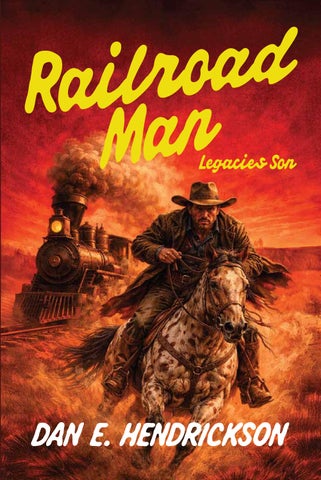
RAILROAD MAN: LEGACIES SON
With sweeping energy, Railroad Man bursts onto the canvas of the American West, where ambition and heritage clash in the age of iron rails. Navy veteran Arthur Edwards is tasked with extending the railroad from Cheyenne to Billings—but to succeed, he must win over the formidable Chief Pretty Eagle of the Crow Nation. Talks are tense and passions run high as cattlemen push for profit and resort to kidnapping Apony and her daughter Aylen, a tenacious railroad worker whose spark kindles Arthur’s growing affection.
DAN E. HENDRICKSON
Publisher Page
an imprint of Headline Books
Terra Alta, WV
Railroad Man: Legacies Son by Dan E. Hendrickson copyright ©2026 Dan E. Hendrickson All rights reserved. This book is a work of fiction. Names, characters, places, and incidents, except where noted otherwise, are products of the author’s imagination, or are used fictitiously. Any other resemblance to actual people, places or events is entirely coincidental. No part of this publication may be reproduced or transmitted in any other form or for any means, electronic or mechanical, including photocopy, recording or any information storage system, without written permission from Publisher Page. To order additional copies of this book or for book publishing information, or to contact the author: Headline Books, Inc. P.O. Box 52 Terra Alta, WV 26764 www.HeadlineBooks.com mybook@headlinebooks.com Publisher Page is an imprint of Headline Books ISBN 13: 9781958914915 Library of Congress Control Number: 2025951549
P R I N T E D I N T H E U N I T E D S TAT E S O F A M E R I C A
Dedication This dedication is for my grandfather, Daniel Mooney, who, along with my grandmother Elma, raised seven children in Sheridan, Wyoming. Their family includes my mother, Helen Hendrickson; my uncles, Dan, David, and John Mooney; and their daughters, Michelle McDonald, Patricia Shearin, and Carrol Wilhelm. Daniel Mooney served as a railroad conductor for Burlington Northern Railroads in the Northwestern United States for forty years, frequently operating trains along the line between Sheridan, Wyoming and Billings, Montana—the very route central to this book. I held my grandfather in great esteem and hope that, were he alive today, he would appreciate this work and recognize the respect I have for his distinguished career.
Acknowledgement First foremost I am thankful to God Almighty for giving me inspiration to write my stories. Also thanks to my wife Cheryl, who is always there for me and supports my writing with her patient support and help. My Children, Carl, Becky, and Donna who always cheer me on. Writing stories that others enjoy is a reward within itself so I am very grateful to all who will enjoy this story. God Bless You All!
1
Railroad Man May 20, 1883, Cheyenne, Wyoming A dozen hands reach out from the broken window as the sloop sinks into the James River. Bubbles and muffled children’s voices in panicked screams echo from below the surface as the cold evening tides take them to their watery graves. The scene fades as another takes its place. “We must help them, sir! They’re children!” he cries out. The icy cold end of a Union naval-issue .36 caliber revolver presses against the back of his head as he maneuvers the skiff toward the sinking boat. The craggy, crisp voice of his commanding officer bellows, “We are here for Agent Lloyd, Ensign. They are casualties of war. There is nothing we can do for them. Take us back, NOW!” His eyes pop open as the cold sweat drips down the sides of his face, and he sits up in his seat as the train’s steam engines slow their rhythmic puffing pace. Taking his handkerchief from the breast pocket of his worn, faded gray United States-issued naval officer uniform, he pats the sweat off his forehead. He has not been required to wear the uniform since 1865, but, like so many other veterans of the War Between the States, he still chooses to don it out of sentimentality occasionally. He uses the handkerchief to wipe the dusty glass 1
Railroad Man: Legacies Son
window next to his seat on the railroad car and squints to see past the streaky glass at the Cheyenne railroad station—his destination. The railway car tilts forward, similar to the movement of his parents’ ship when it encountered a wave in the Caribbean. The whistle of the massive American Type 4-4-0 wood-burning steam engine blows as it releases the pressure on the doubleaction cylinders that drive the pistons powering the massive machine. Arthur loves the power generated by a locomotive as it slows down or speeds up. Since his first experience on a train, taking him from New York City’s harbor to the Union Naval base in Brooklyn, he was enthralled by the experience. He recalls how, after running away from home to join the Union forces to fight for the freedom of the slaves in the United States, it was an easy choice to join the Navy. After all, he was raised at sea on his parents’ ship. Being a sailor was second nature to him, and upon learning of his lineage and experience, the Union Navy gave him a field promotion to ensign when he signed on. After four years of fighting the Confederate Navy and being involved in one bloody battle after another, losing countless friends, and witnessing so many atrocities, he lost his stomach for the sea. When General Lee finally surrendered to General Grant, he gave up his officer’s rank and retired from the service, despite offers to keep him on and promote him to lieutenant. After that, he walked into the New York office of the Union Pacific Railroad and applied for a job. Now, eighteen years later, his train is pulling into the dispatcher’s office of Cheyenne, Wyoming, where he will report for his next assignment to facilitate the expansion of the railway tracks into northern Wyoming and Montana. The thought of being at the cutting edge of opening these two territories to railway travel exhilarates him. This is history in the making, and he’s in on it from the start. As he stands, Arthur grabs his duffel bag stowed under his seat and makes his way to the compartment door, where he must 2
Dan E. Hendrickson
duck to avoid hitting his head. While not as large as his father, Arthur is not a small man, standing at six feet tall and weighing 185 pounds. The first thing he senses as he steps down from the railcar and into the bright morning sun of Cheyenne is that the air is drier compared to Louisiana, where he just came from. His boss, Mr. Sidney Dillon, president of the Union Pacific Railroad, told him the northwestern states were different. “Cold and dry,” Sidney had said, as he patted him on the back in the New Orleans train depot and gave him his new assignment papers. Eighteen years with the railroad was plenty of time to prove his worth, and that’s why he now took his orders from the head man. Before meeting his boss, he had seen his parents in port, where he learned they wanted to visit him and his sister in Mexico to tell them of their decision to retire from the sea. He had mixed feelings about their decision, but, in the end, had to conclude it was best. He recalls his mother’s playful jibe about Wyoming being the first place in the U.S. to grant women the right to vote, and that it will be a nice place for him to find a suitable wife. “Perhaps you’ll finally give your father and me some grandchildren.” As usual, he did not respond, but simply smiled and kissed his mother on the cheek and shook his father’s hand before departing. He shakes the musing from his mind, straightens his hat, and walks into the depot office with papers in hand. Though the sun is bright on this midsummer day, the air is brisk and invigorating as he makes his way to his destination. The depot door opens into a spacious, square room with four desks positioned in it, with only one occupied. Three of the four desks have neat stacks of paperwork sitting at each corner. At the back of the room is a door to a rear office, marked with a nameplate: Thomas Wainwright, Depot Boss. Next to the door, on a square table, are two baskets labeled “Mail” and “Schedules.” The mail basket has a few letters in it, but the basket marked schedules 3
Railroad Man: Legacies Son
is full. The room has the scent of pencil lead, railroad dust, and oil. Seated behind the desk in front of the entrance is a slender man wearing round spectacles, with graying black hair and long sideburns joined with his beard and mustache. The first thing to catch his attention is that the man is scribbling furiously on some documents on his desk. The only response he gives to Arthur is to raise his palm, making it clear he would not look up and acknowledge his presence until he finished with whatever work he was doing. Arthur walks up and stands in front of the desk for a few uncomfortable moments. Finally, annoyed by the lack of courtesy, he takes the paperwork he’s holding and shoves it right under the man’s nose. “I am here to see Mr. Thomas Wainwright. Get up and fetch him. I am expected.” The man gasps, picks up the paperwork, and shakes it at him. His cheeks flushed, he glares at Arthur and shouts, “Now see here. I am the assistant manager of this depot. You don’t come in here issuing orders to a man like me!” Before Arthur can respond, the door to the back office opens and a large, barrel-chested man with bright red hair, long sideburns, and a clean-shaven face steps through. “Disby, what the devil are you yelling about? I spilled my coffee all over my night reports!” Disby turns around and points back at Arthur. “Another recruit from Denver thinks he can come in here and treat me like a receptionist.” A crease of a smile crosses Arthur’s face as he steps around the desk and looks the man from the office directly in the eye. “I’m not from Denver, and I am certainly no recruit. You must be Mr. Wainwright. My name is Arthur Edwards. You’re expecting me.” Panic crosses Thomas Wainwright’s face as he steps up to his assistant, snatches the papers from his hands, and points at the 4
Dan E. Hendrickson
inscription on the front page while shoving it back under Disby’s nose. “You see, you idiot. This man was sent here by Mr. Dillon himself. I told you to expect him today. He’s our new northern rail conductor and Mr. Dillon’s top ramrod.” All the color drains from Disby’s face as he grabs the papers and stares at them. Everyone at the Union Pacific Railroad Company knows how much Mr. Dillon relies on his ramrods to handle new and difficult assignments, and most are aware of the Union naval hero Arthur Edwards and his reputation with the railroad. Disby takes a gulp of air and slowly says, “I am sorry, Mr. Edwards. You see, I arrive here at 5 a.m. every day because Mr. Wainwright wants his nightly reports submitted by 7 a.m. After that, I barely have time to get the day’s itineraries copied and distributed to all the conductors before their trains leave the depot. We have a lot of recruits showing up every day from Denver to work on the northern rail line, and I can’t get them assigned until I finish the itineraries. So, I often must be firm with them when they barge in here.” Arthur stares at both men for a moment, studying their faces. Something in their eyes tells him to whom he should direct his next question. “Mr. Wainwright, one thing Mr. Dillon wanted me to check on when I got here was why your itinerary reports always seem to come in so late.” His eyes pan the office area, noting that the three desks, besides having Disby’s papers on them, appear to be unoccupied. Directing his attention back to Wainwright, he says, “So, if I am to understand what is going on here, you are only now going over reports that have obviously been on your desk since, or before, yesterday at 7 a.m.?” The expression on Wainwright’s face reminds Arthur of something between a cat getting caught with the family canary in its mouth and a dog growling at an unknown intruder approaching his house. 5
Railroad Man: Legacies Son
Wainwright indignantly huffs and waves his hand dismissively. “Now, Mr. Edwards, let’s not get off on the wrong foot here. I told you I spilled coffee on the reports.” Arthur goes to the basket to the left of the door from which Mr. Wainwright had just emerged, picks up a pile of papers, and reads them. “These are dated from the night before last.” He thumbs through them and raises an eyebrow as he turns back at Mr. Wainwright and Mr. Disby. “Thoroughly done, I might add. Shouldn’t take you any time at all to approve and send on.” Wainwright steps up and grabs the reports out of his hand and huffs, “Dillon’s number one ramrod or not, I’m still boss in this depot, and your assignment puts you under my authority. Take care with your tone, Edwards.” Arthur, seeing Disby enjoying what is transpiring, gives him a subtle wink and turns back to Wainwright, donning his most innocent smile. He’s seen a dozen Wainwrights in his time: pompous, lazy men assigned management positions at frontier sites who think they can get away with anything because no one is watching over their shoulders. “You are right, Mr. Wainwright. I am under your authority as a Northern Rail Conductor and Expansion Facilitator. But in my reporting to Mr. Dillon, I answer only to him. That’s part of being a ramrod.” He shakes his head and, noting the empty desks, points back to Disby. “Where is this man’s assistant? For the last two years, you have been budgeted to accommodate an additional clerk. But it would appear you are making Disby do everything, and that’s why Mr. Dillon’s office isn’t getting your reports on time. I wonder what else has not been getting done around here?” Arthur stifles a laugh as the conflicting emotions of rage and terror cross Wainwright’s face. When he and Mr. Dillon talked about the situation, they had already concluded the Cheyenne Depot boss was pocketing the extra money—not an uncommon practice for frontier personnel, and sometimes it was explainable. 6
Dan E. Hendrickson
The lack of educated people to handle clerical work this far into the Northwest was a concern. When Arthur asked Mr. Dillon if he was removing Wainwright as depot boss, he responded, “No, even if he is pocketing the money and not looking for another assistant, he’s valuable to me in other ways; mostly because he has contacted all the major cattle ranchers in Wyoming and Montana and has most of them on board to support the new line in the future. But when you arrive, make him hire someone to help Disby out. Disby is one of the best, and I don’t want to lose him.” Arthur stares at the depot boss with a mixture of mirth and indifference as he shrugs and holds out both hands in an appeasing fashion. “All right, Mr. Wainwright, no need to get upset. Mr. Dillon is aware of what is going on here and has no desire to discipline you for your actions in the matter. Hire someone capable of assisting Disby with his responsibilities, and we’ll move on as necessary.” Wainwright studies Arthur’s face for a few moments, looking for any signs of duplicity. He sighs, relaxes his shoulders, and waves his hand at Disby. “Disby, at the noon whistle, go over to the women’s college and hire one of those girls you were telling me about. Make sure we hire her at the apprentice rate and tell them she is to be full-time and will have no time for studies. She needs to be done with her schooling.” He turns to Arthur, nods his head, and points to his office. “Mr. Edwards, we have a lot to discuss. Could you join me in my office?” “Sure, Mr. Wainwright. Give me a moment to get my things over to one of these desks and I’ll be in.” Wainwright nods his head and goes back into his office. As he closes the door, he says over his shoulder. “When you’re ready, come right in.” As soon as the door is closed, Disby jumps to his feet and steps up with his right hand extended, which Arthur receives in 7
Railroad Man: Legacies Son
a hearty handshake. “I am sorry for how cross I was when you entered, Mr. Edwards.” “That’s perfectly alright, Disby. Mr. Dillon said if it were not for you, we’d have no idea what was going on here in Cheyenne. I am glad you’re going to have some help to do that now.” Disby’s mouth curls into a sardonic smile as his eyes go to Wainwright’s office, and he quietly says, “You know he’s not a bad depot boss. He’s a little greedy and doesn’t have a head for ciphering and scheduling, but he’s expanded things in Wyoming and Montana nicely. The recruits we are getting from Denver are his doing as well.” “Mr. Dillon’s sentiments as well. I’d better get in there and see what’s on his mind. We’ll talk more.” Disby gives a curt nod and rushes back to his desk, checking the clock on the wall and pulling out his personal timepiece to compare. He lets out a groan and sits, grabbing his pencil and begins whizzing through all the reports and schedules. Arthur walks to Wainwright’s door, turns the doorknob, and walks right in. As the noon whistle is about to blow, Arthur is sitting at his new desk, going over the specs of the locomotive he is about to take command of. The engine, one of the newest and most formidable engines in the world, is called the 4-4-6 General, which has twice the power of the 4-4-0 he came in on this morning. The engine was developed to handle the heavy mountainous region of the northwestern United States. Scheduled to arrive from New York next month, he gets goosebumps thinking about overseeing a machine with its capabilities. The meeting with Wainwright had lasted about an hour, and it took most of that time to convince the man he was not there to replace him. It also proved profitable in finding out why Mr. Dillon wanted to keep Wainwright right where he was. The man was a natural-born salesman with a dynamic, persuasive personality. It was no wonder he had organized so much labor 8
Dan E. Hendrickson
pouring in from Denver, and had so many ranchers up north on board to support the rail line. Arthur stands, stretches, and walks over to Disby’s desk. While standing behind him, he considers the fact that he has not seen the man slow down one iota since he arrived this morning. Even now, right before lunch, Wainwright’s assistant is filling out reports and filing them. Before Arthur can reach out to tap the man on the shoulder, the noon whistle blows, and Disby bolts out of his seat and heads for the door. “Uh, Mr. Disby, hold on. I wanted to talk to you about the new engine coming in from New York.” Disby stops and glances over his shoulder as he grabs his Homberg hat from the hanging post by the door. “I am sorry, Mr. Edwards; I have an appointment with Dean Winslow at the women’s college in half an hour. Since I must walk, I will barely be there on time if I leave right away.” Arthur smiles, grabs his US. Naval hat from the post and hangs his left hand on Disby’s shoulder. “Mind if I join you? Mr. Dillon wanted me to check the college out for potential future administrative staff in this region. We can talk while we walk.” “Suit yourself, Mr. Edwards. But be warned, the Cheyenne Women’s College is full of ambitious young women, though the only ambition most have is toward finding a financially attractive husband, not a job in an office.” Anticipating Arthur’s next question, he adds, “Albeit, there are a few who are actually looking for work, and Dean Winslow thinks she found me the perfect fit.” “Know anything about her?” Arthur asks with a curious smirk. “Not a lot yet. Only that she grew up near Sheridan, is the daughter of a sheriff, and her mother is some kind of Indian princess.” “Sounds intriguing, Mr. Disby,” Arthur replies. 9
Railroad Man: Legacies Son
“I wouldn’t get any ideas, Mr. Edwards. From what Dean Winslow tells me, this candidate is a good example of why Wyoming was the first territory to give women the right to vote.”
10
2
Aylen Perry Forty-five minutes later, Cheyenne Women’s College Aylen Perry, wearing the heavily laced high-heeled boots required as part of her school uniform, stumbles while hurrying along the administrative hall of the women’s college. Having received a summons to the dean’s office by Madam Dean Shery Winslow herself meant it was important. Still, she is relieved she did not have to sit another second during Mrs. Duncan’s speech on graduation etiquette and procedure. She struggles not to trip over her feet in her monstrous footwear, wishing she were allowed to wear the moccasins her mother made for her. Or better yet, go barefoot, like she did most of the time growing up on her parents’ ranch a few miles north of Sheridan. She approaches the oak doors to the dean’s office and slows her pace. The last thing she wants to do is show up frazzled and out of breath. The brass handles to the doors are always immaculately polished, and the two-foot-high and six-inchwide backing plates serve as a bronze-hued mirror as she stops to comb her long black hair with her fingers. She stares at her reflection with the deep blue eyes she inherited from her father and pinches her cheeks to add some color to the high cheekbones she inherited from her mother. 11
Railroad Man: Legacies Son
She inhales deeply, straightens her dress, points her right index finger at the reflection, and says, “You are the daughter of Sheriff Tom Perry and the granddaughter of Chief Pretty Eagle of the Crow Nation. You can handle this, whatever it is.” She enters the office with as much confidence and poise as she can muster and steps up to the secretary seated at the desk in the outer office. “Pardon me, Miss Floris, I am expected by Dean Winslow.” A middle-aged woman with plump, rosy cheeks and a disarming smile raises her eyes to meet Aylen’s. “Of course, Aylen, she is ready for you. Go ahead.” Aylen takes a breath, walks up to Dean Winslow’s door, and knocks twice. A “Come in” follows. Stepping into the office, she is greeted by the matriarchal countenance of the college’s headmistress, sitting pristinely behind her desk. Dean Winslow grew up in Rhode Island, where she attended Pembroke Women’s College and received her master’s degree in English Literature. Her pale blue eyes and graying hair are accentuated by sharp cheekbones and a hawk-like nose. Though having the ability to be stern when needed, she is known to her students to be supportive and encouraging. Aylen meets her gaze, gives a slight curtsy, and says, “You wanted to see me, Dean Winslow?” “Yes, Aylen, please close the door and sit down,” the dean says, pointing to a chair to Aylen’s left. As she takes a seat, she notices two men sitting to her right who were previously not visible, having been obstructed by the open door. She recognizes Disby as the assistant to Mr. Wainwright at the Union Pacific Rail Depot downtown. The other is a large, younger man in an old naval officer’s uniform, who appears to be only a few years older than herself. What strikes her about the latter is his piercing green eyes and ruggedly handsome appearance. Knowing she must wait for Dean Winslow to make formal introductions, she curtsies to both men, takes her seat, and rests her eyes back on the dean. 12
Dan E. Hendrickson
Dean Winslow holds her gaze for a moment, then raises her hand to point at the two men. “Aylen, I believe you are already acquainted with Mr. Disby from the Railroad Depot.” “Of course, Dean Winslow. You introduced him to our secretarial class last month when he told us the Union Pacific Railroad will need confident young women in the northwestern territories to take on clerical roles as the railroad continues to expand.” A lightning bolt of excited anticipation goes through her as she voices her deepest desire for the meaning of this summons. She sees the corners of Dean Winslow’s mouth curve ever so slightly as she points to the other man. “Now, let me introduce Mr. Arthur Edwards, the new conductor for the northern line, and Mr. Sidney Dillon’s number one ramrod.” Despite her usual ability to control her emotions, Aylen gasps. Anyone who knows anything about the Union Pacific Railroad has heard about the Civil War Navy hero, now Mr. Dillon’s number one ramrod, Arthur Edwards. She can still hear her father’s excited reading of the story in the Cheyenne Gazette. The newspaper, brought to Sheridan with a cattle drive back in ’65, told the story of how a nineteen-year-old ensign rescued an important intelligence courier and brought him to General Grant’s headquarters during the Battle of Trent’s Reach. Edwards’ superior officer was killed during the rescue, and he had to sail upriver in a skiff, through the battle. It is said the courier’s information was vital in Grant’s victory over Lee a few months later. She stands, shyly lowers her gaze to the ground, and curtsies. “It is a pleasure to meet you, Mr. Edwards. I must say, when my father, Sheriff Tom Perry of Sheridan, hears you’ll be the new northern conductor, he will be thrilled and will invite you out to the ranch for supper.” Arthur stands and says, “Why, thank you, Miss Perry. That would be my pleasure.” 13
Railroad Man: Legacies Son
A bit taken aback by her obvious familiarity with his past, he clears his throat and contemplates how to avoid any further discussion of the matter. He decides on a direct approach. “But I think we should get to Mr. Disby’s business, so we don’t take up any more of Dean Winslow’s precious time.” Aylen’s face flushes red as the impact of her impetuous reaction in front of the Dean hits her. She nods and takes a seat. She breathes deeply and lets her eyes rest on Mr. Disby. On cue, Disby nods to Dean Winslow and directs his attention to Aylen. “Miss Perry, to put it simply, Mr. Wainwright and I would like to hire you as a full-time secretary at the rail depot here in Cheyenne. Your pay would be entry-level at first, but there is room to grow in our organization for a young woman. Dean Winslow tells me you graduate tomorrow and can start the day after, if you so desire.” Aylen controls her urge to blurt out her excited response, takes another deep breath, and considers the offer. Then a thought comes to her. “Mr. Disby, your offer is exciting to me, but I have one question.” Disby raises an eyebrow. “Yes?” “When you came to our classroom a while back, you explained that if one of us were hired while still attending classes and could only work part-time, we would receive entry-level wages, which are one dollar a day, which would be quite suitable for someone still living at the college and having all their meals and room provided for them. But for a full-time, graduated candidate, you said we would be paid the competitive standard wage of two dollars and fifty cents a day.” Disby, recalling Mr. Wainwright’s words earlier, swallows hard and starts to answer, but Arthur pats his shoulder and interjects. “You are correct, Miss Perry; for someone like yourself, who will have a degree from a reputable institution like the Cheyenne Women’s College, the competitive wage is what Mr. Dillon 14
Dan E. Hendrickson
approves of. So that would be your starting salary.” He looks over at Mr. Disby and nods. “I will inform Mr. Wainwright of how much he will pay Miss Perry, if it’s alright with you, Mr. Disby?” Disby eagerly nods his head in agreement. Dean Winslow smiles at everyone and stands. “Well, I am sure this is satisfactory to Miss Perry, and she will be at work bright and early the day after tomorrow. It was fortuitous that you could join us today, Mr. Edwards. Good day to you both,” she says as she walks around her desk to see Aylen and the men to the door. Disby and Arthur take their hats, which they have been holding in their hands, put them on, tip them to both women, and leave. When they are gone, Dean Winslow’s secretary turns to Aylen and Dean Winslow, fanning herself with her hand, and exclaims, “Well, Mr. Edwards is about the most handsome man these eyes have seen in a long time. Don’t you agree?” Dean Winslow simply smiles and walks back into her office. Aylen stares at the door for a few minutes, then at the secretary. “I guess you could say he is ruggedly handsome, Miss Floris. But more than that, he impressed me as being a good and fair man. My father will like him a lot when they meet.” She steps up to the double doors and opens them. “Goodbye, Miss Floris. See you tomorrow at graduation.” “Goodbye, Aylen. Glad you got the job!”
15
3
Rail Line Standoff Same day, rail line work location north of Sheridan Twenty-five United States cavalrymen, mounted on an assortment of Mustang and Morgan horses, form up in front of the Union Pacific Railroad work camp, blocking the railway from proceeding into the newly formed Crow Indian Reservation. Major Albert Manning is an average-size man with intense hazel-green eyes, dark brown hair, and a clean-shaven face. Taking his gloved right hand, he wipes the grimy trail dust and sweat coming down his brow. He and his men had ridden hard all night from Billings, Montana, to get here before the railroad workers started putting rail onto Crow land. An Army veteran of twenty years, he joined the Union forces one year before the Civil War began, when he was twenty. Now at forty-one, he is in command of the Wyoming-Montana border patrol company that monitors the three largest reservations in the northwestern United States. The Crow occupy the territory north of Sheridan, Wyoming, and extend to the southeast of Billings. Next to them, on their eastern border, is the Cheyenne reservation, and below Sheridan to the southwest is the Shoshone reservation.
16
Dan E. Hendrickson
After the fiasco of General George A. Custer’s defeat by Chief Crazy Horse and Sitting Bull at the Battle of the Little Bighorn in 1876, Manning was transferred from the Arizona Territory to Wyoming to aid in the Great Sioux War under Colonel Nelson A. Miles. That second campaign turned out to be a significant victory for the U.S. The Crow Nation allied themselves with the U.S. forces during both engagements, and the government did not want the railroad to take advantage of them. The negotiations with the tribal council for the terms allowing the railway to be built through their lands were not yet complete, and Manning’s orders were to hold the rail workers in place until the papers were signed. Chief Pretty Eagle of the Crow Nation had sent a contingent of twenty braves to guard the border, and they are now all sitting on the ground with their Winchester rifles in their laps, blocking the railway work crews from proceeding. The rail work boss, a stout, fiery Irishman with jet black hair, full beard, and mustache, Daniel Mooney, is yelling at the braves while shaking a sledgehammer. Approaching Running Claw, the brave in charge, Manning cautions him to stay behind him and his cavalrymen. He starts to move his horse toward the work crew to speak with the upset boss but hears a whinny from a couple of horses with riders coming in from the southwest. He recognizes the men as Mr. John Harris and Mr. Bob Jones, owners of the two largest cattle ranches in the territory. Manning sucks the air in between his teeth, endeavoring to calm his nerves because he already knows what they want, and he can’t let them have it. He turns toward his adjutant sergeant, Victor Freeburger, and quietly says, “Keep everyone right here, and don’t let Running Claw get any of his braves riled up. I’ll handle this.” Sergeant Freeburger nods his head and motions the men to take their places. Manning puts on a blank expression and canters his horse to meet the two ranchers before they get to the railway workers. He raises his right hand in the air to forestall the two ranchers. “Morning, John, Bob.” He nods to each man. “What brings you 17
Railroad Man: Legacies Son
out so early this morning?” The three men rein in their horses and look at each other for a moment while Bob and John contemplate their respective responses. John Harris is a tall man with pale blue eyes and a full beard and mustache. His head and facial hair are sandy blond, and though having lived for fifty-two years, he still has a youthful vigor and magnetism. Having served the North as a field-commissioned colonel in the War Between the States, he chose not to pursue a military career afterwards, but took his savings and bought some land in the northwest territory of Wyoming, where he became one of the first to raise his cattle on the mountain plains in the territory. He now owns the biggest ranch in the area, and, mainly due to the new railroad, stands to become one of the wealthiest ranchers in the United States. Bob Jones is a head shorter than Tom, with thick, bushy red hair, green eyes, and a mustache that meets his sideburns. He also came to the northwestern Wyoming Territory to try his luck at cattle ranching. His ranch is smaller than Harris’s, but he, too, stands to gain a substantial fortune when the railroad goes through. John Harris begins to speak, but Bob throws his right hand up and shakes it at Manning’s men and shouts, “What the hell is going on here, Major? This track needs to meet the rail station by the end of summer, or none of our beef will ship this year! Tell your men to herd those Indians out of the way right now, or else.” “I can’t do that, Bob,” Manning replies as he reaches inside his jacket and pulls out an envelope labeled United States Bureau of Indian Affairs. He opens it and reads it aloud. “By order of the United States Bureau of Indian Affairs, the Honorable John A. Hoyt, Governor of the Wyoming Territory, and the Honorable Benjamin Franklin Potts, Governor of the Montana Territories, the rail line under construction north of Sheridan, Wyoming, is to cease all operations until agreements have been met with the Crow Reservation of Montana’s Tribal Counsel, led by Chief 18
Dan E. Hendrickson
Pretty Eagle. Any disregard of this order will be subject to fines, prosecution, and imprisonment. This order is to be enforced not only by all law enforcement of both states, but also by the United States Cavalry assigned to said territories under Colonel Nelson A. Miles.” John Harris reaches over and puts a hand on Bob’s shoulder while looking Major Manning in the eye. “Calm down, Bob. We don’t need to start anything here that we can’t finish. Can I see that document, Major?” he asks as he moves his mare beside Manning’s mount. “Sure, John,” Manning replies and hands him the document. He knows John is as angry about the delay as Bob, but John has ambitions beyond being the richest man in the territory, and has boasted that once Wyoming gets its statehood, he will seek the governor’s office in the first free election. Getting into an altercation with the United States Cavalry and representatives of the Crow Nation would not bode well for those ambitions especially if he ends up dying during the conflict. He takes the document and reads it, then hands it to Bob. Turning back to Manning, he gives an exasperated sigh. “What else do Pretty Eagle and his tribal council want, Albert? We give them free access to ride the train anytime they want; ain’t that enough?” “You know what they want, John. They want to run their own depot on the reservation. They want free shipping for their herds, and they want all of us to pay a levy for anything we ship across their lands,” a voice coming from behind the work camp says. All eyes turn to see a tall, dark-headed man with graying sideburns and a clean-shaven face emerge on horseback from behind the work tent. He is followed by a Crow woman with long jet-black hair and piercing brown eyes that project a distinct attitude of natural, native aristocracy. She is riding bareback on a fiery-eyed Appaloosa stallion. When she gets within sight of the twenty braves sitting behind Manning’s men, they stand and 19
Railroad Man: Legacies Son
start to cheer. She turns her gaze in their direction, raises her hand, and flashes them all a radiant smile as she waves. Bob and John recognize the couple. Their arrogance deflates, and John eyes Bob and whispers under his breath, “You told me they had business in Casper and wouldn’t be back until the end of the week!” As if on cue, twenty riders emerge from behind John and Bob. John stands up in his saddle and faces them, raising his hand in a staying manner. “Turn around and take the boys back to the ranch, Rod. Any man who pulls his sidearm or tries anything will answer to me!” The riders did not worry Major Manning now that Sheriff Tom Perry and his wife, Apony, daughter of Chief Pretty Eagle, were here. Tom and his wife own a little spread northeast of Sheridan that spans across the Montana border and sits on the eastern border of the Crow Reservation. Tom grew up in the Northwest Territories of the United States. His father, Hershel Perry, was one of the original Mountain Men to explore and trap in the Rocky Mountains. His mother was the daughter of a Swedish immigrant whom his dad met at a trading post in Colorado when her family was on its way to California to try their luck in the gold rush. The Swede noticed Hershel’s attraction to his daughter, which delighted him to no end. Despite the average age for a young woman to marry being between twenty and twenty-two, in his mind, his daughter remaining unwed at the ripe old age of eighteen was unacceptable, and he eagerly encouraged the relationship. He offered Hershel a respectable dowry in silver coin and paid for the wedding right there at the trading post. In addition, as a widower with two sons and a daughter, he felt bringing his sons into gold rush pandemonium was one thing, but a single daughter was quite another. He kissed his daughter after the wedding and headed west the next day, never to be heard from again. A few years later, Tom was born. 20
Dan E. Hendrickson
Tom grew up around the Crow Indians in the Northwest Territories of Wyoming and Montana, where he met and fell in love with Chief Pretty Eagle’s daughter. The chief liked Tom, who, among other things, worked as a tracker and cowboy throughout the territories. Tom and Apony had one daughter, Aylen. Upon the untimely death of Sheridan County’s former sheriff, Bob Mitchel, Tom agreed to run and was overwhelmingly elected as the new sheriff. His standing with the Crow Nation and family ties were major factors in his support being so massive. Manning ignores the two irate ranchers and nudges his mount over to the couple. “Morning, Tom, Apony, it’s good to see you both,” he says with a smile in his voice as he reaches across his mount to shake hands with the sheriff. Sheriff Perry grabs his hand, shakes it heartily, and says under his breath, “We caught wind Bob and John were coming here this morning and didn’t know if you would be here in time, so we postponed our trip to Casper to head off any trouble they might stir up.” Manning smiles and nods his head as the two ranchers catch up to the trio. John Harris interjects himself into the conversation. “Sheriff, aren’t you supposed to be on your way to Casper for that territory sheriffs’ meeting with the governor? It’s a two-day ride, and if you don’t get going, you and the missus are going to be late.” As if on cue, a huge steam engine whistle blows in the background, and all eyes turn toward Sheridan, where the morning supply train from Cheyenne has just arrived at the depot. Sheriff Perry tips his hat to John and Bob as he points toward the depot. “Actually, John, I’m glad you brought that up, because the Sheridan Depot Master told me last night this morning’s supply train will have room for me, Apony, and our mounts, and would be glad to have them take us back to Casper today.” He winks at the perturbed ranchers and smiles at his wife. “Once she found out she didn’t have to leave Swiftwind here, and he could ride on the train with us, she finally agreed.” Swiftwind is Apony’s 21
Railroad Man: Legacies Son
Appaloosa mount, and everyone who knows the daughter of Chief Pretty Eagle understands the two are virtually inseparable. John Harris sits back in his saddle and huffs. “I thought you never wanted to ride on a train, Apony. What changed your mind?” Apony puts on her most majestic smile, nudges Swiftwind closer to the ranchers, and points her hand at the Crow braves seated behind the cavalrymen. “After my brother, Running Claw, showed up last night and told us what my father sent him to do here, Tom and I changed our plans. Besides, John, the iron horse can have us in Casper by this evening. At twenty miles per hour, taking the train will have us there one day early, and Tom has promised me a night out. How could I refuse?” John and Bob are now steaming in their saddles as they see their morning plans blown to pieces. John puts a restraining hand on Bob’s shoulder and gives him a nudge. While still looking at Manning and the Perrys, he feigns a smile and says to Bob, “Tell the boys, we’ll all meet at the Mint Bar later and talk.” Bob huffs, turns his mount back toward town, kicks it into a canter, and yells over his shoulder to his men, “Follow me!” John takes a deep, calming breath, puts on his best disarming smile as he tips his hat to the trio, and says over his shoulder as he canters away, “Sheriff, you and the missus have an enjoyable trip on the train. My boy Ben asked about Aylen in the last letter he wrote while in Denver, getting our cattle loaded. He’ll be home in a month. Can we expect her home this summer?” Tom and his wife frown. Ben Harris is John’s oldest son, and he has always taken a shine to their daughter. Aylen never reciprocated the attraction, which only intensified the boy’s efforts. Tom waves at John’s back as he yells, “Don’t think so, John. She just graduated, but in her last letter, she said she might get on at the Cheyenne Depot. You know how ambitious she is, and she loves living in the capital.” John waves as he disappears over the horizon. 22
Dan E. Hendrickson
Tom and Apony stare at John’s back for a moment, lost in thoughts about their only child, Aylen. Apony and Aylen have had fierce conversations about Aylen’s ambitions, and neither will give an inch of ground to the other’s point of view. Ever since Wyoming became the first territory to grant women the right to vote in free elections back in ’69, Aylen has had ambitious ideas about what she wants to do with her life. She begged her parents to allow her to go to the women’s college in Cheyenne to study secretarial skills, hoping a senator would hire her on. Getting on with the railroad would be a stepping stone in that direction. The railroad is the most rapidly growing industry in the United States and would bode well for a recommendation to any politician looking for an assistant. Apony places an affectionate hand on her husband’s shoulder and gives it a light nudge as she turns Swiftwind in her brother’s direction and trots over to him and his braves. Major Manning watches her leave and says to the sheriff, “I don’t know how you do it, Tom. You have two of the most stubborn women in the whole Northwest in your family. Watching you wrestle with those mountain lions only confirms my conviction to remain a bachelor.” Tom smiles, then chuckles. “It’s called being in love, Albert. Ain’t nothing I can do about it. Going to happen to you someday, I bet!” “Ha, that remains to be seen. Anyway, we dodged another bullet this morning. John and Bob were plenty angry about the railway line delay, and probably would have started some trouble if we both weren’t here to stop them. This whole thing could turn into a veritable stampede if we’re not careful.” A couple of hours later, The Mint Bar, downtown Sheridan Ever since the election of Sheriff Perry, it’s been illegal to wear a sidearm while inside a drinking establishment in Sheridan County, so when John Harris enters the Mint Bar, he reluctantly 23