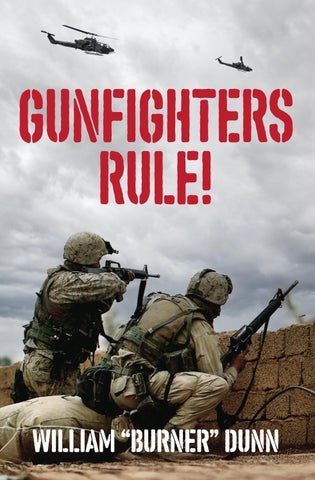
GUNFIGHTERS RULE! William “Burner” Dunn
Headline Books Terra Alta, WV
Gunfighters Rule! by William “Burner” Dunn copyright ©2026 William “Burner” Dunn All rights reserved. No part of this publication may be reproduced or transmitted in any other form or for any means, electronic or mechanical, including photocopy, recording or any information storage system, without written permission from Headline Books, Inc. To order additional copies of this book or for book publishing information, or to contact the author: Headline Books, Inc. P.O. Box 52 Terra Alta, WV 26764 www.HeadlineBooks.com mybook@headlinebooks.com
ISBN 13: 9781958914908 Library of Congress Control Number: 2025950897
P R I N T E D I N T H E U N I T E D S TAT E S O F A M E R I C A
This book is a memoir. It reflects the author’s present recollections of experiences over time. Some names and characteristics have been changed, some events have been compressed, and some dialogue has been recreated. The book reflects the author’s memories and opinions. Some of the characters are a composite of different people in the author’s life, and resemblance to actual people should be considered coincidental.
Acknowledgements The first person to thank in the creation of this book is my wife, Mimi. She stood by me through over thirty-three years of Marine Corps service and remains a best friend, partner, and wife. During the development of Gunfighters Rule! she worked beside me and helped edit, refrain, and turn this work into a reflection of my memories and life—the toughest editor I know. I must also thank Joe, my best friend and the first person I let read the book. He has been there from the beginning and is still there today supporting me, our Corps, and our country. I also want to thank Mick Moriarty. An author in his own right, he provided guidance and input. Mick helped force me to see the world outside of the lens of a Marine. I also want to thank my daughters, Sarah and Laura. Their insights on parts of their lives and memories added to the flavor of the book. They served a life in the Marine Corps as well and are supporters of our Corps and country. I also have to thank my sisters and their husbands, Phil and Lisa and Michele and Larry. Lisa and Phil spent countless hours reviewing and providing insight and guidance. I appreciate the input and thoughts and memories. Michele and Larry, staunch supporters of our Marine Corps, have supported me for an entire career. During the writing, Michele often helped me remember things long locked away from our childhood.
1
And finally, the Gunfighters and all the Marines and sailors with whom I have served, I am alive because of you! God bless you all and God bless the Marine Corps and United States Navy!
2
Table of Contents Introduction ...................................................................................... 5 Chapter 1 — Becoming a Marine ................................................. 11 Chapter 2 — Joining the Corps ..................................................... 21 Chapter 3 — Drilling with the Reserves ...................................... 31 Chapter 4 — College and a Wife ................................................... 36 Chapter 5 — Becoming an Officer ................................................ 43 Chapter 6 — Flight School ............................................................. 54 Chapter 7 — Back to Pensacola..................................................... 63 Chapter 8 — Finally in the FMF ................................................... 68 Chapter 9 — President George Bush Senior................................ 78 Chapter 10 — Back to the Fleet..................................................... 89 Chapter 11 — The Marine Expeditionary Unit........................... 92 Chapter 12 — A Rumor of War..................................................... 98 Chapter 13 — Safwan ................................................................... 106 Chapter 14 — Welcome to Baghdad .......................................... 123 Chapter 15 — Karbala .................................................................. 131 Chapter 16 — The World of the HMLA .................................... 151 Chapter 17 — Cobra and Huey Wives ....................................... 162 Chapter 18 — Gunshot 66 ........................................................... 165 Chapter 19 — Flying in Combat ................................................. 168 Chapter 20 — Gunfighter 06 ....................................................... 175 Chapter 21 — The Key Volunteer Network ............................... 181 Chapter 22 — Deployment Ready .............................................. 185 Chapter 23 — Morphine 12 ......................................................... 192 3
Chapter 24 — A Dark Day ........................................................... 196 Chapter 25 — The HMLA Mission............................................. 205 Chapter 26 — Back to Iraq .......................................................... 207 Chapter 27 — Meeting the Infantry Commanders .................. 212 Chapter 28 — Abu Bali................................................................. 226 Chapter 29 — Saving Lives .......................................................... 233 Chapter 30 — Long Days ............................................................. 238 Chapter 31 — Gunfighter Village ............................................... 247 Chapter 32 — The Police .............................................................. 262 Chapter 33 — The End of Command......................................... 269 Epilogue ......................................................................................... 272
4
Introduction I am a Marine. By definition, that makes me a dangerous man. I conducted four tours in Iraq, during which I killed many of the enemy. I have no idea how many I actually killed. Numbers are not important. What is important is that I am still here, and they are not. I killed the enemy by three methods: with my rifle, with my radio when I was a Forward Air Controller (FAC) during Operation Iraqi Freedom 1 (OIF1), and while flying Cobra attack helicopters as the Commanding Officer of the Gunfighters, Helicopter Marine Light Attack Squadron-369 (HMLA-369) during OIF 06-08. A Cobra attack helicopter is the premiere attack aircraft in the Marine Corps. It is a tandem two-seater attack aircraft that carries guns, missiles, and rockets. It is a fighting machine capable of massive destruction on the battlefield. I once saw a quote on a Bell Helicopter poster that read, “We made them pretty because it is the last thing some people will ever see.” All my kills were considered good kills, with no civilians included, for which I am very grateful. There is, however, one that left a question in my mind, and that was the “White Shirt Man.” I killed him during OIF1 while I was a FAC as part of a fire support team (FiST). Even as I write, I am filled with doubts about him— doubts but not remorse. I killed him during an intense firefight. He came out of a truck, moving rapidly to the end of the bridge.
5
Gunfighters Rule!
Rocket propelled grenades (RPGs) were exploding all around, and machine gun fire whizzed by my head. I fired. At that moment, I had no doubts, but as time passed, I began to doubt myself. The memory is foggy. He haunts me! Was he truly an enemy? I have watched him die in my mind every day since the moment I shot him on the bridge. During this fight, I fired hundreds of rounds of ammunition. Now, I was down to my last magazine and only had the typical FAC magazine filled with tracers. FACs keep the last magazine with just tracers as a last resort to mark targets if they are about to be overrun by enemy forces. Tracer rounds, when fired, show a red line through the air. You can see them from behind as the round travels to its target. I watched as red bullets drove right through his white shirt. He would not die, so I kept firing more tracers through his chest. He was still standing. The next thing I saw was when he fell down. But he stood back up, holding onto the bridge. Somehow his leg was at a ninety-degree angle. How could he still be alive? I tried a mercy shot to his head, but my tracer passed by his head, missing by mere inches. Soon he was down on the bridge, rolling around but alive, no longer a threat. I stopped firing at him and turned my attention to another enemy. Now only questions remain. Was the man in the white shirt an enemy soldier or a guy in the wrong place at the wrong time? I will never know the truth, not like all the others. With them there was no doubt, and I felt solace in my actions. I can never know the truth about the White Shirt Man, and I am glad, for I might not like the answer. It allows me to keep the truth at bay and to move without remorse. I do not take the killing of a human being, even an enemy, lightly. I spent thirty-three and a half years in the United States Marine Corps. During my tenure, I was able to hold every billet I wanted. It was truly a great career. One of the pinnacles of my career was commanding the Gunfighters. Commanding an attack helicopter squadron in combat is an honor bestowed on 6
William “Burner” Dunn
only a select few. I was one of the lucky ones, and it has become a part of me that will live on forever. My time in the Marine Corps was special. I loved nearly every day and am certain that my destiny was to be a Marine. From the day I graduated boot camp at Parris Island, South Carolina, my entire family has always made me feel different. Different that I was a Marine. Different in the best way possible. From that day on I felt a sense that my family thought more of me, that they were proud of what I had become, a United States Marine. My aunts, uncles, and cousins, whom I have known my whole life, looked at me differently. I am different. I have an ingrained process of thinking about how to fight and protect, and I thought about it every day when I was in the Marine Corps. It comes with the occupation. The Corps trained me to be a killer and to be able to do it at a moment’s notice. It is what Marines do. When I walk into a room, the first thing I do is look around to see if there are any potential threats and find a means to protect myself and others should a threat appear. One day, I was in Twentynine Palms, California, and I went to a restaurant in Joshua Tree. There was a disturbance, and I immediately sought out the first weapon I could find, the only choice—a ketchup bottle. I built a plan to grab it and use it as a weapon and, if necessary, to stop the threat. When I am with other Marines, especially those who have participated in combat and killing, I feel better. I like to surround myself with warriors. It is an elite club that I am glad I belong to. Sometimes when I am with my family, especially my girls, I look at them and wonder if they really understand the level of killer I have become. They know a little, and I have told them a few things about the war, but most things I will never tell. My oldest daughter told me that it was always comforting to them that if someone ever did something bad to them, they both knew I would take care of the threat. It made them both feel safe. She 7
Gunfighters Rule!
was right; I would defend my family at all costs. I do not think there is a better compliment to a father. In 2016, I retired from our Corps. While preparing to retire or leave the Corps, you go through a process that includes seeing medical and psychiatric specialists. Marines typically call psychiatric personnel “shrinks.” While in this process, I met with a United States Navy general practitioner. She was a tall lady and very intense. I walked into her office and introduced myself, and she started staring at me. Within minutes of sitting in her office, she told me I had post-traumatic stress disorder (PTSD). It was as if she had diagnosed me before even meeting me. She said she could see it in my eyes and that I looked very exhausted, and to her, she noted that I looked threatening. I told her I was tired because I was in command, and we were terribly busy as of late. As for looking threatening, I told her I was smiling. She did not think my comment was humorous. I guess I missed the mark. I continued saying that I did not have PTSD. Her response was baffling. First, she said if I had PTSD, I would say that I didn’t and, second, that I had what is known as “hypervigilance,” which means I am always looking for a way out or to defend myself. She asked if I ever look for weapons when I go into restaurants or establishments and think about defending myself. I responded that all Marines do. She said, “No, they don’t.” I disagreed and gaffed her off. After all, most Marines are hypervigilant; it comes with the territory. Hypervigilance doesn’t equate to PTSD. Besides, she was not even a shrink. We continued our banter until I had had enough, and I began to seek an exit. As I tried to exit, she dug in her heels. I pressed too and finally exited. That discussion ended with an appointment with an actual shrink. Speaking with a psychiatrist was a sobering experience. His demeanor was so calming that it stressed me out. I was not used to talking to someone who was so quiet and demure as he asked me questions about Iraq. I didn’t like it one bit and could not wait to disengage. In the end, it was 8
William “Burner” Dunn
determined I did not have PTSD. The general practitioner was right about many of the things she said. However, I have always felt the same, even before my first day in combat. I always have, since joining the Corps. I assume if I had PTSD when leaving the Corps, I must have had it the first day out of boot camp. This book started writing itself in my mind when I was a FAC during OIF1. Our fire support team was assigned to a specific Amphibious Assault Vehicle, known as an amtrak. Our amtrak was named “Track 301.” An amtrak is a vehicle that looks like a tank with large tracks and a compartment to hold thirteen Marines and all their equipment. It is used to launch Marines from a ship in the ocean to land on a beach. This is what the Marines did in World War II. In OIF, we used them to drive to Baghdad on the roads and over land. The amtraks had never been driven that far over land in the history of the Marine Corps. Our team was in Track 301 from Delta Company Tracks. As we crossed from Kuwait into Iraq, I began to keep a journal. As we progressed through the war, many of the Marines recommended that I write a book about our actions. Although I started writing this book many times over and over, I scrubbed the effort due to multiple deployments and time spent just being a Marine. It was a hard book to write, and I often became enraged and tense as I wrote. Some things about my Corps are not perfect, and we have faults, as do some of our Marines. Some of those things disturb me greatly. Then there is the killing. It is much easier to think about what you have done and who you killed than it is to write about it. When you put it down on paper, it becomes real again, not just a memory. The stories in these pages apply not just to the military and future combat commanders; they also apply to myriad situations. Recently, I ran into a Marine whom I served directly with in combat. He began to brag to the other Marines in the group about how many people I had killed. It was sobering. I thought these memories were just mine. They are not. They are shared 9
Gunfighters Rule!
with the Marines I fought with. They know the truth. This book is dedicated to the Marines and sailors who have supported me for over three decades and to my family who has supported me since day one.
10
1 Becoming a Marine To me, my father was the greatest man on earth. He was in the Air Force, a technical sergeant in administration. He deployed to Vietnam for eighteen months when I was little. My mom and older sister and I lived with my grandparents in Buffalo, New York. To this day, I am a diehard Buffalo Bills fan. When my father was gone, I knew it but had no idea where he was and when he was coming home. I was just a little three-year- old boy missing his dad. I didn’t understand anything about war at the time. I just knew I missed him. Then, like magic, one day he was home. I don’t have any memory of knowing he would be home at a specific time, no countdown to the end of a deployment like my children did when I deployed. Just one day, he was home. The next thing I remember is packing up our car with everything we owned and heading to a place called Virginia. Once in Virginia, we began to spend a lot of time together. He was making up for lost time with his children. He and I spent a lot of time together hunting, fishing, and playing sports. He was stationed at Andrews Air Force Base (AFB) as well as Bolling AFB. Back then, Washington, DC was pretty sparsely populated, and we lived in a place called Dale City. As I grew older, I began to understand more and more about war and Vietnam. Soon I 11
Gunfighters Rule!
realized that my father had been in a war in Vietnam while he was deployed. I remember watching news clips on our little TV and hearing discussions about the war. That was about the extent of my early knowledge of killing and fighting. Since my father was my hero, it would have been rational to follow in his footsteps and join the Air Force. I am certain that is the path I would have taken until I learned about the Marine Corps. At a young age, I became enthralled with combat and war. I enjoyed watching war shows on TV with my dad. At the time, I did not know there were different armed services, just guys doing different things. One day my dad and I were watching a show about war, and I asked him if he had ever killed anyone. He said no and that he was in administration. Not knowing what that was perplexed me. How could you go to war and not kill anyone? Watching these shows, everyone was killing the enemy. I was also seeing combat footage on the news. It surprised me that my dad said he had not killed anyone. As my hero, I envisioned him as a tough warrior, fighting in the trenches like the Marines we were watching on TV. Knowing that my father did not kill anyone did not lower the pedestal I held him on; it was just confusing to a ten-year-old. Then, one day, we were watching a war show called The Sands of Iwo Jima. The movie stars John Wayne and is about the Marines fighting in the Pacific Campaign in World War II. Iwo Jima was one of the hardest-fought battles in World War II, and Marines landed on the beaches in vehicles very similar to the amtraks we used many decades later to drive to Baghdad. I pressed the issue about what my dad had done in the war. He brushed off the questions as the movie continued. Then he began to speak. This was the day I learned there was a difference between the Marines and the other services. I asked about the guys we were watching fight on TV, and he replied, “Those are the Marines.”
12
William “Burner” Dunn
He told me about how the Marines did a lot of the fighting and killing and said that they were tough. I had never met or seen a Marine at the time, but that would soon change. In the meantime, I would watch as many shows about war as possible. One day, watching a show called The Green Berets, I assumed they were also Marines. I thought they were special Marines wearing different hats. My dad explained that they were special, but special Army guys, not Marines. He explained further about the Army and that there were other people who killed bad guys besides the Marines. It was very confusing for a ten-yearold without the aid of the internet. Then my dad told me that the Marines were the toughest of all the services. That became ingrained in my head. As time passed, I ended up meeting three Marines: my uncle and my cousin, both enlisted Marines, and later on my neighbor, a colonel in the Marines who eventually became a Marine general officer. A colonel in the Marine Corps is a senior commissioned officer. The ranks for officers go from second lieutenant to general, with five different ranks in between. Colonels are usually older Marines with over twenty years in the Marine Corps. On the other hand, my cousin was a corporal in the Marine Corps. In the enlisted ranks they go from private to sergeant major or master gunnery sergeant. A corporal is considered a noncommissioned officer (NCO), and in the Corps, they get things done. My cousin was a hard-looking man. One day he just showed up at our house; it was the first time I met him. My mother asked him how he got there, and he said he walked. She responded, “All the way?” That was over twenty miles. He said it was all the way and not too bad. The walk and the discussion with my parents really struck home. I had never known anyone that had walked twenty miles. There were many comments about how only a Marine would walk twenty miles. My eyes were large, and I noticed how special this Marine was being treated.
13
Gunfighters Rule!
My uncle was the next Marine I met. He was a hard man as well, and a mean one, but he always treated me well. I remember his stories of fighting in the Corps, not combat but just fighting with his buddies. I really enjoyed the stories, and his personality was bigger than life. Growing up, he was always there for me, even giving me the use of his car to take a girl to the senior prom. My only other choice was the Hawg, a giant Ford truck that was beaten up pretty badly. His vehicle was a much better option for my prom date, and she was glad I arrived in a car to pick her up. My uncle always seemed confident and hard, and I started to like how everybody kept saying he was a Marine. Many years later, he would take his own life. I am still not over it and never will be. I had other uncles and aunts in the Air Force, but no one ever remarked on them being special, just that they were in the service. A point of distinction became apparent. All of my family in the Air Force, including my father, said they were in the service. They didn’t specify the Air Force. When I spoke to my cousin and my uncle, they were Marines serving their country but always said they were in the Marine Corps. It was a distinction that still holds true today. Marines are in the Marine Corps, not the service. I started to see just how special these men called Marines were and how much deference they received from everyone. I liked it. I wanted to be special like them and not in the service but in the Marine Corps. We eventually moved to a bigger house in Dale City, Virginia. My mother had been recovering from a serious stroke that had impacted her a few years earlier, paralyzing the entire right side of her body. Somehow she managed to get by and keep working. Our new home was great and would lead to another Marine that would impact my future. The next Marine I met was my neighbor in Dale City. To me, he was a giant. I did not even know what a colonel was, but he and my dad were good friends. I remember very distinctly one day when my dad, the colonel, and I were out cutting firewood, and the Marine colonel was picking up these 14
William “Burner” Dunn
giant logs. The logs were three times the size of what my dad could carry. My dad was always my hero, and the colonel was the first man I ever saw who was bigger and stronger than him. My dad even remarked on how strong the Marine was. All this was imprinted in my brain. I could see that being a Marine was special to everyone and that Marines were tough and strong. In July 1975, I was like most boys my age, trying to figure out things like football, girls, and having fun. I was happy, and I kept noticing the Marine colonel when our families would do things together. I also began to like the colonel’s daughter, and she was the first girl I would ever kiss. I was concerned about what the Marine would do to me if he ever found out. Fortunately, he did not. Life was good. I was ten, had sort of a girlfriend, and spent a lot of time hunting with my dad. I remember things in our neighborhood were nice and quiet, and life was relatively slow, in a good way. Then, one day, it all changed: my dad called a family conference. Now there were five of us: my older sister Michele, my little sister Lisa, born just a year earlier, me and my mom, and Dad. We also had my best buddy and dog, Fluffy. Fluffy was a gift from my dad when we moved to Virginia. A toy Pomeranian, he was a great protector and awesome dog. Everyone loved Fluffy. Fluffy was lying under the table on this day. The whole family was there. Once we were all sitting at the table, with Lisa in a bassinet, my dad began to speak. I still remember very vividly what he said. “I have cancer.” He then proceeded to say, “When you hear stories such as these, it is always the family down the street, but this time it is us.” I didn’t know what cancer was, but my mom and older sister were crying. I wasn’t worried at all. My dad was tough, and whatever it was, he would be fine. I did not understand what all the fuss was about. My dad and mother were both heavy smokers. I did not realize the concern because they had smoked my entire life. My dad told me he had started
15
Gunfighters Rule!
smoking when he was in eighth grade. A New Yorker from Buffalo, that is “what we did when we were kids,” he said. Both my parents smoked an average of two packs of cigarettes a day. It took its toll, and soon after the cancer diagnosis, I was told he had to have an operation on his lung. I watched my father in the hospital, and for the first time, he looked sick and weak. I could tell he was not doing well. I still figured he would be fine. My dad fought the cancer hard, but one day I saw him smoking again. That bothered me. By then I had learned that his cancer was from smoking and that smoking was a bad thing. One afternoon he called me into his room and asked me if I wanted to smoke a cigar. I said sure, and he lit one up and made me take a huge puff. I immediately gagged and almost puked. On that day, he made me promise I would never smoke. I promised him I would not, and I kept that promise. In August 1976, we went to see my dad in the hospital. Everyone was sad. I did not understand why; he would be coming home soon, I thought. Then my mom had everyone leave the room, and it was just me and my dad in the hospital room. I was glad to be alone, and I told him I could not wait until he got home, so we could go hunting. He told me not this time and made me promise to take care of my mom and sisters. I cried and said he would be fine. After a few hours, we went home. The next day, my older sister and I went to a friend’s house. We stayed there while my mother and little sister went back and forth to the hospital. I was having a good time hanging out with my friend. My friend’s dad was my dad’s best friend. Later in the week, my friend’s dad said we had to go home. I had been there for three days and was glad to be headed home. I couldn’t wait to see my dad. I thought it would be great to plan our next trip. I was so excited. When I arrived at the house, my uncle Lou was standing there. He looked odd, and when I asked where my dad was, he said to go see my mom up in her room. I couldn’t wait. I was so 16
William “Burner” Dunn
happy my dad was finally home! As I walked in, so happy to see my dad, I looked around and didn’t see him, just my mom, and she was crying. She told me and my sister that my dad had died. I was in shock. On August 28, 1976, my father passed away from lung cancer. I was eleven and left with my mom and two sisters. Now I was the man of the house. What happened next in my life may seem unbelievable, but it happened. When I discussed writing this book with my sisters, they said I must put in this portion. It is difficult to digest, and I understand some may not believe it. Before my father passed, he and my mother were joking about death, and my father said if he died, he would come back as a black cat. My mother quipped, “If you do, you better have on a flea collar.” He said he would be wearing a red collar instead. Now, most readers will not believe the next part of this story. The only thing I can do is promise it is true. Several weeks after my father died, we came home from the cemetery, and on our front stoop was a black cat with a red collar. We were all astonished! My mom was in shock, and she shooed the cat away from the door. When we opened the door, the cat was not deterred and scrambled in, ran downstairs, and sat in my father’s La-Z-Boy. The cat and Fluffy got along great. Fluffy would normally at least growl if another cat or dog came by the house. He had no issue with this cat. My older sister and I believed this was my dad in the form of a cat. We are Catholic and don’t believe in reincarnation, but on this day we did. For the next few weeks, when I would walk to my bus stop, the cat would ride on my shoulder, and then when I got back off the bus on the way home, it would meet me at the bus stop and ride on my shoulders back to the house. We never named the cat. I never had to call him; he would just come to me. I had never seen the cat before that day on the stoop, and now we were best friends. To say the least, this was a little freaky. My mother started to worry that we really thought it was my dad. I did! 17
Gunfighters Rule!
This went on for several weeks, and then, one day, the cat was gone. We never really knew what happened to it. My mother said she took it to the pound because she didn’t want us to think it was our dad. We never believed her fully. It is better to believe the cat just went home somewhere. To this day, when my sisters and I tell this story, we all get teary-eyed. In my heart of hearts, I believe, for a period, that cat had my father’s spirit with him. I see no other way to explain it. The next several months were hard. Everyone tried to help, but nothing can replace your father. That Christmas, my mother got us many presents to take the loss of our father off our minds. I could not believe how many things were under the tree. We were not poor growing up, but that was because my dad worked two jobs and my mom worked one. We were used to frugality. We often drank powdered milk watered down so far that it looked purple. We almost never spent money going out to dinner. Money was always tight. Not this year. There were more gifts that year than all the others combined. It didn’t work. Christmas was still sad. Without Dad, it would never be the same. Every Christmas, my dad and I would stay up late and play with the presents. Not this year. We opened the presents and went to bed. The next year flew by, and I have very little memory of it. Just getting by, I became very introverted. In 1977, we were getting ready for another Christmas that would still be overshadowed by missing my dad. My mother once again overspent on presents, but this year she had several of her sisters come for Christmas. I was still sad, and as we prepped for another lonely night after opening presents, we had no way of knowing another bad event was upon us and our lives were about to change again. As Christmas 1977 came and went, my mother and her sisters were up playing cards one evening, and they cooked something called sponge toast—basically, fried bread dough. My mom would make them by the dozens and slather butter and jelly on 18
William “Burner” Dunn
them. To say they are tasty is an understatement. To say they are healthy is false. You don’t eat them to be healthy. That night, as my mom and her sisters played cards and ate sponge toast, a disaster was unknowingly developing. When they finished their card game, the sisters all prepared for bed. My mother left the sponge toast pan sitting on the stove so the grease would cool down. Her intent was to clean the pan the next morning by scraping the dried and cool grease into a trash can. Her plan would fail. As she went to bed with the pan sitting on the stove, disaster was looming. The next morning, my aunt got up to get ready for her flight and turned on the wrong burner. It heated up the grease instead of the coffee pot. Forgetting about the coffee, she hopped in the shower. Everyone else was still sleeping. I awoke that morning to hear my mother yelling for everyone to get out of the house. The house was on fire and burning fast. Smoke was everywhere, and as I headed out the front door, I could see the kitchen ablaze. We evacuated and went outside across the street in front of the colonel’s house. Then I noticed my dog was still inside. I broke away from my mom and ran back to search for Fluffy. I checked downstairs first, and I got no response when I called him repeatedly. “Fluffy, Fluffy, where are you?” I then ran upstairs, saw the flames in the kitchen, sucked in a bunch of smoke, and started hacking. Then I saw Fluffy, my toy Pomeranian and best buddy at the time. He was very upset, and although normally yellow, he was quite gray. He came running down the hall, but instead of coming to me, he turned and headed toward the kitchen, where the fire was blazing. He was running into the fire. I dove forward and caught him just before he made it to the fire. I nabbed him like a football and ran out of the hallway and down the stairs with a gray dog yelping because I was squeezing him so hard while I was coughing up smoke. I made it out and then was scolded for running into a burning house. I did not care; Fluffy was safe. 19
Gunfighters Rule!
The entire house could have burned to the ground, but fortunately, the fire department got there quickly and saved the house. It would be more than a year before we could move back in. In the aftermath of the fire, we had to move to a new house. My mother was a great real estate agent in Virginia, and while the insurance worked out all the challenges with rebuilding a house, we had to move. My mother bought a townhouse in a different part of Dale City, and we moved in. It took a long time for the house to get repaired, and as it came close to being finished, my mother decided not to move back in. Maybe it was just too many bad memories or my mother’s superstitions. But either way, we were not destined to move back, and instead my mother began to have a new house built in Montclair, Virginia. I was glad we did not move back. There was a lot of sadness there, and it was time to move on.
20
2 Joining the Corps Slowly, things got back to normal. We had made it through the death of our father, a cat situation, a house fire, and many other small events along the way. As we started a new life in Montclair, things were looking up. The insurance from the house fire finally got everything fixed, and soon I had some of the things my father had left me—all of his guns and his truck, the Hawg. The Hawg was named much later, but it was a 1975 Ford 250 four-wheel drive. It was awesome. Later, I would drive the Hawg and spend many hours making out in it with my future wife, Mimi. One could say we closed the deal in it a few times. I loved that truck, and today it is still my favorite truck. Although I no longer have it, I sure wish I did. The guns, on the other hand, I still have, and I hunt with them just like I did with my dad. Recently I took my grandson hunting with his great- grandfather’s rifle. A man he never met provided weapons for his great-grandson to hunt with. In 1979, I began high school at Potomac Senior High. High school was fun. The house in Montclair was on the lake, and I could walk out my back door and fish. Living on the lake was great. I fished every day that I could. I would get up to go to school, and when able, I would fish before and after. There, I met a guy named Joe Quintavalli. We quickly became best friends. 21