Frederick Douglass
Clara Barton
Davy Crockett
From the first profile, your AmeriCAN-do spirit will inspire your increased success and contributions to our magnificent country! This volume continues celebrating timeless AmeriCAN-do values and principles that are as valid today as ever. These AmeriCAN men and women of the 19th century honored the gift of liberty bestowed by the Founders and preserved, perpetuated, and expanded those freedoms for we who have followed them. Young adults and up will cheer these AmeriCANS' success and realize increased pride in our country and future. Readers will learn of ordinary people with the AmeriCAN-do spirit that left us the gift of this uniquely prosperous country. Their stories and examples of overcoming adversities and the Civil War will encourage and inspire you to repay their favor and pass it along to our descendants.
AmeriCANS Who Made America! 19 Century
Abraham Lincoln
AmeriCANS Who Made America! 19th Century – Growth, Division, and Reunification
“By telling the stories you know, the stories you thought you knew, and the stories you may never have heard, Richard V. Battle defines American Exceptionalism; not through government or documents but by the everyday people who chose to do exceptional things.” —TIM TAPP, Host of Tapp into the Truth Richard V. Battle
RICHARD V. BATTLE is the multi-award-winning author of thirteen books, including the AmeriCANS Who Made America series, and has been a public speaker on leadership, motivation, faith, sales, and volunteerism for over 30 years. He is an experienced corporate executive and non-profit leader who serves organizations in an advisory role.
Richard V. Battle
“AmeriCANS Who Made America: 19th Century – Growth, Division, and Reunification can serve as a primer for any course in Civics, American History, or Entrepreneurship. As an ex-teacher, I appreciate the book’s assistance as a resource for creating lesson plans and further study. I especially like the choice of the AmeriCANS as examples of the virtuous efforts that have contributed to this great land of ours. The fact that they may not all be household names exemplifies the opportunities that have been and still are available to anyone who aspires to them.” —Jerry Nugent, JD, former Austin Community College and Austin Independent School district board member and retired teacher “Wow, that is all I can say. Sir Francis Scott Key had a never-quit drive. He knew his efforts would make way for a new nation struggling against an enemy determined to take the new world for the King of England. What he saw and heard from the British Admiral made him even more determined and made his belief even stronger. When the sun arose, and what his eyes beheld said it all. The words of the National Anthem began to form in his heart of hearts. The rest is history. A piano manufacturer built him a custom piano. Upon this, he wrote The Greatest Words for a Nation as a reminder of the true cost of Freedom. And while this is about Sir Francis, we must not forget all the others written in this book’s pages. It’s upon the shoulders of all of them that made this Nation what it is today. And while you are at it, get the book of the Eighteenth-Century heroes that made America great.” —Respectfully, Hartley Eugene Key “By telling the stories you know, the stories you thought you knew, and the stories you may never have heard, Richard V. Battle defines American Exceptionalism; not through government or documents but by the everyday people who chose to do exceptional things.” —Tim Tapp Host of Tapp into the Truth
“Richard Battle is a successful businessman and a prolific author. With each book, he shares the wisdom and insight God has given him as he has navigated life. The result is that he writes with a heart as big as Texas! In the AmeriCANS series, Richard Battle shares the stories of visionaries whose hearts were devoted to finishing the task given them by their faith in God, their belief in human nature, and their desire to see America grow into the finest nation on earth. Rather than a weighty tome full of dates and statistics, AmeriCANS Who Made America! 19th Century – Growth, Division, and Reunification highlights the achievements of forty American pioneers, leaders, and innovators from the 1800’s who changed this nation. The result is an uplifting afternoon read in your comfy lounge chair, or a stellar family read around the dinner table. Best of all, Richard Battle includes numerous quotes from the leaders themselves. These quotes are both learning tools and great fodder to ensure lively conversations around that table. Examples: “It is easier to build strong children than to repair broken men,” by Frederick Douglas. “Duty is ours, results are God’s,” by John Quincy Adams. “Our greatest weakness lies in giving up. The most certain way to succeed is always to try just one more time,” by Thomas Edison. —Marlene S. McMichael, Co-host, Love Talk Network “Throughout the unmatched history of our nation, our timeline includes countless personal stories and experiences you can find nowhere else in the world. Richard does an incredible job sharing easyto-read insight detailing stories of individuals, their significance, and the sacrifice surrounding the players who dedicated their lives to creating a perfect union. Whether it be exploring the uncharted lands of the Wild West or the innovators who helped shape our economy and marketplace, it is vital to our future that we share these incredible stories as a guide to inspire and motivate our generations to come. It would serve our future leaders to study and learn from those who have come before us as a reminder that we can achieve greatness for our nation and its people no matter what we look like, where we come from, or the status we hold in our society.” —Joe Catenacci, Host, Hot Talk Morning Show, WRNN99.5FM Myrtle Beach, South Carolina.
AmeriCANS Who Made America! 19th Century - Growth, Division, and Reunification
Richard V. Battle
Headline Books, Inc. Terra Alta, WV
AmeriCANS Who Made America! 19th Century - Growth, Division, and Reunification by Richard V. Battle copyright ©2025 Richard V. Battle All rights reserved. No part of this publication may be reproduced or transmitted in any other form or for any means, electronic or mechanical, including photocopy, recording or any information storage system, without written permission from Headline Books, Inc. All Scripture quotations, unless otherwise noted, are taken from The Holy Bible, New International Version from www.biblegateway.com. THE HOLY BIBLE, NEW INTERNATIONAL VERSION®, NIV® Copyright © 1973, 1978, 1984, 2011 by Biblica, Inc.® Used by permission. All rights reserved worldwide. No part of this publication was written by AI. All words other than quotations are those of the author. To order additional copies of this book or for book publishing information, or to contact the author: Headline Books, Inc. P.O. Box 52 Terra Alta, WV 26764 www.HeadlineBooks.com mybook@headlinebooks.com ISBN 13: 9781958914656 Library of Congress Control Number: 2025934236
P R I N T E D I N T H E U N I T E D S TAT E S O F A M E R I C A
I humbly dedicate this volume to the sons and daughters, grandsons, and granddaughters of the Founders and founding generations. Their lives relentlessly protected, preserved, and perpetuated the ideals of The Declaration of Independence and Constitution of 1787, fulfilling its closing objective to “secure the Blessings of Liberty to ourselves and our Posterity” in the 19th century. They successfully passed their responsibility along with the gifts of liberty, which eventually landed upon our shoulders in the 21st century. It is now up to us to honor their lives and sacrifice by expanding liberty and ensuring its perpetuation before our lives end.
Also by Richard V. Battle AmeriCANS Who Made America – 18th Century – Birth of The Republic The Unopened Present Made in America by AmeriCANS not AmeriCANTS Life’s Daily Treasure – 366 Doses of Hope, Optimism, Personal Growth, and Encouragement Navigating Life’s Journey – Common Sense in Uncommon Times Conquering Life’s Course – Common Sense in Chaotic Times Unwelcome Opportunity – Overcoming Life’s Greatest Challenges Surviving Grief by God’s Grace The Master’s Sales Secrets The Four-Letter Word That Builds Character The Volunteer Handbook – How to Organize and Manage A Successful Organization
Table of Contents Preface................................................................................................. 9 About this Book............................................................................... 11 Acknowledgments........................................................................... 13 Cover Photo Story........................................................................... 14 How We Became AmeriCANS and Not AmeriCANTS............. 16 Pioneers.................................................................................. 23 Merriweather Lewis and William Clark..................................... 24 Sacagawea....................................................................................... 29 Kit Carson – Frontiersman/Scout............................................... 32 John C. Fremont............................................................................. 35 Davy Crockett................................................................................ 38 Zebulon Pike – Army/Explorer................................................... 42 Charles Goodnight - Cattleman.................................................. 45 Lew Wallace.................................................................................... 48 Wyatt Earp...................................................................................... 53 Frederick Remington.................................................................... 58 Leaders.................................................................................... 62 President James Monroe............................................................... 63 President John Quincy Adams..................................................... 66 President Andrew Jackson............................................................ 71 Sam Houston.................................................................................. 77 President Abraham Lincoln......................................................... 82 President Ulysses S. Grant............................................................ 88 President Rutherford B. Hayes..................................................... 94 Joshua Chamberlain...................................................................... 99 7
President Theodore Roosevelt ................................................... 103 Joseph Story ................................................................................. 107 Oliver Wendell Holmes Jr........................................................... 111 Ralph Waldo Emerson................................................................ 116 Innovators............................................................................. 120 Francis Bellamy............................................................................ 121 George Washington Carver........................................................ 124 Rebecca Lee Crumpler................................................................ 128 Thomas Edison............................................................................. 131 Francis Scott Key.......................................................................... 136 Theodore Judah and Grenville Dodge...................................... 140 Dwight L. Moody......................................................................... 144 Red Cloud..................................................................................... 148 Frederick Douglas........................................................................ 152 James Naismith............................................................................ 157 John Phillip Sousa........................................................................ 161 Booker T. Washington................................................................. 164 Harriet Tubman........................................................................... 168 Mark Twain................................................................................... 172 Madam C. J. Walker (Sarah Breedlove).................................... 179 John D. Rockefeller...................................................................... 182 Richard W. Sears.......................................................................... 187 Levi Strauss................................................................................... 191 A Note from the Author............................................................... 194 Bibliography................................................................................... 196 Index............................................................................................... 198 About the Author.......................................................................... 202 Richard V. Battle Books................................................................ 204
8
Preface A common denominator throughout American history is the AmeriCAN-do spirit originating with the pilgrims and settlers in the early 1600s, building through the 20th century, and continuing, although threatened, in the 21st century. This volume and its companions in the AmeriCANS who Made America series celebrate the AmeriCAN-do spirit through imperfect but beneficial examples from varied walks of life whose lives deserve recognition and honor, inspiring our efforts to live our best lives. They demonstrated it’s not your gender, race, or location in the United States you live in that dictates your impact on the present and influence the future. Still, every day blesses us with opportunities to improve ourselves, pursue our dreams, and leave our country better than we inherited it for those who follow us. As before and after, America was and is still imperfect. It is also the freest country in history thanks to those who risked their “lives, fortunes, and sacred honor,” declaring independence and fighting for eight years to create our country. In the Preamble to the Constitution, they recognized that their, and our, ongoing responsibility as citizens is “To form a more perfect union.” That goal is impossible, but our priority in striving for it will continually improve our beloved country and repay the favor our ancestors gave us. 9
AmeriCANS Who Made America! | 19th Century
As you can imagine, this volume and series can only cite a minuscule fraction of the innumerable people who walked before us. I hope you will complete your reading with a newfound sense of love of country, appreciation of the gift we have received, and a responsibility to use our time to honor the sacrifices of our predecessors.
10
About this Book “At the beginning of the 19th century, we abandoned tradition, it’s at that point I intend to renew it because the present is built on the past just as the past was built on the times that went before it.” – Adolph Loos, architect, and theorist The 19th century in America saw expansion fulfilling manifest destiny, division and civil war, reconstruction and reunification, and innovation preparing for the American century to follow. *** It is a wonder, and I believe only by the Providence of God, that the thirteen colonies banded together sufficiently to win the eight-year war against the superpower of the 18th century and secure independence. As dawn broke on the 19th century, strands in that binding were fraying under the pressure of regional interests. Contentious elections in 1800 and 1824 added to the division. Disagreements against admitting new states allowing slavery further separated citizens despite compromise legislation. Political parties fell and sprang up to voice the people’s beliefs. Finally, only a war destined to see 600,000 soldiers fall in combat settled the issue legally. 11
AmeriCANS Who Made America! | 19th Century
Reunification in law occurred within a little more than a decade. Spiritually, it took decades for America to heal, and some argue it never has and never will. In fact, the people of Vicksburg, Mississippi, so despised the surrender forced upon them did not celebrate Independence Day until 1944, in the depth of World War II. *** Though the Civil War broke out in 1861, divisions pre-dated the Revolutionary War and the birth of The Republic. Divisions grew until only war would decide the issue. The reunification of the United States and its expansion demonstrated that we can heal the differences we believe are so great today. Honorable and principled leadership brought people together, agreeing that the positive traits of America were more important than individual issues and differences. When leaders put our country ahead of party and self, individuals prosper, proving individual liberty and economic freedom, encouraging the AmeriCAN-do spirit celebrated in the men and women profiled in this volume. As the Founders recognized, there is no end to “forming a more perfect union” as enumerated in The Constitution, which is the responsibility of all we AmeriCANS in every generation.
12
Acknowledgments I like the term “repay the favor” better than “pay it forward” because I believe it more comprehensively covers all who came before us and made and gifted us the most wonderful country in history. I’m grateful for our forebears and hope to contribute my share in protecting, preserving, and perpetuating that gift for future generations. My daughter Elizabeth and any future children she may have are the prime audience of my efforts, and I cherish her love and support. I’m blessed to have Logan Cummings as my mentor. His willingness to share his West Texas, Texas Tech basketball, and pastoral experience provides down-to-earth feedback and thoughts that add value to my mission. Thank you to Burke Allen, Shaili Priya, and the Allen Media Strategies team, who represent me professionally but have also become great friends and cheerleaders of my work. Your advice and counsel are invaluable. Thank you, Cathy Teets and your team at Headline Books, for your faith in me and this project. Your expertise and contributions to this work are essential to its impact and success. Thank you, Alane Pearce, for your invaluable contributions and editing prowess in helping me communicate my message more effectively.
13
Cover Photo Story
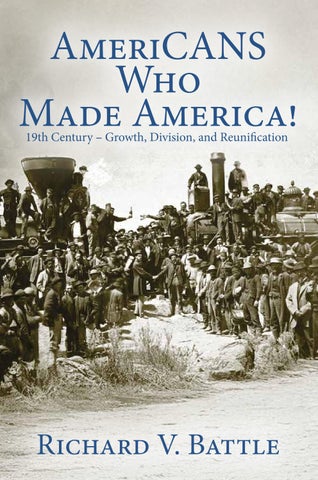
Dodge at right center shaking hands with Samuel S. Montague at the Golden Spike Ceremony. Photograph by Andrew J. Russell.
Building the transcontinental railroad was a dream for Theodore Judah, who persuaded its importance to Abraham Lincoln, who pushed the Pacific Railroad Act in 1862 and encouraged its building but never saw its completion. Two companies, one beginning in the West and the other in the Midwest, were paid in land and currency for each mile of track laid, creating a ferocious race to see who could lay the most miles of the railroad. On May 10, 1869, the Union Pacific from Omaha and Central Pacific from Sacramento met in Promontory Summit, Utah, driving a “golden spike” to celebrate the completion of the project. Still, the celebratory photo represented so much more. 14
Richard V. Battle
*** Completing the transcontinental railroad demonstrated the AmeriCAN-do spirit in achieving ambitious goals and illustrated several other symbols of America’s growth as a country. They include: While not perfect, completing the railroad split the time of the first and second halves of the century because of its other significant impacts. The continuous railroad reduced the cost and increased the speed of the delivery of people, goods, and mail, positively increasing the economy and quality of life. Its geographic impact connected the West to the East, speeding up Manifest Destiny and resulting in our country today. It accelerated the conversion from an agrarian and handicraft society to an industrial giant in the second phase of the Industrial Revolution. Increasing citizen mobility helped heal the North and South because more people interacted with many more around the country than before the war. Those personal encounters with people from the “other side” soothed hard feelings, speeding up a more united nation. *** While few ride the rails over long distances today, remembering the integral part of passenger rail service in the past and appreciating railroads’ essential role in transporting freight today broadens our understanding of our country’s development.
15
How We Became AmeriCANS instead of AmeriCANTS Today’s turmoil can make us forget we are AmeriCANS by birth or naturalization and by our history over 200 years. Our CAN-DO Attitude is in our genes and makes us exceptional! I also fervently believe we’re an extraordinary country by divine providence and the inspiration given to our founders, those who overcame unimaginable obstacles without any thought of “help from the government” to forge our future and gift us freedom very rarely seen by humans in history. None of our heroes or benefactors were perfect, but they overcame their limitations to achieve tremendous accomplishments. They built a civilization where there wasn’t one, contributed to the betterment of people where there was one, and enabled individuals to pursue their dreams when, how, and where they wanted to live. *** There are many more examples of our collective achievements than I can cite here. I believe they prove providence’s touch and an inherent can-do attitude in our people. While he never became an American, Christopher Columbus set the precedent of a can-do attitude with his relentless persistence in achieving his vision of a shortcut to Asia. He wasn’t any more 16
Richard V. Battle
perfect than any hero but lived more courageously than any of his critics. The Pilgrims risked everything with no hope of returning to Europe, sailing for the Americas in 1620. They endured great hardships and suffered staggering losses but established a permanent foothold for Western Civilization at Plymouth in 1620. As the colonies grew and prospered, they yearned for better representation and freedom not extended by England. The Boston Tea Party in 1773, the shot heard around the world at Lexington and Concord on April 19, 1775, The Declaration of Independence, and General George Washington crossing the Delaware River on Christmas 1776 were highlights of a sevenyear war of independence. The U.S. Constitution in 1787, which is still the longestserving governing document, codified individual and state’s rights and delegated specific and limited power to a new federal governing body. Unfortunately, the child continues to seize power from the parent and now acts as the dominant party as was never intended. The Bill of Rights enumerated individual rights and restricted the government’s power further. It has protected us for two centuries but is under attack as never before today. *** As the country grew and the 19th century dawned, citizens lived their dreams freely. They contributed to the republican experiment knowing freedom would not survive without everyone sharing their talents with their friends and neighbors. The Lewis and Clark expedition in 1804 to explore the Louisiana Purchase might as well have been a trip to the moon. Lasting two years, without any communication or support from their countrymen, they traveled to the Pacific Ocean and back, 17
AmeriCANS Who Made America! | 19th Century
losing only one man. Sacagawea, a young Shoshone woman, enabled them to interact with Native American tribes peacefully and they succeeded in their mission. Before entering the United States, Texans fought their war of independence against Mexico. Sacrificing for their friends and relatives, men at The Alamo fought to the death, and Texans avenged their deaths at San Jacinto, securing the republic for nine years. The most significant blemish in the American experiment was slavery. Though practiced throughout time and across the world, it is an unacceptable institution. The founders reluctantly relented to secure the necessary commitment from all thirteen colonies to win independence. The Civil War saw more than 600,000 Americans die to extinguish slavery in the United States. The wagon trains of pioneers settling the west again demonstrated people’s independent and optimistic attitude. They were willing to risk everything with no support from governments or those they left behind to pursue better lives and futures. Weather, lack of food and water, native and criminal attacks, and illness reduced the numbers of those who reached their destination. Those who survived were strengthened from experience and emboldened to pursue loftier achievements. *** The 20th century dawned with the industrial revolution completely underway. Americans built their accomplishments on the successful and unsuccessful experiences of those before them. The 1918 Spanish Flu epidemic ravaged the country with sickness and death. Families faced disease and loss with none of the social safety nets that would develop later. Necessity forced people to toughen up for the challenge, illustrating the 18
Richard V. Battle
old expression, “That which doesn’t kill us makes us tougher.” Survivors were prepared for more challenges in the future. The 1920s roared with prosperity and ended with economic hardship as the Great Depression began. Again, people faced difficult times without hope for relief. Overcoming the difficulties strengthened individuals’ resolve and gave them the confidence that they could face almost anything and survive. Sandwiched around the epidemic and depression, World War I and II threatened the country’s livelihood and civilization. People banded together, each person finding their place to contribute to the effort to protect and further the life of the United States. Once again, each victory bolstered the people and therefore, the country itself. Post-World War II saw tremendous growth and prosperity for the country, culture, and the people. President John F. Kennedy set a goal to place an American on the moon before the end of the 1960s. Americans achieved the goal, though President Kennedy didn’t live to see it. President Ronald Reagan’s optimistic attitude and rhetoric came at a time of discouragement among the people and inspired the country to achieve a decade of peace and prosperity. I was fortunate to see him speak once. Then, and on television, Reagan had a gift of making everyone feel they were the only person being spoken to, which is why he was known as the great communicator. *** Despite the 9/11 attacks, a long period of global war, financial upheavals, social justice campaigns, and other setbacks, the United States, in the 21st century, is still the country people around the world look to for leadership and example.
19
AmeriCANS Who Made America! | 19th Century
So many people want what Americans possess. They stream illegally across the border at unprecedented levels, risking everything, including their lives, to achieve it. Others respect our laws and immigrate legally, desiring to assimilate into our culture and improve the trajectory of their family’s future. Nowhere do people have more individual liberty and economic and political freedom than we who live in The United States. We are free to achieve great dreams that benefit all people today and in the future. We must remember there is no political freedom without economic freedom. Those who attack private property desiring to redistribute it in the name of “equity,” threaten centuries of building and success for an ideology that only succeeds in theory. *** As in every other example, those selling equity and social justice believe it will be different this time thinking, We’re smarter than those who tried to build a utopia in other times and places. They refuse to accept that the problem is not who is leading the revolution but the utopian idealism itself. Their fatal flaw is a misunderstanding of human nature. They believe human nature has and is evolving, and with their intervention, the selfless, ideal utopia will arrive. Hundreds of millions of people in other countries are murdered while politicos pursue the path toward nirvana, affirming that human nature has not changed. Regardless of who is leading a government, it will never change. If my assertion is correct, why would we throw away what has worked very well, though imperfectly, for what the millions who rush to America at the earliest opportunity can’t escape quickly enough?
20
Richard V. Battle
As Thomas Sowell expertly said, “Much of the social history of the Western world over the past three decades has involved replacing what worked with what sounded good.” The immortal philosopher Yogi Berra said it differently, “In theory, there is no difference in theory and practice. In practice, there is.” AmeriCANS lead us to victory and achievement. AmeriCANTS lead us to defeat and dishonor! *** So, what must we do to preserve our AmeriCAN attitude and resist those who would sentence us to a future as AmeriCANTS? 1. We should revere our unique gift of remembering and studying the history of our family and ancestors. 2. We should commit to preserving our CAN-DO spirit, teaching our children what it is and why it is imperative for the success of theirs and future generations. 3. We should RETURN THE FAVOR of the gift we received to those who come behind us. All who sacrificed and contributed to our heritage of individual freedom will have done so in vain if we allow others to extinguish it. 4. We MUST: • Stand up and actively participate in governance. • Show Up when we can and where we can to support those fighting to protect our interests. • Speak Up to let our voices influence policy. • Stay up in the fight. There will be no rest until we neutralize the current threat. It may take longer than we like, but the resulting resumption of unthreatened freedom will be worth the price for us and our children.
21