Vol 29 | Issue 1 | August 2025
25
www.asa-inc.org.au
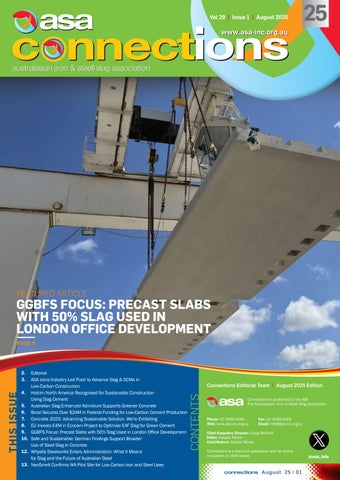
FEATURED ARTICLE
GGBFS FOCUS: PRECAST SLABS WITH 50% SLAG USED IN LONDON OFFICE DEVELOPMENT PAGE 9
Editorial ASA Joins Industry-Led Push to Advance Slag & SCMs in Low-Carbon Construction 4. Holcim North America Recognised for Sustainable Construction Using Slag Cement 5. Australian Slag-Enhanced Admixture Supports Greener Concrete 6. Boral Secures Over $24M in Federal Funding for Low-Carbon Cement Production 7. Concrete 2025: Advancing Sustainable Solution. We're Exhibiting 8. EU Invests €4M in Ecocem Project to Optimise EAF Slag for Green Cement 9. GGBFS Focus: Precast Slabs with 50% Slag Used in London Office Development 10. Safe and Sustainable: German Findings Support Broader Use of Steel Slag in Concrete 12. Whyalla Steelworks Enters Administration: What It Means for Slag and the Future of Australian Steel 13. NeoSmelt Confirms WA Pilot Site for Low-Carbon Iron and Steel Uses
CONTENTS
THIS ISSUE
2. 3.
Connections Editorial Team | August 2025 Edition Connections is published by the ASA The Australasian (Iron & Steel) Slag Association
Phone: 02 4258 0160 Web: www.asa-inc.org.au
Fax: 02 4258 0169 Email: info@asa-inc.org.au
Chief Executive Director: Craig Heidrich Editor: Kaspar Moore Contributors: Kaspar Moore Connections is a biannual publication with an online circulation of 1500 copies
connections August 25 | 01
@asa_info
EDITORIAL Welcome to our first edition of ASA Connections for 2025!
In the year so far, the Australasian (iron and steel) Slag Association has had strong momentum building across research, funding, and end-use innovation. In this edition of ASA Connections, explore global and local advances in slag applications, from significant funding in the EU and Australia to emerging research, infrastructure breakthroughs, and sustainable materials gaining traction in construction and beyond. To begin this article, ASA has joined forces with leading industry bodies and researchers to drive the next wave of SCM innovation. This new project highlights the important role of iron and steel slags in low-carbon construction, focusing on testing, standards, and commercialisation. As the sector moves toward net-zero, slag stands out as a proven, high-performance material that is shaping the future of sustainable infrastructure.
Backed by €4 million in EU funding, the ECO-SLAG-CEM project is investigating how Electric Arc Furnace (EAF) slag can support greener cement production. Led by Ecocem and key partners, this research aims to optimise EAF slag’s performance, reactivity, and sustainability. The project represents a promising step toward developing circular, lowcarbon solutions in the steel and cement industries across Europe and beyond.
Holcim North America was recognised at the 2024 Slag Cement in Sustainable Concrete Awards for its involvement in several projects showcasing the use of slag cement. Awarded in categories such as Lower Carbon Concrete and Durability, these projects demonstrate how slag-enhanced mixes are contributing to improved performance and reduced emissions outcomes. This provides useful reference points for ongoing discussions around sustainable construction in Australasia.
In a standout example of low-carbon construction, London’s 105 Victoria Street development is using precast concrete slabs containing 50% ground granulated blast-furnace slag (GGBFS). With 3,000 slabs planned, this project showcases how GGBFS is helping major commercial builds cut emissions and support circular economy goals, while still delivering on durability, and performance.
A new Australian-developed admixture is helping to reduce concrete’s carbon footprint by incorporating granulated blast furnace slag (GBFS) and other supplementary cementitious materials (SCMs). Developed by Mapei at its Brisbane facility, the admixture is reported to enhance strength performance while allowing for higher replacement of traditional cement. It reinforces GBFS’s role in creating durable, lower-carbon concrete tailored to Australia’s evolving construction and sustainability goals. In a significant step towards slag-inclusive products in Australia, Boral has secured over $24 million in federal funding to decarbonise its Berrima Cement Works, aiming to cut 100,000 tonnes of CO2 annually. The project will promote the use of alternative raw materials, including GBFS, steel slag, and fly ash, all replacing carbon-intensive limestone. Concrete 2025, the Concrete Institute of Australia’s national conference, will take place in Adelaide from 7th to 10th September. With over 200 technical presentations, the event will spotlight innovations in sustainable concrete. Our Association staff will be present, exhibiting and sharing insights on iron and steel slag’s role in reducing carbon, and contributes to quality infrastructure. Visit our booth and explore sustainable solutions shaping concrete’s future.
A German study confirms that steel slag, especially electric arc furnace (EAF) slag, is safe and environmentally suitable as concrete aggregate. Despite concerns about chromium content, leaching tests indicate a minimal risk, with chromium primarily in a non-toxic form. The research supports revising regulations to enable wider use of steel slag, advancing sustainable construction, circular economy goals, and carbon reduction efforts. The Whyalla Steelworks, a key Australian steel producer, has entered voluntary administration amid chronic underinvestment and maintenance issues. Supported by a $2.4 billion government package and BlueScope’s strategic review, its future remains uncertain. The site’s continued slag production is crucial for sustainable construction materials, making its re-establishment of vital importance for Australia’s circular economy and steel industry. Finally, the NeoSmelt consortium of BlueScope, BHP, and Rio Tinto, has confirmed Kwinana, WA, as the pilot site for its low-carbon electric smelting furnace. Supported by $75 million in government funding, the plant aims to produce cleaner iron and generate high-quality slag for sustainable construction. Operations could begin by 2028.
Kaspar Moore Kaspar Moore Editor
connections August 25 | 02
ASA JOINS INDUSTRY-LED PUSH TO ADVANCE SLAG AND SCMS IN LOW-CARBON CONSTRUCTION As the construction sector works to reduce its carbon footprint, supplementary cementitious materials (SCMs) have become key to lowering emissions and improving material performance. Among the most established and effective SCMs is slag, a by-product of iron and steelmaking that plays a vital role in enhancing concrete durability and sustainability. To support the broader acceptance and use of SCMs, the Australasian Slag Association (ASA) has partnered with the Ash Development Association of Australia (ADAA), Australasian Pozzolan Association (APozA), BG&E, and Macquarie University in a new collaborative project. This initiative is focused on unlocking the full potential of industrial by-products, like slag, for use in high-performance, low-carbon construction materials. The project aims to: • Identify available and emerging SCMs across Australia • Conduct laboratory testing to fill knowledge gaps on material behaviour • Explore how current standards may need to evolve to support wider SCM use • Develop a draft commercialisation strategy to guide future applications Among the range of SCMs being assessed, slag remains a cornerstone. In particular, Ground granulated blast furnace slag (GGBFS), delivers the key benefits of enhanced durability, reduced permeability, and improved long-term strength. It also contributes to significant carbon savings of up to 900 kg CO2 per tonne of cement replaced, making it one of the most impactful materials for sustainable concrete production. With growing pressure to decarbonise infrastructure and construction, slag’s continued use and relevance are increasingly important. This project will help ensure slag remains a technically and commercially viable option well into the future. For ASA members, this collaboration supports our shared goal of promoting slag as a proven, sustainable solution for the built environment. ASA will continue to advocate for policies, standards, and research that underpin slag’s long-term value in a lower-carbon construction economy.
connections August 25 | 03
HOLCIM NORTH AMERICA RECOGNISED FOR SUSTAINABLE CONSTRUCTION USING SLAG CEMENT Holcim North America has received recognition for its contributions to sustainable building practices. Recently, the Slag Cement Association (SCA) acknowledged the company during its 2024 Slag Cement in Sustainable Concrete Awards held on April 2, 2025. Holcim was noted for its involvement in three projects that highlighted the use of slag-based cementitious materials. AWARDS AND PROJECTS In this award cycle, Holcim was recognized under the categories of Lower Carbon Concrete and Durability. The recognition reflects an ongoing trend in construction where innovative materials are increasingly valued for their potential environmental benefits. Notably, Holcim’s projects demonstrate various aspects of sustainable construction and performance. One project of interest is the Seattle Storm Center for Basketball Performance, which was awarded in the Lower Carbon Concrete category. This facility incorporated supplementary cementitious material, specifically slag cement, which reportedly contributed to a reduction in carbon emissions. The project aimed to align with emission reduction targets established by the First Movers Coalition for Concrete. Another project, located in Massachusetts, involved the Middle Road and Hanover Street intersection. This project was acknowledged for its durability and long-term structural benefits. The use of slag cement in the concrete mix was intended to enhance certain performance characteristics, including compressive strength and longevity. Additionally, the Minnesota Department of Transportation’s I-94 Slag Cement Study received attention for its research into different slag-blended systems. The findings from this study contributed to a broader understanding of clinker reduction and the performance of slag cement in public infrastructure contexts.
BROADER IMPLICATIONS FOR AUSTRALIA The recognition of these projects serves as a reference point for discussions on sustainable construction methods in the Australasian region. As industries and governments worldwide increasingly explore low-carbon construction strategies, the examples from Holcim may provide insights into the specification and implementation of slagenhanced concrete. The ongoing exploration of sustainable materials like slag cement illustrates a shift towards more environmentally conscious building practices. As Holcim continues to engage in projects that incorporate such innovations, the conversation surrounding the benefits and applications of these materials is likely to evolve. Holcim North America’s recent accolades illustrate the potential of slag cement in contributing to sustainable construction. By highlighting various projects, the company has provided examples that may inform future practices in infrastructure development. The ongoing dialogue about these materials reflects a growing interest in solutions that aim to balance construction needs with environmental considerations. Further information here.
Image Credit : instagram.com/zgfarchitects/
connections August 25 | 04
AUSTRALIAN SLAG-ENHANCED ADMIXTURE SUPPORTS GREENER CONCRETE A new range of concrete admixtures developed in Australia highlights the growing role of granulated blast furnace slag (GBFS) and other supplementary cementitious materials (SCMs) in reducing the environmental impact of concrete production. Mapei, a manufacturer of chemical products for the construction industry, has introduced Mapecube 70, an admixture developed at its Brisbane Wacol facility. The formulation is designed to enhance strength performance while reducing reliance on traditional general-purpose cement. A key feature of the development is the incorporation of SCMs, particularly Granulated blast furnace slag (GBFS), a by-product of iron and steel production valued for its cementitious properties, and other SCMs such as fly ash. Granulated blast furnace slag (GBFS) is produced by rapidly cooling molten slag from ironmaking, transforming it into a glassy, granular material. When ground into a fine powder, it exhibits cementitious properties that make it highly effective in blended cement and concrete systems. Its inclusion in admixtures allows for greater substitution of Portland cement while maintaining durability and performance benchmarks. This results in a more sustainable concrete mix, supporting both cost efficiency and a reduction in embodied carbon. Mapei’s admixture is reported to support strength development at multiple curing stages, from early-age strength to performance at seven and 28 days. These attributes are increasingly relevant as the construction sector works toward net zero emissions by 2050. According to Mapei, global data shows that cement manufacturing contributed approximately 1.56 billion metric tons of CO2 in 2023, accounting for around 8 per cent of total global emissions. This shows the crucial importance of low-carbon alternatives such as GBFS in reducing emissions. As the construction industry advances toward its decarbonisation targets, the increased use of granulated blast furnace slag and other SCMs will play a key role in reducing its environmental footprint. This locally developed admixture, tailored to Australian conditions and performance standards, marks an important step toward the integration of GBFS into lower-carbon concrete and reinforces the industry’s ongoing commitment to sustainable innovation and circular economy practices. Further information here. Image: Gianluca Bianchin, Mapei Corporate Product Manager - Admixtures for low-carbon concrete, Marco De Santis, General Manager of Mapei Australia, and Davide Carpenito, Product Manager for Cement Addtitives at Mapei Australia, attended the launch event.
connections August 25 | 05
BORAL SECURES OVER $24M IN FEDERAL FUNDING FOR LOW CARBON CEMENT PRODUCTION Boral Limited has secured $24.5 million in federal government funding to support a major decarbonisation project at its Berrima Cement Works in NSW. This transformative initiative will focus on kiln feed optimisation to reduce up to 100,000 tonnes of CO₂ emissions annually from cement manufacturing. Central to the project is the development of a new specialised grinding circuit and infrastructure, enabling Boral to significantly boost the use of alternative raw materials (ARMs), particularly granulated blast furnace slag and steel slag, along with other industrial by-products such as fly ash and recycled concrete fines and cement fibre board. These materials help displace carbon-intensive limestone in the cement manufacturing process, lowering emissions and energy use. The initiative is set to increase Boral’s ARM usage from 9% to up to 23% in kiln feed. By replacing limestone (which releases CO2 during calcination) with slag-based materials, the project directly addresses the significant emissions associated with clinker production, which contributes to around 55% of the Australian cement industry’s carbon footprint. Granulated blast furnace slag (GBFS) is a by-product of the ironmaking process, formed when molten slag is rapidly quenched to form a glassy, granular material. GBFS has latent hydraulic properties, making it highly effective in cement and concrete applications. It improves strength, durability, and sustainability while supporting circular economy objectives by repurposing waste from the steel industry.
Steel slag, another valuable by-product from steel manufacturing, possesses both cementitious and pozzolanic characteristics. Its use in cement production contributes not only to carbon reduction but also to the responsible management of metallurgical waste, enhancing material efficiency and industrial sustainability. The funding was announced by Minister for Climate Change and Energy- Chris Bowen, at the Berrima site, which currently supplies up to 40% of NSW and ACT’s cement. The grant is part of the federal Powering the Regions Fund, which aims to help key industrial sectors decarbonise while maintaining economic resilience. With funding now in place, Boral will move ahead with detailed engineering, procurement, and construction, aiming for full operational capability by 2028. Boral CEO Vik Bansal highlighted that this project supports the company’s broader sustainability goals, including staying below the safeguard mechanism thresholds and advancing the use of lowcarbon and recycled materials in cement. “This investment isn’t just about cutting emissions, it’s about transforming how we think about raw materials in construction,” Bansal said. “We’re proud to lead the way in building a cleaner future for the industry.” This initiative strongly supports the development and wider adoption of slag as a strategic construction material in Australia. By integrating GBFS and steel slag into mainstream cement production, Boral is helping to unlock the full potential of iron and steel by-products. Further information here.
connections August 25 | 06
CONCRETE 2025:
ADVANCING SUSTAINABLE SOLUTION. WE'RE EXHIBITING The Concrete Institute of Australia’s 32nd Biennial National Conference, Concrete 2025, is set to take place from the 7th - 10th of September at the Adelaide Convention Centre. This event will bring together engineers, researchers, manufacturers, and professional from across Australia and around the world to engage in discussions under the conference theme: Concrete Solutions for a Sustainable Future. With over 200 technical presentations delivered over 3 days, across four streams, Concrete 2025 will showcase global best practices and the latest innovations in concrete design, durability, construction, and sustainability. Delegates can expect in-depth coverage of emerging technologies, from low-carbon concrete and digital design tools to novel reinforcement materials and circular economy strategies. Featured forums such as Women in Concrete and NEXGen are important highlights, fostering the next generation of concrete professionals. We’re excited to announce that the Australasian (Iron & Steel) Slag Association (ASA), Ash Development Association of Australia (ADAA), and Australasian Pozzolan Association (APOZA) will be exhibiting at this major industry event. As key voices in the advancement of sustainable materials and technologies, we’ll be there to share our knowledge, connect with attendees, and showcase the critical role our sectors play in shaping the future of concrete. As exhibitors, we’ll be hosting a dedicated booth where attendees can explore the use of iron and steel slag in sustainable construction. The Australasian (Iron & Steel) Slag Association (ASA) will showcase how slag-based materials improve concrete performance, support resource recovery, and reduce embodied carbon. Visitors can engage with our experts to understand slag’s role in circular material flows and its practical application across infrastructure sectors.
Concrete 2025 offers a valuable platform to engage with industry professionals, and we are proud to be part of this important dialogue. We invite all attendees to visit our booth and connect with us as we work together to build a resilient and sustainable future for concrete in Australia. Don’t miss out! Tickets are limited, so secure your place at Concrete 2025 today and be part of the conversation shaping the future of our industry.
2025
CONCRETE For more information about the conference and how to attend, visit the Concrete Institute of Australia’s website.
connections August 25 | 07
EU INVESTS €4M IN ECOCEM PROJECT TO OPTIMISE EAF SLAG FOR GREEN CEMENT In April 2025, the European Innovation Council (EIC) awarded Ecocem, a European low-carbon cement technology organisation, €4 million in research funding to a project focused on the environmental and technical optimisation of Electric Arc Furnace (EAF) slag for use in low-carbon cement The project, ECO-SLAG-CEM, is one of just 31 selected under the EIC Pathfinder Challenges 2024 from over 400 submissions. Its goal is to assess and improve the suitability of EAF slag as a cementitious component in the context of decarbonising the construction sector. EAF slag is increasingly relevant as steel production evolves from blast furnaces to electric arc furnace technology. This EAF technology alters the chemical and physical characteristics of the slag generated, posing new challenges and opportunities for its beneficial use. The project seeks to better understand and enhance the reactivity and environmental performance of EAF slag in cement systems, particularly its long-term durability and compatibility. The research is being led by a consortium of academic and industrial partners, including Ecocem, ArcelorMittal, the University of Toulouse, CNRS, the FehS Building Materials Institute, Helmholtz-Zentrum Dresden-Rossendorf, and ETH Zurich. Experimental work and pilot-scale testing will take place over the next four years, with trials planned in Paris in cooperation with ArcelorMittal. This initiative is part of a broader push under Horizon Europe to explore innovative ways to reduce carbon emissions in construction materials. The EIC Pathfinder’s “Cement and Concrete as a Carbon Sink” challenge recognises that supplementary cementitious materials, including slag, could play an important role in meeting net-zero targets. Slags, including EAF slag, are already widely used in road construction and concrete, but their variability and lower early reactivity pose technical hurdles. The project aims to address these through improved characterisation, treatment methods, and application guidelines, contributing to circular economy goals and better resource efficiency. EAF slag, when properly processed, holds promise as a high-volume alternative to traditional binders. Research from this program may provide valuable insights into its performance, environmental safety, and regulatory acceptance, paving the way for increased circularity in both the steel and cement industries. For more technical background and project updates, visit: www.ecocemglobal.com Further information here.
Image: AF Electric Furnace
connections August 25 | 08
GGBFS FOCUS: PRECAST SLABS WITH 50% SLAG USED IN LONDON OFFICE DEVELOPMENT
Ground granulated blast-furnace slag (GGBFS) plays a central role in low-carbon construction innovations, with its use recently highlighted in building developments in London, specifically t he 1 05 V ictoria S treet, 1 6-story office building. The project, led by contractor Skanska, incorporates 3,000 precast concrete slabs containing 50% GGBFS, a significant application of slag in a high-profile urban setting. The slabs are being designed, manufactured, and supplied by Laing O’Rourke at its Explore Manufacturing facility near Worksop, Nottinghamshire, UK, with installation on-site handled by Severfield. As of May 2025, approximately 600 slabs have been placed across four floors. Ground granulated blast-furnace slag (GGBFS) is a by-product of blast furnace iron-making and has long been valued in concrete production as a recycled material for its durability and lower environmental impact. Compared to traditional Portland cement, GGBFS requires significantly less energy to produce and emits considerably less CO2. In the case of the Victoria Street project, the precast planks incorporate a single layer of reinforcement in the bottom mat, helping reduce embodied carbon further, as it doesn’t require quarrying of new materials. The remaining binder content in the mix is CEM I, a common choice in structural precast concrete. The Victoria Street project is targeting several high-performance sustainability certifications, including BREEAM Outstanding and WELL Platinum. Although outside the scope of slag-specific developments, the broader goals of this project indicate the increasing relevance of materials like GGBFS in achieving stringent carbon targets. As decarbonisation accelerates across both the steel and construction industries, the continued use of GGBFS and other slag-based materials is proving vital to lowering embodied carbon, especially in large-scale commercial developments like 105 Victoria Street. Despite supply pressures linked to evolving steel production methods, the environmental performance of slag products makes them an effective supplementary cementitious material. Their use not only contributes to substantial CO2 reductions but also supports circular economy principles by repurposing industrial by-products into durable, high-performance building components. Going forward, maintaining access to quality slag materials and integrating them more widely into commercial construction will be essential for meeting climate goals and building more sustainable cities. Further information here.
connections August 25 | 09
SAFE AND SUSTAINABLE:
GERMAN FINDINGS SUPPORT BROADER USE OF STEEL SLAG IN CONCRETE A recent German research project, funded by the Federal Ministry for Economic Affairs and Climate Action, has delivered compelling evidence supporting the environmental suitability of using steel slag, specifically electric arc furnace (EAF) slag, as aggregate in concrete. Traditional aggregates in concrete contribute to significantly increased carbon emissions, and with aggregates making up around 70% of concrete volume, finding alternatives to traditional materials is critical for reducing environmental impact, conserving finite resources, and advancing sustainable construction. Each year, hundreds of millions of tonnes of natural aggregates are mined worldwide, leading to significant landscape degradation, biodiversity loss, and increased CO2 emissions. Industrial by-products like steel slag offer a sustainable and high-performing substitute, yet regulatory and political hurdles currently limit their use in structural concrete.
A KEY BARRIER: CHROMIUM Steel slag as a substance does not pose toxicological hazards. However, in many cases, chromium is considered a contaminant, and there are concerns about its accumulation in the material cycle. Chromium content in steel slag often exceeds solid limit values, despite minimal leaching behaviour and no evident environmental harm in practice. To address this discrepancy, the IGF research project 21567 N: Suitability of Metallurgical Slags for Use as Aggregates in Concrete conducted extensive environmental testing under real-world conditions. The focus was on eluate (leachate) testing rather than total content, a more scientifically appropriate metric for assessing environmental risk. EAF slags consistently met all relevant thresholds when embedded in concrete, even when raw samples occasionally exceeded certain trace element limits like vanadium or chromium. Long-term leaching tests, including recycled concrete materials exposed outdoors for two years, confirmed that once EAF slag is bound in the cement matrix, the potential release of environmentally relevant substances drops significantly. Notably, trace chromium (often present in stable, insoluble mineral phases) is predominantly in the trivalent form (Cr-III), which is far less mobile, less bioavailable, and not classified as environmentally hazardous. These findings highlight the importance of considering chemical speciation, not just elemental totals.
Extensive toxicological assessments conducted under the REACH Regulation confirm that both BOS and EAF steel slags are safe for human health. Key findings include: • Oral exposure: In construction applications, ingestion is highly unlikely. Nonetheless, in vivo studies confirm that iron and steel slags are non-toxic. • Dermal exposure: Skin contact is the most likely route during handling. In vivo and in vitro tests on finely ground slag and eluates show no harmful effects. • Inhalation exposure: Dust formation during processing was studied via in vivo inhalation tests on rats and in vitro tests across all slag types. Results show no significant cytotoxicity and clearance similar to natural rock particles. These results confirm that steel slags pose no risk to human health or the environment and do not require classification under the CLP Regulation. Chromium (VI), the more concerning form, was consistently undetectable or present only in trace amounts well below safety thresholds. Additionally, radiological measurements confirmed that natural background levels were not exceeded, ensuring safety for use in inhabited structures. Based on these results, research activities, and findings, the study concluded that in considering all potential exposure pathways, there are no dangers associated with the use of steel slags in concrete. Political demands for resource conservation, circular economy, and CO2 reduction highlight the importance of using steel slag as aggregate in concrete. To fully realise this potential, existing regulatory frameworks must evolve to reflect current scientific understanding. We must shift from using total content limits to more accurate risk based eluate criteria. This approach already used in road construction standards, would enable and support the safe and efficient reuse of high-quality industrial by-products, helping achieve climate targets and improve resource sustainability.
connections August 25 | 10
WHYALLA STEELWORKS ENTERS ADMINISTRATION: What It Means for Slag and the Future of Australian Steel
The Whyalla Steelworks is one of Australia’s two major steelmaking facilities, and it has officially entered voluntary administration. The plant, which was previously owned by Sanjeev Gupta’s GFG Alliance, has gone through some initial observations by the appointed administration, who have uncovered that it has long suffered from chronic underinvestment, leading to ongoing maintenance issues, production disruptions, and questions about its long-term viability. While the administration process unfolds, the steelworks remains operational. A $2.4 billion joint support package from the Federal and South Australian governments has been announced to stabilise the site and maintain the employment of approximately 4,000 workers and contractors. As part of this process, BlueScope, Australia’s largest steelmaker, has been brought in to support stabalisation efforts, conducting a 100-day strategic review. While in-depth details remain confidential, this review may help shape a long-term pathway for the site, including possible future ownership or redevelopment. Their early assessment flagged a backlog of essential repairs and maintenance reaching approximately $180 million to continue operations. This highlights the depth of neglect under GFG’s ownership. While exact figures are still evolving, administrators have confirmed the business had been "running on empty" for some time, resulting in frequent unplanned shutdowns.
Iron slag(s), particularly from integrated blast furnace operations like Whyalla, is a high-value industrial by-product with widespread applications, including in cement, concrete, road base, and other civil works. Its ongoing availability is key to reducing carbon emissions and demand on traditional materials, particularly as construction and infrastructure projects seek more sustainable alternatives. With BlueScope now involved and government backing in place, the short-term future of the site is more stable. However, long-term outcomes, including whether current iron and steel slag output and reuse streams will be preserved, remain uncertain and will depend on the findings of the strategic review, market conditions, and any future transition to green steel technologies. The collapse of GFG’s ownership marks a turning point for Australian steelmaking and its by-products. With strategic reviews now underway and private-sector interest emerging, the coming months will determine whether Whyalla can transition from crisis to renewal, and what that means for slags, sustainability, and the resilience of Australia’s circular materials economy.
Whyalla produces around 75% of Australia’s structural steel and is the nation’s sole domestic producer of steel long products, making it a vital contributor to infrastructure, housing, and defence. This also makes the future of iron and steel slag production from Whyalla an important consideration for downstream industries and circular economy stakeholders.
connections August 25 | 11
NEOSMELT CONFIRMS WA PILOT SITE FOR LOW CARBON IRON AND STEEL USES In a significant development for Australia’s steel, ironmaking, and slag by-products, the consortium behind the NeoSmelt project: BlueScope, BHP, and Rio Tinto, has confirmed the Kwinana Industrial Area in Western Australia as the location for its first electric smelting furnace (ESF) pilot plant. The project aims to trial new pathways for producing iron with lower emissions, specifically using Pilbara ores in an electric smelting process. The Kwinana site was selected for its strong logistics links, established industrial infrastructure, and government support, including a $75 million commitment from the Western Australian Government. The plant is reported to be capable of producing 30,000 to 40,000 tonnes of molten iron per year and will initially operate on natural gas-based direct reduced iron (DRI), with the long-term goal of transitioning to hydrogen as a cleaner reductant. We recognise the significance of this pilot not just for decarbonisation, but also for the potential it holds in producing high-quality slag byproducts an essential component in circular economy practices and sustainable construction. Slag generated during ironmaking— especially from electric smelting—can be repurposed into highperformance materials. One of the most impactful uses is in cement and concrete production. When ground into a fine powder, granulated slag can replace a significant portion of Portland cement in concrete, reducing the embodied carbon of construction materials. Electric smelting furnaces, compared to traditional blast furnaces, offer more controlled conditions that may lead to advancements in slag chemistry and improved consistency. This opens the door to innovative slag applications across civil infrastructure, cement replacement, and even emerging uses in carbon capture and soil improvement. The NeoSmelt process, if optimised, could generate valuable slag streams suitable for high-performance, and lower-carbon materials.
“Today marks a major step in what is a technically ambitious & environmentally significant project.” said BlueScope Chief Executive Australia, Tania Archibald.
“We’re pleased with the collaboration that has brought us to this stage, and optimistic about what this means for the future of steelmaking.” The NeoSmelt project is still in its early stages. With pre-feasibility now complete, the consortium plans to begin feasibility studies in the second quarter of 2025, with a final investment decision expected in 2026. The plant could be operational by 2028. The NeoSmelt project is not a commercial operation yet. But it is a critical step toward reshaping how Australia makes iron and manages its by-products. It reflects a growing commitment to collaborative innovation and resource efficiency, where slag is an opportunity for more sustainable concrete and construction solutions.
Image: The NeoSmelt Site In Kwinana
connections August 25 | 12
WE NEED YOUR CONTENT
Connections is produced twice a year for the benefit of ASA members and before each publication is drafted, an email is sent to all members urging them to contribute their stories. The types of content we are looking for include:
NEW DEVELOPMENTS AND TECHNOLOGIES NEW PROJECTS
NEW EMPLOYEES We also have a Member Profile section, which is open to all member companies for contributions on behalf of the business in general, or a specific employee. So if you have an idea or content that you think might make an interesting article, get in contact with the Association today:
publications@asa-inc.org.au
SUBSCRIBE TO www.asa-inc.org.au Views expressed in Connections newsletter do not necessarily reflect the opinion of the Australasian Slag Association. All contributions are welcomed, though the publisher reserves the right to decline or edit for style grammar, length and legal reasons.
connections August 25 | 13