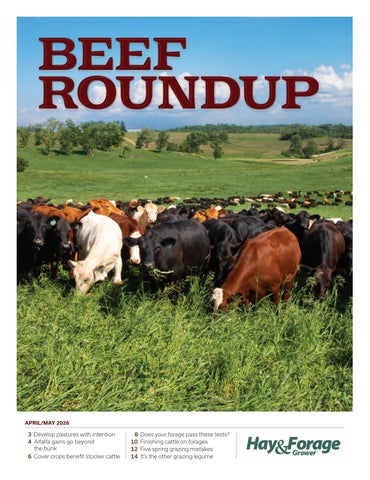
BEEF ROUNDUP
APRIL/MAY 2026
3 Develop pastures with intention 4 Alfalfa gains go beyond the bunk 6 Cover crops benefit stocker cattle
F4 BR 1 Apr_May 2026 Cover.indd 1
8 Does your forage pass these tests? 10 Finishing cattle on forages 12 Five spring grazing mistakes 14 It’s the other grazing legume
4/17/26 9:47 AM
All hat. All cattle. Not all rations are created equal. Don’t settle for feed ingredients that are all talk.
Whole cottonseed provides a powerful combination of fat, fiber and protein in one single feed ingredient.1 This triple-nutrient feedstuff offers an effective way to supplement the ration and improve body condition.2,3 See what a higher nutrient profile can do for your operation. Choose the triple-nutrient feed ingredient. Feed whole cottonseed.
1
Stewart, L. and Rossi, J. (2010). Using cotton byproducts in beef cattle diets. Bulletin 1311. The University of Georgia and Ft. Valley State University, the U.S. Department of Agriculture and counties of the state cooperating.
2
Jacobs, L. et al. (2019). Whole cottonseed use in beef cattle diets. Alabama A&M and Auburn University Extensions. https://www.aces. edu/wp-content/uploads/2019/12/ANR2608_WholeCottonseed112219L-G.pdf.
3
Comerford, J.W. (2014). Added fat in the ration of beef cows to enhance reproduction. Pennsylvania State University. https://extension. psu.edu/added-fat-in-the-ration-of-beef-cows-to-enhance-reproduction.
AMERICA’S COTTON PRODUCERS AND IMPORTERS. Service marks/trademarks of Cotton Incorporated. ©2026 Cotton Incorporated. The Seal of Cotton is a trademark of Cotton Incorporated.
25-COT-2613_HAT_CotBeef_PgAd_BeefRoundup_AprilMay_040826_VF.indd 1
4/8/26 12:26 PM
BEEF ROUNDUP
DEVELOP PASTURES WITH INTENTION [ by Mike Rankin, Senior Editor ]
J
ASON CAVADINI often finds himself trying to answer the question “What should I plant in my pasture?” The University of Wisconsin Division of Extension grazing specialist recently addressed this same question during a “Focus on Forage” webinar.
“People want to know what species are best to seed a new pasture with or renovate an existing pasture,” Cavadini began. “It’s not an easy question to address because the answer varies with the farm being considered.” Cavadini pointed out that there is a plethora of pasture premixes available on the market. He said that all the premixes may have utility in certain situations, but any given premix may not be the best choice for a specific farm, and planting the wrong one can result in a costly mistake.
First things first Before deciding to seed new pastures, the grazing specialist suggested first asking three important questions: • W hat are my grazing goals? • W hat are my farm’s existing resources? • Can I work with what I’ve got? “We have to determine whether existing forage species in our pastures or hayfields are desirable or undesirable based on our farm’s goals,” Cavadini said. “We also need to know if the existing species are compatible or incompatible with one another. Given that management impacts the species present, it may be that a change in management can be used to improve a pasture’s forage inventory.” Once there is an understanding of the soil types, land use limitations, and the existing species, then the key question becomes “Can I work with what I’ve got?” If the answer to that question is “yes,” Cavadini suggested graziers look toward management changes before purchasing seed. Such changes may include simply “planting more fence posts” or developing a renovation plan, Cavadini noted.
There will be times when the existing pastures or hayfields won’t help meet the farm’s grazing goals. In these cases, a new seeding may be necessary, and Cavadini recommends you start with a clean seedbed because most seed mixes don’t establish well where there is competition from existing plants. A new seeding allows for the greatest opportunity to select forage species that will be compatible to each other and the soil characteristics of the farm. Cavadini cited the example of mixing tall fescue with meadow fescue. “If you mix these two species, the animals will devour the more palatable meadow fescue and leave the tall fescue. Within a few years, you will find yourself with nothing but a tall fescue pasture.”
Selected species also need to meet the overall goals and management of the farm. For example, some species won’t persist if adequate residuals or rest periods aren’t possible. Cavadini pointed out that grass species can be classified as either a bunch grass or sod former. Although both can be used, he cautioned that sod formers can be competitive in a new seeding. They can also make future renovation difficult. For these reasons, most new pasture mixes include several bunch grass types plus some legume species. The correct species to plant will ultimately depend on the individual farm and the type of management being used. Cavadini recently co-authored a fact sheet that can help farmers, technical providers, and grazing planners work through the question of “What should I plant in my pasture?” It can be downloaded at: https://bit.ly/ HFG-pastures. BR
PROJECT: 29547_LAN_Magniva_Hay_PrintAd PUBLICATION: Hay & Forage NON-BLEED SIZE: 4.875” x 3.625”
Partnering in microbial solutions for a changing world. Using sound science, proven results and knowledge from experience, Lallemand Animal Nutrition helps our customers and industry partners be more successful – and animals lead healthier lives. Lallemand Animal Nutrition provides a full range of specific, natural microbial products, services and solutions that improve animal welfare and performance while respecting animals, people and the environment.
April/May 2026 • BR3
F4 BR 3 Apr_May 2026 Develop Pastures.indd 1
4/16/26 11:25 AM
BEEF ROUNDUP
ALFALFA GAINS GO BEYOND THE BUNK [ by Amber Friedrichsen, Former Hay & Forage Grower Editor ]
In growing beef cattle diets, roughage is strategically fed to animals to reduce fat deposition and limit the cost of gain. Traditionally, this dietary fiber has come in the form of corn silage or alfalfa, but the inclusion rate of the former ingredient has readily outpaced that of the latter in beef feedlots across the country. DiCostanzo, an extension beef systems educator, said corn silage provides more energy, but the digestion of alfalfa fiber in the rumen or small intestine is greater than that of corn silage. This is particularly important in high-grain diets where more digestible starch, such as that from high-moisture corn or steam-flaked corn, reaches the small intestine. “The bacteria in the rumen require nutrients to get feed processed and produce volatile fatty acids that the animal then transforms into energy,” DiCostanzo explained. “The problem is that there is less fiber that we can get out of corn silage
in the rumen, so it’s not helping the bacteria make those transformations of energy. Also, alfalfa protein is highly degradable in the rumen, adding to the supply of nutrients that the bacteria need.” In addition to its utilization as a feedstuff, alfalfa brings many other agronomic and environmental attributes to the table, and this is where systems thinking comes in, DiCostanzo said. Alfalfa excels at sequestering carbon and improving soil health thanks to its deep taproots and perennial lifespan, which also allows for a wider window of opportunity to spread manure. Annual crop rotations, such as corncorn or corn-soybeans, have much less flexibility for manure applications.
as the alfalfa haylage inclusion rate went up; however, at the same time, average daily gain, and thus gain-tofeed conversion, went down. DiCostanzo pointed out that the digestibility of neutral detergent fiber (NDF), crude protein (CP), and dry matter all decreased with higher alfalfa haylage inclusion. In his presentation proceedings, DiCostanzo also notes that the metabolizable
silage, which represented total forage. Researchers then replaced corn silage with alfalfa haylage at a rate of 33%, 66%, and 100% for the respective treatment groups. Depending on initial individual weight, cattle were fed the experimental diet for 42 to 70 days until they reached approximately 960 pounds. There was a linear relationship in animal intake
Table 1. Effect of finishing diet on carcass traits (Study 1) Item
Corn silage
AH_33
AH_66
AH_100
915
915
904
917
Carcass, lb. Marbling, in.
495
523
504
507
REA,in.2
15.07
15.33
14.85
15.21
Fat depth, in.
0.58
0.65
0.56
0.57
Figure 1. Effect of finishing diet on carcass grades 50 45 Percent of carcasses
T
HE fact that alfalfa is diminishing in cattle rations is a popular talking point in the dairy industry, but less often discussed is the inclusion rate of alfalfa in beef diets. Alfredo DiCostanzo with the University of Nebraska Extension said the lack of alfalfa in feedlot systems is an issue he just can’t wrap his head around, especially considering the positive, holistic impacts alfalfa can have on crop and livestock systems overall. DiCostanzo encouraged farmers to consider upping the alfalfa inclusion rates in their growing and finishing beef cattle diets at the Midwest Forage Association Symposium held in Wisconsin Dells, Wis., in February.
40 35 30 25 20 10 5 0
CS Prime, %
AH-33
AH-66
AH-100
Upper choice, %
Select, %
Cattle caught up In one feeding study, researchers evaluated how adding alfalfa to growing cattle diets affected weight gain, starting from when animals weighed roughly 760 pounds. The control diet contained 50% corn
Table 2. Effect of finishing diet on carcass traits (Study 2) P-value Source NDF
Item
Corn silage
CS_ AH_14
CS_ AH_18
Carcass, lb.
1,008
1,003
994
0.47
0.41
Marbling, in.
480
488
527
0.14
0.04
REA,in.2
16.34
16.18
15.97
0.19
0.14
Fat depth, in.
0.71
0.60
0.59
0.08
0.31
BR4 • April/May 2026
F4 BR 4-5 Apr_May 2026 Alfalfa Gains.indd 1
4/17/26 7:46 AM
energy (ME) value of corn silage and alfalfa haylage were 3.05 and 2.39 megacalories (Mcal) of ME per kilogram of dry matter, respectively, when included at 50% of the total diet dry matter. Those values were greater than previously reported. With that said, after the cattle in the study were harvested, there were no significant differences observed in carcass traits, including marbling, rib eye area, and backfat thickness (Table 1). Carcass grades were also similar (Figure 1). DiCostanzo said the cattle that experienced lower average daily gains when fed alfalfa haylage realized compensatory gains during the finishing period. He added that alfalfa-fed cattle reached comparable harvest weights after similar days on feed as cattle assigned to the corn silage control. “Once they came off the growing phase and went into their finishing period, there was no difference,” DiCostanzo said. “In spite of having lower feed conversions, lower intake, and lower gains in the growing period, these cattle compensated in the last 150 days on feed. The point is that whatever we did not do in the growing phase, we recovered in the finishing phase.”
Cattle finished well In a second study, researchers evaluated how replacing corn silage with alfalfa haylage in finishing diets affected final body weight and carcass traits. The control diet included 12% corn silage with 13.9% dietary NDF. Researchers then replaced corn silage with alfalfa to formulate rations containing 14% dietary NDF (low) or 18% dietary NDF (high), allowing them to analyze effects of fiber level and
source. This study lasted 106 days and concluded with cattle harvest and carcass data collection. Overall, researchers concluded that dietary NDF concentration did not have a significant impact on intake, average daily gain, or feed conversion. “Dry matter digestibility decreased when we increased the concentration of NDF in the diet — that was to be expected,” DiCostanzo said. “In spite of that, cattle performed exceptionally well.” There was no significant difference in carcass weight, marbling, or rib eye area across all cattle in the three treatment groups. One statistical difference among the carcass data was backfat depth, with cattle fed the corn silage control measuring 0.71 inch compared to 0.60 inch and 0.59 inch for cattle fed low-NDF and high-NDF diets, respectively (Table 2). Therefore, DiCostanzo said the lack of performance response suggests that alfalfa can be included in finishing diets with minimal downside. But the benefits of incorporating alfalfa into feedlot rations go beyond what is realized on the rail. DiCostanzo reiterated that adding alfalfa to crop rotations supports soil health, fertility management, and even enhanced wildlife habitat on the farm. And with more forage fiber available in the diet, healthier rumens may translate to healthier cattle. “To me, it’s about rumen health,” DiCostanzo said. “It’s not like alfalfa hay is going to get cattle fatter or make them marble more, but it may help those cattle be more comfortable if they are not hurting from acidosis as much and are probably digesting their feed better.” BR
Need Photo
April/May 2026 • BR5
F4 BR 4-5 Apr_May 2026 Alfalfa Gains.indd 2
4/16/26 11:26 AM
BEEF ROUNDUP
COVER CROPS BENEFIT STOCKER CATTLE [ by Cody Gruber ]
C CODY GRUBER The author is a Ph.D. candidate in ruminant nutrition attending Oklahoma State University.
OVER crops are widely used because of their many agronomic and nutritional benefits. Common reasons cover crops may be adopted include nitrogen fixation, soil organic matter accumulation, and weed suppression. In addition, cover crops can serve as a high-quality forage source for growing stocker cattle. During the summer months in Oklahoma, where forage quality rapidly declines, forages that either maintain quality for longer or produce greater biomass can be impactful for stocker weight gains.
We initiated a study to evaluate the impacts of warm-season cover crops and additional nitrogen (N) fertilizer on measurements of individual and per-acre animal performance when compared to volunteer warm-season grasses and no additional N fertilizer. During the summer of 2025, 40 steers weighing an average of 741 pounds grazed eight pastures at the Oklahoma State University Wheat Pasture Unit in Stillwater from June 19 to Aug. 14. These 40 steers were designated as “tester” steers and grazed assigned pastures for the entire grazing period. An additional 28 “grazer” steers were used to maintain the desired forage allowance of 3.5 pounds of forage dry matter per pound of total steer body weight. This was maintained through “put-and-take” stocking, which involved reallocating extra
grazer steers among pastures every other week in accordance with changes in available forage to maintain the desired forage allowance in each pasture. This maintains equal grazing pressure and prevents limited forage for the tester steers. Grazed pastures were either planted with a mixture of warm-season cover crops, consisting of cowpea, sunn hemp, mung bean, brown midrib (BMR) sorghum sudangrass, and okra, or were allowed to transition to volunteer warm-season grasses following graze-out of winter wheat. The cover crop seed mix consisted of 19.6 pounds per acre of cowpea, 14.3 pounds per acre of sunn hemp, 9.8 pounds per acre of mung bean, 9.8 pounds per acre of BMR sorghum sudangrass, and 4.5 pounds per acre of okra. In addition, half of the pastures were fertilized with urea
Tester steer ADG (lbs./day)
Steer ADG with or without cover crops and additional N fertilizer 2.0 1.5 1.0 0.5 0.0 Volunteer no fertilizer
Volunteer + fertilizer
Cover crops no fertilizer
Treatment
Cover crops + fertilizer
with a total applied N rate of 107 pounds N/acre. The following four treatments were studied: cover crops without added N, cover crops with added N, volunteer grasses without added N, and volunteer grasses with added N.
Early positive results Providing the cover crop mixture improved individual stocker performance as total body weight gain increased 67.7% (from 65 to 109 pounds), and average daily gain
Grazed cover crops can be used to improve individual animal performance.
(ADG) improved by 70.1% (from 1.15 to 1.97 pounds) compared to volunteer grasses. While volunteer grasses produced an average of 18 more grazing days per acre, total body weight gain per acre did not differ between forage type but was increased by 15.5 pounds per acre with N fertilizer. These results display the potential of warm-season cover crops to improve stocker performance. This was year one of a three-year study where changes in forage and soil nutrient contents and N utilization by steers will be evaluated during both the summer and winter wheat-grazing periods to determine the extent of the benefits provided by warm-season cover crops on a winter wheat and warm-season cover crop rotation. BR
BR6 • April/May 2026
F4 BR 6 Apr_May 2026 Warm Season.indd 1
4/17/26 8:16 AM
10,000+ producers trust Nofence. It’s your turn to put us to the test. Untitled-1 1
4/16/26 8:57 AM
BEEF ROUNDUP
DOES YOUR FORAGE PASS THESE TESTS? [ by Amber Friedrichsen, Former Hay & Forage Grower Editor ]
C
OW-CALF producers know that sound nutrition is the backbone of a profitable operation. Healthy, productive cows produce healthy, productive calves — and the cycle repeats. According to Elizabeth Belew, a nutritionist on Purina Animal Nutrition’s beef technical solutions team, producers who want to optimize their feeding programs and capture greater profit potential must do three things: test forage, assess body condition, and score manure. When she isn’t traveling across the country to visit her company’s clients, Belew runs a cow-calf operation with her husband, father-in-law, and two children on their farm in central Missouri. With both industry and personal experience in the beef business, as well as a background in animal science and cowcalf parasitology, Belew is an expert in identifying and troubleshooting challenges in beef nutrition, which often tie back to forage quality and fiber digestibility. “At the end of the day, our biggest resource as cattle producers is our forage,” Belew
said. “If we don’t know what we have, we can’t prepare for how we are going to utilize it.”
Test your hay Testing hay provides a snapshot of the amount of nutrients the forage has to offer, which can then be matched with cow requirements. Of all the numbers provided on a quality analysis, Belew homes in on crude protein (CP), total digestible nutrients (TDN), and neutral detergent fiber (NDF). “Neutral detergent fiber is an indicator of intake — if forage is poor quality, cows would need to eat a lot of it,
but they just physically can’t because of the passage rate. The NDF value helps me determine what intake is going to be,” Belew said. She also considers forage moisture and other antinutritional factors reported on a test to inform feeding decisions. For example, high-moisture forages need to be adjusted to a dry-matter basis to effectively calculate inclusion rates. High mycotoxins and mold counts in ensiled forages or susceptible hay crops must also be addressed during ration formulation. And other forages with potential for excess nitrate accumulation — like sorghum species — need to be diluted to safe feeding levels or excluded from the diet entirely, depending on cows’ stage of production. Ultimately, the goal is to make the best use of available forages to keep cows productive despite the ebbs and
flows of energy requirements throughout the lactation curve. When producers can inventory forage according to quality, they can essentially create a timeline for feeding hay and supplementing grazed forages that addresses those changing needs. For instance, after weaning, cows’ energy requirements drop substantially and can usually be met with forage at the lower end of the quality spectrum along with protein and/or mineral supplementation. On the other hand, cows hit maximum energy and protein requirements at peak lactation in order to produce sufficient milk without losing body condition as breeding season approaches. Sampling hay and reserving the highest quality forage for this period helps ensure cows stay productive with calves at their side year after year. “I talk about the long game: How are the decisions I’m making today going to be realized after nine months of gestation and six months weaning — 15 months down the road?” Belew posited. “I want cows to get bred early and I want calves to put on weight. That’s how you make money in the beef business.” But even with forage tests in hand and feeding plans in mind, a cow’s body condition score (BCS) and manure score will reveal if the rubber actually hits the road. If cows can’t maintain a healthy BCS or manure scores indicate poor-quality forage and low fiber digestibility, it’s time to make a change.
BR8 • April/May 2026
F4 BR 8-9 Apr_May 2026 Forage Test.indd 1
4/17/26 8:20 AM
Body condition score The BCS scale ranges from 1, severely emaciated, to 9, obese. “Holistically, we want to be between a 5 and a 6 on a year-round basis,” Belew said. “We want no less than a 5 at weaning and at least a 6 at calving.” At BCS 5, cows have two or three ribs showing, are angular across the top, and have no tail head or brisket fat. At BCS 6, cows have zero ribs showing, are round across the top, and have some tail head and brisket fat. Animals in this category should look strong in their shoulders and hindquarters. In addition to indicating that cows are hitting their maintenance calories and have enough energy for milk production, good body condition puts them in a favorable position to get rebred. “Generally speaking, I need cows to get bred in the first two heat cycles after calving to be profitable,” Belew said. Consider a calf that gains roughly 2 pounds per day and is born into a market where cattle prices are $3 per pound. Every missed estrous cycle puts calving 21 days behind schedule. In this example, that would equate to 42 fewer pounds of gain or $126 less per calf at the sale barn, emphasizing the economic importance of consistently good body condition.
feeding hay, but if you leave a round bale of dry grass hay in the pasture for the first couple weeks of grazing, it’s going to help you get more out of the forage because passage rate will slow down a bit. Cows will be able to break it down instead of it just washing out the back end,” Belew said. • Manure score 3: The ideal manure score takes a normal pat form and stacks about 1 inch thick. This indicates that the rumen is working efficiently and that cows are consuming forage and able to digest the fiber well. • Manure score 4: Manure starts to become thicker; piles are deeper but do not stack. This indicates that the forage is becoming more mature and less digestible. Supplementing protein and minerals is needed to support fiber-digesting bacteria that are breaking down this forage. • Manure score 5: Manure is very firm and stacks over 2 inches tall. Rumen microbes require supplemental protein, energy, and/or mineral to suc-
cessfully digest low-quality forage. “Manure score 5 shows really bad forage digestibility,” Belew said. “When it starts stacking, that’s forage fiber coming out the back end. And if it’s coming out the back end, it’s not being utilized by the microbes in the rumen or the cattle.”
Don’t forget phosphorus When it comes to mineral supplementation, Belew said producers must prioritize phosphorus. “When you feed a cow, you’re not actually feeding her directly — you are feeding her bugs. Through the fermentation process, those bugs create energy, and phosphorus is extremely important for fiber-digesting bugs,” she explained, reiterating that ideal manure scores reflect good rumen function. “If I can go from a manure score 5 to a 4 by adding phosphorus from a consistent mineral, that could pay for your first bag of mineral because of the improvement in feed efficiency of that forage.” BR
Manure measurements If BCS is the long-term measure of forage quality and feed efficiency, manure scoring is the short-term evaluation. Belew said there are key differences along the five-point manure scoring scale that can help producers understand what happens in the rumen three to four days after forage is fed. • Manure score 1: Manure has a thin, runny consistency that indicates acidosis or rumen upset. Add fiber to the diet to help slow passage rate and get the rumen back in balance. “Typically, we think of this for fed cattle that are bumped up too quickly, but that’s not always the case,” Belew said. “We can get some subclinical acidosis in cattle on pasture when we don’t supplement them correctly.” • Manure score 2: Piles are less than 1 inch thick and do not stack, indicating a fast passage rate. This is usually seen during the spring flush at the start of the grazing season. “You might get excited to have green grass out there and that you can be done
GREATER
FEED PERFORMANCE Maximize feeding efficiency with a ROTO-MIX feed delivery box, designed to deliver larger loads to your cattle with fewer trips.
SCAN TO LEARN MORE OR VISIT ROTOMIX.COM (620) 225-1142
April/May 2026 • BR9
F4 BR 8-9 Apr_May 2026 Forage Test.indd 2
4/16/26 11:29 AM
BEEF ROUNDUP
FINISHING CATTLE ON FORAGES [ by Dan Glenn ]
Grass-finishing beef requires that you match forage availability with the final 90 days before harvest.
I
F YOU bring up the subject of grass-finished beef, you’re likely to get a passionate answer, and there’s a good reason for the passion. Grass-fed and grass-finished beef can be an excellent, flavor-filled, nutrient-rich eating experience. Or it can taste — and smell — bad.
DAN GLENN The author is the owner-operator of Deep Grass Graziers, a seedstock cattle ranch in Osierfield, Ga.
Let’s start with the commodity supply chain. There’s a reason it works: consistent feed supply, large inventory, full carcass utilization, and economy of scale. The product you get at a certain location has often been sized and graded with a consistency you can expect. One goes to their favorite fast food chain because they know what they’re getting and it’s the same every time. Grass-finished beef is different. The forages typically vary every year, the direct marketer has a smaller inventory supply chain, and they may use a butcher or group of butchers that aren’t necessarily held to consistency standards that the larger packers employ. From one animal or package to the next, everything is not the same.
I’ve often thought that these differences should be embraced by our industry as “terroir,” or the flavor imparted by the time and region in which a product was produced. The wine industry has embraced and marketed this concept exceptionally well. However, the key to embracing terroir is to make sure that the flavor parameters fall within acceptable guardrails.
End in mind People can and will argue about the right breed, forages, age at slaughter, or amount of fat needed on a properly grass-finished animal. Before I got lost in the genetics side of cattle production, I was passionate about grass-finished beef and a little quixotic over the chase for the best steak
I could produce. I brought in oldline Angus cattle that had a little too much hair and were maybe a touch too small. I grew annual species and created a forage chain that stretched through all four seasons, and we consequently finished some truly memorable steaks. The key steps were to get the genetics right and keep good nutrition in front of the animals from gestation until harvest, focusing on the last 90 days with the best forages available. You have to start with the end in mind. In Georgia, our best forages were winter annuals stretching into the spring flush — February through the beginning of May. This included ryegrass, oats, crimson clover, white clover, hairy vetch, and triticale. This period was the only great stretch we had for grass finishing. If the cattle had to transition from spring to summer, they typically would sit still or go backward. Summer in Georgia was so hot that even sorghum-sudangrass and crabgrass would struggle to provide the necessary gains for a proper finish. The fall was the worst because energy declined in the perennial grasses, and there usually was a dead spot in the forage chain, so we needed to feed hay to get to our winter annuals. Stockpiled sorghum-sudangrass in a summer mix was about the best we could do for September and October. With all of this in mind, we considered how long it would take to grass-finish those animals from birth in order to know when we wanted to breed the dams so we could line up their last 90 days with our ideal forage window. If you are bringing calves into your program, you’d have to ask your-
BR10 • April/May 2026
F4 BR 10-11 Apr_May 2026 Finishing On Forage.indd 1
4/16/26 11:28 AM
Two-piece tarp shade for ease of handling self the same question from the point at which you receive them. How heavy are they now, and how much will they gain until they’re ready to harvest? If you have a limited high-quality forage window like us, you have to dial in on that time frame. Fortunately, our typical calving period was late winter/early spring, so those animals would be right around 2 years old when finished. Each environment and amount of supplementation will dictate the ideal size and time frame for finishing beef on forages. Some folks use alfalfa hay, soy hulls, winter annual baleage or hay, or forage stockpiles to keep animals moving in the winter or other times when their forage chain is challenged. Whatever you choose as an acceptable supplement, be transparent with your customers about your program. Integrity is built over years and lost in moments. If you tell folks your beef is 100% grass-fed, they might be confused why soy hulls are considered grass.
Checks and balances I believe that cows eating diverse forages creates a nutritious balance of fat and protein, which is health affirming. Because tenderness is corollary to age and affected by genetics, you have to get both of those things right to dial in the steak-eating experience. However, the question becomes, is producing the best steak as profitable as producing a good steak? The answer depends on how much of a premium you make from 15% to 20% of the carcass. This brings up a valuable point: Don’t let perfect get in the way of good. This doesn’t mean you need to settle for less; it means you need to balance what your environ-
ment allows with what your customers want. We focus on our genetics to thrive in our environment with reproductive longevity and fleshing ease in mind, in that order. Our ranching customers can apply a terminal “grass” bull to those females and produce a good product and a profitable herd of cows. Just remember, a terminal grass bull is different than a terminal mainstream bull. We’ll save that conversation for another day. If you chase that “perfect” steak with Wagyu, Akaushi, or other high-marbling breeds, ensure you are making enough of a premium off those handful of steak cuts to make up for the longer finishing times, potentially lower fertility rates, and lower meat yield. Good accounting will let you know if you’re on the right track. Finally, let’s circle back to flavor. Fat contributes heavily to the flavor profile of grass-finished beef. We talked about the role of genetics and the forage chain, but keep in mind some forages can produce off flavors. Brassicas should probably be avoided over the last 90 days as they can impart a pungent quality to the fat. While I think there is still much unknown about plant compounds and soil conditions that contribute to off flavors, winter annuals and clovers are a good fit here, and we build our systems around that season. Your environment might look completely different: orchardgrass and clover in the early summer, stockpiled novel-endophyte fescue in the fall or winter, or alfalfa during a longer window. Dial in your forages, your genetics, and your finishing window so you’re the person they buy grass-finished beef from every time.” BR
• Improve average daily gain • Reduce heat stress • 1,600 ft/2 • 70% shade • 7,000# Precast concrete base with through fork pockets for easy moving
Need • Reduce shrink Photo • Safety • 7 sizes for any loader
SILAGE FACER
320-664-4171 HANSONSILO.COM EMCELLE® TOCOPHEROL ®
An essential nutrient for growth and maintaining calf health status!
EMCELLE® TOCOPHEROL A natural-source and biologically active liquid form of vitamin E — the same form as in cow’s colostrum and milk. Specially formulated for use as a top-dress onto dry feeds at the time of feeding or administered in drinking water or milk replacer. EMCELLE® TOCOPHEROL is micellized and water-dispersible. This enhances the calf’s ability to utilize vitamin E. Especially when compared to either powders or oily forms of vitamin E.
Research-based Solutions . . . for Animal Nutrition Needs StuartProducts.com Info@StuartProducts.com
April/May 2026 • BR11
F4 BR 10-11 Apr_May 2026 Finishing On Forage.indd 2
4/17/26 8:23 AM
BEEF ROUNDUP
FIVE SPRING GRAZING MISTAKES [ by Ryan Rhoades ]
E RYAN RHOADES The author is an associate professor and extension beef specialist at Colorado State University.
ARLY-SEASON grazing decisions can determine pasture productivity and the number of days cattle graze for the rest of the year. Spring is a crucial time for grazing management across much of the western United States. As temperatures rise and snowmelt makes soil moisture available, cool-season grasses enter a period of rapid growth. In many grazing systems, as much as 40% to 60% of the year’s total forage production happens during this late spring growth phase. That boost in production offers both opportunities and risks for cattle producers.
range specialists suggest keeping forage utilization between 40% and 50%. Practically, this means leaving about half of the available forage after grazing. Maintaining sufficient residual height ensures plants keep enough leaf area to recover quickly.
Proper grazing management during the spring can help capture high-quality forage and promote pasture growth. Conversely, poor management can reduce forage yields and shorten the grazing season. Research from Colorado State University has highlighted several common mistakes made during the early grazing season. Avoiding these errors can help maintain pasture productivity and improve overall grazing efficiency.
ents later on. In semi-arid areas such as Colorado, this problem can be worse because plant recovery depends heavily on moisture. Ranchers looking to cut feeding costs early on might consider using sacrifice pastures or limit feeding hay in designated areas until pastures are healthy enough. Waiting even a week or two longer for proper plant growth can greatly improve pasture performance later in the season.
MISTAKE #1: Turning out too early
MISTAKE #2: Grazing too short
One of the most common grazing mistakes happens when cattle are turned out on pastures before forage plants are ready. In early spring, grasses are still growing leaves and rebuilding carbohydrate reserves that were used up during winter dormancy. If cattle start grazing before enough leaf growth, plants may struggle to recover. Many forage specialists suggest waiting until grasses reach about 6 to 8 inches tall before grazing. This usually means the plants have enough leaf area to continue growing after being grazed. Grazing too early removes leaves needed for photosynthesis, slowing plant growth. Early leaf removal also reduces root growth, making plants weaker and less able to access soil moisture and nutri-
While spring growth often produces plenty of forage, grazing pastures too intensively can have long-term effects. Removing too much leaf area inhibits the plant’s ability to regrow. When grasses are repeatedly grazed before they recover, it results in overgrazing, even if cattle numbers seem moderate. Studies on grazing intensity have shown that heavy grazing can cut forage production by more than 50% compared to moderate grazing. Excessive defoliation also impacts plant root systems. When too much foliage is removed, root growth slows or temporarily stops as the plant focuses energy on rebuilding leaves. Smaller roots limit the plant’s capacity to absorb water and nutrients, enhancing the risk for drought stress. To prevent these issues, many
Although overgrazing is a common problem, allowing forage to become overly mature can also cause issues. Cool-season grasses are most nutritious during early vegetative growth. As plants mature, forage quality drops quickly. Crude protein levels in grasses may decline from about 20% at early stages to less than 10% after they mature. Digestibility also drops as fiber content increases. When pastures become overmature, cattle tend to graze selectively, eating the most palatable parts and leaving behind lower-quality forage. Selective grazing can lead to uneven pasture use and less efficient forage intake. Allowing forage to become overly mature may also reduce cattle performance, as gains tend to decline when cattle are forced to eat lower-quality forage. Rotational grazing can help prevent this by controlling grazing times and keeping plants in a more vegetative stage. In cases where forage production surpasses cattle needs, harvesting surplus forage as hay can be a useful alternative.
MISTAKE #3: Overmature pastures
MISTAKE #4: Failure to rotate Continuous grazing during the spring growth period can put excessive stress on the tastiest plants. Cattle naturally return
BR12 • April/May 2026
F4 BR 12-13 Apr_May 2026 Five Spring indd.indd 1
4/17/26 8:26 AM
again and again to eat preferred plants, often before those plants have had a chance to recover. Over time, this repeated grazing weakens the good forage species and allows less productive ones to take over. Rotational grazing systems can help break this cycle. Dividing pastures into multiple paddocks and moving cattle regularly gives plants enough time to recover between grazing periods. Research on grazing systems shows that rotational grazing can improve forage production and pasture use compared to continuous grazing. Rotational systems also help distribute grazing pressure more evenly across the pasture, which can enhance plant diversity and promote more uniform forage growth. The number of paddocks and the length of grazing periods depend on the forage growth and stocking rate. Even simple rotational systems can offer advantages over continuous grazing. Early-season rotations are espe-
cially important because plants are still developing root systems and energy reserves that support growth later in the year.
MISTAKE #5: Overlooking nutrition Lush spring forage often provides excellent nutrition for grazing cattle, but it can also pose certain risks. One common concern during spring grazing is grass tetany, a metabolic disorder linked to low magnesium levels in rapidly growing forage. Grass tetany most frequently affects lactating cows grazing cool-season pastures during periods of spring growth. Cold, wet weather and high soil potassium and/or nitrogen levels will increase the risk. Offering free-choice mineral supplements with magnesium is one of the most effective ways to mitigate the risk of grass tetany. Monitoring cattle carefully during early grazing can also help identify potential problems before they
become serious. Proper mineral nutrition is a crucial part of effectively managing spring pastures.
Long-term impacts Spring grazing decisions are crucial for determining pasture productivity for the rest of the year. Healthy pastures depend on strong root systems, sufficient leaf area, and appropriate recovery periods after grazing. Avoid common mistakes such as turning cattle out too early, grazing too closely, letting forage become overmature, failing to rotate pastures, and ignoring the nutritional risks to help maximize the benefits of the spring flush. Careful grazing management during this vital growth period promotes higher forage yields and extends the grazing season. For ranches across semi-arid regions of the U.S., good spring grazing management is more than pasture stewardship — it is a key factor in maintaining a profitable operation. BR
STRONG.
BUILT TOUGH. BUILT TO LAST.
PROUDLY BUILT IN MARSHFIELD, WI
HSMFGCO.COM April/May 2026 • BR13
F4 BR 12-13 Apr_May 2026 Five Spring indd.indd 2
4/16/26 11:30 AM
BEEF ROUNDUP
IT’S THE OTHER GRAZING LEGUME [ by Mike Rankin, Senior Editor ]
W
HEN thinking about bolstering pastures with legumes, thoughts immediately turn to red or white clover — or perhaps alfalfa. Those are all good options, but there seems to be at least one other legume that’s gaining steady momentum. Annual lespedeza is a warm-season annual legume that, when managed correctly, will reseed itself and provide multiple years of grazing pleasure. Graziers who routinely use lespedeza simply love it. “Annual lespedeza is a forage option that offers a simple, low-input way to help fill the
summer slump while improving overall pasture performance and soil health,” says Caleb O’Neal, a University of Missouri Extension plant science field specialist based in Mt. Vernon. “One of the greatest advantages of annual lespedeza is its ease of establishment and adaptability. Unlike
FEATURES:
• Adds one hydraulic remote outlet • 15GPM per outlet 3000PSI • Works on any tractor, open or closed center • Easy to mount, versatile • Convenient, one handed operation • Aluminum body construction • Commercial grade sealed switches • Inexpensive
Call for more information:
800-648-6507
www.vandminc.com
many legumes, it can be productive on soils with pH levels as low as 5 and on sites with marginal fertility,” he adds. Although it does much better than many other species on marginal soils, its best production occurs where good fertility and soil drainage exist. As a warm-season species, annual lespedeza is typically seeded in the spring, and there are several viable establishment options. It can be broadcast frost seeded, drilled into existing pastures, or established as a monoculture after a winter-annual harvest or grazing. Current users often put it in their seed mixture to repair winter-damaged feeding areas. Greg Halich, an agricultural economist with the University of Kentucky, is another of those strong proponents for incorporating annual lespedeza into a grazing plan. On his own farm, he’s found seeding later is better than earlier. Halich likes to broadcast lespedeza from mid-March to early April. If it establishes too early, and a frost occurs, the plants will be thinned or lost. In most cases, lespedeza seed will need to be inoculated. Use the same bacteria as that for the cowpea-peanut family of legumes. Annual lespedeza fixes nitrogen, boosts the forage quality of grass-dominated pastures, takes away some of the summer-slump pain, helps dilute the effects of toxic tall fescue, and enhances soil health. Although it’s an annual species, it can reseed
itself for future production when managed correctly. Both O’Neal and Halich note that the best time to let annual lespedeza reseed itself is in the fall.
Variety options Most seed companies selling annual lespedeza will offer either Kobe or Korean varieties. Kobe lespedeza has smaller leaves, a lower growth habit, and matures a little later than Korean. It produces flowers that are closer to the ground, allowing for greater grazing tolerance, and it performs well on poor soils. Korean lespedeza offers a higher yield potential than Kobe. It grows taller and is more adapted to rotational grazing or hay production. It flowers and sets seed earlier than Kobe but is more susceptible to disease pressure and heavy grazing. “Selection should be based on management goals and site conditions,” O’Neal says. “For low-input pastures where persistence is a priority, Kobe lespedeza is often the better option. For producers aiming to maximize summer forage production under managed grazing or hay systems, Korean lespedeza is the preferred choice.” Annual lespedeza has proven its utility as a grazing option. It will never nor should it exceed the utilization of clovers, but it seems that there is a place for this afterthought legume on many more farms than where it’s currently being used. BR
BR14 • April/May 2026
F4 BR 14 Apr_May 2026 Other Legume.indd 1
4/16/26 11:31 AM
Get up to 20% higher yield at harvest with no negative impact to quality.1
Extend the cutting window up to 10 days to increase tonnage without losing quality.
High-quality forage for your livestock and your ROI potential.
Data comes from FGI trials comparing HarvXtra Alfalfa with Roundup Ready Technology 2017 FD4 commercial varieties to FD4 commercial checks. Trials were seeded in 2013 and harvested in 2014, 2015 and 2016 in Boone, IA; Mt. Joy, PA; Nampa, ID; Touchet, WA; and West Salem, WI. Yield increase was directly correlated to the ability to delay harvest.
1
To maximize your forage and your operation, call 800-406-7662 or scan the QR code to learn more.
26-FGI-0896 HayForage_Ad_041426_VF.indd 1
© 2026 Forage Genetics International, LLC. HarvXtra® is a registered trademark of Forage Genetics International, LLC. All other trademarks are property of their respective owners. HarvXtra® with Roundup Ready® Technology and Roundup Ready® Alfalfa are subject to planting and use restrictions. Visit ForageGenetics.com/legal for the full legal, stewardship and trademark statements for these products.
4/14/26 7:51 AM
AMERICAN QUALITY P R O U D LY B U I LT W I T H P R E C I S I O N I N T H E U S A .
At Y-T E X ® , w e ta ke p ri d e in Am er ican cr aftsm anship. Our All- Am er i c an ® t w o - p i e ce an d Y-Ta g s ® on e - piece ear tags ar e m ade in the USA fr om adv anc ed t h e r m o p l asti c po l yureth a n e for exceptional dur ability, flexibility and r etenti on. F e a t u r i n g 1 0 0 % P u reL a se r™ im pr inting with r eadability guar anteed for the l i fe o f th e a n i ma l , ou r tag s deliver Am er ican- m ade quality r ancher s tr us t.
To l e a r n m o r e , s e e y o u r l i v e s t o c k p r o d u c t s s u p p l i e r o r v i s i t w w w . Y- T E X . c o m .
Y- TEX ® and all br ands shown ar e r e gi s ter ed tr adem ar k s or tr adem ar k s of Y- T EX C or por ati on. ©2025 Y- T EX C or por a t i o n
Untitled-1 1
4/13/26 9:06 AM