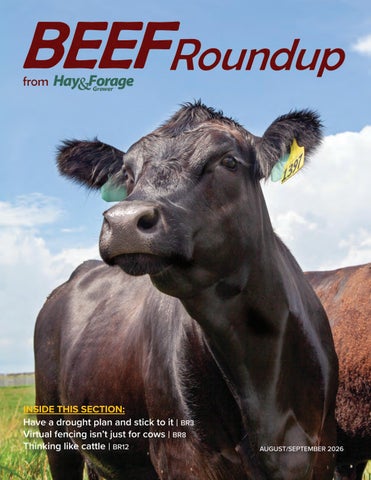
INSIDE THIS SECTION: Have a drought plan and stick to it | BR3 Virtual fencing isn’t just for cows | BR8 Thinking like cattle | BR12
F4 BR 1 Aug 2026.indd 1
AUGUST/SEPTEMBER 2026
7/29/26 9:51 AM
The Complete Livestock Management System
Healthy Pastures. Healthy Herds. Healthy Returns. Get up to $100 Back on NJ Phillips & Simcro Purchases Get up to $100 Back on NJ Phillips & Simcro purchases from September 15 – October 15, 2026 $10 back for every $100 spent on NJ Phillips & Simcro Animal Health Disposables & Devices Buy NJ Phillips or Simcro products, Submit your receipt(s) online & Get a gift card of your choice Contact us directly for more on this special promotion exclusive to HFG readers.
Get up to $100 Back Order Support Specialist 254-534-7363 us.livestocksolutions@datamars.com Datamars Livestock Rebate Terms & Conditions. Promotional offers are only open to U.S. residents with a valid mailing address. Offer only valid for end-user customers. Offer not valid for redemption by resale partners. Datamars reserves the right, in its sole and absolute discretion, to cancel, terminate, modify, or suspend a Promotion at any time and for any reason. NJ Phillips and Simcro are registered trademarks of Datamars, Inc. © 2026 Datamars, Inc. – All rights reserved.
Untitled-2 1
7/26/26 2:37 PM
HAVE A DROUGHT PLAN AND STICK TO IT [ by Megan Van Emon ]
D MEGAN VAN EMON The author is an extension beef cattle specialist at Montana State University.
ROUGHT is always at the back of the mind as we move into summer. Currently, the majority of the western United States is in at least a moderate drought, with several areas in an extreme drought. Although some areas have received much-needed rain recently, this has not improved forage conditions in the long term. Therefore, as we move through summer, it will become more important to make those drought-mitigation decisions. Having a ranch drought management plan with trigger dates and thresholds for making decisions can help ranchers determine available options early. If your area has received less than 75% of average precipitation by July 1, and pasture production is reduced, consider culling a percentage of the herd. This is an example of a trigger date and threshold decision. These trigger dates and thresholds should be specific to each ranch. Making decisions early may also lead to additional resource availability, such as pasture leases and purchasing hay. Moreover, preparing a written drought management plan can also help with decision-making before, during, and after the drought.
What can be controlled Several areas have been experiencing drought conditions for several months, and ranchers in these areas have made some drought mitigation decisions already. If your area has been experiencing drought for several months, consider measuring the current forage production in the pastures. This can help determine the optimal stocking rate or carrying capacity of the available pasture. With limited pasture production, consider early weaning for calves or culling additional stock to meet the limitations of the pastures.
Early weaning of calves has advantages and disadvantages. Some advantages are the drop in cow nutrient demands, which reduces the forage demand, leading to prolonged use of the pasture. Early weaning also offers the ability to market cull cows early, leading to a better price compared to October and November. A primary disadvantage of early weaning is that retaining calves to background often requires additional labor, facilities, and resources. Therefore, early weaning should be well planned and a decision should be made in advance to prepare for the additional needs. Having accurate records can help make culling decisions easier. Cows with bad feet, temperament, teeth or udders, open cows, old cows, and dry cows at calving are all relatively straightforward culling decisions. The choices become more difficult when needing to cull additional cows as a drought strategy. A few things to consider when trying to determine which additional cows to cull could be: low pound of calf weaned per cow body weight, late bred cows, heifers and cows between 6 and 10 years old that no longer fit the ranch goals or management. Also, not all heifers are destined to be herd replacements. With so many areas experiencing drought, hay production may
be limited, even in irrigated fields, which can boost hay prices. Therefore, purchasing hay may not be a feasible or an economical option for feeding cows during the drought. However, additional considerations could be utilized Consider hay quality when purchasing. If buying, grazing, or harvesting small grain hay, always conduct a nitrate test, as nitrates accumulate in stressed plants, which may lead to livestock health problems. Work with your local extension agent or a nutritionist to determine how to best utilize the feeds available in your area. Water quality and quantity may also play a major role in making drought decisions. Water is the most critical nutrient and impacts feed intake, nutrient metabolism, lactation, thermoregulation, mineral balance, and many other processes. If water quality is a concern, conducting a livestock suitability test with a commercial laboratory will help make decisions for grazing a pasture. In previous multi-year droughts, ranchers hauled water to their cattle, and quality could be somewhat controlled. In many correct instances, this is not the case. Having a drought management plan with specific trigger dates and thresholds can help alleviate the stress of making management decisions. Drought management decisions can also include recovery options to determine how soon to add livestock back into the operation or how soon livestock can be grazed on certain pastures. BR For current drought condition information, go to the U.S. Drought Monitor at droughtmonitor.unl. edu/CurrentMap.aspx.
August/September 2026 • BR3
F4 BR 3 Aug 2026 Drought Plan.indd 1
7/30/26 2:36 PM
Jeff Goodwin
PITFALLS IN EARLY ADAPTIVE GRAZING IMPLEMENTATION [ by Jeff Goodwin ]
T
HERE is a long-standing debate on the merits of adaptive rotational grazing. The context of each grazing operation can certainly influence outcomes; however, there is a significant amount of scientific and anecdotal evidence to suggest adaptively managed grazing with optimized plant recovery can improve forage production, plant diversity, soil function, wildlife habitat, and ranch profitability. Many operations today are reevaluating their strategies and considering adaptive grazing, but they often encounter early pitfalls that leave them dissatisfied with the results. Consequently, there are ranchers who try rotational grazing and eventually walk away frustrated. It’s not that the grazing strategy was flawed, but rather that they ran into predictable execution patterns that show up again and again. Below are seven of the most common pitfalls I have seen producers encounter
during the first few years of implementation. None of them are new or overly complicated, and all of them are correctable. If you’re planning a system or are early in one, consider this list before you commit to another season of the same approach.
PITFALL 1: Stocking rate is set on total acres Stocking rate is one of the most important decisions made in the grazing management process. Basing stock-
ing rates on the total acres of a property rather than the carrying capacity of the acres that are grazable can lead to forage deficiencies. Plenty of grazing plans fall apart because the math is wrong from the start. Assess the acres that are accessible and grazable on a property first. Using those acres, an appropriate carrying capacity can be estimated based on their forage productivity. Finally, stocking rate decisions can be made based on the adjusted carrying capacity. Grazable acres are those producing grazable forage and exclude areas such as lakes and ponds, roads, dense woodlands with limited forage production, and often slopes over 30%. A wide range of online mapping tools are available today to aid producers in estimating grazable acres on their prop-
BR4 • August/September 2026
F4 BR 4-6 Aug 2026 Pittfalls.indd 1
7/30/26 2:38 PM
Focus on what you can control
erty. Overstocking based on overestimated production is a common way to undermine recovery and overextend a new system in its first dry year.
PITFALL 2: Overbuilding infrastructure too soon New ideas and strategies should spark enthusiasm; however, they can also be expensive. Commonly, we see producers — often those new to the land — decide to implement a grazing strategy and immediately invest in permanent cross-fencing, buried pipelines, and concrete water troughs based on a paddock layout that has not been fully vetted. A season later, they find out the gates and lanes are in the wrong place, cattle handling is difficult, the paddock arrangements are not based on forage distribution, and water points were either in the wrong place or there were not enough of them. A better approach is to start with what you have, being both cheap and flexible. You may know where a handful of cross fences need to go based on previous experiences; if so, install them. However, before implementing the full design, consider temporary solutions first. There are many temporary fencing options available on the market today that can help teach you more about your planned design in one grazing season than any plan on paper. Watch cattle behavior, assess how they handle, and where forage gets over or underutilized. Once you’ve run a year or two of temporary or semi-permanent divisions, then with experience, implement more permanent structures if you choose. You may even find that a combination of temporary and permanent options suits your management style better and you will likely have saved money in the process.
PITFALL 3: Ignoring water distribution in the rotation design
terrain, depending on the stock density, utilization stays reasonably even out to about 800 to 1,200 feet from a water source. Beyond that, utilization begins to drop, and on slopes it falls off faster still. Paddocks designed without thoughtful water planning end up with plants that are severely overutilized near water sources coupled with ungrazed, over-mature forage in the far side of the pasture. Fundamentally, there is over and under-grazing in the same pasture. The fix is to design livestock water placement first and fence second. Aim to keep every part of every paddock within roughly a quarter-mile of a reliable water source during the grazing period. In Western, more semi-arid regions, a half mile may be the target — a mile in extreme cases. That may mean more water points or smaller paddocks closer to existing infrastructure. Proper distribution and plant utilization is what
makes the math on rotational grazing actually work. Without it, you’re just moving cattle through patterns of overuse and underuse.
PITFALL 4: Rotating based on the calendar Many times, we hear grazing strategies described as “we move every three days” or “once a week.” These are useful descriptions of grazing duration, but they are not a management system. Plants don’t always have the same growth pattern from year to year based on the calendar; some years green up is early, sometimes frost is late. In the growing season, a paddock may be fully recovered in 30 to 45 days. The same paddock in a dry August may need 90 to 120 days or more, and in a drought year, it may need to be skipped entirely. In general terms, it’s encouraged to speed up rota-
GREATER
FEED PERFORMANCE Maximize feeding efficiency with a ROTO-MIX feed delivery box, designed to deliver larger loads to your cattle with fewer trips.
SCAN TO LEARN MORE OR VISIT ROTOMIX.COM (620) 225-1142
Water drives utilization more than fence does. Many of us were taught that if we have one watering point in a pasture, that’s good enough. Sometimes it is and sometimes it’s not; it mostly depends on topography and pasture size. On level
August/September 2026 • BR5
F4 BR 4-6 Aug 2026 Pittfalls.indd 2
7/30/26 2:38 PM
Jeff Goodwin
To be successful with an adaptive rotational grazing system, a keen sense of observation is required.
tions during fast growth periods and slow down during slow growth periods. Consider rotational decisions on graze-period residual in the paddock you’re leaving, and regrowth condition in the paddock you’re moving into. Calendar-based moves tend to be overly prescriptive when the key is to stay adaptive. Grazing duration depends on the time of the year, the growth stage of the forage, the length of recovery period, and the class and condition of the livestock. Set a target utilization based on the factors above, and once you’ve met your target, rotate to another paddock and don’t return until the plants have fully recovered leaf area. The recovery period is more important than the grazing period. If you overutilize the pasture, couple that with an extended recovery period. Manage the plant, and the calendar takes care of itself.
PITFALL 5: Shorting recovery periods One of the most common pitfalls is returning to a pasture before it’s ready. Often recovery periods get shortened to keep moves frequent, accommodate a herd forage demand that has outpaced the supply, or to finish a rotation on schedule. The result is plants bitten again before carbohydrate reserves and leaf area have recovered, which can lead to reduced productivity, more pressure on desirable species, and reduced pasture health. This is often a symptom of having too few paddocks, an unbalanced stocking rate, or both. The result is rotational overgrazing. Recovery is strictly a function of growing conditions, not
days on a chart or calendar. Thirty days might be ample in a wet spring, but in late summer, it is not nearly enough.
PITFALL 6: Prioritizing per-head metrics Ranchers are land asset managers. Subsequently, re-evaluating a mindset focused on product produced per acre on a farm or ranch is often a more realistic view of ranch efficiency than individual animal metrics. A 650-pound weaning weight or a 2.5-pound average daily gain on stockers is a fine target. But individual performance metrics, viewed in isolation, can obscure whether the ranch is actually efficient. Pounds of weaned beef produced per acre is generally a more valid metric to evaluate efficiency of the beef enterprise. Metrics on a per acre basis are also valuable in evaluating the performance of other enterprises on the ranch, like a hunting enterprise. It speaks to the manager’s ability to convert sunlight into a forage resource and into a beef product at a scale relative to them. The real economic advantage of rotational grazing rarely shows up as a bump in per-head performance. It shows up as more stock days per acre, a larger carrying capacity, or more total pounds of beef harvested from the same land. Track per-head numbers but let per-acre output be the scoreboard.
PITFALL 7: Expecting results tomorrow Producers who expect dramatic forage and soil responses in year one are
often disappointed. In evaluating land, we use leading indicators and lagging indicators. Some forage responses are leading indicators and can be experienced within the first grazing season. Leading forage indicators can include percentage of bare ground, plant cover, or productivity. Lagging indicators that take multiple growing seasons to truly see impacts include soil organic carbon, plant community dynamics, or infiltration improvements. These indicators operate on ecological timescales, not fiscal-year timescales. In humid regions with 30 or more inches of rainfall, visible pasture improvement typically takes three to five growing seasons. Even in higher rainfall regions there is generally a lag in ecological response, it can take one to three years to see benefits. In semi-arid and arid regions, it can take a decade or more, and progress is still highly regulated by precipitation. Set realistic benchmarks. The early gains are usually in management knowledge and animal performance consistency. The big ecological gains come later, and only if you stay disciplined long enough to let them compound.
Plan, act, and adjust Adaptive rotational grazing is not a fence layout. It’s a proactive management strategy that requires observation. It asks the rancher to read the land, evaluate forage, water, weather, and livestock together, then plan, act and adjust. Every pitfall on this list shares a common root: substituting a rule, a schedule, or a number for actual observation of what’s happening on the land. The operators who are successful long-term are not the ones with the most paddocks or the most elaborate infrastructure. They’re the ones who learn from the land, prioritize recovery, optimize stocking, adapt, and stay patient. Start simple, watch closely, and let the land and livestock tell you what to do next. BR
JEFF GOODWIN The author is the director of the Center for Grazinglands and Ranch Management at Texas A&M University.
BR6 • August/September 2026
F4 BR 4-6 Aug 2026 Pittfalls.indd 3
7/30/26 2:39 PM
26-PUR RTL-0716 2026 Grass Cattle Asset Development_PrintAd_072326_VF_HiRes_Bleeds.pdf
1
7/23/26
9:19 AM
VIRTUAL FENCE IS NOT JUST FOR COWS [ by Eric Bailey ]
I
RECENTLY attended a virtual fence symposium held at the University of Missouri. There was a large audience who asked insightful questions about using this new technology, but it became clear throughout the day that most producers were thinking about using these collars on cows. Only one person asked a question about using virtual fence on stocker cattle. Virtual fencing may have major applications outside of the cow-calf enterprise. One of the more interesting opportunities is with stocker cattle, especially when producers are trying to graze high-quality annual forages, cover crops, or other short-season forage resources that require strict management. That is the question we are working through right now at the University of Missouri: Can we put virtual fence collars on stocker calves fresh out of the sale barn, train them quickly, and then use those calves in a high-density strip-grazing system? A lot of producers already understand that grazing management can improve forage utilization. The barrier is usually the labor required for improved grazing
management. Moving polywire takes time. Setting posts takes time. Planning water access takes time. Getting the fence right takes time. And in the real world, time is often the limiting resource.
Time to test Virtual fencing does not create forage nor does it improve forage quality. What it may do is allow producers to harvest forage that is already there but underused due to the labor and logistics of controlling cattle movement being too high. That is why cover crops are such an interesting place to test this. Cereal rye is a logical place to start, as it is commonly used as a cover crop. It fits Missouri production systems and provides early spring growth when
many perennial pastures are still dormant or too sensitive to graze hard. In a state dominated by tall fescue, that early forage window matters. Spring growth from winter annuals can provide high-quality feed at a time when stocker cattle can use it efficiently and when producers are often looking for ways to stretch perennial pastures. The practical question is straightforward: If producers are going to plant cover crops anyway, can we help capture more value from those acres by grazing them at a high stocking density using virtual fencing collars? Our current project is evaluating cereal rye grazing with stocker cattle and virtual fence technology. The work is being led by Derek Brake, a ruminant nutritionist, in collaboration with Harley Naumann, a forage agronomist, Emma Bauer, a graduate student, and myself. The project is part of a broader effort through the University of Missouri Center for Regenerative Agriculture.
The invisible barrier We used Halter virtual fence collars to strip graze two varieties of cereal rye at two stocking densities. One treatment placed four, 600-pound steers on a 0.25-acre strip. The other placed eight, 600-pound steers on a 0.25-acre strip. Expressed another way, the treatments represent approximately 9,600 or 19,200 pounds of calf per acre.
BR8 • August/September 2026
F4 BR 8-9 Aug 2026 Virtual Fence.indd 1
7/30/26 2:43 PM
Focus on what you can control
The calves were not turned out on a whole field and left to select a diet of their choosing. Instead, they were allocated forage in controlled strips, similar to what a producer might do with temporary polywire. The difference is that the boundary is created with a collar and a digital line, rather than a physical fence. This was one of the big unknowns going into the project. It is one thing to keep cattle inside a broad pasture. It is another thing to ask the technology to hold a tight strip-grazing line in a high-quality annual forage system with recently assembled stocker calves. These sale-barn calves were bought on Tuesday, and nine days later, they were enrolled in the experiment and turned out on rye. If the technology only works with calm, mature cows in low-pressure settings, its usefulness is more limited. If it works with stocker calves after a reasonable training period, the range of potential applications gets much larger.
Potential is growing The early field experience has been encouraging, and the drone images from the project show a sharp contrast between grazed and ungrazed strips. The calves have respected the virtual boundaries with far more precision than many of us expected. I am not ready to say virtual fence will replace every polywire reel on every farm. That would be getting ahead of the data and ahead of the practical reality. But I am comfortable saying this: The technology is worth evaluating in stocker operations. This is especially true for grazing systems where timing and forage allocation matter. Think about cereal rye in the spring, stockpiled forage, summer annuals, and rented crop ground where a producer has access to forage but does not want to build permanent fence. Think about fields where the economics of grazing look good, but the labor of fence movement keeps the idea from happening. That is the opportunity. Stocker systems are built around biological and economic timing. Calves need to be straightened out, and forage must be grazed when quality is high. Markets and the weather change at a rapid pace. A system that lets the producer move cattle digitally rather than physically moving fence could create real management flexibility. Again, virtual fence does not remove the need for management. It changes where the management happens. Instead of management being limited by the amount of temporary fence that can be built and moved in a day, it shifts more of the work to planning, monitoring, and adjusting of digital boundaries. Although that is still management, it may be management that is easier to scale. The research team collected calf body weight every 14 days over a 70-day grazing period. On the forage side, the team collected weekly measurements of forage mass and nutritive value. Those samples were collected across strips every week, including areas already grazed by cattle. The final performance data are not complete, so I am not going to oversell the conclusion. But the practical observation is important: Sale-barn stocker calves can be collar trained and used in a controlled strip-grazing system.
practical. Grazing cover crops sounds good, but it must work with cattle behavior, labor availability, water, forage growth, soil conditions, and markets. Otherwise, it remains a good idea that does not get implemented at scale. The economic case remains simple. More grass harvested from the same acres lowers feed cost, better forage allocation can improve cost of gain, and fewer physical fence moves reduces labor. More flexible access to annual forages may also open up acres that were previously hard to graze. Technology should always be evaluated through a profit lens. If virtual fence helps producers harvest more of the forage they already grow, allocate forage more precisely, and use stocker cattle to capture value from short-season grazing opportunities, then it deserves a serious look. Virtual fence is not just for cows. It can be a tool for stocker cattle, grazing cover crops, and for bringing livestock back onto crop farms. Virtual fence may help expand grazing across cover crop acres not just in Missouri, but across the country. BR
ERIC BAILEY The author is an extension beef nutrition specialist with the University of Missouri-Columbia.
EMCELLE® TOCOPHEROL ®
An essential nutrient for growth and maintaining calf health status!
EMCELLE® TOCOPHEROL A natural-source and biologically active liquid form of vitamin E — the same form as in cow’s colostrum and milk. Specially formulated for use as a top-dress onto dry feeds at the time of feeding or administered in drinking water or milk replacer. EMCELLE® TOCOPHEROL is micellized and water-dispersible. This enhances the calf’s ability to utilize vitamin E. Especially when compared to either powders or oily forms of vitamin E.
Research-based Solutions . . . for Animal Nutrition Needs StuartProducts.com Info@StuartProducts.com
Evaluate through a profit lens For regenerative agriculture to work in cattle systems, grazing strategies must be biologically sound and economically
August/September 2026 • BR9
F4 BR 8-9 Aug 2026 Virtual Fence.indd 2
7/30/26 2:44 PM
WHAT’S NEW? [ by Brett Rushing ]
O
CCASIONALLY, I get asked the question, “What’s new in the forage world?” — or something to that effect. I’m usually caught off guard by the question for a couple of reasons. First, the question implies that what we had been discussing during our conversation is outdated, and they are looking for some edge — some silver bullet — that hasn’t been discovered that might relieve them of some time, expended energy, or save them money. My response usually revolves around technology advancements, such as drones or imagery, or I might offer some data on new cultivars or mention equipment with on-board near infrared spectroscopy (NIRS) technology that will allow them to track nutritive values in their harvested forage. My answers often fall flat, or might stoke some response like heightened eyebrows or a crossing of the arms, but rarely is there much interest or continued dialogue regarding the answers, which usually ends the conversation. The second reason this question makes me stumble is that as I drive across the backroads of Mississippi, I never jump out of the truck, dumbstruck by the awe-inspiring embrace of modernization. Yes, you will see new tractors, new sprayers, and new this and that. You hear of farmers using drones, but in the beef pasture and forage production world, we seem to be grinding the wheels of progression like a cow chews her cud — slowly, monotonously, and intentionally. There is a reason why this occurs. We seek new or alternative ways to accomplish the same goals that have always been underlying our operations. These goals include efficiency, cost savings, perhaps a break from monotony, or maybe we just like being different. But as the wise Solomon once said, “What has been is what will be, and what has been done is what will be done, and there is nothing new under the sun. Is there a thing of which it is said, ‘See, this is new?’ It has been already in the ages before us. There is no remembrance of former things, nor will there be any remembrance of later things yet to be among those who come after.” (Ecclesiastes 1:9-11). This explanation from Solomon is a sober reminder that in this life, deliber-
ate, intentional consistency is a philosophy to embrace. There is constant striving for modernity that might allow us to work less, or an innovation that solves a particular problem. All of this is good and well, and deserves our attention and efforts, but ultimately, our focus in this industry has always been — and will always be — the movement of nutrients from one shape or form to another. Nitrogen from the atmosphere moves through the soil, into the plant, then to the animal, and onto our plates. The movement of carbon from leaf tissue moves into the animal, is excreted to the ground, consumed by microbes, and contributes to organic matter. This cyclical pattern of ingestion, digestion, and mobilization through the atmosphere, into the soil, through the ruminant, and to the consumer is the basis of our industry. We can easily get hung up on variety or species selection, herd health and development, equipment technology, labor issues, market issues, fertilizer prices, or new pest challenges, but in the end, we are still just overseeing the distribution of essential elements throughout the beef supply chain. How animals get
those nutrients is the part of the equation where we now turn our attention.
Questions to ponder In Mississippi, there has been a concerted effort over the years to inform livestock and hay producers of the necessity for hay testing and its role in developing feeding or grazing management plans. The compilation of data from these simple tests often discloses information that reflects the management or mismanagement of nutrient distribution. Table 1 contains the results from hay samples that were submitted to the Mississippi State Chemical Laboratory from January 2017 to October 2025. A total of 2,344 samples were submitted during that time frame. As with most of the southeastern U.S., a majority of the samples submitted were categorized as grass hay (1,991 samples). Next was haylage (baleage; 259 samples), followed by legume hay (mostly clovers; 51 samples), then mixed hay (at least 50% legume composition; 29 samples), and finally silage (corn and sorghum; 14 samples). The distribution of samples submitted is analogous to the types and amounts of forage produced in the state — a lot of grass hay in the summer, a fair amount of ryegrass baleage in spring, very little clover or alfalfa production, and even less silage. But remember, it’s all about nutrient distribution. In the types of feedstuffs listed, where are the nutrients concentrated?
Table 1. Forage quality results from the Mississippi State University Chemical Laboratory (Jan. 2017 to Oct. 2025) Type
#
CP*
ADF*
aNDF*
Fat
TDN*
Silage
14
10.89
30.08
49.10
3.12
60.45
Grass hay
1,991
8.72
40.10
65.50
1.89
49.18
Haylage
259
12.81
37.44
57.56
3.15
54.46
Legume hay
51
19.73
32.65
39.80
1.75
60.01
Mixed hay
29
11.32
38.50
59.45
1.85
53.74
Total
2,344
*CP, crude protein; ADF, acid detergent fiber; aNDF, amylase-treated neutral detergent fiber; TDN, total digestible nutrients.
BR10 • August/September 2026
F4 BR 10-11 Aug 2026 What's New.indd 1
7/30/26 2:45 PM
Focus on what you can control
When feeding them, are they transferring adequate amounts of nitrogen as crude protein to meet peak lactation requirements or to sustain growth for rebreeding potential? How much are we spending to produce these feedstuffs that don’t adequately meet the nutrient demands of the animals we’re feeding them to? Ultimately, we must ask ourselves, “What exactly are we doing and to what end?”
Making hay I think we all grasp “what we’re doing,” so let’s focus on the “to what end” part. Have you ever calculated how much time it takes to produce a round bale of dry hay? I’m not an economist, but I’m about to make a lot of assumptions to see if we can figure this out. Let’s say we have about 2 tons of mixed grass (bahiagrass/bermudagrass) per acre in our hayfields and the weatherman offers a favorable forecast for the next five days. With a 115-horsepower tractor and 8-foot disc mower, you cover about six acres per hour at 7 to 8 miles per hour. We can cover the same area with a 16-foot tedder or rake in half the time, so three acres per hour. Baling is more difficult to estimate because it depends on bale diameter and type of binding, but let’s go fancy and say it’s a 4x5 with net wrap. Many fields have quite a few turns, so let’s assume about 3 minutes between bales, including stopping, wrapping, and ejecting. The bales weigh an average of 1,000 pounds per bale. This gets us to about four bales per acre with a 2-ton yield, which translates to 12 minutes per acre for baling. Let’s assume the hay barn is less than a mile from all our fields, and it takes about 10 minutes to load, drive, unload, and stack four bales. If I did all my math correctly, we end with a grand total of 37 minutes per acre from start to finish. Remember, that time is just for harvesting, baling, and storing. It does not include spreading fertilizer, spraying pesticides, scouting, or feeding. My estimate would be around double the time per acre to include these additional activities. And this is just for one cutting!
High Moisture Corn, Nebraska
Is there a better way? When discussing hay budgets with farmers, we often include operator labor, which is currently at $18.69 per hour based on our state’s forage planning budgets. Many farmers don’t want to accept this cost because “they enjoy making hay and don’t consider it labor.” The point is that we spend a lot of time producing hay that the data shows is too often moderate to poor quality. Why are we expending so much time and money to make hay that, in the end, will require additional supplementation to meet the nutrient demands of the animals we are feeding it to? So, the next time you find yourself in the hayfield, ask yourself: “Is this really the best use of my time? Would I be better off moving nutrients by improving grazing efficiency or putting more emphasis on growing and harvesting higher quality hay? Just think about it sometime. BR
BRETT RUSHING The author is a research and extension professor at Mississippi State University’s Coastal Plain Branch Experiment Station in Newton, Miss.
S I L A G E®
BARRIER
FILMS
BY CONNOR AGRISCIENCE
August/September 2026 • BR11
F4 BR 10-11 Aug 2026 What's New.indd 2
7/29/26 10:02 AM
THINKING LIKE CATTLE [ by James Rogers ]
C
ATTLE behavior is complex. We have all experienced individual cattle that amble up to see what we are doing when we enter a pasture. We have also experienced cows that seem to know our intentions and quickly take their calves to the far reaches of the pasture. These behavioral differences are part of what makes up an animal’s temperament and are often categorized as “good” or “bad.” However, cattle behavior goes much deeper than temperament alone. It influences how cattle perform, learn, and forage. Understanding cattle behavior can therefore improve grazing management. When we watch cattle graze — really watch them graze — we realize they are not randomly wrapping their tongues around the nearest available forage. Instead, they actively select the forages they prefer. Where does this forage-selection knowledge come from? Evidence suggests that preferences may begin during gestation, as flavors are detected by the developing calf through uterine fluid. After birth, milk flavored by the cow’s diet further influences the calf’s grazing preferences. Once calves begin grazing, they observe what the mother cow consumes and mimic her behavior, learning what to eat and what to avoid. Cattle are social creatures and learn from one another. When introduced to an unfamiliar environment without prior grazing knowledge, cattle can learn from experienced animals about where and what to graze. The basis for forage-selection preference is driven by forage nutritional quality and the animal’s need to meet nutritional requirements while avoiding plants that cause toxicosis. An example of this was observed in eastern Oklahoma, where an overgrazed pasture left only Baptisia (false indigo), a plant that can cause gastrointestinal distress when consumed. Preferences tend to develop for forages with high dry matter digestibility because they provide positive digestive feedback. Cattle prefer forages that make them feel full and satisfied (satiety), much like humans, and avoid those that make them feel ill. Forage nutritional content varies depending on species, maturity, landscape position, time of day, moisture content, and many other factors. Low
nutrient content may cause cattle to avoid certain forages, while excessively high nutrient concentrations may also lead to avoidance because of digestive discomfort. Overall, forage selection can be understood as a process of learning through experience. Once cattle have gained selection experience, are they limited only to those experiences? No. Cattle can expand their diets and develop additional forage or feed preferences to meet nutrient deficiencies or through social learning from other animals, as described earlier. Often, when cattle are introduced to a pasture containing an unfamiliar mixture of forages, they move quickly across the area, taking small bites as they go — testing and tasting while searching for familiar flavors. Younger cattle that have not yet developed strong preferences for specific forages may adapt more quickly to new forages or mixtures. In such cases, older animals may adapt and learn from younger animals. As a grazing manager, we would like each individual animal’s voluntary dry matter intake (DMI), nutrient demand, and function to be the same, or at least predictable based on physical size and stage of production. We could then easily stock pastures at the correct rate based on forage availability and tailor the stocking period accurately based on forage quality. However, there is individual variation in intake. Some small cows (lighter than 1,200 pounds) will consume as much as larger cows (heavier than 1,200 pounds) and vice versa. There are also variations in how effectively intake is utilized to support growth, maintenance, reproduction, and
other bodily functions. Forage availability, grazing behavior, and diet selection all influence voluntary intake.
It’s all about preference Forage availability to a grazing manager refers to the volume of forage available for consumption. To the selective grazing beef cow, it means volume of preferred forage species available to eat. Studies have shown that as much as 80% of the seasonal forage diet consumed made up only 6% of the forage standing crop. In a stocking rate demonstration where stocking rate was pushed up to 1,000,000 pounds per acre, stocker weight steers still expressed preferences for what they first consumed. In this case, the first thing to be consumed was the flower heads from the American Basket-flower (Plectocephalus americanus). An analysis of the nutrient content of the flower heads revealed a crude protein content of 17% and total digestible nutrients (TDN) of 80%. As the steers continued to graze, they stairstepped their way down through preferences to the point that the least-preferred forages were simply trampled. Within preferred forage species, and grazing in general, cattle prefer immature green leaves followed by mature green leaves, green stems, dry leaves, and finally dry stems. Cattle actively graze at two time periods: sunrise and sunset. Sunset grazing periods tend to be longer and more intense. Some grazing will occur overnight, but it is not a major contributor to daily DMI. How cattle graze from morning to evening varies with higher bite and intake rates during the evening grazing event compared to the morning. This heightened evening grazing activity corresponds with changes occurring to plant nutritional content throughout the day. As plant photosynthetic activity rises from morning to afternoon, soluble carbohydrates, digestibility, and palatability rise as well. Grazing behavior is therefore strongly influenced by the experience and knowl-
BR12 • August/September 2026
F4 BR 12-13 Aug 2026 Thinking Like Cattle.indd 1
7/30/26 2:49 PM
Focus on what you can control
edge cattle have gained regarding forage preferences. They will then spend more time in areas with abundant preferred forages and move away from areas when satiety, or the feeling of fullness, is not achieved. If given the opportunity, cattle repeatedly return to grazing areas with high nutrient content more often than to areas with lower nutrient value. If this aspect of grazing behavior is not properly managed, the consequences become evident over time. Pastures may become spot-grazed, preferred plant species may weaken or disappear, and less desirable plants may gradually replace them. These effects can then ripple out to influence animal production, stocking rate, and drought management.
Maintain a balance Grazing management can be used to control the amount of time that a preferred forage species is grazed and the recovery time period before it is grazed
again. Management can favor plant persistence of preferred grazing forages, but it also changes grazing behavior. Changes include diet selection (preference), grazing time, and herding behavior. An effective grazing manager achieves a balance that needs to be achieved between forage plants and the grazing animal, one that comes with experience. Strategies include: • Assess the current plant-animal system and determine whether it is meeting animal and plant goals (production, diversity, and so forth). If goals are not being met, identify the weak link in the system and develop specific, realistic, and obtainable forage plant and/or animal goals. • Understand the effects of grazing management strategies on both plants and animals. Changes in grazing management can reduce an animal’s ability to select preferred forage. However, these strategies may also improve the per-
sistence of preferred forage species. Management decisions should maintain a balance between plant and animal needs. • Allow time for adaptation when introducing cattle to a new forage environment. Cattle require time to learn the available forage resources and grazing area. Adaptation is often faster when inexperienced animals can observe and learn from experienced herdmates. Use forage preference and grazing behavior as management tools to help achieve production and vegetation goals. Monitor animal behavior and vegetation response closely, and adjust management practices as needed to help improve outcomes on your operation. BR
JAMES ROGERS The author is a North Dakota State University Extension forage crops production specialist.
STRONG.
BUILT TOUGH. BUILT TO LAST.
PROUDLY BUILT IN MARSHFIELD, WI
HSMFGCO.COM August/September 2026 • BR13
F4 BR 12-13 Aug 2026 Thinking Like Cattle.indd 2
7/30/26 2:49 PM
WHAT’S IN YOUR BALE? [ by Bruno Pedreira ]
E
Guessing game One of the most challenging days of my year is judging hay entries at the Tennessee State Fair Hay Contest. Using a hay judging scorecard, I evaluate factors such as maturity, leafiness, softness, odor, color, and the presence of weeds, dirt, mold, or other foreign materials. When several hay samples are lined up side by side, it is often possible to identify the better bale. The problem is that hay buyers rarely have that luxury. When purchasing hay, bales are often located at different farms, harvested under varied conditions, and available in limited quantities. Thus, comparing them accurately becomes difficult. As a result, many hay purchases are made without any knowledge of the forage’s actual nutritive value. Once the hay arrives at the farm, producers face many important decisions. Which hay should be fed to replacement heifers? How much supplement will be needed to meet nutritional requirements? Those decisions become challenging when you do not know what nutrients are, or are not, in the bale. Consider your replacement heifers. If they spend the winter consuming hay that is lower in quality than expected, they may fail to reach target breeding weights. Delayed breeding can affect
Mike Rankin
VERY year, many livestock producers purchase hay to feed to their animals throughout the winter months. Although hay often represents a significant investment, sometimes several thousands of dollars, it is frequently bought with surprisingly little information. In many cases, purchasing hay becomes just another routine farm expense, and decisions are based largely on visual evaluation. This approach is understandable, as most producers can easily distinguish obviously good hay from poor-quality hay. Appearance matters, and visual evaluation can provide useful clues about forage quality. However, appearance alone rarely tells the whole story. productivity and ultimately reduce farm profitability. A relatively small mistake in hay quality assessment can create significant economic consequences months later. That is why hay testing is one of the most valuable tools available to livestock producers. If you purchase hay without a forage analysis report, consider testing it yourself. Rather than guessing how much supplement to feed, you can make informed decisions based on actual nutrient content. Supplementation can then be targeted to provide only what is missing from the forage, helping to minimize feed costs while ensuring animals meet performance goals.
of Tennessee Soil, Plant, and Pest Center between 2015 and 2023. The results revealed substantial variation in nutritive value among forage species. Average crude protein concentrations ranged from approximately 9.8% in native warm-season grasses to 13.4% in orchardgrass. Native warm-season grasses generally exhibited the highest fiber concentrations, while orchardgrass and annual ryegrass provided the greatest digestibility. Total digestible nutrients averaged nearly 59%, but values varied considerably among forages. Relative forage quality ranged from 85 for native warm-season grasses to over 100 for orchardgrass.
Probe for answers
These results highlight an important reality: hay quality can vary tremendously, even among commonly used forages. Without testing, producers are essentially making feeding decisions without knowing the nutritional value of the hay they purchase or produce. Ideally, hay sellers would routinely provide forage test results to buyers. Unfortunately, that remains uncommon in many hay markets. In fact, there is often a reason some is sold without a forage analysis. If a producer neglects fertility, harvests at an advanced stage of maturity, or fails to follow sound hay-making practices, the resulting for-
Collect samples from approximately 10 to 15 bales within a single lot, defined as hay harvested from the same field at the same time. The preferred method is to use a forage probe and collect core samples from the side of the bale in toward its center. Many county extension offices have forage probes available for producer use and can also assist with sample submission and interpretation of laboratory results. Most land-grant universities offer affordable forage testing services. To better understand hay quality across Tennessee, we analyzed more than 7,000 hay samples submitted to the University
Testing advised
BR14 • August/September 2026
F4 BR 14-15 Aug 2026 What's In Your Bale.indd 1
7/30/26 2:53 PM
Focus on what you can control
age quality may be poor. Knowing that, would they be eager to document the quality before selling it? Probably not. On the other hand, producers who invest in soil fertility, harvest timing, and proper storage often have every reason to test their hay. A forage analysis provides objective proof of quality and can help justify a premium price. In my experience, many of the hay lots that caused the greatest feeding challenges were those that had never been tested. If you have already purchased hay, testing it can still provide tremendous value. The information can guide winter feeding programs, improve supplementation decisions, and help identify which suppliers consistently deliver high-quality forage. Over time, those results can help you build relationships with dependable hay producers and avoid costly disappointments. There is another important reason to test your hay, and it comes from an interesting experience I had a few years ago. An attorney once contacted me regarding a legal dispute involving a hay barn that had burned. The insurance company and the hay owner disagreed on the value of the destroyed hay. The challenge was that nobody knew exactly how much hay had been stored, nor did they have forage analyses documenting its quality. Unfortunately, this situation is not uncommon. Most hay bales are never weighed. Producers often have rough estimates, but few routinely measure actual bale weights. Likewise, many hay lots are never analyzed for crude protein, fiber, energy content, or other quality parameters.
Document inventories It sometimes takes an unfortunate event, such as a barn fire, to remind us of the importance of documenting both the quantity and quality of our forage inventory. What if that barn had been yours? Would you have been able to accurately demonstrate the value of the hay you lost? While this example represents an extreme situation, it illustrates a broader issue. Every year, hay is bought and sold with little objective information regarding either weight or nutritive value. Research and field experience consistently show that bale weights are often overestimated. Simply weighing a few representative bales from each harvest can improve inventory management and provide more accurate valuations. Likewise, a relatively inexpensive forage test can provide information that is valuable not only for feeding decisions, but also for marketing, recordkeeping, and risk management. Whether you produce your own hay or purchase it from others, knowing what is in the bale is one of the most effective ways to improve forage management. Hay testing allows producers to fine-tune supplementation programs, control feed costs, support animal performance, and make better-informed purchasing decisions. After all, when hay is one of the largest winter feed expenses on the farm, it makes sense to know exactly what you are feeding. BR
BRUNO PEDREIRA The author is a forage specialist and director of the UT Beef and Forage Center at the University of Tennessee.
FEATURES:
• Adds one hydraulic remote outlet • 15GPM per outlet 3000PSI • Works on any tractor, open or closed center • Easy to mount, versatile • Convenient, one handed operation • Aluminum body construction • Commercial grade sealed switches • Inexpensive
Call for more information:
800-648-6507
www.vandminc.com
August/September 2026 • BR15
F4 BR 14-15 Aug 2026 What's In Your Bale.indd 2
7/30/26 2:27 PM
All hat. All cattle. Not all rations are created equal. Don’t settle for feed ingredients that are all talk.
Whole cottonseed provides a powerful combination of fat, fiber and protein in one single feed ingredient.1 This triple-nutrient feedstuff offers an effective way to supplement the ration and improve body condition.2,3 See what a higher nutrient profile can do for your operation. Choose the triple-nutrient feed ingredient. Feed whole cottonseed.
1
Stewart, L. and Rossi, J. (2010). Using cotton byproducts in beef cattle diets. Bulletin 1311. The University of Georgia and Ft. Valley State University, the U.S. Department of Agriculture and counties of the state cooperating.
2
Jacobs, L. et al. (2019). Whole cottonseed use in beef cattle diets. Alabama A&M and Auburn University Extensions. https://www.aces. edu/wp-content/uploads/2019/12/ANR2608_WholeCottonseed112219L-G.pdf.
3
Comerford, J.W. (2014). Added fat in the ration of beef cows to enhance reproduction. Pennsylvania State University. https://extension. psu.edu/added-fat-in-the-ration-of-beef-cows-to-enhance-reproduction.
AMERICA’S COTTON PRODUCERS AND IMPORTERS. Service marks/trademarks of Cotton Incorporated. ©2026 Cotton Incorporated. The Seal of Cotton is a trademark of Cotton Incorporated.
25-COT-2613_HAT_CotBeef_PgAd_BeefRoundup_AprilMay_040826_VF.indd 1
4/8/26 12:26 PM