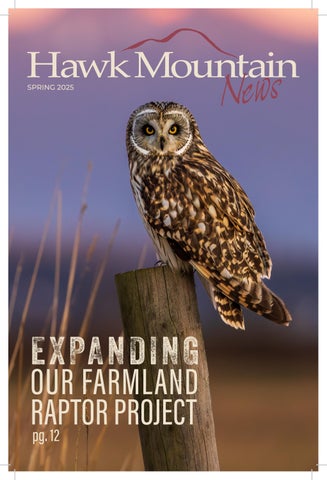
EXPANDING OUR FARMLAND RAPTOR PROJECT
The mission of Hawk Mountain Sanctuary Association is to conserve birds of prey worldwide by providing leadership in raptor conservation science and education, and by maintaining Hawk Mountain Sanctuary as a model observation, research, and education facility. MISSION
Photo by Becca McCabe
Visitor
Changing
Expanding Broad-winged Hawk & Farmland Raptor Projects
Human Impact on Barred Owls
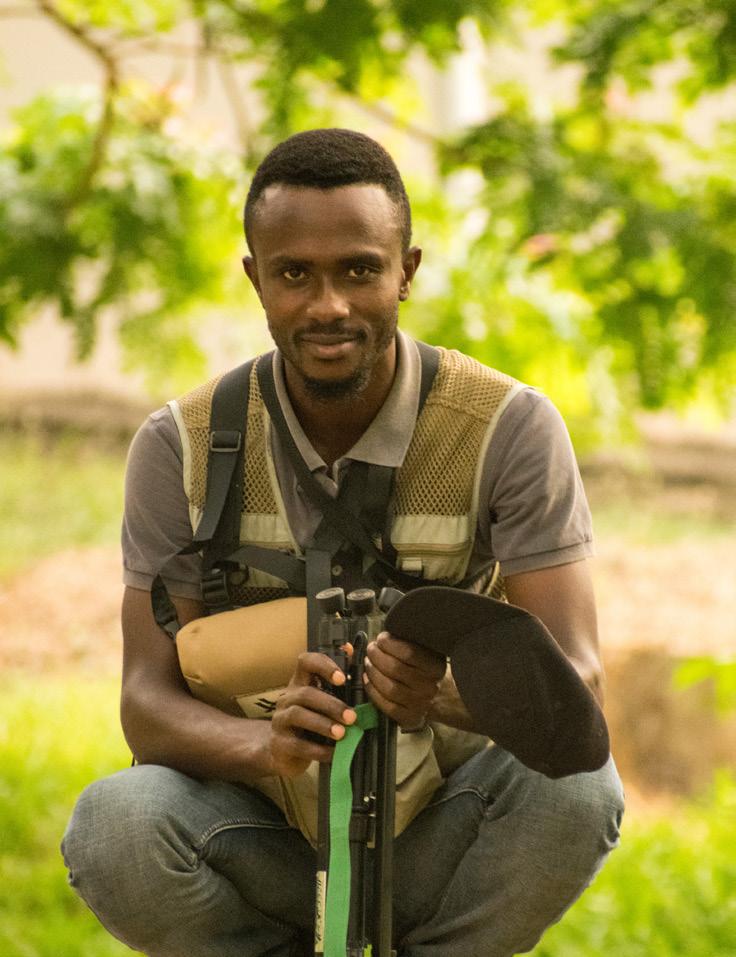
Joseph Kwasi Afrifa
COVER PHOTO by Jolena Tagg
Photo by Bill Moses
HAWK MOUNTAIN: A PLACE OF POWER
Is Hawk Mountain a place of power, a sacred site, a location where people feel a deeper sense of connection with the natural world? Many of us know of special spots where we live or grew up where you feel grounded, reflective, and connected with nature. I believe it is important for each of us to have a place that we can visit and experience nature throughout the changing seasons, such as the profound quiet you can experience during falling snow, or the first chorus of calling frogs in early March, or the hush and whispers of newly grown-in leaves in early summer, or while listening to the sounds of late summer, with lazy insects singing in the changes of fall, and millions of birds take to the sky and begin their annual migration.
Given the epic view from North Lookout, and the birds and other wildlife that migrate along the Kittatinny Ridge, it is no wonder that Hawk Mountain has attracted generations of people seeking a deeper understanding of nature and wildness, that for many is symbolized by the fleeting glimpse of a wild bird of prey. When I was ten, I recall the day I saw my fist kettles
of broad-winged hawks migrating over my home in Massachusetts, and it is likely those same birds were seen a week later by visitors to Hawk Mountain. It is interesting to contemplate that a raptor or bird that nests in your patch of woods, could spend 40 percent of their lifetime migrating thousands of miles to their very specific wintering grounds, and that by being aware of their existence and journey, we are connected to the places, wildlife, and other people that they see. For me, that connection represents the Hawk Mountain community.
That calling or desire, to share in and understand wildlife and the wild places they call home, is something that generations of us have shared. For instance, today I share common ground with the same people who visited in 1936, 1960, or 2020. Today, people come from more than 76 countries to learn about raptors and how to study them. Many have gone on to set up hawkwatch sites in their home countries, or to study a specific species of raptor and their relative health as a species, or have continued on to write scientific
papers and become PhDs, just as five former trainees did last year. I believe Hawk Mountain is a sacred place and that everyone it has touched is part of that global community.
Yours in Conservation,

Sean Grace PRESIDENT
STAFF
PRESIDENT
Sean Grace
DIRECTOR OF CONSERVATION SCIENCE
Laurie Goodrich, Ph.D.
SENIOR SCIENTIST AND GRADUATE STUDY DIRECTOR
Jean-François
Therrien, Ph.D.
SENIOR RESEARCH BIOLOGIST
David Barber
BIOLOGIST-NATURALIST
Bracken Brown
RESEARCH BIOLOGIST
Rebecca McCabe, Ph.D.
ACOPIAN CENTER OPERATIONS COORDINATOR
Wendy Nicodemus
DIRECTOR OF EDUCATION
Megan Roselli
EDUCATOR
Jessica Gary
DIRECTOR OF SANCTUARY STEWARDSHIP
Todd Bauman
SANCTUARY STEWARDS
Stephen Wade
Noah Rauch
DIRECTOR OF DEVELOPMENT
Mary Linkevich
MEMBERSHIP & VOLUNTEER MANAGER
Tammy Jandrasitz
COMMUNICATIONS SPECIALIST
Gigi Romano
DEVELOPMENT AND COMMUNICATIONS OUTREACH COORDINATOR
Laura Berry
DEVELOPMENT ASSISTANT
Annie Trexler
BUSINESS MANAGER
Shelley Davenport
BOOKSTORE MANAGER
Mary Therese Grob
BOARD
CHAIRMAN
Tom Kerr
VICE CHAIRMAN
David Bonenberger
TREASURER
Edwin Baldrige
SECRETARY
Wendy McLean, Esq.
Peter Bennett
Jacquelyn Bonomo
Ana Maria Castaño
George Cauffman
Deborah Edge, M.D.
Stephen Edge, M.D.
Jeff Goldenberg
Richard W. Holt
Beth Hucker
Diane Husic, Ph.D.
Ernesto Ruelas Inzunza, Ph.D.
Nasreen Kara
Jim Lefik
Holly Merker
David Middleton
Sara Nicholas
Sally O’Byrne
Dan Rubenstein, Ph.D.
Jeff Weil
Minturn Wright, III, Emeritus Member
Photo by Harry Collins
CONSERVATION COLLABORATIONS
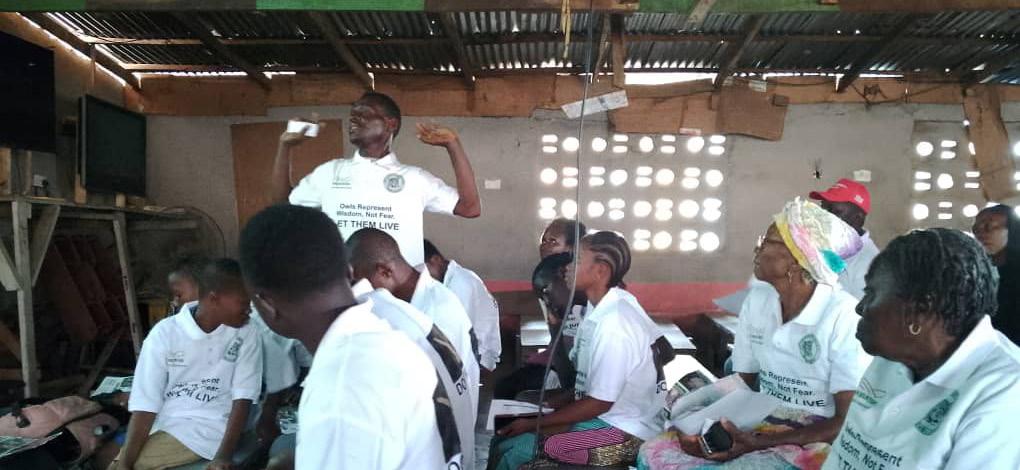
In December, Charles Showers, a former Hawk Mountain Conservation Science Trainee from Sierra Leone (2008), reached out with heartbreaking photos of dead owls. In his country, owls are believed to be harbingers of death, leading to their tragic killing. Charles, alongside the Conservation Society of Sierra Leone, wanted to change this mindset and launched an owl appreciation campaign, promoting owl conservation and respect. Thanks to a small grant from several generous donors, Charles was able to initiate the project. He followed up just a couple months later with photos of education workshops, where community members were receiving owl diversity posters and wearing co-branded shirts—simple but powerful tools for grassroots education. This campaign is a perfect example of how former trainees, with support from donors, can create global impact in conservation, helping to protect raptors through local action and education.
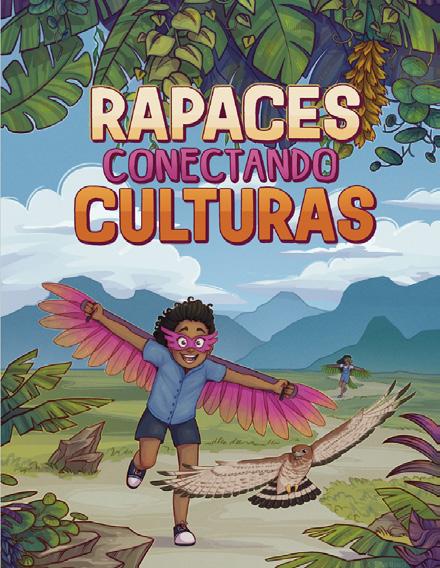
Former Hawk Mountain Conservation Trainee
Dalí Téllez Girón Jiménez recently authored a comprehensive teacher manual written in Spanish and designed to educate youth about raptors in the Neotropics, covering topics such as adaptations, migration, birding, and more. Rapaces Conectando Culturas was the culmination of Dalí’s trainee project while he was at the Sanctuary and was supported by Hawk Mountain through a small grant to help with expenses. The manual was reviewed by several Hawk Mountain staff, board members, and colleagues, ensuring it met educational and scientific standards. Dalí’s work is an excellent example of how our trainees are making a lasting impact in raptor education worldwide.
Hawk Mountain selected Canadian doctoral candidate Thierry Grandmont with the 2024 James A. Kushlan Graduate Student Award. Established in 2005 through a generous gift from the Kushlan Endowment Fund, this competitive award supports graduate students conducting research in raptor conservation. Senior Scientist and Director of Graduate Studies, Dr. JF Therrien, praised Grandmont as a remarkable young scientist who has effectively transformed his lifelong passion for natural history into a focused conservation science approach. Grandmont’s research focuses on the impact of human activities within protected areas on the movements and reproduction of barred owls; read more about his work on page 12.
Owl Awareness Campaign in Sierra Leone
LOCAL RECOGNITION FOR WIDESPREAD IMPACT
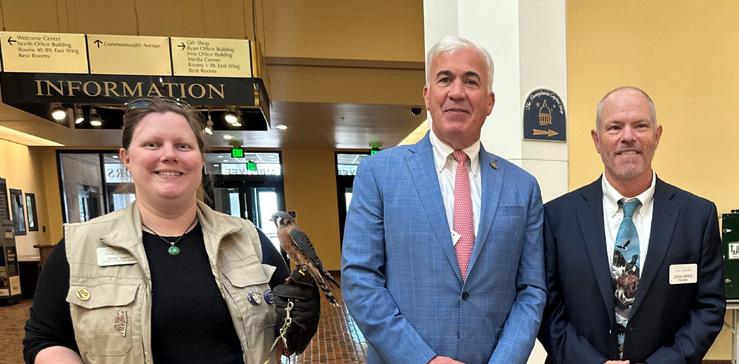
In October 2024, The Pennsylvania House of Representatives officially designated the month as “Hawk Mountain Sanctuary Migration Month,” following a resolution introduced by Representative Jamie Barton. The initiative highlights Hawk Mountain’s global significance, drawing visitors from around the world, including school groups of all ages. The designation recognizes the Sanctuary’s important role in environmental education and raptor conservation, emphasizing its connection to both local and international communities.
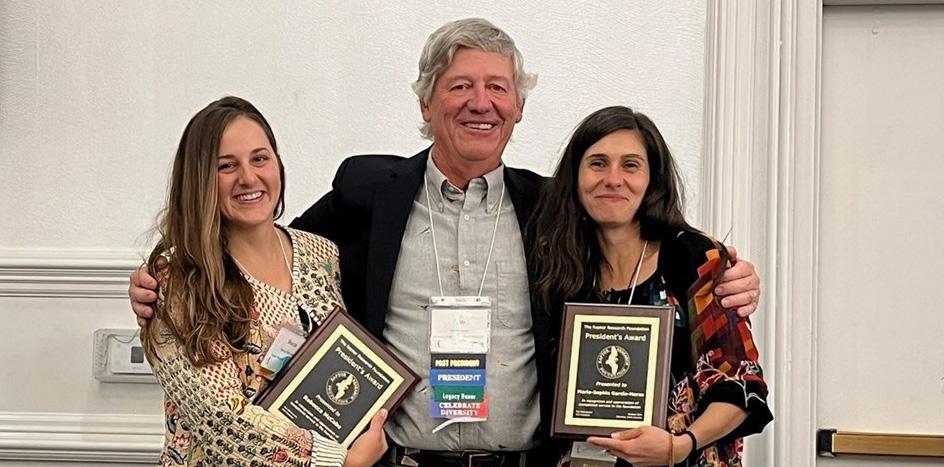
AWARD-WINNING LEADERSHIP
Hawk Mountain Sanctuary’s Research Biologist, Dr. Rebecca McCabe, and Dr. Sophie Garcia-Heras, a 2017-2018 Leadership Trainee and raptor ecology researcher from France and Spain, were honored with the 2024 Raptor Research Foundation (RRF) President’s Award. This prestigious accolade recognizes their exceptional multi-year contributions as co-chairs of the scientific program for the RRF annual conference. Their collaborative efforts have significantly enhanced the quality and impact of the conference, fostering advancements in raptor research.
DIGGING UP LOCAL HISTORY
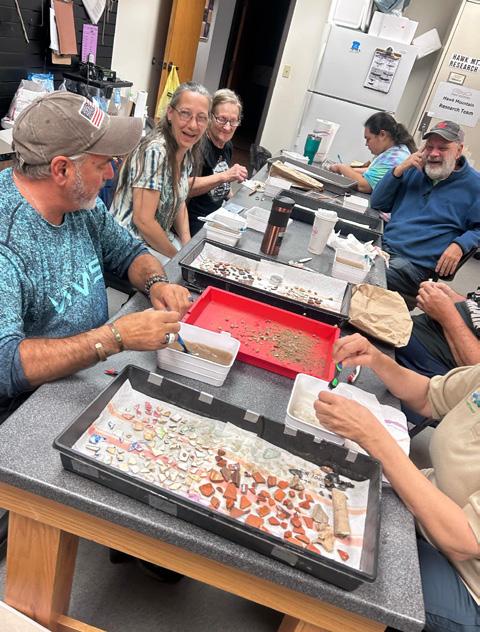
The Hawk Mountain Chapter 31 for Society for Pennsylvania Archaeology, led by archaeologist Curtis Hosey, is investigating a colonial site on Hawk Mountain Sanctuary property. Supported by a small grant from the Kittatinny Ridge Mini-grant program, the project aims to gather and use local artifacts in an exhibit showcasing the area’s early history. The team began excavating the site in 2024 and recovering artifacts like pipe stems and ceramic pieces, with further work planned to refine the site’s dating and historical understanding. All artifacts recovered are being cleaned and cataloged in the lab at Hawk Mountain’s Acopian Center for Conservation Learning under guidelines from the PA Historic and Museum Commission.
PA’S FIRST WINTER BIRD ATLAS
Archaeological group cleaning excavated finds,
The first winter survey season for the 3rd Pennsylvania Bird Atlas took place from December 1, 2024, to February 28, 2025, with birders across the state counting and logging observations of backyard birds, raptors, waterfowl, and more in the Pennsylvania Bird Atlas portal on eBird. Alongside common resident and overwintering species, several rarer birds, including brant, greater white-fronted goose, painted bunting, purple sandpiper, and Ross’s goose have been reported. With over 2,200 participants already contributing, additional birdwatchers are encouraged to join in and help expand knowledge of Pennsylvania’s bird populations over the next two years. Learn more at ebird.org/atlaspa
photo by Curtis Hosey
RIDGE CURRENTS
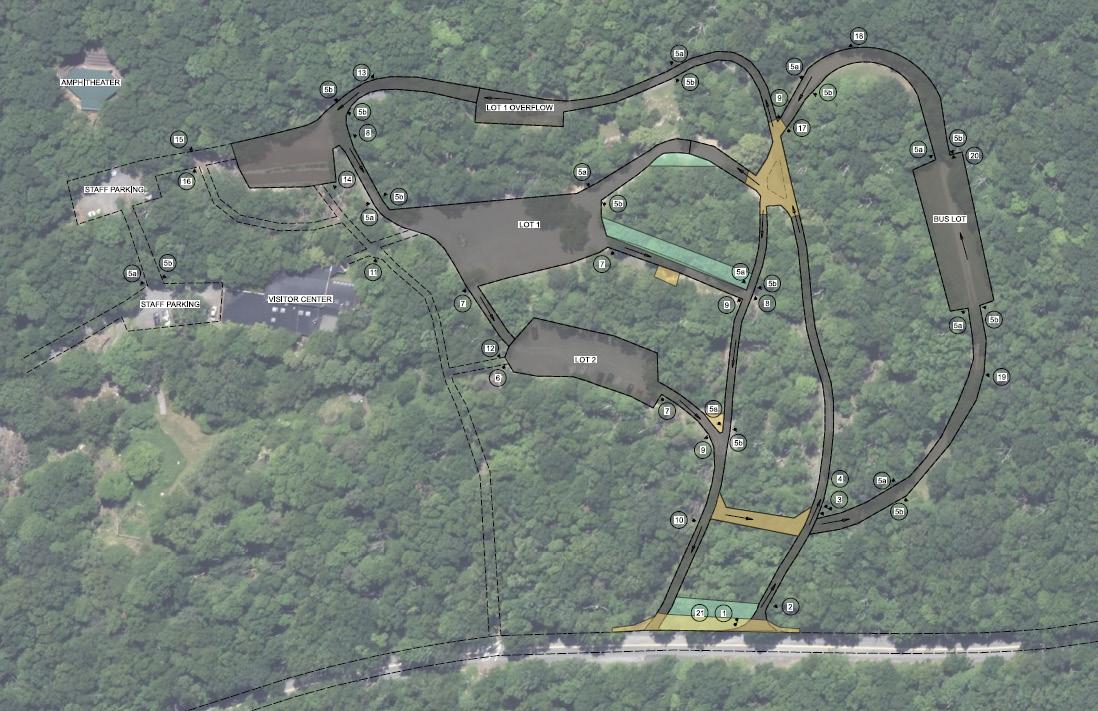
Hawk Mountain is hard at work raising funds to address our aging Visitor Center, but as we move the campaign forward, we’re already taking steps to build momentum for the overall project. For instance, we know parking lot roadways must be shored up before any Visitor Center work begins, so we created a plan to improve the overall approach. Now, a grant from PA Department of Conservation and Natural Resources will make that possible.
Steps will include modest paving at the roadway “apron,” the addition of a low and all-natural, native stone wall to delineate vehicle routes, and widening the roadways in select areas. We also will improve safety and orientation by flipping the entrance and exit, a suggestion made in both a vehicular and pedestrian circulation study and the Sanctuary’s master plan. We also will improve stormwater runoff systems and create wetland habitat areas to attract and benefit more birds and wildlife as you enter our natural area. We intend to bid the project in late summer/early fall, begin construction in November, and complete the asphalt installation next spring. Then, we will test and practice the new traffic pattern throughout the summer months in preparation of our busy fall weekends.
On the Road to Improvement Striving to Save Snowies: Groundbreaking Assessment Illuminates Global Population Trends
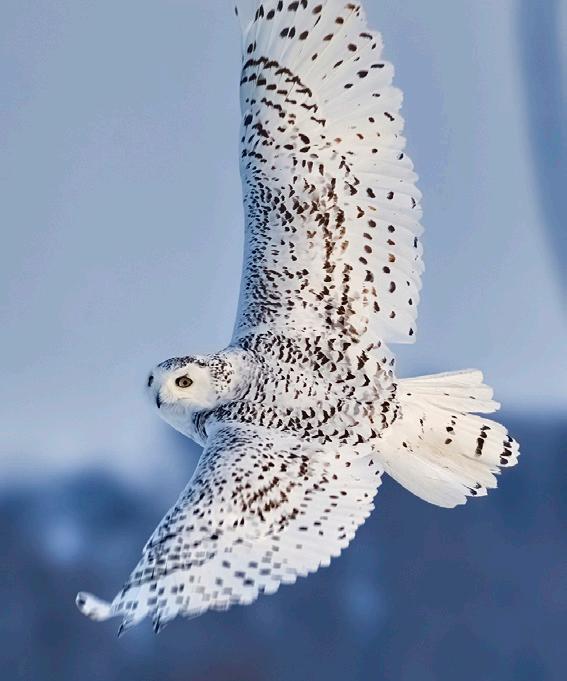
Over the last year Hawk Mountain scientists Dr. Rebecca McCabe and Dr. J.F. Therrien collaborated with 37 global researchers to publish a comprehensive assessment of snowy owl population trends. The study, titled “Status assessment and conservation priorities for a circumpolar raptor: the Snowy Owl Bubo scandiacus,” was published in Bird Conservation International in December 2024. This groundbreaking research estimates the global population of snowy owls to be between 14,000 and 28,000 breeding adults, significantly lower than previous estimates. The findings support the International Union for Conservation of Nature’s 2017 decision to classify the species as “Vulnerable.” The team analyzed long-term breeding data, genetic studies, satellite-GPS tracking, and survival estimates from Arctic monitoring sites, accounting for the owls’ nomadic behavior. This study emphasized the importance of global collaboration in achieving these insights, which are crucial for guiding future conservation efforts.
Visit hawkmountain.org/news to read more about this assessment and download the full publication.
Photo by Wayne Patzer
Welcome Megan Roselli as
the New Director of Education
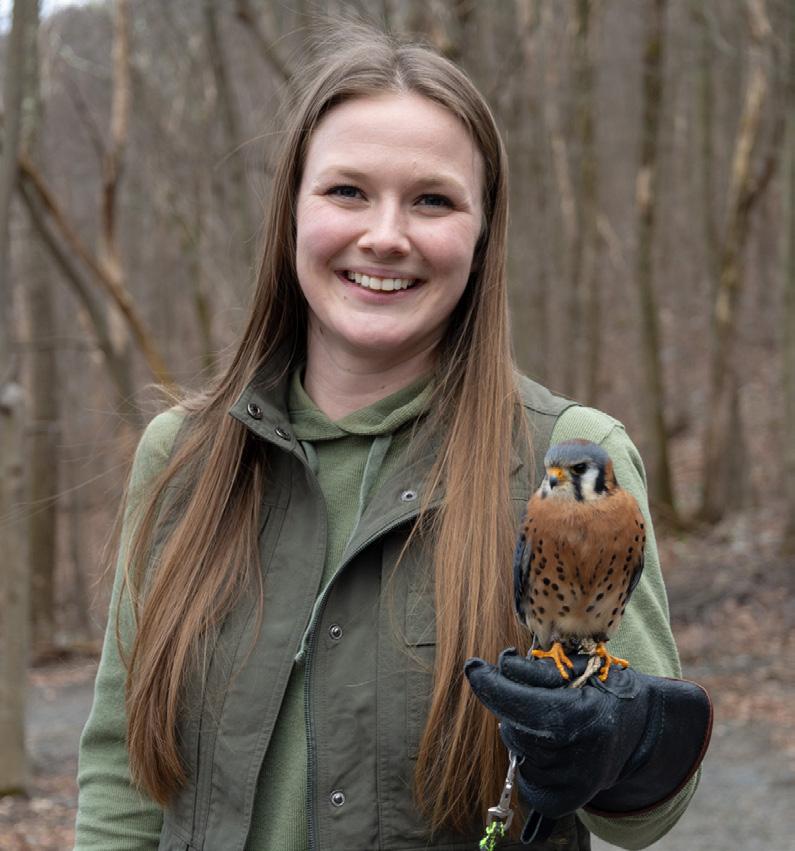
In December 2024, Hawk Mountain welcomed Megan Roselli as its new Director of Education, succeeding Jamie Dawson who departed earlier in the year. Megan brings a wealth of experience in both public education and field-based learning, having previously managed STEAM education programs and a team of educators at the Da Vinci Science Center in Allentown, PA. Her background combines handson science and research with a strong foundation in program development, leadership, and partnership-building.
Megan will oversee the Sanctuary’s local-toglobal educational platform, including the education trainee program, summer camp, on-site field trips, and off-site initiatives that inspire learners of all ages to take action for raptor conservation. A trained scientist, she discovered her true passion in education—empowering others to use science as a tool for positive change in their lives and communities. She has designed and implemented impactful educational programs in diverse settings and has extensive experience mentoring educators and interns in nonprofit environments. Her expertise in co-creation and fostering collaboration strengthens the Sanctuary’s mission to create meaningful, action-driven learning experiences.
Megan earned her B.S. in Biology from Wilkes University and a Masters in Natural Resource Ecology and Management from Oklahoma State University. A published scientist with six peer-reviewed papers, she is also a nationally recognized informal educator, having
presented her work for the Association of Science and Technology Centers (ASTC) and the National Informal STEM Education Network (NISE Net). Her career includes fieldwork at Acadia National Park, research with Neighborhood NestWatch’s citizen science program, and collaborations with academic, federal, state, and nonprofit partners to develop and implement engaging educational experiences.
Most importantly, Megan is deeply passionate about Hawk Mountain’s mission.
“My dream is that everyone sees the interconnectedness of the world they live in. What happens in Kempton, Pennsylvania, can cascade through other states, countries, and ecosystems. Science, science education, and specifically migratory raptors are the perfect way to show that local, community-based changes can have a lasting, global impact,” she says.
I’m honored to join the team of dedicated staff, members, and volunteers at Hawk Mountain Sanctuary to support raptor conservation worldwide, and I look forward to meeting many of our members this spring and fall!

Unraveling the Changing Migration Patterns at Hawk Mountain Monarchs on the move:
By Alexandra Hagans
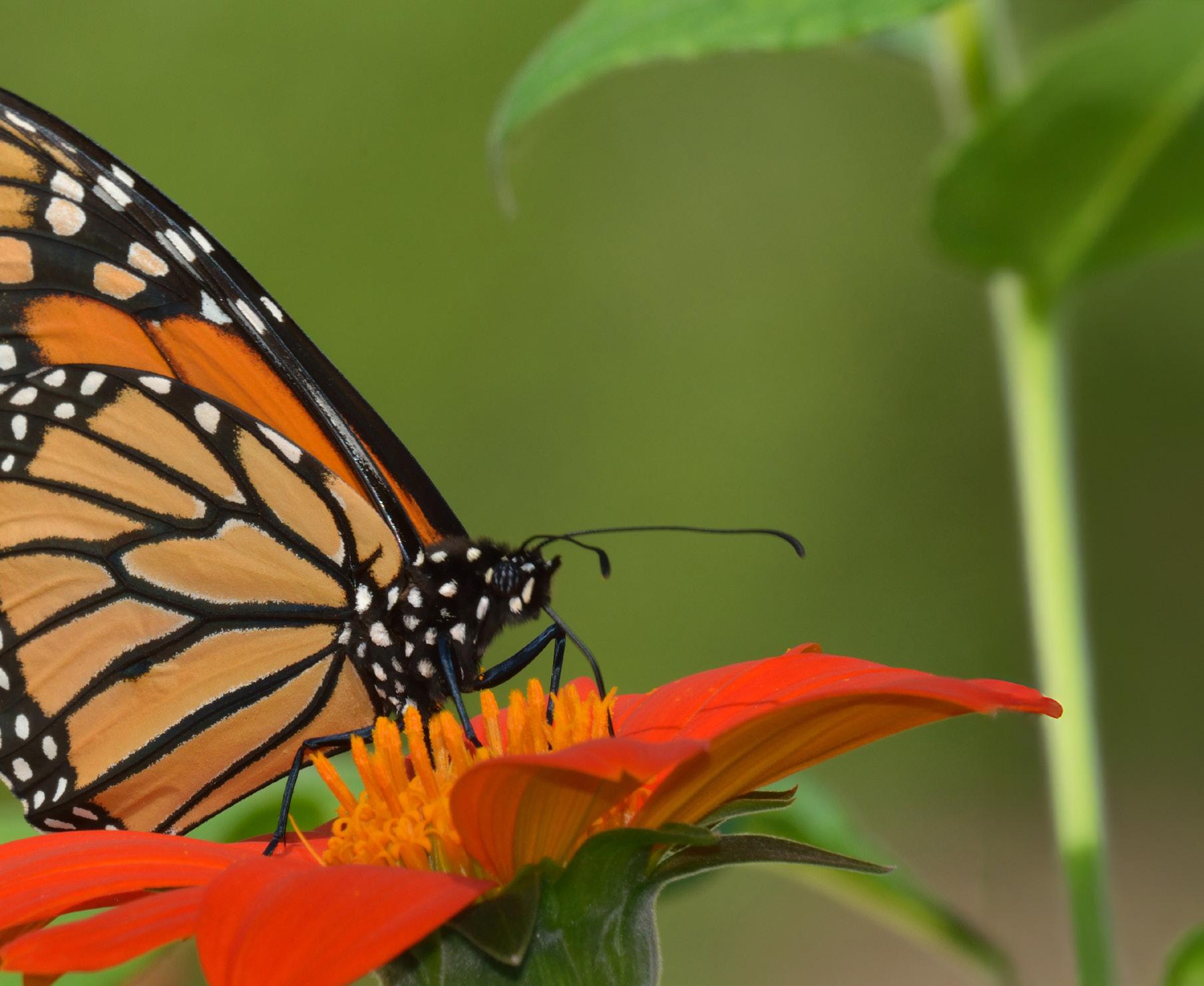
Rarely is sunlight more beautiful than when glimpsed briefly through the burnt orange wing of a monarch butterfly fluttering against a brilliant azure sky.
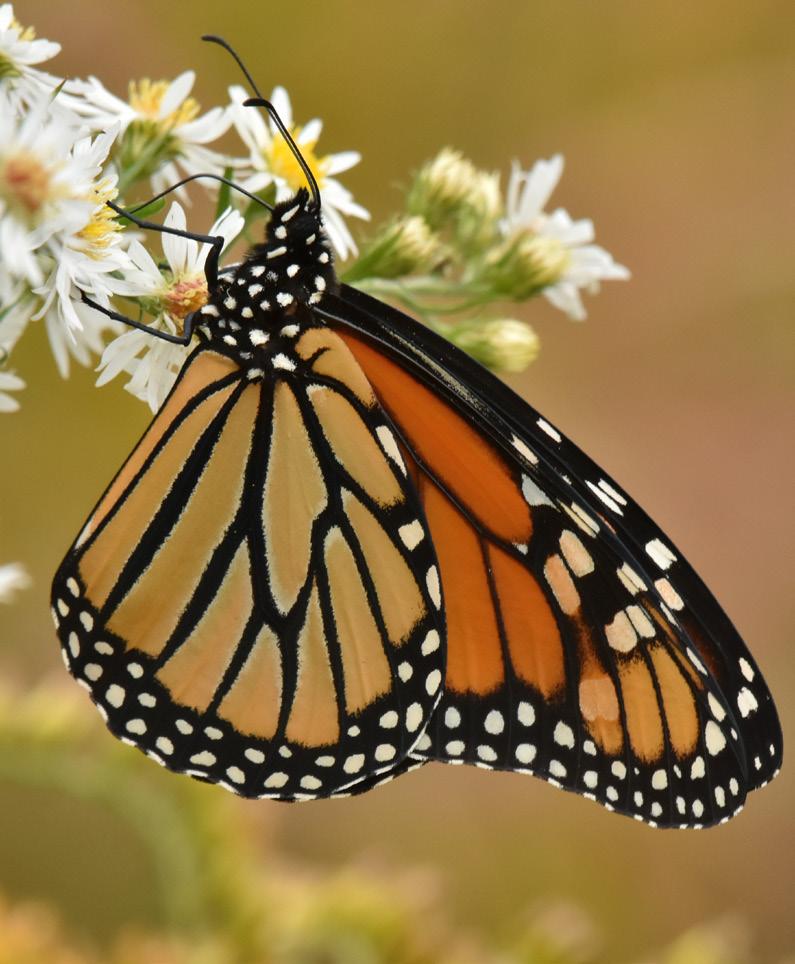
A welcome sight every fall, monarch butterflies are one of the most common and iconic insect species in North America, as well as one of the most impressive. The yearly migration of the eastern population is the combined effort of four separate generations of monarchs, culminating in an annual multigenerational relay run spanning up to 3,000 miles from the northeastern Unites States down to central Mexico. While similar in distance and timing to that of migratory birds, the journey undertaken by monarchs is remarkable among both birds and insects. Individual birds complete multiple roundtrip migrations from their breeding area
SPRING 2025 • HAWKMOUNTAIN.ORG
to their over wintering sites during their lives, whereas most monarchs need four generations to complete the full journey, with a single generation covering one full life cycle from egg to adult butterfly.
The first generation of monarchs emerge in Mexico during March-April and are tasked with migrating up to the southern United States to lay eggs in May. The second and third generations hatch in June and July, with the adults continuing to move into the northeast as they follow the northerly emergence of milkweed. The third generation produces the migratory fourth generation, which will live 8-9 months, whereas the previous generations will have had a lifespan of only 2-6 weeks. These are the adult butterflies that are recorded by hawk watch sites during August-October as they migrate south to their overwintering
Photo by Bill Moses
grounds in the oyamel fir forests of Mexico, the same journey made by the previous fourth generation the fall before.
This extended lifespan unique to the migratory generation is due to a pause in life cycle triggered by the seasonal changes present in late summer and early fall as the caterpillars are developing. In response to shortening day length, decreasing temperature, and aging milkweed, which adults depend on for reproduction and caterpillars exclusively feed on, monarchs enter a period of reproductive diapause. Reproductive diapause in monarchs is characterized by a halt in the development of eggs and reproductive glands of adult butterflies. This pause enables adults to conserve the energy needed for migration by avoiding reproduction and preventing aging to allow them to live long enough to complete the 3,000-mile migration to central Mexico. The journey takes place over two months with monarchs traveling between 50 to 100 miles per day along the east coast.
After reaching their overwintering grounds towards the beginning of November,
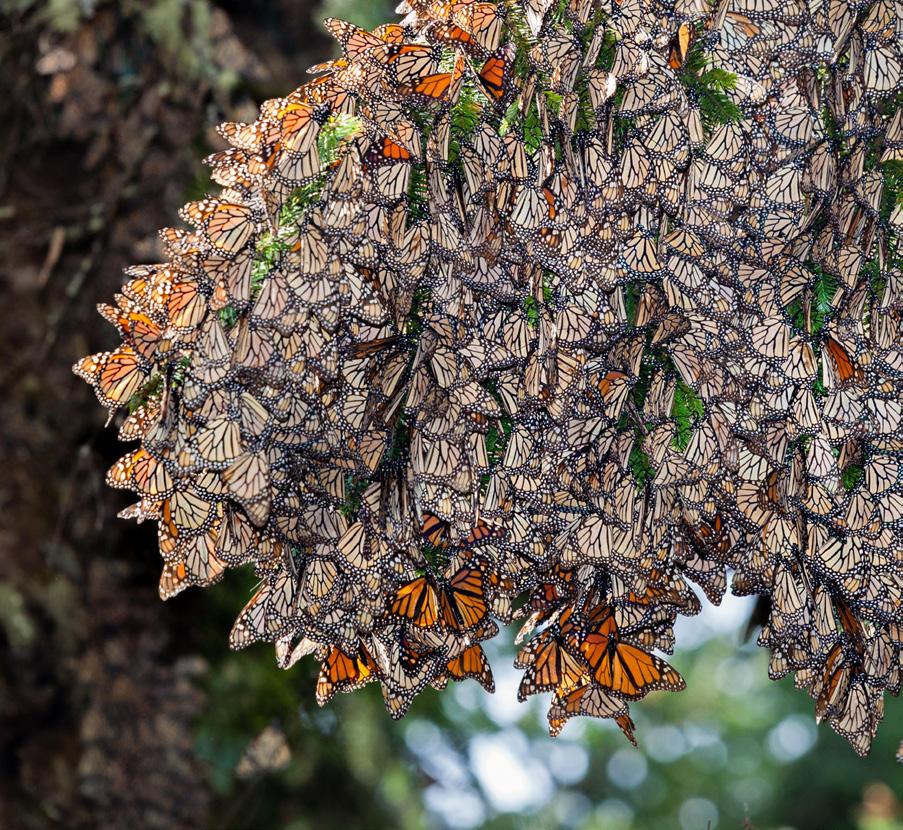
these remarkable insects begin their well-deserved hibernation and remain inactive under the near lethal freezing temperatures until February-March. Monarch roosts are densely packed, occupying an average of three hectares of forest, with tens of thousands clustered together on a single tree. This roosting behavior combined with the frigid temperatures to create a microclimate that is essential to maintaining reproductive diapause and preventing premature depletion of fat reserves. With the arrival of warming spring temperatures, the overwintering butterflies emerge from the roosts and become reproductively active, mate, and leave the overwintering sites to lay the eggs that will hatch into a new first generation and begin the cycle anew.
The fall 2024 total for monarchs counted at North Lookout was 301, the second lowest recorded at Hawk Mountain Sanctuary and 84% below the season average of 1,920. The migration reached peak flight on September 2nd with 23 monarchs counted.
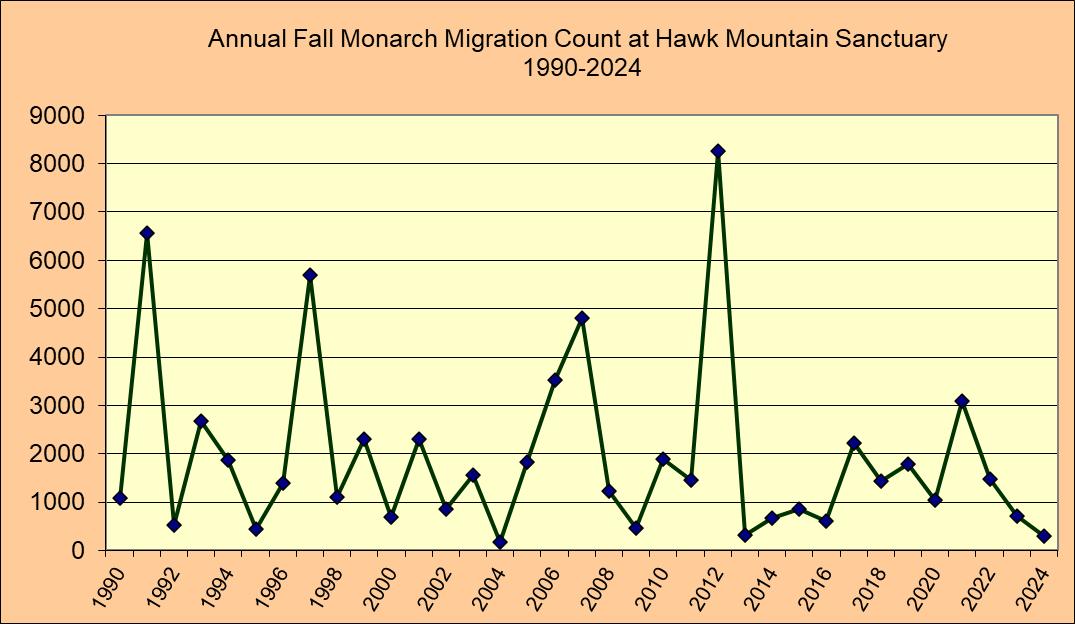
Annual counts of monarch butterflies at Hawk Mountain Sanctuary, Pennsylvania, 1990-2024.
APPALACHIAN TRAILS
Monarch butterflies face many threats and environmental stressors that result in declining populations including habitat loss, agrochemicals, and climate change. As mentioned above, monarch butterflies depend on the oyamel fir forests of central Mexico and the protection they provide to survive the winter. These forests are threatened by human activities which negatively impact monarch roost sites. Habitat degradation due to logging and land conversion for agriculture alters the ability of the forests to create a microhabitat, leading to increased monarch mortality. To support agricultural activities, water is diverted away from the forests for human use, forcing monarchs to travel further to reach a water source which may cause their fat reserves to be depleted quicker. Oyamel fir trees are also at risk from heat stress and drought caused by climate change, which increases their vulnerability to insects and disease.
Agrochemicals pose a major threat to monarchs during every stage of their life cycle. Milkweed is essential to monarch survival and reproduction. Adult monarchs lay their eggs only on milkweed plants, and once hatched, the caterpillars depend solely on the plant for food and shelter. Adults also feed on the nectar of milkweed flowers. Consequently, the loss of milkweed from agricultural fields due to chemical
spraying leads to a decrease in monarch numbers because of the negative effect on their reproduction. Additionally, insecticide use, specifically neonicotinoid use, directly decreases the number of monarchs because of its toxicity to insects. Plants sprayed with neonicotinoids, or crops grown with coating of the pesticide as corn and soybeans often are, absorb and distribute the chemicals throughout the plant, leaving the nectar, pollen, and leaves of the plant toxic to any arthropods that feed on it. This is dangerous not only to caterpillars living on infected milkweed, but also to adult monarchs that drink the nectar and spread the pollen of multiple different plant species.
As with birds, several aspects of monarch ecology can be affected by ongoing climate change, including reproduction, population size, food availability, survival, and most relevant to this study, phenology. Phenology describes the timing and patterns of the natural world, more specifically the annual life cycles of living things. Shifts in the phenology of migratory species can be vital to understanding the effect of climate change on that species and how it may be adapting its migration timing to account for environmental changes. Because of their life cycle, monarchs are especially vulnerable to climate change.
The passage of monarch butterflies is recorded from Hawk Mountain Sanctuary’s North Lookout. Counts are recorded daily, weather permitting, from August 15 to December 15. Migration counts typically begin at 8 a.m. and end at 5 p.m. eastern time. Count protocol and duration have remained consistent throughout the study period. We calculated the 50% and 95% passage dates for 34 years (1990-2024).
A total of 67,212 monarch butterflies were counted during the 34-year study period. Annual totals ranged from a low of 173 individuals in 2004 to 8,261 individuals in 2012.
Although a small delay in 50% passage date was statistically insignificant. Climate change could be showing the beginning
Oyamel Fir Tree in Rosario Sanctuary, Michoacan, Mexico, photo by Brian Overcast
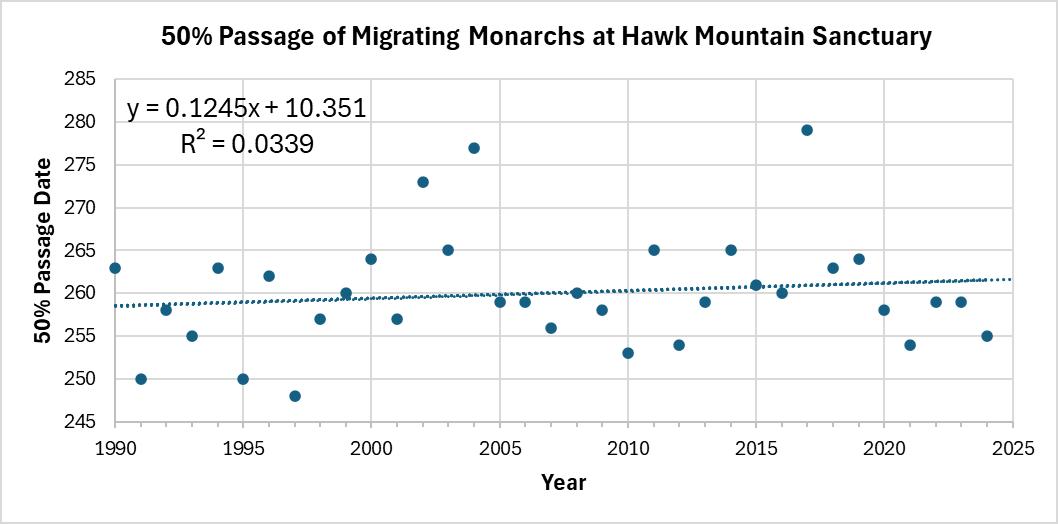
50% passage dates of monarch butterflies during autumn migration at Hawk Mountain from 1990-2024.
of effects on the life cycle of monarch butterflies. Reproductive diapause and migration to the overwintering grounds is triggered in the migratory fourth generation by falling temperatures and aging milkweed. Climate change has extended summers by 4.2 days every ten years. The study period lasted from 1990 to 2024, so this increase will have been captured by the annual monarch migration counts. Prolonged summer temperatures may delay migratory triggers of the fourth generation, resulting in monarchs beginning their migrations later and taking longer to arrive at 50% passage.
Annual counts of monarch roost size in central Mexico report a more than 80% decrease of monarchs since the 1990s. With less monarchs migrating, an earlier 95% passage date would be logical as the amount of time needed for 95% of the flight to pass would decrease since 1990. However, the sharp 80% population decrease is not reflected in the linear regression.
Although this analysis of change did not yield significant trends, further studies of passage dates using count data from watch sites along the east coast should be done to greater understand the effect of climate change on monarch phenology.
To learn more about monarchs: journeynorth.org/monarchs
To help save monarchs: defenders.org/wildlife/monarch-butterfly
Photo by Bill Moses
EXPANDING PROJECTS: BROADWINGS AND FARMLAND RAPTORS
By Laura Berry
Spring and summer fieldwork is ramping up for 2025, and Hawk Mountain has two new pilot studies in the works that expand upon already existing research projects.
The Broad-winged Hawk Project, established in 2014, monitors broad-winged hawk ecology during every stage of their lifecycle. Despite so much coverage, gaps still exist within their overwintering sites, which include South and Central America and even Florida for a small segment of their eastern population. Researchers have attempted to trap broad-winged hawks in the Sunshine State in the past but haven’t been met with success, thus a new strategy was required.
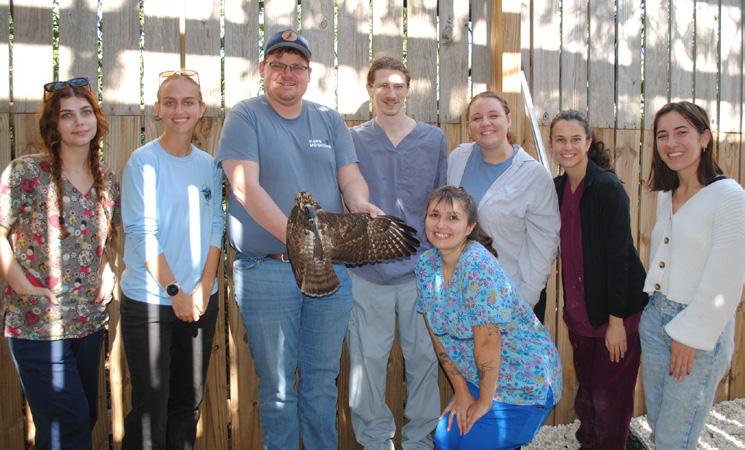
Researchers Dr. Rebecca McCabe and Bracken Brown traveled to Miami in January to try a new approach to tracking broad-winged hawks overwintering in Florida. For only the second time in project history, Hawk Mountain researchers are collaborating with wildlife rehabilitators to recruit candidates for telemetry tracking. The first three on the roster included an adult and two juvenile broad-winged hawks from Pelican Harbor Seabird Station and Florida Keys Wild Bird Rehabilitation Center, two rehabilitation facilities located in Miami and the Keys. All were admitted
with signs of head trauma and other mild ailments but recovered quickly after receiving care at these facilities.
Post-release, the two juvenile hawks successfully established small winter ranges in the vicinity of where they were released and the adult returned to the area it was rescued from. Now sporting GPS devices that connect with the cellular network, researchers can learn more about how birds move across the Florida landscape in the winter, where they migrate to, and if and where they will nest. To protect these three birds as they reorient back into the wild, Hawk Mountain will not be sharing their tracking data until they initiate spring migration. At that time the data will be shared as public maps on the website.
Not only could this pilot project provide key insight into wintering behavior and habitat use of broad-winged hawks in Florida, but this is one of the first studies that focuses on the survival of rehabbed birds postrelease. It will be an illuminating look into the world of these secretive hawks.
Returning from Florida, Bracken Brown is getting ready to head south once again, but this time to Maryland and southern
counties within Pennsylvania. The Farmland Raptor Project, established in 2012, is officially hitting the road this summer after receiving a $246,000 grant from the U.S. Fish and Wildlife Service and the National Fish and Wildlife Foundation. Hawk Mountain was one of 30 organizations to be awarded the Chesapeake WILD Grant to provide funding in support of wildlife habitat, climate resilience, community conservation partnerships, and equitable access to nature in the Chesapeake Bay watershed.
The project, “Conserving Farmland Raptors in the Chesapeake Bay Watershed,” is designed to advance the goals of the

Chesapeake WILD Program by enhancing nesting opportunities for the four species of imperiled farmland raptors, particularly the barn owl, American kestrel and northern harrier in land undergoing watershed restoration. Raptors are a key indicator of a healthy ecosystem and can provide natural pest control services, making them attractive assets to farmers and landowners. Joining forces with Stroud Water Research Center and Pennsylvania DCNR watershed program, other watershed conservation organizations, and wildlife partners in Lancaster, Chester, and Dauphin Counties in Pennsylvania and Maryland, Hawk Mountain plans to conduct landowner outreach and public education that promotes farmland raptor conservation coupled with watershed improvements.
After finding willing landowners, the next step would be to deploy at least 150 kestrel nestboxes and 30 barn owl boxes. This presents the opportunity for private landowners and partners to connect with raptors on a personal level, allowing them to experience nestling banding and monitoring, a unique look into wildlife management, firsthand. The project also will share the importance of farmland raptors with young people through sharing in-box webcam footage in schools, including Amish and Mennonite schools.
This new extension of the Farmland Raptor Project will cast a larger net of protection for farmland raptors throughout Pennsylvania and into Maryland. It will also be the first attempt to couple watershed habitat restoration with raptor conservation actions and will be used to evaluate the success of boxes in watershed restoration landscapes.
Keep these exciting new projects in your scope and check for updates on our website!
Hawk Mountain Sanctuary collaborating with Florida Keys Wild Bird Rehab Center
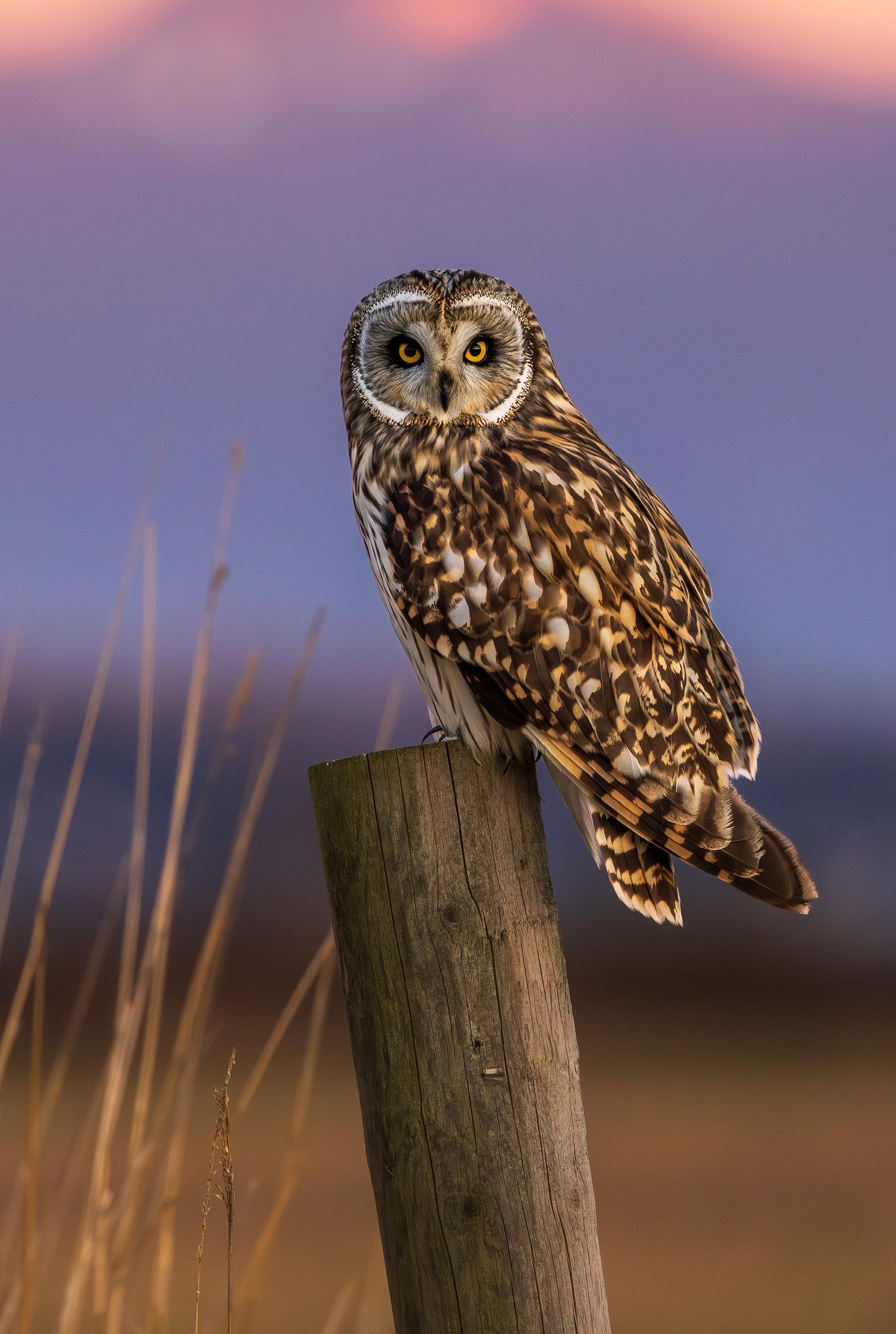
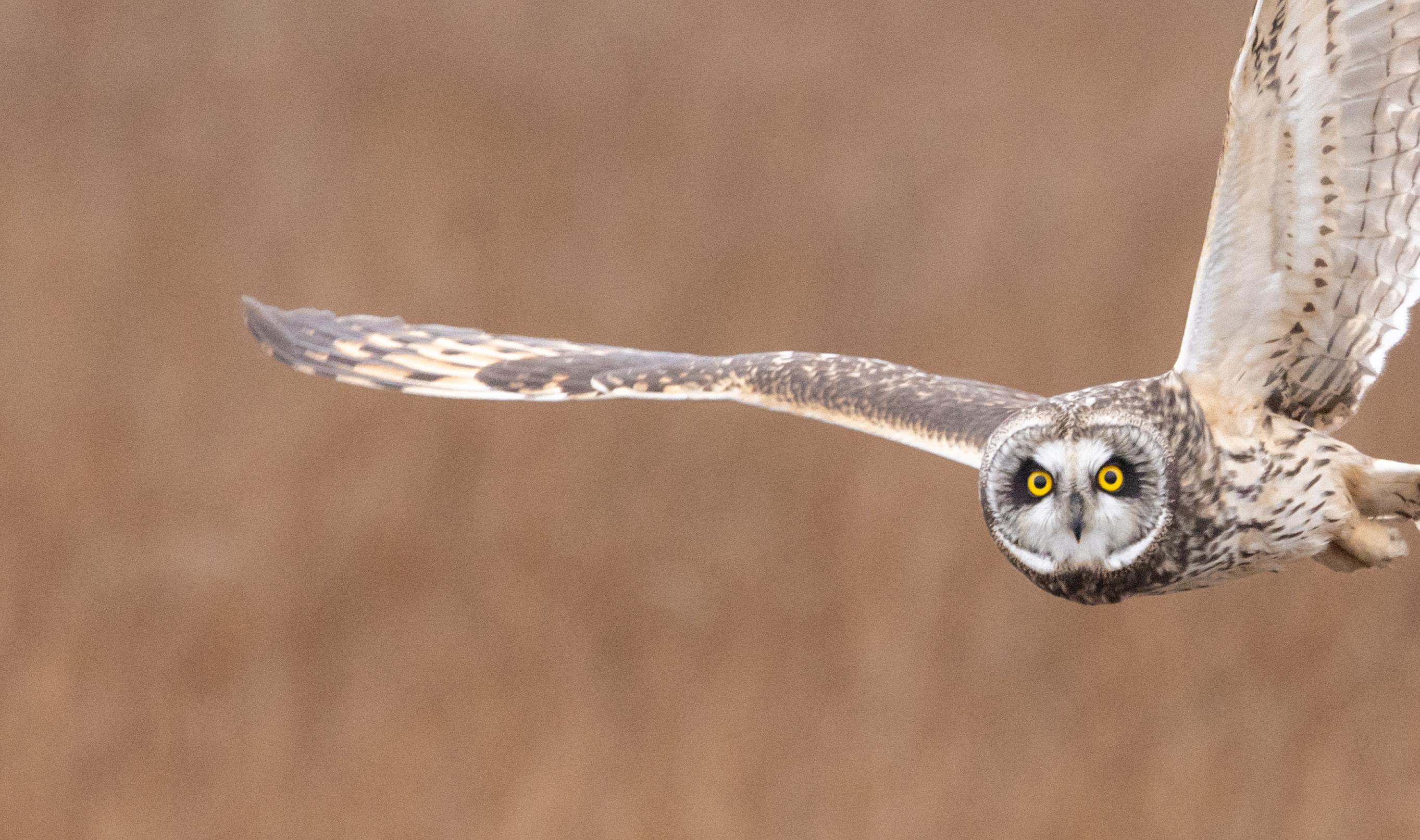
Short-Eared Owl by Sue Allen
TRACKING OUR IMPACT:
Studying How Human Activity Affects Barred Owls’ Behavior
By Thierry Grandmont
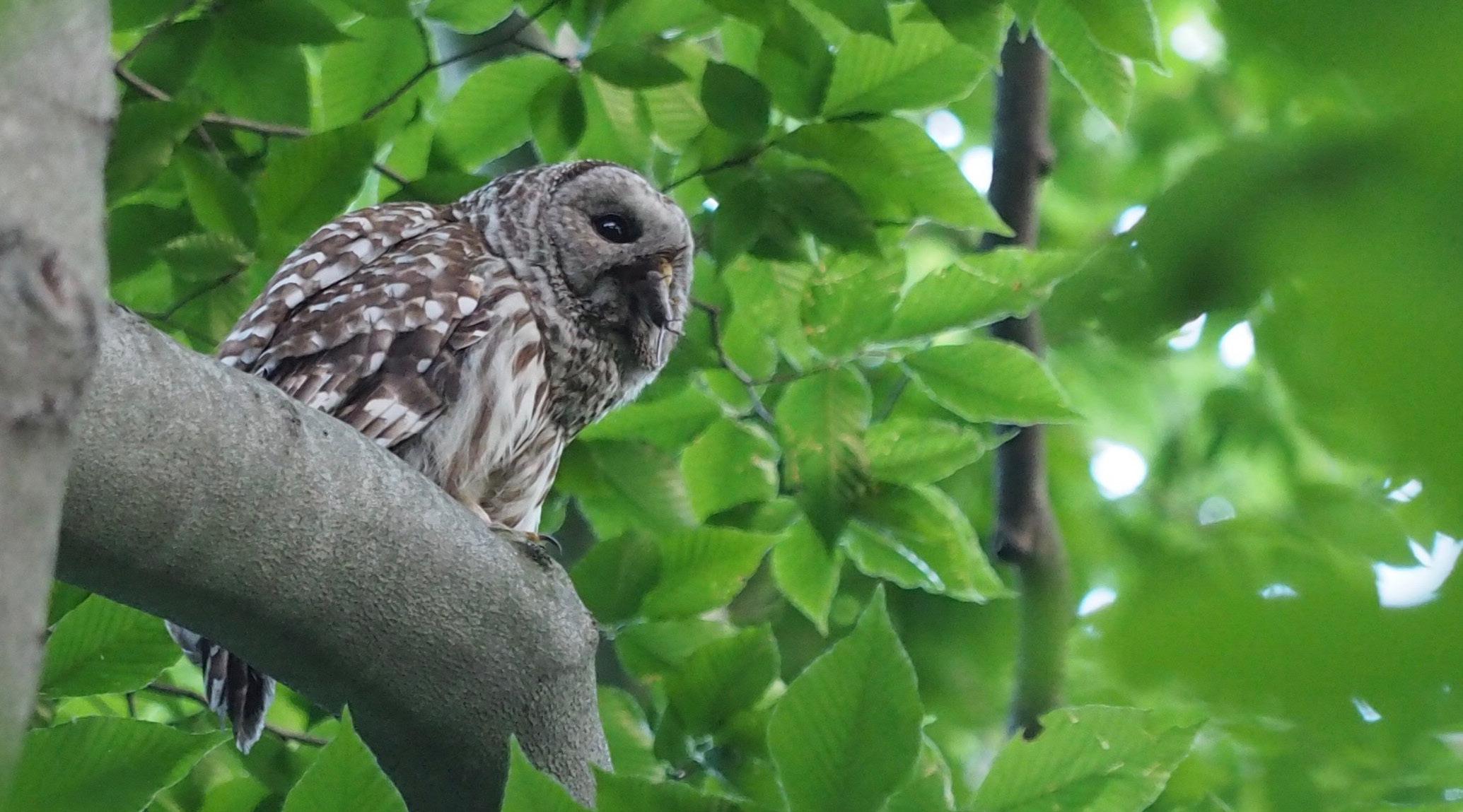
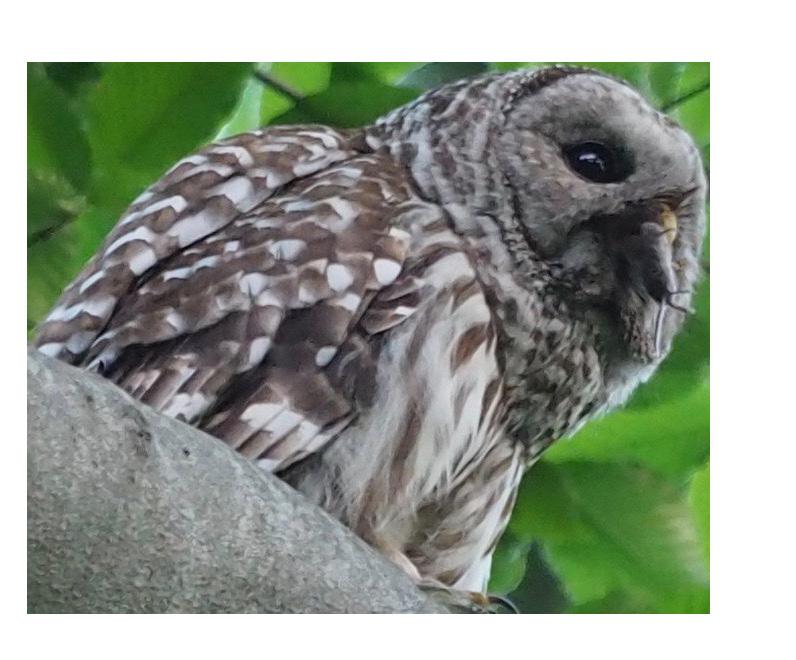
If you have ever hiked in a mixed or deciduous forest in eastern North America, chances are you’ve walked past a barred owl (Strix varia). Though you might not have noticed the bird, the owl certainly did. While it is possible it was unbothered by your presence, it is also possible that it kept its focus on you while you passed by or couldn’t hear its preys as accurately under the sound of your footsteps. This interaction, between recreational activities and barred owls, is at the very core of my Ph.D. project. More precisely, I am studying the relationship between recreation and owls’ reproduction and behavior.
We know that humans impact wildlife in many ways. Even the simplest form of interaction, such as walking in a national park, can influence the behavior of animals perceiving us as threats. By avoiding or fleeing humans, an individual may divert energy from parental care or foraging. Ultimately, human’s recreational activities can alter reproduction or survival of wildlife, even within protected areas. Understanding how human activities affect wildlife is central to improving conservation measures in natural areas.
Barred owls can be found as much in wild forests as in city parks. At my study site, Mont-St-Bruno National Park, Québec,
barred owls commonly encounter humans, the park being close to Montreal and surrounded by three smaller municipalities. While the species is relatively common here, we know little about their response to human activity. Actually, thanks to their secretive behavior, there is a gap in our knowledge on barred owls’ reproduction.
By combining a 10-year study of owls’ reproduction in the park with VHFGPS technology, I hope to better our understanding of humans’ impact on the reproduction and movement of

Thierry holds an owl while a team member fixes the harness with a transmitter.
these charismatic neighbors of ours. One aspect of the project will be to equip male owls with tags allowing us to track their movement. By experimentally exposing those birds to human and dog noises, we want to see if they avoid the noise or if they will remain undisturbed. Movement tracking will also allow us to study their movement during the week and during the weekends, when more people visit the park. The other part of my project aims to compare the reproductive success of owls in more disturbed areas of the national park with those with smaller human influence. This will be done with the precious data from nest surveys collected by François Morneau, a (not that much) retired biologist and collaborator of ours.
Needless to say, an exciting part of the project is catching the owls and equipping them with tracking devices. This kind of tracking has rarely been done on barred owls, and we are, to our knowledge, the first to do so in the province. Studying the owls’ movement, paired with a reproductive survey, will allow us to really delve into the species’ biggest secrets. All of this
is possible thanks to our collaboration with Hawk Mountain Sanctuary. Their knowledge on raptors, especially regarding the different techniques that can be used to study them, enables us to use the best methods and technology to follow these (less and less) mysterious birds.
Last summer, we caught and equipped one owl to test the protocols and the device. Seeing how this owl moves and uses the habitat in the park only sparked more questions in our minds. That’s why I am more than excited for the first owls to start hooting this spring and to start the next field season. Our spring will be spent following the pairs, finding their nest and equipping the birds with tracking devices.
When I first started birdwatching 12 years ago, I never once imagined I would one day have the opportunity to conduct research on one of my favorite birds. More so, I never thought I could actually bring something to scientific knowledge, helping to maintain and preserve these beautiful creatures. It is, in my mind, the most valuable aspect of my study. Aside from my Ph.D. project, I hope to inspire other young birders to jump into raptor research and conservation.
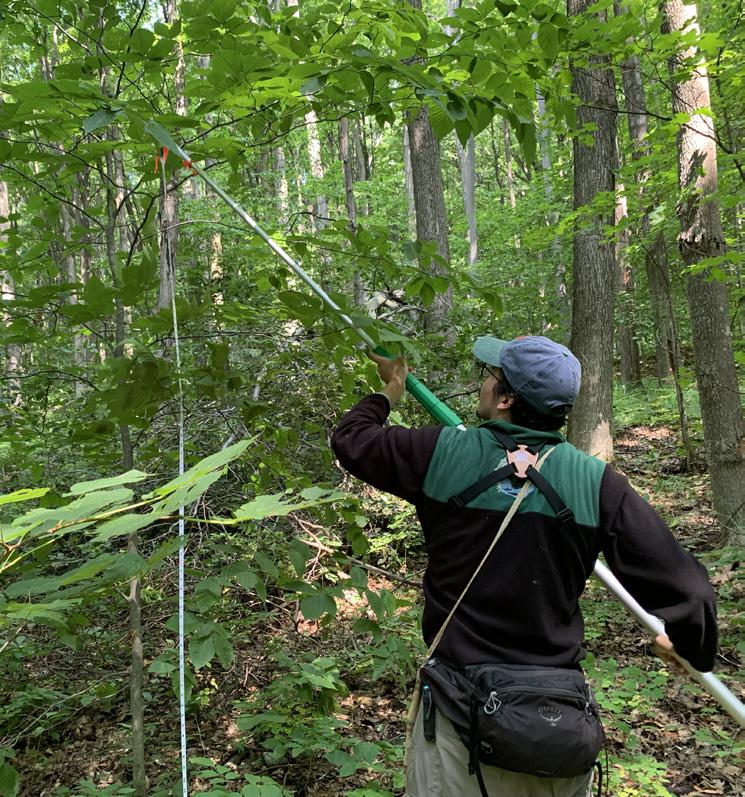
Using a perch to look into tree cavities with nesting owls to see how many nestlings inhabited it.
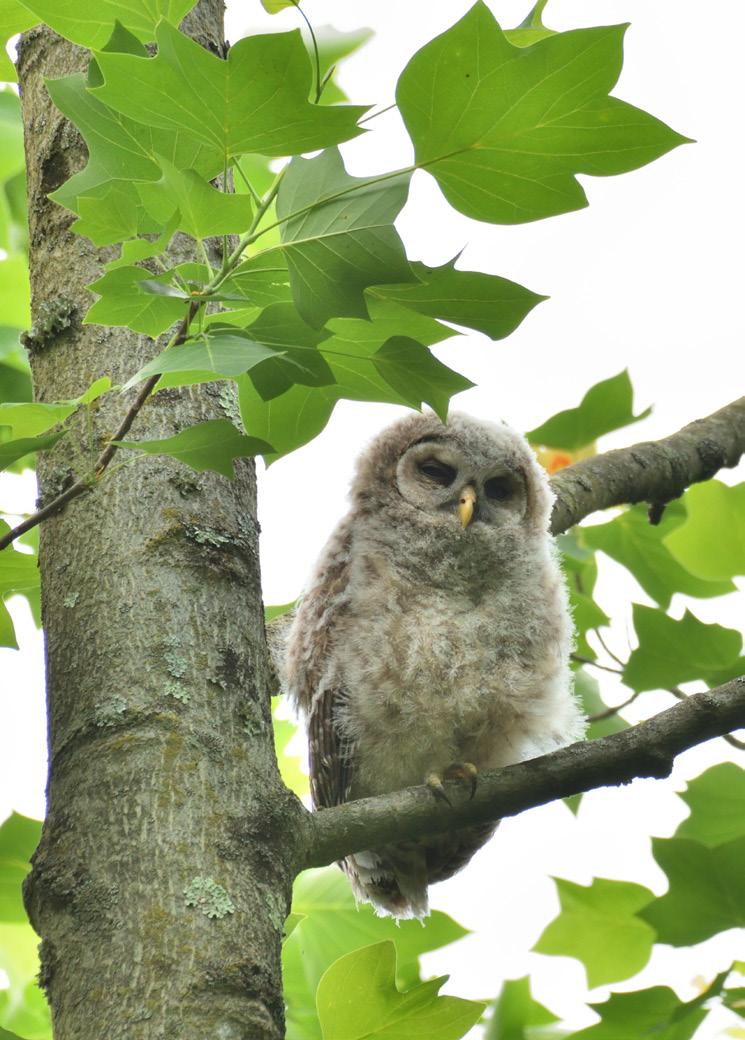
Barred Owlet by Bill Moses
Every Ecologist Has a Story. Well, Here Is Mine!
By Joseph Kwasi Afrifa
Every ecologist has a story, from personal life experience through background to beliefs and values. Well, mine is a combination of atonement for sins against wildlife in the past and love for birds.
Okay, so to start with, I am not going to bore you with the usual humble beginning of “I grew up in a remote village that was once surrounded by nature…” Of course, I had a humble beginning. I grew up in a forest-fringe community in the western region of Ghana. What that meant for myself and my generation at that time, coming from a community with limited formal education, is you are most likely to become a hunter, either a full-time or a partial one, or maybe a sport hunter (hunting small mammals, birds and reptiles using a catapult and trained hunting dog just for fun). And by hunter, I don’t mean the fancy and regulated hunting in Europe or the United States. What being a hunter meant was you shoot every animal that can be sold or eaten; you set traps to trap any animal of your liking. I chose to follow my family’s occupation, which was farming during the daytime and hunting at night. Well, you must be wondering how old I was at that time, let me quench your hunger to know… I was 12. Fast forward, I left the village when it was
time for my senior high education. Even at this stage I still went to the village during vacations to help my parents and to also continue what I grew up doing.
The turning point happened when I left for Cape Coast to pursue my first degree. I had an ambition to become a medical doctor, and then a nurse, but I
unfortunately failed to meet the cut-off grades. The options I was left with were entomology and wildlife. Not so cool right? But it was for me because I still got to chase wildlife but this time with cameras. I was also determined to succeed and build a different career away from my village, so I embraced the program and started my journey in this field. My guess is you know the mindset change that happens when you are exposed to several
concepts about sustainability, ecosystem service, and wildlife management, among others. It was a great one for me because I could relate very well in practice to most of the things that were being taught. This I believe is a result of my childhood experience, which I never knew was going to play such an important role in my academic and professional development. So, I made a conscious decision to build a career that will allow me to atone for my sins against nature, and also to be able to get closer to villages like mine and help individuals like my former self to understand the impact of unsustainable utilization of wildlife resources.
During my bachelor’s studies, I was introduced to ornithology. I loved ornithology because I had in the past spent time informally with birds on farmlands, and I could tell the difference and what they stand for in my village. I had also spent time keeping a few in cages and had a lot of local knowledge about birds. During the program, we had a visit from the thendirector of the British Trust for Ornithology (BTO) in the United Kingdom, who opened up more to us about ornithology and how birds connect our worlds. Knowing from this point that one could build a career in studying birds, I locked that in my brain.
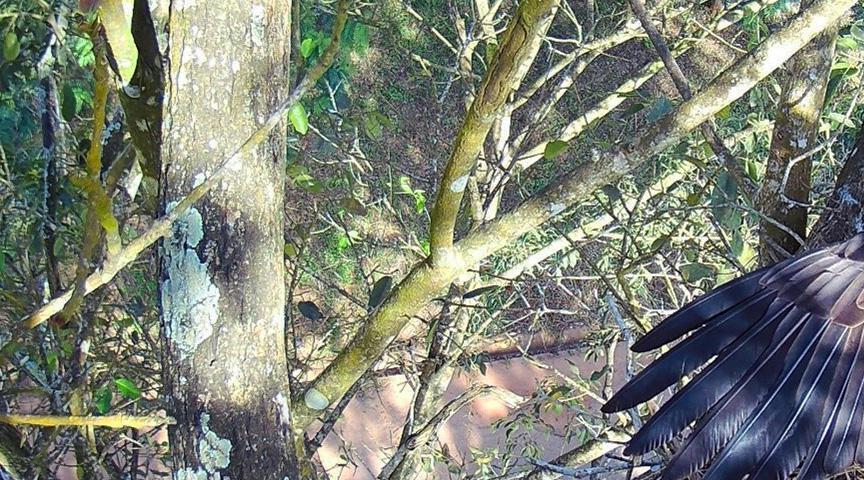
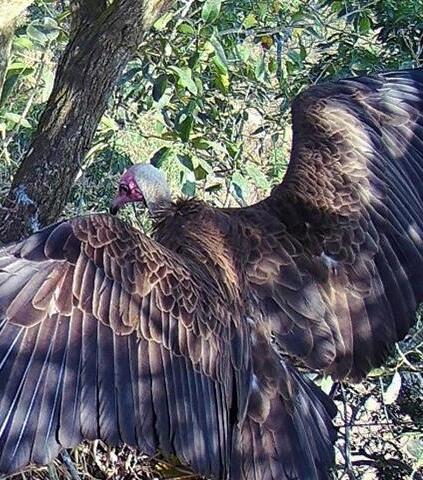
Hooded Vulture in Nest
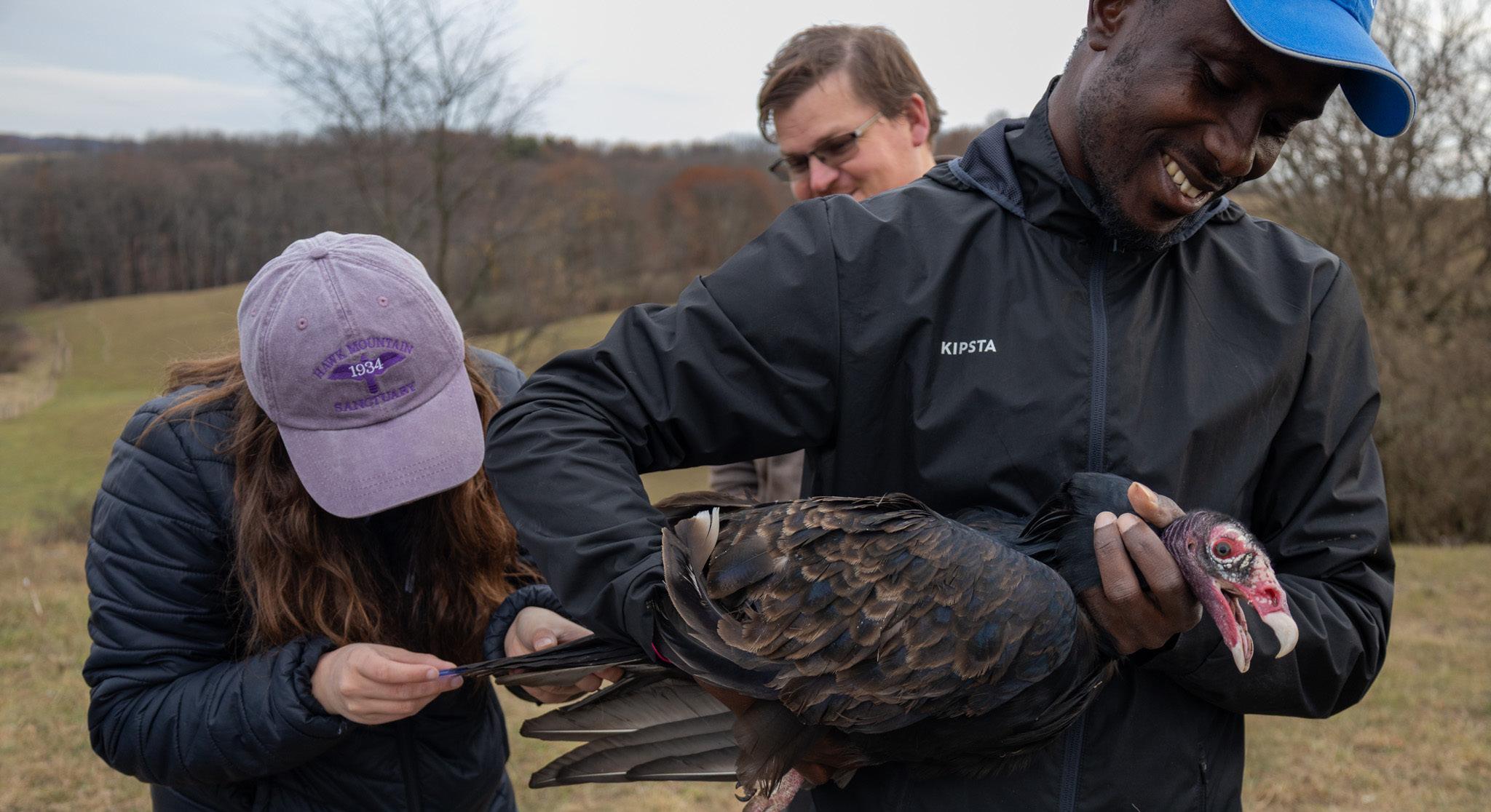
Vulture Tagging
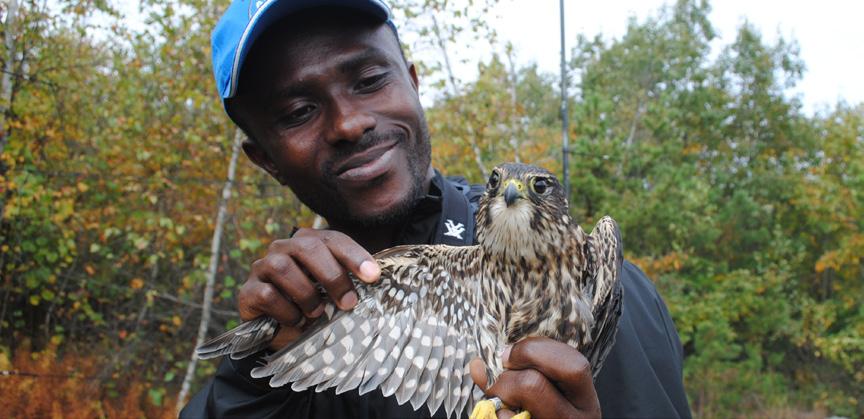
Of course, I am trying to understand and interpret everything in nature but even Edward Wilson, Jane Goodall, Gregor Mendel, and Laurie Goodrich, among all the great scientists, chose a model species to help them preach the conservation message and explain a phenomenon, so I chose birds. Well, I did not just choose them, but I also love them the most because they are everywhere (almost everywhere) and easy to see. It makes talking about them to anyone very interesting and easy. But it wasn’t going to be easy to build a career in ornithology from just an introductory class, so I went on to pursue a Master of Science in Conservation Biology at the AP Leventis Ornithological Research Institute in Nigeria, interned with BirdLife International, and worked with the Ghana Wildlife Society in Ghana.
I am not going to write much about my academic journey and career paths and how it all helped me in getting to where I am, but I guess it’s obvious. Of course, if you are on a journey to atone for your sins like me, you don’t really have to enjoy it, but I am. I am enjoying the impact of conservation initiatives I have been part
of that yielded positive results for species, sites, and communities.
My journey to Hawk Mountain Sanctuary (HMS) marked a great turning point. After I was accepted to be a trainee, I spent time reading a lot about the staff and what to expect. Interestingly, this acceptance came on my second attempt, six years after my first application. I set up three goals for myself: first, to get all the knowledge and skills in raptor ecology, migration, monitoring, trapping and ringing; second, to build a network with experienced professionals whom I can contact for advice on projects; and lastly, to get admission to pursue a Ph.D., either with HMS or anywhere in a field of interest.
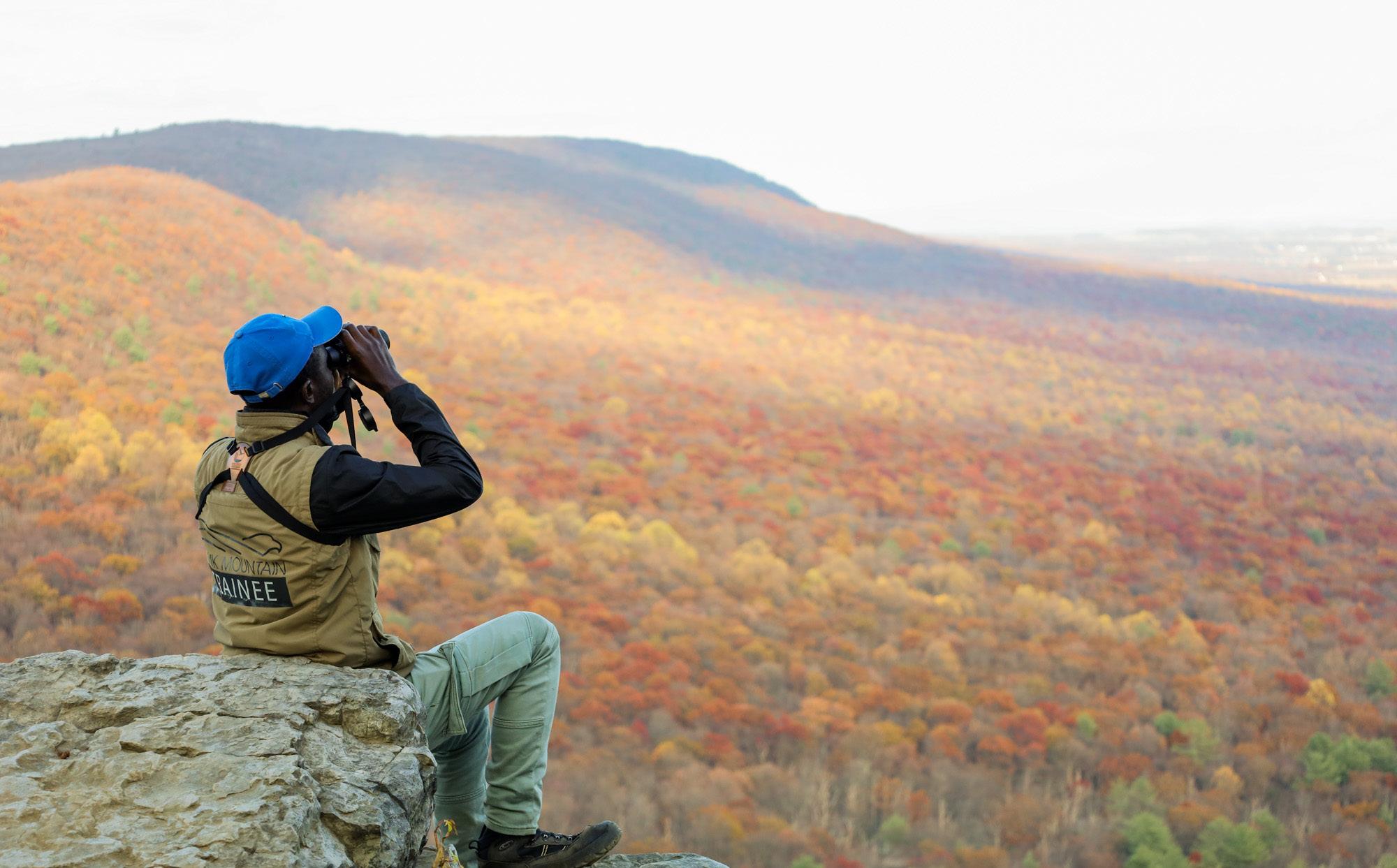
Joseph at South Lookout
My experience at Hawk Mountain has been very transformative and has significantly shaped my plans and future goals. During my time as a Conservation Science Trainee, I gained vital skills in migratory bird monitoring, raptor identification, data collection, and soft skills like public engagement, which has deepened my understanding of bird migration ecology and conservation science and public engagement. The hands-on fieldwork and engagement with experts not only refined my technical skills but also reinforced my passion for biodiversity conservation.
Currently, I am enrolled in a Ph.D. program in wildlife and rangeland management at the Kwame Nkrumah University of Science and Technology focusing my research on monitoring biodiversity in a restoration landscape in Ghana. A position I interviewed for and was offered to me while I was still a trainee at HMS. Although this project is not completely raptor-centered, birds are among the focal species.
My experience at HMS has inspired me to focus on projects that combine scientific research with community involvement, as I saw firsthand the impact of public engagement in promoting
conservation goals.
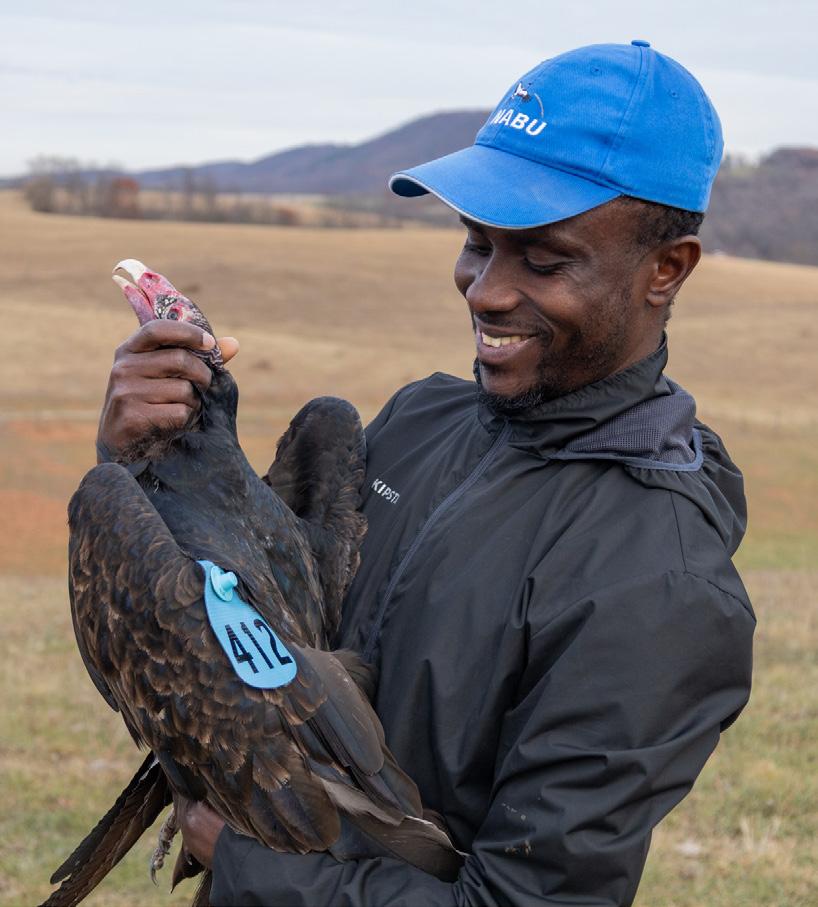
Aside from my Ph.D. career, I am also working on a side project investigating the breeding ecology of hooded vultures in parts of Ghana. Thanks to the knowledge and skills acquired from the long list of experts at HMS who have been working on vultures for many years. In this project, my team and I are currently using camera traps to investigate nest predation, nest success, and other events that happen during the breeding season. We aim to also tag some vultures and monitor populations at the roost sites and feeding grounds with the help of citizen scientists to understand
dispersal and population recruitment rates in the species. The ultimate goal for this project is to return as many vultures to soar the skies of Ghana, and Africa at large. With this, I hope to fully atone for my sins in the past against wildlife as a young boy and pursue my adulthood dreams of becoming a lecturer to have a positive impact not only in conservation science but also help shape the future for young bright minds.
HAWK
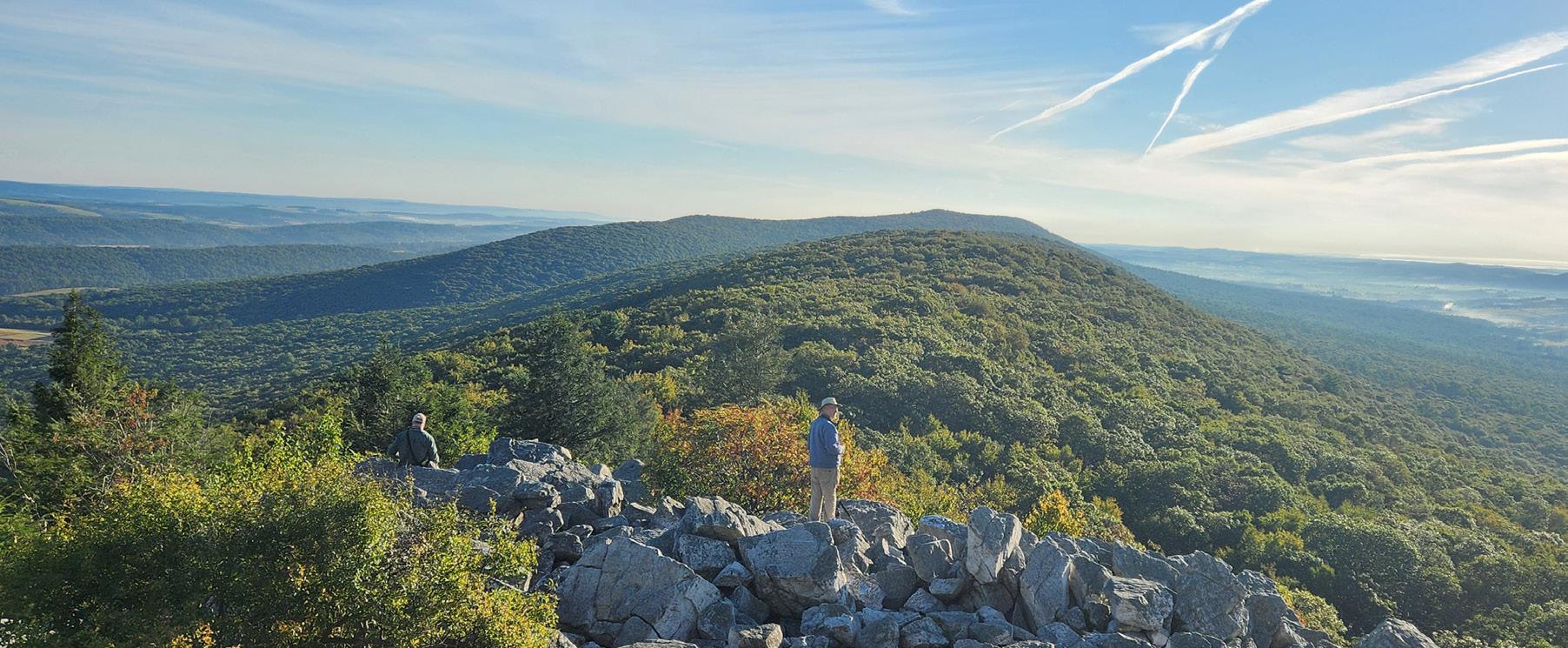
SUMMER AT THE SANCTUARY
Learn more and register at hawkmountain.org/events
SPRING NATIVE PLANT SALE
Saturday, May 17 • 10 AM - 3 PM
Sunday, May 18 • 10 AM - 2 PM
Choose from a wide variety of PA native plants perfect for your home landscape and learn about the importance of native plants from our expert volunteers.
THE
SECRET WORLD OF BATS
Sat, May 24 • 7 – 8:30 PM
$15, $10 for Members
Learn the natural history of bats, their environmental impacts, and how you can help local species. Also get to meet live education bats and experience a release of rehabilitated bats into the Sanctuary.
HAWK MOUNTAIN ARTS TOUR
Sat, June 7 • 9 AM - 5 PM • FREE
This self-guided driving tour leads you to a broad mix of artists at home and host studios within a 25-mile radius of the Sanctuary in scenic Albany Township. Visit hawkmountain.org/artstour to see the list of participating artists and the artist map.
TRAIL BIRDS
Sat, June 7 • 9 AM – 12 PM
Trail fee applies for Non-Members
Celebrate National Trail Days with a guided bird walk to North Lookout with Hawk Mountain birding experts.
CREATE A POLLINATOR GARDEN
Sat, June 28 • 10 – 11:30 AM
$10, $5 for Members
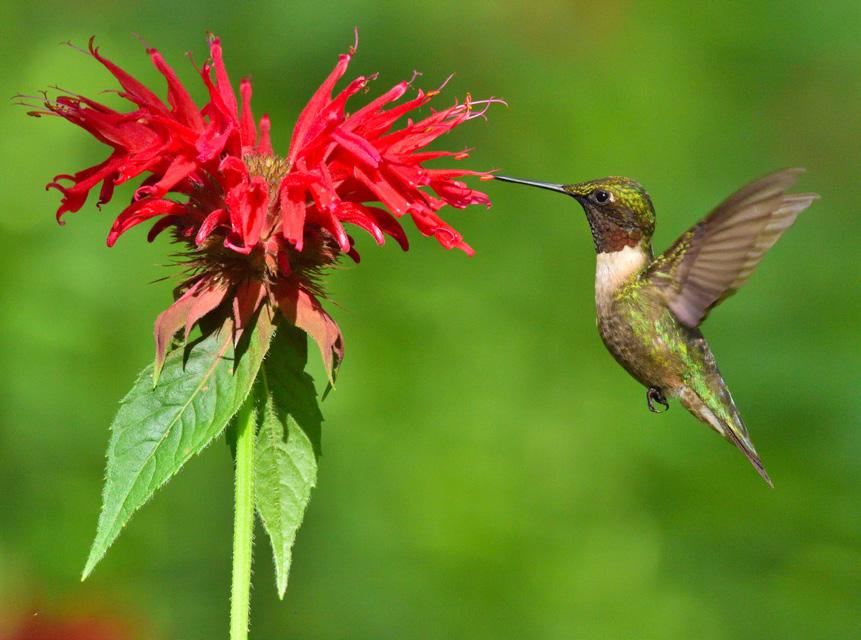
Learn from Hawk Mountain volunteers what it takes to create a sustainable year-round pollinator garden. A guided tour of the Native Habitat Garden will follow the program.
FAMILY FOREST FUN
Sat, July 26 • 10 AM – 2 PM • FREE
Learn about Appalachian flora, fauna, and more at a variety of fun and informative stations in and around the Visitor Center. Engage in an interactive musical program by local musician, Dave Kline, and get to meet some of our live avian ambassadors!
STAR WATCH ATOP HAWK MOUNTAIN
Sat, Aug 23 • 8 – 10 PM
$20, $15 for Members
Take a tour of the late summer sky from one of the darkest spots in the area! Learn about what you can find in the night sky and what produces phenomena like auroras, then look through high-qualiy telescopes to identify constellations, planets, galaxies, and other celestial objects.
Music on the Mountain
Come visit the Mountain and be surrounded by the beauty of nature and live musical performances of local ensembles. Performances take place in the Hawk Mountain Amphitheater and are followed by light refreshments and a live raptor meet-and-greet. Admission is $25, $20 for Mountain Members.
Find details and registration at hawkmountain.org/events.
Berks Sinfonietta
Saturday, June 14 • 2-4 PM
Gabriel Chamber Ensemble
Sunday, September 7 • 2-3:30 PM
Birds & Brew
Saturday, August 9 • 5 - 8 PM $65, $35 for those not tasting
Come spend a late summer evening in support of Hawk Mountain and to celebrate the beginning of another autumn migration season! Enjoy unlimited tastings of beers, ciders, seltzers, wines, and more, along with live music, meet-and-greets with live raptors, and a delicious buffet dinner. Admission is $60, $30 for those not participating the tastings.
Tickets sell fast! Get yours at hawkmountain.org/birdsandbrew.
Upcoming Member
Exclusive Events
Register now at hawmountain.org/events
SPRING BIRDING WITH THE PRESIDENT
Thu, May 1 | 9 AM – 1 PM | $20
Depart on a leisurely guided hike to North Lookout with President Sean Grace, then scan the skies for northbound raptors and other migrating birds.
VULTURE ENCOUNTER
Thu, June 26 | 10 AM – 12 PM | $20
Meet a live black vulture, enjoy light snacks, then head to the seminar room for a personal update on findings in the field from our scientists.
HAWKWATCHING WITH THE PRESIDENT
Mon, Sept 22 | 9 AM – 1 PM | $20
Join President Sean Grace for a guided hike to North Lookout to scan the skies for migrating raptors and learn more about the Sanctuary’s famous Autumn Migration Hawkwatch.
Winds of Change RECORD HIGHS AND NOTABLE LOWS
By David Barber, Senior Research Biologist
What a difference 25 years makes. When I started at Hawk Mountain in 1999, we set a new season-long record for bald eagles with 190 eagles soaring past the lookout. Fast forward 25 years and this year we again set a record for bald eagles with a total of 668, 3.5 times as many as was seen in 1999. In contrast, my first day on the lookout I saw 16 American goshawks, and we tallied 175 for the season. This year I didn’t see any, and we only recorded three for the season. And those osprey and red-tailed hawk “parades” where you could look out over #5 and see migrating raptors stacked up behind each other moving down ridge seems to be a thing of the past. As Bob Dylan wrote back in 1964, “The Times They Are A-Changin’.”
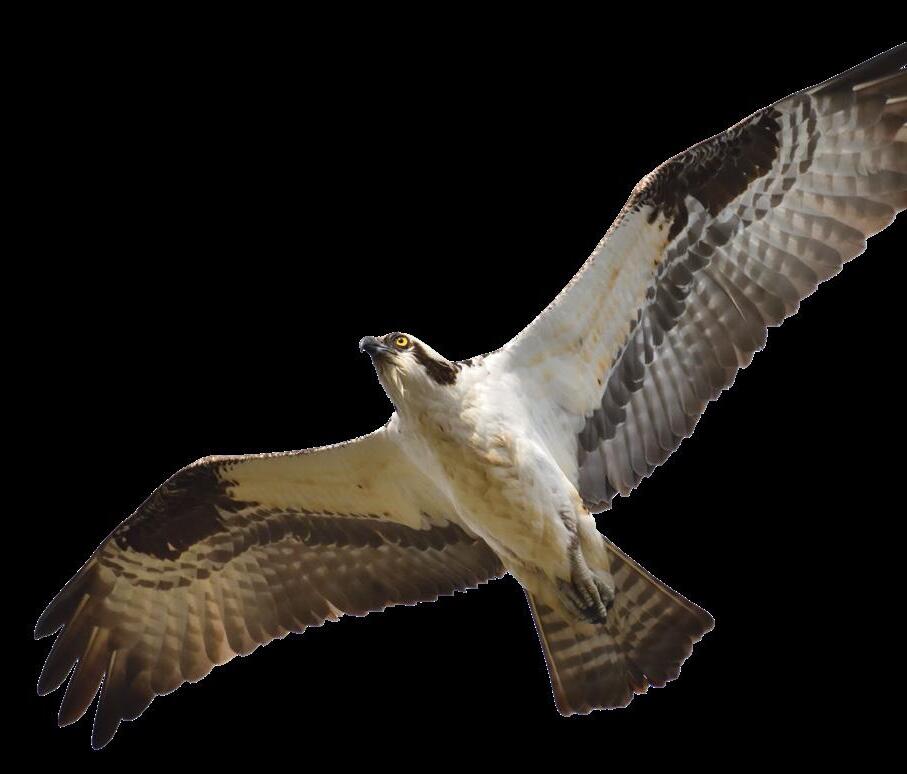
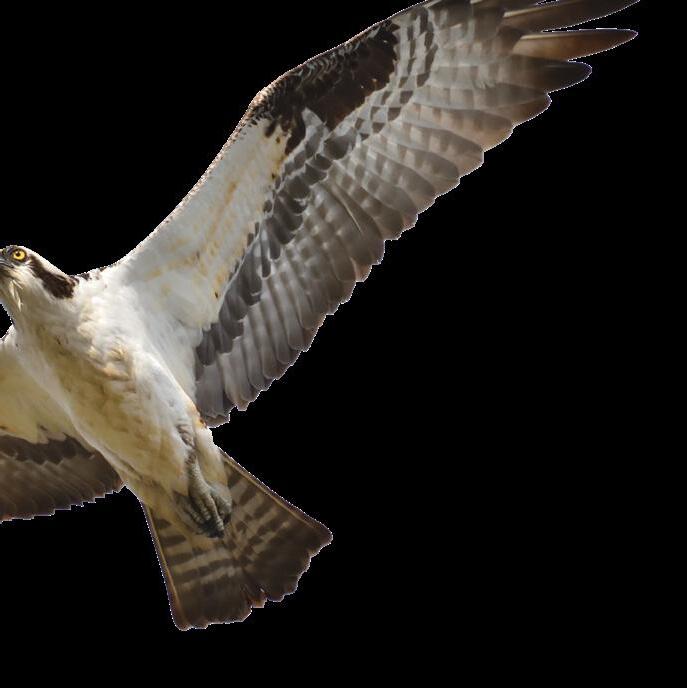
Osprey by Bill Moses
AUGUST 2024
15HazeNW,1-
16Haze/Partlycloudy/ClearW/SW/SE/ VAR,1-70002201
17Fog/RainS,1-800000000
18Fog/HazeSSE/SW,1-70001000
19Fog/Haze/Rain/OvercastWNW,0-1500090010
20MostlycloudyNW,10-25000131904
21Clear/Partlycloudy/Mostlycloudy/OvercastNW,1-500028012
22Clear/MostlycloudyWNW,5-1500048011
23Haze/Clear/PartlycloudyW/ VAR,0-80001001
24ClearNW/VAR,0-50000200
25Clear/PartlycloudyS/SW,1-30004301
26Haze/PartlycloudyWNW/ W,0-1000054110
27Clear/PartlycloudyNW/N/VAR/ WNW/ W,0-30001300
28Overcast/ClearWSW/SW,3-800022001
29Overcast/HazeSE/SSE/S,10-20012003021
30Haze/OvercastESE/SE,4-1800031000
31Overcast/RainESE,0-50008110 Total012565 07214
AUGUST • Skies were hazy and winds were light on the first day of the count, but the lack of cloud cover still produced strong thermals providing ideal conditions for an early season flight. An August high 42 broadwinged hawks and 11 red-tailed hawks were spotted along with an osprey, bald eagle, sharp-shinned hawk, and American kestrel—a great start to the count. Strong northwest winds greeted Research Biologist Becca McCabe on the 20th, and an adult bald eagle and two American kestrels were counted in the first 15 minutes, but the flight was just getting started: ospreys and bald eagles both took advantage of the strong ridge lift as 13 and 19 glided past the lookout along with 28 broad-winged hawks, 7 kestrels, and the first merlin and peregrine falcon of the season.
Director
of Conservation Science Laurie Goodrich enjoyed a late day flight of common nighthawks on the 22nd; small flocks of these nightjars winged their way past the lookout after 5:30 pm with a total of 96 recorded. An additional 66 nighthawks were recorded the next morning, along with the best warbler flight of the season: 10 species of warblers were tallied, including 46 black-throated green warblers, 90 blackburnian warblers, and a golden-winged warbler, an uncommon migrant for North Lookout.
An early migrating flock of 12 turkey vultures was recorded on the 29th.
NOHASSHAC
SEPTEMBER
2024
SEPTEMBER • Biologist-Naturalist Bracken Brown was joined by volunteer counters Dave Kruel and Jeremy Scheivert and Hawk Mountain President Sean Grace on the 2nd as a parade of bald eagles passed the lookout; 34 bald eagles were recorded, the sixth highest one-day count for Hawk Mountain. Also seen on the 2nd was a season high 34 American kestrels and an immature peregrine falcon that plucked and ate a prey item while flying low over the lookout.
On the 8th, volunteer counter Rob Feldman counted 13 red-headed woodpeckers, the second highest single-day count ever at North Lookout.
1Fog/Overcast/Mostlycloudy/PartlycloudyWNW/VAR,1-123005500000
2Overcast/Clear/PartlycloudyNW/WNW,8-180001034121
3ClearVAR,0-1500001023
4Clear/HazeS/SE/VAR,0-8600030310
5ClearSW,1-1200001043
6Drizzle/Fog/Overcast/Mostlycloudy/ClearSE/SSE/S/VAR,1-7080140320
7Overcast/RainS,5-100000000000
8Clear/PartlycloudyWSW/W/WNW/NW,1-7000820013000
9Clear/Partlycloudy/OvercastWNW/W,0-1000035031
10Clear/PartlycloudyNW,0-71003805000
11ClearSW/S/SE,1-7000471610
12Partlycloudy/ClearS/SE,0-521250300151
13ClearSSW/VAR/SE,1-3000220510
14Clear/HazeENE/VAR,3-1001020091
15Clear/Partlycloudy/MostlycloudyE/SE,4-120106221780
16Clear/PartlyCloudyE/SE/S,3-150001416174
17Fog/Overcast/MostlycloudySE/N/S,0-120005221670
18Overcast/DrizzleE/SE/S,5-100003211620
19Clear/PartlycloudyNE/NW/VAR,0-8000301800
20Clear/Partlycloudy/MostlycloudyE/SSE/SE,1-7010332194
21Overcast/Mostlycloudy/PartlycloudyE/SE,3-100003703070
22Overcast/Mostlycloudy/Partlycloudy/ClearSE,1-7020151162
23Overcast/RainE/SE,3-150000022000
24Fog/OvercastSE/S,4-180004141620
25Fog/Overcast/RainSE/ESE,8-20000000000000
26Fog/Rain0000000000000000000000
27Fog/Overcast/Drizzle/RainESE/E/SE,5-10000000200000
28Fog/Rain0000000000000000000000
29Fog/DrizzleE,8-12000000000000
30Fog/OvercastNE/ENE,3-150009248190 Total31380921152731060
Black Vulture TUVU Turkey Vulture
OSPR Osprey
BAEA Bald Eagle NOHA Northern Harrier SSHA Sharp-shinned Hawk COHA Cooper’s Hawk NOGO Northern Goshawk
UNAC Unidentified Accipiter RSHA Red-shouldered Hawk BWHA Broad-winged Hawk RTHA Red-tailed Hawk RLHA Rough-legged Hawk UNBU Unidentified Buteo
Golden Eagle
American Kestrel
Merlin
Peregrine Falcon
Unidentified Falcon UNRA Unidentified Raptor
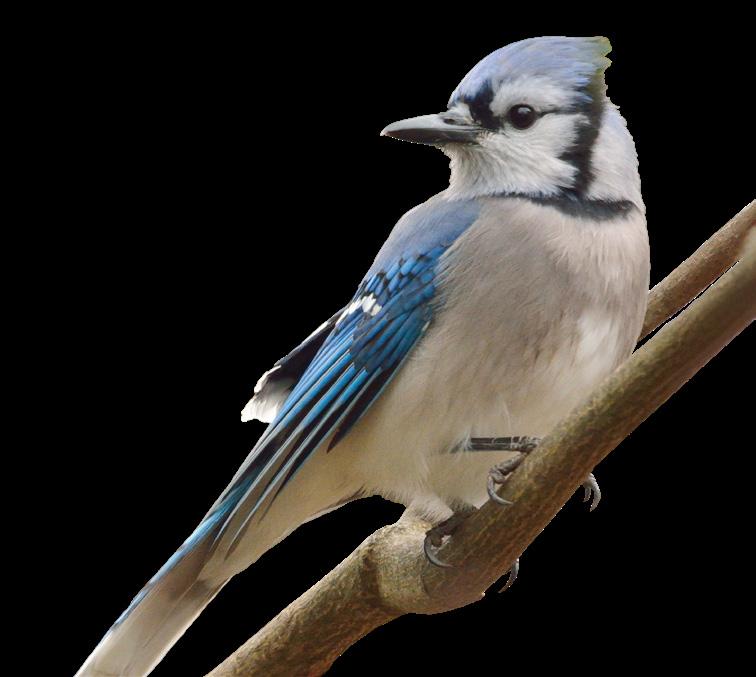
Blue Jay by Bill Moses
Flights of broad-winged hawks started to build the second week with counts of 453 and 236 broadwings on the 11th and 12th, respectively. The broad-winged hawk flight peaked on the 15th when volunteer counters Jason Deeter and Chris Pugliese counted 1,870 broadwings, with more than 1,400 counted between 9 and 11 am. Decent broadwing flights continued for another week, but none broke 1,000 birds.
Blue jays were the most abundant migrant the second half of the month. Over 1,000 blue jays were seen on both the 22nd and 24th, but unsettled weather stalled the flight for the next five days. When the
weather finally cleared on the 30th, blue jays were on the move in big numbers. By the end of the day 4,359 blue jays were tallied, the largest single-day blue jay flight in Hawk Mountain’s history.
The 30th also saw a change in the flight composition of the raptors as the count of sharp-shinned hawks (81), eclipsed the count of broad-winged hawks (37), for the first time of the season; Accipitrine hawk season had begun!
AUTUMN MIGRATION REPORT
OCTOBER • Early morning warbler flights continued into early October although in smaller numbers. Six species of warblers were counted on the 4th including 8 blackpoll, 27 yellow-rumped, and 5 Cape May warblers. Sparrows too started to show up in early October with the first white-throated sparrow recorded on the 4th and a field and chipping sparrow observed on the 6th.
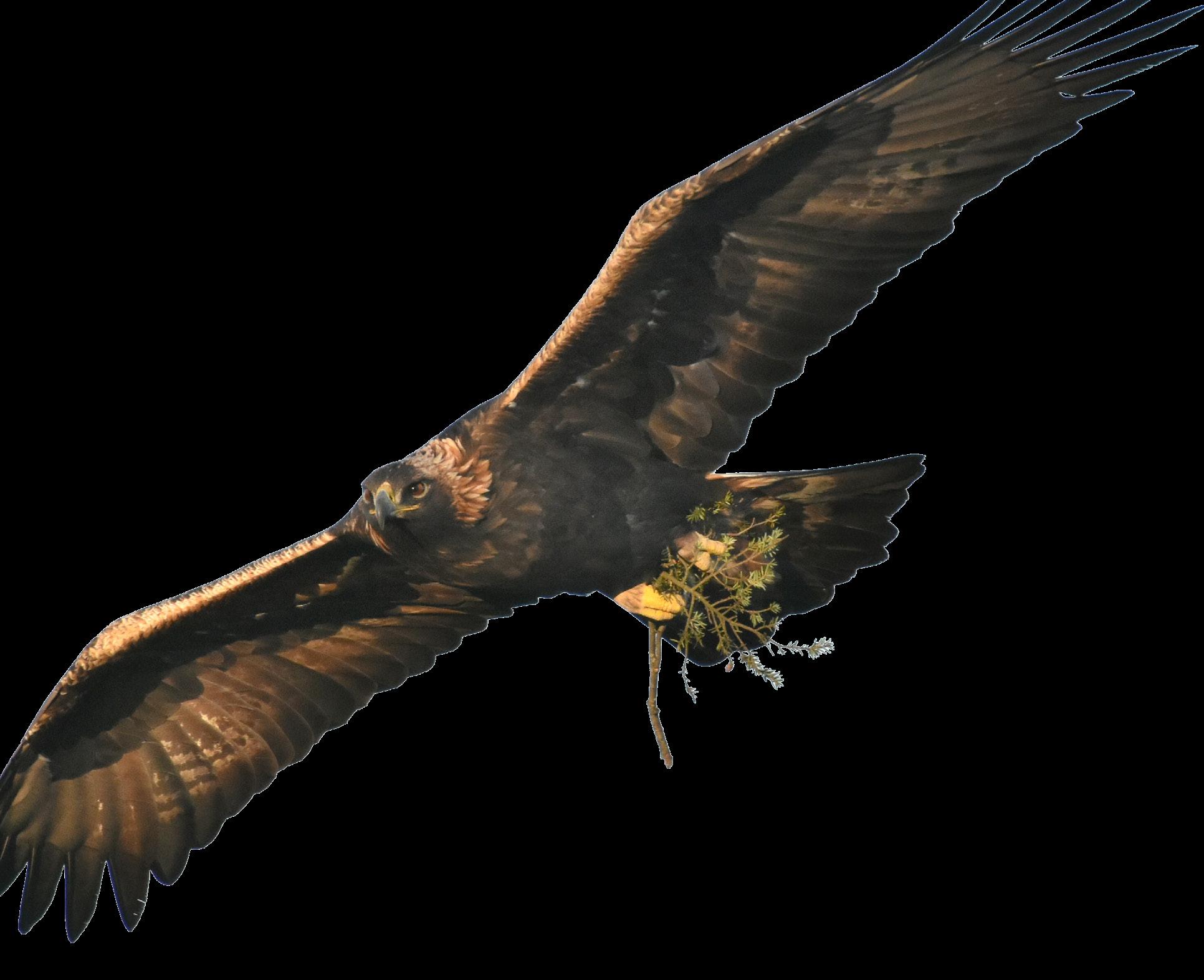
Volunteer counters Scott Morrison and Andy Price counted the first golden eagle of the autumn count on the 13th, a beautiful hatch-year bird with bright white patches in the wings and tail soaring out over the Kempton valley.
Twelve yellow-bellied sapsuckers were counted bounding past the lookout on the 14th, a season high and part of a season total
OCTOBER 2024
of 30 which was the second highest count recorded at North Lookout.
A season-high 28 Cooper’s hawks were counted on the 15th along with 248 sharp-shinned hawks, 12 bald eagles, and 2 golden eagles, but those weren’t the highlight of the day. At midday counters saw a raptor flying down ridge, potential species were called out, but field marks and flight patterns didn’t seem to match. As it flew closer and passed by the lookout it was clear that it was a Mississippi kite! Only the sixth autumn record of this southerly species at North Lookout.
Becca McCabe and Laurie Goodrich swept the Accipitrine hawks on the 16th with a season high 289 sharp-shinned hawks, 26
1OvercastSW/S,8-1800081047
2Fog/OvercastSE/E/ESE,170002101220 3F
5Clear/PartlycloudyN/NNW,3-
6PartlycloudyS,1-7000242748

7Overcast/MostlycloudyNW,3-200120214116680
8Clear/Partlycloudy/MostlycloudyNW,0-400006211840
9Clear/PartlycloudyW/NW,5-15080020015010
,5-
arW/WNW/NW,4-1200008013918 12Partlycloudy/ClearWNW/NW,8-1800005127716
13Partlycloudy/MostlycloudySW/S,4-12070032714616
14Partlycloudy/Overcast/ClearW/NW,15-250001194494 15Overcast/Mostlycloudy/PartlycloudyWNW/NW,0-7101012024828
16PartlyCloudy/MostlyCloudyNW,10-20000021528926
17ClearN,1-7000050424
18ClearN/NW,1-120000642730
19ClearNW/WNW/W,0-515300012707 20ClearNW,1-7300012552 21ClearW/SW/W,0-10000061905
22ClearS,0-10000011323
23Clear/HazeSW/S/W,0-510270040487
24ClearN,0-815470043223
25ClearNNW/NW/SW/S/SSE,1-707600861420
26Partlycloudy/Mostlycloudy/OvercastNW,10-25324009810914
27ClearNW,1-3010000022
28Clear/PartlycloudySE/S,0-10719000062
29PartlycloudySE,1-50600041810
30HazeWSW/VAR,0-525900031112
31PartlycloudySW,1-71585009361 Total94580144204682589254
Cooper’s hawks and the first American goshawk of the season. Turkey vultures started migrating past the lookout in earnest the last third of the month with small flocks seen daily streaming past the lookout. Turkey Vulture numbers peaked on the 30th with 90 counted along with 25 black vultures.
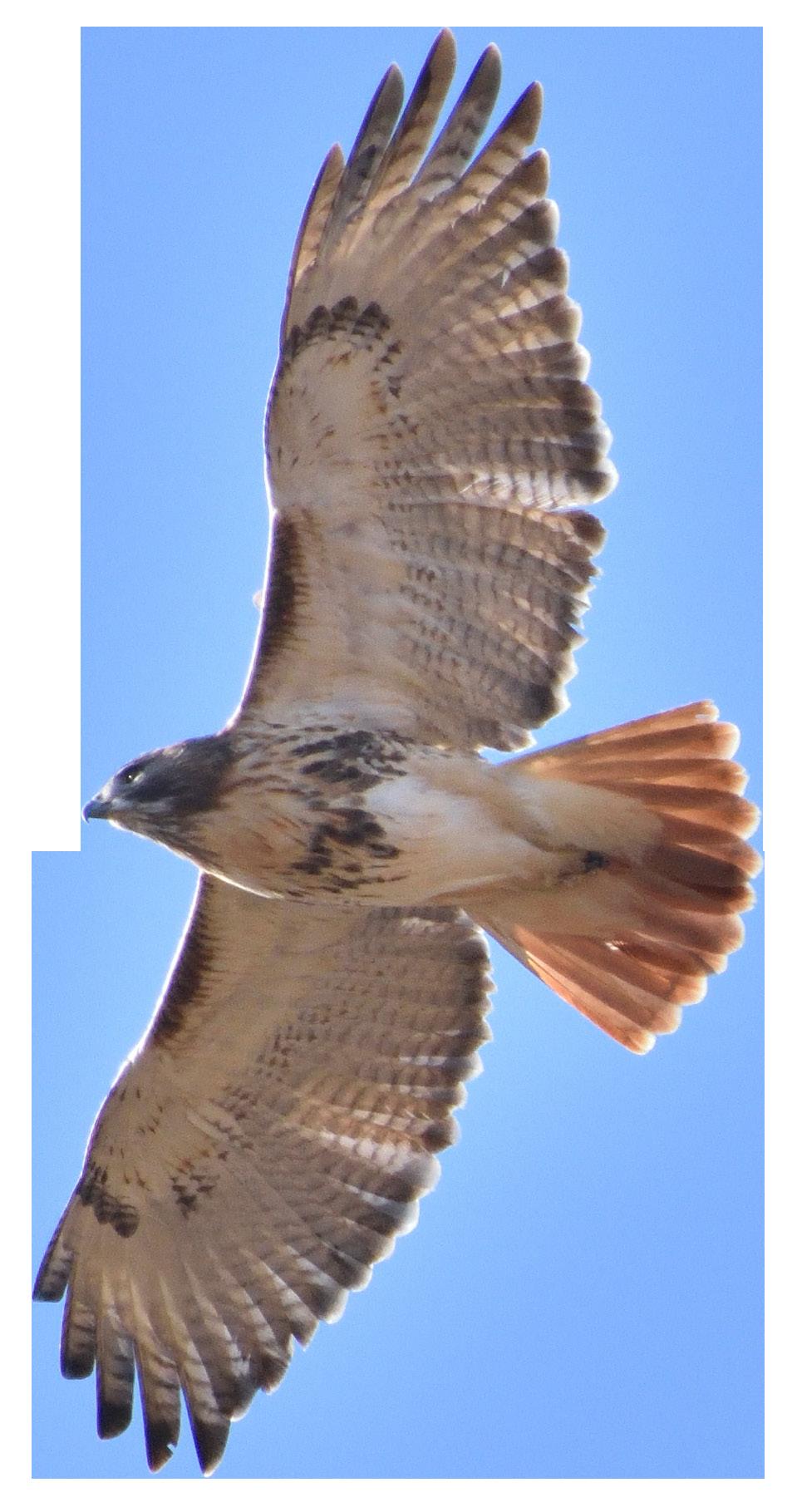
Red-Tailed Hawk by Bill Moses
November started out on a high note with 106 raptors counted, including 48 turkey vultures, 3 northern harriers, 9 sharp-shinned hawks, 3 Cooper’s hawks, 3 golden eagles, an excellent late-day bald eagle flight that included 13 bald eagles after 4 pm, and a great-horned owl calling from below North Lookout at sunset. Jason Deeter and former Conservation Science trainee Zach Burke counted a season high 10 red-shouldered on the 8th along with 17 bald eagles, 5 northern harriers, 41 red-tailed hawks, and 5 golden eagles. Strong flights of redtails continued through the first half of the month, peaking on the 12th with 81 redtails along with 20 bald eagles and a season high 10 golden eagles.
Flights of winter finches were low this year likely due to the abundant cone crop in Canada, but a few species were recorded, a high of 36 pine siskins were tallied on the
1Overcast/Partlycloudy/ClearWNW/NW/W,4-1804
2ClearWNW,0-516001
3ClearN/NNW/NW/NE,1-7010024700
4Mostlycloudy/OvercastNE/SE,10-15036001210
5Mostlycloudy/Partlycloudy/ClearVAR,0-4019004140000
6Clear/Partlycloudy/Mostlycloudy/OvercastSW/W,1-50210010222
7Clear/PartlycloudySW,5-156700221142
8ClearWNW,5-150400175910
9ClearNW,0-1270006084
10Overcast/RainS/SE,4-703000100
11Fog/Partlycloudy/ClearW,5-2004600202430
12Mostlycloudy/Partlycloudy/ClearNNW/NW,8-310000200420
13ClearN,1-7050000000000000000000
14OvercastSE/E,5-1502600100000
15Overcast/Partlycloudy/MostlycloudyWNW/NW,1-1204009012
16Mostlycloudy/ClearWNW,10-30050010234
17Clear/Partlycloudy/OvercastNW/WNW/W/WSW,1-30000000000
18Haze/Partlycloudy/ClearNW,10-15000011032
19Partycloudy/Mostlycloudy/OvercastNNW,0-1000000010
20OvercastS/SE,0-3000010000000000000000
21Rain/DrizzleNW,1-1200000000000000000000000
22Snow00000000000000000000000
23Overcast/ClearNW,15-25220036033
24Mostlycloudy/OvercastWNW,4-1200004022
25Haze/Clear/Overcast000000001
26Fog/Overcast/Mostlycloudy/Partlycloudy/ClearNW/WNW,1-24000015021010
27Overcast/MostlycloudyW,1-50600100000
28Rain/Fog00000000000000000000000
29Clear/Overcast/SnowWNW/W,1-1200003000000
30Clear/Partlycloudy/MostlycloudyWNW/W,10-1500005010 Total1623900234239035
18th along with a single evening grosbeak and a flock of 7 red crossbills. Four common redpolls were recorded on the 20th, and another flock of 10 red crossbills was observed on the 25th.
Volunteer counters Beth Sassaman and Erik Albrecht recorded twelve species of raptors on the 16th including an immature American goshawk, 10 bald eagles, 2 northern harriers, 62 red-tailed hawks, 2 golden eagles, and 3 peregrine falcons.
Four days of overcast skies and light winds with occasional drizzle stalled the flight the third week of the month, but once the skies cleared eagles were on the move. On the 23rd, volunteer counters Andy Wlasniewski and Rob Feldman tallied three bald eagles, a golden eagle, and a peregrine falcon between 7 and 8 pm. The eagle parade continued throughout the day with an
hourly high of eight bald eagles during the 11 am to 12 pm hour. By days end, they had counted 36 bald eagles, the fifth highest single-day count in Hawk Mountain’s 88-years of counting. An additional 15 bald eagles were counted on the 26th along with 15 red-tailed hawks, 5 golden eagles, and a flock of 33 tundra swans.
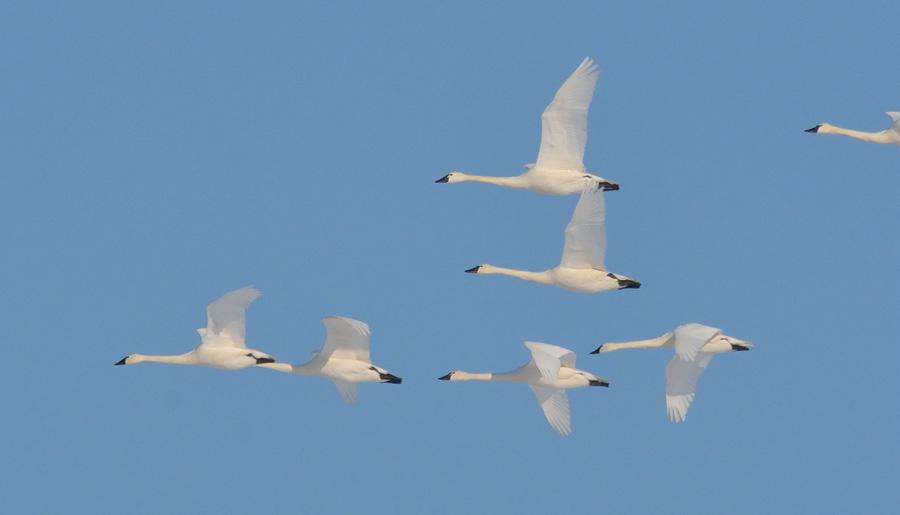
Tundra Swans by Bill Moses
DECEMBER/JANUARY • The largest waterfowl flights of the season occurred during the first week with over 1,000 Canada geese counted on the 2nd and 3rd and a season high 4,991 Canada geese counted on the 6th. Other waterfowl highlights the first week include a flock of 8 black ducks and 350 snow geese on the 2nd and a flock of 180 brant on the 3rd.
official count, bringing the season total bald eagle count up to 653.
Gusty west winds and the potential for more bald eagles lured Bracken Brown to North Lookout on January 1 and 2, where he piled on to the bald eagle count total. Bracken counted 15 bald eagles, 2 red-tailed hawks, 2 golden eagles, and 1 peregrine falcon across the two days. The final bald eagle count for the season was 668, smashing last year’s record of 639.
atherWind(mph)BLVUTUVUMIKIOSPRBAEANOHASSHAC
December’s raptor flights are often more about quality than quantity, but the count on the 6th had both. A total of 55 migrating raptors were counted: 10 black vultures, 4 turkey vultures, 12 bald eagles, 1 northern harrier, 2 Cooper’s hawks, 22 red-tailed hawks, 3 golden eagles, and a peregrine falcon. Light winds, rain, and fog put the migration on hold over the next five days, and when it cleared, Senior Scientist JF Therrien added a December high 16 bald eagles on the 12th. Scott Morrison braved the overcast skies and cold conditions on the 15th, the last day of the official count. Only two birds were tallied all day with a fourth-year bald eagle sailing past the lookout at 2:23 pm being the last bird of the
artlycloudyW/WNW/NW, 1-1200001000000030000000004 ar/Partlycloudy/OvercastWNW, 5-1500002000001060 cloudy/OvercastNW,5-1503003110101030 Overcast/MostlycloudySW,1-801001100000030 W, 8-18010050000000000000 Clear/PartlycloudyW/NW,8-18104001210200002200 cloudy/OvercastW/SW,0-150000000000000000000000
Clear/PartlycloudyWNW/W, 4-1200000000000010 Overcast/DrizzleSW/S,15-200000000000000000000000
W,8-18010016000001070
DECEMBER 2024
Overcast/Mostlycloudy/ClearNW,1-1000001010001040 E/S,0-1000000000000010 OvercastE/ESE/SE, 8-120100100000000000000000 101100433221040500
1Clear/PartlycloudyW/WNW/NW,1-120000100000
2Clear/Partlycloudy/OvercastWNW,5-150000200000
3Partlycloudy/OvercastNW,5-15030031101010
4Overcast/MostlycloudySW,1-8010011000000
5SnowW, 8-18010050000000000000
6Clear/PartlycloudyW/NW,8-1810400121020000
7Partlycloudy/OvercastW/SW,0-150000000000000000000000
8Clear/PartlycloudyWNW/W,4-12000000000000
9Overcast/DrizzleSW/S,15-200000000000000000000000
10Fog0000000000000000000000 11Rain0000000000000000000000
12ClearW,8-1801001600000
13Overcast/Mostlycloudy/ClearNW,1-100000101000 14ClearE/S,0-10000000000000
15OvercastE/ESE/SE,8-120100100000000000000000 Total101100433221
JANUARY 2025
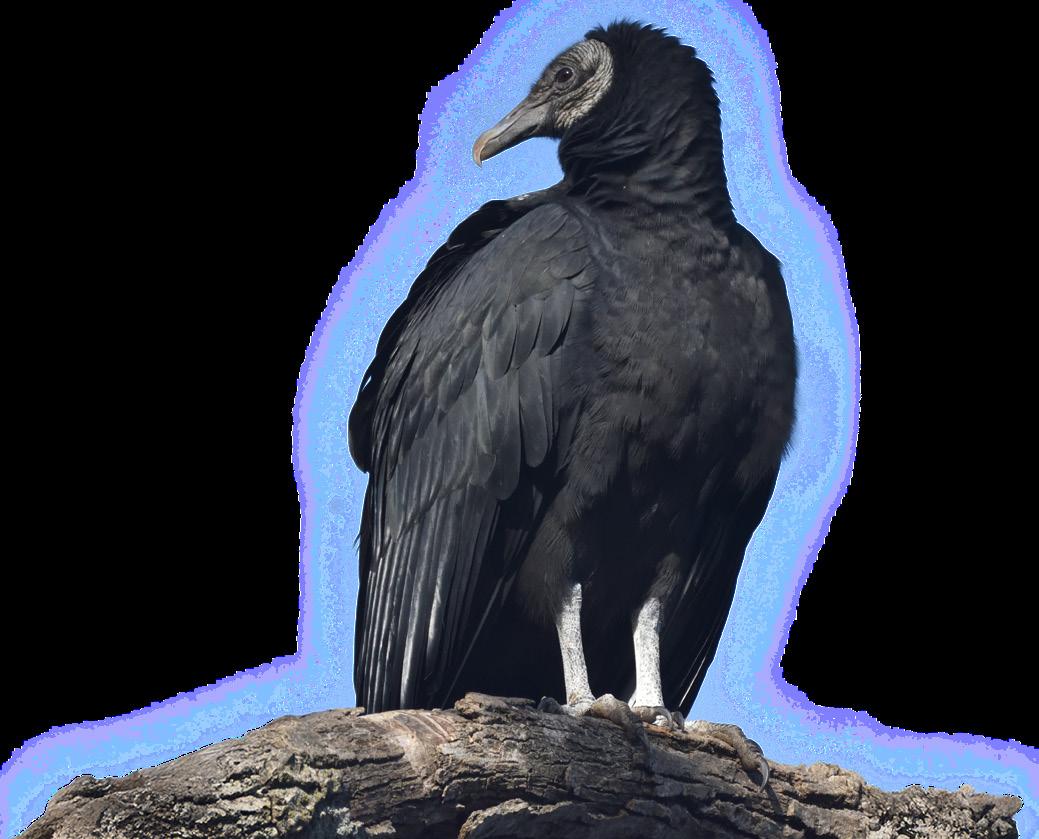
Black Vulture by Bill Moses
N.Rough-WingedSwallow CedarWaxwing
ScarletTanager Red-BelliedWoodpecker Orange-CrownedWarbler
Yellow-RumpedWarbler Dark-EyedJunco Golden-CrownedKinglet
SnowBunting Red-ThroatedLoon EveningGrosbeak
CanadaGoose GreatBlack-BackedCull
South Lookout by Laura Berry
MIGRATION SUMMARY • This was the 88th year of counting migrating raptors in the autumn at North Lookout. There were several highlights: bald eagles had another record year with 668, the count of 880 turkey vultures was the fourth highest count, and we recorded a Mississippi kite for only the sixth time during autumn. However, overall the count was down with the 12,526 raptors counted falling 21% below the 10-year average and 12 of 16 species having below average counts. Most notable were American goshawk, 67% below average, osprey, 32% below average, and broad-winged hawk, 31% below average. For most species, the below average counts at Hawk Mountain mirrored those at other watchsites in Pennsylvania, the exception being broad-winged hawks. The broad-winged hawk is the most variable migrant at Hawk Mountain and the species with the narrowest window of migration. The numbers of broadwings counted at Hawk Mountain is often dictated by weather conditions during the third week in September, the peak window for broadwing migration. This autumn a highpressure system over New England created winds with an easterly component and little cloud cover. It appears that the easterly winds blew broad-winged hawks further west as watchsites in the middle of the state experienced above average counts while most sites in eastern Pennsylvania had below average counts. And the birds that did fly over may have been difficult to detect in the cloudless blue skies.
Counts of American goshawks and osprey continued their long-term declines. The decline in the number of goshawks counted at Hawk Mountain may be due in part to
their migratory behavior. Goshawks are irruptive migrants; immatures from northern populations may migrate every year, but when prey populations crash—snowshoe hares for example—adults join the immatures heading south to search for food. Goshawks were never very abundant, but the irruptions, which typically occurred every 10 years, seem to be a thing of the past. The last large irruption occurred in the early 1970s with a modest irruption in 1999, the year I started at Hawk Mountain. Unfortunately, the cause for the decline or dampening of these irruption cycles is unknown.
The cause of declining osprey counts is also unknown. The Raptor Population Index reports that 36% of hawkwatch sites in the eastern U.S. have shown declines between 2009-2019. These declines are concentrated at watchsites in the eastern Great Lakes and along the Appalachians. Some have suggested the decline in ospreys may be due to the increase in bald eagle populations. Bald eagles compete with osprey for nest sites, and ospreys nesting at inland lakes may be forced out of suitable habitat by bald eagles. Ospreys nesting at coastal sites often cluster their nests in small colonies which may allow ospreys to reduce competition with eagles, and osprey counts at most coastal watchsites are stable with a couple showing increasing counts. So, while the return of the bald eagle and its significant population increase is a conservation success story, could it come at the expense of ospreys? More research is needed to determine if this is the case or whether it’s a simple correlation. Regardless, we need to continue counting raptors at North Lookout. Migration counts are the best tool we have to monitor raptor populations on a large scale,
and it is long-term data like that collected at Hawk Mountain that allows us to calculate population trends of these magnificent birds.
Hawk Mountain counters count everything, from waterfowl to songbirds to dragonflies, and we count far more non-raptors than raptors. This autumn counters recorded 63,923 non-raptors including 449 butterflies and 667 dragonflies. The most abundant non-raptor was Canada goose with 14,511, followed by blue jay (11,535), cedar waxwing (5,877), tree swallow (2,732), and common grackle (2,134). Morning warbler flights in late August and early September were low, but diversity was high; 25 warbler species were recorded, including rarities such as golden-winged and orangecrowned warbler. Most people don’t think of woodpeckers as migratory, but it was a very good woodpecker flight this year; the counts of 46 red-headed woodpeckers and 30 yellow-bellied sapsuckers were the second highest counts for both species and counts of red-bellied woodpeckers also were above average. Some other uncommon non-raptors seen at the lookout this year included cackling goose, red-throated loon, great black-backed gulls, belted kingfisher, and northern mockingbird. Unfortunately, one species that did not have a good year was the monarch butterfly. The 300 monarchs counted this year was the lowest count in the last 20 years and the second lowest since we started counting monarchs in 1990. The eastern population of monarch butterfly is estimated to have declined by 80%, and the International Union for the Conservation of Nature (IUCN) listed monarchs as endangered on their Red List of Threatened Species. Additionally, the U.S.
Fish and Wildlife Service recently proposed listing the monarch as threatened under the Endangered Species Act.
Every year is a little different. There are always highlights and lowlights and a lot has happened in the last 25 years, but one thing if for certain, “the times they are a-changin”.
STAFF:
David Barber, Bracken Brown, Laurie Goodrich, Rebecca McCabe, Jean-Franҫois Therrien
VOLUNTEERS:
Erik Albrecht, Zach Burke, Jason Deeter, Chris Farmer, Rob Feldman, Greg George, Dave Kruel, Scott Morrison, Andy Price, Chris Pugliese, Beth Sassaman, Jeremy Scheivert, Andy Wlasniewski, Matt Wlasniewski
COUNT ASSISTANTS AND DATA VOLUNTEERS:
Chris Arndt, Catherine Elwell, Brian Ferrence, Sean Grace, John Hilbish, Bill Moses, Rich Rieger, 2024 Conservation Science Trainees
CONSERVATION FIELD COURSES
Appalachian Ecology Institute Workshops
These 1- and 2-day field-oriented workshops are designed for the amateur or professional naturalist who is interested in learning more about the natural history and ecology of the central Appalachians. Certificates of completion will be provided to all attendees, and no experience is required, other than ability and gear for hiking rocky terrain on Hawk Mountain trails. Visit hawkmountain.org/AppEcologyInstitute for details and registration.
May 17-18 – Amphibians & Reptiles of the Hawk Mountain Region
May 31 – Birdwatching for Beginners
July 12 – Appalachian Forest Ecology & Tree Identification
Educator Workshops
July 26 – Appalachian Pollinators: Bees, Butterflies, & Plants
Sept 20-21 – Migration Magic: Enjoying Neotropical Migrant Birds on the Move
Jan 17, 2026 – Appalachian Winter Ecology
Introduction to Raptor Field Techniques
Thursday, Oct 30 – Sunday, Nov 2 OR Thursday, Nov 6 – Sunday, Nov 9
$700, $650 for Members
This four-day workshop will help you build confidence in your raptor field techniques. Learn new or hone existing skills through hands-on learning experiences with raptors, including trapping methods, handling, bird banding, blood sampling, satellite telemetry, and more. Students will participate directly in real research projects with significant individual interaction and training. No special training is necessary! Learn more at hawkmountain.org/RaptorFieldCourse
Professional training for formal and non-formal educators! Hawk Mountain hopes to inspire public, private, formal, and non-formal educators with new tools, activities, and curricula for the classroom, wherever that may be!
Pennsylvania Songbirds | Thursday, April 17
Join us for an educator workshop all about birds! Pennsylvania Songbirds is a hands-on, interdisciplinary, K-8 resource and activity guide developed by DCNR, Bureau of State Parks, Audubon Mid-Atlantic, and the Pennsylvania Game Commission. Participants will have the opportunity to enhance their knowledge of observation and identification of songbirds, bird biology, habitat, migration, and much more!
PA Biodiversity and Climate Change | Monday, August 18
Find new ways to incorporate biodiversity into the classroom! This workshop provides wildlife-based environmental education activities that are hands-on, easy to use, and fun! This curriculum is designed for grades 5-12. Participants will have the opportunity to explore and enhance their knowledge of the fundamentals of biodiversity and climate change by investigating PA-specific flora and fauna.
SUMMER NATURE CAMPS
$300, $250 for Members, per week (unless stated otherwise)
8:30 AM – 3:30 PM, daily
Designed for youth entering grades 1 – 6, these week-long day camps get kids outdoors, developing a deeper connection with the natural world through fun and educational activities. Campers can choose one week or join us for the entire summer!
Registration closes and all required forms are due two weeks before start of chosen camp. Scholarship opportunities available! Visit hawkmountain.org/summercamps for details.
Mountain Adventure
June 11 – 13 | $200, $150 for Members
Start your summer off right with this action-packed THREE-DAY camp! Meet up with some birds of prey or chill out with some reptiles while learning about Appalachian wildlife.
Creative Creatures
June 16 – 20
Explore nature and creative expression through art, music, and movement. Uncover the natural world and meet live animals to inspire your imagination!
All About Animals
June 23 – 27
Get up close and personal with mammals, reptiles, birds, insects, and much more. Discover the animal kingdom through crafts, games, special guests, and of course LIVE ANIMALS!
Tales & Tails
June 30 – July 4 | $250, $200 for Members
Learn about legendary creatures and meet their real-life counter parts. During this FOUR-DAY camp we will read epic tales, do interactive crafts, play pretend, and discover what magical secrets Hawk Mountain is hiding.
Wild Survivors
July 7 - 11
Learn survival skills through hands-on experiences while building new friendships. Discover how humans, plants, and animals survive in the wild. Learn to build a shelter, start a fire, and put your skills to the test during an offsite adventure!
Junior Veterinarian
July 14 – 18
Have you ever dreamed of becoming a vet? Immerse yourself in the veterinarian world with hands-on activities, live animals, and special guests. Take a look behind the scenes at what it takes to help injured wildlife and other animals.
Wilderness Quest
July 21 – 25
Put your outdoor skills to the test! Meet new friends as you learn to survive in the wilderness. Learn to build a shelter and start a fire, and then embark on an offsite adventure.
Science Safari
July 28 – August 1
Come to the camp where we will ask: why and how? Campers will investigate the wonders of the world through experiments and hands-on activities. Live animals and special guest presentations are sure to be a blast!
Nature Trailblazers
August 4 – 8
Discover the amazing connections of nature! Observe plants and live animals up close in their natural habitats. No stone will be left unturned as we explore Hawk Mountain!
Autumn 2024 Conservation Science & Academic Trainees
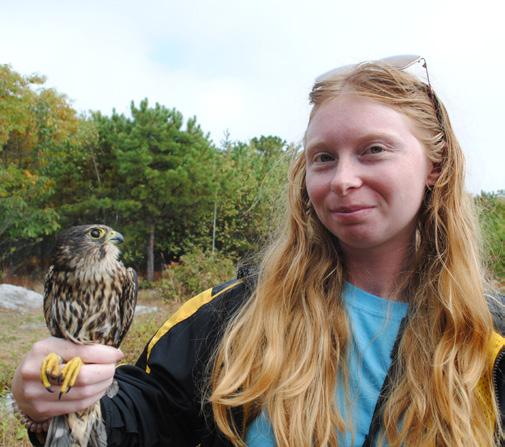
MARY ADAMS
MOORESVILLE, NEW JERSEY
Mary is a 2024 graduate of Franklin and Marshall College where she majored in biology and minored in environmental studies and French. Mary also did coursework in wildlife conservation and fisheries management along with animal behavior at the University College Dublin, Ireland. Mary completed a biology honors independent research project in avian habitat selection across the thermal landscape of Spalding Conservancy. She also worked as a Biology Department Assistant where she assisted with the well-being of plants in a greenhouse, prepared reagents and student benches for laboratory courses. Additionally, Mary interned at the Cedar Run Wildlife Refuge and Rehabilitation Hospital, Medford, NJ as a Wildlife Care Intern where she educated and communicated with the public regarding animal well-being and handling and helped care for the rehabilitated wildlife.
ALEXANDRA HAGANS
READING, PENNSYLVANIA
Alex is a 2023 graduate of Delaware Valley University where she received a bachelor’s degree in wildlife conservation. She was a former intern at the Wolf Sanctuary of Pennsylvania, Lititz, PA where she designed educational packets for children, and was also an intern at the Bucks County Audubon Society, New Hope, PA where she collected and interpreted data from the Bluebird Nest Watch project, prepared and monitored bluebird nest boxes, and removed invasive species. Alex is also a duck banding volunteer at Middle Creek Wildlife Management Center. In the autumn of 2023, Alex was a counter at one of the Kittatinny Ridge sites, where she counted migrating North American raptors.
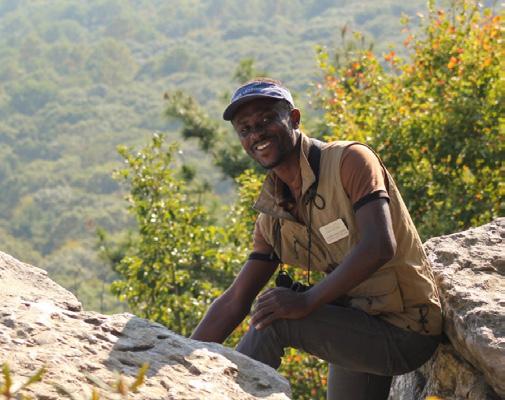
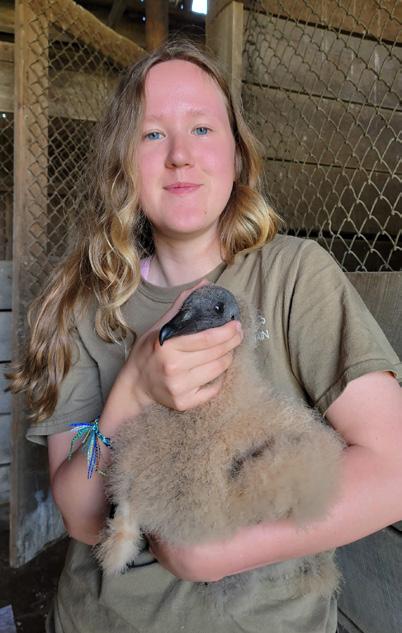
JOSEPH KWASI AFRIFA
ACCRA, GHANA
Joseph received his master’s degree from the University of Cape Coast, Ghana in 2022 in wildlife management and a bachelor’s in 2016 in entomology and wildlife; he also received a master’s degree from the A.P. Leventis Ornithological Research Institute, University of Jos, Nigeria in 2020 in conservation biology. Joseph has done independent research understanding the breeding ecology of the hooded vulture in Cape Coast, Ghana. He was also a Research Program Officer for the Ghana Wildlife Society where he researched the population decline of white-necked picathartes and habitat preferences of willow warblers. Additionally, Joseph worked as an Avian Research Consultant for the Fisheries and Aquatic Sciences Department of the University of Cape Coast, assessing ecosystem-based livelihoods at the Keta Lagoon Complex Ramsar site and identifying hunting and egg collection as key causes of bird population decline.

AISLINN SHILCUSKY
POTTSVILLE, PENNSYLVANIA
Aislinn graduated in 2024 from Susquehanna University with a bachelor’s degree in ecology and a minor in environmental science. Aislinn studied with the Projects Abroad Galapagos, Puerto Baquerizo Moreno, Ecuador, removing invasive plant species and collecting date through beach clean ups and marine animal surveys. She conducted research with Susquehanna University’s Department of Ecology, studying chemically mediated antipredator responses in neustonic prey of the six-spotted fishing spider and the adaptive function of projectile defecation in Atypus karschi for prey capture. Aislinn also worked as a Freshwater Research Intern where she identified benthic and worked as a teaching assistant and animal caretaker.
BETHANY WELLIVER
STAMFORD, CONNECTICUT
Bethany is a recent graduate of Kutztown University where she completed a bachelor’s degree in marine science oceanography with a minor in geology. Bethany has studied at the Chincoteague Bay Field Station where she has learned different oceanography skills by taking samples, and understand how different oceanographic processes work, and has used different marine science instruments including CTC, YSI, Weatherpak, GPS, and Kestrel. Bethany is IACUC certified and is also a certified Waterfront Lifeguard.
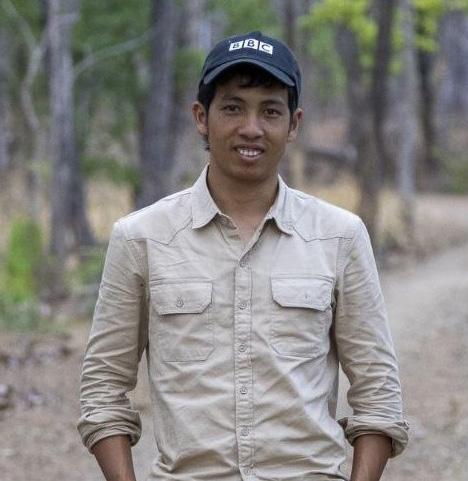
SOTHEA BUN KOMPONG THOM, CAMBODIA
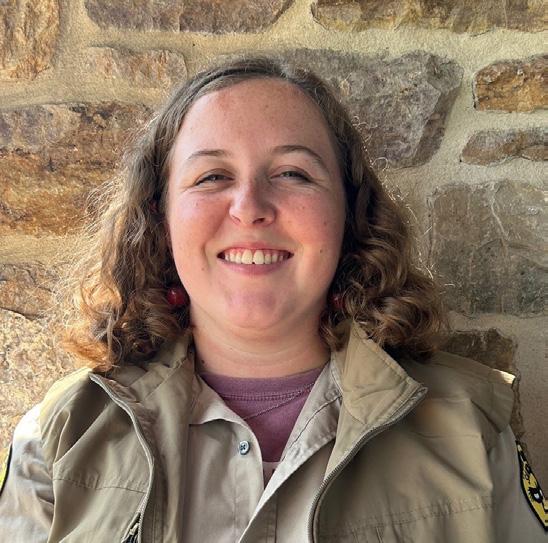
Sothea is a Senior Community and Wildlife Officer with WWF Cambodia focusing in the Eastern Plan Landscape where he helps address issues caused by wildlife and wildlife protection in order to sustain their livelihood and eliminate the poverty surrounding the protected area. Sothea was a volunteer with VSO Cambodia in the ICS program after his graduation from the Royal University of Agriculture. He has worked as a research assistant for several organizations, including the Wildlife Conservation Society focusing on community outreach and Save the Children International on a livelihood project. Sothea would like to continue to protect and conserve natural resources in wildlife and forests for the next generation along with helping indigenous people use their resources sustainably.
Ben Olewine IV LEAVE A LEGACY
It was a twist of fate when in the 1990s, Ben Olewine IV signed up for a field trip and connected with the late Hawk Mountain Chair Cliff Jones, who persuaded him to consider service at the Sanctuary.
Ben joined Cliff on the board and quickly developed a strong belief in the impact of Hawk Mountain and its international Conservation Science Training Program.
“Hawk Mountain demonstrated that a relatively small organization can make a global impact.”
Ben not only believed in the importance of this critical training, but also the need to support trainees after they left the Sanctuary.
“Young people come here, are trained, and go home, but often they need seed money to start their own conservation projects and careers. Hawk Mountain needed to help get them started,” he explains.
With his family, Ben did just that. His father, the beloved civic leader and philanthropist from Harrisburg, Ben Olewine III, Ben, and his family established the Benjamin Olewine IV Project Soar Awards. Since 2003, Ben and his family have faithfully provided support for seed grants, and each year Hawk Mountain uses the funds to
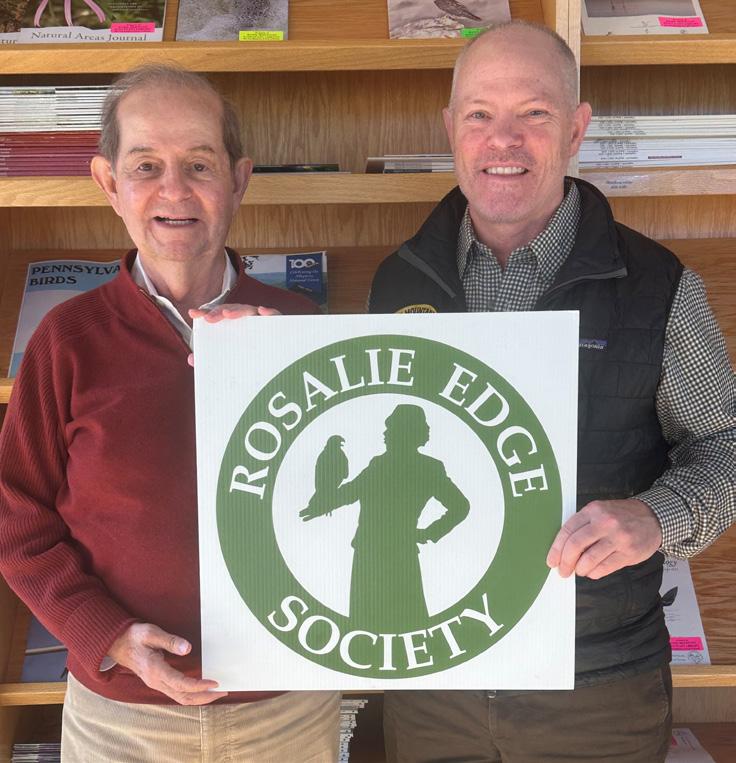
jumpstart careers in conservation for the best and brightest graduates.
Ben considers Project Soar such a priority that he made plans to ensure the funds continue in perpetuity by naming Hawk Mountain the benefactor of an IRA that will provide Benjamin Olewine IV Project Soar Grants for generations to come.
If you too are a visionary like Ben, want to leave your own legacy, or simply share your story, please contact us today.
I know the training program is effective and I know that Hawk Mountain is cost-effective. This support provides a tremendous bang for the buck, in terms of what can be accomplished. It will make a tremendous impact.

Learn More or Share Your Story Today: Mary Linkevich, Director of Development 610-756-6000 x212 linkevich@hawkmountain.org
Leadership Donors
MAKE A DIFFERENCE
While all donors ensure Hawk Mountain remains strong and secure, our leadership donors embody what it means to be a hero for raptor conservation. Leadership Donors help to sustain the Sanctuary, inspire the next generation, and safeguard raptors globally. Entry to leadership giving begins at $250 or the Merlin-Club membership level, and we celebrate your support by offering exclusive events and experiences that connect you with the Sanctuary you protect, and its professional scientists, educators, and forest stewards.
If distance or schedule prevents you from participating, we are happy to schedule a personal visit, mail reports and updates, or set up a phone or zoom talk. Let us know how we can best support your needs and interests.
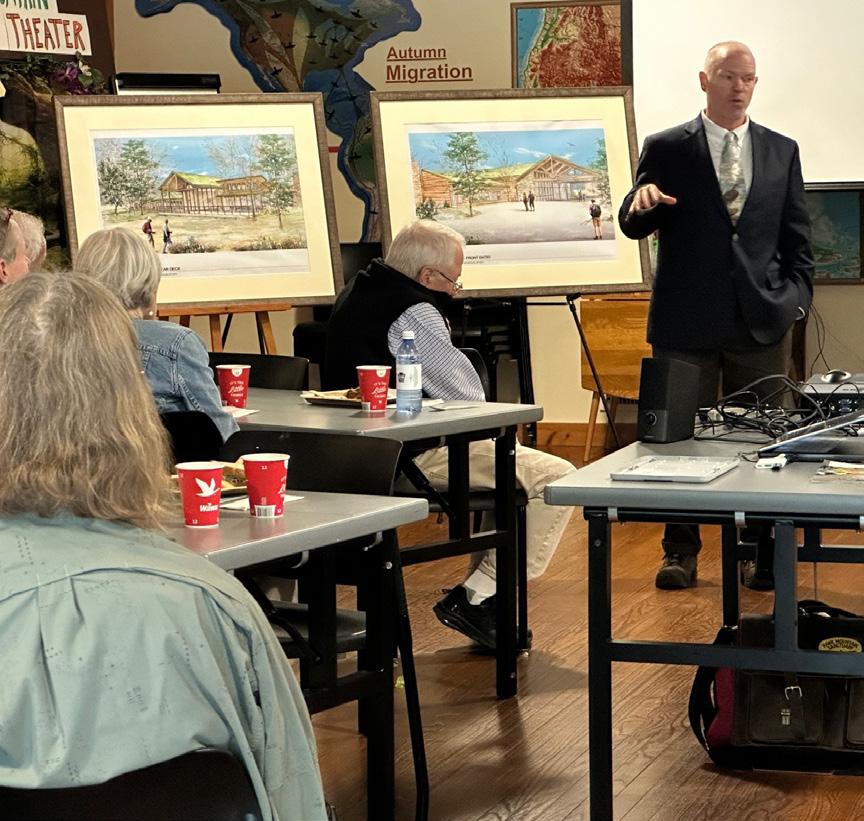
Exclusive Leadership Donors & Rosalie Edge Society Events:
Spring President’s Circle
Saturday, May 17 at 11 AM Education Building Invite only. Meet the President and staff, hear an investor’s update, and presentation. Complimentary brunch buffet. Make it a day and visit the Native Plant Sale.
Autumn President’s Circle Sunday, September 9 at 11 AM Education Building Invite only. Meet President Sean Grace, hear an investor’s update, and enjoy a presentation on one of our special projects or programs. Complimentary brunch. Make it a day and visit the lookouts or purchase a ticket for the Gabriel Chamber Ensemble at 2 PM.

Members of the Rosalie Edge Society have made an investment of $25,000 or more through a planned gift, a gift today to an endowment, or to support the Visitor Center Capital Campaign. Their support ensures that the legacy of Hawk Mountain endures for generations to come.
MOUNTAIN FRIEND
Helen Weaver
By Laura Berry
When asked about her first memory of Hawk Mountain, Helen Weaver could not recall.
“Well, I have lived here most of my life, so I’ve certainly known the Mountain within my backyard,” says the long-time resident of Albany Township.
As an avid birder and with Hawk Mountain so close, it is no surprise that Helen found herself at North Lookout more than a few times, spending mornings on the search for migrating warblers with her local birding club and traversing the trails with her young family. Despite loving nature and the outdoors, Helen didn’t get to the Mountain as much as she would have liked to, something she vowed to do in her retirement.
“I had made up my mind that I wanted to volunteer somewhere. I wanted to feel useful and continue with something.”
In 1997, Helen set out to find the perfect place to volunteer her time. And what better place than with her neighbors on the Mountain?
June Trexler, long-time volunteer and beloved friend, first began bringing Helen with her to put together the Hawk Mountain mailings. Having worked in an office for many years, Helen was the perfect fit.
Today, Helen still makes the trek over 25 years later to stuff envelopes at the request of a different Trexler, Annie, June’s daughter and Hawk Mountain’s Development Assistant. Helen also helps with bookstore inventory and puts her birding skills to good use with Project Feederwatch, a community science effort led by the Cornell

Lab of Ornithology and Birds Canada. Hawk Mountain hosts volunteers twice a week from November to April to man the feeder windows of the Visitor Center, recording how many individuals of each species visit.
When asked of her favorite memory on the Mountain, Helen paused in reflection.
She paints a picture of an early morning hike to the Lookout, coming out of a darkened forest at daybreak when the rosy sun is still just peaking over the trees and the forest is bathed in birdsong. Something just as beautiful is the way she describes the friendships she has made over the years.
“Everybody always has a smile, and I just feel that everybody is a friend. We are surrounded by nature and other nature lovers, and it’s a relaxing place to be in that way.”
Helen is a stellar volunteer, but she is also a good neighbor and friend. People like Helen strengthen our Hawk Mountain community with their presence and a smile.
We rely on volunteers to assist in the day-to-day happenings of the Sanctuary and would love to find a space for you on our team. If interested, contact Tammy Jandrasitz at jandrasitz@hawkmountain.org.
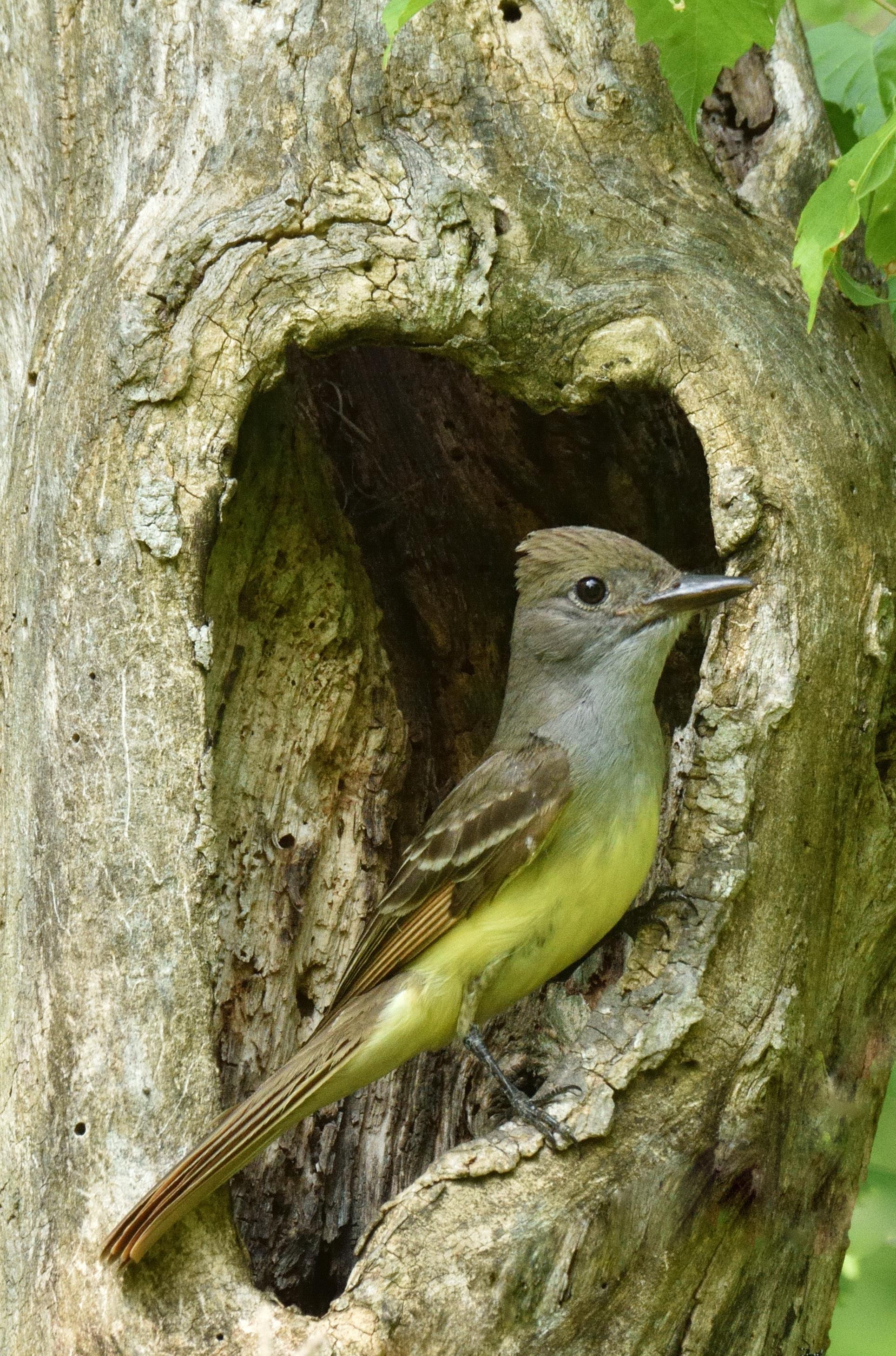
TALE WIND
Great Crested Flycatcher at Nest Cavity by Bill Moses