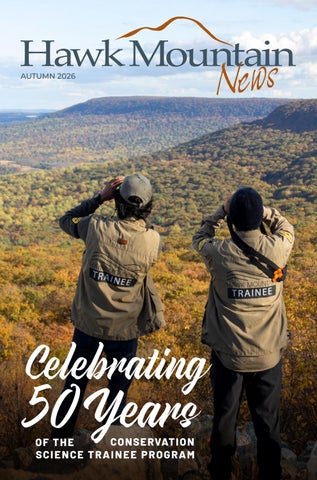
AUTUMN 2026
Celebrating
50 Years
C ON S E RVAT I ON OF T H E SCIENCE TRAINEE PROGRAM
MISSION STATEMENT
The mission of Hawk Mountain Sanctuary Association is to conserve birds of prey worldwide by providing leadership in raptor conservation science and education, and by maintaining Hawk Mountain Sanctuary as a model observation, research, and education facility.
Photo by Will Harvey
CONTENTS
2 TOP OF THE MOUNTAIN
39 FINANCIALS & ACCOUNTABILITY
4 NEWS & NOTES
40 MOUNTAIN FRIENDS
Conservation Community
6 RIDGE CURRENTS
The Future of the Visitor Center New Staff Project Soar Recipients Stewardship Project Updates
12 APPALACHIAN TRAILS Fungal Biodiversity
16 FIELD NOTES
Research & Field Work Updates Raptors of South America Project PA Bird Atlas Halfway Update
20 COMMUNITY SPOTLIGHT
2025-2026
Archive Volunteers: Fred Johnson & Erin Allen
AUTUMN 2026 NUMBER 145
WITNESS THE
MIRACLE OF MIGRATION Autumn Hawk Watch held daily through December 15
22 IN FLIGHT
Farmland Raptor Research with Brandon Brogle
24 SPRING REPORT
Spring Migration Summary From the Nature Notes
26 SCHOOL IN THE CLOUDS
Education Updates Spring & Summer 2026 Education Trainees
29 ON THE WING
Spring 2026 Conservation Science Trainees
32 UP & COMING CONSERVATIONIST Mercy Melo
36 HAWK MOUNTAIN HAPPENINGS Autumn Lecture Series Upcoming Fall Events
38 LEAVE A LEGACY
Ed Baldrige and Lydia Panas
Photo by Bill Moses
COVER PHOTO by Laura Berry
TOP OF THE MOUNTAIN
GROWING THE CONSERVATION COMMUNITY Hawk Mountain has only intensified its dedication to conserving raptors globally since its inception in 1934. Raptors are the most regularly seen apex predators in the natural world that are admired for their beauty, hunting skills, and wildness in the areas where we live. Everyone that works at Hawk Mountain in their various roles makes meaningful contributions to our organization, and we are supported by a large and dedicated board. As Members, you are part of that success story, like our scientists, educators, and Sanctuary stewardship team. We are all part of the Hawk Mountain conservation community. Hawk Mountain has maintained its core programs including the spring and fall raptor counts, while increasing the amount of regional raptor conservation in the surrounding area. This includes an intensive kestrel nest box monitoring program, work with black and turkey vultures, and local broad-winged hawks. The education and stewardship work have also expanded exponentially in recent years. We have the most comprehensive forest breeding bird surveys of any organization in Pennsylvania, and we have expanded into farmland raptors that include the northern harrier, barn and short-eared owls. Over the last several years 2 A U T U M N 2 0 2 6 • H A W K M O U N TA I N . O R G
we have worked in collaboration with DCNR and PA Game Commission to expand raptor counts at additional counts sites along the Kittatinny Ridge. Hawk Mountain saw an opportunity to train people around the globe about raptor conservation through our trainee program, now in its 50th year. The trainee program has 542 graduates, from 77 countries around the globe. Many finish master’s degrees and PhD’s about raptor species around the globe and go on to write peer reviewed scientific papers appearing in leading raptor conservation journals. Studies include migratory sawwhet owls, the circumpolar population of snowy owls, work with arctic peregrine falcons and rough legged hawks. Many of our collaborators hail from Africa, studying the most critically endangered raptors of all, the Old World vultures coming under significant peril in the last 25 years. Today Hawk Mountain is leading the third Bird Atlas project here in Pennsylvania, a five-year study on the population trends of all birds in the state. We have helped inspire and found a variety of sister raptor conservation organizations that do great work and are key collaborators with other projects, like the Raptor Population
STAFF PRESIDENT
DEVELOPMENT SPECIALIST
DIRECTOR OF CONSERVATION SCIENCE
BUSINESS MANAGER
Sean Grace
Sarah Schaeffer
Laurie Goodrich, Ph.D.
SENIOR SCIENTIST AND GRADUATE STUDY DIRECTOR SENIOR RESEARCH BIOLOGIST
CHAIR
BIOLOGIST-NATURALIST
VICE CHAIRMEN
RESEARCH BIOLOGIST
Rebecca McCabe, Ph.D.
ACOPIAN CENTER OPERATIONS COORDINATOR Wendy Nicodemus
DIRECTOR OF EDUCATION Megan Roselli
PRESIDENT
Beth Hucker David Bonenberger Jeff Weil
TREASURER
Edwin Baldrige
SECRETARY
Wendy McLean, Esq.
EXECUTIVE COMMITTEE
EDUCATOR AND RAPTOR CARE SPECIALIST Jessica Gary Dan Jenkins
EDUCATOR
Andrea Drumbore
DIRECTOR OF STEWARDSHIP Todd Bauman
SANCTUARY STEWARD Stephen Wade Noah Rauch Hunter Marton
Sean Grace
Mary-Therese Grob
BOARD
Bracken Brown
Yours in Conservation,
BOOKSTORE MANAGER
Jean-François Therrien, Ph.D. David Barber
Index; a snapshot of raptor populations across North America. I know in my heart that Hawk Mountain is an outstanding conservation organization, built upon the work and support of a unique community of dedicated people helping create a healthier world for raptors and people. Thank you for your support!
Shelley Davenport
DIRECTOR OF DEVELOPMENT Mary Linkevich
DIRECTOR OF MEMBERSHIP
Tammy Jandrasitz
COMMUNICATIONS SPECIALIST Gigi Romano
DEVELOPMENT AND COMMUNICATIONS OUTREACH COORDINATOR
Jacquelyn Bonomo Lorin Basden Arnold, Ph.D. Peter Bennett Ana Maria Castaño George Cauffman Deborah Edge, M.D. Jeff Goldenberg Richard W. Holt Diane Husic, Ph.D. Ernesto Ruelas Inzunza, Ph.D. Nasreen Kara Jim Lefik Holly Merker David Middleton Sara Nicholas Sally O’Byrne Dan Rubenstein, Ph.D. Scott Weidensau Minturn Wright, III Emeritus Member
Laura Berry
DEVELOPMENT ASSISTANT Annie Trexler
PRINTING • ALLEGRA LEHIGH VALLEY DESIGN • CHELSEA GASSERT
A U T U M N 2 0 2 1 • H A W K M O U N TA I N . O R G 3
NEWS & NOTES
FROM SANCTUARY TO SCREEN Stewardship Team members Todd Bauman, Noah Rauch, and Brandie Garner collaborated with Kutztown University alumna and filmmaker Chayse Ehlenberger on A Sanctuary Year, A Sanctuary Life, a documentary celebrating conservation, stewardship, and the deep connection between people and the natural world. The film, which follows Todd’s more than three decades of stewardship at Hawk Mountain, premiered privately at Kutztown University on June 18 to an audience of more than 200 Hawk Mountain community members.
Hawk Mountain Stewards Noah Rauch and Brandie Garner, along with longtime volunteer Lisa Kahn-Schnell, created the short film Cerulean, which was selected for Creature Conserve’s Re-Inhabiting Conservation: Bringing Wildlife Closer to Home exhibition at GoggleWorks in Reading. The exhibition was the third and final installment in a series exploring new approaches to conservation through art. Cerulean was also selected to be featured in an eco-conspiracies exhibition in Denver, Colorado, which explores connections between people and plants through art, conservation, and community-based efforts.
CONSERVATION COLLABORATION Hawk Mountain continues to strengthen its role in Kittatinny Ridge conservation by once again coordinating several hawkwatch sites along this important migratory corridor. Throughout the fall migration season, these sites will be staffed by trained hawk counters who collect valuable data on migrating raptors, with occasional visits from Hawk Mountain educators who help connect visitors with the science and spectacle of migration. This summer, the Sanctuary also hosted the annual Kittatinny Roundtable, bringing together hawkwatchers, conservation partners, and ridge stewards to share updates, discuss challenges, and collaborate on protecting one of the most significant raptor migration pathways in eastern North America. 4 A U T U M N 2 0 2 6 • H A W K M O U N TA I N . O R G
POWERING THE FUTURE Hawk Mountain’s solar project has moved forward, with a small field of solar panels being installed next to the Acopian Center for Conservation Learning. Infrastructure is expected to be complete by the end of summer, with the system coming online following required inspections. Once installation and setup are complete, the Stewardship Team will begin implementing plans to plant native species around and beneath the panels, creating additional habitat alongside the Sanctuary’s renewable energy efforts.
HISTORY ON THE RIDGE A new exhibit in Hawk Mountain’s Visitor Center Gallery invites visitors to explore the rich human history of the Kittatinny Ridge through a display titled “Tracks Through Time: The Changing Communities of Hawk Mountain and the Kittatinny Ridge.” Featuring dozens of archaeological artifacts, the display highlights the people who have lived, worked, and traveled through this landscape, including the Lenape people who crafted pottery and stone tools through flint knapping and the later colonial communities that shaped the region through trade and industry. Visitors can explore examples of Lenape pottery, flint artifacts, and a wide variety of glass, ceramic, and metal materials uncovered near an early 1700s stone cottage along the nearby Little Schuylkill River. The exhibit was made possible with support from Audubon Pennsylvania, the Kittatinny Ridge Conservation Landscape, and the Hawk Mountain Chapter 31 of the Society for Pennsylvania Archaeology.
BIRDING BEYOND BORDERS After completing their postdoctoral research in the United States, ornithologists Emi and Fer López are continuing their journey across the Americas in their motorhome, sharing stories of birds, biodiversity, conservation, and plenty of adventures through their Et Al Blog. Recent travels have taken them through California, where they explored some of the state's iconic birding destinations and searched for the critically endangered California condor before continuing north. Along the way, they are attempting to conduct the world's longest vulture survey, documenting observations through eBird while connecting with local birders, researchers, conservation organizations, and fellow Hawk Mountain trainee alumni. Follow their latest adventures and field updates at etalblog.com and across social media. A U T U M N 2 0 2 6 • H A W K M O U N TA I N . O R G 5
RIDGE CURRENTS
Future THE
OF HAWK MOUNTAIN
There’s never been a more exciting time to be part of the Hawk Mountain family, and as a member and supporter, you are with us on an important journey.
engaging exhibits, gathering spaces, and improved amenities that better connect people to the Sanctuary and the conservation work taking place here every day.
For more than 90 years, the Sanctuary has inspired thousands of people while advancing raptor conservation globally. Now, we’re preparing for the next chapter in that legacy: the construction of a new Visitor Center designed to advance our mission and better serve future generations.
Why now?
The new facility will be fully ADA accessible, welcoming, and energy-efficient, with
Because Hawk Mountain has grown. Today, our scientists conduct research across continents. Our educators reach thousands of students annually. Our award-winning stewardship team manages one of the most important forested landscapes in Pennsylvania. And our visitors come from across the region and around the globe seeking meaningful experiences in nature. Our new facility will allow us to share our story more effectively, welcome more visitors, and inspire even greater conservation action. And it’s happening soon. This time next year, we’ll be in transition, serving you out of temporary space as we bring the vision to life. Be sure to visit this fall to see and experience Hawk Mountain one more time before our transition.
Vaulted ceilings frame soaring raptor carvings 6 A U T U M N 2 0 2 6 • H A W K M O U N TA I N . O R G
Join the Journey
We need your help! We are $3 Million shy of a $13 Million goal, but in this uncertain financial climate, it is imperative we press on and complete the work now. We have schematics in hand, construction documents underway, and clean-out, storage, and temporary workspace plans are ongoing.
Aerial view, green features including solar panels
There’s never been a better time to bring a friend, increase your support, or make a transformational gift to this important campaign. Together, we will build the future of conservation while protecting one of Pennsylvania’s most cherished natural places. We hope you’ll be part of what comes next. Existing Visitor Center noted in red
SUPPORT THE FUTURE Contact us today about making a gift and learn more about remaining naming opportunities: Sean Grace, President grace@hawkmountain.org 610-756-6000 x213
Mary Linkevich, Dir of Development linkevich@hawkmountain.org 610-756-6000 x212 A U T U M N 2 0 2 6 • H A W K M O U N TA I N . O R G 7
RIDGE CURRENTS
GROWING OUR TEAM: WELCOME
HUNTER MARTON AND SARAH SCHAEFFER Hawk Mountain Sanctuary continues to grow its team and strengthen the work behind its mission with the recent addition of two new staff members. Hunter Marton joins the Stewardship team as Sanctuary Steward after two successful seasons as a seasonal employee, while Sarah Schaeffer joins the Development team as Development Specialist. Together, they bring valuable field knowledge, communications experience, and a shared passion for conservation to two important areas of the Sanctuary.
HUNTER MARTON
After two successful seasons as a Seasonal Steward, Hunter Marton has joined Hawk Mountain full-time as a Sanctuary Steward, becoming the newest member of the Stewardship team. Hunter first came to Hawk Mountain in 2024, quickly establishing himself as an invaluable member of the land management crew. His strong work ethic, field botany knowledge, and dedication to stewardship made him a natural fit for a full-time Sanctuary Steward position. Hunter's passion for conservation began through a fascination with local ecosystems and the plants and wildlife that inhabit them. Countless hours spent observing nature led to a deep appreciation for native plant gardening, habitat restoration, and sustainable land management. During his time at Hawk Mountain, he has continued to expand his knowledge of native ecosystems and best management practices while helping care for the Sanctuary's more than 2,600 acres of protected forest and trails.
SARAH SCHAEFFER
Hawk Mountain recently welcomed Sarah Schaeffer as Development Specialist, bringing valuable communications and nonprofit marketing experience to the Development team. A Reading, PA native, Sarah grew up visiting Hawk Mountain, where the Sanctuary and the Kittatinny Ridge helped inspire her lifelong passion for birds and avian conservation. She now returns in a professional role dedicated to advancing the organization's fundraising and development efforts. Sarah earned a bachelor’s degree in graphic design from Cairn University and spent over two years working in nonprofit marketing and communications. Her experience includes an internship with the Brandywine Conservancy & Museum of Art and a full-time position at Cairn University, where she supported successful fundraising and admissions campaigns while improving digital engagement. She looks forward to combining her communications and campaign background with her passion for conservation to help connect supporters with Hawk Mountain's mission. 8 A U T U M N 2 0 2 6 • H A W K M O U N TA I N . O R G
PROJECT SOAR: INVESTING IN CONSERVATION LEADERS AROUND THE WORLD The Benjamin Olewine IV Project Soar Awards continue to turn Hawk Mountain’s global trainee network into lasting conservation impact. This year, seven awards supported projects in six countries across five continents, engaging hundreds of volunteers and reaching thousands of people through research, education, community outreach, and wildlife conservation efforts. In Colombia, 2022 trainee Yhon Gómez examined birdwatching as a conservation and economic tool across Latin America. His review of more than 2,200 scientific publications found that bird tourism can support protected areas, encourage citizen science, and create income for local communities. His work also identified important gaps in understanding the economic value of birdwatching and the potential role of migrating raptors in attracting visitors. In Belize, 2024 trainee Mathew Sacul is working to unravel one of the mysteries surrounding the hook-billed kite. Nearly 5,000 of these elusive raptors pass through southern Belize each autumn, yet little is known about where they breed or spend the rest of the year. Project Soar funding is helping Mathew conduct field surveys and launch the first GPS-tracking study of the species. In Türkiye, 2006 trainee Lale AktaySözüer and her team completed 52 days of fieldwork across 30 provinces, documenting 890 Egyptian vultures and identifying potential new breeding areas. The project combines research with community outreach to address threats including habitat changes and traditional raptor hunting.
South America is also home to several Project Soar projects. In Argentina, two Project Soar recipients are studying how raptors respond to changing environments. 2022 trainee Paula Orozco Valor monitored 203 chimango caracara nests and banded more than 270 birds, generating new insights into breeding behavior, communication, and how this adaptable species responds to urbanization. Meanwhile, 2023 trainee Natividad AguileraAlcalá surveyed 44 areas across the Pampas, documenting 17 raptor species and identifying concerning declines in Swainson’s hawks associated with changing agricultural practices. In Chile, 2024 trainee Javier Medel documented how migrating raptors use the gradual slopes of Andean volcanoes to take advantage of favorable winds and thermal conditions. His surveys also revealed volcanic forests as important stopover habitat, identifying previously unrecognized migration corridors and habitats important for conserving migratory birds. Finally, in The Gambia, trainees Mawdo Jallow and Momodou Dibba responded to mass poisonings that killed 67 critically endangered hooded vultures. Their work combined emergency response, official training, community education, road surveys, and long-term monitoring to strengthen protection for vultures nationwide. Together, these projects demonstrate the global reach of Project Soar and Hawk Mountain’s commitment to supporting conservation leaders long after their traineeship ends.
A U T U M N 2 0 2 6 • H A W K M O U N TA I N . O R G 9
RIDGE CURRENTS
BOOTS ON THE GROUND: STEWARDSHIP PROJECTS STRENGTHEN FORESTS, HABITAT, AND EDUCATION From improving wildlife habitat to expanding educational spaces and maintaining hiking trails, Hawk Mountain's Stewardship Team has been hard at work for the past few months on projects that strengthen both the Sanctuary's forests and the visitor experience. Forest regeneration remains a major focus of the Stewardship Team, with invasive species management playing a central role in stewarding the Sanctuary’s forests. The staff have been hard at work treating and hand-pulling invasive plants to reduce their spread and give native vegetation more
MEET OUR HARDWORKING SUMMER 2026 SEASONAL STEWARDS, ABIGAIL, ANNA, AND DANI 10 A U T U M N 2 0 2 6 • H A W K M O U N TA I N . O R G
opportunity to thrive. This spring, the team also completed construction of a new 2.5acre deer exclosure below Hawk Mountain Road, enclosing more than 1,000 feet of fencing. The area had previously undergone invasive species removal but showed little natural regeneration due to deer browsing. By excluding deer, the project creates conditions for native trees, shrubs, and forest herbaceous layer to recover naturally. The work was supported through the Natural Resources Conservation Service's Environmental Quality Incentives Program (EQIP), which also includes a commitment to plant and protect an additional 500 native trees and shrubs by the end of 2026. Behind the scenes, the team has made strides in forest management by adopting new technology to map and track species while planning for long-term stewardship. Staff are now using the OnX Backcountry GPS mapping platform to organize management activities across the Sanctuary. Steward Noah Rauch has begun developing detailed management units that document vegetation, invasive species, habitat features, monitoring objectives, and past management activities. This growing database will support more targeted forest restoration efforts and strengthen Hawk Mountain's integrated approach to invasive species management and habitat conservation.
Dani hand pulling invasive plants the timber with protective oil to extend its lifespan, and plans for the addition of an instructional table are underway. The department is also sharing its expertise with conservation professionals through the new Professional Land Stewardship Course Series. In June the inaugural workshop, Use of Rigging and Mechanical Advantage in Conservation, reached full enrollment and provided hands-on instruction for safely moving heavy materials during stewardship projects. Two additional workshops continue the series this year, focusing on invasive plant management and trail and forest road maintenance, and covering practical skills that help land managers improve habitat while maintaining safe and sustainable public access.
Documenting species Stewardship efforts are extending beyond the main Sanctuary site as well. Staff are finalizing a new EQIP grant to support ongoing meadow management at the Acopian Center for Conservation Learning. The funding will help control invasive plant species while expanding native wildflower plantings in the nearby Guers Meadow. By increasing the diversity of native flowering plants and extending the bloom period throughout the growing season, the project will provide enhanced habitat for pollinators and other beneficial wildlife. A new outdoor classroom adjacent to the Adirondack Shelters is among the latest projects completed by the Stewardship Team. Designed in collaboration with the Sanctuary’s Education Department, the space features rustic, tiered seating for up to 24 students and blends seamlessly into the surrounding forest. The classroom already served as an outdoor gathering place for summer nature camps, giving young learners an immersive setting to learn and explore. Stewardship staff will continue maintaining the space, including treating
Together, these projects reflect the Stewardship Team's multifaceted role at Hawk Mountain. Whether restoring native forests, enhancing pollinator habitat, building outdoor learning spaces, or training the next generation of land managers, the team's work helps ensure that the Sanctuary remains a healthy, resilient landscape for wildlife and people alike. Through thoughtful planning and hands-on conservation, these efforts support Hawk Mountain's mission to conserve birds of prey and the ecosystems on which they—and we—all depend. In the words of Hawk Mountain’s first curator and warden Maurice Broun, “Sanctuary, we mean it!”
Hunter planting trees A U T U M N 2 0 2 6 • H A W K M O U N TA I N . O R G 11
APPALACHIAN TRAILS
The
Kingdom
Beneath Our Feet Preserving Fungal Biodiversity at Hawk Mountain and the Appalachian Trail By Connor Zamora
Most people perceive the fungal kingdom through mushrooms, the fruiting body of a larger fungus. However, there are many species of fungi that don’t produce mushrooms. It is important that we protect all fungi to support the health of our local forests. This article will explore the fungi of Hawk Mountain and the Appalachian Trail, what is endangering them, and what you can do to help.
“root”). These fungi interact with tree roots, taking up sugars produced by the tree while providing nutrients and water that plant roots cannot access on their own. This relationship developed millions of years ago, and today approximately 80% of surveyed vascular plants have at least one known association with mycorrhizal fungi. Many plants would struggle—or possibly cease to exist—without this partnership.
Fungi sprout from within their many substrates from spores and explore their surroundings using single celled threads called hyphae. When hyphae begin to branch and intertwine with one another, they form what we call mycelium. Turn over any damp log in warm weather, and you will almost certainly find it: small white branching threads within the soil interacting with the underside of the log. Mycelium is the vegetative “body” of a fungus, and different species interact with the forest in different ways. Some are saprotrophic, meaning they thrive by consuming dead or decaying organic matter. In doing so, they return nutrients to the forest. Others are mycorrhizal (myco meaning “fungal” and rhiza meaning
In the summer of 2022, I had the pleasure of working with the Hawk Mountain Sanctuary Stewardship Team. At the time, I was only about a year into my fungal studies, but I already understood how instrumental fungi are to the survival of the forest where I was working. Out of pure curiosity (and a little obsession), I meticulously documented every species I found during my fieldwork on the Mountain. While helping remove invasive plants, I was constantly scanning the ground for organisms that most people would otherwise overlook. In just the three-month span that I worked with the Stewardship Team, I documented 112 individual species of macrofungi! Macrofungi are fungi visible to the naked eye because they produce mushrooms.
12 A U T U M N 2 0 2 6 • H A W K M O U N TA I N . O R G
The Oak Polypore (Fomitopsis pulvina) Among those 112 species, there was incredible diversity. Some were closely related, belonging to the same family or genus and others were evolutionarily distant, belonging to entirely different phyla or orders. This kind of diversity in an entire Kingdom of life is impressive, and deserves our attention. Notably, these were only the fungi I could see. There are hundreds more species toiling away within the soil and interacting with the trees on the Mountain that I could not see or document. Let’s explore a few particularly interesting macrofungi found in our area of the Appalachian Trail.
Fantastic Fungi of Our Section of the Appalachian Trail Our section of the Kittatinny Ridge is rich with fungal activity. There are many fascinating species in this area, but I want to focus on a few that stand out to me or are especially abundant in the area. A particularly common saprotroph of note is the Hemlock Varnish Shelf (Ganoderma tsugae). This fungus belongs to the same family as the medicinal Reishi mushroom and is often referred to as Hemlock Reishi. It thrives on decaying hemlocks and occasionally on other conifers such as fir and spruce. It often fruits high on dead trees while they’re still standing.
Because of this, many hikers walk right beneath it, unaware of its presence. It wastes no time breaking down the tree’s lignin. Lignin is what gives trees and their bark rigidity and protects them from other decomposers. Without fungi’s ability to decompose lignin, it would be incredibly difficult to decompose trees and large woody plants. This mushroom plays a vital role in helping our forests recycle nutrients, particularly nitrogen and phosphorus, back into the soil. Due to its association with the eastern hemlock and its abundance in our forests, it is also currently a leading candidate to become Pennsylvania’s state mushroom. Many consider saprotrophic fungi relatively easy to find, as there is no shortage of decaying matter in our forests. However, some saprotrophic fungi thrive only within very specific niches. The Oak Polypore (Fomitopsis pulvina), although on the rarer side, can be found in our region of Appalachia. This species has an affinity for very old, veteran oak trees. Due to habitat loss, deforestation, and its already small geographic distribution, it has been listed as vulnerable on the International Union for Conservation of Nature’s (IUCN) Red List. It’s worth noting that the IUCN has only done about 1,000 assessments of fungi, compared to about 80,000 assessments of plants. This fungus is an example of why we need to shift our focus to protecting fungi from endangerment, in addition to plants and animals. All of the fungi mentioned so far produce spores from specialized cell structures called basidia. These microscopic structures are found on the gills, pores, or teeth of the mushroom. Once the spores are produced, they are then carried away by the wind, or by some other means of transport.
Asian Beauty (Radulomyces copelandii). An invasive and abundant saprotroph. Photo by Rachel J. Ward
However, many mushroom-producing species create their spores differently. Members of the evolutionary group or phyla Ascomycota produce spores in sac-like structures called asci, which forcibly eject A U T U M N 2 0 2 6 • H A W K M O U N TA I N . O R G 13
APPALACHIAN TRAILS the spores once mature. The delicious morel mushrooms and the small, abundant cup fungi found here also belong to this group. One particularly fascinating Ascomycete found in our area is parasitic in its ecological role: Ophiocordyceps ravenellii. This species infects beetle larvae and grows its fruiting body from them. While it may sound like something from a horror movie, it plays an important ecological role by helping regulate beetle populations and returning nutrients from the insect’s hardy exoskeleton to the soil.
native flora. The Stewardship Team at Hawk Mountain works each year to combat this type of habitat degradation.
The trail is home to mycorrhizal macrofungi species as well. Among the most popular are the Amanitas. The Fly Agaric (Amanita muscaria), the iconic red-and-white spotted mushroom, belongs to this genus. In our region, a yellow variant of the Fly Agaric can be found fairly commonly. One of the most common Amanitas I encountered at Hawk Mountain was Yellow Patches (Amanita flavoconia). These mushrooms associate with a wide variety of trees and can exchange nutrients with multiple tree species simultaneously. Not all mycorrhizal fungi associate strictly with trees. Recent research suggests that some mushrooms, such as the Vermilion Waxcap (Hygrocybe miniata), may associate with certain grasses or mosses.
Humans can also inadvertently introduce fungal species from other continents. One of the most common fungi I encountered during my summer at Hawk Mountain was Asian Beauty (Radulomyces copelandii). This aggressive, potentially dangerous saprotroph appears as a crust-like patch on dead deciduous wood and produces iciclelike “teeth” that release spores. Native to eastern Asia, it began appearing in the United States around 2009. Another problematic species is the Golden Oyster (Pleurotus citrinopileatus), also native to Asia. This bright yellow mushroom is widely cultivated as a gourmet edible and has escaped cultivation. It now occurs in large flushes in the northeastern United States and along the Appalachian Trail. Research into invasive fungi is ongoing, as scientists work to determine their ecological impacts. These species may outcompete native saprotrophs for food, alter habitats for microbes and insects, or displace other native fungal communities. Until just 57 years ago, fungi were classified as lesser plants. Because many fungal species spend most—or all—of their lives underground and unseen, much about them remains unknown. While public awareness of fungi is growing, significant work remains if we are to preserve their vital role in our forests.
Threats to Our Fungal Biodiversity Fungal biodiversity faces numerous anthropogenic threats. One of the most significant is unchecked urbanization and habitat fragmentation. Deforestation for timber harvesting and infrastructure construction has been shown to significantly reduce fungal biomass in both soil and the air. Protecting local wildlands from unnecessary development is critical for human and forest health. Maintaining forest diversity is equally important. As humans unintentionally introduce invasive plant species, these plants can overpopulate and displace 14 A U T U M N 2 0 2 6 • H A W K M O U N TA I N . O R G
When invasive species form monocultures, they create degraded soils that support fewer native soil-dwelling fungi capable of forming mycorrhizal relationships. As a result, fungal abundance and diversity decline. A similar effect occurs in tree plantations where only one tree species is planted en masse. The lack of plant diversity significantly limits fungal diversity.
What Can You Do to Help? Support diverse native habitats.
Plant and animal biodiversity support fungal biodiversity. One major driver of fungal decline is the reduction in the diversity of plant–fungus interactions caused by monocultures and industrial agriculture. These hindrances can cause vulnerable or rare species to decline massively or be pushed out entirely (Banerjee et al., 2024). If you have a yard, try planting native plant species and removing invasive plants whenever possible. These native plants foster the growth of native and biodiverse fungi.
Participate in community science.
Join a local mycology club and document your observations. Apps like iNaturalist allow anyone to record fungal sightings. Observations are reviewed by other users, helping correct misidentifications and elevate accurate ones to research-grade status. Even simple documentation can provide researchers with valuable information about species distribution, habitat preferences, and growth patterns. Hawk Mountain and the surrounding Appalachian Trail are known for their diverse plant life, sprawling views, and bird migrations, but it’s also a treasure trove of diverse and fascinating fungal species. Without them, the forests that us, the birds, and the other wildlife enjoy would not be the same. So, I implore you to keep an eye out for them on your next walk in our wilderness. You’ll be surprised at what you can find once you know that they’re there. Preserving a diverse fungal landscape in our forests is imperative for their health. By supporting native habitats, being responsible stewards of the land, and contributing to community science, we can help the kingdom fungi continue to foster a healthy, thriving forest.
Chicken of the Woods (Laetiporus sulphureus) is a saprotrophic and edible fungus native to Hawk Mountain
A U T U M N 2 0 2 6 • H A W K M O U N TA I N . O R G 15
FIELD NOTES
CONSERVATION IN ACTION
2026 FIELD SEASON HIGHLIGHTS By Mitchell Pruit
From forest to field, Hawk Mountain’s Conservation Science team reports a productive 2026 field season with progress across multiple research projects. From long-term kestrel monitoring to expanding studies on northern harriers, vultures, broadwinged hawks, and Appalachian forest birds, this year’s work generated valuable data, strengthened and expanded partnerships, and advanced our understanding of the species and habitats we work to conserve. Mitchell and Conservation Trainee Ezra banding a kestrel chick
Notably, our Farmland Raptor Project has continued to expand. Work in the Chesapeake Bay Watershed, funded by National Fish and Wildlife Foundation and US Fish and Wildlife Service, has led to new partnerships with landowners through watershed restoration and the deployment of many new barn owl and American kestrel nestboxes. The number of active kestrel nests increased in the Chesapeake this year, while we patiently await more elusive barn owls to call one of our nestboxes home.
This year was on par with our historical average—60 active nests and 80% nesting success—and we banded more than 100 chicks! Our team has recently collaborated on a continental study revealing young kestrels to be at risk, declining at a rate mirroring the species’ ongoing population decline. We hope future research will shed more light on this mortality.
Our 70+ year kestrel project also reports a bountiful year. Since March, a crew of three staff, six trainees, and four graduate students monitored 140 kestrel nestboxes in our longterm research area near Hawk Mountain.
Thanks to support from PA DCNR’s Wild Resource Conservation Program and PA Game Commission, we’ve expanded work to another farmland raptor: the northern harrier, a species that is listed as threatened
16 A U T U M N 2 0 2 6 • H A W K M O U N TA I N . O R G
Trainees and staff erecting a kestrel nest box in a Cheseapeake Bay watershed in Pennsylvania. Our pilot season took wing when our team, assisted by Pennsylvania birdwatchers, hit the marshes and fields across the state to identify sites occupied by nesting harriers. Our team confirmed the first nest of the project and banded three nestlings while deploying a transmitter on an adult to understand habitat use and territory size. Our team and birdwatchers have identified at least 20 other locations where we can search for nests in future. In the forests, it was a busy spring and summer for the Broad-winged Hawk Project with the team continuing to search for and monitor over 20 nests in Pennsylvania, Connecticut, New Hampshire, and Vermont. And this year, the project expanded west of the Great Lakes and partnered with Hawk Ridge Bird Observatory in Minnesota. In July, we successfully trapped and banded four nesting broadwings in Minnesota, three of which we are now tracking with GPS-GSM transmitters. It has also been a productive year for our vulture research, studying nature’s cleanup crew. In Pennsylvania we monitored two turkey vulture nests and in a four-state area, 15 black vulture nests, including the first documented nesting attempt in New Hampshire. As of mid-July, we tagged three nestlings and seven adult black vultures at a local roost. The adults are part of a delayed
release experiment, which we hope to use as a non-lethal way to disperse roosts where vultures congregate in undesirable locations. So far, no birds have been resighted at the roost, and one has been resighted 137 miles away in Maryland! Finally, 2026 marked our 45th year conducting breeding bird censuses at Hawk Mountain. This important data allows us to understand the biodiversity of our ever-changing Appalachian forest ecosystem. Staff and trainees conducted 11 early morning counts on each of two plots and recorded a total 47 species. Among our most abundant species this year were ovenbird, red-eyed vireo, and the dazzling scarlet tanager, a species that Pennsylvania’s forests alone support 13-17% of the world’s population. These projects demonstrate the value of long-term research combined with new partnerships and emerging conservation priorities, and this work wouldn’t be possible without our supporters, partners, and community members, including those who contribute by reporting wildlife sightings. From protecting working farmland to monitoring healthy forests, Hawk Mountain’s Conservation Science team continues to work with the community to guide effective conservation across the region and beyond.
Banded northern harrier fledglings. Photo by Bracken Brown
A U T U M N 2 0 2 6 • H A W K M O U N TA I N . O R G 17
FIELD NOTES
RAPTORS OF SOUTH AMERICA BOOK PROJECT:A TWO-VOLUME REFERENCE By Matías A. Juhant
My fascination with birds began when I was very young, around nine years old. Growing up in Argentina, there was very little information available for a child who wanted to learn about birds. Books were scarce, the internet did not exist as we know it today, and learning depended largely on your own curiosity. Looking back, I believe that this lack of information made me even more determined to discover things for myself. As a teenager, I bred pigeons on my parents’ rooftop terrace and kept songbirds in cages. One morning, while feeding the songbirds, I noticed a male American kestrel trying to catch one of them through the cage. Instead of chasing the kestrel away, I stood still and watched its behavior. I was only 15 years old, but that brief encounter sparked a lifelong passion. From that day on, I was determined to learn everything I could about raptors, although finding reliable information in those days was far from easy. I formally began studying raptors when I was 17, attending a raptor biology course taught by the late Sergio H. Seipke, a former Hawk Mountain trainee. He immediately recognized my enthusiasm for raptors and took me under his wing. For many years, we shared ideas, discussed identification challenges, and exchanged insights on age-class assignment based on direct observations. Until the final stage of his life, we developed our own language for talking about these creatures. 18 A U T U M N 2 0 2 6 • H A W K M O U N TA I N . O R G
This project has lived in my mind since those early years and throughout my academic career. For more than two decades, I have photographed every raptor species I encountered, carefully organizing each image by species, age, plumage, locality, and season. Today, that archive contains more than 100,000 photographs representing over 25,000 individuals from across South America. What began as personal curiosity has grown into one of the largest photographic collections of South American raptors ever assembled. The inspiration behind this twovolume reference is simple. Despite the extraordinary diversity of South American raptors, comprehensive resources for accurately identifying many species, particularly across age classes, remain scarce. I also know this project will continue to teach me. Every expedition, photograph, and observation offers a new opportunity to better understand these magnificent birds. I invite you to follow this journey and, if this project inspires you, to consider supporting the fieldwork that will make it possible. Between 2026 and 2030, I will spend 35 months conducting fieldwork across the entire South American continent and its remote island territories. This extraordinary commitment reflects the time, effort, and financial resources required to bring this knowledge to the world.
HELP CONSERVE PENNSYLVANIA’S BIRDS: UPDATES ON THE PA BIRD ATLAS By Amber Wiewel, PA Bird Atlas Coordinator
We are midway through data collection for Pennsylvania’s Third Bird Atlas (PBA3), a collaboration between the Pennsylvania Game Commission and Hawk Mountain Sanctuary! The project began on January 1, 2024, exactly 20 years after the launch of the Second Atlas of Breeding Birds in Pennsylvania. The goal of the PBA3 is to count and map the approximately 215 species of birds breeding and wintering in the Commonwealth and to document changes to their populations. At the halfway point of the Atlas, more than 3,000 birders have contributed over 490,000 birding checklists, confirmed breeding in 180 species across the state, and collected data on 53 conservation priority species. Data from the project, which runs through early 2029, will provide an invaluable resource for conservationists, researchers, and birders alike. Findings will inform land management, environmental assessments, and recovery plans for at-risk species. Data collection involves surveying 3-by-3 mile blocks throughout the state and recording the presence of wintering birds from December through February and evidence of nesting for all species that breed in Pennsylvania. This enormous endeavor is achievable only through the participation of Pennsylvania’s birders. We invite everyone interested in the state’s avian species to support
Bird Photos by Bill Moses
the PBA3. Birders of all skill level are encouraged to submit their birding observations through early 2029. Visit the PBA3 website at ebird.org/atlaspa to find out how to collect and submit data via the Pennsylvania Bird Atlas project in eBird, or make a donation via Hawk Mountain’s website to support the ongoing data collection and analyses.
Gray catbird
Bobolink
Tufted titmouse
Wood thrush & fledgling
Community Benefit for the Birds
Music on the Mountain, Berks Sinfonietta
A Screening of Chayse Ehlenberger's Documentary, A Sanctuary Year, at Kutztown University
Meadow Mixer
Education Trainees
Spotlight
Country Meadows Senior Living Field Trip
Kestrel Nestbox Visit with Board Chair Beth Hucker
Conservative Science Trainees
Pat Perfect and Sanctuary Staff
Screech Owl Banding
Outdoor Children's Program with the Education Trainees
IN FLIGHT
Following my
Flight Path from Fields to Flyways By Brandon Brogle
In the wake of a changing world, my formal introduction to raptors began at the North Lookout as a conservation science trainee in fall 2020. Instantly I was hooked. For the next six years I continued to work with raptors in some capacity, primarily as a migration counter during autumn at Waggoner’s Gap in Pennsylvania and in spring at New York’s Derby Hill Bird Observatory. As each season passed, my interest in birds of prey grew and eventually brought me back to the Sanctuary in spring 2025 as an assistant for the current farmland raptor expansion into the Chesapeake Bay watershed and as a fall count assistant along the Kittatinny Ridge. For the past two springs and summers, the Farmland Raptor Project team has enjoyed raising awareness and increasing nesting availability for American kestrels and barn owls in Lancaster and neighboring counties. In early spring, with the help of our project partners, we identified and approached local landowners for box installations. As kestrels began to prospect for nesting sites in late spring our work shifted from installation to monitoring our 65 kestrel boxes and 30 barn owl boxes. It was absolutely thrilling whenever we checked a box and found kestrel eggs inside! Once fledging season rolled around, we changed gears again from monitoring to banding and rewarded our successful farmland 22 A U T U M N 2 0 2 6 • H A W K M O U N TA I N . O R G
Brandon banding kestrel chick raptor hosts with an up close and personal encounter with their new kestrel tenants. As summer turned to fall and young birds explore the landscape for the first time, it became time to head to the lookouts and conduct the annual migration count. Last autumn, with the help of additional partners, we were able to provide educational materials and count assistance to six sites along the Kittatinny. It was pleasure to bring the count to more people in Pennsylvania and connect them with the magic of seasonal change. Inspired to learn more about how habitat restoration can help our farmland raptors, I enrolled into Shippensburg University as a graduate student in fall 2025. My research is focused on American kestrel chicks and how their physiological development changes in response to landscape, especially
when located nearby habitat restoration. A critical component of this work is plasma metabolites, which are intermediate products found in blood that represent biological processes. The concentration of certain molecules can therefore give us an immediate snapshot of the health of the individual sampled and can even be predictive of their future condition. The post-fledging period can be a very stressful time in a young bird’s life and may be dependent upon the quantity and quality of the food that they receive during their development. Towards the end of a kestrel’s development within the box, growth slows, and excess energy is converted to stored fats to assist with potential food stress post-fledging. An important suite of metabolites to assess during this period would be representative of their energetic state: triglycerides and beta-hydroxybutyrate. If prey availability or quality is higher in restored areas, we should expect to see chicks with access to these areas in better energetic condition than those with limited or no access to habitat restoration. By sampling triglyceride and betahydroxybutyrate at two different times in development, we can determine if kestrels are in an energetically positive or negative state. Since each kestrel sibling experiences the same landscape, that of their parent’s territory, we can pool sibling data together to create average rates of change for their metabolites and mass. This way we can determine one way landscape, or land cover type, may impact kestrel physiology. After I defend my degree in spring 2027, I plan to reconnect with the sky and study how raptors navigate through the atmosphere during their annual migrations. Weather is a major driver for the volume of raptors observed from a count site, and shifting conditions locally, or aloft, may impact the number or detectability of migrants passing a lookout each season. During migration, migrants respond rapidly to changing weather and alter their flight style accordingly. In recent years, especially in the northeast United States, our changing atmosphere has threatened the overall count of migrants, and some
historically important sites may be at risk. By understanding how regional flight behavior changes in response to modern weather, we can model species populations more precisely if shifts in phenology or migratory routes are underway. In the future, I hope to explore and model this aerial landscape through a raptor’s eye view. My time so far in the Hawk Mountain network has been fantastic. Not only have I been able to expand my analytical toolkit and conduct research, I’ve also been able to connect with people from all walks of life, with friends new and old, and with passionate biologists locally and globally. These combined experiences have forever changed how I view the world we share, and without your support, none of this would have been possible. Thank you!
Installing a nesting box
Teaching landowner's children A U T U M N 2 0 2 6 • H A W K M O U N TA I N . O R G 23
SPRING MIGRATION REPORT
2026 Spring Migration Summary By David Barber, Senior Research Biologist
Overcast skies and light northwest winds greeted the trainees on April 1, the first official day of the count. A Cooper’s hawk winging out of the south was the first bird of the day, followed by three sharp-shinned hawks, two more Cooper’s hawks, three red-tailed hawks, and an American kestrel. Overall, trainees counted 658 migrating raptors of 13 species in 253 hours over 44 days. Rain and fog stalled the count for the next two days, setting up a great flight for the 4th; season high counts of seven northern harriers, 10 sharp-shinned hawks, six Cooper’s hawks, and seven American kestrels were recorded. Flights of bald eagles peaked at the end of the first week with six eagles tallied on the 6th and seven on the 7th. A high stream of broad-winged hawks was spotted late morning on the 14th with 64 broadwings counted between 11 a.m. and 12 p.m., and 89 broadwings were tallied by the end of the day, a season high. Broad-winged hawk flights continued through April with another peak of 34 counted on the 23rd. The first non-raptor migrants were recorded during the first week of the count with a tree swallow and an eastern phoebe seen on April 6. A winter wren was heard around the lookout from mid-April through the first week in May, and the first ovenbirds were heard on April 24 singing their “teacher, teacher, teacher” song from the woods. Raptor migration continued through May 15, but in lower numbers. An immature peregrine falcon was recorded on May 11, one of only two peregrines observed this spring. The count ended with a red-tailed hawk moving north mid-afternoon on the 15th.
Overall, this year’s spring count was 31% below the 10-year average due in large part to low counts of broad-winged hawks, which is our most abundant spring migrant; their count was 45% below average. Other species with below-average counts include turkey and black vultures and red-tailed hawks. Hawk Mountain wasn’t alone—other migration watch sites in Pennsylvania also experienced low broadwing and redtail counts. On the positive side, seven species had aboveaverage or average counts including northern harriers and bald eagles, which were 22% and 20% above average, respectively.
NORTH LOOKOUT – SPRING 2026 Raptor Migration Count March 20 to May 15
Species Black Vulture Turkey Vulture Osprey Bald Eagle Northern Harrier Sharp-shinned Hawk Cooper’s Hawk American Goshawk Unidentified Accipiter Red-shouldered Hawk Broad-winged Hawk Red-tailed Hawk Rough-legged Hawk Unidentified Buteo Golden Eagle Unidentified Eagle American Kestrel Merlin Peregrine Falcon Unidentified Falcon Unidentified Raptor TOTAL RAPTORS
Season 2 12 57 62 25 63 44 0 6 5 271 44 0 12 0 0 25 3 2 3 22 658
Peak 1-Day 10 yr Avg 2 18 8 64 6 54 7 51 7 21 10 68 6 30 0 <1 3 10 2 5 89 497 6 62 0 0 3 16 0 2 0 1 7 24 1 6 1 2 1 3 3 20 95 951
WE THANK THIS SEASON’S COUNTERS: Conservation Science Trainees: Eli Hevalow, Alyona Kaptyonkina, Diolinda Mundoza, Ezra Murray, Lauren Stanfa, Zach Underwood Staff: David Barber, Bracken Brown, Laurie Goodrich, Rebecca McCabe Volunteers: Morrison, 24 A U T U M N Rob 2 0 2 6Feldman, • H A W K MScott O U N TA I N . O R G Andy Price, Andy Wlasniewski, Matt Wlasniewski
FROM THE NATURE NOTES
Brown C Photo b reeper, y Bill Mo ses
le, Box Turt kevich in L ry a M hoto by
P
Oriole, Baltimore Moses ill B y Photo b
k, strea Hair Moses l a r Co Bill to by Pho Five-Lin e Photo b d Skink, y Bill Mo ses
As the Sanctuary awakened from winter, the first signs of spring arrived in familiar ways. March brought the return of waterfowl overhead, while brown creepers continued their search for insects along tree trunks. Wood frogs, spotted salamanders, and common grackles announced the changing season, and an eastern phoebe was heard singing near the Visitor Center. Along the trails, garter snakes gathered in mating groups near the Post 3 junction, and the vibrant shining fir moss added color to the forest floor.
May filled the forest with activity. A porcupine was spotted high in a tree near South Lookout, while box turtles made their way near the garden and the River of Rocks. Scarlet tanagers, rose-breasted grosbeaks, blue-gray gnatcatchers, Baltimore orioles, hermit thrushes, and great crested flycatchers highlighted the peak of spring bird migration. A five-lined skink basked at Bald Lookout, and both a white-banded fishing spider and northern black widow were observed.
By April, migration was well underway. Ring-billed gulls made a strong showing, and palm warblers were abundant despite an otherwise slow start to spring warbler migration. Visitors also enjoyed sightings of a snapping turtle and a banded chickadee in the Native Habitat Garden, along with the songs of ovenbirds, wood thrushes, and blue-headed vireos echoing from North Lookout, plus a winter wren heard establishing its territory in the rhododendron thickets. An American woodcock surprised the Stewardship Crew by appearing in front of the Visitor Center before disappearing into the Habitat Garden.
As summer settled in, reptiles became more active, with timber rattlesnakes, black racers, black rat snakes, eastern milksnakes, and garter snakes all making appearances. Deer were frequently seen along the lower mountain, newly planted elderberry shrubs bloomed, and hummingbirds were abundant. At the Visitor Center, a red-bellied woodpecker fed its juvenile at the feeders, while a curious fox kit was seen just outside. July brought a record number of coral hairstreak butterflies at the Acopian Center during the annual butterfly count, alongside great spangled fritillaries, cabbage whites, and clouded sulphurs. A U T U M N 2 0 2 6 • H A W K M O U N TA I N . O R G 25
SCHOOL IN THE CLOUDS
AWARD-WINNING EDUCATOR Hawk Mountain Sanctuary Educator & Raptor Care Specialist Dan Jenkins was named the 2026 Polytechnic Partner of the Year by the Pennsylvania Cyber Charter School (PA Cyber), recognizing his outstanding support of hands-on, project-based learning opportunities for students. Through his work with PA Cyber’s Polytechnic Academy, Dan has helped students explore raptor conservation, ecology, and environmental science through engaging programs at Hawk Mountain. His dedication to connecting learners with wildlife and inspiring curiosity has made him a valued partner in advancing STEM and conservation education. At Hawk Mountain, Dan shares his expertise through live raptor presentations, educational programs for all ages, and hands-on experiences that foster a deeper understanding of birds of prey and the natural world. The award celebrates his passion for helping the next generation discover the importance of science, conservation, and protecting wildlife.
EDUCATION LEADERSHIP & PROFESSIONAL DEVELOPMENT Hawk Mountain Director of Education Megan Roselli recently shared her expertise at the Pennsylvania Association of Environmental Educators Annual Conference as a copresenter for “STEELS on Wheels: Taking Environmental Education on the Road Using an Efficacy Lens.” The hands-on session helped environmental educators strengthen their portable programming by exploring strategies for creating effective, STEELSaligned lessons that engage students in a variety of settings, from school classrooms to outdoor learning spaces. Participants learned practical approaches for selecting, organizing, transporting, and evaluating educational materials to improve outreach programs and educator confidence. The session received enthusiastic feedback, with attendees highlighting the value of the resources and information shared and requesting expanded opportunities to continue exploring these strategies. Hawk Mountain Educator and Raptor Care Specialist Jessica Gary recently participated in the International Association of Avian Trainers and Educators (IAATE) Conference in Cincinnati, Ohio. This year’s weeklong conference was held in partnership with the Animal Behavior Management Alliance (ABMA), bringing together professionals from across the field to share advances in animal care, training, and welfare. Jess participated in the full-day Training Workshop and attended specialized sessions including the Flying Free and Cooperative Care workshops, along with 26 A U T U M N 2 0 2 6 • H A W K M O U N TA I N . O R G
presentations from leading experts in avian education and behavior. The conference, which featured keynote speaker Steve Martin, provided valuable opportunities to learn new approaches and exchange ideas that will help strengthen Hawk Mountain’s raptor care practices and educational programming.
NEW ANIMAL AMBASSADOR Hawk Mountain Sanctuary is excited to welcome a new eastern box turtle to its team of live animal ambassadors. Native to Pennsylvania's forests, fields, and woodland edges, eastern box turtles are an excellent way to help students connect with the wildlife that calls the Appalachian region home. Through educational programs and up-close encounters, this new ambassador will introduce audiences to the importance of healthy forest ecosystems, habitat conservation, and the challenges native reptiles face, including habitat loss, road mortality, and illegal collection. As a long-lived species that spends much of its life in the same small home range, the eastern box turtle demonstrates why protecting connected, intact habitats is essential for wildlife.
UPCOMING COURSES & TRAINING INTRODUCTION TO RAPTOR FIELD TECHNIQUES Thursday, Oct 29 – Sunday, Nov 1 | $700, $650 for Members & Students This four-day workshop builds your skills in raptor field techniques and offers insight on how biologists study raptors. Learn new methods or hone existing skills with this hands-on training in raptor ID, trapping methods, handling, blood sampling, surveys, telemetry, and more. Must be 18+ to participate.
RED CROSS ADULT AND PEDIATRIC FIRST AID/CPR/AED COURSE Saturday, Jan 16 | $100 This course incorporates the latest science and teaches students to recognize and care for a variety of first aid emergencies and how to respond to breathing and cardiac emergencies to help victims of any age. Students who successfully complete this course will receive a certificate valid for two years.
RED CROSS WILDERNESS AND REMOTE FIRST AID Saturday, Feb 20 – Sunday, Feb 21 | $200 Designed for scouts and scout leaders, outdoor enthusiasts, and anyone who works or spends time in remote environments, this course teaches advanced skills to be used in emergencies when help from professional first responders may be far away. Participants must have a current adult CPR/AED certification. Students who successfully complete this course will receive a certificate valid for two years. A U T U M N 2 0 2 6 • H A W K M O U N TA I N . O R G 27
SCHOOL IN THE CLOUDS
Spring & Summer 2026 Education Interns and Trainees HANNAH UPTON
Timothy F. Whelan Senior Education Intern Hannah is from Florida and earned an associate degree from Eastern Florida State College. She has worked and volunteered with the Brevard Zoo, Disney College Program, Florida Wildlife Hospital, and Raptor Education Group in Wisconsin, where she gained experience in wildlife care, rehabilitation, interpretation, and environmental education. Hannah has led kayak and train tours, assisted with bird rehabilitation, and presented educational programs, with a particular interest in birds of prey. She plans to return to school to pursue a bachelor's degree in environmental science or education and hopes to build a career in wildlife education, specializing in raptor programs. After gaining work experience, she hopes to return to school to pursue a B.S. in Environmental Science or Education.
CLAIRE BERNARD
Jennifer Malloy Combs Senior Education Intern Claire is from Delaware County, Pennsylvania, and earned bachelor's degrees in Wildlife Ecology & Conservation and Insect Ecology & Conservation from the University of Delaware, graduating summa cum laude with honors distinction. Her undergraduate research examined the impact of diet on purple martin nestling development. Claire has worked and volunteered with the John James Audubon Society at Mill Grove, Tracy Aviary in Utah, and the Florida Keys Wild Bird Center, where she gained experience in bird conservation, husbandry, and environmental education. She looks forward to sharing her passion for birds and local wildlife with Hawk Mountain visitors and hopes to continue building experience in environmental education as she begins her career.
TRINITY GRAM
Conservation Education Trainee Trinity is from South Florida and recently graduated from the University of Florida with a bachelor's degree in Animal Sciences, concentrating in Animal Behavior & Welfare, and a minor in Science Education. She has experience in wildlife rehabilitation, emergency veterinary medicine, animal behavior training, and environmental education, including work with Sawgrass Nature Center & Wildlife Hospital. Trinity has also spent many years working with horses and teaching informal STEM lessons to children. She recently accepted a position teaching secondary science in Florida for the upcoming school year and looks forward to continuing her career in science education.
JULIA DAVIS
Conservation Education Trainee Julia is from El Paso, Texas, and recently graduated from the University of Arizona with a bachelor's degree in Natural Resources, with an emphasis in Wildlife Conservation and Management. During her time at the University of Arizona, she worked as an education intern with the BioDiversity Project, teaching environmental lessons at local Title I middle schools, and served as a student leader for an on-campus ministry. She has also gained experience in wildlife education and rehabilitation through volunteering at the El Paso Zoo and completing an educational and rehabilitation internship with Raptor Education Group, Inc. in Wisconsin. Julia hopes to continue her career in wildlife education, with a focus on birds of prey and conservation.
ON THE WING
Trainee Program founder Jim Brett
Celebrating 50 Years OF THE CONSERVATION SCIENCE TRAINEE PROGRAM
This year, Hawk Mountain Sanctuary proudly celebrates the 50th anniversary of its internationally recognized Conservation Science Traineeship Program, marking half a century of growing a global network of conservation leaders. Established in 1976 by the late Curator Emeritus Jim Brett, the program grew from a fledgling effort into an internationally recognized conservation traineeship under his leadership. Since welcoming its first international trainees, the program has provided early-career scientists and conservation professionals with immersive, hands-on experience in raptor migration monitoring, field research, habitat management, environmental education, and conservation leadership. What began as a small initiative has evolved into one of Hawk Mountain's most enduring legacies, with more than 500 trainees from over 75 countries and six continents carrying the Sanctuary's mission around the world. Alumni have gone on to lead
research programs, establish protected areas, influence environmental policy, educate future generations, and strengthen conservation efforts in their home countries. The program's impact extends far beyond the Kittatinny Ridge, creating lasting partnerships and advancing bird and habitat conservation on a global scale. As the challenges facing wildlife continue to grow, the need for skilled, collaborative conservation professionals has never been greater. For 50 years, Hawk Mountain has invested not only in scientific training, but in people—equipping each new generation with the knowledge, experience, and international connections needed to protect birds of prey and the ecosystems they depend on. The Traineeship Program stands as a testament to the Sanctuary's belief that conservation is strongest when knowledge is shared and a worldwide community works together toward a common goal.
ON THE WING
Spring 2026 Conservation Science Trainees ELI HEVALOW
WILMINGTON, DELAWARE
Eli holds a bachelor’s degree in Wildlife Ecology and Conservation from the University of Delaware. He currently works as a Forest Restoration Technician with Red Tail Restoration and Land Management LLC in Glen Mills, Pennsylvania, where he assesses invasive plant species composition, removes invasive vegetation, constructs deer exclusion fencing, and builds relationships with landowners. Eli has also worked as an Assistant Northern Saw-whet Owl Bander with the University of Delaware, processing, banding, and tagging owls during both breeding and non-breeding seasons in Monongahela National Forest and Assateague Island National Seashore. In addition, he has volunteered with the Little Gap Raptor Banding Station, participating in banding efforts during post-breeding migration. After his traineeship, Eli plans to pursue graduate studies.
ALYONA KAPTYONKINA KARAGANDA, KAZAKHSTAN
Alyona earned her Master’s degree in Biology in 2021 from E.A. Buketov Karaganda State University, where she previously completed her Bachelor’s degree in Educational Biology in 2019. She currently serves as a Junior Researcher at the Institute of Zoology of the Republic of Kazakhstan and as a Scientific Assistant with the Biodiversity Research and Conservation Center Community Trust (BRCC) in Kazakhstan. Following her traineeship, Alyona intends to continue her work with vultures, seeking projects focused on protecting scavenger bird species in Kazakhstan, while also pursuing a doctoral degree.
DIOLINDA FELIX MUNDOZA BEIRA, MOZAMBIQUE
Diolinda is a 2023 graduate of the Instituto Superior Politécnico de Manica, where she earned her bachelor’s degree in Ecotourism and Wildlife Management. She has assisted with research projects involving the capture, tagging, and monitoring of vultures and other birds of prey around Gorongosa National Park. In 2016, she participated in the Intermountain Bird Observatory program in partnership with Boise State University, gaining experience in bird capture and banding techniques. She has also shared her conservation work with visiting community members, students, and children to promote environmental awareness. After her traineeship, Diolinda plans to continue working in raptor conservation, focusing on the protection of birds of prey and maintaining ecological balance. 30 A U T U M N 2 0 2 6 • H A W K M O U N TA I N . O R G
LAUREN STANFA
CHAPEL HILL, NORTH CAROLINA
Lauren is a 2024 graduate of North Carolina State University, where she earned a Bachelor of Science in Zoology with minors in Applied Ecology, Environmental Science, and History. She previously served as a Parakeet Lab Technician in the Hobson Lab at NC State, where she collected behavioral data on captive monk parakeet populations using Animal Observer and Basil software to support research on parakeet social behavior. Lauren has also worked as a field technician with Borealis Biological, handling and measuring bats, conducting radio telemetry to locate roost sites, and collaborating with biologists to carry out bat surveys efficiently. Following her traineeship, Lauren plans to apply to graduate programs with a focus on raptor biology.
ZACHARY UNDERWOOD PINE HILL, NEW JERSEY
Zachary is a 2025 graduate of Delaware Valley University, where he earned a bachelor’s degree in Conservation and Wildlife Management with a minor in Media and Communications. Zachary previously served as an Animal Hospital Intern at the Woodford Cedar Run Wildlife Refuge in Medford Township, New Jersey, where he assisted in the care of injured wildlife and resident animals. In this role, he gained experience in wildlife handling techniques, species-specific dietary management, enrichment practices, and interaction protocols. He also supported veterinary staff by assisting with medical examinations and administering medications orally, topically, and through intramuscular injections. Following his traineeship, Zachary hopes to pursue a research-focused career in conservation, with particular interest in the impacts of anthropogenic noise on wildlife.
EZRA MURRY
CORNING, NEW YORK ACADEMIC TRAINEE
Ezra plans to pursue a career in Environmental Science, with a focus on raptor migration and vulture research. Her independent research centers on vulture behavior and the impacts of environmental change on their populations.
A U T U M N 2 0 2 6 • H A W K M O U N TA I N . O R G 31
UP & COMING CONSERVATIONIST
A Kestrel’s Call FINDING A LIFE IN CONSERVATION
By Mercy Melo
Like most conservationists, I didn’t know that I could make a career out of my passion for wildlife until after I had graduated from high school and was tasked with figuring out what I wanted to do for the rest of my life. I grew up on a livestock farm and, as most young people often do, I gravitated to what I knew best when thinking about the path forward. That line of thinking led me to pursue my bachelor’s degree in genetic engineering with the hopes of becoming a livestock geneticist. Luckily, I chose Cedar Crest College in Allentown, PA, which opened up the door to career paths I had not even known existed. It didn’t take much time in the lab to realize that my passion for being outdoors and my curiosity for the natural world far outweighed the allure of petri dishes and bacterial cultures within a laboratory setting. The idea of becoming a geneticist was still so fascinating, but I longed for the connection with the animals that were the foundation of my interest in genetics in the first place. It was then that I decided to try another lab—the only lab at Cedar Crest that offered the opportunity to work with animals— focused on American kestrels. At this point in my life, I had never heard of a kestrel before, let alone seen one up close, and I think that’s what made my first interaction with a kestrel so magical. During the first week of that inaugural summer field season, I was tasked with my first ever 32 A U T U M N 2 0 2 6 • H A W K M O U N TA I N . O R G
nestbox occupancy check. I followed the instructions closely: quietly ascend the ladder, gently unscrew the locking screw, and then ever so slowly open the nestbox door just a crack so you can just barely peek inside. I looked through that little sliver into the nestbox, and to my surprise there was a glaring dark brown eye looking right back at me, just an inch or two from my face. I quickly closed the door. Out of fear? Out of awe? I’m not sure, but as soon as I saw her, something clicked in a way that I’ve never felt before. Throughout that summer, I continued to do nestbox checks and became so
personally invested in the fate of each nest. Seeing the progression from eggs, to fresh hatchlings, to awkward “teenager” nestlings, to daring fledglings hunting on their own: I was hooked. Each day when I returned from the field I scribed my notes, reliving each moment. Each nest had its own datasheet where I would write each chick’s mass, wing length, tail length, and other measurements. As someone who knew absolutely nothing about birds, nor their amazingly fast growth, you can imagine my surprise when I noticed that they went from a tiny hatchling to larger than their parents in just 3 short weeks.
next research project made the time pass. When I was invited to join Hawk Mountain staff in cleaning out the nestboxes in March, I was all in; no amount of mouse nest material or bird poop could keep me away from helping these amazing birds. Just being out in the field kept my spark alive until it was time for the actual summer field season to start again.
While the goal of that summer was to collect blood samples and measurements from the chicks to assess their growth rate, the learning went far beyond the data.
I learned just how amazing field research could be: the birds, the connection, the lunch breaks at Wanamaker's General Store, and most importantly the friendships and memories I made along the way. I cried at the end of that field season. How could a whole summer pass by so quickly? Would I be invited to join Hawk Mountain again for another summer field season? Little did I know that this was just the beginning. I spent each day from the end of that summer to the first day of the next summer thinking about kestrels. Reading scientific papers, organizing data, running analyses, making nestbox maps, and planning my
I went on to do six more summer field seasons at Hawk Mountain, first for my bachelor’s degree and then for my PhD, and each summer was somehow better than the last. I was able to collect data to help answer numerous questions about the species: What does their growth profile look like, both physiologically (looking at blood parameters) and morphologically (looking at wing length, mass, and other body measurements)? What do kestrels eat while in the nest? What is in their gut microbiome and how does that change their development? How well do fledglings survive once they leave the nest? How do interactions with other raptors influence their behavior and nestling growth? Each question “answered” seemed to open the door to three more questions I had not yet considered. Just writing this list is making A U T U M N 2 0 2 6 • H A W K M O U N TA I N . O R G 33
UP & COMING CONSERVATIONIST
me think of even more questions that have yet to be explored for this iconic raptor species. As all great things must come to an end, I concluded my final field season at Hawk Mountain in 2023 and defended my dissertation that following spring. And just as each scientific question I pursued at Hawk Mountain led to the next, each collaboration I forged during that time opened a door to future career options. One such collaboration, working with the Pennsylvania Game Commission, led me to the full-time position I have now: being the Wildlife Management Supervisor for Pennsylvania’s Northcentral region. In this position, I supervise a team of seven biologists with the task of monitoring and managing the region’s bird and mammal
species. Each biologist fills a different niche: one focuses on elk and black bears, one on threatened and endangered birds, one on wild turkeys and other game birds, and so on. But just as a healthy ecosystem thrives on diversity among its components, our diverse team comes together to achieve remarkable feats. From hitting a new record for number of mallard ducks banded in a season to nurturing a site containing only one Allegheny woodrat back to a functional population, we have learned that working together maximizes both the effectiveness and the enjoyment of our everyday activities. Although I thoroughly enjoyed being a “master of one” species while working with kestrels, there is certainly much satisfaction in becoming a “jack of all” species. Each day brings something new, and the field season is never limited to just one season of the year. During the winter, my team and I trap turkeys, survey bear dens, age harvested deer, collar free-ranging elk, collect chronic wasting disease (CWD) samples, band overwintering ducks, and assist State Game Wardens with necropsies and investigations into potential poaching cases. As spring approaches, we switch to conducting playback surveys for secretive marshbirds, using audio recorders to detect northern flying squirrels, and trapping Allegheny woodrats. The summer months bring golden-winged warbler surveys, bear collaring, bat emergence counts, goshawk nest surveys, and dove banding. And, as you can imagine would be involved with working for a “game” commission, the fall months are mostly occupied with checking hunter harvests at check stations. Despite the word “game” in the name of the agency, the PA Game Commission truly does amazing work for the nongame bird and mammal species of
34 A U T U M N 2 0 2 6 • H A W K M O U N TA I N . O R G
Pennsylvania. A large proportion of my office work revolves around writing comprehensive management plans for State Game Lands, which focus on prescribing habitats for the Commonwealth’s Species of Greatest Conservation Need (SGCN). The list of SGCN includes 90 bird species and 19 mammal species that are threatened, endangered, or declining within the state. From the golden eagle to the piping plover, and from the northern flying squirrel to the little brown bat, these are the species that need our help the most, and it’s refreshing to see a state wildlife agency so invested in protecting these vulnerable species. As much as I enjoy working with the amazing game species of Pennsylvania, it’s helping to manage these SGCN that gives me the most satisfaction. After all, it was the decline of the American kestrel that laid the foundation of my passion for wildlife research. In a time where it seems like we’re losing species on a regular basis, it gives me solace to know that there is hope in turning that tide. Each time
I see a northern harrier majestically gliding over a grassland that I had a hand in planning, I am reminded of the impact we can have on the wildlife around us. I am also reminded, of course, that there is still so much work to be done to ensure that the future of these species is bright. Although my time physically being at Hawk Mountain is in the rearview mirror, the lessons, friendships, and passion I gained there continue to guide me in every facet of life. I cannot imagine what my path would’ve looked like if it were not for the staff there that believed in me and the birds there that inspired me to pursue this line of work. If each person that visits Hawk Mountain leaves with even half of the inspiration the Mountain gave me, the future of conservation is very, very bright.
A U T U M N 2 0 2 6 • H A W K M O U N TA I N . O R G 35
HAWK MOUNTAIN HAPPENINGS
AUTUMN
Lecture Series All lectures are FREE to attend and take place at 5 PM in the Visitor Center Gallery, unless stated otherwise. No registration required!
Maurice Broun and Earle Poole: A Friendly Rivalry
Thursday, Aug 27 | 6:30 – 8:30 pm Discover the early history of raptor migration research at Hawk Mountain through the rivalry and eventual friendship between ornithologist Earl L. Poole and the Sanctuary’s first curator and hawk counter Maurice Broun. Drawing from journals and historic birding records, Bill Uhrich highlights how their work helped document migration along the Kittatinny Ridge and shaped bird conservation in Berks County.
Hawk Mountain Wildlife Discovery
Saturday, Sept 12 Join Educator Dan Jenkins to watch and analyze camera footage of wildlife that has been seen at Hawk Mountain. Learn the natural history of each animal and develop a better appreciation of Pennsylvania wildlife.
The Return of the Oystercatcher: Saving Birds to Save the Planet
Saturday, Oct 10 Held in the Outdoor Amphitheater Join author Scott Weidensaul as he draws from his new book The Return of the Oystercatcher to highlight inspiring global success stories in bird conservation. From raptor and seabird recoveries to Indigenousled habitat protection, he shows how restoring birds offers a powerful roadmap for healing ecosystems and our relationship with the planet.
Ornitherapy & Forest Bathing: Natural Pathways to Wellbeing of Mind+Body+Spirit
Saturday, Nov 14 Join renowned birder and author Holly Merker in an exploration of how naturebased practices like Forest Bathing and Ornitherapy support physical and emotional wellbeing, drawing on both ancient wisdom and modern research. Learn how these approaches work and discover simple ways to incorporate nature into your self-care routine at places like Hawk Mountain Sanctuary. 36 A U T U M N 2 0 2 6 • H A W K M O U N TA I N . O R G
20 26 U PC O MIN G E VEN TS
Fall Native Plant Sale
Saturday, Sept 19 | 10 AM - 3 PM Learn from our host of native plant volunteers and choose from over 100 different species of PA native plants for your own home landscape. Get a head start on next spring by planting this fall.
Night Hike
Friday, Sept 25 | 7 – 8:30 PM $20, $15 for Members Enjoy a fall night up at Hawk Mountain with a guided night hike. Hike the trails of the Sanctuary while keeping an eye and hear out for nocturnal wildlife. Registration required.
Moon Glow Trick or Treat Trail
Saturday, Oct 24 | 6 – 7:30 PM $20, $15 for Members Glow sticks and goodies await as we discover the fall forest by the light of a nearly full moon. Join the Education Team for a guided hike to our South Lookout with find some glowing surprizes along the way. Costumes encouraged! Registration required.
Eagle Day
Saturday, Nov 7 | 10 AM – 3 PM Live Eagle Programs at 12 PM & 2 PM Trail fee applies for Non-Members Come see a LIVE golden and bald eagle; this is the only day you'll be guaranteed to see one up close. Also get to learn about HMS’s long-term eagle migration counts, eagle migration, identification, nesting and feeding habits, and reasons behind the phenomenal increase in bald eagle populations over the past thirty years.
BOY SCOUT MERIT BADGE DAYS Cub Scout Merit Badge Day: Bears and Webelos
Saturday, Sept 26 | 9 AM – 3:30 PM $35 per scout Cub Scouts are invited to join us for a day of hiking and learning! Bears will earn the Bear Habitat and Balancing Bears Adventure while Webelos will complete Webelo Walkabout and Math on the Trail Adventures. Registration required.
Boy Scout Merit Badge Day: Forestry
Saturday, Nov 14 | 9 AM – 3:30 PM $35 per scout Explore Hawk Mountain's autumn forests while learning about tree identification, forest ecology, and sustainable forest management. By day’s end, participants will complete all requirements for their Forestry Badge. Registration required.
MEMBER EXCLUSIVE Hawkwatching with the President
Friday, Oct 9 | 9 AM – 1 PM $20 Depart on a leisurely guided hike to North Lookout with President Sean Grace, then scan the skies for migrating raptors. A bagged lunch will be provided or bring your own. Registration required.
Owloween
Sunday, Oct 25 | 1 – 2 PM $15 Spend the afternoon with Hawk Mountain Sanctuary owl ambassadors. Learn all about these nocturnal birds of prey while enjoying some light snakes and then dissect a real owl pellet! Registration required.
A U T U M N 2 0 2 6 • H A W K M O U N TA I N . O R G 37
LEAVE A
LEGACY
Ed Baldrige and Lydia Panas
Ed Baldrige first visited Hawk Mountain as a Boy Scout. Like many first-time visitors, he was captivated by the landscape, though he never imagined the Sanctuary would one day become part of his family's story. After building a career in Chicago and New York, Ed and his wife, Lydia, returned to Pennsylvania in 1990 to raise their family on a farm near Kutztown. They soon rediscovered Hawk Mountain, and family hikes quickly became a cherished tradition. Thanksgiving mornings often began on the trails before everyone gathered around the dinner table. "With each visit, our connection to the Mountain grew stronger," Ed recalls. One memorable day, a running accident on the River of Rocks led to an unexpected friendship with Director of Stewardship Todd Bauman. That relationship opened the door to even deeper involvement. Their sons spent countless hours exploring the Sanctuary, camping and learning from Hawk Mountain's stewardship team. Their youngest son even became a member of the first Hawk Mountain Conservation Corps, and their daughter continues to bring friends from out of town on visits to experience “wide open spaces.” As their appreciation grew, so did their commitment. Ed and Lydia volunteered with Hawk Mountain's American Kestrel
Learn More or Share Your Story Today: Mary Linkevich, Director of Development 610-756-6000 x212 linkevich@hawkmountain.org
Hawk Mountain isn't just a beautiful place. It's a world-class conservation organization whose impact reaches far beyond the Mountain. Nestbox Project and assisted with kestrel and saw-whet owl banding, gaining firsthand insight into the science and dedication behind the Sanctuary's work. Ed later joined Hawk Mountain's Board of Directors, where he witnessed the passion and expertise of the staff and the global reach of the Sanctuary's mission. Lydia, a visual artist and retired professor, shares his love of nature and its ability to inspire curiosity, creativity, and stewardship. Today, Ed and Lydia are proud members of the Rosalie Edge Society, having made a legacy-level contribution to the Hawk Mountain Visitor Center Capital Campaign. "We want future generations to experience the same sense of wonder, learning, and connection that our family has found here," Ed says. "Leaving a legacy is our way of giving back to a place that has given so much to us."
FINANCIALS
Statement of Operating | Revenue and Expense Fiscal Year April 1, 2025 - March 31, 2026 REVENUE
FY 2025-2026
FY 2024-2025
VARIANCE
$9,558,798
$7,418,971
$2,139,827
$576,770 $1,450,136 $239,668 $783,055 $235,048
$473,823 $1,211,806 $174,549 $721,409 $188,574
$102,947 $238,330 $65,119 $61,646 $46,474
$575,515 $236,119 $4,096,311
$534,555 $212,275 $3,516,991
$40,960 $23,844 $579,320
Increase (decrease) in Net Assets
$5,462,487
$3,901,980
$1,560,507
Note depreciation is included in above numbers
$296,726
$267,743
Membership Dues Admission Fees Bookstore Net Sales Fees and other income Grants Contributions Investment Income TOTAL
$380,459 $311,034 $111,297 $113,452 $512,044 $5,103,398 $3,027,114
$412,931 $315,270 $117,616 $158,645 $430,037 $5,078,909 $905,563
($32,472) ($4,236) ($6,319) ($45,193) $82,007 $24,489 $2,121,551
EXPENSE
PROGRAM Education Conservation Science Communications Operations Bookstore SUPPORTING SERVICES Development & Membership Administration TOTAL
Hawk Mountain Sanctuary received a clean opinion from the auditing firm Baker Tilly Virchow Krause, LLP. Of particular interest is that 80 cents of every dollar received goes directly to support Sanctuary research and education programs. A U T U M N 2 0 2 6 • H A W K M O U N TA I N . O R G 39
MOUNTAIN FRIEND
Archive Volunteers FRED JOHNSON & ERIN ALLEN By Laura Berry
Before becoming a volunteer, Fred Johnson first began coming to Hawk Mountain as a hiker. For years, he and his wife would stay at a local bed and breakfast and spend their weekends exploring the trails and lookouts. He has always been an active member, attending events and visiting regularly, but his relationship with the Sanctuary changed about three years ago after an unexpected loss in his family inspired him to start volunteering in the archives.
“My older brother Dave had been very involved with researching genealogy throughout his life and was also active at the archives at the Mennonite Life Historical Society in Lancaster. I felt it was the impetus for me to give back to a very worthy organization my time and efforts in remembrance of Dave.” Hawk Mountain’s historical collection contains over 90 years’ worth of journal entries, publications, letters, photos, slides, and even physical items dating all the way back to 1934 and beyond, helping tell the rich history of the world’s first refuge for raptors. It has taken Fred two years just to physically catalogue and place each item in its proper space within the archives, which touches on the vastness of the collection and the importance of his work. Thankfully, Fred is no longer alone in this great effort, as last year Erin Allen joined the volunteer corps. Erin first learned of Hawk Mountain through a fellow volunteer at her local environmental education center.
“I told her that I wanted to learn more about wildlife and conservation, and she told me about Hawk Mountain's work in global raptor conservation research and the nature workshops that they offer. I went home, read through the website, and signed up for the Amphibians and Reptiles of the Hawk Mountain Region of Pennsylvania Workshop that night!” After the workshop, Erin was hooked. Dr. Rebecca McCabe told her about the volunteer program and she applied right away. Her experience doing collections work at a historical house and volunteering with an environmental archaeology lab made her a perfect fit for the archives. Now Fred and Erin are tackling data entry, which involves entering a record of everything that is catalogued into a computer database. Fred shares that this process could take months, likely years, to complete, but it is an essential step to make the archives accessible for staff and other interested parties. Besides, both Fred and Erin enjoy what they do. “My favorite part of volunteering in the archives is learning about the past history, of how very difficult it was for Rosalie Edge and Maurice Broun to establish the Sanctuary in the early 1930’s when Americans as a whole were not as environmentally aware as we are today,” says Fred. “Their influence and friendships with people like Rachel Carson and Roger Tory Peterson are just fascinating to read about. The early photographs of a winter ice storm on the mountain and the views of Schaumbach are just wonderful to see.” Erin shares the sentiment, saying that reading about the “constant, dogged,
Erin is currently working a seasonal position monitoring mosquitos in Maine. She plans to rejoin Fred in the archives when she returns in December.
ardent efforts” of Rosalie Edge, Maurice and Irma Broun, and so many others that worked passionately to establish the Sanctuary and further conservation across the country has completely moved her. “When Fred and I do get the occasional chance to emerge from the climatecontrolled basement, I feel that same passion and enthusiasm from all the researchers, staff, interns, and other volunteers that I meet here,” she says.
I love the people who make Hawk Mountain what it is, both past and present. It's like there's something in the mountain air, but I think everyone brings it up with them!
We rely on volunteers to assist in the day-to-day happenings of the Sanctuary and would love to find a space for you on our team. If interested, contact Tammy Jandrasitz at jandrasitz@hawkmountain.org. A U T U M N 2 0 2 6 • H A W K M O U N TA I N . O R G 41
Find your next adventure at Hawk Mountain.
D I S C O VER. C O NNEC T. Experience.
Hawk Mountain Sanctuary Association Visitor Center & Administrative Office 1700 Hawk Mountain Road Kempton, PA 19529
www.hawkmountain.org 610.756.6961
Non-profit Organization U.S. Postage PA I D Lehigh Valley, PA Permit No. 129