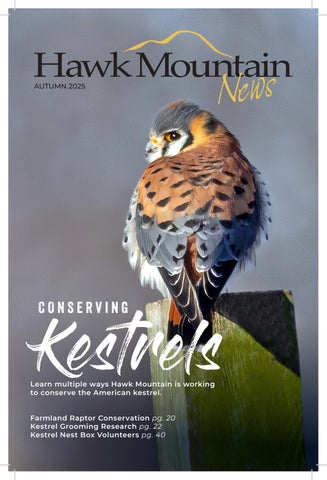
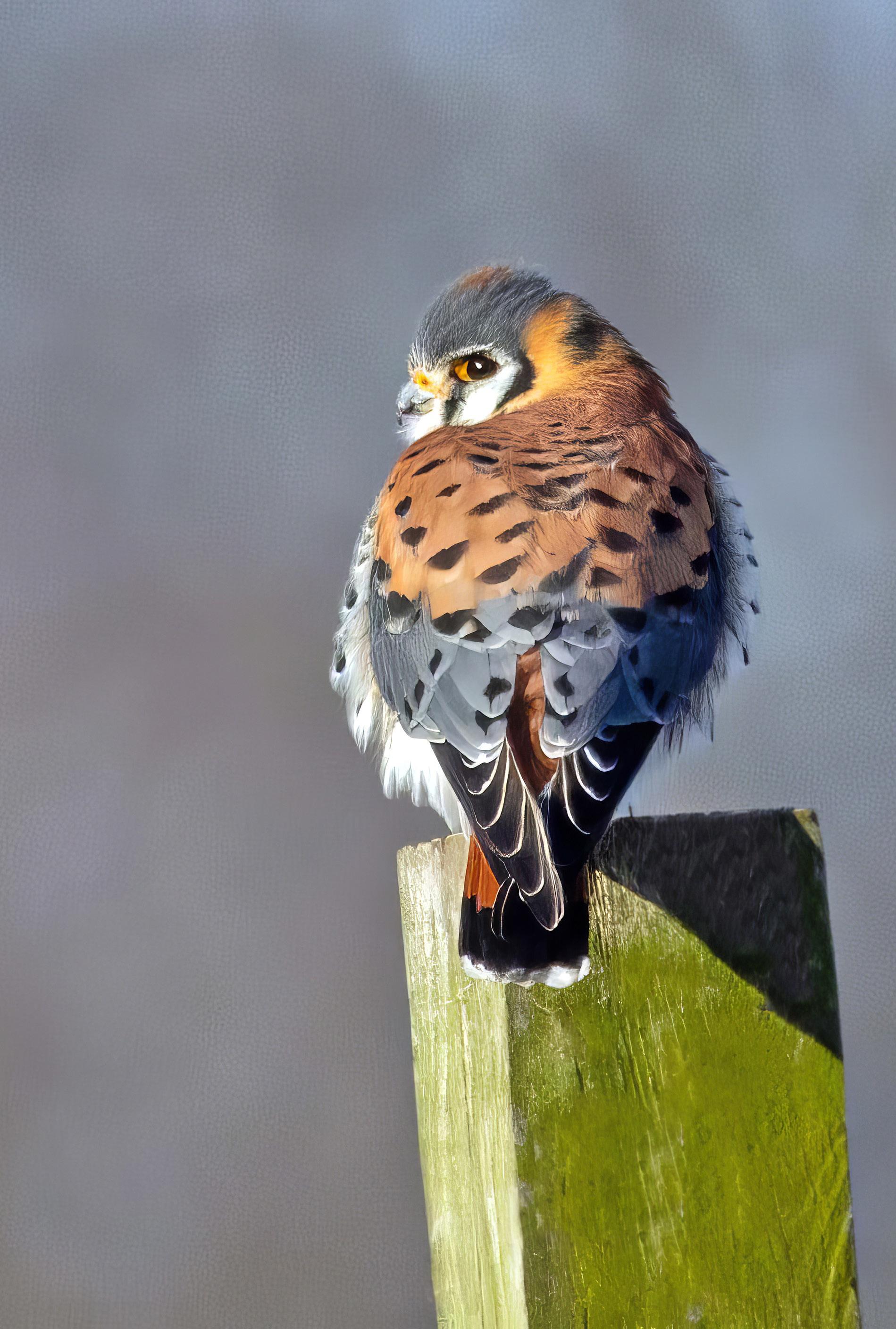
Kestrels
Learn multiple ways Hawk Mountain is working to conserve the American kestrel.
Farmland Raptor Conservation pg. 20
Kestrel Grooming Research pg. 22
Kestrel Nest Box Volunteers pg. 40
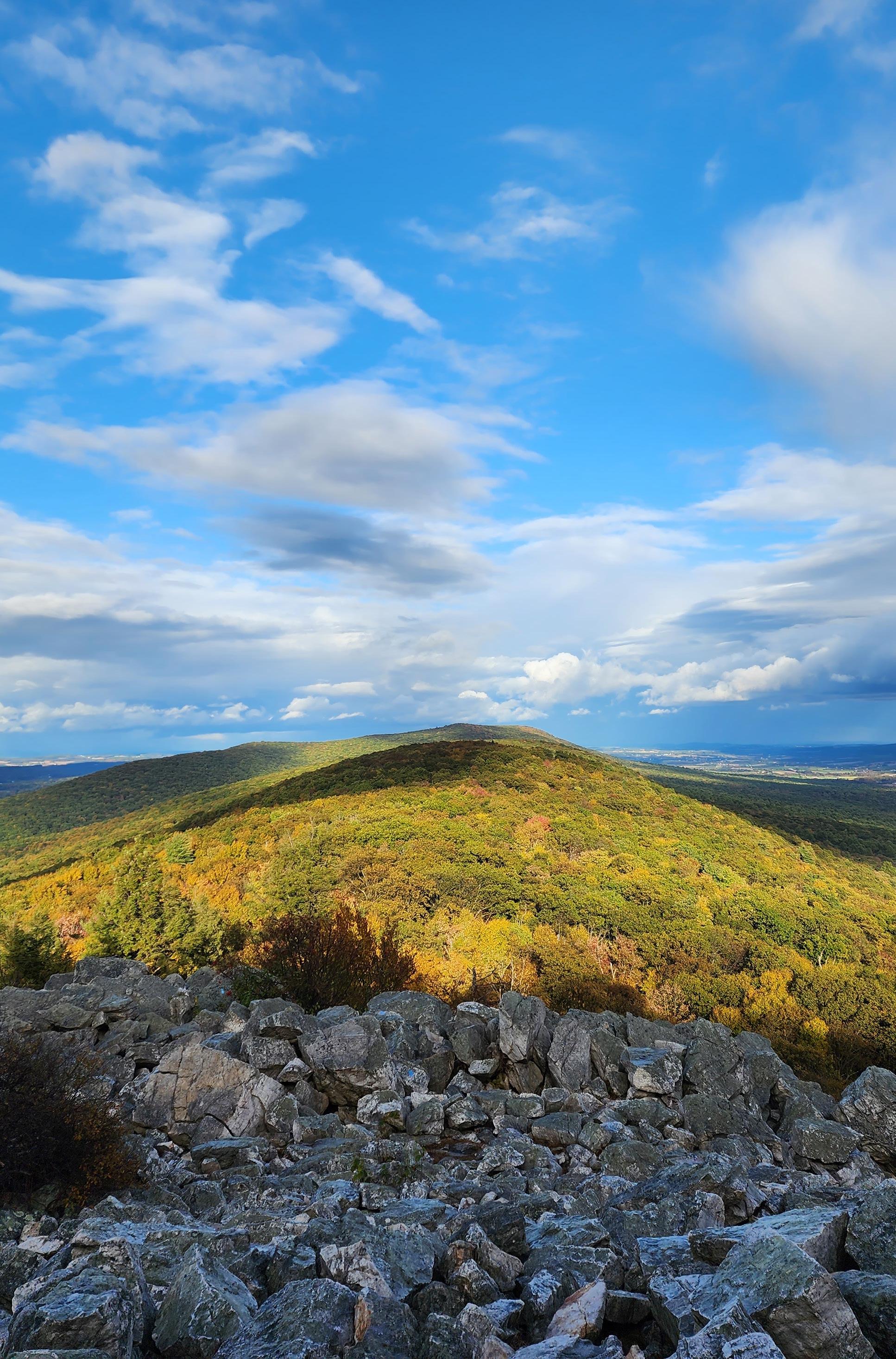
The mission of Hawk Mountain Sanctuary Association is to conserve birds of prey worldwide by providing leadership in raptor conservation science and education, and by maintaining Hawk Mountain Sanctuary as a model observation, research, and education facility.
TOP OF THE MOUNTAIN
Heroes for Conservation
NEWS & NOTES
RIDGE CURRENTS
AI, Ecology, and the Ethics of a Connected World
APPALACHIAN TRAILS
Let’s Talk Ticks
FIELD NOTES
Archaeological Finds Near Hawk Mountain
Year Two of Flying Insect Sampling
Connecting the Kittatinny to the Chesapeake
IN FLIGHT
Kestrel Grooming Research with Ashley Webster & Nicole Amedee
SPRING REPORT
Spring Migration Summary
From the Nature Notes
Lois
MOUNTAIN
American Kestrel Nestbox Volunteers: Mike
Gary Raisner, & Art Zdancewic
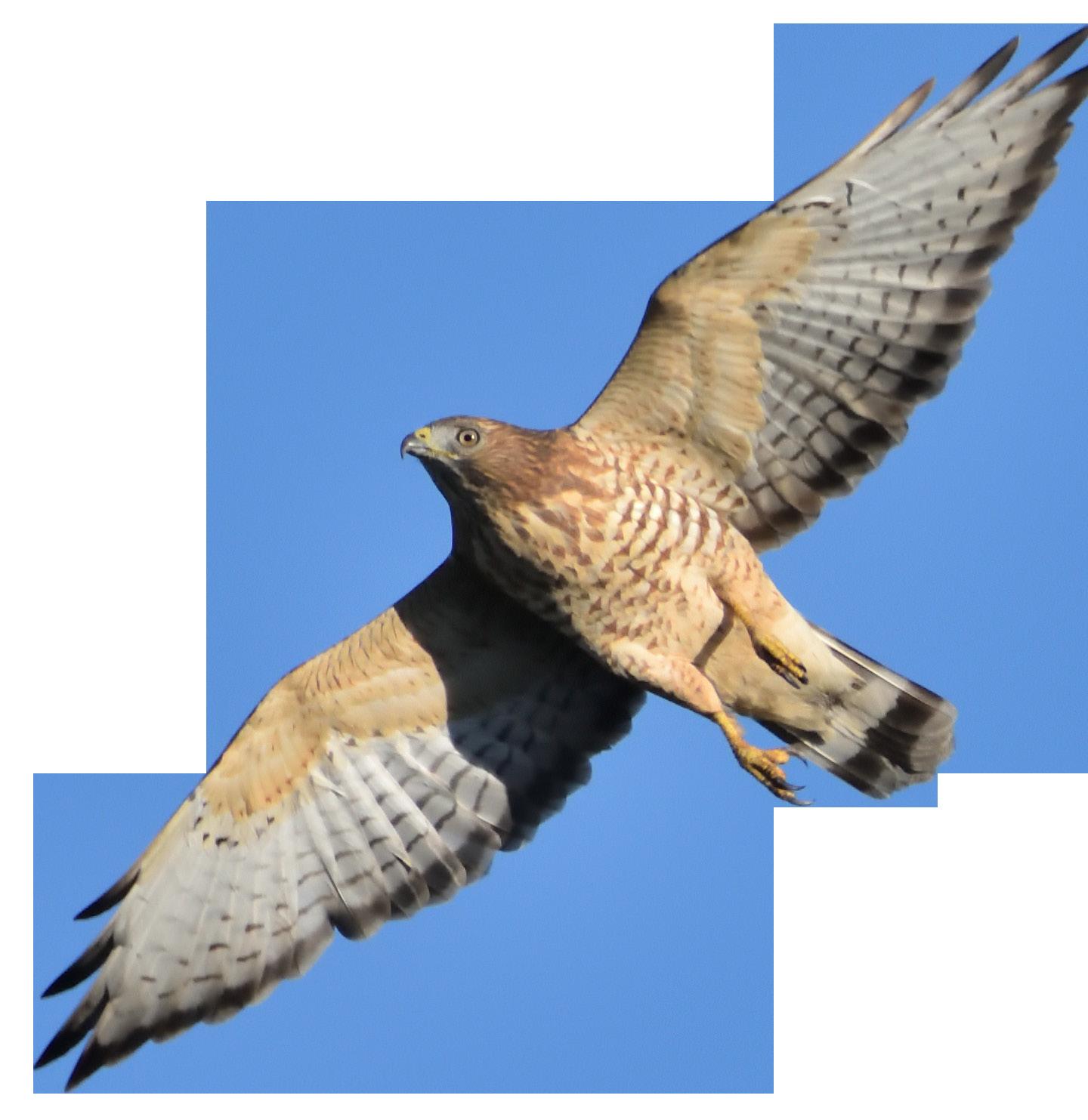
Autumn Hawk Watch held daily through December 15
Photo by Bill Moses
COVER PHOTO by Bob Rumer
HEROES FOR CONSERVATION
At Hawk Mountain Sanctuary, every gift is meaningful, but legacy gifts have the power to shape the future. Individuals who include the Sanctuary in their estate plans or make a gift of $25,000 or more to the endowment or our future new Visitor Center are invited to join the Rosalie Edge Society, a special group of visionary supporters who ensure the mission endures for generations.
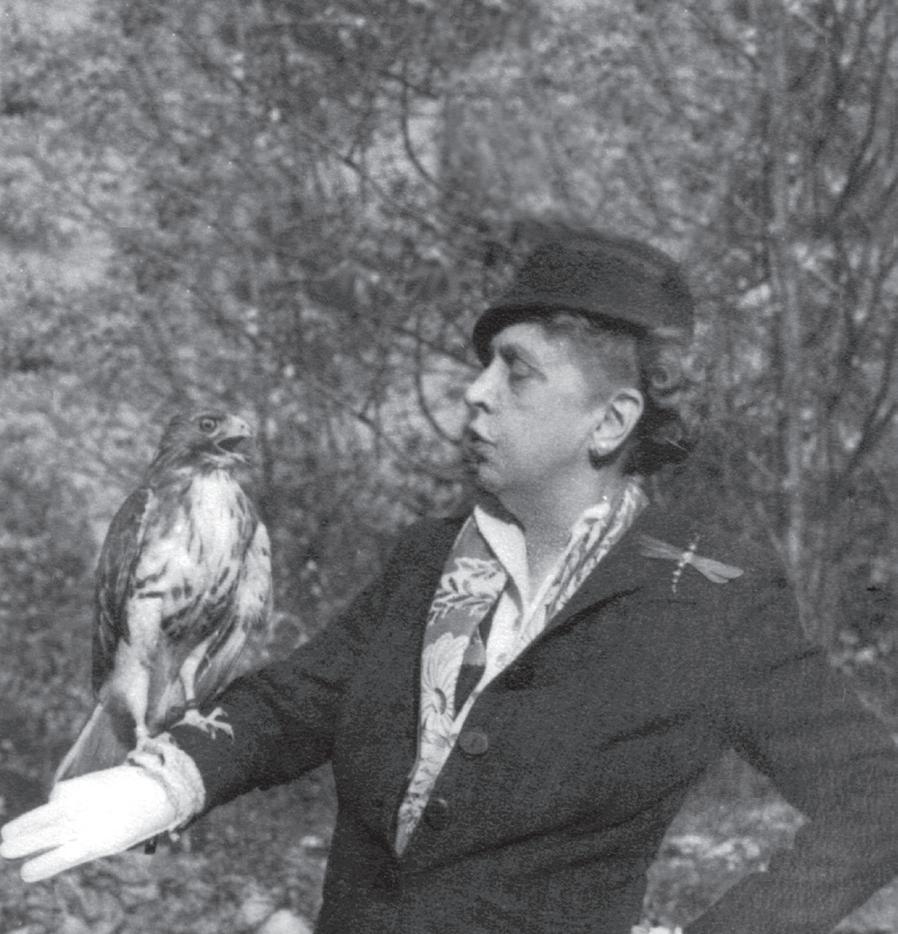
The society is named in honor of Hawk Mountain’s indomitable founder, Rosalie Edge. A pioneering conservationist and grassroots activist, Edge launched the Emergency Conservation Committee in 1930 at the age of 52. Under her leadership, the ECC became one of the most successful conservation forces in the nation. Yet Rosalie considered her greatest achievement to be the creation of Hawk Mountain Sanctuary, where she personally halted the slaughter of migrating raptors and raised funds during the depths of the Great Depression to purchase this rugged ridgetop. She created not only the world’s first refuge for birds of prey, but a legacy of fearless conservation.
Today, members of the Rosalie Edge Society continue that legacy with lasting generosity. Their commitment goes beyond annual support; it reflects a lifelong dedication to raptor conservation, scientific research, and environmental education.
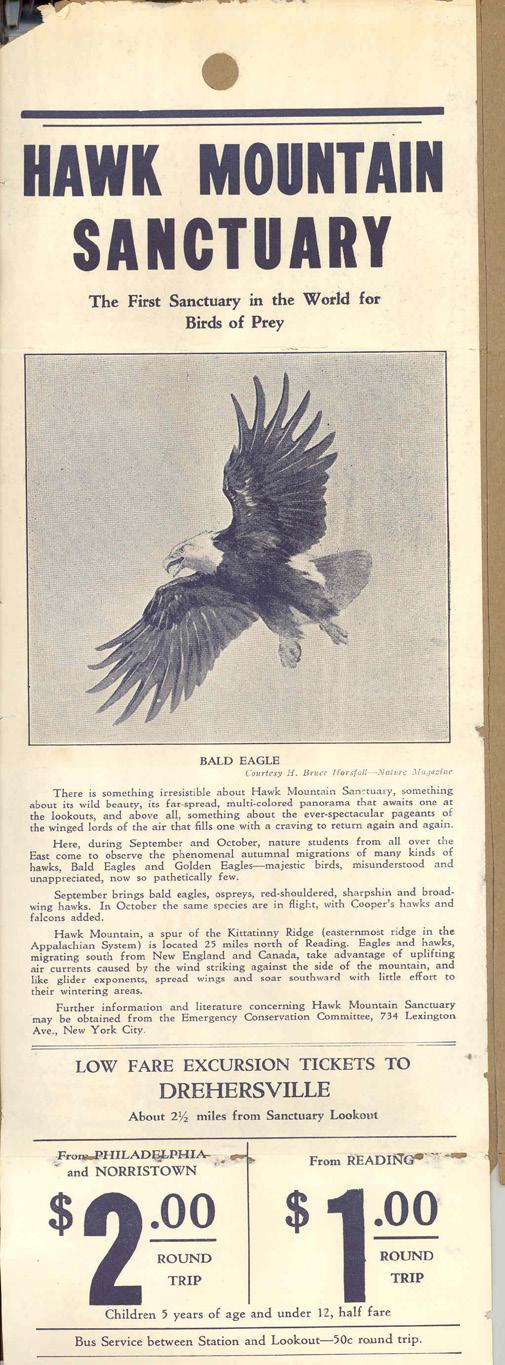
Excursion tickets to Drehersville
By making a planned gift or contributing significantly to the Sanctuary’s endowment or the Visitor Center Capital Campaign, they provide the financial stability needed to protect this global resource far into the future.
The Hawk Mountain Visitor Center is the welcoming point for every individual who visits and the first chance to connect people with our global raptor conservation mission. But our much-loved facility is at the end of its useful lifespan and soon will require costly upgrades. The time to act is now, and we intend to rebuild the Visitor Center for the next generation of young conservationists and nature lovers.

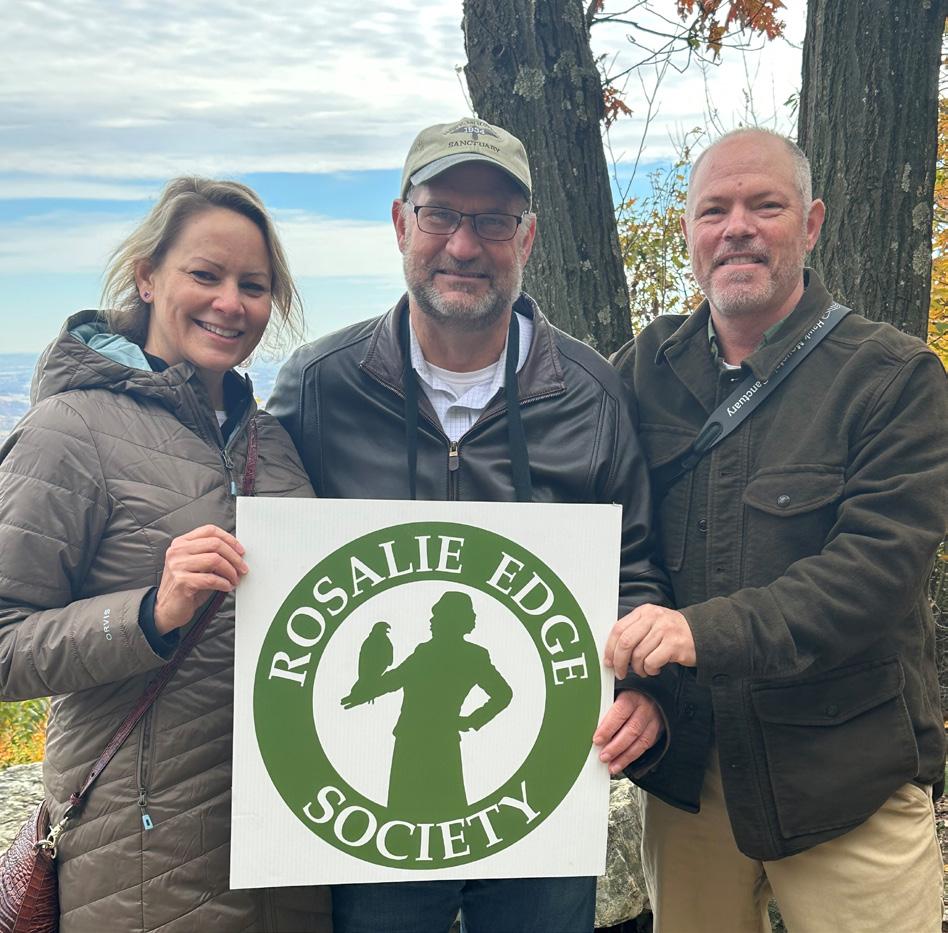
Left: Rosalie Edge, Founder
Right: Recent Rosalie Edge Society Inductees Anne Marie Hayes-Hawkinson and Ken Hawkinson with President Sean Grace
We are now finalizing the design and details of the building. The project is enormous, but we remain undaunted thanks to our supporters who inspire us with their enthusiasm and generosity. If you too would like to be part of this legacy project, the time to act is now.
Rosalie Edge believed in action. She believed in impact. And thanks to those who follow in her footsteps, the raptors will continue to soar over Hawk Mountain, and we will welcome new visitors to turn their eyes to the skies above the famed North Lookout. Please join me in making an important gift today, and feel free to contact me anytime to learn more about the new Visitor Center or legacy giving.
STAFF
PRESIDENT
Sean Grace
DIRECTOR OF CONSERVATION SCIENCE
Laurie Goodrich, Ph.D.
SENIOR SCIENTIST AND GRADUATE STUDY DIRECTOR
Jean-François
Therrien, Ph.D.
SENIOR RESEARCH BIOLOGIST
David Barber
BIOLOGIST-NATURALIST
Bracken Brown
RESEARCH BIOLOGIST
Rebecca McCabe, Ph.D.
ACOPIAN CENTER OPERATIONS COORDINATOR
Wendy Nicodemus
EDUCATORS
Jessica Gary
Dan Jenkins
DIRECTOR OF STEWARDSHIP
Todd Bauman
DEVELOPMENT ASSISTANT
Annie Trexler
BUSINESS MANAGER
Shelley Davenport
BOOKSTORE MANAGER
Mary Therese Grob
BOARD
CHAIR
Tom Kerr
VICE CHAIR
David Bonenberger
TREASURER
Edwin Baldrige
SECRETARY
Wendy McLean, Esq.
Peter Bennett
Jacquelyn Bonomo
Ana Maria Castaño
George Cauffman
Deborah Edge, M.D.
Stephen Edge, M.D.

Yours in Conservation, Sean Grace PRESIDENT
SANCTUARY STEWARDS
Stephen Wade
Noah Rauch
DIRECTOR OF DEVELOPMENT
Mary Linkevich
MEMBERSHIP & VOLUNTEER MANAGER
Tammy Jandrasitz
COMMUNICATIONS SPECIALIST
Gigi Romano
DEVELOPMENT & COMMUNICATIONS
OUTREACH COORDINATOR
Laura Berry
Jeff Goldenberg
Richard W. Holt
Beth Hucker
Diane Husic, Ph.D.
Ernesto Ruelas
Inzunza, Ph.D.
Nasreen Kara
Jim Lefik
Holly Merker
David Middleton
Sara Nicholas
Sally O’Byrne
Dan Rubenstein, Ph.D.
Jeff Weil
Minturn Wright, III
Emeritus Member
CONSERVATION COLLABORATION
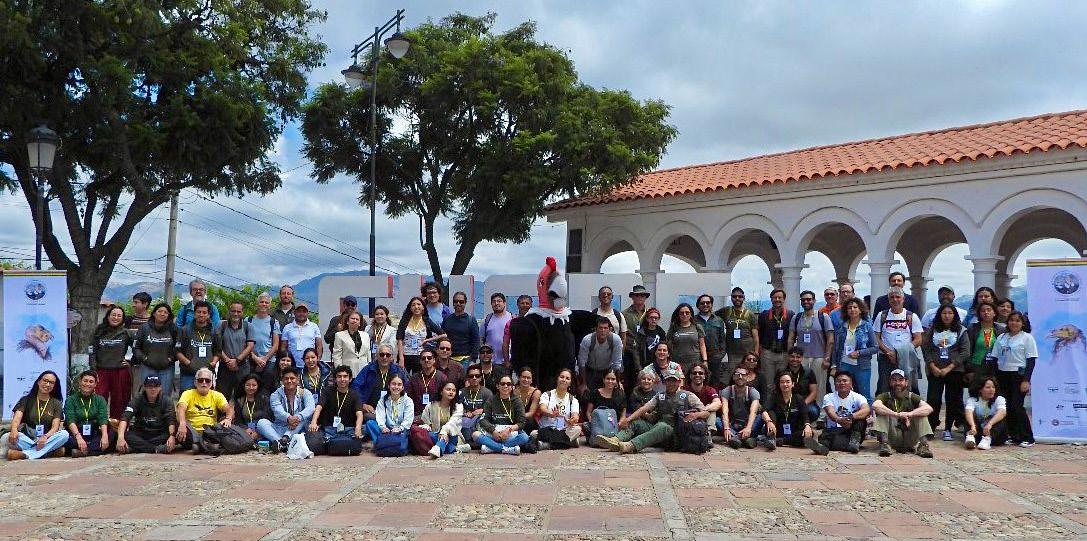
This past March, the 5th International Meeting on the Andean Condor and the first-ever Vultures of the Americas Symposium, sponsored by Hawk Mountain, took place in Sucre, Bolivia, and featured 60 exhibitors, 80 talks, and participants from 11 countries. Diego Méndez (2015 trainee), director of the Bolivian Raptor Research Program, was instrumental in organizing and hosting the event, and among other trainees, Nati Aquilera-Alcala (2024 leadership trainee) presented a talk on trends in turkey and black vultures. This event brought together national and international experts to assess advances in research and conservation of the Andean condor, and the Vulture Symposium provided crucial time to discuss the conservation of New World vultures and map out an action plan for their long-term protection.
Dr. Laurie Goodrich was a featured guest speaker at The International Ornithological Tourism Fair–Extremadura Birdwatching Fair (FIO), the largest and most important expo of its kind in southern Europe, held at Monfragüe National Park in Cáceres, Spain. This natural area offers an exceptional setting along with an exhibition area for companies and organizations, stage for presentations, space for workshops and to gather for outings, and of course,
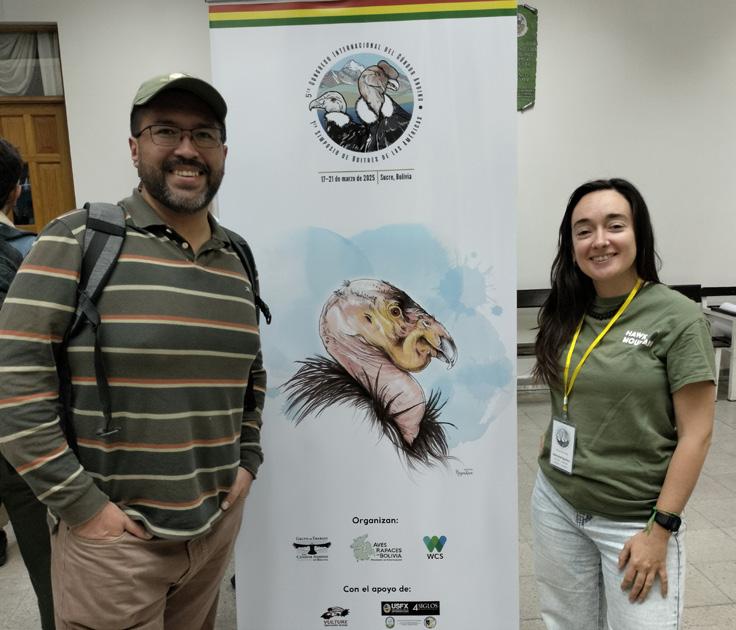
Hawk Mountain Trainee Alumni, Diego and Nati at the symposium
birdwatching from various viewing points throughout the Park. Laurie’s talk, “Hawk Mountain History and Global Raptor Conservation,” was both well received and promoted to the thousands of attendees who flock to this event annually.
Hawk Mountain’s new Global Trainee Map is now live on the Sanctuary’s website, showcasing its far-reaching impact in raptor conservation, with hundreds of trainees and interns from 75 countries across six continents highlighted. The interactive map not only illustrates this growing global network but also offers a private, searchable tool for trainees to find and reconnect with one another. Users can filter by class year, trainee type, focus area, or home country, fostering continued collaboration across borders. Check it out now at hawkmountain.org/globalreach.
ADVANCING ACCESSIBILITY
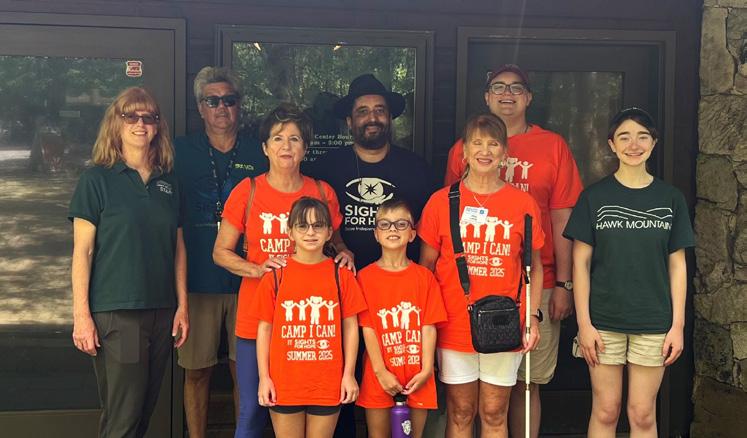
Hawk Mountain continues its commitment to accessibility with several recent efforts led by Visitor Services Manager Mary-Therese Grob. Mary-Therese is nearing completion of her certification as a Certified Access Birding Outing Leader through the Access Birding program. She also collaborates with experts and Kutztown University students to develop accessible materials, including social narratives for individuals with autism. This summer, she coordinated several inclusive events at the Sanctuary, including a visit from Sights for Hope’s Camp I Can program. Mark your calendar for two upcoming Accessible Hawk Watch programs on Tuesday, September 23 and Tuesday, October 14, welcoming birders of all abilities to experience fall migration at the Sanctuary.
HONORING A BELOVED AMBASSADOR
Hawk Mountain is saddened to share the passing of Marge, our cherished great-horned owl ambassador, who inspired and educated visitors for nearly 25 years. As our oldest ambassador animal and a staff favorite, Marge greeted thousands of school groups, charmed wild owls with her autumn duets, and brought joy to all who met her. Her legacy lives on through our Animal Ambassador Program, and donations in her memory will help continue her important work. Marge will be deeply missed.
STEWARDSHIP HIGHLIGHTS
Over the last year, the Hawk Mountain Sanctuary Stewardship Team completed a variety of impactful projects, including installing a new trailside kiosk, hosting a regional FSC conference, and improving 300 feet of the River of Rocks trail tread. They discovered a new plant species for their biota list—Leathery Grape Fern—and enhanced habitat by planting 12 black cohosh trees and establishing new deer exclosures, including the largest one yet at just over 4 acres. Additionally, they removed more than 100 risk trees to improve forest and visitor safety.
COMMITMENT TO TRANSPARENCY
Hawk Mountain Sanctuary has just earned the prestigious Platinum Seal of Transparency from Candid (formerly GuideStar), the highest level of recognition awarded to nonprofits. This seal is a mark of full openness, showcasing in-depth financials, metrics, mission goals, and strategies, and underscores their commitment to donor accountability and integrity. This achievement solidifies Hawk Mountain’s reputation for excellence in nonprofit stewardship, complementing their continued 4-star rating from Charity Navigator.
COASTAL MAINE BIRDING EXCURSION
Save the date for a breathtaking birding adventure along the coast of Maine, July 7–10, 2026! Guided by experts Holly Merker and Seth Benz, this excursion offers a chance to spot puffins and other coastal species. Don’t miss this unforgettable trip; more details coming soon.
AI, ECOLOGY, AND THE ETHICS OF A CONNECTED WORLD
By Laura Berry
Technology has long helped to achieve conservation goals, dating back to the early 1800s when Audubon’s bird banding experiments tied strings to the legs of songbirds to see if they returned to the same nests each year. Today, Hawk Mountain researchers track broadwinged hawks in real time using satellite transmitter backpacks as they travel thousands of miles during their seasonal migration. Investigations of wildlife movement, habitat use, and behavior utilize GPS and satellite tracking, acoustic monitoring, radio telemetry, and camera traps. The irony is that the advanced tech that should be catapulting us forward in the conservation field also creates an overabundance of data that slows the entire process down—until now. Artificial intelligence (AI) has entered the chat.
Technology Advancing Conservation
AI has been a part of the conservation conversation since the early 2000s, long before ChatGPT and generative AI appeared on the scene. Ever used Merlin Bird ID to identify an unfamiliar songster, or
iNaturalist to identify a tree? You can thank AI for that. It works by deciphering patterns and creating a sense of organization in impossibly large datasets of information, uploaded by community scientists. Once an audio recording is determined to resemble the wave pattern of a song sparrow, or a photo of a leaf is categorized as a black walnut by its size and shape, it is then added to the existing dataset with a label, thus allowing the technology to “become smarter” and more accurate over time. The concept is relatively similar across all AI learning platforms: the technology must be trained to be effective.
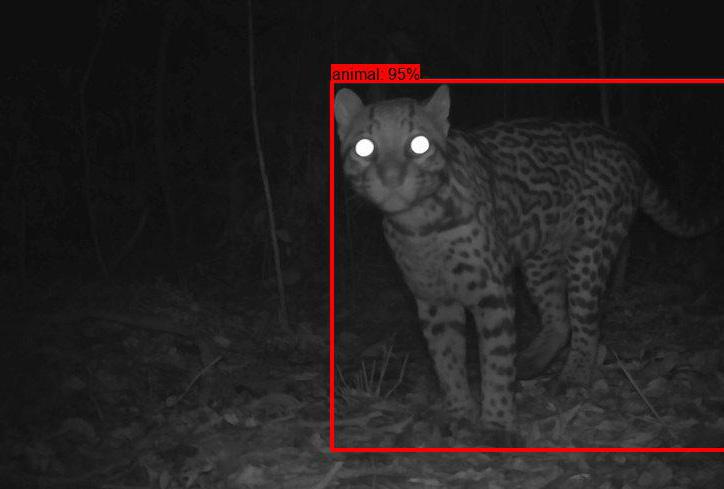
In the same way that Merlin and iNaturalist function, researchers are recruiting AI to process camera trap data. One motiondetecting camera trap can capture thousands of photos in a single sampling period, ranging from days to months. In the case of Dr. Dan Ardia’s research through Franklin and Marshall College (F&M), camera traps powered by lithium batteries can work for a full year and capture anywhere from 8,000 to 15,000 images per device. Ardia, whose research aims to
Ocelot captured on motion-detetion camera
identify how wildlife uses fragmented and urbanized landscapes, has approximately 150 camera traps deployed over more than 50 study sites—the resulting volume of data is hard to conceptualize. In any sense, manual sorting would be maddeningly tedious and virtually impossible. That’s where machine learning tools come in.
Using Microsoft’s open-source MegaDetector tool, an AI machine learning model designed to identify animals and humans in camera trap images, Ardia and F&M’s research computing specialists Tony Weaver and Jason Brooks began to automate the sorting process using Globus technology. This essentially filters out images depicting people and leaves images of animals to manually classify. All human detections are recorded quantitatively to a spreadsheet and then deleted. Images triggered by abiotic factors, such as wind moving leaves or sunlight casting shadows, are ignored entirely. The resulting dataset is more manageable for students to sort and saves researchers substantial time. This also ensures deliverables are met in a timelier manner, which is critically important in a conservation lens.
“We’re talking about terabytes of data that someone couldn’t review all themselves, so having a tool that can process that data, it’s transformative,” says Ardia.
“But,” he adds, “I do think of these very differently than I think of the generative AI, ChatGPT kinds of things that are just absolutely disrupting education and learning.”
The Integrity of ChatGPT
From a professor’s perspective, one would think the answer would be a resounding NO to the use of AI like ChatGPT in the classroom. And for some, it has been. Others are taking a more open-minded approach.
Dr. Aaron Haines of Millersville University also utilizes camera traps in his research and, like Dr. Ardia, recognizes the practicality of AI for data processing. His current research looks at determining the best method for camera trapping small terrestrial mammals, animals that are vital to ecosystems but understudied compared to larger species. Motion-triggered camera traps struggle to detect them, so Haines works to determine the most effective set-up for image capture. Haines’ images of small mammals are also helping to train Wildlife Insights, a collaborative platform developed by Google with help from conservation organizations. It serves as a database for storing and sharing images from camera trap research but also has an AI feature to help identify species that is still currently in its development stages.
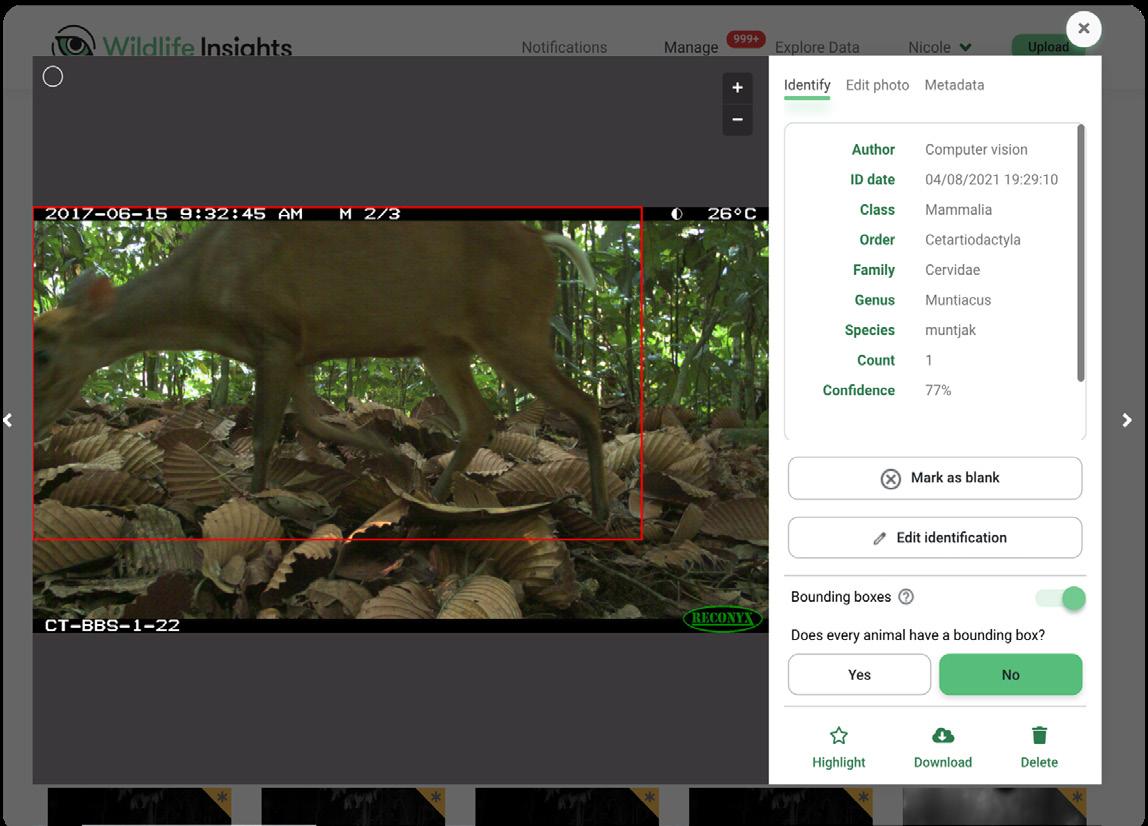
Image courtesy of wildlifesinsights.org, showing how the AI models detect and identify species in camera trap images
Using AI to process data is completely different than using Chat GPT to write a research paper. Conversational AI chatbots have become very effective at answering user questions, summarizing text, coding, and even generating creative content, like stories and poems. With technology this powerful, it would be absurd to think that students are not taking advantage of it to cut corners on assignments. Even students who are trying to use it in a more ethical manner could be falling short.
“I work with my students. I tell them: learn how to incorporate AI into your career,” says Haines.
“It’s like 30 years ago saying, ‘learn how to be more familiar with how to use the Internet in your career.’ It’s the same thing.
Haines utilizes AI in his own work to help with coding and data analysis, but instead of relying on the software to provide answers, he works with it as he would a lab partner.
“The key to AI is you’ve got to be very good at giving it prompts. You need be very specific, and you have to be educated. If you have uneducated prompts, AI is going to give you an answer that reflects that. But
the more familiar you are with the subject matter, the better your results.”
So, to students attempting to use AI to cut corners: teachers can tell. Learning the subject is key to even hoping that AI can successfully help you with an assignment. AI is only as smart as the person using it, or as the people it has learned from, which leads to another point: if AI is trained by humans, an inherently flawed being, how do we guarantee it can be trusted?
AI only learns from the information it is fed, often presented through the lens of those with the funding to obtain it. This applies to universities and organizations, but also globally. Going back to the example of Merlin bird ID: many find the app is inaccurate when used outside of North America and Europe because the database the app relies on is limited in countries without ample access to research funding opportunities. Countries without such funding inherently have less data to share. This is what makes intersectional environmentalism so important—the concept that to effectively address environmental issues, all viewpoints must be considered. This also applies to AI, because the accuracy of the software is limited to the individuals feeding it. If we expect AI to perform at its best, then all perspectives must be given the opportunity to contribute to its development.
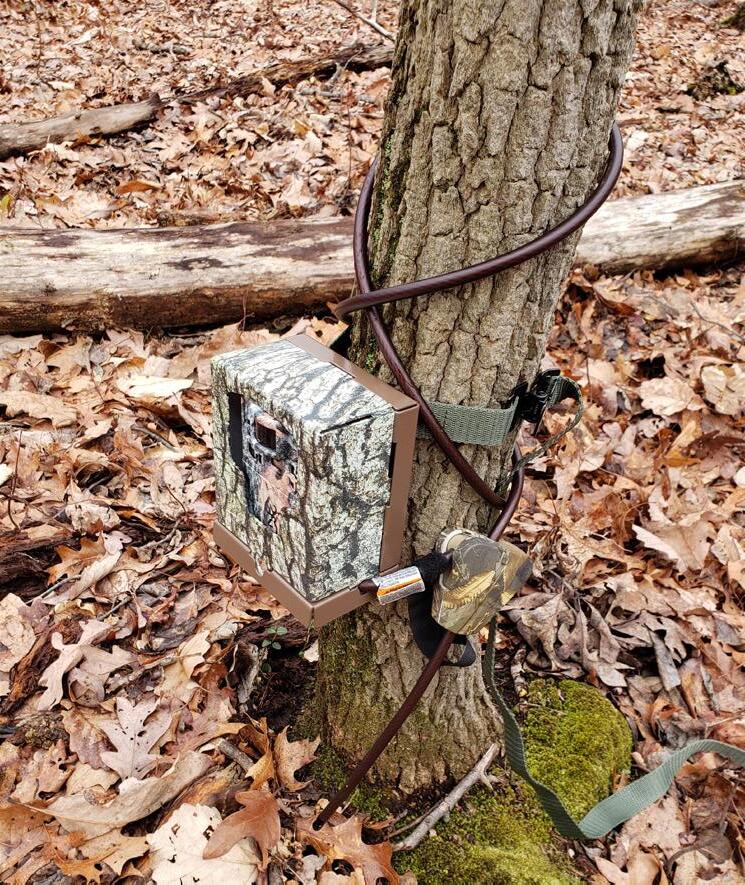
Motion-detecting camera trap
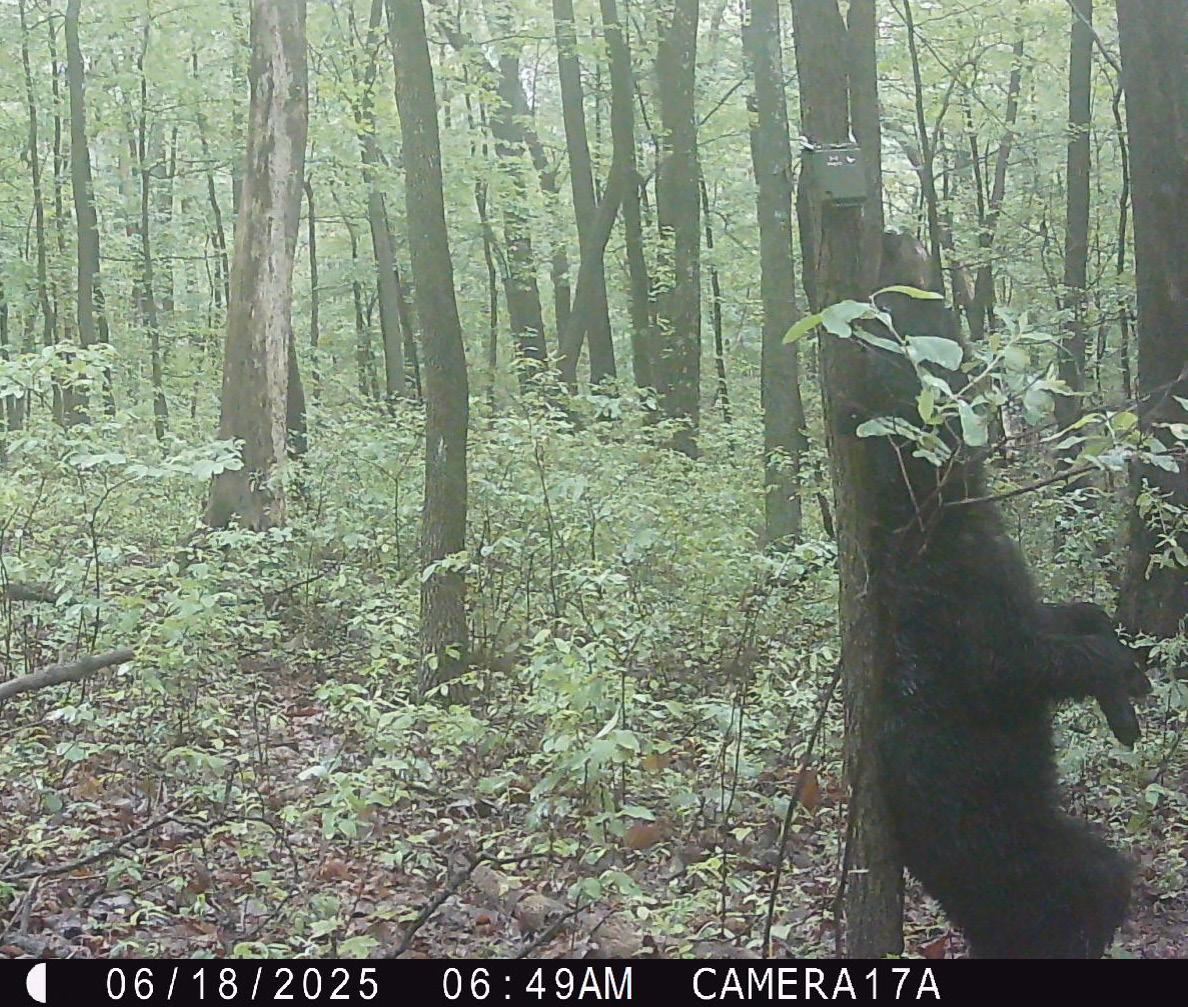
Bear caught on camera trap scratching its back
AI and Its Environmental Impact
Dr. Andrew Mashintonio of Kutzown University is also helping to train Wildlife Insights with the contribution of images from his own ongoing research, which seeks to define how changing delay intervals in the camera itself affects species detection. Though Mashintonio is receptive to AI in data analysis, he is overall hesitant to fully accept the technology for several reasons, one being its impact on the environment.
“I know it’s not just AI. Our phones, Google, all these things are powered by servers that require massive amounts of electricity to run and water to cool,” Mashintonio reflects.
“AI is making that worse, but it’s a problem that already existed. And I don’t know if it can become more efficient or if we just have to be more limited in its use, but that is the problem, there aren’t any current solutions for this.”
As technology grows, nature often becomes the unfortunate casualty to an exponential need for fuel, land, and resources. AI’s growing use has been coupled with a growing need for electricity to power servers, land to build data centers, water to cool those data centers, and resources to manufacture hardware, of which could pollute soil and water.

“And is it something where, okay, we’re using these resources, but if it’s helping us with conservation, is that a net positive? Then in that case, that’d be great. But the percent of AI that is dedicated towards conservation is probably very tiny compared to all the other things that it’s doing. So, I doubt that would be enough to tilt it in a positive balance for conservation, but I don’t really have a good answer to that.”
No one does. The conclusion is that there is no conclusion. The verdict is still out on whether AI is “good” or “bad,” if it can even be categorized by such extremes that offer no room for nuance or neutrality.
That’s up to the reader to decide for themselves.
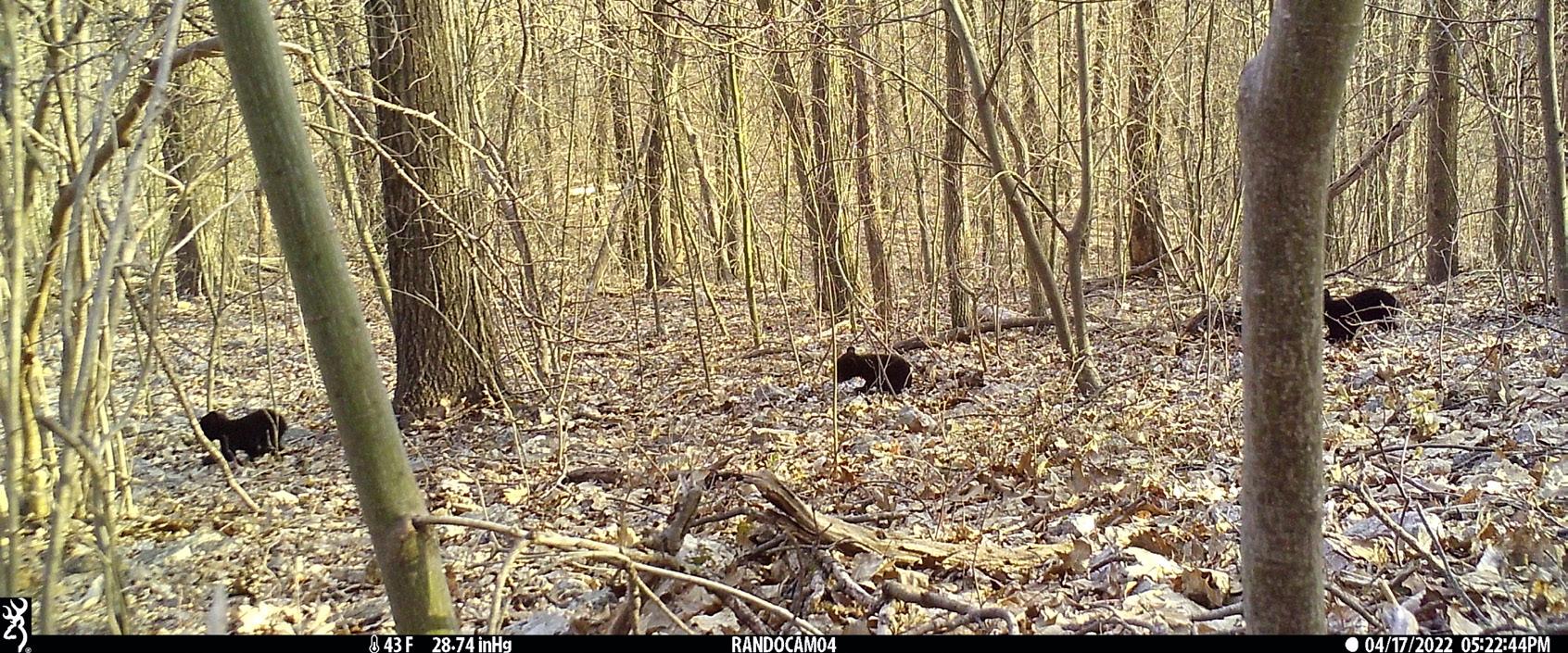
Three bear cubs caught wandering
Porcupine spotted camera trap
LET’S TALK TICKS
The rise of tick-borne disease in the United States in recent years is well documented. Figuring out why is complicated.
By Megan Roselli, Director of Education

If you live in the northeastern United States, chances are you or someone you know has been impacted by a tick-borne disease. Lyme Disease in particular has become a household name, and for a good reason. It’s the most common vectorborne disease in North America, where an estimated half a million people are diagnosed and treated each year.
But what exactly is a vector-borne disease? Vector-borne diseases are caused by bacteria or viruses transmitted through the bite of an organism called a vector. For example, Lyme Disease, caused by the bacteria Borrelia burgdorferi, is spread to humans by one of its vectors, the blacklegged tick (Ixodes scapularis). Other common vector species in the U.S. include mosquitoes, fleas, and kissing bugs.
Since the mid-1990s, cases of Lyme Disease have surged by nearly 500%. Other tickborne illnesses are increasing, too. In this article, I’ll delve into the at times horrifying world of ticks and examine the ecological factors fueling their rise. The more you learn about ticks, the better equipped you will be to avoid them.
Tick Biology
Ticks are parasitic arachnids that feed on blood to survive and reproduce. Found on every continent, there are two major tick families: hard ticks and soft ticks. This article focuses on hard ticks.
Ticks are expertly adapted to find hosts, evolving an entire organ and special tactics dedicated to finding their next meal. Their secret weapon is called the Haller’s organ, which acts like a highly sensitive chemical and heat detector. With it, ticks can sense the exhalation of carbon dioxide and warmth radiating from their potential hosts. Once a tick has zeroed in on the perfect spot, they start their ambush by crawling to the tip of grass or leaves and holding their front legs out, like eager toddlers raising their hands for a piggyback ride. Ticks don’t jump or fly, instead they simply wait for the perfect moment to latch on to an unsuspecting host strolling by.
Ticks have a four-stage life cycle: egg, larva, nymph, and adult, with each non-egg life stage requiring a blood meal to grow and molt into the next form. Adult females take a final blood meal, mate, lay thousands of
Changes in Tick Populations
Ticks are highly sensitive to environmental conditions and have a complex life cycle involving multiple hosts. Because of this, changes in tick populations are not due to a single factor, but a few factors working together.
eggs, and then die, while males die soon after mating. All life stages of ticks, except eggs, will feed on humans, companion animals, and livestock.
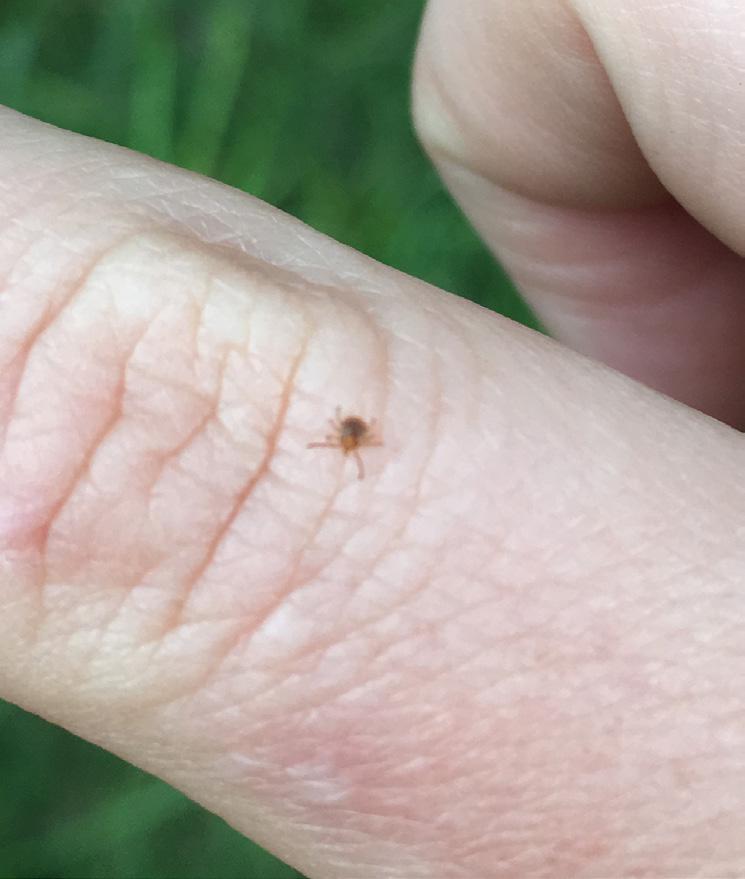
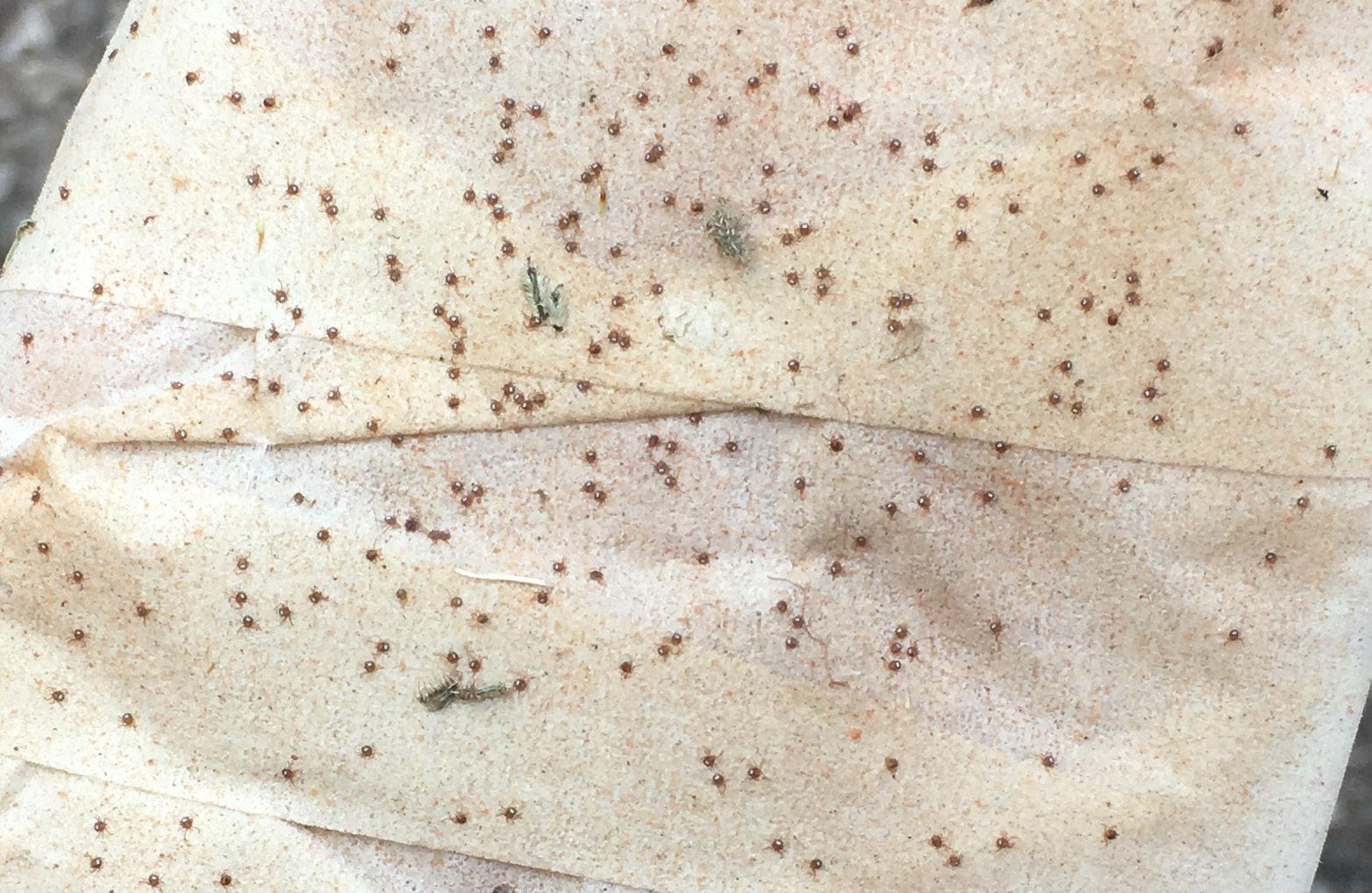
Most of the time, ticks become infested with bacteria or viruses from the animals they feed on. This means tick larvae are least likely to carry disease-causing agents since they haven’t fed yet. This is great news, because larval ticks are smaller than poppy seeds and hard to spot during tick checks. However, nymphal ticks are a similar size and have a much greater risk of transmitting disease-causing agents to their host. Since they’re hard to see, many Lyme Disease cases are linked to nymph bites. That’s why it’s crucial to perform thorough tick checks, remembering that poppy seed sized spots might be more than just freckles.
These tiny parasites are sensitive to temperature and humidity, so warmer winters and longer summers can boost tick survival. For instance, the lone star tick (Amblyomma americanum), was once primarily found south of New Jersey. Now, this tick has established populations in Connecticut and has even been found in Canada.
Even urban areas have seen increases in ticks and tick-borne illnesses. Land use changes, like urbanization or deforestation, can drastically change the population of wildlife that ticks can feed on. For instance, white-footed mice are key reservoir hosts for Borrelia burgdorferi, the bacteria that causes Lyme Disease. These mice amplify and sustain B. burgdorferi in their blood and thrive in forest fragments and yards. Other animals like bobcats, weasels, and black rat snakes are less likely to be found. Ticks in these areas are more likely to feed on mice, become infested with B. Burgdorferi, and transmit the bacteria to humans both because of the lack of animal diversity to feed on and increased population of mice in the absence of predators.
Larval ticks collected on tick trap
Tick in it’s nymph phase walking on finger
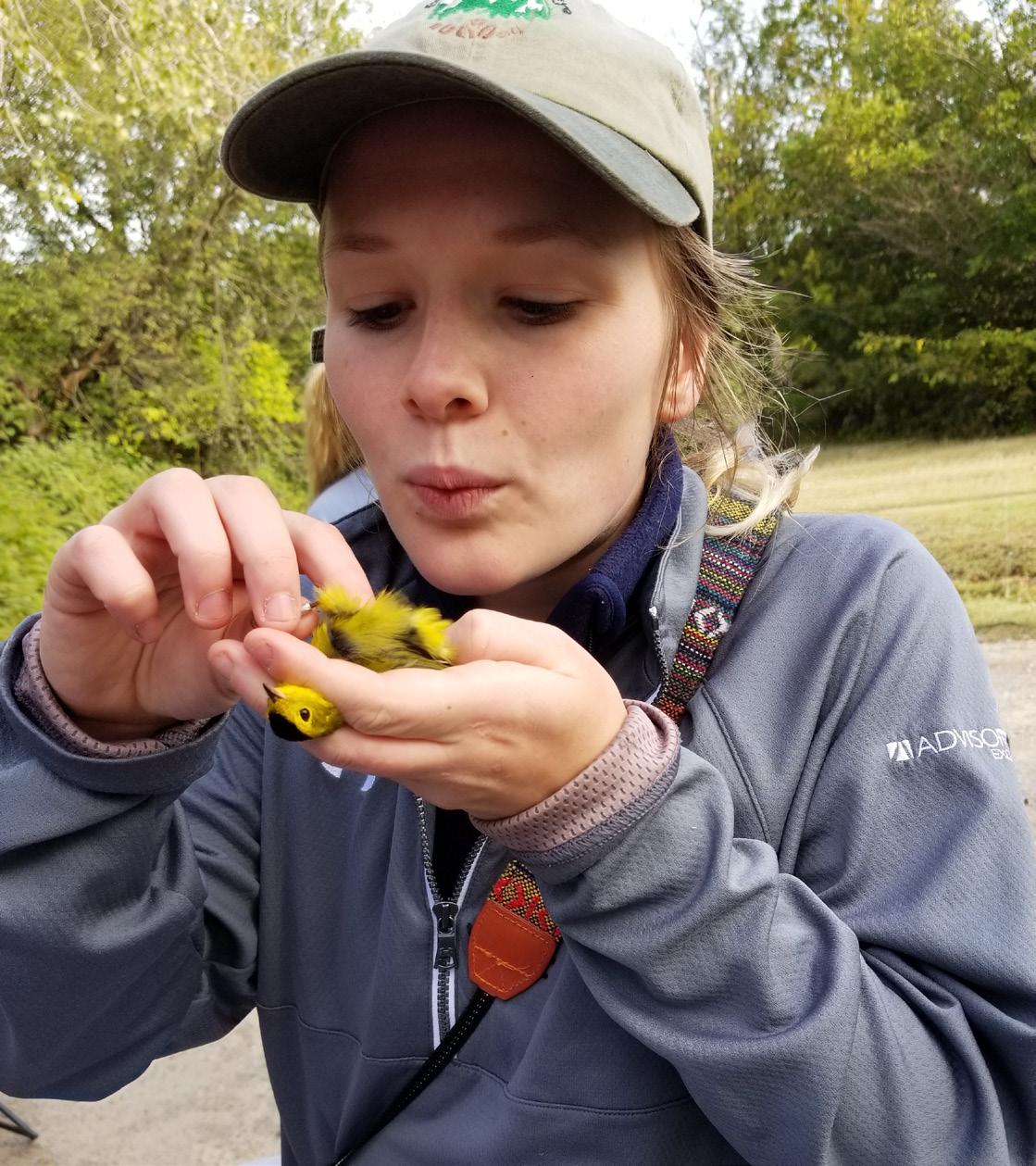
Have you ever wondered if birds could get ticks? No? Just me?
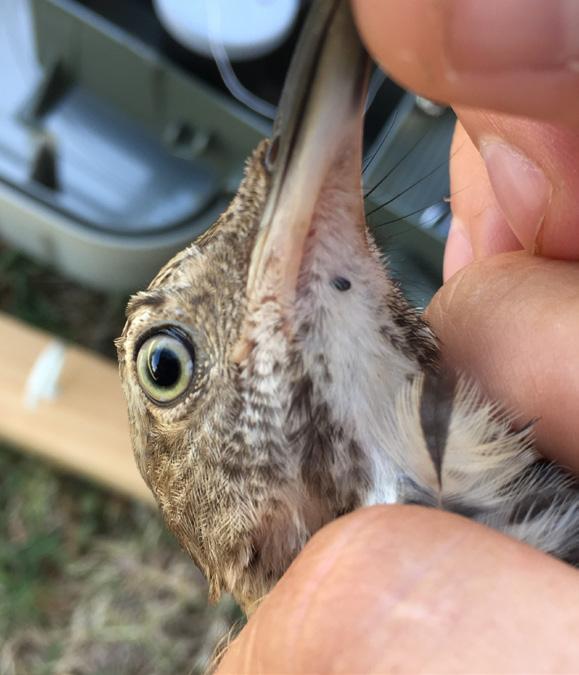
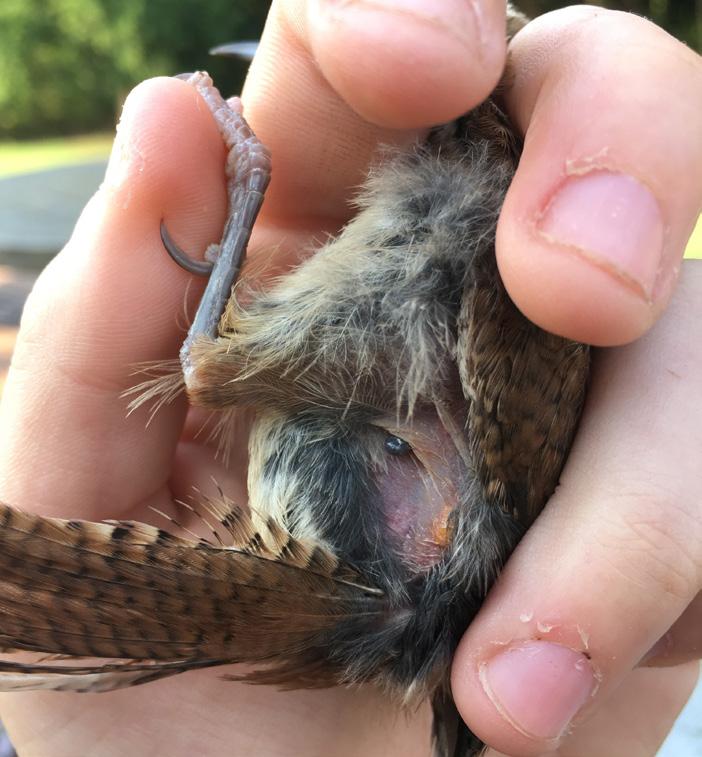
My research found that songbirds likely play an important role in tick populations and tick-borne disease cycles. In Oklahoma City, we found 24% of birds were infested with ticks, but urban birds were less likely to be infested. Moreover, other research shows that birds can transport ticks, often with disease-causing agents, during their migration across vast distances. These findings suggest that songbirds, both during migration and more sedentary periods, play critical roles in establishing and moving tick populations into regions where they are not usually found. In addition to ecological factors, better diagnostic tools, reporting requirements, and increased awareness for tick-borne diseases are also contributing to the huge increase in tick-borne disease.
Tick Safety
If you spend time outside, even in highly urban areas or in manicured lawns, it’s not a matter of if you’ll encounter a tick, but when. You can get a tick anywhere outside—not just in tall grass, leaf litter, or “in the woods.” However, there are some steps that you can take to help prevent ticks from attaching and feeding on you and your pets.
Your best line of defense is checking yourself thoroughly for ticks after being outside. Yes, even if you are just checking
Brown thrasher with tick
Searching a Wilson’s warbler for ticks
Carolina wren with tick
the mail! To do this, remove any clothing and place it in the dryer on high heat for at least 6 minutes (washing is optional as the heat is what will kill ticks). When possible, shower immediately upon returning indoors to help wash off any ticks that may not have attached. Then, check your entire body, especially in hair, around the ears, under the arms, between the legs, on the backs of the knees, at the waistband, and the cuffs of socks. If you find a tick, dispose of the tick by wrapping it in a tightly sealed container, securing it in tape, or placing it in alcohol. You should always do tick checks, even when using other preventative measures.
In addition to tick checks, there are other measures you can take to both deter ticks from attaching to you and to make ticks more easily spotted before attaching:
• Wear light colored clothing where it’s easier to see a dark tick crawling on you
• Tuck your pants into your socks, so that ticks must crawl up your pants instead of on your skin
• Use EPA-registered repellents and insecticides, like DEET and permethrin, but make sure you are using it exactly according to label
• Make sure your pets are tick free to avoid indoor hitchhikers
Unfortunately, there are no studies that show that predation from chickens, guinea fowl, opossums, or other animals control tick populations. Although these animals
ABOUT THE AUTHOR
(and others) will eat ticks, they do not impact the overall tick population.
Even if you take every preventative measure, you may still end up with an attached tick. If this is the case, do not panic and focus on removing the tick as soon as possible. To remove a tick:
• Use tweezers or your fingers (when tweezers are unavailable) to grasp the tick as close to the skin as possible, avoid squeezing the body
• Pull the tick perpendicular to the skin with steady, even pressure
• Dispose of the tick and clean the area with soap and water
This is the only studied, safe way to remove ticks. Do not use petroleum jelly, heat, nail polish, or other substances to try and make the tick detach from the skin. This may agitate the tick and force fluid from the tick into your body. Yuck!
After removing the tick, monitor yourself for symptoms of tick-borne illness. These often include rash, fever, body aches, headache, muscle pain, and fatigue. If you experience any of these symptoms, see your doctor immediately. Always tell your doctor if you’ve had a tick on you recently even if you are there for something “unrelated,” since tick-borne illnesses can mimic the symptoms of many other illnesses or diseases, like the flu or the common cold.
Before becoming Education Director at Hawk Mountain, Megan earned her M.S. in Natural Resource Ecology and Management from Oklahoma State University. Her graduate research took place at parks and green spaces around Oklahoma City, where she conducted tick and vegetation surveys and used mist nets to capture songbirds and examine them for ticks. Megan investigated how ticks interact with wildlife in urban areas—a project that connected public health, wildlife ecology, and natural resource management. This work resulted in six peer-reviewed publications and deepened her passion for making science accessible and relevant to everyday life.
ONE MAN’S TRASH IS ANOTHER MAN’S TREASURE:
Archaeological Finds
Near Hawk Mountain
By Evelyn de Chazal
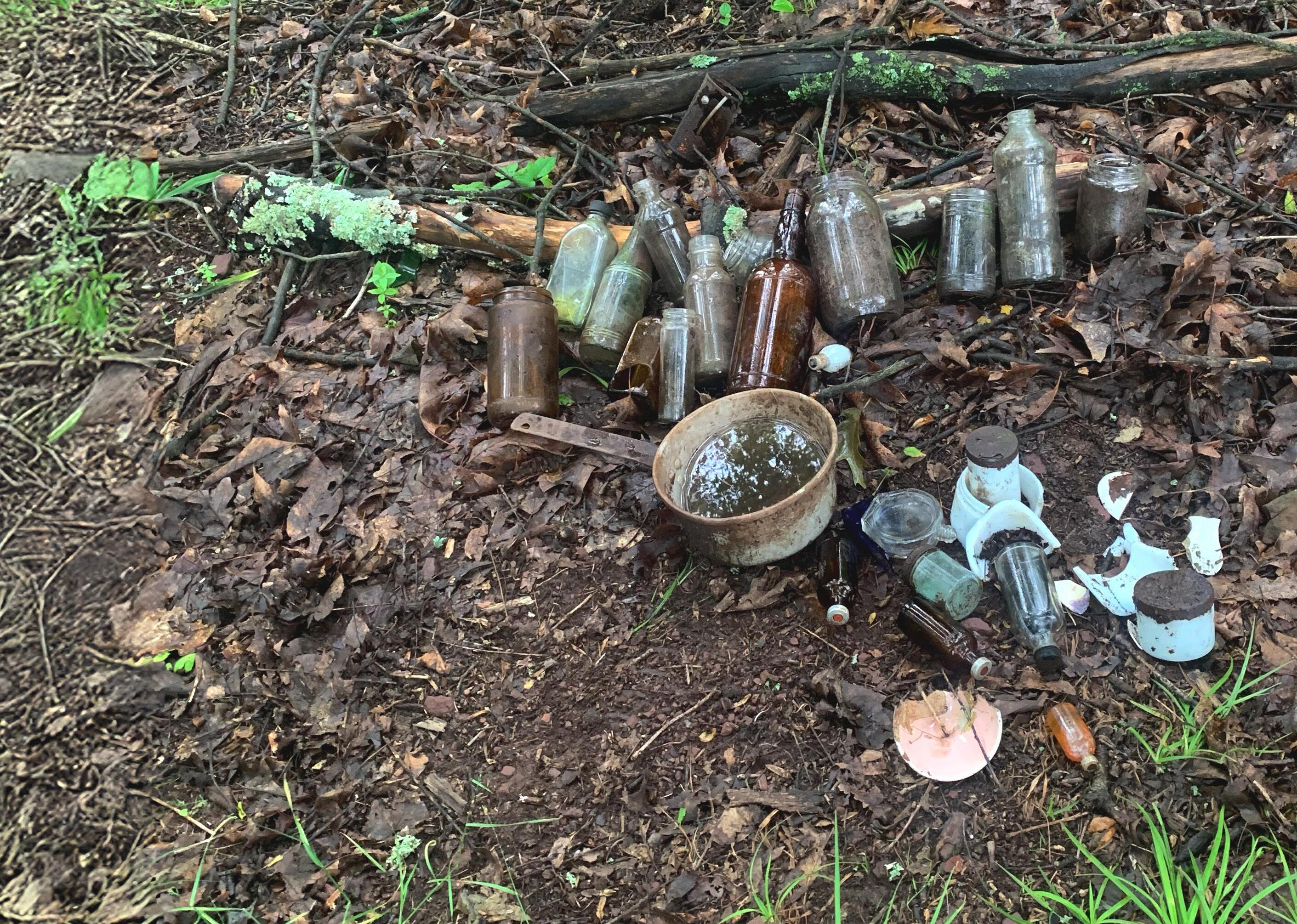
A recent discovery on Hawk Mountain Sanctuary property has led to the planning of further excavation of a former property owner’s dump site, with glass pieces dating back to the early 1800s. While it’s typically frowned upon to sift through the garbage of others, the eager archaeologist of antiquesavvy mind may find an old dumpsite as a welcome opportunity to get a glimpse of the world through the eyes of peoples past. Evelyn de Chazal, one of the conservation science trainees at Hawk Mountain, stumbled upon the site completely by accident while searching for a suitable spot to put up a hammock on one of the only sunny days this past spring. Her art history background clued her into the significance of the area, and she alerted the archaeology team at Hawk Mountain of the location. Together de Chazal and the team mapped out the area, and determined that the site spans roughly a quarter of an acre over the edge of the property.
This new site adds to the ongoing archaeological efforts already underway at the Sanctuary. The Hawk Mountain Chapter 31 of the Society for Pennsylvania Archaeology (SPA), led by archaeologist Curtis Hosey, was already excavating a
colonial-era site elsewhere on the property. Supported by a Kittatinny Ridge Mini-grant, the project began in 2024 and has yielded artifacts like pipe stems and ceramic shards—pieces that will eventually support a public exhibit on the region’s early history. All materials are being processed at the Acopian Center for Conservation Learning under state guidelines. The discovery of this dump site offers a new layer of insight into how local families lived, and discarded, their way through the centuries.
Much of the land surrounding Hawk Mountain used to be (and remains as) farmland. Many families found tucked away locations to dump their trash near or on their properties, considering the remoteness of the area didn’t allow for a local trash pickup schedule, and such vehicles for trash removal hadn’t been invented yet. While many families may have dug holes, it was much easier (and more convenient) to throw garbage off the side of an unused hillside. Out of sight, out of mind; until now, that is.
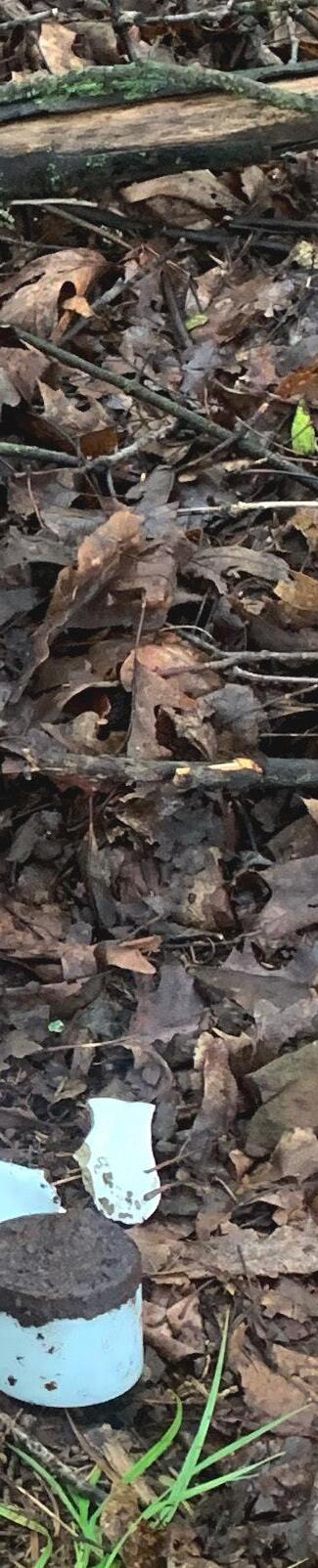
Lanolin shampoo bottle, a popular brand from around the 1950s.
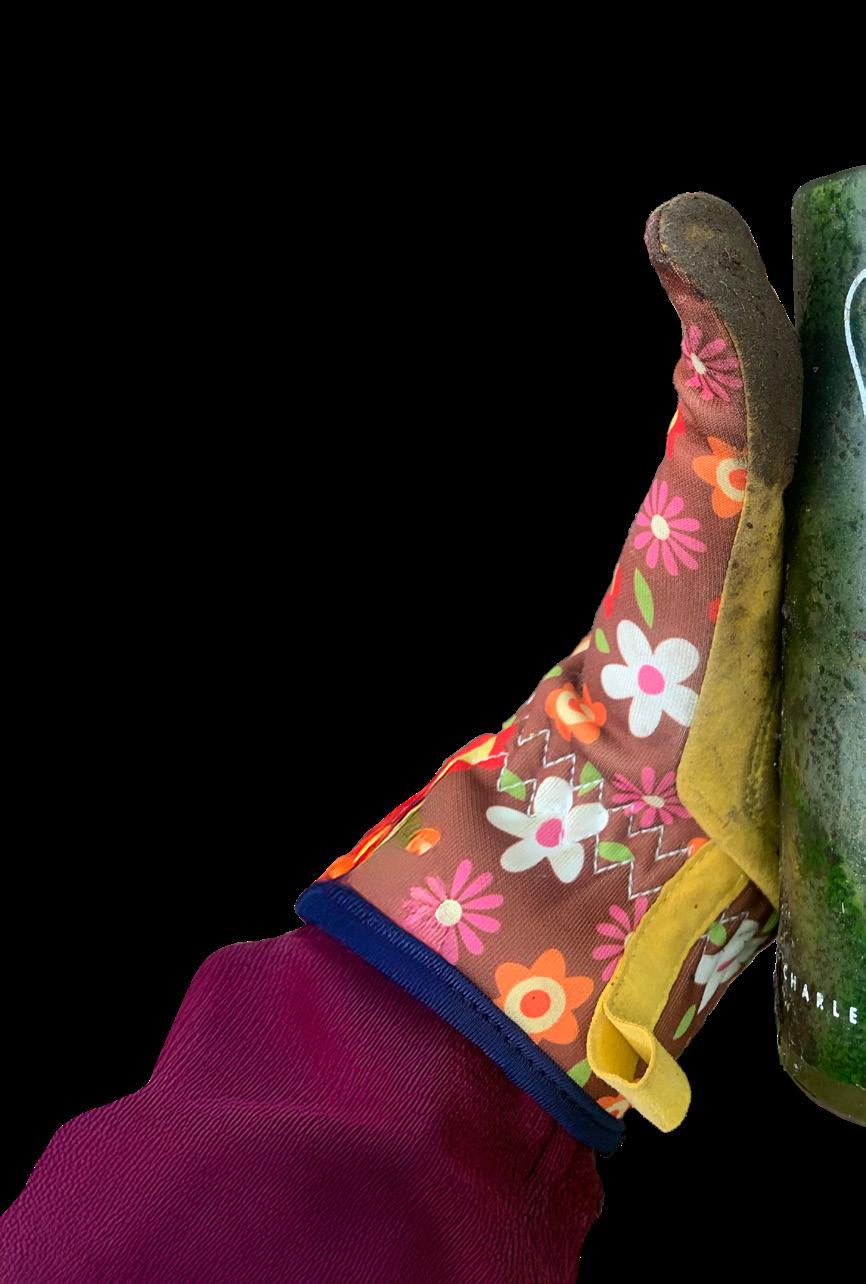
NOTABLE FINDS
The pieces listed below are all surface finds; no excavation has been carried out at the site as of yet. It is recommended not to break the surface when uncovering what may be important artifacts to reduce risk of breaking delicate items. Additionally, certain factors such as the depth at which an item is found help give archaeologists clues as to the age and use of the item.
Glass
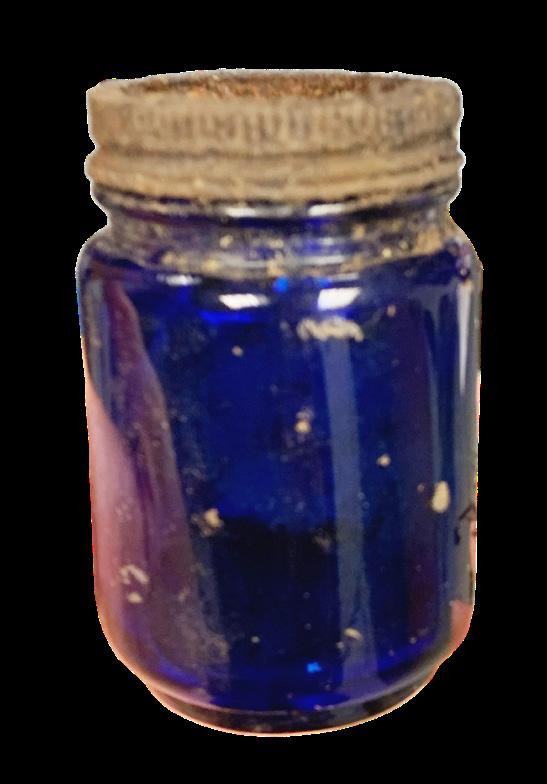
Some particularly notable glass finds include amber and cobalt colored glass bottles/fragments from the mid-1800s. These vessels were usually used for medicinal purposes or contained alcohol. The value in these bottles is not seen only in their age and past contents, but display the exquisite craftsmanship required to handblow this glass, proven by the small bubbles peppered throughout. These bottles can also be aged

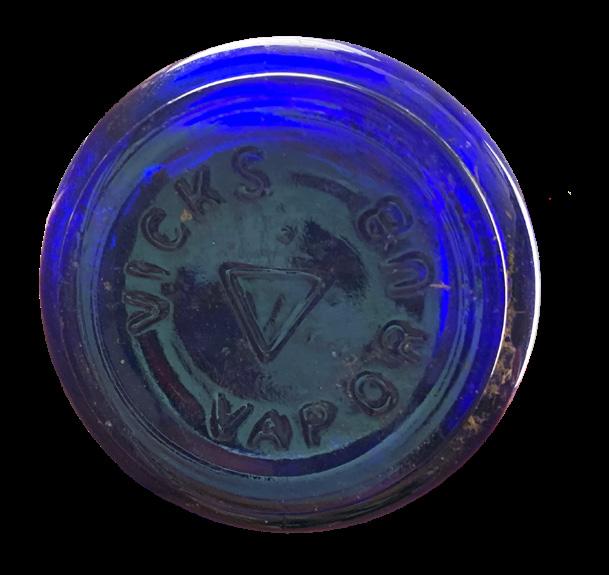

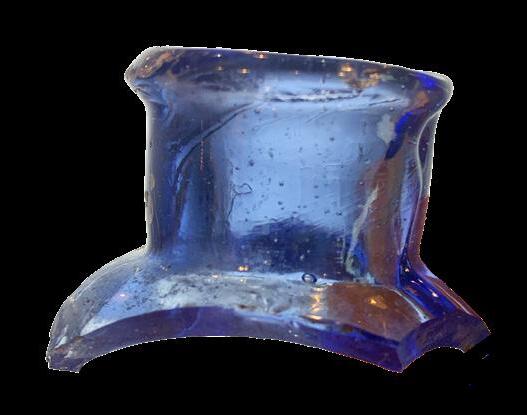
farm property, it is assumed that amber colored here contained perhaps even for the tired

Light cobalt-colored glass, containing distinct bubbles and uneven edges characteristic of hand-blown glass.

Bottle containing Karo’s brand corn syrup.
Clorox glass bottle.
A small, amber vial with metal lid still intact.
A piece of uranium glass found on Sanctuary property, probably the base of a bowl.

Other notable glass found at the site includes uranium glass, which contains trace amounts of uranium, popular in the 1880s-1920s and sometimes denoted as “Vaseline glass” for its pale yellow color like that of Vaseline. In daylight, this glass appears to have a light, limegreen or yellow tint. Once shone under a blacklight, the uranium contained in the glass reflects the light and fluoresces lime green. Despite concerns of owning glass containing a radioactive element, uranium glass is perfectly safe to own, considering the amounts of uranium within are trace. Uranium glass went out of production completely around 1943 when the US government confiscated uranium for war efforts and experiments. They didn’t take the glass though, and it can still be found in antique stores and grandma’s curio cabinets.
Also found was a glass LePage glue bottle with a rubber tip, popular in schools in the early 1900s, and a few canning jars with contents still intact, albeit disgusting. Many cosmetic/toiletry jars were collected, including old Ponds cold cream and shampoo jars. Other popular brands included glass Clorox bottles and blue Vicks Vaporub vials.

Original LePage glue bottles in packaging. Image courtesy of justuseglue.com.
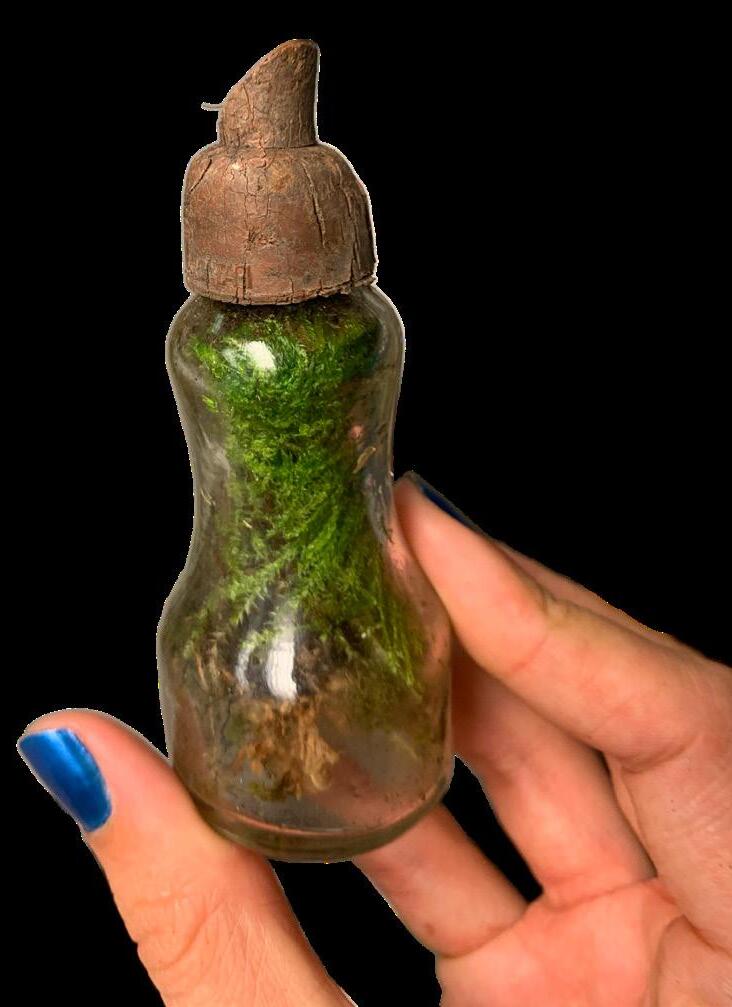
LePage glue bottle with rubber top and terrarium within.
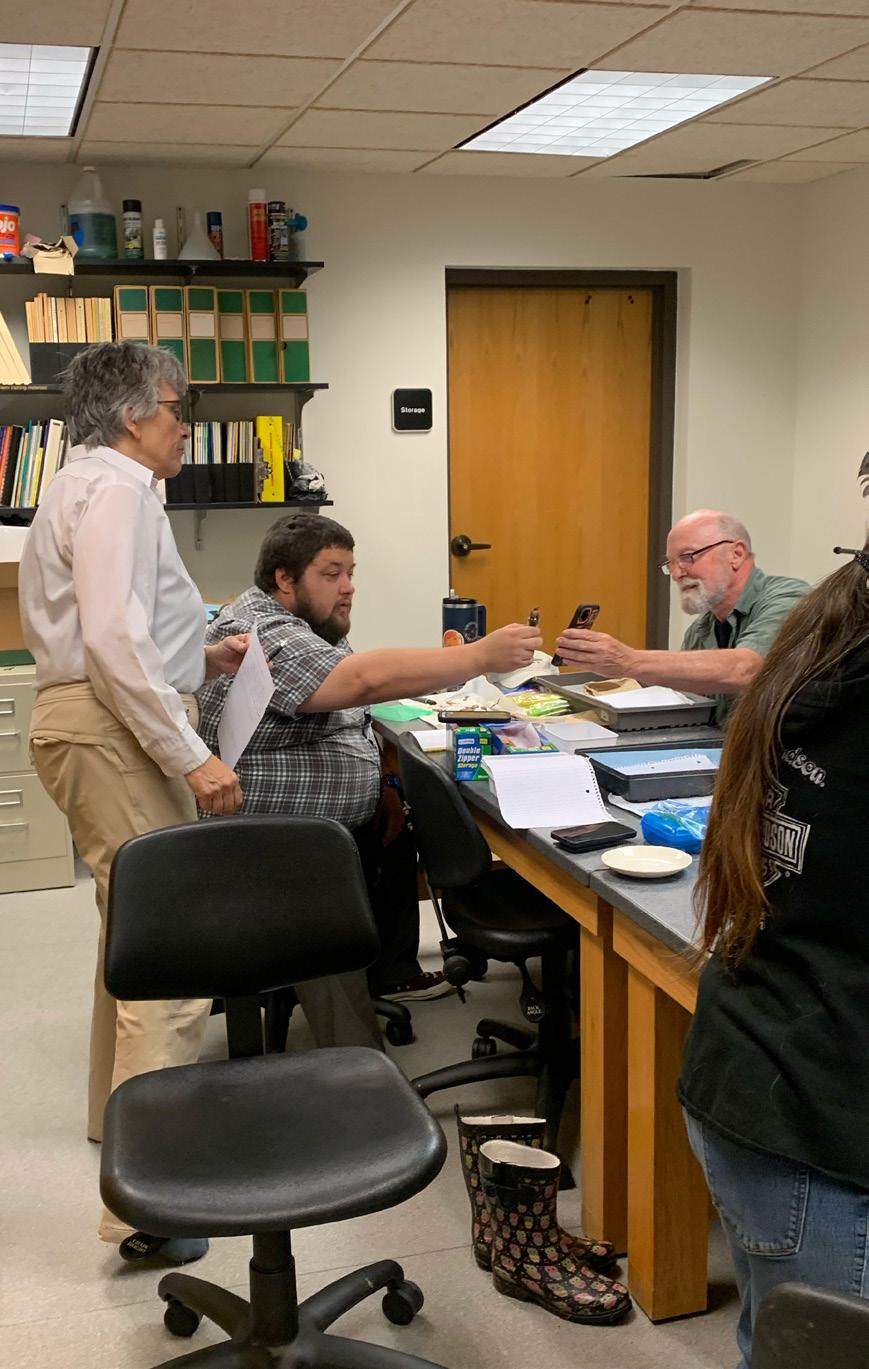
HMS Archaeology team discussing the LePage glue bottle.
Ceramics
Most ceramic finds at the site included whiteware. Most notable thus far are a broken hand painted teapot, and various teacups with some saucers. More research to come from the whiteware found at the site.
Metal
Notable metal finds at the site included a pewter toy Bronco pistol, various kitchen pots, an enamel coated basin, and a 1950s era steam iron. A brass, Victorian style 4x6 in picture frame was also discovered at the site, alongside various metal pieces probably from farm equipment.
WHAT’S NEXT?
The plan for moving forward with the site project is still in the works. Ideally, permission would be granted to dig at the site to discover what other treasures may lie beneath the surface. Years of leaf litter, fern/ tree growth, and weathering may be hiding a lot from the naked eye.
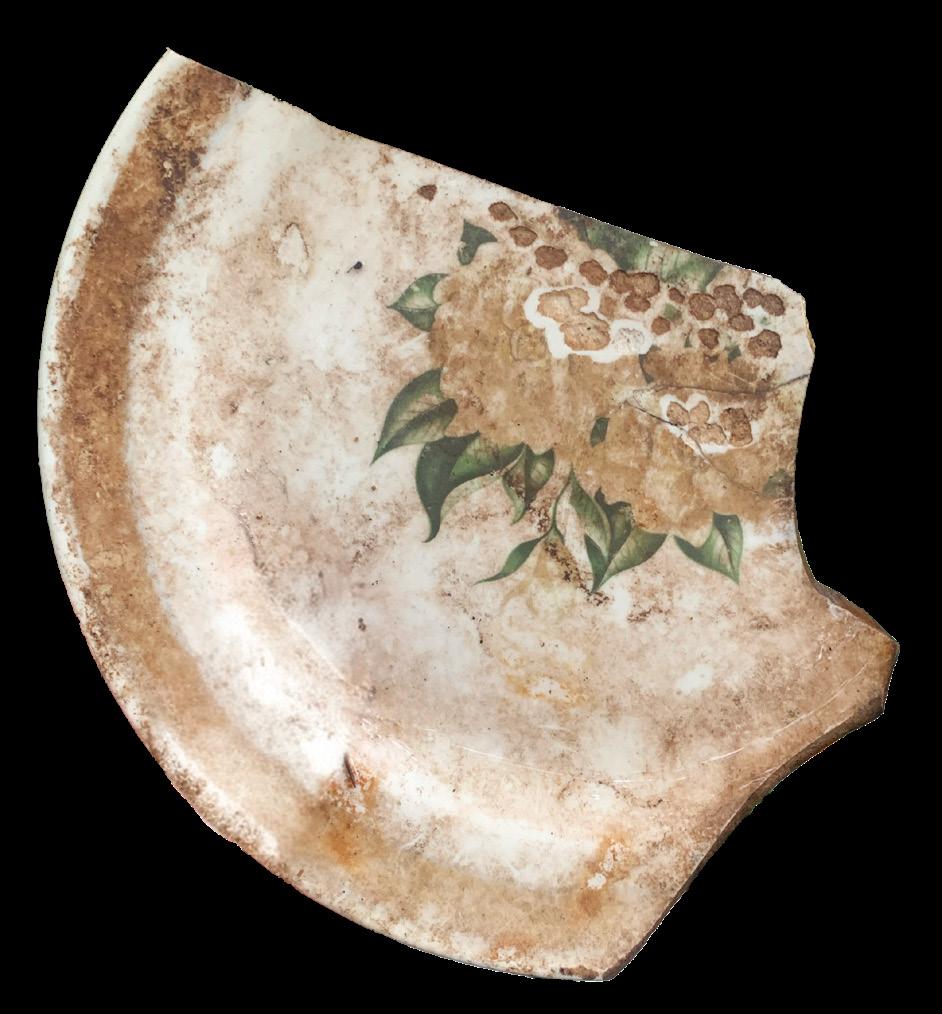
found on Sanctuary property.
HOW TO GET INVOLVED

Archaeology is the study of artifacts as primary sources for discovering and deciphering the everyday life of people and cultures of the past. While much of archaeology focuses on the very old, such as Greek or Roman cultures, there is plenty to be done in your own backyard that is considered local archaeology. Pennsylvania has the added benefit of being one of the USA’s oldest states and thus earliest settled. If you know the local history, you could find artifacts in your own backyard!
Archaeology is a wonderful science that welcomes people of all ages, backgrounds and knowledge, which aligns quite seamlessly with the demographics of
the birding community. Community archaeology can be a very fun, educational discipline which has the opportunity to further connect a community with the land and history it is placed upon, as well as each other. It takes a vigorous curiosity and willingness to get one’s hands dirty, but the rewards are well worth it! As the saying goes, one man’s trash is another man’s treasure!
If involvement in this project excites you, we would love to hear from you! SPA chapter 31 is involved in many projects at Hawk Mountain. Check them out at facebook. com/spachapter31
Piece of broken ceramic plate,
FLYING INSECT SAMPLING AT THE ACOPIAN CENTER: YEAR TWO
By Emily Jones & Alex Hagans
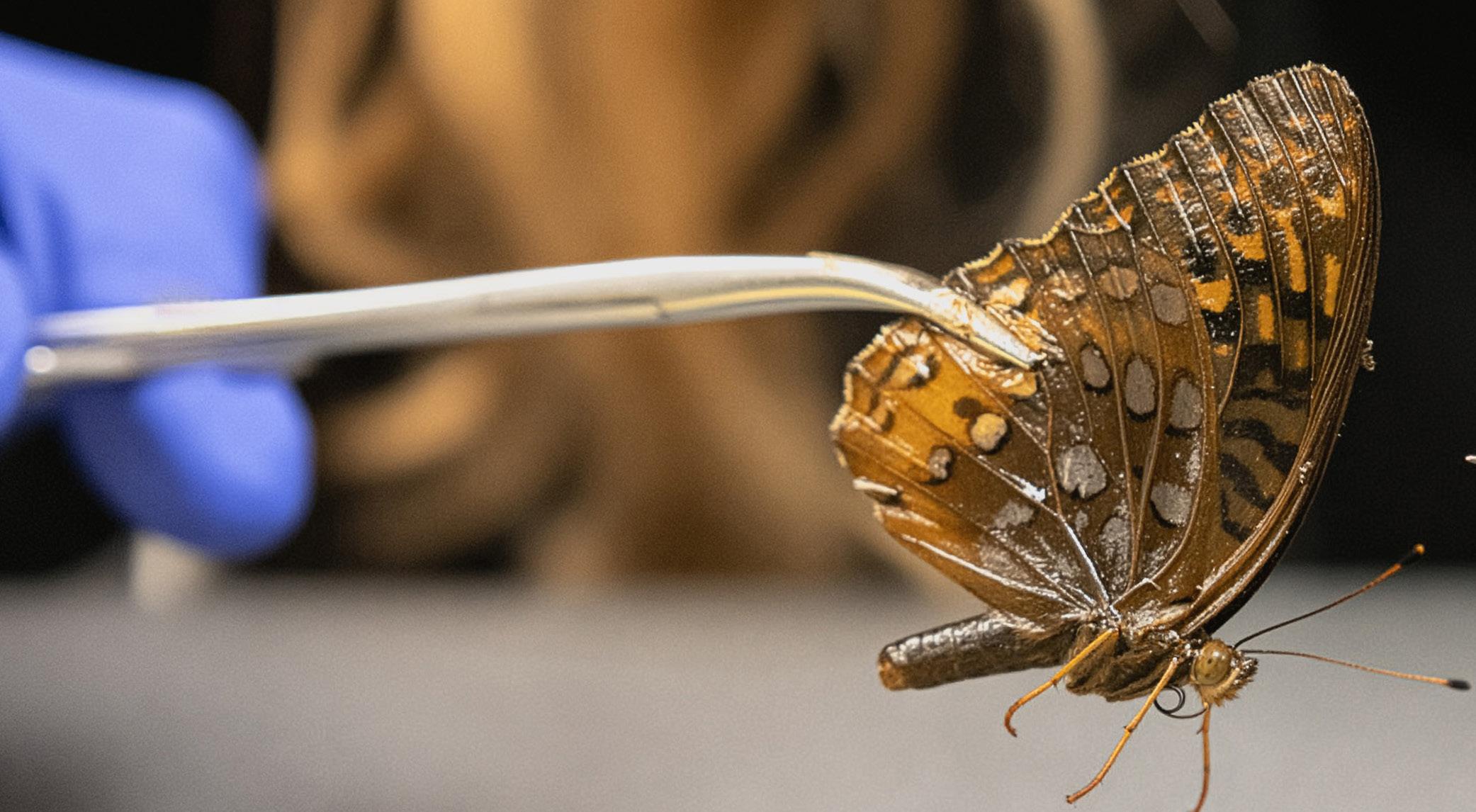
Insects are an essential food source for many bird species, making their study of utmost importance to conservation. Some raptors, such as American kestrels and Eastern screech-owls, feed on insects regularly in the summer months. Larger raptors also inadvertently rely on insects, as the birds and small mammals they prey upon use insects as a food source. Unfortunately, insect populations are in decline around the world and definitive trends are unknown. Understanding insect population declines can yield interesting information for not only the fate of raptors, but also for the ecosystems they inhabit as well. Enter the Malaise-style trap, designed to capture flying insects common in fields or grassy areas.
In May of 2024, Hawk Mountain Sanctuary began participating in the Malaise Trap Project, a collaborative monitoring effort by the North American Insect Abundance Network including over 250 researchers across Canada and the United States. The Malaise Trap Project was created to analyze insect trends using a standardized method of trapping and measurement across large regions to gain more detailed information about insect population declines.
A study using Malaise-style traps in Germany by Hallmann et al. 2017 estimated a seasonal decline of 76% in flying insect biomass, and a mid-summer decline of 82% over the 27 years of study. A comprehensive publication by Sánchez-Bayo and Wyckhuys 2019 reviews 73 historical reports of insect
claim could result in the extinction of 40% of the world’s insect species over the next few decades. However, these reports, along with others have been met with questions and criticism due to a lack of baseline data, which is why it is so important to have a standardized method for collecting insect samples like the Malaise Trap Project.
The data collected at Hawk Mountain Sanctuary will be used to study the effects of insect abundance on the reproduction of swallows. The start date of the first sampling period was determined using the coordinates and elevation of the trap site to calculate the average laying date for tree swallows in the region, which was calculated to be May 17 from the Acopian Center. The trap ran from May 16 to May 19, after which the collection bottle was removed, and the insects inside were sorted. The start date for the second
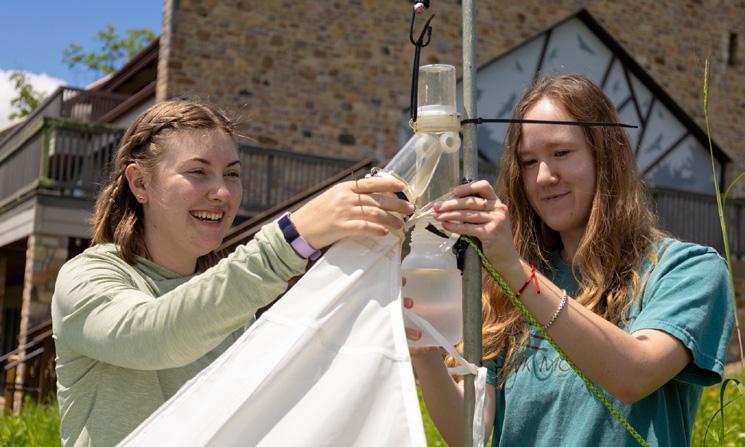
Emily and Alex setting up the collection bottle
sampling period was calculated for average hatch date, determined to be June 4, and ended on June 7. The third and final start date was timed for when the nestlings would be 12 days old, on June 16, and ended on June 19.
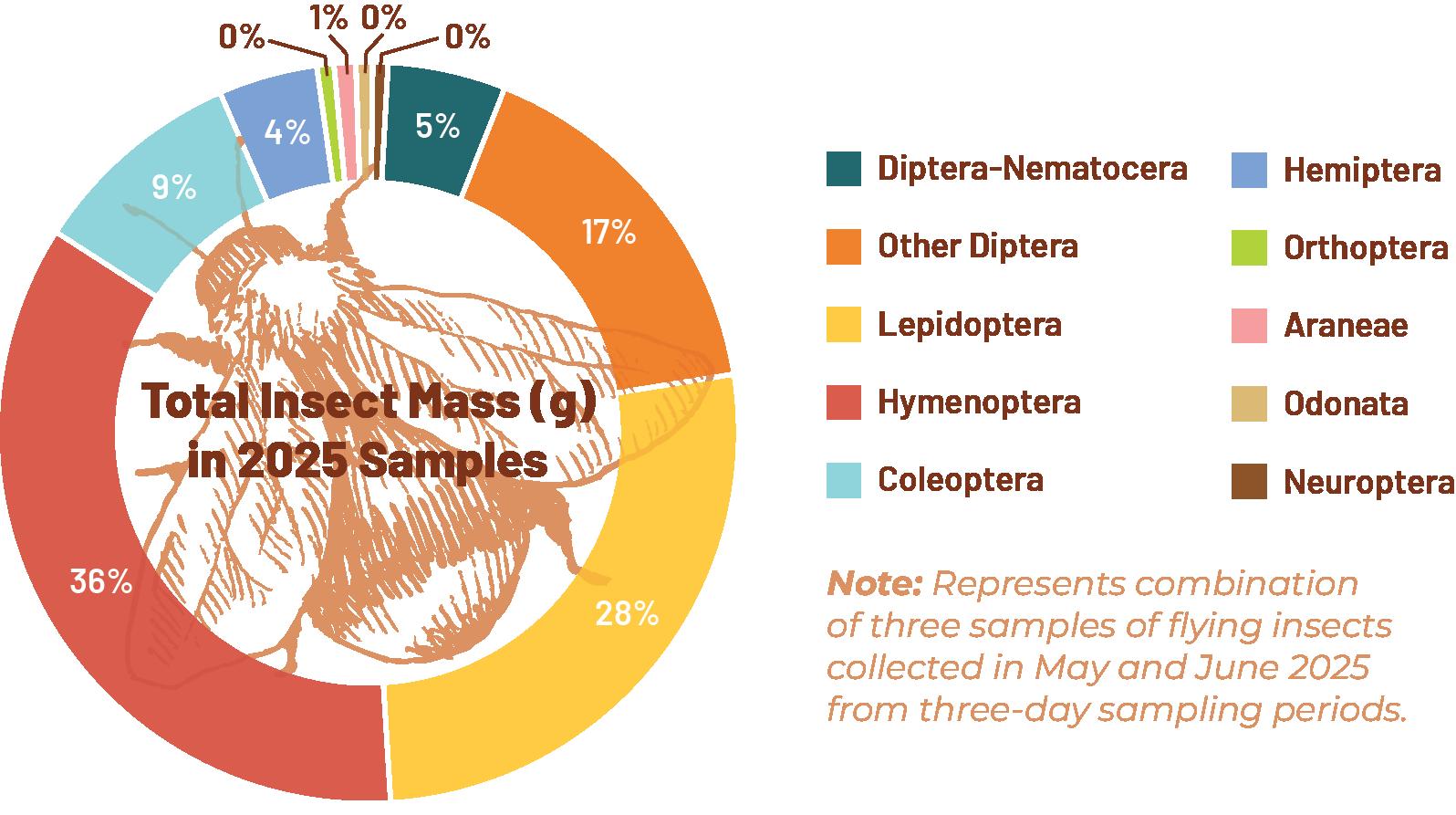
The trap is oriented North-South to intercept prevailing winds and increase the likelihood of flying insects entering the trap. For consistency, three insect samples were collected this year from the Hawk Mountain Acopian Center, a continuation of the same protocol from last year. Collected insects were sorted at the end of each sampling period. On the last day of each sampling period, the collection bottle was removed and the contents strained. The insects were then placed in a petri dish and weighed to get a total mass for the sample. The insects were sorted into five orders (and one subgroup) and placed into dedicated corresponding petri dishes. Sorting was limited to one hour to prevent the ethanol from evaporating and the insects from drying out. At the end of the sorting period, the mass of each individual order was taken and recorded. Following this, the insects were placed into labeled bags and refrigerated for long-term storage.
The six groups sorted were Diptera, Nematocera (Gnats, midges, and mosquitoes), Other Diptera (Flies), Lepidoptera (Butterflies and moths),

Sorting caught insects
Hymenoptera (Bees, wasps, and ants), Coleoptera (Beetles), Hemiptera (Hoppers, cicadas, and shield bugs). Last year, the total mass taken from all three samples was 32.816 g of insects collected. The largest group sorted in samples one and two was Diptera (Flies), but the largest group for the third sample was Lepidoptera due to more butterflies and moths emerging later in the Spring.
This year, the total mass taken from all three samples was 17.452 g of insects collected, indicating a notable decrease in total mass of insects collected from 2024 to 2025. This decrease could be attributed to population decline or to the heavy and frequent rainfall from this spring,
*This article would not have been possible without the invaluable effort of Alexandra Hagans who started working with this project in 2024 when she was a
CONNECTING THE KITTATINNY TO THE CHESAPEAKE:
An Update on Hawk Mountain’s Expanded PA Farmland Raptor Project
By Bracken Brown, Biologist-Naturalist
Hawk Mountain Sanctuary’s PA Farmland Raptor project is expanding its reach after securing a grant through the National Fish and Wildlife Foundation to expand the project into the Chesapeake Bay watershed. This effort is linking the four farmland raptors (American kestrel, northern harrier, barn owl and short-eared owl) with riparian restoration efforts to increase reach on functional ecosystems. A partnership developed with Stroud Water Research Center, who have been monitoring water quality and establishing riparian buffers since the late 1960’s. What seemed like
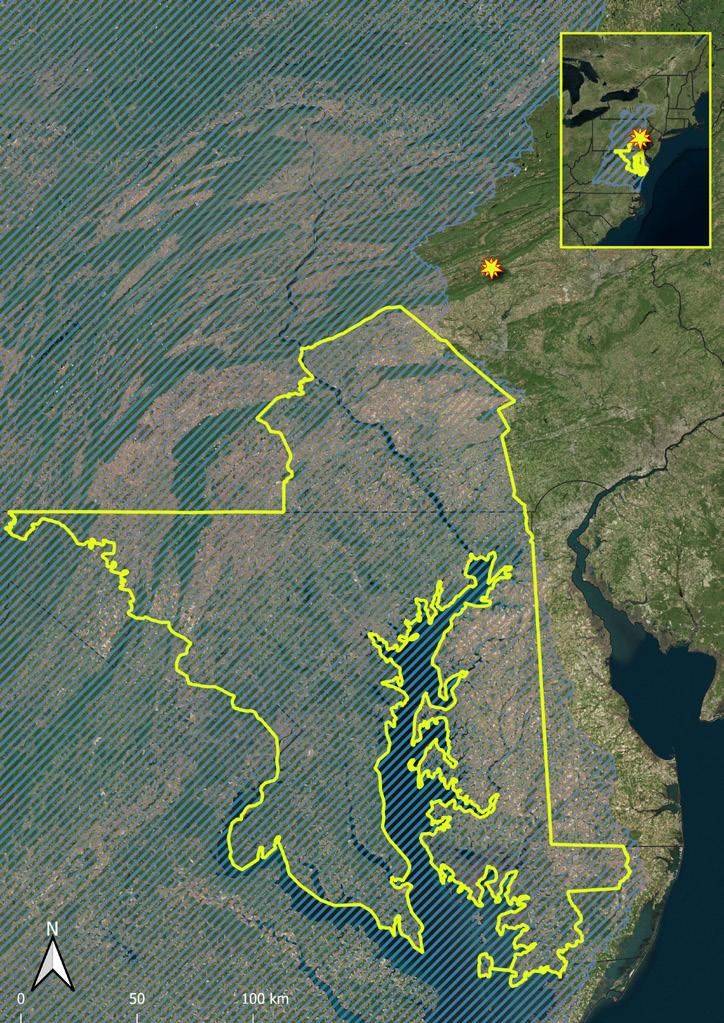
Chesapeake Watershed Project Area
a potential hurdle turned into an asset when Stroud shared their statistics on vole damage to their tree plantings and landowner concern that incorporating these buffer zones would lead to a rodent population boom. Enter the farmland raptor and a perfect partnership is born!
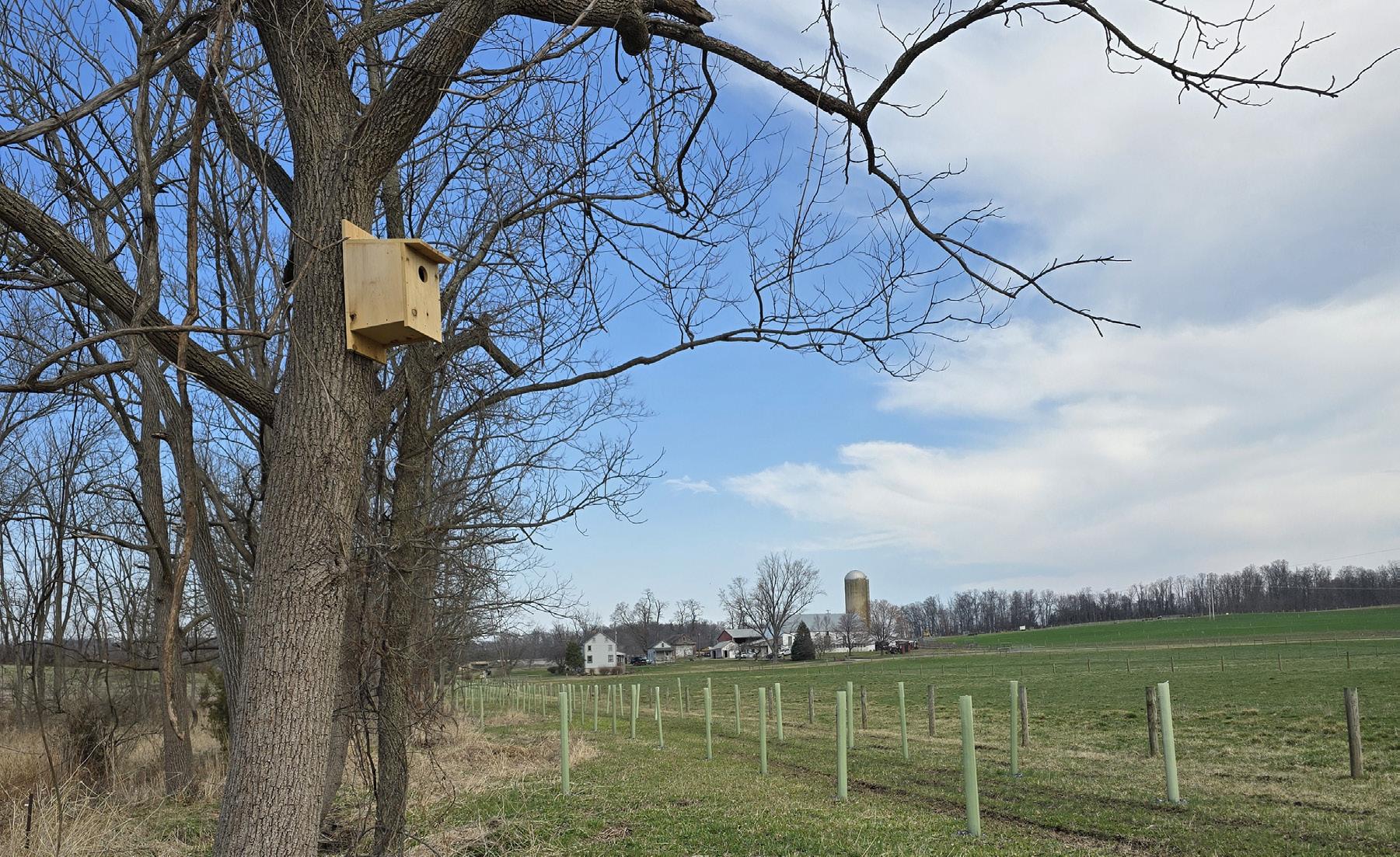
Riparian buffers improve water quality by providing shade to water, but also by acting as a natural filter that limits agricultural runoff from reaching the watershed. At minimum, buffers extend out 35 feet from the stream bank and use a mix of native trees and shrubs to provide both shade and natural filtration. These projects are often significant endeavors for landowners and restoration project managers, as tree saplings need protection and maintenance during establishment. The first three years are when trees are at their most vulnerable and often when vole damage can kill the trees. These early stages provide excellent hunting grounds for farmland raptors, as the small trees provide perch locations to
Riparian buffer with nest box mounted on tree.
scan the grass for their next meal. As trees mature, they can also provide raptors with a safe place to roost during the winter.
These riparian zones increase biodiversity, as they offer refuge extending through open agricultural landscapes to birds, mammals, and insects during mowing events, which benefits the entire food chain. This project aims to use farmland raptors to track habitat functionality, as presence of raptors indicates a healthy ecosystem. By installing kestrel and barn owl boxes in or near these restoration zones, Hawk Mountain researchers can track use of the area as the buffer matures to see if grassland raptors respond to the modified landscape. Encouraging landowners to use natural pest control and making sure to manage properties with habitat in mind can provide long-reaching benefits to our local wildlife.
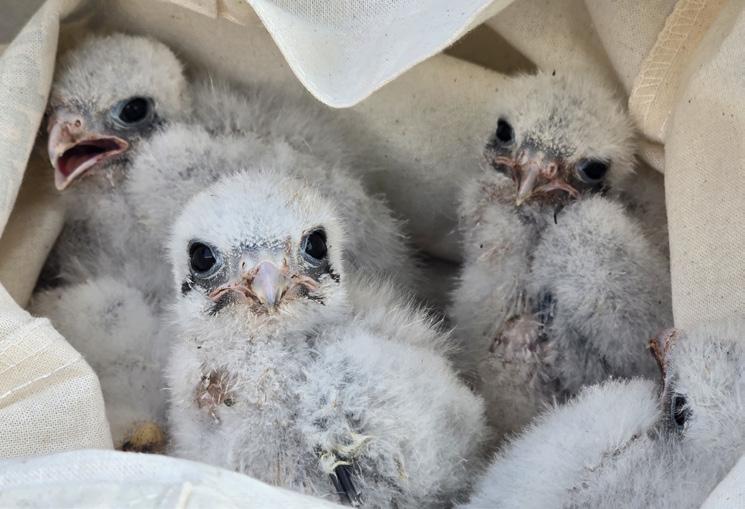
To date the team has deployed 63 kestrel and nine barn owl boxes on properties with buffer projects. With the landowner’s permission, the collaborative team will monitor these boxes for the next two years to determine if they recruit the target species. As of mid-June, 28% of the kestrel boxes were being occupied by nesting kestrels and the team spotted a barn owl roosting in one of the new owl boxes. The quick utilization of these freshly placed nest boxes highlights how important it is to have nesting opportunities in ideal landscapes. June marks the peak of kestrel season, as young are beginning to leave the nest and
learn how to hunt for themselves, so the team has been busy in the field banding chicks. Hawk Mountain bands young kestrels about a week before they are expected to fledge and then continues to monitor where they disperse to.
Once out of the nest box, keeping an eye on young farmland raptors can be a challenge. To combat this, the team plans to conduct surveys in the study area year-round to assess how farmland raptors continue to use the riparian locations. This monitoring effort will also rely on community scientists to report their sightings, either on Hawk Mountain’s online portal or through eBird. The team will also be surveying prey species in and adjacent to the riparian zones to compare diversity and availability of prey items. A healthy prey base will recruit a predator, so farmland raptors will hopefully be a litmus for success of conservation efforts in working landscapes.
It will be a busy two-year effort for farmland raptors in Chester, Lancaster, Lebanon, and York counties, as well as the state of Maryland, adjacent to the bay. This project would be a near impossible undertaking without partners, and Hawk Mountain extends its gratitude to Stroud, PA Game Commission, MD Bird Conservation Partnership, Steve Eisenhauer, Zoo America, Hershey Area Raptor Project, and all our landowner hosts.
If you see a box near a restoration zone, scan for our grassland icons and make sure to report your sightings on the project. To learn more about the project, or to report your sightings, visit hawkmountain.org/ farmland-raptors.

American Kestrel chicks

Kestrels UNDER PRESSURE:
What Grooming Behaviors Can Tell Us
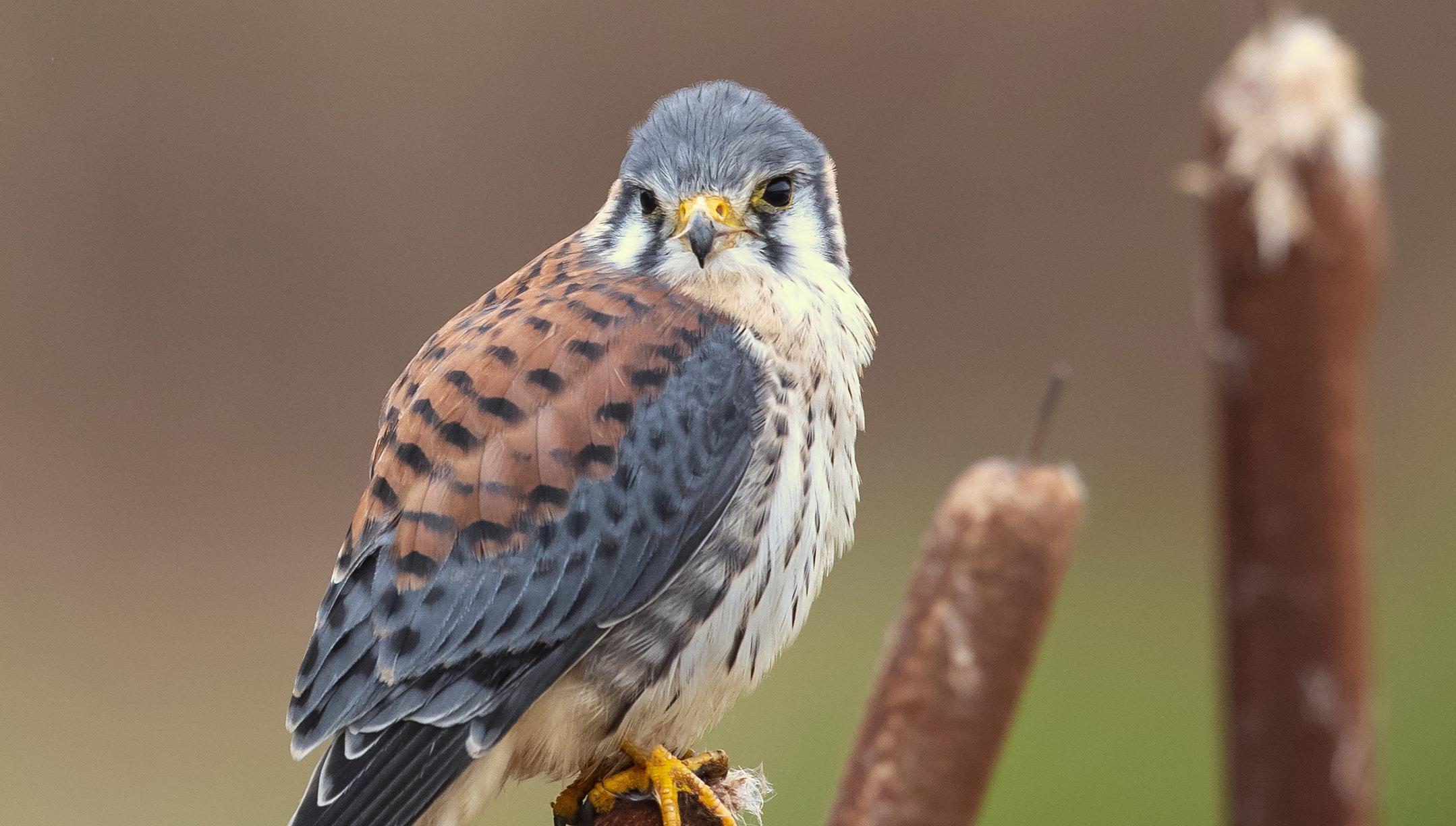
American Kestrels are facing a mysterious decline, and two graduates are turning to behavior for answers. Their research highlighted how grooming, stress, and parasitism impact kestrel health and survival, offering fresh insight into the daily lives and longterm challenges of this falcon.
PARASITES, PREENING, AND POPULATION HEALTH
By Ashley Webster
I am currently pursuing my Ph.D. at the University of Utah in Salt Lake City, where my research concentrates on grooming behavior and stress endocrinology. My goal is to understand how these aspects relate to individual health and long-term survival. I have a keen interest in how environmental stressors—like different habitats and parasitism—affect the behavior and physiology of wildlife. Gaining insights into these impacts is vital for predicting species resilience and formulating effective conservation strategies.
This project aims to fill a significant knowledge gap by examining the connection between grooming behavior, physiological stress, and parasitism in American kestrels. I’m looking into both ectoparasites and endoparasites to see how they influence grooming rates and variation. By uncovering how these internal and external stressors affect grooming habits and stress hormone levels, I hope to shed light on their role in the fitness and population trends of kestrels.
I was drawn to this project because American kestrels are truly fascinating birds, yet their decline in parts of North America is still not fully understood. By exploring how behavior and physiology respond to environmental pressures, I can identify
potential conservation strategies and set management priorities.
Current techniques in hormone sampling and parasite detection enable us to collect valuable data in non-invasive ways. By combining behavioral observations with physiological and parasitological analysis, we can gain a deeper understanding of the factors influencing kestrel health and population dynamics.
My collaboration with Hawk Mountain Sanctuary has been crucial to this research. Their extensive nest box system has provided me with access to a large number of kestrels across a region, facilitating consistent monitoring and sample collection. This partnership significantly enhances the quality and scope of my project, supporting a more comprehensive understanding of the factors contributing to the decline of kestrel populations in North America.
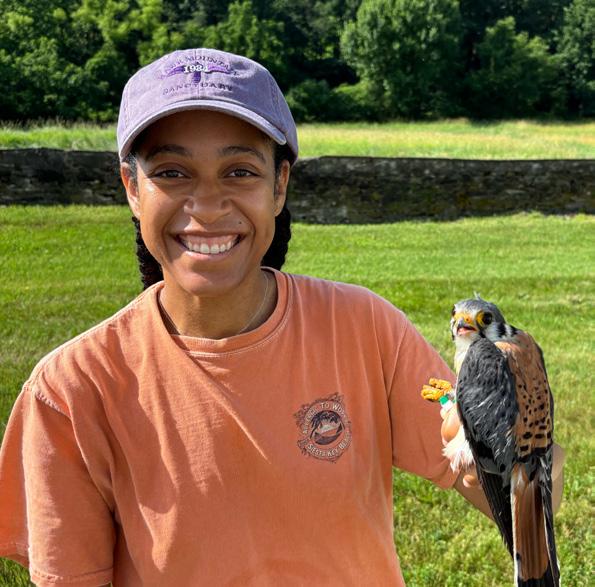
Ashley with a kestrel
JUGGLING PARENTING AND PARASITES
By Nicole Amedee
I am currently an Ecology, Evolution, and Organismal Biology Ph.D. student going into my second year at the University of Utah in Salt Lake City, Utah. My research focuses on anti-parasite behavior in American Kestrels, a tiny but fierce falcon. Like all birds, kestrels have behaviors that combat ectoparasites, such as lice, flies, ticks, and fleas, which are parasites found on the outside of the body. Specifically, I study grooming behavior, which includes both preening (when a bird touches the feathers with the bill), and scratching (when a bird touches the feathers with the feet). Grooming is important for the control of parasites, but it takes time and energy, and birds have busy schedules. Grooming may create trade-offs with feeding offspring, looking out for predators, and defending a territory, for example.
This summer, I conducted an experiment to test whether the amount of time American kestrels spend grooming is calorically limited. To do this, I provided some of Hawk Mountain’s kestrel nest boxes with food and not providing food to other boxes. Then, I measured how much time kestrels from both groups of nest boxes spent grooming. I also counted the number of ectoparasites on adult and nestling kestrels from both groups.
A typical day in my life during the field season started with waking up early to beat the heat and find kestrels while they are
active. I took several pieces of equipment with me in my car, such as a microscope for counting louse eggs on kestrel feathers, a spotting scope for watching behavior, and a ladder for climbing up to nest boxes. Before the experiment began, I marked adult kestrels’ legs with unique color bands combinations so that I could tell each bird apart. Most of my day consisted of driving to different nest boxes, where I delivered food to some and search for the adult kestrels. When I found a kestrel, I recorded each behavior as well as their color band combination. Due to their high activity level and small size, kestrels can be challenging to find. Twenty-one days after the chicks hatched, it was time to band them and count their ectoparasites as well.
American kestrels are a charismatic and important raptor species, yet their numbers are declining. I hope my research will contribute valuable knowledge on the behavior of this species, and support conservation efforts as I learn more about how grooming is related to kestrel health.
Stay tuned for updates on the findings of Nicole and Webster’s research! To learn more about the Sanctuary’s American kestrel research and nest box program, and for how to get involved, visit hawkmountain.org/kestrelnestboxprogram.
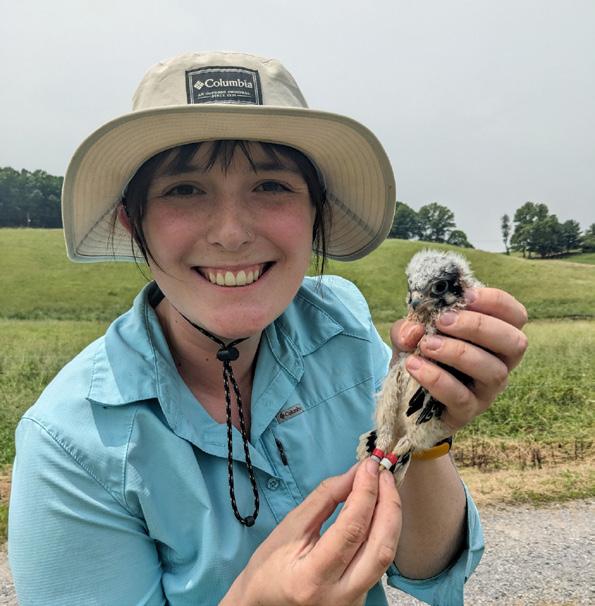
Nicole with a kestrel chick
2025 Spring Migration Summary
By Mathew Sacul, Conservation Science Trainee
Following a trip to Derby Hill Hawk Watch in New York and several training sessions at North Lookout, the Conservation Science Trainees came ready for the spring migration count. Cold temperatures and northwest winds greeted the team on their first day. In the first hour an adult bald eagle was seen high over the lookout, a positive omen for the spring count to come. Overall, trainees counted 1,271 migrating raptors of 14 species in 218 hours over 37 days.
Twelve raptors were counted the first day, including four black vultures. A record high 18 bald eagles were tallied on April 13 along with an adult American goshawk, one of only two goshawks recorded this spring. Flights of Accipitrine hawks peaked midApril with a high of 19 sharp-shinned hawks on the 14th and 12 Cooper’s hawks on the 18th. The 18th also saw a spring record 542 broad-winged hawks, including 125 broadwings in one kettle.
Migration continued through May 15, but in low numbers with only 32 migrating raptors counted in May due to rain cancelling the flight on seven days. May’s raptor highlight was an immature American goshawk flying past the lookout at eye level on the 2nd. Although the raptor migration slowed, songbird migration picked up; the squeaky wheel song of the black-and-white warbler could be heard from the forest and noisy flocks of blue jays were seen flapping past the lookout with a season high 310 jays on May 2. The last raptors of the season were two broad-winged hawks spotted on the afternoon of May 12.
Overall, the year’s spring count was 30% above the 10-year average due in large part to the record high 885 broad-winged hawks counted. Northern harriers also had an above average year and was the
WE THANK THIS SEASON’S COUNTERS:
Conservation Science Trainees:
Aishwarya Laghate, Antonella Mascaro, Emily Jones, Evelyn de Chazal, Gracey Brouillard, Mathew Sacul
Staff: Bracken Brown, David Barber, Jean-Franҫois Therrien, Laurie Goodrich, Rebecca McCabe
Volunteers: Andy Price, Andy Wlasniewski, Emily Sandly, Jeremy Scheivert, Matt Wlasniewski
highest count since 2013. Counts of black and turkey vultures were below average, and the count of sharp-shinned hawks was the second lowest spring count recorded at Hawk Mountain. These below-average counts aren’t a concern yet; they simply may be the result of between year variation since there were no consistent patterns across watchsites in Pennsylvania this spring.
NORTH LOOKOUT – SPRING
Species
Black Vulture
Turkey Vulture
Osprey
Bald Eagle
Northern Harrier
Sharp-shinned Hawk
Cooper’s Hawk
American Goshawk
Unidentified Accipiter
Red-shouldered Hawk
Broad-winged Hawk
Red-tailed Hawk
Rough-legged Hawk
Unidentified Buteo
Golden Eagle
Unidentified Eagle
American Kestrel
Merlin
Peregrine Falcon
Unidentified Falcon
Unidentified Raptor
RAPTORS

PhotoYellow
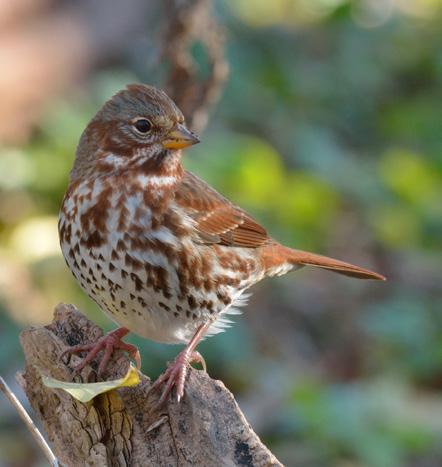
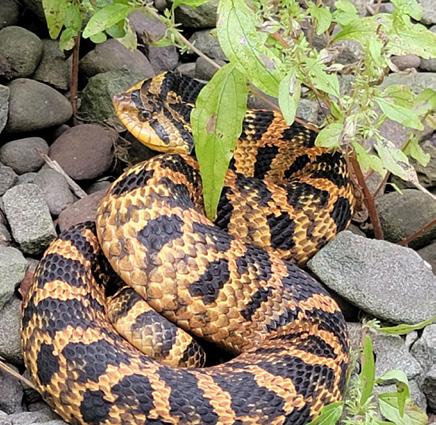

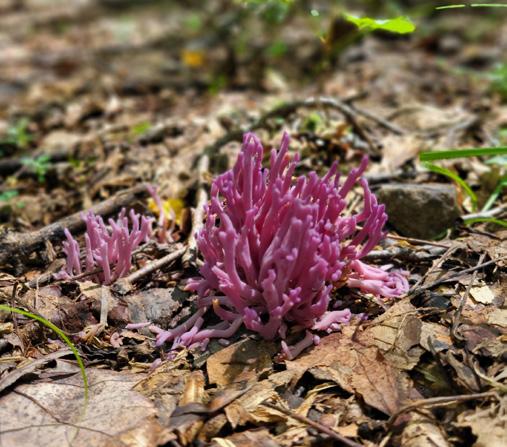
As spring melted into summer, the Sanctuary pulsed with life, offering a display of biodiversity from songbirds and snakes to blooming wildflowers and glowing fireflies. A changing chorus of wildlife filled the forests, fields, and skies, offering memorable sightings and important ecological cues.
The count season began with light nonraptor migration, led by flocks of male redwinged blackbirds and common grackles crossing the ridge. These were trailed by double-crested cormorants and common loons. But by late spring, the Mountain’s forests filled with the sounds of neotropical migrants reclaiming their breeding grounds. Ovenbirds and black-throated green warblers sang from the lower slopes, while black-and-white warblers inspected rocky crevices near North Lookout. Among the standout sightings was a striking Bonaparte’s gull gliding low across the ridge.
At the feeders in May, a Lincoln sparrow made a rare appearance, joined also by fox, white-crowned, and American tree sparrows. A ruby-throated hummingbird nest spotted above the trail entrance gate reminded visitors to keep their eyes peeled in unexpected places.
Mammals made their presence known as well: black bears were seen roaming the surrounding forest, and a particularly bold fisher made an appearance in the parking lot. On Easter Sunday, visitors were treated to the sight of a porcupine tucked in the trees near South Lookout.
Reptile sightings surged, with black rat, ring-necked, and eastern garter snakes, along with multiple timber rattlesnakes noted, including one lounging in the branches of a witch-hazel. A rare highlight was an eastern hognose snake found near the Education Building.
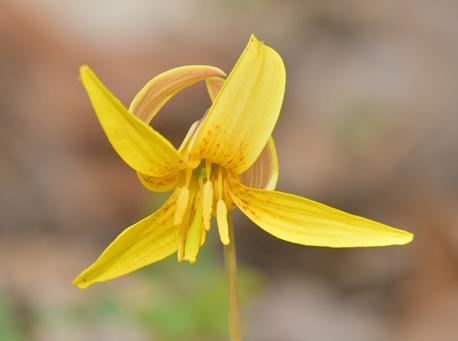
Wildflowers and forest growth brought bursts of color and curiosity to the Mountain this spring. Dutchman’s breeches signaled the arrival of warmer days, followed by the delicate yellow blooms of trout lily. As the season progressed, visitors and staff spotted ghost pipe emerging in shady, damp areas, along with eye-catching fungi like golden spindles, violet coral fungus, and the bright orange shelves of chicken of the woods.
Throughout July, the Sanctuary’s wildflower meadows continued to thrive, offering brilliant seasonal color and a stunning display of pollinators, including many butterflies such as eastern black, spicebush, and tiger swallowtails, plus sleepy orange and cabbage white butterflies. However, not all flora fared as well; oak trees showed signs of stress due to prolonged drought and symptoms of oak wilt, which was definitely not helped by the presence of orange-patched smoky moths, a leaf skeletonizer species. Other moths spotted by staff include painted lichen, clymene, and luna moths.
Photo by Grayson Dewald
Photo by Jess Gary
Yellow Trout Lily,
Photo by Bill Moses
CHAMPIONING ENVIRONMENTAL EDUCATION
In July, Hawk Mountain’s Director of Education Megan Roselli served as a panelist at the Conservation and Natural Resources Advisory Council (CNRAC) meeting, contributing to the discussion titled “Promoting Knowledge and Literacy through Environmental Education.” The panel explored key topics including the role of environmental education in Pennsylvania’s new Science, Technology & Engineering,
ENHANCING ENRICHMENT FOR OUR RAPTORS
Environmental Literacy & Sustainability (STEELS) standards for schools, the importance of career development pathways in the field, and the critical need for accessibility in environmental education. Roselli shared Hawk Mountain’s successes in these areas and helped advocate for continued support and resources to advance environmental literacy across the Commonwealth.
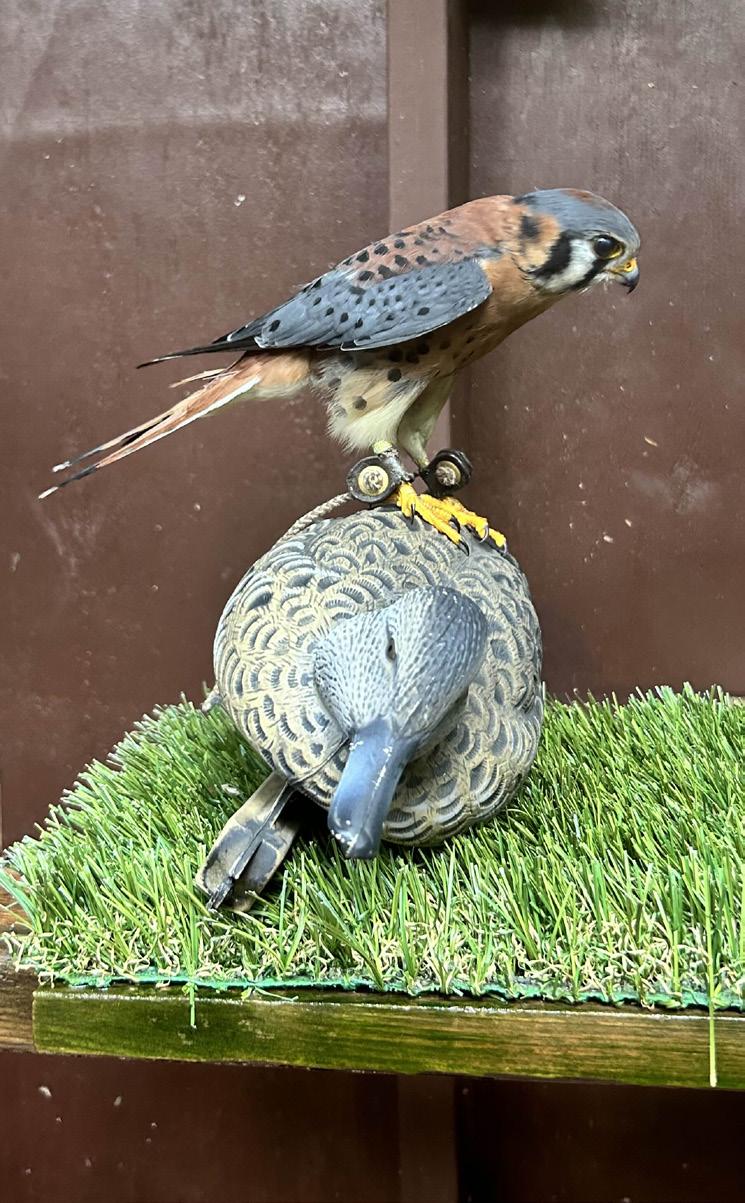
Our education team has been diligently working to implement a new and improved raptor enrichment program, and so far, it has been a great success. Currently, each one of our resident raptors receives an item daily to tear, investigate, or solve. Just like people who have different likes and dislikes, we have found some of our enrichment items resonate better with certain birds than others. Our American kestrel will pounce and claw at a cereal box when an educator’s cell phone plays recorded mouse squeaks from within. Our red-tailed hawk, however, doesn’t bat so much as an eye when a plastic decoy duck is placed in her water bowl as if it was a rubber ducky in a luxurious bathtub. Some others will only interact with their enrichment once our educators’ spying eyes have left for the day. We hope to start categorizing their interactions to better understand their behaviors and interest in different items.
Furthermore, we would like to ask you to help us with donating certain items to keep the novelty flowing for our resident raptors! We will accept uncooked bones (long bones, skulls, antlers), cardboard boxes (ex: cereal, snack, tissue; no adhesives), unscented toilet paper and paper towel tubes, egg cartons, Kong balls, tennis balls, and metal muffin tins (non-disposable). Items can be donated directly to the front desk in our Visitor Center!
Raptor enrichment - American kestrel with duck decoy
Photo by Marissa Defino
NEW EDUCATOR DAN JENKINS
Hawk Mountain Sanctuary recently welcomed Daniel Jenkins as its new Educator and Raptor Care Specialist. A Pennsylvania native and Penn State graduate, Dan brings extensive experience in environmental education, ambassador animal care, bird banding, and habitat management. He previously served with the Cleveland Metroparks system and has led camps, outreach programs, and public events. Passionate about interpretation, he presented at the 2024 National Association for Interpretation conference and has a strong background in wildlife biology, including work with owls and songbirds through various research and conservation initiatives.
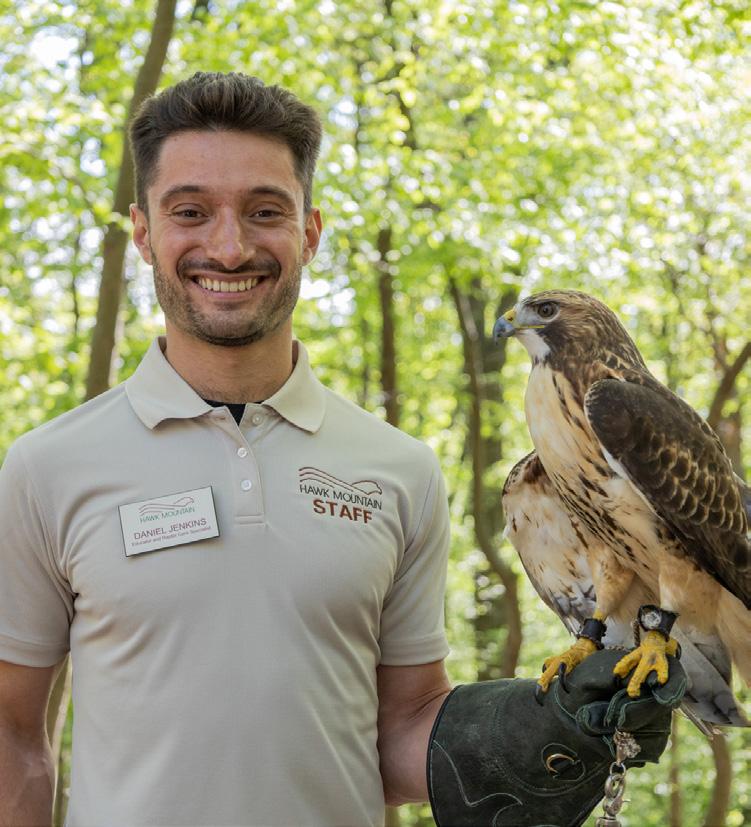
I’m thrilled to be part of such a dynamic team at Hawk Mountain Sanctuary,” Dan says. “I’m dedicated to sharing my passion of raptors and the natural world to help develop an appreciation that will be nurtured for generations to come. Pennsylvania is home and Hawk Mountain Sanctuary is my calling.
APPALACHIAN ECOLOGY INSTITUTE COURSES
INTRODUCTION TO RAPTOR FIELD TECHNIQUES
Thursday, Oct 30 – Sunday, Nov 2 | Thursday, Nov 6 – Sunday, Nov 9
$700, $650 for Members and students
This four-day workshop builds your skills in raptor field techniques and offers insight on how biologists study raptors. Learn new methods or hone existing skills with this hands-on training in raptor ID, trapping methods, handling, blood sampling, surveys, telemetry, and more. Must be 18+ to participate.
APPALACHIAN WINTER ECOLOGY WORKSHOP
Saturday, Jan 17: 8:30 AM – 3:30 PM
$100, $85 for Members and students
Taught by Dr. Dan Ardia, Professor of Biology at Franklin and Marshall College, this 3-day workshop will explore Hawk Mountain’s winter wildlife and how plants and other wildlife adapt to this critical life cycle period.
Visit hawkmountain.org/AppEcologyInstitute for more information and to register.
Spring & Summer 2025 Education Interns and Trainees
AISLINN SHILCUSKY
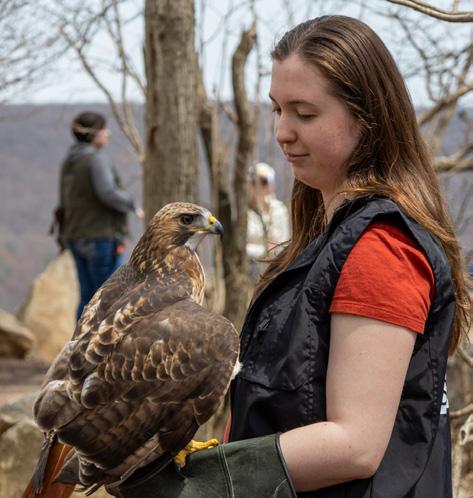
Jennifer Malloy Combs Senior Education Intern Aislinn, originally from Pottsville, PA, earned her B.S. in Ecology from Susquehanna University. Her passion for animal behavior and conservation has led her to conduct fieldwork in diverse ecosystems, including Costa Rica and the Galapagos Islands. As a Conservation Science Trainee in Fall 2024, Aislinn deepened her knowledge of raptor biology and gained valuable hands-on experience in the field. She now serves as a Senior Education Intern at Hawk Mountain Sanctuary, where she combines her love of research and public engagement to support the Sanctuary’s mission. Aislinn especially enjoys working with the Sanctuary’s raptor ambassadors and helping visitors connect with wildlife through meaningful, educational experiences. Having grown up hiking the trails at Hawk Mountain, she is thrilled to now play an active role in its conservation efforts.
MARA ANDERSON-SKELLY
Mara grew up in Lemont, Pa, and developed a love for raptors and the outdoors at a young age. She majored in Environmental Studies at Luther College in Iowa and has worked as a summer camp instructor at Shaver’s Creek Environmental Center and in raptor banding projects with Raptor Resource Project. Mara is excited to get outside these next few months with campers and visitors, share her passion for raptors, and rediscover the beauties of Appalachia.
MARISSA DEFINO
ASHLYN THOMAS
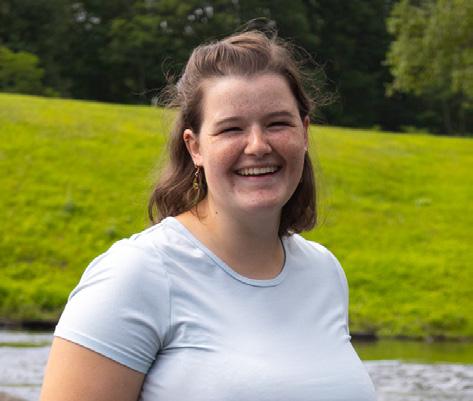
Ashlyn is currently a student in Wildlife Management and Conservation at Delaware Valley University. Originally from the Lehigh Valley, Ashlyn was involved with Summer Camp at Lehigh Gap Nature Center in Slatington, PA, before joining Hawk Mountain Sanctuary. She has loved the outdoors her whole life, so she is excited to teach others about it! Ashlyn is currently focusing on gaining experience and figuring out what environmental field she wants to pursue after graduation.
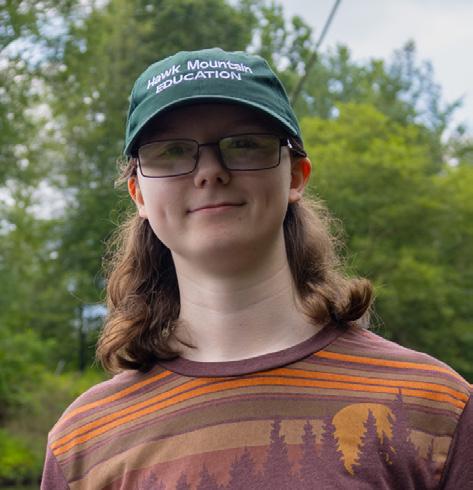
Marissa is from Fair Lawn, NJ, and graduated from Susquehanna University in May with a B.S. in Biology, with a concentration in ecology. Most recently, Marrisa worked as an Environmental Education Intern at the Freshwater Research Institute based at Susquehanna University. Marissa has a passion for wildlife both on land and offshore. She participated in a study abroad to the Galápagos Islands where she strengthened this passion. Marissa’s career goal is to work closely with animals, preferably as a caregiver/zookeeper for a wildlife reserve or zoo.
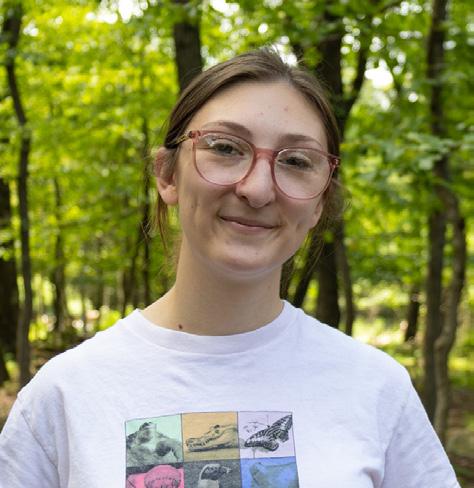
THE TEAM BEHIND THE TRAILS
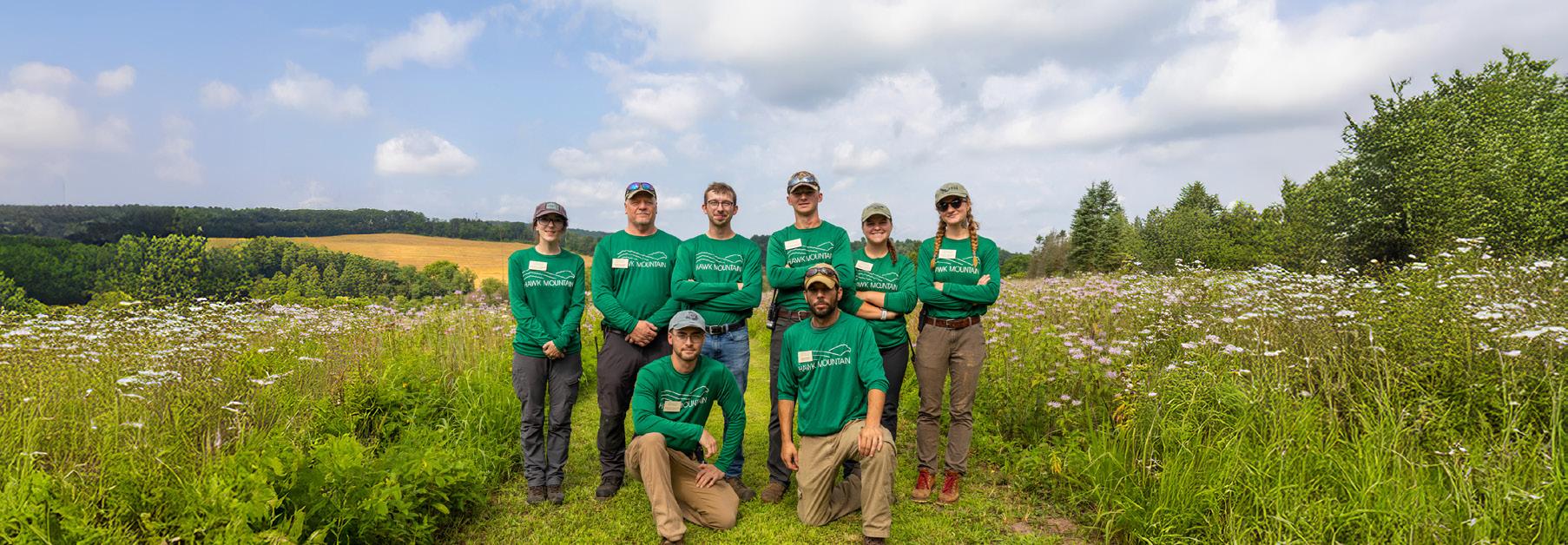
Meet the members of Hawk Mountain’s summer Stewardship Team, affectionately known as the “Stew Crew.” This group tackles invasive plant remediation, maintains and improves trails, builds deer exclosures to protect native vegetation, and tackles countless other projects across the Sanctuary. Their efforts keep Hawk Mountain wild, healthy, and accessible for both wildlife and visitors.
ANNA LAUGHLIN
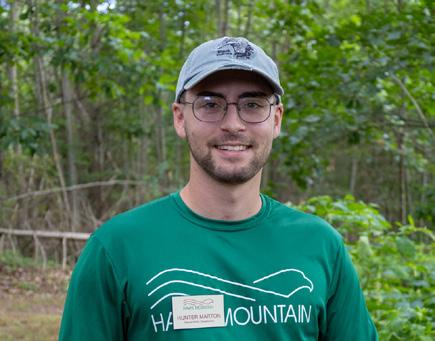
HUNTER MARTON
Hunter, from Dauberville, PA, is a returning naturalist who enjoys gardening, backpacking, and foraging, and shares his knowledge through an online nature blog. He also maintains native plant gardens and micro-meadows at home. This summer, Hunter brought valuable skills in land management and habitat restoration to the team.
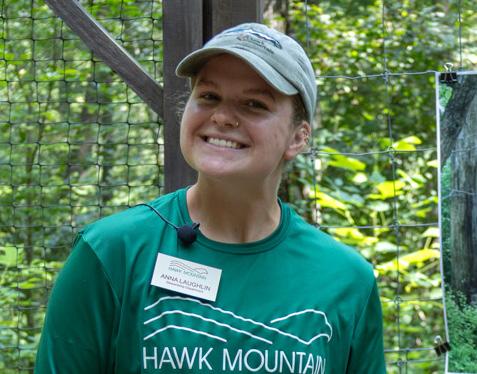
Anna, from Schuylkill County, studies Wildlife and Fisheries Science at Penn State Berks, where she also plays softball. She will transfer to University Park next fall to finish her degree. Anna enjoys hunting, camping, and spending time outdoors. Here, she gained experience with Pennsylvania flora, invasive species, and forest ecosystems. She plans to attend the Pennsylvania Game Warden Academy to pursue a career as a Game Warden.
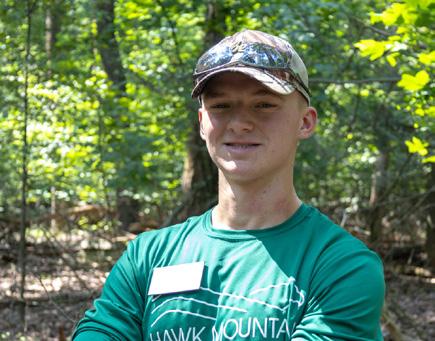
GRAYSON DEWALD
Grayson is a graduate of The Citadel, where he earned a degree in Biology and conducted amphibian research in the Southeastern Coastal Plain. An Eagle Scout and outdoorsman, he enjoys fly fishing, hunting, camping, and snowboarding. When not working on the Mountain, he is often found with a fly rod in hand. His next step is a commission with the United States Air Force.
GRACE VARLESE NECEDA
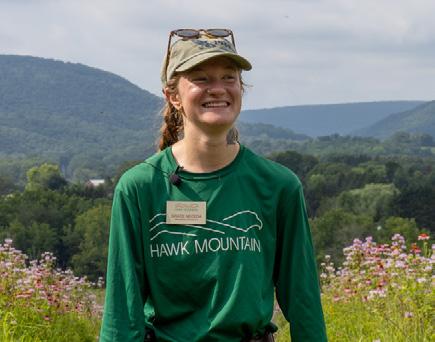
Grace, originally from New Jersey, moved to Pennsylvania three years ago. She grew up hiking, camping, and canoeing, which sparked her love for the outdoors. Last fall, she worked with a conservation corps in Moab, Utah, where she discovered her passion for hands-on conservation. Grace is pursuing a degree in environmental science and plans to return to school this fall. In her free time, she enjoys snowboarding, yoga, and climbing.
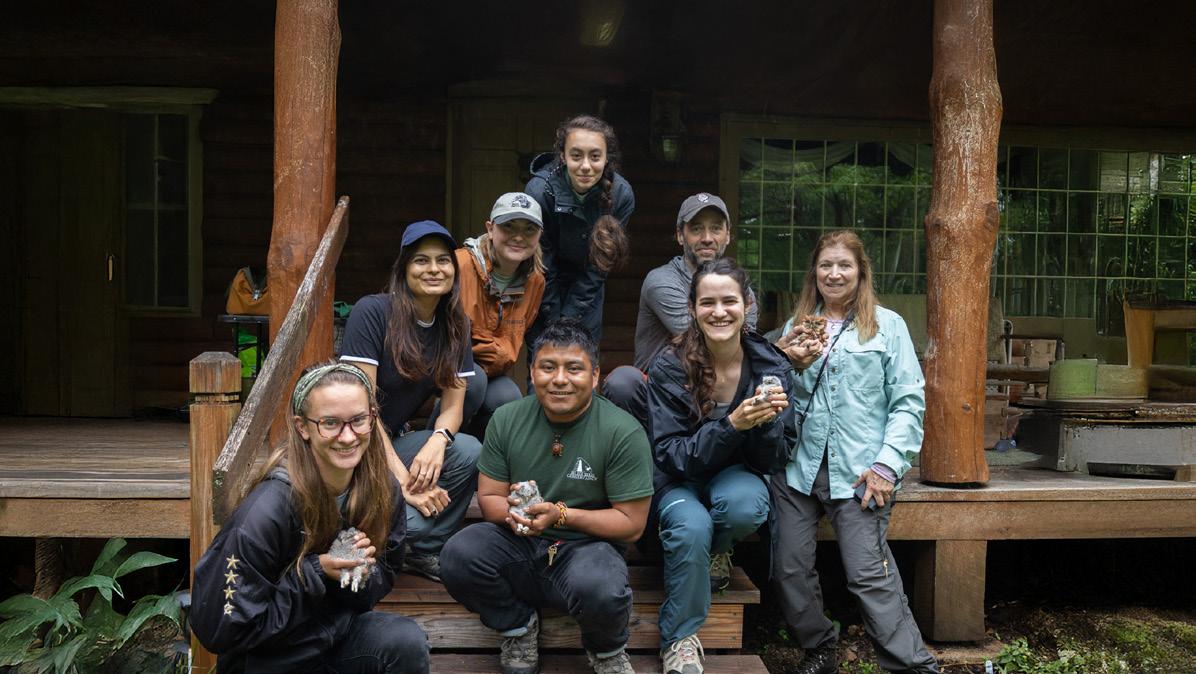
Spring 2025 Conservation Science Trainees
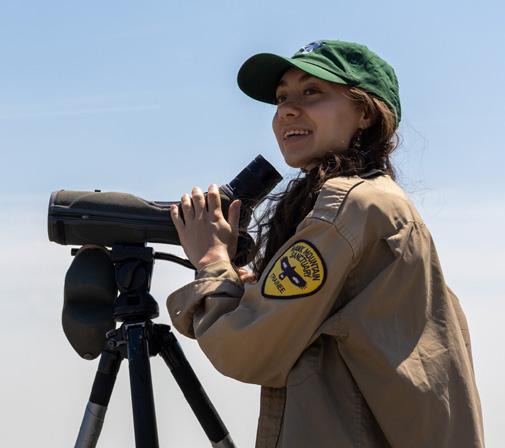
GRACEY BROUILLARD
NEW YORK, NEW YORK
Gracey is a recent graduate of Cornell University where she studied Environment and Sustainability with a concentration in Environmental Biology and Applied Ecology. Gracy has worked with the Cornell Raptor Program where she worked with husbandry, diet management, and relationship building with resident birds where she worked on health logs and identified trends within their behaviors.
EVENLYN DE CHAZAL ROCHESTER, MICHIGAN
Evelyn is a 2024 graduate of Bryn Athyn College with a bachelor’s degree in Interdisciplinary Studies, Biology and Theology. She worked as an Applied Ornithology Intern where she learned to understand the habitat preferences of local bird species, along with methods for gaining community support for nestbox production and installment. She has also interned at the Sanibel Captiva Conservation Foundation as a Garden Nursery Intern where she learned how to properly maintain landscapes, habitats and ecosystems using native plants.
EMILY JONES
RUSHVILLE, ILLINOIS
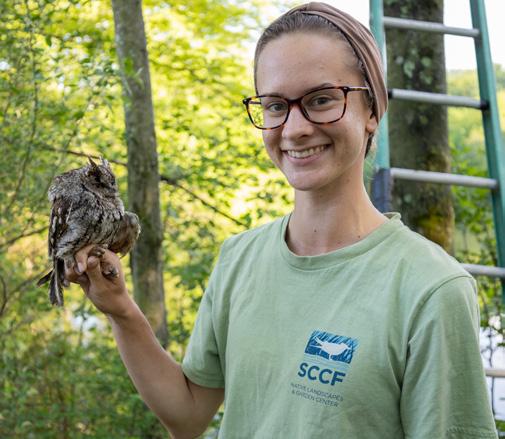
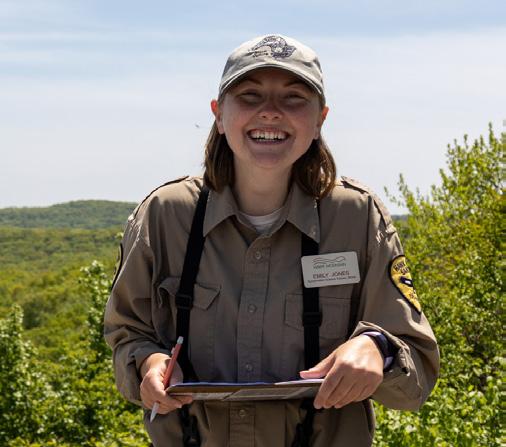
Emily has a bachelor’s degree in Arts in Environmental Studies from the University of Illinois at Springfield. Emily has worked as a Research Technician with the Cooperative Wildlife Research Lab where she identified goose flocks, recorded behavioral, and collected spatial data on geese using FastField. She has also worked as a Senior Field Technician for Osprey Hacking where she processed osprey chicks. She has worked with the University of Illinois at Springfield as a Research Assistant for an American Kestrel Project where she banded, released and resighted kestrels, and collected data.

AISHWARYA LAGHATE
BANGALORE, INDIA
Aishwarya is currently pursuing a PhD in Wildlife Ecology and Conservation at the Center for Wild Studies. She completed her master’s degree in Wildlife Conservation and Action in 2021 from the Institute of Environment Education and Research at Bharati Vidyapeeth University. Aishwarya also has a bachelor’s degree in Environmental Science from Fergusson College that she received in 2019. Aishwarya has worked with WWF India’s Raptor Conservation Programme as a Project Officer, where she monitored nesting colonies of critically endangered long-billed vultures and white-rumped vultures in Central Indian Landscape and coordinated with 500+ eBird citizen scientists for the three years for the annual Vulture Count hosted by WWF-India. Aishwarya has presented at several conferences focusing on vultures, most recently at the 2024 National Level Conference on Lesser-Known Species in Madhya Pradesh on “Endangered/Lesser-known Raptors Present Status, Conservation Challenges and How to Revive.”
ANTONELLA MASCARO
SANTA ROSA, ARGENTINA
Antonella is a graduate of the National University of La Pampa, Argentina, where she received a bachelor’s degree in Engineering in Natural Resources and the Environment. Antonella was a volunteer at the Center of Conservation of Wild Fauna Aguara where she worked with orphaned animals. She also was an assistant at the Center for Studies and Conservation of Raptors in Argentina (CECARA) where she assisted in monitoring and reproductive study of a Chimango colony.
MATHEW SACUL
LAGUNA VILLAGE, BELIZE
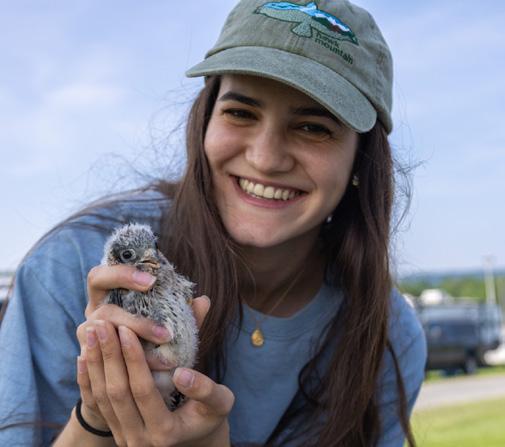
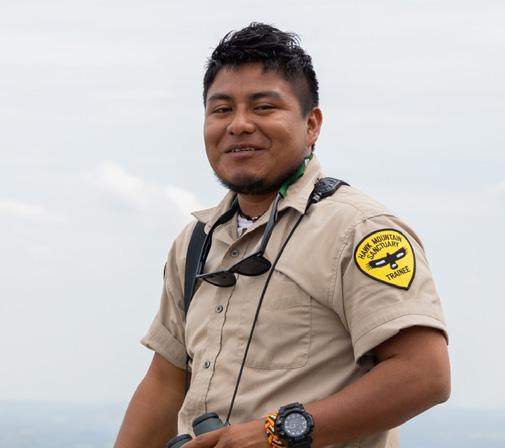
Mathew has an associate’s degree from the University of Belize in Tourism Studies, as well as a certificate from the Belize Raptor Watch Research Conservancy. He also completed the the Belize eBird proficiency workshop in 2020. Mathew is a National Tour Guide and holds many certifications in diving and scuba diving. Mathew has worked as a Bird Survey Assistant at the Mountain Pine Ridge Biological Research Station where he focused on data collection, analysis and documentation. He also enjoys working within the local community teaching about conservation. Mathew currently works as a Day Leader for the Belize Bird Conservancy.
FROM MIGRATION PATHS TO LIFE PATHS
JOURNEY FROM TRAINEE TO ADVOCATE
By Dennis Melsa-Wiegard

Even as a young child, I was fascinated by everything that lived, from towering trees to tiny fungi hiding under fallen leaves. Before my family moved to the city, I was exposed to nature, marveling at how forests breathe and how creatures move in secret ways. One of my earliest memories is observing a hedgehog roaming around. This passion for understanding the natural world eventually led me to study biology at university, focusing on zoology, botany, and nature conservation, with a clear professional goal in mind: to be part of an environmental or nature conservation organization or to be working in a protected area. Science gave me a language to describe my wonder, and a set of tools to explore it more deeply. It turned out that a scientific mindset could guide me even in unexpected careers.
Dennis with Acopian Center Sign
In spring 2004, at the end of my university days, that path led me to Hawk Mountain Sanctuary, where I became a Conservation Science Intern (now called trainees). The Sanctuary’s rocky and forested ridge became my new classroom. I carried out fieldwork, and like generations of trainees before, helped with the long-term raptor count and occasionally assisted with educational programs. Off-duty evenings around a barbeque, swapping field and personal stories with staff, volunteers, and fellow trainees, reminded me that
CONSERVATION IS AS
MUCH ABOUT
COMMUNITY
AS IT IS ABOUT
SCIENCE.
Looking back now after more than 20 years, I can say that Hawk Mountain offered much more than technical experience. It taught me how to connect science with people—to share knowledge, inspire curiosity, and build a community committed to nature. I learned to be meticulous in my work, to collaborate in diverse teams, and to speak to all kinds of audiences about my findings. These lessons have stayed with me ever since and became the foundation of how I lead and hopefully inspire others.
One pivotal experience during the trainee program was the opportunity to conduct my master’s research at Hawk Mountain. The inspiration for my thesis came partly from Rachel Carson’s Silent Spring. I’d read her book as a student, and it spoke directly to the love of nature that had always guided me. Later I learned that some of Carson’s evidence showing how DDT harmed wildlife across the food chain had come from the very counts at Hawk
Mountain. It felt like the first full circle in life: the mountain that once helped telling her story was now helping shape mine. With support from the Sanctuary’s renowned Acopian Center, I collaborated with Cornell University and gathered data at Hawk Mountain for my thesis, where science, passion, and purpose all converged.
My research at Hawk Mountain centered on earthworms, believe it or not. European and Asian earthworms had been introduced to North American forests by humans, becoming “new” prey for amphibians like the red-backed salamander. It’s a well-established fact that those worms could carry higher amounts of heavy metals from the soil than other soil-dwelling animals: zinc, lead and cadmium from industrial emissions, fossil fuel combustion or agricultural fertilizers.
When I think back to my thesis work in and outside of Hawk Mountain Sanctuary, I still remember crouching in the leaf litter, gently lifting soil to collect earthworms and salamanders. My study explored how introduced earthworms might serve as hidden highways for heavy metals moving up the forest food chain. My field surveys revealed that European and Asian earthworms indeed carried higher levels of zinc, lead, and cadmium than surrounding soils, especially in disturbed sites. In carefully designed feeding experiments,
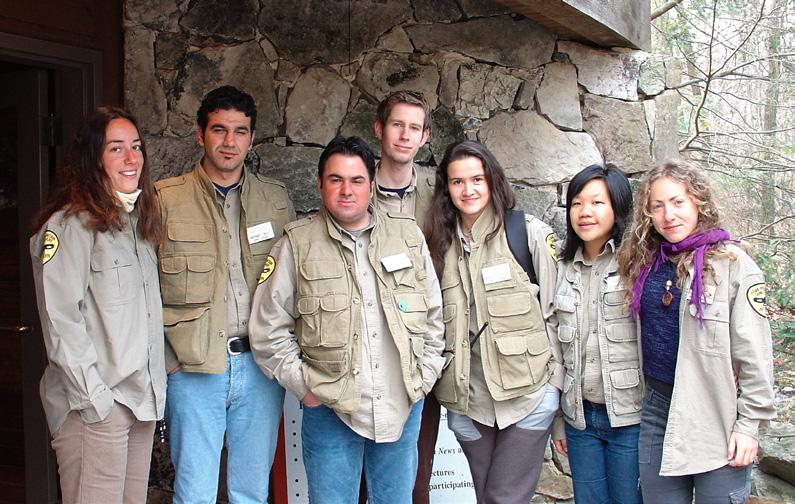
Class of 2004 Trainees
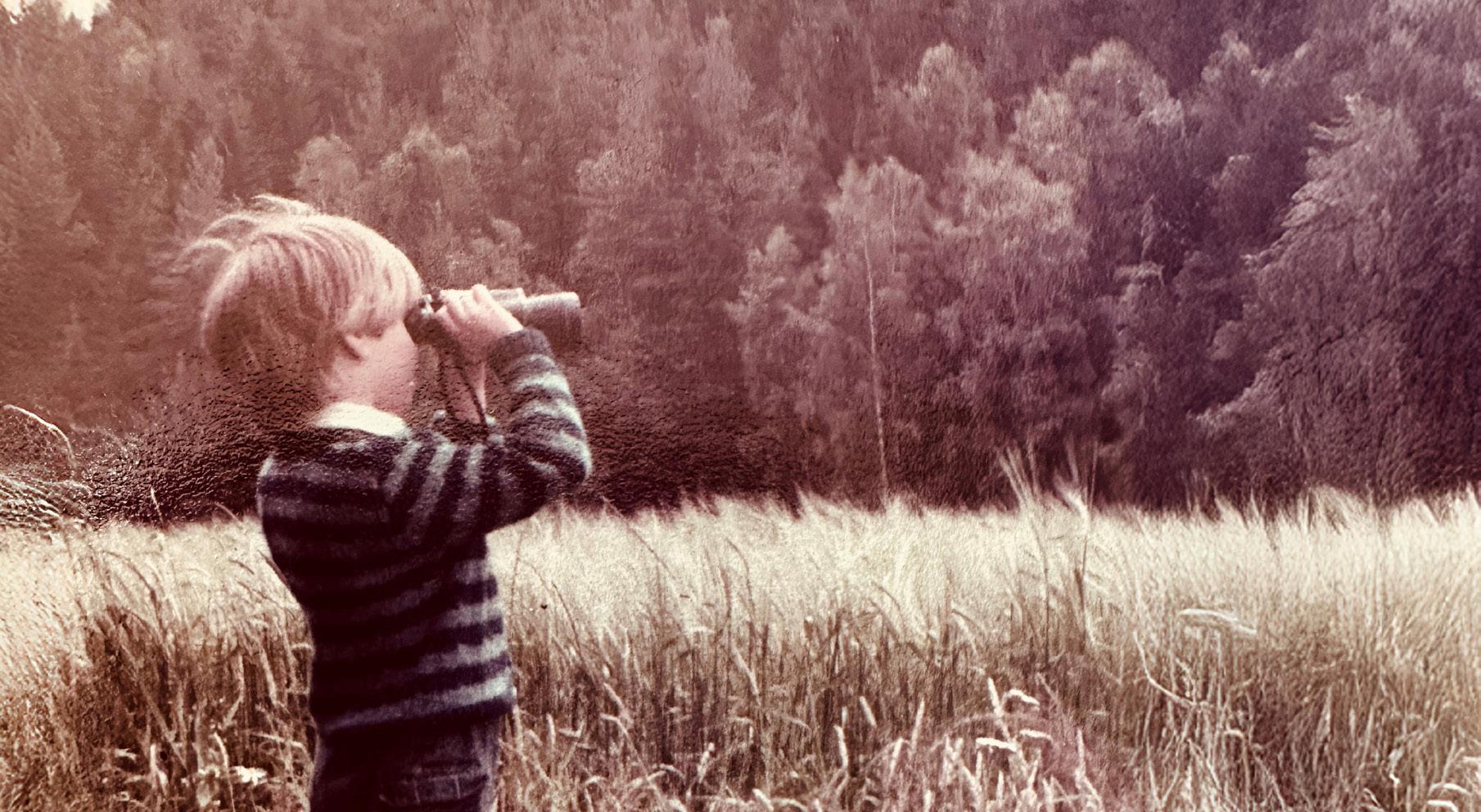
Family photo of young Dennis
I found that salamanders that preyed on these worms sometimes absorbed extra metals, notably zinc and lead, though results varied by species and conditions. Not every metal traveled easily, but the research showed that even small shifts in prey can influence how pollutants flow through forest life. It was a humbling lesson; even underfoot, complex ecological connections shape how healthy or threatened an ecosystem truly is.
bridging science and international cooperation, but it was short-lived due to funding limits.
Undeterred, I pivoted into the renewable energy field. A university classmate invited me to join his solar startup at a time when making solar panels affordable and accessible was still a big challenge. I found myself again part of an international team working hard to expand clean energy and help power a more sustainable future. I learned to manage people and projects on tight deadlines, and every panel distributed felt like a small win for the planet. It wasn’t the same as wading through a stream with test tubes, but I knew I was still helping nature, one step at a time.
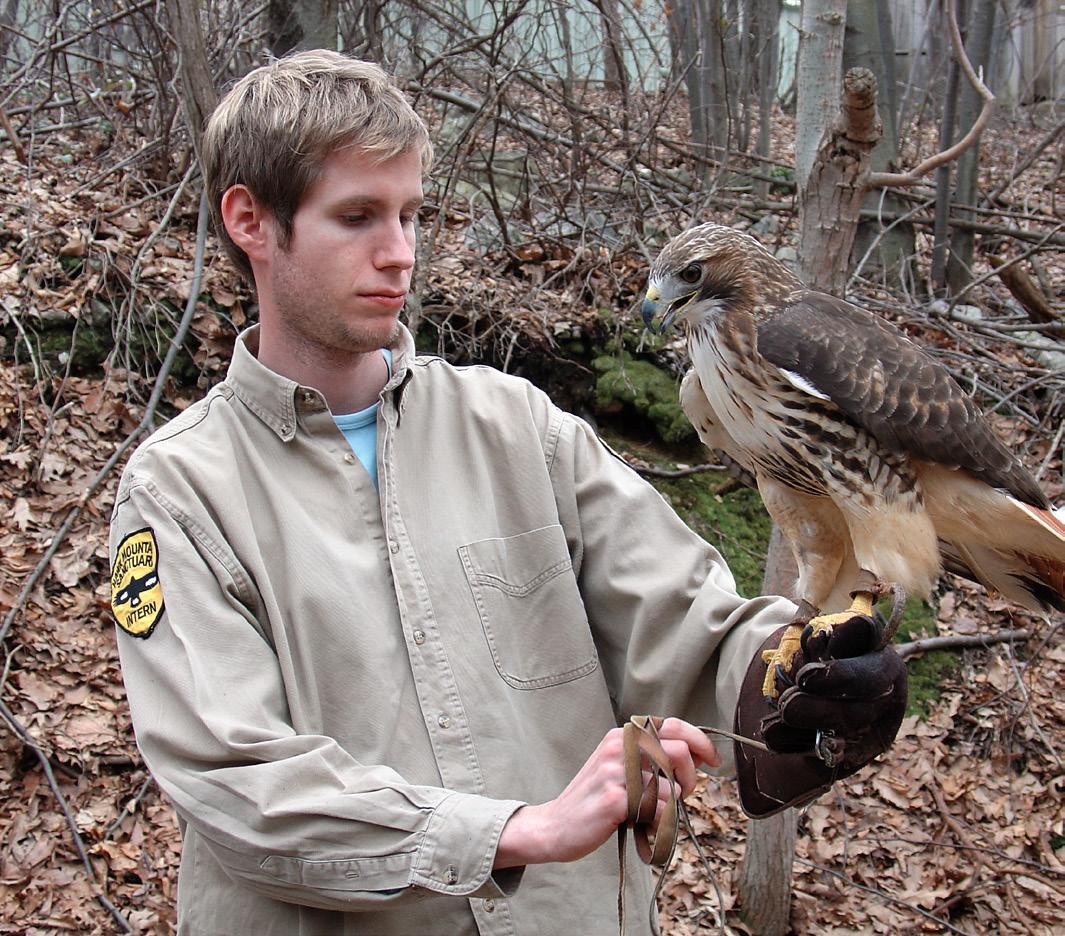
Dennis with raptor during his time at Hawk Mountain.
After Hawk Mountain and graduation from university, I found myself at a fork in the road. One trail led deeper into academic science, the other stretched toward a broader definition of what is impactful and meaningful to me. I chose the broader trail, eager to protect the world I loved by linking environmental knowledge with social change and community engagement. My first step on this new trail was with the United Nations Environment Program, at a specialized UNSecretariat in Bonn, Germany, working to protect harbor porpoises in the North Sea and Baltic Sea. It was my first experience
Eventually, my heart led me back to environmental nonprofits, especially those working with young people. I became Executive Director of a youth environmental organization on a federal level that I have worked for in the past. For almost thirteen years, I helped meld environmental education with democratic values, inspiring young people to care for nature and each other. There were so many proud moments, like bringing young people from African and European countries together and helping them work on their perspectives on the Sustainable Development Goals of the United Nations. Those young people reminded me that nurturing youth truly nurtures the future of both people and the planet.
In recent years, new challenges have emerged. I became more than just alarmed by how antidemocratic and exclusionary forces were trying to infiltrate environmental circles in Europe, especially in Germany. History has shown that even beloved conservation

causes or biological concepts can be twisted by hateful ideologies, from “social Darwinism” to modern eco-nationalism. I knew we had to push back decisively. That’s why I helped launch FARN, a center for countering extremism and strengthening civic engagement in nature conservation and environmental protection, a unique education and research center that defends democracy at the heart of the green movement. Since 2017 FARN has designed and conducted countless workshops, published research, and fostered the training for environmental groups, youth workers, universities, and volunteers, just to name a few, to recognize far-right narratives and concepts that seek to divide societies and mislead people. For example, FARN is running training sessions for local nature clubs and other NGOs on a state or federal level that show how seemingly innocent ideas like protecting “native” species or charged terms like “invasive” can be misused to spread exclusionary messages about “pure” cultures or closed borders. FARN is encouraging scientists and educators to reflect on how ecological language carries metaphors—militaristic words like “invasion” or “alien”—that can echo nationalist or xenophobic thinking when applied beyond science. Instead, this center is advocating the use of precise, neutral terms like “introduced” or “established” species and connecting conservation with inclusive, democratic values. For me, nature conservation and scientific concepts that cannot be applied to human societies must never be a tool for hate; they should always defend life, diversity, equality, and human rights. True sustainability means democracy
and nature thriving together, and the words we choose help shape that vision.
Today, I’m co-Executive Director of KiJuBB, the Competence Center for Child and Youth Participation, in the State of Brandenburg, Germany. Our mission is simple but profound: to amplify young voices in local and state government so that children and youth are not just heard but asked and involved in shaping their communities. This is even enshrined in law and provided for, but politicians and administrators have to be reminded of this once in a while. We advise on the development of such participation concepts.
On the surface, it might seem like a departure—from counting birds on a ridge to empowering young people—but to me it makes perfect sense. Hawk Mountain taught me to observe how small changes ripple through complex systems. I eventually realized democracy is also a living ecosystem, one that thrives on diversity, balance, and active participation. The natural environment that surrounds us and forms of social coexistence, such as democracy, alike gain resilience from inclusion, connection, and care.
Looking back, I see that every chapter of this journey connects. Each mountain peak had its lesson, each valley its perspective. Hawk Mountain was one of my launchpads and every new role or project felt like a ridge to climb toward a wider horizon. Standing on North Lookout years ago (and thankfully a few times since then!), I learned that the horizon is wide. Each of us can choose how high to soar.

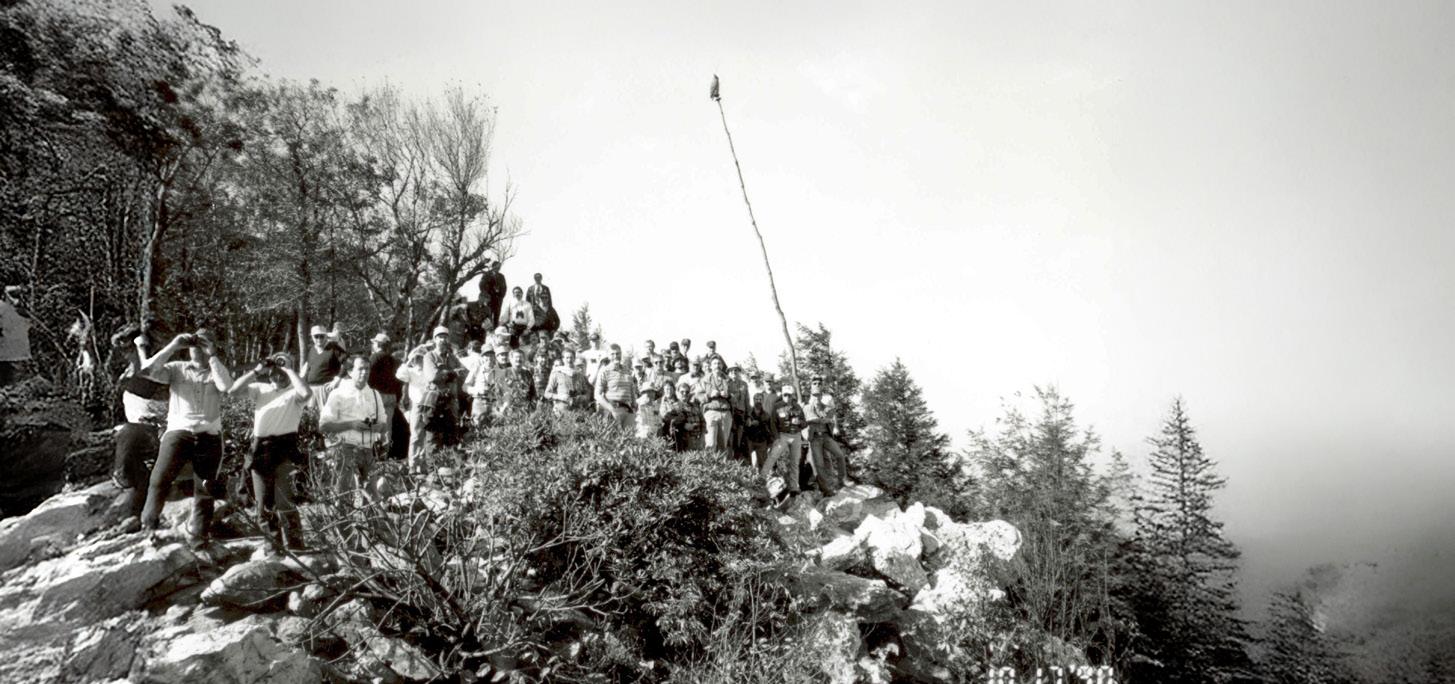
The
Falkland Islands: Penguin Adventure
Saturday, October 4 | 5:30 PM
Join Shawn Carey, past president and current vice president of Eastern Mass Hawk Watch, for an unforgettable journey to the Falkland Islands—home to incredible wildlife like penguins, black-browed albatross, and elephant seals. Gain expert travel tips and stunning photography insights to inspire your own Falklands adventure.
The Courage of Birds: How Our Birds Survive the Winter
Saturday, October 11
Award-winning author Pete Dunne explores the remarkable winter survival strategies of birds. Drawing from his latest book The Courage of Birds, he delves into unique adaptations, migration mysteries, and the impact of climate change—interwoven with personal naturalist anecdotes. A book signing will follow the presentation.
AUTUMN Lecture Series
All lectures are FREE to attend and take place at 5 PM in the Visitor Center Gallery unless stated otherwise. No registration required!
Hawk Mountain Sanctuary: The Past, Present, and Future of Global Raptor Conservation
Saturday, October 18
Hawk Mountain President Sean Grace highlights the Sanctuary’s global conservation impact—from its founding of migration ecology to its ongoing efforts in raptor research, education, and professional training. Discover how Hawk Mountain is shaping the future of birds of prey around the world.
Conservation and Landscape Fragmentation: The View from Hawk Mountain and Southeastern
PA
Saturday, October 25
Join Dan Ardia, Professor of Biology at Franklin & Marshall College, as he explores how habitat fragmentation affects wildlife locally and globally. This talk will feature research from Hawk Mountain and beyond, along with video footage of elusive species like bobcat, black bear, and fisher.
Gentoo penguins in nest.
Photo by Shawn Carey
Full Moon Night Hike
Friday, October 3 | 6:30 - 8:30 PM
$20, $15 for Members
Enjoy a spooky Friday night atop Hawk Mountain with an educator to meet a live owl and set out on a hike in the dark of night. We will keep a keen ear out for the sounds of the wilds that come alive at night. Sturdy footwear required. Flashlights optional. Registration required.
The Big Sit
Saturday, October 11 | 9 AM – 3 PM
Trail fee applies for Non-Members
Assist Hawk Mountain naturalists by tallying raptors at one or more of our three count circles for the Big Sit on the Mountain.
Hawk Mountain Trick or Treat Trail
Sunday, October 19 | 1 – 3:30 PM
$15, $10 for Members
Put on your costume and join us for a festive day of fall fun with a transformed trail, live animal encounters, a costume contest, and photo opportunities at the South Lookout and Wings of Wonder Gallery. Registration required.
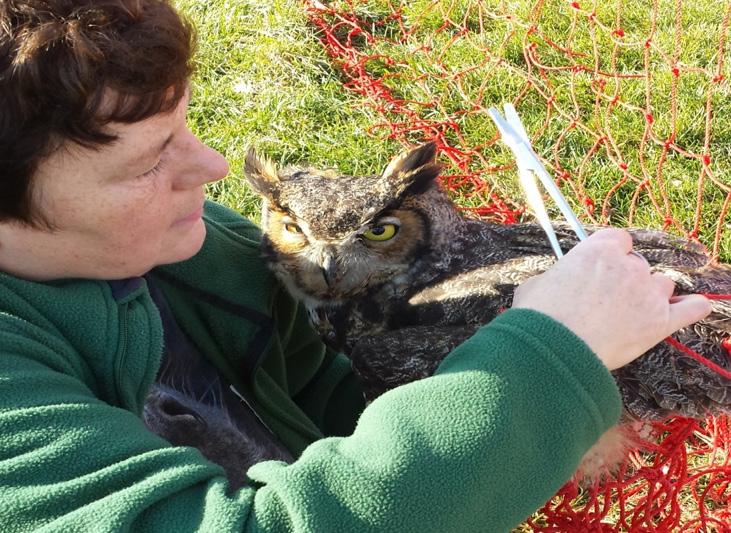
Wildlife Rehabilitation: What We Do and Why
Saturday, November 15
Lylee Leonard of Red Creek Wildlife Center shares the importance of wildlife rehabilitation, patient success stories, and an overview of the center’s work. This engaging presentation includes live animal ambassadors and insights into why wildlife rehab matters for conservation.
Eagle Day
Saturday, November 1 | 10 AM – 3 PM
Programs at 12 PM & 2 PM
Trail fee applies for Non-Members
Come see a LIVE golden and bald eagle; this is the only day you’ll be guaranteed to see one up close! Also get to learn about HMS’s longterm eagle migration counts and other cool eagle facts at the Eagle Discovery Station.
MEMBER EXCLUSIVE
Hawkwatching with the President
Tuesday, October 14 | 9 AM – 1 PM
$20
Depart on a leisurely guided hike to North Lookout with President Sean Grace, then scan the skies for migrating raptors. Registration required.
Owloween
Sunday, October 26 | 1 – 2 PM
$15
Spend the afternoon with Hawk Mountain owl ambassadors. Learn all about these nocturnal birds of prey while enjoying some light snacks, and then dissect a real owl pellet! Registration required.
Youth Discovery Hike
Sunday, November 9 | 10 AM – 1 PM
$15
Youth ages 10-16 are invited to come spend the day at Hawk Mountain, hiking the North Lookout Trail and learning how to identify birds of prey from a distance. Registration required.
LEAVE A LEGACY
Lois Wilkins
Lois’s connection to Hawk Mountain began in the 1980s, when her parents retired to the Poconos and discovered the Sanctuary.
“When I visited, we often spent the day at Hawk Mountain,” she recalls. “As the only non-science major in my family, the romantic sounding Hall of the Mountain King appealed to me from the beginning.”
A retired journalist, teacher, and school librarian, Lois grew up in rural New Jersey in a family that cherished animals, art, gardens, and forests. In college, she explored botany, philosophy, and political science, and today she channels her creative spirit into making functional pottery—many pieces inspired by birds. “Clay scraps magically turn into birds, some three-dimensional and some silhouettes,” she says.
Hawk Mountain’s blend of nature, science, and beauty continues to inspire Lois. “These things I love… birds, plants, animals, people, trees, design, music, and art… are all on Hawk Mountain,” she says.
Her deep appreciation and desire to see Hawk Mountain thrive long into the future led Lois to make the caring decision to include the Sanctuary in her estate plans. “I want to do my part to ensure that the work continues and that Hawk Mountain maintains its independence as a leader in conservation, science, research, and education.”
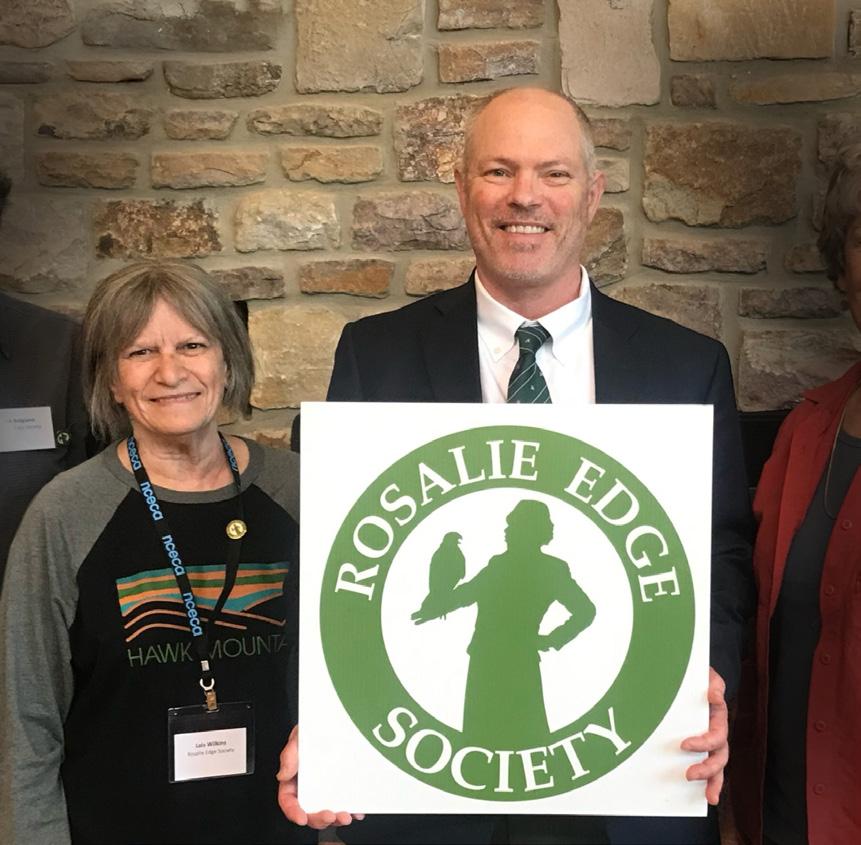
The health and well-being of the birds and the environment are measures of how responsibly we are managing our impact on the planet.
Thanks to her vision and commitment, Lois increased her membership to a leadership level and joined the ranks of the Rosalie Edge Society. We often see her, camera in hand, exploring the Native Plant Garden, taking in the view at South Lookout, or or attending our Sanctuary events and programs.
If you, too, would like to leave a legacy or learn more, please contact us today.
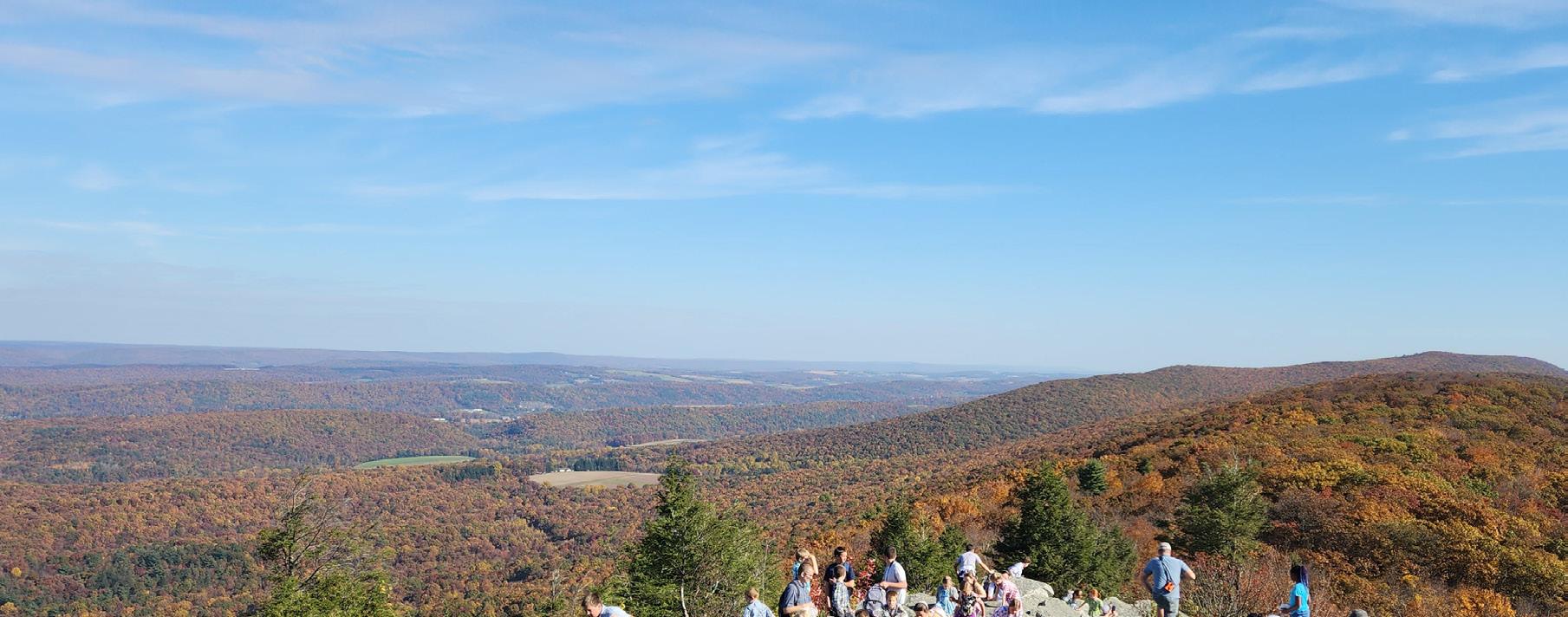
Learn More or Share Your Story Today: Mary Linkevich, Director of Development 610-756-6000 x212 linkevich@hawkmountain.org
Statement of Operating | Revenue and Expense
Fiscal Year April 1, 2024 - March 31, 2025
REVENUE
Membership Dues
Admission Fees
Bookstore Net Sales
Fees and other income
Grants
Contributions
Investment Income
TOTAL EXPENSE
PROGRAM
Education
Conservation Science
Communications
Operations
Bookstore
SUPPORTING SERVICES
Development & Membership
Administration
TOTAL
Increase (decrease) in Net Assets
Note depreciation is included in above numbers

FY 2024-2025
$412,931
$315,270
$117,616
$158,645
$430,037
$5,078,909
$905,563
$7,418,971
FY 2023-2024
$395,585
$301,386
$107,565
$503,739
$134,324
$3,905,181
$2,505,624
$7,853,404
$473,823
$1,211,806
$174,549
$721,409
$188,574
$534,555
$212,275
$3,516,991
$3,901,980
$267,743
$555,681
$1,025,079
$202,203
$719,218
$215,286
$446,869
$151,719
$3,316,055
$4,537,349
$263,581
VARIANCE
$17,346 $13,884 $10,051 ($345,094) $295,713 $1,173,728 ($1,600,061) ($434,433) ($81,858) $186,727 ($27,654) $2,191 ($26,712) $87,686 $60,556 $200,936 ($635,369)
Hawk Mountain Sanctuary received a clean opinion from the auditing firm Baker Tilly Virchow Krause, LLP. Of particular interest is that 79 cents of every dollar received goes directly to support Sanctuary research and education programs.
American Kestrel Nestbox Volunteers:
MIKE MCCARTNEY, GARY RAISNER, & ART ZDANCEWIC
Hawk Mountain’s volunteer corps abounds with friendly faces and dynamic workers, many who do not limit themselves to just one skillset or job. The result is a robust team who accomplishes a lot of good for the Sanctuary. Three such volunteers, whose expertise is shared among native gardening, trail maintenance, and through work with collaborators, have also dedicated countless hours of their time building new nestboxes for our American Kestrel Nestbox Program.
Mike McCartney has been coming to Hawk Mountain since his high school days, attending lecture programs with his parents in the late 60s. Progressing from member to volunteer after retirement, Mike fell in love with tending the plants in the Native Habitat Garden alongside other passionate volunteers. Through building wood duck, kestrel, and bluebird nestboxes with the Lehigh Valley Audubon Society and local park systems like Leaser Lake, Mike later connected with Dr. JF Therrien, who was looking for volunteers to build nestboxes for the kestrel program. Over the past five
Mike McCartney
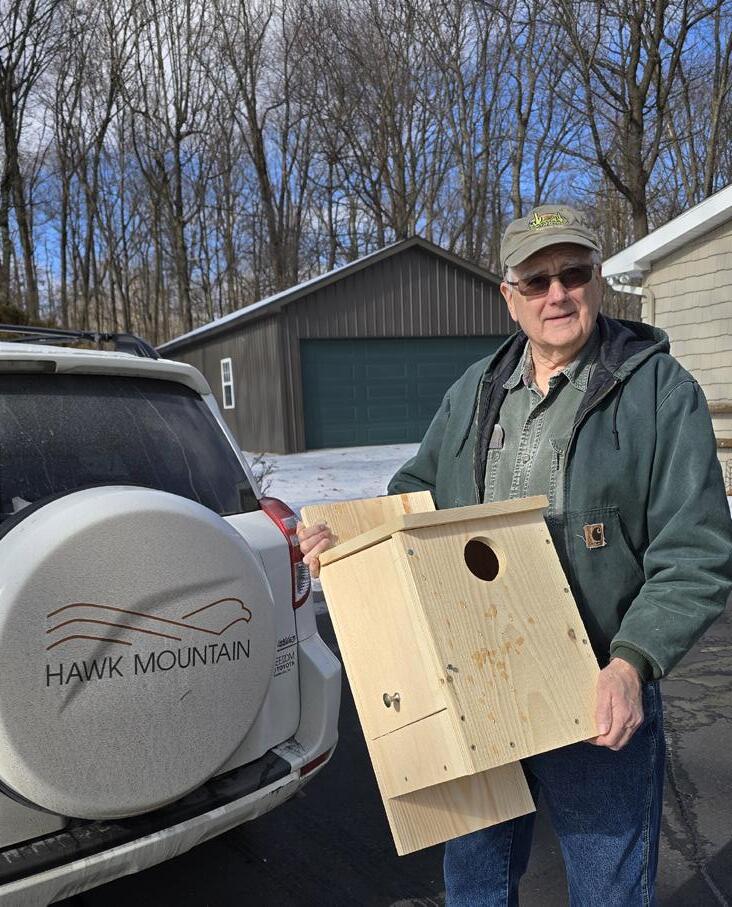
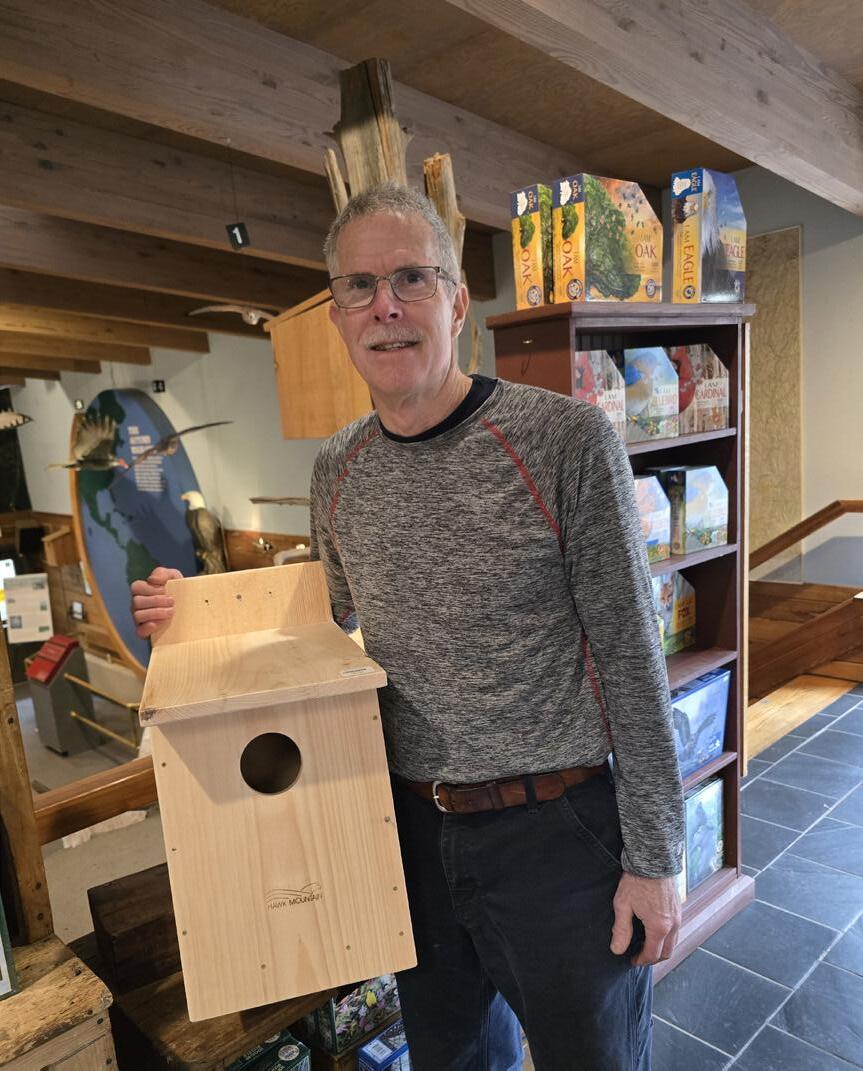
years, Mike has managed to provide us with approximately 10 nestboxes each year.
“All the people I’m lucky enough to know and work with are so friendly and knowledgeable, it is a real pleasure coming up here,” says Mike of the volunteer corps and Hawk Mountain staff.
“I get to work with all the volunteers and staff in the native plant garden, and some staff and interns from the Acopian Center on the kestrel project. I believe all the different conservation projects, both national and international, are absolutely fantastic.”
Similarly, Gary Raisner had been a member at Hawk Mountain for over 35 years before officially becoming a volunteer in January 2019. After retirement, Gary joined Hawk Mountain Stewardship as a volunteer, where he helps maintain the trail system, repair the roads and parking lots, complete minor construction projects, and periodically prune shrubs and trees to keep the views from the lookouts open.
“One of my favorite assignments was when Todd Bauman asked, after a few heavy snowstorms, if I would snowshoe to North
Gary Raisner
Art Zdancewic
Lookout to assess the condition of the Lookout Trail,” shares Gary.
“The snow was above the railings on the steps leading to North and had filled in spaces between the rocks making for a picturesque hike.”
In addition to “anything that needs to be done” with Stewardship, Gary also helps construct the kestrel and bluebird nestboxes that are sold in the Visitor Center. This past year he put his woodworking skills to the test by constructing 44 American kestrel nestboxes for the Farmland Raptor Project, which helped the conservation science team immensely.
Art Zdancewic first visited Hawk Mountain in the mid 1970s after moving to Allentown. Growing up in the farms and forests of Pennsylvania, Art’s career took him to other parts of the country for a while before he was able to settle back in the Reading area in 2000. He learned basic carpentry skills from his granddad and has put them to good use in his retirement, building kestrel boxes for the PA Game Commission, the Delaware Department of Natural Resources and Environmental Control, and now for Hawk Mountain Sanctuary. Art focuses his efforts in the winter, producing 20 nestboxes in his garage-convertedwoodshop this year alone.
Hawk Mountain’s American Kestrel Nestbox Program aims to better understand the decline of kestrels, both regionally and throughout North America. Providing them with nestboxes ensures that they have a safe place to raise their young and hopefully lends to the recovery of the species in our region.
“With our ever-increasing urbanization, it is distressing that our smallest falcon is declining in number,” says Art.

“I like to think that my small effort is helping kestrels and that my grandkids will be able to show their children kestrels one day.”
The combined efforts of these three gentlemen have resulted in the creation of more than 110 nestboxes constructed over the past five years! But they are not the only ones—seasonal steward Brandie Gardner has been a champion for the kestrel nestbox program, contributing 45 nestboxes this past winter, and every few years a boy scout troop or individual donor will contribute some new boxes as well.
WANT TO GET INVOLVED?
You can volunteer or donate to the American Kestrel Nestbox Program by visiting the QR code here:

We rely on volunteers to assist in the day-to-day happenings of the Sanctuary and would love to find a space for you on our team. If interested, contact Tammy Jandrasitz at jandrasitz@hawkmountain.org.

