The mission of Hawk Mountain Sanctuary Association is to conserve birds of prey worldwide by providing leadership in raptor conservation science and education, and by maintaining Hawk Mountain Sanctuary as a model observation, research, and education facility.
TOP OF THE MOUNTAIN
Making Migration Memories
NEWS & NOTES
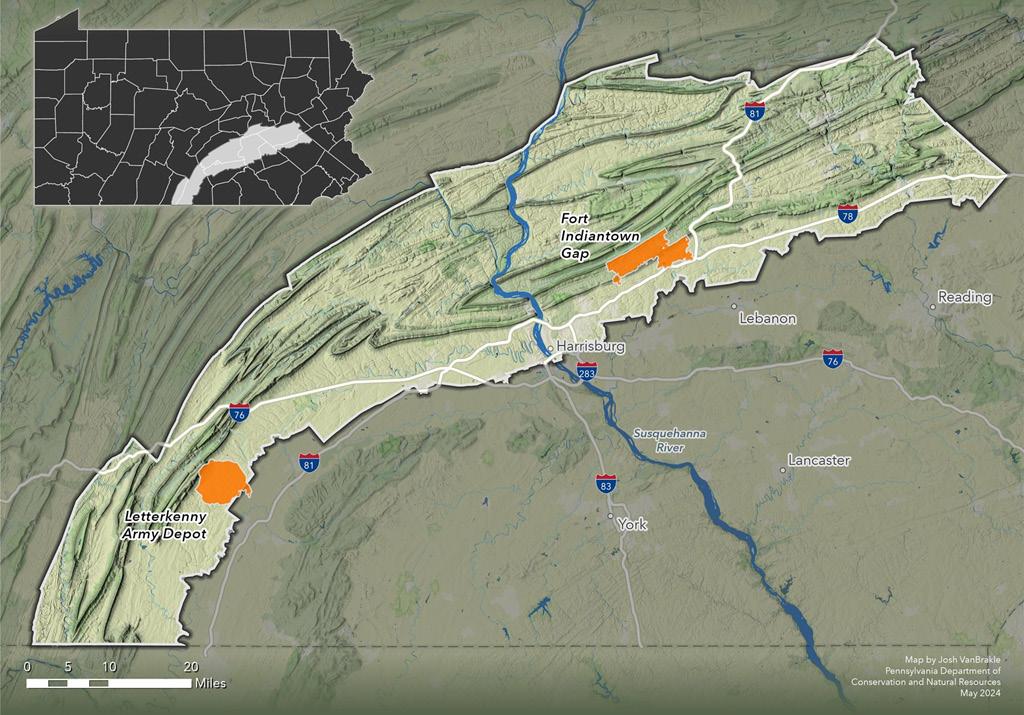
New Sentinel Landscape Designation
RIDGE CURRENTS
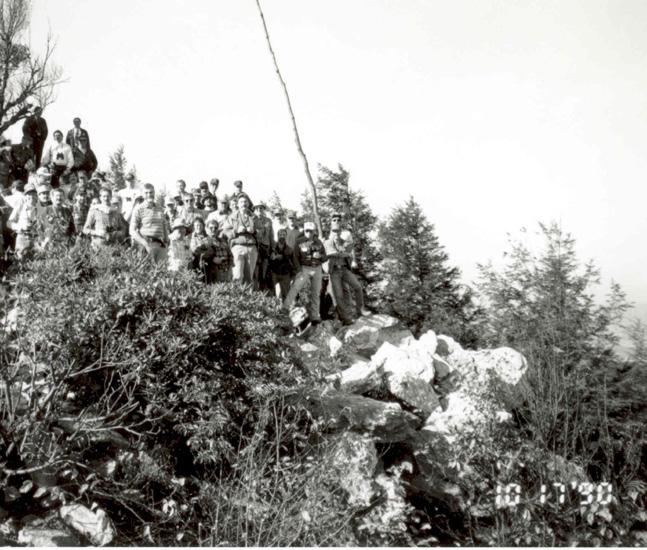
Reunited for Raptors: 90th
Anniversary Trainee Reunion
APPALACHIAN TRAILS
Decade of Biodiversity Building
FIELD NOTES
Why Are Raptors at Risk?
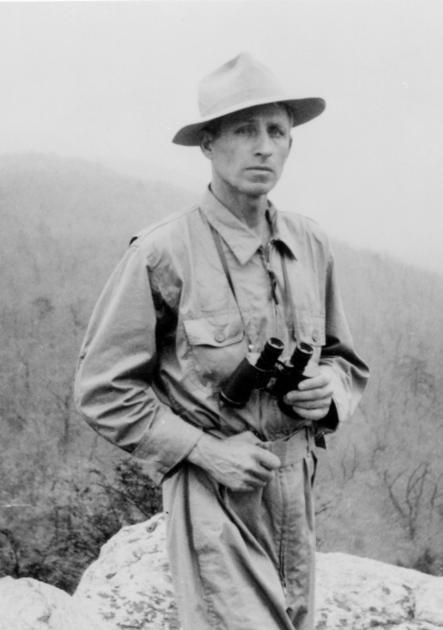
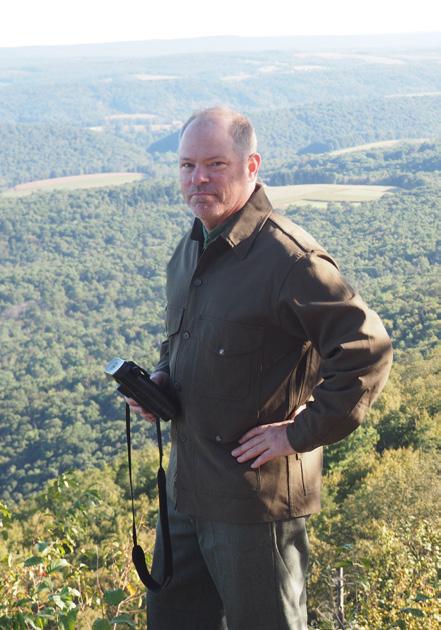
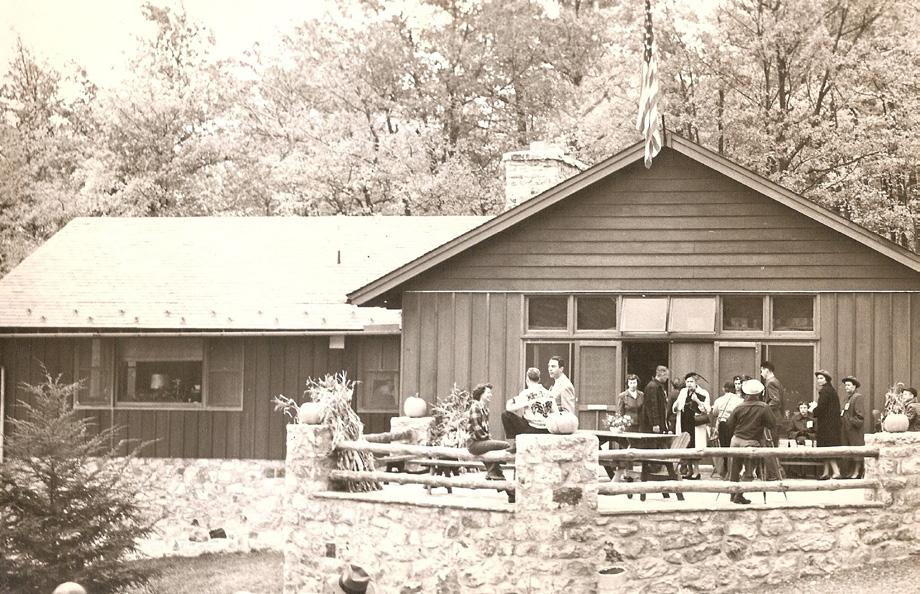
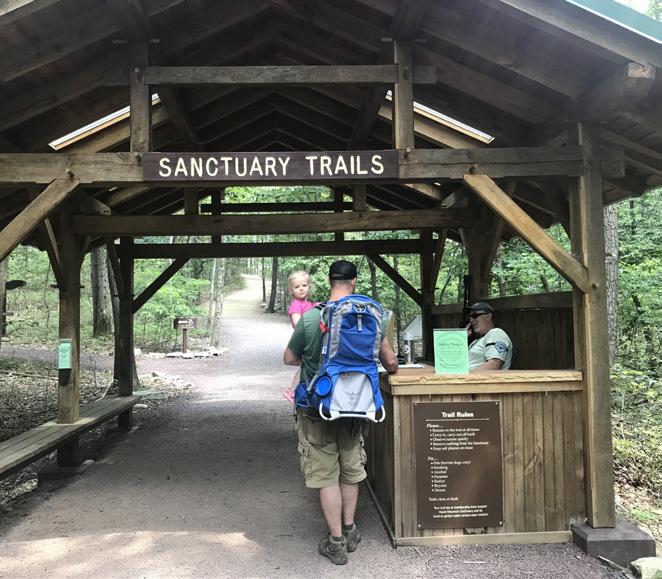
Then and Now
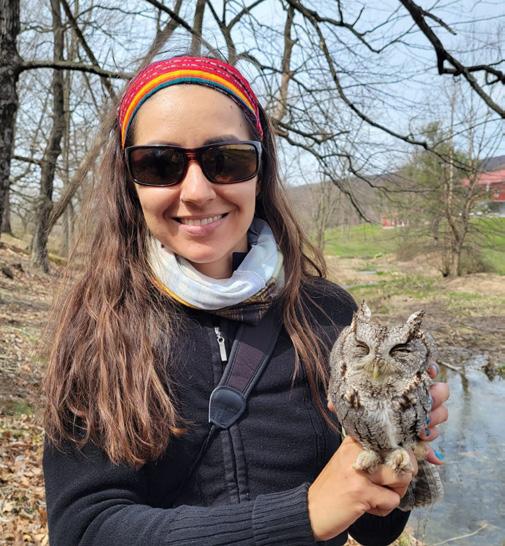
Patricia Dumandan
Mitchell Pruit
SCHOOL IN THE CLOUDS
Spring & Summer 2024 Education Trainees
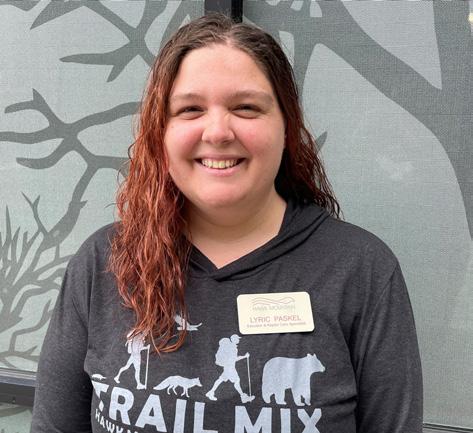
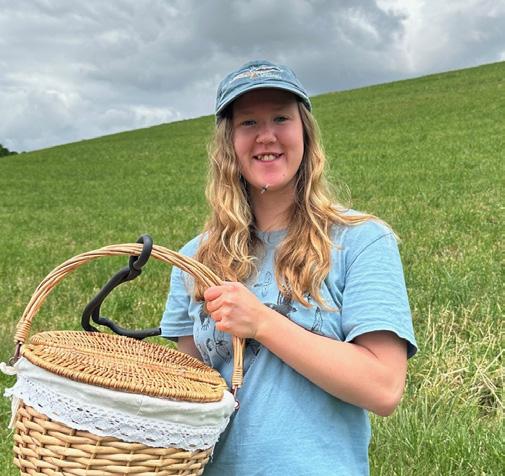
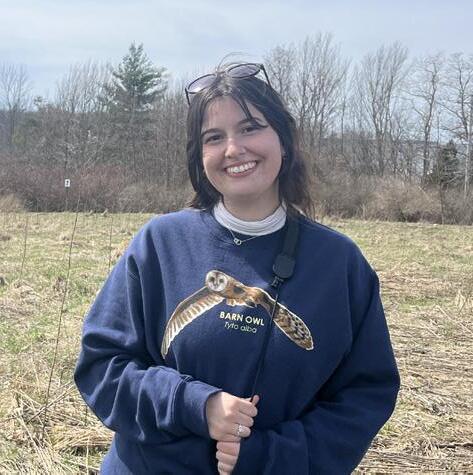
New Educator Lyric Paskel
SPRING REPORT
Spring Migration Summary From the Nature Notes
& Summer 2024 Science Trainees
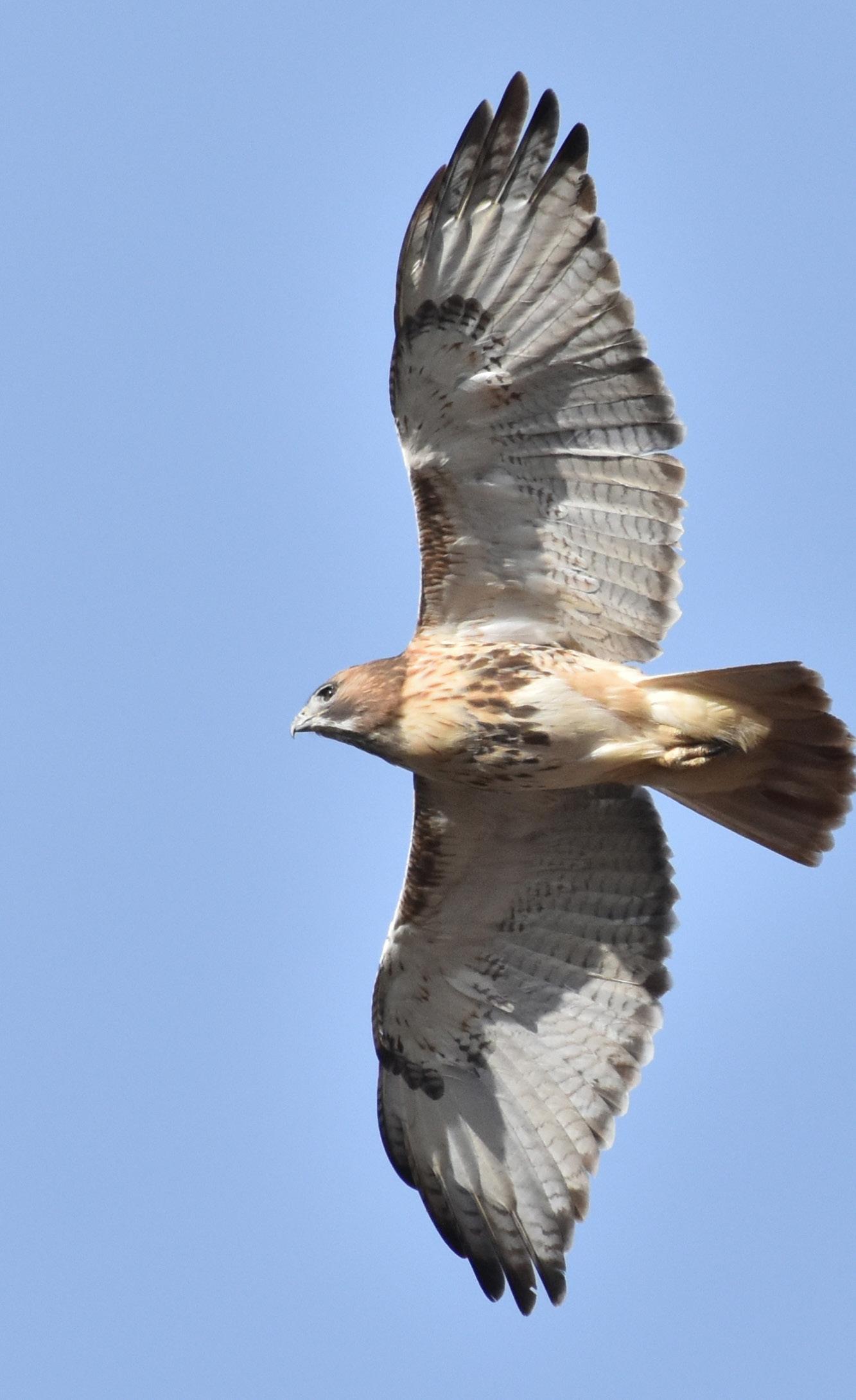
Autumn Hawk Watch held daily through December 15
Photo by Bill Moses
MAKING MIGRATION MEMORIES
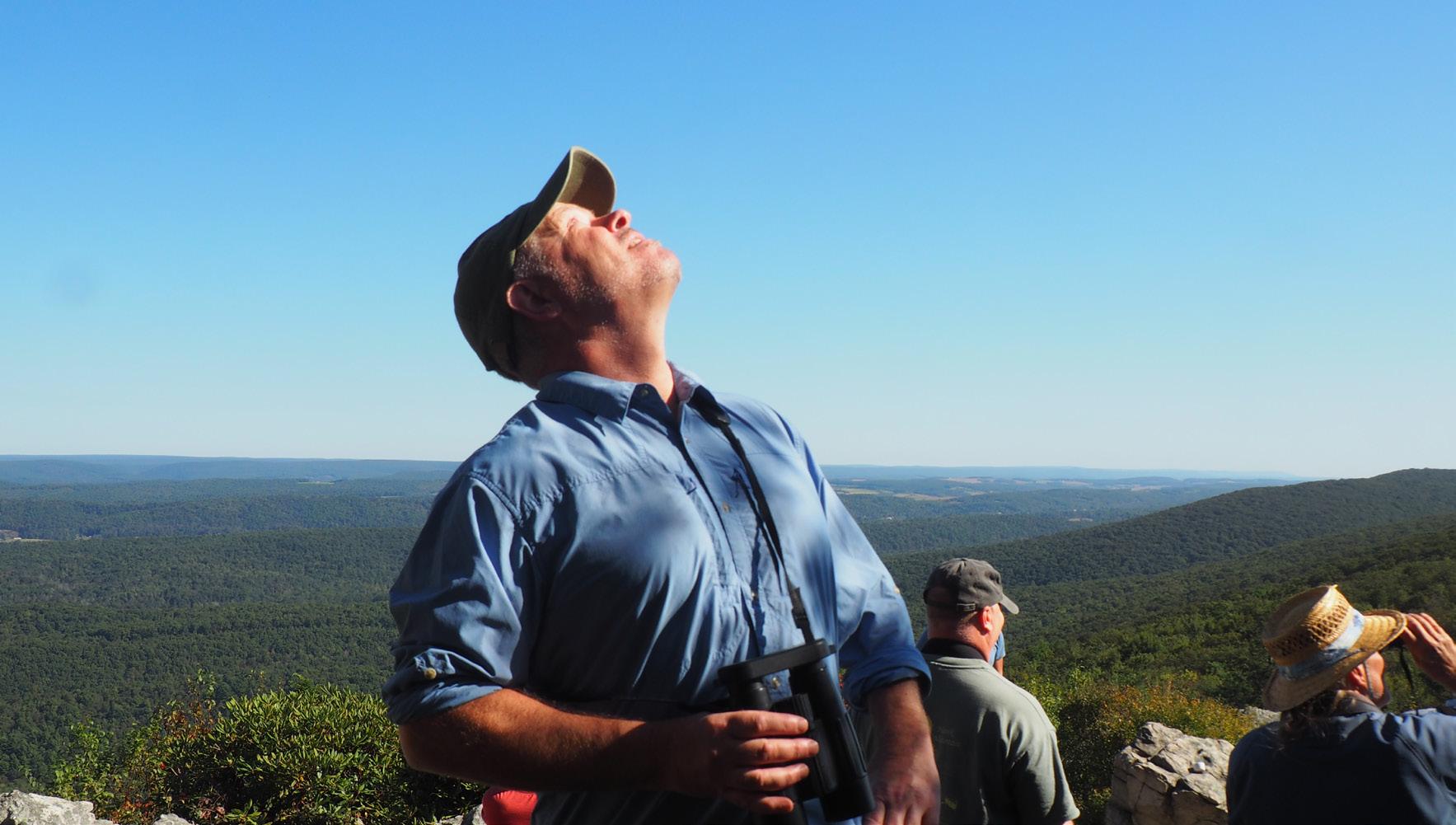
September is my favorite month of the year, with near perfect weather as summer winds down following the autumnal equinox. As the days grow longer, trees stop producing chlorophyl and the true vibrant color of the leaves will show through the forest around us. It is also the time when billions of birds will migrate, often as far away as South America, and it is one of the best times of the year to be outside.
I have always been keenly interested in wildlife, and my doorway to the natural world was opened through a passion for fishing and exploring miles of river and pond shoreline where I grew up. Each natural history discovery that I made was then researched in my field
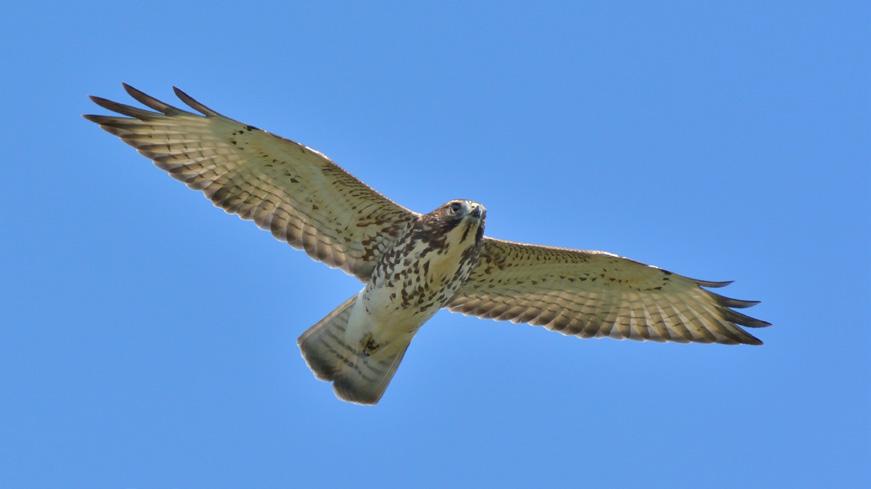
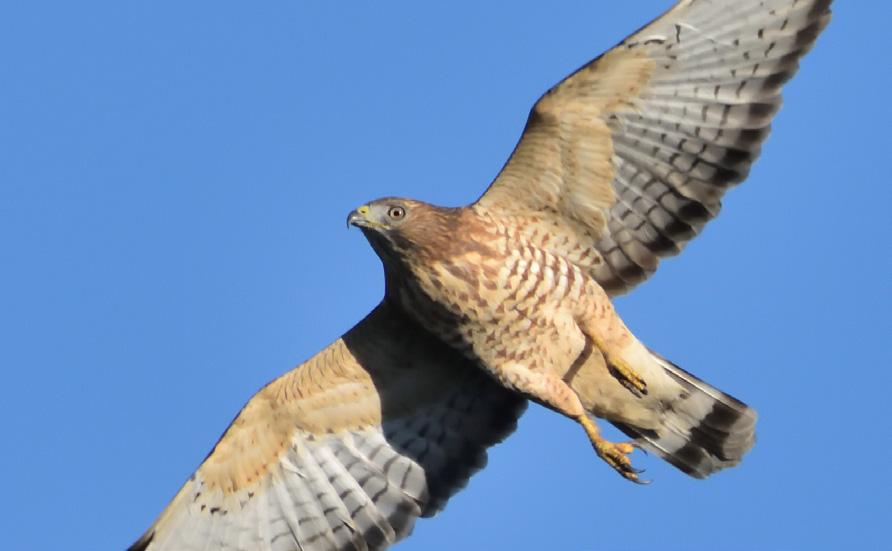
guides. When I was ten, I remember playing a pickup game of football in the local field with friends, on a Saturday in September. As the afternoon wore on, I kept noticing large flocks of hawks I had not seen before, and long after everyone else went home I laid on my back mesmerized by swarms of banded-tailed hawks circling overhead. Why were they here?
Every day that week I excitedly went back to the field hoping to see the flocks of circling hawks, but they had left. In hindsight, I now know I had seen my first broad-winged hawks on their annual migration to South America. Those same broadwings I had seen may have passed over Hawk Mountain later that week to be counted by the former curator Alex Nagy. Today, our tracking data shows broad-winged hawks will utilize the same patch of woods to overwinter in South America before risking it all on a return journey to their same breeding territory here in North America. That experience, like many others, set me on a path that led me to a career in conservation and eventually becoming the president at Hawk Mountain.
Broad-winged hawk,
Photo by Bill Moses
The connections between raptors and the Appalachian Mountains have been ongoing for hundreds of thousands of years, with the mountains providing “waves of wind” for raptors to soar along while conserving energy during migration.
Today, land use changes including large agrobusinesses and urbanization are eroding the sustainability of migration, adding hurdles and diminishing natural resources. Thanks to your support, we have now trained more than 500 young scientists that are helping create healthier habitats for raptors and people.
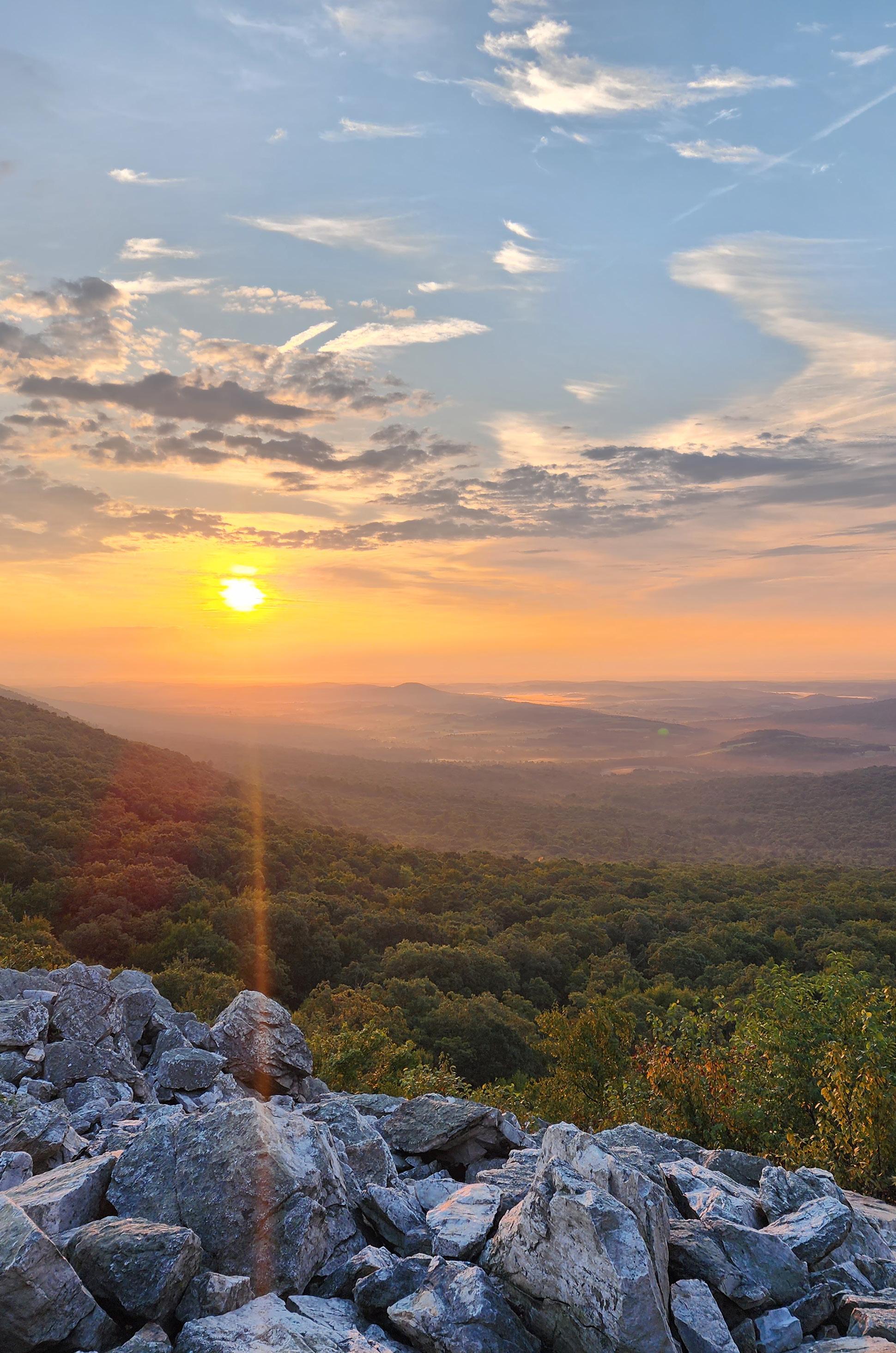
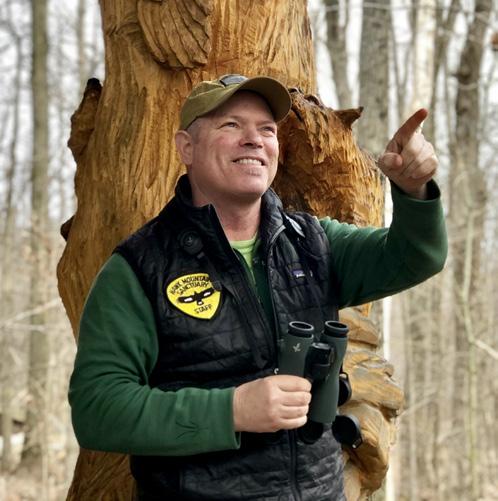
I hope to see you at North Lookout this fall to share in the magic of migration.
Yours in Conservation,
Sean Grace
PRESIDENT
STAFF
PRESIDENT
Sean Grace
DIRECTOR OF CONSERVATION SCIENCE
Laurie Goodrich, Ph.D.
SENIOR SCIENTIST AND GRADUATE STUDY DIRECTOR
Jean-François
Therrien, Ph.D.
SENIOR RESEARCH BIOLOGIST
David Barber
BIOLOGIST-NATURALIST
Bracken Brown
RESEARCH BIOLOGIST
Rebecca McCabe, Ph.D.
ACOPIAN CENTER OPERATIONS COORDINATOR
Wendy Nicodemus
EDUCATORS
Jessica Gary Lyric Paskel
DIRECTOR OF SANCTUARY STEWARDSHIP
Todd Bauman
SANCTUARY STEWARDS
Stephen Wade
Noah Rauch
DIRECTOR OF DEVELOPMENT
Mary Linkevich
MEMBERSHIP & VOLUNTEER MANAGER
Tammy Jandrasitz
COMMUNICATIONS SPECIALIST
Gigi Romano
DEVELOPMENT ASSISTANT
Annie Trexler
BUSINESS MANAGER
Shelley Davenport
BOOKSTORE MANAGER
Mary Therese Grob
BOARD
CHAIR
Tom Kerr
VICE CHAIR
David Bonenberger
TREASURER
Edwin Baldrige
SECRETARY
Wendy McLean, Esq.
Peter Bennett
Jacquelyn Bonomo
Ana Maria Castaño
George Cauffman
Deborah Edge, M.D.
Stephen Edge, M.D.
Peter Fontaine
Jeff Goldenberg
Richard W. Holt
Beth Hucker
Diane Husic, Ph.D.
Ernesto Ruelas Inzunza, Ph.D.
Nasreen Kara
Jim Lefik
Holly Merker
David Middleton
Sara Nicholas
Sally O’Byrne
Dan Rubenstein, Ph.D.
Minturn Wright, III, Emeritus Member
HAWK MOUNTAIN INCLUDED IN NEW SENTINEL LANDSCAPE
Hawk Mountain is part of the newly designated Kittatinny Ridge Sentinel Landscape, the only such designation this year in the state of Pennsylvania. It was one of five designated across the nation this year. Federally designated Sentinel Landscapes are areas where conservation, working lands, and national defense interests converge, anchored by at least one high-value military installation, in our case, Fort Indiantown Gap.
Founded in 2013 by the U.S. Department of Agriculture, Department of Defense, and Department of the Interior, the Sentinel Landscapes Partnership’s mission is to conserve natural resources, bolster agricultural and forestry economies, strengthen military readiness, increase public access to outdoor recreation, and enhance resilience to climate change. The Kittatinny Ridge matches the criteria in part because it is recognized as a Globally Important Bird Area, which the Sanctuary has played a role in that process with the important outreach we provide with our conservation partners.
“The Sanctuary was part of the working group on the proposal for the designation and Hawk Mountain migration data forms the backbone foundation of the work that led to Important Bird Area status,” explains Director of Conservation Science Dr. Laurie Goodrich.
So not only has Sanctuary data been invaluable, Hawk Mountain also has been instrumental in educating and promoting the importance of conserving the Kittatinny as a Globally Important Bird Area and mega-migration super highway, along with protecting over 2600 acres of this designated land.
“The partnership supports our collaborative efforts to mitigate climate change impacts and improve sustainable land and water management practices,” says Hawk Mountain President Sean Grace.
Learn more about this Kittatinny Ridge Sentinel Landscape at sentinellandscapes. org/landscapes/kittatinny-ridge.
SEASONAL STEW CREW
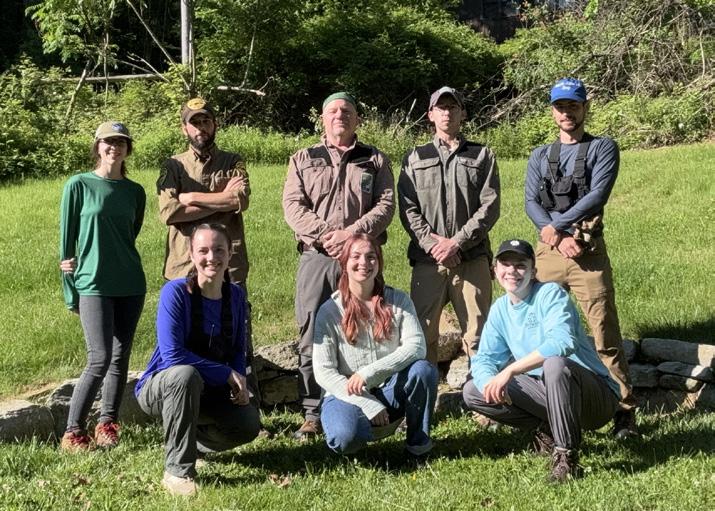
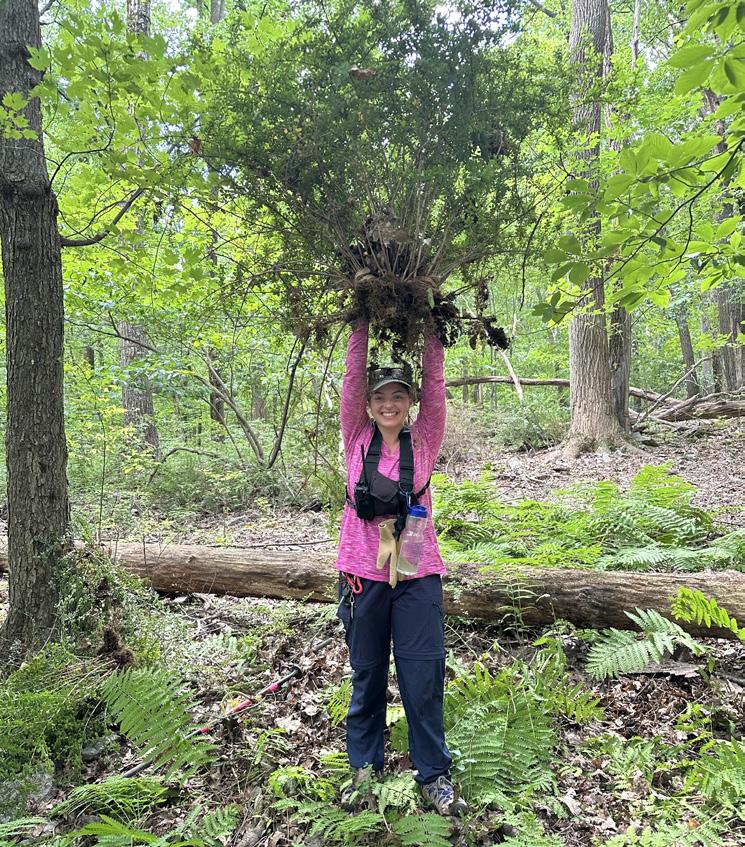
Four outstanding young people joined the seasonal Sanctuary Stewardship Team: Blythe Kratzer, an environmental science student at Lehigh University, Hannah Kulbitsky, a sustainable studies and theater recent graduate from Muhlenberg College, Hunter Marton, a musician and naturalist from Daubersville, and Cadence Boras, a biology student attending the University of New Mexico. Together the team worked hard throughout the summer to maintain Hawk Mountain as a model sanctuary, spending most of their time attacking the goals of our long-term invasive plant remediation plan.
BOARD UPDATES
This spring, the board welcomed new member Beth Hucker from Berwyn, PA. Beth has long-time connections to Hawk Mountain; her father, Alan Crawford, served as the Sanctuary’s treasurer for many years, and birding and conservation have been in her life from an early age. Beth brings to the Sanctuary broad experience in nonprofit management, having served on multiple boards and in various leadership positions, along with her expertise in financial management.
ACADEMIC INTERN
This summer, the Communications Department welcomed Chayse Ehlenberger from Kutztown University as a part-time media intern. Chayse is a senior majoring in Cinema, Television and Media Production, and she has used her skillset to create a series of educational and promotional videos for the Sanctuary’s social media. In the spring, Chayse will return to collaborate with the Stewardship Department to create a short documentary about their forest management achievements.
GET INVOLVED WITH THE PA BIRD ATLAS
Birders across Pennsylvania are gearing up for the winter atlas, which is the first time a PA Bird Atlas has included the winter season. The 3rd PA Bird Atlas is a five-year survey that began at the beginning of 2024 and is led by the PA Game Commission and Hawk Mountain. Using Cornell Lab’s eBird tools, volunteers are mapping bird breeding and wintering patterns to inform conservation efforts. Anyone can participate by reporting sightings through eBird, and county compilers are available for assistance, making it accessible to birders of all levels. Learn more and get involved at hawkmountain. org/3rdpabirdatlas
REUNITED FOR RAPTORS
By Mary Linkevich
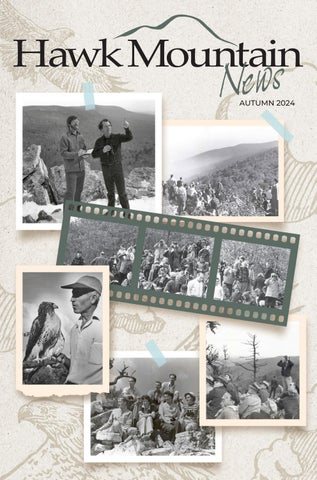
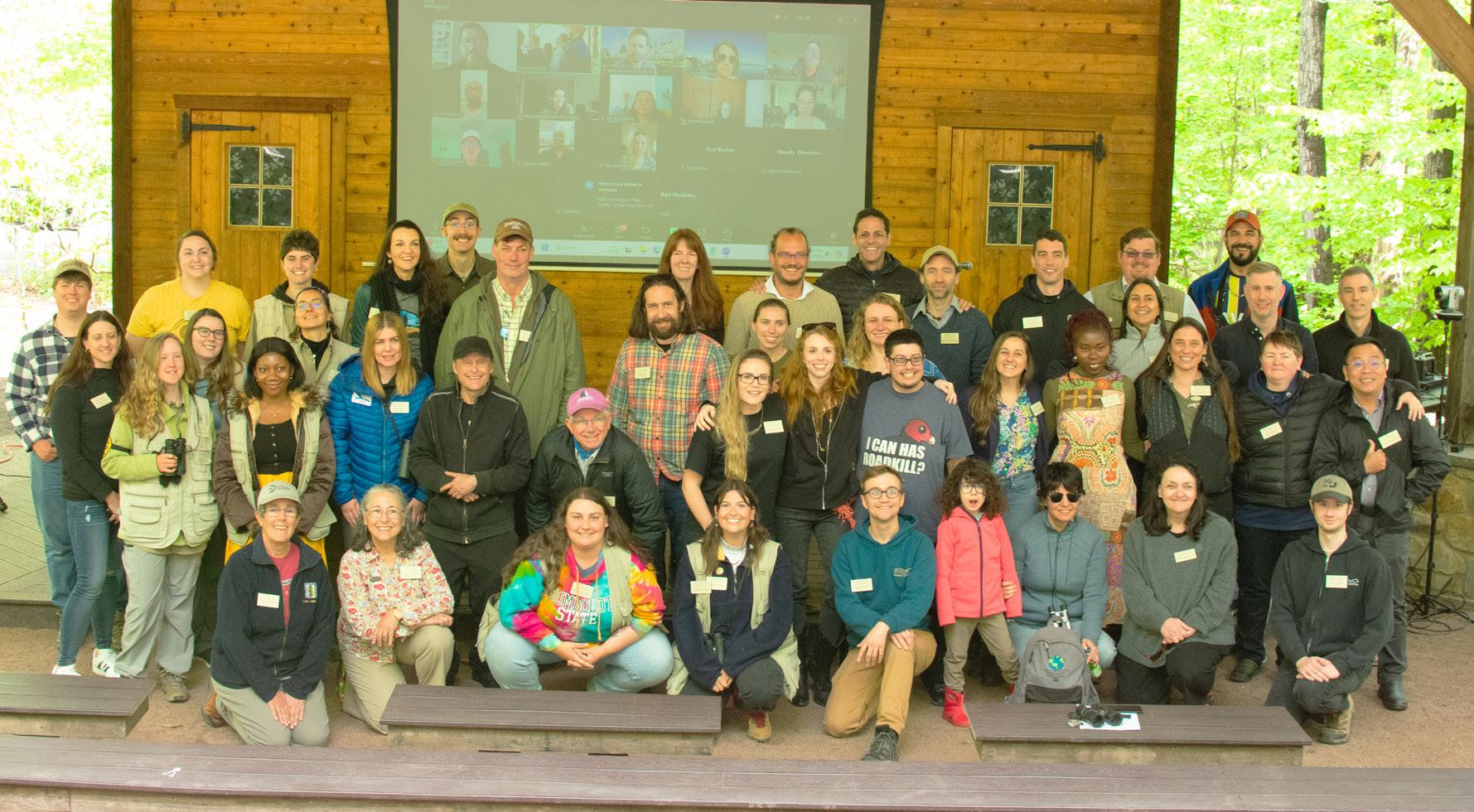
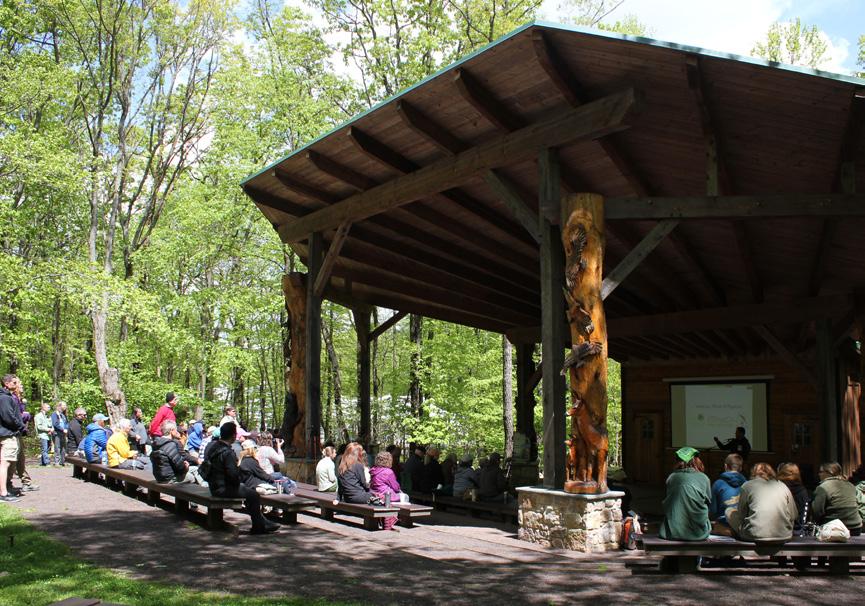
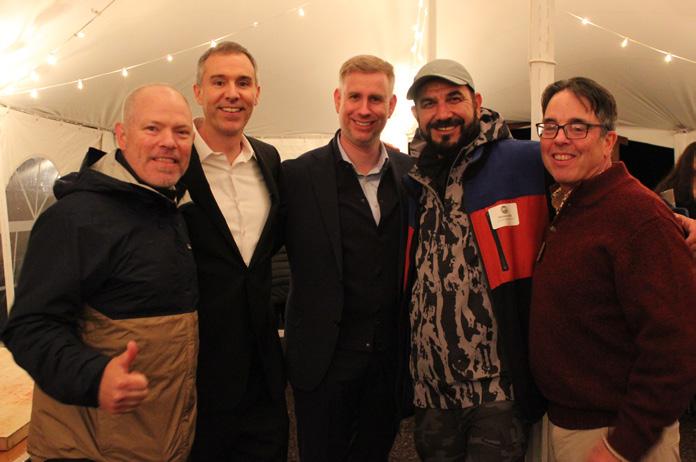
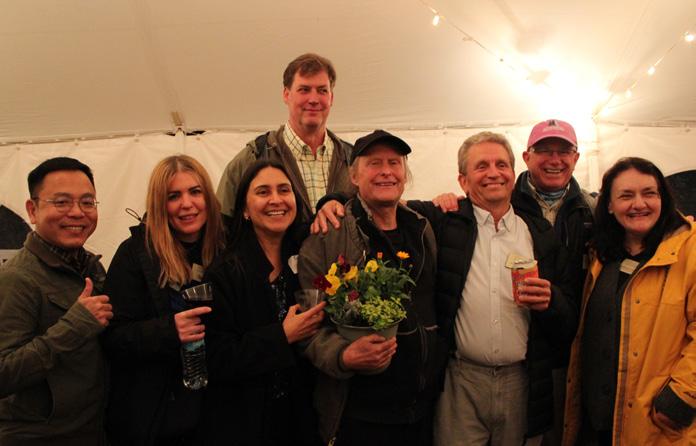
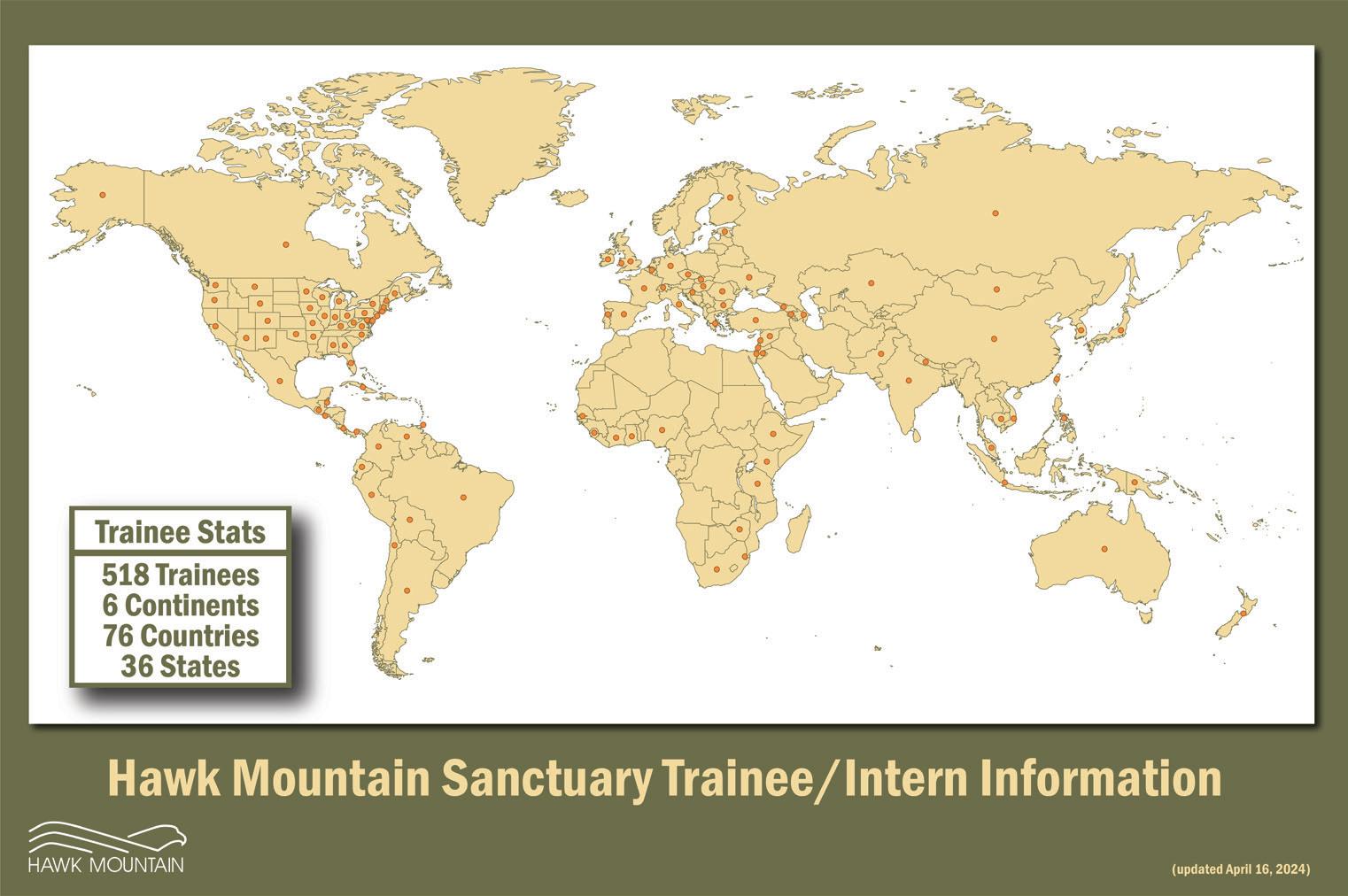
More than 50 intern or trainee alumni from 13 countries and at least 12 states descended upon the Sanctuary in early May for Hawk Mountain’s first-ever trainee reunion to celebrate 90 years in global raptor conservation. Some came from as far away as Malaysia and Zimbabwe to spend the weekend or for longer stays, and more than a dozen participated virtually during a full-day symposium on Saturday, May 11. Trainees representing six continents spoke throughout the day, sharing the conservation success stories and challenges that occur for raptors around the world.
“Hawk Mountain itself is mystical and wonderful, but even more amazing is its worldwide reach,” recalled Board Member Stephen Edge, the grandson of Sanctuary founder Rosalie Edge. Like many, Edge spent the weekend nearby for the threeday celebration, which began with a Friday evening benefit and culminated Sunday with a mixer and brainstorming roundtable.
“We heard from many trainees from over the past 35 years, including scientists and conservationists from the U.S., Mexico, Central and South America, Central and Southeast Asia, and Africa, and all showed us how their life’s work has stemmed from their formative time at Hawk Mountain, some early in their careers,” he added.
The Saturday Trainee Symposium was held in memory of Curator Emeritus Jim Brett and was open the public. Talks were recorded, and geared for the general, nonscientific audience so that everyone who attended could learn of some of the challenges and successes in conservation globally. All presentations are available to watch on Hawk Mountain’s YouTube channel, youtube. com/@hawkmountainsanctuary.
The event was made possible thanks to a seed grant from the Jessie Ball duPont Fund, as part of their place-making and equity program, as Hawk Mountain is the singular location that ties each graduate together, and each one can consider their home away from home, no matter the amount of time that has passed. Prior to the reunion former trainee (2014) and Hawk Mountain Research Biologist Rebecca McCabe worked with Trainee Coordinator Wendy Nicodemus for more than a year to rebuild Hawk Mountain’s contact database for alumni and to hold mini virtual “socials”. In fall 2023, the first notice of the May reunion was sent out and speakers recruited to represent the alumni network on each continent.
All the trainee and intern alumni felt inspired, and the weekend was not only a professional networking opportunity, but also a chance to reconnect, make new friendships, plan projects, and share challenges. Collectively, the reunion was inspiring, and at times, emotional.
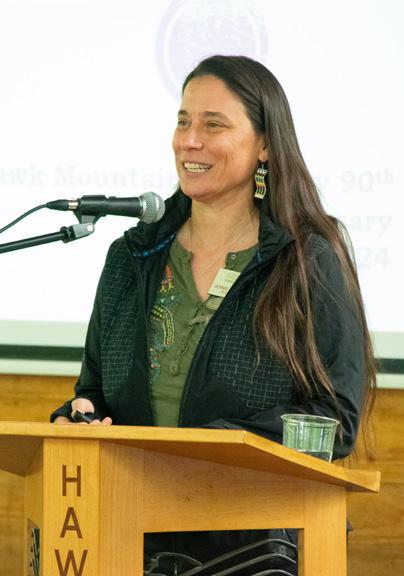
Ana Castaño, an alumna herself but now also a Hawk Mountain Board Member, served as one of several emcees throughout the day, and called the event
a wonderful celebration of an incredible institution.
“It is so amazing how we feel like a real family, even just meeting for the first time in many cases. We are privileged and we know it, and that’s why each one of us gives back so much. I celebrate each person I met, and the passion, love, and commitment to conservation and awareness,” she said.
Speakers included Jennie Duberstein, Ph.D. (U.S., Education Intern 1996), Ernesto Ruelas Inzunza, Ph.D. (Mexico, Research Intern 1990), Diego Méndez (Bolivia, Conservation Science Trainee 2015), Wouter Vansteelant, Ph.D. (Belgium, Leadership Trainee 2011), Martha Nzisa (Kenya, Conservation Science Trainee 2010), Merlyn Nomusa Nkomo (Zimbabwe, 2017), Chong Leong Puan, Ph.D. (Malaysia, Conservation Science Trainee 2013), Todd Katzner, Ph.D. (U.S. virtually from Australia, Leadership Trainee 2003). Emcees included Ruth Tingay (United Kingdom) and Ana Maria Castaño (Colombia, Conservation Science Trainee 1998) with technical support provided by Dr. Rebecca McCabe, biologist and a 2014 trainee, and Acopian Center Operations Coordinator Wendy Nicodemus.
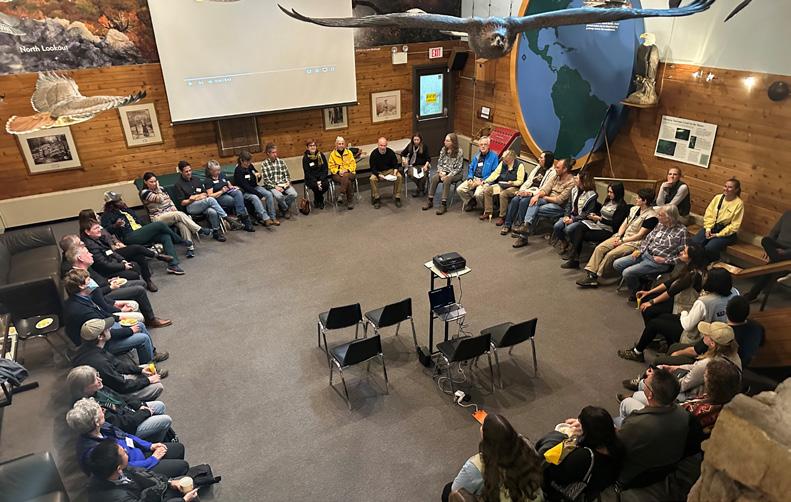
Before departing, the alumni regrouped all in one room to discuss ways Hawk Mountain can support their work, make the program stronger, and foster global raptor conservation. Suggestions were recorded, and alumni were unanimous in saying they wanted to maintain the connections with Hawk Mountain and other alumni. The weekend ended with great excitement and commitment from all attending.
About the Program
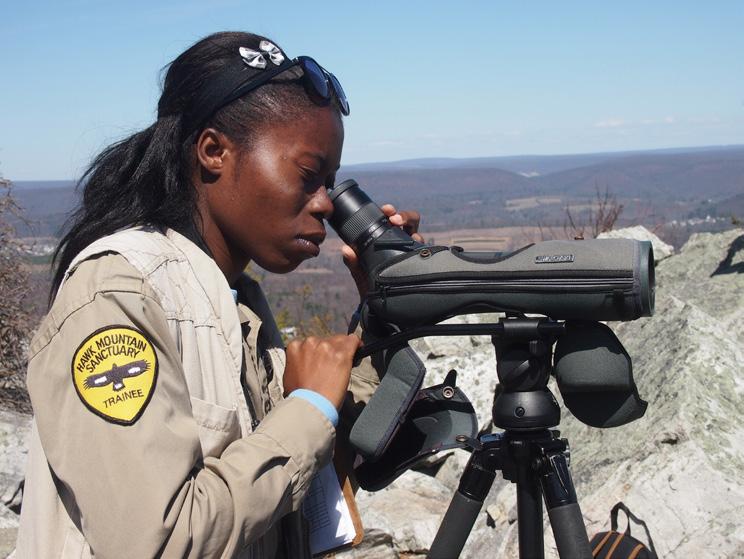
Hawk Mountain’s acclaimed International Trainee Program is a three-and-a-halfmonth-long residential and fully immersive experience that has produced some of the most impressive names in raptor conservation today, with many emerging as leaders in the field. To date, more than 500 up-and-coming conservationists from 76 countries on six continents have graduated the program.
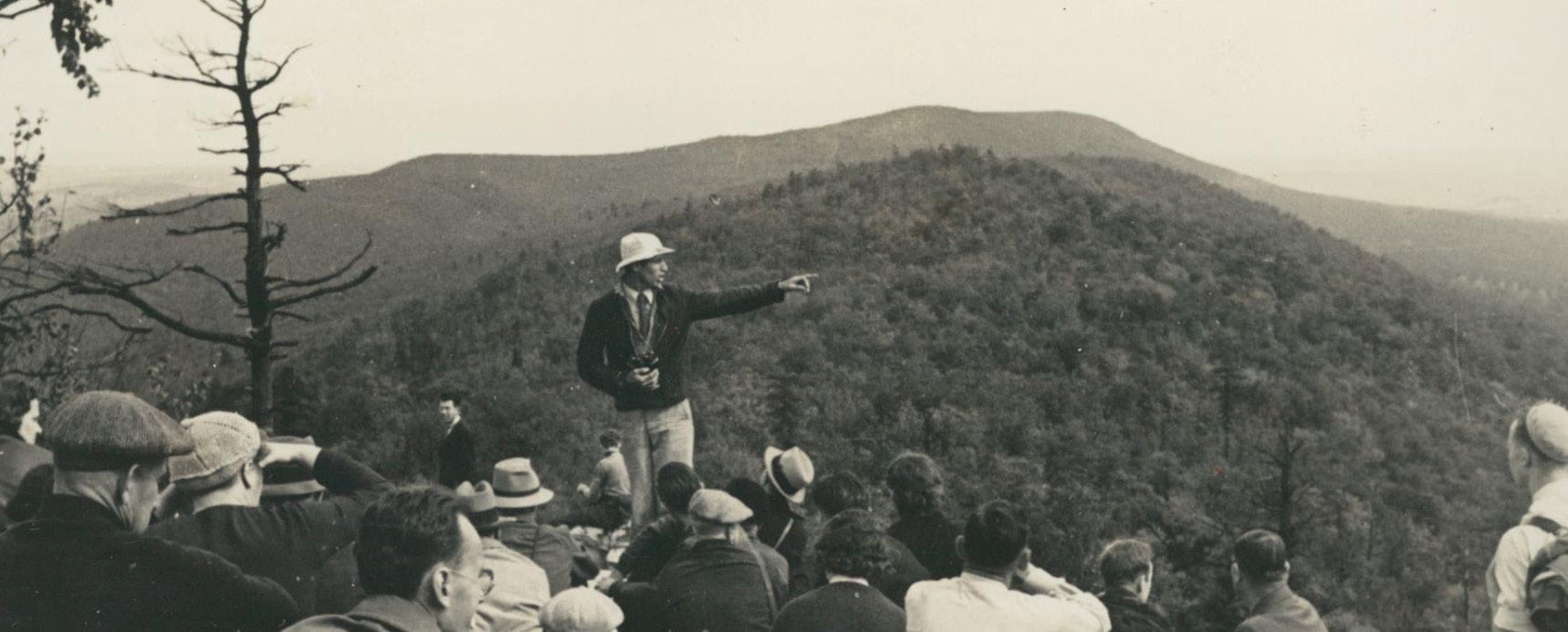
Hawk Mountain’s work with young people interested in conservation dates to the 1940s when local youth “earned and learned” under the tutelage of Curator Maurice Broun. Interested participants continued to grow incrementally until the 1970s, when Hawk Mountain’s first professional educator, then-Assistant Curator Jim Brett, formalized a season-long internship training program in fall 1976.
Jim took the program global with Dr. Phoebe Barnard, Canada, in 1982, Kenjii Yoshino, Japan, in 1985, and a year later, Manachem Adar, of Israel, thanks to an introduction to Brett by Dr. Yossi Leshem. By 1990, the program trained ten international interns on four continents, including Mexican biologist Ernesto Ruelas Inzunza, now a Sanctuary board member and the co-founder of the Pronatura Veracruz River of Raptors watchsite in Mexico, which is host to the largest concentration of raptors on the planet.
In 1999, Hawk Mountain applied to the U.S. Department of State and was approved to issue visas to provide qualified international
training opportunities for up to four months at the Sanctuary. A successful Internship Endowment Campaign raised funds to fully cover the cost of this training, including transportation, housing, living stipends, and materials, and to ensure that participants would always be selected based on merit rather than ability to pay. Three years later, thanks to the generosity and vision of Hawk Mountain benefactor Mr. Sarkis Acopian and the leadership of retired Director of Conservation Science Dr. Keith Bildstein, the program moved into the newly constructed Acopian Center for Conservation Learning in September 2002 and provided the infrastructure necessary to transform and expand both the number and type of trainees who complete the program.
Today Hawk Mountain Sanctuary has recruited and trained more than 500 raptor conservation science and education trainees, and 58% are women and 48% are diverse candidates. Out of this program has grown leadership experiences for young professionals, summer field experiences for North American undergraduates, and a thriving Graduate Student Program, one in which staff works with the brightest trainee graduates who collaborate with Hawk Mountain on independent research as they work toward an advanced degree. We continue to build this alumni network across the world, and many now work in partnership regionally, brainstorming projects at international conferences. And the onset
of online and virtual meetings allows for continued professional development, here at Hawk Mountain and abroad, for our trainee family both then and now.
“Raptors are still being shot in Europe and South America today. Hawk Mountain trainees are on the ground fighting for conservation, just as our founders Rosalie Edge and Maurice Broun did decades ago,” explained Laurie Goodrich, Hawk Mountain’s Sarkis Acopian Director of Conservation Science. “This event was a chance to celebrate their success and renew collaborations to improve raptor conservation.”
As for Castaño, an immediate WhatsApp group created a fast and easy way to message individuals who attended or the entire group, and she keeps the connection open.
“The reunion is now a tool to share ideas regularly on how we can make this amazing network stronger and do more than ever for our beloved raptors and their habitats worldwide,” she said.
Biodiversity Building Decade of
By Mary Linkevich
Ten years ago, Director of Stewardship Todd Bauman committed to a sciencebased persistent and consistent attack on invasive plants when he launched the Sanctuary’s long-term Invasive Plant Remediation Program. With a five-year seed grant from the U.S. Department of Agriculture’s Natural Resources Conservation Service (NRCS), ten years later, this work and its methods are serving as a model for all in forest stewardship.
“Non-native, invasive plants are the greatest threat to Hawk Mountain’s forests and other natural areas in the state and around the globe,” says Bauman.
“This program is critical to building biodiversity back in our forests, and the stewardship team works hard to document the techniques and challenges, and to share them with the public and other landowners,” he adds.
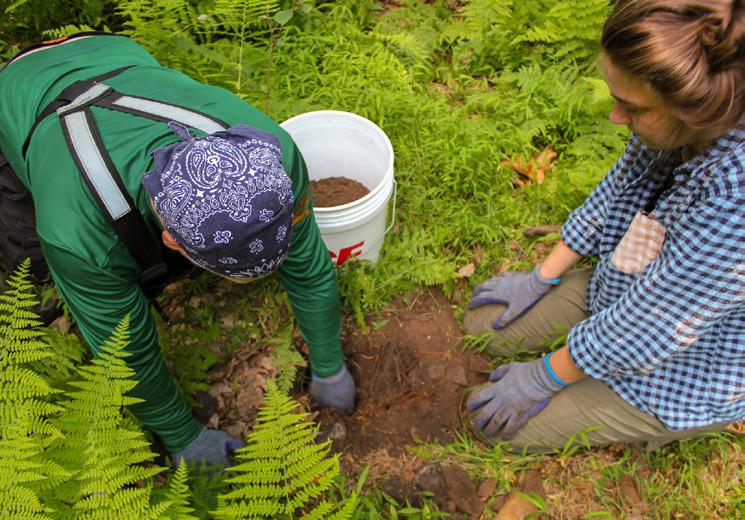
With more than 30 years of service to the Sanctuary, Bauman and his colleagues have witnessed and documented change. Simply put, invasive species choke out native plants and reduce overall plant species diversity, which in turn reduces the native wildlife that relies upon healthy and biodiverse areas. In fact, the team has even discovered that areas of impact also harbor invasive earthworms and affect everything from the trees to the wildlife to the soil structure.
A number of invasive species have been documented at Hawk Mountain, but big culprits include stiltgrass, garlic mustard,
Photo by Noah Rauch
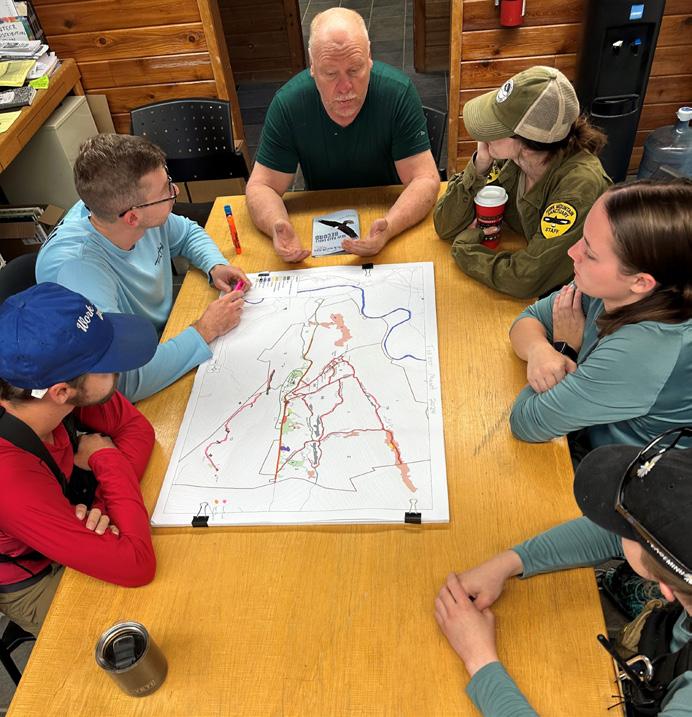
Stew Crew during invasive planning
and barberry, among others. The summer invasive specialists are typically collegeaged, and together use a variety of methods, which collectively, the team has tested and proven over time, often sharing with other land managers at conferences or in seminars, along with the public.
“Different species require different treatments,” Bauman says.
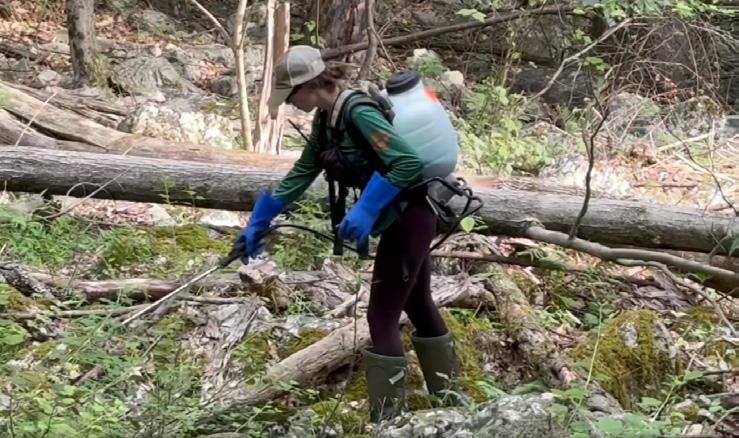
“We use a combination of spraying, pulling, and mowing. Our spray program utilizes forestry-approved herbicides on stiltgrass, barberry, and tree-of-heaven using a backpack sprayer,” he explains. Use of herbicide treatment requires licensing, training, and wearing proper protective gear, such as long pants and long-sleeved shirts, gloves, and safety glasses. “It’s not fun in 100% humidity, but the summer is the growing season, so it is the best time to use a foliar application.”
In addition, staff will weed whack and hand pull garlic mustard before seed formation.
Areas heavily impacted by barberry and bush honeysuckle are often hand pulled.
“It’s hard work, and requires a strong commitment to the process,” Bauman explains.
Storm Water Runoff
A top culprit in the spread of non-native plants results directly from the roadway that bisects Sanctuary lands, so additional efforts are made to control runoff. Heavy rains funnel rivers of storm water along the roadsides that split off to spread invasive seeds deep into the back country trails and lowland areas, including longterm research study sites for breeding and wintering bird surveys.
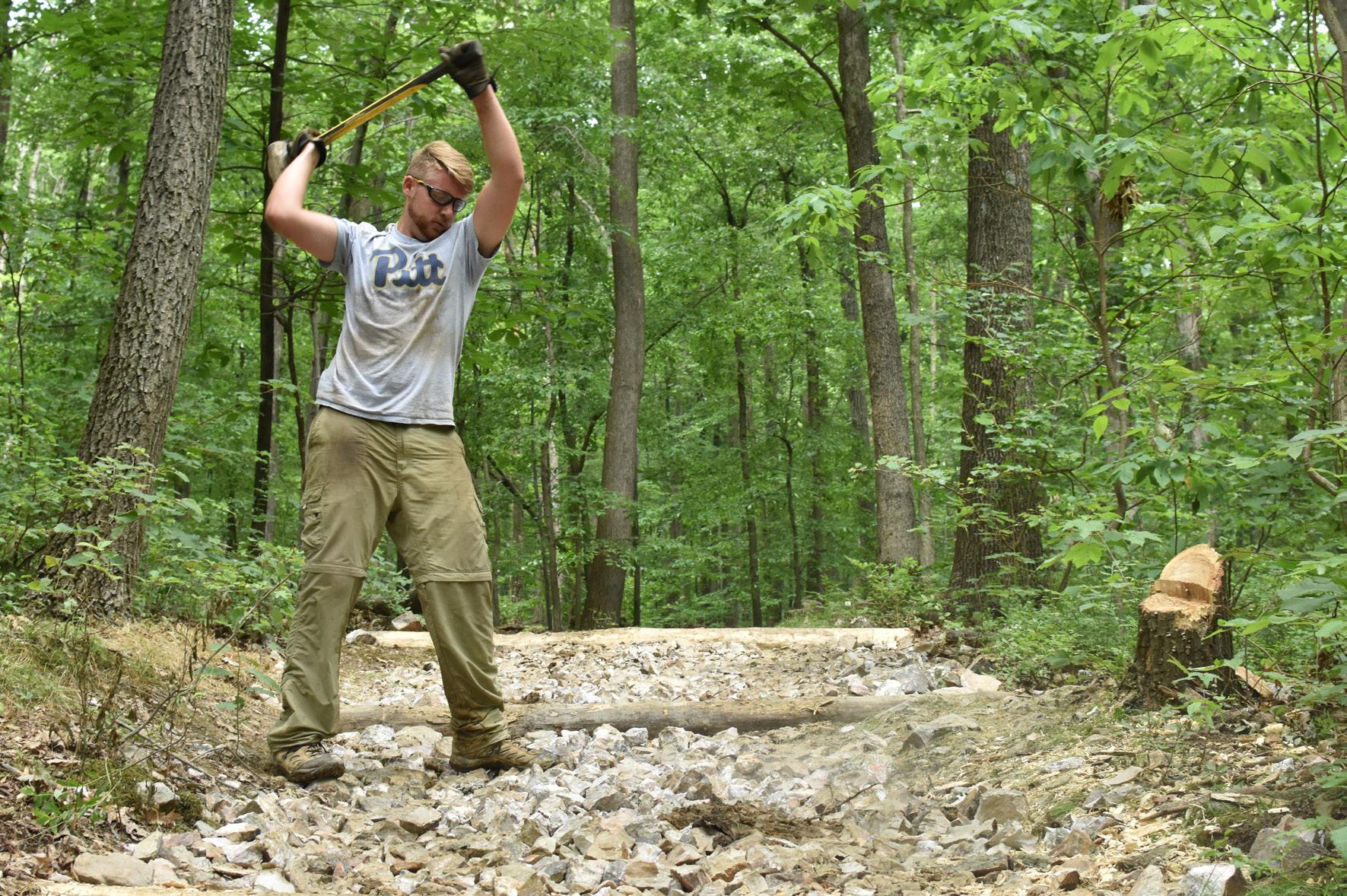
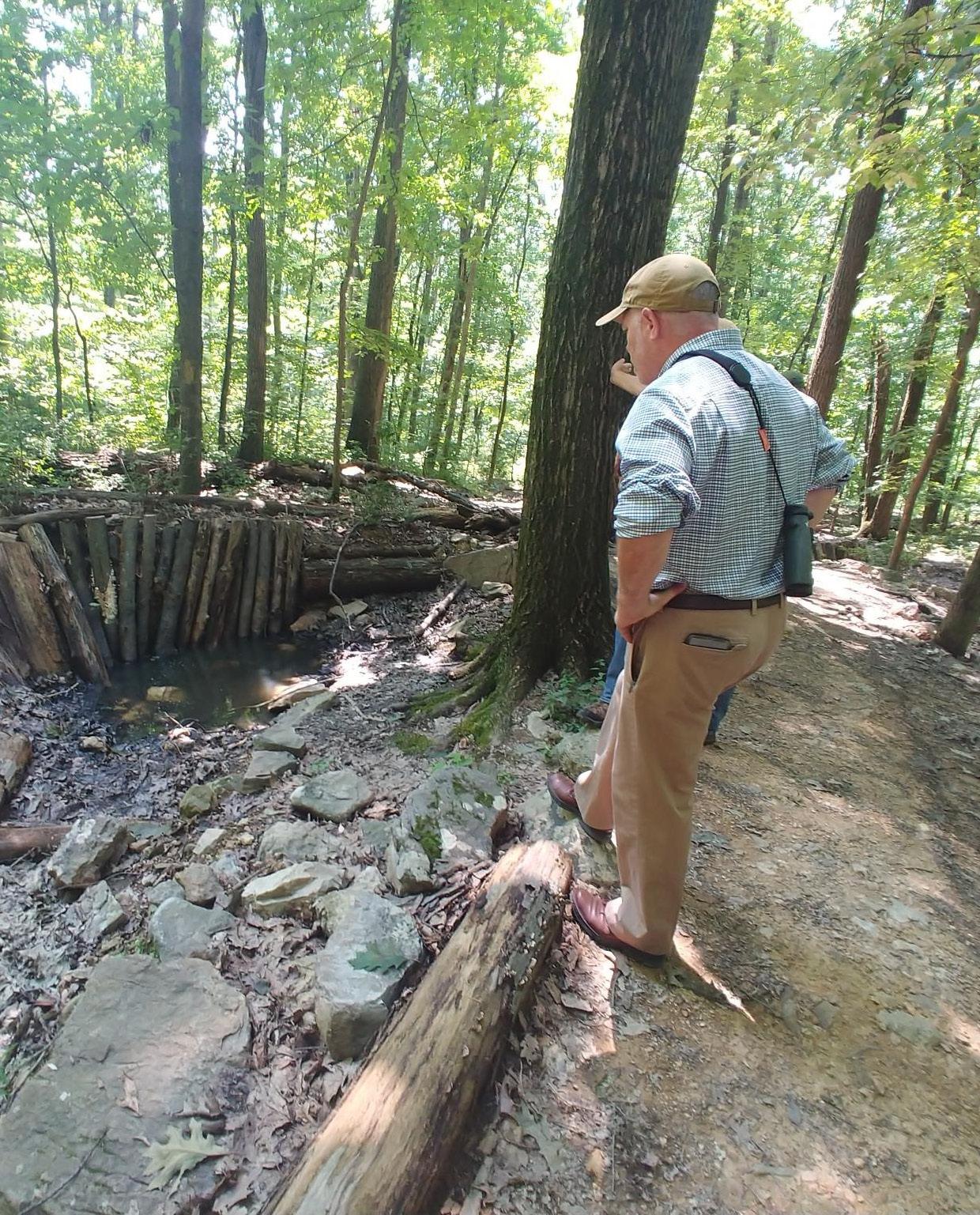
Still, the most well-established invasives concentrate in core visitor areas and hiking trails, especially those with steep slopes, like the Golden Eagle Trails. The stewardship team plans projects to tackle such sites and address the biggest challenges, often only as time, personnel, and financial resources allow. Projects typically stretch over several years and include constructing detention basins, as well as creating and installing railings to better funnel hikers on trails stabilized with cribbing and crushed stone base. Such methods have been successful.
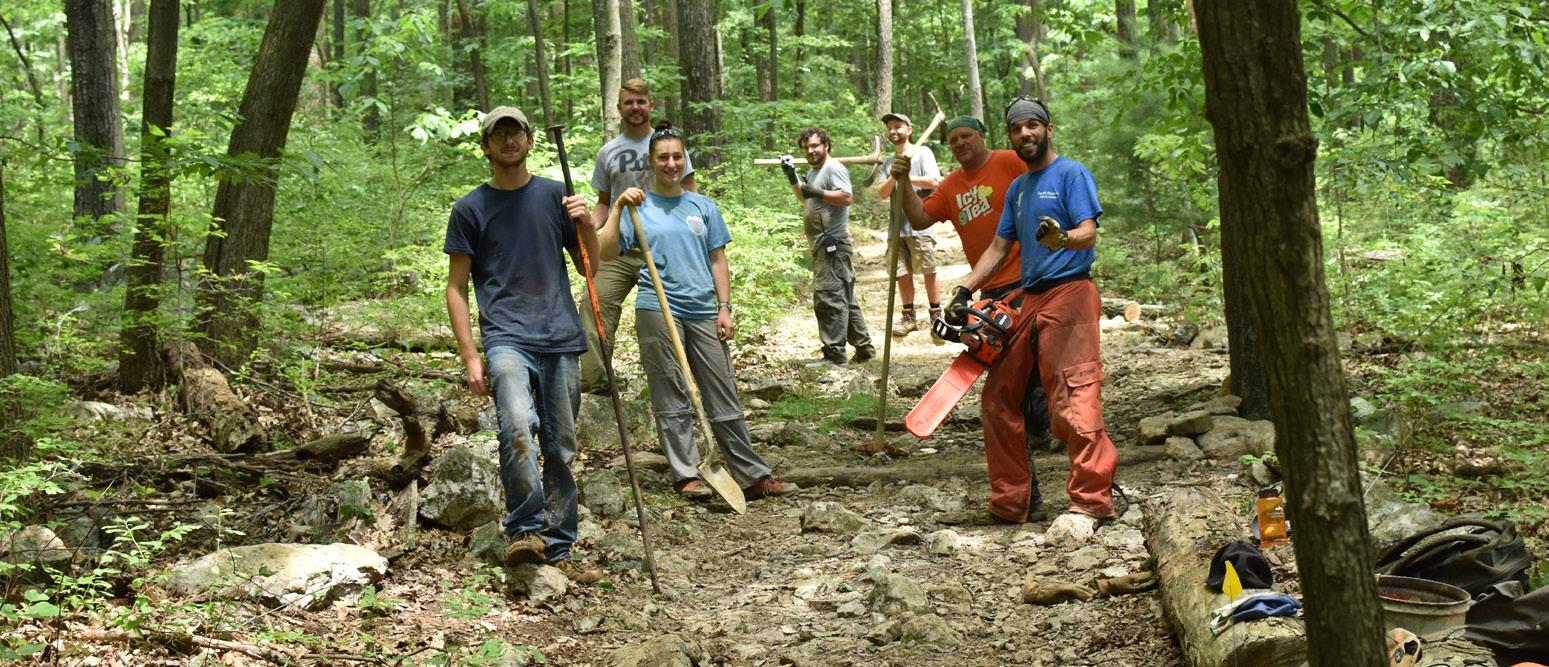
A major benchmark included relocating a portion of Golden Eagle, a project that dates to 2007 and was completed in chunks over time, first by the Hawk Mountain Conservation Corps, a group
Photo by Noah Rauch
Collecting soil for invasive worm research
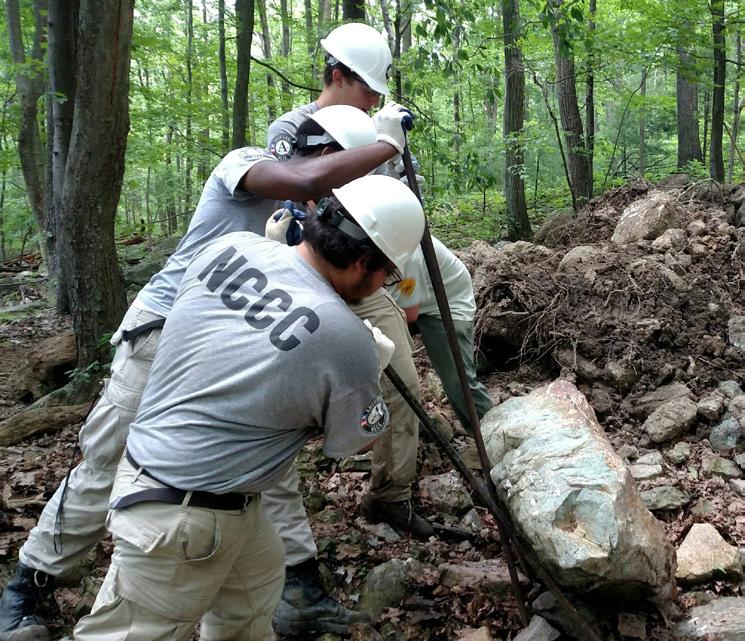
of teenagers committed to service learning through trail stewardship projects. The corps launched the project by creating a climbing turn in stone to negotiate the steepest terrain. Later, The National Civilian Community Corps (NCCC) AmeriCorps group and volunteers from the Delaware Nature Society worked on the trail during two separate sessions and in two separate areas. Piece-by-piece, year-by-year, the mini projects slowly connected and incorporated best practices in trail management.
One issue that emerged on the Golden Eagle Trail was trail braiding, which occurs when hikers try to avoid an obstacle, such as a muddy spot or large rock. Over time and with repeated behavior, the trail can split or widen, which increases impact, erosion, compaction, and the spread of invasives. Golden Eagle had spread nearly 30 feet wide in some areas.
This legacy project concluded in 2020 with support from the Schuylkill Highlands Conservation Landscape and PA DCNR along with REI Co-op, which allowed Hawk Mountain to hire a four-member trail crew to complete the work on the most remote section.
“Once a forest road, the ultimate goal of the Golden Eagle Project was to establish a sustainable trail tread while also protecting and improving the surrounding forest habitat,” says Bauman. Improvements
included trail stabilization using cribbing, constructing detention basins and natural bridges where needed, and reworking eroded areas of the path into stone stairs. It also maintained a width that allowed for first responder access but delineated to avoid future braiding. All this work also reduced the spread of invasives, a top goal of every trail project in forest management.
More recently, propagation and planting of oak and other native species along with addition of local leaf litter helps to build diversity in the treated areas, along with installation of a 2.5-acre deer exclosure and smaller exclosures in heavily impacted areas to encourage natural healthy regrowth. The reappearance of native species is the reward for the team’s hard work and demonstrates their effective approach.
Why Hawk Mountain?
“Guided by our Forest Management Plan, our award-winning Stewardship Team has spent a decade of effort in invasive plant
NCCC updating the Golden Eagle Trail
Hannah Kulbitsky with hand-pulled invasive plants
Spot spraying invasive plants
remediation to conserve the future of our forest,” explains President Sean Grace.
The team monitors and improves trails, conserves our Appalachian Forest landscape, and models best practices in land management techniques. And for good reason: Hawk Mountain Sanctuary is part of the Kittatinny Ridge, an iconic and critical landscape and designated Important Bird Area. The Sanctuary’s 2,615 acres, along with adjacent private and public lands, make up one of the largest protected tracts of contiguous forest in southeastern Pennsylvania, serving as a stronghold for wildlife and migrants.
“The Kittatinny is identified as the most resilient landscape in the state for adapting to climate change, and our forested corridor allows wildlife to escape rising temperatures, increased floods, or drought. It has been identified by scientists as critical to the future of hundreds of animal and bird species amid a changing climate,” Grace explains.
A huge array of species uses the Ridge as a yearly migratory corridor, including broad-winged hawks, American kestrels, ruby-throated hummingbirds, eastern bluebirds, monarch butterflies, blackburnian warblers, and more. Seven of the 10 most common nesting species here are forest-interior Neotropical migrants including our most common nesting bird, the ovenbird, a ground-nesting warbler, and hawks and owls also nest on Hawk Mountain, including broad-winged, sharp-shinned, Cooper’s hawk, red-tailed
hawks, and great-horned, barred, and eastern screech owls. The Sanctuary also supports ruffed grouse with family groups encountered along the upper ridge woodlands through the summer.
Hawk Mountain forests provide migration stopover habitat for more than 100 species of birds, including 16 raptors. The Kittatinny Ridge is a globally important flyway, and its forested slopes and lowland grasslands provide habitat to rest and feed, sometimes for up to several days. Some eastern migrants, such as black-throated green warblers, may concentrate in greater numbers along the Appalachian flyway than along the Atlantic coastal flyway.
Which is precisely why Hawk Mountain is committed to connecting people with the landscape while we conserve the sensitive Appalachian ecosystem for generations to come.
“A trail is not just a mere path. It is a multigenerational commitment to biodiversity and one we intend to keep,” Bauman says.
President Sean Grace viewing the basin by the Golden Eagle Trail
Ian Eberly recording stiltgrass
Raptors
WHY ARE AT RISK?
By Todd Katzner, U.S. Geological Survey
of how science defines a raptor and why we think they are important.
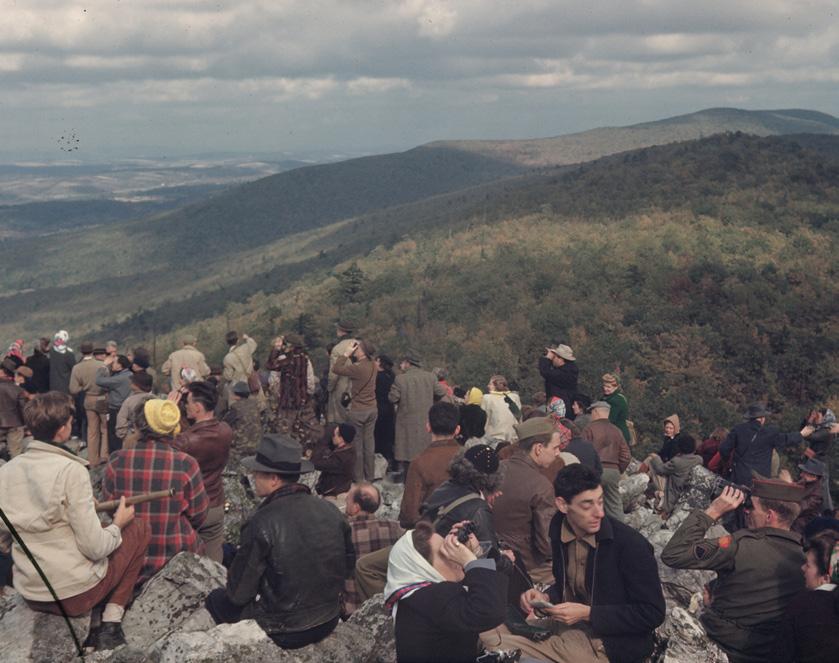
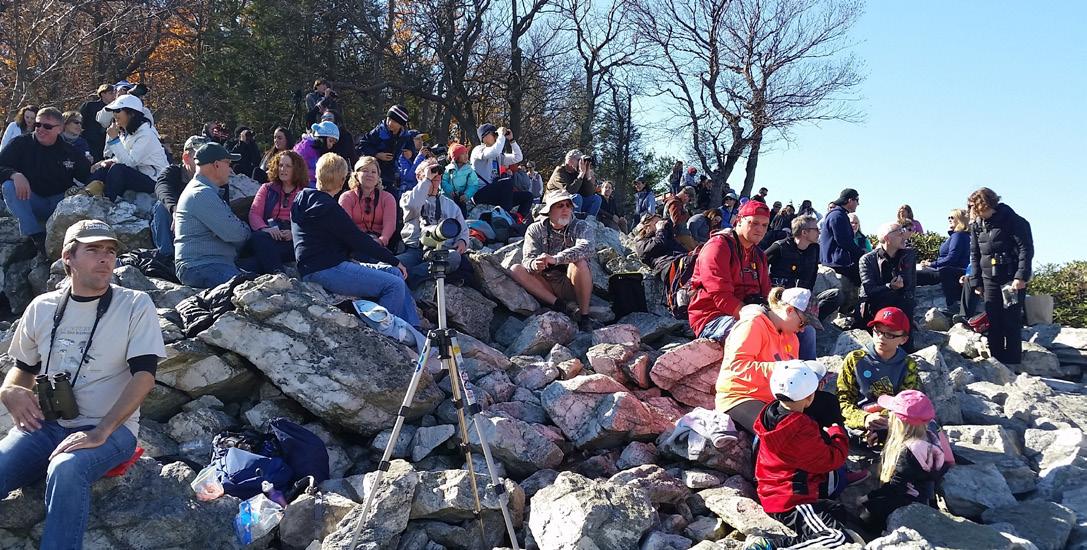
I love sitting at the North Lookout on a cool autumn day, watching a stream of raptors pass by on one side, the River of Rocks on another. Seeing these birds on their annual migration is a reminder that no matter the stresses and strains we humans face, hawks are still migrating, and some things are still right in the world.
Despite the epochal consistency of their migration, these birds of prey also tell a story about environmental change and about how to understand human impacts on the environment. Their story is both sad and hopeful, and it is that story I want to talk about here.
To start, I need to go back to the basics. Long-time readers of this magazine need no reminder about raptors and their roles. But for those who are newer to the hawk counting world, it is worth a brief reminder
Even though we all have a picture in our head of what a raptor is, in reality the term “raptor” isn’t precisely defined. We all know that birds of prey are aerial predators with raptorial features. Except for when they aren’t. Their features are characterized by strong feet, a hooked bill, and sharp eyes—most of the time.
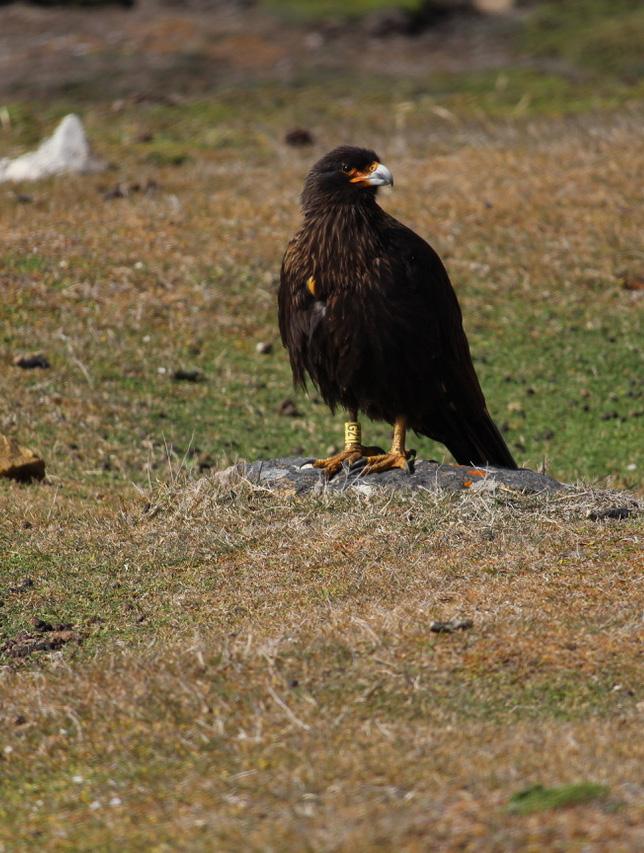
In fact, there are raptors that don’t typically hunt from the air; most caracaras spend much of their foraging time walking on the ground. Other raptors, especially the American vultures, don’t
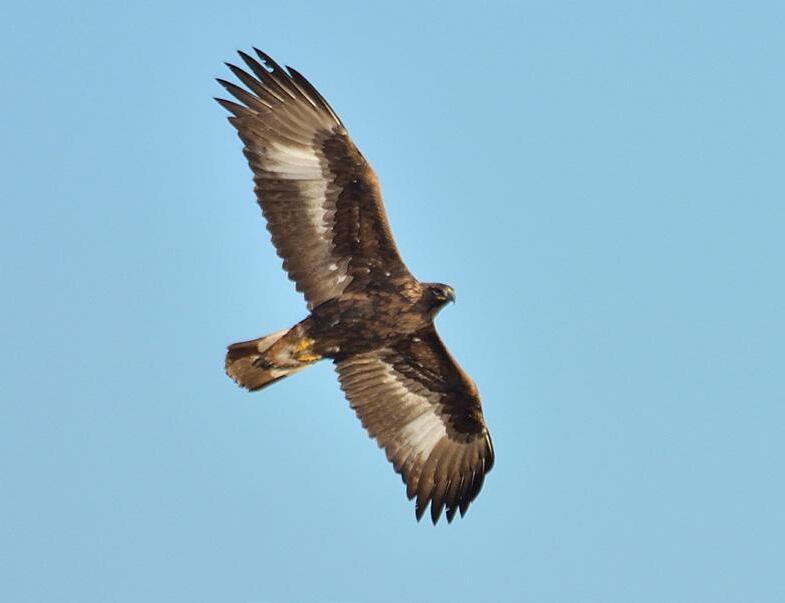
A golden eagle over the North Lookout by Bill Moses
so many of us love Hawk Mountain, raptors are called “flagships,” because they are a species around which humans can rally for conservation.
Because they are charismatic and important to conservation, raptors are well studied, and thus we know the threats they face. Those threats are pervasive and global, and they have massive effects, even on all those birds passing by the North Lookout.
some aren’t particularly predatory—the Palm Nut vulture is famous for eating fruit! Because of this inconsistency, and despite recent efforts by acclaimed scientists, a raptor is actually something that is hard to define.
Although we may seem bogged down in nomenclatural nuance, we are still pretty confident that the things we call raptors are important. In fact, there are a host of terms that conservation biologists use to describe flora and fauna with critical roles in ecosystems, and most of those apply to raptors. As apex predators, many raptors are called “keystone species” because ecosystem functioning changes dramatically if you remove them. Raptors are also “umbrella species” because, if you protect them you end up simultaneously protecting a host of other taxa. Raptors are “indicator species” because their conservation status tells us something about the ecosystem in general. Finally, and this is in part why
To illustrate these threats, I want to describe two recent studies in which I’ve had the privilege to participate. The first of these involved tracking of about 350 golden eagles in western North America. The work was led by my friend Dr. Brian Millsap, at the time a biologist with the U.S. Fish and Wildlife Service. Brian assembled tracking data from golden eagles tagged by researchers across the country. Teams like mine provided Brian with data on when we tagged the bird, if and when it died, and how it died. Brian then used these data to build a model of eagle populations to extrapolate from this small number of tagged individuals to the entire 30,000+ eagles in the wild population of the western USA.
What Brian’s models told us was remarkable. Of the first-year eagles that die, the vast majority, about 75%, succumb to natural causes. Mostly they starve to death, probably because they are not good enough at hunting to feed themselves. Beyond their first year though, the story is the complete opposite. Of the birds that die after their first birthday, 75% of fatalities are human caused. Most commonly, birds are shot. Almost as frequently they collide with human-made objects: vehicles, powerlines, and wind turbines. A smaller but still consequential number are electrocuted, poisoned, or caught in a trap intended for mammals. From this study, Brian drew the somewhat grim conclusion that the growth of the western USA eagle population is limited by human-caused mortality.
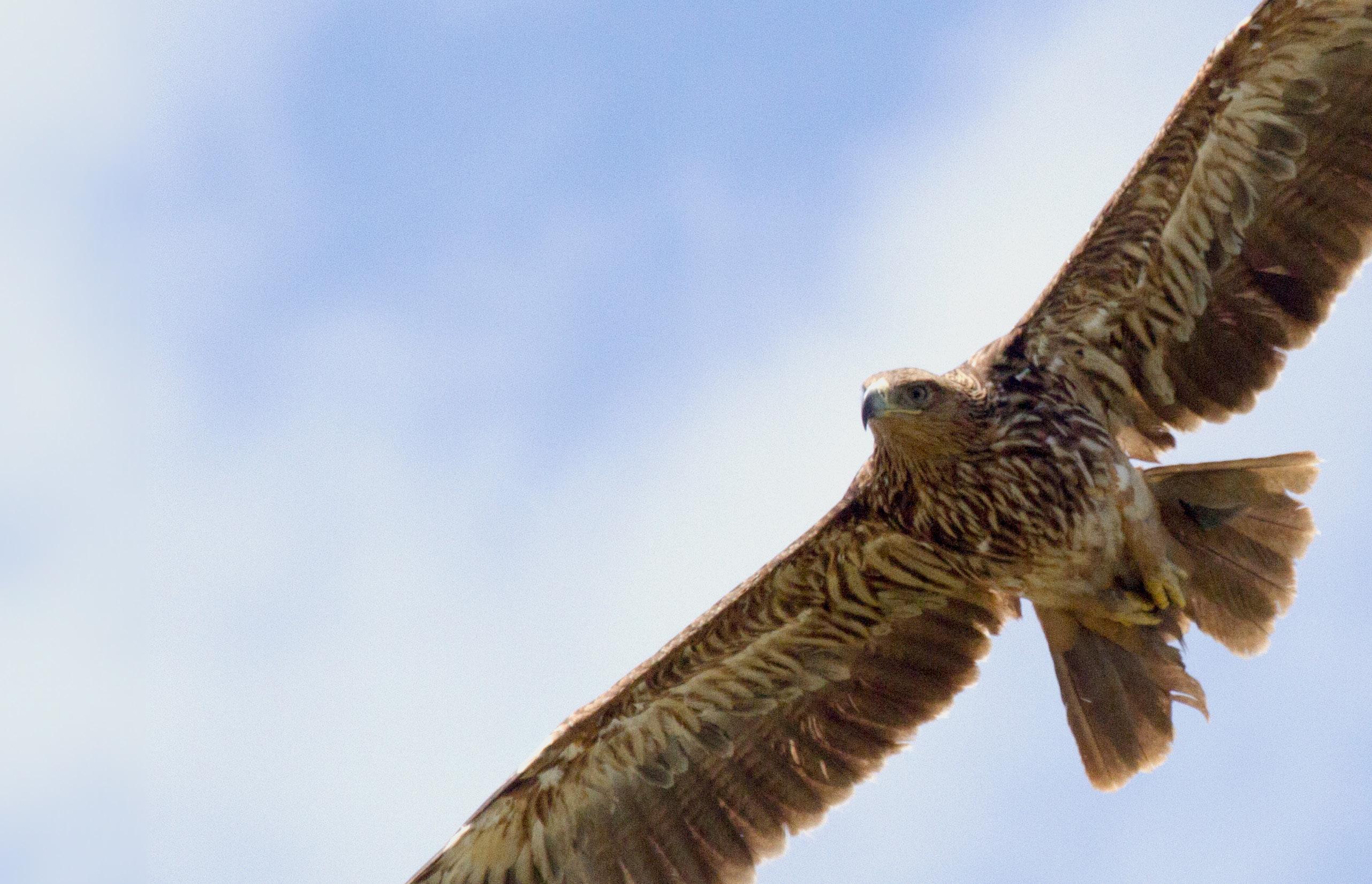
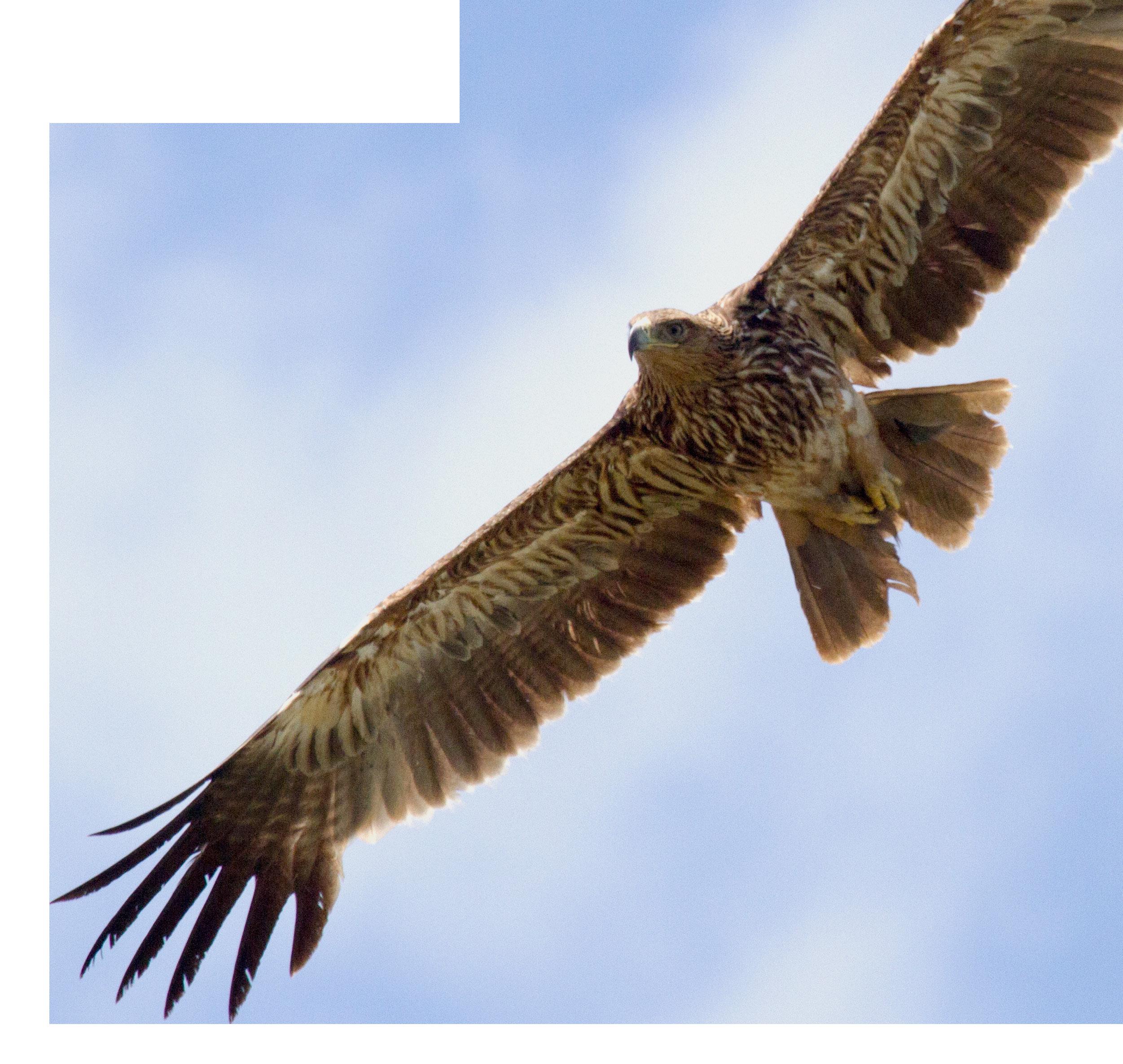
Subadult imperial eagle
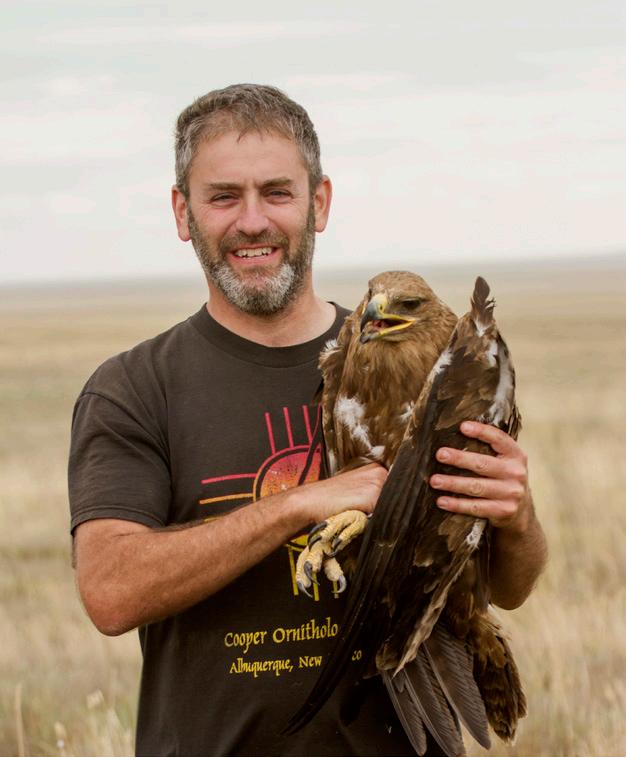
Todd with an adult female steppe eagle
The second illustrative study was focused on Europe and Africa and was led by my colleague Dr. Juan Serratosa. Rather than trying to build models for one species, Juan evaluated trends in telemetry data from all species for which he could get records. For this study, I contributed data on steppe eagles that my team and I tagged as nestlings in Kazakhstan. After reading about Brian’s work with golden eagles, you will not be surprised to learn that, of the Afro-European birds for which cause of death could be determined, human actions or objects killed 70%. For predatory raptors, the leading human-caused reasons for death were, in order: electrocution, illegal killing (including shooting), collision, and poisoning. For scavenging vultures, the leading human-caused reasons for death were poisoning, electrocution, illegal killing, and collision. As was the case for North American golden eagles, the threats these Afro-European birds face are predominantly human-caused.
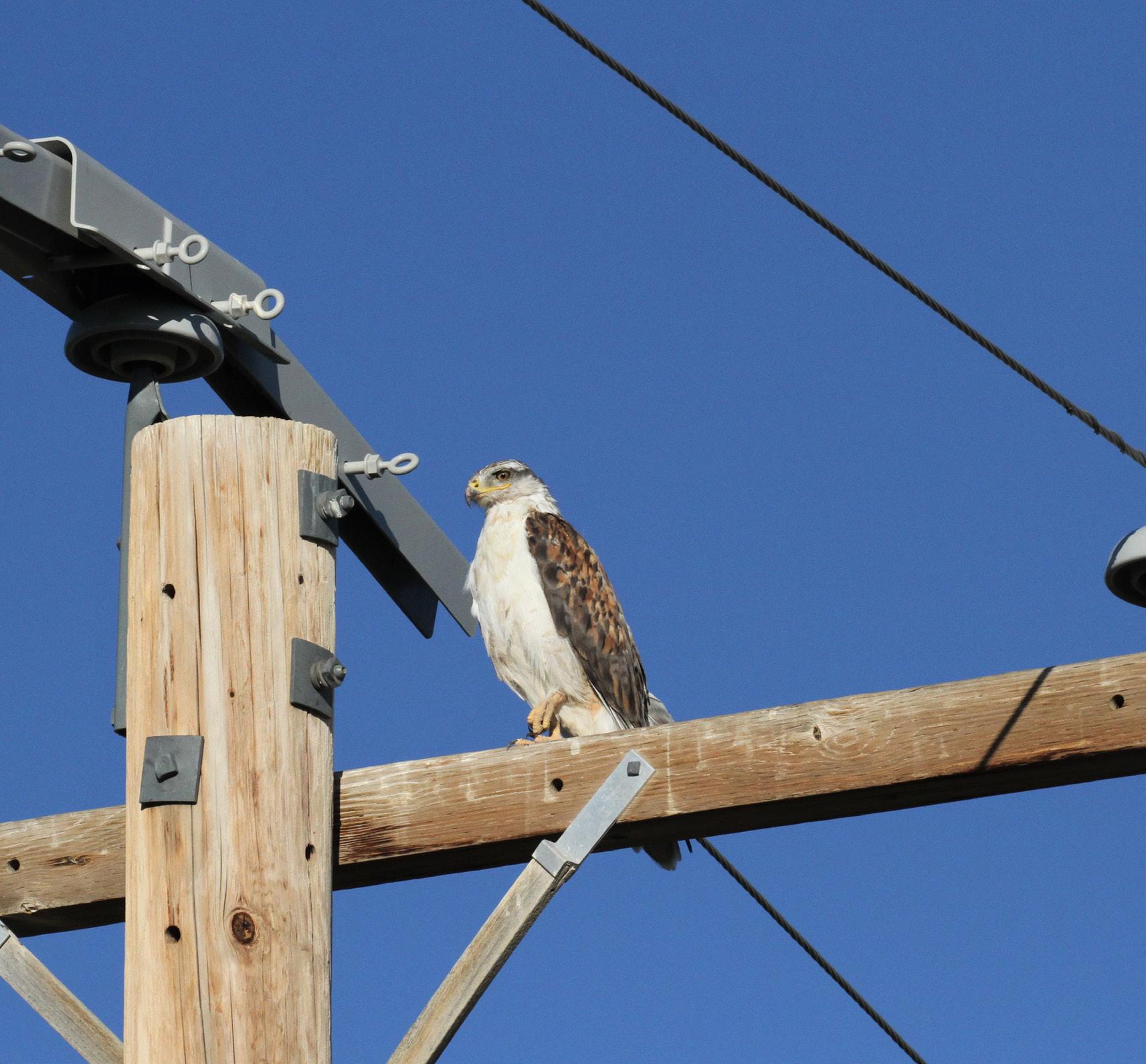
These threats to raptors seem so pervasive and learning about them can be overwhelming. The good news is that although human causes of death are so relevant, there are practical solutions to those problems. We have it within ourselves to address these issues. For example, illegal shooting of raptors is widespread, but there are tried and true law enforcement techniques to reduce rates of shooting. Likewise, education programs, including those at Hawk Mountain, lead to lower rates of persecution of raptors. Finally, electrocution kills thousands of raptors every year, but there are bird-safe designs and retrofits that have already made electrocution far rarer than it once was.
Law enforcement and power pole retrofits are important, but hard for most of us to do on our own. However, beyond supporting effective raptor conservation programs, there also are things that we as individuals can do in our daily actions to reduce threats to raptors. For example, hunters can use non-lead ammunition. Gut piles from shot
A tagged caracara photographed by Katie Harrington
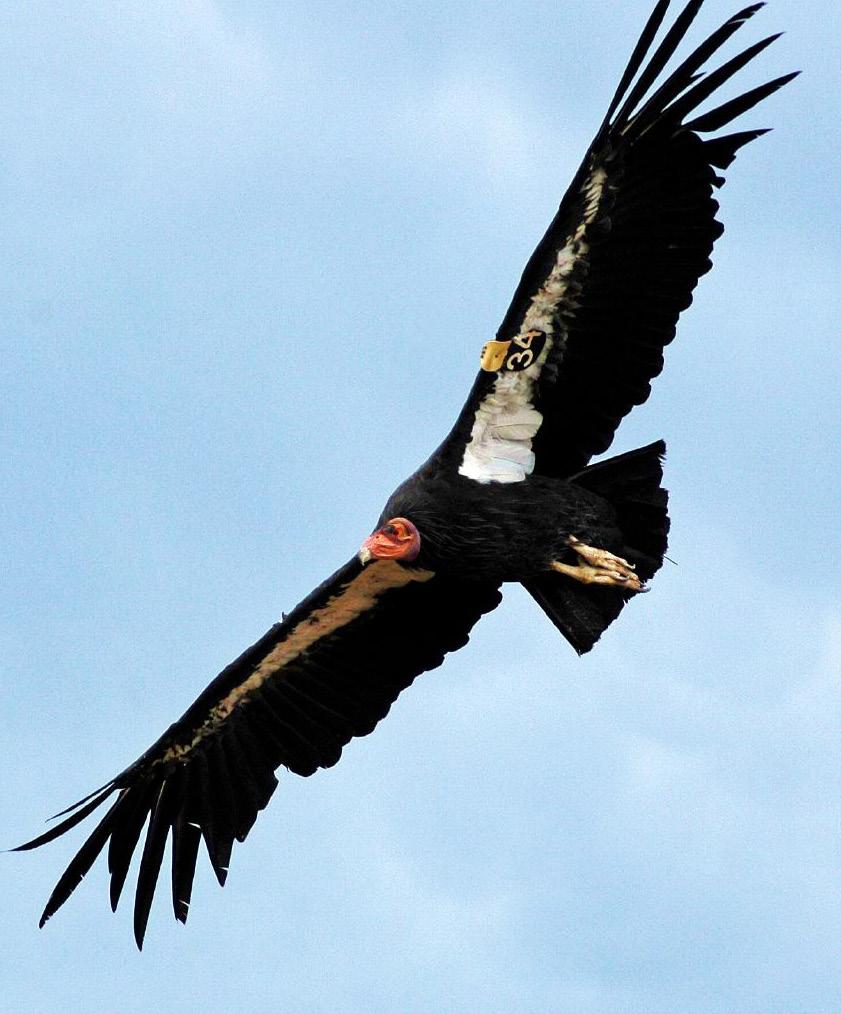
A California condor photographed by Don Graham
animals are a great food source for raptors, and anyone who has put a game camera on a gut pile has seen how frequently they are visited by scavengers. However, spent lead ammunition in those gut piles or in bodies of smaller game is ingested by raptors. Consequently, lead poisoning is a leading cause of death for birds of prey. We now know that this problem is so pervasive that lead poisoning is holding back growth of populations of both golden eagles and California condors. That is why it is so encouraging that there is a straightforward solution to this problem, one that links to personal decisions and one that lets hunters continue their storied conservation tradition. Voluntary use of non-lead ammunition is a great example
of an individual choice that people can make with real and direct positive consequence for birds of prey.
Next time you are at the North Lookout watching the flow of raptors moving by, keep in mind the threats they face. Think about what each bird has navigated and how far it has flown, and, for those species that are declining, how humans have contributed to those declines. At the same time, remember that despite all the threats they face, they are still migrating and there are steps we all can take to ensure that some things still continue to be right in the world.
Photo by EDM International, Inc.
A ferruginous hawk on an avian-friendly pole where the center phase has been retrofitted with a conductor guard.
Then Now & COMMUNITY SPOTLIGHT
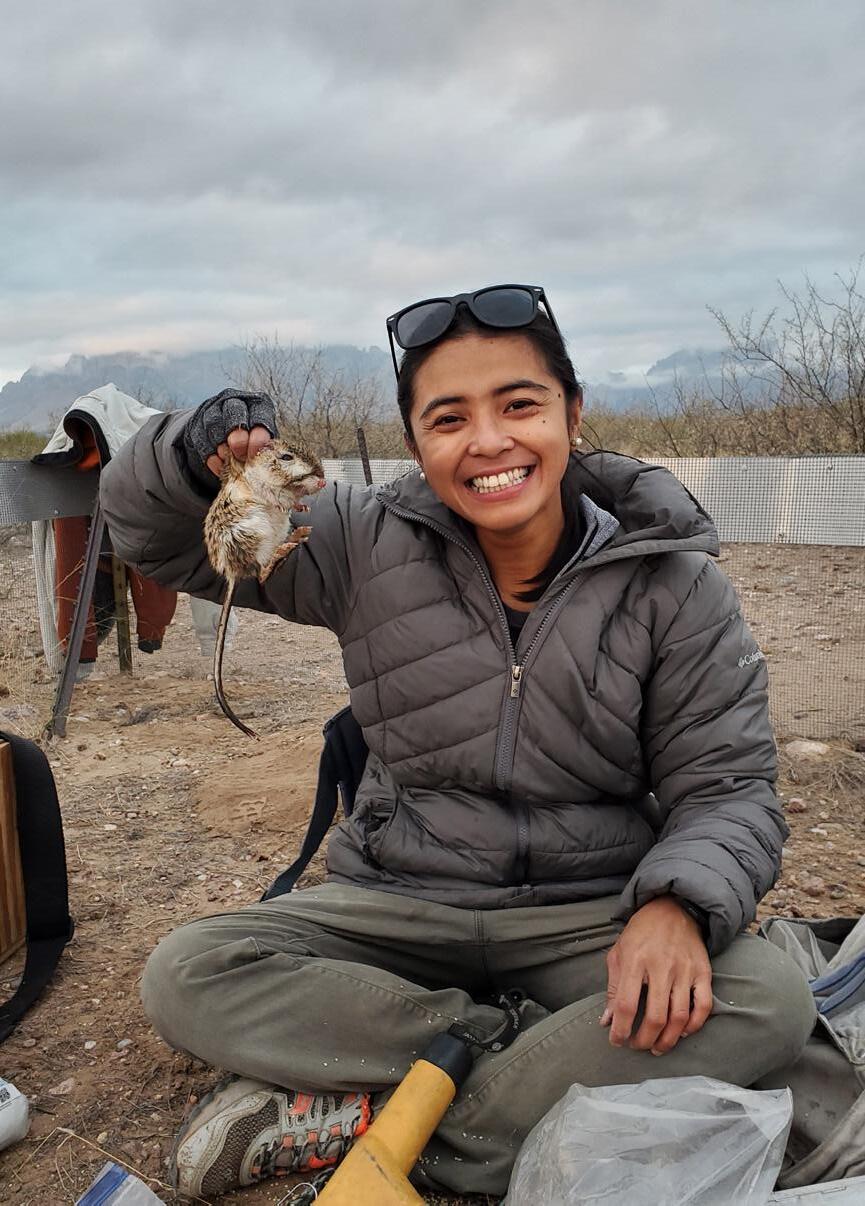
Pat with a banner-tailed kangaroo rat at her field site in Portal, AZ
TALES ABOUT TALONS AND TAILS
By Patricia Dumandan, Ph.D.
My inexplicable fascination with ever-changing nature began during my traineeship at Hawk Mountain Sanctuary in 2016. Since then, my passion for bringing to light environmental changes using the availability of longterm datasets has continued to grow. During my Ph.D., I focused on gaining an in-depth understanding about the migration ecology of birds as prey, and have expanded my research interests to a common prey item—rodents.
A concept that I have explored is phenology, or the timing of life-history events. Studying phenology is important because it can be one of the quickest ways to document species’ responses to climate change. I specifically investigated two understudied aspects of phenology: 1) how species interactions influence phenological patterns, and 2) how our inferences about phenological trends can vary at different scales of observation. Fortunately, I have had access to wellmaintained long-term datasets to be able to ask these questions. Using 40+ years of data from an experimental study on desert rodent communities in the southwestern US (Portal Project), I found that desert rodents can adjust their breeding timing (phenology) and efforts in response to the presence of dominant competitors1. This is important to note because usually, when we talk about shifts in phenology, we assume it is driven by changes in environmental conditions. However, I have shown that indirect impacts of climate change, such as reorganization of communities, can impact population dynamics too.
Motivated by these results and my inordinate fondness for raptors, I explored how our understanding of their migration
phenology differs across levels of organization. Using hawk migration data collected at Hawk Mountain Sanctuary, I studied how lower-level changes influence phenological patterns at a higher level. I found that phenological trends observed at the community/assemblage-level can be driven not just by population-level shifts in phenology but by compositional shifts. This means that an advanced migration timing at the site may be driven not by changes in the timing of the component species but by changes in their numbers.
My explorations on this time-related concept highlight two things: 1) only time will tell us the truths about environmental change, but 2) long-term monitoring gives us data to help pick up signals when these shifts happen. Supporting efforts that contribute to the maintenance of these rare and extremely useful datasets is therefore needed and timely.1
1 Dumandan, P.K.T., G. M. Yenni, and S. K. M. Ernest. 2023. “Shifts in Competitive Structures Can Drive Variation in Species’ Phenology.” Ecology 104(11): e4160. https://doi.org/10.1002/ecy.4160.
SEARCHING FOR SAW-WHETS
By Mitchell Pruitt, Ph.D.
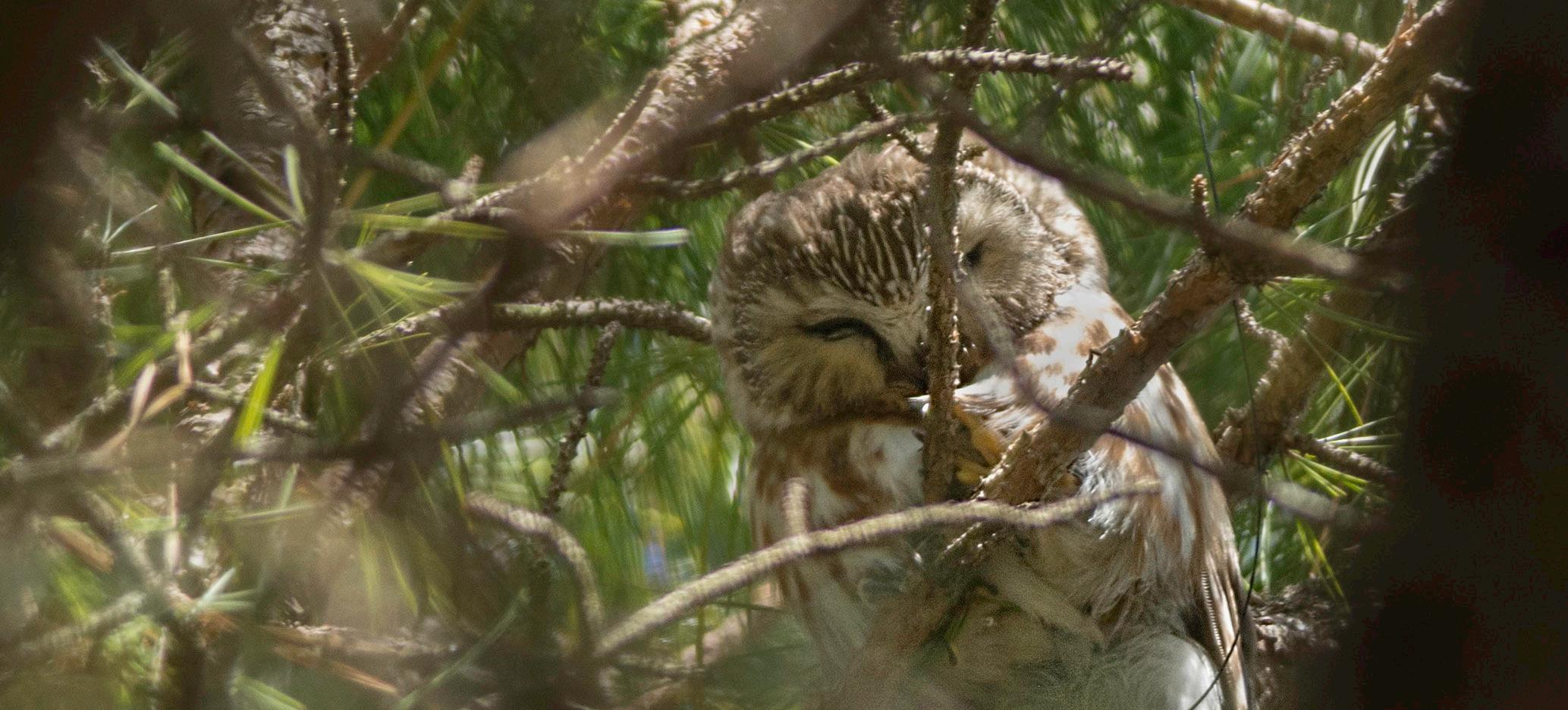
Saw-whet roosting in a shortleaf pine, located during Mitchell’s telemetry study several years ago
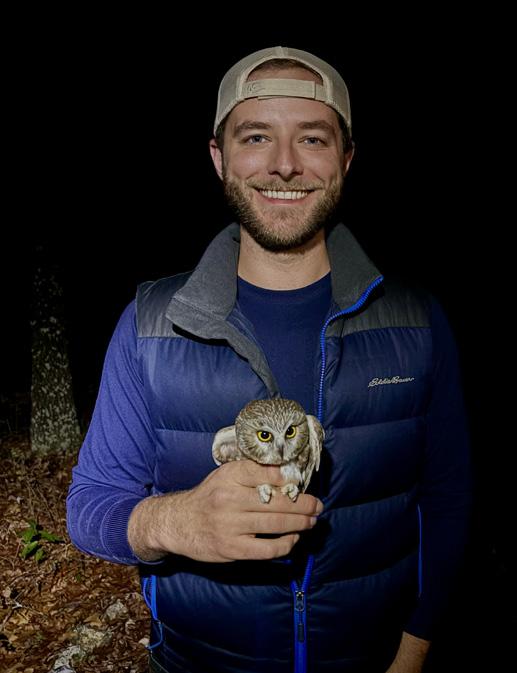
For at least the fifth time that night, I walked into the woods hoping the brownish blob I could see hanging in the mist net wasn’t another leaf or some illusion of the dark night. As I neared, it bobbed and flapped… it was an owl! In fact, it was a northern saw-whet owl—the first ever captured for research in Arkansas. That was almost ten years ago.
Thanks to that one tiny owl, I’ve completed two degrees studying aspects of the saw-whet’s migration and winter ecology, culminating in a Ph.D. in May of this year. As with many owls, saw-whets are poorly understood despite being common across much of North America. Prior to that fortunate night in 2014, they were not known to regularly occur in Arkansas or the Ozark Highlands—an ecoregion that includes northern Arkansas.
Over the years, I have learned much about saw-whets at what is likely the southern fringe of their nonbreeding distribution. My research has involved a multi-faceted approach, including the use of radio transmitters and acoustic monitoring to determine what habitat the species’ uses in the region and how widely they are distributed.
Through this work, collaborators and I have demonstrated that saw-whets occur regularly during fall migration in the Ozark Highlands, with many settling down to winter in the region. This is significantly
further south than the species was historically believed to occur. I also found saw-whets prefer open pine forest while wintering in the Ozark Highlands and that they likely occupy >70% of pine sites in the region. The Ozark Highlands are a significant and previously overlooked piece to the saw-whet’s distribution. Just incredible for a species that was not known to regularly occur here a decade ago!
There are still many unknowns about the saw-whet owl’s nonbreeding ecology, which is concerning given recent trends that show migration shifts in their diurnal raptor relatives. Long-term data collected by projects like mine and the projects of so many others diligently working with sawwhets, will be valuable to inform knowledge gaps.
Since finishing my Ph.D., I have been working on a passion project to found Ozark Bird Conservancy, an organization that focuses on avian research in the Ozark Highlands and beyond. This project is inspired by my work with saw-whets and a need to prioritize avian conservation objectives in regions that are experiencing rapid population growth and urbanization.
2024 Senior Education Interns
PETER LIVENGOOD
Ohiopyle, Pennsylvania
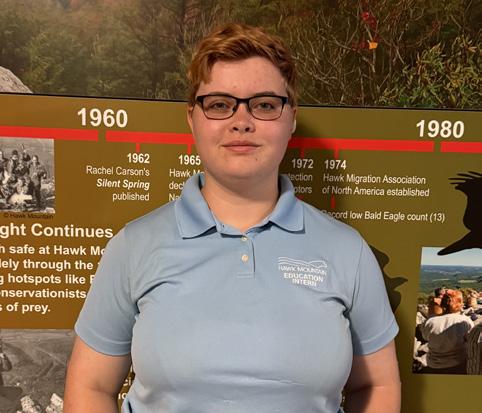
Peter received a B.S. in wildlife and fisheries biology and a B.A. in jurisprudence from Pennsylvania Western University in 2023 and graduated in May with a master’s degree in law and public policy. Peter discovered and founded the Summit Mountain Hawk Watch, where he continues to be the site administrator through HMANA. He was an official counter at the Allegheny Front Hawk Watch for several seasons. He also worked on an aquatic ecosystem assessment of Cranberry Glade Lake to guide management of invasive aquatic vegetation and development of a restoration plan for the Ohiopyle State Park Campground to mitigate understory depletion and erosion issues. Peter completed a nationally recognized Eagle Scout Project on green stormwater management in Ohiopyle. Additionally, he worked for 6 years as summer educational staff for the Wildlife Leadership Academy, and served on the Pennsylvania Governor’s Youth Advisory Council for Hunting, Fishing, and Conservation. After his internship, Peter would like to stay involved in raptor research and conservation education while working toward a career in public policy.
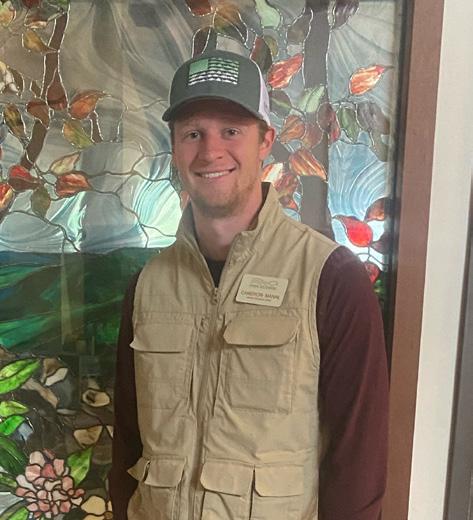
CAMERON MANAL
Newark, Delaware
Cameron is a 2022 graduate from Juniata College where he graduated with a bachelor’s degree in animal conservation and management. In the past, Cameron has interned at multiple zoos, an animal sanctuary in Texas, and a rehabilitation center in Delaware for multiple years during high school. Cameron has also worked at two different zoos before coming to Hawk Mountain. At the end of this internship, Cameron plans on securing a job at a zoo working with ambassador animals where he will be able to talk and engage with the public about species conservation.
MADISON SMITH
Shippensburg, Pennsylvania
Madison graduated in 2021 with a bachelor’s degree in environmental science with a minor in animal studies from Wilson College. She was a former wildlife rehab intern at the Blue Ridge Wildlife Rehabilitation Center in Boyce, VA where she would care for a variety of native wildlife patients including mammals, reptiles, raptors, and other bird species. She also has a background in education from being a substitute teacher in her local school district, where she taught high school environmental classes. After her internship, Madison would like to pursue a career in environmental education or wildlife conservation within a public setting.
Spring & Summer 2024 Conservation Education Trainees
GEORGINA ANTWL
Greater Accra, Ghana
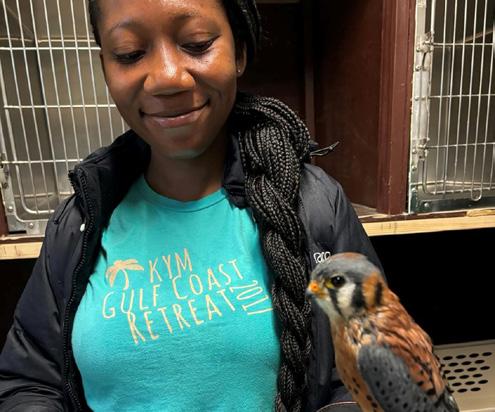
Georgina is a 2023 graduate of the Wisconsin International University where she received an MBA in project management. Georgina currently works as the Assistant Conservation Education project officer at the Ghana Wildlife Society (Birdlife partner in Ghana) where she handles projects under environmental education and biodiversity conservation. She is an environmental educator who works with the youth on biodiversity conservation projects such as tree planting, educational seminars, birdwatching, and clean-up activities. She has worked on several committees to coordinate world environmental days such as International Vulture Awareness Day and World Migratory Bird Day. After her traineeship, Georgina would like to obtain a Ph.D. in Environmental Education and Sustainability.
ABIGAYLE HOLLIBAUGH
Huntingdon, Pennsylvania
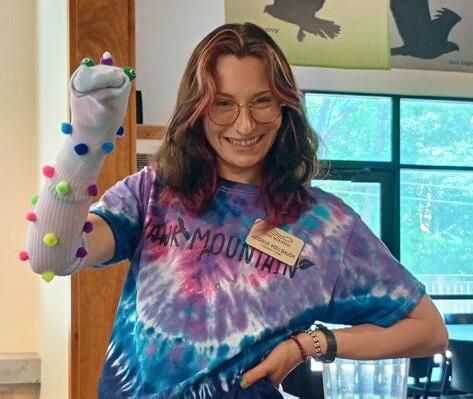
Abigayle holds a bachelor’s in biology environment, ecology, and conservation from Shippensburg University and has served as an environmental educator, naturalist, and animal caregiver at Shaver’s Creek Environmental Center. Following her traineeship, Abigayle will be continuing her career as an environmental educator at the Alabama 4H Science School in Columbiana, AL.
New Educator
LYRIC PASKEL
ESTHER METCALFE
Hamburg, Pennsylvania
Esther lives locally and completed the Sanctuary’s traineeship program as a graduate requirement to obtain her bachelor’s degree in environmental geoscience from Bloomsburg University. She plans to graduate in May 2025, and then continue gaining experience in raptor care and environmental education during an internship at Red Creek Wildlife Center.
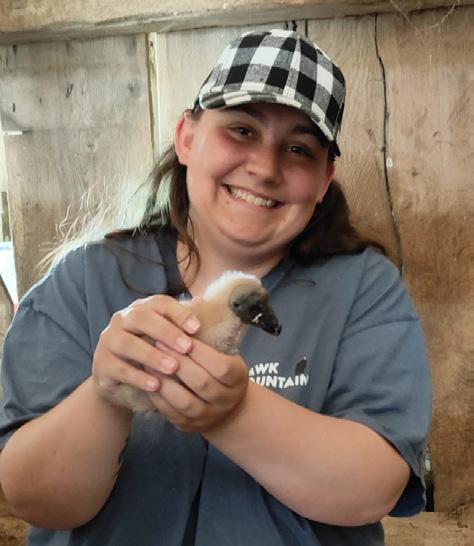
This spring Hawk Mountain welcomed a new educator and raptor care specialist to the team: Lyric Paskel! Lyric has nearly 20 years of experience in outdoor and environmental education, working at various facilities in Pennsylvania, including Shavers Creek Environmental Center, Wildlands Conservancy, and Blue Marsh Lake. She has expertise in animal and raptor care, conducting summer camps and animal programs, and educating the public on natural history. During her time with the Disney College Program, she worked at Walt Disney World’s Animal Kingdom, teaching guests about global conservation. For the past seven years, she has taught science to grades 3-12 while pursuing a master’s in education. Lyric is passionate about fostering connections between individuals and nature and is excited to continue her environmental education career at Hawk Mountain Sanctuary.
2024 Spring Migration Summary
By David Barber, Senior Research Biologist
Cold temperatures and northwest winds greeted the trainees on their first day at North Lookout. At 9:20 a.m., a pair of bald eagles was seen flying north high over the lookout, a positive omen of the spring count to come. Overall, counters tallied 1,001 migrating raptors of 14 species in 254 hours over 42 days from March 18 to May 15.
Accipiter flights were steady through April, peaking on the 7th with 9 sharpshinned hawks and 4 Cooper’s hawks. Trainees spotted a subadult golden eagle on April 11, and a season high nine bald eagles was tallied on April 16. Rain shut down the flight on April 19, but not before a high of 101 broad-winged hawks soared past North Lookout. Broadwings continued to be counted daily through the end of April.
Migration continued through midMay although in low numbers. A May high 25 raptors was tallied on the 13th with 2 osprey, 5 bald eagles, 1 northern harrier, 13 broad-winged hawks, 1 redtailed hawk, and 2 unidentified raptors. The last migrant of the season was a red-tailed hawk moving north on the afternoon of May 14.
Overall, the count total was 6% above the 10-year average. Black vultures, bald eagles, sharp-shinned hawks, and merlins all had above average counts. The bald eagle count of 87 was a new season-long record, and the merlin count of 11 was the second highest spring total. Turkey vultures and red-tailed hawks had the largest drops in count numbers and were 17% and 19% below average, respectively. Hawk Mountain wasn’t the only
Volunteers: Scott Morrison, Andy Price, Matt Wlasniewsk
Pennsylvania watchsite to count lower numbers of red-tailed hawks this year. Redtail counts were below average at all sites and the total number of redtails counted migrating through Pennsylvania was a 25-year low.
For long-term trends of our spring count visit the Raptor Population Index (www.rpi-project.org).
NORTH LOOKOUT – SPRING 2024
Unidentified Accipiter
Red-shouldered Hawk
Broad-winged Hawk
Red-tailed Hawk
Rough-legged Hawk
Unidentified Buteo
Golden Eagle
Unidentified Eagle
American Kestrel
Merlin
Peregrine Falcon
Unidentified Falcon
Unidentified Raptor
Hawk Mountain has been a bustling haven of plants and wildlife as the Mountain transitioned from a wet spring into a scorcher of a summer.
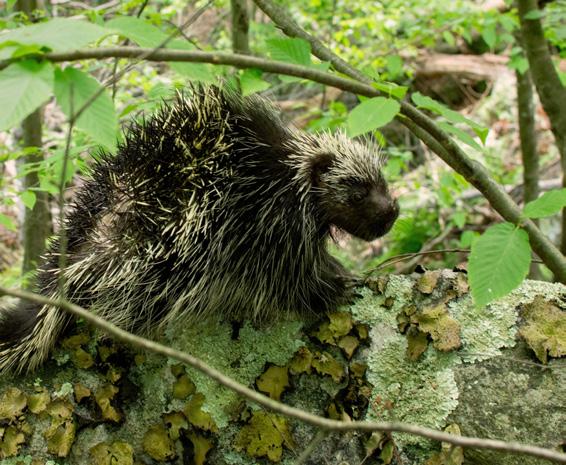
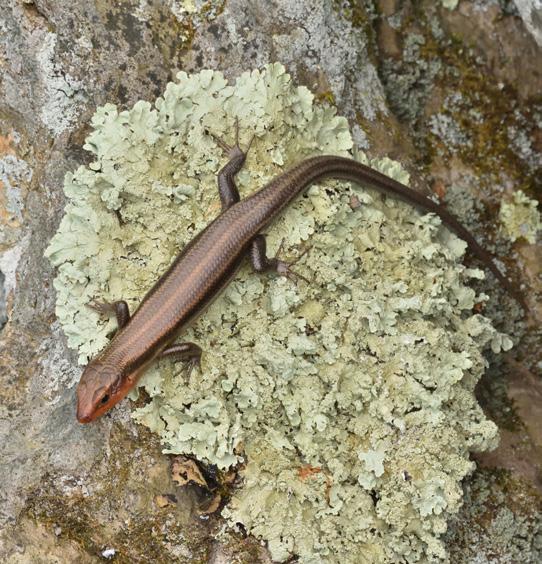
The grounds have been alive with reptiles, including the elusive five-lined skink, black rat snake, eastern garter snake, milk snake, and the eastern box turtle. And they’re not the only ones exploring the forest understory. The Sanctuary has experienced a significant chipmunk boom, with both adults and juveniles scurrying around the grounds. A sighting of a porcupine on May 30 was a unique addition to the wildlife catalog, and the early start of mating wood frogs added to the spring symphony of nature’s sounds.
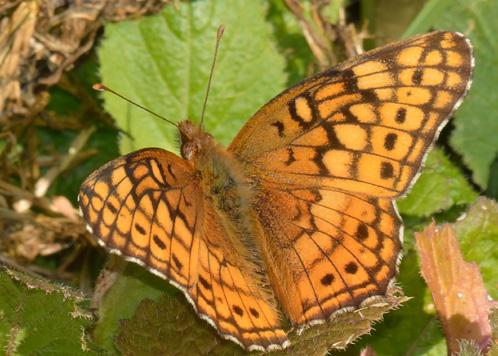
The lookouts have been adorned with a variety of butterflies, as seen during the migration count and the official Independence Day Butterfly Count. Appalachian brown, eastern and grey comma, eastern tiger swallowtail, mourning cloak, and eastern tailed blue butterflies have all been spotted. At specific locations, the tawny emperor was seen at Bolich Farm—the meadow at the base of the mountain on the Kempton side, managed by the PA Game Commission—along with variegated fritillary, common checkered skippers, and northern pearly-eyed and little wood satyr at the Acopian Center.
The blooming of American chestnut and rhododendron painted the landscape with bright colors in the spring, while mountain laurel made an early appearance, gracing the end of May with its pink hues. Dogwood had a weaker bloom this year, probably due to the weather conditions in early May.
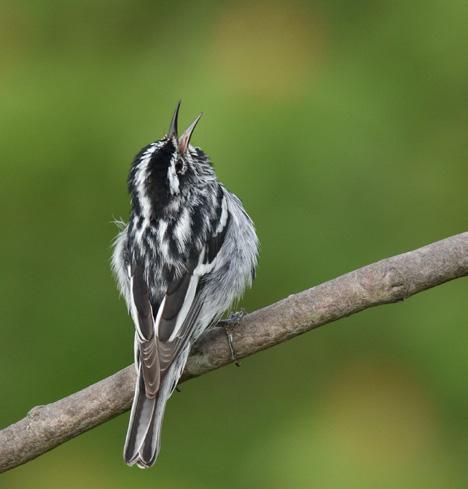
Bird enthusiasts have had much to lookout for. The first ovenbird, the Sanctuary’s most abundant breeding bird, was heard on April 23 in the River of Rocks. Sanctuary scientists were excited to welcome the return of a pair of cerulean warblers on Owls Head for the second consecutive. Common loons and double-crested cormorants making an okay showing, while black-and-white warblers reclaimed territories along the ridgetop, great crested flycatchers announced their return with their distinctive calls, and the spring green was highlighted by the brilliant plumage of migrating scarlet tanagers. A male indigo bunting closed the season, singing proudly from his lookout perch.
By Gigi Romano
Photos By Bill Moses
Variegated Fritillary Euptoieta Claudia Stroud
Photo by Noah Rauch
Spring & Summer 2024 Conservation Science Trainees
ALEXANDRA HAGANS
Reading, Pennsylvania
Alex is a 2023 graduate of Delaware Valley University where she received a bachelor’s degree in wildlife conservation. Alexandra was a former intern at the Wolf Sanctuary of Pennsylvania where she designed wolf educational packets for children, along with doing upkeep of the sanctuary. Alexandra was also an intern at the Bucks County Audubon Society where she collected and interpreted data from the Bluebird Nest Watch project, prepared and monitored Bluebird nest boxes, and removed invasive species. She is a duck banding volunteer at Middle Creek Wildlife Management Center where she assists with duck banding, restraining the banded birds, and acquired familiarity with bird banding techniques. In the autumn of 2023 Alexandra was a counter at one of the Kittatinny Ridge hawkwatch sites, where she counted migrating North American raptors. After her traineeship, Alexandra would like to continue to work within the conservation science field specifically in avian conservation.
RILEIGH LECH
Cherry Hill, New Jersey
Rileigh is a 2023 graduate of Kutztown University where she graduated with a bachelor’s degree in environmental science and biology, and a minor in environmental geography. Rileigh currently works at the Woodford Cedar Run Wildlife Refuge where she educates guests on native New Jersey raptors, mammals, and reptile species, along with conservation efforts and citizen science presentations. Rileigh was a seasonal assistant environmental educator at the Wildlands Conservancy in Emmaus, PA where she assisted in daily camp activities for an environmental-based curriculum, assisting with hikes and presentations. After her traineeship, Rileigh would like to pursue a master’s degree focused on conservation biology.
KATIA GUTIÉRREZ MÉNDEZ
La Paz, Mexico
Katia graduated in 2019 from Universidad Autónoma de Baja California Sur where she received her bachelor’s degree in marine biology. Katia currently works at the Bird Laboratory, UABCS, where she is monitoring osprey reproduction in Guerrero Negro, fledgling marking programs, monitoring of migratory waterbirds in Guerrero Negro and La Ensenada de La Paz and working on the monitoring program of the western sandpiper. Katia has been a volunteer at the A.C. Red de Viveros de Biodiversidad in Coatepec, Veracruz, along with being a volunteer and assistant counter at the Pronatura Veracruz Project River of Raptors in Veracruz, Mexico. After her traineeship, Katia would like to complete her master’s degree focusing on the peregrine falcon in Mexico.
MARY-KATE REED
Eureka, California
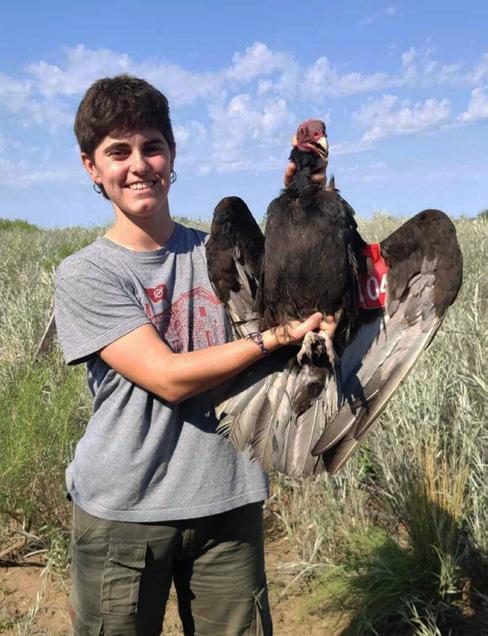
Mary-Kate is a 2023 graduate of Cal Poly Humboldt with a bachelor’s degree in wildlife management. MaryKate was a Raven Project Intern at Cal Poly Humboldt where she focused on locating banded ravens in the field, performed surveys and behavioral observations on foot and from stationary viewpoints, and collected data from surveys and observations and then processed data. After her traineeship, Mary-Kate would like to pursue a career in conservation and research of raptors, along with completing a master’s degree.
MADALEN GOITIA URDIAIN
Munguía, Spain
Madalen graduated in 2021 with a master’s degree in biodiversity from the University of Barcelona, Spain. Madalen’s thesis was focused on the comparison of the performance of complex bird song recognizers in three automated recognition programs. She received her bachelor’s degree in biology in 2020 from the University of Basque County, Spain. Madalen participates in the counting of the Litle Owl in Catalonia and is training to become a bander with the Aranzadi Society of Sciences in Spain. She has also participated in migration ringing campaigns in Menorca. Madelen has worked with the Chaco eagle, chimango caracara, black vulture, and turkey vulture. After her traineeship, Madalen would like to obtain a Ph.D. in conservation wildlife.
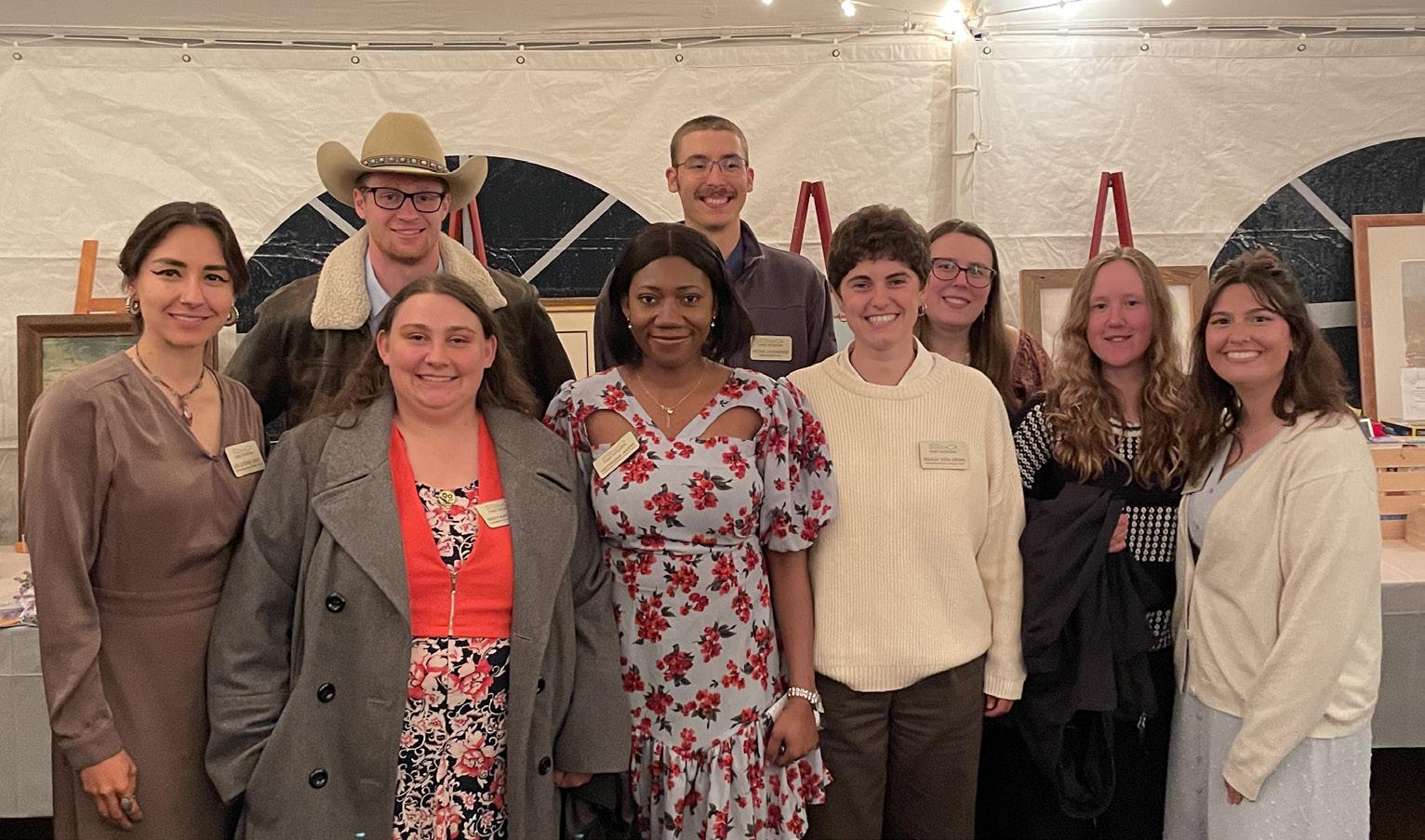
Spring 2024 Conservation Science and Education Trainees at the Benefit for the Birds.
Staying on the Trail
By Merlyn Nomsa Nkomo
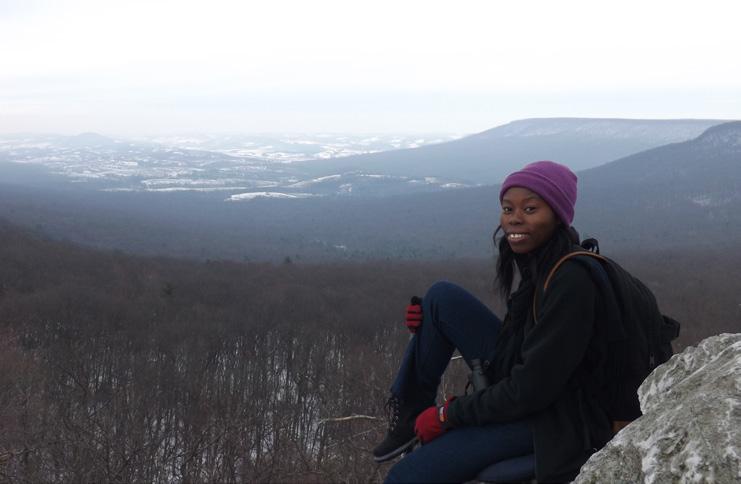
The story of how I found my way into ornithology and raptor biology is serendipitous. At best, I can describe it with something I do too often: faithfully hiking a blazed trail alone, engrossed in the beauty around you without knowing how long and how steep the trail goes, never mind what the weather will be with nothing but your torch and a water bottle.
THE WISE IN MY CULTURE SAY:
“Inyathi ibuzwa kwabaphambili.” OR
You ask of the buffalo from those ahead of you
“Indlela ibuzwa kwabaphambili.”
You ask of the way from those ahead of you.
These two proverbs are the same and are often used interchangeably. However, the message is the same although in two parts: life is a journey, and the young rely
on the wisdom of their elders to navigate life and its dangers. As a first-generation university student in Zimbabwe, I had to throw caution to the wind, ignore these wise words, to pursue my passion with no road map or known destination, just a guiding torch forward towards the things that spark wonder and creativity in me.
Life is full of uncertainty, but career uncertainty is unacceptable where I come from. Education is a big investment; you only get one play, and you have to make it count. A gamble to follow your dreams without the assurance of hitting the jackpot is not on the table. For this reason, I found myself lucky to have the curious support of my parents. They were proud that their first-born child had made it into university and was studying science. After I fibbed to them about the certainty of the job market in conservation, I had their full support for whatever was required to get me there.
I remember the day I got my first pair of binoculars; it was the greatest feeling in the world. I’d convinced my father (another fib) that they were an essential piece of equipment we needed at school. I was not deterred by how expensive they seemed to be when I scoured the internet for them. My father got them
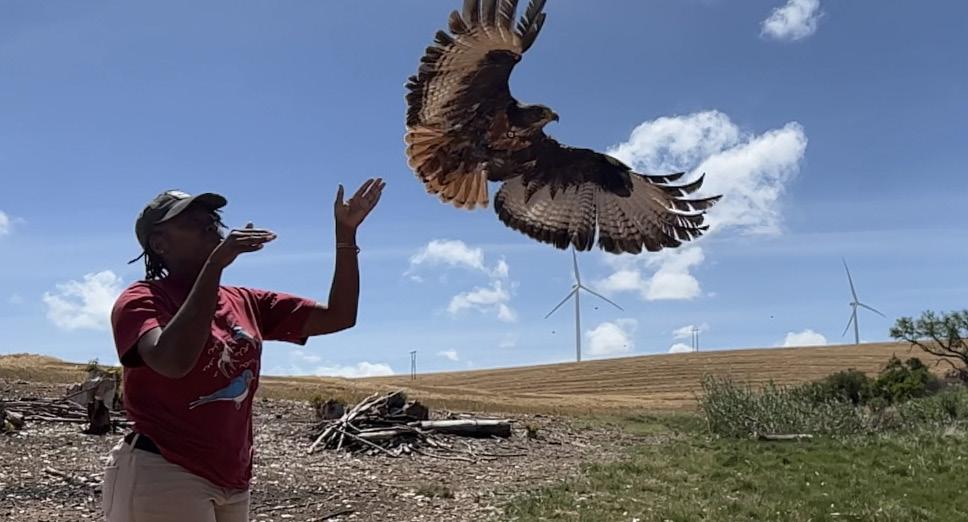
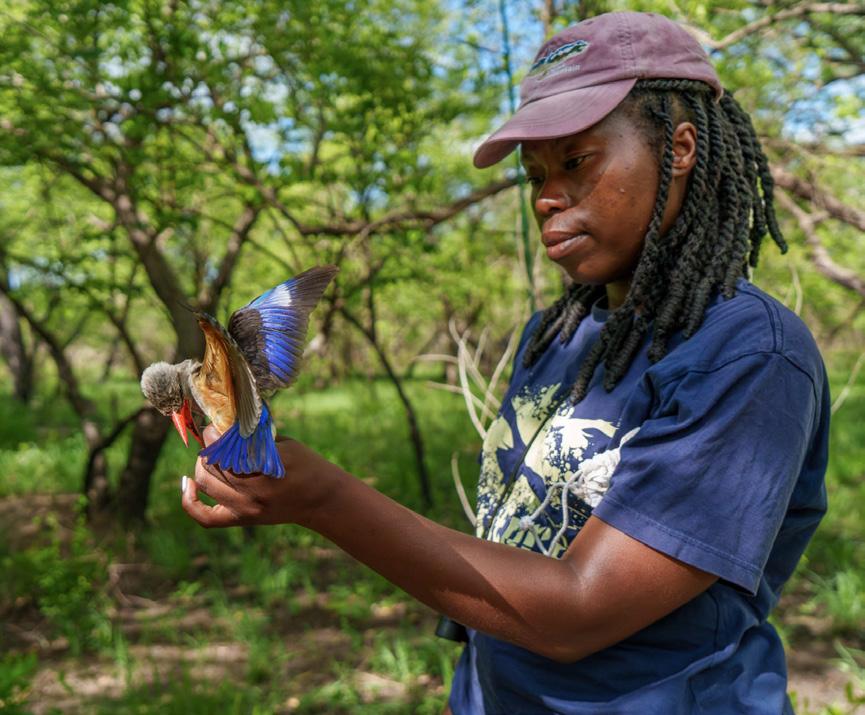
Merlyn releasing a GPS-tagged Jackal Buzzard.
for me through a family friend in the UK and even added a camera. I was on top of the world, the happiest girl. At that point, I was blissfully set on ornithology and clueless as to where the journey would lead. Three years later the journey led me to Hawk Mountain Sanctuary, the school in the clouds, and on this vantage point, the future became clearer, and the uncertainty lifted.
True to character, I arrived at Hawk Mountain unaware of what was to happen. I did not know anything about migration counting, if, where, when and how we would be doing it as trainees. I was certain, however, that I was home, that my passion for raptors meant I would be able to rise to every challenge that came my way. Sure enough, challenges did come, the first being the freezing state we found the mountain in after a late blizzard swept by. As a fashionista biologist, I had to learn a few things about layering and picking one’s battles right. Another challenge was hiking. Coming from the flat plains of Zimbabwe, hiking was a whole new world, a crucible to my desire to get up to North Lookout and see the birds. The people doing it for fun—well they were odd and eventually inspirational to me, and now I am one of them. My time here changed me the most, I learnt more than just birds. I learnt to ride a bicycle, to swim; I learnt that I was a storyteller, and a writer, fell in love, and that I was an African first before anything. I learnt that I loved Africa, and I was in conservation for her more than for my pursuits.
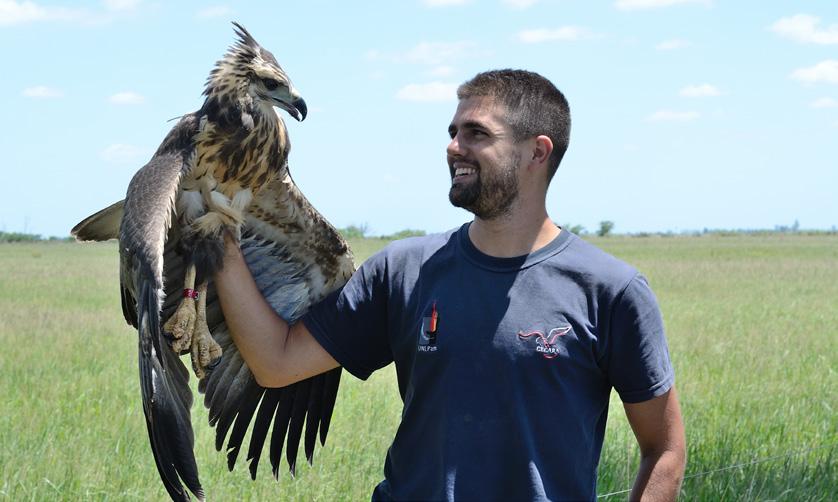
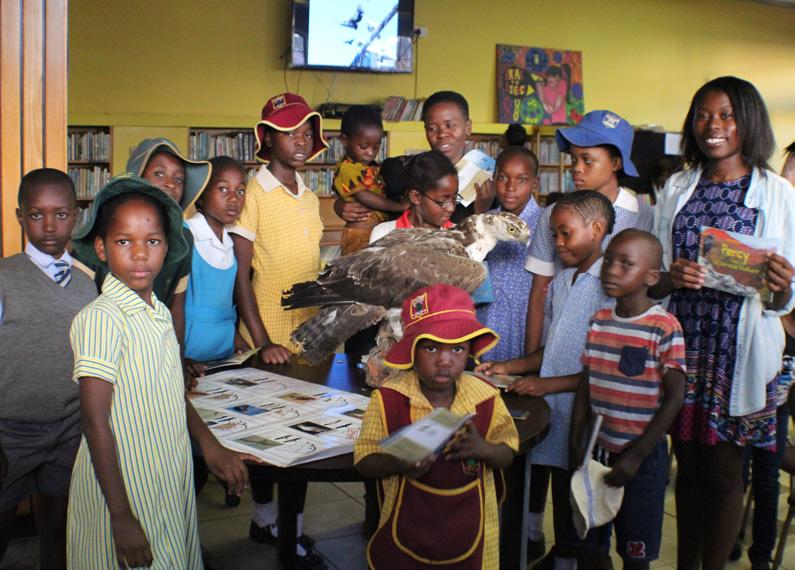
When the time came to leave Hawk Mountain, I was confident, more expressive and equipped in different ways to share my passion for raptor conservation. I threw myself into storytelling in many ways; photography and blogging being the main forms. Periodically, I organised events in my hometown of Bulawayo, Zimbabwe, at the Natural History Museum. These events ranged from vulture conservation seminars to science symposia, and once, I tried to organize a city-wide school science fair. Unfortunately, after a lot of work on it, it did not come to fruition. However, one of my favourite events was a public library book reading event I organised where I read the book Percy the Victorius Vulture, then, a recently published children’s book from Hawk Mountain. The reading was very well attended, and I wrote a blog about it for Hawk Mountain. A few years later, a woman who had brought her children, met me in town and said her toddler had never forgotten the words roadkill since, and I was very proud. Those days I walked and drove around the city seeking partnerships, bursting with ideas for outreach and public discourse on conservation issues. Friends called me the busiest unemployed person around. I put myself to work, my work, and it was the work of expanding and diversifying the conservation landscape to include more people from my community, particularly young people, and people who looked like me.
Merlyn teaching Percy the Victorious Vulture to local school children.
The blazes led me on to postgraduate study in Cape Town, South Africa, at the FitzPatrick Institute of African Ornithology, or what I called my Mecca. I studied there for a master’s in conservation biology and stayed on to date, for my doctoral studies. My insistence on staying and working in Africa meant this institute was the best place to be. My time in postgraduate education has opened my eyes to the challenges African students face in following their passion for biology fields. There are too few mentors and people to look up to, what is termed the leaky pipeline. We have specific challenges we face globally as people of colour in conservation fields and more so in Africa that makes it hard to find us adequately represented
in university campuses, conservation leadership, research stations, you name it. Representation matters because it takes phenomenal audacity to dream of a life you have not seen lived and actualised by people like you. How do you paint the colours of that life? Who do you ask of the buffalo and how to navigate it? These questions dominated my thinking when I realised that as an African woman, I was a minority in my postgraduate classroom, there were no professors like me or people like me in all the leading organisations that came by to talk about their work in Africa. I found myself asking who we are conserving Africa for if it’s not for her people, with her people.
Serendipity struck again, and seven years after leaving the mountain I found my way back. I came back bolder in my expression, self-assured in my work and “grown-up.” However, the glee and passion for birding and being a raptor biologist had been battered and overcome by practical and big-picture thinking. Not that these are wrong but like in my earlier hiking analogy, I have achieved much in my career by staying present in my passion and intentionally enjoying the journey not worrying over the length and challenge of the trail. The practical realities are now hard to ignore.
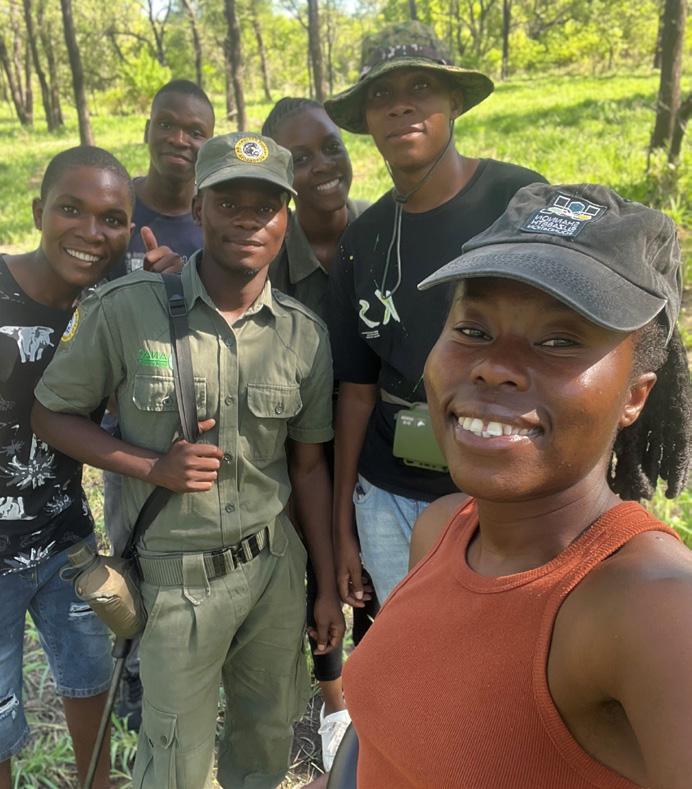
Merlyn teaches ornithology during expeditions in Mozambique.
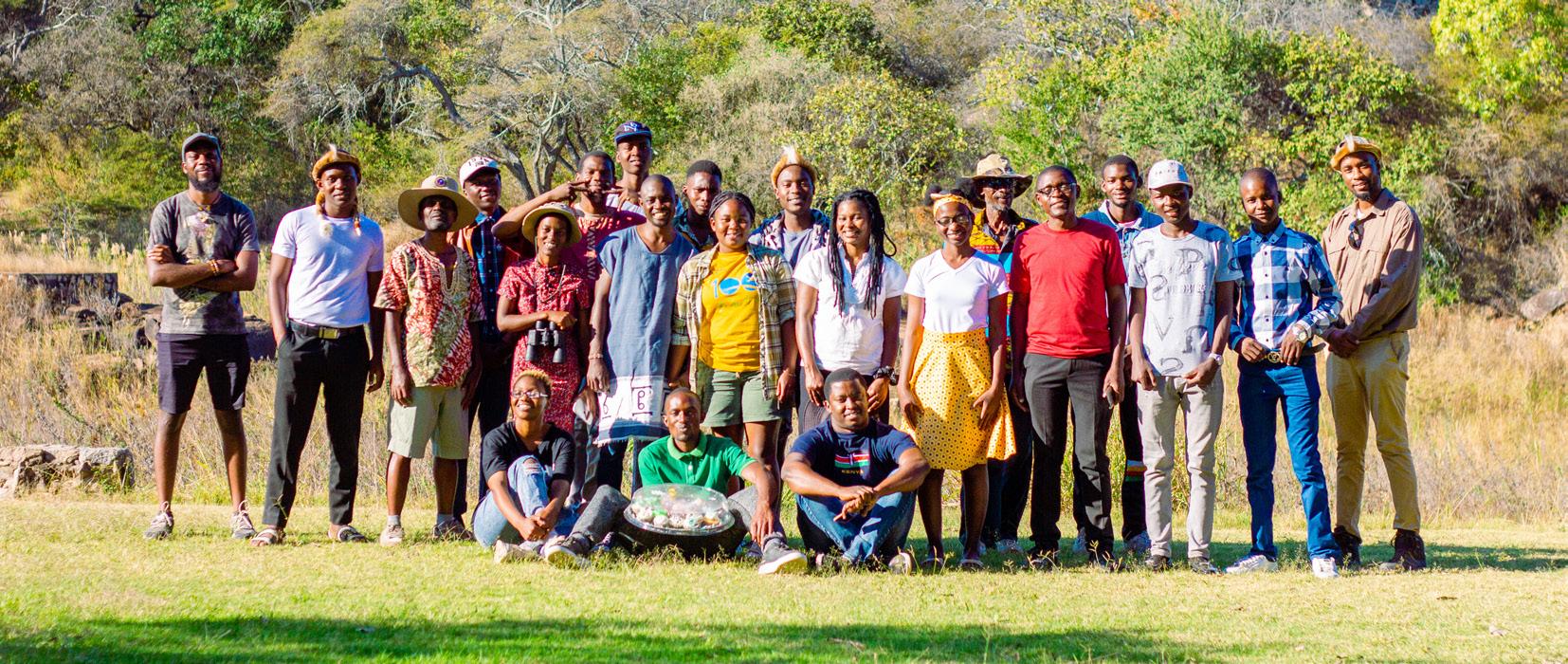
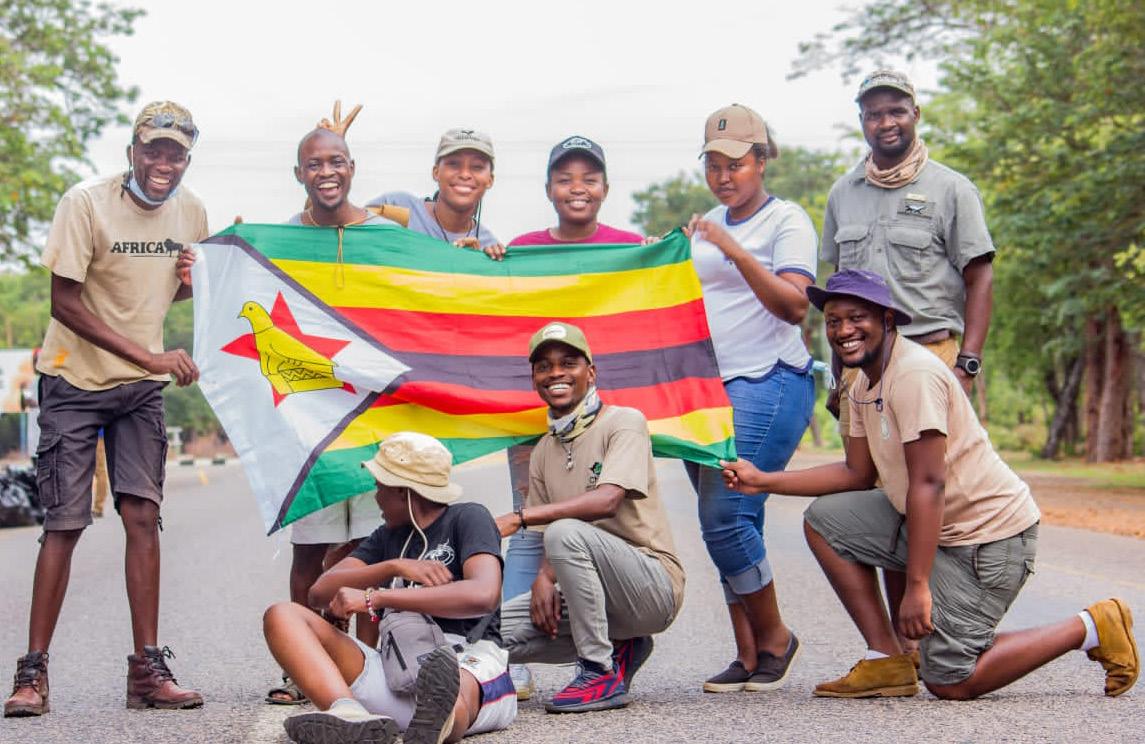
The Matabeleland Youth Conservation Society
Thoughts of legacy and impact weigh heavy on my shoulders. As a result, I have found myself again, juggling a lot. My friends call me the busiest Ph.D. student because my Ph.D. is only a small part of what I do. My work to advance inclusion and transformation in African conservation means that I have led a youth conservation society in Zimbabwe remotely for five years, I make time to go on teaching expeditions with young Mozambican biologists, and I engage in science communication, writing and public speaking with every chance I get while writing my doctoral thesis. I do not recommend this juggling act to anyone, but life is short, and we ought to put our best foot forward towards our calling(s).
I am currently back on the Mountain getting help from the Sanctuary’s biologists to analyse my tracking data for my movement ecology study and to gain more field experience. I was very fortunate to be able to complete the Raptor Field Techniques Course offered here, and I am currently planning and designing an African version of this course to introduce and upskill many early-career Africans to raptor biology. My homecoming trip to the Sanctuary
has convinced me I belong in raptor biology, and that I can still make a meaningful contribution. The reunion made this epiphany tangible; I finally could ask from those ahead of me in this family, of the buffalo and the way. Celebrating 90 years of Hawk Mountain has shown me that persistence, resilience, consistency, and conviction are how I can leave an impactful legacy through all the chapters, highs and lows, of this trail that is my career—whatever form it takes from here on.
Merlyn founded the Matabeleland Youth Conservation Club in Zimbabwe
Holding a grey-headed kingfisher in Mozambique.
AUTUMN Lecture Series
All lectures are FREE to attend and take place at 4 PM in the Visitor Center Gallery unless stated otherwise. No registration required!
90 Years on the Rocks
Saturday, September 14
Presented by the Hawk Mountain Staff, come celebrate the people, places, and events that have and those that continue to shape the conservation legacy of Hawk Mountain.
Held in the Amphitheater
The
Bald Eagle: Connecting the Count, Carson, and Conservation
Saturday, September 21
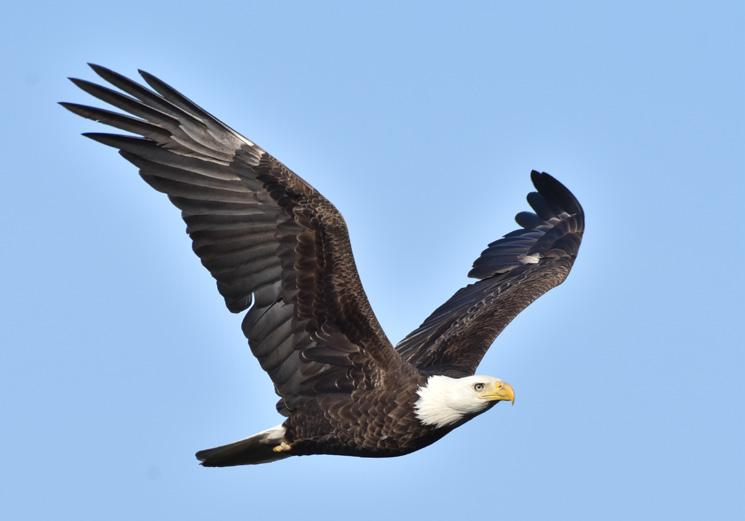
Learn about the important connection linking our long-term raptor migration count, Rachel Carson, and the conservation success story of the bald eagle. After viewing the documentary film “Pennsylvania Bald Eagles: Celebrating 30 Years of Restoration”, Patti Barber of the Pennsylvania Game Commission will share updates of the current eagle population within the state.
History of Hawk Mountain Area Before the Sanctuary
Saturday, October 19
Join Dave Ray of the Hawk Mountain Chapter 31 Society for Pennsylvania Archaeology to learn about the history of the Hawk Mountain area before the Sanctuary came to be, including the Native Americans, early settlers, charcoal industry, and the sand quarry and slide.
Pennsylvania Bird Atlas: Winter is Coming!
Saturday, November 16
Pennsylvania’s Third Bird Atlas (PBA3) is a 5-year long community science project that will help improve our understanding of the distribution and abundance of birds across the state. The PBA3 follows PA’s first two atlases, which were conducted in the 1980s and early 2000s. However, the PBA3 is our first atlas to incorporate winter atlas efforts! Find out how you can contribute to bird conservation by counting birds overwintering in PA.
MEMBER EXCLUSIVE
Hawkwatching with the President
Tuesday, October 15 | 9 AM – 1 PM
$20
Depart on a leisurely hike to North Lookout with President Sean Grace, then scan the skies for migrating raptors. A bagged lunch will be provided to enjoy at North Lookout.
The Big Sit
Saturday, October 5 | 8 AM – 4 PM
Trail fee for Non-Members
Assist Hawk Mountain naturalists at one (or more) of our three count circles for the Big Sit on the Mountain.
Owloween
Sunday, October 27 | 1 PM – 3 PM
$8, $6 for Members
Sanctuary Saturday: Celebrating HMS 90th Anniversary
Saturday, September 14
Various programs and information stations all in celebration of Hawk Mountain’s 90th anniversary being the world’s first refuge and count site for birds of prey. Visit website for details.
Broadwing Buddy Pass
Monday, September 16 through Friday, September 20
$25 per pass
Celebrate International Hawk Migration Week and watch for our most numerous migrant, the broad-winged hawk! The $25 Broadwing Buddy Pass allows trail admission September 16-20.
Fall Native Plant Sale
Saturday, September 21 | 10 AM – 3 PM
Learn from our host of native plant volunteers and choose from over 100 different species of PA native plants for your own home landscape. Get a head start on next spring by planting this fall!
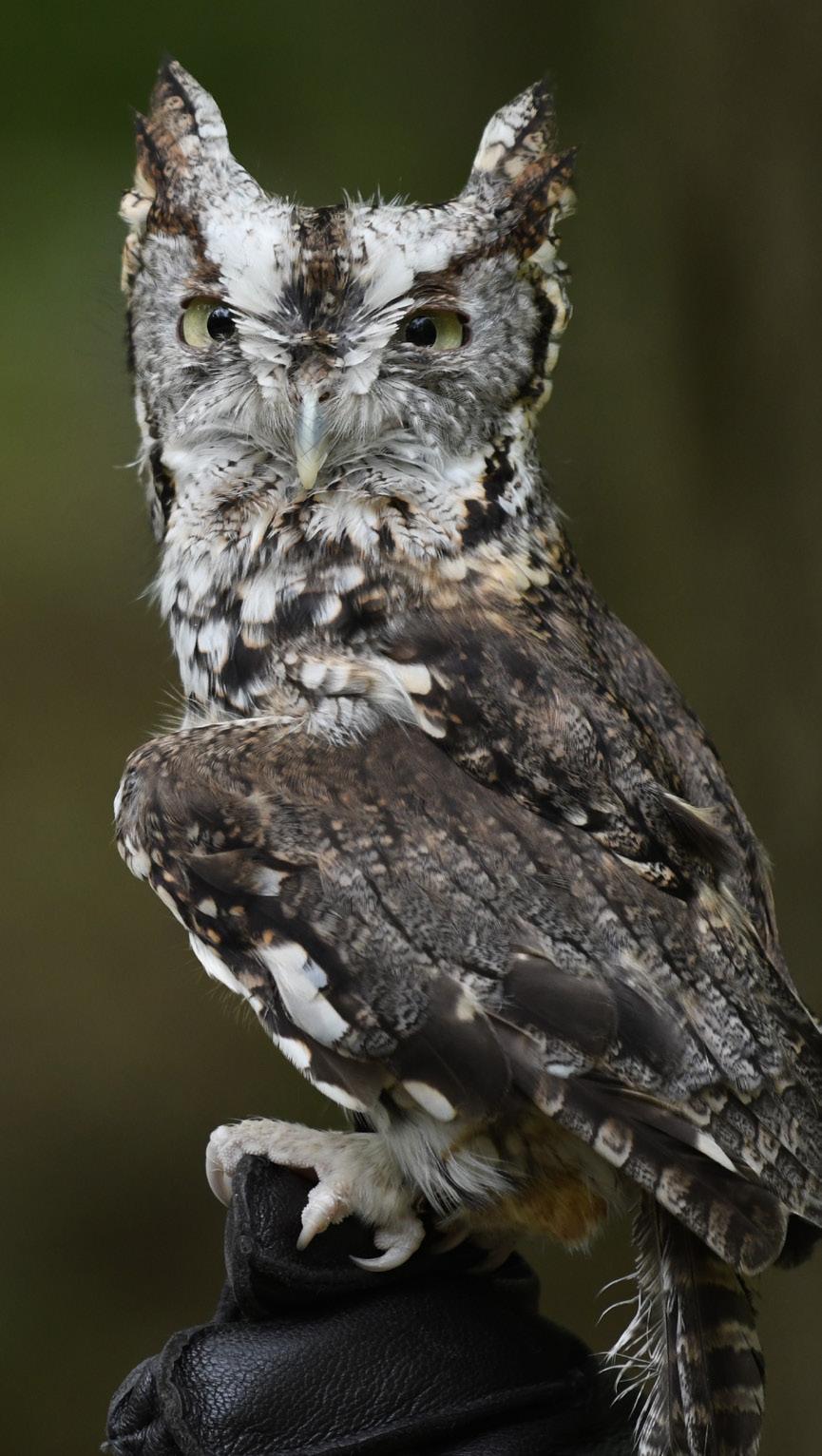
Put on your best costume and celebrate Owloween on the Mountain with creepy crawly cold-blooded creatures - slithery, scaly, and lots of legs! And of course get to learn all about owls and even meet one up close. Registration required.
LEAVE A LEGACY
Rick Holt
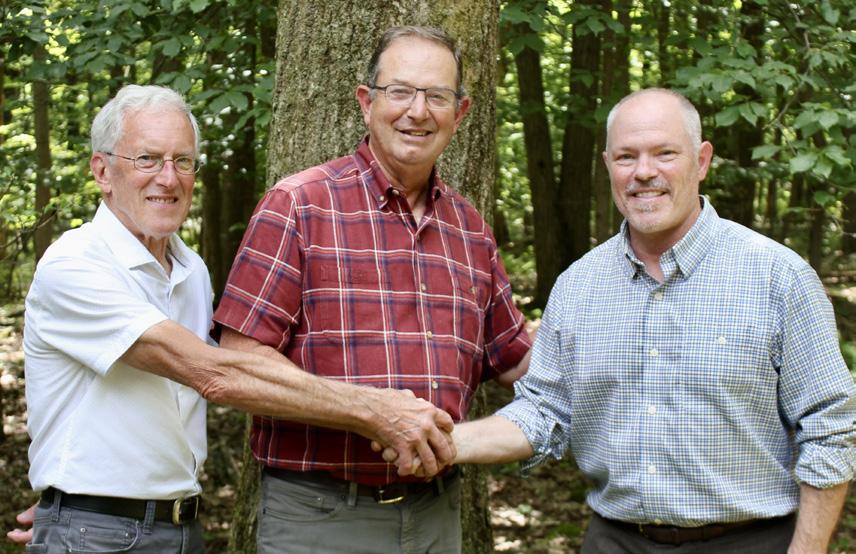
In his youth, Rick Holt spent considerable time at Hawk Mountain where he volunteered under Curator Maurice Broun and developed a passion for birds and raptors. The experience left a lasting impression, and that same passion lured him back in 2021 to serve on the board of directors. For two years, he listened and learned, and his understanding about the sheer magnitude and impact of Hawk Mountain programs, and the ripple effect of the Sanctuary and its trainees have on global raptor conservation, inspired him to act.
With a strong wish to make a major financial contribution during his lifetime, Rick and his family made the caring decision to help launch a capital campaign to revision and rebuild our aging Visitor Center, along with an additional gift to build the Education Endowment. Thanks to the Holts’ vision and commitment, Rick and his wife Michele joined the ranks of the Rosalie Edge Society.
While Rick has worked with many nonprofits, he believes Hawk Mountain is
exemplary in terms of staying focused on its mission and continuing a remarkable trajectory of accomplishments.
“Hawk Mountain has been a great place for 90 years, and seeing how the organization has made an impact on raptor conservation locally, regionally, nationally, and globally over this timeframe is beyond impressive,” he said. Learn More or Share Your Story Today: Mary Linkevich, Director of Development 610-756-6000 x212 linkevich@hawkmountain.org
Hawk Mountain is the best investment in conservation today.
Statement of Operating | Revenue and Expense
Fiscal Year April 1, 2023 - March 31, 2024
REVENUE
Membership Dues
Admission Fees
Bookstore Net Sales
Fees
income
Note depreciation is included in above numbers FY 2023-2024
Hawk Mountain Sanctuary received a clean opinion from the auditing firm Baker Tilly Virchow Krause, LLP. Of particular interest is that 81 cents of every dollar received goes directly to support Sanctuary research and education programs.
Stephen Hamm & Sons
By Gigi Romano
Raised in Kempton with a grandmother in Drehersville, Stephen Hamm has always been familiar with Hawk Mountain Sanctuary. As a child, he remembers being puzzled by the people sitting on the Mountain, staring at birds, until he later received a clearer understanding when Jim Brett and his family started volunteering at the Kempton Fire Company.
Steve’s journey as a volunteer at Hawk Mountain began in the fall of 1991, initially helping with parking. Over the years, his involvement grew to include various projects, even cooking meals for board meetings.
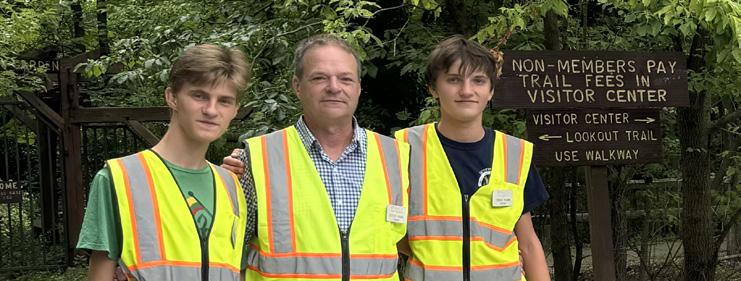
One memorable Thanksgiving, he and John Hobdell were roped into helping with the hawk count. When Steve needed to stay with his sons on the weekends due to a change in his wife’s work schedule in 2016, Director of Stewardship Todd Bauman invited his sons Lukas and Tomas to join him, sporting vests and waving at visitors, proving that volunteering can be a family affair.
Steve’s favorite part of volunteering at Hawk Mountain is the sense of community. “Meeting visitors and catching up with staff and volunteers on fall weekends; it’s like an extended family reunion,” he says. He also enjoys interacting with the diverse trainees
from all around the world as they visit to train at the Sanctuary.
When convincing someone to visit Hawk Mountain for the first time, Steve recommends the South Lookout. Sitting there for just a few minutes and taking in the surroundings will create an experience that he can guarantee: “If you don’t feel a connection, I’ll personally refund your money.” One of his standout memories is standing in front of the Visitor Center on a late January Saturday. With snow on the ground, no wind, and total silence, he watched the orange glow of the sunset through the trees and enjoyed a moment of pure tranquility.
In closing, Steve echoes the sentiment of former volunteer coordinator Susan Wolfe: “The reason most people don’t volunteer is they weren’t asked.” He urges everyone to consider volunteering, even just a handful of days each year, to make a significant impact on the Mountain, its visitors, and themselves.
We rely on volunteers to assist in the day-to-day happenings of the Sanctuary and would love to find a space for you on our team. If interested, contact Tammy Jandrasitz at jandrasitz@hawkmountain.org.
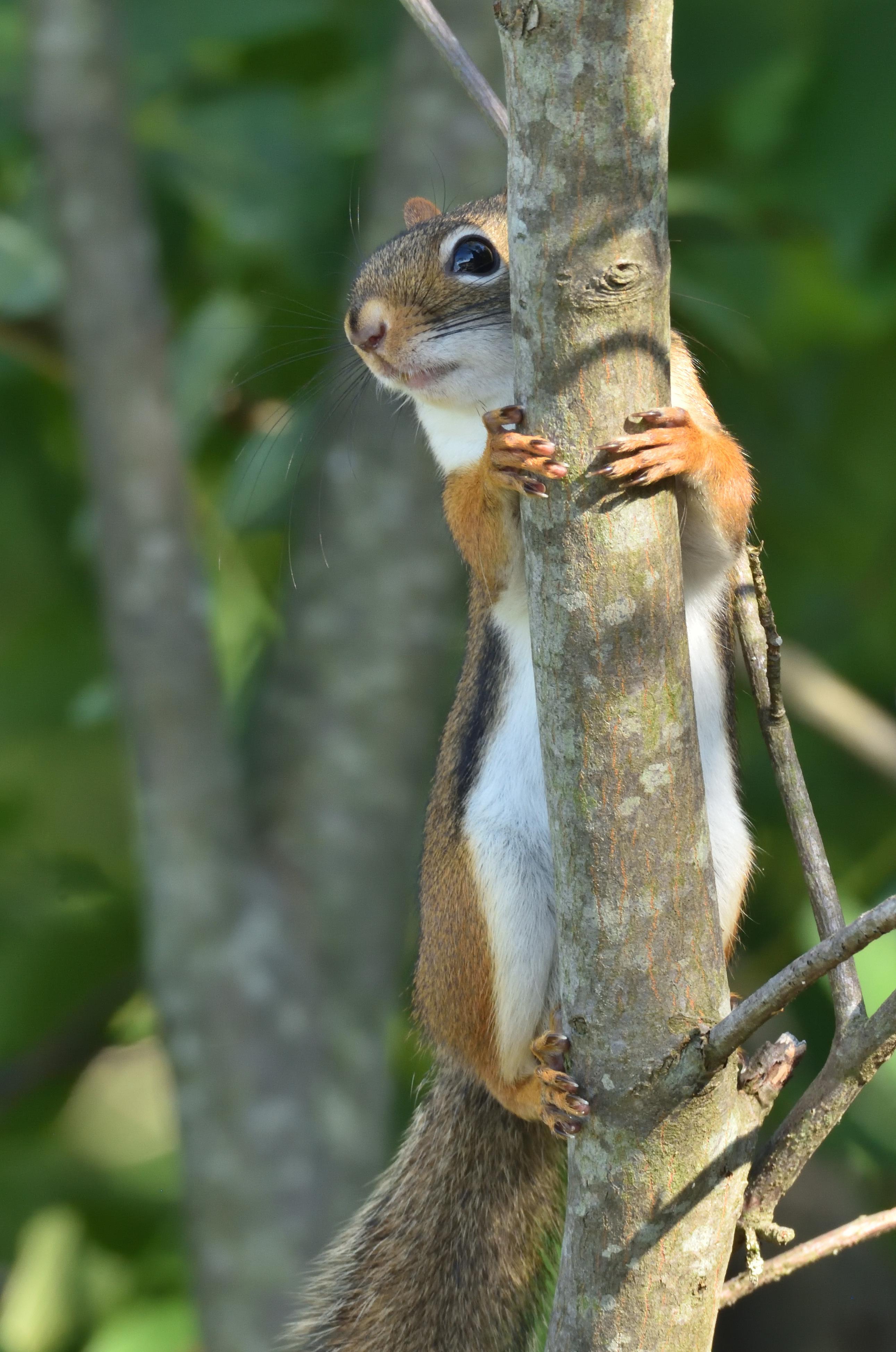
Red Squirrel spotted at Bald Lookout by Bill Moses